Painted Gray:Planned Parenthood and the Privatization of Narratives of Female Reproductive Control
Planned Parenthood’s Mission:“to provide comprehensive reproductive and complementary health care services in settings which preserve and protect the essential privacyand rights of each individual to advocate public policies which guarantee these rights and ensure access to such services”
A Project Begins. . .“Initially – the first time I visited a Planned Parenthood clinic as a solicitor of that hard-won control – I appreciated the privacy.  Nineteen and terrified, for some reason, that a teacher, or school chum, or anyone in my hometown really would see me walk through the mirrored doors and admit that I wanted to be sexual and not be a mother.  In retrospect, however, I see the dilemma appreciation of privacy presents for the future women who enter the spaces of clinics.  The longer we hold our breath and hurry between the alley parking and the discreet entrance, the longer we invent ourselves as a counterpublic who ought to be ashamed and secretive and abnormal.”
“For women the measure of intimacy has been the measure of oppression.  This is why feminism has had to explode the private.  This is why feminism has seen the personal as the political.”  - Catherine MacKinnon
Notions of Public and Private. . .HabermasCapitalism catalyzes creation of a “bourgeois public sphere” – citizens coming together to articulate the larger needs of a civil societyPublic, Habermas labels it, connotes “openness” and accessibilityBenhabib“All struggles against oppression in the modern world begin by redefining what had previously been considered private, nonpublic, and nonpolitical issues as matters of public concern, issues of justice, and sites of power that need discursive legitimation.”FraserWomen often then form "Subaltern counterpublics" that are "parallel discursive arenas where members of subordinated social groups invent and circulate counterdiscourses to formulate oppositional interpretations of their identities, interests, and needs”.Warner“The Public” is imaginary, but “endowed with legitimacy”Counterpublics are “defined by their tension” with a larger, dominant public
And so. . .Women seeking control over human reproduction are counterpublics (and often even subaltern counterpublics)In order to legitimate female reproductive health care and control, we must consider “going public” with “oppositional interpretations”
Why Consider Space?Foucault:Institutional spaces can be understood as metaphors for how power works within a society that architects them.. It is space itself that participates in the “constant division between the normal and the abnormal”Harvey:outlines the “core features of capitalist mode of production” and attempts to answer the problem of “a ‘spatial fix’ to the internal contradictions of capitalism” and the uneven “accumulation of capital” Porter:“institutions can be sensitized to users, to people, systemically from within and that this sensitizing can potentially change the way an entire industry perceives its relationship to the public”
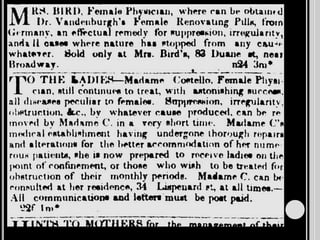
A History Fixed in the Spaces of clinics:Initially the legal rhetoric regarding abortion empowered women; a pregnancy could legally and morally be terminated before “quickening” or movement of the fetus was felt.  But the only person who could determine this, essentially was the mother herself.1879 Comstock Law criminalizes “indecent” public rhetoric of contraceptive methodsBy 1900 physicians had successfully argued that “abortion was both morally wrong and medically dangerous.” Most of these men were elite, “regular” physicians associated with university-based medical schools.  They claimed that “they were obliged to save women from their own ignorance because only physicians were in possession of scientific evidence” that abortion is immoral. (21)  Abortion is outlawed in all fifty states.Male physicians and legislators privatize reproductive control. Woman becomes “patient” and the “doctor knows best” construction of future Roe vs. Wade language is established. (Gibson)Female physicians continue to advertise methods for reproductive control
How space silences narrative and why it mattersNarrative and story telling have historically been used by women to offer “oppositional interpretations”
Sanger, Steinem, and the Red Stockings Speak Outs – narrative at work
“Going public,” according to Baumgardner, “strengthens a pro choice political position”
“Demystifying” what happens behind the mirrored windows can help position Planned Parenthood’s services as “public” and therefore legitimated

Painted Gray

  • 1.
    Painted Gray:Planned Parenthoodand the Privatization of Narratives of Female Reproductive Control
  • 2.
    Planned Parenthood’s Mission:“toprovide comprehensive reproductive and complementary health care services in settings which preserve and protect the essential privacyand rights of each individual to advocate public policies which guarantee these rights and ensure access to such services”
  • 3.
    A Project Begins.. .“Initially – the first time I visited a Planned Parenthood clinic as a solicitor of that hard-won control – I appreciated the privacy. Nineteen and terrified, for some reason, that a teacher, or school chum, or anyone in my hometown really would see me walk through the mirrored doors and admit that I wanted to be sexual and not be a mother. In retrospect, however, I see the dilemma appreciation of privacy presents for the future women who enter the spaces of clinics. The longer we hold our breath and hurry between the alley parking and the discreet entrance, the longer we invent ourselves as a counterpublic who ought to be ashamed and secretive and abnormal.”
  • 8.
    “For women themeasure of intimacy has been the measure of oppression. This is why feminism has had to explode the private. This is why feminism has seen the personal as the political.” - Catherine MacKinnon
  • 9.
    Notions of Publicand Private. . .HabermasCapitalism catalyzes creation of a “bourgeois public sphere” – citizens coming together to articulate the larger needs of a civil societyPublic, Habermas labels it, connotes “openness” and accessibilityBenhabib“All struggles against oppression in the modern world begin by redefining what had previously been considered private, nonpublic, and nonpolitical issues as matters of public concern, issues of justice, and sites of power that need discursive legitimation.”FraserWomen often then form "Subaltern counterpublics" that are "parallel discursive arenas where members of subordinated social groups invent and circulate counterdiscourses to formulate oppositional interpretations of their identities, interests, and needs”.Warner“The Public” is imaginary, but “endowed with legitimacy”Counterpublics are “defined by their tension” with a larger, dominant public
  • 10.
    And so. ..Women seeking control over human reproduction are counterpublics (and often even subaltern counterpublics)In order to legitimate female reproductive health care and control, we must consider “going public” with “oppositional interpretations”
  • 11.
    Why Consider Space?Foucault:Institutionalspaces can be understood as metaphors for how power works within a society that architects them.. It is space itself that participates in the “constant division between the normal and the abnormal”Harvey:outlines the “core features of capitalist mode of production” and attempts to answer the problem of “a ‘spatial fix’ to the internal contradictions of capitalism” and the uneven “accumulation of capital” Porter:“institutions can be sensitized to users, to people, systemically from within and that this sensitizing can potentially change the way an entire industry perceives its relationship to the public”
  • 12.
    A History Fixedin the Spaces of clinics:Initially the legal rhetoric regarding abortion empowered women; a pregnancy could legally and morally be terminated before “quickening” or movement of the fetus was felt. But the only person who could determine this, essentially was the mother herself.1879 Comstock Law criminalizes “indecent” public rhetoric of contraceptive methodsBy 1900 physicians had successfully argued that “abortion was both morally wrong and medically dangerous.” Most of these men were elite, “regular” physicians associated with university-based medical schools. They claimed that “they were obliged to save women from their own ignorance because only physicians were in possession of scientific evidence” that abortion is immoral. (21) Abortion is outlawed in all fifty states.Male physicians and legislators privatize reproductive control. Woman becomes “patient” and the “doctor knows best” construction of future Roe vs. Wade language is established. (Gibson)Female physicians continue to advertise methods for reproductive control
  • 14.
    How space silencesnarrative and why it mattersNarrative and story telling have historically been used by women to offer “oppositional interpretations”
  • 15.
    Sanger, Steinem, andthe Red Stockings Speak Outs – narrative at work
  • 16.
    “Going public,” accordingto Baumgardner, “strengthens a pro choice political position”
  • 17.
    “Demystifying” what happensbehind the mirrored windows can help position Planned Parenthood’s services as “public” and therefore legitimated