TEAM SYNERGY
INDUSTRY - PAINTS AND VARNISHES
GROUP MEMBERS
SHIVANI KHADYE
NIKUNJ MUNDHARA
ABHIJEET BOSE
SIDDHESH DESAI
PREEYAM TOLIA
The Indian paint industry is over 100 years old. Its beginning can be traced back to the setting up of a factory by
Shalimar Paints in Calcutta (now Kolkata) in 1902.
Until World War II, the industry consisted of small producers and two foreign companies. After the war, the imports
stopped, which led to the setting up of manufacturing facilities by local entrepreneurs.
The paints was generally imported from the Britain. Due the 2nd world war many company entered in India like
Goodlass Wall(1918), Elephant Oil Mills (1917).
Asian Paints & Kansai Nerolac came into picture after the post independence.
The Indian Paint Association (IPA) is a national body which represents both the Organized Sector and the Small Sector .
IPA was founded by amalgamating the former two associations, Indian paint Manufacturers Association and Paint
Federation on 1st July, 1960.
After liberalization, In the 1990s, helped by a growing economy, the Indian paint industry recorded a healthy growth of
12-13% annually. This was mainly due to a drastic reduction in excise from a staggering 40% to 16%. However, the
growth was restricted in 2002-03 to single digits. There was a revival in 2003-04 with a robust growth of 13%.
» As with other industries the paint sector comprises of players from the regional as well as the
international landscape. Traditionally the industry had been dominated by the unorganized sector, but
with the foray of foreign firms as well as the rapid industrialization there has been a restructuring.
» Currently the organized players account for 65% of the market, while the remaining belonging to the
unorganized firms. The unorganized sector comprises of around 2000 small scale paint units.
» Top Five players are estimated to control>80% of the organized market.
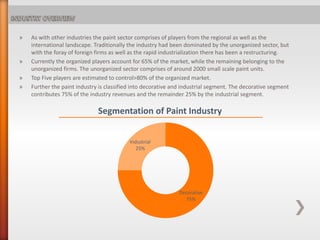
» Further the paint industry is classified into decorative and industrial segment. The decorative segment
contributes 75% of the industry revenues and the remainder 25% by the industrial segment.
Decorative
75%
Industrial
25%
Segmentation of Paint Industry
» The current market structure of the decorative paint industry is an oligopoly. Typically the characteristics
are high barriers to entry due to large capital outlays. Therefore the existing players remain well insulated
with respect to new entrants maintaining relatively stronger pricing power. Demand for decorative paints
arises from household painting, architectural and other display purposes. Demand in the festive season
(September-December) is significant, as compared to other periods. This segment is price sensitive and is
a higher margin business as compared to industrial segment.
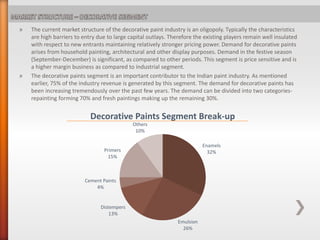
» The decorative paints segment is an important contributor to the Indian paint industry. As mentioned
earlier, 75% of the industry revenue is generated by this segment. The demand for decorative paints has
been increasing tremendously over the past few years. The demand can be divided into two categories-
repainting forming 70% and fresh paintings making up the remaining 30%.
Enamels
32%
Emulsion
26%
Distempers
13%
Cement Paints
4%
Primers
15%
Others
10%
Decorative Paints Segment Break-up
Demand Drivers:
» Rapid urbanization
⇒ Greater proportion of the population migrating to cities, due to better opportunities.
⇒ Easy availability of financing for housing loans.
⇒ All in all higher demand for residential housing.
» Increase in purchasing power across various income groups.
» Fast changing rural market and rapidly developing Tier I and Tier II cities.
» Reduced duration of repainting cycles, has further prompted customers to use paint more frequently.
» Spurt in commercial construction fuelled by rampant economic growth. The new government’s goal of
developing 100 smart cities and affordable housing schemes will led to growth in this sector.
Recent Developments:
» Firms have also been investing heavily in building strong distribution networks spreading across the
nation. This will enable them to penetrate deeper into the rural markets where their presence is weak and
will also help improve customer service at various points of sales.
» The main drivers for the urban customers are premium products while for the rural market the shift is
towards the organized sector. Currently the rural and urban markets contribute 45% and 55% respectively.
» The industrial paints segment of the market remains to be dominated by foreign firms. With a
technological advantage over its peers, this segment continues to attract competition. Hence the pricing
power remains week and margins are slumped making it even more sensitive to the changes in input
prices.
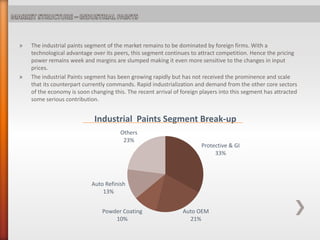
» The industrial Paints segment has been growing rapidly but has not received the prominence and scale
that its counterpart currently commands. Rapid industrialization and demand from the other core sectors
of the economy is soon changing this. The recent arrival of foreign players into this segment has attracted
some serious contribution.
Protective & GI
33%
Auto OEM
21%
Powder Coating
10%
Auto Refinish
13%
Others
23%
Industrial Paints Segment Break-up
Demand Drivers:
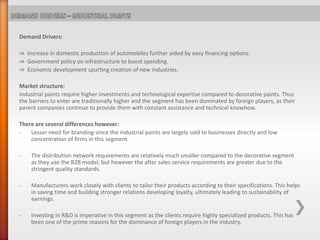
⇒ Increase in domestic production of automobiles further aided by easy financing options.
⇒ Government policy on infrastructure to boost spending.
⇒ Economic development spurting creation of new industries.
Market structure:
Industrial paints require higher investments and technological expertise compared to decorative paints. Thus
the barriers to enter are traditionally higher and the segment has been dominated by foreign players, as their
parent companies continue to provide them with constant assistance and technical knowhow.
There are several differences however:
- Lesser need for branding-since the industrial paints are largely sold to businesses directly and low
concentration of firms in this segment.
- The distribution network requirements are relatively much smaller compared to the decorative segment
as they use the B2B model, but however the after sales service requirements are greater due to the
stringent quality standards.
- Manufacturers work closely with clients to tailor their products according to their specifications. This helps
in saving time and building stronger relations developing loyalty, ultimately leading to sustainability of
earnings.
- Investing in R&D is imperative in this segment as the clients require highly specialized products. This has
been one of the prime reasons for the dominance of foreign players in the industry.
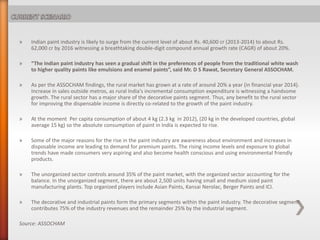
» Indian paint industry is likely to surge from the current level of about Rs. 40,600 cr (2013-2014) to about Rs.
62,000 cr by 2016 witnessing a breathtaking double-digit compound annual growth rate (CAGR) of about 20%.
» “The Indian paint industry has seen a gradual shift in the preferences of people from the traditional white wash
to higher quality paints like emulsions and enamel paints”, said Mr. D S Rawat, Secretary General ASSOCHAM.
» As per the ASSOCHAM findings, the rural market has grown at a rate of around 20% a year (in financial year 2014).
Increase in sales outside metros, as rural India's incremental consumption expenditure is witnessing a handsome
growth. The rural sector has a major share of the decorative paints segment. Thus, any benefit to the rural sector
for improving the dispensable income is directly co-related to the growth of the paint industry.
» At the moment Per capita consumption of about 4 kg (2.3 kg in 2012), (20 kg in the developed countries, global
average 15 kg) so the absolute consumption of paint in India is expected to rise.
» Some of the major reasons for the rise in the paint industry are awareness about environment and increases in
disposable income are leading to demand for premium paints. The rising income levels and exposure to global
trends have made consumers very aspiring and also become health conscious and using environmental friendly
products.
» The unorganized sector controls around 35% of the paint market, with the organized sector accounting for the
balance. In the unorganized segment, there are about 2,500 units having small and medium sized paint
manufacturing plants. Top organized players include Asian Paints, Kansai Nerolac, Berger Paints and ICI.
» The decorative and industrial paints form the primary segments within the paint industry. The decorative segment
contributes 75% of the industry revenues and the remainder 25% by the industrial segment.
Source: ASSOCHAM
Threat of New entrants: Paint market in India is dominated by few players (Oligopoly), making it difficult for
anyone newly entering the industry to compete. It is estimated that 18-20% of the total raw materials used in
the industry are imported, Working capital needed is high-causes difficulty to local players & big firms enjoy
economies of scale. Big players have high brand image & quality products & good promotional activities to
attract customer. Threat of new entrants is Low.
Availability of substitutes: In rural areas lime wash is used as substitute. Another alternative for decorative wall
paints available today is Wallpaper. Buyers propensity of substitute is low.
Bargaining power of suppliers: Raw material intensive production- over 300 raw materials make the final
product. Titanium Dioxide is one of the key pigment used in he production of paint and is facing a global supply
shortage. Thus supplier of this material has solid bargaining power. Other raw materials-crude derivatives
(50%) have high price fluctuations affecting industry profits. Bargaining power of suppliers is Medium.
Bargaining power of Buyers: while the unorganized market is highly fragmented with over 2,000 players the
buyers have the choice to go for other companies. However the leading Industrial paint suppliers have their
expertise in their favour, which limits the bargaining power of buyers. The pricing strategy is oriented to
middle/lower end consumers.
Competition: 65% of the paint market is organized. The organized market is highly concentrated and a classic
example of an oligopoly, where entry barriers are high and the ‘top-5’ players capture most of the market.
Competitive rivalry is Low
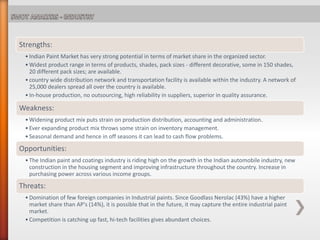
Strengths:
•Indian Paint Market has very strong potential in terms of market share in the organized sector.
•Widest product range in terms of products, shades, pack sizes - different decorative, some in 150 shades,
20 different pack sizes; are available.
•country wide distribution network and transportation facility is available within the industry. A network of
25,000 dealers spread all over the country is available.
•In-house production, no outsourcing, high reliability in suppliers, superior in quality assurance.
Weakness:
•Widening product mix puts strain on production distribution, accounting and administration.
•Ever expanding product mix throws some strain on inventory management.
•Seasonal demand and hence in off seasons it can lead to cash flow problems.
Opportunities:
•The Indian paint and coatings industry is riding high on the growth in the Indian automobile industry, new
construction in the housing segment and improving infrastructure throughout the country. Increase in
purchasing power across various income groups.
Threats:
•Domination of few foreign companies in Industrial paints. Since Goodlass Nerolac (43%) have a higher
market share than AP's (14%), it is possible that in the future, it may capture the entire industrial paint
market.
•Competition is catching up fast, hi-tech facilities gives abundant choices.
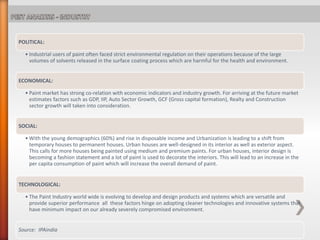
POLITICAL:
• Industrial users of paint often faced strict environmental regulation on their operations because of the large
volumes of solvents released in the surface coating process which are harmful for the health and environment.
ECONOMICAL:
• Paint market has strong co-relation with economic indicators and industry growth. For arriving at the future market
estimates factors such as GDP, IIP, Auto Sector Growth, GCF (Gross capital formation), Realty and Construction
sector growth will taken into consideration.
SOCIAL:
• With the young demographics (60%) and rise in disposable income and Urbanization is leading to a shift from
temporary houses to permanent houses. Urban houses are well-designed in its interior as well as exterior aspect.
This calls for more houses being painted using medium and premium paints. For urban houses, interior design is
becoming a fashion statement and a lot of paint is used to decorate the interiors. This will lead to an increase in the
per capita consumption of paint which will increase the overall demand of paint.
TECHNOLOGICAL:
• The Paint Industry world wide is evolving to develop and design products and systems which are versatile and
provide superior performance all these factors hinge on adopting cleaner technologies and innovative systems that
have minimum impact on our already severely compromised environment.
Source: IPAindia
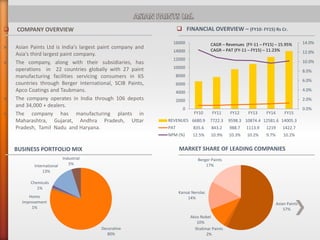
 COMPANY OVERVIEW
» Asian Paints Ltd is India's largest paint company and
Asia's third largest paint company.
» The company, along with their subsidiaries, has
operations in 22 countries globally with 27 paint
manufacturing facilities servicing consumers in 65
countries through Berger International, SCIB Paints,
Apco Coatings and Taubmans.
» The company operates in India through 106 depots
and 34,000 + dealers.
» The company has manufacturing plants in
Maharashtra, Gujarat, Andhra Pradesh, Uttar
Pradesh, Tamil Nadu and Haryana.
0.0%
2.0%
4.0%
6.0%
8.0%
10.0%
12.0%
14.0%
0
2000
4000
6000
8000
10000
12000
14000
16000
FY10 FY11 FY12 FY13 FY14 FY15
REVENUES 6680.9 7722.3 9598.3 10874.4 12581.6 14005.3
PAT 835.6 843.2 988.7 1113.9 1219 1422.7
NPM (%) 12.5% 10.9% 10.3% 10.2% 9.7% 10.2%
CAGR – Revenues (FY-11 – FY15) – 15.95%
CAGR – PAT (FY-11 – FY15) – 11.23%
Decorative
80%
Chemicals
1%
Home
Improvement
1%
International
13%
Industrial
5%
BUSINESS PORTFOLIO MIX
Asian Paints
57%
Shalimar Paints
2%
Akzo Nobel
10%
Kansai Nerolac
14%
Berger Paints
17%
MARKET SHARE OF LEADING COMPANIES
 FINANCIAL OVERVIEW – (FY10- FY15) Rs Cr.
43.8% 42.1%
39.8% 41.0% 41.7%
18.4% 17.2% 15.4% 15.3% 14.8%
0.0%
10.0%
20.0%
30.0%
40.0%
50.0%
FY10 FY11 FY12 FY13 FY14
GP Margin % EBITDA Margin %
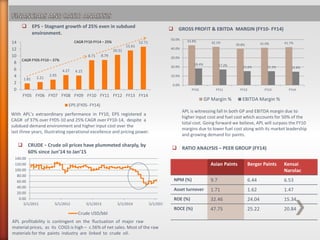
APL is witnessing fall In both GP and EBITDA margin due to
higher input cost and fuel cost which accounts for 50% of the
total cost. Going forward we believe, APL will surpass the FY10
margins due to lower fuel cost along with its market leadership
and growing demand for paints.
1.81 2.21
2.93
4.27 4.15
8.71 8.79
10.31
11.61
12.71
0
2
4
6
8
10
12
14
FY05 FY06 FY07 FY08 FY09 FY10 FY11 FY12 FY13 FY14
EPS (FY05- FY14)
CAGR FY05-FY10 – 37%
CAGR FY10-FY14 – 25%
With APL’s extraordinary performance in FY10, EPS registered a
CAGR of 37% over FY05-10 and 25% CAGR over FY10-14, despite a
subdued demand environment and higher input cost over the
last three years, illustrating operational excellence and pricing power.
0.00
20.00
40.00
60.00
80.00
100.00
120.00
140.00
5/1/2011 5/1/2012 5/1/2013 5/1/2014 5/1/2015
Crude USD/bbl
APL profitability is contingent on the fluctuation of major raw
material prices, as its COGS is high – c.56% of net sales. Most of the raw
materials for the paints industry are linked to crude oil.
Asian Paints Berger Paints Kensai
Narolac
NPM (%) 9.7 6.44 6.53
Asset turnover 1.71 1.62 1.47
ROE (%) 32.46 24.04 15.34
ROCE (%) 47.75 25.22 20.84
 RATIO ANALYSIS – PEER GROUP (FY14)
 EPS - Stagnant growth of 25% even in subdued
environment.
 GROSS PROFIT & EBITDA MARGIN (FY10- FY14)
 CRUDE - Crude oil prices have plummeted sharply, by
60% since Jun’14 to Jan’15
14% 10%
0
5% 15%
45%
81% 75%
55%
0%
20%
40%
60%
80%
100%
Asian Paints Berger Paints Kansai Nerolac
Others Industrial Decorative
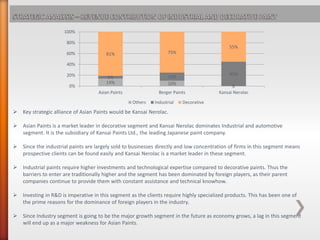
 Key strategic alliance of Asian Paints would be Kansai Nerolac.
 Asian Paints is a market leader in decorative segment and Kansai Nerolac dominates Industrial and automotive
segment. It is the subsidiary of Kansai Paints Ltd., the leading Japanese paint company.
 Since the industrial paints are largely sold to businesses directly and low concentration of firms in this segment means
prospective clients can be found easily and Kansai Nerolac is a market leader in these segment.
 Industrial paints require higher investments and technological expertise compared to decorative paints. Thus the
barriers to enter are traditionally higher and the segment has been dominated by foreign players, as their parent
companies continue to provide them with constant assistance and technical knowhow.
 Investing in R&D is imperative in this segment as the clients require highly specialized products. This has been one of
the prime reasons for the dominance of foreign players in the industry.
 Since Industry segment is going to be the major growth segment in the future as economy grows, a lag in this segment
will end up as a major weakness for Asian Paints.
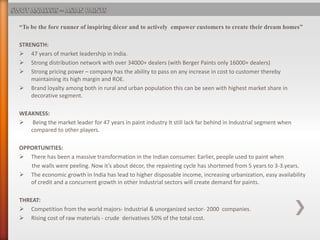
“To be the fore runner of inspiring décor and to actively empower customers to create their dream homes”
STRENGTH:
 47 years of market leadership in India.
 Strong distribution network with over 34000+ dealers (with Berger Paints only 16000+ dealers)
 Strong pricing power – company has the ability to pass on any increase in cost to customer thereby
maintaining its high margin and ROE.
 Brand loyalty among both in rural and urban population this can be seen with highest market share in
decorative segment.
WEAKNESS:
 Being the market leader for 47 years in paint industry It still lack far behind in Industrial segment when
compared to other players.
OPPORTUNITIES:
 There has been a massive transformation in the Indian consumer. Earlier, people used to paint when
the walls were peeling. Now it’s about décor, the repainting cycle has shortened from 5 years to 3-3.years.
 The economic growth in India has lead to higher disposable income, increasing urbanization, easy availability
of credit and a concurrent growth in other Industrial sectors will create demand for paints.
THREAT:
 Competition from the world majors- Industrial & unorganized sector- 2000 companies.
 Rising cost of raw materials - crude derivatives 50% of the total cost.
The Leading Brand in the sector:
• Asian Paints carries out regular training programs for painters especially for its more sophisticated emulsion products like Royale Play.
A list of such trained painters is available to customers to ensure high quality standards are maintained. Asian Paints has leveraged its
focus on consumer preference by providing consultation services ‘ Home Solutions’ through opening of stores such as Color Ideas,
Kids World and signature stores expose the customers to entire range of products by giving them look and feel of various options
available.
Superior supply chain management:
• The company invested in implementation of supply chain management software from i2 technologies and enterprise resource
planning solutions from SAP. This led to the integration of manufacturing plants, regional distribution centers and processing centers,
thereby simplifying the tracking of demand and inventory levels across the country. These helped the company to improve accuracy of
demand forecasts (lower inventory and lower WC) and track performance of dealers, take corrective actions and incentivize high
performing dealers.
• 10 years ago Asian Paints would supply stocks to dealers in select tier 1 cities within a day (versus 4-5 days for peers), now the
turnaround time has been reduced to 3-4 hours (versus 1-2 days for its peers).
The Best management team in the sector:
• Asian Paints is the only paints company in the sector which has not seen a change in its controlling shareholder(promoter) over the
past 70 years. All its competitors have seen: a) change in controlling shareholder and; b) significant presence of foreign entity on the
board of directors. This consistency at the Board level has helped Asian Paints maintain focus on execution of a stable long term
strategy.
• The company has always focused on hiring and retaining high quality professionals. For example it was recruiting graduates from
India’s elite business schools even in 1970s. As a result, the middle management team at Asian Paints usually includes relatively young
professionals who are in the age group of 40-45 years at the same time have had experience of 15-20 years in the industry.
THANK YOU

paint industry

  • 1.
    TEAM SYNERGY INDUSTRY -PAINTS AND VARNISHES GROUP MEMBERS SHIVANI KHADYE NIKUNJ MUNDHARA ABHIJEET BOSE SIDDHESH DESAI PREEYAM TOLIA
  • 2.
    The Indian paintindustry is over 100 years old. Its beginning can be traced back to the setting up of a factory by Shalimar Paints in Calcutta (now Kolkata) in 1902. Until World War II, the industry consisted of small producers and two foreign companies. After the war, the imports stopped, which led to the setting up of manufacturing facilities by local entrepreneurs. The paints was generally imported from the Britain. Due the 2nd world war many company entered in India like Goodlass Wall(1918), Elephant Oil Mills (1917). Asian Paints & Kansai Nerolac came into picture after the post independence. The Indian Paint Association (IPA) is a national body which represents both the Organized Sector and the Small Sector . IPA was founded by amalgamating the former two associations, Indian paint Manufacturers Association and Paint Federation on 1st July, 1960. After liberalization, In the 1990s, helped by a growing economy, the Indian paint industry recorded a healthy growth of 12-13% annually. This was mainly due to a drastic reduction in excise from a staggering 40% to 16%. However, the growth was restricted in 2002-03 to single digits. There was a revival in 2003-04 with a robust growth of 13%.
  • 3.
    » As withother industries the paint sector comprises of players from the regional as well as the international landscape. Traditionally the industry had been dominated by the unorganized sector, but with the foray of foreign firms as well as the rapid industrialization there has been a restructuring. » Currently the organized players account for 65% of the market, while the remaining belonging to the unorganized firms. The unorganized sector comprises of around 2000 small scale paint units. » Top Five players are estimated to control>80% of the organized market. » Further the paint industry is classified into decorative and industrial segment. The decorative segment contributes 75% of the industry revenues and the remainder 25% by the industrial segment. Decorative 75% Industrial 25% Segmentation of Paint Industry
  • 4.
    » The currentmarket structure of the decorative paint industry is an oligopoly. Typically the characteristics are high barriers to entry due to large capital outlays. Therefore the existing players remain well insulated with respect to new entrants maintaining relatively stronger pricing power. Demand for decorative paints arises from household painting, architectural and other display purposes. Demand in the festive season (September-December) is significant, as compared to other periods. This segment is price sensitive and is a higher margin business as compared to industrial segment. » The decorative paints segment is an important contributor to the Indian paint industry. As mentioned earlier, 75% of the industry revenue is generated by this segment. The demand for decorative paints has been increasing tremendously over the past few years. The demand can be divided into two categories- repainting forming 70% and fresh paintings making up the remaining 30%. Enamels 32% Emulsion 26% Distempers 13% Cement Paints 4% Primers 15% Others 10% Decorative Paints Segment Break-up
  • 5.
    Demand Drivers: » Rapidurbanization ⇒ Greater proportion of the population migrating to cities, due to better opportunities. ⇒ Easy availability of financing for housing loans. ⇒ All in all higher demand for residential housing. » Increase in purchasing power across various income groups. » Fast changing rural market and rapidly developing Tier I and Tier II cities. » Reduced duration of repainting cycles, has further prompted customers to use paint more frequently. » Spurt in commercial construction fuelled by rampant economic growth. The new government’s goal of developing 100 smart cities and affordable housing schemes will led to growth in this sector. Recent Developments: » Firms have also been investing heavily in building strong distribution networks spreading across the nation. This will enable them to penetrate deeper into the rural markets where their presence is weak and will also help improve customer service at various points of sales. » The main drivers for the urban customers are premium products while for the rural market the shift is towards the organized sector. Currently the rural and urban markets contribute 45% and 55% respectively.
  • 6.
    » The industrialpaints segment of the market remains to be dominated by foreign firms. With a technological advantage over its peers, this segment continues to attract competition. Hence the pricing power remains week and margins are slumped making it even more sensitive to the changes in input prices. » The industrial Paints segment has been growing rapidly but has not received the prominence and scale that its counterpart currently commands. Rapid industrialization and demand from the other core sectors of the economy is soon changing this. The recent arrival of foreign players into this segment has attracted some serious contribution. Protective & GI 33% Auto OEM 21% Powder Coating 10% Auto Refinish 13% Others 23% Industrial Paints Segment Break-up
  • 7.
    Demand Drivers: ⇒ Increasein domestic production of automobiles further aided by easy financing options. ⇒ Government policy on infrastructure to boost spending. ⇒ Economic development spurting creation of new industries. Market structure: Industrial paints require higher investments and technological expertise compared to decorative paints. Thus the barriers to enter are traditionally higher and the segment has been dominated by foreign players, as their parent companies continue to provide them with constant assistance and technical knowhow. There are several differences however: - Lesser need for branding-since the industrial paints are largely sold to businesses directly and low concentration of firms in this segment. - The distribution network requirements are relatively much smaller compared to the decorative segment as they use the B2B model, but however the after sales service requirements are greater due to the stringent quality standards. - Manufacturers work closely with clients to tailor their products according to their specifications. This helps in saving time and building stronger relations developing loyalty, ultimately leading to sustainability of earnings. - Investing in R&D is imperative in this segment as the clients require highly specialized products. This has been one of the prime reasons for the dominance of foreign players in the industry.
  • 8.
    » Indian paintindustry is likely to surge from the current level of about Rs. 40,600 cr (2013-2014) to about Rs. 62,000 cr by 2016 witnessing a breathtaking double-digit compound annual growth rate (CAGR) of about 20%. » “The Indian paint industry has seen a gradual shift in the preferences of people from the traditional white wash to higher quality paints like emulsions and enamel paints”, said Mr. D S Rawat, Secretary General ASSOCHAM. » As per the ASSOCHAM findings, the rural market has grown at a rate of around 20% a year (in financial year 2014). Increase in sales outside metros, as rural India's incremental consumption expenditure is witnessing a handsome growth. The rural sector has a major share of the decorative paints segment. Thus, any benefit to the rural sector for improving the dispensable income is directly co-related to the growth of the paint industry. » At the moment Per capita consumption of about 4 kg (2.3 kg in 2012), (20 kg in the developed countries, global average 15 kg) so the absolute consumption of paint in India is expected to rise. » Some of the major reasons for the rise in the paint industry are awareness about environment and increases in disposable income are leading to demand for premium paints. The rising income levels and exposure to global trends have made consumers very aspiring and also become health conscious and using environmental friendly products. » The unorganized sector controls around 35% of the paint market, with the organized sector accounting for the balance. In the unorganized segment, there are about 2,500 units having small and medium sized paint manufacturing plants. Top organized players include Asian Paints, Kansai Nerolac, Berger Paints and ICI. » The decorative and industrial paints form the primary segments within the paint industry. The decorative segment contributes 75% of the industry revenues and the remainder 25% by the industrial segment. Source: ASSOCHAM
  • 9.
    Threat of Newentrants: Paint market in India is dominated by few players (Oligopoly), making it difficult for anyone newly entering the industry to compete. It is estimated that 18-20% of the total raw materials used in the industry are imported, Working capital needed is high-causes difficulty to local players & big firms enjoy economies of scale. Big players have high brand image & quality products & good promotional activities to attract customer. Threat of new entrants is Low. Availability of substitutes: In rural areas lime wash is used as substitute. Another alternative for decorative wall paints available today is Wallpaper. Buyers propensity of substitute is low. Bargaining power of suppliers: Raw material intensive production- over 300 raw materials make the final product. Titanium Dioxide is one of the key pigment used in he production of paint and is facing a global supply shortage. Thus supplier of this material has solid bargaining power. Other raw materials-crude derivatives (50%) have high price fluctuations affecting industry profits. Bargaining power of suppliers is Medium. Bargaining power of Buyers: while the unorganized market is highly fragmented with over 2,000 players the buyers have the choice to go for other companies. However the leading Industrial paint suppliers have their expertise in their favour, which limits the bargaining power of buyers. The pricing strategy is oriented to middle/lower end consumers. Competition: 65% of the paint market is organized. The organized market is highly concentrated and a classic example of an oligopoly, where entry barriers are high and the ‘top-5’ players capture most of the market. Competitive rivalry is Low
  • 10.
    Strengths: •Indian Paint Markethas very strong potential in terms of market share in the organized sector. •Widest product range in terms of products, shades, pack sizes - different decorative, some in 150 shades, 20 different pack sizes; are available. •country wide distribution network and transportation facility is available within the industry. A network of 25,000 dealers spread all over the country is available. •In-house production, no outsourcing, high reliability in suppliers, superior in quality assurance. Weakness: •Widening product mix puts strain on production distribution, accounting and administration. •Ever expanding product mix throws some strain on inventory management. •Seasonal demand and hence in off seasons it can lead to cash flow problems. Opportunities: •The Indian paint and coatings industry is riding high on the growth in the Indian automobile industry, new construction in the housing segment and improving infrastructure throughout the country. Increase in purchasing power across various income groups. Threats: •Domination of few foreign companies in Industrial paints. Since Goodlass Nerolac (43%) have a higher market share than AP's (14%), it is possible that in the future, it may capture the entire industrial paint market. •Competition is catching up fast, hi-tech facilities gives abundant choices.
  • 11.
    POLITICAL: • Industrial usersof paint often faced strict environmental regulation on their operations because of the large volumes of solvents released in the surface coating process which are harmful for the health and environment. ECONOMICAL: • Paint market has strong co-relation with economic indicators and industry growth. For arriving at the future market estimates factors such as GDP, IIP, Auto Sector Growth, GCF (Gross capital formation), Realty and Construction sector growth will taken into consideration. SOCIAL: • With the young demographics (60%) and rise in disposable income and Urbanization is leading to a shift from temporary houses to permanent houses. Urban houses are well-designed in its interior as well as exterior aspect. This calls for more houses being painted using medium and premium paints. For urban houses, interior design is becoming a fashion statement and a lot of paint is used to decorate the interiors. This will lead to an increase in the per capita consumption of paint which will increase the overall demand of paint. TECHNOLOGICAL: • The Paint Industry world wide is evolving to develop and design products and systems which are versatile and provide superior performance all these factors hinge on adopting cleaner technologies and innovative systems that have minimum impact on our already severely compromised environment. Source: IPAindia
  • 12.
     COMPANY OVERVIEW »Asian Paints Ltd is India's largest paint company and Asia's third largest paint company. » The company, along with their subsidiaries, has operations in 22 countries globally with 27 paint manufacturing facilities servicing consumers in 65 countries through Berger International, SCIB Paints, Apco Coatings and Taubmans. » The company operates in India through 106 depots and 34,000 + dealers. » The company has manufacturing plants in Maharashtra, Gujarat, Andhra Pradesh, Uttar Pradesh, Tamil Nadu and Haryana. 0.0% 2.0% 4.0% 6.0% 8.0% 10.0% 12.0% 14.0% 0 2000 4000 6000 8000 10000 12000 14000 16000 FY10 FY11 FY12 FY13 FY14 FY15 REVENUES 6680.9 7722.3 9598.3 10874.4 12581.6 14005.3 PAT 835.6 843.2 988.7 1113.9 1219 1422.7 NPM (%) 12.5% 10.9% 10.3% 10.2% 9.7% 10.2% CAGR – Revenues (FY-11 – FY15) – 15.95% CAGR – PAT (FY-11 – FY15) – 11.23% Decorative 80% Chemicals 1% Home Improvement 1% International 13% Industrial 5% BUSINESS PORTFOLIO MIX Asian Paints 57% Shalimar Paints 2% Akzo Nobel 10% Kansai Nerolac 14% Berger Paints 17% MARKET SHARE OF LEADING COMPANIES  FINANCIAL OVERVIEW – (FY10- FY15) Rs Cr.
  • 13.
    43.8% 42.1% 39.8% 41.0%41.7% 18.4% 17.2% 15.4% 15.3% 14.8% 0.0% 10.0% 20.0% 30.0% 40.0% 50.0% FY10 FY11 FY12 FY13 FY14 GP Margin % EBITDA Margin % APL is witnessing fall In both GP and EBITDA margin due to higher input cost and fuel cost which accounts for 50% of the total cost. Going forward we believe, APL will surpass the FY10 margins due to lower fuel cost along with its market leadership and growing demand for paints. 1.81 2.21 2.93 4.27 4.15 8.71 8.79 10.31 11.61 12.71 0 2 4 6 8 10 12 14 FY05 FY06 FY07 FY08 FY09 FY10 FY11 FY12 FY13 FY14 EPS (FY05- FY14) CAGR FY05-FY10 – 37% CAGR FY10-FY14 – 25% With APL’s extraordinary performance in FY10, EPS registered a CAGR of 37% over FY05-10 and 25% CAGR over FY10-14, despite a subdued demand environment and higher input cost over the last three years, illustrating operational excellence and pricing power. 0.00 20.00 40.00 60.00 80.00 100.00 120.00 140.00 5/1/2011 5/1/2012 5/1/2013 5/1/2014 5/1/2015 Crude USD/bbl APL profitability is contingent on the fluctuation of major raw material prices, as its COGS is high – c.56% of net sales. Most of the raw materials for the paints industry are linked to crude oil. Asian Paints Berger Paints Kensai Narolac NPM (%) 9.7 6.44 6.53 Asset turnover 1.71 1.62 1.47 ROE (%) 32.46 24.04 15.34 ROCE (%) 47.75 25.22 20.84  RATIO ANALYSIS – PEER GROUP (FY14)  EPS - Stagnant growth of 25% even in subdued environment.  GROSS PROFIT & EBITDA MARGIN (FY10- FY14)  CRUDE - Crude oil prices have plummeted sharply, by 60% since Jun’14 to Jan’15
  • 14.
    14% 10% 0 5% 15% 45% 81%75% 55% 0% 20% 40% 60% 80% 100% Asian Paints Berger Paints Kansai Nerolac Others Industrial Decorative  Key strategic alliance of Asian Paints would be Kansai Nerolac.  Asian Paints is a market leader in decorative segment and Kansai Nerolac dominates Industrial and automotive segment. It is the subsidiary of Kansai Paints Ltd., the leading Japanese paint company.  Since the industrial paints are largely sold to businesses directly and low concentration of firms in this segment means prospective clients can be found easily and Kansai Nerolac is a market leader in these segment.  Industrial paints require higher investments and technological expertise compared to decorative paints. Thus the barriers to enter are traditionally higher and the segment has been dominated by foreign players, as their parent companies continue to provide them with constant assistance and technical knowhow.  Investing in R&D is imperative in this segment as the clients require highly specialized products. This has been one of the prime reasons for the dominance of foreign players in the industry.  Since Industry segment is going to be the major growth segment in the future as economy grows, a lag in this segment will end up as a major weakness for Asian Paints.
  • 15.
    “To be thefore runner of inspiring décor and to actively empower customers to create their dream homes” STRENGTH:  47 years of market leadership in India.  Strong distribution network with over 34000+ dealers (with Berger Paints only 16000+ dealers)  Strong pricing power – company has the ability to pass on any increase in cost to customer thereby maintaining its high margin and ROE.  Brand loyalty among both in rural and urban population this can be seen with highest market share in decorative segment. WEAKNESS:  Being the market leader for 47 years in paint industry It still lack far behind in Industrial segment when compared to other players. OPPORTUNITIES:  There has been a massive transformation in the Indian consumer. Earlier, people used to paint when the walls were peeling. Now it’s about décor, the repainting cycle has shortened from 5 years to 3-3.years.  The economic growth in India has lead to higher disposable income, increasing urbanization, easy availability of credit and a concurrent growth in other Industrial sectors will create demand for paints. THREAT:  Competition from the world majors- Industrial & unorganized sector- 2000 companies.  Rising cost of raw materials - crude derivatives 50% of the total cost.
  • 16.
    The Leading Brandin the sector: • Asian Paints carries out regular training programs for painters especially for its more sophisticated emulsion products like Royale Play. A list of such trained painters is available to customers to ensure high quality standards are maintained. Asian Paints has leveraged its focus on consumer preference by providing consultation services ‘ Home Solutions’ through opening of stores such as Color Ideas, Kids World and signature stores expose the customers to entire range of products by giving them look and feel of various options available. Superior supply chain management: • The company invested in implementation of supply chain management software from i2 technologies and enterprise resource planning solutions from SAP. This led to the integration of manufacturing plants, regional distribution centers and processing centers, thereby simplifying the tracking of demand and inventory levels across the country. These helped the company to improve accuracy of demand forecasts (lower inventory and lower WC) and track performance of dealers, take corrective actions and incentivize high performing dealers. • 10 years ago Asian Paints would supply stocks to dealers in select tier 1 cities within a day (versus 4-5 days for peers), now the turnaround time has been reduced to 3-4 hours (versus 1-2 days for its peers). The Best management team in the sector: • Asian Paints is the only paints company in the sector which has not seen a change in its controlling shareholder(promoter) over the past 70 years. All its competitors have seen: a) change in controlling shareholder and; b) significant presence of foreign entity on the board of directors. This consistency at the Board level has helped Asian Paints maintain focus on execution of a stable long term strategy. • The company has always focused on hiring and retaining high quality professionals. For example it was recruiting graduates from India’s elite business schools even in 1970s. As a result, the middle management team at Asian Paints usually includes relatively young professionals who are in the age group of 40-45 years at the same time have had experience of 15-20 years in the industry.
  • 17.