NYS Workers Compensation - 101


     William S Jones- Jones Jones LLC
New York Workers’ Compensation Law
In New York, certain injuries and illnesses that occur while an employee is
on the job qualify for workers’ compensation benefits.
-“Injury” and “personal illness” mean only accidental injuries arising out of and in the
court of employment
- While the injury may be physical, or at least in some circumstance mental, there must
be some direct relationship between the injury or disease and the employment
- Liability for workers’ compensation benefits are imposed on the employer without
regard to the existence of fault, however, the employer’s liability to the injured
employee generally extends no further.
So, Who’s Covered?
Today, virtually all employees, other than casual
laborers, babysitters, real-estate brokers, and certain
other sales associates, are covered under the New
York Workers’ Compensation Law.


*Additionally, independent contractors are not
entitled to workers’ compensation benefits unless
covered by their own policies of insurance
The Initial Investigation

  ANCR – The foundation for each and
  every claim! But what does this mean??

  1- A = Accident
  2- N = Notice
  3- CR = Causal Relationship
Things to look for when investigating a claim
•   Was the accident witnessed?
•   Was the accident reported immediately?
•   Who was first notice given to?
•   On what day did the accident occur and how long was the claimant employed?
•   Did all the facts and events make sense?
•   Was the claimant known to be disgruntled?
•   Was the claimant treated for this accident and/or a similar injury or illness in the past?


    What if something doesn’t add up… What then??
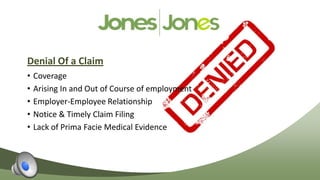
Denial Of a Claim
•   Coverage
•   Arising In and Out of Course of employment
•   Employer-Employee Relationship
•   Notice & Timely Claim Filing
•   Lack of Prima Facie Medical Evidence
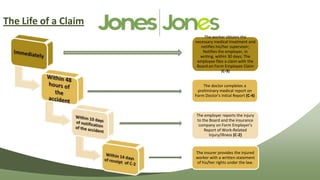
The Life of a Claim
                          The worker obtains the
                      necessary medical treatment and
                         notifies his/her supervisor;
                          Notifies the employer, in
                        writing, within 30 days; The
                       employee files a claim with the
                       Board on Form Employee Claim
                                     (C-3)


                          The doctor completes a
                       preliminary medical report on
                      Form Doctor's Initial Report (C-4)


                      The employer reports the injury
                      to the Board and the insurance
                       company on Form Employer's
                          Report of Work-Related
                             Injury/Illness (C-2)


                      The insurer provides the injured
                      worker with a written statement
                      of his/her rights under the law.
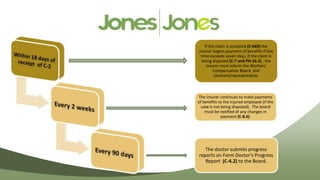
If the claim is accepted (C-669) the
insurer begins payment of benefits if lost
 time exceeds seven days. If the claim is
  being disputed (C-7 and PH-16.2) , the
    insurer must inform the Workers'
        Compensation Board and
         claimant/representative.


The insurer continues to make payments
of benefits to the injured employee (if the
  case is not being disputed). The board
    must be notified of any changes in
              payment (C-8.6).


   The doctor submits progress
reports on Form Doctor's Progress
   Report (C-4.2) to the Board.
Finally! Our world is safe and our claims are under
                  control… Right?
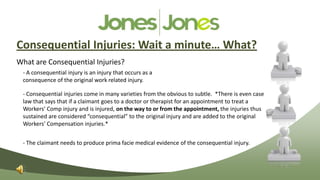
Consequential Injuries: Wait a minute… What?
What are Consequential Injuries?
 - A consequential injury is an injury that occurs as a
 consequence of the original work related injury.

 - Consequential injuries come in many varieties from the obvious to subtle. *There is even case
 law that says that if a claimant goes to a doctor or therapist for an appointment to treat a
 Workers’ Comp injury and is injured, on the way to or from the appointment, the injuries thus
 sustained are considered “consequential” to the original injury and are added to the original
 Workers’ Compensation injuries.*


 - The claimant needs to produce prima facie medical evidence of the consequential injury.
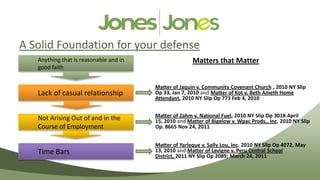
A Solid Foundation for your defense
   Anything that is reasonable and in                  Matters that Matter
   good faith


                                        Matter of Jaquin v. Community Covenant Church , 2010 NY Slip
   Lack of casual relationship          Op 33, Jan 7, 2010 and Matter of Kot v. Beth Ameth Home
                                        Attendant, 2010 NY Slip Op 773 Feb 4, 2010


   Not Arising Out of and in the        Matter of Zahm v. National Fuel, 2010 NY Slip Op 3018 April
                                        15, 2010 and Matter of Bigelow v. Wpac Prods., Inc. 2010 NY Slip
   Course of Employment                 Op. 8665 Nov 24, 2011


                                        Matter of Yarleque v. Sally Lou, Inc. 2010 NY Slip Op 4072, May
   Time Bars                            13, 2010 and Matter of Lavigne v. Peru Central School
                                        District, 2011 NY Slip Op 2089; March 24, 2011
For additional Workers Compensation
Information, please visit our new Webpage
@ WWW.JONESJONESLLC.COM

Comp 101

  • 1.
    NYS Workers Compensation- 101 William S Jones- Jones Jones LLC
  • 2.
    New York Workers’Compensation Law In New York, certain injuries and illnesses that occur while an employee is on the job qualify for workers’ compensation benefits. -“Injury” and “personal illness” mean only accidental injuries arising out of and in the court of employment - While the injury may be physical, or at least in some circumstance mental, there must be some direct relationship between the injury or disease and the employment - Liability for workers’ compensation benefits are imposed on the employer without regard to the existence of fault, however, the employer’s liability to the injured employee generally extends no further.
  • 3.
    So, Who’s Covered? Today,virtually all employees, other than casual laborers, babysitters, real-estate brokers, and certain other sales associates, are covered under the New York Workers’ Compensation Law. *Additionally, independent contractors are not entitled to workers’ compensation benefits unless covered by their own policies of insurance
  • 4.
    The Initial Investigation ANCR – The foundation for each and every claim! But what does this mean?? 1- A = Accident 2- N = Notice 3- CR = Causal Relationship
  • 5.
    Things to lookfor when investigating a claim • Was the accident witnessed? • Was the accident reported immediately? • Who was first notice given to? • On what day did the accident occur and how long was the claimant employed? • Did all the facts and events make sense? • Was the claimant known to be disgruntled? • Was the claimant treated for this accident and/or a similar injury or illness in the past? What if something doesn’t add up… What then??
  • 6.
    Denial Of aClaim • Coverage • Arising In and Out of Course of employment • Employer-Employee Relationship • Notice & Timely Claim Filing • Lack of Prima Facie Medical Evidence
  • 7.
    The Life ofa Claim The worker obtains the necessary medical treatment and notifies his/her supervisor; Notifies the employer, in writing, within 30 days; The employee files a claim with the Board on Form Employee Claim (C-3) The doctor completes a preliminary medical report on Form Doctor's Initial Report (C-4) The employer reports the injury to the Board and the insurance company on Form Employer's Report of Work-Related Injury/Illness (C-2) The insurer provides the injured worker with a written statement of his/her rights under the law.
  • 8.
    If the claimis accepted (C-669) the insurer begins payment of benefits if lost time exceeds seven days. If the claim is being disputed (C-7 and PH-16.2) , the insurer must inform the Workers' Compensation Board and claimant/representative. The insurer continues to make payments of benefits to the injured employee (if the case is not being disputed). The board must be notified of any changes in payment (C-8.6). The doctor submits progress reports on Form Doctor's Progress Report (C-4.2) to the Board.
  • 9.
    Finally! Our worldis safe and our claims are under control… Right?
  • 10.
    Consequential Injuries: Waita minute… What? What are Consequential Injuries? - A consequential injury is an injury that occurs as a consequence of the original work related injury. - Consequential injuries come in many varieties from the obvious to subtle. *There is even case law that says that if a claimant goes to a doctor or therapist for an appointment to treat a Workers’ Comp injury and is injured, on the way to or from the appointment, the injuries thus sustained are considered “consequential” to the original injury and are added to the original Workers’ Compensation injuries.* - The claimant needs to produce prima facie medical evidence of the consequential injury.
  • 11.
    A Solid Foundationfor your defense Anything that is reasonable and in Matters that Matter good faith Matter of Jaquin v. Community Covenant Church , 2010 NY Slip Lack of casual relationship Op 33, Jan 7, 2010 and Matter of Kot v. Beth Ameth Home Attendant, 2010 NY Slip Op 773 Feb 4, 2010 Not Arising Out of and in the Matter of Zahm v. National Fuel, 2010 NY Slip Op 3018 April 15, 2010 and Matter of Bigelow v. Wpac Prods., Inc. 2010 NY Slip Course of Employment Op. 8665 Nov 24, 2011 Matter of Yarleque v. Sally Lou, Inc. 2010 NY Slip Op 4072, May Time Bars 13, 2010 and Matter of Lavigne v. Peru Central School District, 2011 NY Slip Op 2089; March 24, 2011
  • 12.
    For additional WorkersCompensation Information, please visit our new Webpage @ WWW.JONESJONESLLC.COM