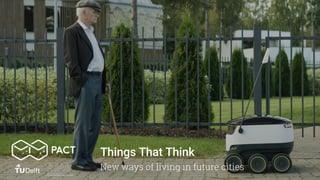
Things That Think
New ways of living in future cities
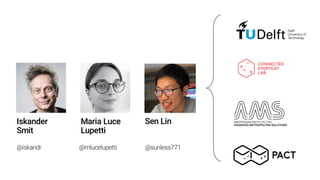
Iskander
Smit
Maria Luce
Lupetti
@iskandr @mlucelupetti
Sen Lin
@sunless771
Partnerships in Cities of Things
Affective Things
Iohanna Nicenboim, Elisa Giaccardi, 2017
Roboats
AMS & MIT Senseable Cities Lab
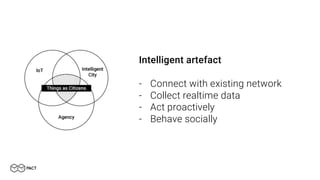
Intelligent artefact
- Connect with existing network
- Collect realtime data
- Act proactively
- Behave socially
Text
second part
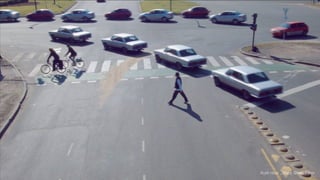
Rush Hour _ Black Sheep Films
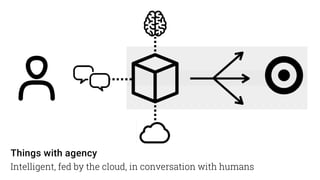
Things with agency
Intelligent, fed by the cloud, in conversation with humans
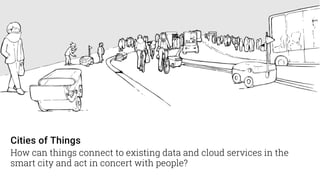
Cities of Things
How can things connect to existing data and cloud services in the
smart city and act in concert with people?
Paradigm #1
The smart city as a dashboard
- Awareness building
- Then back to policy and regulation
Air Quality apps
Plume Air Report
Paradigm #2
The smart city as
an intelligent infrastructure
- Mitigation (sensing + actuation)
- Opportunity for concerted action
Roboats flexible infrastructure
MIT Senseable City Lab
Paradigm #3
Cities of Things
- Things as social entities
- Cannot be controlled (like humans)
but can be governed
- Need for social contracts
(pacts, agreements)
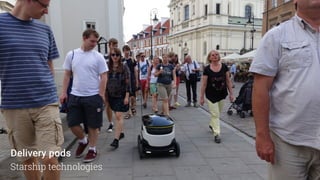
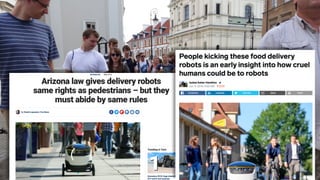
Delivery pods
Starship technologies
Delivery pods
Starship technologies
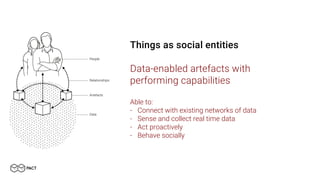
Things as social entities
Data-enabled artefacts with
performing capabilities
Able to:
- Connect with existing networks of data
- Sense and collect real time data
- Act proactively
- Behave socially
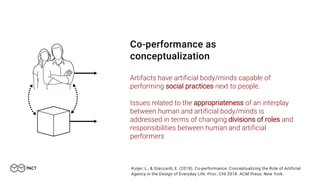
Co-performance as
conceptualization
Artifacts have artificial body/minds capable of
performing social practices next to people.
Issues related to the appropriateness of an interplay
between human and artificial body/minds is
addressed in terms of changing divisions of roles and
responsibilities between human and artificial
performers
Kuijer, L., & Giaccardi, E. (2018). Co-performance: Conceptualizing the Role of Artificial
Agency in the Design of Everyday Life. Proc. CHI 2018. ACM Press: New York.
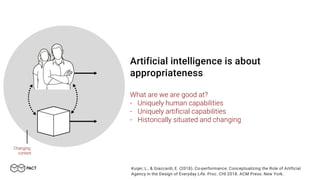
Artificial intelligence is about
appropriateness
What are we are good at?
- Uniquely human capabilities
- Uniquely artificial capabilities
- Historically situated and changing
Changing
context
Kuijer, L., & Giaccardi, E. (2018). Co-performance: Conceptualizing the Role of Artificial
Agency in the Design of Everyday Life. Proc. CHI 2018. ACM Press: New York.
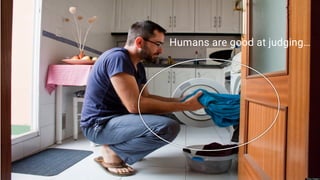
Humans are good at judging…
Machines are good at optimizing…
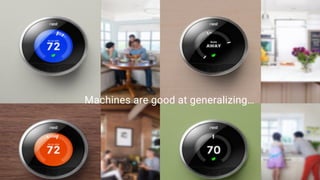
Machines are good at generalizing…
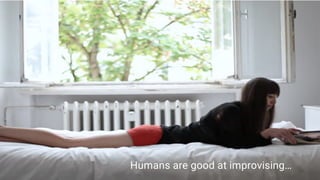
Humans are good at improvising…
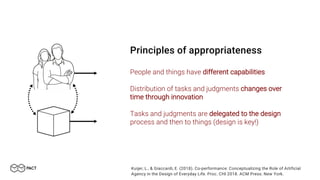
Principles of appropriateness
People and things have different capabilities
Distribution of tasks and judgments changes over
time through innovation
Tasks and judgments are delegated to the design
process and then to things (design is key!)
Kuijer, L., & Giaccardi, E. (2018). Co-performance: Conceptualizing the Role of Artificial
Agency in the Design of Everyday Life. Proc. CHI 2018. ACM Press: New York.
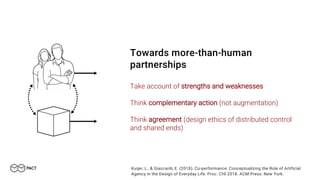
Towards more-than-human
partnerships
Take account of strengths and weaknesses
Think complementary action (not augmentation)
Think agreement (design ethics of distributed control
and shared ends)
Kuijer, L., & Giaccardi, E. (2018). Co-performance: Conceptualizing the Role of Artificial
Agency in the Design of Everyday Life. Proc. CHI 2018. ACM Press: New York.
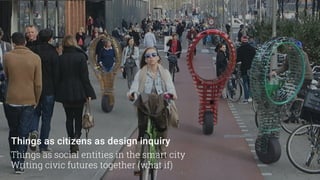
Things as citizens as design inquiry
Things as social entities in the smart city
Writing civic futures together (what if)
Louise Hugen, 2018
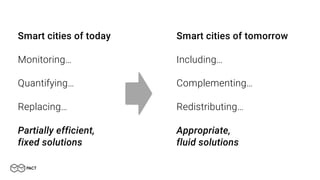
Smart cities of today
Monitoring…
Quantifying…
Replacing…
Partially efficient,
fixed solutions
Smart cities of tomorrow
Including…
Complementing…
Redistributing…
Appropriate,
fluid solutions
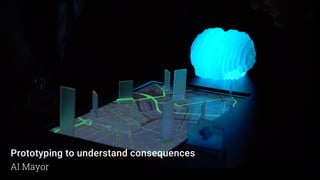
Prototyping to understand consequences
AI Mayor
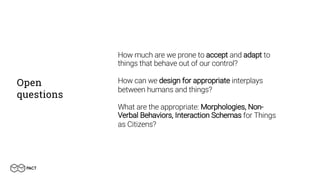
Open
questions
How much are we prone to accept and adapt to
things that behave out of our control?
How can we design for appropriate interplays
between humans and things?
What are the appropriate: Morphologies, Non-
Verbal Behaviors, Interaction Schemas for Things
as Citizens?
TaCIT
Things as Citizens Ideation Toolkit
A toolkit by M. L. Lupetti, for PACT project

Delft University of Technology
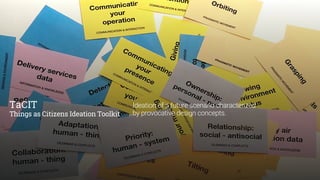
Ideation of a future scenario characterized
by provocative design concepts.
TaCIT
Things as Citizens Ideation Toolkit
TaCIT // M. L. Lupetti // Delft University of Technology
Aim of TaCIT
Identify different strategies
PREMISE
Identify different roles and values
Point out critical issues
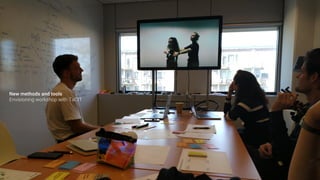
New methods and tools
Envisioning workshop with TaCIT
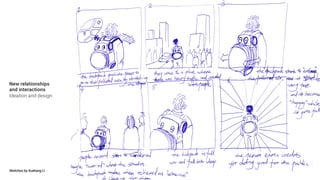
New relationships
and interactions
Ideation and design
Sketches by Xueliang Li
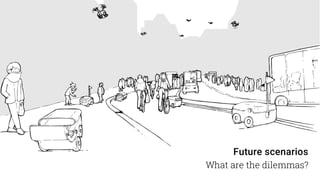
Future scenarios
What are the dilemmas?
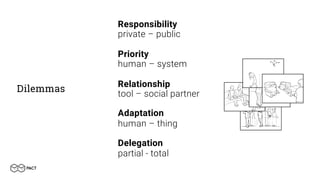
Dilemmas
Responsibility
private – public
Priority
human – system
Relationship
tool – social partner
Adaptation
human – thing
Delegation
partial - total
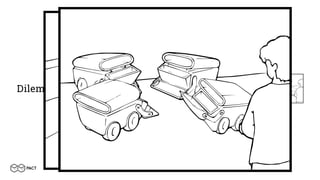
Dilemmas
Responsibility
private – public
Priority
human – system
Relationship
tool – social partner
Adaptation
human – thing
Delegation
partial - total
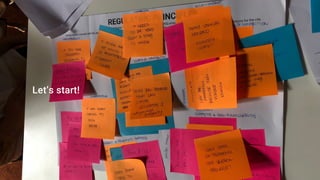
Let’s start!
Partnerships in Cities of Things

PACT workshop Border Sessions 2018