PACIFIC BROADCASTING ISSUES
15 May 2015
Today’s Discussion Points
• Digital Switchover and the New Zealand
Experience
• Intellectual property (IP) and its protection
New Zealand Experience
• Went digital from September 2012 –
December 2013
• Going Digital campaign
• 1.5 million television homes
• Commercial premises – schools and
universities, hospitals, prisons, businesses,
hotels, motels and taverns
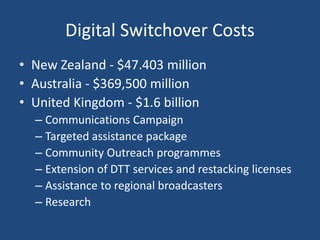
Digital Switchover Costs
• New Zealand - $47.403 million
• Australia - $369,500 million
• United Kingdom - $1.6 billion
– Communications Campaign
– Targeted assistance package
– Community Outreach programmes
– Extension of DTT services and restacking licenses
– Assistance to regional broadcasters
– Research
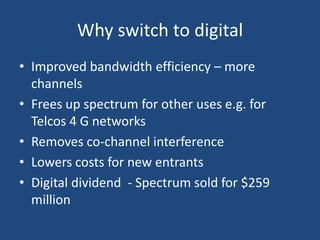
Why switch to digital
• Improved bandwidth efficiency – more
channels
• Frees up spectrum for other uses e.g. for
Telcos 4 G networks
• Removes co-channel interference
• Lowers costs for new entrants
• Digital dividend - Spectrum sold for $259
million
And the consumer?
• Requires a new digital ready television or:
• A set-top-box
• Delivers better picture and audio quality
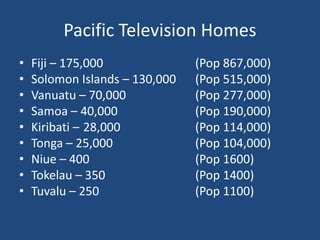
Pacific Television Homes
• Fiji – 175,000 (Pop 867,000)
• Solomon Islands – 130,000 (Pop 515,000)
• Vanuatu – 70,000 (Pop 277,000)
• Samoa – 40,000 (Pop 190,000)
• Kiribati – 28,000 (Pop 114,000)
• Tonga – 25,000 (Pop 104,000)
• Niue – 400 (Pop 1600)
• Tokelau – 350 (Pop 1400)
• Tuvalu – 250 (Pop 1100)
Efficient use of capital?
• Who pays
• Government?
• Broadcasters?
• Consumers?
• Capital cost of equipment
• Lower populations – higher cost per television
home
What are the alternatives?
• Do nothing
• Look at Mobile - penetration is high in the
Pacific
• Look at wireless internet connectivity
• Deliver audio and visual content via the
internet
Emerging technologies
• EMBMS - Enabled Multimedia Broadcast
Multicast Services
• Reduces congestion
• 2G, 3G, 4G
• 5G next – more efficient
• New ways to connect mobile device to the TV
– Chromecast, 3G Wireless modem
Food for thought……
• Look at the alternatives as the Pacific is
already well served by mobile
• Should you leapfrog technologies to
mobile/wireless content delivery
• Look at the costs – cost benefit analysis
• Who pays?
• Are there any revenue opportunities?
The importance of IP
• Intellectual Property (IP) includes software,
hardware, content, music, usage rights etc
• Must protect both IP created by your citizens
& overseas IP licensed for use in your country
• If you can’t ensure IP protection, you risk
creative flight & exclusion from use
• This may impact on economic growth and
your citizens, especially as economies
transition to digital
Protecting Property Rights
• © and IP laws need to be updated for 21st
digital technologies
• Must be able to enforce these laws
• Businesses must deliver adequate Digital
Rights Management, geo-filtering, royalty
tracking & reporting etc
• Businesses must be helped to keep up with
rapid digital change
Fight Piracy
• Piracy is a critical issue for all IP owners
• 15% or more of global content revenues may
leak annually due to piracy
• Must be able to demonstrate that you are
fighting piracy
• Find ways to link in with what’s happening
overseas and show you support it
• Forewarned is forearmed
Summary
• Digital Switchover – consider the options
• Cost Benefit Analysis DSO Vs ‘Techno
Leapfrog’
• Don’t rush into this – you don’t need to
• Consumers are important
• IP – protect your own local content and IP
creators
QUESTIONS?

Pacific Broadcasting Issues

  • 1.
  • 2.
    Today’s Discussion Points •Digital Switchover and the New Zealand Experience • Intellectual property (IP) and its protection
  • 3.
    New Zealand Experience •Went digital from September 2012 – December 2013 • Going Digital campaign • 1.5 million television homes • Commercial premises – schools and universities, hospitals, prisons, businesses, hotels, motels and taverns
  • 4.
    Digital Switchover Costs •New Zealand - $47.403 million • Australia - $369,500 million • United Kingdom - $1.6 billion – Communications Campaign – Targeted assistance package – Community Outreach programmes – Extension of DTT services and restacking licenses – Assistance to regional broadcasters – Research
  • 5.
    Why switch todigital • Improved bandwidth efficiency – more channels • Frees up spectrum for other uses e.g. for Telcos 4 G networks • Removes co-channel interference • Lowers costs for new entrants • Digital dividend - Spectrum sold for $259 million
  • 6.
    And the consumer? •Requires a new digital ready television or: • A set-top-box • Delivers better picture and audio quality
  • 7.
    Pacific Television Homes •Fiji – 175,000 (Pop 867,000) • Solomon Islands – 130,000 (Pop 515,000) • Vanuatu – 70,000 (Pop 277,000) • Samoa – 40,000 (Pop 190,000) • Kiribati – 28,000 (Pop 114,000) • Tonga – 25,000 (Pop 104,000) • Niue – 400 (Pop 1600) • Tokelau – 350 (Pop 1400) • Tuvalu – 250 (Pop 1100)
  • 8.
    Efficient use ofcapital? • Who pays • Government? • Broadcasters? • Consumers? • Capital cost of equipment • Lower populations – higher cost per television home
  • 9.
    What are thealternatives? • Do nothing • Look at Mobile - penetration is high in the Pacific • Look at wireless internet connectivity • Deliver audio and visual content via the internet
  • 10.
    Emerging technologies • EMBMS- Enabled Multimedia Broadcast Multicast Services • Reduces congestion • 2G, 3G, 4G • 5G next – more efficient • New ways to connect mobile device to the TV – Chromecast, 3G Wireless modem
  • 11.
    Food for thought…… •Look at the alternatives as the Pacific is already well served by mobile • Should you leapfrog technologies to mobile/wireless content delivery • Look at the costs – cost benefit analysis • Who pays? • Are there any revenue opportunities?
  • 12.
    The importance ofIP • Intellectual Property (IP) includes software, hardware, content, music, usage rights etc • Must protect both IP created by your citizens & overseas IP licensed for use in your country • If you can’t ensure IP protection, you risk creative flight & exclusion from use • This may impact on economic growth and your citizens, especially as economies transition to digital
  • 13.
    Protecting Property Rights •© and IP laws need to be updated for 21st digital technologies • Must be able to enforce these laws • Businesses must deliver adequate Digital Rights Management, geo-filtering, royalty tracking & reporting etc • Businesses must be helped to keep up with rapid digital change
  • 14.
    Fight Piracy • Piracyis a critical issue for all IP owners • 15% or more of global content revenues may leak annually due to piracy • Must be able to demonstrate that you are fighting piracy • Find ways to link in with what’s happening overseas and show you support it • Forewarned is forearmed
  • 15.
    Summary • Digital Switchover– consider the options • Cost Benefit Analysis DSO Vs ‘Techno Leapfrog’ • Don’t rush into this – you don’t need to • Consumers are important • IP – protect your own local content and IP creators
  • 16.

Editor's Notes

  • #2 THANKS AND ACKNOWLEDGE SHANE AND PETER AND…………. WHY ME? – MINI BIO INFORMS AND ENTERTAINS PLAYS A KEY ROLE IN A DEMOCRACY
  • #12 TELCOS IN MEXICO AND SOME AFRICAN NATIONS – STRAIGHT TO MOBILE