Information Extraction System
Using Indoor Location and Activity
               Plan
               9th International Conference on Practical Applications
                         of Agents and Multi-Agent Systems
                                       6-8th April, 2011


                     Bjørn Grønbæk, Pedro Valente and Kasper Hallenborg
                          The Maersk Mc-Kinney Moller Institute, Odense, Denmark
                                    Special thanks to Shabbir Hossain


6 April 2011                                                                       1
Outline
•Problem domain
   • Context-aware
   • AAL Butler System
•Context scope
   • Architecture overview
   • AAL Butler Ontology
•Session participation
•System evaluation
•Conclusion and future work
6 April 2011                  2
Context-aware
       “Context is any information that can be used to
      characterize the situation of an entity” Dey(2001)

•Context-Aware components:
   • Sensing (input)– acquire data or information about
      physical world or some aspect of the physical world;
   • Thinking (reasoning)- make sense of it;
   • Acting (output) – Effectors and actions to be taken;
•Target: indoor environments tracking several persons
simultaneous (part of IntelliCare project).
•Scope: activity recognition.
6 April 2011                                                 3
AAL Butler System
•AAL Forum 2010 conference on Ambient
Assisted Living;
•3 days venue;
•7 session tracks;
•Space more than 7000 m2;
•Conference venue include 3 plenary
rooms, 10 session rooms, lunch and break
area, additional areas and corridors;
•Location sytem: WiFi EKAHAU RTLS;
•Created a private wireless network with
35 AP;
•Each participant carry a Wifi Badge tag;

6 April 2011                                4
Architecture overview
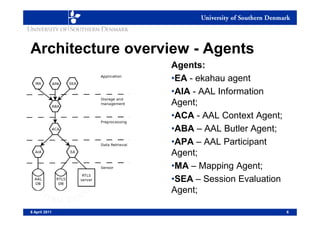
                  Layers:
                  •Sensor: logical and physical
     Acting       data sources;
                  •Data Retrieval: extract data
                  from sensors and match it with
      subsystem
       Thinking


                  context model;
                  •Preprocessing: contextual
                  information from multiple data
                  sources into a single context
                  source;
      subsystem
       Sensing


                  •Storage and management:
                  interface to applications;
                  •Application: target to end-
                  users;

6 April 2011                                       5
Architecture overview - Agents
                  Agents:
                  •EA - ekahau agent
                  •AIA - AAL Information
                  Agent;
                  •ACA - AAL Context Agent;
                  •ABA – AAL Butler Agent;
                  •APA – AAL Participant
                  Agent;
                  •MA – Mapping Agent;
                  •SEA – Session Evaluation
                  Agent;

6 April 2011                                  6
AAL Butler Ontology


 •Ontologies provide a comprehensive model of different
 types of context information, which can be used to describe
 situations for particular domains
 •Context information can be reasoned about in a logical
 way and different entities can understand and utilize the
 knowledge.
6 April 2011                                                   7
Session participation
•Aim: detect which session a
participant spend time in;
•We have used DBSCAN
datamining technique for
position classification into
clusters;
•Analyse each time slots
individually allows represent
time dimension;
•Each participant have their own
position cluster, for each session
time-slot;
6 April 2011                         8
System evaluation
•Live and historic position data
    • Have tracked 268 of 736 participants;
    • Collect 2.6 million position records;
•Session participation extraction
    • Each user represented as an agent in the system;
    • Each agent was able to keep track of the RTLS tag location;
    • Observe participant’s session history;
    • Perform a simple prediction on the next session;
•Indoor localization system: Ekahau RTLS
    • System accuracy decrease with user gathering
    • System calibration and AP signal coverage can influence
      clustering techniques;

6 April 2011                                                        9
Conclusion and future work
•Initial attempt at creating a system for providing contextual information on
persons or agents, based on their current and past location data;
•Aggregate time and space dimension with predefined knowledge on time
schedules and locations of activities;
•Describe an approach to do mapping between information presented as
predefined knowledge and the location data of a person using and ontology
based context model;
•We designed an agent-based system with cooperating agents, that used
context model to provide data access to the location of a person as well
person’s activities;
•Conduct a live experiment with multiple participants and large indoor
environment - collect data and provide user services during the venue;
•Next steps use BDI agent architecture, focus on prediction and
recommendation functionality;
•Convert this agent system to use in elder care environments focus on
activity support.
6 April 2011                                                                    10
Thank you for your attention


                     Email:
                  Pedro Valente
               prnv@mmmi.sdu.dk

6 April 2011                           11

Paams2011 pvalente-presentation-slides1

  • 1.
    Information Extraction System UsingIndoor Location and Activity Plan 9th International Conference on Practical Applications of Agents and Multi-Agent Systems 6-8th April, 2011 Bjørn Grønbæk, Pedro Valente and Kasper Hallenborg The Maersk Mc-Kinney Moller Institute, Odense, Denmark Special thanks to Shabbir Hossain 6 April 2011 1
  • 2.
    Outline •Problem domain • Context-aware • AAL Butler System •Context scope • Architecture overview • AAL Butler Ontology •Session participation •System evaluation •Conclusion and future work 6 April 2011 2
  • 3.
    Context-aware “Context is any information that can be used to characterize the situation of an entity” Dey(2001) •Context-Aware components: • Sensing (input)– acquire data or information about physical world or some aspect of the physical world; • Thinking (reasoning)- make sense of it; • Acting (output) – Effectors and actions to be taken; •Target: indoor environments tracking several persons simultaneous (part of IntelliCare project). •Scope: activity recognition. 6 April 2011 3
  • 4.
    AAL Butler System •AALForum 2010 conference on Ambient Assisted Living; •3 days venue; •7 session tracks; •Space more than 7000 m2; •Conference venue include 3 plenary rooms, 10 session rooms, lunch and break area, additional areas and corridors; •Location sytem: WiFi EKAHAU RTLS; •Created a private wireless network with 35 AP; •Each participant carry a Wifi Badge tag; 6 April 2011 4
  • 5.
    Architecture overview Layers: •Sensor: logical and physical Acting data sources; •Data Retrieval: extract data from sensors and match it with subsystem Thinking context model; •Preprocessing: contextual information from multiple data sources into a single context source; subsystem Sensing •Storage and management: interface to applications; •Application: target to end- users; 6 April 2011 5
  • 6.
    Architecture overview -Agents Agents: •EA - ekahau agent •AIA - AAL Information Agent; •ACA - AAL Context Agent; •ABA – AAL Butler Agent; •APA – AAL Participant Agent; •MA – Mapping Agent; •SEA – Session Evaluation Agent; 6 April 2011 6
  • 7.
    AAL Butler Ontology •Ontologies provide a comprehensive model of different types of context information, which can be used to describe situations for particular domains •Context information can be reasoned about in a logical way and different entities can understand and utilize the knowledge. 6 April 2011 7
  • 8.
    Session participation •Aim: detectwhich session a participant spend time in; •We have used DBSCAN datamining technique for position classification into clusters; •Analyse each time slots individually allows represent time dimension; •Each participant have their own position cluster, for each session time-slot; 6 April 2011 8
  • 9.
    System evaluation •Live andhistoric position data • Have tracked 268 of 736 participants; • Collect 2.6 million position records; •Session participation extraction • Each user represented as an agent in the system; • Each agent was able to keep track of the RTLS tag location; • Observe participant’s session history; • Perform a simple prediction on the next session; •Indoor localization system: Ekahau RTLS • System accuracy decrease with user gathering • System calibration and AP signal coverage can influence clustering techniques; 6 April 2011 9
  • 10.
    Conclusion and futurework •Initial attempt at creating a system for providing contextual information on persons or agents, based on their current and past location data; •Aggregate time and space dimension with predefined knowledge on time schedules and locations of activities; •Describe an approach to do mapping between information presented as predefined knowledge and the location data of a person using and ontology based context model; •We designed an agent-based system with cooperating agents, that used context model to provide data access to the location of a person as well person’s activities; •Conduct a live experiment with multiple participants and large indoor environment - collect data and provide user services during the venue; •Next steps use BDI agent architecture, focus on prediction and recommendation functionality; •Convert this agent system to use in elder care environments focus on activity support. 6 April 2011 10
  • 11.
    Thank you foryour attention Email: Pedro Valente prnv@mmmi.sdu.dk 6 April 2011 11