A Report and MILE Guide for
21st Century Skills
LEARNING FORTHE 21st CENTURY
Introduction
Introduction to the Partnership
Why are 21st century skills important?
What are 21st century skills?
What is the MILE Guide for 21st century skills?
What Nine Steps can you take to build momentum?
Today
introduction
to
the partnership for
21st century skills
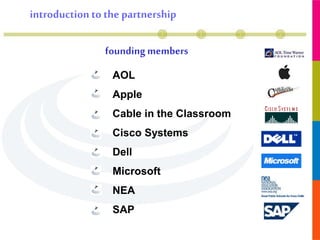
AOL
Apple
Cable in the Classroom
Cisco Systems
Dell
Microsoft
NEA
SAP
founding members
introduction to the partnership
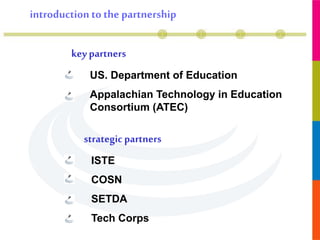
US. Department of Education
Appalachian Technology in Education
Consortium (ATEC)
strategicpartners
introduction to the partnership
keypartners
ISTE
COSN
SETDA
Tech Corps
mission
introduction to the partnership
The Partnership for 21st Century Skills is a public-
private partnership organized to create an overall
vision of how 21st century skills can be
incorporated into K-12 education.
objectives
introduction to the partnership
Define a framework and create a common language for
understanding and promoting 21st Century Skills
Demonstrate how 21st Century Skills integrate with and
reinforce basic skills
Provide education leaders with tools, examples and
strategies for action
Build consensus in the public and private sectors with
public education campaign to promote 21st Century
Skills
methodology
introduction to the partnership
Request for Information
(RFI)
Research
Focus Groups
Outreach to Organizations
Outreach to Individuals
with Expertise in 21st
Century Skills
National Forum on 21st
Century Skills
why are
21st century skills
important?
students
whyare 21st centuryskillsimportant?
Today’s education faces irrelevance unless
we bridge the gap between how students
live and how students learn.
workforce
whyare 21st centuryskillsimportant?
“The average person will change jobs nine
times by the time he or she is 32.”Elaine Chao,
U.S. Secretary of Labor
Relationship to nochild left behind
•Emphasizes student achievement and requires
assessments in core subjects.
•Skills are to be integrated in core subjects
•Requires that every student be technologically
literate by 8th grade
•States, schools and districts can incorporate a
broad vision of 21st century skills into their NCLB
framework
whyare 21st centuryskillsimportant?
what are
21st century skills?
Currentnationaldebate
whatare 21st centuryskills?
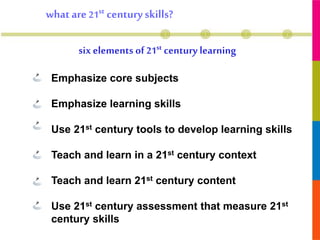
six elements of 21st century learning
whatare 21st centuryskills?
• Emphasize core subjects
• Emphasize learning skills
• Use 21st century tools to develop learning skills
• Teach and learn in a 21st century context
• Teach and learn 21st century content
• Use 21st century assessment that measure 21st
century skills
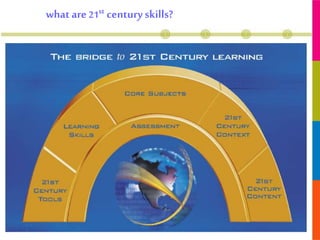
partnershipmodel
whatare 21st centuryskills?
Core subject
21st centurytools Learning
skils
21st centurycontext 21st centurycontent assessment
Element 1: core subjects
Core academic subjects remain
the foundation of a good
education
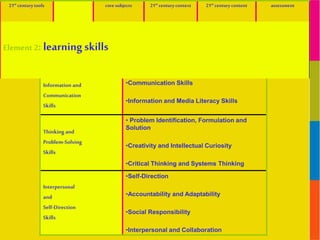
learning skills
Information and
Communication
Skills
•Communication Skills
•Information and Media Literacy Skills
Thinking and
Problem-Solving
Skills
• Problem Identification, Formulation and
Solution
•Creativity and Intellectual Curiosity
•Critical Thinking and Systems Thinking
Interpersonal
and
Self-Direction
Skills
•Self-Direction
•Accountability and Adaptability
•Social Responsibility
•Interpersonal and Collaboration
21st centurytools coresubjects 21st centurycontext 21st centurycontent assessment
Element 2: learning skills
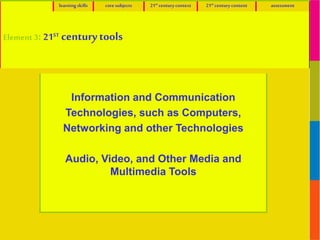
21st century tools
Information and Communication
Technologies, such as Computers,
Networking and other Technologies
Audio, Video, and Other Media and
Multimedia Tools
learningskills coresubjects 21st centurycontext 21st centurycontent assessment
Element 3: 21ST centurytools
EmphasizeICT LITERACY
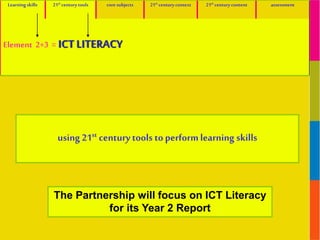
using 21st century tools to performlearning skills
Learningskills 21st centurytools coresubjects 21st centurycontext 21st centurycontent assessment
Element 2+3 = ICT LITERACY
The Partnership will focus on ICT Literacy
for its Year 2 Report
Emphasize21st Century Content
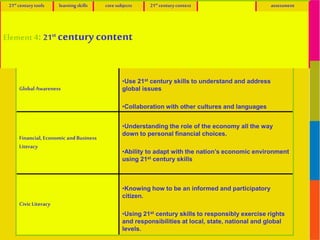
GlobalAwareness
•Use 21st century skills to understand and address
global issues
•Collaboration with other cultures and languages
Financial, Economic andBusiness
Literacy
•Understanding the role of the economy all the way
down to personal financial choices.
•Ability to adapt with the nation’s economic environment
using 21st century skills
CivicLiteracy
•Knowing how to be an informed and participatory
citizen.
•Using 21st century skills to responsibly exercise rights
and responsibilities at local, state, national and global
levels.
21st centurytools learningskills coresubjects 21st centurycontext assessment
Element 4: 21st centurycontent
Emphasize21st Century Context
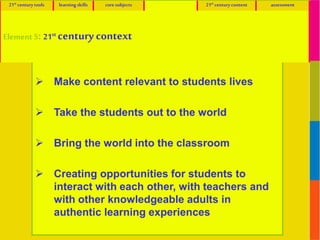
 Make content relevant to students lives
 Take the students out to the world
 Bring the world into the classroom
 Creating opportunities for students to
interact with each other, with teachers and
with other knowledgeable adults in
authentic learning experiences
21st centurytools learningskills coresubjects 21st centurycontent assessment
Element 5: 21st century context
21st Century Assessment
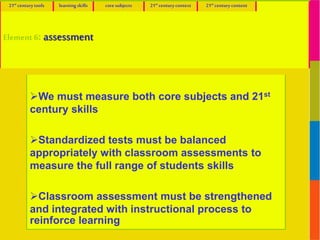
We must measure both core subjects and 21st
century skills
Standardized tests must be balanced
appropriately with classroom assessments to
measure the full range of students skills
Classroom assessment must be strengthened
and integrated with instructional process to
reinforce learning
21st centurytools learningskills coresubjects 21st centurycontext 21st centurycontent
Element 6: assessment
what is
the MILE GUIDE
for
21st century skills?
Who contributed?
How did we collect the information?
What did we do with the information?
Results? The MILE Guide
The MILE Guide
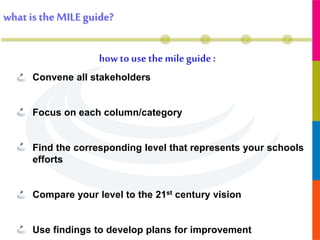
how tousethemile guide :
Convene all stakeholders
Focus on each column/category
Find the corresponding level that represents your schools
efforts
Compare your level to the 21st century vision
Use findings to develop plans for improvement
whatis the MILEguide?
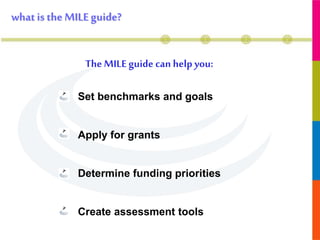
The MILEguide can help you:
whatis the MILEguide?
Set benchmarks and goals
Apply for grants
Determine funding priorities
Create assessment tools
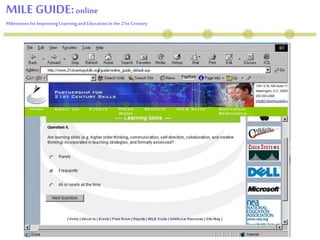
Mile Guide online
MILE GUIDE:online
MilestonesforImprovingLearningand Educationin the21st Century
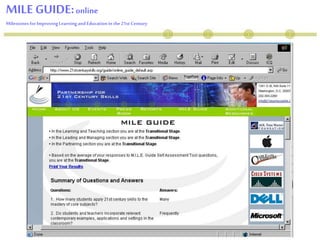
Mile Guide Online
MILE GUIDE:online
MilestonesforImprovingLearningand Educationin the21st Century
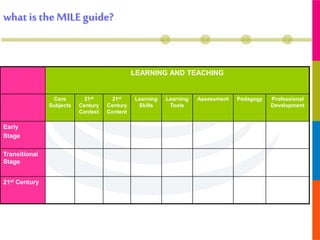
Learning and teaching
whatis the MILEguide?
LEARNING AND TEACHING
Core
Subjects
21st
Century
Context
21st
Century
Content
Learning
Skills
Learning
Tools
Assessment Pedagogy Professional
Development
Early
Stage
Transitional
Stage
21st Century
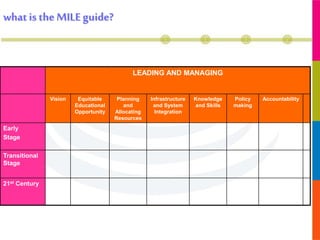
Leading and Managing
whatis the MILEguide?
LEADING AND MANAGING
Vision Equitable
Educational
Opportunity
Planning
and
Allocating
Resources
Infrastructure
and System
Integration
Knowledge
and Skills
Policy
making
Accountability
Early
Stage
Transitional
Stage
21st Century
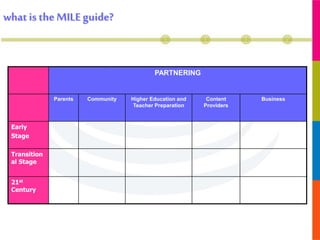
Partnering
whatis the MILEguide?
PARTNERING
Parents Community Higher Education and
Teacher Preparation
Content
Providers
Business
Early
Stage
Transition
al Stage
21st
Century
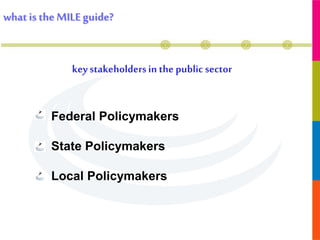
keystakeholdersin the public sector
Federal Policymakers
State Policymakers
Local Policymakers
whatis the MILEguide?
keystakeholdersin the privatesector
Businesses
Families and Parents
whatis the MILEguide?
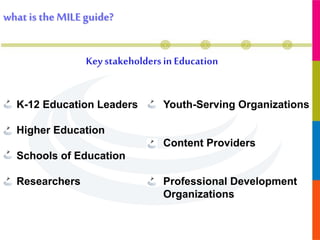
Key stakeholdersin Education
K-12 Education Leaders
Higher Education
Schools of Education
Researchers
Youth-Serving Organizations
Content Providers
Professional Development
Organizations
whatis the MILEguide?
what nine steps
can you take
to build momentum?
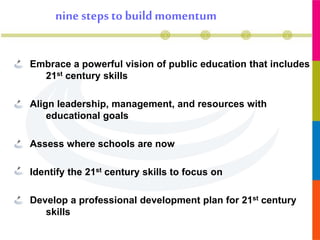
nine steps to build momentum
Embrace a powerful vision of public education that includes
21st century skills
Align leadership, management, and resources with
educational goals
Assess where schools are now
Identify the 21st century skills to focus on
Develop a professional development plan for 21st century
skills
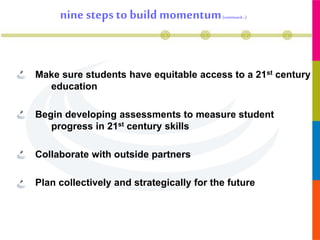
nine steps to build momentum(continued…)
Make sure students have equitable access to a 21st century
education
Begin developing assessments to measure student
progress in 21st century skills
Collaborate with outside partners
Plan collectively and strategically for the future
Partnershipfor21st CenturySkills
www.21stcenturyskills.org

P21_MILE_Guide_Presentation.ppt

  • 1.
    A Report andMILE Guide for 21st Century Skills LEARNING FORTHE 21st CENTURY
  • 2.
    Introduction Introduction to thePartnership Why are 21st century skills important? What are 21st century skills? What is the MILE Guide for 21st century skills? What Nine Steps can you take to build momentum? Today
  • 3.
  • 4.
    AOL Apple Cable in theClassroom Cisco Systems Dell Microsoft NEA SAP founding members introduction to the partnership
  • 5.
    US. Department ofEducation Appalachian Technology in Education Consortium (ATEC) strategicpartners introduction to the partnership keypartners ISTE COSN SETDA Tech Corps
  • 6.
    mission introduction to thepartnership The Partnership for 21st Century Skills is a public- private partnership organized to create an overall vision of how 21st century skills can be incorporated into K-12 education.
  • 7.
    objectives introduction to thepartnership Define a framework and create a common language for understanding and promoting 21st Century Skills Demonstrate how 21st Century Skills integrate with and reinforce basic skills Provide education leaders with tools, examples and strategies for action Build consensus in the public and private sectors with public education campaign to promote 21st Century Skills
  • 8.
    methodology introduction to thepartnership Request for Information (RFI) Research Focus Groups Outreach to Organizations Outreach to Individuals with Expertise in 21st Century Skills National Forum on 21st Century Skills
  • 9.
    why are 21st centuryskills important?
  • 10.
    students whyare 21st centuryskillsimportant? Today’seducation faces irrelevance unless we bridge the gap between how students live and how students learn.
  • 11.
    workforce whyare 21st centuryskillsimportant? “Theaverage person will change jobs nine times by the time he or she is 32.”Elaine Chao, U.S. Secretary of Labor
  • 12.
    Relationship to nochildleft behind •Emphasizes student achievement and requires assessments in core subjects. •Skills are to be integrated in core subjects •Requires that every student be technologically literate by 8th grade •States, schools and districts can incorporate a broad vision of 21st century skills into their NCLB framework whyare 21st centuryskillsimportant?
  • 13.
  • 14.
  • 15.
    six elements of21st century learning whatare 21st centuryskills? • Emphasize core subjects • Emphasize learning skills • Use 21st century tools to develop learning skills • Teach and learn in a 21st century context • Teach and learn 21st century content • Use 21st century assessment that measure 21st century skills
  • 16.
  • 17.
    Core subject 21st centurytoolsLearning skils 21st centurycontext 21st centurycontent assessment Element 1: core subjects Core academic subjects remain the foundation of a good education
  • 18.
    learning skills Information and Communication Skills •CommunicationSkills •Information and Media Literacy Skills Thinking and Problem-Solving Skills • Problem Identification, Formulation and Solution •Creativity and Intellectual Curiosity •Critical Thinking and Systems Thinking Interpersonal and Self-Direction Skills •Self-Direction •Accountability and Adaptability •Social Responsibility •Interpersonal and Collaboration 21st centurytools coresubjects 21st centurycontext 21st centurycontent assessment Element 2: learning skills
  • 19.
    21st century tools Informationand Communication Technologies, such as Computers, Networking and other Technologies Audio, Video, and Other Media and Multimedia Tools learningskills coresubjects 21st centurycontext 21st centurycontent assessment Element 3: 21ST centurytools
  • 20.
    EmphasizeICT LITERACY using 21stcentury tools to performlearning skills Learningskills 21st centurytools coresubjects 21st centurycontext 21st centurycontent assessment Element 2+3 = ICT LITERACY The Partnership will focus on ICT Literacy for its Year 2 Report
  • 21.
    Emphasize21st Century Content GlobalAwareness •Use21st century skills to understand and address global issues •Collaboration with other cultures and languages Financial, Economic andBusiness Literacy •Understanding the role of the economy all the way down to personal financial choices. •Ability to adapt with the nation’s economic environment using 21st century skills CivicLiteracy •Knowing how to be an informed and participatory citizen. •Using 21st century skills to responsibly exercise rights and responsibilities at local, state, national and global levels. 21st centurytools learningskills coresubjects 21st centurycontext assessment Element 4: 21st centurycontent
  • 22.
    Emphasize21st Century Context Make content relevant to students lives  Take the students out to the world  Bring the world into the classroom  Creating opportunities for students to interact with each other, with teachers and with other knowledgeable adults in authentic learning experiences 21st centurytools learningskills coresubjects 21st centurycontent assessment Element 5: 21st century context
  • 23.
    21st Century Assessment Wemust measure both core subjects and 21st century skills Standardized tests must be balanced appropriately with classroom assessments to measure the full range of students skills Classroom assessment must be strengthened and integrated with instructional process to reinforce learning 21st centurytools learningskills coresubjects 21st centurycontext 21st centurycontent Element 6: assessment
  • 24.
    what is the MILEGUIDE for 21st century skills?
  • 25.
    Who contributed? How didwe collect the information? What did we do with the information? Results? The MILE Guide The MILE Guide
  • 26.
    how tousethemile guide: Convene all stakeholders Focus on each column/category Find the corresponding level that represents your schools efforts Compare your level to the 21st century vision Use findings to develop plans for improvement whatis the MILEguide?
  • 27.
    The MILEguide canhelp you: whatis the MILEguide? Set benchmarks and goals Apply for grants Determine funding priorities Create assessment tools
  • 28.
    Mile Guide online MILEGUIDE:online MilestonesforImprovingLearningand Educationin the21st Century
  • 29.
    Mile Guide Online MILEGUIDE:online MilestonesforImprovingLearningand Educationin the21st Century
  • 30.
    Learning and teaching whatisthe MILEguide? LEARNING AND TEACHING Core Subjects 21st Century Context 21st Century Content Learning Skills Learning Tools Assessment Pedagogy Professional Development Early Stage Transitional Stage 21st Century
  • 31.
    Leading and Managing whatisthe MILEguide? LEADING AND MANAGING Vision Equitable Educational Opportunity Planning and Allocating Resources Infrastructure and System Integration Knowledge and Skills Policy making Accountability Early Stage Transitional Stage 21st Century
  • 32.
    Partnering whatis the MILEguide? PARTNERING ParentsCommunity Higher Education and Teacher Preparation Content Providers Business Early Stage Transition al Stage 21st Century
  • 33.
    keystakeholdersin the publicsector Federal Policymakers State Policymakers Local Policymakers whatis the MILEguide?
  • 34.
  • 35.
    Key stakeholdersin Education K-12Education Leaders Higher Education Schools of Education Researchers Youth-Serving Organizations Content Providers Professional Development Organizations whatis the MILEguide?
  • 36.
    what nine steps canyou take to build momentum?
  • 37.
    nine steps tobuild momentum Embrace a powerful vision of public education that includes 21st century skills Align leadership, management, and resources with educational goals Assess where schools are now Identify the 21st century skills to focus on Develop a professional development plan for 21st century skills
  • 38.
    nine steps tobuild momentum(continued…) Make sure students have equitable access to a 21st century education Begin developing assessments to measure student progress in 21st century skills Collaborate with outside partners Plan collectively and strategically for the future
  • 39.