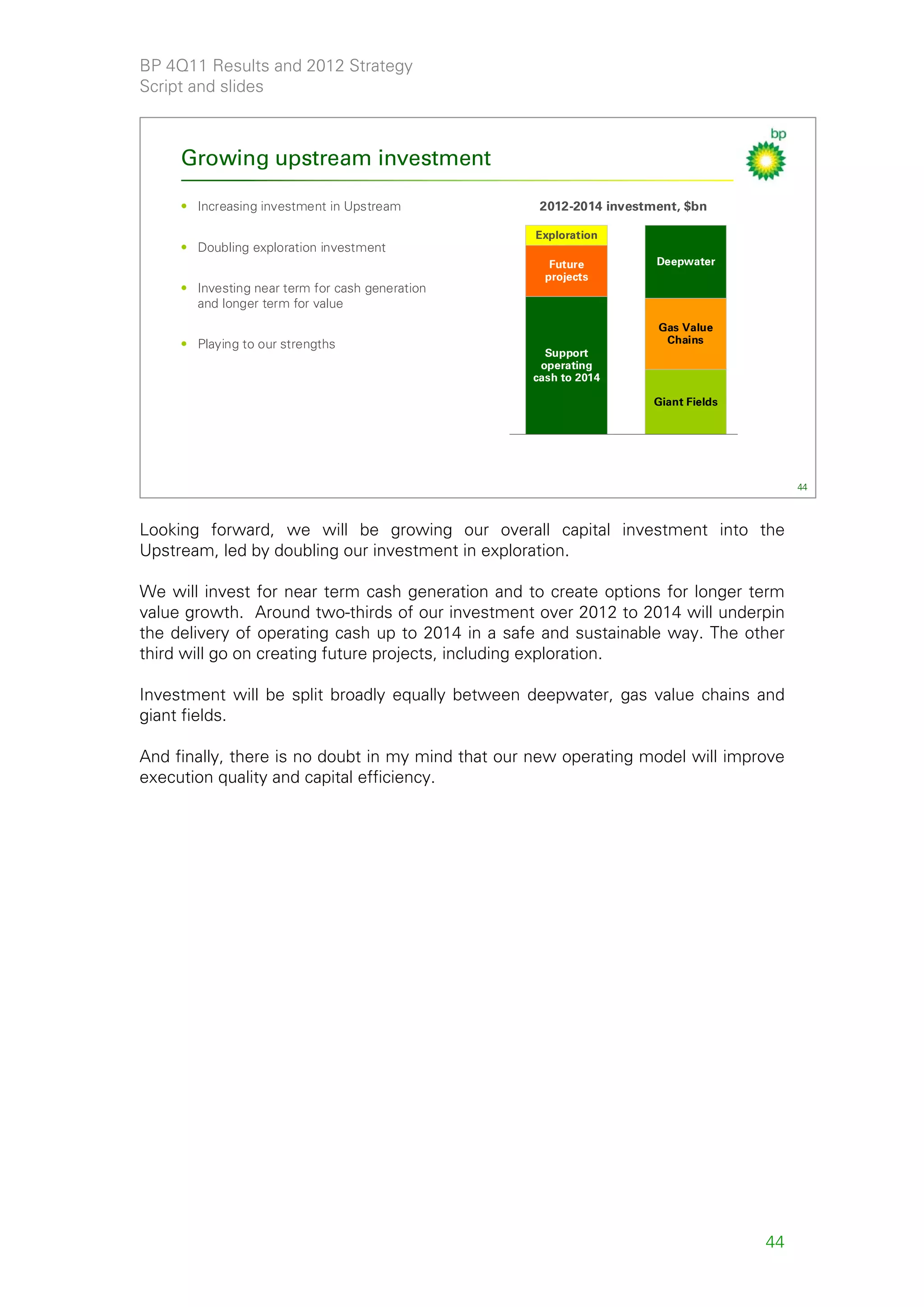
BP 4Q11 Results and 2012 Strategy
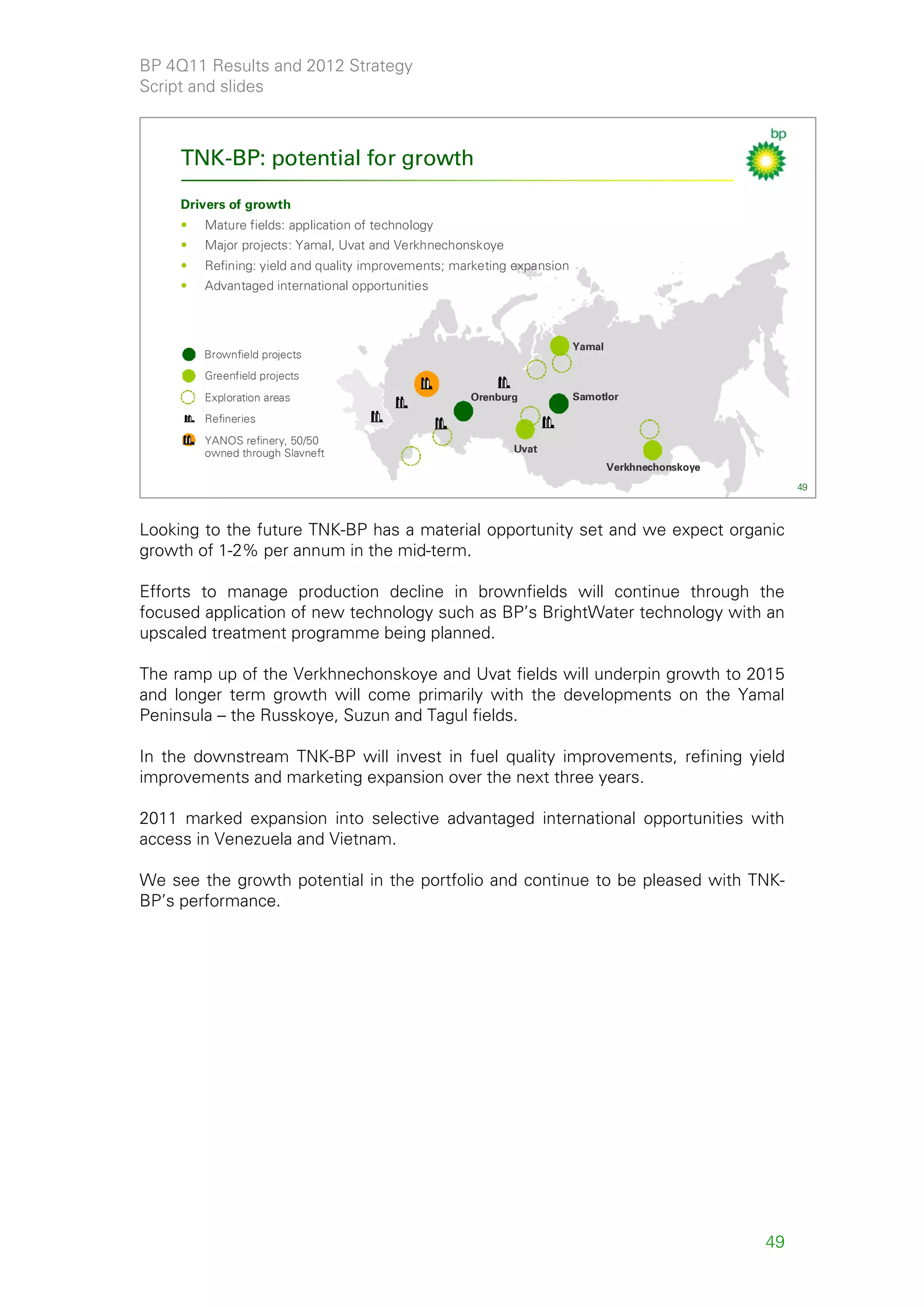
Script and slides


BP 4Q11 & 2012 Strategy presentation

Bob Dudley: Group Chief Executive

   SECRET


    2011 Results and
    Strategy Presentation
    2011 Results and
     7 February 2012


    Strategy Presentation
    7 February 2012


                                                                                        1


Good afternoon everyone and thank you for joining us today. Welcome to BP’s 2011
Results and Strategy presentation. We are very pleased to have you with us,
whether in person, over the phone or on the web.

For those here in our new venue at Canada Square, in east London, you will have
seen behind me our safety evacuation guidelines. There are more details in the
safety briefing card handed to you at reception. We’re not planning to test the alarm
system today, so if you hear it, please proceed as advised by these instructions.
May I also ask you to turn off your mobile or cell phones at this point.

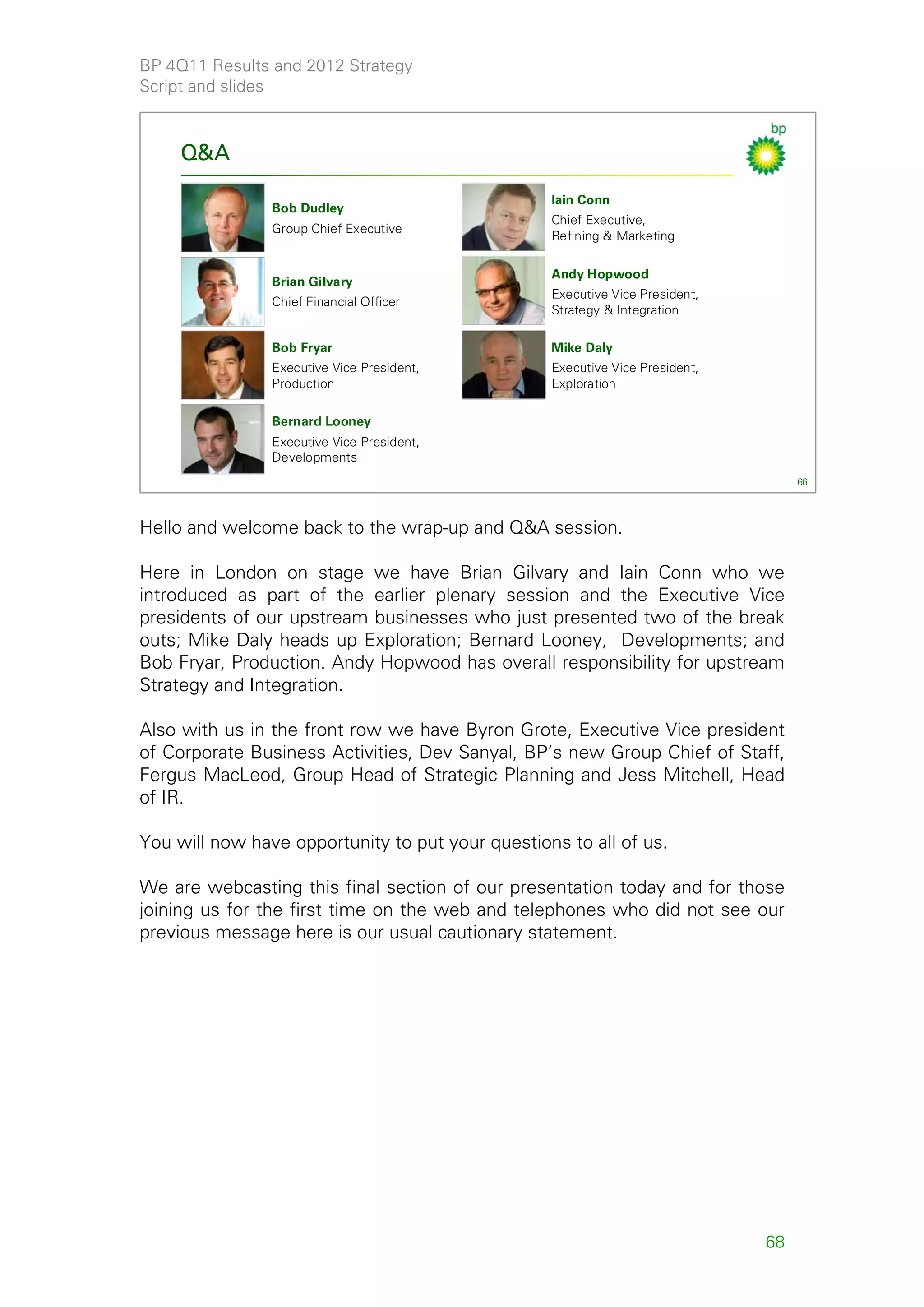
With me on stage I have Brian Gilvary, whom I am very pleased to introduce as BP’s
new Chief Financial Officer, and Iain Conn, our Chief Executive of Refining &
Marketing.

In the audience we have our Chairman, Carl-Henric Svanberg and members of our
Executive Team who will host the break-outs after this session and join us for Q&A
later this afternoon.


                                                                                   1
BP 4Q11 Results and 2012 Strategy
Script and slides


     Cautionary statement
     Forward-looking statements - cautionary statement
     This presentation, including the video presentation regarding Project 20K, and the associated slides and discussion contain forward-looking statements, particularly those regarding: expectations regarding financial
     momentum in 2013 and 2014; BP’s outlook on global energy trends to 2030; expected increases in investment in exploration and upstream drilling and production; anticipated improvements and increases, and the
     sources and timing thereof, in pre-tax returns, operating cash flow and margins, including generating around 50% more annually in operating cash flow by 2014 versus 2011 at US$100/bbl; divestm ent plans,
     including the anticipated timing for completion of and final proceeds from the disposition of certain BP assets; the expected level of planned turnarounds and related production outages expectations and plans for
     increased investment, increased distributions to shareholders; the restoration of high value production; the expected level of planned turnarounds; expectations regarding our new operating model; expectations of
     a challenging marketing environment in 2012 for fuels, lubricants and petrochemicals; the quarterly dividend payment; the strength of the balance sheet; the expected increase in exploration activity; expectations
     for drilling and rig activity generally and specifically in the Gulf of Mexico; the level of performance improvement in Refining and Marketing; expected full-year 2012 organic capital expenditure and increased capital
     spend for the future; the timing and composition of major projects including expected start up, completion, level of production and margins; the expected timing and level of final investment decisions the
     expected timing and level of appraisal activity; the timing for completion of the Whiting refinery upgrade, other refining upgrades and logistics optimization; the expected level of production in the first quarter of
     2012 and in full-year 2012 the magnitude and timing of remaining remediation costs related to the Deepwater Horizon oil spill; the factors that could affect the magnitude of BP’s ultimate exposure and the cost to
     BP in relation to the spill and any potential mitigation resulting from BP’s partners or others involved in the spill; the potential liabilities resulting from pending and future legal proceedings and potential
     investigations and civil or criminal actions that US state and/or local governments could seek to take against BP as a result of the spill; the timing of claims and litigation outcomes and of payment of legal costs;
     timing and quantum of contributions to and payments from the $20 billion Trust Fund; expectations regarding the reduction of net debt and the net debt ratio; the expected levels of underlying and reported
     production in 2012, and the impact of disposals thereon; the expected level of depreciation, depletion and amortization in 2012; expectations for the level and volatility of quarterly losses in Other businesses and
     corporate; the expected full-year effective tax rate for 2012; plans to continue to seek opportunities and prospects in BP’s areas of strength, such as deepwater, gas value chains and giant fields; plans to
     strengthen BP’s position in unconventionals; the expected production potential of certain existing unconventional oil assets; the timing of the deployment of BP’s new single work management system; the
     sources and timing of volume growth and earnings momentum in Lubricants and Petrochemicals; expected future levels of resource recovery in giant fields; expectations about the future significance of
     deepwater drilling for BP; BP’s intentions to invest in and develop certain deepwater technology and systems in connection with Project 20K, and the expected level of investment in connection therewith; the
     expected level of investments by TNK-BP; TNK-BP’s expected organic production growth; TNK-BP’s plans to manage production decline in certain fields; the timing and composition of major projects of TNK-BP;
     TNK-BP’s expansion plans; BP’s plans to report TNK-BP as a separate segment in BP’s financial accounts; the expected future level of investment in Alternative Energy; and the expected profitability and level of
     future cash flow of certain Alternative Energy assets. By their nature, forward-looking statements involve risk and uncertainty because they relate to events and depend on circumstances that will or may occur in
     the future. Actual results may differ from those expressed in such statements, depending on a variety of factors including the timing of bringing new fields onstream; the timing of certain disposals; future levels
     of industry product supply; demand and pricing; OPEC quota restrictions; PSA effects; operational problems; general economic conditions; political stability and economic growth in relevant areas of the world;
     changes in laws and governmental regulations; changes in taxation or regulation; regulatory or legal actions including the types of enforcement action pursued and the nature of remedies sought; the actions of
     prosecutors, regulatory authorities, the Gulf Coast Claims Facility and the courts; the actions of all parties to the Deepwater Horizon oil spill-related litigation at various phases of the litigation; the impact on our
     reputation following the Deepwater Horizon oil spill; exchange rate fluctuations; development and use of new technology; the success or otherwise of partnering; the successful completion of certain disposals;
     the actions of competitors, trading partners, creditors, rating agencies and others; natural disasters and adverse weather conditions; changes in public expectations and other changes to business conditions; wars
     and acts of terrorism or sabotage; and other factors discussed under “Risk factors” in our Annual Report and Form 20-F 2010 as filed with the US Securities and Exchange Commission (SEC).
     Reconciliations to GAAP-This presentation also contains financial information which is not presented in accordance with generally accepted accounting principles (GAAP). A quantitative reconciliation of this
     information to the most directly comparable financial measure calculated and presented in accordance with GAAP can be found on our website at www.bp.com.
     Statement of Assumptions - The operating cash flow projection for 2014 stated on slides 8, 10, 11, 33, 38, 58, 61, 62 and 63 reflects our expectation that all required payments into the $20 billion US Trust Fund
     will have been completed prior to 2014. The projection does not reflect any cash flows relating to other liabilities, contingent liabilities, settlements or contingent assets arising from the Deepwater Horizon oil spill
     which may or may not arise at that time. As disclosed in the Stock Exchange Announcement, we are not today able to reliably estimate the amount or timing of a number of contingent liabilities.
     Cautionary note to US investors - We use certain terms in this presentation, such as “resources”, “non-proved resources” and references to projections in relation to such that the SEC’s rules prohibit us from
     including in our filings with the SEC. U.S. investors are urged to consider closely the disclosures in our Form 20-F, SEC File No. 1-06262. This form is available on our website at www.bp.com. You can also obtain
     this form from the SEC by calling 1-800-SEC-0330 or by logging on to their website at www.sec.gov. Tables and projections in this presentation are BP projections unless otherwise stated.
     February 2012                                                                                                                                                                                                               2


Before we start, I’d like to draw your attention to our cautionary statement – please
read carefully.

During today’s presentation, we will reference estimates, plans and expectations
that are forward-looking statements. Actual outcomes could differ materially due to
factors we note on this slide and in our regulatory filings. Please refer to our Annual
Report and Accounts, 20-F and fourth-quarter Stock Exchange Announcement for
more details. These documents are available on our website.


                                                                                                                                                                                                                      2
BP 4Q11 Results and 2012 Strategy
Script and slides


    Bob Dudley
    Group Chief Executive


    Playing to our strengths


                                                                                        3


Today we are going to return to the plans we laid out to you in October. Our 10-point
plan to grow value.

We aim to leave you with an even clearer view of the path ahead.

2011 was a successful year of recovery, consolidation and change and we reached
an operational turning point in October.

2012 will be a year of milestones as we build on those foundations.

And as we move through 2013 and 2014 we expect to see the financial momentum
building as we complete payments into the Trust Fund and as our operations start to
show the benefits of our actions.

Our 10-point plan provides the roadmap – how we will play to our strengths and be
safer, stronger, simpler and more standardised. How value will be driven by growth
in both underlying volume and margin – from a portfolio of the right size to generate
the operating cash flow to both reinvest in our project pipeline as well as reward
shareholders as we have announced today with a 14% increase in our quarterly
dividend. We believe this will help us to see the true value of the company
recognised.


                                                                                   3
BP 4Q11 Results and 2012 Strategy
Script and slides


     Moving BP forward
       Playing to our strengths                   Bob Dudley
       4Q 2011 results                            Brian Gilvary

       Progress in the US                         Bob Dudley
       Upstream
       TNK-BP
       Alternative Energy

       Refining and Marketing                     Iain Conn

       Summary                                    Bob Dudley
       Break-outs
         Upstream - Longer term investments play to our strengths
         Upstream - Operating model: improving execution capability
         Refining & Marketing - Delivering a world class downstream business
       Conclusions and Q&A                        Bob Dudley and Executive Team
                                                                                        4


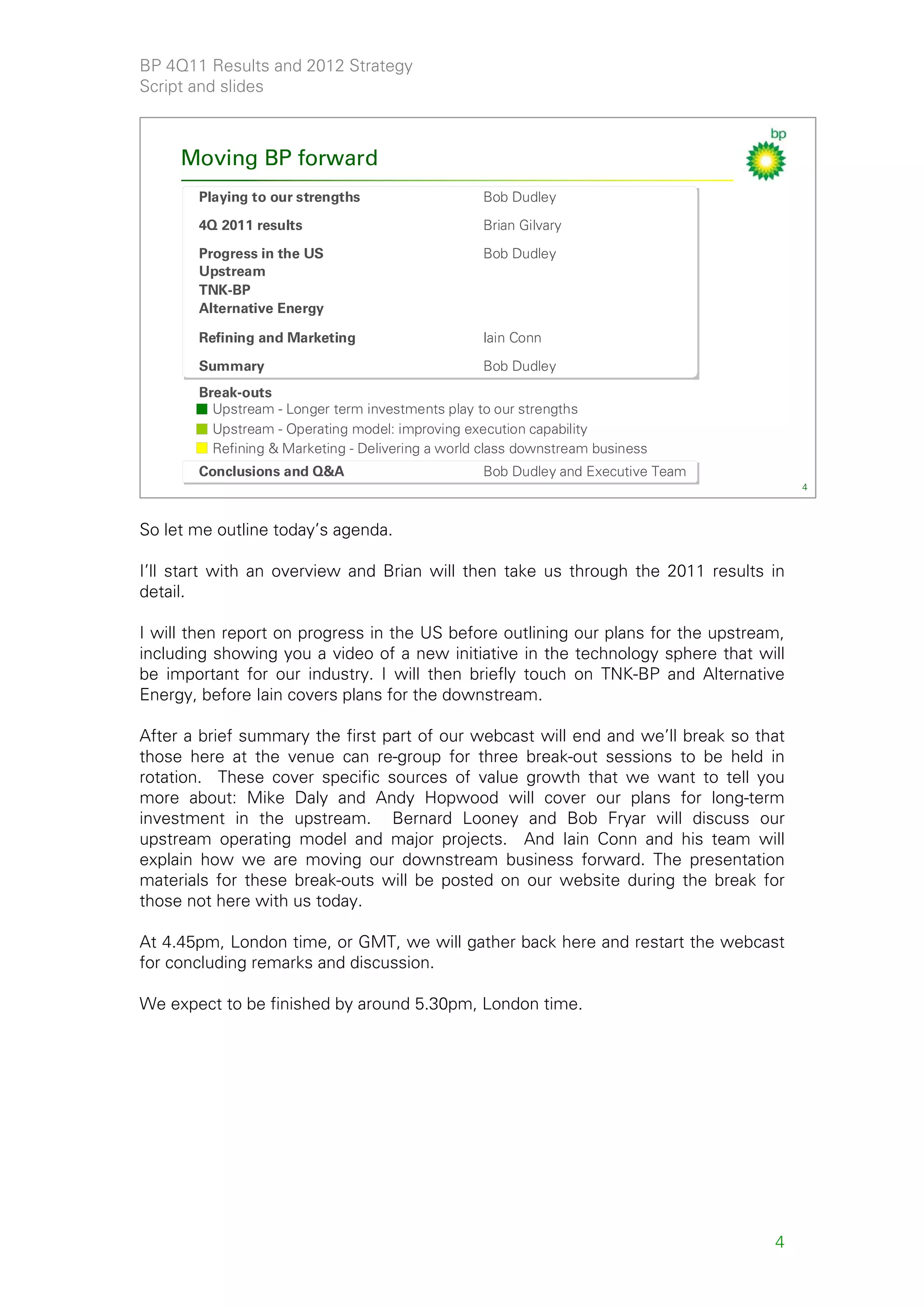
So let me outline today’s agenda.

I’ll start with an overview and Brian will then take us through the 2011 results in
detail.

I will then report on progress in the US before outlining our plans for the upstream,
including showing you a video of a new initiative in the technology sphere that will
be important for our industry. I will then briefly touch on TNK-BP and Alternative
Energy, before Iain covers plans for the downstream.

After a brief summary the first part of our webcast will end and we’ll break so that
those here at the venue can re-group for three break-out sessions to be held in
rotation. These cover specific sources of value growth that we want to tell you
more about: Mike Daly and Andy Hopwood will cover our plans for long-term
investment in the upstream. Bernard Looney and Bob Fryar will discuss our
upstream operating model and major projects. And Iain Conn and his team will
explain how we are moving our downstream business forward. The presentation
materials for these break-outs will be posted on our website during the break for
those not here with us today.

At 4.45pm, London time, or GMT, we will gather back here and restart the webcast
for concluding remarks and discussion.

We expect to be finished by around 5.30pm, London time.


                                                                                   4
BP 4Q11 Results and 2012 Strategy
Script and slides


     2011: A year of consolidation
     Safety – Trust – Value Growth
     Safety
     • Safety and Operational Risk organisation in action
     • Upstream re-organized to strengthen consistency and capability
     Trust
     • Meeting our commitments in the Gulf of Mexico
     • Resumed drilling in the Gulf of Mexico - with enhanced standards
     Value Growth
     • Resumed dividend payments
     • 55 new exploration licences awarded in 9 countries
     • 19th year of reported reserves replacement >100%(1)
     • Operational turning point
     • Portfolio strengthened
        - Planned divestments of $38bn
        - Acquisitions in Brazil and India
     • Refining & Marketing record earnings

     (1)   Reserves replacement as reported on a combined basis of subsidiaries and equity accounted entities (including TNK-BP), excluding
           acquisitions and divestments. See Stock Exchange Announcement for further important information on basis for calculation.              5


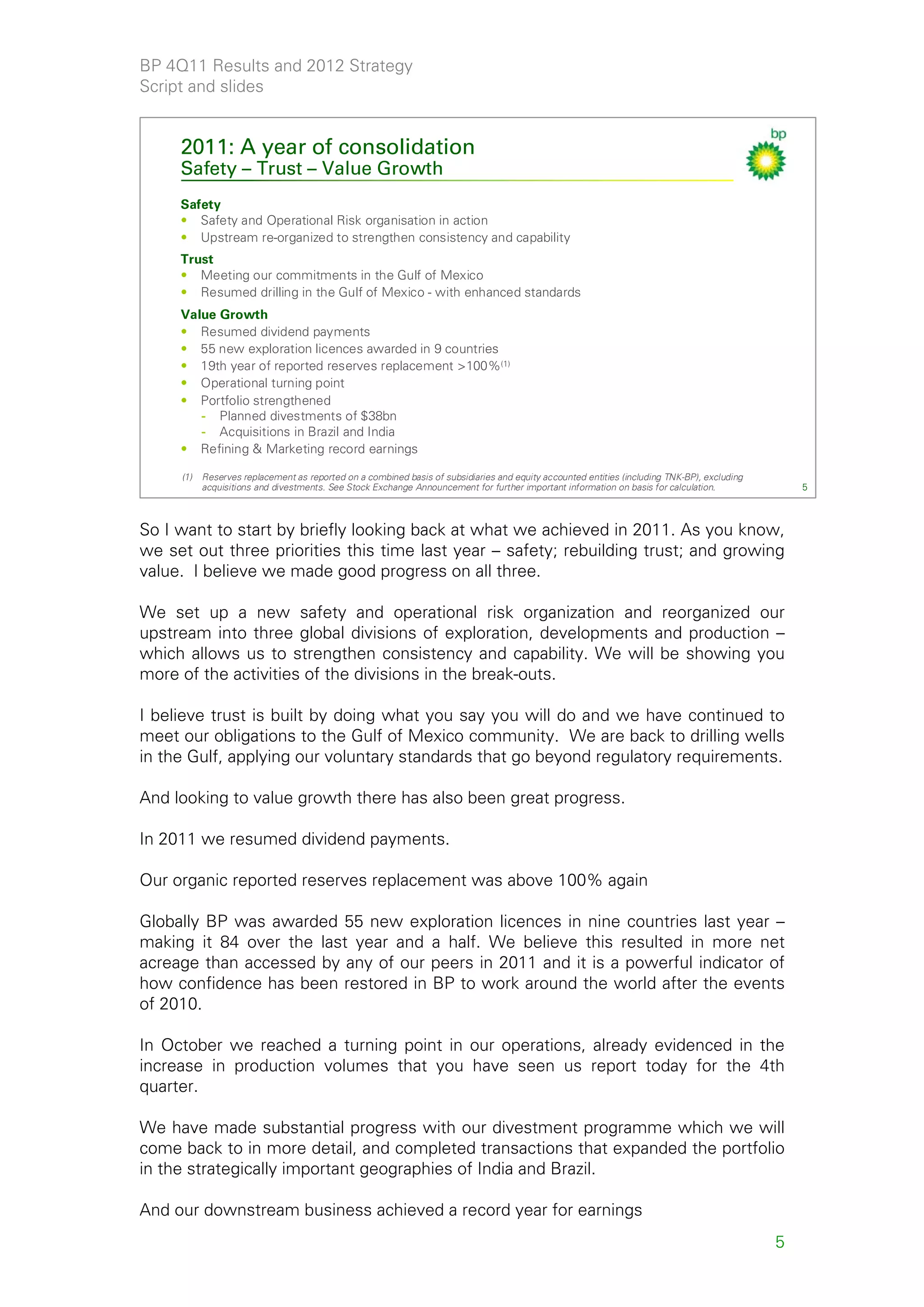
So I want to start by briefly looking back at what we achieved in 2011. As you know,
we set out three priorities this time last year – safety; rebuilding trust; and growing
value. I believe we made good progress on all three.

We set up a new safety and operational risk organization and reorganized our
upstream into three global divisions of exploration, developments and production –
which allows us to strengthen consistency and capability. We will be showing you
more of the activities of the divisions in the break-outs.

I believe trust is built by doing what you say you will do and we have continued to
meet our obligations to the Gulf of Mexico community. We are back to drilling wells
in the Gulf, applying our voluntary standards that go beyond regulatory requirements.

And looking to value growth there has also been great progress.

In 2011 we resumed dividend payments.

Our organic reported reserves replacement was above 100% again

Globally BP was awarded 55 new exploration licences in nine countries last year –
making it 84 over the last year and a half. We believe this resulted in more net
acreage than accessed by any of our peers in 2011 and it is a powerful indicator of
how confidence has been restored in BP to work around the world after the events
of 2010.

In October we reached a turning point in our operations, already evidenced in the
increase in production volumes that you have seen us report today for the 4th
quarter.

We have made substantial progress with our divestment programme which we will
come back to in more detail, and completed transactions that expanded the portfolio
in the strategically important geographies of India and Brazil.

And our downstream business achieved a record year for earnings
                                                                                                                                              5
BP 4Q11 Results and 2012 Strategy
Script and slides


     Key global energy trends to 2030

     •   Continued strong growth in demand                                        Energy contributions to global growth
         - Concentrated in non-OECD
                                                                            2.5
     •   Oil, gas and coal expected to deliver 80% of
         needs by 2030 and to have similar shares of global                 2.0                            Renewables
         demand
                                                                                                           Hydro
         - Gas is the fastest growing fuel; ~2% per year


                                                              % per annum
                                                                            1.5
         - Oil continues to dominate transport fuel                                                        Nuclear

     •   Renewables growing from 2% to 6% of global                                                        Coal
                                                                            1.0
         energy supply; more than 8% per year                                                              Gas

     •   North America has the potential to become energy                   0.5                            Oil
         self sufficient by 2030

     •   Industry needs to continue to develop new                          0.0
                                                                                   1970-   1990-   2010-
         frontiers and apply technology and learning                               1990    2010    2030


     Projections from BP Energy Outlook 2030                                                                              6


So that was the story of 2011, but before we look ahead let’s just remind ourselves
of some important context.

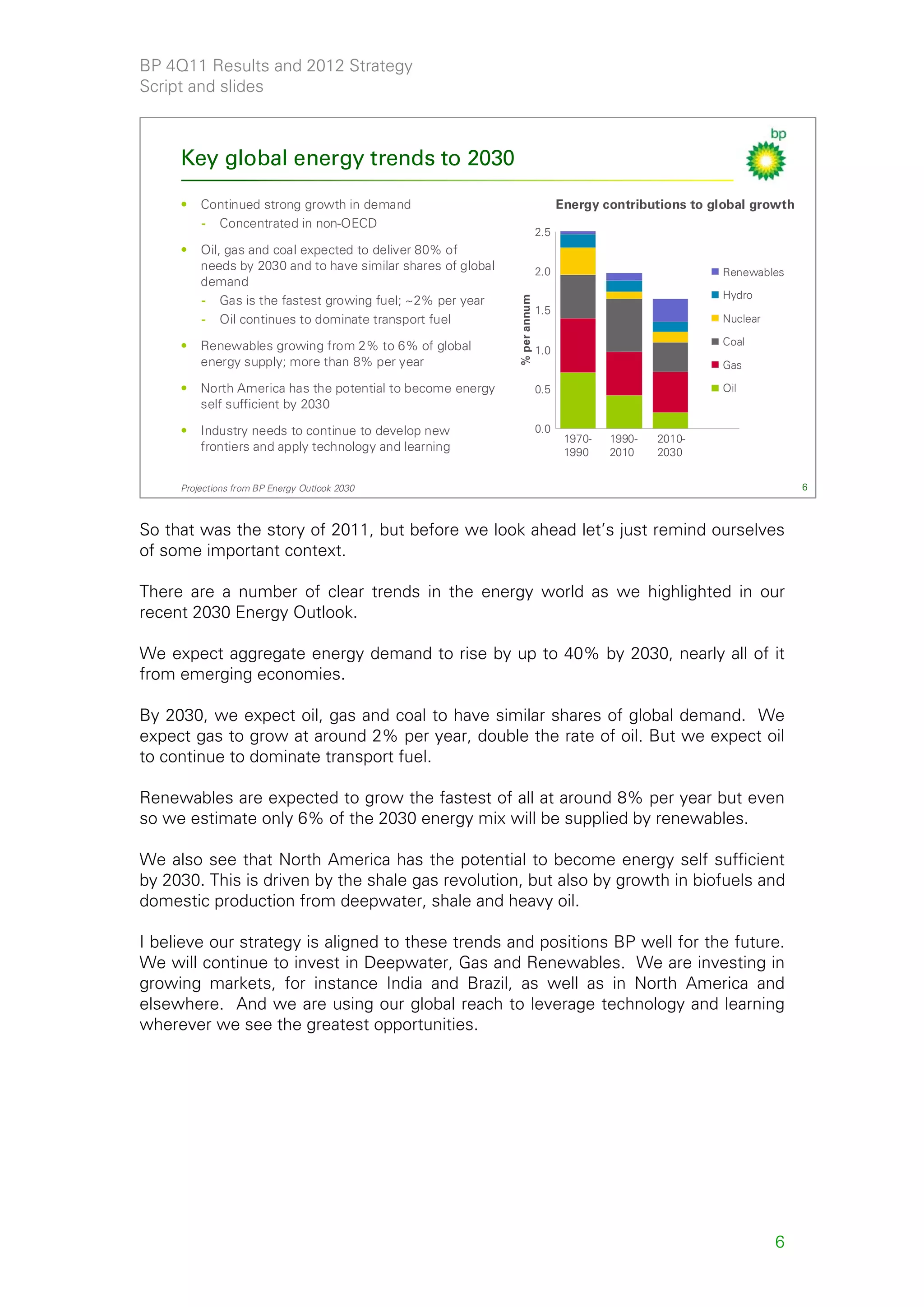
There are a number of clear trends in the energy world as we highlighted in our
recent 2030 Energy Outlook.

We expect aggregate energy demand to rise by up to 40% by 2030, nearly all of it
from emerging economies.

By 2030, we expect oil, gas and coal to have similar shares of global demand. We
expect gas to grow at around 2% per year, double the rate of oil. But we expect oil
to continue to dominate transport fuel.

Renewables are expected to grow the fastest of all at around 8% per year but even
so we estimate only 6% of the 2030 energy mix will be supplied by renewables.

We also see that North America has the potential to become energy self sufficient
by 2030. This is driven by the shale gas revolution, but also by growth in biofuels and
domestic production from deepwater, shale and heavy oil.

I believe our strategy is aligned to these trends and positions BP well for the future.
We will continue to invest in Deepwater, Gas and Renewables. We are investing in
growing markets, for instance India and Brazil, as well as in North America and
elsewhere. And we are using our global reach to leverage technology and learning
wherever we see the greatest opportunities.


                                                                                                                     6
BP 4Q11 Results and 2012 Strategy
Script and slides


       Environment
             Brent oil $/bbl(1)                       Natural gas $/mmbtu(1)                            Refining Marker Margin $/bbl(2)
 160                                          28                                                   30
                                                        Henry Hub
 140                                          24        Japan/Korea marker
                                                                                                   25

 120
                                              20
                                                                                                   20
 100
                                              16
  80                                                                                               15
                                              12
  60
                                                                                                   10
                                               8
  40

                                               4                                                    5
  20


   0                                           0                                                   0
   2005 2006 2007 2008 2009 2010 2011 2012     2005   2006 2007     2008 2009 2010   2011   2012   2005    2006 2007 2008 2009   2010 2011 2012


       (1)   Source: Thomson Reuters Datastream, 12 January 2012
       (2)   BP Refining Marker Margin based on BP's portfolio                                                                                    7


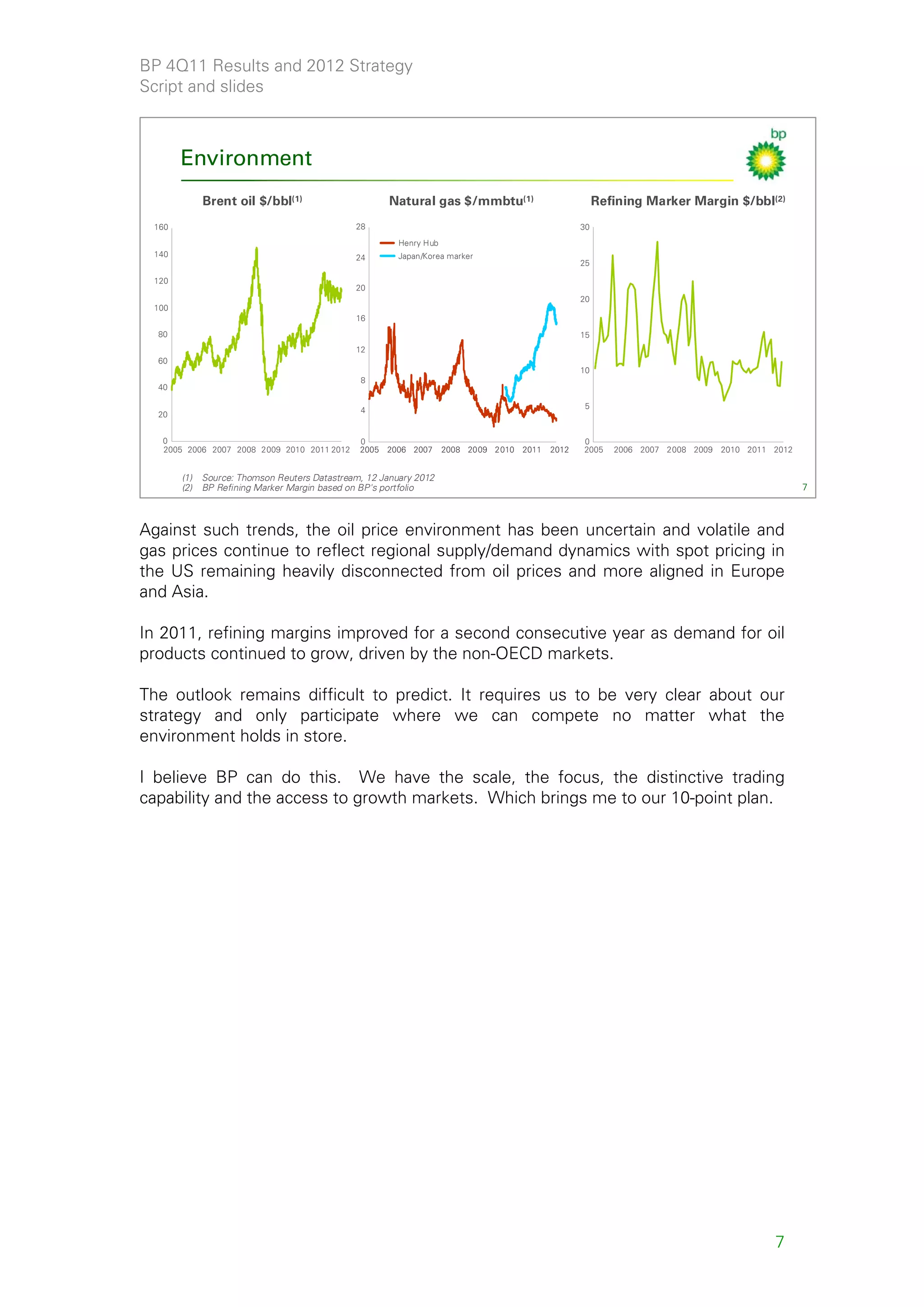
Against such trends, the oil price environment has been uncertain and volatile and
gas prices continue to reflect regional supply/demand dynamics with spot pricing in
the US remaining heavily disconnected from oil prices and more aligned in Europe
and Asia.

In 2011, refining margins improved for a second consecutive year as demand for oil
products continued to grow, driven by the non-OECD markets.

The outlook remains difficult to predict. It requires us to be very clear about our
strategy and only participate where we can compete no matter what the
environment holds in store.

I believe BP can do this. We have the scale, the focus, the distinctive trading
capability and the access to growth markets. Which brings me to our 10-point plan.


                                                                                                                                           7
BP 4Q11 Results and 2012 Strategy
Script and slides


        Moving BP Forward
        10 - point plan

   What you can expect                               What you can measure
   1.    Relentless focus on safety and managing     6.   Active portfolio management to continue
         risk
                                                     7.   New upstream projects onstream with unit
   2.    Play to our strengths                            operating cash margins double the 2011
                                                          average(1)
   3.    Stronger and more focused
                                                     8.   Generate around 50% more annually in
   4.    Simpler and more standardized
                                                          operating cash flow by 2014 versus 2011
   5.    More visibility and transparency to value        at $100/bbl(2)
                                                     9.   Half of incremental operating cash for
                                                          re-investment, half for other purposes
                                                          including distributions
                                                     10. Strong balance sheet


                                                     (1) Assuming a constant $100/bbl oil price and excluding TNK-BP
                                                     (2) See Statement of Assumptions under Cautionary Statement           8


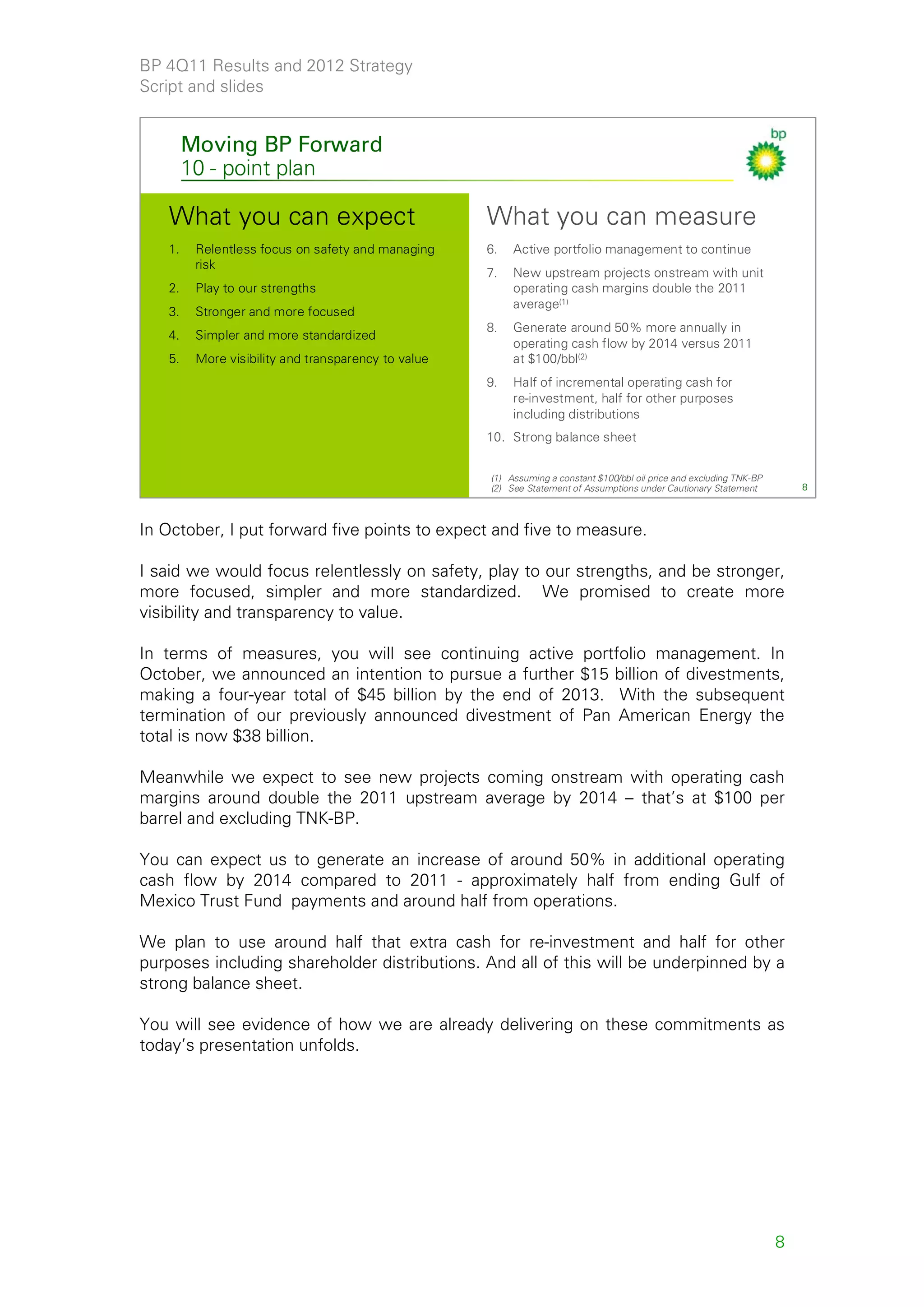
In October, I put forward five points to expect and five to measure.

I said we would focus relentlessly on safety, play to our strengths, and be stronger,
more focused, simpler and more standardized. We promised to create more
visibility and transparency to value.

In terms of measures, you will see continuing active portfolio management. In
October, we announced an intention to pursue a further $15 billion of divestments,
making a four-year total of $45 billion by the end of 2013. With the subsequent
termination of our previously announced divestment of Pan American Energy the
total is now $38 billion.

Meanwhile we expect to see new projects coming onstream with operating cash
margins around double the 2011 upstream average by 2014 – that’s at $100 per
barrel and excluding TNK-BP.

You can expect us to generate an increase of around 50% in additional operating
cash flow by 2014 compared to 2011 - approximately half from ending Gulf of
Mexico Trust Fund payments and around half from operations.

We plan to use around half that extra cash for re-investment and half for other
purposes including shareholder distributions. And all of this will be underpinned by a
strong balance sheet.

You will see evidence of how we are already delivering on these commitments as
today’s presentation unfolds.


                                                                                                                       8
BP 4Q11 Results and 2012 Strategy
Script and slides


     Playing to our strengths

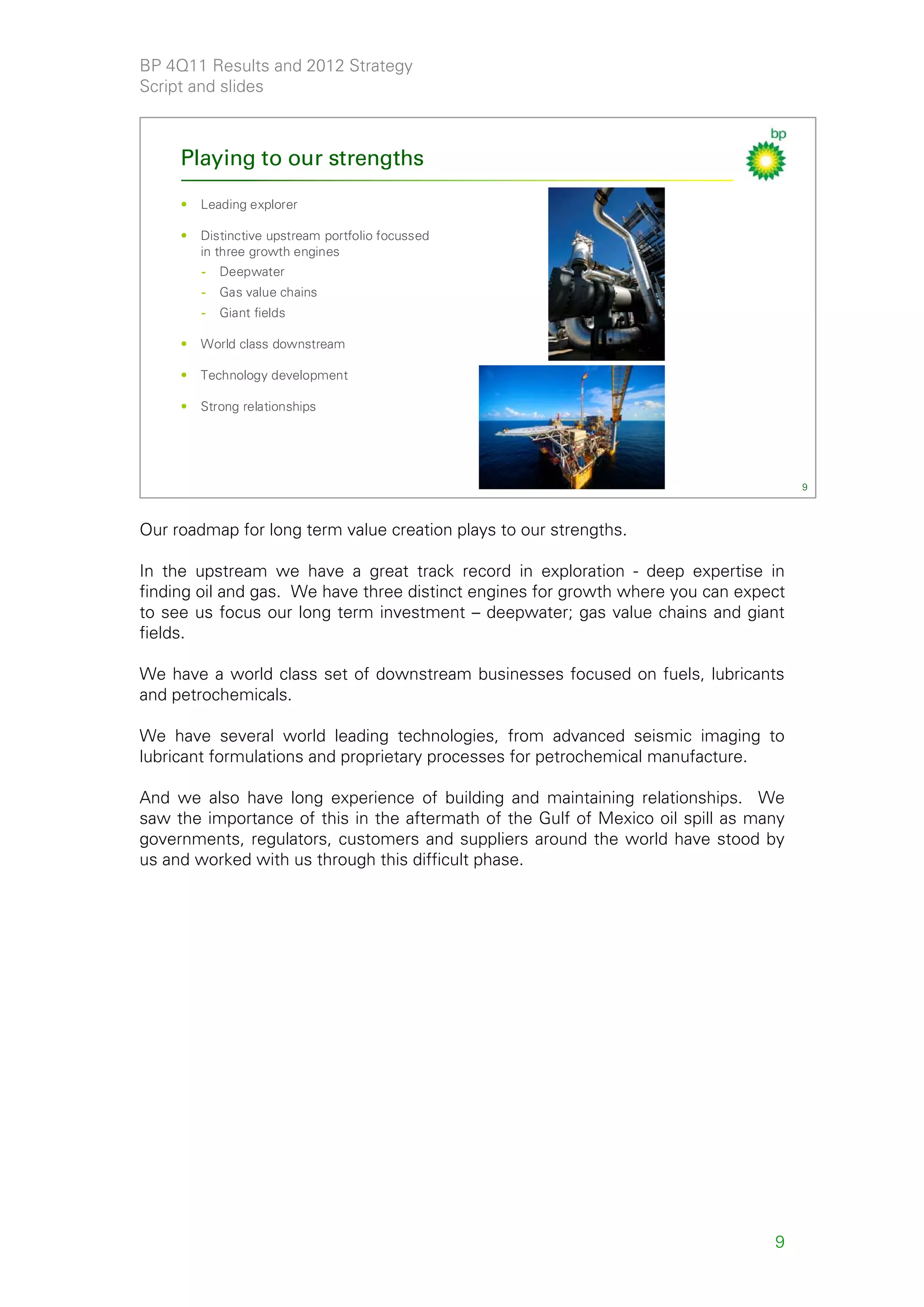
     •   Leading explorer

     •   Distinctive upstream portfolio focussed
         in three growth engines
         -   Deepwater
         -   Gas value chains
         -   Giant fields

     •   World class downstream

     •   Technology development

     •   Strong relationships


                                                                                      9


Our roadmap for long term value creation plays to our strengths.

In the upstream we have a great track record in exploration - deep expertise in
finding oil and gas. We have three distinct engines for growth where you can expect
to see us focus our long term investment – deepwater; gas value chains and giant
fields.

We have a world class set of downstream businesses focused on fuels, lubricants
and petrochemicals.

We have several world leading technologies, from advanced seismic imaging to
lubricant formulations and proprietary processes for petrochemical manufacture.

And we also have long experience of building and maintaining relationships. We
saw the importance of this in the aftermath of the Gulf of Mexico oil spill as many
governments, regulators, customers and suppliers around the world have stood by
us and worked with us through this difficult phase.


                                                                                 9
BP 4Q11 Results and 2012 Strategy
Script and slides


     Growing value
                                             Building momentum
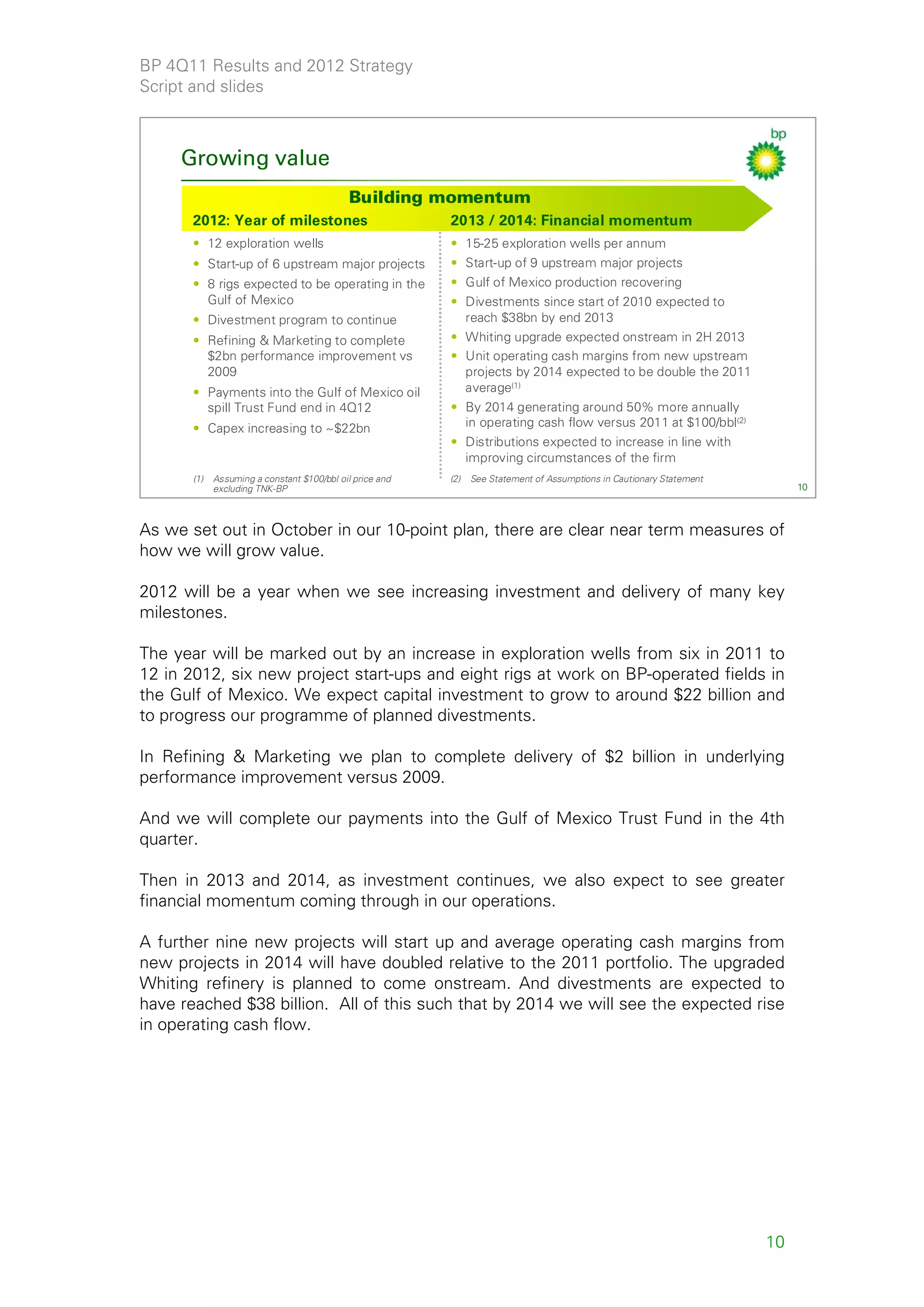
       2012: Year of milestones                           2013 / 2014: Financial momentum
       • 12 exploration wells                             • 15-25 exploration wells per annum
       • Start-up of 6 upstream major projects            • Start-up of 9 upstream major projects
       • 8 rigs expected to be operating in the           • Gulf of Mexico production recovering
         Gulf of Mexico                                   • Divestments since start of 2010 expected to
       • Divestment program to continue                     reach $38bn by end 2013
       • Refining & Marketing to complete                 • Whiting upgrade expected onstream in 2H 2013
         $2bn performance improvement vs                  • Unit operating cash margins from new upstream
         2009                                               projects by 2014 expected to be double the 2011
       • Payments into the Gulf of Mexico oil               average(1)
         spill Trust Fund end in 4Q12                     • By 2014 generating around 50% more annually
       • Capex increasing to ~$22bn                         in operating cash flow versus 2011 at $100/bbl(2)
                                                          • Distributions expected to increase in line with
                                                            improving circumstances of the firm
       (1)   Assuming a constant $100/bbl oil price and   (2)   See Statement of Assumptions in Cautionary Statement
             excluding TNK-BP                                                                                               10


As we set out in October in our 10-point plan, there are clear near term measures of
how we will grow value.

2012 will be a year when we see increasing investment and delivery of many key
milestones.

The year will be marked out by an increase in exploration wells from six in 2011 to
12 in 2012, six new project start-ups and eight rigs at work on BP-operated fields in
the Gulf of Mexico. We expect capital investment to grow to around $22 billion and
to progress our programme of planned divestments.

In Refining & Marketing we plan to complete delivery of $2 billion in underlying
performance improvement versus 2009.

And we will complete our payments into the Gulf of Mexico Trust Fund in the 4th
quarter.

Then in 2013 and 2014, as investment continues, we also expect to see greater
financial momentum coming through in our operations.

A further nine new projects will start up and average operating cash margins from
new projects in 2014 will have doubled relative to the 2011 portfolio. The upgraded
Whiting refinery is planned to come onstream. And divestments are expected to
have reached $38 billion. All of this such that by 2014 we will see the expected rise
in operating cash flow.


                                                                                                                       10
BP 4Q11 Results and 2012 Strategy
Script and slides


     Growing value
     2013-14: financial momentum
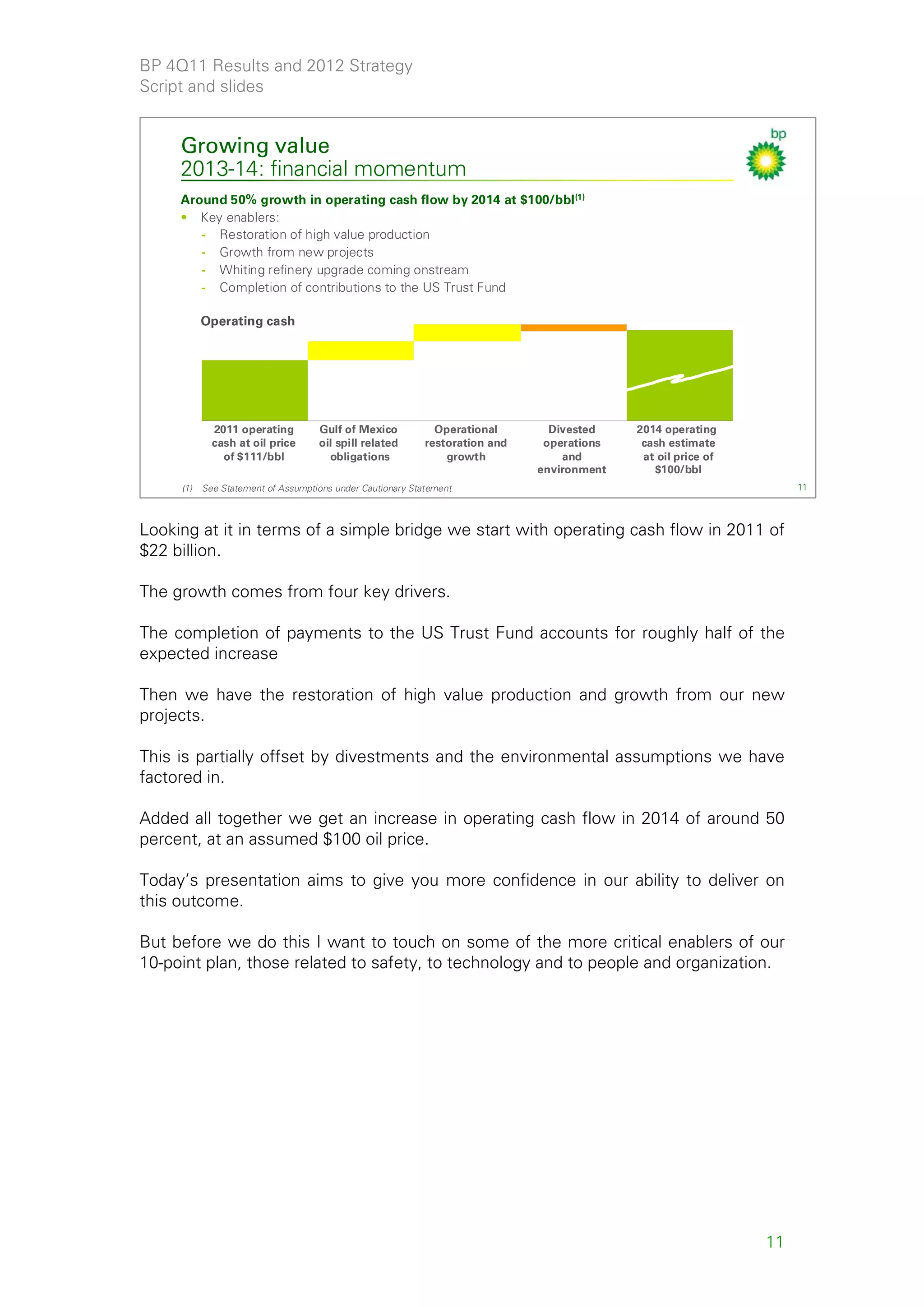
     Around 50% growth in operating cash flow by 2014 at $100/bbl (1)
     • Key enablers:
        - Restoration of high value production
        - Growth from new projects
        - Whiting refinery upgrade coming onstream
        - Completion of contributions to the US Trust Fund

           Operating cash


             2011 operating         Gulf of Mexico            Operational       Divested    2014 operating
             cash at oil price      oil spill related       restoration and    operations    cash estimate
               of $111/bbl            obligations               growth            and        at oil price of
                                                                              environment      $100/bbl
     (1)   See Statement of Assumptions under Cautionary Statement                                                  11


Looking at it in terms of a simple bridge we start with operating cash flow in 2011 of
$22 billion.

The growth comes from four key drivers.

The completion of payments to the US Trust Fund accounts for roughly half of the
expected increase

Then we have the restoration of high value production and growth from our new
projects.

This is partially offset by divestments and the environmental assumptions we have
factored in.

Added all together we get an increase in operating cash flow in 2014 of around 50
percent, at an assumed $100 oil price.

Today’s presentation aims to give you more confidence in our ability to deliver on
this outcome.

But before we do this I want to touch on some of the more critical enablers of our
10-point plan, those related to safety, to technology and to people and organization.


                                                                                                               11
BP 4Q11 Results and 2012 Strategy
Script and slides


      Safety performance record
   700
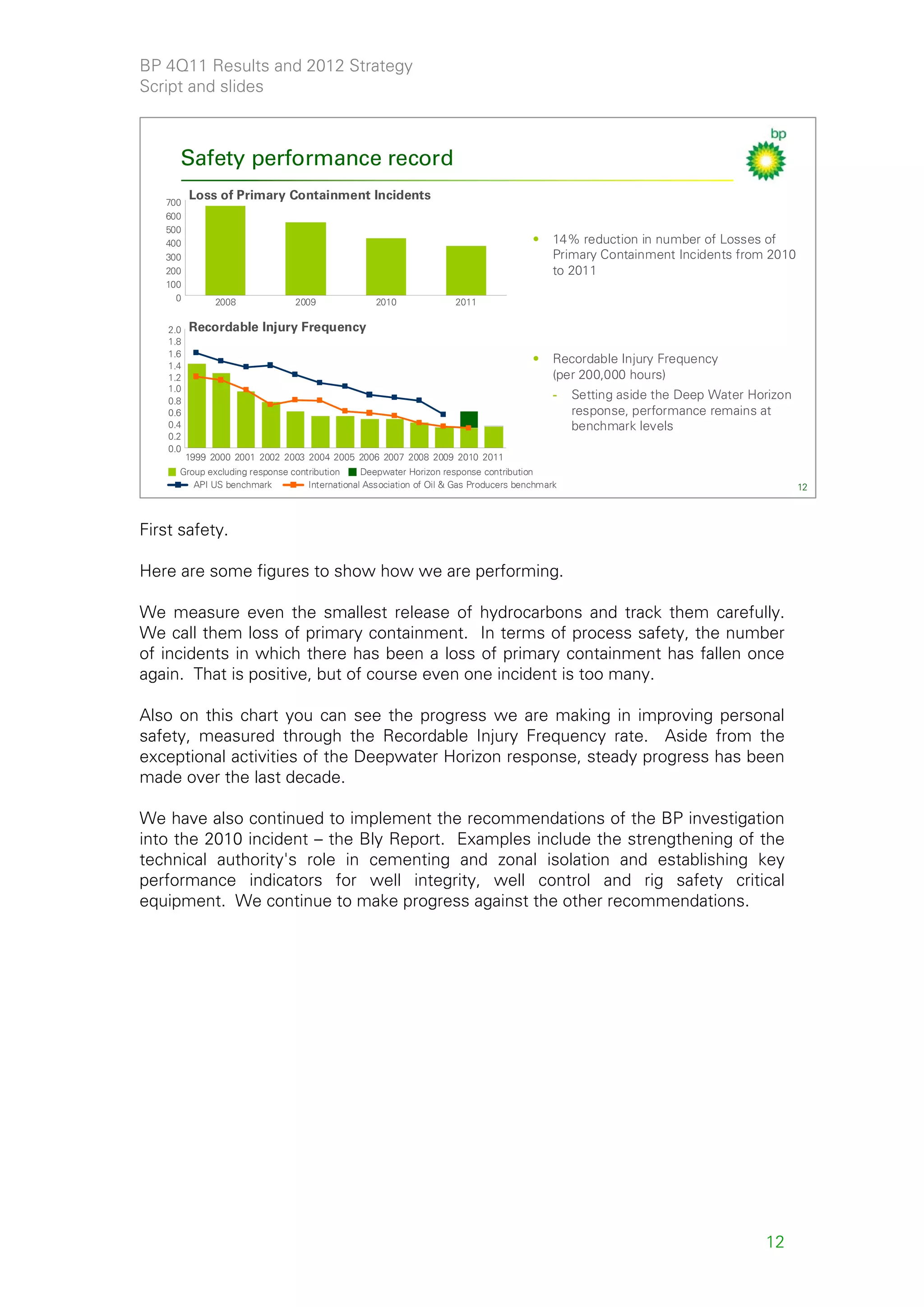
          Loss of Primary Containment Incidents
   600
   500
   400                                                                                 •    14% reduction in number of Losses of
   300                                                                                      Primary Containment Incidents from 2010
   200                                                                                      to 2011
   100
     0          2008            2009               2010              2011

    2.0   Recordable Injury Frequency
    1.8
    1.6
    1.4
                                                                                       •    Recordable Injury Frequency
    1.2                                                                                     (per 200,000 hours)
    1.0
    0.8
                                                                                            -   Setting aside the Deep Water Horizon
    0.6                                                                                         response, performance remains at
    0.4                                                                                         benchmark levels
    0.2
    0.0
          1999 2000 2001 2002 2003 2004 2005 2006 2007 2008 2009 2010 2011
      Group excluding response contribution     Deepwater Horizon response contribution
         API US benchmark          International Association of Oil & Gas Producers benchmark                                          12


First safety.

Here are some figures to show how we are performing.

We measure even the smallest release of hydrocarbons and track them carefully.
We call them loss of primary containment. In terms of process safety, the number
of incidents in which there has been a loss of primary containment has fallen once
again. That is positive, but of course even one incident is too many.

Also on this chart you can see the progress we are making in improving personal
safety, measured through the Recordable Injury Frequency rate. Aside from the
exceptional activities of the Deepwater Horizon response, steady progress has been
made over the last decade.

We have also continued to implement the recommendations of the BP investigation
into the 2010 incident – the Bly Report. Examples include the strengthening of the
technical authority's role in cementing and zonal isolation and establishing key
performance indicators for well integrity, well control and rig safety critical
equipment. We continue to make progress against the other recommendations.


                                                                                                                               12
BP 4Q11 Results and 2012 Strategy
Script and slides


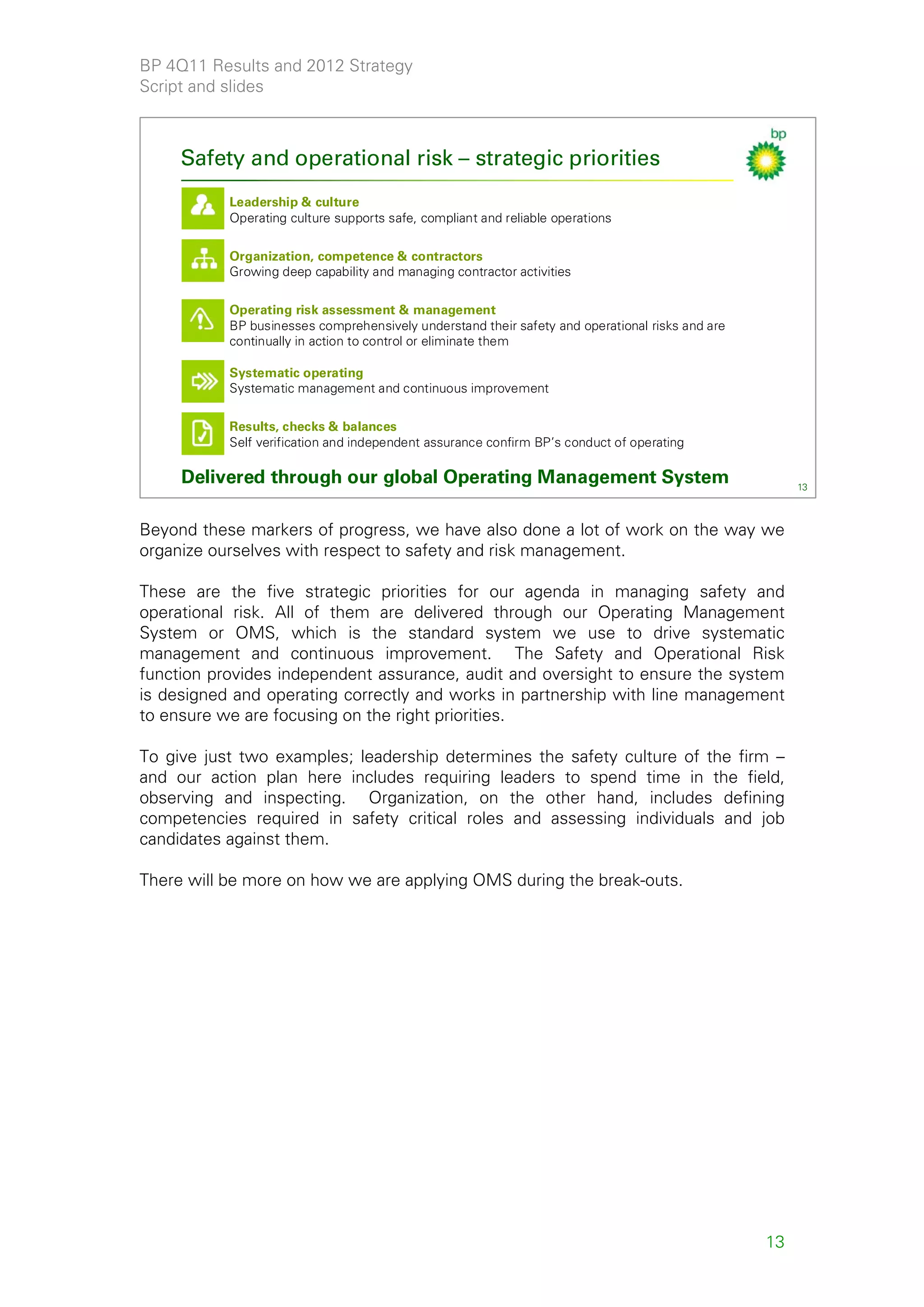
     Safety and operational risk – strategic priorities
           Leadership & culture
           Operating culture supports safe, compliant and reliable operations

           Organization, competence & contractors
           Growing deep capability and managing contractor activities

           Operating risk assessment & management
           BP businesses comprehensively understand their safety and operational risks and are
           continually in action to control or eliminate them

           Systematic operating
           Systematic management and continuous improvement

           Results, checks & balances
           Self verification and independent assurance confirm BP’s conduct of operating

     Delivered through our global Operating Management System                                         13


Beyond these markers of progress, we have also done a lot of work on the way we
organize ourselves with respect to safety and risk management.

These are the five strategic priorities for our agenda in managing safety and
operational risk. All of them are delivered through our Operating Management
System or OMS, which is the standard system we use to drive systematic
management and continuous improvement. The Safety and Operational Risk
function provides independent assurance, audit and oversight to ensure the system
is designed and operating correctly and works in partnership with line management
to ensure we are focusing on the right priorities.

To give just two examples; leadership determines the safety culture of the firm –
and our action plan here includes requiring leaders to spend time in the field,
observing and inspecting. Organization, on the other hand, includes defining
competencies required in safety critical roles and assessing individuals and job
candidates against them.

There will be more on how we are applying OMS during the break-outs.


                                                                                                 13
BP 4Q11 Results and 2012 Strategy
Script and slides


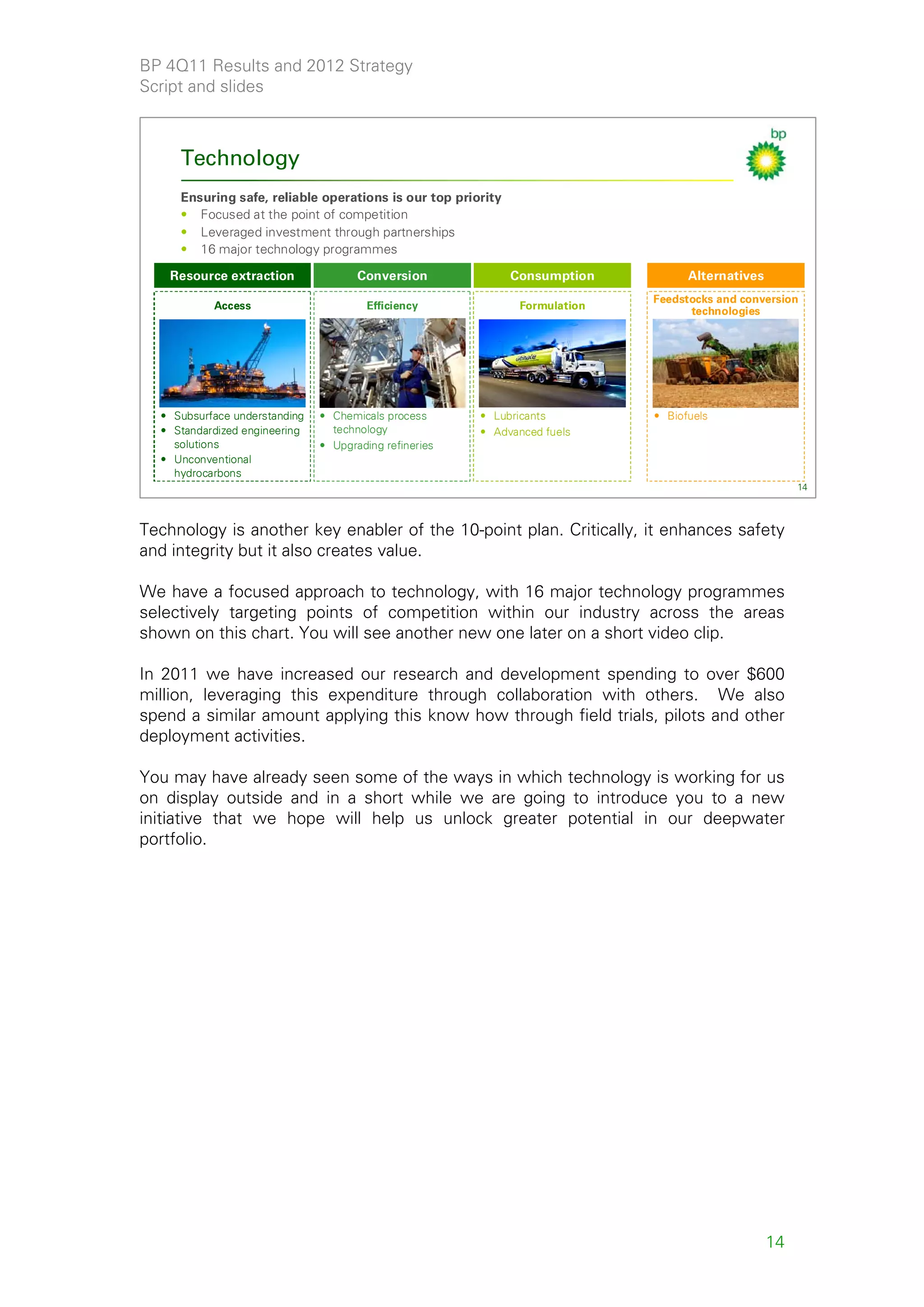
     Technology
     Ensuring safe, reliable operations is our top priority
     • Focused at the point of competition
     • Leveraged investment through partnerships
     • 16 major technology programmes

    Resource extraction               Conversion              Consumption          Alternatives
                                                                             Feedstocks and conversion
           Access                       Efficiency             Formulation         technologies


  • Subsurface understanding   • Chemicals process      • Lubricants         • Biofuels
  • Standardized engineering     technology             • Advanced fuels
    solutions                  • Upgrading refineries
  • Unconventional
    hydrocarbons
                                                                                                       14


Technology is another key enabler of the 10-point plan. Critically, it enhances safety
and integrity but it also creates value.

We have a focused approach to technology, with 16 major technology programmes
selectively targeting points of competition within our industry across the areas
shown on this chart. You will see another new one later on a short video clip.

In 2011 we have increased our research and development spending to over $600
million, leveraging this expenditure through collaboration with others. We also
spend a similar amount applying this know how through field trials, pilots and other
deployment activities.

You may have already seen some of the ways in which technology is working for us
on display outside and in a short while we are going to introduce you to a new
initiative that we hope will help us unlock greater potential in our deepwater
portfolio.


                                                                                                  14
BP 4Q11 Results and 2012 Strategy
Script and slides


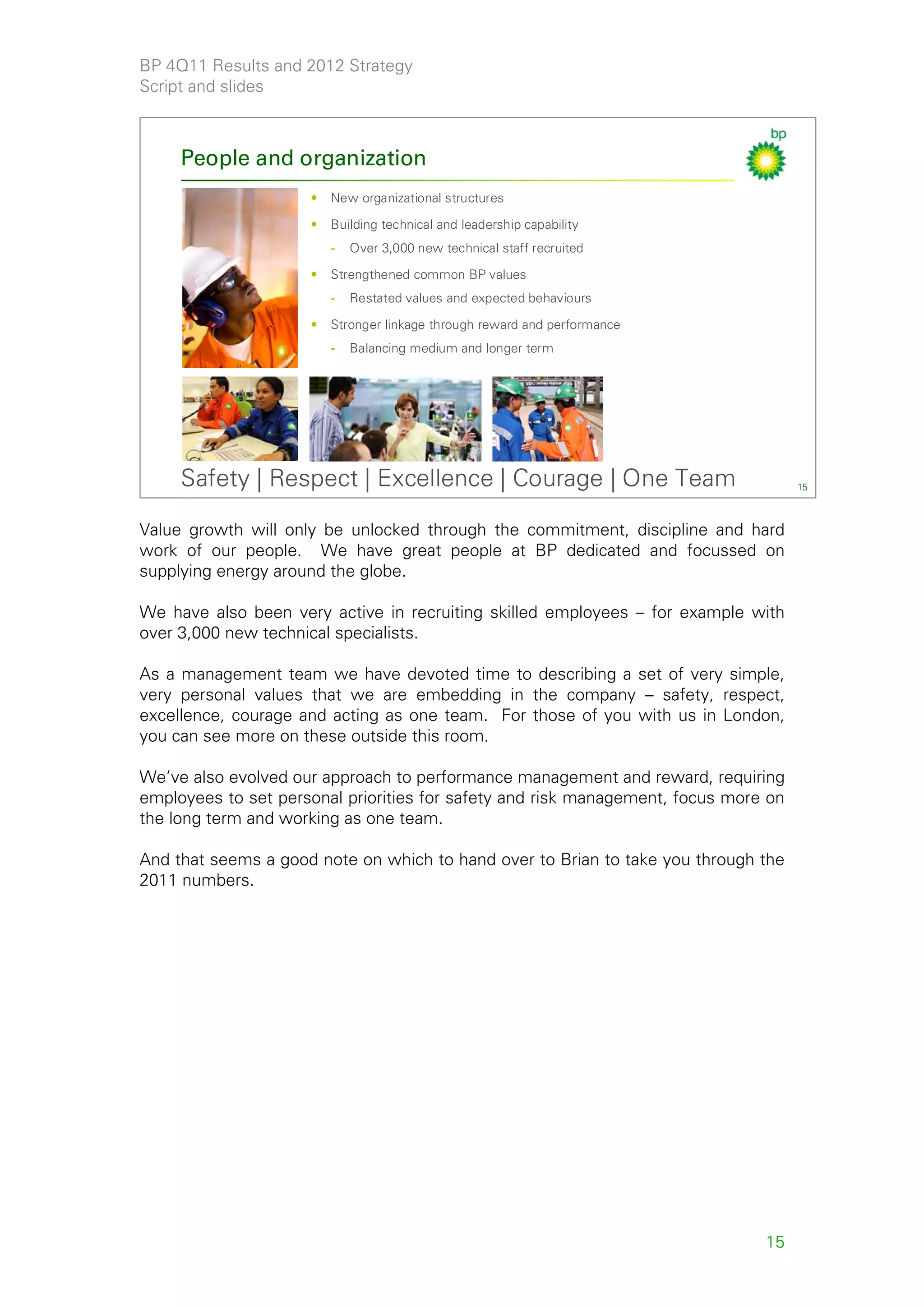
     People and organization
                     •   New organizational structures

                     •   Building technical and leadership capability
                         -   Over 3,000 new technical staff recruited

                     •   Strengthened common BP values
                         -   Restated values and expected behaviours

                     •   Stronger linkage through reward and performance
                         -   Balancing medium and longer term


     Safety | Respect | Excellence | Courage | One Team                              15


Value growth will only be unlocked through the commitment, discipline and hard
work of our people. We have great people at BP dedicated and focussed on
supplying energy around the globe.

We have also been very active in recruiting skilled employees – for example with
over 3,000 new technical specialists.

As a management team we have devoted time to describing a set of very simple,
very personal values that we are embedding in the company – safety, respect,
excellence, courage and acting as one team. For those of you with us in London,
you can see more on these outside this room.

We’ve also evolved our approach to performance management and reward, requiring
employees to set personal priorities for safety and risk management, focus more on
the long term and working as one team.

And that seems a good note on which to hand over to Brian to take you through the
2011 numbers.


                                                                               15
BP 4Q11 Results and 2012 Strategy
Script and slides


Brian Gilvary: Chief Financial Officer


    Brian Gilvary
    Chief Financial Officer


                                                                                     16


Thank you Bob.

I’m delighted to join you today to present my first set of quarterly results.


                                                                                16
BP 4Q11 Results and 2012 Strategy
Script and slides


     4Q 2011 Summary
     Earnings figures are adjusted for the costs associated with the Gulf of Mexico oil spill, other
     non-operating items and fair value accounting effects

      $bn                                                                       4Q10      3Q11         4Q11    % yoy
        Exploration & Production                                                 6.7        7.2        6.9
        Refining & Marketing                                                     0.7        1.7        0.8
        Other businesses & corporate                                             (0.5)     (0.4)       (0.6)
        Consolidation adjustment                                                 0.1       (0.2)       0.1
      Underlying replacement cost profit before interest and tax                 7.0        8.3        7.2      3%
        Interest and minority interest                                           (0.4)     (0.4)       (0.3)
        Tax                                                                      (2.2)     (2.4)       (1.9)
      Underlying replacement cost profit                                         4.4        5.5        5.0     14%

      Earnings per share (cents)                                                 23.2      28.8        26.3    13%

      Dividend paid per share (cents)                                            0.0        7.0        7.0

      Operating cash flow                                                        (0.2)      6.9        5.0
                                                                                                                            17


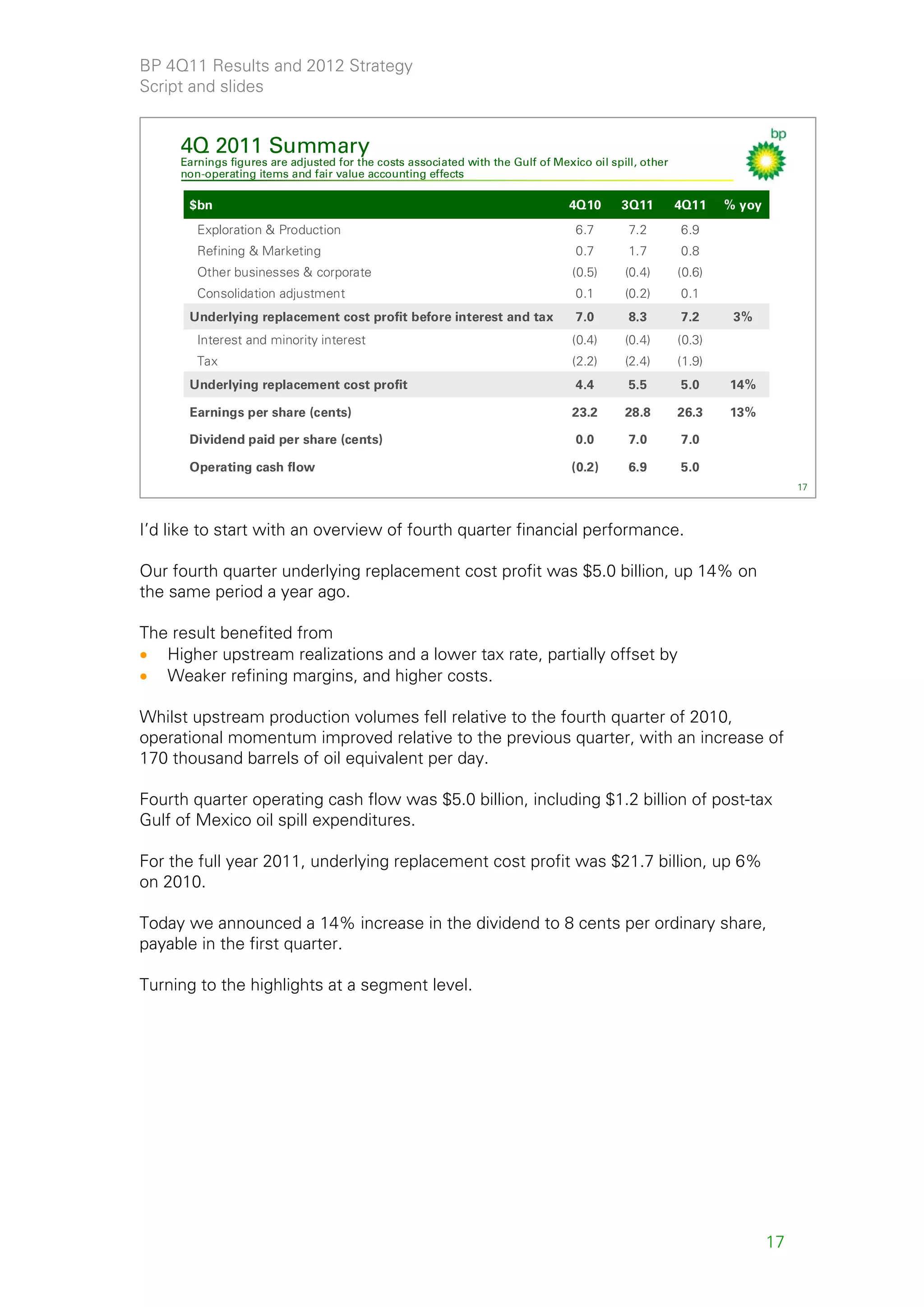
I’d like to start with an overview of fourth quarter financial performance.

Our fourth quarter underlying replacement cost profit was $5.0 billion, up 14% on
the same period a year ago.

The result benefited from
• Higher upstream realizations and a lower tax rate, partially offset by
• Weaker refining margins, and higher costs.

Whilst upstream production volumes fell relative to the fourth quarter of 2010,
operational momentum improved relative to the previous quarter, with an increase of
170 thousand barrels of oil equivalent per day.

Fourth quarter operating cash flow was $5.0 billion, including $1.2 billion of post-tax
Gulf of Mexico oil spill expenditures.

For the full year 2011, underlying replacement cost profit was $21.7 billion, up 6%
on 2010.

Today we announced a 14% increase in the dividend to 8 cents per ordinary share,
payable in the first quarter.

Turning to the highlights at a segment level.


                                                                                                                       17
BP 4Q11 Results and 2012 Strategy
Script and slides


                Exploration & Production
                                                                                                                                    Underlying replacement cost
               Realizations (1)                                                Volume                                               profit before interest and tax(2)
     120                                           20                  1,600                                                    10

                                                                       1,400
     100                                                                                                                                      7.8
                                                   16                                                                               8                7.4   7.2
                                                                       1,200                                                            6.7                        6.9
          80
                                                   12                  1,000
                                                                                                                                    6


                                                               mboed
                                                       $/mcf
  $/bbl


                                                                                                                              $bn
          60                                                            800
                                                   8                                                                                4
                                                                        600
          40
                                                                        400
                                                   4                                                                                2
          20
                                                                        200

          0                                        0                      0                                                         0
                4Q10 1Q11 2Q11 3Q11 4Q11                                       4Q10 1Q11 2Q11 3Q11 4Q11                                 4Q10 1Q11 2Q11 3Q11 4Q11
                    Liquids $/bbl                                              Liquids, excluding TNK-BP       TNK-BP total              US   Non-US, excluding TNK-BP
                    Natural gas $/mcf                                          Natural gas, excluding TNK-BP                             TNK-BP     Total RCPBIT

               (1) Realizations based on sales of consolidated subsidiaries only – this excludes equity accounted entities
               (2) Adjusted for non-operating items and fair value accounting effects                                                                                     18


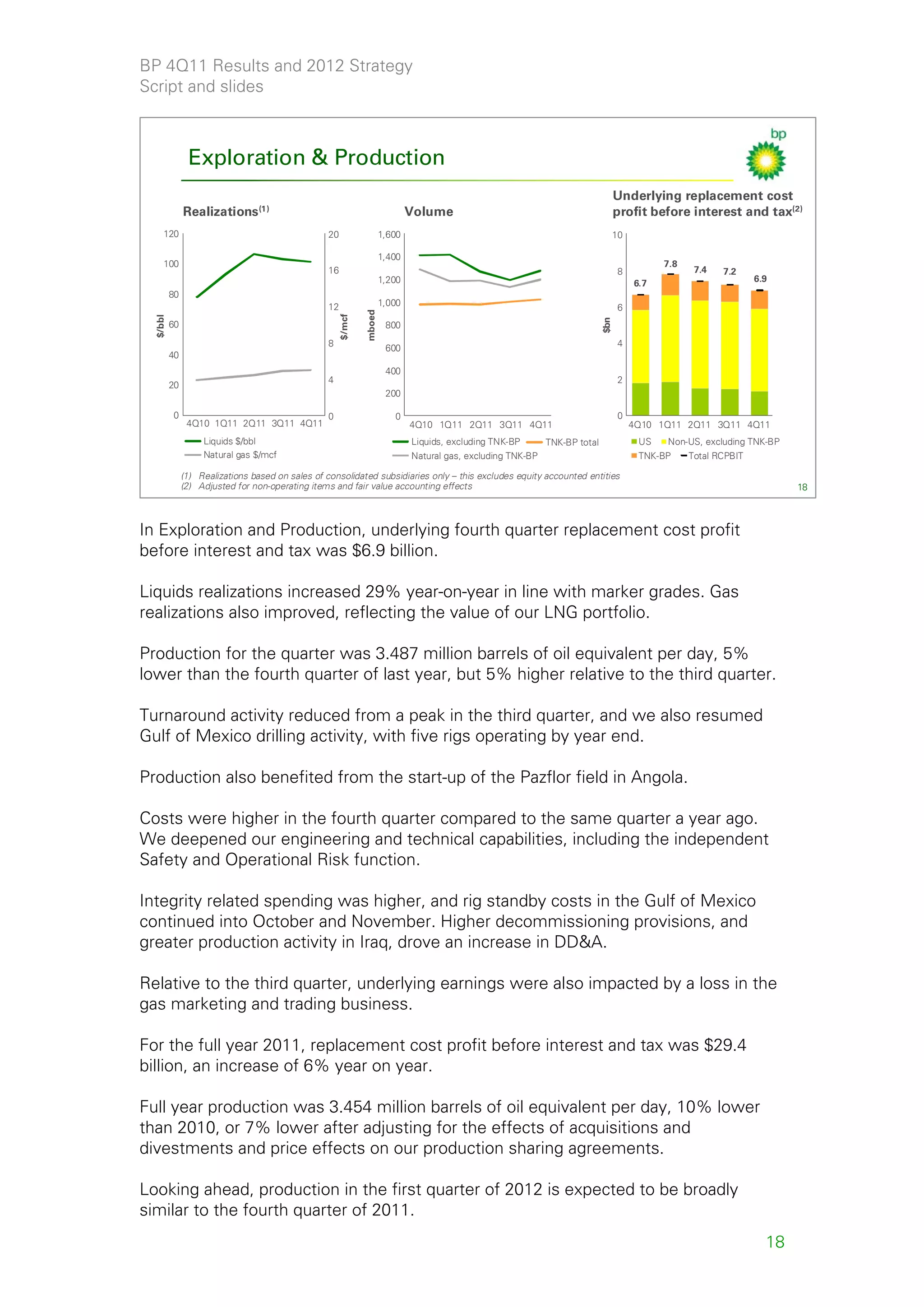
In Exploration and Production, underlying fourth quarter replacement cost profit
before interest and tax was $6.9 billion.

Liquids realizations increased 29% year-on-year in line with marker grades. Gas
realizations also improved, reflecting the value of our LNG portfolio.

Production for the quarter was 3.487 million barrels of oil equivalent per day, 5%
lower than the fourth quarter of last year, but 5% higher relative to the third quarter.

Turnaround activity reduced from a peak in the third quarter, and we also resumed
Gulf of Mexico drilling activity, with five rigs operating by year end.

Production also benefited from the start-up of the Pazflor field in Angola.

Costs were higher in the fourth quarter compared to the same quarter a year ago.
We deepened our engineering and technical capabilities, including the independent
Safety and Operational Risk function.

Integrity related spending was higher, and rig standby costs in the Gulf of Mexico
continued into October and November. Higher decommissioning provisions, and
greater production activity in Iraq, drove an increase in DD&A.

Relative to the third quarter, underlying earnings were also impacted by a loss in the
gas marketing and trading business.

For the full year 2011, replacement cost profit before interest and tax was $29.4
billion, an increase of 6% year on year.

Full year production was 3.454 million barrels of oil equivalent per day, 10% lower
than 2010, or 7% lower after adjusting for the effects of acquisitions and
divestments and price effects on our production sharing agreements.

Looking ahead, production in the first quarter of 2012 is expected to be broadly
similar to the fourth quarter of 2011.
                                                                                                                                                                     18
BP 4Q11 Results and 2012 Strategy
Script and slides


               TNK-BP

               Average oil marker prices               BP share of net income                 BP share of dividend
      120                                        1.4                                    1.8

                                                                                        1.6
      100                                        1.2
                                                                                        1.4
                                                 1.0
          80                                                                            1.2
                                                 0.8                                    1.0
  $/bbl


                                                                                  $bn
                                           $bn
          60
                                                 0.6                                    0.8

          40                                                                            0.6
                                                 0.4
                                                                                        0.4
          20                                     0.2
                                                                                        0.2

           0                                     0.0                                    0.0
               4Q10 1Q11 2Q11 3Q11 4Q11                4Q10 1Q11 2Q11 3Q11 4Q11               4Q10 1Q11 2Q11 3Q11 4Q11

                  Urals
                  Russian domestic oil

                                                                                                                          19


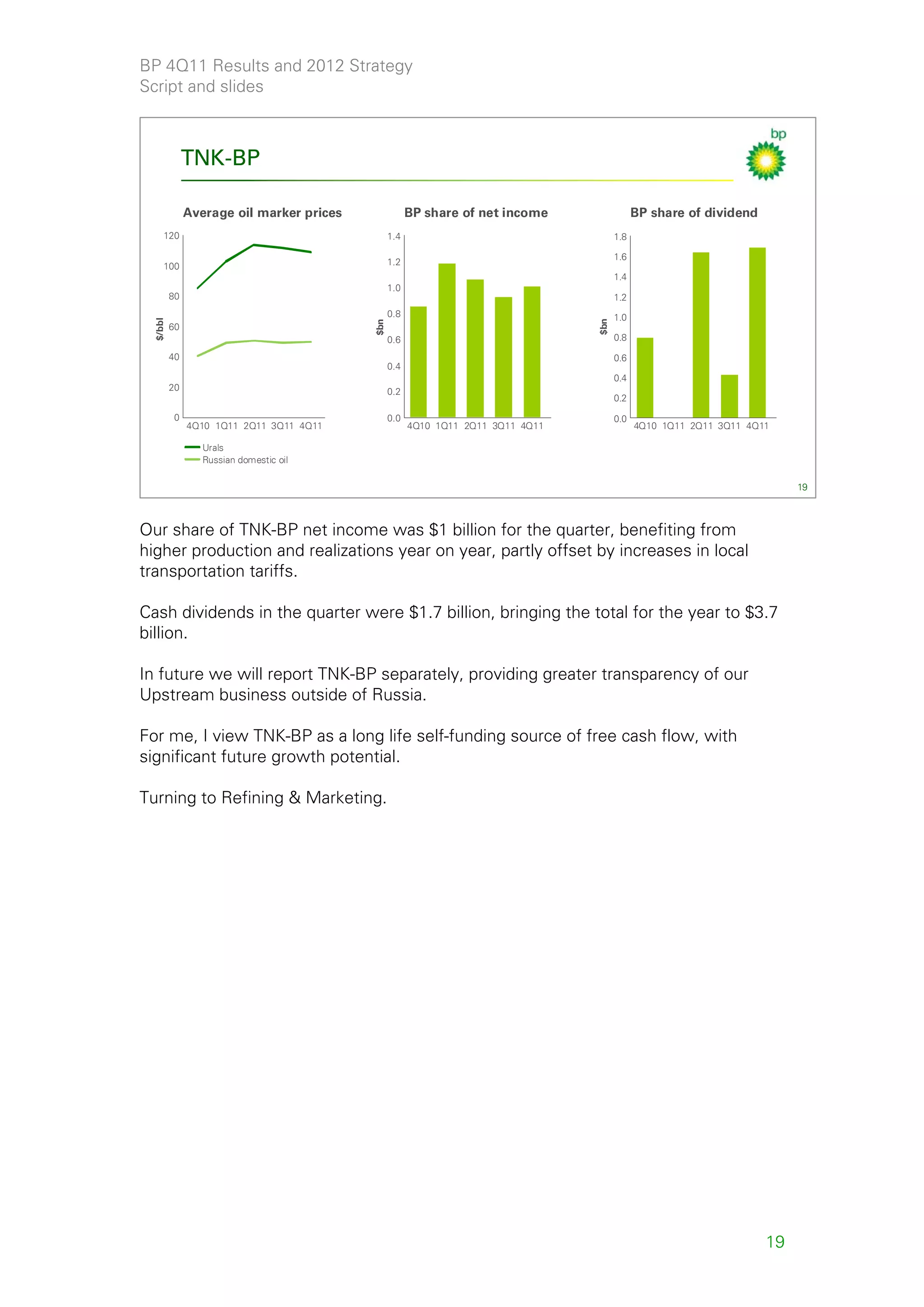
Our share of TNK-BP net income was $1 billion for the quarter, benefiting from
higher production and realizations year on year, partly offset by increases in local
transportation tariffs.

Cash dividends in the quarter were $1.7 billion, bringing the total for the year to $3.7
billion.

In future we will report TNK-BP separately, providing greater transparency of our
Upstream business outside of Russia.

For me, I view TNK-BP as a long life self-funding source of free cash flow, with
significant future growth potential.

Turning to Refining & Marketing.


                                                                                                                     19
BP 4Q11 Results and 2012 Strategy
Script and slides


               Refining & Marketing
               BP average                                                                        Underlying replacement cost
               Refining Marker Margin                                 Refining availability      profit before interest and tax(1)
          20                                                     97                               2.5
                                                                                                              2.2
          18                                                     96
                                                                                                  2.0
          16                                                                                                                  1.7
                                                                 95
          14                                                                                                           1.4
                                                                                                  1.5
                                                                 94
          12                                                 %
  $/bbl


                                                                 93
          10                                                                                      1.0
                                                                                                        0.7                         0.8
                                                                 92
           8
                                                                                                  0.5
           6                                                     91

           4                                                     90                               0.0
                4Q10 1Q11 2Q11 3Q11 4Q11                              4Q10 1Q11 2Q11 3Q11 4Q11          4Q10 1Q11 2Q11 3Q11 4Q11
                                                                                                          Fuels              Petrochemicals
                                                                                                          Lubricants         Total RCPBIT


               (1) Adjusted for non-operating items and fair value accounting effects                                                          20


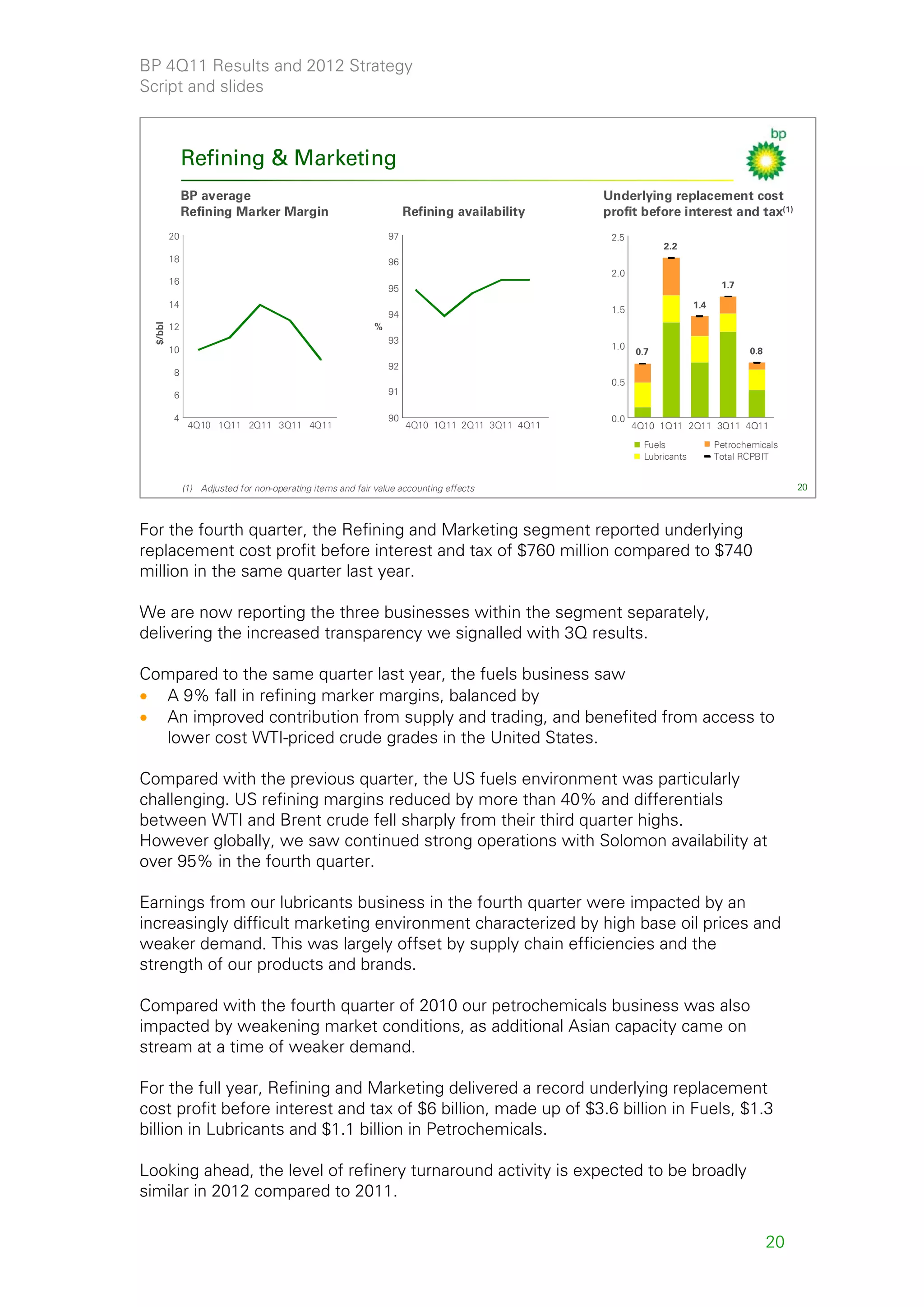
For the fourth quarter, the Refining and Marketing segment reported underlying
replacement cost profit before interest and tax of $760 million compared to $740
million in the same quarter last year.

We are now reporting the three businesses within the segment separately,
delivering the increased transparency we signalled with 3Q results.

Compared to the same quarter last year, the fuels business saw
• A 9% fall in refining marker margins, balanced by
• An improved contribution from supply and trading, and benefited from access to
  lower cost WTI-priced crude grades in the United States.

Compared with the previous quarter, the US fuels environment was particularly
challenging. US refining margins reduced by more than 40% and differentials
between WTI and Brent crude fell sharply from their third quarter highs.
However globally, we saw continued strong operations with Solomon availability at
over 95% in the fourth quarter.

Earnings from our lubricants business in the fourth quarter were impacted by an
increasingly difficult marketing environment characterized by high base oil prices and
weaker demand. This was largely offset by supply chain efficiencies and the
strength of our products and brands.

Compared with the fourth quarter of 2010 our petrochemicals business was also
impacted by weakening market conditions, as additional Asian capacity came on
stream at a time of weaker demand.

For the full year, Refining and Marketing delivered a record underlying replacement
cost profit before interest and tax of $6 billion, made up of $3.6 billion in Fuels, $1.3
billion in Lubricants and $1.1 billion in Petrochemicals.

Looking ahead, the level of refinery turnaround activity is expected to be broadly
similar in 2012 compared to 2011.

                                                                                                                                          20
BP 4Q11 Results and 2012 Strategy
Script and slides


     Other items

                    OB&C underlying RCPBIT(1)                                      Effective tax rate (2)
                    4Q10    1Q11    2Q11    3Q11    4Q11
             0.0                                                              45


            (0.1)
                                                                              40

            (0.2)
                                                                              35
            (0.3)
                            (0.3)                                         %
      $bn


                                    (0.3)
            (0.4)                                                             30
                                            (0.4)
            (0.5)   (0.5)
                                                                              25
                                                                                    2011 full year effective tax
            (0.6)                                                                   rate is 33%
                                                    (0.6)
            (0.7)                                                             20
                                                                                   4Q10   1Q11   2Q11    3Q11    4Q11

      (1)   Other businesses and corporate (OB&C) replacement cost profit before interest and tax (RCPBIT), adjusted for
            non-operating items and fair value accounting effects
      (2)   Effective tax rate on replacement cost profit                                                                       21


In Other Businesses and Corporate, we reported a pre-tax underlying replacement
cost charge of $620 million for the fourth quarter, an increase of $140 million versus
the charge of a year ago, primarily reflecting higher functional costs related to the
strengthening of our operations. This more than offset an improvement in foreign
exchange effects.

The full year charge of $1.7 billion was in line with our February guidance. In 2012,
we expect the underlying quarterly charge for Other Businesses and Corporate to
average around $500 million, although this will remain volatile between individual
quarters.

The effective tax rate for the fourth quarter was 30% bringing the full year rate to
33%. In 2012 we expect the tax rate to be in the range of 34% to 36%.
The increase is driven by changes to the geographical mix of income, together with
the anticipated impacts of the disposal programme.


                                                                                                                           21
BP 4Q11 Results and 2012 Strategy
Script and slides


     Gulf of Mexico oil spill costs and provisions
     (pre-tax(1))
          $bn                                                                       FY10               FY11               Total
          Income statement
            Charge / (credit) for the period                                         40.9               (3.7)              37.2

          Balance sheet(2)
          Brought forward                                                                               23.3
            Charge / (credit) to income statement                                    40.9               (3.7)              37.2
            Payments into Trust Fund                                                 (5.0)            (10.1)             (15.1)
            Cash settlements received                                                 0.0                 5.1                5.1
                                                              (3)
            Other related payments in the period                                   (12.7)               (3.9)            (16.6)
          Carried forward                                                            23.3               10.6

          Cash outflow                                                               17.7                 8.9              26.6
     (1) Includes contributions received from Mitsui, Weatherford and Anadarko and the income statement impact of the Cameron settlement
     (2) Balance sheet amount includes all provisions, other payables and the asset balances related to the Gulf of Mexico oil spill
     (3) Please refer to details as disclosed in the Stock Exchange Announcement                                                                22


Turning to the costs and provisions associated with the Gulf of Mexico oil spill.

In the fourth quarter we recognized a $4.1 billion credit reflecting a reduction in the
pre-tax charge for the incident, bringing the full-year total to a reduction of $3.7
billion.

The 4Q credit reflects the settlements with Anadarko and Cameron, partially offset
by an increase in the provision for spill response costs plus a charge for the ongoing
quarterly expenses of the Gulf Coast Restoration Organization.

Under these settlement agreements, Anadarko paid BP $4 billion in November,
which was subsequently paid in to the Trust Fund, and Cameron paid BP $250
million last month which will be reflected as paid into the $20 billion Trust Fund in
the first quarter. As a result of these accelerated contributions, the $20 billion
commitment to the Trust Fund will have been paid in full by the end of this year.

The total charge taken for the incident at year-end was $37.2 billion.

Pre-tax BP cash out flow related to oil spill costs for the year was $8.9 billion.

As we indicated in previous quarters, we continue to believe that BP was not grossly
negligent and we have taken the charge against income on that basis.


                                                                                                                                           22
BP 4Q11 Results and 2012 Strategy
Script and slides


       Divestments
                                  US                          Wytch Farm
       Natural Gas
  Liquids Canada(3)               Midstream
                                  Aluminium                   Egypt Western
        Western                                               Desert
      Canada Gas                  Permian Assets
                                                                                    LukArco

                                                                                                                   Cumulative divestments proceeds(1)
                                                                                    50% Devon
                                                                                                              25
                                                                                    ACG(2) interest
                                                                                                              20
  Wattenberg gas
                                                                                    Pakistan                  15
           plant


                                                                                                        $bn
                                                                                    Vietnam                   10
    Pompano and
      Mica fields                                                                   Malaysia
                                                                                    Petrochemicals             5
   Devon Gulf of                                                                    Joint Venture
  Mexico mature                                                                                                0
         assets                                                                     Southern                       2Q10 3Q10 4Q10 1Q11 2Q11 3Q11 4Q11
        Colombia                       Venezuela                                    Africa
                                                                       2010
                                                                       2011


       (1) Cumulative divestment proceeds have been adjusted to remove the deposit of $3.5bn received in 4Q 2010 relating to the sale of
           our interest in Pan American Energy and its subsequent repayment in 4Q 2011
       (2) Azeri-Chirag-Gunashli
       (3) Announced, not closed                                                                                                                        23


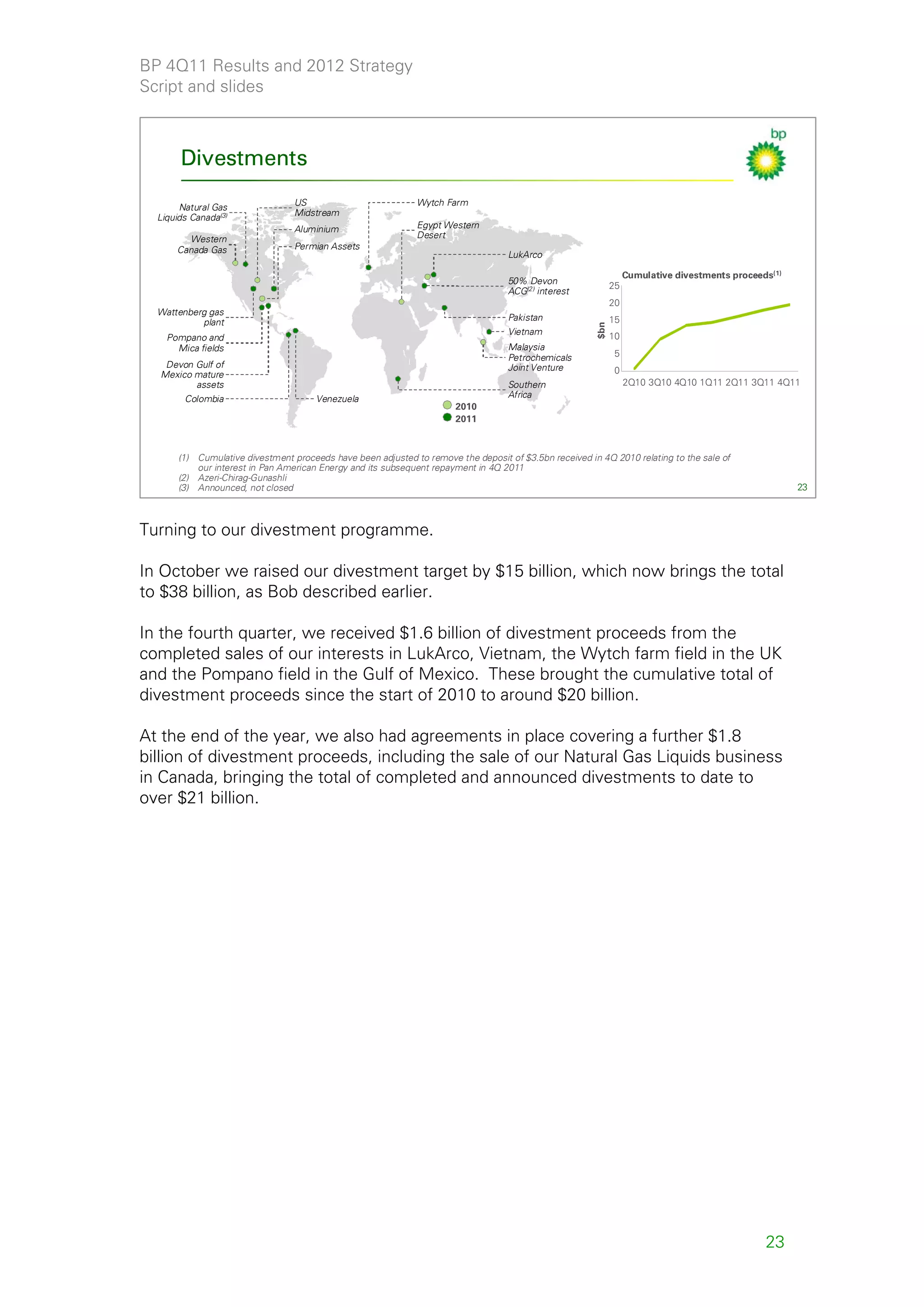
Turning to our divestment programme.

In October we raised our divestment target by $15 billion, which now brings the total
to $38 billion, as Bob described earlier.

In the fourth quarter, we received $1.6 billion of divestment proceeds from the
completed sales of our interests in LukArco, Vietnam, the Wytch farm field in the UK
and the Pompano field in the Gulf of Mexico. These brought the cumulative total of
divestment proceeds since the start of 2010 to around $20 billion.

At the end of the year, we also had agreements in place covering a further $1.8
billion of divestment proceeds, including the sale of our Natural Gas Liquids business
in Canada, bringing the total of completed and announced divestments to date to
over $21 billion.


                                                                                                                                                 23
BP 4Q11 Results and 2012 Strategy
Script and slides


     Sources and uses of cash

                                 2010                                                                  2011
          35                                                                    35

          30                                                                    30                            Inorganic
                                                                                           Disposals            capex
          25                                                                    25
                                         Inorganic
          20                               capex                                20
                 Disposals


                                                                          $bn
    $bn


          15                                                                    15                            Organic
                                          Organic                                       Operating              capex
          10                               capex                                       cash flow(1)
                                                                                10
                 Operating
          5     cash flow(1)                                                     5
                                        Dividends                                                             Dividends
          0                                                                      0
                  Sources                   Uses                                           Sources              Uses

      (1) After payments into the Trust Fund and other Gulf of Mexico oil spill payments                                       24


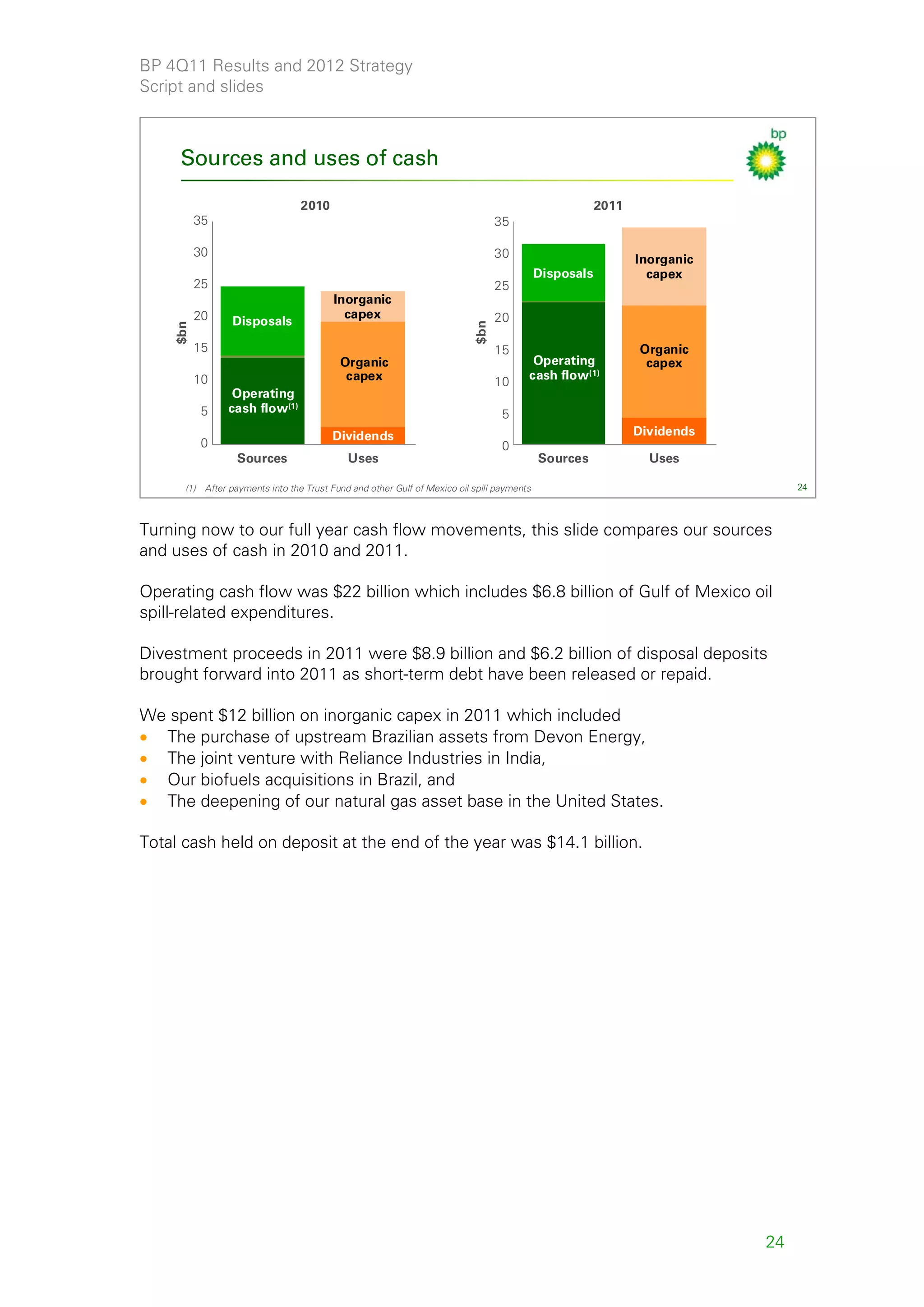
Turning now to our full year cash flow movements, this slide compares our sources
and uses of cash in 2010 and 2011.

Operating cash flow was $22 billion which includes $6.8 billion of Gulf of Mexico oil
spill-related expenditures.

Divestment proceeds in 2011 were $8.9 billion and $6.2 billion of disposal deposits
brought forward into 2011 as short-term debt have been released or repaid.

We spent $12 billion on inorganic capex in 2011 which included
• The purchase of upstream Brazilian assets from Devon Energy,
• The joint venture with Reliance Industries in India,
• Our biofuels acquisitions in Brazil, and
• The deepening of our natural gas asset base in the United States.

Total cash held on deposit at the end of the year was $14.1 billion.


                                                                                                                          24
BP 4Q11 Results and 2012 Strategy
Script and slides


     Net debt ratio

          35

          30

          25                   20 to 30%

          20
      %
          15                                                                    10 to 20% 20%
                                                                                      10 to

          10

            5

            0
                 2008            2009             2010             2011            2012            2013

     Net debt ratio = net debt / (net debt + equity)
     Net debt includes the fair value of associated derivative financial instruments used to hedge finance debt        25


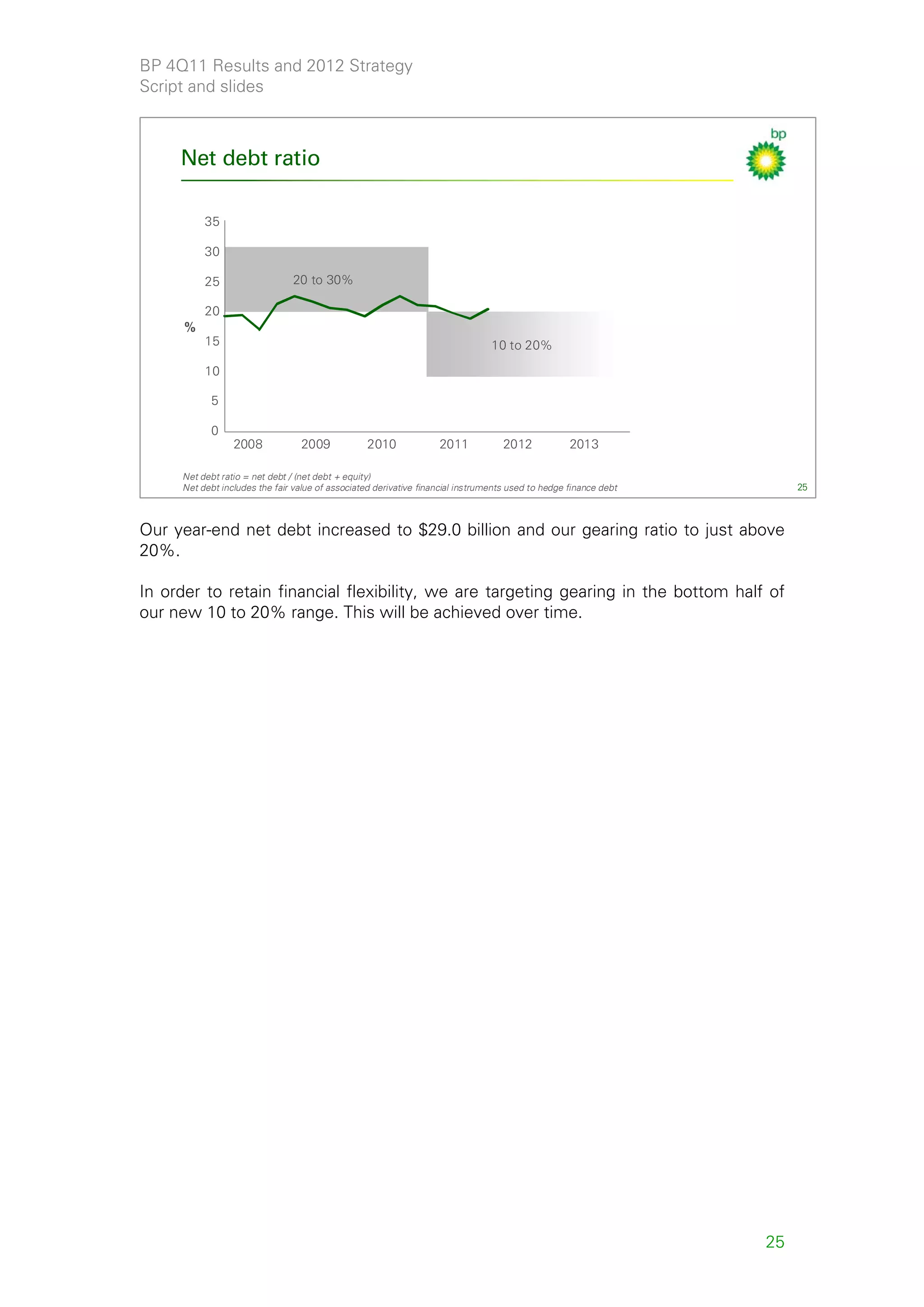
Our year-end net debt increased to $29.0 billion and our gearing ratio to just above
20%.

In order to retain financial flexibility, we are targeting gearing in the bottom half of
our new 10 to 20% range. This will be achieved over time.


                                                                                                                  25
BP 4Q11 Results and 2012 Strategy
Script and slides


     2012 Guidance

       $bn                                                                         2011                    2012 guidance

       Organic capital expenditure                                                  19.1                          ~ 22

       DD&A(1)                                                                      11.1                     ~ 1.0 higher

       Production excluding TNK-BP                                            2,460mboed                 ~ flat, underlying(2)

       Other businesses and corporate:
                                                                                ~ $400m                        ~ $500m
       average underlying quarterly charge

       Full year effective tax rate                                                 33%                       34% - 36%


     (1) Depreciation, depletion and amortization
     (2) 2012 underlying production is based on $100/bbl oil normalized for the impact of divestments, OPEC quotas and price effects        26


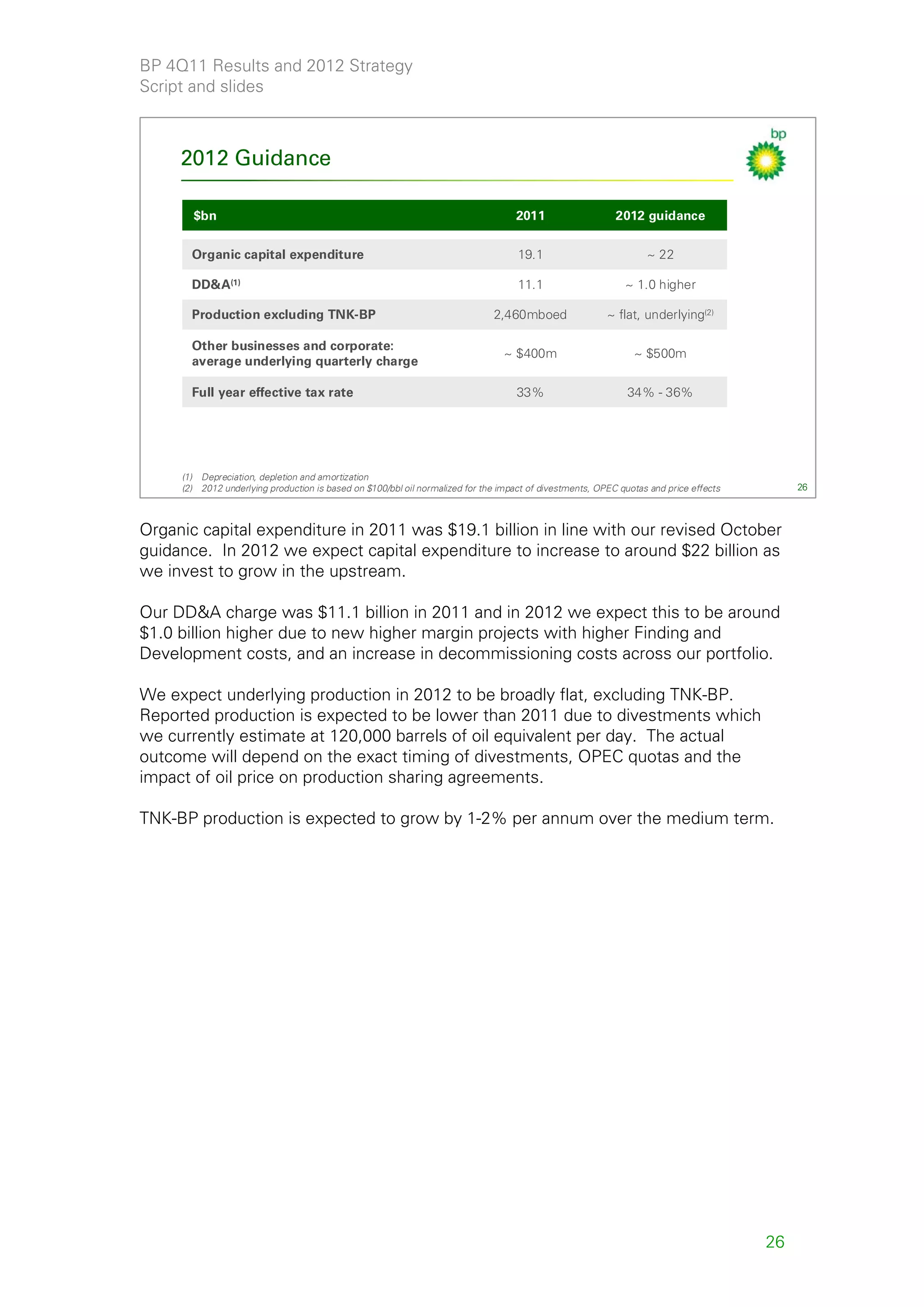
Organic capital expenditure in 2011 was $19.1 billion in line with our revised October
guidance. In 2012 we expect capital expenditure to increase to around $22 billion as
we invest to grow in the upstream.

Our DD&A charge was $11.1 billion in 2011 and in 2012 we expect this to be around
$1.0 billion higher due to new higher margin projects with higher Finding and
Development costs, and an increase in decommissioning costs across our portfolio.

We expect underlying production in 2012 to be broadly flat, excluding TNK-BP.
Reported production is expected to be lower than 2011 due to divestments which
we currently estimate at 120,000 barrels of oil equivalent per day. The actual
outcome will depend on the exact timing of divestments, OPEC quotas and the
impact of oil price on production sharing agreements.

TNK-BP production is expected to grow by 1-2% per annum over the medium term.


                                                                                                                                       26
BP 4Q11 Results and 2012 Strategy
Script and slides


     Financial framework

     • Increased investment to grow the firm

     • Intention to grow distributions over time in line with improving
       circumstances of the firm

     • Dividend: progressive growth
           • Driven by:      – momentum in underlying businesses
           • Balanced by:    – the need to retain significant level of financial flexibility
                             – continuing obligation to the Trust Fund

     • Gearing: lower half of 10% to 20% range over time
           • Supported by: – $15bn additional expected divestments by end 2013;
                             $38bn in total
                                                                                                    27


In closing, I would like to provide an update on the medium-term financial framework
for the Group.

•   We are increasing capital expenditure to grow the firm by investing in our areas
    of strength.
•   With the improvements in operating cash flow we have outlined for 2014, we are
    now confident in committing to a progressive dividend policy going forward and
    have today announced an increase in the dividend of 14% to eight cents per
    ordinary share payable in the first quarter.
•   Future increases will be contingent on improved cash flow delivery, balanced by
    the need to retain financial flexibility, and our continuing obligations to the Trust
    Fund.
•   Our commitment to reduce gearing to the lower half of the 10-20% range over
    time is supported by the $15 billion of additional strategic divestments we
    announced in October.
•    In addition, we aim to maintain a strong liquidity buffer, given the current
    uncertainties and economic outlook.
•   After meeting these objectives, share buybacks still remain an option as a
    flexible mechanism to return cash over the longer term, once uncertainty has
    reduced and gearing has reached the lower half of our target band.

That concludes my remarks, now back to Bob


                                                                                               27
BP 4Q11 Results and 2012 Strategy
Script and slides


Bob Dudley: Group Chief Executive


    Bob Dudley
    Group Chief Executive


    Progress in the US


                                                                                    28


Thanks Brian. Now let’s look at the progress we have made since the oil spill and
spend a few minutes on the upcoming legal process in the US.


                                                                              28
BP 4Q11 Results and 2012 Strategy
Script and slides


     Progress in the US


     Response completion: focus on restoration
     • Shoreline clean up essentially complete
     • Patrolling and maintenance continues
     Environmental restoration
     • Natural Resource Damages Assessment progressing
     • $1bn committed to early restoration projects
     Economic restoration
     • $7.8bn of claims and government payments to date(1)
     • Robust recovery of Gulf coast tourism
     Trust Fund >75% funded
     • $15.1bn paid into the Trust Fund, including cash from settlements with Mitsui,
        Weatherford and Anadarko
     (1)   As at end of 4Q, includes $6.2bn paid out of the Trust Fund                       29


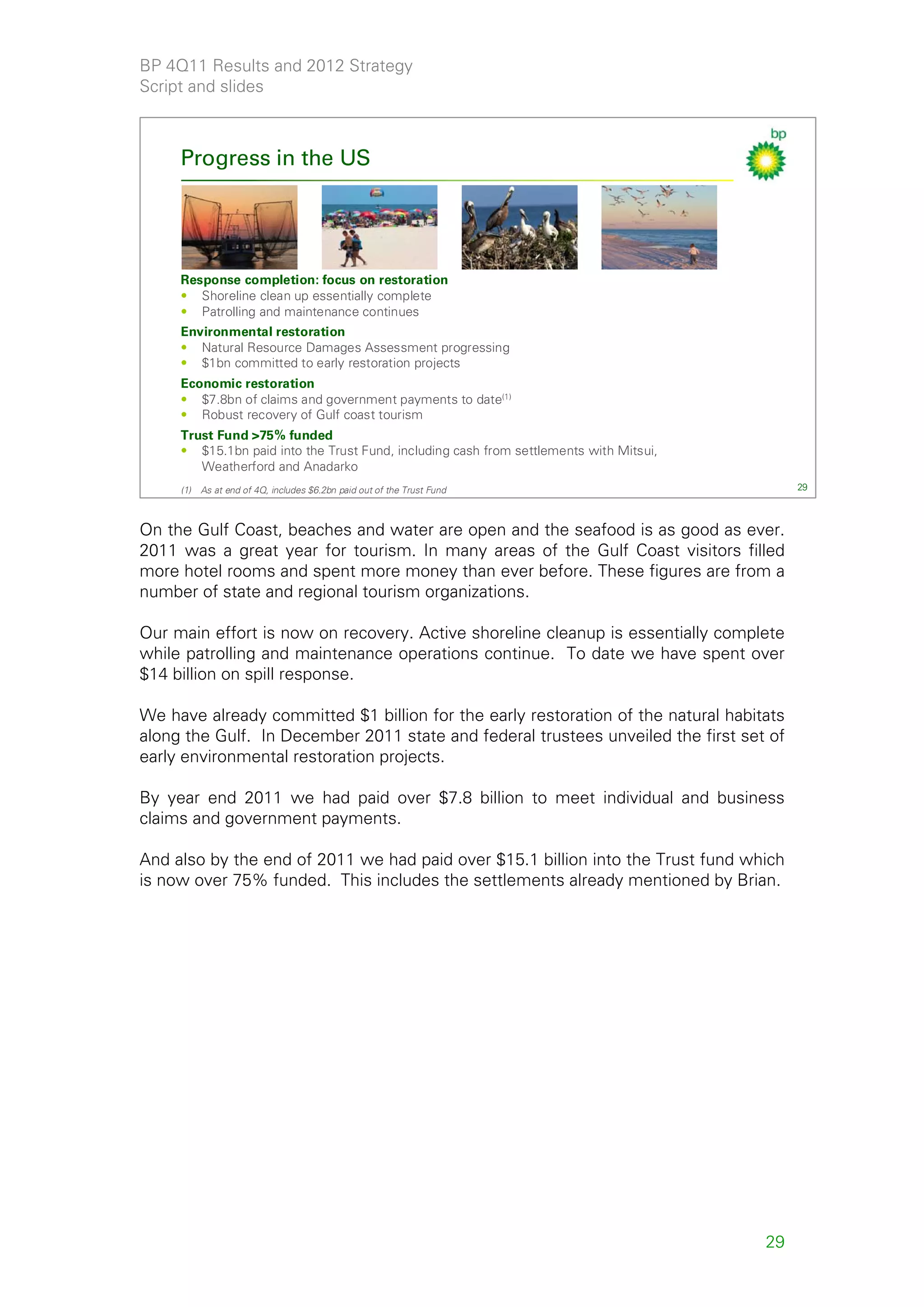
On the Gulf Coast, beaches and water are open and the seafood is as good as ever.
2011 was a great year for tourism. In many areas of the Gulf Coast visitors filled
more hotel rooms and spent more money than ever before. These figures are from a
number of state and regional tourism organizations.

Our main effort is now on recovery. Active shoreline cleanup is essentially complete
while patrolling and maintenance operations continue. To date we have spent over
$14 billion on spill response.

We have already committed $1 billion for the early restoration of the natural habitats
along the Gulf. In December 2011 state and federal trustees unveiled the first set of
early environmental restoration projects.

By year end 2011 we had paid over $7.8 billion to meet individual and business
claims and government payments.

And also by the end of 2011 we had paid over $15.1 billion into the Trust fund which
is now over 75% funded. This includes the settlements already mentioned by Brian.


                                                                                        29
BP 4Q11 Results and 2012 Strategy
Script and slides


     Legal proceedings:
     Limitation and Liability Trial (MDL 2179)
     Civil liability trial will begin 27 February 2012 and is likely to last into 2013
     (with breaks between the three phases)

     Trial will address allocation and proportion of fault
     • Transocean’s ability to limit its liability under the Limitation Act
     • Defendants’ alleged negligence/gross negligence; other bases of liability
     • Proportion of liability among defendants and effect of indemnity provisions
     • USA Department of Justice is a party plaintiff

     Bench trial in admiralty before Judge Barbier (no jury)


                                                                                              30


Of course we still have a challenging period ahead of us. The legal processes
around the incident are complex and uncertain. Let me explain what we do know.

As I’ve said before, we’re ready to settle if we can do so on fair and reasonable
terms, but we are preparing vigorously for trial.

The trial will allocate fault across the parties for the casualty and resulting oil spill.
The Judgment is expected to assign percentages of fault among the participants in
the well operation and on the rig. The United States Department of Justice is a party
plaintiff and will present its case for liability under the clean water act.


                                                                                         30
BP 4Q11 Results and 2012 Strategy
Script and slides


     Legal proceedings: MDL 2179 timeline(1)

      2010                     2011                     2012                    2013              2014+
               MDL 2179 formed
               and master complaints
                                        Discovery
                                        and motions
                                                                   Start of Limitation and
                                                                   Liability trial phase 1
                                                                          Trial Phase 2 and Phase 3;
                                                                        judgment (no monetary award)
                                                                                                 Potential appeal of
                                                                                              limitation trial judgment
                                                                                                     CWA penalty
                                                                                                       ruling
                                                                                                          Other MDL 2179
                                                                                                        proceedings continue
      (1)   Estimated timelines are subject to revision as litigation proceeding(s) develop                                         31


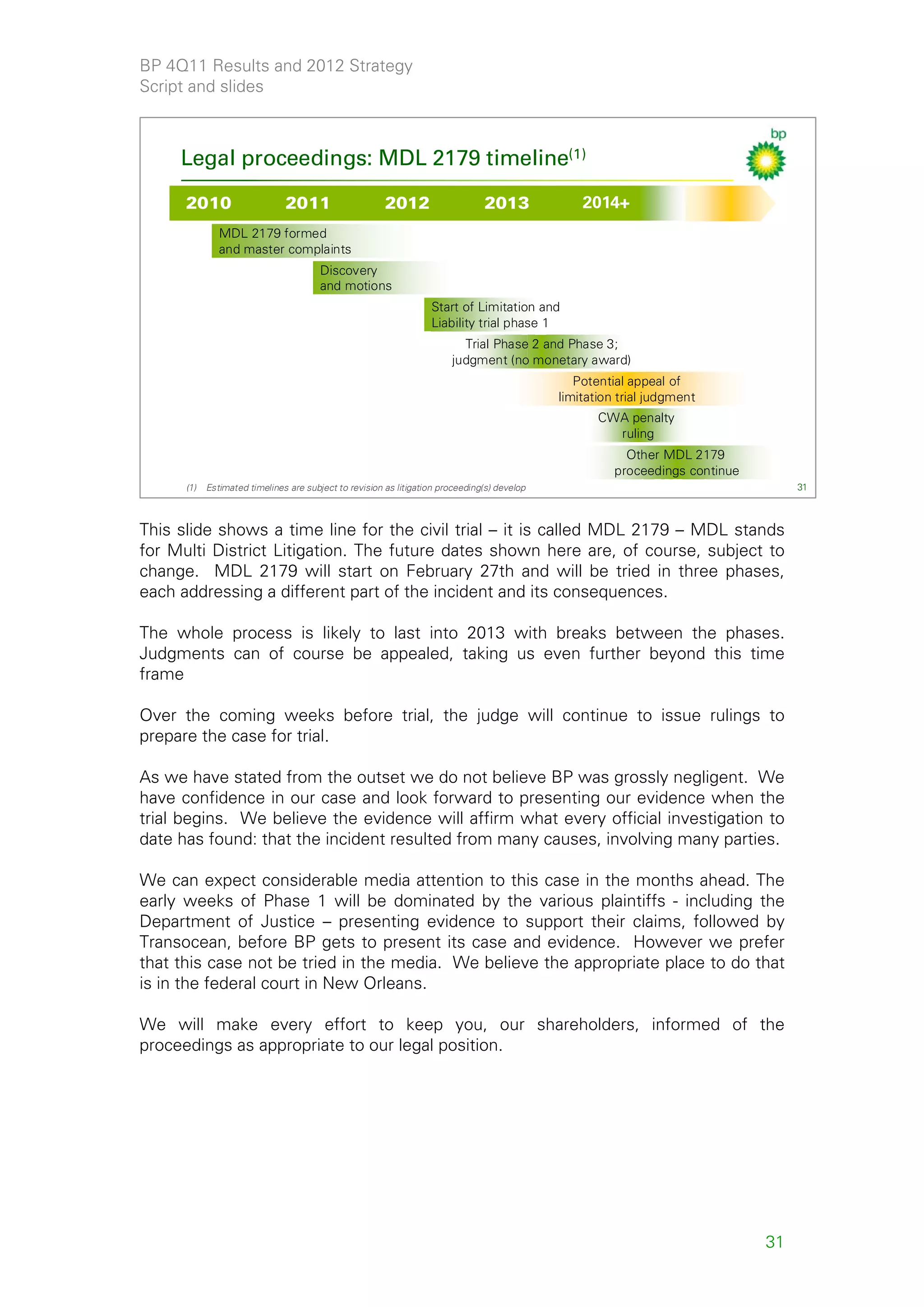
This slide shows a time line for the civil trial – it is called MDL 2179 – MDL stands
for Multi District Litigation. The future dates shown here are, of course, subject to
change. MDL 2179 will start on February 27th and will be tried in three phases,
each addressing a different part of the incident and its consequences.

The whole process is likely to last into 2013 with breaks between the phases.
Judgments can of course be appealed, taking us even further beyond this time
frame

Over the coming weeks before trial, the judge will continue to issue rulings to
prepare the case for trial.

As we have stated from the outset we do not believe BP was grossly negligent. We
have confidence in our case and look forward to presenting our evidence when the
trial begins. We believe the evidence will affirm what every official investigation to
date has found: that the incident resulted from many causes, involving many parties.

We can expect considerable media attention to this case in the months ahead. The
early weeks of Phase 1 will be dominated by the various plaintiffs - including the
Department of Justice – presenting evidence to support their claims, followed by
Transocean, before BP gets to present its case and evidence. However we prefer
that this case not be tried in the media. We believe the appropriate place to do that
is in the federal court in New Orleans.

We will make every effort to keep you, our shareholders, informed of the
proceedings as appropriate to our legal position.


                                                                                                                               31
BP 4Q11 Results and 2012 Strategy
Script and slides


    Upstream


                                                                                      32


So let me now turn to the Upstream and our plans for restoring and growing value in
this vital part of our business.


                                                                                32
BP 4Q11 Results and 2012 Strategy
Script and slides


     Upstream: focus on value

     Our new operating model
     • Driving risk reduction and strengthening execution capability

     Active portfolio management
     • Leading to a “reshaping and rescaling” of our portfolio

     Underpinning 2014 operating cash growth
     • Growing operating cash faster than production

     Longer term investments play to our strengths
     • Increasing investment in exploration, deepwater, gas value chains and giant fields


                                                                                                 33


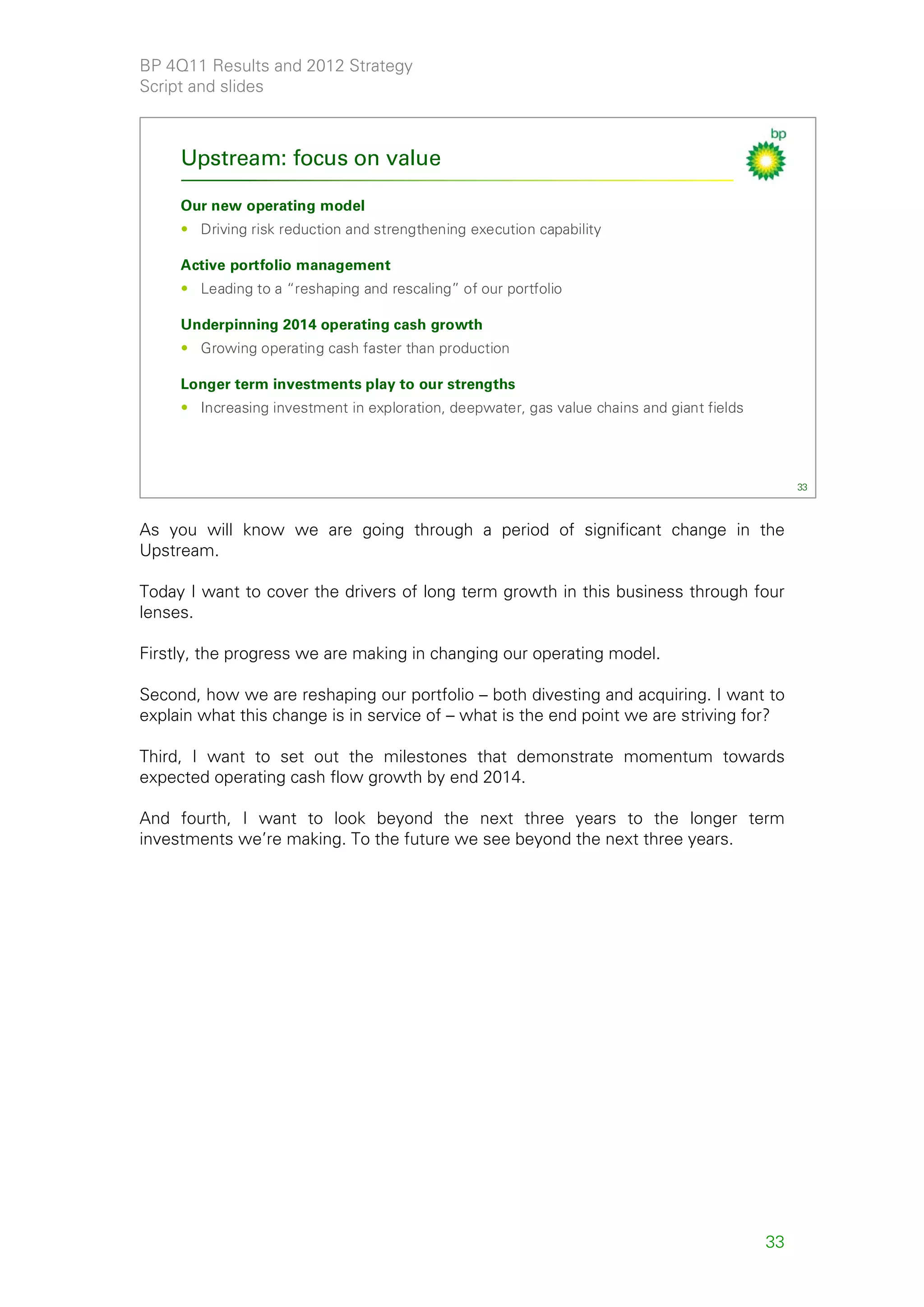
As you will know we are going through a period of significant change in the
Upstream.

Today I want to cover the drivers of long term growth in this business through four
lenses.

Firstly, the progress we are making in changing our operating model.

Second, how we are reshaping our portfolio – both divesting and acquiring. I want to
explain what this change is in service of – what is the end point we are striving for?

Third, I want to set out the milestones that demonstrate momentum towards
expected operating cash flow growth by end 2014.

And fourth, I want to look beyond the next three years to the longer term
investments we’re making. To the future we see beyond the next three years.


                                                                                            33
BP 4Q11 Results and 2012 Strategy
Script and slides


     New operating model now in place

     Relentless focus on safety and managing risk
     Organization in place and aligned with delivery
     • Exploration: Access, Exploration and Appraisal
     • Production: Subsurface, Operations
     • Developments: Global Projects Organization, Global Wells Organization
     Reducing complexity – stronger and more focused
     Global standards in place and driving
     • Risk reduction
     • Systematic, consistent execution
     • Increased reliability
     • Cost and investment efficiency

                                                                                         34


The move from a de-centralized asset structure to a fully functional organization has
been the biggest organizational change we have taken on in the last 20 years.

It is hard work but it is going well.

We now have the functional organization lined up with every dimension of
operational delivery and with full line accountability – from our global approach to
exploration and appraisal, to a global approach to our major projects.

This allows us to optimize activity choices effectively and execute them more
reliably and efficiently. For example, we now have a single global rig fleet operating
to a single set of standards.

Bernard and Bob will provide more insights during their breakout. And you will see
how we are reinforcing risk management and generating efficiencies from more
systematic and standardized design, engineering and procurement practices.

Let’s now take a look at how we manage our portfolio.


                                                                                   34
BP 4Q11 Results and 2012 Strategy
Script and slides


     Active portfolio management to continue
     Divestments ($bn)                                Acquisitions ($bn)                New Access
                                       ~30                                              • US: Gulf of Mexico
                                                                                        • Angola: Kwanza and Benguela basins
                                                                                        • Australia: Ceduna basin
                                                                                        • Namibia: Orange Delta
        16                                                                              • China: South China Sea(1)
                                                               16
                Vietnam                                                Brazil           • Indonesia: North Arafura, East
                Colombia                                               Gulf of Mexico     Kalimantan CBM, West Aru
                Lukarco JV                                                              • Azerbaijan: Shafag-Asiman
                                                                       India
                Canada Gas                                                              • UK: North Sea
                Permian                                                Azerbaijan       • Trinidad: Barbados Trough(1)
     Complete Active         Planned    Total                 Deepwater                 • Jordan: Risha
                                                              Gas Value Chains
                                                              Giant Fields /
                                                              Unconventional

     Portfolio management and new access: from 2010 and excluding TNK-BP                (1) Government approvals pending        35


I want to be very clear about this. We have some very simple objectives here:

First, we want to own assets where we have distinctive capability and can therefore
achieve advantaged returns.

Second, we aim to achieve a size of the upstream that is small enough to generate
growth in operating cash flow – and large enough to enable us to take on the energy
challenges and needs of governments for decades.

Third, we intend to deliver the funds to live within our financial framework. We are
planning divestments of up to $30 billion in the Upstream over four years and have
announced $16 billion to date.

We have also acquired very promising acreage in the deep water in Angola and
Brazil, entered a growing gas market in India, and deepened our unconventional
asset base in US gas and the Canadian oil sands. We have massively strengthened
our exploration portfolio for the later part of the decade.

We have traded smaller, mature assets with declining cash flows for those which
can grow. We have concentrated geography and assets to focus management
attention.

And we have increased the Group’s exposure to growth markets where we believe
exposure along the value chain maximizes returns. India is a good example – where
our Reliance position supports a downstream gas JV – and our petrochemicals
portfolio.


                                                                                                                           35
BP 4Q11 Results and 2012 Strategy
Script and slides


     Potential for stronger growth, diverse resource mix
     and new market exposure
         Resources, bn boe (excluding TNK-BP)

                                    Prospect                        Non-proved
                                    Inventory
                                                              Conventional Viscous /
                                                                   gas     Heavy oil
                                                           LNG
                                                           gas
                                                                                  Deepwater
                                                                                     oil

                                                         Unconventional         Conventional
             24             32      Non-proved                gas                   oil


             14             13      Proved

          End 2007       End 2011                                      Proved
                                                                 14 years reserves to
                                                                   production ratio
                                                                                                    36


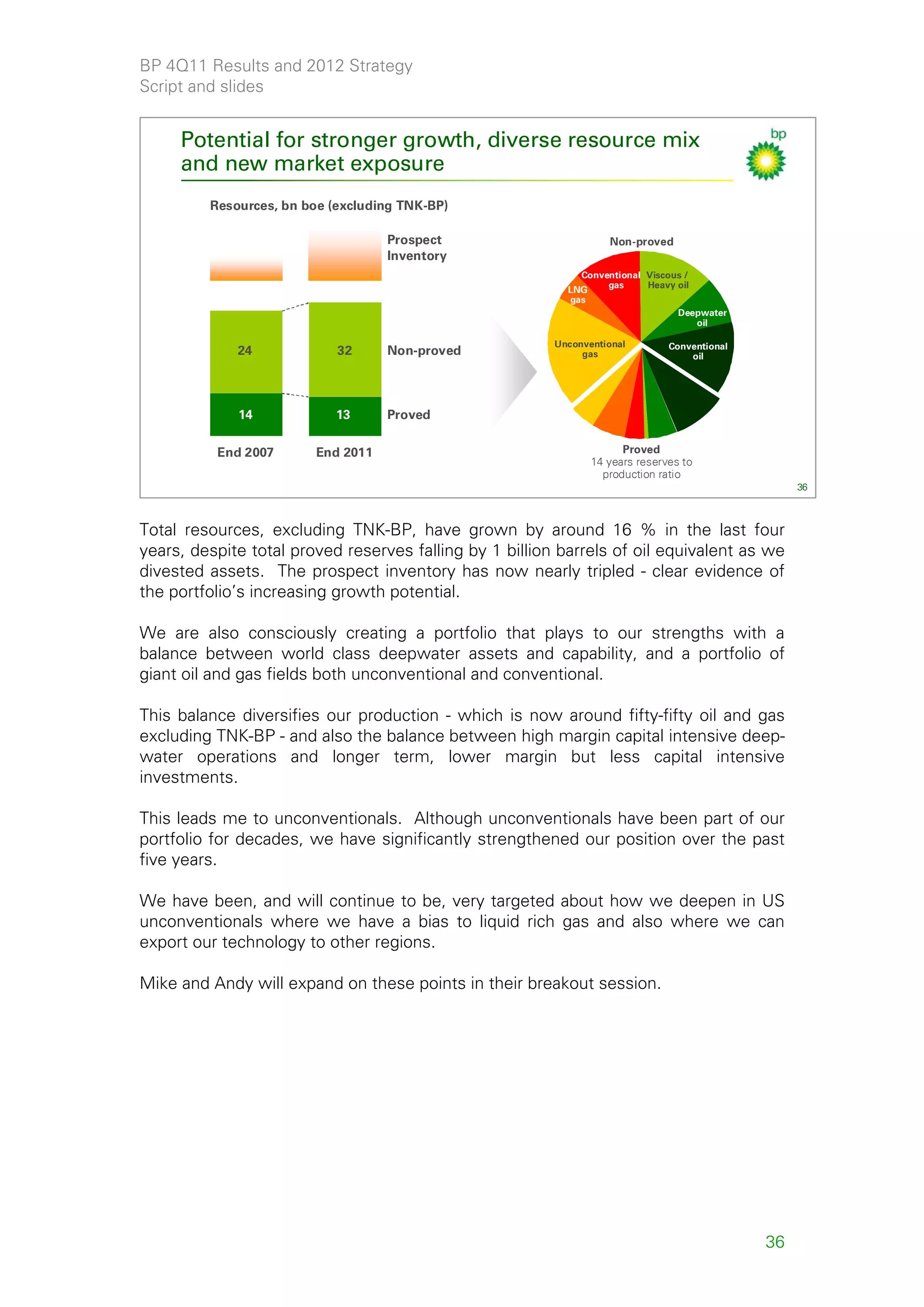
Total resources, excluding TNK-BP, have grown by around 16 % in the last four
years, despite total proved reserves falling by 1 billion barrels of oil equivalent as we
divested assets. The prospect inventory has now nearly tripled - clear evidence of
the portfolio’s increasing growth potential.

We are also consciously creating a portfolio that plays to our strengths with a
balance between world class deepwater assets and capability, and a portfolio of
giant oil and gas fields both unconventional and conventional.

This balance diversifies our production - which is now around fifty-fifty oil and gas
excluding TNK-BP - and also the balance between high margin capital intensive deep-
water operations and longer term, lower margin but less capital intensive
investments.

This leads me to unconventionals. Although unconventionals have been part of our
portfolio for decades, we have significantly strengthened our position over the past
five years.

We have been, and will continue to be, very targeted about how we deepen in US
unconventionals where we have a bias to liquid rich gas and also where we can
export our technology to other regions.

Mike and Andy will expand on these points in their breakout session.


                                                                                               36
BP 4Q11 Results and 2012 Strategy
Script and slides


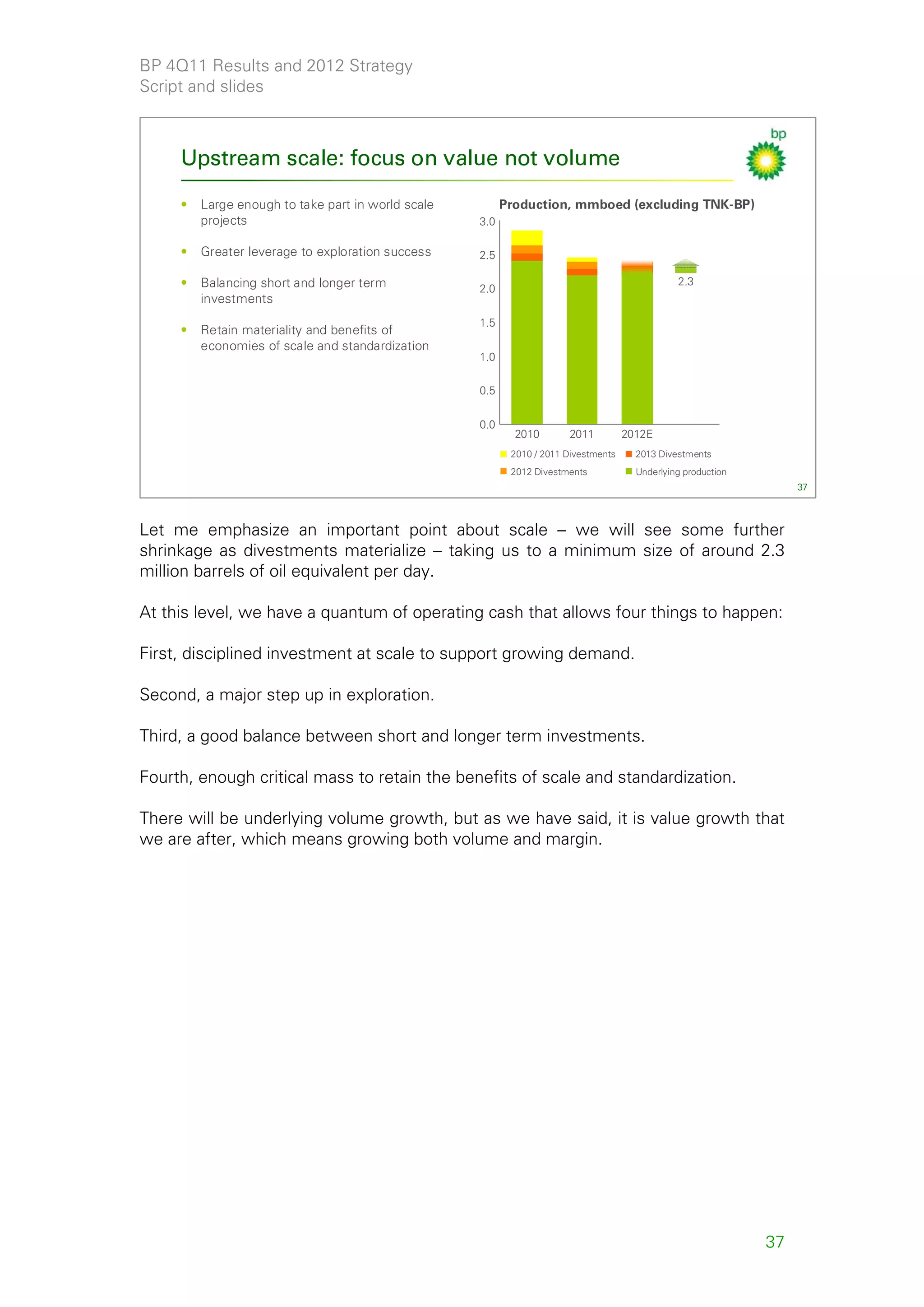
     Upstream scale: focus on value not volume

     •   Large enough to take part in world scale         Production, mmboed (excluding TNK-BP)
         projects                                   3.0

     •   Greater leverage to exploration success    2.5

     •   Balancing short and longer term                                                        2.3
                                                    2.0
         investments
                                                    1.5
     •   Retain materiality and benefits of
         economies of scale and standardization
                                                    1.0


                                                    0.5


                                                    0.0
                                                            2010       2011          2012E
                                                           2010 / 2011 Divestments     2013 Divestments
                                                           2012 Divestments            Underlying production
                                                                                                                    37


Let me emphasize an important point about scale – we will see some further
shrinkage as divestments materialize – taking us to a minimum size of around 2.3
million barrels of oil equivalent per day.

At this level, we have a quantum of operating cash that allows four things to happen:

First, disciplined investment at scale to support growing demand.

Second, a major step up in exploration.

Third, a good balance between short and longer term investments.

Fourth, enough critical mass to retain the benefits of scale and standardization.

There will be underlying volume growth, but as we have said, it is value growth that
we are after, which means growing both volume and margin.


                                                                                                               37
BP 4Q11 Results and 2012 Strategy
Script and slides


     Operating cash to grow faster than production

     Upstream operating cash (excluding TNK-BP)


        2011 operating        Growth driven by      Divested      2014 operating
       cash at oil price of       Angola,        operations and    cash estimate
           $111/bbl            Gulf of Mexico,    environment      at oil price of
                                 North Sea                           $100/bbl


                                                                                          38


Now let me turn to operating cash growth. We showed this slide last October,
showing our plans to increase operating cash flow in the Upstream.

The operating cash in 2014 will come from – first, our base operations, second, the
new wells drilled in existing operations, and finally our 15 Major Projects in the
Upstream that will start up between 2012 and 2014.

Unit cash margins are expected to improve significantly with new projects having
around twice the unit operating cash margin of our 2011 portfolio by 2014 at $100
per barrel.


                                                                                     38
BP 4Q11 Results and 2012 Strategy
Script and slides


     Major projects underpin operating cash growth


                 Deepwater                                         Gas                                   Giant Fields
     Start-                           Gross                                  Gross                                       Gross
            Project         WI%(2)               Project            WI%     Capacity     Project            WI%
     up                              Capacity                                                                           Capacity
     2012 Block 31
                             27      150 mboed   Angola LNG         14    1,100 mmscfd   Skarv(1)            24     165 mboed
            PSVM (1)
            Clochas-
                             27      100 mboed                                           Devenick(1)         89     200 mmscfd
            Mavacola
            Galapagos(1)    47-67    60 mboed
     2013 / Na Kika
     2014 Phase 3(1)         50      40 mboed    North Rankin 2     17    1,800 mmscfd   Kinnoull(1)         77         50 mboed

                                                 In Salah
            CLOV             17      160 mboed                      33    420 mmscfd     Chirag Oil(1)       36     140 mboed
                                                 Southern Fields
                                                 In Amenas
            Mars B           29      130 mboed                      46    330 mmscfd     Sunrise             50         60 mboed
                                                 Compression
     (1) BP operated
     (2) Working interest                                                                                                          39


Our new projects are progressing well – all now managed centrally in our Global
Projects Organization.

By the end of 2014 we plan to start up these 15 major projects. Six start-ups this
year with nine more in 2013 and 2014.

The majority of these projects are in our higher unit cash margin areas of Angola, the
North Sea, the Gulf of Mexico and Azerbaijan and is how we will deliver the unit
operating cash margins I just mentioned.

The projects mix is also diverse with around two thirds of the projects being oil
developments and a third gas. Roughly half of the projects will be operated by BP.

Most of the offshore projects in the North Sea and the Gulf of Mexico are subsea
tie-backs to existing facilities and allow us to build upon previous investment made
in the existing infrastructure.

Bernard will say more about the execution of these projects in the break-out session.


                                                                                                                              39
BP 4Q11 Results and 2012 Strategy
Script and slides


     Gulf of Mexico has returned to work

     Exploration and Appraisal                                     Rigs on BP operated fields
     • Moccasin discovery                                       2011            2012               2013
     • Kaskida appraisal
                                                                       Development Driller II
     • Mad Dog resource extension now estimated to be
       4bn bbl Original Oil In Place                                   Development Driller III
     • Gila exploration and Tiber appraisal expected in 2012              Discoverer Enterprise

     Major projects                                                         West Sirius
     • Mad Dog Phase 2 Final Investment Decision                             Thunder Horse PDQ
     • Galapagos, Na Kika Phase 3 and Mars B execution                                    West Capricorn

     Production drilling                                                                  Ensco DS-3
     • Drilling and completion activity at both Thunder Horse                                    Mad Dog A
       and Atlantis
                                                                  Production
     • Mad Dog rig operational by end 2012
                                                                  Exploration and Appraisal
                                                                  Commencement of rig activity subject
                                                                  to regulatory approval
                                                                                                               40


As you know the Gulf of Mexico remains a very important part of our future, and
getting safely back to work was a critical milestone for us.

We now have rigs working on exploration and appraisal, major projects, and drilling
and completion work on our existing fields.

We have five deepwater rigs working with a further three planned to start up this
year, subject to regulatory approval.

Exploration and Appraisal are important to us, and also to the future energy security
of the US. We are planning to spud the Gila exploration well in 2012, and anticipate
ongoing appraisal programs on Kaskida and Tiber.

In major projects, we have reached the final investment decision on Mad Dog Phase
2 - our first for an operated stand-alone facility in nearly a decade in the Gulf - and a
giant field in its own right. We also have Galapagos, Na Kika Phase 3 and the Mars
B major projects starting up over the next three years.

In production drilling we have resumed drilling and completion activities at Thunder
Horse and Atlantis and plan to restart the Mad Dog rig operations by the end of
2012. Clearly, there will be a lag between completing the activity and the related
production showing up.


                                                                                                          40
BP 4Q11 Results and 2012 Strategy
Script and slides


     Growing upstream value in 2012
     Excluding TNK-BP


     Operating cash
     •     Expected to grow based on operating cash margin improvement
     Production
     • Underlying production broadly flat(1)
     • 2012 vs 2011 divestment impact ~120 mboed(2)
     Investment
     • $16-17bn, $2-3bn higher than 2011
     • Increase driven by
           - Drilling 12 exploration wells, double 2011
           - Major projects, mainly in Angola, Gulf of Mexico and the North Sea
           - Activity ramp-up in the Gulf of Mexico

     (1)   Normalized for divestments, OPEC quotas, and $100/bbl oil prices
     (2)   Depending on timing of divestments                                          41


Our focus is on value. Looking to 2012, we expect to see growth in operating cash
driven by the unit cash margin improvements already highlighted.

As far as volume is concerned, we expect underlying production to be broadly flat,
setting aside TNK-BP. This is the net effect of growth from new projects, reduced
outages and new production from India being offset by base decline. We expect
production from the Gulf of Mexico to be somewhat lower than 2011, with natural
decline progressively offset by new production activity now that we are back to
drilling. We expect Gulf of Mexico production to return to growth in 2013.

We are also planning another extensive turnaround programme in 2012, although we
expect overall production outages to be lower. Bob will cover the details of this in
his breakout session.

We expect reported production in 2012 to be lower than 2011. The actual outcome
will depend on the exact timing of the divestments. Also, OPEC quotas and the
impact of oil price on production sharing contracts. We expect the divestment
impact to be around 120 thousand barrels of oil equivalent per day in 2012 with
around 70 thousand barrels of oil equivalent per day from divestments completed in
2011, and around 50 thousand barrels of oil equivalent per day from divestments
expected to close in 2012. We will continue to update you on these divestment
impacts as the year progresses. As Brian said earlier, we expect TNK-BP production
to grow organically at 1-2% per annum into the mid term.

In terms of investment, we are expecting to increase investment in the upstream to
around $16 to $17 billion this year, up $2 to $3 billion on 2011. This is driven by
doubling exploration drilling, the increase in major projects and the ramp up in
activity in the Gulf of Mexico.

Now, I want to turn to the horizon beyond 2014.


                                                                                  41
BP 4Q11 Results and 2012 Strategy
Script and slides


     Longer term investments play to our strengths

     Exploration with a focus on Deepwater
     • Material positions created / added to via new access deals
     • Plans to double investment underpinned
     Gas value chains
     • Strengthening in diverse and high growth gas markets: Europe (Shah Deniz),
       India (Reliance), Far East (Tangguh)
     Giant field and unconventional resource appraisal
     • Significant potential appearing in Gulf of Mexico (Mad Dog) and UK (Clair)
     • Unconventional gas skills exported, and new resources in Canada
     Technology
     • Focused and strategic commitments continue

                                                                                         42


We have a strong pipeline of exploration prospects and project opportunities that will
generate new resources and projects well into the next decade.

Nearer term we have plans in place to ramp-up exploration activity over the next two
to three years.

Our experience in managing the subsurface, combined with advances in seismic, is
continuing to redefine and grow the size of our giant fields. This is underpinning
major new investment, such as Mad Dog Phase 2 and the Clair Ridge projects to
name a few.

Gas use as a fuel will continue to grow steadily in the global energy mix. We have
world class gas projects that we expect to bring onstream before the end of the
decade, linked to price-leveraged markets.

And all of this is enabled by a commitment to technology, a theme which I will return
to shortly.


                                                                                    42
BP 4Q11 Results and 2012 Strategy
Script and slides


      Robust pipeline for the longer term
                      Exploration                              Pre-FID                                                  Post-FID
                    • Australia        • GoM(1): Kaskida, Thunder      •   Angola: Block 18 West,    • Angola: Kizomba • Angola: LNG, Block 31
                    • Asia               Horse Water Injection, Tiber,     Block 31 South-East,        Satellites Phase 2 PSVM, Clochas-Mavacola,
                                         Moccasin, Freedom, Mad            Pazflor Phase 2, Tulipa   • GoM: Mad Dog       CLOV
   Deepwater        • GoM(1)
                                         Dog North                     •   Brazil: Itaipu, Wahoo      Phase 2           • GoM: Galapagos,
                    • North Africa
                                                                                                                          Na Kika Phase 3, Mars B
                    • South Atlantic
                    • Australia        • Azerbaijan: Shah Deniz FFD(2) • Australia: Browse,         • Australia: Western • Australia: North Rankin 2
                    • Egypt            • Indonesia: Tangguh              Western Flank B,             Flank A            • North Africa: In Salah
   Gas Value                             expansion                       Persephone                 • Egypt: West Nile     Southern Fields,
                    • India
   Chains                              • India: D6 Satellites, NEC 25   • Trinidad: Field expansion, Delta                 In Amenas Compression
                    • Indonesia
                                                                          Juniper
                    • Trinidad
                                                                        • Egypt: East Nile Delta
   Giant Fields     • Azerbaijan       • Azerbaijan: ACG expansion      • North Sea: Greater Clair • North Sea: Clair   • Azerbaijan: Chirag Oil
   Conventional     • North Sea        • Iraq: Rumaila expansion        • North Sea: Norway          Ridge, Quad 204    • North Sea: Skarv, Devenick,
                    • Canada: Arctic                                                                                      Kinnoull

   Unconventional                      • Alaska: heavy oil              • Canada: Sunrise Phase 2,                      • Canada: Sunrise Phase 1
   oil                                                                    Pike, Terre de Grace
   Unconventional   • Jordan           • Oman: Khazzan                  • Algeria: Bourarhat
   gas                                                                                                                  (1) GoM: Gulf of Mexico
                                       • US: Eagle Ford                 • Indonesia: Sanga Sanga
                                                                                                                        (2) FFD: Full Field Development
                                       • Argentina: Neuquen               coal bed methane
                                                                                                                        Start ups by end 2014 in bold
                                                                                                                        Excludes TNK-BP               43


This shows the pipeline in more detail. You can see that we have some major
projects coming through behind the highlighted projects on the right side. These
projects will start up in the next three years. And there is a very strong inventory of
material exploration positions [on the left].

These are aligned with our strengths in deepwater, gas value chains and giant fields.

Deepwater will remain a core building block of our portfolio through the end of the
decade.

In the gas value chains we have world-scale projects in Azerbaijan, Tangguh in
Indonesia, in Egypt and Trinidad. We are appraising another in Oman.

In the area of giant fields we will have significant cash flow coming over decades
from our unconventional Canadian heavy oil projects and big unconventional gas
fields around the world.


                                                                                                                                              43
BP 4Q11 Results and 2012 Strategy
Script and slides


     Growing upstream investment

     • Increasing investment in Upstream           2012-2014 investment, $bn

                                                  Exploration
     • Doubling exploration investment
                                                     Future         Deepwater
                                                    projects
     • Investing near term for cash generation
       and longer term for value
                                                                    Gas Value
     • Playing to our strengths                                      Chains
                                                    Support
                                                   operating
                                                  cash to 2014

                                                                    Giant Fields


                                                                                        44


Looking forward, we will be growing our overall capital investment into the
Upstream, led by doubling our investment in exploration.

We will invest for near term cash generation and to create options for longer term
value growth. Around two-thirds of our investment over 2012 to 2014 will underpin
the delivery of operating cash up to 2014 in a safe and sustainable way. The other
third will go on creating future projects, including exploration.

Investment will be split broadly equally between deepwater, gas value chains and
giant fields.

And finally, there is no doubt in my mind that our new operating model will improve
execution quality and capital efficiency.


                                                                                   44
BP 4Q11 Results and 2012 Strategy
Script and slides


     20KTM the next challenge in deepwater
     Building 20KTM capability                                          The next deepwater technical frontier: >15 thousand PSI
     • BP is investing in technology to enable exploration,
       development and production of reservoirs at
       20 thousand PSI
     • Successful development of 20KTM will enable us to:
       - Develop deeper higher pressure resources in our
          existing giant fields
       - Explore for and produce new hydrocarbon resources in
          global basins >15 thousand PSI
                                                                                              10-20 bn bbls resource potential
     We will be developing four new 20KTM systems
        Rig, riser and BOP                Well designs and            Subsea production             Well intervention and
            equipment                      completions                  system (SPS)                    containment


     Stronger, larger and safer     More real-time monitoring   New High Integrity Pressure      Apply lessons from Deepwater
     design                                                     Protection System (HIPPS)        Horizon
     BOP = Blow Out Preventer
     PSI = Pounds per square inch                                                                                                 45


Earlier I mentioned the importance that technology plays in the world of energy. I
would like to make a departure from our usual format and show you something we
are very committed to and will be important for us in the years to come for safely
unlocking new deepwater resources.

Over the last few years we have had considerable success in exploring deeper plays
in some of our established basins - specifically the Paleogene of the Gulf of Mexico,
Tiber and Kaskida; the OlioMiocene of the Nile Delta, that is Raven and Satis; and
the PreFasila reservoirs of Shah Deniz in the Caspian.

Each of these plays has developable oil and gas today, but each also has a material
upside that sits beyond the industry’s current development capability due to high
reservoir pressures.

To address this undevelopable resource, today we are outlining a project to develop
a high pressure capability to drill, develop and produce resources beyond 15,000
pounds per square inch or 15kpsi - we call it Project 20K.

Let’s look at a short video that will give you some appreciation of the challenge and
the opportunity the project represents

[Play-out of Project 20K video]

You can see the challenge and the valuable opportunity this will unlock. We have
great people working on this and I believe it will not only open up some of BP's
existing resources, but perhaps a greater prize will be the new resources it will
unlock in exploration and development of resources.

We anticipate doing this both as BP and in partnership with NOC's. Much of the
technology will apply on and offshore and therefore be of help in the Middle East,
the Mediterranean, Russia and the Gulf of Mexico.

Like many advances in industry development of this capability will take some time.
We will keep you posted on our progress

                                                                                                                                45
BP 4Q11 Results and 2012 Strategy
Script and slides


     Upstream summary

     • Operating model is reducing risk and strengthening execution capability

     • Portfolio being focused – potential for stronger growth with diversified
       resource mix and market exposure

     • 2014 operating cash delivery is underpinned

     • Longer term investments play to our strengths


                                                                                          46


So to sum up.

Our Upstream business is going through significant changes - and while we still have
some way to go - we can already see tangible benefits.

Our new operating model is in place, with safety and operational risk embedded and
the divisional organization accountable for operational performance. We are
standardizing, choosing our activity carefully and improving how we work to get this
done.

We continue to sharpen our portfolio, having already announced divestments of
around $16 billion of assets in the upstream, with plans in place for up to $30 billion
in total. We have made strategic acquisitions in businesses positioned for growth,
and will continue to do so if good opportunities arise. We have reloaded our
exploration prospect inventory through record licensing.

Upstream will contribute significantly to the Group's expected 50% increase in
operating cash by 2014. This will be from higher margin Major project start-
ups, new wells, as well as efficiencies in our base business

Finally, we are increasing investment through the medium term. Investing in the
areas where we can add the most value, by playing to our strengths.


                                                                                    46
BP 4Q11 Results and 2012 Strategy
Script and slides


    TNK-BP


                                                                                   47


And now let me give you a summary of TNK-BP, which continues with its consistent
track record of delivery, despite the challenges.


                                                                             47
BP 4Q11 Results and 2012 Strategy
Script and slides


     TNK-BP
     Unique position in Russia, continued strong performance
     World class integrated oil and gas company
     • Russia’s number two oil producer(1)
     • 4.8bn boe of proved reserves(2), 23bn boe resources BP net
     • Russia’s third largest refiner
     • Growing international presence
     Continued strong performance
     • 4% average per annum organic production growth from inception
     • BP net income of $4.2bn in 2011
     • $3.7bn net dividends to BP in 2011, $18.6bn to date
     • Around $160bn in taxes, duties and levies paid since 2003


     (1)   If ranked by quarterly average starting 3Q11
     (2)   SEC classification, including Slavneft and international assets                   48


TNK-BP offers BP a distinctive position to access Russia’s extensive hydrocarbon
resources.

It is now Russia’s second largest oil producer, with BP net production of almost a
million barrels of oil per day and nearly five billion barrels of oil equivalent in proved
reserves. It is Russia’s third largest refiner and now has an established international
presence.

The ongoing shareholder dispute has had minimal impact on the operational and
financial performance of the joint venture.

Since its formation in 2003, TNK-BP has delivered 4% organic production growth. In
2011 BP’s share of net income was $4.2 billion and dividends received were $3.7
billion. Since acquiring 50% of TNK-BP for around $8 billion, BP has received around
$19 billion in dividends, so historically around $2 billion per year.

At the same time TNK-BP has been a solid corporate citizen and has paid around
$160 billion of taxes, duties, and levies since its formation in 2003.


                                                                                       48
BP 4Q11 Results and 2012 Strategy
Script and slides


     TNK-BP: potential for growth

     Drivers of growth
     •   Mature fields: application of technology
     •   Major projects: Yamal, Uvat and Verkhnechonskoye
     •   Refining: yield and quality improvements; marketing expansion
     •   Advantaged international opportunities


                                                                         Yamal
         Brownfield projects
         Greenfield projects
         Exploration areas                           Orenburg            Samotlor

         Refineries
         YANOS refinery, 50/50
         owned through Slavneft                             Uvat
                                                                                 Verkhnechonskoye
                                                                                                         49


Looking to the future TNK-BP has a material opportunity set and we expect organic
growth of 1-2% per annum in the mid-term.

Efforts to manage production decline in brownfields will continue through the
focused application of new technology such as BP’s BrightWater technology with an
upscaled treatment programme being planned.

The ramp up of the Verkhnechonskoye and Uvat fields will underpin growth to 2015
and longer term growth will come primarily with the developments on the Yamal
Peninsula – the Russkoye, Suzun and Tagul fields.

In the downstream TNK-BP will invest in fuel quality improvements, refining yield
improvements and marketing expansion over the next three years.

2011 marked expansion into selective advantaged international opportunities with
access in Venezuela and Vietnam.

We see the growth potential in the portfolio and continue to be pleased with TNK-
BP’s performance.


                                                                                                    49
BP 4Q11 Results and 2012 Strategy
Script and slides


    Alternative Energy


                                                                                   50


And finally, a few comments about our Alternative Energy business before handing
over to Iain to cover the downstream.


                                                                             50
BP 4Q11 Results and 2012 Strategy
Script and slides


     Alternative Energy: a focused renewable footprint

     Strategic intent                            Wind                           Biofuels
                                                 13 operating farms             1 pilot plant
     •   Position for growth of renewables       2 under construction           1 commercial plant
         as an increasing proportion of fuel                                    under construction

         and power demand

     Focused portfolio
     •   Operating assets: Brazilian
         Biofuels, US Wind
                                                                 Biofuels
         -   Profitable today with growing                       1 pilot plant
             production and operating cash                       1 commercial plant
                                                                 under construction
             flows
     •   Technology assets: US Cellulosic
         Biofuels, Advanced Biofuels                             Biofuels
                                                                 3 operating plants


                                                                                                          51


BP has been in various segments of renewables over the last 35 years to understand
and be positioned in the global trend of long-wave renewables growth we
highlighted earlier.

The portfolio is now tightly focused on several specific operating and technology
assets.

In biofuels, our operating assets are focused in Brazil where we own and operate
three mills in prime cane locations and plan to continue investing in advantaged land,
mills and logistics.

Our biofuels technology assets include our US cellulosic biofuels business and other
advanced biofuel developments, notably biobutanol.

In renewable power, or wind, our operating assets consist of over 1,000 turbines in
13 wholly-owned and Joint Venture US wind farms which have been developed
since 2007. We have an advantaged land position which underpins our ongoing wind
development and construction programme. The land has analogies to upstream
exploration acreage.

We plan to continue to grow our alternative energy business. With an increasing
footprint of operating assets, the business is now positioned for a steadily improving
income and operating cash flow contribution.

Let me now hand over to Iain.


                                                                                                     51
BP 4Q11 Results and 2012 Strategy
Script and slides


Iain Conn: Chief Executive, Refining & Marketing


    Iain Conn
    Chief Executive
    Refining & Marketing

    Refining & Marketing


                                                                                      52


Thank you Bob and good afternoon. It’s a pleasure to be talking to you again about
Refining and Marketing.

We had an in-depth look at the Segment at our Investor Day on 30th November and
therefore today I will focus on a few key aspects we covered at that time, talk in
more detail about our results for the Segment as a whole, and remind you where we
are on our journey. In the break-out session, we will provide more detail about our
results and strategic progress by value chain business in line with the increased
transparency we have provided you with today.


                                                                                52
BP 4Q11 Results and 2012 Strategy
Script and slides


     World class downstream business

     The highest quality downstream
     business
     •   Hydrocarbon value chains delivering
         leading returns and cash flow growth


     Incorporating three business models:
     •   Fuels (including optimization and
         trading)
     •   Lubricants
     •   Petrochemicals


                                                                                       53


Bob reminded you of BP’s 10-point plan earlier. One of the strengths we are playing
to is developing a truly world class downstream business. R&M has come a long
way and we have a very focused portfolio of value chain businesses designed to
deliver a competitively winning performance.

We are in the business of hydrocarbon value chains and in addition to an intense
focus on safe and reliable operations, our definition of “world class” is clear - it
means being the highest quality business measured by delivery of leading returns
and material cash flow growth.

We’re in three types of value chain businesses:
• Fuels
• Lubricants and
• Petrochemicals

We are delivering returns in each of these business models at, or near, the top of
the competitive range. Today we have provided you with further transparency of
each of these businesses, including five years of history.


                                                                                 53
BP 4Q11 Results and 2012 Strategy
Script and slides


     World class downstream business

     Safe and reliable operations
     • Becoming a leader in process safety
     • Industry leading reliability and availability
     Excellent execution
     • Compliance, rigour, discipline, efficient use of resources
     • Effective organization and capability
     Portfolio quality and integration driving leading cash margin capability
     • Right asset configuration, technology, channels, brands and integration
     • Enables advantaged operations to deliver leading utilization rates
     • Drives cash margins and cash flow delivery
     Growing margin share – exposure to growth
     • Expansion of competitive margin capability
     • Building growth market positions
     Disciplined investment and portfolio management
     • Financial framework
     • Operating cash flow growth
                                                                                        54


In November I used this slide to outline what a world class downstream business
involves.

It all starts with a platform built on safe and reliable operations and leadership in
process safety, combined with excellent execution.

Next, the portfolio must be of high quality competitively with assets of the right
scale, location and configuration, and having leading technology and brands. In each
business, the value chain must be operated and optimised in an integrated way.
This drives competitive cash margin capability which in turn leads to differentiated
utilization and cash flows.

Growth of the business comes from growth in margin share in established markets
and exposure to growth market positions.

Finally, all of this must be within a disciplined financial framework with active
portfolio management to ensure a tight focus on quality positions.

So how are we doing?


                                                                                  54
BP 4Q11 Results and 2012 Strategy
Script and slides


     Underlying performance improvement

                                                                                     10                                                                             $2bn performance


                        Pre-tax underlying replacement costnprofits$/bbl
                         P re - ta x u n d e r ly in g r e p l a c e m e t c o t p
                                                                                 .
                                                                                      9                                                                             improvement(1) vs 2009
                                                                                      8

                                                                                      7
                                                                                                                            2011
                                                                                      6                                                                          $1.3bn performance improvement
                                                                                                                                                   20 05
                                                                                                                                                        2 006
                                                                                                                                                                 delivered 2009-2011
                                                                                      5                             2010             2004


                                                                                      4
                                                                                                                       2009                               2007
                                                                                      3                                                        2 008

                                                                                      2

                                                                                      1

                                                                                      0
                                                                                          0   4                  8             12                    16              20
                                                                                               BP’sP 's R e f in in g M MarginM a rg i n(2) $/bbl 2 ) $ /b b l
                                                                                                 B Refining Marker a r k e r (RMM) (R M M

     (1) Yellow regression line represents $2bn incremental performance improvement guidance, 2012 vs 2009
         Performance improvement is after adjusting for refining and petrochemical environment (including energy costs), foreign exchange
         impacts and price lag effects
     (2) RMMs are simplified regional margin indicators based upon product yields and a marker crude oil deemed appropriate for the region                                                        55


This chart is familiar to you. It shows the improvement in underlying pre-tax
earnings relative to our history. The dark line shows our historical relationship
between refining margins and profits. Having returned the business to historical
performance levels in 2009, the yellow band represents our goal of improving
underlying pre-tax replacement cost (RC) profit by a further $2 billion by the end of
this year relative to 2009, on a comparable basis, using the same methodology we
have used for the last five years.

Plotting our profit and Refining Marker Margin in this chart, you can see that in the
two years of 2010 and 2011 it shows we have delivered $1.3 billion of that
improvement.

2011 was a particularly heavy turnaround year and the underlying performance
improvement is actually higher when the ca $200 million of increased turnaround
burden in 2011 versus 2009 is taken into account.

We therefore remain confident we are on track to deliver the aggregate $2 billion
performance improvement by the end of 2012.

As of end 2011, in total since 2007 we have now delivered over $6 billion per annum
of underlying improvement.


Let me now turn briefly to competitive performance.


                                                                                                                                                                                             55
BP 4Q11 Results and 2012 Strategy
Script and slides


     Competitive position
           Underlying ROACE % (post tax)(1)                                           Underlying Net Income $/bbl(3)
     30                                                                           6


     25                                                                           5


     20                                                                           4


     15                                                                           3


     10                                                                           2


       5                                                                          1


       0                                                                          0
       2003    2004   2005   2006   2007    2008     2009   2010   2011           2003   2004   2005    2006   2007   2008    2009   2010   2011

                          Competitor    average(2)                   BP R&M                  Competitor   range(2)

     (1)   BP and competitor return on average capital employed data adjusted to comparable basis
     (2)   Competitor set comprises R&M segments of Super Majors (2011 Total data is 3Q YTD plus average broker estimates for 4Q)
     (3)   Capacity as stated in F&OI / Company Disclosures
     (4)   2011 Competitor Capital Employed estimates based on company disclosures                                                                 56


You’re also familiar with these charts. They show BP’s estimates of our competitive
performance vs the R&M segments of the other supermajors adjusted to be on a
comparable basis.

In terms of post tax ROACE, BP has achieved another goal with returns approaching
10% in 2011, the best since 2006 when refining margins were nearly 40% higher at
$16/bbl. BP has now moved from being the worst performing company in the
sector from 2004 until 2008 to being one of the better performers on this measure.

On the right you can see underlying net income per barrel of refining capacity. This
is a measure of relative portfolio quality and while there of course is a mix effect,
most of our competitors also have large lubricants businesses and some
petrochemicals.

The fourth quarter was a very challenging time for the fuels business in our sector.
Despite lower refining margins, including the collapse of Gulf Coast and Mid-West
margins in particular, and the narrowing of the WTI/ Brent differential, our fuels
business remained profitable in 4Q.

Overall, I am pleased with our competitive performance, which once again is
beginning to demonstrate the relative quality and resilience of our portfolio.

Brian outlined our 4Q performance earlier. Let me provide you with some further
commentary on how R&M’s individual businesses fared for the full year of 2011.


                                                                                                                                            56
BP 4Q11 Results and 2012 Strategy
Script and slides


          Portfolio performance

              Pre-tax underlying replacement                                                                                     Business Environment
              cost profit by business                                                                                            (Indexed 2004 = 100)


                                                                                  Refining & Petchems margin environment
          7                                                                                                                200                                                   350

          6                                                                                                                180                                  Lubricants       300
                                                                                                                                                                base oil


                                                                                                                                                                                       Lubricants base oil price
                                                                                                                                                                price
          5                                                                                                                160                                                   250

          4                                                                                                                140                                                   200
    $bn


          3                                                                                                                120                                 Petrochemicals 150
                                                                                                                                                               VCM(2)
          2                                                                                                                100                                                100

          1                                                                                                                 80                                 Fuels   50
                                                                                                                                                               RMM(3)
          0                                                                                                                 60                                         0
              2004   2005   2006        2007   2008       2009   2010   2011                                                   2004 2005 2006 2007 2008 2009 2010 2011

                                        (1)
                               Fuels           Lubricants        Petrochemicals
  2011 pre-tax average
  operating capital employed       45                 5                 6
  (including goodwill - $bn)                                                                                        (1)          Segment costs have been allocated to the fuels business
                                                                                                                    (2)          VCM = Variable Contribution Margin
                                                                                                                    (3)          RMM = Refining Marker Margin                                                      57


Here you see an updated version of the chart I showed in November. On the left,
you see the performance history of the individual businesses updated with 2011’s
actual results.

In 2011 R&M’s underlying pre-tax RCP was $6 billion, a record year for the Segment
and above 2004 levels despite lower refining margins.

Under the graph, you also see for the first time the 2011 pre-tax average operating
capital employed including goodwill split out by business model. This shows a total
capital employed on this measure of $56 billion, giving pre-tax returns relative to this
measure of capital employed of about 11% overall for the year. As you can see, the
fuels business carries 80% of this capital employed. This is significantly driven by
the oil price effect on working capital.

On the right, you see the business environment indexed back to 2004.

The fuels business delivered $3.6 billion of underlying pre-tax RCP compared to $2.2
billion in 2010, an increase of 62%. Refining margins were $1.6/bbl higher.
Solomon refining availability was similar to 2010 at 95%. Marketing volumes were
down 4% year-on-year due to demand effects and marketing margins were also
lower. Although we did see improved refining margins and improvement in the WTI/
Brent spread, there were many offsetting challenges such as higher prices for sweet
crude globally. Our oil trading and supply activities returned to a more typical level of
contribution after a poor 2010. Overall, 2011 was a good year for the fuels business
with material year-on-year momentum.

In terms of strategic progress, the Whiting project remains on track for coming
onstream in the second half of 2013 and today we announced the intention to sell
our LPG marketing businesses serving the bulk and bottle markets in nine countries.
This continues our journey to focus down on a logical core set of positions in which
we believe BP to be the natural owner. I will provide more detail of this in the break-
out session.


                                                                                                                                                                                    57
BP 4Q11 Results and 2012 Strategy
Script and slides

Turning to Lubricants, underlying pre-tax RCP was $1.2 billion, down 11% year-on-
year and in line with 2009 levels. Volumes were also down by 4%. Base oil prices
rose by over 30% during the year, contributing material pricing pressure, and
providing a very challenging environment when combined with the general
slowdown in economic activity. Against this backdrop, our brands and the business
performed well.

In Petrochemicals, underlying pre-tax RCP was $1.1 billion, down 9% year-on-year.
Margins were up 5% on 2010, although ended the year at very low levels having
started the year benefiting from particular strength in paraxylene. Production was
down 6% year-on-year as a result of operational issues including a direct strike by a
tornado at our Decatur, Alabama facility.

I would now like to turn to earnings and operating cash flow momentum.


                                                                                  58
BP 4Q11 Results and 2012 Strategy
Script and slides


                             Earnings and operating cash flow momentum
                                            Sources of earnings growth                                                                Operating cash flow growth
                                          (in a 2009 refining environment)                                                            •   Earnings
                                                                                                                                          - On track for +$2bn performance


                                                                                                      Performance improvement - $bn
                                                                                 Whiting Refinery
                             14                                                   Modernization 10                                           improvement by 2012 vs 2009
  Actual pre-tax returns %


                             12                                                  Project (WRMP)                                           - Growth beyond 2012
                                                                                                  8
                             10                                                                                                              - Sustaining returns from the base
                              8                                                                   6                                          - Improving cash margin capability
                                                                                 Growth market                                                  (Whiting online 2H 2013)
                              6                                                   positions and   4
                              4                                                    cash margin                                               - Growth market positions
                                                                                    capability    2
                              2                                                                                                       •   Sustainable working capital management
                              0                                                                   0
                              2007    2008     2009       2010      2011     2012     2013     2014                                   Returns
                             Growing gross margin              Cost efficiency
                                                                                                                                      •   Pre-tax returns nearly double 2008-11
                             Restoring missing revenues        Pre-tax returns based on pre-tax average                               •   Earnings growth
                                                               capital employed including goodwill (%)
                                                                                                                                      •   Capital/working capital efficiency
                                                                                                                                      •   Active portfolio management
                             2012-14 data are BP projections                                                                                                                           58


We showed the picture on the left in October. I have simply updated it for 2011
actuals.

It shows our pre-tax earnings growth relative to a 2007 baseline in a constant 2009
refining margin environment. Having materially improved our earnings position since
2007 we continue to have confidence in the pre-tax earnings growth of the portfolio
through the end of this year and out to 2014. This earnings momentum comes from
sustaining returns from the base, improving cash margin capability including the
impact of the Whiting Modernisation project coming onstream, and through
extending our positions in growth markets.

This earnings momentum at a constant environment is the major driver of our
operating cash flow growth between 2011 and 2014, as we contribute to the Group
goal.

On top of earnings which flow through to operating cash flow growth, we are
constantly looking for ways to improve the efficiency of working capital use in the
business, particularly in fuels.

In terms of actual pre-tax returns, as you can see from the red line we have nearly
doubled them from 2008-2011 and we expect them to continue to expand through
earnings growth, portfolio simplification including the ongoing US divestments and
the proposed LPG sale announced today, and through active improvement of capital
and working capital efficiency.

R&M remains a material contributor to the Group’s cash flows today and to the
forward growth in operating cash flow into the future.


                                                                                                                                                                                  59
BP 4Q11 Results and 2012 Strategy
Script and slides


     Refining & Marketing summary

     •     World class downstream
           - Safety, excellent execution, portfolio quality, exposure to growth
     •     2011 is a record year of Refining & Marketing earnings
     •     On track for delivery of >$2bn per annum of pre-tax underlying performance improvement(1)
           by 2012 vs 2009
     •     Material earnings and operating cash flow growth
           - Whiting Refinery Modernization Project onstream 2H 2013
     •     Disciplined investment
           - 2012 capex of ~$4.5bn
     •     Portfolio management
     •     Increased transparency of fuels, lubricants and petrochemicals performance
           - Pre-tax underlying replacement cost profit
           - Pre-tax operating returns(2)
           - Operating metrics
     (1)   Performance improvement is after adjusting for refining and petrochemical environment (including energy costs), foreign
           exchange impacts and price lag effects
     (2)   Based on average pre-tax operating capital employed including goodwill, or return on sales                                     59


So let me summarize.

BP has a highly competitive downstream portfolio which is becoming truly world
class. Success is defined by safety performance, excellent execution, intense focus
on the quality of the portfolio and through exposure to growth.

The 2011 underlying pre-tax RCP of $6 billion is an all-time record for BP, and has
been achieved in far from the best market conditions.
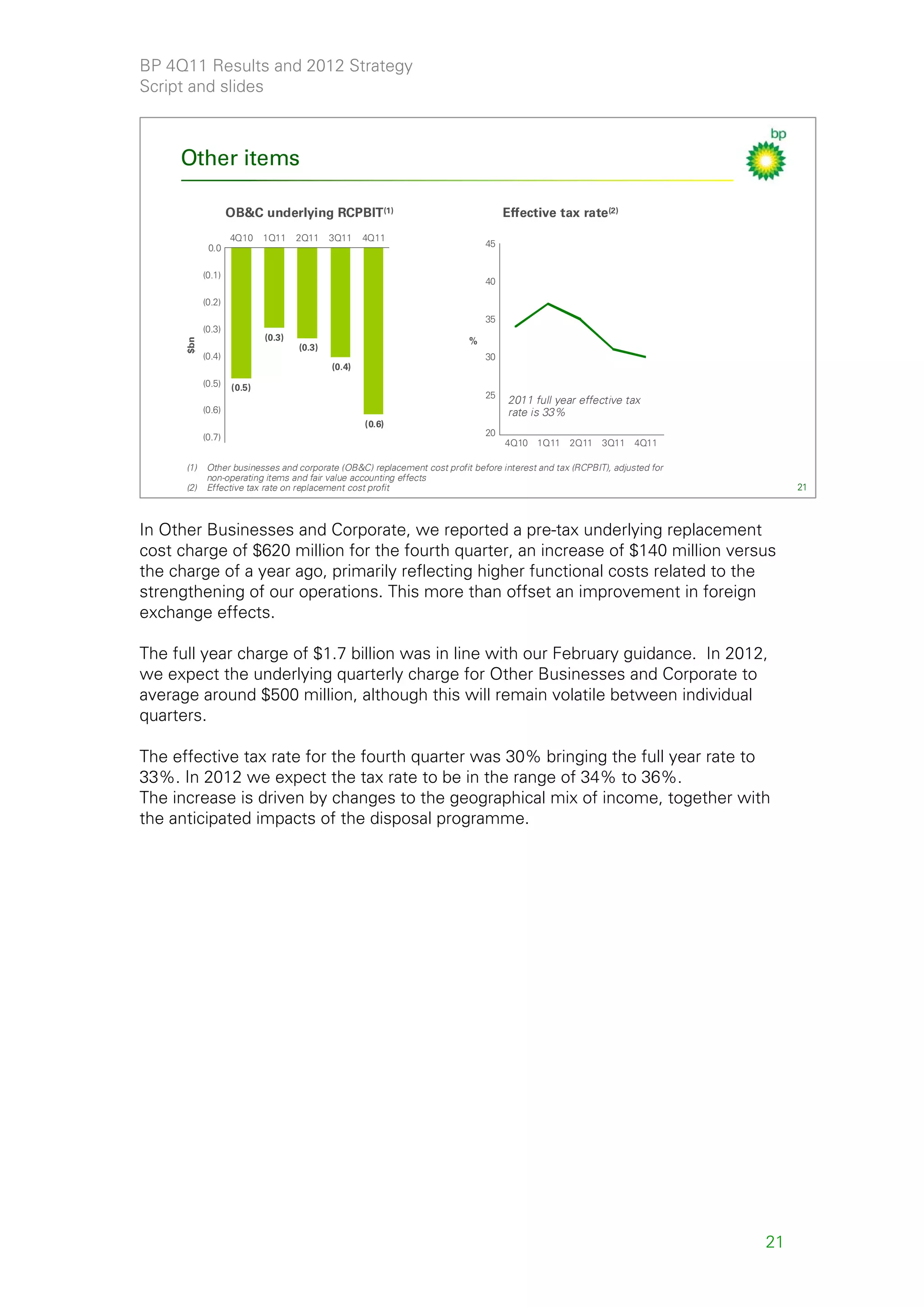
R&M remains on track for delivery of $2 billion of improvement in pre-tax underlying
performance by the end of 2012 relative to 2009 and represents a material
contribution to the growth in operating cash flow for the Group by 2014, notably
through the Whiting project coming onstream in second half of 2013.

We continue to invest with discipline. 2012 organic capital expenditure is expected
to be about $4.5 billion, slightly higher than in 2011 as the activity levels in the field
at Whiting ramp-up.

We continue to be active in the management of our portfolio. I will provide more
detail on our portfolio activities in the break-out.

Finally, we have provided you with further transparency on the performance of the
fuels, lubricants and petrochemicals businesses so you can get a better feel for our
performance and momentum. For each of the businesses you will be able to track
and measure our progress through our profits, operating returns on either capital or
sales, and through key operating metrics.

In summary, 2011 represented a good year for R&M and I am particularly proud of
the team which delivered it.

Let me now hand you back to Bob.


                                                                                                                                     60
BP 4Q11 Results and 2012 Strategy
Script and slides


Bob Dudley: Group Chief Executive


    Bob Dudley


    Moving BP forward


                                                                                  60


Thanks Iain.

So let me just conclude by summarising this first part of today’s presentation.


                                                                             61
BP 4Q11 Results and 2012 Strategy
Script and slides


     Moving BP Forward

                                                                     (1)           15 major upstream projects
                                                                   w               onstream 2012-2014 (2)
                                                          h     flo
                                                        as      Whiting onstream 2H 2013
                                                      gc
                                                 ati n
                                              er           Payments to US Trust Fund end in 2012
                                            op
                                         in          Reducing uncertainties on Gulf of Mexico liabilities
                                      th
                                 ow
                            gr              Margin mix of portfolio improves
                       0%
                    ~5            Back to work in Gulf of Mexico
                         Downstream earnings momentum
                                  Divestments: $38bn by end 2013(3)

     2011                                                                                                2014
     (1)   BP projection at $100/bbl by 2014. See Statement of Assumptions under Cautionary Statement.
     (2)   Excluding TNK-BP
     (3)   Since start of 2010                                                                                       61


Looking out to 2014 you can expect to see the delivery of many major
milestones. These include:

Downstream earnings momentum reaching $2 billion of improvement this
year versus 2009.

Upstream performance improving as we return to work in the Gulf of Mexico,
and the margin mix of our portfolio improves.

Gulf of Mexico liabilities being clarified.

Trust Fund payments ending this year.

The Whiting refinery upgrade coming onstream in 2013.

And the start up of 15 new upstream projects over 2012 to 2014.


                                                                                                                62
BP 4Q11 Results and 2012 Strategy
Script and slides


        Moving BP Forward
        10 - point plan

   What you can expect                               What you can measure
   1.    Relentless focus on safety and managing     6.   Active portfolio management to continue
         risk
                                                     7.   New upstream projects onstream with unit
   2.    Play to our strengths                            operating cash margins double the 2011
                                                          average(1)
   3.    Stronger and more focused
                                                     8.   Generate around 50% more annually in
   4.    Simpler and more standardized
                                                          operating cash flow by 2014 versus 2011
   5.    More visibility and transparency to value        at $100/bbl(2)
                                                     9.   Half of incremental operating cash for
                                                          re-investment, half for other purposes
                                                          including distributions
                                                     10. Strong balance sheet


                                                     (1) Assuming a constant $100/bbl oil price and excluding TNK-BP
                                                     (2) See Statement of Assumptions under Cautionary Statement            62


The 10 point plan will continue to provide the backbone for our programme of
value creation – what you can expect and what you can measure.

As the months go by we will be able to show how we are progressing against
these expectations and indicators of performance.


                                                                                                                       63
BP 4Q11 Results and 2012 Strategy
Script and slides


    Moving BP Forward

    • Year of consolidation now behind us
    • Safety is our continuing priority
    • 2012 a year of milestones: 2013/14
      brings financial momentum
           - Around 50% improvement in operating cash
             flow by 2014 versus 2011(1)
    • Increasing investment to grow the firm
    • Gearing: targeted to lower half of 10-20%
      range
    • Intention to grow distributions over time in line
      with improving circumstances of the firm

     (1)   See Statement of Assumptions under Cautionary Statement              63


BP is moving forward.

The year of consolidation is now behind us.

Safety and risk management are our continuing priority.

2012 will be a year of milestones, with financial momentum building in 2013
and 2014.

We expect around 50% improvement in operating cash flow by 2014
compared with 2011.

Long run we’ll be increasing investment to grow the firm but will also
continue to actively manage the portfolio to add value.

Gearing is targeted to reduce to the bottom half of a 10 to 20% range over
time.

And our intention is to grow distributions over time in line with improving
circumstances of the firm. Having reached an operational turning point in
October and having confidence in our 10-point plan, we believe
circumstances have improved sufficiently to increase the dividend as we have
announced today.

We will now break and say good-bye to those on the webcast before moving
on to the next part of today’s proceedings. Thank you for joining us and we
hope you will rejoin us later. The webcast will restart at 4.45pm London time
for the Q&A session. In the meantime you will find the break-out materials
available on our website.


                                                                          64
BP 4Q11 Results and 2012 Strategy
Script and slides

For those here in person, I will now hand over to our Head of Investor
Relations, Jess Mitchell, to explain the arrangements for the break-outs.
Thank you.

[Webcast ends]


                                                                      65
BP 4Q11 Results and 2012 Strategy
Script and slides


     Break-out sessions
      Upstream                                                             1st Floor
      Longer term investments play to our strengths

      Mike Daly: Executive Vice President, Exploration
      Andy Hopwood: Executive Vice President, Strategy and Integration

      Upstream
                                                                           3 rd Floor
      Operating model: improving execution capability

      Bob Fryar: Executive Vice President, Production
      Bernard Looney: Executive Vice President, Developments

      Refining & Marketing                                                 6 th Floor
      Delivering a world class downstream business
      Iain Conn: Chief Executive, Refining & Marketing
      Tufan Erginbilgic: COO, Eastern Hemisphere Fuels, Global Lubes, Aviation & LPG
      Richard Hookway: CFO, Refining & Marketing
                                                                                             64


Hello everyone. As you can see on the slide behind me we have three break-
outs which you will all get chance to attend in rotation.

On the front of your passes you’ll see that you have a number 1, 2 or 3. This
allocates you to a group for the break-out sessions. We’d like you now to
make your way over to the back of the room to the venue host holding the
appropriate numbered board who will escort you around the break-out
sessions. We would be most grateful if you do this promptly in order to
ensure things run smoothly this afternoon. We would also ask that you stay
with this same group throughout the sessions. There will be refreshments
available at the break-out locations and time for a longer intermission after the
break-outs complete.

Thank you, enjoy the break-outs and we will see you all back here at 4.45pm
for our Q&A session.


                                                                                        66
BP 4Q11 Results and 2012 Strategy
Script and slides


   SECRET


    2011 Results and
    Strategy Presentation
    2011 Results and
    7 February 2012


    Strategy Presentation
    7 February 2012


                                                              65


[Picture for when attendees reconvene for wrap-up Q&A]


                                                         67
BP 4Q11 Results and 2012 Strategy
Script and slides


     Q&A

                                                  Iain Conn
                Bob Dudley
                                                  Chief Executive,
                Group Chief Executive
                                                  Refining & Marketing

                                                  Andy Hopwood
                Brian Gilvary
                                                  Executive Vice President,
                Chief Financial Officer
                                                  Strategy & Integration

                Bob Fryar                         Mike Daly
                Executive Vice President,         Executive Vice President,
                Production                        Exploration

                Bernard Looney
                Executive Vice President,
                Developments
                                                                                   66


Hello and welcome back to the wrap-up and Q&A session.

Here in London on stage we have Brian Gilvary and Iain Conn who we
introduced as part of the earlier plenary session and the Executive Vice
presidents of our upstream businesses who just presented two of the break
outs; Mike Daly heads up Exploration; Bernard Looney, Developments; and
Bob Fryar, Production. Andy Hopwood has overall responsibility for upstream
Strategy and Integration.

Also with us in the front row we have Byron Grote, Executive Vice president
of Corporate Business Activities, Dev Sanyal, BP’s new Group Chief of Staff,
Fergus MacLeod, Group Head of Strategic Planning and Jess Mitchell, Head
of IR.

You will now have opportunity to put your questions to all of us.

We are webcasting this final section of our presentation today and for those
joining us for the first time on the web and telephones who did not see our
previous message here is our usual cautionary statement.


                                                                              68
BP 4Q11 Results and 2012 Strategy
Script and slides


    Cautionary statement
     Forward-looking statements - cautionary statement
     This presentation, including the video presentation regarding Project 20K, and the associated slides and discussion contain forward-looking statements, particularly those regarding: expectations regarding financial
     momentum in 2013 and 2014; BP’s outlook on global energy trends to 2030; expected increases in investment in exploration and upstream drilling and production; anticipated improvements and increases, and the
     sources and timing thereof, in pre-tax returns, operating cash flow and margins, including generating around 50% more annually in operating cash flow by 2014 versus 2011 at US$100/bbl; divestm ent plans,
     including the anticipated timing for completion of and final proceeds from the disposition of certain BP assets; the expected level of planned turnarounds and related production outages expectations and plans for
     increased investment, increased distributions to shareholders; the restoration of high value production; the expected level of planned turnarounds; expectations regarding our new operating model; expectations of
     a challenging marketing environment in 2012 for fuels, lubricants and petrochemicals; the quarterly dividend payment; the strength of the balance sheet; the expected increase in exploration activity; expectations
     for drilling and rig activity generally and specifically in the Gulf of Mexico; the level of performance improvement in Refining and Marketing; expected full-year 2012 organic capital expenditure and increased capital
     spend for the future; the timing and composition of major projects including expected start up, completion, level of production and margins; the expected timing and level of final investment decisions the
     expected timing and level of appraisal activity; the timing for completion of the Whiting refinery upgrade, other refining upgrades and logistics optimization; the expected level of production in the first quarter of
     2012 and in full-year 2012 the magnitude and timing of remaining remediation costs related to the Deepwater Horizon oil spill; the factors that could affect the magnitude of BP’s ultimate exposure and the cost to
     BP in relation to the spill and any potential mitigation resulting from BP’s partners or others involved in the spill; the potential liabilities resulting from pending and future legal proceedings and potential
     investigations and civil or criminal actions that US state and/or local governments could seek to take against BP as a result of the spill; the timing of claims and litigation outcomes and of payment of legal costs;
     timing and quantum of contributions to and payments from the $20 billion Trust Fund; expectations regarding the reduction of net debt and the net debt ratio; the expected levels of underlying and reported
     production in 2012, and the impact of disposals thereon; the expected level of depreciation, depletion and amortization in 2012; expectations for the level and volatility of quarterly losses in Other businesses and
     corporate; the expected full-year effective tax rate for 2012; plans to continue to seek opportunities and prospects in BP’s areas of strength, such as deepwater, gas value chains and giant fields; plans to
     strengthen BP’s position in unconventionals; the expected production potential of certain existing unconventional oil assets; the timing of the deployment of BP’s new single work management system; the
     sources and timing of volume growth and earnings momentum in Lubricants and Petrochemicals; expected future levels of resource recovery in giant fields; expectations about the future significance of
     deepwater drilling for BP; BP’s intentions to invest in and develop certain deepwater technology and systems in connection with Project 20K, and the expected level of investment in connection therewith; the
     expected level of investments by TNK-BP; TNK-BP’s expected organic production growth; TNK-BP’s plans to manage production decline in certain fields; the timing and composition of major projects of TNK-BP;
     TNK-BP’s expansion plans; BP’s plans to report TNK-BP as a separate segment in BP’s financial accounts; the expected future level of investment in Alternative Energy; and the expected profitability and level of
     future cash flow of certain Alternative Energy assets. By their nature, forward-looking statements involve risk and uncertainty because they relate to events and depend on circumstances that will or may occur in
     the future. Actual results may differ from those expressed in such statements, depending on a variety of factors including the timing of bringing new fields onstream; the timing of certain disposals; future levels
     of industry product supply; demand and pricing; OPEC quota restrictions; PSA effects; operational problems; general economic conditions; political stability and economic growth in relevant areas of the world;
     changes in laws and governmental regulations; changes in taxation or regulation; regulatory or legal actions including the types of enforcement action pursued and the nature of remedies sought; the actions of
     prosecutors, regulatory authorities, the Gulf Coast Claims Facility and the courts; the actions of all parties to the Deepwater Horizon oil spill-related litigation at various phases of the litigation; the impact on our
     reputation following the Deepwater Horizon oil spill; exchange rate fluctuations; development and use of new technology; the success or otherwise of partnering; the successful completion of certain disposals;
     the actions of competitors, trading partners, creditors, rating agencies and others; natural disasters and adverse weather conditions; changes in public expectations and other changes to business conditions; wars
     and acts of terrorism or sabotage; and other factors discussed under “Risk factors” in our Annual Report and Form 20-F 2010 as filed with the US Securities and Exchange Commission (SEC).
     Reconciliations to GAAP-This presentation also contains financial information which is not presented in accordance with generally accepted accounting principles (GAAP). A quantitative reconciliation of this
     information to the most directly comparable financial measure calculated and presented in accordance with GAAP can be found on our website at www.bp.com.
     Statement of Assumptions - The operating cash flow projection for 2014 stated on slides 8, 10, 11, 33, 38, 58, 61, 62 and 63 reflects our expectation that all required payments into the $20 billion US Trust Fund
     will have been completed prior to 2014. The projection does not reflect any cash flows relating to other liabilities, contingent liabilities, settlements or contingent assets arising from the Deepwater Horizon oil spill
     which may or may not arise at that time. As disclosed in the Stock Exchange Announcement, we are not today able to reliably estimate the amount or timing of a number of contingent liabilities.
     Cautionary note to US investors - We use certain terms in this presentation, such as “resources”, “non-proved resources” and references to projections in relation to such that the SEC’s rules prohibit us from
     including in our filings with the SEC. U.S. investors are urged to consider closely the disclosures in our Form 20-F, SEC File No. 1-06262. This form is available on our website at www.bp.com. You can also obtain
     this form from the SEC by calling 1-800-SEC-0330 or by logging on to their website at www.sec.gov. Tables and projections in this presentation are BP projections unless otherwise stated.
     February 2012                                                                                                                                                                                                             67


Once again I refer you to the remarks I made earlier which are now posted on
our website.


                                                                                                                                                                                                                  69
BP 4Q11 Results and 2012 Strategy
Script and slides


    Q&A

                                               Iain Conn
               Bob Dudley
                                               Chief Executive,
               Group Chief Executive
                                               Refining & Marketing

                                               Andy Hopwood
               Brian Gilvary
                                               Executive Vice President,
               Chief Financial Officer
                                               Strategy & Integration

               Bob Fryar                       Mike Daly
               Executive Vice President,       Executive Vice President,
               Production                      Exploration

               Bernard Looney
               Executive Vice President,
               Developments
                                                                                68


So we’d now be very happy to take your questions.


                                                                           70
BP 4Q11 Results and 2012 Strategy
Script and slides


   SECRET


    2011 Results and
    Strategy Presentation
    7 February 2012


    Moving BP forward


                                                                                  69


Q&A session

Bob Dudley closing remarks:

Ladies and gentlemen, thank you very much for spending today with us. I
hope you have found the time well spent and I know I speak for the executive
team in saying we have enjoyed showing you our plans for the future.

We continue to meet our obligations. For our many employees working hard
everywhere, our period of consolidation is over.

Now it’s time to deliver: investment, growth and value – achieved by playing
to our strengths.

That means making choices.

We are choosing value over volume – measured in cash flow not barrels.

We are choosing strategic assets over non-core ones.

We’re investing more in the front-end of exploration and divesting mature
assets which others can derive more value from.

So we are choosing not to try to be the biggest - but over time to aspire to be
the best. A safer, stronger and simpler BP.

As I said at the outset, our vision is to build an ever stronger portfolio,
upstream and downstream, generating sufficient cash both to invest in our
pipeline and reward those who invest in us as the circumstances of the firm


                                                                            71
BP 4Q11 Results and 2012 Strategy
Script and slides

improve. We have made a strong start on the portfolio, we’re building the
cash generation and we have begun to provide those rewards.

Thank you to those who have stayed with us on the webcast - and our very
best to you from London.

Ladies and gentlemen, I hope you can join us for refreshments in the area
just outside.


                                                                      72

P 4Q11 & 2012 Strategy Presentation

  • 1.
    BP 4Q11 Resultsand 2012 Strategy Script and slides BP 4Q11 & 2012 Strategy presentation Bob Dudley: Group Chief Executive SECRET 2011 Results and Strategy Presentation 2011 Results and 7 February 2012 Strategy Presentation 7 February 2012 1 Good afternoon everyone and thank you for joining us today. Welcome to BP’s 2011 Results and Strategy presentation. We are very pleased to have you with us, whether in person, over the phone or on the web. For those here in our new venue at Canada Square, in east London, you will have seen behind me our safety evacuation guidelines. There are more details in the safety briefing card handed to you at reception. We’re not planning to test the alarm system today, so if you hear it, please proceed as advised by these instructions. May I also ask you to turn off your mobile or cell phones at this point. With me on stage I have Brian Gilvary, whom I am very pleased to introduce as BP’s new Chief Financial Officer, and Iain Conn, our Chief Executive of Refining & Marketing. In the audience we have our Chairman, Carl-Henric Svanberg and members of our Executive Team who will host the break-outs after this session and join us for Q&A later this afternoon. 1
  • 2.
    BP 4Q11 Resultsand 2012 Strategy Script and slides Cautionary statement Forward-looking statements - cautionary statement This presentation, including the video presentation regarding Project 20K, and the associated slides and discussion contain forward-looking statements, particularly those regarding: expectations regarding financial momentum in 2013 and 2014; BP’s outlook on global energy trends to 2030; expected increases in investment in exploration and upstream drilling and production; anticipated improvements and increases, and the sources and timing thereof, in pre-tax returns, operating cash flow and margins, including generating around 50% more annually in operating cash flow by 2014 versus 2011 at US$100/bbl; divestm ent plans, including the anticipated timing for completion of and final proceeds from the disposition of certain BP assets; the expected level of planned turnarounds and related production outages expectations and plans for increased investment, increased distributions to shareholders; the restoration of high value production; the expected level of planned turnarounds; expectations regarding our new operating model; expectations of a challenging marketing environment in 2012 for fuels, lubricants and petrochemicals; the quarterly dividend payment; the strength of the balance sheet; the expected increase in exploration activity; expectations for drilling and rig activity generally and specifically in the Gulf of Mexico; the level of performance improvement in Refining and Marketing; expected full-year 2012 organic capital expenditure and increased capital spend for the future; the timing and composition of major projects including expected start up, completion, level of production and margins; the expected timing and level of final investment decisions the expected timing and level of appraisal activity; the timing for completion of the Whiting refinery upgrade, other refining upgrades and logistics optimization; the expected level of production in the first quarter of 2012 and in full-year 2012 the magnitude and timing of remaining remediation costs related to the Deepwater Horizon oil spill; the factors that could affect the magnitude of BP’s ultimate exposure and the cost to BP in relation to the spill and any potential mitigation resulting from BP’s partners or others involved in the spill; the potential liabilities resulting from pending and future legal proceedings and potential investigations and civil or criminal actions that US state and/or local governments could seek to take against BP as a result of the spill; the timing of claims and litigation outcomes and of payment of legal costs; timing and quantum of contributions to and payments from the $20 billion Trust Fund; expectations regarding the reduction of net debt and the net debt ratio; the expected levels of underlying and reported production in 2012, and the impact of disposals thereon; the expected level of depreciation, depletion and amortization in 2012; expectations for the level and volatility of quarterly losses in Other businesses and corporate; the expected full-year effective tax rate for 2012; plans to continue to seek opportunities and prospects in BP’s areas of strength, such as deepwater, gas value chains and giant fields; plans to strengthen BP’s position in unconventionals; the expected production potential of certain existing unconventional oil assets; the timing of the deployment of BP’s new single work management system; the sources and timing of volume growth and earnings momentum in Lubricants and Petrochemicals; expected future levels of resource recovery in giant fields; expectations about the future significance of deepwater drilling for BP; BP’s intentions to invest in and develop certain deepwater technology and systems in connection with Project 20K, and the expected level of investment in connection therewith; the expected level of investments by TNK-BP; TNK-BP’s expected organic production growth; TNK-BP’s plans to manage production decline in certain fields; the timing and composition of major projects of TNK-BP; TNK-BP’s expansion plans; BP’s plans to report TNK-BP as a separate segment in BP’s financial accounts; the expected future level of investment in Alternative Energy; and the expected profitability and level of future cash flow of certain Alternative Energy assets. By their nature, forward-looking statements involve risk and uncertainty because they relate to events and depend on circumstances that will or may occur in the future. Actual results may differ from those expressed in such statements, depending on a variety of factors including the timing of bringing new fields onstream; the timing of certain disposals; future levels of industry product supply; demand and pricing; OPEC quota restrictions; PSA effects; operational problems; general economic conditions; political stability and economic growth in relevant areas of the world; changes in laws and governmental regulations; changes in taxation or regulation; regulatory or legal actions including the types of enforcement action pursued and the nature of remedies sought; the actions of prosecutors, regulatory authorities, the Gulf Coast Claims Facility and the courts; the actions of all parties to the Deepwater Horizon oil spill-related litigation at various phases of the litigation; the impact on our reputation following the Deepwater Horizon oil spill; exchange rate fluctuations; development and use of new technology; the success or otherwise of partnering; the successful completion of certain disposals; the actions of competitors, trading partners, creditors, rating agencies and others; natural disasters and adverse weather conditions; changes in public expectations and other changes to business conditions; wars and acts of terrorism or sabotage; and other factors discussed under “Risk factors” in our Annual Report and Form 20-F 2010 as filed with the US Securities and Exchange Commission (SEC). Reconciliations to GAAP-This presentation also contains financial information which is not presented in accordance with generally accepted accounting principles (GAAP). A quantitative reconciliation of this information to the most directly comparable financial measure calculated and presented in accordance with GAAP can be found on our website at www.bp.com. Statement of Assumptions - The operating cash flow projection for 2014 stated on slides 8, 10, 11, 33, 38, 58, 61, 62 and 63 reflects our expectation that all required payments into the $20 billion US Trust Fund will have been completed prior to 2014. The projection does not reflect any cash flows relating to other liabilities, contingent liabilities, settlements or contingent assets arising from the Deepwater Horizon oil spill which may or may not arise at that time. As disclosed in the Stock Exchange Announcement, we are not today able to reliably estimate the amount or timing of a number of contingent liabilities. Cautionary note to US investors - We use certain terms in this presentation, such as “resources”, “non-proved resources” and references to projections in relation to such that the SEC’s rules prohibit us from including in our filings with the SEC. U.S. investors are urged to consider closely the disclosures in our Form 20-F, SEC File No. 1-06262. This form is available on our website at www.bp.com. You can also obtain this form from the SEC by calling 1-800-SEC-0330 or by logging on to their website at www.sec.gov. Tables and projections in this presentation are BP projections unless otherwise stated. February 2012 2 Before we start, I’d like to draw your attention to our cautionary statement – please read carefully. During today’s presentation, we will reference estimates, plans and expectations that are forward-looking statements. Actual outcomes could differ materially due to factors we note on this slide and in our regulatory filings. Please refer to our Annual Report and Accounts, 20-F and fourth-quarter Stock Exchange Announcement for more details. These documents are available on our website. 2
  • 3.
    BP 4Q11 Resultsand 2012 Strategy Script and slides Bob Dudley Group Chief Executive Playing to our strengths 3 Today we are going to return to the plans we laid out to you in October. Our 10-point plan to grow value. We aim to leave you with an even clearer view of the path ahead. 2011 was a successful year of recovery, consolidation and change and we reached an operational turning point in October. 2012 will be a year of milestones as we build on those foundations. And as we move through 2013 and 2014 we expect to see the financial momentum building as we complete payments into the Trust Fund and as our operations start to show the benefits of our actions. Our 10-point plan provides the roadmap – how we will play to our strengths and be safer, stronger, simpler and more standardised. How value will be driven by growth in both underlying volume and margin – from a portfolio of the right size to generate the operating cash flow to both reinvest in our project pipeline as well as reward shareholders as we have announced today with a 14% increase in our quarterly dividend. We believe this will help us to see the true value of the company recognised. 3
  • 4.
    BP 4Q11 Resultsand 2012 Strategy Script and slides Moving BP forward Playing to our strengths Bob Dudley 4Q 2011 results Brian Gilvary Progress in the US Bob Dudley Upstream TNK-BP Alternative Energy Refining and Marketing Iain Conn Summary Bob Dudley Break-outs Upstream - Longer term investments play to our strengths Upstream - Operating model: improving execution capability Refining & Marketing - Delivering a world class downstream business Conclusions and Q&A Bob Dudley and Executive Team 4 So let me outline today’s agenda. I’ll start with an overview and Brian will then take us through the 2011 results in detail. I will then report on progress in the US before outlining our plans for the upstream, including showing you a video of a new initiative in the technology sphere that will be important for our industry. I will then briefly touch on TNK-BP and Alternative Energy, before Iain covers plans for the downstream. After a brief summary the first part of our webcast will end and we’ll break so that those here at the venue can re-group for three break-out sessions to be held in rotation. These cover specific sources of value growth that we want to tell you more about: Mike Daly and Andy Hopwood will cover our plans for long-term investment in the upstream. Bernard Looney and Bob Fryar will discuss our upstream operating model and major projects. And Iain Conn and his team will explain how we are moving our downstream business forward. The presentation materials for these break-outs will be posted on our website during the break for those not here with us today. At 4.45pm, London time, or GMT, we will gather back here and restart the webcast for concluding remarks and discussion. We expect to be finished by around 5.30pm, London time. 4
  • 5.
    BP 4Q11 Resultsand 2012 Strategy Script and slides 2011: A year of consolidation Safety – Trust – Value Growth Safety • Safety and Operational Risk organisation in action • Upstream re-organized to strengthen consistency and capability Trust • Meeting our commitments in the Gulf of Mexico • Resumed drilling in the Gulf of Mexico - with enhanced standards Value Growth • Resumed dividend payments • 55 new exploration licences awarded in 9 countries • 19th year of reported reserves replacement >100%(1) • Operational turning point • Portfolio strengthened - Planned divestments of $38bn - Acquisitions in Brazil and India • Refining & Marketing record earnings (1) Reserves replacement as reported on a combined basis of subsidiaries and equity accounted entities (including TNK-BP), excluding acquisitions and divestments. See Stock Exchange Announcement for further important information on basis for calculation. 5 So I want to start by briefly looking back at what we achieved in 2011. As you know, we set out three priorities this time last year – safety; rebuilding trust; and growing value. I believe we made good progress on all three. We set up a new safety and operational risk organization and reorganized our upstream into three global divisions of exploration, developments and production – which allows us to strengthen consistency and capability. We will be showing you more of the activities of the divisions in the break-outs. I believe trust is built by doing what you say you will do and we have continued to meet our obligations to the Gulf of Mexico community. We are back to drilling wells in the Gulf, applying our voluntary standards that go beyond regulatory requirements. And looking to value growth there has also been great progress. In 2011 we resumed dividend payments. Our organic reported reserves replacement was above 100% again Globally BP was awarded 55 new exploration licences in nine countries last year – making it 84 over the last year and a half. We believe this resulted in more net acreage than accessed by any of our peers in 2011 and it is a powerful indicator of how confidence has been restored in BP to work around the world after the events of 2010. In October we reached a turning point in our operations, already evidenced in the increase in production volumes that you have seen us report today for the 4th quarter. We have made substantial progress with our divestment programme which we will come back to in more detail, and completed transactions that expanded the portfolio in the strategically important geographies of India and Brazil. And our downstream business achieved a record year for earnings 5
  • 6.
    BP 4Q11 Resultsand 2012 Strategy Script and slides Key global energy trends to 2030 • Continued strong growth in demand Energy contributions to global growth - Concentrated in non-OECD 2.5 • Oil, gas and coal expected to deliver 80% of needs by 2030 and to have similar shares of global 2.0 Renewables demand Hydro - Gas is the fastest growing fuel; ~2% per year % per annum 1.5 - Oil continues to dominate transport fuel Nuclear • Renewables growing from 2% to 6% of global Coal 1.0 energy supply; more than 8% per year Gas • North America has the potential to become energy 0.5 Oil self sufficient by 2030 • Industry needs to continue to develop new 0.0 1970- 1990- 2010- frontiers and apply technology and learning 1990 2010 2030 Projections from BP Energy Outlook 2030 6 So that was the story of 2011, but before we look ahead let’s just remind ourselves of some important context. There are a number of clear trends in the energy world as we highlighted in our recent 2030 Energy Outlook. We expect aggregate energy demand to rise by up to 40% by 2030, nearly all of it from emerging economies. By 2030, we expect oil, gas and coal to have similar shares of global demand. We expect gas to grow at around 2% per year, double the rate of oil. But we expect oil to continue to dominate transport fuel. Renewables are expected to grow the fastest of all at around 8% per year but even so we estimate only 6% of the 2030 energy mix will be supplied by renewables. We also see that North America has the potential to become energy self sufficient by 2030. This is driven by the shale gas revolution, but also by growth in biofuels and domestic production from deepwater, shale and heavy oil. I believe our strategy is aligned to these trends and positions BP well for the future. We will continue to invest in Deepwater, Gas and Renewables. We are investing in growing markets, for instance India and Brazil, as well as in North America and elsewhere. And we are using our global reach to leverage technology and learning wherever we see the greatest opportunities. 6
  • 7.
    BP 4Q11 Resultsand 2012 Strategy Script and slides Environment Brent oil $/bbl(1) Natural gas $/mmbtu(1) Refining Marker Margin $/bbl(2) 160 28 30 Henry Hub 140 24 Japan/Korea marker 25 120 20 20 100 16 80 15 12 60 10 8 40 4 5 20 0 0 0 2005 2006 2007 2008 2009 2010 2011 2012 2005 2006 2007 2008 2009 2010 2011 2012 2005 2006 2007 2008 2009 2010 2011 2012 (1) Source: Thomson Reuters Datastream, 12 January 2012 (2) BP Refining Marker Margin based on BP's portfolio 7 Against such trends, the oil price environment has been uncertain and volatile and gas prices continue to reflect regional supply/demand dynamics with spot pricing in the US remaining heavily disconnected from oil prices and more aligned in Europe and Asia. In 2011, refining margins improved for a second consecutive year as demand for oil products continued to grow, driven by the non-OECD markets. The outlook remains difficult to predict. It requires us to be very clear about our strategy and only participate where we can compete no matter what the environment holds in store. I believe BP can do this. We have the scale, the focus, the distinctive trading capability and the access to growth markets. Which brings me to our 10-point plan. 7
  • 8.
    BP 4Q11 Resultsand 2012 Strategy Script and slides Moving BP Forward 10 - point plan What you can expect What you can measure 1. Relentless focus on safety and managing 6. Active portfolio management to continue risk 7. New upstream projects onstream with unit 2. Play to our strengths operating cash margins double the 2011 average(1) 3. Stronger and more focused 8. Generate around 50% more annually in 4. Simpler and more standardized operating cash flow by 2014 versus 2011 5. More visibility and transparency to value at $100/bbl(2) 9. Half of incremental operating cash for re-investment, half for other purposes including distributions 10. Strong balance sheet (1) Assuming a constant $100/bbl oil price and excluding TNK-BP (2) See Statement of Assumptions under Cautionary Statement 8 In October, I put forward five points to expect and five to measure. I said we would focus relentlessly on safety, play to our strengths, and be stronger, more focused, simpler and more standardized. We promised to create more visibility and transparency to value. In terms of measures, you will see continuing active portfolio management. In October, we announced an intention to pursue a further $15 billion of divestments, making a four-year total of $45 billion by the end of 2013. With the subsequent termination of our previously announced divestment of Pan American Energy the total is now $38 billion. Meanwhile we expect to see new projects coming onstream with operating cash margins around double the 2011 upstream average by 2014 – that’s at $100 per barrel and excluding TNK-BP. You can expect us to generate an increase of around 50% in additional operating cash flow by 2014 compared to 2011 - approximately half from ending Gulf of Mexico Trust Fund payments and around half from operations. We plan to use around half that extra cash for re-investment and half for other purposes including shareholder distributions. And all of this will be underpinned by a strong balance sheet. You will see evidence of how we are already delivering on these commitments as today’s presentation unfolds. 8
  • 9.
    BP 4Q11 Resultsand 2012 Strategy Script and slides Playing to our strengths • Leading explorer • Distinctive upstream portfolio focussed in three growth engines - Deepwater - Gas value chains - Giant fields • World class downstream • Technology development • Strong relationships 9 Our roadmap for long term value creation plays to our strengths. In the upstream we have a great track record in exploration - deep expertise in finding oil and gas. We have three distinct engines for growth where you can expect to see us focus our long term investment – deepwater; gas value chains and giant fields. We have a world class set of downstream businesses focused on fuels, lubricants and petrochemicals. We have several world leading technologies, from advanced seismic imaging to lubricant formulations and proprietary processes for petrochemical manufacture. And we also have long experience of building and maintaining relationships. We saw the importance of this in the aftermath of the Gulf of Mexico oil spill as many governments, regulators, customers and suppliers around the world have stood by us and worked with us through this difficult phase. 9
  • 10.
    BP 4Q11 Resultsand 2012 Strategy Script and slides Growing value Building momentum 2012: Year of milestones 2013 / 2014: Financial momentum • 12 exploration wells • 15-25 exploration wells per annum • Start-up of 6 upstream major projects • Start-up of 9 upstream major projects • 8 rigs expected to be operating in the • Gulf of Mexico production recovering Gulf of Mexico • Divestments since start of 2010 expected to • Divestment program to continue reach $38bn by end 2013 • Refining & Marketing to complete • Whiting upgrade expected onstream in 2H 2013 $2bn performance improvement vs • Unit operating cash margins from new upstream 2009 projects by 2014 expected to be double the 2011 • Payments into the Gulf of Mexico oil average(1) spill Trust Fund end in 4Q12 • By 2014 generating around 50% more annually • Capex increasing to ~$22bn in operating cash flow versus 2011 at $100/bbl(2) • Distributions expected to increase in line with improving circumstances of the firm (1) Assuming a constant $100/bbl oil price and (2) See Statement of Assumptions in Cautionary Statement excluding TNK-BP 10 As we set out in October in our 10-point plan, there are clear near term measures of how we will grow value. 2012 will be a year when we see increasing investment and delivery of many key milestones. The year will be marked out by an increase in exploration wells from six in 2011 to 12 in 2012, six new project start-ups and eight rigs at work on BP-operated fields in the Gulf of Mexico. We expect capital investment to grow to around $22 billion and to progress our programme of planned divestments. In Refining & Marketing we plan to complete delivery of $2 billion in underlying performance improvement versus 2009. And we will complete our payments into the Gulf of Mexico Trust Fund in the 4th quarter. Then in 2013 and 2014, as investment continues, we also expect to see greater financial momentum coming through in our operations. A further nine new projects will start up and average operating cash margins from new projects in 2014 will have doubled relative to the 2011 portfolio. The upgraded Whiting refinery is planned to come onstream. And divestments are expected to have reached $38 billion. All of this such that by 2014 we will see the expected rise in operating cash flow. 10
  • 11.
    BP 4Q11 Resultsand 2012 Strategy Script and slides Growing value 2013-14: financial momentum Around 50% growth in operating cash flow by 2014 at $100/bbl (1) • Key enablers: - Restoration of high value production - Growth from new projects - Whiting refinery upgrade coming onstream - Completion of contributions to the US Trust Fund Operating cash 2011 operating Gulf of Mexico Operational Divested 2014 operating cash at oil price oil spill related restoration and operations cash estimate of $111/bbl obligations growth and at oil price of environment $100/bbl (1) See Statement of Assumptions under Cautionary Statement 11 Looking at it in terms of a simple bridge we start with operating cash flow in 2011 of $22 billion. The growth comes from four key drivers. The completion of payments to the US Trust Fund accounts for roughly half of the expected increase Then we have the restoration of high value production and growth from our new projects. This is partially offset by divestments and the environmental assumptions we have factored in. Added all together we get an increase in operating cash flow in 2014 of around 50 percent, at an assumed $100 oil price. Today’s presentation aims to give you more confidence in our ability to deliver on this outcome. But before we do this I want to touch on some of the more critical enablers of our 10-point plan, those related to safety, to technology and to people and organization. 11
  • 12.
    BP 4Q11 Resultsand 2012 Strategy Script and slides Safety performance record 700 Loss of Primary Containment Incidents 600 500 400 • 14% reduction in number of Losses of 300 Primary Containment Incidents from 2010 200 to 2011 100 0 2008 2009 2010 2011 2.0 Recordable Injury Frequency 1.8 1.6 1.4 • Recordable Injury Frequency 1.2 (per 200,000 hours) 1.0 0.8 - Setting aside the Deep Water Horizon 0.6 response, performance remains at 0.4 benchmark levels 0.2 0.0 1999 2000 2001 2002 2003 2004 2005 2006 2007 2008 2009 2010 2011 Group excluding response contribution Deepwater Horizon response contribution API US benchmark International Association of Oil & Gas Producers benchmark 12 First safety. Here are some figures to show how we are performing. We measure even the smallest release of hydrocarbons and track them carefully. We call them loss of primary containment. In terms of process safety, the number of incidents in which there has been a loss of primary containment has fallen once again. That is positive, but of course even one incident is too many. Also on this chart you can see the progress we are making in improving personal safety, measured through the Recordable Injury Frequency rate. Aside from the exceptional activities of the Deepwater Horizon response, steady progress has been made over the last decade. We have also continued to implement the recommendations of the BP investigation into the 2010 incident – the Bly Report. Examples include the strengthening of the technical authority's role in cementing and zonal isolation and establishing key performance indicators for well integrity, well control and rig safety critical equipment. We continue to make progress against the other recommendations. 12
  • 13.
    BP 4Q11 Resultsand 2012 Strategy Script and slides Safety and operational risk – strategic priorities Leadership & culture Operating culture supports safe, compliant and reliable operations Organization, competence & contractors Growing deep capability and managing contractor activities Operating risk assessment & management BP businesses comprehensively understand their safety and operational risks and are continually in action to control or eliminate them Systematic operating Systematic management and continuous improvement Results, checks & balances Self verification and independent assurance confirm BP’s conduct of operating Delivered through our global Operating Management System 13 Beyond these markers of progress, we have also done a lot of work on the way we organize ourselves with respect to safety and risk management. These are the five strategic priorities for our agenda in managing safety and operational risk. All of them are delivered through our Operating Management System or OMS, which is the standard system we use to drive systematic management and continuous improvement. The Safety and Operational Risk function provides independent assurance, audit and oversight to ensure the system is designed and operating correctly and works in partnership with line management to ensure we are focusing on the right priorities. To give just two examples; leadership determines the safety culture of the firm – and our action plan here includes requiring leaders to spend time in the field, observing and inspecting. Organization, on the other hand, includes defining competencies required in safety critical roles and assessing individuals and job candidates against them. There will be more on how we are applying OMS during the break-outs. 13
  • 14.
    BP 4Q11 Resultsand 2012 Strategy Script and slides Technology Ensuring safe, reliable operations is our top priority • Focused at the point of competition • Leveraged investment through partnerships • 16 major technology programmes Resource extraction Conversion Consumption Alternatives Feedstocks and conversion Access Efficiency Formulation technologies • Subsurface understanding • Chemicals process • Lubricants • Biofuels • Standardized engineering technology • Advanced fuels solutions • Upgrading refineries • Unconventional hydrocarbons 14 Technology is another key enabler of the 10-point plan. Critically, it enhances safety and integrity but it also creates value. We have a focused approach to technology, with 16 major technology programmes selectively targeting points of competition within our industry across the areas shown on this chart. You will see another new one later on a short video clip. In 2011 we have increased our research and development spending to over $600 million, leveraging this expenditure through collaboration with others. We also spend a similar amount applying this know how through field trials, pilots and other deployment activities. You may have already seen some of the ways in which technology is working for us on display outside and in a short while we are going to introduce you to a new initiative that we hope will help us unlock greater potential in our deepwater portfolio. 14
  • 15.
    BP 4Q11 Resultsand 2012 Strategy Script and slides People and organization • New organizational structures • Building technical and leadership capability - Over 3,000 new technical staff recruited • Strengthened common BP values - Restated values and expected behaviours • Stronger linkage through reward and performance - Balancing medium and longer term Safety | Respect | Excellence | Courage | One Team 15 Value growth will only be unlocked through the commitment, discipline and hard work of our people. We have great people at BP dedicated and focussed on supplying energy around the globe. We have also been very active in recruiting skilled employees – for example with over 3,000 new technical specialists. As a management team we have devoted time to describing a set of very simple, very personal values that we are embedding in the company – safety, respect, excellence, courage and acting as one team. For those of you with us in London, you can see more on these outside this room. We’ve also evolved our approach to performance management and reward, requiring employees to set personal priorities for safety and risk management, focus more on the long term and working as one team. And that seems a good note on which to hand over to Brian to take you through the 2011 numbers. 15
  • 16.
    BP 4Q11 Resultsand 2012 Strategy Script and slides Brian Gilvary: Chief Financial Officer Brian Gilvary Chief Financial Officer 16 Thank you Bob. I’m delighted to join you today to present my first set of quarterly results. 16
  • 17.
    BP 4Q11 Resultsand 2012 Strategy Script and slides 4Q 2011 Summary Earnings figures are adjusted for the costs associated with the Gulf of Mexico oil spill, other non-operating items and fair value accounting effects $bn 4Q10 3Q11 4Q11 % yoy Exploration & Production 6.7 7.2 6.9 Refining & Marketing 0.7 1.7 0.8 Other businesses & corporate (0.5) (0.4) (0.6) Consolidation adjustment 0.1 (0.2) 0.1 Underlying replacement cost profit before interest and tax 7.0 8.3 7.2 3% Interest and minority interest (0.4) (0.4) (0.3) Tax (2.2) (2.4) (1.9) Underlying replacement cost profit 4.4 5.5 5.0 14% Earnings per share (cents) 23.2 28.8 26.3 13% Dividend paid per share (cents) 0.0 7.0 7.0 Operating cash flow (0.2) 6.9 5.0 17 I’d like to start with an overview of fourth quarter financial performance. Our fourth quarter underlying replacement cost profit was $5.0 billion, up 14% on the same period a year ago. The result benefited from • Higher upstream realizations and a lower tax rate, partially offset by • Weaker refining margins, and higher costs. Whilst upstream production volumes fell relative to the fourth quarter of 2010, operational momentum improved relative to the previous quarter, with an increase of 170 thousand barrels of oil equivalent per day. Fourth quarter operating cash flow was $5.0 billion, including $1.2 billion of post-tax Gulf of Mexico oil spill expenditures. For the full year 2011, underlying replacement cost profit was $21.7 billion, up 6% on 2010. Today we announced a 14% increase in the dividend to 8 cents per ordinary share, payable in the first quarter. Turning to the highlights at a segment level. 17
  • 18.
    BP 4Q11 Resultsand 2012 Strategy Script and slides Exploration & Production Underlying replacement cost Realizations (1) Volume profit before interest and tax(2) 120 20 1,600 10 1,400 100 7.8 16 8 7.4 7.2 1,200 6.7 6.9 80 12 1,000 6 mboed $/mcf $/bbl $bn 60 800 8 4 600 40 400 4 2 20 200 0 0 0 0 4Q10 1Q11 2Q11 3Q11 4Q11 4Q10 1Q11 2Q11 3Q11 4Q11 4Q10 1Q11 2Q11 3Q11 4Q11 Liquids $/bbl Liquids, excluding TNK-BP TNK-BP total US Non-US, excluding TNK-BP Natural gas $/mcf Natural gas, excluding TNK-BP TNK-BP Total RCPBIT (1) Realizations based on sales of consolidated subsidiaries only – this excludes equity accounted entities (2) Adjusted for non-operating items and fair value accounting effects 18 In Exploration and Production, underlying fourth quarter replacement cost profit before interest and tax was $6.9 billion. Liquids realizations increased 29% year-on-year in line with marker grades. Gas realizations also improved, reflecting the value of our LNG portfolio. Production for the quarter was 3.487 million barrels of oil equivalent per day, 5% lower than the fourth quarter of last year, but 5% higher relative to the third quarter. Turnaround activity reduced from a peak in the third quarter, and we also resumed Gulf of Mexico drilling activity, with five rigs operating by year end. Production also benefited from the start-up of the Pazflor field in Angola. Costs were higher in the fourth quarter compared to the same quarter a year ago. We deepened our engineering and technical capabilities, including the independent Safety and Operational Risk function. Integrity related spending was higher, and rig standby costs in the Gulf of Mexico continued into October and November. Higher decommissioning provisions, and greater production activity in Iraq, drove an increase in DD&A. Relative to the third quarter, underlying earnings were also impacted by a loss in the gas marketing and trading business. For the full year 2011, replacement cost profit before interest and tax was $29.4 billion, an increase of 6% year on year. Full year production was 3.454 million barrels of oil equivalent per day, 10% lower than 2010, or 7% lower after adjusting for the effects of acquisitions and divestments and price effects on our production sharing agreements. Looking ahead, production in the first quarter of 2012 is expected to be broadly similar to the fourth quarter of 2011. 18
  • 19.
    BP 4Q11 Resultsand 2012 Strategy Script and slides TNK-BP Average oil marker prices BP share of net income BP share of dividend 120 1.4 1.8 1.6 100 1.2 1.4 1.0 80 1.2 0.8 1.0 $/bbl $bn $bn 60 0.6 0.8 40 0.6 0.4 0.4 20 0.2 0.2 0 0.0 0.0 4Q10 1Q11 2Q11 3Q11 4Q11 4Q10 1Q11 2Q11 3Q11 4Q11 4Q10 1Q11 2Q11 3Q11 4Q11 Urals Russian domestic oil 19 Our share of TNK-BP net income was $1 billion for the quarter, benefiting from higher production and realizations year on year, partly offset by increases in local transportation tariffs. Cash dividends in the quarter were $1.7 billion, bringing the total for the year to $3.7 billion. In future we will report TNK-BP separately, providing greater transparency of our Upstream business outside of Russia. For me, I view TNK-BP as a long life self-funding source of free cash flow, with significant future growth potential. Turning to Refining & Marketing. 19
  • 20.
    BP 4Q11 Resultsand 2012 Strategy Script and slides Refining & Marketing BP average Underlying replacement cost Refining Marker Margin Refining availability profit before interest and tax(1) 20 97 2.5 2.2 18 96 2.0 16 1.7 95 14 1.4 1.5 94 12 % $/bbl 93 10 1.0 0.7 0.8 92 8 0.5 6 91 4 90 0.0 4Q10 1Q11 2Q11 3Q11 4Q11 4Q10 1Q11 2Q11 3Q11 4Q11 4Q10 1Q11 2Q11 3Q11 4Q11 Fuels Petrochemicals Lubricants Total RCPBIT (1) Adjusted for non-operating items and fair value accounting effects 20 For the fourth quarter, the Refining and Marketing segment reported underlying replacement cost profit before interest and tax of $760 million compared to $740 million in the same quarter last year. We are now reporting the three businesses within the segment separately, delivering the increased transparency we signalled with 3Q results. Compared to the same quarter last year, the fuels business saw • A 9% fall in refining marker margins, balanced by • An improved contribution from supply and trading, and benefited from access to lower cost WTI-priced crude grades in the United States. Compared with the previous quarter, the US fuels environment was particularly challenging. US refining margins reduced by more than 40% and differentials between WTI and Brent crude fell sharply from their third quarter highs. However globally, we saw continued strong operations with Solomon availability at over 95% in the fourth quarter. Earnings from our lubricants business in the fourth quarter were impacted by an increasingly difficult marketing environment characterized by high base oil prices and weaker demand. This was largely offset by supply chain efficiencies and the strength of our products and brands. Compared with the fourth quarter of 2010 our petrochemicals business was also impacted by weakening market conditions, as additional Asian capacity came on stream at a time of weaker demand. For the full year, Refining and Marketing delivered a record underlying replacement cost profit before interest and tax of $6 billion, made up of $3.6 billion in Fuels, $1.3 billion in Lubricants and $1.1 billion in Petrochemicals. Looking ahead, the level of refinery turnaround activity is expected to be broadly similar in 2012 compared to 2011. 20
  • 21.
    BP 4Q11 Resultsand 2012 Strategy Script and slides Other items OB&C underlying RCPBIT(1) Effective tax rate (2) 4Q10 1Q11 2Q11 3Q11 4Q11 0.0 45 (0.1) 40 (0.2) 35 (0.3) (0.3) % $bn (0.3) (0.4) 30 (0.4) (0.5) (0.5) 25 2011 full year effective tax (0.6) rate is 33% (0.6) (0.7) 20 4Q10 1Q11 2Q11 3Q11 4Q11 (1) Other businesses and corporate (OB&C) replacement cost profit before interest and tax (RCPBIT), adjusted for non-operating items and fair value accounting effects (2) Effective tax rate on replacement cost profit 21 In Other Businesses and Corporate, we reported a pre-tax underlying replacement cost charge of $620 million for the fourth quarter, an increase of $140 million versus the charge of a year ago, primarily reflecting higher functional costs related to the strengthening of our operations. This more than offset an improvement in foreign exchange effects. The full year charge of $1.7 billion was in line with our February guidance. In 2012, we expect the underlying quarterly charge for Other Businesses and Corporate to average around $500 million, although this will remain volatile between individual quarters. The effective tax rate for the fourth quarter was 30% bringing the full year rate to 33%. In 2012 we expect the tax rate to be in the range of 34% to 36%. The increase is driven by changes to the geographical mix of income, together with the anticipated impacts of the disposal programme. 21
  • 22.
    BP 4Q11 Resultsand 2012 Strategy Script and slides Gulf of Mexico oil spill costs and provisions (pre-tax(1)) $bn FY10 FY11 Total Income statement Charge / (credit) for the period 40.9 (3.7) 37.2 Balance sheet(2) Brought forward 23.3 Charge / (credit) to income statement 40.9 (3.7) 37.2 Payments into Trust Fund (5.0) (10.1) (15.1) Cash settlements received 0.0 5.1 5.1 (3) Other related payments in the period (12.7) (3.9) (16.6) Carried forward 23.3 10.6 Cash outflow 17.7 8.9 26.6 (1) Includes contributions received from Mitsui, Weatherford and Anadarko and the income statement impact of the Cameron settlement (2) Balance sheet amount includes all provisions, other payables and the asset balances related to the Gulf of Mexico oil spill (3) Please refer to details as disclosed in the Stock Exchange Announcement 22 Turning to the costs and provisions associated with the Gulf of Mexico oil spill. In the fourth quarter we recognized a $4.1 billion credit reflecting a reduction in the pre-tax charge for the incident, bringing the full-year total to a reduction of $3.7 billion. The 4Q credit reflects the settlements with Anadarko and Cameron, partially offset by an increase in the provision for spill response costs plus a charge for the ongoing quarterly expenses of the Gulf Coast Restoration Organization. Under these settlement agreements, Anadarko paid BP $4 billion in November, which was subsequently paid in to the Trust Fund, and Cameron paid BP $250 million last month which will be reflected as paid into the $20 billion Trust Fund in the first quarter. As a result of these accelerated contributions, the $20 billion commitment to the Trust Fund will have been paid in full by the end of this year. The total charge taken for the incident at year-end was $37.2 billion. Pre-tax BP cash out flow related to oil spill costs for the year was $8.9 billion. As we indicated in previous quarters, we continue to believe that BP was not grossly negligent and we have taken the charge against income on that basis. 22
  • 23.
    BP 4Q11 Resultsand 2012 Strategy Script and slides Divestments US Wytch Farm Natural Gas Liquids Canada(3) Midstream Aluminium Egypt Western Western Desert Canada Gas Permian Assets LukArco Cumulative divestments proceeds(1) 50% Devon 25 ACG(2) interest 20 Wattenberg gas Pakistan 15 plant $bn Vietnam 10 Pompano and Mica fields Malaysia Petrochemicals 5 Devon Gulf of Joint Venture Mexico mature 0 assets Southern 2Q10 3Q10 4Q10 1Q11 2Q11 3Q11 4Q11 Colombia Venezuela Africa 2010 2011 (1) Cumulative divestment proceeds have been adjusted to remove the deposit of $3.5bn received in 4Q 2010 relating to the sale of our interest in Pan American Energy and its subsequent repayment in 4Q 2011 (2) Azeri-Chirag-Gunashli (3) Announced, not closed 23 Turning to our divestment programme. In October we raised our divestment target by $15 billion, which now brings the total to $38 billion, as Bob described earlier. In the fourth quarter, we received $1.6 billion of divestment proceeds from the completed sales of our interests in LukArco, Vietnam, the Wytch farm field in the UK and the Pompano field in the Gulf of Mexico. These brought the cumulative total of divestment proceeds since the start of 2010 to around $20 billion. At the end of the year, we also had agreements in place covering a further $1.8 billion of divestment proceeds, including the sale of our Natural Gas Liquids business in Canada, bringing the total of completed and announced divestments to date to over $21 billion. 23
  • 24.
    BP 4Q11 Resultsand 2012 Strategy Script and slides Sources and uses of cash 2010 2011 35 35 30 30 Inorganic Disposals capex 25 25 Inorganic 20 capex 20 Disposals $bn $bn 15 15 Organic Organic Operating capex 10 capex cash flow(1) 10 Operating 5 cash flow(1) 5 Dividends Dividends 0 0 Sources Uses Sources Uses (1) After payments into the Trust Fund and other Gulf of Mexico oil spill payments 24 Turning now to our full year cash flow movements, this slide compares our sources and uses of cash in 2010 and 2011. Operating cash flow was $22 billion which includes $6.8 billion of Gulf of Mexico oil spill-related expenditures. Divestment proceeds in 2011 were $8.9 billion and $6.2 billion of disposal deposits brought forward into 2011 as short-term debt have been released or repaid. We spent $12 billion on inorganic capex in 2011 which included • The purchase of upstream Brazilian assets from Devon Energy, • The joint venture with Reliance Industries in India, • Our biofuels acquisitions in Brazil, and • The deepening of our natural gas asset base in the United States. Total cash held on deposit at the end of the year was $14.1 billion. 24
  • 25.
    BP 4Q11 Resultsand 2012 Strategy Script and slides Net debt ratio 35 30 25 20 to 30% 20 % 15 10 to 20% 20% 10 to 10 5 0 2008 2009 2010 2011 2012 2013 Net debt ratio = net debt / (net debt + equity) Net debt includes the fair value of associated derivative financial instruments used to hedge finance debt 25 Our year-end net debt increased to $29.0 billion and our gearing ratio to just above 20%. In order to retain financial flexibility, we are targeting gearing in the bottom half of our new 10 to 20% range. This will be achieved over time. 25
  • 26.
    BP 4Q11 Resultsand 2012 Strategy Script and slides 2012 Guidance $bn 2011 2012 guidance Organic capital expenditure 19.1 ~ 22 DD&A(1) 11.1 ~ 1.0 higher Production excluding TNK-BP 2,460mboed ~ flat, underlying(2) Other businesses and corporate: ~ $400m ~ $500m average underlying quarterly charge Full year effective tax rate 33% 34% - 36% (1) Depreciation, depletion and amortization (2) 2012 underlying production is based on $100/bbl oil normalized for the impact of divestments, OPEC quotas and price effects 26 Organic capital expenditure in 2011 was $19.1 billion in line with our revised October guidance. In 2012 we expect capital expenditure to increase to around $22 billion as we invest to grow in the upstream. Our DD&A charge was $11.1 billion in 2011 and in 2012 we expect this to be around $1.0 billion higher due to new higher margin projects with higher Finding and Development costs, and an increase in decommissioning costs across our portfolio. We expect underlying production in 2012 to be broadly flat, excluding TNK-BP. Reported production is expected to be lower than 2011 due to divestments which we currently estimate at 120,000 barrels of oil equivalent per day. The actual outcome will depend on the exact timing of divestments, OPEC quotas and the impact of oil price on production sharing agreements. TNK-BP production is expected to grow by 1-2% per annum over the medium term. 26
  • 27.
    BP 4Q11 Resultsand 2012 Strategy Script and slides Financial framework • Increased investment to grow the firm • Intention to grow distributions over time in line with improving circumstances of the firm • Dividend: progressive growth • Driven by: – momentum in underlying businesses • Balanced by: – the need to retain significant level of financial flexibility – continuing obligation to the Trust Fund • Gearing: lower half of 10% to 20% range over time • Supported by: – $15bn additional expected divestments by end 2013; $38bn in total 27 In closing, I would like to provide an update on the medium-term financial framework for the Group. • We are increasing capital expenditure to grow the firm by investing in our areas of strength. • With the improvements in operating cash flow we have outlined for 2014, we are now confident in committing to a progressive dividend policy going forward and have today announced an increase in the dividend of 14% to eight cents per ordinary share payable in the first quarter. • Future increases will be contingent on improved cash flow delivery, balanced by the need to retain financial flexibility, and our continuing obligations to the Trust Fund. • Our commitment to reduce gearing to the lower half of the 10-20% range over time is supported by the $15 billion of additional strategic divestments we announced in October. • In addition, we aim to maintain a strong liquidity buffer, given the current uncertainties and economic outlook. • After meeting these objectives, share buybacks still remain an option as a flexible mechanism to return cash over the longer term, once uncertainty has reduced and gearing has reached the lower half of our target band. That concludes my remarks, now back to Bob 27
  • 28.
    BP 4Q11 Resultsand 2012 Strategy Script and slides Bob Dudley: Group Chief Executive Bob Dudley Group Chief Executive Progress in the US 28 Thanks Brian. Now let’s look at the progress we have made since the oil spill and spend a few minutes on the upcoming legal process in the US. 28
  • 29.
    BP 4Q11 Resultsand 2012 Strategy Script and slides Progress in the US Response completion: focus on restoration • Shoreline clean up essentially complete • Patrolling and maintenance continues Environmental restoration • Natural Resource Damages Assessment progressing • $1bn committed to early restoration projects Economic restoration • $7.8bn of claims and government payments to date(1) • Robust recovery of Gulf coast tourism Trust Fund >75% funded • $15.1bn paid into the Trust Fund, including cash from settlements with Mitsui, Weatherford and Anadarko (1) As at end of 4Q, includes $6.2bn paid out of the Trust Fund 29 On the Gulf Coast, beaches and water are open and the seafood is as good as ever. 2011 was a great year for tourism. In many areas of the Gulf Coast visitors filled more hotel rooms and spent more money than ever before. These figures are from a number of state and regional tourism organizations. Our main effort is now on recovery. Active shoreline cleanup is essentially complete while patrolling and maintenance operations continue. To date we have spent over $14 billion on spill response. We have already committed $1 billion for the early restoration of the natural habitats along the Gulf. In December 2011 state and federal trustees unveiled the first set of early environmental restoration projects. By year end 2011 we had paid over $7.8 billion to meet individual and business claims and government payments. And also by the end of 2011 we had paid over $15.1 billion into the Trust fund which is now over 75% funded. This includes the settlements already mentioned by Brian. 29
  • 30.
    BP 4Q11 Resultsand 2012 Strategy Script and slides Legal proceedings: Limitation and Liability Trial (MDL 2179) Civil liability trial will begin 27 February 2012 and is likely to last into 2013 (with breaks between the three phases) Trial will address allocation and proportion of fault • Transocean’s ability to limit its liability under the Limitation Act • Defendants’ alleged negligence/gross negligence; other bases of liability • Proportion of liability among defendants and effect of indemnity provisions • USA Department of Justice is a party plaintiff Bench trial in admiralty before Judge Barbier (no jury) 30 Of course we still have a challenging period ahead of us. The legal processes around the incident are complex and uncertain. Let me explain what we do know. As I’ve said before, we’re ready to settle if we can do so on fair and reasonable terms, but we are preparing vigorously for trial. The trial will allocate fault across the parties for the casualty and resulting oil spill. The Judgment is expected to assign percentages of fault among the participants in the well operation and on the rig. The United States Department of Justice is a party plaintiff and will present its case for liability under the clean water act. 30
  • 31.
    BP 4Q11 Resultsand 2012 Strategy Script and slides Legal proceedings: MDL 2179 timeline(1) 2010 2011 2012 2013 2014+ MDL 2179 formed and master complaints Discovery and motions Start of Limitation and Liability trial phase 1 Trial Phase 2 and Phase 3; judgment (no monetary award) Potential appeal of limitation trial judgment CWA penalty ruling Other MDL 2179 proceedings continue (1) Estimated timelines are subject to revision as litigation proceeding(s) develop 31 This slide shows a time line for the civil trial – it is called MDL 2179 – MDL stands for Multi District Litigation. The future dates shown here are, of course, subject to change. MDL 2179 will start on February 27th and will be tried in three phases, each addressing a different part of the incident and its consequences. The whole process is likely to last into 2013 with breaks between the phases. Judgments can of course be appealed, taking us even further beyond this time frame Over the coming weeks before trial, the judge will continue to issue rulings to prepare the case for trial. As we have stated from the outset we do not believe BP was grossly negligent. We have confidence in our case and look forward to presenting our evidence when the trial begins. We believe the evidence will affirm what every official investigation to date has found: that the incident resulted from many causes, involving many parties. We can expect considerable media attention to this case in the months ahead. The early weeks of Phase 1 will be dominated by the various plaintiffs - including the Department of Justice – presenting evidence to support their claims, followed by Transocean, before BP gets to present its case and evidence. However we prefer that this case not be tried in the media. We believe the appropriate place to do that is in the federal court in New Orleans. We will make every effort to keep you, our shareholders, informed of the proceedings as appropriate to our legal position. 31
  • 32.
    BP 4Q11 Resultsand 2012 Strategy Script and slides Upstream 32 So let me now turn to the Upstream and our plans for restoring and growing value in this vital part of our business. 32
  • 33.
    BP 4Q11 Resultsand 2012 Strategy Script and slides Upstream: focus on value Our new operating model • Driving risk reduction and strengthening execution capability Active portfolio management • Leading to a “reshaping and rescaling” of our portfolio Underpinning 2014 operating cash growth • Growing operating cash faster than production Longer term investments play to our strengths • Increasing investment in exploration, deepwater, gas value chains and giant fields 33 As you will know we are going through a period of significant change in the Upstream. Today I want to cover the drivers of long term growth in this business through four lenses. Firstly, the progress we are making in changing our operating model. Second, how we are reshaping our portfolio – both divesting and acquiring. I want to explain what this change is in service of – what is the end point we are striving for? Third, I want to set out the milestones that demonstrate momentum towards expected operating cash flow growth by end 2014. And fourth, I want to look beyond the next three years to the longer term investments we’re making. To the future we see beyond the next three years. 33
  • 34.
    BP 4Q11 Resultsand 2012 Strategy Script and slides New operating model now in place Relentless focus on safety and managing risk Organization in place and aligned with delivery • Exploration: Access, Exploration and Appraisal • Production: Subsurface, Operations • Developments: Global Projects Organization, Global Wells Organization Reducing complexity – stronger and more focused Global standards in place and driving • Risk reduction • Systematic, consistent execution • Increased reliability • Cost and investment efficiency 34 The move from a de-centralized asset structure to a fully functional organization has been the biggest organizational change we have taken on in the last 20 years. It is hard work but it is going well. We now have the functional organization lined up with every dimension of operational delivery and with full line accountability – from our global approach to exploration and appraisal, to a global approach to our major projects. This allows us to optimize activity choices effectively and execute them more reliably and efficiently. For example, we now have a single global rig fleet operating to a single set of standards. Bernard and Bob will provide more insights during their breakout. And you will see how we are reinforcing risk management and generating efficiencies from more systematic and standardized design, engineering and procurement practices. Let’s now take a look at how we manage our portfolio. 34
  • 35.
    BP 4Q11 Resultsand 2012 Strategy Script and slides Active portfolio management to continue Divestments ($bn) Acquisitions ($bn) New Access ~30 • US: Gulf of Mexico • Angola: Kwanza and Benguela basins • Australia: Ceduna basin • Namibia: Orange Delta 16 • China: South China Sea(1) 16 Vietnam Brazil • Indonesia: North Arafura, East Colombia Gulf of Mexico Kalimantan CBM, West Aru Lukarco JV • Azerbaijan: Shafag-Asiman India Canada Gas • UK: North Sea Permian Azerbaijan • Trinidad: Barbados Trough(1) Complete Active Planned Total Deepwater • Jordan: Risha Gas Value Chains Giant Fields / Unconventional Portfolio management and new access: from 2010 and excluding TNK-BP (1) Government approvals pending 35 I want to be very clear about this. We have some very simple objectives here: First, we want to own assets where we have distinctive capability and can therefore achieve advantaged returns. Second, we aim to achieve a size of the upstream that is small enough to generate growth in operating cash flow – and large enough to enable us to take on the energy challenges and needs of governments for decades. Third, we intend to deliver the funds to live within our financial framework. We are planning divestments of up to $30 billion in the Upstream over four years and have announced $16 billion to date. We have also acquired very promising acreage in the deep water in Angola and Brazil, entered a growing gas market in India, and deepened our unconventional asset base in US gas and the Canadian oil sands. We have massively strengthened our exploration portfolio for the later part of the decade. We have traded smaller, mature assets with declining cash flows for those which can grow. We have concentrated geography and assets to focus management attention. And we have increased the Group’s exposure to growth markets where we believe exposure along the value chain maximizes returns. India is a good example – where our Reliance position supports a downstream gas JV – and our petrochemicals portfolio. 35
  • 36.
    BP 4Q11 Resultsand 2012 Strategy Script and slides Potential for stronger growth, diverse resource mix and new market exposure Resources, bn boe (excluding TNK-BP) Prospect Non-proved Inventory Conventional Viscous / gas Heavy oil LNG gas Deepwater oil Unconventional Conventional 24 32 Non-proved gas oil 14 13 Proved End 2007 End 2011 Proved 14 years reserves to production ratio 36 Total resources, excluding TNK-BP, have grown by around 16 % in the last four years, despite total proved reserves falling by 1 billion barrels of oil equivalent as we divested assets. The prospect inventory has now nearly tripled - clear evidence of the portfolio’s increasing growth potential. We are also consciously creating a portfolio that plays to our strengths with a balance between world class deepwater assets and capability, and a portfolio of giant oil and gas fields both unconventional and conventional. This balance diversifies our production - which is now around fifty-fifty oil and gas excluding TNK-BP - and also the balance between high margin capital intensive deep- water operations and longer term, lower margin but less capital intensive investments. This leads me to unconventionals. Although unconventionals have been part of our portfolio for decades, we have significantly strengthened our position over the past five years. We have been, and will continue to be, very targeted about how we deepen in US unconventionals where we have a bias to liquid rich gas and also where we can export our technology to other regions. Mike and Andy will expand on these points in their breakout session. 36
  • 37.
    BP 4Q11 Resultsand 2012 Strategy Script and slides Upstream scale: focus on value not volume • Large enough to take part in world scale Production, mmboed (excluding TNK-BP) projects 3.0 • Greater leverage to exploration success 2.5 • Balancing short and longer term 2.3 2.0 investments 1.5 • Retain materiality and benefits of economies of scale and standardization 1.0 0.5 0.0 2010 2011 2012E 2010 / 2011 Divestments 2013 Divestments 2012 Divestments Underlying production 37 Let me emphasize an important point about scale – we will see some further shrinkage as divestments materialize – taking us to a minimum size of around 2.3 million barrels of oil equivalent per day. At this level, we have a quantum of operating cash that allows four things to happen: First, disciplined investment at scale to support growing demand. Second, a major step up in exploration. Third, a good balance between short and longer term investments. Fourth, enough critical mass to retain the benefits of scale and standardization. There will be underlying volume growth, but as we have said, it is value growth that we are after, which means growing both volume and margin. 37
  • 38.
    BP 4Q11 Resultsand 2012 Strategy Script and slides Operating cash to grow faster than production Upstream operating cash (excluding TNK-BP) 2011 operating Growth driven by Divested 2014 operating cash at oil price of Angola, operations and cash estimate $111/bbl Gulf of Mexico, environment at oil price of North Sea $100/bbl 38 Now let me turn to operating cash growth. We showed this slide last October, showing our plans to increase operating cash flow in the Upstream. The operating cash in 2014 will come from – first, our base operations, second, the new wells drilled in existing operations, and finally our 15 Major Projects in the Upstream that will start up between 2012 and 2014. Unit cash margins are expected to improve significantly with new projects having around twice the unit operating cash margin of our 2011 portfolio by 2014 at $100 per barrel. 38
  • 39.
    BP 4Q11 Resultsand 2012 Strategy Script and slides Major projects underpin operating cash growth Deepwater Gas Giant Fields Start- Gross Gross Gross Project WI%(2) Project WI% Capacity Project WI% up Capacity Capacity 2012 Block 31 27 150 mboed Angola LNG 14 1,100 mmscfd Skarv(1) 24 165 mboed PSVM (1) Clochas- 27 100 mboed Devenick(1) 89 200 mmscfd Mavacola Galapagos(1) 47-67 60 mboed 2013 / Na Kika 2014 Phase 3(1) 50 40 mboed North Rankin 2 17 1,800 mmscfd Kinnoull(1) 77 50 mboed In Salah CLOV 17 160 mboed 33 420 mmscfd Chirag Oil(1) 36 140 mboed Southern Fields In Amenas Mars B 29 130 mboed 46 330 mmscfd Sunrise 50 60 mboed Compression (1) BP operated (2) Working interest 39 Our new projects are progressing well – all now managed centrally in our Global Projects Organization. By the end of 2014 we plan to start up these 15 major projects. Six start-ups this year with nine more in 2013 and 2014. The majority of these projects are in our higher unit cash margin areas of Angola, the North Sea, the Gulf of Mexico and Azerbaijan and is how we will deliver the unit operating cash margins I just mentioned. The projects mix is also diverse with around two thirds of the projects being oil developments and a third gas. Roughly half of the projects will be operated by BP. Most of the offshore projects in the North Sea and the Gulf of Mexico are subsea tie-backs to existing facilities and allow us to build upon previous investment made in the existing infrastructure. Bernard will say more about the execution of these projects in the break-out session. 39
  • 40.
    BP 4Q11 Resultsand 2012 Strategy Script and slides Gulf of Mexico has returned to work Exploration and Appraisal Rigs on BP operated fields • Moccasin discovery 2011 2012 2013 • Kaskida appraisal Development Driller II • Mad Dog resource extension now estimated to be 4bn bbl Original Oil In Place Development Driller III • Gila exploration and Tiber appraisal expected in 2012 Discoverer Enterprise Major projects West Sirius • Mad Dog Phase 2 Final Investment Decision Thunder Horse PDQ • Galapagos, Na Kika Phase 3 and Mars B execution West Capricorn Production drilling Ensco DS-3 • Drilling and completion activity at both Thunder Horse Mad Dog A and Atlantis Production • Mad Dog rig operational by end 2012 Exploration and Appraisal Commencement of rig activity subject to regulatory approval 40 As you know the Gulf of Mexico remains a very important part of our future, and getting safely back to work was a critical milestone for us. We now have rigs working on exploration and appraisal, major projects, and drilling and completion work on our existing fields. We have five deepwater rigs working with a further three planned to start up this year, subject to regulatory approval. Exploration and Appraisal are important to us, and also to the future energy security of the US. We are planning to spud the Gila exploration well in 2012, and anticipate ongoing appraisal programs on Kaskida and Tiber. In major projects, we have reached the final investment decision on Mad Dog Phase 2 - our first for an operated stand-alone facility in nearly a decade in the Gulf - and a giant field in its own right. We also have Galapagos, Na Kika Phase 3 and the Mars B major projects starting up over the next three years. In production drilling we have resumed drilling and completion activities at Thunder Horse and Atlantis and plan to restart the Mad Dog rig operations by the end of 2012. Clearly, there will be a lag between completing the activity and the related production showing up. 40
  • 41.
    BP 4Q11 Resultsand 2012 Strategy Script and slides Growing upstream value in 2012 Excluding TNK-BP Operating cash • Expected to grow based on operating cash margin improvement Production • Underlying production broadly flat(1) • 2012 vs 2011 divestment impact ~120 mboed(2) Investment • $16-17bn, $2-3bn higher than 2011 • Increase driven by - Drilling 12 exploration wells, double 2011 - Major projects, mainly in Angola, Gulf of Mexico and the North Sea - Activity ramp-up in the Gulf of Mexico (1) Normalized for divestments, OPEC quotas, and $100/bbl oil prices (2) Depending on timing of divestments 41 Our focus is on value. Looking to 2012, we expect to see growth in operating cash driven by the unit cash margin improvements already highlighted. As far as volume is concerned, we expect underlying production to be broadly flat, setting aside TNK-BP. This is the net effect of growth from new projects, reduced outages and new production from India being offset by base decline. We expect production from the Gulf of Mexico to be somewhat lower than 2011, with natural decline progressively offset by new production activity now that we are back to drilling. We expect Gulf of Mexico production to return to growth in 2013. We are also planning another extensive turnaround programme in 2012, although we expect overall production outages to be lower. Bob will cover the details of this in his breakout session. We expect reported production in 2012 to be lower than 2011. The actual outcome will depend on the exact timing of the divestments. Also, OPEC quotas and the impact of oil price on production sharing contracts. We expect the divestment impact to be around 120 thousand barrels of oil equivalent per day in 2012 with around 70 thousand barrels of oil equivalent per day from divestments completed in 2011, and around 50 thousand barrels of oil equivalent per day from divestments expected to close in 2012. We will continue to update you on these divestment impacts as the year progresses. As Brian said earlier, we expect TNK-BP production to grow organically at 1-2% per annum into the mid term. In terms of investment, we are expecting to increase investment in the upstream to around $16 to $17 billion this year, up $2 to $3 billion on 2011. This is driven by doubling exploration drilling, the increase in major projects and the ramp up in activity in the Gulf of Mexico. Now, I want to turn to the horizon beyond 2014. 41
  • 42.
    BP 4Q11 Resultsand 2012 Strategy Script and slides Longer term investments play to our strengths Exploration with a focus on Deepwater • Material positions created / added to via new access deals • Plans to double investment underpinned Gas value chains • Strengthening in diverse and high growth gas markets: Europe (Shah Deniz), India (Reliance), Far East (Tangguh) Giant field and unconventional resource appraisal • Significant potential appearing in Gulf of Mexico (Mad Dog) and UK (Clair) • Unconventional gas skills exported, and new resources in Canada Technology • Focused and strategic commitments continue 42 We have a strong pipeline of exploration prospects and project opportunities that will generate new resources and projects well into the next decade. Nearer term we have plans in place to ramp-up exploration activity over the next two to three years. Our experience in managing the subsurface, combined with advances in seismic, is continuing to redefine and grow the size of our giant fields. This is underpinning major new investment, such as Mad Dog Phase 2 and the Clair Ridge projects to name a few. Gas use as a fuel will continue to grow steadily in the global energy mix. We have world class gas projects that we expect to bring onstream before the end of the decade, linked to price-leveraged markets. And all of this is enabled by a commitment to technology, a theme which I will return to shortly. 42
  • 43.
    BP 4Q11 Resultsand 2012 Strategy Script and slides Robust pipeline for the longer term Exploration Pre-FID Post-FID • Australia • GoM(1): Kaskida, Thunder • Angola: Block 18 West, • Angola: Kizomba • Angola: LNG, Block 31 • Asia Horse Water Injection, Tiber, Block 31 South-East, Satellites Phase 2 PSVM, Clochas-Mavacola, Moccasin, Freedom, Mad Pazflor Phase 2, Tulipa • GoM: Mad Dog CLOV Deepwater • GoM(1) Dog North • Brazil: Itaipu, Wahoo Phase 2 • GoM: Galapagos, • North Africa Na Kika Phase 3, Mars B • South Atlantic • Australia • Azerbaijan: Shah Deniz FFD(2) • Australia: Browse, • Australia: Western • Australia: North Rankin 2 • Egypt • Indonesia: Tangguh Western Flank B, Flank A • North Africa: In Salah Gas Value expansion Persephone • Egypt: West Nile Southern Fields, • India Chains • India: D6 Satellites, NEC 25 • Trinidad: Field expansion, Delta In Amenas Compression • Indonesia Juniper • Trinidad • Egypt: East Nile Delta Giant Fields • Azerbaijan • Azerbaijan: ACG expansion • North Sea: Greater Clair • North Sea: Clair • Azerbaijan: Chirag Oil Conventional • North Sea • Iraq: Rumaila expansion • North Sea: Norway Ridge, Quad 204 • North Sea: Skarv, Devenick, • Canada: Arctic Kinnoull Unconventional • Alaska: heavy oil • Canada: Sunrise Phase 2, • Canada: Sunrise Phase 1 oil Pike, Terre de Grace Unconventional • Jordan • Oman: Khazzan • Algeria: Bourarhat gas (1) GoM: Gulf of Mexico • US: Eagle Ford • Indonesia: Sanga Sanga (2) FFD: Full Field Development • Argentina: Neuquen coal bed methane Start ups by end 2014 in bold Excludes TNK-BP 43 This shows the pipeline in more detail. You can see that we have some major projects coming through behind the highlighted projects on the right side. These projects will start up in the next three years. And there is a very strong inventory of material exploration positions [on the left]. These are aligned with our strengths in deepwater, gas value chains and giant fields. Deepwater will remain a core building block of our portfolio through the end of the decade. In the gas value chains we have world-scale projects in Azerbaijan, Tangguh in Indonesia, in Egypt and Trinidad. We are appraising another in Oman. In the area of giant fields we will have significant cash flow coming over decades from our unconventional Canadian heavy oil projects and big unconventional gas fields around the world. 43
  • 44.
    BP 4Q11 Resultsand 2012 Strategy Script and slides Growing upstream investment • Increasing investment in Upstream 2012-2014 investment, $bn Exploration • Doubling exploration investment Future Deepwater projects • Investing near term for cash generation and longer term for value Gas Value • Playing to our strengths Chains Support operating cash to 2014 Giant Fields 44 Looking forward, we will be growing our overall capital investment into the Upstream, led by doubling our investment in exploration. We will invest for near term cash generation and to create options for longer term value growth. Around two-thirds of our investment over 2012 to 2014 will underpin the delivery of operating cash up to 2014 in a safe and sustainable way. The other third will go on creating future projects, including exploration. Investment will be split broadly equally between deepwater, gas value chains and giant fields. And finally, there is no doubt in my mind that our new operating model will improve execution quality and capital efficiency. 44
  • 45.
    BP 4Q11 Resultsand 2012 Strategy Script and slides 20KTM the next challenge in deepwater Building 20KTM capability The next deepwater technical frontier: >15 thousand PSI • BP is investing in technology to enable exploration, development and production of reservoirs at 20 thousand PSI • Successful development of 20KTM will enable us to: - Develop deeper higher pressure resources in our existing giant fields - Explore for and produce new hydrocarbon resources in global basins >15 thousand PSI 10-20 bn bbls resource potential We will be developing four new 20KTM systems Rig, riser and BOP Well designs and Subsea production Well intervention and equipment completions system (SPS) containment Stronger, larger and safer More real-time monitoring New High Integrity Pressure Apply lessons from Deepwater design Protection System (HIPPS) Horizon BOP = Blow Out Preventer PSI = Pounds per square inch 45 Earlier I mentioned the importance that technology plays in the world of energy. I would like to make a departure from our usual format and show you something we are very committed to and will be important for us in the years to come for safely unlocking new deepwater resources. Over the last few years we have had considerable success in exploring deeper plays in some of our established basins - specifically the Paleogene of the Gulf of Mexico, Tiber and Kaskida; the OlioMiocene of the Nile Delta, that is Raven and Satis; and the PreFasila reservoirs of Shah Deniz in the Caspian. Each of these plays has developable oil and gas today, but each also has a material upside that sits beyond the industry’s current development capability due to high reservoir pressures. To address this undevelopable resource, today we are outlining a project to develop a high pressure capability to drill, develop and produce resources beyond 15,000 pounds per square inch or 15kpsi - we call it Project 20K. Let’s look at a short video that will give you some appreciation of the challenge and the opportunity the project represents [Play-out of Project 20K video] You can see the challenge and the valuable opportunity this will unlock. We have great people working on this and I believe it will not only open up some of BP's existing resources, but perhaps a greater prize will be the new resources it will unlock in exploration and development of resources. We anticipate doing this both as BP and in partnership with NOC's. Much of the technology will apply on and offshore and therefore be of help in the Middle East, the Mediterranean, Russia and the Gulf of Mexico. Like many advances in industry development of this capability will take some time. We will keep you posted on our progress 45
  • 46.
    BP 4Q11 Resultsand 2012 Strategy Script and slides Upstream summary • Operating model is reducing risk and strengthening execution capability • Portfolio being focused – potential for stronger growth with diversified resource mix and market exposure • 2014 operating cash delivery is underpinned • Longer term investments play to our strengths 46 So to sum up. Our Upstream business is going through significant changes - and while we still have some way to go - we can already see tangible benefits. Our new operating model is in place, with safety and operational risk embedded and the divisional organization accountable for operational performance. We are standardizing, choosing our activity carefully and improving how we work to get this done. We continue to sharpen our portfolio, having already announced divestments of around $16 billion of assets in the upstream, with plans in place for up to $30 billion in total. We have made strategic acquisitions in businesses positioned for growth, and will continue to do so if good opportunities arise. We have reloaded our exploration prospect inventory through record licensing. Upstream will contribute significantly to the Group's expected 50% increase in operating cash by 2014. This will be from higher margin Major project start- ups, new wells, as well as efficiencies in our base business Finally, we are increasing investment through the medium term. Investing in the areas where we can add the most value, by playing to our strengths. 46
  • 47.
    BP 4Q11 Resultsand 2012 Strategy Script and slides TNK-BP 47 And now let me give you a summary of TNK-BP, which continues with its consistent track record of delivery, despite the challenges. 47
  • 48.
    BP 4Q11 Resultsand 2012 Strategy Script and slides TNK-BP Unique position in Russia, continued strong performance World class integrated oil and gas company • Russia’s number two oil producer(1) • 4.8bn boe of proved reserves(2), 23bn boe resources BP net • Russia’s third largest refiner • Growing international presence Continued strong performance • 4% average per annum organic production growth from inception • BP net income of $4.2bn in 2011 • $3.7bn net dividends to BP in 2011, $18.6bn to date • Around $160bn in taxes, duties and levies paid since 2003 (1) If ranked by quarterly average starting 3Q11 (2) SEC classification, including Slavneft and international assets 48 TNK-BP offers BP a distinctive position to access Russia’s extensive hydrocarbon resources. It is now Russia’s second largest oil producer, with BP net production of almost a million barrels of oil per day and nearly five billion barrels of oil equivalent in proved reserves. It is Russia’s third largest refiner and now has an established international presence. The ongoing shareholder dispute has had minimal impact on the operational and financial performance of the joint venture. Since its formation in 2003, TNK-BP has delivered 4% organic production growth. In 2011 BP’s share of net income was $4.2 billion and dividends received were $3.7 billion. Since acquiring 50% of TNK-BP for around $8 billion, BP has received around $19 billion in dividends, so historically around $2 billion per year. At the same time TNK-BP has been a solid corporate citizen and has paid around $160 billion of taxes, duties, and levies since its formation in 2003. 48
  • 49.
    BP 4Q11 Resultsand 2012 Strategy Script and slides TNK-BP: potential for growth Drivers of growth • Mature fields: application of technology • Major projects: Yamal, Uvat and Verkhnechonskoye • Refining: yield and quality improvements; marketing expansion • Advantaged international opportunities Yamal Brownfield projects Greenfield projects Exploration areas Orenburg Samotlor Refineries YANOS refinery, 50/50 owned through Slavneft Uvat Verkhnechonskoye 49 Looking to the future TNK-BP has a material opportunity set and we expect organic growth of 1-2% per annum in the mid-term. Efforts to manage production decline in brownfields will continue through the focused application of new technology such as BP’s BrightWater technology with an upscaled treatment programme being planned. The ramp up of the Verkhnechonskoye and Uvat fields will underpin growth to 2015 and longer term growth will come primarily with the developments on the Yamal Peninsula – the Russkoye, Suzun and Tagul fields. In the downstream TNK-BP will invest in fuel quality improvements, refining yield improvements and marketing expansion over the next three years. 2011 marked expansion into selective advantaged international opportunities with access in Venezuela and Vietnam. We see the growth potential in the portfolio and continue to be pleased with TNK- BP’s performance. 49
  • 50.
    BP 4Q11 Resultsand 2012 Strategy Script and slides Alternative Energy 50 And finally, a few comments about our Alternative Energy business before handing over to Iain to cover the downstream. 50
  • 51.
    BP 4Q11 Resultsand 2012 Strategy Script and slides Alternative Energy: a focused renewable footprint Strategic intent Wind Biofuels 13 operating farms 1 pilot plant • Position for growth of renewables 2 under construction 1 commercial plant as an increasing proportion of fuel under construction and power demand Focused portfolio • Operating assets: Brazilian Biofuels, US Wind Biofuels - Profitable today with growing 1 pilot plant production and operating cash 1 commercial plant under construction flows • Technology assets: US Cellulosic Biofuels, Advanced Biofuels Biofuels 3 operating plants 51 BP has been in various segments of renewables over the last 35 years to understand and be positioned in the global trend of long-wave renewables growth we highlighted earlier. The portfolio is now tightly focused on several specific operating and technology assets. In biofuels, our operating assets are focused in Brazil where we own and operate three mills in prime cane locations and plan to continue investing in advantaged land, mills and logistics. Our biofuels technology assets include our US cellulosic biofuels business and other advanced biofuel developments, notably biobutanol. In renewable power, or wind, our operating assets consist of over 1,000 turbines in 13 wholly-owned and Joint Venture US wind farms which have been developed since 2007. We have an advantaged land position which underpins our ongoing wind development and construction programme. The land has analogies to upstream exploration acreage. We plan to continue to grow our alternative energy business. With an increasing footprint of operating assets, the business is now positioned for a steadily improving income and operating cash flow contribution. Let me now hand over to Iain. 51
  • 52.
    BP 4Q11 Resultsand 2012 Strategy Script and slides Iain Conn: Chief Executive, Refining & Marketing Iain Conn Chief Executive Refining & Marketing Refining & Marketing 52 Thank you Bob and good afternoon. It’s a pleasure to be talking to you again about Refining and Marketing. We had an in-depth look at the Segment at our Investor Day on 30th November and therefore today I will focus on a few key aspects we covered at that time, talk in more detail about our results for the Segment as a whole, and remind you where we are on our journey. In the break-out session, we will provide more detail about our results and strategic progress by value chain business in line with the increased transparency we have provided you with today. 52
  • 53.
    BP 4Q11 Resultsand 2012 Strategy Script and slides World class downstream business The highest quality downstream business • Hydrocarbon value chains delivering leading returns and cash flow growth Incorporating three business models: • Fuels (including optimization and trading) • Lubricants • Petrochemicals 53 Bob reminded you of BP’s 10-point plan earlier. One of the strengths we are playing to is developing a truly world class downstream business. R&M has come a long way and we have a very focused portfolio of value chain businesses designed to deliver a competitively winning performance. We are in the business of hydrocarbon value chains and in addition to an intense focus on safe and reliable operations, our definition of “world class” is clear - it means being the highest quality business measured by delivery of leading returns and material cash flow growth. We’re in three types of value chain businesses: • Fuels • Lubricants and • Petrochemicals We are delivering returns in each of these business models at, or near, the top of the competitive range. Today we have provided you with further transparency of each of these businesses, including five years of history. 53
  • 54.
    BP 4Q11 Resultsand 2012 Strategy Script and slides World class downstream business Safe and reliable operations • Becoming a leader in process safety • Industry leading reliability and availability Excellent execution • Compliance, rigour, discipline, efficient use of resources • Effective organization and capability Portfolio quality and integration driving leading cash margin capability • Right asset configuration, technology, channels, brands and integration • Enables advantaged operations to deliver leading utilization rates • Drives cash margins and cash flow delivery Growing margin share – exposure to growth • Expansion of competitive margin capability • Building growth market positions Disciplined investment and portfolio management • Financial framework • Operating cash flow growth 54 In November I used this slide to outline what a world class downstream business involves. It all starts with a platform built on safe and reliable operations and leadership in process safety, combined with excellent execution. Next, the portfolio must be of high quality competitively with assets of the right scale, location and configuration, and having leading technology and brands. In each business, the value chain must be operated and optimised in an integrated way. This drives competitive cash margin capability which in turn leads to differentiated utilization and cash flows. Growth of the business comes from growth in margin share in established markets and exposure to growth market positions. Finally, all of this must be within a disciplined financial framework with active portfolio management to ensure a tight focus on quality positions. So how are we doing? 54
  • 55.
    BP 4Q11 Resultsand 2012 Strategy Script and slides Underlying performance improvement 10 $2bn performance Pre-tax underlying replacement costnprofits$/bbl P re - ta x u n d e r ly in g r e p l a c e m e t c o t p . 9 improvement(1) vs 2009 8 7 2011 6 $1.3bn performance improvement 20 05 2 006 delivered 2009-2011 5 2010 2004 4 2009 2007 3 2 008 2 1 0 0 4 8 12 16 20 BP’sP 's R e f in in g M MarginM a rg i n(2) $/bbl 2 ) $ /b b l B Refining Marker a r k e r (RMM) (R M M (1) Yellow regression line represents $2bn incremental performance improvement guidance, 2012 vs 2009 Performance improvement is after adjusting for refining and petrochemical environment (including energy costs), foreign exchange impacts and price lag effects (2) RMMs are simplified regional margin indicators based upon product yields and a marker crude oil deemed appropriate for the region 55 This chart is familiar to you. It shows the improvement in underlying pre-tax earnings relative to our history. The dark line shows our historical relationship between refining margins and profits. Having returned the business to historical performance levels in 2009, the yellow band represents our goal of improving underlying pre-tax replacement cost (RC) profit by a further $2 billion by the end of this year relative to 2009, on a comparable basis, using the same methodology we have used for the last five years. Plotting our profit and Refining Marker Margin in this chart, you can see that in the two years of 2010 and 2011 it shows we have delivered $1.3 billion of that improvement. 2011 was a particularly heavy turnaround year and the underlying performance improvement is actually higher when the ca $200 million of increased turnaround burden in 2011 versus 2009 is taken into account. We therefore remain confident we are on track to deliver the aggregate $2 billion performance improvement by the end of 2012. As of end 2011, in total since 2007 we have now delivered over $6 billion per annum of underlying improvement. Let me now turn briefly to competitive performance. 55
  • 56.
    BP 4Q11 Resultsand 2012 Strategy Script and slides Competitive position Underlying ROACE % (post tax)(1) Underlying Net Income $/bbl(3) 30 6 25 5 20 4 15 3 10 2 5 1 0 0 2003 2004 2005 2006 2007 2008 2009 2010 2011 2003 2004 2005 2006 2007 2008 2009 2010 2011 Competitor average(2) BP R&M Competitor range(2) (1) BP and competitor return on average capital employed data adjusted to comparable basis (2) Competitor set comprises R&M segments of Super Majors (2011 Total data is 3Q YTD plus average broker estimates for 4Q) (3) Capacity as stated in F&OI / Company Disclosures (4) 2011 Competitor Capital Employed estimates based on company disclosures 56 You’re also familiar with these charts. They show BP’s estimates of our competitive performance vs the R&M segments of the other supermajors adjusted to be on a comparable basis. In terms of post tax ROACE, BP has achieved another goal with returns approaching 10% in 2011, the best since 2006 when refining margins were nearly 40% higher at $16/bbl. BP has now moved from being the worst performing company in the sector from 2004 until 2008 to being one of the better performers on this measure. On the right you can see underlying net income per barrel of refining capacity. This is a measure of relative portfolio quality and while there of course is a mix effect, most of our competitors also have large lubricants businesses and some petrochemicals. The fourth quarter was a very challenging time for the fuels business in our sector. Despite lower refining margins, including the collapse of Gulf Coast and Mid-West margins in particular, and the narrowing of the WTI/ Brent differential, our fuels business remained profitable in 4Q. Overall, I am pleased with our competitive performance, which once again is beginning to demonstrate the relative quality and resilience of our portfolio. Brian outlined our 4Q performance earlier. Let me provide you with some further commentary on how R&M’s individual businesses fared for the full year of 2011. 56
  • 57.
    BP 4Q11 Resultsand 2012 Strategy Script and slides Portfolio performance Pre-tax underlying replacement Business Environment cost profit by business (Indexed 2004 = 100) Refining & Petchems margin environment 7 200 350 6 180 Lubricants 300 base oil Lubricants base oil price price 5 160 250 4 140 200 $bn 3 120 Petrochemicals 150 VCM(2) 2 100 100 1 80 Fuels 50 RMM(3) 0 60 0 2004 2005 2006 2007 2008 2009 2010 2011 2004 2005 2006 2007 2008 2009 2010 2011 (1) Fuels Lubricants Petrochemicals 2011 pre-tax average operating capital employed 45 5 6 (including goodwill - $bn) (1) Segment costs have been allocated to the fuels business (2) VCM = Variable Contribution Margin (3) RMM = Refining Marker Margin 57 Here you see an updated version of the chart I showed in November. On the left, you see the performance history of the individual businesses updated with 2011’s actual results. In 2011 R&M’s underlying pre-tax RCP was $6 billion, a record year for the Segment and above 2004 levels despite lower refining margins. Under the graph, you also see for the first time the 2011 pre-tax average operating capital employed including goodwill split out by business model. This shows a total capital employed on this measure of $56 billion, giving pre-tax returns relative to this measure of capital employed of about 11% overall for the year. As you can see, the fuels business carries 80% of this capital employed. This is significantly driven by the oil price effect on working capital. On the right, you see the business environment indexed back to 2004. The fuels business delivered $3.6 billion of underlying pre-tax RCP compared to $2.2 billion in 2010, an increase of 62%. Refining margins were $1.6/bbl higher. Solomon refining availability was similar to 2010 at 95%. Marketing volumes were down 4% year-on-year due to demand effects and marketing margins were also lower. Although we did see improved refining margins and improvement in the WTI/ Brent spread, there were many offsetting challenges such as higher prices for sweet crude globally. Our oil trading and supply activities returned to a more typical level of contribution after a poor 2010. Overall, 2011 was a good year for the fuels business with material year-on-year momentum. In terms of strategic progress, the Whiting project remains on track for coming onstream in the second half of 2013 and today we announced the intention to sell our LPG marketing businesses serving the bulk and bottle markets in nine countries. This continues our journey to focus down on a logical core set of positions in which we believe BP to be the natural owner. I will provide more detail of this in the break- out session. 57
  • 58.
    BP 4Q11 Resultsand 2012 Strategy Script and slides Turning to Lubricants, underlying pre-tax RCP was $1.2 billion, down 11% year-on- year and in line with 2009 levels. Volumes were also down by 4%. Base oil prices rose by over 30% during the year, contributing material pricing pressure, and providing a very challenging environment when combined with the general slowdown in economic activity. Against this backdrop, our brands and the business performed well. In Petrochemicals, underlying pre-tax RCP was $1.1 billion, down 9% year-on-year. Margins were up 5% on 2010, although ended the year at very low levels having started the year benefiting from particular strength in paraxylene. Production was down 6% year-on-year as a result of operational issues including a direct strike by a tornado at our Decatur, Alabama facility. I would now like to turn to earnings and operating cash flow momentum. 58
  • 59.
    BP 4Q11 Resultsand 2012 Strategy Script and slides Earnings and operating cash flow momentum Sources of earnings growth Operating cash flow growth (in a 2009 refining environment) • Earnings - On track for +$2bn performance Performance improvement - $bn Whiting Refinery 14 Modernization 10 improvement by 2012 vs 2009 Actual pre-tax returns % 12 Project (WRMP) - Growth beyond 2012 8 10 - Sustaining returns from the base 8 6 - Improving cash margin capability Growth market (Whiting online 2H 2013) 6 positions and 4 4 cash margin - Growth market positions capability 2 2 • Sustainable working capital management 0 0 2007 2008 2009 2010 2011 2012 2013 2014 Returns Growing gross margin Cost efficiency • Pre-tax returns nearly double 2008-11 Restoring missing revenues Pre-tax returns based on pre-tax average • Earnings growth capital employed including goodwill (%) • Capital/working capital efficiency • Active portfolio management 2012-14 data are BP projections 58 We showed the picture on the left in October. I have simply updated it for 2011 actuals. It shows our pre-tax earnings growth relative to a 2007 baseline in a constant 2009 refining margin environment. Having materially improved our earnings position since 2007 we continue to have confidence in the pre-tax earnings growth of the portfolio through the end of this year and out to 2014. This earnings momentum comes from sustaining returns from the base, improving cash margin capability including the impact of the Whiting Modernisation project coming onstream, and through extending our positions in growth markets. This earnings momentum at a constant environment is the major driver of our operating cash flow growth between 2011 and 2014, as we contribute to the Group goal. On top of earnings which flow through to operating cash flow growth, we are constantly looking for ways to improve the efficiency of working capital use in the business, particularly in fuels. In terms of actual pre-tax returns, as you can see from the red line we have nearly doubled them from 2008-2011 and we expect them to continue to expand through earnings growth, portfolio simplification including the ongoing US divestments and the proposed LPG sale announced today, and through active improvement of capital and working capital efficiency. R&M remains a material contributor to the Group’s cash flows today and to the forward growth in operating cash flow into the future. 59
  • 60.
    BP 4Q11 Resultsand 2012 Strategy Script and slides Refining & Marketing summary • World class downstream - Safety, excellent execution, portfolio quality, exposure to growth • 2011 is a record year of Refining & Marketing earnings • On track for delivery of >$2bn per annum of pre-tax underlying performance improvement(1) by 2012 vs 2009 • Material earnings and operating cash flow growth - Whiting Refinery Modernization Project onstream 2H 2013 • Disciplined investment - 2012 capex of ~$4.5bn • Portfolio management • Increased transparency of fuels, lubricants and petrochemicals performance - Pre-tax underlying replacement cost profit - Pre-tax operating returns(2) - Operating metrics (1) Performance improvement is after adjusting for refining and petrochemical environment (including energy costs), foreign exchange impacts and price lag effects (2) Based on average pre-tax operating capital employed including goodwill, or return on sales 59 So let me summarize. BP has a highly competitive downstream portfolio which is becoming truly world class. Success is defined by safety performance, excellent execution, intense focus on the quality of the portfolio and through exposure to growth. The 2011 underlying pre-tax RCP of $6 billion is an all-time record for BP, and has been achieved in far from the best market conditions. R&M remains on track for delivery of $2 billion of improvement in pre-tax underlying performance by the end of 2012 relative to 2009 and represents a material contribution to the growth in operating cash flow for the Group by 2014, notably through the Whiting project coming onstream in second half of 2013. We continue to invest with discipline. 2012 organic capital expenditure is expected to be about $4.5 billion, slightly higher than in 2011 as the activity levels in the field at Whiting ramp-up. We continue to be active in the management of our portfolio. I will provide more detail on our portfolio activities in the break-out. Finally, we have provided you with further transparency on the performance of the fuels, lubricants and petrochemicals businesses so you can get a better feel for our performance and momentum. For each of the businesses you will be able to track and measure our progress through our profits, operating returns on either capital or sales, and through key operating metrics. In summary, 2011 represented a good year for R&M and I am particularly proud of the team which delivered it. Let me now hand you back to Bob. 60
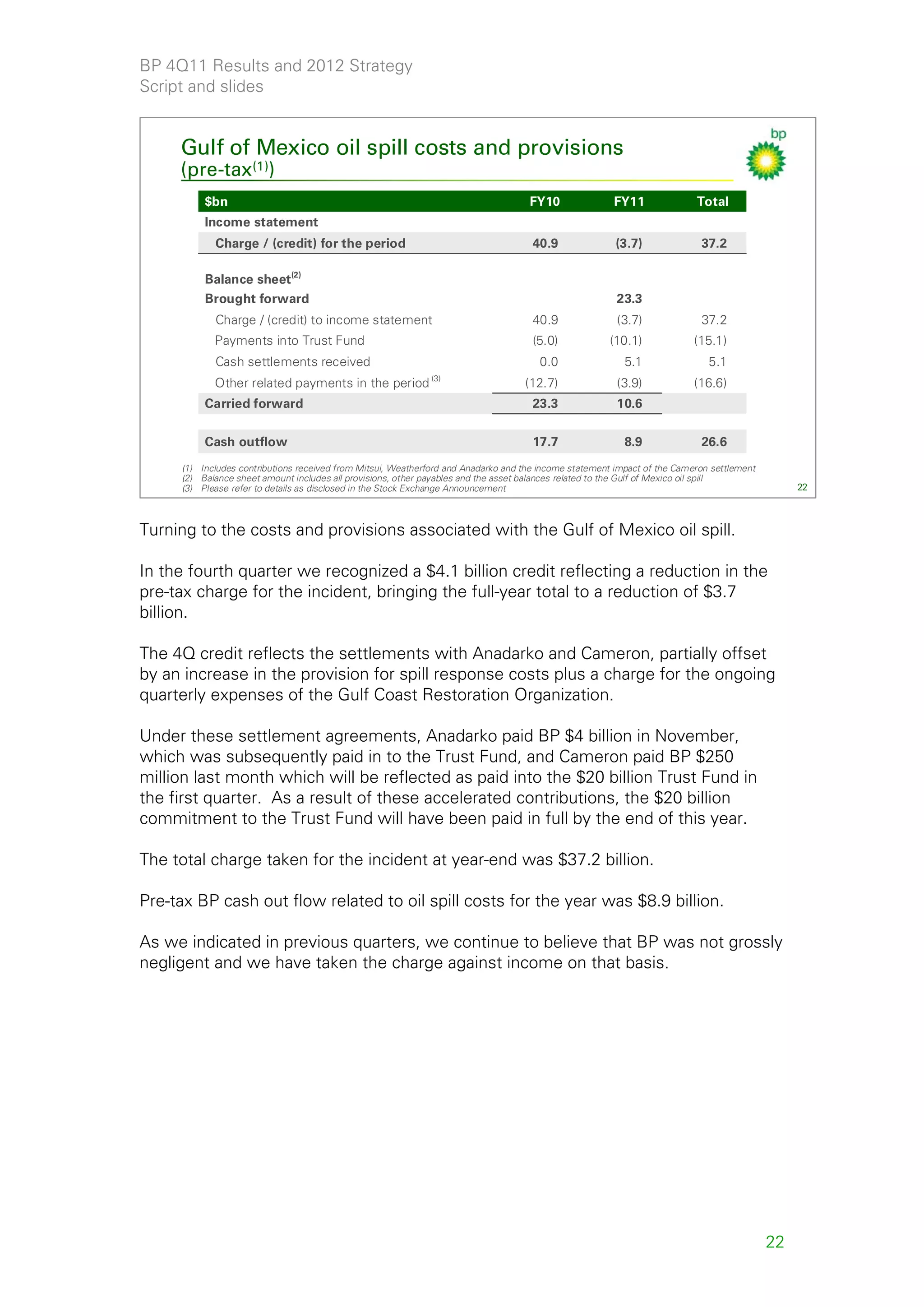
  • 61.
    BP 4Q11 Resultsand 2012 Strategy Script and slides Bob Dudley: Group Chief Executive Bob Dudley Moving BP forward 60 Thanks Iain. So let me just conclude by summarising this first part of today’s presentation. 61
  • 62.
    BP 4Q11 Resultsand 2012 Strategy Script and slides Moving BP Forward (1) 15 major upstream projects w onstream 2012-2014 (2) h flo as Whiting onstream 2H 2013 gc ati n er Payments to US Trust Fund end in 2012 op in Reducing uncertainties on Gulf of Mexico liabilities th ow gr Margin mix of portfolio improves 0% ~5 Back to work in Gulf of Mexico Downstream earnings momentum Divestments: $38bn by end 2013(3) 2011 2014 (1) BP projection at $100/bbl by 2014. See Statement of Assumptions under Cautionary Statement. (2) Excluding TNK-BP (3) Since start of 2010 61 Looking out to 2014 you can expect to see the delivery of many major milestones. These include: Downstream earnings momentum reaching $2 billion of improvement this year versus 2009. Upstream performance improving as we return to work in the Gulf of Mexico, and the margin mix of our portfolio improves. Gulf of Mexico liabilities being clarified. Trust Fund payments ending this year. The Whiting refinery upgrade coming onstream in 2013. And the start up of 15 new upstream projects over 2012 to 2014. 62
  • 63.
    BP 4Q11 Resultsand 2012 Strategy Script and slides Moving BP Forward 10 - point plan What you can expect What you can measure 1. Relentless focus on safety and managing 6. Active portfolio management to continue risk 7. New upstream projects onstream with unit 2. Play to our strengths operating cash margins double the 2011 average(1) 3. Stronger and more focused 8. Generate around 50% more annually in 4. Simpler and more standardized operating cash flow by 2014 versus 2011 5. More visibility and transparency to value at $100/bbl(2) 9. Half of incremental operating cash for re-investment, half for other purposes including distributions 10. Strong balance sheet (1) Assuming a constant $100/bbl oil price and excluding TNK-BP (2) See Statement of Assumptions under Cautionary Statement 62 The 10 point plan will continue to provide the backbone for our programme of value creation – what you can expect and what you can measure. As the months go by we will be able to show how we are progressing against these expectations and indicators of performance. 63
  • 64.
    BP 4Q11 Resultsand 2012 Strategy Script and slides Moving BP Forward • Year of consolidation now behind us • Safety is our continuing priority • 2012 a year of milestones: 2013/14 brings financial momentum - Around 50% improvement in operating cash flow by 2014 versus 2011(1) • Increasing investment to grow the firm • Gearing: targeted to lower half of 10-20% range • Intention to grow distributions over time in line with improving circumstances of the firm (1) See Statement of Assumptions under Cautionary Statement 63 BP is moving forward. The year of consolidation is now behind us. Safety and risk management are our continuing priority. 2012 will be a year of milestones, with financial momentum building in 2013 and 2014. We expect around 50% improvement in operating cash flow by 2014 compared with 2011. Long run we’ll be increasing investment to grow the firm but will also continue to actively manage the portfolio to add value. Gearing is targeted to reduce to the bottom half of a 10 to 20% range over time. And our intention is to grow distributions over time in line with improving circumstances of the firm. Having reached an operational turning point in October and having confidence in our 10-point plan, we believe circumstances have improved sufficiently to increase the dividend as we have announced today. We will now break and say good-bye to those on the webcast before moving on to the next part of today’s proceedings. Thank you for joining us and we hope you will rejoin us later. The webcast will restart at 4.45pm London time for the Q&A session. In the meantime you will find the break-out materials available on our website. 64
  • 65.
    BP 4Q11 Resultsand 2012 Strategy Script and slides For those here in person, I will now hand over to our Head of Investor Relations, Jess Mitchell, to explain the arrangements for the break-outs. Thank you. [Webcast ends] 65
  • 66.
    BP 4Q11 Resultsand 2012 Strategy Script and slides Break-out sessions Upstream 1st Floor Longer term investments play to our strengths Mike Daly: Executive Vice President, Exploration Andy Hopwood: Executive Vice President, Strategy and Integration Upstream 3 rd Floor Operating model: improving execution capability Bob Fryar: Executive Vice President, Production Bernard Looney: Executive Vice President, Developments Refining & Marketing 6 th Floor Delivering a world class downstream business Iain Conn: Chief Executive, Refining & Marketing Tufan Erginbilgic: COO, Eastern Hemisphere Fuels, Global Lubes, Aviation & LPG Richard Hookway: CFO, Refining & Marketing 64 Hello everyone. As you can see on the slide behind me we have three break- outs which you will all get chance to attend in rotation. On the front of your passes you’ll see that you have a number 1, 2 or 3. This allocates you to a group for the break-out sessions. We’d like you now to make your way over to the back of the room to the venue host holding the appropriate numbered board who will escort you around the break-out sessions. We would be most grateful if you do this promptly in order to ensure things run smoothly this afternoon. We would also ask that you stay with this same group throughout the sessions. There will be refreshments available at the break-out locations and time for a longer intermission after the break-outs complete. Thank you, enjoy the break-outs and we will see you all back here at 4.45pm for our Q&A session. 66
  • 67.
    BP 4Q11 Resultsand 2012 Strategy Script and slides SECRET 2011 Results and Strategy Presentation 2011 Results and 7 February 2012 Strategy Presentation 7 February 2012 65 [Picture for when attendees reconvene for wrap-up Q&A] 67
  • 68.
    BP 4Q11 Resultsand 2012 Strategy Script and slides Q&A Iain Conn Bob Dudley Chief Executive, Group Chief Executive Refining & Marketing Andy Hopwood Brian Gilvary Executive Vice President, Chief Financial Officer Strategy & Integration Bob Fryar Mike Daly Executive Vice President, Executive Vice President, Production Exploration Bernard Looney Executive Vice President, Developments 66 Hello and welcome back to the wrap-up and Q&A session. Here in London on stage we have Brian Gilvary and Iain Conn who we introduced as part of the earlier plenary session and the Executive Vice presidents of our upstream businesses who just presented two of the break outs; Mike Daly heads up Exploration; Bernard Looney, Developments; and Bob Fryar, Production. Andy Hopwood has overall responsibility for upstream Strategy and Integration. Also with us in the front row we have Byron Grote, Executive Vice president of Corporate Business Activities, Dev Sanyal, BP’s new Group Chief of Staff, Fergus MacLeod, Group Head of Strategic Planning and Jess Mitchell, Head of IR. You will now have opportunity to put your questions to all of us. We are webcasting this final section of our presentation today and for those joining us for the first time on the web and telephones who did not see our previous message here is our usual cautionary statement. 68
  • 69.
    BP 4Q11 Resultsand 2012 Strategy Script and slides Cautionary statement Forward-looking statements - cautionary statement This presentation, including the video presentation regarding Project 20K, and the associated slides and discussion contain forward-looking statements, particularly those regarding: expectations regarding financial momentum in 2013 and 2014; BP’s outlook on global energy trends to 2030; expected increases in investment in exploration and upstream drilling and production; anticipated improvements and increases, and the sources and timing thereof, in pre-tax returns, operating cash flow and margins, including generating around 50% more annually in operating cash flow by 2014 versus 2011 at US$100/bbl; divestm ent plans, including the anticipated timing for completion of and final proceeds from the disposition of certain BP assets; the expected level of planned turnarounds and related production outages expectations and plans for increased investment, increased distributions to shareholders; the restoration of high value production; the expected level of planned turnarounds; expectations regarding our new operating model; expectations of a challenging marketing environment in 2012 for fuels, lubricants and petrochemicals; the quarterly dividend payment; the strength of the balance sheet; the expected increase in exploration activity; expectations for drilling and rig activity generally and specifically in the Gulf of Mexico; the level of performance improvement in Refining and Marketing; expected full-year 2012 organic capital expenditure and increased capital spend for the future; the timing and composition of major projects including expected start up, completion, level of production and margins; the expected timing and level of final investment decisions the expected timing and level of appraisal activity; the timing for completion of the Whiting refinery upgrade, other refining upgrades and logistics optimization; the expected level of production in the first quarter of 2012 and in full-year 2012 the magnitude and timing of remaining remediation costs related to the Deepwater Horizon oil spill; the factors that could affect the magnitude of BP’s ultimate exposure and the cost to BP in relation to the spill and any potential mitigation resulting from BP’s partners or others involved in the spill; the potential liabilities resulting from pending and future legal proceedings and potential investigations and civil or criminal actions that US state and/or local governments could seek to take against BP as a result of the spill; the timing of claims and litigation outcomes and of payment of legal costs; timing and quantum of contributions to and payments from the $20 billion Trust Fund; expectations regarding the reduction of net debt and the net debt ratio; the expected levels of underlying and reported production in 2012, and the impact of disposals thereon; the expected level of depreciation, depletion and amortization in 2012; expectations for the level and volatility of quarterly losses in Other businesses and corporate; the expected full-year effective tax rate for 2012; plans to continue to seek opportunities and prospects in BP’s areas of strength, such as deepwater, gas value chains and giant fields; plans to strengthen BP’s position in unconventionals; the expected production potential of certain existing unconventional oil assets; the timing of the deployment of BP’s new single work management system; the sources and timing of volume growth and earnings momentum in Lubricants and Petrochemicals; expected future levels of resource recovery in giant fields; expectations about the future significance of deepwater drilling for BP; BP’s intentions to invest in and develop certain deepwater technology and systems in connection with Project 20K, and the expected level of investment in connection therewith; the expected level of investments by TNK-BP; TNK-BP’s expected organic production growth; TNK-BP’s plans to manage production decline in certain fields; the timing and composition of major projects of TNK-BP; TNK-BP’s expansion plans; BP’s plans to report TNK-BP as a separate segment in BP’s financial accounts; the expected future level of investment in Alternative Energy; and the expected profitability and level of future cash flow of certain Alternative Energy assets. By their nature, forward-looking statements involve risk and uncertainty because they relate to events and depend on circumstances that will or may occur in the future. Actual results may differ from those expressed in such statements, depending on a variety of factors including the timing of bringing new fields onstream; the timing of certain disposals; future levels of industry product supply; demand and pricing; OPEC quota restrictions; PSA effects; operational problems; general economic conditions; political stability and economic growth in relevant areas of the world; changes in laws and governmental regulations; changes in taxation or regulation; regulatory or legal actions including the types of enforcement action pursued and the nature of remedies sought; the actions of prosecutors, regulatory authorities, the Gulf Coast Claims Facility and the courts; the actions of all parties to the Deepwater Horizon oil spill-related litigation at various phases of the litigation; the impact on our reputation following the Deepwater Horizon oil spill; exchange rate fluctuations; development and use of new technology; the success or otherwise of partnering; the successful completion of certain disposals; the actions of competitors, trading partners, creditors, rating agencies and others; natural disasters and adverse weather conditions; changes in public expectations and other changes to business conditions; wars and acts of terrorism or sabotage; and other factors discussed under “Risk factors” in our Annual Report and Form 20-F 2010 as filed with the US Securities and Exchange Commission (SEC). Reconciliations to GAAP-This presentation also contains financial information which is not presented in accordance with generally accepted accounting principles (GAAP). A quantitative reconciliation of this information to the most directly comparable financial measure calculated and presented in accordance with GAAP can be found on our website at www.bp.com. Statement of Assumptions - The operating cash flow projection for 2014 stated on slides 8, 10, 11, 33, 38, 58, 61, 62 and 63 reflects our expectation that all required payments into the $20 billion US Trust Fund will have been completed prior to 2014. The projection does not reflect any cash flows relating to other liabilities, contingent liabilities, settlements or contingent assets arising from the Deepwater Horizon oil spill which may or may not arise at that time. As disclosed in the Stock Exchange Announcement, we are not today able to reliably estimate the amount or timing of a number of contingent liabilities. Cautionary note to US investors - We use certain terms in this presentation, such as “resources”, “non-proved resources” and references to projections in relation to such that the SEC’s rules prohibit us from including in our filings with the SEC. U.S. investors are urged to consider closely the disclosures in our Form 20-F, SEC File No. 1-06262. This form is available on our website at www.bp.com. You can also obtain this form from the SEC by calling 1-800-SEC-0330 or by logging on to their website at www.sec.gov. Tables and projections in this presentation are BP projections unless otherwise stated. February 2012 67 Once again I refer you to the remarks I made earlier which are now posted on our website. 69
  • 70.
    BP 4Q11 Resultsand 2012 Strategy Script and slides Q&A Iain Conn Bob Dudley Chief Executive, Group Chief Executive Refining & Marketing Andy Hopwood Brian Gilvary Executive Vice President, Chief Financial Officer Strategy & Integration Bob Fryar Mike Daly Executive Vice President, Executive Vice President, Production Exploration Bernard Looney Executive Vice President, Developments 68 So we’d now be very happy to take your questions. 70
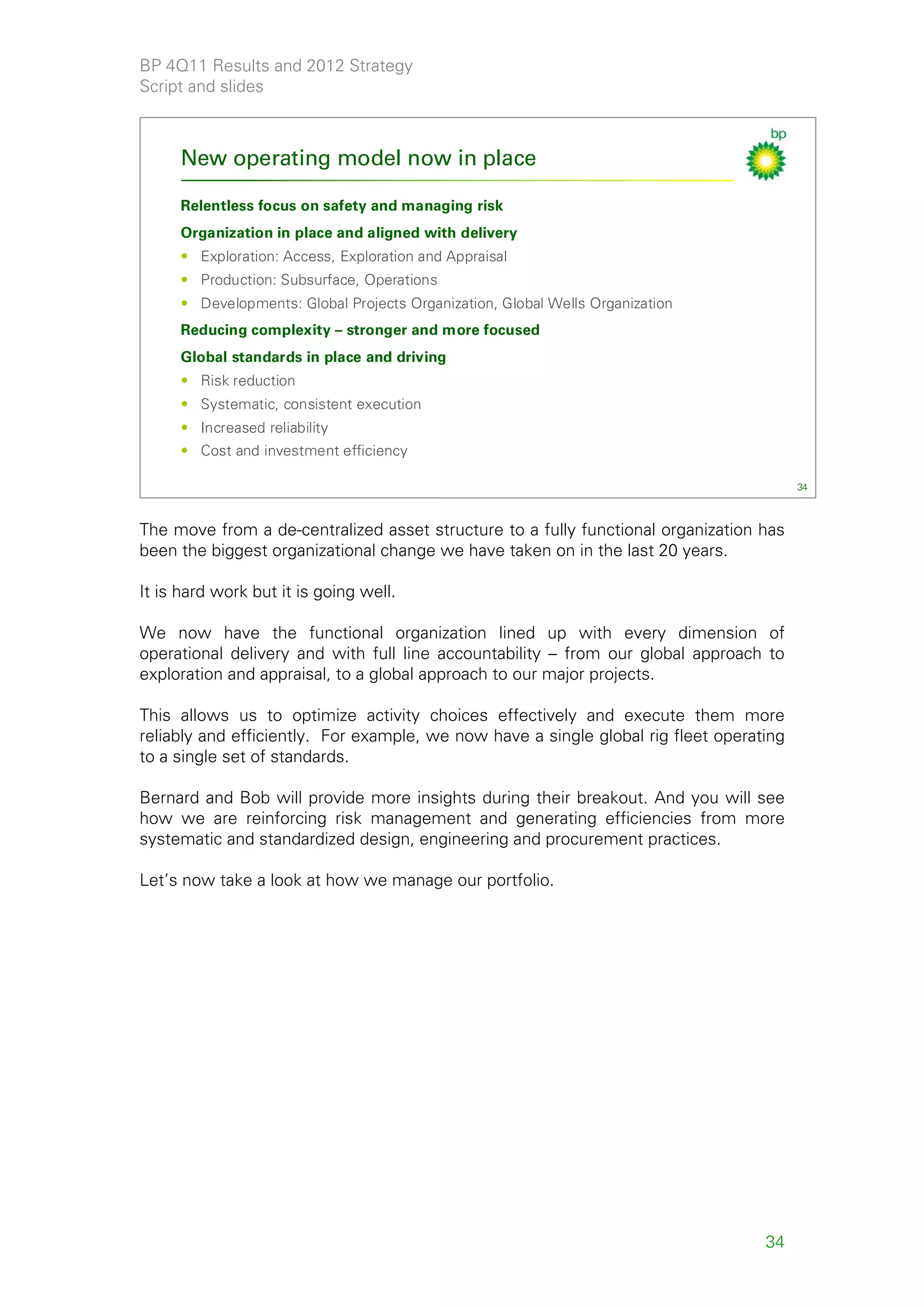
  • 71.
    BP 4Q11 Resultsand 2012 Strategy Script and slides SECRET 2011 Results and Strategy Presentation 7 February 2012 Moving BP forward 69 Q&A session Bob Dudley closing remarks: Ladies and gentlemen, thank you very much for spending today with us. I hope you have found the time well spent and I know I speak for the executive team in saying we have enjoyed showing you our plans for the future. We continue to meet our obligations. For our many employees working hard everywhere, our period of consolidation is over. Now it’s time to deliver: investment, growth and value – achieved by playing to our strengths. That means making choices. We are choosing value over volume – measured in cash flow not barrels. We are choosing strategic assets over non-core ones. We’re investing more in the front-end of exploration and divesting mature assets which others can derive more value from. So we are choosing not to try to be the biggest - but over time to aspire to be the best. A safer, stronger and simpler BP. As I said at the outset, our vision is to build an ever stronger portfolio, upstream and downstream, generating sufficient cash both to invest in our pipeline and reward those who invest in us as the circumstances of the firm 71
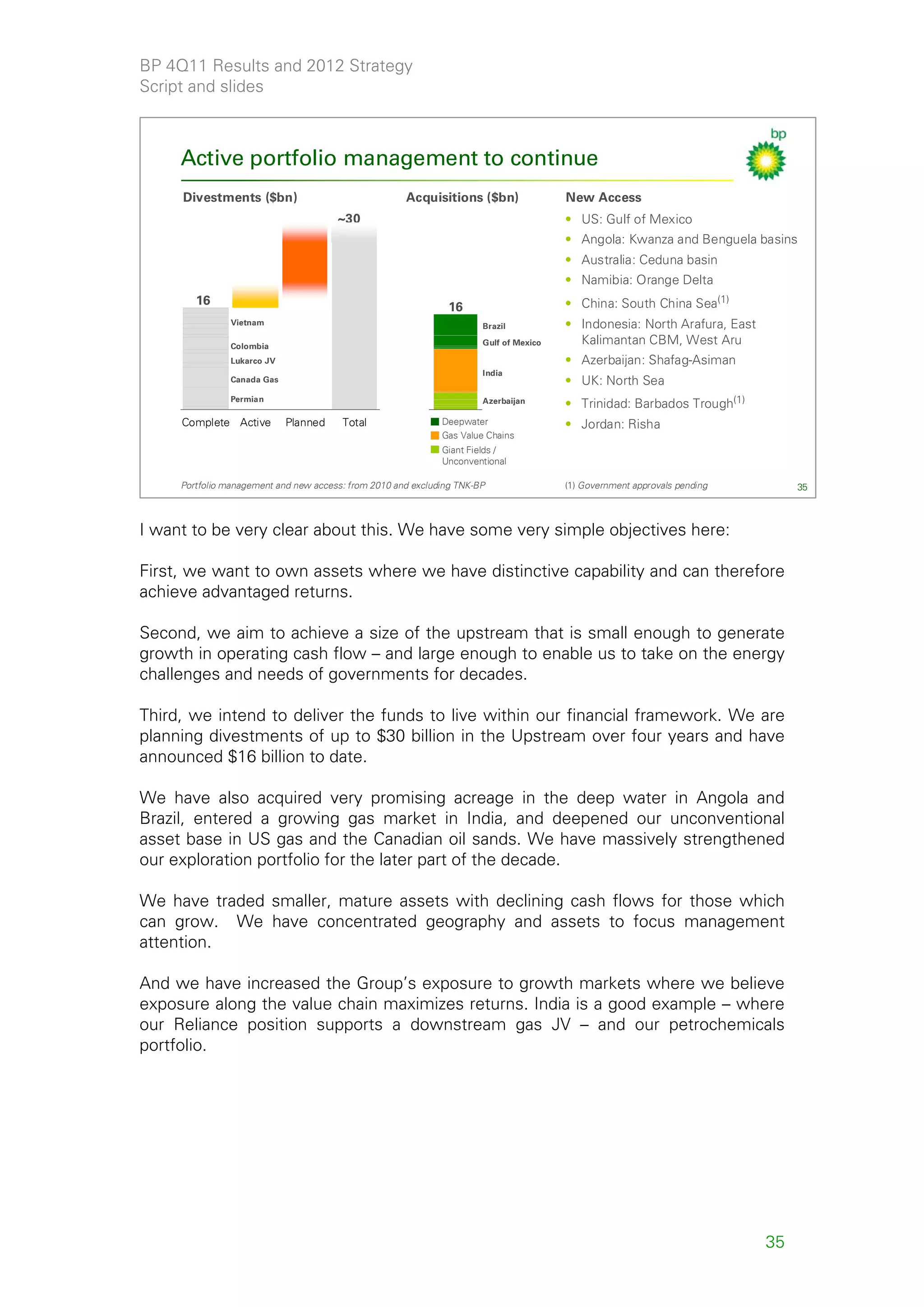
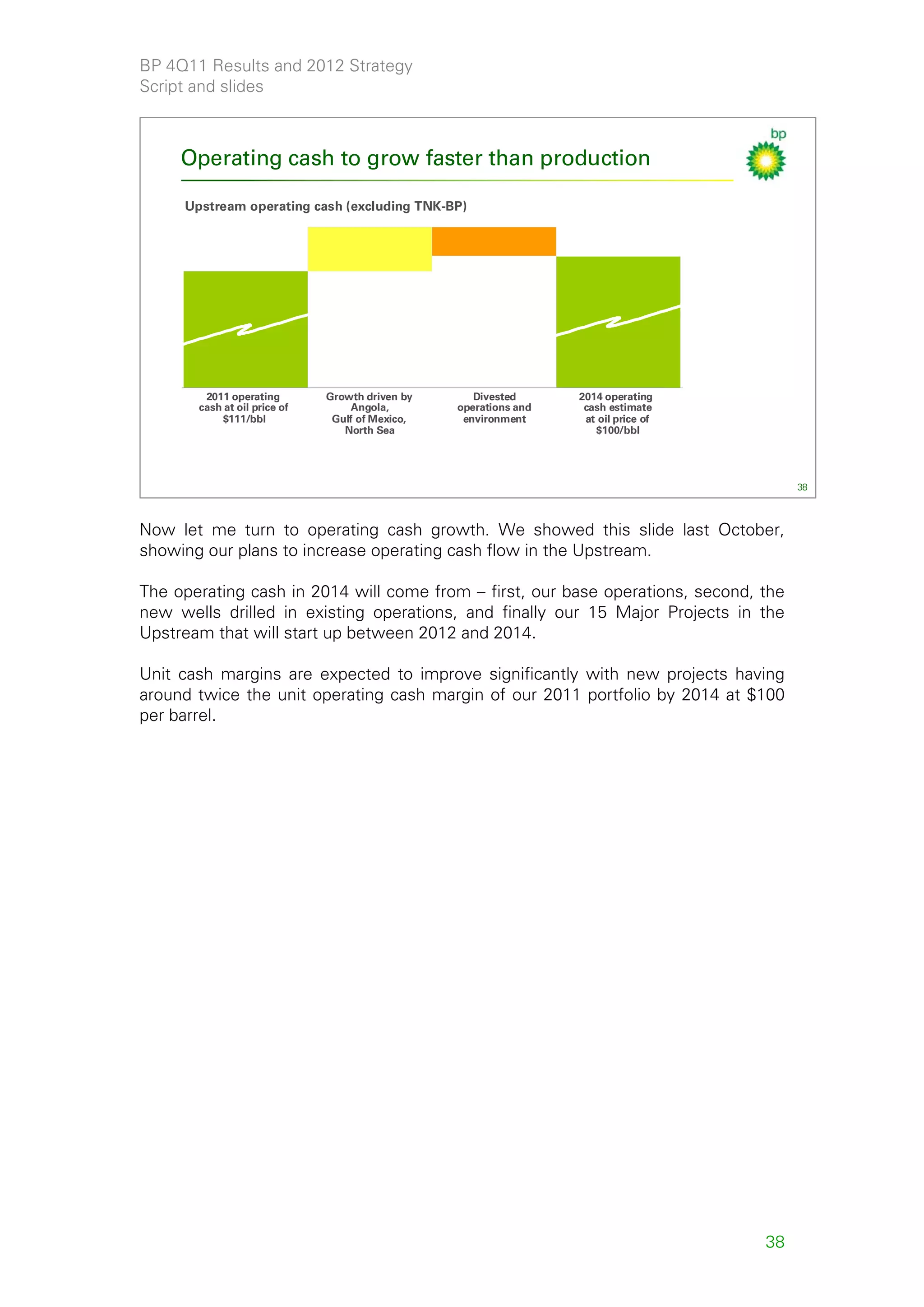
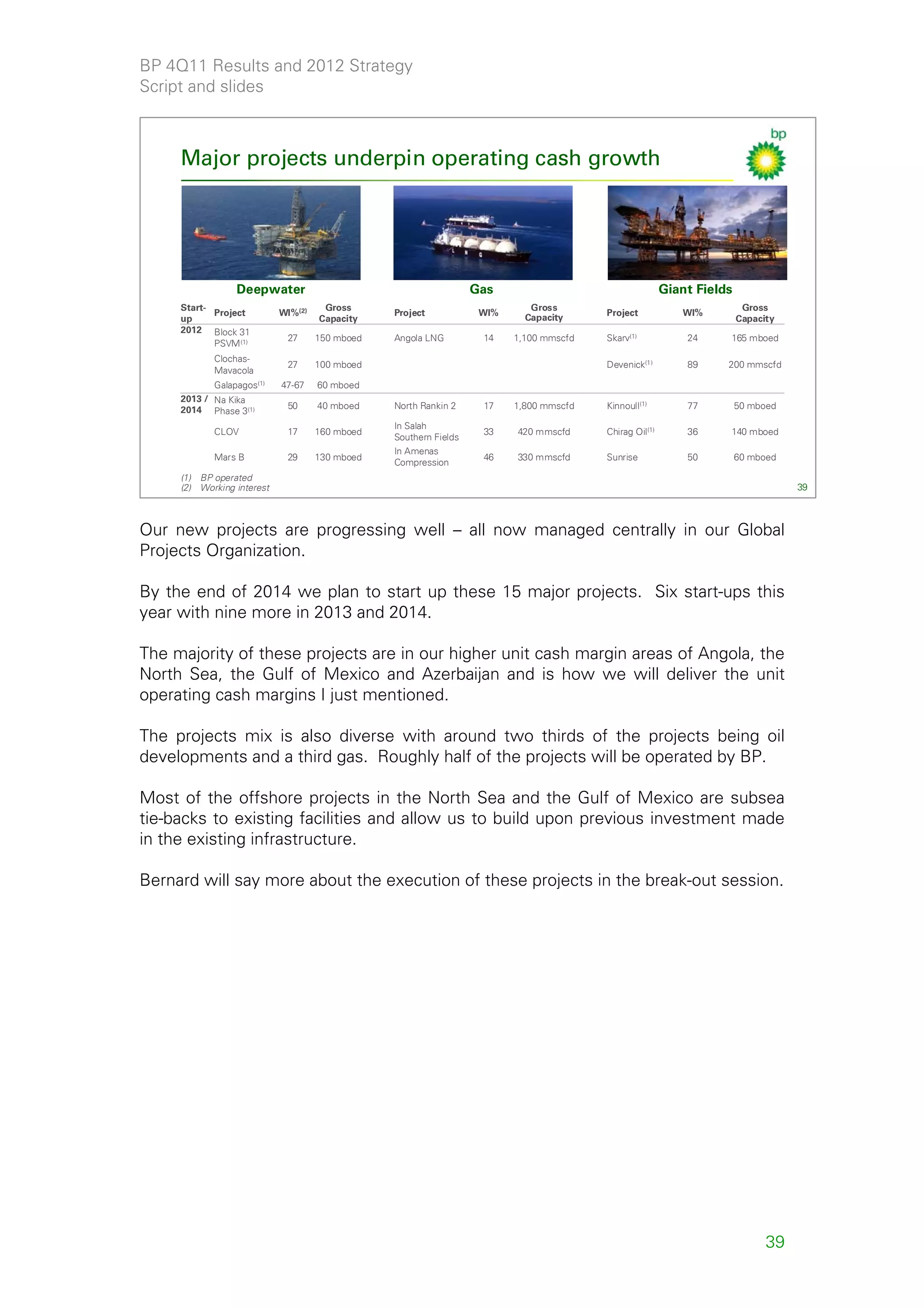
  • 72.
    BP 4Q11 Resultsand 2012 Strategy Script and slides improve. We have made a strong start on the portfolio, we’re building the cash generation and we have begun to provide those rewards. Thank you to those who have stayed with us on the webcast - and our very best to you from London. Ladies and gentlemen, I hope you can join us for refreshments in the area just outside. 72