Overview
This activity is to be completed after studying the presentation,
Turning Your Review of the Literature into a Draft Answer, and
its accompanying discussion questions.
For this activity, you will evaluate a sample response to the
discussion question with which you worked earlier. Please read
the sample response below and then follow the directions to
evaluate the response.
Humanistic Psychology is also called Third-Force Psychology.
Discuss the change that Humanistic Psychology brought, and
how this affected psychologists' ways of understanding human
behavior. Also, address the ways in which Humanistic
Psychology asked questions and conducted research, and
analyze how they differed from Behaviorism. Provide at least
two peer-reviewed articles to support your ideas.
Sample Response to the Discussion Question
In this response, there will be four main points. They are, first,
the change that humanistic psychology brought; second, how
that change affected psychologists' understanding of human
nature; third, ways the humanistic psychologists asked their
questions and conducted their research; and fourth, how those
methods differed from behaviorists' ways of doing so.
Abraham Maslow, considered the founder of third force or
humanistic psychology, wrote in 1969 that he found it necessary
to avoid being “anti-Freudian” or “anti-behaviorist,” and to
adopt—even if it meant taking serious intellectual risks—an
untested attitude; namely, to view human beings from the
perspective of psychological health and potential rather than
otherwise. He wrote that it was time for psychology to concern
itself with understanding what human beings could do if
properly nourished and nurtured (what was their potential?),
rather than trying to elucidate merely their behavioral
functioning or their mental illnesses. He advocated a key
change in psychologists’ view of science, as he had written in
his earlier Psychology of Science (1966): to consider human
beings as free and autonomous persons and to shift psychology
as a science away from the idea that our goal is prediction and
control of human beings. In his words, “Do we ourselves want
to be predicted and predictable? Controlled and controllable?”
(1966, p.729). These ideas—looking at human healthiness and
potential, treating humans as free and autonomous persons, and
viewing our science as a science of spontaneity and of the real
concerns of real people living in their real worlds—formed the
central core of the new third force in psychology, which
deliberately separated itself from the older dominating schools
of thought, behaviorism and psychoanalysis.
How did these ideas affect psychologists’ understanding of
human nature? In their fascinating review of George Kelly’s
view of the human person—personal construct psychology—
Franz Epting and Mark Paris (2006) wrote that Kelly’s use of
the term “constructive” embraced four related but quite distinct
meanings. The first contrasts “constructive” with “regressive”—
a constructive attitude looks ahead, is progress-oriented, not
looking back or regressing. The second meaning is that of
“something being positive, wise, or good” (p. 22). Third,
borrowing a term from architecture, constructive signifies a
kind of ornamentation which is integral to the building rather
than being merely decorative, and thus, in terms of
psychological attitudes about human beings, a constructive view
sees humans as having integrity in all their parts, none being
merely decorative. Finally, there is the sense of constructive as
making meaning and giving interpretation. Human being is
constructive—progressive and oriented to health and life, wise
or good, integral, and meaning-making. These ideas, which
Epting and Paris insisted are at the heart of humanistic
psychology, of which George Kelly (they maintain) was clearly
a member, signify in 2006 how strongly the original humanistic
philosophy has affected psychologists’ view of human nature.
There is a strong emphasis within many schools on human
potential rather than human frailty, on wisdom rather than on
prediction and control, and on human freedom and the
contradictions that freedom brings in an implacable world.
Despite its influence, humanistic psychology does not dominate
psychology, especially in the United States, where the emphasis
on evidence-based practice is increasingly widespread
(Goodheart, 2011). Goodheart proposes a sweeping
reconstruction of psychology’s house, with new “essential
building blocks: evidence-basedpractice, treatment guidelines,
technology, classifications of function, diagnostic systems,
outcomes measurement, and integrated health care” (p. 339).
This clearly is a call for the kind of prediction and control
mentality that dominated the view of science and human nature
among the behaviorists and among many of the
psychodynamically oriented clinicians. Humanistic psychology
is hardly a third force, given the simple numbers of published
articles. A search of PsycINFO for the years 2005–2011 on the
terms “humanis* psycholog*” yielded 187 articles. The same
search on the term “behavior* psycholog* yielded 1694
articles. This is not substantive evidence of the relative
importance of each school of thought, but it offers at least a
glimpse of the imbalance.
The third and fourth points of this response deal with how
humanists and behaviorists frame their research questions and
conduct their research. As we have seen in this course
(Hergenhahn, 2009), the behaviorists insist on strict observation
of observable behavior. Anything that cannot be measured
cannot be studied. Consciousness is out as an object of study
(Skinner, 1987). In a fascinating reply to Skinner published in
the American Psychologist, on the other hand, thirteen
humanistic psychologists (Krippner, et al.), faculty members at
Saybrook Institute, argued that humanists conduct research
based on the three quite different principles. Their words are
eloquent:
“The humanistic psychologies accord a central position to (a)
the human beings who behave (behavior is not excluded but
human beings are not reduced to behavior), (b) a human science
that adapts the method to the subject matter rather than the
reverse, and (c) a praxis that calls for the real-world extension
of the conceptual structures created by our efforts” (p. 819).
To conclude, four points were discussed in this posting: the
change that third force psychology brought to the field; how
that change affect psychologists' views of human beings; how
the humanistic psychologists approach their research; and how
this contrasts with behaviorists' approaches.
References
Epting, F. R., & Paris, M. E. (2006). A constructive
understanding of the person: George Kelly and humanistic
psychology. The Humanistic Psychologist, 34(1),21–37.
Goodheart, C. D. (2011). Psychology practice: A design for
tomorrow. American Psychologist, 66(5), 339–347.
Hergenhahn, B. R. (2009). An introduction to the history of
psychology (6th ed.). Belmont, CA: Wadsworth Cengage
Learning.
Maslow, A. (1969). Toward a humanistic biology. American
Psychologist, 24(8), 724–735.
Skinner, B. E. (1987). Whatever happened to psychology as the
science of behavior? American Psychologist, 42(8), 780–786.
Directions
After you have read the sample response:
1. Use the Reverse Outline to help you revise the organization
of the sample response.
2. Then, use the MEAL Plan to examine and evaluate the
individual components of these paragraphs. When you have
completed these steps, please answer the following questions:
· Based on your work in the two previous discussion questions,
identify and discuss how the sample response addresses the
content issues and levels of analysis in the discussion question.
If any components were missing, identify them.
· Identify and discuss the composition of the introduction, body,
and conclusion. How can these sections be improved?
· Evaluate how well the introduction restates the question and
introduces the response.
· Evaluate the details, evidence, and logical support for the
main points of the response (these should have been outlined in
the introductory paragraph).
The answers should be written in a Word document, using
correct APA format and style. The answer does not need to have
a title page, abstract, or table of contents. Begin with a brief
introduction explaining the main points of the paper. In the
main body, identify the answer being given with a correctly
formatted section heading, using Level 1 headings. A
conclusion should follow the main body. Include a reference list
for any sources used, which should also be correctly cited in the
paper.
REVERSE OUTLINING
REVERSE OUTLINING
Reverse outlining is a great tool to use in figuring out where
your draft needs work. One of
the most important parts of the writing process is revision, the
stage where you rework your
draft’s global concerns (GLOCs): focus, clarity, organization,
and persuasiveness.
What is Reverse Outlining?
You’re probably familiar with the concept of outlining as a
prewriting strategy—when you
outline, you write down all the sections and subsections of your
paper in an organized,
numbered hierarchy, which you can then use as a blueprint in
producing your first draft.
When you create a reverse outline, you do the same thing, only
backwards: you start with
an existing draft, and try to create an outline that represents its
sections and its major
points. Doing so allows you to see where your organization
doesn’t make sense, where you
have unexplained “leaps” in your logic, and where you haven’t
constructed effective
paragraphs.
How to Create a Reverse Outline
There are a couple of ways to create a reverse outline:
• Create a sequential outline.
• Make a table.
How to Create a Sequential Outline
1. Look at your current draft and read each paragraph carefully
– and separately – for
purpose and content.
2. Write in the margins of your draft what you see as the main
point in your
paragraph. If your paragraph seems to have two main points,
write them both in the
margin of the paper.
3. Transfer these “main points” into an outline format on a
separate sheet of paper.
4. Examine your outline for several important things:
a. Fluidity of development: ask yourself: Do my points follow
logically from each
other? Could I make the flow smoother by moving certain
paragraphs to different
places in my argument?
b. Separation of points: Do any of my paragraphs make more
than one point? If so,
how do I separate them into different paragraphs? Do the
paragraphs belong
near each other? Or should they be separated to improve the
flow of my
argument?
c. Inclusion of important elements: Does my essay miss any
significant points or
connections that are necessary for its development? Where
should I put these
“missing links”?
5. And finally, make revisions as necessary, first with the
outline, and then with the
draft.
Writing Center, August 2014
1
REVERSE OUTLINING
How to Create a Table
To use the tabling approach to reverse outlining:
1. Number your draft’s paragraphs from beginning to end.
2. Use the following table (or draw columns on a separate sheet)
to record what each
paragraph “does” and “says.”
a. In the “does” column, write down the paragraph’s function,
the job it is supposed
to do in your draft (“proves that some evidence indicates
heightened self-esteem
among home-schooled, pre-teen girls;” “creates a logical
transition from
discussion of self-esteem to discussion of body image”).
b. In the “says” column, write down each paragraph’s main
point(s). As with the
sequential outlining approach, you’ll want to keep an eye out
for paragraphs that
have more than one main point and paragraphs whose “says”
don’t seem to
match their “does;” that is, paragraphs that are not functioning
in the way you
intended them to function.
3. When you’re done, check your paper’s organization and
logical flow by reading the
“does” column in order from top to bottom. Are the points
presented in the most
logical order? Do you see gaps in reasoning, or places where
you suddenly switch
tracks without explanation or transitions? Also, how can you
revise paragraphs so
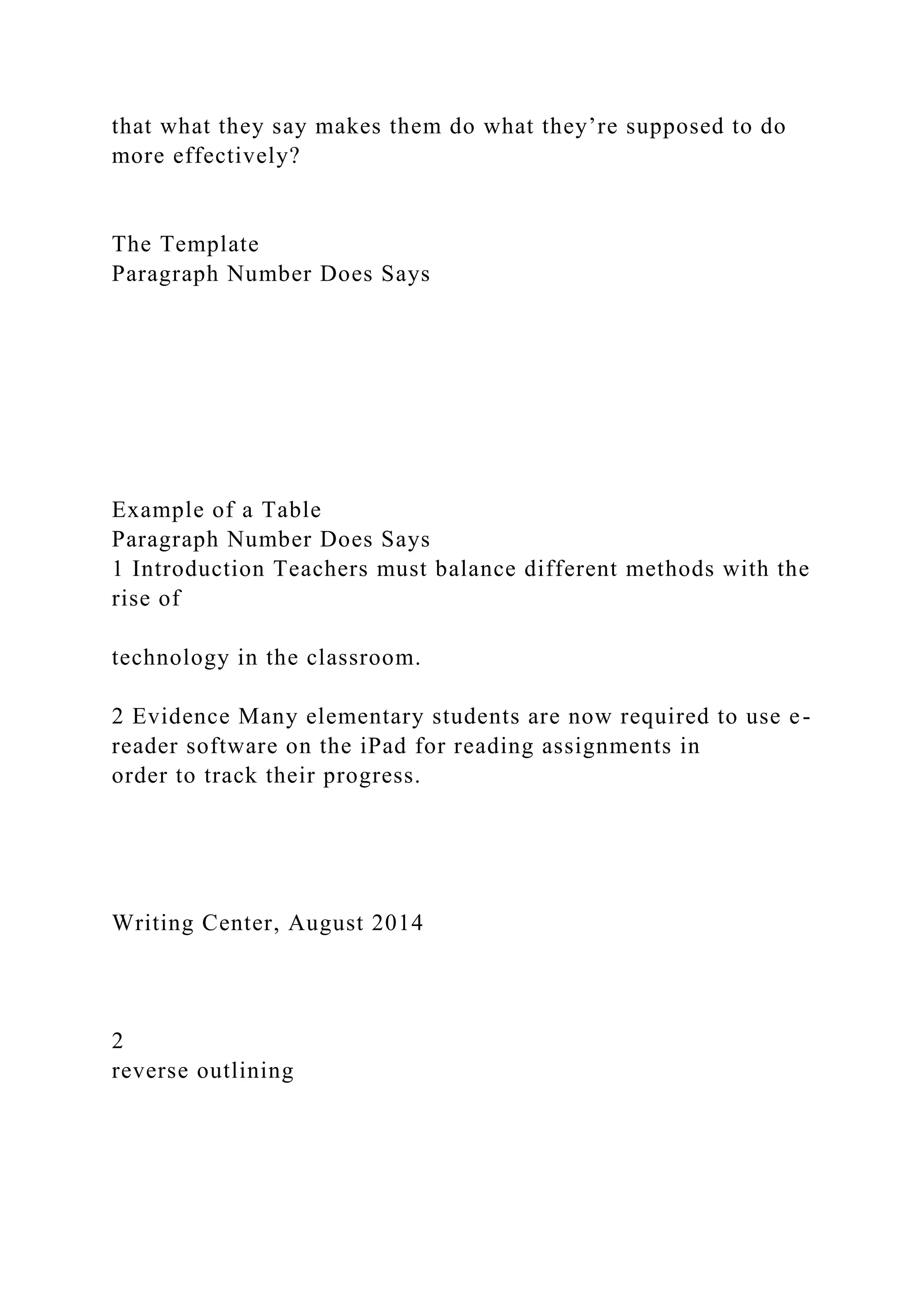
that what they say makes them do what they’re supposed to do
more effectively?
The Template
Paragraph Number Does Says
Example of a Table
Paragraph Number Does Says
1 Introduction Teachers must balance different methods with the
rise of
technology in the classroom.
2 Evidence Many elementary students are now required to use e-
reader software on the iPad for reading assignments in
order to track their progress.
Writing Center, August 2014
2
reverse outlining
Capella University Writing Center
January 2006
Paragraphing with the MEAL Plan
M Main Idea
Every paragraph should have one main idea. If you find that
your paragraphs have more than
one main idea, separate your paragraphs so that each has only
one main point. The idea
behind a paragraph is to introduce an idea and expand upon it.
If you veer off into a new topic,
begin a new paragraph.
E Evidence or Examples
Your main idea needs support, either in the form of evidence
that buttresses your argument or
examples that explain your idea. If you don’t have any evidence
or examples to support your
main idea, your idea may not be strong enough to warrant a
complete paragraph. In this case,
re-evaluate your idea and see whether you need even to keep it
in the paper.
A Analysis
Analysis is the heart of academic writing. While your readers
want to see evidence or examples
of your idea, the real “meat” of your idea is your interpretation
of your evidence or examples:
how you break them apart, compare them to other ideas, use
them to build a persuasive case,
demonstrate their strengths or weaknesses, and so on. Analysis
is especially important if your
evidence (E) is a quote from another author. Always follow a
quote with your analysis of the
quote, demonstrating how that quote helps you to make your
case. If you let a quote stand on
its own, then the author of that quote will have a stronger voice
in your paragraph (and maybe
even your paper) than you will.
L Link
Links help your reader to see how your paragraphs fit together.
When you end a paragraph, try
to link it to something else in your paper, such as your thesis or
argument, the previous
paragraph or main idea, or the following paragraph. Creating
links will help your reader
understand the logic and organization of your paper, as well as
the logic and organization of
your argument or main points.
The following continues our discussion of how to create high-
quality discussion posts and responses to colleagues. This
section will cover the following steps in creating your
discussion responses, steps you will follow in order:
· Identify existing research and theory.
· Deciding on the central thesis or idea for your answer.
· Creating an outline of your answer.
· Starting to write.
· Crafting paragraphs using the MEAL Plan.
· Citing the literature.
· Reviewing and revising.
· Writing Feedback Tool.
Identify Existing Research and Theory
Once you have identified the content issues and the levels of
critical analysis in the discussion question, your first task is to
identify existing research and theory in the literature that
addresses the content issues.
· In most instances, there will be a central topic that embraces
all the content issues in the question, and the key words in that
topic.
· The key words in the various content issues should form the
basis for your search of the library databases.
· Utilize the key words in the content issues to develop a focus
to build an answer.
· Find articles that directly address the content issues (main
points) of the discussion question.
· Avoid tangentially related articles.
Deciding on the Central Thesis or Idea for Your Answer
When you have found articles of research or theory that directly
relate to your question, decide how you want to frame your
answer to the question using the information that you identified.
· What's going to be your central thesis or the central idea in
your answer?
· Remember: Your answer should contribute something of value
to the knowledge base. In this instance, you are providing a new
way of thinking about the question. Merely summarizing the
text is insufficient because you add nothing of value.
Creating an Outline of Your Answer
After you have completed your study of the literature directly
related to the discussion question topic (content issues) and
have decided on your central thesis, you are prepared to begin
to write your answer. The first thing you should do is to create
an outline. Outlining is a very important skill to develop. The
form your outline takes can be very simple or very elaborate.
The key is to find a form that helps you organize your thoughts.
Why would you take this step? You will be evaluated on the
strength of your argument. Did you marshal your evidence to
support your main points in a way that makes a persuasive
argument?
· A persuasive argument is an arrangement of ideas that draws
the reader into an agreement with your thesis or central idea.
· The Reverse Outline method, to be used after the answer is
drafted, allows you to evaluate the organization of your
paragraphs so that the ideas flow logically and make your case
cogently.
The simplest outline form also expresses the basic elements of
all writing: An introduction, a body, and a conclusion. Simple,
isn't it? We'll delve into more details in the future, but for now
just be aware that all forms of scholarly writing (a paragraph, a
discussion question, a final project, the comprehensive
examinations, or the dissertation — and you can think of oral
presentations the same way) contain the three elements detailed
in the table below. For more information about the elemets,
explore the Writing Center's resources on organizing a text.
· Introduction (For more information about the introduction, see
the Writing Feedback Tool, criterion 3.)
· Body (For more information about the introduction, see the
Writing Feedback Tool, criterion 4,5, and 6.)
· Conclusion (For more information about the introduction, see
the Writing Feedback Tool, criterion 7.)
Elements of Writing by Scale of Assignment
Paragraph
Discussion Response
Literature Review/Final Project
Comps Question
Dissertation
Introduction
One sentence
One paragraph
1–2 paragraphs
1–2 paragraphs
Chapter 1
Body
Two sentences
Two paragraphs
8–10 pages
12–16 pages
Chapter 2, Chapter 3, Chapter 4
Conclusion
One sentence
One paragraph
1–2 paragraphs
1–2 paragraphs
Chapter 5
New Activity
Use the discussion question below from PSY7110 to create an
outline indicating how you will organize and use the literature
to respond to the discussion question. When you write your
answer, you may:
· Write a new answer (if you have not yet taken PSY7110 or
took an earlier version of the course).
· Use your actual answer to this question from PSY7110 (if you
have taken the new PSY7110 after October, 2010). If you
choose this option, you will work with the "Reverse Outline."
If you prefer to use the Reverse Outline, you can go on to
"Starting to Write" below and write your answer to the question
first, then do the Reverse Outline. Here is the discussion
question from PSY7110.
"Humanistic Psychology is also called Third-Force Psychology.
Discuss the change that Humanistic Psychology brought, and
how this affected psychologists' ways of understanding human
behavior. Also, address the ways in which Humanistic
Psychology asked questions and conducted research and analyze
how they differed from Behaviorism. Provide at least two peer-
reviewed articles to support your ideas."
Starting to Write
Once you have created your outline for your discussion answer,
you are ready to start to write. If you use the Reverse Outline,
start writing first (or your actual message written for PSY7110),
then use the reverse outline and critique your work with it.
Look at the third column of the table: "Discussion response." As
you can see, the structure of a good discussion response should
contain a minimum of four paragraphs:
1. In the introduction (minimum one paragraph): Restate the
question being asked. Briefly set up your response by naming
the main points you intend to make.
2. In the body (minimum 2 to 5 paragraphs): Discuss your
response in detail, allotting one paragraph to each of your main
points. Develop your paragraphs using the MEAL Plan (see
below for details).
3. In the conclusion, provide a summary (1 paragraph):
Summarize your answer. Make recommendations for your own
further study.
As you think about this introduction — main body —
conclusion outline, you may remember the adage, "Tell them
what you'll tell them, tell them, then tell them what you told
them." This sums up good scholarly writing and speaking.
Crafting Your Answer Using the MEAL Plan
Remember that paragraphs in the answer should contain, at a
minimum, the M, E, and A of the MEAL Plan handout, although
often the introduction and conclusion paragraphs don't contain
the evidence or analysis elements. MEAL stands for the
elements of a good paragraph:
· Main idea: One of the sentences (usually the first) should state
the main idea for the paragraph. This will be one of the main
points you have derived from your literature review.
· Evidence: The other sentences should support the main idea by
adding details, sub-points, or evidence. The evidence, of course,
is all the ideas you have borrowed from the existing literature
you reviewed and are reporting, so these sentences will have a
citation.
· Analysis: These sentences develop your position on each main
point within the paragraph. Your analysis will be your
evaluation of how the evidence supports your main point — or
challenges it, as may be. These sentences, being your own work,
won't need citations.
· Link: This sentence completes your thought process and flows
into the next paragraph. (Note: The link element helps provide
logic and organization to the body, but the link is not always a
necessary paragraph element.)
You may have noticed that the MEAL plan also has an
introduction — body — conclusion structure:
· The Main Idea serves as an introduction.
· The Evidence and Analysis sections serve as the body.
· The Link concludes the paragraph.
Every paragraph in the body of your answer develops and
elaborates the full answer stated succinctly in the introduction.
· If you list the main ideas of the paragraphs, the list should
provide a logically flowing outline of a complete answer to the
question, the basic idea of the Reverse Outline.
· Each of the supporting paragraphs in the body should flow in a
logical fashion from the introduction of your position to a
discussion of your position to a logical conclusion.
Follow your outline or use the Reverse Outline and your
discussion answers will demonstrate high-quality writing skills
and will also demonstrate high quality critical thinking skills.
Citing the Literature
Your analysis sentences are your own work, but what are you
analyzing (or evaluating, or synthesizing, etc.)? You're
analyzing the work of others: previous research and theory that
supports your main points. Each of these sentences requires a
citation and a full reference in the reference list. Remember:
· Support all positions with citations to the literature.
· Use additional sources beyond course texts and required
articles.
· Cite at least one reference per paragraph. (If you cite one
reference in a paragraph, you are reporting that only that one
reference helps you make your main point of the paragraph.) If
you have other sources that bear on your main point, use them
too and cite them as well.
· List the full references below your response.
· Use correct APA sixth edition formatting and style for the
citations and references.
· Use correct APA sixth edition formatting throughout the
paper, including a title page
For more information, explore Academic Writer. Academic
Writer is a virtual representation of the APA Manual.
Reviewing and Revising
Before you post your discussion answer, review it carefully for:
· Logic and form.
· Editorial and mechanical errors such as misspellings, and
typographical errors.
· Grammatical or punctuation errors and APA format errors.
Here are a couple of tips about the review process:
· Read your work carefully to make sure that your presentation
of information is reader-friendly and clearly expresses your
response. Reading your answer aloud is highly recommended
because the ear often catches logic errors and errors of grammar
or usage that the eye misses.
· Use spell-check and edit your answer for typographical,
spelling, punctuation, grammar, usage, and other writing and
mechanical errors. This tedious work should come after your
content is settled and well-written. Although a tedious task,
learn the small details of APA scientific writing. Sloppiness in
writing is a giveaway to sloppiness in thinking, and the
academic community always knows this.
· In your discussion posts, write in the third person unless your
instructor prefers first person. Check with your course
instructor to be sure you understand his or her preferences. You
will always be required to write in the third person for (a) final
and formal course papers, (b) comprehensive examinations, and
(c) dissertations.
Learn more about the stages of writing at the Writing Center.
Writing Effective Responses to Colleagues in the Courseroom
Discussions
Everything we've just reviewed about writing your own
response to a discussion question applies to your response to
your colleagues. Often, the discussion question provides
directions about how to focus your response to a colleague.
Look for both the: Content issues and level of critical analysis
required.
Be especially cognizant of the standards of scholarly etiquette
and interaction we discussed earlier. Part of the process of
becoming a scholar-practitioner is to become comfortable with
feedback. Focus your critical analysis on your peer's ideas.
Never belittle or condescend, even if your feedback makes plain
that you know more than your peer does about the subject.
Remember the motto, noblesse oblige, or "nobility obliges." It
means that the more one knows, the more respectful one should
be toward those who are just learning.
Structure your response to a peer just as you would your own
answer:
· Introduction (1 paragraph).
· Body (2-5 paragraphs, following the MEAL plan).
· Conclusion.
In this case, the "evidence" supporting your main ideas about
your colleague's post will be taken from your peer's post, so
quote or paraphrase carefully and mention the source. Learner
posts are not published documents of course, so your "citation"
need not follow APA format, which applies for the most part to
published or available scholarly materials. For instance, "As
you said in your second paragraph, …"
Finally, revise, edit, and proofread your response to your
colleagues. They are scholars too, and presenting finished
products is part of scholarly etiquette.
OverviewThis activity is to be completed after studying the pres.docx

OverviewThis activity is to be completed after studying the pres.docx

  • 1.
    Overview This activity isto be completed after studying the presentation, Turning Your Review of the Literature into a Draft Answer, and its accompanying discussion questions. For this activity, you will evaluate a sample response to the discussion question with which you worked earlier. Please read the sample response below and then follow the directions to evaluate the response. Humanistic Psychology is also called Third-Force Psychology. Discuss the change that Humanistic Psychology brought, and how this affected psychologists' ways of understanding human behavior. Also, address the ways in which Humanistic Psychology asked questions and conducted research, and analyze how they differed from Behaviorism. Provide at least two peer-reviewed articles to support your ideas. Sample Response to the Discussion Question In this response, there will be four main points. They are, first, the change that humanistic psychology brought; second, how that change affected psychologists' understanding of human nature; third, ways the humanistic psychologists asked their questions and conducted their research; and fourth, how those methods differed from behaviorists' ways of doing so. Abraham Maslow, considered the founder of third force or humanistic psychology, wrote in 1969 that he found it necessary to avoid being “anti-Freudian” or “anti-behaviorist,” and to adopt—even if it meant taking serious intellectual risks—an untested attitude; namely, to view human beings from the perspective of psychological health and potential rather than otherwise. He wrote that it was time for psychology to concern itself with understanding what human beings could do if properly nourished and nurtured (what was their potential?), rather than trying to elucidate merely their behavioral functioning or their mental illnesses. He advocated a key change in psychologists’ view of science, as he had written in
  • 2.
    his earlier Psychologyof Science (1966): to consider human beings as free and autonomous persons and to shift psychology as a science away from the idea that our goal is prediction and control of human beings. In his words, “Do we ourselves want to be predicted and predictable? Controlled and controllable?” (1966, p.729). These ideas—looking at human healthiness and potential, treating humans as free and autonomous persons, and viewing our science as a science of spontaneity and of the real concerns of real people living in their real worlds—formed the central core of the new third force in psychology, which deliberately separated itself from the older dominating schools of thought, behaviorism and psychoanalysis. How did these ideas affect psychologists’ understanding of human nature? In their fascinating review of George Kelly’s view of the human person—personal construct psychology— Franz Epting and Mark Paris (2006) wrote that Kelly’s use of the term “constructive” embraced four related but quite distinct meanings. The first contrasts “constructive” with “regressive”— a constructive attitude looks ahead, is progress-oriented, not looking back or regressing. The second meaning is that of “something being positive, wise, or good” (p. 22). Third, borrowing a term from architecture, constructive signifies a kind of ornamentation which is integral to the building rather than being merely decorative, and thus, in terms of psychological attitudes about human beings, a constructive view sees humans as having integrity in all their parts, none being merely decorative. Finally, there is the sense of constructive as making meaning and giving interpretation. Human being is constructive—progressive and oriented to health and life, wise or good, integral, and meaning-making. These ideas, which Epting and Paris insisted are at the heart of humanistic psychology, of which George Kelly (they maintain) was clearly a member, signify in 2006 how strongly the original humanistic philosophy has affected psychologists’ view of human nature. There is a strong emphasis within many schools on human potential rather than human frailty, on wisdom rather than on
  • 3.
    prediction and control,and on human freedom and the contradictions that freedom brings in an implacable world. Despite its influence, humanistic psychology does not dominate psychology, especially in the United States, where the emphasis on evidence-based practice is increasingly widespread (Goodheart, 2011). Goodheart proposes a sweeping reconstruction of psychology’s house, with new “essential building blocks: evidence-basedpractice, treatment guidelines, technology, classifications of function, diagnostic systems, outcomes measurement, and integrated health care” (p. 339). This clearly is a call for the kind of prediction and control mentality that dominated the view of science and human nature among the behaviorists and among many of the psychodynamically oriented clinicians. Humanistic psychology is hardly a third force, given the simple numbers of published articles. A search of PsycINFO for the years 2005–2011 on the terms “humanis* psycholog*” yielded 187 articles. The same search on the term “behavior* psycholog* yielded 1694 articles. This is not substantive evidence of the relative importance of each school of thought, but it offers at least a glimpse of the imbalance. The third and fourth points of this response deal with how humanists and behaviorists frame their research questions and conduct their research. As we have seen in this course (Hergenhahn, 2009), the behaviorists insist on strict observation of observable behavior. Anything that cannot be measured cannot be studied. Consciousness is out as an object of study (Skinner, 1987). In a fascinating reply to Skinner published in the American Psychologist, on the other hand, thirteen humanistic psychologists (Krippner, et al.), faculty members at Saybrook Institute, argued that humanists conduct research based on the three quite different principles. Their words are eloquent: “The humanistic psychologies accord a central position to (a) the human beings who behave (behavior is not excluded but human beings are not reduced to behavior), (b) a human science
  • 4.
    that adapts themethod to the subject matter rather than the reverse, and (c) a praxis that calls for the real-world extension of the conceptual structures created by our efforts” (p. 819). To conclude, four points were discussed in this posting: the change that third force psychology brought to the field; how that change affect psychologists' views of human beings; how the humanistic psychologists approach their research; and how this contrasts with behaviorists' approaches. References Epting, F. R., & Paris, M. E. (2006). A constructive understanding of the person: George Kelly and humanistic psychology. The Humanistic Psychologist, 34(1),21–37. Goodheart, C. D. (2011). Psychology practice: A design for tomorrow. American Psychologist, 66(5), 339–347. Hergenhahn, B. R. (2009). An introduction to the history of psychology (6th ed.). Belmont, CA: Wadsworth Cengage Learning. Maslow, A. (1969). Toward a humanistic biology. American Psychologist, 24(8), 724–735. Skinner, B. E. (1987). Whatever happened to psychology as the science of behavior? American Psychologist, 42(8), 780–786. Directions After you have read the sample response: 1. Use the Reverse Outline to help you revise the organization of the sample response. 2. Then, use the MEAL Plan to examine and evaluate the individual components of these paragraphs. When you have completed these steps, please answer the following questions: · Based on your work in the two previous discussion questions, identify and discuss how the sample response addresses the content issues and levels of analysis in the discussion question. If any components were missing, identify them. · Identify and discuss the composition of the introduction, body, and conclusion. How can these sections be improved? · Evaluate how well the introduction restates the question and introduces the response.
  • 5.
    · Evaluate thedetails, evidence, and logical support for the main points of the response (these should have been outlined in the introductory paragraph). The answers should be written in a Word document, using correct APA format and style. The answer does not need to have a title page, abstract, or table of contents. Begin with a brief introduction explaining the main points of the paper. In the main body, identify the answer being given with a correctly formatted section heading, using Level 1 headings. A conclusion should follow the main body. Include a reference list for any sources used, which should also be correctly cited in the paper. REVERSE OUTLINING REVERSE OUTLINING Reverse outlining is a great tool to use in figuring out where your draft needs work. One of the most important parts of the writing process is revision, the stage where you rework your draft’s global concerns (GLOCs): focus, clarity, organization, and persuasiveness. What is Reverse Outlining? You’re probably familiar with the concept of outlining as a prewriting strategy—when you outline, you write down all the sections and subsections of your paper in an organized, numbered hierarchy, which you can then use as a blueprint in producing your first draft.
  • 6.
    When you createa reverse outline, you do the same thing, only backwards: you start with an existing draft, and try to create an outline that represents its sections and its major points. Doing so allows you to see where your organization doesn’t make sense, where you have unexplained “leaps” in your logic, and where you haven’t constructed effective paragraphs. How to Create a Reverse Outline There are a couple of ways to create a reverse outline: • Create a sequential outline. • Make a table. How to Create a Sequential Outline 1. Look at your current draft and read each paragraph carefully – and separately – for purpose and content. 2. Write in the margins of your draft what you see as the main point in your paragraph. If your paragraph seems to have two main points, write them both in the margin of the paper. 3. Transfer these “main points” into an outline format on a separate sheet of paper. 4. Examine your outline for several important things: a. Fluidity of development: ask yourself: Do my points follow logically from each
  • 7.
    other? Could Imake the flow smoother by moving certain paragraphs to different places in my argument? b. Separation of points: Do any of my paragraphs make more than one point? If so, how do I separate them into different paragraphs? Do the paragraphs belong near each other? Or should they be separated to improve the flow of my argument? c. Inclusion of important elements: Does my essay miss any significant points or connections that are necessary for its development? Where should I put these “missing links”? 5. And finally, make revisions as necessary, first with the outline, and then with the draft. Writing Center, August 2014 1 REVERSE OUTLINING
  • 8.
    How to Createa Table To use the tabling approach to reverse outlining: 1. Number your draft’s paragraphs from beginning to end. 2. Use the following table (or draw columns on a separate sheet) to record what each paragraph “does” and “says.” a. In the “does” column, write down the paragraph’s function, the job it is supposed to do in your draft (“proves that some evidence indicates heightened self-esteem among home-schooled, pre-teen girls;” “creates a logical transition from discussion of self-esteem to discussion of body image”). b. In the “says” column, write down each paragraph’s main point(s). As with the sequential outlining approach, you’ll want to keep an eye out for paragraphs that have more than one main point and paragraphs whose “says” don’t seem to match their “does;” that is, paragraphs that are not functioning in the way you intended them to function. 3. When you’re done, check your paper’s organization and logical flow by reading the “does” column in order from top to bottom. Are the points presented in the most logical order? Do you see gaps in reasoning, or places where you suddenly switch tracks without explanation or transitions? Also, how can you revise paragraphs so
  • 9.
    that what theysay makes them do what they’re supposed to do more effectively? The Template Paragraph Number Does Says Example of a Table Paragraph Number Does Says 1 Introduction Teachers must balance different methods with the rise of technology in the classroom. 2 Evidence Many elementary students are now required to use e- reader software on the iPad for reading assignments in order to track their progress. Writing Center, August 2014 2 reverse outlining
  • 10.
    Capella University WritingCenter January 2006 Paragraphing with the MEAL Plan M Main Idea Every paragraph should have one main idea. If you find that your paragraphs have more than one main idea, separate your paragraphs so that each has only one main point. The idea behind a paragraph is to introduce an idea and expand upon it. If you veer off into a new topic, begin a new paragraph. E Evidence or Examples Your main idea needs support, either in the form of evidence that buttresses your argument or examples that explain your idea. If you don’t have any evidence or examples to support your main idea, your idea may not be strong enough to warrant a complete paragraph. In this case, re-evaluate your idea and see whether you need even to keep it in the paper. A Analysis Analysis is the heart of academic writing. While your readers want to see evidence or examples of your idea, the real “meat” of your idea is your interpretation of your evidence or examples: how you break them apart, compare them to other ideas, use
  • 11.
    them to builda persuasive case, demonstrate their strengths or weaknesses, and so on. Analysis is especially important if your evidence (E) is a quote from another author. Always follow a quote with your analysis of the quote, demonstrating how that quote helps you to make your case. If you let a quote stand on its own, then the author of that quote will have a stronger voice in your paragraph (and maybe even your paper) than you will. L Link Links help your reader to see how your paragraphs fit together. When you end a paragraph, try to link it to something else in your paper, such as your thesis or argument, the previous paragraph or main idea, or the following paragraph. Creating links will help your reader understand the logic and organization of your paper, as well as the logic and organization of your argument or main points. The following continues our discussion of how to create high- quality discussion posts and responses to colleagues. This section will cover the following steps in creating your discussion responses, steps you will follow in order: · Identify existing research and theory. · Deciding on the central thesis or idea for your answer. · Creating an outline of your answer. · Starting to write. · Crafting paragraphs using the MEAL Plan. · Citing the literature.
  • 12.
    · Reviewing andrevising. · Writing Feedback Tool. Identify Existing Research and Theory Once you have identified the content issues and the levels of critical analysis in the discussion question, your first task is to identify existing research and theory in the literature that addresses the content issues. · In most instances, there will be a central topic that embraces all the content issues in the question, and the key words in that topic. · The key words in the various content issues should form the basis for your search of the library databases. · Utilize the key words in the content issues to develop a focus to build an answer. · Find articles that directly address the content issues (main points) of the discussion question. · Avoid tangentially related articles. Deciding on the Central Thesis or Idea for Your Answer When you have found articles of research or theory that directly relate to your question, decide how you want to frame your answer to the question using the information that you identified. · What's going to be your central thesis or the central idea in your answer? · Remember: Your answer should contribute something of value to the knowledge base. In this instance, you are providing a new way of thinking about the question. Merely summarizing the text is insufficient because you add nothing of value. Creating an Outline of Your Answer After you have completed your study of the literature directly related to the discussion question topic (content issues) and have decided on your central thesis, you are prepared to begin to write your answer. The first thing you should do is to create an outline. Outlining is a very important skill to develop. The form your outline takes can be very simple or very elaborate. The key is to find a form that helps you organize your thoughts. Why would you take this step? You will be evaluated on the
  • 13.
    strength of yourargument. Did you marshal your evidence to support your main points in a way that makes a persuasive argument? · A persuasive argument is an arrangement of ideas that draws the reader into an agreement with your thesis or central idea. · The Reverse Outline method, to be used after the answer is drafted, allows you to evaluate the organization of your paragraphs so that the ideas flow logically and make your case cogently. The simplest outline form also expresses the basic elements of all writing: An introduction, a body, and a conclusion. Simple, isn't it? We'll delve into more details in the future, but for now just be aware that all forms of scholarly writing (a paragraph, a discussion question, a final project, the comprehensive examinations, or the dissertation — and you can think of oral presentations the same way) contain the three elements detailed in the table below. For more information about the elemets, explore the Writing Center's resources on organizing a text. · Introduction (For more information about the introduction, see the Writing Feedback Tool, criterion 3.) · Body (For more information about the introduction, see the Writing Feedback Tool, criterion 4,5, and 6.) · Conclusion (For more information about the introduction, see the Writing Feedback Tool, criterion 7.) Elements of Writing by Scale of Assignment Paragraph Discussion Response Literature Review/Final Project Comps Question Dissertation Introduction One sentence One paragraph 1–2 paragraphs 1–2 paragraphs
  • 14.
    Chapter 1 Body Two sentences Twoparagraphs 8–10 pages 12–16 pages Chapter 2, Chapter 3, Chapter 4 Conclusion One sentence One paragraph 1–2 paragraphs 1–2 paragraphs Chapter 5 New Activity Use the discussion question below from PSY7110 to create an outline indicating how you will organize and use the literature to respond to the discussion question. When you write your answer, you may: · Write a new answer (if you have not yet taken PSY7110 or took an earlier version of the course). · Use your actual answer to this question from PSY7110 (if you have taken the new PSY7110 after October, 2010). If you choose this option, you will work with the "Reverse Outline." If you prefer to use the Reverse Outline, you can go on to "Starting to Write" below and write your answer to the question first, then do the Reverse Outline. Here is the discussion question from PSY7110. "Humanistic Psychology is also called Third-Force Psychology. Discuss the change that Humanistic Psychology brought, and how this affected psychologists' ways of understanding human behavior. Also, address the ways in which Humanistic Psychology asked questions and conducted research and analyze how they differed from Behaviorism. Provide at least two peer- reviewed articles to support your ideas." Starting to Write Once you have created your outline for your discussion answer,
  • 15.
    you are readyto start to write. If you use the Reverse Outline, start writing first (or your actual message written for PSY7110), then use the reverse outline and critique your work with it. Look at the third column of the table: "Discussion response." As you can see, the structure of a good discussion response should contain a minimum of four paragraphs: 1. In the introduction (minimum one paragraph): Restate the question being asked. Briefly set up your response by naming the main points you intend to make. 2. In the body (minimum 2 to 5 paragraphs): Discuss your response in detail, allotting one paragraph to each of your main points. Develop your paragraphs using the MEAL Plan (see below for details). 3. In the conclusion, provide a summary (1 paragraph): Summarize your answer. Make recommendations for your own further study. As you think about this introduction — main body — conclusion outline, you may remember the adage, "Tell them what you'll tell them, tell them, then tell them what you told them." This sums up good scholarly writing and speaking. Crafting Your Answer Using the MEAL Plan Remember that paragraphs in the answer should contain, at a minimum, the M, E, and A of the MEAL Plan handout, although often the introduction and conclusion paragraphs don't contain the evidence or analysis elements. MEAL stands for the elements of a good paragraph: · Main idea: One of the sentences (usually the first) should state the main idea for the paragraph. This will be one of the main points you have derived from your literature review. · Evidence: The other sentences should support the main idea by adding details, sub-points, or evidence. The evidence, of course, is all the ideas you have borrowed from the existing literature you reviewed and are reporting, so these sentences will have a citation. · Analysis: These sentences develop your position on each main point within the paragraph. Your analysis will be your
  • 16.
    evaluation of howthe evidence supports your main point — or challenges it, as may be. These sentences, being your own work, won't need citations. · Link: This sentence completes your thought process and flows into the next paragraph. (Note: The link element helps provide logic and organization to the body, but the link is not always a necessary paragraph element.) You may have noticed that the MEAL plan also has an introduction — body — conclusion structure: · The Main Idea serves as an introduction. · The Evidence and Analysis sections serve as the body. · The Link concludes the paragraph. Every paragraph in the body of your answer develops and elaborates the full answer stated succinctly in the introduction. · If you list the main ideas of the paragraphs, the list should provide a logically flowing outline of a complete answer to the question, the basic idea of the Reverse Outline. · Each of the supporting paragraphs in the body should flow in a logical fashion from the introduction of your position to a discussion of your position to a logical conclusion. Follow your outline or use the Reverse Outline and your discussion answers will demonstrate high-quality writing skills and will also demonstrate high quality critical thinking skills. Citing the Literature Your analysis sentences are your own work, but what are you analyzing (or evaluating, or synthesizing, etc.)? You're analyzing the work of others: previous research and theory that supports your main points. Each of these sentences requires a citation and a full reference in the reference list. Remember: · Support all positions with citations to the literature. · Use additional sources beyond course texts and required articles. · Cite at least one reference per paragraph. (If you cite one reference in a paragraph, you are reporting that only that one reference helps you make your main point of the paragraph.) If you have other sources that bear on your main point, use them
  • 17.
    too and citethem as well. · List the full references below your response. · Use correct APA sixth edition formatting and style for the citations and references. · Use correct APA sixth edition formatting throughout the paper, including a title page For more information, explore Academic Writer. Academic Writer is a virtual representation of the APA Manual. Reviewing and Revising Before you post your discussion answer, review it carefully for: · Logic and form. · Editorial and mechanical errors such as misspellings, and typographical errors. · Grammatical or punctuation errors and APA format errors. Here are a couple of tips about the review process: · Read your work carefully to make sure that your presentation of information is reader-friendly and clearly expresses your response. Reading your answer aloud is highly recommended because the ear often catches logic errors and errors of grammar or usage that the eye misses. · Use spell-check and edit your answer for typographical, spelling, punctuation, grammar, usage, and other writing and mechanical errors. This tedious work should come after your content is settled and well-written. Although a tedious task, learn the small details of APA scientific writing. Sloppiness in writing is a giveaway to sloppiness in thinking, and the academic community always knows this. · In your discussion posts, write in the third person unless your instructor prefers first person. Check with your course instructor to be sure you understand his or her preferences. You will always be required to write in the third person for (a) final and formal course papers, (b) comprehensive examinations, and (c) dissertations. Learn more about the stages of writing at the Writing Center. Writing Effective Responses to Colleagues in the Courseroom Discussions
  • 18.
    Everything we've justreviewed about writing your own response to a discussion question applies to your response to your colleagues. Often, the discussion question provides directions about how to focus your response to a colleague. Look for both the: Content issues and level of critical analysis required. Be especially cognizant of the standards of scholarly etiquette and interaction we discussed earlier. Part of the process of becoming a scholar-practitioner is to become comfortable with feedback. Focus your critical analysis on your peer's ideas. Never belittle or condescend, even if your feedback makes plain that you know more than your peer does about the subject. Remember the motto, noblesse oblige, or "nobility obliges." It means that the more one knows, the more respectful one should be toward those who are just learning. Structure your response to a peer just as you would your own answer: · Introduction (1 paragraph). · Body (2-5 paragraphs, following the MEAL plan). · Conclusion. In this case, the "evidence" supporting your main ideas about your colleague's post will be taken from your peer's post, so quote or paraphrase carefully and mention the source. Learner posts are not published documents of course, so your "citation" need not follow APA format, which applies for the most part to published or available scholarly materials. For instance, "As you said in your second paragraph, …" Finally, revise, edit, and proofread your response to your colleagues. They are scholars too, and presenting finished products is part of scholarly etiquette.