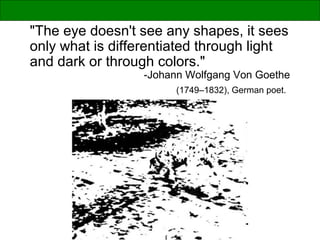
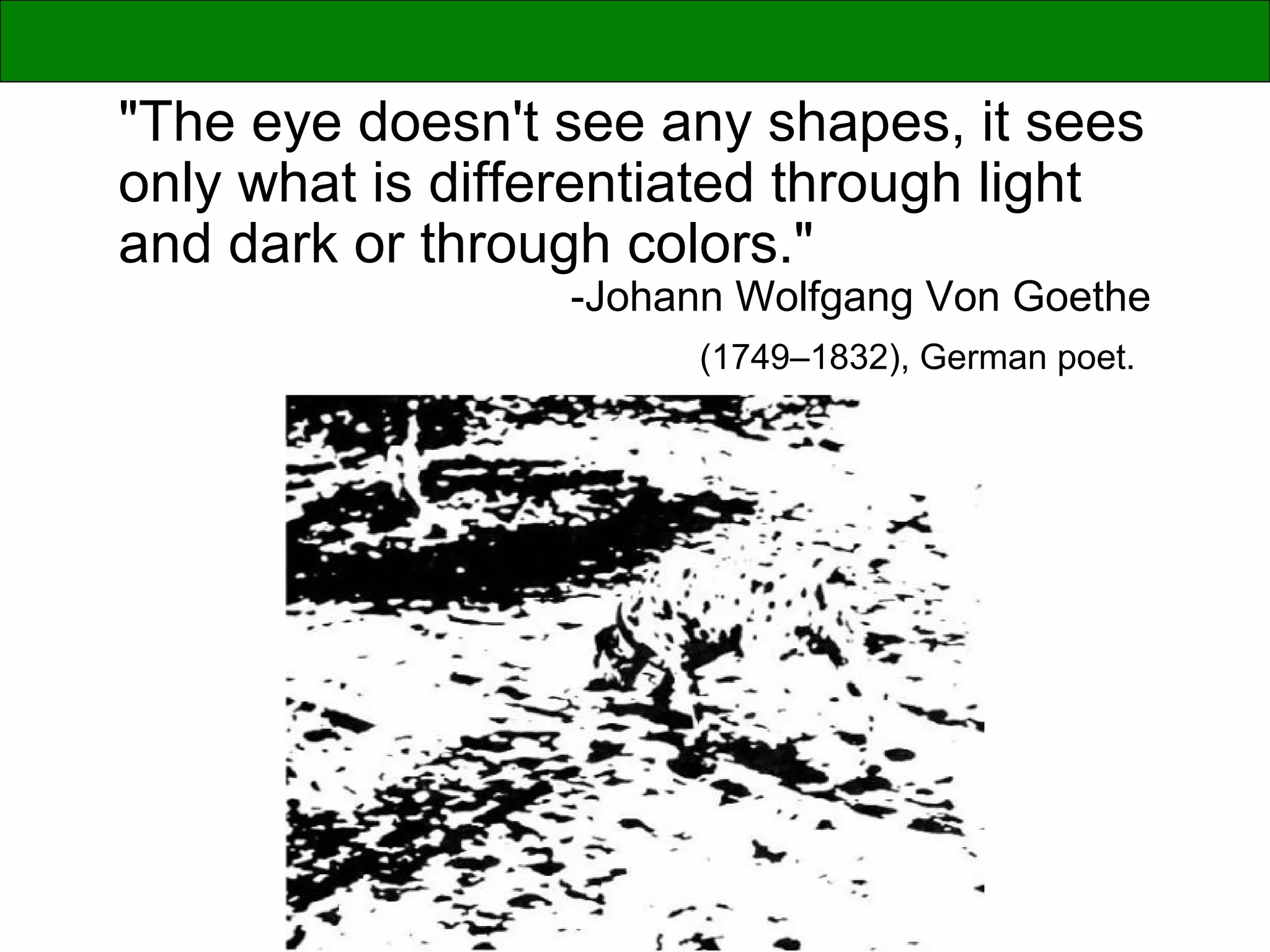
"The eye doesn't see any shapes, it sees
only what is differentiated through light
and dark or through colors."
-Johann Wolfgang Von Goethe
(1749–1832), German poet.
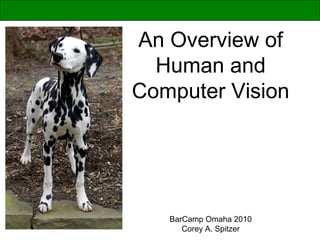
An Overview of
Human and
Computer Vision
BarCamp Omaha 2010
Corey A. Spitzer
Hi.
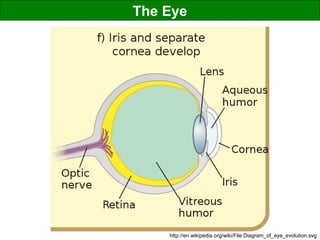
The Eye
http://en.wikipedia.org/wiki/File:Diagram_of_eye_evolution.svg
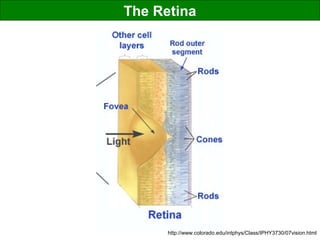
The Retina
http://www.colorado.edu/intphys/Class/IPHY3730/07vision.html
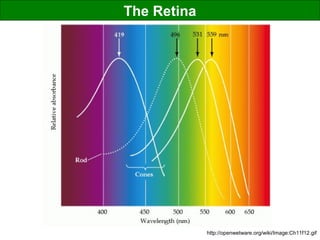
The Retina
http://openwetware.org/wiki/Image:Ch11f12.gif
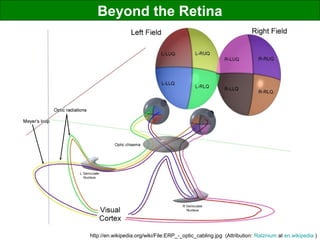
Beyond the Retina
http://en.wikipedia.org/wiki/File:ERP_-_optic_cabling.jpg (Attribution: Ratznium at en.wikipedia )
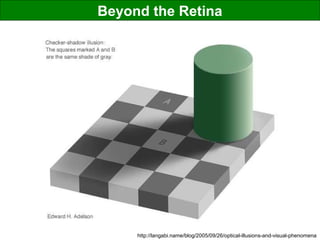
Beyond the Retina
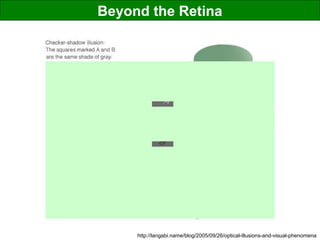
http://langabi.name/blog/2005/09/26/optical-illusions-and-visual-phenomena
Beyond the Retina
http://langabi.name/blog/2005/09/26/optical-illusions-and-visual-phenomena
Computer Vision
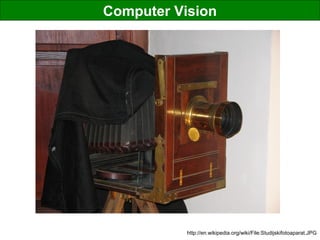
http://en.wikipedia.org/wiki/File:Studijskifotoaparat.JPG
Low-level Image Processing
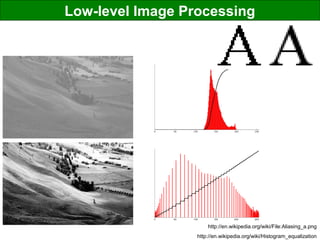
http://en.wikipedia.org/wiki/File:Aliasing_a.png
http://en.wikipedia.org/wiki/Histogram_equalization
Image Segmentation
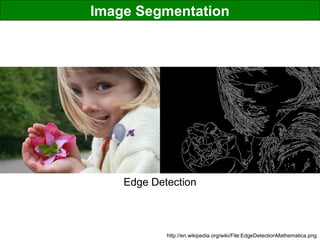
http://en.wikipedia.org/wiki/File:EdgeDetectionMathematica.png
Edge Detection
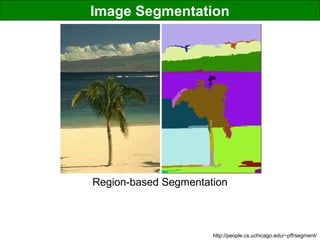
Image Segmentation
http://people.cs.uchicago.edu/~pff/segment/
Region-based Segmentation
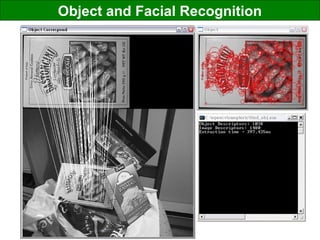
Object and Facial Recognition
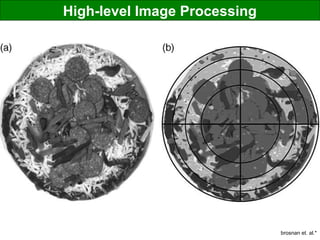
High-level Image Processing
brosnan et. al.*
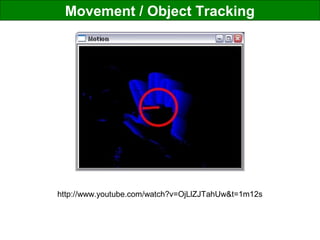
Movement / Object Tracking
http://www.youtube.com/watch?v=OjLlZJTahUw&t=1m12s
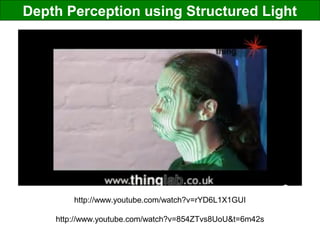
Depth Perception using Structured Light
http://www.youtube.com/watch?v=rYD6L1X1GUI
http://www.youtube.com/watch?v=854ZTvs8UoU&t=6m42s
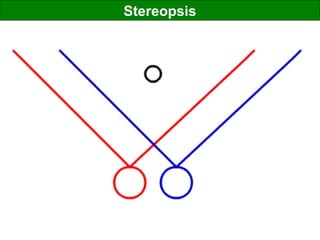
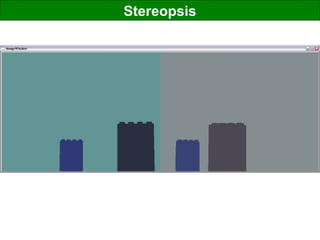
Stereopsis
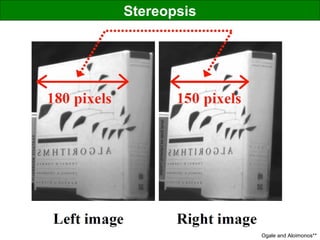
Stereopsis
Ogale and Aloimonos**
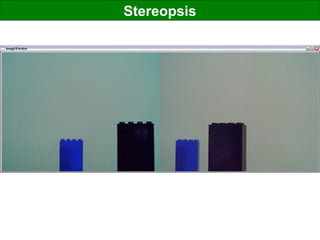
Stereopsis
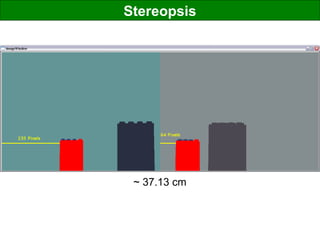
Stereopsis
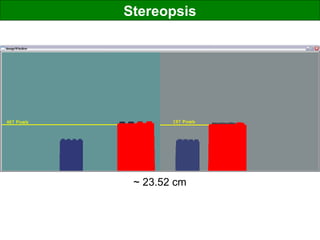
Stereopsis
~ 37.13 cm
Stereopsis
~ 23.52 cm
Sources and Further Information
Brain and Behavior course website
University of Colorado at Boulder
http://www.colorado.edu/intphys/Class/IPHY3730/07vision.html
* Improving quality inspection of food products by computer vision––a review
Tadhg Brosnan, Da-Wen Sun
** Shape and the stereo correspondence problem
Abhijit S. Ogale and Yiannis Aloimonos
Sources and Further Information

Overview of Human and Computer Vision

Editor's Notes

  • #6 fovea - pit that has provides the greatest focus rods and cones turn light into electrochemical signals that are sent to the brain
  • #7 cones are dedicated to bright light and colors 3 kinds of cones rods are active in processing dim light hard to see color in dim light
  • #8 left and right fields get processed together and in parallel Doesn't show path to the superior colliculus -- SC serves to generate quick and usually unconscious movements of the eye (saccades); -- often purely reflexive -- focuses attention onto regions of interest such as areas where a texture or color is different from its surroundings or where movement has been detected by higher areas of the brain LGN -- each LGN has 6 layers of processing, 3 for each eye; -- exact function is not known, but information is sent to and from V1 Visual Cortex -- 5 major layers processing: orientation, position, size; _; form and shape; color; motion -- two paths: "where" and "what" processed in parallel No one completely knows how vision works in a mathematical / algorithmic sense
  • #9 Processing involves more than just working with the image coming from the retina Retinal images don't tell us the difference between a hole in the ground and a shadow. The brain adds hints to the image for correct interpretation based on probability, past experience, and knowledge. Brain tweaks the image; may add additional shading or changing perceived colors to synthetically add features like depth cues What the brain allows you to see isn't always the image that's actually coming in. Not raw data
  • #11 Huge area of study full of huge sub-areas of study Things are more objective and discrete with pixels versus fuzzy biological signals
  • #12 Huge area. Deals with preprocessing an image to aid higher-level analysis High/low pass filtering (e.g. sharpening, blurring) aliasing / antialiasing Histogram equalization - redistributes the gray-level intensities amongst the pixels, shifting all pixels with a given intensity together (i.e. all pixels that had the same intensity before have the same intensity now, it's just a different value), thus increasing the global contrast cumulative distribution function - at point X, how many pixels have intensity at or below X
  • #13 after image is prepared to be analyzed at a high level.. Need to be able to tell difference between the foreground and background, areas / objects of interest in the image, etc. subproblem of a lot of different high-level problems such as -- object recognition/detection -- image classification discontinuities - adjacent pixel regions where local contrast exceeds some threshold local contrasts - define edges - define boundaries of shapes - define objects Canny edge detector problems: -- can create edges that don't actually exist -- can ignore edges that do exist -- no inherent way to tell if an edge is part of an object or is an object boundary; e.g. textures
  • #14 looking for homogeneity wrt certain features (e.g. color, texture, etc); think of the paint bucket tool in photoshop; spread out in all directions looking for contiguous pixels that are similar can be used in conjunction with edge detection
  • #15 High level image processing feature detection
  • #16 Images from a system that classifies pizzas as good or bad based on the pattern and distribution of toppings
  • #19 Disparity - thumb exercise Brain offers hints and cues for distance -- parallax - moving head, closer objects move across field of view faster; moon follows you wherever you go -- shadows -- knowledge of what things look like Correspondence problem -- some pixels don't correspond at all due to occlusions; can see more AROUND the left side with left eye, right side with right eye -- some areas are going to appear as different widths in the different images (e.g. slanted)
  • #22 Smoothed image to eliminate noise Segmented based mostly on color and contrast. -- colors weren't the same due to different cameras, different lighting from different angles, noise, etc.
  • #23 Triangulation using distance between each camera, focal points, and relative positions of the corresponding segments