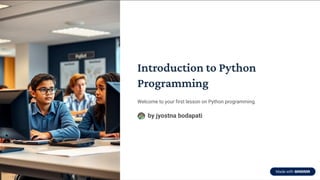
Introduction to Python
Programming
Welcome to your first lesson on Python programming.
by jyostna bodapati
Course Outline
History of
Python
Basics and
Syntax
Variables,
data types,
and
indentation
Installatio
n &
Execution
Exercise
Programs
What is Python?
Python is a widely used high-level programming language.
It is known for simplicity and vast standard libraries.
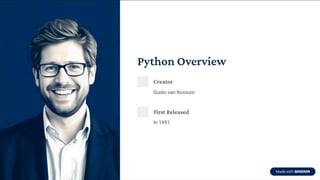
Python Overview
Creator
Guido van Rossum
First Released
In 1991
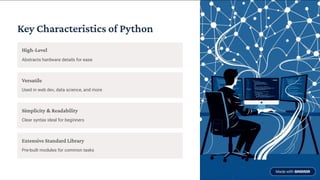
Key Characteristics of Python
High-Level
Abstracts hardware details for ease
Versatile
Used in web dev, data science, and more
Simplicity & Readability
Clear syntax ideal for beginners
Extensive Standard Library
Pre-built modules for common tasks
Python Features
Python offers strong community support and dynamic typing.
It promotes code reuse and supports multiple programming paradigms.
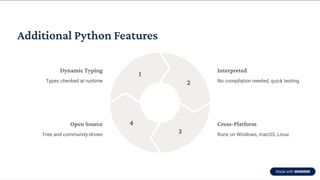
Additional Python Features
1
2
3
4
Dynamic Typing
Types checked at runtime
Interpreted
No compilation needed, quick testing
Cross-Platform
Runs on Windows, macOS, Linux
Open Source
Free and community-driven
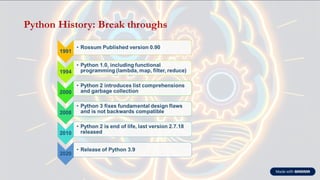
History of Python
Python's development began in the late 1980s.
It was influenced by languages like ABC and Modula-3.
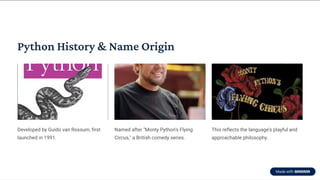
Python History & Name Origin
Developed by Guido van Rossum, first
launched in 1991.
Named after "Monty Python's Flying
Circus," a British comedy series.
This reflects the language's playful and
approachable philosophy.
Python's Playful Name
The name Python was inspired by the British comedy series "Monty
Python's Flying Circus."
This reflects the language's design philosophy emphasizing fun and
approachable coding experiences.
"Why Python?
Python works on different platforms (Windows, Mac, Linux, Raspberry Pi, etc).
"Python has a simple syntax similar to the English language.
"Python has syntax that allows developers to write programs with fewer lines than some other programming languages.
"Python runs on an interpreter system, meaning that code can be executed as soon as it is written. This means that prototyping
can be very quick.
"Python can be treated in a procedural way, an object-orientated way or a functional way.
`
Overview and Introduction to Python-Programming

Overview and Introduction to Python-Programming

  • 1.
    Introduction to Python Programming Welcometo your first lesson on Python programming. by jyostna bodapati
  • 2.
    Course Outline History of Python Basicsand Syntax Variables, data types, and indentation Installatio n & Execution Exercise Programs
  • 3.
    What is Python? Pythonis a widely used high-level programming language. It is known for simplicity and vast standard libraries.
  • 4.
    Python Overview Creator Guido vanRossum First Released In 1991
  • 5.
    Key Characteristics ofPython High-Level Abstracts hardware details for ease Versatile Used in web dev, data science, and more Simplicity & Readability Clear syntax ideal for beginners Extensive Standard Library Pre-built modules for common tasks
  • 6.
    Python Features Python offersstrong community support and dynamic typing. It promotes code reuse and supports multiple programming paradigms.
  • 7.
    Additional Python Features 1 2 3 4 DynamicTyping Types checked at runtime Interpreted No compilation needed, quick testing Cross-Platform Runs on Windows, macOS, Linux Open Source Free and community-driven
  • 8.
    History of Python Python'sdevelopment began in the late 1980s. It was influenced by languages like ABC and Modula-3.
  • 9.
    Python History &Name Origin Developed by Guido van Rossum, first launched in 1991. Named after "Monty Python's Flying Circus," a British comedy series. This reflects the language's playful and approachable philosophy.
  • 10.
    Python's Playful Name Thename Python was inspired by the British comedy series "Monty Python's Flying Circus." This reflects the language's design philosophy emphasizing fun and approachable coding experiences.
  • 16.
    "Why Python? Python workson different platforms (Windows, Mac, Linux, Raspberry Pi, etc). "Python has a simple syntax similar to the English language. "Python has syntax that allows developers to write programs with fewer lines than some other programming languages. "Python runs on an interpreter system, meaning that code can be executed as soon as it is written. This means that prototyping can be very quick. "Python can be treated in a procedural way, an object-orientated way or a functional way.
  • 24.