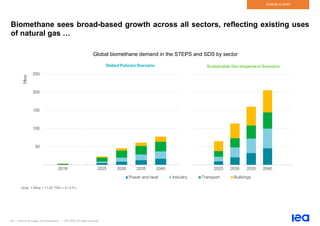
Outlook for biogas and
Prospects for organic growth
World Energy Outlook Special Report
biomethane
2 | Outlook for biogas and biomethane | IEA 2020. All rights reserved
Table of contents
Key findings................................................................................................................................................................................................................... 4
An introduction to biogas and biomethane ...................................................................................................................................................................12
Sustainable supply potential and costs ........................................................................................................................................................................24
Biogas supply potential and costs.............................................................................................................................................................................26
Biomethane supply potential and costs.....................................................................................................................................................................34
The outlook for biogas and biomethane to 2040 ..........................................................................................................................................................40
Outlook for biogas.....................................................................................................................................................................................................45
Focus: The role of biogas as a clean cooking fuel ....................................................................................................................................................51
Outlook for biomethane.............................................................................................................................................................................................57
Focus: Biomethane and the future of gas infrastructure ...........................................................................................................................................63
Implications for policy makers and industry..................................................................................................................................................................69
Investment ................................................................................................................................................................................................................70
Energy security .........................................................................................................................................................................................................74
Reductions in CO2 and methane...............................................................................................................................................................................77
Considerations for policy makers..............................................................................................................................................................................82
Annex...........................................................................................................................................................................................................................87
3 | Outlook for biogas and biomethane | IEA 2020. All rights reserved
Introduction
The case for biogas and biomethane lies at the intersection of two
critical challenges of modern life: dealing with the increasing amount of
organic waste that is produced by modern societies and economies,
and the imperative to reduce global greenhouse gas (GHG) emissions.
By turning organic waste into a renewable energy resource, the
production of biogas or biomethane offers a window onto a world in
which resources are continuously used and reused, and one in which
rising demand for energy services can be met while also delivering
wider environmental benefits.
In assessing the prospects for “organic growth” of biogas and
biomethane, this new report from the International Energy Agency (IEA)
explores how big a role these gases can play in the transformation of
the global energy system, where the opportunities and potential pitfalls
lie, and what policy makers and industry can do to support sustainable
growth in this sector.
The answers to these questions rest on a major new IEA analysis of the
sustainable potential for biogas and biomethane supply, including a
detailed assessment of feedstock availability and production costs
across all regions of the world.
This provides a platform to explore the various services that biogas and
biomethane can provide in different countries, which vary widely
depending on circumstances and policy priorities. Biogas can be a
valuable local source of power and heat, as well as a clean cooking fuel
to displace reliance on the traditional use of solid biomass in many
developing countries. There are also potential co-benefits in terms of
agricultural productivity (as a result of using the residual “digestate”
from biodigesters as a fertiliser) and reducing deforestation.
When upgraded, biomethane (also known as renewable natural gas) is
indistinguishable from natural gas and so can be transported and used
in the same way. Biomethane can deliver the energy system benefits of
natural gas while being carbon-neutral.
The value of biogas and biomethane is heightened in scenarios such
as the IEA Sustainable Development Scenario (SDS), which meet in full
the world’s goals to tackle climate change, improve air quality and
provide access to modern energy. Projections from the SDS provide an
essential benchmark for much of the discussion in this report.
Biogas and biomethane have the potential to support all aspects of the
SDS, which charts a path fully consistent with the Paris Agreement by
holding the rise in global temperatures to “well below 2°C … and
pursuing efforts to limit [it] to 1.5°C”, and meets objectives related to
universal energy access and cleaner air.
The other scenario referenced in the analysis is the Stated Policies
Scenario (STEPS), which provides an indication of where today’s policy
ambitions and plans, including national policy announcements and
pledges, would lead the energy sector.
Comparison between the outcomes in these two scenarios provides an
indication of the range of possible futures that are open to biogas and
biomethane, and the policy and technology levers that will affect which
pathway they ultimately follow.
Key findings
5 | Outlook for biogas and biomethane | IEA 2020. All rights reserved
Key findings
1. Biogas and biomethane producers take organic residues and wastes and turn
them into a valuable modern source of clean energy
Modern societies and economies produce
increasing amounts of organic waste that can
be used to produce clean sources of energy,
with multiple potential benefits for
sustainable development. Biogas and
biomethane are different products with different
applications, but they both originate from a range
of organic feedstocks whose potential is
underutilised today. The production and use of
these gases embody the idea of a more circular
economy, bringing benefits from reduced
emissions, improved waste management and
greater resource efficiency. Biogas and
biomethane also provide a way to integrate rural
communities and industries into the
transformation of the energy sector.
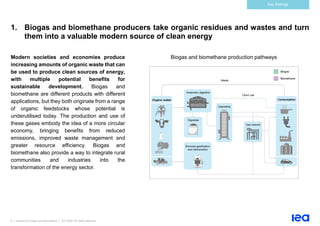
Biogas and biomethane production pathways
6 | Outlook for biogas and biomethane | IEA 2020. All rights reserved
Key findings
2. The feedstocks available for sustainable production of biogas and biomethane
are huge, but only a fraction of this potential is used today
A detailed, bottom-up study of the worldwide
availability of sustainable feedstocks for
biogas and biomethane, conducted for this
report, shows that the technical potential to
produce these gases is huge and largely
untapped. These feedstocks include crop
residues, animal manure, municipal solid waste,
wastewater and – for direct production of
biomethane via gasification – forestry residues.
This assessment considers only those
feedstocks that do not compete with food for
agricultural land. Biogas and biomethane
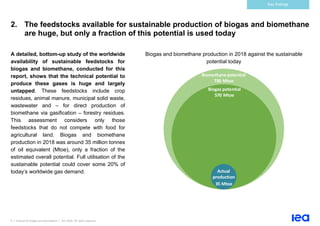
production in 2018 was around 35 million tonnes
of oil equivalent (Mtoe), only a fraction of the
estimated overall potential. Full utilisation of the
sustainable potential could cover some 20% of
today’s worldwide gas demand.
Biogas and biomethane production in 2018 against the sustainable
potential today
35 Mtoe
Biogas potential
570 Mtoe
Biomethane potential
730 Mtoe
Actual
production
7 | Outlook for biogas and biomethane | IEA 2020. All rights reserved
Key findings
3. Possibilities to produce biogas and biomethane are widely distributed around
the world
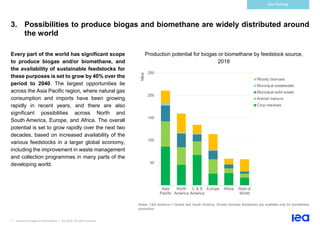
Every part of the world has significant scope
to produce biogas and/or biomethane, and
the availability of sustainable feedstocks for
these purposes is set to grow by 40% over the
period to 2040. The largest opportunities lie
across the Asia Pacific region, where natural gas
consumption and imports have been growing
rapidly in recent years, and there are also
significant possibilities across North and
South America, Europe, and Africa. The overall
potential is set to grow rapidly over the next two
decades, based on increased availability of the
various feedstocks in a larger global economy,
including the improvement in waste management
and collection programmes in many parts of the
developing world.
Production potential for biogas or biomethane by feedstock source,
2018
Notes: C&S America = Central and South America. Woody biomass feedstocks are available only for biomethane
production.
50
100
150
200
250
Asia
Pacific
North
America
C & S
America
Europe Africa Rest of
World
Mtoe
Woody biomass
Municipal wastewater
Municipal solid waste
Animal manure
Crop residues
8 | Outlook for biogas and biomethane | IEA 2020. All rights reserved
Key findings
4. Biogas offers a local source of power and heat, and a clean cooking fuel for
households
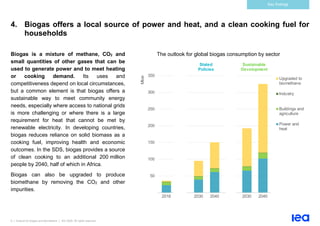
Biogas is a mixture of methane, CO2 and
small quantities of other gases that can be
used to generate power and to meet heating
or cooking demand. Its uses and
competitiveness depend on local circumstances,
but a common element is that biogas offers a
sustainable way to meet community energy
needs, especially where access to national grids
is more challenging or where there is a large
requirement for heat that cannot be met by
renewable electricity. In developing countries,
biogas reduces reliance on solid biomass as a
cooking fuel, improving health and economic
outcomes. In the SDS, biogas provides a source
of clean cooking to an additional 200 million
people by 2040, half of which in Africa.
Biogas can also be upgraded to produce
biomethane by removing the CO2 and other
impurities.
The outlook for global biogas consumption by sector
50
100
150
200
250
300
350
2018 2030 2040 2030 2040
Mtoe
Upgraded to
biomethane
Industry
Buildings and
agriculture
Power and
heat
Stated
Policies
Sustainable
Development
9 | Outlook for biogas and biomethane | IEA 2020. All rights reserved
Key findings
5. When upgraded, biomethane brings all the energy system benefits of natural
gas without the associated net emissions
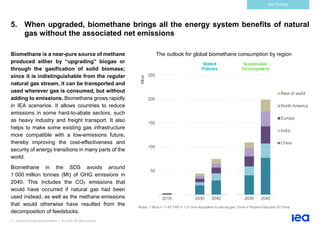
Biomethane is a near-pure source of methane
produced either by “upgrading” biogas or
through the gasification of solid biomass;
since it is indistinguishable from the regular
natural gas stream, it can be transported and
used wherever gas is consumed, but without
adding to emissions. Biomethane grows rapidly
in IEA scenarios. It allows countries to reduce
emissions in some hard-to-abate sectors, such
as heavy industry and freight transport. It also
helps to make some existing gas infrastructure
more compatible with a low-emissions future,
thereby improving the cost-effectiveness and
security of energy transitions in many parts of the
world.
Biomethane in the SDS avoids around
1 000 million tonnes (Mt) of GHG emissions in
2040. This includes the CO2 emissions that
would have occurred if natural gas had been
used instead, as well as the methane emissions
that would otherwise have resulted from the
decomposition of feedstocks.
The outlook for global biomethane consumption by region
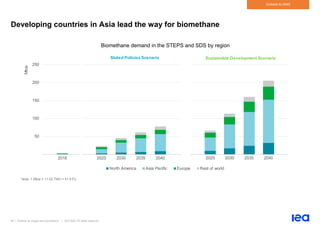
Notes: 1 Mtoe = 11.63 TWh = 1.21 bcm-equivalent to natural gas. China = People’s Republic of China.
50
100
150
200
250
2018 2030 2040 2030 2040
Mtoe
Rest of world
North America
Europe
India
China
Stated
Policies
Sustainable
Development
10 | Outlook for biogas and biomethane | IEA 2020. All rights reserved
Key findings
6. Most of the biomethane potential is more expensive than natural gas, but the
cost gap narrows over time
With the exception of some landfill gas, most
of the biomethane assessed in this report is
more expensive than the prevailing natural
gas prices in different regions. The average
price for biomethane produced today is around
USD 19 per million British thermal units (MBtu),
with some additional costs for grid injection.
However, this report estimates that around
30 Mtoe (~40 billion cubic metres [bcm]) of
biomethane – mostly landfill gas – could be
produced today at a price that undercuts the
domestic price of natural gas; this is already
ten times more than total biomethane
consumption today.
The cost gap is projected to narrow over time as
biomethane production technologies improve
and as carbon pricing in some regions makes
natural gas more expensive. Recognition of the
value of avoided CO2 and methane emissions
goes a long way towards improving the cost-
competitiveness of biomethane.
Cost ranges for developing global biomethane potential today
200
400
600
800
0-5 5-10 10-15 15-20 20-25 >25 Total
potential
Mtoe
20 Mtoe
35
150
210
190
125 730
USD/MBtu
11 | Outlook for biogas and biomethane | IEA 2020. All rights reserved
Key findings
7. Low-carbon gases are essential to energy transitions; supportive policies are
required to unlock the potential for biogas and biomethane
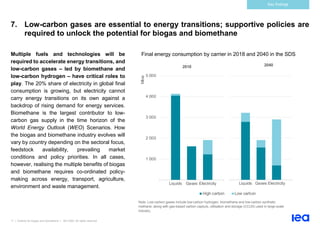
Multiple fuels and technologies will be
required to accelerate energy transitions, and
low-carbon gases – led by biomethane and
low-carbon hydrogen – have critical roles to
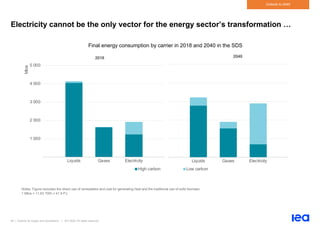
play. The 20% share of electricity in global final
consumption is growing, but electricity cannot
carry energy transitions on its own against a
backdrop of rising demand for energy services.
Biomethane is the largest contributor to low-
carbon gas supply in the time horizon of the
World Energy Outlook (WEO) Scenarios. How
the biogas and biomethane industry evolves will
vary by country depending on the sectoral focus,
feedstock availability, prevailing market
conditions and policy priorities. In all cases,
however, realising the multiple benefits of biogas
and biomethane requires co-ordinated policy-
making across energy, transport, agriculture,
environment and waste management.
Final energy consumption by carrier in 2018 and 2040 in the SDS
Note: Low-carbon gases include low-carbon hydrogen, biomethane and low-carbon synthetic
methane, along with gas-based carbon capture, utilisation and storage (CCUS) used in large-scale
industry.
1 000
2 000
3 000
4 000
5 000
Liquids Gases Electricity
Mtoe
2018
High carbon Low carbon
Liquids Gases Electricity
2040
12 | Outlook for biogas and biomethane | IEA 2020. All rights reserved
An introduction to biogas and biomethane
13 | Outlook for biogas and biomethane | IEA 2020. All rights reserved
An introduction to biogas
and biomethane
What are biogas and biomethane?
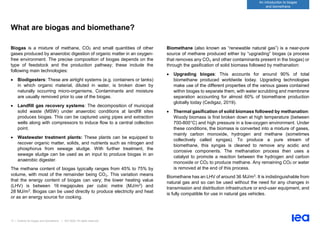
Biogas is a mixture of methane, CO2 and small quantities of other
gases produced by anaerobic digestion of organic matter in an oxygen-
free environment. The precise composition of biogas depends on the
type of feedstock and the production pathway; these include the
following main technologies:
• Biodigesters: These are airtight systems (e.g. containers or tanks)
in which organic material, diluted in water, is broken down by
naturally occurring micro-organisms. Contaminants and moisture
are usually removed prior to use of the biogas.
• Landfill gas recovery systems: The decomposition of municipal
solid waste (MSW) under anaerobic conditions at landfill sites
produces biogas. This can be captured using pipes and extraction
wells along with compressors to induce flow to a central collection
point.
• Wastewater treatment plants: These plants can be equipped to
recover organic matter, solids, and nutrients such as nitrogen and
phosphorus from sewage sludge. With further treatment, the
sewage sludge can be used as an input to produce biogas in an
anaerobic digester.
The methane content of biogas typically ranges from 45% to 75% by
volume, with most of the remainder being CO₂. This variation means
that the energy content of biogas can vary; the lower heating value
(LHV) is between 16 megajoules per cubic metre (MJ/m3) and
28 MJ/m3. Biogas can be used directly to produce electricity and heat
or as an energy source for cooking.
Biomethane (also known as “renewable natural gas”) is a near-pure
source of methane produced either by “upgrading” biogas (a process
that removes any CO₂ and other contaminants present in the biogas) or
through the gasification of solid biomass followed by methanation:
• Upgrading biogas: This accounts for around 90% of total
biomethane produced worldwide today. Upgrading technologies
make use of the different properties of the various gases contained
within biogas to separate them, with water scrubbing and membrane
separation accounting for almost 60% of biomethane production
globally today (Cedigaz, 2019).
• Thermal gasification of solid biomass followed by methanation:
Woody biomass is first broken down at high temperature (between
700-800°C) and high pressure in a low-oxygen environment. Under
these conditions, the biomass is converted into a mixture of gases,
mainly carbon monoxide, hydrogen and methane (sometimes
collectively called syngas). To produce a pure stream of
biomethane, this syngas is cleaned to remove any acidic and
corrosive components. The methanation process then uses a
catalyst to promote a reaction between the hydrogen and carbon
monoxide or CO2 to produce methane. Any remaining CO2 or water
is removed at the end of this process.
Biomethane has an LHV of around 36 MJ/m3. It is indistinguishable from
natural gas and so can be used without the need for any changes in
transmission and distribution infrastructure or end-user equipment, and
is fully compatible for use in natural gas vehicles.
14 | Outlook for biogas and biomethane | IEA 2020. All rights reserved
An introduction to biogas
and biomethane
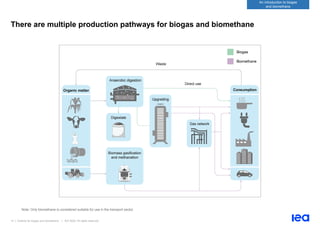
There are multiple production pathways for biogas and biomethane
Note: Only biomethane is considered suitable for use in the transport sector.
15 | Outlook for biogas and biomethane | IEA 2020. All rights reserved
An introduction to biogas
and biomethane
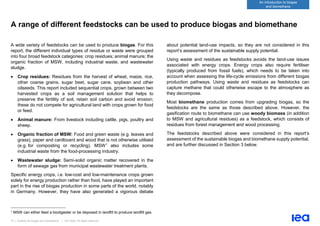
A range of different feedstocks can be used to produce biogas and biomethane
A wide variety of feedstocks can be used to produce biogas. For this
report, the different individual types of residue or waste were grouped
into four broad feedstock categories: crop residues; animal manure; the
organic fraction of MSW, including industrial waste; and wastewater
sludge.
• Crop residues: Residues from the harvest of wheat, maize, rice,
other coarse grains, sugar beet, sugar cane, soybean and other
oilseeds. This report included sequential crops, grown between two
harvested crops as a soil management solution that helps to
preserve the fertility of soil, retain soil carbon and avoid erosion;
these do not compete for agricultural land with crops grown for food
or feed.
• Animal manure: From livestock including cattle, pigs, poultry and
sheep.
• Organic fraction of MSW: Food and green waste (e.g. leaves and
grass), paper and cardboard and wood that is not otherwise utilised
(e.g. for composting or recycling). MSW1 also includes some
industrial waste from the food-processing industry.
• Wastewater sludge: Semi-solid organic matter recovered in the
form of sewage gas from municipal wastewater treatment plants.
Specific energy crops, i.e. low-cost and low-maintenance crops grown
solely for energy production rather than food, have played an important
part in the rise of biogas production in some parts of the world, notably
in Germany. However, they have also generated a vigorous debate
1 MSW can either feed a biodigester or be disposed in landfill to produce landfill gas.
about potential land-use impacts, so they are not considered in this
report’s assessment of the sustainable supply potential.
Using waste and residues as feedstocks avoids the land-use issues
associated with energy crops. Energy crops also require fertiliser
(typically produced from fossil fuels), which needs to be taken into
account when assessing the life-cycle emissions from different biogas
production pathways. Using waste and residues as feedstocks can
capture methane that could otherwise escape to the atmosphere as
they decompose.
Most biomethane production comes from upgrading biogas, so the
feedstocks are the same as those described above. However, the
gasification route to biomethane can use woody biomass (in addition
to MSW and agricultural residues) as a feedstock, which consists of
residues from forest management and wood processing.
The feedstocks described above were considered in this report’s
assessment of the sustainable biogas and biomethane supply potential,
and are further discussed in Section 3 below.
16 | Outlook for biogas and biomethane | IEA 2020. All rights reserved
An introduction to biogas
and biomethane
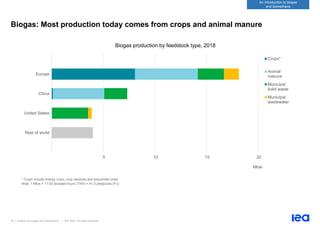
Biogas: Most production today comes from crops and animal manure
Biogas production by feedstock type, 2018
* Crops include energy crops, crop residues and sequential crops.
Note: 1 Mtoe = 11.63 terawatt-hours (TWh) = 41.9 petajoules (PJ).
5 10 15 20
Rest of world
United States
China
Europe
Mtoe
Crops*
Animal
manure
Municipal
solid waste
Municipal
wastewater
17 | Outlook for biogas and biomethane | IEA 2020. All rights reserved
An introduction to biogas
and biomethane
The rise of biogas has been shaped by two main factors: Policy support and
feedstock availability
The development of biogas has been uneven across the world, as it
depends not only on the availability of feedstocks but also on policies
that encourage its production and use. Europe, the People’s Republic
of China (hereafter, “China”) and the United States account for 90% of
global production.
Europe is the largest producer of biogas today. Germany is by far the
largest market, and home to two-thirds of Europe’s biogas plant
capacity. Energy crops were the primary choice of feedstock that
underpinned the growth of Germany’s biogas industry, but policy has
recently shifted more towards the use of crop residues, sequential
crops, livestock waste and the capture of methane from landfill sites.
Other countries such as Denmark, France, Italy and the Netherlands
have actively promoted biogas production.
In China, policies have supported the installation of household-scale
digesters in rural areas with the aim of increasing access to modern
energy and clean cooking fuels; these digesters account for around
70% of installed biogas capacity today. Different programmes have
been announced to support the installation of larger-scale
co-generation plants (i.e. plants producing both heat and power).
Moreover, the Chinese National Development and Reform Commission
issued a guidance document in late 2019 specifically on biogas
industrialisation and upgrading to biomethane, supporting also the use
of biomethane in the transport sector.
In the United States, the primary pathway for biogas has been through
landfill gas collection, which today accounts for nearly 90% of its biogas
production. There is also growing interest in biogas production from
agricultural waste, since domestic livestock markets are responsible for
almost one-third of methane emissions in the United States (USDA,
2016). The United States is also leading the way globally in the use of
biomethane in the transport sector, as a result of both state and federal
support.
Around half of the remaining production comes from developing
countries in Asia, notably Thailand and India. Remuneration via the
Clean Development Mechanism (CDM) was a key factor underpinning
this growth, particularly between 2007 and 2011. The development of
new biogas projects fell sharply after 2011 as the value of emission
reduction credits awarded under the CDM dropped. Thailand produces
biogas from the waste streams of its cassava starch sector, biofuel
industry and pig farms. India aims to develop around 5 000 new
compressed biogas plants over the next five years (GMI, 2019).
Argentina and Brazil have also supported biogas through auctions;
Brazil has seen the majority of production come from landfills, but there
is also potential from vinasse, a by-product from the ethanol industry.
A clear picture of today’s consumption of biogas in Africa is made more
difficult by a lack of data, but its use has been concentrated in countries
with specific support programmes. Some governments, such as Benin,
Burkina Faso and Ethiopia, provide subsidies that can cover from half
to all of the investment, while numerous projects promoted by
non-governmental organisations provide practical know-how and
subsidies to lower the net investment cost. In addition to these
subsidies, credit facilities have made progress in a few countries,
notably a recent lease-to-own arrangement in Kenya that financed
almost half of the digester installations in 2018 (ter Heegde, 2019)
18 | Outlook for biogas and biomethane | IEA 2020. All rights reserved
An introduction to biogas
and biomethane
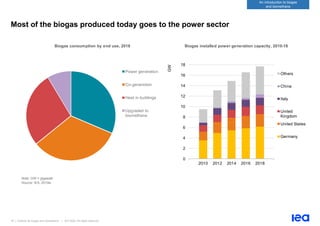
Most of the biogas produced today goes to the power sector
Note: GW = gigawatt.
Source: IEA, 2019a.
Power generation
Co-generation
Heat in buildings
Upgraded to
biomethane
Biogas consumption by end use, 2018
0
2
4
6
8
10
12
14
16
18
2010 2012 2014 2016 2018
GW
Others
China
Italy
United
Kingdom
United States
Germany
Biogas installed power generation capacity, 2010-18
19 | Outlook for biogas and biomethane | IEA 2020. All rights reserved
An introduction to biogas
and biomethane
Upgrading biogas to biomethane could be a major source of future growth
Almost two-thirds of biogas production in 2018 was used to generate
electricity and heat (with an approximately equal split between
electricity-only facilities and co-generation facilities). Around 30% was
consumed in buildings, mainly in the residential sector for cooking and
heating, with the remainder upgraded to biomethane and blended into
the gas networks or used as a transport fuel.
Today there is around 18 GW of installed power generation capacity
running on biogas around the world, most of which is in Germany, the
United States and the United Kingdom. Capacity increased on average
by 4% per year between 2010 and 2018. In recent years, deployment
in the United States and some European countries has slowed, mainly
because of changes in policy support, although growth has started to
pick up in other markets such as China and Turkey.
The levelised cost of generating electricity from biogas varies according
to the feedstocks used and the sophistication of the plant, and ranges
from USD 50 per megawatt-hour (MWh) to USD 190/MWh. A
substantial part of this range lies above the cost of generation from wind
and utility-scale solar photovoltaic (PV), which have come down sharply
in recent years.
The relatively high costs of biogas power generation mean that the
transition from feed-in tariffs to technology-neutral renewable electricity
auction frameworks (such as power purchase agreements) in many
countries could limit the future prospects for electricity-only biogas
plants. However, unlike wind and solar PV, biogas plants can operate
in a flexible manner and so provide balancing and other ancillary
services to the electricity network. Recognising the value of these
services would help to spur future deployment prospects for biogas
plants.
Where local heat off-take is available, the economic case for biogas
co-generation is stronger than for an electricity-only plant. This is
because co-generation can provide a higher level of energy efficiency,
with around 35% of the energy from biogas used to generate electricity
and an additional 40-50% of the waste heat put to productive use.
Certain industrial subsectors, such as the food and drink and chemicals,
produce wet waste with a high organic content, which is a suitable
feedstock for anaerobic digestion. In such industries, biogas production
can also have the co-benefit of providing treatment for waste while also
supplying on-site heat and electricity.
For the moment, a relatively small but growing share of the biogas
produced worldwide is upgraded to biomethane. This area has
significant potential for further growth, although – as outlined in
subsequent sections of this report – this is heavily contingent on the
strength and design of policies aimed at decarbonising gas supply in
different parts of the world.
20 | Outlook for biogas and biomethane | IEA 2020. All rights reserved
An introduction to biogas
and biomethane
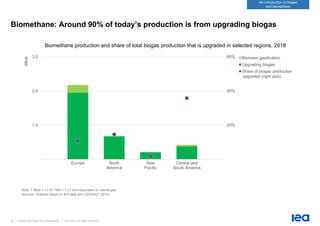
Biomethane: Around 90% of today’s production is from upgrading biogas
Biomethane production and share of total biogas production that is upgraded in selected regions, 2018
Note: 1 Mtoe = 11.63 TWh = 1.21 bcm-equivalent to natural gas.
Sources: Analysis based on IEA data and CEDIGAZ (2019).
20%
40%
60%
1.0
2.0
3.0
Europe North
America
Asia
Pacific
Central and
South America
Mtoe
Biomass gasification
Upgrading biogas
Share of biogas production
upgraded (right axis)
21 | Outlook for biogas and biomethane | IEA 2020. All rights reserved
An introduction to biogas
and biomethane
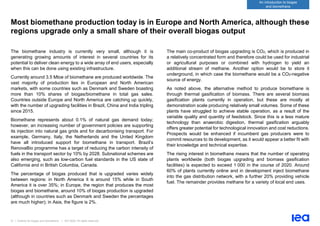
Most biomethane production today is in Europe and North America, although these
regions upgrade only a small share of their overall biogas output
The biomethane industry is currently very small, although it is
generating growing amounts of interest in several countries for its
potential to deliver clean energy to a wide array of end users, especially
when this can be done using existing infrastructure.
Currently around 3.5 Mtoe of biomethane are produced worldwide. The
vast majority of production lies in European and North American
markets, with some countries such as Denmark and Sweden boasting
more than 10% shares of biogas/biomethane in total gas sales.
Countries outside Europe and North America are catching up quickly,
with the number of upgrading facilities in Brazil, China and India tripling
since 2015.
Biomethane represents about 0.1% of natural gas demand today;
however, an increasing number of government policies are supporting
its injection into natural gas grids and for decarbonising transport. For
example, Germany, Italy, the Netherlands and the United Kingdom
have all introduced support for biomethane in transport. Brazil’s
RenovaBio programme has a target of reducing the carbon intensity of
fuels in the transport sector by 10% by 2028. Subnational schemes are
also emerging, such as low-carbon fuel standards in the US state of
California and in British Columbia, Canada.
The percentage of biogas produced that is upgraded varies widely
between regions: in North America it is around 15% while in South
America it is over 35%; in Europe, the region that produces the most
biogas and biomethane, around 10% of biogas production is upgraded
(although in countries such as Denmark and Sweden the percentages
are much higher); in Asia, the figure is 2%.
The main co-product of biogas upgrading is CO2, which is produced in
a relatively concentrated form and therefore could be used for industrial
or agricultural purposes or combined with hydrogen to yield an
additional stream of methane. Another option would be to store it
underground, in which case the biomethane would be a CO2-negative
source of energy.
As noted above, the alternative method to produce biomethane is
through thermal gasification of biomass. There are several biomass
gasification plants currently in operation, but these are mostly at
demonstration scale producing relatively small volumes. Some of these
plants have struggled to achieve stable operation, as a result of the
variable quality and quantity of feedstock. Since this is a less mature
technology than anaerobic digestion, thermal gasification arguably
offers greater potential for technological innovation and cost reductions.
Prospects would be enhanced if incumbent gas producers were to
commit resources to its development, as it would appear a better fit with
their knowledge and technical expertise.
The rising interest in biomethane means that the number of operating
plants worldwide (both biogas upgrading and biomass gasification
facilities) is expected to exceed 1 000 in the course of 2020. Around
60% of plants currently online and in development inject biomethane
into the gas distribution network, with a further 20% providing vehicle
fuel. The remainder provides methane for a variety of local end uses.
22 | Outlook for biogas and biomethane | IEA 2020. All rights reserved
An introduction to biogas
and biomethane
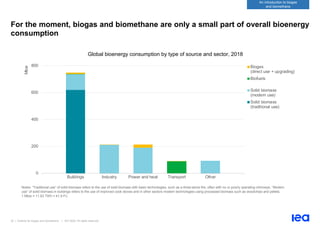
For the moment, biogas and biomethane are only a small part of overall bioenergy
consumption
Global bioenergy consumption by type of source and sector, 2018
Notes: “Traditional use” of solid biomass refers to the use of solid biomass with basic technologies, such as a three-stone fire, often with no or poorly operating chimneys. “Modern
use” of solid biomass in buildings refers to the use of improved cook stoves and in other sectors modern technologies using processed biomass such as woodchips and pellets.
1 Mtoe = 11.63 TWh = 41.9 PJ.
0
200
400
600
800
Buildings Industry Power and heat Transport Other
Mtoe
Biogas
(direct use + upgrading)
Biofuels
Solid biomass
(modern use)
Solid biomass
(traditional use)
23 | Outlook for biogas and biomethane | IEA 2020. All rights reserved
An introduction to biogas
and biomethane
However, there is a strong potential role for biogas and biomethane in the
transformation of the global energy system
Bioenergy accounts for around 10% of the world’s primary energy
demand today. It can be consumed either in solid, liquid or gaseous
form, and by far the most prevalent use of bioenergy today is solid
biomass (around 90%).
The use of solid biomass is typically categorised as either “traditional”
or “modern”, and currently demand is split roughly equally between the
two. Modern biomass relies on more advanced technologies, mainly in
electricity generation and industrial applications, which use upgraded
fuels such as woodchips and pellets. Traditional use refers to the
burning of solid biomass, such as wood, charcoal, agricultural residues
and animal dung, for cooking or heating using basic technologies such
as three-stone fires. With low conversion efficiencies and significant
negative health impacts from indoor air pollution, many developing
economies are trying to shift consumption away from traditional use.
The differentiation between traditional and modern does not apply for
liquid and gaseous bioenergy, since both are produced using advanced
technologies. Liquid biofuels make up around 7% of total bioenergy
demand today. Biofuels are the main renewable energy source used
directly in the transport sector, with around 90 Mtoe or almost 2 million
barrels of oil equivalent per day consumed in 2018. About 70% of
biofuels consumed today is bioethanol, which is usually blended with
gasoline; most of the remainder is biodiesel.
Biogas and biomethane today account for less than 3% of total
bioenergy demand, and represent an even smaller 0.3% share of total
primary energy. But there are reasons to believe that these low-carbon
gases could gain a firmer foothold in the future.
• They can provide the system benefits of natural gas (storage,
flexibility, high-temperature heat) without the net carbon emissions.
As economies decarbonise, this becomes a crucial attribute.
• Biogas provides a sustainable supply of heat and power that can
serve communities seeking local, decentralised sources of energy,
as well as a valuable cooking fuel for developing countries.
• The GHG reduction benefit is amplified by the processing and use
of methane (a potent GHG) that could otherwise be released to the
atmosphere from the decomposition of organic by-products and
waste.
• Biogas and biomethane can also play an important part in waste
management, improving overall resource efficiency.
• Where it displaces gas transported or imported over long distances,
biogas and biomethane also yield energy security benefits.
• There are also broader non-energy considerations, such as nutrient
recycling, rural job creation or reductions in the time spent in low-
income communities collecting firewood. Both biogas and
biomethane can also be developed at scale through partnerships
between the energy and agricultural industries. By transforming a
range of organic wastes into higher-value products, biogas and
biomethane fit well into the concept of the circular economy.
Policies can help to unlock these benefits, but much will depend on how
much biogas and biomethane is available and at what cost. These are
the questions addressed in the next section.
Sustainable supply potential and costs
25 | Outlook for biogas and biomethane | IEA 2020. All rights reserved
Sustainable supply potential & costs
The backbone of the Outlook is a detailed global assessment of the sustainable
technical potential and costs of biogas and biomethane supply
This report uses a new IEA estimate of the sustainable technical
potential of biogas and biomethane supply, based on a detailed
assessment of the availability of 19 types of feedstocks across the
25 regions modelled in the World Energy Model. The assessment used
detailed cost, feedstock and technology data to derive supply cost
curves illustrating the potential scale and commercial viability of
different biogas and biomethane production pathways around the world.
This section considers first the potential and costs for biogas, followed
by those for biomethane.
For biogas, this report considered 17 individual types of residue or
waste, grouped into the four feedstock categories described in
Section I, namely crop residues, animal manure, the organic fraction of
MSW and wastewater sludge. Biogas production pathways vary by
feedstock and region and rely on the following main technologies:
biodigesters (including centralised digesters at small, medium or large
scale and decentralised digesters at household scale), landfill gas
recovery systems, and wastewater treatment municipal plants.
For biomethane this report considered two main production pathways:
upgrading biogas and the gasification of biomass. For biogas
upgrading, the same feedstocks assessed for biogas have been
considered, on the assumption that these can be used either for biogas
production or for upgrading biogas to biomethane. The alternative route
to biomethane production – gasification – opens up the possibility of
using two additional sources of solid biomass feedstock: forestry
residues and wood processing residues.
This analysis focuses primarily on the opportunities and costs of biogas
and biomethane, thereby excluding technologies to convert electricity
to gas (also known as power-to-gas) and methanation using the CO2
extracted during the biogas upgrading process.
As noted in Section I, this analysis includes only the technical potential
of feedstock that can broadly be considered sustainable. This is defined
as feedstocks that can be processed with existing technologies, which
do not compete with food for agricultural land and that do not have any
other adverse sustainability impacts (e.g. reducing biodiversity).
Although energy crop residues are included, energy crop feedstocks
grown specifically to produce biogas and biomethane are not included
on the basis that their sustainability warrants further in-depth analysis
outside the scope of this study.
The estimates of the sustainable technical potential of biogas and
biomethane evolve over time, and are affected by gross domestic
product (GDP) and population growth, urbanisation trends, changes in
waste management, and anticipated rates of technology evolution.
This report’s assessment of supply costs matches feedstock availability
with the appropriate production technologies, and draws on a number
of case studies of the unit costs of biogas and biomethane production
around the world. The costs presented here differ slightly from those in
the World Energy Outlook 2019 (IEA, 2019b). This is mainly due to the
adoption of a more comprehensive data set for biogas upgrading
technologies, separate consideration of the costs of connecting
upgrading facilities to the gas grid, and inclusion of the latest published
data and information.
26 | Outlook for biogas and biomethane | IEA 2020. All rights reserved
Sustainable supply potential & costs
Biogas supply potential and costs
27 | Outlook for biogas and biomethane | IEA 2020. All rights reserved
Sustainable supply potential & costs
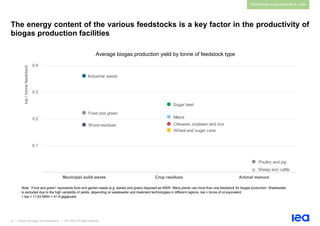
The energy content of the various feedstocks is a key factor in the productivity of
biogas production facilities
Average biogas production yield by tonne of feedstock type
Note: “Food and green” represents food and garden waste (e.g. leaves and grass) disposed as MSW. Many plants use more than one feedstock for biogas production. Wastewater
is excluded due to the high variability of yields, depending on wastewater and treatment technologies in different regions. toe = tonne of oil equivalent.
1 toe = 11.63 MWh = 41.9 gigajoules.
Maize
Sugar beet
Wheat and sugar cane
Oilseeds, soybean and rice
Poultry and pig
Sheep and cattle
Food and green
Wood residues
Industrial waste
0.1
0.2
0.3
0.4
Municipal solid waste Crop residues Animal manure
toe
/
tonne
feedstock
28 | Outlook for biogas and biomethane | IEA 2020. All rights reserved
Sustainable supply potential & costs
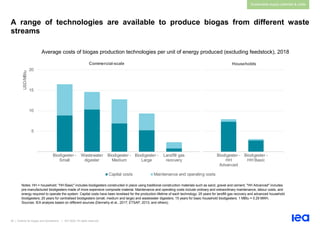
A range of technologies are available to produce biogas from different waste
streams
Average costs of biogas production technologies per unit of energy produced (excluding feedstock), 2018
Notes: HH = household; ''HH Basic'' includes biodigesters constructed in place using traditional construction materials such as sand, gravel and cement; ''HH Advanced'' includes
pre-manufactured biodigesters made of more expensive composite material. Maintenance and operating costs include ordinary and extraordinary maintenance, labour costs, and
energy required to operate the system. Capital costs have been levelised for the production lifetime of each technology: 25 years for landfill gas recovery and advanced household
biodigesters; 20 years for centralised biodigesters (small, medium and large) and wastewater digesters; 15 years for basic household biodigesters. 1 MBtu = 0.29 MWh.
Sources: IEA analysis based on different sources (Dennehy et al., 2017; ETSAP, 2013; and others).
5
10
15
20
Biodigester -
Small
Wastewater
digester
Biodigester -
Medium
Biodigester -
Large
Landfill gas
recovery
Biodigester -
HH
Advanced
Biodigester -
HH Basic
USD/MBtu
Capital costs Maintenance and operating costs
Commercial-scale Households
29 | Outlook for biogas and biomethane | IEA 2020. All rights reserved
Sustainable supply potential & costs
Each biogas technology is adapted for different types of user and use, and comes
with distinctive advantages and challenges
There are many different pathways for biogas production, involving
different feedstocks and biogas technologies. Livestock manure is the
most common feedstock, but the biogas production yield is significantly
lower than what could be obtained from crop residues. Industrial waste
is the highest-yielding feedstock, able to provide around 0.40 toe of
energy per tonne. Besides yields, there is variation in the cost and effort
required for collecting different volumes of feedstock. Technologies also
vary; this report assessed the following:
• Decentralised biodigesters at household scale, categorised into
either basic or advanced technologies
• Centralised biodigesters systems categorised by small (100 cubic
metres per hour [m3/h]), medium (250 m3/h) and large scale output
flow rates (750 m3/h)
• Existing wastewater treatment plants adapted to process sludge
produced at the municipal level (1 000 m3/h)
• Landfill gas recovery systems to recover biogas produced from
closed landfill sites (2 000 m3/h).
Household-scale biogas systems can provide heating and cooking fuels
in developing countries, as an alternative to the traditional use of solid
biomass. The output of these units are typically around 1 m3 per day,
providing two to three hours of gas-fired stove cooking time for every
20 to 30 kg of animal manure (SNV, 2019). The capital costs of these
basic technologies lie in a range of USD 3-8/MBtu (USD 10-30/MWh)
and generally have shorter lifetimes and variable production yields.
Feedstocks are usually available locally at zero cost, and in many cases
the deployment of these systems has been supported through
development programmes.
The picture changes when biodigesters scale up. Providing a
continuous flow of organic material in significant quantities requires a
more structured system to collect industrial quantities of feedstock. The
biogas output is then typically connected to a captive power or
co-generation plant involving additional investments. To ensure efficient
operation, temperatures need to be maintained generally in the range
of 30-45°C, and the feedstock must be continuously moved. For these
reasons, centralised commercial and industrial biogas plants are more
technologically sophisticated and their capital and operating costs per
unit of energy produced are higher, although they also offer higher
levels of efficiency and automation.
Anaerobic digestion systems can be installed at water treatment plants
(through the processing of sewage sludge with high moisture content).
Adapting a wastewater treatment plant entails high upfront investment
costs averaging around USD 15/MBtu, but can significantly improve the
longer-term economics of the plant. However, treatment capacities
must generally be higher than 5 000 m3 per day in order for the facility
to be cost-effective. Landfill gas extraction is possible for closed landfill
facilities containing MSW. This technology is best positioned to benefit
from economies of scale, with production costs below USD 3/MBtu.
The suitability of these various technologies depend on factors such as
location, feedstock availability and end-use applications. In this analysis
each type of feedstock is allocated to the most suitable technology,
resulting in the supply cost curves, presented below, which combine
technology and feedstock costs.
30 | Outlook for biogas and biomethane | IEA 2020. All rights reserved
Sustainable supply potential & costs
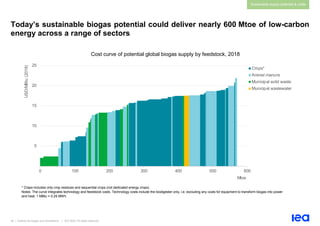
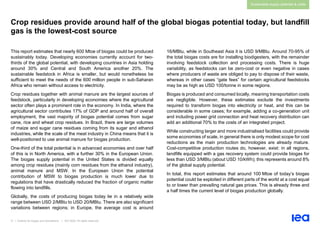
Today’s sustainable biogas potential could deliver nearly 600 Mtoe of low-carbon
energy across a range of sectors
Cost curve of potential global biogas supply by feedstock, 2018
* Crops includes only crop residues and sequential crops (not dedicated energy crops).
Notes: The curve integrates technology and feedstock costs. Technology costs include the biodigester only, i.e. excluding any costs for equipment to transform biogas into power
and heat. 1 MBtu = 0.29 MWh.
5
10
15
20
25
0 100 200 300 400 500 600
USD/MBtu
(2018)
Crops*
Animal manure
Municipal solid waste
Municipal wastewater
Mtoe
31 | Outlook for biogas and biomethane | IEA 2020. All rights reserved
Sustainable supply potential & costs
Crop residues provide around half of the global biogas potential today, but landfill
gas is the lowest-cost source
This report estimates that nearly 600 Mtoe of biogas could be produced
sustainably today. Developing economies currently account for two-
thirds of the global potential, with developing countries in Asia holding
around 30% and Central and South America another 20%. The
sustainable feedstock in Africa is smaller, but would nonetheless be
sufficient to meet the needs of the 600 million people in sub-Saharan
Africa who remain without access to electricity.
Crop residues together with animal manure are the largest sources of
feedstock, particularly in developing economies where the agricultural
sector often plays a prominent role in the economy. In India, where the
agricultural sector contributes 17% of GDP and around half of overall
employment, the vast majority of biogas potential comes from sugar
cane, rice and wheat crop residues. In Brazil, there are large volumes
of maize and sugar cane residues coming from its sugar and ethanol
industries, while the scale of the meat industry in China means that it is
well-positioned to use animal manure for biogas production.
One-third of the total potential is in advanced economies and over half
of this is in North America, with a further 30% in the European Union.
The biogas supply potential in the United States is divided equally
among crop residues (mainly corn residues from the ethanol industry),
animal manure and MSW. In the European Union the potential
contribution of MSW to biogas production is much lower due to
regulations that have drastically reduced the fraction of organic matter
flowing into landfills.
Globally, the costs of producing biogas today lie in a relatively wide
range between USD 2/MBtu to USD 20/MBtu. There are also significant
variations between regions; in Europe, the average cost is around
16/MBtu, while in Southeast Asia it is USD 9/MBtu. Around 70-95% of
the total biogas costs are for installing biodigesters, with the remainder
involving feedstock collection and processing costs. There is huge
variability, as feedstocks can be zero-cost or even negative in cases
where producers of waste are obliged to pay to dispose of their waste,
whereas in other cases “gate fees” for certain agricultural feedstocks
may be as high as USD 100/tonne in some regions.
Biogas is produced and consumed locally, meaning transportation costs
are negligible. However, these estimates exclude the investments
required to transform biogas into electricity or heat, and this can be
considerable in some cases; for example, adding a co-generation unit
and including power grid connection and heat recovery distribution can
add an additional 70% to the costs of an integrated project.
While constructing larger and more industrialised facilities could provide
some economies of scale, in general there is only modest scope for cost
reductions as the main production technologies are already mature.
Cost-competitive production routes do, however, exist: in all regions,
landfills equipped with a gas recovery system could provide biogas for
less than USD 3/MBtu (about USD 10/kWh); this represents around 8%
of the global supply potential.
In total, this report estimates that around 100 Mtoe of today’s biogas
potential could be exploited in different parts of the world at a cost equal
to or lower than prevailing natural gas prices. This is already three and
a half times the current level of biogas production globally.
32 | Outlook for biogas and biomethane | IEA 2020. All rights reserved
Sustainable supply potential & costs
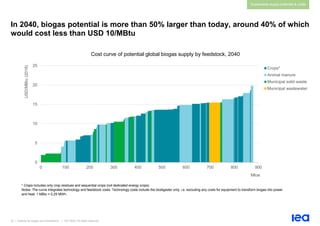
In 2040, biogas potential is more than 50% larger than today, around 40% of which
would cost less than USD 10/MBtu
Cost curve of potential global biogas supply by feedstock, 2040
* Crops includes only crop residues and sequential crops (not dedicated energy crops).
Notes: The curve integrates technology and feedstock costs. Technology costs include the biodigester only, i.e. excluding any costs for equipment to transform biogas into power
and heat. 1 MBtu = 0.29 MWh.
0
5
10
15
20
25
0 100 200 300 400 500 600 700 800 900
USD/MBtu
(2018)
Mtoe
Crops*
Animal manure
Municipal solid waste
Municipal wastewater
33 | Outlook for biogas and biomethane | IEA 2020. All rights reserved
Sustainable supply potential & costs
Biogas production costs fall slightly over time, narrowing the cost gap with
projected natural gas prices
This report’s assessment of the sustainable potential for biogas
production in 2040 is 50% higher than today, based on increased
availability of the various feedstocks in a larger global economy. The
projected costs of production also fall modestly over time.
There are significant variations in dynamics across different regions,
with the biogas supply potential in developing economies growing at
around twice the rate of advanced economies. This is mainly due to the
increased availability of animal manure and MSW along with the rising
potential to produce biogas from wastewater treatment plants.
Changes in dietary habits, with a growing number of people consuming
more protein-rich diets, increases the size and scale of the meat
industry and therefore the availability of animal manure. Increased
urbanisation and waste collection also increase the availability of MSW
in some developing economies; In India and Southeast Asia, for
example, the improvement of waste management and collection
programmes leads to significant growth in the availability of MSW
(reaching 36 Mtoe in 2040, three times the current assessment). The
level of wastewater available for biogas production also increases by
around 6% per year over the period to 2040.
More sophisticated and sustainable waste management practices could
in some cases reroute feedstock away from certain biogas production
technologies. For example, the availability of landfill gas could be
reduced if organic waste is collected separately and used for other
purposes, such as composting or transport biofuel production.
In 2040, the agricultural sector remains the largest contributor to global
biogas supply potential, with crop residues accounting for over 40% and
animal manure for 35% of the total. Availability of animal manure as a
feedstock is projected to increase by around 2.5% on average each
year, double the rate of increase for crop residues. MSW provides a
much smaller fraction of total potential in 2040 than today. Nonetheless,
there is still scope to produce more than 80 Mtoe in 2040, with landfill
gas remaining the lowest-cost source of supply.
Overall, biogas production costs are projected to decrease slightly while
natural gas prices tend to increase. Countries and regions where
projected natural gas prices are relatively high, such as China and
Southeast Asia, and regions with ambitious climate targets could
therefore have strong incentives to increase their biogas production.
In total, this report estimates that in 2040 over 260 Mtoe of biogas could
be produced worldwide for less than prevailing regional natural gas
prices in STEPS, which average around USD 9/MBtu in importing
regions such as Europe and most developing Asian economies,
USD 7/MBtu in Africa, and around USD 4.5/MBtu in North America.
One option to increase the competitiveness of biogas is to monetise the
by-products from its production. Producing biogas leaves a residue of
fluids and fibrous materials called “digestate”. The handling and
disposal of digestate can be costly and as a result it is often considered
a waste rather than a useful by-product. However, in certain locations
and applications, digestate can be sold as a natural fertiliser, helping to
offset a part of the production cost. European regulations have recently
recognised the role organic materials play in the production of digestate
(EBA, 2019).
34 | Outlook for biogas and biomethane | IEA 2020. All rights reserved
Sustainable supply potential & costs
Biomethane supply potential and costs
35 | Outlook for biogas and biomethane | IEA 2020. All rights reserved
Sustainable supply potential & costs
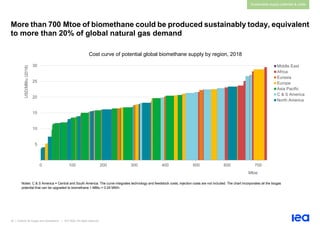
More than 700 Mtoe of biomethane could be produced sustainably today, equivalent
to more than 20% of global natural gas demand
Cost curve of potential global biomethane supply by region, 2018
Notes: C & S America = Central and South America. The curve integrates technology and feedstock costs; injection costs are not included. The chart incorporates all the biogas
potential that can be upgraded to biomethane.1 MBtu = 0.29 MWh.
5
10
15
20
25
30
0 100 200 300 400 500 600 700
USD/MBtu
(2018)
Mtoe
Middle East
Africa
Eurasia
Europe
Asia Pacific
C & S America
North America
36 | Outlook for biogas and biomethane | IEA 2020. All rights reserved
Sustainable supply potential & costs
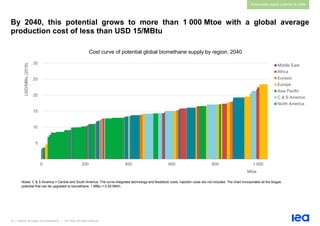
By 2040, this potential grows to more than 1 000 Mtoe with a global average
production cost of less than USD 15/MBtu
Cost curve of potential global biomethane supply by region, 2040
Notes: C & S America = Central and South America. The curve integrates technology and feedstock costs; injection costs are not included. The chart incorporates all the biogas
potential that can be upgraded to biomethane. 1 MBtu = 0.29 MWh.
.
5
10
15
20
25
30
0 200 400 600 800 1 000
USD/MBtu
(2018)
Mtoe
Middle East
Africa
Eurasia
Europe
Asia Pacific
C & S America
North America
37 | Outlook for biogas and biomethane | IEA 2020. All rights reserved
Sustainable supply potential & costs
Upgrading biogas is by far the most common biomethane production route today.
Biomass gasification remains a relatively niche industry
The potential for biomethane production today is over 700 Mtoe, which
is higher than biogas because of the inclusion of woody biomass as a
feedstock for thermal gasification; this increases the total possible
resource base by a fifth. However, the vast majority of global
biomethane potential today is linked to the upgrading of biogas.
This potential has a wide geographic spread: at a regional level, the
United States and Europe each hold a 16% share in the global total, but
there is also major potential in China and Brazil (each with 12%) and
India (8%). As with biogas, the potential could be even larger if energy
crops were to be included, but classifying them as “sustainable” would
require case-specific consideration of possible competition between
biomethane and food production. This does not mean, however, that
the feedstocks included in this assessment do not compete with one
another for alternative uses: for example, forestry residues can be a
sustainable source of direct heat, while crop residues can be used for
animal feed or to produce advanced biofuels.
Cost curves for biomethane equal the biogas production costs plus the
additional costs required for upgrading. An assessment of woody
biomass that can be processed via gasification is also included. This
report estimates that the global average cost of producing biomethane
through biogas upgrading today is around USD 19/MBtu. Most of this
cost is attributable to the production of the biogas, with the upgrading
process costing around USD 2/MBtu to USD 4/MBtu for a facility that
upgrades around 3.5 million m3 of biogas per year. The cost of the
upgrading process can vary significantly for different facility sizes and
across different regions: for example, in North America, upgrading costs
are at the lower end of this range due to economies of scale captured
by larger unit sizes.
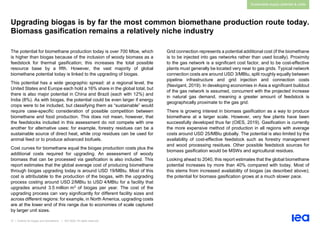
Grid connection represents a potential additional cost (if the biomethane
is to be injected into gas networks rather than used locally). Proximity
to the gas network is a significant cost factor, and to be cost-effective
plants must generally be located very near to gas grids. Typical network
connection costs are around USD 3/MBtu, split roughly equally between
pipeline infrastructure and grid injection and connection costs
(Navigant, 2019). In developing economies in Asia a significant buildout
of the gas network is assumed, concurrent with the projected increase
in natural gas demand, meaning a greater amount of feedstock is
geographically proximate to the gas grid.
There is growing interest in biomass gasification as a way to produce
biomethane at a larger scale. However, very few plants have been
successfully developed thus far (OIES, 2019). Gasification is currently
the more expensive method of production in all regions with average
costs around USD 25/MBtu globally. The potential is also limited by the
availability of cost-effective feedstock such as forestry management
and wood processing residues. Other possible feedstock sources for
biomass gasification would be MSWs and agricultural residues.
Looking ahead to 2040, this report estimates that the global biomethane
potential increases by more than 40% compared with today. Most of
this stems from increased availability of biogas (as described above);
the potential for biomass gasification grows at a much slower pace.
38 | Outlook for biogas and biomethane | IEA 2020. All rights reserved
Sustainable supply potential & costs
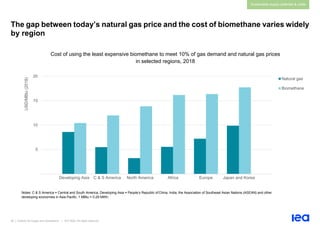
The gap between today’s natural gas price and the cost of biomethane varies widely
by region
Cost of using the least expensive biomethane to meet 10% of gas demand and natural gas prices
in selected regions, 2018
Notes: C & S America = Central and South America; Developing Asia = People’s Republic ofChina, India, the Association of Southeast Asian Nations (ASEAN) and other
developing economies in Asia Pacific. 1 MBtu = 0.29 MWh.
5
10
15
20
Developing Asia C & S America North America Africa Europe Japan and Korea
USD/MBtu
(2018)
Natural gas
Biomethane
39 | Outlook for biogas and biomethane | IEA 2020. All rights reserved
Sustainable supply potential & costs
Upgrading biogas captured from landfill sites is typically the cheapest option to
produce cost-competitive biomethane
There are limited prospects for major reductions in the cost of producing
biomethane. The technologies for biogas production and upgrading are
relatively mature although there may be higher potential to bring down
the cost of biomass gasification. Larger facilities could also provide
some economies of scale for both production routes. Overall, by 2040,
this report estimates that the average cost of producing biomethane
globally is set to be around 25% lower than today, at around
USD 14/MBtu.
Natural gas prices in several regions are very low today, a consequence
of ample supplies of gas and of liquefied natural gas (LNG). However,
there are still commercially viable opportunities for biomethane in some
markets. Taking into account biomethane costs and natural gas prices
across different regions, this report estimates that around 30 Mtoe of
biomethane could be produced today for less than the domestic price
of natural gas in the relevant regions, most of which involves fitting
landfill sites with gas capture technologies. If this were to be fully
exploited, this would represent around 1% of today’s natural gas
demand.
Whereas most sources of biomethane in advanced economies are
significantly more expensive to produce than today’s natural gas prices,
this is not necessarily the case in parts of the developing world. This is
particularly visible in parts of Asia, where natural gas is imported and
therefore relatively expensive, and where biogas feedstock is available
at a very low cost; in India for example, the share of today’s natural gas
demand that can be met cost-effectively by biomethane is 10%. By
2040 this rises to almost two thirds.
A key reason for the relatively low uptake of biomethane in developing
countries is the lack of specific policies encouraging its development.
The relatively high cost of capital is also a barrier to investment. There
are also non-economic barriers, such as the lack of awareness and
information, and the scarcity of expertise in the design, installation and
maintenance of biomethane production plants.
Monetising some of the by-products from biomethane production could
improve its cost-competitiveness. In addition to the potential use of
digestate as fertiliser, biogas upgrading also results in a pure stream of
CO2 that could be used by other industries. The revenues that can be
achieved through selling digestate or the pure CO2 stream, however,
are likely to be relatively modest and in most cases would not be
sufficient to close the cost gap entirely with natural gas.
Ultimately, the cost-competitiveness of biomethane in most markets
relies on pricing externalities. If CO2 prices are applied to the
combustion of natural gas, then biomethane becomes a more attractive
proposition. If policy recognises the value of avoided methane
emissions that would otherwise take place from the decomposition of
feedstocks, then an even larger quantity would be cost-competitive.
Methane is such a potent GHG that attaching a value to these avoided
emissions makes a dramatic difference to its overall supply cost profile.
The outlook for biogas and biomethane to 2040
41 | Outlook for biogas and biomethane | IEA 2020. All rights reserved
Outlook to 2040
Scenarios for the future of energy
The future of biogas and biomethane cannot be considered separately
from the broader context of the global energy system. There is a huge
range of possible futures for global energy, depending on the pace of
technological innovation, the ambition of energy policies, market
dynamics, societal trends and many other factors. The analysis below
refers to two scenarios included in the IEA WEO, the Stated Policies
Scenario (STEPS) and the Sustainable Development Scenario (SDS).
The STEPS represents the IEA’s assessment of the implications of
today’s energy and climate policies, including those policies that have
been announced (for example, as part of the nationally determined
contributions under the Paris Agreement). This gives a sense of the
direction in which the global energy system is heading, based on the
latest available market and technology data and a defined set of starting
conditions and assumptions.
The SDS takes the opposite approach. It fixes the end point, in this case
full achievement of various energy-related sustainable development
goals, and then works out a feasible pathway to reach them. Most
significantly, it charts a pathway for the global energy sector to be fully
aligned with the Paris Agreement by holding the rise in global
temperatures to “well below 2°C … and pursuing efforts to limit [it] to
1.5°C”. It also meets goals relating to universal access to modern
energy, including access to both electricity and clean cooking fuels, as
well as a dramatic reduction in emissions of the pollutants that cause
poor air quality.
Achieving the SDS would require rapid and widespread changes across
all parts of the energy system, but there is a large gap between this
scenario and the direction outlined in STEPS. While the SDS requires
an early peak and a rapid decline in energy-related CO2 emissions, in
the STEPS there is no such peak in sight before 2040. And while the
SDS sees universal access to modern energy achieved by 2030, in the
STEPS there are still more than 600 million people remaining without
electricity in 2030, and well over 2 billion still reliant upon the traditional
use of solid biomass as a cooking fuel.
This disparity between the direction in which the world appears to be
heading, on the one hand, and what would be required to hit crucial
energy-related sustainable development goals, on the other, is a crucial
fault line in global energy. The production and use of biogas and
biomethane grow in both of these scenarios, but the STEPS and SDS
also provide divergent visions of the opportunities that might lie ahead.
42 | Outlook for biogas and biomethane | IEA 2020. All rights reserved
Outlook to 2040
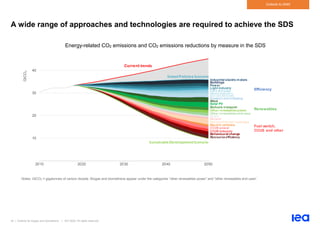
A wide range of approaches and technologies are required to achieve the SDS
Energy-related CO2 emissions and CO2 emissions reductions by measure in the SDS
Notes: GtCO2 = gigatonnes of carbon dioxide. Biogas and biomethane appear under the categories “other renewables power” and “other renewables end uses”.
10
20
30
40
2010 2020 2030 2040 2050
GtCO₂
Nuclear
Stated Policies Scenario
SustainableDevelopmentScenario
Biofuels transport
Air conditioners
Cars & trucks
Heavy industry
Solar PV
Wind
Hydro
Electric vehicles
Fuel switchincl. hydrogen
Buildings
CCUS industry
Resource efficiency
Aviation and shipping
Other renewables end-uses
Power
CCUS power
Other renewables power
Light industry
Behavioural change
Industrial electric motors
Current trends
Efficiency
Renewables
Fuel switch,
CCUS and other
43 | Outlook for biogas and biomethane | IEA 2020. All rights reserved
Outlook to 2040
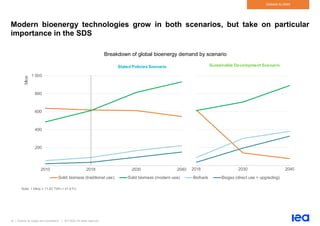
Modern bioenergy technologies grow in both scenarios, but take on particular
importance in the SDS
Breakdown of global bioenergy demand by scenario
Note: 1 Mtoe = 11.63 TWh = 41.9 PJ.
200
400
600
800
1 000
2010 2018 2030 2040
Mtoe
Stated Policies Scenario
Solid biomass (traditional use) Solid biomass (modern use) Biofuels Biogas (direct use + upgrading)
2018 2030 2040
Sustainable Development Scenario
44 | Outlook for biogas and biomethane | IEA 2020. All rights reserved
Outlook to 2040
Energy transitions give biogas and biomethane the opportunity to gain a firmer
foothold in global energy consumption
A wide range of technologies and policies are required to bring down
emissions and ensure universal access.
In the SDS, alongside widespread improvements in energy efficiency,
there is also a step change in the pace at which renewable technologies
are deployed. This is most visible in the power sector, where
renewables provide two-thirds of electricity supply worldwide by 2040
(up from one-quarter today). Of this, solar PV and wind power together
provide 40%, with a further 25% from dispatchable renewables
including hydro and bioenergy.
The growth in low-carbon electricity is accompanied by the rising
importance of electricity as an energy carrier. The share of electricity in
global final consumption rises from 19% today to more than 30% by
2040. The increase in electricity demand in the SDS comes from a
variety of sources; the largest is electric vehicles.
However, even with rapid growth in low-carbon electricity, more than
two-thirds of final consumption in 2040 in the SDS comes from other
sources, mainly from liquids and gases.
And even if electricity use were to grow even faster and the complete
technical potential for electrification were deployed, there would still be
sectors requiring other energy sources (given today’s technologies),
with most of the world’s shipping, aviation and certain industrial
processes not yet “electric-ready”.
These trends open up significant possibilities for biogas and
biomethane. These gases can help to decarbonise parts of the energy
system that low-carbon electricity cannot reach. By enhancing the
flexible operation of power systems, they can facilitate the rise of wind
and solar. By displacing the traditional use of biomass, they can provide
clean cooking fuels as part of the drive for universal access to modern
energy. As a local, sustainable source of power and heat, they offer
communities and municipalities a way to meet clean energy
commitments in tandem with renewable electricity.
Biogas and biomethane start from a low base, but are the fastest-
growing forms of bioenergy in both the STEPS and the SDS. Their
combined market share in total modern bioenergy demand grows from
5% today to 12% by 2040 in STEPS and to 20% in SDS.
45 | Outlook for biogas and biomethane | IEA 2020. All rights reserved
Outlook to 2040
Outlook for biogas
46 | Outlook for biogas and biomethane | IEA 2020. All rights reserved
Outlook to 2040
Developing countries in Asia lead the growth in direct biogas use in the STEPS
Global biogas demand for direct use in the STEPS
Notes: Excludes biogas production used for upgrading to biomethane. “Other developing Asia” includes Southeast Asia and other developing economies in Asia Pacific.
1 Mtoe = 11.63 TWh = 41.9 PJ.
20%
40%
60%
80%
100%
2018 2030 2040
35 50 75 Mtoe
Rest of world
Africa
Other developing
Asia
India
China
Europe
North America
47 | Outlook for biogas and biomethane | IEA 2020. All rights reserved
Outlook to 2040
Biogas picks up quickly in the SDS and is widely used as a local source of
renewable power and heat, and for ensuring clean cooking access
Global demand for direct use of biogas in the SDS
Notes: “Power and heat” includes power generation as well as co-generation. “Buildings” includes the direct use of biogas for cooking and heating.
1 Mtoe = 11.63 TWh = 41.9 PJ.
25
50
75
100
2010 2018 2030 2040 2010 2018 2030 2040
Mtoe
Industry
Buildings
Power and heat
Advanced economies Developing economies
48 | Outlook for biogas and biomethane | IEA 2020. All rights reserved
Outlook to 2040
Low-cost feedstocks, supportive policies and relatively high natural gas prices
underpin biogas growth, led by the developing world
Global direct consumption of biogas was around 35 Mtoe in 2018.
Currently, over 60% of biogas production capacity lies in Europe and
North America. As the leading biogas-producing region, Europe has
around 20 000 biogas plants, with the majority situated in Germany.
Most are built for on-site electricity generation and co-generation, with
around 500 plants dedicated to the upgrading of biogas (OIES, 2019).
In the STEPS, projected production of biogas for direct consumption
more than doubles, reaching around 75 Mtoe in 2040. Most of this
growth comes from centralised plants that are fed by agricultural and
municipal solid waste sources in order to meet local power and heating
demand. The share of biogas used for power and heat rises from
around 70% today to 85% by 2040.
Providing a renewable and reliable source of power has typically been
the easiest route to market for biogas, given incentives such as feed-in-
tariffs, subsidy grants and tax relief schemes that can also support the
development of rural areas. The economic case for biogas improves
when biodigesters are favourably located – e.g. close to feedstock
sources, electricity networks and local heat offtake – or where
co-benefits, such as the ability of biogas plants to treat wastewater with
high levels of organic pollutants, are recognised and remunerated.
Such co-benefits from biogas production can address a suite of
sustainability priorities in developing economies, which are set to
capture three-quarters of the growth in global biogas production. China,
already producing almost a third of the global total, is seeking to expand
rural biogas production to reduce air pollution from coal use while
improving waste management practices, with plans to reach a level of
nearly 17 Mtoe (20 bcm) by 2030 (from around 7 Mtoe today). India has
offered to provide financial support to local biogas co-generation plants
and has overseen the deployment of more than 5 million household
biogas units for clean cooking. The prospects for biogas are further
galvanised by wider bioenergy targets in countries such as Indonesia,
Malaysia and Thailand. These countries are seeking to develop a
biogas market by leveraging vast quantities of available residues
produced from certain industry sectors, such as the palm oil industry.
In the SDS, robust policy support for biogas development translates into
nearly double the production level of the STEPS by 2040, along with a
wholesale shift towards the use of sustainable feedstocks. Over
80 Mtoe of biogas is produced in developing economies alone, which
exploit their vast potential from agricultural residues and MSW. Growth
is underpinned by the use of biogas as a relatively stable source of
renewable electricity generation; this becomes more valuable as
developing economies increase the share of variable wind and solar in
their electricity generation mix.
Biogas also provides an important option to support clean energy
commitments at community level, especially where access to national
electricity grids is more challenging, or where there is a large
requirement for heat that cannot be met by renewable electricity. There
is also a considerable push to develop biogas for clean cooking. By
2030, around 200 million people move away from the traditional use of
biomass through biogas, half of whom are in Africa.
49 | Outlook for biogas and biomethane | IEA 2020. All rights reserved
Outlook to 2040
Biogas development in the SDS means scaling up a range of production
technologies
Global biogas production for direct use in the SDS by technology, units installed and average flow rate, 2040
Notes: Bubble size indicates production level in 2040 in the SDS. Household digesters are considered only in developing economies, and are primarily deployed to ensure access
to clean cooking.
Biodigester - small
Biodigester - medium
Biodigester - large
Landfill gas recovery
Wastewater digester
Bubble size:
Production in SDS
20 Mtoe
Household digesters
500
1000
1500
2000
2500
100 1 000 10 000 100 000 1 000 000 10 000 000
Average
unit
size
(m
3
/hr)
Number of units
Advanced
Developing
50 | Outlook for biogas and biomethane | IEA 2020. All rights reserved
Outlook to 2040
The choice of biogas production technologies is conditioned by policy priorities
and local circumstances
The development of a biogas industry ultimately depends on the policy
framework in different countries and regions, which is itself informed by
broader renewable energy goals and targets. In Europe most biogas
plants to date have been built to capture feed-in tariffs and other forms
of support for renewable power generation. In developing economies,
development funding has driven the deployment of biodigesters at
household and community levels to help ensure rural energy access.
In the SDS, there is an acceleration in the production of biogas in
several regions. The installation of household biogas digesters is part
of a concerted policy drive to ensure access to clean cooking solutions
in developing economies, particularly for geographically dispersed
populations located in rural areas far from cities or not connected to gas
or electricity grids. Scaling up the use of household biogas in the SDS
requires annual additions of over 5 million biodigesters in developing
economies over the period to 2040.
A range of medium- and large-scale centralised biodigesters are also
deployed in this scenario to capture agricultural wastes across a larger
number of sources. These centralised units form around clusters of
agricultural feedstock sources (e.g. a dense set of industrial farming
facilities) and produce in the range of 500 m3/hour to 1 000 m3/hour of
biogas; economies of scale mean lower per-unit capital and operating
costs compared with smaller-scale commercial units. Such facilities
could provide heat to local, captive distribution systems as well as
power to national grids.
With low marginal costs of installing capture equipment, closed landfill
facilities make the largest contribution to the growth in total biogas
production in the SDS, as emerging economies increasingly adopt more
comprehensive and efficient waste management practices.
Biogas production in the SDS ultimately comes from thousands of local,
small-scale facilities, compared with the traditional large-scale
centralised infrastructure that meets most energy service demand
today. While this has several co-benefits for rural communities, it also
creates challenges for scaling up output, as larger plants require more
sophisticated co-operative models and are also more exposed to the
variability of different waste streams. It is also less certain that biogas
digesters can undergo the type of factory-style modular fabrication that
has driven down the manufacturing costs of other renewable
technologies, such as solar PV.
Policy frameworks need to value the co-benefits of biogas, including
reduced air pollution, avoided emissions, and rural and agricultural
development, and to consider its contribution in these areas relative to
other bioenergy pathways (i.e. biofuels or solid biomass). Tailoring
support schemes to local conditions could also ensure that a biogas
industry develops as a partner, rather than competitor, to food
production.
Below, this report considers the role of biogas as a way to provide clean
cooking in Africa, to illustrate how well-designed policies can overcome
some of the barriers to larger-scale deployment.
51 | Outlook for biogas and biomethane | IEA 2020. All rights reserved
Outlook to 2040
Focus: The role of biogas as a clean cooking fuel
52 | Outlook for biogas and biomethane | IEA 2020. All rights reserved
Outlook to 2040
The direct use of biogas can be crucial to accessing clean cooking while improving
waste management, especially in developing economies
The world has made considerable progress towards achieving universal
access to electricity in recent years, but increasing access to clean
cooking facilities remains challenging. In sub-Saharan Africa, around
900 million people lack access to clean cooking facilities (or, five out of
six people), accounting for a third of the global total. Almost 95% of
them use solid biomass, in the form of fuelwood, charcoal or dung in
open fires, while the remainder use kerosene (especially in Nigeria) or
coal (mostly in Southern Africa).
At the global level, 80% of those without access to clean cooking are
located in rural areas, and they make up 60% of the world’s rural
population. Less than 15% of the urban population globally lacks access
to clean cooking, thanks to wider access to cleaner options.
There are a range of modern fuels and technologies that can provide
clean cooking, including natural gas, LPG, electricity, bioethanol and
biogas, or improved biomass cook stoves which deliver significant
improvements compared with basic biomass cook stoves or three-stone
fires. The choice among these options is a consequence of the
interactions among policy, geography, demographics and
socio-economic factors.
Rural areas face a unique array of challenges in transitioning towards
clean cooking, with the lack of availability of modern fuels being one of
the principal barriers to change:
• LPG is not always available due to long distances and poor transport
links between distribution centres and households. Moreover, there
can also be competition for supply from urban areas.
• A move to electric cooking is impeded by very low rates of electricity
access in rural areas in Africa, the unreliability of electricity supply
in many places where it does exist, the prioritisation of electricity for
uses such as lighting and appliances, and a cultural preference in
many countries for cooking over a flame.
• Other modern fuels such as ethanol and processed biomass pellets
or briquettes often face similar barriers to access.
Household air pollution resulting from reliance on inefficient and
polluting cook stoves is directly linked to nearly 500 000 premature
deaths in sub-Saharan Africa in 2018, and 2.5 million globally. There
are also around 3 million deaths attributable to outdoor air pollution, half
of which are in China and India. Stubble burning, the practice of
intentional burning of the stubble that remains after grains have been
harvested, is a major contributor to air pollution. There have been
attempts to restrict this practice, but it remains common in many
developing economies (in India, stubble burning can account in certain
peak days for up to 40% of air pollution in Delhi).
Turning organic waste such as animal manure or crop residues into
biogas via a simple household biodigester offers a way to support rural
development and to alleviate these health impacts. In China, for
example, subsidy support was based on the diversion of household
sewage towards biodigesters, with major positive health impacts.
53 | Outlook for biogas and biomethane | IEA 2020. All rights reserved
Outlook to 2040
Household biodigesters have higher upfront costs but much lower fuel and
operating costs than other clean cooking options
Global ranges of spending for different clean cooking technologies in developing economies, 2018
Notes: ICS = Improved cook stoves. Electric stoves are considered for households connected to the centralised grid or minigrid.
Sources: IEA analysis based on data from Politecnico di Milano (2016), World Bank (2014) and Hivos (2019).
150
300
450
600
750
900
ICS using
fuelwood
ICS using
charcoal
LPG
stoves
Household
biodigester
Electric
stoves
USD
(2018)
/unit
Unsubsidised capital costs
150
300
450
600
750
900
ICS using
fuelwood
ICS using
charcoal
LPG
stoves
Household
biodigester
Electric
stoves
USD
(2018)
/yr
Annual fuel costs
54 | Outlook for biogas and biomethane | IEA 2020. All rights reserved
Outlook to 2040
The upfront costs of installing a biodigester are the main economic barrier today to
their use, despite payback periods as little as two years
Research in East Africa shows that families with access to biogas see
benefits in terms of ease of cooking and a reduction in the time spent
collecting fuelwood, as well as a lower incidence of health and
respiratory problems. There are also potential co-benefits in terms of
agricultural productivity (as a result of using the digestate as fertiliser)
and reducing deforestation (Clemens et al., 2018).
The main economic challenge is the relatively high upfront cost of the
biodigester. In Africa, upfront costs for an average-size household
biodigester with a technical lifetime of over 20 years can range between
USD 500 and USD 800 (ter Heegde, 2019). Installation costs for other
clean cooking technologies are much lower. However, on a total cost-
of-ownership basis, biodigesters have a corresponding advantage by
having low or non-existent fuel costs, and basic digesters can prove
their relative worth once they surpass two years of continuous use.
A part of the capital cost can be reduced by using traditional and locally
available construction materials such as sand and gravel, and by relying
on local labour. For the remainder, financing help is often needed.
There are also significant non-economic barriers. Biogas systems have
been in use as early as the 1980s to provide clean cooking in rural parts
of Africa and Asia. However, their wide-scale diffusion has been limited
by a number of deployment challenges, such as difficulties with
providing a continuous availability of feedstock and ensuring proper
maintenance of biodigesters. These barriers can be even more
pronounced for a biodigester at the community scale or larger. The
same research in East Africa showed that more than a quarter of
biodigesters installed between 2009 and 2013 were out of operation by
2016 because of a lack of readily available maintenance expertise
(Clemens et al., 2018).
While there are no fuel costs for running household biodigesters,
producing and gathering sufficient feedstock cannot be taken for
granted. For example, in order to generate enough biogas to cook for
two to three hours per day and prepare one family meal, 20 to 30 kg of
fresh dung has to be available on a daily basis, along with an equivalent
quantity of water. Feeding a household biodigester regularly with animal
manure requires at least two mature cattle, so any deterioration in
household circumstances quickly affects biogas production, while local
communities need to develop and maintain a system to collect waste
and residues for centralised biodigesters.
Well-designed development assistance programmes could help
overcome these barriers and thereby encourage the wider diffusion of
household biodigesters. Training a local workforce and involving local
communities in the construction of biogas production plants can create
durable employment opportunities while ensuring the optimal use of
biodigesters over their full technical lifetimes.
Local entrepreneurs and government partnerships with the private
sector also have a crucial role to play in overcoming these barriers, with
governments promoting investment through a range of subsidy
programmes, community grants and favourable financing facilities. This
is crucial for attracting private-sector participation, particularly
independent energy companies, private equity and infrastructure funds,
which can help scale up the supply chain while benefiting from lower-
cost financing afforded by government-backed investment
programmes.
55 | Outlook for biogas and biomethane | IEA 2020. All rights reserved
Outlook to 2040
Today there is enough sustainable feedstock to satisfy the entire energy demand
for clean cooking in Africa
Cost curve of potential biogas supply by feedstock in Africa, 2018
Notes: “Crops” includes crops residues only; energy crops are excluded given concerns about their sustainability.
1 MBtu = 0.29 MWh.
10
20
30
0 10 20 30 40 50
USD/Mbtu
(2018)
Mtoe
Crops*
Animal manure
Municipal solid waste
Municipal wastewater
56 | Outlook for biogas and biomethane | IEA 2020. All rights reserved
Outlook to 2040
By 2030, an additional 200 million people, half of whom are in Africa, use biogas in
SDS to move away from reliance on traditional use of solid biomass
The agricultural sector employs around half of the labour force in Africa,
meaning biogas is a strong contender for large-scale diffusion across
the population. However, a clear picture of today’s consumption of
biogas in Africa is not available due to lack of data. This report estimates
that current biogas use is around 5 000 toe (6 million m3 of natural gas
equivalent), and its use is concentrated in countries with specific
support programmes for this fuel.
Some governments, such as Benin, Burkina Faso and Ethiopia, provide
subsidies that can cover anywhere from half to the full cost of
investment, while numerous projects promoted by non-governmental
organisations provide practical know-how and subsidies to lower the net
investment cost. In addition to these subsidies, credit facilities have
made progress in a few countries. A limited number of companies in
Kenya have recently developed a new lease-to-own (LtO) arrangement,
and around 45% of the households in Kenya that installed a digester in
2018 financed their unit through an LtO arrangement (ter Heegde,
2019).
Based on this new bottom-up assessment, this report estimates that
Africa has the potential to provide nearly 50 Mtoe of locally produced
low-carbon biogas, largely via household-scale biodigesters; this
potential doubles to almost 100 Mtoe by 2040, at an average cost of
around USD 15/MBtu. The case for developing biogas in Africa is
strongest for rural areas with large agricultural sectors. Crop residues,
especially cereals, account for almost 60% of the total potential, animal
manure for close to 25%, and MSW for most of the remainder. At the
end of the outlook period, the picture changes slightly as further
urbanisation increases the availability of MSW and as anticipated
changes in diet underpin an increase in livestock and therefore of
animal manure.
Projected consumption of biogas rises to more than 3 Mtoe in Africa by
2040 in STEPS. However, this is only a fraction of the potential. Africa’s
rural electrification needs and the achievement of universal access to
clean cooking could push biogas demand three times higher, at 9 Mtoe
by 2040 (over half of this would be used as a clean cooking fuel, the
remainder for power generation). In such a scenario, more than
100 million people in Africa use biogas to move away from reliance on
traditional use of solid biomass.
57 | Outlook for biogas and biomethane | IEA 2020. All rights reserved
Outlook to 2040
Outlook for biomethane
58 | Outlook for biogas and biomethane | IEA 2020. All rights reserved
Outlook to 2040
Developing countries in Asia lead the way for biomethane
Biomethane demand in the STEPS and SDS by region
Note: 1 Mtoe = 11.63 TWh = 41.9 PJ.
50
100
150
200
250
2018 2025 2030 2035 2040
Mtoe
Stated Policies Scenario
North America Asia Pacific Europe Rest of world
2025 2030 2035 2040
Sustainable Development Scenario
59 | Outlook for biogas and biomethane | IEA 2020. All rights reserved
Outlook to 2040
The policy environment shapes the biomethane outlook
Whichever way the energy system evolves over the coming decades,
biomethane is on a growth trajectory. But the extent of that growth
varies substantially between STEPS and SDS, responding to the
different market and policy environment that each scenario describes.
Since biomethane is indistinguishable from natural gas, it can reach any
grid-connected residential or commercial building, industrial facility, or
power plant and can provide energy services to a broad spectrum of
sectors and end users. To be injected, biomethane has to comply with
the gas grid specifications originally planned for natural gas.
Viewed through the lens of decarbonisation, the optimal uses of
biomethane are in end-use sectors where there are fewer low-carbon
alternatives, such as high-temperature heating, petrochemical
feedstocks, heavy-duty transport and maritime shipping. But there are
other motivations that can play into the uses of biomethane, including
rural development, energy security (where biomethane is used instead
of natural gas transported over long distances or imported, or where it
is used flexibly to complement electricity from variable wind and solar
PV), and urban air quality.
This range of motivations is visible in IEA scenarios, notably in
developing economies in Asia (including China, India, Southeast Asia
and other developing economies in Asia Pacific) that account for the
bulk of the growth. China produces over 30 Mtoe of biomethane by
2040 in the STEPS, which is injected into its expanding natural gas grid,
while India’s consumption grows to 15 Mtoe, in part to support the
expansion of gas use in the transport sector.
In the case of China, biomethane largely substitutes for domestic coal
and imported natural gas (biomethane provides a much greater
reduction in CO2 emissions than switching from coal to natural gas). In
India, it substitutes for the traditional use of solid biomass and for oil
products, where import dependence stands at around 80% of total
demand.
Projected consumption growth in STEPS is more limited in countries
with mature gas markets. Consumption in North America increases to
just under 10 Mtoe. European biomethane use reaches 12 Mtoe in
2040, accounting for 2.5% of the gas used in natural gas grids.
At the moment, 70% of the biomethane used in Europe comes from
energy crops. The share of waste and residue feedstocks is set to rise,
though, as policies seek to encourage bioenergy that avoids
competition with food or feed production, and industry initiatives (such
as the Biogas Done Right concept developed by the Italian Biogas
Association) gain traction.
In the SDS, the production and use of biomethane accelerates in all
regions, a consequence of strengthened efforts to lower the carbon
footprint of gas and ensure energy access across the developing world.
The Asia Pacific region sees by far the largest growth, driven in large
part by China and India, but gains are also visible elsewhere: by 2040,
there is a 10% blend of biomethane in gas grids in Europe and a 5%
blend in North America. This represents a step change in the role of
biomethane in global energy.
60 | Outlook for biogas and biomethane | IEA 2020. All rights reserved
Outlook to 2040
Biomethane sees broad-based growth across all sectors, reflecting existing uses
of natural gas …
Global biomethane demand in the STEPS and SDS by sector
Note: 1 Mtoe = 11.63 TWh = 41.9 PJ.
50
100
150
200
250
2018 2025 2030 2035 2040
Mtoe
Stated Policies Scenario
Power and heat Industry Transport Buildings
2025 2030 2035 2040
Sustainable Developement Scenario
61 | Outlook for biogas and biomethane | IEA 2020. All rights reserved
Outlook to 2040
… while also tapping into markets such as transport, where biomethane demand
rises in line with the growing gas-fuelled fleet in some countries and regions
Change in gas use in transport in the SDS, 2040 versus 2018
Note: 1 Mtoe = 11.63 TWh = 41.9 PJ.
10
20
30
40
50
China United States India Europe
Mtoe
Natural gas
Biomethane
62 | Outlook for biogas and biomethane | IEA 2020. All rights reserved
Outlook to 2040
Electricity and liquid biofuels are the main vectors for decarbonising transport, but
biomethane finds a niche in some countries and sectors
Reducing emissions from the transport sector is a central challenge of
energy transitions. Efficiency, electrification and alternative fuels are the
key vectors for reducing reliance on oil, with biofuels currently
displacing around 2 million barrels per day of oil demand. Natural gas
is also playing a role in some sectors and countries; there are some
28 million natural gas-fuelled vehicles on the road today, representing
around 1% of the global road fleet. This also opens up opportunities for
biomethane.
The case for using compressed natural gas (CNG) or LNG for transport
is strongest in transport segments where electrification is a more
challenging prospect, such as long-haul road freight and shipping.
Although the provision of gas fuelling infrastructure adds expense and
complexity, there are possibilities to build infrastructure along
established routes (for example those used by captive fleets such as
municipal buses, refuse collection vehicles, or ferries and cruise ships)
or along key transport corridors sustaining a significant portion of tonne-
or passenger-kilometre activity.
The environmental case for natural gas in these applications rests on
much lower air pollutant emissions, allied to an appreciable reduction in
CO2 compared with combustion of oil. The counterargument points to
the risk of fugitive methane emissions along the natural gas supply
chain as well as at the vehicle tailpipe.
The use of biomethane as a transport fuel bolsters the environmental
case for gas-based vehicles. It also has a distinctive advantage over
bioethanol and biodiesel, which can often be subject to blend share
limitations (since they are not identical to gasoline and diesel);
biomethane, by contrast, can fully replace natural gas as a source of
fuel without any changes required to the engine.
Around one-fifth of existing biomethane plants produce either CNG
(bio-CNG) or more energy-dense liquefied gas (bio-LNG) for the
transport sector, but their use in transport is currently very small. How
far and fast this niche role expands depends to a large degree on policy
design and the buildout of infrastructure.
The United States is the current leader in this area, due to incentives
from the federal Renewable Fuel Standard and California’s Low Carbon
Fuel Standard. Several countries in Europe are also developing gas-
based transport infrastructure; most of Sweden’s biomethane
production is used in vehicles, giving it the highest share of biomethane
use in transport demand. Italy has a well-established natural gas vehicle
fleet and an expanding fuelling network, and has recently introduced
biomethane blending obligations. India also has ambitious plans to
expand the use of biomethane in transport, targeting the buildout of
5 000 bio-CNG stations by 2025. Most of the small quantities of
biomethane produced in China today are used in gas-fired vehicles –
primarily buses and heavy-duty trucks.
The use of biomethane in transport reaches more than 25 Mtoe in
STEPS by 2040, or around 30% of total biomethane consumption; a
lack of policy commitments elsewhere limits overall growth. In the SDS,
biomethane consumption in the transport sector is nearly twice as high,
with India accounting for the largest share of vehicles running on
biomethane by 2040.
63 | Outlook for biogas and biomethane | IEA 2020. All rights reserved
Outlook to 2040
Focus: Biomethane and the future of gas infrastructure
64 | Outlook for biogas and biomethane | IEA 2020. All rights reserved
Outlook to 2040
What role for gas infrastructure in a low-emissions future?
In many respects, the prospects for biomethane and other low-carbon
gases are tied up with wider questions about the future role of gas
infrastructure in energy transitions. Long-term strategies need to
consider the potential for existing and new infrastructure to deliver
different types of gases in a low-emissions future, as well as their role
in ensuring energy security. There is a concurrent need to consider
interactions and possible synergies between the delivery systems for
liquids, gases and electricity.
WEO analysis has consistently highlighted the enormous potential for
electricity to play a bigger direct role in the energy system in the future
(IEA, 2018). Indeed, all deep decarbonisation pathways envisage a low-
carbon energy system in which an expansion of low-carbon electricity
generation is accompanied by widespread electrification of industrial
processes, electric heating takes over market share from natural gas in
buildings, and electric transport is ubiquitous.
Since 2000, global electricity demand has grown two-thirds faster than
total final consumption. Worldwide investment in electricity generation,
networks and storage in 2018 exceeded USD 750 billion, more than
combined investment in oil and gas supply.
However, there are limits to how quickly and extensively electrification
can occur, as electricity is not well suited to deliver all types of energy
services. Even if the complete technical potential for electrification were
deployed, there would still be sectors requiring other energy sources
(given today’s technologies).
For example, most of the world’s shipping, aviation, heavy-freight trucks
and certain industrial processes are not yet “electric-ready”. While in the
future these sectors could use fuels that have been generated using
electricity (such as hydrogen or synthetic fuels), some of these fuels
would need a separate delivery infrastructure.
The energy security value of overlapping infrastructure can also be an
important consideration for policy makers. Maintaining a parallel gas
infrastructure system adds a layer of resilience compared with an
approach that relies exclusively on electricity. This was visible, for
example, in Japan when gas-fired generation stepped in to provide
power following the shutdown of its nuclear reactors from 2011. It also
provides a useful hedge against the risks that electrification and the
development of new electricity networks do not increase at the pace
needed to displace existing fuels while meeting energy service
demands.
However, if gas infrastructure is to secure its role in a low-emissions
system, it will ultimately need to deliver truly low-carbon energy
sources.
65 | Outlook for biogas and biomethane | IEA 2020. All rights reserved
Outlook to 2040
Electricity cannot be the only vector for the energy sector’s transformation …
Final energy consumption by carrier in 2018 and 2040 in the SDS
Notes: Figure excludes the direct use of renewables and coal for generating heat and the traditional use of solid biomass.
1 Mtoe = 11.63 TWh = 41.9 PJ.
1 000
2 000
3 000
4 000
5 000
Liquids Gases Electricity
Mtoe
2018
High carbon Low carbon
Liquids Gases Electricity
2040
66 | Outlook for biogas and biomethane | IEA 2020. All rights reserved
Outlook to 2040
… but can gas infrastructure be repurposed to deliver low-carbon energy?
In the SDS, the share of electricity in final consumption rises from 19%
today to 30% by 2040, and there is a simultaneous decarbonisation of
supply through a significant expansion of renewables, particularly wind
and solar PV but also bioenergy, hydropower and nuclear. Still, half of
final energy consumption in 2040 remains served by liquids and gases;
the share of low-carbon sources in liquids supply also rises to 14%, and
in gas supply to 18%.
Replicating the services that gas grids provide via low-carbon electricity
may be possible in some parts of the world, in particular areas that have
ample resources to generate renewable electricity, relatively limited
winter heating requirements, and an economic base (services and
certain industrial subsectors) that is amenable to electrification.
However, elsewhere, substituting electricity for gas as a way to provide
services to end consumers is likely to be much more challenging and
expensive.
There are practical issues with deploying electric heating at scale in
both industry and residential sectors. The scale of infrastructure
investments required to balance peak loads with variable supply
present a significant barrier to full electrification. Batteries are becoming
cheaper and are well suited to manage short-term variations in
electricity supply and demand, but they are unlikely to provide a cost-
effective way to cope with large seasonal swings.
If there is, instead, an option to use some existing infrastructure to
deliver decarbonised gases, then these networks could be used through
energy transitions and beyond. As things stand, gas networks are the
primary delivery mechanism for energy to consumers in many
countries; in Europe and the United States, for example, they provide
far more energy to end users than electricity networks. Allied to gas
storage facilities, they also provide a valuable source of flexibility,
scaling up deliveries as necessary to meet peaks in demand.
The two main options to decarbonise gas supply are biomethane and
low-carbon hydrogen.
There has been a surge of interest in low-carbon hydrogen in recent
years, although for the moment it is relatively expensive to produce.
Blending low-carbon hydrogen into gas grids would not only mean lower
CO2 emissions, but also help scale up production of hydrogen and so
reduce its costs (IEA, 2019b). Further, since there is no widespread
infrastructure today for dedicated hydrogen transport, the existing
natural gas grid in many countries could be used to transport hydrogen
at much lower unit costs than would be the case if new dedicated
hydrogen pipelines had to be built.
With minor modifications, transmission networks could probably cope
with hydrogen blends of up to 15-20%, depending on the local context.
However, regulations on hydrogen blending today are generally based
on natural gas supply specifications or the tolerance of the most
sensitive piece of equipment on the grid. As a result, only very low levels
of blending are allowed: in many countries, no more than 2% hydrogen
blending is currently permitted (IEA, 2019b).
Unlike hydrogen, biomethane, a near-pure source of methane, is
indistinguishable from natural gas and so can be used without the need
for any changes in transmission and distribution infrastructure or end-
user equipment.
67 | Outlook for biogas and biomethane | IEA 2020. All rights reserved
Outlook to 2040
Maintaining viable and well-functioning gas infrastructure is a feature of the SDS …
Average annual investment in LNG and gas pipeline infrastructure in the SDS
Notes: T&D = transmission and distribution. Investments show maintenance costs.
10
20
30
40
50
60
70
2011-20 2021-30 2031-40 2011-20 2021-30 2031-40
Billion
dollars
(2018)
T&D pipelines
LNG regasification
LNG liquefaction
Developing economies Advanced economies
68 | Outlook for biogas and biomethane | IEA 2020. All rights reserved
Outlook to 2040
… but this scenario is far from business-as-usual for the gas industry and for the
owners of gas infrastructure
The trajectory of gas demand in the SDS means a reduced requirement
for spending on gas infrastructure, especially after 2030. There is an
increasing divergence in trends between advanced economies, where
investment levels fall more sharply, and developing economies. In all
cases, an increasing share of total spending is for the maintenance of
existing networks: investment in new assets continues in some places
to meet rising gas demand in the near term, but this also has to take
adequate account of longer-term trends.
The growth in biomethane, along with low-carbon hydrogen, provides a
way to future-proof continued investment in gas infrastructure in the
SDS. However, there are uncertainties about the optimal configuration
of the gas grid, including the costs involved in maintaining its role as a
flexible delivery mechanism for large quantities of energy.
The chosen pathway to deliver low-carbon gases has major implications
for investment in storage and delivery capacity, processing and
separation requirements, blending tolerances, and choices about end-
user equipment. The uptake of technologies that create
interdependences between gas and electricity networks (for example,
electrolysers or hybrid heat pumps) will also determine the scale of
investments required for gas grids
The location and size of biomethane and hydrogen production facilities
are also crucial variables for the scale and types of infrastructure
investments. There are many uncertainties over the way this might play
out in practice, but in general biomethane production is likely to be more
dispersed than hydrogen, requiring (if it is not consumed locally)
thousands of new grid connections. By contrast, hydrogen is likely to be
done at scale and, in most cases, as close as possible to concentrations
of end users (such as industrial clusters).
On the regulatory side, gas quality specifications are an essential step
in scaling up production from a variety of different feedstocks and
technologies. Blending levels and injected volumes also need to be
properly tracked in order to support certification schemes (such as
guarantees of origin or the development of national registries), which
are required for policies that remunerate consumption of low-carbon
gases. There may also be a need to incentivise low-carbon gas
production through the socialisation of grid connection charges.
Another important consideration, particularly in the context of ambitions
to reach net-zero emissions, is whether low-carbon gases, on their own,
can eventually provide for a fully carbon-neutral gas system. The
volumes of low-carbon gases delivered to consumers are on a sharp
upward trajectory in the SDS by 2040, but whether they can be scaled
up to provide 100% decarbonised gases depends on numerous factors,
including relative technology costs, supply availability and the trajectory
for gas demand (including seasonality).
In the case of the European Union, maximising the full sustainable
technical potential of biomethane would allow it to reach a 40% share
of total gas demand in 2040. Options to tackle emissions from the
remaining share would include accelerated investments in low-carbon
hydrogen, CCUS or carbon offsetting mechanisms, alongside efficiency
measures and fuel switching to reduce further gas consumption.
Implications for policy makers and industry
70 | Outlook for biogas and biomethane | IEA 2020. All rights reserved
Implications
Investment
71 | Outlook for biogas and biomethane | IEA 2020. All rights reserved
Implications
In energy transitions, gas investment has to shift towards low-carbon supply …
Average annual investment in gas by scenario
100
200
300
400
500
2016-18 2021-25 2026-30 2031-35 2036-40 2021-25 2026-30 2031-35 2036-40
Billion
USD
(2018)
Biomethane,
biogas, gas-based
CCUS and low-
carbon hydrogen
Natural gas
Stated Policies Scenario Sustainable Development Scenario
72 | Outlook for biogas and biomethane | IEA 2020. All rights reserved
Implications
… and spending on biogas and biomethane picks up sharply
Average annual investment in low-carbon gas by scenario
Notes: CCUS is gas-based, and includes investments in power and industry. Values exclude cost of feedstock. Biomethane costs include the cost of developing biogas production
capacity, as well as the upgrading cost.
20
40
60
80
2010-19 2020-30 2031-40 2020-30 2031-40
Billion
USD
(2018)
Low-carbon hydrogen
CCUS
Biogas
Biomethane
Stated Policies Scenario Sustainable Development Scenario
73 | Outlook for biogas and biomethane | IEA 2020. All rights reserved
Implications
New business models and improved access to financing are critical to the
prospects for biogas and biomethane
Currently, biogas and biomethane projects represent only a small
fraction of total global spending on gas. Investments have averaged
less than USD 4 billion per year over the last decade, the same amount
the natural gas industry typically spends every week.
In the STEPS, annual spending on biogas and biomethane rises more
than threefold to reach around USD 14 billion by 2040. Rising spending
on biomethane eclipses the amount invested in the direct use of biogas
by the late 2020s. However, the share of biomethane and biogas in total
investment spending on gas remains well below 5%.
The SDS sees a significant upside to this trend. As investment in natural
gas declines, total capital spending on low-carbon gases rises to
capture over a quarter of total investment in global gas supply, as
biogas and biomethane are scaled up and hydrogen and CCUS are
added to the mix of low-carbon gases. Biomethane and biogas projects
remain the largest destination for low-carbon gas investment, capturing
40% of the total; by 2040, around USD 30 billion is spent on biomethane
injected into gas grids every year, around the same level of investment
being made in shale gas development in the United States today. These
investments are made primarily in developing economies in Asia,
particularly China and India, which together make up nearly 40% of total
global spending.
The investments made in the SDS assume that several financing
barriers are overcome. At the moment, biogas and biomethane projects
encounter some of the same financing challenges as other small-scale,
distributed renewable projects (especially in developing economies).
Local banks often serve as a first port of call for raising the capital
necessary for a biogas project; however, the loan requirements are
often too small to attract project finance, and also potentially too large
for individual investors (e.g. farmers) to raise the required equity. The
latter is usually around 20-25% of the initial capital costs (which, for a
medium-sized biogas plant producing around 2 million cubic metres per
year [1.7 kilotonnes of oil equivalent], would be in the range of
USD 1.5 million to USD 2 million).
From a banking perspective, there is often a lack of technical expertise
in this area and relatively few benchmarks to assess adequately the
risk/return profile for individual projects. There are also some risks that
can be difficult to assess, e.g. the ability to secure reliable feedstock of
consistent quality or, in the case of biomethane, to meet the rigorous
gas quality specifications for injection into national distribution networks.
These issues can increase risk perceptions and raise the cost of debt
or reduce the loan tenure available to potential investors.
Various models are being tested to overcome these hurdles; for
example, project sponsors such as energy companies or larger-scale
agricultural firms can offer an integrated business model to farming
communities, in order to take advantage of fixed feed-in tariffs or other
forms of subsidy, which typically yield a lower risk for securing finance.
Farming co-operatives or other models that aggregate feedstock
sources are also viable routes to scale up production.
Both biogas and biomethane projects might also benefit from the
growing accessibility of financial instruments focused on renewable
projects, such as green bonds or targeted institutional investor funds.
74 | Outlook for biogas and biomethane | IEA 2020. All rights reserved
Implications
Energy security
75 | Outlook for biogas and biomethane | IEA 2020. All rights reserved
Implications
As a domestic source of gas, biomethane can help to mitigate dependence on
imported fuels
Natural gas imports and biomethane production in the SDS, 2040 (left) and import bill savings from biomethane (right)
Note: 1 bcm = 0.83 Mtoe.
100
200
300
400
China European
Union
India
bcm
Natural gas imports Biomethane production
10
20
30
40
China European
Union
India
Billion
USD
(2018)
76 | Outlook for biogas and biomethane | IEA 2020. All rights reserved
Implications
Storage helps to reap the full energy security benefits of biomethane
For import-dependent countries, investment in biomethane supply can
displace the need for fuel imports. Natural gas imports in India, for
example, increase from 30 bcm in 2018 to 220 bcm in 2040 in the SDS,
while in China natural gas imports double from today’s levels to reach
260 bcm in 2040.
There is widespread biomethane potential in both of these countries, a
significant proportion of which is available at relatively low cost. In India,
biomethane consumption in 2040 in this scenario is around 35 bcm, and
in China, 90 bcm. If this energy demand were to be met instead by
natural gas, imports would be around 15% higher in India and 35% in
China. Moreover, every additional billion cubic metres of biomethane
produced in China or India could save over USD 300 million on fuel
import costs; by 2040, both countries would see tens of billions in import
bill savings in the SDS, which could help offset the costs of developing
a domestic biomethane industry.
The security-of-supply implications of biomethane production on gas
networks require careful evaluation. Scaling up biomethane production
means gas supply becomes more decentralised. This reduces
excessive reliance on the operation of a limited number of large-scale
production, storage and import nodes. However, as with electricity
distribution, gas grids would need to accommodate the growth of supply
at the distribution level; impacts might be felt in grid balancing, while
changes to tariff structures and capacity charges might be needed to
incentivise injection at the distribution level while avoiding penalising
other grid-connected customers.
Most biomethane projects today require a high and relatively constant
level of plant utilisation to recoup their initial investment costs, meaning
that (in the absence of storage) the seasonal “swing” capabilities of
biomethane plants – the ability to ramp up and down – could be limited
in some cases. This could have implications for countries with high
winter heating loads, where the ratio of average-to-peak demand for
biomethane may be an order of magnitude higher than the ratio of
average-to-peak supply. For those countries that have it, gas storage
capacity would be able to manage this issue. The spare capacity within
gas transmission pipelines could also be leveraged to meet short-term
peak periods of demand, whether for electricity or heat. Countries
looking to replace seasonal LNG or pipeline imports with biomethane
would need to assess feedstock types and their productive cycles to
understand the energy security implications of this switch.
In the power sector, plants running on biogas and biomethane can
provide an important complement to the rising shares of variable
renewables such as wind and solar. By leveraging the energy storage
potential from gas infrastructure, these renewable gases could also be
used to flexibly meet peak electricity demand.
Biogas and biomethane also have co-benefits in terms of food security,
as the by-product from production – digestate – can be used as a
fertiliser and so obviate the need for imports (for example, the European
Union must import 30% of its nitrogen consumption, 60% of its
phosphorus and 75% of its potassium (European Commission, 2019).
77 | Outlook for biogas and biomethane | IEA 2020. All rights reserved
Implications
Reductions in CO2 and methane
78 | Outlook for biogas and biomethane | IEA 2020. All rights reserved
Implications
A carbon price enhances the economic value of organic waste
Average value of feedstock sources for biomethane production according to different carbon prices, 2018
10
20
30
40
50
50 100 150 200
Feedstock
value
(USD/tonne)
Carbon price (USD/tonne)
Municipal solid waste
Crop residues
Animal manure
79 | Outlook for biogas and biomethane | IEA 2020. All rights reserved
Implications
Biogas and biomethane help to avoid CO2 emissions by displacing the use of more
polluting fuels and by enabling the rise of other renewables
The potential to realise CO2 emissions reduction from using biogas or
biomethane depends on how these gases are produced and where they
are used in the value chain. From a policy perspective, it is essential
that the production of biogases (and all other forms of bioenergy)
actually deliver net life-cycle CO2 emissions reduction.
For example, a 10% volume blend of biomethane in a natural gas
pipeline would in theory reduce CO2 emissions in the gas consumed by
10%. However, there are emissions from the collection, processing and
transport of the biogas feedstock that need to be weighed against the
CO2 emissions that arise during the production, processing and
transport of natural gas (GRDF, 2018) (Giuntoli et al., 2015). These
indirect emissions can vary considerably between sources of
biomethane and natural gas and, unless minimised, they could reduce
the CO2 emissions savings from the use of biomethane.
The same is true of low-carbon hydrogen: a 10% volume blend in a
natural gas pipeline would reduce CO2 emissions by 3-4% (for a given
level of energy). However, the different potential energy inputs and
conversion technologies to produce hydrogen mean a careful life-cycle
emissions approach is needed to ensure that it is truly low-carbon
(McDonagh et al., 2019).
There is an additional opportunity for CO2 emissions reductions from
biomethane production. Biogas upgrading generates a highly
concentrated by-product stream of CO2 that could be captured for as
little as USD 20 per tonne of CO2 (tCO2) (Koornneef J. et al., 2013).
Carbon prices enhance the economic case for biomethane
consumption, supporting the development of plants in areas of
feedstock availability and in many cases providing additional sources of
income to rural communities. The value of each feedstock type
ultimately depends on the production yield of each tonne of collected
waste, and also on the costs of collecting and processing the waste. At
carbon prices of USD 50/tCO2, for example, a tonne of MSW used for
biomethane production would be worth nearly USD 10, as it could be
used to deliver carbon-neutral electricity and heat. However, carbon
prices would need to more than triple to unlock the same value from a
tonne of crop residue.
Globally, low-carbon hydrogen and biomethane blended into the gas
grid in the SDS avoid around 500 Mt of annual CO2 emissions that
would have occurred in 2040 if natural gas were used instead.
80 | Outlook for biogas and biomethane | IEA 2020. All rights reserved
Implications
Putting a value on avoided methane can dramatically tilt the cost equation in favour
of biomethane …
Global marginal abatement costs for biomethane to replace natural gas, with and without credit for avoided methane
emissions, 2018
Note: Chart shows the biomethane potential starting from the cheapest production options that would require a GHG price; the first 30 Mtoe of the global biomethane potential costs
less than regional natural gas prices (and so should not require a GHG price to be cheaper than natural gas).
40
80
120
160
50-100 100-150 150-200 200-250
USD/tonne
CO2-eq
Biomethane used to replace natural gas (Mtoe)
Without credit for
methane
With credit for
methane
81 | Outlook for biogas and biomethane | IEA 2020. All rights reserved
Implications
… but finding a way to account for methane-related savings is not simple
There is around 30 Mtoe of biomethane potential today that can be
developed cost-effectively at a cost lower than the regional gas price.
As discussed, if CO2 prices are applied to the combustion of natural
gas, then a much larger quantity of biomethane becomes an attractive
proposition. If policy also recognises the value of avoided methane
emissions that would otherwise take place from the decomposition of
feedstocks, then an even larger quantity would be cost-competitive.
Methane is such a potent GHG that attaching a value to these avoided
emissions makes a dramatic difference to its overall supply cost profile.
Some of the feedstocks that are used to produce biomethane would
decompose and produce methane emissions if not carefully managed.
This applies in particular to animal manure and the organic fraction of
MSW at landfill sites. In both cases, anaerobic digestion can happen
spontaneously, generating methane emissions. All other potential
biomethane feedstock types, such as crop residues, generally degrade
in the presence of oxygen (not under anaerobic conditions) and so do
not commonly result in methane emissions.
Biomethane production can avoid methane emissions from certain
organic waste by capturing and processing them instead. Even if these
emissions occur outside the energy sector, they should be credited to
biomethane. This is already the case within California’s Low Carbon
Fuel Standard, which considers the full life-cycle GHG emissions for
biomethane and gives credit to avoided methane.
Yet estimating the size of this credit is not straightforward, as it depends
on a reasonable “counterfactual” case for what level of methane
emissions would have occurred if the feedstock had not been converted
into biomethane, which can vary according to region and over time. For
example, there is wide regional variation in how methane produced
within landfill sites is currently handled. In Europe, most sites have
capture facilities, with the captured methane (known as “landfill gas”)
either flared or used for power generation. In the United States, around
55% of the methane that is generated in landfill sites across the country
is captured. Around 20% of the remainder breaks down before reaching
the atmosphere, meaning that close to 35% of the methane generated
in landfills is emitted to the atmosphere. There is a lack of reliable data
on landfills in most developing economies, but the percentage of
methane that is captured is likely to be considerably lower than in
advanced economies.
There are a number of policy frameworks for how “avoided” methane
emissions should be handled or credited (e.g. the Clean Development
Mechanism (UNFCCC, 2019), but there is currently no globally agreed
or universally accepted framework. Different ways of handling these
emissions can have a major impact on the apparent cost-effectiveness
of using biomethane to reduce global GHG emissions.
For example, if no credit were to be awarded for avoiding methane
emissions, but a credit were to be given for the CO2 that is avoided from
displacing natural gas, then around 60 Mtoe of biomethane potential
would be economic at a USD 50/tonne GHG price. If avoided methane
emissions were to be additionally included, then more than 120 Mtoe
would be economic at a USD 50/tonne GHG price.
82 | Outlook for biogas and biomethane | IEA 2020. All rights reserved
Implications
Considerations for policy makers
83 | Outlook for biogas and biomethane | IEA 2020. All rights reserved
Implications
Realising the potential of biogas and biomethane will depend on policies that
recognise the benefit of low-carbon gases in energy transitions
Biogas and biomethane both have enormous potential to contribute to
clean energy transitions and help achieve a number of energy-related
Sustainable Development Goals. There have been previous waves of
enthusiasm for these gases but today they meet only a fraction of total
energy demand. This is because they are generally more expensive
than natural gas and they have not enjoyed the same level of policy
support as renewable sources of electricity such as wind and solar PV.
If biogas and biomethane are to play a more prominent role in the future
energy mix, it will be critical to recognise both the benefits that they
provide over natural gases and the enduring importance of gaseous
energy carriers.
This report outlines some possible approaches for consideration by
governments and other stakeholders seeking to facilitate biogas and
biomethane market development. Two key features of any policy
framework are to:
• Support the competitiveness of biogas and biomethane against oil,
natural gas and coal via CO2 or GHG pricing mechanisms. This
should include recognising the significant GHG emissions
abatement potential of biogas/biomethane from avoiding direct
methane emissions from feedstock decomposition to the
environment. There are many examples of existing and planned
policies that do this globally, including the Low Carbon Fuel
Standard in California and the forthcoming Netherlands SDE++
policy.
• Ensure co-ordinated policy-making across agriculture, waste
management, energy and transport to deliver an integrated
approach to developing the biogas and biomethane sector. There
are several co-benefits of developing a biogas industry, including
employment and income for rural communities, improved gender
equality, health benefits from avoided air pollution and proper waste
management, reduced risk of deforestation, and greater resource
efficiency. These benefits cut across the competencies and
jurisdictions of different government departments, and ultimately a
holistic approach is required that adequately values these benefits,
and hence incentivises public and private investment in their
development.
This report concludes with possible policy considerations and
approaches in three areas:
• Availability of sustainable biogas and biomethane feedstocks.
• Support for biogas and biomethane consumption.
• Support for biogas and biomethane supply.
84 | Outlook for biogas and biomethane | IEA 2020. All rights reserved
Implications
1. Availability of sustainable biogas and biomethane feedstocks
Specific ways to support the availability of sustainable feedstocks for
biogas and biomethane production could include:
• Introduce comprehensive waste management policies and
regulations to enhance the collection, sorting and pre-treatment of
MSW, creating suitable biomass feedstock for biogas production in
urban areas.
• Enhance the collection of unavoidable food waste by banning landfill
disposal and introducing segregated collection.
• Promote sequential cropping trials and programmes to maximise
feedstock resources from a given area of agricultural land, without
affecting food production.
• Apply appropriate and harmonised sustainability criteria to ensure
only sustainable feedstocks are used for biogas and biomethane
production.
• Introduce GHG monitoring and reporting requirements for large-
scale biogas and biomethane production units.
• Undertake comprehensive national and regional assessments of
feedstock availability and cost, including a screening of optimal
locations for biogas and biomethane plants, and assessing the
potential at municipal level.
• Conduct feasibility assessments at existing landfill and water
treatment plants to assess potential for landfill/sewage gas
production.
85 | Outlook for biogas and biomethane | IEA 2020. All rights reserved
Implications
2. Support for biogas and biomethane consumption
Policy measures or approaches that could lead to greater consumption
of biogas and biomethane include:
• Consider the wider positive externalities when developing
biogas/biomethane policy support, as the benefits from biogas and
biomethane extend beyond the provision of renewable heat,
electricity and transport fuels.
• Encourage the creation of biogas and biomethane industry jobs in
rural locations, through promotional campaigns and training
programmes.
• Support the adoption of biogas installations in rural areas of
developing countries for clean cooking through subsidy
programmes covering a certain percentage of the capital cost or
microcredit schemes that would allow households to pay off the
capital costs over time using the economic savings produced by the
biogas plant.
• Design renewable electricity auction frameworks for power
purchase agreements that recognise and reward the flexible
generation potential of biogas systems.
• Develop registries to track and balance the volumes of biomethane
injected to the gas network and subsequently consumed. These are
an essential component in the application of policy support and are
already in place in 14 European countries.
• Introduce quotas for renewable energy in transport that include
sub-targets for advanced bioenergy production from waste and
residues, for example the European Union (EU) Renewable Energy
Directive sub-target of 3.5% of transport energy demand from such
fuels by 2030.
• Roll out natural gas/biomethane fuelling infrastructure along key
road freight corridors to enable biomethane consumption, a relevant
example being the EU Alternative Fuels Infrastructure Directive.
• Promote public procurement of biomethane-fuelled vehicles that
operate as captive fleets, e.g. municipal refuse collection vehicles
and city buses.
• Utilise pricing units that allow comparison with other transport fuels,
e.g. units of gasoline or diesel equivalents.
• Develop a framework for the use of digestate as a soil
improver/fertiliser, e.g. through appropriate regulations, standards
and certifications.
• Consider setting binding targets for renewable gases, based on
quotas linked to total gas consumption.
• Develop more targeted incentives for renewable sources of power
generation which can provide baseload and load-following services.
86 | Outlook for biogas and biomethane | IEA 2020. All rights reserved
Implications
3. Support for biogas and biomethane supply
Policy measures or approaches that could lead to greater supply of
biogas and biomethane include
• Introduce low-carbon and renewable gas standards and incentives
for their use, considering the appropriateness of feed-in tariffs, feed-
in premiums or auction-based support schemes for renewable
gases.
• Establish targets for biogas electricity capacity, biomethane
production or injection into natural gas networks based on realistic
assessments of feedstock availability and the status of the industry.
• Introduce fiscal benefits, for example accelerated depreciation for
the purchase of equipment/accessories for biogas production, and
exemptions from excise duty for imported equipment and
biomethane fuels.
• Develop relevant technical specifications, for example the European
EN 16723-1 (2016) standard for the injection of biomethane in the
gas grid and EN 16723-2 (2017) standard for biomethane use in
transport.
• Stimulate innovation in solid biomass gasification to accelerate its
commercialisation.
• Develop frameworks for co-operative infrastructure deployment for
biomethane upgrading and gas network injection, reducing the
investment and operational costs for multiple biogas producers in
the same geographical location, e.g. multiple farm digester units.
• Establish a shared understanding about the path to minimise the risk
of conflicts between the strategies of market participants with
differing commercial interests.
• Utilise nationally appropriate mitigation actions in developing
countries to facilitate technology transfer, financing and capacity
building from developed countries
• Harness overseas development assistance to co-fund the market-
based provision of household and community-scale biogas systems
in developing countries.
• Raise awareness of biogas’s potential in key industry subsectors
such as food and drink, and chemicals.
• Clarify and harmonise Guarantee of Origin schemes and regulations
in collaboration with other governments to encourage virtual cross-
border trade of low-carbon gas.
Annex
88 | Outlook for biogas and biomethane | IEA 2020. All rights reserved
Annex
Acknowledgements
This report was prepared by the Energy Supply and Investment Outlook
(ESIO) Division of the Directorate of Sustainability, Technology and
Outlooks in cooperation with the Renewable Energy Division (RED) of
the Directorate of Energy Markets and Security at the International
Energy Agency. The principal authors were Michela Cappannelli,
Christophe McGlade and Peter Zeniewski (ESIO), and Pharoah Le
Feuvre (RED), with major contributions from Tim Gould (Head of ESIO
Division), who designed and directed the analysis.
Other key contributors from across the International Energy Agency
were, Praveen Bains, Arthur Contejean, Timothy Goodson, Apostolos
Petropoulos and Molly A. Walton. Ryszard Pośpiech and Eleni
Tsoukala provided essential support.
Valuable comments and feedback were provided by senior
management and numerous other colleagues within the IEA, in
particular, Laura Cozzi, Paolo Frankl, Keisuke Sadamori, Laszlo Varro
and Mechthild Wörsdörfer.
The analysis relies heavily on the scenario analysis and modelling
undertaken by the entire World Energy Outlook team.
Thanks also go to Astrid Dumond, Tanya Dyhin, Maria Kyriacou, Katie
Lazaro, Jad Mouawad, Jethro Mullen and Therese Walsh of the
Communications and Digital Office. Erin Crum was the editor.
Valuable input was provided by Paul Hughes (independent consultant),
and by the IEA Bioenergy TCP Task 37 (Jerry D. Murphy, School of
Engineering University College Cork).
The United States Environmental Protection Agency provided
invaluable support to this report.
Many experts from outside the IEA provided input, commented on the
underlying analytical work, and reviewed a preliminary draft of the
report. Their comments and suggestions were of great value. The work
also benefited greatly from discussions at a high-level workshop held in
Paris on 19 February 2019.
The individuals and organisations that contributed to this study are not
responsible for any opinions or judgements it contains. All errors and
omissions are solely the responsibility of the IEA.
89 | Outlook for biogas and biomethane | IEA 2020. All rights reserved
Annex
Peer reviewers
ABIOGAS – Brazilian Biogas and
Biomethane Association
CIB – Italian Consortium Biogas
CNREC – China National
Renewable Energy Center
EIB – European Investment Bank
Engie
Eni
ENTSOG - European Network of
Transmission System Operators
for Gas
IEA TCP - Bioenergy - Task 37
OIES – The Oxford Institute for
Energy Studies
Seokyeong University, Seoul
Korea
SNV – Netherlands Development
Organisation
SUEZ
Tokyo Gas Co., Ltd.
Gabriel Kropsch
Marco Pezzaglia
Dou Kejun
Susana Lagarto
Marta Kamola-Martines
Ottavia Stella
Séan Kinsella
Cihan Soenmez
Jerry Murphy
Martin Lambert
Kim Gi-Eun
Wim van Nes
Pablo Kroff
Masazumi Hirono
Denise M Mulholland U.S. Environmental Protection
Agency
90 | Outlook for biogas and biomethane | IEA 2020. All rights reserved
Annex
References
Cedigaz (2019). Global biomethane market: Green gas goes global
(press release, 20 March). https://www.cedigaz.org/global-
biomethane-market-green-gas-goes-global/.
Clemens et al. (2018). Africa Biogas Partnership Program: A review of
clean cooking implementation trhough market development in
East Africa. Energy for Sustainable Development.
https://doi.org/10.1016/j.esd.2018.05.012.
Dennehy C. et al. (2017). Stochastic modelling of the economic
viability of on-farm co-digestion of pig manure and food waste
in Ireland. https://doi.org/10.1016/j.apenergy.2017.08.101.
EBA (European Biogas Association) (2019). Statistical Report.
https://www.europeanbiogas.eu/eba-statistical-report-2019/.
ETSAP (Energy Technology System Analysis Programme) (2013).
Biogas and Bio-syngas Production. https://iea-etsap.org/E-
TechDS/PDF/P11_BiogasProd_ML_Dec2013_GSOK.pdf.
European Commission. (2019). Fertilisers in the EU.
https://ec.europa.eu/info/sites/info/files/food-farming-
fisheries/farming/documents/market-brief-
fertilisers_june2019_en.pdf.
Giuntoli J. et al. (2015). Solid and Gaseous Bioenergy Pathways: Input
Values and GHG Emissions. Italy: European Commission Joint
Research Centre, Institute for Energy and Transport, Ispra.
https://ec.europa.eu/energy/sites/ener/files/documents/Solid%2
0and%20gaseous%20bioenergy%20pathways.pdf.
GMI (Global Methane Institute) (2019).
https://www.globalmethane.org/partners/partner.aspx?c=india,
(accessed 1 July 2019).
GRDF (Gaz réseau distribution France). (2018). Perspectives gaz
naturel & renouvelables sur l'horizon 2018-2035 [Natural gas
and renewables perspectives, 2018-2035].
http://www.grtgaz.com/fileadmin/plaquettes/fr/2019/Perspective
s-Gaz-2018.pdf.
Hivos. (2019). Beyond fire: How to achieve electrical cooking,
28 March, https://www.hivos.org/news/beyond-fire-how-to-
achieve-electric-cooking/.
IEA (International Energy Agency). (2019a). Renewables 2019.
https://www.iea.org/reports/renewables-2019.
IEA. (2019b). World Energy Outlook 2019.
https://www.iea.org/reports/world-energy-outlook-2019.
IEA. (2018). World Energy Outlook 2018.
https://www.iea.org/reports/world-energy-outlook-2018.
Koornneef J. et al. (2013). Potential for biomethane production with
carbon capture, transport and storage up to 2050.
https://doi.org/10.1016/j.egypro.2013.06.533
McDonagh S. et al. (2019). Are electro fuels a sustainable transport
fuel? Analysis of the effect of controls on carbon, curtailment,
and cost of hydrogen.
https://doi.org/10.1016/j.apenergy.2019.04.060.
Navigant (2019). Gas for Climate.
https://www.gasforclimate2050.eu/files/files/Navigant_Gas_for_
91 | Outlook for biogas and biomethane | IEA 2020. All rights reserved
Annex
Climate_The_optimal_role_for_gas_in_a_net_zero_emissions_
energy_system_March_2019.pdf.
OIES (The Oxford Institute for Energy Studies) (2019). A mountain to
climb? Tracking progress in scaling up renewable gas
production in Europe.
https://www.oxfordenergy.org/publications/a-mountain-to-climb-
tracking-progress-in-scaling-up-renewable-gas-production-in-
europe/?v=11aedd0e4327.
Politecnico di Milano. (2016). Cookstove costs, in “Defining energy
access: 2019 methodology” (IEA article).
https://www.iea.org/articles/defining-energy-access-2019-
methodology.
SNV (Netherlands Development Organisation) (2019). Technical
potential for household biodigesters in Africa.
https://snv.org/update/increased-technical-potential-african-
household-biodigesters.
UNFCCC (United Nations Framework Convention on Climate Change)
(2019). CDM Methodology Booklet.
https://cdm.unfccc.int/methodologies/documentation/meth_book
let.pdf.
USDA (United States Department of Agriculture) (2016). Methane
Emissions from Dairy Farming. (Fact Sheet).
http://www.sustainabledairy.org/publications/Documents/DairyC
ap_Methane_FactSheet_Final.pdf.
World Bank. (2014). Clean and improved cooking in sub-Saharan
Africa: A landscape report.
http://documents.worldbank.org/curated/en/1642414681787574
64/Clean-and-improved-cooking-in-Sub-Saharan-Africa-a-
landscape-report.
The IEA examines the full spectrum of
energy issues including oil, gas and
coal supply and demand, renewable
energy technologies, electricity
markets, energy efficiency, access to
energy, demand side management
and much more. Through its work, the
IEA advocates policies that will
enhance the reliability, affordability
and sustainability of energy in its 30
member countries, 8 association
countries and beyond.
Please note that this publication is
subject to specific restrictions that limit
its use and distribution. The terms and
conditions are available online at
www.iea.org/t&c/
Source: IEA. All rights reserved.
International Energy Agency
Website: www.iea.org
IEA member countries:
Australia
Austria
Belgium
Canada
Czech Republic
Denmark
Estonia
Finland
France
Germany
Greece
Hungary
Ireland
Italy
Japan
Korea
Luxembourg
Mexico
Netherlands
New Zealand
Norway
Poland
Portugal
Slovak Republic
Spain
Sweden
Switzerland
Turkey
United Kingdom
United States
IEA association countries:
Brazil
China
India
Indonesia
Morocco
Singapore
South Africa
Thailand
INTERNATIONAL ENERGY AGENCY
This publication reflects the views of the IEA Secretariat but does not necessarily reflect those of individual IEA member
countries. The IEA makes no representation or warranty, express or implied, in respect of the publication’s contents
(including its completeness or accuracy) and shall not be responsible for any use of, or reliance on, the publication.
Unless otherwise indicated, all material presented in figures and tables is derived from IEA data and analysis. This
publication and any map/figure/table included herein are without prejudice to the status of or sovereignty over any
territory, to the delimitation of international frontiers and boundaries and to the name of any territory, city or area. Please
note that this publication is subject to specific restrictions that limit its use and distribution. The terms and conditions are
available online at iea.org/t&c
IEA. All rights reserved.
IEA Publications
International Energy Agency
Website: iea.org
Contact information: iea.org/about/contact
Design in France by IEA – March 2020

Outlook_for_biogas_and_biomethane.pdf

  • 1.
    Outlook for biogasand Prospects for organic growth World Energy Outlook Special Report biomethane
  • 2.
    2 | Outlookfor biogas and biomethane | IEA 2020. All rights reserved Table of contents Key findings................................................................................................................................................................................................................... 4 An introduction to biogas and biomethane ...................................................................................................................................................................12 Sustainable supply potential and costs ........................................................................................................................................................................24 Biogas supply potential and costs.............................................................................................................................................................................26 Biomethane supply potential and costs.....................................................................................................................................................................34 The outlook for biogas and biomethane to 2040 ..........................................................................................................................................................40 Outlook for biogas.....................................................................................................................................................................................................45 Focus: The role of biogas as a clean cooking fuel ....................................................................................................................................................51 Outlook for biomethane.............................................................................................................................................................................................57 Focus: Biomethane and the future of gas infrastructure ...........................................................................................................................................63 Implications for policy makers and industry..................................................................................................................................................................69 Investment ................................................................................................................................................................................................................70 Energy security .........................................................................................................................................................................................................74 Reductions in CO2 and methane...............................................................................................................................................................................77 Considerations for policy makers..............................................................................................................................................................................82 Annex...........................................................................................................................................................................................................................87
  • 3.
    3 | Outlookfor biogas and biomethane | IEA 2020. All rights reserved Introduction The case for biogas and biomethane lies at the intersection of two critical challenges of modern life: dealing with the increasing amount of organic waste that is produced by modern societies and economies, and the imperative to reduce global greenhouse gas (GHG) emissions. By turning organic waste into a renewable energy resource, the production of biogas or biomethane offers a window onto a world in which resources are continuously used and reused, and one in which rising demand for energy services can be met while also delivering wider environmental benefits. In assessing the prospects for “organic growth” of biogas and biomethane, this new report from the International Energy Agency (IEA) explores how big a role these gases can play in the transformation of the global energy system, where the opportunities and potential pitfalls lie, and what policy makers and industry can do to support sustainable growth in this sector. The answers to these questions rest on a major new IEA analysis of the sustainable potential for biogas and biomethane supply, including a detailed assessment of feedstock availability and production costs across all regions of the world. This provides a platform to explore the various services that biogas and biomethane can provide in different countries, which vary widely depending on circumstances and policy priorities. Biogas can be a valuable local source of power and heat, as well as a clean cooking fuel to displace reliance on the traditional use of solid biomass in many developing countries. There are also potential co-benefits in terms of agricultural productivity (as a result of using the residual “digestate” from biodigesters as a fertiliser) and reducing deforestation. When upgraded, biomethane (also known as renewable natural gas) is indistinguishable from natural gas and so can be transported and used in the same way. Biomethane can deliver the energy system benefits of natural gas while being carbon-neutral. The value of biogas and biomethane is heightened in scenarios such as the IEA Sustainable Development Scenario (SDS), which meet in full the world’s goals to tackle climate change, improve air quality and provide access to modern energy. Projections from the SDS provide an essential benchmark for much of the discussion in this report. Biogas and biomethane have the potential to support all aspects of the SDS, which charts a path fully consistent with the Paris Agreement by holding the rise in global temperatures to “well below 2°C … and pursuing efforts to limit [it] to 1.5°C”, and meets objectives related to universal energy access and cleaner air. The other scenario referenced in the analysis is the Stated Policies Scenario (STEPS), which provides an indication of where today’s policy ambitions and plans, including national policy announcements and pledges, would lead the energy sector. Comparison between the outcomes in these two scenarios provides an indication of the range of possible futures that are open to biogas and biomethane, and the policy and technology levers that will affect which pathway they ultimately follow.
  • 4.
  • 5.
    5 | Outlookfor biogas and biomethane | IEA 2020. All rights reserved Key findings 1. Biogas and biomethane producers take organic residues and wastes and turn them into a valuable modern source of clean energy Modern societies and economies produce increasing amounts of organic waste that can be used to produce clean sources of energy, with multiple potential benefits for sustainable development. Biogas and biomethane are different products with different applications, but they both originate from a range of organic feedstocks whose potential is underutilised today. The production and use of these gases embody the idea of a more circular economy, bringing benefits from reduced emissions, improved waste management and greater resource efficiency. Biogas and biomethane also provide a way to integrate rural communities and industries into the transformation of the energy sector. Biogas and biomethane production pathways
  • 6.
    6 | Outlookfor biogas and biomethane | IEA 2020. All rights reserved Key findings 2. The feedstocks available for sustainable production of biogas and biomethane are huge, but only a fraction of this potential is used today A detailed, bottom-up study of the worldwide availability of sustainable feedstocks for biogas and biomethane, conducted for this report, shows that the technical potential to produce these gases is huge and largely untapped. These feedstocks include crop residues, animal manure, municipal solid waste, wastewater and – for direct production of biomethane via gasification – forestry residues. This assessment considers only those feedstocks that do not compete with food for agricultural land. Biogas and biomethane production in 2018 was around 35 million tonnes of oil equivalent (Mtoe), only a fraction of the estimated overall potential. Full utilisation of the sustainable potential could cover some 20% of today’s worldwide gas demand. Biogas and biomethane production in 2018 against the sustainable potential today 35 Mtoe Biogas potential 570 Mtoe Biomethane potential 730 Mtoe Actual production
  • 7.
    7 | Outlookfor biogas and biomethane | IEA 2020. All rights reserved Key findings 3. Possibilities to produce biogas and biomethane are widely distributed around the world Every part of the world has significant scope to produce biogas and/or biomethane, and the availability of sustainable feedstocks for these purposes is set to grow by 40% over the period to 2040. The largest opportunities lie across the Asia Pacific region, where natural gas consumption and imports have been growing rapidly in recent years, and there are also significant possibilities across North and South America, Europe, and Africa. The overall potential is set to grow rapidly over the next two decades, based on increased availability of the various feedstocks in a larger global economy, including the improvement in waste management and collection programmes in many parts of the developing world. Production potential for biogas or biomethane by feedstock source, 2018 Notes: C&S America = Central and South America. Woody biomass feedstocks are available only for biomethane production. 50 100 150 200 250 Asia Pacific North America C & S America Europe Africa Rest of World Mtoe Woody biomass Municipal wastewater Municipal solid waste Animal manure Crop residues
  • 8.
    8 | Outlookfor biogas and biomethane | IEA 2020. All rights reserved Key findings 4. Biogas offers a local source of power and heat, and a clean cooking fuel for households Biogas is a mixture of methane, CO2 and small quantities of other gases that can be used to generate power and to meet heating or cooking demand. Its uses and competitiveness depend on local circumstances, but a common element is that biogas offers a sustainable way to meet community energy needs, especially where access to national grids is more challenging or where there is a large requirement for heat that cannot be met by renewable electricity. In developing countries, biogas reduces reliance on solid biomass as a cooking fuel, improving health and economic outcomes. In the SDS, biogas provides a source of clean cooking to an additional 200 million people by 2040, half of which in Africa. Biogas can also be upgraded to produce biomethane by removing the CO2 and other impurities. The outlook for global biogas consumption by sector 50 100 150 200 250 300 350 2018 2030 2040 2030 2040 Mtoe Upgraded to biomethane Industry Buildings and agriculture Power and heat Stated Policies Sustainable Development
  • 9.
    9 | Outlookfor biogas and biomethane | IEA 2020. All rights reserved Key findings 5. When upgraded, biomethane brings all the energy system benefits of natural gas without the associated net emissions Biomethane is a near-pure source of methane produced either by “upgrading” biogas or through the gasification of solid biomass; since it is indistinguishable from the regular natural gas stream, it can be transported and used wherever gas is consumed, but without adding to emissions. Biomethane grows rapidly in IEA scenarios. It allows countries to reduce emissions in some hard-to-abate sectors, such as heavy industry and freight transport. It also helps to make some existing gas infrastructure more compatible with a low-emissions future, thereby improving the cost-effectiveness and security of energy transitions in many parts of the world. Biomethane in the SDS avoids around 1 000 million tonnes (Mt) of GHG emissions in 2040. This includes the CO2 emissions that would have occurred if natural gas had been used instead, as well as the methane emissions that would otherwise have resulted from the decomposition of feedstocks. The outlook for global biomethane consumption by region Notes: 1 Mtoe = 11.63 TWh = 1.21 bcm-equivalent to natural gas. China = People’s Republic of China. 50 100 150 200 250 2018 2030 2040 2030 2040 Mtoe Rest of world North America Europe India China Stated Policies Sustainable Development
  • 10.
    10 | Outlookfor biogas and biomethane | IEA 2020. All rights reserved Key findings 6. Most of the biomethane potential is more expensive than natural gas, but the cost gap narrows over time With the exception of some landfill gas, most of the biomethane assessed in this report is more expensive than the prevailing natural gas prices in different regions. The average price for biomethane produced today is around USD 19 per million British thermal units (MBtu), with some additional costs for grid injection. However, this report estimates that around 30 Mtoe (~40 billion cubic metres [bcm]) of biomethane – mostly landfill gas – could be produced today at a price that undercuts the domestic price of natural gas; this is already ten times more than total biomethane consumption today. The cost gap is projected to narrow over time as biomethane production technologies improve and as carbon pricing in some regions makes natural gas more expensive. Recognition of the value of avoided CO2 and methane emissions goes a long way towards improving the cost- competitiveness of biomethane. Cost ranges for developing global biomethane potential today 200 400 600 800 0-5 5-10 10-15 15-20 20-25 >25 Total potential Mtoe 20 Mtoe 35 150 210 190 125 730 USD/MBtu
  • 11.
    11 | Outlookfor biogas and biomethane | IEA 2020. All rights reserved Key findings 7. Low-carbon gases are essential to energy transitions; supportive policies are required to unlock the potential for biogas and biomethane Multiple fuels and technologies will be required to accelerate energy transitions, and low-carbon gases – led by biomethane and low-carbon hydrogen – have critical roles to play. The 20% share of electricity in global final consumption is growing, but electricity cannot carry energy transitions on its own against a backdrop of rising demand for energy services. Biomethane is the largest contributor to low- carbon gas supply in the time horizon of the World Energy Outlook (WEO) Scenarios. How the biogas and biomethane industry evolves will vary by country depending on the sectoral focus, feedstock availability, prevailing market conditions and policy priorities. In all cases, however, realising the multiple benefits of biogas and biomethane requires co-ordinated policy- making across energy, transport, agriculture, environment and waste management. Final energy consumption by carrier in 2018 and 2040 in the SDS Note: Low-carbon gases include low-carbon hydrogen, biomethane and low-carbon synthetic methane, along with gas-based carbon capture, utilisation and storage (CCUS) used in large-scale industry. 1 000 2 000 3 000 4 000 5 000 Liquids Gases Electricity Mtoe 2018 High carbon Low carbon Liquids Gases Electricity 2040
  • 12.
    12 | Outlookfor biogas and biomethane | IEA 2020. All rights reserved An introduction to biogas and biomethane
  • 13.
    13 | Outlookfor biogas and biomethane | IEA 2020. All rights reserved An introduction to biogas and biomethane What are biogas and biomethane? Biogas is a mixture of methane, CO2 and small quantities of other gases produced by anaerobic digestion of organic matter in an oxygen- free environment. The precise composition of biogas depends on the type of feedstock and the production pathway; these include the following main technologies: • Biodigesters: These are airtight systems (e.g. containers or tanks) in which organic material, diluted in water, is broken down by naturally occurring micro-organisms. Contaminants and moisture are usually removed prior to use of the biogas. • Landfill gas recovery systems: The decomposition of municipal solid waste (MSW) under anaerobic conditions at landfill sites produces biogas. This can be captured using pipes and extraction wells along with compressors to induce flow to a central collection point. • Wastewater treatment plants: These plants can be equipped to recover organic matter, solids, and nutrients such as nitrogen and phosphorus from sewage sludge. With further treatment, the sewage sludge can be used as an input to produce biogas in an anaerobic digester. The methane content of biogas typically ranges from 45% to 75% by volume, with most of the remainder being CO₂. This variation means that the energy content of biogas can vary; the lower heating value (LHV) is between 16 megajoules per cubic metre (MJ/m3) and 28 MJ/m3. Biogas can be used directly to produce electricity and heat or as an energy source for cooking. Biomethane (also known as “renewable natural gas”) is a near-pure source of methane produced either by “upgrading” biogas (a process that removes any CO₂ and other contaminants present in the biogas) or through the gasification of solid biomass followed by methanation: • Upgrading biogas: This accounts for around 90% of total biomethane produced worldwide today. Upgrading technologies make use of the different properties of the various gases contained within biogas to separate them, with water scrubbing and membrane separation accounting for almost 60% of biomethane production globally today (Cedigaz, 2019). • Thermal gasification of solid biomass followed by methanation: Woody biomass is first broken down at high temperature (between 700-800°C) and high pressure in a low-oxygen environment. Under these conditions, the biomass is converted into a mixture of gases, mainly carbon monoxide, hydrogen and methane (sometimes collectively called syngas). To produce a pure stream of biomethane, this syngas is cleaned to remove any acidic and corrosive components. The methanation process then uses a catalyst to promote a reaction between the hydrogen and carbon monoxide or CO2 to produce methane. Any remaining CO2 or water is removed at the end of this process. Biomethane has an LHV of around 36 MJ/m3. It is indistinguishable from natural gas and so can be used without the need for any changes in transmission and distribution infrastructure or end-user equipment, and is fully compatible for use in natural gas vehicles.
  • 14.
    14 | Outlookfor biogas and biomethane | IEA 2020. All rights reserved An introduction to biogas and biomethane There are multiple production pathways for biogas and biomethane Note: Only biomethane is considered suitable for use in the transport sector.
  • 15.
    15 | Outlookfor biogas and biomethane | IEA 2020. All rights reserved An introduction to biogas and biomethane A range of different feedstocks can be used to produce biogas and biomethane A wide variety of feedstocks can be used to produce biogas. For this report, the different individual types of residue or waste were grouped into four broad feedstock categories: crop residues; animal manure; the organic fraction of MSW, including industrial waste; and wastewater sludge. • Crop residues: Residues from the harvest of wheat, maize, rice, other coarse grains, sugar beet, sugar cane, soybean and other oilseeds. This report included sequential crops, grown between two harvested crops as a soil management solution that helps to preserve the fertility of soil, retain soil carbon and avoid erosion; these do not compete for agricultural land with crops grown for food or feed. • Animal manure: From livestock including cattle, pigs, poultry and sheep. • Organic fraction of MSW: Food and green waste (e.g. leaves and grass), paper and cardboard and wood that is not otherwise utilised (e.g. for composting or recycling). MSW1 also includes some industrial waste from the food-processing industry. • Wastewater sludge: Semi-solid organic matter recovered in the form of sewage gas from municipal wastewater treatment plants. Specific energy crops, i.e. low-cost and low-maintenance crops grown solely for energy production rather than food, have played an important part in the rise of biogas production in some parts of the world, notably in Germany. However, they have also generated a vigorous debate 1 MSW can either feed a biodigester or be disposed in landfill to produce landfill gas. about potential land-use impacts, so they are not considered in this report’s assessment of the sustainable supply potential. Using waste and residues as feedstocks avoids the land-use issues associated with energy crops. Energy crops also require fertiliser (typically produced from fossil fuels), which needs to be taken into account when assessing the life-cycle emissions from different biogas production pathways. Using waste and residues as feedstocks can capture methane that could otherwise escape to the atmosphere as they decompose. Most biomethane production comes from upgrading biogas, so the feedstocks are the same as those described above. However, the gasification route to biomethane can use woody biomass (in addition to MSW and agricultural residues) as a feedstock, which consists of residues from forest management and wood processing. The feedstocks described above were considered in this report’s assessment of the sustainable biogas and biomethane supply potential, and are further discussed in Section 3 below.
  • 16.
    16 | Outlookfor biogas and biomethane | IEA 2020. All rights reserved An introduction to biogas and biomethane Biogas: Most production today comes from crops and animal manure Biogas production by feedstock type, 2018 * Crops include energy crops, crop residues and sequential crops. Note: 1 Mtoe = 11.63 terawatt-hours (TWh) = 41.9 petajoules (PJ). 5 10 15 20 Rest of world United States China Europe Mtoe Crops* Animal manure Municipal solid waste Municipal wastewater
  • 17.
    17 | Outlookfor biogas and biomethane | IEA 2020. All rights reserved An introduction to biogas and biomethane The rise of biogas has been shaped by two main factors: Policy support and feedstock availability The development of biogas has been uneven across the world, as it depends not only on the availability of feedstocks but also on policies that encourage its production and use. Europe, the People’s Republic of China (hereafter, “China”) and the United States account for 90% of global production. Europe is the largest producer of biogas today. Germany is by far the largest market, and home to two-thirds of Europe’s biogas plant capacity. Energy crops were the primary choice of feedstock that underpinned the growth of Germany’s biogas industry, but policy has recently shifted more towards the use of crop residues, sequential crops, livestock waste and the capture of methane from landfill sites. Other countries such as Denmark, France, Italy and the Netherlands have actively promoted biogas production. In China, policies have supported the installation of household-scale digesters in rural areas with the aim of increasing access to modern energy and clean cooking fuels; these digesters account for around 70% of installed biogas capacity today. Different programmes have been announced to support the installation of larger-scale co-generation plants (i.e. plants producing both heat and power). Moreover, the Chinese National Development and Reform Commission issued a guidance document in late 2019 specifically on biogas industrialisation and upgrading to biomethane, supporting also the use of biomethane in the transport sector. In the United States, the primary pathway for biogas has been through landfill gas collection, which today accounts for nearly 90% of its biogas production. There is also growing interest in biogas production from agricultural waste, since domestic livestock markets are responsible for almost one-third of methane emissions in the United States (USDA, 2016). The United States is also leading the way globally in the use of biomethane in the transport sector, as a result of both state and federal support. Around half of the remaining production comes from developing countries in Asia, notably Thailand and India. Remuneration via the Clean Development Mechanism (CDM) was a key factor underpinning this growth, particularly between 2007 and 2011. The development of new biogas projects fell sharply after 2011 as the value of emission reduction credits awarded under the CDM dropped. Thailand produces biogas from the waste streams of its cassava starch sector, biofuel industry and pig farms. India aims to develop around 5 000 new compressed biogas plants over the next five years (GMI, 2019). Argentina and Brazil have also supported biogas through auctions; Brazil has seen the majority of production come from landfills, but there is also potential from vinasse, a by-product from the ethanol industry. A clear picture of today’s consumption of biogas in Africa is made more difficult by a lack of data, but its use has been concentrated in countries with specific support programmes. Some governments, such as Benin, Burkina Faso and Ethiopia, provide subsidies that can cover from half to all of the investment, while numerous projects promoted by non-governmental organisations provide practical know-how and subsidies to lower the net investment cost. In addition to these subsidies, credit facilities have made progress in a few countries, notably a recent lease-to-own arrangement in Kenya that financed almost half of the digester installations in 2018 (ter Heegde, 2019)
  • 18.
    18 | Outlookfor biogas and biomethane | IEA 2020. All rights reserved An introduction to biogas and biomethane Most of the biogas produced today goes to the power sector Note: GW = gigawatt. Source: IEA, 2019a. Power generation Co-generation Heat in buildings Upgraded to biomethane Biogas consumption by end use, 2018 0 2 4 6 8 10 12 14 16 18 2010 2012 2014 2016 2018 GW Others China Italy United Kingdom United States Germany Biogas installed power generation capacity, 2010-18
  • 19.
    19 | Outlookfor biogas and biomethane | IEA 2020. All rights reserved An introduction to biogas and biomethane Upgrading biogas to biomethane could be a major source of future growth Almost two-thirds of biogas production in 2018 was used to generate electricity and heat (with an approximately equal split between electricity-only facilities and co-generation facilities). Around 30% was consumed in buildings, mainly in the residential sector for cooking and heating, with the remainder upgraded to biomethane and blended into the gas networks or used as a transport fuel. Today there is around 18 GW of installed power generation capacity running on biogas around the world, most of which is in Germany, the United States and the United Kingdom. Capacity increased on average by 4% per year between 2010 and 2018. In recent years, deployment in the United States and some European countries has slowed, mainly because of changes in policy support, although growth has started to pick up in other markets such as China and Turkey. The levelised cost of generating electricity from biogas varies according to the feedstocks used and the sophistication of the plant, and ranges from USD 50 per megawatt-hour (MWh) to USD 190/MWh. A substantial part of this range lies above the cost of generation from wind and utility-scale solar photovoltaic (PV), which have come down sharply in recent years. The relatively high costs of biogas power generation mean that the transition from feed-in tariffs to technology-neutral renewable electricity auction frameworks (such as power purchase agreements) in many countries could limit the future prospects for electricity-only biogas plants. However, unlike wind and solar PV, biogas plants can operate in a flexible manner and so provide balancing and other ancillary services to the electricity network. Recognising the value of these services would help to spur future deployment prospects for biogas plants. Where local heat off-take is available, the economic case for biogas co-generation is stronger than for an electricity-only plant. This is because co-generation can provide a higher level of energy efficiency, with around 35% of the energy from biogas used to generate electricity and an additional 40-50% of the waste heat put to productive use. Certain industrial subsectors, such as the food and drink and chemicals, produce wet waste with a high organic content, which is a suitable feedstock for anaerobic digestion. In such industries, biogas production can also have the co-benefit of providing treatment for waste while also supplying on-site heat and electricity. For the moment, a relatively small but growing share of the biogas produced worldwide is upgraded to biomethane. This area has significant potential for further growth, although – as outlined in subsequent sections of this report – this is heavily contingent on the strength and design of policies aimed at decarbonising gas supply in different parts of the world.
  • 20.
    20 | Outlookfor biogas and biomethane | IEA 2020. All rights reserved An introduction to biogas and biomethane Biomethane: Around 90% of today’s production is from upgrading biogas Biomethane production and share of total biogas production that is upgraded in selected regions, 2018 Note: 1 Mtoe = 11.63 TWh = 1.21 bcm-equivalent to natural gas. Sources: Analysis based on IEA data and CEDIGAZ (2019). 20% 40% 60% 1.0 2.0 3.0 Europe North America Asia Pacific Central and South America Mtoe Biomass gasification Upgrading biogas Share of biogas production upgraded (right axis)
  • 21.
    21 | Outlookfor biogas and biomethane | IEA 2020. All rights reserved An introduction to biogas and biomethane Most biomethane production today is in Europe and North America, although these regions upgrade only a small share of their overall biogas output The biomethane industry is currently very small, although it is generating growing amounts of interest in several countries for its potential to deliver clean energy to a wide array of end users, especially when this can be done using existing infrastructure. Currently around 3.5 Mtoe of biomethane are produced worldwide. The vast majority of production lies in European and North American markets, with some countries such as Denmark and Sweden boasting more than 10% shares of biogas/biomethane in total gas sales. Countries outside Europe and North America are catching up quickly, with the number of upgrading facilities in Brazil, China and India tripling since 2015. Biomethane represents about 0.1% of natural gas demand today; however, an increasing number of government policies are supporting its injection into natural gas grids and for decarbonising transport. For example, Germany, Italy, the Netherlands and the United Kingdom have all introduced support for biomethane in transport. Brazil’s RenovaBio programme has a target of reducing the carbon intensity of fuels in the transport sector by 10% by 2028. Subnational schemes are also emerging, such as low-carbon fuel standards in the US state of California and in British Columbia, Canada. The percentage of biogas produced that is upgraded varies widely between regions: in North America it is around 15% while in South America it is over 35%; in Europe, the region that produces the most biogas and biomethane, around 10% of biogas production is upgraded (although in countries such as Denmark and Sweden the percentages are much higher); in Asia, the figure is 2%. The main co-product of biogas upgrading is CO2, which is produced in a relatively concentrated form and therefore could be used for industrial or agricultural purposes or combined with hydrogen to yield an additional stream of methane. Another option would be to store it underground, in which case the biomethane would be a CO2-negative source of energy. As noted above, the alternative method to produce biomethane is through thermal gasification of biomass. There are several biomass gasification plants currently in operation, but these are mostly at demonstration scale producing relatively small volumes. Some of these plants have struggled to achieve stable operation, as a result of the variable quality and quantity of feedstock. Since this is a less mature technology than anaerobic digestion, thermal gasification arguably offers greater potential for technological innovation and cost reductions. Prospects would be enhanced if incumbent gas producers were to commit resources to its development, as it would appear a better fit with their knowledge and technical expertise. The rising interest in biomethane means that the number of operating plants worldwide (both biogas upgrading and biomass gasification facilities) is expected to exceed 1 000 in the course of 2020. Around 60% of plants currently online and in development inject biomethane into the gas distribution network, with a further 20% providing vehicle fuel. The remainder provides methane for a variety of local end uses.
  • 22.
    22 | Outlookfor biogas and biomethane | IEA 2020. All rights reserved An introduction to biogas and biomethane For the moment, biogas and biomethane are only a small part of overall bioenergy consumption Global bioenergy consumption by type of source and sector, 2018 Notes: “Traditional use” of solid biomass refers to the use of solid biomass with basic technologies, such as a three-stone fire, often with no or poorly operating chimneys. “Modern use” of solid biomass in buildings refers to the use of improved cook stoves and in other sectors modern technologies using processed biomass such as woodchips and pellets. 1 Mtoe = 11.63 TWh = 41.9 PJ. 0 200 400 600 800 Buildings Industry Power and heat Transport Other Mtoe Biogas (direct use + upgrading) Biofuels Solid biomass (modern use) Solid biomass (traditional use)
  • 23.
    23 | Outlookfor biogas and biomethane | IEA 2020. All rights reserved An introduction to biogas and biomethane However, there is a strong potential role for biogas and biomethane in the transformation of the global energy system Bioenergy accounts for around 10% of the world’s primary energy demand today. It can be consumed either in solid, liquid or gaseous form, and by far the most prevalent use of bioenergy today is solid biomass (around 90%). The use of solid biomass is typically categorised as either “traditional” or “modern”, and currently demand is split roughly equally between the two. Modern biomass relies on more advanced technologies, mainly in electricity generation and industrial applications, which use upgraded fuels such as woodchips and pellets. Traditional use refers to the burning of solid biomass, such as wood, charcoal, agricultural residues and animal dung, for cooking or heating using basic technologies such as three-stone fires. With low conversion efficiencies and significant negative health impacts from indoor air pollution, many developing economies are trying to shift consumption away from traditional use. The differentiation between traditional and modern does not apply for liquid and gaseous bioenergy, since both are produced using advanced technologies. Liquid biofuels make up around 7% of total bioenergy demand today. Biofuels are the main renewable energy source used directly in the transport sector, with around 90 Mtoe or almost 2 million barrels of oil equivalent per day consumed in 2018. About 70% of biofuels consumed today is bioethanol, which is usually blended with gasoline; most of the remainder is biodiesel. Biogas and biomethane today account for less than 3% of total bioenergy demand, and represent an even smaller 0.3% share of total primary energy. But there are reasons to believe that these low-carbon gases could gain a firmer foothold in the future. • They can provide the system benefits of natural gas (storage, flexibility, high-temperature heat) without the net carbon emissions. As economies decarbonise, this becomes a crucial attribute. • Biogas provides a sustainable supply of heat and power that can serve communities seeking local, decentralised sources of energy, as well as a valuable cooking fuel for developing countries. • The GHG reduction benefit is amplified by the processing and use of methane (a potent GHG) that could otherwise be released to the atmosphere from the decomposition of organic by-products and waste. • Biogas and biomethane can also play an important part in waste management, improving overall resource efficiency. • Where it displaces gas transported or imported over long distances, biogas and biomethane also yield energy security benefits. • There are also broader non-energy considerations, such as nutrient recycling, rural job creation or reductions in the time spent in low- income communities collecting firewood. Both biogas and biomethane can also be developed at scale through partnerships between the energy and agricultural industries. By transforming a range of organic wastes into higher-value products, biogas and biomethane fit well into the concept of the circular economy. Policies can help to unlock these benefits, but much will depend on how much biogas and biomethane is available and at what cost. These are the questions addressed in the next section.
  • 24.
  • 25.
    25 | Outlookfor biogas and biomethane | IEA 2020. All rights reserved Sustainable supply potential & costs The backbone of the Outlook is a detailed global assessment of the sustainable technical potential and costs of biogas and biomethane supply This report uses a new IEA estimate of the sustainable technical potential of biogas and biomethane supply, based on a detailed assessment of the availability of 19 types of feedstocks across the 25 regions modelled in the World Energy Model. The assessment used detailed cost, feedstock and technology data to derive supply cost curves illustrating the potential scale and commercial viability of different biogas and biomethane production pathways around the world. This section considers first the potential and costs for biogas, followed by those for biomethane. For biogas, this report considered 17 individual types of residue or waste, grouped into the four feedstock categories described in Section I, namely crop residues, animal manure, the organic fraction of MSW and wastewater sludge. Biogas production pathways vary by feedstock and region and rely on the following main technologies: biodigesters (including centralised digesters at small, medium or large scale and decentralised digesters at household scale), landfill gas recovery systems, and wastewater treatment municipal plants. For biomethane this report considered two main production pathways: upgrading biogas and the gasification of biomass. For biogas upgrading, the same feedstocks assessed for biogas have been considered, on the assumption that these can be used either for biogas production or for upgrading biogas to biomethane. The alternative route to biomethane production – gasification – opens up the possibility of using two additional sources of solid biomass feedstock: forestry residues and wood processing residues. This analysis focuses primarily on the opportunities and costs of biogas and biomethane, thereby excluding technologies to convert electricity to gas (also known as power-to-gas) and methanation using the CO2 extracted during the biogas upgrading process. As noted in Section I, this analysis includes only the technical potential of feedstock that can broadly be considered sustainable. This is defined as feedstocks that can be processed with existing technologies, which do not compete with food for agricultural land and that do not have any other adverse sustainability impacts (e.g. reducing biodiversity). Although energy crop residues are included, energy crop feedstocks grown specifically to produce biogas and biomethane are not included on the basis that their sustainability warrants further in-depth analysis outside the scope of this study. The estimates of the sustainable technical potential of biogas and biomethane evolve over time, and are affected by gross domestic product (GDP) and population growth, urbanisation trends, changes in waste management, and anticipated rates of technology evolution. This report’s assessment of supply costs matches feedstock availability with the appropriate production technologies, and draws on a number of case studies of the unit costs of biogas and biomethane production around the world. The costs presented here differ slightly from those in the World Energy Outlook 2019 (IEA, 2019b). This is mainly due to the adoption of a more comprehensive data set for biogas upgrading technologies, separate consideration of the costs of connecting upgrading facilities to the gas grid, and inclusion of the latest published data and information.
  • 26.
    26 | Outlookfor biogas and biomethane | IEA 2020. All rights reserved Sustainable supply potential & costs Biogas supply potential and costs
  • 27.
    27 | Outlookfor biogas and biomethane | IEA 2020. All rights reserved Sustainable supply potential & costs The energy content of the various feedstocks is a key factor in the productivity of biogas production facilities Average biogas production yield by tonne of feedstock type Note: “Food and green” represents food and garden waste (e.g. leaves and grass) disposed as MSW. Many plants use more than one feedstock for biogas production. Wastewater is excluded due to the high variability of yields, depending on wastewater and treatment technologies in different regions. toe = tonne of oil equivalent. 1 toe = 11.63 MWh = 41.9 gigajoules. Maize Sugar beet Wheat and sugar cane Oilseeds, soybean and rice Poultry and pig Sheep and cattle Food and green Wood residues Industrial waste 0.1 0.2 0.3 0.4 Municipal solid waste Crop residues Animal manure toe / tonne feedstock
  • 28.
    28 | Outlookfor biogas and biomethane | IEA 2020. All rights reserved Sustainable supply potential & costs A range of technologies are available to produce biogas from different waste streams Average costs of biogas production technologies per unit of energy produced (excluding feedstock), 2018 Notes: HH = household; ''HH Basic'' includes biodigesters constructed in place using traditional construction materials such as sand, gravel and cement; ''HH Advanced'' includes pre-manufactured biodigesters made of more expensive composite material. Maintenance and operating costs include ordinary and extraordinary maintenance, labour costs, and energy required to operate the system. Capital costs have been levelised for the production lifetime of each technology: 25 years for landfill gas recovery and advanced household biodigesters; 20 years for centralised biodigesters (small, medium and large) and wastewater digesters; 15 years for basic household biodigesters. 1 MBtu = 0.29 MWh. Sources: IEA analysis based on different sources (Dennehy et al., 2017; ETSAP, 2013; and others). 5 10 15 20 Biodigester - Small Wastewater digester Biodigester - Medium Biodigester - Large Landfill gas recovery Biodigester - HH Advanced Biodigester - HH Basic USD/MBtu Capital costs Maintenance and operating costs Commercial-scale Households
  • 29.
    29 | Outlookfor biogas and biomethane | IEA 2020. All rights reserved Sustainable supply potential & costs Each biogas technology is adapted for different types of user and use, and comes with distinctive advantages and challenges There are many different pathways for biogas production, involving different feedstocks and biogas technologies. Livestock manure is the most common feedstock, but the biogas production yield is significantly lower than what could be obtained from crop residues. Industrial waste is the highest-yielding feedstock, able to provide around 0.40 toe of energy per tonne. Besides yields, there is variation in the cost and effort required for collecting different volumes of feedstock. Technologies also vary; this report assessed the following: • Decentralised biodigesters at household scale, categorised into either basic or advanced technologies • Centralised biodigesters systems categorised by small (100 cubic metres per hour [m3/h]), medium (250 m3/h) and large scale output flow rates (750 m3/h) • Existing wastewater treatment plants adapted to process sludge produced at the municipal level (1 000 m3/h) • Landfill gas recovery systems to recover biogas produced from closed landfill sites (2 000 m3/h). Household-scale biogas systems can provide heating and cooking fuels in developing countries, as an alternative to the traditional use of solid biomass. The output of these units are typically around 1 m3 per day, providing two to three hours of gas-fired stove cooking time for every 20 to 30 kg of animal manure (SNV, 2019). The capital costs of these basic technologies lie in a range of USD 3-8/MBtu (USD 10-30/MWh) and generally have shorter lifetimes and variable production yields. Feedstocks are usually available locally at zero cost, and in many cases the deployment of these systems has been supported through development programmes. The picture changes when biodigesters scale up. Providing a continuous flow of organic material in significant quantities requires a more structured system to collect industrial quantities of feedstock. The biogas output is then typically connected to a captive power or co-generation plant involving additional investments. To ensure efficient operation, temperatures need to be maintained generally in the range of 30-45°C, and the feedstock must be continuously moved. For these reasons, centralised commercial and industrial biogas plants are more technologically sophisticated and their capital and operating costs per unit of energy produced are higher, although they also offer higher levels of efficiency and automation. Anaerobic digestion systems can be installed at water treatment plants (through the processing of sewage sludge with high moisture content). Adapting a wastewater treatment plant entails high upfront investment costs averaging around USD 15/MBtu, but can significantly improve the longer-term economics of the plant. However, treatment capacities must generally be higher than 5 000 m3 per day in order for the facility to be cost-effective. Landfill gas extraction is possible for closed landfill facilities containing MSW. This technology is best positioned to benefit from economies of scale, with production costs below USD 3/MBtu. The suitability of these various technologies depend on factors such as location, feedstock availability and end-use applications. In this analysis each type of feedstock is allocated to the most suitable technology, resulting in the supply cost curves, presented below, which combine technology and feedstock costs.
  • 30.
    30 | Outlookfor biogas and biomethane | IEA 2020. All rights reserved Sustainable supply potential & costs Today’s sustainable biogas potential could deliver nearly 600 Mtoe of low-carbon energy across a range of sectors Cost curve of potential global biogas supply by feedstock, 2018 * Crops includes only crop residues and sequential crops (not dedicated energy crops). Notes: The curve integrates technology and feedstock costs. Technology costs include the biodigester only, i.e. excluding any costs for equipment to transform biogas into power and heat. 1 MBtu = 0.29 MWh. 5 10 15 20 25 0 100 200 300 400 500 600 USD/MBtu (2018) Crops* Animal manure Municipal solid waste Municipal wastewater Mtoe
  • 31.
    31 | Outlookfor biogas and biomethane | IEA 2020. All rights reserved Sustainable supply potential & costs Crop residues provide around half of the global biogas potential today, but landfill gas is the lowest-cost source This report estimates that nearly 600 Mtoe of biogas could be produced sustainably today. Developing economies currently account for two- thirds of the global potential, with developing countries in Asia holding around 30% and Central and South America another 20%. The sustainable feedstock in Africa is smaller, but would nonetheless be sufficient to meet the needs of the 600 million people in sub-Saharan Africa who remain without access to electricity. Crop residues together with animal manure are the largest sources of feedstock, particularly in developing economies where the agricultural sector often plays a prominent role in the economy. In India, where the agricultural sector contributes 17% of GDP and around half of overall employment, the vast majority of biogas potential comes from sugar cane, rice and wheat crop residues. In Brazil, there are large volumes of maize and sugar cane residues coming from its sugar and ethanol industries, while the scale of the meat industry in China means that it is well-positioned to use animal manure for biogas production. One-third of the total potential is in advanced economies and over half of this is in North America, with a further 30% in the European Union. The biogas supply potential in the United States is divided equally among crop residues (mainly corn residues from the ethanol industry), animal manure and MSW. In the European Union the potential contribution of MSW to biogas production is much lower due to regulations that have drastically reduced the fraction of organic matter flowing into landfills. Globally, the costs of producing biogas today lie in a relatively wide range between USD 2/MBtu to USD 20/MBtu. There are also significant variations between regions; in Europe, the average cost is around 16/MBtu, while in Southeast Asia it is USD 9/MBtu. Around 70-95% of the total biogas costs are for installing biodigesters, with the remainder involving feedstock collection and processing costs. There is huge variability, as feedstocks can be zero-cost or even negative in cases where producers of waste are obliged to pay to dispose of their waste, whereas in other cases “gate fees” for certain agricultural feedstocks may be as high as USD 100/tonne in some regions. Biogas is produced and consumed locally, meaning transportation costs are negligible. However, these estimates exclude the investments required to transform biogas into electricity or heat, and this can be considerable in some cases; for example, adding a co-generation unit and including power grid connection and heat recovery distribution can add an additional 70% to the costs of an integrated project. While constructing larger and more industrialised facilities could provide some economies of scale, in general there is only modest scope for cost reductions as the main production technologies are already mature. Cost-competitive production routes do, however, exist: in all regions, landfills equipped with a gas recovery system could provide biogas for less than USD 3/MBtu (about USD 10/kWh); this represents around 8% of the global supply potential. In total, this report estimates that around 100 Mtoe of today’s biogas potential could be exploited in different parts of the world at a cost equal to or lower than prevailing natural gas prices. This is already three and a half times the current level of biogas production globally.
  • 32.
    32 | Outlookfor biogas and biomethane | IEA 2020. All rights reserved Sustainable supply potential & costs In 2040, biogas potential is more than 50% larger than today, around 40% of which would cost less than USD 10/MBtu Cost curve of potential global biogas supply by feedstock, 2040 * Crops includes only crop residues and sequential crops (not dedicated energy crops). Notes: The curve integrates technology and feedstock costs. Technology costs include the biodigester only, i.e. excluding any costs for equipment to transform biogas into power and heat. 1 MBtu = 0.29 MWh. 0 5 10 15 20 25 0 100 200 300 400 500 600 700 800 900 USD/MBtu (2018) Mtoe Crops* Animal manure Municipal solid waste Municipal wastewater
  • 33.
    33 | Outlookfor biogas and biomethane | IEA 2020. All rights reserved Sustainable supply potential & costs Biogas production costs fall slightly over time, narrowing the cost gap with projected natural gas prices This report’s assessment of the sustainable potential for biogas production in 2040 is 50% higher than today, based on increased availability of the various feedstocks in a larger global economy. The projected costs of production also fall modestly over time. There are significant variations in dynamics across different regions, with the biogas supply potential in developing economies growing at around twice the rate of advanced economies. This is mainly due to the increased availability of animal manure and MSW along with the rising potential to produce biogas from wastewater treatment plants. Changes in dietary habits, with a growing number of people consuming more protein-rich diets, increases the size and scale of the meat industry and therefore the availability of animal manure. Increased urbanisation and waste collection also increase the availability of MSW in some developing economies; In India and Southeast Asia, for example, the improvement of waste management and collection programmes leads to significant growth in the availability of MSW (reaching 36 Mtoe in 2040, three times the current assessment). The level of wastewater available for biogas production also increases by around 6% per year over the period to 2040. More sophisticated and sustainable waste management practices could in some cases reroute feedstock away from certain biogas production technologies. For example, the availability of landfill gas could be reduced if organic waste is collected separately and used for other purposes, such as composting or transport biofuel production. In 2040, the agricultural sector remains the largest contributor to global biogas supply potential, with crop residues accounting for over 40% and animal manure for 35% of the total. Availability of animal manure as a feedstock is projected to increase by around 2.5% on average each year, double the rate of increase for crop residues. MSW provides a much smaller fraction of total potential in 2040 than today. Nonetheless, there is still scope to produce more than 80 Mtoe in 2040, with landfill gas remaining the lowest-cost source of supply. Overall, biogas production costs are projected to decrease slightly while natural gas prices tend to increase. Countries and regions where projected natural gas prices are relatively high, such as China and Southeast Asia, and regions with ambitious climate targets could therefore have strong incentives to increase their biogas production. In total, this report estimates that in 2040 over 260 Mtoe of biogas could be produced worldwide for less than prevailing regional natural gas prices in STEPS, which average around USD 9/MBtu in importing regions such as Europe and most developing Asian economies, USD 7/MBtu in Africa, and around USD 4.5/MBtu in North America. One option to increase the competitiveness of biogas is to monetise the by-products from its production. Producing biogas leaves a residue of fluids and fibrous materials called “digestate”. The handling and disposal of digestate can be costly and as a result it is often considered a waste rather than a useful by-product. However, in certain locations and applications, digestate can be sold as a natural fertiliser, helping to offset a part of the production cost. European regulations have recently recognised the role organic materials play in the production of digestate (EBA, 2019).
  • 34.
    34 | Outlookfor biogas and biomethane | IEA 2020. All rights reserved Sustainable supply potential & costs Biomethane supply potential and costs
  • 35.
    35 | Outlookfor biogas and biomethane | IEA 2020. All rights reserved Sustainable supply potential & costs More than 700 Mtoe of biomethane could be produced sustainably today, equivalent to more than 20% of global natural gas demand Cost curve of potential global biomethane supply by region, 2018 Notes: C & S America = Central and South America. The curve integrates technology and feedstock costs; injection costs are not included. The chart incorporates all the biogas potential that can be upgraded to biomethane.1 MBtu = 0.29 MWh. 5 10 15 20 25 30 0 100 200 300 400 500 600 700 USD/MBtu (2018) Mtoe Middle East Africa Eurasia Europe Asia Pacific C & S America North America
  • 36.
    36 | Outlookfor biogas and biomethane | IEA 2020. All rights reserved Sustainable supply potential & costs By 2040, this potential grows to more than 1 000 Mtoe with a global average production cost of less than USD 15/MBtu Cost curve of potential global biomethane supply by region, 2040 Notes: C & S America = Central and South America. The curve integrates technology and feedstock costs; injection costs are not included. The chart incorporates all the biogas potential that can be upgraded to biomethane. 1 MBtu = 0.29 MWh. . 5 10 15 20 25 30 0 200 400 600 800 1 000 USD/MBtu (2018) Mtoe Middle East Africa Eurasia Europe Asia Pacific C & S America North America
  • 37.
    37 | Outlookfor biogas and biomethane | IEA 2020. All rights reserved Sustainable supply potential & costs Upgrading biogas is by far the most common biomethane production route today. Biomass gasification remains a relatively niche industry The potential for biomethane production today is over 700 Mtoe, which is higher than biogas because of the inclusion of woody biomass as a feedstock for thermal gasification; this increases the total possible resource base by a fifth. However, the vast majority of global biomethane potential today is linked to the upgrading of biogas. This potential has a wide geographic spread: at a regional level, the United States and Europe each hold a 16% share in the global total, but there is also major potential in China and Brazil (each with 12%) and India (8%). As with biogas, the potential could be even larger if energy crops were to be included, but classifying them as “sustainable” would require case-specific consideration of possible competition between biomethane and food production. This does not mean, however, that the feedstocks included in this assessment do not compete with one another for alternative uses: for example, forestry residues can be a sustainable source of direct heat, while crop residues can be used for animal feed or to produce advanced biofuels. Cost curves for biomethane equal the biogas production costs plus the additional costs required for upgrading. An assessment of woody biomass that can be processed via gasification is also included. This report estimates that the global average cost of producing biomethane through biogas upgrading today is around USD 19/MBtu. Most of this cost is attributable to the production of the biogas, with the upgrading process costing around USD 2/MBtu to USD 4/MBtu for a facility that upgrades around 3.5 million m3 of biogas per year. The cost of the upgrading process can vary significantly for different facility sizes and across different regions: for example, in North America, upgrading costs are at the lower end of this range due to economies of scale captured by larger unit sizes. Grid connection represents a potential additional cost (if the biomethane is to be injected into gas networks rather than used locally). Proximity to the gas network is a significant cost factor, and to be cost-effective plants must generally be located very near to gas grids. Typical network connection costs are around USD 3/MBtu, split roughly equally between pipeline infrastructure and grid injection and connection costs (Navigant, 2019). In developing economies in Asia a significant buildout of the gas network is assumed, concurrent with the projected increase in natural gas demand, meaning a greater amount of feedstock is geographically proximate to the gas grid. There is growing interest in biomass gasification as a way to produce biomethane at a larger scale. However, very few plants have been successfully developed thus far (OIES, 2019). Gasification is currently the more expensive method of production in all regions with average costs around USD 25/MBtu globally. The potential is also limited by the availability of cost-effective feedstock such as forestry management and wood processing residues. Other possible feedstock sources for biomass gasification would be MSWs and agricultural residues. Looking ahead to 2040, this report estimates that the global biomethane potential increases by more than 40% compared with today. Most of this stems from increased availability of biogas (as described above); the potential for biomass gasification grows at a much slower pace.
  • 38.
    38 | Outlookfor biogas and biomethane | IEA 2020. All rights reserved Sustainable supply potential & costs The gap between today’s natural gas price and the cost of biomethane varies widely by region Cost of using the least expensive biomethane to meet 10% of gas demand and natural gas prices in selected regions, 2018 Notes: C & S America = Central and South America; Developing Asia = People’s Republic ofChina, India, the Association of Southeast Asian Nations (ASEAN) and other developing economies in Asia Pacific. 1 MBtu = 0.29 MWh. 5 10 15 20 Developing Asia C & S America North America Africa Europe Japan and Korea USD/MBtu (2018) Natural gas Biomethane
  • 39.
    39 | Outlookfor biogas and biomethane | IEA 2020. All rights reserved Sustainable supply potential & costs Upgrading biogas captured from landfill sites is typically the cheapest option to produce cost-competitive biomethane There are limited prospects for major reductions in the cost of producing biomethane. The technologies for biogas production and upgrading are relatively mature although there may be higher potential to bring down the cost of biomass gasification. Larger facilities could also provide some economies of scale for both production routes. Overall, by 2040, this report estimates that the average cost of producing biomethane globally is set to be around 25% lower than today, at around USD 14/MBtu. Natural gas prices in several regions are very low today, a consequence of ample supplies of gas and of liquefied natural gas (LNG). However, there are still commercially viable opportunities for biomethane in some markets. Taking into account biomethane costs and natural gas prices across different regions, this report estimates that around 30 Mtoe of biomethane could be produced today for less than the domestic price of natural gas in the relevant regions, most of which involves fitting landfill sites with gas capture technologies. If this were to be fully exploited, this would represent around 1% of today’s natural gas demand. Whereas most sources of biomethane in advanced economies are significantly more expensive to produce than today’s natural gas prices, this is not necessarily the case in parts of the developing world. This is particularly visible in parts of Asia, where natural gas is imported and therefore relatively expensive, and where biogas feedstock is available at a very low cost; in India for example, the share of today’s natural gas demand that can be met cost-effectively by biomethane is 10%. By 2040 this rises to almost two thirds. A key reason for the relatively low uptake of biomethane in developing countries is the lack of specific policies encouraging its development. The relatively high cost of capital is also a barrier to investment. There are also non-economic barriers, such as the lack of awareness and information, and the scarcity of expertise in the design, installation and maintenance of biomethane production plants. Monetising some of the by-products from biomethane production could improve its cost-competitiveness. In addition to the potential use of digestate as fertiliser, biogas upgrading also results in a pure stream of CO2 that could be used by other industries. The revenues that can be achieved through selling digestate or the pure CO2 stream, however, are likely to be relatively modest and in most cases would not be sufficient to close the cost gap entirely with natural gas. Ultimately, the cost-competitiveness of biomethane in most markets relies on pricing externalities. If CO2 prices are applied to the combustion of natural gas, then biomethane becomes a more attractive proposition. If policy recognises the value of avoided methane emissions that would otherwise take place from the decomposition of feedstocks, then an even larger quantity would be cost-competitive. Methane is such a potent GHG that attaching a value to these avoided emissions makes a dramatic difference to its overall supply cost profile.
  • 40.
    The outlook forbiogas and biomethane to 2040
  • 41.
    41 | Outlookfor biogas and biomethane | IEA 2020. All rights reserved Outlook to 2040 Scenarios for the future of energy The future of biogas and biomethane cannot be considered separately from the broader context of the global energy system. There is a huge range of possible futures for global energy, depending on the pace of technological innovation, the ambition of energy policies, market dynamics, societal trends and many other factors. The analysis below refers to two scenarios included in the IEA WEO, the Stated Policies Scenario (STEPS) and the Sustainable Development Scenario (SDS). The STEPS represents the IEA’s assessment of the implications of today’s energy and climate policies, including those policies that have been announced (for example, as part of the nationally determined contributions under the Paris Agreement). This gives a sense of the direction in which the global energy system is heading, based on the latest available market and technology data and a defined set of starting conditions and assumptions. The SDS takes the opposite approach. It fixes the end point, in this case full achievement of various energy-related sustainable development goals, and then works out a feasible pathway to reach them. Most significantly, it charts a pathway for the global energy sector to be fully aligned with the Paris Agreement by holding the rise in global temperatures to “well below 2°C … and pursuing efforts to limit [it] to 1.5°C”. It also meets goals relating to universal access to modern energy, including access to both electricity and clean cooking fuels, as well as a dramatic reduction in emissions of the pollutants that cause poor air quality. Achieving the SDS would require rapid and widespread changes across all parts of the energy system, but there is a large gap between this scenario and the direction outlined in STEPS. While the SDS requires an early peak and a rapid decline in energy-related CO2 emissions, in the STEPS there is no such peak in sight before 2040. And while the SDS sees universal access to modern energy achieved by 2030, in the STEPS there are still more than 600 million people remaining without electricity in 2030, and well over 2 billion still reliant upon the traditional use of solid biomass as a cooking fuel. This disparity between the direction in which the world appears to be heading, on the one hand, and what would be required to hit crucial energy-related sustainable development goals, on the other, is a crucial fault line in global energy. The production and use of biogas and biomethane grow in both of these scenarios, but the STEPS and SDS also provide divergent visions of the opportunities that might lie ahead.
  • 42.
    42 | Outlookfor biogas and biomethane | IEA 2020. All rights reserved Outlook to 2040 A wide range of approaches and technologies are required to achieve the SDS Energy-related CO2 emissions and CO2 emissions reductions by measure in the SDS Notes: GtCO2 = gigatonnes of carbon dioxide. Biogas and biomethane appear under the categories “other renewables power” and “other renewables end uses”. 10 20 30 40 2010 2020 2030 2040 2050 GtCO₂ Nuclear Stated Policies Scenario SustainableDevelopmentScenario Biofuels transport Air conditioners Cars & trucks Heavy industry Solar PV Wind Hydro Electric vehicles Fuel switchincl. hydrogen Buildings CCUS industry Resource efficiency Aviation and shipping Other renewables end-uses Power CCUS power Other renewables power Light industry Behavioural change Industrial electric motors Current trends Efficiency Renewables Fuel switch, CCUS and other
  • 43.
    43 | Outlookfor biogas and biomethane | IEA 2020. All rights reserved Outlook to 2040 Modern bioenergy technologies grow in both scenarios, but take on particular importance in the SDS Breakdown of global bioenergy demand by scenario Note: 1 Mtoe = 11.63 TWh = 41.9 PJ. 200 400 600 800 1 000 2010 2018 2030 2040 Mtoe Stated Policies Scenario Solid biomass (traditional use) Solid biomass (modern use) Biofuels Biogas (direct use + upgrading) 2018 2030 2040 Sustainable Development Scenario
  • 44.
    44 | Outlookfor biogas and biomethane | IEA 2020. All rights reserved Outlook to 2040 Energy transitions give biogas and biomethane the opportunity to gain a firmer foothold in global energy consumption A wide range of technologies and policies are required to bring down emissions and ensure universal access. In the SDS, alongside widespread improvements in energy efficiency, there is also a step change in the pace at which renewable technologies are deployed. This is most visible in the power sector, where renewables provide two-thirds of electricity supply worldwide by 2040 (up from one-quarter today). Of this, solar PV and wind power together provide 40%, with a further 25% from dispatchable renewables including hydro and bioenergy. The growth in low-carbon electricity is accompanied by the rising importance of electricity as an energy carrier. The share of electricity in global final consumption rises from 19% today to more than 30% by 2040. The increase in electricity demand in the SDS comes from a variety of sources; the largest is electric vehicles. However, even with rapid growth in low-carbon electricity, more than two-thirds of final consumption in 2040 in the SDS comes from other sources, mainly from liquids and gases. And even if electricity use were to grow even faster and the complete technical potential for electrification were deployed, there would still be sectors requiring other energy sources (given today’s technologies), with most of the world’s shipping, aviation and certain industrial processes not yet “electric-ready”. These trends open up significant possibilities for biogas and biomethane. These gases can help to decarbonise parts of the energy system that low-carbon electricity cannot reach. By enhancing the flexible operation of power systems, they can facilitate the rise of wind and solar. By displacing the traditional use of biomass, they can provide clean cooking fuels as part of the drive for universal access to modern energy. As a local, sustainable source of power and heat, they offer communities and municipalities a way to meet clean energy commitments in tandem with renewable electricity. Biogas and biomethane start from a low base, but are the fastest- growing forms of bioenergy in both the STEPS and the SDS. Their combined market share in total modern bioenergy demand grows from 5% today to 12% by 2040 in STEPS and to 20% in SDS.
  • 45.
    45 | Outlookfor biogas and biomethane | IEA 2020. All rights reserved Outlook to 2040 Outlook for biogas
  • 46.
    46 | Outlookfor biogas and biomethane | IEA 2020. All rights reserved Outlook to 2040 Developing countries in Asia lead the growth in direct biogas use in the STEPS Global biogas demand for direct use in the STEPS Notes: Excludes biogas production used for upgrading to biomethane. “Other developing Asia” includes Southeast Asia and other developing economies in Asia Pacific. 1 Mtoe = 11.63 TWh = 41.9 PJ. 20% 40% 60% 80% 100% 2018 2030 2040 35 50 75 Mtoe Rest of world Africa Other developing Asia India China Europe North America
  • 47.
    47 | Outlookfor biogas and biomethane | IEA 2020. All rights reserved Outlook to 2040 Biogas picks up quickly in the SDS and is widely used as a local source of renewable power and heat, and for ensuring clean cooking access Global demand for direct use of biogas in the SDS Notes: “Power and heat” includes power generation as well as co-generation. “Buildings” includes the direct use of biogas for cooking and heating. 1 Mtoe = 11.63 TWh = 41.9 PJ. 25 50 75 100 2010 2018 2030 2040 2010 2018 2030 2040 Mtoe Industry Buildings Power and heat Advanced economies Developing economies
  • 48.
    48 | Outlookfor biogas and biomethane | IEA 2020. All rights reserved Outlook to 2040 Low-cost feedstocks, supportive policies and relatively high natural gas prices underpin biogas growth, led by the developing world Global direct consumption of biogas was around 35 Mtoe in 2018. Currently, over 60% of biogas production capacity lies in Europe and North America. As the leading biogas-producing region, Europe has around 20 000 biogas plants, with the majority situated in Germany. Most are built for on-site electricity generation and co-generation, with around 500 plants dedicated to the upgrading of biogas (OIES, 2019). In the STEPS, projected production of biogas for direct consumption more than doubles, reaching around 75 Mtoe in 2040. Most of this growth comes from centralised plants that are fed by agricultural and municipal solid waste sources in order to meet local power and heating demand. The share of biogas used for power and heat rises from around 70% today to 85% by 2040. Providing a renewable and reliable source of power has typically been the easiest route to market for biogas, given incentives such as feed-in- tariffs, subsidy grants and tax relief schemes that can also support the development of rural areas. The economic case for biogas improves when biodigesters are favourably located – e.g. close to feedstock sources, electricity networks and local heat offtake – or where co-benefits, such as the ability of biogas plants to treat wastewater with high levels of organic pollutants, are recognised and remunerated. Such co-benefits from biogas production can address a suite of sustainability priorities in developing economies, which are set to capture three-quarters of the growth in global biogas production. China, already producing almost a third of the global total, is seeking to expand rural biogas production to reduce air pollution from coal use while improving waste management practices, with plans to reach a level of nearly 17 Mtoe (20 bcm) by 2030 (from around 7 Mtoe today). India has offered to provide financial support to local biogas co-generation plants and has overseen the deployment of more than 5 million household biogas units for clean cooking. The prospects for biogas are further galvanised by wider bioenergy targets in countries such as Indonesia, Malaysia and Thailand. These countries are seeking to develop a biogas market by leveraging vast quantities of available residues produced from certain industry sectors, such as the palm oil industry. In the SDS, robust policy support for biogas development translates into nearly double the production level of the STEPS by 2040, along with a wholesale shift towards the use of sustainable feedstocks. Over 80 Mtoe of biogas is produced in developing economies alone, which exploit their vast potential from agricultural residues and MSW. Growth is underpinned by the use of biogas as a relatively stable source of renewable electricity generation; this becomes more valuable as developing economies increase the share of variable wind and solar in their electricity generation mix. Biogas also provides an important option to support clean energy commitments at community level, especially where access to national electricity grids is more challenging, or where there is a large requirement for heat that cannot be met by renewable electricity. There is also a considerable push to develop biogas for clean cooking. By 2030, around 200 million people move away from the traditional use of biomass through biogas, half of whom are in Africa.
  • 49.
    49 | Outlookfor biogas and biomethane | IEA 2020. All rights reserved Outlook to 2040 Biogas development in the SDS means scaling up a range of production technologies Global biogas production for direct use in the SDS by technology, units installed and average flow rate, 2040 Notes: Bubble size indicates production level in 2040 in the SDS. Household digesters are considered only in developing economies, and are primarily deployed to ensure access to clean cooking. Biodigester - small Biodigester - medium Biodigester - large Landfill gas recovery Wastewater digester Bubble size: Production in SDS 20 Mtoe Household digesters 500 1000 1500 2000 2500 100 1 000 10 000 100 000 1 000 000 10 000 000 Average unit size (m 3 /hr) Number of units Advanced Developing
  • 50.
    50 | Outlookfor biogas and biomethane | IEA 2020. All rights reserved Outlook to 2040 The choice of biogas production technologies is conditioned by policy priorities and local circumstances The development of a biogas industry ultimately depends on the policy framework in different countries and regions, which is itself informed by broader renewable energy goals and targets. In Europe most biogas plants to date have been built to capture feed-in tariffs and other forms of support for renewable power generation. In developing economies, development funding has driven the deployment of biodigesters at household and community levels to help ensure rural energy access. In the SDS, there is an acceleration in the production of biogas in several regions. The installation of household biogas digesters is part of a concerted policy drive to ensure access to clean cooking solutions in developing economies, particularly for geographically dispersed populations located in rural areas far from cities or not connected to gas or electricity grids. Scaling up the use of household biogas in the SDS requires annual additions of over 5 million biodigesters in developing economies over the period to 2040. A range of medium- and large-scale centralised biodigesters are also deployed in this scenario to capture agricultural wastes across a larger number of sources. These centralised units form around clusters of agricultural feedstock sources (e.g. a dense set of industrial farming facilities) and produce in the range of 500 m3/hour to 1 000 m3/hour of biogas; economies of scale mean lower per-unit capital and operating costs compared with smaller-scale commercial units. Such facilities could provide heat to local, captive distribution systems as well as power to national grids. With low marginal costs of installing capture equipment, closed landfill facilities make the largest contribution to the growth in total biogas production in the SDS, as emerging economies increasingly adopt more comprehensive and efficient waste management practices. Biogas production in the SDS ultimately comes from thousands of local, small-scale facilities, compared with the traditional large-scale centralised infrastructure that meets most energy service demand today. While this has several co-benefits for rural communities, it also creates challenges for scaling up output, as larger plants require more sophisticated co-operative models and are also more exposed to the variability of different waste streams. It is also less certain that biogas digesters can undergo the type of factory-style modular fabrication that has driven down the manufacturing costs of other renewable technologies, such as solar PV. Policy frameworks need to value the co-benefits of biogas, including reduced air pollution, avoided emissions, and rural and agricultural development, and to consider its contribution in these areas relative to other bioenergy pathways (i.e. biofuels or solid biomass). Tailoring support schemes to local conditions could also ensure that a biogas industry develops as a partner, rather than competitor, to food production. Below, this report considers the role of biogas as a way to provide clean cooking in Africa, to illustrate how well-designed policies can overcome some of the barriers to larger-scale deployment.
  • 51.
    51 | Outlookfor biogas and biomethane | IEA 2020. All rights reserved Outlook to 2040 Focus: The role of biogas as a clean cooking fuel
  • 52.
    52 | Outlookfor biogas and biomethane | IEA 2020. All rights reserved Outlook to 2040 The direct use of biogas can be crucial to accessing clean cooking while improving waste management, especially in developing economies The world has made considerable progress towards achieving universal access to electricity in recent years, but increasing access to clean cooking facilities remains challenging. In sub-Saharan Africa, around 900 million people lack access to clean cooking facilities (or, five out of six people), accounting for a third of the global total. Almost 95% of them use solid biomass, in the form of fuelwood, charcoal or dung in open fires, while the remainder use kerosene (especially in Nigeria) or coal (mostly in Southern Africa). At the global level, 80% of those without access to clean cooking are located in rural areas, and they make up 60% of the world’s rural population. Less than 15% of the urban population globally lacks access to clean cooking, thanks to wider access to cleaner options. There are a range of modern fuels and technologies that can provide clean cooking, including natural gas, LPG, electricity, bioethanol and biogas, or improved biomass cook stoves which deliver significant improvements compared with basic biomass cook stoves or three-stone fires. The choice among these options is a consequence of the interactions among policy, geography, demographics and socio-economic factors. Rural areas face a unique array of challenges in transitioning towards clean cooking, with the lack of availability of modern fuels being one of the principal barriers to change: • LPG is not always available due to long distances and poor transport links between distribution centres and households. Moreover, there can also be competition for supply from urban areas. • A move to electric cooking is impeded by very low rates of electricity access in rural areas in Africa, the unreliability of electricity supply in many places where it does exist, the prioritisation of electricity for uses such as lighting and appliances, and a cultural preference in many countries for cooking over a flame. • Other modern fuels such as ethanol and processed biomass pellets or briquettes often face similar barriers to access. Household air pollution resulting from reliance on inefficient and polluting cook stoves is directly linked to nearly 500 000 premature deaths in sub-Saharan Africa in 2018, and 2.5 million globally. There are also around 3 million deaths attributable to outdoor air pollution, half of which are in China and India. Stubble burning, the practice of intentional burning of the stubble that remains after grains have been harvested, is a major contributor to air pollution. There have been attempts to restrict this practice, but it remains common in many developing economies (in India, stubble burning can account in certain peak days for up to 40% of air pollution in Delhi). Turning organic waste such as animal manure or crop residues into biogas via a simple household biodigester offers a way to support rural development and to alleviate these health impacts. In China, for example, subsidy support was based on the diversion of household sewage towards biodigesters, with major positive health impacts.
  • 53.
    53 | Outlookfor biogas and biomethane | IEA 2020. All rights reserved Outlook to 2040 Household biodigesters have higher upfront costs but much lower fuel and operating costs than other clean cooking options Global ranges of spending for different clean cooking technologies in developing economies, 2018 Notes: ICS = Improved cook stoves. Electric stoves are considered for households connected to the centralised grid or minigrid. Sources: IEA analysis based on data from Politecnico di Milano (2016), World Bank (2014) and Hivos (2019). 150 300 450 600 750 900 ICS using fuelwood ICS using charcoal LPG stoves Household biodigester Electric stoves USD (2018) /unit Unsubsidised capital costs 150 300 450 600 750 900 ICS using fuelwood ICS using charcoal LPG stoves Household biodigester Electric stoves USD (2018) /yr Annual fuel costs
  • 54.
    54 | Outlookfor biogas and biomethane | IEA 2020. All rights reserved Outlook to 2040 The upfront costs of installing a biodigester are the main economic barrier today to their use, despite payback periods as little as two years Research in East Africa shows that families with access to biogas see benefits in terms of ease of cooking and a reduction in the time spent collecting fuelwood, as well as a lower incidence of health and respiratory problems. There are also potential co-benefits in terms of agricultural productivity (as a result of using the digestate as fertiliser) and reducing deforestation (Clemens et al., 2018). The main economic challenge is the relatively high upfront cost of the biodigester. In Africa, upfront costs for an average-size household biodigester with a technical lifetime of over 20 years can range between USD 500 and USD 800 (ter Heegde, 2019). Installation costs for other clean cooking technologies are much lower. However, on a total cost- of-ownership basis, biodigesters have a corresponding advantage by having low or non-existent fuel costs, and basic digesters can prove their relative worth once they surpass two years of continuous use. A part of the capital cost can be reduced by using traditional and locally available construction materials such as sand and gravel, and by relying on local labour. For the remainder, financing help is often needed. There are also significant non-economic barriers. Biogas systems have been in use as early as the 1980s to provide clean cooking in rural parts of Africa and Asia. However, their wide-scale diffusion has been limited by a number of deployment challenges, such as difficulties with providing a continuous availability of feedstock and ensuring proper maintenance of biodigesters. These barriers can be even more pronounced for a biodigester at the community scale or larger. The same research in East Africa showed that more than a quarter of biodigesters installed between 2009 and 2013 were out of operation by 2016 because of a lack of readily available maintenance expertise (Clemens et al., 2018). While there are no fuel costs for running household biodigesters, producing and gathering sufficient feedstock cannot be taken for granted. For example, in order to generate enough biogas to cook for two to three hours per day and prepare one family meal, 20 to 30 kg of fresh dung has to be available on a daily basis, along with an equivalent quantity of water. Feeding a household biodigester regularly with animal manure requires at least two mature cattle, so any deterioration in household circumstances quickly affects biogas production, while local communities need to develop and maintain a system to collect waste and residues for centralised biodigesters. Well-designed development assistance programmes could help overcome these barriers and thereby encourage the wider diffusion of household biodigesters. Training a local workforce and involving local communities in the construction of biogas production plants can create durable employment opportunities while ensuring the optimal use of biodigesters over their full technical lifetimes. Local entrepreneurs and government partnerships with the private sector also have a crucial role to play in overcoming these barriers, with governments promoting investment through a range of subsidy programmes, community grants and favourable financing facilities. This is crucial for attracting private-sector participation, particularly independent energy companies, private equity and infrastructure funds, which can help scale up the supply chain while benefiting from lower- cost financing afforded by government-backed investment programmes.
  • 55.
    55 | Outlookfor biogas and biomethane | IEA 2020. All rights reserved Outlook to 2040 Today there is enough sustainable feedstock to satisfy the entire energy demand for clean cooking in Africa Cost curve of potential biogas supply by feedstock in Africa, 2018 Notes: “Crops” includes crops residues only; energy crops are excluded given concerns about their sustainability. 1 MBtu = 0.29 MWh. 10 20 30 0 10 20 30 40 50 USD/Mbtu (2018) Mtoe Crops* Animal manure Municipal solid waste Municipal wastewater
  • 56.
    56 | Outlookfor biogas and biomethane | IEA 2020. All rights reserved Outlook to 2040 By 2030, an additional 200 million people, half of whom are in Africa, use biogas in SDS to move away from reliance on traditional use of solid biomass The agricultural sector employs around half of the labour force in Africa, meaning biogas is a strong contender for large-scale diffusion across the population. However, a clear picture of today’s consumption of biogas in Africa is not available due to lack of data. This report estimates that current biogas use is around 5 000 toe (6 million m3 of natural gas equivalent), and its use is concentrated in countries with specific support programmes for this fuel. Some governments, such as Benin, Burkina Faso and Ethiopia, provide subsidies that can cover anywhere from half to the full cost of investment, while numerous projects promoted by non-governmental organisations provide practical know-how and subsidies to lower the net investment cost. In addition to these subsidies, credit facilities have made progress in a few countries. A limited number of companies in Kenya have recently developed a new lease-to-own (LtO) arrangement, and around 45% of the households in Kenya that installed a digester in 2018 financed their unit through an LtO arrangement (ter Heegde, 2019). Based on this new bottom-up assessment, this report estimates that Africa has the potential to provide nearly 50 Mtoe of locally produced low-carbon biogas, largely via household-scale biodigesters; this potential doubles to almost 100 Mtoe by 2040, at an average cost of around USD 15/MBtu. The case for developing biogas in Africa is strongest for rural areas with large agricultural sectors. Crop residues, especially cereals, account for almost 60% of the total potential, animal manure for close to 25%, and MSW for most of the remainder. At the end of the outlook period, the picture changes slightly as further urbanisation increases the availability of MSW and as anticipated changes in diet underpin an increase in livestock and therefore of animal manure. Projected consumption of biogas rises to more than 3 Mtoe in Africa by 2040 in STEPS. However, this is only a fraction of the potential. Africa’s rural electrification needs and the achievement of universal access to clean cooking could push biogas demand three times higher, at 9 Mtoe by 2040 (over half of this would be used as a clean cooking fuel, the remainder for power generation). In such a scenario, more than 100 million people in Africa use biogas to move away from reliance on traditional use of solid biomass.
  • 57.
    57 | Outlookfor biogas and biomethane | IEA 2020. All rights reserved Outlook to 2040 Outlook for biomethane
  • 58.
    58 | Outlookfor biogas and biomethane | IEA 2020. All rights reserved Outlook to 2040 Developing countries in Asia lead the way for biomethane Biomethane demand in the STEPS and SDS by region Note: 1 Mtoe = 11.63 TWh = 41.9 PJ. 50 100 150 200 250 2018 2025 2030 2035 2040 Mtoe Stated Policies Scenario North America Asia Pacific Europe Rest of world 2025 2030 2035 2040 Sustainable Development Scenario
  • 59.
    59 | Outlookfor biogas and biomethane | IEA 2020. All rights reserved Outlook to 2040 The policy environment shapes the biomethane outlook Whichever way the energy system evolves over the coming decades, biomethane is on a growth trajectory. But the extent of that growth varies substantially between STEPS and SDS, responding to the different market and policy environment that each scenario describes. Since biomethane is indistinguishable from natural gas, it can reach any grid-connected residential or commercial building, industrial facility, or power plant and can provide energy services to a broad spectrum of sectors and end users. To be injected, biomethane has to comply with the gas grid specifications originally planned for natural gas. Viewed through the lens of decarbonisation, the optimal uses of biomethane are in end-use sectors where there are fewer low-carbon alternatives, such as high-temperature heating, petrochemical feedstocks, heavy-duty transport and maritime shipping. But there are other motivations that can play into the uses of biomethane, including rural development, energy security (where biomethane is used instead of natural gas transported over long distances or imported, or where it is used flexibly to complement electricity from variable wind and solar PV), and urban air quality. This range of motivations is visible in IEA scenarios, notably in developing economies in Asia (including China, India, Southeast Asia and other developing economies in Asia Pacific) that account for the bulk of the growth. China produces over 30 Mtoe of biomethane by 2040 in the STEPS, which is injected into its expanding natural gas grid, while India’s consumption grows to 15 Mtoe, in part to support the expansion of gas use in the transport sector. In the case of China, biomethane largely substitutes for domestic coal and imported natural gas (biomethane provides a much greater reduction in CO2 emissions than switching from coal to natural gas). In India, it substitutes for the traditional use of solid biomass and for oil products, where import dependence stands at around 80% of total demand. Projected consumption growth in STEPS is more limited in countries with mature gas markets. Consumption in North America increases to just under 10 Mtoe. European biomethane use reaches 12 Mtoe in 2040, accounting for 2.5% of the gas used in natural gas grids. At the moment, 70% of the biomethane used in Europe comes from energy crops. The share of waste and residue feedstocks is set to rise, though, as policies seek to encourage bioenergy that avoids competition with food or feed production, and industry initiatives (such as the Biogas Done Right concept developed by the Italian Biogas Association) gain traction. In the SDS, the production and use of biomethane accelerates in all regions, a consequence of strengthened efforts to lower the carbon footprint of gas and ensure energy access across the developing world. The Asia Pacific region sees by far the largest growth, driven in large part by China and India, but gains are also visible elsewhere: by 2040, there is a 10% blend of biomethane in gas grids in Europe and a 5% blend in North America. This represents a step change in the role of biomethane in global energy.
  • 60.
    60 | Outlookfor biogas and biomethane | IEA 2020. All rights reserved Outlook to 2040 Biomethane sees broad-based growth across all sectors, reflecting existing uses of natural gas … Global biomethane demand in the STEPS and SDS by sector Note: 1 Mtoe = 11.63 TWh = 41.9 PJ. 50 100 150 200 250 2018 2025 2030 2035 2040 Mtoe Stated Policies Scenario Power and heat Industry Transport Buildings 2025 2030 2035 2040 Sustainable Developement Scenario
  • 61.
    61 | Outlookfor biogas and biomethane | IEA 2020. All rights reserved Outlook to 2040 … while also tapping into markets such as transport, where biomethane demand rises in line with the growing gas-fuelled fleet in some countries and regions Change in gas use in transport in the SDS, 2040 versus 2018 Note: 1 Mtoe = 11.63 TWh = 41.9 PJ. 10 20 30 40 50 China United States India Europe Mtoe Natural gas Biomethane
  • 62.
    62 | Outlookfor biogas and biomethane | IEA 2020. All rights reserved Outlook to 2040 Electricity and liquid biofuels are the main vectors for decarbonising transport, but biomethane finds a niche in some countries and sectors Reducing emissions from the transport sector is a central challenge of energy transitions. Efficiency, electrification and alternative fuels are the key vectors for reducing reliance on oil, with biofuels currently displacing around 2 million barrels per day of oil demand. Natural gas is also playing a role in some sectors and countries; there are some 28 million natural gas-fuelled vehicles on the road today, representing around 1% of the global road fleet. This also opens up opportunities for biomethane. The case for using compressed natural gas (CNG) or LNG for transport is strongest in transport segments where electrification is a more challenging prospect, such as long-haul road freight and shipping. Although the provision of gas fuelling infrastructure adds expense and complexity, there are possibilities to build infrastructure along established routes (for example those used by captive fleets such as municipal buses, refuse collection vehicles, or ferries and cruise ships) or along key transport corridors sustaining a significant portion of tonne- or passenger-kilometre activity. The environmental case for natural gas in these applications rests on much lower air pollutant emissions, allied to an appreciable reduction in CO2 compared with combustion of oil. The counterargument points to the risk of fugitive methane emissions along the natural gas supply chain as well as at the vehicle tailpipe. The use of biomethane as a transport fuel bolsters the environmental case for gas-based vehicles. It also has a distinctive advantage over bioethanol and biodiesel, which can often be subject to blend share limitations (since they are not identical to gasoline and diesel); biomethane, by contrast, can fully replace natural gas as a source of fuel without any changes required to the engine. Around one-fifth of existing biomethane plants produce either CNG (bio-CNG) or more energy-dense liquefied gas (bio-LNG) for the transport sector, but their use in transport is currently very small. How far and fast this niche role expands depends to a large degree on policy design and the buildout of infrastructure. The United States is the current leader in this area, due to incentives from the federal Renewable Fuel Standard and California’s Low Carbon Fuel Standard. Several countries in Europe are also developing gas- based transport infrastructure; most of Sweden’s biomethane production is used in vehicles, giving it the highest share of biomethane use in transport demand. Italy has a well-established natural gas vehicle fleet and an expanding fuelling network, and has recently introduced biomethane blending obligations. India also has ambitious plans to expand the use of biomethane in transport, targeting the buildout of 5 000 bio-CNG stations by 2025. Most of the small quantities of biomethane produced in China today are used in gas-fired vehicles – primarily buses and heavy-duty trucks. The use of biomethane in transport reaches more than 25 Mtoe in STEPS by 2040, or around 30% of total biomethane consumption; a lack of policy commitments elsewhere limits overall growth. In the SDS, biomethane consumption in the transport sector is nearly twice as high, with India accounting for the largest share of vehicles running on biomethane by 2040.
  • 63.
    63 | Outlookfor biogas and biomethane | IEA 2020. All rights reserved Outlook to 2040 Focus: Biomethane and the future of gas infrastructure
  • 64.
    64 | Outlookfor biogas and biomethane | IEA 2020. All rights reserved Outlook to 2040 What role for gas infrastructure in a low-emissions future? In many respects, the prospects for biomethane and other low-carbon gases are tied up with wider questions about the future role of gas infrastructure in energy transitions. Long-term strategies need to consider the potential for existing and new infrastructure to deliver different types of gases in a low-emissions future, as well as their role in ensuring energy security. There is a concurrent need to consider interactions and possible synergies between the delivery systems for liquids, gases and electricity. WEO analysis has consistently highlighted the enormous potential for electricity to play a bigger direct role in the energy system in the future (IEA, 2018). Indeed, all deep decarbonisation pathways envisage a low- carbon energy system in which an expansion of low-carbon electricity generation is accompanied by widespread electrification of industrial processes, electric heating takes over market share from natural gas in buildings, and electric transport is ubiquitous. Since 2000, global electricity demand has grown two-thirds faster than total final consumption. Worldwide investment in electricity generation, networks and storage in 2018 exceeded USD 750 billion, more than combined investment in oil and gas supply. However, there are limits to how quickly and extensively electrification can occur, as electricity is not well suited to deliver all types of energy services. Even if the complete technical potential for electrification were deployed, there would still be sectors requiring other energy sources (given today’s technologies). For example, most of the world’s shipping, aviation, heavy-freight trucks and certain industrial processes are not yet “electric-ready”. While in the future these sectors could use fuels that have been generated using electricity (such as hydrogen or synthetic fuels), some of these fuels would need a separate delivery infrastructure. The energy security value of overlapping infrastructure can also be an important consideration for policy makers. Maintaining a parallel gas infrastructure system adds a layer of resilience compared with an approach that relies exclusively on electricity. This was visible, for example, in Japan when gas-fired generation stepped in to provide power following the shutdown of its nuclear reactors from 2011. It also provides a useful hedge against the risks that electrification and the development of new electricity networks do not increase at the pace needed to displace existing fuels while meeting energy service demands. However, if gas infrastructure is to secure its role in a low-emissions system, it will ultimately need to deliver truly low-carbon energy sources.
  • 65.
    65 | Outlookfor biogas and biomethane | IEA 2020. All rights reserved Outlook to 2040 Electricity cannot be the only vector for the energy sector’s transformation … Final energy consumption by carrier in 2018 and 2040 in the SDS Notes: Figure excludes the direct use of renewables and coal for generating heat and the traditional use of solid biomass. 1 Mtoe = 11.63 TWh = 41.9 PJ. 1 000 2 000 3 000 4 000 5 000 Liquids Gases Electricity Mtoe 2018 High carbon Low carbon Liquids Gases Electricity 2040
  • 66.
    66 | Outlookfor biogas and biomethane | IEA 2020. All rights reserved Outlook to 2040 … but can gas infrastructure be repurposed to deliver low-carbon energy? In the SDS, the share of electricity in final consumption rises from 19% today to 30% by 2040, and there is a simultaneous decarbonisation of supply through a significant expansion of renewables, particularly wind and solar PV but also bioenergy, hydropower and nuclear. Still, half of final energy consumption in 2040 remains served by liquids and gases; the share of low-carbon sources in liquids supply also rises to 14%, and in gas supply to 18%. Replicating the services that gas grids provide via low-carbon electricity may be possible in some parts of the world, in particular areas that have ample resources to generate renewable electricity, relatively limited winter heating requirements, and an economic base (services and certain industrial subsectors) that is amenable to electrification. However, elsewhere, substituting electricity for gas as a way to provide services to end consumers is likely to be much more challenging and expensive. There are practical issues with deploying electric heating at scale in both industry and residential sectors. The scale of infrastructure investments required to balance peak loads with variable supply present a significant barrier to full electrification. Batteries are becoming cheaper and are well suited to manage short-term variations in electricity supply and demand, but they are unlikely to provide a cost- effective way to cope with large seasonal swings. If there is, instead, an option to use some existing infrastructure to deliver decarbonised gases, then these networks could be used through energy transitions and beyond. As things stand, gas networks are the primary delivery mechanism for energy to consumers in many countries; in Europe and the United States, for example, they provide far more energy to end users than electricity networks. Allied to gas storage facilities, they also provide a valuable source of flexibility, scaling up deliveries as necessary to meet peaks in demand. The two main options to decarbonise gas supply are biomethane and low-carbon hydrogen. There has been a surge of interest in low-carbon hydrogen in recent years, although for the moment it is relatively expensive to produce. Blending low-carbon hydrogen into gas grids would not only mean lower CO2 emissions, but also help scale up production of hydrogen and so reduce its costs (IEA, 2019b). Further, since there is no widespread infrastructure today for dedicated hydrogen transport, the existing natural gas grid in many countries could be used to transport hydrogen at much lower unit costs than would be the case if new dedicated hydrogen pipelines had to be built. With minor modifications, transmission networks could probably cope with hydrogen blends of up to 15-20%, depending on the local context. However, regulations on hydrogen blending today are generally based on natural gas supply specifications or the tolerance of the most sensitive piece of equipment on the grid. As a result, only very low levels of blending are allowed: in many countries, no more than 2% hydrogen blending is currently permitted (IEA, 2019b). Unlike hydrogen, biomethane, a near-pure source of methane, is indistinguishable from natural gas and so can be used without the need for any changes in transmission and distribution infrastructure or end- user equipment.
  • 67.
    67 | Outlookfor biogas and biomethane | IEA 2020. All rights reserved Outlook to 2040 Maintaining viable and well-functioning gas infrastructure is a feature of the SDS … Average annual investment in LNG and gas pipeline infrastructure in the SDS Notes: T&D = transmission and distribution. Investments show maintenance costs. 10 20 30 40 50 60 70 2011-20 2021-30 2031-40 2011-20 2021-30 2031-40 Billion dollars (2018) T&D pipelines LNG regasification LNG liquefaction Developing economies Advanced economies
  • 68.
    68 | Outlookfor biogas and biomethane | IEA 2020. All rights reserved Outlook to 2040 … but this scenario is far from business-as-usual for the gas industry and for the owners of gas infrastructure The trajectory of gas demand in the SDS means a reduced requirement for spending on gas infrastructure, especially after 2030. There is an increasing divergence in trends between advanced economies, where investment levels fall more sharply, and developing economies. In all cases, an increasing share of total spending is for the maintenance of existing networks: investment in new assets continues in some places to meet rising gas demand in the near term, but this also has to take adequate account of longer-term trends. The growth in biomethane, along with low-carbon hydrogen, provides a way to future-proof continued investment in gas infrastructure in the SDS. However, there are uncertainties about the optimal configuration of the gas grid, including the costs involved in maintaining its role as a flexible delivery mechanism for large quantities of energy. The chosen pathway to deliver low-carbon gases has major implications for investment in storage and delivery capacity, processing and separation requirements, blending tolerances, and choices about end- user equipment. The uptake of technologies that create interdependences between gas and electricity networks (for example, electrolysers or hybrid heat pumps) will also determine the scale of investments required for gas grids The location and size of biomethane and hydrogen production facilities are also crucial variables for the scale and types of infrastructure investments. There are many uncertainties over the way this might play out in practice, but in general biomethane production is likely to be more dispersed than hydrogen, requiring (if it is not consumed locally) thousands of new grid connections. By contrast, hydrogen is likely to be done at scale and, in most cases, as close as possible to concentrations of end users (such as industrial clusters). On the regulatory side, gas quality specifications are an essential step in scaling up production from a variety of different feedstocks and technologies. Blending levels and injected volumes also need to be properly tracked in order to support certification schemes (such as guarantees of origin or the development of national registries), which are required for policies that remunerate consumption of low-carbon gases. There may also be a need to incentivise low-carbon gas production through the socialisation of grid connection charges. Another important consideration, particularly in the context of ambitions to reach net-zero emissions, is whether low-carbon gases, on their own, can eventually provide for a fully carbon-neutral gas system. The volumes of low-carbon gases delivered to consumers are on a sharp upward trajectory in the SDS by 2040, but whether they can be scaled up to provide 100% decarbonised gases depends on numerous factors, including relative technology costs, supply availability and the trajectory for gas demand (including seasonality). In the case of the European Union, maximising the full sustainable technical potential of biomethane would allow it to reach a 40% share of total gas demand in 2040. Options to tackle emissions from the remaining share would include accelerated investments in low-carbon hydrogen, CCUS or carbon offsetting mechanisms, alongside efficiency measures and fuel switching to reduce further gas consumption.
  • 69.
    Implications for policymakers and industry
  • 70.
    70 | Outlookfor biogas and biomethane | IEA 2020. All rights reserved Implications Investment
  • 71.
    71 | Outlookfor biogas and biomethane | IEA 2020. All rights reserved Implications In energy transitions, gas investment has to shift towards low-carbon supply … Average annual investment in gas by scenario 100 200 300 400 500 2016-18 2021-25 2026-30 2031-35 2036-40 2021-25 2026-30 2031-35 2036-40 Billion USD (2018) Biomethane, biogas, gas-based CCUS and low- carbon hydrogen Natural gas Stated Policies Scenario Sustainable Development Scenario
  • 72.
    72 | Outlookfor biogas and biomethane | IEA 2020. All rights reserved Implications … and spending on biogas and biomethane picks up sharply Average annual investment in low-carbon gas by scenario Notes: CCUS is gas-based, and includes investments in power and industry. Values exclude cost of feedstock. Biomethane costs include the cost of developing biogas production capacity, as well as the upgrading cost. 20 40 60 80 2010-19 2020-30 2031-40 2020-30 2031-40 Billion USD (2018) Low-carbon hydrogen CCUS Biogas Biomethane Stated Policies Scenario Sustainable Development Scenario
  • 73.
    73 | Outlookfor biogas and biomethane | IEA 2020. All rights reserved Implications New business models and improved access to financing are critical to the prospects for biogas and biomethane Currently, biogas and biomethane projects represent only a small fraction of total global spending on gas. Investments have averaged less than USD 4 billion per year over the last decade, the same amount the natural gas industry typically spends every week. In the STEPS, annual spending on biogas and biomethane rises more than threefold to reach around USD 14 billion by 2040. Rising spending on biomethane eclipses the amount invested in the direct use of biogas by the late 2020s. However, the share of biomethane and biogas in total investment spending on gas remains well below 5%. The SDS sees a significant upside to this trend. As investment in natural gas declines, total capital spending on low-carbon gases rises to capture over a quarter of total investment in global gas supply, as biogas and biomethane are scaled up and hydrogen and CCUS are added to the mix of low-carbon gases. Biomethane and biogas projects remain the largest destination for low-carbon gas investment, capturing 40% of the total; by 2040, around USD 30 billion is spent on biomethane injected into gas grids every year, around the same level of investment being made in shale gas development in the United States today. These investments are made primarily in developing economies in Asia, particularly China and India, which together make up nearly 40% of total global spending. The investments made in the SDS assume that several financing barriers are overcome. At the moment, biogas and biomethane projects encounter some of the same financing challenges as other small-scale, distributed renewable projects (especially in developing economies). Local banks often serve as a first port of call for raising the capital necessary for a biogas project; however, the loan requirements are often too small to attract project finance, and also potentially too large for individual investors (e.g. farmers) to raise the required equity. The latter is usually around 20-25% of the initial capital costs (which, for a medium-sized biogas plant producing around 2 million cubic metres per year [1.7 kilotonnes of oil equivalent], would be in the range of USD 1.5 million to USD 2 million). From a banking perspective, there is often a lack of technical expertise in this area and relatively few benchmarks to assess adequately the risk/return profile for individual projects. There are also some risks that can be difficult to assess, e.g. the ability to secure reliable feedstock of consistent quality or, in the case of biomethane, to meet the rigorous gas quality specifications for injection into national distribution networks. These issues can increase risk perceptions and raise the cost of debt or reduce the loan tenure available to potential investors. Various models are being tested to overcome these hurdles; for example, project sponsors such as energy companies or larger-scale agricultural firms can offer an integrated business model to farming communities, in order to take advantage of fixed feed-in tariffs or other forms of subsidy, which typically yield a lower risk for securing finance. Farming co-operatives or other models that aggregate feedstock sources are also viable routes to scale up production. Both biogas and biomethane projects might also benefit from the growing accessibility of financial instruments focused on renewable projects, such as green bonds or targeted institutional investor funds.
  • 74.
    74 | Outlookfor biogas and biomethane | IEA 2020. All rights reserved Implications Energy security
  • 75.
    75 | Outlookfor biogas and biomethane | IEA 2020. All rights reserved Implications As a domestic source of gas, biomethane can help to mitigate dependence on imported fuels Natural gas imports and biomethane production in the SDS, 2040 (left) and import bill savings from biomethane (right) Note: 1 bcm = 0.83 Mtoe. 100 200 300 400 China European Union India bcm Natural gas imports Biomethane production 10 20 30 40 China European Union India Billion USD (2018)
  • 76.
    76 | Outlookfor biogas and biomethane | IEA 2020. All rights reserved Implications Storage helps to reap the full energy security benefits of biomethane For import-dependent countries, investment in biomethane supply can displace the need for fuel imports. Natural gas imports in India, for example, increase from 30 bcm in 2018 to 220 bcm in 2040 in the SDS, while in China natural gas imports double from today’s levels to reach 260 bcm in 2040. There is widespread biomethane potential in both of these countries, a significant proportion of which is available at relatively low cost. In India, biomethane consumption in 2040 in this scenario is around 35 bcm, and in China, 90 bcm. If this energy demand were to be met instead by natural gas, imports would be around 15% higher in India and 35% in China. Moreover, every additional billion cubic metres of biomethane produced in China or India could save over USD 300 million on fuel import costs; by 2040, both countries would see tens of billions in import bill savings in the SDS, which could help offset the costs of developing a domestic biomethane industry. The security-of-supply implications of biomethane production on gas networks require careful evaluation. Scaling up biomethane production means gas supply becomes more decentralised. This reduces excessive reliance on the operation of a limited number of large-scale production, storage and import nodes. However, as with electricity distribution, gas grids would need to accommodate the growth of supply at the distribution level; impacts might be felt in grid balancing, while changes to tariff structures and capacity charges might be needed to incentivise injection at the distribution level while avoiding penalising other grid-connected customers. Most biomethane projects today require a high and relatively constant level of plant utilisation to recoup their initial investment costs, meaning that (in the absence of storage) the seasonal “swing” capabilities of biomethane plants – the ability to ramp up and down – could be limited in some cases. This could have implications for countries with high winter heating loads, where the ratio of average-to-peak demand for biomethane may be an order of magnitude higher than the ratio of average-to-peak supply. For those countries that have it, gas storage capacity would be able to manage this issue. The spare capacity within gas transmission pipelines could also be leveraged to meet short-term peak periods of demand, whether for electricity or heat. Countries looking to replace seasonal LNG or pipeline imports with biomethane would need to assess feedstock types and their productive cycles to understand the energy security implications of this switch. In the power sector, plants running on biogas and biomethane can provide an important complement to the rising shares of variable renewables such as wind and solar. By leveraging the energy storage potential from gas infrastructure, these renewable gases could also be used to flexibly meet peak electricity demand. Biogas and biomethane also have co-benefits in terms of food security, as the by-product from production – digestate – can be used as a fertiliser and so obviate the need for imports (for example, the European Union must import 30% of its nitrogen consumption, 60% of its phosphorus and 75% of its potassium (European Commission, 2019).
  • 77.
    77 | Outlookfor biogas and biomethane | IEA 2020. All rights reserved Implications Reductions in CO2 and methane
  • 78.
    78 | Outlookfor biogas and biomethane | IEA 2020. All rights reserved Implications A carbon price enhances the economic value of organic waste Average value of feedstock sources for biomethane production according to different carbon prices, 2018 10 20 30 40 50 50 100 150 200 Feedstock value (USD/tonne) Carbon price (USD/tonne) Municipal solid waste Crop residues Animal manure
  • 79.
    79 | Outlookfor biogas and biomethane | IEA 2020. All rights reserved Implications Biogas and biomethane help to avoid CO2 emissions by displacing the use of more polluting fuels and by enabling the rise of other renewables The potential to realise CO2 emissions reduction from using biogas or biomethane depends on how these gases are produced and where they are used in the value chain. From a policy perspective, it is essential that the production of biogases (and all other forms of bioenergy) actually deliver net life-cycle CO2 emissions reduction. For example, a 10% volume blend of biomethane in a natural gas pipeline would in theory reduce CO2 emissions in the gas consumed by 10%. However, there are emissions from the collection, processing and transport of the biogas feedstock that need to be weighed against the CO2 emissions that arise during the production, processing and transport of natural gas (GRDF, 2018) (Giuntoli et al., 2015). These indirect emissions can vary considerably between sources of biomethane and natural gas and, unless minimised, they could reduce the CO2 emissions savings from the use of biomethane. The same is true of low-carbon hydrogen: a 10% volume blend in a natural gas pipeline would reduce CO2 emissions by 3-4% (for a given level of energy). However, the different potential energy inputs and conversion technologies to produce hydrogen mean a careful life-cycle emissions approach is needed to ensure that it is truly low-carbon (McDonagh et al., 2019). There is an additional opportunity for CO2 emissions reductions from biomethane production. Biogas upgrading generates a highly concentrated by-product stream of CO2 that could be captured for as little as USD 20 per tonne of CO2 (tCO2) (Koornneef J. et al., 2013). Carbon prices enhance the economic case for biomethane consumption, supporting the development of plants in areas of feedstock availability and in many cases providing additional sources of income to rural communities. The value of each feedstock type ultimately depends on the production yield of each tonne of collected waste, and also on the costs of collecting and processing the waste. At carbon prices of USD 50/tCO2, for example, a tonne of MSW used for biomethane production would be worth nearly USD 10, as it could be used to deliver carbon-neutral electricity and heat. However, carbon prices would need to more than triple to unlock the same value from a tonne of crop residue. Globally, low-carbon hydrogen and biomethane blended into the gas grid in the SDS avoid around 500 Mt of annual CO2 emissions that would have occurred in 2040 if natural gas were used instead.
  • 80.
    80 | Outlookfor biogas and biomethane | IEA 2020. All rights reserved Implications Putting a value on avoided methane can dramatically tilt the cost equation in favour of biomethane … Global marginal abatement costs for biomethane to replace natural gas, with and without credit for avoided methane emissions, 2018 Note: Chart shows the biomethane potential starting from the cheapest production options that would require a GHG price; the first 30 Mtoe of the global biomethane potential costs less than regional natural gas prices (and so should not require a GHG price to be cheaper than natural gas). 40 80 120 160 50-100 100-150 150-200 200-250 USD/tonne CO2-eq Biomethane used to replace natural gas (Mtoe) Without credit for methane With credit for methane
  • 81.
    81 | Outlookfor biogas and biomethane | IEA 2020. All rights reserved Implications … but finding a way to account for methane-related savings is not simple There is around 30 Mtoe of biomethane potential today that can be developed cost-effectively at a cost lower than the regional gas price. As discussed, if CO2 prices are applied to the combustion of natural gas, then a much larger quantity of biomethane becomes an attractive proposition. If policy also recognises the value of avoided methane emissions that would otherwise take place from the decomposition of feedstocks, then an even larger quantity would be cost-competitive. Methane is such a potent GHG that attaching a value to these avoided emissions makes a dramatic difference to its overall supply cost profile. Some of the feedstocks that are used to produce biomethane would decompose and produce methane emissions if not carefully managed. This applies in particular to animal manure and the organic fraction of MSW at landfill sites. In both cases, anaerobic digestion can happen spontaneously, generating methane emissions. All other potential biomethane feedstock types, such as crop residues, generally degrade in the presence of oxygen (not under anaerobic conditions) and so do not commonly result in methane emissions. Biomethane production can avoid methane emissions from certain organic waste by capturing and processing them instead. Even if these emissions occur outside the energy sector, they should be credited to biomethane. This is already the case within California’s Low Carbon Fuel Standard, which considers the full life-cycle GHG emissions for biomethane and gives credit to avoided methane. Yet estimating the size of this credit is not straightforward, as it depends on a reasonable “counterfactual” case for what level of methane emissions would have occurred if the feedstock had not been converted into biomethane, which can vary according to region and over time. For example, there is wide regional variation in how methane produced within landfill sites is currently handled. In Europe, most sites have capture facilities, with the captured methane (known as “landfill gas”) either flared or used for power generation. In the United States, around 55% of the methane that is generated in landfill sites across the country is captured. Around 20% of the remainder breaks down before reaching the atmosphere, meaning that close to 35% of the methane generated in landfills is emitted to the atmosphere. There is a lack of reliable data on landfills in most developing economies, but the percentage of methane that is captured is likely to be considerably lower than in advanced economies. There are a number of policy frameworks for how “avoided” methane emissions should be handled or credited (e.g. the Clean Development Mechanism (UNFCCC, 2019), but there is currently no globally agreed or universally accepted framework. Different ways of handling these emissions can have a major impact on the apparent cost-effectiveness of using biomethane to reduce global GHG emissions. For example, if no credit were to be awarded for avoiding methane emissions, but a credit were to be given for the CO2 that is avoided from displacing natural gas, then around 60 Mtoe of biomethane potential would be economic at a USD 50/tonne GHG price. If avoided methane emissions were to be additionally included, then more than 120 Mtoe would be economic at a USD 50/tonne GHG price.
  • 82.
    82 | Outlookfor biogas and biomethane | IEA 2020. All rights reserved Implications Considerations for policy makers
  • 83.
    83 | Outlookfor biogas and biomethane | IEA 2020. All rights reserved Implications Realising the potential of biogas and biomethane will depend on policies that recognise the benefit of low-carbon gases in energy transitions Biogas and biomethane both have enormous potential to contribute to clean energy transitions and help achieve a number of energy-related Sustainable Development Goals. There have been previous waves of enthusiasm for these gases but today they meet only a fraction of total energy demand. This is because they are generally more expensive than natural gas and they have not enjoyed the same level of policy support as renewable sources of electricity such as wind and solar PV. If biogas and biomethane are to play a more prominent role in the future energy mix, it will be critical to recognise both the benefits that they provide over natural gases and the enduring importance of gaseous energy carriers. This report outlines some possible approaches for consideration by governments and other stakeholders seeking to facilitate biogas and biomethane market development. Two key features of any policy framework are to: • Support the competitiveness of biogas and biomethane against oil, natural gas and coal via CO2 or GHG pricing mechanisms. This should include recognising the significant GHG emissions abatement potential of biogas/biomethane from avoiding direct methane emissions from feedstock decomposition to the environment. There are many examples of existing and planned policies that do this globally, including the Low Carbon Fuel Standard in California and the forthcoming Netherlands SDE++ policy. • Ensure co-ordinated policy-making across agriculture, waste management, energy and transport to deliver an integrated approach to developing the biogas and biomethane sector. There are several co-benefits of developing a biogas industry, including employment and income for rural communities, improved gender equality, health benefits from avoided air pollution and proper waste management, reduced risk of deforestation, and greater resource efficiency. These benefits cut across the competencies and jurisdictions of different government departments, and ultimately a holistic approach is required that adequately values these benefits, and hence incentivises public and private investment in their development. This report concludes with possible policy considerations and approaches in three areas: • Availability of sustainable biogas and biomethane feedstocks. • Support for biogas and biomethane consumption. • Support for biogas and biomethane supply.
  • 84.
    84 | Outlookfor biogas and biomethane | IEA 2020. All rights reserved Implications 1. Availability of sustainable biogas and biomethane feedstocks Specific ways to support the availability of sustainable feedstocks for biogas and biomethane production could include: • Introduce comprehensive waste management policies and regulations to enhance the collection, sorting and pre-treatment of MSW, creating suitable biomass feedstock for biogas production in urban areas. • Enhance the collection of unavoidable food waste by banning landfill disposal and introducing segregated collection. • Promote sequential cropping trials and programmes to maximise feedstock resources from a given area of agricultural land, without affecting food production. • Apply appropriate and harmonised sustainability criteria to ensure only sustainable feedstocks are used for biogas and biomethane production. • Introduce GHG monitoring and reporting requirements for large- scale biogas and biomethane production units. • Undertake comprehensive national and regional assessments of feedstock availability and cost, including a screening of optimal locations for biogas and biomethane plants, and assessing the potential at municipal level. • Conduct feasibility assessments at existing landfill and water treatment plants to assess potential for landfill/sewage gas production.
  • 85.
    85 | Outlookfor biogas and biomethane | IEA 2020. All rights reserved Implications 2. Support for biogas and biomethane consumption Policy measures or approaches that could lead to greater consumption of biogas and biomethane include: • Consider the wider positive externalities when developing biogas/biomethane policy support, as the benefits from biogas and biomethane extend beyond the provision of renewable heat, electricity and transport fuels. • Encourage the creation of biogas and biomethane industry jobs in rural locations, through promotional campaigns and training programmes. • Support the adoption of biogas installations in rural areas of developing countries for clean cooking through subsidy programmes covering a certain percentage of the capital cost or microcredit schemes that would allow households to pay off the capital costs over time using the economic savings produced by the biogas plant. • Design renewable electricity auction frameworks for power purchase agreements that recognise and reward the flexible generation potential of biogas systems. • Develop registries to track and balance the volumes of biomethane injected to the gas network and subsequently consumed. These are an essential component in the application of policy support and are already in place in 14 European countries. • Introduce quotas for renewable energy in transport that include sub-targets for advanced bioenergy production from waste and residues, for example the European Union (EU) Renewable Energy Directive sub-target of 3.5% of transport energy demand from such fuels by 2030. • Roll out natural gas/biomethane fuelling infrastructure along key road freight corridors to enable biomethane consumption, a relevant example being the EU Alternative Fuels Infrastructure Directive. • Promote public procurement of biomethane-fuelled vehicles that operate as captive fleets, e.g. municipal refuse collection vehicles and city buses. • Utilise pricing units that allow comparison with other transport fuels, e.g. units of gasoline or diesel equivalents. • Develop a framework for the use of digestate as a soil improver/fertiliser, e.g. through appropriate regulations, standards and certifications. • Consider setting binding targets for renewable gases, based on quotas linked to total gas consumption. • Develop more targeted incentives for renewable sources of power generation which can provide baseload and load-following services.
  • 86.
    86 | Outlookfor biogas and biomethane | IEA 2020. All rights reserved Implications 3. Support for biogas and biomethane supply Policy measures or approaches that could lead to greater supply of biogas and biomethane include • Introduce low-carbon and renewable gas standards and incentives for their use, considering the appropriateness of feed-in tariffs, feed- in premiums or auction-based support schemes for renewable gases. • Establish targets for biogas electricity capacity, biomethane production or injection into natural gas networks based on realistic assessments of feedstock availability and the status of the industry. • Introduce fiscal benefits, for example accelerated depreciation for the purchase of equipment/accessories for biogas production, and exemptions from excise duty for imported equipment and biomethane fuels. • Develop relevant technical specifications, for example the European EN 16723-1 (2016) standard for the injection of biomethane in the gas grid and EN 16723-2 (2017) standard for biomethane use in transport. • Stimulate innovation in solid biomass gasification to accelerate its commercialisation. • Develop frameworks for co-operative infrastructure deployment for biomethane upgrading and gas network injection, reducing the investment and operational costs for multiple biogas producers in the same geographical location, e.g. multiple farm digester units. • Establish a shared understanding about the path to minimise the risk of conflicts between the strategies of market participants with differing commercial interests. • Utilise nationally appropriate mitigation actions in developing countries to facilitate technology transfer, financing and capacity building from developed countries • Harness overseas development assistance to co-fund the market- based provision of household and community-scale biogas systems in developing countries. • Raise awareness of biogas’s potential in key industry subsectors such as food and drink, and chemicals. • Clarify and harmonise Guarantee of Origin schemes and regulations in collaboration with other governments to encourage virtual cross- border trade of low-carbon gas.
  • 87.
  • 88.
    88 | Outlookfor biogas and biomethane | IEA 2020. All rights reserved Annex Acknowledgements This report was prepared by the Energy Supply and Investment Outlook (ESIO) Division of the Directorate of Sustainability, Technology and Outlooks in cooperation with the Renewable Energy Division (RED) of the Directorate of Energy Markets and Security at the International Energy Agency. The principal authors were Michela Cappannelli, Christophe McGlade and Peter Zeniewski (ESIO), and Pharoah Le Feuvre (RED), with major contributions from Tim Gould (Head of ESIO Division), who designed and directed the analysis. Other key contributors from across the International Energy Agency were, Praveen Bains, Arthur Contejean, Timothy Goodson, Apostolos Petropoulos and Molly A. Walton. Ryszard Pośpiech and Eleni Tsoukala provided essential support. Valuable comments and feedback were provided by senior management and numerous other colleagues within the IEA, in particular, Laura Cozzi, Paolo Frankl, Keisuke Sadamori, Laszlo Varro and Mechthild Wörsdörfer. The analysis relies heavily on the scenario analysis and modelling undertaken by the entire World Energy Outlook team. Thanks also go to Astrid Dumond, Tanya Dyhin, Maria Kyriacou, Katie Lazaro, Jad Mouawad, Jethro Mullen and Therese Walsh of the Communications and Digital Office. Erin Crum was the editor. Valuable input was provided by Paul Hughes (independent consultant), and by the IEA Bioenergy TCP Task 37 (Jerry D. Murphy, School of Engineering University College Cork). The United States Environmental Protection Agency provided invaluable support to this report. Many experts from outside the IEA provided input, commented on the underlying analytical work, and reviewed a preliminary draft of the report. Their comments and suggestions were of great value. The work also benefited greatly from discussions at a high-level workshop held in Paris on 19 February 2019. The individuals and organisations that contributed to this study are not responsible for any opinions or judgements it contains. All errors and omissions are solely the responsibility of the IEA.
  • 89.
    89 | Outlookfor biogas and biomethane | IEA 2020. All rights reserved Annex Peer reviewers ABIOGAS – Brazilian Biogas and Biomethane Association CIB – Italian Consortium Biogas CNREC – China National Renewable Energy Center EIB – European Investment Bank Engie Eni ENTSOG - European Network of Transmission System Operators for Gas IEA TCP - Bioenergy - Task 37 OIES – The Oxford Institute for Energy Studies Seokyeong University, Seoul Korea SNV – Netherlands Development Organisation SUEZ Tokyo Gas Co., Ltd. Gabriel Kropsch Marco Pezzaglia Dou Kejun Susana Lagarto Marta Kamola-Martines Ottavia Stella Séan Kinsella Cihan Soenmez Jerry Murphy Martin Lambert Kim Gi-Eun Wim van Nes Pablo Kroff Masazumi Hirono Denise M Mulholland U.S. Environmental Protection Agency
  • 90.
    90 | Outlookfor biogas and biomethane | IEA 2020. All rights reserved Annex References Cedigaz (2019). Global biomethane market: Green gas goes global (press release, 20 March). https://www.cedigaz.org/global- biomethane-market-green-gas-goes-global/. Clemens et al. (2018). Africa Biogas Partnership Program: A review of clean cooking implementation trhough market development in East Africa. Energy for Sustainable Development. https://doi.org/10.1016/j.esd.2018.05.012. Dennehy C. et al. (2017). Stochastic modelling of the economic viability of on-farm co-digestion of pig manure and food waste in Ireland. https://doi.org/10.1016/j.apenergy.2017.08.101. EBA (European Biogas Association) (2019). Statistical Report. https://www.europeanbiogas.eu/eba-statistical-report-2019/. ETSAP (Energy Technology System Analysis Programme) (2013). Biogas and Bio-syngas Production. https://iea-etsap.org/E- TechDS/PDF/P11_BiogasProd_ML_Dec2013_GSOK.pdf. European Commission. (2019). Fertilisers in the EU. https://ec.europa.eu/info/sites/info/files/food-farming- fisheries/farming/documents/market-brief- fertilisers_june2019_en.pdf. Giuntoli J. et al. (2015). Solid and Gaseous Bioenergy Pathways: Input Values and GHG Emissions. Italy: European Commission Joint Research Centre, Institute for Energy and Transport, Ispra. https://ec.europa.eu/energy/sites/ener/files/documents/Solid%2 0and%20gaseous%20bioenergy%20pathways.pdf. GMI (Global Methane Institute) (2019). https://www.globalmethane.org/partners/partner.aspx?c=india, (accessed 1 July 2019). GRDF (Gaz réseau distribution France). (2018). Perspectives gaz naturel & renouvelables sur l'horizon 2018-2035 [Natural gas and renewables perspectives, 2018-2035]. http://www.grtgaz.com/fileadmin/plaquettes/fr/2019/Perspective s-Gaz-2018.pdf. Hivos. (2019). Beyond fire: How to achieve electrical cooking, 28 March, https://www.hivos.org/news/beyond-fire-how-to- achieve-electric-cooking/. IEA (International Energy Agency). (2019a). Renewables 2019. https://www.iea.org/reports/renewables-2019. IEA. (2019b). World Energy Outlook 2019. https://www.iea.org/reports/world-energy-outlook-2019. IEA. (2018). World Energy Outlook 2018. https://www.iea.org/reports/world-energy-outlook-2018. Koornneef J. et al. (2013). Potential for biomethane production with carbon capture, transport and storage up to 2050. https://doi.org/10.1016/j.egypro.2013.06.533 McDonagh S. et al. (2019). Are electro fuels a sustainable transport fuel? Analysis of the effect of controls on carbon, curtailment, and cost of hydrogen. https://doi.org/10.1016/j.apenergy.2019.04.060. Navigant (2019). Gas for Climate. https://www.gasforclimate2050.eu/files/files/Navigant_Gas_for_
  • 91.
    91 | Outlookfor biogas and biomethane | IEA 2020. All rights reserved Annex Climate_The_optimal_role_for_gas_in_a_net_zero_emissions_ energy_system_March_2019.pdf. OIES (The Oxford Institute for Energy Studies) (2019). A mountain to climb? Tracking progress in scaling up renewable gas production in Europe. https://www.oxfordenergy.org/publications/a-mountain-to-climb- tracking-progress-in-scaling-up-renewable-gas-production-in- europe/?v=11aedd0e4327. Politecnico di Milano. (2016). Cookstove costs, in “Defining energy access: 2019 methodology” (IEA article). https://www.iea.org/articles/defining-energy-access-2019- methodology. SNV (Netherlands Development Organisation) (2019). Technical potential for household biodigesters in Africa. https://snv.org/update/increased-technical-potential-african- household-biodigesters. UNFCCC (United Nations Framework Convention on Climate Change) (2019). CDM Methodology Booklet. https://cdm.unfccc.int/methodologies/documentation/meth_book let.pdf. USDA (United States Department of Agriculture) (2016). Methane Emissions from Dairy Farming. (Fact Sheet). http://www.sustainabledairy.org/publications/Documents/DairyC ap_Methane_FactSheet_Final.pdf. World Bank. (2014). Clean and improved cooking in sub-Saharan Africa: A landscape report. http://documents.worldbank.org/curated/en/1642414681787574 64/Clean-and-improved-cooking-in-Sub-Saharan-Africa-a- landscape-report.
  • 92.
    The IEA examinesthe full spectrum of energy issues including oil, gas and coal supply and demand, renewable energy technologies, electricity markets, energy efficiency, access to energy, demand side management and much more. Through its work, the IEA advocates policies that will enhance the reliability, affordability and sustainability of energy in its 30 member countries, 8 association countries and beyond. Please note that this publication is subject to specific restrictions that limit its use and distribution. The terms and conditions are available online at www.iea.org/t&c/ Source: IEA. All rights reserved. International Energy Agency Website: www.iea.org IEA member countries: Australia Austria Belgium Canada Czech Republic Denmark Estonia Finland France Germany Greece Hungary Ireland Italy Japan Korea Luxembourg Mexico Netherlands New Zealand Norway Poland Portugal Slovak Republic Spain Sweden Switzerland Turkey United Kingdom United States IEA association countries: Brazil China India Indonesia Morocco Singapore South Africa Thailand INTERNATIONAL ENERGY AGENCY
  • 93.
    This publication reflectsthe views of the IEA Secretariat but does not necessarily reflect those of individual IEA member countries. The IEA makes no representation or warranty, express or implied, in respect of the publication’s contents (including its completeness or accuracy) and shall not be responsible for any use of, or reliance on, the publication. Unless otherwise indicated, all material presented in figures and tables is derived from IEA data and analysis. This publication and any map/figure/table included herein are without prejudice to the status of or sovereignty over any territory, to the delimitation of international frontiers and boundaries and to the name of any territory, city or area. Please note that this publication is subject to specific restrictions that limit its use and distribution. The terms and conditions are available online at iea.org/t&c IEA. All rights reserved. IEA Publications International Energy Agency Website: iea.org Contact information: iea.org/about/contact Design in France by IEA – March 2020