1
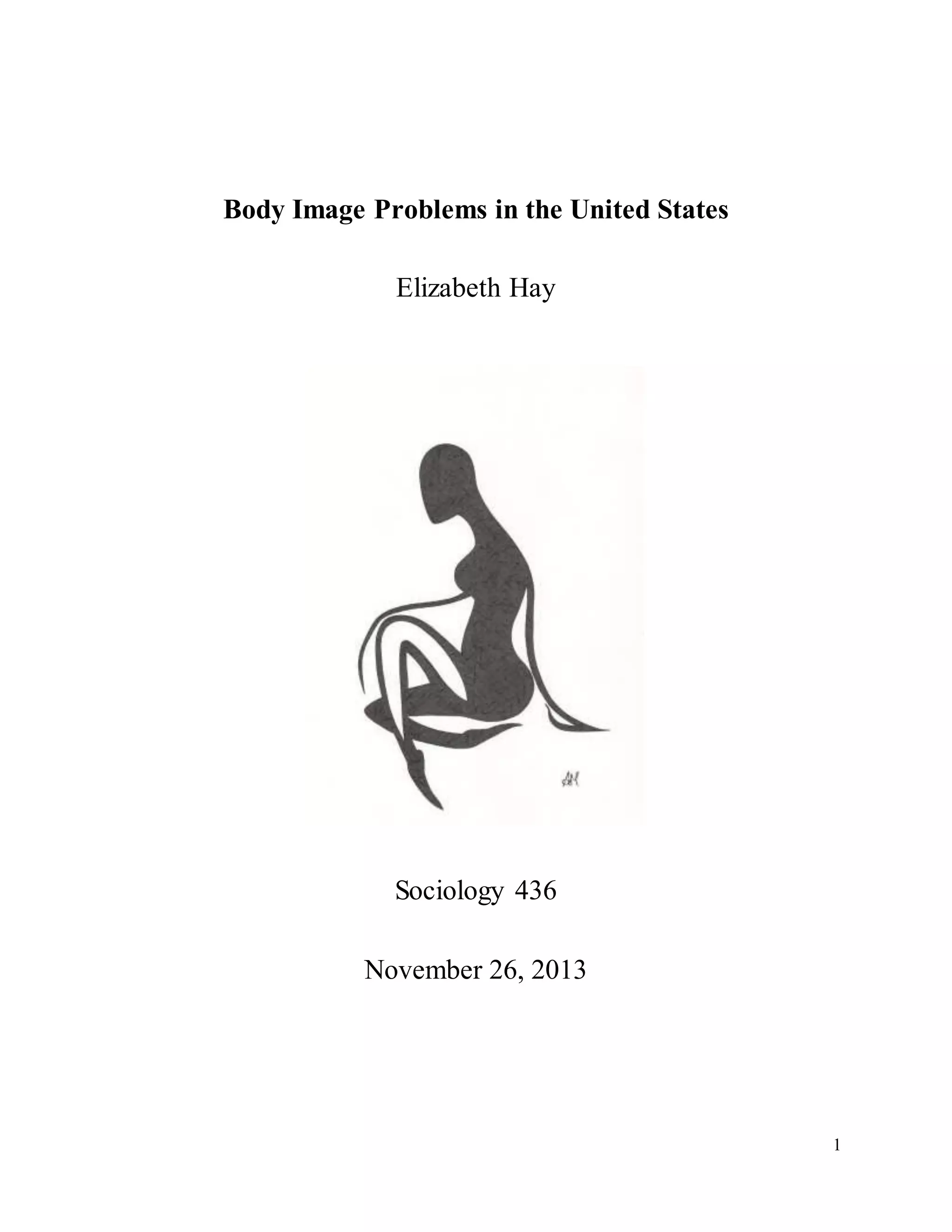
Body Image Problems in the United States
Elizabeth Hay
Sociology 436
November 26, 2013
2
Over 12.7 million females underwent cosmetic procedures in 2012 (American Society of
Plastic Surgeons [ASPS], 2012). The cosmetic industry had revenue of almost $55 billion in
2012 (Shultz, n.d.). Over one million Americans tan indoors every day (American Academy of
Dermatology [AAD], n.d.). Seventy-percent of those people are white females sixteen to twenty-
nine years old. Twenty million American women will have an eating disorder in their lifetimes
(National Eating Disorders Association [NEDA], n.d. a).
After reading those statistics, an important question arises- why? Why are all those
numbers in the millions or billions? Why do more women than men have plastic surgery? Why
do women spend so much money on cosmetics? Why do women tan more than men? Why do
more women than men have eating disorders? In general, why do women spend so much time,
effort, and money on their bodies? Because American society pressures women and girls to have
the perfect body, and that perfect body requires females to be thin, tan, and to wear a lot of
make-up. The life of the average woman involves the daily struggle of applying products to her
skin and hair, finding an outfit that looks good on her, counting calories, working out, all while
trying to look sexy but not slutty. She is constantly looking in the mirror.
At the root of all these statistics and questions is one underlying theme: body image.
Everyone has a body image; it is how a person sees his or herself in the mirror and/or in the mind
(NEDA, n.d. b). It includes feelings about one’s appearance, weight, height, shape, and control
of one’s body. The image one sees is either positive or negative. People either like what they see,
dislike what they see, or are somewhere in between. For most women, they do not like what they
see and have a negative body image (Office on Women’s Health [OWH], 2009). Again, why is
this? Why is body image so important to women? Many aspects of life and society influence the
way women see their bodies and contribute to the widespread problem of negative body image.
3
Those influences cause a long list of mental and physical health problems for women.
A woman’s body image revolves around the pursuit of achieving “ideal beauty” or the
“perfect body,” which includes being young, tall, thin, white, and having large breasts and long
hair. All of these characteristics, together, define “sexy” in modern American society.
Realistically, not every woman can meet these criteria. Some women are on the short side, some
women have dark skin, and not every woman wears a D cup. If a woman is not tall, thin, white,
and big-breasted, then she will go to great lengths to be so. She might also feel ashamed,
embarrassed, and isolated for, perhaps, her entire life. This ideal beauty excludes a voluminous
proportion of women, puts large amounts of pressure on them to have the perfect body, and
causes feelings of shame that all contribute to damaging health effects.
The standards of ideal beauty leave out many women including minorities, women of
color, short women, fat women, women with short hair, flat-chested women, lesbian women, and
women with disabilities. For example, it has long been in debate whether veiling contributes to
or reduces the sexual objectification of Muslin women (Burn, 2011). Muslim scripts emphasize
the importance of women covering themselves in public; Muslim men are not compelled to do
the same. In the U.S., women are not forced to veil themselves but can do so by choice.
Tolaymat and Moradi (2011) conducted a study on how veiling contributes to the sexual
objectification of women, and subsequently to negative body image and eating disorders among
American Muslim women (p. 383). They felt that previous studies on body image lacked
information on minorities. They wrote, “Sexual objectification experiences can promote
internalization of dominant cultural standards of beauty and result in self-objectification…
[which] is manifested as body surveillance or persistent monitoring of how the body looks
relative to the internalized standard…Body surveillance can promote feelings of body shame
4
when one falls short of the internalized (typically impossible) standard” (p. 383).
Women of color have long been excluded from the American beauty ideal. According to
Our Bodies, Ourselves, “As early as the 1850s, skin bleaching and hair straightening were
pitched to African Americans as ways to obtain the privileges of white society” (The Boston
Women’s Health Book Collective, 2011, p. 47). Two centuries later, women are still using skin
bleaching products on their skin and straightening products on their hair. Our Bodies, Ourselves
warns about the dangerous ingredients used in these products (The Boston Women’s Health
Book Collective, 2011). Some skin whitening creams contain mercury, corticosteroids, and
hydroquinone. Mercury is known to cause a long list of health problems like kidney damage,
brain damage, seizures, and hair loss. Corticosteroids can cause skin rashes or infections, and
hydroquinone is believed to be a carcinogen. Hair relaxers also contain harmful chemicals like
formaldehyde and carcinogens.
In today’s ageist society, older women and women with disabilities are largely excluded
from the beauty ideal as well (The Boston Women’s Health Book Collective, 2011). They are
desexualized and considered undesirable. A woman with wrinkles, a woman with gray hair, or a
woman in a wheel chair cannot be sexy. Women might be able to get face lifts or dye their hair,
but women with permanent disabilities will live with them for the rest of their lives. In Our
Bodies, Ourselves, Ashton Applewhite said, “We call people out for racist and sexist attitudes,
but few people blink at the suggestion that older people are befuddled or disabled or dependent
or creepy, even repulsive. After all, that’s how people over 65 tend to be depicted in
entertainment and advertising (if they make an appearance at all)” (The Boston Women’s Health
Book Collective, 2011, p. 548).
5
A woman with short hair could be labeled as a lesbian for just that reason alone. Lesbian
or not, women who choose to have their hair short or shaved often face discrimination. When
women age or receive chemotherapy for cancer treatment, they may have thinning or balding
hair. Some of them feel that in order to remain feminine they must purchase wigs or hair
extensions (The Boston Women’s Health Book Collective, 2011). Weitz (2012) explains that
many women feel that their sexiness depends on their hair, even more so for overweight and
disabled women (p. 256). Being sexy is all about finding a man, and the key to catching a man’s
eye is the “hair flip” move. Women with short hair cannot flaunt themselves like this, and lesbian
women do not want that kind of attention from men. As Weitz (2012) wrote, “Hair is central to
our identities…Whenever we cut our hair short or grow it long, cover the gray or leave it alone,
dye it blonde or dye it turquoise, curl it or straighten it, we decide what image we want to present
to the world” (p. 259).
Overweight women are largely considered undesirable and asexual according to the
beauty ideal (The Boston Women’s Health Book Collective, 2011). The majority of women on
television, in magazines, and movies are stick thin. In reality, the average American woman
weighs 165 pounds, and 41% of women wear a size 14 or larger. “Half of all women are on a
diet on any given day,” spending almost $60 billion on dieting annually (p. 66). Although health
problems can result from obesity, thin women can have health problems, too. Weight loss
surgery and medications, bad eating habits like compulsive eating, and extreme weight gain and
loss, can all pose health threats. Those bad eating habits can turn into eating disorders, which
have their own list of health problems. Often, psychological illnesses like depression, obsessive-
compulsive disorder, and anxiety are associated with eating disorders. Anorexic women may
develop fertility problems because starvation can cause, “absence or irregular menstrual cycles,
6
reduced egg quality, ovarian failure, compromised uterine health, and miscarriage” (p. 67). Not
all women are naturally thin, so they feel they must forgo their hunger and cravings or exercise
persistently to be thin. Asian women are stereotyped as naturally thin and small, and black and
Hispanic women are stereotyped as having big butts and thighs. Minorities face double binds
because they are not white and their body sizes and shapes are stereotyped.
Because women may not meet the beauty ideal naturally, they feel compelled to find
ways of achieving the perfect body. They are forced to change their appearance or else suffer the
consequences of being ugly. Consequently, beauty products and procedures are utilized heavily
by women. Recall that the cosmetic industry made billions of dollars last year (Shultz, n.d.). The
commercials on television tell women that they need Aveeno to make their skin soft, they need
Maybelline to make there lashes long, and they need Retinal to get rid of wrinkles. Women also
need push-up bras, Hydroxycut, manicures, Vagisil, high-heeled shoes, bikini waxes, and the list
goes on and on. Colored women need paler skin, but white women need to be tan. Those
thousands of girls tanning indoors are putting their lives at risk (AAD, n.d.). Artificial UV
radiation from tanning beds dramatically increases the risk of developing skin cancers. Exposure
in tanning beds can cause cataracts, ocular melanoma, suppression of the immune system, and
accelerated aging of the skin. Also worth noting, repeated tanning habits can turn into an
addiction. In fact, Mosher and Danoff-Burg found that one third of college students who
frequently tan are addicted (as cited in The Boston Women’s Health Book Collective, 2011).
The products women use on their bodies are dangerous as well. Most personal care
products contain several ingredients that have never been tested (The Boston Women’s Health
Book Collective, 2011). For example, mercury is permitted in low levels in cosmetics used near
the eyes, so products like eye makeup, skin lightening creams, and also tanning bed lights
7
contain mercury. Exposure to mercury can cause depression, loss in memory, hair loss, damage
to the heart, lungs, kidneys, central nervous and endocrine systems. Mercury is not the only
dangerous chemical found in cosmetics; substances like lead, phthalates, BPA, and endocrine
disrupting chemicals are also found in cosmetics. Each substance has its own list of associated
health problems, but all of the mentioned substances are believed to cause serious reproductive
health problems and infertility for women and men. They have been linked to early puberty in
girls, vaginal and breast cancers in adult women, genital abnormalities in babies, and decreased
sperm count in men.
Men are certainly exposed to the dangers of tanning and personal care products too, but
there are many reasons why women are exposed more. First, “the average woman uses ten
beauty products a day” (The Boston Women’s Health Book Collective, 2011, pp. 50-51), but that
is just the average woman; many women might use just ten products on their faces alone.
Second, each product she uses contains one or more harmful ingredients. Third, the media urges
her to buy and use these products. She is expected to use lipstick, foundation, mascara, eyeliner,
eye shadow, and several more beauty products on a daily basis because that is all part of being a
woman. Factor all of this together, and one can see why women are impacted more than men.
If cosmetics, hair extensions, and tanning are not enough, then many women turn to
cosmetic surgery as means of achieving the perfect body. Remember that over twelve million
females had a cosmetic procedure done last year; they account for 91% of the total number of
cosmetic procedures (ASPS, 2012). Cosmetic procedures are classified as surgeries or minimally
invasive. Surgeries like breast augmentation, eyelid surgery, facelifts, liposuction, and
rhinoplasty are the most popular (in that order). The top five minimally invasive procedures
include Botox, chemical peels, laser hair removal, microdermabrasion, and soft tissue fillers. A
8
variety of women are getting cosmetic procedures, not just the rich and famous (The Boston
Women’s Health Book Collective, 2011). Thirteen to nineteen year-olds accounted for almost
210,000 of plastic surgeries done four years ago. The FDA has approved Botox for anyone aged
twelve years or older. More women of the middle and working classes are going under the knife
as well, even if it means going into debt. The National Research Center for Women & Families
(n.d.) says breast augmentation surgery costs between $5,000 and $8,000. They also make it
clear that because all implants will eventually break, half of women with implants will need
another surgery in three to four years after initial surgery, which will cost another $5,000 to
$8,000. The MRI required to check the implants and confirm surgery is necessary will cost
around $2,000.
Because “every inch of a woman’s body presents a new opportunity for improvement,”
says The Boston Women’s Health Book Collective (2011), women are also getting vaginal
reconstruction surgeries (p. 58). Reconstruction of the labia and hymen and vaginal rejuvenation
are marketed to women under promises of increased sexual pleasure for them and their male
partners. Studies have found no evidence to prove physical enhancements in sexual experiences,
but professionals believe there may be psychological enhancements.
Millions of women undergo plastic surgery, but Our Bodies, Ourselves is worried that
many of those women do not know about the possible health risks of these procedures (The
Boston Women’s Health Book Collective 2011). Surgical tightening of the vagina may treat
urinary incontinence, but it can also result in painful arousal or loss of arousal. Other vaginal
surgeries may cause scarring, infection, adhesions, pain, and problems during child birth. Hymen
reconstruction purposefully causes bleeding during intercourse, suggesting virginity, which is
desired in Hispanic and Middle Eastern cultures. Many women have reported severe effects after
9
their silicone or saline breast implants broke (Absolutely Safe, n.d.). Fatigue, loss of breast
sensation, joint pain, and dizziness are some of the side effects women have reported from
leaking implants. Little research has been conducted on breast implants, so doctors lack evidence
to support women’s claims of health effects.
If a plethora of products and cosmetic procedures are not enough for women to reach the
beauty ideal, then women are forced to feel ashamed about their bodies. Negative body image
has a number of associated feelings including embarrassment, low self-esteem, anxiety,
depression, and failure. The negative feelings, shame, and pressure to conform come from a
variety of sources including partners, family, friends, and doctors, but it most often comes from
within the woman herself. (The Boston Women’s Health Book Collective, 2011; Office on
Women’s Health, 2009).
For thousands of women, negative attitudes about their bodies do not stop at feelings;
they develop into disorders and/or life threatening problems. In the never-ending quest to lose
weight, women will resort to very risky behaviors in order to shed pounds like taking laxatives,
smoking, fasting, skipping meals, and induced vomiting (National Eating Disorders Association,
n.d. a). Eating disorders like anorexia nervosa, bulimia nervosa, and binge eating can cause a
multitude of physical and psychological health problems. Mental illnesses like bi-polar disorder,
anxiety, seasonal affective disorder, depression, and obsessive compulsive disorder are
commonly linked to women with poor body image. Lesser known is the chronic mental illness
called body dysmorphic disorder, or BDD (Mayo Clinic, 2013). BDD, or dysmorphophobia, is
the fear of having a deformity. It involves obsessive thought and constant shame over flaws in
appearance. The shame in one’s appearance can be as severe as not leaving home to avoid being
seen by others.
10
The conversations women have with each other can also be damaging to their emotional
health. Fat talk, “when women speak negatively with each other about the size/shape of their
bodies,” takes place often among women (Salk & Engeln-Maddox, 2012, p. 636). These
conversations include phrases such as, “Do I look fat,” “I’m so fat,” and so on (The Boston
Women’s Health Book Collective, 2011). Usually such phrases are followed by reassurances that
they are not fat, and that they look great, but self-esteem is only temporarily heightened. After
engaging in fat talk, a woman may see a beautiful model in a magazine and envy her thighs.
Feelings of shame, eating disorders, mental illnesses, and condescending conversations
about weight can affect any woman in this world. Negative body image does not discriminate by
race, ethnicity, class, age, religion, or even gender for that matter. Men can dislike their bodies,
have eating and psychological disorders, and have cosmetic surgery, too. But still, men are not
pressured to as much extent as women. Males make up five to fifteen percent of people with
eating disorders (National Association of Anorexia Nervosa and Associated Disorders [ANAD],
n.d.). Women are more likely to be diagnosed with mental illnesses and eating disorders, engage
in fat talk, diet, and have cosmetic procedures done (American Society of Plastic Surgeons,
2012; NEDA, n.d. a; The Boston Women’s Health Book Collective, 2011).
There are certain women who experience these problems more often than others. “The
prevalence of eating disorders is similar among Non-Hispanic Whites, Hispanics, African-
Americans, and Asians in the United States, with the exception that anorexia nervosa is more
common among Non-Hispanic Whites” (NEDA, n.d. a). Young women are particularly
susceptible because of the prevalence of young people in the media. Forty-seven percent of girls
in grades five through twelve say they would like to lose weight because of images in magazines,
and 69% of girls at the same age say that they get their idea of a perfect body from magazine
11
images (ANAD, n.d.). Among girls aged six to twelve years old, 40-60% worry about their
weight (NEDA, n.d. a). Ninety-one percent of women in college diet (ANAD, n.d.). Female
athletes are also more likely to be highly concerned about their bodies. Figure skaters, ballerinas,
and gymnasts are at higher risks of developing eating disorders.
Furthermore, pregnant women struggle with negative body image as their bodies change
to accommodate their developing babies (The Boston Women’s Health Book Collective, 2011).
Rubin and Steinberg (2011) addressed the changing ideals of what a pregnant woman should
look like (p. 607). The modern image of pregnancy includes the baby “bump,” but not an ounce
of fat anywhere else on the body. Correll, Dalton, and Bailey (2013) found that many young
women in rural Tennessee continue to smoke during pregnancy as a means to prevent weight
gain (p. 734). The Office on Women’s Health (2009) warns about the dangerous complications
pregnant women with eating disorders may suffer including low birth weight, stillbirth,
premature labor, and gestational diabetes.
A very large amount of information has been gathered on body image issues and the
associated health problems that accompany them. Statistics are shockingly high and health
problems are widespread, making the body image issue look unsurmountable. Despite the
prevalence of negative body image, there are many women and organizations pushing for
change, spreading the word on women’s health issues, and creating resources to help women
improve their body image.
First, women are fighting the issue at its source- the media. So many women are excluded
from media images because they do not fit the beauty ideal. Putting minority women, overweight
women, older women, disabled women, lesbian, and bisexual women into mainstream media will
12
help women with the same characteristics increase their self-confidence. Jes Sachse and Holly
Norris created a photo series called “American Able” for a college class, in which Sachse, who
has Freeman-Sheldon syndrome, is the main subject (The Boston Women’s Health Book
Collective, 2011). Norris’ photographs challenge the norms of American advertising and were
seen on hundreds of TVs all over subway lines in Toronto. Also, a group of women in Chicago
called the “Empowered Fe Fes”, with the help of Access Living and Beyondmedia Education,
created a documentary called Doin’ It: Sex, Disability & Videotape. The film seeks to educate
women with disabilities about sex. Since its release, Doin’ It has been shown at film festivals,
has won awards in the U.S. and Canada, and has been translated for audiences in Japan. Our
Bodies, Ourselves offers several media activism steps anyone can take to help combat the media
(The Boston Women’s Health Book Collective, 2011). They recommend women be wary of
mainstream media images that do not personally resemble them, be aware of messages and
strategies that perpetuate internalization, and use online sources to critique the media.
It seems like the dangers of cosmetics are unavoidable, but progress has already been
made to make cosmetics safer for women. In 2010, the Safe Cosmetics Act was introduced to
Congress; it allows the FDA to regulate the ingredients used in cosmetics (The Boston Women’s
Health Book Collective, 2011). Started in 2004, the Campaign for Safe Cosmetics aims “To
protect the health of consumers and workers by securing the corporate, regulatory and legislative
reforms necessary to eliminate dangerous chemicals from cosmetics and personal care products”
(The Boston Women’s Health Book Collective, 2011; The Campaign for Safe Cosmetics, n.d.).
The Campaign warns readers about companies that use the pink breast cancer ribbon to market
products to women because those products still contain harmful chemicals. It also highlights
Wal-Mart’s recent commitment to remove cosmetics and cleaners containing toxins from its
13
shelves. If more retailers made promises like Wal-Mart, and cosmetic manufacturers removed
the chemicals from their products, more progress could be made in making cosmetics safer.
Additionally, the government should conduct more testing and enforce stricter regulations on
personal care products. Individual women can also enact change by choosing cosmetics that do
not contain toxic chemicals and by supporting causes like the Campaign for Safe Cosmetics.
There is also hope for improving the safety of cosmetic surgeries. Many women elect to
have a cosmetic surgery, only thinking about how good they will look after the procedure.
Extensive education of the dangers and risks of plastic surgery should be included in a woman’s
visit to the plastic surgeon. The documentary Absolutely Safe was made to educate people about
the risks of breast augmentation surgery (Absolutely Safe, n.d.). The film makers think informed
consent should be required by law, and they work toward more FDA regulation of breast
implants. Breasts are unique to women, and together women can advocate for safer procedures
involving such a vital part of their bodies.
The size issue of body image poses another obstacle to overcome. Promoting self-esteem
for women and girls, as well as teaching them about healthy nutrition and media literacy can help
eliminate the widespread problem of eating disorders (The Boston Women’s Health Book
Collective, 2011). Catherine Steiner-Adair and Lisa Sjostrom have created a program called
“Full of Ourselves: A Wellness Program to Advance Girl Power, Health, and Leadership” to help
prevent eating disorders (The Boston Women’s Health Book Collective, 2011). Women can also
elect to not participate in fat talk and participate in the Fat Talk Free Week, sponsored by the
Reflections Body Image Program. Even more, they could chose to be fat talk free for the rest of
their lives.
14
Another key to solving this problem is fat acceptance (The Boston Women’s Health
Book Collective, 2011). Instead of assuming that beautiful women only come in one size,
women should be open minded and include more sizes into their definitions of beauty. Several
authors and blog websites have written about the importance in ridding the thin ideal from
society. “Health experts are focusing on a model of health called Healthy at Every Size” that
inspires women to exercise, eat healthy, and accept the fact that women come in many forms
(The Boston Women’s Health Book Collective, 2011, p. 68-69).
Just like there are numerous factors contributing to negative body image, there are also
numerous steps to take to build positive body image. Through research and observation of media
and my peers, I can see how body image issues can be addressed with macro and micro level
perspectives. Each woman may be struggling with her weight and other health problems in
different ways than other women and for different reasons. Accepting one’s body, seeking
treatment for a mental health disorder, or contemplating plastic surgery is an individual decision.
Societal norms, stereotypes, advertising, and media, however, have huge influences on how
women perceive their bodies. There is strength in numbers. Negative body image and the
associated health problems affect millions of women. Women should work together to advocate
change. Women should join the groups that have started to make progress and support the
organizations rallying for the cause. If the opportunity arises, women should start new campaigns
that address a specific health issue in their school, town, county, state, or country. Success might
also be found if groups work with other groups. If Healthy at Every Size teamed up with the
American Cancer Society, women could walk at Relay for Life to fight cancer and eating
disorders. When mothers pick up their WIC checks, including a pamphlet on the Campaign for
Safe Cosmetics with it would get more women thinking about what is in their cosmetics. Women
15
should be encouraged to join and welcomed into groups that will improve their self-esteem and
outlook on womanhood.
Above all else, women should be educated. What women do not know about their health
and well-being can hurt them. As the statistics show, it is hurting them. If the government can
ensure that no child is being left behind in school, then it can ensure that no girl is internalizing
her body image in an unhealthy way. The government should fund more programs and enact
more laws that encourage healthy lifestyles for women. Women should write to their senators
and representatives to remind them of what needs to be done to fight this problem.
If I would have never taken Sociology 436, I never would have read Our Bodies,
Ourselves. If I never read the book, I would have never been enlightened about body insecurity
and the disasters it causes on women’s health. Not all women have the opportunity to take
college classes. Not every woman will read Our Bodies, Ourselves, or watch Absolutely Safe, or
research the ingredients in her makeup. The information I shared in this paper is just a tidbit of
all the information out there today. Much is still yet to be learned about the damages the beauty
ideal has caused. I would love to see more books, more websites, and more movies promoting
better body image incorporated into women’s education, starting in preschool and continuing
into adulthood. I would also like to see a day when body image education is no longer necessary.
I hope that my children and grandchildren are raised in a society that accepts and values women
of all races, religions, classes, and sexual orientations. I hope that someday women will no
longer feel the need to starve themselves or subject themselves to risky operations. I believe that
one day the beauty ideal will not encompass words like tall, skinny, young, and white, but rather
include words that describe personal characteristics like smart, funny, caring, and talented. I
look forward to the day when papers on body image problems will no longer need to be written.
16
Works Cited
Absolutely Safe (n.d.). Synopsis. Retrieved November 21, 2013, from http://absolutelysafe.com/
synopsis.html
American Academy of Dermatology (n.d.). Indoor tanning. Retrieved November 19, 2013, from
http://www.aad.org/media-resources/stats-and-facts/prevention-and-care/indoor-tanning
American Society of Plastic Surgeons (2012). 2012 Plastic Surgery Statistics Report. Retrieved
November 19, 2013, from http://www.plasticsurgery.org/news-and-resources/2012-plastic-
surgery-statistics.html
Burn, S.M. (2011). Women across cultures. New York: McGraw-Hill.
Correll, J.A., Dalton, W.T., & Bailey, B. (2013). Weight concerns, body image, and smoking
continuation in pregnant women in rural Appalachia. American Journal of Health and
Behavior, 37(6), 734-744. doi: http://dx.doi.org/10.5993/AJHB.37.6.2
Mayo Clinic (2013, May) Body dysmorphic disorder. Retrieved from http://www.mayoclinic.
com/health/body-dysmorphic-disorder/DS00559
National Association of Anorexia Nervosa and Associated Disorders (n.d.). Eating disorder
statistics. Retrieved November 19, 2013, from http://www.anad.org/get-information/about-
eating-disorders/eating-disorders-statistics/
National Eating Disorders Association (n.d. a). Get the facts on eating disorders. Retrieved
November 19, 2013, from http://www.nationaleatingdisorders.org/get-facts-eating-disorders
National Eating Disorders Association (n.d. b). What is body image? Retrieved November 19,
2013, from http://www.nationaleatingdisorders.org/what-body-image
National Research Center for Women & Families (n.d.). Breast implant information. Retrieved
November 20, 2013, from http://www.breastimplantinfo.org/
Office on Women’s Health (2009, September). Body image. Retrieved from http://womenshealth
.gov/body-image/about-body-image/index.html
Rubin, L.R., & Steinberg, J.R. (2011). Self-objectification and pregnancy: Are body
functionality dimensions protective? Sex Roles, 65(), 606-618. doi: 10.1007/s11199-011-
9955-y
Salk, R.H., & Engeln-Maddox, R. (2012). Fat talk among college women is both contagious and
harmful. Sex Roles, 66(9/10), 636-645. doi: 10.1007/s11199-011-0050-1
Shultz, C. (n.d.) Statistics and facts on the cosmetic industry. Retrieved November 19, 2013,
from http://www.statista.com/topics/1008/cosmetics-industry/#chapter2
17
The Boston Women’s Health Book Collective (2011). Our Bodies, ourselves. New York:
Touchstone.
The Campaign for Safe Cosmetics, (n.d.) About Us. Retrieved November 24, 2013, from http://
safecosmetics.org/article.php?list=type&type=34
Tolaymat, L.D., & Moradi, B. (2011). U.S. Muslim women and body image: Links among
objectification theory constructs and the hijab. Journal of Counseling Psychology, 58(3),
383-392. doi: 10.1037/a0023461
Weitz, R. (2012). What we do for love. In S. Shaw, & J. Lee (Eds.), Women’s voices, feminist
visions (pp. 253-262).

outline

  • 1.
    1 Body Image Problemsin the United States Elizabeth Hay Sociology 436 November 26, 2013
  • 2.
    2 Over 12.7 millionfemales underwent cosmetic procedures in 2012 (American Society of Plastic Surgeons [ASPS], 2012). The cosmetic industry had revenue of almost $55 billion in 2012 (Shultz, n.d.). Over one million Americans tan indoors every day (American Academy of Dermatology [AAD], n.d.). Seventy-percent of those people are white females sixteen to twenty- nine years old. Twenty million American women will have an eating disorder in their lifetimes (National Eating Disorders Association [NEDA], n.d. a). After reading those statistics, an important question arises- why? Why are all those numbers in the millions or billions? Why do more women than men have plastic surgery? Why do women spend so much money on cosmetics? Why do women tan more than men? Why do more women than men have eating disorders? In general, why do women spend so much time, effort, and money on their bodies? Because American society pressures women and girls to have the perfect body, and that perfect body requires females to be thin, tan, and to wear a lot of make-up. The life of the average woman involves the daily struggle of applying products to her skin and hair, finding an outfit that looks good on her, counting calories, working out, all while trying to look sexy but not slutty. She is constantly looking in the mirror. At the root of all these statistics and questions is one underlying theme: body image. Everyone has a body image; it is how a person sees his or herself in the mirror and/or in the mind (NEDA, n.d. b). It includes feelings about one’s appearance, weight, height, shape, and control of one’s body. The image one sees is either positive or negative. People either like what they see, dislike what they see, or are somewhere in between. For most women, they do not like what they see and have a negative body image (Office on Women’s Health [OWH], 2009). Again, why is this? Why is body image so important to women? Many aspects of life and society influence the way women see their bodies and contribute to the widespread problem of negative body image.
  • 3.
    3 Those influences causea long list of mental and physical health problems for women. A woman’s body image revolves around the pursuit of achieving “ideal beauty” or the “perfect body,” which includes being young, tall, thin, white, and having large breasts and long hair. All of these characteristics, together, define “sexy” in modern American society. Realistically, not every woman can meet these criteria. Some women are on the short side, some women have dark skin, and not every woman wears a D cup. If a woman is not tall, thin, white, and big-breasted, then she will go to great lengths to be so. She might also feel ashamed, embarrassed, and isolated for, perhaps, her entire life. This ideal beauty excludes a voluminous proportion of women, puts large amounts of pressure on them to have the perfect body, and causes feelings of shame that all contribute to damaging health effects. The standards of ideal beauty leave out many women including minorities, women of color, short women, fat women, women with short hair, flat-chested women, lesbian women, and women with disabilities. For example, it has long been in debate whether veiling contributes to or reduces the sexual objectification of Muslin women (Burn, 2011). Muslim scripts emphasize the importance of women covering themselves in public; Muslim men are not compelled to do the same. In the U.S., women are not forced to veil themselves but can do so by choice. Tolaymat and Moradi (2011) conducted a study on how veiling contributes to the sexual objectification of women, and subsequently to negative body image and eating disorders among American Muslim women (p. 383). They felt that previous studies on body image lacked information on minorities. They wrote, “Sexual objectification experiences can promote internalization of dominant cultural standards of beauty and result in self-objectification… [which] is manifested as body surveillance or persistent monitoring of how the body looks relative to the internalized standard…Body surveillance can promote feelings of body shame
  • 4.
    4 when one fallsshort of the internalized (typically impossible) standard” (p. 383). Women of color have long been excluded from the American beauty ideal. According to Our Bodies, Ourselves, “As early as the 1850s, skin bleaching and hair straightening were pitched to African Americans as ways to obtain the privileges of white society” (The Boston Women’s Health Book Collective, 2011, p. 47). Two centuries later, women are still using skin bleaching products on their skin and straightening products on their hair. Our Bodies, Ourselves warns about the dangerous ingredients used in these products (The Boston Women’s Health Book Collective, 2011). Some skin whitening creams contain mercury, corticosteroids, and hydroquinone. Mercury is known to cause a long list of health problems like kidney damage, brain damage, seizures, and hair loss. Corticosteroids can cause skin rashes or infections, and hydroquinone is believed to be a carcinogen. Hair relaxers also contain harmful chemicals like formaldehyde and carcinogens. In today’s ageist society, older women and women with disabilities are largely excluded from the beauty ideal as well (The Boston Women’s Health Book Collective, 2011). They are desexualized and considered undesirable. A woman with wrinkles, a woman with gray hair, or a woman in a wheel chair cannot be sexy. Women might be able to get face lifts or dye their hair, but women with permanent disabilities will live with them for the rest of their lives. In Our Bodies, Ourselves, Ashton Applewhite said, “We call people out for racist and sexist attitudes, but few people blink at the suggestion that older people are befuddled or disabled or dependent or creepy, even repulsive. After all, that’s how people over 65 tend to be depicted in entertainment and advertising (if they make an appearance at all)” (The Boston Women’s Health Book Collective, 2011, p. 548).
  • 5.
    5 A woman withshort hair could be labeled as a lesbian for just that reason alone. Lesbian or not, women who choose to have their hair short or shaved often face discrimination. When women age or receive chemotherapy for cancer treatment, they may have thinning or balding hair. Some of them feel that in order to remain feminine they must purchase wigs or hair extensions (The Boston Women’s Health Book Collective, 2011). Weitz (2012) explains that many women feel that their sexiness depends on their hair, even more so for overweight and disabled women (p. 256). Being sexy is all about finding a man, and the key to catching a man’s eye is the “hair flip” move. Women with short hair cannot flaunt themselves like this, and lesbian women do not want that kind of attention from men. As Weitz (2012) wrote, “Hair is central to our identities…Whenever we cut our hair short or grow it long, cover the gray or leave it alone, dye it blonde or dye it turquoise, curl it or straighten it, we decide what image we want to present to the world” (p. 259). Overweight women are largely considered undesirable and asexual according to the beauty ideal (The Boston Women’s Health Book Collective, 2011). The majority of women on television, in magazines, and movies are stick thin. In reality, the average American woman weighs 165 pounds, and 41% of women wear a size 14 or larger. “Half of all women are on a diet on any given day,” spending almost $60 billion on dieting annually (p. 66). Although health problems can result from obesity, thin women can have health problems, too. Weight loss surgery and medications, bad eating habits like compulsive eating, and extreme weight gain and loss, can all pose health threats. Those bad eating habits can turn into eating disorders, which have their own list of health problems. Often, psychological illnesses like depression, obsessive- compulsive disorder, and anxiety are associated with eating disorders. Anorexic women may develop fertility problems because starvation can cause, “absence or irregular menstrual cycles,
  • 6.
    6 reduced egg quality,ovarian failure, compromised uterine health, and miscarriage” (p. 67). Not all women are naturally thin, so they feel they must forgo their hunger and cravings or exercise persistently to be thin. Asian women are stereotyped as naturally thin and small, and black and Hispanic women are stereotyped as having big butts and thighs. Minorities face double binds because they are not white and their body sizes and shapes are stereotyped. Because women may not meet the beauty ideal naturally, they feel compelled to find ways of achieving the perfect body. They are forced to change their appearance or else suffer the consequences of being ugly. Consequently, beauty products and procedures are utilized heavily by women. Recall that the cosmetic industry made billions of dollars last year (Shultz, n.d.). The commercials on television tell women that they need Aveeno to make their skin soft, they need Maybelline to make there lashes long, and they need Retinal to get rid of wrinkles. Women also need push-up bras, Hydroxycut, manicures, Vagisil, high-heeled shoes, bikini waxes, and the list goes on and on. Colored women need paler skin, but white women need to be tan. Those thousands of girls tanning indoors are putting their lives at risk (AAD, n.d.). Artificial UV radiation from tanning beds dramatically increases the risk of developing skin cancers. Exposure in tanning beds can cause cataracts, ocular melanoma, suppression of the immune system, and accelerated aging of the skin. Also worth noting, repeated tanning habits can turn into an addiction. In fact, Mosher and Danoff-Burg found that one third of college students who frequently tan are addicted (as cited in The Boston Women’s Health Book Collective, 2011). The products women use on their bodies are dangerous as well. Most personal care products contain several ingredients that have never been tested (The Boston Women’s Health Book Collective, 2011). For example, mercury is permitted in low levels in cosmetics used near the eyes, so products like eye makeup, skin lightening creams, and also tanning bed lights
  • 7.
    7 contain mercury. Exposureto mercury can cause depression, loss in memory, hair loss, damage to the heart, lungs, kidneys, central nervous and endocrine systems. Mercury is not the only dangerous chemical found in cosmetics; substances like lead, phthalates, BPA, and endocrine disrupting chemicals are also found in cosmetics. Each substance has its own list of associated health problems, but all of the mentioned substances are believed to cause serious reproductive health problems and infertility for women and men. They have been linked to early puberty in girls, vaginal and breast cancers in adult women, genital abnormalities in babies, and decreased sperm count in men. Men are certainly exposed to the dangers of tanning and personal care products too, but there are many reasons why women are exposed more. First, “the average woman uses ten beauty products a day” (The Boston Women’s Health Book Collective, 2011, pp. 50-51), but that is just the average woman; many women might use just ten products on their faces alone. Second, each product she uses contains one or more harmful ingredients. Third, the media urges her to buy and use these products. She is expected to use lipstick, foundation, mascara, eyeliner, eye shadow, and several more beauty products on a daily basis because that is all part of being a woman. Factor all of this together, and one can see why women are impacted more than men. If cosmetics, hair extensions, and tanning are not enough, then many women turn to cosmetic surgery as means of achieving the perfect body. Remember that over twelve million females had a cosmetic procedure done last year; they account for 91% of the total number of cosmetic procedures (ASPS, 2012). Cosmetic procedures are classified as surgeries or minimally invasive. Surgeries like breast augmentation, eyelid surgery, facelifts, liposuction, and rhinoplasty are the most popular (in that order). The top five minimally invasive procedures include Botox, chemical peels, laser hair removal, microdermabrasion, and soft tissue fillers. A
  • 8.
    8 variety of womenare getting cosmetic procedures, not just the rich and famous (The Boston Women’s Health Book Collective, 2011). Thirteen to nineteen year-olds accounted for almost 210,000 of plastic surgeries done four years ago. The FDA has approved Botox for anyone aged twelve years or older. More women of the middle and working classes are going under the knife as well, even if it means going into debt. The National Research Center for Women & Families (n.d.) says breast augmentation surgery costs between $5,000 and $8,000. They also make it clear that because all implants will eventually break, half of women with implants will need another surgery in three to four years after initial surgery, which will cost another $5,000 to $8,000. The MRI required to check the implants and confirm surgery is necessary will cost around $2,000. Because “every inch of a woman’s body presents a new opportunity for improvement,” says The Boston Women’s Health Book Collective (2011), women are also getting vaginal reconstruction surgeries (p. 58). Reconstruction of the labia and hymen and vaginal rejuvenation are marketed to women under promises of increased sexual pleasure for them and their male partners. Studies have found no evidence to prove physical enhancements in sexual experiences, but professionals believe there may be psychological enhancements. Millions of women undergo plastic surgery, but Our Bodies, Ourselves is worried that many of those women do not know about the possible health risks of these procedures (The Boston Women’s Health Book Collective 2011). Surgical tightening of the vagina may treat urinary incontinence, but it can also result in painful arousal or loss of arousal. Other vaginal surgeries may cause scarring, infection, adhesions, pain, and problems during child birth. Hymen reconstruction purposefully causes bleeding during intercourse, suggesting virginity, which is desired in Hispanic and Middle Eastern cultures. Many women have reported severe effects after
  • 9.
    9 their silicone orsaline breast implants broke (Absolutely Safe, n.d.). Fatigue, loss of breast sensation, joint pain, and dizziness are some of the side effects women have reported from leaking implants. Little research has been conducted on breast implants, so doctors lack evidence to support women’s claims of health effects. If a plethora of products and cosmetic procedures are not enough for women to reach the beauty ideal, then women are forced to feel ashamed about their bodies. Negative body image has a number of associated feelings including embarrassment, low self-esteem, anxiety, depression, and failure. The negative feelings, shame, and pressure to conform come from a variety of sources including partners, family, friends, and doctors, but it most often comes from within the woman herself. (The Boston Women’s Health Book Collective, 2011; Office on Women’s Health, 2009). For thousands of women, negative attitudes about their bodies do not stop at feelings; they develop into disorders and/or life threatening problems. In the never-ending quest to lose weight, women will resort to very risky behaviors in order to shed pounds like taking laxatives, smoking, fasting, skipping meals, and induced vomiting (National Eating Disorders Association, n.d. a). Eating disorders like anorexia nervosa, bulimia nervosa, and binge eating can cause a multitude of physical and psychological health problems. Mental illnesses like bi-polar disorder, anxiety, seasonal affective disorder, depression, and obsessive compulsive disorder are commonly linked to women with poor body image. Lesser known is the chronic mental illness called body dysmorphic disorder, or BDD (Mayo Clinic, 2013). BDD, or dysmorphophobia, is the fear of having a deformity. It involves obsessive thought and constant shame over flaws in appearance. The shame in one’s appearance can be as severe as not leaving home to avoid being seen by others.
  • 10.
    10 The conversations womenhave with each other can also be damaging to their emotional health. Fat talk, “when women speak negatively with each other about the size/shape of their bodies,” takes place often among women (Salk & Engeln-Maddox, 2012, p. 636). These conversations include phrases such as, “Do I look fat,” “I’m so fat,” and so on (The Boston Women’s Health Book Collective, 2011). Usually such phrases are followed by reassurances that they are not fat, and that they look great, but self-esteem is only temporarily heightened. After engaging in fat talk, a woman may see a beautiful model in a magazine and envy her thighs. Feelings of shame, eating disorders, mental illnesses, and condescending conversations about weight can affect any woman in this world. Negative body image does not discriminate by race, ethnicity, class, age, religion, or even gender for that matter. Men can dislike their bodies, have eating and psychological disorders, and have cosmetic surgery, too. But still, men are not pressured to as much extent as women. Males make up five to fifteen percent of people with eating disorders (National Association of Anorexia Nervosa and Associated Disorders [ANAD], n.d.). Women are more likely to be diagnosed with mental illnesses and eating disorders, engage in fat talk, diet, and have cosmetic procedures done (American Society of Plastic Surgeons, 2012; NEDA, n.d. a; The Boston Women’s Health Book Collective, 2011). There are certain women who experience these problems more often than others. “The prevalence of eating disorders is similar among Non-Hispanic Whites, Hispanics, African- Americans, and Asians in the United States, with the exception that anorexia nervosa is more common among Non-Hispanic Whites” (NEDA, n.d. a). Young women are particularly susceptible because of the prevalence of young people in the media. Forty-seven percent of girls in grades five through twelve say they would like to lose weight because of images in magazines, and 69% of girls at the same age say that they get their idea of a perfect body from magazine
  • 11.
    11 images (ANAD, n.d.).Among girls aged six to twelve years old, 40-60% worry about their weight (NEDA, n.d. a). Ninety-one percent of women in college diet (ANAD, n.d.). Female athletes are also more likely to be highly concerned about their bodies. Figure skaters, ballerinas, and gymnasts are at higher risks of developing eating disorders. Furthermore, pregnant women struggle with negative body image as their bodies change to accommodate their developing babies (The Boston Women’s Health Book Collective, 2011). Rubin and Steinberg (2011) addressed the changing ideals of what a pregnant woman should look like (p. 607). The modern image of pregnancy includes the baby “bump,” but not an ounce of fat anywhere else on the body. Correll, Dalton, and Bailey (2013) found that many young women in rural Tennessee continue to smoke during pregnancy as a means to prevent weight gain (p. 734). The Office on Women’s Health (2009) warns about the dangerous complications pregnant women with eating disorders may suffer including low birth weight, stillbirth, premature labor, and gestational diabetes. A very large amount of information has been gathered on body image issues and the associated health problems that accompany them. Statistics are shockingly high and health problems are widespread, making the body image issue look unsurmountable. Despite the prevalence of negative body image, there are many women and organizations pushing for change, spreading the word on women’s health issues, and creating resources to help women improve their body image. First, women are fighting the issue at its source- the media. So many women are excluded from media images because they do not fit the beauty ideal. Putting minority women, overweight women, older women, disabled women, lesbian, and bisexual women into mainstream media will
  • 12.
    12 help women withthe same characteristics increase their self-confidence. Jes Sachse and Holly Norris created a photo series called “American Able” for a college class, in which Sachse, who has Freeman-Sheldon syndrome, is the main subject (The Boston Women’s Health Book Collective, 2011). Norris’ photographs challenge the norms of American advertising and were seen on hundreds of TVs all over subway lines in Toronto. Also, a group of women in Chicago called the “Empowered Fe Fes”, with the help of Access Living and Beyondmedia Education, created a documentary called Doin’ It: Sex, Disability & Videotape. The film seeks to educate women with disabilities about sex. Since its release, Doin’ It has been shown at film festivals, has won awards in the U.S. and Canada, and has been translated for audiences in Japan. Our Bodies, Ourselves offers several media activism steps anyone can take to help combat the media (The Boston Women’s Health Book Collective, 2011). They recommend women be wary of mainstream media images that do not personally resemble them, be aware of messages and strategies that perpetuate internalization, and use online sources to critique the media. It seems like the dangers of cosmetics are unavoidable, but progress has already been made to make cosmetics safer for women. In 2010, the Safe Cosmetics Act was introduced to Congress; it allows the FDA to regulate the ingredients used in cosmetics (The Boston Women’s Health Book Collective, 2011). Started in 2004, the Campaign for Safe Cosmetics aims “To protect the health of consumers and workers by securing the corporate, regulatory and legislative reforms necessary to eliminate dangerous chemicals from cosmetics and personal care products” (The Boston Women’s Health Book Collective, 2011; The Campaign for Safe Cosmetics, n.d.). The Campaign warns readers about companies that use the pink breast cancer ribbon to market products to women because those products still contain harmful chemicals. It also highlights Wal-Mart’s recent commitment to remove cosmetics and cleaners containing toxins from its
  • 13.
    13 shelves. If moreretailers made promises like Wal-Mart, and cosmetic manufacturers removed the chemicals from their products, more progress could be made in making cosmetics safer. Additionally, the government should conduct more testing and enforce stricter regulations on personal care products. Individual women can also enact change by choosing cosmetics that do not contain toxic chemicals and by supporting causes like the Campaign for Safe Cosmetics. There is also hope for improving the safety of cosmetic surgeries. Many women elect to have a cosmetic surgery, only thinking about how good they will look after the procedure. Extensive education of the dangers and risks of plastic surgery should be included in a woman’s visit to the plastic surgeon. The documentary Absolutely Safe was made to educate people about the risks of breast augmentation surgery (Absolutely Safe, n.d.). The film makers think informed consent should be required by law, and they work toward more FDA regulation of breast implants. Breasts are unique to women, and together women can advocate for safer procedures involving such a vital part of their bodies. The size issue of body image poses another obstacle to overcome. Promoting self-esteem for women and girls, as well as teaching them about healthy nutrition and media literacy can help eliminate the widespread problem of eating disorders (The Boston Women’s Health Book Collective, 2011). Catherine Steiner-Adair and Lisa Sjostrom have created a program called “Full of Ourselves: A Wellness Program to Advance Girl Power, Health, and Leadership” to help prevent eating disorders (The Boston Women’s Health Book Collective, 2011). Women can also elect to not participate in fat talk and participate in the Fat Talk Free Week, sponsored by the Reflections Body Image Program. Even more, they could chose to be fat talk free for the rest of their lives.
  • 14.
    14 Another key tosolving this problem is fat acceptance (The Boston Women’s Health Book Collective, 2011). Instead of assuming that beautiful women only come in one size, women should be open minded and include more sizes into their definitions of beauty. Several authors and blog websites have written about the importance in ridding the thin ideal from society. “Health experts are focusing on a model of health called Healthy at Every Size” that inspires women to exercise, eat healthy, and accept the fact that women come in many forms (The Boston Women’s Health Book Collective, 2011, p. 68-69). Just like there are numerous factors contributing to negative body image, there are also numerous steps to take to build positive body image. Through research and observation of media and my peers, I can see how body image issues can be addressed with macro and micro level perspectives. Each woman may be struggling with her weight and other health problems in different ways than other women and for different reasons. Accepting one’s body, seeking treatment for a mental health disorder, or contemplating plastic surgery is an individual decision. Societal norms, stereotypes, advertising, and media, however, have huge influences on how women perceive their bodies. There is strength in numbers. Negative body image and the associated health problems affect millions of women. Women should work together to advocate change. Women should join the groups that have started to make progress and support the organizations rallying for the cause. If the opportunity arises, women should start new campaigns that address a specific health issue in their school, town, county, state, or country. Success might also be found if groups work with other groups. If Healthy at Every Size teamed up with the American Cancer Society, women could walk at Relay for Life to fight cancer and eating disorders. When mothers pick up their WIC checks, including a pamphlet on the Campaign for Safe Cosmetics with it would get more women thinking about what is in their cosmetics. Women
  • 15.
    15 should be encouragedto join and welcomed into groups that will improve their self-esteem and outlook on womanhood. Above all else, women should be educated. What women do not know about their health and well-being can hurt them. As the statistics show, it is hurting them. If the government can ensure that no child is being left behind in school, then it can ensure that no girl is internalizing her body image in an unhealthy way. The government should fund more programs and enact more laws that encourage healthy lifestyles for women. Women should write to their senators and representatives to remind them of what needs to be done to fight this problem. If I would have never taken Sociology 436, I never would have read Our Bodies, Ourselves. If I never read the book, I would have never been enlightened about body insecurity and the disasters it causes on women’s health. Not all women have the opportunity to take college classes. Not every woman will read Our Bodies, Ourselves, or watch Absolutely Safe, or research the ingredients in her makeup. The information I shared in this paper is just a tidbit of all the information out there today. Much is still yet to be learned about the damages the beauty ideal has caused. I would love to see more books, more websites, and more movies promoting better body image incorporated into women’s education, starting in preschool and continuing into adulthood. I would also like to see a day when body image education is no longer necessary. I hope that my children and grandchildren are raised in a society that accepts and values women of all races, religions, classes, and sexual orientations. I hope that someday women will no longer feel the need to starve themselves or subject themselves to risky operations. I believe that one day the beauty ideal will not encompass words like tall, skinny, young, and white, but rather include words that describe personal characteristics like smart, funny, caring, and talented. I look forward to the day when papers on body image problems will no longer need to be written.
  • 16.
    16 Works Cited Absolutely Safe(n.d.). Synopsis. Retrieved November 21, 2013, from http://absolutelysafe.com/ synopsis.html American Academy of Dermatology (n.d.). Indoor tanning. Retrieved November 19, 2013, from http://www.aad.org/media-resources/stats-and-facts/prevention-and-care/indoor-tanning American Society of Plastic Surgeons (2012). 2012 Plastic Surgery Statistics Report. Retrieved November 19, 2013, from http://www.plasticsurgery.org/news-and-resources/2012-plastic- surgery-statistics.html Burn, S.M. (2011). Women across cultures. New York: McGraw-Hill. Correll, J.A., Dalton, W.T., & Bailey, B. (2013). Weight concerns, body image, and smoking continuation in pregnant women in rural Appalachia. American Journal of Health and Behavior, 37(6), 734-744. doi: http://dx.doi.org/10.5993/AJHB.37.6.2 Mayo Clinic (2013, May) Body dysmorphic disorder. Retrieved from http://www.mayoclinic. com/health/body-dysmorphic-disorder/DS00559 National Association of Anorexia Nervosa and Associated Disorders (n.d.). Eating disorder statistics. Retrieved November 19, 2013, from http://www.anad.org/get-information/about- eating-disorders/eating-disorders-statistics/ National Eating Disorders Association (n.d. a). Get the facts on eating disorders. Retrieved November 19, 2013, from http://www.nationaleatingdisorders.org/get-facts-eating-disorders National Eating Disorders Association (n.d. b). What is body image? Retrieved November 19, 2013, from http://www.nationaleatingdisorders.org/what-body-image National Research Center for Women & Families (n.d.). Breast implant information. Retrieved November 20, 2013, from http://www.breastimplantinfo.org/ Office on Women’s Health (2009, September). Body image. Retrieved from http://womenshealth .gov/body-image/about-body-image/index.html Rubin, L.R., & Steinberg, J.R. (2011). Self-objectification and pregnancy: Are body functionality dimensions protective? Sex Roles, 65(), 606-618. doi: 10.1007/s11199-011- 9955-y Salk, R.H., & Engeln-Maddox, R. (2012). Fat talk among college women is both contagious and harmful. Sex Roles, 66(9/10), 636-645. doi: 10.1007/s11199-011-0050-1 Shultz, C. (n.d.) Statistics and facts on the cosmetic industry. Retrieved November 19, 2013, from http://www.statista.com/topics/1008/cosmetics-industry/#chapter2
  • 17.
    17 The Boston Women’sHealth Book Collective (2011). Our Bodies, ourselves. New York: Touchstone. The Campaign for Safe Cosmetics, (n.d.) About Us. Retrieved November 24, 2013, from http:// safecosmetics.org/article.php?list=type&type=34 Tolaymat, L.D., & Moradi, B. (2011). U.S. Muslim women and body image: Links among objectification theory constructs and the hijab. Journal of Counseling Psychology, 58(3), 383-392. doi: 10.1037/a0023461 Weitz, R. (2012). What we do for love. In S. Shaw, & J. Lee (Eds.), Women’s voices, feminist visions (pp. 253-262).