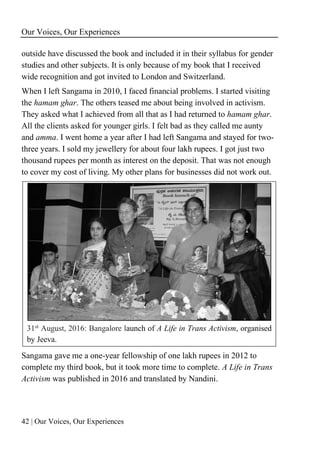
Our Voices
Our Experiences
Content curated and compiled by: Anita Cheria and Uma
Editor: Winnu Das
Editing and transcription support: Parimala Kamatar, Gopika Bashi, Sunita,
Mallu Kumbar
Cover art and book design: Winnu Das
Printed by: Kriya Prakashan P. Ltd.
Bengaluru, Karnataka – 560027.
This work is licensed under a Creative Commons Attribution-NonCommercial-
NoDerivatives 4.0 International License
This book is not for sale.
Suggested contribution ₹ 200; $ 25; € 20
First edition: May 2019
Published by: Jeeva, a Trust registered under the Indian Trusts Act, 1882.
Jeeva is registered under Sections 12A and 80G of the Income Tax Act, 1961.
email: jeevabng@gmail.com
Phone: +91 9591775020 / +91 9008376679
Wordpress: http://jeevabng.wordpress.com/home/
Facebook: https://www.facebook.com/jeevabng
Youtube: https://bit.ly/2Gqa2Wv
Contents
JEEVA’S JOURNEY...........................................................................................i
PREFACE ...................................................................................................... iii
OUR VOICES, OUR EXPERIENCES ............................................................ 1-51
MAPPING TRANSGENDER EXPERIENCES................................................ 53-71
JEEVA: FOR A LIFE OF PEACE AND FREEDOM OF EXPRESSION.............. 73-87
ENGAGING WITH LAW AND THE STATE............................................... 89-121
ANNEXURES....................................................................................... 123-131
i
Jeeva’s Journey
Jeeva (lit. life), registered on 5th
November 2012, is a community-led
organization that aims to build a society where all people can live in peace
and freely express themselves irrespective of their gender identity or sexual
orientation. It is the solidarity and support of countless individuals that has
made our journey possible.
Manohar Elavarthi provided valuable support to start Jeeva. Fellowships
from Aneka (2013-14) and Jain University (2015-17) provided mentorship
and financial support to Jeeva in its initial years. Akkai Padmashali has
partnered with Jeeva and helped build organizational linkages. Jayna
Kothari of CLPR has supported Jeeva’s legal interventions. The Karnataka
Sexual Minorities Forum, particularly Mallu Kumbar, has partnered with
Jeeva for several community initiatives. OpenSpace has provided
documentation and strategic planning support. Alex Tuscano of Praxis has
consistently supported the Praxis-Jeeva projects since 2016.
Our present board of trustees – Lakshmi. A, Pushpa Achanta, Dr.
Muralidhar, Revathi A, Sunitha B.J and Anita Cheria - and former trustee
and founder member Dr. Evangeline Anderson-Rajkumar, have guided and
supported the organisation at every stage.
I thank all the volunteers, allies, community leaders, activists and NGOs in
Bangalore, in other districts of Karnataka, nationally and internationally
who have supported and collaborated with Jeeva since its inception.
Uma (alias Umesh P.),
Founder and Managing Trustee,
Jeeva
iii
Preface
‘Our Voices, Our Experiences’ focuses on transgender experiences in
Karnataka and issues with which Jeeva has extensively engaged. Putting it
together has been an insightful journey. We started curating and compiling
experiences a year ago, certain the process would be completed in a few
months. However, as we progressed, and the events of 2018 unfolded, we
found there was a lot more to say.
There are four sections in this book. The first and second map personal
stories and experiences with the major institutions of society such as the
state, media and family. Most stories have been shared by friends of Jeeva
who have consistently supported Jeeva in prioritising issues for reflection,
conversation and campaigns. Some stories have been adapted from
‘Ananya’, Jeeva’s print magazine, or interviews aired on Jeeva Diary, a
community radio programme. Jeeva’s key interventions are highlighted in
the third section. The final section touches on engagements with law and
the state and includes experiences from campaigns and traces key
developments and current concerns for gender and sexual minority rights.
In the annexures to the book are a glossary of relevant concepts, acronyms
used in the book, links for reference and further reading and finally, lists of
sensitive hospitals, counsellors and NGOs/CBOs.
We hope this book generates awareness, understanding and dialogue on the
concerns of gender and sexual minorities. Though not exhaustive, it

attempts to reflect the rich and varied experiences, challenges and victories
of gender and sexual minorities – personal, collective and organizational.
Anita Cheria
Trustee, Jeeva
Our Voices, Our Experiences | 1
Our Voices, Our Experiences
This section contains eight life stories:
▪ JARMI, JASMINE, JOY – MY LIFE EXPERIENCES
▪ BLESSED BY THE GODDESS – THE LIFE OF RENUKA
▪ SHAKTI – A MARALADI LIFE
▪ VIMALA – A SEARCH FOR ACCEPTANCE
▪ AMULYA – MY STRUGGLES, MY LIFE
▪ MY JOURNEY – SONU NIRANJAN
▪ REVATHI – THE STORY OF MY LIFE
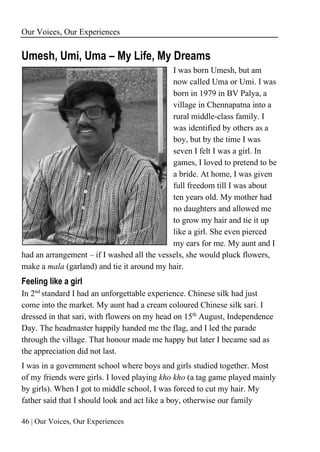
▪ UMESH, UMI, UMA – MY LIFE, MY DREAMS
Jarmi, Uma, Kannan, Deepika, Vaishali, Kumar B, Ranjita and Mallu
Kumbar participated in a discussion on the transgender experience
facilitated by Anita Cheria. Observations from this focus group have been
interwoven into this section and through the book.
Reflecting the diversity of the transgender population, the narrators of the
life stories and the participants of focus group are of diverse ages, gender
identities, sexual orientations, come from different places and cultures and
have varied aspirations. It is on these diverse experiences that Jeeva bases
its work.
Our Voices, Our Experiences
2 | Our Voices, Our Experiences
Jarmi, Jasmine, Joy – My Life Experiences
My name is Jarmi, short for
Jeremiah. I was born male on 3rd
September 1974. I am a woman and
live and identify as a kothi. I may
dress in a pant and shirt, but my
feelings and emotions have always
been feminine.
Ever since I can remember I have
been interested in girls’ clothes and
cosmetics, but my feelings became
clear to me at the age of 13. There
was no opportunity to share my
feelings at that time. Later in high
school, I shared my feelings with
Shashi, another transgender person.
Till I joined a pre-university college in 1988, I did not face any real
restrictions. My identity and expression were never hidden. My family and
friends never thought of it as unnatural. Women in the neighbourhood used
to even ask me for tips on hair styles, blouses and matching colours which I
loved to give. I used to spend most of my time with other girls. This was
never seen with suspicion. I was allowed to play games like kho kho (a tag
sport) with girls. It was only when I became an adult that my family started
asking me to learn cycling and play cricket. People started saying that I
should not be friends with or spend time with girls.
College: Harassment and isolation
In college, I was made to feel uncomfortable. People made hurtful
comments. I was teased about the way I walked, dressed, held books and
for using an umbrella. Though I wore a pant and shirt, I used to wear ones
with patterns in colours of my choice. I used to ask the cobbler to add a
Our Voices, Our Experiences | 3
heel to my shoes. My clothes and my gait attracted negative attention.
When classmates started teasing me and questioning my behaviour, I said
that this is how I am and how I have always been. Sometimes it was okay.
But at other times, comments could be very hurtful. Sometimes I was asked
why I dressed and behaved like an ombuttu (a derogatory word referring to
effeminate men). It did not stop at that. They started asking me for sex.
One day, class got over an hour early. The boys were going to a stream
close to the college and asked me to join them. At first, I refused saying that
I did not know how to swim, but they forced me. Once we reached the
stream, they wanted to get into the water. As boys usually do, they stripped
down to their underwear and jumped into the water very casually. I agreed
to go into the water with my clothes on. Till that point it was okay, but then
they started questioning me: “Why can’t you be like us? We want you to do
the same. What is the problem? We want to see what you are like. Why you
are refusing to do the same as us?”
My refusal to undress made them agitated. I was confused and stressed and
embarrassed and scared by their demands. As they started getting insistent,
I became nervous, not sure whether to hold on to my clothes or jump into
the water. They asked me again why I was not ready to strip like them and
come into the water. Finally, they forced me. They stripped me and I just
sat in the sand and cried. That was when one of them came to me and
comforted me. He said that no one was serious or wanted to hurt me; they
were just teasing, and it was a joke; that it was fine if I chose not to get into
the water. I said that this may be a joke for him, but I found it very hurtful.
He brought back all my clothes. I put them on and left.
I did not share this incident with my family as I felt they would not
understand my pain. They would have scolded me and asked why I did not
feel free with my friends, why I was shy, why I wanted to behave
differently. They would have said that I should have undressed like my
friends.
Our Voices, Our Experiences
4 | Our Voices, Our Experiences
Girls from my own class were friendly with me. I used to play throwball
and kho kho with them. But my seniors, even the girls, started teasing me.
When I walked in college, groups of students sitting around the campus
would make it a point to look at me and ridicule me. I used to wonder why
my classmates commented so rudely. It was very painful. I started finding it
difficult to focus on my studies.
By my second year at college, I started wanting to express myself more
freely as a woman – to dress like one, wear a sari, walk like a woman and
be loved by a man. So, I left college.
Leaving home
I was at home for a few years after that. I started working in a paper factory
close to my house and moved to the factory town in 1994. There were very
well-furnished stylish buildings for the management. But for the workers
there were only small temporary shelters where we could keep our
belongings or rest between work. My job was to trim plants and maintain
the garden around the factory. I got paid Rs.18 per day. I felt very awkward
there; I felt that others were always staring at me. They used to call me
many derogatory names like ombuttu and chakka (a derogatory term for
transgender persons). I was constantly a little scared of this negative
attention.
Friendships and love
After a month or so, I found another person who was feminine like me – a
kothi. Her name was Sundari. If someone called her by her male name, she
would get very angry. We became friends and supported each other. I felt
much better. But even then, both of us were continuously teased by the rest
of the workers. I felt attracted to a man named Manju but was very scared
to express myself in the factory. I found most of the workers very rough in
their behaviour – almost like rowdies.
There was another man, Karthik (name changed) who was a mechanic in
the factory. I asked him if he was comfortable talking to me and being
Our Voices, Our Experiences | 5
friends or if he was embarrassed to interact with me. We gradually started
meeting during the lunch break, a time when most workers would eat and
rest. Sometimes we would get some time alone if the others had left. Once
he asked whether he could love me. I jokingly asked whether it was not
awkward to talk about love among boys as I did not want to expose myself.
Sundari and I loved Manju, but he was friendlier with Sundari and paid no
attention to me. I did not take everything so seriously. Sundari wrote ‘I love
you’ on a chocolate wrapper and gave it to Manju and that made their
relationship stronger. This is when I thought I also need to do something to
attract the person I loved. I decided to cut my hand and use the blood to
write to him about my love. I wrote about half a page. I did not want to hide
anything from Sundari, even about loving the same person so I handed the
letter to Sundari. She was in a tight spot as she loved both of us. It was
difficult for both of us.
Even though it was very painful for her, Sundari agreed to give my letter to
Manju. She later told me that she gave it to him but as we were walking and
speaking about this, I found the letter that I had written crushed and thrown
on the path. I was sad and Sundari felt sad for me. I asked if she and Manju
had spoken about anything when she gave him the letter. She said that she
told Manju that the letter was from me and handed it over to him.
Manju went around the entire factory town talking badly about us. He said
there were two ombuttu in the factory and this became a topic of gossip
among the other workers.
Marriage and divorce
Karthik asked me if I was upset about Manju spreading this gossip. It was
then that I knew he liked me. The next day he said he was unwell and took
permission to take an hour off work. Noticing this, I asked my supervisor
for the same. When I went to see him, Karthik asked me why I was not
friendly with him. We soon became friends and started living as a couple.
He was from the same area as me. I liked to cook for him, wait for him to
Our Voices, Our Experiences
6 | Our Voices, Our Experiences
come back and eat with him. Sometimes, I served him extra food so that he
could not finish and I could eat from his plate. I did everything that made
me feel like a good wife. He kept telling me that this was not necessary, that
he would always stay with me. But that was my image of loving couples –
the right way for a husband and wife to be together. Even though I dress in
a pant and shirt, my feelings then and now are the same.
I told him that I wanted him to marry me; that it would make me happy if
he tied a thali (a gold pendant on a chain known as mangalsutram that the
groom ties on the bride’s neck as a symbol of marriage) for me at a temple.
He was ready but warned me that at some point his family would force him
to get married. He asked me whether I would be able to deal with a
situation like that. He knew I was very sensitive, but I said that would be
alright. We tied a thali in a small temple nearby. From 2002 to 2004 we
lived very happily as a couple.
Slowly, word got around and his family found out about our relationship –
first his brother, then his parents. His mother asked me why I thought of her
son as a husband; was I not a man too? It became a big issue in my home
also when the whole fight started. His brother brought some goondas to
threaten and beat me. When the goondas came, my husband hid me and
saved me. My sisters found out and came to visit me. Karthik’s mother filed
a police complaint. At the time I did not know that there were any
organisations that worked on issues like sexuality and gender who could
help. The police also did not know much about these kinds of cases. They
did not take any action against me saying that whatever the relationship
was, it had no validity before the law. They claimed that I cannot complain
as his first wife if Karthik were to get married, so there was no issue. Then,
it became a fight between the families. My sister made me promise not to
meet him again saying that my presence will ruin his life – she made me
promise on her son to put more pressure on me. My husband was then
forced to marry by his family. I felt it was time to make a clean break and
decided that shifting to Bangalore might help.
Our Voices, Our Experiences | 7
Bangalore: Expectations from city life
Moving to Bangalore was difficult for me; not because I was leaving home,
but because of my experiences there. I had a picture of city life: a place I
could dress according to my choice, use make-up and most important, live
freely. Once I arrived in Bangalore that image was shattered.
My sister lived in Bangalore but living with her would have meant a lot of
restrictions. One of my husband’s friends helped me shift and I lived in his
house. He was a driver and had an erratic schedule. He held a lot of ‘drinks
parties’ in his house.
“He often told me to be ‘good with his friends’.”
The people who came home were also from our village. They knew
everything that happened to me, teased me and asked me for sexual favours.
I was totally dependent on my husband’s friend and did not have much
choice. It was very traumatic for me. I had never drunk alcohol but here, I
was forced to drink. They would just force it into my mouth and then
involve me in oral sex.
Abandoned by friends, saved by strangers
All this made me feel very low. I was sad that people looked at me only as a
sex object. Nobody was genuinely ready to help me. I was scared to accept
any help, as it would often mean that they would ask me for something
hurtful in return. After a year, my husband’s friend left me alone in his
house to fend for myself. It was difficult for me as at that time I hardly
knew anyone, I did not have a job, and I did not know the city. I had left my
home, the friend who brought me here left, and even my sister did not want
me to stay with her. I found it difficult to manage basic food and clothing.
I felt lonely and helpless and contemplated suicide. I went to Nandi hills.
While I was sitting there and thinking, three young boys noticed me and
asked me why I was sitting there. They said it was dangerous after dark and
the police and guards would drive me away. I started crying. I told them I
Our Voices, Our Experiences
8 | Our Voices, Our Experiences
was depressed because of a family issue and did not go into any details.
They were nice to me, but I did not want to risk being treated like a sex
object – after all they were three boys. They very carefully moved me away
from the edge of the hill, brought me down and put me on a bus that would
take me away from there.
Rebuilding
In a temple close to my house, they served food. Whoever cleaned the
plates after the meal got a free lunch, so I did that. That got me a meal every
day. One day at the temple, a person came and spoke to me and I shared my
experiences and problems. This person introduced me to someone who got
me a job at Garuda (a shopping mall in Bangalore). This was 2006. After a
year of working there, I felt much more secure. That was the first time I
could plan for myself and make decisions independently – how to live,
where to live, how to manage expenses.
One day I went to Cubbon Park. While I was sitting there, a person
approached me and started asking questions. He told me about Sangama, an
organisation that supported people like me, helped us access counselling
and medical services, held community meetings and gave us space to
express ourselves and enjoy ourselves together. My first reaction was to
reject his advice. I thought it was risky to believe a stranger, especially in a
place that was new to me. But then, a second person came to me and spoke
about Sangama on another day. That was when I felt that it could be the
truth as it is difficult for two people to tell me the same lie. I started visiting
Sangama’s office. I went for every weekend meeting and found friends and
a community. I felt a new confidence knowing that there are so many
people like me. For about three years, I continued working in Garuda mall
and went for community meetings. Slowly, I became more confident and
self-reliant. I forgot the people in my past and felt happier than before.
I quit the job in Garuda mall and started working with organisations
working with our community. I started as an office assistant at an
organisation called Samara in 2009. It works on AIDS prevention and care.
Our Voices, Our Experiences | 9
After some time, I became a peer educator and later an outreach worker.
Now I am an assistant manager. I am keen to continue working for my
community. There was a time when I thought that what happened to me
was the worst. Now I know others have experienced much more pain and
need support.
Faith, Worship and the Church
As a child, I was part of the CSI Church Vanes Memorial Church in New
Town, Bhadravathy. When I shifted to Bangalore, I contacted some CSI
bishops through a friend and tried to join the local churches – one near
Bowring hospital and another in Kothanur. They both said that I had to
apply as a male and not a transgender person. In my previous church –
many years prior – I was registered as a male. In Bangalore, I wanted
admission as a transgender. They insisted that I get a letter from the
previous church mentioning the same – transgender. After all this talk of
process and procedure, I got tired and found a private church which has
been very welcoming.
Castration
I have always wanted to undergo castration and SRS to be seen and
recognised as a woman. For a long time, I did not receive any support.
Everybody discouraged me based on my age. Then, some people told me
that age is not an issue. I tried to follow the legal procedure for SRS and
approached Ramaiah hospital for counselling. Unfortunately, I could not
pick up my certificate as I got busy with other things. During that time, a
friend warned me that if I undergo an operation at this age, I will have
problems passing urine. I was keen to build my identity as a woman but
further delayed my SRS procedures for almost another year due to the
discouraging advice and lack of support.
Then, another friend who had done her nirvana (castration) said that she
knew people who had undergone the surgery after fifty and that there were
no age-related complications. I regained my confidence and went back to
Our Voices, Our Experiences
10 | Our Voices, Our Experiences
Ramaiah hospital to get my counselling certificate. I was told that I should
live as satla (dress as a woman, preferably in a sari) for six months and only
then would they certify me as ready for SRS. I was disappointed and had a
disagreement with the counsellor. I felt discriminated against. I was not a
seventeen-year-old. I was mature and decided on the surgery after a lot of
thought, considering all possible complications. The way the counsellor
spoke to me, it appeared that he did not understand my situation and context
and thought I was discussing the issue for the first time. I gave up on
Ramaiah and in 2017, with the help of friends and colleagues, I went ahead
with castration at a hospital in Madurai. I finally did SRS in early 2018. I
now prefer to be called Jasmine or Joy. My family knows about the surgery.
It has not been an issue as they accepted me as I am a long time ago.
“My feelings are not reflected by or linked to my clothing.
Whatever I wear, I feel the same and recognise myself as a
woman.”
I feel happy now. I am at peace with myself. For so many years, I was
unhappy when I saw my body – when I looked at the mirror, when I had a
bath. The sight of my private parts – my penis – disturbed me. I always
wondered how my life would have
been if I was born without it. Now I am
satisfied with my appearance, my body
and my thoughts. I am still most
comfortable in jubba and pyjama
(traditionally male clothing) and
continue to use that as my daily wear,
but my style has always been feminine.
For parties and on special occasions, I
like to dress up in a sari and wear
make-up.
Our Voices, Our Experiences | 11
My worry now is about survival. The project at Samara where I was
working came to an end this year and I do not have a job. At forty-five, I
cannot think of sex work or begging to support myself. After the surgery, I
feel a little more tired and have lost some of my strength. At most, with
financial support, I can most try to start a small business. Any work that
involves physical labour will not be possible.
Expectations from family, society and state
I consider two families my own: my birth family and my community. In my
birth family I have sisters – they take care of me if I have a health issue, we
share and support each other. Though they are not very happy about the
choices I have made in life, they demand that I keep in touch and meet them
often. With my community family, I share my feelings and there is mutual
understanding, contact and care and support.
A lot of people have hurt me. I want respect and acceptance from society. I
appeal to everyone, if they see someone like me on the road, look at them
with respect. Do not refer to us using demeaning names. We also have a
right to live with dignity. From the government, I expect the
implementation of schemes and services that can support our livelihood and
housing as these are important for our survival and self-reliance. Most
people are not ready to give us houses on rent and the government must
recognise that. Housing and government jobs will make a big difference as
we will not be forced into sex work and begging by the lack of options. If
we are to live with dignity, we need to be given decent housing and a
pension of at least Rs.10,000. Otherwise, we cannot survive.
Our Voices, Our Experiences
12 | Our Voices, Our Experiences
Blessed by the Goddess – The Life of Renuka
My name is Renuka. I am from
Chikkamannuru, a village in Gadag
district. My parents did not have
children for many years after
marriage. They begged the goddess to
bless them with four sons. Then, my
three siblings and I were born. My
parents became ardent worshippers of
the goddess Yellamma.
I was attacked by a strange health
issue when I was nine. Every year my
family visited the Yellamma Gudda,
the hill where the goddess resides.
When we visited the hill later in my
childhood, I felt intensely that I belonged to the hill and to the goddess.
Strange feelings drew me back to the goddess over and again. When I came
back from the hill, I got pimples all over my face and body. A kind of
stinking white blood leaked from the pimples. Even with frequent visits to
doctors, it gradually increased. This is how the goddess possessed me.
My parents connected this problem with the goddess and said, “We will
offer the crops in bulk to her, but we will not let our boy ‘tie the pearls’”
(Kannada: muttu kattuvudu, a ritual followed by Jogtis, Devadasis and
Jogappas to dedicate a person as a lifelong servant of the goddess). My
health started deteriorating again. The goddess possessed me and said that
she would make my siblings and I leave the family and the village. My
uncle begged the goddess: “We will let him ‘tie the pearls’ and bring a huge
number of people in a lorry to worship you, but we will not let him wrap the
sari”. The goddess was not ready to listen to him. My health problems
increased again. My uncle started fasting in her name and said, “We will
Our Voices, Our Experiences | 13
allow him to wrap the sari but will not send him out of the house or
village”. The goddess possessed me again and said, “I know what to do
next. It is your responsibility to leave him to serve me”.
My parents, with our family and others, took me to the hill of Yellamma to
tie the pearls. To tie the pearls, the elder Jogappas and a specific priest of
the temple have to be informed a day in advance. There are two rituals to tie
the pearls: enjalu muttu and meesalu muttu. Since I was young, they did not
allow meesalu muttu and decided to tie enjalu muttu. According to the
ritual, I bathed in the enne honda (lit. pond of oil, one among the seven
ponds on the hill of Yellamma). They placed a paddalagi (a bamboo basket
with food, sweets and vegetables, also used by Jogappas for begging) on
my head and gave me water to drink and some sugar to eat. Then the priest
tied the pearls. We offered the priest twenty-one rupees and ulupi (a
bamboo basket with rice, jaggery, coconut, betel nut, a sari and a blouse
piece). I worshipped the other goddess Matangi and offered her fresh food.
At Sattyakkana bhavi (lit. the pond of Sattyakka), I drank the water from a
stone barrel in which a piece of animal skin was placed. We offered food to
young Jogappas. Once all these rituals of enjalu muttu were completed, I
was completely cured.
Leaving home, finding a livelihood
I stayed at home for three years without any problems. But later, problems
arose and I left. I went to a village called Kurlageri in Nargund where Devi,
a senior Jogappa, stayed. Similar to the Hijras, Jogappas have gurus who act
as mothers and take care of their chelas (daughters). For eleven years, I
stayed with my guru. Before I returned to my village, my guru offered ten
thousand rupees and ten grams of gold to the goddess. She told me to
contact her if I needed anything.
Soon after I returned home, my brothers got married. They told me I had to
take on the responsibility of everything at home. I could not shoulder the
responsibility of caring for everyone. So, I left the house again and settled
in Gadag. Every now and then, I visit my village and meet my mother.
Our Voices, Our Experiences
14 | Our Voices, Our Experiences
To earn a livelihood, I begged in several villages. People offered raw rice,
jawar, flour and small amounts of money. How could I live only on that? It
was too difficult – I needed to pay my rent. I started begging from vehicles
sometimes, but other Jogappas did not allow me to do this since they
worked in those areas. I started dancing on special occasions, sometimes
alone and sometimes in a group.
Jogappa traditions
When we dance, we place a copper pot with the head of the goddess on our
heads. We also sing and play the chaudike (a music instrument played by
Jogappas and other devotees of Yellamma). We divide the earnings from
these performances between us.
During festivals and crescent moon days, we stay at the hill of goddess and
perform there. On crescent moon days like rande hunnime (part of a month-
long mourning of Yellamma’s widowhood during which devotees follow
the rituals of a woman becoming a widow) and muttaide hunnime (part of a
month-long celebration of Yellamma being restored to her status as a
married woman) devotees from all over the state and the country come and
stay on the hill in huge numbers. We earn more on those days. We buy gold
jewels for the goddess if we earn large amounts and wear those jewels on
special occasions.
“Jogappa culture is embedded within Hinduism, but we cannot join any
temple. We have to start in our own temples. Within the Jogappa culture
there is no place for nirvana, i.e. castration and SRS. The body given by
god should not be tampered. Our dressing is also traditional, unlike in the
city.” – Vaishali, Focus Group
Castration and sadar (Jogappa term for sex work) are not accepted within
the Jogappa culture. Few Jogappas are engaged in sex work. People who do
not dedicate themselves in the service of the goddess are not respected in
our culture. If they really serve the goddess, they would depend on the
money they earn from performances not tapar (Jogappa term for money
Our Voices, Our Experiences | 15
earned from sex work). They would not accept any of the facilities or
services the government provides. But it would be of great help to us if the
government provided us with houses.
A Jogappa in Krishnapur was sent out of his house. He has rented a house
now and lives with his sister whose has left her husband. He does not have
a source of income. This is how we live – without a home, family, earnings
or security. No one listens to us.
The only comfort and solace we have is that we have some relationships
outside of our families. I am forty-one years old now and have six
daughters.
Our Voices, Our Experiences
16 | Our Voices, Our Experiences
Shakthi – A Maraladi Life
My name is Shakthi. I am a
Maraladi kothi. I was born and
brought up in Viveknagar,
Bangalore. When I was young,
I identified more with girls and
preferred to play with them. My
friends would tease me about
this. In school, the boys in my
class kept asking me why I
would not play with them, why
I spoke and behaved like a girl.
They taunted me saying, “You
are a boy, why don’t you
behave like a boy?” When I
was in seventh standard, I
became conscious of my
feelings and how different I felt
from the boys around me. I left
school by the end of that year.
Finding my way
I was always very interested doing poojas (rituals in honour of Hindu
deities. Men and women traditionally take up different responsibilities in
poojas. The daily rituals are predominantly performed by the women of the
house). This was often questioned, even within my family. I was told that I
was a boy and should behave like one. The warnings became stronger until
I was openly told not to behave like a girl.
Doraiswamy, a Maraladi with a temple of her own, lived in my
neighbourhood. She was respected in the area. I started visiting her temple
as I liked the rituals and began to identifying with it. I hoped that I could
Our Voices, Our Experiences | 17
become like her. To initiate a person into the Maraladi tradition, a senior
person from the community must accept her. The rishta (relationship)
established is that of a mother and daughter, both of whom are married to a
deity. The senior person ties a chain, called a mangalya or mangalsutra, on
the neck of the new member to symbolise this marriage. The elders gift
vessels and clothes to the new member. Doraiswamy agreed to establish a
Maraladi rishta with me. I found comfort and a way to express myself in
poojas, worshipping gods, offering flowers and decorating the idols. I went
regularly to the wholesale market to buy flowers for the temple.
I started working at a hotel but did not like the job because people
commented on my feminine characteristics. They asked me openly why I
behaved like a girl. I was not comfortable there, so I left.
My family realised that force was not working and it was not up to me to
change. Once they accepted this, they asked me not to go anywhere for
rituals or for sex work. They said I could continue to live at home and they
would build a temple for me at home where I could do poojas.
Maraladi culture
Maraladi kothis build our own temples and perform rituals there. We are
strong in our faith. We are respected in society as there is a belief that to be
blessed by us is auspicious and brings good health, luck and healing.
In summer, we celebrate karaga utsav, a festival during which we practice
anna dhaanam (i.e. feeding devotees) and walk on a bed of burning
charcoal. Karaga refers to a mud pot with a tall floral pyramid that is
balanced on the head during the spiritual offering. The contents of the pot
have remained secret for centuries. The belief is that the person performing
the karaga is blessed by the deity to immediately understand what is in a
person’s mind when they come to us. There are slight variations in the way
karaga is practiced in different temples as rituals are specific to each deity.
There is a collective of Maraladi kothis called the Mahanadu unit. It was
formed many years ago, maybe before independence. To register in the
Our Voices, Our Experiences
18 | Our Voices, Our Experiences
Mahanadu, you must give details of the temple you own or are part of,
photographs and identity proof. Once registered, some support is provided.
When a member dies, they bring a special bell – symbolic of the
community, a lamp, sari and Rs.5,000 for the final rites. After the rituals,
the bell and lamp are taken back. This is done only for members who die a
natural death – if the death is unnatural, they do not come.
Changing practices
When I joined, no one within the Maraladi culture practiced sex work or
had SRS or breast implants. Maraladi kothis wore lungis (traditional wrap-
around garment, usually worn by men) and shirts and let their hair grow
long. They looked distinct as they wore bindis (a coloured mark worn on
the forehead, usually by women) and marked their face with turmeric and
vermillion. Saris were mainly worn during festivals and special occasions.
Over time, there have been changes in our community. Some people have
taken to wearing distinctly women’s clothes like saris and dresses as the
norm. Some have got SRS done, including breast implants. Often such
feelings about the expression of womanhood are due to the desire to be seen
as part of the larger society. Most Maraladis with a temple have a following
of people who believe that their blessings can bring luck and solve their
problems. Even so, with all the stigma and discrimination that exists in
society against transgender persons, it is more stressful to maintain a
distinct dress code and appearance.
Finding home
I am now 40 years old. I continue to live in Viveknagar with my family. I
am settled with my temple work and conduct poojas every week. I get some
income through the offerings made and that is enough for me. I have full
family support for my temple work and in my personal life. My hope is that
I can live worshipping my god in my temple, decorating it with flowers and
blessing people.
Our Voices, Our Experiences | 19
Vimala – A Search for Acceptance
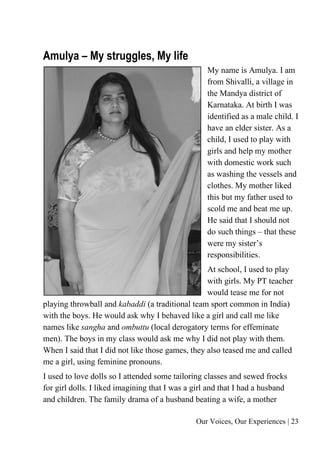
My name is Vimala. I was born in
Ramachandrapura, a village in
Tiruvannamalai, Tamil Nadu. I
always felt I was not born the right
way. Ever since I can remember, I
wanted to look like and be seen as a
girl, feel attractive like a girl. When
I was three years old, I started
going to the government preschool.
During the break, all the boys used
to sit together in groups for lunch,
share food and talk about their
families. I was never included in
any group. One of the boys told me
that this was because I was not
‘proper’. At school and at home
they used to drive me away saying,
“go pick cow dung” or “go graze
cattle.”
My parents did not want me; I never felt accepted by them. My mother
cursed me saying, “Because you are like this, nobody includes you. Why
were you even born in my stomach? Go jump into a well or a lake and die.”
She used to beat me with a spatula. Sometimes, she heated the spatula over
a fire and branded my hands and mouth.
My neighbours taunted my mother saying, “What Kalaimani amma? Your
son is behaving like a woman. Having given birth to such a son, you should
hang yourself.” This provoked my mother and she beat me badly using
broomsticks and slippers.
Our Voices, Our Experiences
20 | Our Voices, Our Experiences
Turning to Devi and leaving home
I wanted to be a Maraladi. I believed that whatever I wished for in my heart
would come true. So, I prayed to Devi Angala Parameshwari and asked that
she make me look like her – with bangles and earrings, vermillion on my
forehead, turmeric on my feet and rings on my fingers and toes. I collected
small stones and performed poojas (rituals in honour of Hindu deities). My
mother used to throw them away until I told her that if she believed that
they were gods and prayed to them, good things would come our way; that
was when she started letting me be.
When I was eleven years old, I left home and went to Krishnagiri. I went to
restaurants looking for a job as a dishwasher, but they shooed me away. I
eventually got a job delivering food. I worked and I studied there from sixth
to ninth standard. As I got to higher classes the male teachers began
touching me here and there. When I asked, “Sir, why are you doing this?”,
they used to say, “Vimal, you are not like other boys. That is why.” I felt
very humiliated.
I worked as a domestic helper in a house for some time – sweeping the
stairs, cleaning the terrace and buying provisions. At first, the family did
not seem to care about my mannerisms, but slowly their behaviour changed.
They began ill-treating me, telling me not to behave like an ombattu
(derogatory Kannada word for transwomen and effeminate men). So, I quit
the job.
Disowned by family, finding my own people
One day, I boarded a bus to Bangalore. When I got down at the Bangalore
bus stand, I saw others who were just like me selling fruits. I began talking
to one of them and ended up telling them my story. They helped me earn a
living by getting me a job at a farm. I worked there for five months during
which I met others like me and found a community.
I lived with my brother in Bangalore for two years after that and continued
my schooling. One day, someone saw me with my community on the street,
Our Voices, Our Experiences | 21
clapping my hands and collecting money from shops and told my family.
My relatives came to Bangalore to beat me, drag me to my village and kill
me. My community stood up for me and did not allow that to happen. My
relatives poured water on themselves to symbolise my death and said that I
was not their son anymore. They told my brother that if I ever went to his
house, he should throw me out and beat me with broomsticks; they told him
not to speak to me even if he saw me on the road. My brother told me to
leave and never come back as his neighbours would comment and his
children would become like me.
I was very hurt by this incident. I
could not take the humiliation and
did not want to live anymore. That
was when I remembered someone
telling me about an organization
for people who talk and walk like
me. I found the organisation, and
through it, other friends.
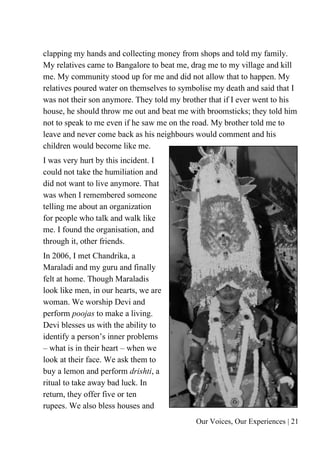
In 2006, I met Chandrika, a
Maraladi and my guru and finally
felt at home. Though Maraladis
look like men, in our hearts, we are
woman. We worship Devi and
perform poojas to make a living.
Devi blesses us with the ability to
identify a person’s inner problems
– what is in their heart – when we
look at their face. We ask them to
buy a lemon and perform drishti, a
ritual to take away bad luck. In
return, they offer five or ten
rupees. We also bless houses and
Our Voices, Our Experiences
22 | Our Voices, Our Experiences
perform special rituals on festival days like amavasya (new moon) and
Shivarathri (the festival celebrating the birth of Shiva).
Money and acceptance
I trusted people but they abandoned me. The family I was born into threw
me out. I used to keep inviting my brothers and their families for
Shivarathri but they always told me they did not want to come. I had no
support from my family. In 2013 and 2014 I did not even have proper saris,
I had to stitch up torn ones. People would say to me, “You perform such
good rituals and functions. Don’t you have a proper sari to wear?” I would
lie and say that my good saris were at my brother’s house. But Devi sends
help when she sees her children in trouble. I trusted my goddess and she did
not chase me away. Devi alone is responsible for all that I am and have
now.
The fifth year I called my brothers, they came. That was eight years ago.
They came because I have money now. I am able to pay Rs.6000 as rent
and take care of my life. If I did not have anything, my family would
probably never come to me. Now, they call me home and ask me to eat and
stay there. My father asks me to buy him clothes; my mother opens my
cupboard and takes my saris to wear. My sisters-in-laws come, wear my
saris and cook and eat in my kitchen. They ask me for cotton saris that will
be light and nice in the hot weather in the village. They all tell me that I am
the light of the house and I should keep the light burning forever.
My only request is that if someone is like me, let them be; let them live and
try not to harass or humiliate them.
Our Voices, Our Experiences | 23
Amulya – My struggles, My life
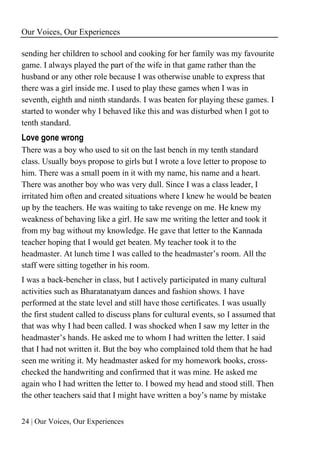
My name is Amulya. I am
from Shivalli, a village in
the Mandya district of
Karnataka. At birth I was
identified as a male child. I
have an elder sister. As a
child, I used to play with
girls and help my mother
with domestic work such
as washing the vessels and
clothes. My mother liked
this but my father used to
scold me and beat me up.
He said that I should not
do such things – that these
were my sister’s
responsibilities.
At school, I used to play
with girls. My PT teacher
would tease me for not
playing throwball and kabaddi (a traditional team sport common in India)
with the boys. He would ask why I behaved like a girl and call me like
names like sangha and ombuttu (local derogatory terms for effeminate
men). The boys in my class would ask me why I did not play with them.
When I said that I did not like those games, they also teased me and called
me a girl, using feminine pronouns.
I used to love dolls so I attended some tailoring classes and sewed frocks
for girl dolls. I liked imagining that I was a girl and that I had a husband
and children. The family drama of a husband beating a wife, a mother
Our Voices, Our Experiences
24 | Our Voices, Our Experiences
sending her children to school and cooking for her family was my favourite
game. I always played the part of the wife in that game rather than the
husband or any other role because I was otherwise unable to express that
there was a girl inside me. I used to play these games when I was in
seventh, eighth and ninth standards. I was beaten for playing these games. I
started to wonder why I behaved like this and was disturbed when I got to
tenth standard.
Love gone wrong
There was a boy who used to sit on the last bench in my tenth standard
class. Usually boys propose to girls but I wrote a love letter to propose to
him. There was a small poem in it with my name, his name and a heart.
There was another boy who was very dull. Since I was a class leader, I
irritated him often and created situations where I knew he would be beaten
up by the teachers. He was waiting to take revenge on me. He knew my
weakness of behaving like a girl. He saw me writing the letter and took it
from my bag without my knowledge. He gave that letter to the Kannada
teacher hoping that I would get beaten. My teacher took it to the
headmaster. At lunch time I was called to the headmaster’s room. All the
staff were sitting together in his room.
I was a back-bencher in class, but I actively participated in many cultural
activities such as Bharatanatyam dances and fashion shows. I have
performed at the state level and still have those certificates. I was usually
the first student called to discuss plans for cultural events, so I assumed that
that was why I had been called. I was shocked when I saw my letter in the
headmaster’s hands. He asked me to whom I had written the letter. I said
that I had not written it. But the boy who complained told them that he had
seen me writing it. My headmaster asked for my homework books, cross-
checked the handwriting and confirmed that it was mine. He asked me
again who I had written the letter to. I bowed my head and stood still. Then
the other teachers said that I might have written a boy’s name by mistake
Our Voices, Our Experiences | 25
instead of writing a girl’s name. They were worried not so much about the
love letter but because it mentioned a boy.
The news spread to the whole school. Even the boy to whom I had written
the letter heard. From then on everyone began calling me “love letter”.
Since we were poor, it was difficult for us to manage the expenses. That
was the end of my school life and education.
Finding friends and community
I always felt the desire to look like a girl, with long hair and a feminine
appearance. I had mood-swings and thought constantly about my feminine
feelings and behaviour. While I was in my village, I never had contact with
other transgender people. Once I went to Mandya district for sports with my
PT teacher and friends. There I saw a group of transgender people who
came for collection (a term used for begging) shouting and speaking loudly.
My teacher and some of my friends said to me, “Look, your people have
come. Go and give them money”. I never thought of speaking to them as I
was scared by the way they were behaving. They saw me running away
from them and said, “Ey! Come here. Why are you running? You will also
become like us one day.” Their words soon came true.
One day I was in a park, lost in my own world. I was very depressed and
confused by the thoughts inside me. Someone came to me and asked me my
name. We spoke about our desires and feelings and he said that both of us
were the same. He took me to an NGO and helped me get counselling.
There I met Shobhamma, a counsellor who seemed to be completely a
woman except for her voice. I was confused whether to call her aunty or
uncle. I told her that I wanted to become like her – like a woman. She told
me not to become like her. She meant that I should not undergo sex
reassignment at this stage in life, but instead adjust and continue my
education and get a job. She said that becoming a transgender would lead to
a miserable life in all possible ways. But I wanted to become a woman.
Our Voices, Our Experiences
26 | Our Voices, Our Experiences
I left my village. I took a bus to Majestic, the interstate bus stand in
Bangalore. Soon after reaching Majestic, I saw a group of people coming
towards me. They asked whether I was also a kothi (an effeminate male).
When I said I was, they asked me to accompany them to their house. I
asked why I should go with them. They said they would make me the way I
wanted to become.
Celebrating womanhood and survival
Later, I met my guru and she took me to her house in Dasarhalli in 2006.
Being accepted as a woman, being able to dress and walk like a woman in
my guru’s house was a dream come true for me. I was finally able to
celebrate the womanhood hidden inside me. I was extremely happy on that
day when my new community life began. In 2008, I underwent castration.
They said that there are only two ways to live our life: begging or sex work.
I went for collection (local term for begging) to Nagavaara for the first
time. I clapped and begged in a shop. They looked at me in an awkward
manner. I felt very bad and started to question why I should beg. I had no
disabilities. Why should I be forced into such a situation? People like me
who are capable, we should get educated and work. But who will give us
jobs? People simply say that they will help us, but no one helps us build our
life. I then remembered the advice of Shobhamma. Somehow, I adjusted to
begging even though I was reluctant as there was no support from my
biological family and my guru said there was no other way out.
I did sex work later. It is not an easy job. I never imagined these hardships,
that I would spend my life like this. I was slapped for the first time when I
was doing sex work. I did not ask the reason. Feeling upset, I came straight
home and slept. Police and goondas never let us to do sex work if we do not
pay their share. They threaten us and beat us up sometimes. Several times, I
decided to commit suicide by hanging myself. But then I wondered, why
should I die? I have not done anything to anybody. I slowly motivated
myself, telling myself that this was my life and I must live it.
Our Voices, Our Experiences | 27
Love and loss
I began a relationship with a man in 2011. I asked him to drop me to my
house once. Later, we exchanged phone numbers and messaged each other
for two years. He came home, sat silently, drank tea and went back without
speaking. When he came a second time, I told him that I was transgender
and doing sex work. He felt very bad after listening to me. He asked, “Are
you the one I liked?” I asked him why the love changed after learning that I
am a transgender. He did not say anything. Even after that incident, we
stayed in touch for a few more years.
Later, he said that he was being forced to get married. I sacrificed my love
for him to be happy but I was madly in love with him and cried many times.
I felt completely broken and tried to commit suicide. I called him several
times, but he did not take my calls. Maybe he knew that I may commit
suicide and that was why he came to my house and told me to be calm. He
told me to contact my parents and spend my life helping them. He told me
about the hardships of life, how men leave their wives even after getting
married legally. He asked how it could be worse in a transgender person’s
case. He said “Who will take care of your parents after your sister gets
married? Help your parents.”
Family: Conflict and acceptance
I had never contacted my parents, though they tried to find me and contact
me many times. I had an old childhood friend, Vijay (name changed) in my
village. I call him anna (elder brother). When Vijay found out that I have
become like this, he called me and asked me to meet him. I told him to
come to Bangalore. Vijay also had feelings like me, he feels like a woman,
but he wears a pant and shirt. He came home with another person and asked
why I was dressed as a woman. He informed me that my parents were very
worried after I left the village. It had been six years since I met them. When
Vijay went back, he told the whole village that I had undergone castration
and become a woman. My parents were worried and complained against
Our Voices, Our Experiences
28 | Our Voices, Our Experiences
Vijay for spreading this news. They said that their son was lost five years
ago, that he might have made me like this by performing black magic.
Soon after, my brother-in-law and uncle called and asked me to meet them
in Koramangala, an area in Bangalore. Wondering why they called me after
such a long time, I tried to avoid their calls. However, my sister called me
and requested that I meet them, so all of us met. On seeing my appearance,
my sister started crying. I also started to cry. They were not ready to believe
that it was me – the boy they had known as a child, but they identified me
by a mole I had. They told me that a complaint had been lodged against
Vijay and his friend who had visited me in Bangalore. They asked me to
throw away my wig but then realised that it was my own hair. I told them
that I had undergone castration by choice, that nobody had forced me to do
anything. They asked why I had become like this. I told them that I would
not torture any of them and asked that they let me live my life. I even
prostrated in front of them.
They took me to the police station, assuring me that they would bring me
back safely. When we reached the police station, they forced me to support
their accusations that Vijay and his friend had used black magic to change
me. When my parents reached the police station, they did not recognise me
and asked who I was. They were shocked on seeing my transformed
identity. They were upset and not ready to accept me and my physical
appearance. I could understand what was going through their minds and
hearts at that time. They claimed their rights of being my parents without
understanding me properly. My father had brought all my sports certificates
in which my male name was written. My parents quarrelled with Vijay and
his friend and accused them of performing black magic and changing me. I
became emotional on seeing my family and felt pressurised to agree with
them. I think I wanted very much to reconnect with my family at that point.
I lied to the police that Vijay and his friend were responsible for my
condition but I felt bad for saying this as it was me who had wanted to be
like this. The police took me to the District Magistrate to record my
Our Voices, Our Experiences | 29
statement. Here, in front of all of them, I said that becoming a woman was
my own decision; I was willing and desired it; no one else was responsible
for who I am. My parents emotionally blackmailed me but I explained to
my parents that nobody had forced me and took back the case.
Now I am happy because I have shared my desires and feelings. I am not
hiding it all as I had been since the beginning. Just as my parents had
certain dreams for me, I had always wished to become a woman. Finally, I
became who I wanted to be. Now my family has accepted me as I am. If I
feel bored in Bangalore, I go to my village and spend time with my niece,
go to my fields and work there for some time. I also help my mother with
domestic work. My mother always says that had I been a man, she would
have had a daughter-in-law by this time. I have told her many times to think
of me as her daughter-in-law and to forget that she had a son.
Life goes on
The way I am, the decisions I have taken, even what my parents did, is
nobody’s fault. It was a difficult time in all our lives. I fought alone against
those hardships. I am happy to be what I am today because I love to be this
way. I have become a woman as it was my desire.
My wish is that society treats us equally and does not consider us inhuman.
I would never expect the government to give us kilos of gold, silver or cash.
But I do expect them to offer us jobs and provide equal opportunities since
we are also capable human beings.
Our Voices, Our Experiences
30 | Our Voices, Our Experiences
My Journey – Sonu Niranjan
I am Sonu Niranjan. At birth, I
was identified as a girl. I belong
to a poor Dalit family from
Trivandrum, Kerala. We were a
small family, just my mother and
I. I do not like to talk about my
father. My mother was a teacher.
We lived on her salary and she
supported my studies.
I hated looking at my body. I
always felt I was a male trapped
in a female body. I was haunted
by the thought that I was the only
one who felt like I did. I tried
hard to cover every feminine part
of my body and insisted on
wearing a pant and shirt. I always
played with boys; I did not mix much with girls or play with them.
While watching films, boys would watch the heroines and girls would
watch the heroes. But I was a girl and was attracted only to heroines.
Whenever I thought of a film song, I would get immense pleasure
imagining myself as the hero. In third standard, I felt attracted to a girl who
was in fourth standard. At that time, I did not know why I was attracted to
girls. I could not express my feelings at home. We were very poor with no
exposure to issues such as sexuality or gender. During that period, I knew
only that I was different from others.
When I was in tenth standard, I cut my hair and started wearing my
favourite clothes – a pant and shirt. This made me extremely happy but my
mother and relatives were very upset and screamed at me. To keep my hair
Our Voices, Our Experiences | 31
short, I told them that I had a serious ambition to be an international cricket
player and lied that I could not have long hair as it restricted me while
playing. They insisted that I stop cricket, but I stuck to my ambition.
Ridicule and loneliness
I was constantly ridiculed for dressing in a pant and shirt, playing cricket
and behaving like a man. This was due to the patriarchal stereotype of how
a woman should be – submissive, restricted to the kitchen and in ‘women’s
clothes’. The people in my neighbourhood called me ‘Shikhandi’ (a
character in the epic Mahabharata who is born female and later becomes
male). Even my family ridiculed me and called me names. People scolded
my mother for having allowed me to be as I wanted. They said that she
spoiled me; she had not raised me ‘properly’ as a girl; that she had allowed
me to do what I did.
I was madly in love with a girl and would always spend my time with her.
That became a serious issue for my mother and family. They started
questioning why I spent time with her. They said she was not a girl of good
character, that she was the reason I was spoilt. At that time, I was not aware
of my rights. Even the fact that other transgender people existed was not
very clear to me. Most of the time I felt very lonely.
I found out that there was a person in my family who felt like me. He was
attracted to women and behaved like a man. Unlike me, he did not cut his
hair and wore women’s clothes like churidars (tunics and loose pants
traditionally worn by women). Through him, I met others like me.
“One advantage for those born female is that many times a strong girl is
more acceptable than a feminine boy in our society.” – Kannan
When I joined a women’s pre-university college, I found a friend who was
like me. We were part of the state women’s cricket team. I loved cricket as I
felt it was a masculine sport. I observed my friend – the way he spoke and
dressed, always played with boys, looked at girls – everything he did was
Our Voices, Our Experiences
32 | Our Voices, Our Experiences
what I wanted to express. I was very happy I met him. I shared all my
feelings with him and we became best friends.
We faced a lot of problems in college because we wore pants and shirts.
Many of the other students’ parents started complaining that their children
were roaming around with two boys in the women’s college campus. The
complaints went to the principal. He was very confused trying to figure out
who these two boys were. The complaints became very serious and one day
the principal called us and insisted we bring our parents. The next day both
of us went to college with our parents. The principal asked my mother
strange and horrible questions: “Is your child male or female? Why does
she wear men’s clothing to college?” He asked me, “what organs do you
have?” He said that the college is for women and no male students are
allowed. My mother pleaded, telling him that I like to dress only in pants
and shirts. The principal scolded my mother and my friend’s parents, telling
them that they were not raising their daughters properly as we “behave like
boys, sing like boys and dress like boys. We [the college] will not let girls
wear pants and shirts. They must wear churidars or skirts”. We tried to
justify our dressing as we were not wearing skimpy clothes, we only wore
pants and shirts which covered the whole body. The principle said that girls
would get ‘spoiled’ because of us and the college name would be corrupted.
He instructed the teachers and students not to mingle with us because if
they did, they would also become like us. After that incident, nobody spoke
to us. We were ridiculed inside and outside the classroom. We were seen as
specimens. Though I was very interested in studies, I could not complete
my 12th
standard due to the harassment.
Battling alone
My mother was very unwell during this time and passed away. That was a
big blow for me. I ended up with living my relatives. They tried to change
everything about me, curtailed all my freedoms and pressurised me to get
married.
Our Voices, Our Experiences | 33
In India if a homosexual or bisexual female, or a transman expresses their
feelings, they are prone to more torture. The assumption is that once she
conceives, she will become ‘alright’. A heterosexual marriage is seen as a
‘cure’ – Focus Group
Hoping to make me ‘presentable’ to potential grooms, they forced me to
grow my hair long, wear girls’ clothing and behave like a girl. I could not
imagine being married to a man. How could I ever share with them that I
always imagined myself as the man in a marriage, being in love with a girl,
making her my wife and living as couple? Even if I wanted to share this
with them, they would see it as two women getting married. They never
thought of me as a man. I even considered suicide as I felt there was no
other escape.
Finding my voice and a world beyond
My friend from college and I found FIRM and Sahayatrika – organisations
supporting people like us. In 2003, there was a case referred to as the
‘lesbian case’. It actually concerned a transman and a cis-woman. The
media portrayed them as perverts, said that they were Naxals running a sex
racket. A legal case was filed to stop them from living together even though
they were adults but FIRM provided legal support and won the case.
FIRM sent many gender and sexual minority persons for the 2004 World
Social Forum in Mumbai. I was one of them. I told my family I had a
cricket match.
“In the train, for the first time I experienced the extraordinary
freedom of expressing myself as a man among many
transgender persons. Everybody saw me as a man. I was
extremely happy that I was away from the restrictions and
rebukes of my family and home. I had no fear, no need to hide
myself and my expressions of gender. It was, and remains to
this day, the most memorable journey of my life.”
Our Voices, Our Experiences
34 | Our Voices, Our Experiences
In Mumbai, I met many transgender persons from other states. Among them
was Famila, a Hijra woman from Bangalore, working as a human rights
activist with the NGO Sangama. I developed an intense friendship with her
and told her about my life and my fear – that I would be forced to get
married when I returned to my hometown. I also shared my feelings and
situation with Elavarthi Manohar, who was then the director of Sangama.
He assured me that there would be support if I came to Bangalore. Famila
suggested that I could move to Bangalore and stay with her so that I would
not have to go back to my family. I was a little apprehensive as I was
misinformed about Hijras and afraid of them. When we travelled in trains
for cricket matches, we were told that they would force money out of us,
that they kidnapped children to make us like them.
When I came to Bangalore and stayed in Famila’s house, it was wonderful
and all my misconceptions flew out of my mind. But how long could I stay
there? I had to return and I did. My family in Kerala scolded me for not
coming back on time. My mother was gone and I was at the mercy of my
relatives.
I started working in a medical store. There were other boys in the store and
they harassed and abused me every chance they got because I dressed in
men’s clothes. They constantly looked at me sexually and commented in
innuendos. I left the job and decided to shift to Bangalore. I told my family
I wanted to play cricket. They did not agree but I insisted and came to
Bangalore.
Life, survival and dignity
In Bangalore, I could live as I desired – as a man. However, I needed a job
and language was a problem. I started working but was constantly
addressed in female pronouns and faced gender-based harassment. So, I
quit that job. I asked for a job in Sangama and was given one. However, I
lost the job as I became lazy and did not do it properly. I later got a job in
Suraksha – another NGO that works with sex workers and sexual
minorities. I started out as an assistant; with help of friends who trained me
Our Voices, Our Experiences | 35
in computer basics, I become a data entry operator. I later re-joined
Sangama and worked as training officer in the Pehechan project. Now the
project is over. Work in NGOs is not a permanent – the job only lasts till
the funds come; I also need a job in mainstream society. I am now
continuing my studies in Kerala with the support of Kerala State Literacy
Mission. I am a member of the Kerala State Transgender Board which
implements and monitors the state transgender policy.
“SRS was a two-year process. First, there was counselling
and my application was approved. Then I went to the
endocrinologist and they started me on hormone therapy
along with further counselling. I underwent the top surgery
(mastectomy). As I am from a working-class background and
could not save money for the surgery, my friends helped me. I
am very happy that I did it.”
The gender binary
Transgender persons face a lot of problems. Our society operates on the
strict binary of male and female and has no concept of other gender
expressions. We are not understood. We are told that as women we should
not wear men’s clothing. These gender norms restrict our expression. If you
assert yourself as a man and not a woman, the stigma and discrimination
begin. This scrutiny extends to every service sector. Take health. My
friends and I do not usually go to doctors for normal health issues as we are
forced to answer a hundred questions about our gender. They ask if we are
women or men; they gather to see us as though we are specimens and
ridicule us. Most of the time, we cannot easily use public toilets as we need
be extra careful to use men’s toilet. These practical issues lead to bigger
problems. We restrict ourselves from urinating in public toilets and end up
with infections and develop kidney problems.
Our Voices, Our Experiences
36 | Our Voices, Our Experiences
Society often becomes very violent against transgender persons. People try
to strip them to ‘check’ their gender. Once, my friend was travelling in a
bus and got a call. When he answered the call, people heard his voice and
started ridiculing him asking if he was a man or a woman. My friend tried
to stop the bus near a police station but the bus did not stop. They even tried
to force him to strip, but he managed to escape. In another case, one of my
friend’s shirt was torn to ‘check’ if he was man or woman.
All the restrictions on gender expressions and violence have led to many
suicides. I have a request to society. I want people to stop thinking of
gender as binary and let every person live their chosen gender.
Our Voices, Our Experiences | 37
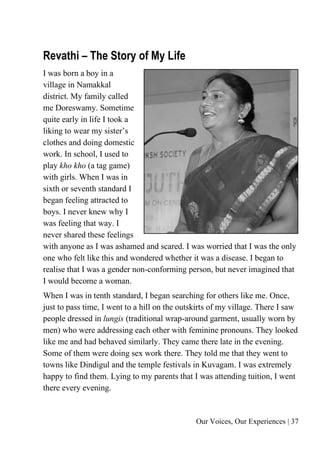
Revathi – The Story of My Life
I was born a boy in a
village in Namakkal
district. My family called
me Doreswamy. Sometime
quite early in life I took a
liking to wear my sister’s
clothes and doing domestic
work. In school, I used to
play kho kho (a tag game)
with girls. When I was in
sixth or seventh standard I
began feeling attracted to
boys. I never knew why I
was feeling that way. I
never shared these feelings
with anyone as I was ashamed and scared. I was worried that I was the only
one who felt like this and wondered whether it was a disease. I began to
realise that I was a gender non-conforming person, but never imagined that
I would become a woman.
When I was in tenth standard, I began searching for others like me. Once,
just to pass time, I went to a hill on the outskirts of my village. There I saw
people dressed in lungis (traditional wrap-around garment, usually worn by
men) who were addressing each other with feminine pronouns. They looked
like me and had behaved similarly. They came there late in the evening.
Some of them were doing sex work there. They told me that they went to
towns like Dindigul and the temple festivals in Kuvagam. I was extremely
happy to find them. Lying to my parents that I was attending tuition, I went
there every evening.
Our Voices, Our Experiences
38 | Our Voices, Our Experiences
Finding friends
I went to Dindigul with my new community friends for the Mariamman
festival (celebrated after new moon at the Sri Kottai Mariamman Temple). I
did not tell my family. I stole my sister’s clothes and make-up to wear to
the festival. On the bus to Dindigul, my friends started to wear make-up.
The other passengers teased us asking where we were headed and whether
we were going to perform in a play. I did not like this and asked them not to
do so since the men were looking at all of us.
We got down in Dindigul after a few hours. I saw many people wearing
saris and could not differentiate between my friends and women. I also felt
like wearing a sari, so I asked whether I could. They said yes. I wore a sari,
a nose ring, a bindi (a coloured sticker worn on the forehead) and bangles.
There, for the first time, I did all the domestic work usually done by
women.
They told me to stay back there and held a jamat (a council of the Hijra
elders, or heads of the gharanas). When I told them that my name was
Doreswamy, they told me not to mention my male name again and asked if
there was a female name I liked. I did not have any names in my mind.
They appreciated my beauty and told me that I look like Revathi, a well-
known film actress; I was very happy to hear this. They named me Revathi.
That was my reet (lit. ritual, reet is a celebration initiating a person into the
Hijra community. They are given a female name, a sari and other gifts).
Leaving home in search of life
My guru was preparing to go to Delhi. After sending her off I returned
home. My relatives were at home for my sister’s marriage, so no one beat
me, but I was scolded. I wanted to go Delhi since I felt that it was where I
needed to be. So, soon after my sister’s marriage I left for Delhi. I was 15
years old.
I stayed in Delhi for three months. I wrote a letter to my mother addressed
from a shop run by Malayalis where I went for begging and got a response
Our Voices, Our Experiences | 39
to my letter at the same address. But my family members found out where I
stayed with the help of lorry drivers from my village. These drivers knew
my family and traced me to Azad mandi (a wholesale vegetable market). I
was forced to return home. My brother beat me and my family shaved off
my hair. They filed a complaint against my community people saying that
they forced me to become like this and go to Delhi.
I stayed at home only for a year. I worked as a lorry cleaner in the family
business. My hair grew. I left for Delhi again at the age of sixteen. My
community sent me to Mumbai since I was not castrated at that time and
conducted another reet for me. I stayed in my guru’s house and started
going to shops for collection (begging). I stayed in Mumbai for three years
before undergoing nirvana (castration). While in Mumbai, I met
Maniyamma, a Hijra from Bangalore. She told me to visit her hamam ghar
(a house where Hijras live together which sometimes doubles as a brothel)
in Halsuru if I went to Bangalore.
I felt like doing sex work, but we were not allowed in the house where I
stayed so I ran away to a different gharana (lit. house. There are seven
Hijra gharanas in India, each with different traditions). I encountered
unimaginable violence by all sorts of people at the place. I just wanted to go
back home. This time no one found me and forced me. I went back for
myself.
They knew that I had gone to Mumbai and that I was a satla kothi (a
transwoman who dresses as a female). My brother beat me up again and my
parents scolded me. My mother was very frustrated and cried and shouted
loudly. All the villagers started coming home and when they saw me, they
said “Aiyyo! Doreswamy has become a woman.” I did not say anything at
the time. What could have been my response? But my father supported me.
He said that he failed in all efforts of beating, scolding and shouting at me.
Since I did not change, he accepted me the way I was. But how long could I
stay at home? I had many desires – to wear a sari, to look like a woman.
Our Voices, Our Experiences
40 | Our Voices, Our Experiences
I came to Bangalore when I was twenty-three in search of work. I did not
know anything much about Bangalore except Maniyamma’s hamam ghar.
The auto driver in Bangalore took me to a different place, but when I
mentioned Maniyamma’s name and he took me to the right address.
Maniyamma treated me well and I stayed on.
One day, I was once walking on a road when police caught me and dragged
me to a police station. They asked me where I live. They kicked me with
their bare feet and harassed me. They asked me why I had come to
Bangalore. I told them that I came to earn a livelihood and begged them to
leave me alone. They made me sweep and clean the police station and told
me they could not let me go since the officer was not there. They told me to
sit in a cell. I went inside and sat in a corner. There was another prisoner – a
huge, naked person in the cell. He asked me whether my breasts were real
or not and where they came from. He asked whether I had a bottom
operation. When I said I did, he forced me to part my thighs and tried to
insert a stick. He and others said dirty words and started laughing. This is
how I was harassed at the police station.
As I stayed in Bangalore, I started trying to support others like me. I
became a ‘mummy’ to many young friends who came to Bangalore in
distress in search of a safe place to live and express themselves. Famila was
young transwoman who I accepted as a daughter. Though she looked to me
as a mother and guru, it did not stop her from supporting me. She
introduced me to Sangama, the organisation she worked for. I started
working there as an office attendant in the year 2000. Here, I learned more
about my rights. I worked and engaged with many human rights campaigns
for sexual minorities and others.
I fell in love with a person who was also working in my office. My guru
helped organise my marriage in a temple and conducted some traditional
rituals at her home. I had seen these rituals during my sister’s marriage but
never imagined that they would happen for me. But our relationship as
husband and wife was not as I had imagined. He left me after a year. I felt
Our Voices, Our Experiences | 41
very low and often even suicidal. However, I felt I needed to live for my
parents and my guru since they loved me. I asked myself, why should I die
for a man who did not even care for me? I moved on and got a divorce in
2002. There was so much tension and emotional turmoil but there was also
a lot of work at the office in 2003. My circle of friends and my professional
connections grew. Slowly, I took on more responsibilities, until I ended up
as the director.
Activist to author
As I got into leadership positions, I often was called to larger meetings to
talk about my experience. I wrote notes to prepare as the organisers allotted
me a fixed time to speak. This slowly started taking the form of poetry, as I
felt I could express deeper feelings better. That is how I started as a writer.
In 2003 Shubha, a board member of Sangama, told me to write my first
book. I felt that I needed to read a lot first as I was not a professional writer.
Shubha gave me Karukku, the autobiography of Bama, a Dalit Christian
woman. This helped me structure my book, but I still faced problems with
grammar. In 2004, my first book Unarvum Uruvamum (Feelings of the
Entire Body), was published. In 2005, I re-joined Sangama and started
working on my next book.
Many more opportunities to deliver speeches about my life and other topics
started coming my way. I visited Dhaka and Sri Lanka as a guest speaker.
The preparations to write and deliver speeches as well as the habit of
writing my diary helped me write a second book. It took me three long
years to complete my autobiography: The Truth about Me: A Hijra Life
Story. It was published in 2010 and translated by feminist historian V.
Geetha. Badaku Bayalu, it’s Kannada translation, was published in 2012.
After my second book was published in English, I witnessed several
changes. Many people began writing about my book. I see references to my
book in reviews and articles online. I wonder how many people have
written about it. So many people seem to have used my book for their
doctoral research. More than 320 universities and colleges in India and
Our Voices, Our Experiences
42 | Our Voices, Our Experiences
outside have discussed the book and included it in their syllabus for gender
studies and other subjects. It is only because of my book that I received
wide recognition and got invited to London and Switzerland.
When I left Sangama in 2010, I faced financial problems. I started visiting
the hamam ghar. The others teased me about being involved in activism.
They asked what I achieved from all that as I had returned to hamam ghar.
All the clients asked for younger girls. I felt bad as they called me aunty
and amma. I went home a year after I had left Sangama and stayed for two-
three years. I sold my jewellery for about four lakh rupees. I got just two
thousand rupees per month as interest on the deposit. That was not enough
to cover my cost of living. My other plans for businesses did not work out.
31st
August, 2016: Bangalore launch of A Life in Trans Activism, organised
by Jeeva.
Sangama gave me a one-year fellowship of one lakh rupees in 2012 to
complete my third book, but it took more time to complete. A Life in Trans
Activism was published in 2016 and translated by Nandini.
Our Voices, Our Experiences | 43
Author to actor
Ganesh Heggodu, from the Ninasam theatre group in Shivamoga, and his
wife read Badaku Bayalu. They were touched by my story and called to ask
for permission to create a play based on it. Ganesh said that it was not for
any personal gain. I did not have much experience in theatre or understand
what he was going to do with the book but I gave my permission. It was
staged in 2014. Many people told me that they had watched my play and
that it had come out very well. I was in Tamil Nadu then so it was difficult
for me to see it.
The 49th
show was organized in Kolar. I attended this along with the
director. The hall was full. The way my mother behaved with me, the way
my brother beat me up, the way people behaved with people like me, the
violence by the police and other incidents were recreated before my eyes. It
was difficult to watch my life unfold on stage. I was left speechless. I
became emotional and started crying. When the performance was over, I
went on stage and expressed my gratitude to the actors. The audience gave
a standing ovation. They were touched by the act and my story. I never
imagined that the play would influence people this way. Seeing this, I
decided to continue the shows for one more year. I did not know how to tell
Ganesh of my wish. Finally, on Deepavali, I told him and within a week he
called me back and agreed.
Ganesh invited me to Bangalore to celebrate the 50th
show in grand way and
possibly close the stage shows after that. He invited NGOs that I had
worked with to organise and support the celebration. Some NGO
representatives said they would watch the show and then take a decision.
Much to my disappointment, they said they would only support the show if
some dialogues were cut. The dialogue they wanted removed was, “I too
got married since I fell in love with a person and the marriage broke up
after a year.” For me, my marriage was a very important part of my life.
Why would I not express that in a play about me? This demand was painful.
Our Voices, Our Experiences
44 | Our Voices, Our Experiences
I suggested to Ganesh that we do the show independently. We staged the
play in Ravindra Kalakshetra (an auditorium in Bangalore) as a paid event.
Ganesh asked me whether I could spend three months in Neenasam with
them. He arranged for the artists to stay in Neenasam but asked me to stay
at his home. His wife’s hospitality filled me with joy. She took care of me
like my father, providing good food for three months. I started acting in the
play and was extremely happy to work with them and practice theatre. This
is how I started acting in plays. We successfully completed 86 shows.
I developed an interest in theatre after seeing the influence of theatre. It is
an easy medium to tell our stories and reach the hearts of people. I found
happiness in performance. Ganesh was organising a national theatre festival
and suggested that I perform a solo play. I agreed as I had been waiting for
such an opportunity. I asked Mangai, an activist and theatre artist from
Chennai, to help me. I showed her my script. She trained me for four hours
after which I rehearsed myself. I performed my solo play on stage for the
first time at an event organised by Kalki Subramaniam, a transgender rights
activist from Sahodari Foundation and later performed at Ganesh’s festival.
I have done 18 solo shows.
Looking back
I have started to have health issues due to my age. My one regret is that my
father has not yet understood me or my community. Despite all the support
I have given to my family, I have been neglected by them. In spite of all
this, life is moving on. I am aware of my responsibility towards my family
and will continue doing what I do.
“Gender discrimination is not uniformly experienced. It is
differs depending on several other factors such as a persons’
caste, religion and skin colour. Society must treat people as
human beings irrespective of all their differences.”
Our Voices, Our Experiences | 45
Activism has become part of my life. I deliver speeches at seminars,
colleges and universities. My book has helped me connect to good people
who lead me to new opportunities. I have become adept as a solo theatre
performer. Sometimes I get financial benefits and sometimes I do not, but I
feel happy to work continuously. My long association with rights-based
work and campaigns has helped me understand freedom and dignity and
take my life further. Along with taking care of my father, all this gives me
happiness and adds meaning to my life.
Our Voices, Our Experiences
46 | Our Voices, Our Experiences
Umesh, Umi, Uma – My Life, My Dreams
I was born Umesh, but am
now called Uma or Umi. I was
born in 1979 in BV Palya, a
village in Chennapatna into a
rural middle-class family. I
was identified by others as a
boy, but by the time I was
seven I felt I was a girl. In
games, I loved to pretend to be
a bride. At home, I was given
full freedom till I was about
ten years old. My mother had
no daughters and allowed me
to grow my hair and tie it up
like a girl. She even pierced
my ears for me. My aunt and I
had an arrangement – if I washed all the vessels, she would pluck flowers,
make a mala (garland) and tie it around my hair.
Feeling like a girl
In 2nd
standard I had an unforgettable experience. Chinese silk had just
come into the market. My aunt had a cream coloured Chinese silk sari. I
dressed in that sari, with flowers on my head on 15th
August, Independence
Day. The headmaster happily handed me the flag, and I led the parade
through the village. That honour made me happy but later I became sad as
the appreciation did not last.
I was in a government school where boys and girls studied together. Most
of my friends were girls. I loved playing kho kho (a tag game played mainly
by girls). When I got to middle school, I was forced to cut my hair. My
father said that I should look and act like a boy, otherwise our family
Our Voices, Our Experiences | 47
honour will be lost. When my hair was cut, I cried the whole day and did
not eat.
By eighth standard, at about thirteen years of age, I started facing severe
violence and discrimination in school, particularly from boys. I was forced
to show my private parts and teased about being too feminine. The same
teasing and beating continued at home as my brothers were embarrassed by
my feminine ways. My voice was a clear give away and my gait was
noticeably feminine.
My confusion became a reason for stress and an issue I could not ignore.
My interest and capacity to study decreased. My feminine characteristics
became apparent, and soon the school staff started sexually abusing me. It
was mainly the physical education teacher, the administrator and the
gardener. They used the rooms allotted for materials and sports equipment
to abuse me.
Life after school
I failed my tenth standard board exam and was not able to study further. I
was much better with chores at home. I stayed at home for two years. There
was a lot of conflict with family members. I feel gender is my personal
choice. When I started questioning my own feelings, I was never sure how
to tell others about it. The two options offered by society were water tights
boxes – male and female. I did not feel comfortable being tied down. The
things I liked to do were seen as girly – I used to be very religious, do a lot
of poojas and fasting. I liked to wear kumkum, bindis and tight clothes. I
used to enjoy drawing rangolis (patterns created on the floor, traditionally,
using materials such as coloured rice) in front of the house. In winter, it is
considered auspicious to wash the house early in the morning, bathe, go to
the temple and singing hymns. I used to like to do all that too. Perhaps I
liked doing these things because I thought they were girlish things to do.
Our Voices, Our Experiences
48 | Our Voices, Our Experiences
Work and loneliness
As my mother wanted me to be more self-reliant, I moved to a nearby town
to stay with my grandmother. I got a job as a helper in a textile power-loom
factory. I worked from eight in the morning to nine at night. Later, I learnt
to operate the machine. I worked there for about three years. I started with
Rs.150 a week. By the end of three years, I earned Rs.300 a week. All the
factory workers were men. They abused me sexually. But, also at the
factory for the first time, I found another boy like me. We became friends
and that was when I got the confidence to share my feelings with someone
else. But he developed a heart problem and died. That disturbed me very
much.
There were fights in my family about the division of property. I overheard
my elder brother and wife saying that I should not get a share as I was
feminine. They even convinced my father. I felt emotionally drained and
very depressed by my life. I wanted to commit suicide. Even at that time, I
was bothered about how men might see my private parts, so I wore pants
under my lungi (traditional wrap-around garment, usually worn by men). I
attempted suicide by hanging, but my father saved me.
I decided to fight back and hold on to my property and support my mother.
She was very supportive and we were both targeted. For three long years,
from 1999 to 2002, I fought for my share and finally got it. I sold the
property and handed over the money to my mother. I lived with her, away
from the rest of the family. After securing my mother’s life, I felt my
responsibilities were over and I again wanted to commit suicide. At that
time my cousin in Bangalore called me for a pooja. That was the first time I
had come to Bangalore. I decided to stay.
Finding friends
In Bangalore, I helped my cousin with domestic chores. One day I was at
the Majestic bus stand and I noticed somebody with a feminine gait walking
close to me. That night I was disturbed. I wanted to meet him again. Every
Our Voices, Our Experiences | 49
day I walked to Majestic and sat there from one o’clock to four o’clock in
the evening. A week went by. On the last day, when I thought I would need
to go back, I saw him. I could make out that he was also interested. We
began talking and soon became friends. I started helping my cousin with
work. Because I had no money, I would eat at home and then walk to
Majestic or Cubbon Park where I met more transgender people like me.
Ten years ago, we had many spaces such as parks, bus stops and public
toilets that we could use free of cost for relaxing and to meet others. Now,
these are not as accessible. In the name of development, all the parks have
guards and are locked up except for a few hours during the day. If they
realise that we are sexual minorities they do not let us in at all. All the
public toilets are now pay and use so that space is also restricted. – Focus
group
My cousin’s husband and family started complaining, asking me to return
to the village or shift out. Though I had no money or source of income, I
had made a few connections to other transgender people, so I moved in with
them. I started dressing as a woman and started sex work. But I could not
settle in. There was a lot of violence between older members and
newcomers in the community.
I was told to undergo castration. I was confused – I thought an operation
would mean that I too will have a vagina and be able to have children. But I
saw many others who went through castration and jalsa (a traditional Hijra
celebration of castration). I realised that castration was not a complete sex
change. Just a day before my operation was scheduled, I returned home. By
then my mother was worried as I was not living at my cousin’s home.
When I returned to Bangalore. I stayed with friends and started sex work
independently at Cubbon Park. I then found out about the organisation
Sangama and started volunteering there. I got a job in Sangama in 2004. I
also worked with SWASTHI in 2003 on a survey to map the beneficiaries
for a HIV/AIDS prevention programme.
Our Voices, Our Experiences
50 | Our Voices, Our Experiences
“Biological family is important, but friendship-based family
is closer to us. My birth family gives me stability and being
part of a family is good as I can share my happiness and pain.
But family support and acceptance are conditional on
maintaining a fake identity. Due to this exclusion from my
birth family, the bond of friendship with the family of my
choice is very strong.”
My professional experiences
I have been living as part of the transgender community for nearly 17 years.
I have supported many of my community members in times of crisis. I have
also intervened in social and legal matters through media, community
interventions and legal action to advocate for the human rights and social
entitlements of gender and sexual minorities. I have produced and edited
text and audio-visual content highlighting human interest stories, socio-
economic and legal challenges and stigma and discrimination against
gender and sexual minorities in Karnataka.
In the last seven years I have been a founding member of three community-
based initiatives; Samara, which provides services to sexual minorities on
HIV and other health and rights issues, was started in 2005; KSMF, which
focuses on promoting rights of sexual minorities in Karnataka, was started
in 2006 and registered in 2007; Payanna, which promotes rights of sexual
minorities was started in 2009.
For some time, I took a break from NGO work and worked with a
company. But I felt compelled to work with my community. I considered
working with a fellowship but after discussions with friends and supporters,
I became interested in starting something that would last longer. I registered
my own organisation, Jeeva, in 2012. I decided the focus of Jeeva by
researching the needs of the community through a planned interactive
process.
Our Voices, Our Experiences | 51
An issue that repeatedly came up for discussion was the high suicide rates
among sexual minorities. There was no space to talk about mental health
problems. There were also problems of livelihood. The number of persons
openly identifying as gender or sexual minorities was increasing, but there
were few livelihood options to support them.
There were ongoing debates and discussions about sexual minorities, and
groups fighting for sexual minority rights. But these did not reach or
involve everyone. In some areas, there was a lot of activity and in others
there was none. There was a need to disseminate information within the
community and to the larger society. As I had personally faced many of
these problems, I was driven to take action. I decided to make mental
health, livelihoods, and community media the three focus areas of Jeeva. I
sought advice from various people with expertise and experience in these
areas and put together a board of advisors who were working on these
issues.
Over time, my engagements with community issues has become deeper. I
have become involved in advocacy and crisis intervention. I try to
understand issues and then mobilise support to address them. I have had an
active role in mobilising the community to oppose laws that criminalised
us. Now, I not only feel confident but have started to enjoy public speaking.
As a section of society who have suffered from social, economic and
political marginalisation, we need to use every opening to enable ourselves
to live a life of dignity and peace. I want to create a platform for gender and
sexual minorities to participate equally in society, build a sustainable
livelihood, and attain a quality life with self-esteem and dignity.
Our Voices, Our Experiences | 53
Mapping Transgender Experiences
The transgender experience encompasses and influences all aspects of life.
This section attempts to provide an overview of engagements and
experiences in different spheres of life and interactions with the major
institutions of society and state:
▪ CHILDHOOD AND EDUCATION
▪ FAMILY AND FRIENDS
▪ HEALTH
▪ MENTAL HEALTH
▪ SEX REASSIGNMENT SURGERY (SRS)
▪ ECONOMIC SYSTEMS AND FINANCIAL VULNERABILITY
▪ MEDIA
▪ RELIGIOUS INSTITUTIONS
▪ SOCIO-CULTURAL COMMUNITIES OF TRANSWOMEN IN INDIA
▪ THE STATE
Mapping Transgender Experiences
54 | Our Voices, Our Experiences
Childhood and Education
Childhood is a vulnerable and defining period in a person’s life. Schools,
families and communities need to be well equipped to respond to the needs
of children who do not conform to society’s norms of gender and sexuality.
Anita Cheria, Director of OpenSpace, highlighted some shortfalls of society
and state in this regard. These children are often confronted by insensitivity,
ignorance and violence from their birth family, school teachers and friends
– the very people they are emotionally dependent on. Their behaviour is
restricted by family and society to make their identity – or even their
existence – invisible. Families sometimes take extreme measures such as
restricting the movement of or confining the child, not allowing them to
attend school or socialise. Faced with such treatment which is often
criminal and violates their basic human rights, many of these children run
away from home – if they are not thrown out first.
Focus group on childhood and discovering identity
Most children become aware of their gender and sexuality at a young age.
Kannan, assigned female at birth, started feeling attracted to girls at around
age ten. Deepika became aware of her gender at eight. Vaishali became
aware she identified as female in eighth standard, Kumar B in seventh
standard and Mallu Kumbar at the age of thirteen.
Some children find acceptance within their families: “I was born a male
child in Bengaluru city on 23rd
January 1988. Now many of my friends call
me Kumari. But even in my childhood, my grandmother and some other
relatives called me Kumari, as they wanted a daughter in the family.” –
Kumar B
Our Voices, Our Experiences | 55
Others do not: With the exception of one participant in the focus group, all
had experienced some form of violence in different spaces, discrimination,
isolation, or had been forced out by their families or neighbours for not
conforming to their expected gender roles. They may go a long time
without finding anyone with whom they can articulate and discuss their
feelings. The first time Kannan met another transgender person was at the
age of 26. “I met someone who felt similar, I felt a big relief”.
– Kannan
For children in rural areas these problems are aggravated by their relative
isolation. It is harder for them to reach out or find likeminded or sensitive
individuals or communities. Small efforts can make a big difference.
“One day I saw a press clipping about a lesbian couple. Then I found a
book on sex which referred to a ‘she-man’. This excited me.” – Kannan
Counselling and medical support can be provided only on a case by case
basis when organisations become aware of such cases but one can never be
sure that all such children are able to reach out for support.
“I was teased by classmates in school. When I told my teachers, they would
tell me to behave like a boy. When I was in 8th
standard I felt very lonely
and shared my feelings with my class teacher, Usha. She told me that I was
still very young, that it was just confusion, that it would clear up once I am
older. Though she was not unpleasant, she was of no help!” – Kumar B,
Focus group
Mapping Transgender Experiences
56 | Our Voices, Our Experiences
Family and Friends
The focus group discussed their social connections. Of the eight
participants, three were in touch with their biological families and which
gave them different degrees of support and comfort. But, for support in
times of emotional stress and for castration and SRS, most turn to the
family of their choice as there is greater understanding and connection.
Deepika’s best friends are Ramprasad, a man and Keerthi and Rakshita,
transwomen.
“I keep in touch with my birth family, but I have got immense love from the
family I chose. At my wedding, Revathi was my mother and Sarvanan was
father to Satya, my wife. With both Revathi and Sarvanan my relationship
started as friends and colleagues.” – Kannan
For transgender persons, often getting to a place where their birth families
understand and support them can be a long journey. “I have seen many ups
and downs in my life and in my relationships. When I returned home after
SRS, I was made to shave my hair, beaten and locked up. But with time,
there is more acceptance. But on the whole we can’t depend on anyone; we
need to take care of ourselves, be aware of our own life.” – Ranjitha.
Even among their chosen families, there is partiality based on factors such
as their capacity to earn or cook. Along the way, some find that their best
option is to rely only on themselves. “Shashi from the community is my
friend but I am my own family. I need to be emotionally and physically self-
sufficient, whether others are there or not. I know I have to depend only on
myself.” – Mallu Kumbar
Our Voices, Our Experiences | 57
Mental Health
Mental health is an integral component of wellbeing, but addressing it is
highly taboo in Indian society. According to Virupaksha, a counsellor and
PhD Scholar from NIMHANS, mental illness impacts our capacity to fulfil
our daily responsibilities, manage normal interactions and deal with
ordinary stress. Studies have consistently found that gender and sexual
minorities are subjected to a variety of unique stressors which increase their
vulnerability to mental illness and they are disproportionately affected by
anxiety, depression or even suicide. According to Sharada, a counsellor,
statistics show that suicidal tendency is high among transgender persons,
with some estimates as high as 60% of the total adult population. According
to Uma, there were 42 suicides of gender and sexuality minority persons in
2010 in Bangalore alone. The stigma they face from society, rejection by
family and friends, institutional discrimination, structural exclusion, the
pervasive threat of violence and isolation all aggravate their vulnerability.
They are subjected to forced marriages and are more likely to face sexual,
physical and mental abuse in their birth homes and workplaces. The
prejudices of society make it difficult for individuals to accept their identity
as they fail to see narratives that normalise their existence. Dialogue on
mental health is not prioritised as the stress of survival often overpowers
everything else.
There is a general lack of awareness among health care professionals
regarding mental health needs of sexuality minorities. This has led to
inefficient support, misdiagnoses and a lack of mental health services. The
fear of exposure and backlash often keeps closeted individuals from seeking
any medical services and social entitlements. This fear increases the stress
involved in almost all social interactions.
HIV positive individuals experience additional stress because disclosing
their illness to their families may lead to rejection. The fear of adverse
reactions and lack of resources make it difficult to protect sexual partners
Mapping Transgender Experiences
58 | Our Voices, Our Experiences
from HIV infection. It is often a challenge to access the required medical
treatment and nutrition.
Accessing SRS is difficult due to the monetary constraints and the dearth of
qualified professionals. The lack of personal and professional support and
sensitivity often makes it a traumatic process even if it is possible.
There are additional challenges in addressing mental health issues of
working-class sexual minorities. When every day is a struggle for
livelihood, there is little time to consider or understand the importance of
mental health. Thus, it is essential to address livelihood issues
simultaneously with mental health. However, getting governmental
organisations to coordinate and offer viable livelihood services is an
ongoing challenge.
Addressing mental health
With early diagnosis, mental illnesses can be better treated and managed.
However, the lack of services to support mental health needs, poor
affordability and inaccessibility of institutions, as well as stigma attached to
accessing mental health services often prevent timely detection. Mental
illness is seen as something that can be managed without professional help.
It is not understood to require treatment as it is assumed to be the result of a
particular short-term stress that will self-correct.
The dearth of accessible and sensitive mental health services has led to an
over-dependence on informal community support where individuals within
the community take on multiple roles as friends and counsellors to those in
crisis. This has placed immense stress on these care-givers and supporters,
who may be facing crises in their own lives. There is an acute need to
address the mental health concerns and crises of sexual minority individuals
and their supporters by having more empathetic counsellors and counselling
centres. National mental health policies must not be solely concerned with
mental disorders, but holistic and recognize and address broader issues
which influence mental health.
Our Voices, Our Experiences | 59
The making of a friendly counsellor
The following pages contain extracts from an interview with Sajeev, a
community-friendly counsellor, on his experiences and insights.
How did you begin counselling?
I joined my father’s business, but my generous nature got us into debt. It
was very difficult for my father and there was conflict between us. It was so
bad that I had to seek medical attention. I was stressed as I felt I had to
force myself to behave differently.
In 2005, I joined Sangama – an NGO working with sexual minorities in
Bangalore. For two years I worked there as a caterer. I was happy with the
work environment at Sangama. In 2007, there was no funds to keep me on
as a caterer and they asked me if I would train as a counsellor. I decided to
try even though I did not grow up with a passion for social work and
counselling was new to me. I went for a 20-day training conducted by
South India AIDS Action Programme. This training had a deep impact on
me. This was where my journey as a counsellor started.
What NGO interventions have there been in mental health for sexual
minorities?
Sangama, which was started in 1999, was one of the first organizations to
address the issues of working-class sexual minorities in Karnataka. The
concept of drop-in centres (DIC), crisis support and peer counsellors were
all pioneered in Karnataka by them in the mid-2000s. We advocated for a
rights-based approach and inclusion of peer counsellors as a part of the
project activities under the Nation Aids Prevention Programme.
What was your first experience in counselling?
After my first round of training, I was recruited as a trainee counsellor by
Sangama. I worked under a senior counsellor at DICs which were part of a
HIV prevention programme. My job was to motivate community members
to do HIV tests and support them. This was difficult to achieve as there
Mapping Transgender Experiences
60 | Our Voices, Our Experiences
were time restrictions. Over years I gained experience and started working
on my own. I find my work very satisfying.
Is there any format you follow while counselling?
I make it a point to build trust with my clients and be sensitive to their
needs and issues. A session starts with introductions and noting the history
of the client. As a counsellor, we need to listen and note the points shared
with care and help the client to articulate their problem. A counsellor must
discuss all the possibilities with the client to help them make a decision.
Each client needs counselling for different lengths of time. I conduct both
individual sessions and group therapy depending on the requirement.
What are the most common problems clients come to you with?
Many gender and sexual minority persons suffer from low self-esteem. The
most common problems I see are depression, stress, anxiety, self-harm and
suicidal tendencies. The lack of family support, society’s rejection and
negligence of the government makes survival a lonely battle. Poverty
aggravates the amount of pain and silent suffering.
Most people do not accept or understand gender non-conforming behaviour.
This puts children under constant pressure to conform. Young community
members have confided that they have faced sexual violence by teachers in
school. An extra class or request for errands by school staff is often the
pretext used to by teachers to harass them.
The families resort to black magic, blackmailing and unethical medical
practices such as shock treatment to ‘cure’ them. Children or young adults
are often the target of such practices which involve physical and mental
torture. They experience extreme helplessness and fear.
Families see marriage as a ‘solution’ to change sexuality and use it to
pressurise and emotionally blackmail their children. If the person gives into
the pressure, the daily pretence becomes very stressful. People who are
financially independent and have access to cosmopolitan spaces have more
options available to them; they may be able to take the decision not to give
Our Voices, Our Experiences | 61
into such pressures. But the majority of the population does not have this
choice. They are usually forced to maintain silence in order to survive. A
common report from clients is that family members have sexually assaulted
them. Female-born clients are threatened by their fathers and brothers who
say, “you are going out for happiness, we will give it to you”.
What are the challenges you face while counselling?
Various issues arise from rejection by family, domestic violence by family
or partners, violence within the community, financial problems, loneliness
and depression. These issues are challenging to address as they require
several rounds of counselling and most people want a quick solution.
But the most challenging cases I face are those of community members who
are suicidal. To build trust and confidence, I make an oral ‘contract’ with
them that they will be able to reach me at any time. A supportive system is
very important. There must be at least one person the client can depend on.
Helplines often cause harm as the people answering them may not be
equipped to address the issue adequately. It can be a helpless and frustrating
exercise for a person who is already vulnerable.
What do you think are the most important qualities for counsellors?
Just as we counsel clients to manage stress, we need to do the same. I try to
maintain a work life balance and share my professional concerns with my
senior colleagues and mentors to prevent a burn out. Self-awareness and
being non-judgemental are the two most important qualities of a counsellor.
Most counsellors have entrenched regressive beliefs regarding gender and
sexuality. They discourage any gender expression that goes against societal
norms. There is a need for sensitisation and training of counsellors to
support gender and sexual minorities.
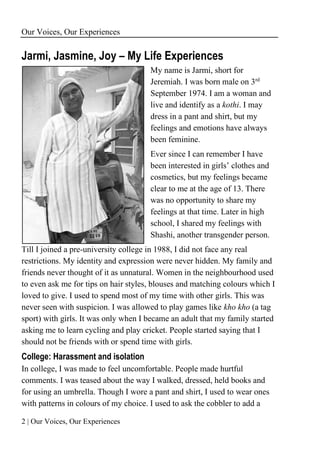
Mapping Transgender Experiences
62 | Our Voices, Our Experiences
Sex Reassignment Surgery (SRS)
August 2017: A discussion on SRS with activists, NGOs, academicians and
transgender persons jointly hosted by Samara and Jeeva. Virupaksha,
Counsellor and PhD Scholar from NIMHANS researching gender dysphoria,
led the discussion with definitions, standards and procedures. This was
followed by an open discussion.
Misgendered names, bodies and clothing are often a source of great
discomfort for many transgender persons: “When I started developing
breasts, I hated it. At home no one really questioned me or my preference of
clothes. But in school and college I hated the way I had to be.”– Kannan
Each transgender person deals with their identity differently. There are
some who find that their identity is independent of their name or their body.
Kumar B, Mallu Kumbar and Uma who participated in the focus group had
not attempted changing their names officially or SRS. “I feel acceptance
and thus do not feel the need for any official change.” – Kumar B
For others, SRS can be an extremely liberating process that enables them to
assert their identity “I got SRS done in July 1998 and changed my name to
Ranjitha/Ritu after jalsa (a Hijra ceremony to celebrate sex reassignment
Our Voices, Our Experiences | 63
and acceptance). All my property documents and identity cards mention my
gender as transgender” – Ranjitha
Medical options to address gender dysphoria include counselling, hormone
therapy and Sex Reassignment Surgery (SRS). SRS is
the surgical procedure (or procedures) by which a transgender person’s
physical characteristics are altered to align with their gender identity. The
decision to undergo SRS is never taken lightly and is dependent on the
individual’s exposure to options, their priorities and their circumstances. In
Jeeva’s experience, there is little support from birth families for SRS. It is
not recognised as a right by the state; there is no government support, or
laws or standards in India for SRS.
Procedures and precautions
For hormone therapy and for SRS, one must be diagnosed with persistent
gender dysphoria and be a legal adult (18 years in India). These facts must
be documented and certified. There must be documented evidence of how
the person has tried to deal with gender dysphoria, such as if they have used
cosmetic methods or hormone treatments.
One must undergo intense counselling prior to SRS to certify readiness.
Emotional and physical state, desire, culture and motivations and several
other factors are assessed to ensure that a person is making an informed
decision. Due to a lack of exposure and information, some persons with
non-heterosexual sexual identities may consider SRS. They are referred to
support groups and counselling to help them accept themselves.
Approval requires that a person live in their gender identity for one year.
For approving male to female transitioning, counsellors often insist that a
person dress in stereotypically female clothing, preferably a sari, for a year.
However, clothing is not the only or primary expression of gender and this
is a detrimental practice and can make the counselling process traumatic.
Once evaluations are completed, a letter certifying that the patient has opted
to undergo the procedure without misconceptions or external coercion is
Mapping Transgender Experiences
64 | Our Voices, Our Experiences
issued. Two letters are required to be eligible for SRS either from two
psychiatrists or, two psychologists or, one from a psychiatrist and one from
clinical psychologist. With these letters, individuals can proceed to consult
doctors for their treatments. Hormone treatment and SRS require the
support of several specialists including gynaecologists, urologists, plastic
surgeons and endocrinologists.
After counselling, some chose not to proceed with SRS, some chose
completely reversible procedures, some chose partially reversible
procedures and some chose irreversible options.
Hormone therapy is used to alter secondary sexual characteristics such
as breast and hair growth. Hormones have a complex role in regulating our
emotions and physiology. Side effects may include anxiety, depression,
mood swings, weight loss/gain, hair loss, weakening of bones, kidney
problems, stroke, hypertension and diabetes. These are not easy to predict
or generalize, but careful monitoring can minimize the negative side
effects. Thus, any treatment must be done under medical supervision.
Hormone therapy may be used as a standalone option or in combination
with SRS.
Concerns and observations
Patients are not often given adequate information regarding the procedures,
healing, results and possible complications. Many discussants had
personally experienced complications in SRS and needed multiple surgeries
to correct the first.
There is no database where one can check the reliability of a medical
practitioner. SRS and medical care for transgender persons is not a part of
the regular curriculum in medical courses and there is no recognised
authority to certify a person in this specialisation in India.
Our Voices, Our Experiences | 65
Economic Systems and Financial Vulnerability
Transgender persons face additional expenses that aggravate their financial
situation:
1. Housing: It is difficult for transgender persons to get homes within
city limits as most people are unwilling to rent their homes to them;
those who are charge exorbitantly.
2. Transport: They often spend more on travel as they cannot use
public transport due to harassment.
3. Community expenses: Most among the Hijra community stay with
their guru. This ensures they have shelter, and more importantly a
community. However, they have to make payments to their guru –
which they may have to take loans to meet.
4. Harassment: Some local police and goondas demand pay-offs from
sex workers.
5. Medical services: SRS and related medical services are additional
expenses for them.
6. Wages: For transgender persons from non-English speaking rural
backgrounds it is difficult to complete formal education. Most are
forced to work in the unorganized sector or in begging or sex work.
These occupations do not meet their expenses.
7. Loans: Bank and financial institutions often discriminate and do not
follow set guidelines. However, there have been some changes that
have made opening an account easier such as the option to identify
as transgender on loans applications.
Mapping Transgender Experiences
66 | Our Voices, Our Experiences
Media
20th July 2017: A panel discussion on Indian media coverage of gender and
sexual minorities was organised by Jeeva in partnership with Radio Active
CR 90.4 Mhz, Your Story, Network of Women in Media (Bangalore), KSMF,
OpenSpace and Amnesty International-India.
Reporting on gender and sexual minorities is fraught with challenges and
complexities. Their representation in media is usually either flawed or non-
existent. There is often false information or one-sided reporting. With the
lack of diverse voices in newsrooms, it can be difficult to uncover the truth.
However, it is important to report accurately and responsibly. With ethical
journalism, media can be beneficial in advancing the rights of gender and
sexual minorities. Increased coverage can create the impetus for much
needed dialogue. Reporting in rural areas that are relatively isolated can be
extremely valuable.
Transformation takes time. Diversity in the newsroom and particularly in
leadership, with different voices and perspectives is key to shift the focus
away from sensational coverage to positive and inclusive storytelling.
Improving fact checking, sensitive reporting and engaging with the
Our Voices, Our Experiences | 67
community is the responsibility of every journalist. Existing media
institutions need to work along with gender and sexual minorities to create
and make available a more sensitive vocabulary. Young journalists should
be encouraged and guided to appropriately cover marginalised
communities. Independent efforts by gender and sexual minority
individuals should be supported and promoted by the mainstream media to
amplify their authentic voices.
Mapping Transgender Experiences
68 | Our Voices, Our Experiences
Religious Institutions
Most major religious institutions such as temples, churches and mosques,
do not include transgender persons.
“I have fond memories from my childhood of visiting temples and singing
bhajans and purana kathas (hymns and stories from ancient religious texts).
But once you are a Jogappa you have no space in the mutts (traditional
missions within the Hindu religious orders). You are not allowed in the
men’s or women’s section. For me and people like me the only spaces open
to enjoy singing are music programmes. The practice in large temples of
removing your shirt and bathing in public is embarrassing. If at all we
decide to visit famous temples like Tirupathi, we find safety in numbers.
Even when we are in groups, we are stared at and commented on, but the
difference is that we feel confident together.” – Vaishali
“The Catholic and CSI churches are “government churches”. They are
obsessed with procedure, but if I could be accepted, I would immediately
join one of them. Private churches are small, started by an individual or a
couple and run on a small scale. They are more flexible, friendly and
welcoming.” – Jarmi
The only place where we have had a tradition of inclusion are Dargahs –
the Sufi shrines. Sufism is a mystical Islamic tradition to find the truth of
divine love and knowledge through direct personal experience of God.
Dargahs are often more inclusive to people of different faiths and identities.
The dominant culture followed in the seven Hijra gharanas is Muslim. In
Dargahs, Hijras must dress in traditional male attire, but ear and nose
piercings are allowed. – Focus Group
Our Voices, Our Experiences | 69
Socio-Cultural Communities of Transwomen in India
Excluded from the mainstream religious and social institutions, transwomen
in the Indian subcontinent have created several socio-cultural communities
which have distinct traditions and customs and often, defined religious roles
in their interactions with larger society. These traditions differ across the
country and have long and rich histories of facilitating both integration and
isolation from society, usually creating just enough space on the margins to
live but never thrive.
Hijras are the most prominent of these communities and are spread
throughout the Indian subcontinent. Other groups are more geographically
restricted such as Jogappas – primarily located in Maharashtra and
Karnataka, Kinnars in Northern India, the Aravanis in Tamil Nadu (some
Aravanis now prefer to be called ‘thirunangi’), the Maraladi Kothis in
Tamil Nadu and Karnataka and the Shiv Shaktis in Andhra Pradesh. Some
intersex persons may also be members of these communities.
In communities such as the Hijras and the Jogappas, the primary
relationship is of a guru (teacher) and chela (student) or a mother and
daughter. The guru/mother takes on new chelas/daughters in order to bring
them into the community. This initiation is accompanied by specific rituals
such as reet among the Hijras and muttu kattuvudu among Jogappas.
Some groups form distinct communities and may live together as families –
like the Hijras in their hamams (lit. households). They may also form more
complex social structures. Maraladi kothis have a collective known as the
Mahanadu unit. The Hijra community has seven gharanas (lit. houses),
each with distinct traditions and norms. The elders of the households in
each area form a council known as a jamat. This council approves the
initiation of each new Hijra into the community.
Not all communities form tight knit groups or families. For example,
Jogappas and Maraladis also follow the guru-chela system, but after a
certain period, they lead a largely independent life. They are ‘married’ to
Mapping Transgender Experiences
70 | Our Voices, Our Experiences
specific deities. They have temples of their own and are consulted by
people for certain spiritual or religious services such as spiritual healing and
astrology. They also dress up elaborately and celebrate several festivals
connected to the temple or deity they are connect to.
Traditional professions practices by Hijras include begging (known as
‘collection’), dancing at weddings and blessing. The hamams may double
as brothels. Many people across the Indian subcontinent believe that that
seeing a Hijra’s face is a good omen so people make it a point to take their
blessings before starting new initiatives. As a result of this belief, in
Karnataka some Hijras refer to themselves as Mangalamukhi (lit.
auspicious face).
These communities have also created distinct vocabularies. Some of these
terms are not connected to a particular tradition but rather to a locale: kothi
refers to a person who is assigned male at birth and has typically feminine
characteristics. Those who wear saris are known as satla kothis and those
who dress in typically male clothing are referred to as panti satla kothis.
Nirvana is a general term for ‘rebirth’ of a transgender person after
castration or SRS. Begging is generally known as ‘collection’ among the
transgender communities. Some terms are specific to a particular tradition.
For example, sadar (sex work) and tapar (money earned from sex work)
are typically Jogappa terms.
It is important to note, particularly with reference to policy and inclusion,
that while these communities are significant, they do not include or
represent all transwomen and intersex persons. Further, no transmen are
included in these communities and they do not have other equivalent
structures.
Our Voices, Our Experiences | 71
The State
The Constitution of India recognises and guarantees to all citizens the
fundamental right to life and liberty, equality before law regardless of sex,
equality in public employment, freedom of expression and freedom of
movement. In reality, most genders and sexual minorities in India are
deprived of these rights. There is a long-recognised need for a
comprehensive policy for gender and sexual minorities to address health,
education, employment, housing and provide protection from abuse. The
government must create awareness and foster inclusion for gender and
sexual minorities to be accepted in society and lead a life of dignity.
Bringing legal changes through litigation or legislation has proved to be
difficult and long drawn. The vulnerability must be acknowledged before
the community can advocate for a policy or law. If a favourable law or
policy is passed, its implementation is contingent on the stakeholders
staying vigilant. At all stages, there has been a lack of political will and
clarity.
Consistent community campaigns and public action have resulted in
significant gains in correcting existing laws that violate gender and sexual
minority rights. The removal of the word ‘eunuch’ from section 36A of the
Karnataka Police Act in 2016 and the decriminalisation of consensual
sexual behaviour among adults under section 377 of the IPC are notable
gains in the recent past. Experiences with the state and law are dealt with in
detail in the fourth section.
Our Voices, Our Experiences | 73
Since its inception in 2012, Jeeva has employed multiple strategies to
strengthen the community from within and work with institutions of state
and society to increase inclusion. To these ends, Jeeva:
1. Consults community members regularly for feedback on going
interventions and advice to plan and prioritize future programmes.
2. Amplifies the voice of gender and sexual minorities through
community media by facilitating the production of print and audio-
visual materials for training and awareness. We also facilitate
interactions with and sensitizations of mainstream media.
3. Addresses and supports mental health needs of gender and sexual
minorities by raising awareness and providing counselling. As this
is a public health issue, we also link with government institutions.
4. Works with the government and other institutions toward
incremental and fundamental measures for inclusion in all
aspects of life and livelihood. We monitor, and advocate for, the
implementation of laws and services that are meant to protect and
uplift gender and sexual minorities.
This section contains some highlights of Jeeva’s interventions and
activities.
Jeeva: For a Life of Peace and Freedom of Expression
74 | Our Voices, Our Experiences
Increasing Visibility
Jeeva engages with and tries to increase visibility of gender and sexual
minorities and their issues through various means.
23rd
November 2014: Bangalore Pride and Karnataka Queer Habba.
20th
May 2014: Sports day with the transgender community.
Our Voices, Our Experiences | 75
12th
June 2014: Protest condemning the deadly attack at a gay night club in
Orlando, Florida.
26th
August 2018: Celebration of Raksha Bandhan along with Amrutha Bindu
Trust.
Jeeva: For a Life of Peace and Freedom of Expression
76 | Our Voices, Our Experiences
Jeeva has undertaken multiple initiatives to amplify the voices of gender
and sexual minorities through various forms of media including print, radio
and film. Jeeva launched a Facebook page in November 2012, a Wordpress
blog in August 2013 and a Youtube channel in 2014.
16th November 2013: Screening of “The Love Story of Sruthi and Saranya”
a documentary film about a lesbian couple produced by Jeeva supported by a
fellowship from Aneka.
6th
November 2014: The release of the first edition of Ananya.
Our Voices, Our Experiences | 77
Ananya, our print magazine, is a space for us to share our stories and
experiences through articles, songs, poems and discussions, as well as
information on rights and entitlements, government policies and schemes.
Ananya is one of the first community led efforts to share experiences
through a print magazine in Kannada. The purpose is to establish a better
understanding between the gender and sexual minorities and larger society.
We have published 11 editions Ananya over the last six years with the
mentoring and financial support of the fellowships from Aneka (2013-14)
and Jain University (2015-17). Ananya has also benefited from the
guidance of its current editorial board – Pinky Chandran, Ashish Sen,
Madhu Bhushan and Prapula Devi – and former members, Tanushree and
Pushpa Achanta.
16th
June 2015: Uma (left) interviewing Priya, a transwoman, for Jeeva Diary.
“Jeeva Diary” was a weekly radio programme that aired every Thursday on
Radio Active 90.4 – Bangalore’s first community radio station, from 5th
March 2016 to 2017. It was anchored by Uma who, in the process, became
a trained radio jockey and learned how to edit interviews and to reach out to
Jeeva: For a Life of Peace and Freedom of Expression
78 | Our Voices, Our Experiences
a diverse audience. The show included interviews, poetry reading, reports
on struggles and campaigns and discussions on sex, sexuality and gender.
We were able to literally bring community voices into the public domain.
Every story was presented as a diary entry for the day. This format was
unique in the Indian media. A total of 72 episodes were broadcast. Jeeva
Diary was produced with the fellowship from Jain University and the
guidance of Pinky Chandran of Radio Active.
16th October 2015: Celebration of the 25th episode of Jeeva Diary.
Mental Health
To create support systems for gender and sexual minority members in need
of mental health support, Jeeva has:
1. Conducted art therapy and game therapy for groups of 10 in 2013.
This was not sustainable due to lack of funding and volunteers.
2. Conducted sensitisation programs for public and private health care
providers and government officials.
3. Mapped trusted psychiatrists, psychologists, and mental health
professionals from government hospitals for referrals.
4. Started a regular weekly counselling service in 2016. Counsellors
from NIMHANS volunteered to provide professional support on
demand. The Jeeva office has become a safe space for community
Our Voices, Our Experiences | 79
members to freely converse and access counselling. Several clients
have come forward. The common queries are regarding
relationships, sex and sexuality and gender identities, SRS and
living with HIV/AIDS. Jeeva tries to address the unique stresses for
each situation and provide advice for further action – such as
regular therapy to deal with mental illness or counselling and
assessment for SRS. However, due to the relatively long periods
advised for assessment and counselling, clients may be reluctant or
unable to bear the incidental costs.
Nimmondige Naavu
10th
October 2017: Launching Nimmondige Naavu on World Mental Health
Day.
Jeeva launched the helpline Nimmondige Naavu (lit. we are with you) in
collaboration with the National Institute of Mental Health and
Neurosciences, NIMHANS. It is a 24x7 telephone helpline for sexual
minority persons in need of mental health support. It is accessible from any
location and at any time, making it uniquely posed to address crises
Jeeva: For a Life of Peace and Freedom of Expression
80 | Our Voices, Our Experiences
however they arise as most existing institutions have limitations and many
helplines are accessible only during office hours.
The launch of the helpline was marked by a public function attended by
community members, health professionals and other supporters including
Anita Cheria, Director of OpenSpace which is a campaign support
organization, Prof. Dr. Murlidhar, head of the Mental Health Department at
NIMHANS, Virupaksha, Counsellor and PhD Scholar from NIMHANS,
Sharada, a counsellor with several years of experience counselling sexual
minorities and Sunil and Rumi Harish who are activist, senior researchers
and members of the community.
To popularise the helpline and raise
awareness on mental health issues
faced by gender and sexual
minorities Jeeva created a poster.
This card did not specifically
mention ‘mental health’ in order to
avoid the stigma and resistance that
comes with the term, but simply
stated that persons could reach out
and speak to someone without fear
of being judged.
Jeeva has counselled couples in
conflict, individually and together.
Non-working-class gay couples have also accessed the helpline. Calls were
answered by a sensitive listener who took note of concerns and
requirements. The callers were directed to follow up as required through
Jeeva’s counselling or external support.
Over the years, many issues have been raised and addressed through the
helpline and counselling. As a result of Jeeva’s effort, there is increased
Our Voices, Our Experiences | 81
awareness about the need and challenges of addressing mental health within
the gender and sexual minority community in Karnataka.
Future plans
To further address this issue, in the future we hope to:
1. Train field workers to understand the needs of gender and sexual
minorities.
2. Create a more comprehensive community-vetted list of professional
service providers across all districts of Karnataka.
3. Conduct fortnightly support group meetings with 8-10 participants
providing a space for mutual emotional support and raise awareness
on mental health issues. This will not only impact the participants
but the community they interact with as this support network
expands.
We hope to get to a stage where all gender and sexual minorities recognise
the symptoms of mental illness and are able to support each other and seek
timely counselling.
Engaging with the State
11th January 2016: Meeting the Karnataka law minister to advocate the
removal of section 36A of the Karnataka Police Act.
Jeeva: For a Life of Peace and Freedom of Expression
82 | Our Voices, Our Experiences
12th January 2016: Applicants and lawyers in the case against section 36A of
the Karnataka Police Act at the Karnataka High Court after the judgement.
12th
July 2016: Meeting the Mayor of Bangalore to demand the
implementation of programs for empowering transgender persons for which
BBMP allocated two crore rupees of their 2016-17 budget.
Our Voices, Our Experiences | 83
14th
Feb 2017: Focus group discussion on transgender health, education,
employment and housing organised by Jeeva and KSMF. Jeeva played an
active role working with the government to pass the Karnataka State
Transgender Policy.
20th October 2017: Raising awareness among gender and sexual minorities
on the Karnataka Prohibition of Beggary Act, 1975 and Right to Privacy.
Jeeva: For a Life of Peace and Freedom of Expression
84 | Our Voices, Our Experiences
2nd March 2018: Meeting Mr. Siddharamaiah, Chief Minister of Karnataka,
to submitted a memorandum demanding budget allocation for and the
implementation of welfare schemes.
18th June 2018: Submitting a memorandum for implementation of the
Karnataka State Transgender Policy to Ms. Jayamala, State Minister for
Women and Child Development.
Our Voices, Our Experiences | 85
8th August 2018: Discussion on the status of the Supreme Court hearing on
section 377 of the IPC and the Trafficking of Persons Bill, 2018 organised by
Jeeva and KSMF.
3rd December 2018: Meeting Mallikarjun Kharge, Congress MP and the
Leader of the Opposition to discuss supporting the transgender community
and voting against the Transgender Bill, 2018 when it comes to the Lok
Sabha.
Jeeva: For a Life of Peace and Freedom of Expression
86 | Our Voices, Our Experiences
18th
June 2018: Meeting U.T. Khader, the Karnataka Housing Minister to
demand housing for transgender persons.
6th
September 2018: Celebrating the Supreme Court verdict reading down
section 377.
Our Voices, Our Experiences | 87
10th
October 2018: A panel discussion welcoming the landmark Supreme
Court judgment reading down section 377 organised by Jeeva, KSMF and
Dharwad University.
22nd December 2018: Protest against the Transgender Persons (Protection of
Rights) Bill, 2018 and Trafficking of Persons (Prevention, Protection and
Rehabilitation) Bill, 2018.
Our Voices, Our Experiences | 89
Engaging with Law and the State
This section is focused on Jeeva’s experiences with laws relating to and
governance of the transgender population in Karnataka and at the centre. It
includes a guide to action for citizens to participate in the democratic
process of influencing the law within domestic and international
frameworks. The chapters in this section are:
▪ CITIZENS AND THE LAW
▪ DEVELOPMENTS IN LAW AND POLICY
▪ REFLECTIONS ON THE KARNATAKA STATE TRANSGENDER POLICY
▪ A VOTER ENROLMENT DRIVE: AN EXPERIENCE OF ENGAGING
WITH THE STATE
▪ SDGS AND GENDER AND SEXUAL MINORITIES
Engaging with Law and the State
90 | Our Voices, Our Experiences
Citizens and the Law
The law is a system of rules that are enforceable by the government. The
law confers legal rights, obligations and liabilities on citizens and on the
State machinery. Law can take the form of an act, ordinance, order, by-
laws, rules, regulations, court orders, etc. As citizens, we have both the
right and an obligation to intervene in the law-making process. We have
several opportunities and avenues to do so: we can give comments while
bills, policies or schemes are being drafted; we can use the courts to
challenge violations of the law, or even challenge the law itself; we can
lobby with the administration at every stage; we can vote for representatives
at every level of government who will best protect our interests.
The Constitution of India is the supreme law in India.
➢ No law can be made that contravenes the framework provided by the
Constitution. Such laws can be challenged in court, as section 377 of the
IPC was.
A policy is an official government statement on the principles and goals
they intend to adhere to in administrating.
➢ Citizens can intervene during the drafting of a policy.
➢ Though not legally binding, a policy can be used to guide advocacy and
negotiation with the government. It becomes particularly significant while
negotiating the contents of binding legislation on the same issue.
An Act or a statute is a law which is made by a legislative body like
Parliament or State Legislative Assembly. A legislation, or Act, starts as a
bill.
➢ When a bill is being drafted, there are consultations held with the
stakeholders in addition to the advisory bodies of legislature.
➢ Once a Bill is drafted, it is published for comments from the public for a
period of time. Most draft bills can be accessed on the websites of the
relevant government department. There are other websites such as
prsindia.org that track bills.
Our Voices, Our Experiences | 91
A Bill must be discussed and passed by legislature. It can be introduced by
any member of the parliament (i.e. at the centre. A state bill may be
introduced by any member of the state assembly). Ordinary bills can be
introduced in either House of Parliament. Money bills can only be
introduced in the Lok Sabha. Once they are discussed and passed, the bill in
its new form is sent to the other house for approval.
➢ While a bill is being debated in parliament, citizens can lobby with the
members of parliament/the state legislature to pass the bill in a form that is
favourable.
A Bill becomes a law (Act) once it has been passed by the parliament and
signed by the President (or the governor if it is a state Bill).
Ordinances are laws issued by the President of India on the
recommendation of the Union Cabinet when the Parliament is not in
session. They enable the government to take immediate legislative action.
An ordinance is an extraordinary measure. When the session of the
parliament begins, an ordinance may be approved to make it a permanent
law (an Act) or revoked by resolutions of both houses. If no resolution is
passed within six weeks of the start of the session, it lapses naturally.
➢ Once a legislation is enacted, it is legally binding on the government.
Violations of an Act can be challenged in court.
➢ An Act can be modified or repealed by another Act of the legislature.
Thus, citizens can lobby with their representatives to amend legislations,
just as they would to get legislations created.
➢ Provisions of law can be interpreted, struck down or narrowed by a court.
Such a judgement would affect the reading of the law within that court’s
jurisdiction. For example, if the Delhi High Court struck down a law, that
would change the law for Delhi, but not the rest of the country. Decisions
of a High Court can be appealed to the Supreme Court. As the jurisdiction
of the Supreme Court is the entire territorial extent of India, their
judgements change the law for the whole country.
Engaging with Law and the State
92 | Our Voices, Our Experiences
The exception to this is cases such as the 2009 Naz Foundation judgement
of the Delhi High Court which was applicable to the entire country. This is
because High Court decisions in writ petitions that challenge the
constitutionality of a Central law, are not restricted to their ordinary
territorial jurisdiction.
In order to narrow the scope of or strike down a legal provision, the Court
has to provide a reason. For example, the reason for reading down section
377 of the IPC was that the law violated the Constitution.
Schemes are implemented by the government in order to implement
specific policy or legislative goals. Schemes define the actions that the
administration must take and for whose benefit.
➢ Non-implementation or violations of a scheme can be challenged by
citizens either by going to court or by lobbying with the administration.
International Laws are not binding on India in the domestic legal system
since India follows a dualist legal system. This means that when India
becomes party to an international agreement, those provisions are not
enforceable locally unless the parliament specifically passes a law to that
effect.
➢ International instruments are not binding, but they can be persuasive in
court and guide decisions and directives particularly if there is a lacuna in
the domestic legal system on a subject where India has signed a treaty. For
example, in NALSA v. Union of India, the Supreme Court stated that the
Yogyakarta Principles on the application of international human rights law
in relation to sexual orientation and gender identity should be applied as
part of Indian law. The Principles were also cited in the case against
section 377 of the IPC.
Our Voices, Our Experiences | 93
Developments in Law and Policy
Selected experiences of the transgender community in
Karnataka with the State
2009: Under the leadership of Mr. Dwarakanath, Backward Classes
Commissioner of Karnataka, a public hearing was held and the jury made a
recommendation that the transgender community be given the status of
backward class so that they are eligible for schemes and benefits sanctioned
for the backward classes. This has not been implemented.
2010: Community representatives used the Backward Classes Commission
report to advocate for a State Transgender Welfare Board with Shobha
Karandlaje, then a BJP cabinet minister. The welfare board was not set up.
Instead the state passed a government order to initiate some schemes. The
implementation of the schemes was flawed due to problems in
identification.
2011-12: Justice Manjula Chellur organised public meetings zone-wise
throughout the state involving community members, lawyers, health
professionals and judges to understand, and create an environment of
support for, transgender issues. The reports of these meetings were used in
the arguments in NALSA v. Union of India.
2011: Section 36A was inserted in The Karnataka Police Act giving police
unregulated power to ‘regulate Eunuchs’.
2013: Due to problems with the implementation of the special schemes,
Ramesh Bindurao Zalki, Principal Secretary of DWCD, collaborated with
community organizations and conducted a pilot study in Raichur to
understand diversity of among transgender persons. This led to a broader
definition of transgender by the state government beyond sari-clad Hijras to
include Female to Male transmen, Male to Female transwomen, kothis,
Jogappas and Mangalmukhis. The main schemes announced included
Sahaya Dhana, which provided livelihood grants of Rs.20,000, and Mythri,
Engaging with Law and the State
94 | Our Voices, Our Experiences
a pension scheme. Another government order issued by Mr. Zalki reserved
two beds in every district hospital for transgender persons. The government
tasked KSMF and Sangama with the identification of beneficiaries for these
schemes.
2014: The government held the first round of discussions on the Karnataka
State Transgender Policy and a draft was prepared in collaboration with the
stakeholders.
2015: A petition was filed by Manjula, the President of KSMF, with the
support of advocate Ashok GV, challenging the constitutional validity of
section 36A in the Karnataka Police Act, 1963.
Section 36A gave the Police Commissioner the power to “prevent,
suppress or control undesirable activities of eunuchs”. It allowed the
preparation and maintenances of a register of the names and places of
residence of all eunuchs residing in a particular area who are suspected of
“kidnapping and emasculating boys or of committing unnatural offences
or any other offences or abetting the commission of such offences.” This
provision was targeted at and has been used to disproportionately
criminalize the transgender population and keep them under surveillance.
It is arbitrary, discriminatory and a violation of the rights to equality,
liberty, life and dignity guaranteed by the Constitution.
December 2015: Jeeva and Akkai Padmashali, with the support of advocate
Jayna Kothari of CLPR, filed supportive petitions in the case against
section 36A.
10th
January 2016: Transgender leaders met with Sri T.B. Jayachandra, the
State Minister for Law, and the government lawyer regarding the case
regarding section 36A. The minister agreed to remove the provision at the
meeting. However, during the hearings, the government counsel submitted
that the government was only willing to amend the provision.
Our Voices, Our Experiences | 95
12th
January 2016: The High Court of Karnataka ordered the government
to place the amended provisions before the Court in six months. The term
‘eunuch’ was removed, but the section remains.
2017: The draft Karnataka State Transgender Policy was reopened for
discussion by Uma Mahadevan, Principal Secretary, DWCD. Three
consultations were held over a month with transgender persons and related
organizations in Bangalore. The Women’s Development Corporation
submitted their draft in February 2017. It was approved by the legislative
assembly in October 2017 and signed by the governor in December 2017.
Developments in the capital
2001: Naz Foundation filed a PIL in the Delhi High Court challenging
section 377 of the IPC as it affects the health of gay men.
2005: Naz Foundation filed a PIL stating that section 377 violates the
fundamental rights guaranteed by the Constitution.
2009: The Delhi High Court issued its landmark judgement in Naz
Foundation v. Government of NCT of Delhi decriminalising homosexual
acts involving consenting adults. This was later challenged in the Supreme
Court of India.
11th
December 2013: The Supreme Court in Suresh Koushal v NAZ
Foundation overturned the Delhi High Court ruling in the Naz Foundation
case and reinstated section 377 of the IPC.
15th
April 2014: The Supreme Court issued their judgement in the case of
NALSA v. Union of India. It declared transgender persons to be the 'third
gender', affirmed that the fundamental rights recognised by the Constitution
will be equally applicable to transgender people, and gave them the right to
self-identification. This was a major step towards gender equality. The
court directed the central and state governments to treat transgender persons
as socially and economically backward classes and grant reservations in
employment and admissions to educational institutions. The court directed
Engaging with Law and the State
96 | Our Voices, Our Experiences
all state governments to draft and implement policies in compliance with
the spirit of the judgement.
Over the last five years, there have been several attempts to introduce
central legislation for the protection and empowerment of transgender
persons. These processes and the Bills have had their flaws. There are
currently two Transgender Bills pending before the Parliament.
2014: A private member bill was introduced in the Rajya Sabha by Tiruchi
Siva to guarantee rights and provide welfare measures to transgender
persons. It was passed by the Rajya Sabha in 2015 and is currently pending
before the Lok Sabha.
5th November 2015: Leaders of the transgender community demand a
consultation on the Transgender Bill, 2014.
2015: The Ministry of Social Justice and Empowerment sought comments
on a new draft Transgender Bill.
2nd
August, 2016: The Government introduced a separate Transgender
Persons (Protection of Rights) Bill, 2016 in the Lok Sabha, which is
currently pending before the Rajya Sabha.
Our Voices, Our Experiences | 97
8th
September 2016: The Transgender Bill, 2016 was referred to the
Standing Committee on Social Justice and Empowerment.
2016: Uma, Akkai Padmashali and Sana, transgender community leaders
from Karnataka, with the support of CLPR, intervened in the case
challenging the Naz Foundation judgement in the Supreme Court.
21st
July, 2017: The Standing Committee on Social Justice and
Empowerment submitted their report on the Transgender Bill, 2016.
24th
August 2017: In Puttaswamy v Union of India, the Supreme Court
declared that the right to privacy is a fundamental right. It recognised an
individual’s autonomy to identify and express gender and sexual orientation
as a part of this right.
6th
September 2018: In Navtej Singh v. Union of India, the Supreme Court
read down section 377 of the IPC. The Court decriminalised consensual
sexual conduct between adults, and held that the LGBT community are
entitled, like all other citizens, to the full range of constitutional rights and
liberties. The Court criticised the Suresh Koushal judgement stating that
discrimination based on sexual orientation and gender identity is a violation
of the fundamental rights of autonomy, privacy, equality and dignity.
18th
July 2018: The government introduced the Trafficking of Persons
(Prevention, Protection and Rehabilitation) Bill, 2018. There is a general
misconception in society that groups of transgender persons are engaged in
sex trafficking and forced beggary by kidnapping and forcibly castrate and
administering hormones to increase their numbers. This leads to harassment
by the police and the public. This Bill specifically identifies transgender
persons as a ‘vulnerable’ population. This may allow birth families who
reject gender non-conforming persons to file false cases – identifying them
falsely as victims of trafficking and initiating the process of ‘repatriation’
under the Bill that denies these adults their fundamental right to movement.
The media aggravates this issue through false reports that perpetrate these
lies. Thus, this Bill is relevant to the transgender population. It is essential
Engaging with Law and the State
98 | Our Voices, Our Experiences
that there is awareness in the community on what their rights and legal risks
are so that they can take informed action.
26th
July 2018: The Lok Sabha passed the Trafficking Bill, 2018.
The following are some extracts from press releases by stakeholders
regarding the Transgender and Trafficking Bills.
14th
December 2017: Protest against the Transgender Persons Bill, 2016.
Press Release of the Coalition of Sex Workers and Sexual Minorities’
Rights, Karnataka on 20th December 2018
We, transpersons, sex workers, activists, academics, and allies in
Karnataka, work on various forms of extreme exploitation and with the
transgender community and sex workers (including but not limited to
transgender sex workers). We express grave concerns with the regressive
Transgender Persons (Protection of Rights) Bill and the Trafficking of
Persons (Prevention, Protection and Rehabilitation) Bill, 2018. Both bills
are pending consideration before the Rajya Sabha now. We demand that
Our Voices, Our Experiences | 99
both these Bills not be introduced in the Rajya Sabha and that they be
referred to a Select Committee of the Rajya Sabha.
Recently in August 2018, the Delhi High Court in Harsh Mander and Ors.
vs. Union of India has observed that the approach of criminalising begging
was not a solution to addressing the problem. Further, in September 2018, a
five-judge bench of the Supreme Court in Navetej Singh Johar and Ors. vs.
Union of India categorically held that “The LGBT persons deserve to live a
life unshackled from the shadow of being ‘unapprehended felons’.” Both
the Bills (Transgender Bill and Trafficking Bill 2018) are fundamentally
motivated by a criminalizing impulse. The state instead of taking on
welfarist/developmentalist functions chooses to focus on incarcerating the
poor and marginalised, including sex workers, bonded labourers, contract
workers, domestic workers, construction workers, transgender persons,
inter-state, intra-state and international migrant workers.
Transgender Bill
1. Bill was passed in Lok Sabha without ANY community consultation
and does not address concerns or demands of the community and is an
abusive legislative process.
2. Bill is a retrograde step from previous iterations of transgender persons
rights such as reservation, employment and education opportunities,
right to self-determination of gender as iterated in the NALSA
judgment, MSJE report, the Tiruchi Siva Bill, and the Parliamentary
Standing Committee recommendations.
3. Bill does not address accountability measures, within the state and its
functionaries, police violence, violence from natal families, etc.
4. Bill is inadequate for the protection of transgender persons as it upholds
the criminalisation of transgender persons for traditional sources of
income such as begging, while denying any opportunities in education,
employment, healthcare, etc. or recognising rights to marriage,
adoption, property, etc.
5. Bill upholds lighter consequences and penalties for discrimination and
assault on trans people compared to cisgender people.
Engaging with Law and the State
100 | Our Voices, Our Experiences
6. Bill violates the fundamental rights of transgender persons to live where
we please, stating that even as adults with the right to free movement
and association, we must either stay with our parents or approach a
court.
Trafficking Bill
1. Bill is unclear with respect to existing laws which already penalize
trafficking and exploitation of trafficked victims for sexual
exploitation, bonded labour, contract labour, and inter-state migrant
work.
2. Bill goes against fundamental principles of criminal justice and the
Indian Constitution by creating new offenses unrelated to
trafficking, use of unclear sentencing policy, vesting excessive
powers in the police, etc.
3. Bill ignores and furthers the failures of existing ‘protection’ homes,
fails to hold magistrates accountable, and explicitly bars victims of
trafficking from accessing the legal remedies that every citizen of
India is entitled to in the name of ‘protection’.
4. Bill lacks consultation with trade unions, labour groups, sex
workers, and transgender communities, specifically with respect to
impact on informal labour, including begging, sex work, and
domestic work, thereby categorically targeting marginalised
communities.
5. Bill does not hold accountable state actors and employers, but
instead declares one’s choice and form of labour and sustenance as
trafficking and prescribes excessive punishment for the
marginalised communities engaging in these forms of labour.
6. Bill criminalizes the administration of hormones and other
medicines, failing to distinguish between coercion and assistance in
accessing gender affirming hormone therapy.
7. Bill does not distinguish between voluntary sex work and
trafficking.
Our Voices, Our Experiences | 101
8. Bill is against international legal norms which focus on human
rights and a victim-centred approach
Excerpt from the press release of The National Network of Sex
Workers (NNSW) dated 19 December, 2018
“The problem with The Trafficking Bill, 2018 is that it criminalizes
vulnerable individuals in the absence of comprehensive policies,
programmes and measures that address the factors that make persons
vulnerable to trafficking. The aspiration to move and access better living
conditions. Poverty, lack of equal opportunity and skewed development
policies force persons to move in an unsafe manner and accept work in a
criminalized environment, for instance in sex work or as undocumented
workers abroad.
In March 2018, NNSW members had published an evidenced-based
research study Raided, showing that abolitionist NGOs were violating the
human rights of consenting adult sex workers by misusing provisions of
existing anti-trafficking laws.
The current Trafficking Bill, 2018, continues to use the strategy of forced
raid, rescue and rehabilitation as its primary strategies which are not
subject to scrutiny, allowing an environment of impunity and disregard for
the human rights of sex workers. Recent reports of widespread violations
and abuse in ‘protection’ homes where they are incarcerated for varying
periods, bears testimony to these narratives of sex workers. Sex workers
call for greater accountability and transparency in the functioning of these
institutions, rather than further empowering District Committees and the
police to create fear among workers in vulnerable situations.”
Engaging with Law and the State
102 | Our Voices, Our Experiences
Reflections on the Karnataka State Transgender
Policy
The Karnataka State Transgender Policy (the Policy), which was passed as
a response to the NALSA judgement, came into effect in January 2018.
This was a result of long and consistent advocacy efforts in the state by
community leaders.
12th
-13th
March 2018: A two-day state level consultation on the Policy was
organised by Jeeva, KSMF and ALF. A panel discussion was held with
transgender community leaders representing 16 districts of Karnataka, and 20
organizations and networks. Reflecting the diversity of transgender persons,
the participants included M to F and F to M transgender person, Hijras, panti
satlas, kothis, Jogappas, and Mangalmukhis. This was followed by a public
meeting where supporters, legal experts, researchers, government officials
and the press were also present.
The Policy provides guidelines to ensure the constitutional rights of
transgender persons – individually and collectively, and provides direction
for the inclusion of transgender persons as full citizens. The objectives of
the Policy are to:
• Enforce the constitutional guarantees of dignity, non-
discrimination, equal access and redress.
Our Voices, Our Experiences | 103
• Identify the responsible state institutions and departments for
implementation.
• Define accountability mechanisms.
The Policy includes measures to empower and enable transgender persons,
remedy existing laws and policies and make these changes sustainable. It
directs the government to take steps toward inclusion by harmonising pre-
existing laws, schemes and services with the Policy as well as plan,
administer and implement programmes which have been outlined by the
Policy specifically for inclusion.
The successful implementation of the Policy hinges on the identification of
the beneficiaries and understanding their requirements. There is a limited
understanding of ‘transgender’, the diversity of identities the term
encompasses and their unique challenges. In order to address this, the
Policy included a bench-marking survey that was to be completed in the
first three months. The survey was to help formulate guidelines based on
real experiences of inclusion and exclusion. However, this has not been
done even after a year.
Process
The consultations with the community for the drafting of the Policy were
conducted arbitrarily. The time and resources allocated were inadequate.
They were only held in Bangalore city; no consultations were planned or
held in the districts. While the implementation of the Policy requires
coordination among various departments of government, only the DWCD
was actively involved in the process. Meetings could be triggered by
anything from upcoming elections, budget sessions, or the individual
interest of a bureaucrat or administrator. This kind of arbitrariness led to
significant pressure on all concerned, particularly committed community
leaders who lack financial and organizational resources. More importantly,
it resulted in major gaps in the Policy.
Engaging with Law and the State
104 | Our Voices, Our Experiences
The government calls on community leaders and organizations to
voluntarily support state programmes by reaching out to the community.
However, when it comes to contracting work formally the government
selects larger NGOs instead, with no regard to the interests of the
community at large. There is also concern regarding whether the enactment
of a national legislation will stall any progress made with the Policy
initiatives.
Overarching concerns
• The synergy created during the drafting of the Policy raised
expectations. However, since then there has been a big gap in
consultations with community representatives. Unless a brisk pace
of interaction between stakeholders is maintained, policy concerns
will remain on paper.
• Introducing a separate Transgender Commission at the state level
could provide the required focus. At present implementation of the
Policy is one of the many responsibilities that are taken up by the
DWCD. As the Policy will need to deal with a diverse transgender
population not limited to transwomen, a new Transgender
Commission or the Ministry of Social Justice and Empowerment
would be appropriate to spearhead implementation. A drawback of
a change in the nodal department would be a loss of institutional
memory created over the last decade, as all schemes and services
till date have been under the jurisdiction of the DWCD.
• For administration, the district nodal officer was the Deputy
Director, DWCD. It was suggested that the district nodal officer
should be at least of the rank of CEO of the Zila Panchayat to be
able to enforce and lead such a process. As of 2019, this demand
has been accepted and the nodal officer is now the District
Commissioner.
Our Voices, Our Experiences | 105
• For transparency and accountability, a dedicated website updated
in real time with all government orders, initiatives and budget
allocations by departments to implement the Policy will be ideal.
Separate departments could also highlight a section on budget
allocations and schemes on their own sites, as directed by the
Policy. As of the printing of this book the details are not available
online on any government website.
• Community engagement is critical to successfully implement any
policy. For this the role of the community members, leaders and
organizations needs to be more clearly defined. On 10th
January
2018 the Karnataka state government passed G.O number
MME02MAN2018 directing the formation of State Transgender
Cell. It has members from 19 government departments but no
mention of inclusion of community members. The NGO partners
mentioned were also decided without community consultation.
These NGOs work only on HIV/AIDS prevention. A disease
control organisation cannot adequately know or represent the rights
and struggles of gender and sexual minorities.
• Self-identification was the standard set by the Supreme Court in
the NALSA judgement. The Policy related schemes, services,
protection and benefits must be given to all transgender persons.
Often the understanding of who is transgender is limited to the
more visible sari-clad transgender persons. This leads to ignorant
and unreasonable demands from those in charge of processing
documents.
Thematic concerns and demands
Identification
• There is need to inform and sensitise government staff on the
diverse identities that come under the umbrella of ‘transgender’.
For example, in the implementation of the Mythri pension scheme,
Engaging with Law and the State
106 | Our Voices, Our Experiences
local officers often tell transwomen dressed in a pant and shirt, to
shave their moustache and come back wearing a sari and lipstick.
Even the media and NGOs often have sari-clad Hijras as the only
representatives of transgender persons. The media prefers to have a picture
and quote from a sari-clad transwoman, rather than a pant-shirt wearing
transgender person. Only images of sari-clad transwoman were used in
advertisements issued by both the government and the Election Commission
for a voter enrolment drive conducted in Karnataka.
• There is a need for a clearly defined process for inter-departmental
coordination to simplify and speed up the process of updating
documents and identity cards. There are different documentation
and application procedures for different schemes and services. The
means of identification used by the government include blood
check-ups, community-based identification, self-identification and
medical certificates. This must be standardised. The aim is to make
it easy to access all the protection and support that one is eligible
for. The NALSA judgement has recommended self-identification
which is the most conducive to enable access.
Claiming benefits based on the transgender identity should be based on a
special card. The transgender card could have three options – transgender,
transgender woman and transgender man. In order to curb misuse, the
cards could include a number, taluk and district code and these numbers
could be tracked for benefits from services – Focus group
• The formats of existing identity cards must be corrected to comply
with the Policy. PAN cards were corrected in April 2018.
Our Voices, Our Experiences | 107
Sometimes, even ‘progressive’ attempts have missteps, compromising
dignity and causing immense hurt. For example, the Indian Railways
issued a new reservation form. While the English reservation form has
male, female and third gender, the forms in Kannada language uses
napunksaka – a derogatory term meaning ‘not a man’, ‘sexless’ or
‘impotent’.
SRS and Identification
After SRS Vaishali, who used to be called Vishal, got her voter ID card to
identify her as Vaishali, a transgender. Others prefer to have ‘male’ or
‘female’ on their identity cards and this is made possible by SRS. “My
school certificate and my voter ID mention my sex as male. But, after my
SRS from Victoria hospital in 2016, with some help, I could get a doctor’s
certificate as female. Based on that, in my Aadhar card my sex is mentioned
as female.” – Deepika
There are sometimes challenges to changing the details in official
documents: “I thought I should change my name after the surgery to
Kanan, as it was the name of the hero in my favourite film. But, as my name
on my Provident Fund account was Srikala, I waited till I was able to
withdraw it. Then, I changed my name and gender legally using an affidavit
and the SRS certificate.” – Kannan
Education
• To ease access to existing schemes and services, the Policy
recommends simplifying the process of obtaining duplicate
certificates with corrections in name and gender. This must be
implemented.
• The orientation programmes mandated by the Policy for teaching,
administrative and support staff in educational institutions should
be a compulsory part of their induction and trainings.
Engaging with Law and the State
108 | Our Voices, Our Experiences
• There should be regular awareness programmes on all schemes and
legal rights that transgender persons are eligible for as
recommended by the Policy.
• It was suggested that due to the high drop-out rates, adult education
should be made a right under Right to Education and the age limits
for scholarships and education support should be removed. It was
also suggested that separate Sakshartha Kendras (literacy centres)
be created for transgender persons at the gram panchayats and
district level.
Housing
The Policy directs the government to make existing schemes for housing
more accessible to transgender persons. For this, the documentation and
eligibility criteria must be adapted as most have no permanent address, or
address proof with name, assets, land, birth certificates or school records.
Food security
A Below Poverty Line (BPL) ration card should be provided to all
transgender persons. This would go beyond providing food security as it
lowers costs for basic needs and services and makes a person eligible for
several government schemes and services.
Ration cards are an official document issued by state governments in
India to households that are eligible to purchase subsidized food grain
from the Public Distribution System. They also serve as a common form
of identification for many Indians.
BPL ration cards are issued to households living below the poverty line.
These households received 25-35 kilograms of food grain.
Health
• SRS guidelines for surgical and non-surgical procedures should be
clearly defined. The World Professional Association for
Transgender Health (WPATH) Standards of Care is a tried and
tested standard and could be adapted and adopted.
Our Voices, Our Experiences | 109
• The Yashaswini scheme should be made applicable to the
transgender population as stated in the Policy.
• All medical officers, staff – nurses, attendants and doctors and
administrators should be sensitized.
• Government hospitals are few and have poor facilities. Thus, health
insurance schemes supported by the government for transgender
persons should allow them to access private hospitals and cover
their specific health needs.
• Hospitals should provide privacy and dignity to transgender
patients. A separate room or ward would be ideal.
HIV/AIDS
• Facilities for Antiretroviral therapy (ART) for each stage of infection
and treatment is not available in the districts. Medical assistance should
thus include travel support to the nearest facility.
• Community care centres used to give patients a place to rest with good
nutrition for a week to 10 days while they recovered. These were shut
down and only hospitalization in emergencies is available. The Centres
must be revived and staffed with well qualified personnel.
• The role of Anganwadi and Asha workers needs to be decided with
care. In a HIV/AIDS programme, the private details of patients such as
gender identity were revealed. Criminal penalties must be imposed for
violating privacy.
Employment and pension
• For the age group 20-45, the focus needs to be livelihoods and
employment support:
o There should be reservation for government jobs and a
preference in government tenders.
o Loan amounts to start a business are presently limited to twenty
to fifty thousand rupees. These amounts have been fixed based
on low investment trades such as making incense sticks.
However, these are not viable livelihood options. The loan
amounts must be adequate to start a viable business.
Engaging with Law and the State
110 | Our Voices, Our Experiences
• Suggestions regarding the Mythri pension scheme:
o Stop the pension scheme and provide employment
opportunities instead for those between 18-40 years of age (as
the provision of pension makes persons ineligible for
employment support).
o Increase pension for those above 40-60 years to Rs.5000 per
month
o Increase pension for those above 60 years to Rs.10,000 per
month
Laws and legislation
• To politically empower transgender persons, provisions should be
made for representation in all decision-making bodies including the
local governance authorities. This should not be pegged against
their percentage in the population.
Political inclusion has been more about image building. There has been no
serious attempt by any of the existing parties at the state, centre or the
panchayat level. Some parties have made positive moves towards inclusion.
But overall, there is still a stigma. – Focus group
• Laws on marriage, adoption, and property rights should be brought
in alignment with the Policy.
Schools
Regressive cultural practices put gender non-conforming children at great
risk. Government led interventions are necessary to bring together parents,
teachers, and doctors to address the emotional, physical and medical well-
being of children. Childhood comes with a shelf-life and cannot wait. We
need to invest wisely to expect any lasting change.
In schools, inclusion is a myth. Though some teachers are a little more
sensitive, most students and teachers are abusive. We are teased and
sexually harassed or we are avoided and isolated. Many of us discontinue
school and college because of this treatment. – Focus Group
Our Voices, Our Experiences | 111
24th
January 2018: An 8th
standard gender non-conforming student at
Navodaya Minorities School, K.R. Pete, Karnataka, committed suicide.
The child had been beaten and humiliated by a teacher. He verbally abused
the child using derogatory slang to refer her gender expression and
religion. The fact-finding discovered that the staff and teachers of the
school, like most other schools under similar schemes, are hired on
contract. The headmistress was the only permanent employee and was in
charge of other schools as well. This means that even if the government
did conduct sensitisation programmes, there would be no lasting
institutional change as the institution itself was in constant flux.
Government and governance
The government needs to clearly define and enforce targets and standards
for inclusion within state institutions and for the general public. The
implementation of laws and schemes are restricted by the lack of awareness
of those dealing with applicants. While some officials go out of their way to
enable inclusion, they do not represent system. Best practices will need to
be documented systematically and institutionalized incrementally.
All government staff, regardless of their rank, should be regularly
sensitized. They need both information about the Policy as well as the
sensitivity and awareness to implement it without causing harm. These
programmes should be conducted by CBOs. Institutions that train future
agents of the State such as the SIRD, ATI, the Police Academy and the
Judicial Academy should part of these efforts. There should be a special
focus on the police as they still use section 36A of the Karnataka Police
Act, 1963 and the Karnataka Prohibition of Beggary Act, 1975 to harass
transgender persons.
Engaging with Law and the State
112 | Our Voices, Our Experiences
November 2013: In Hassan, a city in southern Karnataka, 13 transgender
persons were arrested under section 377 of IPC late at night from their
homes while they were sleeping. They were part of a government HIV
prevention program. The FIR falsely states that they were soliciting sex.
They were subjected to extreme violence, stripped, and had sticks inserted
in their private parts. The case is still going on as of the printing of this
book.
As entrenched behaviours and biases do not change overnight, these
programs should be conducted periodically in all branches of government.
The government must build a robust system to listen and respond to
stakeholders, particularly community representatives.
Our Voices, Our Experiences | 113
A Voter Enrolment Drive: An Experience of Engaging
with the State
A special drive was conducted to issue voter ID cards to transgender
persons and sex workers and encourage their participation in the Karnataka
state assembly elections of 2018. This report is based on a detailed
discussion with KSMF, the lead organisation for this programme in several
districts, and Jeeva, responsible for reaching out to transgender persons in
Nelamangala Taluk of Bangalore Rural district.
12th
March 2018: Mallu Kumbar and Akshita of KSMF at a government
consultation organised by the Principal Secretary DCWD with transgender
community leaders and the concerned government officials including the
Special Election Commissioner and members of Election Commission of
India’s Systematic Voters’ Education and Electoral Participation program.
Engaging with Law and the State
114 | Our Voices, Our Experiences
The drive was conducted over 15 days. The government in partnership with
local organisations organised one day campaign meetings in 15 of the
state’s 30 districts. At these meetings, government representatives
highlighted the importance of voting as well as of inclusion, encouraged the
public to participate in the upcoming elections, outlined the voting
procedure and demonstrated the use of electronic voting machines. At the
end of the programme the participants took a pledge to vote in the
upcoming elections.
Challenges and solutions
While filing applications for voter IDs, the biggest difficulty identified by
community representatives was furnishing an acceptable address proof
document. A significant percentage of transgender persons are forced to
leave their parental homes early in life. People are often unwilling to rent
houses to transgender persons. As a result, many of them live in groups of
10 to 12. Individual names are usually not on the rental agreement or on
other documents accepted as proof of address. One suggestion was to use a
letter or parcel received by post that mentioned the name and address of the
applicant as proof of residence. Government representatives suggested that
a letter from a local organisation on an official letterhead, mentioning the
address of the applicant, gender and years of residence, could be taken as
address proof to support the application.
The second challenge highlighted was name correction. It was suggested
that the applicants should follow the general legal procedure for name
change: publish an affidavit. KSMF found that election officers in many
districts were not sensitive to transgender issues. Many officers arbitrarily
insisted on additional documentation or a letter from the local CBO even
when it was not required. They refused to follow the directives of the
government. This caused delays and added to the expenses and stress of
applicants, reducing their confidence. The supporting CBOs often had to
devote scarce resources to deal with such problems.
Our Voices, Our Experiences | 115
On the ground: Uma checking names on the approved voter ID cards with
local leaders at Nelamangala.
Another obstacle for transgender persons to exercise their right to vote is
the discomfort and harassment they face from the public and the officials
while waiting in line to cast their vote. The government made efforts to
sensitise election officers. They had planned to have separate booths in
some wards with a significant transgender population but this was not
implemented.
Lessons from the enrolment drive
Case workers at the taluk and panchayat levels generally send voter ID
applications to local Anganwadi teachers for address checking. Since these
teachers are usually not close to the transgender population, they are unable
to get the information required and tend not to approve applications. When
they go house to house for verification, they are often insensitive and ask
Engaging with Law and the State
116 | Our Voices, Our Experiences
about the applicant’s gender using derogatory words such as ‘chakka’ and
‘ombattu’ (derogatory Kannada words for transwomen and effeminate
men). This causes a lot of pain for the individual and disturbance in the
lives of the immediate family. Such issues can be easily predicted with
some research. The administration must listen to those who can highlight
genuine problems and devise suitable strategies to ensure that the necessary
verification process is completed in ways that do not further traumatise an
already stigmatised population.
While the state government prioritised this drive, the entire mobilisation
effort was left to CBOs who were not allocated adequate time or resources.
A government representative acknowledged that the government does not
have reliable data on the transgender population. The campaign was totally
reliant on local NGOs and CBOs to reach out to the community.
26th April 2018: Voter ID cards distributed at Nelamangala.
Our Voices, Our Experiences | 117
Nelamangala taluk, where Jeeva was in charge of the enrolment drive, has
a population of 2,10,889 spread over 242 villages and 2 towns. There was
no time or resources allocated to identify transgender persons in the taluk.
Jeeva was aware of about 300 people prior to this enrolment and reached
out to all of them. About 150 did not have voter identity cards, 48 filed
applications and 40 were cleared. In some of the voter ID cards that were
processed there were errors such as mismatch between the photograph and
name.
The drive did not result in a significant increase in the number of
transgender persons added to the voters’ list. However, the program has
provided an opportunity for CBOs to engage with the government. This has
brought to light a number of issues. CBOs must be adequately allocated
resources to fulfil their roles in further engagements with the state. The state
must take into account the challenges faced in this drive by them and the
organisations they deputed for better planning and implementation for
similar initiatives in the future.
Engaging with Law and the State
118 | Our Voices, Our Experiences
SDGs and Gender and Sexual Minorities
The United Nations Sustainable Development Goals (SDGs) seek to ensure
a world where all people are prosperous with peace and justice, in harmony
with the planet. The 17 SDGs and its targets are introduced by the UN as
the successor of the Millennium Development Goals (MDGs). The SDGs
were accepted by 195 countries in 2015 as the primary developmental
programme for 15 years. India signed the declaration on the 2030 Agenda
for Sustainable Development at the Sustainable Development Summit of
the United Nations in September 2015. The SDGs cover the entire gamut of
human development in five integrated and indivisible themes—People
(goals 1–7), Prosperity (8–11), Planet (12–15), Peace (16), and Partnerships
(17). The seventeen goals are:
Goal 1. End poverty in all its forms everywhere.
Goal 2. End hunger, achieve food security and improved nutrition and promote
sustainable agriculture.
Goal 3. Ensure healthy lives and promote wellbeing for all at all ages.
Goal 4. Ensure inclusive and equitable quality education and promote lifelong
learning opportunities for all.
Goal 5. Achieve gender equality and empower all women and girls.
Goal 6. Ensure availability and sustainable management of water and sanitation
for all.
Goal 7. Ensure access to affordable, reliable, sustainable and modern energy for
all.
Goal 8. Promote sustained, inclusive and sustainable economic growth, full and
productive employment and decent work for all.
Goal 9. Build resilient infrastructure, promote inclusive and sustainable
industrialisation and foster innovation.
Goal 10. Reduce inequality within and among countries.
Goal 11. Make cities and human settlements inclusive, safe, resilient and
sustainable.
Goal 12. Ensure sustainable consumption and production patterns.
Goal 13. Take urgent action to combat climate change and its impacts.
Our Voices, Our Experiences | 119
Goal 14. Conserve and sustainably use the oceans, seas and marine resources
for sustainable development.
Goal 15. Protect, restore and promote sustainable use of terrestrial ecosystems,
sustainably manage forests, combat desertification, and halt and
reverse land degradation and halt biodiversity loss.
Goal 16. Promote peaceful and inclusive societies for sustainable development,
provide access to justice for all and build effective, accountable and
inclusive institutions at all levels.
Goal 17. Strengthen the means of implementation and revitalise the global
partnership for sustainable development.
All the 17 goals are intimately intertwined with eradication of poverty
(SDGs 1–3), highly dependent quality education for all (4) and decent work
(8) to reduce inequality (10). Political representation (5), strong and just
institutions (16), multi–sectoral partnerships between the community, civil
society, corporations and nations across the world and measurement of
progress (17) ensure that the progress made is sustainable. Without a
healthy planet and economic growth, none of this will be possible.
The people centric approach and principles of accountability, transparency
and participation make the SDGs a model of holistic development. The
time-frame provides space for a generational change in society, sufficient to
nurture a new leadership that is mindful of the health of communities with a
planetary consciousness.
The challenge of leaving no one behind
The SDGs are based on the twin principles of ‘leave no one behind’ and
‘reaching the last first’. They are precisely for the socially excluded
communities (SECs) such as the gender and sexual minorities with special
focus on the vulnerable sections among them – the children, seniors,
physically and mentally challenged. To be effective the SDG process must
identify and focus on the SECs, engage with the institutions and state
mechanisms tasked with inclusion and work to reverse the processes of
Engaging with Law and the State
120 | Our Voices, Our Experiences
exclusion so that there is truly no one left behind – no poverty, no illiteracy,
100% secondary education, decent work for all etc.
As a first step, it is important to acknowledge the scale and extent of the
issues. After acknowledgement, bottlenecks can be identified and the issues
can be addressed.
SDGs and sexual minorities
Elizabeth Mills in her book ‘Leave No One Behind: Gender, Sexuality and
the Sustainable Development Goals’ (October 2015) identified seven goals
that are priority areas for sexual minorities: 1 (No poverty), 3 (Good health
and well–being), 4 (Quality education), 5 (Gender equality and women’s
empowerment), 8 (Decent work and economic growth), 11 (Safe, resilient
and sustainable cities and human settlements) and 16 (Peace, justice and
strong institutions). She opines that among the seven, Goal 16 seems
fundamental to the fulfilment of all other goals.
SDG 16. Promote peaceful and inclusive societies for sustainable development,
provide access to justice for all and build effective, accountable and
inclusive institutions at all levels.
SDG 16.1: Significantly reduce all forms of violence and related death rates
everywhere.
SDG 16.2: End abuse, exploitation, trafficking and all forms of violence against
and torture of children.
SDG 16.3: Promote the rule of law at the national and international levels and
ensure equal access to justice for all.
SDG 16.9: By 2030, provide legal identity for all, including birth registration.
SDG 16.10: Ensure public access to information and protect fundamental
freedoms, in accordance with national legislation and international
agreements.
SDG 16.b: Promote and enforce non–discriminatory laws and policies for
sustainable development.
Targets 16.1 and 16.2 use the phrase ‘all forms’ of violence, which some
United Nations bodies have interpreted to include forms of discrimination
against populations on the basis of sexuality and gender identity. Target
Our Voices, Our Experiences | 121
16.1 also provides a framework for including the needs of lesbian, bisexual
and transwomen explicitly in any programmes to end violence against
women and girls. Legal personhood and access to resources through such
documentation can significantly address social and economic
marginalisation among those discriminated against on the basis of sexuality
and gender identity.
SDGs and gender and sexual minorities in India
In the Indian society the state, state institutions, and dominant society have
been lethargic in recognising gender and sexual minorities. The SDG India
Index Baseline report 2018 (by the NITI Ayog and UN), shows limited
concern for sexual minorities. There is no mention of gender and sexual
minorities or LGBT in the report. The only mention of transgender is in the
context of labour participation. Law and policy are gradually recognizing
the basic rights of gender and sexual minorities and decriminalizing them.
Even so, religion and local traditions continue to discriminate and violate
their rights aggressively. This is so pervasive that many aspects of the right
to life (right to housing, education, livelihood of choice, marriage etc.) are
made virtually unattainable. The present cost self-identification is so high
that most sexual minorities opt to hide their identity. This makes policy
interventions difficult. It is only when the sexual minorities can self-identify
without fear of stigma, that the true extent of their issues will be in the
public domain and can be addressed through policy interventions.
The strength of the SDGs is that they provide a holistic framework for
analysis and intervention. A systematic approach supported by a clear
timeline and budget allocations and careful implementation and monitoring
are simple ways of realising the goals. Mapping all the SDGs and targets
from the perspective of the sexual minorities would help in identifying
areas that need more work and intervention from the community.
Our Voices, Our Experiences | 123
Annexure I
A Glossary on Gender, Sex, and Sexuality
• Biological sex: This depends on a person’s primary and secondary
sexual biological characteristics such as organ systems, hormones and
chromosomes. It is a spectrum and may be predominantly male, female
or any intersex variant.
• Bisexual: (Persons who) experience sexual attraction not exclusively to
persons of one gender.
• Cisgender: (Persons who) have a gender identity that aligns with the
sex assigned at birth.
• Eunuch: A person who is born male and castrated.
• F to M/Female to Male/Transman: Persons assigned female at birth
who identify as male.
• Gay: Persons who identify as male and are attracted to other males.
• Gender binary: Viewing gender as solely male or female.
• Gender dysphoria: A clinically diagnosable condition defined as
significant and durational distress caused when a person’s assigned
birth gender is not the same as the one with which they identify. This
is a prerequisite for approval for SRS.
• Gender expression: The external appearance of a person’s gender
identity, usually expressed through behaviour, clothing, haircut or
voice, and which may or may not conform to social norms defined for
the persons’ assigned gender.
• Gender fluid: A person who does not identify with a single fixed
gender and expresses a fluid or unfixed gender identity.
• Gender identity: How a person identifies themselves: male, female, a
blend of both, or neither. Gender identity is a spectrum and can be the
same or different from one’s sex assigned at birth.
• Gender non-conforming: A broad term referring to people who do not
behave in a way that conforms to the traditional expectations of their
gender, or whose gender expression does not fit neatly into a category.
Annexures
124 | Our Voices, Our Experiences
• Gender stereotype: A social construct which places cultural and social
expectations on individuals based on their assigned sex.
• Heterosexual: Experiencing sexual or emotional attraction
predominantly toward persons of another gender.
• Homosexual: Experiencing sexual or emotional attraction
predominantly toward persons of the same gender.
• Intersex: Persons who at birth show variations in their primary sexual
characteristics, external genitalia, chromosomes, hormones from the
normative standard of female or male body. Intersex persons, like
others, may or may not identify with their gender assigned at birth.
• Lesbian: Persons who identify as female and are attracted to other
females.
• M to F/Male to female/Transwomen: Persons who are assigned male at
birth but identify as female.
• Misgender: Referring to or addressing someone using words and
pronouns that do not reflect the gender with which they identify.
• Non-binary: A gender identity that does not fit into the gender binary.
• Passing: A term used by transgender people which means that they are
perceived by others as the gender with which they self-identify.
• Queer: An umbrella term for persons who have expressions of gender
or sexual orientation that differ from social norms.
• Sex Reassignment Surgery (SRS): A surgery (or surgeries) to bring the
primary and secondary sex characteristics of a transgender person’s
body into alignment with their gender identity.
• Sexual Orientation: The gender of the person toward whom one
experiences sexual or emotional attraction toward. This is defined with
respect to the persons’ gender identity rather than their gender assigned
at birth. It is a spectrum and a person may identify anywhere along the
scale as heterosexual, homosexual, bisexual, pansexual, etc.
• Transgender: An umbrella term for people whose gender identity or
expression does not match the biological sex they were assigned at
birth.
Our Voices, Our Experiences | 125
Annexure II
Acronyms
• CBO: Community-Based Organization
• CLPR: Centre for Law and Policy Research
• CSMR: Coalition for Sex Workers and Sexual Minority Rights
• DWCD: Department of Women and Child Development
• G.O.: Government Order
• IPC: Indian Penal Code
• KHPT: Karnataka Health Promotion Trust
• KSAPS: Karnataka State AIDS Prevention Society
• KSMF: Karnataka Sexual Minorities Forum
• NGO: Non-Governmental Organization
• Policy: Karnataka State Transgender Policy
• WDC: Women’s Development Corporation
• WPATH: World Professional Association for Transgender Health
Annexures
126 | Our Voices, Our Experiences
Annexure III
References and Further Reading
Laws on Mental Health Care in India
• The Mental Health Care Act 2017 was passed on 7 April 2017 and
came into force on July 7, 2018. The complete Act is available at:
https://mohfw.gov.in/node/2793.
• A comment on the legal rights of persons with mental illness in India:
https://www.patientsengage.com/news-and-views/know-your-mental-
healthcare-act
• A review of the Mental Healthcare Act, 2017:
https://www.whiteswanfoundation.org/article/reviewing-the-the-
mental-healthcare-act-2017/
Studies on public and mental health from the USA
• A study on suicide:
https://ajph.aphapublications.org/doi/full/10.2105/AJPH.2016.303088
• A meta-study based on public health information:
https://www.ncbi.nlm.nih.gov/pubmed/26552495
• A study by the Centre for Disease Control and Prevention on LGBTQ
youth: https://www.cdc.gov/lgbthealth/youth-programs.htm
Best Practices – Malta’s polices of inclusion
• Leaving no one behind: The Transgender Health Care Policy
Document of the Maltese government aims to implement the SDGs.
This policy document is available at:
https://deputyprimeminister.gov.mt/en/Documents/National-Health-
Strategies/Transgender%20Healthcare.pdf
“Gender affirmation is a key determinant of transgender health. An
interpersonal and shared process through which one’s gender identity
is socially recognised. Government remains committed to human
rights and the principles of equality. Malta has become a beacon for
other countries with respect to LGBTIQ rights.”
Our Voices, Our Experiences | 127
• The Trans, Gender Variant and Intersex Students in Schools Policy
was developed within the context of the Framework for the Education
Strategy for Malta 2014-2024. The policy is available at:
https://education.gov.mt/en/resources/Documents/Policy%20Documen
ts/Trans,%20Gender%20Variant%20and%20Intersex%20Students%20
in%20Schools%20Policy.pdf
SRS reassignment surgery and Transgender Healthcare
• WPATH Standards of Care: https://www.wpath.org/publications/soc
On Indian laws and cases relating to gender and sexual minorities
• A 2014 report by the Ministry of Social Justice and Empowerment
regarding transgender persons in India:
http://socialjustice.nic.in/writereaddata/UploadFile/Binder2.pdf
• Full text of the Transgender Bill of 2014 introduced by Mr. Tiruchi
Siva: http://orinam.net/resources-for/law-and-enforcement/nalsa-
petition-tg-rights-india/rights-of-transgender-persons-bill-2014/
• Full text of the Draft of the Transgender Bill, 2015 published by the
Ministry of Social Justice and Empowerment:
https://www.prsindia.org/uploads/media/draft/Draft%20Rights%20of
%20Transgender%20Persons%20Bill%202015.pdf
• Overview of the Transgender Bill, 2016 and the suggestions made to
the Standing Committee: http://orinam.net/resources-for/law-and-
enforcement/trans-persons-protection-rights-bill-2016/
• Full text of Transgender Bill, 2016: http://orinam.net/content/wp-
content/uploads/2016/08/TGBill_LS_Eng-1.pdf
• Full text of Transgender Bill, 2018: http://orinam.net/resources-
for/law-and-enforcement/trans-persons-protection-rights-bill-2018/
• Detailed analyses of the Trafficking Bill, 2018 are available at:
o http://www.prsindia.org/billtrack/the-trafficking-of-persons-
prevention-protection-and-rehabilitation-bill-2018-5277/
o https://www.lawyerscollective.org/wp-
content/uploads/2017/07/Critique-of-the-Anti-Trafficking-
Bill-2018.pdf
Annexures
128 | Our Voices, Our Experiences
o http://sangram.org/uploads/trafficking-bill-2018-
docs/Suggested-Amendments-to-Trafficking-Bill.pdf
• The full text of ‘Raided’, a report by the National Network of Sex
Workers: http://sangram.org/resources/RAIDED-executive-
summary.pdf
• A comment on Puttaswamy v. Union of India:
https://www.lawyerscollective.org/updates/breaking-supreme-court-
declares-right-privacy-fundamental-right
• Right to Love, a comprehensive document on Navtej Singh Johar v.
Union of India tracing the campaign and the judgment published by
Alternative Law Forum, Bangalore: http://altlawforum.org/wp-
content/uploads/2018/09/RightToLove_PDFVersion-1.pdf
• Full text of the Karnataka State Transgender Policy:
https://jeevabng.files.wordpress.com/2019/04/the-karnataka-state-
policy-for-transgenders.pdf
• SDG India Index Baseline report 2018 (by the NITI Ayog and UN):
http://4dj7dt2ychlw3310xlowzop2.wpengine.netdna-cdn.com/wp-
content/uploads/2018/12/SDX-Index-India-21-12-2018.pdf
• A repository of information relating to the parliament including acts,
bills and their status: https://www.prsindia.org/
Documented experiences of gender and sexual minorities
• A talk with Baragaru Ramchandrappa about Revathi’s book ‘A Life in
Trans Activism’: https://soundcloud.com/radioactivecr90-4mhz/69-
jeeva-diary-a-radio-diary-r-j-uma-umesh-revathi-book-baraguru-
ramachendrappa
• Shruti-Saranya Love Story, a documentary about a lesbian couple:
https://www.youtube.com/watch?v=gpbYPXJ-F9E
• The fact-finding report into the death of Zaibunnisa, a gender-
nonconforming child:
https://jeevabng.files.wordpress.com/2019/04/zebunnisa-fact-finding-
report.pdf
Our Voices, Our Experiences | 129
Annexure IV
Contacts for Support and Services
SENSITIVE COUNSELLORS FOR GENDER AND SEXUAL MINORITIES
District Name/Organisati
on
Email/website
Bangalore B.N. Sharada,
Parivarthan
parivarthanblr@gmail.com
Bangalore Mahesh
Natarajan,
Innersight
counsellors@innersight.in
Bangalore Banjara mycounsellor@banjaraacademy.org
Bangalore NIMHANS nimhans.wellbeing@gmail.com
TRAINERS FOR MENTAL HEALTH COUNSELLORS
Bangalore Parivarthan parivarthanblr@gmail.com
Bangalore Banjara banjarahh@gmail.com
Bangalore Samvada samvada@gmail.com
Bangalore NIMHANS mhsp@nimhans.ac.in
SENSITIVE HOSPITALS FOR COUNSELLING AND SRS
Bangalore NIMHANS ms@nimhans.kar.nic.in
Bangalore Victoria Hospital http://victoriahospitalbangalore.org/cont
act-us/
Bangalore MS Ramaiah
Memorial
Hospital
contact@msrmh.com
Bangalore Bangalore
Hospital
info@bangalorehospital.co.in
NGOS WORKING FOR THE RIGHTS OF GENDER AND SEXUAL MINORITIES
Bagalkot Nilanasanga milansanghbgk@gmail.com
Bangalore Jeeva Jeevabng@gmail.com
Bangalore KSMF ksmforum@gmail.com
Bangalore Ondede ondededvs@gmail.com
Annexures
130 | Our Voices, Our Experiences
Bangalore Payana payana2009@gmail.com
Bangalore Samara samaraban@gmail.com
Bangalore Samara
Jayanagara
ssjpehchan@gmail.com
Bangalore Samara
Ramaurthinagara
samararamurthynagar@gmail.com
Bangalore Samara
Yeshwanthpura
samarasocietyyeshwanthapurtgti@gmail
.com
Bangalore
Rural
Samara dbpsamara@gmail.com
Belgaum Svikaar sweekar_belgaum@rediffmail.com
Belgaum Humanity
foundation
humanity.foundation@outlook.com
Bellari Pragathi pragathicbo@gmail.com
Bidar Sanghamitra sanghamitrabidar@gmail.com
Chamarajan-
agar
Samtha Sanga samathachnagar@gmail.com
Chikamang-
aloru
Madilu Sanga madiluckm2018@gmail.com
Chikkaballa-
pur
Nisarga nisargacbpura@gmail.com
Chitradurga Vahini vahinicbo2011@gmail.com
Dharwad Samara samaradwd@gmail.com
Davanagere Abhyaspadana abhayaspandhana@gmail.com
Gadag Srustisankula srustisankula@gmail.com
Gulbarga Snehasanga snehacbo@gmail.com
Hassan Prakruthi prakruthi.tanda@gmail.com
Haveri Sanjevani sanjevani@gmail.com
Hubali Samrthya samrthya.org.dharwad@gmail.com
Kodagu Asodhya ashodayasamithi@yahoo.com
Kolar Samilana sammilanakolar@gmail.com
Kopala Hogiranna hongirana_koppal@yahoo.com
Our Voices, Our Experiences | 131
Mangalore Navasahaja navasahaja@gmail.com
Mandya Amara
Sadhakiyara
Sanga
amaramandya17@gmail.com
Mysore Asodhya ashodayasamithi@yahoo.com
Raichur Apthamithra apthamithra.ti@gmail.com
Ramanagara Samara rngsamara@gmail.com
Shivamoga Raksha rakshashivmoga@gmail.com
Tumkur Shabhalve sahabhalvetumkur@yahoo.com
Udupi Asryasanga ashrayaudupi@gmail.com
Vijayapura Navaspurthi navaspoorthiti.bijapura@gmail.com
Yadgir Asha Kiranna ashakiranayadgir@gmail.com
Annexures
132 | Our Voices, Our Experiences

Our Voices, Our Experiences (2019)

  • 2.
  • 3.
    Content curated andcompiled by: Anita Cheria and Uma Editor: Winnu Das Editing and transcription support: Parimala Kamatar, Gopika Bashi, Sunita, Mallu Kumbar Cover art and book design: Winnu Das Printed by: Kriya Prakashan P. Ltd. Bengaluru, Karnataka – 560027. This work is licensed under a Creative Commons Attribution-NonCommercial- NoDerivatives 4.0 International License This book is not for sale. Suggested contribution ₹ 200; $ 25; € 20 First edition: May 2019 Published by: Jeeva, a Trust registered under the Indian Trusts Act, 1882. Jeeva is registered under Sections 12A and 80G of the Income Tax Act, 1961. email: jeevabng@gmail.com Phone: +91 9591775020 / +91 9008376679 Wordpress: http://jeevabng.wordpress.com/home/ Facebook: https://www.facebook.com/jeevabng Youtube: https://bit.ly/2Gqa2Wv
  • 4.
    Contents JEEVA’S JOURNEY...........................................................................................i PREFACE ......................................................................................................iii OUR VOICES, OUR EXPERIENCES ............................................................ 1-51 MAPPING TRANSGENDER EXPERIENCES................................................ 53-71 JEEVA: FOR A LIFE OF PEACE AND FREEDOM OF EXPRESSION.............. 73-87 ENGAGING WITH LAW AND THE STATE............................................... 89-121 ANNEXURES....................................................................................... 123-131
  • 6.
    i Jeeva’s Journey Jeeva (lit.life), registered on 5th November 2012, is a community-led organization that aims to build a society where all people can live in peace and freely express themselves irrespective of their gender identity or sexual orientation. It is the solidarity and support of countless individuals that has made our journey possible. Manohar Elavarthi provided valuable support to start Jeeva. Fellowships from Aneka (2013-14) and Jain University (2015-17) provided mentorship and financial support to Jeeva in its initial years. Akkai Padmashali has partnered with Jeeva and helped build organizational linkages. Jayna Kothari of CLPR has supported Jeeva’s legal interventions. The Karnataka Sexual Minorities Forum, particularly Mallu Kumbar, has partnered with Jeeva for several community initiatives. OpenSpace has provided documentation and strategic planning support. Alex Tuscano of Praxis has consistently supported the Praxis-Jeeva projects since 2016. Our present board of trustees – Lakshmi. A, Pushpa Achanta, Dr. Muralidhar, Revathi A, Sunitha B.J and Anita Cheria - and former trustee and founder member Dr. Evangeline Anderson-Rajkumar, have guided and supported the organisation at every stage. I thank all the volunteers, allies, community leaders, activists and NGOs in Bangalore, in other districts of Karnataka, nationally and internationally who have supported and collaborated with Jeeva since its inception. Uma (alias Umesh P.), Founder and Managing Trustee, Jeeva
  • 8.
    iii Preface ‘Our Voices, OurExperiences’ focuses on transgender experiences in Karnataka and issues with which Jeeva has extensively engaged. Putting it together has been an insightful journey. We started curating and compiling experiences a year ago, certain the process would be completed in a few months. However, as we progressed, and the events of 2018 unfolded, we found there was a lot more to say. There are four sections in this book. The first and second map personal stories and experiences with the major institutions of society such as the state, media and family. Most stories have been shared by friends of Jeeva who have consistently supported Jeeva in prioritising issues for reflection, conversation and campaigns. Some stories have been adapted from ‘Ananya’, Jeeva’s print magazine, or interviews aired on Jeeva Diary, a community radio programme. Jeeva’s key interventions are highlighted in the third section. The final section touches on engagements with law and the state and includes experiences from campaigns and traces key developments and current concerns for gender and sexual minority rights. In the annexures to the book are a glossary of relevant concepts, acronyms used in the book, links for reference and further reading and finally, lists of sensitive hospitals, counsellors and NGOs/CBOs. We hope this book generates awareness, understanding and dialogue on the concerns of gender and sexual minorities. Though not exhaustive, it attempts to reflect the rich and varied experiences, challenges and victories of gender and sexual minorities – personal, collective and organizational. Anita Cheria Trustee, Jeeva
  • 10.
    Our Voices, OurExperiences | 1 Our Voices, Our Experiences This section contains eight life stories: ▪ JARMI, JASMINE, JOY – MY LIFE EXPERIENCES ▪ BLESSED BY THE GODDESS – THE LIFE OF RENUKA ▪ SHAKTI – A MARALADI LIFE ▪ VIMALA – A SEARCH FOR ACCEPTANCE ▪ AMULYA – MY STRUGGLES, MY LIFE ▪ MY JOURNEY – SONU NIRANJAN ▪ REVATHI – THE STORY OF MY LIFE ▪ UMESH, UMI, UMA – MY LIFE, MY DREAMS Jarmi, Uma, Kannan, Deepika, Vaishali, Kumar B, Ranjita and Mallu Kumbar participated in a discussion on the transgender experience facilitated by Anita Cheria. Observations from this focus group have been interwoven into this section and through the book. Reflecting the diversity of the transgender population, the narrators of the life stories and the participants of focus group are of diverse ages, gender identities, sexual orientations, come from different places and cultures and have varied aspirations. It is on these diverse experiences that Jeeva bases its work.
  • 11.
    Our Voices, OurExperiences 2 | Our Voices, Our Experiences Jarmi, Jasmine, Joy – My Life Experiences My name is Jarmi, short for Jeremiah. I was born male on 3rd September 1974. I am a woman and live and identify as a kothi. I may dress in a pant and shirt, but my feelings and emotions have always been feminine. Ever since I can remember I have been interested in girls’ clothes and cosmetics, but my feelings became clear to me at the age of 13. There was no opportunity to share my feelings at that time. Later in high school, I shared my feelings with Shashi, another transgender person. Till I joined a pre-university college in 1988, I did not face any real restrictions. My identity and expression were never hidden. My family and friends never thought of it as unnatural. Women in the neighbourhood used to even ask me for tips on hair styles, blouses and matching colours which I loved to give. I used to spend most of my time with other girls. This was never seen with suspicion. I was allowed to play games like kho kho (a tag sport) with girls. It was only when I became an adult that my family started asking me to learn cycling and play cricket. People started saying that I should not be friends with or spend time with girls. College: Harassment and isolation In college, I was made to feel uncomfortable. People made hurtful comments. I was teased about the way I walked, dressed, held books and for using an umbrella. Though I wore a pant and shirt, I used to wear ones with patterns in colours of my choice. I used to ask the cobbler to add a
  • 12.
    Our Voices, OurExperiences | 3 heel to my shoes. My clothes and my gait attracted negative attention. When classmates started teasing me and questioning my behaviour, I said that this is how I am and how I have always been. Sometimes it was okay. But at other times, comments could be very hurtful. Sometimes I was asked why I dressed and behaved like an ombuttu (a derogatory word referring to effeminate men). It did not stop at that. They started asking me for sex. One day, class got over an hour early. The boys were going to a stream close to the college and asked me to join them. At first, I refused saying that I did not know how to swim, but they forced me. Once we reached the stream, they wanted to get into the water. As boys usually do, they stripped down to their underwear and jumped into the water very casually. I agreed to go into the water with my clothes on. Till that point it was okay, but then they started questioning me: “Why can’t you be like us? We want you to do the same. What is the problem? We want to see what you are like. Why you are refusing to do the same as us?” My refusal to undress made them agitated. I was confused and stressed and embarrassed and scared by their demands. As they started getting insistent, I became nervous, not sure whether to hold on to my clothes or jump into the water. They asked me again why I was not ready to strip like them and come into the water. Finally, they forced me. They stripped me and I just sat in the sand and cried. That was when one of them came to me and comforted me. He said that no one was serious or wanted to hurt me; they were just teasing, and it was a joke; that it was fine if I chose not to get into the water. I said that this may be a joke for him, but I found it very hurtful. He brought back all my clothes. I put them on and left. I did not share this incident with my family as I felt they would not understand my pain. They would have scolded me and asked why I did not feel free with my friends, why I was shy, why I wanted to behave differently. They would have said that I should have undressed like my friends.
  • 13.
    Our Voices, OurExperiences 4 | Our Voices, Our Experiences Girls from my own class were friendly with me. I used to play throwball and kho kho with them. But my seniors, even the girls, started teasing me. When I walked in college, groups of students sitting around the campus would make it a point to look at me and ridicule me. I used to wonder why my classmates commented so rudely. It was very painful. I started finding it difficult to focus on my studies. By my second year at college, I started wanting to express myself more freely as a woman – to dress like one, wear a sari, walk like a woman and be loved by a man. So, I left college. Leaving home I was at home for a few years after that. I started working in a paper factory close to my house and moved to the factory town in 1994. There were very well-furnished stylish buildings for the management. But for the workers there were only small temporary shelters where we could keep our belongings or rest between work. My job was to trim plants and maintain the garden around the factory. I got paid Rs.18 per day. I felt very awkward there; I felt that others were always staring at me. They used to call me many derogatory names like ombuttu and chakka (a derogatory term for transgender persons). I was constantly a little scared of this negative attention. Friendships and love After a month or so, I found another person who was feminine like me – a kothi. Her name was Sundari. If someone called her by her male name, she would get very angry. We became friends and supported each other. I felt much better. But even then, both of us were continuously teased by the rest of the workers. I felt attracted to a man named Manju but was very scared to express myself in the factory. I found most of the workers very rough in their behaviour – almost like rowdies. There was another man, Karthik (name changed) who was a mechanic in the factory. I asked him if he was comfortable talking to me and being
  • 14.
    Our Voices, OurExperiences | 5 friends or if he was embarrassed to interact with me. We gradually started meeting during the lunch break, a time when most workers would eat and rest. Sometimes we would get some time alone if the others had left. Once he asked whether he could love me. I jokingly asked whether it was not awkward to talk about love among boys as I did not want to expose myself. Sundari and I loved Manju, but he was friendlier with Sundari and paid no attention to me. I did not take everything so seriously. Sundari wrote ‘I love you’ on a chocolate wrapper and gave it to Manju and that made their relationship stronger. This is when I thought I also need to do something to attract the person I loved. I decided to cut my hand and use the blood to write to him about my love. I wrote about half a page. I did not want to hide anything from Sundari, even about loving the same person so I handed the letter to Sundari. She was in a tight spot as she loved both of us. It was difficult for both of us. Even though it was very painful for her, Sundari agreed to give my letter to Manju. She later told me that she gave it to him but as we were walking and speaking about this, I found the letter that I had written crushed and thrown on the path. I was sad and Sundari felt sad for me. I asked if she and Manju had spoken about anything when she gave him the letter. She said that she told Manju that the letter was from me and handed it over to him. Manju went around the entire factory town talking badly about us. He said there were two ombuttu in the factory and this became a topic of gossip among the other workers. Marriage and divorce Karthik asked me if I was upset about Manju spreading this gossip. It was then that I knew he liked me. The next day he said he was unwell and took permission to take an hour off work. Noticing this, I asked my supervisor for the same. When I went to see him, Karthik asked me why I was not friendly with him. We soon became friends and started living as a couple. He was from the same area as me. I liked to cook for him, wait for him to
  • 15.
    Our Voices, OurExperiences 6 | Our Voices, Our Experiences come back and eat with him. Sometimes, I served him extra food so that he could not finish and I could eat from his plate. I did everything that made me feel like a good wife. He kept telling me that this was not necessary, that he would always stay with me. But that was my image of loving couples – the right way for a husband and wife to be together. Even though I dress in a pant and shirt, my feelings then and now are the same. I told him that I wanted him to marry me; that it would make me happy if he tied a thali (a gold pendant on a chain known as mangalsutram that the groom ties on the bride’s neck as a symbol of marriage) for me at a temple. He was ready but warned me that at some point his family would force him to get married. He asked me whether I would be able to deal with a situation like that. He knew I was very sensitive, but I said that would be alright. We tied a thali in a small temple nearby. From 2002 to 2004 we lived very happily as a couple. Slowly, word got around and his family found out about our relationship – first his brother, then his parents. His mother asked me why I thought of her son as a husband; was I not a man too? It became a big issue in my home also when the whole fight started. His brother brought some goondas to threaten and beat me. When the goondas came, my husband hid me and saved me. My sisters found out and came to visit me. Karthik’s mother filed a police complaint. At the time I did not know that there were any organisations that worked on issues like sexuality and gender who could help. The police also did not know much about these kinds of cases. They did not take any action against me saying that whatever the relationship was, it had no validity before the law. They claimed that I cannot complain as his first wife if Karthik were to get married, so there was no issue. Then, it became a fight between the families. My sister made me promise not to meet him again saying that my presence will ruin his life – she made me promise on her son to put more pressure on me. My husband was then forced to marry by his family. I felt it was time to make a clean break and decided that shifting to Bangalore might help.
  • 16.
    Our Voices, OurExperiences | 7 Bangalore: Expectations from city life Moving to Bangalore was difficult for me; not because I was leaving home, but because of my experiences there. I had a picture of city life: a place I could dress according to my choice, use make-up and most important, live freely. Once I arrived in Bangalore that image was shattered. My sister lived in Bangalore but living with her would have meant a lot of restrictions. One of my husband’s friends helped me shift and I lived in his house. He was a driver and had an erratic schedule. He held a lot of ‘drinks parties’ in his house. “He often told me to be ‘good with his friends’.” The people who came home were also from our village. They knew everything that happened to me, teased me and asked me for sexual favours. I was totally dependent on my husband’s friend and did not have much choice. It was very traumatic for me. I had never drunk alcohol but here, I was forced to drink. They would just force it into my mouth and then involve me in oral sex. Abandoned by friends, saved by strangers All this made me feel very low. I was sad that people looked at me only as a sex object. Nobody was genuinely ready to help me. I was scared to accept any help, as it would often mean that they would ask me for something hurtful in return. After a year, my husband’s friend left me alone in his house to fend for myself. It was difficult for me as at that time I hardly knew anyone, I did not have a job, and I did not know the city. I had left my home, the friend who brought me here left, and even my sister did not want me to stay with her. I found it difficult to manage basic food and clothing. I felt lonely and helpless and contemplated suicide. I went to Nandi hills. While I was sitting there and thinking, three young boys noticed me and asked me why I was sitting there. They said it was dangerous after dark and the police and guards would drive me away. I started crying. I told them I
  • 17.
    Our Voices, OurExperiences 8 | Our Voices, Our Experiences was depressed because of a family issue and did not go into any details. They were nice to me, but I did not want to risk being treated like a sex object – after all they were three boys. They very carefully moved me away from the edge of the hill, brought me down and put me on a bus that would take me away from there. Rebuilding In a temple close to my house, they served food. Whoever cleaned the plates after the meal got a free lunch, so I did that. That got me a meal every day. One day at the temple, a person came and spoke to me and I shared my experiences and problems. This person introduced me to someone who got me a job at Garuda (a shopping mall in Bangalore). This was 2006. After a year of working there, I felt much more secure. That was the first time I could plan for myself and make decisions independently – how to live, where to live, how to manage expenses. One day I went to Cubbon Park. While I was sitting there, a person approached me and started asking questions. He told me about Sangama, an organisation that supported people like me, helped us access counselling and medical services, held community meetings and gave us space to express ourselves and enjoy ourselves together. My first reaction was to reject his advice. I thought it was risky to believe a stranger, especially in a place that was new to me. But then, a second person came to me and spoke about Sangama on another day. That was when I felt that it could be the truth as it is difficult for two people to tell me the same lie. I started visiting Sangama’s office. I went for every weekend meeting and found friends and a community. I felt a new confidence knowing that there are so many people like me. For about three years, I continued working in Garuda mall and went for community meetings. Slowly, I became more confident and self-reliant. I forgot the people in my past and felt happier than before. I quit the job in Garuda mall and started working with organisations working with our community. I started as an office assistant at an organisation called Samara in 2009. It works on AIDS prevention and care.
  • 18.
    Our Voices, OurExperiences | 9 After some time, I became a peer educator and later an outreach worker. Now I am an assistant manager. I am keen to continue working for my community. There was a time when I thought that what happened to me was the worst. Now I know others have experienced much more pain and need support. Faith, Worship and the Church As a child, I was part of the CSI Church Vanes Memorial Church in New Town, Bhadravathy. When I shifted to Bangalore, I contacted some CSI bishops through a friend and tried to join the local churches – one near Bowring hospital and another in Kothanur. They both said that I had to apply as a male and not a transgender person. In my previous church – many years prior – I was registered as a male. In Bangalore, I wanted admission as a transgender. They insisted that I get a letter from the previous church mentioning the same – transgender. After all this talk of process and procedure, I got tired and found a private church which has been very welcoming. Castration I have always wanted to undergo castration and SRS to be seen and recognised as a woman. For a long time, I did not receive any support. Everybody discouraged me based on my age. Then, some people told me that age is not an issue. I tried to follow the legal procedure for SRS and approached Ramaiah hospital for counselling. Unfortunately, I could not pick up my certificate as I got busy with other things. During that time, a friend warned me that if I undergo an operation at this age, I will have problems passing urine. I was keen to build my identity as a woman but further delayed my SRS procedures for almost another year due to the discouraging advice and lack of support. Then, another friend who had done her nirvana (castration) said that she knew people who had undergone the surgery after fifty and that there were no age-related complications. I regained my confidence and went back to
  • 19.
    Our Voices, OurExperiences 10 | Our Voices, Our Experiences Ramaiah hospital to get my counselling certificate. I was told that I should live as satla (dress as a woman, preferably in a sari) for six months and only then would they certify me as ready for SRS. I was disappointed and had a disagreement with the counsellor. I felt discriminated against. I was not a seventeen-year-old. I was mature and decided on the surgery after a lot of thought, considering all possible complications. The way the counsellor spoke to me, it appeared that he did not understand my situation and context and thought I was discussing the issue for the first time. I gave up on Ramaiah and in 2017, with the help of friends and colleagues, I went ahead with castration at a hospital in Madurai. I finally did SRS in early 2018. I now prefer to be called Jasmine or Joy. My family knows about the surgery. It has not been an issue as they accepted me as I am a long time ago. “My feelings are not reflected by or linked to my clothing. Whatever I wear, I feel the same and recognise myself as a woman.” I feel happy now. I am at peace with myself. For so many years, I was unhappy when I saw my body – when I looked at the mirror, when I had a bath. The sight of my private parts – my penis – disturbed me. I always wondered how my life would have been if I was born without it. Now I am satisfied with my appearance, my body and my thoughts. I am still most comfortable in jubba and pyjama (traditionally male clothing) and continue to use that as my daily wear, but my style has always been feminine. For parties and on special occasions, I like to dress up in a sari and wear make-up.
  • 20.
    Our Voices, OurExperiences | 11 My worry now is about survival. The project at Samara where I was working came to an end this year and I do not have a job. At forty-five, I cannot think of sex work or begging to support myself. After the surgery, I feel a little more tired and have lost some of my strength. At most, with financial support, I can most try to start a small business. Any work that involves physical labour will not be possible. Expectations from family, society and state I consider two families my own: my birth family and my community. In my birth family I have sisters – they take care of me if I have a health issue, we share and support each other. Though they are not very happy about the choices I have made in life, they demand that I keep in touch and meet them often. With my community family, I share my feelings and there is mutual understanding, contact and care and support. A lot of people have hurt me. I want respect and acceptance from society. I appeal to everyone, if they see someone like me on the road, look at them with respect. Do not refer to us using demeaning names. We also have a right to live with dignity. From the government, I expect the implementation of schemes and services that can support our livelihood and housing as these are important for our survival and self-reliance. Most people are not ready to give us houses on rent and the government must recognise that. Housing and government jobs will make a big difference as we will not be forced into sex work and begging by the lack of options. If we are to live with dignity, we need to be given decent housing and a pension of at least Rs.10,000. Otherwise, we cannot survive.
  • 21.
    Our Voices, OurExperiences 12 | Our Voices, Our Experiences Blessed by the Goddess – The Life of Renuka My name is Renuka. I am from Chikkamannuru, a village in Gadag district. My parents did not have children for many years after marriage. They begged the goddess to bless them with four sons. Then, my three siblings and I were born. My parents became ardent worshippers of the goddess Yellamma. I was attacked by a strange health issue when I was nine. Every year my family visited the Yellamma Gudda, the hill where the goddess resides. When we visited the hill later in my childhood, I felt intensely that I belonged to the hill and to the goddess. Strange feelings drew me back to the goddess over and again. When I came back from the hill, I got pimples all over my face and body. A kind of stinking white blood leaked from the pimples. Even with frequent visits to doctors, it gradually increased. This is how the goddess possessed me. My parents connected this problem with the goddess and said, “We will offer the crops in bulk to her, but we will not let our boy ‘tie the pearls’” (Kannada: muttu kattuvudu, a ritual followed by Jogtis, Devadasis and Jogappas to dedicate a person as a lifelong servant of the goddess). My health started deteriorating again. The goddess possessed me and said that she would make my siblings and I leave the family and the village. My uncle begged the goddess: “We will let him ‘tie the pearls’ and bring a huge number of people in a lorry to worship you, but we will not let him wrap the sari”. The goddess was not ready to listen to him. My health problems increased again. My uncle started fasting in her name and said, “We will
  • 22.
    Our Voices, OurExperiences | 13 allow him to wrap the sari but will not send him out of the house or village”. The goddess possessed me again and said, “I know what to do next. It is your responsibility to leave him to serve me”. My parents, with our family and others, took me to the hill of Yellamma to tie the pearls. To tie the pearls, the elder Jogappas and a specific priest of the temple have to be informed a day in advance. There are two rituals to tie the pearls: enjalu muttu and meesalu muttu. Since I was young, they did not allow meesalu muttu and decided to tie enjalu muttu. According to the ritual, I bathed in the enne honda (lit. pond of oil, one among the seven ponds on the hill of Yellamma). They placed a paddalagi (a bamboo basket with food, sweets and vegetables, also used by Jogappas for begging) on my head and gave me water to drink and some sugar to eat. Then the priest tied the pearls. We offered the priest twenty-one rupees and ulupi (a bamboo basket with rice, jaggery, coconut, betel nut, a sari and a blouse piece). I worshipped the other goddess Matangi and offered her fresh food. At Sattyakkana bhavi (lit. the pond of Sattyakka), I drank the water from a stone barrel in which a piece of animal skin was placed. We offered food to young Jogappas. Once all these rituals of enjalu muttu were completed, I was completely cured. Leaving home, finding a livelihood I stayed at home for three years without any problems. But later, problems arose and I left. I went to a village called Kurlageri in Nargund where Devi, a senior Jogappa, stayed. Similar to the Hijras, Jogappas have gurus who act as mothers and take care of their chelas (daughters). For eleven years, I stayed with my guru. Before I returned to my village, my guru offered ten thousand rupees and ten grams of gold to the goddess. She told me to contact her if I needed anything. Soon after I returned home, my brothers got married. They told me I had to take on the responsibility of everything at home. I could not shoulder the responsibility of caring for everyone. So, I left the house again and settled in Gadag. Every now and then, I visit my village and meet my mother.
  • 23.
    Our Voices, OurExperiences 14 | Our Voices, Our Experiences To earn a livelihood, I begged in several villages. People offered raw rice, jawar, flour and small amounts of money. How could I live only on that? It was too difficult – I needed to pay my rent. I started begging from vehicles sometimes, but other Jogappas did not allow me to do this since they worked in those areas. I started dancing on special occasions, sometimes alone and sometimes in a group. Jogappa traditions When we dance, we place a copper pot with the head of the goddess on our heads. We also sing and play the chaudike (a music instrument played by Jogappas and other devotees of Yellamma). We divide the earnings from these performances between us. During festivals and crescent moon days, we stay at the hill of goddess and perform there. On crescent moon days like rande hunnime (part of a month- long mourning of Yellamma’s widowhood during which devotees follow the rituals of a woman becoming a widow) and muttaide hunnime (part of a month-long celebration of Yellamma being restored to her status as a married woman) devotees from all over the state and the country come and stay on the hill in huge numbers. We earn more on those days. We buy gold jewels for the goddess if we earn large amounts and wear those jewels on special occasions. “Jogappa culture is embedded within Hinduism, but we cannot join any temple. We have to start in our own temples. Within the Jogappa culture there is no place for nirvana, i.e. castration and SRS. The body given by god should not be tampered. Our dressing is also traditional, unlike in the city.” – Vaishali, Focus Group Castration and sadar (Jogappa term for sex work) are not accepted within the Jogappa culture. Few Jogappas are engaged in sex work. People who do not dedicate themselves in the service of the goddess are not respected in our culture. If they really serve the goddess, they would depend on the money they earn from performances not tapar (Jogappa term for money
  • 24.
    Our Voices, OurExperiences | 15 earned from sex work). They would not accept any of the facilities or services the government provides. But it would be of great help to us if the government provided us with houses. A Jogappa in Krishnapur was sent out of his house. He has rented a house now and lives with his sister whose has left her husband. He does not have a source of income. This is how we live – without a home, family, earnings or security. No one listens to us. The only comfort and solace we have is that we have some relationships outside of our families. I am forty-one years old now and have six daughters.
  • 25.
    Our Voices, OurExperiences 16 | Our Voices, Our Experiences Shakthi – A Maraladi Life My name is Shakthi. I am a Maraladi kothi. I was born and brought up in Viveknagar, Bangalore. When I was young, I identified more with girls and preferred to play with them. My friends would tease me about this. In school, the boys in my class kept asking me why I would not play with them, why I spoke and behaved like a girl. They taunted me saying, “You are a boy, why don’t you behave like a boy?” When I was in seventh standard, I became conscious of my feelings and how different I felt from the boys around me. I left school by the end of that year. Finding my way I was always very interested doing poojas (rituals in honour of Hindu deities. Men and women traditionally take up different responsibilities in poojas. The daily rituals are predominantly performed by the women of the house). This was often questioned, even within my family. I was told that I was a boy and should behave like one. The warnings became stronger until I was openly told not to behave like a girl. Doraiswamy, a Maraladi with a temple of her own, lived in my neighbourhood. She was respected in the area. I started visiting her temple as I liked the rituals and began to identifying with it. I hoped that I could
  • 26.
    Our Voices, OurExperiences | 17 become like her. To initiate a person into the Maraladi tradition, a senior person from the community must accept her. The rishta (relationship) established is that of a mother and daughter, both of whom are married to a deity. The senior person ties a chain, called a mangalya or mangalsutra, on the neck of the new member to symbolise this marriage. The elders gift vessels and clothes to the new member. Doraiswamy agreed to establish a Maraladi rishta with me. I found comfort and a way to express myself in poojas, worshipping gods, offering flowers and decorating the idols. I went regularly to the wholesale market to buy flowers for the temple. I started working at a hotel but did not like the job because people commented on my feminine characteristics. They asked me openly why I behaved like a girl. I was not comfortable there, so I left. My family realised that force was not working and it was not up to me to change. Once they accepted this, they asked me not to go anywhere for rituals or for sex work. They said I could continue to live at home and they would build a temple for me at home where I could do poojas. Maraladi culture Maraladi kothis build our own temples and perform rituals there. We are strong in our faith. We are respected in society as there is a belief that to be blessed by us is auspicious and brings good health, luck and healing. In summer, we celebrate karaga utsav, a festival during which we practice anna dhaanam (i.e. feeding devotees) and walk on a bed of burning charcoal. Karaga refers to a mud pot with a tall floral pyramid that is balanced on the head during the spiritual offering. The contents of the pot have remained secret for centuries. The belief is that the person performing the karaga is blessed by the deity to immediately understand what is in a person’s mind when they come to us. There are slight variations in the way karaga is practiced in different temples as rituals are specific to each deity. There is a collective of Maraladi kothis called the Mahanadu unit. It was formed many years ago, maybe before independence. To register in the
  • 27.
    Our Voices, OurExperiences 18 | Our Voices, Our Experiences Mahanadu, you must give details of the temple you own or are part of, photographs and identity proof. Once registered, some support is provided. When a member dies, they bring a special bell – symbolic of the community, a lamp, sari and Rs.5,000 for the final rites. After the rituals, the bell and lamp are taken back. This is done only for members who die a natural death – if the death is unnatural, they do not come. Changing practices When I joined, no one within the Maraladi culture practiced sex work or had SRS or breast implants. Maraladi kothis wore lungis (traditional wrap- around garment, usually worn by men) and shirts and let their hair grow long. They looked distinct as they wore bindis (a coloured mark worn on the forehead, usually by women) and marked their face with turmeric and vermillion. Saris were mainly worn during festivals and special occasions. Over time, there have been changes in our community. Some people have taken to wearing distinctly women’s clothes like saris and dresses as the norm. Some have got SRS done, including breast implants. Often such feelings about the expression of womanhood are due to the desire to be seen as part of the larger society. Most Maraladis with a temple have a following of people who believe that their blessings can bring luck and solve their problems. Even so, with all the stigma and discrimination that exists in society against transgender persons, it is more stressful to maintain a distinct dress code and appearance. Finding home I am now 40 years old. I continue to live in Viveknagar with my family. I am settled with my temple work and conduct poojas every week. I get some income through the offerings made and that is enough for me. I have full family support for my temple work and in my personal life. My hope is that I can live worshipping my god in my temple, decorating it with flowers and blessing people.
  • 28.
    Our Voices, OurExperiences | 19 Vimala – A Search for Acceptance My name is Vimala. I was born in Ramachandrapura, a village in Tiruvannamalai, Tamil Nadu. I always felt I was not born the right way. Ever since I can remember, I wanted to look like and be seen as a girl, feel attractive like a girl. When I was three years old, I started going to the government preschool. During the break, all the boys used to sit together in groups for lunch, share food and talk about their families. I was never included in any group. One of the boys told me that this was because I was not ‘proper’. At school and at home they used to drive me away saying, “go pick cow dung” or “go graze cattle.” My parents did not want me; I never felt accepted by them. My mother cursed me saying, “Because you are like this, nobody includes you. Why were you even born in my stomach? Go jump into a well or a lake and die.” She used to beat me with a spatula. Sometimes, she heated the spatula over a fire and branded my hands and mouth. My neighbours taunted my mother saying, “What Kalaimani amma? Your son is behaving like a woman. Having given birth to such a son, you should hang yourself.” This provoked my mother and she beat me badly using broomsticks and slippers.
  • 29.
    Our Voices, OurExperiences 20 | Our Voices, Our Experiences Turning to Devi and leaving home I wanted to be a Maraladi. I believed that whatever I wished for in my heart would come true. So, I prayed to Devi Angala Parameshwari and asked that she make me look like her – with bangles and earrings, vermillion on my forehead, turmeric on my feet and rings on my fingers and toes. I collected small stones and performed poojas (rituals in honour of Hindu deities). My mother used to throw them away until I told her that if she believed that they were gods and prayed to them, good things would come our way; that was when she started letting me be. When I was eleven years old, I left home and went to Krishnagiri. I went to restaurants looking for a job as a dishwasher, but they shooed me away. I eventually got a job delivering food. I worked and I studied there from sixth to ninth standard. As I got to higher classes the male teachers began touching me here and there. When I asked, “Sir, why are you doing this?”, they used to say, “Vimal, you are not like other boys. That is why.” I felt very humiliated. I worked as a domestic helper in a house for some time – sweeping the stairs, cleaning the terrace and buying provisions. At first, the family did not seem to care about my mannerisms, but slowly their behaviour changed. They began ill-treating me, telling me not to behave like an ombattu (derogatory Kannada word for transwomen and effeminate men). So, I quit the job. Disowned by family, finding my own people One day, I boarded a bus to Bangalore. When I got down at the Bangalore bus stand, I saw others who were just like me selling fruits. I began talking to one of them and ended up telling them my story. They helped me earn a living by getting me a job at a farm. I worked there for five months during which I met others like me and found a community. I lived with my brother in Bangalore for two years after that and continued my schooling. One day, someone saw me with my community on the street,
  • 30.
    Our Voices, OurExperiences | 21 clapping my hands and collecting money from shops and told my family. My relatives came to Bangalore to beat me, drag me to my village and kill me. My community stood up for me and did not allow that to happen. My relatives poured water on themselves to symbolise my death and said that I was not their son anymore. They told my brother that if I ever went to his house, he should throw me out and beat me with broomsticks; they told him not to speak to me even if he saw me on the road. My brother told me to leave and never come back as his neighbours would comment and his children would become like me. I was very hurt by this incident. I could not take the humiliation and did not want to live anymore. That was when I remembered someone telling me about an organization for people who talk and walk like me. I found the organisation, and through it, other friends. In 2006, I met Chandrika, a Maraladi and my guru and finally felt at home. Though Maraladis look like men, in our hearts, we are woman. We worship Devi and perform poojas to make a living. Devi blesses us with the ability to identify a person’s inner problems – what is in their heart – when we look at their face. We ask them to buy a lemon and perform drishti, a ritual to take away bad luck. In return, they offer five or ten rupees. We also bless houses and
  • 31.
    Our Voices, OurExperiences 22 | Our Voices, Our Experiences perform special rituals on festival days like amavasya (new moon) and Shivarathri (the festival celebrating the birth of Shiva). Money and acceptance I trusted people but they abandoned me. The family I was born into threw me out. I used to keep inviting my brothers and their families for Shivarathri but they always told me they did not want to come. I had no support from my family. In 2013 and 2014 I did not even have proper saris, I had to stitch up torn ones. People would say to me, “You perform such good rituals and functions. Don’t you have a proper sari to wear?” I would lie and say that my good saris were at my brother’s house. But Devi sends help when she sees her children in trouble. I trusted my goddess and she did not chase me away. Devi alone is responsible for all that I am and have now. The fifth year I called my brothers, they came. That was eight years ago. They came because I have money now. I am able to pay Rs.6000 as rent and take care of my life. If I did not have anything, my family would probably never come to me. Now, they call me home and ask me to eat and stay there. My father asks me to buy him clothes; my mother opens my cupboard and takes my saris to wear. My sisters-in-laws come, wear my saris and cook and eat in my kitchen. They ask me for cotton saris that will be light and nice in the hot weather in the village. They all tell me that I am the light of the house and I should keep the light burning forever. My only request is that if someone is like me, let them be; let them live and try not to harass or humiliate them.
  • 32.
    Our Voices, OurExperiences | 23 Amulya – My struggles, My life My name is Amulya. I am from Shivalli, a village in the Mandya district of Karnataka. At birth I was identified as a male child. I have an elder sister. As a child, I used to play with girls and help my mother with domestic work such as washing the vessels and clothes. My mother liked this but my father used to scold me and beat me up. He said that I should not do such things – that these were my sister’s responsibilities. At school, I used to play with girls. My PT teacher would tease me for not playing throwball and kabaddi (a traditional team sport common in India) with the boys. He would ask why I behaved like a girl and call me like names like sangha and ombuttu (local derogatory terms for effeminate men). The boys in my class would ask me why I did not play with them. When I said that I did not like those games, they also teased me and called me a girl, using feminine pronouns. I used to love dolls so I attended some tailoring classes and sewed frocks for girl dolls. I liked imagining that I was a girl and that I had a husband and children. The family drama of a husband beating a wife, a mother
  • 33.
    Our Voices, OurExperiences 24 | Our Voices, Our Experiences sending her children to school and cooking for her family was my favourite game. I always played the part of the wife in that game rather than the husband or any other role because I was otherwise unable to express that there was a girl inside me. I used to play these games when I was in seventh, eighth and ninth standards. I was beaten for playing these games. I started to wonder why I behaved like this and was disturbed when I got to tenth standard. Love gone wrong There was a boy who used to sit on the last bench in my tenth standard class. Usually boys propose to girls but I wrote a love letter to propose to him. There was a small poem in it with my name, his name and a heart. There was another boy who was very dull. Since I was a class leader, I irritated him often and created situations where I knew he would be beaten up by the teachers. He was waiting to take revenge on me. He knew my weakness of behaving like a girl. He saw me writing the letter and took it from my bag without my knowledge. He gave that letter to the Kannada teacher hoping that I would get beaten. My teacher took it to the headmaster. At lunch time I was called to the headmaster’s room. All the staff were sitting together in his room. I was a back-bencher in class, but I actively participated in many cultural activities such as Bharatanatyam dances and fashion shows. I have performed at the state level and still have those certificates. I was usually the first student called to discuss plans for cultural events, so I assumed that that was why I had been called. I was shocked when I saw my letter in the headmaster’s hands. He asked me to whom I had written the letter. I said that I had not written it. But the boy who complained told them that he had seen me writing it. My headmaster asked for my homework books, cross- checked the handwriting and confirmed that it was mine. He asked me again who I had written the letter to. I bowed my head and stood still. Then the other teachers said that I might have written a boy’s name by mistake
  • 34.
    Our Voices, OurExperiences | 25 instead of writing a girl’s name. They were worried not so much about the love letter but because it mentioned a boy. The news spread to the whole school. Even the boy to whom I had written the letter heard. From then on everyone began calling me “love letter”. Since we were poor, it was difficult for us to manage the expenses. That was the end of my school life and education. Finding friends and community I always felt the desire to look like a girl, with long hair and a feminine appearance. I had mood-swings and thought constantly about my feminine feelings and behaviour. While I was in my village, I never had contact with other transgender people. Once I went to Mandya district for sports with my PT teacher and friends. There I saw a group of transgender people who came for collection (a term used for begging) shouting and speaking loudly. My teacher and some of my friends said to me, “Look, your people have come. Go and give them money”. I never thought of speaking to them as I was scared by the way they were behaving. They saw me running away from them and said, “Ey! Come here. Why are you running? You will also become like us one day.” Their words soon came true. One day I was in a park, lost in my own world. I was very depressed and confused by the thoughts inside me. Someone came to me and asked me my name. We spoke about our desires and feelings and he said that both of us were the same. He took me to an NGO and helped me get counselling. There I met Shobhamma, a counsellor who seemed to be completely a woman except for her voice. I was confused whether to call her aunty or uncle. I told her that I wanted to become like her – like a woman. She told me not to become like her. She meant that I should not undergo sex reassignment at this stage in life, but instead adjust and continue my education and get a job. She said that becoming a transgender would lead to a miserable life in all possible ways. But I wanted to become a woman.
  • 35.
    Our Voices, OurExperiences 26 | Our Voices, Our Experiences I left my village. I took a bus to Majestic, the interstate bus stand in Bangalore. Soon after reaching Majestic, I saw a group of people coming towards me. They asked whether I was also a kothi (an effeminate male). When I said I was, they asked me to accompany them to their house. I asked why I should go with them. They said they would make me the way I wanted to become. Celebrating womanhood and survival Later, I met my guru and she took me to her house in Dasarhalli in 2006. Being accepted as a woman, being able to dress and walk like a woman in my guru’s house was a dream come true for me. I was finally able to celebrate the womanhood hidden inside me. I was extremely happy on that day when my new community life began. In 2008, I underwent castration. They said that there are only two ways to live our life: begging or sex work. I went for collection (local term for begging) to Nagavaara for the first time. I clapped and begged in a shop. They looked at me in an awkward manner. I felt very bad and started to question why I should beg. I had no disabilities. Why should I be forced into such a situation? People like me who are capable, we should get educated and work. But who will give us jobs? People simply say that they will help us, but no one helps us build our life. I then remembered the advice of Shobhamma. Somehow, I adjusted to begging even though I was reluctant as there was no support from my biological family and my guru said there was no other way out. I did sex work later. It is not an easy job. I never imagined these hardships, that I would spend my life like this. I was slapped for the first time when I was doing sex work. I did not ask the reason. Feeling upset, I came straight home and slept. Police and goondas never let us to do sex work if we do not pay their share. They threaten us and beat us up sometimes. Several times, I decided to commit suicide by hanging myself. But then I wondered, why should I die? I have not done anything to anybody. I slowly motivated myself, telling myself that this was my life and I must live it.
  • 36.
    Our Voices, OurExperiences | 27 Love and loss I began a relationship with a man in 2011. I asked him to drop me to my house once. Later, we exchanged phone numbers and messaged each other for two years. He came home, sat silently, drank tea and went back without speaking. When he came a second time, I told him that I was transgender and doing sex work. He felt very bad after listening to me. He asked, “Are you the one I liked?” I asked him why the love changed after learning that I am a transgender. He did not say anything. Even after that incident, we stayed in touch for a few more years. Later, he said that he was being forced to get married. I sacrificed my love for him to be happy but I was madly in love with him and cried many times. I felt completely broken and tried to commit suicide. I called him several times, but he did not take my calls. Maybe he knew that I may commit suicide and that was why he came to my house and told me to be calm. He told me to contact my parents and spend my life helping them. He told me about the hardships of life, how men leave their wives even after getting married legally. He asked how it could be worse in a transgender person’s case. He said “Who will take care of your parents after your sister gets married? Help your parents.” Family: Conflict and acceptance I had never contacted my parents, though they tried to find me and contact me many times. I had an old childhood friend, Vijay (name changed) in my village. I call him anna (elder brother). When Vijay found out that I have become like this, he called me and asked me to meet him. I told him to come to Bangalore. Vijay also had feelings like me, he feels like a woman, but he wears a pant and shirt. He came home with another person and asked why I was dressed as a woman. He informed me that my parents were very worried after I left the village. It had been six years since I met them. When Vijay went back, he told the whole village that I had undergone castration and become a woman. My parents were worried and complained against
  • 37.
    Our Voices, OurExperiences 28 | Our Voices, Our Experiences Vijay for spreading this news. They said that their son was lost five years ago, that he might have made me like this by performing black magic. Soon after, my brother-in-law and uncle called and asked me to meet them in Koramangala, an area in Bangalore. Wondering why they called me after such a long time, I tried to avoid their calls. However, my sister called me and requested that I meet them, so all of us met. On seeing my appearance, my sister started crying. I also started to cry. They were not ready to believe that it was me – the boy they had known as a child, but they identified me by a mole I had. They told me that a complaint had been lodged against Vijay and his friend who had visited me in Bangalore. They asked me to throw away my wig but then realised that it was my own hair. I told them that I had undergone castration by choice, that nobody had forced me to do anything. They asked why I had become like this. I told them that I would not torture any of them and asked that they let me live my life. I even prostrated in front of them. They took me to the police station, assuring me that they would bring me back safely. When we reached the police station, they forced me to support their accusations that Vijay and his friend had used black magic to change me. When my parents reached the police station, they did not recognise me and asked who I was. They were shocked on seeing my transformed identity. They were upset and not ready to accept me and my physical appearance. I could understand what was going through their minds and hearts at that time. They claimed their rights of being my parents without understanding me properly. My father had brought all my sports certificates in which my male name was written. My parents quarrelled with Vijay and his friend and accused them of performing black magic and changing me. I became emotional on seeing my family and felt pressurised to agree with them. I think I wanted very much to reconnect with my family at that point. I lied to the police that Vijay and his friend were responsible for my condition but I felt bad for saying this as it was me who had wanted to be like this. The police took me to the District Magistrate to record my
  • 38.
    Our Voices, OurExperiences | 29 statement. Here, in front of all of them, I said that becoming a woman was my own decision; I was willing and desired it; no one else was responsible for who I am. My parents emotionally blackmailed me but I explained to my parents that nobody had forced me and took back the case. Now I am happy because I have shared my desires and feelings. I am not hiding it all as I had been since the beginning. Just as my parents had certain dreams for me, I had always wished to become a woman. Finally, I became who I wanted to be. Now my family has accepted me as I am. If I feel bored in Bangalore, I go to my village and spend time with my niece, go to my fields and work there for some time. I also help my mother with domestic work. My mother always says that had I been a man, she would have had a daughter-in-law by this time. I have told her many times to think of me as her daughter-in-law and to forget that she had a son. Life goes on The way I am, the decisions I have taken, even what my parents did, is nobody’s fault. It was a difficult time in all our lives. I fought alone against those hardships. I am happy to be what I am today because I love to be this way. I have become a woman as it was my desire. My wish is that society treats us equally and does not consider us inhuman. I would never expect the government to give us kilos of gold, silver or cash. But I do expect them to offer us jobs and provide equal opportunities since we are also capable human beings.
  • 39.
    Our Voices, OurExperiences 30 | Our Voices, Our Experiences My Journey – Sonu Niranjan I am Sonu Niranjan. At birth, I was identified as a girl. I belong to a poor Dalit family from Trivandrum, Kerala. We were a small family, just my mother and I. I do not like to talk about my father. My mother was a teacher. We lived on her salary and she supported my studies. I hated looking at my body. I always felt I was a male trapped in a female body. I was haunted by the thought that I was the only one who felt like I did. I tried hard to cover every feminine part of my body and insisted on wearing a pant and shirt. I always played with boys; I did not mix much with girls or play with them. While watching films, boys would watch the heroines and girls would watch the heroes. But I was a girl and was attracted only to heroines. Whenever I thought of a film song, I would get immense pleasure imagining myself as the hero. In third standard, I felt attracted to a girl who was in fourth standard. At that time, I did not know why I was attracted to girls. I could not express my feelings at home. We were very poor with no exposure to issues such as sexuality or gender. During that period, I knew only that I was different from others. When I was in tenth standard, I cut my hair and started wearing my favourite clothes – a pant and shirt. This made me extremely happy but my mother and relatives were very upset and screamed at me. To keep my hair
  • 40.
    Our Voices, OurExperiences | 31 short, I told them that I had a serious ambition to be an international cricket player and lied that I could not have long hair as it restricted me while playing. They insisted that I stop cricket, but I stuck to my ambition. Ridicule and loneliness I was constantly ridiculed for dressing in a pant and shirt, playing cricket and behaving like a man. This was due to the patriarchal stereotype of how a woman should be – submissive, restricted to the kitchen and in ‘women’s clothes’. The people in my neighbourhood called me ‘Shikhandi’ (a character in the epic Mahabharata who is born female and later becomes male). Even my family ridiculed me and called me names. People scolded my mother for having allowed me to be as I wanted. They said that she spoiled me; she had not raised me ‘properly’ as a girl; that she had allowed me to do what I did. I was madly in love with a girl and would always spend my time with her. That became a serious issue for my mother and family. They started questioning why I spent time with her. They said she was not a girl of good character, that she was the reason I was spoilt. At that time, I was not aware of my rights. Even the fact that other transgender people existed was not very clear to me. Most of the time I felt very lonely. I found out that there was a person in my family who felt like me. He was attracted to women and behaved like a man. Unlike me, he did not cut his hair and wore women’s clothes like churidars (tunics and loose pants traditionally worn by women). Through him, I met others like me. “One advantage for those born female is that many times a strong girl is more acceptable than a feminine boy in our society.” – Kannan When I joined a women’s pre-university college, I found a friend who was like me. We were part of the state women’s cricket team. I loved cricket as I felt it was a masculine sport. I observed my friend – the way he spoke and dressed, always played with boys, looked at girls – everything he did was
  • 41.
    Our Voices, OurExperiences 32 | Our Voices, Our Experiences what I wanted to express. I was very happy I met him. I shared all my feelings with him and we became best friends. We faced a lot of problems in college because we wore pants and shirts. Many of the other students’ parents started complaining that their children were roaming around with two boys in the women’s college campus. The complaints went to the principal. He was very confused trying to figure out who these two boys were. The complaints became very serious and one day the principal called us and insisted we bring our parents. The next day both of us went to college with our parents. The principal asked my mother strange and horrible questions: “Is your child male or female? Why does she wear men’s clothing to college?” He asked me, “what organs do you have?” He said that the college is for women and no male students are allowed. My mother pleaded, telling him that I like to dress only in pants and shirts. The principal scolded my mother and my friend’s parents, telling them that they were not raising their daughters properly as we “behave like boys, sing like boys and dress like boys. We [the college] will not let girls wear pants and shirts. They must wear churidars or skirts”. We tried to justify our dressing as we were not wearing skimpy clothes, we only wore pants and shirts which covered the whole body. The principle said that girls would get ‘spoiled’ because of us and the college name would be corrupted. He instructed the teachers and students not to mingle with us because if they did, they would also become like us. After that incident, nobody spoke to us. We were ridiculed inside and outside the classroom. We were seen as specimens. Though I was very interested in studies, I could not complete my 12th standard due to the harassment. Battling alone My mother was very unwell during this time and passed away. That was a big blow for me. I ended up with living my relatives. They tried to change everything about me, curtailed all my freedoms and pressurised me to get married.
  • 42.
    Our Voices, OurExperiences | 33 In India if a homosexual or bisexual female, or a transman expresses their feelings, they are prone to more torture. The assumption is that once she conceives, she will become ‘alright’. A heterosexual marriage is seen as a ‘cure’ – Focus Group Hoping to make me ‘presentable’ to potential grooms, they forced me to grow my hair long, wear girls’ clothing and behave like a girl. I could not imagine being married to a man. How could I ever share with them that I always imagined myself as the man in a marriage, being in love with a girl, making her my wife and living as couple? Even if I wanted to share this with them, they would see it as two women getting married. They never thought of me as a man. I even considered suicide as I felt there was no other escape. Finding my voice and a world beyond My friend from college and I found FIRM and Sahayatrika – organisations supporting people like us. In 2003, there was a case referred to as the ‘lesbian case’. It actually concerned a transman and a cis-woman. The media portrayed them as perverts, said that they were Naxals running a sex racket. A legal case was filed to stop them from living together even though they were adults but FIRM provided legal support and won the case. FIRM sent many gender and sexual minority persons for the 2004 World Social Forum in Mumbai. I was one of them. I told my family I had a cricket match. “In the train, for the first time I experienced the extraordinary freedom of expressing myself as a man among many transgender persons. Everybody saw me as a man. I was extremely happy that I was away from the restrictions and rebukes of my family and home. I had no fear, no need to hide myself and my expressions of gender. It was, and remains to this day, the most memorable journey of my life.”
  • 43.
    Our Voices, OurExperiences 34 | Our Voices, Our Experiences In Mumbai, I met many transgender persons from other states. Among them was Famila, a Hijra woman from Bangalore, working as a human rights activist with the NGO Sangama. I developed an intense friendship with her and told her about my life and my fear – that I would be forced to get married when I returned to my hometown. I also shared my feelings and situation with Elavarthi Manohar, who was then the director of Sangama. He assured me that there would be support if I came to Bangalore. Famila suggested that I could move to Bangalore and stay with her so that I would not have to go back to my family. I was a little apprehensive as I was misinformed about Hijras and afraid of them. When we travelled in trains for cricket matches, we were told that they would force money out of us, that they kidnapped children to make us like them. When I came to Bangalore and stayed in Famila’s house, it was wonderful and all my misconceptions flew out of my mind. But how long could I stay there? I had to return and I did. My family in Kerala scolded me for not coming back on time. My mother was gone and I was at the mercy of my relatives. I started working in a medical store. There were other boys in the store and they harassed and abused me every chance they got because I dressed in men’s clothes. They constantly looked at me sexually and commented in innuendos. I left the job and decided to shift to Bangalore. I told my family I wanted to play cricket. They did not agree but I insisted and came to Bangalore. Life, survival and dignity In Bangalore, I could live as I desired – as a man. However, I needed a job and language was a problem. I started working but was constantly addressed in female pronouns and faced gender-based harassment. So, I quit that job. I asked for a job in Sangama and was given one. However, I lost the job as I became lazy and did not do it properly. I later got a job in Suraksha – another NGO that works with sex workers and sexual minorities. I started out as an assistant; with help of friends who trained me
  • 44.
    Our Voices, OurExperiences | 35 in computer basics, I become a data entry operator. I later re-joined Sangama and worked as training officer in the Pehechan project. Now the project is over. Work in NGOs is not a permanent – the job only lasts till the funds come; I also need a job in mainstream society. I am now continuing my studies in Kerala with the support of Kerala State Literacy Mission. I am a member of the Kerala State Transgender Board which implements and monitors the state transgender policy. “SRS was a two-year process. First, there was counselling and my application was approved. Then I went to the endocrinologist and they started me on hormone therapy along with further counselling. I underwent the top surgery (mastectomy). As I am from a working-class background and could not save money for the surgery, my friends helped me. I am very happy that I did it.” The gender binary Transgender persons face a lot of problems. Our society operates on the strict binary of male and female and has no concept of other gender expressions. We are not understood. We are told that as women we should not wear men’s clothing. These gender norms restrict our expression. If you assert yourself as a man and not a woman, the stigma and discrimination begin. This scrutiny extends to every service sector. Take health. My friends and I do not usually go to doctors for normal health issues as we are forced to answer a hundred questions about our gender. They ask if we are women or men; they gather to see us as though we are specimens and ridicule us. Most of the time, we cannot easily use public toilets as we need be extra careful to use men’s toilet. These practical issues lead to bigger problems. We restrict ourselves from urinating in public toilets and end up with infections and develop kidney problems.
  • 45.
    Our Voices, OurExperiences 36 | Our Voices, Our Experiences Society often becomes very violent against transgender persons. People try to strip them to ‘check’ their gender. Once, my friend was travelling in a bus and got a call. When he answered the call, people heard his voice and started ridiculing him asking if he was a man or a woman. My friend tried to stop the bus near a police station but the bus did not stop. They even tried to force him to strip, but he managed to escape. In another case, one of my friend’s shirt was torn to ‘check’ if he was man or woman. All the restrictions on gender expressions and violence have led to many suicides. I have a request to society. I want people to stop thinking of gender as binary and let every person live their chosen gender.
  • 46.
    Our Voices, OurExperiences | 37 Revathi – The Story of My Life I was born a boy in a village in Namakkal district. My family called me Doreswamy. Sometime quite early in life I took a liking to wear my sister’s clothes and doing domestic work. In school, I used to play kho kho (a tag game) with girls. When I was in sixth or seventh standard I began feeling attracted to boys. I never knew why I was feeling that way. I never shared these feelings with anyone as I was ashamed and scared. I was worried that I was the only one who felt like this and wondered whether it was a disease. I began to realise that I was a gender non-conforming person, but never imagined that I would become a woman. When I was in tenth standard, I began searching for others like me. Once, just to pass time, I went to a hill on the outskirts of my village. There I saw people dressed in lungis (traditional wrap-around garment, usually worn by men) who were addressing each other with feminine pronouns. They looked like me and had behaved similarly. They came there late in the evening. Some of them were doing sex work there. They told me that they went to towns like Dindigul and the temple festivals in Kuvagam. I was extremely happy to find them. Lying to my parents that I was attending tuition, I went there every evening.
  • 47.
    Our Voices, OurExperiences 38 | Our Voices, Our Experiences Finding friends I went to Dindigul with my new community friends for the Mariamman festival (celebrated after new moon at the Sri Kottai Mariamman Temple). I did not tell my family. I stole my sister’s clothes and make-up to wear to the festival. On the bus to Dindigul, my friends started to wear make-up. The other passengers teased us asking where we were headed and whether we were going to perform in a play. I did not like this and asked them not to do so since the men were looking at all of us. We got down in Dindigul after a few hours. I saw many people wearing saris and could not differentiate between my friends and women. I also felt like wearing a sari, so I asked whether I could. They said yes. I wore a sari, a nose ring, a bindi (a coloured sticker worn on the forehead) and bangles. There, for the first time, I did all the domestic work usually done by women. They told me to stay back there and held a jamat (a council of the Hijra elders, or heads of the gharanas). When I told them that my name was Doreswamy, they told me not to mention my male name again and asked if there was a female name I liked. I did not have any names in my mind. They appreciated my beauty and told me that I look like Revathi, a well- known film actress; I was very happy to hear this. They named me Revathi. That was my reet (lit. ritual, reet is a celebration initiating a person into the Hijra community. They are given a female name, a sari and other gifts). Leaving home in search of life My guru was preparing to go to Delhi. After sending her off I returned home. My relatives were at home for my sister’s marriage, so no one beat me, but I was scolded. I wanted to go Delhi since I felt that it was where I needed to be. So, soon after my sister’s marriage I left for Delhi. I was 15 years old. I stayed in Delhi for three months. I wrote a letter to my mother addressed from a shop run by Malayalis where I went for begging and got a response
  • 48.
    Our Voices, OurExperiences | 39 to my letter at the same address. But my family members found out where I stayed with the help of lorry drivers from my village. These drivers knew my family and traced me to Azad mandi (a wholesale vegetable market). I was forced to return home. My brother beat me and my family shaved off my hair. They filed a complaint against my community people saying that they forced me to become like this and go to Delhi. I stayed at home only for a year. I worked as a lorry cleaner in the family business. My hair grew. I left for Delhi again at the age of sixteen. My community sent me to Mumbai since I was not castrated at that time and conducted another reet for me. I stayed in my guru’s house and started going to shops for collection (begging). I stayed in Mumbai for three years before undergoing nirvana (castration). While in Mumbai, I met Maniyamma, a Hijra from Bangalore. She told me to visit her hamam ghar (a house where Hijras live together which sometimes doubles as a brothel) in Halsuru if I went to Bangalore. I felt like doing sex work, but we were not allowed in the house where I stayed so I ran away to a different gharana (lit. house. There are seven Hijra gharanas in India, each with different traditions). I encountered unimaginable violence by all sorts of people at the place. I just wanted to go back home. This time no one found me and forced me. I went back for myself. They knew that I had gone to Mumbai and that I was a satla kothi (a transwoman who dresses as a female). My brother beat me up again and my parents scolded me. My mother was very frustrated and cried and shouted loudly. All the villagers started coming home and when they saw me, they said “Aiyyo! Doreswamy has become a woman.” I did not say anything at the time. What could have been my response? But my father supported me. He said that he failed in all efforts of beating, scolding and shouting at me. Since I did not change, he accepted me the way I was. But how long could I stay at home? I had many desires – to wear a sari, to look like a woman.
  • 49.
    Our Voices, OurExperiences 40 | Our Voices, Our Experiences I came to Bangalore when I was twenty-three in search of work. I did not know anything much about Bangalore except Maniyamma’s hamam ghar. The auto driver in Bangalore took me to a different place, but when I mentioned Maniyamma’s name and he took me to the right address. Maniyamma treated me well and I stayed on. One day, I was once walking on a road when police caught me and dragged me to a police station. They asked me where I live. They kicked me with their bare feet and harassed me. They asked me why I had come to Bangalore. I told them that I came to earn a livelihood and begged them to leave me alone. They made me sweep and clean the police station and told me they could not let me go since the officer was not there. They told me to sit in a cell. I went inside and sat in a corner. There was another prisoner – a huge, naked person in the cell. He asked me whether my breasts were real or not and where they came from. He asked whether I had a bottom operation. When I said I did, he forced me to part my thighs and tried to insert a stick. He and others said dirty words and started laughing. This is how I was harassed at the police station. As I stayed in Bangalore, I started trying to support others like me. I became a ‘mummy’ to many young friends who came to Bangalore in distress in search of a safe place to live and express themselves. Famila was young transwoman who I accepted as a daughter. Though she looked to me as a mother and guru, it did not stop her from supporting me. She introduced me to Sangama, the organisation she worked for. I started working there as an office attendant in the year 2000. Here, I learned more about my rights. I worked and engaged with many human rights campaigns for sexual minorities and others. I fell in love with a person who was also working in my office. My guru helped organise my marriage in a temple and conducted some traditional rituals at her home. I had seen these rituals during my sister’s marriage but never imagined that they would happen for me. But our relationship as husband and wife was not as I had imagined. He left me after a year. I felt
  • 50.
    Our Voices, OurExperiences | 41 very low and often even suicidal. However, I felt I needed to live for my parents and my guru since they loved me. I asked myself, why should I die for a man who did not even care for me? I moved on and got a divorce in 2002. There was so much tension and emotional turmoil but there was also a lot of work at the office in 2003. My circle of friends and my professional connections grew. Slowly, I took on more responsibilities, until I ended up as the director. Activist to author As I got into leadership positions, I often was called to larger meetings to talk about my experience. I wrote notes to prepare as the organisers allotted me a fixed time to speak. This slowly started taking the form of poetry, as I felt I could express deeper feelings better. That is how I started as a writer. In 2003 Shubha, a board member of Sangama, told me to write my first book. I felt that I needed to read a lot first as I was not a professional writer. Shubha gave me Karukku, the autobiography of Bama, a Dalit Christian woman. This helped me structure my book, but I still faced problems with grammar. In 2004, my first book Unarvum Uruvamum (Feelings of the Entire Body), was published. In 2005, I re-joined Sangama and started working on my next book. Many more opportunities to deliver speeches about my life and other topics started coming my way. I visited Dhaka and Sri Lanka as a guest speaker. The preparations to write and deliver speeches as well as the habit of writing my diary helped me write a second book. It took me three long years to complete my autobiography: The Truth about Me: A Hijra Life Story. It was published in 2010 and translated by feminist historian V. Geetha. Badaku Bayalu, it’s Kannada translation, was published in 2012. After my second book was published in English, I witnessed several changes. Many people began writing about my book. I see references to my book in reviews and articles online. I wonder how many people have written about it. So many people seem to have used my book for their doctoral research. More than 320 universities and colleges in India and
  • 51.
    Our Voices, OurExperiences 42 | Our Voices, Our Experiences outside have discussed the book and included it in their syllabus for gender studies and other subjects. It is only because of my book that I received wide recognition and got invited to London and Switzerland. When I left Sangama in 2010, I faced financial problems. I started visiting the hamam ghar. The others teased me about being involved in activism. They asked what I achieved from all that as I had returned to hamam ghar. All the clients asked for younger girls. I felt bad as they called me aunty and amma. I went home a year after I had left Sangama and stayed for two- three years. I sold my jewellery for about four lakh rupees. I got just two thousand rupees per month as interest on the deposit. That was not enough to cover my cost of living. My other plans for businesses did not work out. 31st August, 2016: Bangalore launch of A Life in Trans Activism, organised by Jeeva. Sangama gave me a one-year fellowship of one lakh rupees in 2012 to complete my third book, but it took more time to complete. A Life in Trans Activism was published in 2016 and translated by Nandini.
  • 52.
    Our Voices, OurExperiences | 43 Author to actor Ganesh Heggodu, from the Ninasam theatre group in Shivamoga, and his wife read Badaku Bayalu. They were touched by my story and called to ask for permission to create a play based on it. Ganesh said that it was not for any personal gain. I did not have much experience in theatre or understand what he was going to do with the book but I gave my permission. It was staged in 2014. Many people told me that they had watched my play and that it had come out very well. I was in Tamil Nadu then so it was difficult for me to see it. The 49th show was organized in Kolar. I attended this along with the director. The hall was full. The way my mother behaved with me, the way my brother beat me up, the way people behaved with people like me, the violence by the police and other incidents were recreated before my eyes. It was difficult to watch my life unfold on stage. I was left speechless. I became emotional and started crying. When the performance was over, I went on stage and expressed my gratitude to the actors. The audience gave a standing ovation. They were touched by the act and my story. I never imagined that the play would influence people this way. Seeing this, I decided to continue the shows for one more year. I did not know how to tell Ganesh of my wish. Finally, on Deepavali, I told him and within a week he called me back and agreed. Ganesh invited me to Bangalore to celebrate the 50th show in grand way and possibly close the stage shows after that. He invited NGOs that I had worked with to organise and support the celebration. Some NGO representatives said they would watch the show and then take a decision. Much to my disappointment, they said they would only support the show if some dialogues were cut. The dialogue they wanted removed was, “I too got married since I fell in love with a person and the marriage broke up after a year.” For me, my marriage was a very important part of my life. Why would I not express that in a play about me? This demand was painful.
  • 53.
    Our Voices, OurExperiences 44 | Our Voices, Our Experiences I suggested to Ganesh that we do the show independently. We staged the play in Ravindra Kalakshetra (an auditorium in Bangalore) as a paid event. Ganesh asked me whether I could spend three months in Neenasam with them. He arranged for the artists to stay in Neenasam but asked me to stay at his home. His wife’s hospitality filled me with joy. She took care of me like my father, providing good food for three months. I started acting in the play and was extremely happy to work with them and practice theatre. This is how I started acting in plays. We successfully completed 86 shows. I developed an interest in theatre after seeing the influence of theatre. It is an easy medium to tell our stories and reach the hearts of people. I found happiness in performance. Ganesh was organising a national theatre festival and suggested that I perform a solo play. I agreed as I had been waiting for such an opportunity. I asked Mangai, an activist and theatre artist from Chennai, to help me. I showed her my script. She trained me for four hours after which I rehearsed myself. I performed my solo play on stage for the first time at an event organised by Kalki Subramaniam, a transgender rights activist from Sahodari Foundation and later performed at Ganesh’s festival. I have done 18 solo shows. Looking back I have started to have health issues due to my age. My one regret is that my father has not yet understood me or my community. Despite all the support I have given to my family, I have been neglected by them. In spite of all this, life is moving on. I am aware of my responsibility towards my family and will continue doing what I do. “Gender discrimination is not uniformly experienced. It is differs depending on several other factors such as a persons’ caste, religion and skin colour. Society must treat people as human beings irrespective of all their differences.”
  • 54.
    Our Voices, OurExperiences | 45 Activism has become part of my life. I deliver speeches at seminars, colleges and universities. My book has helped me connect to good people who lead me to new opportunities. I have become adept as a solo theatre performer. Sometimes I get financial benefits and sometimes I do not, but I feel happy to work continuously. My long association with rights-based work and campaigns has helped me understand freedom and dignity and take my life further. Along with taking care of my father, all this gives me happiness and adds meaning to my life.
  • 55.
    Our Voices, OurExperiences 46 | Our Voices, Our Experiences Umesh, Umi, Uma – My Life, My Dreams I was born Umesh, but am now called Uma or Umi. I was born in 1979 in BV Palya, a village in Chennapatna into a rural middle-class family. I was identified by others as a boy, but by the time I was seven I felt I was a girl. In games, I loved to pretend to be a bride. At home, I was given full freedom till I was about ten years old. My mother had no daughters and allowed me to grow my hair and tie it up like a girl. She even pierced my ears for me. My aunt and I had an arrangement – if I washed all the vessels, she would pluck flowers, make a mala (garland) and tie it around my hair. Feeling like a girl In 2nd standard I had an unforgettable experience. Chinese silk had just come into the market. My aunt had a cream coloured Chinese silk sari. I dressed in that sari, with flowers on my head on 15th August, Independence Day. The headmaster happily handed me the flag, and I led the parade through the village. That honour made me happy but later I became sad as the appreciation did not last. I was in a government school where boys and girls studied together. Most of my friends were girls. I loved playing kho kho (a tag game played mainly by girls). When I got to middle school, I was forced to cut my hair. My father said that I should look and act like a boy, otherwise our family
  • 56.
    Our Voices, OurExperiences | 47 honour will be lost. When my hair was cut, I cried the whole day and did not eat. By eighth standard, at about thirteen years of age, I started facing severe violence and discrimination in school, particularly from boys. I was forced to show my private parts and teased about being too feminine. The same teasing and beating continued at home as my brothers were embarrassed by my feminine ways. My voice was a clear give away and my gait was noticeably feminine. My confusion became a reason for stress and an issue I could not ignore. My interest and capacity to study decreased. My feminine characteristics became apparent, and soon the school staff started sexually abusing me. It was mainly the physical education teacher, the administrator and the gardener. They used the rooms allotted for materials and sports equipment to abuse me. Life after school I failed my tenth standard board exam and was not able to study further. I was much better with chores at home. I stayed at home for two years. There was a lot of conflict with family members. I feel gender is my personal choice. When I started questioning my own feelings, I was never sure how to tell others about it. The two options offered by society were water tights boxes – male and female. I did not feel comfortable being tied down. The things I liked to do were seen as girly – I used to be very religious, do a lot of poojas and fasting. I liked to wear kumkum, bindis and tight clothes. I used to enjoy drawing rangolis (patterns created on the floor, traditionally, using materials such as coloured rice) in front of the house. In winter, it is considered auspicious to wash the house early in the morning, bathe, go to the temple and singing hymns. I used to like to do all that too. Perhaps I liked doing these things because I thought they were girlish things to do.
  • 57.
    Our Voices, OurExperiences 48 | Our Voices, Our Experiences Work and loneliness As my mother wanted me to be more self-reliant, I moved to a nearby town to stay with my grandmother. I got a job as a helper in a textile power-loom factory. I worked from eight in the morning to nine at night. Later, I learnt to operate the machine. I worked there for about three years. I started with Rs.150 a week. By the end of three years, I earned Rs.300 a week. All the factory workers were men. They abused me sexually. But, also at the factory for the first time, I found another boy like me. We became friends and that was when I got the confidence to share my feelings with someone else. But he developed a heart problem and died. That disturbed me very much. There were fights in my family about the division of property. I overheard my elder brother and wife saying that I should not get a share as I was feminine. They even convinced my father. I felt emotionally drained and very depressed by my life. I wanted to commit suicide. Even at that time, I was bothered about how men might see my private parts, so I wore pants under my lungi (traditional wrap-around garment, usually worn by men). I attempted suicide by hanging, but my father saved me. I decided to fight back and hold on to my property and support my mother. She was very supportive and we were both targeted. For three long years, from 1999 to 2002, I fought for my share and finally got it. I sold the property and handed over the money to my mother. I lived with her, away from the rest of the family. After securing my mother’s life, I felt my responsibilities were over and I again wanted to commit suicide. At that time my cousin in Bangalore called me for a pooja. That was the first time I had come to Bangalore. I decided to stay. Finding friends In Bangalore, I helped my cousin with domestic chores. One day I was at the Majestic bus stand and I noticed somebody with a feminine gait walking close to me. That night I was disturbed. I wanted to meet him again. Every
  • 58.
    Our Voices, OurExperiences | 49 day I walked to Majestic and sat there from one o’clock to four o’clock in the evening. A week went by. On the last day, when I thought I would need to go back, I saw him. I could make out that he was also interested. We began talking and soon became friends. I started helping my cousin with work. Because I had no money, I would eat at home and then walk to Majestic or Cubbon Park where I met more transgender people like me. Ten years ago, we had many spaces such as parks, bus stops and public toilets that we could use free of cost for relaxing and to meet others. Now, these are not as accessible. In the name of development, all the parks have guards and are locked up except for a few hours during the day. If they realise that we are sexual minorities they do not let us in at all. All the public toilets are now pay and use so that space is also restricted. – Focus group My cousin’s husband and family started complaining, asking me to return to the village or shift out. Though I had no money or source of income, I had made a few connections to other transgender people, so I moved in with them. I started dressing as a woman and started sex work. But I could not settle in. There was a lot of violence between older members and newcomers in the community. I was told to undergo castration. I was confused – I thought an operation would mean that I too will have a vagina and be able to have children. But I saw many others who went through castration and jalsa (a traditional Hijra celebration of castration). I realised that castration was not a complete sex change. Just a day before my operation was scheduled, I returned home. By then my mother was worried as I was not living at my cousin’s home. When I returned to Bangalore. I stayed with friends and started sex work independently at Cubbon Park. I then found out about the organisation Sangama and started volunteering there. I got a job in Sangama in 2004. I also worked with SWASTHI in 2003 on a survey to map the beneficiaries for a HIV/AIDS prevention programme.
  • 59.
    Our Voices, OurExperiences 50 | Our Voices, Our Experiences “Biological family is important, but friendship-based family is closer to us. My birth family gives me stability and being part of a family is good as I can share my happiness and pain. But family support and acceptance are conditional on maintaining a fake identity. Due to this exclusion from my birth family, the bond of friendship with the family of my choice is very strong.” My professional experiences I have been living as part of the transgender community for nearly 17 years. I have supported many of my community members in times of crisis. I have also intervened in social and legal matters through media, community interventions and legal action to advocate for the human rights and social entitlements of gender and sexual minorities. I have produced and edited text and audio-visual content highlighting human interest stories, socio- economic and legal challenges and stigma and discrimination against gender and sexual minorities in Karnataka. In the last seven years I have been a founding member of three community- based initiatives; Samara, which provides services to sexual minorities on HIV and other health and rights issues, was started in 2005; KSMF, which focuses on promoting rights of sexual minorities in Karnataka, was started in 2006 and registered in 2007; Payanna, which promotes rights of sexual minorities was started in 2009. For some time, I took a break from NGO work and worked with a company. But I felt compelled to work with my community. I considered working with a fellowship but after discussions with friends and supporters, I became interested in starting something that would last longer. I registered my own organisation, Jeeva, in 2012. I decided the focus of Jeeva by researching the needs of the community through a planned interactive process.
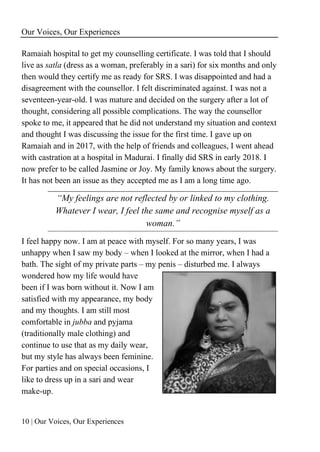
  • 60.
    Our Voices, OurExperiences | 51 An issue that repeatedly came up for discussion was the high suicide rates among sexual minorities. There was no space to talk about mental health problems. There were also problems of livelihood. The number of persons openly identifying as gender or sexual minorities was increasing, but there were few livelihood options to support them. There were ongoing debates and discussions about sexual minorities, and groups fighting for sexual minority rights. But these did not reach or involve everyone. In some areas, there was a lot of activity and in others there was none. There was a need to disseminate information within the community and to the larger society. As I had personally faced many of these problems, I was driven to take action. I decided to make mental health, livelihoods, and community media the three focus areas of Jeeva. I sought advice from various people with expertise and experience in these areas and put together a board of advisors who were working on these issues. Over time, my engagements with community issues has become deeper. I have become involved in advocacy and crisis intervention. I try to understand issues and then mobilise support to address them. I have had an active role in mobilising the community to oppose laws that criminalised us. Now, I not only feel confident but have started to enjoy public speaking. As a section of society who have suffered from social, economic and political marginalisation, we need to use every opening to enable ourselves to live a life of dignity and peace. I want to create a platform for gender and sexual minorities to participate equally in society, build a sustainable livelihood, and attain a quality life with self-esteem and dignity.
  • 64.
    Our Voices, OurExperiences | 53 Mapping Transgender Experiences The transgender experience encompasses and influences all aspects of life. This section attempts to provide an overview of engagements and experiences in different spheres of life and interactions with the major institutions of society and state: ▪ CHILDHOOD AND EDUCATION ▪ FAMILY AND FRIENDS ▪ HEALTH ▪ MENTAL HEALTH ▪ SEX REASSIGNMENT SURGERY (SRS) ▪ ECONOMIC SYSTEMS AND FINANCIAL VULNERABILITY ▪ MEDIA ▪ RELIGIOUS INSTITUTIONS ▪ SOCIO-CULTURAL COMMUNITIES OF TRANSWOMEN IN INDIA ▪ THE STATE
  • 65.
    Mapping Transgender Experiences 54| Our Voices, Our Experiences Childhood and Education Childhood is a vulnerable and defining period in a person’s life. Schools, families and communities need to be well equipped to respond to the needs of children who do not conform to society’s norms of gender and sexuality. Anita Cheria, Director of OpenSpace, highlighted some shortfalls of society and state in this regard. These children are often confronted by insensitivity, ignorance and violence from their birth family, school teachers and friends – the very people they are emotionally dependent on. Their behaviour is restricted by family and society to make their identity – or even their existence – invisible. Families sometimes take extreme measures such as restricting the movement of or confining the child, not allowing them to attend school or socialise. Faced with such treatment which is often criminal and violates their basic human rights, many of these children run away from home – if they are not thrown out first. Focus group on childhood and discovering identity Most children become aware of their gender and sexuality at a young age. Kannan, assigned female at birth, started feeling attracted to girls at around age ten. Deepika became aware of her gender at eight. Vaishali became aware she identified as female in eighth standard, Kumar B in seventh standard and Mallu Kumbar at the age of thirteen. Some children find acceptance within their families: “I was born a male child in Bengaluru city on 23rd January 1988. Now many of my friends call me Kumari. But even in my childhood, my grandmother and some other relatives called me Kumari, as they wanted a daughter in the family.” – Kumar B
  • 66.
    Our Voices, OurExperiences | 55 Others do not: With the exception of one participant in the focus group, all had experienced some form of violence in different spaces, discrimination, isolation, or had been forced out by their families or neighbours for not conforming to their expected gender roles. They may go a long time without finding anyone with whom they can articulate and discuss their feelings. The first time Kannan met another transgender person was at the age of 26. “I met someone who felt similar, I felt a big relief”. – Kannan For children in rural areas these problems are aggravated by their relative isolation. It is harder for them to reach out or find likeminded or sensitive individuals or communities. Small efforts can make a big difference. “One day I saw a press clipping about a lesbian couple. Then I found a book on sex which referred to a ‘she-man’. This excited me.” – Kannan Counselling and medical support can be provided only on a case by case basis when organisations become aware of such cases but one can never be sure that all such children are able to reach out for support. “I was teased by classmates in school. When I told my teachers, they would tell me to behave like a boy. When I was in 8th standard I felt very lonely and shared my feelings with my class teacher, Usha. She told me that I was still very young, that it was just confusion, that it would clear up once I am older. Though she was not unpleasant, she was of no help!” – Kumar B, Focus group
  • 67.
    Mapping Transgender Experiences 56| Our Voices, Our Experiences Family and Friends The focus group discussed their social connections. Of the eight participants, three were in touch with their biological families and which gave them different degrees of support and comfort. But, for support in times of emotional stress and for castration and SRS, most turn to the family of their choice as there is greater understanding and connection. Deepika’s best friends are Ramprasad, a man and Keerthi and Rakshita, transwomen. “I keep in touch with my birth family, but I have got immense love from the family I chose. At my wedding, Revathi was my mother and Sarvanan was father to Satya, my wife. With both Revathi and Sarvanan my relationship started as friends and colleagues.” – Kannan For transgender persons, often getting to a place where their birth families understand and support them can be a long journey. “I have seen many ups and downs in my life and in my relationships. When I returned home after SRS, I was made to shave my hair, beaten and locked up. But with time, there is more acceptance. But on the whole we can’t depend on anyone; we need to take care of ourselves, be aware of our own life.” – Ranjitha. Even among their chosen families, there is partiality based on factors such as their capacity to earn or cook. Along the way, some find that their best option is to rely only on themselves. “Shashi from the community is my friend but I am my own family. I need to be emotionally and physically self- sufficient, whether others are there or not. I know I have to depend only on myself.” – Mallu Kumbar
  • 68.
    Our Voices, OurExperiences | 57 Mental Health Mental health is an integral component of wellbeing, but addressing it is highly taboo in Indian society. According to Virupaksha, a counsellor and PhD Scholar from NIMHANS, mental illness impacts our capacity to fulfil our daily responsibilities, manage normal interactions and deal with ordinary stress. Studies have consistently found that gender and sexual minorities are subjected to a variety of unique stressors which increase their vulnerability to mental illness and they are disproportionately affected by anxiety, depression or even suicide. According to Sharada, a counsellor, statistics show that suicidal tendency is high among transgender persons, with some estimates as high as 60% of the total adult population. According to Uma, there were 42 suicides of gender and sexuality minority persons in 2010 in Bangalore alone. The stigma they face from society, rejection by family and friends, institutional discrimination, structural exclusion, the pervasive threat of violence and isolation all aggravate their vulnerability. They are subjected to forced marriages and are more likely to face sexual, physical and mental abuse in their birth homes and workplaces. The prejudices of society make it difficult for individuals to accept their identity as they fail to see narratives that normalise their existence. Dialogue on mental health is not prioritised as the stress of survival often overpowers everything else. There is a general lack of awareness among health care professionals regarding mental health needs of sexuality minorities. This has led to inefficient support, misdiagnoses and a lack of mental health services. The fear of exposure and backlash often keeps closeted individuals from seeking any medical services and social entitlements. This fear increases the stress involved in almost all social interactions. HIV positive individuals experience additional stress because disclosing their illness to their families may lead to rejection. The fear of adverse reactions and lack of resources make it difficult to protect sexual partners
  • 69.
    Mapping Transgender Experiences 58| Our Voices, Our Experiences from HIV infection. It is often a challenge to access the required medical treatment and nutrition. Accessing SRS is difficult due to the monetary constraints and the dearth of qualified professionals. The lack of personal and professional support and sensitivity often makes it a traumatic process even if it is possible. There are additional challenges in addressing mental health issues of working-class sexual minorities. When every day is a struggle for livelihood, there is little time to consider or understand the importance of mental health. Thus, it is essential to address livelihood issues simultaneously with mental health. However, getting governmental organisations to coordinate and offer viable livelihood services is an ongoing challenge. Addressing mental health With early diagnosis, mental illnesses can be better treated and managed. However, the lack of services to support mental health needs, poor affordability and inaccessibility of institutions, as well as stigma attached to accessing mental health services often prevent timely detection. Mental illness is seen as something that can be managed without professional help. It is not understood to require treatment as it is assumed to be the result of a particular short-term stress that will self-correct. The dearth of accessible and sensitive mental health services has led to an over-dependence on informal community support where individuals within the community take on multiple roles as friends and counsellors to those in crisis. This has placed immense stress on these care-givers and supporters, who may be facing crises in their own lives. There is an acute need to address the mental health concerns and crises of sexual minority individuals and their supporters by having more empathetic counsellors and counselling centres. National mental health policies must not be solely concerned with mental disorders, but holistic and recognize and address broader issues which influence mental health.
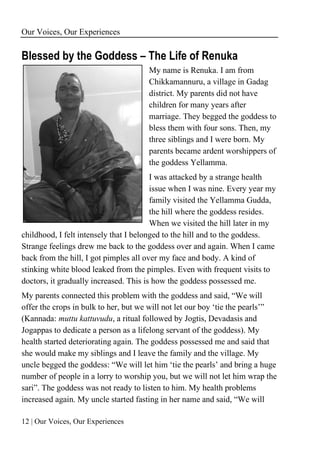
  • 70.
    Our Voices, OurExperiences | 59 The making of a friendly counsellor The following pages contain extracts from an interview with Sajeev, a community-friendly counsellor, on his experiences and insights. How did you begin counselling? I joined my father’s business, but my generous nature got us into debt. It was very difficult for my father and there was conflict between us. It was so bad that I had to seek medical attention. I was stressed as I felt I had to force myself to behave differently. In 2005, I joined Sangama – an NGO working with sexual minorities in Bangalore. For two years I worked there as a caterer. I was happy with the work environment at Sangama. In 2007, there was no funds to keep me on as a caterer and they asked me if I would train as a counsellor. I decided to try even though I did not grow up with a passion for social work and counselling was new to me. I went for a 20-day training conducted by South India AIDS Action Programme. This training had a deep impact on me. This was where my journey as a counsellor started. What NGO interventions have there been in mental health for sexual minorities? Sangama, which was started in 1999, was one of the first organizations to address the issues of working-class sexual minorities in Karnataka. The concept of drop-in centres (DIC), crisis support and peer counsellors were all pioneered in Karnataka by them in the mid-2000s. We advocated for a rights-based approach and inclusion of peer counsellors as a part of the project activities under the Nation Aids Prevention Programme. What was your first experience in counselling? After my first round of training, I was recruited as a trainee counsellor by Sangama. I worked under a senior counsellor at DICs which were part of a HIV prevention programme. My job was to motivate community members to do HIV tests and support them. This was difficult to achieve as there
  • 71.
    Mapping Transgender Experiences 60| Our Voices, Our Experiences were time restrictions. Over years I gained experience and started working on my own. I find my work very satisfying. Is there any format you follow while counselling? I make it a point to build trust with my clients and be sensitive to their needs and issues. A session starts with introductions and noting the history of the client. As a counsellor, we need to listen and note the points shared with care and help the client to articulate their problem. A counsellor must discuss all the possibilities with the client to help them make a decision. Each client needs counselling for different lengths of time. I conduct both individual sessions and group therapy depending on the requirement. What are the most common problems clients come to you with? Many gender and sexual minority persons suffer from low self-esteem. The most common problems I see are depression, stress, anxiety, self-harm and suicidal tendencies. The lack of family support, society’s rejection and negligence of the government makes survival a lonely battle. Poverty aggravates the amount of pain and silent suffering. Most people do not accept or understand gender non-conforming behaviour. This puts children under constant pressure to conform. Young community members have confided that they have faced sexual violence by teachers in school. An extra class or request for errands by school staff is often the pretext used to by teachers to harass them. The families resort to black magic, blackmailing and unethical medical practices such as shock treatment to ‘cure’ them. Children or young adults are often the target of such practices which involve physical and mental torture. They experience extreme helplessness and fear. Families see marriage as a ‘solution’ to change sexuality and use it to pressurise and emotionally blackmail their children. If the person gives into the pressure, the daily pretence becomes very stressful. People who are financially independent and have access to cosmopolitan spaces have more options available to them; they may be able to take the decision not to give
  • 72.
    Our Voices, OurExperiences | 61 into such pressures. But the majority of the population does not have this choice. They are usually forced to maintain silence in order to survive. A common report from clients is that family members have sexually assaulted them. Female-born clients are threatened by their fathers and brothers who say, “you are going out for happiness, we will give it to you”. What are the challenges you face while counselling? Various issues arise from rejection by family, domestic violence by family or partners, violence within the community, financial problems, loneliness and depression. These issues are challenging to address as they require several rounds of counselling and most people want a quick solution. But the most challenging cases I face are those of community members who are suicidal. To build trust and confidence, I make an oral ‘contract’ with them that they will be able to reach me at any time. A supportive system is very important. There must be at least one person the client can depend on. Helplines often cause harm as the people answering them may not be equipped to address the issue adequately. It can be a helpless and frustrating exercise for a person who is already vulnerable. What do you think are the most important qualities for counsellors? Just as we counsel clients to manage stress, we need to do the same. I try to maintain a work life balance and share my professional concerns with my senior colleagues and mentors to prevent a burn out. Self-awareness and being non-judgemental are the two most important qualities of a counsellor. Most counsellors have entrenched regressive beliefs regarding gender and sexuality. They discourage any gender expression that goes against societal norms. There is a need for sensitisation and training of counsellors to support gender and sexual minorities.
  • 73.
    Mapping Transgender Experiences 62| Our Voices, Our Experiences Sex Reassignment Surgery (SRS) August 2017: A discussion on SRS with activists, NGOs, academicians and transgender persons jointly hosted by Samara and Jeeva. Virupaksha, Counsellor and PhD Scholar from NIMHANS researching gender dysphoria, led the discussion with definitions, standards and procedures. This was followed by an open discussion. Misgendered names, bodies and clothing are often a source of great discomfort for many transgender persons: “When I started developing breasts, I hated it. At home no one really questioned me or my preference of clothes. But in school and college I hated the way I had to be.”– Kannan Each transgender person deals with their identity differently. There are some who find that their identity is independent of their name or their body. Kumar B, Mallu Kumbar and Uma who participated in the focus group had not attempted changing their names officially or SRS. “I feel acceptance and thus do not feel the need for any official change.” – Kumar B For others, SRS can be an extremely liberating process that enables them to assert their identity “I got SRS done in July 1998 and changed my name to Ranjitha/Ritu after jalsa (a Hijra ceremony to celebrate sex reassignment
  • 74.
    Our Voices, OurExperiences | 63 and acceptance). All my property documents and identity cards mention my gender as transgender” – Ranjitha Medical options to address gender dysphoria include counselling, hormone therapy and Sex Reassignment Surgery (SRS). SRS is the surgical procedure (or procedures) by which a transgender person’s physical characteristics are altered to align with their gender identity. The decision to undergo SRS is never taken lightly and is dependent on the individual’s exposure to options, their priorities and their circumstances. In Jeeva’s experience, there is little support from birth families for SRS. It is not recognised as a right by the state; there is no government support, or laws or standards in India for SRS. Procedures and precautions For hormone therapy and for SRS, one must be diagnosed with persistent gender dysphoria and be a legal adult (18 years in India). These facts must be documented and certified. There must be documented evidence of how the person has tried to deal with gender dysphoria, such as if they have used cosmetic methods or hormone treatments. One must undergo intense counselling prior to SRS to certify readiness. Emotional and physical state, desire, culture and motivations and several other factors are assessed to ensure that a person is making an informed decision. Due to a lack of exposure and information, some persons with non-heterosexual sexual identities may consider SRS. They are referred to support groups and counselling to help them accept themselves. Approval requires that a person live in their gender identity for one year. For approving male to female transitioning, counsellors often insist that a person dress in stereotypically female clothing, preferably a sari, for a year. However, clothing is not the only or primary expression of gender and this is a detrimental practice and can make the counselling process traumatic. Once evaluations are completed, a letter certifying that the patient has opted to undergo the procedure without misconceptions or external coercion is
  • 75.
    Mapping Transgender Experiences 64| Our Voices, Our Experiences issued. Two letters are required to be eligible for SRS either from two psychiatrists or, two psychologists or, one from a psychiatrist and one from clinical psychologist. With these letters, individuals can proceed to consult doctors for their treatments. Hormone treatment and SRS require the support of several specialists including gynaecologists, urologists, plastic surgeons and endocrinologists. After counselling, some chose not to proceed with SRS, some chose completely reversible procedures, some chose partially reversible procedures and some chose irreversible options. Hormone therapy is used to alter secondary sexual characteristics such as breast and hair growth. Hormones have a complex role in regulating our emotions and physiology. Side effects may include anxiety, depression, mood swings, weight loss/gain, hair loss, weakening of bones, kidney problems, stroke, hypertension and diabetes. These are not easy to predict or generalize, but careful monitoring can minimize the negative side effects. Thus, any treatment must be done under medical supervision. Hormone therapy may be used as a standalone option or in combination with SRS. Concerns and observations Patients are not often given adequate information regarding the procedures, healing, results and possible complications. Many discussants had personally experienced complications in SRS and needed multiple surgeries to correct the first. There is no database where one can check the reliability of a medical practitioner. SRS and medical care for transgender persons is not a part of the regular curriculum in medical courses and there is no recognised authority to certify a person in this specialisation in India.
  • 76.
    Our Voices, OurExperiences | 65 Economic Systems and Financial Vulnerability Transgender persons face additional expenses that aggravate their financial situation: 1. Housing: It is difficult for transgender persons to get homes within city limits as most people are unwilling to rent their homes to them; those who are charge exorbitantly. 2. Transport: They often spend more on travel as they cannot use public transport due to harassment. 3. Community expenses: Most among the Hijra community stay with their guru. This ensures they have shelter, and more importantly a community. However, they have to make payments to their guru – which they may have to take loans to meet. 4. Harassment: Some local police and goondas demand pay-offs from sex workers. 5. Medical services: SRS and related medical services are additional expenses for them. 6. Wages: For transgender persons from non-English speaking rural backgrounds it is difficult to complete formal education. Most are forced to work in the unorganized sector or in begging or sex work. These occupations do not meet their expenses. 7. Loans: Bank and financial institutions often discriminate and do not follow set guidelines. However, there have been some changes that have made opening an account easier such as the option to identify as transgender on loans applications.
  • 77.
    Mapping Transgender Experiences 66| Our Voices, Our Experiences Media 20th July 2017: A panel discussion on Indian media coverage of gender and sexual minorities was organised by Jeeva in partnership with Radio Active CR 90.4 Mhz, Your Story, Network of Women in Media (Bangalore), KSMF, OpenSpace and Amnesty International-India. Reporting on gender and sexual minorities is fraught with challenges and complexities. Their representation in media is usually either flawed or non- existent. There is often false information or one-sided reporting. With the lack of diverse voices in newsrooms, it can be difficult to uncover the truth. However, it is important to report accurately and responsibly. With ethical journalism, media can be beneficial in advancing the rights of gender and sexual minorities. Increased coverage can create the impetus for much needed dialogue. Reporting in rural areas that are relatively isolated can be extremely valuable. Transformation takes time. Diversity in the newsroom and particularly in leadership, with different voices and perspectives is key to shift the focus away from sensational coverage to positive and inclusive storytelling. Improving fact checking, sensitive reporting and engaging with the
  • 78.
    Our Voices, OurExperiences | 67 community is the responsibility of every journalist. Existing media institutions need to work along with gender and sexual minorities to create and make available a more sensitive vocabulary. Young journalists should be encouraged and guided to appropriately cover marginalised communities. Independent efforts by gender and sexual minority individuals should be supported and promoted by the mainstream media to amplify their authentic voices.
  • 79.
    Mapping Transgender Experiences 68| Our Voices, Our Experiences Religious Institutions Most major religious institutions such as temples, churches and mosques, do not include transgender persons. “I have fond memories from my childhood of visiting temples and singing bhajans and purana kathas (hymns and stories from ancient religious texts). But once you are a Jogappa you have no space in the mutts (traditional missions within the Hindu religious orders). You are not allowed in the men’s or women’s section. For me and people like me the only spaces open to enjoy singing are music programmes. The practice in large temples of removing your shirt and bathing in public is embarrassing. If at all we decide to visit famous temples like Tirupathi, we find safety in numbers. Even when we are in groups, we are stared at and commented on, but the difference is that we feel confident together.” – Vaishali “The Catholic and CSI churches are “government churches”. They are obsessed with procedure, but if I could be accepted, I would immediately join one of them. Private churches are small, started by an individual or a couple and run on a small scale. They are more flexible, friendly and welcoming.” – Jarmi The only place where we have had a tradition of inclusion are Dargahs – the Sufi shrines. Sufism is a mystical Islamic tradition to find the truth of divine love and knowledge through direct personal experience of God. Dargahs are often more inclusive to people of different faiths and identities. The dominant culture followed in the seven Hijra gharanas is Muslim. In Dargahs, Hijras must dress in traditional male attire, but ear and nose piercings are allowed. – Focus Group
  • 80.
    Our Voices, OurExperiences | 69 Socio-Cultural Communities of Transwomen in India Excluded from the mainstream religious and social institutions, transwomen in the Indian subcontinent have created several socio-cultural communities which have distinct traditions and customs and often, defined religious roles in their interactions with larger society. These traditions differ across the country and have long and rich histories of facilitating both integration and isolation from society, usually creating just enough space on the margins to live but never thrive. Hijras are the most prominent of these communities and are spread throughout the Indian subcontinent. Other groups are more geographically restricted such as Jogappas – primarily located in Maharashtra and Karnataka, Kinnars in Northern India, the Aravanis in Tamil Nadu (some Aravanis now prefer to be called ‘thirunangi’), the Maraladi Kothis in Tamil Nadu and Karnataka and the Shiv Shaktis in Andhra Pradesh. Some intersex persons may also be members of these communities. In communities such as the Hijras and the Jogappas, the primary relationship is of a guru (teacher) and chela (student) or a mother and daughter. The guru/mother takes on new chelas/daughters in order to bring them into the community. This initiation is accompanied by specific rituals such as reet among the Hijras and muttu kattuvudu among Jogappas. Some groups form distinct communities and may live together as families – like the Hijras in their hamams (lit. households). They may also form more complex social structures. Maraladi kothis have a collective known as the Mahanadu unit. The Hijra community has seven gharanas (lit. houses), each with distinct traditions and norms. The elders of the households in each area form a council known as a jamat. This council approves the initiation of each new Hijra into the community. Not all communities form tight knit groups or families. For example, Jogappas and Maraladis also follow the guru-chela system, but after a certain period, they lead a largely independent life. They are ‘married’ to
  • 81.
    Mapping Transgender Experiences 70| Our Voices, Our Experiences specific deities. They have temples of their own and are consulted by people for certain spiritual or religious services such as spiritual healing and astrology. They also dress up elaborately and celebrate several festivals connected to the temple or deity they are connect to. Traditional professions practices by Hijras include begging (known as ‘collection’), dancing at weddings and blessing. The hamams may double as brothels. Many people across the Indian subcontinent believe that that seeing a Hijra’s face is a good omen so people make it a point to take their blessings before starting new initiatives. As a result of this belief, in Karnataka some Hijras refer to themselves as Mangalamukhi (lit. auspicious face). These communities have also created distinct vocabularies. Some of these terms are not connected to a particular tradition but rather to a locale: kothi refers to a person who is assigned male at birth and has typically feminine characteristics. Those who wear saris are known as satla kothis and those who dress in typically male clothing are referred to as panti satla kothis. Nirvana is a general term for ‘rebirth’ of a transgender person after castration or SRS. Begging is generally known as ‘collection’ among the transgender communities. Some terms are specific to a particular tradition. For example, sadar (sex work) and tapar (money earned from sex work) are typically Jogappa terms. It is important to note, particularly with reference to policy and inclusion, that while these communities are significant, they do not include or represent all transwomen and intersex persons. Further, no transmen are included in these communities and they do not have other equivalent structures.
  • 82.
    Our Voices, OurExperiences | 71 The State The Constitution of India recognises and guarantees to all citizens the fundamental right to life and liberty, equality before law regardless of sex, equality in public employment, freedom of expression and freedom of movement. In reality, most genders and sexual minorities in India are deprived of these rights. There is a long-recognised need for a comprehensive policy for gender and sexual minorities to address health, education, employment, housing and provide protection from abuse. The government must create awareness and foster inclusion for gender and sexual minorities to be accepted in society and lead a life of dignity. Bringing legal changes through litigation or legislation has proved to be difficult and long drawn. The vulnerability must be acknowledged before the community can advocate for a policy or law. If a favourable law or policy is passed, its implementation is contingent on the stakeholders staying vigilant. At all stages, there has been a lack of political will and clarity. Consistent community campaigns and public action have resulted in significant gains in correcting existing laws that violate gender and sexual minority rights. The removal of the word ‘eunuch’ from section 36A of the Karnataka Police Act in 2016 and the decriminalisation of consensual sexual behaviour among adults under section 377 of the IPC are notable gains in the recent past. Experiences with the state and law are dealt with in detail in the fourth section.
  • 86.
    Our Voices, OurExperiences | 73 Since its inception in 2012, Jeeva has employed multiple strategies to strengthen the community from within and work with institutions of state and society to increase inclusion. To these ends, Jeeva: 1. Consults community members regularly for feedback on going interventions and advice to plan and prioritize future programmes. 2. Amplifies the voice of gender and sexual minorities through community media by facilitating the production of print and audio- visual materials for training and awareness. We also facilitate interactions with and sensitizations of mainstream media. 3. Addresses and supports mental health needs of gender and sexual minorities by raising awareness and providing counselling. As this is a public health issue, we also link with government institutions. 4. Works with the government and other institutions toward incremental and fundamental measures for inclusion in all aspects of life and livelihood. We monitor, and advocate for, the implementation of laws and services that are meant to protect and uplift gender and sexual minorities. This section contains some highlights of Jeeva’s interventions and activities.
  • 87.
    Jeeva: For aLife of Peace and Freedom of Expression 74 | Our Voices, Our Experiences Increasing Visibility Jeeva engages with and tries to increase visibility of gender and sexual minorities and their issues through various means. 23rd November 2014: Bangalore Pride and Karnataka Queer Habba. 20th May 2014: Sports day with the transgender community.
  • 88.
    Our Voices, OurExperiences | 75 12th June 2014: Protest condemning the deadly attack at a gay night club in Orlando, Florida. 26th August 2018: Celebration of Raksha Bandhan along with Amrutha Bindu Trust.
  • 89.
    Jeeva: For aLife of Peace and Freedom of Expression 76 | Our Voices, Our Experiences Jeeva has undertaken multiple initiatives to amplify the voices of gender and sexual minorities through various forms of media including print, radio and film. Jeeva launched a Facebook page in November 2012, a Wordpress blog in August 2013 and a Youtube channel in 2014. 16th November 2013: Screening of “The Love Story of Sruthi and Saranya” a documentary film about a lesbian couple produced by Jeeva supported by a fellowship from Aneka. 6th November 2014: The release of the first edition of Ananya.
  • 90.
    Our Voices, OurExperiences | 77 Ananya, our print magazine, is a space for us to share our stories and experiences through articles, songs, poems and discussions, as well as information on rights and entitlements, government policies and schemes. Ananya is one of the first community led efforts to share experiences through a print magazine in Kannada. The purpose is to establish a better understanding between the gender and sexual minorities and larger society. We have published 11 editions Ananya over the last six years with the mentoring and financial support of the fellowships from Aneka (2013-14) and Jain University (2015-17). Ananya has also benefited from the guidance of its current editorial board – Pinky Chandran, Ashish Sen, Madhu Bhushan and Prapula Devi – and former members, Tanushree and Pushpa Achanta. 16th June 2015: Uma (left) interviewing Priya, a transwoman, for Jeeva Diary. “Jeeva Diary” was a weekly radio programme that aired every Thursday on Radio Active 90.4 – Bangalore’s first community radio station, from 5th March 2016 to 2017. It was anchored by Uma who, in the process, became a trained radio jockey and learned how to edit interviews and to reach out to
  • 91.
    Jeeva: For aLife of Peace and Freedom of Expression 78 | Our Voices, Our Experiences a diverse audience. The show included interviews, poetry reading, reports on struggles and campaigns and discussions on sex, sexuality and gender. We were able to literally bring community voices into the public domain. Every story was presented as a diary entry for the day. This format was unique in the Indian media. A total of 72 episodes were broadcast. Jeeva Diary was produced with the fellowship from Jain University and the guidance of Pinky Chandran of Radio Active. 16th October 2015: Celebration of the 25th episode of Jeeva Diary. Mental Health To create support systems for gender and sexual minority members in need of mental health support, Jeeva has: 1. Conducted art therapy and game therapy for groups of 10 in 2013. This was not sustainable due to lack of funding and volunteers. 2. Conducted sensitisation programs for public and private health care providers and government officials. 3. Mapped trusted psychiatrists, psychologists, and mental health professionals from government hospitals for referrals. 4. Started a regular weekly counselling service in 2016. Counsellors from NIMHANS volunteered to provide professional support on demand. The Jeeva office has become a safe space for community
  • 92.
    Our Voices, OurExperiences | 79 members to freely converse and access counselling. Several clients have come forward. The common queries are regarding relationships, sex and sexuality and gender identities, SRS and living with HIV/AIDS. Jeeva tries to address the unique stresses for each situation and provide advice for further action – such as regular therapy to deal with mental illness or counselling and assessment for SRS. However, due to the relatively long periods advised for assessment and counselling, clients may be reluctant or unable to bear the incidental costs. Nimmondige Naavu 10th October 2017: Launching Nimmondige Naavu on World Mental Health Day. Jeeva launched the helpline Nimmondige Naavu (lit. we are with you) in collaboration with the National Institute of Mental Health and Neurosciences, NIMHANS. It is a 24x7 telephone helpline for sexual minority persons in need of mental health support. It is accessible from any location and at any time, making it uniquely posed to address crises
  • 93.
    Jeeva: For aLife of Peace and Freedom of Expression 80 | Our Voices, Our Experiences however they arise as most existing institutions have limitations and many helplines are accessible only during office hours. The launch of the helpline was marked by a public function attended by community members, health professionals and other supporters including Anita Cheria, Director of OpenSpace which is a campaign support organization, Prof. Dr. Murlidhar, head of the Mental Health Department at NIMHANS, Virupaksha, Counsellor and PhD Scholar from NIMHANS, Sharada, a counsellor with several years of experience counselling sexual minorities and Sunil and Rumi Harish who are activist, senior researchers and members of the community. To popularise the helpline and raise awareness on mental health issues faced by gender and sexual minorities Jeeva created a poster. This card did not specifically mention ‘mental health’ in order to avoid the stigma and resistance that comes with the term, but simply stated that persons could reach out and speak to someone without fear of being judged. Jeeva has counselled couples in conflict, individually and together. Non-working-class gay couples have also accessed the helpline. Calls were answered by a sensitive listener who took note of concerns and requirements. The callers were directed to follow up as required through Jeeva’s counselling or external support. Over the years, many issues have been raised and addressed through the helpline and counselling. As a result of Jeeva’s effort, there is increased
  • 94.
    Our Voices, OurExperiences | 81 awareness about the need and challenges of addressing mental health within the gender and sexual minority community in Karnataka. Future plans To further address this issue, in the future we hope to: 1. Train field workers to understand the needs of gender and sexual minorities. 2. Create a more comprehensive community-vetted list of professional service providers across all districts of Karnataka. 3. Conduct fortnightly support group meetings with 8-10 participants providing a space for mutual emotional support and raise awareness on mental health issues. This will not only impact the participants but the community they interact with as this support network expands. We hope to get to a stage where all gender and sexual minorities recognise the symptoms of mental illness and are able to support each other and seek timely counselling. Engaging with the State 11th January 2016: Meeting the Karnataka law minister to advocate the removal of section 36A of the Karnataka Police Act.
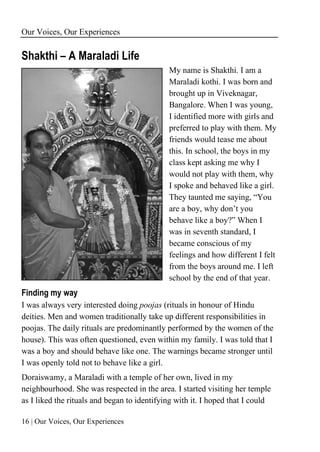
  • 95.
    Jeeva: For aLife of Peace and Freedom of Expression 82 | Our Voices, Our Experiences 12th January 2016: Applicants and lawyers in the case against section 36A of the Karnataka Police Act at the Karnataka High Court after the judgement. 12th July 2016: Meeting the Mayor of Bangalore to demand the implementation of programs for empowering transgender persons for which BBMP allocated two crore rupees of their 2016-17 budget.
  • 96.
    Our Voices, OurExperiences | 83 14th Feb 2017: Focus group discussion on transgender health, education, employment and housing organised by Jeeva and KSMF. Jeeva played an active role working with the government to pass the Karnataka State Transgender Policy. 20th October 2017: Raising awareness among gender and sexual minorities on the Karnataka Prohibition of Beggary Act, 1975 and Right to Privacy.
  • 97.
    Jeeva: For aLife of Peace and Freedom of Expression 84 | Our Voices, Our Experiences 2nd March 2018: Meeting Mr. Siddharamaiah, Chief Minister of Karnataka, to submitted a memorandum demanding budget allocation for and the implementation of welfare schemes. 18th June 2018: Submitting a memorandum for implementation of the Karnataka State Transgender Policy to Ms. Jayamala, State Minister for Women and Child Development.
  • 98.
    Our Voices, OurExperiences | 85 8th August 2018: Discussion on the status of the Supreme Court hearing on section 377 of the IPC and the Trafficking of Persons Bill, 2018 organised by Jeeva and KSMF. 3rd December 2018: Meeting Mallikarjun Kharge, Congress MP and the Leader of the Opposition to discuss supporting the transgender community and voting against the Transgender Bill, 2018 when it comes to the Lok Sabha.
  • 99.
    Jeeva: For aLife of Peace and Freedom of Expression 86 | Our Voices, Our Experiences 18th June 2018: Meeting U.T. Khader, the Karnataka Housing Minister to demand housing for transgender persons. 6th September 2018: Celebrating the Supreme Court verdict reading down section 377.
  • 100.
    Our Voices, OurExperiences | 87 10th October 2018: A panel discussion welcoming the landmark Supreme Court judgment reading down section 377 organised by Jeeva, KSMF and Dharwad University. 22nd December 2018: Protest against the Transgender Persons (Protection of Rights) Bill, 2018 and Trafficking of Persons (Prevention, Protection and Rehabilitation) Bill, 2018.
  • 104.
    Our Voices, OurExperiences | 89 Engaging with Law and the State This section is focused on Jeeva’s experiences with laws relating to and governance of the transgender population in Karnataka and at the centre. It includes a guide to action for citizens to participate in the democratic process of influencing the law within domestic and international frameworks. The chapters in this section are: ▪ CITIZENS AND THE LAW ▪ DEVELOPMENTS IN LAW AND POLICY ▪ REFLECTIONS ON THE KARNATAKA STATE TRANSGENDER POLICY ▪ A VOTER ENROLMENT DRIVE: AN EXPERIENCE OF ENGAGING WITH THE STATE ▪ SDGS AND GENDER AND SEXUAL MINORITIES
  • 105.
    Engaging with Lawand the State 90 | Our Voices, Our Experiences Citizens and the Law The law is a system of rules that are enforceable by the government. The law confers legal rights, obligations and liabilities on citizens and on the State machinery. Law can take the form of an act, ordinance, order, by- laws, rules, regulations, court orders, etc. As citizens, we have both the right and an obligation to intervene in the law-making process. We have several opportunities and avenues to do so: we can give comments while bills, policies or schemes are being drafted; we can use the courts to challenge violations of the law, or even challenge the law itself; we can lobby with the administration at every stage; we can vote for representatives at every level of government who will best protect our interests. The Constitution of India is the supreme law in India. ➢ No law can be made that contravenes the framework provided by the Constitution. Such laws can be challenged in court, as section 377 of the IPC was. A policy is an official government statement on the principles and goals they intend to adhere to in administrating. ➢ Citizens can intervene during the drafting of a policy. ➢ Though not legally binding, a policy can be used to guide advocacy and negotiation with the government. It becomes particularly significant while negotiating the contents of binding legislation on the same issue. An Act or a statute is a law which is made by a legislative body like Parliament or State Legislative Assembly. A legislation, or Act, starts as a bill. ➢ When a bill is being drafted, there are consultations held with the stakeholders in addition to the advisory bodies of legislature. ➢ Once a Bill is drafted, it is published for comments from the public for a period of time. Most draft bills can be accessed on the websites of the relevant government department. There are other websites such as prsindia.org that track bills.
  • 106.
    Our Voices, OurExperiences | 91 A Bill must be discussed and passed by legislature. It can be introduced by any member of the parliament (i.e. at the centre. A state bill may be introduced by any member of the state assembly). Ordinary bills can be introduced in either House of Parliament. Money bills can only be introduced in the Lok Sabha. Once they are discussed and passed, the bill in its new form is sent to the other house for approval. ➢ While a bill is being debated in parliament, citizens can lobby with the members of parliament/the state legislature to pass the bill in a form that is favourable. A Bill becomes a law (Act) once it has been passed by the parliament and signed by the President (or the governor if it is a state Bill). Ordinances are laws issued by the President of India on the recommendation of the Union Cabinet when the Parliament is not in session. They enable the government to take immediate legislative action. An ordinance is an extraordinary measure. When the session of the parliament begins, an ordinance may be approved to make it a permanent law (an Act) or revoked by resolutions of both houses. If no resolution is passed within six weeks of the start of the session, it lapses naturally. ➢ Once a legislation is enacted, it is legally binding on the government. Violations of an Act can be challenged in court. ➢ An Act can be modified or repealed by another Act of the legislature. Thus, citizens can lobby with their representatives to amend legislations, just as they would to get legislations created. ➢ Provisions of law can be interpreted, struck down or narrowed by a court. Such a judgement would affect the reading of the law within that court’s jurisdiction. For example, if the Delhi High Court struck down a law, that would change the law for Delhi, but not the rest of the country. Decisions of a High Court can be appealed to the Supreme Court. As the jurisdiction of the Supreme Court is the entire territorial extent of India, their judgements change the law for the whole country.
  • 107.
    Engaging with Lawand the State 92 | Our Voices, Our Experiences The exception to this is cases such as the 2009 Naz Foundation judgement of the Delhi High Court which was applicable to the entire country. This is because High Court decisions in writ petitions that challenge the constitutionality of a Central law, are not restricted to their ordinary territorial jurisdiction. In order to narrow the scope of or strike down a legal provision, the Court has to provide a reason. For example, the reason for reading down section 377 of the IPC was that the law violated the Constitution. Schemes are implemented by the government in order to implement specific policy or legislative goals. Schemes define the actions that the administration must take and for whose benefit. ➢ Non-implementation or violations of a scheme can be challenged by citizens either by going to court or by lobbying with the administration. International Laws are not binding on India in the domestic legal system since India follows a dualist legal system. This means that when India becomes party to an international agreement, those provisions are not enforceable locally unless the parliament specifically passes a law to that effect. ➢ International instruments are not binding, but they can be persuasive in court and guide decisions and directives particularly if there is a lacuna in the domestic legal system on a subject where India has signed a treaty. For example, in NALSA v. Union of India, the Supreme Court stated that the Yogyakarta Principles on the application of international human rights law in relation to sexual orientation and gender identity should be applied as part of Indian law. The Principles were also cited in the case against section 377 of the IPC.
  • 108.
    Our Voices, OurExperiences | 93 Developments in Law and Policy Selected experiences of the transgender community in Karnataka with the State 2009: Under the leadership of Mr. Dwarakanath, Backward Classes Commissioner of Karnataka, a public hearing was held and the jury made a recommendation that the transgender community be given the status of backward class so that they are eligible for schemes and benefits sanctioned for the backward classes. This has not been implemented. 2010: Community representatives used the Backward Classes Commission report to advocate for a State Transgender Welfare Board with Shobha Karandlaje, then a BJP cabinet minister. The welfare board was not set up. Instead the state passed a government order to initiate some schemes. The implementation of the schemes was flawed due to problems in identification. 2011-12: Justice Manjula Chellur organised public meetings zone-wise throughout the state involving community members, lawyers, health professionals and judges to understand, and create an environment of support for, transgender issues. The reports of these meetings were used in the arguments in NALSA v. Union of India. 2011: Section 36A was inserted in The Karnataka Police Act giving police unregulated power to ‘regulate Eunuchs’. 2013: Due to problems with the implementation of the special schemes, Ramesh Bindurao Zalki, Principal Secretary of DWCD, collaborated with community organizations and conducted a pilot study in Raichur to understand diversity of among transgender persons. This led to a broader definition of transgender by the state government beyond sari-clad Hijras to include Female to Male transmen, Male to Female transwomen, kothis, Jogappas and Mangalmukhis. The main schemes announced included Sahaya Dhana, which provided livelihood grants of Rs.20,000, and Mythri,
  • 109.
    Engaging with Lawand the State 94 | Our Voices, Our Experiences a pension scheme. Another government order issued by Mr. Zalki reserved two beds in every district hospital for transgender persons. The government tasked KSMF and Sangama with the identification of beneficiaries for these schemes. 2014: The government held the first round of discussions on the Karnataka State Transgender Policy and a draft was prepared in collaboration with the stakeholders. 2015: A petition was filed by Manjula, the President of KSMF, with the support of advocate Ashok GV, challenging the constitutional validity of section 36A in the Karnataka Police Act, 1963. Section 36A gave the Police Commissioner the power to “prevent, suppress or control undesirable activities of eunuchs”. It allowed the preparation and maintenances of a register of the names and places of residence of all eunuchs residing in a particular area who are suspected of “kidnapping and emasculating boys or of committing unnatural offences or any other offences or abetting the commission of such offences.” This provision was targeted at and has been used to disproportionately criminalize the transgender population and keep them under surveillance. It is arbitrary, discriminatory and a violation of the rights to equality, liberty, life and dignity guaranteed by the Constitution. December 2015: Jeeva and Akkai Padmashali, with the support of advocate Jayna Kothari of CLPR, filed supportive petitions in the case against section 36A. 10th January 2016: Transgender leaders met with Sri T.B. Jayachandra, the State Minister for Law, and the government lawyer regarding the case regarding section 36A. The minister agreed to remove the provision at the meeting. However, during the hearings, the government counsel submitted that the government was only willing to amend the provision.
  • 110.
    Our Voices, OurExperiences | 95 12th January 2016: The High Court of Karnataka ordered the government to place the amended provisions before the Court in six months. The term ‘eunuch’ was removed, but the section remains. 2017: The draft Karnataka State Transgender Policy was reopened for discussion by Uma Mahadevan, Principal Secretary, DWCD. Three consultations were held over a month with transgender persons and related organizations in Bangalore. The Women’s Development Corporation submitted their draft in February 2017. It was approved by the legislative assembly in October 2017 and signed by the governor in December 2017. Developments in the capital 2001: Naz Foundation filed a PIL in the Delhi High Court challenging section 377 of the IPC as it affects the health of gay men. 2005: Naz Foundation filed a PIL stating that section 377 violates the fundamental rights guaranteed by the Constitution. 2009: The Delhi High Court issued its landmark judgement in Naz Foundation v. Government of NCT of Delhi decriminalising homosexual acts involving consenting adults. This was later challenged in the Supreme Court of India. 11th December 2013: The Supreme Court in Suresh Koushal v NAZ Foundation overturned the Delhi High Court ruling in the Naz Foundation case and reinstated section 377 of the IPC. 15th April 2014: The Supreme Court issued their judgement in the case of NALSA v. Union of India. It declared transgender persons to be the 'third gender', affirmed that the fundamental rights recognised by the Constitution will be equally applicable to transgender people, and gave them the right to self-identification. This was a major step towards gender equality. The court directed the central and state governments to treat transgender persons as socially and economically backward classes and grant reservations in employment and admissions to educational institutions. The court directed
  • 111.
    Engaging with Lawand the State 96 | Our Voices, Our Experiences all state governments to draft and implement policies in compliance with the spirit of the judgement. Over the last five years, there have been several attempts to introduce central legislation for the protection and empowerment of transgender persons. These processes and the Bills have had their flaws. There are currently two Transgender Bills pending before the Parliament. 2014: A private member bill was introduced in the Rajya Sabha by Tiruchi Siva to guarantee rights and provide welfare measures to transgender persons. It was passed by the Rajya Sabha in 2015 and is currently pending before the Lok Sabha. 5th November 2015: Leaders of the transgender community demand a consultation on the Transgender Bill, 2014. 2015: The Ministry of Social Justice and Empowerment sought comments on a new draft Transgender Bill. 2nd August, 2016: The Government introduced a separate Transgender Persons (Protection of Rights) Bill, 2016 in the Lok Sabha, which is currently pending before the Rajya Sabha.
  • 112.
    Our Voices, OurExperiences | 97 8th September 2016: The Transgender Bill, 2016 was referred to the Standing Committee on Social Justice and Empowerment. 2016: Uma, Akkai Padmashali and Sana, transgender community leaders from Karnataka, with the support of CLPR, intervened in the case challenging the Naz Foundation judgement in the Supreme Court. 21st July, 2017: The Standing Committee on Social Justice and Empowerment submitted their report on the Transgender Bill, 2016. 24th August 2017: In Puttaswamy v Union of India, the Supreme Court declared that the right to privacy is a fundamental right. It recognised an individual’s autonomy to identify and express gender and sexual orientation as a part of this right. 6th September 2018: In Navtej Singh v. Union of India, the Supreme Court read down section 377 of the IPC. The Court decriminalised consensual sexual conduct between adults, and held that the LGBT community are entitled, like all other citizens, to the full range of constitutional rights and liberties. The Court criticised the Suresh Koushal judgement stating that discrimination based on sexual orientation and gender identity is a violation of the fundamental rights of autonomy, privacy, equality and dignity. 18th July 2018: The government introduced the Trafficking of Persons (Prevention, Protection and Rehabilitation) Bill, 2018. There is a general misconception in society that groups of transgender persons are engaged in sex trafficking and forced beggary by kidnapping and forcibly castrate and administering hormones to increase their numbers. This leads to harassment by the police and the public. This Bill specifically identifies transgender persons as a ‘vulnerable’ population. This may allow birth families who reject gender non-conforming persons to file false cases – identifying them falsely as victims of trafficking and initiating the process of ‘repatriation’ under the Bill that denies these adults their fundamental right to movement. The media aggravates this issue through false reports that perpetrate these lies. Thus, this Bill is relevant to the transgender population. It is essential
  • 113.
    Engaging with Lawand the State 98 | Our Voices, Our Experiences that there is awareness in the community on what their rights and legal risks are so that they can take informed action. 26th July 2018: The Lok Sabha passed the Trafficking Bill, 2018. The following are some extracts from press releases by stakeholders regarding the Transgender and Trafficking Bills. 14th December 2017: Protest against the Transgender Persons Bill, 2016. Press Release of the Coalition of Sex Workers and Sexual Minorities’ Rights, Karnataka on 20th December 2018 We, transpersons, sex workers, activists, academics, and allies in Karnataka, work on various forms of extreme exploitation and with the transgender community and sex workers (including but not limited to transgender sex workers). We express grave concerns with the regressive Transgender Persons (Protection of Rights) Bill and the Trafficking of Persons (Prevention, Protection and Rehabilitation) Bill, 2018. Both bills are pending consideration before the Rajya Sabha now. We demand that
  • 114.
    Our Voices, OurExperiences | 99 both these Bills not be introduced in the Rajya Sabha and that they be referred to a Select Committee of the Rajya Sabha. Recently in August 2018, the Delhi High Court in Harsh Mander and Ors. vs. Union of India has observed that the approach of criminalising begging was not a solution to addressing the problem. Further, in September 2018, a five-judge bench of the Supreme Court in Navetej Singh Johar and Ors. vs. Union of India categorically held that “The LGBT persons deserve to live a life unshackled from the shadow of being ‘unapprehended felons’.” Both the Bills (Transgender Bill and Trafficking Bill 2018) are fundamentally motivated by a criminalizing impulse. The state instead of taking on welfarist/developmentalist functions chooses to focus on incarcerating the poor and marginalised, including sex workers, bonded labourers, contract workers, domestic workers, construction workers, transgender persons, inter-state, intra-state and international migrant workers. Transgender Bill 1. Bill was passed in Lok Sabha without ANY community consultation and does not address concerns or demands of the community and is an abusive legislative process. 2. Bill is a retrograde step from previous iterations of transgender persons rights such as reservation, employment and education opportunities, right to self-determination of gender as iterated in the NALSA judgment, MSJE report, the Tiruchi Siva Bill, and the Parliamentary Standing Committee recommendations. 3. Bill does not address accountability measures, within the state and its functionaries, police violence, violence from natal families, etc. 4. Bill is inadequate for the protection of transgender persons as it upholds the criminalisation of transgender persons for traditional sources of income such as begging, while denying any opportunities in education, employment, healthcare, etc. or recognising rights to marriage, adoption, property, etc. 5. Bill upholds lighter consequences and penalties for discrimination and assault on trans people compared to cisgender people.
  • 115.
    Engaging with Lawand the State 100 | Our Voices, Our Experiences 6. Bill violates the fundamental rights of transgender persons to live where we please, stating that even as adults with the right to free movement and association, we must either stay with our parents or approach a court. Trafficking Bill 1. Bill is unclear with respect to existing laws which already penalize trafficking and exploitation of trafficked victims for sexual exploitation, bonded labour, contract labour, and inter-state migrant work. 2. Bill goes against fundamental principles of criminal justice and the Indian Constitution by creating new offenses unrelated to trafficking, use of unclear sentencing policy, vesting excessive powers in the police, etc. 3. Bill ignores and furthers the failures of existing ‘protection’ homes, fails to hold magistrates accountable, and explicitly bars victims of trafficking from accessing the legal remedies that every citizen of India is entitled to in the name of ‘protection’. 4. Bill lacks consultation with trade unions, labour groups, sex workers, and transgender communities, specifically with respect to impact on informal labour, including begging, sex work, and domestic work, thereby categorically targeting marginalised communities. 5. Bill does not hold accountable state actors and employers, but instead declares one’s choice and form of labour and sustenance as trafficking and prescribes excessive punishment for the marginalised communities engaging in these forms of labour. 6. Bill criminalizes the administration of hormones and other medicines, failing to distinguish between coercion and assistance in accessing gender affirming hormone therapy. 7. Bill does not distinguish between voluntary sex work and trafficking.
  • 116.
    Our Voices, OurExperiences | 101 8. Bill is against international legal norms which focus on human rights and a victim-centred approach Excerpt from the press release of The National Network of Sex Workers (NNSW) dated 19 December, 2018 “The problem with The Trafficking Bill, 2018 is that it criminalizes vulnerable individuals in the absence of comprehensive policies, programmes and measures that address the factors that make persons vulnerable to trafficking. The aspiration to move and access better living conditions. Poverty, lack of equal opportunity and skewed development policies force persons to move in an unsafe manner and accept work in a criminalized environment, for instance in sex work or as undocumented workers abroad. In March 2018, NNSW members had published an evidenced-based research study Raided, showing that abolitionist NGOs were violating the human rights of consenting adult sex workers by misusing provisions of existing anti-trafficking laws. The current Trafficking Bill, 2018, continues to use the strategy of forced raid, rescue and rehabilitation as its primary strategies which are not subject to scrutiny, allowing an environment of impunity and disregard for the human rights of sex workers. Recent reports of widespread violations and abuse in ‘protection’ homes where they are incarcerated for varying periods, bears testimony to these narratives of sex workers. Sex workers call for greater accountability and transparency in the functioning of these institutions, rather than further empowering District Committees and the police to create fear among workers in vulnerable situations.”
  • 117.
    Engaging with Lawand the State 102 | Our Voices, Our Experiences Reflections on the Karnataka State Transgender Policy The Karnataka State Transgender Policy (the Policy), which was passed as a response to the NALSA judgement, came into effect in January 2018. This was a result of long and consistent advocacy efforts in the state by community leaders. 12th -13th March 2018: A two-day state level consultation on the Policy was organised by Jeeva, KSMF and ALF. A panel discussion was held with transgender community leaders representing 16 districts of Karnataka, and 20 organizations and networks. Reflecting the diversity of transgender persons, the participants included M to F and F to M transgender person, Hijras, panti satlas, kothis, Jogappas, and Mangalmukhis. This was followed by a public meeting where supporters, legal experts, researchers, government officials and the press were also present. The Policy provides guidelines to ensure the constitutional rights of transgender persons – individually and collectively, and provides direction for the inclusion of transgender persons as full citizens. The objectives of the Policy are to: • Enforce the constitutional guarantees of dignity, non- discrimination, equal access and redress.
  • 118.
    Our Voices, OurExperiences | 103 • Identify the responsible state institutions and departments for implementation. • Define accountability mechanisms. The Policy includes measures to empower and enable transgender persons, remedy existing laws and policies and make these changes sustainable. It directs the government to take steps toward inclusion by harmonising pre- existing laws, schemes and services with the Policy as well as plan, administer and implement programmes which have been outlined by the Policy specifically for inclusion. The successful implementation of the Policy hinges on the identification of the beneficiaries and understanding their requirements. There is a limited understanding of ‘transgender’, the diversity of identities the term encompasses and their unique challenges. In order to address this, the Policy included a bench-marking survey that was to be completed in the first three months. The survey was to help formulate guidelines based on real experiences of inclusion and exclusion. However, this has not been done even after a year. Process The consultations with the community for the drafting of the Policy were conducted arbitrarily. The time and resources allocated were inadequate. They were only held in Bangalore city; no consultations were planned or held in the districts. While the implementation of the Policy requires coordination among various departments of government, only the DWCD was actively involved in the process. Meetings could be triggered by anything from upcoming elections, budget sessions, or the individual interest of a bureaucrat or administrator. This kind of arbitrariness led to significant pressure on all concerned, particularly committed community leaders who lack financial and organizational resources. More importantly, it resulted in major gaps in the Policy.
  • 119.
    Engaging with Lawand the State 104 | Our Voices, Our Experiences The government calls on community leaders and organizations to voluntarily support state programmes by reaching out to the community. However, when it comes to contracting work formally the government selects larger NGOs instead, with no regard to the interests of the community at large. There is also concern regarding whether the enactment of a national legislation will stall any progress made with the Policy initiatives. Overarching concerns • The synergy created during the drafting of the Policy raised expectations. However, since then there has been a big gap in consultations with community representatives. Unless a brisk pace of interaction between stakeholders is maintained, policy concerns will remain on paper. • Introducing a separate Transgender Commission at the state level could provide the required focus. At present implementation of the Policy is one of the many responsibilities that are taken up by the DWCD. As the Policy will need to deal with a diverse transgender population not limited to transwomen, a new Transgender Commission or the Ministry of Social Justice and Empowerment would be appropriate to spearhead implementation. A drawback of a change in the nodal department would be a loss of institutional memory created over the last decade, as all schemes and services till date have been under the jurisdiction of the DWCD. • For administration, the district nodal officer was the Deputy Director, DWCD. It was suggested that the district nodal officer should be at least of the rank of CEO of the Zila Panchayat to be able to enforce and lead such a process. As of 2019, this demand has been accepted and the nodal officer is now the District Commissioner.
  • 120.
    Our Voices, OurExperiences | 105 • For transparency and accountability, a dedicated website updated in real time with all government orders, initiatives and budget allocations by departments to implement the Policy will be ideal. Separate departments could also highlight a section on budget allocations and schemes on their own sites, as directed by the Policy. As of the printing of this book the details are not available online on any government website. • Community engagement is critical to successfully implement any policy. For this the role of the community members, leaders and organizations needs to be more clearly defined. On 10th January 2018 the Karnataka state government passed G.O number MME02MAN2018 directing the formation of State Transgender Cell. It has members from 19 government departments but no mention of inclusion of community members. The NGO partners mentioned were also decided without community consultation. These NGOs work only on HIV/AIDS prevention. A disease control organisation cannot adequately know or represent the rights and struggles of gender and sexual minorities. • Self-identification was the standard set by the Supreme Court in the NALSA judgement. The Policy related schemes, services, protection and benefits must be given to all transgender persons. Often the understanding of who is transgender is limited to the more visible sari-clad transgender persons. This leads to ignorant and unreasonable demands from those in charge of processing documents. Thematic concerns and demands Identification • There is need to inform and sensitise government staff on the diverse identities that come under the umbrella of ‘transgender’. For example, in the implementation of the Mythri pension scheme,
  • 121.
    Engaging with Lawand the State 106 | Our Voices, Our Experiences local officers often tell transwomen dressed in a pant and shirt, to shave their moustache and come back wearing a sari and lipstick. Even the media and NGOs often have sari-clad Hijras as the only representatives of transgender persons. The media prefers to have a picture and quote from a sari-clad transwoman, rather than a pant-shirt wearing transgender person. Only images of sari-clad transwoman were used in advertisements issued by both the government and the Election Commission for a voter enrolment drive conducted in Karnataka. • There is a need for a clearly defined process for inter-departmental coordination to simplify and speed up the process of updating documents and identity cards. There are different documentation and application procedures for different schemes and services. The means of identification used by the government include blood check-ups, community-based identification, self-identification and medical certificates. This must be standardised. The aim is to make it easy to access all the protection and support that one is eligible for. The NALSA judgement has recommended self-identification which is the most conducive to enable access. Claiming benefits based on the transgender identity should be based on a special card. The transgender card could have three options – transgender, transgender woman and transgender man. In order to curb misuse, the cards could include a number, taluk and district code and these numbers could be tracked for benefits from services – Focus group • The formats of existing identity cards must be corrected to comply with the Policy. PAN cards were corrected in April 2018.
  • 122.
    Our Voices, OurExperiences | 107 Sometimes, even ‘progressive’ attempts have missteps, compromising dignity and causing immense hurt. For example, the Indian Railways issued a new reservation form. While the English reservation form has male, female and third gender, the forms in Kannada language uses napunksaka – a derogatory term meaning ‘not a man’, ‘sexless’ or ‘impotent’. SRS and Identification After SRS Vaishali, who used to be called Vishal, got her voter ID card to identify her as Vaishali, a transgender. Others prefer to have ‘male’ or ‘female’ on their identity cards and this is made possible by SRS. “My school certificate and my voter ID mention my sex as male. But, after my SRS from Victoria hospital in 2016, with some help, I could get a doctor’s certificate as female. Based on that, in my Aadhar card my sex is mentioned as female.” – Deepika There are sometimes challenges to changing the details in official documents: “I thought I should change my name after the surgery to Kanan, as it was the name of the hero in my favourite film. But, as my name on my Provident Fund account was Srikala, I waited till I was able to withdraw it. Then, I changed my name and gender legally using an affidavit and the SRS certificate.” – Kannan Education • To ease access to existing schemes and services, the Policy recommends simplifying the process of obtaining duplicate certificates with corrections in name and gender. This must be implemented. • The orientation programmes mandated by the Policy for teaching, administrative and support staff in educational institutions should be a compulsory part of their induction and trainings.
  • 123.
    Engaging with Lawand the State 108 | Our Voices, Our Experiences • There should be regular awareness programmes on all schemes and legal rights that transgender persons are eligible for as recommended by the Policy. • It was suggested that due to the high drop-out rates, adult education should be made a right under Right to Education and the age limits for scholarships and education support should be removed. It was also suggested that separate Sakshartha Kendras (literacy centres) be created for transgender persons at the gram panchayats and district level. Housing The Policy directs the government to make existing schemes for housing more accessible to transgender persons. For this, the documentation and eligibility criteria must be adapted as most have no permanent address, or address proof with name, assets, land, birth certificates or school records. Food security A Below Poverty Line (BPL) ration card should be provided to all transgender persons. This would go beyond providing food security as it lowers costs for basic needs and services and makes a person eligible for several government schemes and services. Ration cards are an official document issued by state governments in India to households that are eligible to purchase subsidized food grain from the Public Distribution System. They also serve as a common form of identification for many Indians. BPL ration cards are issued to households living below the poverty line. These households received 25-35 kilograms of food grain. Health • SRS guidelines for surgical and non-surgical procedures should be clearly defined. The World Professional Association for Transgender Health (WPATH) Standards of Care is a tried and tested standard and could be adapted and adopted.
  • 124.
    Our Voices, OurExperiences | 109 • The Yashaswini scheme should be made applicable to the transgender population as stated in the Policy. • All medical officers, staff – nurses, attendants and doctors and administrators should be sensitized. • Government hospitals are few and have poor facilities. Thus, health insurance schemes supported by the government for transgender persons should allow them to access private hospitals and cover their specific health needs. • Hospitals should provide privacy and dignity to transgender patients. A separate room or ward would be ideal. HIV/AIDS • Facilities for Antiretroviral therapy (ART) for each stage of infection and treatment is not available in the districts. Medical assistance should thus include travel support to the nearest facility. • Community care centres used to give patients a place to rest with good nutrition for a week to 10 days while they recovered. These were shut down and only hospitalization in emergencies is available. The Centres must be revived and staffed with well qualified personnel. • The role of Anganwadi and Asha workers needs to be decided with care. In a HIV/AIDS programme, the private details of patients such as gender identity were revealed. Criminal penalties must be imposed for violating privacy. Employment and pension • For the age group 20-45, the focus needs to be livelihoods and employment support: o There should be reservation for government jobs and a preference in government tenders. o Loan amounts to start a business are presently limited to twenty to fifty thousand rupees. These amounts have been fixed based on low investment trades such as making incense sticks. However, these are not viable livelihood options. The loan amounts must be adequate to start a viable business.
  • 125.
    Engaging with Lawand the State 110 | Our Voices, Our Experiences • Suggestions regarding the Mythri pension scheme: o Stop the pension scheme and provide employment opportunities instead for those between 18-40 years of age (as the provision of pension makes persons ineligible for employment support). o Increase pension for those above 40-60 years to Rs.5000 per month o Increase pension for those above 60 years to Rs.10,000 per month Laws and legislation • To politically empower transgender persons, provisions should be made for representation in all decision-making bodies including the local governance authorities. This should not be pegged against their percentage in the population. Political inclusion has been more about image building. There has been no serious attempt by any of the existing parties at the state, centre or the panchayat level. Some parties have made positive moves towards inclusion. But overall, there is still a stigma. – Focus group • Laws on marriage, adoption, and property rights should be brought in alignment with the Policy. Schools Regressive cultural practices put gender non-conforming children at great risk. Government led interventions are necessary to bring together parents, teachers, and doctors to address the emotional, physical and medical well- being of children. Childhood comes with a shelf-life and cannot wait. We need to invest wisely to expect any lasting change. In schools, inclusion is a myth. Though some teachers are a little more sensitive, most students and teachers are abusive. We are teased and sexually harassed or we are avoided and isolated. Many of us discontinue school and college because of this treatment. – Focus Group
  • 126.
    Our Voices, OurExperiences | 111 24th January 2018: An 8th standard gender non-conforming student at Navodaya Minorities School, K.R. Pete, Karnataka, committed suicide. The child had been beaten and humiliated by a teacher. He verbally abused the child using derogatory slang to refer her gender expression and religion. The fact-finding discovered that the staff and teachers of the school, like most other schools under similar schemes, are hired on contract. The headmistress was the only permanent employee and was in charge of other schools as well. This means that even if the government did conduct sensitisation programmes, there would be no lasting institutional change as the institution itself was in constant flux. Government and governance The government needs to clearly define and enforce targets and standards for inclusion within state institutions and for the general public. The implementation of laws and schemes are restricted by the lack of awareness of those dealing with applicants. While some officials go out of their way to enable inclusion, they do not represent system. Best practices will need to be documented systematically and institutionalized incrementally. All government staff, regardless of their rank, should be regularly sensitized. They need both information about the Policy as well as the sensitivity and awareness to implement it without causing harm. These programmes should be conducted by CBOs. Institutions that train future agents of the State such as the SIRD, ATI, the Police Academy and the Judicial Academy should part of these efforts. There should be a special focus on the police as they still use section 36A of the Karnataka Police Act, 1963 and the Karnataka Prohibition of Beggary Act, 1975 to harass transgender persons.
  • 127.
    Engaging with Lawand the State 112 | Our Voices, Our Experiences November 2013: In Hassan, a city in southern Karnataka, 13 transgender persons were arrested under section 377 of IPC late at night from their homes while they were sleeping. They were part of a government HIV prevention program. The FIR falsely states that they were soliciting sex. They were subjected to extreme violence, stripped, and had sticks inserted in their private parts. The case is still going on as of the printing of this book. As entrenched behaviours and biases do not change overnight, these programs should be conducted periodically in all branches of government. The government must build a robust system to listen and respond to stakeholders, particularly community representatives.
  • 128.
    Our Voices, OurExperiences | 113 A Voter Enrolment Drive: An Experience of Engaging with the State A special drive was conducted to issue voter ID cards to transgender persons and sex workers and encourage their participation in the Karnataka state assembly elections of 2018. This report is based on a detailed discussion with KSMF, the lead organisation for this programme in several districts, and Jeeva, responsible for reaching out to transgender persons in Nelamangala Taluk of Bangalore Rural district. 12th March 2018: Mallu Kumbar and Akshita of KSMF at a government consultation organised by the Principal Secretary DCWD with transgender community leaders and the concerned government officials including the Special Election Commissioner and members of Election Commission of India’s Systematic Voters’ Education and Electoral Participation program.
  • 129.
    Engaging with Lawand the State 114 | Our Voices, Our Experiences The drive was conducted over 15 days. The government in partnership with local organisations organised one day campaign meetings in 15 of the state’s 30 districts. At these meetings, government representatives highlighted the importance of voting as well as of inclusion, encouraged the public to participate in the upcoming elections, outlined the voting procedure and demonstrated the use of electronic voting machines. At the end of the programme the participants took a pledge to vote in the upcoming elections. Challenges and solutions While filing applications for voter IDs, the biggest difficulty identified by community representatives was furnishing an acceptable address proof document. A significant percentage of transgender persons are forced to leave their parental homes early in life. People are often unwilling to rent houses to transgender persons. As a result, many of them live in groups of 10 to 12. Individual names are usually not on the rental agreement or on other documents accepted as proof of address. One suggestion was to use a letter or parcel received by post that mentioned the name and address of the applicant as proof of residence. Government representatives suggested that a letter from a local organisation on an official letterhead, mentioning the address of the applicant, gender and years of residence, could be taken as address proof to support the application. The second challenge highlighted was name correction. It was suggested that the applicants should follow the general legal procedure for name change: publish an affidavit. KSMF found that election officers in many districts were not sensitive to transgender issues. Many officers arbitrarily insisted on additional documentation or a letter from the local CBO even when it was not required. They refused to follow the directives of the government. This caused delays and added to the expenses and stress of applicants, reducing their confidence. The supporting CBOs often had to devote scarce resources to deal with such problems.
  • 130.
    Our Voices, OurExperiences | 115 On the ground: Uma checking names on the approved voter ID cards with local leaders at Nelamangala. Another obstacle for transgender persons to exercise their right to vote is the discomfort and harassment they face from the public and the officials while waiting in line to cast their vote. The government made efforts to sensitise election officers. They had planned to have separate booths in some wards with a significant transgender population but this was not implemented. Lessons from the enrolment drive Case workers at the taluk and panchayat levels generally send voter ID applications to local Anganwadi teachers for address checking. Since these teachers are usually not close to the transgender population, they are unable to get the information required and tend not to approve applications. When they go house to house for verification, they are often insensitive and ask
  • 131.
    Engaging with Lawand the State 116 | Our Voices, Our Experiences about the applicant’s gender using derogatory words such as ‘chakka’ and ‘ombattu’ (derogatory Kannada words for transwomen and effeminate men). This causes a lot of pain for the individual and disturbance in the lives of the immediate family. Such issues can be easily predicted with some research. The administration must listen to those who can highlight genuine problems and devise suitable strategies to ensure that the necessary verification process is completed in ways that do not further traumatise an already stigmatised population. While the state government prioritised this drive, the entire mobilisation effort was left to CBOs who were not allocated adequate time or resources. A government representative acknowledged that the government does not have reliable data on the transgender population. The campaign was totally reliant on local NGOs and CBOs to reach out to the community. 26th April 2018: Voter ID cards distributed at Nelamangala.
  • 132.
    Our Voices, OurExperiences | 117 Nelamangala taluk, where Jeeva was in charge of the enrolment drive, has a population of 2,10,889 spread over 242 villages and 2 towns. There was no time or resources allocated to identify transgender persons in the taluk. Jeeva was aware of about 300 people prior to this enrolment and reached out to all of them. About 150 did not have voter identity cards, 48 filed applications and 40 were cleared. In some of the voter ID cards that were processed there were errors such as mismatch between the photograph and name. The drive did not result in a significant increase in the number of transgender persons added to the voters’ list. However, the program has provided an opportunity for CBOs to engage with the government. This has brought to light a number of issues. CBOs must be adequately allocated resources to fulfil their roles in further engagements with the state. The state must take into account the challenges faced in this drive by them and the organisations they deputed for better planning and implementation for similar initiatives in the future.
  • 133.
    Engaging with Lawand the State 118 | Our Voices, Our Experiences SDGs and Gender and Sexual Minorities The United Nations Sustainable Development Goals (SDGs) seek to ensure a world where all people are prosperous with peace and justice, in harmony with the planet. The 17 SDGs and its targets are introduced by the UN as the successor of the Millennium Development Goals (MDGs). The SDGs were accepted by 195 countries in 2015 as the primary developmental programme for 15 years. India signed the declaration on the 2030 Agenda for Sustainable Development at the Sustainable Development Summit of the United Nations in September 2015. The SDGs cover the entire gamut of human development in five integrated and indivisible themes—People (goals 1–7), Prosperity (8–11), Planet (12–15), Peace (16), and Partnerships (17). The seventeen goals are: Goal 1. End poverty in all its forms everywhere. Goal 2. End hunger, achieve food security and improved nutrition and promote sustainable agriculture. Goal 3. Ensure healthy lives and promote wellbeing for all at all ages. Goal 4. Ensure inclusive and equitable quality education and promote lifelong learning opportunities for all. Goal 5. Achieve gender equality and empower all women and girls. Goal 6. Ensure availability and sustainable management of water and sanitation for all. Goal 7. Ensure access to affordable, reliable, sustainable and modern energy for all. Goal 8. Promote sustained, inclusive and sustainable economic growth, full and productive employment and decent work for all. Goal 9. Build resilient infrastructure, promote inclusive and sustainable industrialisation and foster innovation. Goal 10. Reduce inequality within and among countries. Goal 11. Make cities and human settlements inclusive, safe, resilient and sustainable. Goal 12. Ensure sustainable consumption and production patterns. Goal 13. Take urgent action to combat climate change and its impacts.
  • 134.
    Our Voices, OurExperiences | 119 Goal 14. Conserve and sustainably use the oceans, seas and marine resources for sustainable development. Goal 15. Protect, restore and promote sustainable use of terrestrial ecosystems, sustainably manage forests, combat desertification, and halt and reverse land degradation and halt biodiversity loss. Goal 16. Promote peaceful and inclusive societies for sustainable development, provide access to justice for all and build effective, accountable and inclusive institutions at all levels. Goal 17. Strengthen the means of implementation and revitalise the global partnership for sustainable development. All the 17 goals are intimately intertwined with eradication of poverty (SDGs 1–3), highly dependent quality education for all (4) and decent work (8) to reduce inequality (10). Political representation (5), strong and just institutions (16), multi–sectoral partnerships between the community, civil society, corporations and nations across the world and measurement of progress (17) ensure that the progress made is sustainable. Without a healthy planet and economic growth, none of this will be possible. The people centric approach and principles of accountability, transparency and participation make the SDGs a model of holistic development. The time-frame provides space for a generational change in society, sufficient to nurture a new leadership that is mindful of the health of communities with a planetary consciousness. The challenge of leaving no one behind The SDGs are based on the twin principles of ‘leave no one behind’ and ‘reaching the last first’. They are precisely for the socially excluded communities (SECs) such as the gender and sexual minorities with special focus on the vulnerable sections among them – the children, seniors, physically and mentally challenged. To be effective the SDG process must identify and focus on the SECs, engage with the institutions and state mechanisms tasked with inclusion and work to reverse the processes of
  • 135.
    Engaging with Lawand the State 120 | Our Voices, Our Experiences exclusion so that there is truly no one left behind – no poverty, no illiteracy, 100% secondary education, decent work for all etc. As a first step, it is important to acknowledge the scale and extent of the issues. After acknowledgement, bottlenecks can be identified and the issues can be addressed. SDGs and sexual minorities Elizabeth Mills in her book ‘Leave No One Behind: Gender, Sexuality and the Sustainable Development Goals’ (October 2015) identified seven goals that are priority areas for sexual minorities: 1 (No poverty), 3 (Good health and well–being), 4 (Quality education), 5 (Gender equality and women’s empowerment), 8 (Decent work and economic growth), 11 (Safe, resilient and sustainable cities and human settlements) and 16 (Peace, justice and strong institutions). She opines that among the seven, Goal 16 seems fundamental to the fulfilment of all other goals. SDG 16. Promote peaceful and inclusive societies for sustainable development, provide access to justice for all and build effective, accountable and inclusive institutions at all levels. SDG 16.1: Significantly reduce all forms of violence and related death rates everywhere. SDG 16.2: End abuse, exploitation, trafficking and all forms of violence against and torture of children. SDG 16.3: Promote the rule of law at the national and international levels and ensure equal access to justice for all. SDG 16.9: By 2030, provide legal identity for all, including birth registration. SDG 16.10: Ensure public access to information and protect fundamental freedoms, in accordance with national legislation and international agreements. SDG 16.b: Promote and enforce non–discriminatory laws and policies for sustainable development. Targets 16.1 and 16.2 use the phrase ‘all forms’ of violence, which some United Nations bodies have interpreted to include forms of discrimination against populations on the basis of sexuality and gender identity. Target
  • 136.
    Our Voices, OurExperiences | 121 16.1 also provides a framework for including the needs of lesbian, bisexual and transwomen explicitly in any programmes to end violence against women and girls. Legal personhood and access to resources through such documentation can significantly address social and economic marginalisation among those discriminated against on the basis of sexuality and gender identity. SDGs and gender and sexual minorities in India In the Indian society the state, state institutions, and dominant society have been lethargic in recognising gender and sexual minorities. The SDG India Index Baseline report 2018 (by the NITI Ayog and UN), shows limited concern for sexual minorities. There is no mention of gender and sexual minorities or LGBT in the report. The only mention of transgender is in the context of labour participation. Law and policy are gradually recognizing the basic rights of gender and sexual minorities and decriminalizing them. Even so, religion and local traditions continue to discriminate and violate their rights aggressively. This is so pervasive that many aspects of the right to life (right to housing, education, livelihood of choice, marriage etc.) are made virtually unattainable. The present cost self-identification is so high that most sexual minorities opt to hide their identity. This makes policy interventions difficult. It is only when the sexual minorities can self-identify without fear of stigma, that the true extent of their issues will be in the public domain and can be addressed through policy interventions. The strength of the SDGs is that they provide a holistic framework for analysis and intervention. A systematic approach supported by a clear timeline and budget allocations and careful implementation and monitoring are simple ways of realising the goals. Mapping all the SDGs and targets from the perspective of the sexual minorities would help in identifying areas that need more work and intervention from the community.
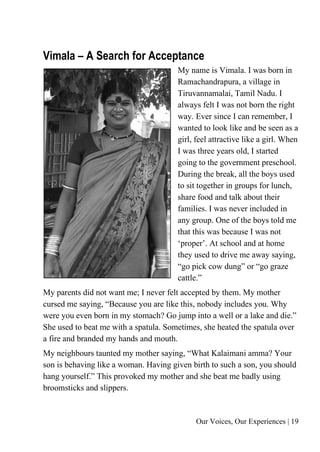
  • 140.
    Our Voices, OurExperiences | 123 Annexure I A Glossary on Gender, Sex, and Sexuality • Biological sex: This depends on a person’s primary and secondary sexual biological characteristics such as organ systems, hormones and chromosomes. It is a spectrum and may be predominantly male, female or any intersex variant. • Bisexual: (Persons who) experience sexual attraction not exclusively to persons of one gender. • Cisgender: (Persons who) have a gender identity that aligns with the sex assigned at birth. • Eunuch: A person who is born male and castrated. • F to M/Female to Male/Transman: Persons assigned female at birth who identify as male. • Gay: Persons who identify as male and are attracted to other males. • Gender binary: Viewing gender as solely male or female. • Gender dysphoria: A clinically diagnosable condition defined as significant and durational distress caused when a person’s assigned birth gender is not the same as the one with which they identify. This is a prerequisite for approval for SRS. • Gender expression: The external appearance of a person’s gender identity, usually expressed through behaviour, clothing, haircut or voice, and which may or may not conform to social norms defined for the persons’ assigned gender. • Gender fluid: A person who does not identify with a single fixed gender and expresses a fluid or unfixed gender identity. • Gender identity: How a person identifies themselves: male, female, a blend of both, or neither. Gender identity is a spectrum and can be the same or different from one’s sex assigned at birth. • Gender non-conforming: A broad term referring to people who do not behave in a way that conforms to the traditional expectations of their gender, or whose gender expression does not fit neatly into a category.
  • 141.
    Annexures 124 | OurVoices, Our Experiences • Gender stereotype: A social construct which places cultural and social expectations on individuals based on their assigned sex. • Heterosexual: Experiencing sexual or emotional attraction predominantly toward persons of another gender. • Homosexual: Experiencing sexual or emotional attraction predominantly toward persons of the same gender. • Intersex: Persons who at birth show variations in their primary sexual characteristics, external genitalia, chromosomes, hormones from the normative standard of female or male body. Intersex persons, like others, may or may not identify with their gender assigned at birth. • Lesbian: Persons who identify as female and are attracted to other females. • M to F/Male to female/Transwomen: Persons who are assigned male at birth but identify as female. • Misgender: Referring to or addressing someone using words and pronouns that do not reflect the gender with which they identify. • Non-binary: A gender identity that does not fit into the gender binary. • Passing: A term used by transgender people which means that they are perceived by others as the gender with which they self-identify. • Queer: An umbrella term for persons who have expressions of gender or sexual orientation that differ from social norms. • Sex Reassignment Surgery (SRS): A surgery (or surgeries) to bring the primary and secondary sex characteristics of a transgender person’s body into alignment with their gender identity. • Sexual Orientation: The gender of the person toward whom one experiences sexual or emotional attraction toward. This is defined with respect to the persons’ gender identity rather than their gender assigned at birth. It is a spectrum and a person may identify anywhere along the scale as heterosexual, homosexual, bisexual, pansexual, etc. • Transgender: An umbrella term for people whose gender identity or expression does not match the biological sex they were assigned at birth.
  • 142.
    Our Voices, OurExperiences | 125 Annexure II Acronyms • CBO: Community-Based Organization • CLPR: Centre for Law and Policy Research • CSMR: Coalition for Sex Workers and Sexual Minority Rights • DWCD: Department of Women and Child Development • G.O.: Government Order • IPC: Indian Penal Code • KHPT: Karnataka Health Promotion Trust • KSAPS: Karnataka State AIDS Prevention Society • KSMF: Karnataka Sexual Minorities Forum • NGO: Non-Governmental Organization • Policy: Karnataka State Transgender Policy • WDC: Women’s Development Corporation • WPATH: World Professional Association for Transgender Health
  • 143.
    Annexures 126 | OurVoices, Our Experiences Annexure III References and Further Reading Laws on Mental Health Care in India • The Mental Health Care Act 2017 was passed on 7 April 2017 and came into force on July 7, 2018. The complete Act is available at: https://mohfw.gov.in/node/2793. • A comment on the legal rights of persons with mental illness in India: https://www.patientsengage.com/news-and-views/know-your-mental- healthcare-act • A review of the Mental Healthcare Act, 2017: https://www.whiteswanfoundation.org/article/reviewing-the-the- mental-healthcare-act-2017/ Studies on public and mental health from the USA • A study on suicide: https://ajph.aphapublications.org/doi/full/10.2105/AJPH.2016.303088 • A meta-study based on public health information: https://www.ncbi.nlm.nih.gov/pubmed/26552495 • A study by the Centre for Disease Control and Prevention on LGBTQ youth: https://www.cdc.gov/lgbthealth/youth-programs.htm Best Practices – Malta’s polices of inclusion • Leaving no one behind: The Transgender Health Care Policy Document of the Maltese government aims to implement the SDGs. This policy document is available at: https://deputyprimeminister.gov.mt/en/Documents/National-Health- Strategies/Transgender%20Healthcare.pdf “Gender affirmation is a key determinant of transgender health. An interpersonal and shared process through which one’s gender identity is socially recognised. Government remains committed to human rights and the principles of equality. Malta has become a beacon for other countries with respect to LGBTIQ rights.”
  • 144.
    Our Voices, OurExperiences | 127 • The Trans, Gender Variant and Intersex Students in Schools Policy was developed within the context of the Framework for the Education Strategy for Malta 2014-2024. The policy is available at: https://education.gov.mt/en/resources/Documents/Policy%20Documen ts/Trans,%20Gender%20Variant%20and%20Intersex%20Students%20 in%20Schools%20Policy.pdf SRS reassignment surgery and Transgender Healthcare • WPATH Standards of Care: https://www.wpath.org/publications/soc On Indian laws and cases relating to gender and sexual minorities • A 2014 report by the Ministry of Social Justice and Empowerment regarding transgender persons in India: http://socialjustice.nic.in/writereaddata/UploadFile/Binder2.pdf • Full text of the Transgender Bill of 2014 introduced by Mr. Tiruchi Siva: http://orinam.net/resources-for/law-and-enforcement/nalsa- petition-tg-rights-india/rights-of-transgender-persons-bill-2014/ • Full text of the Draft of the Transgender Bill, 2015 published by the Ministry of Social Justice and Empowerment: https://www.prsindia.org/uploads/media/draft/Draft%20Rights%20of %20Transgender%20Persons%20Bill%202015.pdf • Overview of the Transgender Bill, 2016 and the suggestions made to the Standing Committee: http://orinam.net/resources-for/law-and- enforcement/trans-persons-protection-rights-bill-2016/ • Full text of Transgender Bill, 2016: http://orinam.net/content/wp- content/uploads/2016/08/TGBill_LS_Eng-1.pdf • Full text of Transgender Bill, 2018: http://orinam.net/resources- for/law-and-enforcement/trans-persons-protection-rights-bill-2018/ • Detailed analyses of the Trafficking Bill, 2018 are available at: o http://www.prsindia.org/billtrack/the-trafficking-of-persons- prevention-protection-and-rehabilitation-bill-2018-5277/ o https://www.lawyerscollective.org/wp- content/uploads/2017/07/Critique-of-the-Anti-Trafficking- Bill-2018.pdf
  • 145.
    Annexures 128 | OurVoices, Our Experiences o http://sangram.org/uploads/trafficking-bill-2018- docs/Suggested-Amendments-to-Trafficking-Bill.pdf • The full text of ‘Raided’, a report by the National Network of Sex Workers: http://sangram.org/resources/RAIDED-executive- summary.pdf • A comment on Puttaswamy v. Union of India: https://www.lawyerscollective.org/updates/breaking-supreme-court- declares-right-privacy-fundamental-right • Right to Love, a comprehensive document on Navtej Singh Johar v. Union of India tracing the campaign and the judgment published by Alternative Law Forum, Bangalore: http://altlawforum.org/wp- content/uploads/2018/09/RightToLove_PDFVersion-1.pdf • Full text of the Karnataka State Transgender Policy: https://jeevabng.files.wordpress.com/2019/04/the-karnataka-state- policy-for-transgenders.pdf • SDG India Index Baseline report 2018 (by the NITI Ayog and UN): http://4dj7dt2ychlw3310xlowzop2.wpengine.netdna-cdn.com/wp- content/uploads/2018/12/SDX-Index-India-21-12-2018.pdf • A repository of information relating to the parliament including acts, bills and their status: https://www.prsindia.org/ Documented experiences of gender and sexual minorities • A talk with Baragaru Ramchandrappa about Revathi’s book ‘A Life in Trans Activism’: https://soundcloud.com/radioactivecr90-4mhz/69- jeeva-diary-a-radio-diary-r-j-uma-umesh-revathi-book-baraguru- ramachendrappa • Shruti-Saranya Love Story, a documentary about a lesbian couple: https://www.youtube.com/watch?v=gpbYPXJ-F9E • The fact-finding report into the death of Zaibunnisa, a gender- nonconforming child: https://jeevabng.files.wordpress.com/2019/04/zebunnisa-fact-finding- report.pdf
  • 146.
    Our Voices, OurExperiences | 129 Annexure IV Contacts for Support and Services SENSITIVE COUNSELLORS FOR GENDER AND SEXUAL MINORITIES District Name/Organisati on Email/website Bangalore B.N. Sharada, Parivarthan parivarthanblr@gmail.com Bangalore Mahesh Natarajan, Innersight counsellors@innersight.in Bangalore Banjara mycounsellor@banjaraacademy.org Bangalore NIMHANS nimhans.wellbeing@gmail.com TRAINERS FOR MENTAL HEALTH COUNSELLORS Bangalore Parivarthan parivarthanblr@gmail.com Bangalore Banjara banjarahh@gmail.com Bangalore Samvada samvada@gmail.com Bangalore NIMHANS mhsp@nimhans.ac.in SENSITIVE HOSPITALS FOR COUNSELLING AND SRS Bangalore NIMHANS ms@nimhans.kar.nic.in Bangalore Victoria Hospital http://victoriahospitalbangalore.org/cont act-us/ Bangalore MS Ramaiah Memorial Hospital contact@msrmh.com Bangalore Bangalore Hospital info@bangalorehospital.co.in NGOS WORKING FOR THE RIGHTS OF GENDER AND SEXUAL MINORITIES Bagalkot Nilanasanga milansanghbgk@gmail.com Bangalore Jeeva Jeevabng@gmail.com Bangalore KSMF ksmforum@gmail.com Bangalore Ondede ondededvs@gmail.com
  • 147.
    Annexures 130 | OurVoices, Our Experiences Bangalore Payana payana2009@gmail.com Bangalore Samara samaraban@gmail.com Bangalore Samara Jayanagara ssjpehchan@gmail.com Bangalore Samara Ramaurthinagara samararamurthynagar@gmail.com Bangalore Samara Yeshwanthpura samarasocietyyeshwanthapurtgti@gmail .com Bangalore Rural Samara dbpsamara@gmail.com Belgaum Svikaar sweekar_belgaum@rediffmail.com Belgaum Humanity foundation humanity.foundation@outlook.com Bellari Pragathi pragathicbo@gmail.com Bidar Sanghamitra sanghamitrabidar@gmail.com Chamarajan- agar Samtha Sanga samathachnagar@gmail.com Chikamang- aloru Madilu Sanga madiluckm2018@gmail.com Chikkaballa- pur Nisarga nisargacbpura@gmail.com Chitradurga Vahini vahinicbo2011@gmail.com Dharwad Samara samaradwd@gmail.com Davanagere Abhyaspadana abhayaspandhana@gmail.com Gadag Srustisankula srustisankula@gmail.com Gulbarga Snehasanga snehacbo@gmail.com Hassan Prakruthi prakruthi.tanda@gmail.com Haveri Sanjevani sanjevani@gmail.com Hubali Samrthya samrthya.org.dharwad@gmail.com Kodagu Asodhya ashodayasamithi@yahoo.com Kolar Samilana sammilanakolar@gmail.com Kopala Hogiranna hongirana_koppal@yahoo.com
  • 148.
    Our Voices, OurExperiences | 131 Mangalore Navasahaja navasahaja@gmail.com Mandya Amara Sadhakiyara Sanga amaramandya17@gmail.com Mysore Asodhya ashodayasamithi@yahoo.com Raichur Apthamithra apthamithra.ti@gmail.com Ramanagara Samara rngsamara@gmail.com Shivamoga Raksha rakshashivmoga@gmail.com Tumkur Shabhalve sahabhalvetumkur@yahoo.com Udupi Asryasanga ashrayaudupi@gmail.com Vijayapura Navaspurthi navaspoorthiti.bijapura@gmail.com Yadgir Asha Kiranna ashakiranayadgir@gmail.com
  • 149.
    Annexures 132 | OurVoices, Our Experiences