OUR COUNTRY INDIA
BY YOGA VAISHNAV 6B
In this lesson you will learn
• About India
• About the states in India.
• Food varieties in different states.
• About the clothes they were in different
states.
• The festivals in different states
INDIA
• India, officially the Republic of India, is a country in South
Asia. It is the 7th-largest sovereign state in the world,
the second-most populous country (with over 1.2 billion
people), and the most populous democracy in the world.
• It is bounded by the Indian Ocean on the south, the Arabian
Sea on the southwest, and the Bay of Bengal on the
southeast. It shares land borders with Pakistan to the
west; China, Nepal, and Bhutan to the northeast;
and Myanmar (Burma) and Bangladesh to the east.
• In the Indian Ocean, India is in the vicinity of Sri Lanka and
the Maldives. India's Andaman and Nicobar Islands share a
maritime border with Thailand and Indonesia. Its capital
is New Delhi;
other metropolises include Mumbai, Kolkata, Chennai, Ban
galore, Hyderabad and Ahmedabad.
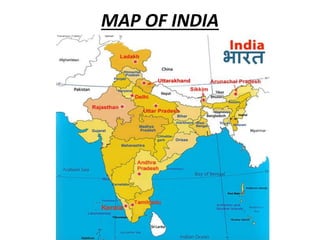
MAP OF INDIA
STATES IN INDIA
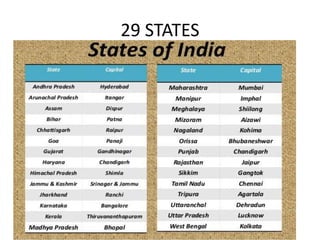
29 STATES
ANDHRA PRADESH
ANDHRA PRADHESH (The place of victory) is one of
the 29 states in India, situated on the southeastern
coast of the country. The state is the eight largest state
in India covering an area of
160,205 km2 (61,855 sq mi). As per 2011 census of
India, the state is tenth largest by population with
49,386,799 inhabitants. On 2 June 2014, the north-
western portion of the state was bifurcated to form a
new state of telangana. In accordance with the Andhra
Pradesh reorganization act, 2014, Hyderabad will
remain the capital of both Andhra Pradesh
and telangana states for a period of time not exceeding
10 years.
VARIETIES OF FOOD IN ANDHRA
PRADESH
There are so many varieties of food in Andhra Pradesh:
1) Ragi is popularly used in the Rayalaseema.
2) The uttarandhra is known for its use of Jaggery,
shallots and fenugreek paste.
3) Pulihora, or tamarind rice along with green chilies is
the most popular food in Andhra Pradesh
4) The vegetarian dishes consist of koora which include
cooking different vegetables in a variety of styles-
with gravy, frying, with lentils etc.
5) You have lentil based delicious known as pappu and
tamarind based, sour stew called pulusu.
6) The non vegetarian platter has a delightful mix of
seafood ,meat and eggs cooked in fiery spices and
always teamed with vegetables like eggplant.
COSTUMES PEOPLE WEAR IN ANDHRA
PRADESH
Costumes of Andhra Pradesh are Saree and
Blouse for women, and Dhoti and Kurta for men.
Andhra Pradesh is the insignia of the cultural
convergence of South India. Andhra Pradesh
costumes are very famous
for cotton and silk textiles. However, the
traditional dress of Andhra Pradesh still is the
ethnic handloom sarees that are made at
different places and are mostly famous by the
names of these places.
FESTIVALS CELEBRATED IN ANDHRA
PRADESH
Festivals celebrated in Andhra Pradesh are:
• Makara Sankranti in January.
• Maha Shivaratri in February/March.
• Ugadi or the Telugu New Year in March/April.
• Sri Rama Navami celebrated in March/April 9 days after Ugadi.
• Varalakshmi Vratam in August.
• Vinayaka Chaviti in August.
• Dasara in September/October.
• Atla Tadde 3rd day in bright half of Aswiyuja month (falls in
September/October in Gregorian calendar)
• Deepavali in October/November.
• Deepothsavam during the Deepavali season.
ARUNACHAL PRADESH
ARUNACHAL PRADHESH is one of the twenty-
nine states of India. Located in north east
India, it holds the most north-eastern position
among the states in the north-east region of
India. Arunachal Pradesh borders the states
of Assam and Nagaland to the south, and
shares international borders with Bhutan in
the west, Myanmar in the east and China in
the north. Itanagar is the capital of the state.
VARIETIES OF FOOD IN ARUNACHAL
PRADESH
There are a lot of varieties of food in Arunachal
Pradesh. Some of them are:
1) The staple food is rice along with fish, meat and many
green vegetables. Different varieties of rice are
available. Lettuce is the most common and preferred
vegetable of all, prepared by boiling it with ginger,
coriander and green chilies and pinch of salt. Boiled
rice cakes wrapped in leaves is a famous snack.
2) The Momos are also popular. Dishes in eastern
districts like Tirap and Changlang have some different
method in their way of food preparation.
COSTUMES PEOPLE WEAR IN
ARUNACHAL PRADESH
Tribal wear in Arunachal Pradesh
The Tangsa tribe, also, dwelling in the Tirap
district and Changlang district of Arunachal Pradesh, is
a Naga tribe. These robust, middle-length people cater to
the Burmese costume-style. The Tangsa men wear
green lungi, proficiently seamed in with matching yellow,
red and white yarns. A sleeveless shirt, acts as the upper
garment. Tangsa women put in a very attractive looking
woven petticoat, along with a linen blouse to top it. Miji
women, living in the West Kameng and East Kameng
districts, exhibit simplicity as well as refinement in their
costume. The ankle-long white cloak gives the Miji women
an immaculate look. And the final touch is given by an
ornate red jacket. Big-sized silver earrings and resplendent
necklaces, commonly decked with jade, perfectly augments
the beauty.
FESTIVALS CELEBRATED IN
ARUNACHAL PRADESH
Festivals celebrated In Arunachal Pradesh are:
• Loku in 25th – 27th November
• Boori Boot in 4th – 6th February
• Solung in 1st – 9th September
• Dree Festival in 5th July
• Nyokum in 28th February – 2nd March
• Lossar Festival in 11th February
• Sanken in 14th – 17th February
ASSAM
ASSAM (Tea city of India) is a state
in northeastern Located south of the
eastern Himalayas, Assam comprises
the Brahmaputra valley and the Barak
valley along with the karbi anglong and dima
hasoe districts with an area of 30,285 sq mi
(78,440 km2). Its capital is Dispur.
VARIETIES OF FOOD IN ASSAM
There are lots of food items in Assam: some of them are:
1) The staple food of Assam is rice, which is consumed in a
variety of ways. During special occasions like Bihu, a special
type of rice preparation called Pithas is made. The different
varieties of Pithas include Ghila pitha, Til pitha, Sunga pitha,
Tekeli pitha, Bhapotdiya pitha, Tora pitha, Kholasapori pitha
& Xutuli pitha.
2) Vegetarian items Served in bell metal utensils called Kahor
Thal, a typical Assamese meal comprises of steamed rice,
taken with Khar anja (a dish made of raw papaya), a variety
of Pitikas (mashed Potatoes, Brinjal or Tomatoes).
3) Among the non vegetarian items that form a part of the
Assamese cuisine, the favorites are chicken, pigeon, duck
and fish - the most popular varieties being Rohu, Hilsa, Puthi
and Chital. Hukoti, a dish made of small dried fish.
4) The state of Assam is famous all over the world for its tea
production. Assam tea is known for its strong malty flavor
and bright color.
COSTUMES PEOPLE WEAR IN ASSAM
Costumes of Assam consist of the Muga or the golden silk
fiber which has a huge demand in the global market. When
an Assamese lady wraps herself in the extremely beautiful
'Mekhela Chadar' of golden 'Muga' variety then it is hard to
pass by without casting a momentary look on her. Besides
the 'Muga' variety there is the 'Eri' and the 'Paat' that is
being used mostly in the making of clothes in Assam. The
former is used to make winter garments especially shawls
called 'Eri Chadar' and the latter is used for the making of
'Mekhela Chadar.' The 'Muga' is the most important and
the most preferred wild silk all over India and is the main
cause behind the exquisiteness and elegance of the Assam
Silk saris. The delicate designs, finely woven, on the saris
cater to patterns in nature, for example, the flora and the
fauna. Embroideries also incorporate, acquainted and
culture-related things, such as architecture and stone-
sculptures on the Madan Kamdev Temple in Assam.
FESTIVALS CELEBTRATED IN ASSAM
Festivals celebrated in Assam are:
• Bohag Bihu
• Kati Bihu or Kangali Bihu
• Magh Bihu or Bhogali Bihu
• Ambubachi
• Biswakarma Puja
• Doljatra
• Janmastami
• Rasa Puja
• Elephant Festival
• Tea Festival
BIHAR
BIHAR (The silk city of India) is a state in East
India East India. It is the 13th-largest state of
India, with an area of
94,163 km2 (36,357 sq mi).its capital is patna.
The third-largest state of India by population,
it is contiguous with Uttar Pradesh to its
west, Nepal to the north, the northern part of
Nepal to the east, with Jharkhand to the
south. The Bihar plain is split by the
river ganges which flows from west to east
VARIETIES OF FOOD IN BIHAR
• Bihari cuisine is predominantly vegetarian because traditional Bihar
society, influenced by Buddhist and Hindu values of non-violence,
did not eat eggs, chicken, fish and other animal products.
• However, there is also a tradition of meat-eating, and fish dishes
are especially common due to the number of rivers in Bihar, such as
the Son, Gandak and Ganges. There are also numerous Bihari meat
dishes, with chicken and mutton being the most common.
• Dairy products are consumed frequently throughout the year, with
common foods including yogurt known as dahi and also buttermilk
known as mattha, ghee, lassi and butter. It is highly seasonal, with
watery foods such as watermelon and Sherbet made of pulp of the
wood-apple fruit.
• Some dishes which Bihar is famous for include Bihari Kebab, Bihari
Boti, Bihari Chicken Masala, Sattu Paratha, which are parathas
stuffed with fried chickpea flour, chokha (spicy mashed potatoes),
fish curry and', Postaa-dana kaa halwaa.
COSTUMES PEOPLE WEAR IN BIHAR
Particularly, the rustic crowd of Bihar adheres to the traditional
pattern of dresses and jewellery. Though most of the population of
the state still remains in rural areas the costumes worn by them are
still traditional. The clothes for the people of different religions are
a bit divergent. The senior male citizens of Bihar, irrespective of
Hindu or Muslim, favour tradition, when it comes to costumes. If a
Hindu elderly person prefers Dhoti (an Indian loin cloth), a Muslim
person might dress himself in Lungi (a type of petticoat for men) or
Pyjama (loose trousers). As an upper garment, men usually go
for Kurta (loose, normally cotton, Indian, T-shirts), and shirts.
The costume of the women folk of Bihar is chosen carefully in
keeping with tradition. As per tradition, married women, smear the
hair- parting zone with powder of Sindoor or vermillion. Tikli, a
forehead-adorning little ornament is added to the hair-partitioning
area. On the forehead, a Bihari married woman, be she an urban or
a rural one, usually applies bindi. A lot of Bihari women, love
applying Kajal i.e. eye-pencil, or antimony eye-make-up called
Surma, to improve the appeal of their eyes.
FESTIVALS CELEBRATED IN BIHAR
Festivals celebrated in Bihar are:
• Chatth Puja
• Sama-Chakeva
• Ramnavami
• Makar-Sankranti
• Bihula
• Madhushravani
CHHATTISGARH
CHATTISGARH is a state in central India. It is
the 10th largest state in India, with an area of
135,194 km2 (52,199 sq mi). With a
population of 28 million, Chhattisgarh is the
17th most-populated state of the nation. It is a
source of electricity and steel for India,
accounting for 15% of the total steel produced
in the country. Chhattisgarh is one of the
fastest-developing states in India.
VARIETIES OF FOOD IN
CHHATTISGARH
1) The special delicacies like jalebis, rakhia badi and petha are the
main appeals of Chhattisgarh Food. The people of the state have
an inclination towards tangy recipes and sweet delectable's.
Maize, wheat and jowar are the basic diet of the inhabitants of
Chhattisgarh.
2) Chhattisgarh Recipes presents a veritable range of appetizing
dishes. While some of the recipes of Chhattisgarh are made by the
core tribal groups during their folk festivals, the other food items
like sweet dishes of jalebis are prepared by almost all the
inhabitants of the state. Petha and rakhia badi are the two popular
delectable's of the tribes of Chhattisgarh.
3) Petha is a kind of exquisite sweet dish which is prepared by the
Chhattisgarh tribes. Rakhia badi is a type of curry which includes
rakhia phal or fruit, coriander, green chilies, ginger and seeds of
slitted black gram.
COSTUMES PEOPLE WEAR IN
CHHATTISGARH
In the urban areas, trousers and shirts, sarees and
salwar suits are worn by the men and the women
respectively. The costumes worn here are just like
those worn all over India. They have no characteristic
features or specialties. Sarees in varieties like
Maheshwari silk, Orissa silk, Chanderi silk, Batik print
sarees, etc. are worn by the women in the urban areas
here.
It is the tribal costumes of Chhattisgarh that endow
the costumes of the state with a unique identity and
arise interest among the tourists. The tribal men and
women wear bright and colourful costumes.
FESTIVALS CELEBRATED IN
CHHATTISGARH
Festivals celebrated in Chhattisgarh are:
• Bastar Dassera
• Teeja Festival
• Champaran Mela
• Hareli festival
• Rajim kumbh Mela
GOA
GOA is a state in west India within the coastal region
known as the konkan. Bounded by Maharashtra to
the north and Karnataka to the east and south,
the Arabian sea forms its western coast. It is India's
smallest state by area and the fourth smallest city
by population. Goa is one of India's richest states
with a GDP per capita two and a half times that of
the country. It was ranked the best placed state by
the Eleventh Finance Commission for its
infrastructure and ranked on top for the best
quality of life in India by the National Commission
on Population based on the 12 Indicators.
VARIETIES OF FOOD IN GOA
There are so many food in Goa like:
1) beef, pork, coconut, jaggery, cashew and an endless
variety of seafood. A lot of Goan dishes like Prawn balchao
and Sorpotel are well known and relished around the
world.
2) Spices, fish and coconut have dominated Goan food for
centuries and it's only in the last few years it has started
to be featured with new, more innovative ingredients like
fenni and vinegar.
3) Goans didn't take after their prominent use of garlic in
every dish, but definitely latched on to their flair for
bread-making. You'll see that Goans often swap their
regular bowl of steamed rice with soft and warm bread.
COSTUMES PEOPLE WEAR IN GOA
The costumes of Goa show a colourful variety. In Goa, Portuguese
influence is evident in men's and even women's western wears.
There are a number of different costumes that are worn by the
people of Goa during different occasions. The main costume for the
women of Goa is the 9-yard sari, which they complement with
traditional jewelry. Pano bhaju is another important traditional
costume of the women of Goa. The Koli fishermen of Goa, who
wear colourful shirts and half pants, and a hat made of bark of the
bamboo trees, make for a wonderful sight.
The people in the carnival wear many different types of colourful
costumes and beautiful masks. This three-day festival is a melting
pot of several cultures, and besides Portuguese influence, it has
over the years, infused and got enriched by the traditional revelry
of Hindu festivities. As such this animated pageantry showcases a
wide variety of costumes. The most popular among the people are
the off-shoulder dresses and colourful suits.
FESTIVALS CELEBRATED IN GOA
Festivals celebrated in Goa are:
• Christmas
• Diwali
• Ganesh Chaturthi
• Feast of St. Francis Xavier
• Shigmo
• Three Kings Feast
• Eid-ul-Fitr
• Carnival
• Bonderam Festival
GUJARAT
GUJARAT (Green city) Is a state in western India,
sometimes referred to as the "Jewel of Western India". It
has an area of 196,024 km2 (75,685 sq mi) with a coastline
of 1,600 km (990 mi), most of which lies on the Kathiawar
peninsula, and a population in excess of 60 million. The
state is bordered by Rajasthan to the north, Maharashtra to
the south, Madhya Pradesh to the east, and the Arabian
sea and the Pakistani province of sindh to the west. Its
capital city is Gandhinagar, while its largest city
is Ahmadabad. Gujarat is home to the Guajarati-speaking
people of India.
The state encompasses some sites of the ancient Indus
valley civilization, such as lothal and dholavira.
VARIETIES OF FOOD IN GUJARAT
Gujarati cuisine is one of the the oldest culinary treasures of India and is
primarily vegetarian. It offers a wide variety of vegetarian dishes, each
with its unique cooking style, different kinds of:
1) pickles, farsans, chutneys and foods that are always high on nutritional
value. But the real essence of Gujarati food lies in the creative use of
everyday vegetables and mild spices. It is an exquisite blend of flavors
where sweet notes dominate most dishes like the famous Gujarati Kadhi.
2) Gujarat's coastal climate is mostly hot and dry which is why the use of
sugar, tomatoes and lemon is quite common as these foods keep the
body hydrated.
3) In big business houses, a traditional Gujarati meal sits on a lovely silver
platter and comprises of an elaborate affair complete with rotis,
dal/kadhi, sabzi or shaak, rice and homemade pickles to tickle your taste
buds. 'Vaghaar' is a blend of spices purified in hot oil and generously
drizzled over dal to enhance the flavor and impart an irresistible aroma.
The prominence of ingredients like besan or gram flour, lentils, sesame
seeds and yogurt is another feature that sets Gujarati dishes apart.
COSTUMES PEOPLE WEAR IN
GUJARAT
The traditional Gujarat dresses for women consist of
the lehenga choli or the ghagra choli. These are
colorfully embroidered and complemented by bare-
backed blouses extending to the waist. Ghagras or
lehengas are gathered ankle-length skirts that are
fastened at the waist. The entire outfit is completed by
a veil cloth called odhni or dupatta which is thrown
across the neck or over the head. The lehenga choli,
otherwise known as the ghagra choli.
Gujarati men usually attire themselves in dhoti, long or
short coat and turban cap. At present, however, pants
are becoming more fashionable instead of the
conventional dhoti. Parsi males wear pants, long coat
and a headgear.
FESTIVALS CELEBRATED IN GUJARAT
Festivals celebrated in Gujarat are:
• Diwali
• Kite Festival
• Holi
• Janmashtami
• Ganesh Chaturthi
• Kutch Mahotsava
• Modhera Dance Festival
• Muharram
HARYANA
HARYANA (City Of Weavers) is one of the 29
states in India, situated in north India. It was
carved out of the former state of east Punjab on
1 November 1966 on a linguistic basis. It
stands 21st in terms of its area, which is spread
about 44,2census of India
12 km2(17,070 sq mi). As of 2011 , the state
is eighteenth largest by population with
25,353,081 inhabitants. The city of Chandigarh is
its capital while the NCR city of Faribad is the
most populous city of the state.
VARIETIES OF FOOD IN HARYANA
Cuisine of any region is linked directly with its culture, simpler the culture
simpler its food. Haryana have been retaining simplicity in its cuisine.
1) Here, varieties of Rotis are available, specially the most common types
are rotis made from Wheat and Bajra. In earlier times, people preferred
to have nutritious and healthy rotis made from a flour of wheat, gram
and barley. But with the passage of time, prices increased and people
started preferring comparatively cheaper wheat flour.
2) People here have a strong belief over home made butter and ghee , they
use these liberally in their daily diet. In most of the homes,”nooni or
tindi ghee” a homemade fresh butter is churned daily . As a part of their
culture, girl’s family give her gifts of ghee (clarified butter), gondh (edible
gum), laddus (a sweetmeat made of gram flour) and dry fruits. as an
instant cooler for summers, Lassi made from yoghurt is another popular
drink, almost a meal in itself.
3) The Haryanvi’s love for lassi can be concluded from the fact that thandai,
a sweet, milk based drink is called kachi lassi in Haryana.
COSTUMES PEOPLE WEAR IN
HARYANA
Women love to wear colourful dresses. Their basic
trousseau includes 'Damaan', 'Kurti' & 'Chunder'. 'Chunder'
is the long, coloured piece of cloth, decorated with shiny
laces, meant to cover the head and is drawn in the front
like the 'pallav' of the saree. Kurti is a shirt like blouse,
usually white in colour. The 'Daaman' is the flairy ankle-long
skirt, in striking colours.
The men generally wear 'Dhoti', the wrap around cloth,
tucked in between the legs with a white-coloured kurta
worn atop it. 'Pagri' is the traditional headgear for men,
which is now worn mainly by the old villagers. All-white
attire is a status symbol for men.
FESTIVALS CELEBRATED IN HARYANA
Festivals celebrated in Haryana are:
• Baisakhi at Pinjore
• Haryana Day
• Kurukshetra Festival in Haryana
• Mahabharata Festival in Haryana
• Mango Festival in Haryana
• Pinjore heritage festival
• Sohna Car Rally
• Surajkund Crafts Mela
HIMACHAL PRADESH
• HIMACHAL PRADHESH Is a state of India located
in northern India. It is bordered by Jammu and
Kashmir on the north, Punjab and Chandigarh on the
west, Haryana on the south-west, uttarakhand on
the south-east and by the Tibet autonomous
region on the east. The name was coined from
Sanskrit him 'snow' and anchal 'lap', by Acharya
Diwakar Datt Sharma, one of the province's most
eminent Sanskrit scholars.
• Himachal Pradesh is famous for its natural beauty,
hill stations, and temples. Himachal Pradesh has
been ranked fifteenth in the list of the highest per
capita incomes of Indian states and union
territories for year 2015-2016
VARIETIES OF FOOD IN HIMACHAL
PRADESH
lots of food in Himachal Pradesh are famous. Such as:
1) Since it is hard to find a variety of fresh vegetables on the hilly
terrain of Himachal Pradesh, there are a lot of non-vegetarian
dishes and the use of lentils, rice and pulses is common.
Interestingly, the best quality of Basmati rice comes from this
region – the foot of the Himalayas.
2) Regions in the north of Himachal Pradesh like Spiti and Lahaul
are comparatively dry and therefore they use hardier local
grains like buckwheat, barley and millets. A lot of their
traditional dishes like Siddu, Aktori or Gulgule are cereal-based.
3) They also use a lot of yogurt as a base to most curries which
adds a comforting depth along with buttermilk and desi ghee.
The food is rich and spicy with a generous sprinkle of spices like
cardamom, cinnamon, turmeric and coriander powder.
COSTUMES PEOPLE WEAR IN
HIMACHAL PRADESH
Hand-woven excellence is the hallmark of the costumes of Himachal
Pradesh. The native women are famous in weaving headscarves. The
utility shoes made from grass, are perfect for keeping the feet warm.
Brahmin Costumes of Himachal Pradesh
By heritage, the Dhoti-clad Brahmin priests roam around in Kurta, coat,
waistcoat, turban, i.e., Pagri, and with a hand towel, placed upon the
shoulders and with a valuable copy of Panchang.
women costumes of Himachal Pradesh
The costume of the women hailing from the Brahmin and the Rajputs
clans are quite traditional. These women normally dress themselves
in Kurtas, Ghagra Lehenga Choli and "Rahide" which is a nice crimson
headscarf decked with golden fringes. The farmers and worker classes
required to toil, go for kurta, a loincloth and a cap. They provide to long
pyjamas, for attending ceremonies like marriage ceremonies or special
occasions, such as festival.
FESTIVALS CELEBRATED IN HIMACHAL
PRADESH
Festivals celebrated in Himachal Pradesh are:
• Halda festival – Welcome the New Year in January
• Sazo
• Himachal Winter Carnival
• Losar Festival
• Doongri Festival, Kullu
• Maha Shivaratri
• Mandi Shivaratri Fair
• Nalwari Fair
• Baisakh/ Vaisakhi
• Spring Festival
• Kullu Dussehra
• International Himalayan Festival
• Ice Skating Carnival
JAMMU AND KASHMIR
JAMMU AND KASHMIR (City Of Lakes) is
a state in northern India, often denoted by
the acronym J&K. It is located mostly in
the Himalayan mountains, and shares borders
with the states of Himachal
Pradesh and Punjab to the south. Jammu and
Kashmir has an international border
with china in the north and east. The state has
special autonomy under article 370 of
the constitution of India.
VARIETIES OF FOOD IN JAMMU AND
KASHMIR
Just like its picturesque beauty, the food in Kashmir is heavenly. The rich,
redolent dishes steeped in traditions have evolved through many
generations and are known to be a blend of three different cooking
styles - that of Kashmiri Pandits, Muslims and Mughals. Some of the best
food in jammu and kashmir are:
1) The ultimate ceremonial feast in Kashmir is known as 'Wazwan'and
consists of mostly meat-based dishes. The word 'waz' means chef and
'wan' denotes an array of meat curries and other elaborate dishes. It's a
princely 36-course banquet, with about 15-34 dishes and is popularly
referred to as a 'feast fit for kings'. Lamb meat highlights the menu with
some of the popular dishes like Gushtaba, Rogan Josh, Rista, Tabak
Maas, Dhaniwal Korma and Marchwangan Korma.
2) The liberal use of spices like cinnamon, cardamom and cloves adds
warmth and comfort to Kashmiri curries. Pungent notes feature in most
dishes as Kashmiri's use a lot of mustard oil. Kashmiri food also favors
the generous use of desi ghee (clarified butter) which makes their food
extremely rich. Curd is used as one of the primary ingredients in curries
and as a marinade for kebabs to add depth in the flavors. The fragrance
of spices like saffron and saunf sets Kashmiri meals apart. The famous
Kashmiri red chilies are less pungent than the regular ones but can liven
up any regular dish.
COSTUMES PEOPLE WEAR IN JAMMU
AND KASHMIR
Most of the garments are made of wool, silk and cotton designed with intricate
embroideries.
Costumes of Jammu and Kashmir for Men
The traditional ‘Pheran’ is the most popular form of dress among both men and
women. Pheran exhibits a lot of beautiful embroidery work comprising of floral
motifs.
Pheran: ‘Pheran’ is the most commonly worn garment among men. Hindu men
usually wear ‘Churidars’ while the Muslim men are dressed in ‘Salwar’ beneath the
formidable Pherans. Pheran is a loosely fitted woollen garment which makes use of
the ‘Kangri’. The Kangri is usually placed in the front, skilfully shrouded by the
Pheran. It functions as an internal heating system in order to keep the wearer
warm during the extreme cold winters.
Costumes of Jammu and Kashmir for Women
Pheran is the prominent attire for Kashmiri women as well. Traditionally, there are
Poots and Pherans, comprising two robes that are placed atop the other. Pheran
worn by women usually has Zari embroidery on the hem line, around pockets and
mostly on the collar area. Pherans worn by the Muslim women are traditionally
characterised by their broad sleeves and reach up to the knees. However, the
Hindus of Jammu and Kashmir wear their Pherans long, stretching up to their feet
with narrowed down sleeves. Often, the Pherans are wrapped tightly by a piece of
creased cloth called Lungi.
FESTIVALS CELEBRATED IN JAMMU
AND KASHMIR
Festivals celebrated in Jammu and Kashmir are:
• Baisakhi
• Eid-ul-Fitr and Eid-ul-Azha
• Hemis Festival
• Lohri
• Urs
• Dussehra
• Diwali
• Vaishno Devi
• On The Festive Trial
JHARKHAND
JHARKHAND (Steel City Of India) is
a state in eastern India carved out of the
southern part of Bihar on 15 November
2000. The state shares its border with the states
of Bihar to the north, Uttar Pradesh to the north-
west, Chhattisgarh to the west, odisha to the
south, and west Bengal to the east. It has an area
of 79,710 km2 (30,778 sq mi). The city of Ranchi is
its capital while the industrial city
of Jamshedpur is the most populous city of the
state. Jharkhand, which got its political dimension as a
state, only in November 2000, has been previously the
southern portion of Bihar.
VARIETIES OF FOOD IN JHARKHAND
There are lot of foods in Jharkhand. Some of them are:
Sattu is a common dish prepared with roasted chickpea
flour that is prepared in various manners. A common food
in Jharkhand is dhuska, which are deep fried rice flour
pancakes that may be served with gram curry and potato.
A popular meat dish includes meat salaan, which consists
of lamb curry and diced potato that is spiced with garam
masala. Spicy chicken is another common meat dish.
Tilkut is a sweet prepared with "pounded sesame-seed
cookies made with jaggery batter or melted sugar."
Thekua is a sweet prepared with whole-meal flour, jaggery
and ghee, the latter of which is a type of clarified butter.
Thekua is prepared and consumed during the Chhath
festival, which celebrates the Sun God.
COSTUMES PEOPLE WEAR IN
JHARKHAND
Male costume of Jharkhand
Men maintain their decency with only one piece of cloth, called Bhagwan.
The major tribes of Santhal Pargana, for instance the Paharis and the
Santhals follow a dress-code, unique in appearance.
Side by side with the tribals, live the non-tribal people. These people
envelop themselves in the traditional costume of Jharkhand, and almost
the whole of India, dhoti, kurta- pajama and shirts. Men while featuring in
ceremonies, adorn themselves in better quality and attractive-looking
kurta, pajama and sherwani.
Female costume in Jharkhand
Women cover themselves in sarees and blouses. Women, belonging to
well-off families, or costume-crazy women, can hardly ignore the dazzle of
the ethnic as well as awesome Tussar silk sarees, manufactured in
Jharkhand. Tribal female's traditional attire is the Panchi and Parhan.
Parhan, the lower garment is topped off by the upper Parhan.
FESTIVALS CELEBRATED IN
JHARKHAND
Festivals celebrated in Jharkhand are:
• Sarhul
• Karam
• Jawa
• Tusu Parab or Makar
• Hal Punhya
• Bhagta Parab
• Rohini
• Bandna
• Jani-Shikaar
• Chhath Pooja
KARNATAKA
KARNATAKA (space city) Is a state in south western region
of India. It was formed on 1 November 1956, with the passage
of the states reorganization act. Originally known as the state
of Mysore , it was renamed Karnataka in 1973. The capital
and largest city is Bangalore (Bengaluru). Karnataka is
bordered by the Arabian sea and the laccidive sea to the
west, Goa to the northwest, Maharashtra to the
north, Telangana to the northeast, Andhra Pradesh to the
east, Tamil Nadu to the southeast, and Kerala to the
southwest. The state covers an area of 191,976 square
kilometers (74,122 sq mi), or 5.83 percent of the total
geographical area of India. It is the seventh largest Indian
state by area. With 61,130,704 inhabitants at the 2011
census, Karnataka is the eight largest state by population,
comprising 30 districts.
VARIETIES OF FOOD IN KARNATAKA
Karnataka is Popularly known for its vast range of
dosas, sambar and lip-smacking Udupi fare, there is so
much more simmering in the local pots here that
promise to delight the palate and tickle the taste buds.
Some of them are:
1) A typical Kannadiga Oota (Kannadiga thali/meal) is a
beautiful blend of different flavors. You have rice,
sambar, fried dishes like bonda; pickle, dessert, ghee
and many other gravy dishes such as saaru, kootu,
huli, etc.
2) These are meticulously and dexterously served on a
banana leaf along with some salt. According to food
writer and blogger, Ashwin Rajagopalan.
COSTUMES PEOPLE WEAR IN
KARNATAKA
Saree is usually worn by the Karnataka females. It consists of regal
silk sarees, which happen to be the traditional costumes of this
place. Karnataka is the silk hub of the country. Karnataka silk has a
wide spectrum. It has abundant variety, namely, smooth silks, sleek
chiffons, and gorgeous brocades. These sarees not only decorate
women in the state, but also establish its sway in other parts of the
country and in foreign nations.
The main dress of the men is a 'lungi' which is worn below the
waist beneath a shirt. A 'angavastram', a silk or cotton muffler is
placed on the neck covering the shoulder Most of Karnataka men
use modern wear for daily purpose without having the privilege of
many options. However, on special occasions, men might dress
themselves in ornate versions of their traditional costume, the
Panche, which is Dhoti-like apparel. In recent times, only the rustic
men of Karnataka stick to Panche, as their everyday costume.
Mysore Peta is the traditional headdress for Karnataka.
FESTIVALS CELEBRATED IN
KARNATAKA
Festivals celebrated in Karnataka are:
• Pattadakkal Dance Festival
• Makar Sankranti
• Hoysala Mahotsava
• Ugadi
• Ganesh Chaturthi
• Hampi Festival
• Dussehra
• Karaga
KERALA
KERALA (God's Own Country) historically known
as Keralam, is an Indian state in south India on
the Malabar coast. It was formed on 1 November 1956
following the states reorganization act by
combining Malayalam-speaking regions. Spread over
38,863 km2(15,005 sq mi), it is bordered by Karnataka to
the north and northeast, Tamil Nadu to the east and
south, and the Lakshadweep sea to the west. With
33,387,677 inhabitants as per the 2011 census, Kerala is
the thirteen largest state by population and is divided
into 14 districts with the capital
being Thiruvananthapuram Malayalam is the most widely
spoken language and is also the official language of the
state.
VARIETIES OF FOOD IN KERALA
There are the best food in Kerala. Some of them are:
1) They've got chicken, mutton, beef, pork and a thrilling
variety of seafood - mussels, crab, tiger prawns, king
prawns, tiny prawns, oysters, sardines, mackerel, tuna
and gorgeous red lobsters. This 'land of spices' has
many exquisite foods to showcase but there few
ingredients that I found common to most foods -
coconut, chopped, grated or shaved, coconut milk or
paste used in gravies or as oil for cooking. Chilies,
curry leaf, mustard seeds and tamarind also dominate
the dishes.
2) puttu and kadla curry to ghee roast masala dosa to
the rest of the items on an inexhaustible list of
vegetarian delicacies.
COSTUMES PEOPLE WEAR IN KERALA
Costumes of Kerala for Women
The traditional garment worn by the women of Kerala is the ‘Mundum
Neriyathum’. The conventional piece is the ‘Mundu’ which is the lower
garment and it consists of two cotton cloth pieces. The Mundu is worn
around the hips and beneath the navel. The cloth is creamy or white in
colour and possesses a coloured strip called border or Kara. The women of
Kerala wear Mundu in different style from that of the women
of Christian origin cloth over the shoulders.
The traditional wear of the Hindu men residing in the state of Kerala is
‘Kasavu Mundu’. This dress is very much popular in the rural or remote
areas. This attire is a pieceCostumes of Kerala for Men
The men of the region are more conservative than the women. In keeping
with the old tradition of Kerala they wear white, which was once universal
for both genders. Their main garment is the long cloth called ‘Mundu’,
which is tucked at the waist and reaches to the ankle, giving its wearer a
peculiar mincing walk, unless, to stride more freely, he kilts it to the knees.
Many men wear no garment above the waist, but those who belong to the
higher castes at least drape a towel-like of cloth made of cotton, 3 to 4
meter long having a silk border.
FESTIVALS CELEBRATED IN KERALA
Festivals celebrated in Kerala are:
• Onam
• Vishu
• Thrissur Pooram Festival
• Theyyam Festival
• Kerala Boat Festivals
• Maha Shivarathri
• Attukal Pongala Festival in Kerala
• Temple festivals of Kerala
• Makaravilakku Festival
• Christmas
MADHYA PRADESH
MADHYA PRADHESH (City Of Lakes) is a state in
central India. Its capital is Bhopal and the largest city
is Indore. Nicknamed the "heart of India" due to its
geographical location in India, Madhya Pradesh is the
second-largest state in the country by area. With over
75 million inhabitants, it is the fifth-largest state in
India by population. It borders the states of Uttar
Pradesh to the north-east, Chhattisgarh to the south-
east, Maharashtra to the south, Gujarat to the west,
and Rajasthan to the northwest. Its total area is
308,245 km². Before 2000, When Chhattisgarh was a
part of Madhya Pradesh, Madhya Pradesh was the
largest state in India and the distance between two
furthest points inside the state, singoli and konta was
1500 km.
VARIETIES OF FOOD IN MADHYA
PRADESH
There are mainly street food in Madhya Pradesh. Some
of them are:
1) crisp jalebis, piping hot samosas with tangy chutney,
Khasta Kachori, or the most-loved local street food -
Bhutte Ka Kees (corn kernels cooked with milk and
spices).
2) If you are a street food lover then Indore is bound to
lure you into its spell. Here, there is a street called
Sarafa which is dedicated to serving lip-smacking
snacks, namkeen, chaats and decadent sweets like
Khopra Pak, Peda, Lavang Lata, Kusli, Malpua, Rabdi
and Imarti till 2 at night!
COSTUMES PEOPLE WEAR IN
MADHYA PRADESH
Men's costume in Madhya Pradesh
The majority of the men of Madhya Pradesh attest Dhoti as their
traditional costume. Safa, a kind of turban, is the headgear, which is
the common feature of Madhya Pradesh costume. Furthermore, a
white or black jacket called Bandi or Mirzai, is a part of the men's
attire, specifically in Bundelkhand and Malw.
Women's costume in Madhya Pradesh
The womenfolk of Madhya Pradesh dress themselves in Lehenga
and Choli. Another additional strip of cloth called Orni or Lugra is
draped around the head and shoulders, to retain a decent and
sober look.
Bandhani cloth is produced on a huge scale in
Maundsar, Indore and Ujjain. The fabric is painted with molten wax
and is dyed with cold dyes to create a cloth variety called Batik.
Contrast patterns on Batik cloth are quite well-known. The
delicate Chanderi sarees and Maheshwari sarees produced in
Madhya Pradesh are hand-woven, and they are quite renowned all
over India.
FESTIVALS CELEBRATED IN MADHYA
PRADESH
Festivals celebrated in Madhya Pradesh are:
• Lokrang Festival
• Akhil Bhartiya Kalidas Samaroh
• Khajuraho Festival
• Bhagoria Haat Festival
• Holi
• Ujjain Kumbh Mela
• Malwa Utsav
• Dussehra
• Nagaji Fair
• Diwali/ Deepawali
• Chethiyagiri Vihara Festival
• Tansen Samaroh or Tansen Sangeet Samaroh
• Pachmarhi Utsav
• Film Festival
MAHARASHTRA
MAHARASHTRA (City Of Dreams) is a state in the
western region of India and is India's third-largest
state by area and is also the world's second-most
populous sub-national entity. It has over
112 million inhabitants and its capital, Mumbai,
has a population of approximately
18 million. Nagpur is Maharashtra's second
capital as well as winter capital. Maharashtra's
business opportunities along with its potential to
offer a higher standard of living attract migrants
from all over India.
VARIETIES OF FOOD IN
MAHARASHTRA
There are lots of food in Maharashtra. And this
place is also famous in street food. Some of them
are:
1) The use of freshly ground masalas like malvani
masala, goda masala and kala masala, is the
highlight of Maharashtrian cuisine.
2) Vegetables, lentils along with grains like wheat,
rice, jowar and bajra constitute an integral part
of everyday cooking. Breads are also given a lot
of significance in a staple Maharashtrian diet
and you have vadas, pavs, polis served in
combination with bhajjis, missal, ussal or ragda.
COSTUMES PEOPLE WEAR IN
MAHARASHTRA
Costume of Maharashtra for Men
The men of Maharashtra uphold Dhoti as their cultural heritage. It may be
worn along with a shirt or kurta, and Dhoti is often substituted with
trousers. They also wear ‘Bandi’ over the shirt and turban called ‘Pheta’
and ‘Pagri’. The festive occasions of the Maharashtrians allow themselves
to indulge in the festive mood and during this time most of the men wear
‘Churidar’, ‘Pyjama’, ‘Achkan’ or ‘Survar’.
Costume of Maharashtra for Women
The traditional costume of women in Maharashtra is a 9 yard long saree
called ‘Nauvari Saree’. This saree bears a resemblance to male trousers.
This specific style of draping does not require a petticoat or a slip beneath
it. The Nauvari sarees have a historical background. During the Maratha
rule, women were entrusted with the grave responsibility of helping their
male partners, at emergency period of wars. To facilitate easy movement,
the Maharashtrian women then introduced the Nauvari Saree. The fabric
of Nauvari Saree is usually cotton, and for special occasions, silk tops the
priority list.
FESTIVALS CELEBRATED IN
MAHARASHTRA
Festivals celebrated in Maharashtra are:
• Diwali
• Makar Sankranti Nag Panchami
• Nag Panchami
• Gudhi Padwa
• Pola
• Narali Pournima
• Gokul Ashtami
• Ganesh Chaturthi
• Dussehra
• Holi/Vasant Panchami
• The Banganga Festival
• The Elephanta Festival
MANIPUR
MANIPUR is a state in northeastern India, with the city
of Imphal as its capital. Manipur is sometimes called
alternative names such as Kangleipak or Sanaleibak. It
is bounded by Nagaland to the north, Mizoram to the
south, and Assam to the west; Burma (Myanmar) lies
to its east. The state covers an area of 22,327 square
kilometers (8,621 sq mi). Its people include
the Meetei, Kuki, Naga, and Pangal peoples, who
speak Sino-Tibetan languages. Manipur has been at the
crossroads of Asian economic and cultural exchange for
more than 2,500 years. It has long connected the
Indian subcontinent to Southeast Asia, enabling
migration of people, cultures and religions.
VARIETIES OF FOOD IN MANIPUR
The principal food of Manipur is rice, fish and vegetables. some of the food are:
1) One of the favorite foods of the Manipur is the Ngri, which is actually is a type of
fermented fish. It carries a distinct smell but it is very popular for its taste.
2) Apart from Ngri, there are so many fishes such as roasted fish and fried fish, they
also love the Nga Aiyaba or the dried fish.
3) Chicken is another popular dish of the people of Manipur. Some of the popular
dishes and preparations of Manipur are:
1. Yongchaak singju
2. Monica gi chakum
3. Aloo mattar and smoked fish
4. Bora - a kind of pakora
5. Kanghau
6. Aloo angouba - fried potato
7. Pakoura mah
8. Nga atauba - fish fry
9. Nga athongba - curried fish
10. Khajing bora.
COSTUMES PEOOPLE WEAR IN
MANIPUR
costumes women wear in Manipur
Women wear a PHANEK i.e. a colorfully striped wrap
around, like that of a sarong. The phanek is still hand
woven. There are phanek that are worn when they go out
which is called MAYEK NAIBI(they MUST have horizontal
stripes). KANAP PHANEK is women's skirt that is made
stitching the tornout traditional cloth of meitai
women.Amongst the dresses used at the time of
rituals, the main is ‘Chin-phi’ (an embroidered Phanek)
and ‘Lai-phi’ (a white cloth with yellow border).
Costumes men wear in Manipur
Men generally wear a WHITE DHOTI on ceremonial
occasions and put on a PAGRI. KHAMEN CHATPA is a
ceremonial dhoti that cannot be worn by any common
person. It was presented as a token of reward by the king to
brave persons.
FESTIVALS CELEBRATED IN MANIPUR
Festivals celebrated in Manipur are:
• Ningol Chakouba
• Yaoshang
• Christmas
• Kut
• Gaan-Ngai
• Ramjan EId
• Cheiraoba
• Lai-Haraoba
• Heikru Hidongba
• Lui Ngai Ni
MEGHALAYA
MEGHALAYA (Land Of Clouds) Is a state
in northeast India. The name means "the abode
of clouds" in Sanskrit. The population of
Meghalaya as of 2014 is estimated to be
3,211,474. Meghalaya covers an area of
approximately 22,430 square kilometers, with a
length to breadth ratio of about 3:1.
The state is bounded to the south by
the Bangladeshi divisions
of Mymensingh and Sylhet, to the west by the
Bangladeshi division of Rangpur, and to the east
by India's State of Assam. The capital of
Meghalaya is Shillong.
VARIETIES OF FOOD IN MEGHALAYA
1) To begin with the food of Meghalaya, the food crops
of Meghalaya are rice and maize. Many fruits, which
form an important part of the food in Meghalaya, are
grown there. Among the important fruits grown in
Meghalaya are oranges, guava, pineapples, bananas,
lemon, etc. The food and fruits grown in Meghalaya
largely influence the eating habits of the people of
Meghalaya.
2) meat of bison, deer, wild pigs, etc. Fish, crabs, eels,
prawns, dry fishes also form a major part of the food
in Meghalaya.
COSTUMES PEOPLE WEAR IN
MEGHALAYA
Women's costume in Meghalaya
The weaver-ace Garos cater to different forms of costume, in
keeping with the air of the ambience they are residing in. In the
remote areas of Garo hills' villages, the women drape eking, a short
cloth round the waist. The Garo women go for a longer version of
cotton attire in the crowded zones. A Garo woman dons a blouse,
and wears a Lungi like mantle of unstitched cloth called Dakmanda,
by fastening it round the waist.
Men's costume in Meghalaya
The Garo men put in a loin cloth as traditional dress. The traditional
costume of the Khasi man in Meghalaya is unstitched lower
apparel, akin to Dhoti, completed by a jacket and headgear or
turban. However, in the recent times, men display themselves in
traditional garments only on social festivals and ceremonies, to
keep the flame of tradition, glowing. The costume of the male
members of the Jaintia tribe bears similarities with that of the Khasi
men.
FESTIVALS CELEBRATED IN
MEGHALAYA
Festivals celebrated in Meghalaya are:
• Wangala
• Behdienkhlam Festival
• Chad Sukra
• Saram Cha A
• Usman Nongkharai
• Shad-Suk Mynsiem
MIZORAM
MIZORAM is one of the states of Northeast
India, with Aizawl as its capital city. The name is
derived from Mi (people), Zo (lofty place, such as
a hill) and Ram (land), and thus Mizoram implies
"land of the hill people". In the northeast, it is the
southern most landlocked state sharing borders
with three of the Seven, now with the addition
of Sikkim, Eight sister states,
namely Tripura, Assam, Manipur. The state also
shares a 722 kilometer border with the
neighboring countries
of Bangladesh and Myanmar.
VARIETIES OF FOOD IN MIZORAM
The Mizoram cuisine offers mainly non-vegetarian delicacies. The
people who belong to this place do eat vegetables, but they
prefer to add some non-vegetarian ingredients to each and
every dish they prepare.
1) The staple food of these people is primarily rice. One of the
most popular non-vegetarian items of the people of the state is
fish. The most commonly used medium of cooking is mustard
oil. The Mizos do not like to eat oily food and they prefer to
cook most of the dishes with little oil.
2) Some of the most demanded delicacies of Mizoram are made
with ingredients like bamboo shoots and ducks. Some very well
known Mizo dishes are Misa Mach Poora, Panch Phoron
Taarkari, which is actually a grilled preparation of shrimps, Dal
with Eggs, Poora Mach and Koat Pitha.
COSTUMES PEOPLE WEAR IN
MIZORAM
Women's costume of Mizoram
The gorgeous dress of Mizo girls is a must during weddings and festivals
such as 'Chapchar Kut' and 'Pawl Kut '. The shades in the attire are black
and white. The black portion of the textile is originated from some kind of
synthetic fur.
Kawrchei is a fabulous blouse for Mizo girls. That also is hand-woven and
cotton material. This are usually used along with 'Puanchei' and while
performing the various dances of the Mizo.
Men's Costume of Mizoram
Mizo men believe in simplicity, when it comes about their traditional
costume. They drape themselves in an almost 7 feet long and 5 wide
cloth-piece. In cold season, some additional cloth is used, one on top of
the other, along with a white coat, comes down from the throat
enveloping till the thighs. White and red bands, stuffed with designs adorn
the sleeves of these coats.
During the hot months, people wore these clothes around the waist to
feel comfortable. The entire dress of the male of the Lusei tribe is made of
cotton, cultivated in the region itself. Usually, the costumes come in white
`, but sometimes men want to wear other shades, for example, blue
colour bestowed with stripes.
FESTIVALS CELEBRATED IN MIZORAM
Festivals celebrated In Mizoram are:
• CHAPCHAR KUT
• THALFAVANG KUT
• Khuado Kut
• MIM KUT
• PAWL KUT
• Anthurium Festival
NAGALAND
NAGALAND (Land Of Warriors) Is a state
in Northeast India. It borders the state
of Assam to the west, Arunachal Pradesh and
part of Assam to the north, Burma to the east,
and Manipur to the south. The state capital
is Kohima, and the largest city is Dimapur. It
has an area of 16,579 square kilometers
(6,401 sq mi) with a population of 1,980,602
per the 2011 Census of India, making it one of
the smallest states of India.
VARIETIES OF FOOD IN NAGALAND
The local people of Nagaland prefer mainly non-vegetarian food.
some of the food they eat are:
1) The food of Nagaland comprises of plain rice, cooked vegetables
and meat. The local indigenous tribal communities of Nagaland
are non- vegetarians who savor meats of all the animals. Dogs,
spiders, pork, beef, crabs, cats, chicken and even elephants are
eaten with great enthusiasm.
2) Representing the vibrant and dynamic cultural lifestyle, the local
indigenous inhabitants of Nagaland prepare several drinks from
rice. Some of the varieties of indigenous drinks of Nagaland are:
• Dzutse
• Zutho
• Ruhi
COSTUMES PEOPLE WEAR IN
NAGALAND
Women's costume of Nagaland
Women in general are clad in plain blue cloth and a white
cloth with black marginal bands of changing breadth.
Women often wear men's garment. The casual costume of
a dress of Angami women includes a petticoat called
neikhro, a sleeveless top called vatchi, a white skirt called
pfemhou.
Men's costume of Nagaland
A daily costume, meant for wear and tear, is the black
shawl called ratapfe. Men wear black kilt, decorated with
embroidered cowries in three or four lines. The western
Angami villages have their unique style of costume-design.
Shawls of Lothas are graded by the number of gennas or
festivals arranged by the wearer.
FESTIVALS CELEBRATED IN NAGALAND
Festivals celebrated in Nagaland are:
• Hornbill
• Aoleang Monyu Festival
• Sekrenyi
• Moatsu Festival
• Tsungrem Mong
• Tsukhenyie
• Bushu
• Rengma Ngadah
• Nazu
• Tuluni
• Yemshe
• Sankarni
ODISHA
ODISHA (Temple City Of India) is one of the 29 states of
India, located in the eastern coast. Its capital is
Bhubaneswar. It is surrounded by the states of West
Bengal to the north-east, Jharkhand to the
north, Chhattisgarh to the west and north-
west, Andhra Pradesh and Telengana to the south and
south-west. Odisha has 485 kilometers (301 mi) of
coastline along the Bay of Bengal on its east,
from Balasore to Malkangiri. It is the 9th largest state
by area, and the 11th largest by
population. Odia (formerly known as Oriya) is the
official and most widely spoken language, spoken by
33.2 million according to the 2001 Census.
VARIETIES OF FOOD IN ODISHA
Compared to other regional Indian cuisines;
1) Odia cuisine uses relatively less oil and is mild in spices
but very flavorful. Rice is the staple food of this region.
Mustard oil is used in several dishes as the cooking
medium, but ghee is preferred in temples like Jagannat.
Traditionally, food was served on disposable plates made
of sal leaves. Yoghurt is also used in various dishes. Many
sweets of the region have chhena (cheese) as a base.
2) The ingredients used in Odia cuisine are typical -
plantains, jackfruit, and raw papaya. The curries are
garnished with tamarind and dried raw mango also called
'Ambula' in Odia. Coconut is also used in several dishes.
'Pancho phutana' is a blend of five spices, which is widely
used in Odiya cuisine. It contains mustard, cumin,
fenugreek, aniseed and kalonji.
COSTUMES PEOPLE WEAR IN ODISHA
Odisha Dress for Men:
Most of the Odisha people are hard workers. Rural areas are very more in
Odisha. In Odisha, Men is interesting to wear their own traditional outfits.
Generally, Dhoti is common traditional costumes for men in Odisha. They
also wear Kurta and Gamucha during the festival and other traditional
celebrations. The head of the family wants to learn to his other family
members about the importance of wearing the traditional costumes. So
he strictly follows to wear their religious costumes. In the way, the
generations stay in touch with their tradition and culture.
Odisha Traditional Dress for Women:
Odisha has a lot of ancient history. Even Kalinga is the place which made
to change the entire life attitude of Samrat Ashoka. Here the people
interest to preserve their tradition and culture. In Odisha, women wear
different types of saris, which makes for glowing the beauty of women.
Odisha is famous for Kataki Sari and Sambalpuri Sari. These sari designs
contain very peculiar designs and seem very dignified Most of the women
in Odisha interested in wearing these saris during festival occasions,
Marriage occasions and other auspicious days. Shalwar Kameez is famous
costumes in India, here the girls also interest to the Shalwar Kameez.
FESTIVALS CELEBRATED IN ODISHA
Festivals celebrated in Odisha are:
• January : Makar, Dhanu Yatra.
• February: Magha Saptmi, Sarswati Puja.
• March : Dola Yatra (Holi), Siva Ratri.
• April : Sokastami, Mahavisuva Sankrati, Rama
Navami.
• May : Jhamu Yatra, Chaita Parva.
• June : Sitalsasthi, Raja Festival.
• July : Car Festival ( Rath Yatra)
PUNJAB
PUNJAB (The Royal City) Is a geographical and cultural
region in the northern part of South Asia, comprising
areas of eastern Pakistan and northern India. Its capital
is Chandigarh. Not being a political unit, the extent of
the region is the subject of debate and focuses on
historical events to determine its boundaries.
The Punjab region has been inhabited by Indus Valley
Civilization, Indo-Aryan peoples, Indo-Scythians and
has seen numerous invasions by the Achaemenid
Empire, Greeks, Kushan
Empire, Ghaznavids, Timurids, Mughals, Afghans.
VARIETIES OF FOOD IN PUNJAB
Punjab is famous for its non vegetarian food. some of the food are:
1) One of the most impressive things about Punjabi food is its
variety. While meat lovers can never have enough of the
evergreen Butter Chicken, Bhuna Gosht, Tandoori
Chicken and Amritsari Machchi, vegetarian fare is equally
delightful. Sarson ka Saag, Chole Bhature and Dal Makhni are just
a handful of vegetarian Punjabi specialities with fans across the
globe.
2) Punjab is home to authentic tandoori food. It is believed that the
'tandoor' originated in Persia and was introduced to India by the
Arabs. Back in the day, people living in the Punjab region were the
first ones to learn the art of cooking with the tandoor. It is
believed that tandoori chicken was invented in Peshawar as
recently as the 1930s and became popular thereafter.
3) It is interesting to know that a couple of star Punjabi delicacies like
the Butter Chicken and Dal Makhni, were an outcome of culinary
experimentation.
COSTUMES PEOPLE WEAR IN PUNJAB
Costumes of Punjabi Women
Churidar Kurta invariably worn by Punjabi women in actuality has
paved the way for national globalization of this dress. This was
traditionally the dress worn in Punjab, but is now worn almost
everywhere, particularly among the younger generations with
bright coloured dupattas. The women can also be seen wearing
shawls adorned with the beautiful Phulkari embroidery. The shawl
is completely covered in thick silk embroidery and folk motifs done
in jewel-tones on an ochre background.
Costume of Punjabi Men
The traditional costume of the men of Punjab comprises Kurta
Pyjama. The Kurta is a kind of loose shirt which is long and straight-
cut. The Pyjamas are loose, baggy pants which are tied at the waist.
Some men also wear the Kurta with the Lungi or Tehmat, which is a
kind of sarong. During winters they can be seen wearing bright
colourful sweaters. Some of the boys as well as the grown up men
can be seen wearing loose pants or slacks with a collared shirt or t-
shirt. The Sikhs among the Punjabis can be distinctly identified by
their attire as they are obliged by religion to wear turbans, known
as Pugg or Pagri.
FESTIVALS CELEBRATED IN PUNJAB
Festivals celebrated in Punjab are:
• Baisakhi Festival
• Lohri
• Holla Mohalla
• Gurupurab Festival
• Raksha Bandhan
• Tikka (Bhaiya Dooj)
• Teeyan
• Karwa Chauth
• Dussehra
• Diwali
RAJASTHAN
RAJASTHAN () is India's largest state by area (342,239
square kilometers (132,139 sq mi) or 10.4% of India's total
area). It is located on the north-western side of the country,
where it comprises most of the wide and inhospitable Thar
Desert (also known as the "Rajasthan Desert" and "Great
Indian Desert") and shares a border with the Pakistani
provinces of Punjab to the northwest and Sindh to the
west, along the Sutlej-Indus river valley. Elsewhere it is
bordered by the other Indian states: Punjab to the
north; Haryana and Uttar Pradesh to the
northeast; Madhya Pradesh to the southeast;
and Gujarat to the southwest. Its capital and largest city
is Jaipur. Rajasthan is divided into 9 regions; Ajmer State,
Hadoti, Dhundhar, Gorwar, Shekhawati, Mewar, Marwar,
Vagad and Mewat which are equally rich in its heritage and
artistic contribution. These regions have a parallel history
which goes along with that of the state.
VARIETIES OF FOOD IN IN RAJASTHAN
A large part of the state is inhabited by the Marawaris, who
prefer vegetarian food. That is why vegetarian food is
popular here. some of the food people eat here are:
1) You can stumble across some of the most
tempting shakahari bhoj in different parts of the
state. Pyaaz kachori remains as one of my staple favorites.
Known as the land of Rajputs, the state is evidently under
a heavy influence of Rajput delicacies including fiery hot
meat curries and mouthwatering desi desserts. Rajastani
cuisine uses a lot of ghee. If you happen to be in Rajasthan
anytime soon, don't miss out on dal baati churma, pyazz
kachori, gatte ki sabzi, papad ki sabzi. For those who live
on meaty delights, laal maas, safed maas, banjari gosht .
2) Rajasthan is a dry area, hence a lot of food preparations
use less water and more of milk, curd, butter
milk or cream as substitutes.
COSTUMES PEOPLE WEAR IN
RAJASTHAN
Costumes of Rajasthan for Men
The Pagri (turban), Angarkha, Dhoti, Kamarbandh
or Patka (waistband) form an integral part of a
Rajasthani male’s attire.
Costumes of Rajasthan for Women
The Rajasthani female’s attire includes Ghaghra-
Choli and Odhni. Nowadays, the traditional
costume of the Rajasthani women is almost in a
state of transition. The women are opting for new
fabrics, designs and accessories.
FESTIVALS CELEBRATED IN
RAJASTHAN
Festivals celebrated in Rajasthan are:
• Bikaner Camel Festival
• Desert Festival
• Gangaur Festival
• Kajli Teej Festival
• Marwar Festival
• Mewar Festival
• Teej Festival
SIKKIM
SIKKIM Is a landlocked state of India, and the last to
give up its monarchy and fully integrate into India in
1975. Located in the Himalayan mountains, the state is
bordered by Nepal to the west, China's Tibet
Autonomous Region to the north and northeast,
and Bhutan to the east and the Indian state of West
Bengal to the south. Its capital is Gangtok
With 607,688 inhabitants as of the 2011 census, Sikkim
is the least populous state in India and the second-
smallest State after Goa in total area, covering
approximately 7,096 km2 (2,740 sq mi).
VARIETIES OF FOOD IN SIKKIM
Sikkim has its own unique dietary culture with specific cuisine
and food recipes. Like anywhere else in the world, food habits
here have evolved as the result of traditional wisdom and
empirical experiences of generations. Some of the food in
Sikkim are:
1) Rice is the staple food. Meat and dairy products are also
consumed depending on availability. Besides these, various
traditional fermented foods and beverages, which constitute
of about 20 per cent of the basic diet for long centuries.
2) The dietary-culture of this region is mostly reflected in the
pattern of food production. Depending on the altitudinal
variation, finger millet, wheat, buckwheat, barley, vegetable,
potato, soybeans, etc. are grown. Some of the common
traditional cuisine with their food recipes has been
presented for introduction of dietary culture of the Sikkim
Himalayas, as well as for product diversification.
COSTUMES PEOPLE WEAR IN SIKKIM
Male costume of Sikkim
The traditional costume of the Lepcha male is Thokro-Dum which
involves a white pajama, stretching only to the calves, Yenthatse, a
Lepcha shirt and Shambo, the cap. The texture of the male dress is
rough, and long-lasting, suitable for the hardy toil in the field and
forest. The traditional costume of Bhutia males comprises Kho, also
known as Bakhu. It is a loose mantle which is tied at the neck on
one side, and at the waist region with a silk or cotton belt.
Female costume of Sikkim
The hereditary costume of Lepcha women is Dumvum or
Dumdyam, a kind of smooth and cosy ankle-long dress, draped like
a saree, Tago a loose-fitting comfortable blouse, Nyamrek, a belt
and Taro, a cap. The magnificent ornaments exhibited by the
Lepcha women, entail, earrings, called Namchok, Lyak a necklace,
Gyar, a bracelet, and so on. The Bhutia community, hailing from the
adjacent country of Tibet, has over years become rooted in the
culture and social norms of Sikkim.
FESTIVALS CELEBRATED IN SIKKIM
Festivals celebrated in Sikkim are:
• Lhabab Dhuechen Festival
• Losoong Festival
• Losar Festival
• Guru Rimpoche's Trungkar Tshechu
• Kagyed Dance Festival
• Kalchakra Puja
TAMIL NADU
TAMIL NADU (Health Capital Of India) is one of the 29 states
of India. Its capital and is Chennai (formerly known as
Madras). Tamil Nadu lies in the southernmost part of
the Indian Peninsula and is bordered by the union
territory of Puducherry and the South Indian states
of Kerala, Karnataka, and Andhra Pradesh. It is bounded by
the Eastern Ghats on the north, by the Nilgiri, the Anamalai
Hills, and Kerala on the west, by the Bay of Bengal in the
east, by the Gulf of Mannar and the Palk Strait on the
southeast, and by the Indian Ocean on the south. The state
shares a maritime border with the nation of Sri Lanka.
VARIETIES OF FOOD IN TAMIL NADU
Tamil cuisine is quite incredible and it's not all dosas and
sambars. But there is also something else. Which is also
popular food. some of the food which is popular are:
1) From tangy tamarind to fresh turmeric to pungent pods of
chilies and curry leaves crackling in coconut oil. The
Classic Anglo-Indian soup, Mulligatawny, was rich with
spices and meat. Mulligatawny literally means 'pepper
water'. The Chicken 65 is red, hot and crispy. This are the
most famous dishes and ingredients in Tamil Nadu.
2) The meal is pure vegetarian fare served on banana leaves
and is called Ilai Sappadu. 'Sappadu' means a full course
meal that accommodates all the six tastes - sweet, sour,
bitter, salty, pungent and astringent. It consists of a never-
ending array of dishes such as Poriyal, Rice,
Varuval, Pachadi, Idli, Payasam, Sambar, Thokku, Vadai,
Rice, Kuzambu amongst others.
COSTUMES PEOPLE WEAR IN TAMIL
NADU
Costumes for Women
The women of this state are decked with these traditional sarees
that mark them from rest of the communities. Ancient Tamil poetry,
Silappadhikaram (Cilappatikaram) describes women in sarees. The
ageless charm of these sarees is the identity of the women of Tamil
Nadu. Being the abode of South Indian silk sarees with rich zari
work, the costumes reflect the traditions of India and Tamil Nadu
itself.
Costumes of Men
Costumes of Tamil Nadu are although not just restricted to the
fairer gender only; men also occupy a considerable position. Men
are generally encountered dressed in lungi, together with a shirt
and Angavastra. The traditional and tremendously popular lungi
originated in the South and it is purely a short length of material
worn around the thighs, resembling a sarong. A dhoti is a rather
longer lungi, but with an additional length of material hauled up
within the legs.
FESTIVALS CELEBRATED IN TAMIL
NADU
Festivals celebrated in Tamil Nadu are:
• Pongal
• Tamil New Year’s Day
• Natyanjali Dance Festival
• Thaipusam
• Mahamaham Festival
• Thiruvaiyaru Festival
• Karthigai Deepam
TELANGANA
TELANGANA (Second City Of India is one of the
29 states in India, located in southern India. Telangana
has an area of 112,077 square kilometer
(43,273 sq mi), and a population of 35,193,978 (2011
census) making it the twelfth largest state in India, and
the twelfth most populated state in India. Its major
cities
include Hyderabad, Warangal, Nizamabad, Kham
am and Karimnagar. Telangana is bordered by the
states of Maharashtra to the north and north
west, Chhattisgarh to the north, Karnataka to the west
and Andhra Pradesh to the east and south.
VARIETIES OF FOOD IN TELANGANA
Since Telangana has Maharashtra, Chhattisgarh and
Northwest Karnataka as its neighbors, its cuisine borrows a
great deal from the local tastes of these states. But there
are some other food also and they taste awesome. some of
the food are:
1) spring onions, sesame and coriander seeds. Its cuisine
makes use of ingredients like sorghum and broken rice. A
lot of cooking is done with millets.
2) Its curry based delicacies are known as koora whereas
when deep-fried and reduced to a thicker consistency it
transforms into vepudu. Snake gourd,
bananas, eggplant and lentils are widely used; peanuts
and cashew nuts are often used to add another level to
the flavor.
COSTUMES PEOPLE WEAR IN
TELANGANA
Men in Telangana commonly like to wear Dhoti and
Kurta, whereas women prefer saree. Women from all
communities can be seen wearing different patterns of
sarees. Even Muslim and Christian women wear saris.
Although the traditional outfit of Muslim women in
Telangana is salwar kameez, they give a try to other
dresses too. Hindu and Christian men can be seen in
Dhoti and Kurta. Men in Muslim community wear
pajamas instead of dhoti with a small fez cap over their
head. Whether you go into villages or cities, many
women can be found wearing sarees. However, due to
westernization young girls like to wear modern dresses
like skirts, jeans, tops, leggings, etc. Overall Telangana
holds its tradition simultaneously advancing and
adopting the current fashion trend.
FESTIVALS CELEBRATED IN
TELANGANA
Festivals celebrated in Telangana are:
• Bonalu
• Bathukamma
• Sammakka Saralamma Jatara
• Holi (festival of colours).
• Sankranthi.
• Raksha Bandhan (celebrating siblings).
• Vijayadashami (the victory of good over evil).
• Ganesh Chaturthi (rebirth of the god Ganesha).
• Ugadi (South Indian New Year).
• Diwali (festival of lights).
• Rama Navami (birth of the god Rama).
• Ekadashi (monthly fasts).
• Varalakshmi Vratam (the goddess Lakshmi).
• Naga Chaturthi/Nag Panchami (serpent gods).
• Krishna Janmashtami (birth of the god Krishna).
• Eid al-Fitr (marking the end of the fasting month of Ramadan).
• Eid al-Adha (marking the end of the Hajj pilgrimage).
• Muharram (first month of the Islamic calendar).
• Mawlid (birth of the prophet Muhammad).
• Good Friday.
• Christmas.
TRIPURA
TRIPURA is a state in Northeast India. The third-smallest state in
the country, it covers 10,491 km2 (4,051 sq mi) and is bordered
by Bangladesh (East Bengal) to the north, south, and west, and the
Indian states of Assam and Mizoram to the east. In 2011 the state
had 3,671,032 residents, constituting 0.3% of the country's
population. The Bengali Hindu people form the ethno-linguistic
majority in Tripura. Indigenous communities, known in India
as scheduled tribes, form about 30 per cent of Tripura's population.
The Kokborok speaking Tripura people are the major group among
19 tribes and many subtribes. Tripura lies in a geographically
disadvantageous location in India, as only one major highway,
the National Highway 8, connects it with the rest of the country.
Five mountain ranges—
Boromura, Atharamura, Longtharai, Shakhan and Jampui Hills—run
north to south, with intervening valleys; Agartala, the capital, is
located on a plain to the west.
VARIETIES OF FOOD IN TRIPURA
Tripura cuisine is the type of food served in the northeast
Indian state of Tripura. The Tripuris are essentially non
vegetarians and hence the main courses are mainly
prepared using meat, but with the addition of vegetables.
some of the dishes in Tripura are:
1) Traditional Tripuri cuisine is known as Mui Borok. Tripuri
food has a key ingredient called Berma, which is dried and
fermented fish. The food is considered to be healthy as it
is prepared without oil.
2) Flavor wise, Berma is more on the sour side. Tripuri food
such as bangui rice and fish stews, bamboo shoots,
fermented fish, local herbs, and meat roasts are extremely
popular within and outside the state.
COSTUMES PEOPLE WEAR IN TRIPURA
Male costume of Tripura
The daily work-costume of a full-grown male is a towel-like sheet of
loin cloth, called Rikutu Gamcha, topped off by a self-woven shirt,
called Kubai. To combat the blazing heat of the sun and to continue
working in the open heat, the men resort to a pagri, i.e., a turban.
Western influence is prominently visible on the young boys of
today's Tripura, because they prefer wearing shirts and pants of
international style.
Female costume of Tripura
The Khakloo, and at large the Tripuri women, envelop themselves in
a greater size of cloth-piece, known as Rinai. This long as well as
broad cloth is draped around the waist and reaches the knee. She
dons herself in a shorter piece of cloth called Risa. This upper-attire
passes under the arms, and conceals the entire chest-region of the
body. Risas are often invested with beautiful embroideries. Now-a-
days, the younger generation of girls prioritize blouses over Risa, as
being more management-friendly.
FESTIVALS CELEBRATED IN TRIPURA
Festivals celebrated in Tripura are:
• Durga Puja
• Kharchi Puja
• Garia Puja
• Diwali Festival
• Pous Sankranti Mela
• Ashokastami Festival
• Orange & Tourism Festival
• Boat Race
UTTARAKHAND
UTTARAKHAND (The Queen Of Mountains) is a state in
the northern part of India. It is often referred to as the Devbhumi.
due to many Hindu temples and pilgrimage centers found
throughout the state. Uttarakhand is known for its natural beauty of
the Himalayas, the Bhabhar and the Terai. On 9 November 2000,
this 27th state of the Republic of India was created from the
Himalayan and adjoining northwestern districts of Uttar Pradesh. It
borders Tibet on the north; the Mahakali Zone of the Far-Western
Region, Nepal on the east; and the Indian states of Uttar Pradesh to
the south and Himachal Pradesh to the west and north-west as well
as Haryana to its south-western corner. The state is divided into two
divisions, Garhwal and Kumaon, with a total of 13 districts. The
interim capital of Uttarakhand is Dehradun, the largest city in the
region, which is a railhead. The High Court of the state is in Nainital.
VARIETIES OF FOOD IN
UTTARAKHAND
Although the residents of Uttararkhand prefer a purely
vegetarian meal, a major bulk of the inhabitants also bask
food recipes readied from mutton or chicken. some of the
food in uttarakhand are:
1) the prime staple food is rice. However, the residents of
the Pahari region prefer lentils. Food items like 'bhatt' a
type of soybean, 'kulath' or rust brown gahat, 'badis' or
humongous spheres of dried urad dal and 'mangodi'
prepared in an identical fashion using moong dal instead
are local favorites that aid the occupants to combat the
spine-chilling winters.
2) Other favorites are Mundua and Linguda. The cooking
medium frequently used is either ghee or mustard oil.
FESTIVALS CELEBRATED IN
UTTARAKHAND
Festivals cele0brated in Uttarakhand are:
• Basant Panchami
• Bhitauli
• Nandadevi
• Olgia/Ghee Sankranti
• Makar Sankranti
• Ganga Dussehra/Dasara
• Phool Dei
• Hilljatra
• Bat Savitri
• Janopunya
• Khatarua
• Chhipla Jaat
• Kumaon Holi
• Kandali
COSTUMES PEOPLE WEAR IN
UTTARAKHAND
Women's costume of Uttarakhand
Ghagri, an oriental long skirt, topped off by a Choli, an Indian blouse and
an Orni, a cloth covering the head and the front portion, usually fastened
to the waist, happen to be the traditional costume of the women of
Uttarakhand, namely, the Garhwalis and the Kumaonis. The traditional
bridal costume of the Kumaoni is Ghaghra-Pichora, akin to Ghaghra
Lehenga- Choli. Pichora is a Kumaoni veil or Rangwali, endowed with gold
and silver tatting. But women also go for sarees.
Men's costume of Uttarakhand
The traditional male costume of Uttarakhand is the loin-cloth Dhoti, or
the Lungi, used as the lower-garment. The Uttarakhand man dons himself
in Kurta, to serve as the upper-attire. The men love to present themselves
with headgear, or turban, a part of their traditional costume. Kurta -
Pajamas are another good alternative for men of Uttarakhand.
Both women and men wear sweaters or woollen jackets in winter, mainly
sleeveless in form. In towns and cities like Dehradun, Rishikesh dresses are
worn due to the influence of western culture. Males who return from the
plains bring the tradition of wearing well tailored dresses.
UTTAR PRADESH
UTTAR PRADHESH (The Golden City Of India) abbreviated as UP, is
the most populous state in the Republic of India as well as the most
populous country subdivision in the world. It was created on 1 April
1937 as the United Provinces during British rule, and was
renamed Uttar Pradesh in 1950. Lucknow is the capital city of Uttar
Pradesh. Ghaziabad, Bulandshahr, Kanpur, Gorakhpur, Allahabad, Ra
ebareli, Moradabad, Bareilly, Aligarh, Sonbhadra, and Varanasi are
known for their industrial importance in the state. On 9 November
2000, a new state, Uttarakhand, was carved out from the Himalayan
hill region of Uttar Pradesh. The state in the northern region of the
Indian subcontinent has over 200 million inhabitants. It covers
243,290 square kilometers (93,933 sq mi), equal to 6.88% of the
total area of India, and is the fourth largest Indian state by
area. Hindi is the official and most widely spoken language in its 75
districts. Uttar Pradesh is the third largest Indian state by economy,
with a GDP of ₹9,763 billion (US$150 billion).
VARIETIES OF FOOD IN UTTAR
PRADESH
The state is famous for its royally delicious Nawabi food.
Cooking techniques in Uttar Pradesh were greatly
influenced by Mughal's. some of the food in this state
are:
1) The state is famous for its royally delicious Nawabi
food. Cooking techniques in Uttar Pradesh were
greatly influenced by Mughal's.
2) The main genre of Uttar Pradesh cuisine is Awadhi,
and the cooking patterns of the state are similar to
those of the rest of Northern India. The Awadhi
cuisine of Uttar Pradesh bears similarities to those of
Kashmir and Punjab.
COSTUMES PEOPLE WEAR IN UTTAR
PRADESH
The people of Uttar Pradesh wear a variety of
native- and Western-style dress. Traditional styles
of dress include colourful draped garments – such
as sari for women and dhoti or lungi for men –
and tailored clothes such as salwar kameez for
women and kurta-pyjama for men. Men also
often sport a head-gear
like topi or pagri. Sherwani is a more formal male
dress and is frequently worn along
with churidar, on festive occasions. European-
style trousers and shirts are also common among
the men.
FESTIVALS CELEBRATED IN UTTAR
PRADESH
Festivals celebrated in Uttar Pradesh are:
• Makar Sankranti- Khichari Mela
• Kumbh Mela
• Ramayan Mela
• Urs of Zinda Shah Madar
• Dhrupad Mela
• Latthamar Holi
• Nauchandi Mela
• Sankat Mochan Music Festival
• Ram Navami
• Jal Vihar Mahotsav
• Kailash Fair
• Shravan Jhula Mela
• Shri Krishna Janmashtami
• Matki Leela
• Diwali
• Cattle Fair
• Christian Fair
• Garh Ganga Mela
• Kartik Purnima Dev Deepawali
• Ramayan Mela
WEST BENGAL
WEST BENGAL (City Of Joy) is an Indian state, located
in East India on the Bay of Bengal. It is India's fourth-
most populous state, with over 91 million inhabitants.
It has a total area of 34,267 sq mi (88,750 km2), making
it similar in size to Serbia. A part of the ethno-
linguistic Bengal region, it borders Bangladesh in the
east and Nepal and Bhutan in the north. It also has
borders with five Indian states,
including Odisha, Jharkhand, Bihar, Sikkim and Assam.
The state capital is Kolkata (Calcutta), the third-largest
city in India.
VARIETIES OF FOOD IN WEST BENGAL
The cuisine of Bengal is as rich and distinct as the state itself. The rule of
Nawabs has deeply influenced Bengali food which is a combination of
subtle and fiery flavors. Some of the best food are:
1) West Bengal is famously known as the land of maach (fish)
and bhaat (rice). Bengalis share an irrevocable relationship with these
two foods that are a staple in almost every household. Since countless
rivers surround the state, fresh sweet water fish are a major attraction
with rohu, pabda and koi being the popular ones. Interestingly, there are
more than forty types of fresh water fish that are popularly served in
Bengal.
2) A much-loved local delicacy in Bengal is an oily fish known as 'Hilsa' or
'Ilish'. The tenderness of the flesh, unique taste and silvery appeal make
it the 'queen of fish'. In fact, hilsa holds great cultural importance in
Bengal and a pair of hilsa fish (Joda Ilish) is usually bought on auspicious
occasions.
3) A much-loved local delicacy in Bengal is an oily fish known as 'Hilsa' or
'Ilish'. The tenderness of the flesh, unique taste and silvery appeal make
it the 'queen of fish'. In fact, hilsa holds great cultural importance in
Bengal and a pair of hilsa fish (Joda Ilish) is usually bought on auspicious
occasions.
COSTUMES PEOPLE WEAR IN WEST
BENGAL
Costumes of West Bengal for Women
The graceful icon of elegance that symbolises the quintessential Bengali
woman is the Saree, which they prefer to drape in typical Bengali fashion.
In West Bengal, Sarees are primarily woven in cotton and silk which have
been named chiefly after their weaving techniques. The traditional
weavers or Tantis of West Bengal are reputed worldwide because of the
quality of fabric spun and their elaborate thread work. In the various
districts of West Bengal
like Murshidabad, Malda, Nadia, Birbhum, Bankuraand Hooghly, different
varieties of Sarees are woven with supreme efficiency and dedication.
Costumes of west Bengal for men:
Dhotis are commonly worn by Hindus. The dress is a long loincloth made
of silk or cotton. Dhoti forms a traditional dress for men in West Bengal.
Previously, Dhotis are prevalent only in white color but nowadays different
colors of Dhotis available in the market. You can pick anyone of them as
per your favorite color choice and other matching stuff. Lungi is also like
dhoti which is widely known for a traditional dress for men. It is worn
around the waist just like dhoti. Men living in villages usually wear it on
regular basis. So, it can be called as their main outfit.
FESTIVALS CELEBRATED IN WEST
BENGAL
Festivals celebrated in West Bengal are:
• New Year's Day
• Gangasagar Mela
• Makar Sankranti
• Saraswati Puja
• Dol Purnima
• Noboborsho
• Rath Yatra
• Vishwa Karma Puja
• Durga Puja
• Laxmi Puja
• Kali Puja
• Christmas
• The Muslim Festivals
• Jalpesh Mela (District Jalpaiguri)
• Bera Utsav (District Murshidabad)
• Jagaddhatri Puja (District Hooghly)
• Teesta Tea & Tourism Festival (Inter-State)
• Vishnupur Festival (District Bankura)
UNION
TERRITORIES OF
INDIA
7 UNION TERRITORIES
UNION TERRITORIE CAPITAL
1)ANDAMAN AND NICOBAR PORT BLAIR
ISLANDS
2)CHANDIGARH CHANDIGARH
3) THE GOVERNMENT OF NCT DELHI
OF DELHI
4)DADRA AND NAGAR HAVELI SILVASSA
5)DAMAN AND DIU DAMAN
6)LAKSHADWEEP KAVARATTI
7)PUDUCHERRY PUDUCHERRY
ANDAMAN AND NICOBAR ISLANDS
• ANDAMAN AND NICOBAR ISLANDS one of the seven union
territories of India, are a group of islands at the juncture of
the Bay of Bengal and Andaman Sea.
• The territory is 150 km (93 mi) north of Aceh in Indonesia and
separated from Thailand and Myanmar (Burma) by the Andaman
Sea. It comprises two island groups, the Andaman Islands and
the Nicobar Islands, separated by the 10°N parallel, with the
Andaman's to the north of this latitude, and the Nicobar's to the
south. The Andaman Sea lies to the east and the Bay of Bengal to
the west.
• The territory's capital is the Andamanese town of Port Blair. The
total land area of these islands is approximately
8,249 km2(3,185 sq mi). The capital of Nicobar Islands is Car
Nicobar. The islands host the Andaman and Nicobar Command,
the only tri-service geographical command of the Indian Armed
Forces.
VARIETIES OF FOOD IN ANDAMAN
AND NICOBAR ISLANDS
The Andaman and Nicobar Islands cuisine mainly comprises of sea
food. These are mostly found in the hotels and restaurants of the
island. The food found in Andaman and Nicobar are:
1) The food of the Andamanese mainly comprises of non veg items
like meat. They also intake a lot of fruits that are found in
abundance in the forests of Andaman and Nicobar islands.
2) Tropical foods are found in the hilly parts of this island. Mango,
banana, orange, pineapple, guava are some common fruits that
are found in the markets of the Andaman and Nicobar Islands.
3) The Andaman food prepared from fish are a very popular cuisine
of Andaman and Nicobar Islands. Since fish is found in abundance
in the sea, so people of Andaman like to take more and more fish
in their meal.
COSTUMES PEOPLE WEAR IN
ANDAMAN AND NICOBAR ISLANDS
The Sentinelese tribe till today wears nothing.
But, Major changes has entered the lifestyle and culture of
the Car Nicobar islanders, who no longer restrict
themselves to the traditional costumes of coconut -leaf
petticoats and other similar costumes. They now have
adopted modern clothes. Same about the Onges, who after
years of no-dress culture, now drape themselves in the
costume of the land. The Shompen people cover
themselves only from their waist. With time the people of
Andaman have transformed and have taken to the new and
improved cosmetics and dresses. However, the Hindus,
Sikhs and Christians, living on the islands, exhibit
themselves in their traditional costumes of sari, salwars ,
skirt-blouse, Dhoti, Kurtas, Pajamas, pants, trousers, shirts
and so on. The people have taken to the new, modern attire
in place of old, traditional clothes which were mainly out of
plant leaves and other similar costumes.
FESTIVALS CELEBRATED IN ANDAMAN
AND NICOBAR ISLANDS
Festivals celebrated in Andaman and Nicobar
Islands are:
• Durga Puja
• Janmashtami
• Island Tourism Festival
• Subhash Mela
• Vivekananda Mela
CHANDIGARH
• CHANDIGARH is a city and a union
territory of India that serves as the capital of the Indian
states of Haryana, and Punjab. As a union territory, the
city is governed directly by the Union Government and
is not part of either state.
• Chandigarh is bordered by the state of Punjab to the
north, west and south, and to the state of Haryana to
the east. Chandigarh is considered to be a part of
the Chandigarh capital region or Greater Chandigarh,
which includes Chandigarh, and the city
of Panchkula (in Haryana) and cities
of Kharar, Kurali Mohali (in Punjab)
VARIETIES OF FOOD IN CHANDIGARH
People of Chandigarh city are any time food crackers who prefer to taste
striking cuisines with good amount of delectable spices. Similar to other
places in Punjab state, the conventional cuisine of this Chandigarh city is
spicy involving comparatively higher amount of ghee and oil. Some of the
food are:
1) They don’t use any interesting sauces or complex soaking other than the
exuberant usage of their spices together with extraordinary addition of
ghee or oil. People in Chandigarh basically prefer wheat based food to
rice. The well known wheat items among the large varieties are Makkee
ki Roti (corn based chapatti) and also stuffed parathas.
2) tandoori chicken together with chana bhaturas (gram curry which is very
spicy with fried pastry beads), in addition to the lip-smacking fast food
channels providing ice creams and burgers, along with affordable south
Indian traditional dosas (lentil and rice pancakes).
COSTUMES PEOPLE WEAR IN
CHANDIGARH
Men's wear in Chandigarh
The urban ambience of Chandigarh requires men to go for formal office
costumes. The long-sleeved shirt, with tie, coat and formal trousers make
up a total office-suit for men, is very much in vogue. n the winter months,
men assume a stylish look with handsome jackets, or woollen garments,
which wards off the biting cold of North India as well. As casuals, jeans
and other branded or quality cotton fabric, rule the list of men's favorite
costumes.
Women's Wear in Chandigarh
Urbanized women of Chandigarh have laid their hands on both Indian and
Western outfit. Their costume ranges from salwar-kameez, sari, kurtis,
jeans, shirts, T-shirts, formal trousers, chic capries, to be very precise all
the popular variety. The casual versions of these entire can serve as
workplace costume, and costume for daily wear and tear. Salwar-kameez,
which glorifies the innate beauty of the Indian woman, is the forever
priority for the Chandigarh women. The plethora of diversity in salwar-
kameez involves, suit with mirror and Kundan embroidery, Persian
embroidery, Aari and Resham work , Cut-work salwar-kameez, golden
filigree salwars-suits, vegetable dye kurta churidar, Phirozi salwars,
handloom jacquard salwar suit, camric cotton salwar suit, chikan suit
(cotton fabric with self-design) .
FESTIVALS CELEBRATED IN
CHANDIGARH
Festivals celebrated in Chandigarh are:
• Baisakhi Festival.
• Chandigarh Mango Festival.
• Festival of Gardens.
• Chandigarh Carnival.
• Chrysanthemums Show.
• Chandigarh Plaza Carnival.
• Teej Festival.
THE GOVERNMENT OF NCT OF DELHI
DELHI officially the National Capital Territory of
Delhi (NCT), is a city and a union
territory of India. It is bordered by Haryana on
three sides and by Uttar Pradesh to the east. It is
the most expansive city in India—about 1,484
square kilometers (573 sq mi). It has a population
of about 25 million, making it the second most
populous city after Mumbai and most populous
urban agglomeration in India and 3rd largest
urban area in the world. Urban expansion in Delhi
has caused it to grow beyond the NCT to
incorporate towns in neighboring states. At its
largest extent, there is a population of about 25
million residents as of 2014.
VARIETIES OF FOOD DELHI
Delhi has no specific food culture. Food culture in Delhi is a
mixture of North Indian food. Some of the food in new
Delhi are:
1) kababs, rotis chaat, bhelpuri, sweetmeats and biryani are
very popular street food in Delhi.
2) The tandoor is an earthen oven which is used to prepare
rotis and kababs. Mughlai dishes are almost a rage in the
entire county due to their spicy flavor and aromatic
nature. The smell of the coal is what imparts a specific
flavor to food cooked in a tandoor. Some of the popular
tandoori dishes in New Delhi include paneer tikka,
tandoori chicken, seekh and boti kebab and even tandoori
fish.
COSTUMES PEOPLE WEAR IN DELHI
The cosmopolitan Delhi denizens have reflected this
tradition of an all-accommodative mindset, in the choice
and setting of the costume-trends. A living example is the
admired female costume of Delhi, Salwar - Kameez, which
refers to a dress of baggy trousers, narrowed down towards
the bottom, topped off by a long shirt or tunic like dress,
and a cloth -piece called dupatta, covering the front upper
portion. This costume of Salwar-Kameez, hugely popular
among girls, is not inherent to India. The pattern of this
Turko-Persian, or Turko-Mongol costume, was imported
into the Indian horizon, with the advent of the Turko-
Iranian dynasty of the DelhI Sultanate. Salwar-suits with
sequined embroidery or semi-precious stones' embroidery,
mirror-work, ari work, cut-work, or simple but elegant cut,
prints, hand paints, all alluring on excellent fabric is the
characteristic of salwar-kameez in Delhi these days.
FESTIVALS CELEBRATED IN DELHI
Festivals celebrated in Delhi are:
• New Year Day Lohri Festival
• Republic Day Republic Day Parade
• Valentine's Day Army Day
• Kite Flying Festival Maha Shivratri
• International Trade Fair Buddha Jayanti
• Jawaharlal Nehru death Anniversary
• Independence Day MangoFestival
• Qutub Festival Dussehra
• Guru Purab Mahavir Jayanti
• Phool Walon ki Sair Sharad Utsav Prasad Nagarm Lake
• Thyagaraja Festival Urs at Hazrat Nizamuddin Aulia’s
Shrine
• Baisakhi Festival Beating the Retreat Ceremony
• Basant Panchami Delhi Book Fair
• Bhakti Festival Central Excise Day
• The Delhi Flower Show Garden Tourism Festival
DADRA AND NAGAR HAVELI
• DADRA AND NAGAR HAVELI is a union
territory in Western India. It is composed of two separate
geographical entities –
Dadra an enclave 1 km NW surrounded by Gujarat
and Nagar Haveli wedged
between Maharashtra and Gujarat. The capital city
is Silvassa. The area of Dadra and Nagar Haveli is spread
over 491 km2, landlocked between Gujarat to the north and
Maharashtra to the south.
• The Union Territory comprises two separate geographical
units – Dadra and Nagar Haveli. The larger part spans a
roughly c-shaped area up-river from the city of Daman on
the coast, at the centre of which, and thus outside the
territory, is the Madhuban reservoir.
VARIETIES OF FOOD IN DADRA AND
NAGAR HAVELI
The food in Dadra and Nagar Haveli is very strongly
influenced by neighboring state Gujarat. Almost always
strictly vegetarian. Some of the food they eat are:
1) The grand spread of Gujarati cuisine can be glimpsed and
savoured in the very popular "Gujarati Thali" a large silver
platter consisting of innumerable bowls full of vegetable
curries, dals or lentil based gravies, a variety of breads,
savories - crisp spicy fried farsans, sweetmeats and an
amazing range of sweet and sour chutneys and pickles.
2) The entire meal including the vegetables and dals (curried
lentils) achieves a delicate balance of flavors - sweet and
sour, salty and spicy, crisp and soft, low fat and deep-
fried!
COSTUMES PEOPLE WEAR IN DADRA
AND NAGAR HAVELI
The costume of the men of Varlis origin , the largest tribal
community, comprises of a loin-cloth , a waist-long coat, and a
headgear i.e., a turban.
The Varli women, wrap themselves round the waist in Lugden (a
one yard sari), reaching down till the knee and another piece of
cloth called Padar. Women love to deck themselves in silver and
white ornaments. Dhodia men, cover themselves in a white knee-
length Dhoti , topped off by a shirt or a waistcoat. They, like the
Varli to act as the headdress, a cap of white or coloured shades .
The Dhodia men are inclined towards wearing ornaments, such as
earrings and silver chains, encircling the waist.
The traditional costume of the Dodhia women, on the other hand,
is a dark blue saree, stretching upto the knees, and with the aanchal
, enveloping the front portion of the body. Beads necklaces of
resplendent hues, metal bangles on wrists and dainty metal Kadas
(a kind of anklet) round the ankles, augment the natural beauty of
the woman folk. The costume of the Koknas, is much akin to that of
the other tribes. The sturdy Kokna men, don themselves in Dhoti,
coming down till the knees, a waist coat or shirt. A turban furnishes
a Kokna man with dignity.
FESTIVALS CELEBRATED IN DADRA
AND NAGAR HAVELI
Festivals celebrated in Dadra and Nagar Haveli
are:
• Pongal
• Masimagam Festival
• Villianur Temple Car Festival
• Bastille Day
• French Food Festival
• Christmas
• Birth Anniversary of Sri Aurobindo
DAMAN AND DIU
• DAMAN AND DIU is a coastal union territory in India, which
was once a part of the Portuguese Empire's neighboring colony
of Goa. For over 450 years, the coastal enclaves
of Daman (Portuguese: Damão) and Diu on the Arabian Sea
coast were part of Portuguese India, along with Goa and Dadra
and Nagar Haveli. Goa, Daman and Diu were incorporated into
the Republic of India on December 19, 1961, by military
conquest. Portugal did not recognize the Indian annexation of
these territories until 1974.
• The territory of "Goa, Daman and Diu" was administered as a
single union territory until 1987, when Goa was granted
statehood, leaving Daman and Diu as a separate union territory.
That is why Daman is the capital of Daman and Diu. Each enclave
constitutes one of the union territory's two districts. Daman and
Diu are approximately 650 kilometers away from each other by
road.
VARIETIES OF FOOD IN DAMAN AND
DIU
Daman foods are characterized by a
predominance of vegetarian preparations. Some
of the food they eat are:
The people have a light breakfast with rotli (flat
breads) and tea, while rotla (peasent bread) and
saag are taken for lunch chokha with saag and
curry is taken for dinner. Puri, lapsee, dhud-plag
etc are prepared during festivals. Aleti paleti
with the chicken liver and gizzard, bheja na
cutlets, parsi kheema, boi, batter-fried bombay
ducks, akuri are popular parsi breakfast dishes.
COSTUMES PEOPLE WEAR IN DAMAN
AND DIU
Traditional Clothing of Daman and Diu for Men:
Men like to wear Kurta Pyjama, Pathani Suits and Dhoti Kurta.
Cotton outfits are also traditional in this part of India. However, due
to the western influence, men started wearing shirt, trouser, blazer,
t-shirt, jacket, etc.
Traditional Clothing of Daman and Diu for Women:
Females wear sari, kurta salwar, Nav-Vari (9 inches sari), Pano
Bhaju, Kashti, (loincloth) worn with a blanket on shoulder called as
Kunbi, Pallo with sari, etc. These dresses are simply beautiful. A
wide range of sarees can be found in the market of Daman and Diu.
Local markets are filled with traditional clothing. Women and girls
also wear skirts, jeans, top and other modern clothing.
FESTIVALS CELEBRATED IN DAMAN
AND DIU
Festivals celebrated in Daman and Diu are:
• Garba Festival
• Folk Dance Festival
• Nariyal Poornima
• Christmas
LAKSHADWEEP
LAKSHADWEEP formerly known as the Laccadive, Minicoy, and
Aminidivi Islands is a group of islands in the Laccadive Sea, 200 to
440 kilometers (120 to 270 mi) off the south western coast of India.
The archipelago is a Union Territory and is governed by the Union
Government of India. They were also known as Laccadive Islands,
although geographically this is only the name of the central
subgroup of the group. Lakshadweep comes from "Lakshadweepa",
which means "one hundred thousand islands" in Sanskrit. The
islands form the smallest Union Territory of India: their total surface
area is just 32 km2 (12 sq mi). The lagoon area covers about
4,200 km2(1,600 sq mi), the territorial waters area
20,000 km2 (7,700 sq mi) and the exclusive economic zone area
400,000 km2(150,000 sq mi). The region forms a single Indian
district+ with ten sub divisions. Kavaratti serves as the capital of the
Union Territory.
VARIETIES OF FOOD IN
LAKSHADWEEP
Dishing out a delicious variety of sea-food with
ample mix-up of coconut is the specialty of
Lakshadweep Cuisines. Some of the food they eat
are:
Since the island has a close proximity with
Kerala, hence the cuisines reflect the taste of the
inhabitants of that place. The local food of
Lakshadweep primarily comprises of coconut
and sea fish. The people of the island have a
great inclination towards the coconut water as it
is the most abundant aerated drink of the place.
COSTUMES PEOPLE WEAR IN
LAKSHADWEEP
Costumes of Lakshadweep for Men
The tribal men, of this coastal land, other than Minicoy, adorn themselves
in white or coloured Lungi. Not only men, but also women tie a silver
thread round the waist. This act as a girdle for a senior person, who pulls
the Lungi through the string to hold it firmly round his waist. Normally, for
daily wear and tear, men do not cover themselves upwards the waist.
However, in ceremonial participation, they flaunt themselves
in cotton or silk drapery, invested with impressive embroidery. This cloth is
passed around the shoulders. The younger generation, exhibit themselves
in shirts.
Costumes of Lakshadweep for Women
The traditional costume of women comprises of ‘Kachi’, a rectangular
piece of cloth, but unstitched unlike that of men. Kachis are, often made
of silk fabric. The shades of Kachis are generally black or white with black
borders. However, the silk Kachis commonly come up in red body with
contrasting black borders. The jacket, on the front side, contains fine-
embroidery, done with glass or gilt bits. It is topped off by a full-sleeves
close-fitting jacket around the waist. The colour-smeared scarf, known as
‘Thattam’, serves as a wonderful headdress.
FESTIVALS CELEBRATED IN
LAKSHADWEEP
Festivals celebrated in Lakshadweep are:
• Id-Ul-Fitr
• Bakrid
• Milad-Ul-Nabi
• Muharram
PUDUCHERRY
• PUDUCHERRY (formerly known as Pondicherry) is a union
territory of India. It was formed out of four exclaves of
former French India,
namely Puducherry, Karaikal, Yanam and Mahe. It is named
after the largest district Puducherry. Historically known
as Pondicherry (Pāṇṭiccēri), the territory changed its official
name to Puducherry (Putuccēri) on 20 September 2006.
• Puducherry lies in the southern part of the Indian
Peninsula. The areas of Puducherry and Karaikal are bound
by the state of Tamil Nadu, while Yanam and Mayyazhi
(Mahe) are enclosed by the states of Andhra
Pradesh and Kerala respectively. Puducherry is the 29th
most populous and the third most densely populated
state/union territory in India. It has a GDP of ₹0.21 lakh
crore (US$3.1 billion) and ranks 27th in India.
VARIETIES OF FOOD IN PUDUCHERRY
Puducherry is known for its food natuarally. Some of
the food they eat are:
1) Since the island has a close proximity with Kerala,
hence the cuisines reflect the taste of the inhabitants
of that place. The local food of Lakshadweep primarily
comprises of coconut and sea fish. The people of the
island have a great inclination towards the coconut
water as it is the most abundant aerated drink of the
place.
2) Since the island has a close proximity with Kerala,
hence the cuisines reflect the taste of the inhabitants
of that place. The local food of Lakshadweep primarily
comprises of coconut and sea fish. The people of the
island have a great inclination towards the coconut
water as it is the most abundant aerated drink of the
place.
COSTUMES PEOPLE WEAR IN
PUDUCHERRY
Traditional costumes of men in puducherry:
These days, men can be seen in shirts and pants.
Policemen wear kepi in red colour.
Traditional costumes of women in puducherry:
Women like to wear saris with blouse and long
skirts. Females avoid excessively short and beach
wears as they can cause unwanted attention of
people. Even nudity is not permissible in
Pondicherry. The indigenous individuals of the
Pondicherry have Tamil origin. However, it is also
a home to people from other states too along
with Europeans. The influence of France still
remains in Pondicherry.
FESTIVALS CELEBRATED IN
PUDUCHERRY
Festivals celebrated in Puducherry are:
• Pongal
• Mothers Birth Anniversary
• Shiva Ratri
• Good Friday
• Akshaya Thrithiya
• Bastille Day
• Republic Day
• Masi Magam
• Holi Festival
• Tamil New Year
• Villianur Temple Festival
• Aadi Amavasai
THANK YOU

OUR COUNTRY INDIA

  • 1.
    OUR COUNTRY INDIA BYYOGA VAISHNAV 6B
  • 2.
    In this lessonyou will learn • About India • About the states in India. • Food varieties in different states. • About the clothes they were in different states. • The festivals in different states
  • 3.
    INDIA • India, officiallythe Republic of India, is a country in South Asia. It is the 7th-largest sovereign state in the world, the second-most populous country (with over 1.2 billion people), and the most populous democracy in the world. • It is bounded by the Indian Ocean on the south, the Arabian Sea on the southwest, and the Bay of Bengal on the southeast. It shares land borders with Pakistan to the west; China, Nepal, and Bhutan to the northeast; and Myanmar (Burma) and Bangladesh to the east. • In the Indian Ocean, India is in the vicinity of Sri Lanka and the Maldives. India's Andaman and Nicobar Islands share a maritime border with Thailand and Indonesia. Its capital is New Delhi; other metropolises include Mumbai, Kolkata, Chennai, Ban galore, Hyderabad and Ahmedabad.
  • 4.
  • 5.
  • 6.
  • 7.
    ANDHRA PRADESH ANDHRA PRADHESH(The place of victory) is one of the 29 states in India, situated on the southeastern coast of the country. The state is the eight largest state in India covering an area of 160,205 km2 (61,855 sq mi). As per 2011 census of India, the state is tenth largest by population with 49,386,799 inhabitants. On 2 June 2014, the north- western portion of the state was bifurcated to form a new state of telangana. In accordance with the Andhra Pradesh reorganization act, 2014, Hyderabad will remain the capital of both Andhra Pradesh and telangana states for a period of time not exceeding 10 years.
  • 8.
    VARIETIES OF FOODIN ANDHRA PRADESH There are so many varieties of food in Andhra Pradesh: 1) Ragi is popularly used in the Rayalaseema. 2) The uttarandhra is known for its use of Jaggery, shallots and fenugreek paste. 3) Pulihora, or tamarind rice along with green chilies is the most popular food in Andhra Pradesh 4) The vegetarian dishes consist of koora which include cooking different vegetables in a variety of styles- with gravy, frying, with lentils etc. 5) You have lentil based delicious known as pappu and tamarind based, sour stew called pulusu. 6) The non vegetarian platter has a delightful mix of seafood ,meat and eggs cooked in fiery spices and always teamed with vegetables like eggplant.
  • 9.
    COSTUMES PEOPLE WEARIN ANDHRA PRADESH Costumes of Andhra Pradesh are Saree and Blouse for women, and Dhoti and Kurta for men. Andhra Pradesh is the insignia of the cultural convergence of South India. Andhra Pradesh costumes are very famous for cotton and silk textiles. However, the traditional dress of Andhra Pradesh still is the ethnic handloom sarees that are made at different places and are mostly famous by the names of these places.
  • 10.
    FESTIVALS CELEBRATED INANDHRA PRADESH Festivals celebrated in Andhra Pradesh are: • Makara Sankranti in January. • Maha Shivaratri in February/March. • Ugadi or the Telugu New Year in March/April. • Sri Rama Navami celebrated in March/April 9 days after Ugadi. • Varalakshmi Vratam in August. • Vinayaka Chaviti in August. • Dasara in September/October. • Atla Tadde 3rd day in bright half of Aswiyuja month (falls in September/October in Gregorian calendar) • Deepavali in October/November. • Deepothsavam during the Deepavali season.
  • 11.
    ARUNACHAL PRADESH ARUNACHAL PRADHESHis one of the twenty- nine states of India. Located in north east India, it holds the most north-eastern position among the states in the north-east region of India. Arunachal Pradesh borders the states of Assam and Nagaland to the south, and shares international borders with Bhutan in the west, Myanmar in the east and China in the north. Itanagar is the capital of the state.
  • 12.
    VARIETIES OF FOODIN ARUNACHAL PRADESH There are a lot of varieties of food in Arunachal Pradesh. Some of them are: 1) The staple food is rice along with fish, meat and many green vegetables. Different varieties of rice are available. Lettuce is the most common and preferred vegetable of all, prepared by boiling it with ginger, coriander and green chilies and pinch of salt. Boiled rice cakes wrapped in leaves is a famous snack. 2) The Momos are also popular. Dishes in eastern districts like Tirap and Changlang have some different method in their way of food preparation.
  • 13.
    COSTUMES PEOPLE WEARIN ARUNACHAL PRADESH Tribal wear in Arunachal Pradesh The Tangsa tribe, also, dwelling in the Tirap district and Changlang district of Arunachal Pradesh, is a Naga tribe. These robust, middle-length people cater to the Burmese costume-style. The Tangsa men wear green lungi, proficiently seamed in with matching yellow, red and white yarns. A sleeveless shirt, acts as the upper garment. Tangsa women put in a very attractive looking woven petticoat, along with a linen blouse to top it. Miji women, living in the West Kameng and East Kameng districts, exhibit simplicity as well as refinement in their costume. The ankle-long white cloak gives the Miji women an immaculate look. And the final touch is given by an ornate red jacket. Big-sized silver earrings and resplendent necklaces, commonly decked with jade, perfectly augments the beauty.
  • 14.
    FESTIVALS CELEBRATED IN ARUNACHALPRADESH Festivals celebrated In Arunachal Pradesh are: • Loku in 25th – 27th November • Boori Boot in 4th – 6th February • Solung in 1st – 9th September • Dree Festival in 5th July • Nyokum in 28th February – 2nd March • Lossar Festival in 11th February • Sanken in 14th – 17th February
  • 15.
    ASSAM ASSAM (Tea cityof India) is a state in northeastern Located south of the eastern Himalayas, Assam comprises the Brahmaputra valley and the Barak valley along with the karbi anglong and dima hasoe districts with an area of 30,285 sq mi (78,440 km2). Its capital is Dispur.
  • 16.
    VARIETIES OF FOODIN ASSAM There are lots of food items in Assam: some of them are: 1) The staple food of Assam is rice, which is consumed in a variety of ways. During special occasions like Bihu, a special type of rice preparation called Pithas is made. The different varieties of Pithas include Ghila pitha, Til pitha, Sunga pitha, Tekeli pitha, Bhapotdiya pitha, Tora pitha, Kholasapori pitha & Xutuli pitha. 2) Vegetarian items Served in bell metal utensils called Kahor Thal, a typical Assamese meal comprises of steamed rice, taken with Khar anja (a dish made of raw papaya), a variety of Pitikas (mashed Potatoes, Brinjal or Tomatoes). 3) Among the non vegetarian items that form a part of the Assamese cuisine, the favorites are chicken, pigeon, duck and fish - the most popular varieties being Rohu, Hilsa, Puthi and Chital. Hukoti, a dish made of small dried fish. 4) The state of Assam is famous all over the world for its tea production. Assam tea is known for its strong malty flavor and bright color.
  • 17.
    COSTUMES PEOPLE WEARIN ASSAM Costumes of Assam consist of the Muga or the golden silk fiber which has a huge demand in the global market. When an Assamese lady wraps herself in the extremely beautiful 'Mekhela Chadar' of golden 'Muga' variety then it is hard to pass by without casting a momentary look on her. Besides the 'Muga' variety there is the 'Eri' and the 'Paat' that is being used mostly in the making of clothes in Assam. The former is used to make winter garments especially shawls called 'Eri Chadar' and the latter is used for the making of 'Mekhela Chadar.' The 'Muga' is the most important and the most preferred wild silk all over India and is the main cause behind the exquisiteness and elegance of the Assam Silk saris. The delicate designs, finely woven, on the saris cater to patterns in nature, for example, the flora and the fauna. Embroideries also incorporate, acquainted and culture-related things, such as architecture and stone- sculptures on the Madan Kamdev Temple in Assam.
  • 18.
    FESTIVALS CELEBTRATED INASSAM Festivals celebrated in Assam are: • Bohag Bihu • Kati Bihu or Kangali Bihu • Magh Bihu or Bhogali Bihu • Ambubachi • Biswakarma Puja • Doljatra • Janmastami • Rasa Puja • Elephant Festival • Tea Festival
  • 19.
    BIHAR BIHAR (The silkcity of India) is a state in East India East India. It is the 13th-largest state of India, with an area of 94,163 km2 (36,357 sq mi).its capital is patna. The third-largest state of India by population, it is contiguous with Uttar Pradesh to its west, Nepal to the north, the northern part of Nepal to the east, with Jharkhand to the south. The Bihar plain is split by the river ganges which flows from west to east
  • 20.
    VARIETIES OF FOODIN BIHAR • Bihari cuisine is predominantly vegetarian because traditional Bihar society, influenced by Buddhist and Hindu values of non-violence, did not eat eggs, chicken, fish and other animal products. • However, there is also a tradition of meat-eating, and fish dishes are especially common due to the number of rivers in Bihar, such as the Son, Gandak and Ganges. There are also numerous Bihari meat dishes, with chicken and mutton being the most common. • Dairy products are consumed frequently throughout the year, with common foods including yogurt known as dahi and also buttermilk known as mattha, ghee, lassi and butter. It is highly seasonal, with watery foods such as watermelon and Sherbet made of pulp of the wood-apple fruit. • Some dishes which Bihar is famous for include Bihari Kebab, Bihari Boti, Bihari Chicken Masala, Sattu Paratha, which are parathas stuffed with fried chickpea flour, chokha (spicy mashed potatoes), fish curry and', Postaa-dana kaa halwaa.
  • 21.
    COSTUMES PEOPLE WEARIN BIHAR Particularly, the rustic crowd of Bihar adheres to the traditional pattern of dresses and jewellery. Though most of the population of the state still remains in rural areas the costumes worn by them are still traditional. The clothes for the people of different religions are a bit divergent. The senior male citizens of Bihar, irrespective of Hindu or Muslim, favour tradition, when it comes to costumes. If a Hindu elderly person prefers Dhoti (an Indian loin cloth), a Muslim person might dress himself in Lungi (a type of petticoat for men) or Pyjama (loose trousers). As an upper garment, men usually go for Kurta (loose, normally cotton, Indian, T-shirts), and shirts. The costume of the women folk of Bihar is chosen carefully in keeping with tradition. As per tradition, married women, smear the hair- parting zone with powder of Sindoor or vermillion. Tikli, a forehead-adorning little ornament is added to the hair-partitioning area. On the forehead, a Bihari married woman, be she an urban or a rural one, usually applies bindi. A lot of Bihari women, love applying Kajal i.e. eye-pencil, or antimony eye-make-up called Surma, to improve the appeal of their eyes.
  • 22.
    FESTIVALS CELEBRATED INBIHAR Festivals celebrated in Bihar are: • Chatth Puja • Sama-Chakeva • Ramnavami • Makar-Sankranti • Bihula • Madhushravani
  • 23.
    CHHATTISGARH CHATTISGARH is astate in central India. It is the 10th largest state in India, with an area of 135,194 km2 (52,199 sq mi). With a population of 28 million, Chhattisgarh is the 17th most-populated state of the nation. It is a source of electricity and steel for India, accounting for 15% of the total steel produced in the country. Chhattisgarh is one of the fastest-developing states in India.
  • 24.
    VARIETIES OF FOODIN CHHATTISGARH 1) The special delicacies like jalebis, rakhia badi and petha are the main appeals of Chhattisgarh Food. The people of the state have an inclination towards tangy recipes and sweet delectable's. Maize, wheat and jowar are the basic diet of the inhabitants of Chhattisgarh. 2) Chhattisgarh Recipes presents a veritable range of appetizing dishes. While some of the recipes of Chhattisgarh are made by the core tribal groups during their folk festivals, the other food items like sweet dishes of jalebis are prepared by almost all the inhabitants of the state. Petha and rakhia badi are the two popular delectable's of the tribes of Chhattisgarh. 3) Petha is a kind of exquisite sweet dish which is prepared by the Chhattisgarh tribes. Rakhia badi is a type of curry which includes rakhia phal or fruit, coriander, green chilies, ginger and seeds of slitted black gram.
  • 25.
    COSTUMES PEOPLE WEARIN CHHATTISGARH In the urban areas, trousers and shirts, sarees and salwar suits are worn by the men and the women respectively. The costumes worn here are just like those worn all over India. They have no characteristic features or specialties. Sarees in varieties like Maheshwari silk, Orissa silk, Chanderi silk, Batik print sarees, etc. are worn by the women in the urban areas here. It is the tribal costumes of Chhattisgarh that endow the costumes of the state with a unique identity and arise interest among the tourists. The tribal men and women wear bright and colourful costumes.
  • 26.
    FESTIVALS CELEBRATED IN CHHATTISGARH Festivalscelebrated in Chhattisgarh are: • Bastar Dassera • Teeja Festival • Champaran Mela • Hareli festival • Rajim kumbh Mela
  • 27.
    GOA GOA is astate in west India within the coastal region known as the konkan. Bounded by Maharashtra to the north and Karnataka to the east and south, the Arabian sea forms its western coast. It is India's smallest state by area and the fourth smallest city by population. Goa is one of India's richest states with a GDP per capita two and a half times that of the country. It was ranked the best placed state by the Eleventh Finance Commission for its infrastructure and ranked on top for the best quality of life in India by the National Commission on Population based on the 12 Indicators.
  • 28.
    VARIETIES OF FOODIN GOA There are so many food in Goa like: 1) beef, pork, coconut, jaggery, cashew and an endless variety of seafood. A lot of Goan dishes like Prawn balchao and Sorpotel are well known and relished around the world. 2) Spices, fish and coconut have dominated Goan food for centuries and it's only in the last few years it has started to be featured with new, more innovative ingredients like fenni and vinegar. 3) Goans didn't take after their prominent use of garlic in every dish, but definitely latched on to their flair for bread-making. You'll see that Goans often swap their regular bowl of steamed rice with soft and warm bread.
  • 29.
    COSTUMES PEOPLE WEARIN GOA The costumes of Goa show a colourful variety. In Goa, Portuguese influence is evident in men's and even women's western wears. There are a number of different costumes that are worn by the people of Goa during different occasions. The main costume for the women of Goa is the 9-yard sari, which they complement with traditional jewelry. Pano bhaju is another important traditional costume of the women of Goa. The Koli fishermen of Goa, who wear colourful shirts and half pants, and a hat made of bark of the bamboo trees, make for a wonderful sight. The people in the carnival wear many different types of colourful costumes and beautiful masks. This three-day festival is a melting pot of several cultures, and besides Portuguese influence, it has over the years, infused and got enriched by the traditional revelry of Hindu festivities. As such this animated pageantry showcases a wide variety of costumes. The most popular among the people are the off-shoulder dresses and colourful suits.
  • 30.
    FESTIVALS CELEBRATED INGOA Festivals celebrated in Goa are: • Christmas • Diwali • Ganesh Chaturthi • Feast of St. Francis Xavier • Shigmo • Three Kings Feast • Eid-ul-Fitr • Carnival • Bonderam Festival
  • 31.
    GUJARAT GUJARAT (Green city)Is a state in western India, sometimes referred to as the "Jewel of Western India". It has an area of 196,024 km2 (75,685 sq mi) with a coastline of 1,600 km (990 mi), most of which lies on the Kathiawar peninsula, and a population in excess of 60 million. The state is bordered by Rajasthan to the north, Maharashtra to the south, Madhya Pradesh to the east, and the Arabian sea and the Pakistani province of sindh to the west. Its capital city is Gandhinagar, while its largest city is Ahmadabad. Gujarat is home to the Guajarati-speaking people of India. The state encompasses some sites of the ancient Indus valley civilization, such as lothal and dholavira.
  • 32.
    VARIETIES OF FOODIN GUJARAT Gujarati cuisine is one of the the oldest culinary treasures of India and is primarily vegetarian. It offers a wide variety of vegetarian dishes, each with its unique cooking style, different kinds of: 1) pickles, farsans, chutneys and foods that are always high on nutritional value. But the real essence of Gujarati food lies in the creative use of everyday vegetables and mild spices. It is an exquisite blend of flavors where sweet notes dominate most dishes like the famous Gujarati Kadhi. 2) Gujarat's coastal climate is mostly hot and dry which is why the use of sugar, tomatoes and lemon is quite common as these foods keep the body hydrated. 3) In big business houses, a traditional Gujarati meal sits on a lovely silver platter and comprises of an elaborate affair complete with rotis, dal/kadhi, sabzi or shaak, rice and homemade pickles to tickle your taste buds. 'Vaghaar' is a blend of spices purified in hot oil and generously drizzled over dal to enhance the flavor and impart an irresistible aroma. The prominence of ingredients like besan or gram flour, lentils, sesame seeds and yogurt is another feature that sets Gujarati dishes apart.
  • 33.
    COSTUMES PEOPLE WEARIN GUJARAT The traditional Gujarat dresses for women consist of the lehenga choli or the ghagra choli. These are colorfully embroidered and complemented by bare- backed blouses extending to the waist. Ghagras or lehengas are gathered ankle-length skirts that are fastened at the waist. The entire outfit is completed by a veil cloth called odhni or dupatta which is thrown across the neck or over the head. The lehenga choli, otherwise known as the ghagra choli. Gujarati men usually attire themselves in dhoti, long or short coat and turban cap. At present, however, pants are becoming more fashionable instead of the conventional dhoti. Parsi males wear pants, long coat and a headgear.
  • 34.
    FESTIVALS CELEBRATED INGUJARAT Festivals celebrated in Gujarat are: • Diwali • Kite Festival • Holi • Janmashtami • Ganesh Chaturthi • Kutch Mahotsava • Modhera Dance Festival • Muharram
  • 35.
    HARYANA HARYANA (City OfWeavers) is one of the 29 states in India, situated in north India. It was carved out of the former state of east Punjab on 1 November 1966 on a linguistic basis. It stands 21st in terms of its area, which is spread about 44,2census of India 12 km2(17,070 sq mi). As of 2011 , the state is eighteenth largest by population with 25,353,081 inhabitants. The city of Chandigarh is its capital while the NCR city of Faribad is the most populous city of the state.
  • 36.
    VARIETIES OF FOODIN HARYANA Cuisine of any region is linked directly with its culture, simpler the culture simpler its food. Haryana have been retaining simplicity in its cuisine. 1) Here, varieties of Rotis are available, specially the most common types are rotis made from Wheat and Bajra. In earlier times, people preferred to have nutritious and healthy rotis made from a flour of wheat, gram and barley. But with the passage of time, prices increased and people started preferring comparatively cheaper wheat flour. 2) People here have a strong belief over home made butter and ghee , they use these liberally in their daily diet. In most of the homes,”nooni or tindi ghee” a homemade fresh butter is churned daily . As a part of their culture, girl’s family give her gifts of ghee (clarified butter), gondh (edible gum), laddus (a sweetmeat made of gram flour) and dry fruits. as an instant cooler for summers, Lassi made from yoghurt is another popular drink, almost a meal in itself. 3) The Haryanvi’s love for lassi can be concluded from the fact that thandai, a sweet, milk based drink is called kachi lassi in Haryana.
  • 37.
    COSTUMES PEOPLE WEARIN HARYANA Women love to wear colourful dresses. Their basic trousseau includes 'Damaan', 'Kurti' & 'Chunder'. 'Chunder' is the long, coloured piece of cloth, decorated with shiny laces, meant to cover the head and is drawn in the front like the 'pallav' of the saree. Kurti is a shirt like blouse, usually white in colour. The 'Daaman' is the flairy ankle-long skirt, in striking colours. The men generally wear 'Dhoti', the wrap around cloth, tucked in between the legs with a white-coloured kurta worn atop it. 'Pagri' is the traditional headgear for men, which is now worn mainly by the old villagers. All-white attire is a status symbol for men.
  • 38.
    FESTIVALS CELEBRATED INHARYANA Festivals celebrated in Haryana are: • Baisakhi at Pinjore • Haryana Day • Kurukshetra Festival in Haryana • Mahabharata Festival in Haryana • Mango Festival in Haryana • Pinjore heritage festival • Sohna Car Rally • Surajkund Crafts Mela
  • 39.
    HIMACHAL PRADESH • HIMACHALPRADHESH Is a state of India located in northern India. It is bordered by Jammu and Kashmir on the north, Punjab and Chandigarh on the west, Haryana on the south-west, uttarakhand on the south-east and by the Tibet autonomous region on the east. The name was coined from Sanskrit him 'snow' and anchal 'lap', by Acharya Diwakar Datt Sharma, one of the province's most eminent Sanskrit scholars. • Himachal Pradesh is famous for its natural beauty, hill stations, and temples. Himachal Pradesh has been ranked fifteenth in the list of the highest per capita incomes of Indian states and union territories for year 2015-2016
  • 40.
    VARIETIES OF FOODIN HIMACHAL PRADESH lots of food in Himachal Pradesh are famous. Such as: 1) Since it is hard to find a variety of fresh vegetables on the hilly terrain of Himachal Pradesh, there are a lot of non-vegetarian dishes and the use of lentils, rice and pulses is common. Interestingly, the best quality of Basmati rice comes from this region – the foot of the Himalayas. 2) Regions in the north of Himachal Pradesh like Spiti and Lahaul are comparatively dry and therefore they use hardier local grains like buckwheat, barley and millets. A lot of their traditional dishes like Siddu, Aktori or Gulgule are cereal-based. 3) They also use a lot of yogurt as a base to most curries which adds a comforting depth along with buttermilk and desi ghee. The food is rich and spicy with a generous sprinkle of spices like cardamom, cinnamon, turmeric and coriander powder.
  • 41.
    COSTUMES PEOPLE WEARIN HIMACHAL PRADESH Hand-woven excellence is the hallmark of the costumes of Himachal Pradesh. The native women are famous in weaving headscarves. The utility shoes made from grass, are perfect for keeping the feet warm. Brahmin Costumes of Himachal Pradesh By heritage, the Dhoti-clad Brahmin priests roam around in Kurta, coat, waistcoat, turban, i.e., Pagri, and with a hand towel, placed upon the shoulders and with a valuable copy of Panchang. women costumes of Himachal Pradesh The costume of the women hailing from the Brahmin and the Rajputs clans are quite traditional. These women normally dress themselves in Kurtas, Ghagra Lehenga Choli and "Rahide" which is a nice crimson headscarf decked with golden fringes. The farmers and worker classes required to toil, go for kurta, a loincloth and a cap. They provide to long pyjamas, for attending ceremonies like marriage ceremonies or special occasions, such as festival.
  • 42.
    FESTIVALS CELEBRATED INHIMACHAL PRADESH Festivals celebrated in Himachal Pradesh are: • Halda festival – Welcome the New Year in January • Sazo • Himachal Winter Carnival • Losar Festival • Doongri Festival, Kullu • Maha Shivaratri • Mandi Shivaratri Fair • Nalwari Fair • Baisakh/ Vaisakhi • Spring Festival • Kullu Dussehra • International Himalayan Festival • Ice Skating Carnival
  • 43.
    JAMMU AND KASHMIR JAMMUAND KASHMIR (City Of Lakes) is a state in northern India, often denoted by the acronym J&K. It is located mostly in the Himalayan mountains, and shares borders with the states of Himachal Pradesh and Punjab to the south. Jammu and Kashmir has an international border with china in the north and east. The state has special autonomy under article 370 of the constitution of India.
  • 44.
    VARIETIES OF FOODIN JAMMU AND KASHMIR Just like its picturesque beauty, the food in Kashmir is heavenly. The rich, redolent dishes steeped in traditions have evolved through many generations and are known to be a blend of three different cooking styles - that of Kashmiri Pandits, Muslims and Mughals. Some of the best food in jammu and kashmir are: 1) The ultimate ceremonial feast in Kashmir is known as 'Wazwan'and consists of mostly meat-based dishes. The word 'waz' means chef and 'wan' denotes an array of meat curries and other elaborate dishes. It's a princely 36-course banquet, with about 15-34 dishes and is popularly referred to as a 'feast fit for kings'. Lamb meat highlights the menu with some of the popular dishes like Gushtaba, Rogan Josh, Rista, Tabak Maas, Dhaniwal Korma and Marchwangan Korma. 2) The liberal use of spices like cinnamon, cardamom and cloves adds warmth and comfort to Kashmiri curries. Pungent notes feature in most dishes as Kashmiri's use a lot of mustard oil. Kashmiri food also favors the generous use of desi ghee (clarified butter) which makes their food extremely rich. Curd is used as one of the primary ingredients in curries and as a marinade for kebabs to add depth in the flavors. The fragrance of spices like saffron and saunf sets Kashmiri meals apart. The famous Kashmiri red chilies are less pungent than the regular ones but can liven up any regular dish.
  • 45.
    COSTUMES PEOPLE WEARIN JAMMU AND KASHMIR Most of the garments are made of wool, silk and cotton designed with intricate embroideries. Costumes of Jammu and Kashmir for Men The traditional ‘Pheran’ is the most popular form of dress among both men and women. Pheran exhibits a lot of beautiful embroidery work comprising of floral motifs. Pheran: ‘Pheran’ is the most commonly worn garment among men. Hindu men usually wear ‘Churidars’ while the Muslim men are dressed in ‘Salwar’ beneath the formidable Pherans. Pheran is a loosely fitted woollen garment which makes use of the ‘Kangri’. The Kangri is usually placed in the front, skilfully shrouded by the Pheran. It functions as an internal heating system in order to keep the wearer warm during the extreme cold winters. Costumes of Jammu and Kashmir for Women Pheran is the prominent attire for Kashmiri women as well. Traditionally, there are Poots and Pherans, comprising two robes that are placed atop the other. Pheran worn by women usually has Zari embroidery on the hem line, around pockets and mostly on the collar area. Pherans worn by the Muslim women are traditionally characterised by their broad sleeves and reach up to the knees. However, the Hindus of Jammu and Kashmir wear their Pherans long, stretching up to their feet with narrowed down sleeves. Often, the Pherans are wrapped tightly by a piece of creased cloth called Lungi.
  • 46.
    FESTIVALS CELEBRATED INJAMMU AND KASHMIR Festivals celebrated in Jammu and Kashmir are: • Baisakhi • Eid-ul-Fitr and Eid-ul-Azha • Hemis Festival • Lohri • Urs • Dussehra • Diwali • Vaishno Devi • On The Festive Trial
  • 47.
    JHARKHAND JHARKHAND (Steel CityOf India) is a state in eastern India carved out of the southern part of Bihar on 15 November 2000. The state shares its border with the states of Bihar to the north, Uttar Pradesh to the north- west, Chhattisgarh to the west, odisha to the south, and west Bengal to the east. It has an area of 79,710 km2 (30,778 sq mi). The city of Ranchi is its capital while the industrial city of Jamshedpur is the most populous city of the state. Jharkhand, which got its political dimension as a state, only in November 2000, has been previously the southern portion of Bihar.
  • 48.
    VARIETIES OF FOODIN JHARKHAND There are lot of foods in Jharkhand. Some of them are: Sattu is a common dish prepared with roasted chickpea flour that is prepared in various manners. A common food in Jharkhand is dhuska, which are deep fried rice flour pancakes that may be served with gram curry and potato. A popular meat dish includes meat salaan, which consists of lamb curry and diced potato that is spiced with garam masala. Spicy chicken is another common meat dish. Tilkut is a sweet prepared with "pounded sesame-seed cookies made with jaggery batter or melted sugar." Thekua is a sweet prepared with whole-meal flour, jaggery and ghee, the latter of which is a type of clarified butter. Thekua is prepared and consumed during the Chhath festival, which celebrates the Sun God.
  • 49.
    COSTUMES PEOPLE WEARIN JHARKHAND Male costume of Jharkhand Men maintain their decency with only one piece of cloth, called Bhagwan. The major tribes of Santhal Pargana, for instance the Paharis and the Santhals follow a dress-code, unique in appearance. Side by side with the tribals, live the non-tribal people. These people envelop themselves in the traditional costume of Jharkhand, and almost the whole of India, dhoti, kurta- pajama and shirts. Men while featuring in ceremonies, adorn themselves in better quality and attractive-looking kurta, pajama and sherwani. Female costume in Jharkhand Women cover themselves in sarees and blouses. Women, belonging to well-off families, or costume-crazy women, can hardly ignore the dazzle of the ethnic as well as awesome Tussar silk sarees, manufactured in Jharkhand. Tribal female's traditional attire is the Panchi and Parhan. Parhan, the lower garment is topped off by the upper Parhan.
  • 50.
    FESTIVALS CELEBRATED IN JHARKHAND Festivalscelebrated in Jharkhand are: • Sarhul • Karam • Jawa • Tusu Parab or Makar • Hal Punhya • Bhagta Parab • Rohini • Bandna • Jani-Shikaar • Chhath Pooja
  • 51.
    KARNATAKA KARNATAKA (space city)Is a state in south western region of India. It was formed on 1 November 1956, with the passage of the states reorganization act. Originally known as the state of Mysore , it was renamed Karnataka in 1973. The capital and largest city is Bangalore (Bengaluru). Karnataka is bordered by the Arabian sea and the laccidive sea to the west, Goa to the northwest, Maharashtra to the north, Telangana to the northeast, Andhra Pradesh to the east, Tamil Nadu to the southeast, and Kerala to the southwest. The state covers an area of 191,976 square kilometers (74,122 sq mi), or 5.83 percent of the total geographical area of India. It is the seventh largest Indian state by area. With 61,130,704 inhabitants at the 2011 census, Karnataka is the eight largest state by population, comprising 30 districts.
  • 52.
    VARIETIES OF FOODIN KARNATAKA Karnataka is Popularly known for its vast range of dosas, sambar and lip-smacking Udupi fare, there is so much more simmering in the local pots here that promise to delight the palate and tickle the taste buds. Some of them are: 1) A typical Kannadiga Oota (Kannadiga thali/meal) is a beautiful blend of different flavors. You have rice, sambar, fried dishes like bonda; pickle, dessert, ghee and many other gravy dishes such as saaru, kootu, huli, etc. 2) These are meticulously and dexterously served on a banana leaf along with some salt. According to food writer and blogger, Ashwin Rajagopalan.
  • 53.
    COSTUMES PEOPLE WEARIN KARNATAKA Saree is usually worn by the Karnataka females. It consists of regal silk sarees, which happen to be the traditional costumes of this place. Karnataka is the silk hub of the country. Karnataka silk has a wide spectrum. It has abundant variety, namely, smooth silks, sleek chiffons, and gorgeous brocades. These sarees not only decorate women in the state, but also establish its sway in other parts of the country and in foreign nations. The main dress of the men is a 'lungi' which is worn below the waist beneath a shirt. A 'angavastram', a silk or cotton muffler is placed on the neck covering the shoulder Most of Karnataka men use modern wear for daily purpose without having the privilege of many options. However, on special occasions, men might dress themselves in ornate versions of their traditional costume, the Panche, which is Dhoti-like apparel. In recent times, only the rustic men of Karnataka stick to Panche, as their everyday costume. Mysore Peta is the traditional headdress for Karnataka.
  • 54.
    FESTIVALS CELEBRATED IN KARNATAKA Festivalscelebrated in Karnataka are: • Pattadakkal Dance Festival • Makar Sankranti • Hoysala Mahotsava • Ugadi • Ganesh Chaturthi • Hampi Festival • Dussehra • Karaga
  • 55.
    KERALA KERALA (God's OwnCountry) historically known as Keralam, is an Indian state in south India on the Malabar coast. It was formed on 1 November 1956 following the states reorganization act by combining Malayalam-speaking regions. Spread over 38,863 km2(15,005 sq mi), it is bordered by Karnataka to the north and northeast, Tamil Nadu to the east and south, and the Lakshadweep sea to the west. With 33,387,677 inhabitants as per the 2011 census, Kerala is the thirteen largest state by population and is divided into 14 districts with the capital being Thiruvananthapuram Malayalam is the most widely spoken language and is also the official language of the state.
  • 56.
    VARIETIES OF FOODIN KERALA There are the best food in Kerala. Some of them are: 1) They've got chicken, mutton, beef, pork and a thrilling variety of seafood - mussels, crab, tiger prawns, king prawns, tiny prawns, oysters, sardines, mackerel, tuna and gorgeous red lobsters. This 'land of spices' has many exquisite foods to showcase but there few ingredients that I found common to most foods - coconut, chopped, grated or shaved, coconut milk or paste used in gravies or as oil for cooking. Chilies, curry leaf, mustard seeds and tamarind also dominate the dishes. 2) puttu and kadla curry to ghee roast masala dosa to the rest of the items on an inexhaustible list of vegetarian delicacies.
  • 57.
    COSTUMES PEOPLE WEARIN KERALA Costumes of Kerala for Women The traditional garment worn by the women of Kerala is the ‘Mundum Neriyathum’. The conventional piece is the ‘Mundu’ which is the lower garment and it consists of two cotton cloth pieces. The Mundu is worn around the hips and beneath the navel. The cloth is creamy or white in colour and possesses a coloured strip called border or Kara. The women of Kerala wear Mundu in different style from that of the women of Christian origin cloth over the shoulders. The traditional wear of the Hindu men residing in the state of Kerala is ‘Kasavu Mundu’. This dress is very much popular in the rural or remote areas. This attire is a pieceCostumes of Kerala for Men The men of the region are more conservative than the women. In keeping with the old tradition of Kerala they wear white, which was once universal for both genders. Their main garment is the long cloth called ‘Mundu’, which is tucked at the waist and reaches to the ankle, giving its wearer a peculiar mincing walk, unless, to stride more freely, he kilts it to the knees. Many men wear no garment above the waist, but those who belong to the higher castes at least drape a towel-like of cloth made of cotton, 3 to 4 meter long having a silk border.
  • 58.
    FESTIVALS CELEBRATED INKERALA Festivals celebrated in Kerala are: • Onam • Vishu • Thrissur Pooram Festival • Theyyam Festival • Kerala Boat Festivals • Maha Shivarathri • Attukal Pongala Festival in Kerala • Temple festivals of Kerala • Makaravilakku Festival • Christmas
  • 59.
    MADHYA PRADESH MADHYA PRADHESH(City Of Lakes) is a state in central India. Its capital is Bhopal and the largest city is Indore. Nicknamed the "heart of India" due to its geographical location in India, Madhya Pradesh is the second-largest state in the country by area. With over 75 million inhabitants, it is the fifth-largest state in India by population. It borders the states of Uttar Pradesh to the north-east, Chhattisgarh to the south- east, Maharashtra to the south, Gujarat to the west, and Rajasthan to the northwest. Its total area is 308,245 km². Before 2000, When Chhattisgarh was a part of Madhya Pradesh, Madhya Pradesh was the largest state in India and the distance between two furthest points inside the state, singoli and konta was 1500 km.
  • 60.
    VARIETIES OF FOODIN MADHYA PRADESH There are mainly street food in Madhya Pradesh. Some of them are: 1) crisp jalebis, piping hot samosas with tangy chutney, Khasta Kachori, or the most-loved local street food - Bhutte Ka Kees (corn kernels cooked with milk and spices). 2) If you are a street food lover then Indore is bound to lure you into its spell. Here, there is a street called Sarafa which is dedicated to serving lip-smacking snacks, namkeen, chaats and decadent sweets like Khopra Pak, Peda, Lavang Lata, Kusli, Malpua, Rabdi and Imarti till 2 at night!
  • 61.
    COSTUMES PEOPLE WEARIN MADHYA PRADESH Men's costume in Madhya Pradesh The majority of the men of Madhya Pradesh attest Dhoti as their traditional costume. Safa, a kind of turban, is the headgear, which is the common feature of Madhya Pradesh costume. Furthermore, a white or black jacket called Bandi or Mirzai, is a part of the men's attire, specifically in Bundelkhand and Malw. Women's costume in Madhya Pradesh The womenfolk of Madhya Pradesh dress themselves in Lehenga and Choli. Another additional strip of cloth called Orni or Lugra is draped around the head and shoulders, to retain a decent and sober look. Bandhani cloth is produced on a huge scale in Maundsar, Indore and Ujjain. The fabric is painted with molten wax and is dyed with cold dyes to create a cloth variety called Batik. Contrast patterns on Batik cloth are quite well-known. The delicate Chanderi sarees and Maheshwari sarees produced in Madhya Pradesh are hand-woven, and they are quite renowned all over India.
  • 62.
    FESTIVALS CELEBRATED INMADHYA PRADESH Festivals celebrated in Madhya Pradesh are: • Lokrang Festival • Akhil Bhartiya Kalidas Samaroh • Khajuraho Festival • Bhagoria Haat Festival • Holi • Ujjain Kumbh Mela • Malwa Utsav • Dussehra • Nagaji Fair • Diwali/ Deepawali • Chethiyagiri Vihara Festival • Tansen Samaroh or Tansen Sangeet Samaroh • Pachmarhi Utsav • Film Festival
  • 63.
    MAHARASHTRA MAHARASHTRA (City OfDreams) is a state in the western region of India and is India's third-largest state by area and is also the world's second-most populous sub-national entity. It has over 112 million inhabitants and its capital, Mumbai, has a population of approximately 18 million. Nagpur is Maharashtra's second capital as well as winter capital. Maharashtra's business opportunities along with its potential to offer a higher standard of living attract migrants from all over India.
  • 64.
    VARIETIES OF FOODIN MAHARASHTRA There are lots of food in Maharashtra. And this place is also famous in street food. Some of them are: 1) The use of freshly ground masalas like malvani masala, goda masala and kala masala, is the highlight of Maharashtrian cuisine. 2) Vegetables, lentils along with grains like wheat, rice, jowar and bajra constitute an integral part of everyday cooking. Breads are also given a lot of significance in a staple Maharashtrian diet and you have vadas, pavs, polis served in combination with bhajjis, missal, ussal or ragda.
  • 65.
    COSTUMES PEOPLE WEARIN MAHARASHTRA Costume of Maharashtra for Men The men of Maharashtra uphold Dhoti as their cultural heritage. It may be worn along with a shirt or kurta, and Dhoti is often substituted with trousers. They also wear ‘Bandi’ over the shirt and turban called ‘Pheta’ and ‘Pagri’. The festive occasions of the Maharashtrians allow themselves to indulge in the festive mood and during this time most of the men wear ‘Churidar’, ‘Pyjama’, ‘Achkan’ or ‘Survar’. Costume of Maharashtra for Women The traditional costume of women in Maharashtra is a 9 yard long saree called ‘Nauvari Saree’. This saree bears a resemblance to male trousers. This specific style of draping does not require a petticoat or a slip beneath it. The Nauvari sarees have a historical background. During the Maratha rule, women were entrusted with the grave responsibility of helping their male partners, at emergency period of wars. To facilitate easy movement, the Maharashtrian women then introduced the Nauvari Saree. The fabric of Nauvari Saree is usually cotton, and for special occasions, silk tops the priority list.
  • 66.
    FESTIVALS CELEBRATED IN MAHARASHTRA Festivalscelebrated in Maharashtra are: • Diwali • Makar Sankranti Nag Panchami • Nag Panchami • Gudhi Padwa • Pola • Narali Pournima • Gokul Ashtami • Ganesh Chaturthi • Dussehra • Holi/Vasant Panchami • The Banganga Festival • The Elephanta Festival
  • 67.
    MANIPUR MANIPUR is astate in northeastern India, with the city of Imphal as its capital. Manipur is sometimes called alternative names such as Kangleipak or Sanaleibak. It is bounded by Nagaland to the north, Mizoram to the south, and Assam to the west; Burma (Myanmar) lies to its east. The state covers an area of 22,327 square kilometers (8,621 sq mi). Its people include the Meetei, Kuki, Naga, and Pangal peoples, who speak Sino-Tibetan languages. Manipur has been at the crossroads of Asian economic and cultural exchange for more than 2,500 years. It has long connected the Indian subcontinent to Southeast Asia, enabling migration of people, cultures and religions.
  • 68.
    VARIETIES OF FOODIN MANIPUR The principal food of Manipur is rice, fish and vegetables. some of the food are: 1) One of the favorite foods of the Manipur is the Ngri, which is actually is a type of fermented fish. It carries a distinct smell but it is very popular for its taste. 2) Apart from Ngri, there are so many fishes such as roasted fish and fried fish, they also love the Nga Aiyaba or the dried fish. 3) Chicken is another popular dish of the people of Manipur. Some of the popular dishes and preparations of Manipur are: 1. Yongchaak singju 2. Monica gi chakum 3. Aloo mattar and smoked fish 4. Bora - a kind of pakora 5. Kanghau 6. Aloo angouba - fried potato 7. Pakoura mah 8. Nga atauba - fish fry 9. Nga athongba - curried fish 10. Khajing bora.
  • 69.
    COSTUMES PEOOPLE WEARIN MANIPUR costumes women wear in Manipur Women wear a PHANEK i.e. a colorfully striped wrap around, like that of a sarong. The phanek is still hand woven. There are phanek that are worn when they go out which is called MAYEK NAIBI(they MUST have horizontal stripes). KANAP PHANEK is women's skirt that is made stitching the tornout traditional cloth of meitai women.Amongst the dresses used at the time of rituals, the main is ‘Chin-phi’ (an embroidered Phanek) and ‘Lai-phi’ (a white cloth with yellow border). Costumes men wear in Manipur Men generally wear a WHITE DHOTI on ceremonial occasions and put on a PAGRI. KHAMEN CHATPA is a ceremonial dhoti that cannot be worn by any common person. It was presented as a token of reward by the king to brave persons.
  • 70.
    FESTIVALS CELEBRATED INMANIPUR Festivals celebrated in Manipur are: • Ningol Chakouba • Yaoshang • Christmas • Kut • Gaan-Ngai • Ramjan EId • Cheiraoba • Lai-Haraoba • Heikru Hidongba • Lui Ngai Ni
  • 71.
    MEGHALAYA MEGHALAYA (Land OfClouds) Is a state in northeast India. The name means "the abode of clouds" in Sanskrit. The population of Meghalaya as of 2014 is estimated to be 3,211,474. Meghalaya covers an area of approximately 22,430 square kilometers, with a length to breadth ratio of about 3:1. The state is bounded to the south by the Bangladeshi divisions of Mymensingh and Sylhet, to the west by the Bangladeshi division of Rangpur, and to the east by India's State of Assam. The capital of Meghalaya is Shillong.
  • 72.
    VARIETIES OF FOODIN MEGHALAYA 1) To begin with the food of Meghalaya, the food crops of Meghalaya are rice and maize. Many fruits, which form an important part of the food in Meghalaya, are grown there. Among the important fruits grown in Meghalaya are oranges, guava, pineapples, bananas, lemon, etc. The food and fruits grown in Meghalaya largely influence the eating habits of the people of Meghalaya. 2) meat of bison, deer, wild pigs, etc. Fish, crabs, eels, prawns, dry fishes also form a major part of the food in Meghalaya.
  • 73.
    COSTUMES PEOPLE WEARIN MEGHALAYA Women's costume in Meghalaya The weaver-ace Garos cater to different forms of costume, in keeping with the air of the ambience they are residing in. In the remote areas of Garo hills' villages, the women drape eking, a short cloth round the waist. The Garo women go for a longer version of cotton attire in the crowded zones. A Garo woman dons a blouse, and wears a Lungi like mantle of unstitched cloth called Dakmanda, by fastening it round the waist. Men's costume in Meghalaya The Garo men put in a loin cloth as traditional dress. The traditional costume of the Khasi man in Meghalaya is unstitched lower apparel, akin to Dhoti, completed by a jacket and headgear or turban. However, in the recent times, men display themselves in traditional garments only on social festivals and ceremonies, to keep the flame of tradition, glowing. The costume of the male members of the Jaintia tribe bears similarities with that of the Khasi men.
  • 74.
    FESTIVALS CELEBRATED IN MEGHALAYA Festivalscelebrated in Meghalaya are: • Wangala • Behdienkhlam Festival • Chad Sukra • Saram Cha A • Usman Nongkharai • Shad-Suk Mynsiem
  • 75.
    MIZORAM MIZORAM is oneof the states of Northeast India, with Aizawl as its capital city. The name is derived from Mi (people), Zo (lofty place, such as a hill) and Ram (land), and thus Mizoram implies "land of the hill people". In the northeast, it is the southern most landlocked state sharing borders with three of the Seven, now with the addition of Sikkim, Eight sister states, namely Tripura, Assam, Manipur. The state also shares a 722 kilometer border with the neighboring countries of Bangladesh and Myanmar.
  • 76.
    VARIETIES OF FOODIN MIZORAM The Mizoram cuisine offers mainly non-vegetarian delicacies. The people who belong to this place do eat vegetables, but they prefer to add some non-vegetarian ingredients to each and every dish they prepare. 1) The staple food of these people is primarily rice. One of the most popular non-vegetarian items of the people of the state is fish. The most commonly used medium of cooking is mustard oil. The Mizos do not like to eat oily food and they prefer to cook most of the dishes with little oil. 2) Some of the most demanded delicacies of Mizoram are made with ingredients like bamboo shoots and ducks. Some very well known Mizo dishes are Misa Mach Poora, Panch Phoron Taarkari, which is actually a grilled preparation of shrimps, Dal with Eggs, Poora Mach and Koat Pitha.
  • 77.
    COSTUMES PEOPLE WEARIN MIZORAM Women's costume of Mizoram The gorgeous dress of Mizo girls is a must during weddings and festivals such as 'Chapchar Kut' and 'Pawl Kut '. The shades in the attire are black and white. The black portion of the textile is originated from some kind of synthetic fur. Kawrchei is a fabulous blouse for Mizo girls. That also is hand-woven and cotton material. This are usually used along with 'Puanchei' and while performing the various dances of the Mizo. Men's Costume of Mizoram Mizo men believe in simplicity, when it comes about their traditional costume. They drape themselves in an almost 7 feet long and 5 wide cloth-piece. In cold season, some additional cloth is used, one on top of the other, along with a white coat, comes down from the throat enveloping till the thighs. White and red bands, stuffed with designs adorn the sleeves of these coats. During the hot months, people wore these clothes around the waist to feel comfortable. The entire dress of the male of the Lusei tribe is made of cotton, cultivated in the region itself. Usually, the costumes come in white `, but sometimes men want to wear other shades, for example, blue colour bestowed with stripes.
  • 78.
    FESTIVALS CELEBRATED INMIZORAM Festivals celebrated In Mizoram are: • CHAPCHAR KUT • THALFAVANG KUT • Khuado Kut • MIM KUT • PAWL KUT • Anthurium Festival
  • 79.
    NAGALAND NAGALAND (Land OfWarriors) Is a state in Northeast India. It borders the state of Assam to the west, Arunachal Pradesh and part of Assam to the north, Burma to the east, and Manipur to the south. The state capital is Kohima, and the largest city is Dimapur. It has an area of 16,579 square kilometers (6,401 sq mi) with a population of 1,980,602 per the 2011 Census of India, making it one of the smallest states of India.
  • 80.
    VARIETIES OF FOODIN NAGALAND The local people of Nagaland prefer mainly non-vegetarian food. some of the food they eat are: 1) The food of Nagaland comprises of plain rice, cooked vegetables and meat. The local indigenous tribal communities of Nagaland are non- vegetarians who savor meats of all the animals. Dogs, spiders, pork, beef, crabs, cats, chicken and even elephants are eaten with great enthusiasm. 2) Representing the vibrant and dynamic cultural lifestyle, the local indigenous inhabitants of Nagaland prepare several drinks from rice. Some of the varieties of indigenous drinks of Nagaland are: • Dzutse • Zutho • Ruhi
  • 81.
    COSTUMES PEOPLE WEARIN NAGALAND Women's costume of Nagaland Women in general are clad in plain blue cloth and a white cloth with black marginal bands of changing breadth. Women often wear men's garment. The casual costume of a dress of Angami women includes a petticoat called neikhro, a sleeveless top called vatchi, a white skirt called pfemhou. Men's costume of Nagaland A daily costume, meant for wear and tear, is the black shawl called ratapfe. Men wear black kilt, decorated with embroidered cowries in three or four lines. The western Angami villages have their unique style of costume-design. Shawls of Lothas are graded by the number of gennas or festivals arranged by the wearer.
  • 82.
    FESTIVALS CELEBRATED INNAGALAND Festivals celebrated in Nagaland are: • Hornbill • Aoleang Monyu Festival • Sekrenyi • Moatsu Festival • Tsungrem Mong • Tsukhenyie • Bushu • Rengma Ngadah • Nazu • Tuluni • Yemshe • Sankarni
  • 83.
    ODISHA ODISHA (Temple CityOf India) is one of the 29 states of India, located in the eastern coast. Its capital is Bhubaneswar. It is surrounded by the states of West Bengal to the north-east, Jharkhand to the north, Chhattisgarh to the west and north- west, Andhra Pradesh and Telengana to the south and south-west. Odisha has 485 kilometers (301 mi) of coastline along the Bay of Bengal on its east, from Balasore to Malkangiri. It is the 9th largest state by area, and the 11th largest by population. Odia (formerly known as Oriya) is the official and most widely spoken language, spoken by 33.2 million according to the 2001 Census.
  • 84.
    VARIETIES OF FOODIN ODISHA Compared to other regional Indian cuisines; 1) Odia cuisine uses relatively less oil and is mild in spices but very flavorful. Rice is the staple food of this region. Mustard oil is used in several dishes as the cooking medium, but ghee is preferred in temples like Jagannat. Traditionally, food was served on disposable plates made of sal leaves. Yoghurt is also used in various dishes. Many sweets of the region have chhena (cheese) as a base. 2) The ingredients used in Odia cuisine are typical - plantains, jackfruit, and raw papaya. The curries are garnished with tamarind and dried raw mango also called 'Ambula' in Odia. Coconut is also used in several dishes. 'Pancho phutana' is a blend of five spices, which is widely used in Odiya cuisine. It contains mustard, cumin, fenugreek, aniseed and kalonji.
  • 85.
    COSTUMES PEOPLE WEARIN ODISHA Odisha Dress for Men: Most of the Odisha people are hard workers. Rural areas are very more in Odisha. In Odisha, Men is interesting to wear their own traditional outfits. Generally, Dhoti is common traditional costumes for men in Odisha. They also wear Kurta and Gamucha during the festival and other traditional celebrations. The head of the family wants to learn to his other family members about the importance of wearing the traditional costumes. So he strictly follows to wear their religious costumes. In the way, the generations stay in touch with their tradition and culture. Odisha Traditional Dress for Women: Odisha has a lot of ancient history. Even Kalinga is the place which made to change the entire life attitude of Samrat Ashoka. Here the people interest to preserve their tradition and culture. In Odisha, women wear different types of saris, which makes for glowing the beauty of women. Odisha is famous for Kataki Sari and Sambalpuri Sari. These sari designs contain very peculiar designs and seem very dignified Most of the women in Odisha interested in wearing these saris during festival occasions, Marriage occasions and other auspicious days. Shalwar Kameez is famous costumes in India, here the girls also interest to the Shalwar Kameez.
  • 86.
    FESTIVALS CELEBRATED INODISHA Festivals celebrated in Odisha are: • January : Makar, Dhanu Yatra. • February: Magha Saptmi, Sarswati Puja. • March : Dola Yatra (Holi), Siva Ratri. • April : Sokastami, Mahavisuva Sankrati, Rama Navami. • May : Jhamu Yatra, Chaita Parva. • June : Sitalsasthi, Raja Festival. • July : Car Festival ( Rath Yatra)
  • 87.
    PUNJAB PUNJAB (The RoyalCity) Is a geographical and cultural region in the northern part of South Asia, comprising areas of eastern Pakistan and northern India. Its capital is Chandigarh. Not being a political unit, the extent of the region is the subject of debate and focuses on historical events to determine its boundaries. The Punjab region has been inhabited by Indus Valley Civilization, Indo-Aryan peoples, Indo-Scythians and has seen numerous invasions by the Achaemenid Empire, Greeks, Kushan Empire, Ghaznavids, Timurids, Mughals, Afghans.
  • 88.
    VARIETIES OF FOODIN PUNJAB Punjab is famous for its non vegetarian food. some of the food are: 1) One of the most impressive things about Punjabi food is its variety. While meat lovers can never have enough of the evergreen Butter Chicken, Bhuna Gosht, Tandoori Chicken and Amritsari Machchi, vegetarian fare is equally delightful. Sarson ka Saag, Chole Bhature and Dal Makhni are just a handful of vegetarian Punjabi specialities with fans across the globe. 2) Punjab is home to authentic tandoori food. It is believed that the 'tandoor' originated in Persia and was introduced to India by the Arabs. Back in the day, people living in the Punjab region were the first ones to learn the art of cooking with the tandoor. It is believed that tandoori chicken was invented in Peshawar as recently as the 1930s and became popular thereafter. 3) It is interesting to know that a couple of star Punjabi delicacies like the Butter Chicken and Dal Makhni, were an outcome of culinary experimentation.
  • 89.
    COSTUMES PEOPLE WEARIN PUNJAB Costumes of Punjabi Women Churidar Kurta invariably worn by Punjabi women in actuality has paved the way for national globalization of this dress. This was traditionally the dress worn in Punjab, but is now worn almost everywhere, particularly among the younger generations with bright coloured dupattas. The women can also be seen wearing shawls adorned with the beautiful Phulkari embroidery. The shawl is completely covered in thick silk embroidery and folk motifs done in jewel-tones on an ochre background. Costume of Punjabi Men The traditional costume of the men of Punjab comprises Kurta Pyjama. The Kurta is a kind of loose shirt which is long and straight- cut. The Pyjamas are loose, baggy pants which are tied at the waist. Some men also wear the Kurta with the Lungi or Tehmat, which is a kind of sarong. During winters they can be seen wearing bright colourful sweaters. Some of the boys as well as the grown up men can be seen wearing loose pants or slacks with a collared shirt or t- shirt. The Sikhs among the Punjabis can be distinctly identified by their attire as they are obliged by religion to wear turbans, known as Pugg or Pagri.
  • 90.
    FESTIVALS CELEBRATED INPUNJAB Festivals celebrated in Punjab are: • Baisakhi Festival • Lohri • Holla Mohalla • Gurupurab Festival • Raksha Bandhan • Tikka (Bhaiya Dooj) • Teeyan • Karwa Chauth • Dussehra • Diwali
  • 91.
    RAJASTHAN RAJASTHAN () isIndia's largest state by area (342,239 square kilometers (132,139 sq mi) or 10.4% of India's total area). It is located on the north-western side of the country, where it comprises most of the wide and inhospitable Thar Desert (also known as the "Rajasthan Desert" and "Great Indian Desert") and shares a border with the Pakistani provinces of Punjab to the northwest and Sindh to the west, along the Sutlej-Indus river valley. Elsewhere it is bordered by the other Indian states: Punjab to the north; Haryana and Uttar Pradesh to the northeast; Madhya Pradesh to the southeast; and Gujarat to the southwest. Its capital and largest city is Jaipur. Rajasthan is divided into 9 regions; Ajmer State, Hadoti, Dhundhar, Gorwar, Shekhawati, Mewar, Marwar, Vagad and Mewat which are equally rich in its heritage and artistic contribution. These regions have a parallel history which goes along with that of the state.
  • 92.
    VARIETIES OF FOODIN IN RAJASTHAN A large part of the state is inhabited by the Marawaris, who prefer vegetarian food. That is why vegetarian food is popular here. some of the food people eat here are: 1) You can stumble across some of the most tempting shakahari bhoj in different parts of the state. Pyaaz kachori remains as one of my staple favorites. Known as the land of Rajputs, the state is evidently under a heavy influence of Rajput delicacies including fiery hot meat curries and mouthwatering desi desserts. Rajastani cuisine uses a lot of ghee. If you happen to be in Rajasthan anytime soon, don't miss out on dal baati churma, pyazz kachori, gatte ki sabzi, papad ki sabzi. For those who live on meaty delights, laal maas, safed maas, banjari gosht . 2) Rajasthan is a dry area, hence a lot of food preparations use less water and more of milk, curd, butter milk or cream as substitutes.
  • 93.
    COSTUMES PEOPLE WEARIN RAJASTHAN Costumes of Rajasthan for Men The Pagri (turban), Angarkha, Dhoti, Kamarbandh or Patka (waistband) form an integral part of a Rajasthani male’s attire. Costumes of Rajasthan for Women The Rajasthani female’s attire includes Ghaghra- Choli and Odhni. Nowadays, the traditional costume of the Rajasthani women is almost in a state of transition. The women are opting for new fabrics, designs and accessories.
  • 94.
    FESTIVALS CELEBRATED IN RAJASTHAN Festivalscelebrated in Rajasthan are: • Bikaner Camel Festival • Desert Festival • Gangaur Festival • Kajli Teej Festival • Marwar Festival • Mewar Festival • Teej Festival
  • 95.
    SIKKIM SIKKIM Is alandlocked state of India, and the last to give up its monarchy and fully integrate into India in 1975. Located in the Himalayan mountains, the state is bordered by Nepal to the west, China's Tibet Autonomous Region to the north and northeast, and Bhutan to the east and the Indian state of West Bengal to the south. Its capital is Gangtok With 607,688 inhabitants as of the 2011 census, Sikkim is the least populous state in India and the second- smallest State after Goa in total area, covering approximately 7,096 km2 (2,740 sq mi).
  • 96.
    VARIETIES OF FOODIN SIKKIM Sikkim has its own unique dietary culture with specific cuisine and food recipes. Like anywhere else in the world, food habits here have evolved as the result of traditional wisdom and empirical experiences of generations. Some of the food in Sikkim are: 1) Rice is the staple food. Meat and dairy products are also consumed depending on availability. Besides these, various traditional fermented foods and beverages, which constitute of about 20 per cent of the basic diet for long centuries. 2) The dietary-culture of this region is mostly reflected in the pattern of food production. Depending on the altitudinal variation, finger millet, wheat, buckwheat, barley, vegetable, potato, soybeans, etc. are grown. Some of the common traditional cuisine with their food recipes has been presented for introduction of dietary culture of the Sikkim Himalayas, as well as for product diversification.
  • 97.
    COSTUMES PEOPLE WEARIN SIKKIM Male costume of Sikkim The traditional costume of the Lepcha male is Thokro-Dum which involves a white pajama, stretching only to the calves, Yenthatse, a Lepcha shirt and Shambo, the cap. The texture of the male dress is rough, and long-lasting, suitable for the hardy toil in the field and forest. The traditional costume of Bhutia males comprises Kho, also known as Bakhu. It is a loose mantle which is tied at the neck on one side, and at the waist region with a silk or cotton belt. Female costume of Sikkim The hereditary costume of Lepcha women is Dumvum or Dumdyam, a kind of smooth and cosy ankle-long dress, draped like a saree, Tago a loose-fitting comfortable blouse, Nyamrek, a belt and Taro, a cap. The magnificent ornaments exhibited by the Lepcha women, entail, earrings, called Namchok, Lyak a necklace, Gyar, a bracelet, and so on. The Bhutia community, hailing from the adjacent country of Tibet, has over years become rooted in the culture and social norms of Sikkim.
  • 98.
    FESTIVALS CELEBRATED INSIKKIM Festivals celebrated in Sikkim are: • Lhabab Dhuechen Festival • Losoong Festival • Losar Festival • Guru Rimpoche's Trungkar Tshechu • Kagyed Dance Festival • Kalchakra Puja
  • 99.
    TAMIL NADU TAMIL NADU(Health Capital Of India) is one of the 29 states of India. Its capital and is Chennai (formerly known as Madras). Tamil Nadu lies in the southernmost part of the Indian Peninsula and is bordered by the union territory of Puducherry and the South Indian states of Kerala, Karnataka, and Andhra Pradesh. It is bounded by the Eastern Ghats on the north, by the Nilgiri, the Anamalai Hills, and Kerala on the west, by the Bay of Bengal in the east, by the Gulf of Mannar and the Palk Strait on the southeast, and by the Indian Ocean on the south. The state shares a maritime border with the nation of Sri Lanka.
  • 100.
    VARIETIES OF FOODIN TAMIL NADU Tamil cuisine is quite incredible and it's not all dosas and sambars. But there is also something else. Which is also popular food. some of the food which is popular are: 1) From tangy tamarind to fresh turmeric to pungent pods of chilies and curry leaves crackling in coconut oil. The Classic Anglo-Indian soup, Mulligatawny, was rich with spices and meat. Mulligatawny literally means 'pepper water'. The Chicken 65 is red, hot and crispy. This are the most famous dishes and ingredients in Tamil Nadu. 2) The meal is pure vegetarian fare served on banana leaves and is called Ilai Sappadu. 'Sappadu' means a full course meal that accommodates all the six tastes - sweet, sour, bitter, salty, pungent and astringent. It consists of a never- ending array of dishes such as Poriyal, Rice, Varuval, Pachadi, Idli, Payasam, Sambar, Thokku, Vadai, Rice, Kuzambu amongst others.
  • 101.
    COSTUMES PEOPLE WEARIN TAMIL NADU Costumes for Women The women of this state are decked with these traditional sarees that mark them from rest of the communities. Ancient Tamil poetry, Silappadhikaram (Cilappatikaram) describes women in sarees. The ageless charm of these sarees is the identity of the women of Tamil Nadu. Being the abode of South Indian silk sarees with rich zari work, the costumes reflect the traditions of India and Tamil Nadu itself. Costumes of Men Costumes of Tamil Nadu are although not just restricted to the fairer gender only; men also occupy a considerable position. Men are generally encountered dressed in lungi, together with a shirt and Angavastra. The traditional and tremendously popular lungi originated in the South and it is purely a short length of material worn around the thighs, resembling a sarong. A dhoti is a rather longer lungi, but with an additional length of material hauled up within the legs.
  • 102.
    FESTIVALS CELEBRATED INTAMIL NADU Festivals celebrated in Tamil Nadu are: • Pongal • Tamil New Year’s Day • Natyanjali Dance Festival • Thaipusam • Mahamaham Festival • Thiruvaiyaru Festival • Karthigai Deepam
  • 103.
    TELANGANA TELANGANA (Second CityOf India is one of the 29 states in India, located in southern India. Telangana has an area of 112,077 square kilometer (43,273 sq mi), and a population of 35,193,978 (2011 census) making it the twelfth largest state in India, and the twelfth most populated state in India. Its major cities include Hyderabad, Warangal, Nizamabad, Kham am and Karimnagar. Telangana is bordered by the states of Maharashtra to the north and north west, Chhattisgarh to the north, Karnataka to the west and Andhra Pradesh to the east and south.
  • 104.
    VARIETIES OF FOODIN TELANGANA Since Telangana has Maharashtra, Chhattisgarh and Northwest Karnataka as its neighbors, its cuisine borrows a great deal from the local tastes of these states. But there are some other food also and they taste awesome. some of the food are: 1) spring onions, sesame and coriander seeds. Its cuisine makes use of ingredients like sorghum and broken rice. A lot of cooking is done with millets. 2) Its curry based delicacies are known as koora whereas when deep-fried and reduced to a thicker consistency it transforms into vepudu. Snake gourd, bananas, eggplant and lentils are widely used; peanuts and cashew nuts are often used to add another level to the flavor.
  • 105.
    COSTUMES PEOPLE WEARIN TELANGANA Men in Telangana commonly like to wear Dhoti and Kurta, whereas women prefer saree. Women from all communities can be seen wearing different patterns of sarees. Even Muslim and Christian women wear saris. Although the traditional outfit of Muslim women in Telangana is salwar kameez, they give a try to other dresses too. Hindu and Christian men can be seen in Dhoti and Kurta. Men in Muslim community wear pajamas instead of dhoti with a small fez cap over their head. Whether you go into villages or cities, many women can be found wearing sarees. However, due to westernization young girls like to wear modern dresses like skirts, jeans, tops, leggings, etc. Overall Telangana holds its tradition simultaneously advancing and adopting the current fashion trend.
  • 106.
    FESTIVALS CELEBRATED IN TELANGANA Festivalscelebrated in Telangana are: • Bonalu • Bathukamma • Sammakka Saralamma Jatara • Holi (festival of colours). • Sankranthi. • Raksha Bandhan (celebrating siblings). • Vijayadashami (the victory of good over evil). • Ganesh Chaturthi (rebirth of the god Ganesha). • Ugadi (South Indian New Year). • Diwali (festival of lights). • Rama Navami (birth of the god Rama). • Ekadashi (monthly fasts). • Varalakshmi Vratam (the goddess Lakshmi). • Naga Chaturthi/Nag Panchami (serpent gods). • Krishna Janmashtami (birth of the god Krishna). • Eid al-Fitr (marking the end of the fasting month of Ramadan). • Eid al-Adha (marking the end of the Hajj pilgrimage). • Muharram (first month of the Islamic calendar). • Mawlid (birth of the prophet Muhammad). • Good Friday. • Christmas.
  • 107.
    TRIPURA TRIPURA is astate in Northeast India. The third-smallest state in the country, it covers 10,491 km2 (4,051 sq mi) and is bordered by Bangladesh (East Bengal) to the north, south, and west, and the Indian states of Assam and Mizoram to the east. In 2011 the state had 3,671,032 residents, constituting 0.3% of the country's population. The Bengali Hindu people form the ethno-linguistic majority in Tripura. Indigenous communities, known in India as scheduled tribes, form about 30 per cent of Tripura's population. The Kokborok speaking Tripura people are the major group among 19 tribes and many subtribes. Tripura lies in a geographically disadvantageous location in India, as only one major highway, the National Highway 8, connects it with the rest of the country. Five mountain ranges— Boromura, Atharamura, Longtharai, Shakhan and Jampui Hills—run north to south, with intervening valleys; Agartala, the capital, is located on a plain to the west.
  • 108.
    VARIETIES OF FOODIN TRIPURA Tripura cuisine is the type of food served in the northeast Indian state of Tripura. The Tripuris are essentially non vegetarians and hence the main courses are mainly prepared using meat, but with the addition of vegetables. some of the dishes in Tripura are: 1) Traditional Tripuri cuisine is known as Mui Borok. Tripuri food has a key ingredient called Berma, which is dried and fermented fish. The food is considered to be healthy as it is prepared without oil. 2) Flavor wise, Berma is more on the sour side. Tripuri food such as bangui rice and fish stews, bamboo shoots, fermented fish, local herbs, and meat roasts are extremely popular within and outside the state.
  • 109.
    COSTUMES PEOPLE WEARIN TRIPURA Male costume of Tripura The daily work-costume of a full-grown male is a towel-like sheet of loin cloth, called Rikutu Gamcha, topped off by a self-woven shirt, called Kubai. To combat the blazing heat of the sun and to continue working in the open heat, the men resort to a pagri, i.e., a turban. Western influence is prominently visible on the young boys of today's Tripura, because they prefer wearing shirts and pants of international style. Female costume of Tripura The Khakloo, and at large the Tripuri women, envelop themselves in a greater size of cloth-piece, known as Rinai. This long as well as broad cloth is draped around the waist and reaches the knee. She dons herself in a shorter piece of cloth called Risa. This upper-attire passes under the arms, and conceals the entire chest-region of the body. Risas are often invested with beautiful embroideries. Now-a- days, the younger generation of girls prioritize blouses over Risa, as being more management-friendly.
  • 110.
    FESTIVALS CELEBRATED INTRIPURA Festivals celebrated in Tripura are: • Durga Puja • Kharchi Puja • Garia Puja • Diwali Festival • Pous Sankranti Mela • Ashokastami Festival • Orange & Tourism Festival • Boat Race
  • 111.
    UTTARAKHAND UTTARAKHAND (The QueenOf Mountains) is a state in the northern part of India. It is often referred to as the Devbhumi. due to many Hindu temples and pilgrimage centers found throughout the state. Uttarakhand is known for its natural beauty of the Himalayas, the Bhabhar and the Terai. On 9 November 2000, this 27th state of the Republic of India was created from the Himalayan and adjoining northwestern districts of Uttar Pradesh. It borders Tibet on the north; the Mahakali Zone of the Far-Western Region, Nepal on the east; and the Indian states of Uttar Pradesh to the south and Himachal Pradesh to the west and north-west as well as Haryana to its south-western corner. The state is divided into two divisions, Garhwal and Kumaon, with a total of 13 districts. The interim capital of Uttarakhand is Dehradun, the largest city in the region, which is a railhead. The High Court of the state is in Nainital.
  • 112.
    VARIETIES OF FOODIN UTTARAKHAND Although the residents of Uttararkhand prefer a purely vegetarian meal, a major bulk of the inhabitants also bask food recipes readied from mutton or chicken. some of the food in uttarakhand are: 1) the prime staple food is rice. However, the residents of the Pahari region prefer lentils. Food items like 'bhatt' a type of soybean, 'kulath' or rust brown gahat, 'badis' or humongous spheres of dried urad dal and 'mangodi' prepared in an identical fashion using moong dal instead are local favorites that aid the occupants to combat the spine-chilling winters. 2) Other favorites are Mundua and Linguda. The cooking medium frequently used is either ghee or mustard oil.
  • 113.
    FESTIVALS CELEBRATED IN UTTARAKHAND Festivalscele0brated in Uttarakhand are: • Basant Panchami • Bhitauli • Nandadevi • Olgia/Ghee Sankranti • Makar Sankranti • Ganga Dussehra/Dasara • Phool Dei • Hilljatra • Bat Savitri • Janopunya • Khatarua • Chhipla Jaat • Kumaon Holi • Kandali
  • 114.
    COSTUMES PEOPLE WEARIN UTTARAKHAND Women's costume of Uttarakhand Ghagri, an oriental long skirt, topped off by a Choli, an Indian blouse and an Orni, a cloth covering the head and the front portion, usually fastened to the waist, happen to be the traditional costume of the women of Uttarakhand, namely, the Garhwalis and the Kumaonis. The traditional bridal costume of the Kumaoni is Ghaghra-Pichora, akin to Ghaghra Lehenga- Choli. Pichora is a Kumaoni veil or Rangwali, endowed with gold and silver tatting. But women also go for sarees. Men's costume of Uttarakhand The traditional male costume of Uttarakhand is the loin-cloth Dhoti, or the Lungi, used as the lower-garment. The Uttarakhand man dons himself in Kurta, to serve as the upper-attire. The men love to present themselves with headgear, or turban, a part of their traditional costume. Kurta - Pajamas are another good alternative for men of Uttarakhand. Both women and men wear sweaters or woollen jackets in winter, mainly sleeveless in form. In towns and cities like Dehradun, Rishikesh dresses are worn due to the influence of western culture. Males who return from the plains bring the tradition of wearing well tailored dresses.
  • 115.
    UTTAR PRADESH UTTAR PRADHESH(The Golden City Of India) abbreviated as UP, is the most populous state in the Republic of India as well as the most populous country subdivision in the world. It was created on 1 April 1937 as the United Provinces during British rule, and was renamed Uttar Pradesh in 1950. Lucknow is the capital city of Uttar Pradesh. Ghaziabad, Bulandshahr, Kanpur, Gorakhpur, Allahabad, Ra ebareli, Moradabad, Bareilly, Aligarh, Sonbhadra, and Varanasi are known for their industrial importance in the state. On 9 November 2000, a new state, Uttarakhand, was carved out from the Himalayan hill region of Uttar Pradesh. The state in the northern region of the Indian subcontinent has over 200 million inhabitants. It covers 243,290 square kilometers (93,933 sq mi), equal to 6.88% of the total area of India, and is the fourth largest Indian state by area. Hindi is the official and most widely spoken language in its 75 districts. Uttar Pradesh is the third largest Indian state by economy, with a GDP of ₹9,763 billion (US$150 billion).
  • 116.
    VARIETIES OF FOODIN UTTAR PRADESH The state is famous for its royally delicious Nawabi food. Cooking techniques in Uttar Pradesh were greatly influenced by Mughal's. some of the food in this state are: 1) The state is famous for its royally delicious Nawabi food. Cooking techniques in Uttar Pradesh were greatly influenced by Mughal's. 2) The main genre of Uttar Pradesh cuisine is Awadhi, and the cooking patterns of the state are similar to those of the rest of Northern India. The Awadhi cuisine of Uttar Pradesh bears similarities to those of Kashmir and Punjab.
  • 117.
    COSTUMES PEOPLE WEARIN UTTAR PRADESH The people of Uttar Pradesh wear a variety of native- and Western-style dress. Traditional styles of dress include colourful draped garments – such as sari for women and dhoti or lungi for men – and tailored clothes such as salwar kameez for women and kurta-pyjama for men. Men also often sport a head-gear like topi or pagri. Sherwani is a more formal male dress and is frequently worn along with churidar, on festive occasions. European- style trousers and shirts are also common among the men.
  • 118.
    FESTIVALS CELEBRATED INUTTAR PRADESH Festivals celebrated in Uttar Pradesh are: • Makar Sankranti- Khichari Mela • Kumbh Mela • Ramayan Mela • Urs of Zinda Shah Madar • Dhrupad Mela • Latthamar Holi • Nauchandi Mela • Sankat Mochan Music Festival • Ram Navami • Jal Vihar Mahotsav • Kailash Fair • Shravan Jhula Mela • Shri Krishna Janmashtami • Matki Leela • Diwali • Cattle Fair • Christian Fair • Garh Ganga Mela • Kartik Purnima Dev Deepawali • Ramayan Mela
  • 119.
    WEST BENGAL WEST BENGAL(City Of Joy) is an Indian state, located in East India on the Bay of Bengal. It is India's fourth- most populous state, with over 91 million inhabitants. It has a total area of 34,267 sq mi (88,750 km2), making it similar in size to Serbia. A part of the ethno- linguistic Bengal region, it borders Bangladesh in the east and Nepal and Bhutan in the north. It also has borders with five Indian states, including Odisha, Jharkhand, Bihar, Sikkim and Assam. The state capital is Kolkata (Calcutta), the third-largest city in India.
  • 120.
    VARIETIES OF FOODIN WEST BENGAL The cuisine of Bengal is as rich and distinct as the state itself. The rule of Nawabs has deeply influenced Bengali food which is a combination of subtle and fiery flavors. Some of the best food are: 1) West Bengal is famously known as the land of maach (fish) and bhaat (rice). Bengalis share an irrevocable relationship with these two foods that are a staple in almost every household. Since countless rivers surround the state, fresh sweet water fish are a major attraction with rohu, pabda and koi being the popular ones. Interestingly, there are more than forty types of fresh water fish that are popularly served in Bengal. 2) A much-loved local delicacy in Bengal is an oily fish known as 'Hilsa' or 'Ilish'. The tenderness of the flesh, unique taste and silvery appeal make it the 'queen of fish'. In fact, hilsa holds great cultural importance in Bengal and a pair of hilsa fish (Joda Ilish) is usually bought on auspicious occasions. 3) A much-loved local delicacy in Bengal is an oily fish known as 'Hilsa' or 'Ilish'. The tenderness of the flesh, unique taste and silvery appeal make it the 'queen of fish'. In fact, hilsa holds great cultural importance in Bengal and a pair of hilsa fish (Joda Ilish) is usually bought on auspicious occasions.
  • 121.
    COSTUMES PEOPLE WEARIN WEST BENGAL Costumes of West Bengal for Women The graceful icon of elegance that symbolises the quintessential Bengali woman is the Saree, which they prefer to drape in typical Bengali fashion. In West Bengal, Sarees are primarily woven in cotton and silk which have been named chiefly after their weaving techniques. The traditional weavers or Tantis of West Bengal are reputed worldwide because of the quality of fabric spun and their elaborate thread work. In the various districts of West Bengal like Murshidabad, Malda, Nadia, Birbhum, Bankuraand Hooghly, different varieties of Sarees are woven with supreme efficiency and dedication. Costumes of west Bengal for men: Dhotis are commonly worn by Hindus. The dress is a long loincloth made of silk or cotton. Dhoti forms a traditional dress for men in West Bengal. Previously, Dhotis are prevalent only in white color but nowadays different colors of Dhotis available in the market. You can pick anyone of them as per your favorite color choice and other matching stuff. Lungi is also like dhoti which is widely known for a traditional dress for men. It is worn around the waist just like dhoti. Men living in villages usually wear it on regular basis. So, it can be called as their main outfit.
  • 122.
    FESTIVALS CELEBRATED INWEST BENGAL Festivals celebrated in West Bengal are: • New Year's Day • Gangasagar Mela • Makar Sankranti • Saraswati Puja • Dol Purnima • Noboborsho • Rath Yatra • Vishwa Karma Puja • Durga Puja • Laxmi Puja • Kali Puja • Christmas • The Muslim Festivals • Jalpesh Mela (District Jalpaiguri) • Bera Utsav (District Murshidabad) • Jagaddhatri Puja (District Hooghly) • Teesta Tea & Tourism Festival (Inter-State) • Vishnupur Festival (District Bankura)
  • 123.
  • 124.
    7 UNION TERRITORIES UNIONTERRITORIE CAPITAL 1)ANDAMAN AND NICOBAR PORT BLAIR ISLANDS 2)CHANDIGARH CHANDIGARH 3) THE GOVERNMENT OF NCT DELHI OF DELHI 4)DADRA AND NAGAR HAVELI SILVASSA 5)DAMAN AND DIU DAMAN 6)LAKSHADWEEP KAVARATTI 7)PUDUCHERRY PUDUCHERRY
  • 125.
    ANDAMAN AND NICOBARISLANDS • ANDAMAN AND NICOBAR ISLANDS one of the seven union territories of India, are a group of islands at the juncture of the Bay of Bengal and Andaman Sea. • The territory is 150 km (93 mi) north of Aceh in Indonesia and separated from Thailand and Myanmar (Burma) by the Andaman Sea. It comprises two island groups, the Andaman Islands and the Nicobar Islands, separated by the 10°N parallel, with the Andaman's to the north of this latitude, and the Nicobar's to the south. The Andaman Sea lies to the east and the Bay of Bengal to the west. • The territory's capital is the Andamanese town of Port Blair. The total land area of these islands is approximately 8,249 km2(3,185 sq mi). The capital of Nicobar Islands is Car Nicobar. The islands host the Andaman and Nicobar Command, the only tri-service geographical command of the Indian Armed Forces.
  • 126.
    VARIETIES OF FOODIN ANDAMAN AND NICOBAR ISLANDS The Andaman and Nicobar Islands cuisine mainly comprises of sea food. These are mostly found in the hotels and restaurants of the island. The food found in Andaman and Nicobar are: 1) The food of the Andamanese mainly comprises of non veg items like meat. They also intake a lot of fruits that are found in abundance in the forests of Andaman and Nicobar islands. 2) Tropical foods are found in the hilly parts of this island. Mango, banana, orange, pineapple, guava are some common fruits that are found in the markets of the Andaman and Nicobar Islands. 3) The Andaman food prepared from fish are a very popular cuisine of Andaman and Nicobar Islands. Since fish is found in abundance in the sea, so people of Andaman like to take more and more fish in their meal.
  • 127.
    COSTUMES PEOPLE WEARIN ANDAMAN AND NICOBAR ISLANDS The Sentinelese tribe till today wears nothing. But, Major changes has entered the lifestyle and culture of the Car Nicobar islanders, who no longer restrict themselves to the traditional costumes of coconut -leaf petticoats and other similar costumes. They now have adopted modern clothes. Same about the Onges, who after years of no-dress culture, now drape themselves in the costume of the land. The Shompen people cover themselves only from their waist. With time the people of Andaman have transformed and have taken to the new and improved cosmetics and dresses. However, the Hindus, Sikhs and Christians, living on the islands, exhibit themselves in their traditional costumes of sari, salwars , skirt-blouse, Dhoti, Kurtas, Pajamas, pants, trousers, shirts and so on. The people have taken to the new, modern attire in place of old, traditional clothes which were mainly out of plant leaves and other similar costumes.
  • 128.
    FESTIVALS CELEBRATED INANDAMAN AND NICOBAR ISLANDS Festivals celebrated in Andaman and Nicobar Islands are: • Durga Puja • Janmashtami • Island Tourism Festival • Subhash Mela • Vivekananda Mela
  • 129.
    CHANDIGARH • CHANDIGARH isa city and a union territory of India that serves as the capital of the Indian states of Haryana, and Punjab. As a union territory, the city is governed directly by the Union Government and is not part of either state. • Chandigarh is bordered by the state of Punjab to the north, west and south, and to the state of Haryana to the east. Chandigarh is considered to be a part of the Chandigarh capital region or Greater Chandigarh, which includes Chandigarh, and the city of Panchkula (in Haryana) and cities of Kharar, Kurali Mohali (in Punjab)
  • 130.
    VARIETIES OF FOODIN CHANDIGARH People of Chandigarh city are any time food crackers who prefer to taste striking cuisines with good amount of delectable spices. Similar to other places in Punjab state, the conventional cuisine of this Chandigarh city is spicy involving comparatively higher amount of ghee and oil. Some of the food are: 1) They don’t use any interesting sauces or complex soaking other than the exuberant usage of their spices together with extraordinary addition of ghee or oil. People in Chandigarh basically prefer wheat based food to rice. The well known wheat items among the large varieties are Makkee ki Roti (corn based chapatti) and also stuffed parathas. 2) tandoori chicken together with chana bhaturas (gram curry which is very spicy with fried pastry beads), in addition to the lip-smacking fast food channels providing ice creams and burgers, along with affordable south Indian traditional dosas (lentil and rice pancakes).
  • 131.
    COSTUMES PEOPLE WEARIN CHANDIGARH Men's wear in Chandigarh The urban ambience of Chandigarh requires men to go for formal office costumes. The long-sleeved shirt, with tie, coat and formal trousers make up a total office-suit for men, is very much in vogue. n the winter months, men assume a stylish look with handsome jackets, or woollen garments, which wards off the biting cold of North India as well. As casuals, jeans and other branded or quality cotton fabric, rule the list of men's favorite costumes. Women's Wear in Chandigarh Urbanized women of Chandigarh have laid their hands on both Indian and Western outfit. Their costume ranges from salwar-kameez, sari, kurtis, jeans, shirts, T-shirts, formal trousers, chic capries, to be very precise all the popular variety. The casual versions of these entire can serve as workplace costume, and costume for daily wear and tear. Salwar-kameez, which glorifies the innate beauty of the Indian woman, is the forever priority for the Chandigarh women. The plethora of diversity in salwar- kameez involves, suit with mirror and Kundan embroidery, Persian embroidery, Aari and Resham work , Cut-work salwar-kameez, golden filigree salwars-suits, vegetable dye kurta churidar, Phirozi salwars, handloom jacquard salwar suit, camric cotton salwar suit, chikan suit (cotton fabric with self-design) .
  • 132.
    FESTIVALS CELEBRATED IN CHANDIGARH Festivalscelebrated in Chandigarh are: • Baisakhi Festival. • Chandigarh Mango Festival. • Festival of Gardens. • Chandigarh Carnival. • Chrysanthemums Show. • Chandigarh Plaza Carnival. • Teej Festival.
  • 133.
    THE GOVERNMENT OFNCT OF DELHI DELHI officially the National Capital Territory of Delhi (NCT), is a city and a union territory of India. It is bordered by Haryana on three sides and by Uttar Pradesh to the east. It is the most expansive city in India—about 1,484 square kilometers (573 sq mi). It has a population of about 25 million, making it the second most populous city after Mumbai and most populous urban agglomeration in India and 3rd largest urban area in the world. Urban expansion in Delhi has caused it to grow beyond the NCT to incorporate towns in neighboring states. At its largest extent, there is a population of about 25 million residents as of 2014.
  • 134.
    VARIETIES OF FOODDELHI Delhi has no specific food culture. Food culture in Delhi is a mixture of North Indian food. Some of the food in new Delhi are: 1) kababs, rotis chaat, bhelpuri, sweetmeats and biryani are very popular street food in Delhi. 2) The tandoor is an earthen oven which is used to prepare rotis and kababs. Mughlai dishes are almost a rage in the entire county due to their spicy flavor and aromatic nature. The smell of the coal is what imparts a specific flavor to food cooked in a tandoor. Some of the popular tandoori dishes in New Delhi include paneer tikka, tandoori chicken, seekh and boti kebab and even tandoori fish.
  • 135.
    COSTUMES PEOPLE WEARIN DELHI The cosmopolitan Delhi denizens have reflected this tradition of an all-accommodative mindset, in the choice and setting of the costume-trends. A living example is the admired female costume of Delhi, Salwar - Kameez, which refers to a dress of baggy trousers, narrowed down towards the bottom, topped off by a long shirt or tunic like dress, and a cloth -piece called dupatta, covering the front upper portion. This costume of Salwar-Kameez, hugely popular among girls, is not inherent to India. The pattern of this Turko-Persian, or Turko-Mongol costume, was imported into the Indian horizon, with the advent of the Turko- Iranian dynasty of the DelhI Sultanate. Salwar-suits with sequined embroidery or semi-precious stones' embroidery, mirror-work, ari work, cut-work, or simple but elegant cut, prints, hand paints, all alluring on excellent fabric is the characteristic of salwar-kameez in Delhi these days.
  • 136.
    FESTIVALS CELEBRATED INDELHI Festivals celebrated in Delhi are: • New Year Day Lohri Festival • Republic Day Republic Day Parade • Valentine's Day Army Day • Kite Flying Festival Maha Shivratri • International Trade Fair Buddha Jayanti • Jawaharlal Nehru death Anniversary • Independence Day MangoFestival • Qutub Festival Dussehra • Guru Purab Mahavir Jayanti • Phool Walon ki Sair Sharad Utsav Prasad Nagarm Lake • Thyagaraja Festival Urs at Hazrat Nizamuddin Aulia’s Shrine • Baisakhi Festival Beating the Retreat Ceremony • Basant Panchami Delhi Book Fair • Bhakti Festival Central Excise Day • The Delhi Flower Show Garden Tourism Festival
  • 137.
    DADRA AND NAGARHAVELI • DADRA AND NAGAR HAVELI is a union territory in Western India. It is composed of two separate geographical entities – Dadra an enclave 1 km NW surrounded by Gujarat and Nagar Haveli wedged between Maharashtra and Gujarat. The capital city is Silvassa. The area of Dadra and Nagar Haveli is spread over 491 km2, landlocked between Gujarat to the north and Maharashtra to the south. • The Union Territory comprises two separate geographical units – Dadra and Nagar Haveli. The larger part spans a roughly c-shaped area up-river from the city of Daman on the coast, at the centre of which, and thus outside the territory, is the Madhuban reservoir.
  • 138.
    VARIETIES OF FOODIN DADRA AND NAGAR HAVELI The food in Dadra and Nagar Haveli is very strongly influenced by neighboring state Gujarat. Almost always strictly vegetarian. Some of the food they eat are: 1) The grand spread of Gujarati cuisine can be glimpsed and savoured in the very popular "Gujarati Thali" a large silver platter consisting of innumerable bowls full of vegetable curries, dals or lentil based gravies, a variety of breads, savories - crisp spicy fried farsans, sweetmeats and an amazing range of sweet and sour chutneys and pickles. 2) The entire meal including the vegetables and dals (curried lentils) achieves a delicate balance of flavors - sweet and sour, salty and spicy, crisp and soft, low fat and deep- fried!
  • 139.
    COSTUMES PEOPLE WEARIN DADRA AND NAGAR HAVELI The costume of the men of Varlis origin , the largest tribal community, comprises of a loin-cloth , a waist-long coat, and a headgear i.e., a turban. The Varli women, wrap themselves round the waist in Lugden (a one yard sari), reaching down till the knee and another piece of cloth called Padar. Women love to deck themselves in silver and white ornaments. Dhodia men, cover themselves in a white knee- length Dhoti , topped off by a shirt or a waistcoat. They, like the Varli to act as the headdress, a cap of white or coloured shades . The Dhodia men are inclined towards wearing ornaments, such as earrings and silver chains, encircling the waist. The traditional costume of the Dodhia women, on the other hand, is a dark blue saree, stretching upto the knees, and with the aanchal , enveloping the front portion of the body. Beads necklaces of resplendent hues, metal bangles on wrists and dainty metal Kadas (a kind of anklet) round the ankles, augment the natural beauty of the woman folk. The costume of the Koknas, is much akin to that of the other tribes. The sturdy Kokna men, don themselves in Dhoti, coming down till the knees, a waist coat or shirt. A turban furnishes a Kokna man with dignity.
  • 140.
    FESTIVALS CELEBRATED INDADRA AND NAGAR HAVELI Festivals celebrated in Dadra and Nagar Haveli are: • Pongal • Masimagam Festival • Villianur Temple Car Festival • Bastille Day • French Food Festival • Christmas • Birth Anniversary of Sri Aurobindo
  • 141.
    DAMAN AND DIU •DAMAN AND DIU is a coastal union territory in India, which was once a part of the Portuguese Empire's neighboring colony of Goa. For over 450 years, the coastal enclaves of Daman (Portuguese: Damão) and Diu on the Arabian Sea coast were part of Portuguese India, along with Goa and Dadra and Nagar Haveli. Goa, Daman and Diu were incorporated into the Republic of India on December 19, 1961, by military conquest. Portugal did not recognize the Indian annexation of these territories until 1974. • The territory of "Goa, Daman and Diu" was administered as a single union territory until 1987, when Goa was granted statehood, leaving Daman and Diu as a separate union territory. That is why Daman is the capital of Daman and Diu. Each enclave constitutes one of the union territory's two districts. Daman and Diu are approximately 650 kilometers away from each other by road.
  • 142.
    VARIETIES OF FOODIN DAMAN AND DIU Daman foods are characterized by a predominance of vegetarian preparations. Some of the food they eat are: The people have a light breakfast with rotli (flat breads) and tea, while rotla (peasent bread) and saag are taken for lunch chokha with saag and curry is taken for dinner. Puri, lapsee, dhud-plag etc are prepared during festivals. Aleti paleti with the chicken liver and gizzard, bheja na cutlets, parsi kheema, boi, batter-fried bombay ducks, akuri are popular parsi breakfast dishes.
  • 143.
    COSTUMES PEOPLE WEARIN DAMAN AND DIU Traditional Clothing of Daman and Diu for Men: Men like to wear Kurta Pyjama, Pathani Suits and Dhoti Kurta. Cotton outfits are also traditional in this part of India. However, due to the western influence, men started wearing shirt, trouser, blazer, t-shirt, jacket, etc. Traditional Clothing of Daman and Diu for Women: Females wear sari, kurta salwar, Nav-Vari (9 inches sari), Pano Bhaju, Kashti, (loincloth) worn with a blanket on shoulder called as Kunbi, Pallo with sari, etc. These dresses are simply beautiful. A wide range of sarees can be found in the market of Daman and Diu. Local markets are filled with traditional clothing. Women and girls also wear skirts, jeans, top and other modern clothing.
  • 144.
    FESTIVALS CELEBRATED INDAMAN AND DIU Festivals celebrated in Daman and Diu are: • Garba Festival • Folk Dance Festival • Nariyal Poornima • Christmas
  • 145.
    LAKSHADWEEP LAKSHADWEEP formerly knownas the Laccadive, Minicoy, and Aminidivi Islands is a group of islands in the Laccadive Sea, 200 to 440 kilometers (120 to 270 mi) off the south western coast of India. The archipelago is a Union Territory and is governed by the Union Government of India. They were also known as Laccadive Islands, although geographically this is only the name of the central subgroup of the group. Lakshadweep comes from "Lakshadweepa", which means "one hundred thousand islands" in Sanskrit. The islands form the smallest Union Territory of India: their total surface area is just 32 km2 (12 sq mi). The lagoon area covers about 4,200 km2(1,600 sq mi), the territorial waters area 20,000 km2 (7,700 sq mi) and the exclusive economic zone area 400,000 km2(150,000 sq mi). The region forms a single Indian district+ with ten sub divisions. Kavaratti serves as the capital of the Union Territory.
  • 146.
    VARIETIES OF FOODIN LAKSHADWEEP Dishing out a delicious variety of sea-food with ample mix-up of coconut is the specialty of Lakshadweep Cuisines. Some of the food they eat are: Since the island has a close proximity with Kerala, hence the cuisines reflect the taste of the inhabitants of that place. The local food of Lakshadweep primarily comprises of coconut and sea fish. The people of the island have a great inclination towards the coconut water as it is the most abundant aerated drink of the place.
  • 147.
    COSTUMES PEOPLE WEARIN LAKSHADWEEP Costumes of Lakshadweep for Men The tribal men, of this coastal land, other than Minicoy, adorn themselves in white or coloured Lungi. Not only men, but also women tie a silver thread round the waist. This act as a girdle for a senior person, who pulls the Lungi through the string to hold it firmly round his waist. Normally, for daily wear and tear, men do not cover themselves upwards the waist. However, in ceremonial participation, they flaunt themselves in cotton or silk drapery, invested with impressive embroidery. This cloth is passed around the shoulders. The younger generation, exhibit themselves in shirts. Costumes of Lakshadweep for Women The traditional costume of women comprises of ‘Kachi’, a rectangular piece of cloth, but unstitched unlike that of men. Kachis are, often made of silk fabric. The shades of Kachis are generally black or white with black borders. However, the silk Kachis commonly come up in red body with contrasting black borders. The jacket, on the front side, contains fine- embroidery, done with glass or gilt bits. It is topped off by a full-sleeves close-fitting jacket around the waist. The colour-smeared scarf, known as ‘Thattam’, serves as a wonderful headdress.
  • 148.
    FESTIVALS CELEBRATED IN LAKSHADWEEP Festivalscelebrated in Lakshadweep are: • Id-Ul-Fitr • Bakrid • Milad-Ul-Nabi • Muharram
  • 149.
    PUDUCHERRY • PUDUCHERRY (formerlyknown as Pondicherry) is a union territory of India. It was formed out of four exclaves of former French India, namely Puducherry, Karaikal, Yanam and Mahe. It is named after the largest district Puducherry. Historically known as Pondicherry (Pāṇṭiccēri), the territory changed its official name to Puducherry (Putuccēri) on 20 September 2006. • Puducherry lies in the southern part of the Indian Peninsula. The areas of Puducherry and Karaikal are bound by the state of Tamil Nadu, while Yanam and Mayyazhi (Mahe) are enclosed by the states of Andhra Pradesh and Kerala respectively. Puducherry is the 29th most populous and the third most densely populated state/union territory in India. It has a GDP of ₹0.21 lakh crore (US$3.1 billion) and ranks 27th in India.
  • 150.
    VARIETIES OF FOODIN PUDUCHERRY Puducherry is known for its food natuarally. Some of the food they eat are: 1) Since the island has a close proximity with Kerala, hence the cuisines reflect the taste of the inhabitants of that place. The local food of Lakshadweep primarily comprises of coconut and sea fish. The people of the island have a great inclination towards the coconut water as it is the most abundant aerated drink of the place. 2) Since the island has a close proximity with Kerala, hence the cuisines reflect the taste of the inhabitants of that place. The local food of Lakshadweep primarily comprises of coconut and sea fish. The people of the island have a great inclination towards the coconut water as it is the most abundant aerated drink of the place.
  • 151.
    COSTUMES PEOPLE WEARIN PUDUCHERRY Traditional costumes of men in puducherry: These days, men can be seen in shirts and pants. Policemen wear kepi in red colour. Traditional costumes of women in puducherry: Women like to wear saris with blouse and long skirts. Females avoid excessively short and beach wears as they can cause unwanted attention of people. Even nudity is not permissible in Pondicherry. The indigenous individuals of the Pondicherry have Tamil origin. However, it is also a home to people from other states too along with Europeans. The influence of France still remains in Pondicherry.
  • 152.
    FESTIVALS CELEBRATED IN PUDUCHERRY Festivalscelebrated in Puducherry are: • Pongal • Mothers Birth Anniversary • Shiva Ratri • Good Friday • Akshaya Thrithiya • Bastille Day • Republic Day • Masi Magam • Holi Festival • Tamil New Year • Villianur Temple Festival • Aadi Amavasai
  • 153.