G.Vinothini M.sc.,M.phil.,
Department of Information Techonology,
Bon Secours College for Women,
Thanjavur.
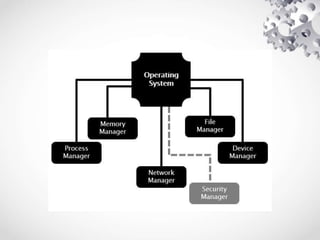
The main functions of the device manager
are:
1. Monitor the status of all devices, including storage
drives, printers and other peripherals
2. Enforce pre-set policies on which process gets
which device for how long
3. Deal with the allocation of devices to processes
4. Deal with the de-allocation of devices to
processes, both at a temporary basis (e.g. when
the process is interrupted) and on a permanent
basis (e.g. when the process is completed).
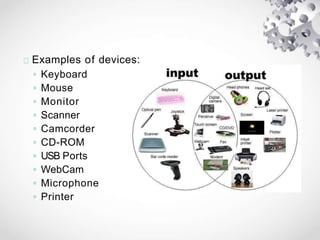
Examples of devices:
◦ Keyboard
◦ Mouse
◦ Monitor
◦ Scanner
◦ Camcorder
◦ CD-ROM
◦ USB Ports
◦ WebCam
◦ Microphone
◦ Printer
There are three main types
of devices:
◦ Dedicated Devices
◦ Shared Devices
◦ Virtual Devices
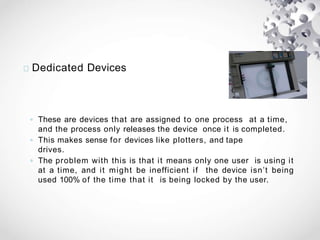
Dedicated Devices
◦ These are devices that are assigned to one process at a time,
and the process only releases the device once it is completed.
◦ This makes sense for devices like plotters, and tape
drives.
◦ The problem with this is that it means only one user is using it
at a time, and it might be inefficient if the device isn’t being
used 100% of the time that it is being locked by the user.
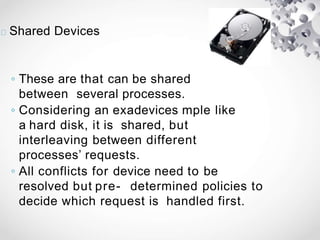
Shared Devices
◦ These are that can be shared
between several processes.
◦ Considering an exadevices mple like
a hard disk, it is shared, but
interleaving between different
processes’ requests.
◦ All conflicts for device need to be
resolved but pre- determined policies to
decide which request is handled first.
Virtual Devices
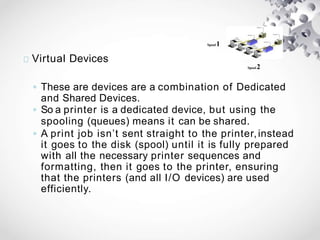
◦ These are devices are a combination of Dedicated
and Shared Devices.
◦ So a printer is a dedicated device, but using the
spooling (queues) means it can be shared.
◦ A print job isn’t sent straight to the printer,instead
it goes to the disk (spool) until it is fully prepared
with all the necessary printer sequences and
formatting, then it goes to the printer, ensuring
that the printers (and all I/O devices) are used
efficiently.
Spool1
Spool2
hard disk configurations:
◦ Mobile-Head Magnetic Disk Storage
◦ Fixed-Head Magnetic Disk Storage
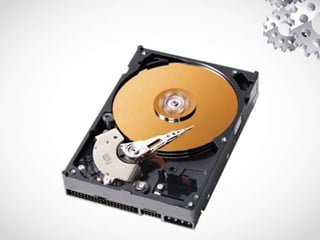
Moveable-Head Magnetic Disk Storage
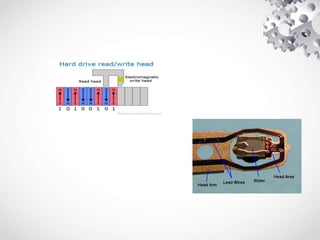
◦ Both the reading(/writing) head moves and the disk
spins.
◦ Usually formatted on both sides.
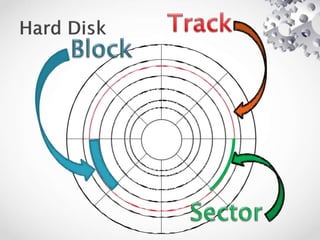
◦ Data is recorded on tracks.
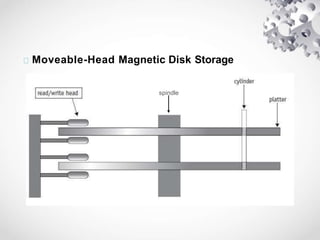
Moveable-Head Magnetic Disk Storage
Typically there is more than one disk (platter),
and they are arranged in a stack (we also call
this as being part of a disk pack).
The disks are stacked on a common spindle,
and have Read/Write heads on both sides.
All of the Read/Write heads are move in
unison.
Moveable-Head Magnetic Disk Storage
spindle
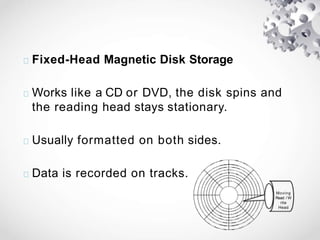
Fixed-Head Magnetic Disk Storage
Works like a CD or DVD, the disk spins and
the reading head stays stationary.
Usually formatted on both sides.
Data is recorded on tracks.
Moving
Read / W
rite
Head
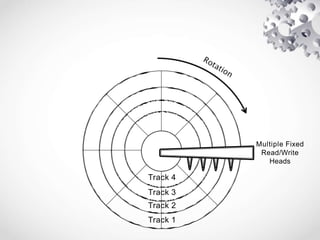
Track 4
Track 3
Track 2
Track 1
Multiple Fixed
Read/Write
Heads
Fixed-Head Magnetic Disk Storage
This means it’s very fast compared to a
moving Read/Write head, however, it is more
costly to manufacture, and it has less storage
space as the tracks have to be positioned
farther apart.
These are often used in space flight and
aircraft applications where speed is most
important.
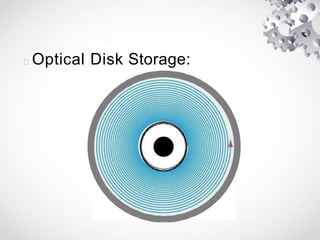
Optical Disk Storage:
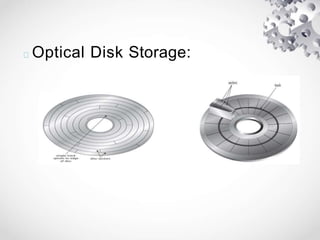
◦ Because of advances in laser technology it
is possible to store data optically rather
than magnetically, and CDs and DVDs are
examples of optical storage.
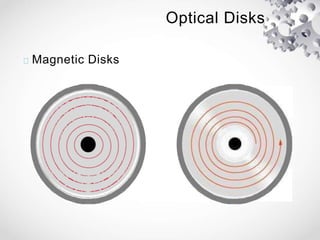
◦ Unlike magnetic disks, which typically
consist of tracks as a series of concentric
circles, optical disks are usually a single
continuous spiral track.
Magnetic Disks
Optical Disks
Optical Disk Storage:
◦ Another significant difference between magnetic
and optical disks is that magnetic disks spin at a
constant speed, so the tracks on other outer rings
of magnetic disks have to have larger sectors, and
those tracks nearer the centre have small tracks.
◦ Optical disks can change the speed to reading, so
the sector size is the same in the outside or inside.
Optical Disk Storage:
◦ Three important performance measures are:
Data Transfer Rate
Average Access Time
Cache Size
 Data Transfer Rate:
◦ This measures the amount of data that can be read
from the disk.
◦ It is typically measured in megabytes per
second (MB/s).
Average Access Time
◦ This measures how long (on average) it takes
to move the disk head to a specific place on
the disk.
◦ It is typically measured in milliseconds (ms).
Cache Size
◦ When reading and writing to disk, sometimes
the user will wish to re-read data they have
just read, if so, having it in the cache saves
reading it again.
◦ It is typically measured in kilobytes (KB).
Optical Disk Storage:
◦ To write to an optical disk, a high intensity laser
beam burns indentations in the disk called pits.
The pits represent zeros (0s).
◦ The unburned flat areas are called lands, and
represent ones (1s).
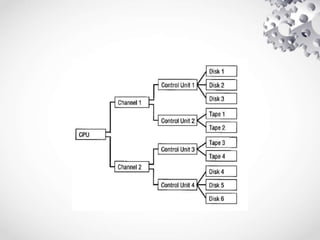
The CPU makes a lot of I/O requests.
The I/O channels work to co-ordinate the
devices to synchronise the fast speed of the
CPU with the slower speeds of the I/O
devices.
The I/O control units are attached to several
similar devices and control these devices
based on instructions from the channel.

Os - device management

  • 1.
    G.Vinothini M.sc.,M.phil., Department ofInformation Techonology, Bon Secours College for Women, Thanjavur.
  • 3.
    The main functionsof the device manager are: 1. Monitor the status of all devices, including storage drives, printers and other peripherals 2. Enforce pre-set policies on which process gets which device for how long 3. Deal with the allocation of devices to processes 4. Deal with the de-allocation of devices to processes, both at a temporary basis (e.g. when the process is interrupted) and on a permanent basis (e.g. when the process is completed).
  • 4.
    Examples of devices: ◦Keyboard ◦ Mouse ◦ Monitor ◦ Scanner ◦ Camcorder ◦ CD-ROM ◦ USB Ports ◦ WebCam ◦ Microphone ◦ Printer
  • 5.
    There are threemain types of devices: ◦ Dedicated Devices ◦ Shared Devices ◦ Virtual Devices
  • 6.
    Dedicated Devices ◦ Theseare devices that are assigned to one process at a time, and the process only releases the device once it is completed. ◦ This makes sense for devices like plotters, and tape drives. ◦ The problem with this is that it means only one user is using it at a time, and it might be inefficient if the device isn’t being used 100% of the time that it is being locked by the user.
  • 7.
    Shared Devices ◦ Theseare that can be shared between several processes. ◦ Considering an exadevices mple like a hard disk, it is shared, but interleaving between different processes’ requests. ◦ All conflicts for device need to be resolved but pre- determined policies to decide which request is handled first.
  • 8.
    Virtual Devices ◦ Theseare devices are a combination of Dedicated and Shared Devices. ◦ So a printer is a dedicated device, but using the spooling (queues) means it can be shared. ◦ A print job isn’t sent straight to the printer,instead it goes to the disk (spool) until it is fully prepared with all the necessary printer sequences and formatting, then it goes to the printer, ensuring that the printers (and all I/O devices) are used efficiently. Spool1 Spool2
  • 12.
    hard disk configurations: ◦Mobile-Head Magnetic Disk Storage ◦ Fixed-Head Magnetic Disk Storage
  • 13.
    Moveable-Head Magnetic DiskStorage ◦ Both the reading(/writing) head moves and the disk spins. ◦ Usually formatted on both sides. ◦ Data is recorded on tracks.
  • 15.
    Moveable-Head Magnetic DiskStorage Typically there is more than one disk (platter), and they are arranged in a stack (we also call this as being part of a disk pack). The disks are stacked on a common spindle, and have Read/Write heads on both sides. All of the Read/Write heads are move in unison.
  • 16.
  • 17.
    Fixed-Head Magnetic DiskStorage Works like a CD or DVD, the disk spins and the reading head stays stationary. Usually formatted on both sides. Data is recorded on tracks. Moving Read / W rite Head
  • 18.
    Track 4 Track 3 Track2 Track 1 Multiple Fixed Read/Write Heads
  • 19.
    Fixed-Head Magnetic DiskStorage This means it’s very fast compared to a moving Read/Write head, however, it is more costly to manufacture, and it has less storage space as the tracks have to be positioned farther apart. These are often used in space flight and aircraft applications where speed is most important.
  • 21.
    Optical Disk Storage: ◦Because of advances in laser technology it is possible to store data optically rather than magnetically, and CDs and DVDs are examples of optical storage. ◦ Unlike magnetic disks, which typically consist of tracks as a series of concentric circles, optical disks are usually a single continuous spiral track.
  • 22.
  • 23.
  • 24.
    Optical Disk Storage: ◦Another significant difference between magnetic and optical disks is that magnetic disks spin at a constant speed, so the tracks on other outer rings of magnetic disks have to have larger sectors, and those tracks nearer the centre have small tracks. ◦ Optical disks can change the speed to reading, so the sector size is the same in the outside or inside.
  • 25.
  • 26.
    Optical Disk Storage: ◦Three important performance measures are: Data Transfer Rate Average Access Time Cache Size  Data Transfer Rate: ◦ This measures the amount of data that can be read from the disk. ◦ It is typically measured in megabytes per second (MB/s).
  • 27.
    Average Access Time ◦This measures how long (on average) it takes to move the disk head to a specific place on the disk. ◦ It is typically measured in milliseconds (ms).
  • 28.
    Cache Size ◦ Whenreading and writing to disk, sometimes the user will wish to re-read data they have just read, if so, having it in the cache saves reading it again. ◦ It is typically measured in kilobytes (KB).
  • 29.
    Optical Disk Storage: ◦To write to an optical disk, a high intensity laser beam burns indentations in the disk called pits. The pits represent zeros (0s). ◦ The unburned flat areas are called lands, and represent ones (1s).
  • 32.
    The CPU makesa lot of I/O requests. The I/O channels work to co-ordinate the devices to synchronise the fast speed of the CPU with the slower speeds of the I/O devices. The I/O control units are attached to several similar devices and control these devices based on instructions from the channel.