Organizing Principles
of Formal SignWriting
by Stephen E Slevinski Jr
the Center for Sutton Movement Writing
January 12
th
, 2018
 Three propositions serve as the foundation of Formal
SignWriting development.
1) the importance of real literacy
2) the utility of formal structures
3) the benefits of living forward.
Organizing Principles
of Formal SignWriting
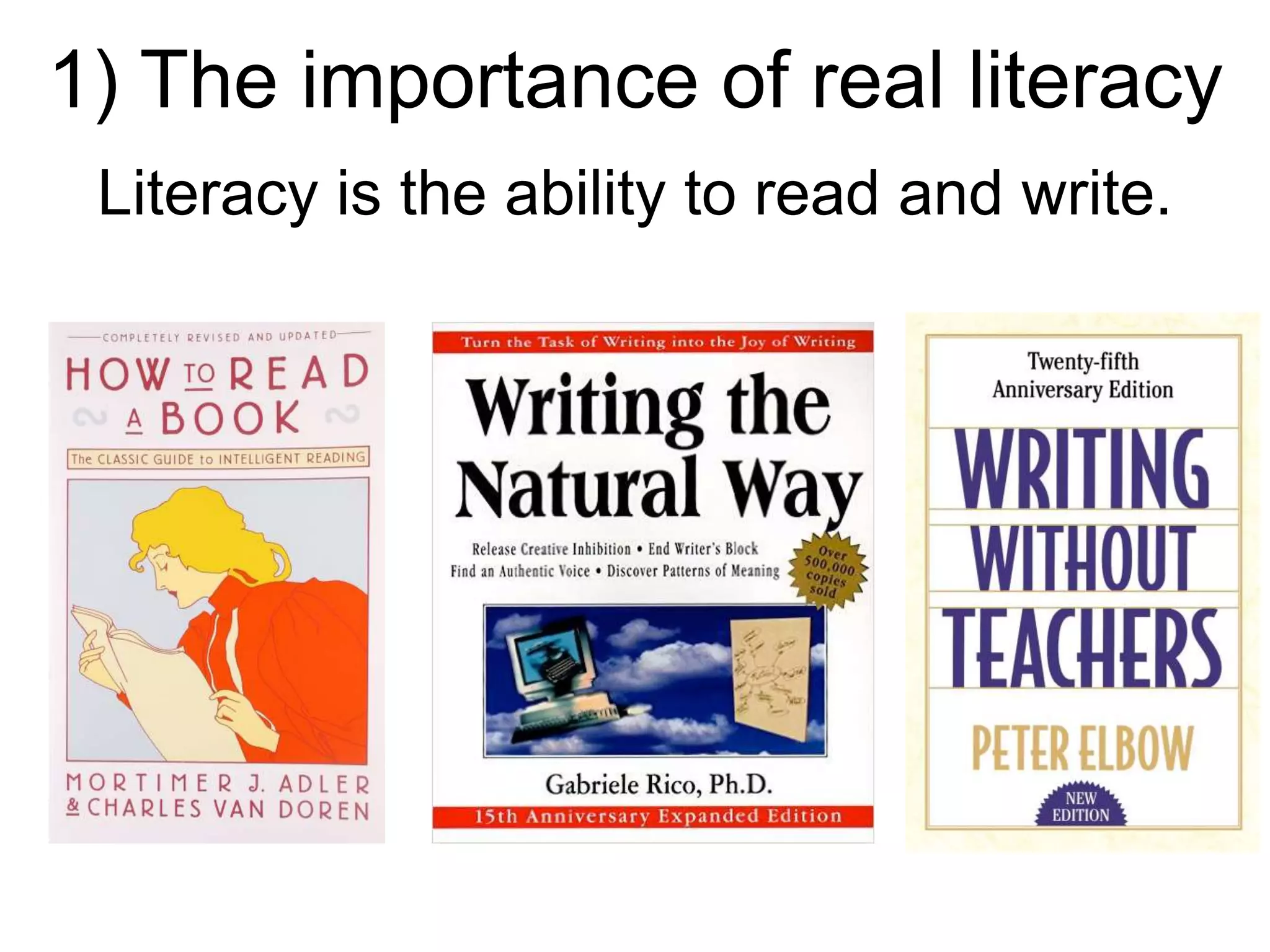
1) The importance of real literacy
Literacy is the ability to read and write.
How to Read a Book
“This is a book for readers and for those who wish to
become readers… it is for those whose main purpose
in reading books is to gain increased understanding.”
“By ‘readers’ we mean people who are still accustomed,
as almost every literate and intelligent person used to be, to
gain a large share of their information about and their
understanding of the world from the written word.
Not all of it, of course; even in the days before radio and
television, a certain amount of information and understanding
was acquired through the spoken word and through
observation. But for intelligent and curious people that
was never enough. They knew that they had to read…”
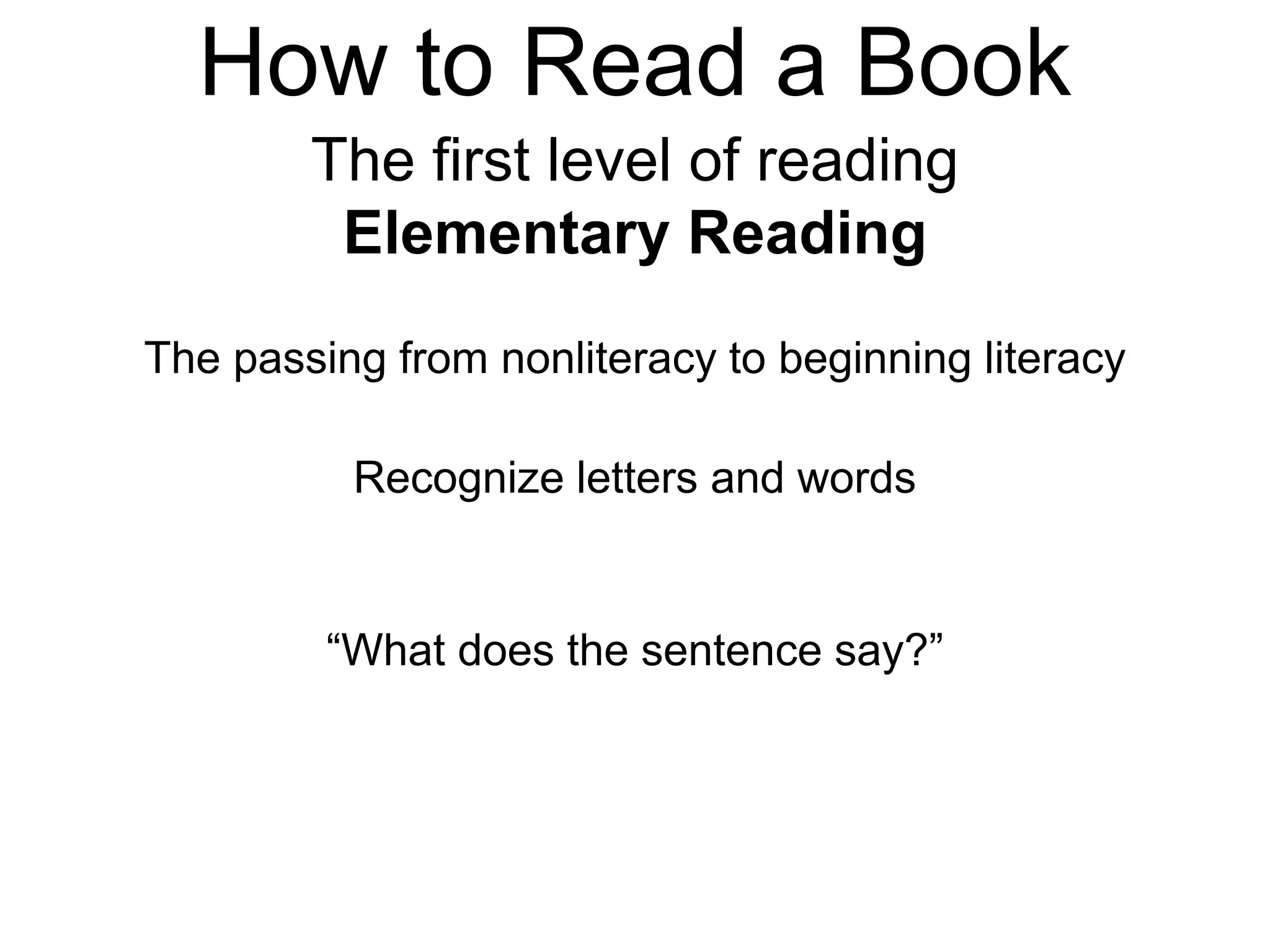
How to Read a Book
The first level of reading
Elementary Reading
The passing from nonliteracy to beginning literacy
Recognize letters and words
“What does the sentence say?”
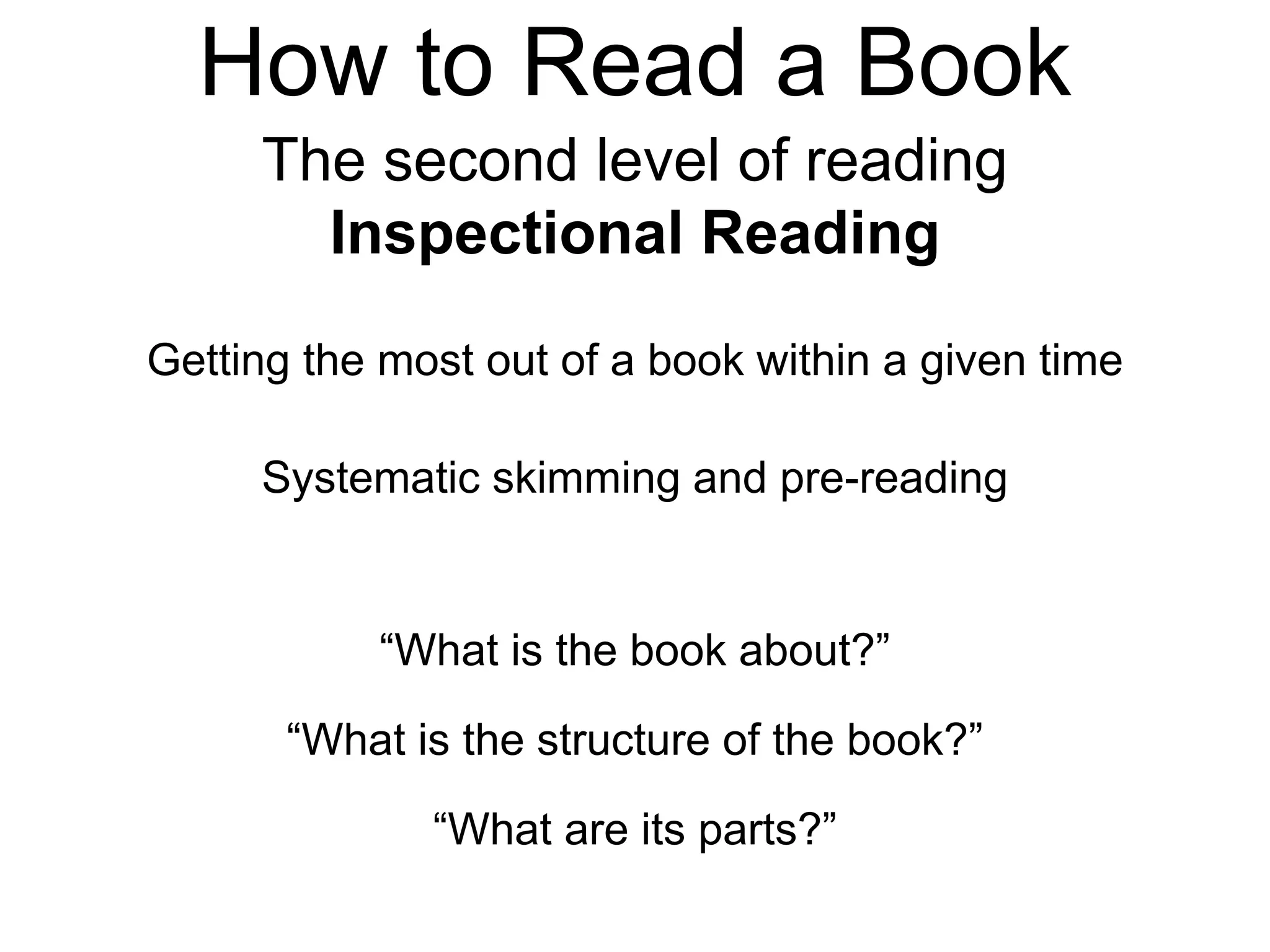
How to Read a Book
The second level of reading
Inspectional Reading
Getting the most out of a book within a given time
Systematic skimming and pre-reading
“What is the book about?”
“What is the structure of the book?”
“What are its parts?”
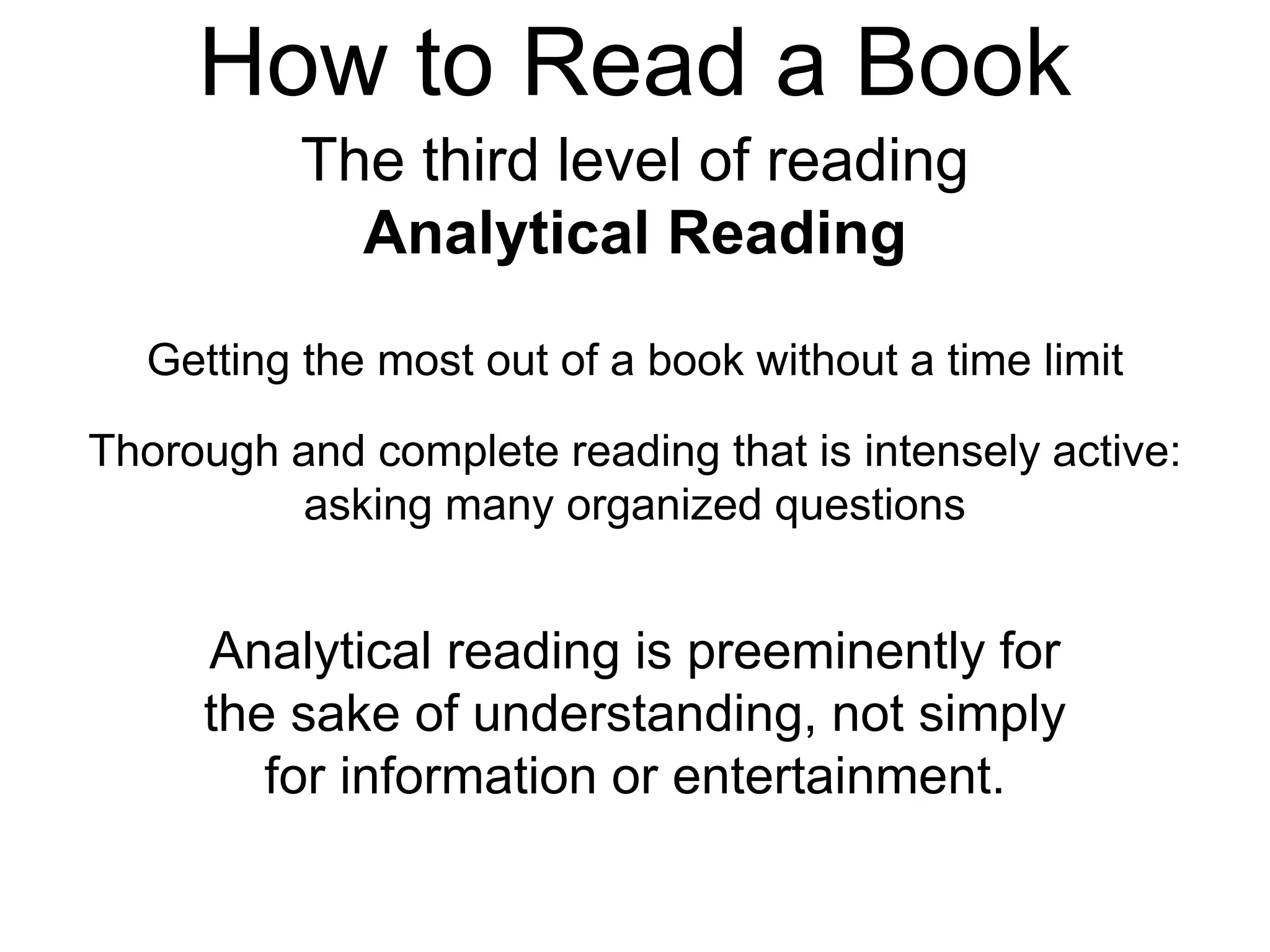
How to Read a Book
The third level of reading
Analytical Reading
Getting the most out of a book without a time limit
Thorough and complete reading that is intensely active:
asking many organized questions
Analytical reading is preeminently for
the sake of understanding, not simply
for information or entertainment.
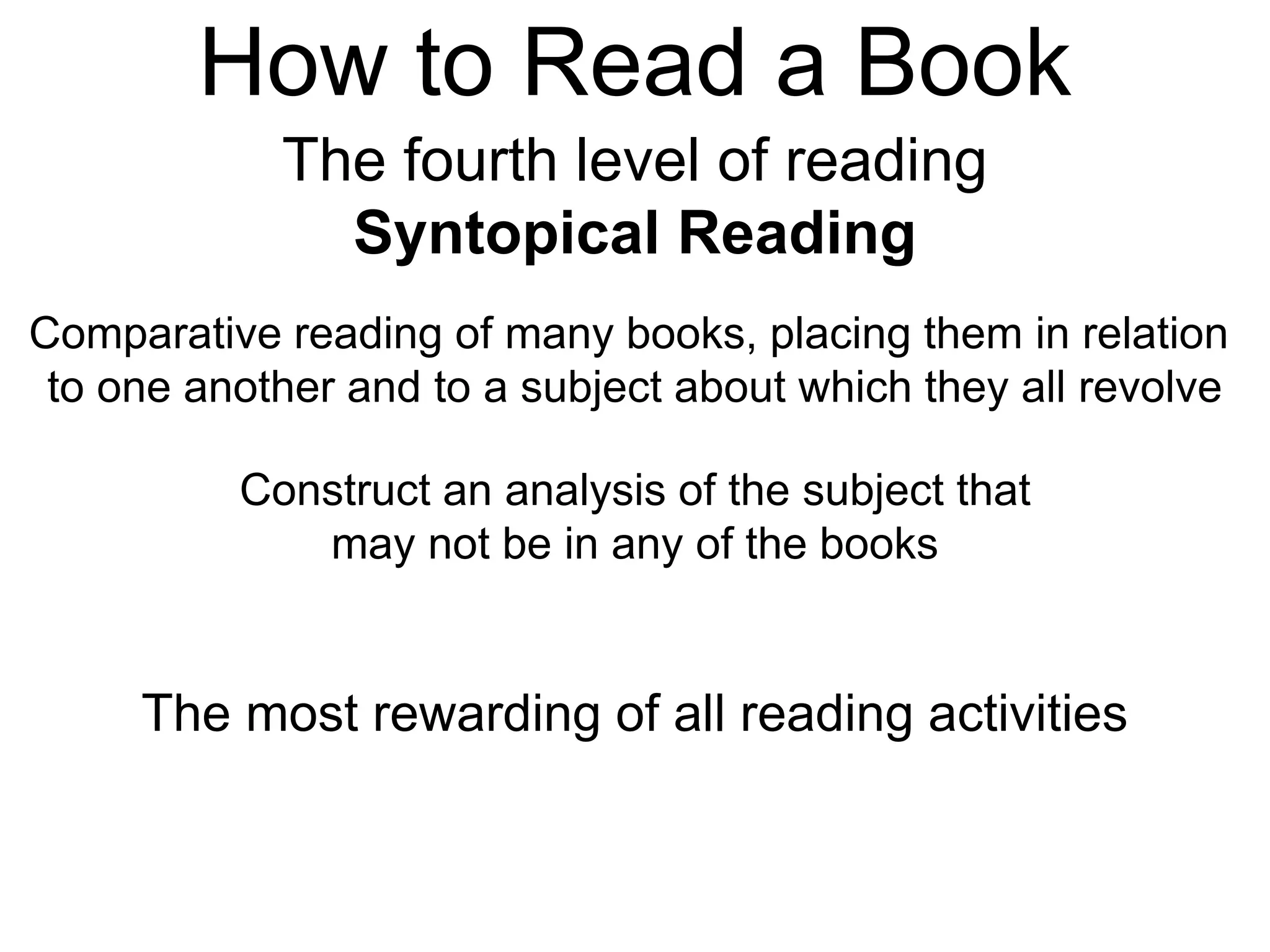
How to Read a Book
The fourth level of reading
Syntopical Reading
Comparative reading of many books, placing them in relation
to one another and to a subject about which they all revolve
Construct an analysis of the subject that
may not be in any of the books
The most rewarding of all reading activities
Writing the Natural Way
“The most intimate facet of learning is self-design, giving
us a sense of identity in time and space. We are
designers, active agents of thought and language, not
passive receivers. The act of writing is one of the most
intensely creative acts we can engage in.”
“The creative process, then, is the ongoing oscillation between
the mind’s ability to form a hazy big picture and then to
sequence the details to clarify and ‘hold’ it, then to redesign,
and to clarify further. This collaboration between the Sign
and Design mind has led to stupendous human creative acts.
Two brains are indeed better than one!”
Writing the Natural Way
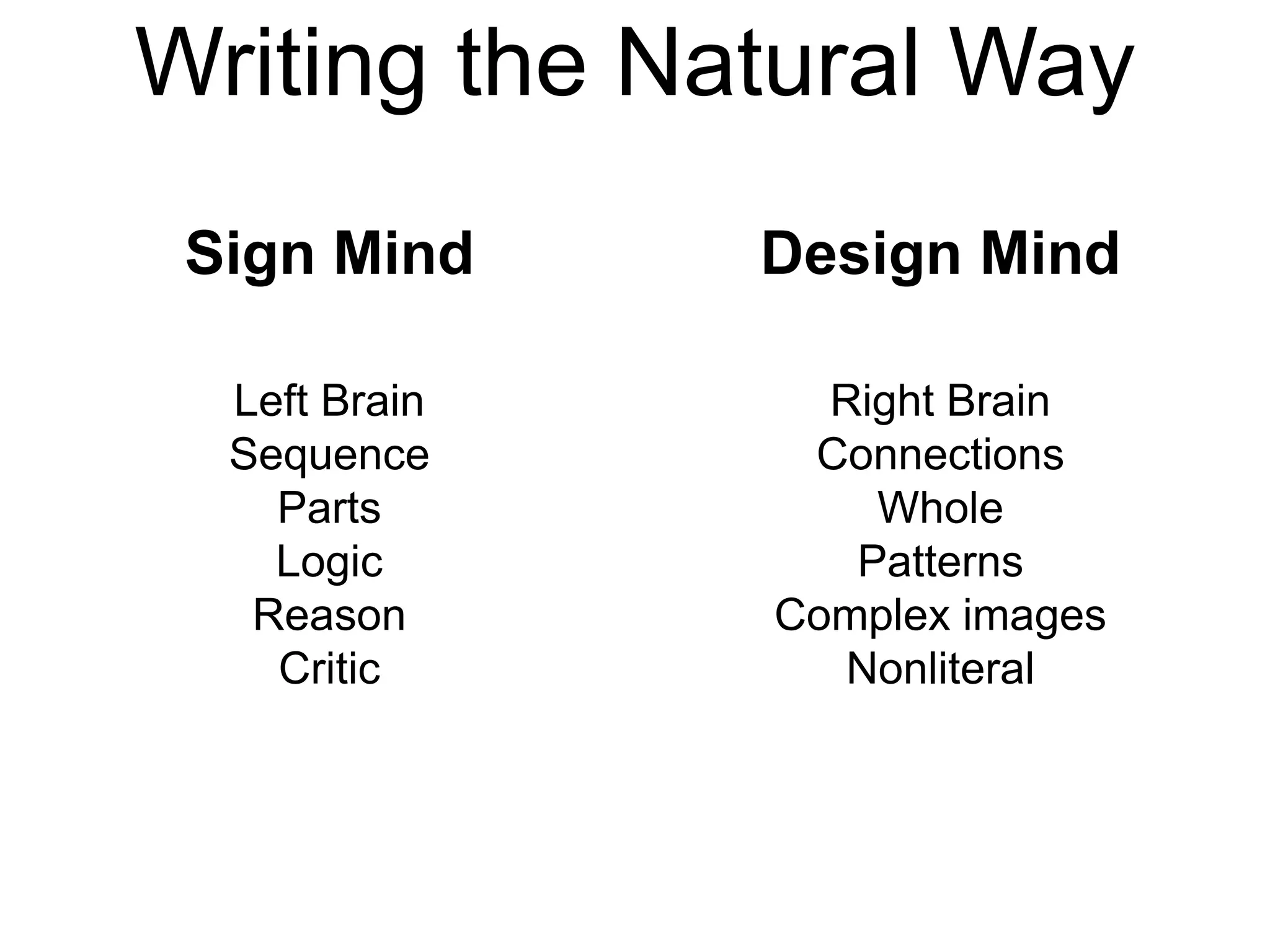
Sign Mind Design Mind
Right Brain
Connections
Whole
Patterns
Complex images
Nonliteral
Left Brain
Sequence
Parts
Logic
Reason
Critic
Writing the Natural Way
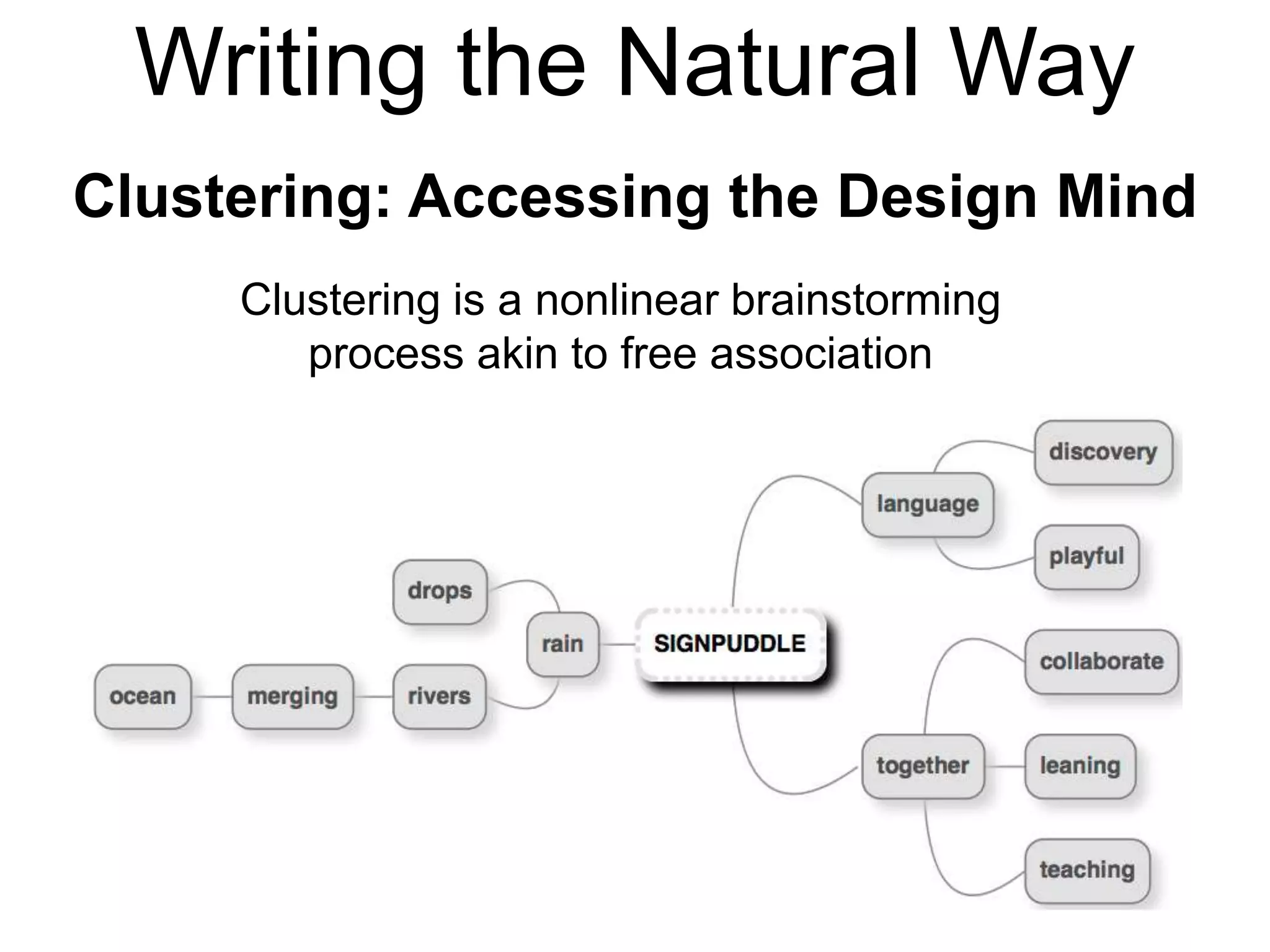
Clustering: Accessing the Design Mind
Clustering is a nonlinear brainstorming
process akin to free association
Writing the Natural Way
Mental Shift
Start writing once you experience a sudden
sense of what you are going to write about.
We learn together and we play together. One at a time.
Drop by drop. We discover language in a playful way,
learning as we go. All together, merging into streams,
merging into rivers. Until the world is covered with
sign as an ocean of language.
SignPuddle
Writing Without Teachers
“The most effective way I know to improve your writing is to do
free writing exercises regularly. At least three times a week.
They are sometimes called ‘automatic writing’, ‘babbling’, or
‘jabbering’ exercises. The idea is simply to write for ten
minutes (later on, perhaps fifteen or twenty).”
“After you have done three or four exercises that are more or
less ‘on’ what your subject turns out to be, you will have piles of
rubble, you will will probably also have a lot of words, phrases,
and sentences that seem important. Pick out these good bits.
Strip away the rubble. Now use as much careful thought and
editorial discrimination as possible in order to see what they add
up to: decide how much you believe them, how true they are, in
what senses they are true; arrange them somehow so they make
sense, and write new and connecting parts when necessary.”
Writing Without Teachers
Productive
Editorial
Only at the end will you know what you want to say.
Expect to end somewhere different from where you started.
Write before you know your meaning.
Never stop to look back or to cross out.
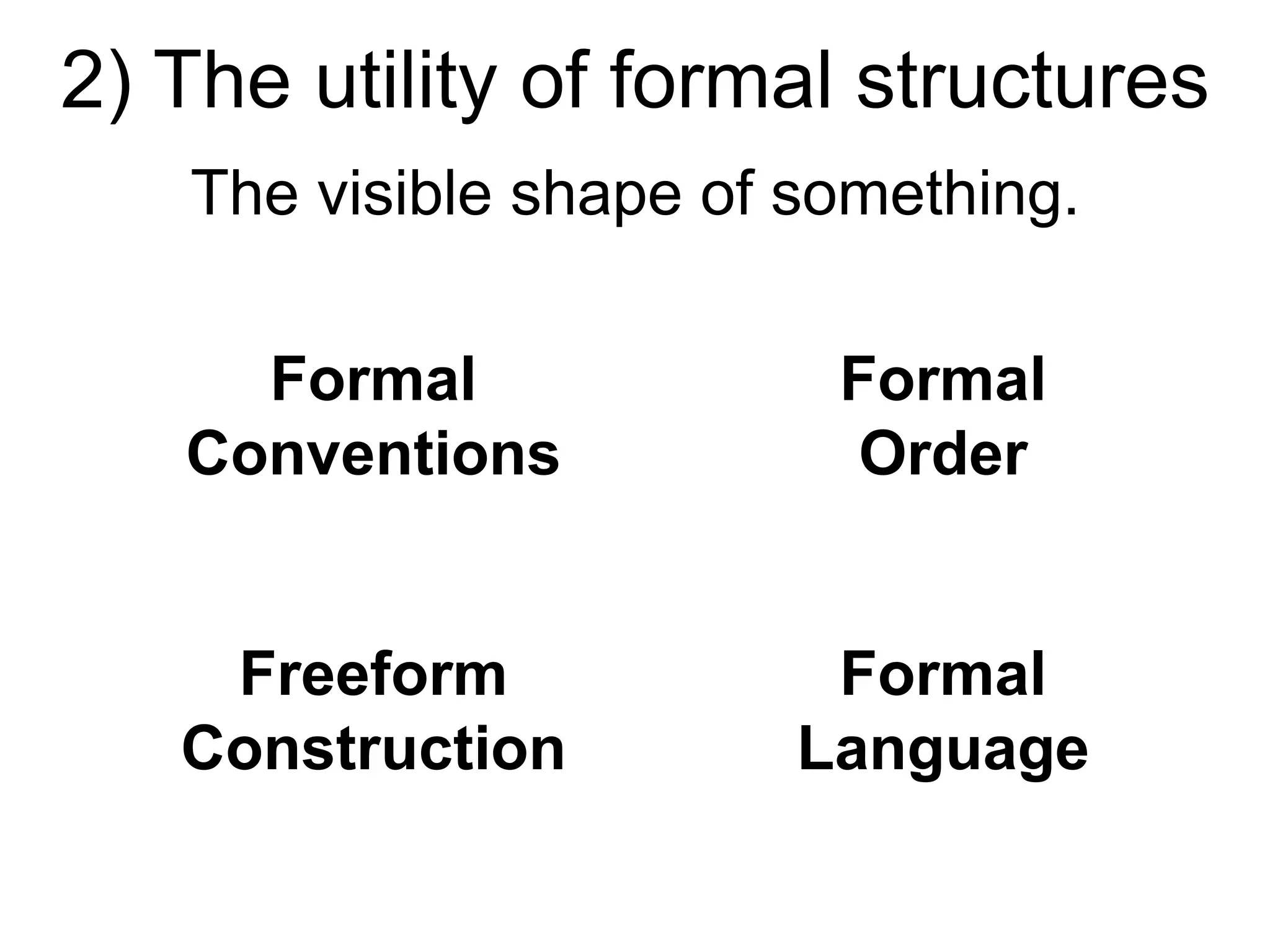
2) The utility of formal structures
The visible shape of something.
Formal
Conventions
Freeform
Construction
Formal
Order
Formal
Language
Formal Conventions
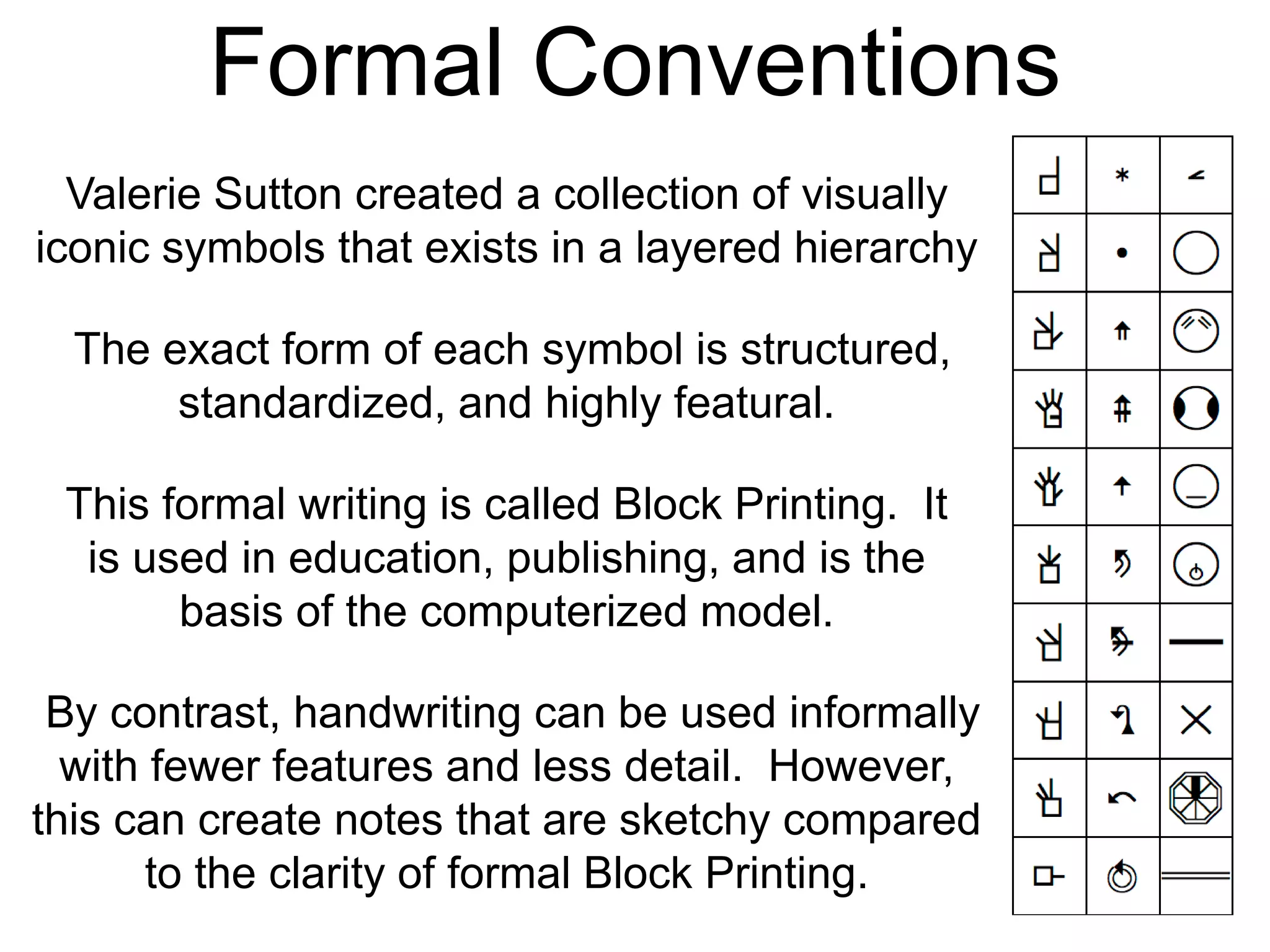
The exact form of each symbol is structured,
standardized, and highly featural.
Valerie Sutton created a collection of visually
iconic symbols that exists in a layered hierarchy
This formal writing is called Block Printing. It
is used in education, publishing, and is the
basis of the computerized model.
By contrast, handwriting can be used informally
with fewer features and less detail. However,
this can create notes that are sketchy compared
to the clarity of formal Block Printing.
Freeform Construction
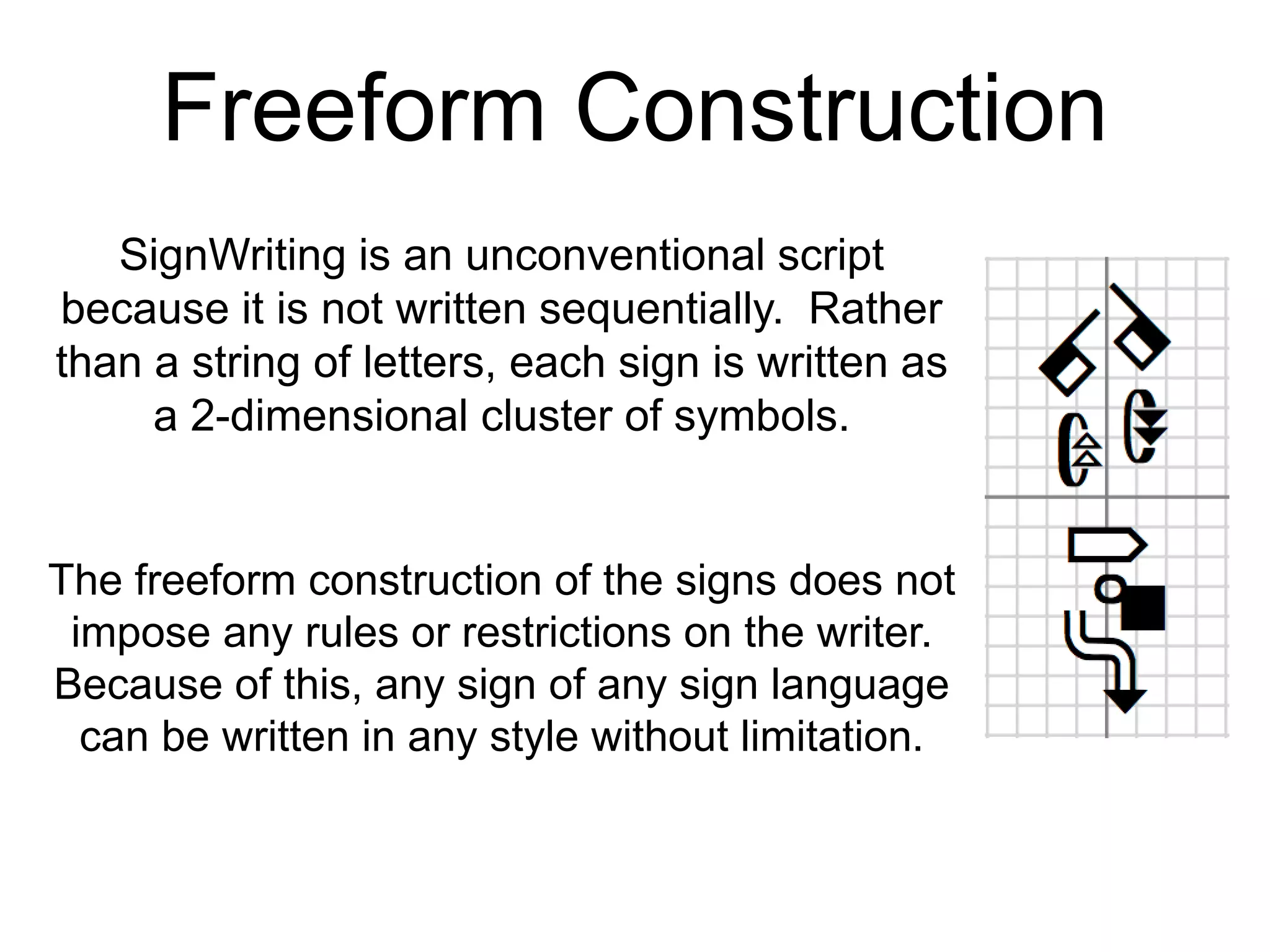
SignWriting is an unconventional script
because it is not written sequentially. Rather
than a string of letters, each sign is written as
a 2-dimensional cluster of symbols.
The freeform construction of the signs does not
impose any rules or restrictions on the writer.
Because of this, any sign of any sign language
can be written in any style without limitation.
Formal Order
The 11th Century Song Chinese developed the movable
type printing press. Each piece of type contained a single
character mostly equivalent to a word. Great block houses
developed with hundreds of thousand of type pieces each.
The Chinese logographic system is open-ended. New
words require new type. Each house created their own
specialized logograms. Organizing the numerous type
pieces became a problem. It was easy to understand how
to organize the basic type, but new logograms didn’t have a
definite place within the established order. The practice
developed to attach slips of paper to unusual logograms
with a sequential list of more standard writing. This way,
each piece of type was easy to organize and it was
possible to learn the ordering for the new logograms.
Formal Order
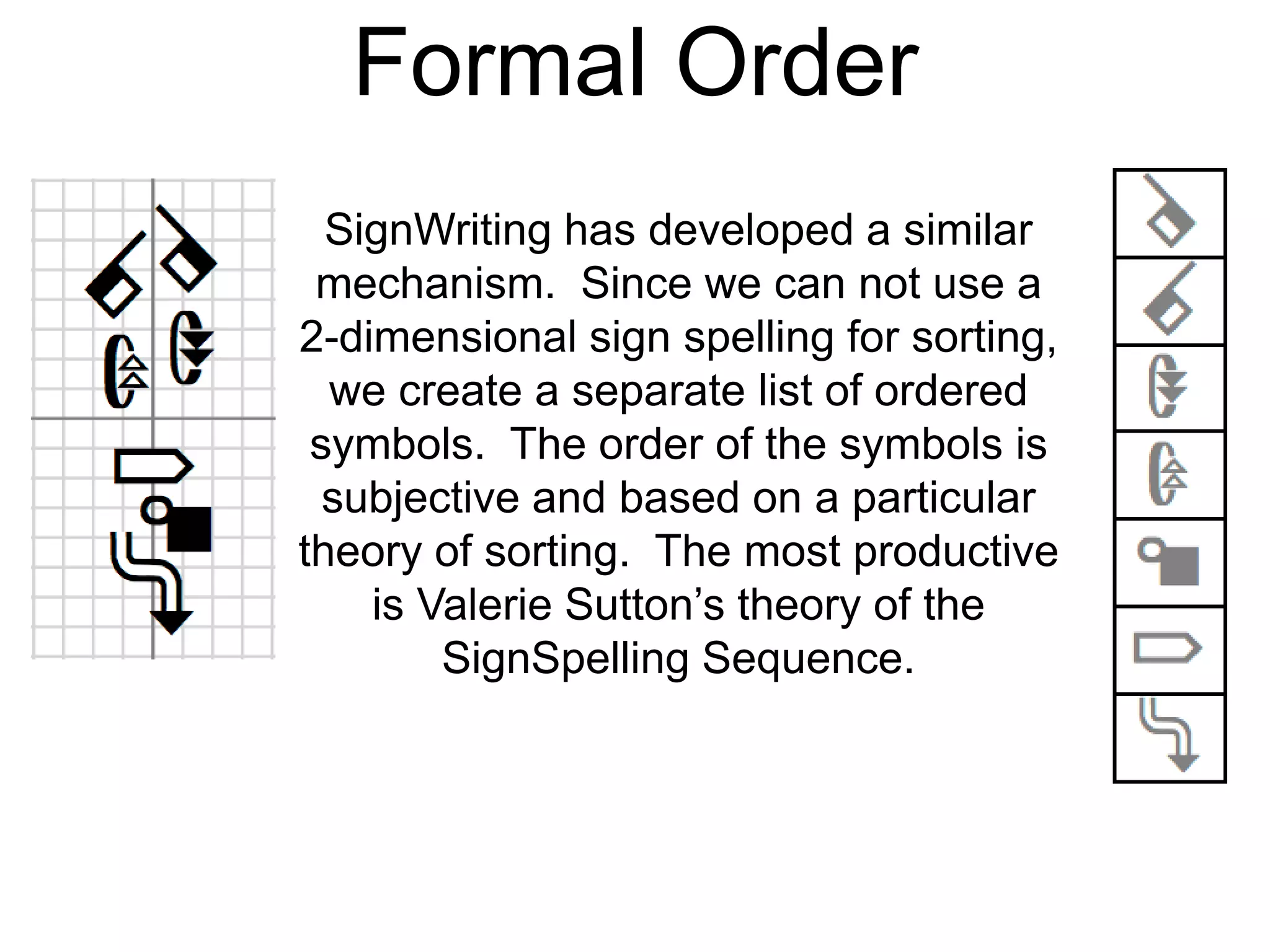
SignWriting has developed a similar
mechanism. Since we can not use a
2-dimensional sign spelling for sorting,
we create a separate list of ordered
symbols. The order of the symbols is
subjective and based on a particular
theory of sorting. The most productive
is Valerie Sutton’s theory of the
SignSpelling Sequence.
Formal Language
According to Wikipedia, "In mathematics, computer
science, and linguistics, a formal language is a set
of strings of symbols that may be constrained by
rules that are specific to it."
Formal SignWriting defines a formal language for the
signed languages of the world. Any sign of any sign
language can be written as either a string of ASCII
characters or a string of Unicode characters.
Formal Language
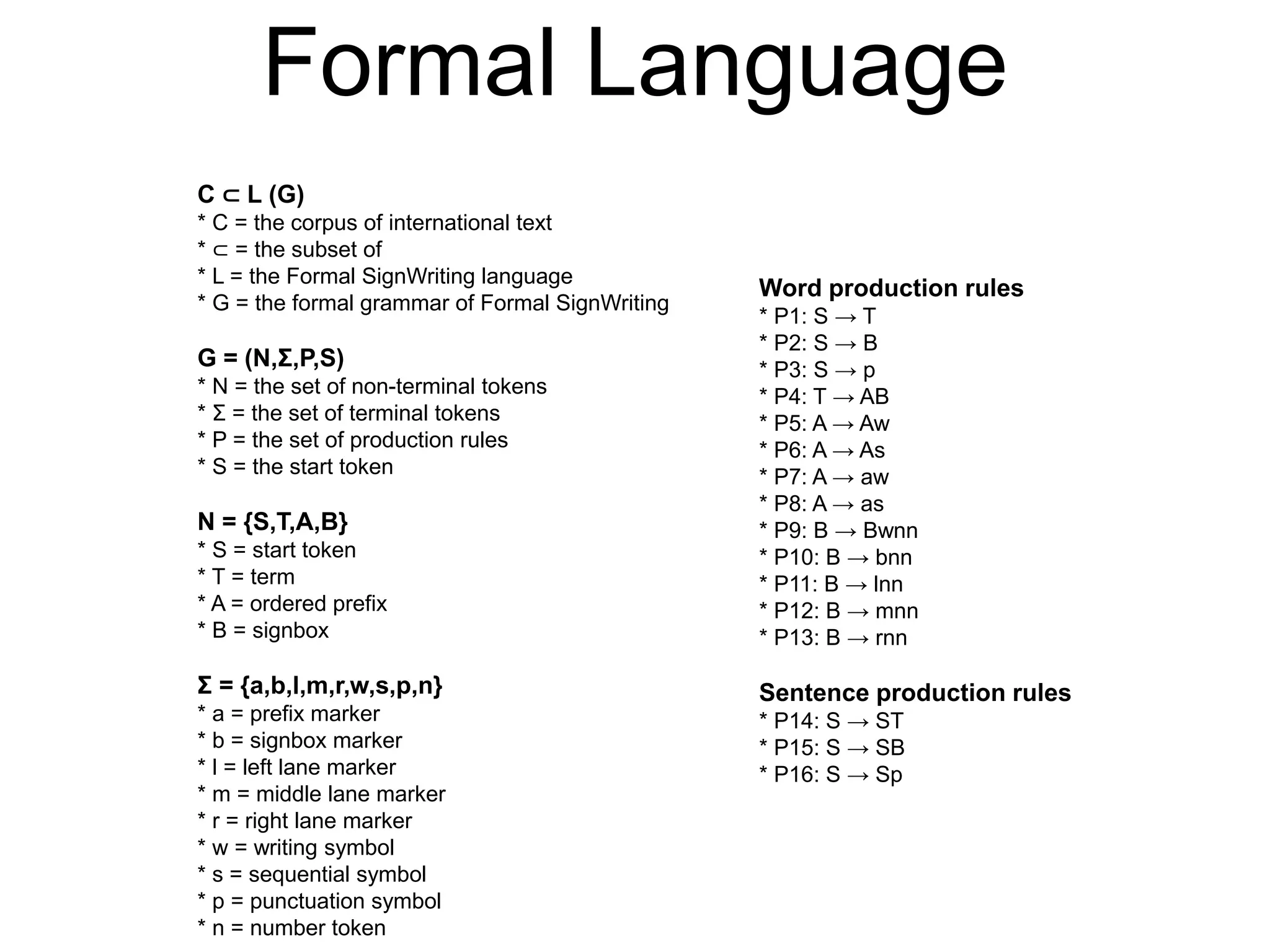
C ⊂ L (G)
* C = the corpus of international text
* ⊂ = the subset of
* L = the Formal SignWriting language
* G = the formal grammar of Formal SignWriting
G = (N,Σ,P,S)
* N = the set of non-terminal tokens
* Σ = the set of terminal tokens
* P = the set of production rules
* S = the start token
N = {S,T,A,B}
* S = start token
* T = term
* A = ordered prefix
* B = signbox
Σ = {a,b,l,m,r,w,s,p,n}
* a = prefix marker
* b = signbox marker
* l = left lane marker
* m = middle lane marker
* r = right lane marker
* w = writing symbol
* s = sequential symbol
* p = punctuation symbol
* n = number token
Word production rules
* P1: S → T
* P2: S → B
* P3: S → p
* P4: T → AB
* P5: A → Aw
* P6: A → As
* P7: A → aw
* P8: A → as
* P9: B → Bwnn
* P10: B → bnn
* P11: B → lnn
* P12: B → mnn
* P13: B → rnn
Sentence production rules
* P14: S → ST
* P15: S → SB
* P16: S → Sp
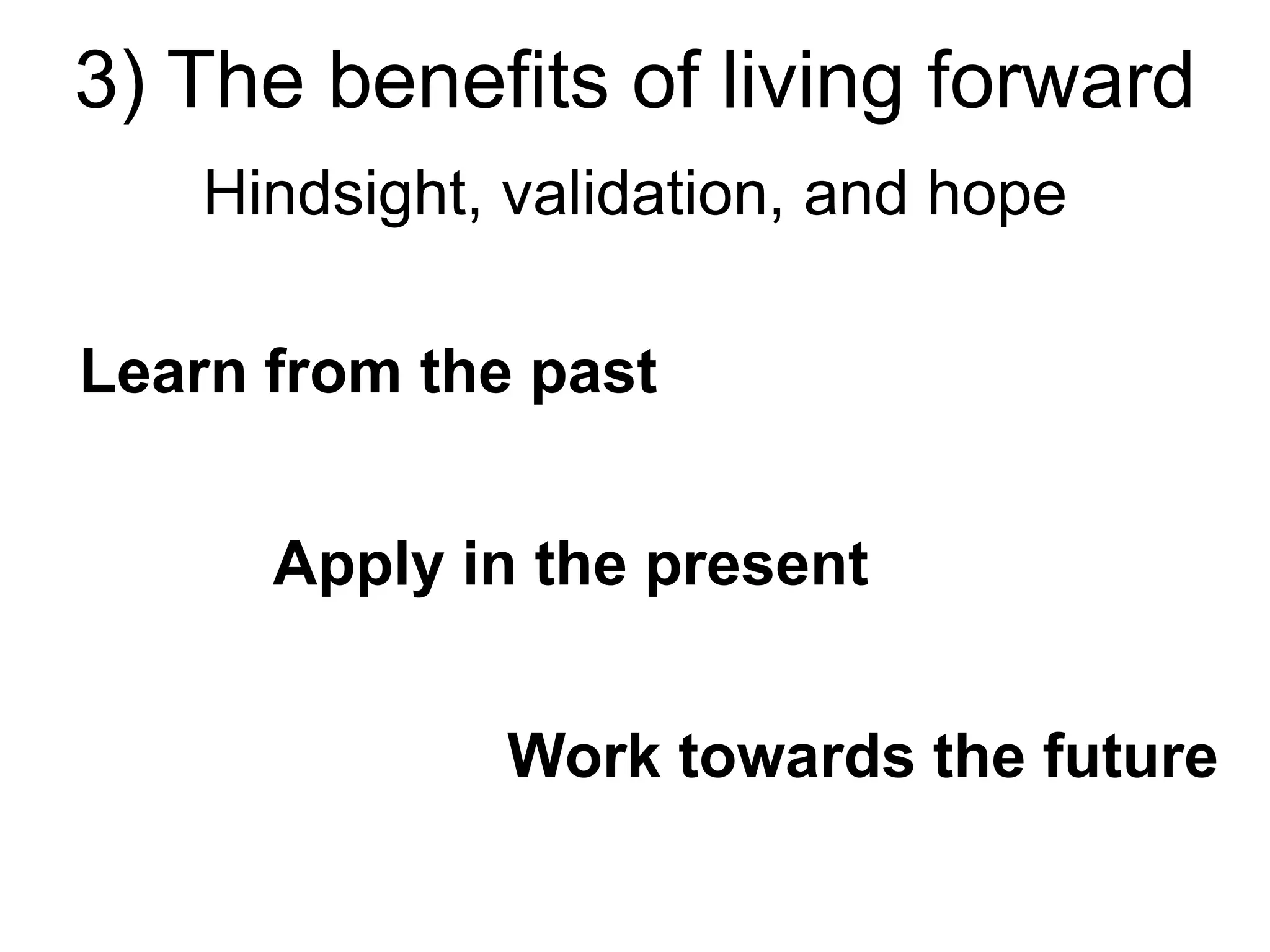
3) The benefits of living forward
Hindsight, validation, and hope
Learn from the past
Apply in the present
Work towards the future
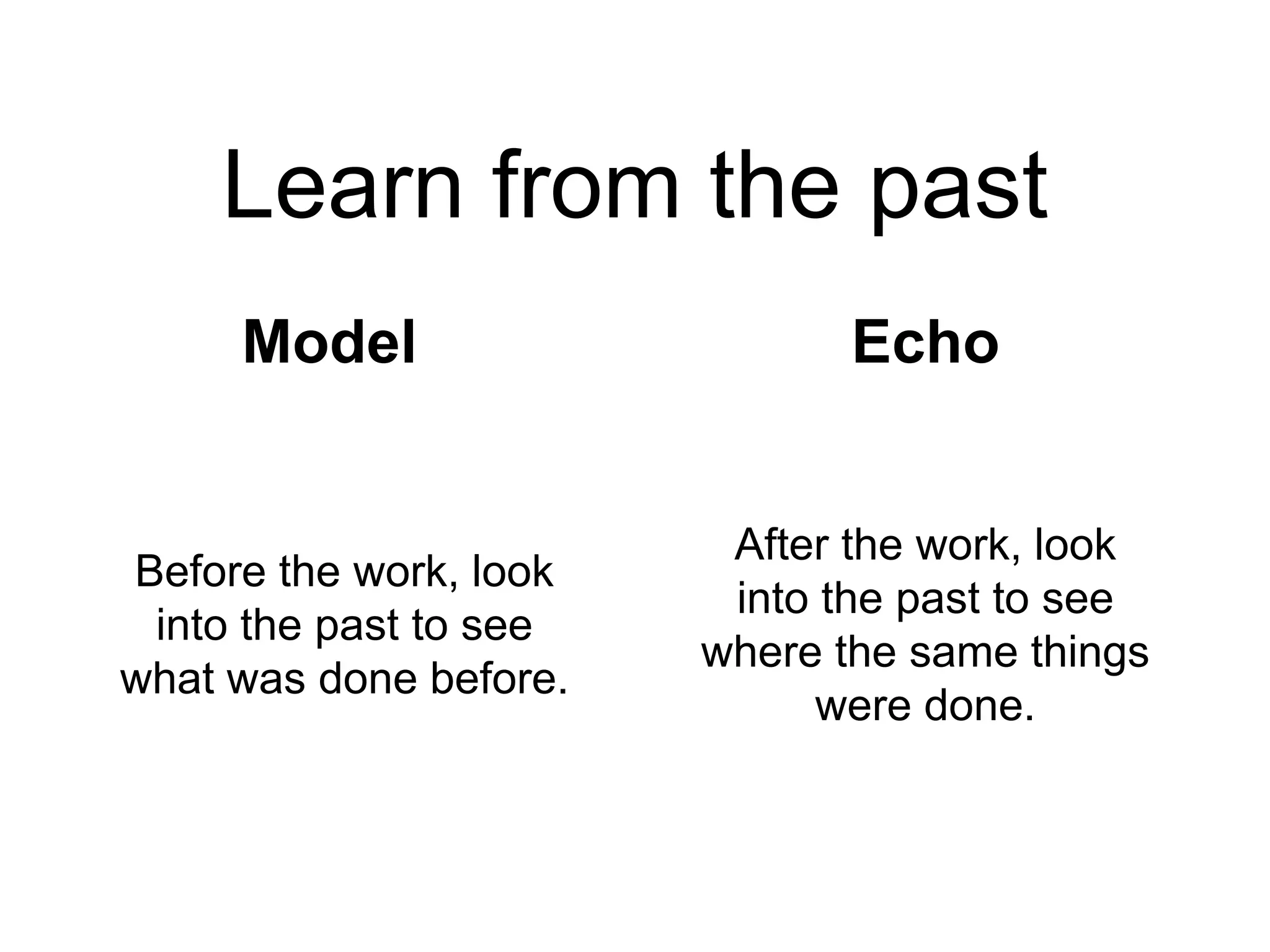
Learn from the past
Model Echo
Before the work, look
into the past to see
what was done before.
After the work, look
into the past to see
where the same things
were done.
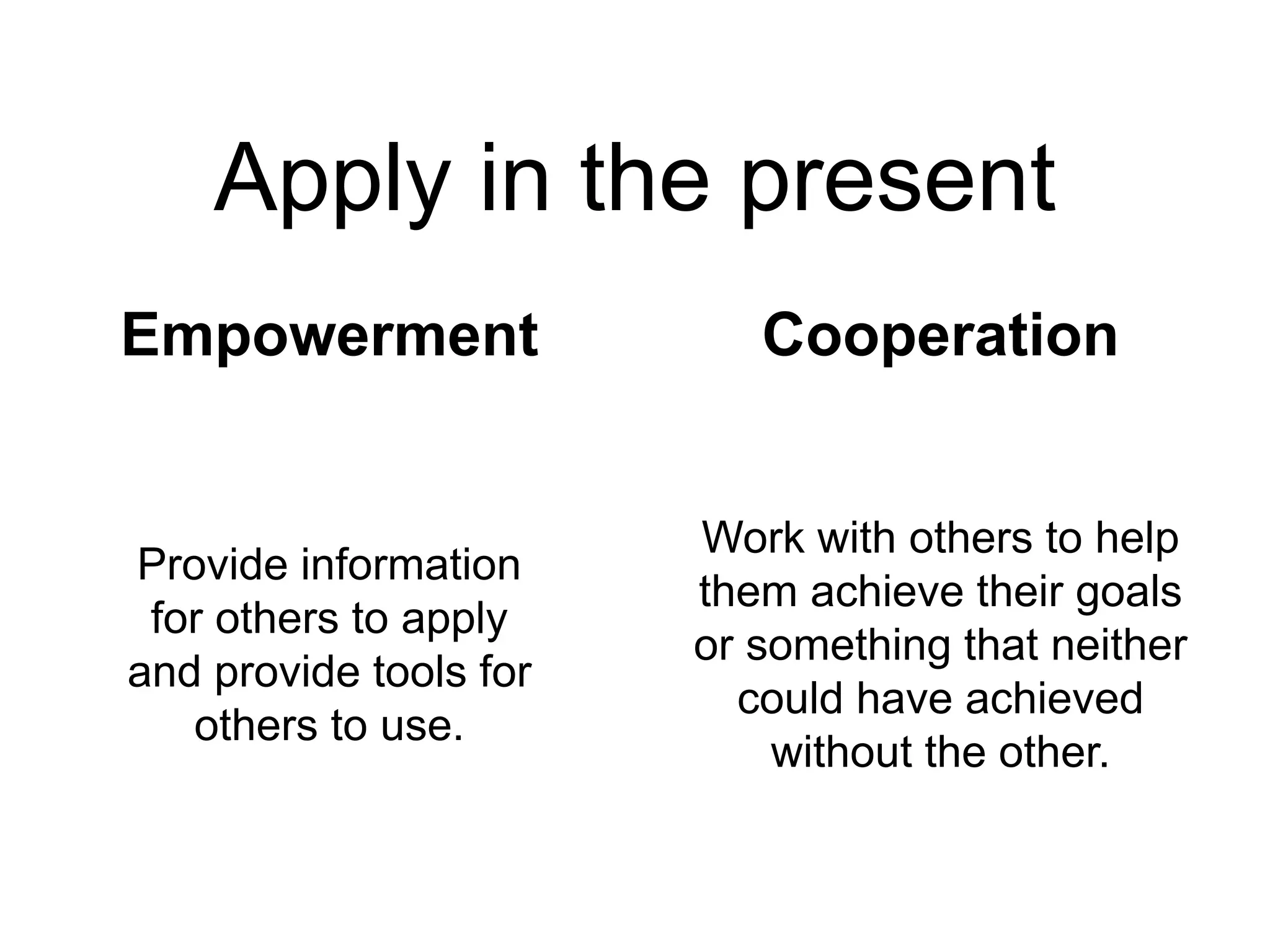
Apply in the present
Empowerment Cooperation
Provide information
for others to apply
and provide tools for
others to use.
Work with others to help
them achieve their goals
or something that neither
could have achieved
without the other.
Works towards the future
Progress Generations
The works isn’t done
yet, but we’re getting
better all the time.
The real goals and
benefits will be achieved
long after we are gone.
The literary tradition in
Western Civilization
3,000 years of reading and writing.
A brief digression…
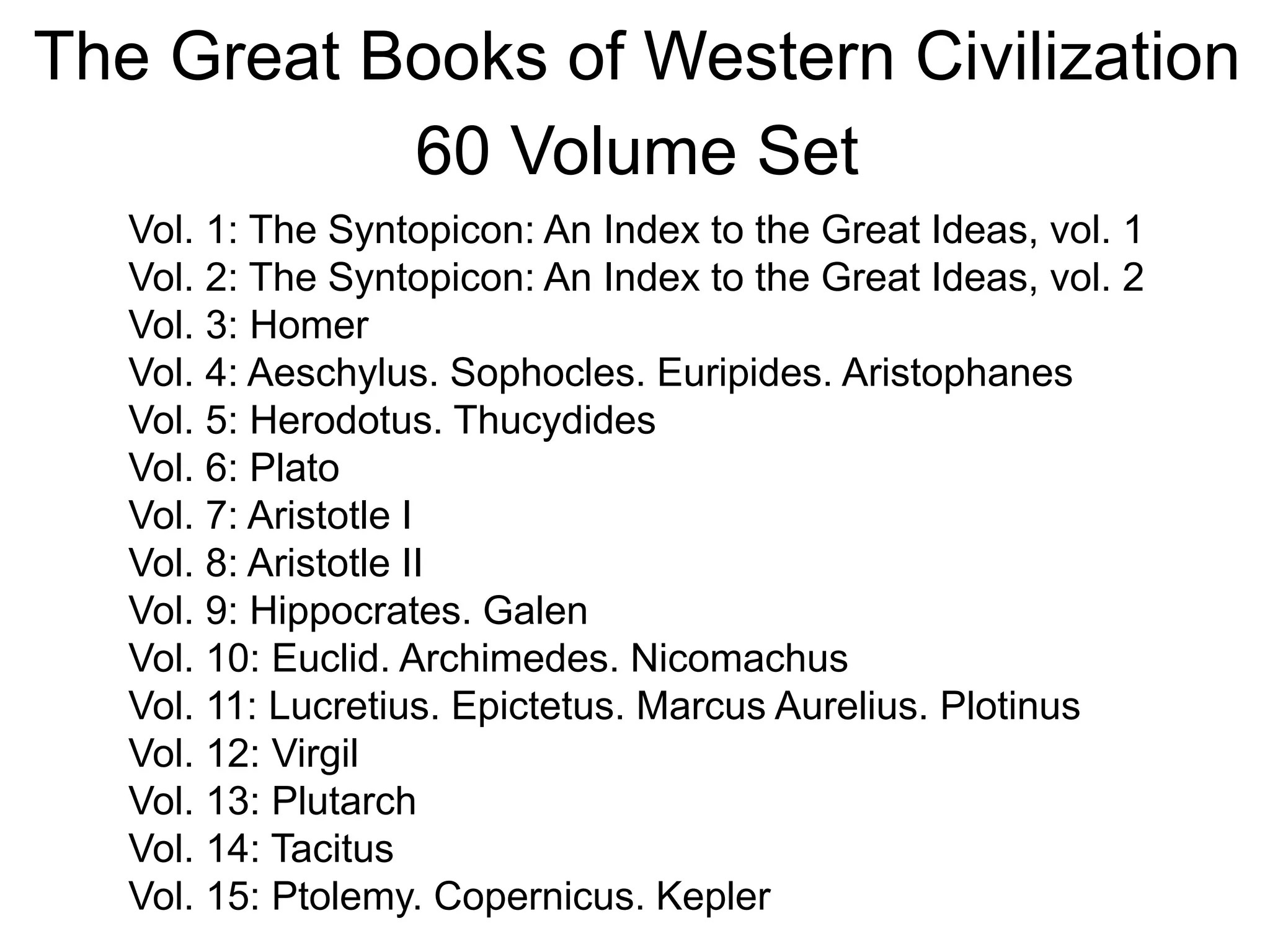
The Great Books of Western Civilization
60 Volume Set
Vol. 1: The Syntopicon: An Index to the Great Ideas, vol. 1
Vol. 2: The Syntopicon: An Index to the Great Ideas, vol. 2
Vol. 3: Homer
Vol. 4: Aeschylus. Sophocles. Euripides. Aristophanes
Vol. 5: Herodotus. Thucydides
Vol. 6: Plato
Vol. 7: Aristotle I
Vol. 8: Aristotle II
Vol. 9: Hippocrates. Galen
Vol. 10: Euclid. Archimedes. Nicomachus
Vol. 11: Lucretius. Epictetus. Marcus Aurelius. Plotinus
Vol. 12: Virgil
Vol. 13: Plutarch
Vol. 14: Tacitus
Vol. 15: Ptolemy. Copernicus. Kepler
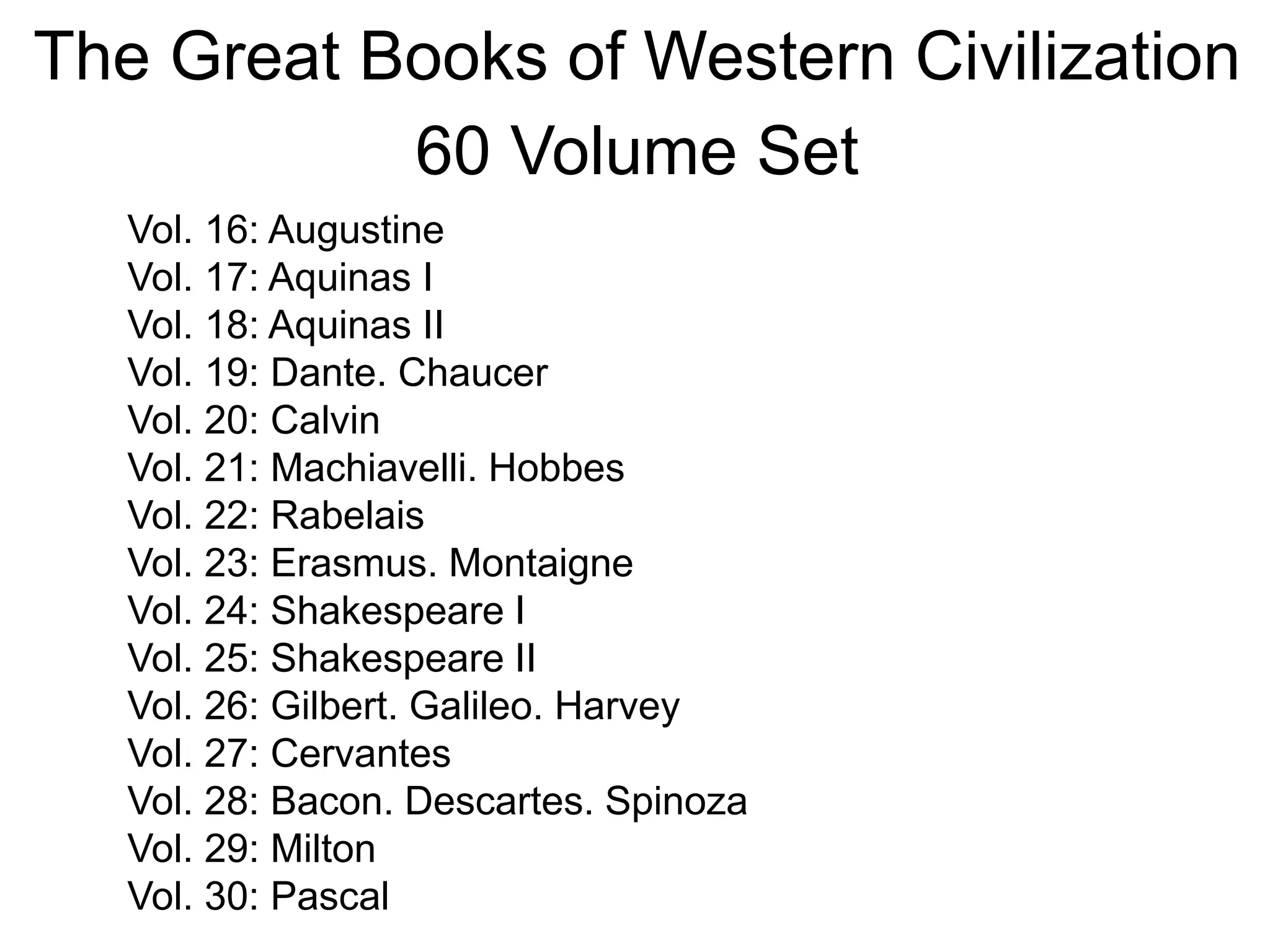
The Great Books of Western Civilization
60 Volume Set
Vol. 16: Augustine
Vol. 17: Aquinas I
Vol. 18: Aquinas II
Vol. 19: Dante. Chaucer
Vol. 20: Calvin
Vol. 21: Machiavelli. Hobbes
Vol. 22: Rabelais
Vol. 23: Erasmus. Montaigne
Vol. 24: Shakespeare I
Vol. 25: Shakespeare II
Vol. 26: Gilbert. Galileo. Harvey
Vol. 27: Cervantes
Vol. 28: Bacon. Descartes. Spinoza
Vol. 29: Milton
Vol. 30: Pascal
The Great Books of Western Civilization
60 Volume Set
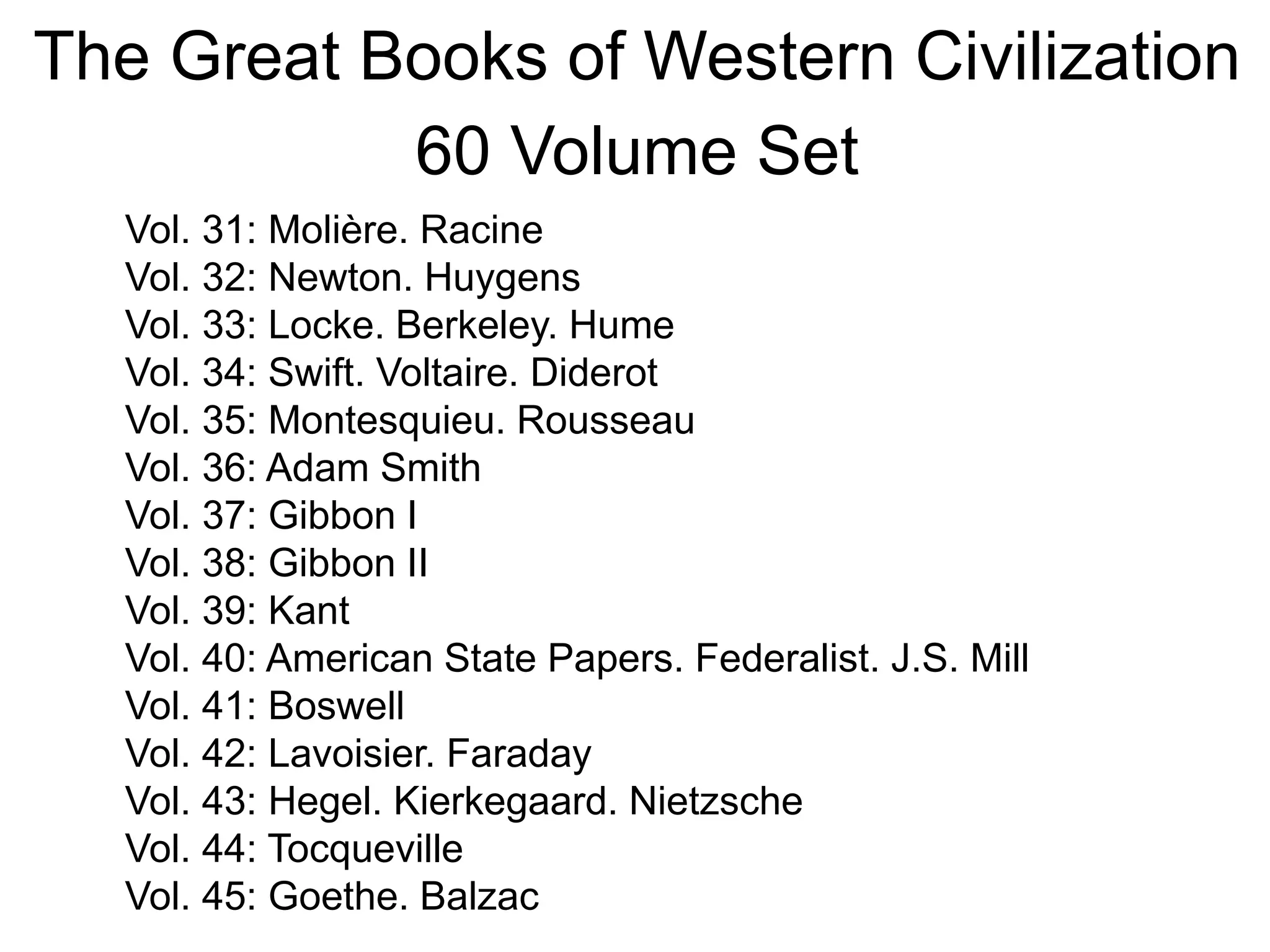
Vol. 31: Molière. Racine
Vol. 32: Newton. Huygens
Vol. 33: Locke. Berkeley. Hume
Vol. 34: Swift. Voltaire. Diderot
Vol. 35: Montesquieu. Rousseau
Vol. 36: Adam Smith
Vol. 37: Gibbon I
Vol. 38: Gibbon II
Vol. 39: Kant
Vol. 40: American State Papers. Federalist. J.S. Mill
Vol. 41: Boswell
Vol. 42: Lavoisier. Faraday
Vol. 43: Hegel. Kierkegaard. Nietzsche
Vol. 44: Tocqueville
Vol. 45: Goethe. Balzac
The Great Books of Western Civilization
60 Volume Set
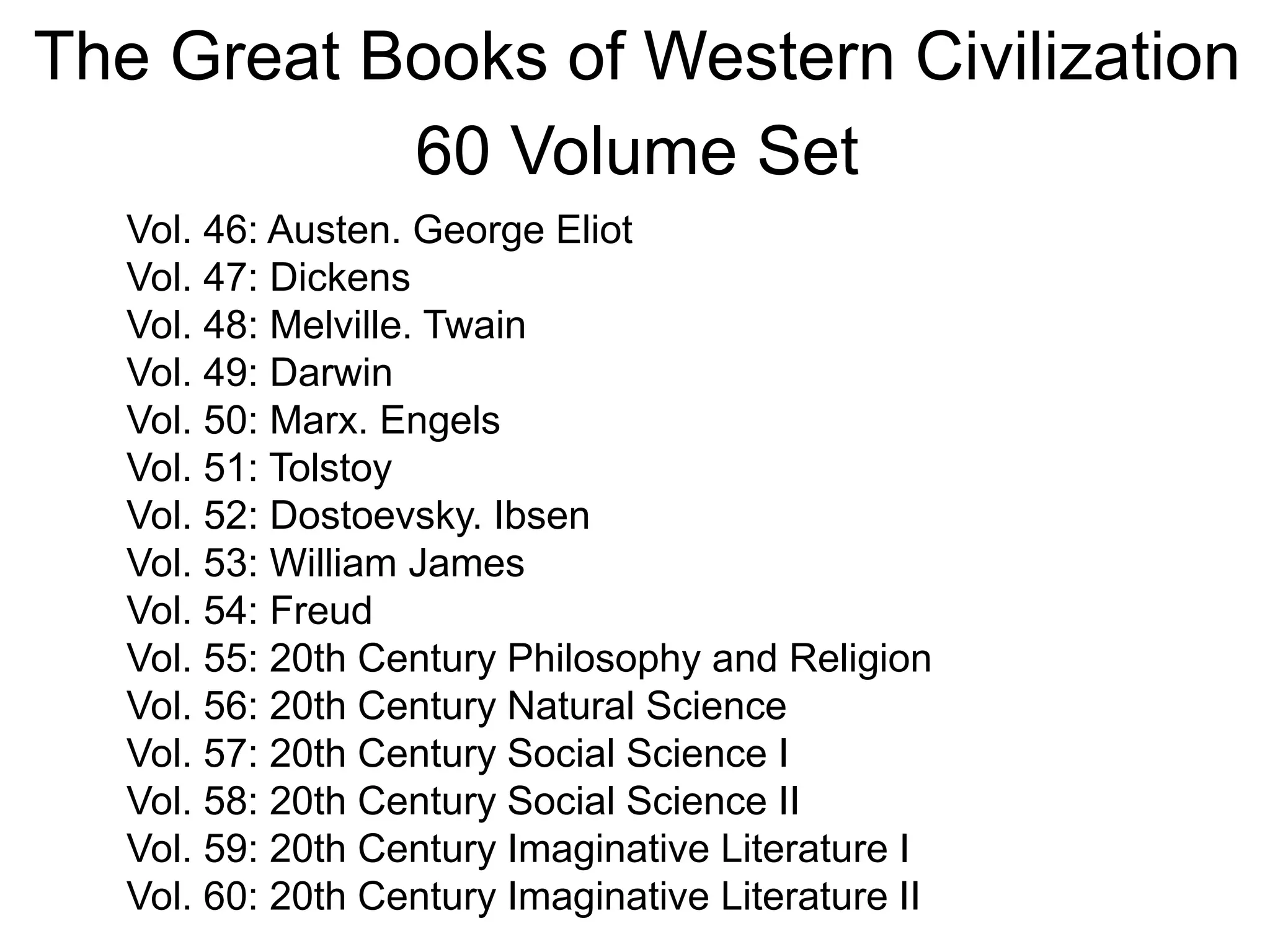
Vol. 46: Austen. George Eliot
Vol. 47: Dickens
Vol. 48: Melville. Twain
Vol. 49: Darwin
Vol. 50: Marx. Engels
Vol. 51: Tolstoy
Vol. 52: Dostoevsky. Ibsen
Vol. 53: William James
Vol. 54: Freud
Vol. 55: 20th Century Philosophy and Religion
Vol. 56: 20th Century Natural Science
Vol. 57: 20th Century Social Science I
Vol. 58: 20th Century Social Science II
Vol. 59: 20th Century Imaginative Literature I
Vol. 60: 20th Century Imaginative Literature II
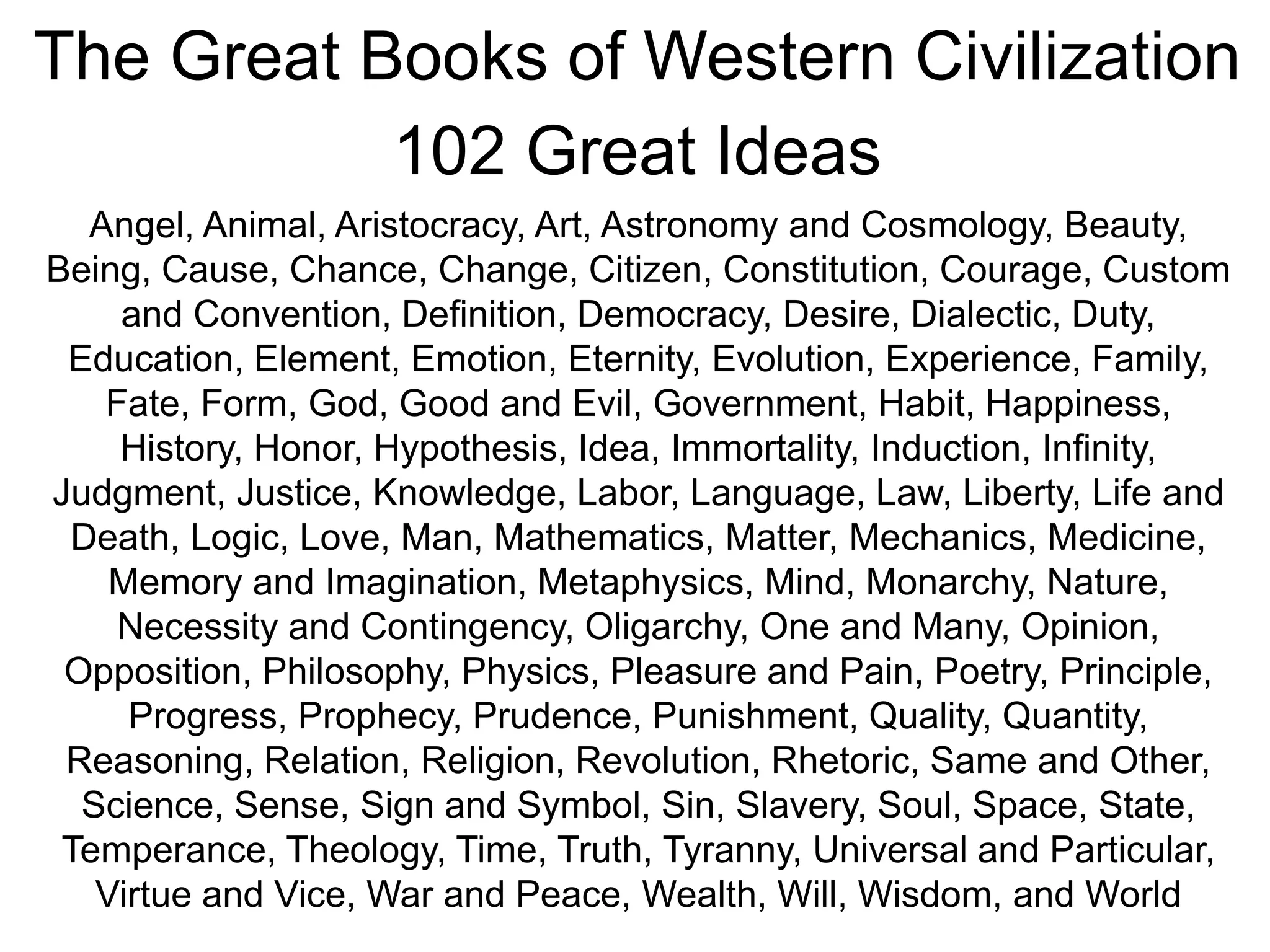
Angel, Animal, Aristocracy, Art, Astronomy and Cosmology, Beauty,
Being, Cause, Chance, Change, Citizen, Constitution, Courage, Custom
and Convention, Definition, Democracy, Desire, Dialectic, Duty,
Education, Element, Emotion, Eternity, Evolution, Experience, Family,
Fate, Form, God, Good and Evil, Government, Habit, Happiness,
History, Honor, Hypothesis, Idea, Immortality, Induction, Infinity,
Judgment, Justice, Knowledge, Labor, Language, Law, Liberty, Life and
Death, Logic, Love, Man, Mathematics, Matter, Mechanics, Medicine,
Memory and Imagination, Metaphysics, Mind, Monarchy, Nature,
Necessity and Contingency, Oligarchy, One and Many, Opinion,
Opposition, Philosophy, Physics, Pleasure and Pain, Poetry, Principle,
Progress, Prophecy, Prudence, Punishment, Quality, Quantity,
Reasoning, Relation, Religion, Revolution, Rhetoric, Same and Other,
Science, Sense, Sign and Symbol, Sin, Slavery, Soul, Space, State,
Temperance, Theology, Time, Truth, Tyranny, Universal and Particular,
Virtue and Vice, War and Peace, Wealth, Will, Wisdom, and World
The Great Books of Western Civilization
102 Great Ideas
The literary tradition with
Sign Language
All great endeavors must have a start.
Future generations will be blessed
because of what we do today.
by Stephen E Slevinski Jr
slevinski@signwriting.org
Organizing Principles
of Formal SignWriting

Organizing Principles of Formal SignWriting

  • 1.
    Organizing Principles of FormalSignWriting by Stephen E Slevinski Jr the Center for Sutton Movement Writing January 12 th , 2018
  • 2.
     Three propositionsserve as the foundation of Formal SignWriting development. 1) the importance of real literacy 2) the utility of formal structures 3) the benefits of living forward. Organizing Principles of Formal SignWriting
  • 3.
    1) The importanceof real literacy Literacy is the ability to read and write.
  • 4.
    How to Reada Book “This is a book for readers and for those who wish to become readers… it is for those whose main purpose in reading books is to gain increased understanding.” “By ‘readers’ we mean people who are still accustomed, as almost every literate and intelligent person used to be, to gain a large share of their information about and their understanding of the world from the written word. Not all of it, of course; even in the days before radio and television, a certain amount of information and understanding was acquired through the spoken word and through observation. But for intelligent and curious people that was never enough. They knew that they had to read…”
  • 5.
    How to Reada Book The first level of reading Elementary Reading The passing from nonliteracy to beginning literacy Recognize letters and words “What does the sentence say?”
  • 6.
    How to Reada Book The second level of reading Inspectional Reading Getting the most out of a book within a given time Systematic skimming and pre-reading “What is the book about?” “What is the structure of the book?” “What are its parts?”
  • 7.
    How to Reada Book The third level of reading Analytical Reading Getting the most out of a book without a time limit Thorough and complete reading that is intensely active: asking many organized questions Analytical reading is preeminently for the sake of understanding, not simply for information or entertainment.
  • 8.
    How to Reada Book The fourth level of reading Syntopical Reading Comparative reading of many books, placing them in relation to one another and to a subject about which they all revolve Construct an analysis of the subject that may not be in any of the books The most rewarding of all reading activities
  • 9.
    Writing the NaturalWay “The most intimate facet of learning is self-design, giving us a sense of identity in time and space. We are designers, active agents of thought and language, not passive receivers. The act of writing is one of the most intensely creative acts we can engage in.” “The creative process, then, is the ongoing oscillation between the mind’s ability to form a hazy big picture and then to sequence the details to clarify and ‘hold’ it, then to redesign, and to clarify further. This collaboration between the Sign and Design mind has led to stupendous human creative acts. Two brains are indeed better than one!”
  • 10.
    Writing the NaturalWay Sign Mind Design Mind Right Brain Connections Whole Patterns Complex images Nonliteral Left Brain Sequence Parts Logic Reason Critic
  • 11.
    Writing the NaturalWay Clustering: Accessing the Design Mind Clustering is a nonlinear brainstorming process akin to free association
  • 12.
    Writing the NaturalWay Mental Shift Start writing once you experience a sudden sense of what you are going to write about. We learn together and we play together. One at a time. Drop by drop. We discover language in a playful way, learning as we go. All together, merging into streams, merging into rivers. Until the world is covered with sign as an ocean of language. SignPuddle
  • 13.
    Writing Without Teachers “Themost effective way I know to improve your writing is to do free writing exercises regularly. At least three times a week. They are sometimes called ‘automatic writing’, ‘babbling’, or ‘jabbering’ exercises. The idea is simply to write for ten minutes (later on, perhaps fifteen or twenty).” “After you have done three or four exercises that are more or less ‘on’ what your subject turns out to be, you will have piles of rubble, you will will probably also have a lot of words, phrases, and sentences that seem important. Pick out these good bits. Strip away the rubble. Now use as much careful thought and editorial discrimination as possible in order to see what they add up to: decide how much you believe them, how true they are, in what senses they are true; arrange them somehow so they make sense, and write new and connecting parts when necessary.”
  • 14.
    Writing Without Teachers Productive Editorial Onlyat the end will you know what you want to say. Expect to end somewhere different from where you started. Write before you know your meaning. Never stop to look back or to cross out.
  • 15.
    2) The utilityof formal structures The visible shape of something. Formal Conventions Freeform Construction Formal Order Formal Language
  • 16.
    Formal Conventions The exactform of each symbol is structured, standardized, and highly featural. Valerie Sutton created a collection of visually iconic symbols that exists in a layered hierarchy This formal writing is called Block Printing. It is used in education, publishing, and is the basis of the computerized model. By contrast, handwriting can be used informally with fewer features and less detail. However, this can create notes that are sketchy compared to the clarity of formal Block Printing.
  • 17.
    Freeform Construction SignWriting isan unconventional script because it is not written sequentially. Rather than a string of letters, each sign is written as a 2-dimensional cluster of symbols. The freeform construction of the signs does not impose any rules or restrictions on the writer. Because of this, any sign of any sign language can be written in any style without limitation.
  • 18.
    Formal Order The 11thCentury Song Chinese developed the movable type printing press. Each piece of type contained a single character mostly equivalent to a word. Great block houses developed with hundreds of thousand of type pieces each. The Chinese logographic system is open-ended. New words require new type. Each house created their own specialized logograms. Organizing the numerous type pieces became a problem. It was easy to understand how to organize the basic type, but new logograms didn’t have a definite place within the established order. The practice developed to attach slips of paper to unusual logograms with a sequential list of more standard writing. This way, each piece of type was easy to organize and it was possible to learn the ordering for the new logograms.
  • 19.
    Formal Order SignWriting hasdeveloped a similar mechanism. Since we can not use a 2-dimensional sign spelling for sorting, we create a separate list of ordered symbols. The order of the symbols is subjective and based on a particular theory of sorting. The most productive is Valerie Sutton’s theory of the SignSpelling Sequence.
  • 20.
    Formal Language According toWikipedia, "In mathematics, computer science, and linguistics, a formal language is a set of strings of symbols that may be constrained by rules that are specific to it." Formal SignWriting defines a formal language for the signed languages of the world. Any sign of any sign language can be written as either a string of ASCII characters or a string of Unicode characters.
  • 21.
    Formal Language C ⊂L (G) * C = the corpus of international text * ⊂ = the subset of * L = the Formal SignWriting language * G = the formal grammar of Formal SignWriting G = (N,Σ,P,S) * N = the set of non-terminal tokens * Σ = the set of terminal tokens * P = the set of production rules * S = the start token N = {S,T,A,B} * S = start token * T = term * A = ordered prefix * B = signbox Σ = {a,b,l,m,r,w,s,p,n} * a = prefix marker * b = signbox marker * l = left lane marker * m = middle lane marker * r = right lane marker * w = writing symbol * s = sequential symbol * p = punctuation symbol * n = number token Word production rules * P1: S → T * P2: S → B * P3: S → p * P4: T → AB * P5: A → Aw * P6: A → As * P7: A → aw * P8: A → as * P9: B → Bwnn * P10: B → bnn * P11: B → lnn * P12: B → mnn * P13: B → rnn Sentence production rules * P14: S → ST * P15: S → SB * P16: S → Sp
  • 22.
    3) The benefitsof living forward Hindsight, validation, and hope Learn from the past Apply in the present Work towards the future
  • 23.
    Learn from thepast Model Echo Before the work, look into the past to see what was done before. After the work, look into the past to see where the same things were done.
  • 24.
    Apply in thepresent Empowerment Cooperation Provide information for others to apply and provide tools for others to use. Work with others to help them achieve their goals or something that neither could have achieved without the other.
  • 25.
    Works towards thefuture Progress Generations The works isn’t done yet, but we’re getting better all the time. The real goals and benefits will be achieved long after we are gone.
  • 26.
    The literary traditionin Western Civilization 3,000 years of reading and writing. A brief digression…
  • 27.
    The Great Booksof Western Civilization 60 Volume Set Vol. 1: The Syntopicon: An Index to the Great Ideas, vol. 1 Vol. 2: The Syntopicon: An Index to the Great Ideas, vol. 2 Vol. 3: Homer Vol. 4: Aeschylus. Sophocles. Euripides. Aristophanes Vol. 5: Herodotus. Thucydides Vol. 6: Plato Vol. 7: Aristotle I Vol. 8: Aristotle II Vol. 9: Hippocrates. Galen Vol. 10: Euclid. Archimedes. Nicomachus Vol. 11: Lucretius. Epictetus. Marcus Aurelius. Plotinus Vol. 12: Virgil Vol. 13: Plutarch Vol. 14: Tacitus Vol. 15: Ptolemy. Copernicus. Kepler
  • 28.
    The Great Booksof Western Civilization 60 Volume Set Vol. 16: Augustine Vol. 17: Aquinas I Vol. 18: Aquinas II Vol. 19: Dante. Chaucer Vol. 20: Calvin Vol. 21: Machiavelli. Hobbes Vol. 22: Rabelais Vol. 23: Erasmus. Montaigne Vol. 24: Shakespeare I Vol. 25: Shakespeare II Vol. 26: Gilbert. Galileo. Harvey Vol. 27: Cervantes Vol. 28: Bacon. Descartes. Spinoza Vol. 29: Milton Vol. 30: Pascal
  • 29.
    The Great Booksof Western Civilization 60 Volume Set Vol. 31: Molière. Racine Vol. 32: Newton. Huygens Vol. 33: Locke. Berkeley. Hume Vol. 34: Swift. Voltaire. Diderot Vol. 35: Montesquieu. Rousseau Vol. 36: Adam Smith Vol. 37: Gibbon I Vol. 38: Gibbon II Vol. 39: Kant Vol. 40: American State Papers. Federalist. J.S. Mill Vol. 41: Boswell Vol. 42: Lavoisier. Faraday Vol. 43: Hegel. Kierkegaard. Nietzsche Vol. 44: Tocqueville Vol. 45: Goethe. Balzac
  • 30.
    The Great Booksof Western Civilization 60 Volume Set Vol. 46: Austen. George Eliot Vol. 47: Dickens Vol. 48: Melville. Twain Vol. 49: Darwin Vol. 50: Marx. Engels Vol. 51: Tolstoy Vol. 52: Dostoevsky. Ibsen Vol. 53: William James Vol. 54: Freud Vol. 55: 20th Century Philosophy and Religion Vol. 56: 20th Century Natural Science Vol. 57: 20th Century Social Science I Vol. 58: 20th Century Social Science II Vol. 59: 20th Century Imaginative Literature I Vol. 60: 20th Century Imaginative Literature II
  • 31.
    Angel, Animal, Aristocracy,Art, Astronomy and Cosmology, Beauty, Being, Cause, Chance, Change, Citizen, Constitution, Courage, Custom and Convention, Definition, Democracy, Desire, Dialectic, Duty, Education, Element, Emotion, Eternity, Evolution, Experience, Family, Fate, Form, God, Good and Evil, Government, Habit, Happiness, History, Honor, Hypothesis, Idea, Immortality, Induction, Infinity, Judgment, Justice, Knowledge, Labor, Language, Law, Liberty, Life and Death, Logic, Love, Man, Mathematics, Matter, Mechanics, Medicine, Memory and Imagination, Metaphysics, Mind, Monarchy, Nature, Necessity and Contingency, Oligarchy, One and Many, Opinion, Opposition, Philosophy, Physics, Pleasure and Pain, Poetry, Principle, Progress, Prophecy, Prudence, Punishment, Quality, Quantity, Reasoning, Relation, Religion, Revolution, Rhetoric, Same and Other, Science, Sense, Sign and Symbol, Sin, Slavery, Soul, Space, State, Temperance, Theology, Time, Truth, Tyranny, Universal and Particular, Virtue and Vice, War and Peace, Wealth, Will, Wisdom, and World The Great Books of Western Civilization 102 Great Ideas
  • 32.
    The literary traditionwith Sign Language All great endeavors must have a start. Future generations will be blessed because of what we do today.
  • 33.
    by Stephen ESlevinski Jr slevinski@signwriting.org Organizing Principles of Formal SignWriting