Types of media
Members:
Zyra Jane Delicanog
Romart Laturnas
Warren Siglos
Direction: arrange the jumble litters.
1. Tripn demia
2. Doarbscast imdea
3. Viemo
4. Neterint
5. Oedvi maegs
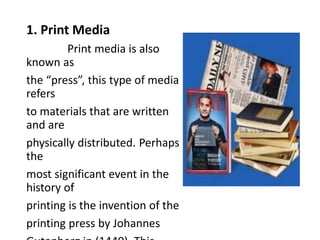
1. Print Media
Print media is also
known as
the “press”, this type of media
refers
to materials that are written
and are
physically distributed. Perhaps
the
most significant event in the
history of
printing is the invention of the
printing press by Johannes
Books are the very first mass media in human history.
Baran (2010)
consider books as very personal because they
contain records of past
experiences and human knowledge that are passed
on to later generations.
Books are movers and shakers of culture. As a
statement to this, books in
physical form are being stored digitally as e-books.
Magazines and newspapers may be targeted
for the general audience or may address the
interests of a particular group of readers.
Magazines typically contain features or human
interest articles, whereas newspapers will
definitely have news stories and occasionally
have other types of articles. Both the
magazine and the newspaper may also have
online versions for them to reach a wider and
larger audience who are more often virtually
connected through the Internet.
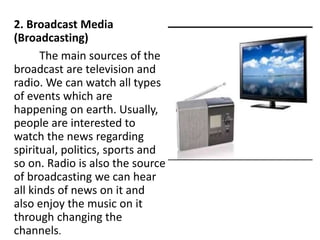
2. Broadcast Media
(Broadcasting)
The main sources of the
broadcast are television and
radio. We can watch all types
of events which are
happening on earth. Usually,
people are interested to
watch the news regarding
spiritual, politics, sports and
so on. Radio is also the source
of broadcasting we can hear
all kinds of news on it and
also enjoy the music on it
through changing the
channels.
Broadcast media is considered “household” media
because they be found in practically any corner of a
home. According to Baran (2010), radio was the first
electronic mass medium and precursor of television.
For a long time, radio was the “young people’s
media. “This first evident in the proliferation of FM
radio stations catering to the musical taste of
younger generations, also known as format radio. In
the Philippines, you customarily expect FM
programming to be format radio, whereas AM
programming is dominated by a news format.
3. Movies
(Film/Cinema)
It is one of the oldest
platforms of media and
people went to the
theaters to watch it
but know people can
watch movies at home
via safelight and cable
in HD resolution.
According to Wikipedia, a film is
created by photographing actual scenes with a
motion picture camera; by photographing
drawings or miniature models using traditional
animation; or by a combination of some or all
of these techniques and other visual effects. It is a
series of images, which when
displayed on screen, create an illusion of moving
images by the phi phenomenon.
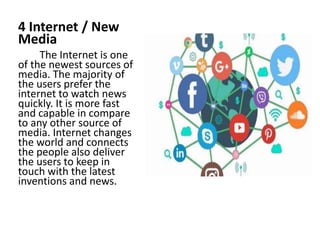
4 Internet / New
Media
The Internet is one
of the newest sources of
media. The majority of
the users prefer the
internet to watch news
quickly. It is more fast
and capable in compare
to any other source of
media. Internet changes
the world and connects
the people also deliver
the users to keep in
touch with the latest
inventions and news.
The Internet also gives you a chance to express your
ideas all over the globe.
The internet and social media provide young people
with a range of benefits, and opportunities to
empower themselves in a variety of ways. Young
people can maintain social connections and support
networks that otherwise wouldn't be possible, and
can access more information than ever before. The
communities and social interactions young people
form online can be invaluable for bolstering and
developing young people's self-confidence and social
skills
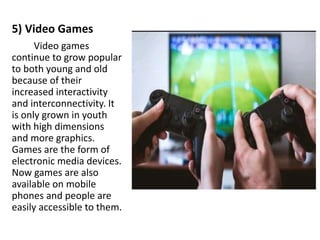
5) Video Games
Video games
continue to grow popular
to both young and old
because of their
increased interactivity
and interconnectivity. It
is only grown in youth
with high dimensions
and more graphics.
Games are the form of
electronic media devices.
Now games are also
available on mobile
phones and people are
easily accessible to them.
What is Media Convergence?
Converge means to meeting at a point, it is
synonymous to the words: join,
unite, interest, merge, connect, coincide. Media
Convergence happens when
different (two or more) media sources join together.
It allows media texts to be
produced and distributed on multiple media devices.
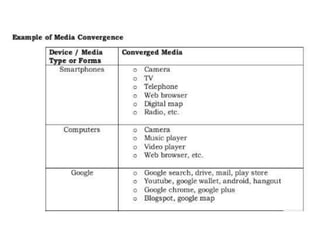
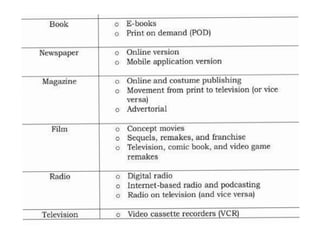
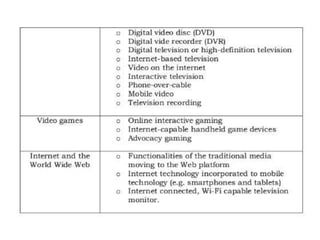
Media convergence is the ability to transform
different kinds of media into digital code, which
is then accessible by a range of devices. Media
convergence usually occurs in various platforms
such as:
1. Social Network
2. Learning Management System
3. Product Advertisement
4. News Agency
5. Multimedia Personality
Media convergence have a vital element of life for
many people. With the
development of technology in different platforms
and cooperation such as television,
Internet and mobile communication, audiences have
had both a bigger choice of
media and a life which media technologies has made
easier
CLASSIFICATION OF MEDIA
There are different ways to classify media.
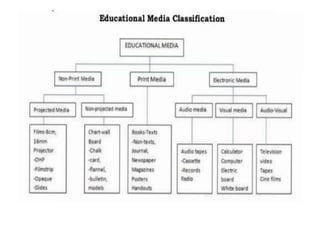
1. Print media, non-print media, electronic media
Print media. They include: books, journals,
magazines, newspapers, workbook, textbooks
Non-print media: they include: projected and
non-projected media
Electronic media: they include: Audio media,
Visual media and Audio-Visual
2. Projected media & non-projected media
Projected media: they require light source for
projection.
E.g. film projector slides etc.
Non-projected media: they do not require light
source.
They include 3 dimensional objects,
2dimensional objects,prints, charts, models etc
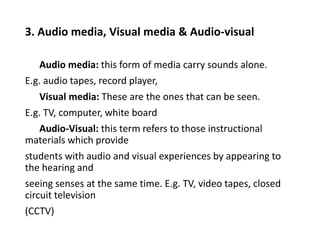
3. Audio media, Visual media & Audio-visual
Audio media: this form of media carry sounds alone.
E.g. audio tapes, record player,
Visual media: These are the ones that can be seen.
E.g. TV, computer, white board
Audio-Visual: this term refers to those instructional
materials which provide
students with audio and visual experiences by appearing to
the hearing and
seeing senses at the same time. E.g. TV, video tapes, closed
circuit television
(CCTV)
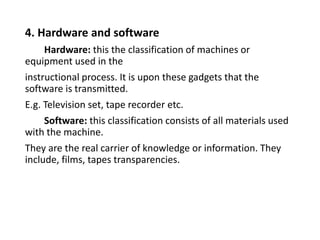
4. Hardware and software
Hardware: this the classification of machines or
equipment used in the
instructional process. It is upon these gadgets that the
software is transmitted.
E.g. Television set, tape recorder etc.
Software: this classification consists of all materials used
with the machine.
They are the real carrier of knowledge or information. They
include, films, tapes transparencies.
TYPES-OF-MEDIA-DELICANOG-SIGLOS-LATURNAS.pptx

TYPES-OF-MEDIA-DELICANOG-SIGLOS-LATURNAS.pptx

  • 1.
    Types of media Members: ZyraJane Delicanog Romart Laturnas Warren Siglos
  • 2.
    Direction: arrange thejumble litters. 1. Tripn demia 2. Doarbscast imdea 3. Viemo 4. Neterint 5. Oedvi maegs
  • 3.
    1. Print Media Printmedia is also known as the “press”, this type of media refers to materials that are written and are physically distributed. Perhaps the most significant event in the history of printing is the invention of the printing press by Johannes
  • 4.
    Books are thevery first mass media in human history. Baran (2010) consider books as very personal because they contain records of past experiences and human knowledge that are passed on to later generations. Books are movers and shakers of culture. As a statement to this, books in physical form are being stored digitally as e-books.
  • 5.
    Magazines and newspapersmay be targeted for the general audience or may address the interests of a particular group of readers. Magazines typically contain features or human interest articles, whereas newspapers will definitely have news stories and occasionally have other types of articles. Both the magazine and the newspaper may also have online versions for them to reach a wider and larger audience who are more often virtually connected through the Internet.
  • 6.
    2. Broadcast Media (Broadcasting) Themain sources of the broadcast are television and radio. We can watch all types of events which are happening on earth. Usually, people are interested to watch the news regarding spiritual, politics, sports and so on. Radio is also the source of broadcasting we can hear all kinds of news on it and also enjoy the music on it through changing the channels.
  • 7.
    Broadcast media isconsidered “household” media because they be found in practically any corner of a home. According to Baran (2010), radio was the first electronic mass medium and precursor of television. For a long time, radio was the “young people’s media. “This first evident in the proliferation of FM radio stations catering to the musical taste of younger generations, also known as format radio. In the Philippines, you customarily expect FM programming to be format radio, whereas AM programming is dominated by a news format.
  • 8.
    3. Movies (Film/Cinema) It isone of the oldest platforms of media and people went to the theaters to watch it but know people can watch movies at home via safelight and cable in HD resolution.
  • 9.
    According to Wikipedia,a film is created by photographing actual scenes with a motion picture camera; by photographing drawings or miniature models using traditional animation; or by a combination of some or all of these techniques and other visual effects. It is a series of images, which when displayed on screen, create an illusion of moving images by the phi phenomenon.
  • 10.
    4 Internet /New Media The Internet is one of the newest sources of media. The majority of the users prefer the internet to watch news quickly. It is more fast and capable in compare to any other source of media. Internet changes the world and connects the people also deliver the users to keep in touch with the latest inventions and news.
  • 11.
    The Internet alsogives you a chance to express your ideas all over the globe. The internet and social media provide young people with a range of benefits, and opportunities to empower themselves in a variety of ways. Young people can maintain social connections and support networks that otherwise wouldn't be possible, and can access more information than ever before. The communities and social interactions young people form online can be invaluable for bolstering and developing young people's self-confidence and social skills
  • 12.
    5) Video Games Videogames continue to grow popular to both young and old because of their increased interactivity and interconnectivity. It is only grown in youth with high dimensions and more graphics. Games are the form of electronic media devices. Now games are also available on mobile phones and people are easily accessible to them.
  • 13.
    What is MediaConvergence? Converge means to meeting at a point, it is synonymous to the words: join, unite, interest, merge, connect, coincide. Media Convergence happens when different (two or more) media sources join together. It allows media texts to be produced and distributed on multiple media devices.
  • 14.
    Media convergence isthe ability to transform different kinds of media into digital code, which is then accessible by a range of devices. Media convergence usually occurs in various platforms such as: 1. Social Network 2. Learning Management System 3. Product Advertisement 4. News Agency 5. Multimedia Personality
  • 18.
    Media convergence havea vital element of life for many people. With the development of technology in different platforms and cooperation such as television, Internet and mobile communication, audiences have had both a bigger choice of media and a life which media technologies has made easier
  • 19.
    CLASSIFICATION OF MEDIA Thereare different ways to classify media. 1. Print media, non-print media, electronic media Print media. They include: books, journals, magazines, newspapers, workbook, textbooks Non-print media: they include: projected and non-projected media Electronic media: they include: Audio media, Visual media and Audio-Visual
  • 20.
    2. Projected media& non-projected media Projected media: they require light source for projection. E.g. film projector slides etc. Non-projected media: they do not require light source. They include 3 dimensional objects, 2dimensional objects,prints, charts, models etc
  • 21.
    3. Audio media,Visual media & Audio-visual Audio media: this form of media carry sounds alone. E.g. audio tapes, record player, Visual media: These are the ones that can be seen. E.g. TV, computer, white board Audio-Visual: this term refers to those instructional materials which provide students with audio and visual experiences by appearing to the hearing and seeing senses at the same time. E.g. TV, video tapes, closed circuit television (CCTV)
  • 22.
    4. Hardware andsoftware Hardware: this the classification of machines or equipment used in the instructional process. It is upon these gadgets that the software is transmitted. E.g. Television set, tape recorder etc. Software: this classification consists of all materials used with the machine. They are the real carrier of knowledge or information. They include, films, tapes transparencies.