TABLET MANUFACTURING
PROCESS
TABLETS
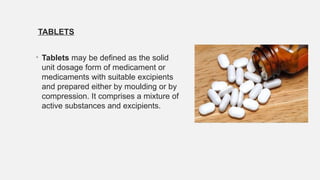
• Tablets may be defined as the solid
unit dosage form of medicament or
medicaments with suitable excipients
and prepared either by moulding or by
compression. It comprises a mixture of
active substances and excipients.
1. Compressed Tablets (CT)
2. Sugar Coated Tablets (SCT)
3. Film-Coated Tablets (FCT)
4. Enteric-Coated Tablets (ECT)
5. Multiple Compressed tablets
(MCT)
5.1 Layered Tablets,
5.2 Press-Coated Tablets
6. Controlled Release tablets.
TYPES OF TABLETS
7. Tablets for Solution /
Dispersible Tablets
8. Effervescent tablets
9. Compressed Suppositories or
inserts
10. Buccal and Sublingual Tablets.
11. Vaginal tablets...
12. Lozenges.
13. Implants.
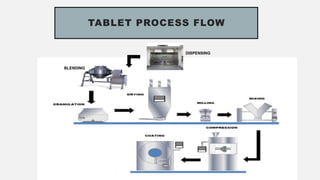
TABLET PROCESS FLOW
BLENDING
DISPENSING
GRANULATION
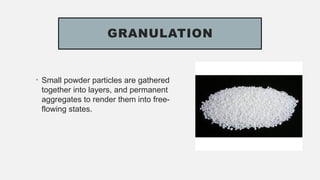
• Small powder particles are gathered
together into layers, and permanent
aggregates to render them into free-
flowing states.
GRANULATION METHODS
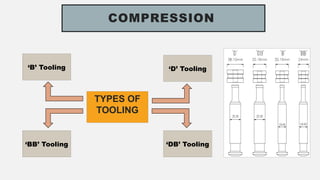
COMPRESSION
TYPES OF
TOOLING
‘B’ Tooling ‘D’ Tooling
‘BB’ Tooling ‘DB’ Tooling
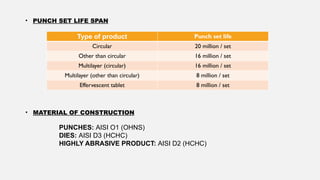
Type of product Punch set life
Circular 20 million / set
Other than circular 16 million / set
Multilayer (circular) 16 million / set
Multilayer (other than circular) 8 million / set
Effervescent tablet 8 million / set
• PUNCH SET LIFE SPAN
• MATERIAL OF CONSTRUCTION
PUNCHES: AISI O1 (OHNS)
DIES: AISI D3 (HCHC)
HIGHLY ABRASIVE PRODUCT: AISI D2 (HCHC)
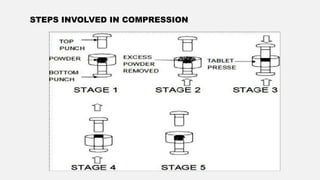
STEPS INVOLVED IN COMPRESSION
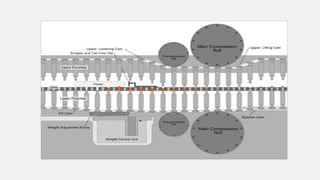
• PARTS OF A ROTARY PRESS
1. Hopper
2. Feeder system
3. Punches
4. Die system
5. Turret
6. Cam Tracks
7. Fill Cam and Dose Cam
8. Compression Rollers
9. Ejection Cam
10.Discharge Chute
Evaluation tests for Tablets
1. Appearance, Height, Length, and Width.
2. Weight variation test
3. Hardness test
4. Friability test
5. Dissolution test
6. Disintegration test
COATING
WHY coating is required
1. To mask taste, odour and appearance.
2. Protect drug from gastric environment.
3. Provide physical and chemical protection.
4. To avoid incompatibilities between drugs.
5. Improve pharmaceutical elegance.
TYPES OF COATING
SUGAR COATING
FILM COATING
ENTERIC COATING
Conventional Pan Coaters Modern Coating Pan
FLUIDIZED BED WRUSTER COATING PROCESS
ORAL SOLID DOSAGE TABLET MANUFACTURING PROCESS.pptx

ORAL SOLID DOSAGE TABLET MANUFACTURING PROCESS.pptx

  • 1.
  • 2.
    TABLETS • Tablets maybe defined as the solid unit dosage form of medicament or medicaments with suitable excipients and prepared either by moulding or by compression. It comprises a mixture of active substances and excipients.
  • 3.
    1. Compressed Tablets(CT) 2. Sugar Coated Tablets (SCT) 3. Film-Coated Tablets (FCT) 4. Enteric-Coated Tablets (ECT) 5. Multiple Compressed tablets (MCT) 5.1 Layered Tablets, 5.2 Press-Coated Tablets 6. Controlled Release tablets. TYPES OF TABLETS 7. Tablets for Solution / Dispersible Tablets 8. Effervescent tablets 9. Compressed Suppositories or inserts 10. Buccal and Sublingual Tablets. 11. Vaginal tablets... 12. Lozenges. 13. Implants.
  • 4.
  • 5.
    GRANULATION • Small powderparticles are gathered together into layers, and permanent aggregates to render them into free- flowing states.
  • 6.
  • 7.
    COMPRESSION TYPES OF TOOLING ‘B’ Tooling‘D’ Tooling ‘BB’ Tooling ‘DB’ Tooling
  • 8.
    Type of productPunch set life Circular 20 million / set Other than circular 16 million / set Multilayer (circular) 16 million / set Multilayer (other than circular) 8 million / set Effervescent tablet 8 million / set • PUNCH SET LIFE SPAN • MATERIAL OF CONSTRUCTION PUNCHES: AISI O1 (OHNS) DIES: AISI D3 (HCHC) HIGHLY ABRASIVE PRODUCT: AISI D2 (HCHC)
  • 9.
    STEPS INVOLVED INCOMPRESSION
  • 10.
    • PARTS OFA ROTARY PRESS 1. Hopper 2. Feeder system 3. Punches 4. Die system 5. Turret 6. Cam Tracks 7. Fill Cam and Dose Cam 8. Compression Rollers 9. Ejection Cam 10.Discharge Chute
  • 12.
    Evaluation tests forTablets 1. Appearance, Height, Length, and Width. 2. Weight variation test 3. Hardness test 4. Friability test 5. Dissolution test 6. Disintegration test
  • 13.
    COATING WHY coating isrequired 1. To mask taste, odour and appearance. 2. Protect drug from gastric environment. 3. Provide physical and chemical protection. 4. To avoid incompatibilities between drugs. 5. Improve pharmaceutical elegance.
  • 14.
    TYPES OF COATING SUGARCOATING FILM COATING ENTERIC COATING
  • 15.
    Conventional Pan CoatersModern Coating Pan
  • 16.
    FLUIDIZED BED WRUSTERCOATING PROCESS