Presented by
GROUP 2
Introduction
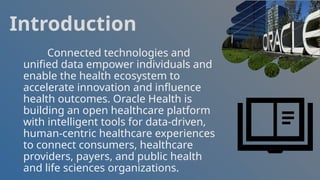
Connected technologies and
unified data empower individuals and
enable the health ecosystem to
accelerate innovation and influence
health outcomes. Oracle Health is
building an open healthcare platform
with intelligent tools for data-driven,
human-centric healthcare experiences
to connect consumers, healthcare
providers, payers, and public health
and life sciences organizations.
How
Oracl
e
Healt
h
With the largest global EHR market share, it is
able to bring data together to enable
clinicians, patients, and researchers to take
meaningful action, advance health, and work
to improve outcomes worldwide.
Improve Health Globally
Rated the largest revenue cycle management
(RCM) leader by IDC Market Scape, it provides
timely, predictive, and actionable health
insights to automate processes, optimize
resources, and drive efficiencies.
Streamline Operations
Accelerate innovation, benefit from flexible
infrastructure and platform resources, and
drive clinical intelligence through its open,
extensible ecosystem of partners and
technologies.
Unleash Innovation
Oracle Health Services
Service Lines and Departments
Organize care delivery around service
lines to help drive revenue, improve
quality, and reduce costs. Their service
lines and departments portfolio of clinical
solutions can help you provide knowledge-
driven care—informed by electronic
patient health records and unique
workflows that support service lines and
departments throughout the care
continuum.
C
L
I
N
I
C
A
L
A
P
P
L
I
C
A
T
I
O
N
S
Clinical Suite
Helps improve the quality of care and the
patient experience while enhancing
clinical and operational efficiency with
Oracle Health’s clinical suite. Their
solutions help care teams across the
continuum document and access critical
patient data, refine workflows, and
support patient safety initiatives.
Clinical Suite
Helps improve the quality of care and the
patient experience while enhancing
clinical and operational efficiency with
Oracle Health’s clinical suite. Their
solutions help care teams across the
continuum document and access critical
patient data, refine workflows, and
support patient safety initiatives.
Service Lines and Departments
Organize care delivery around service
lines to help drive revenue, improve
quality, and reduce costs. Their service
lines and departments portfolio of clinical
solutions can help you provide knowledge-
driven care—informed by electronic
patient health records and unique
workflows that support service lines and
departments throughout the care
continuum.
C
L
I
N
I
C
A
L
A
P
P
L
I
C
A
T
I
O
N
S
Continuum of Career
Helps patients achieve the best possible
health outcomes by coordinating, managing,
and delivering high-quality care across the
continuum—from rehabilitation, home
health, and long-term care to behavioral
health. Oracle Health’s continuum of care
solutions help clinicians find the right venue
for patients to get the continued care they
need while enabling the exchange of
information during transitions of care.
Interoperability
Facilitate the flow of patient data across
provider, vendor, geographical, and
technological boundaries with
interoperable systems. Provide
practitioners with access to a holistic view
of each patient’s record—and with it, the
potential to coordinate care across health
systems, make more-informed care
decisions, and gain operational
efficiencies.
C
L
I
N
I
C
A
L
A
P
P
L
I
C
A
T
I
O
N
S
Interoperability
Facilitate the flow of patient data across
provider, vendor, geographical, and
technological boundaries with
interoperable systems. Provide
practitioners with access to a holistic view
of each patient’s record—and with it, the
potential to coordinate care across health
systems, make more-informed care
decisions, and gain operational
efficiencies.
C
L
I
N
I
C
A
L
A
P
P
L
I
C
A
T
I
O
N
S
Continuum of Career
Helps patients achieve the best possible
health outcomes by coordinating, managing,
and delivering high-quality care across the
continuum—from rehabilitation, home
health, and long-term care to behavioral
health. Oracle Health’s continuum of care
solutions help clinicians find the right venue
for patients to get the continued care they
need while enabling the exchange of
information during transitions of care.
C
L
I
N
I
C
A
L
A
N
D
Clinical Operations
Transform clinical operations by
empowering clinicians with real-time
health system tools and techniques that
help them overcome today’s challenges
and provide high-quality care. A real-time
health system strategy helps organization
achieve predictable excellence in clinical,
operational, and financial outcomes by
using near real-time data from many
sources.
F
I
N
A
N
C
I
A
L
O
P
E
R
A
T
I
O
N
S
C
L
I
N
I
C
A
L
A
N
D
Revenue Cycle
Clinically driven and patient-focused
—that’s the foundation of Oracle
Health’s revenue cycle management
solutions. A clinically driven revenue
cycle takes information captured by
clinicians during care and uses it to
drive financial outcomes.
F
I
N
A
N
C
I
A
L
O
P
E
R
A
T
I
O
N
S
C
L
I
N
I
C
A
L
A
N
D
F
I
N
A
N
C
I
A
L
O
P
E
R
A
T
I
O
N
S
Reporting and analytics
Transform organization’s data into
usable, actionable information with
Oracle’s healthcare analytics
solutions. Realize the true value of
the data by helping executives,
clinicians, analysts, and staff spend
less time searching for and preparing
data and more time acting on it.
HOW
HEALTH CAN
HELP BUSINESS
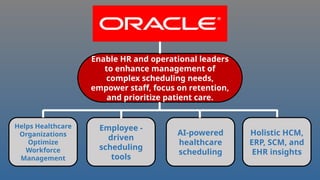
Enable HR and operational leaders
to enhance management of
complex scheduling needs,
empower staff, focus on retention,
and prioritize patient care.
Helps Healthcare
Organizations
Optimize
Workforce
Management
Holistic HCM,
ERP, SCM, and
EHR insights
AI-powered
healthcare
scheduling
Employee -
driven
scheduling
tools
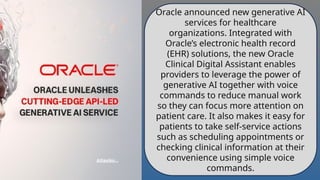
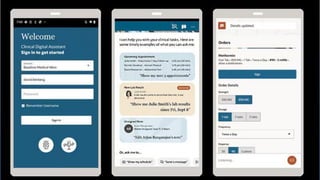
Oracle announced new generative AI
services for healthcare
organizations. Integrated with
Oracle’s electronic health record
(EHR) solutions, the new Oracle
Clinical Digital Assistant enables
providers to leverage the power of
generative AI together with voice
commands to reduce manual work
so they can focus more attention on
patient care. It also makes it easy for
patients to take self-service actions
such as scheduling appointments or
checking clinical information at their
convenience using simple voice
commands.
Clinical Digital Assistant
While EHRs have helped reduce errors and enhance the
continuum of care, patients are often left feeling
disconnected, unheard, and unsatisfied when a provider
spends the majority of the appointment staring at a screen.
The generative AI-powered Oracle Clinical Digital Assistant
alleviates this issue to enable physicians to give their full
attention to patients while dramatically simplifying
administrative tasks. The multimodal voice and screen-based
assistant participates in the appointment using generative AI
to automate note taking and to propose context-aware next
actions, such as ordering medication or scheduling labs and
follow-up appointments.
The Oracle Clinical Digital Assistant also responds to
conversational voice commands from providers who
can ask questions such as ‘show me the patient’s
latest MRI results,’ to look up elements of a patient’s
EHR record during an appointment. The information
and images are then delivered in a relevant order that
helps the physician gain insight into the appropriate
treatment path without requiring a multi-menu, multi-
step interaction with the EHR. The new solution will be
available in the next 12 months.
Patient self-service capabilities
New capabilities in the Oracle Digital Assistant
Platform also enable patients to take more control
over their healthcare. Patients can take self-service
actions that range from using voice commands to
schedule an appointment or pay a bill to getting
generative AI-driven answers to questions such as,
‘what happens during a colonoscopy?’
Providers can also deliver helpful information to
patients via web chat embedded in their secure
patient portal, such as a reminder to bring required
lab results to an upcoming visit. With these
interactions, healthcare providers can advance patient
retention with better engagement while significantly
reducing revenue loss by avoiding common issues,
such as missed appointments. These capabilities are
available today.
OVERVIEW
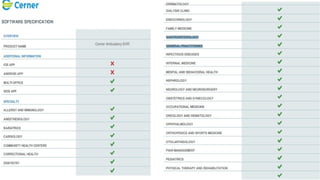
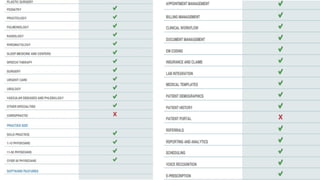
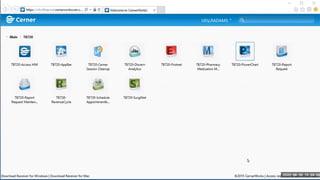
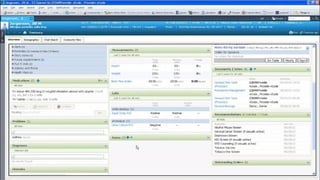
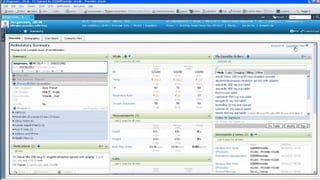
Cerner EHR is built for and designed by physicians to
provide practices of sizes with fully functional medical
software across specialties. Cerner’s Ambulatory
solution allows physicians and practice staff to access
patient information and perform workflows on
mobile and tablet devices and supports voice
dictation. All the workflows in Cerner EHR are
customizable and support more than 55 different
medical specialties.
OVERVIEW
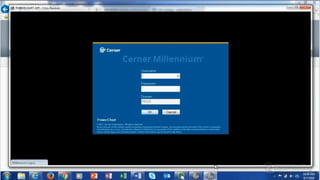
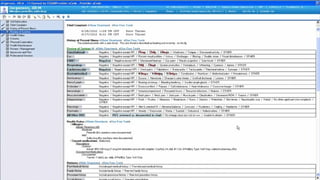
The Cerner charting system uses a “Chart Search”
function that reduces time spent seeking information.
Boasting a user-friendly dashboard, Cerner Ambulatory
EHR provides secure access to patient records.
Ambulatory includes ePrescribe, nCode, electronic lab
requisition, and results analysis which are designed to
save time when making a diagnosis and reduce the
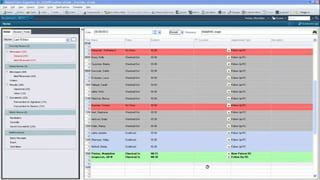
possibility of human error. The Cerner scheduling system
is designed with administrative staff and patients in mind
to be as user friendly as possible.
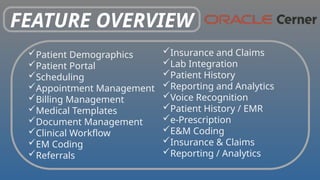
FEATURE OVERVIEW
Patient Demographics
Patient Portal
Scheduling
Appointment Management
Billing Management
Medical Templates
Document Management
Clinical Workflow
EM Coding
Referrals
Insurance and Claims
Lab Integration
Patient History
Reporting and Analytics
Voice Recognition
Patient History / EMR
e-Prescription
E&M Coding
Insurance & Claims
Reporting / Analytics
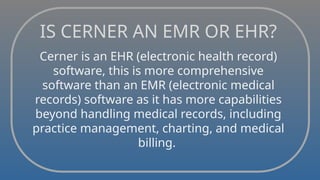
IS CERNER AN EMR OR EHR?
Cerner is an EHR (electronic health record)
software, this is more comprehensive
software than an EMR (electronic medical
records) software as it has more capabilities
beyond handling medical records, including
practice management, charting, and medical
billing.
Oracle Cerner powerpoint presentation xd

Oracle Cerner powerpoint presentation xd

  • 1.
  • 2.
    Introduction Connected technologies and unifieddata empower individuals and enable the health ecosystem to accelerate innovation and influence health outcomes. Oracle Health is building an open healthcare platform with intelligent tools for data-driven, human-centric healthcare experiences to connect consumers, healthcare providers, payers, and public health and life sciences organizations.
  • 3.
  • 4.
    With the largestglobal EHR market share, it is able to bring data together to enable clinicians, patients, and researchers to take meaningful action, advance health, and work to improve outcomes worldwide. Improve Health Globally
  • 5.
    Rated the largestrevenue cycle management (RCM) leader by IDC Market Scape, it provides timely, predictive, and actionable health insights to automate processes, optimize resources, and drive efficiencies. Streamline Operations
  • 6.
    Accelerate innovation, benefitfrom flexible infrastructure and platform resources, and drive clinical intelligence through its open, extensible ecosystem of partners and technologies. Unleash Innovation
  • 7.
  • 8.
    Service Lines andDepartments Organize care delivery around service lines to help drive revenue, improve quality, and reduce costs. Their service lines and departments portfolio of clinical solutions can help you provide knowledge- driven care—informed by electronic patient health records and unique workflows that support service lines and departments throughout the care continuum. C L I N I C A L A P P L I C A T I O N S Clinical Suite Helps improve the quality of care and the patient experience while enhancing clinical and operational efficiency with Oracle Health’s clinical suite. Their solutions help care teams across the continuum document and access critical patient data, refine workflows, and support patient safety initiatives.
  • 9.
    Clinical Suite Helps improvethe quality of care and the patient experience while enhancing clinical and operational efficiency with Oracle Health’s clinical suite. Their solutions help care teams across the continuum document and access critical patient data, refine workflows, and support patient safety initiatives. Service Lines and Departments Organize care delivery around service lines to help drive revenue, improve quality, and reduce costs. Their service lines and departments portfolio of clinical solutions can help you provide knowledge- driven care—informed by electronic patient health records and unique workflows that support service lines and departments throughout the care continuum. C L I N I C A L A P P L I C A T I O N S
  • 10.
    Continuum of Career Helpspatients achieve the best possible health outcomes by coordinating, managing, and delivering high-quality care across the continuum—from rehabilitation, home health, and long-term care to behavioral health. Oracle Health’s continuum of care solutions help clinicians find the right venue for patients to get the continued care they need while enabling the exchange of information during transitions of care. Interoperability Facilitate the flow of patient data across provider, vendor, geographical, and technological boundaries with interoperable systems. Provide practitioners with access to a holistic view of each patient’s record—and with it, the potential to coordinate care across health systems, make more-informed care decisions, and gain operational efficiencies. C L I N I C A L A P P L I C A T I O N S
  • 11.
    Interoperability Facilitate the flowof patient data across provider, vendor, geographical, and technological boundaries with interoperable systems. Provide practitioners with access to a holistic view of each patient’s record—and with it, the potential to coordinate care across health systems, make more-informed care decisions, and gain operational efficiencies. C L I N I C A L A P P L I C A T I O N S Continuum of Career Helps patients achieve the best possible health outcomes by coordinating, managing, and delivering high-quality care across the continuum—from rehabilitation, home health, and long-term care to behavioral health. Oracle Health’s continuum of care solutions help clinicians find the right venue for patients to get the continued care they need while enabling the exchange of information during transitions of care.
  • 12.
    C L I N I C A L A N D Clinical Operations Transform clinicaloperations by empowering clinicians with real-time health system tools and techniques that help them overcome today’s challenges and provide high-quality care. A real-time health system strategy helps organization achieve predictable excellence in clinical, operational, and financial outcomes by using near real-time data from many sources. F I N A N C I A L O P E R A T I O N S
  • 13.
    C L I N I C A L A N D Revenue Cycle Clinically drivenand patient-focused —that’s the foundation of Oracle Health’s revenue cycle management solutions. A clinically driven revenue cycle takes information captured by clinicians during care and uses it to drive financial outcomes. F I N A N C I A L O P E R A T I O N S
  • 14.
    C L I N I C A L A N D F I N A N C I A L O P E R A T I O N S Reporting and analytics Transformorganization’s data into usable, actionable information with Oracle’s healthcare analytics solutions. Realize the true value of the data by helping executives, clinicians, analysts, and staff spend less time searching for and preparing data and more time acting on it.
  • 15.
  • 16.
    Enable HR andoperational leaders to enhance management of complex scheduling needs, empower staff, focus on retention, and prioritize patient care. Helps Healthcare Organizations Optimize Workforce Management Holistic HCM, ERP, SCM, and EHR insights AI-powered healthcare scheduling Employee - driven scheduling tools
  • 18.
    Oracle announced newgenerative AI services for healthcare organizations. Integrated with Oracle’s electronic health record (EHR) solutions, the new Oracle Clinical Digital Assistant enables providers to leverage the power of generative AI together with voice commands to reduce manual work so they can focus more attention on patient care. It also makes it easy for patients to take self-service actions such as scheduling appointments or checking clinical information at their convenience using simple voice commands.
  • 22.
    Clinical Digital Assistant WhileEHRs have helped reduce errors and enhance the continuum of care, patients are often left feeling disconnected, unheard, and unsatisfied when a provider spends the majority of the appointment staring at a screen. The generative AI-powered Oracle Clinical Digital Assistant alleviates this issue to enable physicians to give their full attention to patients while dramatically simplifying administrative tasks. The multimodal voice and screen-based assistant participates in the appointment using generative AI to automate note taking and to propose context-aware next actions, such as ordering medication or scheduling labs and follow-up appointments.
  • 23.
    The Oracle ClinicalDigital Assistant also responds to conversational voice commands from providers who can ask questions such as ‘show me the patient’s latest MRI results,’ to look up elements of a patient’s EHR record during an appointment. The information and images are then delivered in a relevant order that helps the physician gain insight into the appropriate treatment path without requiring a multi-menu, multi- step interaction with the EHR. The new solution will be available in the next 12 months.
  • 24.
    Patient self-service capabilities Newcapabilities in the Oracle Digital Assistant Platform also enable patients to take more control over their healthcare. Patients can take self-service actions that range from using voice commands to schedule an appointment or pay a bill to getting generative AI-driven answers to questions such as, ‘what happens during a colonoscopy?’
  • 25.
    Providers can alsodeliver helpful information to patients via web chat embedded in their secure patient portal, such as a reminder to bring required lab results to an upcoming visit. With these interactions, healthcare providers can advance patient retention with better engagement while significantly reducing revenue loss by avoiding common issues, such as missed appointments. These capabilities are available today.
  • 27.
    OVERVIEW Cerner EHR isbuilt for and designed by physicians to provide practices of sizes with fully functional medical software across specialties. Cerner’s Ambulatory solution allows physicians and practice staff to access patient information and perform workflows on mobile and tablet devices and supports voice dictation. All the workflows in Cerner EHR are customizable and support more than 55 different medical specialties.
  • 28.
    OVERVIEW The Cerner chartingsystem uses a “Chart Search” function that reduces time spent seeking information. Boasting a user-friendly dashboard, Cerner Ambulatory EHR provides secure access to patient records. Ambulatory includes ePrescribe, nCode, electronic lab requisition, and results analysis which are designed to save time when making a diagnosis and reduce the possibility of human error. The Cerner scheduling system is designed with administrative staff and patients in mind to be as user friendly as possible.
  • 29.
    FEATURE OVERVIEW Patient Demographics PatientPortal Scheduling Appointment Management Billing Management Medical Templates Document Management Clinical Workflow EM Coding Referrals Insurance and Claims Lab Integration Patient History Reporting and Analytics Voice Recognition Patient History / EMR e-Prescription E&M Coding Insurance & Claims Reporting / Analytics
  • 30.
    IS CERNER ANEMR OR EHR? Cerner is an EHR (electronic health record) software, this is more comprehensive software than an EMR (electronic medical records) software as it has more capabilities beyond handling medical records, including practice management, charting, and medical billing.