OPM OverviewOPM Overview
Daniel Garijo
Using as reference:
http://openprovenance.org/tutorial
Background
• OPM is the outcome of the Provenance
Challenge Series
• Specification Requirements• Specification Requirements
▫ Define the model in a precise, technologic agnostic
manner.
• Specificiation Non requirements
▫ OPM does not specify the internal representations
that systems have to adopt to store and
manipulate provenance internally.
• Based on a causal graph.
Nodes
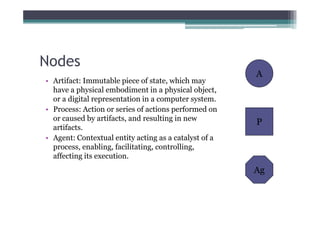
• Artifact: Immutable piece of state, which may
have a physical embodiment in a physical object,
or a digital representation in a computer system.
• Process: Action or series of actions performed on
A
• Process: Action or series of actions performed on
or caused by artifacts, and resulting in new
artifacts.
• Agent: Contextual entity acting as a catalyst of a
process, enabling, facilitating, controlling,
affecting its execution.
P
Ag
Edges
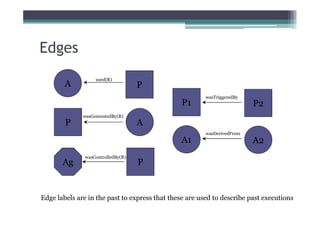
P1 P2
wasTriggeredBy
A P
used(R)
A1 A2
wasDerivedFrom
AP
wasGeneratedBy(R)
Ag P
wasControlledBy(R)
Edge labels are in the past to express that these are used to describe past executions
Accounts
• Mechanism by which multiple descriptions of a
same execution can co-exist in a same OPM graph
• Different accounts may be provided by different• Different accounts may be provided by different
observers (or asserters)
• Accounts can overlap if they have some OPM
subgraph in common
• An account can be a refinement of another, if it
provides more details
▫ Support for hierarchical descriptions
• Accounts may be conflicting!
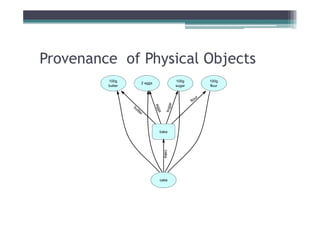
Provenance of Physical Objects
Another Account of a same Execution
Valid OPM Graphs
• WasDerivedFrom* is acyclic within one account
▫ Intuition: a data item cannot be derived from itself
▫ Note: cycles may exist in multiple accounts▫ Note: cycles may exist in multiple accounts
• An artifact can be generated by at most one
process in a given account
Concept of a Profile
• A specialisation of an OPM graph for a specific
domain or to handle a specific problem
• Note: profile multiplicity challenges inter-• Note: profile multiplicity challenges inter-
operability
• A profile has a unique identity
• Defines vocabulary, guidelines, expansion
guidance, serialisation format
OWL Ontology for OPM (OPMO)
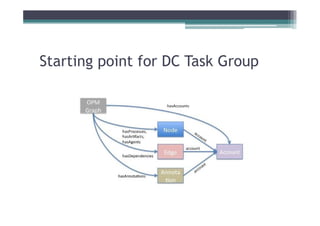
Starting point for DC Task Group
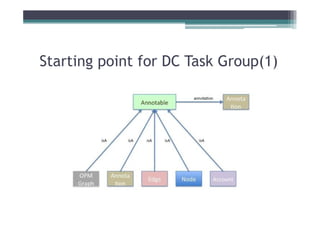
Starting point for DC Task Group(1)
References
• FIS 2010 Tutorial of OPM:
http://openprovenance.org/tutorial
• OPM Ontology:• OPM Ontology:
http://openprovenance.org/model/opmo

OPM Overview

  • 1.
    OPM OverviewOPM Overview DanielGarijo Using as reference: http://openprovenance.org/tutorial
  • 2.
    Background • OPM isthe outcome of the Provenance Challenge Series • Specification Requirements• Specification Requirements ▫ Define the model in a precise, technologic agnostic manner. • Specificiation Non requirements ▫ OPM does not specify the internal representations that systems have to adopt to store and manipulate provenance internally. • Based on a causal graph.
  • 3.
    Nodes • Artifact: Immutablepiece of state, which may have a physical embodiment in a physical object, or a digital representation in a computer system. • Process: Action or series of actions performed on A • Process: Action or series of actions performed on or caused by artifacts, and resulting in new artifacts. • Agent: Contextual entity acting as a catalyst of a process, enabling, facilitating, controlling, affecting its execution. P Ag
  • 4.
    Edges P1 P2 wasTriggeredBy A P used(R) A1A2 wasDerivedFrom AP wasGeneratedBy(R) Ag P wasControlledBy(R) Edge labels are in the past to express that these are used to describe past executions
  • 5.
    Accounts • Mechanism bywhich multiple descriptions of a same execution can co-exist in a same OPM graph • Different accounts may be provided by different• Different accounts may be provided by different observers (or asserters) • Accounts can overlap if they have some OPM subgraph in common • An account can be a refinement of another, if it provides more details ▫ Support for hierarchical descriptions • Accounts may be conflicting!
  • 6.
  • 7.
    Another Account ofa same Execution
  • 8.
    Valid OPM Graphs •WasDerivedFrom* is acyclic within one account ▫ Intuition: a data item cannot be derived from itself ▫ Note: cycles may exist in multiple accounts▫ Note: cycles may exist in multiple accounts • An artifact can be generated by at most one process in a given account
  • 9.
    Concept of aProfile • A specialisation of an OPM graph for a specific domain or to handle a specific problem • Note: profile multiplicity challenges inter-• Note: profile multiplicity challenges inter- operability • A profile has a unique identity • Defines vocabulary, guidelines, expansion guidance, serialisation format
  • 10.
    OWL Ontology forOPM (OPMO)
  • 11.
    Starting point forDC Task Group
  • 12.
    Starting point forDC Task Group(1)
  • 13.
    References • FIS 2010Tutorial of OPM: http://openprovenance.org/tutorial • OPM Ontology:• OPM Ontology: http://openprovenance.org/model/opmo