The McGraw-Hill Seriesin Operations
and Decision Sciences
Operations Management
Beckman and Rosenfield, Operations,
Strategy: Competing in the 21st Century,
First Edition
Benton, Purchasing and Supply Chain
Management, Second Edition
Bowersox, Closs, Cooper, and Bowersox,
Supply Chain Logistics Management,
Fourth Edition
Brown and Hyer, Managing Projects:
A Team-Based Approach, First Edition
Burt, Petcavage, and Pinkerton, Supply
Management, Eighth Edition
Cachon and Terwiesch, Matching Supply
with Demand: An Introduction to
Operations Management, Third Edition
Cooper and Schindler, Business Research
Methods, Twelfth Edition
Finch, Interactive Models for Operations
and Supply Chain Management, First
Edition
Fitzsimmons, Fitzsimmons, and Bordoloi,
Service Management: Operations,
Strategy, Information Technology, Eighth
Edition
Gehrlein, Operations Management Cases,
First Edition
Harrison and Samson, Technology
Management, First Edition
Hayen, SAP R/3 Enterprise Software:
An Introduction, First Edition
Hill, Manufacturing Strategy: Text
& Cases, Third Edition
Hopp, Supply Chain Science, First Edition
Jacobs, Berry, Whybark, and Vollmann,
Manufacturing Planning & Control for
Supply Chain Management, Sixth Edition
Jacobs and Chase, Operations and Supply
Management: The Core, Third Edition
Jacobs and Chase, Operations and Supply
Management, Fourteenth Edition
Jacobs and Whybark, Why ERP? First
Edition
Larson and Gray, Project Management:
The Managerial Process, Sixth Edition
Leenders, Johnson, and Flynn, Purchasing
and Supply Management, Fourteenth
Edition
Olson, Introduction to Information
Systems Project Management, Second
Edition
Schroeder, Goldstein, Rungtusanatham,
Operations Management: Contemporary
Concepts and Cases, Sixth Edition
Seppanen, Kumar, and Chandra, Process
Analysis and Improvement, First Edition
Simchi-Levi, Kaminsky, and Simchi-Levi,
Designing and Managing the Supply
Chain: Concepts, Strategies, Case Studies,
Third Edition
Sterman, Business Dynamics: Systems
Thinking and Modeling for Complex
World, First Edition
Stevenson, Operations Management,
Twelfth Edition
Swink, Melnyk, Cooper, and Hartley,
Managing Operations Across the Supply
Chain, Second Edition
Thomke, Managing Product and Service
Development: Text and Cases, First
Edition
Ulrich and Eppinger, Product Design and
Development, Fourth Edition
Zipkin, Foundations of Inventory
Management, First Edition
Quantitative Methods
and Management Science
Hillier and Hillier, Introduction to
Management Science: A Modeling
and Case Studies Approach with
Spreadsheets, Fifth Edition
Stevenson and Ozgur, Introduction to
Management Science with Spreadsheets,
First Edition
vii
• New materialand more emphasis have been devoted to
these topics:
Service
Supply chain management
Sustainability
Step-by-step problem solving
• Throughout the text, there are new, updated readings,
and photos to provide students with a motivating view of
the critical importance of operations management today.
• Connect Plus for Operations Management is now
available with LearnSmart, McGraw-Hill’s adaptive
learning component. LearnSmart provides assignable
modules that help students master core concepts and
come to class better prepared.
Acknowledgments
I want to thank the many contributors to this edition. Review-
ers and adopters of the text have provided a “continuously
improving” wealth of ideas and suggestions. It is encourag-
ing to me as an author. I hope all reviewers and readers will
know their suggestions were valuable, were carefully consid-
ered, and are sincerely appreciated. The list includes post-
publication reviewers.
Robert Aboolian, California State University—
San Marcos
Pamela Barnes, Kansas State University
Greg Bier, University of Missouri
Gary Black, University of Southern Indiana
Jeff Brand, Marquette University
Cenk Caliskan, Utah Valley University
Cem Canel, University of North Carolina—Wilmington
Jen-Yi Chen, Cleveland State University
Robert Clark, Stony Brook University
Dinesh Dave, Appalachian State University
Abdelghani Elimam, San Francisco State
Kurt Engemann, Iona College
Michael Fathi, Georgia Southwestern State
Warren Fisher, Stephen F. Austin State University
Gene Fliedner, Oakland University
Theodore Glickman, George Washington University
Haresh Gurnani, University of Miami
Johnny Ho, Columbus State University
Ron Hoffman, Greenville Technical College
Preface
The material in this book is intended as an introduction to the
field of operations management. The topics covered include
both strategic issues and practical applications. Among the
topics are forecasting, product and service design, capacity
planning, management of quality and quality control, inven-
tory management, scheduling, supply chain management, and
project management.
My purpose in revising this book continues to be to pro-
vide a clear presentation of the concepts, tools, and appli-
cations of the field of operations management. Operations
management is evolving and growing, and I have found
updating and integrating new material to be both reward-
ing and challenging, particularly due to the plethora of new
developments in the field, while facing the practical limits on
the length of the book.
This text offers a comprehensive and flexible amount
of content that can be selected as appropriate for different
courses and formats, including undergraduate, graduate, and
executive education.
This allows instructors to select the chapters, or portions
of chapters, that are most relevant for their purposes. That
flexibility also extends to the choice of relative weighting of
the qualitative or quantitative aspects of the material and the
order in which chapters are covered because chapters do not
depend on sequence. For example, some instructors cover
project management early, others cover quality or lean early,
etc.
As in previous editions, there are major pedagogical fea-
tures designed to help students learn and understand the
material. This section describes the key features of the book,
the chapter elements, the supplements that are available for
teaching the course, highlights of the eleventh edition, and
suggested applications for classroom instruction. By pro-
viding this support, it is our hope that instructors and stu-
dents will have the tools to make this learning experience a
rewarding one.
What’s New in This Edition
This edition has been revised to incorporate and integrate
changes in the field of Operations Management, and the
many suggestions for improvement received from instructors
around the world who are using the text. The following are
key among the revisions:
• New examples, discussion questions, and problems have
been incorporated throughout.
• Some content has been rewritten or added to include
current information, improve clarity and help
understanding.
9.
viii Preface
Lisa Houts,California State University—Fresno
Stella Hua, Western Washington University
Neil Hunt, Suffolk University
Faizul Huq, Ohio University
Richard Jerz, St. Ambrose University
George Kenyon, Lamar University
Casey Kleindienst, California State University—Fullerton
John Kros, East Carolina University
Anita Lee-Post, University of Kentucky
Nancy Levenburg, Grand Valley State University
F. Edward Ziegler, Kent State University
Other contributors include accuracy checkers: Gary Black,
University of Southern Indiana, Michael Godfrey, University
of Wisconsin at Oshkosh, and Richard White, University of
North Texas; Test Bank: Alan Cannon, University of Texas at
Arlington; PowerPoints: David Cook, Old Dominion Univer-
sity; Data Sets: Mehdi Kaighobadi, Florida Atlantic Univer-
sity; Excel Templates and ScreenCam tutorials: Lee Tangedahl,
University of Montana; Instructors Manual: Michael Godfrey.
Special thanks goes out to Larry White, Eastern Illinois
University, who helped revise, design, and develop interactive
content in Connect®
Operations Management for this edition:
Finally I would like to thank all the people at McGraw-
Hill/Irwin for their efforts and support. It is always a plea-
sure to work with such a professional and competent group of
people. Special thanks go to Thomas Hayward, Senior Brand
Manager; Wanda Zeman, Senior Development Editor; Kristin
Bradley, Project Manager; Debra Sylvester, Buyer; Heather
Kazakoff, Senior Marketing Manager; Srdjan Savanovic,
Designer; Rachel Townsend, Content Project Manager; Keri
Johnson, Senior Photo Research Coordinator, and many
others who worked “behind the scenes.”
I would also like to thank the many reviewers of previ-
ous editions for their contributions. Vikas Agrawal, Fay-
etteville State University; Bahram Alidaee, University of
Mississippi; Ardavan Asef-Faziri, California State Uni-
versity at Northridge; Prabir Bagchi, George Washington
State University; Gordon F. Bagot, California State Uni-
versity at Los Angeles; Ravi Behara, Florida Atlantic Uni-
versity; Michael Bendixen, Nova Southeastern; Ednilson
Bernardes, Georgia Southern University; Prashanth N.
Bharadwaj, Indiana University of Pennsylvania; Greg Bier,
University of Missouri at Columbia; Joseph Biggs, Cal
Poly State University; Kimball Bullington, Middle Ten-
nessee State University; Alan Cannon, University of Texas
at Arlington; Injazz Chen, Cleveland State University;
Alan Chow, University of Southern Alabama at Mobile;
Chrwan-Jyh, Oklahoma State University; Chen Chung,
University of Kentucky; Robert Clark, Stony Brook Uni-
versity; Loretta Cochran, Arkansas Tech University;
Lewis Coopersmith, Rider University; Richard Crandall,
Appalachian State University; Dinesh Dave, Appalachian
State University; Scott Dellana, East Carolina University;
Kathy Dhanda, DePaul University; Xin Ding, University
of Utah; Ellen Dumond, California State University at Ful-
lerton; Richard Ehrhardt, University of North Carolina at
Greensboro; Kurt Engemann, Iona College; Diane Ervin,
DeVry University; Farzaneh Fazel, Illinois State Univer-
sity; Wanda Fennell, University of Mississippi at Hatties-
burg; Joy Field, Boston College; Warren Fisher, Stephen
F. Austin State University; Lillian Fok, University of New
Orleans; Charles Foley, Columbus State Community Col-
lege; Matthew W. Ford, Northern Kentucky University;
Phillip C. Fry, Boise State University; Charles A. Gates Jr.,
Aurora University; Tom Gattiker, Boise State University;
Damodar Golhar, Western Michigan University; Robert
Graham, Jacksonville State University; Angappa Gunas-
ekaran, University of Massachusetts at Dartmouth; Haresh
Gurnani, University of Miami; Terry Harrison, Penn State
University; Vishwanath Hegde, California State Univer-
sity at East Bay; Craig Hill, Georgia State University; Jim
Ho, University of Illinois at Chicago; Seong Hyun Nam,
University of North Dakota; Jonatan Jelen, Mercy Col-
lege; Prafulla Joglekar, LaSalle University; Vijay Kannan,
Utah State University; Sunder Kekre, Carnegie-Mellon
University; Jim Keyes, University of Wisconsin at Stout;
Seung-Lae Kim, Drexel University; Beate Klingenberg,
Marist College; John Kros, East Carolina University;
Vinod Lall, Minnesota State University at Moorhead; Ken-
neth Lawrence, New Jersey Institute of Technology; Jooh
Lee, Rowan University; Anita Lee-Post, University of
Kentucky; Karen Lewis, University of Mississippi; Bing-
guang Li, Albany State University; Cheng Li, California
State University at Los Angeles; Maureen P. Lojo, Califor-
nia State University at Sacramento; F. Victor Lu, St. John’s
University; Janet Lyons, Utah State University; James
Maddox, Friends University; Gita Mathur, San Jose State
University; Mark McComb, Mississippi College; George
Mechling, Western Carolina University; Scott Metlen, Uni-
versity of Idaho; Douglas Micklich, Illinois State Univer-
sity; Ajay Mishra, SUNY at Binghamton; Scott S. Morris,
Southern Nazarene University; Philip F. Musa, University
of Alabama at Birmingham; Roy Nersesian, Monmouth
University; Jeffrey Ohlmann, University of Iowa at Iowa
City; John Olson, University of St. Thomas; Ozgur Ozluk,
San Francisco State University; Kenneth Paetsch, Cleve-
land State University; Taeho Park, San Jose State Univer-
sity; Allison Pearson, Mississippi State University; Patrick
Penfield, Syracuse University; Steve Peng, California
State University at Hayward; Richard Peschke, Minne-
sota State University at Moorhead; Andru Peters, San Jose
State University; Charles Phillips, Mississippi State Uni-
versity; Frank Pianki, Anderson University; Sharma Pil-
lutla, Towson University; Zinovy Radovilsky, California
State University at Hayward; Stephen A. Raper, Univer-
sity of Missouri at Rolla; Pedro Reyes, Baylor University;
Buddhadev Roychoudhury, Minnesota State University
10.
Preface ix
at Mankato;Narendra Rustagi, Howard University; Herb
Schiller, Stony Brook University; Dean T. Scott, DeVry
University; Scott J. Seipel, Middle Tennessee State Uni-
versity; Raj Selladurai, Indiana University; Kaushic Sen-
gupta, Hofstra University; Kenneth Shaw, Oregon State
University; Dooyoung Shin, Minnesota State University at
Mankato; Michael Shurden, Lander University; Raymond
E. Simko, Myers University; John Simon, Governors State
University; Jake Simons, Georgia Southern University;
Charles Smith, Virginia Commonwealth University; Ken-
neth Solheim, DeVry University; Young Son, Bernard M.
Baruch College; Victor Sower, Sam Houston State Uni-
versity; Jeremy Stafford, University of North Alabama;
Donna Stewart, University of Wisconsin at Stout; Dothang
Truong, Fayetteville State University; Mike Umble, Baylor
University; Javad Varzandeh, California State University
at San Bernardino; Timothy Vaughan, University of Wis-
consin at Eau Claire; Emre Veral, Baruch College; Mark
Vroblefski, University of Arizona; Gustavo Vulcano, New
York University; Walter Wallace, Georgia State University;
James Walters, Ball State University; John Wang, Mont-
clair State University; Tekle Wanorie, Northwest Missouri
State University; Jerry Wei, University of Notre Dame;
Michael Whittenberg, University of Texas; Geoff Wil-
lis, University of Central Oklahoma; Pamela Zelbst, Sam
Houston State University; Jiawei Zhang, NYU; Zhenying
Zhao, University of Maryland; Yong-Pin Zhou, University
of Washington.
William J. Stevenson
11.
x
MAJOR STUDY ANDLEARNING FEATURES
A number of key features in this text have been specifically designed
to help introductory students learn, understand, and apply Operations
concepts and problem-solving techniques.
Walkthrough
Sales of new houses and three-month lagged unemployment are shown in the following table.
Determine if unemployment levels can be used to predict demand for new houses and, if so,
derive a predictive equation.
Period ................................ 1 2 3 4 5 6 7 8 9 10 11
Units sold .......................... 20 41 17 35 25 31 38 50 15 19 14
Unemployment %
(three-month lag) ..... 7.2 4.0 7.3 5.5 6.8 6.0 5.4 3.6 8.4 7.0 9.0
E X A M P L E 1 0
e cel
x
mhhe.com/stevenson12e
S O L U T I O N
1. Plot the data to see if a linear model seems reasonable. In this case, a linear model seems
appropriate for the range of the data.
50
40
30
20
10
0
2 4 6 8 10
Level of unemployment (%), x
Units
sold,
y
2. Check the correlation coefficient to confirm that it is not close to zero using the Web site
template, and then obtain the regression equation:
.966
r ⫽ ⫺
This is a fairly high negative correlation. The regression equation is
71.85 6.91
y x
⫽ ⫺
Note that the equation pertains only to unemployment levels in the range 3.6 to 9.0,
because sample observations covered only that range.
Examples with Solutions
Throughout the text, wherever a quantitative or
analytic technique is introduced, an example is
included to illustrate the application of that tech-
nique. These are designed to be easy to follow.
12.
SOLVED PROBLEMS
The tasksshown in the following precedence diagram are to be assigned to workstations with the
intent of minimizing idle time. Management has designed an output rate of 275 units per day. Assume
440 minutes are available per day.
a. Determine the appropriate cycle time.
b. What is the minimum number of stations possible?
c. Assign tasks using the “positional weight” rule: Assign tasks with highest following times
(including a task’s own time) first. Break ties using greatest number of following tasks.
d. Compute efficiency.
Problem 1
a c e
b d f
g h i
0.3 minute 0.2 minute 0.1 minute 0.5 minute 0.3 minute
0.4 minute
0.6 minute 0.6 minute
1.2 minutes
a. Cycle time
Operating time
Desired output
440 minutes per day
275 units per day
1.6 minutes
⫽ ⫽ ⫽
Solution per unit
ste24102_ch06_236-287.indd 276 11/1/13 12:22
xi
Solved Problems
At the end of chapters and
chapter supplements, “solved
problems” are provided to
illustrate problem solving
and the core concepts in
the chapter. These have
been carefully prepared to
help students understand
the steps involved in solving
different types of problems.
The Excel logo indicates that
a spreadsheet is available on
the text’s Web site, to help
solve the problem.
TABLE 16.5 Excel solution for Example 2a
Excel Spreadsheet
Solutions
Where applicable, the
examples and solved prob-
lems include screen shots
of a spreadsheet solution.
Many of these were taken
from the Excel templates,
which are on the text’s
website. Templates are
programmed to be fully
functional in Excel 2013
and earlier.
13.
xii
C HAPTE R
4
CHAPTEROUTLINE
4.1 Introduction, 136
What Does Product and Service Design
Do? 136
Key Questions, 136
Reasons for Product or Service Design or
Redesign, 137
4.2 Idea Generation, 139
4.3 Legal and Ethical Considerations, 141
4.4 Human Factors, 142
4.5 Cultural Factors, 143
4.6 Global Product and Service Design, 143
4.7 Environmental Factors:
Sustainability, 144
Cradle-to-Grave Assessment, 144
End-of-Life Programs, 144
The Three Rs: Reduce, Reuse, Recycle, 144
Reduce: Value Analysis, 145
Reuse: Remanufacturing, 145
Recycle, 146
4.8 Other Design Considerations 149
Strategies for Product or Service Life
Stages, 149
Degree of Standardization, 151
Designing for Mass Customization, 151
Reliability, 153
Robust Design, 154
Degree of Newness, 155
Quality Function Deployment, 155
The Kano Model, 158
4.9 Phases in Product Design and
Development, 159
4.10 Designing for Production, 160
Concurrent Engineering, 160
Computer-Aided Design, 160
Production Requirements, 161
Component Commonality, 162
4.11 Service Design, 162
Overview of Service Design, 163
Differences between Service Design and
Product Design, 163
Phases in the Service Design
Process, 164
Service Blueprinting, 164
Characteristics of Well-Designed Service
Systems, 165
Challenges of Service Design, 166
Guidelines for Successful
Service Design, 166
4.12 Operations Strategy, 167
Operations Tour: High Acres Landfill, 170
Chapter Supplement: Reliability, 171
Product and
Service Design
After completing this chapter, you should be able to:
LO4.1 Explain the strategic importance of product and service design.
LO4.2 Describe what product and service design does.
LO4.3 Name the key questions of product and service design.
LO4.4 Identify some reasons for design or redesign.
LO4.5 List some of the main sources of design ideas.
LO4.6 Discuss the importance of legal, ethical, and sustainability
considerations in product and service design.
LO4.7 Explain the purpose and goal of life cycle assessment.
LO4.8 Explain the phrase “the 3 Rs.”
LO4.9 Briefly describe the phases in product design and development.
LO4.10 Discuss several key issues in product or service design.
LO4.11 Discuss the two key issues in service design.
LO4.12 List the characteristics of well-designed service systems.
LO4.13 List some guidelines for successful service design.
LEARNING OBJECTIVES
ste24102_ch04_134-170.indd 134 16/10/13 11:48 PM
The essence of a business organization is the products and services it offers, and every aspect
of the organization and its supply chain are structured around those products and services.
Organizations that have well-designed products or services are more likely to realize their
goals than those with poorly designed products or services. Hence, organizations have a stra-
tegic interest in product and service design. Product or service design should be closely tied to
an organization’s strategy. It is a major factor in cost, quality, time-to-market, customer satisfaction, and competitive advantage.
Consequently, marketing, finance, operations, accounting, IT, and HR need to be involved. Demand forecasts and projected
costs are important, as is the expected impact on the supply chain. It is significant to note that an important cause of operations
failures can be traced to faulty design. Designs that have not been well thought out, or incorrectly implemented, or instructions
for assembly or usage that are wrong or unclear, can be the cause of product and service failures, leading to lawsuits, injuries
and deaths, product recalls, and damaged reputations.
The introduction of new products or services, or changes to product or service designs, can have impacts throughout the
organization and the entire supply chain. Some processes may change very little, while others may have to change consider-
ably in terms of what they do or how and when they do it. New processes may have to be added, and some current ones may
be eliminated. New suppliers and distributors may need to be found and integrated into the system, and some current suppliers
and distributors may no longer be an appropriate fit. Moreover, it is necessary to take into account projected impact on demand
as well as financial, marketing, and distribution implications. Because of the potential for widespread effects, taking a “big
picture” systems approach early and throughout the design or redesign process is imperative to reduce the chance of missing
some implications and costs, and to understand the time it will take. Likewise, input from engineering, operations, marketing,
finance, accounting, and supply chains is crucial.
In this chapter you will discover insights into the design process that apply to both product and service design.
LO4.1 Explain the strategic
importance of product and
service design.
ste24102_ch04_134-170.indd 135 16/10/13 11:48 PM
CHAPTER ELEMENTS
Within each chapter, you will find the following elements that are
designed to facilitate study and learning. All of these have been
carefully developed over many editions and have proven to be
successful.
Chapter Outlines
Every chapter and supplement includes
an outline of the topics covered.
Learning Objectives
Every chapter and supplement lists the
learning objectives to achieve when studying
the chapter material. The learning objectives
are also included next to the specific material
in the margins of the text.
Opening Vignettes
Each chapter opens with an introduction to the
important operations topics covered in the chapter.
This enables students to see the relevance of
operations management in order to actively engage
in learning the material.
14.
xiii
Figures and Photos
Thetext includes photographs and
graphic illustrations to support
student learning and provide interest
and motivation. Approximately 100
carefully selected photos highlight the
twelfth edition. The photos illustrate
applications of operations and supply
chain concepts in many successful
companies. More than 400 graphic
illustrations, more than any other
text in the field, are included and all
are color coded with pedagogical
consistency to assist students in
understanding concepts.
FIGURE 6.1
Process selection and capacity
planning influence system design Forecasting
Product and
service design
Technological
change
Facilities and
equipment
Layout
Work
design
Capacity
Planning
Process
Selection
Inputs Outputs
ste24102_ch06_236-287.indd 238 11/
A major key to Apple’s
continued success is its ability
to keep pushing the boundaries
of innovation. Apple has
demonstrated how to create
growth by dreaming up products
so new and ingenious that they
have upended one industry after
another.
ste24102_ch02_040-073.indd 55 11/10/13 4:07 PM
Icons
Icons are included in the text, to point out relevant applications in a discussion or concept.
These include: Excel icons to point out Excel applications; and ScreenCam Tutorial
icons to link to the tutorials on the text’s website.
e cel
x
www.mhhe.com/stevenson11e
e cel
x
mhhe.com/stevenson12e SCREENCAM TUTORIAL
xv
END-OF-CHAPTER RESOURCES
For studentstudy and review, the following items are provided at the
end of each chapter or chapter supplement.
TAKING STOCK
This item appears at the end of each chapter. It is intended to focus your attention on three key issues for
business organizations in general, and operations management in particular. Those issues are trade-off
decisions, collaboration among various functional areas of the organization, and the impact of technol-
ogy. You will see three or more questions relating to these issues. Here is the first set of questions:
1. What are trade-offs? Why is careful consideration of trade-offs important in decision making?
2. Why is it important for the various functional areas of a business organization to collaborate?
3. In what general ways does technology have an impact on operations management decision making?
CRITICAL
THINKING
EXERCISES
This item also will appear in every chapter. It allows you to critically apply information you learned in
the chapter to a practical situation. Here is the first set of exercises:
1. Many organizations offer a combination of goods and services to their customers. As you learned in
this chapter, there are some key differences between production of goods and delivery of services.
What are the implications of these differences relative to managing operations?
2. Why is it important to match supply and demand? If a manager believes that supply and demand
will not be equal, what actions could the manager take to increase the probability of achieving a
match?
3. One way that organizations compete is through technological innovation. However, there can be
downsides for both the organization and the consumer. Explain.
ste24102_ch01_002-039.indd 37 11/10/13 4:06 PM
1. Demand forecasts are essential inputs for many business decisions; they help managers decide how
much supply or capacity will be needed to match expected demand, both within the organization and
in the supply chain.
2. Because of random variations in demand, it is likely that the forecast will not be perfect, so managers
need to be prepared to deal with forecast errors.
3. Other, nonrandom factors might also be present, so it is necessary to monitor forecast errors to check
for nonrandom patterns in forecast errors.
4. It is important to choose a forecasting technique that is cost-effective and one that minimizes forecast
error.
KEY POINTS
ste24102_ch03_074-133.indd 115 11/10/13 5:10 PM
1. Determine the utilization and the efficiency for each of these situations:
a. A loan processing operation that processes an average of 7 loans per day. The operation has a
design capacity of 10 loans per day and an effective capacity of 8 loans per day.
b. A furnace repair team that services an average of four furnaces a day if the design capacity is six
furnaces a day and the effective capacity is five furnaces a day.
c. Would you say that systems that have higher efficiency ratios than other systems will always
have higher utilization ratios than those other systems? Explain.
2. In a job shop, effective capacity is only 50 percent of design capacity, and actual output is
80 percent of effective output. What design capacity would be needed to achieve an actual output of
eight jobs per week?
3. A producer of pottery is considering the addition of a new plant to absorb the backlog of demand
that now exists. The primary location being considered will have fixed costs of $9,200 per month
and variable costs of 70 cents per unit produced. Each item is sold to retailers at a price that
averages 90 cents.
a. What volume per month is required in order to break even?
b. What profit would be realized on a monthly volume of 61,000 units? 87,000 units?
c. What volume is needed to obtain a profit of $16,000 per month?
d. What volume is needed to provide a revenue of $23,000 per month?
PROBLEMS
Summaries
Chapters contain summaries that provide an
overview of the material covered.
Key Points
The key points of the chapter are emphasized.
Key Terms
Key terms are highlighted in the text and then
repeated in the margin with brief definitions for
emphasis. They are listed at the end of each
chapter (along with page references) to aid in
reviewing.
Discussion and Review Questions
Each chapter and each supplement have a
list of discussion and review questions. These
precede the problem sets and are intended to
serve as a student self-review or as class dis-
cussion starters.
Problem Sets
Each chapter includes a set of problems
for assignment. The problems have been
refined over many editions and are intended
to be challenging but doable for students.
Short answers to most of the problems are
included in Appendix A so that students can
check their understanding and see immedi-
ately how they are progressing.
Taking Stock and Critical
Thinking Exercises
These activities encourage analytical thinking and
help broaden conceptual understanding. A question
related to ethics is included in the Critical Thinking
Exercises.
17.
xvi
Bruegger's Bagel Bakerymakes and sells a variety of bagels, includ-
ing plain, onion, poppyseed, and cinnamon raisin, as well as assorted
flavors of cream cheese. Bagels are the major source of revenue for
the company.
The bagel business is a $3 billion industry. Bagels are very popular
with consumers. Not only are they relatively low in fat, they are filling,
and they taste good! Investors like the bagel industry because it can be
highly profitable: it only costs about $.10 to make a bagel, and they can
be sold for $.50 each or more. Although some bagel companies have
done poorly in recent years, due mainly to poor management, Brueg-
ger's business is booming; it is number one nationally, with over 450
shops that sell bagels, coffee, and bagel sandwiches for takeout or on-
premise consumption. Many stores in the Bruegger's chain generate an
average of $800,000 in sales annually.
Production of bagels is done in batches, according to flavor, with
each flavor being produced on a daily basis. Production of bagels at
Bruegger's begins at a processing plant, where the basic ingredients
of flour, water, yeast, and flavorings are combined in a special mixing
machine. After the dough has been thoroughly mixed, it is transferred
to another machine that shapes the dough into individual bagels. Once
the bagels have been formed, they are loaded onto refrigerated trucks
for shipping to individual stores. When the bagels reach a store, they
output at each step in the process. At the stores,
employees are instructed to watch for deformed
bagels and to remove them when they find them. (Deformed bagels
are returned to a processing plant where they are sliced into bagel
chips, packaged, and then taken back to the stores for sale, thereby
reducing the scrap rate.) Employees who work in the stores are care-
fully chosen and then trained so that they are competent to operate
the necessary equipment in the stores and to provide the desired level
of service to customers.
The company operates with minimal inventories of raw materials
and inventories of partially completed bagels at the plant and very little
inventory of bagels at the stores. One reason for this is to maintain a
high degree of freshness in the final product by continually supplying
fresh product to the stores. A second reason is to keep costs down;
minimal inventories mean less space is needed for storage.
Questions
1. Bruegger's maintains relatively little inventory at either its plants
or its retail stores. List the benefits and risks of this policy.
2. Quality is very important to Bruegger's.
a. What features of bagels do customers look at to judge their
quality?
OPERATIONS TOUR
Bruegger's Bagel Bakery
(D f d b l
ste24102_ch13_548-605.indd 602 9/18/13 11:55 AM
Operations Tours
These provide a simple “walkthrough” of an opera-
tion for students, describing the company, its product
or service, and its process of managing operations.
Companies featured include Wegmans Food Markets,
Morton Salt, Stickley Furniture, and Boeing.
Production of bagels is done in batches, according to flavor, with minimal inven
ons
gger
reta
ty is
hat f
ality
Background
Harvey Industries,aWisconsin company,specializes in the assembly of high-
pressure washer systems and in the sale of repair parts for these systems.
The products range from small portable high-pressure washers to large
industrial installations for snow removal from vehicles stored outdoors during
the winter months.Typical uses for high-pressure water cleaning include:
Industrial customers include General Motors,
Ford, Chrysler, Delta Airlines, United Parcel Service,
and Shell Oil Company.
Although the industrial applications are a significant part of its sales,
Harvey Industries is primarily an assembler of equipment for coin oper-
ated self-service car wash systems. The typical car wash is of concrete
block construction with an equipment room in the center, flanked on
either side by a number of bays. The cars are driven into the bays where
the owner can wash and wax the car, utilizing high-pressure hot water
and liquid wax.A dollar bill changer is available to provide change for the
use of the equipment and the purchase of various products from dispens-
ers. The products include towels, tire cleaner, and upholstery cleaner.
CASE
Harvey Industries
Automobiles Airplanes
Building maintenance Barns
Engines Ice cream plants
Lift trucks Machinery
Swimming pools
ste24102_ch13_548-605.indd 598 9/18/13 11:55 AM
Manufacturing
manager
Sales
manager
Purchasing
manager
Controller
President
Stockroom
foreman
Assembly
foreman
Quality
engineer
Cases
The text includes short cases. The cases were
selected to provide a broader, more integrated
thinking opportunity for students without taking
a full case approach.
18.
xvii
INSTRUCTOR RESOURCES
Online LearningCenter (OLC) www.mhhe.com/stevenson12e
The Online Learning Center provides complete materials for study and review. At this book’s
website, instructors have access to teaching supports such as electronic files of the ancillary
materials: Solutions Manual, Instructor’s Manual, test bank, PowerPoint Lecture Slides, Digi-
tal Image Library, and Excel Lecture scripts.
Instructor’s Manual. Prepared by Michael Godfrey, University of Wisconsin-Oshkosh,
with contributions from William J. Stevenson, this manual includes teaching notes, chapter
overview, an outline for each chapter, and solutions to the problems in the text.
Test Bank. Prepared by the Alan Cannon, University of Texas-Arlington, the Test Bank
includes over 2,000 true/false, multiple-choice, and discussion questions/problems at varying
levels of difficulty.
EZ Test Online. All test bank questions are available in EZ Test Online, a flexible elec-
tronic testing program. The answers to all questions are given, along with a rating of the
level of difficulty, chapter learning objective met, Bloom’s taxonomy question type, and the
AACSB knowledge category.
PowerPoint Lecture Slides. Prepared by David Cook, Old Dominion University, the
PowerPoint slides draw on the highlights of each chapter and provide an opportunity for the
instructor to emphasize the key concepts in class discussions.
Digital Image Library. All the figures in the book are included for insertion in PowerPoint
slides or for class discussion.
Excel Lecture Scripts. Prepared by Lee Tangedahl, University of Montana, the scripts
provide suggestions on using Excel and the Excel templates in class.
Operations Management Video Series
The operations management video series, free to text adopters, includes professionally devel-
oped videos showing students applications of key manufacturing and service topics in real
companies. Each segment includes on-site or plant footage, interviews with company manag-
ers, and focused presentations of OM applications in use to help the companies gain competi-
tive advantage. Companies such as Zappos, FedEx, Subaru, Disney, BP, Chase Bank, DHL,
Louisville Slugger, McDonald’s, Noodles & Company, and Honda are featured.
STUDENT RESOURCES
Online Learning Center (OLC) www.mhhe.com/stevenson12e
Students have access to study materials created specifically for the text.
• Quizzes—self-grading to assess knowledge of the material.
• PowerPoint Slides—give an overview of the chapter content.
• Excel Data Files—import into Excel for quick calculation and analysis.
• Study Outlines—provide a framework for taking notes.
• Screencam Tutorials—describe how to solve problems in the text (see below).
19.
xviii
• Excel Templates—providea handy Excel-based tool for solving problems in the text
(see below).
• And more . . .
TABLE 3.1 Excel solution for Example 5
Excel Templates
Templates created by Lee Tangedahl, University of Montana, are included on the OLC. The templates, over 70 total,
include dynamically linked graphics and variable controls. They allow you to solve a number of problems in the text
or additional problems. All templates have been revised to allow formatting of all cells, hiding rows or columns, and
entering data or calculations in blank cells. Many ofthe templates have been expanded to accommodate solving larger
problems and cases.
Trend-Adjusted Exponential Smoothing
A variation of simple exponential smoothing can be used when a time series exhibits a linear
trend. It is called trend-adjusted exponential smoothing or, sometimes, double smoothing,
to differentiate it from simple exponential smoothing, which is appropriate only when data
vary around an average or have step or gradual changes. If a series exhibits trend, and simple
smoothing is used on it, the forecasts will all lag the trend: If the data are increasing, each
forecast will be too low; if decreasing, each forecast will be too high.
The trend-adjusted forecast (TAF) is composed of two elements: a smoothed error and a
trend factor.
TAF 1 S T
t t t
⫽ ⫹
⫹ (3–11)
where
St ⫽ Previous forecast plus smoothed error
Tt ⫽ Current trend estimate
and
TAF ( TAF )
(TAF TAF )
1 1 1
S A
T T T
t t t t
t t t t t
⫽ ⫹ ␣ ⫺
⫽ ⫹  ⫺ ⫺
⫺ ⫺ ⫺ (3–12)
Trend-adjusted exponential
smoothing Variation of expo-
nential smoothing used when
a time series exhibits a linear
trend.
SCREENCAM TUTORIAL
LO3.12 Prepare a trend-
adjusted exponential smoothing
forecast.
ste24102_ch03_074-133.indd 95 11/10/13 5:10 PM
ScreenCam Tutorials
These screen “movies” and voiceover tutorials explain key chapter
content, using Excel and other software platforms.
SCREENCAM TUTORIAL
20.
xix
CourseSmart (ISBN: 0077640403)
CourseSmartis a convenient way to find and buy eTextbooks. At CourseSmart you can save
up to 60 percent off the cost of a print textbook, reduce your impact on the environment,
and gain access to powerful Web tools for learning. CourseSmart has the largest selection of
eTextbooks available anywhere, offering thousands of the most commonly adopted textbooks
from a wide variety of higher education publishers. CourseSmart eTextbooks are available in
one standard online reader with full text search, notes and highlighting, and e-mail tools for
sharing notes between classmates. Visit www.CourseSmart.com for more information.
E-LEARNING AND ASSESSMENT
McGraw-Hill Connect®
Operations Management
McGraw-Hill Connect®
Operations Management is an online assignment and assessment
solution that connects students with the tools and resources they’ll need to achieve success
through faster learning, higher retention, and more efficient studying. It provides instructors with
tools to quickly pick content and assignments according to the topics they want to emphasize.
Online Assignments. Connect Operations Management helps students learn more
efficiently by providing practice material and feedback when they are needed. Connect
grades homework automatically and provides feedback on any questions that students may
have missed.
Integration of Excel Data Sets. A convenient feature is the inclusion of an Excel data
file link in many problems using data files in their calculation. The link allows students to eas-
ily launch into Excel, work the problem, and return to Connect to key in the answer.
21.
xx
Guided Examples. Thesenarrated video walkthroughs provide students with step-by-step
guidelines for solving problems similar to those contained in the text. The student is given
personalized instruction on how to solve a problem by applying the concepts presented in the
chapter. The narrated voiceover shows the steps to take to work through an exercise. Students
can go through each example multiple times if needed.
LearnSmart. LearnSmart adaptive self-study technology with Connect Operations Man-
agement helps students make the best use of their study time. LearnSmart provides a seam-
less combination of practice, assessment, and remediation for every concept in the textbook.
LearnSmart’s intelligent software adapts to students by supplying questions on a new concept
when students are ready to learn it. With LearnSmart students will spend less time on topics
they understand and instead focus on the topics they need to master.
Simple Assignment Management and Smart Grading. When it comes to studying,
time is precious. Connect Operations Management helps students learn more efficiently by
providing feedback and practice material when they need it, where they need it. When it
comes to teaching, your time also is precious. The grading function enables you to:
• Have assignments scored automatically, giving students immediate feedback on their
work and side-by-side comparisons with correct answers.
• Access and review each response; manually change grades or leave comments for stu-
dents to review.
Student Reporting. Connect Operations Management keeps instructors informed about
how each student, section, and class is performing, allowing for more productive use of lec-
ture and office hours. The progress-tracking function enables you to:
• View scored work immediately (Add Assignment Results Screen) and track individual
or group performance with assignment and grade reports.
• Access an instant view of student or class performance relative to learning objectives.
• Collect data and generate reports required by many accreditation organizations, such as
AACSB.
Student Resource Library. The Connect Business Statistics Student Library is the place
for students to access additional resources. The Student Library provides quick access to
recorded lectures, practice materials, eBooks, and more.
22.
xxi
Instructor Library. TheConnect Operations Management Instructor Library is your repos-
itory for additional resources to improve student engagement in and out of class. You can
select and use any asset that enhances your lecture. The Connect Business Statistics Instructor
Library includes:
• eBook
• PowerPoint presentations
23.
xxii
• Test Bank
•Instructor’s Manual
• Digital Image Library
Connect®
Plus Operations Management includes a seamless integration of an eBook and
Connect Operations Management with rich functionality integrated into the product.
Integrated Media-Rich eBook. An integrated media-rich eBook allows students to
access media in context with each chapter. Students can highlight, take notes, and access
shared instructor highlights/notes to learn the course material.
Dynamic Links. Dynamic links between the problems or questions you assign to your stu-
dents and the location in the eBook where that problem or question is covered.
Powerful Search Function. A powerful search function to pinpoint and connect key
concepts in a snap. This state-of-the-art, thoroughly tested system supports you in prepar-
ing students for the world that awaits. For more information about Connect, go to www.
mcgrawhillconnect.com or contact your local McGraw-Hill sales representative.
SmartBook SmartBook is the first and only adaptive reading experience avaible today.
SmartBook changes reading from a passive and linear experience, to an engaging and
dynamic one, in which students are more likely to master and retain important concepts, com-
ing to class better prepared. Valuable reports provide instructors insight as to how students are
progressing through textbook content, and are useful for shaping in-class time or assessment.
This revolutionary technology suite is available only from McGraw-Hill Education. To learn
more, go to http://learnsmartadvantage.com/ or contact your representative for a demo.
24.
xxiii
Tegrity Campus: Lectures24/7
Tegrity Campus is a service that makes class time available 24/7 by automatically capturing
every lecture in a searchable format for students to review when they study and complete
assignments. With a simple one-click start-and-stop process, you capture all computer screens
and corresponding audio. Students can replay any part of any class with easy-to-use browser-
based viewing on a PC or Mac.
Educators know that the more students can see, hear, and experience class resources, the
better they learn. In fact, studies prove it. With Tegrity Campus, students quickly recall key
moments by using Tegrity Campus’s unique search feature. This search helps students effi-
ciently find what they need, when they need it, across an entire semester of class recordings.
Help turn all your students’ study time into learning moments immediately supported by your
lecture. To learn more about Tegrity, watch a two-minute Flash demo at http://tegritycampus.
mhhe.com.
Online Course Management
No matter what online course management system you use (WebCT, BlackBoard, or eCollege),
we have a course content ePack available for your course. Our new ePacks are specifically
designed to make it easy for students to navigate and access content online. For help, our
online Digital Learning Consultants are ready to assist you with your online course needs.
They provide training and will answer any questions you have throughout the life of your
adoption. McGraw-Hill Higher Education and Blackboard have teamed up. What does this
mean for you?
1. Single sign-on. Now you and your students can access McGraw-Hill’s Connect and
Create right from within your Blackboard course—all with one single sign-on.
2. Deep integration of content and tools. You get a single sign-on with Connect and
Create, and you also get integration of McGraw-Hill content and content engines
right into Blackboard. Whether you’re choosing a book for your course or building
Connect assignments, all the tools you need are right where you want them—inside of
Blackboard.
3. One gradebook. Keeping several gradebooks and manually synchronizing grades into
Blackboard is no longer necessary. When a student completes an integrated Connect
assignment, the grade for that assignment automatically (and instantly) feeds your
Blackboard grade center.
4. A solution for everyone. Whether your institution is already using Blackboard or you
just want to try Blackboard on your own, we have a solution for you. McGraw-Hill
and Blackboard can now offer you easy access to industry-leading technology and
content, whether your campus hosts it, or we do. Be sure to ask your local McGraw-Hill
representative for details.
McGraw-Hill Create™
The future of custom publishing is here. McGraw-
Hill CreateTM is a new, self-service website that
allows you to quickly and easily create custom course
materials by drawing upon McGraw-Hill’s compre-
hensive, cross-disciplinary content and other third party resources. Creating your own custom
25.
xxiv
book is easy.You,as an instructor, can: third party resources. Creating your own custom book
is easy. You, as an instructor, can:
• Select, then arrange the content in a way that makes the most sense for your course.
• Combine material from different sources and even upload your own content.
• Choose the best format for your students—print or eBook.
• Edit and update your course materials as often as you’d like.
• Receive your PDF review copy in minutes or a print review copy in just a few days.
Begin creating now at www.mcgrawhillcreate.com.
Connect/LearnSmart Packaging Options:
Connect with LearnSmart 1 Semester Access Card: 0077640349
Connect Plus with LearnSmart 1 Semester Access Card: 0077640357
McGraw-Hill Customer Experience Contact Information
At McGraw-Hill, we understand that getting the most from new technology can be chal-
lenging. That’s why our services don’t stop after you purchase our products. You can e-mail
our Product Specialists 24 hours a day to get product training online. Or you can search our
knowledge bank of Frequently Asked Questions on our support website. For Customer Sup-
port, call 800-331-5094, or visit www.mhhe.com/support. One of our Customer Experience
Team members will be able to assist you in a timely fashion.
ASSURANCE OF LEARNING READY
Many educational institutions today are focused on the notion of assurance of learning, an
important element of some accreditation standards. Operations Management is designed spe-
cifically to support your assurance of learning initiatives with a simple, yet powerful, solution.
Each test bank question for Operations Management maps to a specific chapter learning
outcome/objective listed in the text. You can use our test bank software, EZ Test and EZ Test
Online, or Connect Operations Management to easily query for learning outcomes/objectives
that directly relate to the learning objectives for your course. You can then use the reporting
features of EZ Test to aggregate student results in similar fashion, making the collection and
presentation of assurance of learning data simple and easy.
AACSB STATEMENT
McGraw-Hill Education is a proud corporate member of AACSB International. Understand-
ing the importance and value of AACSB accreditation, Operations Management recognizes
the curricula guidelines detailed in the AACSB standards for business accreditation by con-
necting selected questions in the test bank to the six general knowledge and skill areas in the
AACSB’s Assessment of Learning Standards.
The statements contained in Operations Management are provided only as a guide for
the users of this textbook. The AACSB leaves content coverage and assessment within the
purview of individual schools, the mission of the school, and the faculty. While Operations
Management and the teaching package make no claim of any specific AACSB qualification
or evaluation, we have within the test bank labeled questions according to the six general
knowledge and skill areas.
26.
xxv
4. Recognize applicationsof the concepts and techniques
covered.
5. Discuss the subject matter in some depth, including its
relevance, managerial considerations, and advantages
and limitations.
You will encounter a number of chapter supplements. Check
with your instructor to determine whether to study them.
This book places an emphasis on problem solving. There
are many examples throughout the text illustrating solutions.
In addition, at the end of most chapters and supplements you
will find a group of solved problems. The examples within
the chapter itself serve to illustrate concepts and techniques.
Too much detail at those points would be counterproductive.
Yet, later on, when you begin to solve the end-of-chapter
problems, you will find the solved problems quite helpful.
Moreover, those solved problems usually illustrate more and
different details than the problems within the chapter.
I suggest the following approach to increase your chances
of getting a good grade in the course:
1. Look over the chapter outline and learning objectives.
2. Read the chapter summary, and then skim the chapter.
3. Read the chapter and take notes.
4. Look over and try to answer the discussion and review
questions.
5. Solve the problems, referring to the solved problems and
chapter examples as needed.
6. Take the quizzes on the text’s website.
Note that the answers to many problems are given at the
end of the book. Try to solve each problem before turning to
the answer. Remember—tests don’t come with answers.
An Online Learning Center (www.mhhe.com/stevenson12e)
is also available, containing many of the same study tools
found in the text.
And here is one final thought: Homework is on the High-
way to Happiness! Enjoy the journey!
W.J.S.
The material in this text is part of the core knowledge in your
education. Consequently, you will derive considerable ben-
efit from your study of operations management, regardless
of your major. Practically speaking, operations is a course in
management.
This book describes principles and concepts of operations
management. You should be aware that many of these prin-
ciples and concepts are applicable to other aspects of your
professional and personal life. You can expect the benefits of
your study of operations management to serve you in those
other areas as well.
Some students approach this course with apprehension,
and perhaps even some negative feelings. It may be that they
have heard that the course contains a certain amount of quan-
titative material that they feel uncomfortable with, or that
the subject matter is dreary, or that the course is about “fac-
tory management.” This is unfortunate, because the subject
matter of this book is interesting and vital for all business
students. While it is true that some of the material is quan-
titative, numerous examples, solved problems, and answers
at the back of the book will help you with the quantitative
material. As for “factory management,” there is material
on manufacturing as well as on services. Manufacturing is
important, and something that you should know about for a
number of reasons. Look around you. Most of the “things”
you see were manufactured: cars, trucks, planes, cloth-
ing, shoes, computers, books, pens and pencils, desks, and
cell phones. And these are just the tip of the iceberg. So it
makes sense to know something about how these things are
produced. Beyond all that is the fact that manufacturing is
largely responsible for the high standard of living people
have in industrialized countries.
After reading each chapter or supplement in the text,
attending related classroom lectures, and completing assigned
questions and problems, you should be able to do each of the
following:
1. Identify the key features of that material.
2. Define and use terminology.
3. Solve typical problems.
Note to Students
27.
and a table;add a solved problems and three new problems; and
provided additional guidance in the use of several formulas.
Chapter 8: Added content on automation; added a reading
and deleted several readings; and moved the Clicks or Bricks
reading to the supply chain chapter.
Chapter 8S. This supplement has been moved to the
Online Learning Center.
Chapter 9: Rearranged the sequence of some topics to
improve the flow; shortened the chapter; Deleted several read-
ings; and added material on Six Sigma.
Chapter 10: Modified several diagrams to improve under-
standing; added a Critical Thinking Exercise; and modified
the formula summary table to make it easier to select the
appropriate formula.
Chapter 10S: This supplement has been moved to the
Online Learning Center.
Chapter 11: Added more explanation of aggregation;
added three new problems and renumbered some problems;
and added an excel screenshot.
Chapter 12: Revised the introduction completely; added
detail to the starting tree diagram; added new material on
ERP, including a new figure; added a setup guide for devel-
oping an MRP plan; added a new solved problem and a new
problem; and deleted the last part of problem 9.
Chapter 13: Revised the chapter opening material;
updated Example 3; added more explanation of the EPQ
model; and added a new problem 1 and revised problems 2,
11, 27 and 28.
Chapter 14: Added a description of the characteristics of
lean systems; added benefits and risks of lean systems;
deleted a reading; added a reading; and added more material
on value stream mapping.
Chapter 15: Added new sections on risk and resiliency,
shortening the supply chain, and small businesses; added a
new reading; added material on ERP and the supply chain;
added some material on CPFR and SCORE; and added the
Clicks and Bricks reading from chapter 8.
Chapter 16: Added some excel screen shots for clarity.
Chapter 17: Revised the description of project cycle and
definition of terms; added a new Solved Problem; revised
problems so they can be solved using either AOA or AON.
Chapter 18: Deleted readings on hotels and waiting at
stop lights; added some starter problems.
All Chapters
Major sections within each chapter are numbered for easy
reference.
Learning objectives are positioned with related content
within each chapter.
Many minor changes have been made to improve clarity
and understanding.
The Bibliography & Additional Reading sections have
been updated/revised.
Most Chapters
Learning Objectives have been revised to incorporate new
content. Questions have been added to some readings that did
not have questions.
Additional Changes
Chapter 1: Updated product examples to make them more
current; changed the sequence of some content; updated
the reading on why manufacturing matters; added opera-
tions management job descriptions; added new readings on
analytics and agility; and added a format to guide problem
solving.
Chapter 2: Added examples of Balanced Scorecard fac-
tors; added new reading on productivity advantage; and added
the USPS sustainability scorecard to the USPS reading
Chapter 3: Added a simpler example to illustrate seasonal
computations; revised Discussion and Review question 4;
revised problems 2, 5, and 23; renumbered problems 8-18;
added new problem 13.
Chapter 4: Added a reading; added several Discussion
and Review Questions; and updated Problem 1.
Chapter 5:Added formula (and renumbered the formulas);
added a new example; added a new Solved Problem; added a
new Critical Thinking Exercise; and added five new problems.
Chapter 6: Modified the introduction to process selection
and the figure that relates volume and variety to process type;
added content on RFID tags; added a reading and deleted two
readings; added material on restaurant and hospital layouts
and a reading on the hospital room of the future; and added a
Critical Thinking Exercise.
Chapter 7: Changed the sequence of topics slightly to
improve the flow; shortened the chapter by deleting a few lists
Chapter-by-Chapter Revisions for the Twelfth Edition
xxvi
28.
xxvii
Preface vii
1 Introductionto Operations Management 2
2 Competitiveness, Strategy, and Productivity 40
3 Forecasting 74
4 Product and Service Design 134
SUPPLEMENT TO CHAPTER 4: Reliability 171
5 Strategic Capacity Planning for Products and Services 184
SUPPLEMENT TO CHAPTER 5: Decision Theory 216
6 Process Selection and Facility Layout 236
7 Work Design and Measurement 288
SUPPLEMENT TO CHAPTER 7: Learning Curves 325
8 Location Planning and Analysis 336
9 Management of Quality 366
10 Quality Control 410
11 Aggregate Planning and Master Scheduling 456
12 MRP and ERP 494
13 Inventory Management 546
14 JIT and Lean Operations 604
SUPPLEMENT TO CHAPTER 14: Maintenance 640
15 Supply Chain Management 648
16 Scheduling 688
17 Project Management 730
18 Management of Waiting Lines 782
19 Linear Programming 822
Appendix A: Answers to Selected Problems 854
Appendix B: Tables 867
Appendix C: Working with the Normal Distribution 872
Photo Credits 877
Company Index 878
Subject Index 880
Brief Contents
29.
xxviii
Reading:
AMAZON Tops inCustomer Service 45
Operations Strategy 51
Reading:
Productivity Gains Curb Inflation 53
Implications of Organization Strategy for Operations
Management 54
Transforming Strategy into Action: The Balanced
Scorecard 54
Productivity 56
Readings:
Why Productivity Matters 59
Dutch Tomato Growers’ Productivity
Advantage 60
Productivity Improvement 62
Summary 62
Key Points 62
Key Terms 63
Solved Problems 63
Discussion and Review Questions 64
Taking Stock 64
Critical Thinking Exercises 65
Problems 65
Cases:
An American Tragedy: How a Good Company
Died 66
Home-Style Cookies 67
Hazel Revisited 69
“Your Garden Gloves” 69
Operations Tour:
The U.S. Postal Service 70
Selected Bibliography and Further Readings 73
3 Forecasting 74
Introduction 75
Features Common to All Forecasts 77
Elements of a Good Forecast 78
Forecasting and the Supply Chain 78
Steps in the Forecasting Process 79
Forecast Accuracy 79
Preface vii
1 Introduction to Operations
Management 2
Introduction 3
Production of Goods Versus Providing Services 7
Why Learn About Operations Management? 9
Career Opportunities and Professional Societies 11
Process Management 12
The Scope of Operations Management 14
Reading:
Why Manufacturing Matters 17
Operations Management and Decision Making 17
Reading:
Analytics 20
The Historical Evolution of Operations
Management 21
Operations Today 24
Reading:
Agility Creates a Competitive Edge 26
Key Issues for Today’s Business Operations 27
Readings:
Universities Embrace Sustainability 28
Diet and the Environment: Vegetarian vs.
Nonvegetarian 29
Summary 36
Key Points 36
Key Terms 36
Discussion and Review Questions 36
Taking Stock 37
Critical Thinking Exercises 37
Case:
Hazel 37
Selected Bibliography and Further Readings 38
Problem-Solving Guide 38
2 Competitiveness, Strategy,
and Productivity 40
Introduction 41
Competitiveness 42
Mission And Strategies 44
Contents
30.
Contents xxix
Readings:
Best BuyWants Your Junk 145
Kraft Foods’ Recipe for Sustainability 146
Xerox Diverts 2 Billion Pounds of Waste from
Landfills through Green Initiatives 147
Recycle City: Maria’s Market 148
Other Design Considerations 149
Reading:
Lego A/S in the Pink 151
Phases in Product Design and Development 159
Designing for Production 160
Service Design 162
Reading:
The Challenges of Managing Services 166
Operations Strategy 167
Summary 167
Key Points 168
Key Terms 168
Discussion and Review Questions 168
Taking Stock 169
Critical Thinking Exercises 169
Problems 169
Operations Tour:
High Acres Landfill 170
Selected Bibliography and Further Readings 170
SUPPLEMENT TO CHAPTER 4: Reliability 171
5 Strategic Capacity Planning for Products
and Services 184
Introduction 185
Reading:
Excess Capacity Can Be Bad News! 186
Capacity Decisions Are Strategic 187
Defining and Measuring Capacity 188
Determinants of Effective Capacity 189
Strategy Formulation 191
Forecasting Capacity Requirements 192
Additional Challenges of Planning Service
Capacity 194
Do it In-House or Outsource It? 195
Developing Capacity Strategies 196
Reading:
My Compliments to the Chef, er, Buyer 196
Reading:
High Forecasts Can Be Bad News 80
Approaches to Forecasting 82
Qualitative Forecasts 82
Forecasts Based on Time-Series Data 84
Associative Forecasting Techniques 100
Monitoring Forecast Error 106
Choosing a Forecasting Technique 110
Using Forecast Information 112
Computer Software in Forecasting 112
Reading:
Gazing at the Crystal Ball 113
Summary 114
Key Points 115
Key Terms 117
Solved Problems 117
Discussion and Review Questions 123
Taking Stock 124
Critical Thinking Exercises 124
Problems 124
Cases:
M&L Manufacturing 132
Highline Financial Services, Ltd. 133
Selected Bibliography and Further Readings 133
4 Product and Service Design 134
Introduction 136
Readings:
Design as a Business Strategy 136
Product Redesign, Not Offshoring, Holds Cost
Advantage for U.S. Manufacturers 137
Dutch Boy Brushes Up Its Paints 138
Idea Generation 139
Reading:
Vlasic on a Roll with Huge Pickle Slices 140
Legal and Ethical Considerations 141
Human Factors 142
Cultural Factors 143
Global Product and Service Design 143
Reading:
Do You Want Pickled Beets with That? 143
Environmental Factors: Sustainability 144
31.
xxx Contents
Methods Analysis299
Motion Study 303
Work Measurement 305
Operations Strategy 316
Summary 317
Key Points 317
Key Terms 318
Solved Problems 319
Discussion and Review Questions 319
Taking Stock 320
Critical Thinking Exercise 320
Problems 320
Case:
Making Hotplates 323
Selected Bibliography and Further Readings 324
SUPPLEMENT TO CHAPTER 7: Learning Curves 325
8 Location Planning and Analysis 336
The Need for Location Decisions 337
The Nature of Location Decisions 338
Global Locations 340
General Procedure for Making Location
Decisions 342
Identifying a Country, Region, Community, and Site 343
Reading:
Innovative MCI Unit Finds Culture Shock in
Colorado Springs 344
Service and Retail Locations 351
Reading:
Site Selection Grows Up: Improved Tech Tools
Make the Process Faster, Better 352
Evaluating Location Alternatives 353
Summary 358
Key Points 358
Key Terms 359
Solved Problems 359
Discussion and Review Questions 360
Taking Stock 360
Critical Thinking Exercises 361
Problems 361
Case:
Hello, Walmart? 364
Selected Bibliography and Further Readings 364
9 Management of Quality 366
Introduction 367
The Evolution of Quality Management 368
Constraint Management 201
Evaluating Alternatives 201
Operations Strategy 207
Summary 207
Key Points 208
Key Terms 208
Solved Problems 208
Discussion and Review Questions 211
Taking Stock 211
Critical Thinking Exercises 211
Problems 212
Case:
Outsourcing of Hospital Services 215
Selected Bibliography and Further Readings 215
SUPPLEMENT TO CHAPTER 5: Decision Theory 216
6 Process Selection and Facility Layout 236
Introduction 237
Process Selection 238
Technology 244
Reading:
Foxconn Shifts Its Focus to Automation 246
Process Strategy 249
Strategic Resource Organization: Facilities
Layout 250
Reading:
A Safe Hospital Room of the Future 260
Designing Product Layouts: Line Balancing 262
Reading:
BMW’s Strategy: Flexibility 270
Designing Process Layouts 271
Summary 275
Key Points 276
Key Terms 276
Solved Problems 276
Discussion and Review Questions 280
Taking Stock 280
Critical Thinking Exercises 280
Problems 281
Selected Bibliography and Further Readings 287
7 Work Design and Measurement 288
Introduction 289
Job Design 289
Quality of Work Life 294
Reading:
Choosing Incentive Plans 298
32.
Contents xxxi
Statistical ProcessControl 417
Process Capability 435
Operations Strategy 440
Reading:
Bar Codes Might Cut Drug Errors in Hospitals 441
Summary 441
Key Points 441
Key Terms 441
Solved Problems 443
Discussion and Review Questions 447
Taking Stock 448
Critical Thinking Exercises 448
Problems 448
Cases:
Toys, Inc. 454
Tiger Tools 454
Selected Bibliography and Further Readings 455
11 Aggregate Planning and Master
Scheduling 456
Introduction 458
Reading:
Duplicate Orders Can Lead to Excess Capacity 462
Basic Strategies for Meeting Uneven Demand 465
Techniques for Aggregate Planning 468
Aggregate Planning in Services 475
Disaggregating the Aggregate Plan 477
Master Scheduling 477
The Master Scheduling Process 478
Summary 483
Key Points 483
Key Terms 484
Solved Problems 484
Discussion and Review Questions 487
Taking Stock 487
Critical Thinking Exercise 487
Problems 487
Case:
Eight Glasses a Day (EGAD) 492
Selected Bibliography and Further Readings 492
12 MRP and ERP 494
Introduction 495
An Overview of MRP 495
MRP Inputs 496
MRP Processing 500
MRP Outputs 507
Other Considerations 508
Reading:
Whatever Happened to Quality? 368
The Foundations of Modern Quality Management:
The Gurus 369
Insights on Quality Management 372
Readings:
The Sounds of Quality 374
Hyundai: Kissing Clunkers Goodbye 378
Quality Awards 380
Reading:
Rework and Morale 380
Quality Certification 381
Quality and the Supply Chain 383
Total Quality Management 384
Reading:
Improving Quality and Reducing Risk in
Offshoring 384
Problem Solving and Process Improvement 388
Reading:
What Keeps Six Sigma Practitioners Up at
Night? 391
Quality Tools 392
Reading:
Benchmarking Corporate Web Sites of Fortune 500
Companies 400
Operations Strategy 400
Summary 400
Key Points 401
Key Terms 401
Solved Problem 401
Discussion and Review Questions 402
Taking Stock 403
Critical Thinking Exercises 403
Problems 403
Cases:
Chick-n-Gravy Dinner Line 405
Tip Top Markets 406
Selected Bibliography and Further Readings 408
10 Quality Control 410
Introduction 411
Inspection 412
Reading:
In the Chips at Jays 415
33.
xxxii Contents
Cases:
UPD Manufacturing596
Harvey Industries 596
Grill Rite 598
Farmers Restaurant 599
Operations Tours:
Bruegger’s Bagel Bakery 600
PSC, Inc. 601
Selected Bibliography and Further Readings 603
14 JIT and Lean Operations 604
Introduction 606
Reading:
Toyota Recalls 608
Supporting Goals 609
Building Blocks 610
Readings:
General Mills Turns to NASCAR to Reduce
Changeover Time 612
“People” Firms Boost Profits, Study Shows 617
Lean Tools 627
Transitioning to a Lean System 629
Reading:
Nearby Suppliers Match Ford’s Mix 629
Lean Services 630
Reading:
To Build a Better Hospital, Virginia Mason Takes
Lessons from Toyota Plants 632
JIT II 633
Operations Strategy 633
Summary 634
Key Points 635
Key Terms 635
Solved Problems 635
Discussion and Review Questions 636
Taking Stock 636
Critical Thinking Exercises 636
Problems 636
Case:
Level Operations 637
Operations Tour:
Boeing 638
Selected Bibliography and Further Readings 639
SUPPLEMENT TO CHAPTER 14: Maintenance 640
MRP in Services 510
Benefits and Requirements of MRP 510
MRP II 511
Capacity Requirements Planning 513
ERP 516
Readings:
The ABCs of ERP 518
The Top 10 ERP Mistakes 522
Operations Strategy 524
Summary 524
Key Points 524
Key Terms 525
Solved Problems 525
Discussion and Review Questions 534
Taking Stock 534
Critical Thinking Exercises 535
Problems 535
Cases:
Promotional Novelties 540
DMD Enterprises 541
Operations Tour:
Stickley Furniture 541
Selected Bibliography and Further Readings 544
13 Inventory Management 546
Introduction 547
The Nature and Importance of Inventories 548
Requirements for Effective Inventory
Management 551
Reading:
Radio Frequency Identification (RFID) Tags 553
Inventory Ordering Policies 557
How Much to Order: Economic Order Quantity
Models 557
Reorder Point Ordering 569
How Much to Order: Fixed-Order-Interval Model 573
The Single-Period Model 576
Operations Strategy 581
Summary 581
Key Points 581
Key Terms 582
Solved Problems 583
Discussion and Review Questions 588
Taking Stock 588
Critical Thinking Exercises 588
Problems 589
34.
Contents xxxiii
Cases:
Master Tag685
B&L Inc. 686
Selected Bibliography and Further Readings 687
16 Scheduling 688
Scheduling Operations 690
Scheduling in Low-Volume Systems 693
Scheduling Services 711
Readings:
Servicing Passenger Planes 713
Summary 716
Key Points 716
Key Terms 716
Solved Problems 716
Discussion and Review Questions 721
Taking Stock 721
Critical Thinking Exercises 721
Problems 722
Case:
Hi-Ho, Yo-Yo, Inc. 728
Selected Bibliography and Further Readings 728
17 Project Management 730
Introduction 732
Project Life Cycle 732
Behavioral Aspects of Project Management 733
Reading:
Project Managers Have Never Been More
Critical 737
Work Breakdown Structure 739
Planning and Scheduling with Gantt Charts 739
PERT and CPM 740
Deterministic Time Estimates 743
A Computing Algorithm 744
Probabilistic Time Estimates 751
Determining Path Probabilities 754
Simulation 756
Budget Control 757
Time–Cost Trade-Offs: Crashing 757
Advantages of Using PERT and Potential Sources
of Error 760
Critical Chain Project Management 761
Other Topics in Project Management 761
15 Supply Chain Management 648
Introduction 649
Reading:
Veggie Tales 652
Trends in Supply Chain Management 653
Reading:
At 3M, a Long Road Became a Shorter Road 655
Global Supply Chains 656
ERP and Supply Chain Management 656
Ethics and the Supply Chain 657
Small Businesses 657
Management Responsibilities 658
Procurement 660
E-Business 663
Readings:
IBM’s Supply Chain Social Responsibility 663
Desperately Seeking E-Fulfillment 665
E-Procurement at IBM 666
Supplier Management 667
Reading:
NestléUSA and Ocean Spray Form Strategic
Operations Alliance 669
Inventory Management 670
Order Fulfillment 671
Logistics 672
Operations Tour:
Wegmans’ Shipping System 673
Readings:
Springdale Farm 675
RFID Tags: Keeping the Shelves Stocked 675
Active RFID vs. Passive RFID 676
Rise of the 3PL 677
Creating An Effective Supply Chain 678
Reading:
Clicks or Bricks, or Both? 679
Strategy 683
Summary 683
Key Points 684
Key Terms 684
Discussion and Review Questions 684
Taking Stock 684
Critical Thinking Exercises 685
Problems 685
35.
xxxiv Contents
Taking Stock815
Critical Thinking Exercises 815
Problems 816
Case:
Big Bank 819
Readings:
Stopped at a Light? Why Not Read This, You May
Have Time 819
Selected Bibliography and Further Readings 821
19 Linear Programming 822
Introduction 823
Linear Programming Models 824
Graphical Linear Programming 826
The Simplex Method 838
Computer Solutions 838
Sensitivity Analysis 841
Summary 844
Key Points 844
Key Terms 844
Solved Problems 844
Discussion and Review Questions 847
Problems 847
Cases:
Son, Ltd. 851
Custom Cabinets, Inc. 852
Selected Bibliography and Further Readings 853
Appendix A Answers to Selected Problems 854
Appendix B Tables 867
Appendix C Working with the Normal Distribution 872
Photo Credits 877
Company Index 878
Subject Index 880
Project Management Software 762
Risk Management 763
Summary 764
Key Points 765
Key Terms 765
Solved Problems 765
Discussion and Review Questions 772
Taking Stock 772
Critical Thinking Exercises 772
Problems 772
Cases:
The Case of the Mexican Crazy Quilt 779
Time, Please 781
Selected Bibliography and Further Readings 781
18 Management of Waiting Lines 782
Why is There Waiting? 784
Managerial Implications of Waiting Lines 785
Goal of Waiting-Line Management 785
Reading:
New Yorkers do not Like Waiting in Line 785
Characteristics of Waiting Lines 786
Measures of Waiting-Line Performance 790
Queuing Models: Infinite-Source 790
Queuing Model: Finite-Source 805
Constraint Management 810
The Psychology of Waiting 811
Readings:
David H. Maister on the Psychology of
Waiting 811
Managing Waiting Lines at Disney World 812
Operations Strategy 812
Summary 812
Key Points 813
Key Terms 813
Solved Problems 813
Discussion and Review Questions 815
2
CHAPTER OUTLINE
1.1 Introduction,3
1.2 Production of Goods versus
Providing Services, 7
1.3 Why Learn about Operations
Management?, 9
1.4 Career Opportunities and Professional
Societies, 11
1.5 Process Management, 12
Managing a Process to Meet Demand, 13
Process Variation, 13
1.6 The Scope of Operations
Management, 14
Managing the Supply Chain to Achieve
Schedule, Cost, and Quality Goals, 15
1.7 Operations Management and
Decision Making, 17
Models, 18
Quantitative Approaches, 19
Performance Metrics, 19
Analysis of Trade-Offs, 19
Degree of Customization, 20
A Systems Approach, 20
Establishing Priorities, 20
1.8 The Historical Evolution of Operations
Management, 21
The Industrial Revolution, 21
Scientific Management, 21
The Human Relations
Movement, 23
Decision Models and
Management Science, 23
The Influence of Japanese
Manufacturers, 24
1.9 Operations Today, 24
1.10 Key Issues for Today’s Business
Operations, 27
Environmental Concerns, 27
Ethical Conduct, 29
The Need to Manage the Supply Chain, 31
Elements of Supply Chain Management, 32
Operations Tour: Wegmans Food
Markets, 33
Case: Hazel, 37
Problem Solving Guide, 38
C HAP T E R
1
Introduction
to Operations
Management
After completing this chapter, you should be able to:
LO1.1 Define the terms operations management and supply chain.
LO1.2 Identify similarities and differences between production and
service operations.
LO1.3 Explain the importance of learning about operations
management.
LO1.4 Identify the three major functional areas of organizations and
describe how they interrelate.
LO1.5 Summarize the two major aspects of process management.
LO1.6 Describe the operations function and the nature of the
operations manager’s job.
LO1.7 Explain the key aspects of operations management
decision making.
LO1.8 Briefly describe the historical evolution of
operations management.
LO1.9 Describe current issues in business that impact
operations management.
LO1.10 Explain the need to manage the supply chain.
LEARNING OBJECTIVES
39.
3
1.1 INTRODUCTION
Operations isthat part of a business organization that is responsible for producing goods
and/or services. Goods are physical items that include raw materials, parts, subassemblies
such as motherboards that go into computers, and final products such as cell phones and
automobiles. Services are activities that provide some combination of time, location, form,
or psychological value. Examples of goods and services are found all around you. Every
book you read, every video you watch, every e-mail or text message you send, every tele-
phone conversation you have, and every medical treatment you receive involves the opera-
tions function of one or more organizations. So does everything you wear, eat, travel in, sit
on, and access the Internet with. The operations function in business can also be viewed
from a more far-reaching perspective: The collective success or failure of companies’ oper-
ations functions has an impact on the ability of a nation to compete with other nations, and
on the nation’s economy.
Goods Physical items produced
by business organizations.
Services Activities that
provide some combination
of time, location, form, and
psychological value.
This book is about operations management. The subject mat-
ter is relevant for you regardless of your major. Productivity,
quality, e-business, competition, and customer satisfaction are
important for every aspect of a business organization. This first
chapter presents an introduction and overview of operations
management. Among the issues it addresses are: What is opera-
tions management? Why is it important? What do operations
management professionals do?
The chapter also provides an interesting description of the
historical evolution of operations management and a discussion
of the trends and issues that impact operations management.
You will learn about (1) the economic balance that every business organization seeks to achieve; (2) the condition that
generally exists that makes achieving the economic balance challenging; (3) the line function that is the core of every business
organization; (4) key steps in the history and evolution of operations management; (5) the differences and similarities between
producing products and delivering services; (6) what a supply chain is, and why it is essential to manage it; and (7) the key
issues for today’s business operations.
Recalls of automobiles, foods, toys, and other products;
major oil spills; and even dysfunctional state and federal
legislatures are all examples of operations failures. They
underscore the need for effective operations management.
Examples of operations successes include the many elec-
tronic devices we all use, medical breakthroughs in diag-
nosing and treating ailments, and high-quality goods and
services that are widely available.
40.
4 Chapter OneIntroduction to Operations Management
The ideal situation for a business organization is to achieve an economic match of sup-
ply and demand. Having excess supply or excess capacity is wasteful and costly; having
too little means lost opportunity and possible customer dissatisfaction. The key func-
tions on the supply side are operations and supply chains, and sales and marketing on the
demand side.
While the operations function is responsible for producing products and/or delivering ser-
vices, it needs the support and input from other areas of the organization. Business organi-
zations have three basic functional areas, as depicted in Figure 1.1: finance, marketing, and
operations. It doesn’t matter whether the business is a retail store, a hospital, a manufacturing
firm, a car wash, or some other type of business; all business organizations have these three
basic functions.
Finance is responsible for securing financial resources at favorable prices and allocating
those resources throughout the organization, as well as budgeting, analyzing investment pro-
posals, and providing funds for operations. Marketing is responsible for assessing consumer
wants and needs, and selling and promoting the organization’s goods or services. Operations
is responsible for producing the goods or providing the services offered by the organiza-
tion. To put this into perspective, if a business organization were a car, operations would be
its engine. And just as the engine is the core of what a car does, in a business organization,
operations is the core of what the organization does. Operations management is responsible
for managing that core. Hence, operations management is the management of systems or
processes that create goods and/or provide services.
Operations and supply chains are intrinsically linked, and no business organization could
exist without both. A supply chain is the sequence of organizations—their facilities, func-
tions, and activities—that are involved in producing and delivering a product or service. The
sequence begins with basic suppliers of raw materials and extends all the way to the final
customer, as seen in Figure 1.2. Facilities might include warehouses, factories, processing
centers, offices, distribution centers, and retail outlets. Functions and activities include fore-
casting, purchasing, inventory management, information management, quality assurance,
scheduling, production, distribution, delivery, and customer service. Figure 1.3 provides
another illustration of a supply chain: a chain that begins with wheat growing on a farm and
ends with a customer buying a loaf of bread in a supermarket. Note that the value of the prod-
uct increases as it moves through the supply chain.
Supply chains are both external and internal to the organization. The external parts of
a supply chain provide raw materials, parts, equipment, supplies, and/or other inputs to
the organization, and they deliver outputs that are goods to the organization’s customers.
The internal parts of a supply chain are part of the operations function itself, supply-
ing operations with parts and materials, performing work on products, and/or performing
services.
LO1.1 Define the terms
operations management and
supply chain.
Operations management
The management of systems or
processes that create goods and/
or provide services.
Supply chain A sequence
of activities and organizations
involved in producing and deliv-
ering a good or service.
FIGURE 1.1
The three basic functions of
business organizations
Organization
Operations Marketing
Finance
FIGURE 1.2
A simple product supply chain Final
customers
Distributor
Producer
Direct
suppliers
Suppliers’
suppliers
41.
Chapter One Introductionto Operations Management 5
The creation of goods or services involves transforming or converting inputs into outputs.
Various inputs such as capital, labor, and information are used to create goods or services
using one or more transformation processes (e.g., storing, transporting, repairing). To ensure
that the desired outputs are obtained, an organization takes measurements at various points in
the transformation process (feedback) and then compares them with previously established
standards to determine whether corrective action is needed (control). Figure 1.4 depicts the
conversion system.
Table 1.1 provides some examples of inputs, transformation processes, and outputs.
Although goods and services are listed separately in Table 1.1, it is important to note that
FIGURE 1.3 A supply chain for bread
Supermarket
Bakery
Mill
Farm
Bread
$1.29
Suppliers:
Trucking
Trucking
Trucking
Equipment suppliers
Equipment repair
Feed, seed, fertilizers, pesticides
Energy/fuel
Suppliers:
Equipment suppliers
Equipment repair
Other ingredients
Energy
Suppliers:
Equipment suppliers
Equipment repair
Energy
Suppliers:
Fuel
Repairs
Tires
Drivers
Trucks
FIGURE 1.4
The operations function
involves the conversion of
inputs into outputs
Value-added
Control
Inputs
Land
Labor
Capital
Information
Outputs
Goods
Services
Transformation/
conversion
process
Measurement and
Feedback
Measurement and
Feedback
Measurement and Feedback
42.
6 Chapter OneIntroduction to Operations Management
FIGURE 1.5
The goods–service continuum
Goods Service
Songwriting, software development
Computer repair, restaurant meal
Automobile repair, fast food
Home remodeling, retail sales
Automobile assembly, steelmaking
Surgery, teaching
TABLE 1.1
Examples of inputs,
transformation, and outputs
Inputs Transformation Outputs
Land Processes High goods percentage
Human Cutting, drilling Houses
Physical labor Transporting Automobiles
Intellectual labor Teaching Clothing
Capital Farming Computers
Raw materials Mixing Machines
Water Packing Televisions
Metals Copying, faxing Food products
Wood Analyzing Textbooks
Equipment Developing CD players
Machines Searching High service percentage
Computers Researching Health care
Trucks Repairing Entertainment
Tools Innovating Car repair
Facilities Debugging Legal
Hospitals Selling Banking
Factories Communication
Retail stores
Energy
Other
Information
Time
Legal constraints
Government regulations
goods and services often occur jointly. For example, having the oil changed in your car is a
service, but the oil that is delivered is a good. Similarly, house painting is a service, but the
paint is a good. The goods–service combination is a continuum. It can range from primar-
ily goods, with little service, to primarily service, with few goods. Figure 1.5 illustrates this
continuum. Because there are relatively few pure goods or pure services, companies usually
sell product packages, which are a combination of goods and services. There are elements of
both goods production and service delivery in these product packages. This makes managing
operations more interesting, and also more challenging.
43.
Chapter One Introductionto Operations Management 7
Table 1.2 provides some specific illustrations of the transformation process.
The essence of the operations function is to add value during the transformation process:
Value-added is the term used to describe the difference between the cost of inputs and the
value or price of outputs. In nonprofit organizations, the value of outputs (e.g., highway con-
struction, police and fire protection) is their value to society; the greater the value-added, the
greater the effectiveness of these operations. In for-profit organizations, the value of outputs
is measured by the prices that customers are willing to pay for those goods or services. Firms
use the money generated by value-added for research and development, investment in new
facilities and equipment, worker salaries, and profits. Consequently, the greater the value-
added, the greater the amount of funds available for these purposes. Value can also be psycho-
logical, as in branding.
Many factors affect the design and management of operations systems. Among them are
the degree of involvement of customers in the process and the degree to which technology
is used to produce and/or deliver a product or service. The greater the degree of customer
involvement, the more challenging it can be to design and manage the operation. Technology
choices can have a major impact on productivity, costs, flexibility, and quality and customer
satisfaction.
1.2 PRODUCTION OF GOODS VERSUS
PROVIDING SERVICES
Although goods and services often go hand in hand, there are some very basic differences
between the two, differences that impact the management of the goods portion versus man-
agement of the service portion. There are also many similarities between the two.
Production of goods results in a tangible output, such as an automobile, eyeglasses, a
golf ball, a refrigerator—anything that we can see or touch. It may take place in a factory,
but it can occur elsewhere. For example, farming and restaurants produce nonmanufactured
goods. Delivery of service, on the other hand, generally implies an act. A physician’s exami-
nation, TV and auto repair, lawn care, and the projection of a film in a theater are examples of
services. The majority of service jobs fall into these categories:
Professional services (e.g., financial, health care, legal).
Mass services (e.g., utilities, Internet, communications).
Service shops (e.g., tailoring, appliance repair, car wash, auto repair/maintenance).
Personal care (e.g., beauty salon, spa, barbershop).
Value-added The difference
between the cost of inputs and
the value or price of outputs.
LO1.2 Identify the similarities
and differences between pro-
duction and service operations.
TABLE 1.2
Illustrations of the
transformation process
Inputs Processing Output
Food Processor Raw vegetables Cleaning Canned vegetables
Metal sheets Making cans
Water Cutting
Energy Cooking
Labor Packing
Building Labeling
Equipment
Hospital Doctors, nurses Examination Treated patients
Hospital Surgery
Medical supplies Monitoring
Equipment Medication
Laboratories Therapy
44.
8 Chapter OneIntroduction to Operations Management
Government (e.g., Medicare, mail, social services, police, fire).
Education (e.g., schools, universities).
Food service (e.g., catering).
Services within organizations (e.g., payroll, accounting, maintenance, IT, HR, janitorial).
Retailing and wholesaling.
Shipping and delivery (e.g., truck, railroad, boat, air).
Residential services (e.g., lawn care, painting, general repair, remodeling, interior design).
Transportation (e.g., mass transit, taxi, airlines, ambulance).
Travel and hospitality (e.g., travel bureaus, hotels, resorts).
Miscellaneous services (e.g., copy service, temporary help).
Manufacturing and service are often different in terms of what is done but quite similar in
terms of how it is done.
Consider these points of comparison:
Degree of customer contact. Many services involve a high degree of customer con-
tact, although services such as Internet providers, utilities, and mail service do not.
When there is a high degree of contact, the interaction between server and customer
becomes a “moment of truth” that will be judged by the customer every time the ser-
vice occurs.
Labor content of jobs. Services often have a higher degree of labor content than manu-
facturing jobs do, although automated services are an exception.
Uniformity of inputs. Service operations are often subject to a higher degree of vari-
ability of inputs. Each client, patient, customer, repair job, and so on presents a some-
what unique situation that requires assessment and flexibility. Conversely, manufacturing
operations often have a greater ability to control the variability of inputs, which leads to
more-uniform job requirements.
Measurement of productivity. Measurement of productivity can be more difficult for
service jobs due largely to the high variations of inputs. Thus, one doctor might have a
higher level of routine cases to deal with, while another might have more-difficult cases.
Unless a careful analysis is conducted, it may appear that the doctor with the difficult
cases has a much lower productivity than the one with the routine cases.
Quality assurance. Quality assurance is usually more challenging for services due to the
higher variation in input, and because delivery and consumption occur at the same time.
Unlike manufacturing, which typically occurs away from the customer and allows mis-
takes that are identified to be corrected, services have less opportunity to avoid exposing
the customer to mistakes.
Inventory. Many services tend to involve less use of inven-
tory than manufacturing operations, so the costs of having
inventory on hand are lower than they are for manufactur-
ing. However, unlike manufactured goods, services cannot
be stored. Instead, they must be provided “on demand.”
Wages. Manufacturing jobs are often well paid, and have
less wage variation than service jobs, which can range
from highly paid professional services to minimum-wage
workers.
Ability to patent. Product designs are often easier to patent
than service designs, and some services cannot be patented,
making them easier for competitors to copy.
There are also many similarities between managing the pro-
duction of products and managing services. In fact, most of the
45.
Chapter One Introductionto Operations Management 9
topics in this book pertain to both. When there are important service considerations, these are
highlighted in separate sections. Here are some of the primary factors for both:
a. Forecasting and capacity planning to match supply and demand.
b. Process management.
c. Managing variations.
d. Monitoring and controlling costs and productivity.
e. Supply chain management.
f. Location planning, inventory management, quality control, and scheduling.
Note that many service activities are essential in goods-producing companies. These include
training, human resource management, customer service, equipment repair, procurement, and
administrative services.
Table 1.3 provides an overview of the differences between production of goods and service
operations. Remember, though, that most systems involve a blend of goods and services.
1.3 WHY LEARN ABOUT OPERATIONS
MANAGEMENT?
Whether operations management is your major or not, the skill set you gain studying opera-
tions management will serve you well in your career.
There are many career-related reasons for wanting to learn about operations management,
whether you plan to work in the field of operations or not. This is because every aspect of
business affects or is affected by operations. Operations and sales are the two line functions
in a business organization. All other functions—accounting, finance, marketing, IT, and so
on—support the two line functions. Among the service jobs that are closely related to opera-
tions are financial services (e.g., stock market analyst, broker, investment banker, and loan
officer), marketing services (e.g., market analyst, marketing researcher, advertising manager,
and product manager), accounting services (e.g., corporate accountant, public accountant, and
budget analyst), and information services (e.g., corporate intelligence, library services, man-
agement information systems design services).
A common complaint from employers is that college graduates come to them very focused,
when employers would prefer them to have more of a general knowledge of how business
organizations operate. This book provides some of the breadth that employers are looking
for in their new hires. Apart from the career-related reasons is a not so obvious one: Through
learning about operations and supply chains, you will have a much better understanding of the
world you live in, the global dependencies of companies and nations, some of the reasons that
companies succeed or fail, and the importance of working with others.
LO1.3 Explain the importance
of learning about operations
management.
TABLE 1.3
Typical differences between
production of goods and
provision of services
Characteristic Goods Services
Output Tangible Intangible
Customer contact Low High
Labor content Low High
Uniformity of input High Low
Measurement of productivity Easy Difficult
Opportunity to correct problems
before delivery High Low
Inventory Much Little
Wages Narrow range Wide range
Patentable Usually Not usually
46.
10 Chapter OneIntroduction to Operations Management
Working together successfully means that all members of the organization understand not
only their own role, but they also understand the roles of others. In practice, there is signifi-
cant interfacing and collaboration among the various functional areas, involving exchange of
information and cooperative decision making. For example, although the three primary func-
tions in business organizations perform different activities, many of their decisions impact the
other areas of the organization. Consequently, these functions have numerous interactions, as
depicted by the overlapping circles shown in Figure 1.6.
Finance and operations management personnel cooperate by exchanging information and
expertise in such activities as the following:
1. Budgeting. Budgets must be periodically prepared to plan financial requirements.
Budgets must sometimes be adjusted, and performance relative to a budget must be
evaluated.
2. Economic analysis of investment proposals. Evaluation of alternative investments in
plant and equipment requires inputs from both operations and finance people.
3. Provision of funds. The necessary funding of operations and the amount and timing of
funding can be important and even critical when funds are tight. Careful planning can
help avoid cash-flow problems.
Marketing’s focus is on selling and/or promoting the goods or services of an organization.
Marketing is also responsible for assessing customer wants and needs, and for communicat-
ing those to operations people (short term) and to design people (long term). That is, opera-
tions needs information about demand over the short to intermediate term so that it can plan
accordingly (e.g., purchase materials or schedule work), while design people need informa-
tion that relates to improving current products and services and designing new ones. Market-
ing, design, and production must work closely together to successfully implement design
changes and to develop and produce new products. Marketing can provide valuable insight
on what competitors are doing. Marketing also can supply information on consumer prefer-
ences so that design will know the kinds of products and features needed; operations can
supply information about capacities and judge the manufacturability of designs. Operations
will also have advance warning if new equipment or skills will be needed for new products or
services. Finance people should be included in these exchanges in order to provide informa-
tion on what funds might be available (short term) and to learn what funds might be needed
for new products or services (intermediate to long term). One important piece of information
marketing needs from operations is the manufacturing or service lead time in order to give
customers realistic estimates of how long it will take to fill their orders.
Thus, marketing, operations, and finance must interface on product and process design,
forecasting, setting realistic schedules, quality and quantity decisions, and keeping each other
informed on the other’s strengths and weaknesses.
People in every area of business need to appreciate the importance of managing and coor-
dinating operations decisions that affect the supply chain and the matching of supply and
demand, and how those decisions impact other functions in an organization.
LO1.4 Identify the three major
functional areas of organiza-
tions and describe how they
interrelate.
Lead time The time between
ordering a good or service and
receiving it.
FIGURE 1.6
The three major functions of
business organizations overlap
Marketing
and Sales
Operations
Finance
47.
Chapter One Introductionto Operations Management 11
Operations also interacts with other functional areas of the organization, including legal,
management information systems (MIS), accounting, personnel/human resources, and public
relations, as depicted in Figure 1.7.
The legal department must be consulted on contracts with employees, customers, suppli-
ers, and transporters, as well as on liability and environmental issues.
Accounting supplies information to management on costs of labor, materials, and over-
head, and may provide reports on items such as scrap, downtime, and inventories.
Management information systems (MIS) is concerned with providing management with the
information it needs to effectively manage. This occurs mainly through designing systems to
capture relevant information and designing reports. MIS is also important for managing the
control and decision-making tools used in operations management.
The personnel or human resources department is concerned with recruitment and training
of personnel, labor relations, contract negotiations, wage and salary administration, assisting
in manpower projections, and ensuring the health and safety of employees.
Public relations has responsibility for building and maintaining a positive public image of
the organization. Good public relations provides many potential benefits. An obvious one is
in the marketplace. Other potential benefits include public awareness of the organization as a
good place to work (labor supply), improved chances of approval of zoning change requests,
community acceptance of expansion plans, and instilling a positive attitude among employees.
1.4 CAREER OPPORTUNITIES AND
PROFESSIONAL SOCIETIES
There are many career opportunities in the operations management and supply chain fields.
Among the numerous job titles are operations manager, production analyst, production man-
ager, inventory manager, purchasing manager, schedule coordinator, distribution manager,
supply chain manager, quality analyst, and quality manager. Other titles include office man-
ager, store manager, and service manager.
People who work in the operations field should have a skill set that includes both peo-
ple skills and knowledge skills. People skills include political awareness; mentoring abil-
ity; and collaboration, negotiation, and communication skills. Knowledge skills, necessary
for credibility and good decision making, include product and/or service knowledge, process
knowledge, industry and global knowledge, financial and accounting skills, and project man-
agement skills. See Table 1.4.
If you are thinking of a career in operations management, you can benefit by joining one or
more of the professional societies.
FIGURE 1.7
Operations interfaces with a
number of supporting functions
Legal
Public
relations
Personnel/
Human
resources
Accounting
Operations
MIS
48.
12 Chapter OneIntroduction to Operations Management
APICS, the Association for Operations Management
8430 West Bryn Mawr Avenue, Suite 1000, Chicago, Illinois 60631 www.apics.org
American Society for Quality (ASQ)
230 West Wells Street, Milwaukee, Wisconsin 53203 www.asq.org
Institute for Supply Management (ISM)
2055 East Centennial Circle, Tempe, Arizona 85284 www.ism.ws
Institute for Operations Research and the Management Sciences (INFORMS)
901 Elkridge Landing Road, Linthicum, Maryland 21090-2909 www.informs.org
The Production and Operations Management Society (POMS)
College of Engineering, Florida International University, EAS 2460,
10555 West Flagler Street, Miami, Florida 33174 www.poms.org
The Project Management Institute (PMI)
4 Campus Boulevard, Newtown Square, Pennsylvania 19073-3299 www.pmi.org
Council of Supply Chain Management Professionals (CSCMP)
333 East Butterfield Road, Suite 140, Lombard, Illinois 60148 http//cscmp.org
APICS, ASQ, ISM, and other professional societies offer a practitioner certification
examination that can enhance your qualifications. Information about job opportunities can
be obtained from all of these societies as well as from other sources, such as the Decision
Sciences Institute (University Plaza, Atlanta, Georgia 30303) and the Institute of Industrial
Engineers (25 Technology Park, Norcross, Georgia 30092).
1.5 PROCESS MANAGEMENT
A key aspect of operations management is process management. A process consists of one or
more actions that transform inputs into outputs. In essence, the central role of all management
is process management.
Businesses are composed of many interrelated processes. Generally speaking, there are
three categories of business processes:
1. Upper-management processes. These govern the operation of the entire organization.
Examples include organizational governance and organizational strategy.
2. Operational processes. These are the core processes that make up the value stream.
Examples include purchasing, production and/or service, marketing, and sales.
3. Supporting processes. These support the core processes. Examples include accounting,
human resources, and IT (information technology).
Process One or more actions
that transform inputs into
outputs.
TABLE 1.4
Sample operations management
job descriptions Production Supervisor Supply Chain Manager
Social Media Product
Manager
• Manage a production staff
of 10–20.
• Ensure the department
meets daily goals through
the management of
productivity.
• Enforce safety policies.
• Coordinate work between
departments.
• Have good problem-solving
skills, and good written and
oral communication skills.
• Have a general knowledge
of materials management,
information systems, and
basic statistics.
• Direct, monitor, evaluate,
and motivate employee
performance.
• Be knowledgeable about
shipping regulations.
• Manage budgetary accounts
• Manage projects.
• Identify ways to increase consumer
engagement.
• Analyze the key performance indica-
tors and recommend improvements.
• Lead cross-functional teams to
define product specifications.
• Collaborate with design and
technical to create key product
improvements.
• Develop requirements for new
Web site enhancements.
• Monitor the competition to identify
need for changes.
49.
Chapter One Introductionto Operations Management 13
Business processes, large and small, are composed of a series of supplier–customer rela-
tionships, where every business organization, every department, and every individual opera-
tion is both a customer of the previous step in the process and a supplier to the next step in the
process. Figure 1.8 illustrates this concept.
A major process can consist of many subprocesses, each having its own goals that con-
tribute to the goals of the overall process. Business organizations and supply chains have
many such processes and subprocesses, and they benefit greatly when management is using a
process perspective. Business process management (BPM) activities include process design,
process execution, and process monitoring. Two basic aspects of this for operations and sup-
ply chain management are managing processes to meet demand and dealing with process
variability.
Managing a Process to Meet Demand
Ideally, the capacity of a process will be such that its output just matches demand. Excess
capacity is wasteful and costly; too little capacity means dissatisfied customers and lost rev-
enue. Having the right capacity requires having accurate forecasts of demand, the ability
to translate forecasts into capacity requirements, and a process in place capable of meeting
expected demand. Even so, process variation and demand variability can make the achieve-
ment of a match between process output and demand difficult. Therefore, to be effective, it is
also necessary for managers to be able to deal with variation.
Process Variation
Variation occurs in all business processes. It can be due to variety or variability. For example,
random variability is inherent in every process; it is always present. In addition, variation can
occur as the result of deliberate management choices to offer customers variety.
There are four basic sources of variation:
1. The variety of goods or services being offered. The greater the variety of goods and
services, the greater the variation in production or service requirements.
2. Structural variation in demand. These variations, which include trends and sea-
sonal variations, are generally predictable. They are particularly important for capacity
planning.
3. Random variation. This natural variability is present to some extent in all processes,
as well as in demand for services and products, and it cannot generally be influenced by
managers.
4. Assignable variation. These variations are caused by defective inputs, incorrect work
methods, out-of-adjustment equipment, and so on. This type of variation can be reduced
or eliminated by analysis and corrective action.
Variations can be disruptive to operations and supply chain processes, interfering with
optimal functioning. Variations result in additional cost, delays and shortages, poor quality,
and inefficient work systems. Poor quality and product shortages or service delays can lead
to dissatisfied customers and can damage an organization’s reputation and image. It is not
surprising, then, that the ability to deal with variability is absolutely necessary for managers.
Throughout this book, you will learn about some of the tools managers use to deal with
variation. An important aspect of being able to deal with variation is to use metrics to describe
it. Two widely used metrics are the mean (average) and the standard deviation. The stan-
dard deviation quantifies variation around the mean. The mean and standard deviation are
used throughout this book in conjunction with variation. So, too, is the normal distribution.
LO1.5 Summarize the two
major aspects of process
management.
FIGURE 1.8
Business processes form a
sequence of suppliers and
customers
Supplier(s) Customer(s)
A business
organization, a
department, or an
individual operation
Input(s) from one
or more suppliers
Output(s) to one or
more customers
Transformation
50.
14 Chapter OneIntroduction to Operations Management
Because you will come across many examples of how the normal distribution is used, you
may find the overview on working with the normal distribution in the appendix at the end of
the book helpful.
1.6 THE SCOPE OF OPERATIONS
MANAGEMENT
The scope of operations management ranges across the organization. Operations management
people are involved in product and service design, process selection, selection and manage-
ment of technology, design of work systems, location planning, facilities planning, and qual-
ity improvement of the organization’s products or services.
The operations function includes many interrelated activities, such as forecasting, capacity
planning, scheduling, managing inventories, assuring quality, motivating employees, deciding
where to locate facilities, and more.
We can use an airline company to illustrate a service organization’s operations system.
The system consists of the airplanes, airport facilities, and maintenance facilities, sometimes
spread out over a wide territory. The activities include:
Forecasting such things as weather and landing conditions, seat demand for flights, and
the growth in air travel.
Capacity planning, essential for the airline to maintain cash flow and make a reasonable
profit. (Too few or too many planes, or even the right number of planes but in the wrong
places, will hurt profits.)
Locating facilities according to managers’ decisions on which cities to provide ser-
vice for, where to locate maintenance facilities, and where to locate major and minor
hubs.
Facilities and layout, important in achieving effective use of workers and equipment.
LO1.6 Describe the operations
function and the nature of the
operations manager’s job.
Scheduling planes, cargo,
and flight and ground crews
is an operations function for
an airline.
51.
Chapter One Introductionto Operations Management 15
Scheduling of planes for flights and for routine maintenance; scheduling of pilots and
flight attendants; and scheduling of ground crews, counter staff, and baggage handlers.
Managing inventories of such items as foods and beverages, first-aid equipment, in-
flight magazines, pillows and blankets, and life preservers.
Assuring quality, essential in flying and maintenance operations, where the emphasis is
on safety, and important in dealing with customers at ticket counters, check-in, telephone
and electronic reservations, and curb service, where the emphasis is on efficiency and
courtesy.
Motivating and training employees in all phases of operations.
Managing the Supply Chain to Achieve
Schedule, Cost, and Quality Goals
Now consider a bicycle factory. This might be primarily an assembly operation: buying com-
ponents such as frames, tires, wheels, gears, and other items from suppliers, and then assem-
bling bicycles. The factory also might do some of the fabrication work itself, forming frames,
making the gears and chains, and it might buy mainly raw materials and a few parts and
materials such as paint, nuts and bolts, and tires. Among the key management tasks in either
case are scheduling production, deciding which components to make and which to buy, order-
ing parts and materials, deciding on the style of bicycle to produce and how many, purchasing
new equipment to replace old or worn-out equipment, maintaining equipment, motivating
workers, and ensuring that quality standards are met.
Obviously, an airline company and a bicycle factory are completely different types of
operations. One is primarily a service operation, the other a producer of goods. Nonetheless,
these two operations have much in common. Both involve scheduling activities, motivating
employees, ordering and managing supplies, selecting and maintaining equipment, satisfying
quality standards, and—above all—satisfying customers. And in both businesses, the success
of the business depends on short- and long-term planning.
A primary function of an operations manager is to guide the system by decision mak-
ing. Certain decisions affect the design of the system, and others affect the operation of
the system.
A worker is making the bottom
bracket lug for a Trek OCLV
carbon road bike at Trek
Bicycle Company in Waterloo,
Wisconsin, world headquarters
for Trek. Trek is a world
leader in bicycle products
and accessories, with 1,500
employees worldwide. Designers
and engineers incorporate
the most advanced technology
into Trek products, resulting
in award-winning bikes and
components.
52.
16 Chapter OneIntroduction to Operations Management
System design involves decisions that relate to system capacity, the geographic loca-
tion of facilities, arrangement of departments and placement of equipment within physical
structures, product and service planning, and acquisition of equipment. These decisions
usually, but not always, require long-term commitments. Moreover, they are typically
strategic decisions. System operation involves management of personnel, inventory plan-
ning and control, scheduling, project management, and quality assurance. These are
generally tactical and operational decisions. Feedback on these decisions involves mea-
surement and control. In many instances, the operations manager is more involved in
day-to-day operating decisions than with decisions relating to system design. However,
the operations manager has a vital stake in system design because system design essen-
tially determines many of the parameters of system operation. For example, costs, space,
capacities, and quality are directly affected by design decisions. Even though the opera-
tions manager is not responsible for making all design decisions, he or she can provide
those decision makers with a wide range of information that will have a bearing on
their decisions.
A number of other areas are part of, or support, the operations function. They include pur-
chasing, industrial engineering, distribution, and maintenance.
Purchasing has responsibility for procurement of materials, supplies, and equipment.
Close contact with operations is necessary to ensure correct quantities and timing of
purchases. The purchasing department is often called on to evaluate vendors for quality,
reliability, service, price, and ability to adjust to changing demand. Purchasing is also
involved in receiving and inspecting the purchased goods.
Industrial engineering is often concerned with scheduling, performance standards,
work methods, quality control, and material handling.
Distribution involves the shipping of goods to warehouses, retail outlets, or final
customers.
Maintenance is responsible for general upkeep and repair of equipment, buildings and
grounds, heating and air-conditioning; removing toxic wastes; parking; and perhaps
security.
The operations manager is the key figure in the system: He or she has the ultimate responsibil-
ity for the creation of goods or provision of services.
The kinds of jobs that operations managers oversee vary tremendously from organization
to organization largely because of the different products or services involved. Thus, manag-
ing a banking operation obviously requires a different kind of expertise than managing a
steelmaking operation. However, in a very important respect, the jobs are the same: They are
both essentially managerial. The same thing can be said for the job of any operations manager
regardless of the kinds of goods or services being created.
The service sector and the manufacturing sector are both important to the economy. The
service sector now accounts for more than 70 percent of jobs in the United States, and it is
growing in other countries as well. Moreover, the number of people working in services is
increasing, while the number of people working in manufacturing is not. The reason for the
decline in manufacturing jobs is twofold: As the operations function in manufacturing com-
panies finds more productive ways of producing goods, the companies are able to maintain
or even increase their output using fewer workers. Furthermore, some manufacturing work
has been outsourced to more productive companies, many in other countries, that are able to
produce goods at lower costs. Outsourcing and productivity will be discussed in more detail
in this and other chapters.
Many of the concepts presented in this book apply equally to manufacturing and service.
Consequently, whether your interest at this time is on manufacturing or on service, these con-
cepts will be important, regardless of whether a manufacturing example or service example is
used to illustrate the concept.
The reading on page 17 gives another reason for the importance of manufacturing jobs.
53.
17
Why Manufacturing MattersREADING
The U.S. economy is becoming more and more service-based. The per-
centage of employment in manufacturing continues to decrease while
the percentage employed in services continues to increase. However, it
would be unwise to assume that manufacturing isn’t important to the
economy, or that service is more important. Let’s see why.
Not only is the percentage of manufacturing jobs decreasing, but
the actual number of manufacturing jobs is also decreasing. There
are two main reasons for the decline: increases in productivity, which
means fewer workers are needed to maintain manufacturing output;
and outsourcing, especially to countries that have much lower wages,
an attractive option for companies seeking to maintain their competi-
tiveness and boost their bottom lines.
However, when companies outsource part (or in some cases, all) of
their manufacturing to lower-cost countries, the loss of jobs results in
the loss of service jobs as well. Some are lost in the community in retail
businesses patronized by the manufacturing workers. Also included in
that figure are factory service workers (e.g., workers who do machine
repairs, maintenance, material handling, packaging, and so on). General
estimates are that four service jobs are lost for each manufacturing
job lost.
As the manufacturing base shrinks, workers who lose their manu-
facturing job are finding it tougher to find another opening in manufac-
turing. Instead they join the ranks of the unemployed, or take a service
job, usually at a lower wage rate than what manufacturing paid.
From a national perspective, not only is work
transferred to a foreign country, intellectual knowl-
edge is transferred. Moreover, as time passes, the
domestic base of manufacturing skills and know-how is lost.
There are important consequences for taxes as well. Unemploy-
ment benefits are costly, and the erosion of federal, state, and local
tax bases results in lower tax revenues collected from individuals and
from corporations.
Lastly, manufacturing is an important source of innovation. It is
responsible for 70 percent of private-sector R&D and 90 percent of U.S.
patents (Rana Foroohar,“Go Glocal,” Time,August 20, 2012, p. 30). Much
of the work in getting a product ready for volume production is high-value-
added knowledge work that supports future innovation. And innovation
generates jobs. “Intel has invested tens of billions of dollars in its facto-
ries in Oregon, Arizona, and New Mexico so that they are able to produce
the most advanced semiconductors” (Willy Shih and Gary Pisano,“Why
Manufacturing Matters for America,” Special to CNN, Sept. 21, 2012).
Questions
1. How important is the loss of manufacturing jobs to the nation?
2. Can you suggest some actions the government (federal, state, or
local) can take to stem the job loss?
3. What evidence is there of the importance of manufacturing
innovation?
1.7 OPERATIONS MANAGEMENT
AND DECISION MAKING
The chief role of an operations manager is that of planner/decision maker. In this capacity,
the operations manager exerts considerable influence over the degree to which the goals and
objectives of the organization are realized. Most decisions involve many possible alternatives
that can have quite different impacts on costs or profits. Consequently, it is important to make
informed decisions.
Operations management professionals make a number of key decisions that affect the
entire organization. These include the following:
What: What resources will be needed, and in what amounts?
When: When will each resource be needed? When should the work be scheduled? When
should materials and other supplies be ordered? When is corrective action needed?
Where: Where will the work be done?
How: How will the product or service be designed? How will the work be done (organi-
zation, methods, equipment)? How will resources be allocated?
Who: Who will do the work?
An operations manager’s daily concerns include costs (budget), quality, and schedules (time).
Throughout this book, you will encounter the broad range of decisions that operations
managers must make, and you will be introduced to the tools necessary to handle those deci-
sions. This section describes general approaches to decision making, including the use of
LO1.7 Explain the key aspects
of operations management
decision making.
rk
l-
k
54.
18 Chapter OneIntroduction to Operations Management
models, quantitative methods, analysis of trade-offs, establishing priorities, ethics, and the
systems approach. Models are often a key tool used by all decision makers.
Models
A model is an abstraction of reality, a simplified representation of something. For example,
a child’s toy car is a model of a real automobile. It has many of the same visual features
(shape, relative proportions, wheels) that make it suitable for the child’s learning and play-
ing. But the toy does not have a real engine, it cannot transport people, and it does not weigh
2,000 pounds.
Other examples of models include automobile test tracks and crash tests; formulas,
graphs and charts; balance sheets and income statements; and financial ratios. Common
statistical models include descriptive statistics such as the mean, median, mode, range, and
standard deviation, as well as random sampling, the normal distribution, and regression
equations.
Models are sometimes classified as physical, schematic, or mathematical:
Physical models look like their real-life counterparts. Examples include miniature cars,
trucks, airplanes, toy animals and trains, and scale-model buildings. The advantage of
these models is their visual correspondence with reality.
Schematic models are more abstract than their physical counterparts; that is, they have
less resemblance to the physical reality. Examples include graphs and charts, blue-
prints, pictures, and drawings. The advantage of schematic models is that they are often
relatively simple to construct and change. Moreover, they have some degree of visual
correspondence.
Mathematical models are the most abstract: They do not look at all like their real-life
counterparts. Examples include numbers, formulas, and symbols. These models are
usually the easiest to manipulate, and they are important forms of inputs for computers
and calculators.
The variety of models in use is enormous. Nonetheless, all have certain common features:
They are all decision-making aids and simplifications of more complex real-life phenomena.
Real life involves an overwhelming amount of detail, much of which is irrelevant for any par-
ticular problem. Models omit unimportant details so that attention can be concentrated on the
most important aspects of a situation.
Because models play a significant role in operations management decision making, they
are heavily integrated into the material of this text. For each model, try to learn (1) its pur-
pose, (2) how it is used to generate results, (3) how these results are interpreted and used, and
(4) what assumptions and limitations apply.
The last point is particularly important because virtually every model has an associated
set of assumptions or conditions under which the model is valid. Failure to satisfy all of the
assumptions will make the results suspect. Attempts to apply the results to a problem under
such circumstances can lead to disastrous consequences.
Managers use models in a variety of ways and for a variety of reasons. Models are benefi-
cial because they
1. Are generally easy to use and less expensive than dealing directly with the actual
situation.
2. Require users to organize and sometimes quantify information and, in the process, often
indicate areas where additional information is needed.
3. Increase understanding of the problem.
4. Enable managers to analyze what-if questions.
5. Serve as a consistent tool for evaluation and provide a standardized format for analyzing
a problem.
6. Enable users to bring the power of mathematics to bear on a problem.
Model An abstraction of reality;
a simplified representation of
something.
55.
Chapter One Introductionto Operations Management 19
This impressive list of benefits notwithstanding, models have certain limitations of which
you should be aware. The following are three of the more important limitations:
1. Quantitative information may be emphasized at the expense of qualitative information.
2. Models may be incorrectly applied and the results misinterpreted. The widespread use
of computerized models adds to this risk because highly sophisticated models may be
placed in the hands of users who are not sufficiently knowledgeable to appreciate the
subtleties of a particular model; thus, they are unable to fully comprehend the circum-
stances under which the model can be successfully employed.
3. The use of models does not guarantee good decisions.
Quantitative Approaches
Quantitative approaches to problem solving often embody an attempt to obtain mathemati-
cally optimal solutions to managerial problems. Linear programming and related math-
ematical techniques are widely used for optimum allocation of scarce resources. Queuing
techniques are useful for analyzing situations in which waiting lines form. Inventory models
are widely used to control inventories. Project models such as PERT (program evaluation
and review technique) and CPM (critical path method) are useful for planning, coordinating,
and controlling large-scale projects. Forecasting techniques are widely used in planning and
scheduling. Statistical models are currently used in many areas of decision making.
In large measure, quantitative approaches to decision making in operations management
(and in other functional business areas) have been accepted because of calculators and com-
puters capable of handling the required calculations. Computers have had a major impact on
operations management. Moreover, the growing availability of software packages for quanti-
tative techniques has greatly increased management’s use of those techniques.
Although quantitative approaches are widely used in operations management decision
making, it is important to note that managers typically use a combination of qualitative and
quantitative approaches, and many important decisions are based on qualitative approaches.
Performance Metrics
All managers use metrics to manage and control operations. There are many metrics in use,
including those related to profits, costs, quality, productivity, flexibility, assets, inventories,
schedules, and forecast accuracy. As you read each chapter, note the metrics being used and
how they are applied to manage operations.
Analysis of Trade-Offs
Operations personnel frequently encounter decisions that can be described as trade-off deci-
sions. For example, in deciding on the amount of inventory to stock, the decision maker must
take into account the trade-off between the increased level of customer service that the addi-
tional inventory would yield and the increased costs required to stock that inventory.
Throughout this book you will be presented with decision models that reflect these kinds
of trade-offs. Decision makers sometimes deal with these decisions by listing the advantages
and disadvantages—the pros and cons—of a course of action to better understand the conse-
quences of the decisions they must make. In some instances, decision makers add weights to
the items on their list that reflect the relative importance of various factors. This can help them
“net out” the potential impacts of the trade-offs on their decision.
Degree of Customization
A major influence on the entire organization is the degree of customization of products or ser-
vices being offered to its customers. Providing highly customized products or services such as
home remodeling, plastic surgery, and legal counseling tends to be more labor intensive than
providing standardized products such as those you would buy “off the shelf” at a mall store
56.
20
or a supermarketor standardized services such as public utilities and Internet services. Fur-
thermore, production of customized products or provision of customized services is generally
more time consuming, requires more highly skilled people, and involves more flexible equip-
ment than what is needed for standardized products or services. Customized processes tend
to have a much lower volume of output than standardized processes, and customized output
carries a higher price tag. The degree of customization has important implications for process
selection and job requirements. The impact goes beyond operations and supply chains. It
affects marketing, sales, accounting, finance, and information systems.
A Systems Approach
A systems viewpoint is almost always beneficial in decision making. Think of it as a “big pic-
ture” view. A system can be defined as a set of interrelated parts that must work together. In a
business organization, the organization can be thought of as a system composed of subsystems
(e.g., marketing subsystem, operations subsystem, finance subsystem), which in turn are com-
posed of lower subsystems. The systems approach emphasizes interrelationships among sub-
systems, but its main theme is that the whole is greater than the sum of its individual parts.
Hence, from a systems viewpoint, the output and objectives of the organization as a whole
take precedence over those of any one subsystem. An alternative approach is to concentrate
on efficiency within subsystems and thereby achieve overall efficiency. But that approach
overlooks the facts that organizations must operate in an environment of scarce resources and
that subsystems are often in direct competition for those scarce resources, so that an orderly
approach to the allocation of resources is called for.
A systems approach is essential whenever something is being designed, redesigned, imple-
mented, improved, or otherwise changed. It is important to take into account the impact on all
parts of the system. For example, if the upcoming model of an automobile will add antilock
brakes, a designer must take into account how customers will view the change, instructions
for using the brakes, chances for misuse, the cost of producing the new brakes, installation
procedures, recycling worn-out brakes, and repair procedures. In addition, workers will need
training to make and/or assemble the brakes, production scheduling may change, inventory
procedures may have to change, quality standards will have to be established, advertising
must be informed of the new features, and parts suppliers must be selected.
Establishing Priorities
In virtually every situation, managers discover that certain issues or items are more important
than others. Recognizing this enables the managers to direct their efforts to where they will
do the most good.
Typically, a relatively few issues or items are very important, so that dealing with those
factors will generally have a disproportionately large impact on the results achieved. This
well-known effect is referred to as the Pareto phenomenon. This is one of the most impor-
tant and pervasive concepts in operations management. In fact, this concept can be applied
at all levels of management and to every aspect of decision making, both professional
and personal.
System A set of interrelated
parts that must work together.
Pareto phenomenon A few
factors account for a high per-
centage of the occurrence of
some event(s).
READING
Analytics
Analytics uses descriptive and predictive models to obtain insight from
data and then uses that insight to recommend action or to guide deci-
sion making.
Commercial analytics software is available for the challenges of
analyzing very large, dynamic data sets, referred to as big data. Analyz-
ing big data presents opportunities for businesses such as those that
operate transactional online systems that gener-
ate massive volumes of data. For example, the
McKinsey Global Institute estimates that the U.S.
health care system could save $300 billion from analyzing big data.1
1
“Big Data: The next frontier for innovation, competition and productivity as
reported in Building with Big Data” The Economist, May 26, 2011.
57.
Chapter One Introductionto Operations Management 21
1.8 THE HISTORICAL EVOLUTION OF
OPERATIONS MANAGEMENT
Systems for production have existed since ancient times. For example, the construction of
pyramids and Roman aquaducts involved operations management skills. The production of
goods for sale, at least in the modern sense, and the modern factory system had their roots in
the Industrial Revolution.
The Industrial Revolution
The Industrial Revolution began in the 1770s in England and spread to the rest of Europe and
to the United States during the 19th century. Prior to that time, goods were produced in small
shops by craftsmen and their apprentices. Under that system, it was common for one person
to be responsible for making a product, such as a horse-drawn wagon or a piece of furniture,
from start to finish. Only simple tools were available; the machines in use today had not
been invented.
Then, a number of innovations in the 18th century changed the face of production forever
by substituting machine power for human power. Perhaps the most significant of these was
the steam engine, because it provided a source of power to operate machines in factories.
Ample supplies of coal and iron ore provided materials for generating power and making
machinery. The new machines, made of iron, were much stronger and more durable than the
simple wooden machines they replaced.
In the earliest days of manufacturing, goods were produced using craft production:
highly skilled workers using simple, flexible tools produced goods according to customer
specifications.
Craft production had major shortcomings. Because products were made by skilled crafts-
men who custom-fitted parts, production was slow and costly. And when parts failed, the
replacements also had to be custom made, which was also slow and costly. Another shortcom-
ing was that production costs did not decrease as volume increased; there were no economies
of scale, which would have provided a major incentive for companies to expand. Instead,
many small companies emerged, each with its own set of standards.
A major change occurred that gave the Industrial Revolution a boost: the development of
standard gauging systems. This greatly reduced the need for custom-made goods. Factories
began to spring up and grow rapidly, providing jobs for countless people who were attracted
in large numbers from rural areas.
Despite the major changes that were taking place, management theory and practice had not
progressed much from early days. What was needed was an enlightened and more systematic
approach to management.
Scientific Management
The scientific management era brought widespread changes to the management of factories.
The movement was spearheaded by the efficiency engineer and inventor Frederick Winslow
Taylor, who is often referred to as the father of scientific management. Taylor believed in a
“science of management” based on observation, measurement, analysis and improvement of
work methods, and economic incentives. He studied work methods in great detail to identify
the best method for doing each job. Taylor also believed that management should be respon-
sible for planning, carefully selecting and training workers, finding the best way to perform
each job, achieving cooperation between management and workers, and separating manage-
ment activities from work activities.
Taylor’s methods emphasized maximizing output. They were not always popular with
workers, who sometimes thought the methods were used to unfairly increase output without
a corresponding increase in compensation. Certainly some companies did abuse workers in
their quest for efficiency. Eventually, the public outcry reached the halls of Congress, and
hearings were held on the matter. Taylor himself was called to testify in 1911, the same year
LO1.8 Briefly describe
the historical evolution of
operations management.
Craft production System in
which highly skilled workers use
simple, flexible tools to produce
small quantities of customized
goods.
58.
22 Chapter OneIntroduction to Operations Management
in which his classic book, The Principles of Scientific Management, was published. The pub-
licity from those hearings actually helped scientific management principles to achieve wide
acceptance in industry.
A number of other pioneers also contributed heavily to this movement, including the
following:
Frank Gilbreth was an industrial engineer who is often referred to as the father of motion
study. He developed principles of motion economy that could be applied to incredibly
small portions of a task.
Henry Gantt recognized the value of nonmonetary rewards to motivate workers, and
developed a widely used system for scheduling, called Gantt charts.
Harrington Emerson applied Taylor’s ideas to organization structure and encouraged
the use of experts to improve organizational efficiency. He testified in a congressional
hearing that railroads could save a million dollars a day by applying principles of scien-
tific management.
Henry Ford, the great industrialist, employed scientific management techniques in his
factories.
During the early part of the 20th century, automobiles were just coming into vogue in the
United States. Ford’s Model T was such a success that the company had trouble keeping up
with orders for the cars. In an effort to improve the efficiency of operations, Ford adopted the
scientific management principles espoused by Frederick Winslow Taylor. He also introduced
the moving assembly line, which had a tremendous impact on production methods in many
industries.
Among Ford’s many contributions was the introduction of mass production to the auto-
motive industry, a system of production in which large volumes of standardized goods are
produced by low-skilled or semiskilled workers using highly specialized, and often costly,
equipment. Ford was able to do this by taking advantage of a number of important concepts.
Perhaps the key concept that launched mass production was interchangeable parts, some-
times attributed to Eli Whitney, an American inventor who applied the concept to assembling
muskets in the late 1700s. The basis for interchangeable parts was to standardize parts so
that any part in a batch of parts would fit any automobile coming down the assembly line.
This meant that parts did not have to be custom fitted, as they were in craft production. The
standardized parts could also be used for replacement parts. The result was a tremendous
Mass production System in
which low-skilled workers use
specialized machinery to pro-
duce high volumes of standard-
ized goods.
Interchangeable parts Parts
of a product made to such preci-
sion that they do not have to be
custom fitted.
Row of “Tin Lizzies,” or Model
T’s, being manufactured on an
early Ford assembly line.
59.
Chapter One Introductionto Operations Management 23
decrease in assembly time and cost. Ford accomplished this by standardizing the gauges used
to measure parts during production and by using newly developed processes to produce uni-
form parts.
A second concept used by Ford was the division of labor, which Adam Smith wrote about
in The Wealth of Nations (1776). Division of labor means that an operation, such as assem-
bling an automobile, is divided up into a series of many small tasks, and individual workers
are assigned to one of those tasks. Unlike craft production, where each worker was respon-
sible for doing many tasks, and thus required skill, with division of labor the tasks were so
narrow that virtually no skill was required.
Together, these concepts enabled Ford to tremendously increase the production rate at his
factories using readily available inexpensive labor. Both Taylor and Ford were despised by
many workers, because they held workers in such low regard, expecting them to perform like
robots. This paved the way for the human relations movement.
The Human Relations Movement
Whereas the scientific management movement heavily emphasized the technical aspects of
work design, the human relations movement emphasized the importance of the human ele-
ment in job design. Lillian Gilbreth, a psychologist and the wife of Frank Gilbreth, worked
with her husband, focusing on the human factor in work. (The Gilbreths were the subject of
a classic film, Cheaper by the Dozen.) Many of her studies dealt with worker fatigue. In the
following decades, there was much emphasis on motivation. Elton Mayo conducted studies
at the Hawthorne division of Western Electric. His studies revealed that in addition to the
physical and technical aspects of work, worker motivation is critical for improving productiv-
ity. Abraham Maslow developed motivational theories, which Frederick Hertzberg refined.
Douglas McGregor added Theory X and Theory Y. These theories represented the two ends
of the spectrum of how employees view work. Theory X, on the negative end, assumed that
workers do not like to work, and have to be controlled—rewarded and punished—to get them
to do good work. This attitude was quite common in the automobile industry and in some
other industries, until the threat of global competition forced them to rethink that approach.
Theory Y, on the other end of the spectrum, assumed that workers enjoy the physical and
mental aspects of work and become committed to work. The Theory X approach resulted in
an adversarial environment, whereas the Theory Y approach resulted in empowered workers
and a more cooperative spirit. William Ouchi added Theory Z, which combined the Japanese
approach with such features as lifetime employment, employee problem solving, and con-
sensus building, and the traditional Western approach that features short-term employment,
specialists, and individual decision making and responsibility.
Decision Models and Management Science
The factory movement was accompanied by the development of several quantitative tech-
niques. F. W. Harris developed one of the first models in 1915: a mathematical model for
inventory order size. In the 1930s, three coworkers at Bell Telephone Labs, H. F. Dodge, H.
G. Romig, and W. Shewhart, developed statistical procedures for sampling and quality con-
trol. In 1935, L.H.C. Tippett conducted studies that provided the groundwork for statistical-
sampling theory.
At first, these quantitative models were not widely used in industry. However, the onset
of World War II changed that. The war generated tremendous pressures on manufacturing
output, and specialists from many disciplines combined efforts to achieve advancements in
the military and in manufacturing. After the war, efforts to develop and refine quantitative
tools for decision making continued, resulting in decision models for forecasting, inventory
management, project management, and other areas of operations management.
During the 1960s and 1970s, management science techniques were highly regarded; in
the 1980s, they lost some favor. However, the widespread use of personal computers and
user-friendly software in the workplace contributed to a resurgence in the popularity of
these techniques.
Division of labor The break-
ing up of a production process
into small tasks, so that each
worker performs a small portion
of the overall job.
60.
24 Chapter OneIntroduction to Operations Management
The Influence of Japanese Manufacturers
A number of Japanese manufacturers developed or refined management practices that increased
the productivity of their operations and the quality of their products, due in part to the influence
of Americans W. Edwards Deming and Joseph Juran. This made them very competitive, spark-
ing interest in their approaches by companies outside Japan. Their approaches emphasized
quality and continual improvement, worker teams and empowerment, and achieving customer
satisfaction. The Japanese can be credited with spawning the “quality revolution” that occurred
in industrialized countries, and with generating widespread interest in lean production.
The influence of the Japanese on U.S. manufacturing and service companies has been
enormous and promises to continue for the foreseeable future. Because of that influence, this
book will provide considerable information about Japanese methods and successes.
Table 1.5 provides a chronological summary of some of the key developments in the evolu-
tion of operations management.
1.9 OPERATIONS TODAY
Advances in information technology and global competition have had a major influence on
operations management. While the Internet offers great potential for business organizations,
the potential as well as the risks must be clearly understood in order to determine if and how
to exploit this potential. In many cases, the Internet has altered the way companies compete
in the marketplace.
Electronic business, or e-business, involves the use of the Internet to transact business.
E-business is changing the way business organizations interact with their customers and their
suppliers. Most familiar to the general public is e-commerce, consumer–business transac-
tions such as buying online or requesting information. However, business-to-business transac-
tions such as e-procurement represent an increasing share of e-business. E-business is receiving
E-business Use of the Internet
to transact business.
E-commerce Consumer-to-
business transactions.
Approximate Date Contribution/Concept Originator
1776 Division of labor Adam Smith
1790 Interchangeable parts Eli Whitney
1911 Principles of scientific management Frederick W. Taylor
1911 Motion study, use of industrial psychology Frank and Lillian Gilbreth
1912 Chart for scheduling activities Henry Gantt
1913 Moving assembly line Henry Ford
1915 Mathematical model for inventory ordering F. W. Harris
1930 Hawthorne studies on worker motivation Elton Mayo
1935 Statistical procedures for sampling and
quality control
H. F. Dodge, H. G. Romig,
W. Shewhart, L.H.C.Tippett
1940 Operations research applications in warfare Operations research groups
1947 Linear programming George Dantzig
1951 Commercial digital computers Sperry Univac, IBM
1950s Automation Numerous
1960s Extensive development of quantitative tools Numerous
1960s Industrial dynamics Jay Forrester
1975 Emphasis an manufacturing strategy W. Skinner
1980s Emphasis on flexibility, time-based competition,
lean production
T. Ohno, S. Shingo, Toyota
1980s Emphasis on quality W. Edwards Deming, J. Juran,
K. Ishikawa
1990s Internet, supply chain management Numerous
2000s Applications service providers and outsourcing Numerous
Social media, YouTube, and others. Numerous
TABLE 1.5
Historical summary of operations
management
61.
Chapter One Introductionto Operations Management 25
increased attention from business owners and managers in developing strategies, planning, and
decision making.
The word technology has several definitions, depending on the context. Generally, tech-
nology refers to the application of scientific discoveries to the development and improve-
ment of goods and services. It can involve knowledge, materials, methods, and equipment.
The term high technology refers to the most advanced and developed machines and methods.
Operations management is primarily concerned with three kinds of technology: product and
service technology, process technology, and information technology (IT). All three can have a
major impact on costs, productivity, and competitiveness.
Product and service technology refers to the discovery and development of new products
and services. This is done mainly by researchers and engineers, who use the scientific
approach to develop new knowledge and translate that into commercial applications.
Process technology refers to methods, procedures, and equipment used to produce goods
and provide services. They include not only processes within an organization but also
supply chain processes.
Information technology (IT) refers to the science and use of computers and other elec-
tronic equipment to store, process, and send information. Information technology is
heavily ingrained in today’s business operations. This includes electronic data process-
ing, the use of bar codes to identify and track goods, obtaining point-of-sale information,
data transmission, the Internet, e-commerce, e-mail, and more.
Management of technology is high on the list of major trends, and it promises to be high
well into the future. For example, computers have had a tremendous impact on businesses in
many ways, including new product and service features, process management, medical diag-
nosis, production planning and scheduling, data processing, and communication. Advances in
materials, methods, and equipment also have had an impact on competition and productivity.
Advances in information technology also have had a major impact on businesses. Obviously
there have been—and will continue to be—many benefits from technological advances. How-
ever, technological advance also places a burden on management. For example, management
must keep abreast of changes and quickly assess both their benefits and risks. Predicting
advances can be tricky at best, and new technologies often carry a high price tag and usually a
high cost to operate or repair. And in the case of computer operating systems, as new systems
are introduced, support for older versions is discontinued, making periodic upgrades neces-
sary. Conflicting technologies can exist that make technological choices even more difficult.
Technological innovations in both products and processes will continue to change the way
businesses operate, and hence require continuing attention.
The North American Free Trade Agreement (NAFTA) opened borders for trade between
the United States and Canada and Mexico. The General Agreement on Tariffs and Trade
(GATT) of 1994 reduced tariffs and subsidies in many countries, expanding world trade. The
resulting global competition and global markets have had an impact on the strategies and
operations of businesses large and small around the world. One effect is the importance busi-
ness organizations are giving to management of their supply chains.
Globalization and the need for global supply chains have broadened the scope of supply
chain management. However, tightened border security in certain instances has slowed some
movement of goods and people. Moreover, in some cases, organizations are reassessing their
use of offshore outsourcing.
Competitive pressures and changing economic conditions have caused business organiza-
tions to put more emphasis on
Operations strategy.
Working with fewer resources.
Revenue management.
Process analysis and improvement, and quality improvement.
Agility.
Lean production.
Technology The application
of scientific discoveries to the
development and improvement
of goods and services.
62.
26 Chapter OneIntroduction to Operations Management
During the latter part of the 1900s, many companies neglected to include operations strat-
egy in their corporate strategy. Some of them paid dearly for that neglect. Now more and more
companies are recognizing the importance of operations strategy on the overall success of
their business as well as the necessity for relating it to their overall business strategy.
Working with fewer resources due to layoffs, corporate downsizing, and general cost cut-
ting is forcing managers to make trade-off decisions on resource allocation, and to place
increased emphasis on cost control and productivity improvement.
Revenue management is a method used by some companies to maximize the revenue they
receive from fixed operating capacity by influencing demand through price manipulation.
Also known as yield management, it has been successfully used in the travel and tourism
industries by airlines, cruise lines, hotels, amusement parks, and rental car companies, and in
other industries such as trucking and public utilities.
Process analysis and improvement includes cost and time reduction, productivity improve-
ment, process yield improvement, and quality improvement and increasing customer satisfac-
tion. This is sometimes referred to as a six sigma process.
Given a boost by the “quality revolution” of the 1980s and 1990s, quality is now ingrained
in business. Some businesses use the term total quality management (TQM) to describe their
quality efforts. A quality focus emphasizes customer satisfaction and often involves team-
work. Process improvement can result in improved quality, cost reduction, and time reduction.
Time relates to costs and to competitive advantage, and businesses seek ways to reduce the
time to bring new products and services to the marketplace to gain a competitive edge. If two
companies can provide the same product at the same price and quality, but one can deliver
it four weeks earlier than the other, the quicker company will invariably get the sale. Time
reductions are being achieved in many companies now. Union Carbide was able to cut $400
million of fixed expenses, and Bell Atlantic was able to cut the time needed to hook up long-
distance carriers from 15 days to less than 1, at a savings of $82 million.
Agility refers to the ability of an organization to respond quickly to demands or oppor-
tunities. It is a strategy that involves maintaining a flexible system that can quickly respond
to changes in either the volume of demand or changes in product/service offerings. This is
particularly important as organizations scramble to remain competitive and cope with increas-
ingly shorter product life cycles and strive to achieve shorter development times for new or
improved products and services.
Six sigma A process for reduc-
ing costs, improving quality, and
increasing customer satisfaction.
Agility The ability of an orga-
nization to respond quickly to
demands or opportunities.
Lean production, a new approach to production, emerged in the 1990s. It incorporates a
number of the recent trends listed here, with an emphasis on quality, flexibility, time reduc-
tion, and teamwork. This has led to a flattening of the organizational structure, with fewer
levels of management.
Lean systems are so named because they use much less of certain resources than typi-
cal mass production systems use—space, inventory, and workers—to produce a comparable
amount of output. Lean systems use a highly skilled workforce and flexible equipment. In
effect, they incorporate advantages of both mass production (high volume, low unit cost) and
Lean system System that uses
minimal amounts of resources to
produce a high volume of high-
quality goods with some variety.
READING
Agility Creates a Competitive Edge
There is a huge demand in the United States and elsewhere for affordable
women’s clothing. Low-cost clothing retailers such as Spain’s Zara and
Sweden’s H & M are benefiting from their ability to quickly get mass-
produced, trendy new fashions to store shelves while some less-agile
competitors like Macy’s and Gap struggle to achieve the same results. A
key factor for the agile retailers is their nearness to low-cost producers in
Romania and Turkey, which greatly shortens transportation time. Ameri-
can retailers often source from China, but increasing wages there and the
longer distance lessen their ability to take advan-
tage of quickly introducing new low-cost fashions.
Question
What possible solutions do you see for competitors such as Macy’s and
Gap?
Source: Based on Roya Wolverson, “Need for Speed: Glamorizing Cheap Fashion
Costs More than You Think,” Time, August 6, 2012, p. 18.
63.
Chapter One Introductionto Operations Management 27
craft production (variety and flexibility). And quality is higher than in mass production. This
approach has now spread to services, including health care, offices, and shipping and delivery.
The skilled workers in lean production systems are more involved in maintaining and
improving the system than their mass production counterparts. They are taught to stop an
operation if they discover a defect, and to work with other employees to find and correct the
cause of the defect so that it won’t recur. This results in an increasing level of quality over
time and eliminates the need to inspect and rework at the end of the line.
Because lean production systems operate with lower amounts of inventory, additional
emphasis is placed on anticipating when problems might occur before they arise and avoiding
those problems through planning. Even so, problems can still occur at times, and quick reso-
lution is important. Workers participate in both the planning and correction stages.
Compared to workers in traditional systems, much more is expected of workers in lean
production systems. They must be able to function in teams, playing active roles in operating
and improving the system. Individual creativity is much less important than team success.
Responsibilities also are much greater, which can lead to pressure and anxiety not present in
traditional systems. Moreover, a flatter organizational structure means career paths are not
as steep in lean production organizations. Workers tend to become generalists rather than
specialists, another contrast to more traditional organizations.
1.10 KEY ISSUES FOR TODAY’S
BUSINESS OPERATIONS
There are a number of issues that are high priorities of many business organizations. Although
not every business is faced with these issues, many are. Chief among the issues are the
following:
Economic conditions. The lingering recession and slow recovery in various sectors of
the economy has made managers cautious about investment and rehiring workers who
had been laid off during the recession.
Innovating. Finding new or improved products or services are only two of the many
possibilities that can provide value to an organization. Innovations can be made in pro-
cesses, the use of the Internet, or the supply chain that reduce costs, increase productivity,
expand markets, or improve customer service.
Quality problems. The numerous operations failures mentioned at the beginning of the
chapter underscore the need to improve the way operations are managed. That relates to
product design and testing, oversight of suppliers, risk assessment, and timely response
to potential problems.
Risk management. The need for managing risk is underscored by recent events that
include the crisis in housing, product recalls, oil spills, and natural and man-made disas-
ters, and economic ups and downs. Managing risks starts with identifying risks, assessing
vulnerability and potential damage (liability costs, reputation, demand), and taking steps
to reduce or share risks.
Competing in a global economy. Low labor costs in third-world countries have
increased pressure to reduce labor costs. Companies must carefully weigh their options,
which include outsourcing some or all of their operations to low-wage areas, reducing
costs internally, changing designs, and working to improve productivity.
Three other key areas require more in-depth discussion: environmental concerns, ethical
conduct, and managing the supply chain.
Environmental Concerns
Concern about global warming and pollution has had an increasing effect on how businesses
operate.
LO1.9 Describe current issues
in business that impact opera-
tions management.
64.
Universities and collegesare increasingly embracing sustainability, link-
ing it to global warming, biodiversity, and global commerce. Some are
building sustainability into existing courses, while others are offering
new courses, certificate programs, or degree programs.And some, such
as Arizona State University and the Rochester Institute of Technology,
are offering advanced degree programs.
Some universities are also “practicing what they preach,” by apply-
ing sustainable practices in their operations. Among them are Dart-
mouth College, Harvard University, Stanford, Williams College, and the
University of British Columbia, which was named
by the environmental magazine Grist as one of the
top 15 universities in the world in reducing greenhouse gas emissions
and being energy efficient.
Source: Based on “The Sustainable University: Saving the Planet by Degrees,”
Chronicle of Higher Education, Special Report, October 20, 2006, Stanford News
Service, January 2007, and “B.C.’s School of Greener Learning,” Toronto Globe
and Mail, August 25, 2007, p. A6.
READING
Universities Embrace Sustainability
28 Chapter One Introduction to Operations Management
Stricter environmental regulations, particularly in developed nations, are being imposed. Fur-
thermore, business organizations are coming under increasing pressure to reduce their carbon
footprint (the amount of carbon dioxide generated by their operations and their supply chains)
and to generally operate sustainable processes. Sustainability refers to service and production
processes that use resources in ways that do not harm ecological systems that support both current
and future human existence. Sustainability measures often go beyond traditional environmental
and economic measures to include measures that incorporate social criteria in decision making.
All areas of business will be affected by this. Areas that will be most affected include
product and service design, consumer education programs, disaster preparation and response,
supply chain waste management, and outsourcing decisions. Note that outsourcing of goods
production increases not only transportation costs, but also fuel consumption and carbon
released into the atmosphere. Consequently, sustainability thinking may have implications for
outsourcing decisions.
Because they all fall within the realm of operations, operations management is central
to dealing with these issues. Sometimes referred to as “green initiatives,” the possibilities
include reducing packaging, materials, water and energy use, and the environmental impact
of the supply chain, including buying locally. Other possibilities include reconditioning used
equipment (e.g., printers and copiers) for resale, and recycling.
Sustainability Using resources
in ways that do not harm ecolog-
ical systems that support human
existence.
Puma’s “Clever Little Bag”
changes the idea of the shoebox
by wrapping footwear in a
cardboard structure with 65
percent less cardboard. It uses
a bag made of recycled plastic
as the outer layer that holds
the inner cardboard structure
together. Puma expects to
cut carbon dioxide emissions
by 10,000 tons per year and
water, energy, and diesel use
by 60 percent by using fewer
materials—8,500 fewer tons of
paper to be specific—and the
new packaging’s lighter weight.
house gas emissions
ed
he
65.
Chapter One Introductionto Operations Management 29
The following reading suggests that even our choice of diet can affect the environment.
READING
Diet and the Environment: Vegetarian vs. Nonvegetarian
Ethical Conduct
The need for ethical conduct in business is becoming increasingly obvious, given numerous exam-
ples of questionable actions in recent history. In making decisions, managers must consider how
their decisions will affect shareholders, management, employees, customers, the community at
large, and the environment. Finding solutions that will be in the best interests of all of these stake-
holders is not always easy, but it is a goal that all managers should strive to achieve. Furthermore,
even managers with the best intentions will sometimes make mistakes. If mistakes do occur, man-
agers should act responsibly to correct those mistakes as quickly as possible, and to address any
negative consequences.
Many organizations have developed codes of ethics to guide employees’ or members’ con-
duct. Ethics is a standard of behavior that guides how one should act in various situations.
The Markula Center for Applied Ethics at Santa Clara University identifies five principles
for thinking ethically:
• The Utilitarian Principle is that the good done by an action or inaction should
outweigh any harm it causes or might cause. An example is not allowing a person who
has had too much to drink to drive.
• The Rights Principle is that actions should respect and protect the moral rights of
others. An example is not taking advantage of a vulnerable person.
• The Fairness Principle is that equals should be held to, or evaluated by, the same
standards. An example is equal
pay for equal work.
• The Common Good Principle
is that actions should contrib-
ute to the common good of the
community. An example is an
ordinance on noise abatement.
• The Virtue Principle is that
actions should be consistent with
certain ideal virtues. Examples
include honesty, compassion,
generosity, tolerance, fidelity,
integrity, and self-control.
Ethics A standard of behavior
that guides how one should act
in various situations.
The Fair Trade Certified™ label
guarantees to consumers that
strict economic, social, and
environmental criteria were met
in the production and trade of an
agricultural product.
It is interesting to examine the environmental impact of dietary choices.
There’s ample evidence that agricultural practices pollute the soil, air,
and water. Factors range from the distance food travels to get to the
consumer, to the amount of water and fertilizer used. Of particular con-
cern is the environmental impact of a diet high in animal protein. The
Food and Agricultural Organization (FAO) of the United Nations recently
reported that livestock production is one of the major causes of global
warming and air and water pollution. Using a methodology that considers
the entire supply chain, the FAO estimated that livestock accounts for
18 percent of greenhouse gas emissions.
A Vegetarian versus Nonvegetarian Diet and the Envi-
ronment The eco-friendliness of a meat eater’s diet was the subject of
a study conducted by researchers from the Departments of Environmental
Health and Nutrition of Loma Linda University in
California.They compared the environmental effects
of a vegetarian vs. nonvegetarian diet in California in
terms of agricultural production inputs, including pesticides and fertilizers,
water and energy.
“The study results showed that for the combined production of 11
food items the nonvegetarian diet required 2.9 times more water, 2.5
times more primary energy, 13 times more fertilizer, and 1.4 times more
pesticides than did the vegetarian diet. The biggest differences came
from including beef in the diet.”
Source: Based on “Finding a Scientific Connection Between Food Choices and
the Environment,” Environmental Nutrition Newsletter, October 2009, p. 3.
66.
30 Chapter OneIntroduction to Operations Management
The center expands these principles to create a framework for ethical conduct. An ethical
framework is a sequence of steps intended to guide thinking and subsequent decisions or
actions. Here is the one developed by the Markula Center for Applied Ethics:
1. Recognize an ethical issue by asking if an action could be damaging to a group or an
individual. Is there more to it than just what is legal?
2. Make sure the pertinent facts are known, such as who will be impacted, and what
options are available.
3. Evaluate the options by referring to the appropriate preceding ethical principle.
4. Identify the “best” option and then further examine it by asking how someone you
respect would view it.
5. In retrospect, consider the effect your decision had and what you can learn from it.
More detail is available at the Center’s Web site: http://www.scu.edu/ethics/practicing/
decision/framework.html.
Operations managers, like all managers, have the responsibility to make ethical decisions.
Ethical issues arise in many aspects of operations management, including
• Financial statements: accurately representing the organization’s financial condition.
• Worker safety: providing adequate training, maintaining equipment in good working
condition, maintaining a safe working environment.
• Product safety: providing products that minimize the risk of injury to users or damage to
property or the environment.
• Quality: honoring warranties, avoiding hidden defects.
• The environment: not doing things that will harm the environment.
• The community: being a good neighbor.
• Hiring and firing workers: avoiding false pretenses (e.g., promising a long-term job
when that is not what is intended).
• Closing facilities: taking into account the impact on a community, and honoring com-
mitments that have been made.
• Workers’ rights: respecting workers’ rights, dealing with workers’ problems quickly
and fairly.
The Ethisphere Institute recognizes companies worldwide for their ethical leadership.
Here are some samples from their list:
Apparel: Gap.
Automotive: Ford Motor Company.
Business services: Paychex.
Café: Starbucks.
Computer hardware: Intel.
Computer software: Adobe Systems, Microsoft.
Consumer electronics: Texas Instruments, Xerox.
E-commerce: eBay.
General retail: Costco, Target.
Groceries: Safeway, Wegmans, Whole Foods.
Health and beauty: L’Oreal.
Logistics: UPS.
You can see a complete list of recent recipients and the selection criteria at Ethisphere.com.
Ethical framework A
sequence of steps intended to
guide thinking and subsequent
decision or action.
67.
Chapter One Introductionto Operations Management 31
The Need to Manage the Supply Chain
Supply chain management is being given increasing attention as business organizations face mount-
ing pressure to improve management of their supply chains. In the past, most organizations did little
to manage their supply chains. Instead, they tended to concentrate on their own operations and on
their immediate suppliers. Moreover, the planning, marketing, production and inventory manage-
ment functions in organizations in supply chains have often operated independently of each other.
As a result, supply chains experienced a range of problems that were seemingly beyond the con-
trol of individual organizations. The problems included large oscillations of inventories, inventory
stockouts, late deliveries, and quality problems. These and other issues now make it clear that man-
agement of supply chains is essential to business success. The other issues include the following:
1. The need to improve operations. Efforts on cost and time reduction, and productivity and
quality improvement, have expanded in recent years to include the supply chain. Oppor-
tunity now lies largely with procurement, distribution, and logistics—the supply chain.
2. Increasinglevelsofoutsourcing.Organizationsareincreasingtheirlevelsofoutsourcing,
buying goods or services instead of producing or providing them themselves. As out-
sourcing increases, organizations are spending increasing amounts on supply-related
activities (wrapping, packaging, moving, loading and unloading, and sorting). A signifi-
cant amount of the cost and time spent on these and other related activities may be unnec-
essary. Issues with imported products, including tainted food products, toothpaste, and pet
foods, as well as unsafe tires and toys, have led to questions of liability and the need for
companies to take responsibility for monitoring the safety of outsourced goods.
3. Increasing transportation costs. Transportation costs are increasing, and they need to
be more carefully managed.
4. Competitive pressures. Competitive pressures have led to an increasing number of
new products, shorter product development cycles, and increased demand for custom-
ization. And in some industries, most notably consumer electronics, product life cycles
are relatively short. Added to this are adoption of quick-response strategies and efforts
to reduce lead times.
5. Increasing globalization. Increasing globalization has expanded the physical length of
supply chains. A global supply chain increases the challenges of managing a supply chain.
Having far-flung customers and/or suppliers means longer lead times and greater opportu-
nities for disruption of deliveries.
Often currency differences and
monetary fluctuations are factors,
as well as language and cultural
differences. Also, tightened bor-
der security in some instances
has slowed shipments of goods.
6. Increasing importance of
e-business. The increasing
importance of e-business has
added new dimensions to busi-
ness buying and selling and has
presented new challenges.
7. The complexity of supply
chains. Supply chains are
complex; they are dynamic,
and they have many inherent
uncertainties that can adversely
affect them, such as inaccurate
forecasts, late deliveries, sub-
standard quality, equipment
breakdowns, and canceled or
changed orders.
LO1.10 Explain the need to
manage the supply chain.
Outsourcing Buying goods or
services instead of producing or
providing them in-house.
In Kachchh, India, Fairtrade
allows cotton farmers to have the
assurance of a minimum price,
which gives them more security
to plan their business and invest
in their communities.
68.
32 Chapter OneIntroduction to Operations Management
8. The need to manage inventories. Inventories play a major role in the success or failure
of a supply chain, so it is important to coordinate inventory levels throughout a supply
chain. Shortages can severely disrupt the timely flow of work and have far-reaching
impacts, while excess inventories add unnecessary costs. It would not be unusual to find
inventory shortages in some parts of a supply chain and excess inventories in other parts
of the same supply chain.
Elements of Supply Chain Management
Supply chain management involves coordinating activities across the supply chain. Central to
this is taking customer demand and translating it into corresponding activities at each level of
the supply chain.
The key elements of supply chain management are listed in Table 1.6. The first element,
customers, is the driving element. Typically, marketing is responsible for determining what
customers want as well as forecasting the quantities and timing of customer demand. Product
and service design must match customer wants with operations capabilities.
Processing occurs in each component of the supply chain: it is the core of each organization.
The major portion of processing occurs in the organization that produces the product or service
for the final customer (the organization that assembles the computer, services the car, etc.). A
major aspect of this for both the internal and external portions of a supply chain is scheduling.
Inventory is a staple in most supply chains. Balance is the main objective; too little causes
delays and disrupts schedules, but too much adds unnecessary costs and limits flexibility.
Purchasing is the link between an organization and its suppliers. It is responsible for
obtaining goods and/or services that will be used to produce products or provide services for
the organization’s customers. Purchasing selects suppliers, negotiates contracts, establishes
alliances, and acts as liaison between suppliers and various internal departments.
The supply portion of a value chain is made up of one or more suppliers, all links in the
chain, and each one capable of having an impact on the effectiveness—or the ineffectiveness—
of the supply chain. Moreover, it is essential that the planning and execution be carefully
coordinated between suppliers and all members of the demand portion of their chains.
Location can be a factor in a number of ways. Where suppliers are located can be important,
as can location of processing facilities. Nearness to market, nearness to sources of supply, or
nearness to both may be critical. Also, delivery time and cost are usually affected by location.
Two types of decisions are relevant to supply chain management—strategic and opera-
tional. The strategic decisions are the design and policy decisions. The operational decisions
relate to day-to-day activities: managing the flow of material and product and other aspects of
the supply chain in accordance with strategic decisions.
TABLE 1.6
Elements of supply chain
management
Element Typical Issues Chapter(s)
Customers Determining what products and/or services customers want 3, 4
Forecasting Predicting the quantity and timing of customer demand 3
Design Incorporating customers, wants, manufacturability, and time to
market 4
Capacity planning Matching supply and demand 5, 11
Processing Controlling quality, scheduling work 10, 16
Inventory Meeting demand requirements while managing the costs of hold-
ing inventory 12, 13, 14
Purchasing Evaluating potential suppliers, supporting the needs of operations
on purchased goods and services 15
Suppliers Monitoring supplier quality, on-time delivery, and flexibility; main-
taining supplier relations 15
Location Determining the location of facilities 8
Logistics Deciding how to best move information and materials 15
69.
Chapter One Introductionto Operations Management 33
Wegmans Food Markets, Inc., is one of the premier grocery chains in
the United States. Headquartered in Rochester, New York, Wegmans
operates over 70 stores, mainly in Rochester, Buffalo, and Syracuse.
There are also a handful of stores elsewhere in New York State and
in New Jersey, Pennsylvania, and Virginia. The company employs over
45,000 people, and has annual sales of over $3 billion.
Wegmans has a strong reputation for offering its customers high
product quality and excellent service. Through a combination of market
research, trial and error, and listening to its customers, Wegmans has
evolved into a very successful organization. Its sales per square foot are
50 percent higher than the industry average.
Superstores
Many of the company’s stores are giant 100,000-square-foot super-
stores, double or triple the size of average supermarkets.You can get an
idea about the size of these stores from this: they usually have between
25 and 35 checkout lanes, and during busy periods, all of the checkouts
are in operation.A superstore typically employs from 500 to 600 people.
Individual stores differ somewhat in terms of actual size and some
special features. Aside from the features normally found in supermar-
kets, they generally have a full-service deli (typically a 40-foot display
case), a 500-square-foot fisherman’s wharf that has perhaps 10 differ-
ent fresh fish offerings most days, a large bakery section (each store
bakes its own bread, rolls, cakes, pies, and pastries), and extra-large
produce sections. They also offer film processing,
a complete pharmacy, a card shop, video rentals,
and an Olde World Cheese section. In-store floral shops range in size up
to 800 square feet of floor space and offer a wide variety of fresh-cut
flowers, flower arrangements, vases, and plants. In-store card shops
cover over 1,000 square feet of floor space. The bulk foods department
provides customers with the opportunity to select the quantities they
desire from a vast array of foodstuffs and some nonfood items such as
birdseed and pet food.
Each store is a little different. Among the special features in some
stores are a dry cleaning department, a wokery, and a salad bar. Some
stores feature a Market Café that has different food stations, each
devoted to preparing and serving a certain type of food. For example,
one station will have pizza and other Italian specialties, and another
oriental food, and still another chicken or fish.There also will be a sand-
wich bar, a salad bar, and a dessert station. Customers often wander
among stations as they decide what to order. In some Market Cafés,
diners can have wine with their meals and have brunch on Sundays.
In several affluent locations, customers can stop in on their way home
from work and choose from a selection of freshly prepared dinner
entrees such as medallions of beef with herb butter, chicken Mar-
sala, stuffed flank steak with mushrooms, Cajun tuna, crab cakes, and
accompaniments such as roasted red potatoes, grilled vegetables, and
OPERATIONS TOUR
Wegmans Food Markets
(continued)
The major decision areas in supply chain management are location, production, distribu-
tion, and inventory. The location decision relates to the choice of locations for both produc-
tion and distribution facilities. Production and transportation costs and delivery lead times are
important. Production and distribution decisions focus on what customers want, when they
want it, and how much is needed. Outsourcing can be a consideration. Distribution decisions
are strongly influenced by transportation cost and delivery times, because transportation costs
often represent a significant portion of total cost. Moreover, shipping alternatives are closely
tied to production and inventory decisions. For example, using air transport means higher
costs but faster deliveries and less inventory in transit than sea, rail, or trucking options. Dis-
tribution decisions must also take into account capacity and quality issues. Operational deci-
sions focus on scheduling, maintaining equipment, and meeting customer demand. Quality
control and workload balancing are also important considerations. Inventory decisions relate
to determining inventory needs and coordinating production and stocking decisions through-
out the supply chain. Logistics management plays the key role in inventory decisions.
Enterprise Resource Planning (ERP) is being increasingly used to provide information
sharing in real time among organizations and their major supply chain partners. This impor-
tant topic is discussed in more detail in Chapter 12.
Operations Tours
Throughout the book you will discover operations tours that describe operations in all sorts of
companies. The tour you are about to read is Wegmans Food Markets, a major regional super-
market chain and one of the largest privately held companies in the United States. Wegmans
has been consistently ranked high on Fortune magazine’s list of the 100 Best Companies to
Work For since the inception of the survey a decade ago. In 2005 Wegmans was ranked num-
ber one on the list.
h i i
70.
Caesar salad. ManyWegmans stores offer ready-made sandwiches as
well as made-to-order sandwiches. Some stores have a coffee-shop
section with tables and chairs where shoppers can enjoy regular or spe-
cialty coffees and a variety of tempting pastries.
Produce Department
The company prides itself on fresh produce. Produce is replenished as
often as 12 times a day. The larger stores have produce sections that
are four to five times the size of a produce section in an average super-
market. Wegmans offers locally grown produce in season. Wegmans
uses a “farm to market” system whereby some local growers deliver
their produce directly to individual stores, bypassing the main ware-
house. That reduces the company’s inventory holding costs and gets
the produce into the stores as quickly as possible. Growers may use
specially designed containers that go right onto the store floor instead
of large bins. This avoids the bruising that often occurs when fruits and
vegetables are transferred from bins to display shelves and the need to
devote labor to transfer the produce to shelves.
Meat Department
In addition to large display cases of both fresh and frozen meat prod-
ucts, many stores have a full-service butcher shop that offers a variety
of fresh meat products and where butchers are available to provide cus-
tomized cuts of meat for customers.
Meat department employees attend Wegmans’ “Meat University,”
where they learn about different cuts of meat and how to best pre-
pare them.They also learn about other items to pair with various meats,
and suggest side dishes, breads, and wine. This helps instill a “selling
culture” among employees, who often spend 75 percent of their time
talking with customers.
Wegmans continually analyzes store operations to improve pro-
cesses. In the meat department, a change from in-store cutting and
traditional packaging to using a centralized meat processing facility and
vacuum packaging extended the shelf life of meats and reduced staff-
ing requirements in meat departments, reducing costs and providing
customers with an improved product.
Ordering
Each department handles its own ordering. Although sales records are
available from records of items scanned at the checkouts, they are not
used directly for replenishing stock. Other factors—such as pricing,
special promotions, and local circumstances (e.g., festivals, weather
conditions)—must all be taken into account. However, for seasonal
periods, such as holidays, managers often check scanner records to
learn what past demand was during a comparable period.
The superstores typically receive one truckload of goods per day
from the main warehouse. During peak periods, a store may receive
two truckloads from the main warehouse. The short lead time greatly
reduces the length of time an item might be out of stock, unless the
main warehouse is also out of stock.
The company exercises strict control over suppliers, insisting on
product quality and on-time deliveries.
Inventory Management
Some stores carry as many as 70,000 individual units. Wegmans uses
a companywide system to keep track of inventory. Departments take
a monthly inventory count to verify the amount shown in the com-
panywide system. Departments receive a periodic report indicating
how many days of inventory the department has on hand. Having an
Wegmans’Patisserie is an authentic French pastry shop.
(continued)
34 Chapter One Introduction to Operations Management
71.
appropriate amount onhand is important to department managers: If
they have too much inventory on hand, that will add to their depart-
ment’s costs, whereas having too little inventory will result in shortages
and thus lost sales and dissatisfied customers.
Employees
The company recognizes the value of good employees. It typically
invests an average of $7,000 to train each new employee. In addition to
learning about store operations, new employees learn the importance of
good customer service and how to provide it. The employees are help-
ful, cheerfully answering customer questions or handling complaints.
Employees are motivated through a combination of compensation,
profit sharing, and benefits. Employee turnover for full-time workers is
about 6 percent, compared to the industry average of about 20 percent.
Quality
Quality and customer satisfaction are utmost in the minds of Wegmans’
management and its employees. Private-label food items as well as
name brands are regularly evaluated in test kitchens, along with poten-
tial new products. Managers are responsible for checking and main-
taining product and service quality in their departments. Moreover,
employees are encouraged to report problems to their managers.
If a customer is dissatisfied with an item, and returns it, or even a
portion of the item, the customer is offered a choice of a replacement or
a refund. If the item is a Wegmans brand food item, it is then sent to the
test kitchen to determine the cause of the problem. If the cause can be
determined, corrective action is taken.
Technology
Wegmans continues to adopt new technologies to maintain its competi-
tive edge, including new approaches to tracking inventory and manag-
ing its supply chain, and new ways to maintain freshness in the meat
and produce departments.
Sustainability
Wegmans began replacing incandescent light bulbs with compact fluo-
rescent bulbs in 2007, generating 3,000 fewer tons of carbon dioxide
each year. Also the company installed sensors in its dairy cases that
reduced the time the cooling systems run by 50 percent.
Questions
1. How do customers judge the quality of a supermarket?
2. Indicate how and why each of these factors is important to the suc-
cessful operation of a supermarket:
a. Customer satisfaction.
b. Forecasting.
c. Capacity planning.
d. Location.
e. Inventory management.
f. Layout of the store.
g. Scheduling.
3. What are some of the ways Wegmans uses technology to gain an
edge over its competition?
Fresh seafood is delivered daily, often direct from boat to
store the same day it was caught.
Wegmans’chefs fill the Chef’s Case with ready-to-eat and
ready-to-heat entrees, side dishes, and salads.
Chapter One Introduction to Operations Management 35
72.
36 Chapter OneIntroduction to Operations Management
The operations function in business organizations is responsible for producing goods and providing
services. It is a core function of every business. Supply chains are the sequential system of suppliers
and customers that begins with basic sources of inputs and ends with final customers of the system.
Operations and supply chains are interdependent—one couldn’t exist without the other, and no business
organization could exist without both.
Operations management involves system design and operating decisions related to product and ser-
vice design, capacity planning, process selection, location selection, work management, inventory and
supply management, production planning, quality assurance, scheduling, and project management.
The historical evolution of operations management provides interesting background information on
the continuing evolution of this core business function.
The Operations Tours and Readings included in this and subsequent chapters provide insights into
actual business operations.
SUMMARY
1. The operations function is that part of every business organization that produces products and/or
delivers services.
2. Operations consists of processes that convert inputs into outputs. Failure to manage those processes
effectively will have a negative impact on the organization.
3. A key goal of business organizations is to achieve an economic matching of supply and
demand. The operations function is responsible for providing the supply or service capacity for
expected demand.
4. All processes exhibit variation that must be managed.
5. Although there are some basic differences between services and products that must be taken into
account from a managerial standpoint, there are also many similarities between the two.
6. Environmental issues will increasingly impact operations decision making.
7. Ethical behavior is an integral part of good management practice.
8. All business organizations have, and are part of, a supply chain that must be managed.
KEY POINTS
agility, 26
craft production, 21
division of labor, 23
e-business, 24
e-commerce, 24
ethical framework, 30
ethics, 29
goods, 3
interchangeable parts, 22
lead time, 10
lean system, 26
mass production, 22
model, 18
operations management, 4
outsourcing, 31
Pareto phenomenon, 20
process, 12
services, 3
six sigma, 26
supply chain, 4
sustainability, 28
system, 20
technology, 25
value-added, 7
KEY TERMS
1. Briefly describe the terms operations management and supply chain.
2. Identify the three major functional areas of business organizations and briefly describe how they
interrelate.
3. Describe the operations function and the nature of the operations manager’s job.
4. List five important differences between goods production and service operations; then list five
important similarities.
5. Briefly discuss each of these terms related to the historical evolution of operations management:
a. Industrial Revolution
b. Scientific management
c. Interchangeable parts
d. Division of labor
6. Why are services important? Why is manufacturing important? What are nonmanufactured goods?
7. What are models and why are they important?
8. Why is the degree of customization an important consideration in process planning?
9. List the trade-offs you would consider for each of these decisions:
a. Driving your own car versus public transportation.
b. Buying a computer now versus waiting for an improved model.
DISCUSSION
AND REVIEW
QUESTIONS
73.
Chapter One Introductionto Operations Management 37
c. Buying a new car versus buying a used car.
d. Speaking up in class versus waiting to get called on by the instructor.
e. A small business owner having a Web site versus newspaper advertising.
10. Describe each of these systems: craft production, mass production, and lean production.
11. Why might some workers prefer not to work in a lean production environment?
12. Discuss the importance of each of the following:
a. Matching supply and demand
b. Managing a supply chain
13. List and briefly explain the four basic sources of variation, and explain why it is important for
managers to be able to effectively deal with variation.
14. Why do people do things that are unethical?
15. Explain the term value-added.
16. Discuss the various impacts of outsourcing.
17. Discuss the term sustainability, and its relevance for business organizations.
TAKING STOCK
This item appears at the end of each chapter. It is intended to focus your attention on three key issues for
business organizations in general, and operations management in particular. Those issues are trade-off
decisions, collaboration among various functional areas of the organization, and the impact of technol-
ogy. You will see three or more questions relating to these issues. Here is the first set of questions:
1. What are trade-offs? Why is careful consideration of trade-offs important in decision making?
2. Why is it important for the various functional areas of a business organization to collaborate?
3. In what general ways does technology have an impact on operations management decision making?
CRITICAL
THINKING
EXERCISES
This item also will appear in every chapter. It allows you to critically apply information you learned in
the chapter to a practical situation. Here is the first set of exercises:
1. Many organizations offer a combination of goods and services to their customers. As you learned in
this chapter, there are some key differences between production of goods and delivery of services.
What are the implications of these differences relative to managing operations?
2. Why is it important to match supply and demand? If a manager believes that supply and demand
will not be equal, what actions could the manager take to increase the probability of achieving a
match?
3. One way that organizations compete is through technological innovation. However, there can be
downsides for both the organization and the consumer. Explain.
4. a. What are some possible reasons a business person would make an unethical decision?
b. What are the risks of doing so?
Hazel had worked for the same Fortune 500 company for almost 15
years. Although the company had gone through some tough times,
things were starting to turn around. Customer orders were up, and
quality and productivity had improved dramatically from what they had
been only a few years earlier due to a companywide quality improve-
ment program. So it came as a real shock to Hazel and about 400 of
her coworkers when they were suddenly terminated following the new
CEO’s decision to downsize the company.
After recovering from the initial shock, Hazel tried to find employ-
ment elsewhere. Despite her efforts, after eight months of searching
she was no closer to finding a job than the day she started. Her funds
were being depleted and she was getting more discouraged. There was
one bright spot, though: She was able to bring in a
little money by mowing lawns for her neighbors.
She got involved quite by chance when she heard one neighbor remark
that now that his children were on their own, nobody was around to
cut the grass. Almost jokingly, Hazel asked him how much he’d be will-
ing to pay. Soon Hazel was mowing the lawns of five neighbors. Other
neighbors wanted her to work on their lawns, but she didn’t feel that
she could spare any more time from her job search.
However, as the rejection letters began to pile up, Hazel knew she
had to make a decision. On a sunny Tuesday morning, she decided, like
many others in a similar situation,to go into business for herself—taking
CASE
Hazel
(continued)
74.
38 Chapter OneIntroduction to Operations Management
care of neighborhood lawns. She was relieved to give up the stress of
job hunting, and she was excited about the prospect of being her own
boss. But she was also fearful of being completely on her own. Never-
theless, Hazel was determined to make a go of it.
At first, business was a little slow, but once people realized Hazel
was available, many asked her to take care of their lawns. Some people
were simply glad to turn the work over to her; others switched from
professional lawn care services. By the end of her first year in busi-
ness, Hazel knew she could earn a living this way. She also performed
other services such as fertilizing lawns, weeding gardens, and trimming
shrubbery. Business became so good that Hazel hired two part-time
workers to assist her and, even then, she believed she could expand
further if she wanted to.
Questions
1. Hazel is the operations manager of her business.Among her respon-
sibilities are forecasting, inventory management, scheduling, quality
assurance, and maintenance.
a. What kinds of things would likely require forecasts?
b. What inventory items does Hazel probably have? Name one
inventory decision she has to make periodically.
c. What scheduling must she do? What things might occur to dis-
rupt schedules and cause Hazel to reschedule?
d. How important is quality assurance to Hazel’s business? Explain.
e. What kinds of maintenance must be performed?
2. In what ways are Hazel’s customers most likely to judge the quality
of her lawn care services?
3. What are some of the trade-offs that Hazel probably considered
relative to:
a. Working for a company instead of for herself?
b. Expanding the business?
c. Launching a Web site?
4. The town is considering an ordinance that would prohibit putting
grass clippings at the curb for pickup because local landfills can-
not handle the volume. What options might Hazel consider if the
ordinance is passed? Name two advantages and two drawbacks of
each option.
5. Hazel decided to offer the students who worked for her a bonus of
$25 for ideas on how to improve the business, and they provided
several good ideas. One idea that she initially rejected now appears
to hold great promise. The student who proposed the idea has left,
and is currently working for a competitor. Should Hazel send that
student a check for the idea? What are the possible trade-offs?
6. All managers have to cope with variation.
a. What are the major sources of variation that Hazel has to con-
tend with?
b. How might these sources of variation impact Hazel’s ability to
match supply and demand?
c. What are some ways she can cope with variation?
7. Hazel is thinking of making some of her operations sustainable.
What are some ideas she might consider?
(continued)
Bloomberg Businessweek
Bowie, Norman E., ed. The Blackwell Guide to Busi-
ness Ethics. Malden, MA: Blackwell, 2002.
Fitzsimmons, James, and Mona Fitzsimmons. Service
Management, 4th ed. New York: McGraw-Hill/
Irwin, 2011.
Fortune magazine.
Womack, James P., Daniel Jones, and Daniel Roos.
The Machine That Changed the World. New York:
Harper Perennial, 1991, 2007.
Wisner, Joel D., and Linda L. Stanley. Process Man-
agement: Creating Value Along the Supply Chain.
Mason, OH: Thomson South-Western, 2008.
SELECTED
BIBLIOGRAPHY
AND FURTHER
READINGS
PROBLEM-SOLVING GUIDE
Here is a procedure that will help you solve most of the end-of-chapter problems in this book and
on exams:
1. Identify the question to be answered. This is critical.
2. Summarize the information given in the problem statement using the appropriate symbols.
3. Determine what type of problem it is so you can select the appropriate problem-solving tools
such as a formula or table. Check your notes from class, chapter examples, and the Solved Prob-
lems section of the chapter, and any preceding chapter problems you have already solved for
guidance.
4. Solve the problem and indicate your answer.
Example 1 Department A can produce parts at a rate of 50/day. Department B uses those parts are the rate of 10/
day. Each day unused parts are added to inventory. At what rate does the inventory of unused parts
build up?
75.
Chapter One Introductionto Operations Management 39
1. The question to be answered: At what rate does inventory of unused parts build up (i.e.,
increase) per day?
2. The given information: Production rate ⫽ 50 parts/day
Usage rate ⫽ 10 parts/day
3. For this simple problem, no formula or table is needed. Inventory buildup is simply the differ-
ence between the production and usage rates.
4. Production rate ⫽ 50 parts/day
Usage rate ⫽ 10 parts/day
Inventory buildup ⫽ 40 parts/day
Solution
Example 2
Companies often use this formula to determine how much of a certain item to order: Q
DS
H
=
2
where
Problem-Solving Template
Problem number:
The question to be answered:
Information given:
Solve using:
Q ⫽ order quantity
D ⫽ annual demand
S ⫽ ordering cost
H ⫽ annual holding cost per unit
If annual demand is 400 units, ordering cost is $36, and annual holding cost is $2 per unit, what
is the order quantity?
Solution
1. The question to be answered: What is the order quantity, Q?
2. The information given in the problem: D ⫽ 400 units/year, S ⫽ $36, H ⫽ $2 per year
3. To solve the problem, substitute the values given in the problem into the formula.
4. Solution: = =
2(400 / .)$36
$2/ / .
120 units
Q
units yr
unit yr
76.
40
C HAP TE R
2
CHAPTER OUTLINE
2.1 Introduction, 41
2.2 Competitiveness, 42
Why Some Organizations Fail, 43
2.3 Mission and Strategies, 44
Strategies and Tactics, 45
Strategy Formulation, 46
Supply Chain Strategy, 50
Sustainability Strategy, 50
Global Strategy, 50
2.4 Operations Strategy, 51
Strategic Operations Management Decision
Areas, 52
Quality and Time Strategies, 53
2.5 Implications of Organization Strategy
for Operations Management, 54
2.6 Transforming Strategy into Action: The
Balanced Scorecard, 54
2.7 Productivity, 56
Computing Productivity, 57
Productivity in the Service Sector, 59
Factors That Affect Productivity, 60
Improving Productivity, 61
Cases: An American Tragedy: How a Good
Company Died, 66
Home-Style Cookies, 67
Hazel Revisited, 69
“Your Garden Gloves,” 69
Operations Tour: The U.S. Postal
Service, 70
Competitiveness,
Strategy, and
Productivity
After completing this chapter, you should be able to:
LO2.1 List several ways that business organizations
compete.
LO2.2 Name several reasons that business organizations fail.
LO2.3 Define the terms mission and strategy and explain why they
are important.
LO2.4 Discuss and compare organization strategy and operations
strategy and explain why it is important to link the two.
LO2.5 Describe and give examples of time-based strategies.
LO2.6 Define the term productivity and explain why it is important to
organizations and to countries.
LO2.7 Describe several factors that affect productivity.
LEARNING OBJECTIVES
77.
41
This chapter discussescompetitiveness, strategy, and productiv-
ity, three separate but related topics that are vitally important
to business organizations. Competitiveness relates to the effec-
tiveness of an organization in the marketplace relative to other
organizations that offer similar products or services. Operations
and marketing have a major impact on competitiveness. Strategy
relates to the plans that determine how an organization pursues
its goals. Operations strategy is particularly important in this
regard. Productivity relates to the effective use of resources, and
it has a direct impact on competitiveness. Operations manage-
ment is chiefly responsible for productivity.
THE COLD HARD FACTS
The name of the game is competition. The playing field is
global. Those who understand how to play the game will
succeed; those who don’t are doomed to failure. And don’t
think the game is just companies competing with each
other. In companies that have multiple factories or divi-
sions producing the same good or service, factories or divi-
sions sometimes find themselves competing with each other.
When a competitor—another company or a sister factory
or division in the same company—can turn out products
better, cheaper, and faster, that spells real trouble for the
factory or division that is performing at a lower level. The
trouble can be layoffs or even a shutdown if the managers
can’t turn things around. The bottom line? Better quality,
higher productivity, lower costs, and the ability to quickly
respond to customer needs are more important than ever,
and the bar is getting higher. Business organizations need
to develop solid strategies for dealing with these issues.
2.1 INTRODUCTION
In this chapter you will learn about the different ways companies compete and why some
firms do a very good job of competing. You will learn how effective strategies can lead to
competitive organizations, and you will learn what productivity is, why it is important, and
what organizations can do to improve it.
78.
42 Chapter TwoCompetitiveness, Strategy, and Productivity
2.2 COMPETITIVENESS
Companies must be competitive to sell their goods and services in the marketplace.
Competitiveness is an important factor in determining whether a company prospers, barely
gets by, or fails. Business organizations compete through some combination of price, delivery
time, and product or service differentiation.
Marketing influences competitiveness in several ways, including identifying consumer
wants and needs, pricing, and advertising and promotion.
1. Identifying consumer wants and/or needs is a basic input in an organization’s
decision-making process, and central to competitiveness. The ideal is to achieve a per-
fect match between those wants and needs and the organization’s goods and/or services.
2. Price and quality are key factors in consumer buying decisions. It is important to
understand the trade-off decision consumers make between price and quality.
3. Advertising and promotion are ways organizations can inform potential customers
about features of their products or services, and attract buyers.
Operations has a major influence on competitiveness through product and service design,
cost, location, quality, response time, flexibility, inventory and supply chain management, and
service. Many of these are interrelated.
1. Product and service design should reflect joint efforts of many areas of the firm to
achieve a match between financial resources, operations capabilities, supply chain capa-
bilities, and consumer wants and needs. Special characteristics or features of a product
or service can be a key factor in consumer buying decisions. Other key factors include
innovation and the time-to-market for new products and services.
2. Cost of an organization’s output is a key variable that affects pricing decisions and prof-
its. Cost-reduction efforts are generally ongoing in business organizations. Productivity
(discussed later in the chapter) is an important determinant of cost. Organizations with
higher productivity rates than their competitors have a competitive cost advantage. A
company may outsource a portion of its operation to achieve lower costs, higher produc-
tivity, or better quality.
3. Location can be important in terms of cost and convenience for customers. Location
near inputs can result in lower input costs. Location near markets can result in lower
transportation costs and quicker delivery times. Convenient location is particularly
important in the retail sector.
4. Quality refers to materials, workmanship, design, and service. Consumers judge qual-
ity in terms of how well they think a product or service will satisfy its intended purpose.
Customers are generally willing to pay more for a product or service if they perceive the
product or service has a higher quality than that of a competitor.
5. Quick response can be a competitive advantage. One way is quickly bringing new or
improved products or services to the market. Another is being able to quickly deliver
existing products and services to a customer after they are ordered, and still another is
quickly handling customer complaints.
6. Flexibility is the ability to respond to changes. Changes might relate to alterations in
design features of a product or service, or to the volume demanded by customers, or the
mix of products or services offered by an organization. High flexibility can be a com-
petitive advantage in a changeable environment.
7. Inventory management can be a competitive advantage by effectively matching sup-
plies of goods with demand.
8. Supply chain management involves coordinating internal and external operations (buyers
and suppliers) to achieve timely and cost-effective delivery of goods throughout the system.
9. Service might involve after-sale activities customers perceive as value-added, such as
delivery, setup, warranty work, and technical support. Or it might involve extra atten-
tion while work is in progress, such as courtesy, keeping the customer informed, and
Competitiveness How effec-
tively an organization meets the
wants and needs of customers
relative to others that offer simi-
lar goods or services.
LO2.1 List several ways
that business organizations
compete.
79.
Chapter Two Competitiveness,Strategy, and Productivity 43
attention to details. Service quality can be a key differentiator; and it is one that is often
sustainable. Moreover, businesses rated highly by their customers for service quality
tend to be more profitable, and grow faster, than businesses that are not rated highly.
10. Managers and workers are the people at the heart and soul of an organization, and if
they are competent and motivated, they can provide a distinct competitive edge by their
skills and the ideas they create. One often overlooked skill is answering the telephone.
How complaint calls or requests for information are handled can be a positive or a nega-
tive. If a person answering is rude or not helpful, that can produce a negative image.
Conversely, if calls are handled promptly and cheerfully, that can produce a positive
image and, potentially, a competitive advantage.
Why Some Organizations Fail
Organizations fail, or perform poorly, for a variety of reasons. Being aware of those reasons
can help managers avoid making similar mistakes. Among the chief reasons are the following:
1. Neglecting operations strategy.
2. Failing to take advantage of strengths and opportunities, and/or failing to recognize
competitive threats.
3. Putting too much emphasis on short-term financial performance at the expense of
research and development.
4. Placing too much emphasis on product and service design and not enough on process
design and improvement.
5. Neglecting investments in capital and human resources.
6. Failing to establish good internal communications and cooperation among different
functional areas.
7. Failing to consider customer wants and needs.
Thekeytosuccessfullycompetingistodeterminewhatcustomerswantandthendirectingefforts
toward meeting (or even exceeding) customer expectations. Two basic issues must be addressed.
First: What do the customers want? (Which items on the preceding list of the ways business organi-
zations compete are important to customers?) Second: What is the best way to satisfy those wants?
Operations must work with marketing to obtain information on the relative importance of
the various items to each major customer or target market.
Understanding competitive issues can help managers develop successful strategies.
LO2.2 Name several reasons
that business organizations fail.
Indian operators take calls at
Quatro call center in Gurgaon
on the outskirts of New Delhi.
Companies take advantage of
communications and software
support offshore to drive down
costs. This industry in India
already provides over one
million jobs.
80.
44 Chapter TwoCompetitiveness, Strategy, and Productivity
2.3 MISSION AND STRATEGIES
An organization’s mission is the reason for its existence. It is expressed in its mission
statement. For a business organization, the mission statement should answer the question
“What business are we in?” Missions vary from organization to organization, depending on
the nature of their business. Table 2.1 provides several examples of mission statements.
A mission statement serves as the basis for organizational goals, which provide more detail
and describe the scope of the mission. The mission and goals often relate to how an organiza-
tion wants to be perceived by the general public, and by its employees, suppliers, and custom-
ers. Goals serve as a foundation for the development of organizational strategies. These, in
turn, provide the basis for strategies and tactics of the functional units of the organization.
Organizational strategy is important because it guides the organization by providing direc-
tion for, and alignment of, the goals and strategies of the functional units. Moreover, strate-
gies can be the main reason for the success or failure of an organization.
There are three basic business strategies:
• Low cost.
• Responsiveness.
• Differentiation from competitors.
LO2.3 Define the terms mis-
sion and strategy and explain
why they are important.
Mission The reason for the
existence of an organization.
Mission statement States the
purpose of an organization.
Goals Provide detail and scope
of the mission.
Strategies Plans for achieving
organizational goals.
Microsoft To help people and businesses throughout the world to realize their full potential.
Verizon To help people and businesses communicate with each other.
Starbucks To inspire and nurture the human spirit—one cup and one neighborhood at a time.
U.S. Dept. of
Education
To promote student achievement and preparation for global competitiveness and fostering
educational excellence and ensuring equal access.
TABLE 2.1
Selected portions of company
mission statements
IS IT A STRATEGIC, TACTICAL, OR
OPERATIONAL ISSUE?
Sometimes the same issue may apply to all three levels. However,
a key difference is the time frame. From a strategic perspective,
long-term implications are most relevant. From tactical and opera-
tional perspectives, the time frames are much shorter. In fact, the
operational time frame is often measured in days.
Responsiveness relates to ability to respond to changing demands. Differentiation can
relate to product or service features, quality, reputation, or customer service. Some organiza-
tions focus on a single strategy while others employ a combination of strategies. One com-
pany that has multiple strategies is Amazon.com. Not only does it offer low cost and quick,
reliable deliveries, it also excels in customer service.
Amazon’s service helped
propel the company to double-
digit sales. Amazon started
same-day shipping in major
cities, launched a program to
urge manufacturers to drop
frustrating packaging, and
extended its service reach by
acquiring free-shipping pioneer
Zappos.com.
81.
45
Strategies and Tactics
Ifyou think of goals as destinations, then strategies are the roadmaps for reaching the des-
tinations. Strategies provide focus for decision making. Generally speaking, organizations
have overall strategies called organizational strategies, which relate to the entire organization.
They also have functional strategies, which relate to each of the functional areas of the orga-
nization. The functional strategies should support the overall strategies of the organization,
just as the organizational strategies should support the goals and mission of the organization.
Tactics are the methods and actions used to accomplish strategies. They are more specific
than strategies, and they provide guidance and direction for carrying out actual operations,
which need the most specific and detailed plans and decision making in an organization. You
might think of tactics as the “how to” part of the process (e.g., how to reach the destination,
following the strategy roadmap) and operations as the actual “doing” part of the process.
Much of this book deals with tactical operations.
It should be apparent that the overall relationship that exists from the mission down to
actual operations is hierarchical. This is illustrated in Figure 2.1.
A simple example may help to put this hierarchy into perspective.
Tactics The methods and
actions taken to accomplish
strategies.
though she had paid the merchant, not Amazon.
And she wasn’t asked to return the book.
Amazon sees its customer service as a way to enhance customer
experience, and as a way to identify potential problems with merchants.
In fact, if merchants have problems with more than 1 percent of their
orders, that can get them removed from the site.
Source: Based on “How Amazon Aims to Keep You Clicking,” BusinessWeek,
March 2009, p. 34.
Amazon received the top spot in customer service in a recent Business-
Week ranking. Although most Amazon customers never talk with an
employee, when something goes wrong, Amazon excels in dealing with
the problem. In one case, when a New Jersey woman received a work-
book she ordered that was described as “like new,” she was surprised
to discover that it wasn’t even close to new—worksheets had already
been filled in. She complained to the merchant but didn’t get a response.
Then she complained to Amazon. She promptly received a refund, even
READING
AMAZON Tops in Customer Service
FIGURE 2.1
Planning and decision making are
hierarchical in organizations
Organizational
goals
Mission
Organizational strategies
Functional goals
Marketing
strategies
Finance
strategies
Operations
strategies
Tactics
Tactics Tactics
Operating
procedures
Operating
procedures
Operating
procedures
to enhance customer
n.
82.
46 Chapter TwoCompetitiveness, Strategy, and Productivity
Here are some examples of different strategies an organization might choose from:
Low cost. Outsource operations to third-world countries that have low labor costs.
Scale-based strategies. Use capital-intensive methods to achieve high output volume
and low unit costs.
Specialization. Focus on narrow product lines or limited service to achieve higher
quality.
Newness. Focus on innovation to create new products or services.
Flexible operations. Focus on quick response and/or customization.
High quality. Focus on achieving higher quality than competitors.
Service. Focus on various aspects of service (e.g., helpful, courteous, reliable, etc.).
Sustainability. Focus on environmental-friendly and energy-efficient operations.
A wide range of business organizations are beginning to recognize the strategic advantages
of sustainability, not only in economic terms, but also in promotional benefit by publicizing
their sustainability efforts and achievements.
Sometimes organizations will combine two or more of these or other approaches into their
strategy. However, unless they are careful, they risk losing focus and not achieving advan-
tage in any category. Generally speaking, strategy formulation takes into account the way
organizations compete and a particular organization’s assessment of its own strengths and
weaknesses in order to take advantage of its core competencies—those special attributes or
abilities possessed by an organization that give it a competitive edge.
The most effective organizations use an approach that develops core competencies based
on customer needs as well as on what the competition is doing. Marketing and operations
work closely to match customer needs with operations capabilities. Competitor competen-
cies are important for several reasons. For example, if a competitor is able to supply high-
quality products, it may be necessary to meet that high quality as a baseline. However,
merely matching a competitor is usually not sufficient to gain market share. It may be neces-
sary to exceed the quality level of the competitor or gain an edge by excelling in one or more
other dimensions, such as rapid delivery or service after the sale. Walmart, for example, has
been very successful in managing its supply chain, which has contributed to its competitive
advantage.
To be effective, strategies and core competencies need to be aligned. Table 2.2 lists exam-
ples of strategies and companies that have successfully employed those strategies.
Strategy Formulation
Strategy formulation is almost always critical to the success of a strategy. Walmart discovered
that when it opened stores in Japan. Although Walmart thrived in many countries on its repu-
tation for low-cost items, Japanese consumers associated low cost with low quality, causing
Walmart to rethink its strategy in the Japanese market. And many felt that Hewlett-Packard
(HP) committed a strategic error when it acquired Compaq Computers at a cost of $19 billion.
HP’s share of the computer market was less after the merger than the sum of the shares of
the separate companies before the merger. In another example, U.S. automakers adopted a
Core competencies The spe-
cial attributes or abilities that
give an organization a competi-
tive edge.
Rita is a high school student in Southern California. She would like to have a career in busi-
ness, have a good job, and earn enough income to live comfortably.
A possible scenario for achieving her goals might look something like this:
Mission: Live a good life.
Goal: Successful career, good income.
Strategy: Obtain a college education.
Tactics: Select a college and a major; decide how to finance college.
Operations: Register, buy books, take courses, study.
E X A M P L E 1
83.
Chapter Two Competitiveness,Strategy, and Productivity 47
strategy in the early 2000s of offering discounts and rebates on a range of cars and SUVs,
many of which were on low-margin vehicles. The strategy put a strain on profits, but custom-
ers began to expect those incentives, and the companies maintained them to keep from losing
additional market share.
On the other hand, Coach, the maker of leather handbags and purses, successfully changed
its longtime strategy to grow its market by creating new products. Long known for its highly
durable leather goods in a market where women typically owned few handbags, Coach cre-
ated a new market for itself by changing women’s view of handbags by promoting “differ-
ent handbags for different occasions” such as party bags, totes, clutches, wristlets, overnight
bags, purses, and day bags. And Coach introduced many fashion styles and colors.
To formulate an effective strategy, senior managers must take into account the core com-
petencies of the organizations, and they must scan the environment. They must determine
what competitors are doing, or planning to do, and take that into account. They must criti-
cally examine other factors that could have either positive or negative effects. This is some-
times referred to as the SWOT approach (strengths, weaknesses, opportunities, and threats).
Strengths and weaknesses have an internal focus and are typically evaluated by operations
people. Threats and opportunities have an external focus and are typically evaluated by mar-
keting people. SWOT is often regarded as the link between organizational strategy and opera-
tions strategy.
SWOT Analysis of strengths,
weaknesses, opportunities, and
threats.
TABLE 2.2
Examples of operations strategies
Organization
Strategy
Operations
Strategy
Examples of Companies
or Services
Low price Low cost U.S. first-class postage
Walmart
Southwest Airlines
Responsiveness Short processing time McDonald’s restaurants
Express Mail, UPS, FedEx
One-hour photo
On-time delivery Domino’s Pizza
FedEx
Differentiation:
High quality
High-performance design and/or
high-quality processing
Sony TV
Lexus
Disneyland
Five-star restaurants or hotels
Consistent quality Coca-Cola, PepsiCo
Wegmans
Electrical power
Differentiation:
Newness
Innovation 3M, Apple
Google
Differentiation:
Variety
Flexibility Burger King (“Have it your way”)
Hospital emergency room
Volume McDonald’s (“Buses welcome”)
Toyota
Supermarkets (additional checkouts)
Differentiation:
Service
Superior customer service Disneyland
Amazon
IBM
Nordstrom
Differentiation:
Location
Convenience Supermarkets, dry cleaners
Mall stores
Service stations
Banks, ATMs
84.
48 Chapter TwoCompetitiveness, Strategy, and Productivity
An alternative to SWOT analysis is Michael Porter’s five forces model,1
which takes into
account the threat of new competition, the threat of substitute products or services, the bargain-
ing power of customers, the bargaining power of suppliers, and the intensity of competition.
In formulating a successful strategy, organizations must take into account both order quali-
fiers and order winners. Order qualifiers are those characteristics that potential customers
perceive as minimum standards of acceptability for a product to be considered for purchase.
However, that may not be sufficient to get a potential customer to purchase from the organi-
zation. Order winners are those characteristics of an organization’s goods or services that
cause them to be perceived as better than the competition.
Characteristics such as price, delivery reliability, delivery speed, and quality can be order
qualifiers or order winners. Thus, quality may be an order winner in some situations, but in
others only an order qualifier. Over time, a characteristic that was once an order winner may
become an order qualifier, and vice versa.
Obviously, it is important to determine the set of order qualifier characteristics and the set
of order winner characteristics. It is also necessary to decide on the relative importance of
each characteristic so that appropriate attention can be given to the various characteristics.
Marketing must make that determination and communicate it to operations.
Environmental scanning is the monitoring of events and trends that present either threats
or opportunities for the organization. Generally these include competitors’ activities; chang-
ing consumer needs; legal, economic, political, and environmental issues; the potential for
new markets; and the like.
Another key factor to consider when developing strategies is technological change, which
can present real opportunities and threats to an organization. Technological changes occur in
products (high-definition TV, improved computer chips, improved cellular telephone systems,
and improved designs for earthquake-proof structures); in services (faster order processing,
faster delivery); and in processes (robotics, automation, computer-assisted processing, point-
of-sale scanners, and flexible manufacturing systems). The obvious benefit is a competitive
edge; the risk is that incorrect choices, poor execution, and higher-than-expected operating
costs will create competitive disadvantages.
Important factors may be internal or external. The following are key external factors:
1. Economic conditions. These include the general health and direction of the economy,
inflation and deflation, interest rates, tax laws, and tariffs.
2. Political conditions. These include favorable or unfavorable attitudes toward business,
political stability or instability, and wars.
3. Legal environment. This includes antitrust laws, government regulations, trade restric-
tions, minimum wage laws, product liability laws and recent court experience, labor
laws, and patents.
4. Technology. This can include the rate at which product innovations are occurring, current
and future process technology (equipment, materials handling), and design technology.
5. Competition. This includes the number and strength of competitors, the basis of com-
petition (price, quality, special features), and the ease of market entry.
6. Markets. This includes size, location, brand loyalties, ease of entry, potential for
growth, long-term stability, and demographics.
The organization also must take into account various internal factors that relate to possible
strengths or weaknesses. Among the key internal factors are the following:
1. Human resources. These include the skills and abilities of managers and workers,
special talents (creativity, designing, problem solving), loyalty to the organization,
expertise, dedication, and experience.
1
Michael E. Porter, “The Five Competitive Forces That Shape Strategy,” Harvard Business Review 86, no. 1
(January 2008), pp. 78–93, 137.
Order qualifiers Character-
istics that customers perceive as
minimum standards of accept-
ability to be considered as a
potential for purchase.
Order winners Characteris-
tics of an organization’s goods
or services that cause it to be
perceived as better than the
competition.
Environmental scanning
The monitoring of events and
trends that present threats or
opportunities for a company.
85.
Chapter Two Competitiveness,Strategy, and Productivity 49
2. Facilities and equipment. Capacities, location, age, and cost to maintain or replace can
have a significant impact on operations.
3. Financial resources. Cash flow, access to additional funding, existing debt burden, and
cost of capital are important considerations.
4. Customers. Loyalty, existing relationships, and understanding of wants and needs are
important.
5. Products and services. These include existing products and services, and the potential
for new products and services.
6. Technology. This includes existing technology, the ability to integrate new technology,
and the probable impact of technology on current and future operations.
7. Suppliers. Supplier relationships, dependability of suppliers, quality, flexibility, and
service are typical considerations.
8. Other. Other factors include patents, labor relations, company or product image, dis-
tribution channels, relationships with distributors, maintenance of facilities and equip-
ment, access to resources, and access to markets.
After assessing internal and external factors and an organization’s distinctive competence,
a strategy or strategies must be formulated that will give the organization the best chance of
success. Among the types of questions that may need to be addressed are the following:
What role, if any, will the Internet play?
Will the organization have a global presence?
To what extent will outsourcing be used?
What will the supply chain management strategy be?
To what extent will new products or services be introduced?
What rate of growth is desirable and sustainable?
What emphasis, if any, should be placed on lean production?
How will the organization differentiate its products and/or services from competitors’?
The organization may decide to have a single, dominant strategy (e.g., be the price leader)
or to have multiple strategies. A single strategy would allow the organization to concentrate
on one particular strength or market condition. On the other hand, multiple strategies may be
needed to address a particular set of conditions.
Many companies are increasing their use of outsourcing to reduce overhead, gain flexibil-
ity, and take advantage of suppliers’ expertise. Dell Computers provides a great example of
some of the potential benefits of outsourcing as part of a business strategy.
Growth is often a component of strategy, especially for new companies. A key aspect of
this strategy is the need to seek a growth rate that is sustainable. In the 1990s, fast-food com-
pany Boston Markets dazzled investors and fast-food consumers alike. Fueled by its success,
it undertook rapid expansion. By the end of the decade, the company was nearly bankrupt; it
had overexpanded. In 2000, it was absorbed by fast-food giant McDonald’s.
Companies increase their risk of failure not only by missing or incomplete strategies; they
also fail due to poor execution of strategies. And sometimes they fail due to factors beyond
their control, such as natural or man-made disasters, major political or economic changes, or
competitors that have an overwhelming advantage (e.g., deep pockets, very low labor costs,
less rigorous environmental requirements).
A useful resource on successful business strategies is the Profit Impact of Market Strategy
(PIMS) database (www.pimsonline.com). The database contains profiles of over 3,000 busi-
nesses located primarily in the United States, Canada, and western Europe. It is used by com-
panies and academic institutions to guide strategic thinking. It allows subscribers to answer
strategy questions about their business. Moreover, they can use it to generate benchmarks and
develop successful strategies.
86.
50 Chapter TwoCompetitiveness, Strategy, and Productivity
According to the PIMS Web site,
The database is a collection of statistically documented experiences drawn from thousands of
businesses, designed to help understand what kinds of strategies (e.g. quality, pricing, vertical
integration, innovation, advertising) work best in what kinds of business environments. The data
constitute a key resource for such critical management tasks as evaluating business performance,
analyzing new business opportunities, evaluating and reality testing new strategies, and screening
business portfolios. The primary role of the PIMS Program of the Strategic Planning Institute is
to help managers understand and react to their business environment. PIMS does this by assisting
managers as they develop and test strategies that will achieve an acceptable level of winning as
defined by various strategies and financial measures.
Supply Chain Strategy
A supply chain strategy specifies how the supply chain should function to achieve supply
chain goals. The supply chain strategy should be aligned with the business strategy. If it is
well executed, it can create value for the organization. It establishes how the organization
should work with suppliers and policies relating to customer relationships and sustainability.
Supply chain strategy is covered in more detail in a later chapter.
Sustainability Strategy
Society is placing increasing emphasis on corporate sustainability practices in the form of
governmental regulations and interest groups. For these and other reasons, business organiza-
tions are or should be devoting attention to sustainability goals. To be successful, they will
need a sustainability strategy. That requires elevating sustainability to the level of organiza-
tional governance; formulating goals for products and services, for processes, and for the
entire supply chain; measuring achievements and striving for improvements; and possibly
linking executive compensation to the achievement of sustainability goals.
Global Strategy
As globalization increased, many companies realized that strategic decisions with respect to
globalization must be made. One issue companies must face is that what works in one country
In 1984, Michael Dell, then a college student, started selling personal
computers from his dorm room. He didn’t have the resources to make
computer components, so he let others do that, choosing instead to
concentrate on selling the computers. And, unlike the major com-
puter producers, he didn’t sell to dealers. Instead, he sold directly to
PC buyers, eliminating some intermediaries, which allowed for lower
cost and faster delivery. Although direct selling of PCs is fairly com-
monplace now, in those days it was a major departure from the norm.
What did Dell do that was so different from the big guys? To
start, he bought components from suppliers instead of making them.
That gave him tremendous leverage. He had little inventory, no R&D
expenditures, and relatively few employees. And the risks of this
approach were spread among his suppliers. Suppliers were willing
to do this because Dell worked closely with them, and kept them
informed. And because he was in direct contact with his custom-
ers, he gained tremendous insight into their expectations and needs,
which he communicated to his suppliers.
Having little inventory gave Dell several advantages over his
competitors. Aside from the lower costs of inventory, when new,
faster computer chips became available, there was little inventory to
work off, so he was able to offer the newer models much sooner than
competitors with larger inventories. Also, when the prices of various
components dropped, as they frequently did, he was able to take
advantage of the lower prices, which kept his average costs lower
than competitors’.
Today the company is worth billions, and so is Michael Dell.
STRATEGY FORMULATION
The key steps in strategy formulation are:
1. Link strategy directly to the organization’s mission or vision
statement.
2. Assess strengths, weaknesses, threats and opportunities, and
identify core competencies.
3. Identify order winners and order qualifiers.
4. Select one or two strategies (e.g., low cost, speed, customer ser-
vice) to focus on.
87.
Chapter Two Competitiveness,Strategy, and Productivity 51
or region will not necessarily work in another, and strategies must be carefully crafted to take
these variabilities into account. Another issue is the threat of political or social upheaval. Still
another issue is the difficulty of coordinating and managing far-flung operations. Indeed, “In
today’s global markets, you don’t have to go abroad to experience international competition.
Sooner or later the world comes to you.”2
2.4 OPERATIONS STRATEGY
The organization strategy provides the overall direction for the organization. It is broad in
scope, covering the entire organization. Operations strategy is narrower in scope, deal-
ing primarily with the operations aspect of the organization. Operations strategy relates to
products, processes, methods, operating resources, quality, costs, lead times, and scheduling.
Table 2.3 provides a comparison of an organization’s mission, its overall strategy, and its
operations strategy, tactics, and operations.
In order for operations strategy to be truly effective, it is important to link it to organiza-
tion strategy; that is, the two should not be formulated independently. Rather, formulation of
organization strategy should take into account the realities of operations’ strengths and weak-
nesses, capitalizing on strengths and dealing with weaknesses. Similarly, operations strategy
must be consistent with the overall strategy of the organization, and with the other functional
units of the organization. This requires that senior managers work with functional units to for-
mulate strategies that will support, rather than conflict with, each other and the overall strat-
egy of the organization. As obvious as this may seem, it doesn’t always happen in practice.
Instead, we may find power struggles between various functional units. These struggles are
detrimental to the organization because they pit functional units against each other rather than
focusing their energy on making the organization more competitive and better able to serve
the customer. Some of the latest approaches in organizations, involving teams of managers
and workers, may reflect a growing awareness of the synergistic effects of working together
rather than competing internally.
2
Christopher A. Bartlett and Sumantra Ghoshal, “Going Global: Lessons from Late Movers,” Harvard Business
Review, March–April 2000, p. 139.
LO2.4 Discuss and compare
organization strategy and
operations strategy and
explain why it is important
to link the two.
Operations strategy The
approach, consistent with the
organization strategy, that is used
to guide the operations function.
At this McDonald’s in Singapore,
one variable is the use of rice as
a staple of the Chinese diet. This
ad highlights rice burgers.
88.
52 Chapter TwoCompetitiveness, Strategy, and Productivity
In the 1970s and early 1980s, operations strategy in the United States was often neglected
in favor of marketing and financial strategies. That may have occurred because many chief
executive officers did not come from operations backgrounds and perhaps did not fully appre-
ciate the importance of the operations function. Mergers and acquisitions were common; lev-
eraged buyouts were used, and conglomerates were formed that joined dissimilar operations.
These did little to add value to the organization; they were purely financial in nature. Deci-
sions were often made by individuals who were unfamiliar with the business, frequently to the
detriment of that business. Meanwhile, foreign competitors began to fill the resulting vacuum
with a careful focus on operations strategy.
In the late 1980s and early 1990s, many companies began to realize this approach was not
working. They recognized that they were less competitive than other companies. This caused
them to focus attention on operations strategy. A key element of both organization strategy
and operations strategy is strategy formulation.
Operations strategy can have a major influence on the competitiveness of an organization.
If it is well designed and well executed, there is a good chance that the organization will be
successful; if it is not well designed or executed, the chances are much less that the organiza-
tion will be successful.
Strategic Operations Management Decision Areas
Operations management people play a strategic role in many strategic decisions in a business
organization. Table 2.4 highlights some key decision areas. Notice that most of the decision
areas have cost implications.
Two factors that tend to have universal strategic operations importance relate to quality and
time. The following section discusses quality and time strategies.
TABLE 2.3 Comparison of mission, organization strategy, and operations strategy
Management
Level
Time
Horizon Scope
Level of
Detail Relates to
The overall
organization
Mission Top Long Broad Low Survival, profitability
Strategy Senior Long Broad Low Growth rate, market share
Operations Strategic Senior Moderate
to long
Broad Low Product design, choice of location, choice of
technology, new facilities
Tactical Middle Moderate Moderate Moderate Employment levels, output levels, equipment
selection, facility layout
Operational Low Short Narrow High Scheduling personnel, adjusting output
rates, inventory management,
purchasing
TABLE 2.4
Strategic operations
management decisions
Decision Area What the Decisions Affect
1. Product and service design
2. Capacity
3. Process selection and layout
4. Work design
5. Location
6. Quality
7. Inventory
8. Maintenance
9. Scheduling
10. Supply chains
11. Projects
Costs, quality, liability and environmental issues
Cost structure, flexibility
Costs, flexibility, skill level needed, capacity
Quality of work life, employee safety, productivity
Costs, visibility
Ability to meet or exceed customer expectations
Costs, shortages
Costs, equipment reliability, productivity
Flexibility, efficiency
Costs, quality, agility, shortages, vendor relations
Costs, new products, services, or operating systems
89.
Chapter Two Competitiveness,Strategy, and Productivity 53
Quality and Time Strategies
Traditional strategies of business organizations have tended to emphasize cost minimization
or product differentiation. While not abandoning those strategies, many organizations have
embraced strategies based on quality and/or time.
Quality-based strategies focus on maintaining or improving the quality of an organiza-
tion’s products or services. Quality is generally a factor in both attracting and retaining cus-
tomers. Quality-based strategies may be motivated by a variety of factors. They may reflect
an effort to overcome an image of poor quality, a desire to catch up with the competition, a
desire to maintain an existing image of high quality, or some combination of these and other
factors. Interestingly enough, quality-based strategies can be part of another strategy such as
cost reduction, increased productivity, or time, all of which benefit from higher quality.
Time-based strategies focus on reducing the time required to accomplish various activi-
ties (e.g., develop new products or services and market them, respond to a change in cus-
tomer demand, or deliver a product or perform a service). By doing so, organizations seek
to improve service to the customer and to gain a competitive advantage over rivals who take
more time to accomplish the same tasks.
Quality-based strategy Strat-
egy that focuses on quality in all
phases of an organization.
Time-based strategy Strategy
that focuses on reduction of time
needed to accomplish tasks.
LO2.5 Describe and give
examples of time-based
strategies.
Time-based strategies focus on reducing the time needed to conduct the various activities
in a process. The rationale is that by reducing time, costs are generally less, productivity is
higher, quality tends to be higher, product innovations appear on the market sooner, and cus-
tomer service is improved.
Organizations have achieved time reduction in some of the following:
Planning time: The time needed to react to a competitive threat, to develop strategies and
select tactics, to approve proposed changes to facilities, to adopt new technologies, and so on.
Product/service design time: The time needed to develop and market new or rede-
signed products or services.
Processing time: The time needed to produce goods or provide services. This can involve
scheduling, repairing equipment, methods used, inventories, quality, training, and the like.
Changeover time: The time needed to change from producing one type of product or
service to another. This may involve new equipment settings and attachments, different
methods, equipment, schedules, or materials.
Delivery time: The time needed to fill orders.
Response time for complaints: These might be customer complaints about quality,
timing of deliveries, and incorrect shipments. These might also be complaints from
employees about working conditions (e.g., safety, lighting, heat or cold), equipment
problems, or quality problems.
It is essential for marketing and operations personnel to collaborate on strategy formulation
in order to ensure that the buying criteria of the most important customers in each market
segment are addressed.
fries, and soft drink. This enabled the counter staff
to enter orders with a single keystroke instead of
multiple keystrokes on their point-of-sale machines, reducing the time
needed to take an order. That, in turn, enabled them to take orders
more quickly, increasing productivity and, consequently, reducing labor
requirements, which produced higher profits.
Source: Based on “Despite Pay Increases, Gains in Productivity, Profits Curb
Inflation,” The Wall Street Journal, May 22, 1997, p. A1.
Wage increases can lead to inflationary pressure. They can cause the
prices consumers pay for products and services to rise—unless, that
is, they are offset by gains in productivity, which lead to an increase in
profits. If that happens, a portion of the resulting profits can be used to
cover the wage increases without having to raise prices.
Some Burger Kings were able to increase the starting pay of new
workers by $1 by achieving productivity gains. The restaurants restruc-
tured the menu, combining items into meal packages such as a burger,
READING
Productivity Gains Curb Inflation
es reducing the time
ff
of
f
f
90.
54 Chapter TwoCompetitiveness, Strategy, and Productivity
Agile operations is a strategic approach for competitive advantage that emphasizes the use
of flexibility to adapt and prosper in an environment of change. Agility involves a blending
of several distinct competencies such as cost, quality, and reliability along with flexibility.
Processing aspects of flexibility include quick equipment changeovers, scheduling, and inno-
vation. Product or service aspects include varying output volumes and product mix.
Successful agile operations requires careful planning to achieve a system that includes
people, flexible equipment, and information technology. Reducing the time needed to perform
work is one of the ways an organization can improve a key metric: productivity.
2.5 IMPLICATIONS OF ORGANIZATION
STRATEGY FOR OPERATIONS MANAGEMENT
Organization strategy has a major impact on operations and supply chain management strate-
gies. For example, organizations that use a low-cost, high-volume strategy limit the amount
of variety offered to customers. As a result, variations for operations and the supply chain
are minimal, so they are easier to deal with. Conversely, a strategy to offer a wide variety
of products or services, or to perform customized work, creates substantial operational and
supply chain variations and, hence, more challenges in achieving a smooth flow of goods
and services throughout the supply chain, thus making the matching of supply to demand
more difficult. Similarly, increasing service reduces the ability to compete on price. Table 2.5
provides a brief overview of variety and some other key implications.
2.6 TRANSFORMING STRATEGY INTO ACTION:
THE BALANCED SCORECARD
The Balanced Scorecard (BSC) is a top-down management system that organizations can use
to clarify their vision and strategy and transform them into action. It was introduced in the
early 1990s by Robert Kaplan and David Norton,3
and it has been revised and improved
3
Robert S. Kaplan and David P. Norton, Balanced Scorecard: Translating Strategy into Action (Cambridge,
MA: Harvard Business School Press, 1996).
TABLE 2.5
Organization strategies and
their implications for operations
management
Organization Strategy Implications for Operations Management
Low price Requires low variation in products/services and a high-volume, steady flow
of goods results in maximum use of resources through the system.
Standardized work, material, and inventory requirements.
High quality Entails higher initial cost for product and service design, and process
design, and more emphasis on assuring supplier quality.
Quick response Requires flexibility, extra capacity, and higher levels of some
inventory items.
Newness/innovation Entails large investment in research and development for new or improved
products and services plus the need to adapt operations and supply
processes to suit new products or services.
Product or service variety Requires high variation in resource and more emphasis on product and
service design; higher worker skills needed, cost estimation more
difficult; scheduling more complex; quality assurance more involved;
inventory management more complex; and matching supply to demand
more difficult.
Sustainability Affects location planning, product and service design, process design,
outsourcing decisions, returns policies, and waste management.
56 Chapter TwoCompetitiveness, Strategy, and Productivity
Moreover, this approach pays little attention to suppliers and government regulations, and
community, environmental, and sustainability issues are missing. These are closely linked,
and business organizations need to be aware of the impact they are having in these areas and
respond accordingly. Otherwise, organizations may be subject to attack by pressure groups
and risk damage to their reputation.
2.7 PRODUCTIVITY
One of the primary responsibilities of a manager is to achieve productive use of an organiza-
tion’s resources. The term productivity is used to describe this. Productivity is an index that
measures output (goods and services) relative to the input (labor, materials, energy, and other
resources) used to produce it. It is usually expressed as the ratio of output to input:
Productivity
Output
Input
⫽ (2–1)
Although productivity is important for all business organizations, it is particularly impor-
tant for organizations that use a strategy of low cost, because the higher the productivity, the
lower the cost of the output.
A productivity ratio can be computed for a single operation, a department, an organiza-
tion, or an entire country. In business organizations, productivity ratios are used for planning
workforce requirements, scheduling equipment, financial analysis, and other important tasks.
Productivity has important implications for business organizations and for entire nations.
For nonprofit organizations, higher productivity means lower costs; for profit-based organiza-
tions, productivity is an important factor in determining how competitive a company is. For
a nation, the rate of productivity growth is of great importance. Productivity growth is the
increase in productivity from one period to the next relative to the productivity in the preced-
ing period. Thus,
Productivity growth
Current productivity Previous productivity
Previous productivity
100
⫽
⫺
⫻ (2–2)
For example, if productivity increased from 80 to 84, the growth rate would be
84 80
80
100 5%
⫺
⫻ ⫽
LO2.6 Define the term
productivity and explain why it
is important to companies and
to countries.
Productivity A measure of
the effective use of resources,
usually expressed as the ratio of
output to input.
TABLE 2.6
Balanced scorecard factors
examples
Focal Point Factors
Suppliers Delivery performance
Quality performance
Number of suppliers
Supplier locations
Duplicate activities
Internal Processes Bottlenecks
Automation potential
Turnover
Employees Job satisfaction
Learning opportunities
Delivery performance
Customers Quality performance
Satisfaction
Retention rate
93.
Chapter Two Competitiveness,Strategy, and Productivity 57
Productivity growth is a key factor in a country’s rate of inflation and the standard of
living of its people. Productivity increases add value to the economy while keeping inflation
in check. Productivity growth was a major factor in the long period of sustained economic
growth in the United States in the 1990s.
Computing Productivity
Productivity measures can be based on a single input (partial productivity), on more than
one input (multifactor productivity), or on all inputs (total productivity). Table 2.7 lists some
examples of productivity measures. The choice of productivity measure depends primarily on
the purpose of the measurement. If the purpose is to track improvements in labor productivity,
then labor becomes the obvious input measure.
Partial measures are often of greatest use in operations management. Table 2.8 provides
some examples of partial productivity measures.
The units of output used in productivity measures depend on the type of job performed.
The following are examples of labor productivity:
Yards of carpet installed
Labor hours
Yards of carpet installed per labor hour
Number of motel rooms cleaned
Number of workers
Number of motel rooms cleaned per worker
⫽
⫽
Productivity can be enhanced
by the use of robotic equipment.
Robots can operate for long
periods with consistent precision
and high speed. The Hyundai
Motor Company manufacturing
plant in Montgomery, Alabama,
uses robots for assembly work.
This $1.4 billion automotive
plant is one of the most
advanced assembly plants in
North America.
Partial measures
Output
Labor
Output
Machine
Output
Capital
Output
Energy
Multifactor measures
Output
Labor Machine
⫹
Output
Labor Capital Energy
⫹ ⫹
Total measure
Goods or servicesproduced
Allinputsused toproduce them
TABLE 2.7
Some examples of different
types of productivity measures
94.
58 Chapter TwoCompetitiveness, Strategy, and Productivity
Similar examples can be listed for machine productivity (e.g., the number of pieces per hour
turned out by a machine).
e cel
x
mhhe.com/stevenson12e
Labor productivity Units of output per labor hour
Units of output per shift
Value-added per labor hour
Dollar value of output per labor hour
Machine productivity Units of output per machine hour
Dollar value of output per machine hour
Capital productivity Units of output per dollar input
Dollar value of output per dollar input
Energy productivity Units of output per kilowatt-hour
Dollar value of output per kilowatt-hour
TABLE 2.8
Some examples of partial
productivity measures
Determine the productivity for these cases:
a. Four workers installed 720 square yards of carpeting in eight hours.
b. A machine produced 70 pieces in two hours. However, two pieces were unusable.
E X A M P L E 2
S O L U T I O N a.
720 square yards
4 workers 8 hours/worker
720 yards
32 hours
22.5 yards/hour
⫽
⫻
⫽
⫽
Productivity
Yards of carpet installed
Labor hours worked
⫽
b.
70 2 68 usable pieces
2 hours
34 pieces/hour
⫽
⫺ ⫽
⫽
Productivity
Usable pieces
Production time
⫽
Calculations of multifactor productivity measure inputs and outputs using a common unit
of measurement, such as cost. For instance, the measure might use cost of inputs and units of
the output:
Quantity of production
Labor cost Materials cost Overhead
⫹ ⫹
(2–3)
Note: The unit of measure must be the same for all factors in the denominator.
e cel
x
mhhe.com/stevenson12e
Determine the multifactor productivity for the combined input of labor and machine time
using the following data:
Output: 7,040 units
Input
Labor: $1,000
Materials: $520
Overhead: $2,000
E X A M P L E 3
95.
Chapter Two Competitiveness,Strategy, and Productivity 59
Productivity measures are useful on a number of levels. For an individual department or
organization, productivity measures can be used to track performance over time. This allows
managers to judge performance and to decide where improvements are needed. For example,
if productivity has slipped in a certain area, operations staff can examine the factors used to
compute productivity to determine what has changed and then devise a means of improving
productivity in subsequent periods.
Productivity measures also can be used to judge the performance of an entire industry or
the productivity of a country as a whole. These productivity measures are aggregate measures.
In essence, productivity measurements serve as scorecards of the effective use of resources.
Business leaders are concerned with productivity as it relates to competitiveness: If two firms
both have the same level of output but one requires less input because of higher productivity,
that one will be able to charge a lower price and consequently increase its share of the mar-
ket. Or that firm might elect to charge the same price, thereby reaping a greater profit. Gov-
ernment leaders are concerned with national productivity because of the close relationship
between productivity and a nation’s standard of living. High levels of productivity are largely
responsible for the relatively high standards of living enjoyed by people in industrial nations.
Furthermore, wage and price increases not accompanied by productivity increases tend to cre-
ate inflationary pressures on a nation’s economy.
Advantages of domestic-based operations for domestic markets often include higher
worker productivity, better control of quality, avoidance of intellectual property losses, lower
shipping costs, political stability, low inflation, and faster delivery.
S O L U T I O N
Multifactor productivity
Output
Labor Materials Overhead
⫽
⫹ ⫹
7,040 units
$1,000 $520 $2,000
2 units per dollar input
⫽
⫹ ⫹
⫽
Productivity in the Service Sector
Service productivity is more problematic than manufacturing productivity. In many situations,
it is more difficult to measure, and thus to manage, because it involves intellectual activities
and a high degree of variability. Think about medical diagnoses, surgery, consulting, legal
services, customer service, and computer repair work. This makes productivity improvements
productivity, they can afford to undercut competi-
tors’ prices to gain market share or charge the
same prices but realize greater profits! For an industry, higher relative
productivity means it is less likely to be supplanted by foreign industry.
Questions
1. Why is high productivity important for a nation?
2. Why do you suppose that service jobs have lower productivity than
manufacturing jobs?
3. How can a company gain a competitive advantage by having higher
productivity than its competitors have?
It is sometimes easy to overlook the importance of productivity. National
figures are often reported in the media. They may seem to be ho-hum;
there’s nothing glamorous about them to get our attention. But make no
mistake; they are key economic indicators—barometers, if you will, that
affect everybody. How? High productivity and high standard of living go
hand-in-hand. If a country becomes more service-based, as the United
States has become, some (but not all) high-productivity manufacturing
jobs are replaced by lower-productivity service jobs.That makes it more
difficult to support a high standard of living.
Productivity levels are also important for industries and compa-
nies. For companies, a higher productivity relative to their competitors
gives them a competitive advantage in the marketplace. With a higher
READING
Why Productivity Matters
dustry higher relative
i-
he
96.
60 Chapter TwoCompetitiveness, Strategy, and Productivity
Factors That Affect Productivity
Numerous factors affect productivity. Generally, they are methods, capital, quality, technol-
ogy, and management.
A commonly held misconception is that workers are the main determinant of productivity.
According to that theory, the route to productivity gains involves getting employees to work
harder. However, the fact is that many productivity gains in the past have come from techno-
logical improvements. Familiar examples include
However, technology alone won’t guarantee productivity gains; it must be used wisely and
thoughtfully. Without careful planning, technology can actually reduce productivity, espe-
cially if it leads to inflexibility, high costs, or mismatched operations. Another current produc-
tivity pitfall results from employees’ use of computers or smart phones for nonwork-related
activities (playing games or checking stock prices or sports scores on the Internet or smart
phones, and texting friends and relatives). Beyond all of these is the dip in productivity that
results while employees learn to use new equipment or procedures that will eventually lead to
productivity gains after the learning phase ends.
LO2.7 Describe several factors
that affect productivity.
Fax machines Automation GPS devices
Copiers Calculators Smart phones
The Internet, search engines Computers Apps
Voice mail, cellular phones E-mail 3-D printing
Software Medical imaging
more difficult to achieve. Nonetheless, because service is becoming an increasingly large por-
tion of our economy, the issues related to service productivity will have to be dealt with. It is
interesting to note that government statistics normally do not include service firms.
A useful measure closely related to productivity is process yield. Where products are
involved, process yield is defined as the ratio of output of good product (i.e., defective product
is not included) to the quantity of raw material input. Where services are involved, process
yield measurement is often dependent on the particular process. For example, in a car rental
agency, a measure of yield is the ratio of cars rented to cars available for a given day. In educa-
tion, a measure for college and university admission yield is the ratio of student acceptances to
the total number of students approved for admission. For subscription services, yield is the ratio
of new subscriptions to the number of calls made or the number of letters mailed. However,
not all services lend themselves to a simple yield measurement. For example, services such as
automotive, appliance, and computer repair don’t readily lend themselves to such measures.
many farmers in other countries do. That enables
Dutch growers to more closely match supply with
supermarket demand. Finally, the Dutch tomato has been engineered to
achieve a firmness that allows growers to harvest and ship tomatoes at
their peak, while the “outdoor” farmers typically need to harvest their
tomatoes before they are fully ripe to allow for firmness during shipping.
Questions
1. What factors enable Dutch tomato growers to achieve much higher
productivity than the Italian and Greek growers?
2. Discuss the importance of the Dutch growers’ supply chain.
Source: Based on “Tomato,” Time, March 25, 2013, pp. 9–14.
Tomato growers in the Netherlands have a huge productivity advantage
over their competitors in Italy and Greece. Although those countries are
sun drenched while the Netherlands are anything but, computerized,
climate-controlled greenhouses, and a “soil” spun from basalt and chalk
that resembles cotton candy, allows for precise control of humidity and
nutrition, and enables growers to produce their crops year around. Grow-
ers in Italy and Greece generally grow their crops outdoors or in unheated
greenhouses, and can only manage two crops a year. Dutch growers
are able to achieve yields that are about ten times per square yard of
those of Italian and Greek growers. And the Dutch have a supply chain
advantage: an integrated Dutch trading company works closely with
supermarket chains in Europe and suppliers around the world, so farmers
are able to sell their output in high volume, rather than locally the way
READING
Dutch Tomato Growers’ Productivity Advantage
as been engineered to
es
th
97.
Chapter Two Competitiveness,Strategy, and Productivity 61
Other factors that affect productivity include the following:
Standardizing processes and procedures wherever possible to reduce variability can
have a significant benefit for both productivity and quality.
Quality differences may distort productivity measurements. One way this can happen
is when comparisons are made over time, such as comparing the productivity of a fac-
tory now with one 30 years ago. Quality is now much higher than it was then, but there
is no simple way to incorporate quality improvements into productivity measurements.
Use of the Internet can lower costs of a wide range of transactions, thereby increasing
productivity. It is likely that this effect will continue to increase productivity in the fore-
seeable future.
Computer viruses can have an immense negative impact on productivity.
Searching for lost or misplaced items wastes time, hence negatively affecting productivity.
Scrap rates have an adverse effect on productivity, signaling inefficient use of
resources.
New workers tend to have lower productivity than seasoned workers. Thus, growing
companies may experience a productivity lag.
Safety should be addressed. Accidents can take a toll on productivity.
A shortage of technology-savvy workers hampers the ability of companies to update com-
puting resources, generate and sustain growth, and take advantage of new opportunities.
Layoffs often affect productivity. The effect can be positive and negative. Initially, pro-
ductivity may increase after a layoff, because the workload remains the same but fewer
workers do the work—although they have to work harder and longer to do it. However,
as time goes by, the remaining workers may experience an increased risk of burnout,
and they may fear additional job cuts. The most capable workers may decide to leave.
Labor turnover has a negative effect on productivity; replacements need time to get up
to speed.
Design of the workspace can impact productivity. For example, having tools and other
work items within easy reach can positively impact productivity.
Incentive plans that reward productivity increases can boost productivity.
And there are still other factors that affect productivity, such as equipment breakdowns and
shortages of parts or materials. The education level and training of workers and their health
can greatly affect productivity. The opportunity to obtain lower costs due to higher productiv-
ity elsewhere is a key reason many organizations turn to outsourcing. Hence, an alternative to
outsourcing can be improved productivity. Moreover, as a part of their strategy for quality, the
best organizations strive for continuous improvement. Productivity improvements can be an
important aspect of that approach.
Improving Productivity
A company or a department can take a number of key steps toward improving productivity:
1. Develop productivity measures for all operations. Measurement is the first step in man-
aging and controlling an operation.
2. Look at the system as a whole in deciding which operations are most critical. It is overall
productivity that is important. Managers need to reflect on the value of potential pro-
ductivity improvements before okaying improvement efforts. The issue is effectiveness.
There are several aspects of this. One is to make sure the result will be something custom-
ers want. For example, if a company is able to increase its output through productivity
improvements, but then is unable to sell the increased output, the increase in productiv-
ity isn’t effective. Second, it is important to adopt a systems viewpoint: A productivity
increase in one part of an operation that doesn’t increase the productivity of the system
would not be effective. For example, suppose a system consists of a sequence of two
operations, where the output of the first operation is the input to the second operation, and
98.
62 Chapter TwoCompetitiveness, Strategy, and Productivity
each operation can complete its part of the process at a rate of 20 units per hour. If the
productivity of the first operation is increased, but the productivity of the second opera-
tion is not, the output of the system will still be 20 units per hour.
3. Develop methods for achieving productivity improvements, such as soliciting ideas
from workers (perhaps organizing teams of workers, engineers, and managers), studying
how other firms have increased productivity, and reexamining the way work is done.
4. Establish reasonable goals for improvement.
5. Make it clear that management supports and encourages productivity improvement.
Consider incentives to reward workers for contributions.
6. Measure improvements and publicize them.
Don’t confuse productivity with efficiency. Efficiency is a narrower concept that pertains to
getting the most out of a fixed set of resources; productivity is a broader concept that pertains
to effective use of overall resources. For example, an efficiency perspective on mowing a lawn
given a hand mower would focus on the best way to use the hand mower; a productivity per-
spective would include the possibility of using a power mower.
Competition is the driving force in many organizations. It may involve price, quality, special features or
services, time, or other factors. To develop effective strategies for business, it is essential for organiza-
tions to determine what combinations of factors are important to customers, which factors are order
qualifiers, and which are order winners.
It is essential that goals and strategies be aligned with the organization’s mission. Strategies are
plans for achieving organizational goals. They provide focus for decision making. Strategies must take
into account present and future customer wants, as well as the organization’s strengths and weaknesses,
threats and opportunities. These can run the gamut from what competitors are doing, or are likely to do,
to technology, supply chain management, and e-business. Organizations generally have overall strate-
gies that pertain to the entire organization and strategies that pertain to each of the functional areas.
Functional strategies are narrower in scope and should be linked to overall strategies. Time-based strat-
egies and quality-based strategies are among the most widely used strategies business organizations
employ to serve their customers and to become more productive. The chapter includes a description of
the Balanced Scorecard approach, which can be helpful for transforming strategies into actions, and the
implications of organization strategy for operations management.
Productivity is a measure of the use of resources. There is considerable interest in productivity both
from an organizational standpoint and from a national standpoint. Business organizations want higher
productivity because it yields lower costs and helps them to become more competitive. Nations want
higher productivity because it makes their goods and services more attractive, offsets inflationary pres-
sures associated with higher wages, and results in a higher standard of living for their people.
SUMMARY
1. Competitive pressure often means that business organizations must frequently assess their competi-
tors’ strengths and weaknesses, as well as their own, to remain competitive.
2. Strategy formulation is critical because strategies provide direction for the organization, so they can
play a role in the success or failure of a business organization.
KEY POINTS
devices through a clean room and the total time
spent blister sealing devices was lowered. Within
a short time, productivity nearly doubled from 36 devices per hour to
60 devices per hour, work-in-progress inventory fell, and a 10 percent
reduction in the standard cost of product was achieved.
Source: Based on Lauraine Howley, “A Strategy for Company Improvement,”
Medical Device Technology 11, no. 2 (March 2000), p. 33.
Stryker Howmedica set up a team to improve the running of its packag-
ing line. A strategy focus on productivity improvement was used. The
team adopted an approach based on the production system of Toyota.
The goal was to satisfy the customer expectations for delivery and qual-
ity, while achieving gains in productivity. After the team identified needs
and set objectives, a number of improvements were implemented. A
one-piece flow was established that reduced bottlenecks in the flow of
READING
Productivity Improvement
6 devices per hour to
e
n
99.
Chapter Two Competitiveness,Strategy, and Productivity 63
competitiveness, 42
core competencies, 46
environmental scanning, 48
goals, 44
mission, 44
mission statement, 44
operations strategy, 51
order qualifiers, 48
order winners, 48
productivity, 56
quality-based strategy, 53
strategies, 44
SWOT, 47
tactics, 45
time-based strategy, 53
KEY TERMS
SOLVED PROBLEMS
A company that processes fruits and vegetables is able to produce 400 cases of canned peaches in
one-half hour with four workers. What is labor productivity?
Problem 1
e cel
x
mhhe.com/stevenson12e
Solution
200 cases per labor hour
⫽
Labor productivity
Quantity produced
Labor hours
400 cases
4 workers 1/2hour/worker
⫽ ⫽
⫻
Problem 2
A wrapping-paper company produced 2,000 rolls of paper one day. Labor cost was $160, material
cost was $50, and overhead was $320. Determine the multifactor productivity.
3. Functional strategies and supply chain strategies need to be aligned with the goals and strategies of
the overall organization.
4. The three primary business strategies are low cost, responsiveness, and differentiation.
5. Productivity is a key factor in the cost of goods and services. Increases in productivity can become
a competitive advantage.
6. High productivity is particularly important for organizations that have a strategy of low costs.
Solution
2,000 rolls
$160 $50 $320
3.77 rolls per dollar input
⫽
⫹ ⫹
⫽
Multifactor productivity
Quantity produced
Labor cost Material cost Overhead
⫽
⫹ ⫹
A variation of the multifactor productivity calculation incorporates the standard price in the numera-
tor by multiplying the units by the standard price.
Problem 3
Compute the multifactor productivity measure for an eight-hour day in which the usable output was
300 units, produced by three workers who used 600 pounds of materials. Workers have an hourly
wage of $20, and material cost is $1 per pound. Overhead is 1.5 times labor cost.
Solution
300 units
(3 workers 8 hours $20/hour) (600 pounds $1/pound)
(3 workers 8 hours $20 /hour 1.50)
300 units
$480 $600 $720
.167 units of output per dollar of input
⫽
⫻ ⫻ ⫹ ⫻ ⫹
⫻ ⫻ ⫻
⫽
⫹ ⫹
⫽
Multifactor productivity
Usable output
Labor cost Material cost Overhead cost
⫽
⫹ ⫹
e cel
x
mhhe.com/stevenson12e
e cel
x
mhhe.com/stevenson12e
100.
64 Chapter TwoCompetitiveness, Strategy, and Productivity
Problem 4 A health club has two employees who work on lead generation. Each employee works 40 hours a
week, and is paid $20 an hour. Each employee identifies an average of 400 possible leads a week
from a list of 8,000 names. Approximately 10 percent of the leads become members and pay a one-
time fee of $100. Material costs are $130 per week, and overhead costs are $1,000 per week. Calcu-
late the multifactor productivity for this operation in fees generated per dollar of input.
Solution
MFP
(Possible leads)(No.of workers)(Fee)(Conversion percentage)
Labor cost Material cost Overhead cost
⫽
⫹ ⫹
(400)(2)($100)(.10)
2(40)($20) $130 $1,000
$8,000
$2,730
2.93
⫽
⫹ ⫹
⫽ ⫽
1. From time to time, various groups clamor for import restrictions or tariffs on foreign-produced
goods, particularly automobiles. How might these be helpful? Harmful?
2. List the key ways that organizations compete.
3. Explain the importance of identifying and differentiating order qualifiers and order winners.
4. Select two stores you shop at, and state how they compete.
5. What is the Balanced Scorecard and how is it useful?
6. Contrast the terms strategies and tactics.
7. Contrast organization strategy and operations strategy.
8. Explain the term time-based strategies and give three examples.
9. Productivity should be a concern of every business organization.
a. How is productivity defined?
b. How are productivity measures used?
c. Why is productivity important?
d. What part of the organization has primary responsibility for productivity?
e. How is efficiency different from productivity?
10. List some factors that can affect productivity and some ways that productivity can be improved.
11. It has been said that a typical Japanese automobile manufacturer produces more cars with fewer
workers than its U.S. counterpart. What are some possible explanations for this, assuming that
U.S. workers are as hardworking as Japanese workers?
12. Boeing’s strategy appears to focus on its 777 midsize plane’s ability to fly into smaller, nonhub
airports. Rival European Airbus’s strategy appears to focus on large planes. Compare the advan-
tages and disadvantages of these two strategies.
13. Name 10 ways that banks compete for customers.
14. Explain the rationale of an operations strategy that seeks to increase the opportunity for use of
technology by reducing variability in processing requirements.
15. Identify two companies that have time-based strategies, and two that have quality-based strategies.
DISCUSSION
AND REVIEW
QUESTIONS
1. Who needs to be involved in formulating organizational strategy?
2. Name some of the competitive trade-offs that might arise in a fast-food restaurant.
3. How can technology improve
a. Competitiveness?
b. Productivity?
TAKING STOCK
e cel
x
mhhe.com/stevenson12e
101.
Chapter Two Competitiveness,Strategy, and Productivity 65
1. In the past there was concern about a “productivity paradox” related to IT services. More recently,
there have been few references to this phenomenon. Using the Internet, explain the term “productiv-
ity paradox.” Why do you think that the discussion of that topic has faded?
2. A U.S. company has two manufacturing plants, one in the United States and one in another country.
Both produce the same item, each for sale in their respective countries. However, their productivity
figures are quite different. The analyst thinks this is because the U.S. plant uses more automated
equipment for processing while the other plant uses a higher percentage of labor. Explain how that
factor can cause productivity figures to be misleading. Is there another way to compare the two
plants that would be more meaningful?
3. While it is true that increases in efficiency generate productivity increases, it is possible to get
caught in an “efficiency improvement trap.” Explain what this means.
4. It is common knowledge that Sam’s boss Dom has been fudging the weekly productivity figures.
Several employees, including Sam, have spoken to him about this, but he continues to do it. Sam
has observed a drop in morale among his coworkers due to this. Sam is thinking about sending an
anonymous note to Dom’s boss. Would that be ethical? What would you do if you were Sam?
5. Give two examples of what would be considered unethical involving competition and the ethical
principles (see Chapter 1) that would be violated.
CRITICAL
THINKING
EXERCISES
1. A catering company prepared and served 300 meals at an anniversary celebration last week using
eight workers. The week before, six workers prepared and served 240 meals at a wedding reception.
a. For which event was the labor productivity higher? Explain.
b. What are some possible reasons for the productivity differences?
2. The manager of a crew that installs carpeting has tracked the crew’s output over the past several
weeks, obtaining these figures:
Compute the labor productivity for each of the weeks. On the basis of your calculations, what can
you conclude about crew size and productivity?
3. Compute the multifactor productivity measure for each of the weeks shown for production of choc-
olate bars. What do the productivity figures suggest? Assume 40-hour weeks and an hourly wage of
$12. Overhead is 1.5 times weekly labor cost. Material cost is $6 per pound.
4. A company that makes shopping carts for supermarkets and other stores recently purchased some
new equipment that reduces the labor content of the jobs needed to produce the shopping carts.
Prior to buying the new equipment, the company used five workers, who produced an average of
80 carts per hour. Workers receive $10 per hour, and machine cost was $40 per hour. With the new
equipment, it was possible to transfer one of the workers to another department, and equipment cost
increased by $10 per hour while output increased by four carts per hour.
a. Compute labor productivity under each system. Use carts per worker per hour as the measure of
labor productivity.
b. Compute the multifactor productivity under each system. Use carts per dollar cost (labor plus
equipment) as the measure.
c. Comment on the changes in productivity according to the two measures, and on which one you
believe is the more pertinent for this situation.
PROBLEMS
Week Output (units) Workers Material (lbs)
1 30,000 6 450
2 33,600 7 470
3 32,200 7 460
4 35,400 8 480
Week Crew Size Yards Installed
1 4 96
2 3 72
3 4 92
4 2 50
5 3 69
6 2 52
102.
66 Chapter TwoCompetitiveness, Strategy, and Productivity
5. An operation has a 10 percent scrap rate. As a result, 72 pieces per hour are produced. What is the
potential increase in labor productivity that could be achieved by eliminating the scrap?
6. A manager checked production records and found that a worker produced 160 units while working
40 hours. In the previous week, the same worker produced 138 units while working 36 hours. Did
the worker’s productivity increase, decrease, or remain the same? Explain.
7. The following table shows data on the average number of customers processed by several bank
service units each day. The hourly wage rate is $25, the overhead rate is 1.0 times labor cost, and
material cost is $5 per customer.
a. Compute the labor productivity and the multifactor productivity for each unit. Use an eight-hour
day for multifactor productivity.
b. Suppose a new, more standardized procedure is to be introduced that will enable each employee
to process one additional customer per day. Compute the expected labor and multifactor produc-
tivity rates for each unit.
8. A property title search firm is contemplating using online software to increase its search productiv-
ity. Currently an average of 40 minutes is needed to do a title search. The researcher cost is $2 per
minute. Clients are charged a fee of $400. Company A’s software would reduce the average search
time by 10 minutes, at a cost of $3.50 per search. Company B’s software would reduce the average
search time by 12 minutes at a cost of $3.60 per search. Which option would have the higher pro-
ductivity in terms of revenue per dollar of input?
9. A company offers ID theft protection using leads obtained from client banks. Three employees
work 40 hours a week on the leads, at a pay rate of $25 per hour per employee. Each employee
identifies an average of 3,000 potential leads a week from a list of 5,000. An average of 4 percent
actually sign up for the service, paying a one-time fee of $70. Material costs are $1,000 per week,
and overhead costs are $9,000 per week. Calculate the multifactor productivity for this operation in
fees generated per dollar of input.
Unit Employees
Customers
Processed/Day
A 4 36
B 5 40
C 8 60
D 3 20
Zachary Schiller
The Rust Belt is back. So say bullish observers as U.S. exports surge,
long-moribund industries glow with newfound profits, and unemploy-
ment dips to lows not seen in a decade. But in the smokestack citadels,
there’s disquiet. Too many machine-tool and auto parts factories are
silent; too many U.S. industries still can’t hold their own.
What went wrong since the heyday of the 1960s? That’s the issue
Max Holland, a contributing editor of The Nation, takes up in his nutsy-
boltsy but fascinating study, When the Machine Stopped.*
The focus of the story is Burgmaster Corp., a Los Angeles–area
machine-tool maker founded in 1944 by Czechoslovakian immigrant
Fred Burg. Holland’s father worked there for 29 years, and the author
interviewed 22 former employees. His shop-floor view of this small
company is a refreshing change from academic
treatises on why America can’t compete.
The discussions of spindles and numerical control can be tough
going. But Holland compensates by conveying the excitement and inno-
vation of the company’s early days and the disgust and cynicism accom-
panying its decline. Moreover, the fate of Burgmaster and its brethren is
crucial to the U.S. industrial economy: Any manufactured item is either
made by a machine tool or by a machine made by a machine tool.
Producing innovative turret drills used in a wide variety of metal
working tasks, Burgmaster was a thriving enterprise by 1965, when
annual sales amounted to about $8 million. The company needed
backing to expand, however, so it sold out to Buffalo-based conglom-
erate Houdaille Industries Inc. Houdaille was in turn purchased in a
1979 leveraged buyout (LBO) led by Kohlberg Kravis Roberts & Co. By
1982, when debt, competition, and a sickly machine-tool market had
CASE
An American Tragedy: How a Good Company Died
(continued)
*Max Holland, When the Machine Stopped: A Contemporary Tale from Industrial
America (Boston: Harvard Business School Press, 1988).
68 Chapter TwoCompetitiveness, Strategy, and Productivity
used to schedule production. At the start of each shift, a list of the cook-
ies to be made that day is delivered to the person in charge of mixing.
That person checks a master list, which indicates the ingredients needed
for each type of cookie, and enters that information into the computer.
The computer then determines the amount of each ingredient needed,
according to the quantity of cookies ordered, and relays that information
to storage silos located outside the plant where the main ingredients (flour,
sugar, and cake flour) are stored.The ingredients are automatically sent to
giant mixing machines where the ingredients are combined with proper
amounts of eggs, water, and flavorings. After the ingredients have been
mixed, the batter is poured into a cutting machine where it is cut into indi-
vidual cookies. The cookies are then dropped onto a conveyor belt and
transported through one of two ovens. Filled cookies, such as apple, date,
and raspberry, require an additional step for filling and folding.
The nonfilled cookies are cut on a diagonal rather than round. The
diagonal-cut cookies require less space than straight-cut cookies,
and the result is a higher level of productivity. In addition, the com-
pany recently increased the length of each oven by 25 feet, which also
increased the rate of production.
As the cookies emerge from the ovens, they are fed onto spiral cool-
ing racks 20 feet high and 3 feet wide. As the cookies come off the
cooling racks, workers place the cookies into boxes manually, removing
any broken or deformed cookies in the process. The boxes are then
wrapped, sealed, and labeled automatically.
Inventory
Most cookies are loaded immediately onto trucks and shipped to dis-
tributors. A small percentage are stored temporarily in the company’s
warehouse, but they must be shipped shortly because of their limited
shelf life. Other inventory includes individual cookie boxes, shipping
boxes, labels, and cellophane for wrapping. Labels are reordered fre-
quently, in small batches, because FDA label requirements are subject
to change, and the company does not want to get stuck with labels it
can’t use. The bulk silos are refilled two or three times a week, depend-
ing on how quickly supplies are used.
Cookies are baked in a sequence that minimizes downtime for
cleaning. For instance, light-colored cookies (e.g., chocolate chip) are
baked before dark-colored cookies (e.g., fudge), and oatmeal cookies
are baked before oatmeal raisin cookies. This permits the company to
avoid having to clean the processing equipment every time a different
type of cookie is produced.
Quality
The bakery prides itself on the quality of its cookies. Cookies are sampled
randomly by a quality control inspector as they come off the line to assure
that their taste and consistency are satisfactory, and that they have been
baked to the proper degree. Also, workers on the line are responsible for
removing defective cookies when they spot them. The company has also
installed an X-ray machine on the line that can detect small bits of metal
filings that may have gotten into cookies during the production process.
The use of automatic equipment for transporting raw materials and mix-
ing batter has made it easier to maintain a sterile process.
Scrap
The bakery is run very efficiently and has minimal amounts of scrap.
For example, if a batch is mixed improperly, it is sold for dog food. Bro-
ken cookies are used in the oatmeal cookies. These practices reduce
the cost of ingredients and save on waste disposal costs. The com-
pany also uses heat reclamation: The heat that escapes from the two
ovens is captured and used to boil the water that supplies the heat
to the building. Also, the use of automation in the mixing process has
resulted in a reduction in waste compared with the manual methods
used previously.
New Products
Ideas for new products come from customers, employees, and observa-
tions of competitors’ products. New ideas are first examined to deter-
mine whether the cookies can be made with existing equipment. If so, a
sample run is made to determine the cost and time requirements. If the
results are satisfactory, marketing tests are conducted to see if there is
a demand for the product.
Potential Improvements
There are a number of areas of potential improvement at the bakery.
One possibility would be to automate packing the cookies into boxes.
Although labor costs are not high, automating the process might save
some money and increase efficiency. So far, the owners have resisted
making this change because they feel an obligation to the community
to employ the 30 women who now do the boxing manually. Another
possible improvement would be to use suppliers who are located closer
to the plant. That would reduce delivery lead times and transportation
costs, but the owners are not convinced that local suppliers could pro-
vide the same good quality. Other opportunities have been proposed in
recent years, but the owners rejected them because they feared that the
quality of the product might suffer.
Questions
1. Briefly describe the cookie production process.
2. What are two ways that the company has increased productiv-
ity? Why did increasing the length of the ovens result in a faster
output rate?
3. Do you think that the company is making the right decision by not
automating the packing of cookies? Explain your reasoning. What
obligation does a company have to its employees in a situation such
as this? What obligation does it have to the community? Is the size
of the town a factor? Would it make a difference if the company was
located in a large city? Is the size of the company a factor? What if it
were a much larger company?
4. What factors cause the company to carry minimal amounts of cer-
tain inventories? What benefits result from this policy?
5. As a consumer, what things do you consider in judging the quality of
cookies you buy in a supermarket?
6. What advantages and what limitations stem from the company’s not
using preservatives in cookies?
7. Briefly describe the company’s strategy.
(continued)
105.
69
(Refer to pp.37–38 for the Hazel Case.)
1. What competitive advantage does Hazel have over a professional
lawn care service?
2. Hazel would like to increase her profits, but she doesn’t believe that
it would be wise to raise her prices considering the current state of
the local economy. Instead, she has given some thought to increas-
ing productivity.
a. Explain how increased productivity could be an alternative to
increased prices.
b. What are some ways that Hazel could increase productivity?
3. Hazel is thinking about the purchase of new equipment. One would
be power sidewalk edgers. She believes edgers will lead to an
increase in productivity. Another would be a chain saw, which would
be used for tree pruning. What trade-offs should she consider in
her analysis?
4. Hazel has been fairly successful in her neigh-
borhood, and now wants to expand to other
neighborhoods, including some that are five miles away.What would
be the advantages and disadvantages of doing this?
5. Hazel does not have a mission statement or a set of objectives. Take
one of the following positions and defend it:
a. Hazel doesn’t need a formal mission statement and objectives.
Many small businesses don’t have them.
b. She definitely needs a mission statement and a set of objectives.
They would be extremely beneficial.
c. There may be some benefit to Hazel’s business, and she should
consider developing one.
CASE
Hazel Revisited
Joseph Murray, Grand Valley State University
“Your Garden Gloves” is a small gardening business located in Michigan.
The company plants and maintains flower gardens for both commercial
and residential clients. The company was founded about five years ago,
and has since grown substantially, averaging about 10 new clients and
one new employee a year. The company currently employs eight sea-
sonal employees who are responsible for a certain number of clients.
Each morning crews are assigned to jobs by the owner. Crew sizes
range from two to four workers. Crew size and composition are a func-
tion of the square footage of the garden and requirements of the job.
The owner feels that large jobs should be assigned to crews of four
workers in order to complete the job in a reasonable amount of time.
From time to time, the owner noticed that some jobs, especially the
largest ones, took longer than she had estimated, based on the square
footage of the garden space involved. The owner’s son, Joe, decided to
investigate. He kept records of job times and crew sizes, and then used
those records to compute labor productivity. The results were:
The company operates on a small profit mar-
gin, so it is especially important to take worker
productivity into account.
Questions
1. Which crew size had the highest productivity per worker? Which
crew size had the lowest productivity per worker? What are some
possible explanations for these results?
2. After a recent storm, a customer called in a panic, saying that she
had planned a garden party for the upcoming weekend and her gar-
den was in shambles. The owner decided to send a crew of four
workers, even though a two-worker crew would have a higher pro-
ductivity. Explain the rationale for this decision.
3. What is a possible qualitative issue that may very well influence
productivity levels that the productivity ratios fail to take into
account?
CASE
“Your Garden Gloves”
Crew Size Average Productivity per Crew
2 4,234 square feet per day
3 5,352 square feet per day
4 7,860 square feet per day
106.
70
“Neither rain, norsnow . . .”
The U.S. Postal Service (USPS) is the largest postal service in the world,
handling about 41 percent (630 million pieces a day) of the world’s
mail volume. The second largest is Japan’s, which handles only about
6 percent of the world’s mail. The USPS is huge by any standard. It
employs over 760,000 workers, making it the largest civilian employer
in the United States. It has over 300,000 mail collection boxes, 38,000
post offices, 130 million mail delivery points, more than 300 processing
plants to sort and ship mail, and more than 75,000 pieces of mail pro-
cessing equipment. It handles over 100 billion pieces of first-class mail
a year, and ships about 3 billion pounds of mail on commercial airline
flights, making it the airlines’ largest shipper.
Processing First-Class Mail
The essence of processing the mail is sorting, which means organizing
the mail into smaller and smaller subgroups to facilitate its timely deliv-
ery. Sorting involves a combination of manual and automatic operations.
Much of the mail that is processed is first-class mail.
Most first-class mail is handled using automated equipment.A small
portion that cannot be handled by automated equipment must be sorted
by hand, just the way it was done in colonial times.
The majority of first-class mail begins at the advanced facer
canceling system. This system positions each letter so that it is face
up, with the stamp in the upper corner, checks to see if the address
is handwritten, and pulls the hand-addressed letters off the line. It
also rejects letters that have the stamp covered by tape, have no
postage, are third-class mail, or have meter impressions that are
too light to read. The rejects are handled manually. The remaining
letters are cancelled and date stamped, and then sorted to one of
seven stackers.
Next the letters go to the multiline optical character readers,
which can handle both printed and pre–bar-coded mail, but not hand-
addressed mail. The optical reader sprays a bar code on the mail that
hasn’t been pre–bar-coded, which represents up to an 11-digit zip
code. For hand-addressed mail, a camera focuses on the front of the
letter, and the image is displayed on a remote terminal, often in another
city, where an operator views the image and provides the information
that the optical readers could not determine so that a bar code can
be added.
Bar-code readers then sort the mail into one of 96 stackers, doing
this at a rate of more than 500 a minute. The mail goes through another
sort using manually controlled mechanical equipment. At that point, the
mail is separated according to whether it is local or out-of-town mail.
The out-of-town mail is placed into appropriate sacks according to its
destination, and moved to the outgoing send area where it will be loaded
on trucks.
The local mail is moved to another machine that not only sorts the
mail into local carrier delivery routes, it sorts it according to delivery
walk sequence!
Small parcels, bundles of letters, and bundles of flats are sorted by
a bundle-sorting machine.
Productivity
Over the years, the USPS has experienced an ever-
increasing volume of mail. Productivity has been an important factor
for the USPS in keeping postal rates low and maintaining rapid deliv-
ery service. Two key factors in improved productivity have been the
increased use of automation and the introduction of zip codes.
Mail processing underwent a major shift to mechanization during
the 1950s and 1960s, which led to more rapid processing and higher
productivity. In 1978, an expanded zip code was introduced. That was
followed in 1983 by a four-digit expansion in zip codes. These changes
required new, automated processing equipment, and the use of bar
codes and optical readers. All of these changes added greatly to pro-
ductivity. But even with these improvements, the USPS faced increasing
competitive pressures.
Competition
In the late 1980s, the USPS experienced a slowdown in the volume of
mail. Some of this was due to a slowing of the economy, but most of it was
the result of increasing competition. Delivery giants FedEx and UPS, as
well as other companies that offer speedy delivery and package tracking,
gave businesses and the general public convenient alternatives for some
mail services.At the same time, there was a growing use of fax machines
and electronic communications and increased use of alternate forms of
advertising such as cable TV, all of which cut into the volume of mail. Early
in this century, e-mail and automated bill paying also cut into mail volume.
Strategies and Tactics Used to Make
the Postal Service More Competitive
To meet these challenges, the USPS developed several strategies to
become more competitive. These included reorganizing, continuing to
seek ways to keep costs down, increasing productivity, and emphasiz-
ing quality and customer service. Here is an overview of the situation
and the strategies and tactics used by the USPS.
The USPS began working more closely with customers to identify better
ways to meet their needs and expanded customer conveniences such as
stamps on consignment.With the help of business mailers, the USPS con-
tinued support for rates reflecting customer work-sharing features, many
tied to automation, to give customers more flexibility. At the same time,
the USPS began forming Customer Advisory Councils—groups of citizens
who volunteered to work with local postal management on postal issues
of interest to the community. In 1990, the USPS awarded two contracts to
private firms to measure first-class mail service and customer satisfac-
tion. In 1992, the USPS stepped up its quest to become more competitive
by reducing bureaucracy and overhead in order to improve service and
customer satisfaction, and to reduce the need to increase postage rates.
To help accomplish these goals, the USPS underwent a reorganiza-
tion. Layers of management were eliminated and overhead positions
were cut by about 30,000. Five regions and 73 field divisions were
replaced by 10 areas, each with a manager for customer services and
a manager for processing and distribution. Ten customer service areas
were established, with managers for customer service and processing
OPERATIONS TOUR
The U.S. Postal Service
107.
and to overhauland simplify its complex rate structure. It also awarded
contracts for two more external tracking systems, one to measure sat-
isfaction levels of business mailers, and the other to measure service
performance of third-class mail.
The reorganization eliminated some programs, cut costs, attracted
new business, and reduced the USPS’s projected deficit.
The postal services’ sustainability scorecard for 2012 is shown
below.
and distribution in each area, as well as a marketing and sales office.
The new structure allowed postal managers to be focused, improved
communications, and empowered employees to meet customer needs.
The USPS also took other steps to improve service. In 1993 it imple-
mented improvements in processing and mail delivery at major postal
facilities, expanded retail hours, and developed a more user-friendly
Domestic Mail Manual. In cooperation with business customers, the
USPS began to develop new services to meet specific mailer needs
(continued)
Chapter Two Competitiveness, Strategy, and Productivity 71
108.
72 Chapter TwoCompetitiveness, Strategy, and Productivity
6. What effect does the increased use of e-mail have on postal
productivity?
7. How does the use of standard shipping containers and flat-rate
mailers help competitiveness?
Source: http://about.usps.com/what-we-are-doing/green/pdf/
omb-scorecard-2012.pdf
Questions
1. Why is it important for the USPS to have a high volume of mail to
process?
2. What caused productivity to increase?
3. What impact did competitive pressures have on the USPS?
4. What measures did the USPS adopt to increase competitiveness?
5. What results were achieved by the USPS’s changes?
(continued)
109.
Chapter Two Competitiveness,Strategy, and Productivity 73
Fortune.
Hammer, Michael, and Steven Stanton. “Ignore Opera-
tions at Your Peril.” Harvard Business Review 6565
(April 2004).
Hill, Terry. Manufacturing Strategy: Text and Cases,
3rd ed. New York: McGraw-Hill, 2000.
Michael E. Porter, “The Five Competitive Forces That
Shape Strategy,” Harvard Business Review 86,
no. 1 (January 2008), pp. 78–93, 137.
Slack, Nigel, and Michael Lewis. Operations Strategy,
3e, Prentice-Hall, 2011. www.weforum.org/issues/
global-competitiveness: Global Competitiveness
Report
Werbach, Adam. Strategy for Sustainability: A Business
Manifesto. Boston: Harvard Business Press, 2009.
SELECTED
BIBLIOGRAPHY
AND FURTHER
READINGS
110.
74
C HAP TE R
3
CHAPTER OUTLINE
3.1 Introduction, 75
3.2 Features Common to All Forecasts, 77
3.3 Elements of a Good Forecast, 78
3.4 Forecasting and the Supply Chain 78
3.5 Steps in the Forecasting Process, 79
3.6 Forecast Accuracy, 79
Summarizing Forecast Accuracy, 81
3.7 Approaches to Forecasting, 82
3.8 Qualitative Forecasts 82
Executive Opinions, 83
Salesforce Opinions, 83
Consumer Surveys, 83
Other Approaches, 83
3.9 Forecasts Based on Time-Series
Data, 84
Naive Methods, 84
Techniques for Averaging, 86
Other Forecasting Methods, 91
Techniques for Trend, 91
Trend-Adjusted Exponential Smoothing, 95
Techniques for Seasonality, 95
Techniques for Cycles, 100
3.10 Associative Forecasting
Techniques, 100
Simple Linear Regression, 101
Comments on the Use of Linear
Regression Analysis, 104
Nonlinear and Multiple Regression
Analysis, 106
3.11 Monitoring Forecast Error, 106
3.12 Choosing a Forecasting
Technique, 110
3.13 Using Forecast Information, 112
3.14 Computer Software in Forecasting, 112
3.15 Operations Strategy, 112
Cases: M&L Manufacturing, 132
Highline Financial Services, Ltd., 133
Forecasting
After completing this chapter, you should be able to:
LO3.1 List features common to all forecasts.
LO3.2 Explain why forecasts are generally wrong.
LO3.3 List the elements of a good forecast.
LO3.4 Outline the steps in the forecasting process.
LO3.5 Summarize forecast errors and use summaries to
make decisions.
LO3.6 Describe four qualitative forecasting techniques.
LO3.7 Use a naive method to make a forecast.
LO3.8 Prepare a moving average forecast.
LO3.9 Prepare a weighted-average forecast.
LO3.10 Prepare an exponential smoothing forecast.
LO3.11 Prepare a linear trend forecast.
LO3.12 Prepare a trend-adjusted exponential smoothing forecast.
LO3.13 Compute and use seasonal relatives.
LO3.14 Compute and use regression and correlation coefficients.
LO3.15 Construct control charts and use them to monitor
forecast errors.
LO3.16 Describe the key factors and trade-offs to consider when
choosing a forecasting technique.
LEARNING OBJECTIVES
111.
75
Weather forecasts areone of the many types of forecasts used by some business organizations. Although some businesses sim-
ply rely on publicly available weather forecasts, others turn to firms that specialize in weather-related forecasts. For example,
Home Depot, Gap, and JCPenney use such firms to help them take weather factors into account for estimating demand.
Many new car buyers have a thing or two in common. Once they make the decision to buy a new car, they want it as soon
as possible. They usually don’t want to order it and then have to wait six weeks or more for delivery. If the car dealer they visit
doesn’t have the car they want, they’ll look elsewhere. Hence, it is important for a dealer to anticipate buyer wants and to have
those models, with the necessary options, in stock. The dealer who can correctly forecast buyer wants, and have those cars
available, is going to be much more successful than a competitor who guesses instead of forecasting—and guesses wrong—and
gets stuck with cars customers don’t want. So how does the dealer know how many cars of each type to stock? The answer is,
the dealer doesn’t know for sure, but by analyzing previous buying patterns, and perhaps making allowances for current condi-
tions, the dealer can come up with a reasonable approximation of what buyers will want.
Planning is an integral part of a manager’s job. If uncertainties cloud the planning horizon, managers will find it difficult to
plan effectively. Forecasts help managers by reducing some of the uncertainty, thereby enabling them to develop more mean-
ingful plans. A forecast is an estimate about the future value of a variable such as demand. The better the estimate, the more
informed decisions can be. Some forecasts are long range, covering several years or more. Long-range forecasts are especially
important for decisions that will have long-term consequences for an organization or for a town, city, country, state, or nation.
One example is deciding on the right capacity for a planned power plant that will operate for the next 20 years. Other forecasts
are used to determine if there is a profit potential for a new service or a new product: Will there be sufficient demand to make
the innovation worthwhile? Many forecasts are short term, covering a day or week. They are especially helpful in planning and
scheduling day-to-day operations. This chapter provides a survey of business forecasting. It describes the elements of good
forecasts, the necessary steps in preparing a forecast, basic forecasting techniques, and how to monitor a forecast.
3.1 INTRODUCTION
Forecasts are a basic input in the decision processes of operations management because they
provide information on future demand. The importance of forecasting to operations manage-
ment cannot be overstated. The primary goal of operations management is to match supply
to demand. Having a forecast of demand is essential for determining how much capacity or
supply will be needed to meet demand. For instance, operations needs to know what capacity
Forecast A statement about
the future value of a variable of
interest.
112.
76 Chapter ThreeForecasting
will be needed to make staffing and equipment decisions, budgets must be prepared, purchas-
ing needs information for ordering from suppliers, and supply chain partners need to make
their plans.
Businesses make plans for future operations based on anticipated future demand. Antici-
pated demand is derived from two possible sources, actual customer orders and forecasts. For
businesses where customer orders make up most or all of anticipated demand, planning is
straightforward, and little or no forecasting is needed. However, for many businesses, most or
all of anticipated demand is derived from forecasts.
Two aspects of forecasts are important. One is the expected level of demand; the other is
the degree of accuracy that can be assigned to a forecast (i.e., the potential size of forecast
error). The expected level of demand can be a function of some structural variation, such as a
trend or seasonal variation. Forecast accuracy is a function of the ability of forecasters to cor-
rectly model demand, random variation, and sometimes unforeseen events.
Forecasts are made with reference to a specific time horizon. The time horizon may be
fairly short (e.g., an hour, day, week, or month), or somewhat longer (e.g., the next six months,
the next year, the next five years, or the life of a product or service). Short-term forecasts per-
tain to ongoing operations. Long-range forecasts can be an important strategic planning tool.
Long-term forecasts pertain to new products or services, new equipment, new facilities, or
something else that will require a somewhat long lead time to develop, construct, or otherwise
implement.
Forecasts are the basis for budgeting, planning capacity, sales, production and inventory,
personnel, purchasing, and more. Forecasts play an important role in the planning process
because they enable managers to anticipate the future so they can plan accordingly.
Forecasts affect decisions and activities throughout an organization, in accounting, finance,
human resources, marketing, and management information systems (MIS), as well as in oper-
ations and other parts of an organization. Here are some examples of uses of forecasts in
business organizations:
Accounting. New product/process cost estimates, profit projections, cash management.
Finance. Equipment/equipment replacement needs, timing and amount of funding/
borrowing needs.
The Walt Disney World
forecasting department has
20 employees who formulate
forecasts on volume and
revenue for the theme parks,
water parks, resort hotels, as
well as merchandise, food, and
beverage revenue by location.
113.
Chapter Three Forecasting77
Human resources. Hiring activities, including recruitment, interviewing, and training;
layoff planning, including outplacement counseling.
Marketing. Pricing and promotion, e-business strategies, global competition strategies.
MIS. New/revised information systems, Internet services.
Operations. Schedules, capacity planning, work assignments and workloads, inventory
planning, make-or-buy decisions, outsourcing, project management.
Product/service design. Revision of current features, design of new products or services.
In most of these uses of forecasts, decisions in one area have consequences in other areas.
Therefore, it is very important for all affected areas to agree on a common forecast. How-
ever, this may not be easy to accomplish. Different departments often have very different
perspectives on a forecast, making a consensus forecast difficult to achieve. For example,
salespeople, by their very nature, may be overly optimistic with their forecasts, and may want
to “reserve” capacity for their customers. This can result in excess costs for operations and
inventory storage. Conversely, if demand exceeds forecasts, operations and the supply chain
may not be able to meet demand, which would mean lost business and dissatisfied customers.
Forecasting is also an important component of yield management, which relates to the per-
centage of capacity being used. Accurate forecasts can help managers plan tactics (e.g., offer dis-
counts, don’t offer discounts) to match capacity with demand, thereby achieving high yield levels.
There are two uses for forecasts. One is to help managers plan the system, and the other
is to help them plan the use of the system. Planning the system generally involves long-range
plans about the types of products and services to offer, what facilities and equipment to have,
where to locate, and so on. Planning the use of the system refers to short-range and interme-
diate-range planning, which involve tasks such as planning inventory and workforce levels,
planning purchasing and production, budgeting, and scheduling.
Business forecasting pertains to more than predicting demand. Forecasts are also used to
predict profits, revenues, costs, productivity changes, prices and availability of energy and
raw materials, interest rates, movements of key economic indicators (e.g., gross domestic
product, inflation, government borrowing), and prices of stocks and bonds. For the sake of
simplicity, this chapter will focus on the forecasting of demand. Keep in mind, however, that
the concepts and techniques apply equally well to the other variables.
In spite of its use of computers and sophisticated mathematical models, forecasting is not
an exact science. Instead, successful forecasting often requires a skillful blending of science
and intuition. Experience, judgment, and technical expertise all play a role in developing use-
ful forecasts. Along with these, a certain amount of luck and a dash of humility can be helpful,
because the worst forecasters occasionally produce a very good forecast, and even the best
forecasters sometimes miss completely. Current forecasting techniques range from the mun-
dane to the exotic. Some work better than others, but no single technique works all the time.
3.2 FEATURES COMMON TO ALL FORECASTS
A wide variety of forecasting techniques are in use. In many respects, they are quite different
from each other, as you shall soon discover. Nonetheless, certain features are common to all,
and it is important to recognize them.
1. Forecasting techniques generally assume that the same underlying causal system that
existed in the past will continue to exist in the future.
Comment A manager cannot simply delegate forecasting to models or computers and then
forget about it, because unplanned occurrences can wreak havoc with forecasts. For instance,
weather-related events, tax increases or decreases, and changes in features or prices of com-
peting products or services can have a major impact on demand. Consequently, a manager
must be alert to such occurrences and be ready to override forecasts, which assume a stable
causal system.
LO3.1 List features common
to all forecasts.
114.
78 Chapter ThreeForecasting
2. Forecasts are not perfect; actual results usually differ from predicted values; the
presence of randomness precludes a perfect forecast. Allowances should be made for
forecast errors.
3. Forecasts for groups of items tend to be more accurate than forecasts for individual
items because forecasting errors among items in a group usually have a canceling effect.
Opportunities for grouping may arise if parts or raw materials are used for multiple
products or if a product or service is demanded by a number of independent sources.
4. Forecast accuracy decreases as the time period covered by the forecast—the time
horizon—increases. Generally speaking, short-range forecasts must contend with fewer
uncertainties than longer-range forecasts, so they tend to be more accurate.
An important consequence of the last point is that flexible business organizations—those
that can respond quickly to changes in demand—require a shorter forecasting horizon and,
hence, benefit from more accurate short-range forecasts than competitors who are less flex-
ible and who must therefore use longer forecast horizons.
3.3 ELEMENTS OF A GOOD FORECAST
A properly prepared forecast should fulfill certain requirements:
1. The forecast should be timely. Usually, a certain amount of time is needed to respond to
the information contained in a forecast. For example, capacity cannot be expanded over-
night, nor can inventory levels be changed immediately. Hence, the forecasting horizon
must cover the time necessary to implement possible changes.
2. The forecast should be accurate, and the degree of accuracy should be stated. This will
enable users to plan for possible errors and will provide a basis for comparing alterna-
tive forecasts.
3. The forecast should be reliable; it should work consistently. A technique that some-
times provides a good forecast and sometimes a poor one will leave users with the
uneasy feeling that they may get burned every time a new forecast is issued.
4. The forecast should be expressed in meaningful units. Financial planners need to know
how many dollars will be needed, production planners need to know how many units
will be needed, and schedulers need to know what machines and skills will be required.
The choice of units depends on user needs.
5. The forecast should be in writing. Although this will not guarantee that all concerned
are using the same information, it will at least increase the likelihood of it. In addition,
a written forecast will permit an objective basis for evaluating the forecast once actual
results are in.
6. The forecasting technique should be simple to understand and use. Users often lack
confidence in forecasts based on sophisticated techniques; they do not understand either
the circumstances in which the techniques are appropriate or the limitations of the tech-
niques. Misuse of techniques is an obvious consequence. Not surprisingly, fairly simple
forecasting techniques enjoy widespread popularity because users are more comfortable
working with them.
7. The forecast should be cost-effective: The benefits should outweigh the costs.
3.4 FORECASTING AND THE SUPPLY CHAIN
Accurate forecasts are very important for the supply chain. Inaccurate forecasts can lead to
shortages and excesses throughout the supply chain. Shortages of materials, parts, and ser-
vices can lead to missed deliveries, work disruption, and poor customer service. Conversely,
overly optimistic forecasts can lead to excesses of materials and/or capacity, which increase
LO3.2 Explain why forecasts
are generally wrong.
LO3.3 List the elements of a
good forecast.
115.
Chapter Three Forecasting79
costs. Both shortages and excesses in the supply chain have a negative impact not only on
customer service but also on profits. Furthermore, inaccurate forecasts can result in temporary
increases and decreases in orders to the supply chain, which can be misinterpreted by the
supply chain.
Organizations can reduce the likelihood of such occurrences in a number of ways. One,
obviously, is by striving to develop the best possible forecasts. Another is through collabora-
tive planning and forecasting with major supply chain partners. Yet another way is through
information sharing among partners and perhaps increasing supply chain visibility by allow-
ing supply chain partners to have real-time access to sales and inventory information. Also
important is rapid communication about poor forecasts as well as about unplanned events that
disrupt operations (e.g., flooding, work stoppages), and changes in plans.
3.5 STEPS IN THE FORECASTING PROCESS
There are six basic steps in the forecasting process:
1. Determine the purpose of the forecast. How will it be used and when will it be
needed? This step will provide an indication of the level of detail required in the fore-
cast, the amount of resources (personnel, computer time, dollars) that can be justified,
and the level of accuracy necessary.
2. Establish a time horizon. The forecast must indicate a time interval, keeping in mind
that accuracy decreases as the time horizon increases.
3. Obtain, clean, and analyze appropriate data. Obtaining the data can involve signifi-
cant effort. Once obtained, the data may need to be “cleaned” to get rid of outliers and
obviously incorrect data before analysis.
4. Select a forecasting technique.
5. Make the forecast.
6. Monitor the forecast errors. The forecast errors should be monitored to determine if
the forecast is performing in a satisfactory manner. If it is not, reexamine the method,
assumptions, validity of data, and so on; modify as needed; and prepare a revised forecast.
Note too that additional action may be necessary. For example, if demand was much less
than the forecast, an action such as a price reduction or a promotion may be needed. Con-
versely, if demand was much more than predicted, increased output may be advantageous.
That may involve working overtime, outsourcing, or taking other measures.
3.6 FORECAST ACCURACY
Accuracy and control of forecasts is a vital aspect of forecasting, so forecasters want to min-
imize forecast errors. However, the complex nature of most real-world variables makes it
almost impossible to correctly predict future values of those variables on a regular basis.
Moreover, because random variation is always present, there will always be some residual
error, even if all other factors have been accounted for. Consequently, it is important to include
an indication of the extent to which the forecast might deviate from the value of the variable
that actually occurs. This will provide the forecast user with a better perspective on how far
off a forecast might be.
Decision makers will want to include accuracy as a factor when choosing among different
techniques, along with cost. Accurate forecasts are necessary for the success of daily activi-
ties of every business organization. Forecasts are the basis for an organization’s schedules,
and unless the forecasts are accurate, schedules will be generated that may provide for too
few or too many resources, too little or too much output, the wrong output, or the wrong tim-
ing of output, all of which can lead to additional costs, dissatisfied customers, and headaches
for managers.
SCREENCAM TUTORIAL
LO3.4 Outline the steps in the
forecasting process.
116.
80 Chapter ThreeForecasting
Some forecasting applications involve a series of forecasts (e.g., weekly revenues), whereas
others involve a single forecast that will be used for a one-time decision (e.g., the size of a power
plant).When making periodic forecasts, it is important to monitor forecast errors to determine if the
errors are within reasonable bounds. If they are not, it will be necessary to take corrective action.
Forecast error is the difference between the value that occurs and the value that was
predicted for a given time period. Hence, Error Actual Forecast:
et At Ft
(3–1)
where
t Any given time period
Positive errors result when the forecast is too low, negative errors when the forecast is too
high. For example, if actual demand for a week is 100 units and forecast demand was 90 units,
the forecast was too low; the error is 100 90 10.
Forecast errors influence decisions in two somewhat different ways. One is in making a
choice between various forecasting alternatives, and the other is in evaluating the success or
failure of a technique in use. We shall begin by examining ways to summarize forecast error
over time, and see how that information can be applied to compare forecasting alternatives.
Error Difference between the
actual value and the value that
was predicted for a given period.
new orders while they work off their inventories,
creating a ripple effect that hits the entire sup-
ply chain, from shippers, to producers, to suppliers of raw materials.
Moreover, the cutbacks to the supply chain could be misinterpreted.The
message is clear: Overly optimistic forecasts can be bad news.
Overly optimistic forecasts by retail store buyers can easily lead retail-
ers to overorder, resulting in bloated inventories. When that happens,
there is pressure on stores to cut prices in order to move the excess
merchandise. Although customers delight in these markdowns, retailer
profits generally suffer. Furthermore, retailers will naturally cut back on
READING
High Forecasts Can Be Bad News
ers of raw materials
s,
,
,
,
p-
117.
Chapter Three Forecasting81
Summarizing Forecast Accuracy
Forecast accuracy is a significant factor when deciding among forecasting alternatives. Accu-
racy is based on the historical error performance of a forecast.
Three commonly used measures for summarizing historical errors are the mean absolute
deviation (MAD), the mean squared error (MSE), and the mean absolute percent error
(MAPE). MAD is the average absolute error, MSE is the average of squared errors, and
MAPE is the average absolute percent error. The formulas used to compute MAD,1
MSE, and
MAPE are as follows:
t t
n
MAD
Actual Forecast
(3–2)
t t
n
MSE
(Actual Forecast )2
1
(3–3)
MAPE
Actual Forecast
Actual
100
t t
t
n
(3–4)
Example 1 illustrates the computation of MAD, MSE, and MAPE.
From a computational standpoint, the difference between these measures is that MAD
weights all errors evenly, MSE weights errors according to their squared values, and MAPE
weights according to relative error.
1
The absolute value, represented by the two vertical lines in Formula 3–2, ignores minus signs; all data are treated
as positive values. For example, 2 becomes 2.
Mean absolute deviation
(MAD) The average absolute
forecast error.
Mean squared error (MSE)
The average of squared forecast
errors.
Mean absolute percent
error (MAPE) The average
absolute percent error.
Compute MAD, MSE, and MAPE for the following data, showing actual and forecasted
numbers of accounts serviced.
Period Actual Forecast
(A ⴚ F)
Error |Error| Error2
[|Error|ⴜ Actual] ⴛ 100
1............................. 217 215 2 2 4 .92%
2............................. 213 216 3 3 9 1.41
3............................. 216 215 1 1 1 .46
4............................. 210 214 4 4 16 1.90
5............................. 213 211 2 2 4 .94
6............................. 219 214 5 5 25 2.28
7............................. 216 217 1 1 1 .46
8............................. 212 216 4 4 16 1.89
2 22 76 10.26%
SCREENCAM TUTORIAL
E X A M P L E 1
e cel
x
mhhe.com/stevenson12e
S O L U T I O N
Using the figures shown in the table,
e
n
e
n
n
MAD
22
8
2.75
MSE
2
1
76
8 1
10.86
MAPE
Actual
100
10.26%
8
1.28%
e
LO3.5 Summarize forecast
errors and use summaries to
make decisions.
118.
82 Chapter ThreeForecasting
One use for these measures is to compare the accuracy of alternative forecasting methods.
For instance, a manager could compare the results to determine one which yields the lowest
MAD, MSE, or MAPE for a given set of data. Another use is to track error performance over
time to decide if attention is needed. Is error performance getting better or worse, or is it stay-
ing about the same?
In some instances, historical error performance is secondary to the ability of a forecast to
respond to changes in data patterns. Choice among alternative methods would then focus on
the cost of not responding quickly to a change relative to the cost of responding to changes
that are not really there (i.e., random fluctuations).
Overall, the operations manager must settle on the relative importance of historical perfor-
mance versus responsiveness and whether to use MAD, MSE, or MAPE to measure historical
performance. MAD is the easiest to compute, but weights errors linearly. MSE squares errors,
thereby giving more weight to larger errors, which typically cause more problems. MAPE
should be used when there is a need to put errors in perspective. For example, an error of 10
in a forecast of 15 is huge. Conversely, an error of 10 in a forecast of 10,000 is insignificant.
Hence, to put large errors in perspective, MAPE would be used.
3.7 APPROACHES TO FORECASTING
There are two general approaches to forecasting: qualitative and quantitative. Qualitative
methods consist mainly of subjective inputs, which often defy precise numerical descrip-
tion. Quantitative methods involve either the projection of historical data or the develop-
ment of associative models that attempt to utilize causal (explanatory) variables to make
a forecast.
Qualitative techniques permit inclusion of soft information (e.g., human factors, personal
opinions, hunches) in the forecasting process. Those factors are often omitted or downplayed
when quantitative techniques are used because they are difficult or impossible to quantify.
Quantitative techniques consist mainly of analyzing objective, or hard, data. They usually
avoid personal biases that sometimes contaminate qualitative methods. In practice, either
approach or a combination of both approaches might be used to develop a forecast.
The following pages present a variety of forecasting techniques that are classified as judg-
mental, time-series, or associative.
Judgmental forecasts rely on analysis of subjective inputs obtained from various sources,
such as consumer surveys, the sales staff, managers and executives, and panels of experts.
Quite frequently, these sources provide insights that are not otherwise available.
Time-series forecasts simply attempt to project past experience into the future. These
techniques use historical data with the assumption that the future will be like the past. Some
models merely attempt to smooth out random variations in historical data; others attempt to
identify specific patterns in the data and project or extrapolate those patterns into the future,
without trying to identify causes of the patterns.
Associative models use equations that consist of one or more explanatory variables that
can be used to predict demand. For example, demand for paint might be related to variables
such as the price per gallon and the amount spent on advertising, as well as to specific charac-
teristics of the paint (e.g., drying time, ease of cleanup).
3.8 QUALITATIVE FORECASTS
In some situations, forecasters rely solely on judgment and opinion to make forecasts. If
management must have a forecast quickly, there may not be enough time to gather and ana-
lyze quantitative data. At other times, especially when political and economic conditions are
changing, available data may be obsolete and more up-to-date information might not yet be
available. Similarly, the introduction of new products and the redesign of existing products
Judgmental forecasts
Forecasts that use subjective
inputs such as opinions from
consumer surveys, sales staff,
managers, executives, and
experts.
Time-series forecasts
Forecasts that project patterns
identified in recent time-series
observations.
Associative model Forecasting
technique that uses explanatory
variables to predict future
demand.
LO3.6 Describe four qualita-
tive forecasting techniques.
119.
Chapter Three Forecasting83
or packaging suffer from the absence of historical data that would be useful in forecasting. In
such instances, forecasts are based on executive opinions, consumer surveys, opinions of the
sales staff, and opinions of experts.
Executive Opinions
A small group of upper-level managers (e.g., in marketing, operations, and finance) may meet
and collectively develop a forecast. This approach is often used as a part of long-range plan-
ning and new product development. It has the advantage of bringing together the considerable
knowledge and talents of various managers. However, there is the risk that the view of one
person will prevail, and the possibility that diffusing responsibility for the forecast over the
entire group may result in less pressure to produce a good forecast.
Salesforce Opinions
Members of the sales staff or the customer service staff are often good sources of informa-
tion because of their direct contact with consumers. They are often aware of any plans the
customers may be considering for the future. There are, however, several drawbacks to using
salesforce opinions. One is that staff members may be unable to distinguish between what cus-
tomers would like to do and what they actually will do. Another is that these people are some-
times overly influenced by recent experiences. Thus, after several periods of low sales, their
estimates may tend to become pessimistic. After several periods of good sales, they may tend
to be too optimistic. In addition, if forecasts are used to establish sales quotas, there will be a
conflict of interest because it is to the salesperson’s advantage to provide low sales estimates.
Consumer Surveys
Because it is the consumers who ultimately determine demand, it seems natural to solicit
input from them. In some instances, every customer or potential customer can be contacted.
However, usually there are too many customers or there is no way to identify all potential
customers. Therefore, organizations seeking consumer input usually resort to consumer sur-
veys, which enable them to sample consumer opinions. The obvious advantage of consumer
surveys is that they can tap information that might not be available elsewhere. On the other
hand, a considerable amount of knowledge and skill is required to construct a survey, admin-
ister it, and correctly interpret the results for valid information. Surveys can be expensive and
time-consuming. In addition, even under the best conditions, surveys of the general public
must contend with the possibility of irrational behavior patterns. For example, much of the
consumer’s thoughtful information gathering before purchasing a new car is often under-
mined by the glitter of a new car showroom or a high-pressure sales pitch. Along the same
lines, low response rates to a mail survey should—but often don’t—make the results suspect.
If these and similar pitfalls can be avoided, surveys can produce useful information.
Other Approaches
A manager may solicit opinions from a number of other managers and staff people. Occasion-
ally, outside experts are needed to help with a forecast. Advice may be needed on political or
economic conditions in the United States or a foreign country, or some other aspect of impor-
tance with which an organization lacks familiarity.
Another approach is the Delphi method, an iterative process intended to achieve a con-
sensus forecast. This method involves circulating a series of questionnaires among individu-
als who possess the knowledge and ability to contribute meaningfully. Responses are kept
anonymous, which tends to encourage honest responses and reduces the risk that one person’s
opinion will prevail. Each new questionnaire is developed using the information extracted
from the previous one, thus enlarging the scope of information on which participants can base
their judgments.
The Delphi method has been applied to a variety of situations, not all of which involve
forecasting. The discussion here is limited to its use as a forecasting tool.
Delphi method An iterative
process in which managers and
staff complete a series of ques-
tionnaires, each developed from
the previous one, to achieve a
consensus forecast.
120.
84 Chapter ThreeForecasting
As a forecasting tool, the Delphi method is useful for technological forecasting, that is,
for assessing changes in technology and their impact on an organization. Often the goal is to
predict when a certain event will occur. For instance, the goal of a Delphi forecast might be
to predict when video telephones might be installed in at least 50 percent of residential homes
or when a vaccine for a disease might be developed and ready for mass distribution. For the
most part, these are long-term, single-time forecasts, which usually have very little hard infor-
mation to go by or data that are costly to obtain, so the problem does not lend itself to analyti-
cal techniques. Rather, judgments of experts or others who possess sufficient knowledge to
make predictions are used.
3.9 FORECASTS BASED ON TIME-SERIES DATA
A time series is a time-ordered sequence of observations taken at regular intervals (e.g.,
hourly, daily, weekly, monthly, quarterly, annually). The data may be measurements of
demand, earnings, profits, shipments, accidents, output, precipitation, productivity, or the
consumer price index. Forecasting techniques based on time-series data are made on the
assumption that future values of the series can be estimated from past values. Although no
attempt is made to identify variables that influence the series, these methods are widely used,
often with quite satisfactory results.
Analysis of time-series data requires the analyst to identify the underlying behavior of the
series. This can often be accomplished by merely plotting the data and visually examining
the plot. One or more patterns might appear: trends, seasonal variations, cycles, or variations
around an average. In addition, there will be random and perhaps irregular variations. These
behaviors can be described as follows:
1. Trend refers to a long-term upward or downward movement in the data. Population
shifts, changing incomes, and cultural changes often account for such movements.
2. Seasonality refers to short-term, fairly regular variations generally related to factors
such as the calendar or time of day. Restaurants, supermarkets, and theaters experience
weekly and even daily “seasonal” variations.
3. Cycles are wavelike variations of more than one year’s duration. These are often related
to a variety of economic, political, and even agricultural conditions.
4. Irregular variations are due to unusual circumstances such as severe weather condi-
tions, strikes, or a major change in a product or service. They do not reflect typical
behavior, and their inclusion in the series can distort the overall picture. Whenever pos-
sible, these should be identified and removed from the data.
5. Random variations are residual variations that remain after all other behaviors have
been accounted for.
These behaviors are illustrated in Figure 3.1. The small “bumps” in the plots represent
random variability.
The remainder of this section describes the various approaches to the analysis of time-
series data. Before turning to those discussions, one point should be emphasized: A demand
forecast should be based on a time series of past demand rather than unit sales. Sales would
not truly reflect demand if one or more stockouts occurred.
Naive Methods
A simple but widely used approach to forecasting is the naive approach. A naive forecast
uses a single previous value of a time series as the basis of a forecast. The naive approach can
be used with a stable series (variations around an average), with seasonal variations, or with
trend. With a stable series, the last data point becomes the forecast for the next period. Thus,
if demand for a product last week was 20 cases, the forecast for this week is 20 cases. With
seasonal variations, the forecast for this “season” is equal to the value of the series last “sea-
son.” For example, the forecast for demand for turkeys this Thanksgiving season is equal to
Time series A time-ordered
sequence of observations taken
at regular intervals.
Trend A long-term upward or
downward movement in data.
Seasonality Short-term regular
variations related to the calendar
or time of day.
Cycle Wavelike variations
lasting more than one year.
Irregular variation Caused
by unusual circumstances, not
reflective of typical behavior.
Random variations Residual
variations after all other
behaviors are accounted for.
Naive forecast A forecast for
any period that equals the previ-
ous period’s actual value.
LO3.7 Use a naive method to
make a forecast.
121.
Chapter Three Forecasting85
demand for turkeys last Thanksgiving; the forecast of the number of checks cashed at a bank
on the first day of the month next month is equal to the number of checks cashed on the first
day of this month; and the forecast for highway traffic volume this Friday is equal to the high-
way traffic volume last Friday. For data with trend, the forecast is equal to the last value of
the series plus or minus the difference between the last two values of the series. For example,
suppose the last two values were 50 and 53. The next forecast would be 56:
FIGURE 3.1
Trend, cyclical, and seasonal data
plots, with random and irregular
variations
y
0
Time
y
J
Time
y
y
y
y
0
F M A M J J A S O N D
Year 4
Year 3
Year 2
Year 1
Seasonal variations
Month
Cycles
Irregular
variation
Trend
Period Actual
Change from
Previous Value Forecast
1 50
2 53 3
3 53 3 56
Although at first glance the naive approach may appear too simplistic, it is nonetheless
a legitimate forecasting tool. Consider the advantages: It has virtually no cost, it is quick
and easy to prepare because data analysis is nonexistent, and it is easily understandable. The
main objection to this method is its inability to provide highly accurate forecasts. However,
if resulting accuracy is acceptable, this approach deserves serious consideration. Moreover,
even if other forecasting techniques offer better accuracy, they will almost always involve a
greater cost. The accuracy of a naive forecast can serve as a standard of comparison against
which to judge the cost and accuracy of other techniques. Thus, managers must answer the
question: Is the increased accuracy of another method worth the additional resources required
to achieve that accuracy?
122.
86 Chapter ThreeForecasting
Techniques for Averaging
Historical data typically contain a certain amount of random variation, or white noise, that
tends to obscure systematic movements in the data. This randomness arises from the com-
bined influence of many—perhaps a great many—relatively unimportant factors, and it can-
not be reliably predicted. Averaging techniques smooth variations in the data. Ideally, it would
be desirable to completely remove any randomness from the data and leave only “real” varia-
tions, such as changes in the demand. As a practical matter, however, it is usually impossible
to distinguish between these two kinds of variations, so the best one can hope for is that the
small variations are random and the large variations are “real.”
Averaging techniques smooth fluctuations in a time series because the individual highs and
lows in the data offset each other when they are combined into an average. A forecast based
on an average thus tends to exhibit less variability than the original data (see Figure 3.2). This
can be advantageous because many of these movements merely reflect random variability
rather than a true change in the series. Moreover, because responding to changes in expected
demand often entails considerable cost (e.g., changes in production rate, changes in the size
of a workforce, inventory changes), it is desirable to avoid reacting to minor variations. Thus,
minor variations are treated as random variations, whereas larger variations are viewed as
more likely to reflect “real” changes, although these, too, are smoothed to a certain degree.
Averaging techniques generate forecasts that reflect recent values of a time series (e.g., the
average value over the last several periods). These techniques work best when a series tends to
vary around an average, although they also can handle step changes or gradual changes in the
level of the series. Three techniques for averaging are described in this section:
1. Moving average.
2. Weighted moving average.
3. Exponential smoothing.
Moving Average. One weakness of the naive method is that the forecast just traces the
actual data, with a lag of one period; it does not smooth at all. But by expanding the amount of
historical data a forecast is based on, this difficulty can be overcome. A moving average fore-
cast uses a number of the most recent actual data values in generating a forecast. The moving
average forecast can be computed using the following equation:
Ft n
At i
i
n
At n At At
n
MA 1
...
2 1
−
=
∑
n
(3–5)
where
Ft Forecast for time period t
MAn n period moving average
Ati Actual value in period t i
n Number of periods (data points) in the moving average
For example, MA3 would refer to a three-period moving average forecast, and MA5 would
refer to a five-period moving average forecast.
SCREENCAM TUTORIAL
Moving average Technique
that averages a number of recent
actual values, updated as new
values become available.
FIGURE 3.2 Averaging applied to three possible patterns
Data
Forecast Ideal Step change
(Forecast lags)
Gradual change
(Forecast lags)
LO3.8 Prepare a moving
average forecast.
123.
Chapter Three Forecasting87
Note that in a moving average, as each new actual value becomes available, the forecast is
updated by adding the newest value and dropping the oldest and then recomputing the aver-
age. Consequently, the forecast “moves” by reflecting only the most recent values.
In computing a moving average, including a moving total column—which gives the sum of
the n most current values from which the average will be computed—aids computations. To
update the moving total: Subtract the oldest value from the newest value and add that amount
to the moving total for each update.
Figure 3.3 illustrates a three-period moving average forecast plotted against actual demand
over 31 periods. Note how the moving average forecast lags the actual values and how smooth
the forecasted values are compared with the actual values.
The moving average can incorporate as many data points as desired. In selecting the number
of periods to include, the decision maker must take into account that the number of data points
in the average determines its sensitivity to each new data point: The fewer the data points in
an average, the more sensitive (responsive) the average tends to be. (See Figure 3.4A.)
If responsiveness is important, a moving average with relatively few data points should be
used. This will permit quick adjustment to, say, a step change in the data, but it also will cause
S O L U T I O N
F6
43 40 41
3
41.33
If actual demand in period 6 turns out to be 38, the moving average forecast for period 7
would be
F7
40 41 38
3
39.67
Compute a three-period moving average forecast given demand for shopping carts for the last
five periods.
Period Demand
1 42
2 40
3 43
the 3 most recent demands
4 40
5 41
E X A M P L E 2
}
e cel
x
mhhe.com/stevenson12e
FIGURE 3.3
A moving average forecast tends
to smooth and lag changes in
the data
y
50
40
30
20
10
5
Period
10 15 20 25 30
0 t
Demand
3-period moving average (MA)
Demand
124.
88 Chapter ThreeForecasting
the forecast to be somewhat responsive even to random variations. Conversely, moving aver-
ages based on more data points will smooth more but be less responsive to “real” changes.
Hence, the decision maker must weigh the cost of responding more slowly to changes in the
data against the cost of responding to what might simply be random variations. A review of
forecast errors can help in this decision.
The advantages of a moving average forecast are that it is easy to compute and easy to
understand. A possible disadvantage is that all values in the average are weighted equally. For
instance, in a 10-period moving average, each value has a weight of 1/10. Hence, the oldest
value has the same weight as the most recent value. If a change occurs in the series, a moving
average forecast can be slow to react, especially if there are a large number of values in the
average. Decreasing the number of values in the average increases the weight of more recent
values, but it does so at the expense of losing potential information from less recent values.
Weighted Moving Average. A weighted average is similar to a moving average, except
that it typically assigns more weight to the most recent values in a time series. For instance,
the most recent value might be assigned a weight of .40, the next most recent value a weight
of .30, the next after that a weight of .20, and the next after that a weight of .10. Note that the
weights must sum to 1.00, and that the heaviest weights are assigned to the most recent values.
F w A A A w A
( ) ... ( ) ( ) ( ) ... ( )
t t n t n t t t t
2 2 1 1 1 1
w w w A
t t t n t n
(3–6)
where
wt1 Weight for period t 1, etc.
At1 Actual value for period t 1, etc.
Weighted average More
recent values in a series are
given more weight in computing
a forecast.
FIGURE 3.4A
The more periods in a moving
average, the greater the forecast
will lag changes in the data
Period
6
4 5
3
2
1 7 8 9 10 11 12 13 14 15
40
35
30
Demand
Data
MA3
MA5
Given the following demand data,
a. Compute a weighted average forecast using a weight of .40 for the most recent period,
.30 for the next most recent, .20 for the next, and .10 for the next.
b. If the actual demand for period 6 is 39, forecast demand for period 7 using the same
weights as in part a.
Period Demand
1 42
2 40
3 43
4 40
5 41
E X A M P L E 3
LO3.9 Prepare a weighted-
average forecast.
125.
Chapter Three Forecasting89
Note that if four weights are used, only the four most recent demands are used to prepare
the forecast.
The advantage of a weighted average over a simple moving average is that the weighted
average is more reflective of the most recent occurrences. However, the choice of weights
is somewhat arbitrary and generally involves the use of trial and error to find a suitable
weighting scheme.
Exponential Smoothing. Exponential smoothing is a sophisticated weighted averaging
method that is still relatively easy to use and understand. Each new forecast is based on the
previous forecast plus a percentage of the difference between that forecast and the actual
value of the series at that point. That is:
Next forecast Previous forecast (Actual Previous forecast)
where (Actual Previous forecast) represents the forecast error and is a percentage of the
error. More concisely,
( )
1 1 1
F F A F
t t t t
(3–7a)
where
Ft Forecast for period t
Ft1 Forecast for the previous period (i.e., period t 1)
Smoothing constant (percentage)
At1 Actual demand or sales for the previous period
The smoothing constant represents a percentage of the forecast error. Each new forecast
is equal to the previous forecast plus a percentage of the previous error. For example, suppose
the previous forecast was 42 units, actual demand was 40 units, and .10. The new forecast
would be computed as follows:
42 .10(40 42) 41.8
Ft
Then, if the actual demand turns out to be 43, the next forecast would be
41.8 .10(43 41.8) 41.92
Ft
An alternate form of Formula 3–7a reveals the weighting of the previous forecast and the
latest actual demand:
(1 ) 1 1
F F A
t t t
(3–7b)
For example, if .10, this would be
.90 .10
1 1
F F A
t t t
The quickness of forecast adjustment to error is determined by the smoothing constant, .
The closer its value is to zero, the slower the forecast will be to adjust to forecast errors (i.e.,
the greater the smoothing). Conversely, the closer the value of is to 1.00, the greater the
responsiveness and the less the smoothing. This is illustrated in Figure 3.4B.
Exponential smoothing A
weighted averaging method
based on previous forecast plus a
percentage of the forecast error.
SCREENCAM TUTORIAL
S O L U T I O N
a. F6 .10(40) .20(43) .30(40) .40(41) 41.0
b. F7 .10(43) .20(40) .30(41) .40(39) 40.2
LO3.10 Prepare an exponen-
tial smoothing forecast.
126.
90 Chapter ThreeForecasting
Selecting a smoothing constant is basically a matter of judgment or trial and error, using
forecast errors to guide the decision. The goal is to select a smoothing constant that balances
the benefits of smoothing random variations with the benefits of responding to real changes if
and when they occur. Commonly used values of range from .05 to .50. Low values of are
used when the underlying average tends to be stable; higher values are used when the underly-
ing average is susceptible to change.
Some computer packages include a feature that permits automatic modification of the
smoothing constant if the forecast errors become unacceptably large.
Exponential smoothing is one of the most widely used techniques in forecasting, partly
because of its ease of calculation and partly because of the ease with which the weighting
scheme can be altered—simply by changing the value of .
Note Exponential smoothing should begin several periods back to enable forecasts to adjust
to the data, instead of starting one period back. A number of different approaches can be
used to obtain a starting forecast, such as the average of the first several periods, a subjective
estimate, or the first actual value as the forecast for period 2 (i.e., the naive approach). For
simplicity, the naive approach is used in this book. In practice, using an average of, say, the
first three values as a forecast for period 4 would provide a better starting forecast because
that would tend to be more representative.
FIGURE 3.4B
The closer is to zero, the
greater the smoothing
Period
Actual
α = .4
α = .1
45
40
Demand
2 4 6 8 10 12
0
Period (t)
Actual
Demand
␣ ⴝ .10
Forecast
␣ ⴝ .40
Forecast
1 42 — —
2 40 42 42
3 43 41.8 41.2
4 40 41.92 41.92
5 41 41.73 41.15
6 39 41.66 41.09
7 46 41.39 40.25
8 44 41.85 42.55
9 45 42.07 43.13
10 38 42.35 43.88
11 40 41.92 41.53
12 41.73 40.92
starting forecast
e cel
x
mhhe.com/stevenson12e
Compare the error performance of these three forecasting techniques using MAD, MSE,
and MAPE: a naive forecast, a two-period moving average, and exponential smoothing with
.10 for periods 3 through 11, using the data shown in Figure 3.4B.
E X A M P L E 4
127.
Chapter Three Forecasting91
Other Forecasting Methods
You may find two other approaches to forecasting interesting. They are briefly described in
this section.
Focus Forecasting. Some companies use forecasts based on a “best recent performance”
basis. This approach, called focus forecasting, was developed by Bernard T. Smith, and is
described in several of his books.2
It involves the use of several forecasting methods (e.g.,
moving average, weighted average, and exponential smoothing) all being applied to the last
few months of historical data after any irregular variations have been removed. The method
that has the highest accuracy is then used to make the forecast for the next month. This pro-
cess is used for each product or service, and is repeated monthly. Example 4 illustrates this
kind of comparison.
Diffusion Models. When new products or services are introduced, historical data are not
generally available on which to base forecasts. Instead, predictions are based on rates of prod-
uct adoption and usage spread from other established products, using mathematical diffusion
models. These models take into account such factors as market potential, attention from mass
media, and word of mouth. Although the details are beyond the scope of this text, it is impor-
tant to point out that diffusion models are widely used in marketing and to assess the merits of
investing in new technologies.
Techniques for Trend
Analysis of trend involves developing an equation that will suitably describe trend (assum-
ing that trend is present in the data). The trend component may be linear, or it may not. Some
2
See, for example, Bernard T. Smith and Virginia Brice, Focus Forecasting: Computer Techniques for Inventory
Control Revised for the Twenty-First Century (Essex Junction, VT: Oliver Wight, 1984).
Focus Forecasting Using the
forecasting method that demon-
strates the best recent success.
SCREENCAM TUTORIAL
S O L U T I O N
Naive Two-period MA Exponential Smoothing
Period, t Demand Forecast Error Forecast Error Forecast Error
1 42 — —
2 40 42 2 42 2
3 43 40 3 41 2 41.8 1.2
4 40 43 3 41.5 1.5 41.92 1.92
5 41 40 1 41.5 0.5 41.73 0.73
6 39 41 2 40.5 1.5 41.66 2.66
7 46 39 7 40 6 41.39 4.61
8 44 46 2 42.5 1.5 41.85 2.15
9 45 44 1 45 0 42.07 2.93
10 38 45 7 44.5 6.5 42.36 4.36
11 40 38 2 41.5 1.5 41.92 1.92
MAD 3.11 2.33 2.50
MSE 16.25 11.44 8.73
MAPE 7.49% 5.64% 5.98%
If lowest MAD is the criterion, the two-period moving average forecast has the greatest accu-
racy; if lowest MSE is the criterion, exponential smoothing works best; and if lowest MAPE
is the criterion, the two-period moving average method is again best. Of course, with other
data, or with different values of for exponential smoothing, and different moving averages,
the best performers could be different.
128.
92 Chapter ThreeForecasting
commonly encountered nonlinear trend types are illustrated in Figure 3.5. A simple plot of the
data often can reveal the existence and nature of a trend. The discussion here focuses exclu-
sively on linear trends because these are fairly common.
There are two important techniques that can be used to develop forecasts when trend
is present. One involves use of a trend equation; the other is an extension of exponential
smoothing.
Trend Equation. A linear trend equation has the form
F a bt
t (3–8)
where
Ft Forecast for period t
a Value of Ft at t 0, which is the y intercept
b Slope of the line
t Specified number of time periods from t 0
For example, consider the trend equation Ft 45 5t. The value of Ft when t 0 is 45,
and the slope of the line is 5, which means that, on the average, the value of Ft will increase
by five units for each time period. If t 10, the forecast, Ft, is 45 5(10) 95 units. The
equation can be plotted by finding two points on the line. One can be found by substituting
Linear trend equation
Ft a bt, used to develop
forecasts when trend is present.
FIGURE 3.5
Graphs of some nonlinear trends
Time
y
Time
y
Time
y
Time
y
Parabolic
trend
Life cycle
trend
Exponential
trend
Growth
curve
LO3.11 Prepare a linear trend
forecast.
0
a
y
t
y
t
y
b =
D
D
D
t
D
Ft = a + bt
129.
Chapter Three Forecasting93
some value of t into the equation (e.g., t 10) and then solving for Ft. The other point is a
(i.e., Ft at t 0). Plotting those two points and drawing a line through them yields a graph of
the linear trend line.
The coefficients of the line, a and b, are based on the following two equations:
( )
2 2
b
n ty t y
n t t
(3–9)
a
y b t
n
y b t
or
(3–10)
where
n Number of periods
y Value of the time series
Note that these two equations are identical to those used for computing a linear regression
line, except that t replaces x in the equations. Values for the trend equation can be obtained
easily by using the Excel template for linear trend.
Cell phone sales for a California-based firm over the last 10 weeks are shown in the following
table. Plot the data, and visually check to see if a linear trend line would be appropriate. Then
determine the equation of the trend line, and predict sales for weeks 11 and 12.
Week Unit Sales
1 700
2 724
3 720
4 728
5 740
6 742
7 758
8 750
9 770
10 775
E X A M P L E 5
e cel
x
mhhe.com/stevenson12e
S O L U T I O N
a. A plot suggests that a linear trend line would be appropriate:
Week
2 4 6 8 10 12
1 3 5 7 9 11
780
Sales
760
740
720
700
130.
94 Chapter ThreeForecasting
b. The solution obtained by using the Excel template for linear trend is shown in Table 3.1.
b 7.51 and a 699.40
The trend line is Ft 699.40 7.51t, where t 0 for period 0.
c. Substituting values of t into this equation, the forecasts for the next two periods (i.e.,
t 11 and t 12) are:
F11 699.40 7.51(11) 782.01
F12 699.40 7.51(12) 789.52
d. For purposes of illustration, the original data, the trend line, and the two projections
(forecasts) are shown on the following graph:
Week
2 4 6 8 10 12
1 3 5 7 9 11
Sales
Trend line
Data
Forecasts
780
800
760
740
720
700
TABLE 3.1 Excel solution for Example 5
131.
Chapter Three Forecasting95
Trend-Adjusted Exponential Smoothing
A variation of simple exponential smoothing can be used when a time series exhibits a linear
trend. It is called trend-adjusted exponential smoothing or, sometimes, double smoothing,
to differentiate it from simple exponential smoothing, which is appropriate only when data
vary around an average or have step or gradual changes. If a series exhibits trend, and simple
smoothing is used on it, the forecasts will all lag the trend: If the data are increasing, each
forecast will be too low; if decreasing, each forecast will be too high.
The trend-adjusted forecast (TAF) is composed of two elements: a smoothed error and a
trend factor.
TAF 1 S T
t t t
(3–11)
where
St Previous forecast plus smoothed error
Tt Current trend estimate
and
TAF ( TAF )
(TAF TAF )
1 1 1
S A
T T T
t t t t
t t t t t
(3–12)
where
Smoothing constant for average
Smoothing constant for trend
In order to use this method, one must select values of and (usually through trial and
error) and make a starting forecast and an estimate of trend.
Trend-adjusted exponential
smoothing Variation of expo-
nential smoothing used when
a time series exhibits a linear
trend.
SCREENCAM TUTORIAL
LO3.12 Prepare a trend-
adjusted exponential smoothing
forecast.
Using the cell phone data from the previous example (where it was concluded that the data
exhibited a linear trend), use trend-adjusted exponential smoothing to obtain forecasts for
periods 6 through 11, with .40 and .30.
E X A M P L E 6
e cel
x
mhhe.com/stevenson12e
S O L U T I O N
The initial estimate of trend is based on the net change of 28 for the three changes from period
1 to period 4, for an average of 9.33. The Excel spreadsheet is shown in Table 3.2. Notice that
an initial estimate of trend is estimated from the first four values and that the starting fore-
cast (period 5) is developed using the previous (period 4) value of 728 plus the initial trend
estimate:
Starting forecast 728 9.33 737.33
Unlike a linear trend line, trend-adjusted smoothing has the ability to adjust to changes
in trend. Of course, trend projections are much simpler with a trend line than with trend-
adjusted forecasts, so a manager must decide which benefits are most important when choos-
ing between these two techniques for trend.
Techniques for Seasonality
Seasonal variations in time-series data are regularly repeating upward or downward move-
ments in series values that can be tied to recurring events. Seasonality may refer to regular
annual variations. Familiar examples of seasonality are weather variations (e.g., sales of win-
ter and summer sports equipment) and vacations or holidays (e.g., airline travel, greeting card
sales, visitors at tourist and resort centers). The term seasonal variation is also applied to
daily, weekly, monthly, and other regularly recurring patterns in data. For example, rush hour
Seasonal variations Regularly
repeating movements in series
values that can be tied to recur-
ring events.
132.
96 Chapter ThreeForecasting
traffic occurs twice a day—incoming
in the morning and outgoing in the late
afternoon. Theaters and restaurants
often experience weekly demand pat-
terns, with demand higher later in the
week. Banks may experience daily
seasonal variations (heavier traffic
during the noon hour and just before
closing), weekly variations (heavier
toward the end of the week), and
monthly variations (heaviest around
the beginning of the month because of
Social Security, payroll, and welfare
checks being cashed or deposited).
Mail volume; sales of toys, beer, auto-
mobiles, and turkeys; highway usage;
hotel registrations; and gardening also
exhibit seasonal variations.
Seasonality in a time series is
expressed in terms of the amount that
actual values deviate from the average
value of a series. If the series tends to
vary around an average value, then seasonality is expressed in terms of that average (or a mov-
ing average); if trend is present, seasonality is expressed in terms of the trend value.
There are two different models of seasonality: additive and multiplicative. In the additive
model, seasonality is expressed as a quantity (e.g., 20 units), which is added to or subtracted
from the series average in order to incorporate seasonality. In the multiplicative model, sea-
sonality is expressed as a percentage of the average (or trend) amount (e.g., 1.10), which is
then used to multiply the value of a series to incorporate seasonality. Figure 3.6 illustrates the
two models for a linear trend line. In practice, businesses use the multiplicative model much
more widely than the additive model, because it tends to be more representative of actual
experience, so we shall focus exclusively on the multiplicative model.
TABLE 3.2 Using the Excel template for trend-adjusted smoothing
133.
Chapter Three Forecasting97
The seasonal percentages in the multiplicative model are referred to as seasonal relatives or
seasonal indexes. Suppose that the seasonal relative for the quantity of toys sold in May at a store
is 1.20. This indicates that toy sales for that month are 20 percent above the monthly average. A
seasonal relative of .90 for July indicates that July sales are 90 percent of the monthly average.
Knowledge of seasonal variations is an important factor in retail planning and scheduling.
Moreover, seasonality can be an important factor in capacity planning for systems that must
be designed to handle peak loads (e.g., public transportation, electric power plants, highways,
and bridges). Knowledge of the extent of seasonality in a time series can enable one to remove
seasonality from the data (i.e., to seasonally adjust data) in order to discern other patterns
or the lack of patterns in the series. Thus, one frequently reads or hears about “seasonally
adjusted unemployment” and “seasonally adjusted personal income.”
The next section briefly describes how seasonal relatives are used.
Using Seasonal Relatives. Seasonal relatives are used in two different ways in forecast-
ing. One way is to deseasonalize data; the other way is to incorporate seasonality in a forecast.
To deseasonalize data is to remove the seasonal component from the data in order to get a
clearer picture of the nonseasonal (e.g., trend) components. Deseasonalizing data is accom-
plished by dividing each data point by its corresponding seasonal relative (e.g., divide Novem-
ber demand by the November relative, divide December demand by the December relative, and
so on).
Incorporating seasonality in a forecast is useful when demand has both trend (or average)
and seasonal components. Incorporating seasonality can be accomplished in this way:
1. Obtain trend estimates for desired periods using a trend equation.
2. Add seasonality to the trend estimates by multiplying (assuming a multiplicative model
is appropriate) these trend estimates by the corresponding seasonal relative (e.g., mul-
tiply the November trend estimate by the November seasonal relative, multiply the
December trend estimate by the December seasonal relative, and so on).
Example 7 illustrates these two techniques.
Seasonal relative Percentage
of average or trend.
FIGURE 3.6
Seasonality: the additive and
multiplicative models compared
using a linear trend
Time
Demand
Multiplicative model
Demand = Trend x Seasonality
Additive model
Demand = Trend + Seasonality
LO3.13 Compute and use
seasonal relatives.
A coffee shop owner wants to estimate demand for the next two quarters for hot chocolate.
Sales data consist of trend and seasonality.
a. Quarter relatives are 1.20 for the first quarter, 1.10 for the second quarter, 0.75 for the
third quarter, and 0.95 for the fourth quarter. Use this information to deseasonalize sales
for quarters 1 through 8.
b. Using the appropriate values of quarter relatives and the equation Ft 124 7.5t for
the trend component, estimate demand for periods 9 and 10.
E X A M P L E 7
e cel
x
mhhe.com/stevenson12e
134.
98 Chapter ThreeForecasting
FIGURE 3.7
A centered moving average
closely tracks the data
50
40
30
20
5
Period
10 15 20 25 30
0
Demand
Centered
MA
Data
S O L U T I O N a.
b. The trend values are:
Period 9: Ft 124 7.5(9) 191.5
Period 10: Ft 124 7.5(10) 199.0
Period 9 is a first quarter and period 10 is a second quarter. Multiplying each trend value
by the appropriate quarter relative results in:
Period 9: 191.5(1.20) 229.8
Period 10: 199.0(1.10) 218.9
Period Quarter Sales (gal.) ⴜ
Quarter
Relative ⴝ
Deseasonalized
Sales
1 1 158.4 1.20 132.0
2 2 153.0 1.10 139.1
3 3 110.0 0.75 146.7
4 4 146.3 0.95 154.0
5 1 192.0 1.20 160.0
6 2 187.0 1.10 170.0
7 3 132.0 0.75 176.0
8 4 173.8 0.95 182.9
Computing Seasonal Relatives. A widely used method for computing seasonal relatives
involves the use of a centered moving average. This approach effectively accounts for any trend
(linear or curvilinear) that might be present in the data. For example, Figure 3.7 illustrates how
a three-period centered moving average closely tracks the data originally shown in Figure 3.3.
Manual computation of seasonal relatives using the centered moving average method is a bit
cumbersome, so the use of software is recommended. Manual computation is illustrated in Solved
Problem 4 at the end of the chapter. The Excel template (on the Web site) is a simple and conve-
nient way to obtain values of seasonal relatives (indexes). Example 8A illustrates this approach.
Centered moving average A
moving average positioned at the
center of the data that were used
to compute it.
e cel
x
mhhe.com/stevenson12e
The manager of a call center recorded the volume of calls received between 9 and 10 a.m. for
21 days and wants to obtain a seasonal index for each day for that hour.
Day Volume Day Volume Day Volume
Tues 67 Tues 60 Tues 64
Wed 75 Wed 73 Wed 76
Thurs 82 Thurs 85 Thurs 87
Fri 98 Fri 99 Fri 96
Sat 90 Sat 86 Sat 88
Sun 36 Sun 40 Sun 44
Mon 55 Mon 52 Mon 50
E X A M P L E 8 A
135.
Chapter Three Forecasting99
S O L U T I O N
Compute Seasonal Indexes
Back
Number of seasons =
Tues
Wed
Thur
Fri
Sat
Sun
Mon
0.8688
1.0460
1.1980
1.3648
1.2383
0.5339
0.7484
0.8690
1.0463
1.1983
1.3652
1.2386
0.5341
0.7486
Season
Average
Index
Standard
Index
Season
Period MA
Actual Index
Center
Tues
1 67
Wed
2 75
Thur
3 82
Fri
4 98 1.3638171
Sat
5 90 1.2701613
Sun
6 38 0.5101215
Mon
7 55 0.7746479
Tues
8 60 0.8433735
Wed
9 73 1.034413
Thur
10 85 1.1947791
Fri
11 99 1.4
Sat
12 86 1.2064128
Sun
13 40 0.5577689
Mon
14 62 0.7222222
Tues
15 64 0.8942116
Wed
16 76 1.0576541
Thur
17 87 1.2011834
Fri
18 96 1.3306931
Sat
19 88
Sun
20 44
Mon
21
71.857143
70.857143
70.571429
71
71.142857
70.571429
71.142857
70.714286
71.285714
71.714286
72
71.571429
71.857143
72.428571
72.142857
71.857143
70.857143
70.571429
71
71.142857
70.571429
71.142857
70.714286
71.285714
71.714286
72
71.571429
71.857143
72.428571
72.142857
50
0
0.2
0.4
0.6
0.8
1
1.2
1.4
1.6
Tues
Wed
Thur
Fri
Sat
Sun
Mon
Clear
7
For practical purposes, you can round the relatives to two decimal places. Thus, the seasonal
(standard) index values are:
Day Index
Tues 0.87
Wed 1.05
Thurs 1.20
Fri 1.37
Sat 1.24
Sun 0.53
Mon 0.75
Computing Seasonal Relatives Using the Simple Average Method. The simple
average (SA) method is an alternative way to compute seasonal relatives. Each seasonal rela-
tive is the average for that season divided by the average of all seasons. This method is illus-
trated in Example 8B, where the seasons are days. Note that there is no need to standardize
the relatives when using the SA method.
The obvious advantage of the SA method compared to the centered MA method is the
simplicity of computations. When the data have a stationary mean (i.e., variation around an
average), the SA method works quite well, providing values of relatives that are quite close
This example illustrates the steps needed to compute seasonal relatives using the SA method. E X A M P L E 8 B
136.
100 Chapter ThreeForecasting
to those obtained using the centered MA method, which is generally accepted as accurate.
Conventional wisdom is that the SA method should not be used when linear trend is present in
the data. However, it can be used to obtain fairly good values of seasonal relatives as long as
the ratio of the intercept to the slope is large, or when variations are large relative to the slope,
as shown below. Also, the larger the ratio, the smaller the error. The general relationship is
illustrated in the following figure.
Variations are large relative to the slope of the
line, so it is okay to use the SA method.
Variations are small relative to the slope of the
line, so it is not okay to use the SA method.
S O L U T I O N Step 1: Compute the
season averages
Step 3: Compute the
SA relatives
Step 2: Compute the
overall average
Quarter Year 1 Year 2 Year 3
Quarter
Total
Quarter
Average
Quarter
Relative
1 20 23 17 60 20 20/20 1.00
2 10 12 8 30 10 10/20 0.50
3 25 17 22 66 22 22/20 1.10
4 28 26 30 84 28 28/20 1.40
80 4.00
Average of quarter averages 80/4 20
Techniques for Cycles
Cycles are up-and-down movements similar to seasonal variations but of longer duration—say,
two to six years between peaks. When cycles occur in time-series data, their frequent irregu-
larity makes it difficult or impossible to project them from past data because turning points
are difficult to identify. A short moving average or a naive approach may be of some value,
although both will produce forecasts that lag cyclical movements by one or several periods.
The most commonly used approach is explanatory: Search for another variable that relates
to, and leads, the variable of interest. For example, the number of housing starts (i.e., permits
to build houses) in a given month often is an indicator of demand a few months later for
products and services directly tied to construction of new homes (landscaping; sales of wash-
ers and dryers, carpeting, and furniture; new demands for shopping, transportation, schools).
Thus, if an organization is able to establish a high correlation with such a leading variable
(i.e., changes in the variable precede changes in the variable of interest), it can develop an
equation that describes the relationship, enabling forecasts to be made. It is important that a
persistent relationship exists between the two variables. Moreover, the higher the correlation,
the better the chances that the forecast will be on target.
3.10 ASSOCIATIVE FORECASTING TECHNIQUES
Associative techniques rely on identification of related variables that can be used to predict
values of the variable of interest. For example, sales of beef may be related to the price per
pound charged for beef and the prices of substitutes such as chicken, pork, and lamb; real
137.
Chapter Three Forecasting101
estate prices are usually related to property location and square footage; and crop yields are
related to soil conditions and the amounts and timing of water and fertilizer applications.
The essence of associative techniques is the development of an equation that summarizes
the effects of predictor variables. The primary method of analysis is known as regression. A
brief overview of regression should suffice to place this approach into perspective relative to
the other forecasting approaches described in this chapter.
Simple Linear Regression
The simplest and most widely used form of regression involves a linear relationship between
two variables. A plot of the values might appear like that in Figure 3.8. The object in linear
regression is to obtain an equation of a straight line that minimizes the sum of squared vertical
deviations of data points from the line (i.e., the least squares criterion). This least squares
line has the equation
y a bx
c (3–13)
where
yc Predicted (dependent) variable
x Predictor (independent) variable
b Slope of the line
a Value of yc when x 0 (i.e., the height of the line at the y intercept)
(Note: It is conventional to represent values of the predicted variable on the y axis and values
of the predictor variable on the x axis.) Figure 3.9 is a general graph of a linear regression line.
Predictor variables Variables
that can be used to predict values
of the variable of interest.
Regression Technique for
fitting a line to a set of points.
Least squares line Minimizes
the sum of the squared vertical
deviations around the line.
FIGURE 3.8
A straight line is fitted to a set of
sample points
y
Predictor variable
x
0
Predicted
variable
Computed
relationship
LO3.14 Compute and use
regression and correlation
coefficients.
FIGURE 3.9
Equation of a straight line: The
line represents the average
(expected) values of variable y
given values of variable x
y
x
0
a x
y
x
y
b =
yc
= a + bx
The line intersects the y axis where y = a. The slope of the line = b.
D
D
D
D
138.
102 Chapter ThreeForecasting
The coefficients a and b of the line are based on the following two equations:
( ) ( )( )
( ) ( )
2 2
b
n xy x y
n x x
(3–14)
or y
a
y b x
n
bx
(3–15)
where
n Number of paired observations
e cel
x
mhhe.com/stevenson12e
Healthy Hamburgers has a chain of 12 stores in northern Illinois. Sales figures and profits for
the stores are given in the following table. Obtain a regression line for the data, and predict
profit for a store assuming sales of $10 million.
Unit Sales, x
(in $ millions)
Profits, y
(in $ millions)
$ 7 $0.15
2 0.10
6 0.13
4 0.15
14 0.25
15 0.27
16 0.24
12 0.20
14 0.27
20 0.44
15 0.34
7 0.17
E X A M P L E 9
S O L U T I O N First, plot the data and decide if a linear model is reasonable. (That is, do the points seem to
scatter around a straight line? Figure 3.10 suggests they do.) Next, using the appropriate Excel
template on the text Web site, obtain the regression equation yc 0.0506 0.0159x (see
Table 3.3). For sales of x 10 (i.e., 10 million), estimated profit is yc 0.0506 0.0159(10)
.2099, or $209,900. (Substituting x 0 into the equation to produce a predicted profit of
$50,600 may appear strange because it seems to suggest that amount of profit will occur with
no sales. However, the value of x 0 is outside the range of observed values. The regression
line should be used only for the range of values from which it was developed; the relation-
ship may be nonlinear outside that range. The purpose of the a value is simply to establish the
height of the line where it crosses the y axis.)
50
40
30
20
10
0
2 4 6 8 10 12 14 16 18 20
Sales ($ millions)
Profits
($
ten
thousands)
FIGURE 3.10
A linear model seems reasonable
139.
Chapter Three Forecasting103
One indication of how accurate a prediction might be for a linear regression line is the
amount of scatter of the data points around the line. If the data points tend to be relatively close
to the line, predictions using the linear equation will tend to be more accurate than if the data
points are widely scattered. The scatter can be summarized using the standard error of esti-
mate. It can be computed by finding the vertical difference between each data point and the
computed value of the regression equation for that value of x, squaring each difference, adding
the squared differences, dividing by n 2, and then finding the square root of that value.
( )
2
2
S
y y
n
e
c
(3–16)
where
Se Standard error of estimate
y y value of each data point
n Number of data points
For the data given in Table 3.3, the error column shows the y yc differences. Squaring
each error and summing the squares yields .01659. Hence, the standard error of estimate is
.01659
12 2
.0407 million
Se
One application of regression in forecasting relates to the use of indicators. These are
uncontrollable variables that tend to lead or precede changes in a variable of interest. For
example, changes in the Federal Reserve Board’s discount rate may influence certain business
activities. Similarly, an increase in energy costs can lead to price increases for a wide range of
products and services. Careful identification and analysis of indicators may yield insight into
possible future demand in some situations. There are numerous published indexes and Web
sites from which to choose.3
These include:
Net change in inventories on hand and on order.
Interest rates for commercial loans.
3
See, for example, The National Bureau of Economic Research, The Survey of Current Business, The Monthly
Labor Review, and Business Conditions Digest.
Standard error of estimate
A measure of the scatter of
points around a regression line.
Simple Linear Regression
Back
Slope = 0.0159 r = 0.9166657
Intercept = 0.0506008 r
2
= 0.840276
x y Forecast Error
7 0.15
2 0.1
6 0.13
4 0.15
14 0.25
15 0.27
16 0.24
12 0.2
14 0.27
20 0.44
15 0.34
7 0.17
x = 10
Δx = 1 Forecast: 0.2099031
0.21
0
0.05
0.1
0.15
0.2
0.25
0.3
0.35
0.4
0.45
0.5
0 5 10 15 20 25
X
Y
y Forecast
Clear
0.1621124
0.0824612
0.1461822
0.1143217
0.273624
0.2895543
0.3054845
0.2417636
0.273624
0.3692054
0.2895543
0.1621124
–0.0121124
0.0175388
–0.0161822
0.0356783
–0.023624
–0.0195543
–0.0654845
–0.0417636
–0.003624
0.0707946
0.0504457
0.0078876
TABLE 3.3 Using the Excel template for linear regression
140.
104 Chapter ThreeForecasting
Industrial output.
Consumer price index (CPI).
The wholesale price index.
Stock market prices.
Other potential indicators are population shifts, local political climates, and activities of
other firms (e.g., the opening of a shopping center may result in increased sales for nearby
businesses). Three conditions are required for an indicator to be valid:
1. The relationship between movements of an indicator and movements of the variable
should have a logical explanation.
2. Movements of the indicator must precede movements of the dependent variable by
enough time so that the forecast isn’t outdated before it can be acted upon.
3. A fairly high correlation should exist between the two variables.
Correlation measures the strength and direction of relationship between two variables.
Correlation can range from 1.00 to 1.00. A correlation of 1.00 indicates that changes
in one variable are always matched by changes in the other; a correlation of 1.00 indicates
that increases in one variable are matched by decreases in the other; and a correlation close
to zero indicates little linear relationship between two variables. The correlation between two
variables can be computed using the equation
( ) ( )( )
( ) ( ) ( ) ( )
2 2 2 2
r
n xy x y
n x x n y y
(3–17)
The square of the correlation coefficient, r2
, provides a measure of the percentage of vari-
ability in the values of y that is “explained” by the independent variable. The possible values
of r2
range from 0 to 1.00. The closer r2
is to 1.00, the greater the percentage of explained
variation. A high value of r2
, say .80 or more, would indicate that the independent variable is
a good predictor of values of the dependent variable. A low value, say .25 or less, would indi-
cate a poor predictor, and a value between .25 and .80 would indicate a moderate predictor.
Comments on the Use of Linear Regression Analysis
Use of simple regression analysis implies that certain assumptions have been satisfied. Basi-
cally, these are as follows:
1. Variations around the line are random. If they are random, no patterns such as cycles or
trends should be apparent when the line and data are plotted.
2. Deviations around the average value (i.e., the line) should be normally distributed. A
concentration of values close to the line with a small proportion of larger deviations
supports the assumption of normality.
3. Predictions are being made only within the range of observed values.
If the assumptions are satisfied, regression analysis can be a powerful tool. To obtain the
best results, observe the following:
1. Always plot the data to verify that a linear relationship is appropriate.
2. The data may be time-dependent. Check this by plotting the dependent variable versus
time; if patterns appear, use analysis of time series instead of regression, or use time as
an independent variable as part of a multiple regression analysis.
3. A small correlation may imply that other variables are important.
In addition, note these weaknesses of regression:
1. Simple linear regression applies only to linear relationships with one independent variable.
2. One needs a considerable amount of data to establish the relationship—in practice, 20
or more observations.
3. All observations are weighted equally.
Correlation A measure of the
strength and direction of rela-
tionship between two variables.
141.
Chapter Three Forecasting105
Sales of new houses and three-month lagged unemployment are shown in the following table.
Determine if unemployment levels can be used to predict demand for new houses and, if so,
derive a predictive equation.
Period ................................ 1 2 3 4 5 6 7 8 9 10 11
Units sold .......................... 20 41 17 35 25 31 38 50 15 19 14
Unemployment %
(three-month lag) ..... 7.2 4.0 7.3 5.5 6.8 6.0 5.4 3.6 8.4 7.0 9.0
E X A M P L E 1 0
e cel
x
mhhe.com/stevenson12e
S O L U T I O N
1. Plot the data to see if a linear model seems reasonable. In this case, a linear model seems
appropriate for the range of the data.
50
40
30
20
10
0
2 4 6 8 10
Level of unemployment (%), x
Units
sold,
y
2. Check the correlation coefficient to confirm that it is not close to zero using the Web site
template, and then obtain the regression equation:
.966
r
This is a fairly high negative correlation. The regression equation is
71.85 6.91
y x
Note that the equation pertains only to unemployment levels in the range 3.6 to 9.0,
because sample observations covered only that range.
142.
106 Chapter ThreeForecasting
Nonlinear and Multiple Regression Analysis
Simple linear regression may prove inadequate to handle certain problems because a linear
model is inappropriate or because more than one predictor variable is involved. When non-
linear relationships are present, you should employ nonlinear regression; models that involve
more than one predictor require the use of multiple regression analysis. While these analyses
are beyond the scope of this text, you should be aware that they are often used. Multiple
regression forecasting substantially increases data requirements.
3.11 MONITORING FORECAST ERROR
Many forecasts are made at regular intervals (e.g., weekly, monthly, quarterly). Because fore-
cast errors are the rule rather than the exception, there will be a succession of forecast errors.
Tracking the forecast errors and analyzing them can provide useful insight on whether fore-
casts are performing satisfactorily.
There are a variety of possible sources of forecast errors, including the following:
1. The model may be inadequate due to (a) the omission of an important variable, (b) a
change or shift in the variable that the model cannot deal with (e.g., sudden appearance
of a trend or cycle), or (c) the appearance of a new variable (e.g., new competitor).
2. Irregular variations may occur due to severe weather or other natural phenomena,
temporary shortages or breakdowns, catastrophes, or similar events.
3. Random variations. Randomness is the inherent variation that remains in the data after
all causes of variation have been accounted for. There are always random variations.
A forecast is generally deemed to perform adequately when the errors exhibit only ran-
dom variations. Hence, the key to judging when to reexamine the validity of a particular
forecasting technique is whether forecast errors are random. If they are not random, it is
necessary to investigate to determine which of the other sources is present and how to cor-
rect the problem.
A very useful tool for detecting nonrandomness in errors is a control chart. Errors
are plotted on a control chart in the order that they occur, such as the one depicted in
Figure 3.11. The centerline of the chart represents an error of zero. Note the two other lines,
one above and one below the centerline. They are called the upper and lower control limits
because they represent the upper and lower ends of the range of acceptable variation for
the errors.
In order for the forecast errors to be judged “in control” (i.e., random), two things are
necessary. One is that all errors are within the control limits. The other is that no patterns
(e.g., trends, cycles, noncentered data) are present. Both can be accomplished by inspection.
Figure 3.12 illustrates some examples of nonrandom errors.
Technically speaking, one could determine if any values exceeded either control limit
without actually plotting the errors, but the visual detection of patterns generally requires
plotting the errors, so it is best to construct a control chart and plot the errors on the chart.
Control chart A visual tool
for monitoring forecast errors.
LO3.15 Construct control
charts and use them to monitor
forecast errors.
FIGURE 3.11
Conceptual representation of a
control chart
Lower control limit
0
+
–
Range of
random
variability
Error
Upper control limit
Normal distribution of forecast errors
Forecast error
for period 8
0 1 2 3 4 5 6 7 8
Time
Period
143.
Chapter Three Forecasting107
To construct a control chart, first compute the MSE. The square root of MSE is used in
practice as an estimate of the standard deviation of the distribution of errors.4
That is,
MSE
s (3–18)
Control charts are based on the assumption that when errors are random, they will be dis-
tributed according to a normal distribution around a mean of zero. Recall that for a normal
distribution, approximately 95.5 percent of the values (errors in this case) can be expected to
fall within limits of 0 2s (i.e., 0 2 standard deviations), and approximately 99.7 percent
of the values can be expected to fall within 3s of zero. With that in mind, the following for-
mulas can be used to obtain the upper control limit (UCL) and the lower control limit (LCL):
UCL: 0 MSE
LCL: 0 MSE
z
z
where
z Number of standard deviations from the mean
Combining these two formulas, we obtain the following expression for the control limits:
Control limits: 0 MSE
z (3–19)
4
The actual value could be computed as
( )
1
.
2
s
e e
n
FIGURE 3.12 Examples of nonrandomness
Error above the
upper control limit Trend
Cycling Bias (too many points on one side of the centerline)
Point beyond a control limit
Upper control limit
Lower control limit
Compute 2s control limits for forecast errors when the MSE is 9.0. E X A M P L E 1 1
S O L U T I O N
MSE 3.0
UCL 0 2(3.0) 6.0
LCL 0 2(3.0) 6.0
s
144.
108 Chapter ThreeForecasting
Another method is the tracking signal. It relates the cumulative forecast error to the aver-
age absolute error (i.e., MAD). The intent is to detect any bias in errors over time (i.e., a
tendency for a sequence of errors to be positive or negative). The tracking signal is computed
period by period using the following formula:
Tracking signal
(Actual Forecast )
MAD
t
t t
t
(3–20)
Values can be positive or negative. A value of zero would be ideal; limits of 4 or 5
are often used for a range of acceptable values of the tracking signal. If a value outside the
acceptable range occurs, that would be taken as a signal that there is bias in the forecast, and
that corrective action is needed.
After an initial value of MAD has been determined, MAD can be updated and smoothed
(SMAD) using exponential smoothing:
SMAD MAD Actual Forecast MAD
1 1
t t t t )
( − − −
(3–21)
Tracking signal The ratio of
cumulative forecast error to the
corresponding value of MAD,
used to monitor a forecast.
Bias Persistent tendency for
forecasts to be greater or less
than the actual values of a time
series.
e cel
x
mhhe.com/stevenson12e
Monthly attendance at financial planning seminars for the past 24 months, and forecasts and
errors for those months, are shown in the following table. Determine if the forecast is working
using these approaches:
1. A tracking signal, beginning with month 10, updating MAD with exponential smoothing.
Use limits of 4 and .2.
2. A control chart with 2s limits. Use data from the first eight months to develop the control
chart, and then evaluate the remaining data with the control chart.
Month
A
(Attendance)
F
(Forecast)
A ⴚ F
(Error) |e|
Cumulative
|e|
1 47 43 4 4 4
2 51 44 7 7 11
3 54 50 4 4 15
4 55 51 4 4 19
5 49 54 5 5 24
6 46 48 2 2 26
7 38 46 8 8 34
8 32 44 12 12 46
9 25 35 10 10 56
10 24 26 2 2 58
11 30 25 5 5
12 35 32 3 3
13 44 34 10 10
14 57 50 7 7
15 60 51 9 9
16 55 54 1 1
17 51 55 4 4
18 48 51 3 3
19 42 50 8 8
20 30 43 13 13
21 28 38 10 10
22 25 27 2 2
23 35 27 8 8
24 38 32 6 6
11
E X A M P L E 1 2
145.
Chapter Three Forecasting109
S O L U T I O N
1. The sum of absolute errors through the 10th month is 58. Hence, the initial MAD is
58/10 5.8. The subsequent MADs are updated using the formula MADnew MADold
(|e| MADold). The results are shown in the following table.
The tracking signal for any month is
Cumulative error at that month
Updated MAD at that month
t
(Month) |e |
MADt ⴝ MADt ⴚ 1
ⴙ .2(|e|ⴚ MADt ⴚ 1)
Cumulative
Error
Tracking Signal
ⴝ Cumulative
Errort ⴜ MADt
10 20 20/5.800 3.45
11 5 5.640 5.8 .2(5 5.8) 15 15/5.640 2.66
12 3 5.112 5.640 .2(3 5.64) 12 12/5.112 2.35
13 10 6.090 5.112 .2(10 5.112) 2 2/6.090 0.33
14 7 6.272 6.090 .2(7 6.090) 5 5/6.272 0.80
15 9 6.818 6.272 .2(9 6.272) 14 14/6.818 2.05
16 1 5.654 6.818 .2(1 6.818) 15 15/5.654 2.65
17 4 5.323 5.654 .2(4 5.654) 11 11/5.323 2.07
18 3 4.858 5.323 .2(3 5.323) 8 8/4.858 1.65
19 8 5.486 4.858 .2(8 4.858) 0 0/5.486 0.00
20 13 6.989 5.486 .2(13 5.486) 13 13/6.989 1.86
21 10 7.591 6.989 .2(10 6.989) 23 23/7.591 3.03
22 2 6.473 7.591 .2(2 7.591) 25 25/6.473 3.86
23 8 6.778 6.473 .2(8 6.473) 17 17/6.778 2.51
24 6 6.622 6.778 .2(6 6.778) 11 11/6.622 1.66
Because the tracking signal is within 4 every month, there is no evidence of a problem.
2. a. Make sure that the average error is approximately zero, because a large average would
suggest a biased forecast.
Average error
errors 11
24
.46
n
b. Compute the standard deviation:
MSE
1
4 7 4 4 ( 5) ( 2) ( 8) ( 12)
8 1
6.91
2
2 2 2 2 2 2 2 2
s
e
n
c. Determine 2s control limits:
0 2s 0 2(6.91) 13.82 to 13.82
d. (1) Check that all errors are within the limits. (They are.)
(2) Plot the data (see the following graph), and check for nonrandom patterns. Note the
strings of positive and negative errors. This suggests nonrandomness (and that an
improved forecast is possible). The tracking signal did not reveal this.
15
10
5
0
0 4 8 12 16 20 24
25
210
215
Month
Error
146.
110 Chapter ThreeForecasting
Like the tracking signal, a control chart focuses attention on deviations that lie outside pre-
determined limits. With either approach, however, it is desirable to check for possible patterns
in the errors, even if all errors are within the limits.
If nonrandomness is found, corrective action is needed. That will result in less variability
in forecast errors, and, thus, in narrower control limits. (Revised control limits must be com-
puted using the resulting forecast errors.) Figure 3.13 illustrates the impact on control limits
due to decreased error variability.
Comment The control chart approach is generally superior to the tracking signal approach.
A major weakness of the tracking signal approach is its use of cumulative errors: Individual
errors can be obscured so that large positive and negative values cancel each other. Con-
versely, with control charts, every error is judged individually. Thus, it can be misleading to
rely on a tracking signal approach to monitor errors. In fact, the historical roots of the tracking
signal approach date from before the first use of computers in business. At that time, it was
much more difficult to compute standard deviations than to compute average deviations; for
that reason, the concept of a tracking signal was developed. Now computers and calculators
can easily provide standard deviations. Nonetheless, the use of tracking signals has persisted,
probably because users are unaware of the superiority of the control chart approach.
3.12 CHOOSING A FORECASTING TECHNIQUE
Many different kinds of forecasting techniques are available, and no single technique works
best in every situation. When selecting a technique, the manager or analyst must take a num-
ber of factors into consideration.
The two most important factors are cost and accuracy. How much money is budgeted for
generating the forecast? What are the possible costs of errors, and what are the benefits that
might accrue from an accurate forecast? Generally speaking, the higher the accuracy, the
higher the cost, so it is important to weigh cost–accuracy trade-offs carefully. The best fore-
cast is not necessarily the most accurate or the least costly; rather, it is some combination of
accuracy and cost deemed best by management.
Other factors to consider in selecting a forecasting technique include the availability of
historical data; the availability of computer software; and the time needed to gather and ana-
lyze data and to prepare the forecast. The forecast horizon is important because some tech-
niques are more suited to long-range forecasts while others work best for the short range. For
example, moving averages and exponential smoothing are essentially short-range techniques,
since they produce forecasts for the next period. Trend equations can be used to project over
much longer time periods. When using time-series data, plotting the data can be very helpful
in choosing an appropriate method. Several of the qualitative techniques are well suited to
FIGURE 3.13
Removal of a pattern usually
results in less variability, and,
hence, narrower control limits
+
0
–
Before
Time
+
0
–
After
Time
LO3.16 Describe the key
factors and trade-offs to
consider when choosing a
forecasting technique.
A plot helps you to visualize the process and enables you to check for possible patterns (i.e.,
nonrandomness) within the limits that suggest an improved forecast is possible.5
5
The theory and application of control charts and the various methods for detecting patterns in the data are cov-
ered in more detail in Chapter 10, on quality control.
112 Chapter ThreeForecasting
3.13 USING FORECAST INFORMATION
A manager can take a reactive or a proactive approach to a forecast. A reactive approach views
forecasts as probable future demand, and a manager reacts to meet that demand (e.g., adjusts
production rates, inventories, the workforce). Conversely, a proactive approach seeks to
actively influence demand (e.g., by means of advertising, pricing, or product/service changes).
Generally speaking, a proactive approach requires either an explanatory model (e.g.,
regression) or a subjective assessment of the influence on demand. A manager might make
two forecasts: one to predict what will happen under the status quo and a second one based on
a “what if” approach, if the results of the status quo forecast are unacceptable.
3.14 COMPUTER SOFTWARE IN FORECASTING
Computers play an important role in preparing forecasts based on quantitative data. Their use
allows managers to develop and revise forecasts quickly, and without the burden of manual
computations. There is a wide range of software packages available for forecasting. The Excel
templates on the text Web site are an example of a spreadsheet approach. There are templates
for moving averages, exponential smoothing, linear trend equation, trend-adjusted exponen-
tial smoothing, and simple linear regression. Some templates are illustrated in the Solved
Problems section at the end of the chapter.
SCREENCAM TUTORIAL
e cel
x
mhhe.com/stevenson12e
3.15 OPERATIONS STRATEGY
Forecasts are the basis for many decisions and an essential input for matching supply and demand.
Clearly, the more accurate an organization’s forecasts, the better prepared it will be to take advan-
tage of future opportunities and reduce potential risks. A worthwhile strategy can be to work to
improve short-term forecasts. Better short-term forecasts will not only enhance profits through
lower inventory levels, fewer shortages, and improved customer service, they also will enhance
forecasting credibility throughout the organization: If short-term forecasts are inaccurate, why
should other areas of the organization put faith in long-term forecasts? Also, the sense of con-
fidence accurate short-term forecasts would generate would allow allocating more resources to
strategic and medium- to longer-term planning and less on short-term, tactical activities.
Maintaining accurate, up-to-date information on prices, demand, and other variables can
have a significant impact on forecast accuracy. An organization also can do other things to
improve forecasts. These do not involve searching for improved techniques but relate to the
inverse relation of accuracy to the forecast horizon: Forecasts that cover shorter time frames
tend to be more accurate than longer-term forecasts. Recognizing this, management might
choose to devote efforts to shortening the time horizon that forecasts must cover. Essentially,
this means shortening the lead time needed to respond to a forecast. This might involve build-
ing flexibility into operations to permit rapid response to changing demands for products and
services, or to changing volumes in quantities demanded; shortening the lead time required to
obtain supplies, equipment, and raw materials or the time needed to train or retrain employ-
ees; or shortening the time needed to develop new products and services.
Lean systems are demand driven; goods are produced to fulfill orders rather than to hold in
inventory until demand arises. Consequently, they are far less dependent on short-term fore-
casts than more traditional systems.
In certain situations forecasting can be very difficult when orders have to be placed far in
advance. This is the case, for example, when demand is sensitive to weather conditions, such
as the arrival of spring, and there is a narrow window for demand. Orders for products or
(continued)
149.
Chapter Three Forecasting113
goods to produce. The manufacturing company
wants to make sure all or much of its finished
product moves off the store shelves or dealer lots as quickly as pos-
sible. Unsold products represent millions of dollars tied up in inventory.
The flip side of this equation is the millions of dollars invested in PPE
to manufacture the finished products. The company and its supporting
supply chain must utilize as close to 100 percent of its PPE investments.
Some manufacturing plants make products in lots of 100 or 1,000. Gen-
erally, it’s cost prohibitive to have production runs of one unit. So how
do you extract maximum value from your investments and avoid having
money tied up in unsold inventory?
DF and supply chain management (SCM) technologies try to solve
this problem by generating a production plan to meet forecasted
demand and extract maximum value from PPE, while reducing the
amount of capital tied up in inventory. Usually, the demand forecast is
pretty close to the actual outcomes, but there are times when demand
forecasts don’t match the outcomes. In addition to unforeseen eco-
nomic events, a new product introduction may be a stellar success or
an abysmal failure. In the case of a phenomenal success, the manufac-
turing plant may not be able to meet demand for its product.
Consider the case of the Chrysler PT Cruiser. It succeeded way
beyond the demand forecast’s projections. Should it have started with
manufacturing capacity to fulfill the runaway demand? Absolutely not.
Given the additional millions of dollars of investment in PPE necessary
to add that capacity, it would’ve backfired if the PT Cruiser had been a
flop. The value provided by DF and supporting SCM technologies in this
instance was the ability to add capacity to meet the amended forecast
based on actual events. Demand forecasts can and do frequently miss
their targets. The point to underscore here is that the underlying DF and
supporting SCM technologies are critical to a company’s ability to react
and respond in a coordinated manner when market conditions change.
The manufacturing company and its supply chain are able to ben-
efit from sharing information about the changed market conditions and
responding to them in a coordinated manner. Despite best practices
embedded in DF and SCM technologies to support this manner of col-
laboration, it plays out differently in the real world.
Ram Reddy
Disregarding Demand Forecasting
Technologies during Tough Economic
Times Can Be a Costly Mistake
It’s no secret that the IT sector has felt the brunt of the economic down-
turn. Caught up in the general disillusionment with IT has been demand
forecasting (DF) technologies. Many companies blame DF technologies
for supply chain problems such as excess inventory. Pinning the blame
on and discontinuing DF technologies is the equivalent of throwing out
the baby with the bathwater. The DF misunderstanding stems from the
fact that, despite sophisticated mathematical models and underlying
technologies, the output from these systems is, at best, an educated
guess about the future.
A forecast from these systems is only as good as the assumptions
and data used to build the forecast. Even the best forecast fails when
an unexpected event—such as a recession—clobbers the underlying
assumptions. However, this doesn’t imply that DF technologies aren’t
delivering the goods. But, unfortunately, many DF and supply chain tech-
nology implementations have recently fallen victim to this mindset. DF is
part science and part art (or intuition)—having the potential to significantly
impact a company’s bottom line. In this column, you’ll find an overview of
how DF is supposed to work and contrast that with how most companies
actually practice it.I’ll conclude with suggestions on how to avoid common
mistakes implementing and using this particular class of technologies.
The Need for DF Systems
DF is crucial to minimizing working capital and associated expenses
and extracting maximum value from a company’s capital investments
in property, plant, and equipment (PPE). It takes a manufacturing com-
pany a lot of lead time to assemble and stage the raw materials and
components to manufacture a given number of products per day. The
manufacturing company, in turn, generates its sales forecast numbers
using data from a variety of sources such as distribution channels, fac-
tory outlets, value-added resellers, historical sales data, and general
macroeconomic data. Manufacturing companies can’t operate without
a demand forecast because they won’t know the quantities of finished
READING
Gazing at the Crystal Ball
ts as quickly as pos
ny
y
y
y
ed
services that relate to this (e.g., garden materials, advertising space) often have to be placed
many months in advance—far beyond the ability of forecasters to accurately predict weather
conditions and, hence, the timing of demand. In such cases, there may be pressures from
salespeople who want low quotas and financial people who don’t want to have to deal with
the cost of excess inventory to have conservative forecasts. Conversely, operations people
may want more optimistic forecasts to reduce the risk of being blamed for possible shortages.
Sharing forecasts or demand data throughout the supply chain can improve forecast qual-
ity in the supply chain, resulting in lower costs and shorter lead times. For example, both
Hewlett-Packard and IBM require resellers to include such information in their contracts.
The following reading provides additional insights on forecasting and supply chains.
(continued)
(concluded)
Chapter Three Forecasting115
the future without considering specific factors that might influence the variable. Associative techniques
attempt to explicitly identify influencing factors and to incorporate that information into equations that
can be used for predictive purposes.
All forecasts tend to be inaccurate; therefore, it is important to provide a measure of accuracy. It is
possible to compute several measures of forecast accuracy that help managers to evaluate the perfor-
mance of a given technique and to choose among alternative forecasting techniques. Control of forecasts
involves deciding whether a forecast is performing adequately, typically using a control chart.
When selecting a forecasting technique, a manager must choose a technique that will serve the
intended purpose at an acceptable level of cost and accuracy.
The various forecasting techniques are summarized in Table 3.6. Table 3.7 lists the formulas used in
the forecasting techniques and in the methods of measuring their accuracy. Note that the Excel templates
on the text Web site that accompanies this book are especially useful for tedious calculations.
TABLE 3.6 Forecasting approaches
Approaches Brief Description
Judgment/opinion: Consumer surveys Questioning consumers on future plans
Direct-contact composites Joint estimates obtained from salespeople or customer service people
Executive opinion Finance, marketing, and manufacturing managers join to prepare forecast
Delphi technique Series of questionnaires answered anonymously by knowledgeable people; succes-
sive questionnaires are based on information obtained from previous surveys
Outside opinion Consultants or other outside experts prepare the forecast
Statistical: Time series:
Naive Next value in a series will equal the previous value in a comparable period
Moving averages Forecast is based on an average of recent values
Exponential smoothing Sophisticated form of weighted moving average
Associative models:
Simple regression Values of one variable are used to predict values of a dependent variable
Multiple regression Two or more variables are used to predict values of a dependent variable
TABLE 3.7
Summary of formulas
Technique Formula Definitions
MAD ∑ e
n
n
MAD
MAD Mean absolute deviation
e Error, A F
n Number of errors
MSE ∑e
n
n
MSE
1
2
MSE Mean squared error
n Number of errors
1. Demand forecasts are essential inputs for many business decisions; they help managers decide how
much supply or capacity will be needed to match expected demand, both within the organization and
in the supply chain.
2. Because of random variations in demand, it is likely that the forecast will not be perfect, so managers
need to be prepared to deal with forecast errors.
3. Other, nonrandom factors might also be present, so it is necessary to monitor forecast errors to check
for nonrandom patterns in forecast errors.
4. It is important to choose a forecasting technique that is cost-effective and one that minimizes forecast
error.
KEY POINTS
152.
116 Chapter ThreeForecasting
Technique Formula Definitions
MAPE
e
n
t
t
MAPE
Actual
100
n
∑ MAPE Mean absolute percent error
n Number of errors
Moving average
forecast =
∑
= −
F
A
n
t
i
n
t i
1
A Demand in period t i
n Number of periods
Weighted average
Ft wt–n(At–n) . . . wt 2(At 2) wt 1
(At 1) wt 1(At 1) . . . wt–n(At–n)
Wt Weight for the period t
At Actual value in period t
Exponential smoothing
forecast
Ft Ft 1 (At 1 Ft 1) Smoothing factor
Linear trend forecast
Ft a bt
where
b
n ty t y
n t t
a
y b t
n
y bt
( )
or
2 2
a y intercept
b Slope
Trend-adjusted
forecast
TAFt 1 St Tt
where
S A
T T T
t t t t
t t t t t
TAF ( TAF )
(TAF TAF )
1 1 1
t Current period
TAFt 1 Trend-adjusted forecast for
next period
S Previous forecast plus
smoothed error
T Trend component
Linear regression
forecast
Yc a bx
where
b
n xy x y
n x x
a
y b x
n
y bx
( ) ( )( )
( ) ( )
or
2 2
yc Computed value of dependent
variable
x Predictor (independent) variable
b Slope of the line
a Value of yc when x 0
Standard error of
estimate S
y y
n
e
c
( )
2
2
Se Standard error of estimate
y y value of each data point
n Number of data points
Tracking signal
∑e
t
n
TS
MAD
Control limits
z
z
UCL 0 MSE
LCL 0 MSE
MSE standard deviation
Number of standard deviations;
2 and 3 are typical values
z
153.
Chapter Three Forecasting117
associative model, 82
bias, 108
centered moving average, 98
control chart, 106
correlation, 104
cycle, 84
Delphi method, 83
error, 80
exponential smoothing, 89
focus forecasting, 91
forecast, 75
irregular variation, 84
judgmental forecasts, 82
least squares line, 101
linear trend equation, 92
mean absolute deviation
(MAD), 81
mean absolute percent error
(MAPE), 81
mean squared error (MSE), 81
moving average, 86
naive forecast, 84
predictor variables, 101
random variations, 84
regression, 101
seasonal relative, 97
seasonal variations, 95
seasonality, 84
standard error of estimate, 103
time series, 84
time-series forecasts, 82
tracking signal, 108
trend, 84
trend-adjusted exponential
smoothing, 95
weighted average, 88
KEY TERMS
SOLVED PROBLEMS
Forecasts based on averages. Given the following data:
Period
Number of
Complaints
1 60
2 65
3 55
4 58
5 64
Prepare a forecast for period 6 using each of these approaches:
a. The appropriate naive approach.
b. A three-period moving average.
c. A weighted average using weights of .50 (most recent), .30, and .20.
d. Exponential smoothing with a smoothing constant of .40.
Problem 1
Solution
Step by step
a. Plot the data to see if there is a pattern. Here we have only variations around an average (i.e., no
trend or cycles). Therefore, the most recent value of the series becomes the next forecast: 64.
b. Use the latest values. MA
55 58 64
3
59
3
c. F .20(55) .30(58) .50(64) 60.4
d. Start with period 2. Use the data in period 1 as the forecast for period 2, and then use exponential
smoothing for successive forecasts.
Period
Number of
Complaints Forecast Calculations
1 60 [The previous value of the series is used
2 65 60 as the starting forecast.]
3 55 62 60 .40(65 60) 62
4 58 59.2 62 .40(55 62) 59.2
5 64 58.72 59.2 .40(58 59.2) 58.72
6 60.83 58.72 .40(64 58.72) 60.83
154.
118 Chapter ThreeForecasting
You also can obtain the forecasts and a plot using an Excel template, as shown:
e cel
x
mhhe.com/stevenson12e
Using seasonal relatives. Apple’s Citrus Fruit Farm ships boxed fruit anywhere in the world. Using
the following information, a manager wants to forecast shipments for the first four months of
next year.
Month
Seasonal
Relative Month
Seasonal
Relative
Jan. 1.2 Jul. 0.8
Feb. 1.3 Aug. 0.6
Mar. 1.3 Sep. 0.7
Apr. 1.1 Oct. 1.0
May. 0.8 Nov. 1.1
Jun. 0.7 Dec. 1.4
The monthly forecast equation being used is:
402 3
F t
t
where
t0 January of last year
Ft Forecast of shipments for month t
Problem 2
e cel
x
mhhe.com/stevenson12e
Solution a. Determine trend amounts for the first four months of next year: January, t 24; February, t 25;
etc. Thus,
402 3(24) 474
402 3(25) 477
402 3(26) 480
402 3(27) 483
Jan
Feb
Mar
Apr
F
F
F
F
b. Multiply each monthly trend by the corresponding seasonal relative for that month.
Month
Seasonal
Relative Forecast
Jan. 1.2 474(1.2) 568.8
Feb. 1.3 477(1.3) 620.1
Mar. 1.3 480(1.3) 624.0
Apr. 1.1 483(1.1) 531.3
155.
Chapter Three Forecasting119
Linear trend line. Plot the data on a graph, and verify visually that a linear trend line is appropriate.
Develop a linear trend equation for the following data. Then use the equation to predict the next two
values of the series.
Problem 3
Solution
Period Demand
1 44
2 52
3 50
4 54
5 55
6 55
7 60
8 56
9 62
A plot of the data indicates that a linear trend line is appropriate:
65
60
55
50
45
2 4 6 8 10
Period
Demand
1 3 5 7 9 11
Trend line
Period,
t t2
Demand,
y ty
1 1 44 44
2 4 52 104
3 9 50 150 t 45 and t2
285
4 16 54 216
5 25 55 275
6 36 55 330
7 49 60 420
8 64 56 448
9 81 62 558
45 285 488 2,545
( )
9(2,545) 45(488)
9(285) 45(45)
1.75
488 1.75(45)
9
45.47
2 2
b
n ty t y
n t t
a
y b t
n
Thus, the trend equation is Ft 45.47 1.75t. The next two forecasts are:
45.47 1.75(10) 62.97
45.47 1.75(11) 64.72
10
11
F
F
156.
120 Chapter ThreeForecasting
You also can use an Excel template to obtain the coefficients and a plot. Simply replace the existing
data in the template with your data.
Seasonal relatives. Obtain estimates of quarter relatives for these data using the centered moving
average method:
YEAR
1 2 3 4
Quarter: 1 2 3 4 1 2 3 4 1 2 3 4 1
Demand: 14 18 35 46 28 36 60 71 45 54 84 88 58
Problem 4
e cel
x
mhhe.com/stevenson12e
Solution Note that each season has an even number of data points. When an even-numbered moving average
is used (in this case, a four-period moving average), the “centered value” will not correspond to an
actual data point; the center of 4 is between the second and third data points. To correct for this, a sec-
ond set of moving averages must be computed using the MA4 values. The MA2 values are centered
between the MA4 and “line up” with actual data points. For example, the first MA4 value is 28.25. It
is centered between 18 and 35 (i.e., between quarter 2 and quarter 3). When the average of the first
two MA4 values is taken (i.e., MA2) and centered, it lines up with the 35 and, hence, with quarter 3.
So, whenever an even-numbered moving average is used as a centered moving average (e.g.,
MA4, MA12), a second moving average, a two-period moving average, is used to achieve correspon-
dence with periods. This procedure is not needed when the number of periods in the centered moving
average is odd.
Year Quarter Demand MA4 MA2 Demand/MA2
1 1 14
2 18 28.25
31.75
36.25
42.50
48.75
53.00
57.50
63.50
67.75
71.00
3 35 30.00 1.17
4 46 34.00 1.35
2 1 28 39.38 0.71
2 36 45.63 0.79
3 60 50.88 1.18
4 71 55.25 1.29
3 1 45 60.50 0.74
2 54 65.63 0.82
3 84 69.38 1.21
4 88
4 1 58
157.
Chapter Three Forecasting121
QUARTER
1 2 3 4
0.71 0.79 1.17 1.35
0.74 0.82 1.18 1.29
1.45 1.61 1.21 2.64
3.56
Average for the quarter: 0.725 0.805 1.187 1.320
The sum of these relatives is 4.037. Multiplying each by 4.00/4.037 will standardize the relatives,
making their total equal 4.00. The resulting relatives are quarter 1, .718; quarter 2, .798; quarter 3,
1.176; quarter 4, 1.308.
Problem 5
Regression line. A large midwestern retailer has developed a graph that summarizes the effect of
advertising expenditures on sales volume. Using the graph, determine an equation of the form
y a bx that describes this relationship.
3
2
1
2 4 6 8 10 x
Advertising ($ thousands)
Sales
($
millions)
Solution
The linear equation has the form y a bx, where a is the value of y when x 0 (i.e., where the
line intersects the y axis) and b is the slope of the line (the amount by which y changes for a one-unit
change in x).
Accordingly, a 1 and b (3 1)/(10 0) .2, so y a bx becomes y 1 .2x. [Note:
(3 1) is the change in y, and (10 0) is the change in x.]
Problem 6
Regression analysis. The owner of a small hardware store has noted a sales pattern for window locks
that seems to parallel the number of break-ins reported each week in the newspaper. The data are:
Sales: 46 18 20 22 27 34 14 37 30
Break-ins: 9 3 3 5 4 7 2 6 4
a. Plot the data to determine which type of equation, linear or nonlinear, is appropriate.
b. Obtain a regression equation for the data.
c. Estimate average sales when the number of break-ins is five.
Solution
a. 60
40
20
0
2 4 6 8 10
Number of break-ins
Sales
The graph supports a linear relationship.
158.
122 Chapter ThreeForecasting
b. You can obtain the regression coefficients using the appropriate Excel template. Simply replace
the existing data for x and y with your data. Note: Be careful to enter the values for the variable
you want to predict as y values. In this problem, the objective is to predict sales, so the sales val-
ues are entered in the y column. The equation is yc 7.129 4.275x.
e cel
x
mhhe.com/stevenson12e
c. For x 5, yc 7.129 4.275(5) 28.50.
Problem 7 Accuracy of forecasts. The manager of a large manufacturer of industrial pumps must choose between
two alternative forecasting techniques. Both techniques have been used to prepare forecasts for a six-
month period. Using MAD as a criterion, which technique has the better performance record?
FORECAST
Month Demand Technique 1 Technique 2
1 492 488 495
2 470 484 482
3 485 480 478
4 493 490 488
5 498 497 492
6 492 493 493
e cel
x
mhhe.com/stevenson12e
Solution Check that each forecast has an average error of approximately zero. (See computations that follow.)
Month Demand Technique 1 e | e | Technique 2 e | e |
1 492 488 4 4 495 3 3
2 470 484 14 14 482 12 12
3 485 480 5 5 478 7 7
4 493 490 3 3 488 5 5
5 498 497 1 1 492 6 6
6 492 493 1 1 493 1 1
2 28 2 34
MAD
28
6
4.67
MAD
34
6
5.67
1
2
e
n
e
n
159.
Chapter Three Forecasting123
Technique 1 is superior in this comparison because its MAD is smaller, although six observations
would generally be too few on which to base a realistic comparison.
Problem 8
Control chart. Given the demand data that follow, prepare a naive forecast for periods 2 through 10.
Then determine each forecast error, and use those values to obtain 2s control limits. If demand in
the next two periods turns out to be 125 and 130, can you conclude that the forecasts are in control?
Period: 1 2 3 4 5 6 7 8 9 10
Demand: 118 117 120 119 126 122 117 123 121 124
Solution
For a naive forecast, each period’s demand becomes the forecast for the next period. Hence, the
forecasts and errors are:
Period Demand Forecast Error Error2
1 118 — — —
2 117 118 ⫺1 1
3 120 117 3 9
4 119 120 ⫺1 1
5 126 119 7 49
6 122 126 ⫺4 16
7 117 122 ⫺5 25
8 123 117 6 36
9 121 123 ⫺2 4
10 124 121 3 9
⫹6 150
Error
1
150
9 1
4.33 ( Number of errors)
2
s
n
n
⫽
⌺
⫺
⫽
⫺
⫽ ⫽
The control limits are 2(4.33) ⫽ ⫾ 8.66.
The forecast for period 11 was 124. Demand turned out to be 125, for an error of 125 ⫺ 124 ⫽ ⫹1.
This is within the limits of ⫾ 8.66. If the next demand is 130 and the naive forecast is 125 (based on
the period 11 demand of 125), the error is ⫹5. Again, this is within the limits, so you cannot con-
clude the forecast is not working properly. With more values—at least five or six—you could plot
the errors to see whether you could detect any patterns suggesting the presence of nonrandomness.
DISCUSSION
AND REVIEW
QUESTIONS
1. What are the main advantages that quantitative techniques for forecasting have over qualitative
techniques? What limitations do quantitative techniques have?
2. What are some of the consequences of poor forecasts? Explain.
3. List the specific weaknesses of each of these approaches to developing a forecast:
a. Consumer surveys.
b. Salesforce composite.
c. Committee of managers or executives.
4. Why are forecasts generally wrong?
5. What is the purpose of establishing control limits for forecast errors?
6. What factors would you consider in deciding whether to use wide or narrow control limits for
forecasts?
7. Contrast the use of MAD and MSE in evaluating forecasts.
8. What advantages as a forecasting tool does exponential smoothing have over moving averages?
9. How does the number of periods in a moving average affect the responsiveness of the forecast?
10. What factors enter into the choice of a value for the smoothing constant in exponential smoothing?
11. How accurate is your local five-day weather forecast? Support your answer with actual data.
12. Explain how using a centered moving average with a length equal to the length of a season elimi-
nates seasonality from a time series.
13. Contrast the terms sales and demand.
160.
124 Chapter ThreeForecasting
14. Contrast the reactive and proactive approaches to forecasting. Give several examples of types of
organizations or situations in which each type is used.
15. Explain how flexibility in production systems relates to the forecast horizon and forecast accuracy.
16. How is forecasting in the context of a supply chain different from forecasting for just a single
organization? List possible supply chain benefits and discuss potential difficulties in doing supply
chain forecasting.
17. Which type of forecasting approach, qualitative or quantitative, is better?
18. Suppose a software producer is about to release a new version of its popular software. What infor-
mation do you think it would take into account in forecasting initial sales?
19. Choose the type of forecasting technique (survey, Delphi, averaging, seasonal, naive, trend, or
associative) that would be most appropriate for predicting
a. Demand for Mother’s Day greeting cards.
b. Popularity of a new television series.
c. Demand for vacations on the moon.
d. The impact a price increase of 10 percent would have on sales of orange marmalade.
e. Demand for toothpaste in a particular supermarket.
1. It has been said that forecasting using exponential smoothing is like driving a car by looking in the
rear-view mirror. What are the conditions that would have to exist for driving a car that are analo-
gous to the assumptions made when using exponential smoothing?
2. What capability would an organization have to have to not need forecasts?
3. When a new business is started, or a patent idea needs funding, venture capitalists or investment
bankers will want to see a business plan that includes forecast information related to a profit and
loss statement. What type of forecasting information do you suppose would be required?
4. Discuss how you would manage a poor forecast.
5. Omar has heard from some of his customers that they will probably cut back on order sizes in the
next quarter. The company he works for has been reducing its sales force due to falling demand and
he worries that he could be next if his sales begin to fall off. Believing that he may be able to con-
vince his customers not to cut back on orders, he turns in an optimistic forecast of his next quarter
sales to his manager. What are the pros and cons of doing that?
6. Give three examples of unethical conduct involving forecasting and the ethical principle each violates.
CRITICAL
THINKING
EXERCISES
1. Explain the trade-off between responsiveness and stability in a forecasting system that uses
time-series data.
2. Who needs to be involved in preparing forecasts?
3. How has technology had an impact on forecasting?
TAKING STOCK
1. A commercial bakery has recorded sales (in dozens) for three products, as shown below:
PROBLEMS
Day
Blueberry
Muffins
Cinnamon
Buns Cupcakes
1 30 18 45
2 34 17 26
3 32 19 27
4 34 19 23
5 35 22 22
6 30 23 48
7 34 23 29
8 36 25 20
9 29 24 14
10 31 26 18
11 35 27 47
12 31 28 26
13 37 29 27
14 34 31 24
15 33 33 22
161.
Chapter Three Forecasting125
a. Predict orders for the following day for each of the products using an appropriate naive method.
Hint: Plot each data set.
b. What should the use of sales data instead of demand imply?
2. National Scan, Inc., sells radio frequency inventory tags. Monthly sales for a seven-month period
were as follows:
Month
Sales
(000 units)
Feb. 19
Mar. 18
Apr. 15
May 20
Jun. 18
Jul. 22
Aug. 20
a. Plot the monthly data on a sheet of graph paper.
b. Forecast September sales volume using each of the following:
(1) The naive approach.
(2) A five month moving average.
(3) A weighted average using .60 for August, .30 for July, and .10 for June.
(4) Exponential smoothing with a smoothing constant equal to .20, assuming a a March
forecast of 19(000).
(5) A linear trend equation.
c. Which method seems least appropriate? Why? (Hint: Refer to your plot from part a.)
d. What does use of the term sales rather than demand presume?
3. A dry cleaner uses exponential smoothing to forecast equipment usage at its main plant. August
usage was forecasted to be 88 percent of capacity; actual usage was 89.6 percent of capacity. A
smoothing constant of .1 is used.
a. Prepare a forecast for September.
b. Assuming actual September usage of 92 percent, prepare a forecast for October usage.
4. An electrical contractor’s records during the last five weeks indicate the number of job requests:
Week: 1 2 3 4 5
Requests: 20 22 18 21 22
Predict the number of requests for week 6 using each of these methods:
a. Naive.
b. A four-period moving average.
c. Exponential smoothing with .30. Use 20 for week 2 forecast.
5. A cosmetics manufacturer’s marketing department has developed a linear trend equation that can be
used to predict annual sales of its popular Hand Foot Cream.
80 15
F t
t
where
Ft Annual sales (000 bottles)
t is in years
a. Are annual sales increasing or decreasing? By how much?
b. Predict annual sales for year 6 using the equation.
6. From the following graph, determine the equation of the linear trend line for time-share sales for
Glib Marketing, Inc.
162.
126 Chapter ThreeForecasting
600
500
400
300
200
100
0
Year
Sales
(units)
1 2 3 4 5 6 7 8 9 10
0
Annual Sales, Glib Sales, Inc.
7. Freight car loadings over a 12-year period at a busy port are as follows:
Week Number Week Number Week Number
1 220 7 350 13 460
2 245 8 360 14 475
3 280 9 400 15 500
4 275 10 380 16 510
5 300 11 420 17 525
6 310 12 450 18 541
a. Determine a linear trend line for expected freight car loadings.
b. Use the trend equation to predict expected loadings for weeks 20 and 21.
c. The manager intends to install new equipment when the volume exceeds 800 loadings per week.
Assuming the current trend continues, the loading volume will reach that level in approximately
what week?
8. Air travel on Mountain Airlines for the past 18 weeks was:
Week Passengers Week Passengers
1 405 10 440
2 410 11 446
3 420 12 451
4 415 13 455
5 412 14 464
6 420 15 466
7 424 16 474
8 433 17 476
9 438 18 482
a. Explain why an averaging technique would not be appropriate for forecasting.
b. Use an appropriate technique to develop a forecast for the expected number of passengers for
the next three weeks.
9. a. Obtain the linear trend equation for the following data on new checking accounts at Fair Savings
Bank and use it to predict expected new checking accounts for periods 16 through 19.
Period
New
Accounts Period
New
Accounts Period
New
Accounts
1 200 6 232 11 281
2 214 7 248 12 275
3 211 8 250 13 280
4 228 9 253 14 288
5 235 10 267 15 310
b. Use trend-adjusted smoothing with .3 and .2 to smooth the new account data in part a.
What is the forecast for period 16?
163.
Chapter Three Forecasting127
10. After plotting demand for four periods, an emergency room manager has concluded that a trend-
adjusted exponential smoothing model is appropriate to predict future demand. The initial estimate of
trend is based on the net change of 30 for the three periods from 1 to 4, for an average of 10 units.
Use .5 and .4, and TAF of 250 for period 5. Obtain forecasts for periods 6 through 10.
Period Actual Period Actual
1 210 6 265
2 224 7 272
3 229 8 285
4 240 9 294
5 255 10
11. A manager of a store that sells and installs spas wants to prepare a forecast for January, February,
and March of next year. Her forecasts are a combination of trend and seasonality. She uses the fol-
lowing equation to estimate the trend component of monthly demand: Ft 70 5t, where t 0
in June of last year. Seasonal relatives are 1.10 for January, 1.02 for February, and .95 for March.
What demands should she predict?
12. The following equation summarizes the trend portion of quarterly sales of condominiums over a
long cycle. Sales also exhibit seasonal variations. Using the information given, prepare a forecast
of sales for each quarter of next year (not this year), and the first quarter of the year following that.
40 6.5 2 2
F t t
t
where
Ft Unit sales
t 0 at the first quarter of last year
Quarter Relative
1 1.1
2 1.0
3 .6
4 1.3
13. Compute seasonal relatives for this data using the SA method:
14. A tourist center is open on weekends (Friday, Saturday, and Sunday). The owner-manager hopes
to improve scheduling of part-time employees by determining seasonal relatives for each of these
days. Data on recent traffic at the center have been tabulated and are shown in the following table:
WEEK
1 2 3 4 5 6
Friday 149 154 152 150 159 163
Saturday 250 255 260 268 273 276
Sunday 166 162 171 173 176 183
a. Develop seasonal relatives for the shop using the centered moving average method.
b. Develop seasonal relatives for the shop using the SA method (see Example 8B).
c. Explain why the results of the two methods correlate the way they do.
15. The manager of a fashionable restaurant open Wednesday through Saturday says that the restau-
rant does about 35 percent of its business on Friday night, 30 percent on Saturday night, and
20 percent on Thursday night. What seasonal relatives would describe this situation?
16. Obtain estimates of daily relatives for the number of customers at a restaurant for the evening
meal, given the following data.
a. Use the centered moving average method. (Hint: Use a seven-day moving average.)
b. Use the SA method.
Quarter Year 1 Year 2 Year 3 Year 4
1 2 3 7 4
2 6 10 18 14
3 2 6 8 8
4 5 9 15 11
164.
128 Chapter ThreeForecasting
Day
Number
Served Day
Number
Served
1 80 15 84
2 75 16 78
3 78 17 83
4 95 18 96
5 130 19 135
6 136 20 140
7 40 21 44
8 82 22 87
9 77 23 82
10 80 24 88
11 94 25 99
12 131 26 144
13 137 27 144
14 42 28 48
17. A pharmacist has been monitoring sales of a certain over-the-counter pain reliever. Daily sales
during the last 15 days were
Day: 1 2 3 4 5 6 7 8 9
Number sold: 36 38 42 44 48 49 50 49 52
Day: 10 11 12 13 14 15
Number sold: 48 52 55 54 56 57
a. Which method would you suggest using to predict future sales—a linear trend equation or
trend-adjusted exponential smoothing? Why?
b. If you learn that on some days the store ran out of the specific pain reliever, would that knowl-
edge cause you any concern? Explain.
c. Assume that the data refer to demand rather than sales. Using trend-adjusted smoothing with an
initial forecast of 50 for day 8, an initial trend estimate of 2, and .3, develop forecasts
for days 9 through 16. What is the MSE for the eight forecasts for which there are actual data?
18. New car sales for a dealer in Cook County, Illinois, for the past year are shown in the following
table, along with monthly indexes (seasonal relatives), which are supplied to the dealer by the
regional distributor.
Month
Units
Sold Index Month
Units
Sold Index
Jan. 640 0.80 Jul. 765 0.90
Feb. 648 0.80 Aug. 805 1.15
Mar. 630 0.70 Sept. 840 1.20
Apr. 761 0.94 Oct. 828 1.20
May 735 0.89 Nov. 840 1.25
Jun. 850 1.00 Dec. 800 1.25
a. Plot the data. Does there seem to be a trend?
b. Deseasonalize car sales.
c. Plot the deseasonalized data on the same graph as the original data. Comment on the two
graphs.
d. Assuming no proactive approach on the part of management, discuss (no calculations neces-
sary) how you would forecast sales for the first three months of the next year.
e. What action might management consider based on your findings in part b?
19. The following table shows a tool and die company’s quarterly sales for the current year. What sales
would you predict for the first quarter of next year? Quarter relatives are SR1 1.10, SR2 .99,
SR3 .90, and SR4 1.01.
Quarter 1 2 3 4
Sales 88 99 108 141.4
165.
Chapter Three Forecasting129
20. An analyst must decide between two different forecasting techniques for weekly sales of roller blades:
a linear trend equation and the naive approach. The linear trend equation is Ft 124 2t, and it was
developed using data from periods 1 through 10. Based on data for periods 11 through 20 as shown in
the table, which of these two methods has the greater accuracy if MAD and MSE are used?
t Units Sold
11 147
12 148
13 151
14 145
15 155
16 152
17 155
18 157
19 160
20 165
21. Two different forecasting techniques (F1 and F2) were used to forecast demand for cases of bot-
tled water. Actual demand and the two sets of forecasts are as follows:
PREDICTED
DEMAND
Period Demand F1 F2
1 68 66 66
2 75 68 68
3 70 72 70
4 74 71 72
5 69 72 74
6 72 70 76
7 80 71 78
8 78 74 80
a. Compute MAD for each set of forecasts. Given your results, which forecast appears to be more
accurate? Explain.
b. Compute the MSE for each set of forecasts. Given your results, which forecast appears to be
more accurate?
c. In practice, either MAD or MSE would be employed to compute forecast errors. What factors
might lead a manager to choose one rather than the other?
d. Compute MAPE for each data set. Which forecast appears to be more accurate?
22. Two independent methods of forecasting based on judgment and experience have been prepared
each month for the past 10 months. The forecasts and actual sales are as follows:
Month Sales Forecast 1 Forecast 2
1 770 771 769
2 789 785 787
3 794 790 792
4 780 784 798
5 768 770 774
6 772 768 770
7 760 761 759
8 775 771 775
9 786 784 788
10 790 788 788
a. Compute the MSE and MAD for each forecast. Does either forecast seem superior? Explain.
b. Compute MAPE for each forecast.
c. Prepare a naive forecast for periods 2 through 11 using the given sales data. Compute each of
the following; (1) MSE, (2) MAD, (3) tracking signal at month 10, and (4) 2s control limits.
How do the naive results compare with the other two forecasts?
166.
130 Chapter ThreeForecasting
23. Long-Life Insurance has developed a linear model that it uses to determine the amount of term life
insurance a family of four should have, based on the current age of the head of the household. The
equation is:
850 .1
y x
where
y Insurance needed ($000)
x Current age of head of household
a. Plot the relationship on a graph.
b. Use the equation to determine the amount of term life insurance to recommend for a family of
four if the head of the household is 30 years old.
24. Timely Transport provides local delivery service for a number of downtown and suburban busi-
nesses. Delivery charges are based on distance and weight involved for each delivery: 10 cents per
pound and 15 cents per mile. Also, there is a $10 handling fee per parcel.
a. Develop an expression that summarizes delivery charges.
b. Determine the delivery charge for transporting a 40-pound parcel 26 miles.
25. The manager of a seafood restaurant was asked to establish a pricing policy on lobster dinners.
Experimenting with prices produced the following data:
Average Number
Sold per Day, y Price, x
Average Number
Sold per Day, y Price, x
200 $6.00 155 $8.25
190 6.50 156 8.50
188 6.75 148 8.75
180 7.00 140 9.00
170 7.25 133 9.25
162 7.50
160 8.00
a. Plot the data and a regression line on the same graph.
b. Determine the correlation coefficient and interpret it.
26. The following data were collected during a study of consumer buying patterns:
Observation x y Observation x y
1 15 74 8 18 78
2 25 80 9 14 70
3 40 84 10 15 72
4 32 81 11 22 85
5 51 96 12 24 88
6 47 95 13 33 90
7 30 83
a. Plot the data.
b. Obtain a linear regression line for the data.
c. What percentage of the variation is explained by the regression line?
d. Use the equation determined in part b to predict the expected value of y for x 41.
27. Lovely Lawns, Inc., intends to use sales of lawn fertilizer to predict lawn mower sales. The store man-
ager estimates a probable six-week lag between fertilizer sales and mower sales. The pertinent data are:
Period
Fertilizer
Sales
(tons)
Number of
Mowers Sold
(six-week lag) Period
Fertilizer
Sales
(tons)
Number of
Mowers Sold
(six-week lag)
1 1.6 10 8 1.3 7
2 1.3 8 9 1.7 10
3 1.8 11 10 1.2 6
4 2.0 12 11 1.9 11
5 2.2 12 12 1.4 8
6 1.6 9 13 1.7 10
7 1.5 8 14 1.6 9
167.
Chapter Three Forecasting131
a. Determine the correlation between the two variables. Does it appear that a relationship between
these variables will yield good predictions? Explain.
b. Obtain a linear regression line for the data.
c. Predict expected lawn mower sales for the first week in August, given fertilizer sales six weeks
earlier of 2 tons.
28. The manager of a travel agency has been using a seasonally adjusted forecast to predict demand
for packaged tours. The actual and predicted values are as follows:
Period Demand Predicted
1 129 124
2 194 200
3 156 150
4 91 94
5 85 80
6 132 140
7 126 128
8 126 124
9 95 100
10 149 150
11 98 94
12 85 80
13 137 140
14 134 128
a. Compute MAD for the fifth period, then update it period by period using exponential smooth-
ing with .3.
b. Compute a tracking signal for periods 5 through 14 using the initial and updated MADs. If lim-
its of 4 are used, what can you conclude?
29. Refer to the data in problem 22.
a. Compute a tracking signal for the 10th month for each forecast using the cumulative error for
months 1 to 10. Use action limits of 4. Is there bias present? Explain.
b. Compute 2s control limits for each forecast.
30. The classified department of a monthly magazine has used a combination of quantitative and quali-
tative methods to forecast sales of advertising space. Results over a 20-month period are as follows:
Month Error Month Error
1 8 11 1
2 2 12 6
3 4 13 8
4 7 14 4
5 9 15 1
6 5 16 2
7 0 17 4
8 3 18 8
9 9 19 5
10 4 20 1
a. Compute a tracking signal for months 11 through 20. Compute an initial value of MAD for
month 11, and then update it for each month using exponential smoothing with .1. What
can you conclude? Assume limits of 4.
b. Using the first half of the data, construct a control chart with 2s limits. What can you conclude?
c. Plot the last 10 errors on the control chart. Are the errors random? What is the implication of this?
31. A textbook publishing company has compiled data on total annual sales of its business texts for
the preceding nine years:
Year: 1 2 3 4 5 6 7 8 9
Sales (000): 40.2 44.5 48.0 52.3 55.8 57.1 62.4 69.0 73.7
a. Using an appropriate model, forecast textbook sales for each of the next five years.
b. Prepare a control chart for the forecast errors using the original data. Use 2s limits.
c. Suppose actual sales for the next five years turn out as follows:
168.
132 Chapter ThreeForecasting
Year: 10 11 12 13 14
Sales (000): 77.2 82.1 87.8 90.6 98.9
Is the forecast performing adequately? Explain.
32. A manager has just received an evaluation from an analyst on two potential forecasting alternatives.
The analyst is indifferent between the two alternatives, saying that they should be equally effective.
Period: 1 2 3 4 5 6 7 8 9 10
Data: 37 39 37 39 45 49 47 49 51 54
Alt. 1: 36 38 40 42 46 46 46 48 52 55
Alt. 2: 36 37 38 38 41 52 47 48 52 53
a. What would cause the analyst to reach this conclusion?
b. What information can you add to enhance the analysis?
33. A manager uses this equation to predict demand for landscaping services: Ft 10 5t. Over the
past eight periods, demand has been as follows:
Period, t: 1 2 3 4 5 6 7 8
Demand: 15 21 23 30 32 38 42 47
Is the forecast performing adequately? Explain.
34. A manager uses a trend equation plus quarterly relatives to predict demand. Quarter relatives are
SR1 .90, SR2 .95, SR3 1.05, and SR4 1.10. The trend equation is: Ft 10 5t. Over the
past nine quarters, demand has been as follows:
Period, t: 1 2 3 4 5 6 7 8 9
Demand: 14 20 24 31 31 37 43 48 52
Is the forecast performing adequately? Explain.
ML Manufacturing makes various components for printers and copi-
ers. In addition to supplying these items to a major manufacturer, the
company distributes these and similar items to office supply stores and
computer stores as replacement parts for printers and desktop copiers.
In all, the company makes about 20 different items. The two markets
(the major manufacturer and the replacement market) require somewhat
different handling. For example, replacement products must be pack-
aged individually whereas products are shipped in bulk to the major
manufacturer.
The company does not use forecasts for production planning.Instead,
the operations manager decides which items to produce and the batch
size, based on orders and the amounts in inventory. The products that
have the fewest amounts in inventory get the highest priority. Demand is
uneven, and the company has experienced being overstocked on some
items and out of others. Being understocked has occasionally created
tensions with the managers of retail outlets. Another problem is that
prices of raw materials have been creeping up, although the operations
manager thinks that this might be a temporary condition.
Because of competitive pressures and falling profits, the manager
has decided to undertake a number of changes. One change is to intro-
duce more formal forecasting procedures in order to improve produc-
tion planning and inventory management.
With that in mind, the manager wants to begin forecasting for two
products. These products are important for several reasons. First, they
account for a disproportionately large share of the company’s profits.
Second, the manager believes that one of these products will become
increasingly important to future growth plans; and third, the other prod-
uct has experienced periodic out-of-stock instances.
The manager has compiled data on product
demand for the two products from order records
for the previous 14 weeks. These are shown in the following table.
Week Product 1 Product 2
1 50 40
2 54 38
3 57 41
4 60 46
5 64 42
6 67 41
7 90* 41
8 76 47
9 79 42
10 82 43
11 85 42
12 87 49
13 92 43
14 96 44
*Unusual order due to flooding of customer’s warehouse.
Questions
1. What are some of the potential benefits of a more formalized
approach to forecasting?
2. Prepare a weekly forecast for the next four weeks for each prod-
uct. Briefly explain why you chose the methods you used. (Hint: For
product 2, a simple approach, possibly some sort of naive/intuitive
approach, would be preferable to a technical approach in view of the
manager’s disdain of more technical methods.)
CASE
ML Manufacturing
169.
133
Highline Financial Servicesprovides three categories of service to its
clients. Managing partner Freddie Mack is getting ready to prepare
financial and personnel hiring (or layoff) plans for the coming year. He
is a bit perplexed by the following printout he obtained, which seems to
show oscillating demand for the three categories of services over the
past eight quarters:
SERVICE
Year Quarter A B C
1 1 60 95 93
2 45 85 90
3 100 92 110
4 75 65 90
Examine the demand that this company has experienced for the
three categories of service it offers over the preceding two years.
Assuming nothing changes in terms of advertising
or promotion, and competition doesn’t change, pre-
dict demand for the services the company offers for the next four quar-
ters. Note that there are not enough data to develop seasonal relatives.
Nonetheless, you should be able to make reasonably good, approximate
intuitive estimates of demand.What general observations can you make
regarding demand? Should Freddie have any concerns? Explain.
SERVICE
Year Quarter A B C
2 1 72 85 102
2 51 75 75
3 112 85 110
4 85 50 100
CASE
Highline Financial Services, Ltd.
Acar, Yavuc, and Everette S. Gardner, Jr. “Forecasting
Method Selection in a Global Supply Chain.” Inter-
national Journal of Forecasting 28, no. 4 (October–
December 2012), 842–48.
Bonomo, Charles. “Forecasting from the Center of the
Supply Chain.” Journal of Business Forecasting
Methods and Systems 22, no. 1 (Spring 2003), p. 3.
Byrne, Robert F. “Forecasting Performance for North
American Consumer Products.” Journal of Business
Forecasting 31, no. 3 (Fall 2012), p. 12.
Hanke, John, and Dean Wichern. Business Forecasting.
9th
ed. Upper Saddle River, NJ: Pearson, 2009.
Hopp, Wallace J., and Mark I. Spearman. Factory
Physics. 3rd
ed. New York: McGraw-Hill, 2008.
Wilson, J. Holton, Barry Keating, and John Galt Solu-
tions. Business Forecasting with ForecastX. 6th
ed.
New York: McGraw-Hill, 2009.
SELECTED
BIBLIOGRAPHY
AND FURTHER
READINGS
170.
134
C HAP TE R
4
CHAPTER OUTLINE
4.1 Introduction, 136
What Does Product and Service Design
Do? 136
Key Questions, 136
Reasons for Product or Service Design or
Redesign, 137
4.2 Idea Generation, 139
4.3 Legal and Ethical Considerations, 141
4.4 Human Factors, 142
4.5 Cultural Factors, 143
4.6 Global Product and Service Design, 143
4.7 Environmental Factors:
Sustainability, 144
Cradle-to-Grave Assessment, 144
End-of-Life Programs, 144
The Three Rs: Reduce, Reuse, Recycle, 144
Reduce: Value Analysis, 145
Reuse: Remanufacturing, 145
Recycle, 146
4.8 Other Design Considerations 149
Strategies for Product or Service Life
Stages, 149
Degree of Standardization, 151
Designing for Mass Customization, 151
Reliability, 153
Robust Design, 154
Degree of Newness, 155
Quality Function Deployment, 155
The Kano Model, 158
4.9 Phases in Product Design and
Development, 159
4.10 Designing for Production, 160
Concurrent Engineering, 160
Computer-Aided Design, 160
Production Requirements, 161
Component Commonality, 162
4.11 Service Design, 162
Overview of Service Design, 163
Differences between Service Design and
Product Design, 163
Phases in the Service Design
Process, 164
Service Blueprinting, 164
Characteristics of Well-Designed Service
Systems, 165
Challenges of Service Design, 166
Guidelines for Successful
Service Design, 166
4.12 Operations Strategy, 167
Operations Tour: High Acres Landfill, 170
Chapter Supplement: Reliability, 171
Product and
Service Design
After completing this chapter, you should be able to:
LO4.1 Explain the strategic importance of product and service design.
LO4.2 Describe what product and service design does.
LO4.3 Name the key questions of product and service design.
LO4.4 Identify some reasons for design or redesign.
LO4.5 List some of the main sources of design ideas.
LO4.6 Discuss the importance of legal, ethical, and sustainability
considerations in product and service design.
LO4.7 Explain the purpose and goal of life cycle assessment.
LO4.8 Explain the phrase “the 3 Rs.”
LO4.9 Briefly describe the phases in product design and development.
LO4.10 Discuss several key issues in product or service design.
LO4.11 Discuss the two key issues in service design.
LO4.12 List the characteristics of well-designed service systems.
LO4.13 List some guidelines for successful service design.
LEARNING OBJECTIVES
171.
135
The essence ofa business organization is the products and services it offers, and every aspect
of the organization and its supply chain are structured around those products and services.
Organizations that have well-designed products or services are more likely to realize their
goals than those with poorly designed products or services. Hence, organizations have a stra-
tegic interest in product and service design. Product or service design should be closely tied to
an organization’s strategy. It is a major factor in cost, quality, time-to-market, customer satisfaction, and competitive advantage.
Consequently, marketing, finance, operations, accounting, IT, and HR need to be involved. Demand forecasts and projected
costs are important, as is the expected impact on the supply chain. It is significant to note that an important cause of operations
failures can be traced to faulty design. Designs that have not been well thought out, or incorrectly implemented, or instructions
for assembly or usage that are wrong or unclear, can be the cause of product and service failures, leading to lawsuits, injuries
and deaths, product recalls, and damaged reputations.
The introduction of new products or services, or changes to product or service designs, can have impacts throughout the
organization and the entire supply chain. Some processes may change very little, while others may have to change consider-
ably in terms of what they do or how and when they do it. New processes may have to be added, and some current ones may
be eliminated. New suppliers and distributors may need to be found and integrated into the system, and some current suppliers
and distributors may no longer be an appropriate fit. Moreover, it is necessary to take into account projected impact on demand
as well as financial, marketing, and distribution implications. Because of the potential for widespread effects, taking a “big
picture” systems approach early and throughout the design or redesign process is imperative to reduce the chance of missing
some implications and costs, and to understand the time it will take. Likewise, input from engineering, operations, marketing,
finance, accounting, and supply chains is crucial.
In this chapter you will discover insights into the design process that apply to both product and service design.
LO4.1 Explain the strategic
importance of product and
service design.
172.
136
4.1 INTRODUCTION
This sectiondiscusses what product and service designers do, the reasons for design (or rede-
sign), and key questions that management must address.
What Does Product and Service Design Do?
The various activities and responsibilities of product and service design include the following
(functional interactions are shown in parentheses):
1. Translate customer wants and needs into product and service requirements. (marketing,
operations)
2. Refine existing products and services. (marketing)
3. Develop new products and/or services. (marketing, operations)
4. Formulate quality goals. (marketing, operations)
5. Formulate cost targets. (accounting, finance, operations)
6. Construct and test prototypes. (operations, marketing, engineering)
7. Document specifications.
8. Translate product and service specifications into process specifications. (engineering,
operations)
Product and service design involves or affects nearly every functional area of an organiza-
tion. However, marketing and operations have major involvement.
Key Questions
From a buyer’s standpoint, most purchasing decisions entail two fundamental considerations;
one is cost and the other is quality or performance. From the organization’s standpoint, the
key questions are:
1. Is there demand for it? What is the potential size of the market, and what is the expected
demand profile (will demand be long term or short term, will it grow slowly or quickly)?
2. Can we do it? Do we have the necessary knowledge, skills, equipment, capacity, and
supply chain capability? For products, this is known as manufacturability; for services,
this is known as serviceability. Also, is outsourcing some or all of the work an option?
3. What level of quality is appropriate? What do customers expect? What level of quality
do competitors provide for similar items? How would it fit with our current offerings?
4. Does it make sense from an economic standpoint? What are the potential liability
issues, ethical considerations, sustainability issues, costs, and profits? For nonprofits, is
the cost within budget?
LO4.2 Describe what product
and service design does.
LO4.3 Name the key questions
of product and service design.
Manufacturability The
capability of an organization to
produce an item at an acceptable
profit.
Serviceability The capability
of an organization to provide a
service at an acceptable cost or
profit.
Some companies, such as Steelcase, Inc.,
have adopted “design thinking” to integrate
design strategy throughout the company.The idea is to predicate design
on insights into user wants and needs—not really a new concept, but
one that is put forth in a way that becomes the focal point of how the
company makes design decisions.
Source: Based on “Sustaining the Dream,” BusinessWeek, October 15, 2007,
p. 60.
As businesses continue to reduce costs to achieve competitive advan-
tage, design issues are becoming increasingly important aspects of
business strategy. Because product and service design touches every
part of a business organization, from operations and supply chains to
finance, marketing, accounting, and information systems, design deci-
sions have far-reaching implications for the organization and its suc-
cess in the marketplace. Product and service innovation is becoming
a key avenue in pursuing a competitive edge, and sustainability issues
are being given increasing importance in business decisions.
READING
Design as a Business Strategy
is to predicate design
c.,
,
,
te
173.
Chapter Four Productand Service Design 137
Reasons for Product and Service Design or Redesign
Product and service design has typically had strategic implications for the success and pros-
perity of an organization. Furthermore, it has an impact on future activities. Consequently,
decisions in this area are some of the most fundamental that managers must make.
Organizations become involved in product and service design or redesign for a variety of
reasons. The main forces that initiate design or redesign are market opportunities and threats.
The factors that give rise to market opportunities and threats can be one or more changes:
• Economic (e.g., low demand, excessive warranty claims, the need to reduce costs).
• Social and demographic (e.g., aging baby boomers, population shifts).
• Political, liability, or legal (e.g., government changes, safety issues, new regulations).
• Competitive (e.g., new or changed products or services, new advertising/promotions).
• Cost or availability (e.g., of raw materials, components, labor, water, energy).
• Technological (e.g., in product components, processes).
While each of these factors may seem obvious, let’s reflect a bit on technological changes,
which can create a need for product or service design changes in several different ways. An
obvious way is new technology that can be used directly in a product or service (e.g., a faster,
smaller microprocessor that spawns a new generation of personal digital assistants or cell
phones). Technology also can indirectly affect product and service design: Advances in pro-
cessing technology may require altering an existing design to make it compatible with the
new processing technology. Still another way that technology can impact product design is
illustrated by new digital recording technology that allows television viewers to skip com-
mercials when they view a recorded program. This means that advertisers (who support a
television program) can’t get their message to viewers. To overcome this, some advertisers
have adopted a strategy of making their products an integral part of a television program, say
by having their products prominently displayed and/or mentioned by the actors as a way to
call viewers’ attention to their products without the need for commercials.
The following reading suggests another potential benefit of product redesign.
LO4.4 Identify some reasons
for design or redesign.
by redesigning products than by outsourcing
production to other countries such as China. In many instances, the
study shows, redesigning a product and manufacturing it in the United
States is a better option for saving money.
To support this idea, the authors identify two principles of design
best practices that, they said, many U.S. manufacturing companies
overlook when making outsourcing decisions:
• First, it is possible to redesign products to reduce part count and
cost. As an illustration, the study features an in-depth, quantita-
tive analysis showing how the redesign of an electric drill would
eliminate the cost advantage of offshore manufacturing and justify a
decision not to outsource production.
• And second, it is necessary to account for all the additional costs
associated with offshore manufacturing and to apply those addi-
tional costs to the product. The study warns that companies may
not be accounting for the full costs of outsourcing when they
Redesign, not offshoring production to countries such as China, holds
the greatest promise of cost advantage for U.S. manufacturers, accord-
ing to a new study that attacks longstanding assumptions about product
costs that have troubled manufacturers for decades, both in the United
States and worldwide.
The study, “Improved Product Design Practices Would Make U.S.
Manufacturing More Cost Effective: A Case to Consider Before Out-
sourcing to China,” suggests that U.S. companies should do a much
better job of integrating cost analysis into product design. If rigorous
cost analysis were to be instituted as a foundation for product design,
U.S. manufacturers would be able to develop innovative products that
are more economical to produce in the United States, assert the report’s
coauthors, Nicholas P. Dewhurst and David G. Meeker.
Dewhurst is executive vice president of Boothroyd Dewhurst, a solu-
tion provider specializing in software for design for manufacture and
assembly (DFMA). Meeker is a DFMA consultant.
One of the more provocative conclusions of the study is that it
can be more advantageous for U.S. manufacturers to lower costs
READING
Product Redesign, Not Offshoring, Holds Cost Advantage
for U.S. Manufacturers
many instances the
(continued)
Chapter Four Productand Service Design 139
4.2 IDEA GENERATION
Ideas for new or redesigned products or services can come from a variety of sources, includ-
ing customers, the supply chain, competitors, employees, and research. Customer input can
come from surveys, focus groups, complaints, and unsolicited suggestions for improvement.
Input from suppliers, distributors, and employees can be obtained from interviews, direct or
indirect suggestions, and complaints.
One of the strongest motivators for new and improved products or services is competitors’
products and services. By studying a competitor’s products or services and how the competi-
tor operates (pricing policies, return policies, warranties, location strategies, etc.), an organi-
zation can glean many ideas. Beyond that, some companies purchase a competitor’s product
and then carefully dismantle and inspect it, searching for ways to improve their own product.
This is called reverse engineering. The Ford Motor Company used this tactic in develop-
ing its highly successful Taurus model: It examined competitors’ automobiles, searching for
best-in-class components (e.g., best hood release, best dashboard display, best door handle).
Sometimes reverse engineering can enable a company to leapfrog the competition by devel-
oping an even better product. Suppliers are still another source of ideas, and with increased
emphasis on supply chains and supplier partnerships, suppliers are becoming an important
source of ideas.
Research is another source of ideas for new or improved products or services. Research
and development (RD) refers to organized efforts that are directed toward increasing
scientific knowledge and product or process innovation. Most of the advances in semiconduc-
tors, medicine, communications, and space technology can be attributed to RD efforts at
colleges and universities, research foundations, government agencies, and private enterprises.
RD efforts may involve basic research, applied research, or development.
Basic research has the objective of advancing the state of knowledge about a subject,
without any near-term expectation of commercial applications.
Applied research has the objective of achieving commercial applications.
Development converts the results of applied research into useful commercial applications.
Basic research, because it does not lead to near-term commercial applications, is gener-
ally underwritten by the government and large corporations. Conversely, applied research
and development, because of the potential for commercial applications, appeals to a wide
spectrum of business organizations.
The benefits of successful RD can be tremendous. Some research leads to patents, with
the potential of licensing and royalties. However, many discoveries are not patentable, or
companies don’t wish to divulge details of their ideas so they avoid the patent route. Even
so, the first organization to bring a new product or service to the market generally stands to
profit from it before the others can catch up. Early products may be priced higher because a
temporary monopoly exists until competitors bring their versions out.
The costs of RD can be high. Some companies spend more than $1 million a day on
RD. Large companies in the automotive, computer, communications, and pharmaceutical
industries spend even more. For example, IBM spends about $5 billion a year, Hewlett-
Packard about $4 billion a year, and Toshiba about $3 billion a year. Even so, critics say that
many U.S. companies spend too little on RD, a factor often cited in the loss of competitive
advantage.
It is interesting to note that some companies are now shifting from a focus primarily on
products to a more balanced approach that explores both product and process RD. Also,
there is increasing recognition that technologies often go through life cycles, the same way
that many products do. This can impact RD efforts on two fronts. Sustained economic
growth requires constant attention to competitive factors over a life cycle, and it also requires
planning to be able to participate in the next-generation technology.
In certain instances, however, research may not be the best approach. The following
reading illustrates a research success.
LO4.5 List some of the main
sources of design ideas.
Reverse engineering Disman-
tling and inspecting a competi-
tor’s product to discover product
improvements.
Research and development
(RD) Organized efforts to
increase scientific knowledge or
product innovation.
176.
140
Once the companysettled on a cucumber,it had to work out details of
how to get Hamburger Stackers into commercial production. One chal-
lenge was to grow the cucumbers in fields, rather than in a greenhouse.
Randy Spence,Vlasic’s manager of manufacturing services, said the
jumbo cucumbers grew quicker than anyone expected.
“Early on, we expected the bigger ones to grow slower, but that
hasn’t been the case,” he said.
These days, most of the gigantic cucumbers are grown in Florida,
where they are handpicked because of their size. Depending on the
weather, they take about 54 days from seed to harvest.
Once harvested, they’re shipped to Vlasic’s plant in Sussex County.
The plant employs about 260 workers year-round and 300 to 400 others
from April to November.
Steven McNulty, director of plant operations at the nearly 30-year-
old Millsboro facility, said the size of the new cucumbers meant they
couldn’t be handled in the same manner as the smaller versions used to
make pickle spears and sweet gherkins.
That became obvious when Vlasic tried to process its first batch of
the somewhat fragile, jumbo-sized cucumbers.
Officials didn’t end up with the Hamburger Stackers they envisioned.
Instead, they ended up with a batch of broken big cucumbers.
“On the first run, we broke every one,” Spence said.
But it taught the company a lot about some of the retooling they’d
have to do to the plant in Millsboro.
Officials at the plant began making months worth of adjustments
so one of the facility’s four production lines could handle the jumbo
cucumbers.
“We’ve learned a lot,” McNulty said. “And we’re still learning.”
Michele Darnell
Many were skeptical of Frank Meczkowski’s plan to develop a pickle so
big that a single slice could cover a hamburger.
After all, whoever saw a pickle that big—except maybe in the Guin-
ness Book of World Records?
Meczkowski and his team of food researchers at Vlasic Foods Inter-
national were convinced the project—given the code name Frisbee—
could fly.
For about four years, they labored to cultivate a jumbo cucumber
with the taste, shape and crunch to be a perfect pickle.
Made only at the company’s plant in Millsboro, the monster-sized
slices seem to have captured the pickle lover’s fancy. They’ve become
one of Vlasic’s best-selling products since their introduction in super-
markets.And the better-than-anticipated sales have helped to reverse a
three-year decline in consumption of Vlasic pickles.
Hamburger Stackers are about 10 times bigger than traditional
pickle chips and come in dill and bread-and-butter varieties.
“They said it just couldn’t be done.”
Making a bigger pickle may not sound like that big of a deal.You just
grow a bigger cucumber, right?
There is more to it than that. The folks at Vlasic soon learned how
tough it was to deal with gigantic cucumbers as they developed the new
product and as they retooled the Delaware plant.
Meczkowski came up with the idea for the mammoth pickle slices
soon after Vlasic’s introduction of its Sandwich Stackers—regular-size
pickles sliced lengthwise so they can be draped on sandwiches.
Sandwich Stackers currently account for 20 percent of all Vlasic
pickle sales.
Vlasic is the No. 1 seller of pickles in the United States, with a 32
percent share of the $800 million retail pickle market, beating out
brands such as Claussen, Heinz, and Peter Piper’s.
To develop Hamburger Stackers, Meczkowski worked with seed
researchers and others to scour the globe looking for oversized varieties
of cucumbers. Most weren’t in commercial production.
Vlasic’s team grew different varieties in greenhouses, looking for
one that would get big enough yet still make a good pickle.
It had to taste like a regular cucumber, stay crisp when pickled,
have a small seed cavity and be straight enough so that it could be cut
mechanically.
“We wanted it to really be a cucumber,” said Meczkowski, who has
worked as a food researcher for 22 years and is based at Vlasic’s head-
quarters in New Jersey.
He said Vlasic also had to decide just how big Hamburger Stackers
should be. At one point, it asked consumers who were participating in
focus groups to bring in their own homemade burgers so the company
could determine the perfect size for its new pickles.
Eventually,Vlasic officials found what they were looking for—a now-
patented cucumber that grows 3.25 inches in diameter, easily reaches
12 to 16 inches in length, and weighs about five pounds.
It looks like the watermelon’s skinny runt brother.
READING
Vlasic on a Roll with Huge Pickle Slices
The Hamburger Stacker on the burger at left dwarfs a traditional
pickle slice. Stackers are genetically designed using cucumbers
that grow to over 3 inches in diameter and weigh 5 pounds.
177.
Chapter Four Productand Service Design 141
4.3 LEGAL AND ETHICAL CONSIDERATIONS
Designers must be careful to take into account a wide array of legal and ethical considerations.
Generally, they are mandatory. Moreover, if there is a potential to harm the environment, then
those issues also become important. Most organizations are subject to numerous govern-
ment agencies that regulate them. Among the more familiar federal agencies are the Food and
Drug Administration, the Occupational Health and Safety Administration, the Environmental
Protection Agency, and various state and local agencies. Bans on cyclamates, red food dye,
phosphates, and asbestos have sent designers scurrying back to their drawing boards to find
alternative designs that were acceptable to both government regulators and customers. Simi-
larly, automobile pollution standards and safety features, such as seat belts, air bags, safety
glass, and energy-absorbing bumpers and frames, have had a substantial impact on automotive
design. Much attention also has been directed toward toy design to remove sharp edges, small
pieces that can cause choking, and toxic materials. The government further regulates construc-
tion, requiring the use of lead-free paint, safety glass in entranceways, access to public buildings
for individuals with disabilities, and standards for insulation, electrical wiring, and plumbing.
Product liability can be a strong incentive for design improvements. Product liability is
the responsibility of a manufacturer for any injuries or damages caused by a faulty product
because of poor workmanship or design. Many business firms have faced lawsuits related to
their products, including Firestone Tire Rubber, Ford Motor Company, General Motors,
tobacco companies, and toy manufacturers. Manufacturers also are faced with the implied
warranties created by state laws under the Uniform Commercial Code, which says that prod-
ucts carry an implication of merchantability and fitness; that is, a product must be usable for
its intended purposes.
The suits and potential suits have led to increased legal and insurance costs, expensive
settlements with injured parties, and costly recalls. Moreover, increasing customer awareness
of product safety can adversely affect product image and subsequent demand for a product.
Thus, it is extremely important to design products that are reasonably free of hazards.
When hazards do exist, it is necessary to install safety guards or other devices for reduc-
ing accident potential, and to provide adequate warning notices of risks. Consumer groups,
LO4.6 Discuss the impor-
tance of legal, ethical, and
sustainability considerations in
product and service design.
Product liability The respon-
sibility of a manufacturer for any
injuries or damages caused by a
faulty product.
Uniform Commercial Code
A product must be suitable for
its intended purpose.
After being packed with pickle slices, the jars of Hamburger Stack-
ers are filled with a combination of water, vinegar, salt, and other flavor-
ings and colorings. They are capped, vacuum-sealed, and pasteurized
before being labeled and packed for global distribution.
Some details of how Hamburger Stackers are made are kept secret.
McNulty said that is because the company is certain its rivals would
love to figure out how to make their own Hamburger Stackers.
Vlasic is the only pickle-making company with such a product on
the market. “We think the competition loves the idea,” McNulty said.
Apparently, so does the pickle-eating public.
About $13 million worth of Hamburger Stackers were sold in the
first five months after they were introduced.
The company is optimistic that the product will continue to grow in
popularity with U.S. consumers who eat about 3.5 billion hamburgers at
home annually.
Source: Rochester Democrat and Chronicle, December 13, 1999.
Making Hamburger Stackers requires a mix of automation and the
human touch. The process starts when the big cucumbers arrive by
truck and are rushed into a cold-storage facility to preserve their flavor.
Once cooled, the cucumbers can be loaded onto the production line
and checked for bad spots and other flaws.
They’re washed by machine a couple times and sliced.
Then they’re sized. Jiggling along a conveyor belt, slices that are too
small are weeded out by a worker and a machine.Those that are too big
also are sorted out.
Too big?
Yes, the monster-sized cucumbers can get a little too big to fit in
the jar.
The cucumber slices that make the cut are mechanically stacked
into jars and then topped off by hand.
Ella Mae Wilkerson, who has worked at the Vlasic plant in Millsboro
for 17 years, said it takes some fast hands to make certain that outgoing
jars have enough pickles packed in.
“The bigger the jar, the harder it is,” she said as containers of sweet
gherkins being jarred on another production line zipped by on a con-
veyor belt.
178.
142 Chapter FourProduct and Service Design
business firms, and various government agencies often work together to develop industrywide
standards that help avoid some of the hazards.
Ethical issues often arise in the design of products and services; it is important for managers
to be aware of these issues and for designers to adhere to ethical standards. Designers are
often under pressure to speed up the design process and to cut costs. These pressures often
require them to make trade-off decisions, many of which involve ethical considerations. One
example of what can happen is “vaporware,” when a software company doesn’t issue a release
of software as scheduled as it struggles with production problems or bugs in the software.
The company faces the dilemma of releasing the software right away or waiting until most of
the bugs have been removed—knowing that the longer it waits, the more time will be needed
before it receives revenues and the greater the risk of damage to its reputation.
Organizations generally want designers to adhere to guidelines such as the following:
• Produce designs that are consistent with the goals of the organization. For instance,
if the company has a goal of high quality, don’t cut corners to save cost, even in areas
where it won’t be apparent to the customer.
• Give customers the value they expect.
• Make health and safety a primary concern. At risk are employees who will produce
goods or deliver services, workers who will transport the products, customers who will
use the products or receive the services, and the general public, which might be endan-
gered by the products or services.
4.4 HUMAN FACTORS
Human factor issues often arise in the design of consumer products. Safety and liability are
two critical issues in many instances, and they must be carefully considered. For example, the
crashworthiness of vehicles is of much interest to consumers, insurance companies, automo-
bile producers, and the government.
Another issue for designers to take into account is adding new features to their products
or services. Companies in certain businesses may seek a competitive edge by adding new
features. Although this can have obvious benefits, it can sometimes be “too much of a good
The much anticipated Boeing
787 Dreamliner aircraft
resumed flights after being
grounded for more than three
months for a battery defect.
Aviation safety depends on
well-maintained equipment and
an expert flight crew who can
handle emergencies as they
come up.
144 Chapter FourProduct and Service Design
the time-to-market. The use of global teams also allows for customer needs assessment
to be done in more than one country with local resources, opportunities, and constraints to
be taken into account. Global product design can provide design outcomes that increase
the marketability and utility of a product. The diversity of an international team may yield
different points of view and ideas and information to enrich the design process. However,
care must be taken in managing the diversity, because if it is mismanaged, that can lead to
conflicts and miscommunications.
Advances in information technology have played a key role in the viability of global prod-
uct design teams by enabling team members to maintain continual contact with each other and
to instantaneously share designs and progress, and to transmit engineering changes and other
necessary information.
4.7 ENVIRONMENTAL FACTORS:
SUSTAINABILITY
Product and service design is a focal point in the quest for sustainability. Key aspects include
cradle-to-grave assessment, end-of-life programs, reduction of costs and materials used, reuse
of parts of returned products, and recycling.
Cradle-to-Grave Assessment
Cradle-to-grave assessment, also known as life cycle analysis, is the assessment of the envi-
ronmental impact of a product or service throughout its useful life, focusing on such factors
as global warming (the amount of carbon dioxide released into the atmosphere), smog for-
mation, oxygen depletion, and solid waste generation. For products, cradle-to-grave analysis
takes into account impacts in every phase of a product’s life cycle, from raw material extrac-
tion from the earth, or the growing and harvesting of plant materials, through fabrication
of parts and assembly operations, or other processes used to create products, as well as the
use or consumption of the product, and final disposal at the end of a product’s useful life.
It also considers energy consumption, pollution and waste, and transportation in all phases.
Although services generally involve less use of materials, cradle-to-grave assessment of ser-
vices is nonetheless important, because services consume energy and involve many of the
same or similar processes that products involve.
The goal of cradle-to-grave assessment is to choose products and services that have the
least environmental impact while still taking into account economic considerations. The pro-
cedures of cradle-to-grave assessment are part of the ISO 14000 environmental management
standards, which are discussed in Chapter 9.
End-of-Life Programs
End-of-life (EOL) programs deal with products that have reached the end of their useful
lives. The products include both consumer products and business equipment. The purpose
of these programs is to reduce the dumping of products, particularly electronic equip-
ment, in landfills or third-world countries, as has been the common practice, or incinera-
tion, which converts materials into hazardous air and water emissions and generates toxic
ash. Although the programs are not limited to electronic equipment, that equipment poses
problems because the equipment typically contains toxic materials such as lead, cadmium,
chromium, and other heavy metals. IBM provides a good example of the potential of EOL
programs. Over the last 15 years, it has collected about 2 billion pounds of product and
product waste.
The Three Rs: Reduce, Reuse, and Recycle
Designers often reflect on three particular aspects of potential cost saving and reducing envi-
ronmental impact: reducing the use of materials through value analysis; refurbishing and then
Cradle-to-grave assessment
The assessment of the environ-
mental impact of a product or
service throughout its useful life.
LO4.7 Explain the purpose and
goal of life cycle assessment.
LO4.8 Explain the phrase “the
3 Rs.”
181.
145
reselling returned goodsthat are deemed to have additional useful life, which is referred to as
remanufacturing; and reclaiming parts of unusable products for recycling.
Reduce: Value Analysis
Value analysis refers to an examination of the function of parts and materials in an effort to
reduce the cost and/or improve the performance of a product. Typical questions that would be
asked as part of the analysis include: Could a cheaper part or material be used? Is the function
necessary? Can the function of two or more parts or components be performed by a single
part for a lower cost? Can a part be simplified? Could product specifications be relaxed, and
would this result in a lower price? Could standard parts be substituted for nonstandard parts?
Table 4.1 provides a checklist of questions that can guide a value analysis.
The following reading describes how Kraft Foods is working to reduce water and energy
use, CO2 and plant waste, and packaging.
Reuse: Remanufacturing
An emerging concept in manufacturing is the remanufacturing of products. Remanufacturing
refers to refurbishing used products by replacing worn-out or defective components, and
reselling the products. This can be done by the original manufacturer, or another company.
Among the products that have remanufactured components are automobiles, printers, copiers,
cameras, computers, and telephones.
There are a number of important reasons for doing this. One is that a remanufactured
product can be sold for about 50 percent of the cost of a new product. Another is that the
Value analysis Examination
of the function of parts and
materials in an effort to reduce
cost and/or improve product
performance.
Remanufacturing
Refurbishing used products by
replacing worn-out or defective
components.
connected to staff and customers, posting ques-
tions on an employee Web site called the Water
Cooler, tracking consumer sentiment on Facebook and Twitter (BBY-
CEO), attending focus groups, and inviting customers to the company’s
leadership meetings.
TVs account for the majority of items. This is somewhat of a mixed
blessing. TVs with picture tubes can’t be resold; they have to be taken
away and disassembled before the materials are melted down for
reuse. Unlike plastics, which might end up in lawn furniture or other
products, the innards of TVs aren’t of much value. In many states man-
ufacturers are required by take-back laws to help finance recycling,
and companies like Samsung and Sony share the costs of disposing
of old TVs.
Even though there may not be a clear economic case for doing so, at
least for TVs, the take-back program could also be beneficial by encour-
aging innovative design and new business models. Manufacturers that
know they will be responsible for the end of life of their products will
design them so that they can be disassembled and recycled easily.
Computer maker Dell, for instance, reduced the number of screws in its
computers to make them easier to dismantle.
Source: Based on “Best Buy Wants Your Electronic Junk,” Fortune magazine,
December 7, 2009.
Electronic junk, that is. The giant electronics retailer sees its recycling
program as a way to get customers into its stores while building a green
reputation.While old TVs, desktop computers, and other outmoded elec-
tronics come in, out go flat-screen TVs, netbooks, and iPhones.
The company decided that being a good corporate citizen makes
business sense. Best Buy’s commitment to corporate responsibility fits
nicely with the company’s strategy and business model. To set itself
apart from its biggest competitors, Walmart and Amazon, the company
wants to do more than sell consumer electronics. It would like to help
customers get better use out of technology, whether they are buying,
installing, fixing, or disposing of their hardware. Since 2009, when Best
Buy began offering free recycling of electronic equipment, millions of
pounds of In Store Take Back (ISTB) have found their way to the com-
pany’s 1,044 U.S. stores, making Best Buy America’s biggest collector
of electronic junk.
Best Buy’s interest in the social and environmental impact of elec-
tronic goods that had reached the end of their useful life came at the
urging of its workers and customers. “Employees wanted to know what
Best Buy was doing to become more environmentally sustainable.”
Some customers—enough to matter—said they preferred buying from
retailers that demonstrated an interest in their community. The com-
pany audits the factories of its suppliers to make sure they don’t exploit
workers or pollute the environment. It actually severed ties with 26 of
about 200 factories in 2008. Best Buy CEO, Brian Dunn, strives to stay
READING
Best Buy Wants Your Junk
ok and Twitter (BBY
s-
er
182.
146
process requires mostlyunskilled and semiskilled workers. And in the global market, Euro-
pean lawmakers are increasingly requiring manufacturers to take back used products, because
this means fewer products end up in landfills and there is less depletion of natural resources
such as raw materials and fuel.
Designing products so that they can be more easily taken apart has given rise to yet another
design consideration: Design for disassembly (DFD).
Recycle
Recycling is sometimes an important consideration for designers. Recycling means recover-
ing materials for future use. This applies not only to manufactured parts but also to materials
Design for disassembly
(DFD) Design so that used prod-
ucts can be easily taken apart.
Recycling Recovering
materials for future use.
• Oscar Mayer Deli Creations: Using 30 percent
less paperboard than the previous design
results in 1.2 million fewer pounds of packaging going to landfills.
• Kraft salad dressing: Using 19 percent less plastic per bottle trans-
lates to 3 million pounds fewer annually.Additionally the new design
allows more bottles to be shipped per truckload, leading to an
increase in transportation efficiency of 18 percent.
The company is also working to help the environment, reduce
water pollution/soil erosion, and support biodiversity. Considering these
successes, Kraft’s recipe for sustainability is one that other companies
should emulate.
The threat of global warming and the desire to protect the environment
has many companies embracing sustainability initiatives. And they
are finding that in many instances, there are cost savings in doing so.
Among them is the Kraft Foods company, whose well-known brands
include Cool Whip, Philadelphia Cream Cheese, DiGiorno pizza, Oscar
Mayer, Oreo cookies, and Kraft cheeses and salad dressings. Kraft is
the world’s second largest food company with 100,000 employees and
annual revenues of $42 billion. The company is a member of the Dow
Jones Sustainability Index and the Ethibel Sustainability Index.
The company has set some ambitious goals that it wants to
achieve:
• Reduce plant energy usage by 25 percent.
• Reduce plant energy-related carbon dioxide emissions by
25 percent.
• Reduce plant water consumption by 15 percent.
• Reduce plant waste by 15 percent.
• Eliminate 150 million pounds of packaging material from the supply
chain.
Some of Kraft’s successes have come from redesigned packag-
ing. The goal is ambitious. It will require more efficient packaging and
a reduction in the amount of packaging material used. Kraft believes
that the greatest opportunity to reduce the environmental impact of a
package is early in the design phase. Their packaging designers world-
wide critically consider the amount of packaging used, how much post-
consumer material can be used, how much energy is used to create
the packaging materials, how much CO2 is generated as the materi-
als are created and formed, and how well the package fits the product
physically.According to Kraft’s press releases, examples and benefits of
recent packaging redesigns include:
• DiGiorno and California Pizza Kitchen pizzas: Using slimmer cartons
that allow shipment of two extra pizza boxes per case and 14 per-
cent more pizzas per pallet.This leads to a savings of approximately
1.4 million pounds of packaging per year, and the ability to load
more pizzas on each truck means there are fewer trucks on the road
and less fuel consumed.
READING
Kraft Foods’ Recipe for Sustainability
ng going to landfills
nt
t
t
n
Kraft Natural Cheese new packaging zipper eliminates more than
one million pounds of packaging per year.
183.
Chapter Four Productand Service Design 147
used during production, such as lubricants and solvents. Reclaimed metal or plastic parts may
be melted down and used to make different products.
Companies recycle for a variety of reasons, including
1. Cost savings.
2. Environment concerns.
3. Environmental regulations.
An interesting note: Companies that want to do business in the European Union must show
that a specified proportion of their products are recyclable.
The pressure to recycle has given rise to the term design for recycling (DFR), referring
to product design that takes into account the ability to disassemble a used product to recover
the recyclable parts.
Design for recycling (DFR)
Design that facilitates the recov-
ery of materials and components
in used products for reuse.
1. Select an item that has a high annual dollar volume. This can be material, a purchased item, or a service.
2. Identify the function of the item.
3. Obtain answers to these kinds of questions:
a. Is the item necessary; does it have value; can it be eliminated?
b. Are there alternative sources for the item?
c. Can the item be provided internally?
d. What are the advantages of the present arrangement?
e. What are the disadvantages of the present arrangement?
f. Could another material, part, or service be used instead?
g. Can specifications be less stringent to save cost or time?
h. Can two or more parts be combined?
i. Can more/less processing be done on the item to save cost or time?
j. Do suppliers/providers have suggestions for improvements?
k. Do employees have suggestions for improvements?
l. Can packaging be improved or made less costly?
4. Analyze the answers obtained as well as answers to other questions that arise, and make recommendations.
TABLE 4.1
Overview of value analysis
“Xerox’s experience with reuse, recycling and
remanufacturing has not only kept waste out of landfills, but saved the
company billions of dollars as it did so,” said Patricia Calkins, Xerox
vice president, Environment, Health and Safety.“If that amount of waste
were loaded into garbage trucks, it would fill more than 160,000 trucks,
stretching more than 1,000 miles, from Seattle to the Mexican border.
We believe sustainability is an integral part of developing products,
serving customers and posting profits.”
Source: Xerox Press Release, November 9, 2007.
By recycling yet one more 5-pound toner cartridge from a Xerox multi-
function system, Xerox Corporation announced today it has surpassed a
major sustainability milestone by diverting billions of pounds of electronic
waste from landfills around the world through waste-free initiatives that
create sustainability benefits for the company and its customers.
Launched in 1991, long before sustainability was on most com-
panies’ radar screens, Xerox’s environmental program achieved waste
avoidance in two areas: reuse and recycling in imaging supplies and
product take-back and recycling and parts reuse. In addition, Xerox
integrates innovative environmental priorities into manufacturing oper-
ations to add to its recycling efforts.
READING
Xerox Diverts 2 Billion Pounds of Waste from Landfills
through Green Initiatives
andfills but saved the
184.
148
you shop again.(Some stores, like Maria’s Market
in Recycle City, credit your grocery bill for reusing
old bags because they don’t have to buy as many new ones.) If you only
purchase one or two items, you might not need a bag at all.
Recycling Igloos
In many parts of the country, supermarkets place recycling containers
near the store to encourage their customers to recycle. (They can be
any shape really, but Recycle City uses these brightly colored igloos
because they’re fun.)
These igloos are used to collect bottles, cans, and plastic from Maria’s
Market shoppers.Twice a week, trucks from the local Materials Recovery
Facility come by to empty the igloos and take the items for recycling.
Cardboard Boxes
The cardboard boxes used to ship food to Maria’s Market can be put to
a variety of other uses once the food has been unpacked. The folks at
the market let Recycle City residents come by and pick up cartons for
storing things or moving to a new home.Any cartons that aren’t claimed
by the residents are broken down and put into a pile so they can be
collected, recycled, and made into other things, like new boxes, paper
bags, building insulation, animal bedding, or packaging materials.
Reduced Packaging
When the buyers at Maria’s Market place orders to restock the store, they
try to order items with very little packaging,or that use ecological packaging
(ones requiring as little energy and as few resources as possible to produce).
Maria’s buyers also try to stock products that come in refillable con-
tainers. Products that don’t harm the environment and come in ecologi-
cally friendly packages are called green products.
Packaging that isn’t environmentally friendly includes products that
are wrapped in several layers of plastic, use plastic foam, or have indi-
vidually wrapped packages inside of a larger wrapped package.
Maria’s Market is the main supermarket in Recycle City. Maria tries to
stock items and provide services in her store that reduce the amount
of material going into the waste stream and encourage reuse and
recycling.
Maria realized that the first and best thing she should do was to
reduce the amount of waste her customers had to throw away after
they bought products at her market.
Maria
To reduce the amount of waste and its impact on the environment,
Maria began to stock items in the store that contained fewer harmful
ingredients and used less packaging. To reduce packaging and wasted
food, she created a section in the store where shoppers could buy food
in bulk, measuring out the exact amounts they needed.
Maria also set up a program to reuse those things that could be
reused, such as cardboard boxes that shoppers could use to carry
their purchases and bring back to the store on their next visit. She
also gave customers discounts for returning their plastic bags the next
time they shopped and for bringing their own cloth sacks to carry gro-
ceries home.
Finally, Maria made sure that many of the items in the store could be
easily recycled. She set up well-marked collection containers to make
it easy for shoppers to participate in the market’s recycling program.
Maria knows that recycling keeps useful materials from going into land-
fills, helping to preserve the land in and around Recycle City for other
uses, like parks and schools.
Paper or Plastic?
Should you ask for a paper or plastic bag at the checkout counter?
There’s no easy answer.The materials needed to make either bag come
from our natural resources.
• Paper comes from wood, which comes from trees, which grow in
the earth’s soil.
• Plastic is made from petroleum, also known as fossil fuel. Petroleum
is made by the decomposition (breaking down) of ancient plants and
animals inside the earth.
The trees needed to make paper are considered renewable
resources. That means more trees can be planted to take the place of
trees that are cut down to make paper and other products. But, trees
take many years to replace because they grow slowly. Once paper is
made, it can be recycled and used to create more paper goods. Making
it into new paper, however, uses water and energy.
Petroleum needed to make plastic is considered a non-renewable
resource. Like aluminum, tin, and steel, petroleum is not renewable
because it is the result of geological processes that take millions of
years to complete.When used up, the earth’s petroleum reserves will be
gone for a long, long time. While plastic bags are easy to reuse, they’re
seldom recycled, and lots and lots of them get dumped into landfills.
The best solution is to use a cloth bag or knapsack for grocery shop-
ping, or to bring your old plastic or paper bag back to the store when
READING
Recycle City: Maria’s Market
new ones ) If you only
et
t
t
g
(continued)
185.
Chapter Four Productand Service Design 149
4.8 OTHER DESIGN CONSIDERATIONS
Aside from legal, ethical, environmental, and human considerations designers must also take
into account product or service life cycles, how much standardization to incorporate, product
or service reliability, and the range of operating conditions under which a product or service
must function. These topics are discussed in this section. We begin with life cycles.
Strategies for Product or Service Life Stages
Most, but not all, products and services go through a series of stages over their useful life,
sometimes referred to as their life cycle, as shown in Figure 4.1. Demand typically varies by
phase. Different phases call for different strategies. In every phase, forecasts of demand and
cash flow are key inputs for strategy.
When a product or service is introduced, it may be treated as a curiosity item. Many poten-
tial buyers may suspect that all the bugs haven’t been worked out and that the price may drop
after the introductory period. Strategically, companies must carefully weigh the trade-offs
in getting all the bugs out versus getting a leap on the competition, as well as getting to the
market at an advantageous time. For example, introducing new high-tech products or features
during peak back-to-school buying periods or holiday buying periods can be highly desirable.
LO4.9 Briefly describe the
phases in product design and
development.
FIGURE 4.1
Products or services often go
through stages over time
Time
0
Demand
Introduction
G
r
o
w
t
h
Maturity Decline
to reduce food waste. For larger needs, they can buy bulk quantities,
which usually use less packaging material and cost less.
When purchasing fresh foods or buying in bulk, shoppers can put
their purchases into refillable containers they bring to the store or into
the recyclable or reusable bags Maria provides.
Paper Towels and Other Paper Items
Many paper products on the shelves today have already been recycled.
Buying recycled products saves valuable natural resources and helps
to create a market for those materials. When manufacturers know that
shoppers want recyclable goods, they will make more of them.
In Maria’s Market, the popularity of paper towels and toilet paper
made from recycled materials ensures that fewer new trees have to be
cut down to produce new products.
Source: Excerpted from http://www.eps.gov/recyclecity/print/supermarket.htm.
Maria’s buyers let the manufacturers who make products for the gro-
cery shelves know that they and their Recycle City customers would rather
buy products wrapped in environmentally friendly packages than ones that
aren’t. Using this kind of packaging is good for the manufacturer’s business.
Bulk and Fresh Foods
Packaging materials make up more than 30 percent of all consumer
waste. Maria’s Market offers shoppers many fresh foods and bulk foods
to help reduce the amount of waste from too much packaging.
Fresh foods, such as bananas, oranges, and nuts, come in their own
natural packaging and are excellent sources of nutrition.
Bulk items and food purchased in bulk quantities allow Maria’s
shoppers to decide exactly how much they want to keep on hand. For
small needs, folks measure out the exact quantity they want, helping
(concluded
186.
150 Chapter FourProduct and Service Design
It is important to have a reasonable forecast of initial demand so an adequate supply of prod-
uct or an adequate service capacity is in place.
Over time, design improvements and increasing demand yield higher reliability and lower
costs, leading the growth in demand. In the growth phase, it is important to obtain accurate
projections of the demand growth rate and how long that will persist, and then to ensure that
capacity increases coincide with increasing demand.
In the next phase, the product or service reaches maturity, and demand levels off. Few, if
any, design changes are needed. Generally, costs are low and productivity is high. New uses
for products or services can extend their life and increase the market size. Examples include
baking soda, duct tape, and vinegar. The maker of Legos has found a way to grow its market
as described in the following reading.
In the decline phase, decisions must be made on whether to discontinue a product or ser-
vice and replace it with new ones or abandon the market, or to attempt to find new uses or
new users for the existing product or service. For example, duct tape and baking soda are
two products that have been employed well beyond their original uses of taping heating and
cooling ducts and cooking. The advantages of keeping existing products or services can be
tremendous. The same workers can produce the product or provide the service using much of
the same equipment, the same supply chain, and perhaps the same distribution channels. Con-
sequently, costs tend to be very low, and additional resource needs and training needs are low.
Some products do not exhibit life cycles: wooden pencils; paper clips; nails; knives, forks,
and spoons; drinking glasses; and similar items. However, most new products do.
Some service life cycles are related to the life cycles of products. For example, as older prod-
ucts are phased out, services such as installation and repair of the older products also phase out.
Wide variations exist in the amount of time a particular product or service takes to pass
through a given phase of its life cycle: some pass through various stages in a relatively short
period; others take considerably longer. Often it is a matter of the basic need for the item and
the rate of technological change. Some toys, novelty items, and style items have a life cycle of
less than one year, whereas other, more useful items, such as clothes washers and dryers, may
last for many years before yielding to technological change.
International Design Excellence Award Winners: The Technogym Recline Personal is an recumbent bike that integrates ergonomic
design, cardiovascular exercise, and entertainment, making it suitable for the home or office. Designed by Dimitriy Sergeev from
Bauman Moscow State Technical University, the CookPit is a complex kitchen cooker system that was developed for small kitchens,
eliminating the need for bulky appliances. The various saucepans can be nested as an effective way to save space. It can be used as an
oven, steamer, slow cooker, and deep fryer.
187.
151
Degree of Standardization
Animportant issue that often arises in both product/service design and process design is the
degree of standardization. Standardization refers to the extent to which there is absence of vari-
ety in a product, service, or process. Standardized products are made in large quantities of identi-
cal items; calculators, computers, and 2 percent milk are examples. Standardized service implies
that every customer or item processed receives essentially the same service. An automatic car
wash is a good example; each car, regardless of how clean or dirty it is, receives the same ser-
vice. Standardized processes deliver standardized service or produce standardized goods.
Standardization carries a number of important benefits as well as certain disadvantages.
Standardized products are immediately available to customers. Standardized products mean
interchangeable parts, which greatly lower the cost of production while increasing productiv-
ity and making replacement or repair relatively easy compared with that of customized parts.
Design costs are generally lower. For example, automobile producers standardize key com-
ponents of automobiles across product lines; components such as brakes, electrical systems,
and other “under-the-skin” parts would be the same for all car models. By reducing variety,
companies save time and money while increasing quality and reliability of their products.
Another benefit of standardization is reduced time and cost to train employees and reduced
time to design jobs. Similarly, scheduling of work, inventory handling, and purchasing and
accounting activities become much more routine, and quality is more consistent.
Lack of standardization can at times lead to serious difficulties and competitive struggles.
For example, the use by U.S. manufacturers of the English system of measurement, while
most of the rest of the world’s manufacturers use the metric system, has led to problems in
selling U.S. goods in foreign countries and in buying foreign machines for use in the United
States. This may make it more difficult for U.S. firms to compete in the European Union.
Standardization also has disadvantages. A major one relates to the reduction in variety.
This can limit the range of customers to whom a product or service appeals. And that creates a
risk that a competitor will introduce a better product or greater variety and realize a competi-
tive advantage. Another disadvantage is that a manufacturer may freeze (standardize) a design
prematurely and, once the design is frozen, find compelling reasons to resist modification.
Obviously, designers must consider important issues related to standardization when mak-
ing choices. The major advantages and disadvantages of standardization are summarized in
Table 4.2.
Designing for Mass Customization
Companies like standardization because it enables them to produce high volumes of relatively
low-cost products, albeit products with little variety. Customers, on the other hand, typically
prefer more variety, although they like the low cost. The question for producers is how to
resolve these issues without (1) losing the benefits of standardization and (2) incurring a host
of problems that are often linked to variety. These include increasing the resources needed to
Standardization Extent to
which a product, service, or pro-
cess lacks variety.
LO4.10 Discuss several key
issues in product or service
design.
LO4.10 Discuss several key
issues in product or service
design.
Question:
Can you think of other companies that have used new colors to extend
or grow the market for their products?
Source. “Lego Shrugs Off Toy-Market Blues,” The Wall Street Journal, February
21, 2013.
Lego A/S overcame the recent doldrums in the toy market as well as
new competition in the building-block segment to continue its market
success, increasing revenues and achieving a close tie for the No. 2 slot
in the global toy business.
“The Danish toy maker enjoyed sustained success for its popular
Lego City and Lego Star Wars sets. Its new Lego Friends theme, tar-
geting girls, sold twice as well as initial expectations and helped triple
sales to girls.”
READING
Lego A/S in the Pink
new colors to extend
d l d
188.
152 Chapter FourProduct and Service Design
achieve design variety; increasing variety in the production process, which would add to the
skills necessary to produce products, causing a decrease in productivity; creating an addi-
tional inventory burden during and after production, by having to carry replacement parts for
the increased variety of parts; and adding to the difficulty of diagnosing and repairing product
failures. The answer, at least for some companies, is mass customization, a strategy of pro-
ducing standardized goods or services, but incorporating some degree of customization in the
final product or service. Several tactics make this possible. One is delayed differentiation, and
another is modular design.
Delayed differentiation is a postponement tactic: the process of producing, but not
quite completing, a product or service, postponing completion until customer preferences
or specifications are known. There are a number of variations of this. In the case of goods,
almost-finished units might be held in inventory until customer orders are received, at which
time customized features are incorporated, according to customer requests. For example,
furniture makers can produce dining room sets, but not apply stain, allowing customers
a choice of stains. Once the choice is made, the stain can be applied in a relatively short
time, thus eliminating a long wait for customers, giving the seller a competitive advantage.
Similarly, various e-mail or Internet services can be delivered to customers as standardized
packages, which can then be modified according to the customer’s preferences. Hewlett-
Packard printers that are made in the United States but intended for foreign markets are
mostly completed in domestic assembly plants and then finalized closer to the country of
use. The result of delayed differentiation is a product or service with customized features
that can be quickly produced, appealing to the customers’ desire for variety and speed of
delivery, and yet one that for the most part is standardized, enabling the producer to realize
the benefits of standardized production. This technique is not new. Manufacturers of men’s
clothing, for example, produce suits with pants that have legs that are unfinished, allowing
customers to tailor choices as to the exact length and whether to have cuffs or no cuffs.
What is new is the extent to which business organizations are finding ways to incorporate
this concept into a broad range of products and services.
Modular design is a form of standardization. Modules represent groupings of component
parts into subassemblies, usually to the point where the individual parts lose their separate
identity. One familiar example of modular design is computers, which have modular parts
that can be replaced if they become defective. By arranging modules in different configu-
rations, different computer capabilities can be obtained. For mass customization, modular
design enables producers to quickly assemble products with modules to achieve a custom-
ized configuration for an individual customer, avoiding the long customer wait that would
occur if individual parts had to be assembled. Dell Computers has successfully used this con-
cept to become a dominant force in the PC industry by offering consumers the opportunity to
configure modules according to their own specifications. Many other computer manufactur-
ers now use a similar approach. Modular design also is found in the construction industry.
One firm in Rochester, New York, makes prefabricated motel rooms complete with wiring,
plumbing, and even room decorations in its factory and then moves the complete rooms by
rail to the construction site, where they are integrated into the structure.
One advantage of modular design of equipment compared with nonmodular design is that
failures are often easier to diagnose and remedy because there are fewer pieces to investigate.
Mass customization
A strategy of producing basi-
cally standardized goods, but
incorporating some degree of
customization.
Delayed differentiation
The process of producing, but
not quite completing, a product
or service until customer prefer-
ences are known.
Modular design A form
of standardization in which
component parts are grouped
into modules that are easily
replaced or interchanged.
Advantages 1. Fewer parts to deal with in inventory and in manufacturing.
2. Reduced training costs and time.
3. More routine purchasing, handling, and inspection procedures.
4. Orders fillable from inventory.
5. Opportunities for long production runs and automation.
6. Need for fewer parts justifies increased expenditures on perfecting designs
and improving quality control procedures.
Disadvantages 1. Designs may be frozen with too many imperfections remaining.
2. High cost of design changes increases resistance to improvements.
3. Decreased variety results in less consumer appeal.
TABLE 4.2
Advantages and disadvantages of
standardization
189.
Chapter Four Productand Service Design 153
Similar advantages are found in ease of repair and replace-
ment; the faulty module is conveniently removed and
replaced with a good one. The manufacture and assembly of
modules generally involve simplifications: Fewer parts are
involved, so purchasing and inventory control become more
routine, fabrication and assembly operations become more
standardized, and training costs often are relatively low.
The main disadvantages of modular design stem from
the decrease in variety: The number of possible configura-
tions of modules is much less than the number of possible
configurations based on individual components. Another
disadvantage that is sometimes encountered is the inability
to disassemble a module in order to replace a faulty part; the
entire module must be scrapped—usually at a higher cost.
Reliability
Reliability is a measure of the ability of a product, a part,
a service, or an entire system to perform its intended func-
tion under a prescribed set of conditions. The importance
of reliability is underscored by its use by prospective buy-
ers in comparing alternatives and by sellers as one deter-
minant of price. Reliability also can have an impact on repeat sales, reflect on the product’s
image, and, if it is too low, create legal implications. Reliability is also a consideration for
sustainability; the higher the reliability of a product, the fewer the resources that will be needed
to maintain it, and the less frequently it will involve the three Rs.
The term failure is used to describe a situation in which an item does not perform as
intended. This includes not only instances in which the item does not function at all, but also
instances in which the item’s performance is substandard or it functions in a way not intended.
For example, a smoke alarm might fail to respond to the presence of smoke (not operate at all),
it might sound an alarm that is too faint to provide an adequate warning (substandard perfor-
mance), or it might sound an alarm even though no smoke is present (unintended response).
Reliabilities are always specified with respect to certain conditions, called normal
operating conditions. These can include load, temperature, and humidity ranges as well as
operating procedures and maintenance schedules. Failure of users to heed these conditions
often results in premature failure of parts or complete systems. For example, using a pas-
senger car to tow heavy loads will cause excess wear and tear on the drive train; driving over
potholes or curbs often results in untimely tire failure; and using a calculator to drive nails
might have a marked impact on its usefulness for performing mathematical operations.
Improving Reliability. Reliability can be improved in a number of ways, some of which
are listed in Table 4.3.
Because overall system reliability is a function of the reliability of individual components,
improvements in their reliability can increase system reliability. Unfortunately, inadequate
production or assembly procedures can negate even the best of designs, and this is often a
source of failures. System reliability can be increased by the use of backup components. Fail-
ures in actual use often can be reduced by upgrading user education and refining maintenance
recommendations or procedures. Finally, it may be possible to increase the overall reliability
of the system by simplifying the system (thereby reducing the number of components that
could cause the system to fail) or altering component relationships (e.g., increasing the reli-
ability of interfaces).
A fundamental question concerning improving reliability is: How much reliability is
needed? Obviously, the reliability needed for a household light bulb isn’t in the same category
as the reliability needed for an airplane. So the answer to the question depends on the poten-
tial benefits of improvements and on the cost of those improvements. Generally speaking,
reliability improvements become increasingly costly. Thus, although benefits initially may
increase at a much faster rate than costs, the opposite eventually becomes true. The optimal
LO4.10 Discuss several key
issues in product or service
design.
Reliability The ability of a
product, part, or system to per-
form its intended function under
a prescribed set of conditions.
Failure Situation in which a
product, part, or system does not
perform as intended.
Normal operating conditions
The set of conditions under
which an item’s reliability is
specified.
Employees on the production line at the new Dell Global Operation
Facility in China. With the capacity to produce up to seven million
units a year, the site will manufacture electronics for the Chinese
market as well as markets in Europe and the United States.
190.
154 Chapter FourProduct and Service Design
level of reliability is the point where the incremental benefit received equals the incremental
cost of obtaining it. In the short term, this trade-off is made in the context of relatively fixed
parameters (e.g., costs). However, in the longer term, efforts to improve reliability and reduce
costs can lead to higher optimal levels of reliability.
Robust Design
Some products or services will function as designed only within a narrow range of conditions,
while others will perform as designed over a much broader range of conditions. The latter
have robust design. Consider a pair of fine leather boots—obviously not made for trekking
through mud or snow. Now consider a pair of heavy rubber boots—just the thing for mud or
snow. The rubber boots have a design that is more robust than that of the fine leather boots.
The more robust a product or service, the less likely it will fail due to a change in the envi-
ronment in which it is used or in which it is performed. Hence, the more designers can build
robustness into the product or service, the better it should hold up, resulting in a higher level
of customer satisfaction.
A similar argument can be made for robust design as it pertains to the production process.
Environmental factors can have a negative effect on the quality of a product or service. The
more resistant a design is to those influences, the less likely is a negative effect. For exam-
ple, many products go through a heating process: food products, ceramics, steel, petroleum
products, and pharmaceutical products. Furnaces often do not heat uniformly; heat may vary
either by position in an oven or over an extended period of production. One approach to this
problem might be to develop a superior oven; another might be to design a system that moves
the product during heating to achieve uniformity. A robust-design approach would develop a
product that is unaffected by minor variations in temperature during processing.
Taguchi’s Approach. Japanese engineer Genichi Taguchi’s approach is based on the concept
of robust design. His premise is that it is often easier to design a product that is insensitive to envi-
ronmental factors, either in manufacturing or in use, than to control the environmental factors.
The central feature of Taguchi’s approach—and the feature used most often by U.S.
companies—is parameter design. This involves determining the specification settings for
both the product and the process that will result in robust design in terms of manufacturing
variations, product deterioration, and conditions during use.
The Taguchi approach modifies the conventional statistical methods of experimental design.
Consider this example. Suppose a company will use 12 chemicals in a new product it intends
to produce. There are two suppliers for these chemicals, but the chemical concentrations vary
slightly between the two suppliers. Classical design of experiments would require 212
⫽ 4,096
test runs to determine which combination of chemicals would be optimum. Taguchi’s approach
would involve only testing a portion of the possible combinations. Relying on experts to iden-
tify the variables that would be most likely to affect important performance, the number of
combinations would be dramatically reduced, perhaps to, say, 32. Identifying the best com-
bination in the smaller sample might be a near-optimal combination instead of the optimal
combination. The value of this approach is its ability to achieve major advances in product or
process design fairly quickly, using a relatively small number of experiments.
Critics charge that Taguchi’s methods are inefficient and incorrect, and often lead to non-
optimal solutions. Nonetheless, his methods are widely used and have been credited with
helping to achieve major improvements in U.S. products and manufacturing processes.
Robust design Design that
results in products or services
that can function over a broad
range of conditions.
LO4.10 Discuss several key
issues in product or service
design.
1. Improve component design.
2. Improve production and/or assembly techniques.
3. Improve testing.
4. Use backups.
5. Improve preventive maintenance procedures.
6. Improve user education.
7. Improve system design.
TABLE 4.3
Potential ways to improve
reliability
191.
Chapter Four Productand Service Design 155
Degree of Newness
Product or service design change can range from the modification of an existing product or
service to an entirely new product or service:
1. Modification of an existing product or service.
2. Expansion of an existing product line or service offering.
3. Clone of a competitor’s product or service.
4. New product or service.
The degree of change affects the newness to the organization and the newness to the mar-
ket. For the organization, a low level of newness can mean a fairly quick and easy transition
to producing the new product, while a high level of newness would likely mean a slower
and more difficult, and therefore more costly, transition. For the market, a low level of new-
ness would mean little difficulty with market acceptance, but possibly low profit potential.
Even in instances of low profit potential, organizations might use this strategy to maintain
market share. A high level of newness, on the other hand, might mean more difficulty with
acceptance, or it might mean a rapid gain in market share with a high potential for profits.
Unfortunately, there is no way around these issues. It is important to carefully assess the
risks and potential benefits of any design change, taking into account clearly identified cus-
tomer wants.
Quality Function Deployment
Obtaining input from customers is essential to assure that they will want what is offered for
sale. Although obtaining input can be informal through discussions with customers, there is
a formal way to document customer wants. Quality function deployment (QFD) is a struc-
tured approach for integrating the “voice of the customer” into both the product and service
development process. The purpose is to ensure that customer requirements are factored into
every aspect of the process. Listening to and understanding the customer is the central feature
of QFD. Requirements often take the form of a general statement such as, “It should be easy
to adjust the cutting height of the lawn mower.” Once the requirements are known, they must
be translated into technical terms related to the product or service. For example, a statement
about changing the height of the lawn mower may relate to the mechanism used to accomplish
that, its position, instructions for use, tightness of the spring that controls the mechanism, or
materials needed. For manufacturing purposes, these must be related to the materials, dimen-
sions, and equipment used for processing.
The structure of QFD is based on a set of matrices. The main matrix relates customer
requirements (what) and their corresponding technical requirements (how). This matrix is
illustrated in Figure 4.2. The matrix provides a structure for data collection.
LO4.10 Discuss several key
issues in product or service
design.
Quality function deployment
(QFD) An approach that
integrates the “voice of the cus-
tomer” into both product and
service development.
LO4.10 Discuss several key
issues in product or service
design.
FIGURE 4.2
An example of the house of
quality: the main QFD matrix
Source: Ernst and Young Consulting Group,
Total Quality (Homewood, IL: Dow-Jones
Irwin, 1991), p. 121. Reprinted by
permission.
Technical
requirements
Importance
to customer
Customer
requirements
Relationship
matrix
192.
156 Chapter FourProduct and Service Design
Additional features are usually added to the basic matrix to broaden the scope of analysis.
Typical additional features include importance weightings and competitive evaluations.
A correlational matrix is usually constructed for technical requirements; this can reveal con-
flicting technical requirements. With these additional features, the set of matrices has the form
illustrated in Figure 4.3. It is often referred to as the house of quality because of its houselike
appearance.
An analysis using this format is shown in Figure 4.4. The data relate to a commercial
printer (customer) and the company that supplies the paper. At first glance, the display appears
complex. It contains a considerable amount of information for product and process planning.
Therefore, let’s break it up into separate parts and consider them one at a time. To start, a key
part is the list of customer requirements on the left side of the figure. Next, note the tech-
nical requirements, listed vertically near the top. The key relationships and their degree of
importance are shown in the center of the figure. The circle with a dot inside indicates the
strongest positive relationship; that is, it denotes the most important technical requirements for
satisfying customer requirements. Now look at the “importance to customer” numbers that are
shown next to each customer requirement (3 is the most important). Designers will take into
account the importance values and the strength of correlation in determining where to focus
the greatest effort.
Next, consider the correlation matrix at the top of the “house.” Of special interest is the
strong negative correlation between “paper thickness” and “roll roundness.” Designers will
have to find some way to overcome that or make a trade-off decision.
On the right side of the figure is a competitive evaluation comparing the supplier’s per-
formance on the customer requirements with each of the two key competitors (A and B). For
example, the supplier (X) is worst on the first customer requirement and best on the third
customer requirement. The line connects the X performances. Ideally, design will cause all of
the Xs to be in the highest positions.
Across the bottom of Figure 4.4 are importance weightings, target values, and techni-
cal evaluations. The technical evaluations can be interpreted in a manner similar to that of
the competitive evaluations (note the line connecting the Xs). The target values typically
contain technical specifications, which we will not discuss. The importance weightings are
the sums of values assigned to the relationships (see the lower right-hand key for relation-
ship weights). The 3 in the first column is the product of the importance to the customer, 3,
and the small (Δ) weight, 1. The importance weightings and target evaluations help design-
ers focus on desired results. In this example, the first technical requirement has the lowest
importance weighting, while the next four technical requirements all have relatively high
importance weightings.
The house of quality approach involves a sequence of “houses,” beginning with design
characteristics, which leads to specific components, then production processes, and finally,
FIGURE 4.3
The house of quality
Customer
requirements
Relationship
matrix
Competitive
assessment
Specifications
or
target values
Design
requirements
Correlation
matrix
193.
Chapter Four Productand Service Design 157
FIGURE 4.4
An example of the house
of quality
Technical
requirements
Importance
to
customer
Customer
requirements
Paper will not tear
Consistent finish
No ink bleed
Prints cleanly
3
1
2
3
Paper
width
Paper
thickness
Roll
roundness
Coating
thickness
Tensile
strength
Paper
color
Competitive
evaluation
X = Us
A = Competitor A
B = Competitor B
X A B
X
A B
X
A
B
X AB
1 2 3 4 5
(5 is best)
Importance weighting 3 27 36 36 27 9
w
mm
t
mm
C
microns
5
lbs.
1
mm
total
runout
within
approved
panel
Target values
5
4
3
2
1
Technical
evaluation
X
A
B
X
A
B X
A
B
X
A
B X
A
B X
A
B
Strong positive
Positive
Negative
Strong negative
Correlations
Strong = 9
Medium = 3
Small = 1
Relationships
FIGURE 4.5 The house of quality sequence
House 1 House 2 House 3 House 4
Design
characteristics
Customer
requirements
Design
characteristics
Specific
components
Production
processes
Specific
components
Production
processes
Quality
plan
a quality plan. The sequence is illustrated in Figure 4.5. Although the details of each house
are beyond the scope of this text, Figure 4.5 provides a conceptual understanding of the
progression involved.
194.
158 Chapter FourProduct and Service Design
The Kano Model
The Kano model is a theory of product and service design developed by Dr. Noriaki Kano, a
Japanese professor, who offered a perspective on customer perceptions of quality different from
the traditional view that “more is better.” Instead, he proposed different categories of quality and
posited that understanding them would better position designers to assess and address quality
needs. His model provides insights into the attributes that are perceived to be important to cus-
tomers. The model employs three definitions of quality: basic, performance, and excitement.
Basic quality refers to customer requirements that have only a limited effect on customer
satisfaction if present, but lead to dissatisfaction if not present. For example, putting a very
short cord on an electrical appliance will likely result in customer dissatisfaction, but beyond
a certain length (e.g., 4 feet), adding more cord will not lead to increased levels of customer
satisfaction. Performance quality refers to customer requirements that generate satisfaction or
dissatisfaction in proportion to their level of functionality and appeal. For example, increasing
the tread life of a tire or the amount of time house paint will last will add to customer satisfac-
tion. Excitement quality refers to a feature or attribute that was unexpected by the customer
and causes excitement (the “wow” factor), such as a voucher for dinner for two at the hotel
restaurant when checking in. Figure 4.6A portrays how the three definitions of quality influ-
ence customer satisfaction or dissatisfaction relative to the degree of implementation. Note
that features that are perceived by customers as basic quality result in dissatisfaction if they
are missing or at low levels, but do not result in customer satisfaction if they are present, even
at high levels. Performance factors can result in satisfaction or dissatisfaction, depending on
the degree to which they are present. Excitement factors, because they are unexpected, do not
result in dissatisfaction when they are absent or at low levels, but have the potential for dispro-
portionate levels of satisfaction if they are present.
Over time, features that excited become performance features, and performance features
soon become basic quality features, as illustrated in Figure 4.6B. The rates at which various
design elements are migrating is an important input from marketing that will enable design-
ers to continue to satisfy and delight customers and not waste efforts on improving what have
become basic quality features.
The lesson of the Kano model is that design elements that fall into each aspect of quality must
first be determined. Once basic needs have been met, additional efforts in those areas should not
be pursued. For performance features, cost–benefit analysis comes into play, and these features
should be included as long as the benefit exceeds the cost. Excitement features pose somewhat
of a challenge. Customers are not likely to indicate excitement factors in surveys because they
don’t know that they want them. However, small increases in such factors produce dispropor-
tional increases in customer satisfaction and generally increase brand loyalty, so it is important
for companies to strive to identify and include these features when economically feasible.
The Kano model can be used in conjunction with QFD as well as in six sigma projects (see
Chapter 9 for a discussion of six sigma).
LO4.10 Discuss several key
issues in product or service
design.
FIGURE 4.6A
The Kano model Excitement
quality
Satisfied
Dissatisfied
Low
functionality
and appeal
High
functionality
and appeal
Performance
quality
Basic quality
195.
Chapter Four Productand Service Design 159
4.9 PHASES IN PRODUCT DESIGN
AND DEVELOPMENT
Product design and development generally proceeds in a series of phases (see Table 4.4):
Feasibility analysis. Feasibility analysis entails market analysis (demand), economic
analysis (development cost and production cost, profit potential), and technical analysis
(capacity requirements and availability, and the skills needed). Also, it is necessary to
answer the question, Does it fit with the mission? It requires collaboration among mar-
keting, finance, accounting, engineering, and operations.
Product specifications. This involves detailed descriptions of what is needed to meet
(or exceed) customer wants, and requires collaboration between legal, marketing,
and operations.
Process specifications. Once product specifications have been set, attention turns to
specifications for the process that will be needed to produce the product. Alternatives
must be weighed in terms of cost, availability of resources, profit potential, and quality.
This involves collaboration between accounting and operations.
Prototype development. With product and process specifications complete, one
(or a few) units are made to see if there are any problems with the product or process
specifications.
Design review. At this stage, any necessary changes are made or the project is aban-
doned. Marketing, finance, engineering, design, and operations collaborate to determine
whether to proceed or abandon.
Market test. A market test is used to determine the extent of consumer acceptance. If
unsuccessful, the product returns to the design review phase. This phase is handled by
marketing.
Product introduction. The new product is promoted. This phase is handled by marketing.
Follow-up evaluation. Based on user feedback, changes may be made or forecasts
refined. This phase is handled by marketing.
FIGURE 4.6B
As time passes, excitement
factors become performance
factors, and performance factors
become basic factors
Excitement
quality
Satisfied
T
i
m
e
Dissatisfied
Low
functionality
and appeal
High
functionality
and appeal
Performance
quality
Basic quality
TABLE 4.4
Phases in the product
development process
1. Feasibility analysis 5. Design review
2. Product specifications 6. Market test
3. Process specifications 7. Product introduction
4. Prototype development 8. Follow-up evaluation
196.
160 Chapter FourProduct and Service Design
4.10 DESIGNING FOR PRODUCTION
In this section, you will learn about design techniques that have greater applicability for
the design of products than the design of services. Even so, you will see that they do have
some relevance for service design. The topics include concurrent engineering, computer-
assisted design, designing for assembly and disassembly, and the use of components for
similar products.
Concurrent Engineering
To achieve a smoother transition from product design to production, and to decrease product
development time, many companies are using simultaneous development, or concurrent engi-
neering. In its narrowest sense, concurrent engineering means bringing design and manu-
facturing engineering people together early in the design phase to simultaneously develop
the product and the processes for creating the product. More recently, this concept has been
enlarged to include manufacturing personnel (e.g., materials specialists) and marketing and
purchasing personnel in loosely integrated, cross-functional teams. In addition, the views of
suppliers and customers are frequently sought. The purpose, of course, is to achieve product
designs that reflect customer wants as well as manufacturing capabilities.
Traditionally, designers developed a new product without any input from manufacturing,
and then turned over the design to manufacturing, which would then have to develop a process
for making the new product. This “over-the-wall” approach created tremendous challenges
for manufacturing, generating numerous conflicts and greatly increasing the time needed to
successfully produce a new product. It also contributed to an “us versus them” mentality.
For these and similar reasons, the simultaneous development approach has great appeal.
Among the key advantages of this approach are the following:
1. Manufacturing personnel are able to identify production capabilities and capacities.
Very often, they have some latitude in design in terms of selecting suitable materials and
processes. Knowledge of production capabilities can help in the selection process. In
addition, cost and quality considerations can be greatly influenced by design, and con-
flicts during production can be greatly reduced.
2. Design or procurement of critical tooling, some of which might have long lead times,
can occur early in the process. This can result in a major shortening of the product
development process, which could be a key competitive advantage.
3. The technical feasibility of a particular design or a portion of a design can be assessed
early on. Again, this can avoid serious problems during production.
4. The emphasis can be on problem resolution instead of conflict resolution.
However, despite the advantages of concurrent engineering, a number of potential difficul-
ties exist in this co-development approach. Two key ones are the following:
1. Long-standing boundaries between design and manufacturing can be difficult to over-
come. Simply bringing a group of people together and thinking that they will be able to
work together effectively is probably naive.
2. There must be extra communication and flexibility if the process is to work, and these
can be difficult to achieve.
Hence, managers should plan to devote special attention if this approach is to work.
Computer-Aided Design (CAD)
Computers are increasingly used for product design. Computer-aided design (CAD) uses
computer graphics for product design. The designer can modify an existing design or cre-
ate a new one on a monitor by means of a light pen, a keyboard, a joystick, or a similar
device. Once the design is entered into the computer, the designer can maneuver it on the
screen: It can be rotated to provide the designer with different perspectives, it can be split
Concurrent engineering
Bringing engineering design
and manufacturing personnel
together early in the design
phase.
Computer-aided design
(CAD) Product design using
computer graphics.
197.
Chapter Four Productand Service Design 161
apart to give the designer a view of the inside, and a portion of it can be enlarged for
closer examination. The designer can obtain a printed version of the completed design and
file it electronically, making it accessible to people in the firm who need this information
(e.g., marketing, operations).
A growing number of products are being designed in this way, including transformers,
automobile parts, aircraft parts, integrated circuits, and electric motors.
A major benefit of CAD is the increased productivity of designers. No longer is it neces-
sary to laboriously prepare mechanical drawings of products or parts and revise them repeat-
edly to correct errors or incorporate revisions. A rough estimate is that CAD increases the
productivity of designers from 3 to 10 times. A second major benefit of CAD is the creation
of a database for manufacturing that can supply needed information on product geometry and
dimensions, tolerances, material specifications, and so on. It should be noted, however, that
CAD needs this database to function and that this entails a considerable amount of effort.
Some CAD systems allow the designer to perform engineering and cost analyses on pro-
posed designs. For instance, the computer can determine the weight and volume of a part and
do stress analysis as well. When there are a number of alternative designs, the computer can
quickly go through the possibilities and identify the best one, given the designer’s criteria.
CAD that includes finite element analysis (FEA) capability can greatly shorten the time to
market of new products. It enables developers to perform simulations that aid in the design,
analysis, and commercialization of new products. Designers in industries such as aeronautics,
biomechanics, and automotives use FEA.
Production Requirements
As noted earlier in the chapter, designers must take into account production capabilities.
Design needs to clearly understand the capabilities of production (e.g., equipment, skills,
types of materials, schedules, technologies, special abilities). This helps in choosing designs
that match capabilities. When opportunities and capabilities do not match, management
must consider the potential for expanding or changing capabilities to take advantage of those
opportunities.
Forecasts of future demand can be very useful, supplying information on the timing and
volume of demand, and information on demands for new products and services.
An architect is using an iPad
CAD (computer-aided design)
application to model a 3D layout
design of a new house.
Chapter Four Productand Service Design 163
Overview of Service Design
Service design begins with the choice of a service strategy, which determines the nature and
focus of the service, and the target market. This requires an assessment by top management
of the potential market and profitability (or need, in the case of a nonprofit organization) of a
particular service, and an assessment of the organization’s ability to provide the service. Once
decisions on the focus of the service and the target market have been made, the customer
requirements and expectations of the target market must be determined.
Two key issues in service design are the degree of variation in service requirements and the
degree of customer contact and customer involvement in the delivery system. These have an
impact on the degree to which service can be standardized or must be customized. The lower
the degree of customer contact and service requirement variability, the more standardized the
service can be. Service design with no contact and little or no processing variability is very
much like product design. Conversely, high variability and high customer contact generally
mean the service must be highly customized. A related consideration in service design is the
opportunity for selling: The greater the degree of customer contact, the greater the opportuni-
ties for selling.
Differences between Service Design
and Product Design
Service operations managers must contend with issues that may be insignificant or nonexis-
tent for managers in a production setting. These include the following:
1. Products are generally tangible; services are generally intangible. Consequently, service
design often focuses more on intangible factors (e.g., peace of mind, ambiance) than
does product design.
2. In many instances services are created and delivered at the same time (e.g., a haircut, a
car wash). In such instances there is less latitude in finding and correcting errors before
the customer has a chance to discover them. Consequently, training, process design, and
customer relations are particularly important.
3. Services cannot be inventoried. This poses restrictions on flexibility and makes capacity
issues very important.
4. Services are highly visible to consumers and must be designed with that in mind; this
adds an extra dimension to process design, one that usually is not present in product
design.
5. Some services have low barriers to entry and exit. This places additional pressures on
service design to be innovative and cost-effective.
6. Location is often important to service design, with convenience as a major factor.
Hence, design of services and choice of location are often closely linked.
7. Service systems range from those with little or no customer contact to those that have a
very high degree of customer contact. Here are some examples of those different types:
Insulated technical core; little or no customer contact (e.g., software development).
Production line; little or no customer contact (e.g., automatic car wash).
Personalized service (e.g., haircut, medical service).
Consumer participation (e.g., diet program, dance lessons).
Self-service (e.g., supermarket).
If there is little or no customer contact, service system design is like product system design.
8. Demand variability alternately creates waiting lines or idle service resources.
When demand variability is a factor, designers may approach service design from one of
two perspectives. One is a cost and efficiency perspective, and the other is a customer per-
spective. Waiting line analysis (see Chapter 18) can be especially useful in this regard.
Basing design objectives on cost and efficiency is essentially a “product design approach”
to service design. Because customer participation makes both quality and demand variability
LO4.11 Discuss the two key
issues in service design.
200.
164 Chapter FourProduct and Service Design
more difficult to manage, designers may opt to limit customer participation in the process
where possible. Alternatively, designers may use staff flexibility as a means of dealing with
demand variability.
In services, a significant aspect of perceived quality relates to the intangibles that are part
of the service package. Designers must proceed with caution because attempts to achieve a
high level of efficiency tend to depersonalize service and to create the risk of negatively alter-
ing the customer’s perception of quality. Such attempts may involve the following:
1. Reducing consumer choices makes service more efficient, but it can be both frustrat-
ing and irritating for the customer. An example would be a cable company that bundles
channels, rather than allowing customers to pick only the channels they want.
2. Standardizing or simplifying certain elements of service can reduce the cost of provid-
ing a service, but it risks eliminating features that some customers value, such as per-
sonal attention.
3. Incorporating flexibility in capacity management by employing part-time or temporary
staff may involve the use of less-skilled or less-interested people, and service quality
may suffer.
Design objectives based on customer perspective require understanding the customer
experience, and focusing on how to maintain control over service delivery to achieve cus-
tomer satisfaction. The customer-oriented approach involves determining consumer wants
and needs in order to understand relationships between service delivery and perceived
quality. This enables designers to make enlightened choices in designing the delivery system.
Of course, designers must keep in mind that while depersonalizing service delivery for the
sake of efficiency can negatively impact perceived quality, customers may not want or be will-
ing to pay for highly personalized service either, so trade-offs may have to be made.
Phases in the Service Design Process
Table 4.5 lists the phases in the service design process. As you can see, they are quite similar
to the phases of product design, except that the delivery system also must be designed.
Service Blueprinting
A useful tool for conceptualizing a service delivery system is the service blueprint, which
is a method for describing and analyzing a service process. A service blueprint is much like
an architectural drawing, but instead of showing building dimensions and other construc-
tion features, a service blueprint shows the basic customer and service actions involved in
a service operation. Figure 4.7 illustrates a simple service blueprint for a restaurant. At the
top of the figure are the customer actions, and just below are the related actions of the direct
contact service people. Next are what are sometimes referred to as “backstage contacts”—in
this example, the kitchen staff—and below those are the support, or “backroom,” operations.
In this example support operations include the reservation system, ordering of food and sup-
plies, cashier, and the outsourcing of laundry service. Figure 4.7 is a simplified illustration;
typically time estimates for actions and operations would be included.
Service blueprint A method
used in service design to
describe and analyze a proposed
service.
1. Conceptualize.
Idea generation
Assessment of customer wants/needs (marketing)
Assessment of demand potential (marketing)
2. Identify service package components needed (operations and marketing).
3. Determine performance specifications (operations and marketing).
4. Translate performance specifications into design specifications.
5. Translate design specifications into delivery specifications.
TABLE 4.5
Phases in service design process
201.
Chapter Four Productand Service Design 165
The major steps in service blueprinting are as follows:
1. Establish boundaries for the service and decide on the level of detail needed.
2. Identify and determine the sequence of customer and service actions and interactions. A
flowchart can be a useful tool for this.
3. Develop time estimates for each phase of the process, as well as time variability.
4. Identify potential failure points and develop a plan to prevent or minimize them, as well
as a plan to respond to service errors.
Characteristics of Well-Designed Service Systems
There are a number of characteristics of well-designed service systems. They can serve as
guidelines in developing a service system. They include the following:
1. Being consistent with the organization’s mission.
2. Being user-friendly.
3. Being robust if variability is a factor.
4. Being easy to sustain.
5. Being cost-effective.
6. Having value that is obvious to customers.
7. Having effective linkages between back-of-the-house operations (i.e., no contact with
the customer) and front-of-the-house operations (i.e., direct contact with customers).
Front operations should focus on customer service, while back operations should focus
on speed and efficiency.
8. Having a single, unifying theme, such as convenience or speed.
9. Having design features and checks that will ensure service that is reliable and of high
quality.
LO4.12 List the characteris-
tics of well-designed service
systems.
FIGURE 4.7 A simple service blueprint for a restaurant
Customer
actions
line of
information
Contact
persons
line of visibility
Backstage
contacts
Support
Arrive Seated Order Eat
Pay and
leave
Greeted by
hostess
Hostess checks
reservation
Hostess escorts
customers to
their table
Greeted by server
Server provides
menus
Server fills
water glasses
Server describes
specials
Server takes orders
Dinners
are
served
Server
occasionally
checks to
see if any
problems
Server
brings the
check
Server
receives
payment
Busboy
clears
table
Kitchen staff
prepares food
Reservation
system
Ordering food Cashier Laundry
service
Dishes
are
washed
line of internal
interaction
202.
166 Chapter FourProduct and Service Design
Challenges of Service Design
Variability is a major concern in most aspects of business operations, and it is particularly
so in the design of service systems. Requirements tend to be variable, both in terms of dif-
ferences in what customers want or need, and in terms of the timing of customer requests.
Because services generally cannot be stored, there is the additional challenge of balancing
supply and demand. This is less of a problem for systems in which the timing of services can
be scheduled (e.g., doctor’s appointment), but not so in others (e.g., emergency room visit).
Another challenge is that services can be difficult to describe precisely and are dynamic in
nature, especially when there is a direct encounter with the customer (e.g., personal services),
due to the large number of variables.
Guidelines for Successful Service Design
1. Define the service package in detail. A service blueprint may be helpful for this.
2. Focus on the operation from the customer’s perspective. Consider how customer expec-
tations and perceptions are managed during and after the service.
3. Consider the image that the service package will present both to customers and to pro-
spective customers.
4. Recognize that designers’ familiarity with the system may give them a quite different
perspective than that of the customer, and take steps to overcome this.
5. Make sure that managers are involved and will support the design once it is
implemented.
6. Define quality for both tangibles and intangibles. Intangible standards are more difficult
to define, but they must be addressed.
7. Make sure that recruitment, training, and reward policies are consistent with service
expectations.
8. Establish procedures to handle both predictable and unpredictable events.
9. Establish systems to monitor, maintain, and improve service.
LO4.13 List some guidelines
for successful service design.
6. Input variability tends to be higher in many
service environments than in manufacturing.
7. Service performance can be adversely affected by workers’ emo-
tions, distractions, customers’ attitudes, and other factors, many of
which are beyond managers’ control.
Because of these factors, quality and costs are more difficult to con-
trol, productivity tends to be lower, the risk of customer dissatisfaction
is greater, and employee motivation is more difficult.
Questions
1. What managerial challenges do services present that manufacturing
does not?
2. Why does service management present more challenges than
manufacturing?
Services can pose a variety of managerial challenges for managers—
challenges that in manufacturing are either much less or nonex-
istent. And because services represent an increasing share of the
economy, this places added importance on understanding and deal-
ing with the challenges of managing services. Here are some of the
main factors:
1. Jobs in service environments are often less structured than in man-
ufacturing environments.
2. Customer contact is usually much higher in services.
3. In many services, worker skill levels are low compared to those of
manufacturing workers.
4. Services are adding many new workers in low-skill, entry-level
positions.
5. Employee turnover is often higher, especially in the low-skill jobs.
READING
The Challenges of Managing Services
ed by workers’ emo
ny
y
y
y
203.
Chapter Four Productand Service Design 167
SUMMARY
Product and service design is a key factor in satisfying the customer. To be successful in product and
service design, organizations must be continually aware of what customers want, what the competition
is doing, what government regulations are, and what new technologies are available.
The design process involves motivation, ideas for improvement, organizational capabilities, and
forecasting. In addition to product life cycles, legal, environmental, and ethical considerations influence
design choices. What degree of standardization designers should incorporate into designs is also an
important consideration. A key objective for designers is to achieve a product or service design that will
meet or exceed customer expectations, within cost or budget and taking into account the capabilities of
operations. Although product design and service design are similar in some respects, a number of key
differences exist between products and services that influence the way they are designed.
Successful design often incorporates many of these basic principles: Determine what customers want
as a starting point; minimize the number of parts needed to manufacture an item or the number of steps
to provide a service; simplify assembly or service, standardize as much as possible; and make the design
robust. Trade-off decisions are common in design, and they involve such things as development time and
cost, product or service cost, special features/performance, and product or service complexity.
Research and development efforts can play a significant role in product and process innovations,
although these are sometimes so costly that only large companies or governments can afford to under-
write them.
Reliability of a product or service is often a key dimension in the eyes of the customer. Measuring
and improving reliability are important aspects of product and service design, although other areas of
the organization also have an influence on reliability.
Quality function deployment is one approach for getting customer input for product or service design.
4.12 OPERATIONS STRATEGY
Product and service design is a fertile area for achieving competitive advantage and/or increas-
ing customer satisfaction. Potential sources of such benefits include the following:
• Packaging products and ancillary services to increase sales. Examples include selling PCs
at a reduced cost with a two-year Internet access sign-up agreement, offering extended
warranties on products, offering installation and service, and offering training with com-
puter software.
• Using multiple-use platforms. Auto manufacturers use the same platform (basic chassis,
say) for several nameplates (e.g., Jaguar S type, Lincoln LS, and Ford Thunderbird have
shared the same platform). There are two basic computer platforms, PC and Mac, with
many variations of computers using a particular platform.
• Implementing tactics that will achieve the benefits of high volume while satisfying cus-
tomer needs for variety, such as mass customization.
• Continually monitoring products and services for small improvements rather than the
“big bang” approach. Often the “little” things can have a positive, long-lasting effect on
consumer attitudes and buying behavior.
• Shortening the time it takes to get new or redesigned goods and services to market.
A key competitive advantage of some companies is their ability to bring new products to
market more quickly than their competitors. Companies using this “first-to-market” approach
are able to enter markets ahead of their competitors, allowing them to set higher selling prices
than otherwise due to absence of competition. Such a strategy is also a defense against com-
petition from cheaper “clones” because the competitors always have to play “catch up.”
From a design standpoint, reducing the time to market involves
• Using standardized components to create new but reliable products.
• Using technology such as computer-aided design (CAD) equipment to rapidly design new
or modified products.
• Concurrent engineering to shorten engineering time.
204.
168 Chapter FourProduct and Service Design
1. A range of factors can cause an organization to design or redesign a product or service, includ-
ing economic, legal, political, social, technological, and competitive pressures. Furthermore, an
important cause of operations failures can be traced to faulty design.
2. Every area of a business organization, and its supply chain, is connected to, and influenced by, its
products and/or services, so the potential impact on each area must be taken into account when
products or services are redesigned or new products or services are to be designed.
3. Central issues relate to the actual or expected demand for a product or service, the organization’s
capabilities, the cost to produce or provide, the desired quality level, and the cost and availability
of necessary resources.
4. Among considerations that are generally important are legal, ethical, and environmental.
5. Although there are some basic differences between product design and service design, there are
many similarities between the two.
KEY POINTS
KEY TERMS computer-aided design
(CAD), 160
concurrent engineering, 160
cradle-to-grave
assessment, 144
delayed differentiation, 152
design for assembly
(DFA), 162
design for disassembly
(DFD), 146
design for manufacturing
(DFM), 162
design for recycling
(DFR), 147
failure, 153
manufacturability, 136, 162
mass customization, 152
modular design, 152
normal operating
conditions, 153
product bundle, 162
product liability, 141
quality function deployment
(QFD), 155
recycling, 146
reliability, 153
remanufacturing, 145
research and development
(RD), 139
reverse engineering, 139
robust design, 154
service, 162
service blueprint, 164
service delivery system, 162
service package, 162
serviceability, 136
standardization, 151
Uniform Commercial
Code, 141
value analysis, 145
1. What are some of the factors that cause organizations to redesign their products or services?
2. Contrast applied research and basic research.
3. What is CAD? Describe some of the ways a product designer can use it.
4. Name some of the main advantages and disadvantages of standardization.
5. What is modular design? What are its main advantages and disadvantages?
6. Explain the term design for manufacturing and briefly explain why it is important.
7. What are some of the competitive advantages of concurrent engineering?
8. Explain the term remanufacturing.
9. a. What is meant by the term life cycle?
b. Why would this be a consideration in product or service design?
c. Name three ways that each of these products has found new uses: baking soda, duct tape, and
vinegar.
10. Why is RD a key factor in productivity improvement? Name some ways RD contributes to
productivity improvements.
11. What is mass customization?
12. Name two factors that could make service design much different than product design.
13. Explain the term robust design.
14. Explain what quality function deployment is and how it can be useful.
15. What is reverse engineering? Do you feel this is unethical?
16. What is the purpose of value analysis?
17. What is life cycle assessment, and what is its overall goal?
18. Explain the term “three Rs” and how the three Rs relate to sustainability.
19. a. Select an electronic device you are familiar with. What standard feature does it have that was
once a “wow” feature? What “wow” feature does it have that you think will soon be a standard
feature on new versions?
b. Answer part a for a service you are familiar with.
DISCUSSION
AND REVIEW
QUESTIONS
205.
Chapter Four Productand Service Design 169
1. Describe some of the trade-offs that are encountered in product and service design.
2. Who needs to be involved in the design of products and services?
3. How has technology had an impact on product and service design?
TAKING STOCK
CRITICAL
THINKING
EXERCISES
1. A number of fast-food chains, after their success with offering their customers fresh salads, and in
an effort to downplay the image of selling unhealthy food, began adding fresh fruit plates to their
menus. At about the same time, and seemingly in direct conflict with this “healthy” strategy, several
other fast-food chains began offering fat- and calorie-laden items to their menus. Compare these
two widely different approaches, and predict the chances of each one’s success. Name some other
products that are popular, despite known health risks.
2. Think of a new or revised product or service that you would like to see on the market. Discuss the
implications of producing that product or service relative to legal, ethical, environmental, profitabil-
ity, competitive, design, and production issues.
3. How were food producers impacted by the U.S. government’s requirement to identify the trans fat
content on product labels?
4. Suppose a company intends to offer a new service to some of its internal customers. Briefly discuss
how the fact that the customers are internal would change the process of managing the four phases
of the service life cycle.
5. A few days before the end of the term of a two-year NDA (nondisclosure agreement) he signed
with a startup company related to a possible patent, Frank interviewed with another startup and
divulged information covered by the agreement. The interview had been scheduled for a week later,
in which case it wouldn’t have been an issue, but had been moved up when another job applicant
dropped out and the company had an opening for an earlier interview. Frank reasoned that he had
met the spirit of the NDA, and a few days early wouldn’t really matter. Besides, as it turned out,
the company he interviewed with wasn’t interested in that information, although they did hire him.
What would you have done if you were Frank?
6. Give two examples of unethical conduct involving product or service design and the ethical prin-
ciples (see Chapter 1) that are violated.
PROBLEMS
1. Examine and compare one of the following product sets. Base your comparison on such factors as
features, costs, convenience, ease of use, and value.
a. GPS versus maps.
b. Cell phones versus landlines.
c. Online shopping versus “bricks and mortar” shopping.
d. Standard gasoline automobile engines versus hybrids.
e. Online course versus classroom.
f. Satellite television versus cable.
2. Use the Internet to obtain recent crash-safety ratings for passenger vehicles. Then answer these
questions:
a. Which vehicles received the highest ratings? The lowest ratings?
b. How important are crash-safety ratings to new car buyers? Does the degree of importance
depend on the circumstances of the buyer?
c. Which types of buyers would you expect to be the most concerned with crash-safety ratings?
d. Are there other features of a new car that might sway a buyer from focusing solely on crash
safety? If so, what might they be?
3. Prepare a service blueprint for each of these banking transactions:
a. Make a savings deposit using a teller.
b. Apply for a home equity loan.
4. Prepare a service blueprint for each of these post office transactions:
a. Buy stamps from a machine.
b. Buy stamps from a postal clerk.
5. List the steps involved in getting gasoline into your car for full service and for self-service. Assume
that paying cash is the only means of payment. For each list, identify the potential trouble points
and indicate a likely problem.
6. Construct a list of steps for making a cash withdrawal from an automated teller machine (ATM).
Assume that the process begins at the ATM with your bank card in hand. Then identify the potential
failure points (i.e., where problems might arise in the process). For each failure point, state one
potential problem.
206.
170 Chapter FourProduct and Service Design
7. a. Refer to Figure 4.4. What two technical requirements have the highest impact on the customer
requirement that the paper not tear?
b. The following table presents technical requirements and customer requirements for the output of
a laser printer. First, decide if any of the technical requirements relate to each customer require-
ment. Decide which technical requirement, if any, has the greatest impact on that customer
requirement.
TECHNICAL REQUIREMENTS
Customer Requirements Type of Paper Internal Paper Feed Print Element
Paper doesn’t wrinkle
Prints clearly
Easy to use
8. Prepare a table similar to that shown in Problem 7b for cookies sold in a bakery. List what you
believe are the three most important customer requirements (not including cost) and the three
most relevant technical requirements (not including sanitary conditions). Next, indicate by a
checkmark which customer requirements and which technical requirements are related.
The High Acres Landfill is located on a 218-acre site outside Fairport,
New York. Opened in 1971, it is licensed to handle residential, commer-
cial, and industrial nonhazardous waste. The landfill has 27 employees,
and it receives approximately 3,000 tons of waste per day.
The public often has certain preconceived notions about a landfill,
chief among them that landfills are dirty and unpleasant. However, a
visit to the landfill dispelled some of those misconceptions.The entrance
is nicely landscaped. Most of the site is planted with grass and a few
trees. Although unpleasant odors can emanate from arriving trucks or
at the dump site, the remainder of the landfill is relatively free of odors.
A major portion of the landfill consists of a large hill within which
the waste is buried. Initially, the landfill began not as a hill but as a large
hole in the ground. After a number of years of depositing waste, the
hole eventually was filled. From that point on, as additional layers were
added, the landfill began to take the shape of a flattop hill. Each layer
is a little narrower than the preceding one, giving the hill a slope. The
sides of the hill are planted with grass. Only the “working face” along
the top remains unplanted. When the designated capacity is exhausted
(this may take another 10 years), the landfill will be closed to further
waste disposal. The site will be converted into a
public park with hiking trails and picnic and recre-
ation areas, and given to the town.
The construction and operation of landfills are subject to numerous
state and federal regulations. For example, nonpermeable liners must
be placed on the bottom and sides of the landfill to prevent leakage of
liquids into the groundwater. (Independent firms monitor groundwater to
determine if there is any leakage into wells placed around the perimeter
of the hill.) Mindful of public opinion, every effort is made to minimize
the amount of time that waste is left exposed. At the end of each day,
the waste that has been deposited in the landfill is compacted and cov-
ered with six inches of soil.
The primary source of income for the landfill is the fees it charges
users. The landfill also generates income from methane gas, a by-
product of organic waste decomposition, that accumulates within the
landfill. A collection system is in place to capture and extract the gas
from the landfill, and it is then sold to the local power company. Also,
the landfill has a composting operation in which leaves and other yard
wastes are converted into mulch.
OPERATIONS TOUR
High Acres Landfill
SELECTED
BIBLIOGRAPHY
AND FURTHER
READINGS
Davis, Mark M., and Janelle Heineke. Managing Ser-
vices: Using Technology to Create Value. New York:
McGraw-Hill/Irwin, 2003.
Fitzsimmons, James A., and Mona J. Fitzsimmons.
Service Management: Operations, Strategy,
and Information Technology. 7th ed. New York:
McGraw-Hill, 2011.
Gilmore, James, and B. Joseph Pine II. Markets of One:
Creating Customer-Unique Value through Mass
Customization. Boston: Harvard Business School
Press, 2000.
Gorman, Michael E. Transforming Nature: Ethics,
Invention, and Design. Boston: Kluwer Academic
Publishers, 1998.
Groover, Mikell P. Automation, Production Systems,
and Computer-Aided Manufacturing. 3rd ed. Engle-
wood Cliffs, NJ: Prentice Hall, 2008.
Lovelock, Christopher H. Services Marketing: People,
Technology, Strategy. 3rd ed. Englewood Cliffs, NJ:
Prentice Hall, 2010.
Ulrich, Karl T., and Steven D. Eppinger. Product
Design and Development. 3rd ed. New York:
McGraw-Hill, 2004.
Vicente, Kim. The Human Factor. New York: Rout-
ledge, 2004.
207.
171
SUPPLEMENT TO
CHAPTER
4S.1 INTRODUCTION
Reliabilityis a measure of the ability of a product, service, part, or system to perform its
intended function under a prescribed set of conditions. In effect, reliability is a probability.
Suppose that an item has a reliability of .90. This means that it has a 90 percent probability
of functioning as intended. The probability it will fail is 1 .90 .10, or 10 percent. Hence,
it is expected that, on the average, 1 of every 10 such items will fail or, equivalently, that the
item will fail, on the average, once in every 10 trials. Similarly, a reliability of .985 implies 15
failures per 1,000 parts or trials.
4S.2 QUANTIFYING RELIABILITY
Engineers and designers have a number of techniques at their disposal for assessing reliability.
A discussion of those techniques is not within the scope of this text. Instead, let us turn to
the issue of quantifying overall product or system reliability. Probability is used in two ways.
1. The probability that the product or system will function when activated.
2. The probability that the product or system will function for a given length of time.
The first of these focuses on one point in time and is often used when a system must
operate for one time or a relatively few number of times. The second of these focuses on the
length of service. The distinction will become more apparent as each of these approaches is
described in more detail.
Reliability The ability of a
product, service, part, or system
to perform its intended func-
tion under a prescribed set of
conditions.
4
SUPPLEMENT OUTLINE
4S.1 Introduction, 171
4S.2 Quantifying Reliability, 171
Finding the Probability of Functioning
When Activated, 172
Finding the Probability of Functioning for a
Given Length of Time, 173
4S.3 Availability, 177
Key Terms, 178
Solved Problems, 178
Discussion and Review Questions, 181
Problems, 181
Reliability
LEARNING OBJECTIVES
After completing this supplement, you
should be able to:
LO4S.1 Define reliability.
LO4S.2 Perform simple reliability
computations.
LO4S.3 Explain the term availability and
perform simple calculations.
LO4S.1 Define reliability.
208.
172 Supplement toChapter Four Reliability
Finding the Probability of Functioning When Activated
The probability that a system or a product will operate as planned is an important concept in
system and product design. Determining that probability when the product or system consists
of a number of independent components requires the use of the rules of probability for inde-
pendent events. Independent events have no relation to the occurrence or nonoccurrence of
each other. What follows are three examples illustrating the use of probability rules to deter-
mine whether a given system will operate successfully.
Rule 1. If two or more events are independent and success is defined as the probability that
all of the events occur, then the probability of success is equal to the product of the probabili-
ties of the events.
Example Suppose a room has two lamps, but to have adequate light both lamps must work
(success) when turned on. One lamp has a probability of working of .90, and the other has a
probability of working of .80. The probability that both will work is .90 .80 .72. Note
that the order of multiplication is unimportant: .80 .90 .72. Also note that if the room had
three lamps, three probabilities would have been multiplied.
This system can be represented by the following diagram:
.90 .80
Lamp 1 Lamp 2
Even though the individual components of a system might have high reliabilities, the sys-
tem as a whole can have considerably less reliability because all components that are in series
(as are the ones in the preceding example) must function. As the number of components in a
series increases, the system reliability decreases. For example, a system that has eight compo-
nents in a series, each with a reliability of .99, has a reliability of only .998
.923.
Obviously, many products and systems have a large number of component parts that must
all operate, and some way to increase overall reliability is needed. One approach is to use
redundancy in the design. This involves providing backup parts for some items.
Rule 2. If two events are independent and success is defined as the probability that at least
one of the events will occur, the probability of success is equal to the probability of either one
plus 1.00 minus that probability multiplied by the other probability.
Example There are two lamps in a room. When turned on, one has a probability of working
of .90 and the other has a probability of working of .80. Only a single lamp is needed to light
for success. If one fails to light when turned on, the other lamp is turned on. Hence, one of the
lamps is a backup in case the other one fails. Either lamp can be treated as the backup; the prob-
ability of success will be the same. The probability of success is .90 (1 .90) .80 .98.
If the .80 light is first, the computation would be .80 (1 .80) .90 .98.
This system can be represented by the following diagram:
.90
Lamp 1
.80
Lamp 2 (backup)
Rule 3. If two or more events are involved and success is defined as the probability that at
least one of them occurs, the probability of success is 1 P (all fail).
LO4S.2 Perform simple reli-
ability computations.
Independent events Events
whose occurrence or nonoccur-
rence does not influence each
other.
Redundancy The use of
backup components to increase
reliability.
209.
Supplement to ChapterFour Reliability 173
Example Three lamps have probabilities of .90, .80, and .70 of lighting when turned on. Only
one lighted lamp is needed for success; hence, two of the lamps are considered to be backups.
The probability of success is
1 [(1 .90) (1 .80) (1 .70)] .994
This system can be represented by the following diagram:
.90
Lamp 1
.80
Lamp 2 (backup for Lamp 1)
.70
Lamp 3 (backup for Lamp 2)
LO4S.2 Perform simple reliability
computations.
E X A M P L E
4 S – 1
Determine the reliability of the system shown below.
.98 .90 .95
.90 .92
e cel
x
mhhe.com/stevenson12e
S O L U T I O N
The system can be reduced to a series of three components:
.98 .90 ⫹ .90(1 ⫺ .90) .95 ⫹ .92(1 ⫺ .95)
The system reliability is, then, the product of these:
.98 .99 .996 .966
Finding the Probability of Functioning for a
Given Length of Time
The second way of looking at reliability considers the incorporation of a time dimension:
Probabilities are determined relative to a specified length of time. This approach is com-
monly used in product warranties, which pertain to a given period of time after purchase of
a product.
A typical profile of product failure rate over time is illustrated in Figure 4S.1. Because of
its shape, it is sometimes referred to as a bathtub curve. Frequently, a number of products fail
shortly after they are put into service, not because they wear out, but because they are defec-
tive to begin with. The rate of failures decreases rapidly once the truly defective items are
weeded out. During the second phase, there are fewer failures because most of the defective
items have been eliminated, and it is too soon to encounter items that fail because they have
worn out. In some cases, this phase covers a relatively long time. In the third phase, failures
occur because the products are worn out, and the failure rate increases.
Information on the distribution and length of each phase requires the collection of histori-
cal data and analysis of those data. It often turns out that the mean time between failures
(MTBF) in the infant mortality phase can be modeled by a negative exponential distribution,
such as that depicted in Figure 4S.2. Equipment failures as well as product failures may occur
in this pattern. In such cases, the exponential distribution can be used to determine various
Mean time between failures
(MTBF) The average length of
time between failures of a prod-
uct or component.
210.
174 Supplement toChapter Four Reliability
probabilities of interest. The probability that equipment or a product put into service at time
0 will fail before some specified time, T, is equal to the area under the curve between 0 and
T. Reliability is specified as the probability that a product will last at least until time T; reli-
ability is equal to the area under the curve beyond T. (Note that the total area under the curve
in each phase is treated as 100 percent for computational purposes.) Observe that as the speci-
fied length of service increases, the area under the curve to the right of that point (i.e., the
reliability) decreases.
Determining values for the area under a curve to the right of a given point, T, becomes a
relatively simple matter using a table of exponential values. An exponential distribution is
completely described using a single parameter, the distribution mean, which reliability engi-
neers often refer to as the mean time between failures. Using the symbol T to represent length
of service, the probability that failure will not occur before time T (i.e., the area in the right
tail) is easily determined:
(no failure before ) /MTBF
P T e T
where
2.7183
Length of service before failure
MTBF Mean time between failures
…
e
T
The probability that failure will occur before time T is:
(failure before ) 1 /MTBF
P T e T
Selected values of eT/MTBF
are listed in Table 4S.1.
FIGURE 4S.1
Failure rate is a function of time
Infant
mortality
Few (random)
failures
Failures due
to wear-out
Time, T
0
Failure
rate
FIGURE 4S.2
An exponential distribution
T
Time
Reliability = e ⫺T/MTBF
1 ⫺ e ⫺T/MTBF
0
f(T )
211.
Supplement to ChapterFour Reliability 175
TABLE 4S.1
Values of eT/MTBF
T/MTBF eT/MTBF T/MTBF eT/MTBF T/MTBF eT/MTBF
0.10 .9048 2.60 .0743 5.10 .0061
0.20 .8187 2.70 .0672 5.20 .0055
0.30 .7408 2.80 .0608 5.30 .0050
0.40 .6703 2.90 .0550 5.40 .0045
0.50 .6065 3.00 .0498 5.50 .0041
0.60 .5488 3.10 .0450 5.60 .0037
0.70 .4966 3.20 .0408 5.70 .0033
0.80 .4493 3.30 .0369 5.80 .0030
0.90 .4066 3.40 .0334 5.90 .0027
1.00 .3679 3.50 .0302 6.00 .0025
1.10 .3329 3.60 .0273 6.10 .0022
1.20 .3012 3.70 .0247 6.20 .0020
1.30 .2725 3.80 .0224 6.30 .0018
1.40 .2466 3.90 .0202 6.40 .0017
1.50 .2231 4.00 .0183 6.50 .0015
1.60 .2019 4.10 .0166 6.60 .0014
1.70 .1827 4.20 .0150 6.70 .0012
1.80 .1653 4.30 .0136 6.80 .0011
1.90 .1496 4.40 .0123 6.90 .0010
2.00 .1353 4.50 .0111 7.00 .0009
2.10 .1255 4.60 .0101
2.20 .1108 4.70 .0091
2.30 .1003 4.80 .0082
2.40 .0907 4.90 .0074
2.50 .0821 5.00 .0067
By means of extensive testing, a manufacturer has determined that its Super Sucker Vacuum
Cleaner models have an expected life that is exponential with a mean of four years. Find the
probability that one of these cleaners will have a life that ends
a. After the initial four years of service.
b. Before four years of service are completed.
c. Not before six years of service.
e cel
x
mhhe.com/stevenson12e
E X A M P L E
4 S – 2
MTBF 4 years
a. T 4 years:
/MTBF
4 years
4 years
1.0
T
From Table 4S.1, e1.0
.3679.
b. The probability of failure before T 4 years is 1 e1
, or 1 .3679 .6321.
c. T 6 years:
/MTBF
6 years
4 years
1.50
T
From Table 4S.1, e1.5
.2231.
Product failure due to wear-out can sometimes be modeled by a normal distribution.
Obtaining probabilities involves the use of a table (refer to Appendix Table B). The table
S O L U T I O N
212.
176 Supplement toChapter Four Reliability
provides areas under a normal curve from (essentially) the left end of the curve to a specified
point z, where z is a standardized value computed using the formula
Mean wear-out time
Standard deviation of wear-out time
z
T
Thus, to work with the normal distribution, it is necessary to know the mean of the distri-
bution and its standard deviation. A normal distribution is illustrated in Figure 4S.3. Appendix
Table B contains normal probabilities (i.e., the area that lies to the left of z). To obtain a prob-
ability that service life will not exceed some value T, compute z and refer to the table. To find
the reliability for time T, subtract this probability from 100 percent. To obtain the value of T
that will provide a given probability, locate the nearest probability under the curve to the left
in Appendix Table B. Then use the corresponding z in the preceding formula and solve for T.
FIGURE 4S.3
A normal curve
Reliability
0 z
z scale
Mean life
Years
T
The mean life of a certain ball bearing can be modeled using a normal distribution with a
mean of six years and a standard deviation of one year. Determine each of the following:
a. The probability that a ball bearing will wear out before seven years of service.
b. The probability that a ball bearing will wear out after seven years of service (i.e., find its
reliability).
c. The service life that will provide a wear-out probability of 10 percent.
e cel
x
mhhe.com/stevenson12e
Wear-out life mean 6 years.
Wear out life standard deviation 1 year.
Wear-out life is normally distributed.
a. Compute z and use it to obtain the probability directly from Appendix Table B (see
diagram).
0 +1.00
z scale
6
Years
7
.8413
7 6
1
1.00
=
−
= +
z
Thus, P(T 7) .8413.
E X A M P L E
4 S – 3
S O L U T I O N
213.
Supplement to ChapterFour Reliability 177
A copier is able to operate for an average of 200 hours between repairs, and the mean
repair time is two hours. Determine the availability of the copier.
e cel
x
mhhe.com/stevenson12e
LO4S.3 Define the term
availability and perform simple
calculations.
0 +1.00
z scale
6
Years
7
.1587
1.00 .8413 .1587
0
z = ⫺1.28
z scale
6
Years
90%
10%
4.72
1.28
6
1
z
T
b. Subtract the probability determined in part a from 100 percent (see diagram).
c. Use the normal table and find the value of z that corresponds to an area under the curve of
10 percent (see diagram).
Solving for T, we find T 4.72 years.
4S.3 AVAILABILITY
A related measure of importance to customers, and hence to designers, is availability. It
measures the fraction of time a piece of equipment is expected to be operational (as opposed
to being down for repairs). Availability can range from zero (never available) to 1.00 (always
available). Companies that can offer equipment with a high availability factor have a com-
petitive advantage over companies that offer equipment with lower availability values. Avail-
ability is a function of both the mean time between failures and the mean time to repair. The
availability factor can be computed using the following formula:
Availability
MTBF
MTBF MTR
where
MTBF Mean time between failures
MTR Mean time to repair, including waiting time
Availability The fraction of
time a piece of equipment is
expected to be available for
operation.
E X A M P L E
4 S – 4
214.
178 Supplement toChapter Four Reliability
SOLVED PROBLEMS
MTBF 200 hours and MTR 2 hours
Availability
MTBF
MTBF MTR
200
200 2
.99
Two implications for design are revealed by the availability formula. One is that avail-
ability increases as the mean time between failures increases. The other is that availability
also increases as the mean repair time decreases. It would seem obvious that designers would
want to design products that have a long time between failures. However, some design options
enhance repairability, which can be incorporated into the product. Ink-jet printers, for exam-
ple, are designed with print cartridges that can easily be replaced.
KEY TERMS availability, 177
independent events, 172
mean time between failures
(MTBF), 173
redundancy, 172
reliability, 171
S O L U T I O N
Problem 1 A product design engineer must decide if a redundant component is cost-justified in a certain system.
The system in question has a critical component with a probability of .98 of operating. System failure
would involve a cost of $20,000. For a cost of $100, a switch could be added that would automati-
cally transfer the system to the backup component in the event of a failure. Should the backup be
added if the backup probability is also .98?
Solution Because no probability is given for the switch, we will assume its probability of operating when needed
is 100 percent. The expected cost of failure (i.e., without the backup) is $20,000 (1 .98) $400.
With the backup, the probability of not failing would be:
.98 .02(.98) .9996
Hence, the probability of failure would be 1 .9996 .0004. The expected cost of failure with the
backup would be the added cost of the backup component plus the failure cost:
$100 $20,000(.0004) $108
Because this is less than the cost without the backup, it appears that adding the backup is definitely
cost justifiable.
Problem 2 Due to the extreme cost of interrupting production, a firm has two standby machines available in case
a particular machine breaks down. The machine in use has a reliability of .94, and the backups have
reliabilities of .90 and .80. In the event of a failure, either backup can be pressed into service. If one
fails, the other backup can be used. Compute the system reliability.
Solution
.94, .90, and .80
1 2 3
R R R
The system can be depicted in this way:
.94
.90
.80
(1 ) (1 )(1 )
system 1 2 1 3 2 1
R R R R R R R
.94 .90(1 .94) .80(1 .90)(1 .94) .9988 (continued)
215.
Supplement to ChapterFour Reliability 179
A hospital has three independent fire alarm systems, with reliabilities of .95, .97, and .99. In the
event of a fire, what is the probability that a warning would be given?
Problem 3
Solution
A warning would not be given if all three alarms failed. The probability that at least one alarm would
operate is 1 P (none operate):
P
P
(none operate) (1 .95)(1 .97)(1 .99) .000015
(warning) 1 .000015 .999985
Problem 4
A weather satellite has an expected life of 10 years from the time it is placed into earth orbit. Deter-
mine its probability of no wear-out before each of the following lengths of service. Assume the
exponential distribution is appropriate.
a. 5 years. b. 12 years. c. 20 years. d. 30 years.
MTBF 10 years
Solution
Compute the ratio T/MTBF for T 5, 12, 20, and 30, and obtain the values of eT/MTBF
from
Table 4S.1. The solutions are summarized in the following table:
T MTBF T/MTBF e
T/MTBF
a. 5 10 0.50 .6065
b. 12 10 1.20 .3012
c. 20 10 2.00 .1353
d. 30 10 3.00 .0498
Problem 5
What is the probability that the satellite described in Solved Problem 4 will fail between 5 and 12
years after being placed into earth orbit?
Solution
(5 years failure 12 years) (failure after 5 years) (failure after 12 years)
P P P
Using the probabilities shown in the previous solution, you obtain:
P(failure after years) .6065
P(failure after 12 years) .3012
.3053
The corresponding area under the curve is illustrated as follows:
12
5
Years
0
f(t
)
.3053
P(5 Failure 12)
(continued)
216.
180 Supplement toChapter Four Reliability
One line of radial tires produced by a large company has a wear-out life that can be modeled using a
normal distribution with a mean of 25,000 miles and a standard deviation of 2,000 miles. Determine
each of the following:
a. The percentage of tires that can be expected to wear out within 2,000 miles of the average (i.e.,
between 23,000 miles and 27,000 miles).
b. The percentage of tires that can be expected to fail between 26,000 miles and 29,000 miles.
c. For what tire life would you expect 4 percent of the tires to have worn out?
Problem 6
Solution Notes: (1) Miles are analogous to time and are handled in exactly the same way; (2) the term percent-
age refers to a probability.
a. The phrase “within 2,000 miles of the average” translates to within one standard deviation of
the mean since the standard deviation equals 2,000 miles. Therefore the range of z is z 1.00,
to z 1.00, and the area under the curve between those points is found as the difference
between P(z 1.00) and P(z 1.00), using values obtained from Appendix Table B.
( 1.00) .8413
( 1.00) .1587
( 1.00 1.00) .6826
P z
P z
P z
0 +1.00
.6826
–1.00
.1587
.8413
b. Wear-out mean 25,000 miles
Wear-out standard deviation 2,000 miles
P(26,000 Wear-out 29,000) P(z z29,000) P(z z26,000)
29,000 25,000
2,000
2.00 From Appendix Table B .9772
26,000 25,000
2,000
.50 From Appendix Table B .6915
29,000
26,000
z P
z P
The difference is .9772 .6915 .2857, which is the expected percent of tires that will wear out
between 26,000 miles and 29,000 miles.
0 +.50 +2.00
.6915
.9772
.2857
c. Use Appendix Table B.1 to find z for 4 percent: z 1.75.
Find tire life using z : 25,000 1.75(2,000) 21,500 miles.
217.
Supplement to ChapterFour Reliability 181
DISCUSSION
AND REVIEW
QUESTIONS
1. Define the term reliability.
2. Explain why a product or system might have an overall reliability that is low even though it is com-
prised of components that have fairly high reliabilities.
3. What is redundancy and how can it improve product design?
PROBLEMS
1. Consider the following system:
.90 .90
Determine the probability that the system will operate under each of these conditions:
a. The system as shown.
b. Each system component has a backup with a probability of .90 and a switch that is 100 percent
reliable.
c. Backups with .90 probability and a switch that is 99 percent reliable.
2. A product is composed of four parts. In order for the product to function properly in a given situa-
tion, each of the parts must function. Two of the parts have a .96 probability of functioning, and two
have a probability of .99. What is the overall probability that the product will function properly?
3. A system consists of three identical components. In order for the system to perform as intended, all
of the components must perform. Each has the same probability of performance. If the system is
to have a .92 probability of performing, what is the minimum probability of performing needed by
each of the individual components?
4. A product engineer has developed the following equation for the cost of a system component:
C ⫽ (10P)2
, where C is the cost in dollars and P is the probability that the component will operate
as expected. The system is composed of two identical components, both of which must operate for
the system to operate. The engineer can spend $173 for the two components. To the nearest two
decimal places, what is the largest component probability that can be achieved?
5. The guidance system of a ship is controlled by a computer that has three major modules. In order
for the computer to function properly, all three modules must function. Two of the modules have
reliabilities of .97, and the other has a reliability of .99.
a. What is the reliability of the computer?
b. A backup computer identical to the one being used will be installed to improve overall reli-
ability. Assuming the new computer automatically functions if the main one fails, determine the
resulting reliability.
c. If the backup computer must be activated by a switch in the event that the first computer fails,
and the switch has a reliability of .98, what is the overall reliability of the system? (Both the
switch and the backup computer must function in order for the backup to take over.)
6. One of the industrial robots designed by a leading producer of servomechanisms has four major
components. Components’ reliabilities are .98, .95, .94, and .90. All of the components must func-
tion in order for the robot to operate effectively.
a. Compute the reliability of the robot.
b. Designers want to improve the reliability by adding a backup component. Due to space limita-
tions, only one backup can be added. The backup for any component will have the same reli-
ability as the unit for which it is the backup. Which component should get the backup in order to
achieve the highest reliability?
c. If one backup with a reliability of .92 can be added to any one of the main components, which
component should get it to obtain the highest overall reliability?
7. A production line has three machines A, B, and C, with reliabilities of .99, .96, and .93, respec-
tively. The machines are arranged so that if one breaks down, the others must shut down. Engineers
are weighing two alternative designs for increasing the line’s reliability. Plan 1 involves adding an
identical backup line, and plan 2 involves providing a backup for each machine. In either case, three
machines (A, B, and C) would be used with reliabilities equal to the original three.
a. Which plan will provide the higher reliability?
b. Explain why the two reliabilities are not the same.
c. What other factors might enter into the decision of which plan to adopt?
218.
182 Supplement toChapter Four Reliability
8. Refer to the previous problem.
a. Assume that the single switch used in plan 1 is 98 percent reliable, while reliabilities of the
machines remain the same. Recalculate the reliability of plan 1. Compare the reliability of this
plan with the reliability of plan 1 calculated in solving the original problem. How much did the
reliability of plan 1 decrease as a result of a 98 percent reliable switch?
b. Assume that the three switches used in plan 2 are all 98 percent reliable, while reliabilities of
the machines remain the same. Recalculate the reliability of plan 2. Compare the reliability of
this plan with the reliability of plan 2 calculated in solving the original problem. How much did
the reliability of plan 2 decrease?
9. A Web server has five major components that must all function in order for it to operate as
intended. Assuming that each component of the system has the same reliability, what is the
minimum reliability each one must have in order for the overall system to have a reliability of .98?
10. Repeat Problem 9 under the condition that one of the components will have a backup with a
reliability equal to that of any one of the other components.
11. Hoping to increase the chances of reaching a performance goal, the director of a research project
has assigned three separate research teams the same task. The director estimates that the team
probabilities are .9, .8, and .7 for successfully completing the task in the allotted time. Assuming that
the teams work independently, what is the probability that the task will not be completed in time?
12. An electronic chess game has a useful life that is exponential with a mean of 30 months. Deter-
mine each of the following:
a. The probability that any given unit will operate for at least (1) 39 months, (2) 48 months,
(3) 60 months.
b. The probability that any given unit will fail sooner than (1) 33 months, (2) 15 months, (3) 6 months.
c. The length of service time after which the percentage of failed units will approximately equal
(1) 50 percent, (2) 85 percent, (3) 95 percent, (4) 99 percent.
13. A manufacturer of programmable calculators is attempting to determine a reasonable free-service
period for a model it will introduce shortly. The manager of product testing has indicated that the
calculators have an expected life of 30 months. Assume product life can be described by an expo-
nential distribution.
a. If service contracts are offered for the expected life of the calculator, what percentage of those
sold would be expected to fail during the service period?
b. What service period would result in a failure rate of approximately 10 percent?
14. Lucky Lumen light bulbs have an expected life that is exponentially distributed with a mean of
20,000 hours. Determine the probability that one of these light bulbs will last
a. At least 24,000 hours.
b. No longer than 4,000 hours.
c. Between 4,000 hours and 24,000 hours.
15. Planetary Communications, Inc., intends to launch a satellite that will enhance reception of
television programs in Alaska. According to its designers, the satellite will have an expected life
of six years. Assume the exponential distribution applies. Determine the probability that it will
function for each of the following time periods:
a. More than 9 years.
b. Less than 12 years.
c. More than 9 years but less than 12 years.
d. At least 21 years.
16. An office manager has received a report from a consultant that includes a section on equipment
replacement. The report indicates that scanners have a service life that is normally distributed
with a mean of 41 months and a standard deviation of 4 months. On the basis of this information,
determine the percentage of scanners that can be expected to fail in the following time periods:
a. Before 38 months of service.
b. Between 40 and 45 months of service.
c. Within 2 months of the mean life.
17. A major television manufacturer has determined that its 40-inch LED televisions have a mean
service life that can be modeled by a normal distribution with a mean of six years and a standard
deviation of one-half year.
a. What probability can you assign to service lives of at least (1) Five years? (2) Six years?
(3) Seven and one-half years?
219.
Supplement to ChapterFour Reliability 183
b. If the manufacturer offers service contracts of four years on these televisions what percentage
can be expected to fail from wear-out during the service period?
18. Refer to Problem 17. What service period would achieve an expected wear-out rate of
a. 2 percent?
b. 5 percent?
19. Determine the availability for each of these cases:
a. MTBF 40 days, average repair time 3 days.
b. MTBF 300 hours, average repair time 6 hours.
20. A machine can operate for an average of 10 weeks before it needs to be overhauled, a process
which takes two days. The machine is operated five days a week. Compute the availability of this
machine. (Hint: All times must be in the same units.)
21. A manager must decide between two machines. The manager will take into account each
machine’s operating costs and initial costs, and its breakdown and repair times. Machine A has
a projected average operating time of 142 hours and a projected average repair time of 7 hours.
Projected times for machine B are an average operating time of 65 hours and a repair time of
2 hours. What are the projected availabilities of each machine?
22. A designer estimates that she can (a) increase the average time between failures of a part by
5 percent at a cost of $450, or (b) reduce the average repair time by 10 percent at a cost of $200.
Which option would be more cost-effective? Currently, the average time between failures is
100 hours and the average repair time is 4 hours.
23. Auto batteries have an average life of 2.7 years. Battery life is normally distributed with a mean of
2.7 years and a standard deviation of .3 year. The batteries are warranted to operate for a minimum
of 2 years. If a battery fails within the warranty period, it will be replaced with a new battery at no
charge. The company sells and installs the batteries. Also, the usual $5 installation charge will be
waived.
a. What percentage of batteries would you expect to fail before the warranty period expires?
b. A competitor is offering a warranty of 30 months on its premium battery. The manager of
this company is toying with the idea of using the same battery with a different exterior,
labeling it as a premium battery, and offering a 30-month warranty on it. How much more
would the company have to charge on its “premium” battery to offset the additional cost of
replacing batteries?
c. What other factors would you take into consideration besides the price of the battery?
220.
184
C HAP TE R
5
CHAPTER OUTLINE
5.1 Introduction, 185
5.2 Capacity Decisions Are Strategic, 187
5.3 Defining and Measuring Capacity, 188
5.4 Determinants of Effective
Capacity, 189
5.5 Strategy Formulation, 191
Steps in the Capacity Planning
Process, 192
5.6 Forecasting Capacity
Requirements, 192
Calculating Processing Requirements, 193
5.7 Additional Challenges of Planning
Service Capacity, 194
5.8 Do It In-House or Outsource It? 195
5.9 Developing Capacity Strategies, 196
5.10 Constraint Management, 201
5.11 Evaluating Alternatives, 201
Cost–Volume Analysis, 202
Financial Analysis, 205
Decision Theory, 206
Waiting-Line Analysis, 206
Simulation, 206
5.12 Operations Strategy, 207
Case: Outsourcing of Hospital
Services, 215
Supplement: Decision Theory, 216
Strategic Capacity
Planning for Products
and Services
After completing this chapter, you should be able to:
LO5.1 Name the three key questions in capacity planning.
LO5.2 Explain the importance of capacity planning.
LO5.3 Describe ways of defining and measuring capacity.
LO5.4 Name several determinants of effective capacity.
LO5.5 Discuss factors to consider when deciding whether to operate
in-house or outsource.
LO5.6 Discuss the major considerations related to developing
capacity alternatives.
LO5.7 Describe the steps that are used to resolve constraint issues.
LO5.8 Briefly describe approaches that are useful for evaluating
capacity alternatives.
LEARNING OBJECTIVES
221.
185
Capacity planning isa key strategic component in designing the system. It encompasses many
basic decisions with long-term consequences for the organization. In this chapter, you will
learn about the importance of capacity decisions, the measurement of capacity, how capacity
requirements are determined, and the development and evaluation of capacity alternatives.
Note that decisions made in the product or service design stage have major implications for
capacity planning. Designs have processing requirements related to volume and degree of
customization that affect capacity planning.
5.1 INTRODUCTION
Hospitals that not too long ago had what could be described as “facility oversupply” are
now experiencing what can be described as a “capacity crisis” in some areas. The way hos-
pitals plan for capacity will be critical to their future success. And the same applies to all
sorts of organizations, and at all levels of these organizations. Capacity refers to an upper
limit or ceiling on the load that an operating unit can handle. The load might be in terms of
the number of physical units produced (e.g., bicycles assembled per hour) or the number
of services performed (e.g., computers upgraded per hour). The operating unit might be a
plant, department, machine, store, or worker. Capacity needs include equipment, space, and
employee skills.
The goal of strategic capacity planning is to achieve a match between the long-term sup-
ply capabilities of an organization and the predicted level of long-term demand. Organiza-
tions become involved in capacity planning for various reasons. Among the chief reasons are
changes in demand, changes in technology, changes in the environment, and perceived threats
or opportunities. A gap between current and desired capacity will result in capacity that is out
of balance. Overcapacity causes operating costs that are too high, while undercapacity causes
strained resources and possible loss of customers.
Capacity The upper limit
or ceiling on the load that an
operating unit can handle.
Demand
forecast
Capacity
planning
222.
186
The key questionsin capacity planning are the following:
1. What kind of capacity is needed?
2. How much is needed to match demand?
3. When is it needed?
The question of what kind of capacity is needed depends on the products and services that
management intends to produce or provide. Hence, in a very real sense, capacity planning is
governed by those choices.
Forecasts are key inputs used to answer the questions of how much capacity is needed and
when is it needed.
Related questions include:
1. How much will it cost, how will it be funded, and what is the expected return?
2. What are the potential benefits and risks? These involve the degree of uncertainty
related to forecasts of the amount of demand and the rate of change in demand, as well
as costs, profits, and the time to implement capacity changes. The degree of accuracy
that can be attached to forecasts is an important consideration. The likelihood and
impact of wrong decisions also need to be assessed.
3. Are there sustainability issues that need to be addressed?
4. Should capacity be changed all at once, or through several (or more) small changes?
5. Can the supply chain handle the necessary changes? Before an organization commits to
ramping up its input, it is essential to confirm that its supply chain will be able to handle
related requirements.
Because of uncertainties, some organizations prefer to delay capacity investment until
demand materializes. However, such strategies often inhibit growth because adding capacity
takes time and customers won’t usually wait. Conversely, organizations that add capacity in
anticipation of growth often discover that the new capacity actually attracts growth. Some
organizations “hedge their bets” by making a series of small changes and then evaluating the
results before committing to the next change.
In some instances, capacity choices are made very infrequently; in others, they are made
regularly, as part of an ongoing process. Generally, the factors that influence this frequency
are the stability of demand, the rate of technological change in equipment and product
design, and competitive factors. Other factors relate to the type of product or service and
whether style changes are important (e.g., automobiles and clothing). In any case, man-
agement must review product and service choices periodically to ensure that the com-
pany makes capacity changes when they are needed for cost, competitive effectiveness, or
other reasons.
In the airline industry, air travel is way down,
leaving airline companies awash in capacity. And
even much of the currently mothballed aircraft are only in storage.
Companies have eliminated flights to save money and cut prices to the
bone trying to lure passengers.
The auto producers don’t have it quite so bad, but for years they’ve
been offering their customers incentives and interest-free financing—in
order to keep their excess plants running.
Today, huge gaps between supply and demand have many compa-
nies struggling. Excess capacity abounds in such major industries as
telecom, airline, and auto manufacturing. The bad news is that some
companies are losing millions of dollars a year because of this. In the
telecom industry, the increasing reach of cellular technology and other
kinds of wireless access is continuing to create more and more sup-
ply, requiring telecom companies to cut prices and offer incentives to
increase demand.
READING
Excess Capacity Can Be Bad News!
are only in storage
n,
,
,
,
d
LO5.1 Name the three key
questions in capacity planning
223.
Chapter Five StrategicCapacity Planning for Products and Services 187
5.2 CAPACITY DECISIONS ARE STRATEGIC
For a number of reasons, capacity decisions are among the most fundamental of all the design
decisions that managers must make. In fact, capacity decisions can be critical for an organization:
1. Capacity decisions have a real impact on the ability of the organization to meet future
demands for products and services; capacity essentially limits the rate of output pos-
sible. Having capacity to satisfy demand can often allow a company to take advantage of
tremendous benefits. When Microsoft introduced its new Xbox in late 2005, there were
insufficient supplies, resulting in lost sales and unhappy customers. And shortages of flu
vaccine in some years due to production problems affected capacity, limiting the availabil-
ity of the vaccine.
2. Capacity decisions affect operating costs. Ideally, capacity and demand requirements
will be matched, which will tend to minimize operating costs. In practice, this is not
always achieved because actual demand either differs from expected demand or tends to
vary (e.g., cyclically). In such cases, a decision might be made to attempt to balance the
costs of over- and undercapacity.
3. Capacity is usually a major determinant of initial cost. Typically, the greater the capacity
of a productive unit, the greater its cost. This does not necessarily imply a one-for-one
relationship; larger units tend to cost proportionately less than smaller units.
4. Capacity decisions often involve long-term commitment of resources and the fact that,
once they are implemented, those decisions may be difficult or impossible to modify
without incurring major costs.
5. Capacity decisions can affect competitiveness. If a firm has excess capacity, or can
quickly add capacity, that fact may serve as a barrier to entry by other firms. Then too,
capacity can affect delivery speed, which can be a competitive advantage.
6. Capacity affects the ease of management; having appropriate capacity makes manage-
ment easier than when capacity is mismatched.
7. Globalization has increased the importance and the complexity of capacity decisions.
Far-flung supply chains and distant markets add to the uncertainty about capacity needs.
8. Because capacity decisions often involve substantial financial and other resources,
it is necessary to plan for them far in advance. For example, it may take years for a
new power-generating plant to be constructed and become operational. However, this
increases the risk that the designated amount of capacity will not match actual demand
when the capacity becomes available.
LO5.2 Explain the importance
of capacity planning.
224.
188 Chapter FiveStrategic Capacity Planning for Products and Services
5.3 DEFINING AND MEASURING CAPACITY
Capacity often refers to an upper limit on the rate of output. Even though this seems simple
enough, there are subtle difficulties in actually measuring capacity in certain cases. These
difficulties arise because of different interpretations of the term capacity and problems with
identifying suitable measures for a specific situation.
In selecting a measure of capacity, it is important to choose one that does not require
updating. For example, dollar amounts are often a poor measure of capacity (e.g., capacity of
$30 million a year) because price changes necessitate updating of that measure.
Where only one product or service is involved, the capacity of the productive unit may be
expressed in terms of that item. However, when multiple products or services are involved, as
is often the case, using a simple measure of capacity based on units of output can be mislead-
ing. An appliance manufacturer may produce both refrigerators and freezers. If the output
rates for these two products are different, it would not make sense to simply state capacity
in units without reference to either refrigerators or freezers. The problem is compounded if
the firm has other products. One possible solution is to state capacities in terms of each prod-
uct. Thus, the firm may be able to produce 100 refrigerators per day or 80 freezers per day.
Sometimes this approach is helpful, sometimes not. For instance, if an organization has many
different products or services, it may not be practical to list all of the relevant capacities. This
is especially true if there are frequent changes in the mix of output, because this would neces-
sitate a frequently changing composite index of capacity. The preferred alternative in such
cases is to use a measure of capacity that refers to availability of inputs. Thus, a hospital has a
certain number of beds, a factory has a certain number of machine hours available, and a bus
has a certain number of seats and a certain amount of standing room.
No single measure of capacity will be appropriate in every situation. Rather, the measure
of capacity must be tailored to the situation. Table 5.1 provides some examples of commonly
used measures of capacity.
Up to this point, we have been using a general definition of capacity. Although it is func-
tional, it can be refined into two useful definitions of capacity:
1. Design capacity: The maximum output rate or service capacity an operation, process,
or facility is designed for.
2. Effective capacity: Design capacity minus allowances such as personal time, and
maintenance.
Design capacity is the maximum rate of output achieved under ideal conditions. Effective
capacity is always less than design capacity owing to realities of changing product mix, the
need for periodic maintenance of equipment, lunch breaks, coffee breaks, problems in schedul-
ing and balancing operations, and similar circumstances. Actual output cannot exceed effective
capacity and is often less because of machine breakdowns, absenteeism, shortages of materials,
and quality problems, as well as factors that are outside the control of the operations managers.
Design capacity The maxi-
mum designed service capacity
or output rate.
Effective capacity Design
capacity minus allowances such
as personal time, equipment
maintenance, delays due to
scheduling problems, and
changing the mix of products.
LO5.3 Describe ways of
defining and measuring
capacity.
TABLE 5.1
Measures of capacity Business Inputs Outputs
Auto manufacturing Labor hours, machine hours Number of cars per shift
Steel mill Furnace size Tons of steel per day
Oil refinery Refinery size Gallons of fuel per day
Farming Number of acres, number
of cows
Bushels of grain per acre per year,
gallons of milk per day
Restaurant Number of tables, seating capacity Number of meals served per day
Theater Number of seats Number of tickets sold per
performance
Retail sales Square feet of floor space Revenue generated per day
225.
Chapter Five StrategicCapacity Planning for Products and Services 189
These different measures of capacity are useful in defining two measures of system effec-
tiveness: efficiency and utilization. Efficiency is the ratio of actual output to effective capacity.
Capacity utilization is the ratio of actual output to design capacity.
Efficiency
Actual output
Effective capacity
100%
(5–1)
Utilization
Actual output
Design capacity
100%
(5–2)
Both measures are expressed as percentages.
It is not unusual for managers to focus exclusively on efficiency, but in many instances this
emphasis can be misleading. This happens when effective capacity is low compared to design
capacity. In those cases, high efficiency would seem to indicate effective use of resources
when it does not. The following example illustrates this point.
Given the following information, compute the efficiency and the utilization of the vehicle
repair department:
Design capacity 50 trucks per day
Effective capacity 40 trucks per day
Actual output 36 trucks per day
E X A M P L E 1
e cel
x
mhhe.com/stevenson12e
S O L U T I O N
Efficiency
Actual output
Effective capacity
100%
36 trucks per day
40 trucks per day
100% 90%
Utilization
Actual output
Design capacity
100%
36 trucks per day
50 trucks per day
100% 72%
Compared to the effective capacity of 40 units per day, 36 units per day looks pretty good.
However, compared to the design capacity of 50 units per day, 36 units per day is much less
impressive although probably more meaningful.
Because effective capacity acts as a lid on actual output, the real key to improving capacity
utilization is to increase effective capacity by correcting quality problems, maintaining equip-
ment in good operating condition, fully training employees, and fully utilizing bottleneck
equipment.
Hence, increasing utilization depends on being able to increase effective capacity, and this
requires a knowledge of what is constraining effective capacity.
The following section explores some of the main determinants of effective capacity. It is
important to recognize that the benefits of high utilization are realized only in instances where
there is demand for the output. When demand is not there, focusing exclusively on utilization
can be counterproductive, because the excess output not only results in additional variable
costs but also generates the costs of having to carry the output as inventory. Another disadvan-
tage of high utilization is that operating costs may increase because of increasing waiting time
due to bottleneck conditions.
5.4 DETERMINANTS OF EFFECTIVE CAPACITY
Many decisions about system design have an impact on capacity. The same is true for many
operating decisions. This section briefly describes some of these factors, which are then elab-
orated on elsewhere in the book. The main factors relate to facilities, products or services,
processes, human considerations, operational factors, the supply chain, and external forces.
226.
190 Chapter FiveStrategic Capacity Planning for Products and Services
Facilities. The design of facilities, including size and provision for expansion, is key. Loca-
tional factors, such as transportation costs, distance to market, labor supply, energy sources,
and room for expansion, are also important. Likewise, layout of the work area often deter-
mines how smoothly work can be performed, and environmental factors such as heating,
lighting, and ventilation also play a significant role in determining whether personnel can
perform effectively or whether they must struggle to overcome poor design characteristics.
Product and Service Factors. Product or service design can have a tremendous influ-
ence on capacity. For example, when items are similar, the ability of the system to produce
those items is generally much greater than when successive items differ. Thus, a restaurant
that offers a limited menu can usually prepare and serve meals at a faster rate than a restaurant
with an extensive menu. Generally speaking, the more uniform the output, the more opportu-
nities there are for standardization of methods and materials, which leads to greater capacity.
The particular mix of products or services rendered also must be considered since different
items will have different rates of output.
LO5.4 Name several determi-
nants of effective capacity.
In only 48 hours Solectron in San Jose, California,
can build to order, ship, and install a complex
computer system. Suppliers hold inventory until
it is pulled, thereby increasing manufacturing
flexibility.
Making a violin requires precision and skill from an
artisan. Capacity is highly limited when items are
specialized and produced one at a time.
Process Factors. The quantity capability of a process is an obvious determinant of capac-
ity. A more subtle determinant is the influence of output quality. For instance, if quality of
output does not meet standards, the rate of output will be slowed by the need for inspection
and rework activities. Productivity also affects capacity. Process improvements that increase
quality and productivity can result in increased capacity. Also, if multiple products or multiple
services are processed in batches, the time to change over equipment settings must be taken
into account.
Human Factors. The tasks that make up a job, the variety of activities involved, and the
training, skill, and experience required to perform a job all have an impact on the potential
and actual output. In addition, employee motivation has a very basic relationship to capacity,
as do absenteeism and labor turnover.
227.
Chapter Five StrategicCapacity Planning for Products and Services 191
Policy Factors. Management policy can affect capacity by allowing or not allowing capac-
ity options such as overtime or second or third shifts.
Operational Factors. Scheduling problems may occur when an organization has differ-
ences in equipment capabilities among alternative pieces of equipment or differences in job
requirements. Inventory stocking decisions, late deliveries, purchasing requirements, accept-
ability of purchased materials and parts, and quality inspection and control procedures also
can have an impact on effective capacity.
Inventory shortages of even one component of an assembled item (e.g., computers, refrig-
erators, automobiles) can cause a temporary halt to assembly operations until the compo-
nents become available. This can have a major impact on effective capacity. Thus, insufficient
capacity in one area can affect overall capacity.
Supply Chain Factors. Supply chain factors must be taken into account in capacity plan-
ning if substantial capacity changes are involved. Key questions include: What impact will the
changes have on suppliers, warehousing, transportation, and distributors? If capacity will be
increased, will these elements of the supply chain be able to handle the increase? Conversely,
if capacity is to be decreased, what impact will the loss of business have on these elements of
the supply chain?
External Factors. Product standards, especially minimum quality and performance stan-
dards, can restrict management’s options for increasing and using capacity. Thus, pollution
standards on products and equipment often reduce effective capacity, as does paperwork
required by government regulatory agencies by engaging employees in nonproductive activi-
ties. A similar effect occurs when a union contract limits the number of hours and type of
work an employee may do.
Table 5.2 summarizes these factors. In addition, inadequate planning can be a major limit-
ing determinant of effective capacity.
5.5 STRATEGY FORMULATION
The three primary strategies are leading, following, and tracking. A leading capacity strategy
builds capacity in anticipation of future demand increases. If capacity increases involve a long
lead time, this strategy may be the best option. A following strategy builds capacity when
demand exceeds current capacity. A tracking strategy is similar to a following strategy, but it
adds capacity in relatively small increments to keep pace with increasing demand.
A. Facilities
1. Design
2. Location
3. Layout
4. Environment
B. Product/service
1. Design
2. Product or service mix
C. Process
1. Quantity capabilities
2. Quality capabilities
D. Human factors
1. Job content
2. Job design
3. Training and experience
4. Motivation
5. Compensation
6. Learning rates
7. Absenteeism and labor turnover
E. Policy
F. Operational
1. Scheduling
2. Materials management
3. Quality assurance
4. Maintenance policies
5. Equipment breakdowns
G. Supply chain
H. External factors
1. Product standards
2. Safety regulations
3. Unions
4. Pollution control standards
TABLE 5.2
Factors that determine
effective capacity
228.
192 Chapter FiveStrategic Capacity Planning for Products and Services
An organization typically bases its capacity strategy on assumptions and predictions about
long-term demand patterns, technological changes, and the behavior of its competitors. These
typically involve (1) the growth rate and variability of demand, (2) the costs of building and
operating facilities of various sizes, (3) the rate and direction of technological innovation,
(4) the likely behavior of competitors, and (5) availability of capital and other inputs.
In some instances a decision may be made to incorporate a capacity cushion, which is
an amount of capacity in excess of expected demand when there is some uncertainty about
demand. Capacity cushion capacity expected demand. Typically, the greater the degree
of demand uncertainty, the greater the amount of cushion used. Organizations that have stan-
dard products or services generally have smaller capacity cushions. Cost and competitive
priorities are also key factors.
Steps in the Capacity Planning Process
1. Estimate future capacity requirements.
2. Evaluate existing capacity and facilities and identify gaps.
3. Identify alternatives for meeting requirements.
4. Conduct financial analyses of each alternative.
5. Assess key qualitative issues for each alternative.
6. Select the alternative to pursue that will be best in the long term.
7. Implement the selected alternative.
8. Monitor results.
Capacity planning can be difficult at times due to the complex influence of market forces and
technology.
5.6 FORECASTING CAPACITY REQUIREMENTS
Capacity planning decisions involve both long-term and short-term considerations. Long-
term considerations relate to overall level of capacity, such as facility size; short-term con-
siderations relate to probable variations in capacity requirements created by such things as
seasonal, random, and irregular fluctuations in demand. Because the time intervals covered by
each of these categories can vary significantly from industry to industry, it would be mislead-
ing to put times on the intervals. However, the distinction will serve as a framework within
which to discuss capacity planning.
Long-term capacity needs require forecasting demand over a time horizon and then con-
verting those forecasts into capacity requirements. Figure 5.1 illustrates some basic demand
patterns that might be identified by a forecast. In addition to basic patterns there are more
complex patterns, such as a combination of cycles and trends.
When trends are identified, the fundamental issues are (1) how long the trend might per-
sist, because few things last forever, and (2) the slope of the trend. If cycles are identified,
interest focuses on (1) the approximate length of the cycles and (2) the amplitude of the cycles
(i.e., deviation from average).
Short-term capacity needs are less concerned with cycles or trends than with seasonal vari-
ations and other variations from average. These deviations are particularly important because
they can place a severe strain on a system’s ability to satisfy demand at some times and yet
result in idle capacity at other times.
An organization can identify seasonal patterns using standard forecasting techniques.
Although commonly thought of as annual fluctuations, seasonal variations are also reflected
in monthly, weekly, and even daily capacity requirements. Table 5.3 provides some examples
of items that tend to exhibit seasonal demand patterns.
When time intervals are too short to have seasonal variations in demand, the analysis can
often describe the variations by probability distributions such as a normal, uniform, or Poisson
Capacity cushion Extra
capacity used to offset demand
uncertainty.
229.
Chapter Five StrategicCapacity Planning for Products and Services 193
distribution. For example, we might describe the amount of coffee served during the midday
meal at a luncheonette by a normal distribution with a certain mean and standard deviation.
The number of customers who enter a bank branch on Monday mornings might be described
by a Poisson distribution with a certain mean. It does not follow, however, that every instance
of random variability will lend itself to description by a standard statistical distribution. Ser-
vice systems in particular may experience a considerable amount of variability in capacity
requirements unless requests for service can be scheduled. Manufacturing systems, because
of their typical isolation from customers and the more uniform nature of production, are likely
to experience fewer variations. Waiting-line models and simulation models can be useful
when analyzing service systems. These models are described in Chapter 18.
Irregular variations are perhaps the most troublesome: They are difficult or impossible
to predict. They are created by such diverse forces as major equipment breakdowns, freak
storms that disrupt normal routines, foreign political turmoil that causes oil shortages, discov-
ery of health hazards (nuclear accidents, unsafe chemical dumping grounds, carcinogens in
food and drink), and so on.
The link between marketing and operations is crucial to realistic determination of capacity
requirements. Through customer contracts, demographic analyses, and forecasts, marketing
can supply vital information to operations for ascertaining capacity needs for both the long
term and the short term.
Calculating Processing Requirements
A necessary piece of information is the capacity requirements of products that will be pro-
cessed. To get this information, one must have reasonably accurate demand forecasts for each
product and know the standard processing time per unit for each product, the number of work-
days per year, and the number of shifts that will be used.
FIGURE 5.1
Common demand patterns
Time
Time
Time
Time
Volume
Volume
Volume
Volume
0
0
0
0
Growth Decline
Cyclical
Stable
TABLE 5.3
Examples of seasonal demand
patterns
Period Items
Year Beer sales, toy sales, airline traffic, clothing, vacations, tourism, power usage, gasoline
consumption, sports and recreation, education
Month Welfare and social security checks, bank transactions
Week Retail sales, restaurant meals, automobile traffic, automotive rentals, hotel registrations
Day Telephone calls, power usage, automobile traffic, public transportation, classroom
utilization, retail sales, restaurant meals
230.
194 Chapter FiveStrategic Capacity Planning for Products and Services
The task of determining capacity requirements should not be taken lightly. Substantial losses
can occur when there are misjudgments on capacity needs. One key reason for those misjudg-
ments can be overly optimistic projections of demand and growth. Marketing personnel are gen-
erally optimistic in their outlook, which isn’t necessarily a bad thing. But care must be taken so
that that optimism doesn’t lead to overcapacity, because the resulting underutilized capacity will
create an additional cost burden. Another key reason for misjudgments may be focusing exclu-
sively on sales and revenue potential, and not taking into account the product mix that will be
needed to generate those sales and revenues. To avoid that, marketing and operations personnel
must work closely to determine the optimal product mix needed and the resulting cost and profit.
A reasonable approach to determining capacity requirements is to obtain a forecast of future
demand, translate demand into both the quantity and the timing of capacity requirements, and
then decide what capacity changes (increased, decreased, or no changes) are needed.
Long-term capacity alternatives include expansion or contraction of an existing facility,
opening or closing branch facilities, and relocation of existing operations. At this point, a
decision must be made on whether to make or buy a good, or provide or buy a service.
5.7 ADDITIONAL CHALLENGES OF
PLANNING SERVICE CAPACITY
While the foregoing discussion relates generally to capacity planning for both goods and ser-
vices, it is important to note that capacity planning for services can present special challenges
due to the nature of services. Three very important factors in planning service capacity are
(1) there may be a need to be near customers, (2) the inability to store services, and (3) the
degree of volatility of demand.
Convenience for customers is often an important aspect of service. Generally, a service
must be located near customers. For example, hotel rooms must be where customers want
to stay; having a vacant room in another city won’t help. Thus, capacity and location are
closely tied.
Capacity also must be matched with the timing of demand. Unlike goods, services can-
not be produced in one period and stored for use in a later period. Thus, an unsold seat on an
airplane, train, or bus cannot be stored for use on a later trip. Similarly, inventories of goods
allow customers to immediately satisfy wants, whereas a customer who wants a service may
have to wait. This can result in a variety of negatives for an organization that provides the ser-
vice. Thus, speed of delivery, or customer waiting time, becomes a major concern in service
capacity planning. For example, deciding on the number of police officers and fire trucks to
A department works one 8-hour shift, 250 days a year, and has these figures for usage of a
machine that is currently being considered:
Product
Annual
Demand
Standard Processing
Time per Unit (hr)
Processing Time
Needed (hr)
1 400 5.0 2,000
2 300 8.0 2,400
3 700 2.0 1,400
5,800
Units of capacity needed
Processing time needed
Processing time capacity per unit
(5–3)
Working one 8-hour shift 250 days a year provides an annual capacity of 8 250 2,000
hours per year. Consequently, three of these machines would be needed to handle the required
volume:
5,800 hours
2,000 hours/machine
2.90 machines
E X A M P L E 2
e cel
x
mhhe.com/stevenson12e
231.
Chapter Five StrategicCapacity Planning for Products and Services 195
have on duty at any given time affects the speed of response and brings into issue the cost of
maintaining that capacity. Some of these issues are addressed in the chapter on waiting lines.
Demand volatility presents problems for capacity planners. Demand volatility tends to be
higher for services than for goods, not only in timing of demand, but also in the amount of
time required to service individual customers. For example, banks tend to experience higher
volumes of demand on certain days of the week, and the number and nature of transactions
tend to vary substantially for different individuals. Then, too, a wide range of social, cultural,
and even weather factors can cause major peaks and valleys in demand. The fact that services
can’t be stored means service systems cannot turn to inventory to smooth demand require-
ments on the system the way goods-producing systems are able to. Instead, service planners
have to devise other methods of coping with demand volatility and cyclical demand. For
example, to cope with peak demand periods, planners might consider hiring extra workers,
hiring temporary workers, outsourcing some or all of a service, or using pricing and promo-
tion to shift some demand to slower periods.
In some instances, demand management strategies can be used to offset capacity limita-
tions. Pricing, promotions, discounts, and similar tactics can help to shift some demand away
from peak periods and into slow periods, allowing organizations to achieve a closer match in
supply and demand.
5.8 DO IT IN-HOUSE OR OUTSOURCE IT?
Once capacity requirements have been determined, the organization must decide whether to pro-
duce a good or provide a service itself, or to outsource from another organization. Many organi-
zations buy parts or contract out services, for a variety of reasons. Among those factors are
1. Available capacity. If an organization has available the equipment, necessary skills, and
time, it often makes sense to produce an item or perform a service in-house. The addi-
tional costs would be relatively small compared with those required to buy items or sub-
contract services. On the other hand, outsourcing can increase capacity and flexibility.
2. Expertise. If a firm lacks the expertise to do a job satisfactorily, buying might be a rea-
sonable alternative.
3. Quality considerations. Firms that specialize can usually offer higher quality than an
organization can attain itself. Conversely, unique quality requirements or the desire to
closely monitor quality may cause an organization to perform a job itself.
4. The nature of demand. When demand for an item is high and steady, the organization
is often better off doing the work itself. However, wide fluctuations in demand or small
orders are usually better handled by specialists who are able to combine orders from
multiple sources, which results in higher volume and tends to offset individual buyer
fluctuations.
5. Cost. Any cost savings achieved from buying or making must be weighed against the
preceding factors. Cost savings might come from the item itself or from transportation
cost savings. If there are fixed costs associated with making an item that cannot be real-
located if the service or product is outsourced, that has to be recognized in the analysis.
Conversely, outsourcing may help a firm avoid incurring fixed costs.
6. Risks. Buying goods or services may entail considerable risks. Loss of direct control
over operations, knowledge sharing, and the possible need to disclose proprietary infor-
mation are three risks. And liability can be a tremendous risk if the products or services
of other companies cause harm to customers or the environment, as well as damage to
an organization’s reputation. Reputation can also be damaged if the public discovers that
a supplier operates with substandard working conditions.
In some cases, a firm might choose to perform part of the work itself and let others handle
the rest in order to maintain flexibility and to hedge against loss of a subcontractor. If part or
all of the work will be done in-house, capacity alternatives will need to be developed.
LO5.5 Discuss factors to con-
sider when deciding whether to
operate in-house or outsource.
232.
196 Chapter FiveStrategic Capacity Planning for Products and Services
Outsourcing brings with it a host of supply chain considerations. These are described in
Chapter 15.
The following reading describes outsourcing that might surprise you.
magazines abound, with taglines such as “Hours
versus ours” and “Just heat and serve.”
Not exactly like mother used to make, but then mother never had to
contend with labor costs that run about 30 percent of revenue, or worry
about keeping up with the competition.
Questions
1. Explain the meaning of the phrase “Hours versus ours.”
2. What advantages are there when restaurants outsource?
3. What are some important disadvantages or limitations of outsourc-
ing for restaurants?
4. Do you consider restaurant outsourcing to be dishonest? Unethical?
Explain.
5. Does restaurant outsourcing increase capacity? Explain.
Ever wonder how some sit-down restaurants are able to offer a huge
variety of menu items, and how they are able to serve everything on
that menu quickly? Could they have humongous kitchens and a bat-
tery of chefs scurrying around? Or maybe a few amazing chefs whose
hands are almost quicker than the eye? Maybe, and maybe not. In
fact, that great-tasting restaurant entrée or dessert you are served
might have been prepared in a distant kitchen, where it was partially
cooked, then flash-frozen or vacuum-packed, and shipped to your
restaurant, awaiting your order. Then the entrée was finished cook-
ing, perhaps in a microwave oven, and soon it was served to you—
fresh made, so to speak. Surprised? Don’t be. Many restaurants, from
chains like Fuddruckers and Perkins, to top-quality restaurants, are
going the outsourcing route. And companies such as Sara Lee, Land
O’ Lakes, and Stockpot Soup Company of Redwood, Washington, are
only too happy to oblige them. Advertisements in restaurant trade
READING
My Compliments to the Chef, er, Buyer
mother never had to
rs
s
s
LO5.6 Discuss the major
considerations related to devel-
oping capacity alternatives.
5.9 DEVELOPING CAPACITY STRATEGIES
There are a number of ways to enhance development of capacity strategies:
1. Design flexibility into systems. The long-term nature of many capacity decisions and
the risks inherent in long-term forecasts suggest potential benefits from designing flexible
systems. For example, provision for future expansion in the original design of a structure fre-
quently can be obtained at a small price compared to what it would cost to remodel an existing
structure that did not have such a provision. Hence, if future expansion of a restaurant seems
likely, water lines, power hookups, and waste disposal lines can be put in place initially so
that if expansion becomes a reality, modification to the existing structure can be minimized.
Similarly, a new golf course may start as a 9-hole operation, but if provision is made for future
expansion by obtaining options on adjacent land, it may progress to a larger (18-hole) course.
Other considerations in flexible design involve layout of equipment, location, equipment
selection, production planning, scheduling, and inventory policies, which will be discussed
in later chapters.
2. Take stage of life cycle into account. Capacity requirements are often closely linked
to the stage of the life cycle that a product or service is in. At the introduction phase, it can be
difficult to determine both the size of the market and the organization’s eventual share of that
market. Therefore, organizations should be cautious in making large and/or inflexible capac-
ity investments.
In the growth phase, the overall market may experience rapid growth. However, the real
issue is the rate at which the organization’s market share grows, which may be more or less
than the market rate, depending on the success of the organization’s strategies. Organiza-
tions generally regard growth as a good thing. They want growth in the overall market for
their products or services, and in their share of the market, because they see this as a way of
increasing volume, and thus, increasing profits. However, there can also be a downside to this
because increasing output levels will require increasing capacity, and that means increasing
investment and increasing complexity. In addition, decision makers should take into account
233.
Chapter Five StrategicCapacity Planning for Products and Services 197
possible similar moves by competitors, which would increase the risk of overcapacity in the
market, and result in higher unit costs of the output. Another strategy would be to compete on
some nonprice attribute of the product by investing in technology and process improvements
to make differentiation a competitive advantage.
In the maturity phase, the size of the market levels off, and organizations tend to have
stable market shares. Organizations may still be able to increase profitability by reducing
costs and making full use of capacity. However, some organizations may still try to increase
profitability by increasing capacity if they believe this stage will be fairly long, or the cost to
increase capacity is relatively small.
In the decline phase, an organization is faced with underutilization of capacity due to
declining demand. Organizations may eliminate the excess capacity by selling it, or by intro-
ducing new products or services. An option that is sometimes used in manufacturing is to
transfer capacity to a location that has lower labor costs, which allows the organization to
continue to make a profit on the product for a while longer.
3. Take a “big-picture” (i.e., systems) approach to capacity changes. When develop-
ing capacity alternatives, it is important to consider how parts of the system interrelate. For
example, when making a decision to increase the number of rooms in a motel, one should
also take into account probable increased demands for parking, entertainment and food, and
housekeeping. Also, will suppliers be able to handle the increased volume?
Capacity changes inevitably affect an organization’s supply chain. Suppliers may need
time to adjust to their capacity, so collaborating with supply chain partners on plans for
capacity increases is essential. That includes not only suppliers, but also distributors and
transporters.
The risk in not taking a big-picture approach is that the system will be unbalanced. Evidence
of an unbalanced system is the existence of a bottleneck operation. A bottleneck operation is
an operation in a sequence of operations whose capacity is lower than the capacities of other
operations in the sequence. As a consequence, the capacity of the bottleneck operation limits
the system capacity; the capacity of the system is reduced to the capacity of the bottleneck
operation. Figure 5.2 illustrates this concept: Four operations generate work that must then be
processed by a fifth operation. The four different operations each have a capacity of 10 units
per hour, for a total capacity of 40 units per hour. However, the fifth operation can only pro-
cess 30 units per hour. Consequently, the output of the system will only be 30 units per hour.
If the other operations operate at capacity, a line of units waiting to be processed by the bottle-
neck operation will build up at the rate of 10 per hour.
Here is another example. The following diagram illustrates a three-step process, with
capacities of each step shown. However, the middle process, because its capacity is lower
than that of the others, constrains the system to its capacity of 10 units per hour. Hence it is
a bottleneck. In order to increase the capacity of the entire process, it would be necessary to
increase the capacity of this bottleneck operation. Note, though, that the potential for increas-
ing the capacity of the process is only 5 units, to 15 units per hour. Beyond that, operation 3’s
capacity would limit process capacity to 15 units per hour.
Bottleneck operation An
operation in a sequence of opera-
tions whose capacity is lower
than that of the other operations.
FIGURE 5.2
Bottleneck operation
Operation 1
Operation 2
Bottleneck
operation
30/hr
10/hr
10/hr
10/hr
10/hr
Operation 3
Operation 4
234.
198 Chapter FiveStrategic Capacity Planning for Products and Services
4. Prepare to deal with capacity “chunks.” Capacity increases are often acquired in
fairly large chunks rather than smooth increments, making it difficult to achieve a match
between desired capacity and feasible capacity. For instance, the desired capacity of a certain
operation may be 55 units per hour, but suppose that machines used for this operation are able
to produce 40 units per hour each. One machine by itself would cause capacity to be 15 units
per hour short of what is needed, but two machines would result in an excess capacity of
25 units per hour. The illustration becomes even more extreme if we shift the topic—to open-
hearth furnaces or to the number of airplanes needed to provide a desired level of capacity.
5. Attempt to smooth out capacity requirements. Unevenness in capacity requirements
also can create certain problems. For instance, during periods of inclement weather, public
transportation ridership tends to increase substantially relative to periods of pleasant weather.
Consequently, the system tends to alternate between underutilization and overutilization.
Increasing the number of buses or subway cars will reduce the burden during periods of heavy
demand, but this will aggravate the problem of overcapacity at other times and certainly add
to the cost of operating the system.
We can trace the unevenness in demand for products and services to a variety of sources.
The bus ridership problem is weather related to a certain extent, but demand could be consid-
ered to be partly random (i.e., varying because of chance factors). Still another source of vary-
ing demand is seasonality. Seasonal variations are generally easier to cope with than random
variations because they are predictable. Consequently, management can make allowances
in planning and scheduling activities and inventories. However, seasonal variations can still
pose problems because of their uneven demands on the system: At certain times the system
Operation 1 Operation 2 Operation 3
20/hr 10/hr 15/hr
10/hr
Capacity requirements are affected by seasonal variations. One approach is to identify products that offset each other such as
demand for water skis and demand for snow skis.
235.
Chapter Five StrategicCapacity Planning for Products and Services 199
will tend to be overloaded, while at other times it will tend to be underloaded. One possible
approach to this problem is to identify products or services that have complementary demand
patterns, that is, patterns that tend to offset each other. For instance, demand for snow skis and
demand for water skis might complement each other: Demand for water skis is greater in the
spring and summer months, and demand for snow skis is greater in the fall and winter months.
The same might apply to heating and air-conditioning equipment. The ideal case is one in
which products or services with complementary demand patterns involve the use of the same
resources but at different times, so that overall capacity requirements remain fairly stable and
inventory levels are minimized. Figure 5.3 illustrates complementary demand patterns.
Variability in demand can pose a problem for managers. Simply adding capacity by
increasing the size of the operation (e.g., increasing the size of the facility, the workforce, or
the amount of processing equipment) is not always the best approach, because that reduces
flexibility and adds to fixed costs. Consequently, managers often choose to respond to higher
than normal demand in other ways. One way is through the use of overtime work. Another
way is to subcontract some of the work. A third way is to draw down finished goods invento-
ries during periods of high demand and replenish them during periods of slow demand. These
options and others are discussed in detail in the chapter on aggregate planning.
6. Identify the optimal operating level. Production units typically have an ideal or
optimal level of operation in terms of unit cost of output. At the ideal level, cost per unit is
the lowest for that production unit. If the output rate is less than the optimal level, increas-
ing the output rate will result in decreasing average unit costs. This is known as economies
of scale. However, if output is increased beyond the optimal level, average unit costs will
become increasingly larger. This is known as diseconomies of scale. Figure 5.4 illustrates
these concepts.
Economies of scale If the out-
put rate is less than the optimal
level, increasing the output rate
results in decreasing average
unit costs.
Diseconomies of scale If the
output rate is more than the opti-
mal level, increasing the output
rate results in increasing average
unit costs.
FIGURE 5.3
A and B have complementary
demand patterns
Time
Demand
0
A + B
A
B
FIGURE 5.4
Production units have an optimal
rate of output for minimum cost
Average
cost
per
unit
0
Rate of output
Minimum
cost
Optimal
rate
236.
200 Chapter FiveStrategic Capacity Planning for Products and Services
Reasons for economies of scale include the following:
a. Fixed costs are spread over more units, reducing the fixed cost per unit.
b. Construction costs increase at a decreasing rate with respect to the size of the facility to
be built.
c. Processing costs decrease as output rates increase because operations become more
standardized, which reduces unit costs.
Reasons for diseconomies of scale include the following:
a. Distribution costs increase due to traffic congestion and shipping from one large
centralized facility instead of several smaller, decentralized facilities.
b. Complexity increases costs; control and communication become more problematic.
c. Inflexibility can be an issue.
d. Additional levels of bureaucracy exist, slowing decision making and approvals for changes.
The explanation for the shape of the cost curve is that at low levels of output, the costs of
facilities and equipment must be absorbed (paid for) by very few units. Hence, the cost per
unit is high. As output is increased, there are more units to absorb the “fixed” cost of facilities
and equipment, so unit costs decrease. However, beyond a certain point, unit costs will start
to rise. To be sure, the fixed costs are spread over even more units, so that does not account
for the increase, but other factors now become important: worker fatigue; equipment break-
downs; the loss of flexibility, which leaves less of a margin for error; and, generally, greater
difficulty in coordinating operations.
Both optimal operating rate and the amount of the minimum cost tend to be a func-
tion of the general capacity of the operating unit. For example, as the general capacity of a
plant increases, the optimal output rate increases and the minimum cost for the optimal rate
decreases. Thus, larger plants tend to have higher optimal output rates and lower minimum
costs than smaller plants. Figure 5.5 illustrates these points.
In choosing the capacity of an operating unit, management must take these relationships
into account along with the availability of financial and other resources and forecasts of
expected demand. To do this, it is necessary to determine enough points for each size facility
to be able to make a comparison among different sizes. In some instances, facility sizes are
givens, whereas in others, facility size is a continuous variable (i.e., any size can be selected).
In the latter case, an ideal facility size can be selected. Usually, management must make a
choice from given sizes, and none may have a minimum at the desired rate of output.
7. Choose a strategy if expansion is involved. Consider whether incremental expansion
or single step is more appropriate. Factors include competitive pressures, market opportuni-
ties, costs and availability of funds, disruption of operations, and training requirements. Also,
decide whether to lead or follow competitors. Leading is more risky, but it may have greater
potential for rewards.
FIGURE 5.5
Minimum cost and optimal
operating rate are functions of
size of a production unit
Output rate
Average
cost
per
unit
0
Small
plant
Medium
plant
Large
plant
237.
Chapter Five StrategicCapacity Planning for Products and Services 201
5.10 CONSTRAINT MANAGEMENT
A constraint is something that limits the performance of a process or system in achieving
its goals. Constraint management is often based on the work of Eli Goldratt (The Theory of
Constraints), and Eli Schragenheim and H. William Dettmer (Manufacturing at Warp Speed).
There are seven categories of constraints:
Market: Insufficient demand.
Resource: Too little of one or more resources (e.g., workers, equipment, and space), as
illustrated in Figure 5.2.
Material: Too little of one or more materials.
Financial: Insufficient funds.
Supplier: Unreliable, long lead time, substandard quality.
Knowledge or competency: Needed knowledge or skills missing or incomplete.
Policy: Laws or regulations interfere.
There may only be a few constraints, or there may be more than a few. Constraint issues
can be resolved by using the following five steps:1
1. Identify the most pressing constraint. If it can easily be overcome, do so, and return to
Step 1 for the next constraint. Otherwise, proceed to Step 2.
2. Change the operation to achieve the maximum benefit, given the constraint. This may be
a short-term solution.
3. Make sure other portions of the process are supportive of the constraint (e.g., bottleneck
operation).
4. Explore and evaluate ways to overcome the constraint. This will depend on the type of
constraint. For example, if demand is too low, advertising or price change may be an
option. If capacity is the issue, working overtime, purchasing new equipment, and out-
sourcing are possible options. If additional funds are needed, working to improve cash
flow, borrowing, and issuing stocks or bonds may be options. If suppliers are a problem,
work with them, find more desirable suppliers, or insource. If knowledge or skills are
needed, seek training or consultants, or outsource. If laws or regulations are the issue,
working with lawmakers or regulators may be an option.
5. Repeat the process until the level of constraints is acceptable.
5.11 EVALUATING ALTERNATIVES
An organization needs to examine alternatives for future capacity from a number of different
perspectives. Most obvious are economic considerations: Will an alternative be economically
feasible? How much will it cost? How soon can we have it? What will operating and mainte-
nance costs be? What will its useful life be? Will it be compatible with present personnel and
present operations?
Less obvious, but nonetheless important, is possible negative public opinion. For instance,
the decision to build a new power plant is almost sure to stir up reaction, whether the plant is
coal-fired, hydroelectric, or nuclear. Any option that could disrupt lives and property is bound
to generate hostile reactions. Construction of new facilities may necessitate moving personnel
to a new location. Embracing a new technology may mean retraining some people and termi-
nating some jobs. Relocation can cause unfavorable reactions, particularly if a town is about
to lose a major employer. Conversely, community pressure in a new location may arise if the
presence of the company is viewed unfavorably (noise, traffic, pollution).
1
Adapted from Eli Schragenheim and H. William Dettmer, Manufacturing at Warp Speed (Boca Raton: St. Lucie
Press, 2000).
Constraint Something that
limits the performance of a pro-
cess or system in achieving its
goals.
LO5.7 Describe the steps that
are used to resolve constraint
issues.
LO5.8 Briefly describe
approaches that are useful
for evaluating capacity
alternatives.
238.
202 Chapter FiveStrategic Capacity Planning for Products and Services
A number of techniques are useful for evaluating capacity alternatives from an economic
standpoint. Some of the more common are cost–volume analysis, financial analysis, decision
theory, and waiting-line analysis. Cost–volume analysis is described in this section. Financial
analysis is mentioned briefly, decision analysis is described in the chapter supplement, and
waiting-line analysis is described in Chapter 18.
Cost–Volume Analysis
Cost–volume analysis focuses on relationships between cost, revenue, and volume of output.
The purpose of cost–volume analysis is to estimate the income of an organization under differ-
ent operating conditions. It is particularly useful as a tool for comparing capacity alternatives.
Use of the technique requires identification of all costs related to the production of a given
product. These costs are then designated as fixed costs or variable costs. Fixed costs tend
to remain constant regardless of volume of output. Examples include rental costs, property
taxes, equipment costs, heating and cooling expenses, and certain administrative costs. Vari-
able costs vary directly with volume of output. The major components of variable costs are
generally materials and labor costs. We will assume that variable cost per unit remains the
same regardless of volume of output, and that all output can be sold.
Table 5.4 summarizes the symbols used in the cost–volume formulas.
The total cost associated with a given volume of output is equal to the sum of the fixed cost
and the variable cost per unit times volume:
TC FC VC
(5–4)
VC
Q v (5–5)
where v variable cost per unit. Figure 5.6A shows the relationship between volume of out-
put and fixed costs, total variable costs, and total (fixed plus variable) costs.
Revenue per unit, like variable cost per unit, is assumed to be the same regardless of
quantity of output. Total revenue will have a linear relationship to output, as illustrated in
Figure 5.6B. The total revenue associated with a given quantity of output, Q, is
TR
R Q (5–6)
Figure 5.6C describes the relationship between profit—which is the difference between
total revenue and total (i.e., fixed plus variable) cost—and volume of output. The volume at
which total cost and total revenue are equal is referred to as the break-even point (BEP).
When volume is less than the break-even point, there is a loss; when volume is greater
than the break-even point, there is a profit. The greater the deviation from this point, the
greater the profit or loss. Figure 5.6D shows total profit or loss relative to the break-even
point. Figure 5.6D can be obtained from Figure 5.6C by drawing a horizontal line through the
point where the total cost and total revenue lines intersect. Total profit can be computed using
the formula
TR TC (FC )
P R Q v Q
Rearranging terms, we have
P Q R v
( ) FC (5–7)
The difference between revenue per unit and variable cost per unit, R v, is known as the
contribution margin.
The required volume, Q, needed to generate a specified profit is
Q
P
R v
FC
(5–8)
A special case of this is the volume of output needed for total revenue to equal total cost.
This is the break-even point, computed using the formula
Break-even point (BEP) The
volume of output at which total
cost and total revenue are equal.
FC Fixed cost
VC Total variable cost
v Variable cost per unit
TC Total cost
TR Total revenue
R Revenue per unit
Q Quantity or volume of
output
QBEP Break-even quantity
P Profit
TABLE 5.4
Cost–volume symbols
239.
Chapter Five StrategicCapacity Planning for Products and Services 203
Q
R v
FC
BEP (5–9)
Different alternatives can be compared by plotting the profit lines for the alternatives, as
shown in Figure 5.6E.
Figure 5.6E illustrates the concept of an indifference point: the quantity at which a deci-
sion maker would be indifferent between two competing alternatives. In this illustration, a
quantity less than the point of indifference would favor choosing alternative B because its
profit is higher in that range, while a quantity greater than the point of indifference would
favor choosing alternative A.
Indifference point The
quantity that would make two
alternatives equivalent.
FIGURE 5.6
Cost–volume relationships
Q (volume in units)
Amount
($)
0
A. Fixed, variable, and total costs
Q (volume in units)
Amount
($)
0
B. Total revenue increases
linearly with output
BEP units
Q (volume in units)
Amount
($)
0
C. Profit = TR – TC
Total cost = VC + FC
Total variable cost (VC)
Fixed cost (FC)
Total revenue
Total revenue
Total cost
Profit
Loss
Q (volume in units)
Amount
($)
D. Profit versus loss
BEP
Profit
Loss
0
Amount
($)
Profit from
alternative A
Profit from alternative B
Q (volume in units)
Point of indifference
E. Point of indifference
for two alternatives
0
The owner of Old-Fashioned Berry Pies, S. Simon, is contemplating adding a new line of
pies, which will require leasing new equipment for a monthly payment of $6,000. Variable
costs would be $2 per pie, and pies would retail for $7 each.
a. How many pies must be sold in order to break even?
b. What would the profit (loss) be if 1,000 pies are made and sold in a month?
c. How many pies must be sold to realize a profit of $4,000?
d. If 2,000 can be sold, and a profit target is $5,000, what price should be charged per pie?
E X A M P L E 3
e cel
x
mhhe.com/stevenson12e
240.
204 Chapter FiveStrategic Capacity Planning for Products and Services
S O L U T I O N FC $6,000, VC $2 per pie, R $7 per pie
a.
FC
R VC
$6,000
$7 $2
1,200 pies/month
BEP
Q
b. For 1,000, ( ) FC 1,000($7 $2) $6,000 $1,000
Q P Q R v
c. $4,000; solve for using Formula 5 8:
$4,000 $6,000
$7 $2
2,000 pies
P Q
Q
−
d.
Q R v
R
R
Profit ( ) FC
$5,000 2,000( $2) $6,000
$7.50
Capacity alternatives may involve step costs, which are costs that increase stepwise as
potential volume increases. For example, a firm may have the option of purchasing one, two,
or three machines, with each additional machine increasing the fixed cost, although perhaps
not linearly. (See Figure 5.7A.) Then fixed costs and potential volume would depend on the
number of machines purchased. The implication is that multiple break-even quantities may
occur, possibly one for each range. Note, however, that the total revenue line might not inter-
sect the fixed-cost line in a particular range, meaning that there would be no break-even point
in that range. This possibility is illustrated in Figure 5.7B, where there is no break-even
point in the first range. In order to decide how many machines to purchase, a manager must
consider projected annual demand (volume) relative to the multiple break-even points and
choose the most appropriate number of machines, as Example 4 shows.
A manager has the option of purchasing one, two, or three machines. Fixed costs and potential
volumes are as follows:
Number of
Machines
Total Annual
Fixed Costs
Corresponding
Range of Output
1 $ 9,600 0 to 300
2 15,000 301 to 600
3 20,000 601 to 900
Variable cost is $10 per unit, and revenue is $40 per unit.
a. Determine the break-even point for each range.
b. If projected annual demand is between 580 and 660 units, how many machines should
the manager purchase?
e cel
x
mhhe.com/stevenson12e
E X A M P L E 4
FIGURE 5.7
Break-even problem with step
fixed costs
Quantity
A. Step fixed costs and variable costs
FC + VC = TC
FC
1 machine
FC + VC = TC
FC
2 machines
FC + VC = TC
FC
3 machines
Quantity
B. Multiple break-even points
1
2
3
BEP3
BEP2
TC
TC
TC
TR
$
241.
Chapter Five StrategicCapacity Planning for Products and Services 205
Cost–volume analysis can be a valuable tool for comparing capacity alternatives if certain
assumptions are satisfied:
1. One product is involved.
2. Everything produced can be sold.
3. The variable cost per unit is the same regardless of the volume.
4. Fixed costs do not change with volume changes, or they are step changes.
5. The revenue per unit is the same regardless of volume.
6. Revenue per unit exceeds variable cost per unit.
As with any quantitative tool, it is important to verify that the assumptions on which
the technique is based are reasonably satisfied for a particular situation. For example, revenue
per unit or variable cost per unit is not always constant. In addition, fixed costs may not be
constant over the range of possible output. If demand is subject to random variations, one
must take that into account in the analysis. Also, cost–volume analysis requires that fixed and
variable costs can be separated, and this is sometimes exceedingly difficult to accomplish.
Cost–volume analysis works best with one product or a few products that have the same cost
characteristics.
A notable benefit of cost–volume considerations is the conceptual framework it provides
for integrating cost, revenue, and profit estimates into capacity decisions. If a proposal looks
attractive using cost–volume analysis, the next step would be to develop cash flow models to
see how it fares with the addition of time and more flexible cost functions.
Financial Analysis
Operations personnel need to have the ability to do financial analysis. A problem that is univer-
sally encountered by managers is how to allocate scarce funds. A common approach is to use
financial analysis to rank investment proposals, taking into account the time value of money.
Two important terms in financial analysis are cash flow and present value:
Cash flow refers to the difference between the cash received from sales (of goods or
services) and other sources (e.g., sale of old equipment) and the cash outflow for labor,
materials, overhead, and taxes.
Present value expresses in current value the sum of all future cash flows of an invest-
ment proposal.
The three most commonly used methods of financial analysis are payback, present value,
and internal rate of return.
Cash flow The difference
between cash received from
sales and other sources, and cash
outflow for labor, material, over-
head, and taxes.
Present value The sum, in
current value, of all future cash
flows of an investment proposal.
S O L U T I O N
a. Compute the break-even point for each range using the formula QBEP FC/(R v).
For one machine:
$9,600
$40/unit $10/unit
320 units [not in range, so there
is no BEP]
BEP
Q
For two machines:
$15,000
$40/unit $10/unit
500 units
BEP
Q
For three machines:
$20,000
$40/unit $10/unit
666.67 units
BEP
Q
b. Comparing the projected range of demand to the two ranges for which a break-even
point occurs (see Figure 5.7B), you can see that the break-even point is 500, which is
in the range 301 to 600. This means that even if demand is at the low end of the range,
it would be above the break-even point and thus yield a profit. That is not true of range
601 to 900. At the top end of projected demand, the volume would still be less than the
break-even point for that range, so there would be no profit. Hence, the manager should
choose two machines.
242.
206 Chapter FiveStrategic Capacity Planning for Products and Services
Payback is a crude but widely used method that focuses on the length of time it will take
for an investment to return its original cost. For example, an investment with an original cost
of $6,000 and a monthly net cash flow of $1,000 has a payback period of six months. Payback
ignores the time value of money. Its use is easier to rationalize for short-term than for long-
term projects.
A new machine will cost $2,000, but it will result in savings of $500 per year. What is the
payback time in years?
E X A M P L E 5
S O L U T I O N Initial cost $2,000 Annual savings $500
The payback time is initial cost divided by annual savings. Thus, the payback time is
Initial cost
Annual Saving
$2,000
$500/yr
Payback time 4 years
The present value (PV) method summarizes the initial cost of an investment, its estimated
annual cash flows, and any expected salvage value in a single value called the equivalent cur-
rent value, taking into account the time value of money (i.e., interest rates).
The internal rate of return (IRR) summarizes the initial cost, expected annual cash flows,
and estimated future salvage value of an investment proposal in an equivalent interest rate. In
other words, this method identifies the rate of return that equates the estimated future returns
and the initial cost.
These techniques are appropriate when there is a high degree of certainty associated with
estimates of future cash flows. In many instances, however, operations managers and other
managers must deal with situations better described as risky or uncertain. When conditions of
risk or uncertainty are present, decision theory is often applied.
Decision Theory
Decision theory is a helpful tool for financial comparison of alternatives under conditions of
risk or uncertainty. It is suited to capacity decisions and to a wide range of other decisions
managers must make. It involves identifying a set of possible future conditions that could
influence results, listing alternative courses of action, and developing a financial outcome for
each alternative–future condition combination. Decision theory is described in the supple-
ment to this chapter.
Waiting-Line Analysis
Analysis of lines is often useful for designing or modifying service systems. Waiting lines
have a tendency to form in a wide variety of service systems (e.g., airport ticket counters, tele-
phone calls to a cable television company, hospital emergency rooms). The lines are symp-
toms of bottleneck operations. Analysis is useful in helping managers choose a capacity level
that will be cost-effective through balancing the cost of having customers wait with the cost
of providing additional capacity. It can aid in the determination of expected costs for various
levels of service capacity.
This topic is described in Chapter 18.
Simulation
Simulation can be a useful tool in evaluating what-if scenarios. Simulation is described on the
book’s Web site.
243.
Chapter Five StrategicCapacity Planning for Products and Services 207
5.12 OPERATIONS STRATEGY
The strategic implications of capacity decisions can be enormous, impacting all areas of the
organization. From an operations management standpoint, capacity decisions establish a set
of conditions within which operations will be required to function. Hence, it is extremely
important to include input from operations management people in making capacity decisions.
Flexibility can be a key issue in capacity decisions, although flexibility is not always an option,
particularly in capital-intensive industries. However, where possible, flexibility allows an organi-
zation to be agile—that is, responsive to changes in the marketplace. Also, it reduces to a certain
extent the dependence on long-range forecasts to accurately predict demand.And flexibility makes
it easier for organizations to take advantage of technological and other innovations. Maintaining
excess capacity (a capacity cushion) may provide a degree of flexibility, albeit at added cost.
Some organizations use a strategy of maintaining a capacity cushion for the purpose of
blocking entry into the market by new competitors. The excess capacity enables them to pro-
duce at costs lower than what new competitors can. However, such a strategy means higher-
than-necessary unit costs, and it makes it more difficult to cut back if demand slows, or to
shift to new product or service offerings.
Efficiency improvements and utilization improvements can provide capacity increases.
Such improvements can be achieved by streamlining operations and reducing waste. The
chapter on lean operations describes ways for achieving those improvements.
Bottleneck management can be a way to increase effective capacity, by scheduling non-
bottleneck operations to achieve maximum utilization of bottleneck operations.
In cases where capacity expansion will be undertaken, there are two strategies for deter-
mining the timing and degree of capacity expansion. One is the expand-early strategy (i.e.,
before demand materializes). The intent might be to achieve economies of scale, to expand
market share, or to preempt competitors from expanding. The risks of this strategy include an
oversupply that would drive prices down, and underutilized equipment that would result in
higher unit costs.
The other approach is the wait-and-see strategy (i.e., to expand capacity only after demand
materializes, perhaps incrementally). Its advantages include a lower chance of oversupply due
to more accurate matching of supply and demand, and higher capacity utilization. The key risks
are loss of market share and the inability to meet demand if expansion requires a long lead time.
In cases where capacity contraction will be undertaken, capacity disposal strategies
become important. This can be the result of the need to replace aging equipment with newer
equipment. It can also be the result of outsourcing and downsizing operations. The cost or
benefit of asset disposal should be taken into account when contemplating these actions.
Capacity refers to a system’s potential for producing goods or delivering services over a specified time
interval. Capacity decisions are important because capacity is a ceiling on output and a major determi-
nant of operating costs.
Three key inputs to capacity planning are the kind of capacity that will be needed, how much will be
needed, and when it will be needed. Accurate forecasts are critical to the planning process.
The capacity planning decision is one of the most important decisions that managers make. The
capacity decision is strategic and long-term in nature, often involving a significant initial investment
of capital. Capacity planning is particularly difficult in cases where returns will accrue over a lengthy
period and risk is a major consideration.
A variety of factors can interfere with effective capacity, so effective capacity is usually somewhat
less than design capacity. These factors include facilities design and layout, human factors, product/
service design, equipment failures, scheduling problems, and quality considerations.
Capacity planning involves long-term and short-term considerations. Long-term considerations relate
to the overall level of capacity; short-term considerations relate to variations in capacity requirements
due to seasonal, random, and irregular fluctuations in demand. Ideally, capacity will match demand.
Thus, there is a close link between forecasting and capacity planning, particularly in the long term. In
the short term, emphasis shifts to describing and coping with variations in demand.
SUMMARY
244.
208 Chapter FiveStrategic Capacity Planning for Products and Services
1. Capacity decisions can be critical to the success of a business organization because capacity is the
supply side of the supply-demand equation, and too little or too much capacity is costly.
2. The key issues in capacity planning relate to determining what kind of capacity is needed, how
much is needed, and when it is needed.
3. Volatile demand and long lead times to achieve capacity changes can be challenging.
4. One or more constraints can adversely affect the overall capacity of a system (see, for example,
Figure 5.2). Capacity increases can only be achieved by loosening those constraints, not by increas-
ing other resources, so it is essential to identify constraining resources and focus efforts on over-
coming them.
KEY POINTS
bottleneck operation, 197
break-even point (BEP), 202
capacity, 185
capacity cushion, 192
cash flow, 205
constraint, 201
design capacity, 188
diseconomies of scale, 199
economies of scale, 199
effective capacity, 188
indifference point, 203
present value, 205
KEY TERMS
Development of capacity alternatives is enhanced by taking a systems approach to planning, by rec-
ognizing that capacity increments are often acquired in chunks, by designing flexible systems, and by
considering product/service complements as a way of dealing with various patterns of demand.
In evaluating capacity alternatives, a manager must consider both quantitative and qualitative
aspects. Quantitative analysis usually reflects economic factors, and qualitative considerations include
intangibles such as public opinion and personal preferences of managers. Cost–volume analysis can be
useful for analyzing alternatives.
SOLVED PROBLEMS
A firm’s manager must decide whether to make or buy a certain item used in the production of
vending machines. Making the item would involve annual lease costs of $150,000. Cost and volume
estimates are as follows:
Make Buy
Annual fixed cost $150,000 None
Variable cost/unit $60 $80
Annual volume (units) 12,000 12,000
a. Given these numbers, should the firm buy or make this item?
b. There is a possibility that volume could change in the future. At what volume would the manager
be indifferent between making and buying?
Problem 1
e cel
x
mhhe.com/stevenson12e
Solution a. Determine the annual cost of each alternative:
Total cost Fixed cost Volume Variable cost
Make:
Buy:
$150,000 12,000($60) $870,000
0 12,000($80) $960,000
Because the annual cost of making the item is less than the annual cost of buying it, the manager
would reasonably choose to make the item. Note: If the unit cost to buy had been less than the vari-
able cost to make, there would be no need to even consider fixed costs; it would simply have been
better to buy.
b. To determine the volume at which the two choices would be equivalent, set the two total costs equal
to each other and solve for volume: TCmake TCbuy. Thus, $150,000 Q($60) 0 Q($80).
Solving, Q 7,500 units. Therefore, at a volume of 7,500 units a year, the manager would be
indifferent between making and buying. For lower volumes, the choice would be to buy, and for
higher volumes, the choice would be to make.
245.
Chapter Five StrategicCapacity Planning for Products and Services 209
? Units
(Indifferent
volume)
$
$150,000
0
TCmake
FCmake
TCbuy
Problem 2
A small firm produces and sells automotive items in a five-state area. The firm expects to consolidate
assembly of its battery chargers line at a single location. Currently, operations are in three widely
scattered locations. The leading candidate for location will have a monthly fixed cost of $42,000 and
variable costs of $3 per charger. Chargers sell for $7 each. Prepare a table that shows total profits,
fixed costs, variable costs, and revenues for monthly volumes of 10,000, 12,000, and 15,000 units.
What is the break-even point?
e cel
x
mhhe.com/stevenson12e
Solution
Q R v
v Q
Revenue $7 per unit
Variable cost $3 per unit
Fixed cost $42,000 per month
Profit ( ) FC
Total cost FC
Volume
Total
Revenue
Total
VC
Fixed
Cost
Total
Cost
Total
Profit
10,000 $ 70,000 $30,000 $42,000 $72,000 $(2,000)
12,000 84,000 36,000 42,000 78,000 6,000
15,000 105,000 45,000 42,000 87,000 18,000
FC $42,000
$7 $3
10,500 units per month
BEP
Q
R v
Problem 3
Refer to Problem 2. Determine profit when volume equals 22,000 units.
Solution
Profit ( ) FC ($7 $3) $42,000 $4 $42,000
Q R v Q Q
For Q 22,000, profit is
$4(22,000) $42,000 $46,000
Problem 4
A manager must decide which type of equipment to buy, Type A or Type B. Type A equipment costs
$15,000 each, and Type B costs $11,000 each. The equipment can be operated eight hours a day, 250
days a year.
Either machine can be used to perform two types of chemical analysis, C1 and C2. Annual ser-
vice requirements and processing times are shown in the following table. Which type of equipment
should be purchased, and how many of that type will be needed? The goal is to minimize total pur-
chase cost.
e cel
x
mhhe.com/stevenson12e
246.
210 Chapter FiveStrategic Capacity Planning for Products and Services
PROCESSING TIME
PER ANALYSIS (hr)
Analysis Type Annual Volume A B
C1 1,200 1 2
C2 900 3 2
Solution Total processing time (Annual volume Processing time per analysis) needed by type of equipment:
Analysis Type A B
C1 1,200 2,400
C2 2,700 1,800
Total 3,900 4,200
Total processing time available per piece of equipment is 8 hours/day 250 days/year 2,000.
Hence, one piece can handle 2,000 hours of analysis, two pieces of equipment can handle
4,000 hours, and so on.
Given the total processing requirements, two of Type A would be needed, for a total cost of
2 $15,000 $30,000, or three of Type B, for a total cost of 3 $11,000 $33,000. Thus, two
pieces of Type A would have sufficient capacity to handle the load at a lower cost than three of
Type B.
Problem 5 Processes are commonly represented in either of two ways. One style uses blocks to represent opera-
tions and the other uses circles. The block style was illustrated on p. 000. A similar style uses circles
rather than blocks:
1 2 3
4 5 6
7
Process can operate in series, as shown in the preceding diagram, or in parallel,
as shown here:
Question: What is the capacity (attainable output) of this system?
1
Operation Operation Operation
2 3
1
10 units/hr 15 units/hr 12 units/hr
11 units/hr 14 units/hr 9 units/hr
?
2 3
4 5 6
7
20 units/hr
Solution The attainable output of each portion of the system is equal to the output of the slowest operation.
So the output of the upper portion is 10 units per hour and the output of the lower portion is 9 units
per hour. Together the two portions can produce 10 9 19 units per hour. Although operation
#7 can handle 20 units per hour, only 19 units per hour come from the two previous portions of the
system, so the system output can only be 19 units per hour.
247.
Chapter Five StrategicCapacity Planning for Products and Services 211
1. Contrast design capacity and effective capacity.
2. List and briefly explain three factors that may inhibit capacity utilization.
3. How do long-term and short-term capacity considerations differ?
4. Give an example of a good and a service that exhibit these seasonal demand patterns:
a. Annual
b. Monthly
c. Weekly
d. Daily
5. Give some examples of building flexibility into system design.
6. Why is it important to adopt a big-picture approach to capacity planning?
7. What is meant by “capacity in chunks,” and why is that a factor in capacity planning?
8. What kinds of capacity problems do many elementary and secondary schools periodically experi-
ence? What are some alternatives to deal with those problems?
9. How can a systems approach to capacity planning be useful?
10. How do capacity decisions influence productivity?
11. Why is it important to match process capabilities with product requirements?
12. Briefly discuss how uncertainty affects capacity decisions.
13. Discuss the importance of capacity planning in deciding on the number of police officers or fire
trucks to have on duty at a given time.
14. Why is capacity planning one of the most critical decisions a manager has to make?
15. Why is capacity planning for services more challenging than it is for goods production?
16. What are some capacity measures for each of the following?
a. University
b. Hospital
c. Computer repair shop
d. Farm
17. What is the benefit to a business organization of having capacity measures?
DISCUSSION
AND REVIEW
QUESTIONS
1. What are the major trade-offs in capacity planning?
2. Who needs to be involved in capacity planning?
3. In what ways does technology have an impact on capacity planning?
TAKING STOCK
1. A computer repair service has a design capacity of 80 repairs per day. Its effective capacity, how-
ever, is 64 repairs per day, and its actual output is 62 repairs per day. The manager would like to
increase the number of repairs per day. Which of the following factors would you recommend that
the manager investigate: quality problems, absenteeism, or scheduling and balancing? Explain
your reasoning.
2. Compared to manufacturing, service requirements tend to be more time dependent, location
dependent, and volatile. In addition, service quality is often directly observable by customers. Find
a recent article in a business magazine that describes how a service organization is struggling with
one or more of these issues and make recommendations on what an organization needs to do to
overcome these difficulties.
3. Identify four potential unethical actions or inactions related to capacity planning, and the ethical
principle each violates (see Chapter 1).
4. Any increase in efficiency also increases utilization. Although the upper limit on efficiency is
100%, what can be done to achieve still higher levels of utilization?
CRITICAL
THINKING
EXERCISES
248.
212 Chapter FiveStrategic Capacity Planning for Products and Services
1. Determine the utilization and the efficiency for each of these situations:
a. A loan processing operation that processes an average of 7 loans per day. The operation has a
design capacity of 10 loans per day and an effective capacity of 8 loans per day.
b. A furnace repair team that services an average of four furnaces a day if the design capacity is six
furnaces a day and the effective capacity is five furnaces a day.
c. Would you say that systems that have higher efficiency ratios than other systems will always
have higher utilization ratios than those other systems? Explain.
2. In a job shop, effective capacity is only 50 percent of design capacity, and actual output is
80 percent of effective output. What design capacity would be needed to achieve an actual output of
eight jobs per week?
3. A producer of pottery is considering the addition of a new plant to absorb the backlog of demand
that now exists. The primary location being considered will have fixed costs of $9,200 per month
and variable costs of 70 cents per unit produced. Each item is sold to retailers at a price that
averages 90 cents.
a. What volume per month is required in order to break even?
b. What profit would be realized on a monthly volume of 61,000 units? 87,000 units?
c. What volume is needed to obtain a profit of $16,000 per month?
d. What volume is needed to provide a revenue of $23,000 per month?
e. Plot the total cost and total revenue lines.
4. A small firm intends to increase the capacity of a bottleneck operation by adding a new machine.
Two alternatives, A and B, have been identified, and the associated costs and revenues have been
estimated. Annual fixed costs would be $40,000 for A and $30,000 for B; variable costs per unit
would be $10 for A and $11 for B; and revenue per unit would be $15.
a. Determine each alternative’s break-even point in units.
b. At what volume of output would the two alternatives yield the same profit?
c. If expected annual demand is 12,000 units, which alternative would yield the higher profit?
5. A producer of felt-tip pens has received a forecast of demand of 30,000 pens for the coming month
from its marketing department. Fixed costs of $25,000 per month are allocated to the felt-tip opera-
tion, and variable costs are 37 cents per pen.
a. Find the break-even quantity if pens sell for $1 each.
b. At what price must pens be sold to obtain a monthly profit of $15,000, assuming that estimated
demand materializes?
6. A real estate agent is considering changing her cell phone plan. There are three plans to choose
from, all of which involve a monthly service charge of $20. Plan A has a cost of $.45 a minute for
daytime calls and $.20 a minute for evening calls. Plan B has a charge of $.55 a minute for daytime
calls and $.15 a minute for evening calls. Plan C has a flat rate of $80 with 200 minutes of calls
allowed per month and a charge of $.40 per minute beyond that, day or evening.
a. Determine the total charge under each plan for this case: 120 minutes of day calls and
40 minutes of evening calls in a month.
b. Prepare a graph that shows total monthly cost for each plan versus daytime call minutes.
c. If the agent will use the service for daytime calls, over what range of call minutes will each plan
be optimal?
d. Suppose that the agent expects both daytime and evening calls. At what point (i.e., percentage of
call minutes for daytime calls) would she be indifferent between plans A and B?
7. A firm plans to begin production of a new small appliance. The manager must decide whether
to purchase the motors for the appliance from a vendor at $7 each or to produce them in-house.
Either of two processes could be used for in-house production; one would have an annual fixed cost
of $160,000 and a variable cost of $5 per unit, and the other would have an annual fixed cost of
$190,000 and a variable cost of $4 per unit. Determine the range of annual volume for which each
of the alternatives would be best.
8. A manager is trying to decide whether to purchase a certain part or to have it produced internally.
Internal production could use either of two processes. One would entail a variable cost of $17 per
unit and an annual fixed cost of $200,000; the other would entail a variable cost of $14 per unit
and an annual fixed cost of $240,000. Three vendors are willing to provide the part. Vendor A has
a price of $20 per unit for any volume up to 30,000 units. Vendor B has a price of $22 per unit for
demand of 1,000 units or less, and $18 per unit for larger quantities. Vendor C offers a price of
$21 per unit for the first 1,000 units, and $19 per unit for additional units.
PROBLEMS
249.
Chapter Five StrategicCapacity Planning for Products and Services 213
a. If the manager anticipates an annual volume of 10,000 units, which alternative would be best
from a cost standpoint? For 20,000 units, which alternative would be best?
b. Determine the range for which each alternative is best. Are there any alternatives that are never
best? Which?
9. A company manufactures a product using two machine cells. Each cell has a design capacity
of 250 units per day and an effective capacity of 230 units per day. At present, actual output
averages 200 units per cell, but the manager estimates that productivity improvements soon
will increase output to 225 units per day. Annual demand is currently 50,000 units. It is fore-
casted that within two years, annual demand will triple. How many cells should the company
plan to produce to satisfy predicted demand under these conditions? Assume 240 workdays
per year.
10. A company must decide which type of machine to buy, and how many units of that type, given the
following information:
Type Cost
1 $10,000
2 14,000
Product demand and processing times for the equipment are:
Product
Annual
Demand
PROCESSING TIME
PER UNIT (minutes)
1 2
001 12,000 4 6
002 10,000 9 9
003 18,000 5 3
a. How many machines of each type would be required to handle demand if the machines will
operate 8 hours a day, 250 days a year, and what annual capacity cushion in processing time
would result for each?
b. With high certainty of annual demand, which type of machine would be chosen if that was an
important consideration? With low certainty, which type of machine would be chosen?
c. If purchasing and operating costs are taken into account, which type of machine would mini-
mize total costs, given your answer for part a? Operating costs are $6/hr for type 1 and $5/hr
for type 2.
11. A manager must decide which type of machine to buy, A, B, or C. Machine costs are as follows:
Machine Cost
A $40,000
B $30,000
C $80,000
Product forecasts and processing times on the machines are as follows:
PROCCESSING TIME
PER UNIT (minutes)
Product
Annual
Demand A B C
1 16,000 3 4 2
2 12,000 4 4 3
3 6,000 5 6 4
4 30,000 2 2 1
a. Assume that only purchasing costs are being considered. Which machine would have the low-
est total cost, and how many of that machine would be needed? Machines operate 10 hours a
day, 250 days a year.
b. Consider this additional information: The machines differ in terms of hourly operating costs:
The A machines have an hourly operating cost of $10 each, B machines have an hourly oper-
ating cost of $11 each, and C machines have an hourly operating cost of $12 each. Which
alternative would be selected, and how many machines, in order to minimize total cost while
satisfying capacity processing requirements?
250.
214 Chapter FiveStrategic Capacity Planning for Products and Services
12. A manager must decide how many machines of a certain type to purchase. Each machine can pro-
cess 100 customers per day. One machine will result in a fixed cost of $2,000 per day, while two
machines will result in a fixed cost of $3,800 per day. Variable costs will be $20 per customer, and
revenue will be $45 per customer.
a. Determine the break-even point for each range.
b. If estimated demand is 90 to 120 customers per day, how many machines should be purchased?
13. The manager of a car wash must decide whether to have one or two wash lines. One line will mean
a fixed cost of $6,000 a month, and two lines will mean a fixed cost of $10,500 a month. Each line
would be able to process 15 cars an hour. Variable costs will be $3 per car, and revenue will be
$5.95 per car. The manager projects an average demand of between 14 and 18 cars an hour. Would
you recommend one or two lines? The car wash is open 300 hours a month.
14. The following diagram shows a four-step process that begins with Operation 1 and ends with
Operation 4. The rates shown in each box represent the effective capacity of that operation.
a. Determine the capacity of this process.
b. Which action would yield the greatest increase in process capacity: (1) increase the capacity
of Operation 1 by 15 percent; (2) increase the capacity of Operation 2 by 10 percent; or (3)
increase the capacity of Operation 3 by 10 percent?
Operation 1 Operation 2 Operation 3 Operation 4
12/hr 15/hr 11/hr 14/hr
15. Given the following diagram,
a. What is the capacity of this system?
b. If the capacity of one operation could be increased in order to increase the output of the sys-
tem, which operation should it be, and what amount of increase?
1
17 units/hr
18 units/hr 15 units/hr 16 units/hr
15 units/hr 17 units/hr
20 units/hr 24 units/hr
2 3
4 5 6
7 8
16. Find the capacity of this system:
1
22 units/hr 17 units/hr 15 units/hr
20 units/hr 18 units/hr 18 units/hr
22 units/hr 17 units/hr 18 units/hr
51 units/hr 54 units/hr
2 3
4 5 6
7 8 9
10 11
17. The following diagram describes a service process where customers go through through either of
two parallel three-step processes and then merge into a single line for two final steps. Capacities of
each step are shown on the diagram.
a. What is the current capacity of the entire system?
b. If you could increase the capacity of only one operation through process improvement efforts,
which operation would you select, how much additional capacity would you strive for, and
what would the resulting capacity of the process be?
251.
Chapter Five StrategicCapacity Planning for Products and Services 215
1
15/hr
5/hr 8/hr 12/hr
34/hr 30/hr
10/hr 20/hr
2 3
4 5 6
7 8
18. A new piece of equipment will cost $12,000 and will result in a reduced operation cost of $1,500
per year. What will the payback time be in years?
19. A new machine will cost $18,000, but result it will in savings of $2,400 per year. What will the
payback time be in years?
20. Remodeling an office will cost $25,000 and will generate savings of $3,000 the first year, $4,000
the second year, and $5,000 per year thereafter. How long will it take to recoup the initial cost of
remodeling?
Due to financial pressures that many hospitals face, the Deaconess
Clinic in Billings, Montana, decided to outsource a number of services,
although in somewhat different ways.
First, the hospital outsourced its cafeteria food service. Although the
food service employees were hired by the outside firm, they still felt a
sense of ownership of their jobs, and still felt connected to the hospital
because of the family atmosphere in the kitchen and the cafeteria.
When the hospital tried the same thing with housekeeping,employee
turnover became a problem. An investigation revealed that because the
housekeeping employees were more isolated in their work, they lost
what little feeling of being connected to the hospital they had.The prob-
lem was solved by hiring the employees back but using the outsource
company to manage housekeeping.
The hospital also decided to outsource its laundry service. This time
the hospital approached a rival hospital about joining it in outsourcing
laundry service.
Questions
1. In some instances the outsourced service occurs in a different loca-
tion, while in others it takes place inside the organization doing the
outsourcing, as the food service did in this case. What advantages
were there in having the outsourced work performed within the hos-
pital? Suppose a different hospital outsourced its food service but
decided not to have the work performed in-house. What might its
rationale be?
2. In the housekeeping situation, why not just forget about outsourc-
ing, especially since the hospital ended up rehiring its employees
anyway?
3. For laundry service, what might have been the rationale for asking
another hospital to join it?
Source: Based on Norm Friedman, “Is Outsourcing the Solution?”
www.hpnonline.com/inside/June04/outsourcing.htm.
CASE
Outsourcing of Hospital Services
rs in a different loca
Allspaw, John. The Art of Capacity Planning: Scaling
Web Resources. Sebastopol, CA: O’Reilly Media,
2008.
Goldratt, Eliyahu M. Theory of Constraints. Great
Barrington, MA: North River Press, 2000.
Gunther, Neil J. Guerrilla Capacity Planning: A
Tactical Approach to Planning for Highly Scalable
Applications and Services. New York:
Springer-Verlag, 2007.
Jacobs, F. Robert, William Berry, D. Clay Whybark,
and Thomas Vollman. Manufacturing Planning and
Control for Supply Chain Management. New York:
McGraw-Hill, 2011.
La Piana, David. The Nonprofit Strategy Revolution:
Real Time Strategic Planning in a Rapid Response
World. St. Paul, MN: Fieldstone Alliance, 2008.
SELECTED
BIBLIOGRAPHY
AND FURTHER
READINGS
252.
216
5S.1 INTRODUCTION
Decision theoryrepresents a general approach to decision making. It is suitable for a wide
range of operations management decisions. Among them are capacity planning, product and
service design, equipment selection, and location planning. Decisions that lend themselves to
a decision theory approach tend to be characterized by the following elements:
1. A set of possible future conditions that will have a bearing on the results of the decision.
2. A list of alternatives for the manager to choose from.
3. A known payoff for each alternative under each possible future condition.
To use this approach, a decision maker would employ this process:
1. Identify the possible future conditions (e.g., demand will be low, medium, or high; the
competitor will or will not introduce a new product). These are called states of nature.
2. Develop a list of possible alternatives, one of which may be to do nothing.
3. Determine or estimate the payoff associated with each alternative for every possible
future condition.
SUPPLEMENT TO
CHAP T E R 5
SUPPLEMENT OUTLINE
5S.1 Introduction, 216
5S.2 The Decision Process and Causes of
Poor Decisions, 217
5S.3 Decision Environments, 218
5S.4 Decision Making under Certainty, 218
5S.5 Decision Making under Uncertainty, 219
5S.6 Decision Making under Risk, 220
5S.7 Decision Trees, 221
5S.8 Expected Value of Perfect
Information, 223
5S.9 Sensitivity Analysis, 224
Decision Theory
LEARNING OBJECTIVES
After completing this supplement, you
should be able to:
LO5S.1 Outline the steps in the decision
process.
LO5S.2 Name some causes of poor
decisions.
LO5S.3 Describe and use techniques that
apply to decision making under
uncertainty.
LO5S.4 Describe and use the expected-
value approach.
LO5S.5 Construct a decision tree and use
it to analyze a problem.
LO5S.6 Compute the expected value of
perfect information.
LO5S.7 Conduct sensitivity analysis on a
simple decision problem.
253.
Supplement to ChapterFive Decision Theory 217
4. If possible, estimate the likelihood of each possible future condition.
5. Evaluate alternatives according to some decision criterion (e.g., maximize expected
profit), and select the best alternative.
The information for a decision is often summarized in a payoff table, which shows the
expected payoffs for each alternative under the various possible states of nature. These tables
are helpful in choosing among alternatives because they facilitate comparison of alternatives.
Consider the following payoff table, which illustrates a capacity planning problem.
The payoffs are shown in the body of the table. In this instance, the payoffs are in terms
of present values, which represent equivalent current dollar values of expected future income
less costs. This is a convenient measure because it places all alternatives on a comparable
basis. If a small facility is built, the payoff will be the same for all three possible states of
nature. For a medium facility, low demand will have a present value of $7 million, whereas
both moderate and high demand will have present values of $12 million. A large facility will
have a loss of $4 million if demand is low, a present value of $2 million if demand is moder-
ate, and a present value of $16 million if demand is high.
The problem for the decision maker is to select one of the alternatives, taking the present
value into account.
Evaluation of the alternatives differs according to the degree of certainty associated with
the possible future conditions.
5S.2 THE DECISION PROCESS AND CAUSES
OF POOR DECISIONS
Despite the best efforts of a manager, a decision occasionally turns out poorly due to unfore-
seeable circumstances. Luckily, such occurrences are not common. Often, failures can be
traced to a combination of mistakes in the decision process, to bounded rationality, or to
suboptimization.
The decision process consists of these steps:
1. Identify the problem.
2. Specify objectives and criteria for a solution.
3. Develop suitable alternatives.
4. Analyze and compare alternatives.
5. Select the best alternative.
6. Implement the solution.
7. Monitor to see that desired result is achieved.
In many cases, managers fail to appreciate the importance of each step in the decision-
making process. They may skip a step or not devote enough effort to completing it before
jumping to the next step. Sometimes this happens owing to a manager’s style of making quick
decisions or a failure to recognize the consequences of a poor decision. The manager’s ego can
be a factor. This sometimes happens when the manager has experienced a series of successes—
important decisions that turned out right. Some managers then get the impression that they can
do no wrong. But they soon run into trouble, which is usually enough to bring them back down
Payoff table Table showing
the expected payoffs for each
alternative in every possible state
of nature.
LO5S.2 Name some causes of
poor decisions.
POSSIBLE FUTURE DEMAND
Alternatives Low Moderate High
Small facility $10* $10 $10
Medium facility 7 12 12
Large facility (4) 2 16
*Present value in $ millions.
LO5S.1 Outline the steps in
the decision process.
254.
218 Supplement toChapter Five Decision Theory
to earth. Other managers seem oblivious to negative results and continue the process they
associate with their previous successes, not recognizing that some of that success may have
been due more to luck than to any special abilities of their own. A part of the problem may be
the manager’s unwillingness to admit a mistake. Yet other managers demonstrate an inability
to make a decision; they stall long past the time when the decision should have been rendered.
Of course, not all managers fall into these traps—it seems safe to say that the majority
do not. Even so, this does not necessarily mean that every decision works out as expected.
Another factor with which managers must contend is bounded rationality, or the limits
imposed on decision making by costs, human abilities, time, technology, and the availability
of information. Because of these limitations, managers cannot always expect to reach deci-
sions that are optimal in the sense of providing the best possible outcome (e.g., highest profit,
least cost). Instead, they must often resort to achieving a satisfactory solution.
Still another cause of poor decisions is that organizations typically departmentalize deci-
sions. Naturally, there is a great deal of justification for the use of departments in terms of
overcoming span-of-control problems and human limitations. However, suboptimization can
occur. This is a result of different departments’ attempts to reach a solution that is optimum
for each. Unfortunately, what is optimal for one department may not be optimal for the orga-
nization as a whole. If you are familiar with the theory of constraints (see Chapter 16), subop-
timization and local optima are conceptually the same, with the same negative consequences.
5S.3 DECISION ENVIRONMENTS
Operations management decision environments are classified according to the degree of cer-
tainty present. There are three basic categories: certainty, risk, and uncertainty.
Certainty means that relevant parameters such as costs, capacity, and demand have
known values.
Risk means that certain parameters have probabilistic outcomes.
Uncertainty means that it is impossible to assess the likelihood of various possible future
events.
Consider these situations:
1. Profit per unit is $5. You have an order for 200 units. How much profit will you make?
(This is an example of certainty since unit profits and total demand are known.)
2. Profit is $5 per unit. Based on previous experience, there is a 50 percent chance of an
order for 100 units and a 50 percent chance of an order for 200 units. What is expected
profit? (This is an example of risk since demand outcomes are probabilistic.)
3. Profit is $5 per unit. The probabilities of potential demands are unknown. (This is an
example of uncertainty.)
The importance of these different decision environments is that they require different anal-
ysis techniques. Some techniques are better suited for one category than for others.
5S.4 DECISION MAKING UNDER CERTAINTY
When it is known for certain which of the possible future conditions will actually happen, the
decision is usually relatively straightforward: Simply choose the alternative that has the best
payoff under that state of nature. Example 5S–1 illustrates this.
Bounded rationality The
limitations on decision making
caused by costs, human abilities,
time, technology, and availability
of information.
Suboptimization The result
of different departments each
attempting to reach a solu-
tion that is optimum for that
department.
Certainty Environment in
which relevant parameters have
known values.
Risk Environment in which cer-
tain future events have probable
outcomes.
Uncertainty Environment in
which it is impossible to assess
the likelihood of various future
events.
E X A M P L E
5 S – 1
Determine the best alternative in the payoff table on the previous page for each of the cases: It
is known with certainty that demand will be (a) low, (b) moderate, (c) high.
255.
Supplement to ChapterFive Decision Theory 219
Choose the alternative with the highest payoff. Thus, if we know demand will be low, we
would elect to build the small facility and realize a payoff of $10 million. If we know demand
will be moderate, a medium factory would yield the highest payoff ($12 million versus either
$10 million or $2 million). For high demand, a large facility would provide the highest payoff.
Although complete certainty is rare in such situations, this kind of exercise provides some
perspective on the analysis. Moreover, in some instances, there may be an opportunity to con-
sider allocation of funds to research efforts, which may reduce or remove some of the uncer-
tainty surrounding the states of nature, converting uncertainty to risk or to certainty.
5S.5 DECISION MAKING UNDER UNCERTAINTY
At the opposite extreme is complete uncertainty: No information is available on how likely
the various states of nature are. Under those conditions, four possible decision criteria
are maximin, maximax, Laplace, and minimax regret. These approaches can be defined as
follows:
Maximin—Determine the worst possible payoff for each alternative, and choose the
alternative that has the “best worst.” The maximin approach is essentially a pessimistic
one because it takes into account only the worst possible outcome for each alternative.
The actual outcome may not be as bad as that, but this approach establishes a “guaranteed
minimum.”
Maximax—Determine the best possible payoff, and choose the alternative with that pay-
off. The maximax approach is an optimistic, “go for it” strategy; it does not take into
account any payoff other than the best.
Laplace—Determine the average payoff for each alternative, and choose the alternative
with the best average. The Laplace approach treats the states of nature as equally likely.
Minimax regret—Determine the worst regret for each alternative, and choose the alter-
native with the “best worst.” This approach seeks to minimize the difference between the
payoff that is realized and the best payoff for each state of nature.
The next two examples illustrate these decision criteria.
S O L U T I O N
Maximin Choose the alterna-
tive with the best of the worst
possible payoffs.
Maximax Choose the alter-
native with the best possible
payoff.
Laplace Choose the alternative
with the best average payoff of
any of the alternatives.
Minimax regret Choose the
alternative that has the least of
the worst regrets.
S O L U T I O N
E X A M P L E
5 S – 2
e cel
x
mhhe.com/stevenson12e
Referring to the payoff table on page 217, determine which alternative would be chosen under
each of these strategies:
a. Maximin
b. Maximax
c. Laplace
a. Using maximin, the worst payoffs for the alternatives are as follows:
Small facility: $10 million
Medium facility: 7 million
Large facility: 4 million
Hence, since $10 million is the best, choose to build the small facility using the maximin
strategy.
b. Using maximax, the best payoffs are as follows:
Small facility: $10 million
Medium facility: 12 million
Large facility: 16 million
The best overall payoff is the $16 million in the third row. Hence, the maximax criterion
leads to building a large facility.
LO5S.3 Describe and use
techniques that apply to deci-
sion making under uncertainty.
256.
220 Supplement toChapter Five Decision Theory
Regret (opportunity loss)
The difference between a given
payoff and the best payoff for a
state of nature.
c. For the Laplace criterion, first find the row totals, and then divide each of those amounts
by the number of states of nature (three in this case). Thus, we have
Row Total
(in $ millions)
Row Average
(in $ millions)
Small facility $30 $10.00
Medium facility 31 10.33
Large facility 14 4.67
Because the medium facility has the highest average, it would be chosen under the Laplace
criterion.
E X A M P L E
5 S – 3
Determine which alternative would be chosen using a minimax regret approach to the capac-
ity planning program.
The first step in this approach is to prepare a table of regrets (or opportunity losses). To do
this, subtract every payoff in each column from the best payoff in that column. For instance,
in the first column, the best payoff is 10, so each of the three numbers in that column must be
subtracted from 10. Going down the column, the regrets will be 10 10 0, 10 7 3, and
10 (4) 14. In the second column, the best payoff is 12. Subtracting each payoff from
12 yields 2, 0, and 10. In the third column, 16 is the best payoff. The regrets are 6, 4, and 0.
These results are summarized in a regret table:
REGRETS (IN $ MILLIONS)
Alternatives Low Moderate High Worst
Small facility $0 $2 $6 $6
Medium facility 3 0 4 4
Large facility 14 10 0 14
The second step is to identify the worst regret for each alternative. For the first alternative,
the worst is 6; for the second, the worst is 4; and for the third, the worst is 14.
The best of these worst regrets would be chosen using minimax regret. The lowest regret is
4, which is for a medium facility. Hence, that alternative would be chosen.
Solved Problem 6 at the end of this supplement illustrates decision making under uncer-
tainty when the payoffs represent costs.
The main weakness of these approaches (except for Laplace) is that they do not take into
account all of the payoffs. Instead, they focus on the worst or best, and so they lose some
information. Still, for a given set of circumstances, each has certain merits that can be helpful
to a decision maker.
5S.6 DECISION MAKING UNDER RISK
Between the two extremes of certainty and uncertainty lies the case of risk: The probability
of occurrence for each state of nature is known. (Note that because the states are mutually
exclusive and collectively exhaustive, these probabilities must add to 1.00.) A widely used
approach under such circumstances is the expected monetary value criterion. The expected
value is computed for each alternative, and the one with the best expected value is selected.
The expected value is the sum of the payoffs for an alternative where each payoff is weighted
by the probability for the relevant state of nature. Thus, the approach is
Expected monetary value (EMV) criterion—Determine the expected payoff of each
alternative, and choose the alternative that has the best expected payoff.
Expected monetary value
(EMV) criterion The best
expected value among the
alternatives.
S O L U T I O N
LO5S.4 Describe and use the
expected-value approach.
257.
Supplement to ChapterFive Decision Theory 221
Using the expected monetary value criterion, identify the best alternative for the previous
payoff table for these probabilities: low .30, moderate .50, and high .20.
E X A M P L E
5 S – 4
e cel
x
mhhe.com/stevenson12e
Find the expected value of each alternative by multiplying the probability of occurrence for
each state of nature by the payoff for that state of nature and summing them:
EV .30($10)
EV .30($7)
EV .30($ 4)
.50($10)
.50($12)
.50($2)
.20($10) $10
.20($12) $10.5
.20($16) $3
small
medium
large
Hence, choose the medium facility because it has the highest expected value.
S O L U T I O N
The expected monetary value approach is most appropriate when a decision maker is nei-
ther risk averse nor risk seeking, but is risk neutral. Typically, well-established organizations
with numerous decisions of this nature tend to use expected value because it provides an indi-
cation of the long-run, average payoff. That is, the expected-value amount (e.g., $10.5 million
in the last example) is not an actual payoff but an expected or average amount that would be
approximated if a large number of identical decisions were to be made. Hence, if a decision
maker applies this criterion to a large number of similar decisions, the expected payoff for the
total will approximate the sum of the individual expected payoffs.
5S.7 DECISION TREES
In health care the array of treatment options and medical costs makes tools such as decision
trees particularly valuable in diagnosing and prescribing treatment plans. For example, if a
20-year-old and a 50-year-old both are brought into an emergency room complaining of chest
pains, the attending physician, after asking each some questions on family history, patient his-
tory, general health, and recent events and activities, will use a decision tree to sort through
the options to arrive at the appropriate decision for each patient.
Decision trees are tools that have many practical applications, not only in health care but
also in legal cases and a wide array of management decision making, including credit card
fraud; loan, credit, and insurance risk analysis; decisions on new product or service develop-
ment; and location analysis.
A decision tree is a schematic representation of the alternatives available to a decision
maker and their possible consequences. The term gets its name from the treelike appearance
of the diagram (see Figure 5S.1). Although tree diagrams can be used in place of a payoff
FIGURE 5S.1
Format of a decision tree
State of nature 1
State of nature 2
State of nature 1
State of nature 2
Payoff 1
Payoff 2
Payoff 3
Payoff 4
Payoff 5
Payoff 6
2
2
Choose A'1
Choose A'
2
1
Choose A1
Choose A
2
Initial
decision
Possible
second
decisions
Choose A'3
Choose A'4
Decision point Chance event
e cel
x
mhhe.com/stevenson12e
Decision tree A schematic
representation of the available
alternatives and their possible
consequences.
LO5S.5 Construct a decision
tree and use it to analyze a
problem.
258.
222 Supplement toChapter Five Decision Theory
table, they are particularly useful for analyzing situations that involve sequential decisions.
For instance, a manager may initially decide to build a small facility only to discover that
demand is much higher than anticipated. In this case, the manager may then be called upon to
make a subsequent decision on whether to expand or build an additional facility.
A decision tree is composed of a number of nodes that have branches emanating from them
(see Figure 5S.1). Square nodes denote decision points, and circular nodes denote chance
events. Read the tree from left to right. Branches leaving square nodes represent alternatives;
branches leaving circular nodes represent chance events (i.e., the possible states of nature).
After the tree has been drawn, it is analyzed from right to left; that is, starting with the
last decision that might be made. For each decision, choose the alternative that will yield the
greatest return (or the lowest cost). If chance events follow a decision, choose the alternative
that has the highest expected monetary value (or lowest expected cost).
Low demand (.4)
High demand (.6)
$40
Do nothing
Expand
Build small
Build large
Overtime
Do nothing
Reduce prices
Low demand (.4)
High demand (.6)
$50
$55
($10)
$50
$40
$70
E X A M P L E
5 S – 5
A manager must decide on the size of a video arcade to construct. The manager has narrowed
the choices to two: large or small. Information has been collected on payoffs, and a decision
tree has been constructed. Analyze the decision tree and determine which initial alternative
(build small or build large) should be chosen in order to maximize expected monetary value.
S O L U T I O N The dollar amounts at the branch ends indicate the estimated payoffs if the sequence of
chance events and decisions that is traced back to the initial decision occurs. For example, if
the initial decision is to build a small facility and it turns out that demand is low, the payoff
will be $40 (thousand). Similarly, if a small facility is built, demand turns out high, and a later
decision is made to expand, the payoff will be $55 (thousand). The figures in parentheses on
branches leaving the chance nodes indicate the probabilities of those states of nature. Hence,
the probability of low demand is .4, and the probability of high demand is .6. Payoffs in
parentheses indicate losses.
Analyze the decisions from right to left:
1. Determine which alternative would be selected for each possible second decision. For a
small facility with high demand, there are three choices: do nothing, work overtime, and
expand. Because expand has the highest payoff, you would choose it. Indicate this by
placing a double slash through each of the other alternatives. Similarly, for a large facility
with low demand, there are two choices: do nothing and reduce prices.You would choose
reduce prices because it has the higher expected value, so a double slash is placed on the
other branch.
259.
Supplement to ChapterFive Decision Theory 223
2. Determine the product of the chance probabilities and their respective payoffs for the
remaining branches:
Build small
Low demand .4($40) $16
High demand .6($55) $33
Build large
Low demand .4($50) $20
High demand .6($70) $42
3. Determine the expected value of each initial alternative:
Build small $16 $33 $49
Build large $20 $42 $62
Hence, the choice should be to build the large facility because it has a larger expected
value than the small facility.
5S.8 EXPECTED VALUE OF PERFECT
INFORMATION
In certain situations, it is possible to ascertain which state of nature will actually occur in the
future. For instance, the choice of location for a restaurant may weigh heavily on whether a
new highway will be constructed or whether a zoning permit will be issued. A decision maker
may have probabilities for these states of nature; however, it may be possible to delay a deci-
sion until it is clear which state of nature will occur. This might involve taking an option to
buy the land. If the state of nature is favorable, the option can be exercised; if it is unfavorable,
the option can be allowed to expire. The question to consider is whether the cost of the option
will be less than the expected gain due to delaying the decision (i.e., the expected payoff
above the expected value). The expected gain is the expected value of perfect information,
or EVPI.
Other possible ways of obtaining perfect information depend somewhat on the nature of
the decision being made. Information about consumer preferences might come from market
research, additional information about a product could come from product testing, or legal
experts might be called on.
There are two ways to determine the EVPI. One is to compute the expected payoff under
certainty and subtract the expected payoff under risk. That is,
Expected value of
perfect information
Expected payoff
under certainty
Expected payoff
under risk
(5S–1)
Expected value of perfect
information (EVPI) The
difference between the expected
payoff with perfect information
and the expected payoff
under risk.
E X A M P L E
5 S – 6
S O L U T I O N
Using the information from Example 5S–4, determine the expected value of perfect informa-
tion using Formula 5S–1.
First, compute the expected payoff under certainty. To do this, identify the best payoff under
each state of nature. Then combine these by weighting each payoff by the probability of that
state of nature and adding the amounts. Thus, the best payoff under low demand is $10, the
best under moderate demand is $12, and the best under high demand is $16. The expected
payoff under certainty is, then,
.30($10) .50($12) .20($16) $12.2
LO5S.6 Compute the expected
value of perfect information.
260.
224 Supplement toChapter Five Decision Theory
The expected payoff under risk, as computed in Example 5S–4, is $10.5. The EVPI is the dif-
ference between these:
EVPI $12.2 $10.5 $1.7
This figure indicates the upper limit on the amount the decision maker should be willing
to spend to obtain perfect information in this case. Thus, if the cost equals or exceeds this
amount, the decision maker would be better off not spending additional money and simply
going with the alternative that has the highest expected payoff.
A second approach is to use the regret table to compute the EVPI. To do this, find the
expected regret for each alternative. The minimum expected regret is equal to the EVPI.
E X A M P L E
5 S – 7
Determine the expected value of perfect information for the capacity-planning problem using
the expected regret approach.
S O L U T I O N Using information from Examples 5S–2, 5S–3, and 5S–4, we can compute the expected regret
for each alternative. Thus:
Small facility
Medium facility
Large facility
.30(0)
.30(3)
.30(14)
.50(2)
.50(0)
.50(10)
.20(6) 2.2
.20(4) 1.7 [minimum]
.20(0) 9.2
The lowest expected regret is 1.7, which is associated with the second alternative. Hence, the
EVPI is $1.7 million, which agrees with the previous example using the other approach.
5S.9 SENSITIVITY ANALYSIS
Generally speaking, both the payoffs and the probabilities in this kind of a decision problem
are estimated values. Consequently, it can be useful for the decision maker to have some
indication of how sensitive the choice of an alternative is to changes in one or more of these
values. Unfortunately, it is impossible to consider all possible combinations of every variable
in a typical problem. Nevertheless, there are certain things a decision maker can do to judge
the sensitivity of probability estimates.
Sensitivity analysis provides a range of probability over which the choice of alternatives
would remain the same. The approach illustrated here is useful when there are two states of
nature. It involves constructing a graph and then using algebra to determine a range of prob-
abilities for which a given solution is best. In effect, the graph provides a visual indication
of the range of probability over which the various alternatives are optimal, and the algebra
provides exact values of the endpoints of the ranges. Example 5S–8 illustrates the procedure.
Sensitivity analysis Deter-
mining the range of probability
for which an alternative has the
best expected payoff.
Given the following table, determine the range of probability for state of nature #2, that is,
P(2), for which each alternative is optimal under the expected-value approach.
STATE OF
NATURE
#1 #2
A 4 12
Alternative B 16 2
C 12 8
E X A M P L E
5 S – 8
S O L U T I O N First, plot each alternative relative to P(2). To do this, plot the #1 value on the left side of the
graph and the #2 value on the right side. For instance, for alternative A, plot 4 on the left side
of the graph and 12 on the right side. Then connect these two points with a straight line. The
three alternatives are plotted on the graph as shown on the next page.
e cel
x
mhhe.com/stevenson12e
e cel
x
mhhe.com/stevenson12e
LO5S.7 Conduct sensitivity
analysis on a simple decision
problem.
261.
Supplement to ChapterFive Decision Theory 225
The graph shows the range of values of P(2) over which each alternative is optimal. Thus,
for low values of P(2) [and thus high values of P(1), since P(1) P(2) 1.0], alternative B
will have the highest expected value; for intermediate values of P(2), alternative C is best; and
for higher values of P(2), alternative A is best.
To find exact values of the ranges, determine where the upper parts of the lines intersect.
Note that at the intersections, the two alternatives represented by the lines would be equivalent
in terms of expected value. Hence, the decision maker would be indifferent between the two
at that point. To determine the intersections, you must obtain the equation of each line. This
is relatively simple to do. Because these are straight lines, they have the form y a bx,
where a is the y-intercept value at the left axis, b is the slope of the line, and x is P(2). Slope
is defined as the change in y for a one-unit change in x. In this type of problem, the distance
between the two vertical axes is 1.0. Consequently, the slope of each line is equal to the right-
hand value minus the left-hand value. The slopes and equations are as follows:
#1 #2 Slope Equation
A 4 12 12 4 8 4 8P(2)
B 16 2 2 16 14 16 14P(2)
C 12 8 8 12 4 12 4P(2)
From the graph, we can see that alternative B is best from P(2) 5 0 to the point where that
straight line intersects the straight line of alternative C, and that begins the region where C is
better. To find that point, solve for the value of P(2) at their intersection. This requires setting
the two equations equal to each other and solving for P(2). Thus,
P P
16 14 (2) 12 4 (2)
Rearranging terms yields
P
4 10 (2)
Solving yields P(2) .40. Thus, alternative B is best from P(2) 0 up to P(2) .40. B
and C are equivalent at P(2) .40.
Alternative C is best from that point until its line intersects alternative A’s line. To find that
intersection, set those two equations equal and solve for P(2). Thus,
P P
4 8 (2) 12 4 (2)
Rearranging terms results in
P
12 (2) 8
Solving yields P(2) .67. Thus, alternative C is best from P(2) .40 up to P(2) .67,
where A and C are equivalent. For values of P(2) greater than .67 up to P(2) 1.0, A is best.
Note: If a problem calls for ranges with respect to P(1), find the P(2) ranges as above, and
then subtract each P(2) from 1.00 (e.g., .40 becomes .60, and .67 becomes .33).
16
14
12
10
8
6
4
2
0 1.0
.8
.6
.4
.2
#1
Payoff
16
14
12
10
8
6
4
2
#2
Payoff
B
C
A
P (2)
B best A best
C best
262.
226 Supplement toChapter Five Decision Theory
Decision making is an integral part of operations management.
Decision theory is a general approach to decision making that is useful in many different aspects of
operations management. Decision theory provides a framework for the analysis of decisions. It includes
a number of techniques that can be classified according to the degree of uncertainty associated with a
particular decision problem. Two visual tools useful for analyzing some decision problems are decision
trees and graphical sensitivity analysis.
SUMMARY
bounded rationality, 218
certainty, 218
decision tree, 221
expected monetary value
(EMV) criterion, 220
expected value of perfect
information (EVPI), 223
Laplace, 219
maximax, 219
maximin, 219
minimax regret, 219
payoff table, 217
regret (opportunity
loss), 220
risk, 218
sensitivity analysis, 224
suboptimization, 218
uncertainty, 218
KEY TERMS
SOLVED PROBLEMS
Assume the payoffs represent profits. Determine the alternative that would be chosen under each of
these decision criteria:
a. Maximin.
b. Maximax.
c. Laplace.
Problem 1
The following solved problems refer to this payoff table:
where A small, B medium, and C large.
New
Bridge
Built
No
New
Bridge
Alternative capacity
for new store
A 1 14
B 2 10
C 4 6
Solution
Thus, the alternatives chosen would be C under maximin, A under maximax, and A under Laplace.
Problem 2 Using graphical sensitivity analysis, determine the probability for no new bridge for which each
alternative would be optimal.
New
Bridge
No New
Bridge
Maximin
(worst)
Maximax
(best)
Laplace
(average)
A 1 14 1 14 [best] 15 2 7.5 [best]
B 2 10 2 10 12 2 6
C 4 6 4 [best] 6 10 2 5
Solution Plot a straight line for each alternative. Do this by plotting the payoff for new bridge on the left axis
and the payoff for no new bridge on the right axis and then connecting the two points. Each line
represents the expected profit for an alternative for the entire range of probability of no new bridge.
Because the lines represent expected profit, the line that is highest for a given value of P (no new
bridge) is optimal. Thus, from the graph, you can see that for low values of this probability, alterna-
tive C is best, and for higher values, alternative A is best (B is never the highest line, so it is never
optimal).
e cel
x
mhhe.com/stevenson12e
e cel
x
mhhe.com/stevenson12e
263.
Supplement to ChapterFive Decision Theory 227
Worst
A 3 [best]
B 4
C 8
New
Bridge
No New
Bridge
A 3 0
B 2 4
C 0 8
The dividing line between the ranges where C and A are optimal occurs where the two lines inter-
sect. To find that probability, first formulate the equation for each line. To do this, let the intersection
with the left axis be the y intercept; the slope equals the right-side payoff minus the left-side payoff.
Thus, for C you have 4 (6 4)P, which is 4 2P. For A, 1 (14 1)P, which is 1 13P. Setting
these two equal to each other, you can solve for P:
P P
4 2 1 13
Solving, P .27. Therefore, the ranges for P(no new bridge) are
A: .27 P 1.00
B: never optimal
C: 0 P .27
Problem 3
Using the information in the payoff table, develop a table of regrets, and then
a. Determine the alternative that would be chosen under minimax regret.
b. Determine the expected value of perfect information using the regret table, assuming that the
probability of a new bridge being built is .60.
Solution
To obtain the regrets, subtract all payoffs in each column from the best payoff in the column. The
regrets are
a. Minimax regret involves finding the worst regret for each alternative and then choosing the alter-
native that has the “best” worst. Thus, you would choose A:
4
2
1
0 1.0
Payoff for
new bridge 14
10
6
0
Payoff for
no new
bridge
A
A best
C best
B
C
.27
P (no new bridge)
e cel
x
mhhe.com/stevenson12e
264.
228 Supplement toChapter Five Decision Theory
b. Once the regret table has been developed, you can compute the EVPI as the smallest expected
regret. Since the probability of a new bridge is given as .60, we can deduce that the probability of
no new bridge is 1.00 .60 .40. The expected regrets are
A: .60(3) .40(0) 1.80
B: .60(2) .40(4) 2.80
C: .60(0) .40(8) 3.20
Hence, the EVPI is 1.80.
Problem 4 Using the probabilities of .60 for a new bridge and .40 for no new bridge,
a. Compute the expected value of each alternative in the payoff table, and identify the alternative
that would be selected under the expected-value approach.
b. Construct a decision tree for the problem showing expected values.
Solution
Problem 5
a. A: .60(1) .40(14) 6.20 [best]
B: .60(2) .40(10) 5.20
C: .60(4) .40(6) 4.80
b.
Compute the EVPI using the information from the previous problem.
C
B
A
New
bridge (.60)
New bridge (.60)
New bridge (.60)
No new
bridge (.40)
No new bridge (.40)
No new bridge (.40)
Expected
values
.60(1) = .60
$6.20 (best)
$5.20
$4.80
.40(14) = 5.60
.60(2) = 1.20
.40(10) = 4.00
.60(4) = 2.40
.40(6) = 2.40
$1
$14
$2
$10
$4
$6
Solution Using Formula 5S–1, the EVPI is the expected payoff under certainty minus the maximum expected
value. The expected payoff under certainty involves multiplying the best payoff in each column by
e cel
x
mhhe.com/stevenson12e
265.
Supplement to ChapterFive Decision Theory 229
the column probability and then summing those amounts. The best payoff in the first column is 4,
and the best in the second is 14. Thus,
Expected payoff under certainty .60(4) .40(14) 8.00
⫽ ⫹ ⫽
Then
EVPI 8.00 6.20 1.80
⫽ ⫺ ⫽
(This agrees with the result obtained in Solved Problem 3b.)
Excel solution:
Placing the problem data in the cell positions shown, the expected monetary value (EMV) for each
alternative is shown in column J.
Then, the overall EMV is obtained in column L as the maximum of the values in L5, L6, and L7.
The EVPI is obtained using the Opportunity Loss Table as the minimum EOL value in J14, J15,
and J16.
Problem 6
Suppose that the values in the payoff table represent costs instead of profits.
a. Determine the choice that you would make under each of these strategies: maximin, minimin, and
Laplace.*
b. Develop the regret table, and identify the alternative chosen using minimax regret. Then find the
EVPI if P(new bridge) ⫽ .60.
c. Using sensitivity analysis, determine the range of P(no new bridge) for which each alternative
would be optimal.
d. If P(new bridge) ⫽ .60 and P(no new bridge) ⫽ .40, find the alternative chosen to minimize
expected cost.
*Minimin is the reverse of maximax; for costs, minimin identifies the lowest (best) cost.
e cel
x
mhhe.com/stevenson12e
266.
230 Supplement toChapter Five Decision Theory
Solution New
Bridge
No New
Bridge
Maximin
(worst)
Minimin
(best)
Laplace
(average)
A 1 14 14 1 [best] 15 2 7.5
B 2 10 10 2 12 2 6
C 4 6 6 [best] 4 10 2 5 [best]
a.
b. Develop the regret table by subtracting the lowest cost in each column from each of the values in
the column. (Note that none of the values is negative.)
c. The graph is identical to that shown in Solved Problem 2. However, the lines now represent
expected costs, so the best alternative for a given value of P(no new bridge) is the lowest line.
Hence, for very low values of P(no new bridge), A is best; for intermediate values, B is best; and
for high values, C is best. You can set the equations of A and B, and B and C, equal to each other
in order to determine the values of P(no new bridge) at their intersections. Thus,
P P P
P P P
A B: 1 13 2 8 ; solving, .20
B C: 2 8 4 2 ; solving, .33
Hence, the ranges are
A best: 0 # P , .20
B best: .20 , P , .33
C best: .33 , P # 1.00
4
2
1
0 1.0
Cost with
new bridge 14
10
6
0
Cost with
no new
bridge
A
C best
B
C
.20
P (no new bridge)
.33
B
best
A
best
d. Expected-value computations are the same whether the values represent costs or profits. Hence,
the expected payoffs for costs are the same as the expected payoffs for profits that were computed
in Solved Problem 4. However, now you want the alternative that has the lowest expected payoff
rather than the one with the highest payoff. Consequently, alternative C is the best because its
expected payoff is the lowest of the three. Alternatively, the best choice (C) could be determined
using the sensitivity ranges found in part c since .40 lies in the range .33 to 1.0.
New
Bridge
No New
Bridge Worst
A 0 8 8
B 1 4 4
C 3 0 3 [best]
EVPI .60(3) .40(0) 1.80
267.
Supplement to ChapterFive Decision Theory 231
1. A small building contractor has recently experienced two successive years in which work opportu-
nities exceeded the firm’s capacity. The contractor must now make a decision on capacity for next
year. Estimated profits under each of the two possible states of nature are as shown in the table
below. Which alternative should be selected if the decision criterion is
a. Maximax?
b. Maximin?
c. Laplace?
d. Minimax regret?
2. Refer to Problem 1. Suppose after a certain amount of discussion, the contractor is able to subjec-
tively assess the probabilities of low and high demand: P(low) .3 and P(high) .7.
a. Determine the expected profit of each alternative. Which alternative is best? Why?
b. Analyze the problem using a decision tree. Show the expected profit of each alternative on the tree.
c. Compute the expected value of perfect information. How could the contractor use this
knowledge?
3. Refer to Problems 1 and 2. Construct a graph that will enable you to perform sensitivity analy-
sis on the problem. Over what range of P(high) would the alternative of doing nothing be best?
Expand? Subcontract?
4. A firm that plans to expand its product line must decide whether to build a small or a large facility
to produce the new products. If it builds a small facility and demand is low, the net present value
after deducting for building costs will be $400,000. If demand is high, the firm can either maintain
the small facility or expand it. Expansion would have a net present value of $450,000, and main-
taining the small facility would have a net present value of $50,000.
PROBLEMS
1. What is the chief role of the operations manager?
2. List the steps in the decision-making process.
3. Explain the term bounded rationality.
4. Explain the term suboptimization.
5. What are some of the reasons for poor decisions?
6. What information is contained in a payoff table?
7. What is sensitivity analysis, and how can it be useful to a decision maker?
8. Contrast maximax and maximin decision strategies. Under what circumstances is each
appropriate?
9. Under what circumstances is expected monetary value appropriate as a decision criterion? When
isn’t it appropriate?
10. Explain or define each of these terms:
a. Laplace criterion.
b. Minimax regret.
c. Expected value.
d. Expected value of perfect information.
11. What information does a decision maker need in order to perform an expected-value analysis of
a problem? What options are available to the decision maker if the probabilities of the states of
nature are unknown? Can you think of a way you might use sensitivity analysis in such a case?
12. Suppose a manager is using maximum EMV as a basis for making a capacity decision and, in the
process, obtains a result in which there is a virtual tie between two of the seven alternatives. How
is the manager to make a decision?
13. Identify three potential unethical actions or inactions related to decision analysis and the ethical
principle each violates (see Chapter 1).
DISCUSSION
AND REVIEW
QUESTIONS
NEXT YEAR’S
DEMAND
Alternative Low High
Do nothing $50* $60
Expand 20 80
Subcontract 40 70
*Profit in $ thousands.
268.
232 Supplement toChapter Five Decision Theory
If a large facility is built and demand is high, the estimated net present value is $800,000. If demand
turns out to be low, the net present value will be $10,000.
The probability that demand will be high is estimated to be .60, and the probability of low demand
is estimated to be .40.
a. Analyze using a tree diagram.
b. Compute the EVPI. How could this information be used?
c. Determine the range over which each alternative would be best in terms of the value of P
(demand low).
5. Determine the course of action that has the highest expected payoff for this decision tree.
S
u
b
c
o
n
t
r
a
c
t
Expand
Small demand (.4)
Large demand (.1)
Small demand (.4)
Medium demand (.5)
Large
dem
and
(.1)
Medium demand (.5)
Medium demand (.5)
Large demand (.1)
Do nothing
* Net present value in millions
Other use #2
Do nothing
Other use #1
Other use #2
Do nothing
Subcontract
Build
Do nothing
Other use #1
Other use #2
Do nothing
Expand
Build
Do nothing
Expand
$1.0*
$1.3
$1.3
$1.5
$1.6
$1.8
$0.7
$1.5
$1.0
$1.6
$1.6
$1.5
$1.7
($0.9)
$1.4
$1.0
$1.0
$1.1
$0.9
$2.4
B
u
i
l
d
Other use #1
Sm
all dem
and
(.4)
6. The lease of Theme Park, Inc., is about to expire. Management must decide whether to renew the
lease for another 10 years or to relocate near the site of a proposed motel. The town planning board
is currently debating the merits of granting approval to the motel. A consultant has estimated the
net present value of Theme Park’s two alternatives under each state of nature as shown on the fol-
lowing page.
269.
Supplement to ChapterFive Decision Theory 233
What course of action would you recommend using?
a. Maximax.
b. Maximin.
c. Laplace.
d. Minimax regret.
7. Refer to Problem 6. Suppose that the management of Theme Park, Inc., has decided that there is a
.35 probability that the motel’s application will be approved.
a. If management uses maximum expected monetary value as the decision criterion, which alter-
native should it choose?
b. Represent this problem in the form of a decision tree.
c. If management has been offered the option of a temporary lease while the town planning board
considers the motel’s application, would you advise management to sign the lease? The lease
will cost $24,000.
8. Construct a graph that can be used for sensitivity analysis for the preceding problem.
a. How sensitive is the solution to the problem in terms of the probability estimate of .35?
b. Suppose that, after consulting with a member of the town planning board, management decides
that an estimate of approval is approximately .45. How sensitive is the solution to this revised
estimate? Explain.
c. Suppose the management is confident of all the estimated payoffs except for $4 million. If the
probability of approval is .35, for what range of payoff for renew/reject will the alternative
selected using the maximum expected value remain the same?
9. A firm must decide whether to construct a small, medium, or large stamping plant. A consultant’s
report indicates a .20 probability that demand will be low and an .80 probability that demand will
be high.
If the firm builds a small facility and demand turns out to be low, the net present value will
be $42 million. If demand turns out to be high, the firm can either subcontract and realize the net
present value of $42 million or expand greatly for a net present value of $48 million.
The firm could build a medium-size facility as a hedge: If demand turns out to be low, its net
present value is estimated at $22 million; if demand turns out to be high, the firm could do nothing
and realize a net present value of $46 million, or it could expand and realize a net present value of
$50 million.
If the firm builds a large facility and demand is low, the net present value will be $20 million,
whereas high demand will result in a net present value of $72 million.
a. Analyze this problem using a decision tree.
b. What is the maximin alternative?
c. Compute the EVPI and interpret it.
d. Perform sensitivity analysis on P(high).
10. A manager must decide how many machines of a certain type to buy. The machines will be used
to manufacture a new gear for which there is increased demand. The manager has narrowed the
decision to two alternatives: buy one machine or buy two. If only one machine is purchased and
demand is more than it can handle, a second machine can be purchased at a later time. However,
the cost per machine would be lower if the two machines were purchased at the same time.
The estimated probability of low demand is .30, and the estimated probability of high
demand is .70.
The net present value associated with the purchase of two machines initially is $75,000 if
demand is low and $130,000 if demand is high.
The net present value for one machine and low demand is $90,000. If demand is high, there
are three options. One option is to do nothing, which would have a net present value of $90,000. A
second option is to subcontract; that would have a net present value of $110,000. The third option
is to purchase a second machine. This option would have a net present value of $100,000.
How many machines should the manager purchase initially? Use a decision tree to analyze this
problem.
Options
Motel
Approved
Motel
Rejected
Renew $ 500,000 $4,000,000
Relocate 5,000,000 100,000
270.
234 Supplement toChapter Five Decision Theory
11. Determine the course of action that has the highest EMV for the accompanying tree diagram.
45
(45)
99
40
50
30
1/3
1/3
1/3
40
50
1/2
1/2
.30
.20
.50
.30
.20
.50
60
0
90
40
44
60
1/3
1/3
1/3
Alternative A
A
l
t
e
r
n
a
t
i
v
e
B
12. A logistics provider plans to have a new warehouse built to handle increasing demands for its
services. Although the company is unsure of how much demand there will be, it must decide now
on the size (large or small) of the warehouse. Preliminary estimates are that if a small warehouse
is built and demand is low, the monthly income will be $700,000. If demand is high, it will have
to either expand the facility or lease additional space. Leasing will result in a monthly income of
$100,000 while expanding will result in a monthly income of $500,000.
If a large warehouse is built and demand is low, monthly income will only be $40,000, while if
demand is high, monthly income will be $2 million.
a. Construct a tree diagram for this decision.
b. Using your tree diagram, identify the choice that would be made using each of the four
approaches for decision making under uncertainty.
13. The director of social services of a county has learned that the state has mandated additional
information requirements. This will place an additional burden on the agency. The director has
identified three acceptable alternatives to handle the increased workload. One alternative is to
reassign present staff members, the second is to hire and train two new workers, and the third
is to redesign current practice so that workers can readily collect the information with little
additional effort. An unknown factor is the caseload for the coming year when the new data will
be collected on a trial basis. The estimated costs for various options and caseloads are shown in
the following table:
CASELOAD
Moderate High Very High
Reassign staff $50*
60 85
New staff 60 60 60
Redesign collection 40 50 90
*
Cost in $ thousands.
Assuming that past experience has shown the probabilities of various caseloads to be unreliable,
what decision would be appropriate using each of the following criteria?
a. Maximin.
b. Maximax.
c. Minimax regret.
d. Laplace.
271.
Supplement to ChapterFive Decision Theory 235
16. A manager has compiled estimated profits for various capacity alternatives but is reluctant to
assign probabilities to the states of nature. The payoff table is as follows:
Receive
Contract
Not Receive
Contract
#1 $10* 22
Proposal #2 8 3
#3 5 5
#4 0 7
*Cost in $ thousands.
STATE OF
NATURE
#1 #2
A $20* 140
Alternative B 120 80
C 100 40
*Profit in $ thousands.
a. Plot the expected-value lines on a graph.
b. Is there any alternative that would never be appropriate in terms of maximizing expected
profit? Explain on the basis of your graph.
c. For what range of P(2) would alternative A be the best choice if the goal is to maximize
expected profit?
d. For what range of P(1) would alternative A be the best choice if the goal is to maximize
expected profit?
17. Repeat all parts of Problem 16, assuming the values in the payoff table are estimated costs and the
goal is to minimize expected costs.
18. The research staff of a marketing agency has assembled the following payoff table of estimated
profits:
Relative to the probability of not receiving the contract, determine the range of probability for
which each of the proposals would maximize expected profit.
Anderson, David R., Dennis J. Sweeney, Thomas A.
Williams, Jeffrey D. Camm, and R. Kipp Martin.
An Introduction to Management Science, 13th ed.
Mason, OH: South-Western, 2010.
Stevenson, William J., and Ceyhun Ozgur. Introduction
to Management Science with Spreadsheets. New
York: McGraw-Hill Irwin, 2007.
Taylor, Bernard W. Introduction to Management Science.
11th ed. Dubuque, IA: William C. Brown, 2013.
SELECTED
BIBLIOGRAPHY
AND FURTHER
READINGS
14. After contemplating the caseload question (see previous problem), the director of social services has
decided that reasonable caseload probabilities are .10 for moderate, .30 for high, and .60 for very high.
a. Which alternative will yield the minimum expected cost?
b. Construct a decision tree for this problem. Indicate the expected costs for the three decision
branches.
c. Determine the expected value of perfect information using an opportunity loss table.
STATE OF
NATURE
#1 #2
A $120* 20
Alternative B 60 40
C 10 110
D 90 90
*Payoff in $ thousands.
a. Determine the range of P(1) for which each alternative would be best, treating the payoffs as
profits.
b. Answer part a treating the payoffs as costs.
15. Given this payoff table:
272.
236
C HAP TE R
6
CHAPTER OUTLINE
6.1 Introduction, 237
6.2 Process Selection, 238
Process Types, 238
Operations Tour: Morton Salt, 242
Product and Service Profiling, 244
Sustainable Production of Goods and
Services, 244
Lean Process Design, 244
6.3 Technology, 244
Automation, 245
6.4 Process Strategy, 249
6.5 Strategic Resource Organization:
Facilities Layout, 250
Repetitive Processing: Product
Layouts, 250
Nonrepetitive Processing: Process
Layouts, 253
Fixed-Position Layouts, 254
Combination Layouts, 255
Cellular Layouts, 256
Service Layouts, 258
6.6 Designing Product Layouts: Line
Balancing, 262
Some Guidelines for Line Balancing, 266
Other Factors, 269
Other Approaches, 269
6.7 Designing Process Layouts, 271
Measures of Effectiveness, 271
Information Requirements, 272
Minimizing Transportation Costs
or Distances, 272
Closeness Ratings, 273
Process Selection
and Facility Layout
After completing this chapter, you should be able to:
LO6.1 Explain the strategic importance of process selection and the
influence it has on the organization and its supply chain.
LO6.2 Name the two main factors that influence process
selection.
LO6.3 Compare the four basic processing types.
LO6.4 Explain the need for management of technology.
LO6.5 List some reasons for redesign of layouts.
LO6.6 Describe product layouts and their main advantages and
disadvantages.
LO6.7 Describe process layouts and their main advantages and
disadvantages.
LO6.8 Solve simple line-balancing problems.
LO6.9 Develop simple process layouts.
LEARNING OBJECTIVES
273.
237
Product and servicechoices, capacity planning, process selection, and layout of facilities are among the most basic decisions
managers make because they have long-term consequences for business organizations, and they impact a wide range of activi-
ties and capabilities.
This chapter is about process selection and facility layout (i.e., the arrangement of the workplace). Processes convert inputs
into outputs; they are at the core of operations management. But the impact of process selection goes beyond operations man-
agement: It affects the entire organization and its ability to achieve its mission, and it affects the organization’s supply chain.
So process selection choices very often have strategic significance. Different process types have different capacity ranges, and
once a process type is functioning, changing it can be difficult, time consuming, and costly. Obviously, long-term forecasts as
well as an organization’s mission and goals are important in developing a process strategy.
Process selection has operational and supply chain implications. Operational implications include equipment and labor
requirements, operations costs, and both the ability to meet demand and the ability to respond to variations in demand. Supply
chain implications relate to the volume and variety of inputs and outputs and the degree of flexibility that is required.
Technology is often a factor in process selection and layout. Three aspects of technology can be factors: product technology,
processing technology, and information technology.
Process selection and facility layout are closely tied, and for that reason, these two topics are presented in a single chapter.
The first part of the chapter covers the basic options for processing work. This is followed by a discussion of how processes and
layout are linked. The remainder of the chapter is devoted to layout design.
LO6.1 Explain the strategic
importance of process selec-
tion and the influence it has on
the organization and its supply
chain.
6.1 INTRODUCTION
Process selection refers to deciding on the way production of goods or services will be orga-
nized. It has major implications for capacity planning, layout of facilities, equipment, and
design of work systems. Process selection occurs as a matter of course when new products or
services are being planned. However, it also occurs periodically due to technological changes
in products or equipment, as well as competitive pressures. Figure 6.1 provides an overview
274.
238 Chapter SixProcess Selection and Facility Layout
of where process selection and capacity planning fit into system design. Forecasts, product
and service design, and technological considerations all influence capacity planning and pro-
cess selection. Moreover, capacity and process selection are interrelated, and are often done in
concert. They, in turn, affect facility and equipment choices, layout, and work design.
How an organization approaches process selection is determined by the organization’s
process strategy. Key aspects include
• Capital intensity: the mix of equipment and labor that will be used by the organization.
• Process flexibility: the degree to which the system can be adjusted to changes in
processing requirements due to such factors as changes in product or service design,
changes in volume processed, and changes in technology.
6.2 PROCESS SELECTION
Process choice is demand driven. The two key questions in process selection are:
1. How much variety will the process need to be able to handle?
2. How much volume will the process need to be able to handle?
Answers to these questions will serve as a guide to selecting an appropriate process. Usually,
volume and variety are inversely related; a higher level of one means a lower level of the
other. However, the need for flexibility of personnel and equipment is directly related to the
level of variety the process will need to handle: the lower the variety, the less the need for
flexibility, while the higher the variety, the greater the need for flexibility.
There is another aspect of variety that is important. Variety means either having separate
operations for each product or service, with a steady demand for each, or being willing to
live with some idle time, or to get equipment ready every time there is the need to change the
product being produced or the service being provided.
Process Types
There are five basic process types: job shop, batch, repetitive, continuous, and project.
Job Shop. A job shop usually operates on a relatively small scale. It is used when a low
volume of high-variety goods or services will be needed. Processing is intermittent; work
includes small jobs, each with somewhat different processing requirements. High flexibility
using general-purpose equipment and skilled workers are important characteristics of a job
shop. A manufacturing example of a job shop is a tool and die shop that is able to produce
FIGURE 6.1
Process selection and capacity
planning influence system design Forecasting
Product and
service design
Technological
change
Facilities and
equipment
Layout
Work
design
Capacity
Planning
Process
Selection
Inputs Outputs
LO6.2 Name the two main
factors that influence process
selection.
275.
Chapter Six ProcessSelection and Facility Layout 239
one-of-a-kind tools. A service example is a veterinarian’s office, which is able to process a
variety of animals and a variety of injuries and diseases.
Batch. Batch processing is used when a moderate volume of goods or services is desired,
and it can handle a moderate variety in products or services. The equipment need not be as
flexible as in a job shop, but processing is still intermittent. The skill level of workers doesn’t
need to be as high as in a job shop because there is less variety in the jobs being processed.
Examples of batch systems include bakeries, which make bread, cakes, or cookies in batches;
movie theaters, which show movies to groups (batches) of people; and airlines, which carry
planeloads (batches) of people from airport to airport. Other examples of products that lend
themselves to batch production are paint, ice cream, soft drinks, beer, magazines, and books.
Other examples of services include plays, concerts, music videos, radio and television pro-
grams, and public address announcements.
A job shop process: A midwestern hospital medical team
performs a diagnostic procedure involving a cardiac
catheterization.
A batch process: Menu items are prepared in batches, in the
kitchen of the Spago Restaurant in the Forum at Caesar’s
Palace, Las Vegas, Nevada.
A repetitive process: Motorcycles on an assembly line with
parts added in a sequential order. A continuous process: An oil refinery performs a continuous
process, mixing and separating crude oil into gas, fuel oil,
chemicals, and many other products.
276.
240 Chapter SixProcess Selection and Facility Layout
Repetitive. When higher volumes of more standardized goods or services are needed,
repetitive processing is used. The standardized output means only slight flexibility of equip-
ment is needed. Skill of workers is generally low. Examples of this type of system include
production lines and assembly lines. In fact, this type of process is sometimes referred to as
assembly. Familiar products made by these systems include automobiles, television sets, pen-
cils, and computers. An example of a service system is an automatic carwash. Other examples
of service include cafeteria lines and ticket collectors at sports events and concerts. Also,
mass customization is an option.
Continuous. When a very high volume of nondiscrete, highly standardized output is desired,
a continuous system is used. These systems have almost no variety in output and, hence,
no need for equipment flexibility. Workers’ skill requirements can range from low to high,
depending on the complexity of the system and the expertise workers need. Generally, if equip-
ment is highly specialized, worker skills can be lower. Examples of nondiscrete products made
in continuous systems include petroleum products, steel, sugar, flour, and salt. Continuous ser-
vices include air monitoring, supplying electricity to homes and businesses, and the Internet.
These process types are found in a wide range of manufacturing and service settings. The
ideal is to have process capabilities match product or service requirements. Failure to do so
can result in inefficiencies and higher costs than are necessary, perhaps creating a competitive
disadvantage. Table 6.1 provides a brief description of each process type along with advan-
tages and disadvantages of each.
Figure 6.2 provides an overview of these four process types in the form of a matrix, with
an example for each process type. Note that job variety, process flexibility, and unit cost are
highest for a job shop and get progressively lower moving from job shop to continuous pro-
cessing. Conversely, volume of output is lowest for a job shop and gets progressively higher
moving from job shop to continuous processing. Note, too, that the examples fall along the
diagonal. The implication is that the diagonal represents the ideal choice of processing sys-
tem for a given set of circumstances. For example, if the goal is to be able to process a small
volume of jobs that will involve high variety, job shop processing is most appropriate. For less
variety and a higher volume, a batch system would be most appropriate, and so on. Note that
combinations far from the diagonal would not even be considered, such as using a job shop
for high-volume, low-variety jobs, or continuous processing for low-volume, high-variety
jobs, because that would result in either higher than necessary costs or lost opportunities.
Another consideration is that products and services often go through life cycles that begin
with low volume, which increases as products or services become better known. When that
LO6.3 Compare the four basic
processing types.
Job Shop Batch
Repetitive/
Assembly Continuous
Description Customized
goods or
services
Semi-
standardized
goods or
services
Standardized
goods or
services
Highly standardized
goods or services
Advantages Able to handle a
wide variety
of work
Flexibility; easy
to add or
change
products or
services
Low unit
cost, high
volume,
efficient
Very efficient, very
high volume
Disadvantages Slow, high cost
per unit,
complex
planning and
scheduling
Moderate cost
per unit,
moderate
scheduling
complexity
Low flexibility,
high cost of
downtime
Very rigid, lack of
variety, costly to
change, very high
cost of downtime
TABLE 6.1
Types of processing
277.
Chapter Six ProcessSelection and Facility Layout 241
happens, a manager must know when to shift from one type of process (e.g., job shop) to the
next (e.g., batch). Of course, some operations remain at a certain level (e.g., magazine pub-
lishing), while others increase (or decrease as markets become saturated) over time. Again,
it is important for a manager to assess his or her products and services and make a judgment
on whether to plan for changes in processing over time.
All of these process types (job shop, batch, repetitive, and continuous) are typically ongo-
ing operations. However, some situations are not ongoing but instead are of limited duration.
In such instances, the work is often organized as a project.
Project. A project is used for work that is nonroutine, with a unique set of objectives to be
accomplished in a limited time frame. Examples range from simple to complicated, including
such things as putting on a play, consulting, making a motion picture, launching a new prod-
uct or service, publishing a book, building a dam, and building a bridge. Equipment flexibility
and worker skills can range from low to high.
The type of process or processes used by an organization influences a great many activities
of the organization. Table 6.2 briefly describes some of those influences.
Project A nonrepetitive set
of activities directed toward a
unique goal within a limited time
frame.
FIGURE 6.2
Volume and variety influence
process choice
Repetitive
assembly line
automatic car wash
Continuous Flow
petroleum refining
water treatment
Low or very
low volume
Moderate
volume
High volume
Very high
volume
Low variety Very low variety
High variety Moderate variety
Job Shop
repair shop
emergency room
Batch
commercial bakery
classroom lecture
Activity/
Function Job Shop Batch Repetitive Continuous Projects
Cost estimation Difficult Somewhat routine Routine Routine Simple to complex
Cost per unit High Moderate Low Low Very high
Equipment used General purpose General purpose Special purpose Special purpose Varied
Fixed costs Low Moderate High Very high Varied
Variable costs High Moderate Low Very low High
Labor skills High Moderate Low Low to high Low to high
Marketing Promote
capabilities
Promote capabilities; semi-
standardized goods
and services
Promote
standardized
goods/services
Promote
standardized
goods/services
Promote
capabilities
Scheduling Complex Moderately complex Routine Routine Complex, subject to
change
Work-in-process
inventory
High High Low Low Varied
TABLE 6.2 Process choice affects numerous activities/functions
278.
242 Chapter SixProcess Selection and Facility Layout
Process type also impacts supply chain requirements. Repetitive and continuous pro-
cesses require steady inputs of high-volume goods and services. Delivery reliability in
terms of quality and timing is essential. Job shop and batch processing may mean that
suppliers have to be able to deal with varying order quantities and timing of orders. In
some instances seasonality is a factor, so suppliers must be able to handle periodic large
demand.
The processes discussed do not always exist in their “pure” forms. It is not unusual to find
hybrid processes—processes that have elements of other process types embedded in them.
For instance, companies that operate primarily in a repetitive mode, or a continuous mode,
will often have repair shops (i.e., job shops) to fix or make new parts for equipment that fails.
Also, if volume increases for some items, an operation that began, say, in a job shop or as a
batch mode may evolve into a batch or repetitive operation. This may result in having some
operations in a job shop or batch mode, and others in a repetitive mode.
Introduction
Morton Salt is a subsidiary of Morton International, a manufacturer
of specialty chemicals, air bags, and salt products. The Morton salt-
processing facility in Silver Springs, New York, between Buffalo and
Rochester, is one of six similar Morton salt-processing facilities in the
United States. The Silver Springs plant employs about 200 people,
ranging from unskilled to skilled. It produces salt products for water
conditioning, grocery, industrial, and agricultural markets. The grocery
business consists of 26-oz. round cans of iodized salt.Although the gro-
cery business represents a relatively small portion of the total output
(approximately 15 percent), it is the most profitable.
Salt Production
The basic raw material, salt, is obtained by injecting water into salt cav-
erns that are located some 2,400 feet below the surface. There, the
salt deposits dissolve in the water. The resulting brine is pumped to the
surface where it is converted into salt crystals. The brine is boiled, and
much of the liquid evaporates, leaving salt crystals and some residual
moisture, which is removed in a drying process. This process is run
continuously for about six weeks at a time. Initially, salt is produced
at the rate of 45 tons per hour. But the rate of output decreases due to
scale buildup, so that by the sixth week, output is only 75 percent of the
initial rate. At that point, the process is halted to perform maintenance
on the equipment and remove the scale, after which salt production
resumes.
The salt is stored in silos until it is needed for production, or it is
shipped in bulk to industrial customers. Conveyors move the salt to
each of the four dedicated production areas, one of which is round can
production. (See diagram.) The discussion here focuses exclusively on
round can production.
Round Can Production
Annual round can production averages roughly 3.8 million cans.Approx-
imately 70 percent of the output is for the Morton label, and the rest is
for private label. There are two parallel, high-speed
production lines. The two lines share common pro-
cesses at the beginning of the lines, and then branch out into two identi-
cal lines. Each line is capable of producing 9,600 cans per hour (160
cans per minute). The equipment is not flexible, so the production rate
is fixed.The operations are completely standardized; the only variable is
the brand label that is applied. One line requires 12 production workers,
while both lines together can be operated by 18 workers because of the
common processes. Workers on the line perform low-skilled, repetitive
tasks.
The plant produces both the salt and the cans the salt is packaged
in. The cans are essentially a cylinder with a top and a bottom; they
are made of cardboard, except for a plastic pour spout in the top. The
cylinder portion is formed from two sheets of chip board that are glued
together and then rolled into a continuous tube. The glue not only binds
the material, it also provides a moisture barrier. The tube is cut in a
two-step process: it is first cut into long sections, and those sections
are then cut into can-size pieces. The top and bottom pieces for the
cans are punched from a continuous strip of cardboard. The separate
pieces move along conveyor belts to the lines where the components
are assembled into cans and glued. The cans are then filled with salt
and the pour spout is added. Finally, the cans are loaded onto pallets
and placed into inventory, ready to be shipped to distributors.
Quality
Quality is checked at several points in the production process. Initially,
the salt is checked for purity when it is obtained from the wells. Iodine
and an anti-caking compound are added to the salt, and their levels are
verified using chemical analysis. Crystal size is important. In order to
achieve the desired size and to remove lumps, the salt is forced through
a scraping screen, which can cause very fine pieces of metal to mix
with the salt. However, these pieces are effectively removed by magnets
that are placed at appropriate points in the process. If, for any reason,
the salt is judged to be contaminated, it is diverted to a nonfood product.
OPERATIONS TOUR
Morton Salt
h t i t t id ti
(continued)
279.
Chapter Six ProcessSelection and Facility Layout 243
Water
supply
Wells
Screens
Blocks
Bags
Conveyors
Filters
Dryer
Silos
Elevator
Brine
storage
Pellet
press
Block
press
Bulk
shipping
Package
shipping
Pellets
Cans
Pans
Checking the quality of the cans is done primarily by visual inspec-
tion, including verifying the assembly operation is correct, checking
filled cans for correct weight, inspecting cans to see that labels are
properly aligned, and checking to see that plastic pour spouts are cor-
rectly attached.
The equipment on the production line is sensitive to misshapen or
damaged cans, and frequently jams, causing production delays. This
greatly reduces the chance of a defective can getting through the pro-
cess, but it reduces productivity, and the salt in the defective cans must
be scrapped. The cost of quality is fairly high, owing to the amount of
product that is scrapped, the large number of inspectors, and the exten-
sive laboratory testing that is needed.
Production Planning and Inventory
The plant can sell all of the salt it produces. The job of the production
scheduler is to distribute the salt that is stored in the silos to the various
production areas, taking into account production capacities in each area
and available inventory levels of those products. A key consideration is
to make sure there is sufficient storage capacity in the silos to handle
the incoming salt from brine production.
Equipment Maintenance and Repair
The equipment is 1950s vintage, and it requires a fair amount of main-
tenance to keep it in good working order. Even so, breakdowns occur as
parts wear out. The plant has its own tool shop where skilled workers
repair parts or make new parts because replacement parts are no lon-
ger available for the old equipment.
Questions
1. Briefly describe salt production, from brine production to finished
round cans.
2. Briefly describe quality assurance efforts in round can production.
3. What are some of the possible reasons why the company continues
to use the old processing equipment instead of buying new, more
modern equipment?
4. Where would you place salt production in the product–process
spectrum?
5. Determine the approximate number of tons of salt produced annu-
ally. Hints: one ton ⫽ 2,000 pounds, and one pound ⫽ 16 ounces.
6. What improvements can you suggest for the plant?
280.
244 Chapter SixProcess Selection and Facility Layout
Product and Service Profiling
Process selection can involve substantial investment in equipment and have a very specific
influence on the layout of facilities, which also require heavy investment. Moreover, mis-
matches between operations capabilities and market demand and pricing or cost strategies can
have a significant negative impact on the ability of the organization to compete or, in govern-
ment agencies, to effectively service clients. Therefore, it is highly desirable to assess the
degree of correlation between various process choices and market conditions before making
process choices in order to achieve an appropriate matching.
Product or service profiling can be used to avoid any inconsistencies by identifying key
product or service dimensions and then selecting appropriate processes. Key dimensions
often relate to the range of products or services that will be processed, expected order sizes,
pricing strategies, expected frequency of schedule changes, and order-winning requirements.
Sustainable Production of Goods and Services
Business organizations are facing increasing pressure from a variety of sources to operate
sustainable production processes. According to the Lowell Center for Sustainable Production
(http://sustainableproduction.org), “Sustainable Production is the creation of goods and ser-
vices using processes and systems that are: non-polluting; conserving of energy and natural
resources; economically efficient; safe and healthful for workers, communities, and consum-
ers; and socially and creatively rewarding for all working people.” To achieve this, the Lowell
Center advocates designing and operating processes in ways that:
• “wastes and ecologically incompatible byproducts are reduced, eliminated or recycled
on-site;
• chemical substances or physical agents and conditions that present hazards to human
health or the environment are eliminated;
• energy and materials are conserved, and the forms of energy and materials used are
most appropriate for the desired ends; and
• work spaces are designed to minimize or eliminate chemical, ergonomic and physical
hazard.”
To achieve these goals, business organizations must focus on a number of factors that
include energy use and efficiency, CO2 (carbon footprint) and toxic emissions, waste genera-
tion, lighting, heating, cooling, ventilation, noise and vibration, and worker health and safety.
Lean Process Design
Lean process design is guided by general principles that are discussed more fully in a later
chapter. One principle of particular interest here is waste reduction, which relates to sustain-
ability objectives. Lean design also focuses on variance reduction in workload over the entire
process to achieve level production and thereby improve process flow. Successful lean design
results in reduced inventory and floor space; quicker response times and shorter lead times;
reduced defects, rework, and scrap; and increased productivity. Lean design is often translated
into practice using cellular layouts, which are discussed later in this chapter.
Lean process design has broad applications in seemingly diverse areas such as health care
delivery systems, manufacturing, construction projects, and process reengineering.
6.3 TECHNOLOGY
Technology and technological innovation often have a major influence on business processes.
Technological innovation refers to the discovery and development of new or improved prod-
ucts, services, or processes for producing or providing them. Technology refers to applica-
tions of scientific discoveries to the development and improvement of goods and services
and/or the processes that produce or provide them. It can involve such factors as knowledge,
Product or service profiling
Linking key product or service
requirements to process
capabilities.
Technology The application
of scientific discoveries to the
development and improvement
of products and services and
operations processes.
Technological innovation
The discovery and development
of new or improved products,
services, or processes for pro-
ducing or providing them.
LO6.4 Explain the need for
management of technology.
281.
Chapter Six ProcessSelection and Facility Layout 245
materials, methods, and equipment. The term high technology refers to the most advanced and
developed equipment and methods.
Process technology and information technology can have a major impact on costs, pro-
ductivity, and competitiveness. Process technology includes methods, procedures, and equip-
ment used to produce goods and provide services. This not only involves processes within
an organization, it also extends to supply chain processes. Information technology (IT) is
the science and use of computers and other electronic equipment to store, process, and send
information. IT is heavily ingrained in today’s business operations. This includes electronic
data processing, the use of bar codes and radio frequency tags to identify and track goods,
devices used to obtain point-of-sale information, data transmission, the Internet, e-commerce,
e-mail, and more.
With radio frequency (RFID) tags, items can be tracked during production and in inven-
tory. For outbound goods, readers at a packing station can verify that the proper items and
quantities were picked before shipping the goods to a customer or a distribution center. In a
hospital setting, RFID tags can be used in several ways. One is to facilitate keeping accurate
track of hospital garments, automating the process by which clean garments are inventoried
and disbursed.An RFID tag can be worn by each hospital employee. The tag contains a unique
ID number which is associated with each wearer. When an employee comes to the counter to
pick up garments, the employee’s tag is scanned and software generates data regarding gar-
ment, type, size, location on racks, and availability for that employee. The garments are then
picked from the specified racks, their RFID tag is read by a nearby scanner and processed, and
the database is automatically updated.
Technological innovation in processing technology can produce tremendous benefits for
organizations by increasing quality, lowering costs, increasing productivity, and expanding
processing capabilities. Among the examples are laser technology used in surgery and laser
measuring devices, advances in medical diagnostic equipment, high-speed Internet connec-
tions, high-definition television, online banking, information retrieval systems, and high-
speed search engines. Processing technologies often come through acquisition rather than
through internal efforts of an organization.
While process technology can have enormous benefits, it also carries substantial risk
unless a significant effort is made to fully understand both the downside and the upside of
a particular technology. It is essential to understand what the technology will and won’t do.
Also, there are economic considerations (initial cost, space, cash flow, maintenance, consul-
tants), integration considerations (cost, time, resources), and human considerations (training,
safety, job loss).
Automation
An increasingly asked question in process design is whether to automate. Automation is
machinery that has sensing and control devices that enable it to operate automatically. If a
company decides to automate, the next question is how much. Automation can range from
factories that are completely automated to a single automated operation.
Automated services are becoming increasingly important. Examples range from automated
teller machines (ATMs) to automated heating and air conditioning and include automated
inspection, automated storage and retrieval systems, package sorting, mail processing, e-mail,
online banking, and E-Z pass.
Automation offers a number of advantages over human labor. It has low variability,
whereas it is difficult for a human to perform a task in exactly the same way, in the same
amount of time, and on a repetitive basis. In a production setting, variability is detrimental to
quality and to meeting schedules. Moreover, machines do not get bored or distracted, nor do
they go out on strike, ask for higher wages, or file labor grievances. Still another advantage of
automation is reduction of variable costs. In order for automated processing to be an option,
job-processing requirements must be standardized (i.e., have very little or no variety).
Both manufacturing and service organizations are increasing their use of automation as a
way to reduce costs, increase productivity, and improve quality and consistency.
Automation Machinery
that has sensing and control
devices that enable it to operate
automatically.
282.
246 Chapter SixProcess Selection and Facility Layout
Automation is frequently touted as a strategy necessary for competitiveness. However,
automation also has certain disadvantages and limitations compared to human labor. To begin
with, it can be costly. Technology is expensive; usually it requires high volumes of output
to offset high costs. In addition, automation is much less flexible than human labor. Once a
process has been automated, there is substantial reason for not changing it. Moreover, workers
sometimes fear automation because it might cause them to lose their jobs. That can have an
adverse effect on morale and productivity.
Decision makers must carefully examine the issue of whether to automate or the degree to
which to automate, so that they clearly understand all the ramifications. Also, much thought
and careful planning are necessary to successfully integrate automation into a production
system. Otherwise, it can lead to major problems. Automation has important implications not
only for cost and flexibility, but also for the fit with overall strategic priorities. If the decision
is made to automate, care must be taken to remove waste from the system prior to automating,
to avoid building the waste into the automated system. Table 6.3 has a list of questions for
organizations that are considering automation.
Generally speaking, there are three kinds of automation: fixed, programmable, and flexible.
Fixed automation is the least flexible. It uses high-cost, specialized equipment for a fixed
sequence of operations. Low cost and high volume are its primary advantages; minimal vari-
ety and the high cost of making major changes in either product or process are its primary
limitations.
Programmable automation involves the use of high-cost, general-purpose equipment
controlled by a computer program that provides both the sequence of operations and specific
details about each operation. This type of automation has the capability of economically pro-
ducing a fairly wide variety of low-volume products in small batches. Numerically controlled
(N/C) machines and some robots are applications of programmable automation.
1. What level of automation is appropriate? (Some operations are more suited to being automated than
others, so partial automation can be an option.)
2. How would automation affect the flexibility of an operation system?
3. How can automation projects be justified?
4. How should changes be managed?
5. What are the risks of automating?
6. What are some of the likely effects of implementing automation on market share, costs, quality, customer
satisfaction, labor relations, and ongoing operations?
TABLE 6.3
Automation questions
Questions
1. As Foxconn cuts jobs as it shifts to greater
use of automation, jobs will be created in other companies. In what
types of companies would you expect to see jobs created?
2. Many companies outsourced their manufacturing activities to Fox-
conn due to its low labor costs. Does Foxconn’s shift to automation
make it likely that some of those companies will reconsider out-
sourcing in favor of shifting to automation? What are some reasons
for staying with Foxconn, and what are some reasons that favor
shifting to their own automated processes?
Source: Based on “Foxconn halts recruitment as focus shifts to automation,” He
Wei in Shanghai, China Daily, February 2, 2013, p. 9.
Foxconn operates a network of factories across the Chinese mainland,
employing 1.2 million people, that makes products for tech companies
that include Apple, Hewlett Packard, and Dell. The electronics manufac-
turing giant has been on a steady course for a while to replace man-
power with robotic systems.
“Foxconn (has) vowed to install up to 1 million robots in its facto-
ries over the next three years, which analysts suggested was in part to
address long-time scandals such as high suicide rates among employ-
ees and exploitation of workers.”
Foreign manufacturers in China are also viewing upgrades as vital to
their operations in the country. In fact, numerous multinational compa-
nies have recognized the long-term benefits of replacing human labor
with robots.
READING
Foxconn Shifts Its Focus to Automation
283.
Chapter Six ProcessSelection and Facility Layout 247
Computer-aided manufacturing (CAM) refers to the use of computers in process
control, ranging from robots to automated quality control. Numerically controlled (N/C)
machines are programmed to follow a set of processing instructions based on mathematical
relationships that tell the machine the details of the operations to be performed. The instruc-
tions are stored on a device such as magnetic tape or microprocessor. Although N/C machines
have been used for many years, they are an important part of new approaches to manufactur-
ing. Individual machines often have their own computer; this is referred to as computerized
numerical control (CNC). Or one computer may control a number of N/C machines, which is
referred to as direct numerical control (DNC).
N/C machines are best used in cases where parts are processed frequently and in small
batches, where part geometry is complex, close tolerances are required, mistakes are costly,
and there is the possibility of frequent changes in design. The main limitations of N/C
machines are the higher skill levels needed to program the machines and their inability to
detect tool wear and material variation.
The use of robots in manufacturing is sometimes an option. Robots can handle a wide vari-
ety of tasks, including welding, assembly, loading and unloading of machines, painting, and
testing. They relieve humans from heavy or dirty work and often eliminate drudgery tasks.
Some uses of robots are fairly simple, others are much more complex. At the lowest level
are robots that follow a fixed set of instructions. Next are programmable robots, which can
repeat a set of movements after being led through the sequence. These robots “play back” a
mechanical sequence much as a video recorder plays back a visual sequence. At the next level
up are robots that follow instructions from a computer. Below are robots that can recognize
objects and make certain simple decisions.
Flexible automation evolved from programmable automation. It uses equipment that is
more customized than that of programmable automation. A key difference between the two is
that flexible automation requires significantly less changeover time. This permits almost con-
tinuous operation of equipment and product variety without the need to produce in batches.
Computer-aided
manufacturing (CAM) The
use of computers in process
control.
Numerically controlled
(N/C) machines Machines that
perform operations by following
mathematical processing
instructions.
Computer numerical control
(CNC) refers to a computer that
reads instructions and drives a
machine tool. CNC machines
are controlled directly from
files created by CAM software
packages. With increased
automation of manufacturing
processes with CNC machining,
considerable improvements in
consistency and quality have
been achieved. CNC automation
reduces the frequency of errors
and provides operators with time
to perform additional tasks. The
intelligence of CNC controllers
has dramatically increased job
shop cell production. Some
machines might even make
1,000 parts on a weekend with
no operator, checking each part
with lasers and sensors.
284.
248 Chapter SixProcess Selection and Facility Layout
In practice, flexible automation is used in several different formats.
A flexible manufacturing system (FMS) is a group of machines that include supervi-
sory computer control, automatic material handling, and robots or other automated processing
equipment. Reprogrammable controllers enable these systems to produce a variety of similar
products. Systems may range from three or four machines to more than a dozen. They are
designed to handle intermittent processing requirements with some of the benefits of automa-
tion and some of the flexibility of individual, or stand-alone, machines (e.g., N/C machines).
Flexible manufacturing systems offer reduced labor costs and more consistent quality when
compared with more traditional manufacturing methods, lower capital investment and higher
flexibility than “hard” automation, and relatively quick changeover time. Flexible manufac-
turing systems often appeal to managers who hope to achieve both the flexibility of job shop
processing and the productivity of repetitive processing systems.
Although these are important benefits, an FMS also has certain limitations. One is that
this type of system can handle a relatively narrow range of part variety, so it must be used for
a family of similar parts, which all require similar machining. Also, an FMS requires longer
planning and development times than more conventional processing equipment because of its
increased complexity and cost. Furthermore, companies sometimes prefer a gradual approach
to automation, and FMS represents a sizable chunk of technology.
Computer-integrated manufacturing (CIM) is a system that uses an integrating com-
puter system to link a broad range of manufacturing activities, including engineering design,
flexible manufacturing systems, purchasing, order processing, and production planning and
control. Not all elements are absolutely necessary. For instance, CIM might be as simple as
linking two or more FMSs by a host computer. More encompassing systems can link sched-
uling, purchasing, inventory control, shop control, and distribution. In effect, a CIM system
integrates information from other areas of an organization with manufacturing.
The overall goal of using CIM is to link various parts of an organization to achieve rapid
response to customer orders and/or product changes, to allow rapid production, and to reduce
indirect labor costs.
A shining example of how process choices can lead to competitive advantages can be found
at Allen-Bradley’s computer-integrated manufacturing process in Milwaukee, Wisconsin. The
company converted a portion of its factory to a fully automated “factory within a factory”
Flexible manufacturing
system (FMS) A group of
machines designed to handle
intermittent processing require-
ments and produce a variety of
similar products.
Computer-integrated
manufacturing (CIM) A sys-
tem for linking a broad range of
manufacturing activities through
an integrating computer system.
Tmsuk’s receptionist robot is
used for medical purposes. These
robots can guide a hospital
visitor to a nearby elevator. If
a human touches the panel on
the robot’s body or speaks to it,
the robot can display or print
directions.
285.
Chapter Six ProcessSelection and Facility Layout 249
At the Ford Motor plant in
Michigan, in the final assembly
area, flexibility means that the
build sequence is the same,
regardless of model, on one or
more platforms. This allows
for efficient use of people and
equipment.
to assemble contactors and relays for electrical motors. A handful of humans operate the
factory, although once an order has been entered into the system, the machines do virtually
all the work, including packaging and shipping, and quality control. Any defective items are
removed from the line, and replacement parts are automatically ordered and scheduled to
compensate for the defective items. The humans program the machines, monitor operations,
and attend to any problems signaled by a system of warning lights.
As orders come into the plant, computers determine production requirements and sched-
ules and order the necessary parts. Bar-coded labels that contain processing instructions are
automatically placed on individual parts. As the parts approach a machine, a sensing device
reads the bar code and communicates the processing instructions to the machine. The factory
can produce 600 units an hour.
The company has realized substantial competitive advantages from the system. Orders can
be completed and shipped within 24 hours of entry into the system, indirect labor costs and
inventory costs have been greatly reduced, and quality is very high.
6.4 PROCESS STRATEGY
Throughout this book, the importance of flexibility as a competitive strategy is stressed. How-
ever, flexibility does not always offer the best choice in processing decisions. Flexible sys-
tems and equipment are often more expensive and not as efficient as less flexible alternatives.
In certain instances, flexibility is unnecessary because products are in mature stages, requir-
ing few design changes, and there is a steady volume of output. Ordinarily, this type of situa-
tion calls for specialized processing equipment, with no need for flexibility. The implication
is clear: Flexibility should be adopted with great care; its applications should be matched with
situations in which a need for flexibility clearly exists.
In practice, decision makers choose flexible systems for either of two reasons: Demand
variety or uncertainty exists about demand. The second reason can be overcome through
improved forecasting.
286.
250 Chapter SixProcess Selection and Facility Layout
6.5 STRATEGIC RESOURCE ORGANIZATION:
FACILITIES LAYOUT
Layout refers to the configuration of departments, work centers, and equipment, with particu-
lar emphasis on movement of work (customers or materials) through the system. This section
describes the main types of layout designs and the models used to evaluate design alternatives.
As in other areas of system design, layout decisions are important for three basic reasons:
(1) they require substantial investments of money and effort; (2) they involve long-term com-
mitments, which makes mistakes difficult to overcome; and (3) they have a significant impact
on the cost and efficiency of operations.
The need for layout planning arises both in the process of designing new facilities and
in redesigning existing facilities. The most common reasons for redesign of layouts include
inefficient operations (e.g., high cost, bottlenecks), accidents or safety hazards, changes in the
design of products or services, introduction of new products or services, changes in the vol-
ume of output or mix of outputs, changes in methods or equipment, changes in environmental
or other legal requirements, and morale problems (e.g., lack of face-to-face contact).
Poor layout design can adversely affect system performance. For example, a change in the
layout at the Minneapolis–St. Paul International Airport solved a problem that had plagued
travelers. In the former layout, security checkpoints were located in the boarding area. That
meant that arriving passengers who were simply changing planes had to pass through a secu-
rity checkpoint before being able to board their connecting flight, along with other passen-
gers whose journeys were originating at Minneapolis–St. Paul. This created excessive waiting
times for both sets of passengers. The new layout relocated the security checkpoints, moving
them from the boarding area to a position close to the ticket counters. Thus, the need for pas-
sengers who were making connecting flights to pass through security was eliminated, and in
the process, the waiting time for passengers departing from Minneapolis–St. Paul was con-
siderably reduced.1
The basic objective of layout design is to facilitate a smooth flow of work, material, and
information through the system. Supporting objectives generally involve the following:
1. To facilitate attainment of product or service quality.
2. To use workers and space efficiently.
3. To avoid bottlenecks.
4. To minimize material handling costs.
5. To eliminate unnecessary movements of workers or materials.
6. To minimize production time or customer service time.
7. To design for safety.
The three basic types of layout are product, process, and fixed-position. Product layouts
are most conducive to repetitive processing, process layouts are used for intermittent process-
ing, and fixed-position layouts are used when projects require layouts. The characteristics,
advantages, and disadvantages of each layout type are described in this section, along with
hybrid layouts, which are combinations of these pure types. These include cellular layouts
and flexible manufacturing systems.
Repetitive Processing: Product Layouts
Product layouts are used to achieve a smooth and rapid flow of large volumes of goods or
customers through a system. This is made possible by highly standardized goods or services
that allow highly standardized, repetitive processing. The work is divided into a series of
standardized tasks, permitting specialization of equipment and division of labor. The large
volumes handled by these systems usually make it economical to invest substantial sums
LO6.5 List some reasons for
redesign of layouts.
1
Based on “Airport Checkpoints Moved to Help Speed Travelers on Their Way,” Minneapolis–St. Paul Star
Tribune, January 13, 1995, p. 1B.
Product layout Layout that
uses standardized processing
operations to achieve smooth,
rapid, high-volume flow.
LO6.6 Describe product lay-
outs and their main advantages
and disadvantages.
287.
Chapter Six ProcessSelection and Facility Layout 251
of money in equipment and job design. Because only one or a few very similar items are
involved, it is feasible to arrange an entire layout to correspond to the technological pro-
cessing requirements of the product or service. For instance, if a portion of a manufacturing
operation required the sequence of cutting, sanding, and painting, the appropriate pieces of
equipment would be arranged in that same sequence. And because each item follows the same
sequence of operations, it is often possible to utilize fixed-path material-handling equipment
such as conveyors to transport items between operations. The resulting arrangement forms a
line like the one depicted in Figure 6.3. In manufacturing environments, the lines are referred
to as production lines or assembly lines, depending on the type of activity involved. In
service processes, the term line may or may not be used. It is common to refer to a cafeteria
line as such but not a car wash, although from a conceptual standpoint the two are nearly
identical. Figure 6.4 illustrates the layout of a typical cafeteria serving line. Examples of this
type of layout are less plentiful in service environments because processing requirements
usually exhibit too much variability to make standardization feasible. Without high standard-
ization, many of the benefits of repetitive processing are lost. When lines are used, certain
compromises may be made. For instance, an automatic car wash provides equal treatment to
all cars—the same amount of soap, water, and scrubbing—even though cars may differ con-
siderably in cleaning needs.
Product layouts achieve a high degree of labor and equipment utilization, which tends
to offset their high equipment costs. Because items move quickly from operation to opera-
tion, the amount of work-in-process is often minimal. Consequently, operations are so closely
tied to each other that the entire system is highly vulnerable to being shut down because of
mechanical failure or high absenteeism. Maintenance procedures are geared to this. Preven-
tive maintenance—periodic inspection and replacement of worn parts or those with high fail-
ure rates—reduces the probability of breakdowns during the operations. Of course, no amount
of preventive activity can completely eliminate failures, so management must take measures
to provide quick repair. These include maintaining an inventory of spare parts and having
repair personnel available to quickly restore equipment to normal operation. These proce-
dures are fairly expensive; because of the specialized nature of equipment, problems become
more difficult to diagnose and resolve, and spare-part inventories can be extensive.
Repetitive processing can be machine paced (e.g., automatic car wash, automobile assem-
bly), worker paced (e.g., fast-food restaurants such as McDonald’s, Burger King), or even
customer paced (e.g., cafeteria line).
The main advantages of product layouts are
1. A high rate of output.
2. Low unit cost due to high volume. The high cost of specialized equipment is spread over
many units.
Production line Standardized
layout arranged according to a
fixed sequence of production
tasks.
Assembly line Standardized
layout arranged according to
a fixed sequence of assembly
tasks.
FIGURE 6.3
A flow line for production or
service
Station
n
Station
3
Station
2
Station
1
Raw materials
or
customer
Finished
item
Materials
and/or labor
Materials
and/or labor
Materials
and/or labor
Materials
and/or labor
Work flow
[Begin] [End]
FIGURE 6.4
Cafeteria line
Cashier
Beverage
Bread and
rolls
Potato and
vegetable
Main
course
Salads
Desserts
Tray and
silver
288.
252 Chapter SixProcess Selection and Facility Layout
3. Labor specialization, which reduces training costs and time, and results in a wide span
of supervision.
4. Low material-handling cost per unit. Material handling is simplified because units
follow the same sequence of operations. Material handling is often automated.
5. A high utilization of labor and equipment.
6. The establishment of routing and scheduling in the initial design of the system. These
activities do not require much attention once the system is operating.
7. Fairly routine accounting, purchasing, and inventory control.
The primary disadvantages of product layouts include the following:
1. The intensive division of labor usually creates dull, repetitive jobs that provide little
opportunity for advancement and may lead to morale problems and to repetitive stress
injuries.
2. Poorly skilled workers may exhibit little interest in maintaining equipment or in the
quality of output.
3. The system is fairly inflexible in response to changes in the volume of output or changes
in product or process design.
4. The system is highly susceptible to shutdowns caused by equipment breakdowns or
excessive absenteeism because workstations are highly interdependent.
5. Preventive maintenance, the capacity for quick repairs, and spare-parts inventories are
necessary expenses.
6. Incentive plans tied to individual output are impractical since they would cause
variations among outputs of individual workers, which would adversely affect the
smooth flow of work through the system.
U-Shaped Layouts. Although a straight production line may have intuitive appeal, a
U-shaped line (see Figure 6.5) has a number of advantages that make it worthy of consid-
eration. One disadvantage of a long, straight line is that it interferes with cross-travel of
workers and vehicles. A U-shaped line is more compact; it often requires approximately
half the length of a straight production line. In addition, a U-shaped line permits increased
communication among workers on the line because workers are clustered, thus facilitating
Workers assemble “Wizard of Oz”
pinball machines at Jersey Jack
Pinball.
289.
Chapter Six ProcessSelection and Facility Layout 253
teamwork. Flexibility in work assignments is increased because workers can handle not only
adjacent stations but also stations on opposite sides of the line. Moreover, if materials enter
the plant at the same point that finished products leave it, a U-shaped line minimizes material
handling.
Of course, not all situations lend themselves to U-shaped layouts: On highly automated
lines there is less need for teamwork and communication. And entry and exit points may be
on opposite sides of the building. Also, operations may need to be separated because of noise
or contamination factors.
Nonrepetitive Processing: Process Layouts
Process layouts (functional layouts) are designed to process items or provide services that
involve a variety of processing requirements. The variety of jobs that are processed requires
frequent adjustments to equipment. This causes a discontinuous work flow, which is referred
to as intermittent processing. The layouts feature departments or other functional groupings
in which similar kinds of activities are performed. A manufacturing example of a process
layout is the machine shop, which has separate departments for milling, grinding, drill-
ing, and so on. Items that require those operations are frequently moved in lots or batches
to the departments in a sequence that varies from job to job. Consequently, variable-path
material-handling equipment (forklift trucks, jeeps, tote boxes) is needed to handle the variety
of routes and items. The use of general-purpose equipment provides the flexibility necessary
to handle a wide range of processing requirements. Workers who operate the equipment are
usually skilled or semiskilled. Figure 6.6 illustrates the departmental arrangement typical of
a process layout.
Process layouts are quite common in service environments. Examples include hospi-
tals, colleges and universities, banks, auto repair shops, airlines, and public libraries. For
instance, hospitals have departments or other units that specifically handle surgery, mater-
nity, pediatrics, psychiatric, emergency, and geriatric care. And universities have separate
schools or departments that concentrate on one area of study such as business, engineering,
science, or math.
Because equipment in a process layout is arranged by type rather than by processing
sequence, the system is much less vulnerable to shutdown caused by mechanical failure or
absenteeism. In manufacturing systems especially, idle equipment is usually available to
LO6.7 Describe process lay-
outs and their main advantages
and disadvantages.
Process layouts Layouts that
can handle varied processing
requirements.
Intermittent processing
Nonrepetitive processing.
FIGURE 6.5
A U-shaped production line
4
3
2
1
7
8
9
10
5
6
In
Out
Workers
FIGURE 6.6 Comparison of process and product layouts
Workstation 1
Dept. E
Dept. C
Dept. A
Dept. F
Dept. D
Dept. B
Workstation 2
Process Layout
(functional)
Used for Intermittent Processing
Job Shop and Batch Processes
Product Layout
(sequential)
Used for Repetitive Processing
Repetitive and Continuous Processes
Workstation 3
290.
254 Chapter SixProcess Selection and Facility Layout
replace machines that are temporarily out of service. Moreover, because items are often pro-
cessed in lots (batches), there is considerably less interdependence between successive opera-
tions than with a product layout. Maintenance costs tend to be lower because the equipment
is less specialized than that of product layouts, and the grouping of machinery permits repair
personnel to become skilled in handling that type of equipment. Machine similarity reduces
the necessary investment in spare parts. On the negative side, routing and scheduling must
be done on a continual basis to accommodate the variety of processing demands typically
imposed on these systems. Material handling is inefficient, and unit handling costs are gen-
erally much higher than in product layouts. In-process inventories can be substantial due to
batch processing and capacity mismatches. Furthermore, it is not uncommon for such systems
to have equipment utilization rates under 50 percent because of routing and scheduling com-
plexities related to the variety of processing demands being handled.
In sum, process layouts have both advantages and disadvantages. The advantages of
process layouts include the following:
1. The systems can handle a variety of processing requirements.
2. The systems are not particularly vulnerable to equipment failures.
3. General-purpose equipment is often less costly than the specialized equipment used in
product layouts and is easier and less costly to maintain.
4. It is possible to use individual incentive systems.
The disadvantages of process layouts include the following:
1. In-process inventory costs can be high if batch processing is used in manufacturing
systems.
2. Routing and scheduling pose continual challenges.
3. Equipment utilization rates are low.
4. Material handling is slow and inefficient, and more costly per unit than in product
layouts.
5. Job complexities often reduce the span of supervision and result in higher supervisory
costs than with product layouts.
6. Special attention necessary for each product or customer (e.g., routing, scheduling,
machine setups) and low volumes result in higher unit costs than with product layouts.
7. Accounting, inventory control, and purchasing are much more involved than with
product layouts.
Fixed-Position Layouts
In fixed-position layouts, the item being worked on remains stationary, and workers, mate-
rials, and equipment are moved about as needed. This is in marked contrast to product and
process layouts. Almost always, the nature of the product dictates this kind of arrangement:
Weight, size, bulk, or some other factor makes it undesirable or extremely difficult to move
the product. Fixed-position layouts are used in large construction projects (buildings, power
plants, dams), shipbuilding, and production of large aircraft and space mission rockets. In
those instances, attention is focused on timing of material and equipment deliveries so as not
to clog up the work site and to avoid having to relocate materials and equipment around the
work site. Lack of storage space can present significant problems, for example, at construc-
tion sites in crowded urban locations. Because of the many diverse activities carried out on
large projects and because of the wide range of skills required, special efforts are needed to
coordinate the activities, and the span of control can be quite narrow. For these reasons, the
administrative burden is often much higher than it would be under either of the other layout
types. Material handling may or may not be a factor; in many cases, there is no tangible prod-
uct involved (e.g., designing a computerized inventory system). When goods and materials
are involved, material handling often resembles process-type, variable-path, general-purpose
Fixed-position layout Layout
in which the product or project
remains stationary, and workers,
materials, and equipment are
moved as needed.
291.
Chapter Six ProcessSelection and Facility Layout 255
equipment. Projects might require use of earth-moving equipment and trucks to haul materi-
als to, from, and around the work site, for example.
Fixed-position layouts are widely used in farming, firefighting, road building, home
building, remodeling and repair, and drilling for oil. In each case, compelling reasons bring
workers, materials, and equipment to the “product’s” location instead of the other way
around.
Combination Layouts
The three basic layout types are ideal models, which may be altered to satisfy the needs of
a particular situation. It is not hard to find layouts that represent some combination of these
pure types. For instance, supermarket layouts are essentially process layouts, yet we find that
most use fixed-path material-handling devices such as roller-type conveyors in the stockroom
and belt-type conveyors at the cash registers. Hospitals also use the basic process arrange-
ment, although frequently patient care involves more of a fixed-position approach, in which
nurses, doctors, medicines, and special equipment are brought to the patient. By the same
token, faulty parts made in a product layout may require off-line reworking, which involves
customized processing. Moreover, conveyors are frequently observed in both farming and
construction activities.
Process layouts and product layouts represent two ends of a continuum from small jobs
to continuous production. Process layouts are conducive to the production of a wider range
of products or services than product layouts, which is desirable from a customer standpoint
where customized products are often in demand. However, process layouts tend to be less
efficient and have higher unit production costs than product layouts. Some manufacturers
are moving away from process layouts in an effort to capture some of the benefits of product
layouts. Ideally, a system is flexible and yet efficient, with low unit production costs. Cellu-
lar manufacturing, group technology, and flexible manufacturing systems represent efforts to
move toward this ideal.
The Queen Mary 2 when
under construction at the
Chantiers de l’Atlantique
shipyard in St. Nazaire,
France. When a large project
must remain stationary,
workers and equipment
come to the site. The QM2
weighs 150,000 tons, is
1,132 feet long, and is
147.6 feet wide. Its capacity
is 2,620 passengers and
1,253 officers and crew.
292.
256 Chapter SixProcess Selection and Facility Layout
Cellular Layouts
Cellular Production. Cellular production is a type of layout in which workstations are
grouped into what is referred to as a cell. Groupings are determined by the operations needed
to perform work for a set of similar items, or part families, that require similar processing.
The cells become, in effect, miniature versions of product layouts. The cells may have no
conveyorized movement of parts between machines, or they may have a flow line connected
by a conveyor (automatic transfer). All parts follow the same route, although minor variations
(e.g., skipping an operation) are possible. In contrast, the functional layout involves multiple
paths for parts. Moreover, there is little effort or need to identify part families.
Cellular manufacturing enables companies to produce a variety of products with as little
waste as possible. A cell layout provides a smooth flow of work through the process with min-
imal transport or delay. Benefits frequently associated with cellular manufacturing include
minimal work in process, reduced space requirements and lead times, productivity and quality
improvement, and increased flexibility.
Figure 6.7 provides a comparison between a traditional process layout (6.7A) and a cellu-
lar layout (6.7B). To get a sense of the advantage of the cellular layout, trace the movement of
an order in the traditional layout (6.7A) that is depicted by the path of the arrow. Begin on the
Cellular production Layout
in which workstations are
grouped into a cell that can
process items that have similar
processing requirements.
FIGURE 6.7
Comparison of process and
cellular layouts
Source: Adapted from U.S. Environmental
Protection Agency, “Lean Manufacturing and
the Environment,” www.epa.gov/innovation/
lean/thinking/cellular.htm.
Boring
Dept.
Chemical
Treatment
Dept. Painting
Dept.
Customer
Milling
Dept. Assembly
Dept.
Parts
Supplier
Deburring
Dept.
Shipping/
Receiving
Warehouse
400 units
released for
production
A. Example of an order processed in a traditional process layout.
Supplier
4 units delivered
for production
Milling
machine
Chemical
treatment
machine
Boring
machine
Assembly
machine
Painting
machine
Customer
Deburring
machine
B. The same example of an order processed in a cellular layout.
293.
Chapter Six ProcessSelection and Facility Layout 257
bottom left at Shipping/Receiving, then follow the arrow to Warehouse, where a batch of raw
material is released for production. Follow the path (shown by the arrows) that the batch takes
as it moves through the system to Shipping/Receiving and then to the Customer. Now turn to
Figure 6.7B. Note the simple path the order takes as it moves through the system.
Several techniques facilitate effective cellular layout design. Among them are the follow-
ing two:
Single-minute exchange of die (SMED) enables an organization to quickly convert a
machine or process to produce a different (but similar) product type. Thus, a single cell
can produce a variety of products without the time-consuming equipment changeover
associated with large batch processes, enabling the organization to quickly respond to
changes in customer demand.
Right-sized equipment is often smaller than equipment used in traditional process
layouts, and mobile, so that it can quickly be reconfigured into a different cellular layout
in a different location.
Table 6.4 lists the benefits of cellular layouts compared to functional layouts.
The biggest challenges of implementing cellular manufacturing involve issues of equip-
ment and layout and issues of workers and management. Equipment and layout issues relate
to design and cost. The costs of work stoppages during implementation can be considerable,
as can the costs of new or modified equipment and the rearrangement of the layout. The
costs to implement cellular manufacturing must be weighed against the cost savings that can
be expected from using cells. Also, the implementation of cell manufacturing often requires
employee training and the redefinition of jobs. Each of the workers in each cell should ideally
be able to complete the entire range of tasks required in that cell, and often this means being
more multiskilled than they were previously. In addition, cells are often expected to be self-
managing, and therefore workers will have to be able to work effectively in teams. Managers
have to learn to be less involved than with more traditional work methods.
Group Technology. Effective cellular manufacturing must have groups of identified items
with similar processing characteristics. This strategy for product and process design is known
as group technology and involves identifying items with similarities in either design char-
acteristics or manufacturing characteristics, and grouping them into part families. Design
characteristics include size, shape, and function; manufacturing or processing characteristics
involve the type and sequence of operations required. In many cases, design and processing
characteristics are correlated, although this is not always the case. Thus, design families may
be different from processing families. Figure 6.8 illustrates a group of parts with similar pro-
cessing characteristics but different design characteristics.
Once similar items have been identified, items can be classified according to their fami-
lies; then a system can be developed that facilitates retrieval from a database for purposes of
design and manufacturing. For instance, a designer can use the system to determine if there
Group technology The group-
ing into part families of items
with similar design or manufac-
turing characteristics.
TABLE 6.4
A comparison of functional
(process) layouts and cellular
layouts
Dimension Functional Cellular
Number of moves between departments Many Few
Travel distances Longer Shorter
Travel paths Variable Fixed
Job waiting time Greater Shorter
Throughput time Higher Lower
Amount of work in process Higher Lower
Supervision difficulty Higher Lower
Scheduling complexity Higher Lower
Equipment utilization Lower Higher
Chapter Six ProcessSelection and Facility Layout 259
However, service layout requirements are somewhat different from manufacturing layout
requirements. The degree of customer contact and the degree of customization are two key
factors in service layout design. If contact and customization are both high, as in health care
and personal care, the service environment is a job shop, usually with high labor content and
flexible equipment, and a layout that supports this. If customization is high but contact low
(e.g., picture framing, tailoring), the layout can be arranged to facilitate workers and equip-
ment. If contact is high but customization is low (e.g., supermarkets, gas stations), self-service
is a possibility, in which case layout must take into account ease of obtaining the service as
well as customer safety. If the degree of contact and the need for customization are low, the
core service and the customer can be separated, making it easier to achieve a high degree of
efficiency in operations. Highly standardized services may lend themselves to automation
(e.g., Web services, online banking, ATM machines).
Let’s consider some of these layouts.
Warehouse and Storage Layouts. The design of storage facilities presents a different
set of factors than the design of factory layouts. Frequency of order is an important consider-
ation; items that are ordered frequently should be placed near the entrance to the facility, and
those ordered infrequently should be placed toward the rear of the facility. Any correlations
between items are also significant (i.e., item A is usually ordered with item B), suggesting
that placing those two items close together would reduce the cost and time of picking (retriev-
ing) those items. Other considerations include the number and widths of aisles, the height of
storage racks, rail and/or truck loading and unloading, and the need to periodically make a
physical count of stored items.
Retail Layouts. The objectives that guide design of manufacturing layouts often pertain to
cost minimization and product flow. However, with retail layouts such as department stores,
supermarkets, and specialty stores, designers must take into account the presence of custom-
ers and the opportunity to influence sales volume and customer attitudes through carefully
designed layouts. Traffic patterns and traffic flow are important factors to consider. Some
large retail chains use standard layouts for all or most of their stores. This has several advan-
tages. Most obvious is the ability to save time and money by using one layout instead of
custom designing one for each store. Another advantage is to avoid confusing consumers who
visit more than one store. In the case of service retail outlets, especially small ones such as dry
cleaners, shoe repair, and auto service centers, layout design is much simpler.
Kiosks benefit customers by
speeding up tedious processes
and reducing waiting time. At
McDonald’s, kiosks actually
increase sales by an average of
$1 over face-to-face purchases.
Managers explain this by
the kiosk’s ability to prompt
customers for more purchases
by showing pictures of products
they might want to buy.
296.
260 Chapter SixProcess Selection and Facility Layout
READING
A Safe Hospital Room of the Future
12 Kits for fall prevention include color-coded nonslip socks, lap
blanket and wristband.
13 Frequently touched surfaces, such as IV poles, bed rails and faucets,
are made with germ-resistant copper alloys, which are
naturally antimicrobial.
14 Infrared technology that lights up the sink reminds health care
providers to wash their hands.
15 Beds with translation technology help staff speak with all
patients.
16 Real-time vital signs—heart rate, blood pressure—can be
monitored from computers outside the room. —B.H.
Questions
1. If you have experienced a hospital room, either as a patient or a
visitor, which of these features was present in that room?
2. If you have experienced a hospital room, which of these features
was missing, but would have been desirable additions?
Source: “Real Possibilities,” AARP The Magazine, April/May 2013, p. 54.
1 Double-sided linen closets allow staff to restock supplies
without disturbing the patient.
2 Bar codes increase safety by matching the right medicine to the
right patient.
3 A two-bin supply system ensures that providers don’t run out
of critical supplies.
4 A hand-washing station in every room gives providers a place
to wash their hands.
5 A sliding glass door doubles as a whiteboard for informa-
tion exchanges.
6 Hand bars on all sides of the bathroom help patients navigate
more safely.
7 Bed alarms alert nurses that a patient may be attempting to get
out of bed unassisted.
8 Disinfecting units use ultra-violet light to kill germs.
9 Checklists give providers a set of proven rules for preventing
infections.
10 Vents suck the air out of the room of sick patients, filter it and then
release it from the building.
11 “Smart” pumps deliver fluids, nutrients and medicines to
patients at precisely controlled rates.
No one expects a stay in a hospital room to be unsafe or having to endure disruptions in their care, although today,
there is need for improvement in hospital room safety and patient care. The following are suggestions for an improved
hospital room of the future.
297.
Chapter Six ProcessSelection and Facility Layout 261
Office Layouts. Office layouts are undergoing transformations as the flow of paperwork is
replaced with the increasing use of electronic communications. This lessens the need to place
office workers in a layout that optimizes the physical transfer of information or paperwork.
Another trend is to create an image of openness; office walls are giving way to low-rise parti-
tions, which also facilitate communication among workers.
Restaurant Layouts. There are many different types of restaurants, ranging from food
trucks to posh establishments. Many belong to chains, and some of those are franchises. That
type of restaurant typically adheres to a floor plan established by the company. Independent
restaurants and bars have their own floor plans. Some have what could be considered very
good designs, while others do not. Ed Norman of MVP Services Group, Inc., in Dubuque,
IA, offers this valuable observation: “The single most important element is process workflow.
Food and non-food products should transition easily through the operation from the receiving
door to the customer with all phases of storage, pre-preparation, cooking, holding, and ser-
vice, unimpaired or minimized due to good design.”
Hospital Layouts. Key elements of hospital layout design are patient care and safety, with
easy access to critical resources such as X-ray, CAT scan, and MRI equipment. General lay-
out of the hospital is one aspect of layout, while layout of patient rooms is another. The fol-
lowing reading illustrates a safe hospital room of the future.
Automation in Services. One way to improve productivity and reduce costs in services
is to remove the customer from the process as much as possible. Automated services is
one increasingly used alternative. For example, financial services use ATMs, automated
call answering, online banking, and electronic funds transfers; retail stores use optical
scanning to process sales; and the travel industry uses electronic reservation systems.
Other examples of automated services include shipping, mail processing, communication,
and health care services.
From self check-in at the airport to depositing a check from anywhere, automation speeds up service and reduces the need to stand
in line.
298.
262 Chapter SixProcess Selection and Facility Layout
Automating services means more-standardized services and less need to involve the
customer directly. However, service standardization brings trade-offs. Generally, costs are
reduced and productivity increases, but the lack of customization and the inability to deal with
a real person raise the risk of customer dissatisfaction.
6.6 DESIGNING PRODUCT LAYOUTS:
LINE BALANCING
The goal of a product layout is to arrange workers or machines in the sequence that operations
need to be performed. The sequence is referred to as a production line or an assembly line.
These lines range from fairly short, with just a few operations, to long lines that have a large
number of operations. Automobile assembly lines are examples of long lines. At the assembly
line for Ford Mustangs, a Mustang travels about nine miles from start to finish!
Because it is difficult and costly to change a product layout that is inefficient, design is a
critical issue. Many of the benefits of a product layout relate to the ability to divide required
work into a series of elemental tasks (e.g., “assemble parts C and D”) that can be performed
quickly and routinely by low-skilled workers or specialized equipment. The durations of these
elemental tasks typically range from a few seconds to 15 minutes or more. Most time require-
ments are so brief that it would be impractical to assign only one task to each worker. For one
thing, most workers would quickly become bored by the limited job scope. For another, the
number of workers required to complete even a simple product or service would be enormous.
Instead, tasks are usually grouped into manageable bundles and assigned to workstations
staffed by one or two operators.
The process of deciding how to assign tasks to workstations is referred to as line balancing.
The goal of line balancing is to obtain task groupings that represent approximately equal time
requirements. This minimizes the idle time along the line and results in a high utilization of
labor and equipment. Idle time occurs if task times are not equal among workstations; some
stations are capable of producing at higher rates than others. These “fast” stations will experi-
ence periodic waits for the output from slower stations or else be forced into idleness to avoid
buildups of work between stations. Unbalanced lines are undesirable in terms of inefficient
utilization of labor and equipment and because they may create morale problems at the slower
stations for workers who must work continuously.
Lines that are perfectly balanced will have a smooth flow of work as activities along the
line are synchronized to achieve maximum utilization of labor and equipment. The major
obstacle to attaining a perfectly balanced line is the difficulty of forming task bundles that
have the same duration. One cause of this is that it may not be feasible to combine certain
activities into the same bundle, either because of differences in equipment requirements or
because the activities are not compatible (e.g., risk of contamination of paint from sanding).
Another cause of difficulty is that differences among elemental task lengths cannot always
be overcome by grouping tasks. A third cause of an inability to perfectly balance a line is
that a required technological sequence may prohibit otherwise desirable task combinations.
Consider a series of three operations that have durations of two minutes, four minutes, and
two minutes, as shown in the following diagram. Ideally, the first and third operations could
be combined at one workstation and have a total time equal to that of the second operation.
However, it may not be possible to combine the first and third operations. In the case of an
automatic car wash, scrubbing and drying operations could not realistically be combined at
the same workstation due to the need to rinse cars between the two operations.
Line balancing The process of
assigning tasks to workstations
in such a way that the worksta-
tions have approximately equal
time requirements.
LO6.8 Solve simple line-
balancing problems.
Scrubbing
2 minutes
Rinsing
4 minutes
Drying
2 minutes
Line balancing involves assigning tasks to workstations. Usually, each workstation has
one worker who handles all of the tasks at that station, although an option is to have several
299.
Chapter Six ProcessSelection and Facility Layout 263
workers at a single workstation. For purposes of illustration, however, all of the examples and
problems in this chapter have workstations with one worker. A manager could decide to use
anywhere from one to five workstations to handle five tasks. With one workstation, all tasks
would be done at that station; with five stations, for example, one task would be assigned to
each station. If two, three, or four workstations are used, some or all of the stations will have
multiple tasks assigned to them. How does a manager decide how many stations to use?
The primary determinant is what the line’s cycle time will be. The cycle time is the maxi-
mum time allowed at each workstation to perform assigned tasks before the work moves on.
The cycle time also establishes the output rate of a line. For instance, if the cycle time is two
minutes, units will come off the end of the line at the rate of one every two minutes. Hence,
the line’s capacity is a function of its cycle time.
We can gain some insight into task groupings and cycle time by considering a simple
example.
Suppose that the work required to fabricate a certain product can be divided up into five
elemental tasks, with the task times and precedence relationships as shown in the following
diagram:
Cycle time The maximum time
allowed at each workstation to
complete its set of tasks on a
unit.
0.1 min. 0.7 min. 1.0 min. 0.2 min.
0.5 min.
The task times govern the range of possible cycle times. The minimum cycle time is equal
to the longest task time (1.0 minute), and the maximum cycle time is equal to the sum of the
task times (0.1 ⫹ 0.7 ⫹ 1.0 ⫹ 0.5 ⫹ 0.2 ⫽ 2.5 minutes). The minimum cycle time would
apply if there were five workstations. The maximum cycle time would apply if all tasks were
performed at a single workstation. The minimum and maximum cycle times are important
because they establish the potential range of output for the line, which we can compute using
the following formula:
Output rate
Operating time per day
Cycle time
⫽ (6–1)
Assume that the line will operate for eight hours per day (480 minutes). With a cycle time
of 1.0 minute, output would be
480 minutes per day
1.0 minute per unit
480 units per day
⫽
With a cycle time of 2.5 minutes, the output would be
480 minutes per day
2.5 minutes per unit
192 units per day
⫽
Assuming that no parallel activities are to be employed (e.g., two lines), the output selected
for the line must fall in the range of 192 units per day to 480 units per day.
As a general rule, the cycle time is determined by the desired output; that is, a desired out-
put rate is selected, and the cycle time is computed. If the cycle time does not fall between the
maximum and minimum bounds, the desired output rate must be revised. We can compute the
cycle time using this equation:
Cycle time
Operating time per day
Desired output rate
⫽ (6–2)
For example, suppose that the desired output rate is 480 units. Using Formula 6–2, the
necessary cycle time is
480 minutes per day
480 units per day
1.0 minute per unit
⫽
300.
264 Chapter SixProcess Selection and Facility Layout
The number of workstations that will be needed is a function of both the desired output rate
and our ability to combine elemental tasks into workstations. We can determine the theoreti-
cal minimum number of stations necessary to provide a specified rate of output as follows:
Cycle time
min
N
t
⫽
⌺
(6–3)
where
Theoretical minimum number of stations
Sum of task times
min
N
t
⫽
⌺ ⫽
Suppose the desired rate of output is the maximum of 480 units per day.2
(This will require
a cycle time of 1.0 minute.) The minimum number of stations required to achieve this goal is
2.5 minutes per unit
1 minute per unit per station
2.5 stations
min
N ⫽ ⫽
Because 2.5 stations is not feasible, it is necessary to round up (because 2.5 is the mini-
mum) to three stations. Thus, the actual number of stations used will equal or exceed three,
depending on how successfully the tasks can be grouped into workstations.
A very useful tool in line balancing is a precedence diagram. Figure 6.9 illustrates a
simple precedence diagram. It visually portrays the tasks that are to be performed along with
the sequential requirements, that is, the order in which tasks must be performed. The diagram
is read from left to right, so the initial task(s) are on the left and the final task is on the right.
In terms of precedence requirements, we can see from the diagram, for example, that the only
requirement to begin task b is that task a must be finished. However, in order to begin task d,
tasks b and c must both be finished. Note that the elemental tasks are the same ones that we
have been using.
Now let’s see how a line is balanced. This involves assigning tasks to workstations. Gener-
ally, no techniques are available that guarantee an optimal set of assignments. Instead, man-
agers employ heuristic (intuitive) rules, which provide good and sometimes optimal sets of
assignments. A number of line-balancing heuristics are in use, two of which are described
here for purposes of illustration:
1. Assign tasks in order of most following tasks.
2. Assign tasks in order of greatest positional weight. Positional weight is the sum of each
task’s time and the times of all following tasks.
Precedence diagram A
diagram that shows elemental
tasks and their precedence
requirements.
2
At first glance, it might seem that the desired output would logically be the maximum possible output. However,
you will see why that is not always the best alternative.
Arrange the tasks shown in Figure 6.9 into three workstations. Use a cycle time of 1.0 minute.
Assign tasks in order of the greatest number of followers.
E X A M P L E 1
e cel
x
mhhe.com/stevenson12e
FIGURE 6.9
A simple precedence diagram a
c
b
d e
0.1 min. 1.0 min.
0.7 min. 0.5 min. 0.2 min.
301.
Chapter Six ProcessSelection and Facility Layout 265
S O L U T I O N
1. Begin with task a; it has the most following tasks. Assign it to workstation 1.
2. Next, tasks b and c each have two following tasks, but only task c will fit in the time
remaining at workstation 1, so assign task c to workstation 1.
3. Task b now has the most followers, but it will not fit at workstation 1, so assign it to
workstation 2.
4. There is no time left at workstation 2, so we move on to workstation 3, assigning task d
and then task e to that workstation.
Workstation
Time
Remaining Eligible
Assign
Task
Revised
Time Remaining
Station
Idle Time
1 1.0 a, c a 0.9
0.9 b, c c 0.2
0.2 none — 0.2
2 1.0 b b 0.0 0.0
3 1.0 d d 0.5
0.5 e e 0.3
0.3 — — 0.3
0.5
The initial “time remaining” for each workstation is equal to the cycle time. For a task to be
eligible, tasks preceding it must have been assigned, and the task’s time must not exceed the
station’s remaining time.
Example 1 is purposely simple; it is designed to illustrate the basic procedure. Later exam-
ples will illustrate tiebreaking, constructing precedence diagrams, and the positional weight
method. Before considering those examples, let us first consider some measures of effective-
ness that can be used for evaluating a given set of assignments.
Two widely used measures of effectiveness are
1. The percentage of idle time of the line. This is sometimes referred to as the balance
delay. It can be computed as follows:
Percentage of idle time
Idle time per cycle
Cycle time
100
actual
N
⫽
⫻
⫻ (6–4)
where
Actual number of stations
actual
N ⫽
For the preceding example, the value is
Percentage of idle time
.5
3 1.0
100 16.7%
⫽
⫻
⫻ ⫽
Balance delay Percentage of
idle time of a line.
0.1 min. 1.0 min.
0.5 min. 0.2 min.
0.7 min.
Workstation 2
Workstation 3
Workstation 1
a b
c d e
302.
266 Chapter SixProcess Selection and Facility Layout
In effect, this is the average idle time divided by the cycle time, multiplied by 100. Note
that cycle time refers to the actual cycle time that is achieved. When the calculated cycle
time in Formula 6–2 and the actual bottleneck station time differ, the actual bottleneck
station time should be used in all idle time, efficiency, and output (throughput) calcula-
tions. The actual bottleneck time dictates the actual pace of the line, whereas the calcu-
lated cycle time is just an upper limit on the amount of time that can be loaded into any
station.
2. The efficiency of the line. This is computed as follows:
Efficiency 100% Percent idle time
⫽ ⫺
(6–5a)
Here, Efficiency ⫽ 100% ⫺ 16.7% ⫽ 83.3%. Alternatively, efficiency could be com-
puted using Formula 6–5b:
Efficiency
Cycle time Idle time
Cycle time
100
actual
actual
N
N
⫽
⫻ ⫺
⫻
⫻ (6–5b)
Now let’s consider the question of whether the selected level of output should equal the
maximum output possible. The minimum number of workstations needed is a function of
the desired output rate and, therefore, the cycle time. Thus, a lower rate of output (hence, a
longer cycle time) may result in a need for fewer stations. Hence, the manager must consider
whether the potential savings realized by having fewer workstations would be greater than the
decrease in profit resulting from producing fewer units.
The preceding examples serve to illustrate some of the fundamental concepts of line bal-
ancing. They are rather simple; in most real-life situations, the number of branches and tasks
is often much greater. Consequently, the job of line balancing can be a good deal more com-
plex. In many instances, the number of alternatives for grouping tasks is so great that it is
virtually impossible to conduct an exhaustive review of all possibilities. For this reason, many
real-life problems of any magnitude are solved using heuristic approaches. The purpose of a
heuristic approach is to reduce the number of alternatives that must be considered, but it does
not guarantee an optimal solution.
Some Guidelines for Line Balancing
In balancing an assembly line, tasks are assigned one at a time to the line, starting at the
first workstation. At each step, the unassigned tasks are checked to determine which are
eligible for assignment. Next, the eligible tasks are checked to see which of them will fit
in the workstation being loaded. A heuristic is used to select one of the tasks that will fit,
and the task is assigned. This process is repeated until there are no eligible tasks that will
fit. Then the next workstation can be loaded. This continues until all tasks are assigned.
The objective is to minimize the idle time for the line subject to technological and output
constraints.
Technological constraints tell us which elemental tasks are eligible to be assigned at a
particular position on the line. Technological constraints can result from the precedence or
ordering relationships among the tasks. The precedence relationships require that certain
tasks must be performed before others (and so, must be assigned to workstations before
others). Thus, in a car wash, the rinsing operation must be performed before the drying
operation. The drying operation is not eligible for assignment until the rinsing operation has
been assigned. Technological constraints may also result from two tasks being incompatible
(e.g., space restrictions or the nature of the operations may prevent their being placed in the
same work center). For example, sanding and painting operations would not be assigned to
the same work center because dust particles from the sanding operation could contaminate
the paint.
Output constraints, on the other hand, determine the maximum amount of work that a
manager can assign to each workstation, and this determines whether an eligible task will
303.
Chapter Six ProcessSelection and Facility Layout 267
fit at a workstation. The desired output rate determines the cycle time, and the sum of the
task times assigned to any workstation must not exceed the cycle time. If a task can be
assigned to a workstation without exceeding the cycle time, then the task will fit.
Once it is known which tasks are eligible and will fit, the manager can select the task to be
assigned (if there is more than one to choose from). This is where the heuristic rules help us
decide which task to assign from among those that are eligible and will fit.
To clarify the terminology, following tasks are all tasks that you would encounter by fol-
lowing all paths from the task in question through the precedence diagram. Preceding tasks
are all tasks you would encounter by tracing all paths backward from the task in question. In
the precedence diagram below, tasks b, d, e, and f are followers of task a. Tasks a, b, and c are
preceding tasks for e.
a b
c
e
d
f
The positional weight for a task is the sum of the task times for itself and all its following
tasks.
Neither of the heuristics guarantees the best solution, or even a good solution to the line-
balancing problem, but they do provide guidelines for developing a solution. It may be useful
to apply several different heuristics to the same problem and pick the best (least idle time)
solution out of those developed.
E X A M P L E 2
e cel
x
mhhe.com/stevenson12e
Using the information contained in the table shown, do each of the following:
1. Draw a precedence diagram.
2. Assuming an eight-hour workday, compute the cycle time needed to obtain an output of
400 units per day.
3. Determine the minimum number of workstations required.
4. Assign tasks to workstations using this rule: Assign tasks according to greatest number of
following tasks. In case of a tie, use the tiebreaker of assigning the task with the longest
processing time first.
Task
Immediate
Predecessor
Task Time
(in minutes)
a — 0.2
b a 0.2
c — 0.8
d c 0.6
e b 0.3
f d, e 1.0
g f 0.4
h g 0.3
⌺t ⫽ 3.8
5. Compute the resulting percent idle time and efficiency of the system.
304.
268 Chapter SixProcess Selection and Facility Layout
S O L U T I O N 1. Drawing a precedence diagram is a relatively straightforward task. Begin with activities
with no predecessors. We see from the list that tasks a and c do not have predecessors. We
build from here.
a
c
Step 1:
a
c
b
d
Step 2: Task b follows a, and d follows c.
a
c
b
d
e
Step 3: Task e follows b.
a
c
b
d
e
f
Step 4: Task f follows e, and d.
a
c
b
d
e
f g h
Step 5: Task g follows f, and h follows g.
2. Cycle time
Operating time
Desired output rate
480 minutes per day
400 units per day
1.2 minutes per cycle
⫽ ⫽ ⫽
3.
Cycle time
3.8 minutes per unit
1.2 minutes per cycle per station
3.17 stations (round to 4)
min
N
t
⫽
⌺
⫽ ⫽
4. Beginning with station 1, make assignments following this procedure: Determine from the
precedence diagram which tasks are eligible for assignment. Then determine which of the
eligible tasks will fit the time remaining for the station. Use the tiebreaker if necessary.
Once a task has been assigned, remove it from consideration. When a station cannot take
any more assignments, go on to the next station. Continue until all tasks have been assigned.
Station
Time
Remaining Eligible Will Fit
Assign
(task time)
Revised
Time
Remaining Idle
1 1.2 a, c*
a, c*
a (0.2) 1.0
1.0 c, b**
c, b**
c (0.8) 0.2
0.2 b, d b b (0.2) 0.0
0 e, d None — 0.0
2 1.2 e, d e, d d (0.6) 0.6
0.6 e e e (0.3) 0.3
0.3***
f None — 0.3
3 1.2 f f f (1.0) 0.2
0.2 g None — 0.2
4 1.2 g g g (0.4) 0.8
0.8 h h h (0.3) 0.5
0.5 — — — 0.5
1.0 min.
*Neither a nor c has any predecessors, so both are eligible. Task a was assigned since it has more followers.
**Once a is assigned, b and c are now eligible. Both will fit in the time remaining of 1.0 minute. The tie cannot be broken by the
“most followers” rule, so the longer task is assigned.
***Although f is eligible, this task will not fit, so station 2 is left with 0.3 minute of idle time per 1.2-minute cycle.
305.
Chapter Six ProcessSelection and Facility Layout 269
These assignments are shown in the following diagram. Note: One should not expect
that heuristic approaches will always produce optimal solutions; they merely pro-
vide a practical way to deal with complex problems that may not lend themselves
to optimizing techniques. Moreover, different heuristics often yield different
answers.
Station 1 Station 2 Station 3
a
c d
b
Station 4
g h
f
e
5. Percent idle time
1.0 min.
4 1.2 min.
100 20.83%.
Efficiency 100% 20.83% 79.17%
⫽
⫻
⫻ ⫽
⫽ ⫺ ⫽
Other Factors
The preceding discussion on line balancing presents a relatively straightforward approach to
approximating a balanced line. In practice, the ability to do this usually involves additional
considerations, some of which are technical.
Technical considerations include skill requirements of different tasks. If skill require-
ments of tasks are quite different, it may not be feasible to place the tasks in the same
workstation. Similarly, if the tasks themselves are incompatible (e.g., the use of fire and
flammable liquids), it may not be feasible even to place them in stations that are near
each other.
Developing a workable plan for balancing a line may also require consideration of human
factors as well as equipment and space limitations.
Although it is convenient to treat assembly operations as if they occur at the same rate
time after time, it is more realistic to assume that whenever humans are involved, task com-
pletion times will be variable. The reasons for the variations are numerous, including fatigue,
boredom, and failure to concentrate on the task at hand. Absenteeism also can affect line bal-
ance. Minor variability can be dealt with by allowing some slack along the line. However, if
more variability is inherent in even a few tasks, that will severely impact the ability to achieve
a balanced line.
For these reasons, lines that involve human tasks are more of an ideal than a reality. In
practice, lines are rarely perfectly balanced. However, this is not entirely bad, because some
unbalance means that slack exists at points along the line, which can reduce the impact of
brief stoppages at some workstations. Also, workstations that have slack can be used for new
workers who may not be “up to speed.”
Other Approaches
Companies use a number of other approaches to achieve a smooth flow of production. One
approach is to use parallel workstations. These are beneficial for bottleneck operations which
would otherwise disrupt the flow of product as it moves down the line. The bottlenecks may
be the result of difficult or very long tasks. Parallel workstations increase the work flow and
provide flexibility.
Chapter Six ProcessSelection and Facility Layout 271
6.7 DESIGNING PROCESS LAYOUTS
The main issue in designing process layouts concerns the relative positioning of the depart-
ments involved. As illustrated in Figure 6.10, departments must be assigned to locations. The
problem is to develop a reasonably good layout; some combinations will be more desirable
than others. For example, some departments may benefit from adjacent locations whereas
others should be separated. A lab with delicate equipment would not be located near a depart-
ment that had equipment with strong vibrations. Conversely, two departments that share some
of the same equipment would benefit from being close together.
Layouts can also be influenced by external factors such as the location of entrances, load-
ing docks, elevators, windows, and areas of reinforced flooring. Also important are noise
levels, safety, and the size and locations of restrooms.
In some instances (e.g., the layouts of supermarkets, gas stations, and fast-food chains),
a sufficient number of installations having similar characteristics justify the development of
standardized layouts. For example, the use of the same basic patterns in McDonald’s fast-food
locations facilitates construction of new structures and employee training. Food preparation,
order taking, and customer service follow the same pattern throughout the chain. Installa-
tion and service of equipment are also standardized. This same concept has been success-
fully employed in computer software products such as Microsoft Windows and the Macintosh
Operating System. Different applications are designed with certain basic features in common,
so that a user familiar with one application can readily use other applications without having
to start from scratch with each new application.
The majority of layout problems involve single rather than multiple locations, and they
present unique combinations of factors that do not lend themselves to a standardized approach.
Consequently, these layouts require customized designs.
A major obstacle to finding the most efficient layout of departments is the large num-
ber of possible assignments. For example, there are more than 87 billion different ways that
14 departments can be assigned to 14 locations if the locations form a single line. Differ-
ent location configurations (e.g., 14 departments in a two-by-seven grid) often reduce the
number of possibilities, as do special requirements (e.g., the stamping department may have
to be assigned to a location with reinforced flooring). Still, the remaining number of lay-
out possibilities is quite large. Unfortunately, no algorithms exist to identify the best layout
arrangement under all circumstances. Often planners must rely on heuristic rules to guide
trial-and-error efforts for a satisfactory solution to each problem.
Measures of Effectiveness
One advantage of process layouts is their ability to satisfy a variety of processing require-
ments. Customers or materials in these systems require different operations and different
sequences of operations, which causes them to follow different paths through the system.
Material-oriented systems necessitate the use of variable-path material-handling equipment
to move materials from work center to work center. In customer-oriented systems, people
must travel or be transported from work center to work center. In both cases, transporta-
tion costs or time can be significant. Because of this factor, one of the major objectives in
process layout is to minimize transportation cost, distance, or time. This is usually accom-
plished by locating departments with relatively high interdepartmental work flow as close
together as possible.
LO6.9 Develop simple process
layouts.
FIGURE 6.10
Work centers must be assigned
to locations
Work centers to
Locations be assigned
1
2
3
4
5
6
A B C
D E F
308.
272 Chapter SixProcess Selection and Facility Layout
Other concerns in choosing among alternative layouts include initial costs in setting up
the layout, expected operating costs, the amount of effective capacity created, and the ease of
modifying the system.
In situations that call for improvement of an existing layout, costs of relocating any work
center must be weighed against the potential benefits of the move.
Information Requirements
The design of process layouts requires the following information:
1. A list of departments or work centers to be arranged, their approximate dimensions, and
the dimensions of the building or buildings that will house the departments.
2. A projection of future work flows between the various work centers.
3. The distance between locations and the cost per unit of distance to move loads between
locations.
4. The amount of money to be invested in the layout.
5. A list of any special considerations (e.g., operations that must be close to each other or
operations that must be separated).
6. The location of key utilities, access and exit points, loading docks, and so on, in existing
buildings.
The ideal situation is to first develop a layout and then design the physical structure around
it, thus permitting maximum flexibility in design. This procedure is commonly followed
when new facilities are constructed. Nonetheless, many layouts must be developed in existing
structures where floor space, the dimensions of the building, location of entrances and eleva-
tors, and other similar factors must be carefully weighed in designing the layout. Note that
multilevel structures pose special problems for layout planners.
Minimizing Transportation Costs or Distances
The most common goals in designing process layouts are minimization of transportation costs
or distances traveled. In such cases, it can be very helpful to summarize the necessary data
in from-to charts like those illustrated in Tables 6.5 and 6.6. Table 6.5 indicates the distance
between each of the locations, and Table 6.6 indicates actual or projected work flow between
each pair. For instance, the distance chart reveals that a trip from location A to location B will
involve a distance of 20 meters. (Distances are often measured between department centers.)
Oddly enough, the length of a trip between locations A and B may differ depending on the
direction of the trip, due to one-way routes, elevators, or other factors. To simplify the discus-
sion, assume a constant distance between any two locations regardless of direction. However,
it is not realistic to assume that interdepartmental work flows are equal—there is no reason to
suspect that department 1 will send as much work to department 2 as department 2 sends to
1. For example, several departments may send goods to packaging, but packaging may send
only to the shipping department.
Transportation costs can also be summarized in from-to charts, but we shall avoid that
complexity, assuming instead that costs are a direct, linear function of distance.
LOCATION
From To A B C
A 20 40
B 30
C
TABLE 6.5
Distance between locations
(meters)
TABLE 6.6
Interdepartmental work
flow (loads per day)
DEPARTMENT
From To 1 2 3
Dept.
1 30 170
2 100
3
309.
Chapter Six ProcessSelection and Facility Layout 273
E X A M P L E 3
e cel
x
mhhe.com/stevenson12e
Assign the three departments shown in Table 6.6 to locations A, B, and C, which are separated
by the distances shown in Table 6.5, in such a way that transportation cost is minimized. Note
that Table 6.6 summarizes the flows in both directions. Use this heuristic: Assign departments
with the greatest interdepartmental work flow first to locations that are closest to each other.
S O L U T I O N
Ranking departments according to highest work flow and locations according to highest inter-
location distances helps in making assignments.
Trip
Distance
(meters)
Department
Pair
Work
Flow
A–B 20 1–3 170
B–C 30 2–3 100
A–C 40 1–2 30
From these listings, you can see that departments 1 and 3 have the highest interdepartmen-
tal work flow, and that locations A and B are the closest. Thus, it seems reasonable to con-
sider assigning 1 and 3 to locations A and B, although it is not yet obvious which department
should be assigned to which location. Further inspection of the work flow list reveals that
2 and 3 have higher work flow than 1 and 2, so 2 and 3 should probably be located more
closely than 1 and 2. Hence, it would seem reasonable to place 3 between 1 and 2, or at least
centralize that department with respect to the other two. The resulting assignments might
appear as illustrated in Figure 6.11.
If the cost per meter to move any load is $1, you can compute the total daily transporta-
tion cost for this assignment by multiplying each department’s number of loads by the trip
distance, and summing those quantities:
Department
Number of
Loads Between Location Distance To: Loads ⴛ Distance
1 2: 30 A C: 40 30 ⫻ 40 ⫽ 1,200
3: 170 B: 20 170 ⫻ 20 ⫽ 3,400
2 3: 100 C B: 30 100 ⫻ 30 ⫽ 3,000
B: 30 100 ⫻ 30 ⫽ 3,000
7,600
At $1 per load meter, the cost for this plan is $7,600 per day. Even though it might appear
that this arrangement yields the lowest transportation cost, you cannot be absolutely positive
of that without actually computing the total cost for every alternative and comparing it to
this one. Instead, rely on the choice of reasonable heuristic rules such as those demonstrated
above to arrive at a satisfactory, if not optimal, solution.
Closeness Ratings
Although the preceding approach is widely used, it suffers from the limitation of focusing on
only one objective, and many situations involve multiple criteria. Richard Muther developed
a more general approach to the problem, which allows for subjective input from analysis or
managers to indicate the relative importance of each combination of department pairs.4
That
1 3 2
30
170 100
A B C
FIGURE 6.11
Interdepartmental work flows for
assigned departments
4
Richard Muther and John Wheeler, “Simplified Systematic Layout Planning,” Factory 120, nos. 8, 9, and 10
(August, September, October 1962), pp. 68–77, 111–119, 101–113, respectively.
310.
274 Chapter SixProcess Selection and Facility Layout
information is then summarized in a grid like that shown in Figure 6.12. Read the grid in the
same way as you would read a mileage chart on a road map, except that letters rather than dis-
tances appear at the intersections. The letters represent the importance of closeness for each
department pair, with A being the most important and X being an undesirable pairing. Thus,
in the grid it is “absolutely necessary” to locate 1 and 2 close to each other because there is an
A at the intersection of those departments on the grid. On the other hand, 1 and 4 should not
be close together because their intersection has an X. In practice, the letters on the grid are
often accompanied by numbers that indicate the reason for each assignment; they are omitted
here to simplify the illustration. Muther suggests the following list:
1. They use same equipment or facilities.
2. They share the same personnel or records.
3. Required sequence of work flow.
4. Needed for ease of communication.
5. Would create unsafe or unpleasant conditions.
6. Similar work is performed.
FIGURE 6.12
A Muther grid
Department 1
Department 2
Department 3
Department 4
Department 5
Department 6
A
E
X
O
A
X
I
X
A
U
A
A
O
U
A
Code
A
E
I
O
U
X
Degree of closeness
Absolutely necessary
Very important
Important
Ordinary importance
Unimportant
Undesirable
E X A M P L E 4 Assign the six departments in Figure 6.12 to a 2 ⫻ 3 set of locations using the heuristic rule:
Assign critical departments first, because they are the most important.
S O L U T I O N Critical pairs of departments are those with A or X ratings. Prepare a list of those by referring
to the grid:
A
Links
X
Links
1–2 1–4
1–3 3–6
2–6 3–4
3–5
4–6
5–6
Next, form a cluster of A links, beginning with the department that appears most frequently in
the A list (in this case, 6). For instance:
2
6
4
5
311.
Chapter Six ProcessSelection and Facility Layout 275
Take the remaining A links in order, and add them to this main cluster where possible, rear-
ranging the cluster as necessary. Form separate clusters for departments that do not link with
the main cluster. In this case, all link with the main cluster.
1
4
3
6
2 6
4
5
3
1
1 2 6
4
5
3
Next, graphically portray the X links:
Observe that, as it stands, the cluster of A links also satisfies the X separations. It is a fairly
simple exercise to fit the cluster into a 2 ⫻ 3 arrangement:
Note that the lower-level ratings have also been satisfied with this arrangement, even though
no attempt was made to explicitly consider the E and I ratings. Naturally, not every problem
will yield the same results, so it may be necessary to do some additional adjusting to see if
improvements can be made, keeping in mind that the A and X assignments deserve the great-
est consideration.
Note that departments are considered close not only when they touch side to side but also
when they touch corner to corner.
The value of this rating approach is that it permits the use of multiple objectives and sub-
jective inputs. Its limitations relate to the use of subjective inputs in general: They are impre-
cise and unreliable.
Process selection choices often have strategic implications for organizations. They can affect cost, qual-
ity, productivity, customer satisfaction, and competitive advantage. Process types include job shop,
batch processing, repetitive processing, continuous processing, and projects. Process type determines
how work is organized, and it has implications for the entire organization and its supply chain. Process
type and layout are closely related. Except for projects, process selection is usually a function of the
volume and variety needed.
Layout decisions are an important aspect of the design of operations systems, affecting operating
costs and efficiency. Layout decisions are often closely related to process selection decisions.
Product layouts are geared to high-volume output of standardized items. Workers and equipment are
arranged according to the technological sequence required by the product or service involved. Emphasis
in design is on work flow through the system, and specialized processing and handling equipment is
often used. Product layouts are highly vulnerable to breakdowns. Preventive maintenance is used to
reduce the occurrence of breakdowns. Software is available for large or complex designs.
Process layouts group similar activities into departments or other work centers. These systems can
handle a wide range of processing requirements and are less susceptible to breakdowns. However, the
variety of processing requirements necessitates continual routing and scheduling and the use of variable-
path material-handling equipment. The rate of output is generally much lower than that of product layouts.
Fixed-position layouts are used when size, fragility, cost, or other factors make it undesirable or
impractical to move a product through a system. Instead, workers, equipment, and materials are brought
to the product.
SUMMARY
312.
276 Chapter SixProcess Selection and Facility Layout
1. Process choice is demand driven.
2. Process type and layout are a function of expected demand volume and the degree of customiza-
tion that will be needed.
3. Each process type and layout type has advantages and limitations that should be clearly under-
stood when making process selection and layout decisions.
4. Process design is critical in a product-focused system, whereas managing is critical in a process-
focused system.
KEY POINTS
The main design efforts in product layout development focus on dividing up the work required to
produce a product or service into a series of tasks that are as nearly equal as possible. The goal is to
achieve a high degree of utilization of labor and equipment. In process layout, design efforts often focus
on the relative positioning of departments to minimize transportation costs or to meet other requirements
concerning the proximity of certain department pairs.
The large number of possible alternatives to layout problems prevents an examination of each one.
Instead, heuristic rules guide discovery of alternatives. The solutions thus obtained are usually satisfac-
tory although not necessarily optimal. Software packages are available to reduce the effort required to
obtain solutions to layout problems, but these too rely largely on heuristic methods.
assembly line, 251
automation, 245
balance delay, 265
cellular production, 256
computer-aided manufacturing
(CAM), 247
computer-integrated
manufacturing (CIM), 248
cycle time, 263
fixed-position layout, 254
flexible manufacturing system
(FMS), 248
group technology, 257
intermittent processing, 253
line balancing, 262
numerically controlled (N/C)
machines, 247
precedence diagram, 264
process layout, 253
product layout, 250
product or service
profiling, 244
production line, 251
project, 241
technological innovation, 244
technology, 244
KEY TERMS
SOLVED PROBLEMS
The tasks shown in the following precedence diagram are to be assigned to workstations with the
intent of minimizing idle time. Management has designed an output rate of 275 units per day. Assume
440 minutes are available per day.
a. Determine the appropriate cycle time.
b. What is the minimum number of stations possible?
c. Assign tasks using the “positional weight” rule: Assign tasks with highest following times
(including a task’s own time) first. Break ties using greatest number of following tasks.
d. Compute efficiency.
Problem 1
a c e
b d f
g h i
0.3 minute 0.2 minute 0.1 minute 0.5 minute 0.3 minute
0.4 minute
0.6 minute 0.6 minute
1.2 minutes
a. Cycle time
Operating time
Desired output
440 minutes per day
275 units per day
1.6 minutes
⫽ ⫽ ⫽
Solution per unit
313.
Chapter Six ProcessSelection and Facility Layout 277
b.
Cycle time
4.2
1.6 minutes
2.625 (round to 3)
N
t
⫽
⌺
⫽ ⫽
c. Add positional weights (task time plus the sum of all following times) to the diagram. Start at the
right end and work backward:
(1.8)
0.3 minute
(1.1)
0.2 minute
(0.9)
0.1 minute
(0.8)
0.5 minute
(0.3)
0.3 minute
(1.5)
0.4 minute
0.6 minute
(3.2)
0.6 minute
(1.4)
1.2 minutes
(2.6)
a c e
b d f
g h i
Station
Time
Remaining* Eligible Will Fit
Assign
Task/Time
Station
Idle Time
1 1.6 a, b a, b b/0.6
1.0 a, d a a/0.3
0.7 c, d c c/0.4
0.3 e, d e e/0.2
0.1 g, d g g/0.1
0 — — — 0
2 1.6 d d d/1.2
0.4 f none none 0.4
3 1.6 f f f/0.6
1.0 h h h/0.5
0.5 i i i/0.3
0.2 — — — 0.2
0.6
*The initial time for each station is the cycle time computed in part a.
The resulting assignments are shown below.
Station 1 Station 2 Station 3
Time =
1.6 minutes
Time =
1.2 minutes
Time =
1.4 minutes
a
d f
g h
b
i
c e
d. Efficiency 100% Percent idle time 100%
0.6 min.
3 1.6 min.
100 87.5%.
⫽ ⫺ ⫽ ⫺
⫻
⫽
Problem 2
Assign nine automobile service departments to bays in a 3 ⫻ 3 grid so that the closeness ratings
in the following matrix are satisfied. (The unimportant and ordinary-importance ratings have been
omitted to simplify the example.) The location of department 4 must be in the upper right-hand cor-
ner of the grid to satisfy a town ordinance.
314.
278 Chapter SixProcess Selection and Facility Layout
Solution Note that department 1 has many A ratings, making it a strong candidate for the center position in the
grid. We can form a cluster of departments that should be close together:
Next, we can identify departmental pairings that should be avoided:
These departments should be spaced around the perimeter of the grid. After a bit of trial and error,
the final grid shown below emerged. Check it against the rating matrix to see if it satisfies the ratings.
1
9
8
7
6
6
5
4
3
2
6
8
4
3
=
=
=
5
9
2
=
=
9 1 6
5
7
8
2 3 4
Five departments are to be assigned to locations B–F in the grid. (For technical reasons, department 6
must be assigned to location A.) Transportation cost is $2 per foot. The objective is to minimize total
transportation cost. Information on interdepartmental work flows and distances between locations is
shown in the following tables. Assign departments with the greatest interdepartmental work flow first.
Problem 3
DISTANCE BETWEEN LOCATIONS (FEET)
From To A B C D E F
A — 50 100 50 80 130
B — 50 90 40 70
C — 140 60 50
D — 50 120
E — 50
F —
Department 1
Department 2
Department 3
Department 4
Department 5
Department 6
Department 7
Department 8
Department 9
A E
X
A
A
X
A
X
A
I
A
A
E
X
X
315.
Chapter Six ProcessSelection and Facility Layout 279
NUMBER OF TRIPS PER DAY BETWEEN CENTERS
From To 1 2 3 4 5 6
1 — 125 62 64 25 50
2 — 10 17 26 54
3 — 2 0 20
4 — 13 2
5 — 5
6 —
Solution
First either rank or arrange the work flows from high to low. Here they have been arranged from high
to low.
Dept. Work Flow Dept. Work Flow
1–2 125 2–4 17
1–4 64 4–5 13
1–3 62 2–3 10
2–6 54 5–6 5
1–6 50 3–4 2
2–5 26 4–6 2
1–5 25 3–5 0
3–6 20
From this, we can see that departments 1 and 2 have the greatest interdepartmental work flow, so they
should be close, perhaps at B and E. Next, work flows for 1–3 and 1–4 are high. Note, though, that
the work flow for 3–4 is low, suggesting that they need not be close. Instead, we would place them
on either side of department 1. Note also that 3–4 is only 2, 3–5 is 0, while 3–6 is 20 and 4–5 is 13.
Hence, place department 3 at location D, department 4 at location F, and department 5 at location C.
A
Dept. 6
D E F
B C
A
Dept. 6
D
Dept. 3
E
Dept. 1
F
Dept. 4
B
Dept. 2
C
Dept. 5
Total cost:
Trip
b
Distance
c
Frequency
(b ⴛ c ⴛ $2)
Cost
1–2 (B–E) 40 125 $10,000
1–3 (D–E) 50 62 6,200
1–4 (F–E) 50 64 6,400
1–5 (E–C) 60 25 3,000
1–6 (A–E) 80 50 8,000
2–3 (B–D) 90 10 1,800
2–4 (B–F) 70 17 2,380
2–5 (B–C) 50 26 2,600
2–6 (A–B) 50 54 5,400
3–4 (F–D) 120 2 480
3–5 (D–C) 140 0 0
3–6 (A–D) 50 20 2,000
4–5 (C–F) 50 13 1,300
4–6 (A–F) 130 2 520
5–6 (A–C) 100 5 1,000
$51,080
316.
280 Chapter SixProcess Selection and Facility Layout
1. Name three major trade-offs in process selection.
2. What trade-offs are involved when deciding how often to rebalance an assembly line?
3. Who needs to be involved in process selection?
4. Who needs to be involved in layout design?
5. In what ways does technology have an impact on process selection? How can technology impact
layout decisions?
TAKING STOCK
1. Explain the importance of process selection in system design.
2. Briefly describe the five process types, and indicate the kinds of situations in which each would be
used.
3. Briefly discuss the advantages and disadvantages of automation.
4. Briefly describe computer-assisted approaches to production.
5. What is a flexible manufacturing system, and under what set of circumstances is it most appropriate?
6. Why is management of technology important?
7. Why might the choice of equipment that provides flexibility sometimes be viewed as a
management cop-out?
8. What are the trade-offs that occur when a process layout is used? What are the trade-offs that
occur when a product layout is used?
9. List some common reasons for redesigning layouts.
10. Briefly describe the two main layout types.
11. What are the main advantages of a product layout? The main disadvantages?
12. What are the main advantages of a process layout? The main disadvantages?
13. What is the goal of line balancing? What happens if a line is unbalanced?
14. Why are routing and scheduling continual problems in process layouts?
15. Compare equipment maintenance strategies in product and process layouts.
16. Briefly outline the impact that job sequence has on each of the layout types.
17. The City Transportation Planning Committee must decide whether to begin a long-term project to
build a subway system or to upgrade the present bus service. Suppose you are an expert in fixed-
path and variable-path material-handling equipment, and the committee seeks your counsel on this
matter. What are the advantages and limitations of the subway and bus systems?
18. Identify the fixed-path and variable-path material-handling equipment commonly found in
supermarkets.
19. What are heuristic approaches, and why are they used in designing layouts?
20. Why are product layouts atypical in service environments?
21. According to a study by the Alliance of American Insurers, it costs more than three times the
original purchase price in parts and labor to reconstruct a wrecked Chevrolet. Explain the reasons
for this large discrepancy in terms of the processes used to assemble the original car and those
required to reconstruct the wrecked car.
22. Name some ways that a layout can help or hinder productivity.
23. What is cellular manufacturing? What are its main benefits and limitations?
24. What is group technology?
25. Explain the consequences of task time variability on line balancing.
DISCUSSION
AND REVIEW
QUESTIONS
1. Name two unethical behaviors related to process selection and two related to layout, and the ethical
principles they violate (see Chapter 1).
2. Layout decisions affect a wide range of facilities, from factories, supermarkets, offices, department
stores, and warehouses, to malls, parking lots and garages, and kitchens. Layout is also important in
the design of some products such as the interiors of automobiles and the arrangement of components
inside computers and other electronic devices. Select three different items from this list, or other
similar items, and explain for each what the four or five key considerations for layout design are.
3. What are the risks of automating a production process? What are the risks for a service process?
CRITICAL
THINKING
EXERCISES
317.
Chapter Six ProcessSelection and Facility Layout 281
4. Consider an assembly line such as the burrito assembly line at Chipotle Mexican Grill. During slow
times of the day, one server can handle assembly, but during very busy times, having many serv-
ers would be prudent. Explain why either approach wouldn’t work all the time, and the benefit of
matching the number of servers to the pace of customer arrivals.
1.4
a
0.5
b
0.7
d
0.6
c 0.5
1.0
g
0.5
h
0.8
e
f
a
d
f
b c
3
7 4 9 5
5 6
2 4
e h i
g
1. An assembly line with 17 tasks is to be balanced. The longest task is 2.4 minutes, and the total time
for all tasks is 18 minutes. The line will operate for 450 minutes per day.
a. What are the minimum and maximum cycle times?
b. What range of output is theoretically possible for the line?
c. What is the minimum number of workstations needed if the maximum output rate is to be sought?
d. What cycle time will provide an output rate of 125 units per day?
e. What output potential will result if the cycle time is (1) 9 minutes? (2) 15 minutes?
2. A manager wants to assign tasks to workstations as efficiently as possible and achieve an hourly
output of 331
⁄3 units. Assume the shop works a 60-minute hour. Assign the tasks shown in the
accompanying precedence diagram (times are in minutes) to workstations using the following rules:
a. In order of most following tasks. Tiebreaker: greatest positional weight.
b. In order of greatest positional weight. Tiebreaker: most following tasks.
c. What is the efficiency?
PROBLEMS
3. A manager wants to assign tasks to workstations as efficiently as possible and achieve an hourly
output of four units. The department uses a working time of 56 minutes per hour. Assign the tasks
shown in the accompanying precedence diagram (times are in minutes) to workstations using the
following rules:
a. In order of most following tasks. Tiebreaker: greatest positional weight.
b. In order of greatest positional weight. Tiebreaker: most following tasks.
c. What is the efficiency?
4. A producer of inkjet printers is planning to add a new line of printers, and you have been asked to
balance the process, given the following task times and precedence relationships. Assume that cycle
time is to be the minimum possible.
Task
Length
(minutes)
Immediate
Predecessor
a 0.2 —
b 0.4 a
c 0.3 —
d 1.3 b, c
e 0.1 —
f 0.8 e
g 0.3 d, f
h 1.2 g
318.
282 Chapter SixProcess Selection and Facility Layout
a. Do each of the following:
(1) Draw the precedence diagram.
(2) Assign tasks to stations in order of most following tasks. Tiebreaker: greatest positional weight.
(3) Determine the percentage of idle time.
(4) Compute the rate of output in printers per day that could be expected for this line assuming
a 420-minute working day.
b. Answer these questions:
(1) What is the shortest cycle time that will permit use of only two workstations? Is this cycle
time feasible? Identify the tasks you would assign to each station.
(2) Determine the percentage of idle time that would result if two stations were used.
(3) What is the daily output under this arrangement?
(4) Determine the output rate that would be associated with the maximum cycle time.
5. As part of a major plant renovation project, the industrial engineering department has been asked
to balance a revised assembly operation to achieve an output of 240 units per eight-hour day. Task
times and precedence relationships are as follows:
Task
Duration
(minutes)
Immediate
Predecessor
a 0.2 —
b 0.4 a
c 0.2 b
d 0.4 —
e 1.2 d
f 1.2 c
g 1.0 e, f
Task
Length
(minutes)
Immediate
Predecessor
a 0.1 —
b 0.2 a
c 0.9 b
d 0.6 c
e 0.1 —
f 0.2 d, e
g 0.4 f
h 0.1 g
i 0.2 h
j 0.7 i
k 0.3 j
l 0.2 k
Do each of the following:
a. Draw the precedence diagram.
b. Determine the minimum cycle time, the maximum cycle time, and the calculated cycle time.
c. Determine the minimum number of stations needed.
d. Assign tasks to workstations on the basis of most following tasks. Use shortest processing time
as a tiebreaker. If ties still exist, assume indifference in choice.
e. Compute the percentage of idle time for the assignment in part d.
6. Twelve tasks, with times and precedence requirements as shown in the following table, are to be
assigned to workstations using a cycle time of 1.5 minutes. Two heuristic rules will be tried:
(1) greatest positional weight, and (2) most following tasks.
In each case, the tiebreaker will be shortest processing time.
a. Draw the precedence diagram for this line.
b. Assign tasks to stations under each of the two rules.
c. Compute the percentage of idle time for each rule.
319.
Chapter Six ProcessSelection and Facility Layout 283
7. For the set of tasks given below, do the following:
a. Develop the precedence diagram.
b. Determine the minimum cycle time and then calculate the cycle time for a desired output of
500 units in a seven-hour day. Why might a manager use a cycle time of 50 seconds?
c. Determine the minimum number of workstations for output of 500 units per day.
d. Balance the line using the greatest positional weight heuristic. Break ties with the most
following tasks heuristic. Use a cycle time of 50 seconds.
e. Calculate the percentage idle time for the line.
Task
Immediate
Predecessor
Task
Time
a — 0.5
b a 1.4
c a 1.2
d a 0.7
e b, c 0.5
f d 1.0
g e 0.4
h g 0.3
i f 0.5
j e, i 0.8
k h, j 0.9
m k 0.3
Task
Task Time
(seconds)
Immediate
Predecessor
A 45 —
B 11 A
C 9 B
D 50 —
E 26 D
F 11 E
G 12 C
H 10 C
I 9 F, G, H
J 10 I
193
8. A shop works a 400-minute day. The manager of the shop wants an output of 200 units per day for
the assembly line that has the elemental tasks shown in the table. Do the following:
a. Construct the precedence diagram.
b. Assign tasks according to the most following tasks rule. Break ties with the greatest positional
weight rule.
c. Assign tasks according to the greatest positional weight rule. Break ties with the most follow-
ing tasks rule.
d. Compute the balance delay for each rule. Which one yields the better set of assignments in this
instance?
9. Arrange six departments into a 2 ⫻ 3 grid so that these conditions are satisfied: 1 close to 2, 5
close to 2 and 6, 2 close to 5, and 3 not close to 1 or 2.
10. Using the information given in the preceding problem, develop a Muther-type grid using the letters
A, O, and X. Assume that any pair of combinations not mentioned have an O rating.
11. Using the information in the following grid, determine if the department locations shown are
appropriate. If not, modify the assignments so that the conditions are satisfied.
320.
284 Chapter SixProcess Selection and Facility Layout
12. Arrange the eight departments shown in the accompanying Muther grid into a 2 ⫻ 4 format. Note:
Department 1 must be in the location shown.
Department 1
Department 2
Department 3
Department 4
Department 5
Department 6
Department 7
Department 8
X
O
A
E
O
A
O
A
A
X
A
A
A
E
A
A
O
E
I
A
A
X
E
5 4
2
8 6
1
3
7
Department 1
Department 2
Department 3
Department 4
Department 5
Department 6
Department 7
Department 8
E
A
U
U
X
E
A
E
E
X
A
U
A
A
A
I
O
A
X
A
X
E
X
X
A
U
A
O
1
Department 1
Department 2
Department 3
Department 4
Department 5
Department 6
Department 7
Department 8
Department 9
X
X
X
X
X
E
A
X
E
A
X
A
X
X
A
I
U
A
A
U
A
X
A
X
X
U
A
E
E
A
A
E
A
U
A
E
13. Arrange the departments so they satisfy the conditions shown in the following rating grid into a
3 ⫻ 3 format. Place department 5 in the lower left corner of the 3 ⫻ 3 grid.
321.
Chapter Six ProcessSelection and Facility Layout 285
14. a. Determine the placement of departments for a newly designed facility that will minimize total
transportation costs using the data in the following tables. Assume that reverse distances are the
same. The locations are shown in the grid. Use a cost of $1 per trip yard.
B
E
3
D
H
C
G
F
A
1
b. Suppose the company has revised its plans for the processes described in part a to accom-
modate technological process changes. Determine the placement of departments that will now
minimize total travel cost. Use the distances shown in part a, but use the following new matrix
of daily trips between departments.
Location
A
Location
B
Location
C
Location
D
DISTANCE BETWEEN
LOCATIONS (yards)
NUMBER OF TRIPS
PER DAY BETWEEN
DEPARTMENTS
From To A B C D From To 1 2 3 4
A — 40 80 70 1 — 10 20 80
B — 40 50 2 — 40 90
C — 60 3 — 55
D — 4 —
NUMBER OF TRIPS
PER DAY BETWEEN
DEPARTMENTS
From To A B C D
1 — 20 20 40
2 — 10 50
3 — 60
4 —
15. Eight work centers must be arranged in an L-shaped building. The locations of centers 1 and 3 are
assigned as shown in the accompanying diagram. Assuming transportation costs are $1 per load
per meter, develop a suitable layout that minimizes transportation costs using the given informa-
tion. Compute the total cost. (Assume the reverse distances are the same.)
DISTANCE (meters)
From To A B C D E F G H
A — 40 40 60 120 80 100 110
B — 60 40 60 140 120 130
C — 45 85 40 70 90
D — 40 50 40 45
E — 90 50 40
F — 40 60
G — 40
H —
LOADS PER DAY
From To 1 2 3 4 5 6 7 8
1 — 10 5 90 370 135 125 0
2 — 360 120 40 115 45 120
3 — 350 110 40 20 200
4 — 190 70 50 190
5 — 10 40 10
6 — 50 20
7 — 20
8 —
322.
286 Chapter SixProcess Selection and Facility Layout
16. Develop a process layout that will minimize the total distance traveled by patients at a medical
clinic, using the following information on projected departmental visits by patients and distance
between locations. Assume a distance of 35 feet between the reception area and each potential
location. Use the format shown.
Reception
B
C D
E
F
A
17. Ten labs will be assigned to the circular layout shown. Recalling a similar layout’s congestion in
the halls, the new lab manager has requested an assignment that will minimize traffic between
offices. Department 1 must be at location A. Develop a suitable layout using the following
information.
DISTANCE BETWEEN LOCATIONS (feet)
From To A B C D E F
A — 40 80 100 120 160
B — 40 60 80 120
C — 20 40 80
D — 20 40
E — 40
F —
TRIPS BETWEEN DEPARTMENTS (per day)
To Reception 1 2 3 4 5 6
Reception — 20 50 210 20 10 130
1 10 — 0 40 110 80 50
2 40 — 0 50 40 120
3 10 0 — 10 250 10
4 0 — 40 90
5 10 — 20
6 30 —
NUMBER OF TRIPS PER DAY BETWEEN DEPARTMENTS
From To 1 2 3 4 5 6 7 8 9 10
1 — 40 51 26 23 9 20 12 11 35
2 — 37 16 27 15 18 18 18 36
3 — 18 20 14 50 18 25 36
4 — 35 14 14 22 23 31
5 — 24 14 13 21 25
6 — 17 44 42 25
7 — 14 33 40
8 — 43 35
9 — 47
10 —
323.
Chapter Six ProcessSelection and Facility Layout 287
Francis, Richard L., Leon F. McGinnis Jr., and John A.
White. Facility Layout and Location: An Analytical
Approach. 3rd ed. Upper Saddle River, NJ: Prentice
Hall, 2001.
Groover, Mikell P. Automation, Production Systems,
and Computer-Aided Manufacturing. 3rd ed. Upper
Saddle River, NJ: Prentice Hall, 2007.
Pinto, J. A Short History of Automation Growth.
JimPinto.com
Stephens, Matthew P., and Fred E. Meyers. Manufac-
turing Facilities Design Material Handling.
5th ed. West Lafayette, IN: Purdue University Press,
2013.
Zijlstra, Emma, and Mark P. Mobach. ”The Influence of
Facility Layout on Operations Explored.” Journal of
Facilities Management 9 (2011), pp. 127-144.
SELECTED
BIBLIOGRAPHY
AND FURTHER
READINGS
J
I
H
G
F
E
D
C
B
Elevators
1A
18. Rebalance the assembly line in Problem 7. This time, use the longest operation time heuristic.
Break ties with the most following tasks heuristic. What is the percentage idle time for your line?
324.
288
C HAP TE R
7
LEARNING OBJECTIVES
After completing this chapter, you should be able to:
LO7.1 Explain the importance of work design.
LO7.2 Compare and contrast the two basic approaches to job design.
LO7.3 Discuss the advantages and disadvantages of specialization.
LO7.4 Describe behavioral approaches to job design.
LO7.5 Discuss the impact of working conditions on job design.
LO7.6 Compare the advantages and disadvantages of time-based
and output-based pay systems.
LO7.7 Explain the purpose of methods analysis and describe how
methods studies are performed.
LO7.8 Describe four commonly used techniques for motion study.
LO7.9 Define a standard time.
LO7.10 Describe and compare time study methods and perform
calculations.
LO7.11 Describe work sampling and perform calculations.
LO7.12 Compare stopwatch time study and work sampling.
Work Design and
Measurement
CHAPTER OUTLINE
7.1 Introduction, 289
7.2 Job Design, 289
Specialization, 290
Behavioral Approaches to Job Design, 291
Motivation, 291
Teams, 292
Ergonomics, 293
7.3 Quality of Work Life, 294
Working Conditions, 294
Compensation, 296
7.4 Methods Analysis, 299
7.5 Motion Study, 303
7.6 Work Measurement, 305
Stopwatch Time Study, 306
Standard Elemental Times, 311
Predetermined Time Standards, 311
Work Sampling, 312
7.7 Operations Strategy, 315
Case: Making Hotplates, 323
Supplement: Learning Curves, 325
325.
289
This chapter hasfour major sections: job design, quality of work life, methods analysis, and work measurement.
As you read this chapter, note how decisions in other design areas have an impact on work design. For example, product
or service design decisions in large measure determine the kinds of activities workers will be involved with. Similarly, layout
decisions often influence work design. Process layouts tend to necessitate broader job content than product layouts. The
implication of these interrelationships is that it is essential to adopt a systems approach to design; decisions in one area must
be related to the overall system.
7.1 INTRODUCTION
The importance of work design is underscored by an organization’s dependence on
human efforts (i.e., work) to accomplish its goals. Furthermore, many of the topics
in this chapter are especially relevant for productivity improvement and continuous
improvement.
7.2 JOB DESIGN
Job design involves specifying the content and methods of jobs. Job designers focus
on what will be done in a job, who will do the job, how the job will be done, and where
the job will be done. The objectives of job design include productivity, safety, and
quality of work life.
Current practice in job design contains elements of two basic schools of thought.
One might be called the efficiency school because it emphasizes a systematic, logical
approach to job design; the other is called the behavioral school because it emphasizes
satisfaction of wants and needs.
The efficiency approach, a refinement of Frederick Winslow Taylor’s scientific
management concepts, received considerable emphasis in the past. The behavioral
LO7.1 Explain the importance
of work design.
LO7.2 Compare and contrast
the two basic approaches to
job design.
Job design The act of specify-
ing the contents and methods of
jobs.
326.
290 Chapter SevenWork Design and Measurement
approach followed and has continued to make inroads into many aspects of job design. It is
noteworthy that specialization is a primary issue of disagreement between the efficiency and
behavioral approaches.
Specialization
The term specialization describes jobs that have a very narrow scope. Examples range from
assembly lines to medical specialties. College professors often specialize in teaching certain
courses, some auto mechanics specialize in transmission repair, and some bakers specialize in
wedding cakes. The main rationale for specialization is the ability to concentrate one’s efforts
and thereby become proficient at that type of work.
Sometimes the amount of knowledge or training required of a specialist and the complex-
ity of the work suggest that individuals who choose such work are very happy with their jobs.
This seems to be especially true in the “professions” (e.g., doctors, lawyers, professors). At
the other end of the scale are assembly-line workers, who are also specialists, although much
less glamorous. The advantage of these highly specialized jobs is that they yield high produc-
tivity and relatively low unit costs, and they are largely responsible for the high standard of
living that exists today in industrialized nations.
Unfortunately, many of the lower-level jobs can be described as monotonous or down-
right boring, and are the source of much of the dissatisfaction among many industrial
workers. While some workers undoubtedly prefer a job with limited requirements and
responsibility for making decisions, others are not capable of handling jobs with greater
scopes. Nonetheless, many workers are frustrated, and this manifests itself in turnover
and absenteeism. In the automotive industry, for example, absenteeism runs as high as
20 percent. Workers may also take out their frustrations through disruptive tactics such as
deliberate slowdowns.
The seriousness of these problems caused job designers and others to seek ways of alle-
viating them. Some of those approaches are discussed in the following sections. Before we
turn to them, note that the advantages and disadvantages of specialization are summarized in
Table 7.1.
Specialization Work that
concentrates on some aspect of a
product or service.
LO7.3 Discuss the advan-
tages and disadvantages of
specialization.
Correct positioning of
equipment and tools can help
reduce fatigue and increase
employee productivity.
Here, an ergonomist from
Humantech Inc., in Ann Arbor,
Michigan, obtains workstation
measurements to ensure proper
height and accessibility for
employees.
327.
Chapter Seven WorkDesign and Measurement 291
Behavioral Approaches to Job Design
In an effort to make jobs more interesting and meaningful, job designers frequently consider
job enlargement, job rotation, job enrichment, and increased use of mechanization.
Job enlargement means giving a worker a larger portion of the total task. This constitutes
horizontal loading—the additional work is on the same level of skill and responsibility as the
original job. The goal is to make the job more interesting by increasing the variety of skills
required and by providing the worker with a more recognizable contribution to the overall
output. For example, a production worker’s job might be expanded so that he or she is respon-
sible for a sequence of activities instead of only one activity.
Job rotation means having workers periodically exchange jobs. A firm can use this
approach to avoid having one or a few employees stuck in monotonous jobs. It works best
when workers can be transferred to more interesting jobs; there is little advantage in hav-
ing workers exchange one boring job for another. Job rotation allows workers to broaden
their learning experience and enables them to fill in for others in the event of sickness or
absenteeism.
Job enrichment involves an increase in the level of responsibility for planning and coor-
dination tasks. It is sometimes referred to as vertical loading. An example of this is to have
stock clerks in supermarkets handle reordering of goods, thus increasing their responsibilities.
The job enrichment approach focuses on the motivating potential of worker satisfaction.
Job enlargement and job enrichment are also used in lean operations (covered in
Chapter 14), where workers are cross-trained to be able to perform a wider variety of tasks
and given more authority to manage their jobs.
The importance of these approaches to job design is that they have the potential to increase
the motivational power of jobs by increasing worker satisfaction through improvement in the
quality of work life.
Motivation
Motivation is a key factor in many aspects of work life. Not only can it influence quality and
productivity, it also contributes to the work environment. People work for a variety of reasons
in addition to compensation. Other reasons include socialization, self-actualization, status,
the physiological aspects of work, and a sense of purpose and accomplishment. Awareness
of these factors can help management to develop a motivational framework that encourages
workers to respond in a positive manner to the goals of the organization. A detailed discussion
of motivation is beyond the scope of this book, but its importance to work design should be
obvious.
Another factor that influences motivation, productivity, and employee–management
relations is trust. In an ideal work environment, there is a high level of trust between workers
LO7.4 Describe behavioral
approaches to job design.
Job enlargement Giving a
worker a larger portion of the
total task, by horizontal loading.
Job rotation Workers periodi-
cally exchange jobs.
Job enrichment Increasing
responsibility for planning and
coordination tasks, by vertical
loading.
TABLE 7.1
Major advantages and
disadvantages of specialization
in business
Advantages
For management:
1. Simplifies training
2. High productivity
3. Low wage costs
For employees:
1. Low education and skill requirements
2. Minimum responsibilities
3. Little mental effort needed
Disadvantages
For management:
1. Difficult to motivate quality
2. Worker dissatisfaction, possibly resulting in
absenteeism, high turnover, disruptive tactics,
poor attention to quality
For employees:
1. Monotonous work
2. Limited opportunities for advancement
3. Little control over work
4. Little opportunity for self-fulfillment
328.
292 Chapter SevenWork Design and Measurement
and managers. When managers trust employees, there is a greater tendency to give employees
added responsibilities. When employees trust management, they are more likely to respond
positively. Conversely, when they do not trust management, they are more likely to respond in
less desirable ways.
Teams
The efforts of business organizations to become more productive, competitive, and customer-
oriented have caused them to rethink how work is accomplished. Significant changes in the
structure of some work environments have been the increasing use of teams and the way
workers are paid, particularly in lean production systems.
In the past, nonroutine job assignments, such as dealing with customer complaints or
improving a process, were typically given to one individual or to several individuals who
reported to the same manager. More recently, nonroutine assignments are being given to
teams who develop and implement solutions to problems.
There are a number of different forms of teams. One is a short-term team formed to col-
laborate on a topic such as quality improvement, product or service design, or solving a prob-
lem. Team members may be drawn from the same functional area or from several functional
areas, depending on the scope of the problem. Other teams are more long term. One form of
long-term team that is increasingly being used, especially in lean production settings, is the
self-directed team.
Self-directed teams, sometimes referred to as self-managed teams, are designed to
achieve a higher level of teamwork and employee involvement. Although such teams are
not given absolute authority to make all decisions, they are typically empowered to make
changes in the work processes under their control. The underlying concept is that the work-
ers, who are close to the process and have the best knowledge of it, are better suited than
management to make the most effective changes to improve the process. Moreover, because
they have a vested interest and personal involvement in the changes, they tend to work
harder to ensure that the desired results are achieved than they would if management had
implemented the changes. For these teams to function properly, team members must be
trained in quality, process improvement, and teamwork. Self-directed teams have a number
of benefits. One is that fewer managers are necessary; very often one manager can handle
Self-directed teams Groups
empowered to make certain
changes in their work processes.
At the Michigan International
Speedway pit stop, the Toyota
team changes four tires, fills
the gas tank, and does a
maintenance check in under
15 seconds. This is done
4-6 times during a 400-mile
NASCAR race.
329.
Chapter Seven WorkDesign and Measurement 293
several teams. Also, self-directed teams can provide improved responsiveness to problems,
they have a personal stake in making the process work, and they require less time to imple-
ment improvements.
Generally, the benefits of teams include higher quality, higher productivity, and greater
worker satisfaction. Moreover, higher levels of employee satisfaction can lead to less turn-
over and absenteeism, resulting in lower costs to train new workers and less need to fill in for
absent employees. This does not mean that organizations will have no difficulties in applying
the team concept. Managers, particularly middle managers, often feel threatened as teams
assume more of the traditional functions of managers.
Moreover, among the leading problems of teams are conflicts between team members,
which can have a detrimental impact on the effectiveness of a team.
Expert Robert Bacal has a list of requirements for successful team building:1
1. Clearly stated and commonly held vision and goals.
2. Talent and skills required to meet goals.
3. Clear understanding of team members’ roles and functions.
4. Efficient and shared understanding of procedures and norms.
5. Effective and skilled interpersonal relations.
6. A system of reinforcement and celebration.
7. Clear understanding of the team’s relationship to the greater organization.
Ergonomics
Ergonomics (or human factors) is the scientific discipline concerned with the understand-
ing of interactions among humans and other elements of a system, and the profession that
applies theory, principles, data and methods to design in order to optimize human well-being
and overall system performance. “Ergonomists contribute to the design and evaluation of
tasks, jobs, products, environments and systems in order to make them compatible with the
needs, abilities and limitations of people.”2
In the work environment, ergonomics also helps to
increase productivity by reducing worker discomfort and fatigue.
The International Ergonomics Association organizes ergonomics into three domains:
physical (e.g., repetitive movements, layout, health, and safety); cognitive (mental workload,
decision making, human–computer interaction, and work stress); and organizational (e.g.,
communication, teamwork, work design, and telework).3
Many examples of ergonomics applications can be found in operations management. In the
early 1900s, Frederick Winslow Taylor, known as the father of scientific management, found
that the amount of coal that workers could shovel could be increased substantially by reduc-
ing the size and weight of the shovels. Frank and Lillian Gilbreth expanded Taylor’s work,
developing a set of motion study principles intended to improve worker efficiency and reduce
injury and fatigue. Over the years since then, technological changes have broadened the scope
of ergonomics, as hand–eye coordination and decision making became more important in
the workplace. More recently, the increasing level of human–computer interfacing has again
broadened the scope of the field of ergonomics, not only in job design, but also in electronics
product design.
Poor posture can lead to fatigue, low productivity, and injuries to the back, neck, and
arm. Good posture can help avoid or minimize these problems. Figure 7.1 illustrates good
posture when using a computer.
Ergonomics Incorporation of
human factors in the design of
the workplace.
1
Robert Bacal, “The Six Deadly Sins of Team-Building,” www.performance-appraisals.org.
2
The International Ergonomics Association (www.iea.cc).
3
Ibid.
4
Ibid.
330.
294 Chapter SevenWork Design and Measurement
7.3 QUALITY OF WORK LIFE
People work for a variety of reasons. Generally people work to earn a living. Also they may
be seeking self-realization, status, physical and mental stimulation, and socialization. Quality
of work life affects not only workers’ overall sense of well-being and contentment, but also
worker productivity. Quality of work life has several key aspects. Getting along well with
coworkers and having good managers can contribute greatly to the quality of work life. Lead-
ership style is particularly important. Also important are working conditions and compensa-
tion, which are addressed here.
Working Conditions
Working conditions are an important aspect of job design. Physical factors such as tempera-
ture, humidity, ventilation, illumination, and noise can have a significant impact on worker
performance in terms of productivity, quality of output, and accidents. In many instances,
government regulations apply.
Temperature and Humidity. Although human beings can function under a fairly wide
range of temperatures and humidity, work performance tends to be adversely affected if tem-
peratures or humidities are outside a very narrow comfort band. That comfort band depends
on how strenuous the work is; the more strenuous the work, the lower the comfort range.
Ventilation. Unpleasant and noxious odors can be distracting and dangerous to workers.
Moreover, unless smoke and dust are periodically removed, the air can quickly become stale
and annoying.
Illumination. The amount of illumination required depends largely on the type of work
being performed; the more detailed the work, the higher the level of illumination needed for
adequate performance. Other important considerations are the amount of glare and contrast.
LO7.5 Discuss the impact
of working conditions on job
design.
FIGURE 7.1
Components of a comfortable
workstation
Source: Copyright 2007 Bennett, Coleman
Co. Ltd. All rights reserved.
Viewing Distance
Arms
Wrist Angle
Mouse
Monitor
Height
Monitor
Angle
Document
Holder
Seat back
Angle
Seat
Height
Keyboard
Height
296 Chapter SevenWork Design and Measurement
(machine guards, dual control switches that require an operator to use both hands), emergency
equipment (emergency showers, fire extinguishers, fire escapes), and thorough instruction in
safety procedures and use of regular and emergency equipment. Housekeeping (clean floors,
open aisles, waste removal) is another important safety factor.
An effective program of safety and accident control requires the cooperation of both work-
ers and management. Workers must be trained in proper procedures and attitudes, and they
can contribute to a reduction in hazards by pointing out hazards to management. Management
must enforce safety procedures and the use of safety equipment. If supervisors allow work-
ers to ignore safety procedures or look the other way when they see violations, workers will
be less likely to take proper precautions. Some firms use contests that compare departmental
safety records. However, accidents cannot be completely eliminated, and a freak accident may
seriously affect worker morale and might even contribute to additional accidents. Posters can
be effective, particularly if they communicate in specific terms how to avoid accidents. For
example, the admonition “Be careful” is not nearly as effective as “Wear hardhats,” “Walk,
don’t run,” or “Hold on to rail.”
The enactment of the Occupational Safety and Health Act in 1970, and the creation of
the Occupational Safety and Health Administration (OSHA), emphasized the importance
of safety considerations in systems design. The law was intended to ensure that workers
in all organizations have healthy and safe working conditions. It provides specific safety
regulations with inspectors to see that they are adhered to. Inspections are carried out both at
random and to investigate complaints of unsafe conditions. OSHA officials are empowered
to issue warnings, to impose fines, and even to invoke court-ordered shutdowns for unsafe
conditions.
OSHA must be regarded as a major influence on operations management decisions in all
areas relating to worker safety. OSHA has promoted the welfare and safety of workers in
its role as a catalyst, spurring companies to make changes that they knew were needed but
“hadn’t gotten around to making.”
Ethical Issues. Ethical issues affect operations through work methods, working conditions
and employee safety, accurate record keeping, unbiased performance appraisals, fair compen-
sation, and opportunities for advancement.
Compensation
Compensation is a significant issue for the design of work systems. It is important for orga-
nizations to develop suitable compensation plans for their employees. If wages are too low,
organizations may find it difficult to attract and hold competent workers and managers. If
wages are too high, the increased costs may result in lower profits, or may force the orga-
nization to increase its prices, which might adversely affect demand for the organization’s
products or services.
Organizations use a variety of approaches to compensate employees, including time-based
systems, output-based systems, and knowledge-based systems. Time-based systems, also
known as hourly and measured daywork systems, compensate employees for the time the
employee has worked during a pay period. Salaried workers also represent a form of time-
based compensation. Output-based (incentive) systems compensate employees accord-
ing to the amount of output they produce during a pay period, thereby tying pay directly to
performance.
Time-based systems are more widely used than incentive systems, particularly for office,
administrative, and managerial employees, but also for blue-collar workers. One reason for
this is that computation of wages is straightforward and managers can readily estimate labor
costs for a given employee level. Employees often prefer time-based systems because the pay
is steady and they know how much compensation they will receive for each pay period. In
addition, employees may resent the pressures of an output-based system.
Another reason for using time-based systems is that many jobs do not lend themselves to
the use of incentives. In some cases, it may be difficult or impossible to measure output. For
example, jobs that require creative or mental work cannot be easily measured on an output
OSHA Occupational Safety
andHealth Administration,
created by the Occupational
Safety and Health Act of 1970.
Time-based system Com-
pensation based on time an
employee has worked during a
pay period.
Output-based (incentive)
system Compensation based on
amount of output an employee
produced during a pay period.
333.
Chapter Seven WorkDesign and Measurement 297
basis. Other jobs may include irregular activities or have so many different forms of output
that measuring output and determining pay are fairly complex. In the case of assembly lines,
the use of individual incentives could disrupt the even flow of work; however, group incen-
tives are sometimes used successfully in such cases. Finally, quality considerations may be
as important as quantity considerations. In health care, for example, emphasis is generally
placed on both the quality of patient care and the number of patients processed.
On the other hand, situations exist where incentives are desirable. Incentives reward work-
ers for their output, presumably causing some workers to produce more than they might under
a time-based system. The advantage is that certain (fixed) costs do not vary with increases in
output, so the overall cost per unit decreases if output increases. Workers may prefer incen-
tive systems because they see a relationship between their efforts and their pay: An incentive
system presents an opportunity for them to earn more money.
On the negative side, incentive systems involve a considerable amount of paperwork, com-
putation of wages is more difficult than under time-based systems, output has to be measured
and standards set, cost-of-living increases are difficult to incorporate into incentive plans, and
contingency arrangements for unavoidable delays have to be developed.
Table 7.2 lists the main advantages and disadvantages of time-based and output-based plans.
In order to obtain maximum benefit from an incentive plan, the plan should be accurate,
easy to understand and apply, fair, and consistent. In addition, there should be an obvious
relationship between effort and reward, and no limit on earnings.
Incentive systems may focus on the output of each individual or a group.
Individual Incentive Plans. Individual incentive plans take a variety of forms. The sim-
plest plan is straight piecework. Under this plan, a worker’s pay is a direct linear function
of his or her output. In the past, piecework plans were fairly popular. Now minimum wage
legislation makes them somewhat impractical. Even so, many of the plans currently in use
represent variations of the straight piecework plan. They typically incorporate a base rate that
serves as a floor: Workers are guaranteed that amount as a minimum, regardless of output.
The base rate is tied to an output standard; a worker who produces less than the standard will
be paid at the base rate. This protects workers from pay loss due to delays, breakdowns, and
similar problems. In most cases, incentives are paid for output above standard, and the pay is
referred to as a bonus.
People work for a variety
of reasons besides
compensation. The work
environment at Google makes
it an appealing place to work.
Google provides employees
with a number of perks,
including massage rooms, a
music room, cafeteria, arcade
games, and other benefits.
The office in Dublin is the
technology hub in Europe.
334.
298 Chapter SevenWork Design and Measurement
which is then divided among eligible employees.
Division is typically prorated according to the base
salary of each participant. Profit sharing is generally done on an annual
basis. At some firms profit sharing may be directly contributed as pre-
tax dollars into a retirement program, such as a 401K program.
Profit plans work best at more established firms with relatively
steady earnings.The criteria for the profit plan must be carefully defined
in advance.
Profit Plans Don’t Always Work
The advantages of a profit-sharing plan include: It pulls people together
since everyone is on the same plan; it gets people to focus on profit-
ability; and its cost to the company goes up and down in sync with
pre-tax earnings.
The disadvantages include: It echoes the base salary; it does not
take into consideration performance during the year; it is focused on a
single objective.
For smaller companies with erratic earnings, profit-sharing plans
can frustrate and irritate employees by creating expectations that are
not fulfilled each year. I switched away from a profit-based incentive
plan because I found that a small payout level, following a year of weak
profitability, made a low morale situation even worse.
“The right incentive plan properly implemented can drive your business
ahead like a rocket ship. But if expectations increase faster than actual
payouts—watch out for trouble!”
Incentive Plans Pull Companies Together!
Years ago the only employees offered incentive pay were sales per-
sonnel, piece workers, and top executives. Today most large corpora-
tions, and many smaller firms, offer an incentive package to all of their
employees.
Some kind of incentive pay is an important part of any compen-
sation plan. Incentive pay shows appreciation and creates a sense of
participation in the company’s well-being that straight salary dollars,
no matter how large, don’t convey. A well-designed incentive-pay plan
can also help pull people together, help point them in the direction you
want them to go, and give that extra push that every company needs in
today’s competitive environment.
Profit-Sharing Plans Are Common
Profit-sharing plans are probably the most widespread incentive-pay
programs at larger corporations. They are generally company-wide and
made available at least to all full-time employees. Usually the company
will contribute a small percentage of its pre-tax profitability to a pool,
READING
Choosing Incentive Plans
lly done on an annual
s.
se
(continued)
Management Worker
TIME-BASED
Advantages 1. Stable labor costs 1. Stable pay
2. Easy to administer
3. Simple to compute pay
2. Less pressure to produce than
under output system
4. Stable output
Disadvantages 1. No incentive for workers to increase
output
1. Extra efforts not rewarded
OUTPUT-BASED
Advantages 1. Lower cost per unit 1. Pay related to efforts
2. Greater output 2. Opportunity to earn more
Disadvantages 1. Wage computation more difficult 1. Pay fluctuates
2. Need to measure output
3. Quality may suffer
4. Difficult to incorporate wage
increases
5. Increased problems with scheduling
2. Workers may be penalized because
of factors beyond their control
(e.g., machine breakdown)
TABLE 7.2
Comparison of time-based and
output-based pay systems
LO7.6 Compare the advan-
tages and disadvantages of
time-based and output-based
pay systems.
Group Incentive Plans. A variety of group incentive plans, which stress sharing of pro-
ductivity gains with employees, are in use. Some focus exclusively on output, while others
reward employees for output and for reductions in material and other costs.
One form of group incentive is the team approach, which many companies are now using
for problem solving and continuous improvement. The emphasis is on team, not individual,
performance.
335.
Chapter Seven WorkDesign and Measurement 299
Knowledge-Based Pay Systems. As companies shift toward lean production, a number
of changes have had a direct impact on the work environment. One is that many of the buffers
that previously existed are gone. Another is that fewer managers are present. Still another is
increased emphasis on quality, productivity, and flexibility. Consequently, workers who can
perform a variety of tasks are particularly valuable. Organizations are increasingly recogniz-
ing this, and they are setting up pay systems to reward workers who undergo training that
increases their skill levels. This is sometimes referred to as knowledge-based pay. It is a
portion of a worker’s pay that is based on the knowledge and skill that the worker possesses.
Knowledge-based pay has three dimensions: Horizontal skills reflect the variety of tasks the
worker is capable of performing; vertical skills reflect managerial tasks the worker is capable
of; and depth skills reflect quality and productivity results.
Management Compensation. Many organizations that traditionally rewarded managers
and senior executives on the basis of output are now seriously reconsidering that approach.
With the new emphasis on customer service and quality, reward systems are being restruc-
tured to reflect new dimensions of performance. In addition, executive pay in many com-
panies is being more closely tied to the success of the company or division that executive is
responsible for. Even so, there have been news reports of companies increasing the compensa-
tion of top executives even as workers were being laid off and the company was losing large
amounts of money!
Recent Trends. Many organizations are moving toward compensation systems that empha-
size flexibility and performance objectives, with variable pay based on performance. Some
are using profit-sharing plans, or bonuses based on achieving profit or cost goals. And the
increasing cost of employee health benefits is causing organizations to rethink their overall
compensation packages. Some are placing more emphasis on quality of work life. An ideal
compensation package is one that balances motivation, profitability, and retention of good
employees.
7.4 METHODS ANALYSIS
One of the techniques used by self-directed teams and work analysts is methods analysis,
which focuses on how a job is done. Job design often begins with an analysis of the overall
operation. It then moves from general to specific details of the job, concentrating on arrange-
ment of the workplace and movements of materials and/or workers. Methods analysis can be
a good source of productivity improvements.
The need for methods analysis can come from a number of different sources:
Changes in tools and equipment, changes in product design or introduction of new prod-
ucts, changes in materials or procedures, government regulations or contractual agreements,
and incidents such as accidents and quality problems.
Knowledge-based pay A pay
system used by organizations
to reward workers who undergo
training that increases their
skills.
LO7.7 Explain the purpose of
methods analysis and describe
how methods studies are
performed.
Methods analysis Analyzing
how a job is done.
significant one-time payout if an employee has an extraordinary accom-
plishment that may not be repeated in future years.
The disadvantages include:The payout is subjective, and employees
may feel that they deserve a higher pay-out; it can be divisive when,
all too often, a top performer tells other people what a big bonus they
got; employees may focus more on “looking good” than on working to
increase corporate profits.
Source: Bob Adams, “Streetwise Business Tips,” www.businesstown.com.
Incentive Programs Award Achievers
Last year we switched to an individual bonus incentive program, where
the annual payout is determined by a subjective evaluation of each per-
son’s performance.
The advantages are: Unlike a profit-sharing plan, we can dramati-
cally differentiate the payout given to a star performer versus a weaker
one; we can differentiate between an individual’s performance and
the company’s performance; and there is complete flexibility for a
336.
300 Chapter SevenWork Design and Measurement
Methods analysis is done for both existing jobs and new jobs. For a new job it is needed
to establish a method. For an existing job the procedure usually is to have the analyst observe
the job as it is currently being performed and then devise improvements. For a new job, the
analyst must rely on a job description and an ability to visualize the operation.
The basic procedure in methods analysis is as follows:
1. Identify the operation to be studied, and gather all pertinent facts about tools, equip-
ment, materials, and so on.
2. For existing jobs, discuss the job with the operator and supervisor to get their input.
3. Study and document the present method of an existing job using process charts. For new
jobs, develop charts based on information about the activities involved.
4. Analyze the job.
5. Propose new methods.
6. Install the new methods.
7. Follow up implementation to assure that improvements have been achieved.
Selecting an Operation to Study. Sometimes a foreman or supervisor will request that
a certain operation be studied. At other times, methods analysis will be part of an overall pro-
gram to increase productivity and reduce costs. Some general guidelines for selecting a job to
study are to consider jobs that
1. Have a high labor content.
2. Are done frequently.
3. Are unsafe, tiring, unpleasant, and/or noisy.
4. Are designated as problems (e.g., quality problems, processing bottlenecks).
Documenting the Current Method. Use charts, graphs, and verbal descriptions of the
way the job is now being performed. This will provide a good understanding of the job and
serve as a basis of comparison against which revisions can be judged.
The most common ergonomic risk factors are awkward postures, excessive force for lifting, pushing, pulling, and gripping, and
repetition involving the same group of muscles. On the left, the worker was using a pistol grip driver in a vertical application which was
placing her into a poor shoulder posture. She was experiencing increasing pain in her right shoulder. On the right, by modifying the
tools being used, the worker is now into a good shoulder posture.
Chapter Seven WorkDesign and Measurement 303
7.5 MOTION STUDY
Motion study is the systematic study of the human motions used to perform an operation.
The purpose is to eliminate unnecessary motions and to identify the best sequence of motions
for maximum efficiency. Hence, motion study can be an important avenue for productivity
improvements. Present practice evolved from the work of Frank Gilbreth, who originated the
concepts in the bricklaying trade in the early 20th century. Through the use of motion study
techniques, Gilbreth is generally credited with increasing the average number of bricks laid
per hour by a factor of 3, even though he was not a bricklayer by trade. When you stop to
realize that bricklaying had been carried on for centuries, Gilbreth’s accomplishment is even
more remarkable.
There are a number of different techniques that motion study analysts can use to develop
efficient procedures. The most-used techniques are the following:
1. Motion study principles.
2. Analysis of therbligs.
3. Micromotion study.
4. Charts.
Gilbreth’s work laid the foundation for the development of motion study principles,
which are guidelines for designing motion-efficient work procedures. The guidelines are
divided into three categories: principles for use of the body, principles for arrangement of
the workplace, and principles for the design of tools and equipment. Table 7.3 lists some
examples of the principles.
In developing work methods that are motion efficient, the analyst tries to
1. Eliminate unnecessary motions.
2. Combine activities.
3. Reduce fatigue.
4. Improve the arrangement of the workplace.
5. Improve the design of tools and equipment.
LO7.8 Describe four com-
monly used techniques for
motion study.
Motion study Systematic
study of the human motions used
to perform an operation.
Motion study principles
Guidelines for designing motion-
efficient work procedures.
FIGURE 7.5
Worker-machine chart
1
2
3
4
5
Step
Product: Bulk Food
Process: Weigh/price
Operator: Customer
Charted by: R.G.
Customer
Time
(seconds)
Machine
Customer places
on scale
Enters product code
Obtains price sticker
and removes bag
Places price sticker
on bag
0
1
2
3
4
5
6
7
Calculates and displays
total price. Dispenses
price sticker.
Summary
Customer
Time
(seconds) %
Machine
Time
(seconds) %
Work
Idle
7
1
87.5
12.5
1
7
12.5
87.5
306 Chapter SevenWork Design and Measurement
A standard time is the amount of time it should take a qualified worker to complete a
specified task, working at a sustainable rate, using given methods, tools and equipment, raw
material inputs, and workplace arrangement. Whenever a time standard is developed for a
job, it is essential to provide a complete description of the parameters of the job because the
actual time to do the job is sensitive to all of these factors; changes in any one of the factors
can materially affect time requirements. For instance, changes in product design or changes
in job performance brought about by a methods study should trigger a new time study to
update the standard time. As a practical matter, though, minor changes are occasionally
made that do not justify the expense of restudying the job. Consequently, the standards
for many jobs may be slightly inaccurate. Periodic time studies may be used to update the
standards.
Organizations develop time standards in a number of different ways. Although some small
manufacturers and service organizations rely on subjective estimates of job times, the most
commonly used methods of work measurement are (1) stopwatch time study, (2) historical
times, (3) predetermined data, and (4) work sampling. The following pages describe each of
these techniques in some detail.
Stopwatch Time Study
Stopwatch time study was first introduced over a hundred years ago by Frederick Win-
slow Taylor to set times for manufacturing and construction activities. It was met with
much resistance from workers, who felt they were being taken advantage of. Nonetheless,
over time, this measurement tool gained acceptance, and it is now a common practice to
conduct time studies on a wide range of activities in distribution and warehousing, janito-
rial services, waste management, call centers, hospitals, data processing, retail operations,
sales, and service and repair operations. It is especially appropriate for short, repetitive
tasks.
Stopwatch time study is used to develop a time standard based on observations of
one worker taken over a number of cycles. That is then applied to the work of all others
in the organization who perform the same task. The basic steps in a time study are the
following:
1. Define the task to be studied, and inform the worker who will be studied.
2. Determine the number of cycles to observe.
3. Time the job, and rate the worker’s performance.
4. Compute the standard time.
The analyst who studies the job should be thoroughly familiar with it since it is not unusual
for workers to attempt to include extra motions during the study in hope of gaining a standard
that allows more time per piece (i.e., the worker will be able to work at a slower pace and
still meet the standard). Furthermore, the analyst will need to check that the job is being per-
formed efficiently before setting the time standard.
In most instances, an analyst will break all but very short jobs down into basic ele-
mental motions (e.g., reach, grasp) and obtain times for each element. There are several
reasons for this: One is that some elements are not performed in every cycle, and the
breakdown enables the analyst to get a better perspective on them. Another is that the
worker’s proficiency may not be the same for all elements of the job. A third reason is to
build a file of elemental times that can be used to set times for other jobs. This use will be
described later.
Workers sometimes feel uneasy about being studied and fear changes that might result.
The analyst should make an attempt to discuss these things with the worker prior to studying
an operation to allay such fears and to enlist the cooperation of the worker.
The number of cycles that must be timed is a function of three things: (1) the variability
of observed times, (2) the desired accuracy, and (3) the desired level of confidence for the
estimated job time. Very often the desired accuracy is expressed as a percentage of the mean
of the observed times. For example, the goal of a time study may be to achieve an estimate
Standard time The time it
should take a fully trained and
qualified worker to complete
a specific task, working at an
efficient, yet sustainable pace,
using specific methods, tools and
equipment, raw materials, and
workplace arrangement.
LO7.10 Describe and compare
time study methods and
perform calculations.
Stopwatch time study
Development of a time standard
based on observations of one
worker taken over a number of
cycles.
343.
Chapter Seven WorkDesign and Measurement 307
that is within 10 percent of the actual mean. The sample size needed to achieve that goal can
be determined using this formula:
2
n
zs
ax
= ⎛
⎝
⎞
⎠
Use this formula when desired accuracy is a percent. (7–1)
where
z Number of normal standard deviations needed for desired confidence
s Sample standard deviation
a Desired accuracy percentage
x Sample mean
Typical values of z used in this computation are:4
Of course, the value of z for any desired confidence can be obtained from the normal table in
Appendix B, Table A.
An alternate formula used when the desired accuracy, e, is stated as an amount (e.g., within
one minute of the true mean) instead of a percentage is
2
= ⎛
⎝
⎜
⎞
⎠
⎟
n
zs
e
Use this formula when desired accuracy is a time. (7–2)
where
e Maximum acceptable amount of time error
To make a preliminary estimate of sample size, it is typical to take a small number of
observations (i.e., 10 to 20) and compute values of x and s to use in the formula for n. Toward
the end of the study, the analyst may want to recompute n using revised estimates of x and s
based on the increased data available.
Note: These formulas may or may not be used in practice, depending on the person doing
the time study. Often, an experienced analyst will rely on his or her judgment in deciding on
the number of cycles to time.
Desired
Confidence
(%) z Value
90 1.65
95 1.96
95.5 2.00
98 2.33
99 2.58
4
Theoretically, a t rather than a z value should be used because the population standard deviation is unknown.
However, the use of z is simpler and provides reasonable results when the number of observations is 30 or more, as it
generally is. In practice, z is used almost exclusively.
E X A M P L E 1
A time study analyst wants to estimate the time required to perform a certain job. A prelimi-
nary study yielded a mean of 6.4 minutes and a standard deviation of 2.1 minutes. The desired
confidence is 95 percent. How many observations will he need (including those already taken)
if the desired maximum error is
a. 10 percent of the sample mean?
b. One-half minute?
e cel
x
mhhe.com/stevenson12e
344.
308 Chapter SevenWork Design and Measurement
Development of a time standard involves computation of three times: the observed time
(OT), the normal time (NT), and the standard time (ST).
Observed Time. The observed time is simply the average of the recorded times. Thus,
OT
x
n
i
(7–3)
where
OT Observed time
∑xi Sum of recorded times
n Number of observations
Note: If a job element does not occur each cycle, its average time should be determined sepa-
rately and that amount should be included in the observed time, OT.
Normal Time. The normal time is the observed time adjusted for worker performance. It is
computed by multiplying the observed time by a performance rating. That is,
NT OT PR
(7–4)
where
NT Normal time
PR Performance rating
This assumes that a single performance rating has been made for the entire job. If ratings are
made on an element-by-element basis, the normal time is obtained by multiplying each ele-
ment’s average time by its performance rating and summing those values:
NT ( PR )
xj j (7–5)
where
Average
xj time for element j
PRj Performance rating for element j
The reason for including this adjustment factor is that the worker being observed may
be working at a rate different from a “normal” rate, either to deliberately slow the pace or
because his or her natural abilities differ from the norm. For this reason, the observer assigns
a performance rating, to adjust the observed times to an “average” pace. A normal rating is
S O L U T I O N a. s 2.1 minutes z 5 1.96
x 6.4 minutes a 10%
= ⎛
⎝
⎜
⎞
⎠
⎟ =
⎛
⎝
⎜
⎞
⎠
⎟ =
1.96(2.1)
.10(6.4)
41.36
2 2
n
zs
ax
; round up to 42 observations
b. e .5 minute
1.96 2.1
.5
67.77
2 2
( )
= ⎛
⎝
⎜
⎞
⎠
⎟ =
⎛
⎝
⎜
⎞
⎠
⎟ =
n
zs
e
; round up to 68 observations
Note: When the value of n is noninteger, round up.
345.
Chapter Seven WorkDesign and Measurement 309
1.00. A performance rating of .9 indicates a pace that is 90 percent of normal, whereas a rating
of 1.05 indicates a pace that is slightly faster than normal. For long jobs, each element may be
rated; for short jobs, a single rating may be made for an entire cycle. Machine segments of a
job are typically given a rating of 1.00.
When assessing performance, the analyst must compare the observed performance to his
or her concept of normal. Obviously, there is room for debate about what constitutes nor-
mal performance, and performance ratings are sometimes the source of considerable conflict
between labor and management. Although no one has been able to suggest a way around these
subjective evaluations, sufficient training and periodic recalibration of analysts using training
films can provide a high degree of consistency in the ratings of different analysts. To avoid
any bias, a second analyst may be called in to also do performance ratings. In fact, union
shops may require this.
Standard Time. The normal time does not take into account such factors as personal delays
(worker fatigue, getting a drink of water or going to the restroom), unavoidable delays (machine
adjustments and repairs, talking to a supervisor, waiting for materials), or breaks. The standard
time for a job is the normal time multiplied by an allowance factor for these delays.
The standard time is
ST NT AF
(7–6)
where
ST Standard time
AF Allowance factor
Allowances can be based on either job time or time worked (e.g., a workday). If allowances
are based on the job time, the allowance factor is computed using the following formula:
AF 1 , where Allowance percentage based on job time
job
A A (7–7)
This is used when different jobs have different allowances. If allowances are based on a per-
centage of the time worked (i.e., the workday), the appropriate formula is
AF
1
1
, where Allowance percentage based on workday
day
A
A (7–8)
This is used when jobs are the same or similar and have the same allowance factors.
Compute the allowance factor for these two cases:
a. The allowance is 20 percent of job time.
b. The allowance is 20 percent of work time.
e cel
x
mhhe.com/stevenson12e
E X A M P L E 2
S O L U T I O N
A .20
a. AF 1 A 1.20, or 120%
b. AF
1
1
1
1 .20
1.25,
A
or 125%
Table 7.4 illustrates some typical allowances. In practice, allowances may be based on the
judgment of the time study analyst, work sampling (described later in the chapter), or negotia-
tions between labor and management.
Example 3 illustrates the time study process from observed times to the standard time.
Chapter Seven WorkDesign and Measurement 311
Note: If an abnormally short time has been recorded, it typically would be assumed to be
the result of observational error and thus discarded. If one of the observations in Example 3
had been .10, it would have been discarded. However, if an abnormally long time has been
recorded, the analyst would want to investigate that observation to determine whether some
irregularly occurring aspect of the task (e.g., retrieving a dropped tool or part) exists, which
should legitimately be factored into the job time.
Despite the obvious benefits that can be derived from work measurement using time study,
some limitations also must be mentioned. One limitation is the fact that only those jobs that
can be observed can be studied. This precludes most managerial and creative jobs, because
these involve mental as well as physical aspects. Also, the cost of the study rules out its use
for irregular operations and infrequently occurring jobs. Finally, it disrupts the normal work
routine, and workers resent it in many cases.
Standard Elemental Times
Standard elemental times are derived from a firm’s own historical time study data. Over the
years, a time study department can accumulate a file of elemental times that are common to
many jobs. After a while, many elemental times can be simply retrieved from the file, elimi-
nating the need for analysts to go through a complete time study to obtain them.
The procedure for using standard elemental times consists of the following steps:
1. Analyze the job to identify the standard elements.
2. Check the file for elements that have historical times, and record them. Use time study
to obtain others, if necessary.
3. Modify the file times if necessary (explained below).
4. Sum the elemental times to obtain the normal time, and factor in allowances to obtain
the standard time.
In some cases, the file times may not pertain exactly to a specific task. For instance, stan-
dard elemental times might be on file for “move the tool 3 centimeters” and “move the tool
9 centimeters,” when the task in question involves a move of 6 centimeters. However, it is
often possible to interpolate between values on file to obtain the desired time estimate.
One obvious advantage of this approach is the potential savings in cost and effort
created by not having to conduct a complete time study for each job. A second advantage
is that there is less disruption of work, again because the analyst does not have to time
the worker. A third advantage is that performance ratings do not have to be done; they are
generally averaged in the file times. The main disadvantage of this approach is that times
may not exist for enough standard elements to make it worthwhile, and the file times may
be biased or inaccurate.
The method described in the following section is a variation of this approach, which helps
avoid some of these problems.
Predetermined Time Standards
Predetermined time standards involve the use of published data on standard elemental
times. A commonly used system is methods-time measurement (MTM), which was devel-
oped by the Methods Engineering Council. The MTM tables are based on extensive research
of basic elemental motions and times. To use this approach, the analyst must divide the job
into its basic elements (reach, move, turn, disengage), measure the distances involved (if
applicable), rate the difficulty of the element, and then refer to the appropriate table of data
to obtain the time for that element. The standard time for the job is obtained by adding the
times for all of the basic elements. One minute of work may cover quite a few basic elements;
a typical job may involve several hundred or more of these basic elements. The analyst needs
a considerable amount of skill to adequately describe the operation and develop realistic time
estimates. Analysts generally take training or certification courses to develop the necessary
skills to do this kind of work.
Standard elemental
times Time standards derived
from a firm’s historical time
data.
Predetermined time
standards Published data based
on extensive research to deter-
mine standard elemental times.
348.
312 Chapter SevenWork Design and Measurement
Among the advantages of predetermined time standards are the following:
1. They are based on large numbers of workers under controlled conditions.
2. The analyst is not required to rate performance in developing the standard.
3. There is no disruption of the operation.
4. Standards can be established even before a job is done.
Although proponents of predetermined standards claim that the approach provides much
better accuracy than stopwatch studies, not everyone agrees with that claim. Some argue that
many activity times are too specific to a given operation to be generalized from published
data. Others argue that different analysts perceive elemental activity breakdowns in different
ways, and that this adversely affects the development of times and produces varying time esti-
mates among analysts. Still others claim that analysts differ on the degree of difficulty they
assign a given task and thereby obtain different time standards.
Work Sampling
Work sampling is a technique for estimating the proportion of time that a worker or machine
spends on various activities and the idle time.
Unlike time study, work sampling does not require timing an activity, nor does it even
involve continuous observation of the activity. Instead, an observer makes brief observations
of a worker or machine at random intervals and simply notes the nature of the activity. For
example, a machine may be busy or idle; a secretary may be typing, filing, talking on the
telephone, and so on; and a carpenter may be carrying supplies, taking measurements, cutting
wood, and so on. The resulting data are counts of the number of times each category of activ-
ity or nonactivity was observed.
Although work sampling is occasionally used to set time standards, its two primary uses
are in (1) ratio-delay studies, which concern the percentage of a worker’s time that involves
unavoidable delays or the proportion of time a machine is idle, and (2) analysis of nonrepeti-
tive jobs. In a ratio-delay study, a hospital administrator, for example, might want to estimate
the percentage of time that a certain piece of X-ray equipment is not in use. In a nonrepetitive
job, such as secretarial work or maintenance, it can be important to establish the percentage of
time an employee spends doing various tasks.
Nonrepetitive jobs typically involve a broader range of skills than repetitive jobs, and
workers in these jobs are often paid on the basis of the highest skill involved. There-
fore, it is important to determine the proportion of time spent on the high-skill level. For
example, a secretary may do word processing, file, answer the telephone, and do other
routine office work. If the secretary spends a high percentage of time filing instead of
doing word processing, the compensation will be lower than for a secretary who spends
a high percentage of time doing word processing. Work sampling can be used to verify
those percentages and can therefore be an important tool in developing the job description.
In addition, work sampling can be part of a program for validation of job content that is
needed for “bona fide occupational qualifications”—that is, advertised jobs requiring the
skills that are specified.
Work sampling estimates include some degree of error. Hence, it is important to treat work
sampling estimates as approximations of the actual proportion of time devoted to a given
activity. The goal of work sampling is to obtain an estimate that provides a specified con-
fidence of not differing from the true value by more than a specified error. For example, a
hospital administrator might request an estimate of X-ray idle time that will provide a 95
percent confidence of being within 4 percent of the actual percentage. Hence, work sampling
is designed to produce a value, p̂, which estimates the true proportion, p, within some allow-
able error, : ˆ .
e p e The variability associated with sample estimates of p tends to be approxi-
mately normal for large sample sizes. The amount of maximum probable error is a function of
both the sample size and the desired level of confidence.
Work sampling Technique for
estimating the proportion of time
that a worker or machine spends
on various activities and the idle
time.
LO7.11 Describe work sam-
pling and perform calculations.
349.
Chapter Seven WorkDesign and Measurement 313
For large samples, the maximum error percent e can be computed using the following formula:
ˆ(1 ˆ)
e z
p p
n
(7–9)
where
z Number of standard deviations needed to achieve desired confidence
p̂ Sample proportion (the number of occurrences divided by the sample size)
n Sample size
In most instances, management will specify the desired confidence level and amount of allow-
able error, and the analyst will be required to determine a sample size sufficient to obtain
these results. The appropriate value for n can be determined by solving Formula 7–9 for n,
which yields
ˆ(1 ˆ)
2
n
z
e
p p
= ⎛
⎝
⎜
⎞
⎠
⎟ (7–10)
E X A M P L E 4
e cel
x
mhhe.com/stevenson12e
The manager of a small supermarket chain wants to estimate the proportion of time stock
clerks spend making price changes on previously marked merchandise. The manager wants
a 98 percent confidence that the resulting estimate will be within 5 percent of the true value.
What sample size should she use?
= =
.05 2.33 (see p. 307) ˆ is unknown
e z p
S O L U T I O N
When no sample estimate of p is available, a preliminary estimate of sample size can be
obtained using ˆ .50.
p After 20 or so observations, a new estimate of p̂ can be obtained
from those observations and a revised value of n computed using the new ˆ.
p It would be
prudent to recompute the value of n at two or three points during the study to obtain a better
indication of the necessary sample size. Thus, the initial estimate of n is
2.33
.05
.50 1 .50 542.89,or 543
2
n ( )
=
⎛
⎝
⎜
⎞
⎠
⎟ − = observations
Suppose that, in the first 20 observations, stock clerks were found to be changing prices twice,
making ˆ 2/20 .10.
p The revised estimate of n at that point would be
2.33
.05
.10 1 .10 195.44, or 196
2
n ( )
=
⎛
⎝
⎜
⎞
⎠
⎟ − = observations
Suppose a second check is made after a total of 100 observations, and ˆ .11
p at this point
(including the initial 20 observations). Recomputing n yields
2.33
.05
.11 .89 212.60, or 213
2
n ( )
=
⎛
⎝
⎜
⎞
⎠
⎟ = observations
Note: As before, if the resulting value of n is noninteger, round up.
Perhaps the manager might make one more check to settle on a final value for n. If the
computed value of n is less than the number of observations already taken, sampling would
be terminated at that point.
Determining the sample size is only one part of work sampling. The overall procedure
consists of the following steps:
1. Clearly identify the worker(s) or machine(s) to be studied.
2. Notify the workers and supervisors of the purpose of the study to avoid arousing suspicions.
350.
314 Chapter SevenWork Design and Measurement
3. Compute an initial estimate of sample size using a preliminary estimate of p, if available
(e.g., from analyst experience or past data). Otherwise, use ˆ .50.
p
4. Develop a random observation schedule.
5. Begin taking observations. Recompute the required sample size several times during the
study.
6. Determine the estimated proportion of time spent on the specified activity.
Careful problem definition can prevent mistakes such as observing the wrong worker or
wrong activity. It is also important to obtain random observations to get valid results.
Observations must be spread out over a period of time so that a true indication of variabil-
ity is obtained. If observations are bunched too closely in time, the behaviors observed during
that time may not genuinely reflect typical performance.
Determination of a random observation schedule involves the use of a random number table
(see Table 7.5), which consists of unordered sequences of numbers (i.e., random). Use of these
tables enables the analyst to incorporate randomness into the observation schedule. Numbers
obtained from the table can be used to identify observation times for a study. Any size number
(i.e., any number of digits read as one number) can be obtained from the table. The digits are in
groups of four for convenience only. The basic idea is to obtain numbers from the table and to
convert each one so that it corresponds to an observation time. There are a number of ways to
accomplish this. In the approach used here, we will obtain three sets of numbers from the table
for each observation: the first set will correspond to the day, the second to the hour, and the third
to the minute when the observation is to be made. The number of digits necessary for any set will
relate to the number of days in the study, the number of hours per day, and minutes per hour. For
instance, if the study covers 47 days, a two-digit number will be needed; if the activity is per-
formed for eight hours per day, a one-digit number will be needed for hours. Of course, since each
hour has 60 minutes, a two-digit number will be needed for minutes. Thus, we need a two-digit
number for the day, a one-digit number for the hour, and a two-digit number for minutes. A study
requiring observations over a seven-day period in an office that works nine hours per day needs
one-digit numbers for days, one-digit numbers for hours, and two-digit numbers for minutes.
Suppose that three observations will be made in the last case (i.e., seven days, nine hours,
60 minutes). We might begin by determining the days on which observations will be made,
then the hours, and finally the minutes. Let’s begin with the first row in the random number
table and read across: The first number is 6, which indicates day 6. The second number is 9.
Since it exceeds the number of days in the study, it is simply ignored. The third number is 1,
indicating day 1, and the next is 2, indicating day 2. Hence, observations will be made on days
6, 1, and 2. Next we determine the hours. Suppose we read the second row of column 1, again
obtaining one-digit numbers. We find
Random number table
Table consisting of unordered
sequences of numbers, used to
determine random observation
schedules.
1 2 3 4 5 6
1 6912 7264 2801 8901 4627 8387
2 3491 1192 0575 7547 2093 4617
3 4715 2486 2776 2664 3856 0064
4 1632 1546 1950 1844 1123 1908
5 8510 7209 0938 2376 0120 4237
6 3950 1328 7343 6083 2108 2044
7 7871 7752 0521 8511 3956 3957
8 2716 1396 7354 0249 7728 8818
9 2935 8259 9912 3761 4028 9207
10 8533 9957 9585 1039 2159 2438
11 0508 1640 2768 4666 9530 3352
12 2951 0131 4359 3095 4421 3018
TABLE 7.5
Portion of a random number table
351.
Chapter Seven WorkDesign and Measurement 315
3 ( 3rd hour),4 ( 4th hour),9 ( 9th hour)
Moving to the next row and reading two-digit numbers, we find
47 ( 47th minute),15 ( 15th minute),24 ( 24th minute)
Combining these results yields the following:
This means that on day 6 of the study an observation is to be made during the 47th minute of
the 3rd hour; on day 1, during the 15th minute of the 4th hour; and on day 2, during the 24th
minute of the 9th hour. For simplicity, these times can be put in chronological order by day.
Thus,
A complete schedule of observations might appear as follows, after all numbers have been
arranged in chronological order, assuming 10 observations per day for two days:
The general procedure for using a random number table is to read the numbers in some
sequence (across rows, down or up columns), discarding any that lack correspondence. It is
important to vary the starting point from one study to the next to avoid taking observations at
the same times, because workers will quickly learn the times that observations are made, and
the random feature will be lost. One way to choose a starting point is to use the serial number
on a dollar bill to select a starting point.
In sum, the procedure for identifying random times at which to make work sampling
observations involves the following steps:
1. Determine the number of days in the study and the number of hours per day. This will
indicate the required number of digits for days and hours.
2. Obtain the necessary number of sets for days, ignoring any sets that exceed the number
of days.
3. Repeat step 2 for hours.
Day Hour Minute
6 3 47
1 4 15
2 9 24
Day Hour Minute
1 4 15
2 9 24
6 3 47
DAY 1
Observation Time Busy(√) Idle (√)
1 8:15
2 9:24
3 9:02
4 9:31
5 9:48
6 10:05
7 10:20
8 11:02
9 1:13
10 3:55
DAY 2
Observation Time Busy (√) Idle (√)
1 8:04
2 9:15
3 9:24
4 9:35
5 10:12
6 10:27
7 10:38
8 10:58
9 11:50
10 1:14
352.
316 Chapter SevenWork Design and Measurement
4. Repeat step 2 for minutes.
5. Link the days, hours, and minutes in the order they were obtained.
6. Place the observation times in chronological order.
Table 7.6 presents a comparison of work sampling and time study. It suggests that a work
sampling approach to determining job times is less formal and less detailed, and best suited
to nonrepetitive jobs.
TABLE 7.6
Work sampling compared with
stopwatch time study
LO7.12 Compare stopwatch
time study and work sampling.
Advantages
1. Observations are spread out over a period of time, making results less susceptible to short-term
fluctuations.
2. There is little or no disruption of work.
3. Workers are less resentful.
4. Studies are less costly and less time-consuming, and the skill requirements of the analyst are much less.
5. Studies can be interrupted without affecting the results.
6. Many different studies can be conducted simultaneously.
7. No timing device is required.
8. It is well suited for nonrepetitive tasks.
Disadvantages
1. There is much less detail on the elements of a job.
2. Workers may alter their work patterns when they spot the observer, thereby invalidating the results.
3. In many cases, there is no record of the method used by the worker.
4. Observers may fail to adhere to a random schedule of observations.
5. It is not well suited for short, repetitive tasks.
6. Much time may be required to move from one workplace to another and back to satisfy the randomness
requirement.
7.7 OPERATIONS STRATEGY
It is important for management to make design of work systems a key element of its opera-
tions strategy. Despite the major advances in computers and operations technology, people
are still the heart of a business; they can make or break it, regardless of the technology used.
Technology is important, of course, but technology alone is not enough.
The topics described in this chapter all have an impact on productivity. Although they lack
the glamour of high tech, they are essential to the fundamentals of work design.
Workers can be a valuable source of insight and creativity because they actually perform
the jobs and are closest to the problems that arise. All too often, managers overlook contribu-
tions and potential contributions of employees, sometimes from ignorance and sometimes
from a false sense of pride. Union–management differences are also a factor. More and more,
though, companies are attempting to develop a spirit of cooperation between employees and
managers.
In the same vein, an increasing number of companies are focusing attention on improving
the quality of work life and instilling pride and respect among workers. Many organizations
are reaping surprising gains through worker empowerment, giving workers more say over
their jobs.
353.
Chapter Seven WorkDesign and Measurement 317
The design of work systems involves quality of work life considerations as well as job design, methods
analysis, and work measurement.
Quality of work life includes relationships with managers and co-workers, working conditions, and
compensation. Job design is concerned with job content and work methods. In the past, job design
tended to emphasize efficiency. More recently, emphasis has expanded to include behavioral consid-
erations and worker satisfaction. Current concerns about productivity have thrust job design into the
limelight. However, the jobs usually associated with high productivity are often the same jobs that are
the greatest source of worker dissatisfaction, creating somewhat of a paradox for job designers.
Analysts often use methods analysis and motion study techniques to develop the “efficiency” aspects
of jobs, but these do not directly address behavioral aspects. Nonetheless, they are an important part of
job design. Working conditions are also a notable aspect of job design, not only because of the behav-
ioral and efficiency factors but also because of concern for the health and safety of workers.
Work measurement is concerned with specifying the length of time needed to complete a job. Such
information is vital for personnel planning, cost estimating, budgeting, scheduling, and worker compen-
sation. Commonly used approaches include stopwatch time study and predetermined times. A related
technique is work sampling, which can also be used to obtain data on activity times. More commonly,
work sampling is used to estimate the proportion of time a worker spends on a certain aspect of the job.
Table 7.7 provides a summary of the formulas used in time studies and work sampling.
Organizations can choose from a variety of compensation plans. It is important to do so carefully, for
compensation is key to both the worker and the organization, and, once adopted, it is usually difficult to
substantially change a compensation plan.
SUMMARY
TABLE 7.7
Summary of formulas
Time Study Work Sampling
A. Sample size A. Maximum error
n
zs
ax
=
⎛
⎝
⎜
⎞
⎠
⎟
2
(7–1) e z
p p
n
ˆ(1 ˆ )
(7–9)
[Use for % accuracy.] B. Sample size
n
z
e
p p
=
⎛
⎝
⎜
⎞
⎠
⎟ ˆ(1 ˆ )
2
n
zs
e
=
⎛
⎝
⎜
⎞
⎠
⎟
2
(7–2) (7–10)
Symbols:
a Allowable error as percentage of average time
A Allowance percentage
AF Allowance factor
e Maximum acceptable amount of time error
n Number of observations needed
NT Normal time
OT Observed, or average, time
p̂ Sample proportion
PR Performance rating
s Standard deviation of observed times
ST Standard time
x Sample mean
xi Time for ith observation (i 1, 2, 3, . . ., n)
z Number of standard deviations needed to
achieve desired confidence
[Use for time accuracy.]
B. Observed time
x
n
i
OT
(7–3)
C. Normal time
NT OT PR (7–4)
j j
NT (x PR )
(7–5)
D. Standard time
ST NT AF (7–6)
E. Allowance factor
AFjob 1 A (7–7)
A
AF
1
1
day
(7–8)
1. Work design focuses on the core of operations.
2. Job design determines job content; methods analysis and motion study determine how a job is to
be performed; and work measurement determines the time it should take to do a job.
3. The information provided by job design, methods analysis, motion study, and time standards is
extremely valuable for process and productivity improvement.
4. Quality of work life can be a major factor in maintaining a productive workforce.
KEY POINTS
354.
318 Chapter SevenWork Design and Measurement
ergonomics, 293
flow process chart, 301
job design, 289
job enlargement, 291
job enrichment, 291
job rotation, 291
knowledge-based pay, 299
methods analysis, 299
micromotion study, 304
motion study, 303
motion study principles, 303
OSHA, 296
output-based (incentive)
system, 296
predetermined time
standards, 311
random number table, 314
self-directed teams, 292
specialization, 290
standard elemental times, 311
standard time, 306
stopwatch time study, 306
therbligs, 304
time-based system, 296
work measurement, 305
work sampling, 312
worker-machine chart, 302
KEY TERMS
SOLVED PROBLEMS
A time study analyst timed an assembly operation for 30 cycles, and then computed the average
time per cycle, which was 18.75 minutes. The analyst assigned a performance rating of .96, and
decided that an appropriate allowance was 15 percent. Assume the allowance factor is based on the
workday. Determine the following: the observed time (OT), the normal time (NT), and the standard
time (ST).
OT Average time 18.75 minutes
NT OT Performance rating 18.75 minutes .96 18 minutes
AF
1
1
1
1 .15
1.176
ST NT AF 18 1.176 21.17 minutes
A
A time study analyst wants to estimate the number of observations that will be needed to achieve
a specified maximum error, with a confidence of 95.5 percent. A preliminary study yielded a mean
of 5.2 minutes and a standard deviation of 1.1 minutes. Determine the total number of observations
needed for these two cases:
a. A maximum error of 6 percent of the sample mean.
b. A maximum error of .40 minute.
a. x 5.2 minutes z 2.00 for 95.5, from p. 307
s 1.1 minutes a .06
2.00 1.1
.06 5.2
49.72; round to 50 observations
2 2
( )
( )
= ⎛
⎝
⎜
⎞
⎠
⎟ =
⎛
⎝
⎜
⎞
⎠
⎟ =
n
zs
ax
b. e .40
2.00 1.1
.40
30.25; round to 31 observations
2 2
( )
= ⎛
⎝
⎜
⎞
⎠
⎟ =
⎛
⎝
⎜
⎞
⎠
⎟ =
n
zs
e
Work sampling. An analyst has been asked to prepare an estimate of the proportion of time that a tur-
ret lathe operator spends adjusting the machine, with a 90 percent confidence level. Based on previ-
ous experience, the analyst believes the proportion will be approximately 30 percent.
a. If the analyst uses a sample size of 400 observations, what is the maximum possible error that will
be associated with the estimate?
b. What sample size would the analyst need in order to have the maximum error be no more than
5 percent?
Solution
Problem 3
Problem 1
Problem 2
Solution
355.
Chapter Seven WorkDesign and Measurement 319
ˆ .30 1.65 for 90 percent confidence from p. 307
p z
a.
ˆ(1 ˆ)
1.65
.3(.7)
400
.038
e z
p p
n
b. ˆ(1 ˆ)
1.65
.05
.3 .7 228.69, or 229
2 2
( )( )
= ⎛
⎝
⎜
⎞
⎠
⎟ =
⎛
⎝
⎜
⎞
⎠
⎟ =
n
z
e
p p
Compute the standard deviation of this data: 3 2 4 1
Step 1: Find the mean of the data.
Step 2: Subtract the mean from each data point. These differences should sum to 0.
Step 3: Square each difference and sum the squares.
Step 4: Divide the sum of the squared differences by n 1.
Step 5: Compute the square root.
Solution
Problem 4
Solution
Data
Step 1
Compute
Mean
Step 2
Compute
Differences
Step 3
Square
Differences
Step 4
Divide Sum
by n 1
Step 5
Compute
Square root
3 3 3 2.5 0.5 0.52
0.25
2 2 2 2.5 0.5 0.52
0.25
4 4 4 2.5 1.5 1.52
2.25
1 1 1 2.5 1.5 1.52
2.25
10/4 2.5 0.0 5.00 5/(4 1) 1.66667
1.66667 1.291
SOLVED PROBLEMS
1. What is job design, and why is it important?
2. What are some of the main advantages and disadvantages of specialization from a management
perspective? From a worker’s perspective?
3. a. Contrast the meanings of the terms job enlargement and job enrichment.
b. What is the purpose of approaches such as job enlargement and job enrichment?
4. a. What is ergonomics and why is it important in job design?
b. Explain how it can relate to quality of work life.
5. Explain the term knowledge-based pay system.
6. What are self-directed work teams? What are some potential benefits of using these teams?
7. Some Japanese firms have a policy of rotating their managers among different managerial jobs.
In contrast, American managers are more likely to specialize in a certain area (e.g., finance or
operations). Discuss the advantages and disadvantages of each of these approaches. Which do you
prefer? Why?
8. What are motion study principles? How are they classified?
9. Name some reasons why methods analyses are needed. How is methods analysis linked to pro-
ductivity improvements?
10. How are devices such as flow process charts and worker-machine charts useful?
11. What is a time standard? What factors must be taken into account when developing standards?
12. What are the main uses of time study information?
13. Could performance rating be avoided by studying a group of workers and averaging their times?
Explain briefly.
DISCUSSION
AND REVIEW
QUESTIONS
356.
320 Chapter SevenWork Design and Measurement
14. If an average worker could be identified, what advantage would there be in using that person for a
time study? What are some reasons why an average worker might not be studied?
15. What are the main limitations of time study?
16. Comment on the following: “At any given instant, the standard times for many jobs will not be
strictly correct.”
a. Why is this so?
b. Does this mean that those standards are useless? Explain.
17. Why do workers sometimes resent time studies?
18. What are the key advantages and disadvantages of:
a. Time-based pay plans?
b. Incentive plans?
19. What is work sampling? How does it differ from time study?
1. What are the trade-offs in the following?
a. Using self-directed teams instead of a more conventional approach with occasional use
of teams.
b. Deciding how often to update standard times due to minor changes in work methods.
c. Choosing between time study and work sampling for work measurement.
2. Who uses the results of work measurement in an organization, and how do they use them?
3. In what ways does technology have an impact on job design?
TAKING STOCK
1. Healthy Hots, a fast-food restaurant that offers heart-healthy food, is experiencing several difficul-
ties with operations. Although customers like the idea of heart-healthy foods, and surveys indicate
that customers find the food to be tasty and appealing, business has fallen off in recent weeks. At
this point, the restaurant is not making a profit. Customers have complained about slow service, and
employee turnover is high.
Explain briefly how techniques described in this chapter could be used to improve operations.
Be specific about which techniques could be used, how they could be used, and why you think
those techniques would be helpful.
2. Identify an unethical behavior for each of the five major topics in this chapter, and indicate which
ethical principle (see Chapter 1) each violates.
CRITICAL
THINKING
EXERCISES
1. An analyst has timed a metal-cutting operation for 50 cycles. The average time per cycle was
10.40 minutes, and the standard deviation was 1.20 minutes for a worker with a performance rat-
ing of 125 percent. Assume an allowance of 16 percent of job time. Find the standard time for
this operation.
2. A job was timed for 60 cycles and had an average of 1.2 minutes per piece. The performance rating
was 95 percent, and workday allowances are 10 percent. Determine each of the following:
a. Observed time.
b. Normal time.
c. Standard time.
3. A time study was conducted on a job that contains four elements. The observed times and perfor-
mance ratings for six cycles are shown in the following table.
PROBLEMS
OBSERVATIONS (minutes per cycle)
Element
Performance
Rating 1 2 3 4 5 6
1 90% 0.44 0.50 0.43 0.45 0.48 0.46
2 85 1.50 1.54 1.47 1.51 1.49 1.52
3 110 0.84 0.89 0.77 0.83 0.85 0.80
4 100 1.10 1.14 1.08 1.20 1.16 1.26
357.
Chapter Seven WorkDesign and Measurement 321
a. Determine the average cycle time for each element.
b. Find the normal time for each element.
c. Assuming an allowance factor of 15 percent of job time, compute the standard time for this job.
4. Given these observed times (in minutes) for four elements of a job, determine the observed time
(OT) for each element. Note: The second element only occurs every other cycle.
5. Given these observed times (in minutes) for five elements of a job, determine the observed time
(OT) for each element. Note: Some of the elements occur only periodically.
6. Using Table 7.4 (on p. 310), develop an allowance percentage for a job element that requires the
worker to lift a weight of 10 pounds while (1) standing in a slightly awkward position, (2) in light
that is slightly below recommended standards, and (3) with intermittent loud noises occurring. The
monotony for this element is high. Include a personal allowance of 5 percent and a basic fatigue
allowance of 4 percent of job time.
7. A worker-machine operation was found to involve 3.3 minutes of machine time per cycle in the
course of 40 cycles of stopwatch study. The worker’s time averaged 1.9 minutes per cycle, and
the worker was given a rating of 120 percent (machine rating is 100 percent). Midway through the
study, the worker took a 10-minute rest break. Assuming an allowance factor of 12 percent of work
time, determine the standard time for this job.
8. A recently negotiated union contract allows workers in a shipping department 24 minutes for rest,
10 minutes for personal time, and 14 minutes for delays for each four hours worked. A time study
analyst observed a job that is performed continuously and found an average time of 6.0 minutes per
cycle for a worker she rated at 95 percent. What standard time is applicable for that operation?
9. The following data were obtained by observing a three-step job of a financial manager’s assistant.
a. Using the data and an allowance of 10 percent of job time, determine a standard time for the
operation.
b. Determine the number of observations that would be required to estimate the mean time for the
first element within 4 percent of the true value with a confidence of 98 percent.
c. How many observations would be needed to estimate the mean time for element C to within
0.10 minutes of its actual value with a confidence of 90 percent?
CYCLE
Element 1 2 3 4 5 6
1 4.1 4.0 4.2 4.1 4.1 4.1
2 — 1.5 — 1.6 — 1.4
3 3.2 3.2 3.3 3.2 3.3 3.3
4 2.7 2.8 2.7 2.8 2.8 2.8
CYCLE
Element 1 2 3 4 5 6
1 2.1 2.0 2.2 2.1 2.1 —
2 — 1.1 — 1.0 — 1.2
3 3.4 3.5 3.3 3.5 3.4 3.3
4 4.0 — — 4.2 — —
5 1.4 1.4 1.5 1.5 1.5 1.4
OBSERVATIONS (minutes per cycle)
Element
Performance
Rating 1 2 3 4 5
A 90% 1.40 1.42 1.39 1.38 1.41
B 120 2.10 2.05 2.00 1.85 1.80
C 110 1.60 1.40 1.50 1.45 1.55
358.
322 Chapter SevenWork Design and Measurement
10. The data in the table below represent time study observations for a woodworking operation.
a. Based on the observations, determine the standard time for the operation, assuming an allow-
ance of 15 percent of job time.
b. How many observations would be needed to estimate the mean time for element 2 within
1 percent of its true value with a 95.5 percent confidence?
c. How many observations would be needed to estimate the mean time for element 2 within
.01 minute of its true value with a 95.5 percent confidence?
11. How many observations should a time study analyst plan for in an operation that has a standard
deviation of 1.5 minutes per piece if the goal is to estimate the mean time per piece to within .4
minute with a confidence of 95.5 percent?
12. How many work cycles should be timed to estimate the average cycle time to within 2 percent of
the sample mean with a confidence of 99 percent if a pilot study yielded these times (minutes):
5.2, 5.5, 5.8, 5.3, 5.5, and 5.1? The standard deviation is .253 minutes per cycle.
13. In an initial survey designed to estimate the percentage of time air-express cargo loaders are idle,
an analyst found that loaders were idle in 6 of the 50 observations.
a. What is the estimated percentage of idle time?
b. Based on the initial results, approximately how many observations would you require to esti-
mate the actual percentage of idle time to within 5 percent with a confidence of 95 percent?
14. An analyst made the following observations about whether customer service representatives were
busy (B) or idle (I):
a. What is the percentage of idle time?
b. Given these results, how many observations would be needed to estimate the actual percentage
of idle time to within 6 percent with a confidence of 90 percent?
15. A job in an insurance office involves telephone conversations with policyholders. The office man-
ager estimates that about half of the employee’s time is spent on the telephone. How many observa-
tions are needed in a work sampling study to estimate that time percentage to within 6 percent and
have a confidence of 98 percent?
16. A hospital administrator thinks that the X-ray equipment is only in use about 20 percent of the time.
What number of observations in a work sampling study would be needed to estimate the true per-
centage of time to within 5 percent with a confidence of 98 percent?
17. Design a schedule of work sampling observations in which eight observations are made during one
eight-hour day (use 0:00 to 7:59). Using Table 7.5, read the last digit going down column 4 for
hours (e.g., 1 7 4 4 6 . . .), and read across row 3 from left to right in sets of two for minutes (e.g.,
47 15 24 86 . . .). Arrange the times chronologically.
18. The manager of a large office intends to conduct a work sampling of the time the staff spends on
the telephone. The observations will be taken over a period of 50 workdays. The office is open five
days a week for eight hours a day (use 0:00 to 7:59). Although the study will consist of 200 random
observations, in this problem you will be asked to determine times for 11 observations. Use random
numbers from Table 7.5.
OBSERVATIONS (minutes per cycle)
Element
Performance
Rating 1 2 3 4 5 6
1 110% 1.20 1.17 1.16 1.22 1.24 1.15
2 115 0.83 0.87 0.78 0.82 0.85 1.32*
3 105 0.58 0.53 0.52 0.59 0.60 0.54
*Unusual delay, disregard time.
Observation 1 2 3 4 5 6 7 8 9 10 11 12 13 14 15 16 17 18 19 20
Busy or idle B B I B I B B B I B B B B I B B B B B I
359.
CASE
Chapter Seven WorkDesign and Measurement 323
a. Determine times for 11 observations. For days, read sets of two-digit numbers going across
row 4 from left to right (e.g., 16 32 15 46 . . .), and do the same in row 5.
b. For hours, read one-digit numbers going down, using the first digit of column 1
(e.g., 6 4 3 1 . . .).
c. For minutes, read two-digit numbers going up column 4 using the first two digits (e.g., 30 46
10 . . .), and then repeat for the second two digits going up column 4 (e.g., 95 66 39 . . .).
d. Arrange the combinations chronologically by day, hour, and minute.
e. Assume March 1 is a Monday and that there are no holidays in March, April, or May.
Convert your observation days to dates in March, April, and May.
19. A work sampling study is to be conducted on rush-hour traffic (4:00 p.m. to 6:59) five days per
week. The study will encompass 40 days. Determine the day, hour, and minute for 10 observations
using the following procedure and Table 7.5:
a. Read two-digit numbers going down the first two digits of column 5 (e.g., 46 20 38 . . .), and
then down the second two digits of that column (e.g., 27 93 56 . . .) for days.
b. For hours, read one-digit numbers going from left to right across row 1 and then across row 2.
(Read only 4s, 5s, and 6s.)
c. For minutes, read two-digit numbers going down column 6, first using the last two digits (e.g.,
87 17 64 . . .), and, after exhausting those numbers, repeat using the first two digits of that col-
umn (e.g., 83 46 00 19 . . .).
Arrange your times chronologically by day, then hour, and then minute.
Edgar F. Huse
A group of 10 workers were responsible for assembling hotplates
(instruments for heating solutions to a given temperature) for hospital
and medical laboratory use. A number of different models of hotplates
were being manufactured. Some had a vibrating device so that the solu-
tion could be mixed while being heated. Others heated only test tubes.
Still others could heat solutions in a variety of different containers.
With the appropriate small tools, each worker assembled part of a
hotplate. The partially completed hotplate was placed on a moving belt,
to be carried from one assembly station to the next. When the hotplate
was completed, an inspector would check it over to ensure that it was
working properly. Then the last worker would place it in a specially pre-
pared cardboard box for shipping.
The assembly line had been carefully balanced by industrial engi-
neers, who had used a time and motion study to break the job down into
subassembly tasks, each requiring about three minutes to accomplish.
The amount of time calculated for each subassembly had also been
“balanc





![5.12 OPERATIONS STRATEGY
The strategic implications of capacity decisions can be enormous, impacting all areas of the
organization. From an operations management standpoint, capacity decisions establish a set
of conditions within which operations will be required to function. Hence, it is extremely
important to include input from operations management people in making capacity decisions.
Flexibility can be a key issue in capacity decisions, although flexibility is not always an option,
particularly in capital-intensive industries. However, where possible, flexibility allows an organi-
zation to be agile—that is, responsive to changes in the marketplace. Also, it reduces to a certain
extent the dependence on long-range forecasts to accurately predict demand.And flexibility makes
it easier for organizations to take advantage of technological and other innovations. Maintaining
excess capacity (a capacity cushion) may provide a degree of flexibility, albeit at added cost.
Some organizations use a strategy of maintaining a capacity cushion for the purpose of
blocking entry into the market by new competitors. The excess capacity enables them to pro-
duce at costs lower than what new competitors can. However, such a strategy means higher-
than-necessary unit costs, and it makes it more difficult to cut back if demand slows, or to
shift to new product or service offerings.
Efficiency improvements and utilization improvements can provide capacity increases.
Such improvements can be achieved by streamlining operations and reducing waste. The
chapter on lean operations describes ways for achieving those improvements.
Bottleneck management can be a way to increase effective capacity, by scheduling non-
bottleneck operations to achieve maximum utilization of bottleneck operations.
In cases where capacity expansion will be undertaken, there are two strategies for deter-
mining the timing and degree of capacity expansion. One is the expand-early strategy (i.e.,
before demand materializes). The intent might be to achieve economies of scale, to expand
market share, or to preempt competitors from expanding. The risks of this strategy include an
oversupply that would drive prices down, and underutilized equipment that would result in
higher unit costs.
The other approach is the wait-and-see strategy (i.e., to expand capacity only after demand
materializes, perhaps incrementally). Its advantages include a lower chance of oversupply due
to more accurate matching of supply and demand, and higher capacity utilization. The key risks
are loss of market share and the inability to meet demand if expansion requires a long lead time.
e24102_ch05_184-215.indd 207 11/10/13 6:59 PM
gy (i.e., to expand capacity only after demand
ges include a lower chance of oversupply due
, and higher capacity utilization. The key risks
demand if expansion requires a long lead time.
The labels are applied automatically, quite a feat, considering their
complexity, size, and the hollow handle they likely encounter during
application. MacDonald admits, “Label application was a challenge. We
had to modify the bottle several times to accommodate the labeling
machinery available.”
Source: “Dutch Boy Brushes Up Its Paints,” Packaging Digest, October 2002.
Copyright © 2002 Reed Business Information. Used with permission.
Sherwin-Williams’ Dutch Boy Group has put a revolutionary spin on
wall/house painting with its new square-shaped Twist & Pour™
paint-
delivery container for the Dirt Fighter interior latex paint line. The four-
piece square container could be the first major change in how house
paint is packaged in decades. Lightweight but sturdy, the Twist & Pour
“bucket” is packed with so many conveniences, it’s next to impossible
to mess up a painting project.
Winning Best of Show in an AmeriStar packaging competition spon-
sored by the Institute of Packaging Professionals, the exclusive, all-
plastic paint container stands almost 7½ in. tall and holds 126 oz., a bit
less than 1 gal. Rust-resistant and moisture-resistant, the plastic bucket
gives users a new way to mix, brush, and store paint.
A hollow handle on one side makes it comfortable to pour and
[carry]. A convenient, snap-in pour spout neatly pours paint into a tray
with no dripping but can be removed if desired, to allow a wide brush to
be dipped into the 5¾-in.-dia. mouth. Capping the container is a large,
twist-off lid that requires no tools to open or close. Molded with two lugs
for a snug-finger-tight closing, the threaded cap provides a tight seal to
extend the shelf life of unused paint.
While the lid requires no tools to access, the snap-off carry bail is
assembled on the container in a“locked-down position”and can be pulled
up after purchase for toting or hanging on a ladder. Large, nearly 4½-in.-
tall label panels allow glossy front and back labels printed and UV-coated
to wrap around the can’s rounded corners, for an impressive display.
Jim MacDonald, co-designer of the Twist & Pour and a packaging
engineer at Cleveland-based Sherwin-Williams, tells Packaging Digest
that the space-efficient, square shape is easier to ship and for retail-
ers to stack in stores. It can also be nested, courtesy of a recess in the
bottom that mates with the lid’s top ring. “The new design allows for
one additional shelf facing on an eight-foot rack or shelf area.”
READING
Dutch Boy Brushes Up Its Paints
ste24102_ch04_134-170.indd 138 16/10/13 11:48 PM
xiv
Operations Strategies
An Operations Strategy section
is included at the ends of most
chapters. These sections discuss
how the chapters’ concepts can
be applied and how they impact
the operations of a company.
Readings
Readings highlight impor-
tant real-world applications,
provide examples of production/
operations issues, and offer
further elaboration of the text
material. They also provide a
basis for classroom discussion
and generate interest in the
subject matter. Many of the
end-of-chapter readings include
assignment questions.](https://image.slidesharecdn.com/operationsmanagement12thedition2015-251029163302-481399e6/85/Operations_Management_12th_Edition_2015-pdf-15-320.jpg)


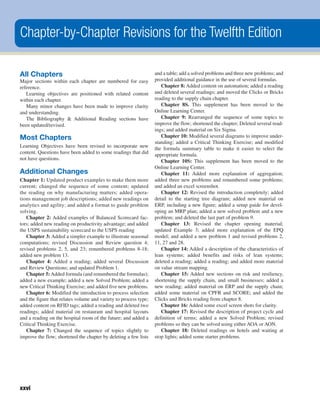






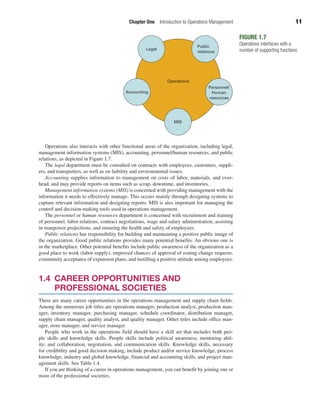


![Chapter Three Forecasting 81
Summarizing Forecast Accuracy
Forecast accuracy is a significant factor when deciding among forecasting alternatives. Accu-
racy is based on the historical error performance of a forecast.
Three commonly used measures for summarizing historical errors are the mean absolute
deviation (MAD), the mean squared error (MSE), and the mean absolute percent error
(MAPE). MAD is the average absolute error, MSE is the average of squared errors, and
MAPE is the average absolute percent error. The formulas used to compute MAD,1
MSE, and
MAPE are as follows:
t t
n
MAD
Actual Forecast
(3–2)
t t
n
MSE
(Actual Forecast )2
1
(3–3)
MAPE
Actual Forecast
Actual
100
t t
t
n
(3–4)
Example 1 illustrates the computation of MAD, MSE, and MAPE.
From a computational standpoint, the difference between these measures is that MAD
weights all errors evenly, MSE weights errors according to their squared values, and MAPE
weights according to relative error.
1
The absolute value, represented by the two vertical lines in Formula 3–2, ignores minus signs; all data are treated
as positive values. For example, 2 becomes 2.
Mean absolute deviation
(MAD) The average absolute
forecast error.
Mean squared error (MSE)
The average of squared forecast
errors.
Mean absolute percent
error (MAPE) The average
absolute percent error.
Compute MAD, MSE, and MAPE for the following data, showing actual and forecasted
numbers of accounts serviced.
Period Actual Forecast
(A ⴚ F)
Error |Error| Error2
[|Error|ⴜ Actual] ⴛ 100
1............................. 217 215 2 2 4 .92%
2............................. 213 216 3 3 9 1.41
3............................. 216 215 1 1 1 .46
4............................. 210 214 4 4 16 1.90
5............................. 213 211 2 2 4 .94
6............................. 219 214 5 5 25 2.28
7............................. 216 217 1 1 1 .46
8............................. 212 216 4 4 16 1.89
2 22 76 10.26%
SCREENCAM TUTORIAL
E X A M P L E 1
e cel
x
mhhe.com/stevenson12e
S O L U T I O N
Using the figures shown in the table,
e
n
e
n
n
MAD
22
8
2.75
MSE
2
1
76
8 1
10.86
MAPE
Actual
100
10.26%
8
1.28%
e
LO3.5 Summarize forecast
errors and use summaries to
make decisions.](https://image.slidesharecdn.com/operationsmanagement12thedition2015-251029163302-481399e6/85/Operations_Management_12th_Edition_2015-pdf-117-320.jpg)


![Chapter Three Forecasting 117
associative model, 82
bias, 108
centered moving average, 98
control chart, 106
correlation, 104
cycle, 84
Delphi method, 83
error, 80
exponential smoothing, 89
focus forecasting, 91
forecast, 75
irregular variation, 84
judgmental forecasts, 82
least squares line, 101
linear trend equation, 92
mean absolute deviation
(MAD), 81
mean absolute percent error
(MAPE), 81
mean squared error (MSE), 81
moving average, 86
naive forecast, 84
predictor variables, 101
random variations, 84
regression, 101
seasonal relative, 97
seasonal variations, 95
seasonality, 84
standard error of estimate, 103
time series, 84
time-series forecasts, 82
tracking signal, 108
trend, 84
trend-adjusted exponential
smoothing, 95
weighted average, 88
KEY TERMS
SOLVED PROBLEMS
Forecasts based on averages. Given the following data:
Period
Number of
Complaints
1 60
2 65
3 55
4 58
5 64
Prepare a forecast for period 6 using each of these approaches:
a. The appropriate naive approach.
b. A three-period moving average.
c. A weighted average using weights of .50 (most recent), .30, and .20.
d. Exponential smoothing with a smoothing constant of .40.
Problem 1
Solution
Step by step
a. Plot the data to see if there is a pattern. Here we have only variations around an average (i.e., no
trend or cycles). Therefore, the most recent value of the series becomes the next forecast: 64.
b. Use the latest values. MA
55 58 64
3
59
3
c. F .20(55) .30(58) .50(64) 60.4
d. Start with period 2. Use the data in period 1 as the forecast for period 2, and then use exponential
smoothing for successive forecasts.
Period
Number of
Complaints Forecast Calculations
1 60 [The previous value of the series is used
2 65 60 as the starting forecast.]
3 55 62 60 .40(65 60) 62
4 58 59.2 62 .40(55 62) 59.2
5 64 58.72 59.2 .40(58 59.2) 58.72
6 60.83 58.72 .40(64 58.72) 60.83](https://image.slidesharecdn.com/operationsmanagement12thedition2015-251029163302-481399e6/85/Operations_Management_12th_Edition_2015-pdf-153-320.jpg)


![Chapter Three Forecasting 121
QUARTER
1 2 3 4
0.71 0.79 1.17 1.35
0.74 0.82 1.18 1.29
1.45 1.61 1.21 2.64
3.56
Average for the quarter: 0.725 0.805 1.187 1.320
The sum of these relatives is 4.037. Multiplying each by 4.00/4.037 will standardize the relatives,
making their total equal 4.00. The resulting relatives are quarter 1, .718; quarter 2, .798; quarter 3,
1.176; quarter 4, 1.308.
Problem 5
Regression line. A large midwestern retailer has developed a graph that summarizes the effect of
advertising expenditures on sales volume. Using the graph, determine an equation of the form
y a bx that describes this relationship.
3
2
1
2 4 6 8 10 x
Advertising ($ thousands)
Sales
($
millions)
Solution
The linear equation has the form y a bx, where a is the value of y when x 0 (i.e., where the
line intersects the y axis) and b is the slope of the line (the amount by which y changes for a one-unit
change in x).
Accordingly, a 1 and b (3 1)/(10 0) .2, so y a bx becomes y 1 .2x. [Note:
(3 1) is the change in y, and (10 0) is the change in x.]
Problem 6
Regression analysis. The owner of a small hardware store has noted a sales pattern for window locks
that seems to parallel the number of break-ins reported each week in the newspaper. The data are:
Sales: 46 18 20 22 27 34 14 37 30
Break-ins: 9 3 3 5 4 7 2 6 4
a. Plot the data to determine which type of equation, linear or nonlinear, is appropriate.
b. Obtain a regression equation for the data.
c. Estimate average sales when the number of break-ins is five.
Solution
a. 60
40
20
0
2 4 6 8 10
Number of break-ins
Sales
The graph supports a linear relationship.](https://image.slidesharecdn.com/operationsmanagement12thedition2015-251029163302-481399e6/85/Operations_Management_12th_Edition_2015-pdf-157-320.jpg)


![138 Chapter Four Product and Service Design
now rushing to outsource manufacturing still do not understand that the
design of the product determines the final cost.”
Dewhurst warned that outsourcing should not be the first step in
lowering product costs. “Considering the competitive nature of the
global economy and the many hidden risks associated with outsourcing
ventures, U.S. companies should scour product designs for efficiency
before resorting to offshore production,” he said. “We hope this study
encourages the U.S. manufacturing industry to take another look at
design cost analysis.”
Source: “Product Redesign, Not Offshoring, Holds Cost Advantage for U.S. Man-
ufacturers,” Supply Demand Chain Executive, September 8, 2004. Copyright
© 2004 Cygnus Business Media and/or its suppliers, 1233 Janesville Ave., Fort
Atkinson, WI 53538 U.S.A. All rights reserved.
consider sending production overseas to countries with very low
labor rates such as China. The authors identify a number of hidden
costs, including shipping and logistics, that can add an estimated
24 percent to labor and material costs at the offshore location.
The study seeks to demonstrate that if companies consider the
potential for design improvement along with a realistic estimate of the
full costs of outsourcing, it often makes more sense to manufacture
products in the United States.
“We know, from years of consulting with design engineers, that U.S.
manufacturers have very little visibility into what their products should
cost to make,” said Dewhurst. “Companies historically do a poor job
of integrating cost analysis into early product design. Many companies
(concluded
The labels are applied automatically, quite a feat, considering their
complexity, size, and the hollow handle they likely encounter during
application. MacDonald admits, “Label application was a challenge. We
had to modify the bottle several times to accommodate the labeling
machinery available.”
Source: “Dutch Boy Brushes Up Its Paints,” Packaging Digest, October 2002.
Copyright © 2002 Reed Business Information. Used with permission.
Sherwin-Williams’ Dutch Boy Group has put a revolutionary spin on
wall/house painting with its new square-shaped Twist Pour™
paint-
delivery container for the Dirt Fighter interior latex paint line. The four-
piece square container could be the first major change in how house
paint is packaged in decades. Lightweight but sturdy, the Twist Pour
“bucket” is packed with so many conveniences, it’s next to impossible
to mess up a painting project.
Winning Best of Show in an AmeriStar packaging competition spon-
sored by the Institute of Packaging Professionals, the exclusive, all-
plastic paint container stands almost 7½ in. tall and holds 126 oz., a bit
less than 1 gal. Rust-resistant and moisture-resistant, the plastic bucket
gives users a new way to mix, brush, and store paint.
A hollow handle on one side makes it comfortable to pour and
[carry]. A convenient, snap-in pour spout neatly pours paint into a tray
with no dripping but can be removed if desired, to allow a wide brush to
be dipped into the 5¾-in.-dia. mouth. Capping the container is a large,
twist-off lid that requires no tools to open or close. Molded with two lugs
for a snug-finger-tight closing, the threaded cap provides a tight seal to
extend the shelf life of unused paint.
While the lid requires no tools to access, the snap-off carry bail is
assembled on the container in a“locked-down position”and can be pulled
up after purchase for toting or hanging on a ladder. Large, nearly 4½-in.-
tall label panels allow glossy front and back labels printed and UV-coated
to wrap around the can’s rounded corners, for an impressive display.
Jim MacDonald, co-designer of the Twist Pour and a packaging
engineer at Cleveland-based Sherwin-Williams, tells Packaging Digest
that the space-efficient, square shape is easier to ship and for retail-
ers to stack in stores. It can also be nested, courtesy of a recess in the
bottom that mates with the lid’s top ring. “The new design allows for
one additional shelf facing on an eight-foot rack or shelf area.”
READING
Dutch Boy Brushes Up Its Paints](https://image.slidesharecdn.com/operationsmanagement12thedition2015-251029163302-481399e6/85/Operations_Management_12th_Edition_2015-pdf-174-320.jpg)


![Supplement to Chapter Four Reliability 173
Example Three lamps have probabilities of .90, .80, and .70 of lighting when turned on. Only
one lighted lamp is needed for success; hence, two of the lamps are considered to be backups.
The probability of success is
1 [(1 .90) (1 .80) (1 .70)] .994
This system can be represented by the following diagram:
.90
Lamp 1
.80
Lamp 2 (backup for Lamp 1)
.70
Lamp 3 (backup for Lamp 2)
LO4S.2 Perform simple reliability
computations.
E X A M P L E
4 S – 1
Determine the reliability of the system shown below.
.98 .90 .95
.90 .92
e cel
x
mhhe.com/stevenson12e
S O L U T I O N
The system can be reduced to a series of three components:
.98 .90 ⫹ .90(1 ⫺ .90) .95 ⫹ .92(1 ⫺ .95)
The system reliability is, then, the product of these:
.98 .99 .996 .966
Finding the Probability of Functioning for a
Given Length of Time
The second way of looking at reliability considers the incorporation of a time dimension:
Probabilities are determined relative to a specified length of time. This approach is com-
monly used in product warranties, which pertain to a given period of time after purchase of
a product.
A typical profile of product failure rate over time is illustrated in Figure 4S.1. Because of
its shape, it is sometimes referred to as a bathtub curve. Frequently, a number of products fail
shortly after they are put into service, not because they wear out, but because they are defec-
tive to begin with. The rate of failures decreases rapidly once the truly defective items are
weeded out. During the second phase, there are fewer failures because most of the defective
items have been eliminated, and it is too soon to encounter items that fail because they have
worn out. In some cases, this phase covers a relatively long time. In the third phase, failures
occur because the products are worn out, and the failure rate increases.
Information on the distribution and length of each phase requires the collection of histori-
cal data and analysis of those data. It often turns out that the mean time between failures
(MTBF) in the infant mortality phase can be modeled by a negative exponential distribution,
such as that depicted in Figure 4S.2. Equipment failures as well as product failures may occur
in this pattern. In such cases, the exponential distribution can be used to determine various
Mean time between failures
(MTBF) The average length of
time between failures of a prod-
uct or component.](https://image.slidesharecdn.com/operationsmanagement12thedition2015-251029163302-481399e6/85/Operations_Management_12th_Edition_2015-pdf-209-320.jpg)


![Chapter Five Strategic Capacity Planning for Products and Services 205
Cost–volume analysis can be a valuable tool for comparing capacity alternatives if certain
assumptions are satisfied:
1. One product is involved.
2. Everything produced can be sold.
3. The variable cost per unit is the same regardless of the volume.
4. Fixed costs do not change with volume changes, or they are step changes.
5. The revenue per unit is the same regardless of volume.
6. Revenue per unit exceeds variable cost per unit.
As with any quantitative tool, it is important to verify that the assumptions on which
the technique is based are reasonably satisfied for a particular situation. For example, revenue
per unit or variable cost per unit is not always constant. In addition, fixed costs may not be
constant over the range of possible output. If demand is subject to random variations, one
must take that into account in the analysis. Also, cost–volume analysis requires that fixed and
variable costs can be separated, and this is sometimes exceedingly difficult to accomplish.
Cost–volume analysis works best with one product or a few products that have the same cost
characteristics.
A notable benefit of cost–volume considerations is the conceptual framework it provides
for integrating cost, revenue, and profit estimates into capacity decisions. If a proposal looks
attractive using cost–volume analysis, the next step would be to develop cash flow models to
see how it fares with the addition of time and more flexible cost functions.
Financial Analysis
Operations personnel need to have the ability to do financial analysis. A problem that is univer-
sally encountered by managers is how to allocate scarce funds. A common approach is to use
financial analysis to rank investment proposals, taking into account the time value of money.
Two important terms in financial analysis are cash flow and present value:
Cash flow refers to the difference between the cash received from sales (of goods or
services) and other sources (e.g., sale of old equipment) and the cash outflow for labor,
materials, overhead, and taxes.
Present value expresses in current value the sum of all future cash flows of an invest-
ment proposal.
The three most commonly used methods of financial analysis are payback, present value,
and internal rate of return.
Cash flow The difference
between cash received from
sales and other sources, and cash
outflow for labor, material, over-
head, and taxes.
Present value The sum, in
current value, of all future cash
flows of an investment proposal.
S O L U T I O N
a. Compute the break-even point for each range using the formula QBEP FC/(R v).
For one machine:
$9,600
$40/unit $10/unit
320 units [not in range, so there
is no BEP]
BEP
Q
For two machines:
$15,000
$40/unit $10/unit
500 units
BEP
Q
For three machines:
$20,000
$40/unit $10/unit
666.67 units
BEP
Q
b. Comparing the projected range of demand to the two ranges for which a break-even
point occurs (see Figure 5.7B), you can see that the break-even point is 500, which is
in the range 301 to 600. This means that even if demand is at the low end of the range,
it would be above the break-even point and thus yield a profit. That is not true of range
601 to 900. At the top end of projected demand, the volume would still be less than the
break-even point for that range, so there would be no profit. Hence, the manager should
choose two machines.](https://image.slidesharecdn.com/operationsmanagement12thedition2015-251029163302-481399e6/85/Operations_Management_12th_Edition_2015-pdf-241-320.jpg)


![224 Supplement to Chapter Five Decision Theory
The expected payoff under risk, as computed in Example 5S–4, is $10.5. The EVPI is the dif-
ference between these:
EVPI $12.2 $10.5 $1.7
This figure indicates the upper limit on the amount the decision maker should be willing
to spend to obtain perfect information in this case. Thus, if the cost equals or exceeds this
amount, the decision maker would be better off not spending additional money and simply
going with the alternative that has the highest expected payoff.
A second approach is to use the regret table to compute the EVPI. To do this, find the
expected regret for each alternative. The minimum expected regret is equal to the EVPI.
E X A M P L E
5 S – 7
Determine the expected value of perfect information for the capacity-planning problem using
the expected regret approach.
S O L U T I O N Using information from Examples 5S–2, 5S–3, and 5S–4, we can compute the expected regret
for each alternative. Thus:
Small facility
Medium facility
Large facility
.30(0)
.30(3)
.30(14)
.50(2)
.50(0)
.50(10)
.20(6) 2.2
.20(4) 1.7 [minimum]
.20(0) 9.2
The lowest expected regret is 1.7, which is associated with the second alternative. Hence, the
EVPI is $1.7 million, which agrees with the previous example using the other approach.
5S.9 SENSITIVITY ANALYSIS
Generally speaking, both the payoffs and the probabilities in this kind of a decision problem
are estimated values. Consequently, it can be useful for the decision maker to have some
indication of how sensitive the choice of an alternative is to changes in one or more of these
values. Unfortunately, it is impossible to consider all possible combinations of every variable
in a typical problem. Nevertheless, there are certain things a decision maker can do to judge
the sensitivity of probability estimates.
Sensitivity analysis provides a range of probability over which the choice of alternatives
would remain the same. The approach illustrated here is useful when there are two states of
nature. It involves constructing a graph and then using algebra to determine a range of prob-
abilities for which a given solution is best. In effect, the graph provides a visual indication
of the range of probability over which the various alternatives are optimal, and the algebra
provides exact values of the endpoints of the ranges. Example 5S–8 illustrates the procedure.
Sensitivity analysis Deter-
mining the range of probability
for which an alternative has the
best expected payoff.
Given the following table, determine the range of probability for state of nature #2, that is,
P(2), for which each alternative is optimal under the expected-value approach.
STATE OF
NATURE
#1 #2
A 4 12
Alternative B 16 2
C 12 8
E X A M P L E
5 S – 8
S O L U T I O N First, plot each alternative relative to P(2). To do this, plot the #1 value on the left side of the
graph and the #2 value on the right side. For instance, for alternative A, plot 4 on the left side
of the graph and 12 on the right side. Then connect these two points with a straight line. The
three alternatives are plotted on the graph as shown on the next page.
e cel
x
mhhe.com/stevenson12e
e cel
x
mhhe.com/stevenson12e
LO5S.7 Conduct sensitivity
analysis on a simple decision
problem.](https://image.slidesharecdn.com/operationsmanagement12thedition2015-251029163302-481399e6/85/Operations_Management_12th_Edition_2015-pdf-260-320.jpg)
![Supplement to Chapter Five Decision Theory 225
The graph shows the range of values of P(2) over which each alternative is optimal. Thus,
for low values of P(2) [and thus high values of P(1), since P(1) P(2) 1.0], alternative B
will have the highest expected value; for intermediate values of P(2), alternative C is best; and
for higher values of P(2), alternative A is best.
To find exact values of the ranges, determine where the upper parts of the lines intersect.
Note that at the intersections, the two alternatives represented by the lines would be equivalent
in terms of expected value. Hence, the decision maker would be indifferent between the two
at that point. To determine the intersections, you must obtain the equation of each line. This
is relatively simple to do. Because these are straight lines, they have the form y a bx,
where a is the y-intercept value at the left axis, b is the slope of the line, and x is P(2). Slope
is defined as the change in y for a one-unit change in x. In this type of problem, the distance
between the two vertical axes is 1.0. Consequently, the slope of each line is equal to the right-
hand value minus the left-hand value. The slopes and equations are as follows:
#1 #2 Slope Equation
A 4 12 12 4 8 4 8P(2)
B 16 2 2 16 14 16 14P(2)
C 12 8 8 12 4 12 4P(2)
From the graph, we can see that alternative B is best from P(2) 5 0 to the point where that
straight line intersects the straight line of alternative C, and that begins the region where C is
better. To find that point, solve for the value of P(2) at their intersection. This requires setting
the two equations equal to each other and solving for P(2). Thus,
P P
16 14 (2) 12 4 (2)
Rearranging terms yields
P
4 10 (2)
Solving yields P(2) .40. Thus, alternative B is best from P(2) 0 up to P(2) .40. B
and C are equivalent at P(2) .40.
Alternative C is best from that point until its line intersects alternative A’s line. To find that
intersection, set those two equations equal and solve for P(2). Thus,
P P
4 8 (2) 12 4 (2)
Rearranging terms results in
P
12 (2) 8
Solving yields P(2) .67. Thus, alternative C is best from P(2) .40 up to P(2) .67,
where A and C are equivalent. For values of P(2) greater than .67 up to P(2) 1.0, A is best.
Note: If a problem calls for ranges with respect to P(1), find the P(2) ranges as above, and
then subtract each P(2) from 1.00 (e.g., .40 becomes .60, and .67 becomes .33).
16
14
12
10
8
6
4
2
0 1.0
.8
.6
.4
.2
#1
Payoff
16
14
12
10
8
6
4
2
#2
Payoff
B
C
A
P (2)
B best A best
C best](https://image.slidesharecdn.com/operationsmanagement12thedition2015-251029163302-481399e6/85/Operations_Management_12th_Edition_2015-pdf-261-320.jpg)
![226 Supplement to Chapter Five Decision Theory
Decision making is an integral part of operations management.
Decision theory is a general approach to decision making that is useful in many different aspects of
operations management. Decision theory provides a framework for the analysis of decisions. It includes
a number of techniques that can be classified according to the degree of uncertainty associated with a
particular decision problem. Two visual tools useful for analyzing some decision problems are decision
trees and graphical sensitivity analysis.
SUMMARY
bounded rationality, 218
certainty, 218
decision tree, 221
expected monetary value
(EMV) criterion, 220
expected value of perfect
information (EVPI), 223
Laplace, 219
maximax, 219
maximin, 219
minimax regret, 219
payoff table, 217
regret (opportunity
loss), 220
risk, 218
sensitivity analysis, 224
suboptimization, 218
uncertainty, 218
KEY TERMS
SOLVED PROBLEMS
Assume the payoffs represent profits. Determine the alternative that would be chosen under each of
these decision criteria:
a. Maximin.
b. Maximax.
c. Laplace.
Problem 1
The following solved problems refer to this payoff table:
where A small, B medium, and C large.
New
Bridge
Built
No
New
Bridge
Alternative capacity
for new store
A 1 14
B 2 10
C 4 6
Solution
Thus, the alternatives chosen would be C under maximin, A under maximax, and A under Laplace.
Problem 2 Using graphical sensitivity analysis, determine the probability for no new bridge for which each
alternative would be optimal.
New
Bridge
No New
Bridge
Maximin
(worst)
Maximax
(best)
Laplace
(average)
A 1 14 1 14 [best] 15 2 7.5 [best]
B 2 10 2 10 12 2 6
C 4 6 4 [best] 6 10 2 5
Solution Plot a straight line for each alternative. Do this by plotting the payoff for new bridge on the left axis
and the payoff for no new bridge on the right axis and then connecting the two points. Each line
represents the expected profit for an alternative for the entire range of probability of no new bridge.
Because the lines represent expected profit, the line that is highest for a given value of P (no new
bridge) is optimal. Thus, from the graph, you can see that for low values of this probability, alterna-
tive C is best, and for higher values, alternative A is best (B is never the highest line, so it is never
optimal).
e cel
x
mhhe.com/stevenson12e
e cel
x
mhhe.com/stevenson12e](https://image.slidesharecdn.com/operationsmanagement12thedition2015-251029163302-481399e6/85/Operations_Management_12th_Edition_2015-pdf-262-320.jpg)
![Supplement to Chapter Five Decision Theory 227
Worst
A 3 [best]
B 4
C 8
New
Bridge
No New
Bridge
A 3 0
B 2 4
C 0 8
The dividing line between the ranges where C and A are optimal occurs where the two lines inter-
sect. To find that probability, first formulate the equation for each line. To do this, let the intersection
with the left axis be the y intercept; the slope equals the right-side payoff minus the left-side payoff.
Thus, for C you have 4 (6 4)P, which is 4 2P. For A, 1 (14 1)P, which is 1 13P. Setting
these two equal to each other, you can solve for P:
P P
4 2 1 13
Solving, P .27. Therefore, the ranges for P(no new bridge) are
A: .27 P 1.00
B: never optimal
C: 0 P .27
Problem 3
Using the information in the payoff table, develop a table of regrets, and then
a. Determine the alternative that would be chosen under minimax regret.
b. Determine the expected value of perfect information using the regret table, assuming that the
probability of a new bridge being built is .60.
Solution
To obtain the regrets, subtract all payoffs in each column from the best payoff in the column. The
regrets are
a. Minimax regret involves finding the worst regret for each alternative and then choosing the alter-
native that has the “best” worst. Thus, you would choose A:
4
2
1
0 1.0
Payoff for
new bridge 14
10
6
0
Payoff for
no new
bridge
A
A best
C best
B
C
.27
P (no new bridge)
e cel
x
mhhe.com/stevenson12e](https://image.slidesharecdn.com/operationsmanagement12thedition2015-251029163302-481399e6/85/Operations_Management_12th_Edition_2015-pdf-263-320.jpg)
![228 Supplement to Chapter Five Decision Theory
b. Once the regret table has been developed, you can compute the EVPI as the smallest expected
regret. Since the probability of a new bridge is given as .60, we can deduce that the probability of
no new bridge is 1.00 .60 .40. The expected regrets are
A: .60(3) .40(0) 1.80
B: .60(2) .40(4) 2.80
C: .60(0) .40(8) 3.20
Hence, the EVPI is 1.80.
Problem 4 Using the probabilities of .60 for a new bridge and .40 for no new bridge,
a. Compute the expected value of each alternative in the payoff table, and identify the alternative
that would be selected under the expected-value approach.
b. Construct a decision tree for the problem showing expected values.
Solution
Problem 5
a. A: .60(1) .40(14) 6.20 [best]
B: .60(2) .40(10) 5.20
C: .60(4) .40(6) 4.80
b.
Compute the EVPI using the information from the previous problem.
C
B
A
New
bridge (.60)
New bridge (.60)
New bridge (.60)
No new
bridge (.40)
No new bridge (.40)
No new bridge (.40)
Expected
values
.60(1) = .60
$6.20 (best)
$5.20
$4.80
.40(14) = 5.60
.60(2) = 1.20
.40(10) = 4.00
.60(4) = 2.40
.40(6) = 2.40
$1
$14
$2
$10
$4
$6
Solution Using Formula 5S–1, the EVPI is the expected payoff under certainty minus the maximum expected
value. The expected payoff under certainty involves multiplying the best payoff in each column by
e cel
x
mhhe.com/stevenson12e](https://image.slidesharecdn.com/operationsmanagement12thedition2015-251029163302-481399e6/85/Operations_Management_12th_Edition_2015-pdf-264-320.jpg)

![230 Supplement to Chapter Five Decision Theory
Solution New
Bridge
No New
Bridge
Maximin
(worst)
Minimin
(best)
Laplace
(average)
A 1 14 14 1 [best] 15 2 7.5
B 2 10 10 2 12 2 6
C 4 6 6 [best] 4 10 2 5 [best]
a.
b. Develop the regret table by subtracting the lowest cost in each column from each of the values in
the column. (Note that none of the values is negative.)
c. The graph is identical to that shown in Solved Problem 2. However, the lines now represent
expected costs, so the best alternative for a given value of P(no new bridge) is the lowest line.
Hence, for very low values of P(no new bridge), A is best; for intermediate values, B is best; and
for high values, C is best. You can set the equations of A and B, and B and C, equal to each other
in order to determine the values of P(no new bridge) at their intersections. Thus,
P P P
P P P
A B: 1 13 2 8 ; solving, .20
B C: 2 8 4 2 ; solving, .33
Hence, the ranges are
A best: 0 # P , .20
B best: .20 , P , .33
C best: .33 , P # 1.00
4
2
1
0 1.0
Cost with
new bridge 14
10
6
0
Cost with
no new
bridge
A
C best
B
C
.20
P (no new bridge)
.33
B
best
A
best
d. Expected-value computations are the same whether the values represent costs or profits. Hence,
the expected payoffs for costs are the same as the expected payoffs for profits that were computed
in Solved Problem 4. However, now you want the alternative that has the lowest expected payoff
rather than the one with the highest payoff. Consequently, alternative C is the best because its
expected payoff is the lowest of the three. Alternatively, the best choice (C) could be determined
using the sensitivity ranges found in part c since .40 lies in the range .33 to 1.0.
New
Bridge
No New
Bridge Worst
A 0 8 8
B 1 4 4
C 3 0 3 [best]
EVPI .60(3) .40(0) 1.80](https://image.slidesharecdn.com/operationsmanagement12thedition2015-251029163302-481399e6/85/Operations_Management_12th_Edition_2015-pdf-266-320.jpg)


![Chapter Six Process Selection and Facility Layout 251
of money in equipment and job design. Because only one or a few very similar items are
involved, it is feasible to arrange an entire layout to correspond to the technological pro-
cessing requirements of the product or service. For instance, if a portion of a manufacturing
operation required the sequence of cutting, sanding, and painting, the appropriate pieces of
equipment would be arranged in that same sequence. And because each item follows the same
sequence of operations, it is often possible to utilize fixed-path material-handling equipment
such as conveyors to transport items between operations. The resulting arrangement forms a
line like the one depicted in Figure 6.3. In manufacturing environments, the lines are referred
to as production lines or assembly lines, depending on the type of activity involved. In
service processes, the term line may or may not be used. It is common to refer to a cafeteria
line as such but not a car wash, although from a conceptual standpoint the two are nearly
identical. Figure 6.4 illustrates the layout of a typical cafeteria serving line. Examples of this
type of layout are less plentiful in service environments because processing requirements
usually exhibit too much variability to make standardization feasible. Without high standard-
ization, many of the benefits of repetitive processing are lost. When lines are used, certain
compromises may be made. For instance, an automatic car wash provides equal treatment to
all cars—the same amount of soap, water, and scrubbing—even though cars may differ con-
siderably in cleaning needs.
Product layouts achieve a high degree of labor and equipment utilization, which tends
to offset their high equipment costs. Because items move quickly from operation to opera-
tion, the amount of work-in-process is often minimal. Consequently, operations are so closely
tied to each other that the entire system is highly vulnerable to being shut down because of
mechanical failure or high absenteeism. Maintenance procedures are geared to this. Preven-
tive maintenance—periodic inspection and replacement of worn parts or those with high fail-
ure rates—reduces the probability of breakdowns during the operations. Of course, no amount
of preventive activity can completely eliminate failures, so management must take measures
to provide quick repair. These include maintaining an inventory of spare parts and having
repair personnel available to quickly restore equipment to normal operation. These proce-
dures are fairly expensive; because of the specialized nature of equipment, problems become
more difficult to diagnose and resolve, and spare-part inventories can be extensive.
Repetitive processing can be machine paced (e.g., automatic car wash, automobile assem-
bly), worker paced (e.g., fast-food restaurants such as McDonald’s, Burger King), or even
customer paced (e.g., cafeteria line).
The main advantages of product layouts are
1. A high rate of output.
2. Low unit cost due to high volume. The high cost of specialized equipment is spread over
many units.
Production line Standardized
layout arranged according to a
fixed sequence of production
tasks.
Assembly line Standardized
layout arranged according to
a fixed sequence of assembly
tasks.
FIGURE 6.3
A flow line for production or
service
Station
n
Station
3
Station
2
Station
1
Raw materials
or
customer
Finished
item
Materials
and/or labor
Materials
and/or labor
Materials
and/or labor
Materials
and/or labor
Work flow
[Begin] [End]
FIGURE 6.4
Cafeteria line
Cashier
Beverage
Bread and
rolls
Potato and
vegetable
Main
course
Salads
Desserts
Tray and
silver](https://image.slidesharecdn.com/operationsmanagement12thedition2015-251029163302-481399e6/85/Operations_Management_12th_Edition_2015-pdf-287-320.jpg)


![Chapter Seven Work Design and Measurement 317
The design of work systems involves quality of work life considerations as well as job design, methods
analysis, and work measurement.
Quality of work life includes relationships with managers and co-workers, working conditions, and
compensation. Job design is concerned with job content and work methods. In the past, job design
tended to emphasize efficiency. More recently, emphasis has expanded to include behavioral consid-
erations and worker satisfaction. Current concerns about productivity have thrust job design into the
limelight. However, the jobs usually associated with high productivity are often the same jobs that are
the greatest source of worker dissatisfaction, creating somewhat of a paradox for job designers.
Analysts often use methods analysis and motion study techniques to develop the “efficiency” aspects
of jobs, but these do not directly address behavioral aspects. Nonetheless, they are an important part of
job design. Working conditions are also a notable aspect of job design, not only because of the behav-
ioral and efficiency factors but also because of concern for the health and safety of workers.
Work measurement is concerned with specifying the length of time needed to complete a job. Such
information is vital for personnel planning, cost estimating, budgeting, scheduling, and worker compen-
sation. Commonly used approaches include stopwatch time study and predetermined times. A related
technique is work sampling, which can also be used to obtain data on activity times. More commonly,
work sampling is used to estimate the proportion of time a worker spends on a certain aspect of the job.
Table 7.7 provides a summary of the formulas used in time studies and work sampling.
Organizations can choose from a variety of compensation plans. It is important to do so carefully, for
compensation is key to both the worker and the organization, and, once adopted, it is usually difficult to
substantially change a compensation plan.
SUMMARY
TABLE 7.7
Summary of formulas
Time Study Work Sampling
A. Sample size A. Maximum error
n
zs
ax
=
⎛
⎝
⎜
⎞
⎠
⎟
2
(7–1) e z
p p
n
ˆ(1 ˆ )
(7–9)
[Use for % accuracy.] B. Sample size
n
z
e
p p
=
⎛
⎝
⎜
⎞
⎠
⎟ ˆ(1 ˆ )
2
n
zs
e
=
⎛
⎝
⎜
⎞
⎠
⎟
2
(7–2) (7–10)
Symbols:
a Allowable error as percentage of average time
A Allowance percentage
AF Allowance factor
e Maximum acceptable amount of time error
n Number of observations needed
NT Normal time
OT Observed, or average, time
p̂ Sample proportion
PR Performance rating
s Standard deviation of observed times
ST Standard time
x Sample mean
xi Time for ith observation (i 1, 2, 3, . . ., n)
z Number of standard deviations needed to
achieve desired confidence
[Use for time accuracy.]
B. Observed time
x
n
i
OT
(7–3)
C. Normal time
NT OT PR (7–4)
j j
NT (x PR )
(7–5)
D. Standard time
ST NT AF (7–6)
E. Allowance factor
AFjob 1 A (7–7)
A
AF
1
1
day
(7–8)
1. Work design focuses on the core of operations.
2. Job design determines job content; methods analysis and motion study determine how a job is to
be performed; and work measurement determines the time it should take to do a job.
3. The information provided by job design, methods analysis, motion study, and time standards is
extremely valuable for process and productivity improvement.
4. Quality of work life can be a major factor in maintaining a productive workforce.
KEY POINTS](https://image.slidesharecdn.com/operationsmanagement12thedition2015-251029163302-481399e6/85/Operations_Management_12th_Edition_2015-pdf-353-320.jpg)