Operations
Excellence: An
Analysis of Saudi
Aramco's Business
Operations
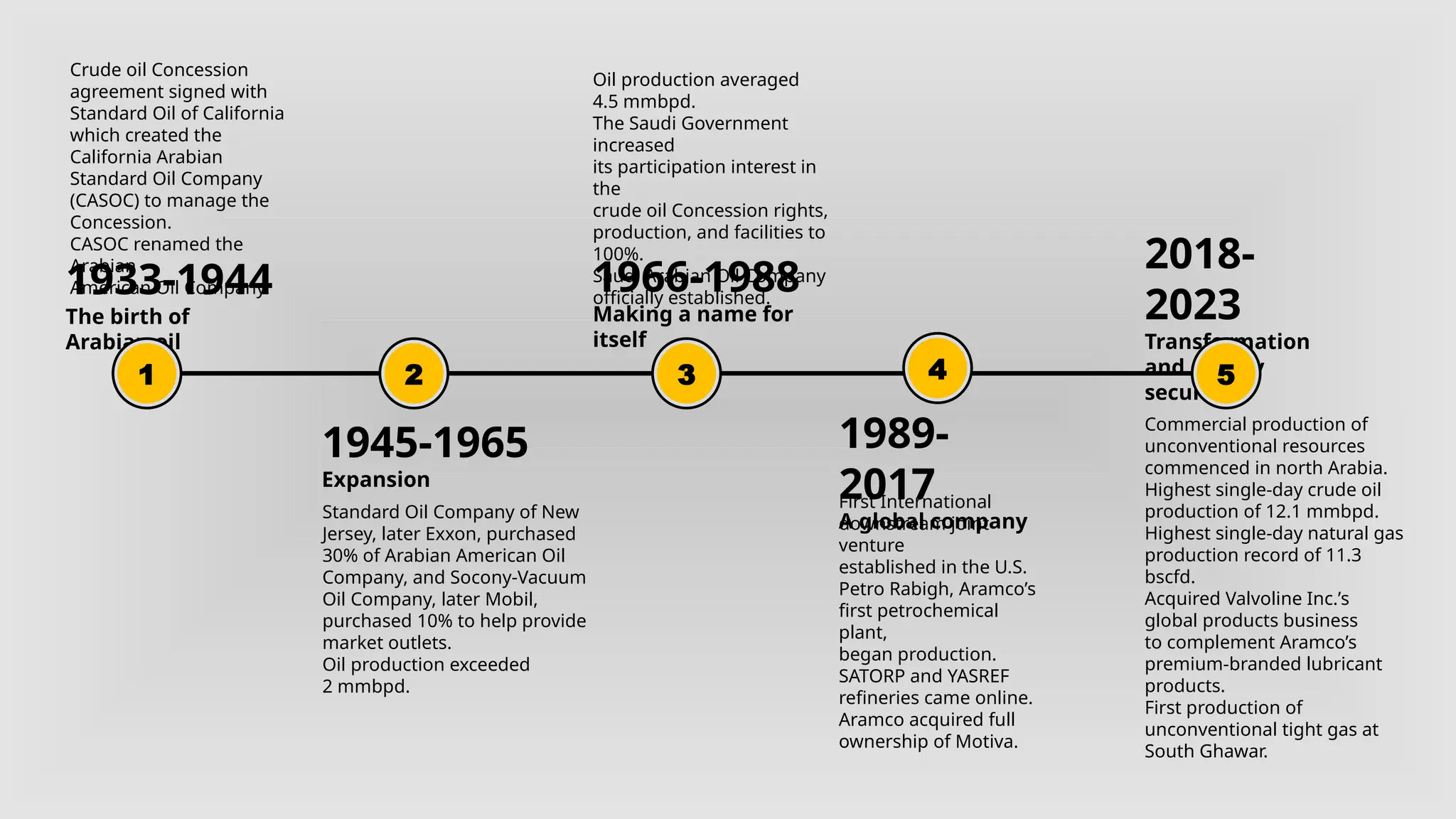
1933-1944
The birth of
Arabian oil
1945-1965
Expansion
1966-1988
Making a name for
itself
1989-
2017
A global company
2018-
2023
Transformation
and energy
security
1 2 3 4 5
Crude oil Concession
agreement signed with
Standard Oil of California
which created the
California Arabian
Standard Oil Company
(CASOC) to manage the
Concession.
CASOC renamed the
Arabian
American Oil Company.
Standard Oil Company of New
Jersey, later Exxon, purchased
30% of Arabian American Oil
Company, and Socony-Vacuum
Oil Company, later Mobil,
purchased 10% to help provide
market outlets.
Oil production exceeded
2 mmbpd.
Oil production averaged
4.5 mmbpd.
The Saudi Government
increased
its participation interest in
the
crude oil Concession rights,
production, and facilities to
100%.
Saudi Arabian Oil Company
officially established.
First International
downstream joint
venture
established in the U.S.
Petro Rabigh, Aramco’s
first petrochemical
plant,
began production.
SATORP and YASREF
refineries came online.
Aramco acquired full
ownership of Motiva.
Commercial production of
unconventional resources
commenced in north Arabia.
Highest single-day crude oil
production of 12.1 mmbpd.
Highest single-day natural gas
production record of 11.3
bscfd.
Acquired Valvoline Inc.’s
global products business
to complement Aramco’s
premium-branded lubricant
products.
First production of
unconventional tight gas at
South Ghawar.
GLOBAL
PRESENCE
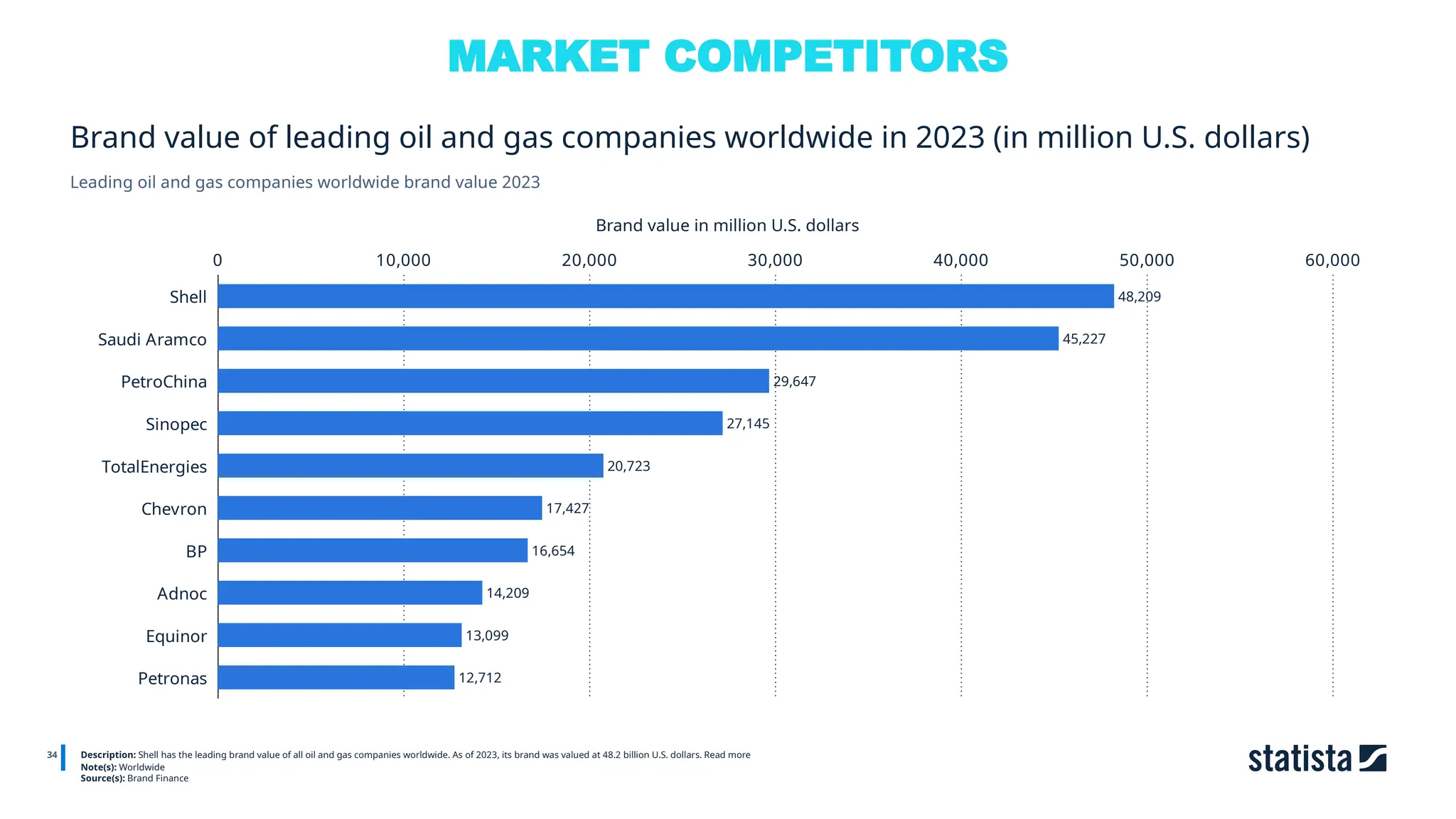
Description: Shell has the leading brand value of all oil and gas companies worldwide. As of 2023, its brand was valued at 48.2 billion U.S. dollars. Read more
Note(s): Worldwide
Source(s): Brand Finance
Shell
Saudi Aramco
PetroChina
Sinopec
TotalEnergies
Chevron
BP
Adnoc
Equinor
Petronas
0 10,000 20,000 30,000 40,000 50,000 60,000
48,209
45,227
29,647
27,145
20,723
17,427
16,654
14,209
13,099
12,712
Brand value in million U.S. dollars
34
Brand value of leading oil and gas companies worldwide in 2023 (in million U.S. dollars)
Leading oil and gas companies worldwide brand value 2023
MARKET COMPETITORS
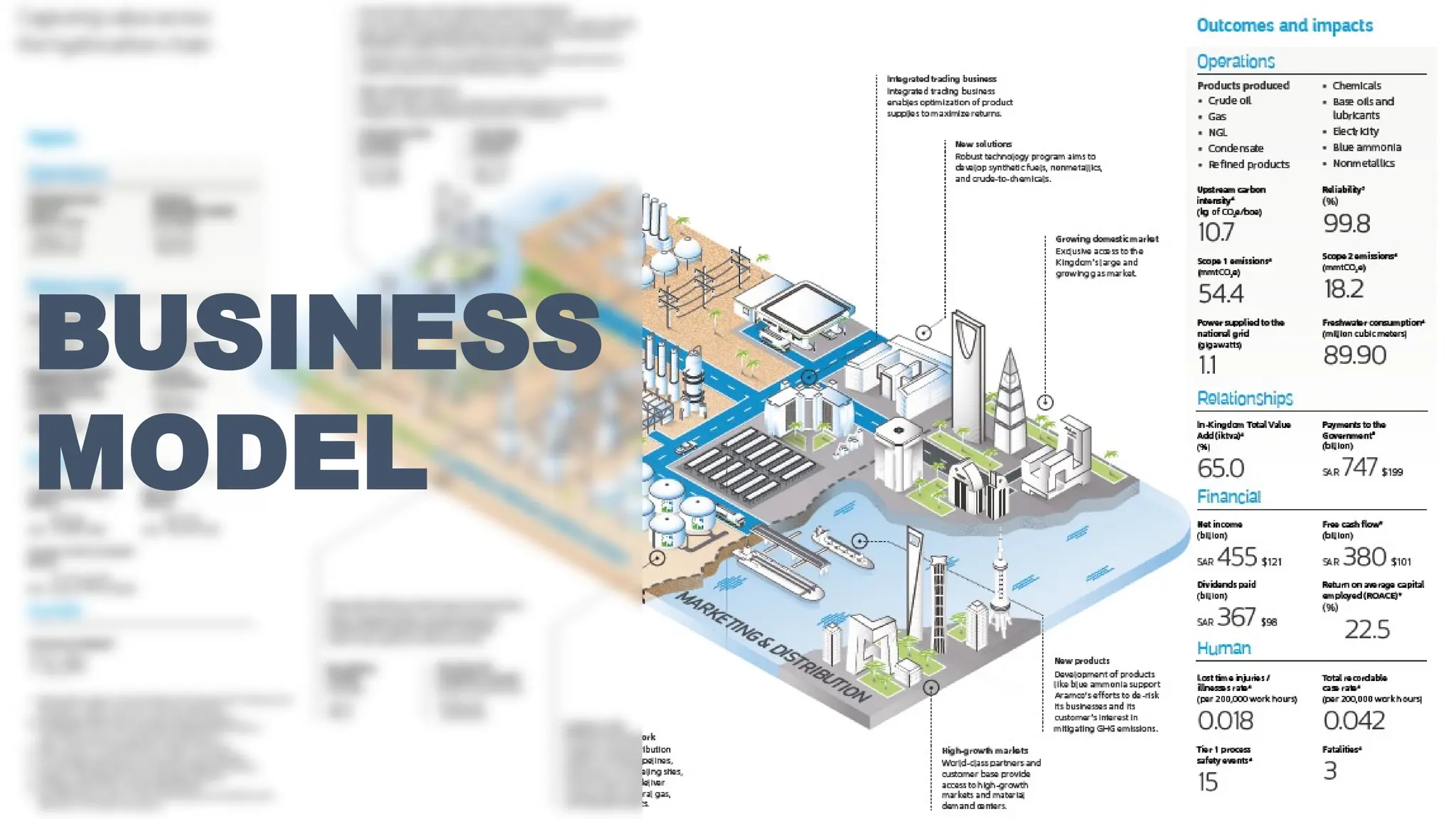
BUSINESS
MODEL
To achieve its vision, Aramco focuses on four
strategic themes across its businesses:
STRATEGIC
THEMES
Upstream
preeminence
Downstream integration
Lower-carbon initiatives
Localization and the promotion of
National champions As the principal engine of value generation, Aramco
intends to maintain its position as the world’s
largest crude oil company by production volume
and one of the lowest-cost producers. The
Company’s vast reserves base, spare capacity, and
unique operational
flexibility allows it to respond to changes in demand
effectively.
Aramco has a dedicated system of domestic
and international wholly-owned and affiliated
refineries that are critical to monetizing its
upstream production. Through continued
strategic integration, the Company captures
additional value across the hydrocarbon chain.
Aramco aims to lower the net carbon
emissions of its operations and support
the global energy transition through the
development of a New Energies business
that includes renewable power generation
and lower-carbon products and solutions
across the energy, chemicals, and
materials sectors.
Aramco facilitates the development of
a diverse, more sustainable, and
globally competitive in-kingdom
energy ecosystem to underpin the
Company’s competitiveness and
support the Kingdom’s economic
development.
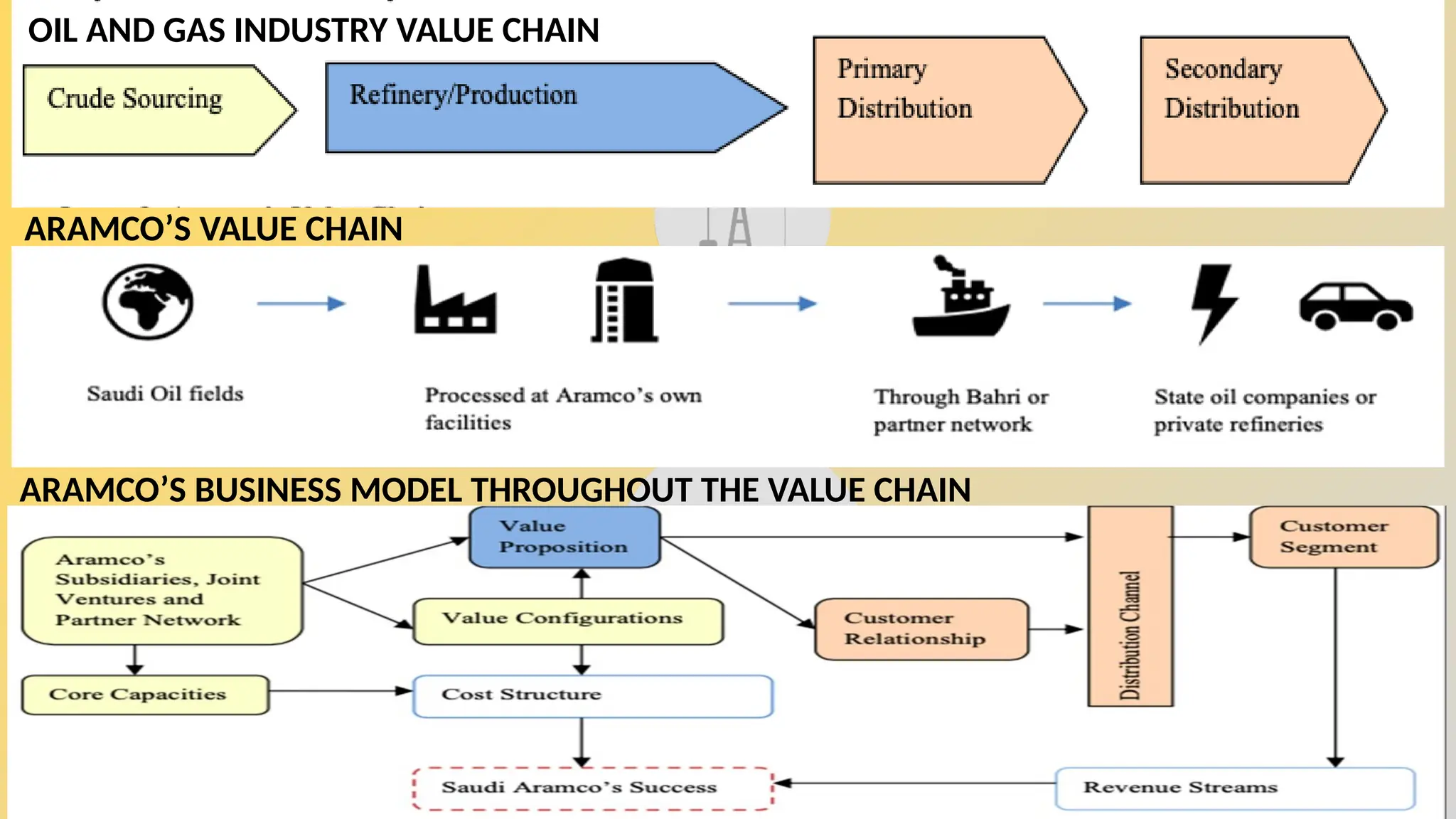
OIL AND GAS INDUSTRY VALUE CHAIN
ARAMCO’S VALUE CHAIN
ARAMCO’S BUSINESS MODEL THROUGHOUT THE VALUE CHAIN
BUSINESS OVERVIEW
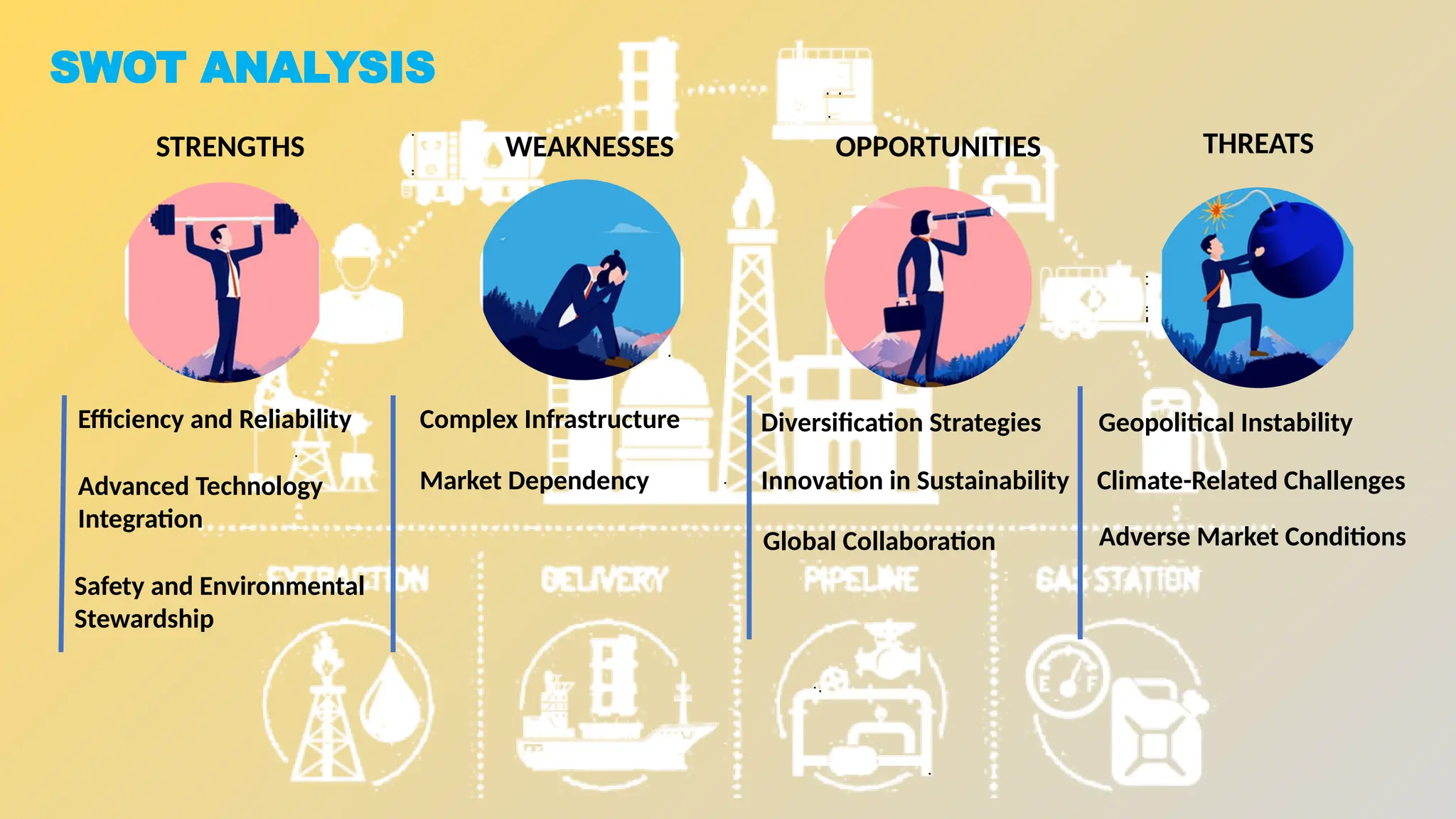
SWOT ANALYSIS
STRENGTHS WEAKNESSES OPPORTUNITIES THREATS
Efficiency and Reliability
Advanced Technology
Integration
Safety and Environmental
Stewardship
Complex Infrastructure
Market Dependency
Diversification Strategies
Innovation in Sustainability
Global Collaboration
Geopolitical Instability
Climate-Related Challenges
Adverse Market Conditions
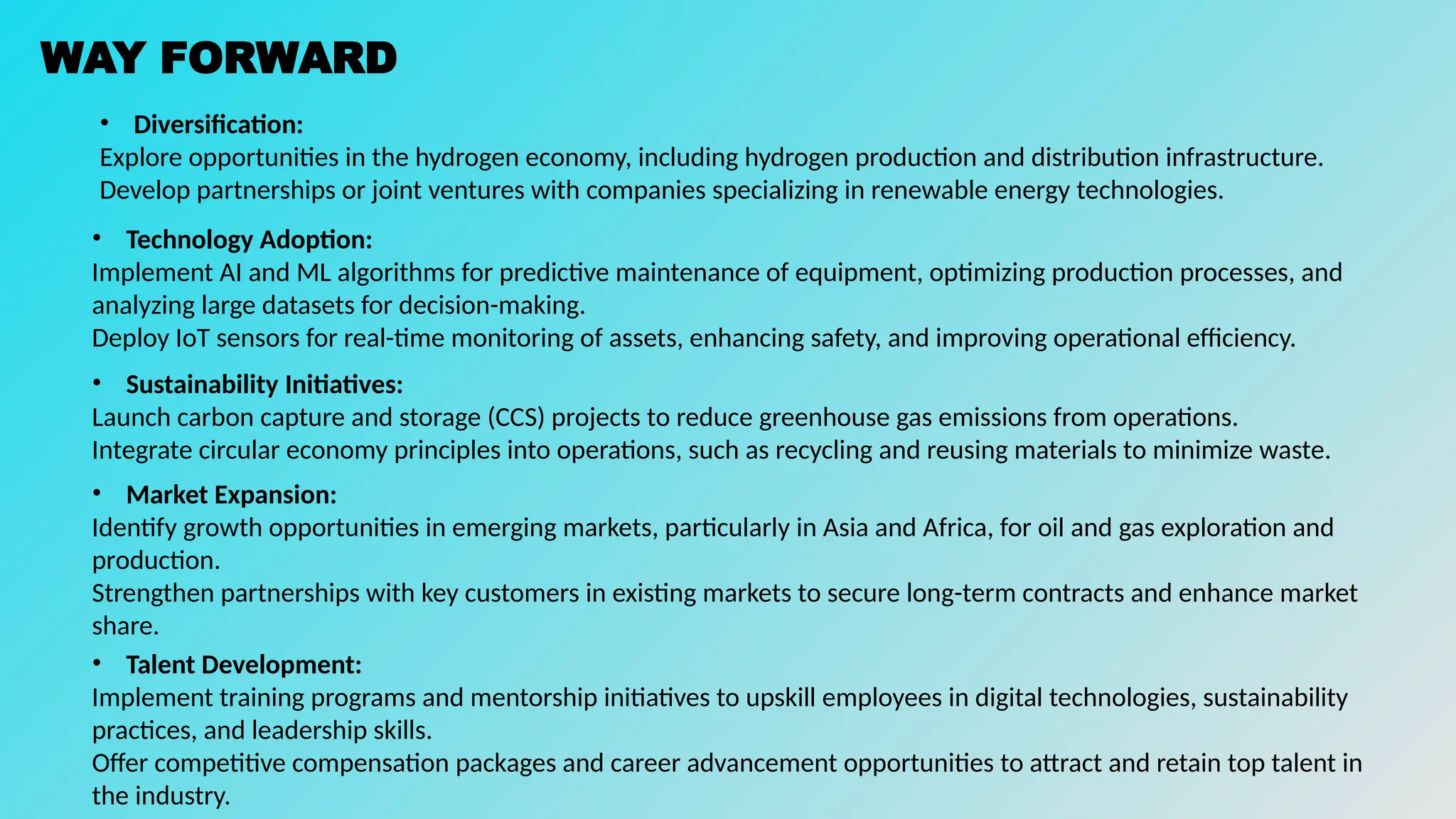
WAY FORWARD
• Diversification:
Explore opportunities in the hydrogen economy, including hydrogen production and distribution infrastructure.
Develop partnerships or joint ventures with companies specializing in renewable energy technologies.
• Technology Adoption:
Implement AI and ML algorithms for predictive maintenance of equipment, optimizing production processes, and
analyzing large datasets for decision-making.
Deploy IoT sensors for real-time monitoring of assets, enhancing safety, and improving operational efficiency.
• Sustainability Initiatives:
Launch carbon capture and storage (CCS) projects to reduce greenhouse gas emissions from operations.
Integrate circular economy principles into operations, such as recycling and reusing materials to minimize waste.
• Market Expansion:
Identify growth opportunities in emerging markets, particularly in Asia and Africa, for oil and gas exploration and
production.
Strengthen partnerships with key customers in existing markets to secure long-term contracts and enhance market
share.
• Talent Development:
Implement training programs and mentorship initiatives to upskill employees in digital technologies, sustainability
practices, and leadership skills.
Offer competitive compensation packages and career advancement opportunities to attract and retain top talent in
the industry.
THANK YOU

Operations Excellence Saudi Aramco original.pptx

  • 1.
    Operations Excellence: An Analysis ofSaudi Aramco's Business Operations
  • 3.
    1933-1944 The birth of Arabianoil 1945-1965 Expansion 1966-1988 Making a name for itself 1989- 2017 A global company 2018- 2023 Transformation and energy security 1 2 3 4 5 Crude oil Concession agreement signed with Standard Oil of California which created the California Arabian Standard Oil Company (CASOC) to manage the Concession. CASOC renamed the Arabian American Oil Company. Standard Oil Company of New Jersey, later Exxon, purchased 30% of Arabian American Oil Company, and Socony-Vacuum Oil Company, later Mobil, purchased 10% to help provide market outlets. Oil production exceeded 2 mmbpd. Oil production averaged 4.5 mmbpd. The Saudi Government increased its participation interest in the crude oil Concession rights, production, and facilities to 100%. Saudi Arabian Oil Company officially established. First International downstream joint venture established in the U.S. Petro Rabigh, Aramco’s first petrochemical plant, began production. SATORP and YASREF refineries came online. Aramco acquired full ownership of Motiva. Commercial production of unconventional resources commenced in north Arabia. Highest single-day crude oil production of 12.1 mmbpd. Highest single-day natural gas production record of 11.3 bscfd. Acquired Valvoline Inc.’s global products business to complement Aramco’s premium-branded lubricant products. First production of unconventional tight gas at South Ghawar.
  • 4.
  • 5.
    Description: Shell hasthe leading brand value of all oil and gas companies worldwide. As of 2023, its brand was valued at 48.2 billion U.S. dollars. Read more Note(s): Worldwide Source(s): Brand Finance Shell Saudi Aramco PetroChina Sinopec TotalEnergies Chevron BP Adnoc Equinor Petronas 0 10,000 20,000 30,000 40,000 50,000 60,000 48,209 45,227 29,647 27,145 20,723 17,427 16,654 14,209 13,099 12,712 Brand value in million U.S. dollars 34 Brand value of leading oil and gas companies worldwide in 2023 (in million U.S. dollars) Leading oil and gas companies worldwide brand value 2023 MARKET COMPETITORS
  • 6.
  • 7.
    To achieve itsvision, Aramco focuses on four strategic themes across its businesses: STRATEGIC THEMES Upstream preeminence Downstream integration Lower-carbon initiatives Localization and the promotion of National champions As the principal engine of value generation, Aramco intends to maintain its position as the world’s largest crude oil company by production volume and one of the lowest-cost producers. The Company’s vast reserves base, spare capacity, and unique operational flexibility allows it to respond to changes in demand effectively. Aramco has a dedicated system of domestic and international wholly-owned and affiliated refineries that are critical to monetizing its upstream production. Through continued strategic integration, the Company captures additional value across the hydrocarbon chain. Aramco aims to lower the net carbon emissions of its operations and support the global energy transition through the development of a New Energies business that includes renewable power generation and lower-carbon products and solutions across the energy, chemicals, and materials sectors. Aramco facilitates the development of a diverse, more sustainable, and globally competitive in-kingdom energy ecosystem to underpin the Company’s competitiveness and support the Kingdom’s economic development.
  • 9.
    OIL AND GASINDUSTRY VALUE CHAIN ARAMCO’S VALUE CHAIN ARAMCO’S BUSINESS MODEL THROUGHOUT THE VALUE CHAIN
  • 10.
  • 11.
    SWOT ANALYSIS STRENGTHS WEAKNESSESOPPORTUNITIES THREATS Efficiency and Reliability Advanced Technology Integration Safety and Environmental Stewardship Complex Infrastructure Market Dependency Diversification Strategies Innovation in Sustainability Global Collaboration Geopolitical Instability Climate-Related Challenges Adverse Market Conditions
  • 12.
    WAY FORWARD • Diversification: Exploreopportunities in the hydrogen economy, including hydrogen production and distribution infrastructure. Develop partnerships or joint ventures with companies specializing in renewable energy technologies. • Technology Adoption: Implement AI and ML algorithms for predictive maintenance of equipment, optimizing production processes, and analyzing large datasets for decision-making. Deploy IoT sensors for real-time monitoring of assets, enhancing safety, and improving operational efficiency. • Sustainability Initiatives: Launch carbon capture and storage (CCS) projects to reduce greenhouse gas emissions from operations. Integrate circular economy principles into operations, such as recycling and reusing materials to minimize waste. • Market Expansion: Identify growth opportunities in emerging markets, particularly in Asia and Africa, for oil and gas exploration and production. Strengthen partnerships with key customers in existing markets to secure long-term contracts and enhance market share. • Talent Development: Implement training programs and mentorship initiatives to upskill employees in digital technologies, sustainability practices, and leadership skills. Offer competitive compensation packages and career advancement opportunities to attract and retain top talent in the industry.
  • 13.