• Operations and Supply management Principle:getting
work done quickly, efficiently, without error, and at low cost
• Operations: Manufacturing and service processes used to transform resources into
products
• Supply Chain: Processes that move information and material to and from the firm
• Efficiency: lowest possible cost (time, effort, resources and without waste)
• Effectiveness: doing the right things to deliver the most value
• Quality: fit for purpose
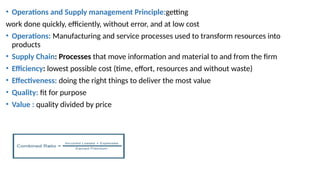
• Value : quality divided by price
• Productivity is a measure of how well resources are used .
• Productivity is a relative measure
• Must be compared to something else to be meaningful like firm with firm or same
firm over time
• Partial productivity measures compare output to a single input
• Multifactor productivity measures compare output to a group of inputs
• Total productivity measures compare output to all inputs
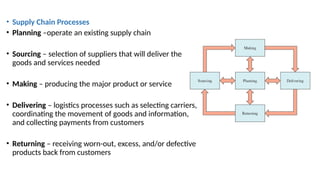
• Supply Chain Processes
• Planning –operate an existing supply chain
• Sourcing – selection of suppliers that will deliver the
goods and services needed
• Making – producing the major product or service
• Delivering – logistics processes such as selecting carriers,
coordinating the movement of goods and information,
and collecting payments from customers
• Returning – receiving worn-out, excess, and/or defective
products back from customers
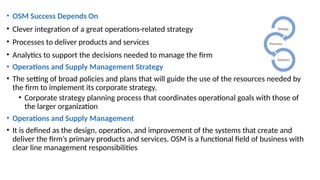
• OSM Success Depends On
• Clever integration of a great operations-related strategy
• Processes to deliver products and services
• Analytics to support the decisions needed to manage the firm
• Operations and Supply Management Strategy
• The setting of broad policies and plans that will guide the use of the resources needed by
the firm to implement its corporate strategy.
• Corporate strategy planning process that coordinates operational goals with those of
the larger organization
• Operations and Supply Management
• It is defined as the design, operation, and improvement of the systems that create and
deliver the firm’s primary products and services. OSM is a functional field of business with
clear line management responsibilities

Operations and Supply management Principle.pptx

  • 1.
    • Operations andSupply management Principle:getting work done quickly, efficiently, without error, and at low cost • Operations: Manufacturing and service processes used to transform resources into products • Supply Chain: Processes that move information and material to and from the firm • Efficiency: lowest possible cost (time, effort, resources and without waste) • Effectiveness: doing the right things to deliver the most value • Quality: fit for purpose • Value : quality divided by price
  • 2.
    • Productivity isa measure of how well resources are used . • Productivity is a relative measure • Must be compared to something else to be meaningful like firm with firm or same firm over time • Partial productivity measures compare output to a single input • Multifactor productivity measures compare output to a group of inputs • Total productivity measures compare output to all inputs
  • 3.
    • Supply ChainProcesses • Planning –operate an existing supply chain • Sourcing – selection of suppliers that will deliver the goods and services needed • Making – producing the major product or service • Delivering – logistics processes such as selecting carriers, coordinating the movement of goods and information, and collecting payments from customers • Returning – receiving worn-out, excess, and/or defective products back from customers
  • 4.
    • OSM SuccessDepends On • Clever integration of a great operations-related strategy • Processes to deliver products and services • Analytics to support the decisions needed to manage the firm • Operations and Supply Management Strategy • The setting of broad policies and plans that will guide the use of the resources needed by the firm to implement its corporate strategy. • Corporate strategy planning process that coordinates operational goals with those of the larger organization • Operations and Supply Management • It is defined as the design, operation, and improvement of the systems that create and deliver the firm’s primary products and services. OSM is a functional field of business with clear line management responsibilities