Operating System
By Khullanote
What is operating system?
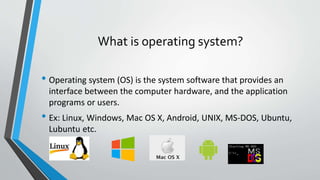
• Operating system (OS) is the system software that provides an
interface between the computer hardware, and the application
programs or users.
• Ex: Linux, Windows, Mac OS X, Android, UNIX, MS-DOS, Ubuntu,
Lubuntu etc.
Function of operating System:
• Process Management—The process management activities handled by the OS are—(1)
control access to shared resources like file, memory, I/O and CPU, (2) control execution of
applications, (3) create, execute and delete a process (system process or user process), (4)
cancel or resume a process (5) schedule a process, and (6) synchronization, communication
and deadlock handling for processes.
• Memory Management—The activities of memory management handled by OS are—(1)
allocate memory, (2) free memory, (3) re-allocate memory to a program when a used block
is freed, and (4) keep track of memory usage.
• File Management—The file management tasks include—(1) create and delete both files and
directories, (2) provide access to files, (3) allocate space for files, (4) keep back-up of files,
and (5) secure files.
• Device Management—The device management tasks handled by OS are—(1) open, close
and write device drivers, and (2) communicate, control and monitor the device driver.
• Protection and Security—OS protects the resources of system. User authentication, file
attributes like read, write, encryption, and back-up of data are used by OS to provide basic
protection.
• User Interface or Command Interpreter—Operating system provides an interface between
the computer user and the computer hardware. The user interface is a set of commands or a
graphical user interface via which the user interacts with the applications and the hardware.
Types of Operating System
• Batch Operating System
• Network Operating System
• Time Sharing Operating System
• Distributed Operating System
• RealTime Operating System
Batch Operating System
• Jobs were loaded to offline devices like punch card.
• Jobs(Program+ Input Data + Control Instruction)
• Submit jobs(punch card) to computer operator.
• Batch were made for similar kinds of jobs.
• Execution.
Network Operating System
• Runs on a server computer
• Provides server availability to share files,manage users,manage security and
other networking functions.
• Eg: MicrosoftWindows Server, UNIX,LINUX,Mac OS X, Novel Netware, BSD
etc.

Operating System.pptx

  • 1.
  • 2.
    What is operatingsystem? • Operating system (OS) is the system software that provides an interface between the computer hardware, and the application programs or users. • Ex: Linux, Windows, Mac OS X, Android, UNIX, MS-DOS, Ubuntu, Lubuntu etc.
  • 3.
    Function of operatingSystem: • Process Management—The process management activities handled by the OS are—(1) control access to shared resources like file, memory, I/O and CPU, (2) control execution of applications, (3) create, execute and delete a process (system process or user process), (4) cancel or resume a process (5) schedule a process, and (6) synchronization, communication and deadlock handling for processes. • Memory Management—The activities of memory management handled by OS are—(1) allocate memory, (2) free memory, (3) re-allocate memory to a program when a used block is freed, and (4) keep track of memory usage. • File Management—The file management tasks include—(1) create and delete both files and directories, (2) provide access to files, (3) allocate space for files, (4) keep back-up of files, and (5) secure files.
  • 4.
    • Device Management—Thedevice management tasks handled by OS are—(1) open, close and write device drivers, and (2) communicate, control and monitor the device driver. • Protection and Security—OS protects the resources of system. User authentication, file attributes like read, write, encryption, and back-up of data are used by OS to provide basic protection. • User Interface or Command Interpreter—Operating system provides an interface between the computer user and the computer hardware. The user interface is a set of commands or a graphical user interface via which the user interacts with the applications and the hardware.
  • 5.
    Types of OperatingSystem • Batch Operating System • Network Operating System • Time Sharing Operating System • Distributed Operating System • RealTime Operating System
  • 6.
    Batch Operating System •Jobs were loaded to offline devices like punch card. • Jobs(Program+ Input Data + Control Instruction) • Submit jobs(punch card) to computer operator. • Batch were made for similar kinds of jobs. • Execution.
  • 7.
    Network Operating System •Runs on a server computer • Provides server availability to share files,manage users,manage security and other networking functions. • Eg: MicrosoftWindows Server, UNIX,LINUX,Mac OS X, Novel Netware, BSD etc.