Open Source and its potential for
   advancing socioeconomic
 development in the Caribbean


            Richard Jobity


                        Presented at “Conversations”,
       Caribbean Development Bank, Wildey, Barbados
                                     29th March, 2006
Outline of presentation

●   Definition of Open Source
●   Examine social and cultural factors that
    militate against adoption of open source
    software in the Caribbean
●   Concerns about open source software
●   Benefits of open source for developing
    countries
●   A role for development Institutions
Definition of Open Source (OSS)


●   Free: The software doesn't cost anything to
    obtain – although there are costs involved in
    configuring and maintaining it, just like with
    other software
Definition of Open Source (OSS)


●   Open: Because the software code is open
    and readable by anyone, it also means that
    the software can be modified by anyone with
    programming skills ... allowing for the
    translation of software into local languages or
    the addition of features needed by a particular
    group
Definition of Open Source (OSS)


●   Collaborative: Open source software draws
    its strength from the fact that people who
    improve, modify or customise programs must
    give it back to the open source community so
    others can benefit from their work.
OSS methods and applications not
limited to Linux alone
●   OpenOffice.org - cross-platform productivity
    suite

●   Apache webserver – most popular webserver
    on the Internet

●   Mozilla.org and subprojects (Mozilla suite,
    Firefox browser, Thunderbird)

●   Google.com
Similar, but not quite “open
source”
●   Wikipedia (global peer-reviewed encyclopedia
    edited via wiki)

●   Creative Commons (creative media
    endeavours – music, video, audio)

●   Groklaw (legal aspects of cases impacting
    OSS)
Social, economic and cultural factors
in the Caribbean – IT and OSS

 ●   Technological innovation not really
     encouraged
        Strong risk-averse business culture,
        Unwillingness to make long-term investment in R&D (by
         businesses),
        Strong preference for purchasing technology from
         abroad instead of developing locally

 ●   Inertia with respect to adoption of IT among
     the older population.
Social, economic and cultural
factors in the Caribbean – IT and
OSS
●   Culture of casual copying – significant
    “copyright infringement” outside of official
    sector – proprietary software effectively at
    minimal cost

●   Some foreign aid “tied” to use of proprietary
    software options.
Concerns about the credibility of
Open Source Software
●   Businesses and people accustomed to and
    dependent on proprietary technology

●   Businesses concerned about technical
    support for Open Source (no one point person
    providing direct support) - is there a pool of
    qualified OSS people to maintain installations
    to the standard of commercial software?

●   FUD campaign by proprietary software
    companies and their lobbyists
Are these concerns valid?

●   Several reputable companies are using the
    technology, locally and internationally

●   Globally: IBM, Google Inc, Amazon.com,
    United Nations, Peru, Venezuela, South
    Korea, China, Department of Defense (USA)

●   Regionally: CMMB, Petrotrin (Trinidad and
    Tobago), rave-TT.net, Greendot,
Are these concerns valid?
Patent and copyright issues
SCO case (SCO vs IBM, Red Hat, Novell, et al)
      Open and transparent code, plus revision tracking
      and use of versioning systems means that
      potential infringement can be dealt with quickly.
      Linux kernel does not infringe on any other code.
      SCO unable to bring any evidence, and in fact
      may not own code that it claims was infringed

●   Patent issues may be future source of
    concern. Possibility that patent portfolio of
    some software companies may be used as
    competitive weapon
Open Source benefits: Cost
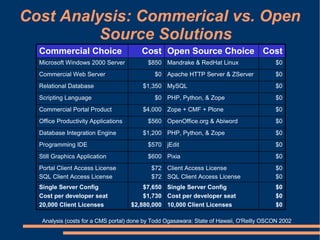
Analysis
●   All TCO calculations are unique, depending
    on the measures used, and who does the
    study

●   Reduced cost of technology – cheaper than
    proprietary technology
Cost Analysis: Commerical vs. Open
          Source Solutions
  Commercial Choice                     Cost Open Source Choice Cost
  Microsoft Windows 2000 Server           $850 Mandrake & RedHat Linux                     $0
  Commercial Web Server                      $0 Apache HTTP Server & ZServer               $0
  Relational Database                    $1,350 MySQL                                      $0
  Scripting Language                         $0 PHP, Python, & Zope                        $0
  Commercial Portal Product              $4,000 Zope + CMF + Plone                         $0
  Office Productivity Applications        $560 OpenOffice.org & Abiword                    $0
  Database Integration Engine            $1,200 PHP, Python, & Zope                        $0
  Programming IDE                         $570 jEdit                                       $0
  Still Graphics Application              $600 Pixia                                       $0
  Portal Client Access License              $72 Client Access License                      $0
  SQL Client Access License                 $72 SQL Client Access License                  $0
  Single Server Config                   $7,650 Single Server Config                       $0
  Cost per developer seat                $1,730 Cost per developer seat                    $0
  20,000 Client Licenses             $2,880,000 10,000 Client Licenses                     $0

   Analysis (costs for a CMS portal) done by Todd Ogasawara: State of Hawaii, O'Reilly OSCON 2002
The OSS value proposition for
developing countries

●   Building over a platform

    As with proprietary software, free software
     platforms can be used as a (modifiable!) base on
     which new services or software are built: 100% of
     the added value is local
The OSS value proposition for
developing countries


●   Sales commissions

    Rarely possible with free software, but also
     represents little value. However, the entire “sale
     price” can be retained locally, as no proprietor has
     to be paid a royalty or licence.
The OSS value proposition for
developing countries

●   Support, integration, customisation...

    Local value addition extensive, as “deep” access is
     available. 100% of such services can be provided
     locally, retaining 100% of the value locally.
Strengths and Advantages of OSS
for the Caribbean region
●   Extends life of hardware – lengthens return on
    investment made in computer systems

●   Foreign Exchange savings – reduced spending
    on imported technology, improvement in the
    country's BOP, even if only used domestically

●   Encourages innovation and builds capacity –
    Open Source Technology encourages creation
    of new products/services and new businesses
Strengths and Advantages of OSS
for the Caribbean region
●   Develops the human resource base – not only
    skills to use OSS applications, but skills
    learned from participating in the OSS commu-
    nity, including:

●   programming
●   copyright law and licenses
●   teamwork and team management
Strengths and Advantages of OSS
for the Caribbean region
●   Focuses on problem solving and collaboration
    (critical skills for any workforce)

●   Development of scalable skills – Linux OSS
    users can easily learn to work in Unix and
    other Unix-like systems (OS X and the BSDs)
Strengths and Advantages of OSS
    for the Caribbean region
●   National security concerns – better control
    over the technology underpinning a country’s
    defence and financial systems. Access to the
    source makes “secret” backdoors less likely

●   Use in disaster relief – OSS can get you up
    and running rapidly in the worst physical con-
    ditions, given openness of protocols and file
    formats (December 2004 tsunami and Hurri-
    cane Katrina)
       ●   CDERA ran successfully on OSS for two years
           with no loss in productivity
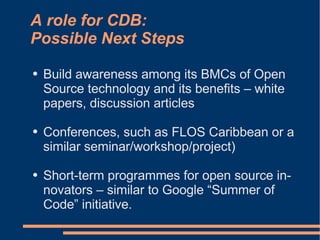
A role for CDB:
Possible Next Steps
●   Build awareness among its BMCs of Open
    Source technology and its benefits – white
    papers, discussion articles

●   Conferences, such as FLOS Caribbean or a
    similar seminar/workshop/project)

●   Short-term programmes for open source in-
    novators – similar to Google “Summer of
    Code” initiative.
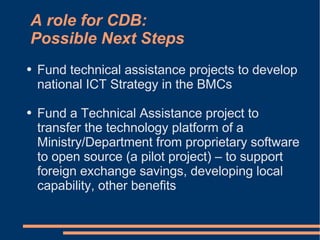
A role for CDB:
Possible Next Steps
●   Fund technical assistance projects to develop
    national ICT Strategy in the BMCs

●   Fund a Technical Assistance project to
    transfer the technology platform of a
    Ministry/Department from proprietary software
    to open source (a pilot project) – to support
    foreign exchange savings, developing local
    capability, other benefits
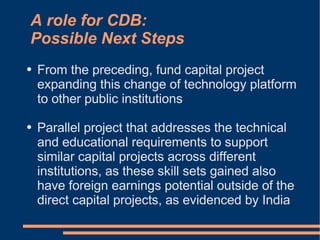
A role for CDB:
Possible Next Steps
●   From the preceding, fund capital project
    expanding this change of technology platform
    to other public institutions

●   Parallel project that addresses the technical
    and educational requirements to support
    similar capital projects across different
    institutions, as these skill sets gained also
    have foreign earnings potential outside of the
    direct capital projects, as evidenced by India
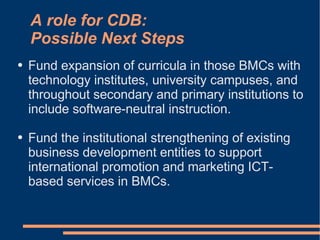
A role for CDB:
    Possible Next Steps
●   Fund expansion of curricula in those BMCs with
    technology institutes, university campuses, and
    throughout secondary and primary institutions to
    include software-neutral instruction.

●   Fund the institutional strengthening of existing
    business development entities to support
    international promotion and marketing ICT-
    based services in BMCs.
What other countries are doing...
" If he is to make good on his promise to
improve life for the tens of millions of
Brazilians who live in dire poverty, President
Luiz Inacio Lula da Silva knows that one key
challenge is to bridge a massive technology
gap. And if that means shunning Microsoft
software in South America's largest country,
then so be it."
http://www.wired.com/news/infostructure/0,1377,61257,00.html
What other countries are doing...
"The Indian government seems to be taking a leaf
out of China's operating system, and is planning a
countrywide drive to promote the open source
operating system, Linux, as the 'platform of choice'
instead of 'proprietary' solutions.”

“The Department of Information Technology has
already devised a strategy to introduce Linux and
open source software as a de-facto standard in
academic institutions, especially in engineering
colleges through course work that encourages use of
such systems."
http://www.aaronbrewster.com/index.php?id=327&first_item=90
Opensource wildey

Opensource wildey

  • 1.
    Open Source andits potential for advancing socioeconomic development in the Caribbean Richard Jobity Presented at “Conversations”, Caribbean Development Bank, Wildey, Barbados 29th March, 2006
  • 2.
    Outline of presentation ● Definition of Open Source ● Examine social and cultural factors that militate against adoption of open source software in the Caribbean ● Concerns about open source software ● Benefits of open source for developing countries ● A role for development Institutions
  • 3.
    Definition of OpenSource (OSS) ● Free: The software doesn't cost anything to obtain – although there are costs involved in configuring and maintaining it, just like with other software
  • 4.
    Definition of OpenSource (OSS) ● Open: Because the software code is open and readable by anyone, it also means that the software can be modified by anyone with programming skills ... allowing for the translation of software into local languages or the addition of features needed by a particular group
  • 5.
    Definition of OpenSource (OSS) ● Collaborative: Open source software draws its strength from the fact that people who improve, modify or customise programs must give it back to the open source community so others can benefit from their work.
  • 6.
    OSS methods andapplications not limited to Linux alone ● OpenOffice.org - cross-platform productivity suite ● Apache webserver – most popular webserver on the Internet ● Mozilla.org and subprojects (Mozilla suite, Firefox browser, Thunderbird) ● Google.com
  • 7.
    Similar, but notquite “open source” ● Wikipedia (global peer-reviewed encyclopedia edited via wiki) ● Creative Commons (creative media endeavours – music, video, audio) ● Groklaw (legal aspects of cases impacting OSS)
  • 8.
    Social, economic andcultural factors in the Caribbean – IT and OSS ● Technological innovation not really encouraged Strong risk-averse business culture, Unwillingness to make long-term investment in R&D (by businesses), Strong preference for purchasing technology from abroad instead of developing locally ● Inertia with respect to adoption of IT among the older population.
  • 9.
    Social, economic andcultural factors in the Caribbean – IT and OSS ● Culture of casual copying – significant “copyright infringement” outside of official sector – proprietary software effectively at minimal cost ● Some foreign aid “tied” to use of proprietary software options.
  • 10.
    Concerns about thecredibility of Open Source Software ● Businesses and people accustomed to and dependent on proprietary technology ● Businesses concerned about technical support for Open Source (no one point person providing direct support) - is there a pool of qualified OSS people to maintain installations to the standard of commercial software? ● FUD campaign by proprietary software companies and their lobbyists
  • 11.
    Are these concernsvalid? ● Several reputable companies are using the technology, locally and internationally ● Globally: IBM, Google Inc, Amazon.com, United Nations, Peru, Venezuela, South Korea, China, Department of Defense (USA) ● Regionally: CMMB, Petrotrin (Trinidad and Tobago), rave-TT.net, Greendot,
  • 12.
    Are these concernsvalid? Patent and copyright issues SCO case (SCO vs IBM, Red Hat, Novell, et al) Open and transparent code, plus revision tracking and use of versioning systems means that potential infringement can be dealt with quickly. Linux kernel does not infringe on any other code. SCO unable to bring any evidence, and in fact may not own code that it claims was infringed ● Patent issues may be future source of concern. Possibility that patent portfolio of some software companies may be used as competitive weapon
  • 13.
    Open Source benefits:Cost Analysis ● All TCO calculations are unique, depending on the measures used, and who does the study ● Reduced cost of technology – cheaper than proprietary technology
  • 14.
    Cost Analysis: Commericalvs. Open Source Solutions Commercial Choice Cost Open Source Choice Cost Microsoft Windows 2000 Server $850 Mandrake & RedHat Linux $0 Commercial Web Server $0 Apache HTTP Server & ZServer $0 Relational Database $1,350 MySQL $0 Scripting Language $0 PHP, Python, & Zope $0 Commercial Portal Product $4,000 Zope + CMF + Plone $0 Office Productivity Applications $560 OpenOffice.org & Abiword $0 Database Integration Engine $1,200 PHP, Python, & Zope $0 Programming IDE $570 jEdit $0 Still Graphics Application $600 Pixia $0 Portal Client Access License $72 Client Access License $0 SQL Client Access License $72 SQL Client Access License $0 Single Server Config $7,650 Single Server Config $0 Cost per developer seat $1,730 Cost per developer seat $0 20,000 Client Licenses $2,880,000 10,000 Client Licenses $0 Analysis (costs for a CMS portal) done by Todd Ogasawara: State of Hawaii, O'Reilly OSCON 2002
  • 15.
    The OSS valueproposition for developing countries ● Building over a platform As with proprietary software, free software platforms can be used as a (modifiable!) base on which new services or software are built: 100% of the added value is local
  • 16.
    The OSS valueproposition for developing countries ● Sales commissions Rarely possible with free software, but also represents little value. However, the entire “sale price” can be retained locally, as no proprietor has to be paid a royalty or licence.
  • 17.
    The OSS valueproposition for developing countries ● Support, integration, customisation... Local value addition extensive, as “deep” access is available. 100% of such services can be provided locally, retaining 100% of the value locally.
  • 18.
    Strengths and Advantagesof OSS for the Caribbean region ● Extends life of hardware – lengthens return on investment made in computer systems ● Foreign Exchange savings – reduced spending on imported technology, improvement in the country's BOP, even if only used domestically ● Encourages innovation and builds capacity – Open Source Technology encourages creation of new products/services and new businesses
  • 19.
    Strengths and Advantagesof OSS for the Caribbean region ● Develops the human resource base – not only skills to use OSS applications, but skills learned from participating in the OSS commu- nity, including: ● programming ● copyright law and licenses ● teamwork and team management
  • 20.
    Strengths and Advantagesof OSS for the Caribbean region ● Focuses on problem solving and collaboration (critical skills for any workforce) ● Development of scalable skills – Linux OSS users can easily learn to work in Unix and other Unix-like systems (OS X and the BSDs)
  • 21.
    Strengths and Advantagesof OSS for the Caribbean region ● National security concerns – better control over the technology underpinning a country’s defence and financial systems. Access to the source makes “secret” backdoors less likely ● Use in disaster relief – OSS can get you up and running rapidly in the worst physical con- ditions, given openness of protocols and file formats (December 2004 tsunami and Hurri- cane Katrina) ● CDERA ran successfully on OSS for two years with no loss in productivity
  • 22.
    A role forCDB: Possible Next Steps ● Build awareness among its BMCs of Open Source technology and its benefits – white papers, discussion articles ● Conferences, such as FLOS Caribbean or a similar seminar/workshop/project) ● Short-term programmes for open source in- novators – similar to Google “Summer of Code” initiative.
  • 23.
    A role forCDB: Possible Next Steps ● Fund technical assistance projects to develop national ICT Strategy in the BMCs ● Fund a Technical Assistance project to transfer the technology platform of a Ministry/Department from proprietary software to open source (a pilot project) – to support foreign exchange savings, developing local capability, other benefits
  • 24.
    A role forCDB: Possible Next Steps ● From the preceding, fund capital project expanding this change of technology platform to other public institutions ● Parallel project that addresses the technical and educational requirements to support similar capital projects across different institutions, as these skill sets gained also have foreign earnings potential outside of the direct capital projects, as evidenced by India
  • 25.
    A role forCDB: Possible Next Steps ● Fund expansion of curricula in those BMCs with technology institutes, university campuses, and throughout secondary and primary institutions to include software-neutral instruction. ● Fund the institutional strengthening of existing business development entities to support international promotion and marketing ICT- based services in BMCs.
  • 26.
    What other countriesare doing... " If he is to make good on his promise to improve life for the tens of millions of Brazilians who live in dire poverty, President Luiz Inacio Lula da Silva knows that one key challenge is to bridge a massive technology gap. And if that means shunning Microsoft software in South America's largest country, then so be it." http://www.wired.com/news/infostructure/0,1377,61257,00.html
  • 27.
    What other countriesare doing... "The Indian government seems to be taking a leaf out of China's operating system, and is planning a countrywide drive to promote the open source operating system, Linux, as the 'platform of choice' instead of 'proprietary' solutions.” “The Department of Information Technology has already devised a strategy to introduce Linux and open source software as a de-facto standard in academic institutions, especially in engineering colleges through course work that encourages use of such systems." http://www.aaronbrewster.com/index.php?id=327&first_item=90