Open Library Data
Digital December
 Digitising the collections of cultural institutions

Creating the metadata to describe those objects

Opening up those data sets to world to build upon
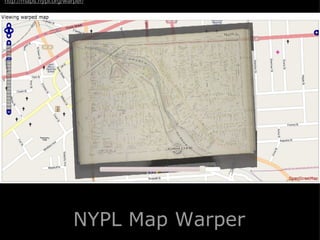
http://maps.nypl.org/warper/


                        NYPL Map Warper
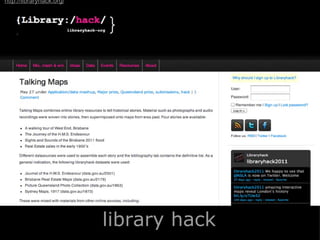
http://libraryhack.org/


                          library hack
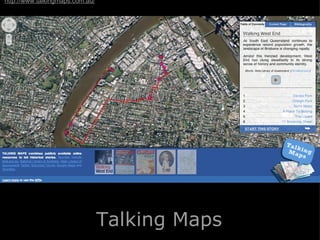
http://www.talkingmaps.com.au/


                                 Talking Maps
WHY?
 People can see our stuff on our website...

       I don't know where to start...

    I have so much other stuff to do...

We don't have any programming expertise...
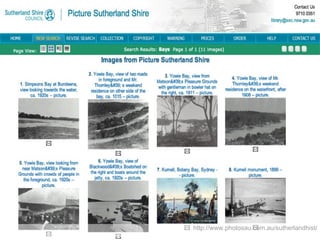
http://www.photosau.com.au/sutherlandhist/
You simply cannot
 imagine the cool things
other people can and will
   do with your data
 

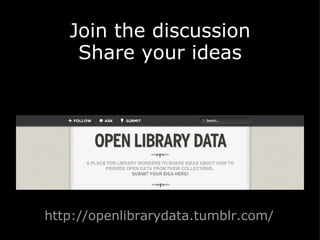
       Join the discussion
        Share your ideas


    http://openlibrarydata.tumblr.com/
This work is licensed under a Cr t e Commons Atibut ShaeAike 3 Unpored L
                                eaiv          tr ion- r l .0        t icense.
Thank You


Questions?  Contact me...
  boycetrus@gmail.com

  @boycetrus

Open Library Data

Editor's Notes

  • #3 Show of hands - who attended digital december last year? Digital december was an event that raised the idea of open library data with some engaging speakers who showed what can be done with digitised collections and their metadata
  • #4 We heard a talk from Michael Lascarides from the New York Public Library about the way they are opening their collections to the web. One of those projects is the Map Warper
  • #5 We also heard from John Allsop, a Sydney web developer and programmer who help organise and run the first Library Hack event last year.
  • #6 One of the Library Hack winners was Talking Maps, a site that takes a different data sets and plots digitised artefacts on a map - it combines photos, audio and video to bring areas alive.
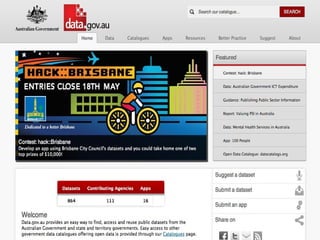
  • #7 There are quite a few govhack days cropping up all over the world and cultural institution data is often used in the things that are built in these competitions. It has reached the point where there are national data catalogues being created and shared. But library data is under-represented in these data catalogues.
  • #8 Some of the larger libraries - state and national and major libraries overseas - are starting to realease more open data but there is not much coming out of smaller public libraries.
  • #9 Your catalogue may be OK at searching for materials when I know what I want... but it's not always the best way to discover the collection. And it certainly no help to someone who wants to build something that presents your collection in new and possibly more appropriate contexts.
  • #10 The truth is though, Some of the things I see on the web are way cooler and more interesting than I would ever have thought of doing
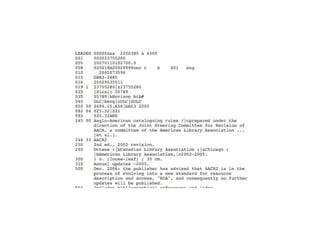
  • #11 However, if there's one thing that librarians are experts at it's classifying objects I'm not advocating the use of MARC records - I wouldn't like to do that the web developers of the world - but it's what we do best We can be the ones who design the data models. We can create the structure that allows the best description of an object. We can populate data sets with our expertise in describing  our collection materials according to a prescribed framework. We can create Open Data.
  • #12 So this talk is really an invitation. To anyone who would like to get involved in some way. To anyone who has an idea that they would like to share for an open data project  To anyone who would like to lend a hand to make some open library data. so go over and visit openlibrarydat.tumblr.com and share your ideas, make suggestions and comment on the projects suggested by others.