Open Educational
Resources (OER)
Considerations
Neil Duldulao
Green River College
Auburn, WA
OER 101, July 2024
“Stack of Old Books” by Austin Kirk is licensed under CC BY 2.0
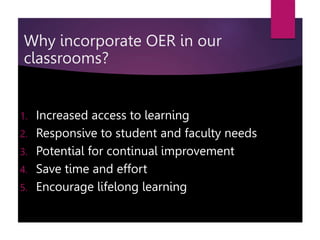
Why incorporate OER in our
classrooms?
1. Increased access to learning
2. Responsive to student and faculty needs
3. Potential for continual improvement
4. Save time and effort
5. Encourage lifelong learning
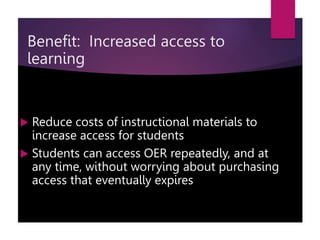
Benefit: Increased access to
learning
 Reduce costs of instructional materials to
increase access for students
 Students can access OER repeatedly, and at
any time, without worrying about purchasing
access that eventually expires
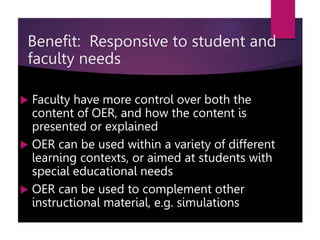
Benefit: Responsive to student and
faculty needs
 Faculty have more control over both the
content of OER, and how the content is
presented or explained
 OER can be used within a variety of different
learning contexts, or aimed at students with
special educational needs
 OER can be used to complement other
instructional material, e.g. simulations
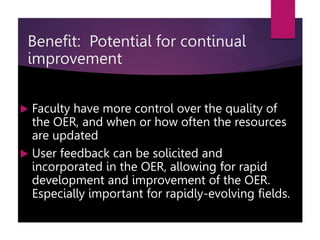
 Faculty have more control over the quality of
the OER, and when or how often the resources
are updated
 User feedback can be solicited and
incorporated in the OER, allowing for rapid
development and improvement of the OER.
Especially important for rapidly-evolving fields.
Benefit: Potential for continual
improvement
 OER can be adapted and modified, so materials
do not have to be developed from scratch
 Promote ease of collaboration in developing
OER
Benefit: Save time and effort
 Wide variety of high-quality OER in many
subjects readily available for traditional and
nontraditional students alike, and this variety is
only expanding
Benefit: Encourage lifelong learning
Ongoing OER Challenges
1. Searching for desired OER
2. Outdated OER
3. Quality control
4. Different OER formats
5. Variable OER “openness”
Challenge: Searching for desired
OER
 Many OER available to sift through
 Search results for OER in OER
collections/databases can be very similar, but
already tailored for specific learning contexts
and special instructional needs
 Many OER were made available online or last
updated up to 20 years ago
 Some OER is not current, requiring time and
effort to bring up to date
Challenge: Outdated OER
 Quality of existing OER may vary
 OER may not be regularly “peer reviewed”, if at
all
 Review information or ratings for a certain
OER can be either difficult to find or possibly
unavailable altogether
Challenge: Quality control
 OER can sometimes be found in a format that
might not be desired
PDF
Website
Microsoft Word
Microsoft PowerPoint
Simulation
And many more!
Challenge: Different OER formats
 Some OER are in the public domain and are the
most open
 Other OER are still under copyright, with all
rights reserved
 Several Creative Commons open licenses exist
with different license elements
Challenge: Variable OER
“openness”

Open Educational Resources (OER) Considerations

  • 1.
    Open Educational Resources (OER) Considerations NeilDuldulao Green River College Auburn, WA OER 101, July 2024 “Stack of Old Books” by Austin Kirk is licensed under CC BY 2.0
  • 2.
    Why incorporate OERin our classrooms? 1. Increased access to learning 2. Responsive to student and faculty needs 3. Potential for continual improvement 4. Save time and effort 5. Encourage lifelong learning
  • 3.
    Benefit: Increased accessto learning  Reduce costs of instructional materials to increase access for students  Students can access OER repeatedly, and at any time, without worrying about purchasing access that eventually expires
  • 4.
    Benefit: Responsive tostudent and faculty needs  Faculty have more control over both the content of OER, and how the content is presented or explained  OER can be used within a variety of different learning contexts, or aimed at students with special educational needs  OER can be used to complement other instructional material, e.g. simulations
  • 5.
     Faculty havemore control over the quality of the OER, and when or how often the resources are updated  User feedback can be solicited and incorporated in the OER, allowing for rapid development and improvement of the OER. Especially important for rapidly-evolving fields. Benefit: Potential for continual improvement
  • 6.
     OER canbe adapted and modified, so materials do not have to be developed from scratch  Promote ease of collaboration in developing OER Benefit: Save time and effort
  • 7.
     Wide varietyof high-quality OER in many subjects readily available for traditional and nontraditional students alike, and this variety is only expanding Benefit: Encourage lifelong learning
  • 8.
    Ongoing OER Challenges 1.Searching for desired OER 2. Outdated OER 3. Quality control 4. Different OER formats 5. Variable OER “openness”
  • 9.
    Challenge: Searching fordesired OER  Many OER available to sift through  Search results for OER in OER collections/databases can be very similar, but already tailored for specific learning contexts and special instructional needs
  • 10.
     Many OERwere made available online or last updated up to 20 years ago  Some OER is not current, requiring time and effort to bring up to date Challenge: Outdated OER
  • 11.
     Quality ofexisting OER may vary  OER may not be regularly “peer reviewed”, if at all  Review information or ratings for a certain OER can be either difficult to find or possibly unavailable altogether Challenge: Quality control
  • 12.
     OER cansometimes be found in a format that might not be desired PDF Website Microsoft Word Microsoft PowerPoint Simulation And many more! Challenge: Different OER formats
  • 13.
     Some OERare in the public domain and are the most open  Other OER are still under copyright, with all rights reserved  Several Creative Commons open licenses exist with different license elements Challenge: Variable OER “openness”