Tissues Groups of cells that have similar functions and structures Epithelial Muscle Connective Nervous Align cells to cover and protect them Epithelial  Connective  Muscle  Nervous  Credits
Epithelial Classified by the number of layers Classified by shape Glandular Simple  Stratified  Home
Glandular Endocrine glands Exocrine glands Most common types of epithelia Epithelial  Home
Simple Consist of one layer of cells Covering epithelia Lining epithelia Pseudostratified  Squamous  Cuboidal  Columnar  epithelia   home
Pseudostratified Actually a simple columnar epithelium Gives the false appearance of being stratified Is often ciliated Simple Epithelial Home
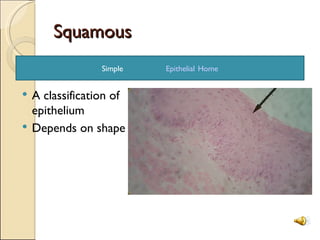
Squamous A classification of epithelium Depends on shape Simple  Epithelial  Home
Cuboidal A classification of epithelium Depends on shape Simple  Epithelial Home
Columnar A classification of epithelium Depends on shape Can be nonciliated Can be ciliated Simple Epithelial Home
Stratified Consists of two or more layers of epithelial cells Covering epithelia Lining epithelia Transitional    Squamous    Cuboidal/Columnar    Epithelial   Home
Transitional Stratified squamous epithelium Has rounded cells Has the ability for cells to slide over one another to stretch an organ Stratified  Epithelial    Home
Squamous Classified based on shape Non-keratinized Keratinized Stratified  Epithelial Home
Cuboidal/Columnar Classification of epithelium depending on shape Not common in the body Stratified  Epithelial  Home
Connective Tissues Found in all parts of the body Most abundant and widely distributed of tissues Most have a large amount of blood vessels Composed of many types of cells Made up of noncellular and nonliving material called a matrix Proper  Cartilage  Bone  Blood  Home
Cartilage Cartilage protects bones Cartilage helps form bones Found in the knees, ears, and nose Hyaline    Elastic    Fibrocartilage  Connective          Home
Hyaline Has chondrocytes in lacunae Found in: Embryonic skeleton The end of long bones Nose Trachea larynx Cartilage  Connective  Home
Elastic Cartilage  Connective   Home Maintains shape Maintains structure Allows flexibility
Fibrocartilage Cartilage  Connective  Home Provides tensile strength Absorbs compression shock
Bone Proper  Dense  Connective  Home Stores calcium Stores minerals Stores fat Marrow inside of bones is the site of hematopoiesis
Proper Loose  Areolar Adipose  Reticular  Bone Connective   Home Embryonic Includes: Areolar Adipose Reticular Dense fibrous connective tissues
Loose Bone Connective  Home Areolar Adipose Reticular Fat storage
Areolar Bone  Connective Home Considered the prototype of the connective tissues All other connective tissues are based off of the structure of the areolar connective tissues
Adipose Bone  Connective  Home Fat tissues Insulates the body Stores food for the body
Reticular Bone Connective  Home Loose ground substance Forms a soft internal skeleton Resembles fibroblasts Supports many free blood cells in lymph nodes, the spleen, and bone marrow
Dense Regular Irregular Elastic Bone Connective Home Often referred to as dense fibrous connective tissues Fibroblasts Includes: Regular fibers Irregular fibers Elastic fibers
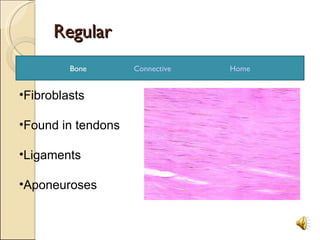
Regular Bone Connective Home Fibroblasts Found in tendons Ligaments Aponeuroses
Irregular Bone  Connective Home Fibroblasts Found in dermis Sub mucosa of the digestive tract Fibrous organ capsules
Elastic Bone  Connective Home Combine strength with elasticity Dense fibrous tissues Occurs in regular and irregular connective tissues
Blood Connective Home Closed circulatory system in humans Open circulatory system in other animals
Muscle Voluntary Involuntary Home Produces most types of body movements Three main types of subcategories of muscle tissues are: Cardiac Skeletal smooth
Voluntary Skeletal Muscle Home Movements of the body Consciously controlled Striated
Skeletal Muscle Home Flesh of the body Attached to the skeleton
Involuntary Smooth Cardiac Muscle Home Unconsciously controlled movements of the body Happens without humans being aware
Smooth Muscle Home Mainly found in the walls of hollow organs Normally two layers that run perpendicular to each other
Cardiac Muscle Home Found only in the heart Has intercalated discs
Nervous Neurons Home Neuroglia Neurons Most associated with nervous system functioning
Neurons Sensitive Highly specialized Receives and sends stimuli to the brain and the whole body Nervous Home
Credits Home Voluntary slide picture-http://images.google.com/imgres?imgurl=http://www.esg.montana.edu/esg/kla/ta/muscar.jpg&imgrefurl=http://www.esg.montana.edu/esg/kla/ta/tissues.html&h=257&w=263&sz=18&hl=en&start=9&sig2=5Uq238OaL5YOfYzZBJLH5A&tbnid=torkyIduFc7D4M:&tbnh=109&tbnw=112&ei=3MEOR4uUBo7qhwLcz6H8Cg&prev=/images%3Fq%3Dvoluntary%2Btissue%26gbv%3D2%26ndsp%3D20%26svnum%3D10%26hl%3Den%26sa%3DN Involuntary slide picture-http://micro.magnet.fsu.edu/primer/anatomy/brightfieldgallery/images/mammalcardiacmusclesmall.jpg Nervous slide picture-http://washington.uwc.edu/about/faculty/schaefer_w/TISSUES/nervous_tissue1.JPG Neurons slide picture-http://www.rndsystems.com/images/ihc/c_nt4ctx_bg.jpg Slides done by Lydia Heter Pictures by Lydia Heter and Kaitlyn Patterson Sound by Lydia Heter Glandular slide picture-http://www.microscopyu.com/galleries/pathology/colonadenocarcinoma.html Reticular slide picture-http://neuromedia.neurobio.ucla.edu/campbell/connective_tissue/wp_images/34_reticular_fibers.gif Dense slide picture-http://kentsimmons.uwinnipeg.ca/cm1504/15lab42006/DensRegularCT.jpg Regular slide picture-http://cellbio.utmb.edu/microanatomy/connective_tissue/00004525.jpg Irregular slide picture-http://medinfo.ufl.edu/year1/histo/images/m8a.jpg Skeletal slide picture-http://www.dmacc.edu/instructors/rbwollaston/Biology_Drawings/skeletal_muscle.gif

Tissues

  • 1.
    Tissues Groups ofcells that have similar functions and structures Epithelial Muscle Connective Nervous Align cells to cover and protect them Epithelial Connective Muscle Nervous Credits
  • 2.
    Epithelial Classified bythe number of layers Classified by shape Glandular Simple Stratified Home
  • 3.
    Glandular Endocrine glandsExocrine glands Most common types of epithelia Epithelial Home
  • 4.
    Simple Consist ofone layer of cells Covering epithelia Lining epithelia Pseudostratified Squamous Cuboidal Columnar epithelia home
  • 5.
    Pseudostratified Actually asimple columnar epithelium Gives the false appearance of being stratified Is often ciliated Simple Epithelial Home
  • 6.
    Squamous A classificationof epithelium Depends on shape Simple Epithelial Home
  • 7.
    Cuboidal A classificationof epithelium Depends on shape Simple Epithelial Home
  • 8.
    Columnar A classificationof epithelium Depends on shape Can be nonciliated Can be ciliated Simple Epithelial Home
  • 9.
    Stratified Consists oftwo or more layers of epithelial cells Covering epithelia Lining epithelia Transitional Squamous Cuboidal/Columnar Epithelial Home
  • 10.
    Transitional Stratified squamousepithelium Has rounded cells Has the ability for cells to slide over one another to stretch an organ Stratified Epithelial Home
  • 11.
    Squamous Classified basedon shape Non-keratinized Keratinized Stratified Epithelial Home
  • 12.
    Cuboidal/Columnar Classification ofepithelium depending on shape Not common in the body Stratified Epithelial Home
  • 13.
    Connective Tissues Foundin all parts of the body Most abundant and widely distributed of tissues Most have a large amount of blood vessels Composed of many types of cells Made up of noncellular and nonliving material called a matrix Proper Cartilage Bone Blood Home
  • 14.
    Cartilage Cartilage protectsbones Cartilage helps form bones Found in the knees, ears, and nose Hyaline Elastic Fibrocartilage Connective Home
  • 15.
    Hyaline Has chondrocytesin lacunae Found in: Embryonic skeleton The end of long bones Nose Trachea larynx Cartilage Connective Home
  • 16.
    Elastic Cartilage Connective Home Maintains shape Maintains structure Allows flexibility
  • 17.
    Fibrocartilage Cartilage Connective Home Provides tensile strength Absorbs compression shock
  • 18.
    Bone Proper Dense Connective Home Stores calcium Stores minerals Stores fat Marrow inside of bones is the site of hematopoiesis
  • 19.
    Proper Loose Areolar Adipose Reticular Bone Connective Home Embryonic Includes: Areolar Adipose Reticular Dense fibrous connective tissues
  • 20.
    Loose Bone Connective Home Areolar Adipose Reticular Fat storage
  • 21.
    Areolar Bone Connective Home Considered the prototype of the connective tissues All other connective tissues are based off of the structure of the areolar connective tissues
  • 22.
    Adipose Bone Connective Home Fat tissues Insulates the body Stores food for the body
  • 23.
    Reticular Bone Connective Home Loose ground substance Forms a soft internal skeleton Resembles fibroblasts Supports many free blood cells in lymph nodes, the spleen, and bone marrow
  • 24.
    Dense Regular IrregularElastic Bone Connective Home Often referred to as dense fibrous connective tissues Fibroblasts Includes: Regular fibers Irregular fibers Elastic fibers
  • 25.
    Regular Bone ConnectiveHome Fibroblasts Found in tendons Ligaments Aponeuroses
  • 26.
    Irregular Bone Connective Home Fibroblasts Found in dermis Sub mucosa of the digestive tract Fibrous organ capsules
  • 27.
    Elastic Bone Connective Home Combine strength with elasticity Dense fibrous tissues Occurs in regular and irregular connective tissues
  • 28.
    Blood Connective HomeClosed circulatory system in humans Open circulatory system in other animals
  • 29.
    Muscle Voluntary InvoluntaryHome Produces most types of body movements Three main types of subcategories of muscle tissues are: Cardiac Skeletal smooth
  • 30.
    Voluntary Skeletal MuscleHome Movements of the body Consciously controlled Striated
  • 31.
    Skeletal Muscle HomeFlesh of the body Attached to the skeleton
  • 32.
    Involuntary Smooth CardiacMuscle Home Unconsciously controlled movements of the body Happens without humans being aware
  • 33.
    Smooth Muscle HomeMainly found in the walls of hollow organs Normally two layers that run perpendicular to each other
  • 34.
    Cardiac Muscle HomeFound only in the heart Has intercalated discs
  • 35.
    Nervous Neurons HomeNeuroglia Neurons Most associated with nervous system functioning
  • 36.
    Neurons Sensitive Highlyspecialized Receives and sends stimuli to the brain and the whole body Nervous Home
  • 37.
    Credits Home Voluntaryslide picture-http://images.google.com/imgres?imgurl=http://www.esg.montana.edu/esg/kla/ta/muscar.jpg&imgrefurl=http://www.esg.montana.edu/esg/kla/ta/tissues.html&h=257&w=263&sz=18&hl=en&start=9&sig2=5Uq238OaL5YOfYzZBJLH5A&tbnid=torkyIduFc7D4M:&tbnh=109&tbnw=112&ei=3MEOR4uUBo7qhwLcz6H8Cg&prev=/images%3Fq%3Dvoluntary%2Btissue%26gbv%3D2%26ndsp%3D20%26svnum%3D10%26hl%3Den%26sa%3DN Involuntary slide picture-http://micro.magnet.fsu.edu/primer/anatomy/brightfieldgallery/images/mammalcardiacmusclesmall.jpg Nervous slide picture-http://washington.uwc.edu/about/faculty/schaefer_w/TISSUES/nervous_tissue1.JPG Neurons slide picture-http://www.rndsystems.com/images/ihc/c_nt4ctx_bg.jpg Slides done by Lydia Heter Pictures by Lydia Heter and Kaitlyn Patterson Sound by Lydia Heter Glandular slide picture-http://www.microscopyu.com/galleries/pathology/colonadenocarcinoma.html Reticular slide picture-http://neuromedia.neurobio.ucla.edu/campbell/connective_tissue/wp_images/34_reticular_fibers.gif Dense slide picture-http://kentsimmons.uwinnipeg.ca/cm1504/15lab42006/DensRegularCT.jpg Regular slide picture-http://cellbio.utmb.edu/microanatomy/connective_tissue/00004525.jpg Irregular slide picture-http://medinfo.ufl.edu/year1/histo/images/m8a.jpg Skeletal slide picture-http://www.dmacc.edu/instructors/rbwollaston/Biology_Drawings/skeletal_muscle.gif