.NET CORE SECURITY
DANIEL KRASNOKUCKI, EQUINIX
/ AppSec
/ DevSecOps
/ .NET Developer
/ Trainer
2.NET CORE SECURITY | DANIEL.KRASNOKUCKI@OWASP.ORG | OWASP POLAND DAY | 16.10.2019
WHOAMI
AGENDA
1. What is .NET Core?
2. .NET (Core) risks and issues
3. Common mistakes when using .NET Core
4. .NET Core (not only) security practices
3.NET CORE SECURITY | DANIEL.KRASNOKUCKI@OWASP.ORG | OWASP POLAND DAY | 16.10.2019
.NET CORE
4.NET CORE SECURITY | DANIEL.KRASNOKUCKI@OWASP.ORG | OWASP POLAND DAY | 16.10.2019
.NET CORE
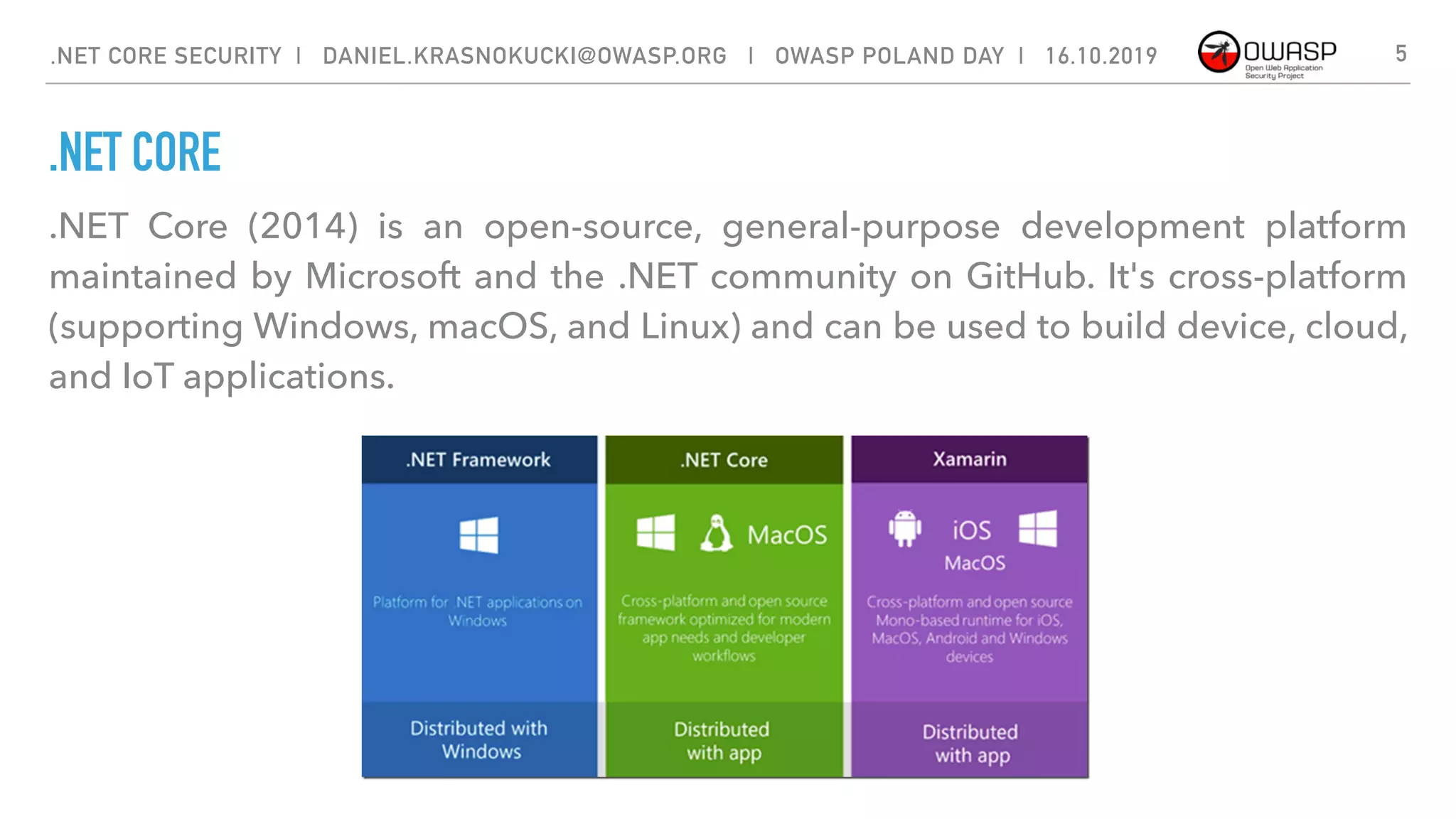
.NET Core (2014)  is an  open-source, general-purpose development platform
maintained by Microsoft and the .NET community on GitHub. It's cross-platform
(supporting Windows, macOS, and Linux) and can be used to build device, cloud,
and IoT applications.
.NET CORE SECURITY | DANIEL.KRASNOKUCKI@OWASP.ORG | OWASP POLAND DAY | 16.10.2019 5
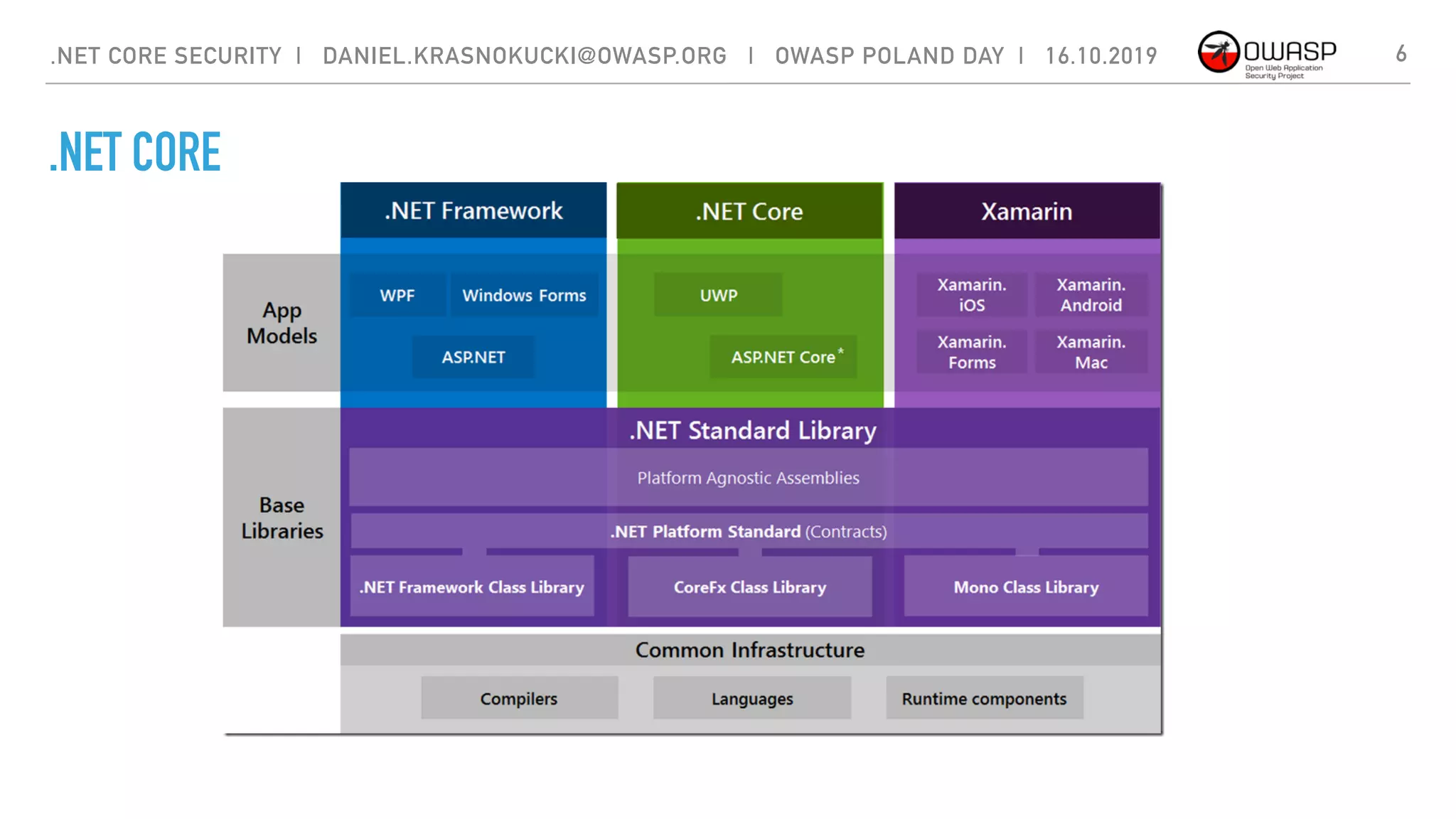
.NET CORE
.NET CORE SECURITY | DANIEL.KRASNOKUCKI@OWASP.ORG | OWASP POLAND DAY | 16.10.2019 6
.NET CORE SECURITY | DANIEL.KRASNOKUCKI@OWASP.ORG | OWASP POLAND DAY | 16.10.2019 7
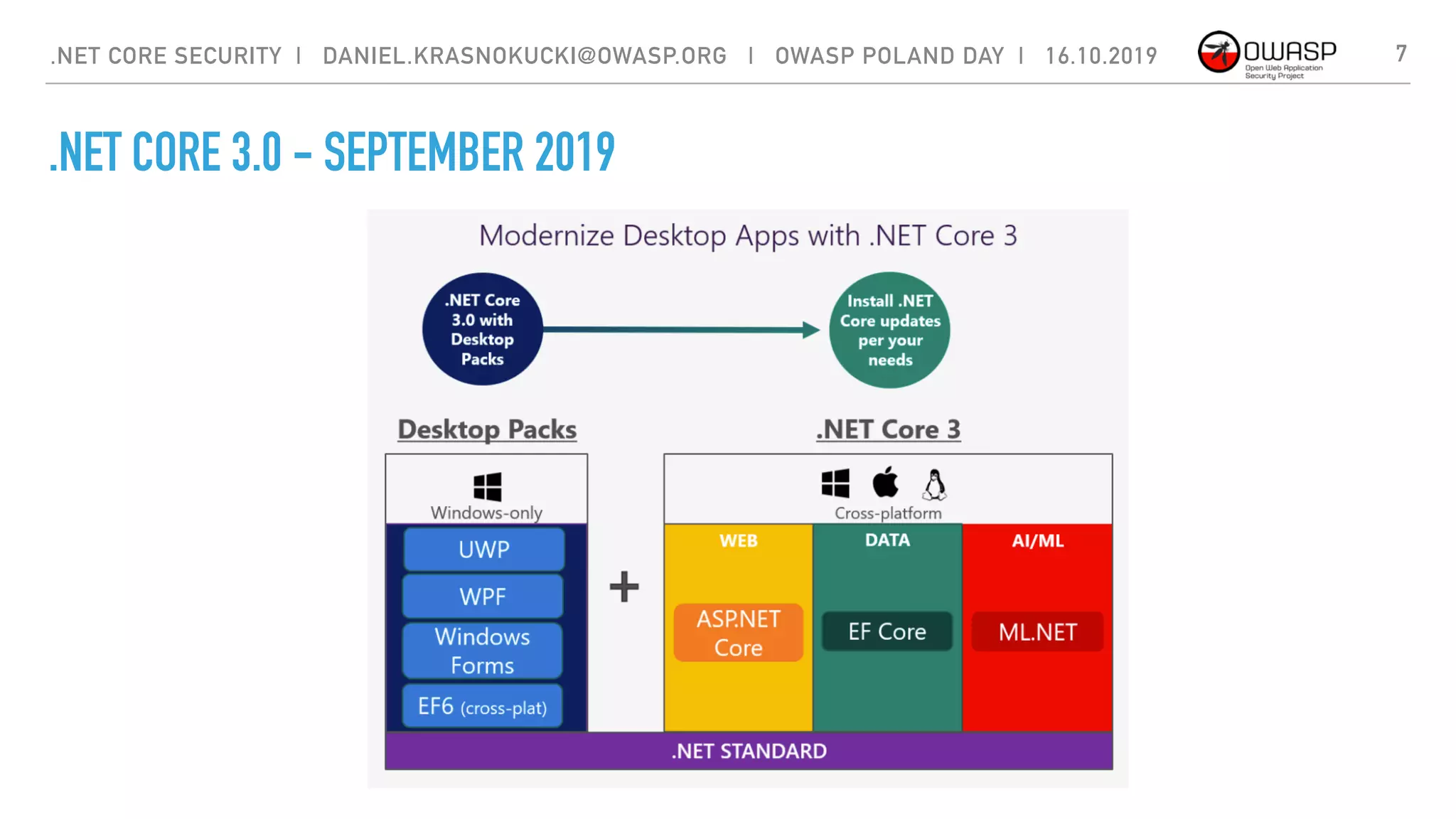
.NET CORE 3.0 - SEPTEMBER 2019
‣ GDPR ready
‣ HTTP/2 enabled by default
‣ gRPC
‣ EventCounters on request
‣ Forwarded Headers Middleware options
‣ One packed executable file
.NET CORE SECURITY | DANIEL.KRASNOKUCKI@OWASP.ORG | OWASP POLAND DAY | 16.10.2019 8
.NET CORE RISKS AND ISSUES
9.NET CORE SECURITY | DANIEL.KRASNOKUCKI@OWASP.ORG | OWASP POLAND DAY | 16.10.2019
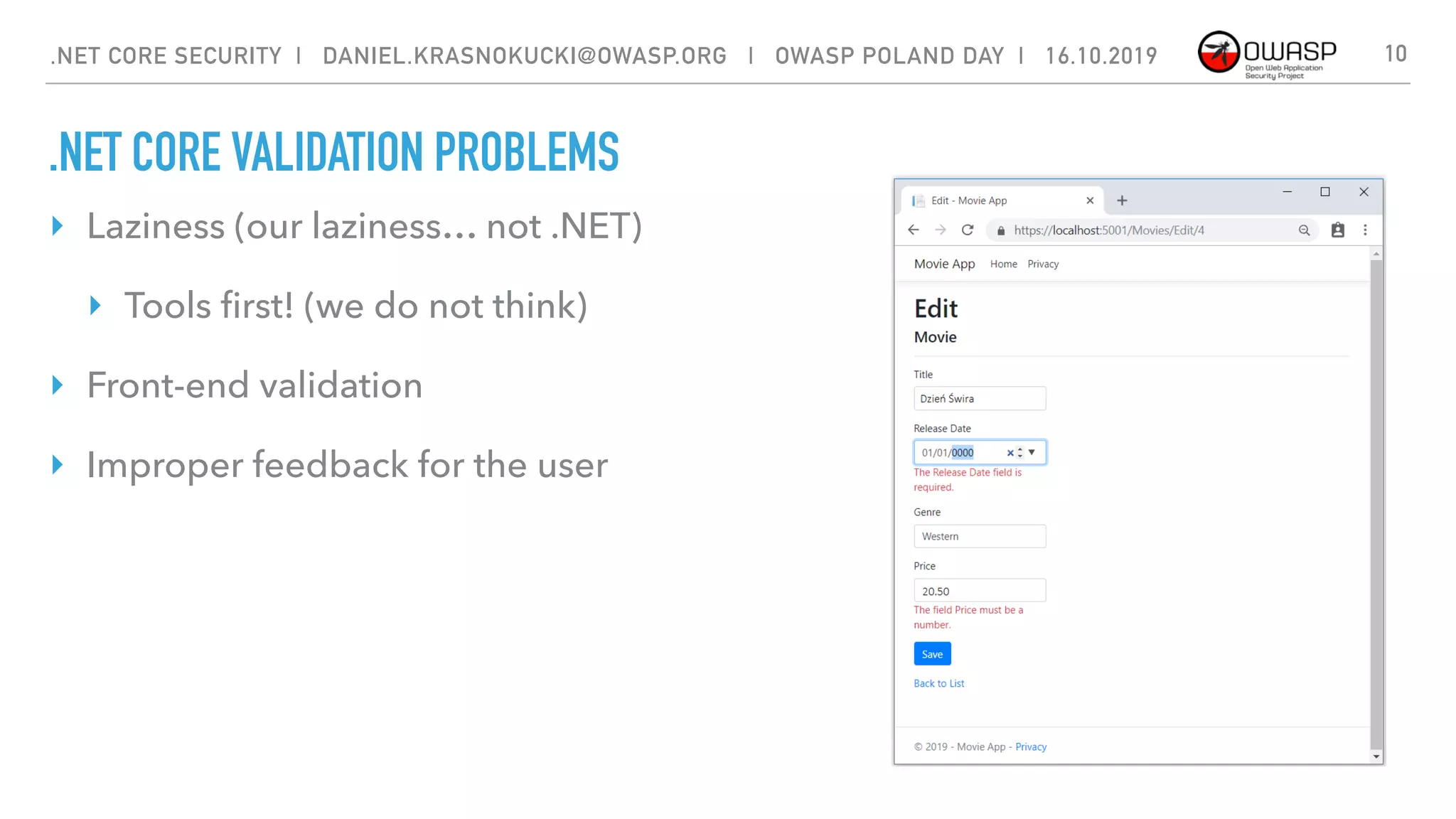
.NET CORE VALIDATION PROBLEMS
10
‣ Laziness (our laziness… not .NET)
‣ Tools first! (we do not think)
‣ Front-end validation
‣ Improper feedback for the user
.NET CORE SECURITY | DANIEL.KRASNOKUCKI@OWASP.ORG | OWASP POLAND DAY | 16.10.2019
INSECURE DESERIALISATION
Insecure deserialization often leads to remote code execution. Even if
deserialization flaws do not result in remote code execution, they can be used to
perform attacks, including replay attacks, injection attacks, and privilege
escalation attacks.
{

"$type": "System.Windows.Data.ObjectDataProvider, PresentationFramework", 

“ObjectInstance": { 

"$type":"System.Diagnostics.Process, System”}, 

"MethodParameters":{ 

"$type":"System.Collections.ArrayList, mscorlib", 

"$values":["calc"]}, 

"MethodName":"Start" 

}
.NET CORE SECURITY | DANIEL.KRASNOKUCKI@OWASP.ORG | OWASP POLAND DAY | 16.10.2019 11
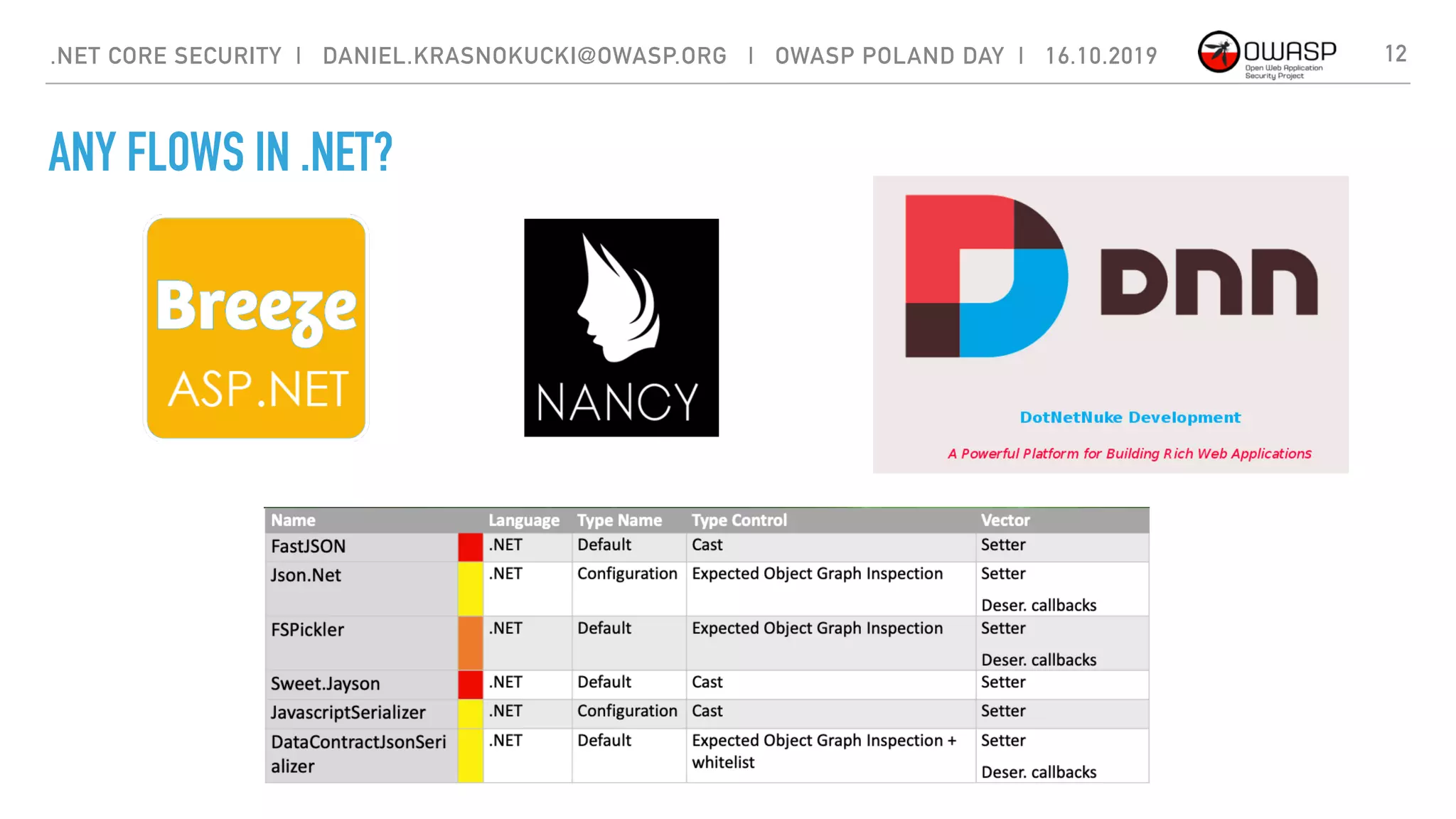
ANY FLOWS IN .NET?
12.NET CORE SECURITY | DANIEL.KRASNOKUCKI@OWASP.ORG | OWASP POLAND DAY | 16.10.2019
13.NET CORE SECURITY | DANIEL.KRASNOKUCKI@OWASP.ORG | OWASP POLAND DAY | 16.10.2019
COMMON MISTAKES WHEN USING .NET CORE
SECURITY MISCONFIGURATION
Security misconfiguration is the most commonly seen issue. This is a result of
insecure default configurations, incomplete or ad hoc configurations, open cloud
storage, misconfigured HTTP headers, and verbose error messages containing
sensitive information. Not only must all operating systems, frameworks, libraries,
and applications be securely configured, but they must be patched/upgraded in
a timely fashion.
14.NET CORE SECURITY | DANIEL.KRASNOKUCKI@OWASP.ORG | OWASP POLAND DAY | 16.10.2019
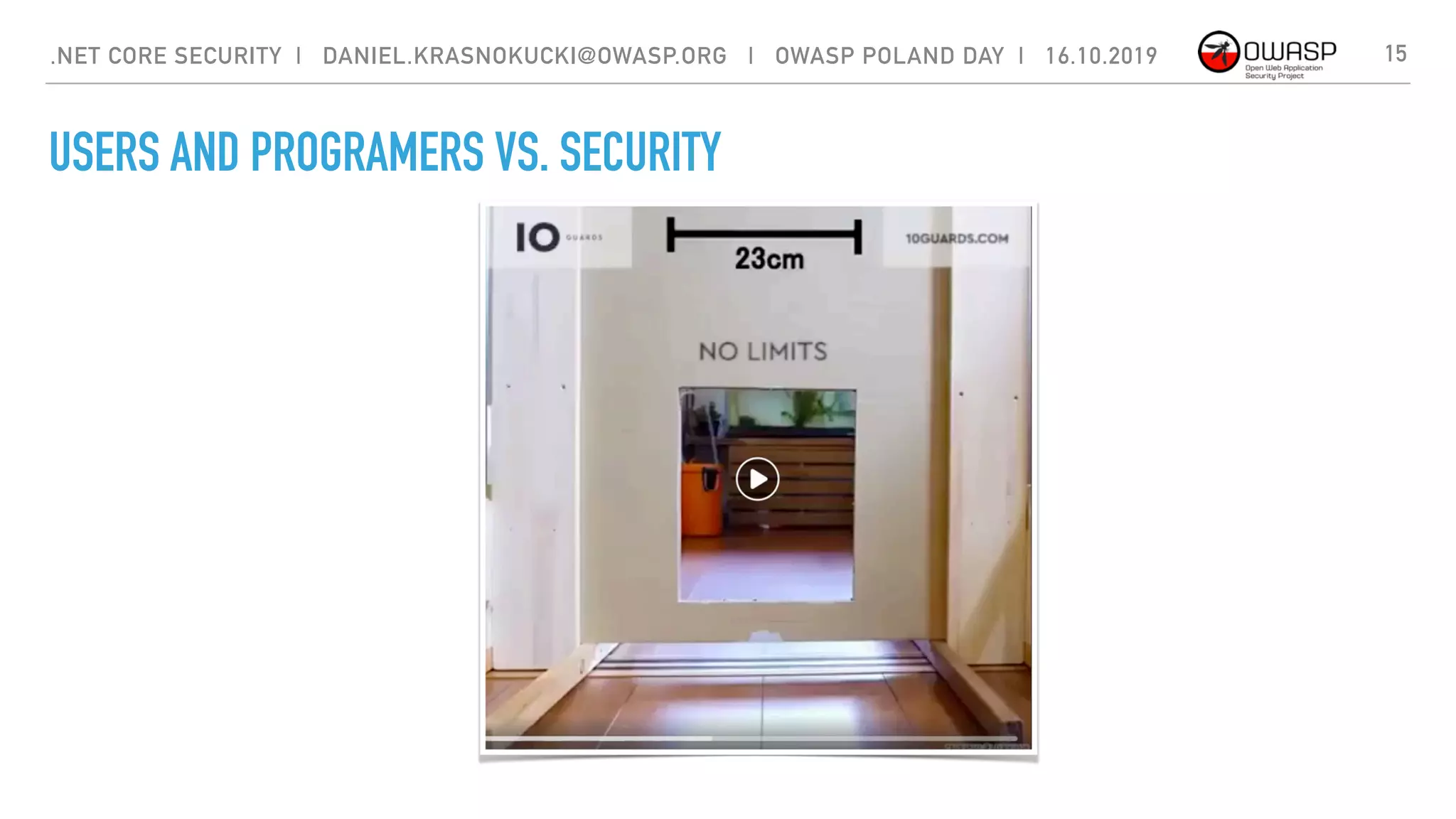
USERS AND PROGRAMERS VS. SECURITY
15.NET CORE SECURITY | DANIEL.KRASNOKUCKI@OWASP.ORG | OWASP POLAND DAY | 16.10.2019
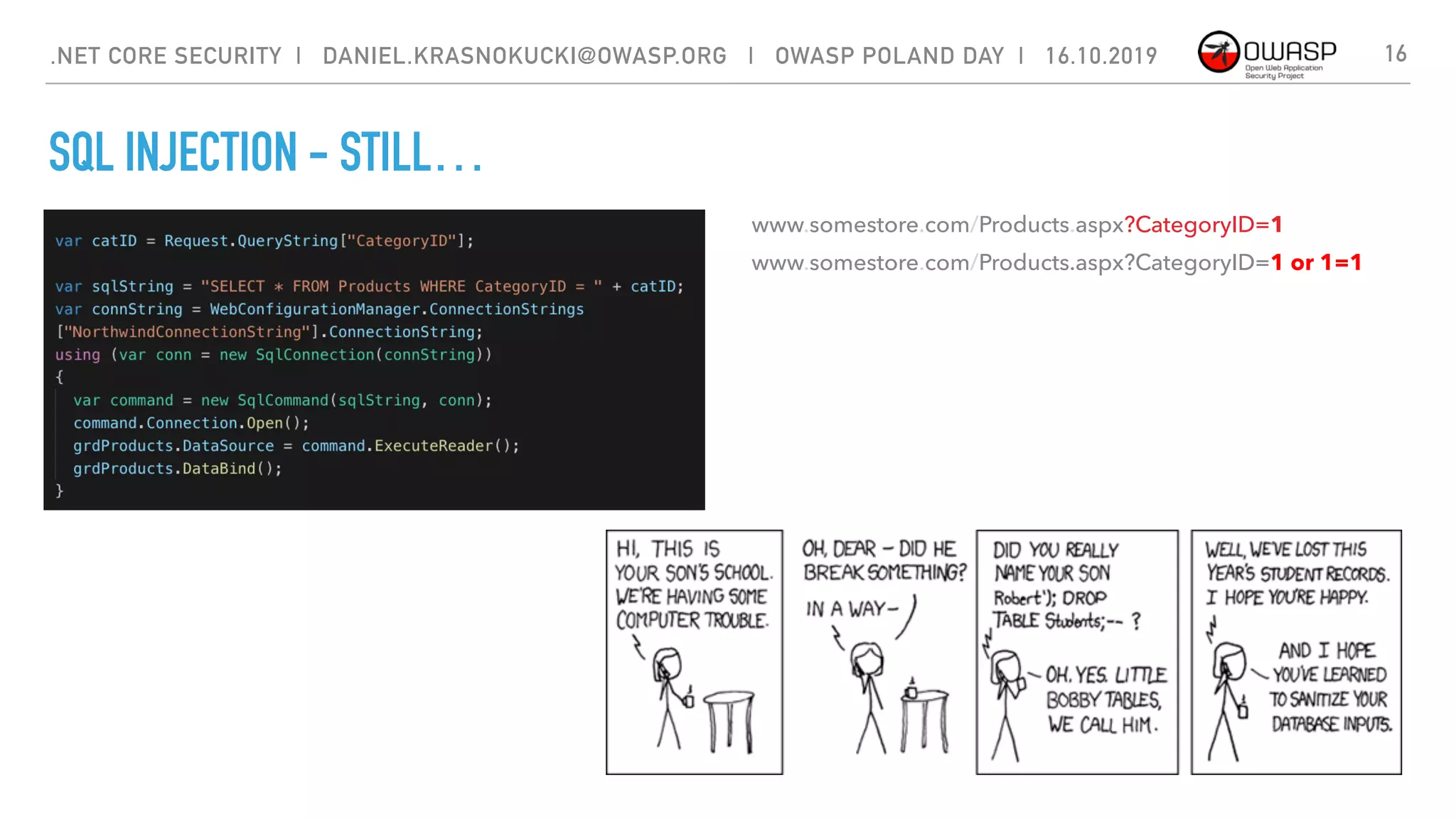
SQL INJECTION - STILL…
16
www.somestore.com/Products.aspx?CategoryID=1
www.somestore.com/Products.aspx?CategoryID=1 or 1=1
.NET CORE SECURITY | DANIEL.KRASNOKUCKI@OWASP.ORG | OWASP POLAND DAY | 16.10.2019
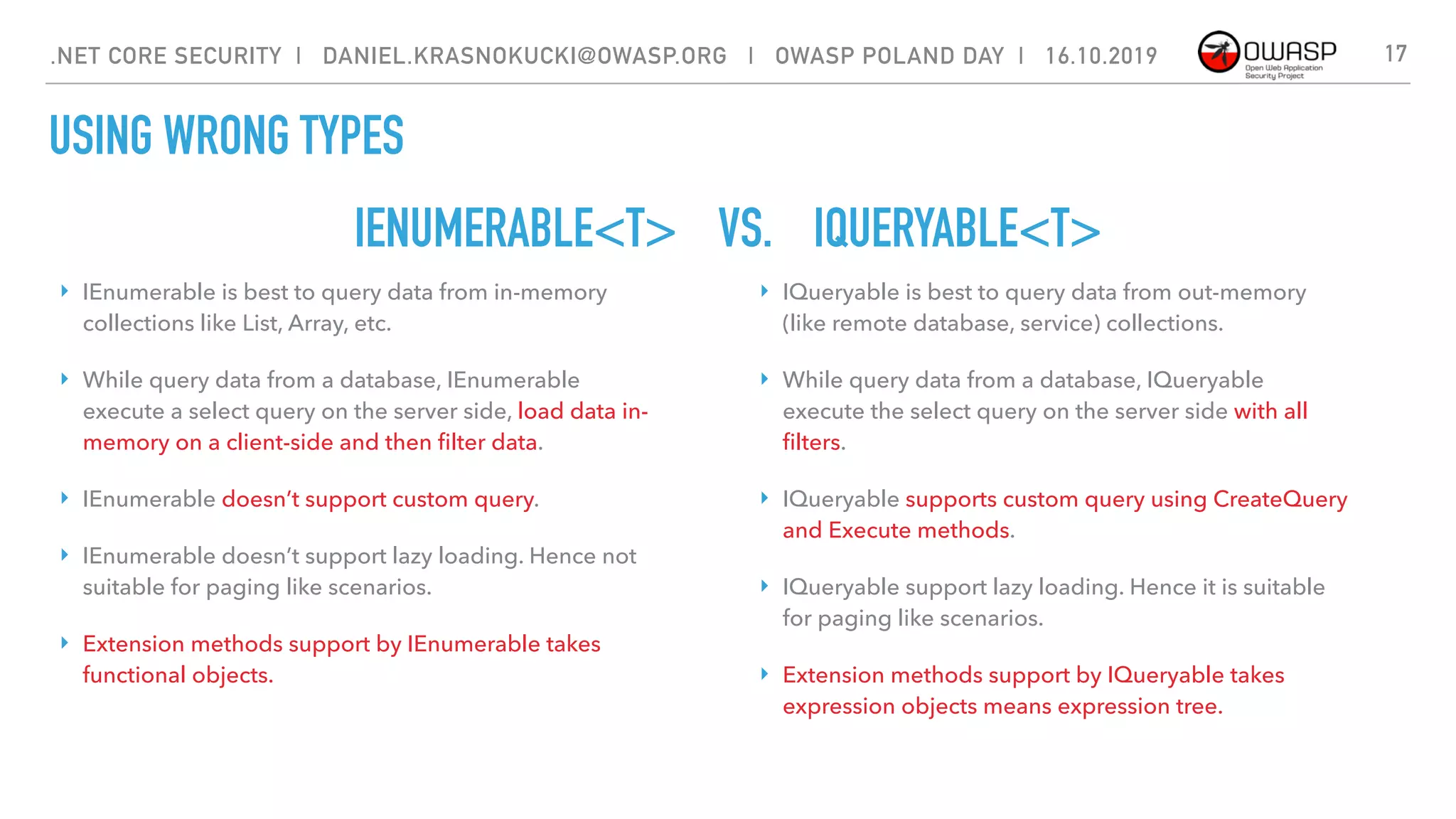
IENUMERABLE<T> VS. IQUERYABLE<T>
17
‣ IEnumerable is best to query data from in-memory
collections like List, Array, etc.
‣ While query data from a database, IEnumerable
execute a select query on the server side, load data in-
memory on a client-side and then filter data.
‣ IEnumerable doesn’t support custom query.
‣ IEnumerable doesn’t support lazy loading. Hence not
suitable for paging like scenarios.
‣ Extension methods support by IEnumerable takes
functional objects.
‣ IQueryable is best to query data from out-memory
(like remote database, service) collections.
‣ While query data from a database, IQueryable
execute the select query on the server side with all
filters.
‣ IQueryable supports custom query using CreateQuery
and Execute methods.
‣ IQueryable support lazy loading. Hence it is suitable
for paging like scenarios.
‣ Extension methods support by IQueryable takes
expression objects means expression tree.
.NET CORE SECURITY | DANIEL.KRASNOKUCKI@OWASP.ORG | OWASP POLAND DAY | 16.10.2019
USING WRONG TYPES
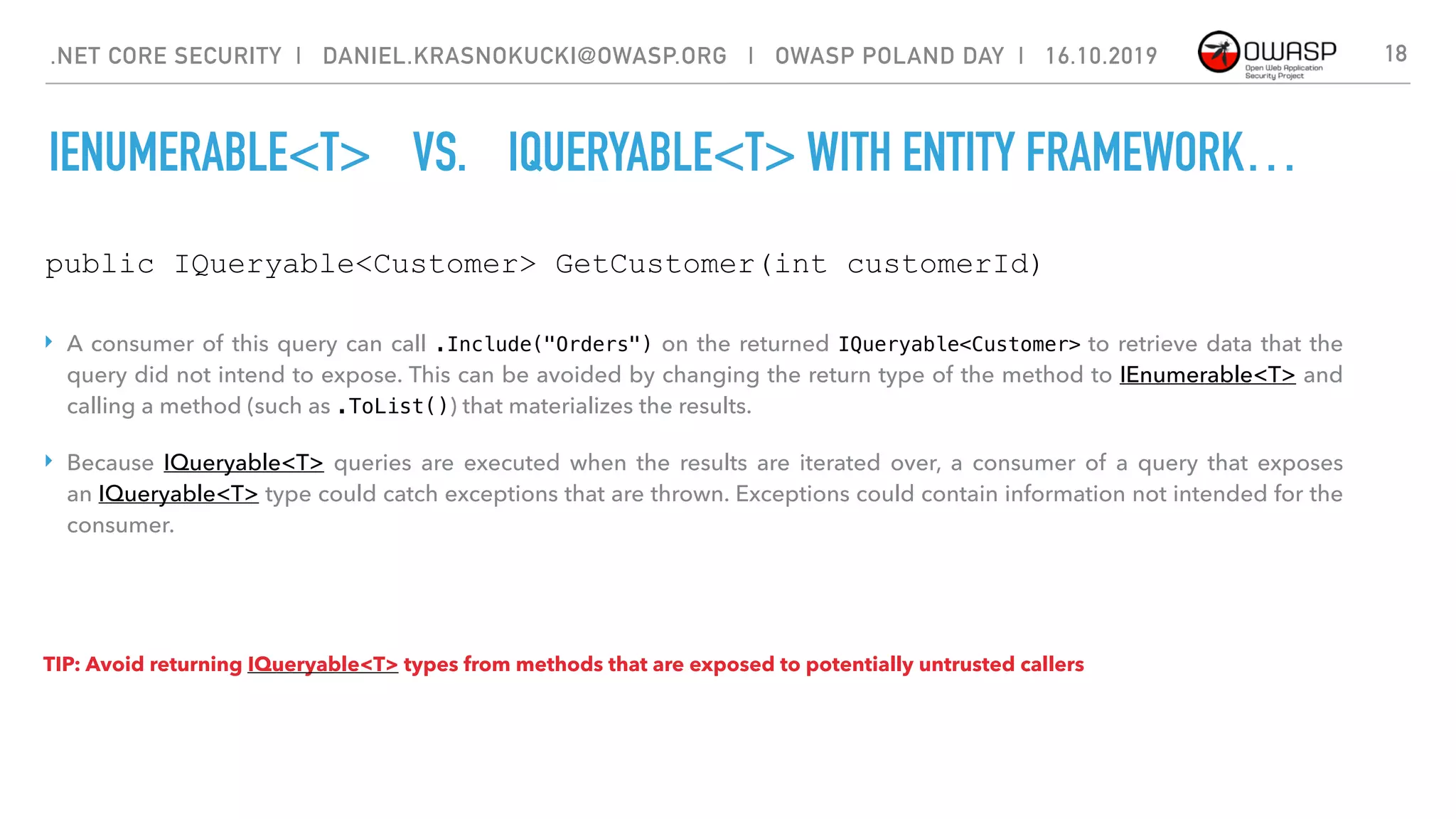
IENUMERABLE<T> VS. IQUERYABLE<T> WITH ENTITY FRAMEWORK…
18
public IQueryable<Customer> GetCustomer(int customerId)
‣ A consumer of this query can call .Include("Orders") on the returned IQueryable<Customer> to retrieve data that the
query did not intend to expose. This can be avoided by changing the return type of the method to IEnumerable<T> and
calling a method (such as .ToList()) that materializes the results.
‣ Because  IQueryable<T>  queries are executed when the results are iterated over, a consumer of a query that exposes
an IQueryable<T> type could catch exceptions that are thrown. Exceptions could contain information not intended for the
consumer.
TIP: Avoid returning IQueryable<T> types from methods that are exposed to potentially untrusted callers
.NET CORE SECURITY | DANIEL.KRASNOKUCKI@OWASP.ORG | OWASP POLAND DAY | 16.10.2019
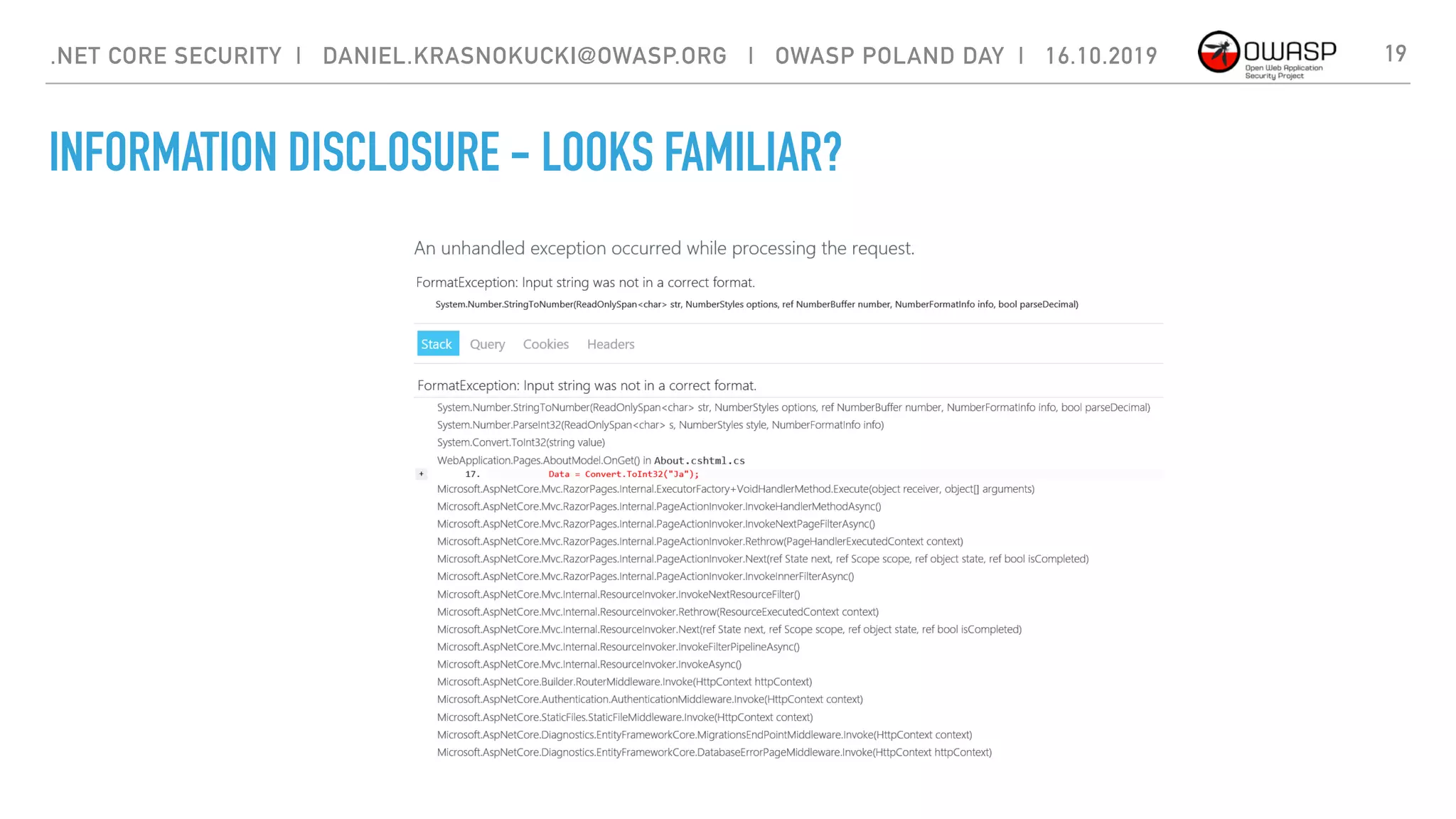
INFORMATION DISCLOSURE - LOOKS FAMILIAR?
19.NET CORE SECURITY | DANIEL.KRASNOKUCKI@OWASP.ORG | OWASP POLAND DAY | 16.10.2019
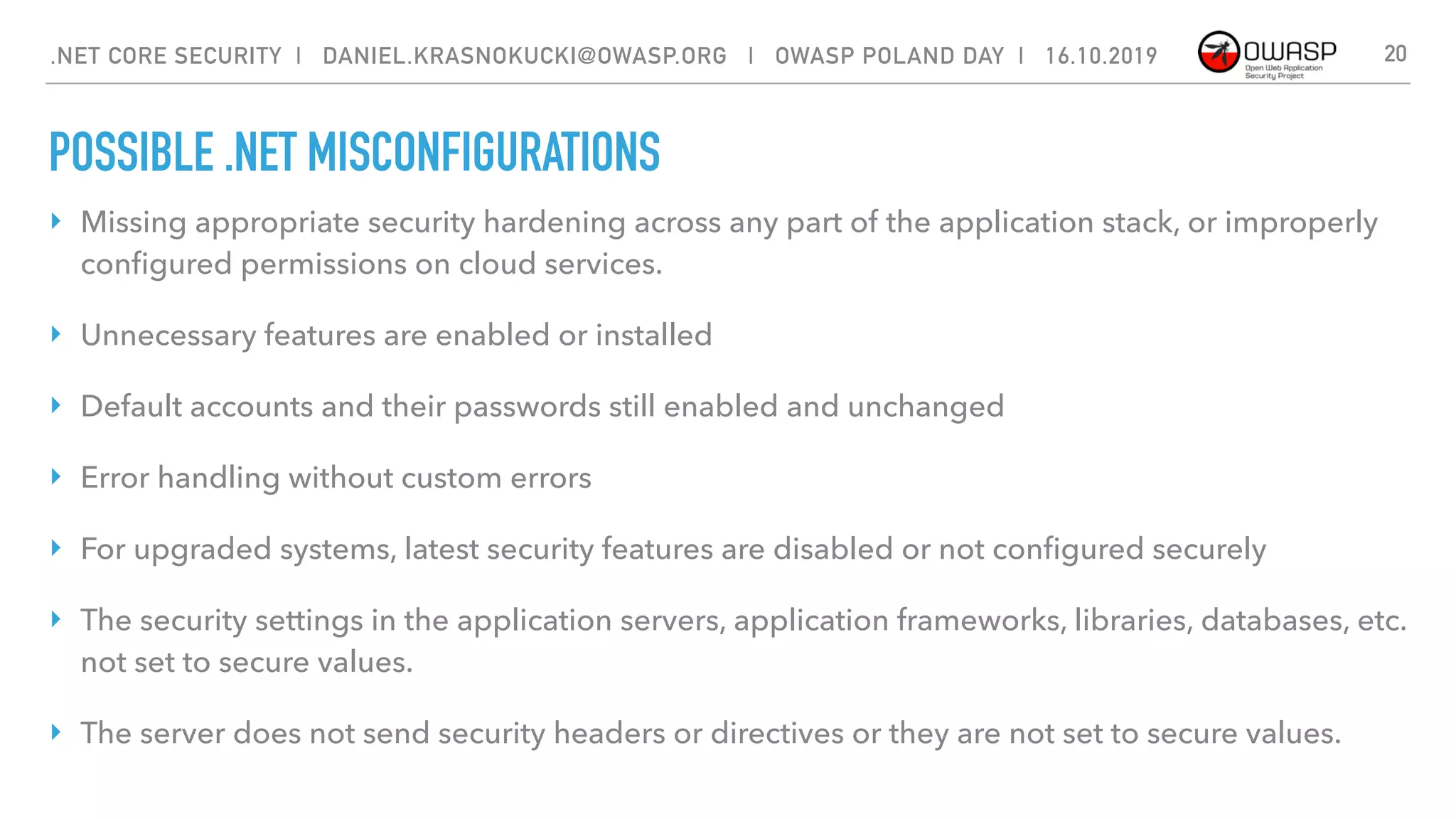
POSSIBLE .NET MISCONFIGURATIONS
‣ Missing appropriate security hardening across any part of the application stack, or improperly
configured permissions on cloud services.
‣ Unnecessary features are enabled or installed
‣ Default accounts and their passwords still enabled and unchanged
‣ Error handling without custom errors
‣ For upgraded systems, latest security features are disabled or not configured securely
‣ The security settings in the application servers, application frameworks, libraries, databases, etc.
not set to secure values.
‣ The server does not send security headers or directives or they are not set to secure values.
20.NET CORE SECURITY | DANIEL.KRASNOKUCKI@OWASP.ORG | OWASP POLAND DAY | 16.10.2019
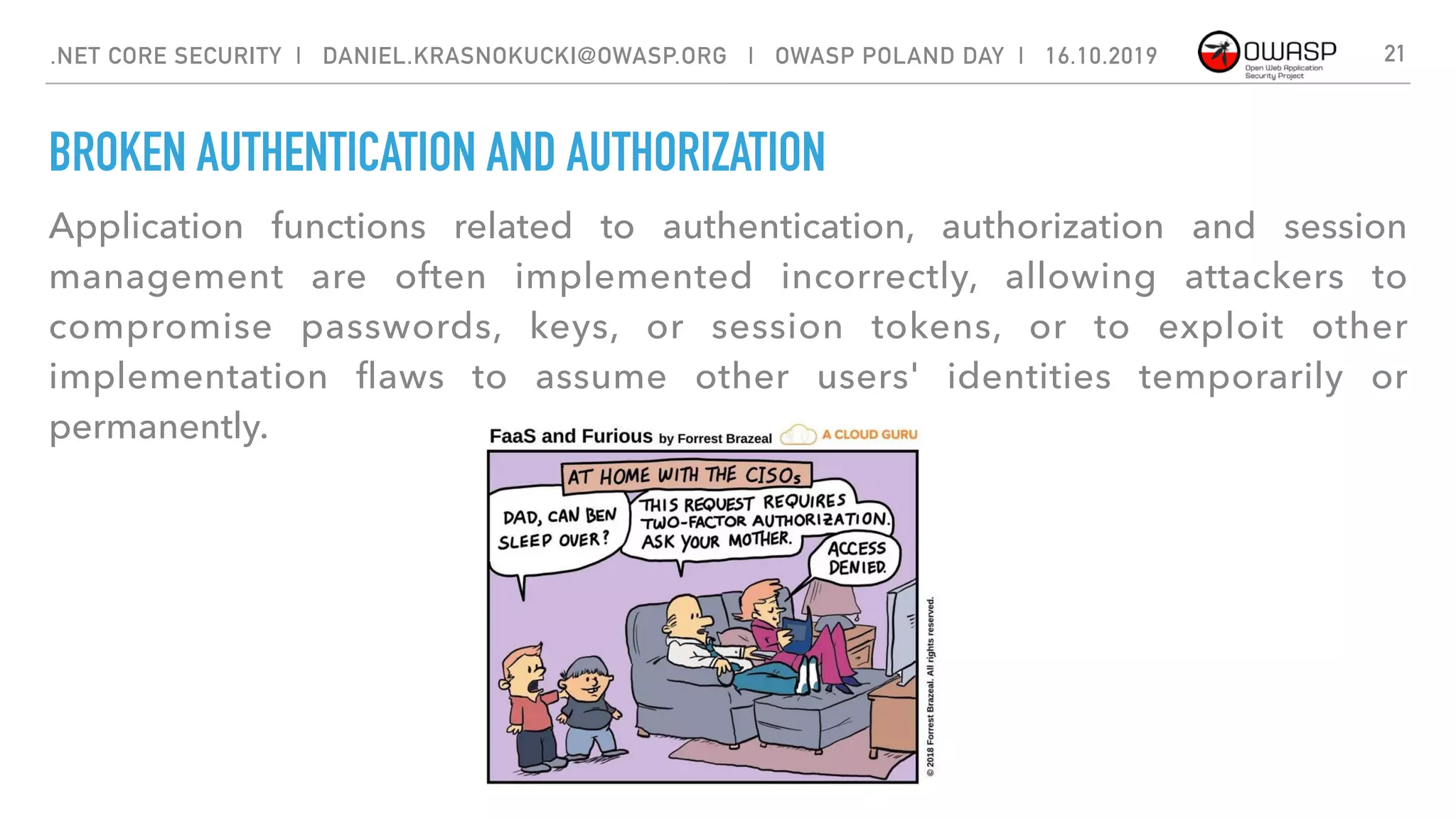
BROKEN AUTHENTICATION AND AUTHORIZATION
Application functions related to authentication, authorization and session
management are often implemented incorrectly, allowing attackers to
compromise passwords, keys, or session tokens, or to exploit other
implementation flaws to assume other users' identities temporarily or
permanently.
21.NET CORE SECURITY | DANIEL.KRASNOKUCKI@OWASP.ORG | OWASP POLAND DAY | 16.10.2019
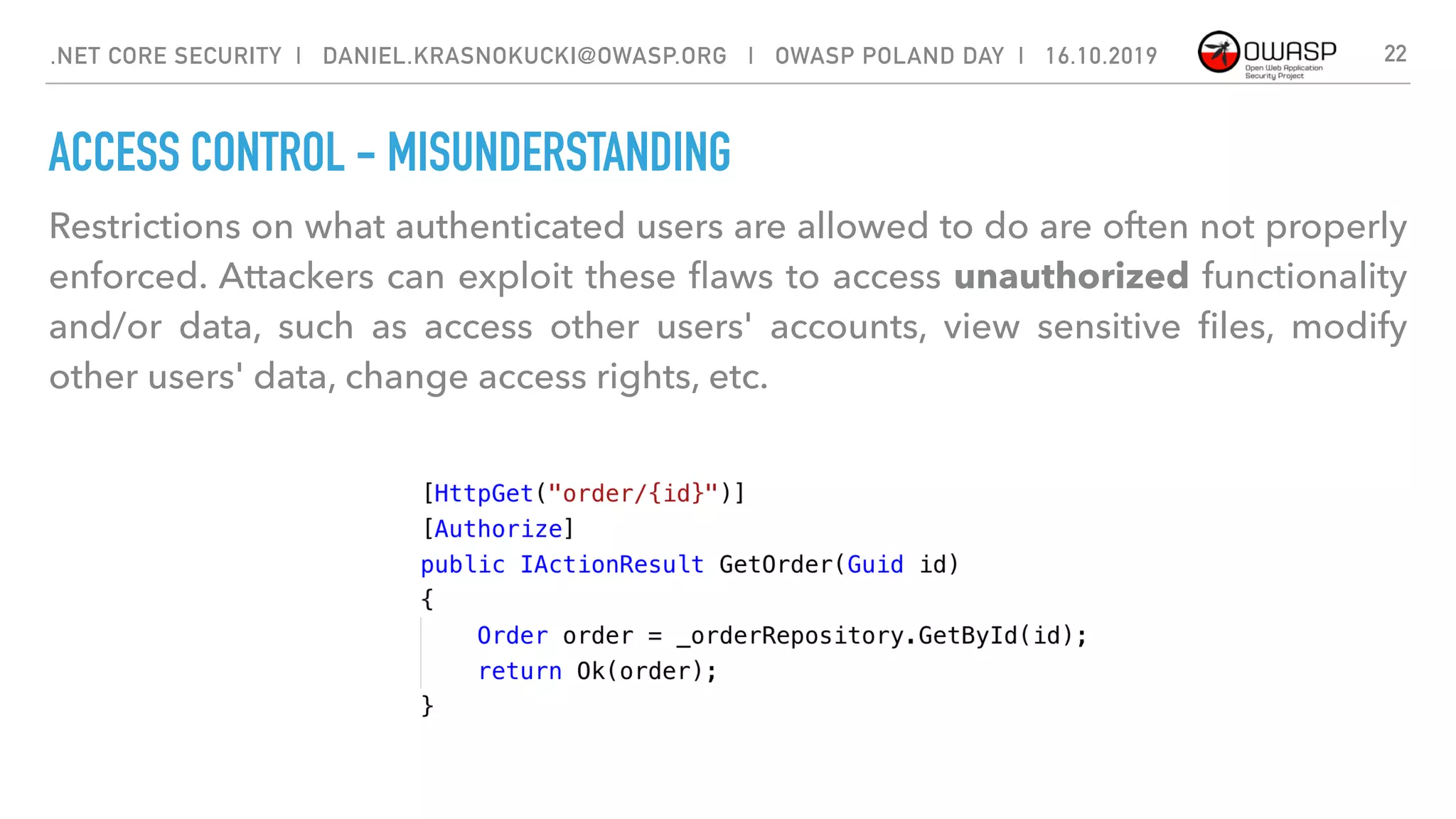
ACCESS CONTROL - MISUNDERSTANDING
Restrictions on what authenticated users are allowed to do are often not properly
enforced. Attackers can exploit these flaws to access unauthorized functionality
and/or data, such as access other users' accounts, view sensitive files, modify
other users' data, change access rights, etc.
22.NET CORE SECURITY | DANIEL.KRASNOKUCKI@OWASP.ORG | OWASP POLAND DAY | 16.10.2019
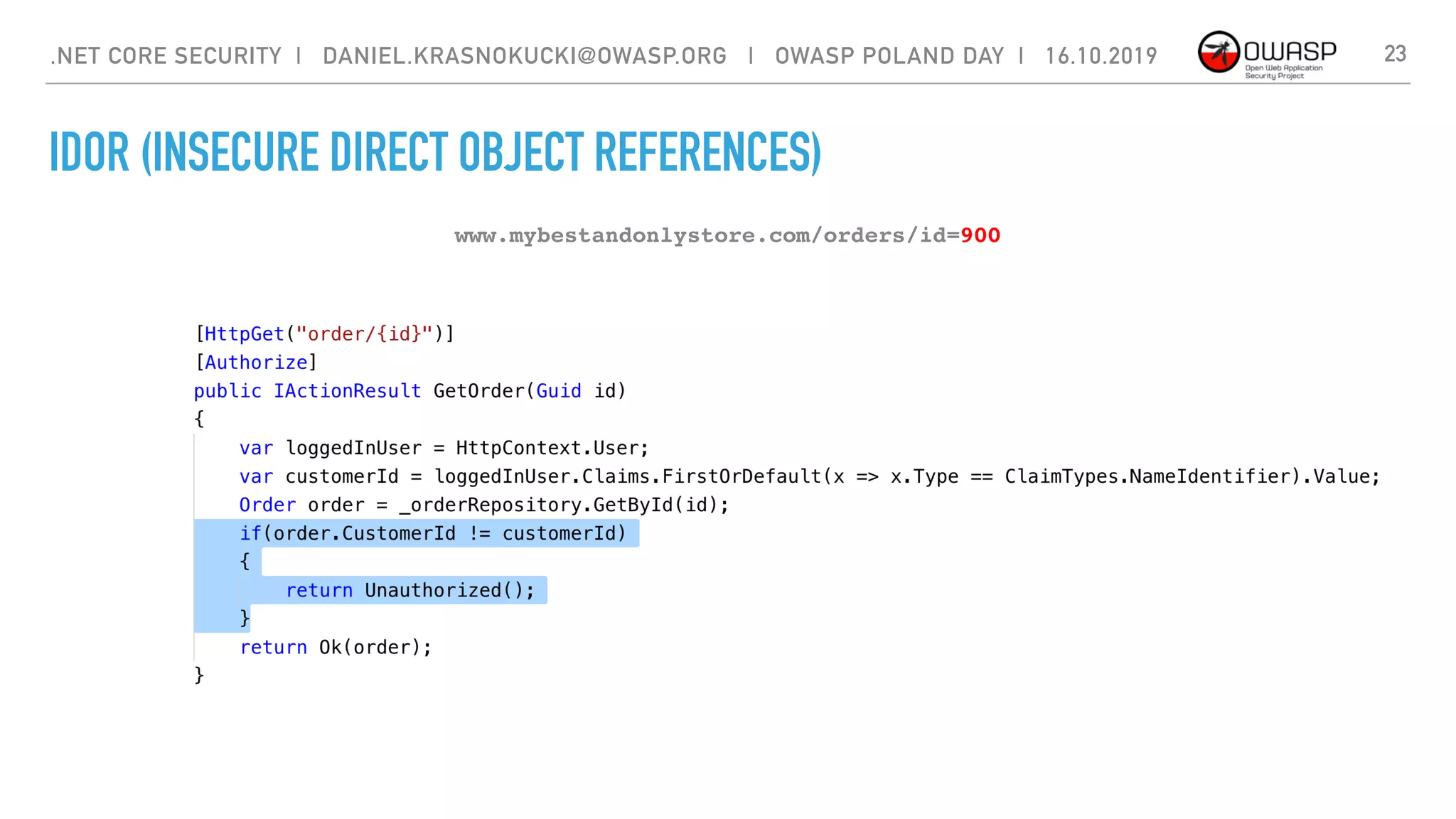
IDOR (INSECURE DIRECT OBJECT REFERENCES)
www.mybestandonlystore.com/orders/id=900
23.NET CORE SECURITY | DANIEL.KRASNOKUCKI@OWASP.ORG | OWASP POLAND DAY | 16.10.2019
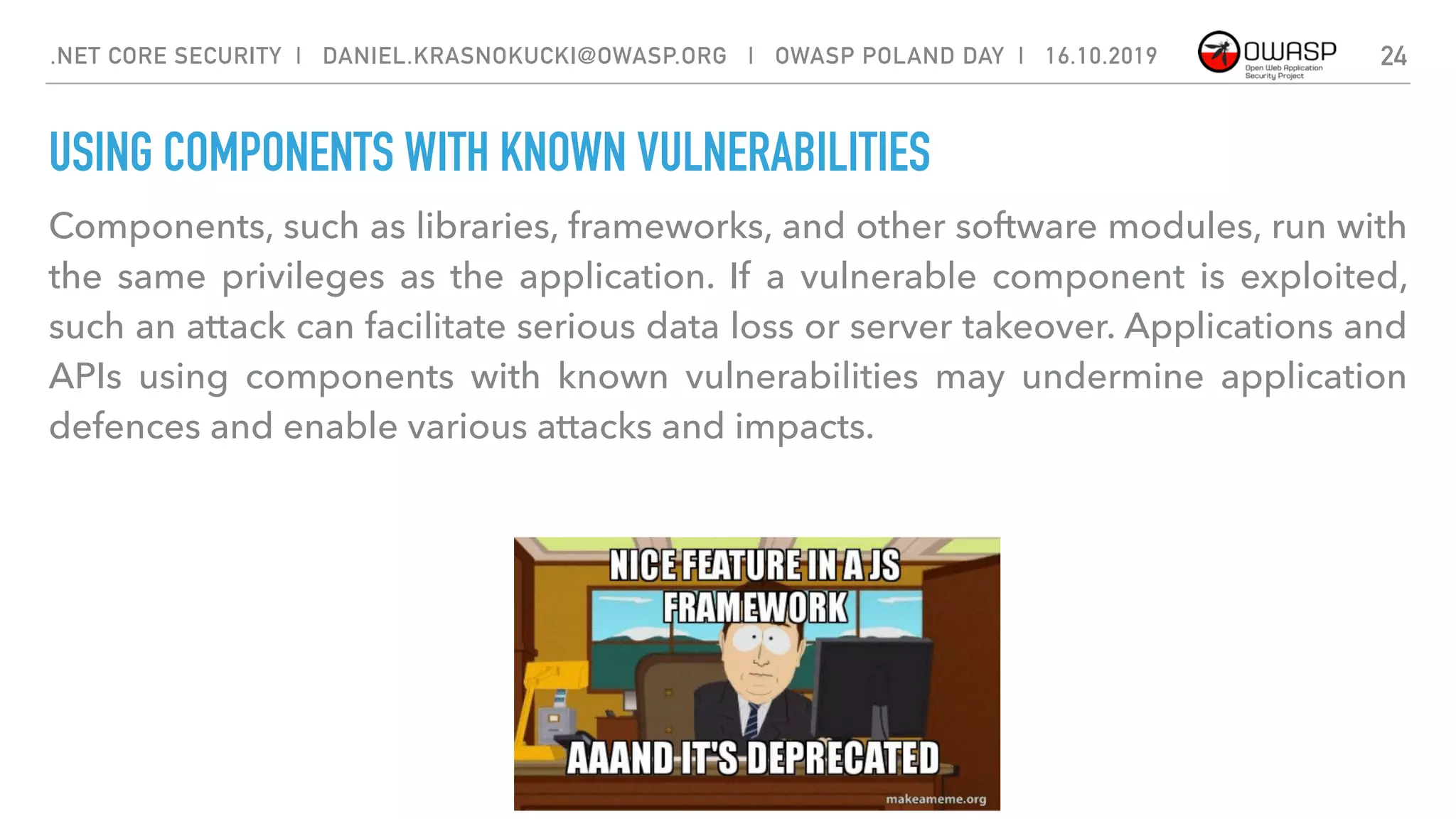
USING COMPONENTS WITH KNOWN VULNERABILITIES
Components, such as libraries, frameworks, and other software modules, run with
the same privileges as the application. If a vulnerable component is exploited,
such an attack can facilitate serious data loss or server takeover. Applications and
APIs using components with known vulnerabilities may undermine application
defences and enable various attacks and impacts.
24.NET CORE SECURITY | DANIEL.KRASNOKUCKI@OWASP.ORG | OWASP POLAND DAY | 16.10.2019
INSUFFICIENT LOGGING & MONITORING
Insufficient logging and monitoring, coupled with missing or ineffective
integration with incident response, allows attackers to further attack systems,
maintain persistence, pivot to more systems, and tamper, extract, or destroy data.
Most breach studies show time to detect a breach is over 200 days, typically
detected by external parties rather than internal processes or monitoring.
25.NET CORE SECURITY | DANIEL.KRASNOKUCKI@OWASP.ORG | OWASP POLAND DAY | 16.10.2019
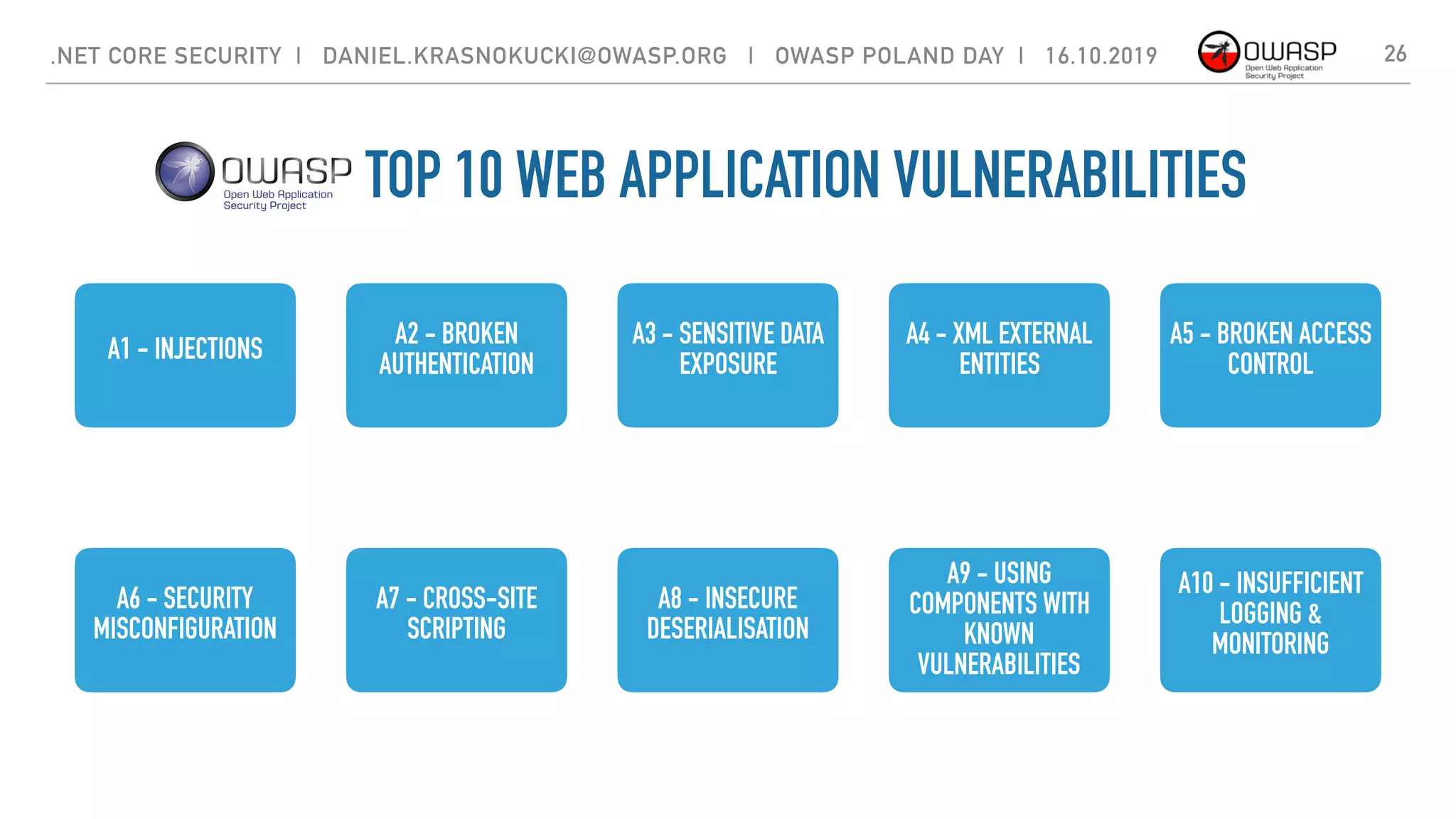
A1 - INJECTIONS
A2 - BROKEN
AUTHENTICATION
A3 - SENSITIVE DATA
EXPOSURE
A4 - XML EXTERNAL
ENTITIES
A5 - BROKEN ACCESS
CONTROL
A6 - SECURITY
MISCONFIGURATION
A7 - CROSS-SITE
SCRIPTING
A8 - INSECURE
DESERIALISATION
A9 - USING
COMPONENTS WITH
KNOWN
VULNERABILITIES
A10 - INSUFFICIENT
LOGGING &
MONITORING
OWASP TOP 10 WEB APPLICATION VULNERABILITIES
26.NET CORE SECURITY | DANIEL.KRASNOKUCKI@OWASP.ORG | OWASP POLAND DAY | 16.10.2019
.NET SECURITY PRACTICES
27.NET CORE SECURITY | DANIEL.KRASNOKUCKI@OWASP.ORG | OWASP POLAND DAY | 16.10.2019
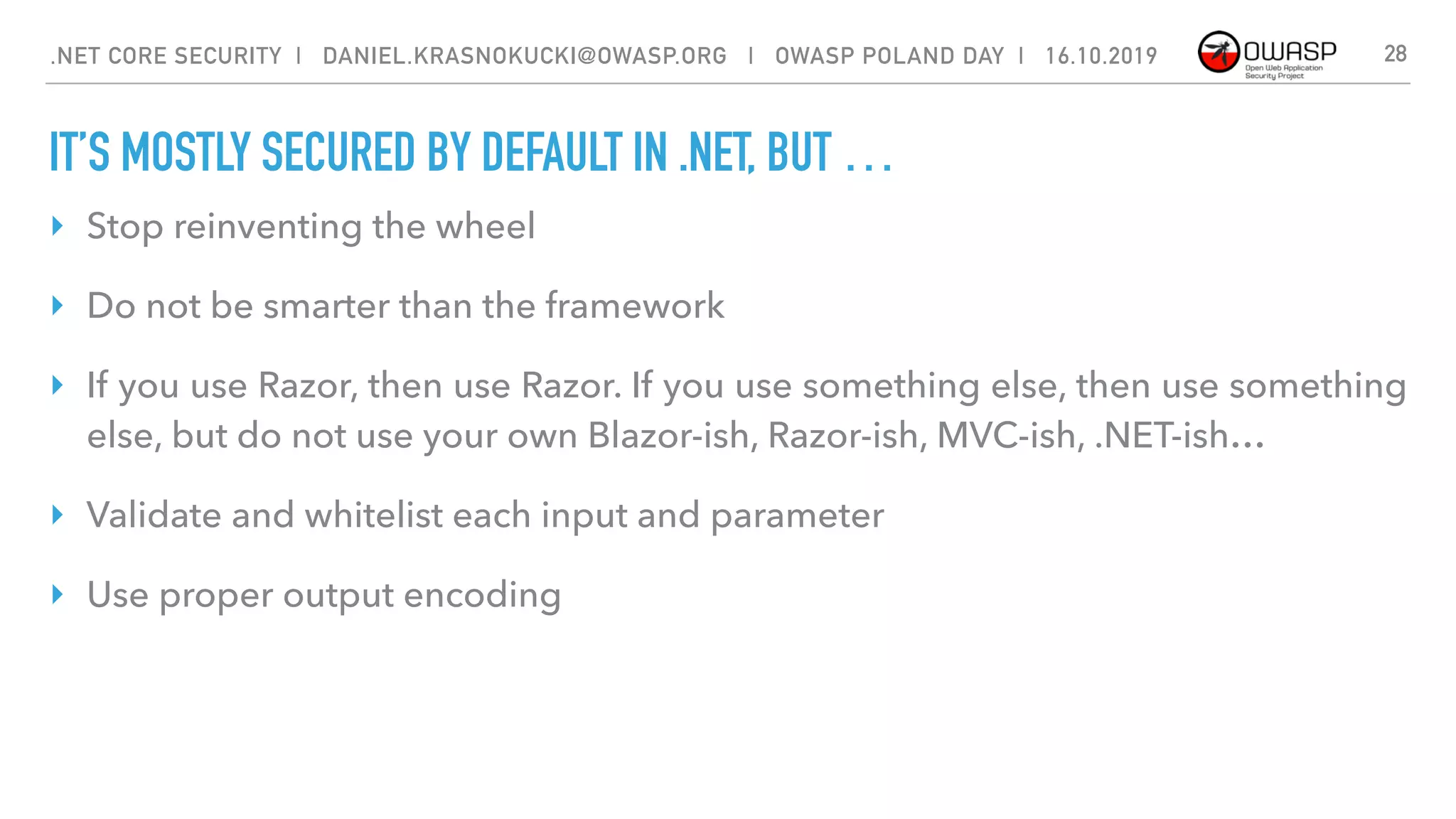
IT’S MOSTLY SECURED BY DEFAULT IN .NET, BUT …
28
‣ Stop reinventing the wheel
‣ Do not be smarter than the framework
‣ If you use Razor, then use Razor. If you use something else, then use something
else, but do not use your own Blazor-ish, Razor-ish, MVC-ish, .NET-ish…
‣ Validate and whitelist each input and parameter
‣ Use proper output encoding
.NET CORE SECURITY | DANIEL.KRASNOKUCKI@OWASP.ORG | OWASP POLAND DAY | 16.10.2019
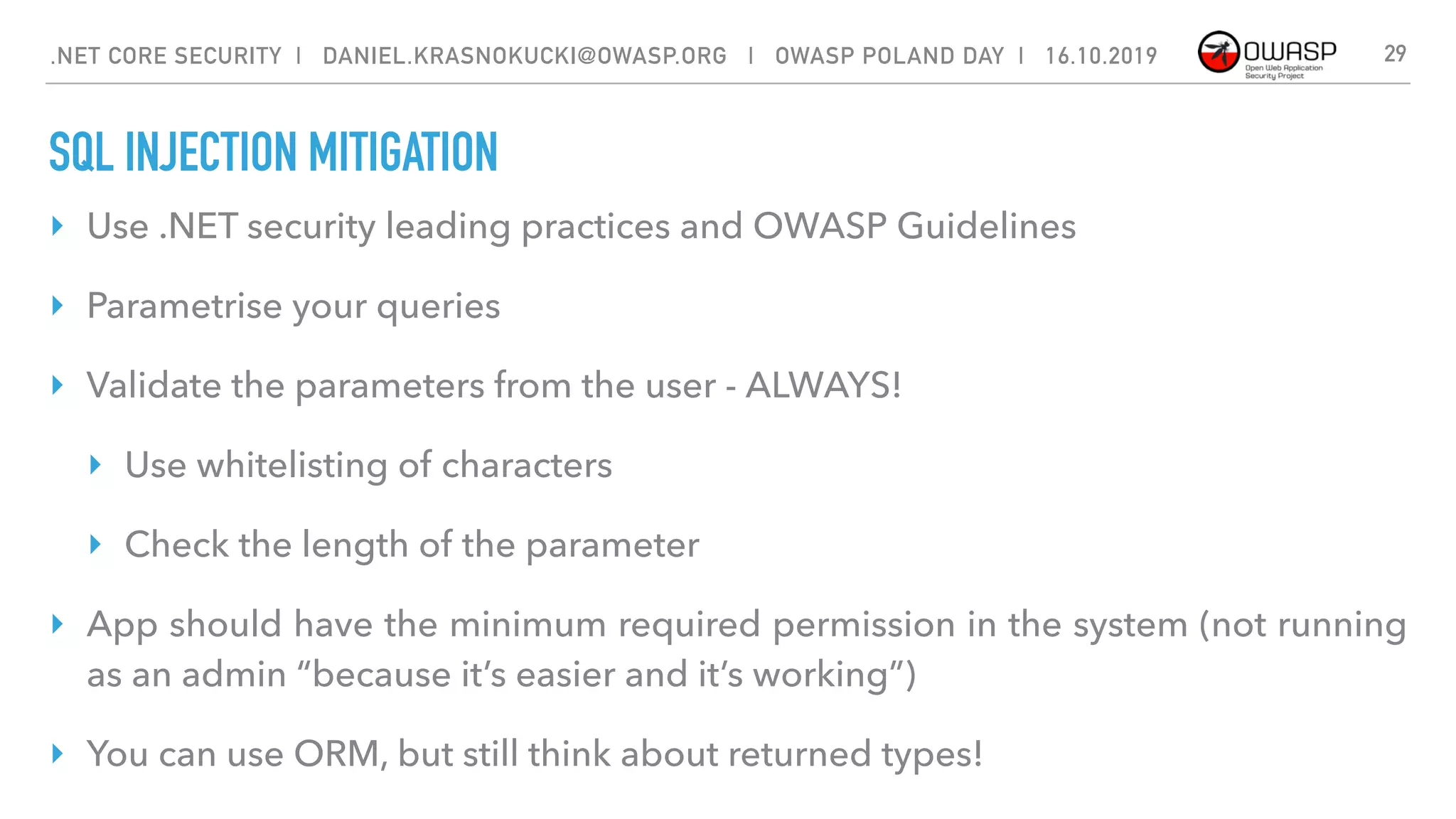
SQL INJECTION MITIGATION
29
‣ Use .NET security leading practices and OWASP Guidelines
‣ Parametrise your queries
‣ Validate the parameters from the user - ALWAYS!
‣ Use whitelisting of characters
‣ Check the length of the parameter
‣ App should have the minimum required permission in the system (not running
as an admin “because it’s easier and it’s working”)
‣ You can use ORM, but still think about returned types!
.NET CORE SECURITY | DANIEL.KRASNOKUCKI@OWASP.ORG | OWASP POLAND DAY | 16.10.2019
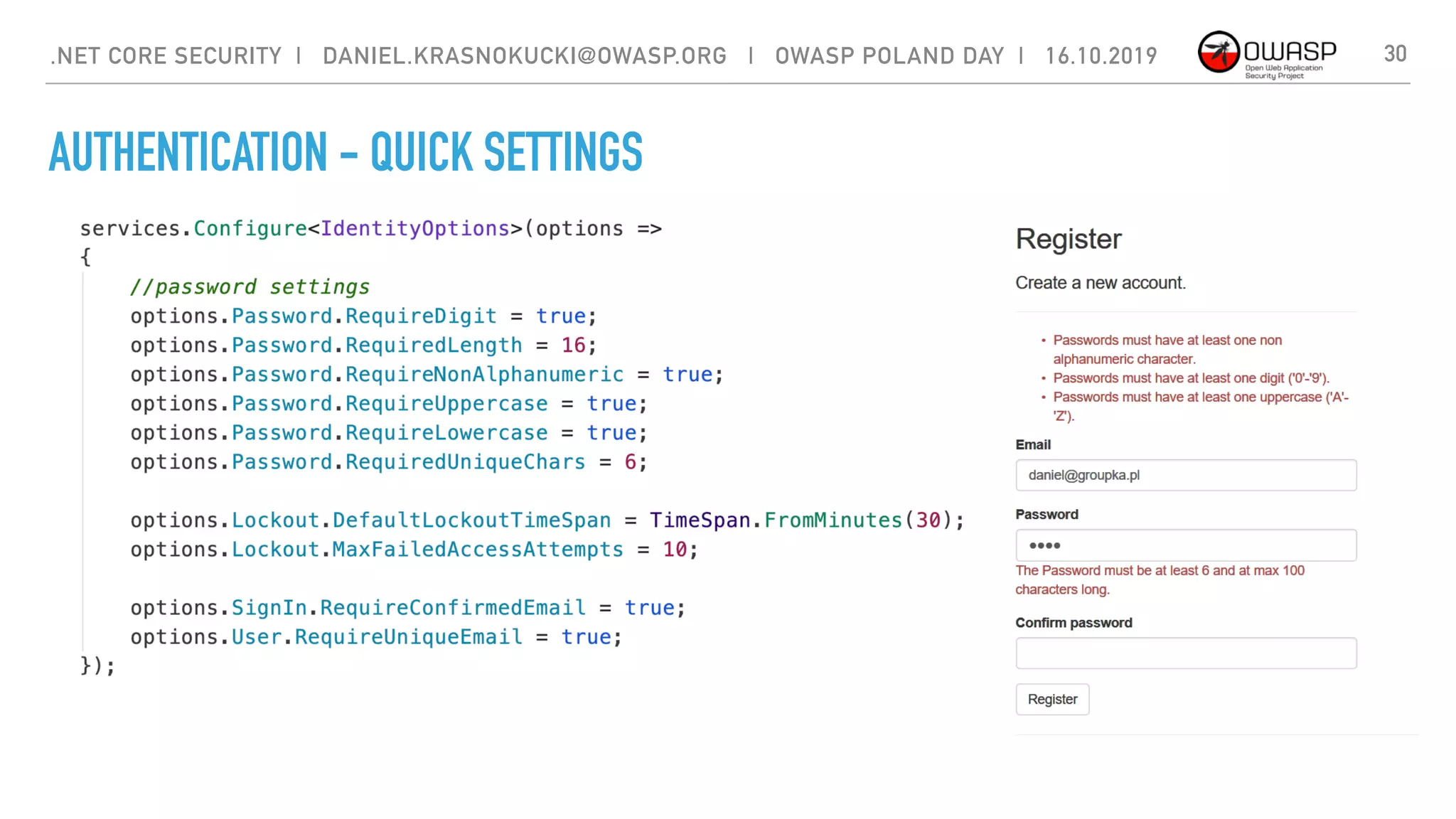
AUTHENTICATION - QUICK SETTINGS
30.NET CORE SECURITY | DANIEL.KRASNOKUCKI@OWASP.ORG | OWASP POLAND DAY | 16.10.2019
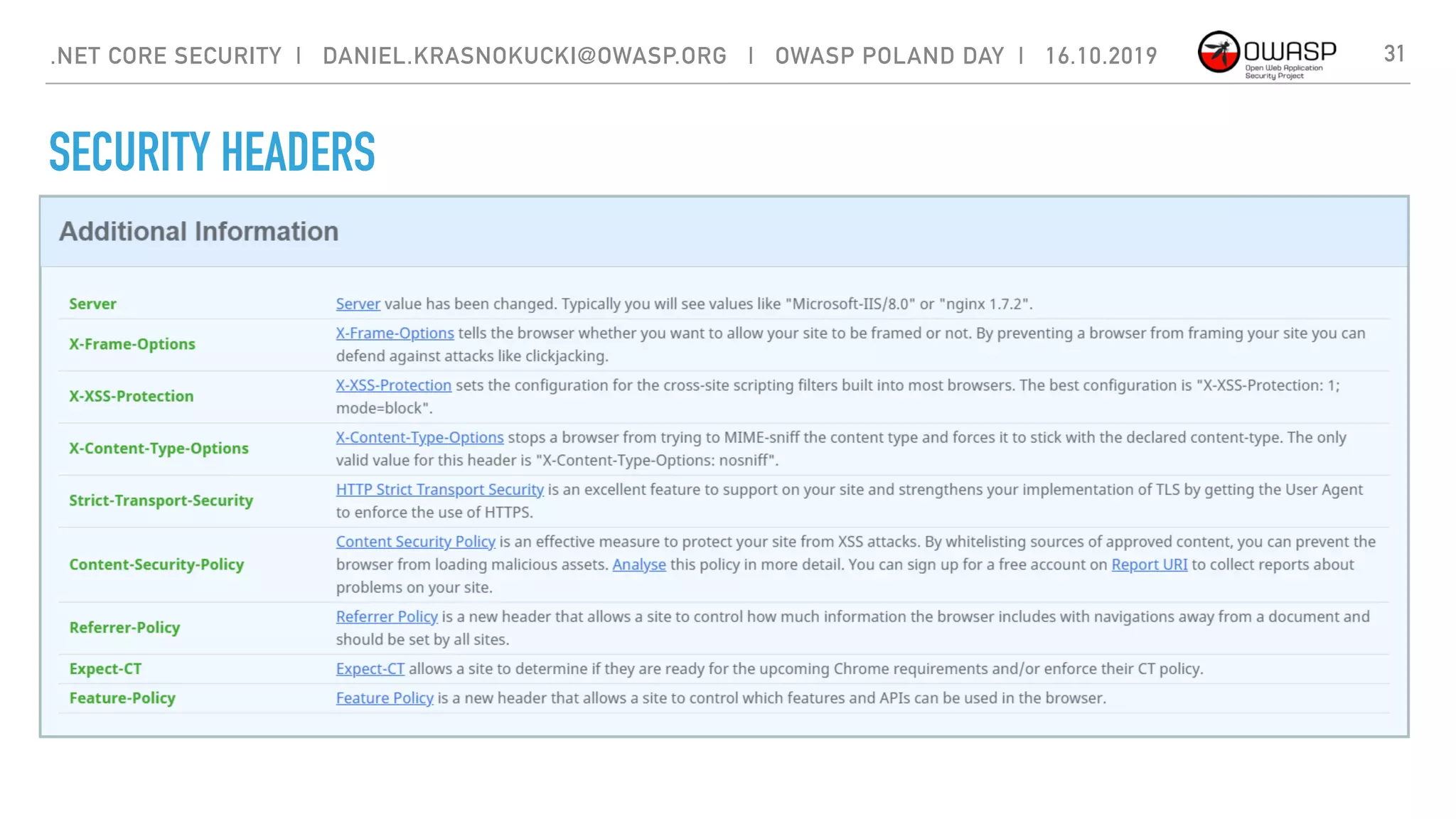
SECURITY HEADERS
31.NET CORE SECURITY | DANIEL.KRASNOKUCKI@OWASP.ORG | OWASP POLAND DAY | 16.10.2019
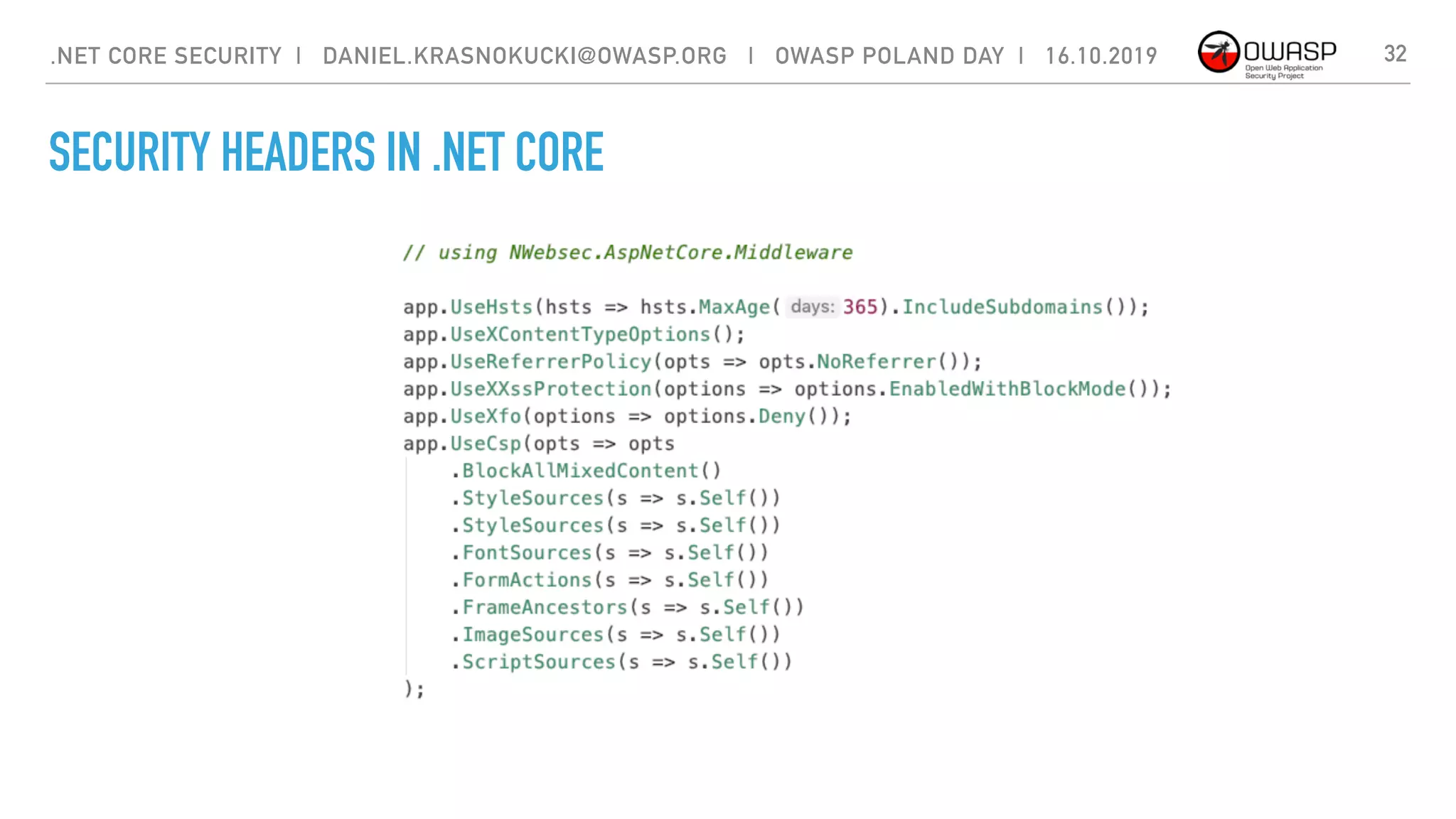
SECURITY HEADERS IN .NET CORE
32.NET CORE SECURITY | DANIEL.KRASNOKUCKI@OWASP.ORG | OWASP POLAND DAY | 16.10.2019
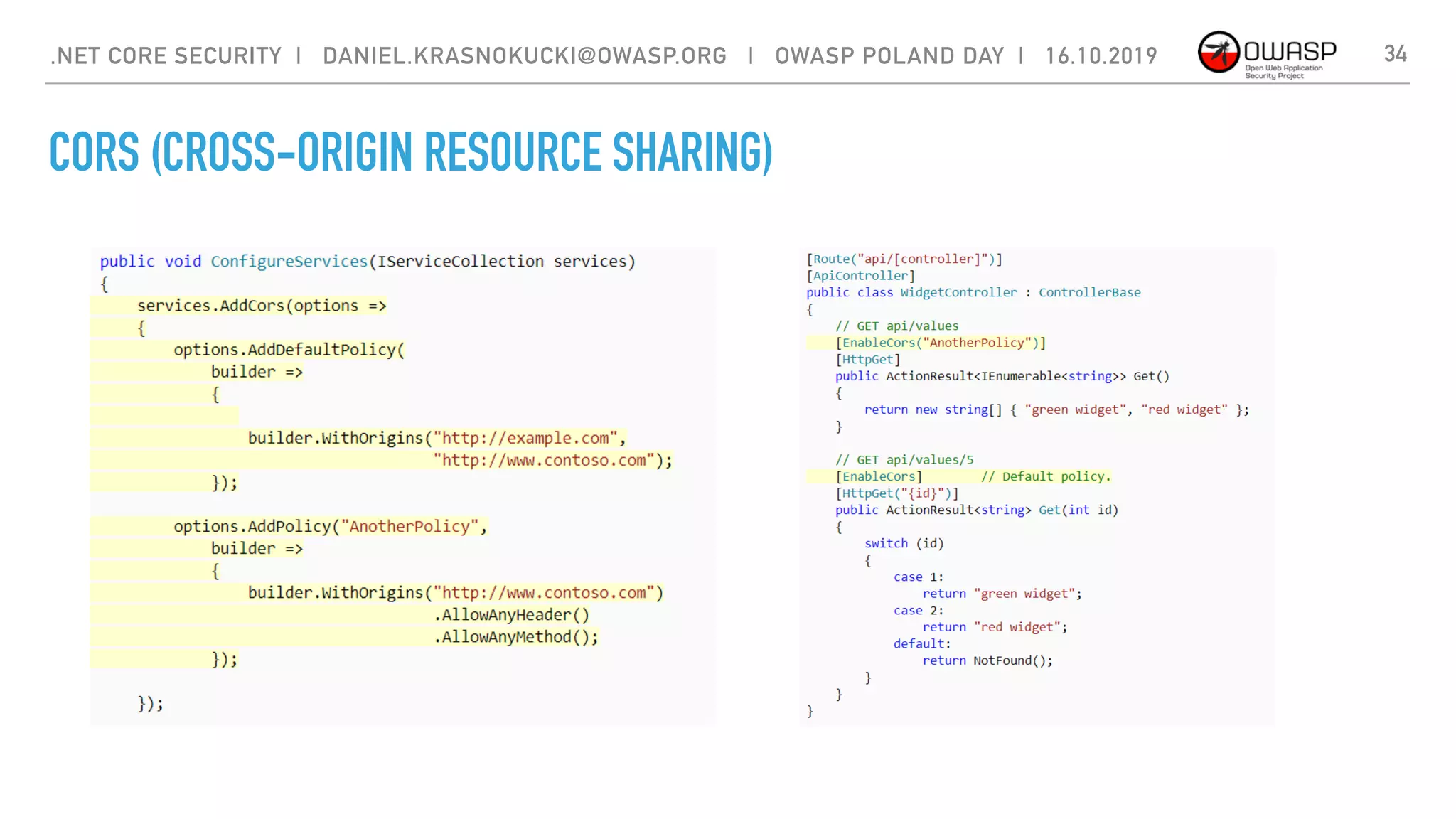
CORS (CROSS-ORIGIN RESOURCE SHARING)
33.NET CORE SECURITY | DANIEL.KRASNOKUCKI@OWASP.ORG | OWASP POLAND DAY | 16.10.2019
A mechanism that allows restricted  resources  on a  web page  to be requested
from another  domain  outside the domain from which the first resource was
served. 
A web page may freely embed cross-origin images, stylesheets, scripts, iframes,
and videos.[2]  Certain "cross-domain" requests, notably  Ajax  requests, are
forbidden by default by the same-origin security policy.
CORS (CROSS-ORIGIN RESOURCE SHARING)
34.NET CORE SECURITY | DANIEL.KRASNOKUCKI@OWASP.ORG | OWASP POLAND DAY | 16.10.2019
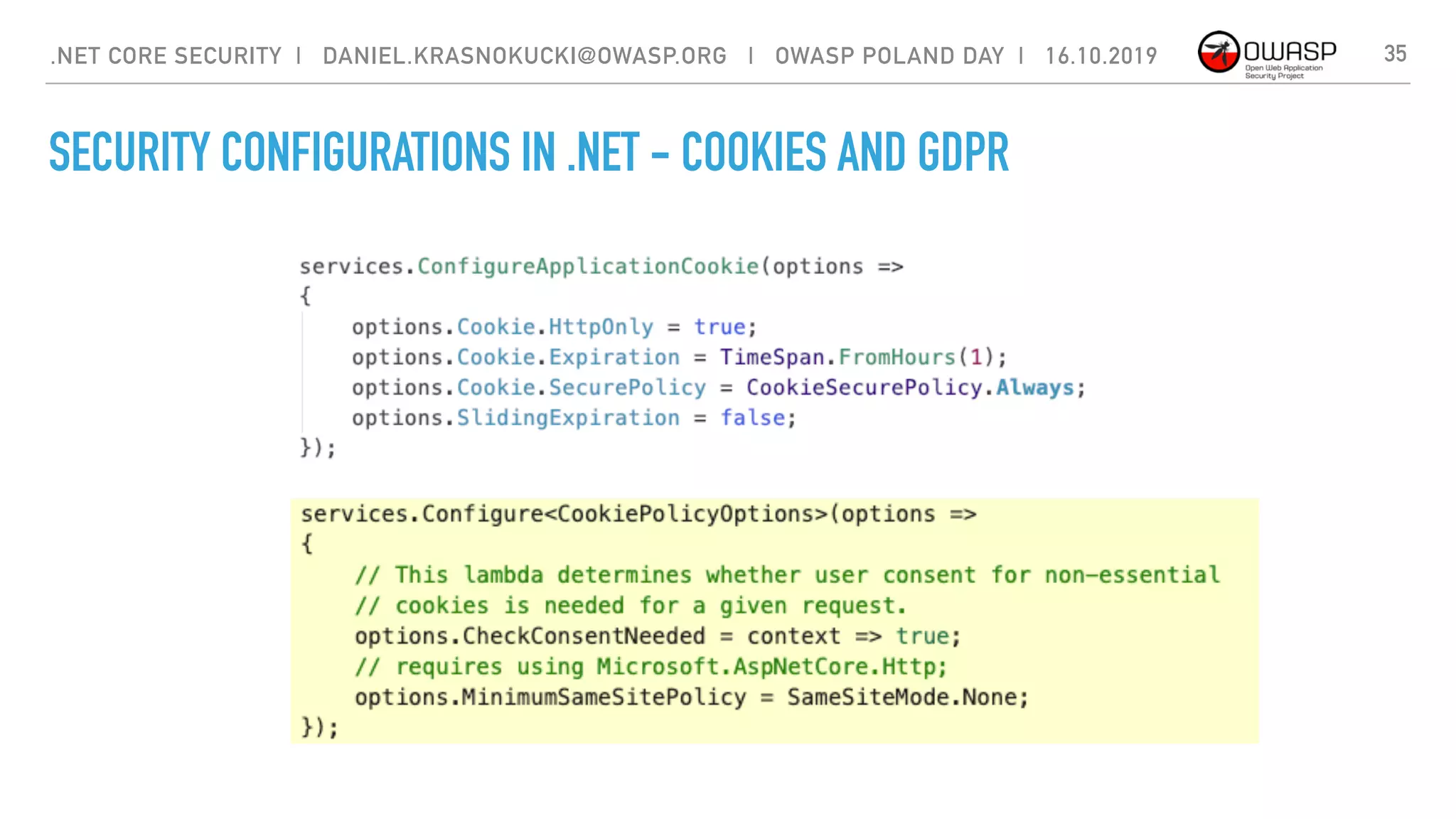
SECURITY CONFIGURATIONS IN .NET - COOKIES AND GDPR
35.NET CORE SECURITY | DANIEL.KRASNOKUCKI@OWASP.ORG | OWASP POLAND DAY | 16.10.2019
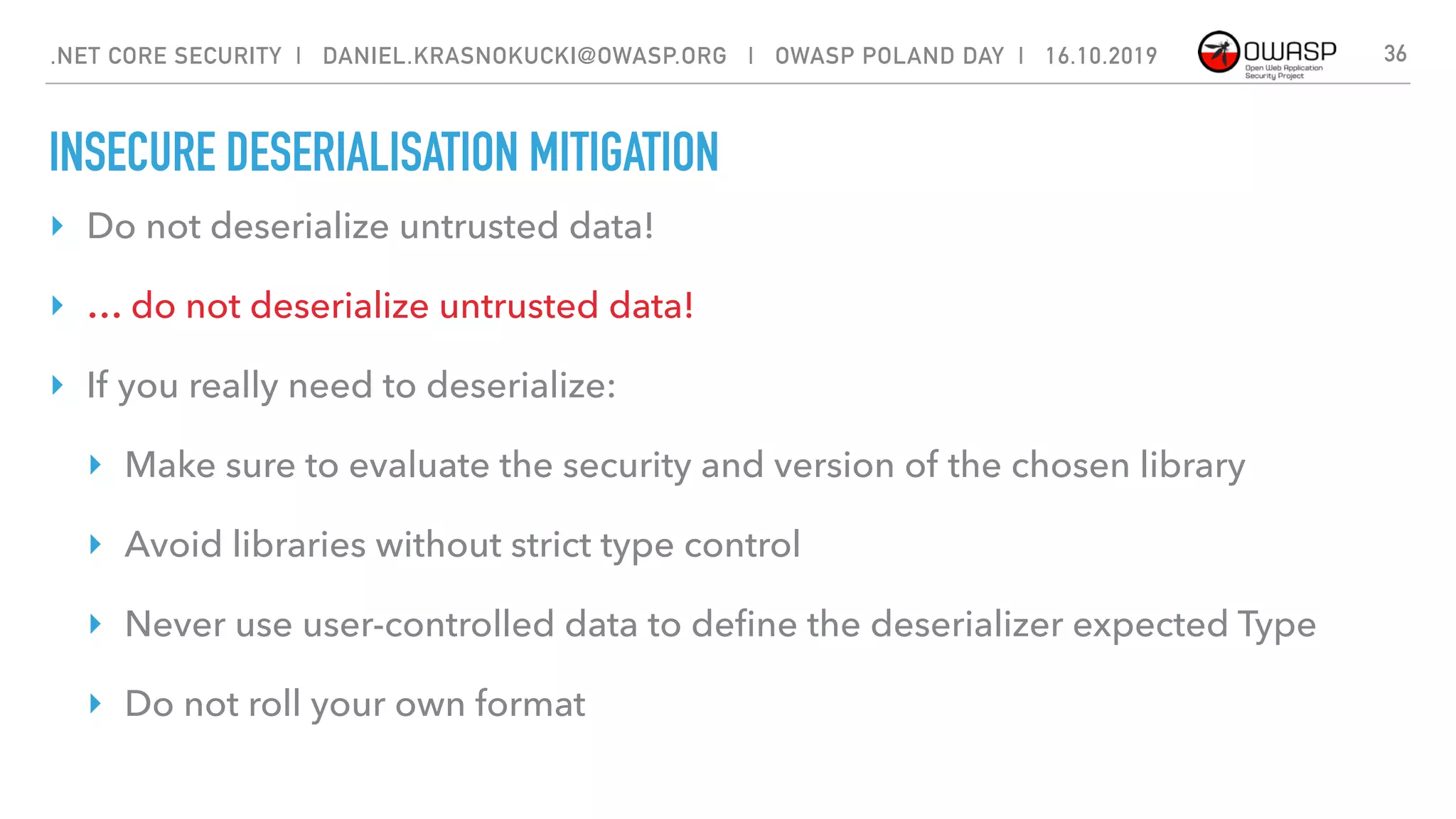
INSECURE DESERIALISATION MITIGATION
‣ Do not deserialize untrusted data!
‣ … do not deserialize untrusted data!
‣ If you really need to deserialize:
‣ Make sure to evaluate the security and version of the chosen library
‣ Avoid libraries without strict type control
‣ Never use user-controlled data to define the deserializer expected Type
‣ Do not roll your own format
36.NET CORE SECURITY | DANIEL.KRASNOKUCKI@OWASP.ORG | OWASP POLAND DAY | 16.10.2019
LOGGING IN .NET
37
Logging guidance from Microsoft
https://microsoft.github.io/code-with-engineering-playbook/Engineering/DevOpsLoggingDetailsCSharp.html
Where possible, always log:
• Input and output validation failures e.g. protocol violations, unacceptable encodings, invalid parameter names and
values
• Authentication successes and failures and Authorization (access control) failures
• Session management failures e.g. cookie session identification value modification
• Application errors and system events
• Application and related systems start-ups and shut-downs, and logging initialization (starting, stopping or pausing)
• Use of higher-risk functionality
• Legal and other opt-ins e.g. permissions for mobile phone capabilities, terms & conditions, PII data usage consent
.NET CORE SECURITY | DANIEL.KRASNOKUCKI@OWASP.ORG | OWASP POLAND DAY | 16.10.2019
HOW TO CHECK ALL OF THAT?
38
‣ Security Headers by Scott Helme - https://securityheaders.com/
‣ SSL Labs - https://www.ssllabs.com/ssltest/
‣ Hardenize - https://www.hardenize.com/
‣ OWASP checklists and security tools
‣ Some of linters/SAST tools available for .NET
✓ DevSkim
✓ FxCop (Microsoft Code Analysis)
✓ Sonar
✓ Puma
.NET CORE SECURITY | DANIEL.KRASNOKUCKI@OWASP.ORG | OWASP POLAND DAY | 16.10.2019
39.NET CORE SECURITY | DANIEL.KRASNOKUCKI@OWASP.ORG | OWASP POLAND DAY | 16.10.2019
.NET CORE SECURITY | DANIEL.KRASNOKUCKI@OWASP.ORG | OWASP POLAND DAY | 16.10.2019
…?
Questions
41.NET CORE SECURITY | DANIEL.KRASNOKUCKI@OWASP.ORG | OWASP POLAND DAY | 16.10.2019
TEXT
THANK YOU.
.NET CORE SECURITY | DANIEL.KRASNOKUCKI@OWASP.ORG | OWASP POLAND DAY | 16.10.2019
DZIĘKUJĘ.
DANIEL.KRASNOKUCKI@OWASP.ORG
42
PLEASE HAVE YOUR BADGE TO GET THE LUNCH!

[OPD 2019] .NET Core Security

  • 1.
    .NET CORE SECURITY DANIELKRASNOKUCKI, EQUINIX
  • 2.
    / AppSec / DevSecOps /.NET Developer / Trainer 2.NET CORE SECURITY | DANIEL.KRASNOKUCKI@OWASP.ORG | OWASP POLAND DAY | 16.10.2019 WHOAMI
  • 3.
    AGENDA 1. What is.NET Core? 2. .NET (Core) risks and issues 3. Common mistakes when using .NET Core 4. .NET Core (not only) security practices 3.NET CORE SECURITY | DANIEL.KRASNOKUCKI@OWASP.ORG | OWASP POLAND DAY | 16.10.2019
  • 4.
    .NET CORE 4.NET CORESECURITY | DANIEL.KRASNOKUCKI@OWASP.ORG | OWASP POLAND DAY | 16.10.2019
  • 5.
    .NET CORE .NET Core(2014)  is an  open-source, general-purpose development platform maintained by Microsoft and the .NET community on GitHub. It's cross-platform (supporting Windows, macOS, and Linux) and can be used to build device, cloud, and IoT applications. .NET CORE SECURITY | DANIEL.KRASNOKUCKI@OWASP.ORG | OWASP POLAND DAY | 16.10.2019 5
  • 6.
    .NET CORE .NET CORESECURITY | DANIEL.KRASNOKUCKI@OWASP.ORG | OWASP POLAND DAY | 16.10.2019 6
  • 7.
    .NET CORE SECURITY| DANIEL.KRASNOKUCKI@OWASP.ORG | OWASP POLAND DAY | 16.10.2019 7 .NET CORE 3.0 - SEPTEMBER 2019
  • 8.
    .NET CORE 3.0- SEPTEMBER 2019 ‣ GDPR ready ‣ HTTP/2 enabled by default ‣ gRPC ‣ EventCounters on request ‣ Forwarded Headers Middleware options ‣ One packed executable file .NET CORE SECURITY | DANIEL.KRASNOKUCKI@OWASP.ORG | OWASP POLAND DAY | 16.10.2019 8
  • 9.
    .NET CORE RISKSAND ISSUES 9.NET CORE SECURITY | DANIEL.KRASNOKUCKI@OWASP.ORG | OWASP POLAND DAY | 16.10.2019
  • 10.
    .NET CORE VALIDATIONPROBLEMS 10 ‣ Laziness (our laziness… not .NET) ‣ Tools first! (we do not think) ‣ Front-end validation ‣ Improper feedback for the user .NET CORE SECURITY | DANIEL.KRASNOKUCKI@OWASP.ORG | OWASP POLAND DAY | 16.10.2019
  • 11.
    INSECURE DESERIALISATION Insecure deserializationoften leads to remote code execution. Even if deserialization flaws do not result in remote code execution, they can be used to perform attacks, including replay attacks, injection attacks, and privilege escalation attacks. {
 "$type": "System.Windows.Data.ObjectDataProvider, PresentationFramework", 
 “ObjectInstance": { 
 "$type":"System.Diagnostics.Process, System”}, 
 "MethodParameters":{ 
 "$type":"System.Collections.ArrayList, mscorlib", 
 "$values":["calc"]}, 
 "MethodName":"Start" 
 } .NET CORE SECURITY | DANIEL.KRASNOKUCKI@OWASP.ORG | OWASP POLAND DAY | 16.10.2019 11
  • 12.
    ANY FLOWS IN.NET? 12.NET CORE SECURITY | DANIEL.KRASNOKUCKI@OWASP.ORG | OWASP POLAND DAY | 16.10.2019
  • 13.
    13.NET CORE SECURITY| DANIEL.KRASNOKUCKI@OWASP.ORG | OWASP POLAND DAY | 16.10.2019 COMMON MISTAKES WHEN USING .NET CORE
  • 14.
    SECURITY MISCONFIGURATION Security misconfigurationis the most commonly seen issue. This is a result of insecure default configurations, incomplete or ad hoc configurations, open cloud storage, misconfigured HTTP headers, and verbose error messages containing sensitive information. Not only must all operating systems, frameworks, libraries, and applications be securely configured, but they must be patched/upgraded in a timely fashion. 14.NET CORE SECURITY | DANIEL.KRASNOKUCKI@OWASP.ORG | OWASP POLAND DAY | 16.10.2019
  • 15.
    USERS AND PROGRAMERSVS. SECURITY 15.NET CORE SECURITY | DANIEL.KRASNOKUCKI@OWASP.ORG | OWASP POLAND DAY | 16.10.2019
  • 16.
    SQL INJECTION -STILL… 16 www.somestore.com/Products.aspx?CategoryID=1 www.somestore.com/Products.aspx?CategoryID=1 or 1=1 .NET CORE SECURITY | DANIEL.KRASNOKUCKI@OWASP.ORG | OWASP POLAND DAY | 16.10.2019
  • 17.
    IENUMERABLE<T> VS. IQUERYABLE<T> 17 ‣IEnumerable is best to query data from in-memory collections like List, Array, etc. ‣ While query data from a database, IEnumerable execute a select query on the server side, load data in- memory on a client-side and then filter data. ‣ IEnumerable doesn’t support custom query. ‣ IEnumerable doesn’t support lazy loading. Hence not suitable for paging like scenarios. ‣ Extension methods support by IEnumerable takes functional objects. ‣ IQueryable is best to query data from out-memory (like remote database, service) collections. ‣ While query data from a database, IQueryable execute the select query on the server side with all filters. ‣ IQueryable supports custom query using CreateQuery and Execute methods. ‣ IQueryable support lazy loading. Hence it is suitable for paging like scenarios. ‣ Extension methods support by IQueryable takes expression objects means expression tree. .NET CORE SECURITY | DANIEL.KRASNOKUCKI@OWASP.ORG | OWASP POLAND DAY | 16.10.2019 USING WRONG TYPES
  • 18.
    IENUMERABLE<T> VS. IQUERYABLE<T>WITH ENTITY FRAMEWORK… 18 public IQueryable<Customer> GetCustomer(int customerId) ‣ A consumer of this query can call .Include("Orders") on the returned IQueryable<Customer> to retrieve data that the query did not intend to expose. This can be avoided by changing the return type of the method to IEnumerable<T> and calling a method (such as .ToList()) that materializes the results. ‣ Because  IQueryable<T>  queries are executed when the results are iterated over, a consumer of a query that exposes an IQueryable<T> type could catch exceptions that are thrown. Exceptions could contain information not intended for the consumer. TIP: Avoid returning IQueryable<T> types from methods that are exposed to potentially untrusted callers .NET CORE SECURITY | DANIEL.KRASNOKUCKI@OWASP.ORG | OWASP POLAND DAY | 16.10.2019
  • 19.
    INFORMATION DISCLOSURE -LOOKS FAMILIAR? 19.NET CORE SECURITY | DANIEL.KRASNOKUCKI@OWASP.ORG | OWASP POLAND DAY | 16.10.2019
  • 20.
    POSSIBLE .NET MISCONFIGURATIONS ‣Missing appropriate security hardening across any part of the application stack, or improperly configured permissions on cloud services. ‣ Unnecessary features are enabled or installed ‣ Default accounts and their passwords still enabled and unchanged ‣ Error handling without custom errors ‣ For upgraded systems, latest security features are disabled or not configured securely ‣ The security settings in the application servers, application frameworks, libraries, databases, etc. not set to secure values. ‣ The server does not send security headers or directives or they are not set to secure values. 20.NET CORE SECURITY | DANIEL.KRASNOKUCKI@OWASP.ORG | OWASP POLAND DAY | 16.10.2019
  • 21.
    BROKEN AUTHENTICATION ANDAUTHORIZATION Application functions related to authentication, authorization and session management are often implemented incorrectly, allowing attackers to compromise passwords, keys, or session tokens, or to exploit other implementation flaws to assume other users' identities temporarily or permanently. 21.NET CORE SECURITY | DANIEL.KRASNOKUCKI@OWASP.ORG | OWASP POLAND DAY | 16.10.2019
  • 22.
    ACCESS CONTROL -MISUNDERSTANDING Restrictions on what authenticated users are allowed to do are often not properly enforced. Attackers can exploit these flaws to access unauthorized functionality and/or data, such as access other users' accounts, view sensitive files, modify other users' data, change access rights, etc. 22.NET CORE SECURITY | DANIEL.KRASNOKUCKI@OWASP.ORG | OWASP POLAND DAY | 16.10.2019
  • 23.
    IDOR (INSECURE DIRECTOBJECT REFERENCES) www.mybestandonlystore.com/orders/id=900 23.NET CORE SECURITY | DANIEL.KRASNOKUCKI@OWASP.ORG | OWASP POLAND DAY | 16.10.2019
  • 24.
    USING COMPONENTS WITHKNOWN VULNERABILITIES Components, such as libraries, frameworks, and other software modules, run with the same privileges as the application. If a vulnerable component is exploited, such an attack can facilitate serious data loss or server takeover. Applications and APIs using components with known vulnerabilities may undermine application defences and enable various attacks and impacts. 24.NET CORE SECURITY | DANIEL.KRASNOKUCKI@OWASP.ORG | OWASP POLAND DAY | 16.10.2019
  • 25.
    INSUFFICIENT LOGGING &MONITORING Insufficient logging and monitoring, coupled with missing or ineffective integration with incident response, allows attackers to further attack systems, maintain persistence, pivot to more systems, and tamper, extract, or destroy data. Most breach studies show time to detect a breach is over 200 days, typically detected by external parties rather than internal processes or monitoring. 25.NET CORE SECURITY | DANIEL.KRASNOKUCKI@OWASP.ORG | OWASP POLAND DAY | 16.10.2019
  • 26.
    A1 - INJECTIONS A2- BROKEN AUTHENTICATION A3 - SENSITIVE DATA EXPOSURE A4 - XML EXTERNAL ENTITIES A5 - BROKEN ACCESS CONTROL A6 - SECURITY MISCONFIGURATION A7 - CROSS-SITE SCRIPTING A8 - INSECURE DESERIALISATION A9 - USING COMPONENTS WITH KNOWN VULNERABILITIES A10 - INSUFFICIENT LOGGING & MONITORING OWASP TOP 10 WEB APPLICATION VULNERABILITIES 26.NET CORE SECURITY | DANIEL.KRASNOKUCKI@OWASP.ORG | OWASP POLAND DAY | 16.10.2019
  • 27.
    .NET SECURITY PRACTICES 27.NETCORE SECURITY | DANIEL.KRASNOKUCKI@OWASP.ORG | OWASP POLAND DAY | 16.10.2019
  • 28.
    IT’S MOSTLY SECUREDBY DEFAULT IN .NET, BUT … 28 ‣ Stop reinventing the wheel ‣ Do not be smarter than the framework ‣ If you use Razor, then use Razor. If you use something else, then use something else, but do not use your own Blazor-ish, Razor-ish, MVC-ish, .NET-ish… ‣ Validate and whitelist each input and parameter ‣ Use proper output encoding .NET CORE SECURITY | DANIEL.KRASNOKUCKI@OWASP.ORG | OWASP POLAND DAY | 16.10.2019
  • 29.
    SQL INJECTION MITIGATION 29 ‣Use .NET security leading practices and OWASP Guidelines ‣ Parametrise your queries ‣ Validate the parameters from the user - ALWAYS! ‣ Use whitelisting of characters ‣ Check the length of the parameter ‣ App should have the minimum required permission in the system (not running as an admin “because it’s easier and it’s working”) ‣ You can use ORM, but still think about returned types! .NET CORE SECURITY | DANIEL.KRASNOKUCKI@OWASP.ORG | OWASP POLAND DAY | 16.10.2019
  • 30.
    AUTHENTICATION - QUICKSETTINGS 30.NET CORE SECURITY | DANIEL.KRASNOKUCKI@OWASP.ORG | OWASP POLAND DAY | 16.10.2019
  • 31.
    SECURITY HEADERS 31.NET CORESECURITY | DANIEL.KRASNOKUCKI@OWASP.ORG | OWASP POLAND DAY | 16.10.2019
  • 32.
    SECURITY HEADERS IN.NET CORE 32.NET CORE SECURITY | DANIEL.KRASNOKUCKI@OWASP.ORG | OWASP POLAND DAY | 16.10.2019
  • 33.
    CORS (CROSS-ORIGIN RESOURCESHARING) 33.NET CORE SECURITY | DANIEL.KRASNOKUCKI@OWASP.ORG | OWASP POLAND DAY | 16.10.2019 A mechanism that allows restricted  resources  on a  web page  to be requested from another  domain  outside the domain from which the first resource was served.  A web page may freely embed cross-origin images, stylesheets, scripts, iframes, and videos.[2]  Certain "cross-domain" requests, notably  Ajax  requests, are forbidden by default by the same-origin security policy.
  • 34.
    CORS (CROSS-ORIGIN RESOURCESHARING) 34.NET CORE SECURITY | DANIEL.KRASNOKUCKI@OWASP.ORG | OWASP POLAND DAY | 16.10.2019
  • 35.
    SECURITY CONFIGURATIONS IN.NET - COOKIES AND GDPR 35.NET CORE SECURITY | DANIEL.KRASNOKUCKI@OWASP.ORG | OWASP POLAND DAY | 16.10.2019
  • 36.
    INSECURE DESERIALISATION MITIGATION ‣Do not deserialize untrusted data! ‣ … do not deserialize untrusted data! ‣ If you really need to deserialize: ‣ Make sure to evaluate the security and version of the chosen library ‣ Avoid libraries without strict type control ‣ Never use user-controlled data to define the deserializer expected Type ‣ Do not roll your own format 36.NET CORE SECURITY | DANIEL.KRASNOKUCKI@OWASP.ORG | OWASP POLAND DAY | 16.10.2019
  • 37.
    LOGGING IN .NET 37 Loggingguidance from Microsoft https://microsoft.github.io/code-with-engineering-playbook/Engineering/DevOpsLoggingDetailsCSharp.html Where possible, always log: • Input and output validation failures e.g. protocol violations, unacceptable encodings, invalid parameter names and values • Authentication successes and failures and Authorization (access control) failures • Session management failures e.g. cookie session identification value modification • Application errors and system events • Application and related systems start-ups and shut-downs, and logging initialization (starting, stopping or pausing) • Use of higher-risk functionality • Legal and other opt-ins e.g. permissions for mobile phone capabilities, terms & conditions, PII data usage consent .NET CORE SECURITY | DANIEL.KRASNOKUCKI@OWASP.ORG | OWASP POLAND DAY | 16.10.2019
  • 38.
    HOW TO CHECKALL OF THAT? 38 ‣ Security Headers by Scott Helme - https://securityheaders.com/ ‣ SSL Labs - https://www.ssllabs.com/ssltest/ ‣ Hardenize - https://www.hardenize.com/ ‣ OWASP checklists and security tools ‣ Some of linters/SAST tools available for .NET ✓ DevSkim ✓ FxCop (Microsoft Code Analysis) ✓ Sonar ✓ Puma .NET CORE SECURITY | DANIEL.KRASNOKUCKI@OWASP.ORG | OWASP POLAND DAY | 16.10.2019
  • 39.
    39.NET CORE SECURITY| DANIEL.KRASNOKUCKI@OWASP.ORG | OWASP POLAND DAY | 16.10.2019
  • 40.
    .NET CORE SECURITY| DANIEL.KRASNOKUCKI@OWASP.ORG | OWASP POLAND DAY | 16.10.2019
  • 41.
    …? Questions 41.NET CORE SECURITY| DANIEL.KRASNOKUCKI@OWASP.ORG | OWASP POLAND DAY | 16.10.2019
  • 42.
    TEXT THANK YOU. .NET CORESECURITY | DANIEL.KRASNOKUCKI@OWASP.ORG | OWASP POLAND DAY | 16.10.2019 DZIĘKUJĘ. DANIEL.KRASNOKUCKI@OWASP.ORG 42 PLEASE HAVE YOUR BADGE TO GET THE LUNCH!