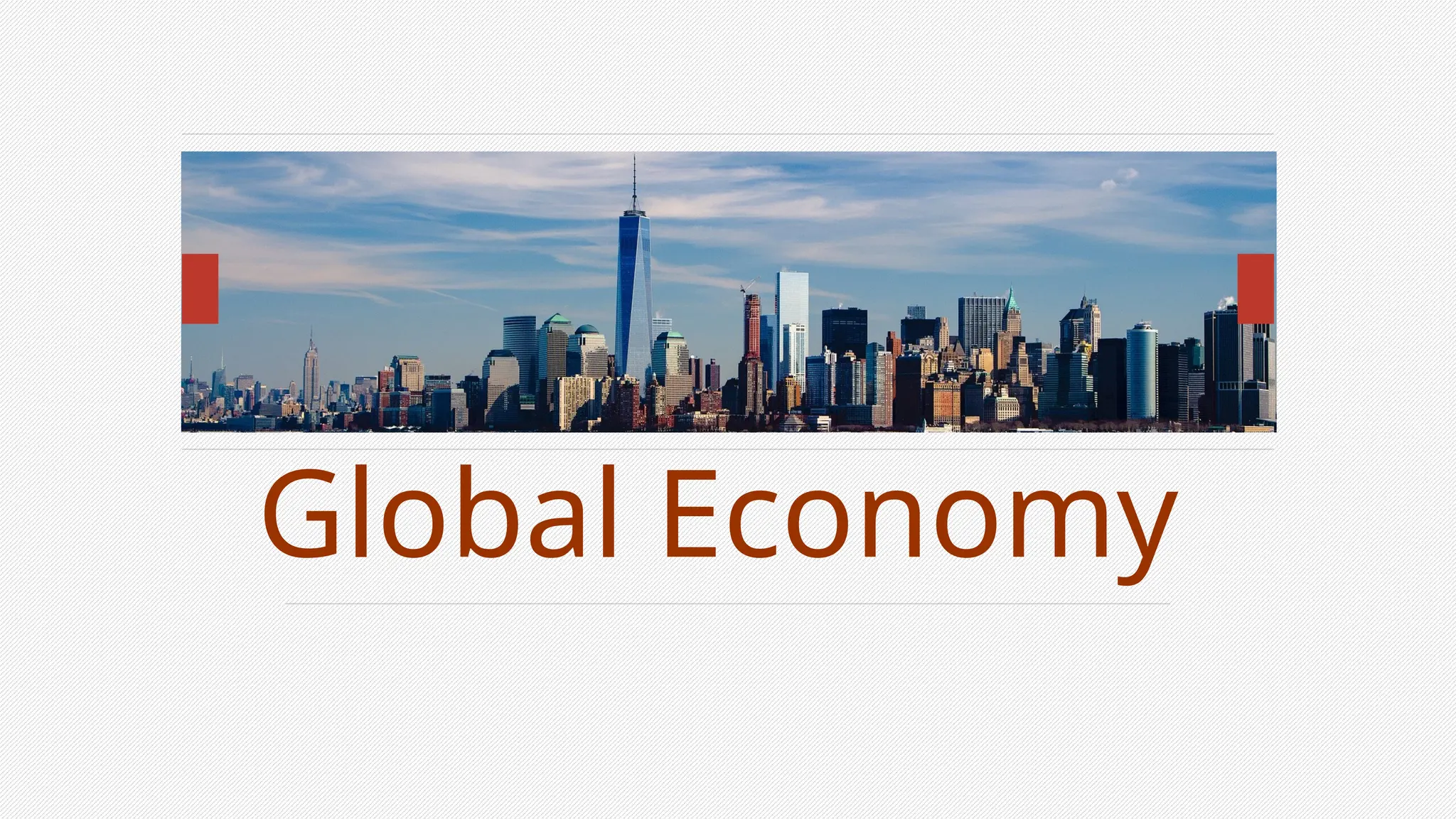
Global Economy
Objective of The Lesson
1. economic globalization is
explained;
2. identify the drivers of economic
globalization;
3. explain the modern world system;
and
4. explain the stance regarding
global economic integration.
Recap!
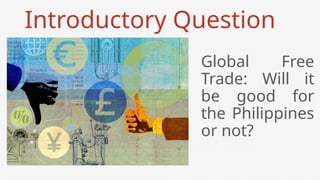
Introductory Question
Global Free
Trade: Will it
be good for
the Philippines
or not?
Guide Question:
1. What is the importance of
globalization to local free trade?
2. What is the importance of
globalization in international free
trade?
3. Does a particular country still have
a role to play in the emergence of
Discussion Proper
WHAT IS THE GLOBAL
ECONOMY?
》 The global economy as a process is
caused by the change of the human and
technological processes that produce a
high degree of global economic integration
through action or movement of goods,
services and capital across borders world
(IMF, 2008).
The IMF identified four basic aspect of
globalization.
1. Trade and transactions,
2. Capital and investment movement
3. Migration and movement of people,
4. The dissemination of knowledge.
Actor of GLOBAL
ECONOMY
They are called Transnational corporations
(TNCs), International corporations (ICs) or
Multinational corporations (MCs), They are the
main promoters of economic globalization
during the past century and constitute
approximately two thirds of all country's output
Multinational Corporations have
operations in more than one country.
Transnational corporations also have
operations in more than one country,
but typically focus on a single market.
Multinational corporations and
Transnational corporations are highly
complex organizations with a wide
History ot GLOBAL
ECONOMY
1. Homo Sapiens, who traveled from the African
continent and settled in other parts of the world.
Although small in number and low level, there is
the international trade beginning in the 16th
century with the establishment of relations with
between America and Afro-Eurasia.
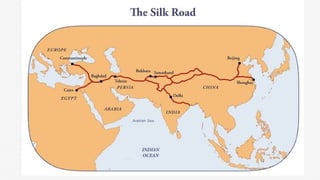
2. The Silk Road, commonly known as
the first global trade route in history,
had a scope and importance far
greater than the simple exchange of
goods.
- It is linked by trade between the
continents of Asia, Africa, and Europe
Part 01
Part
01
Part
02
Part
03
Part
04
Part
05
3. Trade monopoly initiated by
the first multinational
corporation, the British and
Dutch East India Companies of
England and The Netherland
which were established in 1600
4. Increased number of trades ferry
from major European cities to Asia.
5. Golden Age, the short period before
the first world war (1870-1913) can be
considered the "golden age" of world
trade, peaceful, free trade, and stable
finances.
✅ As previously mentioned, many
economists agree that there is no
adequate and precise definition of
globalization.
✅ The same is their view on where and
when it started. Although if we accept the
definition that global trade is "a process
that produced a "total system" of
❗But behind this high record, the
unequal compensation (ratio) can be
noticed between the goods exported
and the global Gross Domestic
Product (GDP). As Gereffi (2005) said,
if the global economy existed then, it
existed only in the spirit of product
exchange and not in their production.
ECONOMIC GLOBALIZATION:
FAILED OR
SUCCESSFUL?
For Dollar and Kraay (2002), only
countries that do not support it fail
to shrink the incidence of poverty
in their constituents in the past
few decade. Wolf (2004) adds, not
the extensiveness of globalization
the problem is the lack of it.
As for the World Bank, it does indeed
reduce poverty, but not all countries
are blessed with it. A strong example of
this is the area of ​
​
Sub-Saharan Africa,
where almost half of the population
lives on nothing another US$1.25 per
day to spend on basic needs.
Rostow (1960) believes that
underdevelopment or the ongoing lack of
economic growth and development,
including (poverty and malnutrition) is
not the initial stage of the historical and
evolutionary process. For him, it is the
result of colonialism and imperialism,
policies promoted by leading capitalist
countries (Hobson, 1902).
Thank you! 😉

oooooooooooooooooooooooooooooooooooooooooooooooooooooooooooooo

  • 1.
  • 2.
    Objective of TheLesson 1. economic globalization is explained; 2. identify the drivers of economic globalization; 3. explain the modern world system; and 4. explain the stance regarding global economic integration.
  • 3.
  • 4.
    Introductory Question Global Free Trade:Will it be good for the Philippines or not?
  • 5.
    Guide Question: 1. Whatis the importance of globalization to local free trade? 2. What is the importance of globalization in international free trade? 3. Does a particular country still have a role to play in the emergence of
  • 6.
  • 7.
    WHAT IS THEGLOBAL ECONOMY? 》 The global economy as a process is caused by the change of the human and technological processes that produce a high degree of global economic integration through action or movement of goods, services and capital across borders world (IMF, 2008).
  • 8.
    The IMF identifiedfour basic aspect of globalization. 1. Trade and transactions, 2. Capital and investment movement 3. Migration and movement of people, 4. The dissemination of knowledge.
  • 9.
    Actor of GLOBAL ECONOMY Theyare called Transnational corporations (TNCs), International corporations (ICs) or Multinational corporations (MCs), They are the main promoters of economic globalization during the past century and constitute approximately two thirds of all country's output
  • 10.
    Multinational Corporations have operationsin more than one country. Transnational corporations also have operations in more than one country, but typically focus on a single market. Multinational corporations and Transnational corporations are highly complex organizations with a wide
  • 11.
    History ot GLOBAL ECONOMY 1.Homo Sapiens, who traveled from the African continent and settled in other parts of the world. Although small in number and low level, there is the international trade beginning in the 16th century with the establishment of relations with between America and Afro-Eurasia.
  • 12.
    2. The SilkRoad, commonly known as the first global trade route in history, had a scope and importance far greater than the simple exchange of goods. - It is linked by trade between the continents of Asia, Africa, and Europe
  • 13.
  • 14.
    3. Trade monopolyinitiated by the first multinational corporation, the British and Dutch East India Companies of England and The Netherland which were established in 1600
  • 15.
    4. Increased numberof trades ferry from major European cities to Asia. 5. Golden Age, the short period before the first world war (1870-1913) can be considered the "golden age" of world trade, peaceful, free trade, and stable finances.
  • 16.
    ✅ As previouslymentioned, many economists agree that there is no adequate and precise definition of globalization. ✅ The same is their view on where and when it started. Although if we accept the definition that global trade is "a process that produced a "total system" of
  • 17.
    ❗But behind thishigh record, the unequal compensation (ratio) can be noticed between the goods exported and the global Gross Domestic Product (GDP). As Gereffi (2005) said, if the global economy existed then, it existed only in the spirit of product exchange and not in their production.
  • 18.
  • 19.
    For Dollar andKraay (2002), only countries that do not support it fail to shrink the incidence of poverty in their constituents in the past few decade. Wolf (2004) adds, not the extensiveness of globalization the problem is the lack of it.
  • 20.
    As for theWorld Bank, it does indeed reduce poverty, but not all countries are blessed with it. A strong example of this is the area of ​ ​ Sub-Saharan Africa, where almost half of the population lives on nothing another US$1.25 per day to spend on basic needs.
  • 21.
    Rostow (1960) believesthat underdevelopment or the ongoing lack of economic growth and development, including (poverty and malnutrition) is not the initial stage of the historical and evolutionary process. For him, it is the result of colonialism and imperialism, policies promoted by leading capitalist countries (Hobson, 1902).
  • 22.