Ontologies in Ubiquitous Computing José Ramón Hilera University of Alcalá, Spain Francisco Ruiz University of Castilla-La Mancha, Spain I International Conference on Ubiquitous Computing  Alcalá de Henares (Spain), June 7-9 (2006)
Contents Ontologies A taxonomy of ontologies in Ubiquitous Computing Conclusions
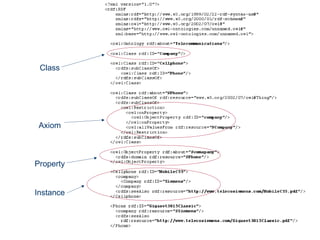
Ontologies (Concept) An ontology is "an explicit specification of a conceptualization “ (Gruber, 1993) A formal representation of a knowledge domain  An ontology consists of: Classes (the concepts of the domain) Properties (relations between the concepts) Instances (concrete examples of concepts) Axioms (restrictions about elements of the ontology)
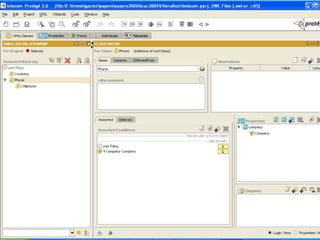
Ontologies (Languages) Ontologies can be edited using markup languages based on XML, which facilitates their reutilization in different semantic platforms to annotate and search resources OWL (Ontology Web Language) These languages define tags to represent the different elements of the ontology <owl:Class> <owl:ObjectProperty> <rdfs:subClassOf> …
 
Class Axiom Property Instance
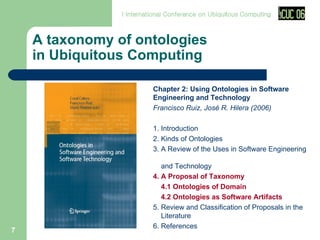
A taxonomy of ontologies in Ubiquitous Computing Chapter 2: Using Ontologies in Software Engineering and Technology  Francisco Ruiz, José R. Hilera (2006) 1. Introduction 2. Kinds of Ontologies 3. A Review of the Uses in Software Engineering    and Technology 4. A Proposal of Taxonomy 4.1 Ontologies of Domain 4.2 Ontologies as Software Artifacts 5. Review and Classification of Proposals in the    Literature 6. References
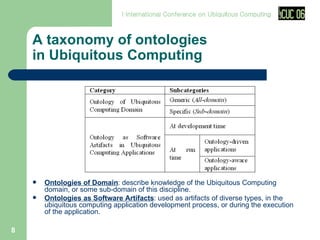
A taxonomy of ontologies in Ubiquitous Computing Ontologies of Domain : describe knowledge of the Ubiquitous Computing domain, or some sub-domain of this discipline. Ontologies as Software Artifacts : used as artifacts of diverse types, in the ubiquitous computing application development process, or during the execution of the application.
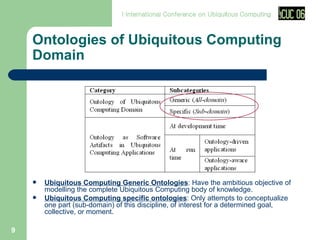
Ontologies of Ubiquitous Computing Domain Ubiquitous Computing Generic Ontologies : Have the ambitious objective of modelling the complete Ubiquitous Computing body of knowledge.  Ubiquitous Computing specific ontologies : Only attempts to conceptualize one part (sub-domain) of this discipline, of interest for a determined goal, collective, or moment.
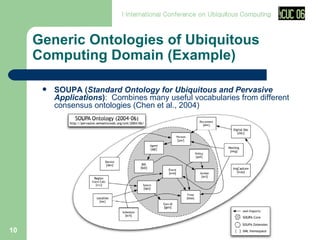
Generic Ontologies of Ubiquitous Computing Domain (Example) SOUPA ( Standard Ontology for Ubiquitous and Pervasive Applications ) :  Combines many useful vocabularies from different consensus ontologies (Chen et al., 2004)
Specific Ontologies of Ubiquitous Computing Domain (Example) FIPA Device Ontology : Can be used as reference to express the capabilities of different devices in an ubiquitous computing system. (Foundation for Intelligent Physical Agents, 2001)
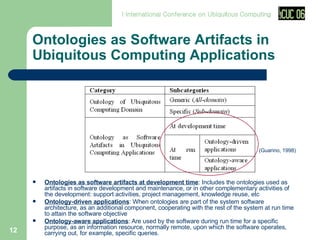
Ontologies as Software Artifacts in Ubiquitous Computing Applications Ontologies as software artifacts at development time : Includes the ontologies used as artifacts in software development and maintenance, or in other complementary activities of the development: support activities, project management, knowledge reuse, etc Ontology-driven applications : When ontologies are part of the system software architecture, as an additional component, cooperating with the rest of the system at run time to attain the software objective Ontology-aware applications : Are used by the software during run time for a specific purpose, as an information resource, normally remote, upon which the software operates, carrying out, for example, specific queries. (Guarino, 1998)
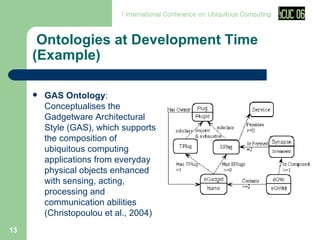
Ontologies at Development Time (Example) GAS Ontology : Conceptualises the Gadgetware Architectural Style (GAS), which supports the composition of ubiquitous computing applications from everyday physical objects enhanced with sensing, acting, processing and communication abilities (Christopoulou et al., 2004)
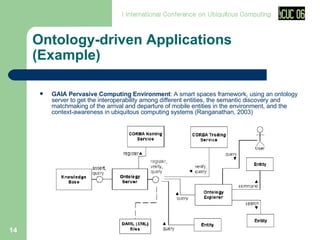
Ontology-driven Applications (Example) GAIA Pervasive Computing Environment : A  smart spaces framework, using an ontology server to get the interoperability among different entities, the semantic discovery and matchmaking of the arrival and departure of mobile entities in the environment, and the context-awareness in ubiquitous computing systems  (Ranganathan, 2003)
Ontology-aware Applications (Example) Ontology as database substitute : Mapping relational databases into ontologies, using a mapping processor for generating the ontology and for the execution of queries on the ontology. This refers to facilitate the transformation of the applications that use a relational database to allow semantic access to the content available in the database. (Barrasa, 2006)
Conclusions A  lot of works that propose to use ontologies in Ubiquitous Computing have been published A taxonomy to classify different ontology use proposals in the Ubiquitous Computing field has been presented This taxonomy can be useful to organize the works This general taxonomy that can be extended by means of the decomposition of the categories in other more specific subcategories : Ontologies as Software Artifacts in  requirements specification Ontologies as Software Artifacts in the sw  maintenance process …
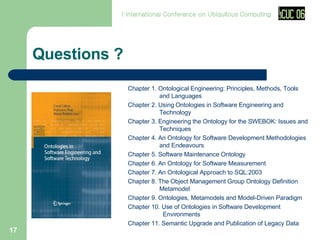
Questions ? Chapter 1. Ontological Engineering: Principles, Methods, Tools and Languages Chapter 2. Using Ontologies in Software Engineering and Technology Chapter 3. Engineering the Ontology for the SWEBOK: Issues and Techniques Chapter 4. An Ontology for Software Development Methodologies and Endeavours Chapter 5. Software Maintenance Ontology Chapter 6. An Ontology for Software Measurement Chapter 7. An Ontological Approach to SQL:2003 Chapter 8. The Object Management Group Ontology Definition Metamodel Chapter 9. Ontologies, Metamodels and Model-Driven Paradigm Chapter 10. Use of Ontologies in Software Development    Environments Chapter 11. Semantic Upgrade and Publication of Legacy Data

Ontologies in Ubiquitous Computing

  • 1.
    Ontologies in UbiquitousComputing José Ramón Hilera University of Alcalá, Spain Francisco Ruiz University of Castilla-La Mancha, Spain I International Conference on Ubiquitous Computing Alcalá de Henares (Spain), June 7-9 (2006)
  • 2.
    Contents Ontologies Ataxonomy of ontologies in Ubiquitous Computing Conclusions
  • 3.
    Ontologies (Concept) Anontology is &quot;an explicit specification of a conceptualization “ (Gruber, 1993) A formal representation of a knowledge domain An ontology consists of: Classes (the concepts of the domain) Properties (relations between the concepts) Instances (concrete examples of concepts) Axioms (restrictions about elements of the ontology)
  • 4.
    Ontologies (Languages) Ontologiescan be edited using markup languages based on XML, which facilitates their reutilization in different semantic platforms to annotate and search resources OWL (Ontology Web Language) These languages define tags to represent the different elements of the ontology <owl:Class> <owl:ObjectProperty> <rdfs:subClassOf> …
  • 5.
  • 6.
  • 7.
    A taxonomy ofontologies in Ubiquitous Computing Chapter 2: Using Ontologies in Software Engineering and Technology Francisco Ruiz, José R. Hilera (2006) 1. Introduction 2. Kinds of Ontologies 3. A Review of the Uses in Software Engineering and Technology 4. A Proposal of Taxonomy 4.1 Ontologies of Domain 4.2 Ontologies as Software Artifacts 5. Review and Classification of Proposals in the Literature 6. References
  • 8.
    A taxonomy ofontologies in Ubiquitous Computing Ontologies of Domain : describe knowledge of the Ubiquitous Computing domain, or some sub-domain of this discipline. Ontologies as Software Artifacts : used as artifacts of diverse types, in the ubiquitous computing application development process, or during the execution of the application.
  • 9.
    Ontologies of UbiquitousComputing Domain Ubiquitous Computing Generic Ontologies : Have the ambitious objective of modelling the complete Ubiquitous Computing body of knowledge. Ubiquitous Computing specific ontologies : Only attempts to conceptualize one part (sub-domain) of this discipline, of interest for a determined goal, collective, or moment.
  • 10.
    Generic Ontologies ofUbiquitous Computing Domain (Example) SOUPA ( Standard Ontology for Ubiquitous and Pervasive Applications ) : Combines many useful vocabularies from different consensus ontologies (Chen et al., 2004)
  • 11.
    Specific Ontologies ofUbiquitous Computing Domain (Example) FIPA Device Ontology : Can be used as reference to express the capabilities of different devices in an ubiquitous computing system. (Foundation for Intelligent Physical Agents, 2001)
  • 12.
    Ontologies as SoftwareArtifacts in Ubiquitous Computing Applications Ontologies as software artifacts at development time : Includes the ontologies used as artifacts in software development and maintenance, or in other complementary activities of the development: support activities, project management, knowledge reuse, etc Ontology-driven applications : When ontologies are part of the system software architecture, as an additional component, cooperating with the rest of the system at run time to attain the software objective Ontology-aware applications : Are used by the software during run time for a specific purpose, as an information resource, normally remote, upon which the software operates, carrying out, for example, specific queries. (Guarino, 1998)
  • 13.
    Ontologies at DevelopmentTime (Example) GAS Ontology : Conceptualises the Gadgetware Architectural Style (GAS), which supports the composition of ubiquitous computing applications from everyday physical objects enhanced with sensing, acting, processing and communication abilities (Christopoulou et al., 2004)
  • 14.
    Ontology-driven Applications (Example)GAIA Pervasive Computing Environment : A smart spaces framework, using an ontology server to get the interoperability among different entities, the semantic discovery and matchmaking of the arrival and departure of mobile entities in the environment, and the context-awareness in ubiquitous computing systems (Ranganathan, 2003)
  • 15.
    Ontology-aware Applications (Example)Ontology as database substitute : Mapping relational databases into ontologies, using a mapping processor for generating the ontology and for the execution of queries on the ontology. This refers to facilitate the transformation of the applications that use a relational database to allow semantic access to the content available in the database. (Barrasa, 2006)
  • 16.
    Conclusions A lot of works that propose to use ontologies in Ubiquitous Computing have been published A taxonomy to classify different ontology use proposals in the Ubiquitous Computing field has been presented This taxonomy can be useful to organize the works This general taxonomy that can be extended by means of the decomposition of the categories in other more specific subcategories : Ontologies as Software Artifacts in requirements specification Ontologies as Software Artifacts in the sw maintenance process …
  • 17.
    Questions ? Chapter1. Ontological Engineering: Principles, Methods, Tools and Languages Chapter 2. Using Ontologies in Software Engineering and Technology Chapter 3. Engineering the Ontology for the SWEBOK: Issues and Techniques Chapter 4. An Ontology for Software Development Methodologies and Endeavours Chapter 5. Software Maintenance Ontology Chapter 6. An Ontology for Software Measurement Chapter 7. An Ontological Approach to SQL:2003 Chapter 8. The Object Management Group Ontology Definition Metamodel Chapter 9. Ontologies, Metamodels and Model-Driven Paradigm Chapter 10. Use of Ontologies in Software Development Environments Chapter 11. Semantic Upgrade and Publication of Legacy Data

Editor's Notes

  • #2 I am going to present a work about the use of ontologies in the Ubiquitous Computing area. Our work is general, and it is not an specific proposal of a new ontology in a new ubiquitous application. We have made an study about different uses of ontologies in this field, and we propose a taxonomy to classify these works.