

On Reading Freud
By	
  Robert	
  R.	
  Holt,	
  Ph.D.	
  
Copyright	
  ©	
  1973	
  by	
  Robert	
  R.	
  Holt	
  
e-Book Copyright © 2014 International Psychotherapy Institute
All Rights Reserved
This e-book contains material protected under International and Federal Copyright Laws and
Treaties. This e-book is intended for personal use only. Any unauthorized reprint or use of this
material is prohibited. No part of this book may be used in any commercial manner without
express permission of the author. Scholarly use of quotations must have proper attribution to the
published work. This work may not be deconstructed, reverse engineered or reproduced in any
other format.
Created in the United States of America
For information regarding this book, contact the publisher:
International Psychotherapy Institute E-Books
301-215-7377
6612 Kennedy Drive
Chevy Chase, MD 20815-6504
www.freepsychotherapybooks.org
ebooks@theipi.org


Contents	
  
Acknowledgments	
  ...........................................................................................................	
  6	
  
Introduction	
  ....................................................................................................................	
  7	
  
Historical	
  Background	
  for	
  a	
  Reading	
  of	
  Freud	
  .................................................................	
  10	
  
THE	
  DEVELOPMENT	
  OF	
  FREUD'S	
  IDEAS	
  ............................................................................................................	
  10	
  
NATURPHILOSOPHIE	
  AND	
  ITS	
  REJECTION	
  .......................................................................................................	
  15	
  
ENERGY	
  AND	
  EVOLUTION.	
  .......................................................................................................................................	
  17	
  
Freud's	
  Two	
  Images	
  of	
  Man	
  ............................................................................................	
  20	
  
FREUD’S	
  HUMANISTIC	
  IMAGE	
  OF	
  MAN	
  ..............................................................................................................	
  21	
  
FREUD'S	
  MECHANISTIC	
  IMAGE	
  OF	
  MAN	
  ............................................................................................................	
  25	
  
IMPLICATIONS	
  OF	
  THE	
  TWO	
  IMAGES	
  .................................................................................................................	
  29	
  
Freud’s	
  Cognitive	
  Style	
  ...................................................................................................	
  34	
  
CHARACTER	
  STYLE	
  ......................................................................................................................................................	
  35	
  
NATURE	
  OF	
  FREUD'S	
  INTELLECT	
  ..........................................................................................................................	
  36	
  
SELF-­‐CRITICAL	
  DOUBTS	
  VERSUS	
  SELF-­‐CONFIDENT	
  DETERMINATION	
  .............................................	
  39	
  
ANALYSIS	
  VERSUS	
  SYNTHESIS	
  ...............................................................................................................................	
  43	
  
DIALECTIC	
  DUALISM.	
  ..................................................................................................................................................	
  43	
  
TOLERATED	
  CONTRADICTION	
  (SYNTHESIS	
  DEFERRED)	
  ..........................................................................	
  44	
  
CONCEPTION	
  OF	
  SCIENTIFIC	
  METHOD	
  AND	
  CONCEPTS.	
  ...........................................................................	
  47	
  
STYLE	
  OF	
  THEORIZING	
  ...............................................................................................................................................	
  50	
  
METHOD	
  OF	
  WORK.	
  .....................................................................................................................................................	
  56	
  
METHOD	
  OF	
  PROVING	
  POINTS	
  (VERIFICATION)	
  ...........................................................................................	
  59	
  
USE	
  OF	
  FIGURES	
  OF	
  SPEECH	
  ....................................................................................................................................	
  65	
  
FREUD'S	
  RHETORIC.	
  ....................................................................................................................................................	
  69	
  
SUMMARY	
  .........................................................................................................................................................................	
  74	
  
A	
  Decalogue	
  for	
  the	
  Reader	
  of	
  Freud	
  ..............................................................................	
  80	
  
References	
  ......................................................................................................................	
  83	


Acknowledgments	
  
Preparation	
   of	
   this	
   paper	
   was	
   supported	
   by	
   a	
   United	
   States	
   Public	
   Health	
   Service	
  
Research	
  Career	
  Award,	
  Grant	
  No.	
  5-­‐K06-­‐MH-­‐124555,	
  from	
  the	
  National	
  Institute	
  of	
  Mental	
  
Health.	
  
Note:	
   This	
   work	
   was	
   originally	
   included	
   as	
   the	
   initial	
   section	
   of	
   Abstracts	
   of	
   the	
  
Standard	
  Edition	
  of	
  the	
  Complete	
  Psychological	
  Works	
  of	
  Sigmund	
  Freud	
  edited	
  by	
  Carrie	
  Lee	
  
Rothgeb.	
  Any	
  reference	
  by	
  the	
  author	
  to	
  the	
  Abstracts	
  is	
  indicating	
  the	
  full	
  text.	


Introduction1
	
  
Erich	
   Fromm	
   once	
   remarked,	
   in	
   a	
   seminar	
   I	
   attended	
   at	
   the	
   Washington	
   School	
   of	
  
Psychiatry	
   approximately	
   30	
   years	
   ago,	
   that	
   Freud	
   and	
   Marx	
   had	
   this	
   in	
   common:	
   both	
  
were	
   the	
   indispensable	
   starting	
   points	
   for	
   students	
   of	
   their	
   respective	
   subject	
   matters,	
  
although	
  practically	
  everything	
  they	
  said	
  was	
  wrong.	
  Fresh	
  from	
  my	
  own	
  psychoanalysis	
  
and	
   fired	
   with	
   enthusiasm	
   as	
   I	
   was	
   for	
   Freud’s	
   work,	
   I	
   greeted	
   this	
   judgment	
   with	
  
incredulity,	
  even	
  scorn;	
  but	
  as	
  the	
  decades	
  have	
  taken	
  me	
  deeper	
  into	
  the	
  repeated	
  study	
  of	
  
Freud’s	
   writings,	
   I	
   have	
   begun	
   to	
   feel	
   that	
   Fromm’s	
   statement	
   was	
   indeed	
   worth	
  
remembering.	
  In	
  its	
  dramatic	
  hyperbole,	
  it	
  was	
  itself	
  a	
  very	
  Freudian	
  proposition,	
  as	
  I	
  shall	
  
try	
  to	
  demonstrate	
  below,	
  making	
  a	
  point	
  the	
  validity	
  of	
  which	
  could	
  be	
  appreciated	
  if	
  one	
  
saw	
  its	
  vehicle	
  as	
  rhetoric	
  rather	
  than	
  as	
  scientific	
  weighing	
  of	
  evidence.	
  
Yes,	
  much	
  of	
  what	
  Freud	
  had	
  to	
  say	
  is	
  more	
  or	
  less	
  false	
  unless	
  read	
  sympathetically—
that	
   is,	
   not,	
   with	
   the	
   desire	
   to	
   find	
   him	
   right	
   at	
   all	
   costs,	
   but	
   to	
   learn	
   from	
   him.	
   He	
   is	
  
vulnerable	
  to	
  almost	
  any	
  diligent	
  critic	
  who	
  wants	
  to	
  find	
  him	
  in	
  error,	
  and	
  he	
  has	
  never	
  
lacked	
  for	
  that	
  kind	
  of	
  antagonist	
  though	
  many	
  of	
  them	
  have	
  been	
  so	
  heavy-­‐handed	
  and	
  
obviously	
  biased	
  as	
  to	
  defeat	
  their	
  own	
  destructive	
  purpose.	
  Major	
  figures	
  in	
  other	
  sciences	
  
who	
  were	
  Freud’s	
  contemporaries	
  are	
  comparably	
  vulnerable,	
  of	
  course.	
  It	
  would	
  be	
  no	


1	
  Parts	
   of	
   the	
   text	
   have	
   been	
   adapted,	
   with	
   permission	
   of	
   the	
   publishers,	
   from	
   previously	
   published	
  
papers	
  (Holt.	
  1963,	
  1965b.	
  1968,	
  1972).	
  I	
  am	
  grateful	
  to	
  Aldine	
  Publishing	
  Co..	
  the	
  American	
  Image,	
  and	
  the	
  
Macmillan	
  Co.	
  for	
  their	
  kind	
  cooperation.	


trick	
  for	
  a	
  pathologist	
  to	
  find	
  many	
  statements	
  in	
  the	
  writings	
  of	
  Rudolf	
  Virchow	
  that	
  are	
  
false	
   by	
   contemporary	
   standards,	
   or	
   for	
   a	
   physiologist	
   to	
   do	
   a	
   hatchet	
   job	
   on	
   Claude	
  
Bernard;	
  but	
  in	
  other	
  sciences	
  that	
  kind	
  of	
  hostile	
  evaluation	
  of	
  the	
  great	
  historical	
  figures	
  
is	
  not	
  common,	
  because	
  it	
  is	
  taken	
  for	
  granted	
  that	
  scientific	
  truth	
  is	
  always	
  partial,	
  relative	
  
to	
  and	
  limited	
  by	
  its	
  historical	
  context,	
  and	
  inevitably	
  subject	
  to	
  correction	
  even	
  when	
  not	
  
wholly	
  superseded.	
  It	
  would	
  be	
  difficult	
  indeed	
  to	
  find	
  another	
  scientist	
  born	
  in	
  the	
  middle	
  
decade	
   of	
   the	
   nineteenth	
   century	
   whose	
   work	
   has	
   not	
   been	
   left	
   behind	
   just	
   as	
   much	
   as	
  
Freud’s.	
  
And	
   yet	
   Freud	
   is	
   much	
   more	
   than	
   a	
   historical	
   figure.	
   Again	
   Fromm	
   was	
   right:	
   he	
   is	
  
surely	
   the	
   indispensable	
   starting	
   point	
   for	
   any	
   serious	
   student	
   of	
   psychoanalysis	
   or	
  
psychotherapy	
  and	
  for	
  (at	
  the	
  least)	
  many	
  serious	
  students	
  of	
  psychology,	
  psychiatry,	
  and	
  
the	
  other	
  behavioral	
  sciences;	
  not	
  as	
  a	
  source	
  of	
  infallible	
  wisdom,	
  for	
  there	
  is	
  none	
  such	
  to	
  
be	
  found	
  anywhere;	
  not	
  as	
  an	
  intellectual	
  father	
  to	
  be	
  swallowed	
  whole	
  in	
  a	
  fantasied	
  act	
  of	
  
magical	
  identification;	
  and	
  not	
  as	
  a	
  generator	
  of	
  propositions	
  that	
  can	
  be	
  carried	
  directly	
  to	
  
the	
  laboratory	
  for	
  rigorous	
  verification	
  or	
  falsification.	
  But	
  read	
  sympathetically	
  and	
  with	
  
appropriate	
  caution,	
  Freud	
  still	
  has	
  an	
  enormous	
  amount	
  to	
  teach	
  us	
  about	
  myriad	
  aspects	
  
of	
  human	
  beings,	
  their	
  ways	
  of	
  growing	
  up	
  and	
  of	
  failing	
  to	
  thrive,	
  their	
  peculiarities,	
  kinks,	
  
and	
  quirks,	
  and	
  above	
  all	
  about	
  their	
  secret	
  lives.	
  
This	
  collection	
  of	
  indexed	
  abstracts,	
  now	
  easily	
  available	
  to	
  a	
  wide	
  audience,	
  will	
  prove	
  
particularly	
   valuable	
   as	
   a	
   sample	
   of	
   and	
   guide	
   to	
   the	
   formidable	
   bulk	
   of	
   the	
   Standard	
  
Edition	
  of	
  the	
  Complete	
  Psychological	
  Works	
  of	
  Sigmund	
  Freud.	
  Any	
  reader	
  who	
  picks	
  it	
  up	
  
in	
  the	
  hope	
  of	
  finding	
  a	
  quick	
  and	
  easy	
  summary,	
  a	
  Freud	
  boiled	
  down	
  to	
  one	
  delicious	
  and	
  
super-­‐nutritious	
   drop,	
   is	
   bound	
   to	
   be	
   disappointed.	
   It	
   is	
   no	
   Reader’s	
   Digest	
   job,	
   not	
   a	
  
‘‘classic	
  condensed	
  for	
  everyman”	
  in	
  the	
  American	
  commercial	
  tradition	
  that	
  reduces	
  any	
  
work	
  of	
  substance	
  to	
  a	
  few	
  easily	
  digested	
  clichés.	
  I	
  see	
  it,	
  rather,	
  as	
  much	
  more	
  like	
  the	
  
psychologist’s	
  indispensable	
  bibliographic	
  aid,	
  the	
  Psychological	
  Abstracts:	
  an	
  entry	
  into	
  a	
  
large	
  literature	
  through	
  an	
  index	
  by	
  which	
  articles	
  relevant	
  to	
  a	
  topic	
  of	
  interest	
  can	
  be	
  
located	
   and	
   then	
   sampled	
   with	
   the	
   aid	
   of	
   expertly	
   condensed	
   summaries.	
   It	
   will	
   not	
  
substitute	
  for,	
  but	
  will	
  facilitate,	
  a	
  reading	
  of	
  Freud	
  in	
  his	
  own	
  words.	
  
The	
   remainder	
   of	
   these	
   introductory	
   remarks	
   has	
   the	
   same	
   objective.	
   In	
   a	
   different	
  
way,	
  they	
  are	
  intended	
  to	
  orient,	
  forearm,	
  alert,	
  prime,	
  or	
  precondition	
  the	
  reader,	
  so	
  that	
  
he	
  or	
  she	
  may	
  enjoy	
  Freud	
  more,	
  be	
  less	
  confused	
  by	
  him,	
  misinterpret	
  him	
  less	
  often,	
  and	
  
grasp	
   better	
   what	
   he	
   has	
   to	
   offer,	
   than	
   would	
   be	
   the	
   case	
   by	
   approaching	
   his	
   writings	
  
unprepared.	
   For	
   the	
   modem	
   reader	
   of	
   Freud	
   must	
   expect	
   a	
   mixture	
   of	
   delights	
   and	
  
difficulties.	
  On	
  the	
  positive	
  side,	
  Freud	
  remains	
  enjoyably	
  and	
  absorbingly	
  readable,	
  even	
  in	
  
translation	
   plainly	
   a	
   master	
   of	
   prose.	
   On	
   the	
   negative,	
   however,	
   anyone	
   who	
   is	
   not	
  
thoroughly	
  versed	
  in	
  his	
  works	
  and	
  acquainted	
  with	
  certain	
  other	
  literatures,	
  repeatedly	
  
encounters	
  baffling	
  difficulties	
  in	
  grasping	
  his	
  meaning	
  in	
  any	
  but	
  a	
  general	
  sense.	
  
Historical	
  Background	
  for	
  a	
  Reading	
  of	
  Freud	
  
To	
  some	
  degree,	
  the	
  problems	
  are	
  those	
  to	
  be	
  expected	
  in	
  reading	
  European	
  works	
  of	
  
almost	
  any	
  kind	
  that	
  are	
  from	
  35	
  to	
  more	
  than	
  80	
  years	
  old.	
  Some	
  terminology	
  is	
  bound	
  to	
  
be	
  outdated,	
  some	
  references	
  to	
  scientific	
  or	
  literary	
  works	
  or	
  to	
  then-­‐current	
  events	
  that	
  
Freud	
   could	
   assume	
   his	
   contemporary	
   readers	
   were	
   familiar	
   with	
   convey	
   nothing	
   any	
  
longer	
  or	
  even	
  give	
  misleading	
  impressions;	
  and	
  an	
  American	
  reader	
  who	
  does	
  not	
  know	
  
the	
   continental	
   literary	
   classics	
   is	
   especially	
   handicapped.	
   To	
   a	
   large	
   extent	
   but	
   not	
  
completely,	
  the	
  devoted	
  editorship	
  of	
  Strachey	
  anticipates	
  such	
  problems	
  and	
  his	
  footnotes	
  
provide	
  helpful	
  explanations.	
  
Other	
  problems	
  arise	
  from	
  Freud's	
  habit	
  of	
  occasionally	
  assuming	
  that	
  the	
  reader	
  knew	
  
his	
  previous	
  works,	
  even	
  his	
  unpublished	
  ones.	
  Thus,	
  a	
  great	
  deal	
  that	
  was	
  baffling	
  about	
  
Chapter	
   7	
   of	
   The	
   Interpretation	
   of	
   Dreams	
   (Freud,	
   1900)—e.g.,	
   his	
   reference	
   to	
   the	
  
undefined	
  and	
  unexplained-­‐systems—became	
  intelligible	
  only	
  after	
  the	
  belated	
  publication	
  
of	
  the	
  “Project”	
  (Freud,	
  1895).	
  But	
  in	
  any	
  event,	
  many	
  students	
  of	
  Freud	
  have	
  pointed	
  out	
  
the	
   necessity	
   of	
   reading	
   him	
   sequentially.	
   His	
   thought	
   cannot	
   be	
   understood	
   if	
   his	
  
developing	
   ideas	
   are	
   taken	
   out	
   of	
   their	
   own	
   context.	
   Fortunately,	
   the	
   chronological	
  
ordering	
  of	
  the	
  Standard	
  Edition	
  and	
  of	
  these	
  abstracts	
  encourages	
  such	
  a	
  reading.	
  
THE	
  DEVELOPMENT	
  OF	
  FREUD'S	
  IDEAS	
  
There	
  were	
  four	
  major	
  and	
  overlapping	
  phases	
  of	
  Freud’s	
  scientific	
  work:	
  
1.	
  His	
  prepsychoanalytic	
  work,	
  which	
  lasted	
  about	
  20	
  years,	
  may	
  be	
  subdivided	
  into	
  an	
  
initial	
  10	
  years	
  of	
  primarily	
  histological-­‐anatomical	
  research	
  and	
  a	
  partly	
  overlapping	
  14	
  
years	
   of	
   clinical	
   neurology,	
   with	
   increasing	
   attention	
   to	
   psychopathology,	
   beginning	
   in	
  
1886	
  when	
  he	
  returned	
  from	
  Paris.	
  
2.	
  The	
  first	
  theory	
  of	
  neurosis	
  dates	
  from	
  the	
  decade	
  of	
  the	
  1890’s,	
  when	
  Freud	
  used	
  
hypnosis	
   and	
   Breuer’s	
   cathartic	
   method	
   of	
   psychotherapy,	
   gradually	
   developing	
   the	
  
psychoanalytic	
   methods	
   of	
   free	
   association,	
   dream	
   interpretation,	
   and	
   the	
   analysis	
   of	
  
transference.	
   The	
   first	
   dozen	
   truly	
   psychoanalytic	
   papers	
   appeared	
   during	
   this	
   time,	
  
expounding	
  the	
  view	
  that	
  neurosis	
  is	
  a	
  defense	
  against	
  intolerable	
  memories	
  of	
  a	
  traumatic	
  
experience—infantile	
  seduction	
  at	
  the	
  hands	
  of	
  a	
  close	
  relative.	
  With	
  the	
  discovery	
  of	
  his	
  
own	
  Oedipus	
  complex,	
  however,	
  Freud	
  came	
  to	
  see	
  that	
  such	
  reports	
  by	
  his	
  patients	
  were	
  
fantasies,	
  which	
  led	
  him	
  to	
  turn	
  his	
  interest	
  away	
  from	
  traumatic	
  events	
  in	
  external	
  reality	
  
and	
  toward	
  subjective	
  psychic	
  reality.	
  A	
  notable	
  but	
  only	
  recently	
  discovered	
  event	
  in	
  the	
  
development	
   of	
   Freud’s	
   thought	
   occurred	
   in	
   1895	
   after	
   the	
   publication	
   of	
   the	
   book	
   he	
  
wrote	
   with	
   Breuer.	
   He	
   wrote	
   but	
   did	
   not	
   publish	
   a	
   “Psychology	
   for	
   Neurologists”	
   (or	
  
“Project	
   for	
   a	
   Scientific	
   Psychology,”	
   hereafter	
   called	
   merely	
   “the	
   Project”),	
   presenting	
   a	
  
comprehensive	
  anatomical-­‐physiological	
  model	
  of	
  the	
  nervous	
  system	
  and	
  its	
  functioning	
  
in	
   normal	
   behavior,	
   thought,	
   and	
   dreams,	
   as	
   well	
   as	
   in	
   hysteria.	
   He	
   sent	
   it	
   to	
   his	
   friend	
  
Fliess	
  in	
  high	
  excitement,	
  then	
  quickly	
  became	
  discouraged	
  by	
  the	
  difficulties	
  of	
  creating	
  a	
  
thoroughgoing	
  mechanistic	
  and	
  reductionistic	
  psychology.	
  He	
  tinkered	
  with	
  the	
  model	
  for	
  a	
  
couple	
  of	
  years	
  in	
  letters	
  to	
  Fliess,	
  and	
  finally	
  gave	
  it	
  up.	
  
The	
   turn	
   of	
   the	
   century	
   marked	
   many	
   basic	
   changes	
   in	
   Freud’s	
   life	
   and	
   work:	
   he	
  
severed	
  his	
  close	
  and	
  dependent	
  friendships	
  with	
  colleagues	
  (first	
  Breuer,	
  then	
  Fliess)	
  and	
  
his	
  contacts	
  with	
  the	
  Viennese	
  medical	
  society;	
  his	
  father	
  died;	
  his	
  last	
  child	
  was	
  born;	
  he	
  
psychoanalyzed	
   himself;	
   he	
   gave	
   up	
   neurological	
   practice,	
   research,	
   and	
   conceptual	
  
models;	
  and	
  he	
  created	
  his	
  own	
  new	
  profession,	
  research	
  method,	
  and	
  theory,	
  in	
  terms	
  of	
  
which	
  he	
  worked	
  thereafter.	
  
3.	
   Freud’s	
   topographic	
   model	
   of	
   the	
   “psychic	
   apparatus’’	
   was	
   the	
   foundation	
   of	
   two	
  
decades	
   of	
   work	
   during	
   which	
   he	
   published	
   his	
   major	
   clinical	
   discoveries:	
   notably,	
   The	
  
Interpretation	
  of	
  Dreams	
  (1900)	
  and	
  Three	
  Essays	
  on	
  the	
  Theory	
  of	
  Sexuality	
  (1905b);	
  his	
  
papers	
  on	
  the	
  technique	
  used	
  in	
  psychoanalytic	
  treatment;	
  his	
  five	
  major	
  case	
  histories;	
  the	
  
central	
  works	
  of	
  metapsychology;	
  and	
  a	
  series	
  of	
  important	
  surveys	
  and	
  popularizations	
  of	
  
his	
  ideas,	
  in	
  addition	
  to	
  his	
  principal	
  applications	
  of	
  his	
  theories	
  to	
  jokes,	
  literature	
  and	
  art,	
  
biography,	
  and	
  anthropology.	
  A	
  complete	
  or	
  metapsychological	
  explanation,	
  Freud	
  wrote	
  in	
  
1915,	
  requires	
  “describing	
  a	
  psychical	
  process	
  in	
  its	
  dynamic,	
  topographical	
  and	
  economic	
  
aspects’’—that	
   is,	
   in	
   terms	
   of	
   a	
   theoretical	
   model	
   in	
   which	
   the	
   central	
   concepts	
   are	
  
psychological	
  forces,	
  structures,	
  and	
  quantities	
  of	
  energy	
  (Rapaport	
  &	
  Gill,	
  1959).	
  Hence,	
  
we	
   speak	
   of	
   three	
   metapsychological	
   points	
   of	
   view.	
   The	
   topographic	
   model,	
   which	
   was	
  
first	
  set	
  forth	
  in	
  Chapter	
  7	
  of	
  The	
  Interpretation	
  of	
  Dreams	
  and	
  was	
  further	
  elaborated	
  in	
  
the	
   metapsychological	
   papers	
   of	
   1915,	
   conceptualizes	
   thought	
   and	
   behavior	
   in	
   terms	
   of	
  
processes	
   in	
   three	
   psychological	
   systems:	
   the	
   Conscious,	
   Preconscious,	
   and	
   Unconscious	
  
(none	
  of	
  which	
  has	
  an	
  explicit	
  locus	
  in	
  the	
  brain).	
  
4.	
   In	
   the	
   final	
   period,	
   between	
   the	
   two	
   world	
   wars,	
   Freud	
   made	
   four	
   main	
   types	
   of	
  
contribution:	
   the	
   final	
   form	
   of	
   his	
   theory	
   of	
   instinctual	
   drives	
   (Beyond	
   the	
   Pleasure	
  
Principle,	
  1920);	
  a	
  group	
  of	
  major	
  modifications	
  of	
  both	
  general	
  and	
  clinical	
  theory—most	
  
notably,	
  the	
  structural	
  model	
  of	
  the	
  psychic	
  apparatus	
  (The	
  Ego	
  and	
  the	
  Id,	
  1923)	
  and	
  the	
  
theory	
  of	
  anxiety	
  and	
  defense	
  (Inhibitions,	
  Symptoms	
  and	
  Anxiety,	
  1926a);	
  applications	
  of	
  
psychoanalysis	
   to	
   larger	
   social	
   problems;	
   and	
   a	
   group	
   of	
   books	
   reviewing	
   and	
  
reformulating	
  his	
  theories.	
  
To	
   grasp	
   the	
   structure	
   of	
   Freud’s	
   work,	
   it	
   is	
   useful	
   not	
   only	
   to	
   adopt	
   such	
   a	
  
developmental	
  approach	
  but	
  also	
  to	
  view	
  his	
  theories	
  from	
  the	
  perspective	
  of	
  the	
  following	
  
threefold	
  classification.	
  
First	
  and	
  best	
  known	
  is	
  the	
  clinical	
  theory	
  of	
  psychoanalysis,	
  with	
  its	
  psychopathology,	
  
its	
   accounts	
   of	
   psychosexual	
   development	
   and	
   character	
   formation,	
   and	
   the	
   like.	
   The	
  
subject	
  matter	
  of	
  this	
  type	
  of	
  theorizing	
  consists	
  of	
  major	
  events	
  (both	
  real	
  and	
  fantasied)	
  
in	
  the	
  life	
  histories	
  of	
  persons,	
  events	
  occurring	
  over	
  spans	
  of	
  time	
  ranging	
  from	
  days	
  to	
  
decades.	
  This	
  theory	
  is	
  the	
  stock	
  in	
  trade	
  of	
  the	
  clinician—not	
  just	
  the	
  psychoanalyst,	
  but	
  
the	
   vast	
   majority	
   of	
   psychiatrists,	
   clinical	
   psychologists,	
   and	
   psychiatric	
   social	
   workers.	
  
Loosely	
   referred	
   to	
   as	
   “psychodynamics,”	
   it	
   has	
   even	
   penetrated	
   into	
   general	
   academic	
  
psychology	
  via	
  textbooks	
  on	
  personality.	
  
Second,	
  there	
  is	
  what	
  Rapaport	
  (1959)	
  has	
  called	
  the	
  general	
  theory	
  of	
  psychoanalysis,	
  
also	
   called	
   metapsychology.	
   Its	
   subject	
   matter—processes	
   in	
   a	
   hypothetical	
   psychic	
  
apparatus	
  or,	
  at	
  times,	
  in	
  the	
  brain—is	
  more	
  abstract	
  and	
  impersonal;	
  and	
  the	
  periods	
  of	
  
time	
   involved	
   are	
   much	
   shorter—from	
   fractions	
   of	
   a	
   second	
   up	
   to	
   a	
   few	
   hours.	
   The	
  
processes	
  dealt	
  with	
  are	
  mostly	
  those	
  occurring	
  in	
  dreams,	
  thinking,	
  affect,	
  and	
  defense.	
  
Freud’s	
   reasoning	
   in	
   working	
   out	
   this	
   theory	
   is	
   much	
   closer,	
   and	
   he	
   made	
   more	
   use	
   of	
  
theoretical	
   models	
   of	
   the	
   psychic	
   apparatus.	
   The	
   main	
   works	
   are	
   the	
   “Project	
   for	
   a	
  
Scientific	
   Psychology,”	
   Chapter	
   7	
   of	
   The	
   Interpretation	
   of	
   Dreams,	
   and	
   the	
  
metapsychological	
  papers.	
  
Third	
  is	
  what	
  might	
  be	
  called	
  Freud's	
  phylogenetic	
  theory.	
  The	
  subject	
  matter	
  is	
  man	
  
as	
  a	
  species	
  or	
  in	
  groups,	
  and	
  the	
  periods	
  of	
  time	
  involved	
  range	
  from	
  generations	
  to	
  eons.	
  
Here	
   are	
   Freud’s	
   grand	
   speculations,	
   largely	
   evolutionary	
   and	
   teleological	
   in	
   character.	
  
They	
  contain	
  no	
  explicit	
  models	
  of	
  a	
  psychic	
  apparatus,	
  employing	
  instead	
  many	
  literary,	
  
metaphorical	
   concepts.	
   The	
   principal	
   works	
   of	
   this	
   type	
   are	
   Totem	
   and	
   Taboo	
   (1913),	
  
Beyond	
  the	
  Pleasure	
  Principle	
  (1920),	
  Group	
  Psychology	
  and	
  the	
  Analysis	
  of	
  the	
  Ego	
  (1921),	
  
The	
   Future	
   of	
   an	
   Illusion	
   (1927),	
   Civilization	
   and	
   Its	
   Discontents	
   (1930),	
   and	
   Moses	
   and	
  
Monotheism	
  (1934-­‐1938).	
  
His	
  clinical	
  contributions	
  are	
  among	
  the	
  earliest	
  of	
  Freud’s	
  papers	
  that	
  are	
  still	
  being	
  
read,	
  and	
  he	
  continued	
  to	
  write	
  in	
  this	
  vein	
  all	
  his	
  life.	
  As	
  for	
  the	
  other	
  two	
  types	
  of	
  theory,	
  
the	
  major	
  metapsychological	
  works	
  came	
  early,	
  the	
  main	
  phylogenetic	
  ones	
  late.	
  As	
  Freud’s	
  
concepts	
  became	
  more	
  metaphorical	
  and	
  dealt	
  with	
  such	
  remote	
  issues	
  as	
  man's	
  ultimate	
  
origins	
  and	
  the	
  meaning	
  of	
  life	
  and	
  death,	
  he	
  became	
  less	
  concerned	
  with	
  describing	
  or	
  
systematically	
  accounting	
  for	
  the	
  course	
  and	
  fate	
  of	
  an	
  impulse	
  or	
  thought.	
  
Even	
  when	
  Freud’s	
  works	
  are	
  read	
  in	
  the	
  order	
  in	
  which	
  he	
  wrote	
  them,	
  much	
  remains	
  
obscure	
   if	
   one	
   has	
   no	
   conception	
   of	
   the	
   contemporary	
   status	
   of	
   the	
   scientific	
   and	
  
professional	
  issues	
  he	
  was	
  discussing.	
  Fortunately	
  for	
  us,	
  modern	
  scholars	
  are	
  supplying	
  a	
  
good	
   deal	
   of	
   this	
   needed	
   background	
   (e.g.,	
   Amacher,	
   1965;	
   Andersson,	
   1962;	
   Bernfeld,	
  
1944;	
  Ellenberger,	
  1970;	
  Jackson,	
  1969;	
  Spehlmann,	
  1953;	
  see	
  also	
  Holt,	
  1965a,	
  1968).	
  The	
  
relevant	
   chapters	
   of	
   Ellenberger’s	
   masterly	
   history	
   are	
   especially	
   recommended	
   for	
   the	
  
scholarly	
  but	
  absorbingly	
  readable	
  way	
  in	
  which	
  they	
  give	
  the	
  social	
  and	
  political	
  as	
  well	
  as	
  
scientific,	
  medical,	
  and	
  general	
  intellectual	
  contexts	
  in	
  which	
  Freud	
  was	
  writing.	
  Here,	
  I	
  can	
  
do	
  no	
  more	
  than	
  touch	
  lightly	
  on	
  a	
  number	
  of	
  the	
  most	
  important	
  and	
  relevant	
  intellectual	
  
currents	
  of	
  the	
  nineteenth	
  century.	
  
NATURPHILOSOPHIE	
  AND	
  ITS	
  REJECTION	
  
The	
  way	
  for	
  the	
  romantic	
  revolt	
  that	
  broadly	
  characterized	
  all	
  aspects	
  of	
  intellectual	
  
life	
   in	
   the	
   early	
   1800’s	
   had	
   been	
   prepared	
   by	
   Naturphilosophie,	
   a	
   mystical	
   and	
   often	
  
rhapsodic	
  view	
  of	
  Nature	
  as	
  perfused	
  with	
  spirit	
  and	
  with	
  conflicting	
  unconscious	
  forces	
  
and	
   as	
   evolving	
   according	
   to	
   an	
   inner,	
   purposive	
   design.	
   Not	
   a	
   tightly	
   knit	
   school,	
   its	
  
constituent	
   thinkers	
   included	
   (in	
   chronological	
   order)	
   Kant,	
   Lamarck,	
   Goethe,	
   Hegel,	
  
Schelling	
  (perhaps	
  the	
  central	
  figure),	
  Oken,	
  and	
  Fechner.	
  With	
  the	
  exception	
  of	
  Fechner,	
  
who	
   lived	
   from	
   1801	
   to	
   1887,	
   they	
   all	
   lived	
   athwart	
   the	
   eighteenth	
   and	
   nineteenth	
  
centuries.	
   Naturphilosophie	
   encouraged	
   the	
   recrudescence	
   of	
   vitalism	
   in	
   biology,	
  
championed	
  by	
  the	
  great	
  physiologist	
  Johannes	
  Muller,	
  and	
  stimulated	
  a	
  humanistic	
  school	
  
of	
   romantic	
   medicine	
   (Galdston,	
   1956).	
   In	
   psychiatry,	
   the	
   early	
   part	
   of	
   the	
   century	
   was	
  
dominated	
  by	
  the	
  reforms	
  of	
  Pinel,	
  Esquirol,	
  and	
  their	
  followers,	
  who	
  introduced	
  an	
  era	
  of	
  
“moral	
   treatment":	
   firm	
   kindness	
   in	
   place	
   of	
   restraints,	
   therapeutic	
   optimism	
   based	
   on	
  
etiological	
  theories	
  of	
  a	
  more	
  psychological	
  than	
  organic	
  cast,	
  and	
  an	
  attempt	
  to	
  involve	
  
inmates	
  of	
  asylums	
  in	
  constructive	
  activities.	
  
The	
  tough-­‐minded	
  reaction	
  to	
  this	
  tender-­‐minded	
  era	
  was	
  greatly	
  aided	
  by	
  the	
  strides	
  
being	
   made	
   in	
   physics	
   and	
   chemistry.	
   Three	
   of	
   Muller's	
   students,	
   Brücke,	
   du	
   Bois-­‐
Reymond,	
  and	
  Helmholtz,	
  met	
  Carl	
  Ludwig	
  in	
  1847	
  and	
  formed	
  a	
  club	
  (which	
  became	
  the	
  
Berlin	
   Physical	
   Society)	
   to	
   “constitute	
   physiology	
   on	
   a	
   chemico-­‐physical	
   foundation,	
   and	
  
give	
   it	
   equal	
   scientific	
   rank	
   with	
   Physics”	
   (Ludwig,	
   quoted	
   by	
   Cranefield,	
   1957,	
   p.	
   407).	
  
They	
  did	
  not	
  succeed	
  in	
  their	
  frankly	
  reductionist	
  aim	
  but	
  did	
  attain	
  their	
  other	
  objectives:	
  
to	
  promote	
  the	
  use	
  of	
  scientific	
  observation	
  and	
  experiment	
  in	
  physiology,	
  and	
  to	
  combat	
  
vitalism.	
  Among	
  themselves,	
  they	
  held	
  to	
  the	
  following	
  program:	
  
No	
   other	
   forces	
   than	
   the	
   common	
   physical-­‐chemical	
   ones	
   are	
   active	
   within	
   the	
  
organism.	
  In	
  those	
  cases	
  which	
  cannot	
  at	
  the	
  time	
  be	
  explained	
  by	
  these	
  forces	
  one	
  has	
  
either	
   to	
   find	
   the	
   specific	
   way	
   or	
   form	
   of	
   their	
   action	
   by	
   means	
   of	
   the	
   physical-­‐
mathematical	
   method,	
   or	
   to	
   assume	
   new	
   forces	
   equal	
   in	
   dignity	
   to	
   the	
   chemical-­‐
physical	
  forces	
  inherent	
  in	
  matter,	
  reducible	
  to	
  the	
  force	
  of	
  attraction	
  and	
  repulsion,	
  
(du	
  Bois-­‐Reymond,	
  quoted	
  by	
  Bernfeld,	
  1944,	
  p.	
  348)	
  
In	
   Germany	
   especially,	
   this	
   materialistic	
   ferment	
   of	
   physicalistic	
   physiology,	
  
mechanism,	
   and	
   reductionism	
   became	
   the	
   mode,	
   gradually	
   putting	
   romantic	
   medicine,	
  
vitalism,	
   and	
   other	
   aspects	
   of	
   Naturphilosophie	
   to	
   rout.	
   Where	
   earlier	
   there	
   had	
   been	
  
Psychic,	
   Psycho-­‐somatic,	
   and	
   Somatic	
   schools	
   in	
   German	
   psychiatry	
   (see	
   Earle,	
   1854,	
   in	
  
Hunter	
   &	
   Macalpine,	
   1963,	
   pp.	
   1015-­‐1018),	
   the	
   Somatic	
   gradually	
   won	
   out;	
   Meynert	
  
(Freud’s	
  teacher	
  of	
  psychiatry),	
  for	
  example,	
  conceived	
  mental	
  disorders	
  to	
  be	
  diseases	
  of	
  
the	
  forebrain.	
  Despite	
  its	
  therapeutic	
  successes,	
  moral	
  treatment	
  was	
  banished	
  along	
  with	
  
its	
   psychogenic	
   (often	
   sexual)	
   theories	
   as	
   “old	
   wives'	
   psychiatry,’’	
   in	
   favor	
   of	
   strictly	
  
organic-­‐hereditarian	
  views	
  and	
  very	
  little	
  by	
  way	
  of	
  therapy	
  (Bry	
  &	
  Rifkin,	
  1962).	
  
The	
   University	
   of	
   Vienna	
   medical	
   school	
   was	
   an	
   outpost	
   of	
   the	
   new	
   hyperscientific	
  
biology,	
   with	
   one	
   of	
   its	
   promulgators,	
   Brücke,	
   holding	
   a	
   major	
   chair	
   and	
   directing	
   the	
  
Physiological	
  Institute	
  (Bernfeld,	
  1944).	
  Ironically,	
  Freud	
  tells	
  us	
  that	
  his	
  decision	
  to	
  enter	
  
medical	
  school	
  was	
  determined	
  by	
  hearing	
  the	
  “Fragment	
  on	
  Nature’’	
  attributed	
  to	
  Goethe	
  
read	
  aloud	
  at	
  a	
  public	
  lecture.	
  This	
  short	
  prose	
  poem	
  is	
  an	
  epitome	
  of	
  Naturphilosophie,	
  and	
  
it	
  must	
  have	
  swayed	
  Freud	
  because	
  of	
  his	
  longstanding	
  admiration	
  for	
  Goethe	
  and	
  perhaps	
  
because	
  of	
  a	
  “longing	
  for	
  philosophical	
  knowledge,’’	
  which	
  had	
  dominated	
  his	
  early	
  years,	
  
as	
  he	
  said	
  later	
  in	
  a	
  letter	
  to	
  Fliess.	
  Evolution	
  had	
  been	
  a	
  major	
  tenet	
  of	
  Naturphilosophie;	
  so	
  
it	
   is	
   not	
   surprising	
   that	
   this	
   1780	
   dithyramb	
   could	
   be	
   part	
   of	
   a	
   lecture	
   on	
   comparative	
  
anatomy,	
  the	
  discipline	
  that	
  furnished	
  much	
  of	
  the	
  crucial	
  evidence	
  for	
  Darwin’s	
  Origin	
  of	
  
Species	
  (1859).	
  
ENERGY	
  AND	
  EVOLUTION	
  
Perhaps	
   the	
   two	
   most	
   exciting	
   concepts	
   of	
   the	
   nineteenth	
   century	
   were	
   energy	
   and	
  
evolution.	
   Both	
   of	
   these	
   strongly	
   influenced	
   Freud’s	
   teachers	
   at	
   the	
   medical	
   school.	
  
Helmholtz	
   had	
   read	
   to	
   the	
   1847	
   group	
   his	
   fundamental	
   paper	
   on	
   the	
   conservation	
   of	
  
energy—presented	
   as	
   a	
   contribution	
   to	
   physiology.	
   Thirty	
   years	
   later,	
   Brücke’s	
   lectures	
  
were	
   full	
   of	
   the	
   closely	
   related	
   (and	
   still	
   poorly	
   differentiated)	
   concepts	
   of	
   energy	
   and	
  
force.	
   To	
   use	
   these	
   dynamic	
   concepts	
   was	
   the	
   very	
   hallmark	
   of	
   the	
   scientific	
   approach;	
  
Brücke	
   taught	
   that	
   the	
   “real	
   causes	
   are	
   symbolized	
   in	
   science	
   by	
   the	
   word	
   ‘force’	
  
’’(Bernfeld,	
  1944,	
  p.	
  349).	
  It	
  seems	
  obvious	
  that	
  the	
  first	
  of	
  Freud’s	
  three	
  metapsychological	
  
points	
  of	
  view,	
  the	
  dynamic	
  (explanation	
  in	
  terms	
  of	
  psychological	
  forces),	
  had	
  its	
  origins	
  in	
  
this	
  exciting	
  attempt	
  to	
  raise	
  the	
  scientific	
  level	
  of	
  physiology	
  by	
  the	
  diligent	
  application	
  of	
  
mechanics	
  and	
  especially	
  of	
  dynamics,	
  that	
  branch	
  of	
  mechanics	
  dealing	
  with	
  forces	
  and	
  
the	
  laws	
  of	
  motion.	
  The	
  heavily	
  quantitative	
  emphasis	
  of	
  the	
  school	
  of	
  Helmholtz	
  and	
  its	
  
stress	
   on	
   energy	
   are	
   clearly	
   the	
   main	
   determinants	
   of	
   metapsychology	
   seen	
   from	
   the	
  
economic	
  point	
  of	
  view	
  (explanation	
  in	
  terms	
  of	
  quantities	
  of	
  energy).	
  The	
  fact	
  that,	
  among	
  
authors	
  Freud	
  respected	
  most,	
  such	
  disparate	
  figures	
  as	
  Fechner	
  and	
  Hughlings	
  Jackson	
  
held	
  to	
  dynamic	
  and	
  economic	
  viewpoints	
  no	
  doubt	
  strengthened	
  Freud's	
  unquestioning	
  
conviction	
   that	
   these	
   viewpoints	
   are	
   absolutely	
   necessary	
   elements	
   of	
   an	
   explanatory	
  
theory.	
  
Despite	
   its	
   physicalistic	
   program,	
   the	
   actual	
   work	
   of	
   Brücke’s	
   institute	
   was	
   largely	
  
classical	
  physiology	
  and	
  histology.	
  Freud	
  had	
  had	
  his	
  Darwinian	
  scientific	
  baptism	
  under	
  
Claus	
  in	
  a	
  microscopic	
  search	
  for	
  the	
  missing	
  testes	
  of	
  the	
  eel,	
  and	
  his	
  several	
  attempts	
  at	
  
physiological	
  and	
  chemical	
  experiments	
  under	
  other	
  auspices	
  were	
  fruitless.	
  He	
  was	
  happy,	
  
therefore,	
  to	
  stay	
  at	
  the	
  microscope	
  where	
  Brücke	
  assigned	
  him	
  neurohistological	
  studies,	
  
inspired	
  by	
  and	
  contributing	
  to	
  evolutionary	
  theory.	
  When	
  he	
  worked	
  with	
  Meynert,	
  it	
  was	
  
again	
  in	
  a	
  structural	
  discipline	
  with	
  a	
  genetic	
  method—the	
  study	
  of	
  brain	
  anatomy	
  using	
  a	
  
series	
  of	
  fetal	
  brains	
  to	
  trace	
  the	
  medullar	
  pathways	
  by	
  following	
  their	
  development.	
  His	
  
subsequent	
  clinical	
  practice	
  was	
  in	
  neurology,	
  a	
  discipline	
  which,	
  as	
  Bernfeld	
  (1951)	
  has	
  
noted,	
  was	
  "merely	
  a	
  diagnostic	
  application	
  of	
  anatomy.”	
  Moreover,	
  Freud's	
  first	
  full-­‐scale	
  
theoretical	
   model,	
   the	
   “Project”	
   of	
   1895,	
   is	
   foremost	
   a	
   theory	
   about	
   the	
   structural	
  
organization	
   of	
   the	
   brain,	
   both	
   gross	
   and	
   fine.	
   His	
   early	
   training	
   thus	
   demonstrably	
  
convinced	
  him	
  that	
  a	
  scientific	
  theory	
  has	
  to	
  have	
  a	
  structural	
  (or	
  topographic)	
  base.	
  
It	
  was	
  Bernfeld	
  (1944)	
  who	
  first	
  pointed	
  out	
  the	
  strikingly	
  antithetical	
  content	
  of	
  these	
  
two	
   coexisting	
   intellectual	
   traditions—Naturphilosophie	
   and	
   physicalistic	
   physiology—
both	
  of	
  which	
  profoundly	
  influenced	
  Freud,	
  and	
  in	
  that	
  order.	
  In	
  his	
  published	
  works,	
  to	
  be	
  
sure,	
  hardly	
  anything	
  of	
  Naturphilosophie	
  can	
  be	
  seen	
  in	
  the	
  papers	
  and	
  books	
  of	
  his	
  first	
  
two	
  periods,	
  and	
  it	
  emerged	
  almost	
  entirely	
  in	
  what	
  I	
  have	
  cited	
  above	
  as	
  his	
  phylogenetic,	
  
speculative	
  works.	
  Many	
  properties	
  of	
  his	
  concept	
  of	
  psychic	
  energy	
  can	
  nevertheless	
  be	
  
traced	
   to	
   the	
   vitalism	
   that	
   was	
   a	
   prominent	
   feature	
   of	
   Naturphilosophie	
   (Holt,	
   1967).	
  
Moreover,	
  these	
  two	
  schools	
  of	
  thought	
  may	
  also	
  be	
  seen	
  as	
  particular	
  manifestations	
  of	
  
even	
  broader,	
  more	
  inclusive	
  bodies	
  of	
  ideas,	
  which	
  I	
  call	
  (following	
  Chein,	
  1972)	
  images	
  of	
  
man.	
  
Freud's	
  Two	
  Images	
  of	
  Man	
  
I	
   believe	
   that	
   there	
   is	
   a	
   pervasive,	
   unresolved	
   conflict	
   within	
   all	
   of	
   Freud’s	
   writings	
  
between	
   two	
   antithetical	
   images;	
   a	
   conflict	
   that	
   is	
   responsible	
   for	
   a	
   good	
   many	
   of	
   the	
  
contradictions	
  in	
  his	
  entire	
  output	
  but	
  that	
  his	
  cognitive	
  make-­‐up	
  allowed	
  him	
  to	
  tolerate	
  
(as	
  we	
  shall	
  shortly	
  see).	
  On	
  the	
  one	
  hand,	
  the	
  main	
  thrust	
  of	
  Freud’s	
  theoretical	
  effort	
  was	
  
to	
   construct	
   what	
   he	
   himself	
   called	
   a	
   metapsychology,	
   modeled	
   on	
   a	
   mid-­‐nineteenth-­‐
century	
  grasp	
  of	
  physics	
  and	
  chemistry.	
  Partly	
  embodied	
  in	
  this	
  and	
  partly	
  lying	
  behind	
  it	
  is	
  
what	
  I	
  call	
  his	
  mechanistic	
  image	
  of	
  man.	
  The	
  opposing	
  view,	
  so	
  much	
  less	
  prominent	
  that	
  
many	
  students	
  are	
  not	
  aware	
  that	
  Freud	
  held	
  it,	
  I	
  like	
  to	
  call	
  a	
  humanistic	
  image	
  of	
  man.	
  It	
  
may	
   be	
   seen	
   in	
   his	
   clinical	
   works	
   and	
   in	
   the	
   broad,	
   speculative,	
   quasi-­‐philosophical	
  
writings	
  of	
  his	
  later	
  years,	
  but	
  it	
  is	
  clearest	
  in	
  Freud’s	
  own	
  life	
  and	
  interactions	
  with	
  others,	
  
best	
  verbalized	
  for	
  us	
  perhaps	
  in	
  his	
  letters.	
  Unlike	
  the	
  mechanistic	
  image,	
  the	
  humanistic	
  
conception	
   of	
   man	
   was	
   never	
   differentiated	
   and	
   stated	
   explicitly	
   enough	
   to	
   be	
   called	
   a	
  
model;	
  yet	
  it	
  comprises	
  a	
  fairly	
  rich	
  and	
  cohesive	
  body	
  of	
  assumptions	
  about	
  the	
  nature	
  of	
  
human	
   beings,	
   which	
   functioned	
   in	
   Freud’s	
   mind	
   as	
   a	
   corrective	
   antagonist	
   of	
   his	
  
mechanistic	
  leanings.	
  
There	
  is	
  little	
  evidence	
  after	
  1900	
  that	
  Freud	
  was	
  conscious	
  of	
  harboring	
  incompatible	
  
images	
  of	
  man,	
  neither	
  of	
  which	
  he	
  could	
  give	
  up.	
  Nevertheless,	
  many	
  otherwise	
  puzzling	
  
aspects	
  of	
  psychoanalysis	
  become	
  intelligible	
  if	
  we	
  assume	
  that	
  both	
  images	
  were	
  there,	
  
functioning	
  in	
  many	
  ways	
  like	
  conflicting	
  motive	
  systems.	
  
Let	
  me	
  emphasize	
  that	
  what	
  I	
  am	
  going	
  to	
  present	
  is	
  not	
  an	
  epitome	
  of	
  various	
  theories	
  
specifically	
   proposed	
   by	
   Freud.	
   Rather,	
   the	
   two	
   images	
   are	
   inferred	
   complexes	
   of	
   ideas,	
  
extracted	
  from	
  Freud’s	
  life	
  and	
  writings	
  and	
  reconstructed	
  in	
  much	
  the	
  same	
  way	
  he	
  taught	
  
us	
  to	
  use	
  in	
  understanding	
  neurotic	
  people:	
  by	
  studying	
  a	
  patient’s	
  dreams,	
  symptoms,	
  and	
  
“associations,”	
   we	
   infer	
   unconscious	
   fantasies,	
   complexes,	
   or	
   early	
   memories	
   that	
   never	
  
become	
  fully	
  conscious,	
  but	
  which	
  enable	
  us	
  to	
  make	
  sense	
  out	
  of	
  his	
  productions,	
  which	
  
seem	
   on	
   the	
   surface	
   so	
   bewilderingly	
   diverse.	
   This	
   endeavor	
   is	
   fraught	
   with	
   a	
   certain	
  
amount	
  of	
  risk.	
  Even	
  the	
  mechanistic	
  image	
  was	
  made	
  explicit	
  as	
  a	
  theoretical	
  model	
  only	
  
in	
  the	
  “Project,”	
  the	
  unpublished	
  attempt	
  at	
  a	
  neuropsychology	
  that	
  Freud	
  wrote	
  in	
  1895.	
  
Thereafter,	
  this	
  model	
  seems	
  to	
  have	
  been	
  largely	
  forgotten	
  or	
  suppressed	
  along	
  with	
  its	
  
antithesis,	
  the	
  humanistic	
  image.	
  
FREUD’S	
  HUMANISTIC	
  IMAGE	
  OF	
  MAN	
  
Neither	
   of	
   Freud's	
   images	
   was	
   especially	
   original	
   with	
   him;	
   each	
   was	
   his	
   personal	
  
synthesis	
  of	
  a	
  body	
  of	
  ideas	
  with	
  a	
  long	
  cultural	
  history,	
  expressed	
  and	
  transmitted	
  to	
  him	
  
in	
  considerable	
  part	
  through	
  books	
  we	
  know	
  he	
  read.	
  Long	
  before	
  and	
  long	
  after	
  Freud	
  
decided	
   to	
   become	
   a	
   scientist,	
   he	
   was	
   an	
   avid	
   reader	
   of	
   the	
   belletristic	
   classics	
   that	
   are	
  
often	
  considered	
  the	
  core	
  of	
  western	
  man’s	
  humanistic	
  heritage.	
  He	
  had	
  an	
  excellent	
  liberal	
  
and	
  classical	
  education,	
  which	
  gave	
  him	
  a	
  thorough	
  grounding	
  in	
  the	
  great	
  works	
  of	
  Greek,	
  
Latin,	
   German,	
   and	
   English	
   authors,	
   as	
   well	
   as	
   the	
   Bible,	
   Cervantes,	
   Moliere,	
   and	
   other	
  
major	
   writers	
   in	
   other	
   languages,	
   which	
   he	
   read	
   in	
   translation.	
   He	
   was	
   a	
   man	
   of	
   deep	
  
culture,	
   with	
   a	
   lifelong	
   passion	
   for	
   reading	
   poetry,	
   novels,	
   essays,	
   and	
   the	
   like	
   and	
   for	
  
learning	
   about	
   classical	
   antiquity	
   in	
   particular	
   but	
   the	
   arts	
   generally,	
   through	
   travel,	
  
collecting,	
   and	
   personal	
   communication	
   with	
   artists,	
   writers,	
   and	
   close	
   friends	
   who	
   had	
  
similar	
  tastes	
  and	
  education.2	
  And	
  despite	
  his	
  later,	
  negative	
  comments	
  about	
  philosophy,	
  
he	
   attended	
   no	
   less	
   than	
   five	
   courses	
   and	
   seminars	
   with	
   the	
   distinguished	
   philosopher-­‐
psychologist	
  Brentano	
  during	
  his	
  years	
  at	
  the	
  University	
  of	
  Vienna.	
  
Very	
   few	
   of	
   the	
   many	
   nonphysicians	
   who	
   were	
   drawn	
   to	
   psychoanalysis	
   and	
   who	
  
became	
  part	
  of	
  Freud’s	
  circle	
  were	
  trained	
  in	
  the	
  “harder”	
  or	
  natural	
  sciences.	
  Mainly,	
  they	
  
came	
  from	
  the	
  arts	
  and	
  humanities.	
  For	
  every	
  Waelder	
  (a	
  physicist)	
  there	
  were	
  a	
  few	
  like	
  
Sachs	
  and	
  Kris	
  (students	
  primarily	
  of	
  literature	
  and	
  art).	
  Surely	
  this	
  tells	
  us	
  something	
  not	
  
only	
  about	
  influences	
  on	
  Freud	
  but	
  the	
  kind	
  of	
  man	
  he	
  was,	
  the	
  conception	
  of	
  man	
  by	
  which	
  
he	
  lived	
  and	
  which	
  was	
  conveyed	
  by	
  subtle	
  means	
  to	
  his	
  co-­‐workers.	
  
In	
  various	
  ways,	
  then,	
  Freud	
  came	
  under	
  the	
  influence	
  of	
  the	
  prevailing	
  image	
  of	
  man	
  
conveyed	
  by	
  the	
  important	
  sector	
  of	
  western	
  culture	
  we	
  call	
  the	
  humanities.	
  Let	
  me	
  now	
  
outline	
   some	
   of	
   the	
   major	
   components	
   of	
   this	
   image	
   of	
   man,	
   which	
   can	
   be	
   discerned	
   in	
  
Freud’s	
  writings.	
  
1. Man	
  is	
  both	
  an	
  animal	
  and	
  something	
  more,	
  a	
  creature	
  with	
  aspirations	
  to	
  divinity.
Thus,	
  he	
  has	
  a	
  dual	
  nature.	
  He	
  possesses	
  carnal	
  passions,	
  vegetative	
  functions,	
  greed	
  and	
  
lust	
  for	
  power,	
  destructiveness,	
  selfish	
  concern	
  with	
  maximizing	
  pleasure	
  and	
  minimizing	
  
pain;	
   but	
   he	
   also	
   has	
   a	
   capacity	
   to	
   develop	
   art,	
   literature,	
   religion,	
   science,	
   and	
  
philosophy—the	
   abstract	
   realms	
   of	
   theoretical	
   and	
   esthetic	
   values—and	
   to	
   be	
   unselfish,	
  
altruistic,	
  and	
  nurturant.	
  This	
  is	
  a	
  complex	
  view	
  of	
  man	
  from	
  the	
  outset,	
  as	
  a	
  creature	
  who	
  
cares	
  deeply	
  about	
  higher	
  as	
  well	
  as	
  lower	
  matters.	
  
2	
   Ellenberger	
   (1970,	
   p.	
   460)	
   tells	
   us	
   that	
   Freud	
   showed	
   the	
   playwright	
   Lenormand	
   “the	
   works	
   of	
  
Shakespeare	
   and	
   of	
   the	
   Greek	
   tragedians	
   on	
   his	
   [office]	
   shelves	
   and	
   said:	
   ‘Here	
   are	
   my	
   masters.'	
   He	
  
maintained	
  that	
  the	
  essential	
  themes	
  of	
  his	
  theories	
  were	
  based	
  on	
  the	
  intuition	
  of	
  the	
  poets."	
  	
  
2. Each	
  human	
  being	
  is	
  unique,	
  yet	
  all	
  men	
  are	
  alike,	
  one	
  species,	
  each	
  one	
  as	
  human	
  as
any	
  other.	
  This	
  assumption	
  carries	
  a	
  strong	
  value	
  commitment	
  as	
  well,	
  to	
  the	
  proposition	
  
that	
  each	
  person	
  is	
  worthy	
  to	
  be	
  respected	
  and	
  to	
  be	
  helped,	
  if	
  in	
  trouble,	
  to	
  live	
  up	
  to	
  the	
  
extent	
   of	
   his	
   capacities,	
   however	
   limited	
   they	
   may	
   be.	
   Freud	
   was	
   one	
   of	
   the	
   main	
  
contributors	
  of	
  an	
  important	
  extension	
  of	
  this	
  assumption	
  through	
  his	
  discovery	
  that	
  there	
  
was	
   indeed	
   method	
   in	
   madness	
   (as	
   Shakespeare	
   knew	
   intuitively),	
   that	
   the	
   insane	
   or	
  
mentally	
  ill	
  could	
  be	
  understood	
  and	
  in	
  fact	
  were	
  actuated	
  by	
  the	
  same	
  basic	
  desires	
  as	
  
other	
  men.	
  Thus,	
  in	
  the	
  tradition	
  of	
  such	
  psychiatrists	
  as	
  Pinel,	
  Freud	
  did	
  a	
  great	
  deal	
  to	
  
reassert	
  the	
  humanity	
  of	
  the	
  mentally	
  and	
  emotionally	
  abnormal	
  and	
  their	
  continuity	
  with	
  
the	
  normal.	
  
3. Man	
  is	
  a	
  creature	
  of	
  longings,	
  a	
  striver	
  after	
  goals	
  and	
  values,	
  after	
  fantasies	
  and
images	
  of	
  gratification	
  and	
  of	
  danger.	
  That	
  is,	
  he	
  is	
  capable	
  of	
  imagining	
  possible	
  future	
  
states	
   of	
   pleasure,	
   sensual	
   joy	
   or	
   spiritual	
   fulfillment,	
   and	
   of	
   pain,	
   humiliation,	
   guilt,	
  
destruction,	
  etc.;	
  and	
  his	
  behavior	
  is	
  guided	
  and	
  impelled	
  by	
  wishes	
  to	
  obtain	
  the	
  positive	
  
goals	
  and	
  to	
  avoid	
  or	
  nullify	
  the	
  negative	
  ones,	
  principally	
  anxiety.	
  
4. Man	
   is	
   a	
   producer	
   and	
   processor	
   of	
   subjective	
   meanings,	
   by	
   which	
   he	
   defines
himself,	
  and	
  one	
  of	
  his	
  strongest	
  needs	
  is	
  to	
  find	
  his	
  life	
  meaningful.	
  It	
  is	
  implicit	
  in	
  the	
  
humanistic	
   image	
   that	
   meanings	
   are	
   primary,	
   irreducible,	
   causally	
   efficacious,	
   and	
   of	
  
complete	
   dignity	
   as	
   a	
   subject	
   of	
   systematic	
   interest.	
   Psychopathology,	
   accordingly,	
   is	
  
conceived	
   of	
   in	
   terms	
   of	
   maladaptive	
   complexes	
   or	
   configurations	
   of	
   ideas,	
   wishes,	
  
concepts,	
  percepts,	
  etc.	
  
5. There	
  is	
  much	
  more	
  to	
  man	
  than	
  he	
  knows	
  or	
  would	
  usually	
  want	
  us	
  to	
  think,	
  more
than	
  is	
  present	
  in	
  his	
  consciousness,	
  more	
  than	
  is	
  presented	
  to	
  the	
  social	
  world	
  in	
  public.	
  
This	
  secret	
  side	
  is	
  extraordinarily	
  important.	
  The	
  meanings	
  that	
  concern	
  a	
  person	
  most,	
  
including	
  fantasies	
  and	
  wishes,	
  are	
  constantly	
  active	
  without	
  awareness,	
  and	
  it	
  is	
  difficult	
  
for	
  people	
  to	
  become	
  aware	
  of	
  many	
  of	
  them.	
  To	
  understand	
  a	
  person	
  truly,	
  it	
  is	
  therefore	
  
necessary	
   to	
   know	
   his	
   subjective,	
   inner	
   life—his	
   dreams,	
   fantasies,	
   longings,	
  
preoccupations,	
  anxieties,	
  and	
  the	
  special	
  coloring	
  with	
  which	
  he	
  sees	
  the	
  outer	
  world.	
  By	
  
comparison,	
  his	
  easily	
  observed,	
  overt	
  behavior	
  is	
  much	
  less	
  interesting	
  and	
  less	
  important.	
  
6. Inner	
  conflict	
  is	
  inevitable	
  because	
  of	
  man’s	
  dualities—his	
  higher	
  and	
  lower	
  natures,
conscious	
  and	
  unconscious	
  sides;	
  moreover,	
  many	
  of	
  his	
  wishes	
  are	
  mutually	
  incompatible	
  
or	
  bring	
  him	
  into	
  conflict	
  with	
  demands	
  and	
  pressures	
  from	
  other	
  people.	
  
7. Perhaps	
  the	
  most	
  important	
  of	
  these	
  wishes	
  comprises	
  the	
  complex	
  instinct	
  of	
  love,
of	
  which	
  sexual	
  lust	
  is	
  a	
  major	
  (and	
  itself	
  complicated)	
  part.	
  Man's	
  urge	
  for	
  sexual	
  pleasure	
  
is	
   almost	
   always	
   strong,	
   persistent,	
   and	
   polymorphous,	
   even	
   when	
   it	
   seems	
   thoroughly	
  
inhibited	
  or	
  blocked,	
  and	
  may	
  be	
  detached	
  from	
  love.	
  At	
  the	
  same	
  time,	
  Freud	
  was	
  always	
  
sensitive	
  to	
  the	
  many	
  forms	
  of	
  anger,	
  hate,	
  and	
  destructiveness,	
  long	
  before	
  he	
  formally	
  
acknowledged	
  them	
  with	
  his	
  theory	
  of	
  the	
  death	
  instinct.	
  
8. Man	
   is	
   an	
   intensely	
   social	
   creature,	
   whose	
   life	
   is	
   distorted	
   and	
   abnormal	
   if	
   not
enmeshed	
  in	
  a	
  web	
  of	
  relationships	
  to	
  other	
  people—some	
  of	
  these	
  relationships	
  formal	
  
and	
   institutionalized,	
   some	
   informal	
   but	
   conscious	
   and	
   deliberate,	
   and	
   many	
   of	
   them	
  
having	
  important	
  unconscious	
  components.	
  Most	
  human	
  motive	
  systems	
  are	
  interpersonal	
  
in	
   character,	
   too:	
   we	
   love	
   and	
   hate	
   other	
   people.	
   Thus,	
   the	
   important	
   reality	
   for	
   man	
   is	
  
social	
  and	
  cultural.	
  These	
  Sullivanian-­‐sounding	
  propositions	
  are	
  clearly	
  implicit	
  in	
  Freud's	
  
case	
  histories.	
  
9. A	
  central	
  feature	
  of	
  this	
  image	
  of	
  man	
  is	
  that	
  he	
  is	
  not	
  static	
  but	
  is	
  always	
  changing—
developing	
  and	
  declining,	
  evolving	
  and	
  devolving.	
  His	
  most	
  important	
  unconscious	
  motives	
  
derive	
   from	
   experiences	
   in	
   childhood—the	
   child	
   is	
   father	
   to	
   the	
   man.	
   Man	
   is	
   part	
   of	
   an	
  
evolutionary	
   universe,	
   thus	
   in	
   principle	
   almost	
   infinitely	
   perfectible	
   though	
   in	
   practice	
  
always	
  subject	
  to	
  setbacks,	
  fixations,	
  and	
  regressions.	
  
10. Man	
  is	
  both	
  the	
  active	
  master	
  of	
  his	
  own	
  fate	
  and	
  the	
  plaything	
  of	
  his	
  passions.	
  He	
  is
capable	
  of	
  choosing	
  among	
  alternatives,	
  of	
  resisting	
  temptations	
  and	
  of	
  governing	
  his	
  own	
  
urges,	
  even	
  though	
  at	
  times	
  he	
  is	
  a	
  passive	
  pawn	
  of	
  external	
  pressures	
  and	
  inner	
  impulses.	
  
It	
  therefore	
  makes	
  sense	
  to	
  try	
  to	
  deal	
  with	
  him	
  in	
  a	
  rational	
  way,	
  to	
  hope	
  to	
  influence	
  his	
  
behavior	
  by	
  discussing	
  things	
  and	
  even	
  urging	
  him	
  to	
  exert	
  his	
  will.	
  Thus,	
  man	
  has	
  both	
  an	
  
id	
  and	
  an	
  autonomous	
  ego.	
  
Extracted	
   from	
   a	
   body	
   of	
   work	
   in	
   which	
   it	
   has	
   no	
   systematic	
   place,	
   this	
   humanistic	
  
image,	
   as	
   presented,	
   is	
   somewhat	
   vague	
   and	
   poorly	
   organized.	
   Nevertheless,	
   I	
   see	
   no	
  
intrinsic	
  reason	
  why	
  it	
  could	
  not	
  be	
  explicated	
  and	
  developed	
  in	
  a	
  more	
  systematic	
  way.	
  
FREUD'S	
  MECHANISTIC	
  IMAGE	
  OF	
  MAN	
  
This	
   humanistically	
   educated	
   and	
   philosophically	
   inclined	
   young	
   man,	
   fired	
   by	
   a	
  
romantic	
  and	
  vitalistic	
  conception	
  of	
  the	
  biology	
  he	
  wanted	
  to	
  study,	
  went	
  to	
  the	
  University	
  
of	
  Vienna	
  medical	
  school,	
  where	
  he	
  found	
  himself	
  surrounded	
  by	
  men	
  of	
  great	
  prestige	
  and	
  
intellectual	
   substance	
   teaching	
   exciting	
   scientific	
   doctrines	
   of	
   a	
   very	
   different	
   kind.	
   He	
  
underwent	
   a	
   hasty	
   conversion	
   first	
   to	
   a	
   radical	
   materialism,	
   and	
   then	
   to	
   physicalistic	
  
physiology,	
   a	
   principal	
   heir	
   of	
   the	
   mechanistic	
   tradition	
   that	
   started	
   with	
   Galileo	
   and	
  
sought	
  to	
  explain	
  everything	
  in	
  the	
  universe	
  in	
  terms	
  of	
  Newtonian	
  physics.	
  
Freud	
   was	
   for	
   years	
   under	
   the	
   spell	
   of	
   Brücke,	
   whom	
   he	
   once	
   called	
   the	
   greatest	
  
authority	
  he	
  ever	
  met.	
  Several	
  of	
  his	
  other	
  teachers	
  and	
  colleagues	
  were	
  also	
  enthusiastic	
  
members	
   of	
   the	
   mechanistic	
   school	
   of	
   Helmholtz,	
   notably	
   Meynert,	
   Breuer,	
   Exner,	
   and	
  
Fliess.	
  The	
  outlook	
  of	
  this	
  narrow	
  but	
  rigorous	
  doctrine	
  was	
  forever	
  after	
  to	
  shape	
  Freud’s	
  
scientific	
   ideals,	
   lingering	
   behind	
   the	
   scenes	
   of	
   his	
   theorizing,	
   almost	
   in	
   the	
   role	
   of	
   a	
  
scientific	
  superego.	
  In	
  this	
  sense,	
  I	
  believe	
  that	
  the	
  mechanistic	
  image	
  of	
  man	
  underlies	
  and	
  
may	
  be	
  discerned	
  in	
  Freud’s	
  metapsychological	
  writings,	
  even	
  when	
  certain	
  aspects	
  of	
  that	
  
image	
  seem	
  to	
  be	
  contradicted.	
  
In	
  many	
  details,	
  the	
  mechanistic	
  image	
  is	
  sharply	
  antithetical	
  to	
  the	
  humanistic	
  one.	
  I	
  
have	
  attempted	
  to	
  bring	
  out	
  this	
  contrast	
  in	
  the	
  following	
  catalogue	
  of	
  assumptions.	
  
1. Man	
  is	
  a	
  proper	
  subject	
  of	
  natural	
  science,	
  and	
  as	
  such	
  is	
  no	
  different	
  from	
  any	
  other
object	
  in	
  the	
  universe.	
  All	
  of	
  his	
  behavior	
  is	
  completely	
  determined,	
  including	
  reports	
  of	
  
dreams	
  and	
  fantasies.	
  That	
  is,	
  all	
  human	
  phenomena	
  are	
  lawful	
  and	
  in	
  principle	
  possible	
  to	
  
explain	
  by	
  natural-­‐	
  scientific,	
  quantitative	
  laws.	
  From	
  this	
  vantage,	
  there	
  is	
  no	
  meaning	
  to	
  
subdividing	
  his	
  behavior	
  or	
  to	
  considering	
  his	
  nature	
  to	
  be	
  dual—he	
  is	
  simply	
  an	
  animal,	
  
best	
  understood	
  as	
  a	
  machine	
  or	
  apparatus,	
  composed	
  of	
  ingenious	
  mechanisms,	
  operating	
  
according	
   to	
   Newton’s	
   laws	
   of	
   motion,	
   and	
   understandable	
   without	
   residue	
   in	
   terms	
   of	
  
physics	
   and	
   chemistry.	
   One	
   need	
   not	
   postulate	
   a	
   soul	
   or	
   vital	
   principle	
   to	
   make	
   the	
  
apparatus	
   run,	
   though	
   energy	
   is	
   an	
   essential	
   concept.	
   All	
   the	
   cultural	
   achievements	
   of	
  
which	
  man	
  is	
  so	
  proud,	
  all	
  his	
  spiritual	
  values	
  and	
  the	
  like,	
  are	
  merely	
  sublimations	
  of	
  basic	
  
instinctual	
  drives,	
  to	
  which	
  they	
  may	
  be	
  reduced.	
  
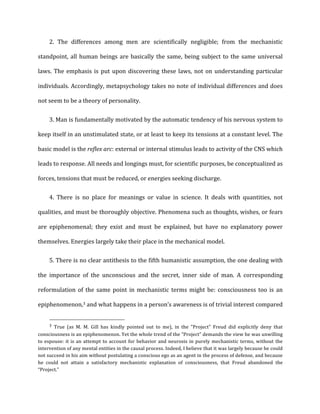
2. The	
   differences	
   among	
   men	
   are	
   scientifically	
   negligible;	
   from	
   the	
   mechanistic
standpoint,	
  all	
  human	
  beings	
  are	
  basically	
  the	
  same,	
  being	
  subject	
  to	
  the	
  same	
  universal	
  
laws.	
  The	
  emphasis	
  is	
  put	
  upon	
  discovering	
  these	
  laws,	
  not	
  on	
  understanding	
  particular	
  
individuals.	
  Accordingly,	
  metapsychology	
  takes	
  no	
  note	
  of	
  individual	
  differences	
  and	
  does	
  
not	
  seem	
  to	
  be	
  a	
  theory	
  of	
  personality.	
  
3. Man	
  is	
  fundamentally	
  motivated	
  by	
  the	
  automatic	
  tendency	
  of	
  his	
  nervous	
  system	
  to
keep	
  itself	
  in	
  an	
  unstimulated	
  state,	
  or	
  at	
  least	
  to	
  keep	
  its	
  tensions	
  at	
  a	
  constant	
  level.	
  The	
  
basic	
  model	
  is	
  the	
  reflex	
  arc:	
  external	
  or	
  internal	
  stimulus	
  leads	
  to	
  activity	
  of	
  the	
  CNS	
  which	
  
leads	
  to	
  response.	
  All	
  needs	
  and	
  longings	
  must,	
  for	
  scientific	
  purposes,	
  be	
  conceptualized	
  as	
  
forces,	
  tensions	
  that	
  must	
  be	
  reduced,	
  or	
  energies	
  seeking	
  discharge.	
  
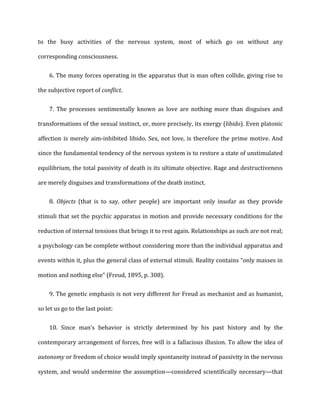
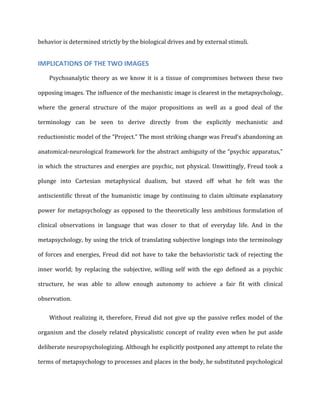
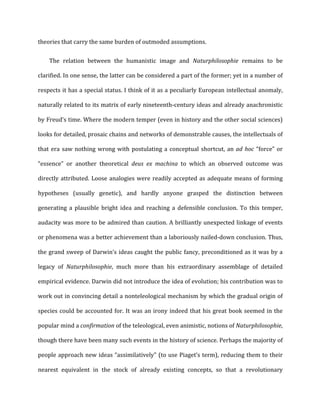
4. There	
   is	
   no	
   place	
   for	
   meanings	
   or	
   value	
   in	
   science.	
   It	
   deals	
   with	
   quantities,	
   not
qualities,	
  and	
  must	
  be	
  thoroughly	
  objective.	
  Phenomena	
  such	
  as	
  thoughts,	
  wishes,	
  or	
  fears	
  
are	
   epiphenomenal;	
   they	
   exist	
   and	
   must	
   be	
   explained,	
   but	
   have	
   no	
   explanatory	
   power	
  
themselves.	
  Energies	
  largely	
  take	
  their	
  place	
  in	
  the	
  mechanical	
  model.	
  
5. There	
  is	
  no	
  clear	
  antithesis	
  to	
  the	
  fifth	
  humanistic	
  assumption,	
  the	
  one	
  dealing	
  with
the	
   importance	
   of	
   the	
   unconscious	
   and	
   the	
   secret,	
   inner	
   side	
   of	
   man.	
   A	
   corresponding	
  
reformulation	
  of	
  the	
  same	
  point	
  in	
  mechanistic	
  terms	
  might	
  be:	
  consciousness	
  too	
  is	
  an	
  
epiphenomenon,3	
  and	
  what	
  happens	
  in	
  a	
  person’s	
  awareness	
  is	
  of	
  trivial	
  interest	
  compared	
  
3	
   True	
   (as	
   M.	
   M.	
   Gill	
   has	
   kindly	
   pointed	
   out	
   to	
   me),	
   in	
   the	
   "Project"	
   Freud	
   did	
   explicitly	
   deny	
   that	
  
consciousness	
  is	
  an	
  epiphenomenon.	
  Yet	
  the	
  whole	
  trend	
  of	
  the	
  “Project"	
  demands	
  the	
  view	
  he	
  was	
  unwilling	
  
to	
  espouse:	
  it	
  is	
  an	
  attempt	
  to	
  account	
  for	
  behavior	
  and	
  neurosis	
  in	
  purely	
  mechanistic	
  terms,	
  without	
  the	
  
intervention	
  of	
  any	
  mental	
  entities	
  in	
  the	
  causal	
  process.	
  Indeed,	
  I	
  believe	
  that	
  it	
  was	
  largely	
  because	
  he	
  could	
  
not	
  succeed	
  in	
  his	
  aim	
  without	
  postulating	
  a	
  conscious	
  ego	
  as	
  an	
  agent	
  in	
  the	
  process	
  of	
  defense,	
  and	
  because	
  
he	
   could	
   not	
   attain	
   a	
   satisfactory	
   mechanistic	
   explanation	
   of	
   consciousness,	
   that	
   Freud	
   abandoned	
   the	
  
“Project."	
  	
  
to	
   the	
   busy	
   activities	
   of	
   the	
   nervous	
   system,	
   most	
   of	
   which	
   go	
   on	
   without	
   any	
  
corresponding	
  consciousness.	
  
6. The	
  many	
  forces	
  operating	
  in	
  the	
  apparatus	
  that	
  is	
  man	
  often	
  collide,	
  giving	
  rise	
  to
the	
  subjective	
  report	
  of	
  conflict.	
  
7. The	
   processes	
   sentimentally	
   known	
   as	
   love	
   are	
   nothing	
   more	
   than	
   disguises	
   and
transformations	
  of	
  the	
  sexual	
  instinct,	
  or,	
  more	
  precisely,	
  its	
  energy	
  (libido).	
  Even	
  platonic	
  
affection	
  is	
  merely	
  aim-­‐inhibited	
  libido.	
  Sex,	
  not	
  love,	
  is	
  therefore	
  the	
  prime	
  motive.	
  And	
  
since	
  the	
  fundamental	
  tendency	
  of	
  the	
  nervous	
  system	
  is	
  to	
  restore	
  a	
  state	
  of	
  unstimulated	
  
equilibrium,	
  the	
  total	
  passivity	
  of	
  death	
  is	
  its	
  ultimate	
  objective.	
  Rage	
  and	
  destructiveness	
  
are	
  merely	
  disguises	
  and	
  transformations	
  of	
  the	
  death	
  instinct.	
  
8. Objects	
   (that	
   is	
   to	
   say,	
   other	
   people)	
   are	
   important	
   only	
   insofar	
   as	
   they	
   provide
stimuli	
  that	
  set	
  the	
  psychic	
  apparatus	
  in	
  motion	
  and	
  provide	
  necessary	
  conditions	
  for	
  the	
  
reduction	
  of	
  internal	
  tensions	
  that	
  brings	
  it	
  to	
  rest	
  again.	
  Relationships	
  as	
  such	
  are	
  not	
  real;	
  
a	
  psychology	
  can	
  be	
  complete	
  without	
  considering	
  more	
  than	
  the	
  individual	
  apparatus	
  and	
  
events	
  within	
  it,	
  plus	
  the	
  general	
  class	
  of	
  external	
  stimuli.	
  Reality	
  contains	
  “only	
  masses	
  in	
  
motion	
  and	
  nothing	
  else”	
  (Freud,	
  1895,	
  p.	
  308).	
  
9. The	
  genetic	
  emphasis	
  is	
  not	
  very	
  different	
  for	
  Freud	
  as	
  mechanist	
  and	
  as	
  humanist,
so	
  let	
  us	
  go	
  to	
  the	
  last	
  point:	
  
10. Since	
   man’s	
   behavior	
   is	
   strictly	
   determined	
   by	
   his	
   past	
   history	
   and	
   by	
   the
contemporary	
  arrangement	
  of	
  forces,	
  free	
  will	
  is	
  a	
  fallacious	
  illusion.	
  To	
  allow	
  the	
  idea	
  of	
  
autonomy	
  or	
  freedom	
  of	
  choice	
  would	
  imply	
  spontaneity	
  instead	
  of	
  passivity	
  in	
  the	
  nervous	
  
system,	
  and	
  would	
  undermine	
  the	
  assumption—considered	
  scientifically	
  necessary—that	
  
behavior	
  is	
  determined	
  strictly	
  by	
  the	
  biological	
  drives	
  and	
  by	
  external	
  stimuli.	
  
IMPLICATIONS	
  OF	
  THE	
  TWO	
  IMAGES	
  
Psychoanalytic	
   theory	
   as	
   we	
   know	
   it	
   is	
   a	
   tissue	
   of	
   compromises	
   between	
   these	
   two	
  
opposing	
  images.	
  The	
  influence	
  of	
  the	
  mechanistic	
  image	
  is	
  clearest	
  in	
  the	
  metapsychology,	
  
where	
   the	
   general	
   structure	
   of	
   the	
   major	
   propositions	
   as	
   well	
   as	
   a	
   good	
   deal	
   of	
   the	
  
terminology	
   can	
   be	
   seen	
   to	
   derive	
   directly	
   from	
   the	
   explicitly	
   mechanistic	
   and	
  
reductionistic	
  model	
  of	
  the	
  “Project.”	
  The	
  most	
  striking	
  change	
  was	
  Freud’s	
  abandoning	
  an	
  
anatomical-­‐neurological	
  framework	
  for	
  the	
  abstract	
  ambiguity	
  of	
  the	
  “psychic	
  apparatus,”	
  
in	
  which	
  the	
  structures	
  and	
  energies	
  are	
  psychic,	
  not	
  physical.	
  Unwittingly,	
  Freud	
  took	
  a	
  
plunge	
   into	
   Cartesian	
   metaphysical	
   dualism,	
   but	
   staved	
   off	
   what	
   he	
   felt	
   was	
   the	
  
antiscientific	
  threat	
  of	
  the	
  humanistic	
  image	
  by	
  continuing	
  to	
  claim	
  ultimate	
  explanatory	
  
power	
  for	
  metapsychology	
  as	
  opposed	
  to	
  the	
  theoretically	
  less	
  ambitious	
  formulation	
  of	
  
clinical	
   observations	
   in	
   language	
   that	
   was	
   closer	
   to	
   that	
   of	
   everyday	
   life.	
   And	
   in	
   the	
  
metapsychology,	
  by	
  using	
  the	
  trick	
  of	
  translating	
  subjective	
  longings	
  into	
  the	
  terminology	
  
of	
  forces	
  and	
  energies,	
  Freud	
  did	
  not	
  have	
  to	
  take	
  the	
  behavioristic	
  tack	
  of	
  rejecting	
  the	
  
inner	
   world;	
   by	
   replacing	
   the	
   subjective,	
   willing	
   self	
   with	
   the	
   ego	
   defined	
   as	
   a	
   psychic	
  
structure,	
   he	
   was	
   able	
   to	
   allow	
   enough	
   autonomy	
   to	
   achieve	
   a	
   fair	
   fit	
   with	
   clinical	
  
observation.	
  
Without	
  realizing	
  it,	
  therefore,	
  Freud	
  did	
  not	
  give	
  up	
  the	
  passive	
  reflex	
  model	
  of	
  the	
  
organism	
  and	
  the	
  closely	
  related	
  physicalistic	
  concept	
  of	
  reality	
  even	
  when	
  he	
  put	
  aside	
  
deliberate	
  neuropsychologizing.	
  Although	
  he	
  explicitly	
  postponed	
  any	
  attempt	
  to	
  relate	
  the	
  
terms	
  of	
  metapsychology	
  to	
  processes	
  and	
  places	
  in	
  the	
  body,	
  he	
  substituted	
  psychological	
  
theories	
  that	
  carry	
  the	
  same	
  burden	
  of	
  outmoded	
  assumptions.	
  
The	
   relation	
   between	
   the	
   humanistic	
   image	
   and	
   Naturphilosophie	
   remains	
   to	
   be	
  
clarified.	
  In	
  one	
  sense,	
  the	
  latter	
  can	
  be	
  considered	
  a	
  part	
  of	
  the	
  former;	
  yet	
  in	
  a	
  number	
  of	
  
respects	
  it	
  has	
  a	
  special	
  status.	
  I	
  think	
  of	
  it	
  as	
  a	
  peculiarly	
  European	
  intellectual	
  anomaly,	
  
naturally	
  related	
  to	
  its	
  matrix	
  of	
  early	
  nineteenth-­‐century	
  ideas	
  and	
  already	
  anachronistic	
  
by	
  Freud’s	
  time.	
  Where	
  the	
  modern	
  temper	
  (even	
  in	
  history	
  and	
  the	
  other	
  social	
  sciences)	
  
looks	
  for	
  detailed,	
  prosaic	
  chains	
  and	
  networks	
  of	
  demonstrable	
  causes,	
  the	
  intellectuals	
  of	
  
that	
  era	
  saw	
  nothing	
  wrong	
  with	
  postulating	
  a	
  conceptual	
  shortcut,	
  an	
  ad	
  hoc	
  “force”	
  or	
  
“essence”	
   or	
   another	
   theoretical	
   deus	
   ex	
   machina	
   to	
   which	
   an	
   observed	
   outcome	
   was	
  
directly	
  attributed.	
  Loose	
  analogies	
  were	
  readily	
  accepted	
  as	
  adequate	
  means	
  of	
  forming	
  
hypotheses	
   (usually	
   genetic),	
   and	
   hardly	
   anyone	
   grasped	
   the	
   distinction	
   between	
  
generating	
   a	
   plausible	
   bright	
   idea	
   and	
   reaching	
   a	
   defensible	
   conclusion.	
   To	
   this	
   temper,	
  
audacity	
  was	
  more	
  to	
  be	
  admired	
  than	
  caution.	
  A	
  brilliantly	
  unexpected	
  linkage	
  of	
  events	
  
or	
  phenomena	
  was	
  a	
  better	
  achievement	
  than	
  a	
  laboriously	
  nailed-­‐down	
  conclusion.	
  Thus,	
  
the	
  grand	
  sweep	
  of	
  Darwin’s	
  ideas	
  caught	
  the	
  public	
  fancy,	
  preconditioned	
  as	
  it	
  was	
  by	
  a	
  
legacy	
   of	
   Naturphilosophie,	
   much	
   more	
   than	
   his	
   extraordinary	
   assemblage	
   of	
   detailed	
  
empirical	
  evidence.	
  Darwin	
  did	
  not	
  introduce	
  the	
  idea	
  of	
  evolution;	
  his	
  contribution	
  was	
  to	
  
work	
  out	
  in	
  convincing	
  detail	
  a	
  nonteleological	
  mechanism	
  by	
  which	
  the	
  gradual	
  origin	
  of	
  
species	
  could	
  be	
  accounted	
  for.	
  It	
  was	
  an	
  irony	
  indeed	
  that	
  his	
  great	
  book	
  seemed	
  in	
  the	
  
popular	
  mind	
  a	
  confirmation	
  of	
  the	
  teleological,	
  even	
  animistic,	
  notions	
  of	
  Naturphilosophie,	
  
though	
  there	
  have	
  been	
  many	
  such	
  events	
  in	
  the	
  history	
  of	
  science.	
  Perhaps	
  the	
  majority	
  of	
  
people	
  approach	
  new	
  ideas	
  “assimilatively"	
  (to	
  use	
  Piaget’s	
  term),	
  reducing	
  them	
  to	
  their	
  
nearest	
   equivalent	
   in	
   the	
   stock	
   of	
   already	
   existing	
   concepts,	
   so	
   that	
   a	
   revolutionary	
  
proposal	
  may	
  end	
  up	
  reinforcing	
  a	
  reactionary	
  idea.	
  
One	
   might	
   even	
   argue	
   that	
   in	
   the	
   world	
   of	
   today,	
   the	
   main	
   function	
   of	
   grand,	
  
integrative	
  speculations—philosophical	
  or	
  pseudoscientific	
  ‘	
  ‘theories	
  of	
  the	
  universe”—is	
  
to	
  help	
  adolescents	
  gain	
  a	
  temporary	
  intellectual	
  mastery	
  of	
  the	
  confusion	
  they	
  experience	
  
upon	
   the	
   sudden	
   widening	
   of	
   their	
   horizons,	
   both	
   emotional	
   and	
   ideational.	
   In	
   a	
   sense,	
  
Freud	
   the	
   medical	
   student	
   was	
   quite	
   justified	
   in	
   feeling	
   that	
   his	
   Nature-­‐philosophical	
  
leanings	
  were	
  among	
  the	
  childish	
  things	
  that	
  a	
  man	
  had	
  to	
  put	
  away.	
  Jones	
  (1953,	
  p.	
  29)	
  
writes	
   that	
   when	
   he	
   once	
   asked	
   Freud	
   how	
   much	
   philosophy	
   he	
   had	
   read,	
   the	
   answer	
  
came:	
   “Very	
   little.	
   As	
   a	
   young	
   man	
   I	
   felt	
   a	
   strong	
   attraction	
   towards	
   speculation	
   and	
  
ruthlessly	
  checked	
  it.”	
  
On	
  the	
  basis	
  of	
  this	
  and	
  many	
  relevant	
  remarks	
  and	
  passages,	
  I	
  have	
  summarized	
  (see	
  
table)	
  the	
  aspects	
  of	
  Freud's	
  thought	
  that	
  seem	
  traceable	
  to	
  Naturphilosophie	
  and	
  to	
  his	
  
philosophical	
   studies	
   with	
   Brentano,	
   along	
   with	
   their	
   counterparts,	
   drawn	
   from	
   the	
  
tradition	
   of	
   mechanistic	
   science	
   and	
   in	
   particular	
   from	
   Freud’s	
   own	
   apprenticeship	
   in	
  
physicalistic	
  physiology.	
  To	
  an	
  unknown	
  extent,	
  some	
  items	
  on	
  the	
  left	
  may	
  have	
  derived	
  
from	
   other	
   humanistic	
   sources,	
   but	
   this	
   one	
   seems	
   most	
   plausible.	
   (Evidence	
   that	
   the	
  
various	
   elements	
   were	
   associated	
   in	
   the	
   manner	
   indicated	
   is	
   presented	
   in	
   Holt,	
   1963.)	
  
Freud	
   usually	
   spoke	
   slightingly	
   about	
   all	
   of	
   the	
   methods	
   and	
   procedures	
   of	
   the	
   formal	
  
disciplines,	
  as	
  in	
  the	
  quotation	
  above,	
  where	
  it	
  is	
  noteworthy	
  (and	
  characteristic)	
  that	
  he	
  
equated	
  philosophy	
  and	
  speculation.	
  Deduction,	
  comprehensiveness	
  of	
  a	
  theory’s	
  coverage,	
  
and	
  rigorous	
  definition	
  were	
  associated	
  in	
  his	
  mind	
  with	
  the	
  sterile,	
  formalistic	
  aspects	
  of	
  	
  
Table	
  1:	
  Latent	
  Structure	
  of	
  Freud's	
  Methodological	
  Conceptions	
  
Derived	
  largely	
  from	
  
philosophy,	
  especially	
  
Naturphilosophie:	
  
Derived	
  largely	
  from	
  
physicalistic	
  physiology:	
  
Associated	
  
disciplines:	
  
Philosophy;	
  academic	
  
philosophical	
  psychology	
  
Physiology;	
  
neuropsychology;	
  
metapsychology	
  
Nature	
  of	
  
theorizing:	
  
Complete,	
  comprehensive	
  
theories,	
  with	
  precise	
  
definitions	
  of	
  concepts	
  
Partial,	
  ad	
  hoc	
  theories	
  
with	
  groping	
  imprecisely	
  
defined	
  concepts	
  
Procedures	
  
and	
  
methods:	
  
Deductive	
  procedure,	
  	
  use	
  
of	
  mathematics;	
  
speculation;	
  synthesis	
  
Inductive	
  procedure	
  
(nonformalistic);	
  
observation;	
  dissection;	
  
analysis	
  
philosophy.	
  And	
  yet	
  (perhaps	
  because	
  of	
  the	
  bridge-­‐concept	
  of	
  evolution),	
  Naturphilosophie	
  
and	
  the	
  rest	
  of	
  this	
  complex	
  of	
  ideas	
  were	
  linked	
  in	
  Freud’s	
  mind	
  with	
  Darwinian	
  biology	
  
and	
   to	
   the	
   similarly	
   genetic	
   discipline	
   of	
   archaeology.	
   These	
   respectable	
   sciences	
   which,	
  
unlike	
  philosophy	
  and	
  mathematics,	
  were	
  concretely	
  empirical,	
  reconstructed	
  the	
  remote	
  
past	
  of	
  man	
  by	
  a	
  genetic	
  method.	
  Perhaps	
  the	
  thought	
  that	
  he	
  was	
  following	
  their	
  method	
  
enabled	
   Freud,	
   finally,	
   to	
   indulge	
   his	
   long-­‐suppressed	
   yearning	
   for	
   broad,	
   speculative	
  
theorizing.	
  In	
  his	
  autobiography	
  (Freud,	
  1925,	
  p.	
  57),	
  he	
  wrote:	
  “In	
  the	
  works	
  of	
  my	
  later	
  
years	
  (Beyond	
  the	
  Pleasure	
  Principle,	
  Group	
  Psychology	
  and	
  the	
  Analysis	
  of	
  the	
  Ego,	
  and	
  The	
  
Ego	
  and	
  the	
  Id),	
  I	
  have	
  given	
  free	
  rein	
  to	
  the	
  inclination,	
  which	
  I	
  kept	
  down	
  for	
  so	
  long,	
  to	
  
speculation....”	
  
In	
  a	
  sense,	
  of	
  course,	
  it	
  is	
  only	
  an	
  extension	
  of	
  the	
  method	
  of	
  genetic	
  reconstruction	
  to	
  
go	
  back	
  beyond	
  the	
  beginnings	
  of	
  an	
  individual	
  life	
  and	
  attempt	
  to	
  trace	
  the	
  development	
  of	
  
socially	
  shared	
  customs	
  in	
  the	
  larger	
  life	
  history	
  of	
  a	
  people,	
  as	
  Freud	
  did	
  in	
  Totem	
  and	
  
Taboo.	
  The	
  conceptions	
  of	
  Haeckel	
  (that	
  ontogeny	
  recapitulates	
  phylogeny)	
  and	
  of	
  Lamarck	
  
(that	
  acquired	
  characteristics	
  may	
  be	
  passed	
  on	
  genetically)	
  were	
  generally	
  known	
  during	
  
Freud’s	
  scientifically	
  formative	
  years	
  and	
  enjoyed	
  a	
  far	
  more	
  widespread	
  acceptance	
  by	
  the	
  
scientific	
  world	
  than	
  they	
  did	
  during	
  Freud’s	
  later	
  years.	
  This	
  acceptance	
  made	
  it	
  difficult	
  
for	
  him	
  to	
  give	
  them	
  up.	
  If	
  the	
  functional	
  anthropologists	
  had	
  appeared	
  a	
  generation	
  sooner	
  
and	
  if	
  the	
  evolutionary	
  approach	
  had	
  not	
  been	
  so	
  popularized	
  by	
  Sir	
  James	
  Frazer,	
  Freud	
  
might	
  have	
  been	
  able	
  to	
  understand	
  how	
  pervasive	
  and	
  unconscious	
  the	
  patterning	
  of	
  a	
  
culture	
   can	
   be.	
   This	
   intricate	
   interconnection	
   makes	
   it	
   possible	
   for	
   culture	
   to	
   be	
  
transmitted	
  via	
  subtle	
  and	
  almost	
  imperceptible	
  kinds	
  of	
  learning,	
  a	
  fact	
  that	
  obviates	
  what	
  
Freud	
  (1934—38)	
  declared	
  was	
  the	
  necessity	
  that	
  a	
  social	
  psychology	
  should	
  postulate	
  the	
  
inheritance	
  of	
  acquired	
  characteristics.	
  
Freud’s	
  Cognitive	
  Style	
  
Let	
  us	
  turn	
  now	
  to	
  the	
  last	
  major	
  source	
  of	
  difficulty	
  the	
  modern	
  reader	
  encounters	
  in	
  
understanding	
  Freud:	
  his	
  cognitive	
  style.	
  Anyone	
  who	
  has	
  read	
  Freud	
  at	
  all	
  may	
  react	
  to	
  
that	
  proposition	
  with	
  astonishment,	
  for	
  Freud’s	
  style	
  is	
  much	
  admired	
  for	
  its	
  limpid	
  clarity.	
  
Even	
  in	
  translation,	
  Freud	
  is	
  vivid,	
  personal,	
  and	
  charmingly	
  direct	
  in	
  a	
  way	
  that	
  makes	
  him	
  
highly	
   readable;	
   he	
   uses	
   imaginative	
   and	
   original	
   figures	
   of	
   speech,	
   and	
   often	
   leads	
   the	
  
reader	
  along	
  by	
  a	
  kind	
  of	
  stepwise	
  development	
  that	
  enables	
  him	
  to	
  penetrate	
  into	
  difficult	
  
or	
  touchy	
  areas	
  with	
  a	
  minimum	
  of	
  effort.	
  Anyone	
  who	
  has	
  read	
  much	
  of	
  his	
  writing	
  can	
  
easily	
  understand	
  why	
  he	
  received	
  the	
  Goethe	
  prize	
  for	
  literature.	
  
Nevertheless,	
  there	
  are	
  stylistic	
  difficulties	
  in	
  understanding	
  him;	
  but	
  they	
  relate	
  to	
  his	
  
cognitive,	
  not	
  his	
  literary	
  style.	
  A	
  couple	
  of	
  decades	
  ago	
  George	
  Klein	
  (1951,	
  1970)	
  coined	
  
the	
  term	
  cognitive	
  style	
  to	
  mean	
  the	
  patterning	
  of	
  a	
  person’s	
  ways	
  of	
  taking	
  in,	
  processing,	
  
and	
  communicating	
  information	
  about	
  his	
  world.	
  Freud	
  has	
  an	
  idiosyncratic	
  way	
  not	
  just	
  of	
  
writing	
   but	
   of	
   thinking,	
   which	
   makes	
   it	
   surprisingly	
   easy	
   for	
   the	
   modern	
   reader	
   to	
  
misinterpret	
   his	
   meaning,	
   to	
   miss	
   or	
   distort	
   many	
   subtleties	
   of	
   his	
   thought.	
   To	
   some	
  
degree,	
  I	
  myself	
  may	
  be	
  subtly	
  distorting	
  Klein’s	
  concept,	
  for	
  he	
  operationalized	
  it	
  in	
  the	
  
laboratory,	
  not	
  the	
  library.	
  He	
  presented	
  subjects	
  with	
  hidden	
  figures	
  to	
  be	
  extracted	
  from	
  
camouflage,	
  series	
  of	
  squares	
  to	
  be	
  judged	
  for	
  size,	
  and	
  other	
  unusual	
  tasks,	
  some	
  of	
  his	
  
own	
  and	
  some	
  of	
  others’	
  devising.	
  By	
  contrast,	
  the	
  methods	
  I	
  have	
  used	
  are	
  more	
  like	
  those	
  
of	
   the	
   literary	
   critic.	
   I	
   have	
   collected	
   notes	
   on	
   what	
   struck	
   me	
   as	
   characteristic	
   ways	
   in	
  
which	
   Freud	
   observed,	
   processed	
   data,	
   obtained	
   ideas	
   by	
   means	
   other	
   than	
   direct	
  
observation,	
   thought	
   about	
   them,	
   and	
   put	
   his	
   personal	
   stamp	
   on	
   them.	
   In	
   doing	
   so,	
  
however,	
   I	
   have	
   been	
   guided	
   by	
   my	
   long	
   association	
   with	
   Klein	
   and	
   his	
   own	
   way	
   of	
  
approaching	
  cognitive	
  processes	
  and	
  products;	
  so	
  I	
  trust	
  that	
  I	
  have	
  been	
  true	
  to	
  the	
  spirit	
  
of	
  his	
  contribution,	
  which	
  is	
  now	
  so	
  widely	
  used	
  as	
  to	
  be	
  virtually	
  a	
  part	
  of	
  psychology's	
  
common	
  property.	
  
CHARACTER	
  STYLE	
  
Perhaps	
  as	
  good	
  a	
  place	
  to	
  start	
  as	
  any	
  is	
  with	
  Ernest	
  Jones’s	
  well-­‐known	
  biography.	
  
Much	
  of	
  the	
  little	
  that	
  he	
  has	
  to	
  say	
  on	
  this	
  topic	
  can	
  be	
  organized	
  in	
  the	
  form	
  of	
  antitheses	
  
or	
  paradoxes.	
  First	
  of	
  all,	
  there	
  was	
  a	
  great	
  deal	
  about	
  Freud	
  that	
  was	
  compulsively	
  orderly	
  
and	
  hard-­‐working.	
  He	
  led	
  a	
  stable,	
  regular	
  life	
  in	
  which	
  his	
  work	
  was	
  a	
  basic	
  necessity.	
  As	
  
he	
  wrote	
  to	
  Pfister:	
  “I	
  could	
  not	
  contemplate	
  with	
  any	
  sort	
  of	
  comfort	
  a	
  life	
  without	
  work.	
  
Creative	
  imagination	
  and	
  work	
  go	
  together	
  with	
  me;	
  I	
  take	
  no	
  delight	
  in	
  anything	
  else.”	
  Yet	
  
he	
  went	
  on,	
  “That	
  would	
  be	
  a	
  prescription	
  for	
  happiness	
  were	
  it	
  not	
  for	
  the	
  terrible	
  thought	
  
that	
   one’s	
   productivity	
   depends	
   entirely	
   on	
   sensitive	
   moods”	
   (Jones,	
   1955,	
   p.	
   396f.).	
   As	
  
Jones	
  brings	
  out,	
  he	
  did	
  indeed	
  work	
  by	
  fits	
  and	
  starts,	
  not	
  quite	
  so	
  steadily	
  and	
  regularly	
  
as,	
  say,	
  Virgil,	
  but	
  when	
  the	
  mood	
  was	
  on	
  him.	
  
Again,	
  Jones	
  remarks	
  on	
  “Freud’s	
  close	
  attention	
  to	
  verbal	
  detail,	
  the	
  striking	
  patience	
  
with	
  which	
  he	
  would	
  unravel	
  the	
  meaning	
  of	
  phrases	
  and	
  utterances”	
  (ibid.,	
  p.	
  398).	
  On	
  the	
  
other	
  hand:	
  
His	
  translators	
  will	
  bear	
  me	
  out	
  when	
  I	
  remark	
  that	
  minor	
  obscurities	
  and	
  ambiguities,	
  
of	
  a	
  kind	
  that	
  more	
  scrupulous	
  circumspection	
  could	
  have	
  readily	
  avoided,	
  are	
  not	
  the	
  
least	
  of	
  their	
  trials.	
  He	
  was	
  of	
  course	
  aware	
  of	
  this.	
  I	
  remember	
  once	
  asking	
  him	
  why	
  he	
  
used	
   a	
   certain	
   phrase,	
   the	
   meaning	
   of	
   which	
   was	
   not	
   clear,	
   and	
   with	
   a	
   grimace	
   he	
  
answered:	
  “Pure	
  Schlamperei"	
  (sloppiness)	
  (1953,	
  p.	
  33f.).	
  
He	
   was	
   himself	
   not	
   a	
   meticulous	
   translator,	
   though	
   a	
   highly	
   gifted	
   one.	
   “Instead	
   of	
  
laboriously	
  transcribing	
  from	
  the	
  foreign	
  language,	
  idioms	
  and	
  all,	
  he	
  would	
  read	
  a	
  passage,	
  
close	
  the	
  book,	
  and	
  consider	
  how	
  a	
  German	
  writer	
  would	
  have	
  clothed	
  the	
  same	
  thoughts	
  …	
  
His	
   translating	
   work	
   was	
   both	
   brilliant	
   and	
   rapid”	
   (Jones,	
   1953,	
   p.	
   55).	
   Similarly,	
   Jones	
  
remarks	
  on	
  Freud’s	
  “quickness	
  of	
  thought	
  and	
  observation”	
  generally,	
  and	
  the	
  fact	
  that	
  “His	
  
type	
  of	
  mind	
  was	
  such	
  as	
  to	
  penetrate	
  through	
  the	
  material	
  to	
  something	
  really	
  essential	
  
beyond	
  rather	
  than	
  to	
  dally	
  or	
  play	
  with	
  it”	
  (1955,	
  p.	
  399).	
  In	
  short,	
  he	
  was	
  intuitive	
  rather	
  
than	
  ploddingly	
  systematic.	
  
This	
  particular	
  paradox	
  can	
  be	
  resolved,	
  I	
  believe,	
  by	
  the	
  recognition	
  that	
  Freud	
  was,	
  
basically,	
   an	
   obsessive-­‐compulsive	
   personality,	
   in	
   which	
   this	
   type	
   of	
   ambivalence	
   is	
  
familiar.	
   He	
   had	
   a	
   good	
   measure	
   of	
   the	
   fundamental	
   anal	
   traits	
   of	
   orderliness	
   and	
  
compulsive	
  attention	
  to	
  detail;	
  yet	
  when	
  it	
  came	
  to	
  his	
  mode	
  of	
  working	
  with	
  such	
  details	
  
as	
  the	
  slightest	
  turn	
  of	
  phrase	
  in	
  the	
  telling	
  of	
  a	
  dream	
  (which	
  only	
  a	
  compulsive	
  would	
  
have	
  noticed	
  in	
  the	
  first	
  place),	
  he	
  showed	
  a	
  gift	
  for	
  intuition.	
  After	
  all,	
  as	
  Jones	
  never	
  tires	
  
of	
  reminding	
  us,	
  he	
  was	
  a	
  genius,	
  a	
  man	
  of	
  extraordinary	
  intelligence.	
  
NATURE	
  OF	
  FREUD'S	
  INTELLECT	
  
What	
   kind	
   of	
   intelligence	
   was	
   it,	
   then?	
   If	
   we	
   adopt	
   the	
   frame	
   of	
   reference	
   of	
   the	
  
Wechsler	
   intelligence	
   tests,	
   it	
   was	
   first	
   of	
   all	
   predominantly	
   a	
   verbal	
   rather	
   than	
   a	
  
performance	
  sort	
  of	
  ability.	
  I	
  have	
  seen	
  no	
  evidence	
  that	
  Freud	
  was	
  specially	
  gifted	
  with	
  his	
  
hands.	
  He	
  failed	
  as	
  a	
  chemical	
  experimenter	
  (Jones,	
  1953,	
  p.	
  54),	
  and	
  though	
  he	
  was	
  a	
  good	
  
microscopist	
  and	
  invented	
  a	
  new	
  tissue	
  stain	
  during	
  his	
  years	
  of	
  scientific	
  apprenticeship	
  
in	
   Brücke’s	
   physiological	
   laboratory,	
   there	
   is	
   no	
   evidence	
   that	
   he	
   was	
   skilled	
   at	
   the	
  
mechanical	
   end	
   of	
   it.	
   He	
   was	
   never	
   what	
   we	
   call	
   “an	
   apparatus	
   man,”	
   an	
   ingenious	
  
tinkerer.4	
  Incidentally,	
  the	
  usual	
  implication	
  of	
  a	
  markedly	
  higher	
  verbal	
  over	
  performance	
  
10	
  would	
  be	
  borne	
  out	
  in	
  Freud’s	
  case:	
  he	
  was	
  surely	
  never	
  given	
  to	
  acting	
  out,	
  but	
  was	
  
always	
   an	
   intellectualizer	
   and	
   internalizer.	
   Moreover,	
   “That	
   there	
   was	
   a	
   pronounced	
  
passive	
   side	
   to	
   Freud’s	
   nature	
   is	
   a	
   conclusion	
   for	
   which	
   there	
   is	
   ample	
   evidence.”	
   Jones	
  
(1953,	
   p.	
   53)	
   notes;	
   “He	
   once	
   remarked	
   that	
   there	
   were	
   three	
   things	
   to	
   which	
   he	
   felt	
  
unequal:	
  governing,	
  curing,	
  and	
  educating.”	
  He	
  gave	
  up	
  hypnosis	
  as	
  “a	
  coarsely	
  interfering	
  
method”	
  and	
  soon	
  abjured	
  the	
  laying	
  on	
  of	
  hands	
  despite	
  the	
  fact	
  that	
  he	
  treated	
  several	
  of	
  
the	
  ladies	
  in	
  Studies	
  in	
  Hysteria	
  by	
  physical	
  massage.	
  Sitting	
  quietly	
  and	
  listening	
  to	
  free	
  
associations,	
   responding	
   only	
   verbally	
   (largely	
   by	
   interpretations),	
   is	
   the	
   method	
   par	
  
excellence	
  of	
  a	
  man	
  with	
  verbal	
  gifts	
  and	
  a	
  disinclination	
  to	
  manipulate.	
  
Within	
  the	
  realm	
  of	
  verbal	
  intelligence,	
  we	
  can	
  make	
  some	
  more	
  specific	
  statements	
  as	
  
well.	
  “He	
  had	
  an	
  enormously	
  rich	
  vocabulary,”	
  Jones	
  (1955,	
  p.	
  402)	
  attests,	
  “but	
  he	
  was	
  the	
  
reverse	
  of	
  a	
  pedant	
  in	
  words.’’	
  He	
  knew	
  eight	
  languages,	
  having	
  enough	
  mastery	
  of	
  English	
  
and	
  French	
  to	
  write	
  scientific	
  papers	
  in	
  those	
  tongues.	
  There	
  is	
  a	
  fair	
  amount	
  of	
  evidence	
  
between	
  the	
  lines	
  of	
  Freud’s	
  writings	
  that	
  the	
  modality	
  of	
  his	
  thought	
  was	
  largely	
  verbal,	
  as	
  
4	
  "As	
  a	
  young	
  doctor	
  I	
  worked	
  for	
  a	
  long	
  time	
  at	
  the	
  Chemical	
  Institute	
  without	
  ever	
  becoming	
  proficient	
  
in	
  the	
  skills	
  which	
  that	
  science	
  demands;	
  and	
  for	
  that	
  reason	
  in	
  my	
  waking	
  life	
  I	
  have	
  never	
  liked	
  thinking	
  of	
  
this	
   barren	
   and	
   indeed	
   humiliating	
   episode	
   in	
   my	
   apprenticeship.	
   On	
   the	
   other	
   hand	
   I	
   have	
   a	
   regularly	
  
recurring	
   dream	
   of	
   working	
   in	
   the	
   laboratory,	
   of	
   carrying	
   out	
   analyses	
   and	
   of	
   having	
   various	
   experiences	
  
there.	
   These	
   dreams	
   are	
   disagreeable	
   in	
   the	
   same	
   way	
   as	
   examination	
   dreams	
   and	
   they	
   are	
   never	
   very	
  
distinct.	
  While	
  I	
  was	
  interpreting	
  one	
  of	
  them,	
  my	
  attention	
  was	
  eventually	
  attracted	
  by	
  the	
  word	
  'analysis'.	
  
which	
  gave	
  me	
  a	
  key	
  to	
  their	
  understanding.	
  Since	
  those	
  days	
  I	
  have	
  become	
  an	
  ‘analyst’,	
  and	
  I	
  now	
  carry	
  out	
  
analyses	
  which	
  are	
  very	
  highly	
  spoken	
  of	
  ..	
  ."	
  (1900,	
  p.	
  475)	
  	
  
opposed	
  to	
  imageless,	
  visual,	
  auditory,	
  or	
  kinesthetic.	
  He	
  gives	
  evidence	
  that	
  he	
  had	
  been	
  a	
  
virtual	
  Eidetiker	
  until	
  well	
  into	
  his	
  schooling,	
  however:	
  
...	
  for	
  a	
  short	
  period	
  of	
  my	
  youth	
  some	
  unusual	
  feats	
  of	
  memory	
  were	
  not	
  beyond	
  me.	
  
When	
  I	
  was	
  a	
  schoolboy	
  I	
  took	
  it	
  as	
  a	
  matter	
  of	
  course	
  that	
  I	
  could	
  repeat	
  by	
  heart	
  the	
  
page	
  I	
  had	
  been	
  reading;	
  and	
  shortly	
  before	
  I	
  entered	
  the	
  University	
  I	
  could	
  write	
  down	
  
almost	
   verbatim	
   popular	
   lectures	
   on	
   scientific	
   subjects	
   directly	
   after	
   hearing	
   them.	
  
(1901,	
  p.	
  135)	
  
His	
  auditory	
  imagery	
  could	
  be	
  extraordinarily	
  vivid,	
  too,	
  at	
  least	
  up	
  until	
  a	
  few	
  years	
  later,	
  
when	
  he	
  was	
  studying	
  with	
  Charcot	
  in	
  Paris.	
  During	
  these	
  days,	
  he	
  reports,	
  “I	
  quite	
  often	
  
heard	
  my	
  name	
  suddenly	
  called	
  by	
  an	
  unmistakable	
  and	
  beloved	
  voice,’’	
  which	
  he	
  goes	
  on	
  
to	
   refer	
   to	
   unblinkingly	
   as	
   a	
   “hallucination’’	
   (1901,	
   p.	
   261).	
   Yet	
   he	
   writes	
   about	
   these	
  
experiences	
  in	
  such	
  a	
  way	
  as	
  to	
  indicate	
  that,	
  like	
  most	
  other	
  eidetic	
  imagers,	
  he	
  gradually	
  
lost	
   the	
   ability	
   as	
   he	
   grew	
   older.	
   True,	
   his	
   dreams	
   remained	
   vividly	
   visual,	
   and	
   he	
  
occasionally	
  was	
  able	
  to	
  get	
  a	
  sharp	
  visual	
  image	
  in	
  waking	
  life,	
  but	
  he	
  emphasized	
  that	
  
such	
  occasions	
  were	
  exceptional.	
  On	
  the	
  other	
  hand,	
  I	
  have	
  never	
  found	
  any	
  indication	
  that	
  
Freud	
   was	
   even	
   aware	
   that	
   such	
   a	
   phenomenon	
   as	
   imageless	
   thought	
   exists;	
   though	
  
investigators	
   from	
   Galton	
   to	
   Anne	
   Roe	
   have	
   found	
   that	
   it	
   characterizes	
   many	
   leading	
  
figures	
  in	
  such	
  disciplines	
  as	
  mathematics	
  and	
  theoretical	
  physics—disciplines	
  that	
  Jones	
  
specifically	
  says	
  (1953,	
  p.	
  33)	
  Freud	
  could	
  never	
  have	
  excelled	
  in.	
  
Perhaps	
  there	
  is	
  a	
  hint	
  here	
  that	
  Freud’s	
  mind	
  was	
  not	
  at	
  the	
  very	
  forefront	
  as	
  far	
  as	
  
highly	
  abstract	
  thinking	
  is	
  concerned.	
  Surely	
  he	
  was	
  not	
  much	
  of	
  a	
  mathematician.	
  He	
  once	
  
characterized	
  himself	
  as	
  follows:	
  
I	
  have	
  very	
  restricted	
  capacities	
  or	
  talents.	
  None	
  at	
  all	
  for	
  the	
  natural	
  sciences;	
  nothing	
  
for	
  mathematics;	
  nothing	
  for	
  anything	
  quantitative.	
  But	
  what	
  I	
  have,	
  of	
  a	
  very	
  restricted	
  
nature,	
  was	
  probably	
  very	
  intensive.	
  (Quoted	
  in	
  Jones,	
  1955,	
  p.	
  397)	
  
As	
  we	
  shall	
  see	
  a	
  little	
  later,	
  this	
  relative	
  weakness	
  in	
  the	
  quantitative	
  factor	
  had	
  a	
  number	
  
of	
  noticeable	
  effects	
  on	
  Freud’s	
  manner	
  of	
  thinking.	
  
To	
   summarize	
   so	
   far,	
   in	
   terms	
   of	
   abilities,	
   Freud	
   had	
   a	
   predominantly	
   verbal	
  
intelligence	
  and	
  mode	
  of	
  thinking.	
  He	
  was	
  extraordinarily	
  gifted	
  at	
  memory,	
  concentration,	
  
passive	
  (or	
  as	
  he	
  put	
  it,	
  “evenly-­‐suspended”)	
  attention,	
  and	
  creative	
  concept-­‐formation.	
  His	
  
gift	
  was	
  more	
  analytic	
  than	
  synthetic,	
  just	
  as	
  his	
  preference	
  was	
  for	
  the	
  former	
  over	
  the	
  
latter	
   aspect	
   of	
   thinking.	
   He	
   had	
   no	
   notable	
   gifts	
   along	
   sensorimotor,	
   manipulative,	
   or	
  
quantitative	
   lines,	
   nor	
   in	
   the	
   most	
   abstract	
   types	
   of	
   thought.	
   Above	
   all,	
   it	
   may	
   not	
   be	
  
superfluous	
  to	
  add,	
  he	
  was	
  productive,	
  original,	
  and	
  creative.	
  
SELF-­‐CRITICAL	
  DOUBTS	
  VERSUS	
  SELF-­‐CONFIDENT	
  DETERMINATION	
  
In	
  moving	
  on	
  to	
  some	
  more	
  stylistic	
  aspects	
  of	
  his	
  thought,	
  I	
  shall	
  continue	
  to	
  pursue	
  
antitheses.	
  One	
  such	
  is	
  the	
  cognitive	
  side	
  of	
  a	
  prominent	
  theme	
  in	
  Freud’s	
  personality:	
  a	
  
self-­‐critical,	
  even	
  retiring	
  and	
  self-­‐doubting	
  modesty	
  versus	
  a	
  largely	
  covert	
  and	
  negated	
  
thirst	
  for	
  fame	
  coupled	
  with	
  great	
  self-­‐confidence.	
  A	
  number	
  of	
  the	
  quotations	
  both	
  from	
  
Freud	
  and	
  from	
  Jones	
  have	
  touched	
  on	
  his	
  self-­‐critical	
  side,	
  and	
  the	
  evidence	
  for	
  his	
  deep-­‐
seated	
  longing	
  to	
  see	
  his	
  name	
  carved	
  on	
  a	
  rock	
  for	
  the	
  ages	
  is	
  omnipresent	
  in	
  Jones’s	
  three	
  
volumes,	
  though	
  the	
  disciple	
  outdid	
  the	
  master	
  in	
  protesting	
  that	
  it	
  wasn’t	
  so.	
  Both	
  of	
  these	
  
facets	
  of	
  Freud’s	
  mind	
  come	
  out	
  in	
  relation	
  to	
  the	
  ideas	
  he	
  set	
  forth	
  in	
  Beyond	
  the	
  Pleasure	
  
Principle.	
  He	
  wrote:	
  
What	
   follows	
   is	
   speculation,	
   often	
   far-­‐fetched	
   speculation,	
   which	
   the	
   reader	
   will	
  
consider	
  or	
  dismiss	
  according	
  to	
  his	
  individual	
  predilection.	
  (1920,	
  p.	
  24)	
  
And:	
  
It	
   may	
   be	
   asked	
   whether	
   and	
   how	
   far	
   I	
   am	
   myself	
   convinced	
   of	
   the	
   truth	
   of	
   the	
  
hypotheses	
  that	
  have	
  been	
  set	
  out	
  in	
  these	
  pages.	
  My	
  answer	
  would	
  be	
  that	
  I	
  am	
  not	
  
convinced	
  myself	
  and	
  that	
  I	
  do	
  not	
  seek	
  to	
  persuade	
  other	
  people	
  to	
  believe	
  in	
  them.	
  Or,	
  
more	
  precisely,	
  that	
  I	
  do	
  not	
  know	
  how	
  far	
  I	
  believe	
  in	
  them....	
  Since	
  we	
  have	
  such	
  good	
  
grounds	
  for	
  being	
  distrustful,	
  our	
  attitude	
  towards	
  the	
  results	
  of	
  our	
  own	
  deliberations	
  
cannot	
  well	
  be	
  other	
  than	
  one	
  of	
  cool	
  benevolence.	
  (1920,	
  p.	
  59)	
  
He	
  was	
  speaking,	
  of	
  course,	
  about	
  his	
  most	
  controversial	
  speculations,	
  those	
  concerning	
  the	
  
death	
  instinct.	
  Yet	
  only	
  a	
  few	
  years	
  later,	
  he	
  wrote	
  this:	
  
To	
   begin	
   with	
   it	
   was	
   only	
   tentatively	
   that	
   I	
   put	
   forward	
   the	
   views	
   I	
   have	
   developed	
  
here,	
   but	
   in	
   the	
   course	
   of	
   time	
   they	
   have	
   gained	
   such	
   a	
   hold	
   upon	
   me	
   that	
   I	
   can	
   no	
  
longer	
   think	
   in	
   any	
   other	
   way.	
   To	
   my	
   mind,	
   they	
   are	
   far	
   more	
   serviceable	
   from	
   a	
  
theoretical	
  standpoint	
  than	
  any	
  other	
  possible	
  ones;	
  they	
  provide	
  that	
  simplification,	
  
without	
  either	
  ignoring	
  or	
  doing	
  violence	
  to	
  the	
  facts,	
  for	
  which	
  we	
  strive	
  in	
  scientific	
  
work.	
  (1930,	
  p.	
  119)	
  
In	
  short,	
  he	
  had	
  a	
  tendency	
  to	
  become	
  so	
  “accustomed	
  to	
  the	
  face”	
  of	
  his	
  own	
  ideas	
  as	
  to	
  
consider	
  them	
  indispensable	
  and,	
  finally,	
  as	
  established,	
  even	
  though	
  they	
  were	
  originally	
  
presented	
  with	
  great	
  modesty.	
  Indeed,	
  he	
  looked	
  back	
  on	
  the	
  shaky	
  speculations	
  of	
  Beyond	
  
the	
  Pleasure	
  Principle	
  as	
  a	
  basis	
  for	
  supporting	
  his	
  fundamental	
  assumption	
  that	
  there	
  had	
  
to	
  be	
  two	
  classes	
  of	
  instinctual	
  drives:	
  
Over	
  and	
  over	
  again	
  we	
  find,	
  when	
  we	
  are	
  able	
  to	
  trace	
  instinctual	
  impulses	
  back,	
  that	
  
they	
  reveal	
  themselves	
  as	
  derivatives	
  of	
  Eros.	
  If	
  it	
  were	
  not	
  for	
  the	
  considerations	
  put	
  
forward	
  in	
  Beyond	
  the	
  Pleasure	
  Principle,	
  and	
  ultimately	
  for	
  the	
  sadistic	
  constituents	
  
which	
  have	
  attached	
  themselves	
  to	
  Eros,	
  we	
  should	
  have	
  difficulty	
  in	
  holding	
  to	
  our	
  
fundamental	
  dualistic	
  point	
  of	
  view	
  [in	
  instinct	
  theory).	
  (1923,	
  p.	
  46)	
  
Here	
  we	
  have	
  the	
  first	
  hint	
  of	
  one	
  of	
  the	
  basic	
  problems	
  with	
  which	
  Freud	
  struggled,	
  
and	
  which	
  helped	
  shape	
  the	
  nature	
  of	
  his	
  thought.	
  Working	
  as	
  he	
  did	
  in	
  a	
  new	
  field,	
  with	
  no	
  
conventional	
  criteria	
  for	
  establishing	
  valid	
  knowledge,	
  he	
  had	
  to	
  be	
  sustained	
  against	
  the	
  
inevitable	
  self-­‐doubts,	
  even	
  the	
  despair	
  that	
  what	
  he	
  was	
  doing	
  could	
  lead	
  anywhere,	
  by	
  an	
  
irrational	
   confidence	
   in	
   himself,	
   a	
   faith	
   that	
   his	
   intuitions	
   and	
   hypotheses	
   would	
   be	
  
vindicated,	
  and	
  even	
  a	
  certain	
  degree	
  of	
  self-­‐deception	
  that	
  he	
  had	
  established	
  points	
  more	
  
firmly	
  than	
  he	
  in	
  fact	
  had	
  been	
  able	
  to	
  do.	
  
His	
  determination	
  to	
  persist	
  in	
  the	
  face	
  of	
  his	
  recognition	
  that	
  progress	
  was	
  difficult	
  is	
  
well	
  expressed	
  in	
  the	
  following	
  quotation:	
  
It	
  is	
  almost	
  humiliating	
  that,	
  after	
  working	
  so	
  long,	
  we	
  should	
  still	
  be	
  having	
  difficulty	
  
in	
   understanding	
   the	
   most	
   fundamental	
   facts.	
   But	
   we	
   have	
   made	
   up	
   our	
   minds	
   to	
  
simplify	
  nothing	
  and	
  to	
  hide	
  nothing.	
  If	
  we	
  cannot	
  see	
  things	
  clearly	
  we	
  will	
  at	
  least	
  see	
  
clearly	
  what	
  the	
  obscurities	
  are.	
  (1926a,	
  p.	
  124)	
  
One	
  of	
  the	
  positive	
  aspects	
  of	
  Freud’s	
  ability	
  to	
  be	
  self-­‐critical	
  was	
  his	
  willingness	
  to	
  change	
  
his	
  ideas:	
  
We	
  must	
  be	
  patient	
  and	
  await	
  fresh	
  methods	
  and	
  occasions	
  of	
  research.	
  We	
  must	
  be	
  
ready,	
  too,	
  to	
  abandon	
  a	
  path	
  that	
  we	
  have	
  followed	
  for	
  a	
  time,	
  if	
  it	
  seems	
  to	
  be	
  leading	
  
to	
  no	
  good	
  end.	
  Only	
  believers,	
  who	
  demand	
  that	
  science	
  shall	
  be	
  a	
  substitute	
  for	
  the	
  
catechism	
   they	
   have	
   given	
   up,	
   will	
   blame	
   an	
   investigator	
   for	
   developing	
   or	
   even	
  
transforming	
  his	
  views.	
  (1920,	
  p.	
  64)	
  
If	
  he	
  was	
  not	
  always	
  able	
  to	
  live	
  up	
  to	
  this	
  brave	
  program,	
  if	
  he	
  failed	
  to	
  recognize	
  that	
  
many	
  of	
  his	
  unquestioned	
  assumptions	
  were	
  not	
  as	
  axiomatically	
  true	
  as	
  he	
  thought,	
  these	
  
are	
  the	
  necessary	
  consequences	
  of	
  being	
  human.	
  Freud	
  was	
  surely	
  sustained	
  in	
  his	
  long	
  
quest	
  by	
  a	
  passionate	
  interest	
  in	
  penetrating	
  the	
  mysteries	
  of	
  nature	
  and	
  a	
  capacity	
  to	
  care	
  
deeply	
  about	
  his	
  ideas.	
  All	
  the	
  more	
  natural,	
  therefore,	
  that	
  he	
  should	
  have	
  tended	
  at	
  times	
  
to	
  lose	
  scientific	
  detachment	
  and	
  confuse	
  his	
  concepts	
  with	
  realities.	
  Thus,	
  he	
  would	
  refer	
  
to	
  “the	
  ‘super-­‐ego,’	
  one	
  of	
  the	
  later	
  findings	
  of	
  psychoanalysis”	
  (1900,	
  p.	
  558	
  n.	
  1),	
  or	
  to	
  “the	
  
discovery	
  that	
  the	
  ego	
  itself	
  is	
  cathected	
  with	
  libido”	
  (1930,	
  p.	
  118;	
  emphasis	
  added	
  in	
  both	
  
quotations).	
  When	
  I	
  spoke	
  above	
  about	
  his	
  unquestioned	
  assumptions,	
  I	
  had	
  principally	
  in	
  
mind	
  the	
  passive	
  reflex	
  model	
  of	
  the	
  organism,	
  which	
  is	
  today	
  demonstrably	
  false	
  (Holt,	
  
1965).	
  Yet	
  to	
  Freud	
  it	
  seemed	
  so	
  self-­‐evidently	
  true	
  that	
  he	
  referred	
  to	
  it	
  as	
  a	
  fact	
  on	
  which	
  
he	
  could	
  found	
  one	
  of	
  his	
  most	
  questionable	
  constructs:	
  
The	
  dominating	
  tendency	
  of	
  mental	
  life,	
  and	
  perhaps	
  of	
  nervous	
  life	
  in	
  general,	
  is	
  the	
  
effort	
  to	
  reduce,	
  to	
  keep	
  constant	
  or	
  to	
  remove	
  internal	
  tension	
  due	
  to	
  stimuli	
  .	
  .	
  .—a	
  
tendency	
  which	
  finds	
  expression	
  in	
  the	
  pleasure	
  principle;	
  and	
  our	
  recognition	
  of	
  that	
  
fact	
   is	
   one	
   of	
   our	
   strongest	
   reasons	
   for	
   believing	
   in	
   the	
   existence	
   of	
   death	
   instincts.	
  
(1920,	
  p.	
  55f.;	
  emphasis	
  added)	
  
Another	
  aspect	
  of	
  this	
  same	
  antithesis	
  was	
  Freud’s	
  conviction	
  that	
  the	
  essence	
  of	
  what	
  
he	
   was	
   setting	
   forth	
   was	
   truth,	
   which	
   would	
   be	
   fully	
   appreciated	
   only	
   by	
   future	
  
generations,	
   versus	
   his	
   expectation	
   that	
   much	
   of	
   what	
   he	
   taught	
   would	
   be	
   quickly	
  
overthrown,	
  as	
  in	
  the	
  following	
  1909	
  letter	
  to	
  Jung	
  in	
  response	
  to	
  the	
  latter’s	
  expressed	
  
fear	
  that	
  Freud’s	
  writings	
  would	
  be	
  treated	
  as	
  gospel:	
  
Your	
  surmise	
  that	
  after	
  my	
  departure	
  my	
  errors	
  might	
  be	
  adored	
  as	
  holy	
  relics	
  amused	
  
me	
  enormously,	
  but	
  I	
  don’t	
  believe	
  it.	
  On	
  the	
  contrary,	
  I	
  think	
  my	
  followers	
  will	
  hasten	
  
to	
  demolish	
  as	
  swiftly	
  as	
  possible	
  everything	
  that	
  is	
  not	
  safe	
  and	
  sound	
  in	
  what	
  I	
  leave	
  
behind.	
  (Quoted	
  in	
  Jones,	
  1955,	
  p.	
  446)	
  
Freud	
  showed	
  here	
  the	
  strength	
  of	
  his	
  faith	
  that	
  there	
  were	
  kernels	
  of	
  eternal	
  truth	
  as	
  
well	
  as	
  chaff	
  in	
  the	
  harvest	
  of	
  his	
  labors.	
  
ANALYSIS	
  VERSUS	
  SYNTHESIS	
  
Another	
  familiar	
  antithesis	
  in	
  the	
  realm	
  of	
  thinking	
  is	
  analysis	
  versus	
  synthesis.	
  Here,	
  
the	
  preference	
  of	
  the	
  inventor	
  and	
  namer	
  of	
  psychoanalysis	
  was	
  clear	
  and	
  marked.	
  In	
  1915	
  
he	
  wrote	
  to	
  Lou	
  Andreas-­‐Salome:	
  
I	
  so	
  rarely	
  feel	
  the	
  need	
  for	
  synthesis.	
  The	
  unity	
  of	
  this	
  world	
  seems	
  to	
  me	
  something	
  
self-­‐understood,	
  something	
  unworthy	
  of	
  emphasis.	
  What	
  interests	
  me	
  is	
  the	
  separation	
  
and	
  breaking	
  up	
  into	
  its	
  component	
  parts	
  what	
  would	
  otherwise	
  flow	
  together	
  into	
  a	
  
primeval	
  pulp.	
  .	
  .	
  .In	
  short,	
  I	
  am	
  evidently	
  an	
  analyst	
  and	
  believe	
  that	
  synthesis	
  offers	
  no	
  
obstacles	
  once	
  analysis	
  has	
  been	
  achieved.(1960,	
  p.	
  310)	
  
Yet	
  in	
  spite	
  of	
  the	
  fact	
  that	
  the	
  concept	
  of	
  the	
  synthetic	
  function	
  of	
  the	
  ego	
  is	
  associated	
  
less	
  with	
  Freud	
  than	
  with	
  Nunberg,	
  the	
  latter’s	
  paper	
  by	
  this	
  name	
  (Nunberg,	
  1931)	
  is	
  in	
  
large	
  part	
  simply	
  a	
  drawing	
  together	
  of	
  points	
  Freud	
  made	
  in	
  passing	
  in	
  many	
  contexts.	
  
Freud	
  could	
  perform	
  remarkable	
  feats	
  of	
  synthesizing	
  many	
  disconnected	
  facts—see	
  for	
  
example	
  his	
  masterly	
  review	
  of	
  the	
  scientific	
  literature	
  on	
  dreams	
  (1900,	
  Ch.	
  1)—and	
  he	
  
taught	
   us	
   a	
   great	
   deal	
   about	
   synthetic	
   functioning;	
   nevertheless,	
   his	
   ability	
   and	
   his	
  
predilection	
  ran	
  predominantly	
  along	
  the	
  lines	
  of	
  analysis.	
  
DIALECTIC	
  DUALISM	
  
One	
   reason	
   I	
   have	
   adopted	
   the	
   antithetical	
   method	
   in	
   this	
   exposition	
   is	
   that	
   a	
  
preference	
  for	
  opposed	
  binary	
  concepts	
  was	
  itself	
  highly	
  characteristic	
  of	
  Freud’s	
  thinking.	
  
Even	
  in	
  the	
  realm	
  of	
  art,	
  he	
  strongly	
  preferred	
  the	
  balance	
  of	
  classical	
  antiquity;	
  a	
  letter	
  to	
  
Romain	
  Rolland	
  in	
  1930	
  speaks	
  of	
  his	
  “Hellenic	
  love	
  of	
  proportion’’	
  (1960,	
  p.	
  392).	
  And	
  in	
  
his	
  own	
  theory,	
  it	
  is	
  surely	
  a	
  striking	
  and	
  well-­‐known	
  fact	
  that	
  his	
  major	
  concepts	
  come	
  in	
  
matched	
  opposing	
  pairs.	
  Perhaps	
  the	
  most	
  notable	
  is	
  his	
  motivational	
  theory	
  in	
  its	
  various	
  
guises.	
   Fairly	
   early,	
   he	
   pitted	
   unconscious	
   wish	
   against	
   preconscious	
   cathexis,	
   then	
   the	
  
libidinal	
   versus	
   the	
   ego-­‐instincts,	
   going	
   on	
   to	
   narcissistic	
   versus	
   object-­‐libido,	
   to	
   Eros	
  
versus	
  the	
  death	
  instincts	
  (or	
  love	
  against	
  hate);	
  but	
  it	
  was	
  always	
  a	
  dual	
  drive	
  theory.	
  Or	
  
recall	
   “the	
   three	
   great	
   polarities	
   that	
   dominate	
   mental	
   life”:	
   activity—passivity,	
   ego—
external	
   world,	
   and	
   pleasure—unpleasure	
   (1915a,	
   p.	
   140;	
   emphasis	
   Freud’s),	
   to	
   which	
  
might	
  be	
  added	
  that	
  of	
  masculine—feminine.	
  Many	
  other	
  such	
  oppositions	
  come	
  to	
  mind:	
  
quantity	
   versus	
   quality,	
   autoplastic	
   versus	
   alloplastic,	
   ego-­‐syntonic	
   versus	
   ego-­‐alien,	
  
pleasure	
   principle	
   versus	
   reality	
   principle,	
   free	
   versus	
   bound	
   cathexis,	
   and	
   the	
   primary	
  
process	
  versus	
  the	
  secondary	
  process.	
  It	
  is	
  not	
  difficult	
  to	
  show	
  that	
  Freud	
  conceived	
  of	
  a	
  
continuous	
   series	
   of	
   actual	
   thought	
   processes	
   between	
   the	
   theoretical	
   extremes	
   of	
   the	
  
primary	
  and	
  the	
  secondary	
  process,	
  but	
  he	
  typically	
  used	
  them	
  in	
  a	
  dichotomous	
  fashion.	
  
Even	
  when	
  he	
  proposed	
  triads	
  of	
  concepts	
  (Cs.,	
  Pcs.,	
  and	
  Ucs.;	
  ego,	
  superego,	
  and	
  id),	
  he	
  had	
  
a	
   strong	
   tendency	
   to	
   reduce	
   them	
   to	
   binary	
   form.	
   The	
   1923	
   work	
   is,	
   after	
   all,	
   entitled	
  
merely	
  The	
  Ego	
  and	
  the	
  Id;	
  and	
  the	
  distinction	
  between	
  conscious	
  and	
  unconscious	
  always	
  
impressed	
  Freud	
  as	
  “our	
  one	
  beacon-­‐light	
  in	
  the	
  darkness	
  of	
  depth-­‐psychology”	
  (1923,	
  p.	
  
18).	
  Terms	
  like	
  ambivalence	
  and	
  conflict	
  conceptualize	
  this	
  trait	
  as	
  fundamental	
  facts	
  of	
  
psychology.	
  Indeed,	
  one	
  might	
  argue	
  that	
  many	
  of	
  the	
  antithetical	
  dynamic	
  concepts	
  are	
  a	
  
direct	
  consequence	
  of	
  Freud’s	
  recognizing	
  how	
  important	
  conflict	
  was	
  in	
  both	
  normal	
  and	
  
pathological	
  development.	
  
TOLERATED	
  CONTRADICTION	
  (SYNTHESIS	
  DEFERRED)	
  
Further,	
  Freud’s	
  thinking	
  is	
  characterized	
  by	
  an	
  unusual	
  tolerance	
  for	
  inconsistency.	
  If	
  
you	
  went	
  through	
  the	
  works	
  of	
  any	
  author	
  as	
  prolific	
  as	
  Freud,	
  you	
  would	
  doubtless	
  find	
  
many	
   mutually	
   contradictory	
   statements,	
   and	
   many	
   propositions	
   that	
   are	
   actually	
  
incompatible	
  with	
  his	
  basic	
  assumptions.	
  But	
  it	
  is	
  not	
  difficult	
  to	
  find	
  other	
  reasons	
  for	
  the	
  
presence	
  of	
  inconsistencies	
  in	
  Freud’s	
  work	
  besides	
  its	
  sheer	
  bulk,	
  which	
  is	
  enormous:	
  his	
  
preference	
   for	
   what	
   I	
   shall	
   expound	
   shortly	
   as	
   seriatim	
   theorizing	
   and	
   piecemeal	
  
empiricism,	
  both	
  of	
  which	
  are	
  clearly	
  to	
  be	
  expected	
  from	
  a	
  man	
  with	
  an	
  orientation	
  away	
  
from	
  synthesis,	
  and	
  a	
  confessed	
  sloppiness	
  with	
  concepts.	
  As	
  Jones	
  puts	
  it,	
  
He	
   wrote	
   easily,	
   fluently,	
   and	
   spontaneously,	
   and	
   would	
   have	
   found	
   much	
   rewriting	
  
irksome.	
   .	
   .	
   .one	
   of	
   his	
   main	
   characteristics	
   [was]	
   his	
   dislike	
   of	
   being	
   hampered	
   or	
  
fettered.	
  He	
  loved	
  to	
  give	
  himself	
  up	
  to	
  his	
  thoughts	
  freely,	
  to	
  see	
  where	
  they	
  would	
  
take	
  him,	
  leaving	
  aside	
  for	
  the	
  moment	
  any	
  question	
  of	
  precise	
  delineation;	
  that	
  could	
  
be	
  left	
  for	
  further	
  consideration.	
  (1953,	
  p.	
  33f.)	
  
True,	
   he	
   did	
   rewrite	
   and	
   revise	
   several	
   of	
   his	
   books	
   many	
   times.	
   Fortunately,	
   the	
  
Standard	
  Edition	
  provides	
  a	
  variorum	
  text	
  and	
  scrupulously	
  informs	
  us	
  of	
  every	
  change,	
  
edition	
  by	
  edition.	
  It	
  is	
  not	
  difficult,	
  therefore,	
  to	
  characterize	
  Freud's	
  style	
  of	
  revision	
  by	
  
studying	
   The	
   Interpretation	
   of	
   Dreams,	
   The	
   Psychopathology	
   of	
   Everyday	
   Life,	
   and	
   Three	
  
Essays	
  on	
  the	
  Theory	
  of	
  Sexuality.	
  These	
  books,	
  first	
  published	
  from	
  1900	
  to	
  1905,	
  went	
  
through	
  eight,	
  ten,	
  and	
  six	
  editions	
  respectively,	
  all	
  of	
  them	
  containing	
  additions	
  from	
  at	
  
least	
   as	
   late	
   as	
   1925.	
   Thus,	
   they	
   span	
   at	
   least	
   two	
   major	
   periods	
   in	
   the	
   development	
   of	
  
Freud's	
  thought,	
  including	
  a	
  far-­‐reaching	
  change	
  in	
  models.	
  Yet	
  one	
  statement	
  covers	
  the	
  
vast	
   majority	
   of	
   the	
   revisions:	
   he	
   added	
   things.	
   There	
   was	
   never	
   any	
   fundamental	
  
reconsideration	
  and	
  precious	
  little	
  synthesis.	
  Perhaps	
  if	
  Freud	
  had	
  not	
  had	
  such	
  a	
  superb	
  
command	
  of	
  written	
  communication	
  so	
  that	
  he	
  rarely	
  had	
  even	
  to	
  polish	
  his	
  first	
  drafts,	
  he	
  
would	
  have	
  reworked	
  his	
  books	
  more	
  thoroughly	
  as	
  they	
  went	
  through	
  new	
  editions.	
  At	
  
most,	
  he	
  added	
  an	
  occasional	
  footnote	
  pointing	
  out	
  the	
  incompatibility	
  of	
  a	
  statement	
  with	
  
later	
  doctrines.	
  Even	
  Chapter	
  7	
  of	
  The	
  Interpretation	
  of	
  Dreams,	
  Freud’s	
  most	
  ambitious	
  and	
  
important	
  theoretical	
  work,	
  was	
  left	
  virtually	
  untouched	
  except	
  for	
  interpolations,	
  after	
  the	
  
tinkerings	
  of	
  1915	
  and	
  1917	
  that	
  undid	
  the	
  possibility	
  of	
  topographical	
  regression,	
  even	
  
after	
  the	
  jettisoning	
  of	
  the	
  whole	
  topographic	
  model	
  in	
  1923	
  and	
  its	
  replacement	
  by	
  the	
  
structural	
   model,	
   which	
   makes	
   no	
   provision	
   for	
   the	
   conceptualization	
   of	
   any	
   complete	
  
cognitive	
  process.	
  Indeed,	
  to	
  the	
  end.	
  Chapter	
  7	
  contained	
  anachronistic	
  carry-­‐overs	
  from	
  
the	
  neurological	
  model	
  of	
  the	
  unpublished	
  “Project,”	
  which	
  had	
  preceded	
  it	
  by	
  four	
  years.	
  
Throughout	
   all	
   the	
   revisions,	
   Freud	
   never	
   eliminated	
   the	
   lapses	
   into	
   references	
   to	
  
“neurones,”	
  “pathways,”	
  and	
  “quantity.”	
  
Freud	
   built	
   theory,	
   then,	
   much	
   as	
   Franklin	
   D.	
   Roosevelt	
   constructed	
   the	
   Executive	
  
branch	
   of	
   the	
   government:	
   when	
   something	
   wasn’t	
   working	
   very	
   well,	
   he	
   seldom	
  
reorganized;	
  he	
  just	
  supplied	
  another	
  agency—or	
  concept—to	
  do	
  the	
  job.	
  To	
  tolerate	
  this	
  
much	
   inconsistency	
   surely	
   took	
   an	
   unusual	
   capacity	
   to	
   delay	
   the	
   time	
   when	
   the	
  
gratification	
   of	
   an	
   orderly,	
   internally	
   consistent,	
   logically	
   coherent	
   theory	
   might	
   be	
  
attained.	
   Compare	
   his	
   self-­‐characterization	
   in	
   the	
   following	
   letter	
   to	
   Andreas-­‐Salome	
   in	
  
1917;	
  he	
  had	
  been	
  contrasting	
  himself	
  with	
  “the	
  system-­‐builders”	
  Jung	
  and	
  Adler.	
  
.	
  .	
  .	
  you	
  have	
  observed	
  how	
  I	
  work,	
  step	
  by	
  step,	
  without	
  the	
  inner	
  need	
  for	
  completion,	
  
continually	
   under	
   the	
   pressure	
   of	
   the	
   problems	
   immediately	
   on	
   hand	
   and	
   taking	
  
infinite	
  pains	
  not	
  to	
  be	
  diverted	
  from	
  the	
  path.	
  (1960,	
  p.	
  319)	
  
Seven	
  years	
  earlier,	
  he	
  had	
  written	
  to	
  Jung:	
  
I	
   notice	
   that	
   you	
   have	
   the	
   same	
   way	
   of	
   working	
   as	
   I	
   have:	
   to	
   be	
   on	
   the	
   look	
   out	
   in	
  
whatever	
   direction	
   you	
   feel	
   drawn	
   and	
   not	
   take	
   the	
   obvious	
   straightforward	
   path.	
   I	
  
think	
  that	
  is	
  the	
  best	
  way	
  too,	
  since	
  one	
  is	
  astonished	
  later	
  to	
  find	
  how	
  directly	
  those	
  
circuitous	
  routes	
  led	
  to	
  the	
  right	
  goal.	
  (Quoted	
  in	
  Jones,	
  1955,	
  p.	
  449)	
  
To	
  follow	
  one’s	
  nose	
  empirically,	
  adding	
  to	
  the	
  theory	
  whatever	
  bits	
  and	
  pieces	
  might	
  
accrue	
  along	
  the	
  way—this	
  was	
  the	
  procedure	
  with	
  which	
  Freud	
  felt	
  at	
  home,	
  with	
  his	
  faith	
  
that	
  ultimately	
  the	
  truth	
  would	
  prevail.	
  
CONCEPTION	
  OF	
  SCIENTIFIC	
  METHOD	
  AND	
  CONCEPTS	
  
This	
  attitude	
  was	
  of	
  a	
  piece	
  with	
  Freud’s	
  basic	
  conception	
  of	
  scientific	
  work.	
  Science	
  
was	
  first	
  and	
  foremost	
  a	
  matter	
  of	
  empirical	
  observation,	
  which	
  he	
  usually	
  contrasted	
  with	
  
speculation	
  to	
  the	
  latter’s	
  discredit.	
  As	
  Freud	
  conceived	
  it,	
  a	
  speculative,	
  or	
  philosophical,	
  
system	
  started	
  with	
  “clear	
  and	
  sharply	
  defined	
  basic	
  concepts,”	
  (1915a,	
  p.	
  117)	
  and	
  built	
  on	
  
this	
  “smooth,	
  logically	
  unassailable	
  foundation”	
  (1914,	
  p.	
  77)	
  a	
  “complete	
  and	
  ready-­‐made	
  
theoretical	
  structure,”	
  (1923,	
  p.	
  36)	
  which	
  could	
  “easily	
  spring	
  into	
  existence	
  complete,	
  and	
  
thereafter	
  remain	
  unchangeable”	
  (1906,	
  p.	
  271).	
  But	
  “no	
  science,	
  not	
  even	
  the	
  most	
  exact,”	
  
operates	
  this	
  way:	
  
The	
  true	
  beginning	
  of	
  scientific	
  activity	
  consists	
  rather	
  in	
  describing	
  phenomena	
  and	
  
then	
   in	
   proceeding	
   to	
   group,	
   classify	
   and	
   correlate	
   them.	
   Even	
   at	
   the	
   stage	
   of	
  
description	
  it	
  is	
  not	
  possible	
  to	
  avoid	
  applying	
  certain	
  abstract	
  ideas	
  to	
  the	
  material	
  in	
  
hand,	
   ideas	
   derived	
   from	
   somewhere	
   or	
   other	
   but	
   certainly	
   not	
   from	
   the	
   new	
  
observations	
   alone.	
   .	
   .	
   .They	
   must	
   at	
   first	
   necessarily	
   possess	
   some	
   degree	
   of	
  
indefiniteness;	
   .	
   .	
   .we	
   come	
   to	
   an	
   understanding	
   about	
   their	
   meaning	
   by	
   making	
  
repeated	
   references	
   to	
   the	
   material	
   of	
   observation	
   from	
   which	
   they	
   appear	
   to	
   have	
  
been	
  derived,	
  but	
  upon	
  which,	
  in	
  fact,	
  they	
  have	
  been	
  imposed.	
  .	
  .	
  .	
  It	
  is	
  only	
  after	
  more	
  
thorough	
  investigation	
  of	
  the	
  field	
  of	
  observation	
  that	
  we	
  are	
  able	
  to	
  formulate	
  its	
  basic	
  
scientific	
  concepts	
  with	
  increased	
  precision,	
  and	
  progressively	
  so	
  to	
  modify	
  them	
  that	
  
they	
  become	
  serviceable	
  and	
  consistent	
  over	
  a	
  wide	
  area.	
  Then,	
  indeed,	
  the	
  time	
  may	
  
have	
  come	
  to	
  confine	
  them	
  in	
  definitions.	
  The	
  advance	
  of	
  knowledge,	
  however,	
  does	
  
not	
  tolerate	
  any	
  rigidity	
  even	
  in	
  definitions.	
  (1915a,	
  p.	
  117)	
  
When	
  tackling	
  a	
  new	
  topic,	
  therefore:	
  
Instead	
  of	
  starting	
  from	
  a	
  definition,	
  it	
  seems	
  more	
  useful	
  to	
  begin	
  with	
  some	
  indication	
  
of	
   the	
   range	
   of	
   the	
   phenomena	
   under	
   review,	
   and	
   to	
   select	
   from	
   among	
   them	
   a	
   few	
  
specially	
  striking	
  and	
  characteristic	
  facts	
  to	
  which	
  our	
  enquiry	
  can	
  be	
  attached.	
  (1921,	
  
p.	
  72)	
  
Thereafter,	
  any	
  psychoanalytic	
  inquiry	
  must	
  
.	
  .	
  .find	
  its	
  way	
  step	
  by	
  step	
  along	
  the	
  path	
  towards	
  understanding	
  the	
  intricacies	
  of	
  the	
  
mind	
   by	
   making	
   an	
   analytic	
   dissection	
   of	
   both	
   normal	
   and	
   abnormal	
   phenomena.	
  
(1923.	
  p.	
  36)	
  
But	
  because	
  of	
  the	
  complexity	
  of	
  its	
  subject	
  matter,	
  psychoanalysis	
  cannot	
  hope	
  for	
  quick	
  
successes:	
  
The	
  extraordinary	
  intricacy	
  of	
  all	
  the	
  factors	
  to	
  be	
  taken	
  into	
  consideration	
  leaves	
  only	
  
one	
  way	
  of	
  presenting	
  them	
  open	
  to	
  us.	
  We	
  must	
  select	
  first	
  one	
  and	
  then	
  another	
  point	
  
of	
  view,	
  and	
  follow	
  it	
  up	
  through	
  the	
  material	
  as	
  long	
  as	
  the	
  application	
  of	
  it	
  seems	
  to	
  
yield	
  results.	
  Each	
  separate	
  treatment	
  of	
  the	
  subject	
  will	
  be	
  incomplete	
  in	
  itself,	
  and	
  
there	
  cannot	
  fail	
  to	
  be	
  obscurities	
  where	
  it	
  touches	
  upon	
  material	
  that	
  has	
  not	
  yet	
  been	
  
treated;	
  but	
  we	
  may	
  hope	
  that	
  a	
  final	
  synthesis	
  will	
  lead	
  to	
  a	
  proper	
  understanding.	
  
(1915b,	
  p.	
  157f.)	
  
The	
  truth,	
  when	
  attained,	
  will	
  be	
  simpler:	
  
...	
  we	
  have	
  no	
  other	
  aim	
  but	
  that	
  of	
  translating	
  into	
  theory	
  the	
  results	
  of	
  observation,	
  
and	
  we	
  deny	
  that	
  there	
  is	
  any	
  obligation	
  on	
  us	
  to	
  achieve	
  at	
  our	
  first	
  attempt	
  a	
  well-­‐
rounded	
   theory	
   which	
   will	
   commend	
   itself	
   by	
   its	
   simplicity.	
   We	
   shall	
   defend	
   the	
  
complications	
   of	
   our	
   theory	
   so	
   long	
   as	
   we	
   find	
   that	
   they	
   meet	
   the	
   results	
   of	
  
observation,	
  and	
  we	
  shall	
  not	
  abandon	
  our	
  expectations	
  of	
  being	
  led	
  in	
  the	
  end	
  by	
  those	
  
very	
  complications	
  to	
  the	
  discovery	
  of	
  a	
  state	
  of	
  affairs	
  which,	
  while	
  simple	
  in	
  itself,	
  can	
  
account	
  for	
  all	
  the	
  complications	
  of	
  reality.	
  (1915c,	
  p.	
  190)	
  
Freud	
  thus	
  demonstrated	
  a	
  capacity	
  to	
  tolerate,	
  in	
  addition	
  to	
  inconsistency	
  and	
  delay,	
  
considerable	
   conceptual	
   indefiniteness	
   or,	
   in	
   the	
   terminology	
   of	
   today,	
   ambiguity.	
   “It	
   is	
  
true,”	
  he	
  was	
  ready	
  to	
  admit,	
  “that	
  notions	
  such	
  as	
  that	
  of	
  an	
  ego-­‐libido,	
  an	
  energy	
  of	
  the	
  
ego-­‐instincts,	
   and	
   so	
   on,	
   are	
   neither	
   particularly	
   easy	
   to	
   grasp,	
   nor	
   sufficiently	
   rich	
   in	
  
content.”	
  Nevertheless,	
  psychoanalysis	
  would	
  “gladly	
  content	
  itself	
  with	
  nebulous,	
  scarcely	
  
imaginable	
  basic	
  concepts,	
  which	
  it	
  hopes	
  to	
  apprehend	
  more	
  clearly	
  in	
  the	
  course	
  of	
  its	
  
development,	
  or	
  which	
  it	
  is	
  even	
  prepared	
  to	
  replace	
  by	
  others”	
  (1914,	
  p.	
  77).	
  Note	
  the	
  
obligation	
  stated	
  here,	
  which	
  follows	
  clearly	
  enough	
  from	
  his	
  position	
  regarding	
  definition,	
  
for	
  a	
  periodic	
  conceptual	
  stocktaking;	
  if	
  consistent	
  and	
  useful	
  definitions	
  never	
  precipitate	
  
out,	
  the	
  concept	
  should	
  be	
  abandoned.	
  As	
  we	
  have	
  seen,	
  however,	
  such	
  a	
  process	
  of	
  regular	
  
review	
  was	
  quite	
  incompatible	
  with	
  Freud’s	
  style	
  of	
  working	
  and	
  thinking,	
  and	
  he	
  rarely	
  
discarded	
  concepts	
  when	
  he	
  added	
  new	
  ones.	
  It	
  is	
  a	
  little	
  sad,	
  but	
  not	
  surprising,	
  to	
  find	
  
that	
   instincts,	
   which	
   in	
   1915	
   (1915a,	
   p.	
   117f.)	
   were	
   “at	
   the	
   moment	
   .	
   .	
   .	
   still	
   somewhat	
  
obscure,”	
   were	
   characterized	
   18	
   years	
   later	
   as	
   “mythical	
   entities,	
   magnificent	
   in	
   their	
  
indefiniteness”	
  (1933,	
  p.	
  95).	
  
A	
  few	
  years	
  ago,	
  I	
  decided	
  to	
  try	
  my	
  hand	
  at	
  this	
  winnowing	
  process,	
  taking	
  one	
  of	
  
Freud’s	
   central	
   but	
   tantalizingly	
   ill-­‐defined	
   concepts	
   (the	
   binding	
   of	
   cathexis;	
   see	
   Holt,	
  
1962)	
  and	
  following	
  it	
  through	
  his	
  writings	
  to	
  see	
  what	
  kind	
  of	
  definition	
  emerged.	
  The	
  
labor	
  of	
  finding	
  and	
  collating	
  the	
  contexts	
  in	
  which	
  it	
  occurred,	
  and	
  educing	
  the	
  14	
  different	
  
meanings	
   that	
   I	
   was	
   able	
   to	
   discern—I	
   have	
   found	
   still	
   others	
   since	
   then!—was	
   great	
  
enough	
  to	
  make	
  me	
  realize	
  that	
  if	
  Freud	
  had	
  undertaken	
  to	
  work	
  his	
  own	
  theories	
  over	
  
continuously	
  in	
  this	
  way,	
  after	
  a	
  few	
  years	
  he	
  would	
  not	
  have	
  had	
  time	
  to	
  analyze	
  any	
  more	
  
patients,	
  much	
  less	
  write	
  anything	
  new.	
  It	
  is	
  true,	
  I	
  was	
  able	
  to	
  sift	
  out	
  a	
  core	
  meaning	
  to	
  
my	
   own	
   satisfaction,	
   but	
   it	
   remains	
   to	
   be	
   seen	
   whether	
   many	
   psychoanalysts	
   will	
   be	
  
convinced	
  that	
  they	
  should	
  abandon	
  the	
  other	
  dozen	
  or	
  so	
  types	
  of	
  usage.	
  With	
  Freud’s	
  
free-­‐and-­‐easy	
  example	
  for	
  precedent,	
  some	
  find	
  it	
  easy	
  to	
  justify	
  putting	
  off	
  the	
  evil	
  day	
  
when	
  terms	
  will	
  start	
  to	
  have	
  definite,	
  restrictive	
  meanings.	
  
So	
   far,	
   I	
   have	
   emphasized	
   the	
   knowingly	
   provisional,	
   tentative	
   nature	
   of	
   Freud’s	
  
theorizing,	
   his	
   deliberate	
   abjuring	
   of	
   any	
   attempt	
   to	
   build	
   a	
   complete	
   and	
   internally	
  
coherent	
  system,	
  in	
  favor	
  of	
  piecemeal	
  empiricism	
  instead—quite	
  a	
  contrast	
  to	
  the	
  view	
  of	
  
Freud	
  as	
  the	
  dogmatic	
  systematist	
  who	
  would	
  brook	
  no	
  deviation	
  from	
  a	
  rigid	
  “party	
  line’’	
  
of	
  theory!	
  Yet	
  this	
  popular	
  conception	
  has	
  its	
  roots	
  in	
  fact	
  also.	
  For	
  one	
  thing,	
  Freud	
  seems	
  
to	
  have	
  had	
  a	
  fluctuating,	
  never	
  explicit	
  set	
  of	
  standards	
  about	
  what	
  parts	
  of	
  psychoanalysis	
  
had	
   been	
   proved,	
   which	
   only	
   he	
   might	
   change	
   with	
   impunity,	
   and	
   what	
   parts	
   were	
  
modifiable	
  by	
  others.	
  True	
  to	
  his	
  agglutinative	
  principle	
  of	
  revision,	
  he	
  welcomed	
  additions	
  
so	
  long	
  as	
  they	
  did	
  not	
  explicitly	
  call	
  for	
  reconsideration	
  of	
  concepts	
  and	
  propositions	
  that	
  
had	
  come	
  to	
  seem	
  basic	
  and	
  necessary.	
  Thus,	
  Adler’s	
  ideas	
  about	
  organ	
  inferiority	
  and	
  the	
  
will	
  to	
  power	
  were	
  acceptable	
  until	
  the	
  disciple	
  started	
  insisting	
  that	
  they	
  clashed	
  with	
  the	
  
libido	
  theory	
  and	
  demanded	
  the	
  latter’s	
  drastic	
  revision.	
  
STYLE	
  OF	
  THEORIZING	
  
Quite	
   aside	
   from	
   Freud’s	
   relation	
   to	
   the	
   contributions	
   of	
   others	
   (a	
   matter	
   that	
   is	
  
obviously	
   a	
   great	
   deal	
   more	
   complicated	
   than	
   the	
   above	
   brief	
   discussion	
   might	
   seem	
   to	
  
imply),	
  there	
  are	
  bases	
  for	
  the	
  conception	
  of	
  Freud	
  as	
  a	
  doctrinaire	
  dogmatist	
  in	
  certain	
  
stylistic	
  peculiarities	
  of	
  his	
  own	
  theorizing.	
  Let	
  me	
  summarize	
  first	
  and	
  then	
  expand,	
  with	
  
examples.	
  Freud	
  was	
  fond	
  of	
  stating	
  things	
  “as	
  it	
  were,	
  dogmatically—in	
  the	
  most	
  concise	
  
form	
  and	
  in	
  the	
  most	
  unequivocal	
  terms”	
  (1940,	
  p.	
  144);	
  indeed,	
  hyperbole	
  was	
  one	
  of	
  his	
  
favorite	
  rhetorical	
  devices.	
  When	
  he	
  thought	
  that	
  he	
  glimpsed	
  a	
  law	
  of	
  nature,	
  he	
  stated	
  it	
  
with	
  sweeping	
  universalism	
  and	
  generality.	
  He	
  was	
  likewise	
  fond	
  of	
  extending	
  concepts	
  to	
  
the	
  limit	
  of	
  their	
  possible	
  applicability,	
  as	
  if	
  stretching	
  the	
  realm	
  of	
  phenomena	
  spanned	
  by	
  
a	
   concept	
   was	
   a	
   way	
   to	
   make	
   it	
   more	
   abstract	
   and	
   useful.	
   His	
   device	
   for	
   escaping	
   the	
  
dangers	
   of	
   oversimplification	
   to	
   which	
   this	
   pattern	
   exposed	
   him	
   was	
   to	
   follow	
   one	
   flat	
  
statement	
   with	
   another	
   that	
   qualified	
   it	
   by	
   partial	
   contradiction.	
   Therefore,	
   the	
  
inconsistency	
   in	
   many	
   of	
   Freud's	
   propositions	
   is	
   only	
   apparent.	
   He	
   was	
   perfectly	
   well	
  
aware	
  that	
  one	
  statement	
  undid	
  another,	
  and	
  used	
  such	
  sequences	
  as	
  a	
  way	
  of	
  letting	
  a	
  
richly	
   complicated	
   conception	
   grow	
   in	
   the	
   reader’s	
   mind	
   as	
   considerations	
   were	
  
introduced	
  one	
  at	
  a	
  time.	
  
Here,	
  then,	
  is	
  one	
  reason	
  why	
  Freud	
  is	
  at	
  once	
  so	
  delightfully	
  easy	
  to	
  read,	
  and	
  so	
  easy	
  
to	
   misunderstand,	
   particularly	
   when	
   statements	
   are	
   taken	
   out	
   of	
   context.	
   His	
   view	
   of	
  
human	
  behavior	
  was	
  unusually	
  subtle,	
  complex,	
  and	
  many-­‐layered;	
  if	
  he	
  had	
  tried	
  to	
  set	
  it	
  
forth	
  in	
  sentences	
  of	
  parallel	
  complexity	
  and	
  hierarchical	
  structure,	
  he	
  would	
  have	
  made	
  
Dr.	
   Johnson	
   look	
   like	
   Hemingway.	
   Instead,	
   he	
   writes	
   simply,	
   directly,	
   forcefully;	
   he	
  
dramatizes	
  by	
  grand	
  overstatement,	
  setting	
  out	
  in	
  hard	
  black	
  outlines	
  what	
  he	
  considers	
  
the	
  basic	
  truth	
  about	
  a	
  matter	
  as	
  the	
  reader’s	
  initial	
  orientation.	
  Then	
  he	
  fills	
  in	
  shadows;	
  
or,	
  by	
  another	
  boldly	
  simple	
  stroke,	
  suddenly	
  shows	
  that	
  forms	
  are	
  disposed	
  on	
  different	
  
planes.	
  Gradually,	
  a	
  three-­‐dimensional	
  reality	
  takes	
  shape	
  before	
  the	
  eyes	
  of	
  the	
  one	
  who	
  
knows	
  how	
  to	
  read	
  Freud.	
  
Here	
  is	
  an	
  example	
  of	
  an	
  initial	
  flat	
  statement,	
  followed	
  by	
  qualifications:	
  
The	
  way	
  in	
  which	
  dreams	
  treat	
  the	
  category	
  of	
  contraries	
  and	
  contradictories	
  is	
  highly	
  
remarkable.	
   It	
   is	
   simply	
   disregarded.	
   'No'	
   seems	
   not	
   to	
   exist	
   so	
   far	
   as	
   dreams	
   are	
  
concerned.	
  (1900,	
  p.	
  318)	
  
I	
   have	
   asserted	
   above	
   that	
   dreams	
   have	
   no	
   means	
   of	
   expressing	
   the	
   relation	
   of	
   a	
  
contradiction,	
   a	
   contrary	
   or	
   a	
   'no.'	
   I	
   shall	
   now	
   proceed	
   to	
   give	
   a	
   first	
   denial	
   of	
   this	
  
assertion.	
  |The	
  idea	
  of	
  ‘just	
  the	
  reverse'	
  is	
  plastically	
  represented	
  as	
  something	
  turned	
  
around	
  from	
  its	
  usual	
  orientation.)	
  (p.	
  326)	
  
...	
   the	
   ‘‘not	
   being	
   able	
   to	
   do	
   something"	
   in	
   this	
   dream	
   was	
   a	
   way	
   of	
   expressing	
   a	
  
contradiction—a	
   ‘no’—;	
   so	
   that	
   my	
   earlier	
   statement	
   that	
   dreams	
   cannot	
   express	
   a	
  
"no"	
  requires	
  correction,	
  (p.	
  337)	
  
(A	
  third	
  "denial"	
  appears	
  on	
  p.	
  434.)	
  
Perhaps	
  an	
  even	
  more	
  familiar	
  sweeping	
  generalization	
  is	
  the	
  following:	
  
Psycho-­‐analysis	
   is	
   justly	
   suspicious.	
   One	
   of	
   its	
   rules	
   is	
   that	
   whatever	
   interrupts	
   the	
  
progress	
  of	
  analytic	
  work	
  is	
  a	
  resistance.	
  (1900,	
  p.	
  517)	
  
Less	
  often	
  quoted	
  is	
  Freud’s	
  footnote,	
  in	
  which	
  he	
  makes	
  this	
  statement—so	
  infuriating	
  
to	
  many	
  an	
  analyzand!—more	
  palatable;	
  it	
  is	
  
.	
  .	
  .	
  easily	
  open	
  to	
  misunderstanding.	
  It	
  is	
  of	
  course	
  only	
  to	
  be	
  taken	
  as	
  a	
  technical	
  rule,	
  
as	
  a	
  warning	
  to	
  analysts.	
  It	
  cannot	
  be	
  disputed	
  that	
  in	
  the	
  course	
  of	
  an	
  analysis	
  various	
  
events	
   may	
   occur	
   the	
   responsibility	
   for	
   which	
   cannot	
   be	
   laid	
   upon	
   the	
   patient's	
  
intentions.	
  His	
  father	
  may	
  die	
  without	
  his	
  having	
  murdered	
  him;	
  or	
  a	
  war	
  may	
  break	
  
out	
   which	
   brings	
   the	
   analysis	
   to	
   an	
   end.	
   But	
   behind	
   its	
   obvious	
   exaggeration	
   the	
  
proposition	
  is	
  asserting	
  something	
  both	
  true	
  and	
  new.	
  Even	
  if	
  the	
  interrupting	
  event	
  is	
  
a	
   real	
   one	
   and	
   independent	
   of	
   the	
   patient,	
   it	
   often	
   depends	
   on	
   him	
   how	
   great	
   an	
  
interruption	
  it	
  causes;	
  and	
  resistance	
  shows	
  itself	
  unmistakably	
  in	
  the	
  readiness	
  with	
  
which	
  he	
  accepts	
  an	
  occurrence	
  of	
  this	
  kind	
  or	
  the	
  exaggerated	
  use	
  which	
  he	
  makes	
  of	
  
it.	
  (emphasis	
  added)	
  
All	
   too	
   often	
   (and	
   unfortunately	
   difficult	
   to	
   illustrate	
   by	
   quotation),	
   the	
   softening	
  
statement	
   following	
   the	
   initial	
   overgeneralization	
   is	
   not	
   explicitly	
   pointed	
   out,	
   may	
   not	
  
follow	
   very	
   soon,	
   or	
   is	
   not	
   obviously	
   related.	
   For	
   Freud,	
   however,	
   this	
   was	
   a	
   conscious	
  
strategy	
  of	
  scientific	
  advance;	
  the	
  transformations	
  of	
  scientific	
  opinion	
  are	
  developments,	
  
not	
  revolutions.	
  A	
  law	
  which	
  was	
  held	
  at	
  first	
  to	
  be	
  universally	
  valid	
  proves	
  to	
  be	
  a	
  special	
  
case	
  of	
  a	
  more	
  comprehensive	
  uniformity,	
  or	
  is	
  limited	
  by	
  another	
  law,	
  not	
  discovered	
  till	
  
later;	
   a	
   rough	
   approximation	
   to	
   the	
   truth	
   is	
   replaced	
   by	
   a	
   more	
   carefully	
   adapted	
   one,	
  
which	
  in	
  turn	
  awaits	
  further	
  perfecting	
  (cf.	
  1927,	
  p.	
  55).	
  
Many	
   examples	
   of	
   statements	
   formulated	
   with	
   arresting	
   exaggeration	
   can	
   easily	
   be	
  
cited.	
  
On	
  the	
  basis	
  of	
  our	
  analysis	
  of	
  the	
  ego	
  it	
  cannot	
  be	
  doubted	
  that	
  in	
  cases	
  of	
  mania	
  the	
  
ego	
  and	
  the	
  ego	
  ideal	
  have	
  fused	
  together.	
  (1921,	
  p.	
  132)	
  
.	
  .	
  .	
  hysteria	
  .	
  .	
  .	
  is	
  concerned	
  only	
  with	
  the	
  patient’s	
  repressed	
  sexuality.	
  (1906,	
  p.	
  278)	
  
.	
   .	
   .	
   no	
   one	
   can	
   doubt	
   that	
   the	
   hypnotist	
   has	
   stepped	
   into	
   the	
   place	
   of	
   the	
   ego	
   ideal.	
  
(1921,	
  p.	
  114)	
  
It	
   is	
   certain	
   that	
   much	
   of	
   the	
   ego	
   is	
   itself	
   unconscious,	
   and	
   notably	
   what	
   we	
   may	
  
describe	
  as	
  its	
  nucleus;	
  only	
  a	
  small	
  part	
  of	
  it	
  is	
  covered	
  by	
  the	
  term	
  “preconscious.”	
  
(1920,	
  p.	
  19)	
  
Strachey	
  appends	
  the	
  following	
  rather	
  amusing	
  footnote	
  to	
  the	
  above	
  passage:	
  
In	
  its	
  present	
  form	
  this	
  sentence	
  dates	
  from	
  1921.	
  In	
  the	
  first	
  edition	
  (1920)	
  it	
  ran:	
  “It	
  
may	
  be	
  that	
  much	
  of	
  the	
  ego	
  is	
  itself	
  unconscious;	
  only	
  a	
  part	
  of	
  it,	
  probably,	
  is	
  covered	
  
by	
  the	
  term	
  ‘preconscious’.”	
  
In	
  this	
  case,	
  it	
  took	
  only	
  a	
  year	
  for	
  a	
  cautious	
  probability	
  to	
  become	
  a	
  certainty.	
  
In	
  other	
  instances,	
  hyperbole	
  takes	
  the	
  form	
  of	
  the	
  assertion	
  of	
  an	
  underlying	
  unity	
  
where	
  only	
  a	
  correlation	
  is	
  observed:	
  
All	
  these	
  three	
  kinds	
  of	
  regression	
  [topographical,	
  temporal,	
  and	
  formal]	
  are,	
  however,	
  
one	
  at	
  bottom	
  and	
  occur	
  together	
  as	
  a	
  rule;	
  for	
  what	
  is	
  older	
  in	
  time	
  is	
  more	
  primitive	
  
in	
  form	
  and	
  in	
  psychical	
  topography	
  lies	
  nearer	
  to	
  the	
  perceptual	
  end.	
  (1900,	
  p.	
  548)	
  
All	
  too	
  often,	
  the	
  sweeping	
  formulation	
  takes	
  the	
  form	
  of	
  a	
  declaration	
  that	
  something	
  
like	
  the	
  Oedipus	
  complex	
  is	
  universal.	
  I	
  believe	
  that	
  Freud	
  was	
  less	
  interested	
  in	
  making	
  an	
  
empirical	
  generalization	
  from	
  his	
  limited	
  data	
  than	
  in	
  groping	
  in	
  this	
  way	
  for	
  a	
  basic	
  law	
  of	
  
nature.	
  As	
  Jones	
  summarizes	
  the	
  letter	
  of	
  October	
  15,	
  1897,	
  to	
  Fliess,	
  
He	
  had	
  discovered	
  in	
  himself	
  the	
  passion	
  for	
  his	
  mother	
  and	
  jealousy	
  of	
  his	
  father;	
  he	
  
felt	
   sure	
   that	
   this	
   was	
   a	
   general	
   human	
   characteristic	
   and	
   that	
   from	
   it	
   one	
   could	
  
understand	
  the	
  powerful	
  effect	
  of	
  the	
  Oedipus	
  legend.	
  (Jones,	
  1953,	
  p.	
  326)	
  
Again,	
  four	
  years	
  later,	
  he	
  generalized	
  universally	
  from	
  his	
  own	
  case:	
  
There	
  thus	
  runs	
  through	
  my	
  thoughts	
  a	
  continuous	
  current	
  of	
  'personal	
  reference,'	
  of	
  
which	
   I	
   generally	
   have	
   no	
   inkling,	
   but	
   which	
   betrays	
   itself	
   by	
   such	
   instances	
   of	
   my	
  
forgetting	
  names.	
  It	
  is	
  as	
  if	
  I	
  were	
  obliged	
  to	
  compare	
  everything	
  I	
  hear	
  about	
  other	
  
people	
   with	
   myself;	
   as	
   if	
   my	
   personal	
   complexes	
   were	
   put	
   on	
   the	
   alert	
   whenever	
  
another	
   person	
   is	
   brought	
   to	
   my	
   notice.	
   This	
   cannot	
   possibly	
   be	
   an	
   individual	
  
peculiarity	
   of	
   my	
   own:	
   it	
   must	
   rather	
   contain	
   an	
   indication	
   of	
   the	
   way	
   in	
   which	
   we	
  
understand	
   “something	
   other	
   than	
   ourself''	
   in	
   general.	
   I	
   have	
   reasons	
   for	
   supposing	
  
that	
  other	
  people	
  are	
  in	
  this	
  respect	
  very	
  similar	
  to	
  me.	
  (1901,	
  p.	
  24)	
  
To	
  the	
  contemporary	
  psychologist,	
  trained	
  to	
  be	
  cautious	
  in	
  generalizing	
  from	
  small	
  
samples,	
  it	
  seems	
  audacious	
  to	
  the	
  point	
  of	
  foolhardiness	
  to	
  jump	
  from	
  self-­‐observation	
  to	
  a	
  
general	
   law.	
   But	
   Freud	
   was	
   emboldened	
   by	
   the	
   very	
   fact	
   that	
   he	
   was	
   dealing	
   with	
   vital	
  
issues:	
  
I	
  feel	
  a	
  fundamental	
  aversion	
  towards	
  your	
  suggestion	
  that	
  my	
  conclusions	
  [about	
  the	
  
sexual	
  etiology	
  of	
  neurosis]	
  are	
  correct,	
  but	
  only	
  for	
  certain	
  cases.	
  .	
  .That	
  is	
  not	
  very	
  
well	
  possible.	
  Entirely	
  or	
  not	
  at	
  all.	
  They	
  are	
  concerned	
  with	
  such	
  fundamental	
  matters	
  
that	
  they	
  could	
  not	
  be	
  valid	
  for	
  one	
  set	
  of	
  cases	
  only.	
  .	
  .	
  .There	
  is	
  only	
  our	
  kind	
  or	
  else	
  
nothing	
   at	
   all	
   is	
   known.	
   An	
   fond	
   you	
   must	
   be	
   of	
   the	
   same	
   opinion.	
   So	
   now	
   I	
   have	
  
confessed	
  all	
  my	
  fanaticism!	
  (Letter	
  to	
  Jung,	
  April	
  19,	
  1909;	
  in	
  Jones,	
  1955,	
  p.	
  439)	
  
Remember,	
  also,	
  the	
  fact	
  that	
  Freud's	
  initial	
  scientific	
  efforts	
  considerably	
  antedated	
  
the	
  invention	
  of	
  statistics,	
  sampling	
  theory,	
  or	
  experimental	
  design.	
  In	
  his	
  early	
  days,	
  when	
  
he	
   was	
   most	
   secure	
   in	
   his	
   role	
   as	
   scientist,	
   Freud	
   was	
   studying	
   neuroanatomy	
   at	
   the	
  
microscope,	
   and	
   like	
   his	
   respected	
   teachers	
   and	
   colleagues,	
   generalizing	
   freely	
   and	
  
automatically	
  from	
  samples	
  of	
  one!	
  
Then	
   too,	
   recall	
   that	
   Freud	
   was	
   the	
   promulgator	
   of	
   the	
   principle	
   of	
   exceptionless	
  
determinism	
  in	
  psychology:	
  all	
  aspects	
  of	
  behavior	
  were	
  lawful,	
  he	
  believed,	
  which	
  made	
  it	
  
easy	
  for	
  him	
  to	
  confuse	
  (a)	
  the	
  universal	
  applicability	
  of	
  abstract	
  laws	
  and	
  concepts	
  with	
  
(b)	
  the	
  universal	
  occurrence	
  of	
  empirically	
  observable	
  behavioral	
  sequences.	
  
Finally,	
   we	
   are	
   so	
   used	
   to	
   considering	
   Freud	
   a	
   “personality	
   theorist’’	
   that	
   we	
   forget	
  
how	
  little	
  interested	
  he	
  was	
  in	
  individual	
  differences	
  as	
  against	
  general	
  principles.	
  He	
  once	
  
wrote	
  to	
  Abraham:	
  
“Personality’’	
  .	
  .	
  .	
  is	
  a	
  rather	
  indefinite	
  expression	
  taken	
  from	
  surface	
  psychology,	
  and	
  it	
  
doesn’t	
   contribute	
   much	
   to	
   our	
   understanding	
   of	
   the	
   real	
   processes,	
   i.e.	
  
metapsychologically.	
  (Quoted	
  in	
  Jones,	
  1955,	
  p.	
  438)	
  
Despite	
  the	
  fact	
  that	
  he	
  wrote	
  great	
  case	
  histories,	
  he	
  used	
  them	
  to	
  illustrate	
  his	
  abstract	
  
formulations,	
  and	
  had	
  no	
  conviction	
  about	
  the	
  scientific	
  value	
  or	
  interest	
  of	
  the	
  single	
  case	
  
except	
  as	
  a	
  possible	
  source	
  of	
  new	
  ideas.	
  
The	
   inclination	
   to	
   generalize	
   sweepingly	
   may	
   be	
   seen	
   also	
   in	
   Freud’s	
   tendency	
   to	
  
stretch	
  the	
  bounds	
  of	
  his	
  concepts.	
  The	
  best-­‐known,	
  not	
  to	
  say	
  most	
  notorious	
  example,	
  is	
  
that	
   of	
   sexuality.	
   In	
   his	
   earliest	
   papers,	
   the	
   “sexual	
   etiology	
   of	
   neurosis’’	
   meant	
   literal	
  
seduction,	
   always	
   involving	
   the	
   stimulation	
   of	
   the	
   genitals.	
   Rather	
   quickly,	
   in	
   the	
   Three	
  
Essays,	
  the	
  concept	
  was	
  expanded,	
  first	
  to	
  include	
  all	
  of	
  the	
  “partial	
  drives,”	
  based	
  on	
  the	
  
oral,	
   anal,	
   and	
   phallic-­‐urethral	
   erogenous	
   zones,	
   plus	
   the	
   eye	
   (for	
   voyeurism	
   and	
  
exhibitionism).	
  But	
  as	
  he	
  found	
  cases	
  in	
  which	
  other	
  parts	
  of	
  the	
  body	
  seemed	
  to	
  serve	
  the	
  
function	
  of	
  sexual	
  organs,	
  Freud	
  extended	
  the	
  concept	
  of	
  erogenous	
  zone	
  to	
  include	
  the	
  
proposition	
  that	
  all	
  parts	
  of	
  the	
  skin,	
  plus	
  all	
  the	
  sensitive	
  internal	
  organs,	
  might	
  give	
  rise	
  to	
  
sexual	
   excitation.	
   Further,	
   “all	
   comparatively	
   intense	
   affective	
   processes,	
   including	
   even	
  
terrifying	
  ones,	
  trench	
  upon	
  sexuality”	
  (1905b,	
  p.	
  203);	
  and	
  finally:	
  
It	
   may	
   well	
   be	
   that	
   nothing	
   of	
   considerable	
   importance	
   can	
   occur	
   in	
   the	
   organism	
  
without	
  contributing	
  some	
  component	
  to	
  the	
  excitation	
  of	
  the	
  sexual	
  instinct,	
  (p.	
  205)	
  
A	
  similar	
  process	
  seems	
  to	
  have	
  gone	
  on	
  in	
  Freud’s	
  blurring	
  of	
  the	
  distinctions	
  among	
  the	
  
various	
   ego	
   instincts,	
   and	
   that	
   between	
   ego	
   instincts	
   and	
   narcissistic	
   libido,	
   which	
   was	
  
resolved	
  by	
  his	
  finally	
  putting	
  everything	
  together	
  in	
  the	
  notion	
  of	
  Eros,	
  the	
  life	
  instinct.	
  
METHOD	
  OF	
  WORK	
  
Having	
  so	
  far	
  surveyed	
  some	
  of	
  the	
  general	
  features	
  of	
  Freud’s	
  thinking	
  and	
  his	
  style	
  of	
  
scientific	
  theorizing,	
  let	
  us	
  now	
  ask	
  how	
  he	
  worked	
  with	
  his	
  data.	
  So	
  far,	
  we	
  have	
  seen	
  only	
  
that	
   he	
   stressed	
   observation	
   as	
   the	
   primary	
   tool	
   of	
   scientific	
   empiricism.	
   His	
   most	
  
important	
  patient,	
  let	
  us	
  remember,	
  was	
  himself.	
  In	
  his	
  self-­‐analysis	
  (particularly	
  during	
  
the	
  late	
  1890’s),	
  he	
  made	
  his	
  fundamental	
  discoveries:	
  the	
  meaning	
  of	
  dreams,	
  the	
  Oedipus	
  
complex,	
  childhood	
  sexuality,	
  and	
  so	
  forth.	
  This	
  fact	
  should	
  remind	
  us	
  of	
  his	
  gift	
  for	
  self-­‐
observation.	
  It	
  was	
  of	
  course	
  the	
  age	
  of	
  trained	
  introspection	
  as	
  a	
  scientific	
  method	
  of	
  the	
  
academic	
  psychologists;	
  but	
  that	
  was	
  something	
  else	
  again.	
  Freud’s	
  self-­‐observation	
  was	
  of	
  
that	
  kind	
  we	
  call	
  psychologically-­‐minded;	
  he	
  was	
  no	
  phenomenologist,	
  curious	
  about	
  the	
  
raw	
   givens	
   of	
   experience	
   or	
   interested	
   in	
   analyzing	
   the	
   data	
   of	
   consciousness	
   in	
   their	
  
“presentational	
  immediacy’’	
  (Whitehead).	
  Even	
  when	
  looking	
  inward,	
  he	
  tried	
  to	
  penetrate	
  
the	
  surface	
  of	
  what	
  he	
  found	
  there,	
  to	
  look	
  for	
  causes	
  in	
  terms	
  of	
  wishes,	
  affects,	
  hopes,	
  
fantasies,	
   and	
   the	
   residues	
   of	
   childhood	
   emotional	
   experiences.	
   Consider	
   how	
   little	
   one	
  
ever	
  heard	
  of	
  such	
  matters	
  from	
  Wundt	
  or	
  Titchener,	
  and	
  it	
  becomes	
  apparent	
  that	
  Freud’s	
  
cognitive	
  style	
  played	
  a	
  role	
  in	
  his	
  unique	
  use	
  of	
  a	
  common	
  instrument.	
  
Observation,	
   when	
   applied	
   to	
   his	
   other	
   patients,	
   meant	
   first	
   of	
   all	
   the	
   use	
   of	
   free	
  
association.	
   The	
   patient	
   was	
   encouraged	
   to	
   report	
   everything	
   about	
   himself	
   without	
  
censorship,	
   so	
   that	
   the	
   analyst	
   might	
   observe	
   directly	
   the	
   struggle	
   to	
   comply	
   with	
   this	
  
seemingly	
   simple	
   request,	
   and	
   observe	
   indirectly	
   the	
   broadest	
   range	
   of	
   important	
   life	
  
experiences	
   as	
   reported.	
   But	
   these	
   therapeutically	
   significant	
   facts,	
   and	
   the	
   even	
   more	
  
important	
   manifestations	
   of	
   the	
   transference	
   that	
   developed	
   in	
   the	
   actual	
   interpersonal	
  
situation	
   of	
   treatment,	
   were	
   typically	
   buried	
   in	
   a	
   haystack	
   of	
   trivial	
   details.	
   Freud	
  
accordingly	
  had	
  to	
  develop	
  himself	
  into	
  a	
  highly	
  selective	
  instrument	
  which	
  at	
  the	
  same	
  
time	
   was	
   as	
   much	
   as	
   possible	
   free	
   of	
   bias.	
   The	
   solution	
   he	
   adopted,	
   that	
   of	
   an	
   “evenly-­‐
suspended	
  attention’’	
  (1912a,	
  p.	
  111),	
  matched	
  in	
  its	
  seeming	
  unselectiveness	
  the	
  attitude	
  
urged	
   on	
   the	
   freely	
   associating	
   patient;	
   in	
   both,	
   the	
   theory	
   affirmed	
   that	
   the	
   process	
   of	
  
suspending	
   conventional	
   standards	
   of	
   conscious	
   judgment	
   would	
   let	
   unconscious	
   forces	
  
guide	
  the	
  production	
  and	
  the	
  reception	
  of	
  the	
  data.	
  Only	
  a	
  man	
  with	
  a	
  basic	
  trust	
  in	
  the	
  
depths	
  of	
  his	
  own	
  being	
  would	
  have	
  been	
  willing	
  to	
  let	
  his	
  conscious	
  intelligence	
  partially	
  
abdicate	
  in	
  this	
  manner.	
  
The	
  principal	
  activity	
  of	
  the	
  analyst,	
  Freud	
  indicated,	
  was	
  offering	
  interpretations	
  of	
  the	
  
patient’s	
  productions.	
  In	
  a	
  way,	
  these	
  constitute	
  a	
  first	
  level	
  of	
  conceptualization	
  (that	
  is,	
  a	
  
first	
  processing	
  of	
  data)	
  as	
  well	
  as	
  an	
  intervention	
  that	
  was	
  calculated	
  to	
  produce	
  further	
  
and	
  altered	
  material	
  from	
  the	
  patient.	
  In	
  the	
  later	
  processing	
  of	
  the	
  accumulated	
  data	
  on	
  a	
  
case,	
  and	
  indeed	
  of	
  other	
  types	
  of	
  data,	
  interpretation	
  plays	
  a	
  crucial	
  role;	
  in	
  some	
  respects,	
  
it	
   is	
   what	
   gives	
   psychoanalysis	
   its	
   unique	
   character	
   as	
   a	
   mode	
   of	
   inquiry	
   into	
   human	
  
behavior.	
  Whether	
  Freud	
  offered	
  the	
  interpretation	
  to	
  the	
  patient	
  or	
  merely	
  used	
  it	
  in	
  his	
  
formulation	
  of	
  the	
  essential	
  features	
  of	
  the	
  case,	
  it	
  often	
  took	
  the	
  genetic	
  form	
  of	
  a	
  historical	
  
reconstruction	
   of	
   sequences	
   of	
   critical	
   events	
   in	
   the	
   patient's	
   past.	
   Here	
   we	
   see	
   a	
  
characteristic	
   feature	
   of	
   Freud’s	
   thinking:	
   the	
   use	
   of	
   historical	
   (rather	
   than	
   ahistorical)	
  
causality.	
   Since	
   Kurt	
   Lewin,	
   the	
   fashion	
   in	
   psychology	
   has	
   been	
   strongly	
   in	
   favor	
   of	
  
ahistorical	
  causality,	
  though	
  the	
  historical	
  form	
  has	
  recently	
  been	
  vigorously	
  argued	
  in	
  a	
  
highly	
  sophisticated	
  way	
  (Culbertson,	
  1963).	
  
As	
   Freud	
   used	
   interpretation	
   in	
   the	
   narrower	
   sense,	
   it	
   was	
   essentially	
   a	
   process	
   of	
  
translation,	
   in	
   which	
   meanings	
   in	
   the	
   patient’s	
   behavior	
   and	
   words	
   were	
   replaced	
   by	
   a	
  
smaller	
  set	
  of	
  other	
  meanings	
  according	
  to	
  more	
  or	
  less	
  specifiable	
  rules	
  (Holt,	
  1961).	
  But	
  
these	
  rules	
  were	
  loose	
  and	
  peculiar,	
  for	
  they	
  incorporated	
  the	
  assumption	
  that	
  the	
  patient’s	
  
communications	
  had	
  been	
  subjected	
  to	
  a	
  set	
  of	
  (largely	
  defensive)	
  distortions	
  according	
  to	
  
the	
  irrational	
  primary	
  process.	
  The	
  analyst’s	
  job,	
  therefore,	
  was	
  to	
  reverse	
  the	
  distortions	
  
in	
   decoding	
   the	
   patient’s	
   productions	
   in	
   order	
   to	
   discern	
   the	
   nature	
   of	
   his	
   unconscious	
  
conflicts	
  and	
  his	
  modes	
  of	
  struggling	
  with	
  them.	
  It	
  is	
  thus	
  a	
  method	
  of	
  discovery.	
  With	
  the	
  
minor	
   exception	
   of	
   a	
   number	
   of	
   recurrent	
   symbols,	
   the	
   rules	
   for	
   such	
   decoding	
   can	
   be	
  
stated	
  in	
  only	
  general	
  terms,	
  and	
  a	
  great	
  deal	
  is	
  left	
  to	
  the	
  analyst’s	
  creative	
  use	
  of	
  his	
  own	
  
primary	
  process.	
  
Interpretation	
  is	
  therefore	
  obviously	
  difficult	
  to	
  use	
  and	
  easy	
  to	
  abuse,	
  as	
  Freud	
  knew	
  
full	
   well.	
   One	
   of	
   his	
   favorite	
   criticisms	
   of	
   dissident	
   former	
   followers	
   was	
   that	
   their	
  
interpretations	
  were	
  arbitrary	
  or	
  farfetched.	
  
What,	
   then,	
   were	
   his	
   criteria	
   for	
   distinguishing	
   deep	
   and	
   insightful	
   from	
   merely	
  
strained	
  and	
  remote	
  interpretations?	
  The	
  most	
  detailed	
  discussions	
  that	
  I	
  have	
  found	
  of	
  
this	
  question	
  date	
  back	
  to	
  the	
  middle	
  1890’s,	
  when	
  Freud	
  was	
  defending	
  his	
  theory	
  that	
  
neurosis	
  was	
  caused	
  by	
  the	
  repressed	
  trauma	
  of	
  actual	
  sexual	
  seduction	
  in	
  infancy.	
  He	
  gave	
  
a	
  number	
  of	
  criteria,	
  like	
  the	
  kind	
  and	
  amount	
  of	
  affect	
  and	
  resistance	
  shown,	
  by	
  which	
  he	
  
satisfied	
  himself	
  that	
  the	
  interpretations	
  (or	
  historical	
  constructions)	
  that	
  he	
  offered	
  his	
  
patients	
  along	
  these	
  lines	
  were	
  valid,	
  and	
  for	
  believing	
  the	
  reports	
  by	
  some	
  of	
  them	
  that	
  
initially	
  stimulated	
  him	
  to	
  essay	
  this	
  approach.	
  Yet	
  as	
  we	
  know,	
  none	
  of	
  those	
  presumed	
  
safeguards	
  was	
  sufficient;	
  Freud	
  finally	
  decided	
  to	
  reject	
  the	
  “recollections”	
  as	
  fantasies.	
  To	
  
this	
   day,	
   providing	
   criteria	
   for	
   evaluating	
   interpretations	
   remains	
   one	
   of	
   the	
   major	
  
unsolved	
  methodological	
  problems	
  in	
  all	
  schools	
  of	
  psychoanalysis.	
  
METHOD	
  OF	
  PROVING	
  POINTS	
  (VERIFICATION)	
  
Once	
  he	
  had	
  made	
  his	
  interpretations	
  and	
  genetic	
  explanations	
  of	
  his	
  various	
  types	
  of	
  
data	
  to	
  his	
  own	
  satisfaction,	
  Freud	
  had	
  formed	
  his	
  principal	
  hypotheses.	
  Now	
  he	
  set	
  about	
  
proving	
  them.	
  Let	
  us	
  examine	
  the	
  ways	
  he	
  attempted	
  to	
  establish	
  his	
  points	
  by	
  marshaling	
  
his	
  evidence	
  and	
  his	
  arguments.	
  
Surprisingly,	
  he	
  often	
  used	
  what	
  is	
  essentially	
  statistical	
  reasoning	
  to	
  make	
  his	
  points.	
  
True,	
   it	
   generally	
   takes	
   the	
   simple	
   form	
   of	
   assuring	
   the	
   reader	
   that	
   he	
   has	
   seen	
   the	
  
phenomenon	
  in	
  question	
  repeatedly:	
  
If	
  it	
  were	
  a	
  question	
  of	
  one	
  case	
  only	
  like	
  that	
  of	
  my	
  patient,	
  one	
  would	
  shrug	
  it	
  aside.	
  
No	
  one	
  would	
  dream	
  of	
  erecting	
  upon	
  a	
  single	
  observation	
  a	
  belief	
  which	
  implies	
  taking	
  
such	
  a	
  decisive	
  line.	
  But	
  you	
  must	
  believe	
  me	
  when	
  I	
  assure	
  you	
  that	
  this	
  is	
  not	
  the	
  only	
  
case	
  in	
  my	
  experience.	
  (1933,	
  p.	
  42)	
  
Many	
  psychologists	
  seem	
  to	
  have	
  the	
  impression	
  that	
  Freud	
  frequently	
  based	
  major	
  
propositions	
  on	
  single	
  cases;	
  but	
  I	
  have	
  carefully	
  searched	
  all	
  his	
  major	
  case	
  histories	
  for	
  
instances,	
  and	
  have	
  found	
  none.5	
  He	
  wrote	
  as	
  early	
  as	
  the	
  case	
  of	
  Dora,	
  “A	
  single	
  case	
  can	
  
never	
   be	
   capable	
   of	
   proving	
   a	
   theorem	
   so	
   general	
   as	
   this	
   one”	
   (1905c,	
   p.	
   115).	
   In	
   his	
  
earliest	
   psychoanalytic	
   papers,	
   Freud	
   again	
   and	
   again	
   quoted	
   such	
   statistics	
   as	
   the	
  
following:	
  
.	
  .	
  .	
  my	
  assertion	
  .	
  .	
  .	
  is	
  supported	
  by	
  the	
  fact	
  that	
  in	
  some	
  eighteen	
  cases	
  of	
  hysteria	
  I	
  
have	
  been	
  able	
  to	
  discover	
  this	
  connection	
  in	
  every	
  single	
  symptom,	
  and,	
  where	
  the	
  
circumstances	
  allowed,	
  to	
  confirm	
  it	
  by	
  therapeutic	
  success.	
  No	
  doubt	
  you	
  may	
  raise	
  
the	
   objection	
   that	
   the	
   nineteenth	
   or	
   the	
   twentieth	
   analysis	
   will	
   perhaps	
   show	
   that	
  
hysterical	
   symptoms	
   are	
   derived	
   from	
   other	
   sources	
   as	
   well,	
   and	
   thus	
   reduce	
   the	
  
universal	
  validity	
  of	
  the	
  sexual	
  aetiology	
  to	
  one	
  of	
  eighty	
  per	
  cent.	
  By	
  all	
  means	
  let	
  us	
  
wait	
  and	
  see;	
  but,	
  since	
  these	
  eighteen	
  cases	
  are	
  at	
  the	
  same	
  time	
  all	
  the	
  cases	
  on	
  which	
  
I	
  have	
  been	
  able	
  to	
  carry	
  out	
  the	
  work	
  of	
  analysis	
  and	
  since	
  they	
  were	
  not	
  picked	
  out	
  by	
  
anyone	
  for	
  my	
  convenience,	
  you	
  will	
  find	
  it	
  understandable	
  that	
  I	
  do	
  not	
  share	
  such	
  an	
  
expectation	
  but	
  am	
  prepared	
  to	
  let	
  my	
  belief	
  run	
  ahead	
  of	
  the	
  evidential	
  force	
  of	
  the	
  
observations	
  I	
  have	
  so	
  far	
  made.	
  (1896,	
  p.	
  199f.)	
  
Boring	
  (1954)	
  has	
  pointed	
  out	
  that	
  in	
  such	
  a	
  use	
  of	
  statistical	
  reasoning	
  as	
  this,	
  Freud	
  
did	
  not	
  advance	
  beyond	
  Mill’s	
  method	
  of	
  agreement,	
  which	
  is	
  his	
  most	
  elementary	
  and	
  least	
  
trustworthy	
   canon	
   of	
   induction.	
   In	
   the	
   paper	
   I	
   have	
   just	
   quoted,	
   Freud	
   considered	
   the	
  
possibility	
   of	
   using	
   the	
   essence	
   of	
   Mill’s	
   recommended	
   joint	
   method	
   of	
   agreement	
   and	
  
5	
   See	
   above,	
   however,	
   for	
   examples	
   of	
   his	
   generalizing	
   freely	
   from	
   self-­‐observation.	
   Apparently,	
   the	
  
inherently	
  compelling	
  nature	
  of	
  introspective	
  data	
  overrode	
  his	
  general	
  caution.	
  	
  
disagreement.	
   It	
   will	
   be	
   objected,	
   he	
   says,	
   that	
   many	
   children	
   are	
   seduced	
   but	
   do	
   not	
  
become	
  hysterical,	
  which	
  he	
  allows	
  to	
  be	
  true	
  without	
  undermining	
  his	
  argument;	
  for	
  he	
  
compares	
   seduction	
   to	
   the	
   ubiquitous	
   tubercle	
   bacillus,	
   which	
   is	
   “inhaled	
   by	
   far	
   more	
  
people	
   than	
   are	
   found	
   to	
   fall	
   ill	
   of	
   tuberculosis”	
   (p.	
   209),	
   yet	
   the	
   bacillus	
   is	
   the	
   specific	
  
determinant	
   of	
   the	
   disease—its	
   necessary	
   but	
   not	
   sufficient	
   cause.	
   He	
   considered	
   the	
  
possibility	
   that	
   there	
   may	
   be	
   hysterical	
   patients	
   who	
   have	
   not	
   undergone	
   seduction	
   but	
  
quickly	
   dismissed	
   it;	
   such	
   supposed	
   instances	
   had	
   not	
   been	
   psychoanalyzed,	
   so	
   the	
  
allegation	
  had	
  not	
  been	
  proved.	
  In	
  the	
  end,	
  therefore,	
  Freud	
  simply	
  argued	
  his	
  way	
  out	
  of	
  
the	
   necessity	
   to	
   consider	
   any	
   but	
   his	
   own	
   positive	
   cases,	
   and	
   was	
   thus	
   unable	
   to	
   use	
  
statistical	
  reasoning	
  in	
  any	
  cogent	
  or	
  coercive	
  way.	
  
In	
   point	
   of	
   fact,	
   references	
   in	
   his	
   papers	
   to	
   numbers	
   of	
   cases	
   treated	
   dropped	
   out	
  
almost	
   entirely	
   after	
   1900;	
   instead,	
   one	
   finds	
   confident	
   quasi-­‐quantitative	
   claims	
   of	
   this	
  
kind:	
  “This	
  discovery,	
  which	
  was	
  easy	
  to	
  make	
  and	
  could	
  be	
  confirmed	
  as	
  often	
  as	
  one	
  liked	
  
.	
  .	
  .”	
  (1906,	
  p.	
  272),	
  or	
  such	
  severe	
  admonitions	
  as	
  this:	
  
The	
  teachings	
  of	
  psychoanalysis	
  are	
  based	
  on	
  an	
  incalculable	
  number	
  of	
  observations	
  
and	
  experiences,	
  and	
  only	
  someone	
  who	
  has	
  repeated	
  these	
  observations	
  on	
  himself	
  
and	
  on	
  others	
  is	
  in	
  a	
  position	
  to	
  arrive	
  at	
  a	
  judgment	
  of	
  his	
  own	
  upon	
  it.	
  (1940,	
  p.	
  144)	
  
In	
  the	
  long	
  quotation	
  from	
  1896	
  just	
  above,	
  note	
  the	
  entry	
  of	
  another	
  characteristic	
  mode	
  
of	
   argument	
   often	
   used	
   by	
   Freud:	
   the	
   theory	
   is	
   proved	
   by	
   its	
   therapeutic	
   successes.	
  
Sometimes	
  it	
  is	
  stated	
  with	
  what	
  we	
  have	
  seen	
  to	
  be	
  characteristic	
  hyperbole:	
  
The	
  fact	
  that	
  in	
  the	
  technique	
  of	
  psycho-­‐analysis	
  a	
  means	
  has	
  been	
  found	
  by	
  which	
  the	
  
opposing	
  force	
  [of	
  anticathexis	
  in	
  repression]	
  can	
  be	
  removed	
  and	
  the	
  ideas	
  in	
  question	
  
made	
  conscious	
  renders	
  this	
  theory	
  irrefutable.	
  (1923,	
  p.	
  14)	
  
I	
   could	
   quote	
   many	
   passages	
   in	
   which	
   the	
   same	
   general	
   type	
   of	
   argument	
   is	
   made:	
  
Freud	
   cites	
   as	
   “proof”	
   or	
   as	
   “confirmation”	
   a	
   set	
   of	
   circumstances	
   that	
   does	
   serve	
   to	
  
enhance	
   the	
   probability	
   that	
   the	
   statement	
   made	
   is	
   true,	
   but	
   does	
   not	
   nail	
   it	
   down	
   in	
   a	
  
rigorous	
  way.	
  The	
  ultimate	
  means	
  of	
  proof,	
  for	
  Freud,	
  was	
  the	
  simple	
  ostensive	
  one:	
  
We	
  are	
  told	
  that	
  the	
  town	
  of	
  Constance	
  lies	
  on	
  the	
  Bodensee.	
  A	
  student	
  song	
  adds:	
  “if	
  
you	
  don’t	
  believe	
  it,	
  go	
  and	
  see.’’	
  I	
  happen	
  to	
  have	
  been	
  there	
  and	
  can	
  confirm	
  the	
  fact	
  …	
  
(1927,	
  p.	
  25)	
  
In	
  many	
  places,	
  Freud	
  applied	
  this	
  basic	
  principle	
  of	
  reality	
  testing	
  to	
  psychoanalysis—
if	
   you	
   don’t	
   believe,	
   go	
   and	
   see	
   for	
   yourself;	
   and	
   until	
   you	
   have	
   been	
   analyzed	
   and,	
  
preferably,	
  also	
  have	
  been	
  trained	
  to	
  carry	
  out	
  psychoanalyses	
  of	
  others	
  yourself,	
  you	
  have	
  
no	
  basis	
  to	
  be	
  skeptical.	
  
Freud	
  did	
  not	
  see	
  that	
  the	
  promulgator	
  of	
  an	
  assertion	
  takes	
  on	
  himself	
  the	
  burden	
  of	
  
proving	
   it.	
   It	
   is	
   doubtful	
   that	
   he	
   ever	
   heard	
   of	
   the	
   null	
   hypothesis;	
   surely	
   he	
   had	
   no	
  
conception	
   of	
   the	
   sophisticated	
   methodology	
   that	
   this	
   strange	
   term	
   connotes.	
   In	
   several	
  
places,	
   he,	
   as	
   it	
   were,	
   quite	
   innocently	
   reveals	
   his	
   unawareness	
   that	
   for	
   empirical	
  
propositions	
  to	
  be	
  taken	
  seriously,	
  they	
  should	
  be	
  in	
  principle	
  refutable.	
  For	
  example,	
  after	
  
asserting	
  that	
  “a	
  wish	
  which	
  is	
  represented	
  in	
  a	
  dream	
  must	
  be	
  an	
  infantile	
  one,”	
  (1900,	
  p.	
  
553;	
  emphasis	
  is	
  Freud’s),	
  he	
  remarks:	
  
I	
   am	
   aware	
   that	
   this	
   assertion	
   cannot	
   be	
   proved	
   to	
   hold	
   universally;	
   but	
   it	
   can	
   be	
  
proved	
  to	
  hold	
  frequently,	
  even	
  in	
  unsuspected	
  cases,	
  and	
  it	
  cannot	
  be	
  contradicted	
  as	
  a	
  
general	
  proposition.	
  (1900,	
  p.	
  554)	
  
At	
  least,	
  in	
  this	
  passage	
  he	
  showed	
  the	
  realization	
  that	
  a	
  universal	
  proposition	
  cannot	
  be	
  
proved;	
  yet	
  later	
  he	
  was	
  to	
  refer	
  to	
  another	
  such	
  
rule	
   laid	
   down	
   in	
   The	
   Interpretation	
   of	
   Dreams	
   .	
   .	
   .	
   [as]	
   since	
   confirmed	
   beyond	
   all	
  
doubt,	
  that	
  words	
  and	
  speeches	
  in	
  the	
  dream-­‐content	
  are	
  not	
  freshly	
  formed	
  .	
  .	
  .	
  (1917,	
  
p. 228)
True,	
  every	
  fresh	
  instance	
  of	
  a	
  claimed	
  universal	
  proposition	
  does	
  strengthen	
  its	
  credibility	
  
and	
  the	
  probability	
  that	
  it	
  is	
  trustworthy.	
  If	
  we	
  keep	
  in	
  mind	
  that	
  nothing	
  more	
  is	
  meant	
  in	
  
psychoanalytic	
  writing	
  by	
  claims	
  of	
  proof,	
  we	
  shall	
  be	
  on	
  relatively	
  safe	
  ground.	
  
Freud	
  did	
  not	
  usually	
  write	
  as	
  if	
  he	
  were	
  familiar	
  with	
  the	
  distinction	
  between	
  forming	
  
hypotheses	
   and	
   testing	
   them.	
   Yet	
   he	
   was	
   aware	
   of	
   it,	
   and	
   at	
   times	
   was	
   modest	
   enough	
  
about	
  the	
  exploratory	
  nature	
  of	
  his	
  work:	
  
Thus	
  this	
  view	
  has	
  been	
  arrived	
  at	
  by	
  inference;	
  and	
  if	
  from	
  an	
  inference	
  of	
  this	
  kind	
  
one	
  is	
  led,	
  not	
  to	
  a	
  familiar	
  region,	
  but	
  on	
  the	
  contrary,	
  to	
  one	
  that	
  is	
  alien	
  and	
  new	
  to	
  
one's	
  thought,	
  one	
  calls	
  the	
  inference	
  a	
  “hypothesis”	
  and	
  rightly	
  refuses	
  to	
  regard	
  the	
  
relation	
  of	
  the	
  hypothesis	
  to	
  the	
  material	
  from	
  which	
  it	
  was	
  inferred	
  as	
  a	
  “proof”	
  of	
  it.	
  It	
  
can	
  only	
  be	
  regarded	
  as	
  “proved”	
  if	
  it	
  is	
  reached	
  by	
  another	
  path	
  as	
  well	
  [N.B.:	
  cross-­‐
validation!]	
   and	
   if	
   it	
   can	
   be	
   shown	
   to	
   be	
   the	
   nodal	
   point	
   of	
   still	
   other	
   connections.	
  
(1905a,	
  p.	
  177f.)	
  
I	
  have	
  examined	
  Freud’s	
  methods	
  of	
  arraying	
  his	
  data	
  and	
  reasoning	
  about	
  them	
  in	
  the	
  
attempt	
  to	
  prove	
  his	
  points	
  in	
  two	
  ways:	
  by	
  making	
  a	
  general	
  collection	
  whenever	
  I	
  came	
  
across	
  instances	
  where	
  he	
  drew	
  conclusions	
  explicitly,	
  and	
  by	
  a	
  careful	
  scrutiny	
  of	
  all	
  his	
  
arguments	
  for	
  the	
  concept	
  of	
  a	
  psychic	
  unconscious	
  in	
  two	
  of	
  his	
  major	
  papers,	
  “A	
  Note	
  on	
  
the	
  Unconscious	
  in	
  Psychoanalysis”	
  (1912b)	
  and	
  “The	
  Unconscious”	
  (1915c).	
  It	
  would	
  be	
  
tedious	
  and	
  time-­‐consuming	
  to	
  document	
  my	
  analyses	
  of	
  his	
  modes	
  of	
  argument;	
  I	
  shall	
  
merely	
  give	
  my	
  conclusion.	
  
It	
  is,	
  quite	
  simply,	
  that	
  Freud	
  seldom	
  proved	
  anything	
  in	
  a	
  rigorous	
  sense	
  of	
  the	
  word.	
  
He	
  rarely	
  subjected	
  hypotheses	
  to	
  the	
  kind	
  of	
  cross-­‐validational	
  check	
  that	
  he	
  advocated	
  in	
  
the	
  last	
  passage	
  quoted.	
  He	
  is	
  often	
  convincing,	
  almost	
  never	
  coercively	
  so.	
  He	
  was	
  quite	
  
ready	
  to	
  use	
  devices	
  he	
  spoke	
  of	
  slightingly	
  in	
  his	
  sharp	
  critiques	
  of	
  the	
  reasoning	
  used	
  by	
  
his	
  opponents:	
  the	
  authoritative	
  dictum,	
  begging	
  the	
  question,	
  arguments	
  by	
  analogy,	
  and	
  
retreats	
   to	
   the	
   discussion	
   of	
   “matters	
   which	
   are	
   so	
   remote	
   from	
   the	
   problems	
   of	
   our	
  
observation,	
  and	
  of	
  which	
  we	
  have	
  so	
  little	
  cognizance,	
  that	
  it	
  is	
  as	
  idle	
  to	
  dispute	
  .	
  .	
  .	
  as	
  to	
  
affirm”	
  them	
  (1914,	
  p.	
  79).	
  
Actually,	
  what	
  Freud	
  does	
  is	
  to	
  make	
  use	
  of	
  all	
  the	
  resources	
  of	
  rhetoric.	
  He	
  backs	
  up	
  a	
  
general	
   statement	
   by	
   a	
   telling	
   example	
   in	
   which	
   it	
   is	
   clearly	
   operative;	
   he	
   constructs	
  
plausible	
  chains	
  of	
  cause	
  and	
  effect	
  (after	
  the	
  principle	
  of	
  post	
  hoc	
  ergo	
  propter	
  hoc),	
  he	
  
argues	
  a	
  fortiori;	
  and	
  he	
  uses	
  enthymemes	
  to	
  draw	
  reasoned	
  conclusions.	
  An	
  enthymeme	
  
corresponds	
   in	
   rhetoric	
   to	
   the	
   syllogism	
   in	
   logic.6	
   In	
   it,	
   one	
   premise	
   is	
   often	
   but	
   not	
  
necessarily	
  suppressed,	
  and,	
  unlike	
  the	
  syllogism,	
  it	
  is	
  a	
  method	
  of	
  establishing	
  probable	
  
rather	
  than	
  exact	
  or	
  absolute	
  truth.	
  
Further,	
  he	
  seeks	
  to	
  win	
  our	
  agreement	
  by	
  a	
  disarming	
  directness	
  of	
  personal	
  address,	
  
and	
  by	
  stepping	
  into	
  the	
  role	
  of	
  the	
  opponent	
  to	
  raise	
  difficult	
  arguments	
  against	
  himself,	
  
after	
   which	
   his	
   points	
   in	
   refutation	
   seem	
   all	
   the	
   more	
   telling.	
   His	
   writing	
   is	
   vivid	
   with	
  
metaphor	
  and	
  personification,	
  with	
  flashes	
  of	
  wit,	
  poetical	
  flights	
  into	
  extended	
  analogies	
  
or	
  similes,	
  and	
  many	
  other	
  such	
  devices	
  to	
  avoid	
  a	
  consistently	
  abstract	
  level	
  of	
  discourse.	
  
When	
   the	
   line	
   of	
   reasoning	
   in	
   a	
   number	
   of	
   his	
   enthymemes	
   in	
   “The	
   Unconscious”	
   is	
  
6	
  For	
  examples,	
  see	
  the	
  passages	
  quoted	
  from	
  Freud	
  (1901,	
  on	
  p.	
  45	
  above,	
  and	
  the	
  next	
  passage	
  quoted,	
  
on	
  p.	
  46).	
  above.	
  
carefully	
   explicated,	
   it	
   is	
   surprisingly	
   weak	
   and	
   involves	
   several	
   non	
   sequiturs.	
   In	
   his	
  
attempts	
  to	
  refute	
  others,	
  he	
  frequently	
  made	
  use	
  of	
  the	
  rhetorical	
  device	
  of	
  making	
  the	
  
other’s	
  argument	
  appear	
  improbable	
  by	
  appealing	
  to	
  its	
  implausibility	
  to	
  common	
  sense	
  
and	
  everyday	
  observation.	
  
In	
   the	
   first	
   place,	
   he	
   [Rank]	
   assumes	
   that	
   the	
   infant	
   has	
   received	
   certain	
   sensory	
  
impressions,	
  in	
  particular	
  of	
  a	
  visual	
  kind,	
  at	
  the	
  time	
  of	
  birth,	
  the	
  renewal	
  of	
  which	
  can	
  
recall	
   to	
   its	
   memory	
   the	
   trauma	
   of	
   birth	
   and	
   thus	
   evoke	
   a	
   reaction	
   of	
   anxiety.	
   This	
  
assumption	
  is	
  quite	
  unfounded	
  and	
  extremely	
  improbable.	
  It	
  is	
  not	
  credible	
  that	
  a	
  child	
  
should	
   retain	
   any	
   but	
   tactile	
   and	
   general	
   sensations	
   relating	
   to	
   the	
   process	
   of	
   birth.	
  
(1926a,	
  p.	
  135)	
  
USE	
  OF	
  FIGURES	
  OF	
  SPEECH	
  
Because	
  I	
  have	
  a	
  special	
  interest	
  in	
  figures	
  of	
  speech,	
  I	
  paid	
  particular	
  attention	
  to	
  the	
  
way	
  Freud	
  used	
  this	
  rhetorical	
  device.	
  The	
  editors	
  of	
  the	
  Standard	
  Edition	
  have	
  made	
  the	
  
task	
   relatively	
   easy	
   by	
   index	
   entries,	
   for	
   each	
   volume,	
   under	
   the	
   heading	
   “Analogies.”	
  
Picking	
  two	
  volumes	
  more	
  or	
  less	
  at	
  random	
  (XII	
  and	
  XIV),	
  I	
  looked	
  up	
  the	
  31	
  analogies	
  so	
  
indexed	
  and	
  attempted	
  to	
  see	
  in	
  what	
  way	
  Freud	
  employed	
  them.	
  
As	
  one	
  professor	
  of	
  rhetoric	
  (Genung,	
  1900)	
  has	
  said,	
  “The	
  value	
  both	
  of	
  example	
  and	
  
of	
  analogy	
  is	
  after	
  all	
  rather	
  illustrative	
  than	
  argumentative;	
  they	
  are	
  in	
  reality	
  instruments	
  
of	
  exposition,	
  employed	
  to	
  make	
  the	
  subject	
  so	
  clear	
  .	
  .	
  .	
  that	
  men	
  can	
  see	
  the	
  truth	
  or	
  error	
  
of	
   it	
   for	
   themselves.”	
   For	
   the	
   most	
   part,	
   in	
   these	
   two	
   volumes	
   Freud	
   used	
   analogies	
   as	
  
“instruments	
  of	
  exposition,”	
  included	
  after	
  an	
  argument	
  had	
  been	
  completely	
  stated	
  in	
  its	
  
own	
  terms,	
  to	
  add	
  lively,	
  visualizable	
  concreteness;	
  some	
  of	
  them	
  are	
  little	
  jokes,	
  adding	
  a	
  
touch	
  of	
  comic	
  relief	
  to	
  lighten	
  the	
  reader’s	
  burden.	
  At	
  times,	
  however,	
  the	
  analogy	
  moves	
  
into	
  the	
  mainstream	
  of	
  the	
  argument	
  and	
  serves	
  a	
  more	
  direct	
  rhetorical	
  purpose;	
  this	
  is	
  
true,	
  surprisingly	
  enough,	
  a	
  good	
  deal	
  more	
  often	
  in	
  Vol.	
  XIV,	
  which	
  contains	
  the	
  austere	
  
metapsychological	
  papers,	
  than	
  in	
  Vol.	
  XII,	
  largely	
  devoted	
  to	
  the	
  case	
  of	
  Schreber	
  and	
  the	
  
papers	
  on	
  technique.	
  It	
  turns	
  out,	
  however,	
  that	
  the	
  argumentative	
  use	
  of	
  analogy	
  occurs	
  
largely	
   in	
   the	
   polemical	
   passages	
   where	
   Freud	
   is	
   attempting	
   to	
   refute	
   the	
   principal	
  
arguments	
  with	
  which	
  Jung	
  and	
  Adler	
  severed	
  their	
  ties	
  to	
  classical	
  psychoanalysis;	
  mostly,	
  
it	
  takes	
  the	
  form	
  of	
  ridicule,	
  a	
  form	
  of	
  discrediting	
  an	
  opponent	
  by	
  making	
  his	
  argument	
  
appear	
  ludicrous	
  rather	
  than	
  meeting	
  it	
  on	
  its	
  own	
  grounds.	
  It	
  is	
  not	
  difficult	
  to	
  understand	
  
how	
  angry	
  Freud	
  must	
  have	
  felt	
  at	
  the	
  apostasies	
  in	
  rapid	
  succession	
  of	
  two	
  of	
  his	
  most	
  
gifted	
  and	
  promising	
  adherents,	
  so	
  that	
  strong	
  affect	
  had	
  its	
  usual	
  effect	
  of	
  degrading	
  the	
  
level	
  of	
  argument.	
  
Freud	
   used	
   analogies	
   in	
   two	
   other	
   kinds	
   of	
   ways	
   in	
   the	
   metapsychological	
   papers,	
  
however.	
  In	
  a	
  few	
  instances,	
  the	
  analogy	
  seems	
  to	
  have	
  played	
  the	
  role	
  of	
  a	
  model.	
  That	
  is,	
  
when	
  he	
  wrote	
  that	
  “The	
  complex	
  of	
  melancholia	
  behaves	
  like	
  an	
  open	
  wound,	
  drawing	
  to	
  
itself	
   .	
   .	
   .	
   ‘anticathexes’	
   .	
   .	
   .	
   from	
   all	
   directions,	
   and	
   emptying	
   the	
   ego	
   until	
   it	
   is	
   totally	
  
impoverished’’	
   (1917,	
   p.	
   253),	
   he	
   revived	
   an	
   image	
   that	
   he	
   had	
   used	
   in	
   an	
   unpublished	
  
draft,	
  written	
  and	
  sent	
  to	
  Fliess	
  20	
  years	
  earlier	
  (1887-­‐1902,	
  p.	
  107f.);	
  moreover,	
  he	
  was	
  to	
  
use	
  it	
  again	
  five	
  years	
  later	
  in	
  the	
  theory	
  of	
  traumatic	
  neurosis	
  (1920,	
  p.	
  30).	
  Interestingly	
  
enough,	
  in	
  none	
  of	
  these	
  versions	
  did	
  Freud	
  say	
  explicitly	
  what	
  there	
  is	
  about	
  a	
  wound	
  that	
  
makes	
  it	
  a	
  useful	
  analogue.	
  Obviously,	
  however,	
  he	
  had	
  in	
  mind	
  the	
  way	
  that	
  leucocytes	
  
gather	
  around	
  the	
  margins	
  of	
  a	
  physical	
  lesion,	
  a	
  medical	
  mechanism	
  of	
  defense	
  that	
  may	
  
well	
  be	
  a	
  principal	
  ancestor	
  of	
  the	
  concept	
  of	
  psychic	
  defense	
  mechanisms.	
  Surely	
  it	
  formed	
  
an	
   important	
   pattern	
   of	
   Freud’s	
   thought,	
   one	
   that	
   directly	
   influenced	
   the	
   kinds	
   of	
  
psychological	
  constructs	
  he	
  invoked	
  and	
  some	
  of	
  what	
  he	
  did	
  with	
  them.	
  
The	
  other	
  use	
  of	
  an	
  extended	
  figure	
  of	
  speech	
  does	
  not	
  employ	
  an	
  analogy	
  in	
  the	
  strict	
  
sense	
  and	
  so	
  is	
  not	
  indexed.	
  (Indeed,	
  the	
  vast	
  majority	
  of	
  Freud’s	
  analogies	
  are	
  not	
  indexed;	
  
only	
  the	
  protracted	
  ones	
  that	
  resemble	
  epic	
  similes.	
  But	
  the	
  text	
  is	
  so	
  dense	
  with	
  tropes	
  of	
  
one	
   kind	
   or	
   another	
   that	
   a	
   complete	
   index	
   would	
   be	
   impractically	
   enormous.)	
   I	
   am	
  
referring	
   to	
   an	
   example	
   of	
   a	
   characteristic	
   Freudian	
   device,	
   the	
   “scientific	
   myth,”	
   as	
   he	
  
called	
   the	
   best-­‐known	
   example,	
   the	
   legend	
   of	
   the	
   primal	
   horde.	
   Near	
   the	
   beginning	
   of	
  
“Instincts	
   and	
   their	
   Vicissitudes”	
   (1915a),	
   after	
   considering	
   the	
   drive	
   concept	
   quite	
  
abstractly	
  from	
  the	
  standpoint	
  of	
  physiology,	
  and	
  in	
  relation	
  to	
  the	
  concept	
  of	
  “stimulus,”	
  
he	
  suddenly	
  says:	
  
Let	
  us	
  imagine	
  ourselves	
  in	
  the	
  situation	
  of	
  an	
  almost	
  entirely	
  helpless	
  living	
  organism,	
  
as	
  yet	
  unorientated	
  in	
  the	
  world,	
  which	
  is	
  receiving	
  stimuli	
  in	
  its	
  nervous	
  substance,	
  (p.	
  
119)	
  
What	
  an	
  arresting	
  image!	
  And	
  note	
  that	
  this	
  is	
  no	
  mere	
  conventional	
  figure	
  of	
  speech,	
  
in	
   which	
   man	
   is	
   compared	
   point	
   by	
   point	
   to	
   a	
   hypothetical	
   primitive	
   organism.	
   Instead,	
  
here	
  we	
  are	
  given	
  an	
  invitation	
  to	
  identification.	
  Freud	
  encourages	
  us	
  to	
  anthropomorphize,	
  
to	
  picture	
  how	
  it	
  would	
  be	
  if	
  we,	
  as	
  adult	
  and	
  thinking	
  people,	
  were	
  in	
  the	
  helpless	
  and	
  
exposed	
  position	
  he	
  goes	
  on	
  to	
  sketch	
  so	
  graphically.	
  It	
  seems	
  natural,	
  therefore,	
  when	
  he	
  
easily	
   attributes	
   to	
   the	
   little	
   animalcule	
   not	
   only	
   consciousness	
   but	
   self-­‐awareness—an	
  
attribute	
  we	
  realize,	
  on	
  sober	
  reflection,	
  to	
  be	
  a	
  uniquely	
  human	
  and	
  rather	
  sophisticated	
  
achievement.	
  His	
  introductory	
  phrase,	
  however,	
  invites	
  us	
  at	
  once	
  to	
  suspend	
  disbelief	
  and	
  
waive	
  the	
  usual	
  rules	
  of	
  scientific	
  thinking.	
  It’s	
  like	
  a	
  child’s	
  “let's	
  pretend’’;	
  it	
  leads	
  us	
  to	
  
expect	
   that	
   this	
   is	
   not	
   so	
   much	
   a	
   way	
   of	
   pushing	
   his	
   argument	
   forward	
   as	
   a	
   temporary	
  
illustrative	
   digression;	
   like	
   his	
   usual	
   analogies,	
   a	
   pictorial	
   holiday	
   from	
   hard	
   theoretical	
  
thinking.	
  We	
  soon	
  discover	
  that	
  he	
  uses	
  this	
  suspension	
  of	
  the	
  rules	
  as	
  a	
  way	
  of	
  allowing	
  
himself	
  a	
  freedom	
  and	
  fluidity	
  of	
  reasoning	
  that	
  would	
  not	
  otherwise	
  be	
  acceptable.	
  And	
  
yet	
  he	
  proceeds	
  thereafter	
  as	
  if	
  the	
  point	
  had	
  been	
  proved	
  in	
  a	
  rigorous	
  way.	
  
The	
  conception	
  of	
  a	
  completely	
  vulnerable	
  organism	
  swimming	
  in	
  a	
  sea	
  of	
  dangerous	
  
energies	
  was	
  another	
  recurrent	
  image	
  that	
  seems	
  to	
  have	
  made	
  a	
  profound	
  impression	
  on	
  
Freud.	
  It	
  plays	
  an	
  even	
  more	
  critical	
  role	
  in	
  the	
  development	
  of	
  his	
  argument	
  in	
  Beyond	
  the	
  
Pleasure	
  Principle,	
  though	
  it	
  is	
  introduced	
  in	
  a	
  somewhat	
  soberer	
  fashion	
  (“Let	
  us	
  picture	
  a	
  
living	
   organism	
   in	
   its	
   most	
   simplified	
   possible	
   form	
   as	
   an	
   undifferentiated	
   vesicle	
   of	
   a	
  
substance	
  that	
  is	
  susceptible	
  to	
  stimulation”;	
  1920,	
  p.	
  26).	
  Yet	
  he	
  does	
  not	
  explicitly	
  present	
  
it	
  as	
  a	
  hypothesis	
  about	
  the	
  nature	
  of	
  the	
  first	
  living	
  organism;	
  in	
  fact,	
  it	
  never	
  becomes	
  
quite	
  clear	
  just	
  what	
  kind	
  of	
  existential	
  status	
  this	
  “vesicle”	
  has.	
  Freud	
  proceeds	
  with	
  some	
  
digressions	
  to	
  suppose	
  that	
  the	
  organism	
  would	
  be	
  killed	
  by	
  the	
  “most	
  powerful	
  energies”	
  
surrounding	
  it	
  if	
  it	
  remained	
  unprotected,	
  and	
  that	
  the	
  cooking	
  of	
  its	
  outer	
  layer	
  formed	
  a	
  
crust	
  that	
  protected	
  what	
  lay	
  underneath.	
  Suddenly,	
  Freud	
  takes	
  a	
  mighty	
  leap	
  from	
  this	
  
original,	
  partly	
  damaged	
  living	
  cell:	
  “In	
  highly	
  developed	
  organisms	
  the	
  receptive	
  cortical	
  
layer	
  of	
  the	
  former	
  vesicle	
  has	
  long	
  been	
  withdrawn	
  into	
  the	
  depths	
  of	
  the	
  interior	
  of	
  the	
  
body,	
  though	
  portions	
  of	
  it	
  have	
  been	
  left	
  behind	
  on	
  the	
  surface	
  immediately	
  beneath	
  the	
  
general	
   shield	
   against	
   stimuli”	
   (p.	
   27f.).	
   Implicitly,	
   he	
   has	
   assumed	
   that	
   his	
   unicellular	
  
Adam	
  has	
  been	
  fruitful	
  and	
  has	
  populated	
  the	
  earth,	
  always	
  passing	
  along	
  its	
  original	
  scabs	
  
by	
  the	
  inheritance	
  of	
  acquired	
  characters.	
  
Just	
  when	
  you	
  think	
  that	
  Freud	
  is	
  presenting	
  a	
  highly	
  fanciful,	
  Lamarckian	
  theory	
  about	
  
the	
  origin	
  of	
  the	
  skin,	
  he	
  switches	
  the	
  metaphor.	
  First,	
  however,	
  he	
  hypothesizes	
  that	
  “The	
  
specific	
  unpleasure	
  of	
  physical	
  pain	
  is	
  probably	
  the	
  result	
  of	
  the	
  protective	
  shield	
  having	
  
been	
   broken	
   through	
   .	
   .	
   .	
   Cathectic	
   energy	
   is	
   summoned	
   from	
   all	
   sides	
   to	
   provide	
  
sufficiently	
   high	
   cathexes	
   of	
   energy	
   in	
   the	
   environs	
   of	
   the	
   breach.	
   An	
   ‘anticathexis’	
   on	
   a	
  
grand	
  scale	
  is	
  set	
  up,	
  for	
  whose	
  benefit	
  all	
  the	
  other	
  psychical	
  systems	
  are	
  impoverished”	
  
(p.	
   30).	
   Along	
   about	
   here,	
   the	
   sharp-­‐eyed	
   reader	
   will	
   do	
   a	
   double	
   take:	
   it	
   sounded	
   as	
   if	
  
Freud	
   was	
   talking	
   about	
   a	
   physical	
   wound	
   in	
   the	
   skin,	
   but	
   what	
   gets	
   summoned	
   to	
   its	
  
margins	
  is	
  not	
  the	
  white	
  blood	
  cells	
  but	
  quanta	
  of	
  psychic	
  energy!	
  Then	
  on	
  the	
  next	
  page,	
  
we	
   learn	
   that	
   “preparedness	
   for	
   anxiety	
   and	
   the	
   hypercathexis	
   of	
   the	
   receptive	
   systems	
  
constitute	
  the	
  last	
  line	
  of	
  defense	
  of	
  the	
  shield	
  against	
  stimuli	
  ”	
  (p.	
  31).	
  This	
  shield,	
  which	
  
seemed	
  so	
  concrete	
  and	
  physical,	
  turns	
  out	
  to	
  be	
  a	
  metaphor	
  wrapped	
  in	
  a	
  myth.	
  
It	
  is	
  true	
  that	
  this	
  whole	
  fourth	
  chapter	
  was	
  introduced	
  by	
  the	
  following	
  disarmingly	
  
candid	
  paragraph:	
  
What	
   follows	
   is	
   speculation,	
   often	
   far-­‐fetched	
   speculation,	
   which	
   the	
   reader	
   will	
  
consider	
  or	
  dismiss	
  according	
  to	
  his	
  individual	
  predilection.	
  It	
  is	
  further	
  an	
  attempt	
  to	
  
follow	
  out	
  an	
  idea	
  consistently,	
  out	
  of	
  curiosity	
  to	
  see	
  where	
  it	
  will	
  lead.	
  (1920,	
  p.	
  24)	
  
In	
  light	
  of	
  the	
  later	
  development	
  of	
  Freud’s	
  theories,	
  in	
  which	
  as	
  we	
  have	
  seen	
  he	
  came	
  
to	
   lean	
   on	
   this	
   curious	
   tissue	
   of	
   speculations	
   as	
   if	
   it	
   were	
   a	
   stoutly	
   supportive	
   fabric,	
   it	
  
seems	
  that	
  this	
  modest	
  disclaimer	
  is	
  another	
  “let’s	
  pretend,’’	
  so	
  that	
  Freud,	
  like	
  Brittania,	
  
may	
  waive	
  the	
  rules.	
  
FREUD'S	
  RHETORIC	
  
The	
  upshot	
  of	
  this	
  survey	
  of	
  the	
  means	
  Freud	
  used	
  in	
  his	
  search	
  after	
  truth	
  is	
  that	
  he	
  
relied	
   heavily	
   on	
   all	
   the	
   classical	
   devices	
   of	
   rhetoric.	
   The	
   effect	
   is	
   not	
   to	
   prove,	
   in	
   any	
  
rigorous	
  sense,	
  but	
  to	
  persuade,	
  using	
  to	
  some	
  extent	
  the	
  devices	
  of	
  an	
  essayist	
  but	
  even	
  
more	
  those	
  of	
  an	
  orator	
  or	
  advocate,	
  who	
  writes	
  his	
  brief	
  and	
  then	
  argues	
  the	
  case	
  with	
  all	
  
the	
  eloquence	
  at	
  his	
  disposal.	
  Notice	
  that	
  I	
  have	
  based	
  this	
  conclusion	
  primarily	
  on	
  a	
  survey	
  
of	
   Freud’s	
   most	
   technical,	
   theoretical	
   papers	
   and	
   books.	
   In	
   such	
   masterly	
   works	
   for	
   the	
  
general	
   reader	
   as	
   his	
   various	
   series	
   of	
   introductory	
   lectures	
   (1916-­‐17;	
   1933)	
   or	
   The	
  
Question	
  of	
  Lay	
  Analysis	
  (1926b),	
  the	
  rhetorical	
  form	
  is	
  even	
  more	
  explicit;	
  the	
  last	
  named	
  
work	
   is	
   actually	
   cast	
   in	
   the	
   form	
   of	
   an	
   extended	
   dialogue,	
   harking	
   directly	
   back	
   to	
   the	
  
classic	
  Greek	
  texts	
  of	
  which	
  Freud	
  was	
  so	
  fond.	
  
There	
  is	
  a	
  tendency	
  today	
  to	
  take	
  “rhetoric”	
  as	
  a	
  slightly	
  pejorative	
  term.	
  Except	
  in	
  the	
  
minds	
  of	
  the	
  Platonists,	
  it	
  had	
  no	
  such	
  connotation	
  in	
  classical	
  times.	
  As	
  Kennedy	
  (1963)	
  
points	
  out,	
  
One	
  of	
  the	
  principal	
  interests	
  of	
  the	
  Greeks	
  was	
  rhetoric.	
  .	
  .	
  .	
  In	
  its	
  origin	
  and	
  intention	
  
rhetoric	
   was	
   natural	
   and	
   good:	
   it	
   produced	
   clarity,	
   vigor	
   and	
   beauty,	
   and	
   it	
   rose	
  
logically	
  from	
  the	
  conditions	
  and	
  qualities	
  of	
  the	
  classical	
  mind.	
  Greek	
  society	
  relied	
  on	
  
oral	
  expression.	
  .	
  .	
  .	
  Political	
  agitation	
  was	
  usually	
  accomplished	
  or	
  defeated	
  by	
  word	
  of	
  
mouth.	
  The	
  judicial	
  system	
  was	
  similarly	
  oral	
  .	
  .	
  .	
  All	
  literature	
  was	
  written	
  to	
  be	
  heard,	
  
and	
  even	
  when	
  reading	
  to	
  himself	
  a	
  Greek	
  read	
  aloud	
  (p.	
  3f.)	
  
Rhetoric,	
  as	
  the	
  theory	
  of	
  persuasive	
  communication,	
  was	
  necessarily	
  a	
  good	
  deal	
  more	
  
than	
  that;	
  it	
  was	
  the	
  only	
  form	
  of	
  criticism	
  in	
  Greek	
  thought.	
  In	
  one	
  of	
  Aristotle’s	
  definitions,	
  
rhetoric	
  is	
  “a	
  process	
  of	
  criticism	
  wherein	
  lies	
  the	
  path	
  to	
  the	
  principles	
  of	
  all	
  inquiries”	
  
(Topics	
  I;	
  quoted	
  in	
  McBurney,	
  1936,	
  p.	
  54).	
  
Since	
  science	
  was	
  not	
  as	
  sharply	
  differentiated	
  from	
  other	
  methods	
  of	
  seeking	
  truth	
  
then	
  as	
  it	
  later	
  became,	
  rhetoric	
  was	
  the	
  closest	
  thing	
  to	
  scientific	
  methodology	
  that	
  the	
  
Greeks	
  had.	
  In	
  Artistotle’s	
  presentation,	
  there	
  were	
  two	
  kinds	
  of	
  truth:	
  exact	
  or	
  certain,	
  and	
  
probable.	
  The	
  former	
  was	
  the	
  concern	
  of	
  science,	
  which	
  operated	
  by	
  means	
  of	
  syllogistic	
  
logic	
  or	
  complete	
  enumeration.	
  All	
  other	
  kinds	
  of	
  merely	
  probabilistic	
  knowledge	
  were	
  the	
  
realms	
  of	
  argumentative	
  inquiry,	
  which	
  operated	
  by	
  means	
  of	
  dialectic	
  and	
  rhetoric.	
  But	
  
the	
   only	
   discipline	
   to	
   which	
   Aristotle’s	
   criterion	
   of	
   “unqualified	
   scientific	
   knowledge”	
  
applies	
  is	
  mathematics	
  (today	
  construed	
  to	
  include	
  symbolic	
  logic);	
  only	
  in	
  such	
  a	
  purely	
  
formal	
  science	
  can	
  strict	
  deductive	
  procedure	
  be	
  used	
  and	
  certainty	
  attained.	
  
I	
  go	
  into	
  this	
  much	
  detail	
  about	
  Greek	
  rhetoric	
  because	
  it	
  suggests	
  to	
  me	
  a	
  possibly	
  
illuminating	
  hypothesis.	
  About	
  all	
  I	
  can	
  do	
  to	
  make	
  it	
  plausible	
  is	
  to	
  point	
  out	
  that	
  Freud	
  did	
  
know	
   Greek	
   well	
   and	
   read	
   the	
   classics	
   in	
   the	
   original;	
   and	
   among	
   the	
   five	
   courses	
   or	
  
seminars	
  he	
  took	
  with	
  Brentano	
  was	
  one	
  on	
  Logic	
  and	
  at	
  least	
  one	
  on	
  “The	
  philosophy	
  of	
  
Aristotle”	
   (Bernfeld,	
   1951).	
   If	
   Freud	
   received	
   any	
   formal	
   training	
   in	
   methodology,	
   the	
  
critical	
   philosophy	
   of	
   science,	
   it	
   was	
   with	
   the	
   Aristotelian	
   philosopher-­‐psychologist	
  
Brentano.	
  I	
  have	
  not	
  found	
  anywhere	
  in	
  Freud’s	
  works	
  any	
  reference	
  to	
  Aristotle's	
  Rhetoric	
  
or	
   any	
   direct	
   evidence	
   that	
   he	
   knew	
   it;	
   the	
   best	
   I	
   can	
   do	
   is	
   to	
   offer	
   these	
   bits	
   of	
  
circumstantial	
   evidence	
   (or,	
   as	
   Aristotle	
   would	
   have	
   put	
   it,	
   to	
   make	
   an	
   argument	
   from	
  
signs).	
  It	
  is,	
  then,	
  possible	
  that	
  Freud	
  was	
  in	
  this	
  way	
  introduced	
  to	
  the	
  devices	
  of	
  rhetoric	
  
and	
  enthymemetic	
  or	
  probabilistic	
  reasoning	
  as	
  the	
  legitimate	
  instruments	
  of	
  inquiry	
  into	
  
empirical	
   matters.	
   His	
   rejection	
   of	
   speculative,	
   deductively	
   exact	
   system-­‐building	
   may	
  
indicate	
  that	
  he	
  was	
  accepting	
  the	
  Aristotelian	
  dichotomy	
  between	
  exact	
  (or	
  mathematical)	
  
and	
  probable	
  truth	
  and	
  choosing	
  to	
  work	
  in	
  the	
  real	
  and	
  approximate	
  world	
  where	
  rhetoric	
  
was	
  the	
  appropriate	
  means	
  of	
  approaching	
  an	
  only	
  relative	
  truth.	
  
The	
  way	
  I	
  have	
  put	
  this	
  point	
  of	
  view	
  deliberately	
  blurs	
  a	
  fine	
  but	
  important	
  distinction	
  
between	
   two	
   kinds	
   of	
   probabilism:	
   that	
   of	
   rhetoric,	
   in	
   which	
   the	
   technical	
   means	
   of	
  
plausible	
   reasoning	
   are	
   used	
   to	
   enhance	
   in	
   the	
   mind	
   of	
   the	
   listener	
   the	
   subjective	
  
probability	
  that	
  the	
  speaker’s	
  thesis	
  is	
  true;	
  and	
  that	
  of	
  modern	
  skeptical	
  science,	
  which	
  
uses	
  the	
  most	
  exact	
  and	
  rigorous	
  methods	
  possible	
  to	
  measure	
  the	
  probability	
  of	
  a	
  thesis—
that	
  is,	
  the	
  amount	
  of	
  confidence	
  we	
  can	
  have	
  that	
  it	
  is	
  a	
  good	
  approximation	
  to	
  a	
  reality	
  
that	
  can	
  be	
  approached	
  only	
  asymptotically.	
  For	
  the	
  former,	
  proof	
  is	
  the	
  establishment	
  of	
  
belief;	
  for	
  the	
  latter,	
  verification	
  is	
  the	
  rejection	
  of	
  a	
  surely	
  false	
  null	
  hypothesis	
  and	
  the	
  
temporary	
  acceptance	
  of	
  an	
  alternative	
  as	
  the	
  best	
  one	
  available	
  at	
  the	
  moment.	
  I	
  do	
  not	
  
believe	
  that	
  Freud	
  saw	
  this	
  distinction	
  clearly;	
  at	
  any	
  rate,	
  he	
  did	
  not	
  write	
  as	
  if	
  he	
  thought	
  
in	
  these	
  terms.	
  
Surely	
  he	
  was	
  a	
  superb	
  rhetorician,	
  whether	
  he	
  was	
  a	
  conscious	
  one	
  or	
  not.	
  He	
  was	
  a	
  
master	
  of	
  all	
  its	
  five	
  parts,	
  of	
  which	
  we	
  have	
  discussed	
  so	
  far	
  primarily	
  aspects	
  of	
  the	
  first,	
  
invention,	
   which	
   includes	
   the	
   modes	
   of	
   proof:	
   direct	
   evidence,	
   argumentation	
   from	
   the	
  
evidence,	
  and	
  indirect	
  means	
  of	
  persuasion	
  by	
  the	
  force	
  of	
  personal	
  impression	
  or	
  presence	
  
(ethos)	
  or	
  by	
  “the	
  emotion	
  he	
  is	
  able	
  to	
  awaken	
  by	
  his	
  verbal	
  appeals,	
  his	
  gestures,”	
  etc.	
  
(pathos)	
  (Kennedy,	
  1963,	
  p.	
  10).	
  Freud’s	
  excellence	
  at	
  ethos	
  and	
  pathos,	
  and	
  at	
  the	
  last	
  two	
  
of	
  the	
  parts,	
  memory	
  and	
  delivery,	
  is	
  described	
  by	
  Jones:	
  
He	
   was	
   a	
   fascinating	
   lecturer.	
   The	
   lectures	
   were	
   always	
   enlightened	
   by	
   his	
   peculiar	
  
ironic	
  humor	
  .	
  .	
  .	
  He	
  always	
  used	
  a	
  low	
  voice,	
  perhaps	
  because	
  it	
  could	
  become	
  rather	
  
harsh	
  if	
  strained,	
  but	
  spoke	
  with	
  the	
  utmost	
  distinctness.	
  He	
  never	
  used	
  any	
  notes,	
  and	
  
seldom	
  made	
  much	
  preparation	
  for	
  a	
  lecture	
  .	
  .	
  .	
  
The	
  adoring	
  biographer	
  goes	
  on	
  to	
  state	
  that	
  “He	
  never	
  used	
  oratory,”	
  but	
  he	
  seems	
  to	
  
be	
  using	
  the	
  term	
  in	
  the	
  modern	
  sense	
  as	
  synonymous	
  with	
  bombast,	
  which	
  was	
  surely	
  not	
  
what	
  the	
  ancient	
  Greeks	
  meant.	
  What	
  Jones’s	
  description	
  conveys	
  is	
  a	
  very	
  effective	
  kind	
  of	
  
personal	
  presence.	
  Freud	
  
talked	
   intimately	
   and	
   conversationally	
   .	
   .	
   .	
   One	
   felt	
   he	
   was	
   addressing	
   himself	
   to	
   us	
  
personally	
  .	
  .	
  .	
  There	
  was	
  no	
  flicker	
  of	
  condescension	
  in	
  it,	
  not	
  even	
  a	
  hint	
  of	
  a	
  teacher.	
  
The	
  audience	
  was	
  assumed	
  to	
  consist	
  of	
  highly	
  intelligent	
  people	
  to	
  whom	
  he	
  wished	
  to	
  
communicate	
  some	
  of	
  his	
  recent	
  experiences	
  .	
  .	
  .(Jones,	
  1953,	
  p.	
  341f.)	
  
With	
   respect	
   to	
   the	
   remaining	
   two	
   parts	
   in	
   the	
   Aristotelian	
   five-­‐part	
   division	
   of	
  
rhetoric,	
   arrangement	
   and	
   style,	
   much	
   could	
   be	
   written,	
   but	
   it	
   would	
   trench	
   on	
   literary	
  
criticism.	
  The	
  Greeks	
  analyzed	
  style	
  evaluatively	
  in	
  terms	
  of	
  the	
  four	
  virtues	
  of	
  correctness,	
  
clarity,	
  ornamentation,	
  and	
  propriety;	
  I	
  will	
  merely	
  record	
  my	
  impression	
  that	
  Freud	
  would	
  
earn	
  top	
  grades	
  on	
  all	
  of	
  these	
  counts.	
  
Freud	
  prided	
  himself	
  on	
  having	
  held	
  aloof	
  from	
  the	
  brawling	
  controversy	
  of	
  polemics.	
  
Only	
  once,	
  he	
  says	
  with	
  some	
  pride	
  in	
  his	
  Autobiography	
  (1925),	
  did	
  he	
  directly	
  answer	
  a	
  
critic,	
  in	
  1894.	
  Yet	
  it	
  is	
  obvious	
  that	
  he	
  wrote	
  in	
  a	
  polemical	
  mood	
  much	
  of	
  the	
  rest	
  of	
  his	
  
life,	
  always	
  with	
  a	
  consciousness	
  that	
  the	
  reader	
  might	
  be	
  hostile.	
  He	
  was	
  explicit	
  about	
  it	
  
in	
  many	
  letters	
  to	
  his	
  followers.	
  For	
  example,	
  to	
  Jung	
  in	
  1909:	
  
We	
   cannot	
   avoid	
   the	
   resistances,	
   so	
   why	
   not	
   rather	
   challenge	
   them	
   at	
   once?	
   In	
   my	
  
opinion	
   attack	
   is	
   the	
   best	
   defense.	
   Perhaps	
   you	
   underestimate	
   the	
   intensity	
   of	
   these	
  
resistances	
  when	
  you	
  hope	
  to	
  counter	
  them	
  with	
  small	
  concessions.	
  (Quoted	
  in	
  Jones,	
  
1955,	
  p.	
  436)	
  
And	
  to	
  Pfister	
  two	
  years	
  later:	
  
It	
  is	
  scarcely	
  possible	
  to	
  have	
  a	
  public	
  debate	
  on	
  psychoanalysis;	
  one	
  has	
  no	
  common	
  
ground	
  and	
  there	
  is	
  nothing	
  to	
  be	
  done	
  against	
  the	
  lurking	
  emotions.	
  The	
  movement	
  is	
  
concerned	
  with	
  the	
  depths,	
  and	
  debates	
  about	
  it	
  must	
  remain	
  as	
  unsuccessful	
  as	
  the	
  
theological	
  disputations	
  at	
  the	
  time	
  of	
  the	
  Reformation.	
  (Jones,	
  1955,	
  p.	
  450f.)	
  
Feeling	
  this	
  strongly,	
  Freud	
  could	
  not	
  have	
  done	
  other	
  than	
  to	
  approach	
  the	
  task	
  of	
  
exposition	
  as	
  one	
  of	
  argument.	
  The	
  amazing	
  thing	
  is	
  that	
  the	
  skilled	
  verbal	
  swordsman	
  let	
  
the	
  scientist	
  in	
  Freud	
  have	
  the	
  floor	
  as	
  much	
  as	
  he	
  did.7	
  
SUMMARY	
  
And	
  now	
  let	
  me	
  return	
  to	
  cognitive	
  style	
  in	
  its	
  contemporary	
  technical	
  sense.	
  As	
  Klein	
  
uses	
   it,	
   a	
   cognitive	
   style	
   characterizes	
   a	
   person	
   and	
   his	
   unique	
   way	
   of	
   processing	
  
information.	
   There	
   are,	
   of	
   course,	
   similarities	
   among	
   people	
   in	
   these	
   respects,	
   and	
   the	
  
dimensions	
   into	
   which	
   cognitive	
   styles	
   may	
   be	
   analyzed	
   are	
   called	
   cognitive	
   control	
  
principles.	
  (The	
  most	
  nearly	
  definitive	
  statement	
  of	
  the	
  principles	
  discovered	
  by	
  Klein	
  and	
  
his	
   collaborators	
   is	
   contained	
   in	
   the	
   monograph	
   by	
   Gardner,	
   Holzman,	
   Klein,	
   Linton,	
   &	
  
Spence,	
  1959.)	
  
We	
   have	
   seen	
   that	
   Freud	
   had,	
   to	
   an	
   unusual	
   degree,	
   a	
   tolerance	
   for	
   ambiguity	
   and	
  
inconsistency.	
  He	
  needed	
  it.	
  As	
  I	
  argued	
  in	
  earlier	
  sections,	
  above,	
  his	
  thinking	
  always	
  took	
  
place	
  in	
  the	
  context	
  of	
  pervasive	
  conflicts.	
  In	
  the	
  first	
  of	
  these,	
  tender-­‐minded,	
  speculative,	
  
wide-­‐ranging	
  and	
  fantasylike	
  thinking	
  deriving	
  from	
  Naturphilosophie	
  was	
  pitted	
  against	
  
the	
   disciplined	
   physicalistic	
   physiology	
   of	
   his	
   revered	
   teachers.	
   The	
   second	
   conflict	
  
involved	
   sets	
   of	
   propositions	
   about	
   reality	
   and	
   human	
   beings	
   and,	
   more	
   generally,	
   two	
  
opposing	
  world	
  views,	
  a	
  humanistic	
  and	
  a	
  mechanistic	
  image	
  of	
  man—one	
  artistic,	
  literary,	
  
and	
  philosophical,	
  the	
  other	
  grounded	
  in	
  a	
  reductionistic	
  ideal	
  of	
  Science	
  and	
  its	
  promise	
  of	
  
progress	
  through	
  objectivity	
  and	
  rigor.	
  Moreover,	
  Freud’s	
  metapsychological	
  model	
  clashes	
  
7	
  As	
  a	
  brief	
  ecological	
  aside,	
  I	
  would	
  like	
  to	
  suggest	
  that	
  Freud	
  might	
  have	
  been	
  less	
  of	
  a	
  fighter	
  in	
  his	
  
writing	
  if	
  he	
  had	
  worked	
  from	
  the	
  protective	
  security	
  of	
  an	
  academic	
  position.	
  His	
  precious	
  Professorship	
  did	
  
not	
   carry	
   tenure	
   nor	
   a	
   salary;	
   Freud	
   operated	
   always	
   from	
   the	
   exposed	
   and	
   lonely	
   situation	
   of	
   private	
  
practice.	
  
at	
   many	
   crucial	
   points	
   with	
   reality;	
   so	
   a	
   further	
   conflict	
   took	
   place	
   between	
   one	
   set	
   of	
  
Freud’s	
   basic	
   orienting	
   assumptions	
   and	
   his	
   growing	
   knowledge	
   of	
   the	
   facts	
   about	
  
behavior.	
  
Because	
  of	
  all	
  these	
  conflicts,	
  I	
  believe	
  that	
  he	
  had	
  to	
  operate	
  in	
  his	
  characteristically	
  
loose-­‐jointed	
  way.	
  If	
  he	
  had	
  had	
  a	
  compulsive	
  need	
  for	
  clarity	
  and	
  consistency,	
  he	
  would	
  
probably	
  have	
  had	
  to	
  make	
  choices	
  and	
  resolve	
  his	
  intellectual	
  conflicts.	
  If	
  he	
  had	
  followed	
  
the	
   way	
   of	
   hard-­‐nosed	
   science,	
   he	
   would	
   have	
   been	
   the	
   prisoner	
   of	
   the	
   methods	
   and	
  
assumptions	
  he	
  learned	
  in	
  his	
  medical	
  school	
  and	
  its	
  laboratories—another,	
  more	
  gifted	
  
Exner,	
   who	
   might	
   have	
   written	
   a	
   series	
   of	
   excellent	
   neurological	
   books	
   like	
   the	
   one	
   on	
  
aphasia,	
  but	
  who	
  would	
  probably	
  have	
  emulated	
  his	
  cautious	
  contemporaries	
  in	
  steering	
  
clear	
   of	
   hysterical	
   patients.	
   And	
   if	
   he	
   had	
   turned	
   his	
   back	
   on	
   the	
   effort	
   at	
   scientific	
  
discipline	
  and	
  had	
  opened	
  the	
  floodgates	
  to	
  his	
  speculative	
  inventiveness,	
  we	
  might	
  have	
  
had	
   a	
   spate	
   of	
   Nature-­‐philosophical	
   essays	
   but	
   nothing	
   like	
   psychoanalysis;	
   or	
   if	
   the	
  
humanist	
  in	
  him	
  had	
  decisively	
  won	
  over	
  the	
  mechanist,	
  he	
  might	
  have	
  written	
  brilliant	
  
novels	
  but	
  would	
  never	
  have	
  made	
  his	
  great	
  discoveries.	
  
But	
  because	
  Freud	
  was	
  able	
  to	
  keep	
  one	
  foot	
  in	
  art	
  and	
  one	
  in	
  science,	
  because	
  he	
  could	
  
comfortably	
  retain	
  the	
  security	
  of	
  a	
  model	
  inherited	
  from	
  respected	
  authorities	
  without	
  its	
  
wholly	
  blinding	
  him	
  to	
  the	
  aspects	
  of	
  reality	
  for	
  which	
  it	
  had	
  no	
  place,	
  he	
  was	
  able	
  to	
  be	
  
extraordinarily	
   creative.	
   Productive	
   originality	
   in	
   science	
   involves	
   a	
   dialectic	
   of	
   freedom	
  
and	
   control,	
   flexibility	
   and	
   rigor,	
   speculation	
   and	
   self-­‐critical	
   checking.	
   Without	
   some	
  
loosening	
  of	
  the	
  chains	
  of	
  conventional,	
  safe,	
  secondary-­‐process	
  thinking,	
  there	
  can	
  be	
  little	
  
originality;	
  Pegasus	
  must	
  have	
  a	
  chance	
  to	
  take	
  wing.	
  But	
  liberation	
  alone	
  is	
  not	
  enough.	
  If	
  
flexibility	
   is	
   not	
   accompanied	
   by	
   discipline,	
   it	
   becomes	
   fluidity,	
   and	
   then	
   we	
   have	
   a	
  
visionary,	
  a	
  Phantast	
  (as	
  Freud	
  once	
  called	
  himself	
  and	
  Fliess)	
  instead	
  of	
  a	
  scientist.	
  It	
  was	
  
just	
  this	
  that	
  Freud	
  feared	
  in	
  himself.	
  The	
  daring	
  but	
  fruitful	
  ideas	
  must	
  be	
  sorted	
  from	
  the	
  
merely	
  daring	
  or	
  positively	
  harebrained	
  ones;	
  insights	
  must	
  be	
  painstakingly	
  checked;	
  new	
  
concepts	
  must	
  be	
  worked	
  into	
  a	
  structure	
  of	
  laws	
  so	
  that	
  they	
  fit	
  smoothly,	
  buttress	
  and	
  
extend	
  the	
  edifice.	
  All	
  of	
  this	
  takes	
  an	
  attitude	
  that	
  is	
  antithetical	
  to	
  the	
  earlier,	
  more	
  strictly	
  
creative	
  one.	
  It	
  is	
  asking	
  a	
  great	
  deal	
  of	
  a	
  man,	
  therefore,	
  that	
  he	
  be	
  adept	
  in	
  both	
  types	
  of	
  
thinking	
  and	
  able	
  to	
  shift	
  appropriately	
  from	
  the	
  role	
  of	
  dreamer	
  to	
  that	
  of	
  critic.	
  Perhaps	
  
that	
  is	
  one	
  reason	
  that	
  we	
  have	
  so	
  few	
  truly	
  great	
  scientists.	
  
This	
  first	
  major	
  characteristic	
  of	
  Freud’s	
  cognitive	
  style	
  is	
  strikingly	
  reminiscent	
  of	
  the	
  
principle	
  of	
  cognitive	
  control	
  called	
  by	
  Klein	
  and	
  his	
  associates	
  tolerance	
  for	
  instability	
  or	
  
for	
  unrealistic	
  experiences.	
  “‘Tolerant’	
  subjects	
  [as	
  compared	
  to	
  intolerant	
  ones]	
  seemed	
  in	
  
equally	
   adequate	
   contact	
   with	
   external	
   reality,	
   but	
   were	
   much	
   more	
   relaxed	
   in	
   their	
  
acceptance	
   of	
   both	
   ideas	
   and	
   perceptual	
   organizations	
   that	
   required	
   deviation	
   from	
   the	
  
conventional’’	
  (Gardner	
  et	
  al.,	
  1959,	
  p.	
  93).	
  It	
  is	
  a	
  relaxed	
  and	
  imaginative	
  kind	
  of	
  mind,	
  
opposed	
  to	
  the	
  kind	
  that	
  rigidly	
  clings	
  to	
  a	
  literally	
  interpreted	
  reality.	
  And	
  Freud	
  (1933)	
  
was	
   unusually	
   willing	
   to	
   entertain	
   parapsychological	
   hypotheses	
   that	
   go	
   well	
   beyond	
  
scientifically	
   conventional	
   concepts	
   of	
   reality.	
   Telepathy	
   is	
   quite	
   literally	
   an	
   “unrealistic	
  
experience.”	
  
If	
   Freud	
   was	
   tolerant	
   of	
   ambiguity,	
   inconsistency,	
   instability,	
   and	
   unrealistic	
  
experiences,	
   there	
   was	
   one	
   similar-­‐sounding	
   state	
   that	
   he	
   could	
   not	
   tolerate:	
  
meaninglessness,	
   the	
   assumption	
   that	
   a	
   process	
   was	
   stochastic	
   or	
   that	
   a	
   phenomenon	
  
occurred	
   because	
   of	
   random	
   error.	
   No	
   doubt	
   this	
   attitude	
   led	
   him	
   at	
   times	
   into	
  
overinterpreting	
   data	
   and	
   reading	
   meaning—especially	
   dynamic	
   or	
   motivational	
  
meaning—into	
  behavior	
  unwarrantedly.	
  But	
  it	
  also	
  spurred	
  his	
  basic	
  discoveries,	
  such	
  as	
  
that	
   of	
   the	
   primary	
   process	
   and	
   the	
   interpretability	
   of	
   dreams,	
   neurotic	
   and	
   psychotic	
  
symptoms.	
  
Let	
   us	
   see	
   whether	
   the	
   remaining	
   five	
   dimensions	
   described	
   by	
   Gardner,	
   Holzman,	
  
Klein,	
  Linton,	
  and	
  Spence	
  do	
  not	
  form	
  a	
  useful	
  framework	
  for	
  summarizing	
  Freud’s	
  manner	
  
of	
   thinking.	
   It	
   surely	
   seems	
   probable	
   that	
   Freud	
   was	
   strongly	
   field-­‐independent.	
   Inner-­‐
directed	
  he	
  surely	
  was,	
  and	
  Graham	
  (1955)	
  has	
  shown	
  an	
  empirical	
  connection	
  between	
  
Riesman’s	
  (1950)	
  and	
  Witkin's	
  (1949)	
  concepts.	
  Here	
  is	
  the	
  Gardner	
  et	
  al.	
  description	
  of	
  
the	
  kind	
  of	
  person	
  who	
  is	
  field-­‐independent—not	
  markedly	
  dependent	
  on	
  the	
  visual	
  field	
  
for	
   orientation	
   to	
   the	
   upright:	
   he	
   is	
   characterized	
   by	
   “(a)	
   activity	
   in	
   dealing	
   with	
   the	
  
environment;	
  (b)	
  .	
  .	
  .‘inner	
  life’	
  and	
  effective	
  control	
  of	
  impulses,	
  with	
  low	
  anxiety;	
  and	
  (c)	
  
high	
  self-­‐esteem,	
  including	
  confidence	
  in	
  the	
  body	
  and	
  a	
  relatively	
  adult	
  body-­‐image.	
  ”	
  It	
  
sounds	
   a	
   good	
   deal	
   like	
   Freud,	
   except	
   possibly	
   for	
   his	
   ambivalent	
   and	
   rather	
  
hypochondriacal	
  attitude	
  towards	
  his	
  body—“poor	
  Konrad,”	
  as	
  he	
  wryly	
  called	
  it.	
  Linton	
  
(1955)	
   has	
   further	
   shown	
   that	
   field-­‐independent	
   people	
   are	
   little	
   susceptible	
   to	
   group	
  
influence,	
  surely	
  true	
  of	
  Freud.	
  
In	
   his	
   preference	
   for	
   a	
   small	
   number	
   of	
   extremely	
   broadly	
   defined	
   motivational	
  
concepts,	
  Freud	
  seems	
  to	
  have	
  had	
  a	
  broad	
  equivalence	
  range.	
  And	
  on	
  Klein’s	
  dimension	
  of	
  
flexible	
   versus	
   constricted	
   control,	
   Freud	
   would	
   assuredly	
   have	
   scored	
   well	
   over	
   at	
   the	
  
flexible	
  end.	
  Was	
  he	
  not	
  “relatively	
  comfortable	
  in	
  situations	
  that	
  involved	
  contradictory	
  or	
  
intrusive	
  cues	
  .	
  .	
  .	
  not	
  overimpressed	
  with	
  a	
  dominant	
  stimulus	
  organization	
  if	
  .	
  .	
  .	
  another	
  
part	
  of	
  the	
  field	
  [was]	
  more	
  appropriate”?	
  And	
  surely	
  he	
  “did	
  not	
  tend	
  to	
  suppress	
  feeling	
  
and	
  other	
  internal	
  cues.”	
  This	
  is	
  the	
  description	
  of	
  the	
  flexibly-­‐controlled	
  subject	
  (Gardner	
  
et	
  al.,	
  1959,	
  p.	
  53f.).	
  
The	
  other	
  two	
  dimensions	
  of	
  cognitive	
  control	
  seem	
  less	
  relevant.	
  Scanning	
  (as	
  against	
  
focusing)	
  as	
  a	
  way	
  of	
  using	
  attention	
  might	
  seem	
  to	
  suggest	
  the	
  way	
  Freud	
  attended	
  to	
  his	
  
patients,	
   but	
   it	
   is	
   qualitatively	
   different.	
   Scanning	
   is	
   accompanied	
   by	
   the	
   ability	
   to	
  
concentrate	
   on	
   what	
   is	
   important,	
   but	
   at	
   the	
   cost	
   of	
   isolation	
   of	
   affect	
   and	
  
overintellectualization;	
  it	
  is	
  not	
  so	
  much	
  passively	
  relaxed	
  attending	
  as	
  a	
  restlessly	
  roaming	
  
search	
  for	
  everything	
  that	
  might	
  be	
  useful.	
  And	
  so	
  far	
  as	
  I	
  can	
  determine,	
  Freud	
  was	
  not	
  
either	
  a	
  leveler	
  or	
  a	
  sharpener;	
  he	
  neither	
  habitually	
  blurred	
  distinctions	
  and	
  oversimplified	
  
nor	
  was	
  he	
  specially	
  alert	
  to	
  fine	
  differences	
  and	
  always	
  on	
  the	
  lookout	
  for	
  slight	
  changes	
  in	
  
situations.	
  
It	
  is	
  fair	
  to	
  conclude,	
  I	
  think,	
  that	
  some	
  of	
  these	
  principles	
  of	
  cognitive	
  control	
  seem	
  
quite	
  apt	
  and	
  useful,	
  though	
  a	
  good	
  deal	
  of	
  the	
  flavor	
  of	
  Freud’s	
  uniqueness	
  as	
  a	
  thinker	
  is	
  
lost	
  when	
  we	
  apply	
  them	
  to	
  him.	
  In	
  addition,	
  a	
  couple	
  of	
  other	
  aspects	
  of	
  cognitive	
  style	
  
have	
  been	
  suggested	
  as	
  characterizing	
  Freud.	
  Kaplan	
  (1964)	
  begins	
  a	
  general	
  discussion	
  of	
  
the	
  cognitive	
  style	
  of	
  behavioral	
  scientists	
  thus:	
  “.	
  .	
  .thought	
  and	
  its	
  expression	
  are	
  surely	
  
not	
   wholly	
   unrelated	
   to	
   one	
   another,	
   and	
   how	
   scientific	
   findings	
   are	
   formulated	
   for	
  
incorporation	
   into	
   the	
   body	
   of	
   knowledge	
   often	
   reflects	
   stylistic	
   traits	
   of	
   the	
   thinking	
  
behind	
  them"	
  (p.	
  259).	
  He	
  goes	
  on	
  to	
  describe	
  six	
  principal	
  styles,	
  and	
  mentions	
  Freud	
  in	
  
connection	
   with	
   the	
   first	
   two	
   of	
   them:	
   the	
   literary	
   and	
   the	
   academic	
   styles.	
   The	
   literary	
  
style	
   is	
   often	
   concerned	
   with	
   individuals,	
   interpreted	
   “largely	
   in	
   terms	
   of	
   the	
   specific	
  
purposes	
  and	
  perspectives	
  of	
  the	
  actors,	
  rather	
  than	
  in	
  terms	
  of	
  the	
  abstract	
  and	
  general	
  
categories	
   of	
   the	
   scientist’s	
   own	
   explanatory	
   scheme	
   .	
   .	
   .	
   Freud’s	
   studies	
   of	
   Moses	
   and	
  
Leonardo	
   .	
   .	
   .	
   exhibit	
   something	
   of	
   this	
   style.’’	
   The	
   academic	
   style,	
   by	
   contrast,	
   is	
   “much	
  
more	
  abstract	
  and	
  general	
  .	
  .	
  .	
  There	
  is	
  some	
  attempt	
  to	
  be	
  precise,	
  but	
  it	
  is	
  verbal	
  rather	
  
than	
   operational.	
   Ordinary	
   words	
   are	
   used	
   in	
   special	
   senses,	
   to	
   constitute	
   a	
   technical	
  
vocabulary.	
  .	
  .	
  .	
  [Treatment	
  of	
  the	
  data]	
  tends	
  to	
  be	
  highly	
  theoretical,	
  if	
  not,	
  indeed,	
  purely	
  
speculative.	
   System	
   is	
   introduced	
   by	
   way	
   of	
   great	
   ‘principles,’	
   applied	
   over	
   and	
   over	
   to	
  
specific	
  cases,	
  which	
  illustrate	
  the	
  generalization	
  rather	
  than	
  serve	
  as	
  proofs	
  for	
  it.’’	
  Kaplan	
  
cites	
  “essays	
  in	
  psychoanalytic	
  theory’’	
  generally	
  as	
  examples,	
  but	
  I	
  trust	
  it	
  will	
  be	
  apparent	
  
how	
  well	
  these	
  descriptions	
  characterize	
  and	
  summarize	
  much	
  of	
  what	
  I	
  have	
  brought	
  out	
  
about	
  Freud.	
  
A	
  Decalogue	
  for	
  the	
  Reader	
  of	
  Freud	
  
To	
  conclude,	
  let	
  me	
  come	
  back	
  to	
  my	
  original	
  statement	
  that	
  a	
  better	
  understanding	
  of	
  
Freud’s	
  intellectual	
  background	
  and	
  cognitive	
  style	
  would	
  help	
  the	
  contemporary	
  reader	
  to	
  
read	
  him	
  with	
  insight	
  rather	
  than	
  confusion,	
  and	
  try	
  to	
  give	
  it	
  substance	
  in	
  the	
  form	
  of	
  ten	
  
admonitions.	
  Like	
  another	
  decalogue,	
  they	
  can	
  be	
  reduced	
  to	
  one	
  golden	
  rule:	
  be	
  empathic	
  
rather	
  than	
  projective—learn	
  what	
  are	
  the	
  man’s	
  own	
  terms	
  and	
  take	
  him	
  on	
  them.	
  
1. Beware	
  of	
  lifting	
  statements	
  out	
  of	
  context.	
  This	
  practice	
  is	
  particularly	
  tempting	
  to
textbook	
   writers,	
   polemical	
   critics,	
   and	
   research-­‐minded	
   clinical	
   psychologists	
   who	
   are	
  
more	
  eager	
  to	
  get	
  right	
  to	
  the	
  testing	
  of	
  propositions	
  than	
  to	
  undertake	
  the	
  slow	
  study	
  of	
  a	
  
large	
  corpus	
  of	
  theory.	
  There	
  is	
  no	
  substitute	
  for	
  reading	
  enough	
  of	
  Freud	
  to	
  get	
  his	
  full	
  
meaning,	
  which	
  is	
  almost	
  never	
  fully	
  expressed	
  in	
  a	
  single	
  paragraph	
  on	
  no	
  matter	
  how	
  
specific	
  a	
  point.	
  
2. Don’t	
  take	
  Freud’s	
  extreme	
  formulations	
  literally.	
  Treat	
  them	
  as	
  his	
  way	
  of	
  calling
your	
  attention	
  to	
  a	
  point.	
  When	
  he	
  says	
  “never,”	
  “invariably,”	
  “conclusively,”	
  and	
  the	
  like,	
  
read	
  on	
  for	
  the	
  qualifying	
  and	
  softening	
  statements.	
  Remember	
  the	
  change	
  that	
  has	
  taken	
  
place	
  in	
  the	
  general	
  atmosphere	
  since	
  Freud	
  wrote	
  his	
  major	
  works;	
  social	
  acceptance	
  and	
  
respectability	
  have	
  replaced	
  shock	
  and	
  hostility,	
  which	
  made	
  Freud	
  feel	
  that	
  his	
  was	
  a	
  small	
  
and	
  lonely	
  voice	
  in	
  a	
  cold	
  wilderness,	
  so	
  that	
  he	
  had	
  to	
  shout	
  in	
  order	
  to	
  be	
  heard	
  at	
  all.	
  
3. Look	
   out	
   for	
   inconsistencies;	
   don’t	
   either	
   trip	
   over	
   them	
   or	
   seize	
   on	
   them	
   with
malicious	
  glee,	
  but	
  take	
  them	
  as	
  incomplete	
  dialectic	
  formulations	
  awaiting	
  the	
  synthesis	
  
that	
  Freud’s	
  cognitive	
  style	
  made	
  him	
  consistently	
  draw	
  back	
  from.	
  
4. Be	
   on	
   the	
   watch	
   for	
   figurative	
   language,	
   personification	
   in	
   particular	
   (reified
formulations	
  of	
  concepts	
  as	
  homunculi).	
  Remember	
  that	
  it	
  is	
  there	
  primarily	
  for	
  color	
  even	
  
though	
   it	
   did	
   at	
   times	
   lead	
   Freud	
   astray	
   himself,	
   and	
   that	
   it	
   is	
   fairest	
   to	
   him	
   to	
   rely	
  
primarily	
  on	
  those	
  of	
  his	
  statements	
  of	
  issues	
  that	
  are	
  least	
  poetic	
  and	
  dramatic.	
  
5. Don’t	
  expect	
  rigorous	
  definitions;	
  look	
  rather	
  for	
  the	
  meanings	
  of	
  his	
  terms	
  in	
  the
ways	
  they	
  are	
  used	
  over	
  a	
  period	
  of	
  time.	
  And	
  don’t	
  be	
  dismayed	
  if	
  you	
  find	
  a	
  word	
  being	
  
used	
  at	
  one	
  place	
  in	
  its	
  ordinary,	
  literary	
  meaning,	
  at	
  another	
  in	
  a	
  special	
  technical	
  sense	
  
which	
   changes	
   with	
   the	
   developmental	
   status	
   of	
   the	
   theory.	
   An	
   enterprise	
   like	
   the	
  
Dictionary	
  of	
  Psychoanalysis,	
  put	
  together	
  by	
  a	
  couple	
  of	
  industrious	
  but	
  misguided	
  analysts	
  
who	
  lifted	
  definition-­‐like	
  sentences	
  from	
  many	
  of	
  Freud’s	
  works,	
  is	
  completely	
  mistaken	
  in	
  
conception	
  and	
  betrays	
  a	
  total	
  misunderstanding	
  of	
  Freud’s	
  style	
  of	
  thinking	
  and	
  working.	
  
6. Be	
   benignly	
   skeptical	
   about	
   Freud’s	
   assertions	
   of	
   proof	
   that	
   something	
   has	
   been
established	
  beyond	
  doubt.	
  Remember	
  that	
  he	
  had	
  different	
  standards	
  of	
  proof	
  than	
  we	
  do	
  
today,	
   that	
   he	
   rejected	
   experiment	
   partly	
   from	
   a	
   too-­‐narrow	
   conception	
   of	
   it	
   and	
   partly	
  
because	
  he	
  had	
  found	
  it	
  stylistically	
  incompatible	
  long	
  before	
  even	
  the	
  first	
  works	
  of	
  R.	
  A.	
  
Fisher,	
   and	
   tended	
   to	
   confuse	
   a	
   replicated	
   observation	
   with	
   a	
   verified	
   theory	
   of	
   the	
  
phenomenon	
  in	
  question.	
  
7. Remember	
  that	
  Freud	
  was	
  overfond	
  of	
  dichotomies,	
  even	
  when	
  his	
  data	
  were	
  better
conceptualized	
   as	
   continuous	
   variables;	
   in	
   general,	
   don’t	
   assume	
   that	
   the	
   theory	
   is	
  
invalidated	
  by	
  its	
  being	
  stated	
  much	
  of	
  the	
  time	
  in	
  methodologically	
  indefensible	
  form.	
  
8. Be	
  wary	
  of	
  Freud’s	
  persuasiveness.	
  Keep	
  in	
  mind	
  that	
  he	
  was	
  a	
  powerful	
  rhetorician
in	
  areas	
  where	
  his	
  scientific	
  footing	
  was	
  uncertain.	
  Though	
  he	
  was	
  often	
  right,	
  it	
  was	
  not	
  
always	
  for	
  the	
  reasons	
  he	
  gave,	
  which	
  are	
  almost	
  never	
  truly	
  sufficient	
  to	
  prove	
  his	
  case,	
  
and	
  not	
  always	
  to	
  the	
  extent	
  that	
  he	
  hoped.	
  
Finally,	
   be	
   particularly	
   cautious	
   not	
   to	
   gravitate	
   toward	
   either	
   of	
   two	
   extreme	
   and	
  
equally	
  untenable	
  positions:	
  that	
  is,	
  
9. Don’t	
  take	
  Freud’s	
  every	
  sentence	
  as	
  a	
  profound	
  truth	
  which	
  may	
  present	
  difficulties
but	
  only	
  because	
  of	
  our	
  own	
  inadequacies,	
  our	
  pedestrian	
  difficulty	
  in	
  keeping	
  up	
  with	
  the	
  
soaring	
  mind	
  of	
  a	
  genius	
  who	
  did	
  not	
  always	
  bother	
  to	
  explicate	
  steps	
  that	
  were	
  obvious	
  to	
  
him,	
  but	
  which	
  we	
  must	
  supply	
  by	
  laborious	
  exegetical	
  scholarship.	
  This	
  is	
  the	
  temptation	
  
of	
  the	
  scholars	
  working	
  from	
  within	
  the	
  psychoanalytic	
  institutes,	
  those	
  earnest	
  Freudians	
  
who,	
  to	
  Freud’s	
  annoyance,	
  had	
  already	
  begun	
  to	
  emerge	
  during	
  his	
  lifetime.	
  For	
  most	
  of	
  us	
  
in	
  the	
  universities,	
  the	
  corresponding	
  temptation	
  is	
  the	
  more	
  dangerous	
  one:	
  
10. Don’t	
  let	
  yourself	
  get	
  so	
  offended	
  by	
  Freud’s	
  lapses	
  from	
  methodological	
  purity	
  that
you	
  dismiss	
  him	
  altogether.	
  Almost	
  any	
  reader	
  can	
  learn	
  an	
  enormous	
  lot	
  from	
  Freud	
  if	
  he	
  
will	
  listen	
  carefully	
  and	
  sympathetically	
  and	
  not	
  take	
  his	
  pronouncements	
  too	
  seriously.	
  	
  
References	
  
Amacher,	
  P.	
  1965.	
  Freud's	
  neurological	
  education	
  and	
  its	
  influence	
  on	
  psychoanalytic	
  
theory.	
  Psychological	
  Issues,	
  4:	
  Monograph	
  No.	
  16.	
  
Andersson.	
  O.	
  1962.	
  Studies	
  in	
  the	
  prehistory	
  of	
  psychoanalysis:	
  the	
  etiology	
  of	
  
psyclioneuroses	
  and	
  some	
  related	
  themes	
  in	
  Sigmund	
  Freud's	
  scientific	
  writings	
  and	
  
letters,	
  1886-­‐1896.	
  Stockholm:	
  Svenska	
  Bokforlaget	
  Norstedts.	
  
Bernfeld,	
  S.	
  1944.	
  Freud's	
  earliest	
  theories	
  and	
  the	
  school	
  of	
  Helmholtz.	
  Psychoanalytic	
  
Quarterly,	
  13:	
  342-­‐362.	
  
_____	
  1951.	
  Sigmund	
  Freud.	
  M.D..	
  1882-­‐1885.	
  International	
  Journal	
  of	
  Psychoanalysis,	
  32:	
  
204-­‐217.	
  
Boring.	
  E.	
  G.	
  1954.	
  Review	
  of	
  “The	
  life	
  and	
  work	
  of	
  Sigmund	
  Freud."	
  Vol.	
  I.	
  by	
  Ernest	
  Jones.	
  
Psychological	
  Bulletin,	
  51:	
  433-­‐437.	
  
Breuer.	
  J..	
  and	
  Freud.	
  S.	
  1955.	
  Studies	
  on	
  hysteria.	
  Standard	
  Edition,	
  Vol.	
  2.	
  London:	
  
Hogarth.	
  
Bry,	
  Ilse.	
  and	
  Rifkin.	
  A	
  H.	
  1962.	
  Freud	
  and	
  the	
  history	
  of	
  ideas:	
  primary	
  sources.	
  1886-­‐1910.	
  
In	
  Science	
  and	
  Psychoanalysis,	
  Vol.	
  V.,	
  ed.	
  J.H.	
  Masserman.	
  New	
  York:	
  Grune	
  &	
  Stratton.	
  
Chein.	
  I.	
  1972.	
  The	
  science	
  of	
  behavior	
  and	
  the	
  image	
  of	
  man.	
  New	
  York:	
  Basic	
  Books.	
  
Cranefield.	
  P.F.	
  1957.	
  The	
  organic	
  physics	
  of	
  1847	
  and	
  the	
  biophysics	
  of	
  today.	
  Journal	
  of	
  
the	
  History	
  of	
  Medicine,	
  12:	
  407-­‐423.	
  
Culbertson,	
  J.T.	
  1963.	
  The	
  minds	
  of	
  robots.	
  Urbana:	
  University	
  of	
  Illinois	
  Press.	
  
Darwin.	
  C.	
  (1859)	
  On	
  the	
  origin	
  of	
  species.	
  Cambridge:	
  Harvard	
  University	
  Press.	
  1964.	
  
Ellenberger.	
  H.	
  F.	
  1956.	
  Fechner	
  and	
  Freud.	
  Bulletin	
  of	
  the	
  Menninger	
  Clinic,	
  20:	
  201-­‐214.	
  
_____	
  1970.	
  The	
  discovery	
  of	
  the	
  unconscious;	
  the	
  history	
  and	
  evolution	
  of	
  dynamic	
  psychiatry.	
  
New	
  York:	
  Basic	
  Books.	
  
Freud.	
  S.	
  (1895)	
  Project	
  for	
  a	
  scientific	
  psychology.	
  Standard	
  Edition,	
  Vol.	
  1.	
  London:	
  
Hogarth	
  Press,	
  1966.	
  
_____	
  (1896)	
  The	
  aetiology	
  of	
  hysteria.	
  Standard	
  Edition.	
  Vol.	
  3.	
  London:	
  Hogarth.	
  1962.	
  
_____	
  (1887-­‐1902)	
  The	
  origins	
  of	
  psychoanalysis.	
  New	
  York:	
  Basic	
  Books.	
  1954.	
  
_____	
  (1900)	
  The	
  interpretation	
  of	
  dreams.	
  Standard	
  Edition,	
  Vols.	
  4	
  &	
  5.	
  London:	
  Hogarth.	
  
1953.	
  
_____	
  (1901)	
  The	
  psychopathology	
  of	
  everyday	
  life.	
  Standard	
  Edition.	
  Vol.	
  6.	
  London:	
  
Hogarth.	
  I960.	
  
_____	
  (1905a)	
  Jokes	
  and	
  their	
  relation	
  to	
  the	
  unconscious.	
  Standard	
  Edition,	
  Vol.	
  8.	
  London:	
  
Hogarth,	
  1960.	
  
_____	
  (1905b)	
  Three	
  essays	
  on	
  the	
  theory	
  of	
  sexuality.	
  Standard	
  Edition,	
  Vol.	
  7.	
  London:	
  
Hogarth,	
  1953.	
  
_____	
  (1905c)	
  Fragment	
  of	
  an	
  analysis	
  of	
  a	
  case	
  of	
  hysteria.	
  Standard	
  Edition,	
  Vol.	
  7.	
  London:	
  
Hogarth,	
  1953.	
  
_____	
  (1906)	
  My	
  views	
  on	
  the	
  part	
  played	
  by	
  sexuality	
  in	
  the	
  aetiology	
  of	
  the	
  neuroses.	
  
Standard	
  Edition,	
  Vol.	
  7.	
  London:	
  Hogarth,	
  1953.	
  
_____	
  (1912a)	
  Recommendations	
  to	
  physicians	
  practising	
  psycho-­‐analysis.	
  Standard	
  Edition,	
  
Vol.	
  12.	
  London:	
  Hogarth,	
  1958.	
  
_____	
  (1912b)	
  A	
  note	
  on	
  the	
  unconscious	
  in	
  psycho-­‐analysis.	
  Standard	
  Edition,	
  Vol.	
  12.	
  
London:	
  Hogarth,	
  1958.	
  
_____	
  (1913)	
  Totem	
  and	
  taboo.	
  Standard	
  Edition,	
  Vol.	
  13.	
  London:	
  Hogarth,	
  1955.	
  
_____	
  (1914)	
  On	
  narcissism:	
  An	
  introduction.	
  Standard	
  Edition,	
  Vol.	
  14.	
  London:	
  Hogarth,	
  
1957.	
  
_____	
  (1915a)	
  Instincts	
  and	
  their	
  vicissitudes.	
  Standard	
  Edition,	
  Vol.	
  14.	
  London:	
  Hogarth,	
  
1957.	
  
_____	
  (1915b)	
  Repression.	
  Standard	
  Edition,	
  Vol.	
  14.	
  London:	
  Hogarth.	
  1957.	
  
_____	
  (1915c)	
  The	
  unconscious.	
  Standard	
  Edition,	
  Vol.	
  14.	
  London:	
  Hogarth,	
  1957.	
  
_____	
  (1916-­‐17)	
  Introductory	
  lectures	
  on	
  psycho-­‐analysis.	
  Standard	
  Edition,	
  Vols.	
  15	
  &	
  16.	
  
London:	
  Hogarth,	
  1963.	
  
_____	
  (1917)	
  Mourning	
  and	
  melancholia.	
  Standard	
  Edition,	
  Vol.	
  14.	
  London:	
  Hogarth,	
  1957.	
  
_____	
  (1920)	
  Beyond	
  the	
  pleasure	
  principle.	
  Standard	
  Edition,	
  Vol.	
  18.	
  London:	
  Hogarth,	
  
1955.	
  
_____	
  (1921)	
  Group	
  psychology	
  and	
  the	
  analysis	
  of	
  the	
  ego.	
  Standard	
  Edition,	
  Vol.	
  18.	
  
London:	
  Hogarth,	
  1955.	
  
_____	
  (1923)	
  The	
  ego	
  and	
  the	
  id.	
  Standard	
  Edition,	
  Vol.	
  19.	
  London:	
  Hogarth,	
  1961.	
  
_____	
  (1925)	
  An	
  autobiographical	
  study.	
  Standard	
  Edition,	
  Vol.	
  20.	
  London:	
  Hogarth,	
  1959.	
  
_____	
  (1926a)	
  Inhibitions,	
  symptoms	
  and	
  anxiety.	
  Standard	
  Edition,	
  Vol.	
  20.	
  London:	
  
Hogarth,	
  1959.	
  
_____	
  (1926b)	
  The	
  question	
  of	
  lay	
  analysis	
  .Standard	
  Edition,	
  Vol.	
  20.	
  London:	
  Hogarth,	
  
1959.	
  
_____	
  (1927)	
  The	
  future	
  of	
  an	
  illusion.	
  Standard	
  Edition,	
  Vol.	
  21.	
  London:	
  Hogarth,	
  1961.	
  
_____	
  (1930)	
  Civilization	
  and	
  its	
  discontents.	
  Standard	
  Edition,	
  Vol.	
  21.	
  London:	
  Hogarth,	
  
1961.	
  
_____	
  (1933)	
  New	
  introductory	
  lectures	
  on	
  psycho-­‐analysis.	
  Standard	
  Edition,	
  Vol.	
  22.	
  
London:	
  Hogarth,	
  1964.	
  
_____	
  (1934-­‐38)	
  Moses	
  and	
  monotheism:	
  three	
  essays.	
  Standard	
  Edition,	
  Vol.	
  23.	
  London:	
  
Hogarth,	
  1964.	
  
_____	
  (1940)	
  An	
  outline	
  of	
  psycho-­‐analysis.	
  Standard	
  Edition,	
  Vol.	
  23.	
  London:	
  Hogarth,	
  
1964.	
  
_____	
  (1960)	
  Letters	
  of	
  Sigmund	
  Freud.	
  E.	
  L.	
  Freud.	
  New	
  York:	
  Basic	
  Books.	
  
Galdston,	
  I.	
  1956.	
  Freud	
  and	
  romantic	
  medicine.	
  Bulletin	
  of	
  the	
  History	
  of	
  Medicine,	
  30:	
  489-­‐
507.	
  
Gardner,	
  R.	
  W.,	
  Holzman,	
  P.	
  S.,	
  Klein,	
  G.	
  S.	
  ,	
  Linton,	
  Harriet	
  B.,	
  and	
  Spence,	
  D.	
  P.	
  1959.	
  
Cognitive	
  control,	
  a	
  study	
  of	
  individual	
  consistencies	
  in	
  cognitive	
  behavior.	
  
Psychological	
  Issues,	
  1,	
  Monograph	
  No.	
  4.	
  
Genung,	
  J.	
  F.	
  1900.	
  The	
  working	
  principles	
  of	
  rhetoric.	
  Boston:	
  Ginn.	
  
Graham,	
  Elaine.	
  1955.	
  Inner-­‐directed	
  and	
  other-­‐directed	
  attitudes.	
  Unpublished	
  doctoral	
  
dissertation,	
  Yale	
  University	
  
Holt,	
  R.	
  R.	
  1961.	
  Clinical	
  judgment	
  as	
  a	
  disciplined	
  inquiry.	
  Journal	
  of	
  Nervous	
  and	
  Mental	
  
Disease,	
  133:	
  369-­‐382.	
  
_____	
  1962.	
  A	
  critical	
  examination	
  of	
  Freud's	
  concept	
  of	
  bound	
  vs.	
  free	
  cathexis.	
  Journal	
  of	
  
the	
  American	
  Psychoanalytic	
  Association,	
  10:	
  475-­‐525.	
  
_____	
  1963.	
  Two	
  influences	
  on	
  Freud's	
  scientific	
  thought:	
  a	
  fragment	
  of	
  intellectual	
  
biography.	
  In	
  The	
  study	
  of	
  lives,	
  ed.	
  R.	
  W.	
  White.	
  New	
  York:	
  Atherton	
  Press.	
  
_____	
  1964.	
  Imagery:	
  the	
  return	
  of	
  the	
  ostracized.	
  American	
  Psychologist,	
  194:	
  254-­‐264.	
  
_____	
  1965a.	
  A	
  review	
  of	
  some	
  of	
  Freud’s	
  biological	
  assumptions	
  and	
  their	
  influence	
  on	
  his	
  
theories.	
  In	
  Psychoanalysis	
  and	
  current	
  biological	
  thought,	
  ed.	
  N.	
  Greenfield	
  and	
  W.	
  
Lewis.	
  Madison:	
  University	
  of	
  Wisconsin	
  Press.	
  
_____	
  1965b.	
  Freud’s	
  cognitive	
  style.	
  American	
  Imago,	
  22:	
  167-­‐179.	
  
_____	
  1967.	
  Beyond	
  vitalism	
  and	
  mechanism:	
  Freud’s	
  concept	
  of	
  psychic	
  energy.	
  In	
  Science	
  
and	
  Psychoanalysis,	
  ed.	
  J.	
  H.	
  Masserman.	
  Vol.	
  XI,	
  New	
  York:	
  Grune	
  &	
  Stratton.	
  
_____	
  1968.	
  Freud,	
  Sigmund.	
  International	
  Encyclopedia	
  of	
  the	
  Social	
  Sciences,	
  Vol.	
  6.	
  New	
  
York:	
  Macmillan,	
  The	
  Free	
  Press.	
  
_____	
  1972a.	
  Freud’s	
  mechanistic	
  and	
  humanistic	
  images	
  of	
  man.	
  In	
  Psychoanalysis	
  and	
  
contemporary	
  science,	
  ed.	
  R.R.	
  Holt	
  and	
  E.	
  Peterfreund.	
  Vol.	
  I.	
  New	
  York:	
  Macmillan	
  
_____	
  1972b.	
  On	
  the	
  nature	
  and	
  generality	
  of	
  mental	
  imagery.	
  In	
  The	
  function	
  and	
  nature	
  of	
  
imagery,	
  ed.	
  P.	
  W.	
  Sheehan.	
  New	
  York:	
  Academic	
  Press.	
  
Hunter,	
  R.	
  A.,	
  and	
  Macalpine,	
  I.,	
  eds.	
  1963.	
  Three	
  hundred	
  years	
  of	
  psychiatry,	
  1535-­‐1860:	
  a	
  
history	
  presented	
  in	
  selected	
  English	
  texts.	
  London:	
  Oxford	
  University	
  Press.	
  
Jackson,	
  S.	
  W.	
  1969.	
  The	
  history	
  of	
  Freud’s	
  concepts	
  of	
  regression.	
  Journal	
  of	
  the	
  American	
  
Psychoanalytic	
  Association,	
  17:	
  743-­‐784.	
  
Jones,	
  E.	
  1953,	
  1955,	
  1957.	
  The	
  life	
  and	
  work	
  of	
  Sigmund	
  Freud,	
  Vols.	
  I,	
  II,	
  &	
  III.	
  New	
  York:	
  
Basic	
  Books.	
  
Kaplan,	
  A.	
  1964.	
  The	
  conduct	
  of	
  inquiry.	
  San	
  Francisco:	
  Chandler.	
  
Kennedy,	
  G.	
  1963.	
  The	
  art	
  of	
  persuasion	
  in	
  Greece.	
  Princeton:	
  Princeton	
  University	
  Press.	
  
Klein,	
  G.	
  S.	
  1951.	
  The	
  personal	
  world	
  through	
  perception.	
  In	
  Perception:	
  An	
  approach	
  to	
  
personality,	
  ed.	
  R.	
  R.	
  Blake	
  and	
  G.	
  V.	
  Ramsey.	
  New	
  York:	
  Ronald	
  Press.	
  
_____	
  1970.	
  Perception,	
  motives,	
  and	
  personality.	
  New	
  York:	
  Knopf.	
  
Linton,	
  Harriet	
  B.	
  1955.	
  Dependence	
  on	
  external	
  influence:	
  correlates	
  in	
  perception,	
  
attitudes,	
  and	
  judgment.	
  Journal	
  of	
  Abnormal	
  and	
  Social	
  Psychology,	
  51:	
  502-­‐507.	
  
McBurney,	
  J.	
  H.	
  1936.	
  The	
  place	
  of	
  the	
  enthymeme	
  in	
  rhetorical	
  theory.	
  Speech	
  Monographs,	
  
3:	
  49-­‐74.	
  
Nunberg,	
  H.	
  (1931)	
  The	
  synthetic	
  function	
  of	
  the	
  ego.	
  In	
  Practice	
  and	
  theory	
  of	
  
psychoanalysis.	
  New	
  York:	
  Nervous	
  &	
  Mental	
  Diseases	
  Publishing	
  Co.,	
  1948,	
  pp.	
  i20-­‐
136.	
  
Rapaport,	
  D.	
  1959.	
  The	
  structure	
  of	
  psychoanalytic	
  theory:	
  A	
  systematizing	
  attempt.	
  In	
  
Psychology:	
  A	
  study	
  of	
  a	
  science,	
  Vol.	
  3,	
  ed.	
  S.	
  Koch.	
  New	
  York:	
  McGraw-­‐Hill.	
  
_____	
  and	
  Gill,	
  M.	
  M.	
  1959.	
  The	
  points	
  of	
  view	
  and	
  assumptions	
  of	
  metapsychology.	
  
International	
  Journal	
  of	
  Psycho-­‐Analysis,	
  40:	
  153-­‐162.	
  
Riesman,	
  D.	
  1950.	
  The	
  lonely	
  crowd.	
  New	
  Haven:	
  Yale	
  University	
  Press.	
  
Spehlmann,	
  R.	
  1953.	
  Sigmund	
  Freuds	
  neurologische	
  Schriften:	
  Eine	
  Unter-­‐	
  suchung	
  zur	
  
Vorgeschichte	
  der	
  Psychoanalyse.	
  Berlin:	
  Springer	
  Verlag.	
  (English	
  summary	
  by	
  H.	
  
Kleinschmidt	
  in	
  Annual	
  Survey	
  of	
  Psychoanalysis,	
  1953,	
  4:	
  693-­‐706).	
  
Witkin,	
  H.	
  A.	
  1949.	
  Perception	
  of	
  body	
  position	
  and	
  of	
  the	
  position	
  of	
  the	
  visual	
  field.	
  
Psychological	
  Monographs,63.	
  (7.	
  Whole	
  No.	
  302).	
  

Onreadingfreud

  • 1.
  • 2.
    On Reading Freud By  Robert  R.  Holt,  Ph.D.  
  • 3.
    Copyright  ©  1973  by  Robert  R.  Holt   e-Book Copyright © 2014 International Psychotherapy Institute All Rights Reserved This e-book contains material protected under International and Federal Copyright Laws and Treaties. This e-book is intended for personal use only. Any unauthorized reprint or use of this material is prohibited. No part of this book may be used in any commercial manner without express permission of the author. Scholarly use of quotations must have proper attribution to the published work. This work may not be deconstructed, reverse engineered or reproduced in any other format. Created in the United States of America For information regarding this book, contact the publisher: International Psychotherapy Institute E-Books 301-215-7377 6612 Kennedy Drive Chevy Chase, MD 20815-6504 www.freepsychotherapybooks.org ebooks@theipi.org        
  • 4.
    Contents   Acknowledgments  ...........................................................................................................  6   Introduction  ....................................................................................................................  7   Historical  Background  for  a  Reading  of  Freud  .................................................................  10   THE  DEVELOPMENT  OF  FREUD'S  IDEAS  ............................................................................................................  10   NATURPHILOSOPHIE  AND  ITS  REJECTION  .......................................................................................................  15   ENERGY  AND  EVOLUTION.  .......................................................................................................................................  17   Freud's  Two  Images  of  Man  ............................................................................................  20   FREUD’S  HUMANISTIC  IMAGE  OF  MAN  ..............................................................................................................  21   FREUD'S  MECHANISTIC  IMAGE  OF  MAN  ............................................................................................................  25   IMPLICATIONS  OF  THE  TWO  IMAGES  .................................................................................................................  29   Freud’s  Cognitive  Style  ...................................................................................................  34   CHARACTER  STYLE  ......................................................................................................................................................  35   NATURE  OF  FREUD'S  INTELLECT  ..........................................................................................................................  36   SELF-­‐CRITICAL  DOUBTS  VERSUS  SELF-­‐CONFIDENT  DETERMINATION  .............................................  39   ANALYSIS  VERSUS  SYNTHESIS  ...............................................................................................................................  43   DIALECTIC  DUALISM.  ..................................................................................................................................................  43   TOLERATED  CONTRADICTION  (SYNTHESIS  DEFERRED)  ..........................................................................  44   CONCEPTION  OF  SCIENTIFIC  METHOD  AND  CONCEPTS.  ...........................................................................  47   STYLE  OF  THEORIZING  ...............................................................................................................................................  50  
  • 5.
    METHOD  OF  WORK.  .....................................................................................................................................................  56   METHOD  OF  PROVING  POINTS  (VERIFICATION)  ...........................................................................................  59   USE  OF  FIGURES  OF  SPEECH  ....................................................................................................................................  65   FREUD'S  RHETORIC.  ....................................................................................................................................................  69   SUMMARY  .........................................................................................................................................................................  74   A  Decalogue  for  the  Reader  of  Freud  ..............................................................................  80   References  ......................................................................................................................  83      
  • 6.
    Acknowledgments   Preparation  of   this   paper   was   supported   by   a   United   States   Public   Health   Service   Research  Career  Award,  Grant  No.  5-­‐K06-­‐MH-­‐124555,  from  the  National  Institute  of  Mental   Health.   Note:   This   work   was   originally   included   as   the   initial   section   of   Abstracts   of   the   Standard  Edition  of  the  Complete  Psychological  Works  of  Sigmund  Freud  edited  by  Carrie  Lee   Rothgeb.  Any  reference  by  the  author  to  the  Abstracts  is  indicating  the  full  text.          
  • 7.
    Introduction1   Erich  Fromm   once   remarked,   in   a   seminar   I   attended   at   the   Washington   School   of   Psychiatry   approximately   30   years   ago,   that   Freud   and   Marx   had   this   in   common:   both   were   the   indispensable   starting   points   for   students   of   their   respective   subject   matters,   although  practically  everything  they  said  was  wrong.  Fresh  from  my  own  psychoanalysis   and   fired   with   enthusiasm   as   I   was   for   Freud’s   work,   I   greeted   this   judgment   with   incredulity,  even  scorn;  but  as  the  decades  have  taken  me  deeper  into  the  repeated  study  of   Freud’s   writings,   I   have   begun   to   feel   that   Fromm’s   statement   was   indeed   worth   remembering.  In  its  dramatic  hyperbole,  it  was  itself  a  very  Freudian  proposition,  as  I  shall   try  to  demonstrate  below,  making  a  point  the  validity  of  which  could  be  appreciated  if  one   saw  its  vehicle  as  rhetoric  rather  than  as  scientific  weighing  of  evidence.   Yes,  much  of  what  Freud  had  to  say  is  more  or  less  false  unless  read  sympathetically— that   is,   not,   with   the   desire   to   find   him   right   at   all   costs,   but   to   learn   from   him.   He   is   vulnerable  to  almost  any  diligent  critic  who  wants  to  find  him  in  error,  and  he  has  never   lacked  for  that  kind  of  antagonist  though  many  of  them  have  been  so  heavy-­‐handed  and   obviously  biased  as  to  defeat  their  own  destructive  purpose.  Major  figures  in  other  sciences   who  were  Freud’s  contemporaries  are  comparably  vulnerable,  of  course.  It  would  be  no                                                                                                                   1  Parts   of   the   text   have   been   adapted,   with   permission   of   the   publishers,   from   previously   published   papers  (Holt.  1963,  1965b.  1968,  1972).  I  am  grateful  to  Aldine  Publishing  Co..  the  American  Image,  and  the   Macmillan  Co.  for  their  kind  cooperation.    
  • 8.
    trick  for  a  pathologist  to  find  many  statements  in  the  writings  of  Rudolf  Virchow  that  are   false   by   contemporary   standards,   or   for   a   physiologist   to   do   a   hatchet   job   on   Claude   Bernard;  but  in  other  sciences  that  kind  of  hostile  evaluation  of  the  great  historical  figures   is  not  common,  because  it  is  taken  for  granted  that  scientific  truth  is  always  partial,  relative   to  and  limited  by  its  historical  context,  and  inevitably  subject  to  correction  even  when  not   wholly  superseded.  It  would  be  difficult  indeed  to  find  another  scientist  born  in  the  middle   decade   of   the   nineteenth   century   whose   work   has   not   been   left   behind   just   as   much   as   Freud’s.   And   yet   Freud   is   much   more   than   a   historical   figure.   Again   Fromm   was   right:   he   is   surely   the   indispensable   starting   point   for   any   serious   student   of   psychoanalysis   or   psychotherapy  and  for  (at  the  least)  many  serious  students  of  psychology,  psychiatry,  and   the  other  behavioral  sciences;  not  as  a  source  of  infallible  wisdom,  for  there  is  none  such  to   be  found  anywhere;  not  as  an  intellectual  father  to  be  swallowed  whole  in  a  fantasied  act  of   magical  identification;  and  not  as  a  generator  of  propositions  that  can  be  carried  directly  to   the  laboratory  for  rigorous  verification  or  falsification.  But  read  sympathetically  and  with   appropriate  caution,  Freud  still  has  an  enormous  amount  to  teach  us  about  myriad  aspects   of  human  beings,  their  ways  of  growing  up  and  of  failing  to  thrive,  their  peculiarities,  kinks,   and  quirks,  and  above  all  about  their  secret  lives.   This  collection  of  indexed  abstracts,  now  easily  available  to  a  wide  audience,  will  prove   particularly   valuable   as   a   sample   of   and   guide   to   the   formidable   bulk   of   the   Standard   Edition  of  the  Complete  Psychological  Works  of  Sigmund  Freud.  Any  reader  who  picks  it  up   in  the  hope  of  finding  a  quick  and  easy  summary,  a  Freud  boiled  down  to  one  delicious  and  
  • 9.
    super-­‐nutritious   drop,   is   bound   to   be   disappointed.   It   is   no   Reader’s   Digest   job,   not   a   ‘‘classic  condensed  for  everyman”  in  the  American  commercial  tradition  that  reduces  any   work  of  substance  to  a  few  easily  digested  clichés.  I  see  it,  rather,  as  much  more  like  the   psychologist’s  indispensable  bibliographic  aid,  the  Psychological  Abstracts:  an  entry  into  a   large  literature  through  an  index  by  which  articles  relevant  to  a  topic  of  interest  can  be   located   and   then   sampled   with   the   aid   of   expertly   condensed   summaries.   It   will   not   substitute  for,  but  will  facilitate,  a  reading  of  Freud  in  his  own  words.   The   remainder   of   these   introductory   remarks   has   the   same   objective.   In   a   different   way,  they  are  intended  to  orient,  forearm,  alert,  prime,  or  precondition  the  reader,  so  that   he  or  she  may  enjoy  Freud  more,  be  less  confused  by  him,  misinterpret  him  less  often,  and   grasp   better   what   he   has   to   offer,   than   would   be   the   case   by   approaching   his   writings   unprepared.   For   the   modem   reader   of   Freud   must   expect   a   mixture   of   delights   and   difficulties.  On  the  positive  side,  Freud  remains  enjoyably  and  absorbingly  readable,  even  in   translation   plainly   a   master   of   prose.   On   the   negative,   however,   anyone   who   is   not   thoroughly  versed  in  his  works  and  acquainted  with  certain  other  literatures,  repeatedly   encounters  baffling  difficulties  in  grasping  his  meaning  in  any  but  a  general  sense.  
  • 10.
    Historical  Background  for  a  Reading  of  Freud   To  some  degree,  the  problems  are  those  to  be  expected  in  reading  European  works  of   almost  any  kind  that  are  from  35  to  more  than  80  years  old.  Some  terminology  is  bound  to   be  outdated,  some  references  to  scientific  or  literary  works  or  to  then-­‐current  events  that   Freud   could   assume   his   contemporary   readers   were   familiar   with   convey   nothing   any   longer  or  even  give  misleading  impressions;  and  an  American  reader  who  does  not  know   the   continental   literary   classics   is   especially   handicapped.   To   a   large   extent   but   not   completely,  the  devoted  editorship  of  Strachey  anticipates  such  problems  and  his  footnotes   provide  helpful  explanations.   Other  problems  arise  from  Freud's  habit  of  occasionally  assuming  that  the  reader  knew   his  previous  works,  even  his  unpublished  ones.  Thus,  a  great  deal  that  was  baffling  about   Chapter   7   of   The   Interpretation   of   Dreams   (Freud,   1900)—e.g.,   his   reference   to   the   undefined  and  unexplained-­‐systems—became  intelligible  only  after  the  belated  publication   of  the  “Project”  (Freud,  1895).  But  in  any  event,  many  students  of  Freud  have  pointed  out   the   necessity   of   reading   him   sequentially.   His   thought   cannot   be   understood   if   his   developing   ideas   are   taken   out   of   their   own   context.   Fortunately,   the   chronological   ordering  of  the  Standard  Edition  and  of  these  abstracts  encourages  such  a  reading.   THE  DEVELOPMENT  OF  FREUD'S  IDEAS   There  were  four  major  and  overlapping  phases  of  Freud’s  scientific  work:  
  • 11.
    1.  His  prepsychoanalytic  work,  which  lasted  about  20  years,  may  be  subdivided  into  an   initial  10  years  of  primarily  histological-­‐anatomical  research  and  a  partly  overlapping  14   years   of   clinical   neurology,   with   increasing   attention   to   psychopathology,   beginning   in   1886  when  he  returned  from  Paris.   2.  The  first  theory  of  neurosis  dates  from  the  decade  of  the  1890’s,  when  Freud  used   hypnosis   and   Breuer’s   cathartic   method   of   psychotherapy,   gradually   developing   the   psychoanalytic   methods   of   free   association,   dream   interpretation,   and   the   analysis   of   transference.   The   first   dozen   truly   psychoanalytic   papers   appeared   during   this   time,   expounding  the  view  that  neurosis  is  a  defense  against  intolerable  memories  of  a  traumatic   experience—infantile  seduction  at  the  hands  of  a  close  relative.  With  the  discovery  of  his   own  Oedipus  complex,  however,  Freud  came  to  see  that  such  reports  by  his  patients  were   fantasies,  which  led  him  to  turn  his  interest  away  from  traumatic  events  in  external  reality   and  toward  subjective  psychic  reality.  A  notable  but  only  recently  discovered  event  in  the   development   of   Freud’s   thought   occurred   in   1895   after   the   publication   of   the   book   he   wrote   with   Breuer.   He   wrote   but   did   not   publish   a   “Psychology   for   Neurologists”   (or   “Project   for   a   Scientific   Psychology,”   hereafter   called   merely   “the   Project”),   presenting   a   comprehensive  anatomical-­‐physiological  model  of  the  nervous  system  and  its  functioning   in   normal   behavior,   thought,   and   dreams,   as   well   as   in   hysteria.   He   sent   it   to   his   friend   Fliess  in  high  excitement,  then  quickly  became  discouraged  by  the  difficulties  of  creating  a   thoroughgoing  mechanistic  and  reductionistic  psychology.  He  tinkered  with  the  model  for  a   couple  of  years  in  letters  to  Fliess,  and  finally  gave  it  up.   The   turn   of   the   century   marked   many   basic   changes   in   Freud’s   life   and   work:   he  
  • 12.
    severed  his  close  and  dependent  friendships  with  colleagues  (first  Breuer,  then  Fliess)  and   his  contacts  with  the  Viennese  medical  society;  his  father  died;  his  last  child  was  born;  he   psychoanalyzed   himself;   he   gave   up   neurological   practice,   research,   and   conceptual   models;  and  he  created  his  own  new  profession,  research  method,  and  theory,  in  terms  of   which  he  worked  thereafter.   3.   Freud’s   topographic   model   of   the   “psychic   apparatus’’   was   the   foundation   of   two   decades   of   work   during   which   he   published   his   major   clinical   discoveries:   notably,   The   Interpretation  of  Dreams  (1900)  and  Three  Essays  on  the  Theory  of  Sexuality  (1905b);  his   papers  on  the  technique  used  in  psychoanalytic  treatment;  his  five  major  case  histories;  the   central  works  of  metapsychology;  and  a  series  of  important  surveys  and  popularizations  of   his  ideas,  in  addition  to  his  principal  applications  of  his  theories  to  jokes,  literature  and  art,   biography,  and  anthropology.  A  complete  or  metapsychological  explanation,  Freud  wrote  in   1915,  requires  “describing  a  psychical  process  in  its  dynamic,  topographical  and  economic   aspects’’—that   is,   in   terms   of   a   theoretical   model   in   which   the   central   concepts   are   psychological  forces,  structures,  and  quantities  of  energy  (Rapaport  &  Gill,  1959).  Hence,   we   speak   of   three   metapsychological   points   of   view.   The   topographic   model,   which   was   first  set  forth  in  Chapter  7  of  The  Interpretation  of  Dreams  and  was  further  elaborated  in   the   metapsychological   papers   of   1915,   conceptualizes   thought   and   behavior   in   terms   of   processes   in   three   psychological   systems:   the   Conscious,   Preconscious,   and   Unconscious   (none  of  which  has  an  explicit  locus  in  the  brain).   4.   In   the   final   period,   between   the   two   world   wars,   Freud   made   four   main   types   of   contribution:   the   final   form   of   his   theory   of   instinctual   drives   (Beyond   the   Pleasure  
  • 13.
    Principle,  1920);  a  group  of  major  modifications  of  both  general  and  clinical  theory—most   notably,  the  structural  model  of  the  psychic  apparatus  (The  Ego  and  the  Id,  1923)  and  the   theory  of  anxiety  and  defense  (Inhibitions,  Symptoms  and  Anxiety,  1926a);  applications  of   psychoanalysis   to   larger   social   problems;   and   a   group   of   books   reviewing   and   reformulating  his  theories.   To   grasp   the   structure   of   Freud’s   work,   it   is   useful   not   only   to   adopt   such   a   developmental  approach  but  also  to  view  his  theories  from  the  perspective  of  the  following   threefold  classification.   First  and  best  known  is  the  clinical  theory  of  psychoanalysis,  with  its  psychopathology,   its   accounts   of   psychosexual   development   and   character   formation,   and   the   like.   The   subject  matter  of  this  type  of  theorizing  consists  of  major  events  (both  real  and  fantasied)   in  the  life  histories  of  persons,  events  occurring  over  spans  of  time  ranging  from  days  to   decades.  This  theory  is  the  stock  in  trade  of  the  clinician—not  just  the  psychoanalyst,  but   the   vast   majority   of   psychiatrists,   clinical   psychologists,   and   psychiatric   social   workers.   Loosely   referred   to   as   “psychodynamics,”   it   has   even   penetrated   into   general   academic   psychology  via  textbooks  on  personality.   Second,  there  is  what  Rapaport  (1959)  has  called  the  general  theory  of  psychoanalysis,   also   called   metapsychology.   Its   subject   matter—processes   in   a   hypothetical   psychic   apparatus  or,  at  times,  in  the  brain—is  more  abstract  and  impersonal;  and  the  periods  of   time   involved   are   much   shorter—from   fractions   of   a   second   up   to   a   few   hours.   The   processes  dealt  with  are  mostly  those  occurring  in  dreams,  thinking,  affect,  and  defense.   Freud’s   reasoning   in   working   out   this   theory   is   much   closer,   and   he   made   more   use   of  
  • 14.
    theoretical   models   of   the   psychic   apparatus.   The   main   works   are   the   “Project   for   a   Scientific   Psychology,”   Chapter   7   of   The   Interpretation   of   Dreams,   and   the   metapsychological  papers.   Third  is  what  might  be  called  Freud's  phylogenetic  theory.  The  subject  matter  is  man   as  a  species  or  in  groups,  and  the  periods  of  time  involved  range  from  generations  to  eons.   Here   are   Freud’s   grand   speculations,   largely   evolutionary   and   teleological   in   character.   They  contain  no  explicit  models  of  a  psychic  apparatus,  employing  instead  many  literary,   metaphorical   concepts.   The   principal   works   of   this   type   are   Totem   and   Taboo   (1913),   Beyond  the  Pleasure  Principle  (1920),  Group  Psychology  and  the  Analysis  of  the  Ego  (1921),   The   Future   of   an   Illusion   (1927),   Civilization   and   Its   Discontents   (1930),   and   Moses   and   Monotheism  (1934-­‐1938).   His  clinical  contributions  are  among  the  earliest  of  Freud’s  papers  that  are  still  being   read,  and  he  continued  to  write  in  this  vein  all  his  life.  As  for  the  other  two  types  of  theory,   the  major  metapsychological  works  came  early,  the  main  phylogenetic  ones  late.  As  Freud’s   concepts  became  more  metaphorical  and  dealt  with  such  remote  issues  as  man's  ultimate   origins  and  the  meaning  of  life  and  death,  he  became  less  concerned  with  describing  or   systematically  accounting  for  the  course  and  fate  of  an  impulse  or  thought.   Even  when  Freud’s  works  are  read  in  the  order  in  which  he  wrote  them,  much  remains   obscure   if   one   has   no   conception   of   the   contemporary   status   of   the   scientific   and   professional  issues  he  was  discussing.  Fortunately  for  us,  modern  scholars  are  supplying  a   good   deal   of   this   needed   background   (e.g.,   Amacher,   1965;   Andersson,   1962;   Bernfeld,   1944;  Ellenberger,  1970;  Jackson,  1969;  Spehlmann,  1953;  see  also  Holt,  1965a,  1968).  The  
  • 15.
    relevant   chapters   of   Ellenberger’s   masterly   history   are   especially   recommended   for   the   scholarly  but  absorbingly  readable  way  in  which  they  give  the  social  and  political  as  well  as   scientific,  medical,  and  general  intellectual  contexts  in  which  Freud  was  writing.  Here,  I  can   do  no  more  than  touch  lightly  on  a  number  of  the  most  important  and  relevant  intellectual   currents  of  the  nineteenth  century.   NATURPHILOSOPHIE  AND  ITS  REJECTION   The  way  for  the  romantic  revolt  that  broadly  characterized  all  aspects  of  intellectual   life   in   the   early   1800’s   had   been   prepared   by   Naturphilosophie,   a   mystical   and   often   rhapsodic  view  of  Nature  as  perfused  with  spirit  and  with  conflicting  unconscious  forces   and   as   evolving   according   to   an   inner,   purposive   design.   Not   a   tightly   knit   school,   its   constituent   thinkers   included   (in   chronological   order)   Kant,   Lamarck,   Goethe,   Hegel,   Schelling  (perhaps  the  central  figure),  Oken,  and  Fechner.  With  the  exception  of  Fechner,   who   lived   from   1801   to   1887,   they   all   lived   athwart   the   eighteenth   and   nineteenth   centuries.   Naturphilosophie   encouraged   the   recrudescence   of   vitalism   in   biology,   championed  by  the  great  physiologist  Johannes  Muller,  and  stimulated  a  humanistic  school   of   romantic   medicine   (Galdston,   1956).   In   psychiatry,   the   early   part   of   the   century   was   dominated  by  the  reforms  of  Pinel,  Esquirol,  and  their  followers,  who  introduced  an  era  of   “moral   treatment":   firm   kindness   in   place   of   restraints,   therapeutic   optimism   based   on   etiological  theories  of  a  more  psychological  than  organic  cast,  and  an  attempt  to  involve   inmates  of  asylums  in  constructive  activities.   The  tough-­‐minded  reaction  to  this  tender-­‐minded  era  was  greatly  aided  by  the  strides   being   made   in   physics   and   chemistry.   Three   of   Muller's   students,   Brücke,   du   Bois-­‐
  • 16.
    Reymond,  and  Helmholtz,  met  Carl  Ludwig  in  1847  and  formed  a  club  (which  became  the   Berlin   Physical   Society)   to   “constitute   physiology   on   a   chemico-­‐physical   foundation,   and   give   it   equal   scientific   rank   with   Physics”   (Ludwig,   quoted   by   Cranefield,   1957,   p.   407).   They  did  not  succeed  in  their  frankly  reductionist  aim  but  did  attain  their  other  objectives:   to  promote  the  use  of  scientific  observation  and  experiment  in  physiology,  and  to  combat   vitalism.  Among  themselves,  they  held  to  the  following  program:   No   other   forces   than   the   common   physical-­‐chemical   ones   are   active   within   the   organism.  In  those  cases  which  cannot  at  the  time  be  explained  by  these  forces  one  has   either   to   find   the   specific   way   or   form   of   their   action   by   means   of   the   physical-­‐ mathematical   method,   or   to   assume   new   forces   equal   in   dignity   to   the   chemical-­‐ physical  forces  inherent  in  matter,  reducible  to  the  force  of  attraction  and  repulsion,   (du  Bois-­‐Reymond,  quoted  by  Bernfeld,  1944,  p.  348)   In   Germany   especially,   this   materialistic   ferment   of   physicalistic   physiology,   mechanism,   and   reductionism   became   the   mode,   gradually   putting   romantic   medicine,   vitalism,   and   other   aspects   of   Naturphilosophie   to   rout.   Where   earlier   there   had   been   Psychic,   Psycho-­‐somatic,   and   Somatic   schools   in   German   psychiatry   (see   Earle,   1854,   in   Hunter   &   Macalpine,   1963,   pp.   1015-­‐1018),   the   Somatic   gradually   won   out;   Meynert   (Freud’s  teacher  of  psychiatry),  for  example,  conceived  mental  disorders  to  be  diseases  of   the  forebrain.  Despite  its  therapeutic  successes,  moral  treatment  was  banished  along  with   its   psychogenic   (often   sexual)   theories   as   “old   wives'   psychiatry,’’   in   favor   of   strictly   organic-­‐hereditarian  views  and  very  little  by  way  of  therapy  (Bry  &  Rifkin,  1962).   The   University   of   Vienna   medical   school   was   an   outpost   of   the   new   hyperscientific   biology,   with   one   of   its   promulgators,   Brücke,   holding   a   major   chair   and   directing   the   Physiological  Institute  (Bernfeld,  1944).  Ironically,  Freud  tells  us  that  his  decision  to  enter  
  • 17.
    medical  school  was  determined  by  hearing  the  “Fragment  on  Nature’’  attributed  to  Goethe   read  aloud  at  a  public  lecture.  This  short  prose  poem  is  an  epitome  of  Naturphilosophie,  and   it  must  have  swayed  Freud  because  of  his  longstanding  admiration  for  Goethe  and  perhaps   because  of  a  “longing  for  philosophical  knowledge,’’  which  had  dominated  his  early  years,   as  he  said  later  in  a  letter  to  Fliess.  Evolution  had  been  a  major  tenet  of  Naturphilosophie;  so   it   is   not   surprising   that   this   1780   dithyramb   could   be   part   of   a   lecture   on   comparative   anatomy,  the  discipline  that  furnished  much  of  the  crucial  evidence  for  Darwin’s  Origin  of   Species  (1859).   ENERGY  AND  EVOLUTION   Perhaps   the   two   most   exciting   concepts   of   the   nineteenth   century   were   energy   and   evolution.   Both   of   these   strongly   influenced   Freud’s   teachers   at   the   medical   school.   Helmholtz   had   read   to   the   1847   group   his   fundamental   paper   on   the   conservation   of   energy—presented   as   a   contribution   to   physiology.   Thirty   years   later,   Brücke’s   lectures   were   full   of   the   closely   related   (and   still   poorly   differentiated)   concepts   of   energy   and   force.   To   use   these   dynamic   concepts   was   the   very   hallmark   of   the   scientific   approach;   Brücke   taught   that   the   “real   causes   are   symbolized   in   science   by   the   word   ‘force’   ’’(Bernfeld,  1944,  p.  349).  It  seems  obvious  that  the  first  of  Freud’s  three  metapsychological   points  of  view,  the  dynamic  (explanation  in  terms  of  psychological  forces),  had  its  origins  in   this  exciting  attempt  to  raise  the  scientific  level  of  physiology  by  the  diligent  application  of   mechanics  and  especially  of  dynamics,  that  branch  of  mechanics  dealing  with  forces  and   the  laws  of  motion.  The  heavily  quantitative  emphasis  of  the  school  of  Helmholtz  and  its   stress   on   energy   are   clearly   the   main   determinants   of   metapsychology   seen   from   the   economic  point  of  view  (explanation  in  terms  of  quantities  of  energy).  The  fact  that,  among  
  • 18.
    authors  Freud  respected  most,  such  disparate  figures  as  Fechner  and  Hughlings  Jackson   held  to  dynamic  and  economic  viewpoints  no  doubt  strengthened  Freud's  unquestioning   conviction   that   these   viewpoints   are   absolutely   necessary   elements   of   an   explanatory   theory.   Despite   its   physicalistic   program,   the   actual   work   of   Brücke’s   institute   was   largely   classical  physiology  and  histology.  Freud  had  had  his  Darwinian  scientific  baptism  under   Claus  in  a  microscopic  search  for  the  missing  testes  of  the  eel,  and  his  several  attempts  at   physiological  and  chemical  experiments  under  other  auspices  were  fruitless.  He  was  happy,   therefore,  to  stay  at  the  microscope  where  Brücke  assigned  him  neurohistological  studies,   inspired  by  and  contributing  to  evolutionary  theory.  When  he  worked  with  Meynert,  it  was   again  in  a  structural  discipline  with  a  genetic  method—the  study  of  brain  anatomy  using  a   series  of  fetal  brains  to  trace  the  medullar  pathways  by  following  their  development.  His   subsequent  clinical  practice  was  in  neurology,  a  discipline  which,  as  Bernfeld  (1951)  has   noted,  was  "merely  a  diagnostic  application  of  anatomy.”  Moreover,  Freud's  first  full-­‐scale   theoretical   model,   the   “Project”   of   1895,   is   foremost   a   theory   about   the   structural   organization   of   the   brain,   both   gross   and   fine.   His   early   training   thus   demonstrably   convinced  him  that  a  scientific  theory  has  to  have  a  structural  (or  topographic)  base.   It  was  Bernfeld  (1944)  who  first  pointed  out  the  strikingly  antithetical  content  of  these   two   coexisting   intellectual   traditions—Naturphilosophie   and   physicalistic   physiology— both  of  which  profoundly  influenced  Freud,  and  in  that  order.  In  his  published  works,  to  be   sure,  hardly  anything  of  Naturphilosophie  can  be  seen  in  the  papers  and  books  of  his  first   two  periods,  and  it  emerged  almost  entirely  in  what  I  have  cited  above  as  his  phylogenetic,  
  • 19.
    speculative  works.  Many  properties  of  his  concept  of  psychic  energy  can  nevertheless  be   traced   to   the   vitalism   that   was   a   prominent   feature   of   Naturphilosophie   (Holt,   1967).   Moreover,  these  two  schools  of  thought  may  also  be  seen  as  particular  manifestations  of   even  broader,  more  inclusive  bodies  of  ideas,  which  I  call  (following  Chein,  1972)  images  of   man.  
  • 20.
    Freud's  Two  Images  of  Man   I   believe   that   there   is   a   pervasive,   unresolved   conflict   within   all   of   Freud’s   writings   between   two   antithetical   images;   a   conflict   that   is   responsible   for   a   good   many   of   the   contradictions  in  his  entire  output  but  that  his  cognitive  make-­‐up  allowed  him  to  tolerate   (as  we  shall  shortly  see).  On  the  one  hand,  the  main  thrust  of  Freud’s  theoretical  effort  was   to   construct   what   he   himself   called   a   metapsychology,   modeled   on   a   mid-­‐nineteenth-­‐ century  grasp  of  physics  and  chemistry.  Partly  embodied  in  this  and  partly  lying  behind  it  is   what  I  call  his  mechanistic  image  of  man.  The  opposing  view,  so  much  less  prominent  that   many  students  are  not  aware  that  Freud  held  it,  I  like  to  call  a  humanistic  image  of  man.  It   may   be   seen   in   his   clinical   works   and   in   the   broad,   speculative,   quasi-­‐philosophical   writings  of  his  later  years,  but  it  is  clearest  in  Freud’s  own  life  and  interactions  with  others,   best  verbalized  for  us  perhaps  in  his  letters.  Unlike  the  mechanistic  image,  the  humanistic   conception   of   man   was   never   differentiated   and   stated   explicitly   enough   to   be   called   a   model;  yet  it  comprises  a  fairly  rich  and  cohesive  body  of  assumptions  about  the  nature  of   human   beings,   which   functioned   in   Freud’s   mind   as   a   corrective   antagonist   of   his   mechanistic  leanings.   There  is  little  evidence  after  1900  that  Freud  was  conscious  of  harboring  incompatible   images  of  man,  neither  of  which  he  could  give  up.  Nevertheless,  many  otherwise  puzzling   aspects  of  psychoanalysis  become  intelligible  if  we  assume  that  both  images  were  there,   functioning  in  many  ways  like  conflicting  motive  systems.  
  • 21.
    Let  me  emphasize  that  what  I  am  going  to  present  is  not  an  epitome  of  various  theories   specifically   proposed   by   Freud.   Rather,   the   two   images   are   inferred   complexes   of   ideas,   extracted  from  Freud’s  life  and  writings  and  reconstructed  in  much  the  same  way  he  taught   us  to  use  in  understanding  neurotic  people:  by  studying  a  patient’s  dreams,  symptoms,  and   “associations,”   we   infer   unconscious   fantasies,   complexes,   or   early   memories   that   never   become  fully  conscious,  but  which  enable  us  to  make  sense  out  of  his  productions,  which   seem   on   the   surface   so   bewilderingly   diverse.   This   endeavor   is   fraught   with   a   certain   amount  of  risk.  Even  the  mechanistic  image  was  made  explicit  as  a  theoretical  model  only   in  the  “Project,”  the  unpublished  attempt  at  a  neuropsychology  that  Freud  wrote  in  1895.   Thereafter,  this  model  seems  to  have  been  largely  forgotten  or  suppressed  along  with  its   antithesis,  the  humanistic  image.   FREUD’S  HUMANISTIC  IMAGE  OF  MAN   Neither   of   Freud's   images   was   especially   original   with   him;   each   was   his   personal   synthesis  of  a  body  of  ideas  with  a  long  cultural  history,  expressed  and  transmitted  to  him   in  considerable  part  through  books  we  know  he  read.  Long  before  and  long  after  Freud   decided   to   become   a   scientist,   he   was   an   avid   reader   of   the   belletristic   classics   that   are   often  considered  the  core  of  western  man’s  humanistic  heritage.  He  had  an  excellent  liberal   and  classical  education,  which  gave  him  a  thorough  grounding  in  the  great  works  of  Greek,   Latin,   German,   and   English   authors,   as   well   as   the   Bible,   Cervantes,   Moliere,   and   other   major   writers   in   other   languages,   which   he   read   in   translation.   He   was   a   man   of   deep   culture,   with   a   lifelong   passion   for   reading   poetry,   novels,   essays,   and   the   like   and   for   learning   about   classical   antiquity   in   particular   but   the   arts   generally,   through   travel,   collecting,   and   personal   communication   with   artists,   writers,   and   close   friends   who   had  
  • 22.
    similar  tastes  and  education.2  And  despite  his  later,  negative  comments  about  philosophy,   he   attended   no   less   than   five   courses   and   seminars   with   the   distinguished   philosopher-­‐ psychologist  Brentano  during  his  years  at  the  University  of  Vienna.   Very   few   of   the   many   nonphysicians   who   were   drawn   to   psychoanalysis   and   who   became  part  of  Freud’s  circle  were  trained  in  the  “harder”  or  natural  sciences.  Mainly,  they   came  from  the  arts  and  humanities.  For  every  Waelder  (a  physicist)  there  were  a  few  like   Sachs  and  Kris  (students  primarily  of  literature  and  art).  Surely  this  tells  us  something  not   only  about  influences  on  Freud  but  the  kind  of  man  he  was,  the  conception  of  man  by  which   he  lived  and  which  was  conveyed  by  subtle  means  to  his  co-­‐workers.   In  various  ways,  then,  Freud  came  under  the  influence  of  the  prevailing  image  of  man   conveyed  by  the  important  sector  of  western  culture  we  call  the  humanities.  Let  me  now   outline   some   of   the   major   components   of   this   image   of   man,   which   can   be   discerned   in   Freud’s  writings.   1. Man  is  both  an  animal  and  something  more,  a  creature  with  aspirations  to  divinity. Thus,  he  has  a  dual  nature.  He  possesses  carnal  passions,  vegetative  functions,  greed  and   lust  for  power,  destructiveness,  selfish  concern  with  maximizing  pleasure  and  minimizing   pain;   but   he   also   has   a   capacity   to   develop   art,   literature,   religion,   science,   and   philosophy—the   abstract   realms   of   theoretical   and   esthetic   values—and   to   be   unselfish,   altruistic,  and  nurturant.  This  is  a  complex  view  of  man  from  the  outset,  as  a  creature  who   cares  deeply  about  higher  as  well  as  lower  matters.   2   Ellenberger   (1970,   p.   460)   tells   us   that   Freud   showed   the   playwright   Lenormand   “the   works   of   Shakespeare   and   of   the   Greek   tragedians   on   his   [office]   shelves   and   said:   ‘Here   are   my   masters.'   He   maintained  that  the  essential  themes  of  his  theories  were  based  on  the  intuition  of  the  poets."    
  • 23.
    2. Each  human  being  is  unique,  yet  all  men  are  alike,  one  species,  each  one  as  human  as any  other.  This  assumption  carries  a  strong  value  commitment  as  well,  to  the  proposition   that  each  person  is  worthy  to  be  respected  and  to  be  helped,  if  in  trouble,  to  live  up  to  the   extent   of   his   capacities,   however   limited   they   may   be.   Freud   was   one   of   the   main   contributors  of  an  important  extension  of  this  assumption  through  his  discovery  that  there   was   indeed   method   in   madness   (as   Shakespeare   knew   intuitively),   that   the   insane   or   mentally  ill  could  be  understood  and  in  fact  were  actuated  by  the  same  basic  desires  as   other  men.  Thus,  in  the  tradition  of  such  psychiatrists  as  Pinel,  Freud  did  a  great  deal  to   reassert  the  humanity  of  the  mentally  and  emotionally  abnormal  and  their  continuity  with   the  normal.   3. Man  is  a  creature  of  longings,  a  striver  after  goals  and  values,  after  fantasies  and images  of  gratification  and  of  danger.  That  is,  he  is  capable  of  imagining  possible  future   states   of   pleasure,   sensual   joy   or   spiritual   fulfillment,   and   of   pain,   humiliation,   guilt,   destruction,  etc.;  and  his  behavior  is  guided  and  impelled  by  wishes  to  obtain  the  positive   goals  and  to  avoid  or  nullify  the  negative  ones,  principally  anxiety.   4. Man   is   a   producer   and   processor   of   subjective   meanings,   by   which   he   defines himself,  and  one  of  his  strongest  needs  is  to  find  his  life  meaningful.  It  is  implicit  in  the   humanistic   image   that   meanings   are   primary,   irreducible,   causally   efficacious,   and   of   complete   dignity   as   a   subject   of   systematic   interest.   Psychopathology,   accordingly,   is   conceived   of   in   terms   of   maladaptive   complexes   or   configurations   of   ideas,   wishes,   concepts,  percepts,  etc.   5. There  is  much  more  to  man  than  he  knows  or  would  usually  want  us  to  think,  more
  • 24.
    than  is  present  in  his  consciousness,  more  than  is  presented  to  the  social  world  in  public.   This  secret  side  is  extraordinarily  important.  The  meanings  that  concern  a  person  most,   including  fantasies  and  wishes,  are  constantly  active  without  awareness,  and  it  is  difficult   for  people  to  become  aware  of  many  of  them.  To  understand  a  person  truly,  it  is  therefore   necessary   to   know   his   subjective,   inner   life—his   dreams,   fantasies,   longings,   preoccupations,  anxieties,  and  the  special  coloring  with  which  he  sees  the  outer  world.  By   comparison,  his  easily  observed,  overt  behavior  is  much  less  interesting  and  less  important.   6. Inner  conflict  is  inevitable  because  of  man’s  dualities—his  higher  and  lower  natures, conscious  and  unconscious  sides;  moreover,  many  of  his  wishes  are  mutually  incompatible   or  bring  him  into  conflict  with  demands  and  pressures  from  other  people.   7. Perhaps  the  most  important  of  these  wishes  comprises  the  complex  instinct  of  love, of  which  sexual  lust  is  a  major  (and  itself  complicated)  part.  Man's  urge  for  sexual  pleasure   is   almost   always   strong,   persistent,   and   polymorphous,   even   when   it   seems   thoroughly   inhibited  or  blocked,  and  may  be  detached  from  love.  At  the  same  time,  Freud  was  always   sensitive  to  the  many  forms  of  anger,  hate,  and  destructiveness,  long  before  he  formally   acknowledged  them  with  his  theory  of  the  death  instinct.   8. Man   is   an   intensely   social   creature,   whose   life   is   distorted   and   abnormal   if   not enmeshed  in  a  web  of  relationships  to  other  people—some  of  these  relationships  formal   and   institutionalized,   some   informal   but   conscious   and   deliberate,   and   many   of   them   having  important  unconscious  components.  Most  human  motive  systems  are  interpersonal   in   character,   too:   we   love   and   hate   other   people.   Thus,   the   important   reality   for   man   is   social  and  cultural.  These  Sullivanian-­‐sounding  propositions  are  clearly  implicit  in  Freud's  
  • 25.
    case  histories.   9.A  central  feature  of  this  image  of  man  is  that  he  is  not  static  but  is  always  changing— developing  and  declining,  evolving  and  devolving.  His  most  important  unconscious  motives   derive   from   experiences   in   childhood—the   child   is   father   to   the   man.   Man   is   part   of   an   evolutionary   universe,   thus   in   principle   almost   infinitely   perfectible   though   in   practice   always  subject  to  setbacks,  fixations,  and  regressions.   10. Man  is  both  the  active  master  of  his  own  fate  and  the  plaything  of  his  passions.  He  is capable  of  choosing  among  alternatives,  of  resisting  temptations  and  of  governing  his  own   urges,  even  though  at  times  he  is  a  passive  pawn  of  external  pressures  and  inner  impulses.   It  therefore  makes  sense  to  try  to  deal  with  him  in  a  rational  way,  to  hope  to  influence  his   behavior  by  discussing  things  and  even  urging  him  to  exert  his  will.  Thus,  man  has  both  an   id  and  an  autonomous  ego.   Extracted   from   a   body   of   work   in   which   it   has   no   systematic   place,   this   humanistic   image,   as   presented,   is   somewhat   vague   and   poorly   organized.   Nevertheless,   I   see   no   intrinsic  reason  why  it  could  not  be  explicated  and  developed  in  a  more  systematic  way.   FREUD'S  MECHANISTIC  IMAGE  OF  MAN   This   humanistically   educated   and   philosophically   inclined   young   man,   fired   by   a   romantic  and  vitalistic  conception  of  the  biology  he  wanted  to  study,  went  to  the  University   of  Vienna  medical  school,  where  he  found  himself  surrounded  by  men  of  great  prestige  and   intellectual   substance   teaching   exciting   scientific   doctrines   of   a   very   different   kind.   He   underwent   a   hasty   conversion   first   to   a   radical   materialism,   and   then   to   physicalistic   physiology,   a   principal   heir   of   the   mechanistic   tradition   that   started   with   Galileo   and  
  • 26.
    sought  to  explain  everything  in  the  universe  in  terms  of  Newtonian  physics.   Freud   was   for   years   under   the   spell   of   Brücke,   whom   he   once   called   the   greatest   authority  he  ever  met.  Several  of  his  other  teachers  and  colleagues  were  also  enthusiastic   members   of   the   mechanistic   school   of   Helmholtz,   notably   Meynert,   Breuer,   Exner,   and   Fliess.  The  outlook  of  this  narrow  but  rigorous  doctrine  was  forever  after  to  shape  Freud’s   scientific   ideals,   lingering   behind   the   scenes   of   his   theorizing,   almost   in   the   role   of   a   scientific  superego.  In  this  sense,  I  believe  that  the  mechanistic  image  of  man  underlies  and   may  be  discerned  in  Freud’s  metapsychological  writings,  even  when  certain  aspects  of  that   image  seem  to  be  contradicted.   In  many  details,  the  mechanistic  image  is  sharply  antithetical  to  the  humanistic  one.  I   have  attempted  to  bring  out  this  contrast  in  the  following  catalogue  of  assumptions.   1. Man  is  a  proper  subject  of  natural  science,  and  as  such  is  no  different  from  any  other object  in  the  universe.  All  of  his  behavior  is  completely  determined,  including  reports  of   dreams  and  fantasies.  That  is,  all  human  phenomena  are  lawful  and  in  principle  possible  to   explain  by  natural-­‐  scientific,  quantitative  laws.  From  this  vantage,  there  is  no  meaning  to   subdividing  his  behavior  or  to  considering  his  nature  to  be  dual—he  is  simply  an  animal,   best  understood  as  a  machine  or  apparatus,  composed  of  ingenious  mechanisms,  operating   according   to   Newton’s   laws   of   motion,   and   understandable   without   residue   in   terms   of   physics   and   chemistry.   One   need   not   postulate   a   soul   or   vital   principle   to   make   the   apparatus   run,   though   energy   is   an   essential   concept.   All   the   cultural   achievements   of   which  man  is  so  proud,  all  his  spiritual  values  and  the  like,  are  merely  sublimations  of  basic   instinctual  drives,  to  which  they  may  be  reduced.  
  • 27.
    2. The  differences   among   men   are   scientifically   negligible;   from   the   mechanistic standpoint,  all  human  beings  are  basically  the  same,  being  subject  to  the  same  universal   laws.  The  emphasis  is  put  upon  discovering  these  laws,  not  on  understanding  particular   individuals.  Accordingly,  metapsychology  takes  no  note  of  individual  differences  and  does   not  seem  to  be  a  theory  of  personality.   3. Man  is  fundamentally  motivated  by  the  automatic  tendency  of  his  nervous  system  to keep  itself  in  an  unstimulated  state,  or  at  least  to  keep  its  tensions  at  a  constant  level.  The   basic  model  is  the  reflex  arc:  external  or  internal  stimulus  leads  to  activity  of  the  CNS  which   leads  to  response.  All  needs  and  longings  must,  for  scientific  purposes,  be  conceptualized  as   forces,  tensions  that  must  be  reduced,  or  energies  seeking  discharge.   4. There   is   no   place   for   meanings   or   value   in   science.   It   deals   with   quantities,   not qualities,  and  must  be  thoroughly  objective.  Phenomena  such  as  thoughts,  wishes,  or  fears   are   epiphenomenal;   they   exist   and   must   be   explained,   but   have   no   explanatory   power   themselves.  Energies  largely  take  their  place  in  the  mechanical  model.   5. There  is  no  clear  antithesis  to  the  fifth  humanistic  assumption,  the  one  dealing  with the   importance   of   the   unconscious   and   the   secret,   inner   side   of   man.   A   corresponding   reformulation  of  the  same  point  in  mechanistic  terms  might  be:  consciousness  too  is  an   epiphenomenon,3  and  what  happens  in  a  person’s  awareness  is  of  trivial  interest  compared   3   True   (as   M.   M.   Gill   has   kindly   pointed   out   to   me),   in   the   "Project"   Freud   did   explicitly   deny   that   consciousness  is  an  epiphenomenon.  Yet  the  whole  trend  of  the  “Project"  demands  the  view  he  was  unwilling   to  espouse:  it  is  an  attempt  to  account  for  behavior  and  neurosis  in  purely  mechanistic  terms,  without  the   intervention  of  any  mental  entities  in  the  causal  process.  Indeed,  I  believe  that  it  was  largely  because  he  could   not  succeed  in  his  aim  without  postulating  a  conscious  ego  as  an  agent  in  the  process  of  defense,  and  because   he   could   not   attain   a   satisfactory   mechanistic   explanation   of   consciousness,   that   Freud   abandoned   the   “Project."    
  • 28.
    to   the   busy   activities   of   the   nervous   system,   most   of   which   go   on   without   any   corresponding  consciousness.   6. The  many  forces  operating  in  the  apparatus  that  is  man  often  collide,  giving  rise  to the  subjective  report  of  conflict.   7. The   processes   sentimentally   known   as   love   are   nothing   more   than   disguises   and transformations  of  the  sexual  instinct,  or,  more  precisely,  its  energy  (libido).  Even  platonic   affection  is  merely  aim-­‐inhibited  libido.  Sex,  not  love,  is  therefore  the  prime  motive.  And   since  the  fundamental  tendency  of  the  nervous  system  is  to  restore  a  state  of  unstimulated   equilibrium,  the  total  passivity  of  death  is  its  ultimate  objective.  Rage  and  destructiveness   are  merely  disguises  and  transformations  of  the  death  instinct.   8. Objects   (that   is   to   say,   other   people)   are   important   only   insofar   as   they   provide stimuli  that  set  the  psychic  apparatus  in  motion  and  provide  necessary  conditions  for  the   reduction  of  internal  tensions  that  brings  it  to  rest  again.  Relationships  as  such  are  not  real;   a  psychology  can  be  complete  without  considering  more  than  the  individual  apparatus  and   events  within  it,  plus  the  general  class  of  external  stimuli.  Reality  contains  “only  masses  in   motion  and  nothing  else”  (Freud,  1895,  p.  308).   9. The  genetic  emphasis  is  not  very  different  for  Freud  as  mechanist  and  as  humanist, so  let  us  go  to  the  last  point:   10. Since   man’s   behavior   is   strictly   determined   by   his   past   history   and   by   the contemporary  arrangement  of  forces,  free  will  is  a  fallacious  illusion.  To  allow  the  idea  of   autonomy  or  freedom  of  choice  would  imply  spontaneity  instead  of  passivity  in  the  nervous   system,  and  would  undermine  the  assumption—considered  scientifically  necessary—that  
  • 29.
    behavior  is  determined  strictly  by  the  biological  drives  and  by  external  stimuli.   IMPLICATIONS  OF  THE  TWO  IMAGES   Psychoanalytic   theory   as   we   know   it   is   a   tissue   of   compromises   between   these   two   opposing  images.  The  influence  of  the  mechanistic  image  is  clearest  in  the  metapsychology,   where   the   general   structure   of   the   major   propositions   as   well   as   a   good   deal   of   the   terminology   can   be   seen   to   derive   directly   from   the   explicitly   mechanistic   and   reductionistic  model  of  the  “Project.”  The  most  striking  change  was  Freud’s  abandoning  an   anatomical-­‐neurological  framework  for  the  abstract  ambiguity  of  the  “psychic  apparatus,”   in  which  the  structures  and  energies  are  psychic,  not  physical.  Unwittingly,  Freud  took  a   plunge   into   Cartesian   metaphysical   dualism,   but   staved   off   what   he   felt   was   the   antiscientific  threat  of  the  humanistic  image  by  continuing  to  claim  ultimate  explanatory   power  for  metapsychology  as  opposed  to  the  theoretically  less  ambitious  formulation  of   clinical   observations   in   language   that   was   closer   to   that   of   everyday   life.   And   in   the   metapsychology,  by  using  the  trick  of  translating  subjective  longings  into  the  terminology   of  forces  and  energies,  Freud  did  not  have  to  take  the  behavioristic  tack  of  rejecting  the   inner   world;   by   replacing   the   subjective,   willing   self   with   the   ego   defined   as   a   psychic   structure,   he   was   able   to   allow   enough   autonomy   to   achieve   a   fair   fit   with   clinical   observation.   Without  realizing  it,  therefore,  Freud  did  not  give  up  the  passive  reflex  model  of  the   organism  and  the  closely  related  physicalistic  concept  of  reality  even  when  he  put  aside   deliberate  neuropsychologizing.  Although  he  explicitly  postponed  any  attempt  to  relate  the   terms  of  metapsychology  to  processes  and  places  in  the  body,  he  substituted  psychological  
  • 30.
    theories  that  carry  the  same  burden  of  outmoded  assumptions.   The   relation   between   the   humanistic   image   and   Naturphilosophie   remains   to   be   clarified.  In  one  sense,  the  latter  can  be  considered  a  part  of  the  former;  yet  in  a  number  of   respects  it  has  a  special  status.  I  think  of  it  as  a  peculiarly  European  intellectual  anomaly,   naturally  related  to  its  matrix  of  early  nineteenth-­‐century  ideas  and  already  anachronistic   by  Freud’s  time.  Where  the  modern  temper  (even  in  history  and  the  other  social  sciences)   looks  for  detailed,  prosaic  chains  and  networks  of  demonstrable  causes,  the  intellectuals  of   that  era  saw  nothing  wrong  with  postulating  a  conceptual  shortcut,  an  ad  hoc  “force”  or   “essence”   or   another   theoretical   deus   ex   machina   to   which   an   observed   outcome   was   directly  attributed.  Loose  analogies  were  readily  accepted  as  adequate  means  of  forming   hypotheses   (usually   genetic),   and   hardly   anyone   grasped   the   distinction   between   generating   a   plausible   bright   idea   and   reaching   a   defensible   conclusion.   To   this   temper,   audacity  was  more  to  be  admired  than  caution.  A  brilliantly  unexpected  linkage  of  events   or  phenomena  was  a  better  achievement  than  a  laboriously  nailed-­‐down  conclusion.  Thus,   the  grand  sweep  of  Darwin’s  ideas  caught  the  public  fancy,  preconditioned  as  it  was  by  a   legacy   of   Naturphilosophie,   much   more   than   his   extraordinary   assemblage   of   detailed   empirical  evidence.  Darwin  did  not  introduce  the  idea  of  evolution;  his  contribution  was  to   work  out  in  convincing  detail  a  nonteleological  mechanism  by  which  the  gradual  origin  of   species  could  be  accounted  for.  It  was  an  irony  indeed  that  his  great  book  seemed  in  the   popular  mind  a  confirmation  of  the  teleological,  even  animistic,  notions  of  Naturphilosophie,   though  there  have  been  many  such  events  in  the  history  of  science.  Perhaps  the  majority  of   people  approach  new  ideas  “assimilatively"  (to  use  Piaget’s  term),  reducing  them  to  their   nearest   equivalent   in   the   stock   of   already   existing   concepts,   so   that   a   revolutionary  
  • 31.
    proposal  may  end  up  reinforcing  a  reactionary  idea.   One   might   even   argue   that   in   the   world   of   today,   the   main   function   of   grand,   integrative  speculations—philosophical  or  pseudoscientific  ‘  ‘theories  of  the  universe”—is   to  help  adolescents  gain  a  temporary  intellectual  mastery  of  the  confusion  they  experience   upon   the   sudden   widening   of   their   horizons,   both   emotional   and   ideational.   In   a   sense,   Freud   the   medical   student   was   quite   justified   in   feeling   that   his   Nature-­‐philosophical   leanings  were  among  the  childish  things  that  a  man  had  to  put  away.  Jones  (1953,  p.  29)   writes   that   when   he   once   asked   Freud   how   much   philosophy   he   had   read,   the   answer   came:   “Very   little.   As   a   young   man   I   felt   a   strong   attraction   towards   speculation   and   ruthlessly  checked  it.”   On  the  basis  of  this  and  many  relevant  remarks  and  passages,  I  have  summarized  (see   table)  the  aspects  of  Freud's  thought  that  seem  traceable  to  Naturphilosophie  and  to  his   philosophical   studies   with   Brentano,   along   with   their   counterparts,   drawn   from   the   tradition   of   mechanistic   science   and   in   particular   from   Freud’s   own   apprenticeship   in   physicalistic  physiology.  To  an  unknown  extent,  some  items  on  the  left  may  have  derived   from   other   humanistic   sources,   but   this   one   seems   most   plausible.   (Evidence   that   the   various   elements   were   associated   in   the   manner   indicated   is   presented   in   Holt,   1963.)   Freud   usually   spoke   slightingly   about   all   of   the   methods   and   procedures   of   the   formal   disciplines,  as  in  the  quotation  above,  where  it  is  noteworthy  (and  characteristic)  that  he   equated  philosophy  and  speculation.  Deduction,  comprehensiveness  of  a  theory’s  coverage,   and  rigorous  definition  were  associated  in  his  mind  with  the  sterile,  formalistic  aspects  of    
  • 32.
    Table  1:  Latent  Structure  of  Freud's  Methodological  Conceptions   Derived  largely  from   philosophy,  especially   Naturphilosophie:   Derived  largely  from   physicalistic  physiology:   Associated   disciplines:   Philosophy;  academic   philosophical  psychology   Physiology;   neuropsychology;   metapsychology   Nature  of   theorizing:   Complete,  comprehensive   theories,  with  precise   definitions  of  concepts   Partial,  ad  hoc  theories   with  groping  imprecisely   defined  concepts   Procedures   and   methods:   Deductive  procedure,    use   of  mathematics;   speculation;  synthesis   Inductive  procedure   (nonformalistic);   observation;  dissection;   analysis   philosophy.  And  yet  (perhaps  because  of  the  bridge-­‐concept  of  evolution),  Naturphilosophie   and  the  rest  of  this  complex  of  ideas  were  linked  in  Freud’s  mind  with  Darwinian  biology   and   to   the   similarly   genetic   discipline   of   archaeology.   These   respectable   sciences   which,   unlike  philosophy  and  mathematics,  were  concretely  empirical,  reconstructed  the  remote   past  of  man  by  a  genetic  method.  Perhaps  the  thought  that  he  was  following  their  method   enabled   Freud,   finally,   to   indulge   his   long-­‐suppressed   yearning   for   broad,   speculative   theorizing.  In  his  autobiography  (Freud,  1925,  p.  57),  he  wrote:  “In  the  works  of  my  later   years  (Beyond  the  Pleasure  Principle,  Group  Psychology  and  the  Analysis  of  the  Ego,  and  The   Ego  and  the  Id),  I  have  given  free  rein  to  the  inclination,  which  I  kept  down  for  so  long,  to   speculation....”   In  a  sense,  of  course,  it  is  only  an  extension  of  the  method  of  genetic  reconstruction  to   go  back  beyond  the  beginnings  of  an  individual  life  and  attempt  to  trace  the  development  of   socially  shared  customs  in  the  larger  life  history  of  a  people,  as  Freud  did  in  Totem  and  
  • 33.
    Taboo.  The  conceptions  of  Haeckel  (that  ontogeny  recapitulates  phylogeny)  and  of  Lamarck   (that  acquired  characteristics  may  be  passed  on  genetically)  were  generally  known  during   Freud’s  scientifically  formative  years  and  enjoyed  a  far  more  widespread  acceptance  by  the   scientific  world  than  they  did  during  Freud’s  later  years.  This  acceptance  made  it  difficult   for  him  to  give  them  up.  If  the  functional  anthropologists  had  appeared  a  generation  sooner   and  if  the  evolutionary  approach  had  not  been  so  popularized  by  Sir  James  Frazer,  Freud   might  have  been  able  to  understand  how  pervasive  and  unconscious  the  patterning  of  a   culture   can   be.   This   intricate   interconnection   makes   it   possible   for   culture   to   be   transmitted  via  subtle  and  almost  imperceptible  kinds  of  learning,  a  fact  that  obviates  what   Freud  (1934—38)  declared  was  the  necessity  that  a  social  psychology  should  postulate  the   inheritance  of  acquired  characteristics.  
  • 34.
    Freud’s  Cognitive  Style   Let  us  turn  now  to  the  last  major  source  of  difficulty  the  modern  reader  encounters  in   understanding  Freud:  his  cognitive  style.  Anyone  who  has  read  Freud  at  all  may  react  to   that  proposition  with  astonishment,  for  Freud’s  style  is  much  admired  for  its  limpid  clarity.   Even  in  translation,  Freud  is  vivid,  personal,  and  charmingly  direct  in  a  way  that  makes  him   highly   readable;   he   uses   imaginative   and   original   figures   of   speech,   and   often   leads   the   reader  along  by  a  kind  of  stepwise  development  that  enables  him  to  penetrate  into  difficult   or  touchy  areas  with  a  minimum  of  effort.  Anyone  who  has  read  much  of  his  writing  can   easily  understand  why  he  received  the  Goethe  prize  for  literature.   Nevertheless,  there  are  stylistic  difficulties  in  understanding  him;  but  they  relate  to  his   cognitive,  not  his  literary  style.  A  couple  of  decades  ago  George  Klein  (1951,  1970)  coined   the  term  cognitive  style  to  mean  the  patterning  of  a  person’s  ways  of  taking  in,  processing,   and  communicating  information  about  his  world.  Freud  has  an  idiosyncratic  way  not  just  of   writing   but   of   thinking,   which   makes   it   surprisingly   easy   for   the   modern   reader   to   misinterpret   his   meaning,   to   miss   or   distort   many   subtleties   of   his   thought.   To   some   degree,  I  myself  may  be  subtly  distorting  Klein’s  concept,  for  he  operationalized  it  in  the   laboratory,  not  the  library.  He  presented  subjects  with  hidden  figures  to  be  extracted  from   camouflage,  series  of  squares  to  be  judged  for  size,  and  other  unusual  tasks,  some  of  his   own  and  some  of  others’  devising.  By  contrast,  the  methods  I  have  used  are  more  like  those   of   the   literary   critic.   I   have   collected   notes   on   what   struck   me   as   characteristic   ways   in  
  • 35.
    which   Freud   observed,   processed   data,   obtained   ideas   by   means   other   than   direct   observation,   thought   about   them,   and   put   his   personal   stamp   on   them.   In   doing   so,   however,   I   have   been   guided   by   my   long   association   with   Klein   and   his   own   way   of   approaching  cognitive  processes  and  products;  so  I  trust  that  I  have  been  true  to  the  spirit   of  his  contribution,  which  is  now  so  widely  used  as  to  be  virtually  a  part  of  psychology's   common  property.   CHARACTER  STYLE   Perhaps  as  good  a  place  to  start  as  any  is  with  Ernest  Jones’s  well-­‐known  biography.   Much  of  the  little  that  he  has  to  say  on  this  topic  can  be  organized  in  the  form  of  antitheses   or  paradoxes.  First  of  all,  there  was  a  great  deal  about  Freud  that  was  compulsively  orderly   and  hard-­‐working.  He  led  a  stable,  regular  life  in  which  his  work  was  a  basic  necessity.  As   he  wrote  to  Pfister:  “I  could  not  contemplate  with  any  sort  of  comfort  a  life  without  work.   Creative  imagination  and  work  go  together  with  me;  I  take  no  delight  in  anything  else.”  Yet   he  went  on,  “That  would  be  a  prescription  for  happiness  were  it  not  for  the  terrible  thought   that   one’s   productivity   depends   entirely   on   sensitive   moods”   (Jones,   1955,   p.   396f.).   As   Jones  brings  out,  he  did  indeed  work  by  fits  and  starts,  not  quite  so  steadily  and  regularly   as,  say,  Virgil,  but  when  the  mood  was  on  him.   Again,  Jones  remarks  on  “Freud’s  close  attention  to  verbal  detail,  the  striking  patience   with  which  he  would  unravel  the  meaning  of  phrases  and  utterances”  (ibid.,  p.  398).  On  the   other  hand:   His  translators  will  bear  me  out  when  I  remark  that  minor  obscurities  and  ambiguities,   of  a  kind  that  more  scrupulous  circumspection  could  have  readily  avoided,  are  not  the   least  of  their  trials.  He  was  of  course  aware  of  this.  I  remember  once  asking  him  why  he  
  • 36.
    used   a   certain   phrase,   the   meaning   of   which   was   not   clear,   and   with   a   grimace   he   answered:  “Pure  Schlamperei"  (sloppiness)  (1953,  p.  33f.).   He   was   himself   not   a   meticulous   translator,   though   a   highly   gifted   one.   “Instead   of   laboriously  transcribing  from  the  foreign  language,  idioms  and  all,  he  would  read  a  passage,   close  the  book,  and  consider  how  a  German  writer  would  have  clothed  the  same  thoughts  …   His   translating   work   was   both   brilliant   and   rapid”   (Jones,   1953,   p.   55).   Similarly,   Jones   remarks  on  Freud’s  “quickness  of  thought  and  observation”  generally,  and  the  fact  that  “His   type  of  mind  was  such  as  to  penetrate  through  the  material  to  something  really  essential   beyond  rather  than  to  dally  or  play  with  it”  (1955,  p.  399).  In  short,  he  was  intuitive  rather   than  ploddingly  systematic.   This  particular  paradox  can  be  resolved,  I  believe,  by  the  recognition  that  Freud  was,   basically,   an   obsessive-­‐compulsive   personality,   in   which   this   type   of   ambivalence   is   familiar.   He   had   a   good   measure   of   the   fundamental   anal   traits   of   orderliness   and   compulsive  attention  to  detail;  yet  when  it  came  to  his  mode  of  working  with  such  details   as  the  slightest  turn  of  phrase  in  the  telling  of  a  dream  (which  only  a  compulsive  would   have  noticed  in  the  first  place),  he  showed  a  gift  for  intuition.  After  all,  as  Jones  never  tires   of  reminding  us,  he  was  a  genius,  a  man  of  extraordinary  intelligence.   NATURE  OF  FREUD'S  INTELLECT   What   kind   of   intelligence   was   it,   then?   If   we   adopt   the   frame   of   reference   of   the   Wechsler   intelligence   tests,   it   was   first   of   all   predominantly   a   verbal   rather   than   a   performance  sort  of  ability.  I  have  seen  no  evidence  that  Freud  was  specially  gifted  with  his   hands.  He  failed  as  a  chemical  experimenter  (Jones,  1953,  p.  54),  and  though  he  was  a  good  
  • 37.
    microscopist  and  invented  a  new  tissue  stain  during  his  years  of  scientific  apprenticeship   in   Brücke’s   physiological   laboratory,   there   is   no   evidence   that   he   was   skilled   at   the   mechanical   end   of   it.   He   was   never   what   we   call   “an   apparatus   man,”   an   ingenious   tinkerer.4  Incidentally,  the  usual  implication  of  a  markedly  higher  verbal  over  performance   10  would  be  borne  out  in  Freud’s  case:  he  was  surely  never  given  to  acting  out,  but  was   always   an   intellectualizer   and   internalizer.   Moreover,   “That   there   was   a   pronounced   passive   side   to   Freud’s   nature   is   a   conclusion   for   which   there   is   ample   evidence.”   Jones   (1953,   p.   53)   notes;   “He   once   remarked   that   there   were   three   things   to   which   he   felt   unequal:  governing,  curing,  and  educating.”  He  gave  up  hypnosis  as  “a  coarsely  interfering   method”  and  soon  abjured  the  laying  on  of  hands  despite  the  fact  that  he  treated  several  of   the  ladies  in  Studies  in  Hysteria  by  physical  massage.  Sitting  quietly  and  listening  to  free   associations,   responding   only   verbally   (largely   by   interpretations),   is   the   method   par   excellence  of  a  man  with  verbal  gifts  and  a  disinclination  to  manipulate.   Within  the  realm  of  verbal  intelligence,  we  can  make  some  more  specific  statements  as   well.  “He  had  an  enormously  rich  vocabulary,”  Jones  (1955,  p.  402)  attests,  “but  he  was  the   reverse  of  a  pedant  in  words.’’  He  knew  eight  languages,  having  enough  mastery  of  English   and  French  to  write  scientific  papers  in  those  tongues.  There  is  a  fair  amount  of  evidence   between  the  lines  of  Freud’s  writings  that  the  modality  of  his  thought  was  largely  verbal,  as   4  "As  a  young  doctor  I  worked  for  a  long  time  at  the  Chemical  Institute  without  ever  becoming  proficient   in  the  skills  which  that  science  demands;  and  for  that  reason  in  my  waking  life  I  have  never  liked  thinking  of   this   barren   and   indeed   humiliating   episode   in   my   apprenticeship.   On   the   other   hand   I   have   a   regularly   recurring   dream   of   working   in   the   laboratory,   of   carrying   out   analyses   and   of   having   various   experiences   there.   These   dreams   are   disagreeable   in   the   same   way   as   examination   dreams   and   they   are   never   very   distinct.  While  I  was  interpreting  one  of  them,  my  attention  was  eventually  attracted  by  the  word  'analysis'.   which  gave  me  a  key  to  their  understanding.  Since  those  days  I  have  become  an  ‘analyst’,  and  I  now  carry  out   analyses  which  are  very  highly  spoken  of  ..  ."  (1900,  p.  475)    
  • 38.
    opposed  to  imageless,  visual,  auditory,  or  kinesthetic.  He  gives  evidence  that  he  had  been  a   virtual  Eidetiker  until  well  into  his  schooling,  however:   ...  for  a  short  period  of  my  youth  some  unusual  feats  of  memory  were  not  beyond  me.   When  I  was  a  schoolboy  I  took  it  as  a  matter  of  course  that  I  could  repeat  by  heart  the   page  I  had  been  reading;  and  shortly  before  I  entered  the  University  I  could  write  down   almost   verbatim   popular   lectures   on   scientific   subjects   directly   after   hearing   them.   (1901,  p.  135)   His  auditory  imagery  could  be  extraordinarily  vivid,  too,  at  least  up  until  a  few  years  later,   when  he  was  studying  with  Charcot  in  Paris.  During  these  days,  he  reports,  “I  quite  often   heard  my  name  suddenly  called  by  an  unmistakable  and  beloved  voice,’’  which  he  goes  on   to   refer   to   unblinkingly   as   a   “hallucination’’   (1901,   p.   261).   Yet   he   writes   about   these   experiences  in  such  a  way  as  to  indicate  that,  like  most  other  eidetic  imagers,  he  gradually   lost   the   ability   as   he   grew   older.   True,   his   dreams   remained   vividly   visual,   and   he   occasionally  was  able  to  get  a  sharp  visual  image  in  waking  life,  but  he  emphasized  that   such  occasions  were  exceptional.  On  the  other  hand,  I  have  never  found  any  indication  that   Freud   was   even   aware   that   such   a   phenomenon   as   imageless   thought   exists;   though   investigators   from   Galton   to   Anne   Roe   have   found   that   it   characterizes   many   leading   figures  in  such  disciplines  as  mathematics  and  theoretical  physics—disciplines  that  Jones   specifically  says  (1953,  p.  33)  Freud  could  never  have  excelled  in.   Perhaps  there  is  a  hint  here  that  Freud’s  mind  was  not  at  the  very  forefront  as  far  as   highly  abstract  thinking  is  concerned.  Surely  he  was  not  much  of  a  mathematician.  He  once   characterized  himself  as  follows:   I  have  very  restricted  capacities  or  talents.  None  at  all  for  the  natural  sciences;  nothing   for  mathematics;  nothing  for  anything  quantitative.  But  what  I  have,  of  a  very  restricted  
  • 39.
    nature,  was  probably  very  intensive.  (Quoted  in  Jones,  1955,  p.  397)   As  we  shall  see  a  little  later,  this  relative  weakness  in  the  quantitative  factor  had  a  number   of  noticeable  effects  on  Freud’s  manner  of  thinking.   To   summarize   so   far,   in   terms   of   abilities,   Freud   had   a   predominantly   verbal   intelligence  and  mode  of  thinking.  He  was  extraordinarily  gifted  at  memory,  concentration,   passive  (or  as  he  put  it,  “evenly-­‐suspended”)  attention,  and  creative  concept-­‐formation.  His   gift  was  more  analytic  than  synthetic,  just  as  his  preference  was  for  the  former  over  the   latter   aspect   of   thinking.   He   had   no   notable   gifts   along   sensorimotor,   manipulative,   or   quantitative   lines,   nor   in   the   most   abstract   types   of   thought.   Above   all,   it   may   not   be   superfluous  to  add,  he  was  productive,  original,  and  creative.   SELF-­‐CRITICAL  DOUBTS  VERSUS  SELF-­‐CONFIDENT  DETERMINATION   In  moving  on  to  some  more  stylistic  aspects  of  his  thought,  I  shall  continue  to  pursue   antitheses.  One  such  is  the  cognitive  side  of  a  prominent  theme  in  Freud’s  personality:  a   self-­‐critical,  even  retiring  and  self-­‐doubting  modesty  versus  a  largely  covert  and  negated   thirst  for  fame  coupled  with  great  self-­‐confidence.  A  number  of  the  quotations  both  from   Freud  and  from  Jones  have  touched  on  his  self-­‐critical  side,  and  the  evidence  for  his  deep-­‐ seated  longing  to  see  his  name  carved  on  a  rock  for  the  ages  is  omnipresent  in  Jones’s  three   volumes,  though  the  disciple  outdid  the  master  in  protesting  that  it  wasn’t  so.  Both  of  these   facets  of  Freud’s  mind  come  out  in  relation  to  the  ideas  he  set  forth  in  Beyond  the  Pleasure   Principle.  He  wrote:   What   follows   is   speculation,   often   far-­‐fetched   speculation,   which   the   reader   will   consider  or  dismiss  according  to  his  individual  predilection.  (1920,  p.  24)  
  • 40.
    And:   It  may   be   asked   whether   and   how   far   I   am   myself   convinced   of   the   truth   of   the   hypotheses  that  have  been  set  out  in  these  pages.  My  answer  would  be  that  I  am  not   convinced  myself  and  that  I  do  not  seek  to  persuade  other  people  to  believe  in  them.  Or,   more  precisely,  that  I  do  not  know  how  far  I  believe  in  them....  Since  we  have  such  good   grounds  for  being  distrustful,  our  attitude  towards  the  results  of  our  own  deliberations   cannot  well  be  other  than  one  of  cool  benevolence.  (1920,  p.  59)   He  was  speaking,  of  course,  about  his  most  controversial  speculations,  those  concerning  the   death  instinct.  Yet  only  a  few  years  later,  he  wrote  this:   To   begin   with   it   was   only   tentatively   that   I   put   forward   the   views   I   have   developed   here,   but   in   the   course   of   time   they   have   gained   such   a   hold   upon   me   that   I   can   no   longer   think   in   any   other   way.   To   my   mind,   they   are   far   more   serviceable   from   a   theoretical  standpoint  than  any  other  possible  ones;  they  provide  that  simplification,   without  either  ignoring  or  doing  violence  to  the  facts,  for  which  we  strive  in  scientific   work.  (1930,  p.  119)   In  short,  he  had  a  tendency  to  become  so  “accustomed  to  the  face”  of  his  own  ideas  as  to   consider  them  indispensable  and,  finally,  as  established,  even  though  they  were  originally   presented  with  great  modesty.  Indeed,  he  looked  back  on  the  shaky  speculations  of  Beyond   the  Pleasure  Principle  as  a  basis  for  supporting  his  fundamental  assumption  that  there  had   to  be  two  classes  of  instinctual  drives:   Over  and  over  again  we  find,  when  we  are  able  to  trace  instinctual  impulses  back,  that   they  reveal  themselves  as  derivatives  of  Eros.  If  it  were  not  for  the  considerations  put   forward  in  Beyond  the  Pleasure  Principle,  and  ultimately  for  the  sadistic  constituents   which  have  attached  themselves  to  Eros,  we  should  have  difficulty  in  holding  to  our   fundamental  dualistic  point  of  view  [in  instinct  theory).  (1923,  p.  46)   Here  we  have  the  first  hint  of  one  of  the  basic  problems  with  which  Freud  struggled,  
  • 41.
    and  which  helped  shape  the  nature  of  his  thought.  Working  as  he  did  in  a  new  field,  with  no   conventional  criteria  for  establishing  valid  knowledge,  he  had  to  be  sustained  against  the   inevitable  self-­‐doubts,  even  the  despair  that  what  he  was  doing  could  lead  anywhere,  by  an   irrational   confidence   in   himself,   a   faith   that   his   intuitions   and   hypotheses   would   be   vindicated,  and  even  a  certain  degree  of  self-­‐deception  that  he  had  established  points  more   firmly  than  he  in  fact  had  been  able  to  do.   His  determination  to  persist  in  the  face  of  his  recognition  that  progress  was  difficult  is   well  expressed  in  the  following  quotation:   It  is  almost  humiliating  that,  after  working  so  long,  we  should  still  be  having  difficulty   in   understanding   the   most   fundamental   facts.   But   we   have   made   up   our   minds   to   simplify  nothing  and  to  hide  nothing.  If  we  cannot  see  things  clearly  we  will  at  least  see   clearly  what  the  obscurities  are.  (1926a,  p.  124)   One  of  the  positive  aspects  of  Freud’s  ability  to  be  self-­‐critical  was  his  willingness  to  change   his  ideas:   We  must  be  patient  and  await  fresh  methods  and  occasions  of  research.  We  must  be   ready,  too,  to  abandon  a  path  that  we  have  followed  for  a  time,  if  it  seems  to  be  leading   to  no  good  end.  Only  believers,  who  demand  that  science  shall  be  a  substitute  for  the   catechism   they   have   given   up,   will   blame   an   investigator   for   developing   or   even   transforming  his  views.  (1920,  p.  64)   If  he  was  not  always  able  to  live  up  to  this  brave  program,  if  he  failed  to  recognize  that   many  of  his  unquestioned  assumptions  were  not  as  axiomatically  true  as  he  thought,  these   are  the  necessary  consequences  of  being  human.  Freud  was  surely  sustained  in  his  long   quest  by  a  passionate  interest  in  penetrating  the  mysteries  of  nature  and  a  capacity  to  care   deeply  about  his  ideas.  All  the  more  natural,  therefore,  that  he  should  have  tended  at  times  
  • 42.
    to  lose  scientific  detachment  and  confuse  his  concepts  with  realities.  Thus,  he  would  refer   to  “the  ‘super-­‐ego,’  one  of  the  later  findings  of  psychoanalysis”  (1900,  p.  558  n.  1),  or  to  “the   discovery  that  the  ego  itself  is  cathected  with  libido”  (1930,  p.  118;  emphasis  added  in  both   quotations).  When  I  spoke  above  about  his  unquestioned  assumptions,  I  had  principally  in   mind  the  passive  reflex  model  of  the  organism,  which  is  today  demonstrably  false  (Holt,   1965).  Yet  to  Freud  it  seemed  so  self-­‐evidently  true  that  he  referred  to  it  as  a  fact  on  which   he  could  found  one  of  his  most  questionable  constructs:   The  dominating  tendency  of  mental  life,  and  perhaps  of  nervous  life  in  general,  is  the   effort  to  reduce,  to  keep  constant  or  to  remove  internal  tension  due  to  stimuli  .  .  .—a   tendency  which  finds  expression  in  the  pleasure  principle;  and  our  recognition  of  that   fact   is   one   of   our   strongest   reasons   for   believing   in   the   existence   of   death   instincts.   (1920,  p.  55f.;  emphasis  added)   Another  aspect  of  this  same  antithesis  was  Freud’s  conviction  that  the  essence  of  what   he   was   setting   forth   was   truth,   which   would   be   fully   appreciated   only   by   future   generations,   versus   his   expectation   that   much   of   what   he   taught   would   be   quickly   overthrown,  as  in  the  following  1909  letter  to  Jung  in  response  to  the  latter’s  expressed   fear  that  Freud’s  writings  would  be  treated  as  gospel:   Your  surmise  that  after  my  departure  my  errors  might  be  adored  as  holy  relics  amused   me  enormously,  but  I  don’t  believe  it.  On  the  contrary,  I  think  my  followers  will  hasten   to  demolish  as  swiftly  as  possible  everything  that  is  not  safe  and  sound  in  what  I  leave   behind.  (Quoted  in  Jones,  1955,  p.  446)   Freud  showed  here  the  strength  of  his  faith  that  there  were  kernels  of  eternal  truth  as   well  as  chaff  in  the  harvest  of  his  labors.  
  • 43.
    ANALYSIS  VERSUS  SYNTHESIS   Another  familiar  antithesis  in  the  realm  of  thinking  is  analysis  versus  synthesis.  Here,   the  preference  of  the  inventor  and  namer  of  psychoanalysis  was  clear  and  marked.  In  1915   he  wrote  to  Lou  Andreas-­‐Salome:   I  so  rarely  feel  the  need  for  synthesis.  The  unity  of  this  world  seems  to  me  something   self-­‐understood,  something  unworthy  of  emphasis.  What  interests  me  is  the  separation   and  breaking  up  into  its  component  parts  what  would  otherwise  flow  together  into  a   primeval  pulp.  .  .  .In  short,  I  am  evidently  an  analyst  and  believe  that  synthesis  offers  no   obstacles  once  analysis  has  been  achieved.(1960,  p.  310)   Yet  in  spite  of  the  fact  that  the  concept  of  the  synthetic  function  of  the  ego  is  associated   less  with  Freud  than  with  Nunberg,  the  latter’s  paper  by  this  name  (Nunberg,  1931)  is  in   large  part  simply  a  drawing  together  of  points  Freud  made  in  passing  in  many  contexts.   Freud  could  perform  remarkable  feats  of  synthesizing  many  disconnected  facts—see  for   example  his  masterly  review  of  the  scientific  literature  on  dreams  (1900,  Ch.  1)—and  he   taught   us   a   great   deal   about   synthetic   functioning;   nevertheless,   his   ability   and   his   predilection  ran  predominantly  along  the  lines  of  analysis.   DIALECTIC  DUALISM   One   reason   I   have   adopted   the   antithetical   method   in   this   exposition   is   that   a   preference  for  opposed  binary  concepts  was  itself  highly  characteristic  of  Freud’s  thinking.   Even  in  the  realm  of  art,  he  strongly  preferred  the  balance  of  classical  antiquity;  a  letter  to   Romain  Rolland  in  1930  speaks  of  his  “Hellenic  love  of  proportion’’  (1960,  p.  392).  And  in   his  own  theory,  it  is  surely  a  striking  and  well-­‐known  fact  that  his  major  concepts  come  in   matched  opposing  pairs.  Perhaps  the  most  notable  is  his  motivational  theory  in  its  various  
  • 44.
    guises.   Fairly   early,   he   pitted   unconscious   wish   against   preconscious   cathexis,   then   the   libidinal   versus   the   ego-­‐instincts,   going   on   to   narcissistic   versus   object-­‐libido,   to   Eros   versus  the  death  instincts  (or  love  against  hate);  but  it  was  always  a  dual  drive  theory.  Or   recall   “the   three   great   polarities   that   dominate   mental   life”:   activity—passivity,   ego— external   world,   and   pleasure—unpleasure   (1915a,   p.   140;   emphasis   Freud’s),   to   which   might  be  added  that  of  masculine—feminine.  Many  other  such  oppositions  come  to  mind:   quantity   versus   quality,   autoplastic   versus   alloplastic,   ego-­‐syntonic   versus   ego-­‐alien,   pleasure   principle   versus   reality   principle,   free   versus   bound   cathexis,   and   the   primary   process  versus  the  secondary  process.  It  is  not  difficult  to  show  that  Freud  conceived  of  a   continuous   series   of   actual   thought   processes   between   the   theoretical   extremes   of   the   primary  and  the  secondary  process,  but  he  typically  used  them  in  a  dichotomous  fashion.   Even  when  he  proposed  triads  of  concepts  (Cs.,  Pcs.,  and  Ucs.;  ego,  superego,  and  id),  he  had   a   strong   tendency   to   reduce   them   to   binary   form.   The   1923   work   is,   after   all,   entitled   merely  The  Ego  and  the  Id;  and  the  distinction  between  conscious  and  unconscious  always   impressed  Freud  as  “our  one  beacon-­‐light  in  the  darkness  of  depth-­‐psychology”  (1923,  p.   18).  Terms  like  ambivalence  and  conflict  conceptualize  this  trait  as  fundamental  facts  of   psychology.  Indeed,  one  might  argue  that  many  of  the  antithetical  dynamic  concepts  are  a   direct  consequence  of  Freud’s  recognizing  how  important  conflict  was  in  both  normal  and   pathological  development.   TOLERATED  CONTRADICTION  (SYNTHESIS  DEFERRED)   Further,  Freud’s  thinking  is  characterized  by  an  unusual  tolerance  for  inconsistency.  If   you  went  through  the  works  of  any  author  as  prolific  as  Freud,  you  would  doubtless  find   many   mutually   contradictory   statements,   and   many   propositions   that   are   actually  
  • 45.
    incompatible  with  his  basic  assumptions.  But  it  is  not  difficult  to  find  other  reasons  for  the   presence  of  inconsistencies  in  Freud’s  work  besides  its  sheer  bulk,  which  is  enormous:  his   preference   for   what   I   shall   expound   shortly   as   seriatim   theorizing   and   piecemeal   empiricism,  both  of  which  are  clearly  to  be  expected  from  a  man  with  an  orientation  away   from  synthesis,  and  a  confessed  sloppiness  with  concepts.  As  Jones  puts  it,   He   wrote   easily,   fluently,   and   spontaneously,   and   would   have   found   much   rewriting   irksome.   .   .   .one   of   his   main   characteristics   [was]   his   dislike   of   being   hampered   or   fettered.  He  loved  to  give  himself  up  to  his  thoughts  freely,  to  see  where  they  would   take  him,  leaving  aside  for  the  moment  any  question  of  precise  delineation;  that  could   be  left  for  further  consideration.  (1953,  p.  33f.)   True,   he   did   rewrite   and   revise   several   of   his   books   many   times.   Fortunately,   the   Standard  Edition  provides  a  variorum  text  and  scrupulously  informs  us  of  every  change,   edition  by  edition.  It  is  not  difficult,  therefore,  to  characterize  Freud's  style  of  revision  by   studying   The   Interpretation   of   Dreams,   The   Psychopathology   of   Everyday   Life,   and   Three   Essays  on  the  Theory  of  Sexuality.  These  books,  first  published  from  1900  to  1905,  went   through  eight,  ten,  and  six  editions  respectively,  all  of  them  containing  additions  from  at   least   as   late   as   1925.   Thus,   they   span   at   least   two   major   periods   in   the   development   of   Freud's  thought,  including  a  far-­‐reaching  change  in  models.  Yet  one  statement  covers  the   vast   majority   of   the   revisions:   he   added   things.   There   was   never   any   fundamental   reconsideration  and  precious  little  synthesis.  Perhaps  if  Freud  had  not  had  such  a  superb   command  of  written  communication  so  that  he  rarely  had  even  to  polish  his  first  drafts,  he   would  have  reworked  his  books  more  thoroughly  as  they  went  through  new  editions.  At   most,  he  added  an  occasional  footnote  pointing  out  the  incompatibility  of  a  statement  with   later  doctrines.  Even  Chapter  7  of  The  Interpretation  of  Dreams,  Freud’s  most  ambitious  and  
  • 46.
    important  theoretical  work,  was  left  virtually  untouched  except  for  interpolations,  after  the   tinkerings  of  1915  and  1917  that  undid  the  possibility  of  topographical  regression,  even   after  the  jettisoning  of  the  whole  topographic  model  in  1923  and  its  replacement  by  the   structural   model,   which   makes   no   provision   for   the   conceptualization   of   any   complete   cognitive  process.  Indeed,  to  the  end.  Chapter  7  contained  anachronistic  carry-­‐overs  from   the  neurological  model  of  the  unpublished  “Project,”  which  had  preceded  it  by  four  years.   Throughout   all   the   revisions,   Freud   never   eliminated   the   lapses   into   references   to   “neurones,”  “pathways,”  and  “quantity.”   Freud   built   theory,   then,   much   as   Franklin   D.   Roosevelt   constructed   the   Executive   branch   of   the   government:   when   something   wasn’t   working   very   well,   he   seldom   reorganized;  he  just  supplied  another  agency—or  concept—to  do  the  job.  To  tolerate  this   much   inconsistency   surely   took   an   unusual   capacity   to   delay   the   time   when   the   gratification   of   an   orderly,   internally   consistent,   logically   coherent   theory   might   be   attained.   Compare   his   self-­‐characterization   in   the   following   letter   to   Andreas-­‐Salome   in   1917;  he  had  been  contrasting  himself  with  “the  system-­‐builders”  Jung  and  Adler.   .  .  .  you  have  observed  how  I  work,  step  by  step,  without  the  inner  need  for  completion,   continually   under   the   pressure   of   the   problems   immediately   on   hand   and   taking   infinite  pains  not  to  be  diverted  from  the  path.  (1960,  p.  319)   Seven  years  earlier,  he  had  written  to  Jung:   I   notice   that   you   have   the   same   way   of   working   as   I   have:   to   be   on   the   look   out   in   whatever   direction   you   feel   drawn   and   not   take   the   obvious   straightforward   path.   I   think  that  is  the  best  way  too,  since  one  is  astonished  later  to  find  how  directly  those   circuitous  routes  led  to  the  right  goal.  (Quoted  in  Jones,  1955,  p.  449)   To  follow  one’s  nose  empirically,  adding  to  the  theory  whatever  bits  and  pieces  might  
  • 47.
    accrue  along  the  way—this  was  the  procedure  with  which  Freud  felt  at  home,  with  his  faith   that  ultimately  the  truth  would  prevail.   CONCEPTION  OF  SCIENTIFIC  METHOD  AND  CONCEPTS   This  attitude  was  of  a  piece  with  Freud’s  basic  conception  of  scientific  work.  Science   was  first  and  foremost  a  matter  of  empirical  observation,  which  he  usually  contrasted  with   speculation  to  the  latter’s  discredit.  As  Freud  conceived  it,  a  speculative,  or  philosophical,   system  started  with  “clear  and  sharply  defined  basic  concepts,”  (1915a,  p.  117)  and  built  on   this  “smooth,  logically  unassailable  foundation”  (1914,  p.  77)  a  “complete  and  ready-­‐made   theoretical  structure,”  (1923,  p.  36)  which  could  “easily  spring  into  existence  complete,  and   thereafter  remain  unchangeable”  (1906,  p.  271).  But  “no  science,  not  even  the  most  exact,”   operates  this  way:   The  true  beginning  of  scientific  activity  consists  rather  in  describing  phenomena  and   then   in   proceeding   to   group,   classify   and   correlate   them.   Even   at   the   stage   of   description  it  is  not  possible  to  avoid  applying  certain  abstract  ideas  to  the  material  in   hand,   ideas   derived   from   somewhere   or   other   but   certainly   not   from   the   new   observations   alone.   .   .   .They   must   at   first   necessarily   possess   some   degree   of   indefiniteness;   .   .   .we   come   to   an   understanding   about   their   meaning   by   making   repeated   references   to   the   material   of   observation   from   which   they   appear   to   have   been  derived,  but  upon  which,  in  fact,  they  have  been  imposed.  .  .  .  It  is  only  after  more   thorough  investigation  of  the  field  of  observation  that  we  are  able  to  formulate  its  basic   scientific  concepts  with  increased  precision,  and  progressively  so  to  modify  them  that   they  become  serviceable  and  consistent  over  a  wide  area.  Then,  indeed,  the  time  may   have  come  to  confine  them  in  definitions.  The  advance  of  knowledge,  however,  does   not  tolerate  any  rigidity  even  in  definitions.  (1915a,  p.  117)   When  tackling  a  new  topic,  therefore:   Instead  of  starting  from  a  definition,  it  seems  more  useful  to  begin  with  some  indication  
  • 48.
    of   the   range   of   the   phenomena   under   review,   and   to   select   from   among   them   a   few   specially  striking  and  characteristic  facts  to  which  our  enquiry  can  be  attached.  (1921,   p.  72)   Thereafter,  any  psychoanalytic  inquiry  must   .  .  .find  its  way  step  by  step  along  the  path  towards  understanding  the  intricacies  of  the   mind   by   making   an   analytic   dissection   of   both   normal   and   abnormal   phenomena.   (1923.  p.  36)   But  because  of  the  complexity  of  its  subject  matter,  psychoanalysis  cannot  hope  for  quick   successes:   The  extraordinary  intricacy  of  all  the  factors  to  be  taken  into  consideration  leaves  only   one  way  of  presenting  them  open  to  us.  We  must  select  first  one  and  then  another  point   of  view,  and  follow  it  up  through  the  material  as  long  as  the  application  of  it  seems  to   yield  results.  Each  separate  treatment  of  the  subject  will  be  incomplete  in  itself,  and   there  cannot  fail  to  be  obscurities  where  it  touches  upon  material  that  has  not  yet  been   treated;  but  we  may  hope  that  a  final  synthesis  will  lead  to  a  proper  understanding.   (1915b,  p.  157f.)   The  truth,  when  attained,  will  be  simpler:   ...  we  have  no  other  aim  but  that  of  translating  into  theory  the  results  of  observation,   and  we  deny  that  there  is  any  obligation  on  us  to  achieve  at  our  first  attempt  a  well-­‐ rounded   theory   which   will   commend   itself   by   its   simplicity.   We   shall   defend   the   complications   of   our   theory   so   long   as   we   find   that   they   meet   the   results   of   observation,  and  we  shall  not  abandon  our  expectations  of  being  led  in  the  end  by  those   very  complications  to  the  discovery  of  a  state  of  affairs  which,  while  simple  in  itself,  can   account  for  all  the  complications  of  reality.  (1915c,  p.  190)   Freud  thus  demonstrated  a  capacity  to  tolerate,  in  addition  to  inconsistency  and  delay,   considerable   conceptual   indefiniteness   or,   in   the   terminology   of   today,   ambiguity.   “It   is   true,”  he  was  ready  to  admit,  “that  notions  such  as  that  of  an  ego-­‐libido,  an  energy  of  the  
  • 49.
    ego-­‐instincts,   and   so   on,   are   neither   particularly   easy   to   grasp,   nor   sufficiently   rich   in   content.”  Nevertheless,  psychoanalysis  would  “gladly  content  itself  with  nebulous,  scarcely   imaginable  basic  concepts,  which  it  hopes  to  apprehend  more  clearly  in  the  course  of  its   development,  or  which  it  is  even  prepared  to  replace  by  others”  (1914,  p.  77).  Note  the   obligation  stated  here,  which  follows  clearly  enough  from  his  position  regarding  definition,   for  a  periodic  conceptual  stocktaking;  if  consistent  and  useful  definitions  never  precipitate   out,  the  concept  should  be  abandoned.  As  we  have  seen,  however,  such  a  process  of  regular   review  was  quite  incompatible  with  Freud’s  style  of  working  and  thinking,  and  he  rarely   discarded  concepts  when  he  added  new  ones.  It  is  a  little  sad,  but  not  surprising,  to  find   that   instincts,   which   in   1915   (1915a,   p.   117f.)   were   “at   the   moment   .   .   .   still   somewhat   obscure,”   were   characterized   18   years   later   as   “mythical   entities,   magnificent   in   their   indefiniteness”  (1933,  p.  95).   A  few  years  ago,  I  decided  to  try  my  hand  at  this  winnowing  process,  taking  one  of   Freud’s   central   but   tantalizingly   ill-­‐defined   concepts   (the   binding   of   cathexis;   see   Holt,   1962)  and  following  it  through  his  writings  to  see  what  kind  of  definition  emerged.  The   labor  of  finding  and  collating  the  contexts  in  which  it  occurred,  and  educing  the  14  different   meanings   that   I   was   able   to   discern—I   have   found   still   others   since   then!—was   great   enough  to  make  me  realize  that  if  Freud  had  undertaken  to  work  his  own  theories  over   continuously  in  this  way,  after  a  few  years  he  would  not  have  had  time  to  analyze  any  more   patients,  much  less  write  anything  new.  It  is  true,  I  was  able  to  sift  out  a  core  meaning  to   my   own   satisfaction,   but   it   remains   to   be   seen   whether   many   psychoanalysts   will   be   convinced  that  they  should  abandon  the  other  dozen  or  so  types  of  usage.  With  Freud’s   free-­‐and-­‐easy  example  for  precedent,  some  find  it  easy  to  justify  putting  off  the  evil  day  
  • 50.
    when  terms  will  start  to  have  definite,  restrictive  meanings.   So   far,   I   have   emphasized   the   knowingly   provisional,   tentative   nature   of   Freud’s   theorizing,   his   deliberate   abjuring   of   any   attempt   to   build   a   complete   and   internally   coherent  system,  in  favor  of  piecemeal  empiricism  instead—quite  a  contrast  to  the  view  of   Freud  as  the  dogmatic  systematist  who  would  brook  no  deviation  from  a  rigid  “party  line’’   of  theory!  Yet  this  popular  conception  has  its  roots  in  fact  also.  For  one  thing,  Freud  seems   to  have  had  a  fluctuating,  never  explicit  set  of  standards  about  what  parts  of  psychoanalysis   had   been   proved,   which   only   he   might   change   with   impunity,   and   what   parts   were   modifiable  by  others.  True  to  his  agglutinative  principle  of  revision,  he  welcomed  additions   so  long  as  they  did  not  explicitly  call  for  reconsideration  of  concepts  and  propositions  that   had  come  to  seem  basic  and  necessary.  Thus,  Adler’s  ideas  about  organ  inferiority  and  the   will  to  power  were  acceptable  until  the  disciple  started  insisting  that  they  clashed  with  the   libido  theory  and  demanded  the  latter’s  drastic  revision.   STYLE  OF  THEORIZING   Quite   aside   from   Freud’s   relation   to   the   contributions   of   others   (a   matter   that   is   obviously   a   great   deal   more   complicated   than   the   above   brief   discussion   might   seem   to   imply),  there  are  bases  for  the  conception  of  Freud  as  a  doctrinaire  dogmatist  in  certain   stylistic  peculiarities  of  his  own  theorizing.  Let  me  summarize  first  and  then  expand,  with   examples.  Freud  was  fond  of  stating  things  “as  it  were,  dogmatically—in  the  most  concise   form  and  in  the  most  unequivocal  terms”  (1940,  p.  144);  indeed,  hyperbole  was  one  of  his   favorite  rhetorical  devices.  When  he  thought  that  he  glimpsed  a  law  of  nature,  he  stated  it   with  sweeping  universalism  and  generality.  He  was  likewise  fond  of  extending  concepts  to  
  • 51.
    the  limit  of  their  possible  applicability,  as  if  stretching  the  realm  of  phenomena  spanned  by   a   concept   was   a   way   to   make   it   more   abstract   and   useful.   His   device   for   escaping   the   dangers   of   oversimplification   to   which   this   pattern   exposed   him   was   to   follow   one   flat   statement   with   another   that   qualified   it   by   partial   contradiction.   Therefore,   the   inconsistency   in   many   of   Freud's   propositions   is   only   apparent.   He   was   perfectly   well   aware  that  one  statement  undid  another,  and  used  such  sequences  as  a  way  of  letting  a   richly   complicated   conception   grow   in   the   reader’s   mind   as   considerations   were   introduced  one  at  a  time.   Here,  then,  is  one  reason  why  Freud  is  at  once  so  delightfully  easy  to  read,  and  so  easy   to   misunderstand,   particularly   when   statements   are   taken   out   of   context.   His   view   of   human  behavior  was  unusually  subtle,  complex,  and  many-­‐layered;  if  he  had  tried  to  set  it   forth  in  sentences  of  parallel  complexity  and  hierarchical  structure,  he  would  have  made   Dr.   Johnson   look   like   Hemingway.   Instead,   he   writes   simply,   directly,   forcefully;   he   dramatizes  by  grand  overstatement,  setting  out  in  hard  black  outlines  what  he  considers   the  basic  truth  about  a  matter  as  the  reader’s  initial  orientation.  Then  he  fills  in  shadows;   or,  by  another  boldly  simple  stroke,  suddenly  shows  that  forms  are  disposed  on  different   planes.  Gradually,  a  three-­‐dimensional  reality  takes  shape  before  the  eyes  of  the  one  who   knows  how  to  read  Freud.   Here  is  an  example  of  an  initial  flat  statement,  followed  by  qualifications:   The  way  in  which  dreams  treat  the  category  of  contraries  and  contradictories  is  highly   remarkable.   It   is   simply   disregarded.   'No'   seems   not   to   exist   so   far   as   dreams   are   concerned.  (1900,  p.  318)   I   have   asserted   above   that   dreams   have   no   means   of   expressing   the   relation   of   a  
  • 52.
    contradiction,   a   contrary   or   a   'no.'   I   shall   now   proceed   to   give   a   first   denial   of   this   assertion.  |The  idea  of  ‘just  the  reverse'  is  plastically  represented  as  something  turned   around  from  its  usual  orientation.)  (p.  326)   ...   the   ‘‘not   being   able   to   do   something"   in   this   dream   was   a   way   of   expressing   a   contradiction—a   ‘no’—;   so   that   my   earlier   statement   that   dreams   cannot   express   a   "no"  requires  correction,  (p.  337)   (A  third  "denial"  appears  on  p.  434.)   Perhaps  an  even  more  familiar  sweeping  generalization  is  the  following:   Psycho-­‐analysis   is   justly   suspicious.   One   of   its   rules   is   that   whatever   interrupts   the   progress  of  analytic  work  is  a  resistance.  (1900,  p.  517)   Less  often  quoted  is  Freud’s  footnote,  in  which  he  makes  this  statement—so  infuriating   to  many  an  analyzand!—more  palatable;  it  is   .  .  .  easily  open  to  misunderstanding.  It  is  of  course  only  to  be  taken  as  a  technical  rule,   as  a  warning  to  analysts.  It  cannot  be  disputed  that  in  the  course  of  an  analysis  various   events   may   occur   the   responsibility   for   which   cannot   be   laid   upon   the   patient's   intentions.  His  father  may  die  without  his  having  murdered  him;  or  a  war  may  break   out   which   brings   the   analysis   to   an   end.   But   behind   its   obvious   exaggeration   the   proposition  is  asserting  something  both  true  and  new.  Even  if  the  interrupting  event  is   a   real   one   and   independent   of   the   patient,   it   often   depends   on   him   how   great   an   interruption  it  causes;  and  resistance  shows  itself  unmistakably  in  the  readiness  with   which  he  accepts  an  occurrence  of  this  kind  or  the  exaggerated  use  which  he  makes  of   it.  (emphasis  added)   All   too   often   (and   unfortunately   difficult   to   illustrate   by   quotation),   the   softening   statement   following   the   initial   overgeneralization   is   not   explicitly   pointed   out,   may   not   follow   very   soon,   or   is   not   obviously   related.   For   Freud,   however,   this   was   a   conscious   strategy  of  scientific  advance;  the  transformations  of  scientific  opinion  are  developments,  
  • 53.
    not  revolutions.  A  law  which  was  held  at  first  to  be  universally  valid  proves  to  be  a  special   case  of  a  more  comprehensive  uniformity,  or  is  limited  by  another  law,  not  discovered  till   later;   a   rough   approximation   to   the   truth   is   replaced   by   a   more   carefully   adapted   one,   which  in  turn  awaits  further  perfecting  (cf.  1927,  p.  55).   Many   examples   of   statements   formulated   with   arresting   exaggeration   can   easily   be   cited.   On  the  basis  of  our  analysis  of  the  ego  it  cannot  be  doubted  that  in  cases  of  mania  the   ego  and  the  ego  ideal  have  fused  together.  (1921,  p.  132)   .  .  .  hysteria  .  .  .  is  concerned  only  with  the  patient’s  repressed  sexuality.  (1906,  p.  278)   .   .   .   no   one   can   doubt   that   the   hypnotist   has   stepped   into   the   place   of   the   ego   ideal.   (1921,  p.  114)   It   is   certain   that   much   of   the   ego   is   itself   unconscious,   and   notably   what   we   may   describe  as  its  nucleus;  only  a  small  part  of  it  is  covered  by  the  term  “preconscious.”   (1920,  p.  19)   Strachey  appends  the  following  rather  amusing  footnote  to  the  above  passage:   In  its  present  form  this  sentence  dates  from  1921.  In  the  first  edition  (1920)  it  ran:  “It   may  be  that  much  of  the  ego  is  itself  unconscious;  only  a  part  of  it,  probably,  is  covered   by  the  term  ‘preconscious’.”   In  this  case,  it  took  only  a  year  for  a  cautious  probability  to  become  a  certainty.   In  other  instances,  hyperbole  takes  the  form  of  the  assertion  of  an  underlying  unity   where  only  a  correlation  is  observed:   All  these  three  kinds  of  regression  [topographical,  temporal,  and  formal]  are,  however,   one  at  bottom  and  occur  together  as  a  rule;  for  what  is  older  in  time  is  more  primitive   in  form  and  in  psychical  topography  lies  nearer  to  the  perceptual  end.  (1900,  p.  548)  
  • 54.
    All  too  often,  the  sweeping  formulation  takes  the  form  of  a  declaration  that  something   like  the  Oedipus  complex  is  universal.  I  believe  that  Freud  was  less  interested  in  making  an   empirical  generalization  from  his  limited  data  than  in  groping  in  this  way  for  a  basic  law  of   nature.  As  Jones  summarizes  the  letter  of  October  15,  1897,  to  Fliess,   He  had  discovered  in  himself  the  passion  for  his  mother  and  jealousy  of  his  father;  he   felt   sure   that   this   was   a   general   human   characteristic   and   that   from   it   one   could   understand  the  powerful  effect  of  the  Oedipus  legend.  (Jones,  1953,  p.  326)   Again,  four  years  later,  he  generalized  universally  from  his  own  case:   There  thus  runs  through  my  thoughts  a  continuous  current  of  'personal  reference,'  of   which   I   generally   have   no   inkling,   but   which   betrays   itself   by   such   instances   of   my   forgetting  names.  It  is  as  if  I  were  obliged  to  compare  everything  I  hear  about  other   people   with   myself;   as   if   my   personal   complexes   were   put   on   the   alert   whenever   another   person   is   brought   to   my   notice.   This   cannot   possibly   be   an   individual   peculiarity   of   my   own:   it   must   rather   contain   an   indication   of   the   way   in   which   we   understand   “something   other   than   ourself''   in   general.   I   have   reasons   for   supposing   that  other  people  are  in  this  respect  very  similar  to  me.  (1901,  p.  24)   To  the  contemporary  psychologist,  trained  to  be  cautious  in  generalizing  from  small   samples,  it  seems  audacious  to  the  point  of  foolhardiness  to  jump  from  self-­‐observation  to  a   general   law.   But   Freud   was   emboldened   by   the   very   fact   that   he   was   dealing   with   vital   issues:   I  feel  a  fundamental  aversion  towards  your  suggestion  that  my  conclusions  [about  the   sexual  etiology  of  neurosis]  are  correct,  but  only  for  certain  cases.  .  .That  is  not  very   well  possible.  Entirely  or  not  at  all.  They  are  concerned  with  such  fundamental  matters   that  they  could  not  be  valid  for  one  set  of  cases  only.  .  .  .There  is  only  our  kind  or  else   nothing   at   all   is   known.   An   fond   you   must   be   of   the   same   opinion.   So   now   I   have   confessed  all  my  fanaticism!  (Letter  to  Jung,  April  19,  1909;  in  Jones,  1955,  p.  439)  
  • 55.
    Remember,  also,  the  fact  that  Freud's  initial  scientific  efforts  considerably  antedated   the  invention  of  statistics,  sampling  theory,  or  experimental  design.  In  his  early  days,  when   he   was   most   secure   in   his   role   as   scientist,   Freud   was   studying   neuroanatomy   at   the   microscope,   and   like   his   respected   teachers   and   colleagues,   generalizing   freely   and   automatically  from  samples  of  one!   Then   too,   recall   that   Freud   was   the   promulgator   of   the   principle   of   exceptionless   determinism  in  psychology:  all  aspects  of  behavior  were  lawful,  he  believed,  which  made  it   easy  for  him  to  confuse  (a)  the  universal  applicability  of  abstract  laws  and  concepts  with   (b)  the  universal  occurrence  of  empirically  observable  behavioral  sequences.   Finally,   we   are   so   used   to   considering   Freud   a   “personality   theorist’’   that   we   forget   how  little  interested  he  was  in  individual  differences  as  against  general  principles.  He  once   wrote  to  Abraham:   “Personality’’  .  .  .  is  a  rather  indefinite  expression  taken  from  surface  psychology,  and  it   doesn’t   contribute   much   to   our   understanding   of   the   real   processes,   i.e.   metapsychologically.  (Quoted  in  Jones,  1955,  p.  438)   Despite  the  fact  that  he  wrote  great  case  histories,  he  used  them  to  illustrate  his  abstract   formulations,  and  had  no  conviction  about  the  scientific  value  or  interest  of  the  single  case   except  as  a  possible  source  of  new  ideas.   The   inclination   to   generalize   sweepingly   may   be   seen   also   in   Freud’s   tendency   to   stretch  the  bounds  of  his  concepts.  The  best-­‐known,  not  to  say  most  notorious  example,  is   that   of   sexuality.   In   his   earliest   papers,   the   “sexual   etiology   of   neurosis’’   meant   literal   seduction,   always   involving   the   stimulation   of   the   genitals.   Rather   quickly,   in   the   Three  
  • 56.
    Essays,  the  concept  was  expanded,  first  to  include  all  of  the  “partial  drives,”  based  on  the   oral,   anal,   and   phallic-­‐urethral   erogenous   zones,   plus   the   eye   (for   voyeurism   and   exhibitionism).  But  as  he  found  cases  in  which  other  parts  of  the  body  seemed  to  serve  the   function  of  sexual  organs,  Freud  extended  the  concept  of  erogenous  zone  to  include  the   proposition  that  all  parts  of  the  skin,  plus  all  the  sensitive  internal  organs,  might  give  rise  to   sexual   excitation.   Further,   “all   comparatively   intense   affective   processes,   including   even   terrifying  ones,  trench  upon  sexuality”  (1905b,  p.  203);  and  finally:   It   may   well   be   that   nothing   of   considerable   importance   can   occur   in   the   organism   without  contributing  some  component  to  the  excitation  of  the  sexual  instinct,  (p.  205)   A  similar  process  seems  to  have  gone  on  in  Freud’s  blurring  of  the  distinctions  among  the   various   ego   instincts,   and   that   between   ego   instincts   and   narcissistic   libido,   which   was   resolved  by  his  finally  putting  everything  together  in  the  notion  of  Eros,  the  life  instinct.   METHOD  OF  WORK   Having  so  far  surveyed  some  of  the  general  features  of  Freud’s  thinking  and  his  style  of   scientific  theorizing,  let  us  now  ask  how  he  worked  with  his  data.  So  far,  we  have  seen  only   that   he   stressed   observation   as   the   primary   tool   of   scientific   empiricism.   His   most   important  patient,  let  us  remember,  was  himself.  In  his  self-­‐analysis  (particularly  during   the  late  1890’s),  he  made  his  fundamental  discoveries:  the  meaning  of  dreams,  the  Oedipus   complex,  childhood  sexuality,  and  so  forth.  This  fact  should  remind  us  of  his  gift  for  self-­‐ observation.  It  was  of  course  the  age  of  trained  introspection  as  a  scientific  method  of  the   academic  psychologists;  but  that  was  something  else  again.  Freud’s  self-­‐observation  was  of   that  kind  we  call  psychologically-­‐minded;  he  was  no  phenomenologist,  curious  about  the  
  • 57.
    raw   givens   of   experience   or   interested   in   analyzing   the   data   of   consciousness   in   their   “presentational  immediacy’’  (Whitehead).  Even  when  looking  inward,  he  tried  to  penetrate   the  surface  of  what  he  found  there,  to  look  for  causes  in  terms  of  wishes,  affects,  hopes,   fantasies,   and   the   residues   of   childhood   emotional   experiences.   Consider   how   little   one   ever  heard  of  such  matters  from  Wundt  or  Titchener,  and  it  becomes  apparent  that  Freud’s   cognitive  style  played  a  role  in  his  unique  use  of  a  common  instrument.   Observation,   when   applied   to   his   other   patients,   meant   first   of   all   the   use   of   free   association.   The   patient   was   encouraged   to   report   everything   about   himself   without   censorship,   so   that   the   analyst   might   observe   directly   the   struggle   to   comply   with   this   seemingly   simple   request,   and   observe   indirectly   the   broadest   range   of   important   life   experiences   as   reported.   But   these   therapeutically   significant   facts,   and   the   even   more   important   manifestations   of   the   transference   that   developed   in   the   actual   interpersonal   situation   of   treatment,   were   typically   buried   in   a   haystack   of   trivial   details.   Freud   accordingly  had  to  develop  himself  into  a  highly  selective  instrument  which  at  the  same   time   was   as   much   as   possible   free   of   bias.   The   solution   he   adopted,   that   of   an   “evenly-­‐ suspended  attention’’  (1912a,  p.  111),  matched  in  its  seeming  unselectiveness  the  attitude   urged   on   the   freely   associating   patient;   in   both,   the   theory   affirmed   that   the   process   of   suspending   conventional   standards   of   conscious   judgment   would   let   unconscious   forces   guide  the  production  and  the  reception  of  the  data.  Only  a  man  with  a  basic  trust  in  the   depths  of  his  own  being  would  have  been  willing  to  let  his  conscious  intelligence  partially   abdicate  in  this  manner.   The  principal  activity  of  the  analyst,  Freud  indicated,  was  offering  interpretations  of  the  
  • 58.
    patient’s  productions.  In  a  way,  these  constitute  a  first  level  of  conceptualization  (that  is,  a   first  processing  of  data)  as  well  as  an  intervention  that  was  calculated  to  produce  further   and  altered  material  from  the  patient.  In  the  later  processing  of  the  accumulated  data  on  a   case,  and  indeed  of  other  types  of  data,  interpretation  plays  a  crucial  role;  in  some  respects,   it   is   what   gives   psychoanalysis   its   unique   character   as   a   mode   of   inquiry   into   human   behavior.  Whether  Freud  offered  the  interpretation  to  the  patient  or  merely  used  it  in  his   formulation  of  the  essential  features  of  the  case,  it  often  took  the  genetic  form  of  a  historical   reconstruction   of   sequences   of   critical   events   in   the   patient's   past.   Here   we   see   a   characteristic   feature   of   Freud’s   thinking:   the   use   of   historical   (rather   than   ahistorical)   causality.   Since   Kurt   Lewin,   the   fashion   in   psychology   has   been   strongly   in   favor   of   ahistorical  causality,  though  the  historical  form  has  recently  been  vigorously  argued  in  a   highly  sophisticated  way  (Culbertson,  1963).   As   Freud   used   interpretation   in   the   narrower   sense,   it   was   essentially   a   process   of   translation,   in   which   meanings   in   the   patient’s   behavior   and   words   were   replaced   by   a   smaller  set  of  other  meanings  according  to  more  or  less  specifiable  rules  (Holt,  1961).  But   these  rules  were  loose  and  peculiar,  for  they  incorporated  the  assumption  that  the  patient’s   communications  had  been  subjected  to  a  set  of  (largely  defensive)  distortions  according  to   the  irrational  primary  process.  The  analyst’s  job,  therefore,  was  to  reverse  the  distortions   in   decoding   the   patient’s   productions   in   order   to   discern   the   nature   of   his   unconscious   conflicts  and  his  modes  of  struggling  with  them.  It  is  thus  a  method  of  discovery.  With  the   minor   exception   of   a   number   of   recurrent   symbols,   the   rules   for   such   decoding   can   be   stated  in  only  general  terms,  and  a  great  deal  is  left  to  the  analyst’s  creative  use  of  his  own   primary  process.  
  • 59.
    Interpretation  is  therefore  obviously  difficult  to  use  and  easy  to  abuse,  as  Freud  knew   full   well.   One   of   his   favorite   criticisms   of   dissident   former   followers   was   that   their   interpretations  were  arbitrary  or  farfetched.   What,   then,   were   his   criteria   for   distinguishing   deep   and   insightful   from   merely   strained  and  remote  interpretations?  The  most  detailed  discussions  that  I  have  found  of   this  question  date  back  to  the  middle  1890’s,  when  Freud  was  defending  his  theory  that   neurosis  was  caused  by  the  repressed  trauma  of  actual  sexual  seduction  in  infancy.  He  gave   a  number  of  criteria,  like  the  kind  and  amount  of  affect  and  resistance  shown,  by  which  he   satisfied  himself  that  the  interpretations  (or  historical  constructions)  that  he  offered  his   patients  along  these  lines  were  valid,  and  for  believing  the  reports  by  some  of  them  that   initially  stimulated  him  to  essay  this  approach.  Yet  as  we  know,  none  of  those  presumed   safeguards  was  sufficient;  Freud  finally  decided  to  reject  the  “recollections”  as  fantasies.  To   this   day,   providing   criteria   for   evaluating   interpretations   remains   one   of   the   major   unsolved  methodological  problems  in  all  schools  of  psychoanalysis.   METHOD  OF  PROVING  POINTS  (VERIFICATION)   Once  he  had  made  his  interpretations  and  genetic  explanations  of  his  various  types  of   data  to  his  own  satisfaction,  Freud  had  formed  his  principal  hypotheses.  Now  he  set  about   proving  them.  Let  us  examine  the  ways  he  attempted  to  establish  his  points  by  marshaling   his  evidence  and  his  arguments.   Surprisingly,  he  often  used  what  is  essentially  statistical  reasoning  to  make  his  points.   True,   it   generally   takes   the   simple   form   of   assuring   the   reader   that   he   has   seen   the   phenomenon  in  question  repeatedly:  
  • 60.
    If  it  were  a  question  of  one  case  only  like  that  of  my  patient,  one  would  shrug  it  aside.   No  one  would  dream  of  erecting  upon  a  single  observation  a  belief  which  implies  taking   such  a  decisive  line.  But  you  must  believe  me  when  I  assure  you  that  this  is  not  the  only   case  in  my  experience.  (1933,  p.  42)   Many  psychologists  seem  to  have  the  impression  that  Freud  frequently  based  major   propositions  on  single  cases;  but  I  have  carefully  searched  all  his  major  case  histories  for   instances,  and  have  found  none.5  He  wrote  as  early  as  the  case  of  Dora,  “A  single  case  can   never   be   capable   of   proving   a   theorem   so   general   as   this   one”   (1905c,   p.   115).   In   his   earliest   psychoanalytic   papers,   Freud   again   and   again   quoted   such   statistics   as   the   following:   .  .  .  my  assertion  .  .  .  is  supported  by  the  fact  that  in  some  eighteen  cases  of  hysteria  I   have  been  able  to  discover  this  connection  in  every  single  symptom,  and,  where  the   circumstances  allowed,  to  confirm  it  by  therapeutic  success.  No  doubt  you  may  raise   the   objection   that   the   nineteenth   or   the   twentieth   analysis   will   perhaps   show   that   hysterical   symptoms   are   derived   from   other   sources   as   well,   and   thus   reduce   the   universal  validity  of  the  sexual  aetiology  to  one  of  eighty  per  cent.  By  all  means  let  us   wait  and  see;  but,  since  these  eighteen  cases  are  at  the  same  time  all  the  cases  on  which   I  have  been  able  to  carry  out  the  work  of  analysis  and  since  they  were  not  picked  out  by   anyone  for  my  convenience,  you  will  find  it  understandable  that  I  do  not  share  such  an   expectation  but  am  prepared  to  let  my  belief  run  ahead  of  the  evidential  force  of  the   observations  I  have  so  far  made.  (1896,  p.  199f.)   Boring  (1954)  has  pointed  out  that  in  such  a  use  of  statistical  reasoning  as  this,  Freud   did  not  advance  beyond  Mill’s  method  of  agreement,  which  is  his  most  elementary  and  least   trustworthy   canon   of   induction.   In   the   paper   I   have   just   quoted,   Freud   considered   the   possibility   of   using   the   essence   of   Mill’s   recommended   joint   method   of   agreement   and   5   See   above,   however,   for   examples   of   his   generalizing   freely   from   self-­‐observation.   Apparently,   the   inherently  compelling  nature  of  introspective  data  overrode  his  general  caution.    
  • 61.
    disagreement.   It   will   be   objected,   he   says,   that   many   children   are   seduced   but   do   not   become  hysterical,  which  he  allows  to  be  true  without  undermining  his  argument;  for  he   compares   seduction   to   the   ubiquitous   tubercle   bacillus,   which   is   “inhaled   by   far   more   people   than   are   found   to   fall   ill   of   tuberculosis”   (p.   209),   yet   the   bacillus   is   the   specific   determinant   of   the   disease—its   necessary   but   not   sufficient   cause.   He   considered   the   possibility   that   there   may   be   hysterical   patients   who   have   not   undergone   seduction   but   quickly   dismissed   it;   such   supposed   instances   had   not   been   psychoanalyzed,   so   the   allegation  had  not  been  proved.  In  the  end,  therefore,  Freud  simply  argued  his  way  out  of   the   necessity   to   consider   any   but   his   own   positive   cases,   and   was   thus   unable   to   use   statistical  reasoning  in  any  cogent  or  coercive  way.   In   point   of   fact,   references   in   his   papers   to   numbers   of   cases   treated   dropped   out   almost   entirely   after   1900;   instead,   one   finds   confident   quasi-­‐quantitative   claims   of   this   kind:  “This  discovery,  which  was  easy  to  make  and  could  be  confirmed  as  often  as  one  liked   .  .  .”  (1906,  p.  272),  or  such  severe  admonitions  as  this:   The  teachings  of  psychoanalysis  are  based  on  an  incalculable  number  of  observations   and  experiences,  and  only  someone  who  has  repeated  these  observations  on  himself   and  on  others  is  in  a  position  to  arrive  at  a  judgment  of  his  own  upon  it.  (1940,  p.  144)   In  the  long  quotation  from  1896  just  above,  note  the  entry  of  another  characteristic  mode   of   argument   often   used   by   Freud:   the   theory   is   proved   by   its   therapeutic   successes.   Sometimes  it  is  stated  with  what  we  have  seen  to  be  characteristic  hyperbole:   The  fact  that  in  the  technique  of  psycho-­‐analysis  a  means  has  been  found  by  which  the   opposing  force  [of  anticathexis  in  repression]  can  be  removed  and  the  ideas  in  question   made  conscious  renders  this  theory  irrefutable.  (1923,  p.  14)  
  • 62.
    I   could   quote   many   passages   in   which   the   same   general   type   of   argument   is   made:   Freud   cites   as   “proof”   or   as   “confirmation”   a   set   of   circumstances   that   does   serve   to   enhance   the   probability   that   the   statement   made   is   true,   but   does   not   nail   it   down   in   a   rigorous  way.  The  ultimate  means  of  proof,  for  Freud,  was  the  simple  ostensive  one:   We  are  told  that  the  town  of  Constance  lies  on  the  Bodensee.  A  student  song  adds:  “if   you  don’t  believe  it,  go  and  see.’’  I  happen  to  have  been  there  and  can  confirm  the  fact  …   (1927,  p.  25)   In  many  places,  Freud  applied  this  basic  principle  of  reality  testing  to  psychoanalysis— if   you   don’t   believe,   go   and   see   for   yourself;   and   until   you   have   been   analyzed   and,   preferably,  also  have  been  trained  to  carry  out  psychoanalyses  of  others  yourself,  you  have   no  basis  to  be  skeptical.   Freud  did  not  see  that  the  promulgator  of  an  assertion  takes  on  himself  the  burden  of   proving   it.   It   is   doubtful   that   he   ever   heard   of   the   null   hypothesis;   surely   he   had   no   conception   of   the   sophisticated   methodology   that   this   strange   term   connotes.   In   several   places,   he,   as   it   were,   quite   innocently   reveals   his   unawareness   that   for   empirical   propositions  to  be  taken  seriously,  they  should  be  in  principle  refutable.  For  example,  after   asserting  that  “a  wish  which  is  represented  in  a  dream  must  be  an  infantile  one,”  (1900,  p.   553;  emphasis  is  Freud’s),  he  remarks:   I   am   aware   that   this   assertion   cannot   be   proved   to   hold   universally;   but   it   can   be   proved  to  hold  frequently,  even  in  unsuspected  cases,  and  it  cannot  be  contradicted  as  a   general  proposition.  (1900,  p.  554)   At  least,  in  this  passage  he  showed  the  realization  that  a  universal  proposition  cannot  be   proved;  yet  later  he  was  to  refer  to  another  such  
  • 63.
    rule   laid   down   in   The   Interpretation   of   Dreams   .   .   .   [as]   since   confirmed   beyond   all   doubt,  that  words  and  speeches  in  the  dream-­‐content  are  not  freshly  formed  .  .  .  (1917,   p. 228) True,  every  fresh  instance  of  a  claimed  universal  proposition  does  strengthen  its  credibility   and  the  probability  that  it  is  trustworthy.  If  we  keep  in  mind  that  nothing  more  is  meant  in   psychoanalytic  writing  by  claims  of  proof,  we  shall  be  on  relatively  safe  ground.   Freud  did  not  usually  write  as  if  he  were  familiar  with  the  distinction  between  forming   hypotheses   and   testing   them.   Yet   he   was   aware   of   it,   and   at   times   was   modest   enough   about  the  exploratory  nature  of  his  work:   Thus  this  view  has  been  arrived  at  by  inference;  and  if  from  an  inference  of  this  kind   one  is  led,  not  to  a  familiar  region,  but  on  the  contrary,  to  one  that  is  alien  and  new  to   one's  thought,  one  calls  the  inference  a  “hypothesis”  and  rightly  refuses  to  regard  the   relation  of  the  hypothesis  to  the  material  from  which  it  was  inferred  as  a  “proof”  of  it.  It   can  only  be  regarded  as  “proved”  if  it  is  reached  by  another  path  as  well  [N.B.:  cross-­‐ validation!]   and   if   it   can   be   shown   to   be   the   nodal   point   of   still   other   connections.   (1905a,  p.  177f.)   I  have  examined  Freud’s  methods  of  arraying  his  data  and  reasoning  about  them  in  the   attempt  to  prove  his  points  in  two  ways:  by  making  a  general  collection  whenever  I  came   across  instances  where  he  drew  conclusions  explicitly,  and  by  a  careful  scrutiny  of  all  his   arguments  for  the  concept  of  a  psychic  unconscious  in  two  of  his  major  papers,  “A  Note  on   the  Unconscious  in  Psychoanalysis”  (1912b)  and  “The  Unconscious”  (1915c).  It  would  be   tedious  and  time-­‐consuming  to  document  my  analyses  of  his  modes  of  argument;  I  shall   merely  give  my  conclusion.   It  is,  quite  simply,  that  Freud  seldom  proved  anything  in  a  rigorous  sense  of  the  word.  
  • 64.
    He  rarely  subjected  hypotheses  to  the  kind  of  cross-­‐validational  check  that  he  advocated  in   the  last  passage  quoted.  He  is  often  convincing,  almost  never  coercively  so.  He  was  quite   ready  to  use  devices  he  spoke  of  slightingly  in  his  sharp  critiques  of  the  reasoning  used  by   his  opponents:  the  authoritative  dictum,  begging  the  question,  arguments  by  analogy,  and   retreats   to   the   discussion   of   “matters   which   are   so   remote   from   the   problems   of   our   observation,  and  of  which  we  have  so  little  cognizance,  that  it  is  as  idle  to  dispute  .  .  .  as  to   affirm”  them  (1914,  p.  79).   Actually,  what  Freud  does  is  to  make  use  of  all  the  resources  of  rhetoric.  He  backs  up  a   general   statement   by   a   telling   example   in   which   it   is   clearly   operative;   he   constructs   plausible  chains  of  cause  and  effect  (after  the  principle  of  post  hoc  ergo  propter  hoc),  he   argues  a  fortiori;  and  he  uses  enthymemes  to  draw  reasoned  conclusions.  An  enthymeme   corresponds   in   rhetoric   to   the   syllogism   in   logic.6   In   it,   one   premise   is   often   but   not   necessarily  suppressed,  and,  unlike  the  syllogism,  it  is  a  method  of  establishing  probable   rather  than  exact  or  absolute  truth.   Further,  he  seeks  to  win  our  agreement  by  a  disarming  directness  of  personal  address,   and  by  stepping  into  the  role  of  the  opponent  to  raise  difficult  arguments  against  himself,   after   which   his   points   in   refutation   seem   all   the   more   telling.   His   writing   is   vivid   with   metaphor  and  personification,  with  flashes  of  wit,  poetical  flights  into  extended  analogies   or  similes,  and  many  other  such  devices  to  avoid  a  consistently  abstract  level  of  discourse.   When   the   line   of   reasoning   in   a   number   of   his   enthymemes   in   “The   Unconscious”   is   6  For  examples,  see  the  passages  quoted  from  Freud  (1901,  on  p.  45  above,  and  the  next  passage  quoted,   on  p.  46).  above.  
  • 65.
    carefully   explicated,   it   is   surprisingly   weak   and   involves   several   non   sequiturs.   In   his   attempts  to  refute  others,  he  frequently  made  use  of  the  rhetorical  device  of  making  the   other’s  argument  appear  improbable  by  appealing  to  its  implausibility  to  common  sense   and  everyday  observation.   In   the   first   place,   he   [Rank]   assumes   that   the   infant   has   received   certain   sensory   impressions,  in  particular  of  a  visual  kind,  at  the  time  of  birth,  the  renewal  of  which  can   recall   to   its   memory   the   trauma   of   birth   and   thus   evoke   a   reaction   of   anxiety.   This   assumption  is  quite  unfounded  and  extremely  improbable.  It  is  not  credible  that  a  child   should   retain   any   but   tactile   and   general   sensations   relating   to   the   process   of   birth.   (1926a,  p.  135)   USE  OF  FIGURES  OF  SPEECH   Because  I  have  a  special  interest  in  figures  of  speech,  I  paid  particular  attention  to  the   way  Freud  used  this  rhetorical  device.  The  editors  of  the  Standard  Edition  have  made  the   task   relatively   easy   by   index   entries,   for   each   volume,   under   the   heading   “Analogies.”   Picking  two  volumes  more  or  less  at  random  (XII  and  XIV),  I  looked  up  the  31  analogies  so   indexed  and  attempted  to  see  in  what  way  Freud  employed  them.   As  one  professor  of  rhetoric  (Genung,  1900)  has  said,  “The  value  both  of  example  and   of  analogy  is  after  all  rather  illustrative  than  argumentative;  they  are  in  reality  instruments   of  exposition,  employed  to  make  the  subject  so  clear  .  .  .  that  men  can  see  the  truth  or  error   of   it   for   themselves.”   For   the   most   part,   in   these   two   volumes   Freud   used   analogies   as   “instruments  of  exposition,”  included  after  an  argument  had  been  completely  stated  in  its   own  terms,  to  add  lively,  visualizable  concreteness;  some  of  them  are  little  jokes,  adding  a   touch  of  comic  relief  to  lighten  the  reader’s  burden.  At  times,  however,  the  analogy  moves   into  the  mainstream  of  the  argument  and  serves  a  more  direct  rhetorical  purpose;  this  is  
  • 66.
    true,  surprisingly  enough,  a  good  deal  more  often  in  Vol.  XIV,  which  contains  the  austere   metapsychological  papers,  than  in  Vol.  XII,  largely  devoted  to  the  case  of  Schreber  and  the   papers  on  technique.  It  turns  out,  however,  that  the  argumentative  use  of  analogy  occurs   largely   in   the   polemical   passages   where   Freud   is   attempting   to   refute   the   principal   arguments  with  which  Jung  and  Adler  severed  their  ties  to  classical  psychoanalysis;  mostly,   it  takes  the  form  of  ridicule,  a  form  of  discrediting  an  opponent  by  making  his  argument   appear  ludicrous  rather  than  meeting  it  on  its  own  grounds.  It  is  not  difficult  to  understand   how  angry  Freud  must  have  felt  at  the  apostasies  in  rapid  succession  of  two  of  his  most   gifted  and  promising  adherents,  so  that  strong  affect  had  its  usual  effect  of  degrading  the   level  of  argument.   Freud   used   analogies   in   two   other   kinds   of   ways   in   the   metapsychological   papers,   however.  In  a  few  instances,  the  analogy  seems  to  have  played  the  role  of  a  model.  That  is,   when  he  wrote  that  “The  complex  of  melancholia  behaves  like  an  open  wound,  drawing  to   itself   .   .   .   ‘anticathexes’   .   .   .   from   all   directions,   and   emptying   the   ego   until   it   is   totally   impoverished’’   (1917,   p.   253),   he   revived   an   image   that   he   had   used   in   an   unpublished   draft,  written  and  sent  to  Fliess  20  years  earlier  (1887-­‐1902,  p.  107f.);  moreover,  he  was  to   use  it  again  five  years  later  in  the  theory  of  traumatic  neurosis  (1920,  p.  30).  Interestingly   enough,  in  none  of  these  versions  did  Freud  say  explicitly  what  there  is  about  a  wound  that   makes  it  a  useful  analogue.  Obviously,  however,  he  had  in  mind  the  way  that  leucocytes   gather  around  the  margins  of  a  physical  lesion,  a  medical  mechanism  of  defense  that  may   well  be  a  principal  ancestor  of  the  concept  of  psychic  defense  mechanisms.  Surely  it  formed   an   important   pattern   of   Freud’s   thought,   one   that   directly   influenced   the   kinds   of   psychological  constructs  he  invoked  and  some  of  what  he  did  with  them.  
  • 67.
    The  other  use  of  an  extended  figure  of  speech  does  not  employ  an  analogy  in  the  strict   sense  and  so  is  not  indexed.  (Indeed,  the  vast  majority  of  Freud’s  analogies  are  not  indexed;   only  the  protracted  ones  that  resemble  epic  similes.  But  the  text  is  so  dense  with  tropes  of   one   kind   or   another   that   a   complete   index   would   be   impractically   enormous.)   I   am   referring   to   an   example   of   a   characteristic   Freudian   device,   the   “scientific   myth,”   as   he   called   the   best-­‐known   example,   the   legend   of   the   primal   horde.   Near   the   beginning   of   “Instincts   and   their   Vicissitudes”   (1915a),   after   considering   the   drive   concept   quite   abstractly  from  the  standpoint  of  physiology,  and  in  relation  to  the  concept  of  “stimulus,”   he  suddenly  says:   Let  us  imagine  ourselves  in  the  situation  of  an  almost  entirely  helpless  living  organism,   as  yet  unorientated  in  the  world,  which  is  receiving  stimuli  in  its  nervous  substance,  (p.   119)   What  an  arresting  image!  And  note  that  this  is  no  mere  conventional  figure  of  speech,   in   which   man   is   compared   point   by   point   to   a   hypothetical   primitive   organism.   Instead,   here  we  are  given  an  invitation  to  identification.  Freud  encourages  us  to  anthropomorphize,   to  picture  how  it  would  be  if  we,  as  adult  and  thinking  people,  were  in  the  helpless  and   exposed  position  he  goes  on  to  sketch  so  graphically.  It  seems  natural,  therefore,  when  he   easily   attributes   to   the   little   animalcule   not   only   consciousness   but   self-­‐awareness—an   attribute  we  realize,  on  sober  reflection,  to  be  a  uniquely  human  and  rather  sophisticated   achievement.  His  introductory  phrase,  however,  invites  us  at  once  to  suspend  disbelief  and   waive  the  usual  rules  of  scientific  thinking.  It’s  like  a  child’s  “let's  pretend’’;  it  leads  us  to   expect   that   this   is   not   so   much   a   way   of   pushing   his   argument   forward   as   a   temporary   illustrative   digression;   like   his   usual   analogies,   a   pictorial   holiday   from   hard   theoretical  
  • 68.
    thinking.  We  soon  discover  that  he  uses  this  suspension  of  the  rules  as  a  way  of  allowing   himself  a  freedom  and  fluidity  of  reasoning  that  would  not  otherwise  be  acceptable.  And   yet  he  proceeds  thereafter  as  if  the  point  had  been  proved  in  a  rigorous  way.   The  conception  of  a  completely  vulnerable  organism  swimming  in  a  sea  of  dangerous   energies  was  another  recurrent  image  that  seems  to  have  made  a  profound  impression  on   Freud.  It  plays  an  even  more  critical  role  in  the  development  of  his  argument  in  Beyond  the   Pleasure  Principle,  though  it  is  introduced  in  a  somewhat  soberer  fashion  (“Let  us  picture  a   living   organism   in   its   most   simplified   possible   form   as   an   undifferentiated   vesicle   of   a   substance  that  is  susceptible  to  stimulation”;  1920,  p.  26).  Yet  he  does  not  explicitly  present   it  as  a  hypothesis  about  the  nature  of  the  first  living  organism;  in  fact,  it  never  becomes   quite  clear  just  what  kind  of  existential  status  this  “vesicle”  has.  Freud  proceeds  with  some   digressions  to  suppose  that  the  organism  would  be  killed  by  the  “most  powerful  energies”   surrounding  it  if  it  remained  unprotected,  and  that  the  cooking  of  its  outer  layer  formed  a   crust  that  protected  what  lay  underneath.  Suddenly,  Freud  takes  a  mighty  leap  from  this   original,  partly  damaged  living  cell:  “In  highly  developed  organisms  the  receptive  cortical   layer  of  the  former  vesicle  has  long  been  withdrawn  into  the  depths  of  the  interior  of  the   body,  though  portions  of  it  have  been  left  behind  on  the  surface  immediately  beneath  the   general   shield   against   stimuli”   (p.   27f.).   Implicitly,   he   has   assumed   that   his   unicellular   Adam  has  been  fruitful  and  has  populated  the  earth,  always  passing  along  its  original  scabs   by  the  inheritance  of  acquired  characters.   Just  when  you  think  that  Freud  is  presenting  a  highly  fanciful,  Lamarckian  theory  about   the  origin  of  the  skin,  he  switches  the  metaphor.  First,  however,  he  hypothesizes  that  “The  
  • 69.
    specific  unpleasure  of  physical  pain  is  probably  the  result  of  the  protective  shield  having   been   broken   through   .   .   .   Cathectic   energy   is   summoned   from   all   sides   to   provide   sufficiently   high   cathexes   of   energy   in   the   environs   of   the   breach.   An   ‘anticathexis’   on   a   grand  scale  is  set  up,  for  whose  benefit  all  the  other  psychical  systems  are  impoverished”   (p.   30).   Along   about   here,   the   sharp-­‐eyed   reader   will   do   a   double   take:   it   sounded   as   if   Freud   was   talking   about   a   physical   wound   in   the   skin,   but   what   gets   summoned   to   its   margins  is  not  the  white  blood  cells  but  quanta  of  psychic  energy!  Then  on  the  next  page,   we   learn   that   “preparedness   for   anxiety   and   the   hypercathexis   of   the   receptive   systems   constitute  the  last  line  of  defense  of  the  shield  against  stimuli  ”  (p.  31).  This  shield,  which   seemed  so  concrete  and  physical,  turns  out  to  be  a  metaphor  wrapped  in  a  myth.   It  is  true  that  this  whole  fourth  chapter  was  introduced  by  the  following  disarmingly   candid  paragraph:   What   follows   is   speculation,   often   far-­‐fetched   speculation,   which   the   reader   will   consider  or  dismiss  according  to  his  individual  predilection.  It  is  further  an  attempt  to   follow  out  an  idea  consistently,  out  of  curiosity  to  see  where  it  will  lead.  (1920,  p.  24)   In  light  of  the  later  development  of  Freud’s  theories,  in  which  as  we  have  seen  he  came   to   lean   on   this   curious   tissue   of   speculations   as   if   it   were   a   stoutly   supportive   fabric,   it   seems  that  this  modest  disclaimer  is  another  “let’s  pretend,’’  so  that  Freud,  like  Brittania,   may  waive  the  rules.   FREUD'S  RHETORIC   The  upshot  of  this  survey  of  the  means  Freud  used  in  his  search  after  truth  is  that  he   relied   heavily   on   all   the   classical   devices   of   rhetoric.   The   effect   is   not   to   prove,   in   any   rigorous  sense,  but  to  persuade,  using  to  some  extent  the  devices  of  an  essayist  but  even  
  • 70.
    more  those  of  an  orator  or  advocate,  who  writes  his  brief  and  then  argues  the  case  with  all   the  eloquence  at  his  disposal.  Notice  that  I  have  based  this  conclusion  primarily  on  a  survey   of   Freud’s   most   technical,   theoretical   papers   and   books.   In   such   masterly   works   for   the   general   reader   as   his   various   series   of   introductory   lectures   (1916-­‐17;   1933)   or   The   Question  of  Lay  Analysis  (1926b),  the  rhetorical  form  is  even  more  explicit;  the  last  named   work   is   actually   cast   in   the   form   of   an   extended   dialogue,   harking   directly   back   to   the   classic  Greek  texts  of  which  Freud  was  so  fond.   There  is  a  tendency  today  to  take  “rhetoric”  as  a  slightly  pejorative  term.  Except  in  the   minds  of  the  Platonists,  it  had  no  such  connotation  in  classical  times.  As  Kennedy  (1963)   points  out,   One  of  the  principal  interests  of  the  Greeks  was  rhetoric.  .  .  .  In  its  origin  and  intention   rhetoric   was   natural   and   good:   it   produced   clarity,   vigor   and   beauty,   and   it   rose   logically  from  the  conditions  and  qualities  of  the  classical  mind.  Greek  society  relied  on   oral  expression.  .  .  .  Political  agitation  was  usually  accomplished  or  defeated  by  word  of   mouth.  The  judicial  system  was  similarly  oral  .  .  .  All  literature  was  written  to  be  heard,   and  even  when  reading  to  himself  a  Greek  read  aloud  (p.  3f.)   Rhetoric,  as  the  theory  of  persuasive  communication,  was  necessarily  a  good  deal  more   than  that;  it  was  the  only  form  of  criticism  in  Greek  thought.  In  one  of  Aristotle’s  definitions,   rhetoric  is  “a  process  of  criticism  wherein  lies  the  path  to  the  principles  of  all  inquiries”   (Topics  I;  quoted  in  McBurney,  1936,  p.  54).   Since  science  was  not  as  sharply  differentiated  from  other  methods  of  seeking  truth   then  as  it  later  became,  rhetoric  was  the  closest  thing  to  scientific  methodology  that  the   Greeks  had.  In  Artistotle’s  presentation,  there  were  two  kinds  of  truth:  exact  or  certain,  and   probable.  The  former  was  the  concern  of  science,  which  operated  by  means  of  syllogistic  
  • 71.
    logic  or  complete  enumeration.  All  other  kinds  of  merely  probabilistic  knowledge  were  the   realms  of  argumentative  inquiry,  which  operated  by  means  of  dialectic  and  rhetoric.  But   the   only   discipline   to   which   Aristotle’s   criterion   of   “unqualified   scientific   knowledge”   applies  is  mathematics  (today  construed  to  include  symbolic  logic);  only  in  such  a  purely   formal  science  can  strict  deductive  procedure  be  used  and  certainty  attained.   I  go  into  this  much  detail  about  Greek  rhetoric  because  it  suggests  to  me  a  possibly   illuminating  hypothesis.  About  all  I  can  do  to  make  it  plausible  is  to  point  out  that  Freud  did   know   Greek   well   and   read   the   classics   in   the   original;   and   among   the   five   courses   or   seminars  he  took  with  Brentano  was  one  on  Logic  and  at  least  one  on  “The  philosophy  of   Aristotle”   (Bernfeld,   1951).   If   Freud   received   any   formal   training   in   methodology,   the   critical   philosophy   of   science,   it   was   with   the   Aristotelian   philosopher-­‐psychologist   Brentano.  I  have  not  found  anywhere  in  Freud’s  works  any  reference  to  Aristotle's  Rhetoric   or   any   direct   evidence   that   he   knew   it;   the   best   I   can   do   is   to   offer   these   bits   of   circumstantial   evidence   (or,   as   Aristotle   would   have   put   it,   to   make   an   argument   from   signs).  It  is,  then,  possible  that  Freud  was  in  this  way  introduced  to  the  devices  of  rhetoric   and  enthymemetic  or  probabilistic  reasoning  as  the  legitimate  instruments  of  inquiry  into   empirical   matters.   His   rejection   of   speculative,   deductively   exact   system-­‐building   may   indicate  that  he  was  accepting  the  Aristotelian  dichotomy  between  exact  (or  mathematical)   and  probable  truth  and  choosing  to  work  in  the  real  and  approximate  world  where  rhetoric   was  the  appropriate  means  of  approaching  an  only  relative  truth.   The  way  I  have  put  this  point  of  view  deliberately  blurs  a  fine  but  important  distinction   between   two   kinds   of   probabilism:   that   of   rhetoric,   in   which   the   technical   means   of  
  • 72.
    plausible   reasoning   are   used   to   enhance   in   the   mind   of   the   listener   the   subjective   probability  that  the  speaker’s  thesis  is  true;  and  that  of  modern  skeptical  science,  which   uses  the  most  exact  and  rigorous  methods  possible  to  measure  the  probability  of  a  thesis— that  is,  the  amount  of  confidence  we  can  have  that  it  is  a  good  approximation  to  a  reality   that  can  be  approached  only  asymptotically.  For  the  former,  proof  is  the  establishment  of   belief;  for  the  latter,  verification  is  the  rejection  of  a  surely  false  null  hypothesis  and  the   temporary  acceptance  of  an  alternative  as  the  best  one  available  at  the  moment.  I  do  not   believe  that  Freud  saw  this  distinction  clearly;  at  any  rate,  he  did  not  write  as  if  he  thought   in  these  terms.   Surely  he  was  a  superb  rhetorician,  whether  he  was  a  conscious  one  or  not.  He  was  a   master  of  all  its  five  parts,  of  which  we  have  discussed  so  far  primarily  aspects  of  the  first,   invention,   which   includes   the   modes   of   proof:   direct   evidence,   argumentation   from   the   evidence,  and  indirect  means  of  persuasion  by  the  force  of  personal  impression  or  presence   (ethos)  or  by  “the  emotion  he  is  able  to  awaken  by  his  verbal  appeals,  his  gestures,”  etc.   (pathos)  (Kennedy,  1963,  p.  10).  Freud’s  excellence  at  ethos  and  pathos,  and  at  the  last  two   of  the  parts,  memory  and  delivery,  is  described  by  Jones:   He   was   a   fascinating   lecturer.   The   lectures   were   always   enlightened   by   his   peculiar   ironic  humor  .  .  .  He  always  used  a  low  voice,  perhaps  because  it  could  become  rather   harsh  if  strained,  but  spoke  with  the  utmost  distinctness.  He  never  used  any  notes,  and   seldom  made  much  preparation  for  a  lecture  .  .  .   The  adoring  biographer  goes  on  to  state  that  “He  never  used  oratory,”  but  he  seems  to   be  using  the  term  in  the  modern  sense  as  synonymous  with  bombast,  which  was  surely  not   what  the  ancient  Greeks  meant.  What  Jones’s  description  conveys  is  a  very  effective  kind  of  
  • 73.
    personal  presence.  Freud   talked   intimately   and   conversationally   .   .   .   One   felt   he   was   addressing   himself   to   us   personally  .  .  .  There  was  no  flicker  of  condescension  in  it,  not  even  a  hint  of  a  teacher.   The  audience  was  assumed  to  consist  of  highly  intelligent  people  to  whom  he  wished  to   communicate  some  of  his  recent  experiences  .  .  .(Jones,  1953,  p.  341f.)   With   respect   to   the   remaining   two   parts   in   the   Aristotelian   five-­‐part   division   of   rhetoric,   arrangement   and   style,   much   could   be   written,   but   it   would   trench   on   literary   criticism.  The  Greeks  analyzed  style  evaluatively  in  terms  of  the  four  virtues  of  correctness,   clarity,  ornamentation,  and  propriety;  I  will  merely  record  my  impression  that  Freud  would   earn  top  grades  on  all  of  these  counts.   Freud  prided  himself  on  having  held  aloof  from  the  brawling  controversy  of  polemics.   Only  once,  he  says  with  some  pride  in  his  Autobiography  (1925),  did  he  directly  answer  a   critic,  in  1894.  Yet  it  is  obvious  that  he  wrote  in  a  polemical  mood  much  of  the  rest  of  his   life,  always  with  a  consciousness  that  the  reader  might  be  hostile.  He  was  explicit  about  it   in  many  letters  to  his  followers.  For  example,  to  Jung  in  1909:   We   cannot   avoid   the   resistances,   so   why   not   rather   challenge   them   at   once?   In   my   opinion   attack   is   the   best   defense.   Perhaps   you   underestimate   the   intensity   of   these   resistances  when  you  hope  to  counter  them  with  small  concessions.  (Quoted  in  Jones,   1955,  p.  436)   And  to  Pfister  two  years  later:   It  is  scarcely  possible  to  have  a  public  debate  on  psychoanalysis;  one  has  no  common   ground  and  there  is  nothing  to  be  done  against  the  lurking  emotions.  The  movement  is   concerned  with  the  depths,  and  debates  about  it  must  remain  as  unsuccessful  as  the   theological  disputations  at  the  time  of  the  Reformation.  (Jones,  1955,  p.  450f.)  
  • 74.
    Feeling  this  strongly,  Freud  could  not  have  done  other  than  to  approach  the  task  of   exposition  as  one  of  argument.  The  amazing  thing  is  that  the  skilled  verbal  swordsman  let   the  scientist  in  Freud  have  the  floor  as  much  as  he  did.7   SUMMARY   And  now  let  me  return  to  cognitive  style  in  its  contemporary  technical  sense.  As  Klein   uses   it,   a   cognitive   style   characterizes   a   person   and   his   unique   way   of   processing   information.   There   are,   of   course,   similarities   among   people   in   these   respects,   and   the   dimensions   into   which   cognitive   styles   may   be   analyzed   are   called   cognitive   control   principles.  (The  most  nearly  definitive  statement  of  the  principles  discovered  by  Klein  and   his   collaborators   is   contained   in   the   monograph   by   Gardner,   Holzman,   Klein,   Linton,   &   Spence,  1959.)   We   have   seen   that   Freud   had,   to   an   unusual   degree,   a   tolerance   for   ambiguity   and   inconsistency.  He  needed  it.  As  I  argued  in  earlier  sections,  above,  his  thinking  always  took   place  in  the  context  of  pervasive  conflicts.  In  the  first  of  these,  tender-­‐minded,  speculative,   wide-­‐ranging  and  fantasylike  thinking  deriving  from  Naturphilosophie  was  pitted  against   the   disciplined   physicalistic   physiology   of   his   revered   teachers.   The   second   conflict   involved   sets   of   propositions   about   reality   and   human   beings   and,   more   generally,   two   opposing  world  views,  a  humanistic  and  a  mechanistic  image  of  man—one  artistic,  literary,   and  philosophical,  the  other  grounded  in  a  reductionistic  ideal  of  Science  and  its  promise  of   progress  through  objectivity  and  rigor.  Moreover,  Freud’s  metapsychological  model  clashes   7  As  a  brief  ecological  aside,  I  would  like  to  suggest  that  Freud  might  have  been  less  of  a  fighter  in  his   writing  if  he  had  worked  from  the  protective  security  of  an  academic  position.  His  precious  Professorship  did   not   carry   tenure   nor   a   salary;   Freud   operated   always   from   the   exposed   and   lonely   situation   of   private   practice.  
  • 75.
    at   many   crucial   points   with   reality;   so   a   further   conflict   took   place   between   one   set   of   Freud’s   basic   orienting   assumptions   and   his   growing   knowledge   of   the   facts   about   behavior.   Because  of  all  these  conflicts,  I  believe  that  he  had  to  operate  in  his  characteristically   loose-­‐jointed  way.  If  he  had  had  a  compulsive  need  for  clarity  and  consistency,  he  would   probably  have  had  to  make  choices  and  resolve  his  intellectual  conflicts.  If  he  had  followed   the   way   of   hard-­‐nosed   science,   he   would   have   been   the   prisoner   of   the   methods   and   assumptions  he  learned  in  his  medical  school  and  its  laboratories—another,  more  gifted   Exner,   who   might   have   written   a   series   of   excellent   neurological   books   like   the   one   on   aphasia,  but  who  would  probably  have  emulated  his  cautious  contemporaries  in  steering   clear   of   hysterical   patients.   And   if   he   had   turned   his   back   on   the   effort   at   scientific   discipline  and  had  opened  the  floodgates  to  his  speculative  inventiveness,  we  might  have   had   a   spate   of   Nature-­‐philosophical   essays   but   nothing   like   psychoanalysis;   or   if   the   humanist  in  him  had  decisively  won  over  the  mechanist,  he  might  have  written  brilliant   novels  but  would  never  have  made  his  great  discoveries.   But  because  Freud  was  able  to  keep  one  foot  in  art  and  one  in  science,  because  he  could   comfortably  retain  the  security  of  a  model  inherited  from  respected  authorities  without  its   wholly  blinding  him  to  the  aspects  of  reality  for  which  it  had  no  place,  he  was  able  to  be   extraordinarily   creative.   Productive   originality   in   science   involves   a   dialectic   of   freedom   and   control,   flexibility   and   rigor,   speculation   and   self-­‐critical   checking.   Without   some   loosening  of  the  chains  of  conventional,  safe,  secondary-­‐process  thinking,  there  can  be  little   originality;  Pegasus  must  have  a  chance  to  take  wing.  But  liberation  alone  is  not  enough.  If  
  • 76.
    flexibility   is   not   accompanied   by   discipline,   it   becomes   fluidity,   and   then   we   have   a   visionary,  a  Phantast  (as  Freud  once  called  himself  and  Fliess)  instead  of  a  scientist.  It  was   just  this  that  Freud  feared  in  himself.  The  daring  but  fruitful  ideas  must  be  sorted  from  the   merely  daring  or  positively  harebrained  ones;  insights  must  be  painstakingly  checked;  new   concepts  must  be  worked  into  a  structure  of  laws  so  that  they  fit  smoothly,  buttress  and   extend  the  edifice.  All  of  this  takes  an  attitude  that  is  antithetical  to  the  earlier,  more  strictly   creative  one.  It  is  asking  a  great  deal  of  a  man,  therefore,  that  he  be  adept  in  both  types  of   thinking  and  able  to  shift  appropriately  from  the  role  of  dreamer  to  that  of  critic.  Perhaps   that  is  one  reason  that  we  have  so  few  truly  great  scientists.   This  first  major  characteristic  of  Freud’s  cognitive  style  is  strikingly  reminiscent  of  the   principle  of  cognitive  control  called  by  Klein  and  his  associates  tolerance  for  instability  or   for  unrealistic  experiences.  “‘Tolerant’  subjects  [as  compared  to  intolerant  ones]  seemed  in   equally   adequate   contact   with   external   reality,   but   were   much   more   relaxed   in   their   acceptance   of   both   ideas   and   perceptual   organizations   that   required   deviation   from   the   conventional’’  (Gardner  et  al.,  1959,  p.  93).  It  is  a  relaxed  and  imaginative  kind  of  mind,   opposed  to  the  kind  that  rigidly  clings  to  a  literally  interpreted  reality.  And  Freud  (1933)   was   unusually   willing   to   entertain   parapsychological   hypotheses   that   go   well   beyond   scientifically   conventional   concepts   of   reality.   Telepathy   is   quite   literally   an   “unrealistic   experience.”   If   Freud   was   tolerant   of   ambiguity,   inconsistency,   instability,   and   unrealistic   experiences,   there   was   one   similar-­‐sounding   state   that   he   could   not   tolerate:   meaninglessness,   the   assumption   that   a   process   was   stochastic   or   that   a   phenomenon  
  • 77.
    occurred   because   of   random   error.   No   doubt   this   attitude   led   him   at   times   into   overinterpreting   data   and   reading   meaning—especially   dynamic   or   motivational   meaning—into  behavior  unwarrantedly.  But  it  also  spurred  his  basic  discoveries,  such  as   that   of   the   primary   process   and   the   interpretability   of   dreams,   neurotic   and   psychotic   symptoms.   Let   us   see   whether   the   remaining   five   dimensions   described   by   Gardner,   Holzman,   Klein,  Linton,  and  Spence  do  not  form  a  useful  framework  for  summarizing  Freud’s  manner   of   thinking.   It   surely   seems   probable   that   Freud   was   strongly   field-­‐independent.   Inner-­‐ directed  he  surely  was,  and  Graham  (1955)  has  shown  an  empirical  connection  between   Riesman’s  (1950)  and  Witkin's  (1949)  concepts.  Here  is  the  Gardner  et  al.  description  of   the  kind  of  person  who  is  field-­‐independent—not  markedly  dependent  on  the  visual  field   for   orientation   to   the   upright:   he   is   characterized   by   “(a)   activity   in   dealing   with   the   environment;  (b)  .  .  .‘inner  life’  and  effective  control  of  impulses,  with  low  anxiety;  and  (c)   high  self-­‐esteem,  including  confidence  in  the  body  and  a  relatively  adult  body-­‐image.  ”  It   sounds   a   good   deal   like   Freud,   except   possibly   for   his   ambivalent   and   rather   hypochondriacal  attitude  towards  his  body—“poor  Konrad,”  as  he  wryly  called  it.  Linton   (1955)   has   further   shown   that   field-­‐independent   people   are   little   susceptible   to   group   influence,  surely  true  of  Freud.   In   his   preference   for   a   small   number   of   extremely   broadly   defined   motivational   concepts,  Freud  seems  to  have  had  a  broad  equivalence  range.  And  on  Klein’s  dimension  of   flexible   versus   constricted   control,   Freud   would   assuredly   have   scored   well   over   at   the   flexible  end.  Was  he  not  “relatively  comfortable  in  situations  that  involved  contradictory  or  
  • 78.
    intrusive  cues  .  .  .  not  overimpressed  with  a  dominant  stimulus  organization  if  .  .  .  another   part  of  the  field  [was]  more  appropriate”?  And  surely  he  “did  not  tend  to  suppress  feeling   and  other  internal  cues.”  This  is  the  description  of  the  flexibly-­‐controlled  subject  (Gardner   et  al.,  1959,  p.  53f.).   The  other  two  dimensions  of  cognitive  control  seem  less  relevant.  Scanning  (as  against   focusing)  as  a  way  of  using  attention  might  seem  to  suggest  the  way  Freud  attended  to  his   patients,   but   it   is   qualitatively   different.   Scanning   is   accompanied   by   the   ability   to   concentrate   on   what   is   important,   but   at   the   cost   of   isolation   of   affect   and   overintellectualization;  it  is  not  so  much  passively  relaxed  attending  as  a  restlessly  roaming   search  for  everything  that  might  be  useful.  And  so  far  as  I  can  determine,  Freud  was  not   either  a  leveler  or  a  sharpener;  he  neither  habitually  blurred  distinctions  and  oversimplified   nor  was  he  specially  alert  to  fine  differences  and  always  on  the  lookout  for  slight  changes  in   situations.   It  is  fair  to  conclude,  I  think,  that  some  of  these  principles  of  cognitive  control  seem   quite  apt  and  useful,  though  a  good  deal  of  the  flavor  of  Freud’s  uniqueness  as  a  thinker  is   lost  when  we  apply  them  to  him.  In  addition,  a  couple  of  other  aspects  of  cognitive  style   have  been  suggested  as  characterizing  Freud.  Kaplan  (1964)  begins  a  general  discussion  of   the  cognitive  style  of  behavioral  scientists  thus:  “.  .  .thought  and  its  expression  are  surely   not   wholly   unrelated   to   one   another,   and   how   scientific   findings   are   formulated   for   incorporation   into   the   body   of   knowledge   often   reflects   stylistic   traits   of   the   thinking   behind  them"  (p.  259).  He  goes  on  to  describe  six  principal  styles,  and  mentions  Freud  in   connection   with   the   first   two   of   them:   the   literary   and   the   academic   styles.   The   literary  
  • 79.
    style   is   often   concerned   with   individuals,   interpreted   “largely   in   terms   of   the   specific   purposes  and  perspectives  of  the  actors,  rather  than  in  terms  of  the  abstract  and  general   categories   of   the   scientist’s   own   explanatory   scheme   .   .   .   Freud’s   studies   of   Moses   and   Leonardo   .   .   .   exhibit   something   of   this   style.’’   The   academic   style,   by   contrast,   is   “much   more  abstract  and  general  .  .  .  There  is  some  attempt  to  be  precise,  but  it  is  verbal  rather   than   operational.   Ordinary   words   are   used   in   special   senses,   to   constitute   a   technical   vocabulary.  .  .  .  [Treatment  of  the  data]  tends  to  be  highly  theoretical,  if  not,  indeed,  purely   speculative.   System   is   introduced   by   way   of   great   ‘principles,’   applied   over   and   over   to   specific  cases,  which  illustrate  the  generalization  rather  than  serve  as  proofs  for  it.’’  Kaplan   cites  “essays  in  psychoanalytic  theory’’  generally  as  examples,  but  I  trust  it  will  be  apparent   how  well  these  descriptions  characterize  and  summarize  much  of  what  I  have  brought  out   about  Freud.  
  • 80.
    A  Decalogue  for  the  Reader  of  Freud   To  conclude,  let  me  come  back  to  my  original  statement  that  a  better  understanding  of   Freud’s  intellectual  background  and  cognitive  style  would  help  the  contemporary  reader  to   read  him  with  insight  rather  than  confusion,  and  try  to  give  it  substance  in  the  form  of  ten   admonitions.  Like  another  decalogue,  they  can  be  reduced  to  one  golden  rule:  be  empathic   rather  than  projective—learn  what  are  the  man’s  own  terms  and  take  him  on  them.   1. Beware  of  lifting  statements  out  of  context.  This  practice  is  particularly  tempting  to textbook   writers,   polemical   critics,   and   research-­‐minded   clinical   psychologists   who   are   more  eager  to  get  right  to  the  testing  of  propositions  than  to  undertake  the  slow  study  of  a   large  corpus  of  theory.  There  is  no  substitute  for  reading  enough  of  Freud  to  get  his  full   meaning,  which  is  almost  never  fully  expressed  in  a  single  paragraph  on  no  matter  how   specific  a  point.   2. Don’t  take  Freud’s  extreme  formulations  literally.  Treat  them  as  his  way  of  calling your  attention  to  a  point.  When  he  says  “never,”  “invariably,”  “conclusively,”  and  the  like,   read  on  for  the  qualifying  and  softening  statements.  Remember  the  change  that  has  taken   place  in  the  general  atmosphere  since  Freud  wrote  his  major  works;  social  acceptance  and   respectability  have  replaced  shock  and  hostility,  which  made  Freud  feel  that  his  was  a  small   and  lonely  voice  in  a  cold  wilderness,  so  that  he  had  to  shout  in  order  to  be  heard  at  all.   3. Look   out   for   inconsistencies;   don’t   either   trip   over   them   or   seize   on   them   with
  • 81.
    malicious  glee,  but  take  them  as  incomplete  dialectic  formulations  awaiting  the  synthesis   that  Freud’s  cognitive  style  made  him  consistently  draw  back  from.   4. Be   on   the   watch   for   figurative   language,   personification   in   particular   (reified formulations  of  concepts  as  homunculi).  Remember  that  it  is  there  primarily  for  color  even   though   it   did   at   times   lead   Freud   astray   himself,   and   that   it   is   fairest   to   him   to   rely   primarily  on  those  of  his  statements  of  issues  that  are  least  poetic  and  dramatic.   5. Don’t  expect  rigorous  definitions;  look  rather  for  the  meanings  of  his  terms  in  the ways  they  are  used  over  a  period  of  time.  And  don’t  be  dismayed  if  you  find  a  word  being   used  at  one  place  in  its  ordinary,  literary  meaning,  at  another  in  a  special  technical  sense   which   changes   with   the   developmental   status   of   the   theory.   An   enterprise   like   the   Dictionary  of  Psychoanalysis,  put  together  by  a  couple  of  industrious  but  misguided  analysts   who  lifted  definition-­‐like  sentences  from  many  of  Freud’s  works,  is  completely  mistaken  in   conception  and  betrays  a  total  misunderstanding  of  Freud’s  style  of  thinking  and  working.   6. Be   benignly   skeptical   about   Freud’s   assertions   of   proof   that   something   has   been established  beyond  doubt.  Remember  that  he  had  different  standards  of  proof  than  we  do   today,   that   he   rejected   experiment   partly   from   a   too-­‐narrow   conception   of   it   and   partly   because  he  had  found  it  stylistically  incompatible  long  before  even  the  first  works  of  R.  A.   Fisher,   and   tended   to   confuse   a   replicated   observation   with   a   verified   theory   of   the   phenomenon  in  question.   7. Remember  that  Freud  was  overfond  of  dichotomies,  even  when  his  data  were  better conceptualized   as   continuous   variables;   in   general,   don’t   assume   that   the   theory   is   invalidated  by  its  being  stated  much  of  the  time  in  methodologically  indefensible  form.  
  • 82.
    8. Be  wary  of  Freud’s  persuasiveness.  Keep  in  mind  that  he  was  a  powerful  rhetorician in  areas  where  his  scientific  footing  was  uncertain.  Though  he  was  often  right,  it  was  not   always  for  the  reasons  he  gave,  which  are  almost  never  truly  sufficient  to  prove  his  case,   and  not  always  to  the  extent  that  he  hoped.   Finally,   be   particularly   cautious   not   to   gravitate   toward   either   of   two   extreme   and   equally  untenable  positions:  that  is,   9. Don’t  take  Freud’s  every  sentence  as  a  profound  truth  which  may  present  difficulties but  only  because  of  our  own  inadequacies,  our  pedestrian  difficulty  in  keeping  up  with  the   soaring  mind  of  a  genius  who  did  not  always  bother  to  explicate  steps  that  were  obvious  to   him,  but  which  we  must  supply  by  laborious  exegetical  scholarship.  This  is  the  temptation   of  the  scholars  working  from  within  the  psychoanalytic  institutes,  those  earnest  Freudians   who,  to  Freud’s  annoyance,  had  already  begun  to  emerge  during  his  lifetime.  For  most  of  us   in  the  universities,  the  corresponding  temptation  is  the  more  dangerous  one:   10. Don’t  let  yourself  get  so  offended  by  Freud’s  lapses  from  methodological  purity  that you  dismiss  him  altogether.  Almost  any  reader  can  learn  an  enormous  lot  from  Freud  if  he   will  listen  carefully  and  sympathetically  and  not  take  his  pronouncements  too  seriously.    
  • 83.
    References   Amacher,  P.  1965.  Freud's  neurological  education  and  its  influence  on  psychoanalytic   theory.  Psychological  Issues,  4:  Monograph  No.  16.   Andersson.  O.  1962.  Studies  in  the  prehistory  of  psychoanalysis:  the  etiology  of   psyclioneuroses  and  some  related  themes  in  Sigmund  Freud's  scientific  writings  and   letters,  1886-­‐1896.  Stockholm:  Svenska  Bokforlaget  Norstedts.   Bernfeld,  S.  1944.  Freud's  earliest  theories  and  the  school  of  Helmholtz.  Psychoanalytic   Quarterly,  13:  342-­‐362.   _____  1951.  Sigmund  Freud.  M.D..  1882-­‐1885.  International  Journal  of  Psychoanalysis,  32:   204-­‐217.   Boring.  E.  G.  1954.  Review  of  “The  life  and  work  of  Sigmund  Freud."  Vol.  I.  by  Ernest  Jones.   Psychological  Bulletin,  51:  433-­‐437.   Breuer.  J..  and  Freud.  S.  1955.  Studies  on  hysteria.  Standard  Edition,  Vol.  2.  London:   Hogarth.   Bry,  Ilse.  and  Rifkin.  A  H.  1962.  Freud  and  the  history  of  ideas:  primary  sources.  1886-­‐1910.   In  Science  and  Psychoanalysis,  Vol.  V.,  ed.  J.H.  Masserman.  New  York:  Grune  &  Stratton.   Chein.  I.  1972.  The  science  of  behavior  and  the  image  of  man.  New  York:  Basic  Books.   Cranefield.  P.F.  1957.  The  organic  physics  of  1847  and  the  biophysics  of  today.  Journal  of   the  History  of  Medicine,  12:  407-­‐423.   Culbertson,  J.T.  1963.  The  minds  of  robots.  Urbana:  University  of  Illinois  Press.   Darwin.  C.  (1859)  On  the  origin  of  species.  Cambridge:  Harvard  University  Press.  1964.   Ellenberger.  H.  F.  1956.  Fechner  and  Freud.  Bulletin  of  the  Menninger  Clinic,  20:  201-­‐214.   _____  1970.  The  discovery  of  the  unconscious;  the  history  and  evolution  of  dynamic  psychiatry.   New  York:  Basic  Books.   Freud.  S.  (1895)  Project  for  a  scientific  psychology.  Standard  Edition,  Vol.  1.  London:  
  • 84.
    Hogarth  Press,  1966.   _____  (1896)  The  aetiology  of  hysteria.  Standard  Edition.  Vol.  3.  London:  Hogarth.  1962.   _____  (1887-­‐1902)  The  origins  of  psychoanalysis.  New  York:  Basic  Books.  1954.   _____  (1900)  The  interpretation  of  dreams.  Standard  Edition,  Vols.  4  &  5.  London:  Hogarth.   1953.   _____  (1901)  The  psychopathology  of  everyday  life.  Standard  Edition.  Vol.  6.  London:   Hogarth.  I960.   _____  (1905a)  Jokes  and  their  relation  to  the  unconscious.  Standard  Edition,  Vol.  8.  London:   Hogarth,  1960.   _____  (1905b)  Three  essays  on  the  theory  of  sexuality.  Standard  Edition,  Vol.  7.  London:   Hogarth,  1953.   _____  (1905c)  Fragment  of  an  analysis  of  a  case  of  hysteria.  Standard  Edition,  Vol.  7.  London:   Hogarth,  1953.   _____  (1906)  My  views  on  the  part  played  by  sexuality  in  the  aetiology  of  the  neuroses.   Standard  Edition,  Vol.  7.  London:  Hogarth,  1953.   _____  (1912a)  Recommendations  to  physicians  practising  psycho-­‐analysis.  Standard  Edition,   Vol.  12.  London:  Hogarth,  1958.   _____  (1912b)  A  note  on  the  unconscious  in  psycho-­‐analysis.  Standard  Edition,  Vol.  12.   London:  Hogarth,  1958.   _____  (1913)  Totem  and  taboo.  Standard  Edition,  Vol.  13.  London:  Hogarth,  1955.   _____  (1914)  On  narcissism:  An  introduction.  Standard  Edition,  Vol.  14.  London:  Hogarth,   1957.   _____  (1915a)  Instincts  and  their  vicissitudes.  Standard  Edition,  Vol.  14.  London:  Hogarth,   1957.   _____  (1915b)  Repression.  Standard  Edition,  Vol.  14.  London:  Hogarth.  1957.   _____  (1915c)  The  unconscious.  Standard  Edition,  Vol.  14.  London:  Hogarth,  1957.   _____  (1916-­‐17)  Introductory  lectures  on  psycho-­‐analysis.  Standard  Edition,  Vols.  15  &  16.   London:  Hogarth,  1963.   _____  (1917)  Mourning  and  melancholia.  Standard  Edition,  Vol.  14.  London:  Hogarth,  1957.  
  • 85.
    _____  (1920)  Beyond  the  pleasure  principle.  Standard  Edition,  Vol.  18.  London:  Hogarth,   1955.   _____  (1921)  Group  psychology  and  the  analysis  of  the  ego.  Standard  Edition,  Vol.  18.   London:  Hogarth,  1955.   _____  (1923)  The  ego  and  the  id.  Standard  Edition,  Vol.  19.  London:  Hogarth,  1961.   _____  (1925)  An  autobiographical  study.  Standard  Edition,  Vol.  20.  London:  Hogarth,  1959.   _____  (1926a)  Inhibitions,  symptoms  and  anxiety.  Standard  Edition,  Vol.  20.  London:   Hogarth,  1959.   _____  (1926b)  The  question  of  lay  analysis  .Standard  Edition,  Vol.  20.  London:  Hogarth,   1959.   _____  (1927)  The  future  of  an  illusion.  Standard  Edition,  Vol.  21.  London:  Hogarth,  1961.   _____  (1930)  Civilization  and  its  discontents.  Standard  Edition,  Vol.  21.  London:  Hogarth,   1961.   _____  (1933)  New  introductory  lectures  on  psycho-­‐analysis.  Standard  Edition,  Vol.  22.   London:  Hogarth,  1964.   _____  (1934-­‐38)  Moses  and  monotheism:  three  essays.  Standard  Edition,  Vol.  23.  London:   Hogarth,  1964.   _____  (1940)  An  outline  of  psycho-­‐analysis.  Standard  Edition,  Vol.  23.  London:  Hogarth,   1964.   _____  (1960)  Letters  of  Sigmund  Freud.  E.  L.  Freud.  New  York:  Basic  Books.   Galdston,  I.  1956.  Freud  and  romantic  medicine.  Bulletin  of  the  History  of  Medicine,  30:  489-­‐ 507.   Gardner,  R.  W.,  Holzman,  P.  S.,  Klein,  G.  S.  ,  Linton,  Harriet  B.,  and  Spence,  D.  P.  1959.   Cognitive  control,  a  study  of  individual  consistencies  in  cognitive  behavior.   Psychological  Issues,  1,  Monograph  No.  4.   Genung,  J.  F.  1900.  The  working  principles  of  rhetoric.  Boston:  Ginn.   Graham,  Elaine.  1955.  Inner-­‐directed  and  other-­‐directed  attitudes.  Unpublished  doctoral   dissertation,  Yale  University   Holt,  R.  R.  1961.  Clinical  judgment  as  a  disciplined  inquiry.  Journal  of  Nervous  and  Mental  
  • 86.
    Disease,  133:  369-­‐382.   _____  1962.  A  critical  examination  of  Freud's  concept  of  bound  vs.  free  cathexis.  Journal  of   the  American  Psychoanalytic  Association,  10:  475-­‐525.   _____  1963.  Two  influences  on  Freud's  scientific  thought:  a  fragment  of  intellectual   biography.  In  The  study  of  lives,  ed.  R.  W.  White.  New  York:  Atherton  Press.   _____  1964.  Imagery:  the  return  of  the  ostracized.  American  Psychologist,  194:  254-­‐264.   _____  1965a.  A  review  of  some  of  Freud’s  biological  assumptions  and  their  influence  on  his   theories.  In  Psychoanalysis  and  current  biological  thought,  ed.  N.  Greenfield  and  W.   Lewis.  Madison:  University  of  Wisconsin  Press.   _____  1965b.  Freud’s  cognitive  style.  American  Imago,  22:  167-­‐179.   _____  1967.  Beyond  vitalism  and  mechanism:  Freud’s  concept  of  psychic  energy.  In  Science   and  Psychoanalysis,  ed.  J.  H.  Masserman.  Vol.  XI,  New  York:  Grune  &  Stratton.   _____  1968.  Freud,  Sigmund.  International  Encyclopedia  of  the  Social  Sciences,  Vol.  6.  New   York:  Macmillan,  The  Free  Press.   _____  1972a.  Freud’s  mechanistic  and  humanistic  images  of  man.  In  Psychoanalysis  and   contemporary  science,  ed.  R.R.  Holt  and  E.  Peterfreund.  Vol.  I.  New  York:  Macmillan   _____  1972b.  On  the  nature  and  generality  of  mental  imagery.  In  The  function  and  nature  of   imagery,  ed.  P.  W.  Sheehan.  New  York:  Academic  Press.   Hunter,  R.  A.,  and  Macalpine,  I.,  eds.  1963.  Three  hundred  years  of  psychiatry,  1535-­‐1860:  a   history  presented  in  selected  English  texts.  London:  Oxford  University  Press.   Jackson,  S.  W.  1969.  The  history  of  Freud’s  concepts  of  regression.  Journal  of  the  American   Psychoanalytic  Association,  17:  743-­‐784.   Jones,  E.  1953,  1955,  1957.  The  life  and  work  of  Sigmund  Freud,  Vols.  I,  II,  &  III.  New  York:   Basic  Books.   Kaplan,  A.  1964.  The  conduct  of  inquiry.  San  Francisco:  Chandler.   Kennedy,  G.  1963.  The  art  of  persuasion  in  Greece.  Princeton:  Princeton  University  Press.   Klein,  G.  S.  1951.  The  personal  world  through  perception.  In  Perception:  An  approach  to   personality,  ed.  R.  R.  Blake  and  G.  V.  Ramsey.  New  York:  Ronald  Press.   _____  1970.  Perception,  motives,  and  personality.  New  York:  Knopf.  
  • 87.
    Linton,  Harriet  B.  1955.  Dependence  on  external  influence:  correlates  in  perception,   attitudes,  and  judgment.  Journal  of  Abnormal  and  Social  Psychology,  51:  502-­‐507.   McBurney,  J.  H.  1936.  The  place  of  the  enthymeme  in  rhetorical  theory.  Speech  Monographs,   3:  49-­‐74.   Nunberg,  H.  (1931)  The  synthetic  function  of  the  ego.  In  Practice  and  theory  of   psychoanalysis.  New  York:  Nervous  &  Mental  Diseases  Publishing  Co.,  1948,  pp.  i20-­‐ 136.   Rapaport,  D.  1959.  The  structure  of  psychoanalytic  theory:  A  systematizing  attempt.  In   Psychology:  A  study  of  a  science,  Vol.  3,  ed.  S.  Koch.  New  York:  McGraw-­‐Hill.   _____  and  Gill,  M.  M.  1959.  The  points  of  view  and  assumptions  of  metapsychology.   International  Journal  of  Psycho-­‐Analysis,  40:  153-­‐162.   Riesman,  D.  1950.  The  lonely  crowd.  New  Haven:  Yale  University  Press.   Spehlmann,  R.  1953.  Sigmund  Freuds  neurologische  Schriften:  Eine  Unter-­‐  suchung  zur   Vorgeschichte  der  Psychoanalyse.  Berlin:  Springer  Verlag.  (English  summary  by  H.   Kleinschmidt  in  Annual  Survey  of  Psychoanalysis,  1953,  4:  693-­‐706).   Witkin,  H.  A.  1949.  Perception  of  body  position  and  of  the  position  of  the  visual  field.   Psychological  Monographs,63.  (7.  Whole  No.  302).