ONLINE 
ASSIGNMENT 
TOPIC : COMMUNITY AWARENESS 
SUBMITED TO: SUBMITED BY: 
ANISHA TEACHER CHINCHU THANKAPPAN 
KUCTE COLLEGE NATURAL S CIENCE 
KULAKKADA NO. : 9
INDEX 
No. 
1 Introduction 
2 Community 
awarness 
3 Conclusion 
4 Reference
INTRODUCTION 
Community awareness, crime prevention and community safety initiatives cannot be packaged 
as one-time solutions that can be applied in every community for every problem. Instead, crime 
prevention should be viewed as a process of community building that can address a range of 
issues that confront and challenge your community. From the corporate sector right down to the 
local neighbourhood, community leaders have the ability to empower their communities to play 
an active role in crime reductions. 
By becoming active participants in identifying the types of crime in their neighbourhood, key 
stakeholders can develop long range strategies to reduce crimes in their neighbourhoods. 
Strong community awareness lessens the isolation of individuals, helps develop respect for the 
property of others, enhances community spirit and provides citizens with a sense of belonging. 
Crime prevention strategies are most effective when community members come together around 
a common cause and coordinate their efforts at all levels to solve the issues in their community.
COMMUNITY AWARENESS 
Community awareness, crime prevention and community safety initiatives cannot be packaged 
as one-time solutions that can be applied in every community for every problem. Instead, crime 
prevention should be viewed as a process of community building that can address a range of 
issues that confront and challenge your community. From the corporate sector right down to the 
local neighbourhood, community leaders have the ability to empower their communities to play 
an active role in crime reductions. 
Examples of Community Awareness Activities 
Organizations, groups, and tribal communities not yet ready to undertake a year-round family 
support program like the ones described in the previous section can still do much to help raise 
awareness, strengthen families, and protect children. The following ideas offer some starting 
points for planning local community awareness activities. While some of these are specific to 
Child Abuse Prevention Month, most can be used at any time of year. 
Hold a Blue Ribbon Campaign. Since 1989, millions of people across the country have 
participated in Blue Ribbon campaigns by wearing the ribbons and getting involved in 
community activities to promote safe children and healthy families. Prevent Child Abuse 
Virginia, a State chapter of Prevent Child Abuse America, uses the blue ribbon to celebrate "Blue 
Ribbon Parents," "Blue Ribbon Kids," or "Blue Ribbon Communities" that find new and 
innovative ways to support families. 
Involve local faith communities. Tips include organizing a parenting fair to educate parents 
about support services available in their community, holding a Family Fun Day or Parent's Night 
Out, hosting a parent education or self-help group at the facility, and establishing a resource 
library focusing on parenting issues. 
Involve men and fathers. The Hillsdale Child Abuse Council in Michigan kicked off its 
countywide "Real Men Rock" shaken baby public awareness campaign with an ad campaign 
showing local fathers nurturing and rocking their babies. Participants included a local emergency 
medical technician and a teacher.
Involve local schools. The Exchange Club Center for the Prevention of Child Abuse of the 
Trident Area, South Carolina, has developed a report card insert to show parents a positive 
approach to dealing with disappointing grades. 
Honor your community's culture. Parenting norms vary from culture to culture - be sure your 
techniques for supporting families are relevant. The child abuse prevention program for the 
Fallon Paiute-Shoshone Tribe hosted a conference called "Honor Our Children, Honor Our 
Heritage." The conference included a spiritual run/walk and a pow-wow ("Honor Our Children, 
Drum Out Child Abuse"). Speakers from other reservations were invited to talk about child abuse 
prevention. (For more information on this and other prevention activities for Native American 
communities, see the National Indian Child Welfare Association website.) 
Encourage community members to celebrate their own heroes. The New Hampshire 
Children's Trust Fund, New Hampshire's Community-Based Child Abuse Prevention (CBCAP) 
grantee, advertised the opportunity to make a contribution to the trust fund to honor a mother or 
someone else special to the donor. The message read, "When you make a gift to the New 
Hampshire Children's Trust Fund in the name of someone you love, your gift will not only honor 
her, but also help other women become strong, effective mothers, too." 
Distribute educational resources for parents. Find a number of tip sheets on positive parenting 
(in English and Spanish) in the "What Individuals Can Do" section of this resource packet. Many 
of the Prevention Initiative Partners also offer parenting resources. 
PISI CULTURE 
Fish farming
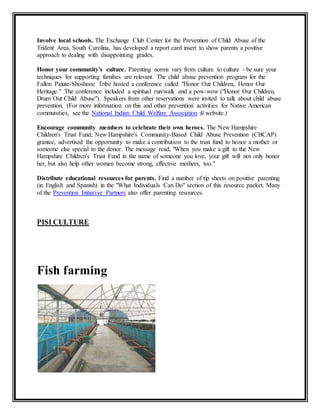
Intensive koi aquaculture facility in Israel 
Fish farming is the principal form of aquaculture, while other methods may fall under 
mariculture. Fish farming involves raising fish commercially in tanks or enclosures, usually for 
food. A facility that releases juvenile fish into the wild for recreational fishing or to supplement a 
species' natural numbers is generally referred to as a fish hatchery. Worldwide, the most 
important fish species used in fish farming are carp, salmon, tilapia and catfish.[1][2] 
Major categories of fish aquaculture 
There are two kinds of aquaculture: extensive aquaculture based on local photosynthetical 
production and intensive aquaculture, in which the fish are fed with external food supply. 
Extensive aquaculture 
Aqua-Boy, a Norwegian live fish carrier used to service the Marine Harvest fish farms on the 
West coast of Scotland 
Limiting for growth here is the available food supply by natural sources, commonly zooplankton 
feeding on pelagic algae or benthic animals, such as crustaceans and mollusks. Tilapia species 
filter feed directly on phytoplankton, which makes higher production possible. The 
photosynthetic production can be increased by fertilizing the pond water with artificial fertilizer 
mixtures, such as potash, phosphorus, nitrogen and micro-elements. Because most fish are 
carnivorous, they occupy a higher place in the trophic chain and therefore only a tiny fraction of 
primary photosynthetic production (typically 1%) will be converted into harvest-able fish. 
In these kinds of systems fish production per unit of surface can be increased at will, as long as 
sufficient oxygen, fresh water and food are provided. Because of the requirement of sufficient 
fresh water, a massive water purification system must be integrated in the fish farm. A clever way 
to achieve this is the combination of hydroponic horticulture and water treatment, see below. The 
exception to this rule are cages which are placed in a river or sea, which supplements the fish 
crop with sufficient oxygenated water. Some environmentalists object to this practice.
Specific types of fish farms 
Within intensive and extensive aquaculture methods, there are numerous specific types of fish 
farms; each has benefits and applications unique to its design. 
Cage system 
Giant gourami is often raised in cages in central Thailand 
Fish cages are placed in lakes, bayous, ponds, rivers or oceans to contain and protect fish until 
they can be harvested.[8] The method is also called "off-shore cultivation[9] " when the cages are 
placed in the sea. They can be constructed of a wide variety of components. Fish are stocked in 
cages, artificially fed, and harvested when they reach market size. 
Indoor fish farming 
An alternative to outdoor open ocean cage aquaculture, is through the use of a recirculation 
aquaculture system (RAS). A RAS is a series of culture tanks and filters where water is 
continuously recycled and monitored to keep optimal conditions year round. To prevent the 
deterioration of water quality, the water is treated mechanically through the removal of 
particulate matter and biologically through the conversion of harmful accumulated chemicals into 
nontoxic ones.
Birdwatching 
Birdwatching or birding is the observation of birds as a recreational activity. It can be done with 
the naked eye, through a visual enhancement device like binoculars and telescopes, or by 
listening for bird sounds.[1][2] 
Birdwatching often involves a significant auditory component, as many bird species are more 
easily detected and identified by ear than by eye. Most birdwatchers pursue this activity for 
recreational or social reasons, unlike ornithologists, who engage in the study of birds using 
formal scientific methods.[1][2] 
Birding, birdwatching, and twitching 
A birdwatching tower in Hankasalmi, Finland. 
The first recorded use of the term birdwatcher was in 1891; bird was introduced as a verb in 
1918.[3] The term birding was also used for the practice of fowling or hunting with firearms as in 
Shakespeare's The Merry Wives of Windsor (1602): "She laments sir... her husband goes this 
morning a-birding."[4] The terms birding and birdwatching are today used by some 
interchangeably, although some participants prefer birding, partly because it does not exclude the 
auditory aspects of enjoying birds.
Rearing (horse) 
A highly trained horse performing the Pesade, a carefully controlled classical dressage movement 
where the horse raises its forehand off the ground for a brief period 
Rearing occurs when a horse or other equine "stands up" on its hind legs with the forelegs off the 
ground. Rearing may be linked to fright, aggression, excitement, disobedience, or pain. It is not 
uncommon to see stallions rearing in the wild when they fight, while striking at their opponent 
with their front legs. Mares are generally more likely to kick when acting in aggression, but may 
rear if they need to strike at a threat in front of them. 
When a horse rears around people, in most cases, it is considered a dangerous habit for riding 
horses, as not only can a rider fall off from a substantial height, but also because it is possible for 
the animal to fall over backwards, which could injure the horse, and the animal could also fall on 
the rider. It is therefore strongly discouraged. A horse that has a habit of rearing generally 
requires extensive retraining by an experienced horse trainer, and if the habit cannot be corrected, 
may be deemed too dangerous to ride. 
A horse that rears when being handled by a human who is on the ground also presents a hazard, 
as it is able to strike out with its front feet and can also fall even without the weight of a rider to 
unbalance the animal. A rearing horse can also break away and escape from a human handler.
CONCLUSION 
Although communities vary based on their location, the primary industry in the area and the typical 
political allegiances of the residents, many issues are the same the world over. People need housing, 
water, a clean environment and a sense of peace in their surroundings. Raising awareness of community 
issues involves planning, effective public relations and lobbying the appropriate levels of government. 
REFERENCE 
1. www.wikipedia.org

Online assignment community awareness

  • 1.
    ONLINE ASSIGNMENT TOPIC: COMMUNITY AWARENESS SUBMITED TO: SUBMITED BY: ANISHA TEACHER CHINCHU THANKAPPAN KUCTE COLLEGE NATURAL S CIENCE KULAKKADA NO. : 9
  • 2.
    INDEX No. 1Introduction 2 Community awarness 3 Conclusion 4 Reference
  • 3.
    INTRODUCTION Community awareness,crime prevention and community safety initiatives cannot be packaged as one-time solutions that can be applied in every community for every problem. Instead, crime prevention should be viewed as a process of community building that can address a range of issues that confront and challenge your community. From the corporate sector right down to the local neighbourhood, community leaders have the ability to empower their communities to play an active role in crime reductions. By becoming active participants in identifying the types of crime in their neighbourhood, key stakeholders can develop long range strategies to reduce crimes in their neighbourhoods. Strong community awareness lessens the isolation of individuals, helps develop respect for the property of others, enhances community spirit and provides citizens with a sense of belonging. Crime prevention strategies are most effective when community members come together around a common cause and coordinate their efforts at all levels to solve the issues in their community.
  • 4.
    COMMUNITY AWARENESS Communityawareness, crime prevention and community safety initiatives cannot be packaged as one-time solutions that can be applied in every community for every problem. Instead, crime prevention should be viewed as a process of community building that can address a range of issues that confront and challenge your community. From the corporate sector right down to the local neighbourhood, community leaders have the ability to empower their communities to play an active role in crime reductions. Examples of Community Awareness Activities Organizations, groups, and tribal communities not yet ready to undertake a year-round family support program like the ones described in the previous section can still do much to help raise awareness, strengthen families, and protect children. The following ideas offer some starting points for planning local community awareness activities. While some of these are specific to Child Abuse Prevention Month, most can be used at any time of year. Hold a Blue Ribbon Campaign. Since 1989, millions of people across the country have participated in Blue Ribbon campaigns by wearing the ribbons and getting involved in community activities to promote safe children and healthy families. Prevent Child Abuse Virginia, a State chapter of Prevent Child Abuse America, uses the blue ribbon to celebrate "Blue Ribbon Parents," "Blue Ribbon Kids," or "Blue Ribbon Communities" that find new and innovative ways to support families. Involve local faith communities. Tips include organizing a parenting fair to educate parents about support services available in their community, holding a Family Fun Day or Parent's Night Out, hosting a parent education or self-help group at the facility, and establishing a resource library focusing on parenting issues. Involve men and fathers. The Hillsdale Child Abuse Council in Michigan kicked off its countywide "Real Men Rock" shaken baby public awareness campaign with an ad campaign showing local fathers nurturing and rocking their babies. Participants included a local emergency medical technician and a teacher.
  • 5.
    Involve local schools.The Exchange Club Center for the Prevention of Child Abuse of the Trident Area, South Carolina, has developed a report card insert to show parents a positive approach to dealing with disappointing grades. Honor your community's culture. Parenting norms vary from culture to culture - be sure your techniques for supporting families are relevant. The child abuse prevention program for the Fallon Paiute-Shoshone Tribe hosted a conference called "Honor Our Children, Honor Our Heritage." The conference included a spiritual run/walk and a pow-wow ("Honor Our Children, Drum Out Child Abuse"). Speakers from other reservations were invited to talk about child abuse prevention. (For more information on this and other prevention activities for Native American communities, see the National Indian Child Welfare Association website.) Encourage community members to celebrate their own heroes. The New Hampshire Children's Trust Fund, New Hampshire's Community-Based Child Abuse Prevention (CBCAP) grantee, advertised the opportunity to make a contribution to the trust fund to honor a mother or someone else special to the donor. The message read, "When you make a gift to the New Hampshire Children's Trust Fund in the name of someone you love, your gift will not only honor her, but also help other women become strong, effective mothers, too." Distribute educational resources for parents. Find a number of tip sheets on positive parenting (in English and Spanish) in the "What Individuals Can Do" section of this resource packet. Many of the Prevention Initiative Partners also offer parenting resources. PISI CULTURE Fish farming
  • 6.
    Intensive koi aquaculturefacility in Israel Fish farming is the principal form of aquaculture, while other methods may fall under mariculture. Fish farming involves raising fish commercially in tanks or enclosures, usually for food. A facility that releases juvenile fish into the wild for recreational fishing or to supplement a species' natural numbers is generally referred to as a fish hatchery. Worldwide, the most important fish species used in fish farming are carp, salmon, tilapia and catfish.[1][2] Major categories of fish aquaculture There are two kinds of aquaculture: extensive aquaculture based on local photosynthetical production and intensive aquaculture, in which the fish are fed with external food supply. Extensive aquaculture Aqua-Boy, a Norwegian live fish carrier used to service the Marine Harvest fish farms on the West coast of Scotland Limiting for growth here is the available food supply by natural sources, commonly zooplankton feeding on pelagic algae or benthic animals, such as crustaceans and mollusks. Tilapia species filter feed directly on phytoplankton, which makes higher production possible. The photosynthetic production can be increased by fertilizing the pond water with artificial fertilizer mixtures, such as potash, phosphorus, nitrogen and micro-elements. Because most fish are carnivorous, they occupy a higher place in the trophic chain and therefore only a tiny fraction of primary photosynthetic production (typically 1%) will be converted into harvest-able fish. In these kinds of systems fish production per unit of surface can be increased at will, as long as sufficient oxygen, fresh water and food are provided. Because of the requirement of sufficient fresh water, a massive water purification system must be integrated in the fish farm. A clever way to achieve this is the combination of hydroponic horticulture and water treatment, see below. The exception to this rule are cages which are placed in a river or sea, which supplements the fish crop with sufficient oxygenated water. Some environmentalists object to this practice.
  • 7.
    Specific types offish farms Within intensive and extensive aquaculture methods, there are numerous specific types of fish farms; each has benefits and applications unique to its design. Cage system Giant gourami is often raised in cages in central Thailand Fish cages are placed in lakes, bayous, ponds, rivers or oceans to contain and protect fish until they can be harvested.[8] The method is also called "off-shore cultivation[9] " when the cages are placed in the sea. They can be constructed of a wide variety of components. Fish are stocked in cages, artificially fed, and harvested when they reach market size. Indoor fish farming An alternative to outdoor open ocean cage aquaculture, is through the use of a recirculation aquaculture system (RAS). A RAS is a series of culture tanks and filters where water is continuously recycled and monitored to keep optimal conditions year round. To prevent the deterioration of water quality, the water is treated mechanically through the removal of particulate matter and biologically through the conversion of harmful accumulated chemicals into nontoxic ones.
  • 8.
    Birdwatching Birdwatching orbirding is the observation of birds as a recreational activity. It can be done with the naked eye, through a visual enhancement device like binoculars and telescopes, or by listening for bird sounds.[1][2] Birdwatching often involves a significant auditory component, as many bird species are more easily detected and identified by ear than by eye. Most birdwatchers pursue this activity for recreational or social reasons, unlike ornithologists, who engage in the study of birds using formal scientific methods.[1][2] Birding, birdwatching, and twitching A birdwatching tower in Hankasalmi, Finland. The first recorded use of the term birdwatcher was in 1891; bird was introduced as a verb in 1918.[3] The term birding was also used for the practice of fowling or hunting with firearms as in Shakespeare's The Merry Wives of Windsor (1602): "She laments sir... her husband goes this morning a-birding."[4] The terms birding and birdwatching are today used by some interchangeably, although some participants prefer birding, partly because it does not exclude the auditory aspects of enjoying birds.
  • 9.
    Rearing (horse) Ahighly trained horse performing the Pesade, a carefully controlled classical dressage movement where the horse raises its forehand off the ground for a brief period Rearing occurs when a horse or other equine "stands up" on its hind legs with the forelegs off the ground. Rearing may be linked to fright, aggression, excitement, disobedience, or pain. It is not uncommon to see stallions rearing in the wild when they fight, while striking at their opponent with their front legs. Mares are generally more likely to kick when acting in aggression, but may rear if they need to strike at a threat in front of them. When a horse rears around people, in most cases, it is considered a dangerous habit for riding horses, as not only can a rider fall off from a substantial height, but also because it is possible for the animal to fall over backwards, which could injure the horse, and the animal could also fall on the rider. It is therefore strongly discouraged. A horse that has a habit of rearing generally requires extensive retraining by an experienced horse trainer, and if the habit cannot be corrected, may be deemed too dangerous to ride. A horse that rears when being handled by a human who is on the ground also presents a hazard, as it is able to strike out with its front feet and can also fall even without the weight of a rider to unbalance the animal. A rearing horse can also break away and escape from a human handler.
  • 10.
    CONCLUSION Although communitiesvary based on their location, the primary industry in the area and the typical political allegiances of the residents, many issues are the same the world over. People need housing, water, a clean environment and a sense of peace in their surroundings. Raising awareness of community issues involves planning, effective public relations and lobbying the appropriate levels of government. REFERENCE 1. www.wikipedia.org