One Management Concept 
B E N H O R O W I T Z , A N D R E E S S E N H O R O W I T Z
Sometimes I’m right and I can be wrong 
My own beliefs are in my song 
The butcher, the banker, the drummer and then 
Makes no difference what group I’m in 
Sly and the Family Stone
In Management Concept Form 
When making a critical decision, you must understand how it will 
be interpreted from each person’s point of view and its impact on 
the union of the individual views. 
i.e. culture
AGENDA 
Demotions 
Raises 
We evaluate a Sam Altman 
blog post 
History’s greatest practitioner 
1 
2 
3 
4
BUSINESS EXAMPLE 1 
Do You Demote Or Fire?
Scenario 
Executive has been working extremely hard and is well liked and 
a great part of the culture. However, he is not world-class 
at running his function and you need someone who is. 
Options 
Fire him or demote him 
Players 
You, exec, every other employee
You 
• It’s tough to fire someone who has put in a big effort 
• A demotion is a “have your cake and eat it too” scenario 
• No cultural backlash
Exec 
• May not want the demotion, but it at least gives him 
an option 
• Saves the embarrassment of getting fired 
• Enables him to keep growing with the company 
even through he’s demoted
Everybody Else 
• Does he keep his same equity package? 
• Is he going to work as hard being the guy who 
reports to the guy? 
• Do I have any respect for him now that he’s been 
demoted?
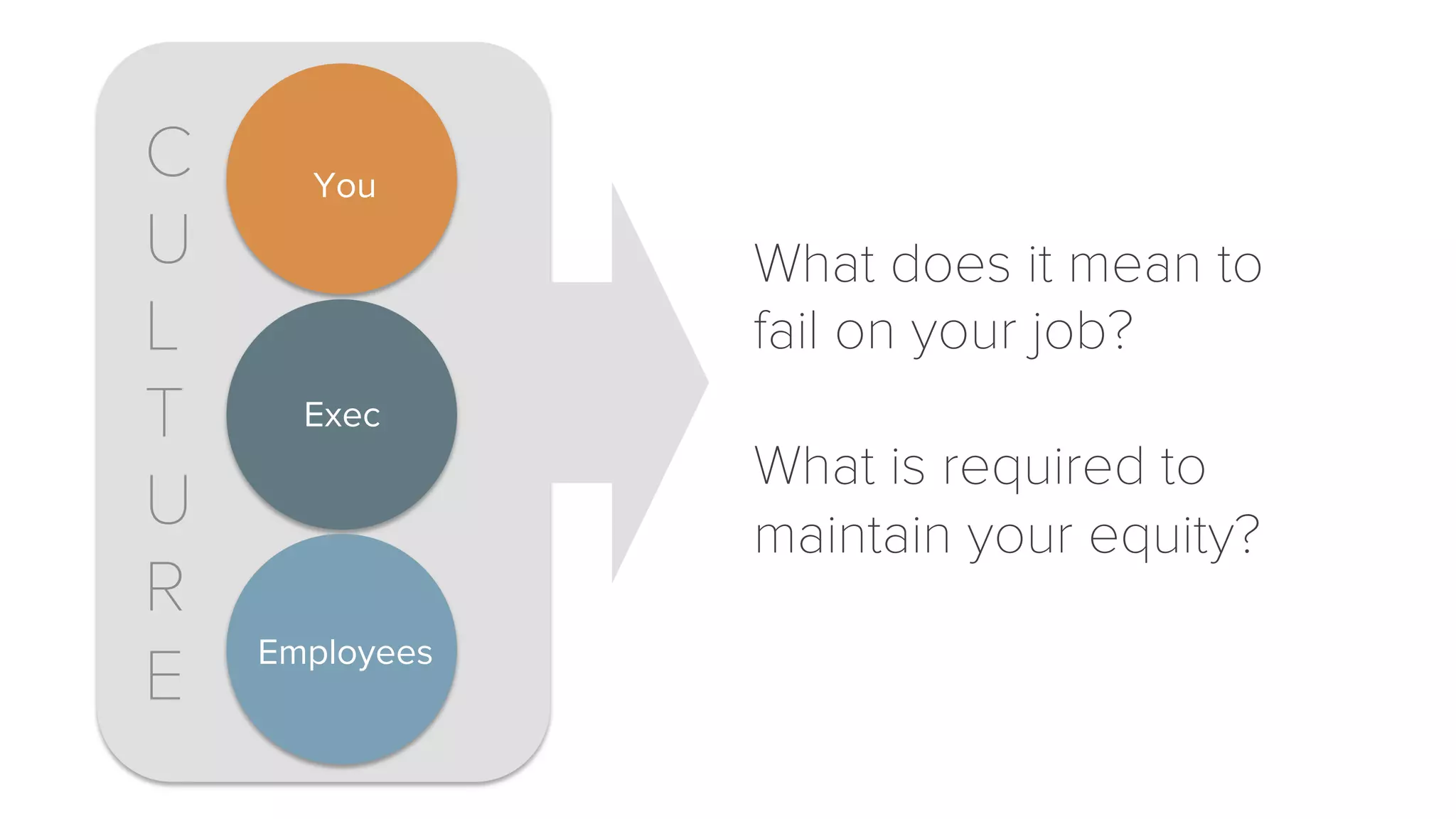
You 
Exec 
Employees 
What does it mean to 
fail on your job? 
What is required to 
maintain your equity? 
C 
UL 
T 
URE
An Excellent Employee Asks 
You for a Raise 
BUSINESS EXAMPLE 2
Your Perspective 
• You want to retain them 
• They have done great work, so it’s “fair” 
• They will like you if you give them the raise and you 
want to be liked
Employee’s Perspective
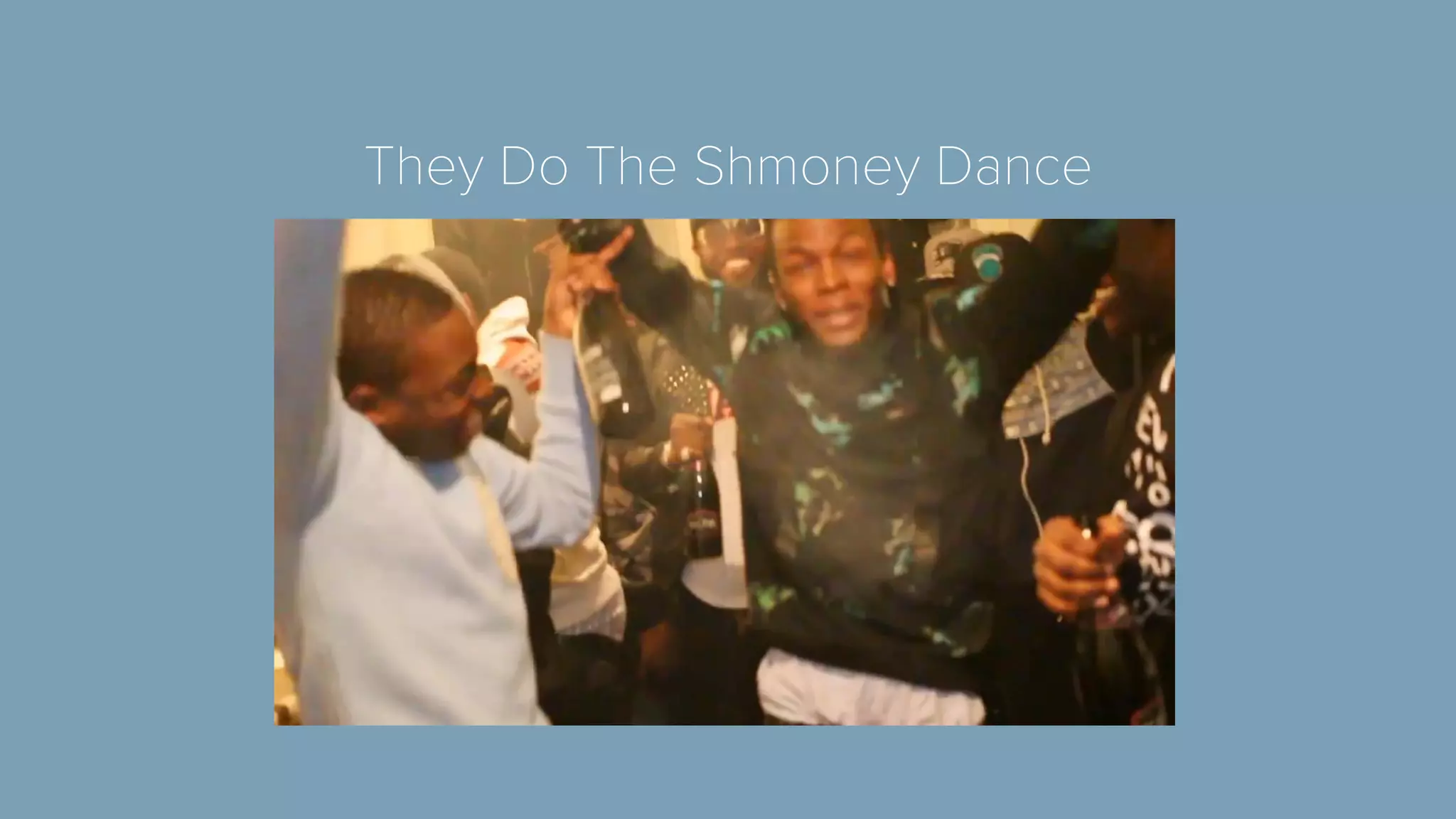
They Do The Shmoney Dance
Every Other Employees’ Perspective 
• Unfair that I didn’t get a raise 
• I did better work, so doubly unfair 
• Maybe I should quit
Cultural Conclusion 
Every employee has a fiduciary responsibility to their 
family to ask for a raise all the time
Right Answer 
• Formal performance evaluation process 
• All the right inputs 
• Run as frequently as needed 
• No raises outside of the process
BUSINESS EXAMPLE 3 
We Evaluate a Sam Altman Blog 
Post
Sam Altman Blog Post Excerpt 
Most employees only have 90 days after they leave a job to exercise 
their options. Unfortunately, this requires money to cover the strike 
price and the tax bill due for the year of exercise (which is calculated on 
the difference between the strike and the current FMV). This is often 
more cash than an employee has, and so the employee often has to 
choose between walking away from vested options he or she can’t 
afford to exercise, or being locked into staying at the company. It’s a 
particularly bad situation when an employee gets terminated.
Sam Altman Blog Post Excerpt 
This doesn’t seem fair. The best solution I have heard is from Adam 
D’Angelo at Quora. The idea is to grant options that are exercisable for 
10 years from the grant date, which should cover nearly all cases (i.e. the 
company will probably either go public, get acquired, or die in that time 
frame, and so either the employee will have the liquidity to exercise or it 
won’t matter.) There are some tricky issues around this—for example, 
the options will automatically convert from ISOs to NSOs 3 months after 
employment terminates (if applicable) but it’s still far better than just 
losing the assets. I think this is a policy all startups should adopt.
Quick History 
• FAS 123 replaces APB opinion No. 25 in 2004 
• Previously, long exercise periods would kill any 
chance of a company going public or being acquired 
• Not the case with FAS 123
Your Perspective 
• Want to be fair 
• Don’t want employees to stay who don’t want to be 
there, but feel handcuffed 
• Want to reward people who stay
Perspective of Employee Who Leaves 
• I worked for my shares; I shouldn’t be prevented 
from getting them due to economics. 
• Did you tell me the truth when you hired me? If you 
didn’t, I’ll make sure that everyone knows that. 
• If I was fired, I just got screwed a second time.
Perspective of Employee Who Stays 
• Is it smarter for me to stay or leave economically? 
• Are my colleagues being treated fairly? 
• Does my loyalty matter?
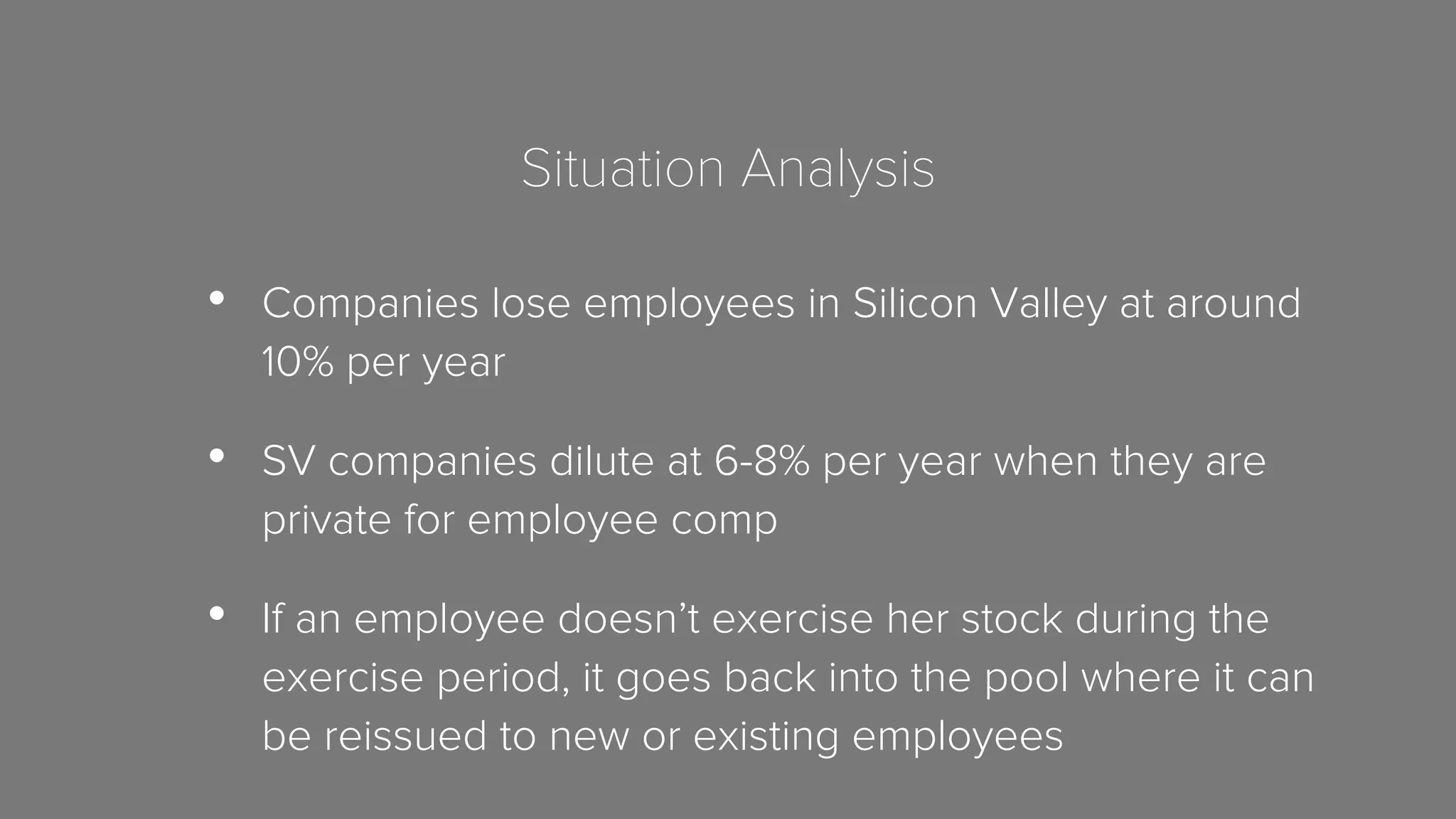
Situation Analysis 
• Companies lose employees in Silicon Valley at around 
10% per year 
• SV companies dilute at 6-8% per year when they are 
private for employee comp 
• If an employee doesn’t exercise her stock during the 
exercise period, it goes back into the pool where it can 
be reissued to new or existing employees
Situation Analysis 
• Losing all your stock is a big financial incentive to stay 
• A 10 year option on a highly volatile security is quite 
valuable 
• When the employee goes to the new company, she 
gets the new company stock plus the 10 year option 
• The employee who stays gets the option only
Two Alternative Cultural Statements 
• We treat new employees with the utmost straight-forwardness and 
fairness and we will therefore give you 10 years to exercise your stock 
if you quit or are fired. 
• We’ll tell you up front: You are guaranteed to get your salary. For your 
stock to be meaningful, you must (a) vest, (b) stay until we exit or have 
the cash to exercise, (c) make the company worth something. We do 
this because we massively value those who see it through and will 
minimize the dilutive cost of those who leave. 
1 
2
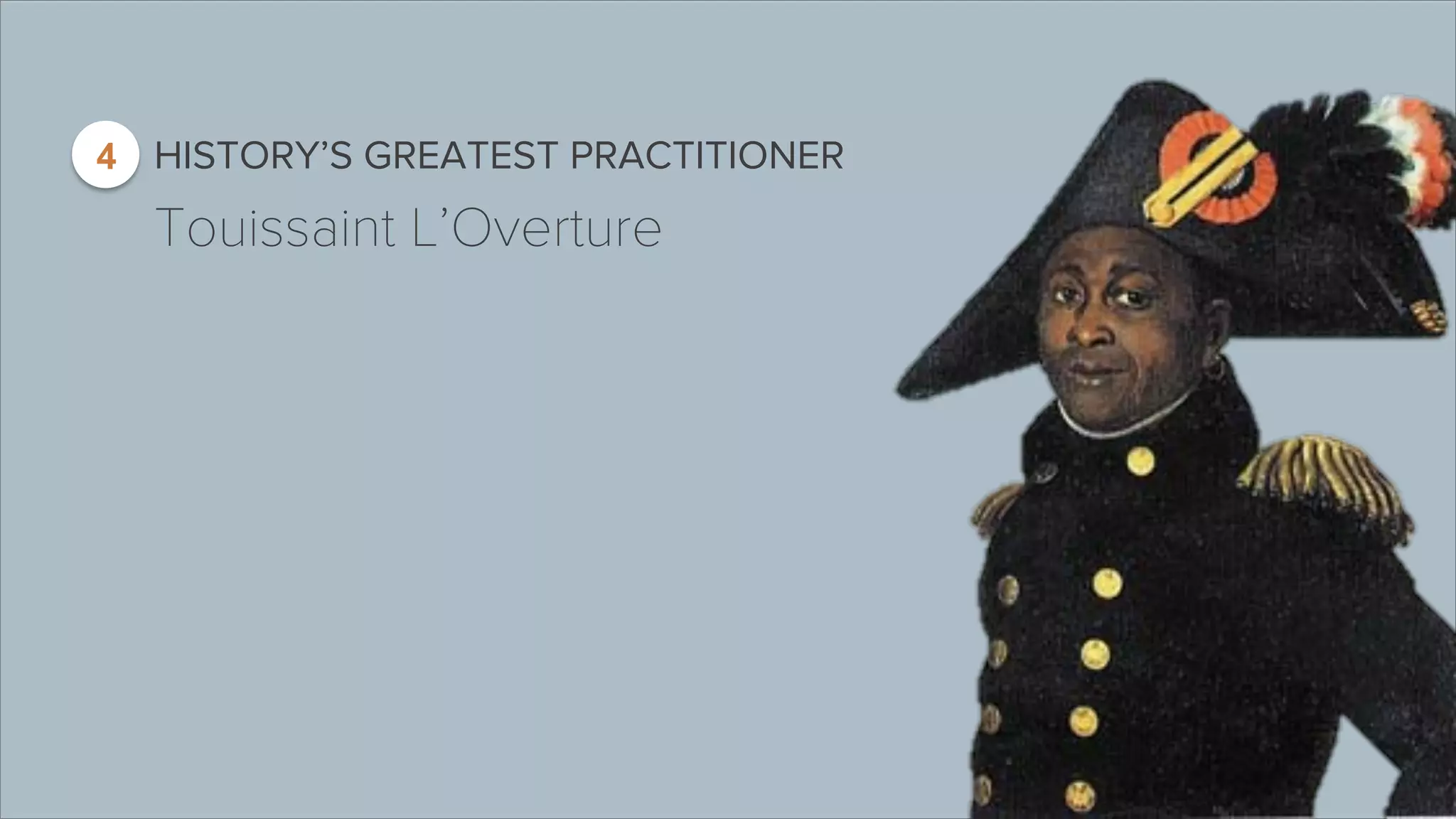
4 HISTORY’S GREATEST PRACTITIONER 
Touissaint L’Overture
Brief History and Context 
• Born a slave 
• Most brutal form of African slavery 
• Vision: End slavery, take control of Haiti, and make 
it a first class country
TOUSSAINT MANAGEMENT EXAMPLE 1 
Conquering the enemy 
Question: What do you do with the defeated leaders?
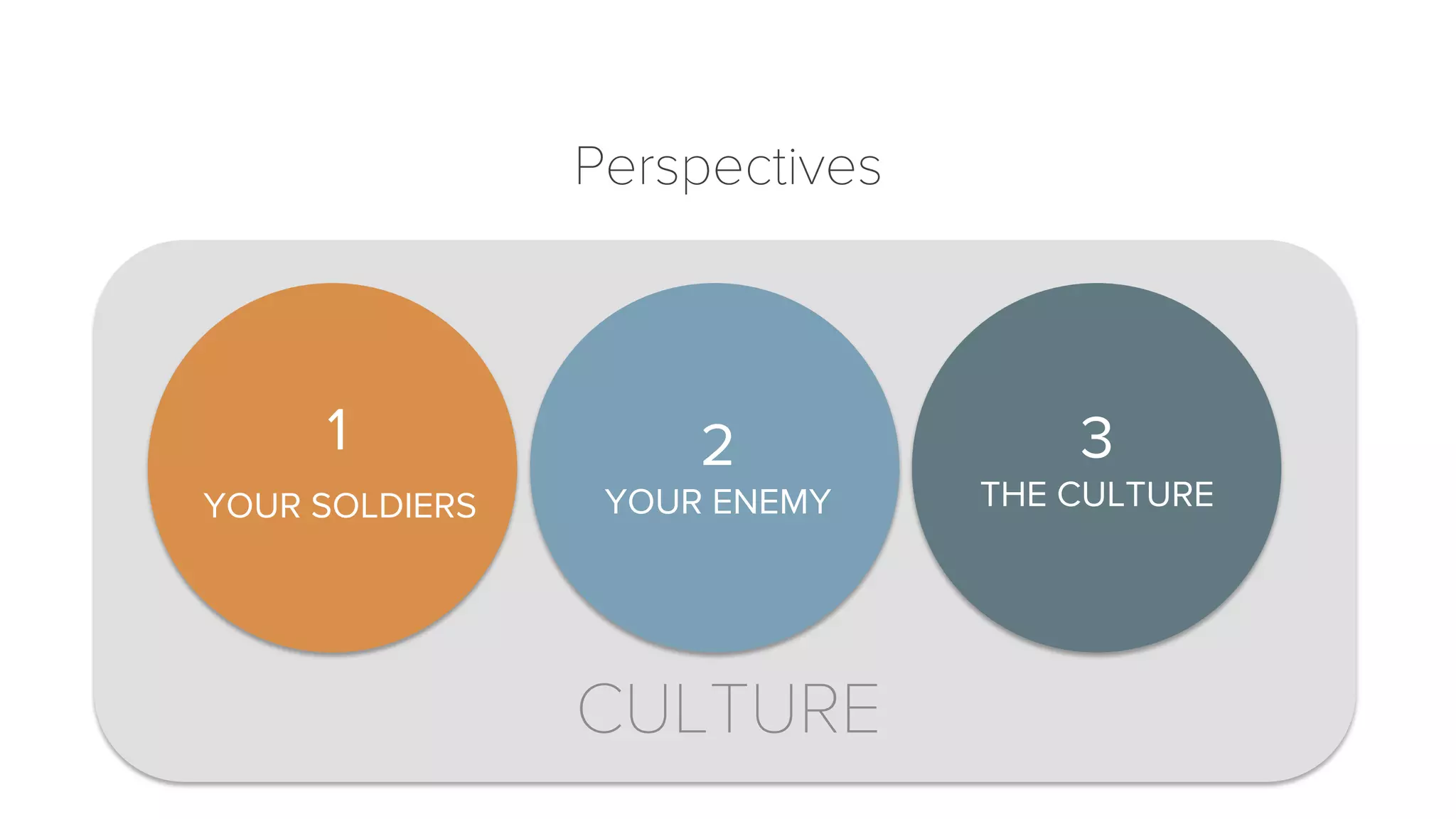
Perspectives 
1 3 
CULTURE 
THE CULTURE 
2 
YOUR ENEMY 
YOUR SOLDIERS
Soldiers Perspective 
• Do we get to pillage? We like to pillage… 
• They were trying to kill us, let’s kill them.
Enemy’s Perspective 
• We are fighting savages, so if we lose, we are dead 
• Anything else would be extraordinary
Culture 
• Toussaint wanted a first-class culture 
• He believed that Haitian culture was inferior to European 
culture and he believed that the slave culture was the 
most broken of them all
Solution 
Make them part of 
Toussaint’s army
TOUSSAINT MANAGEMENT EXAMPLE 2 
What do you do with the 
slave owners?
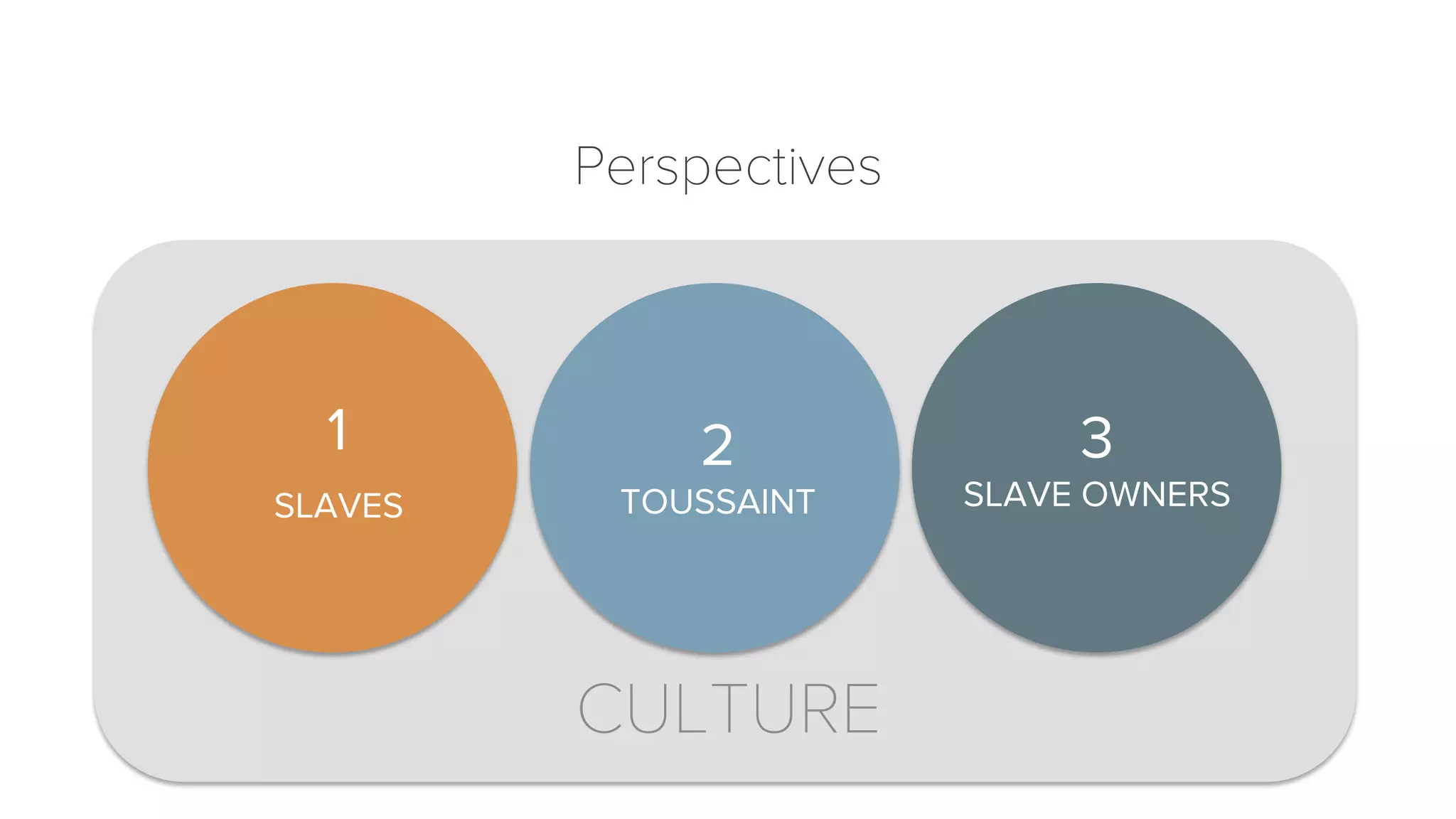
Perspectives 
1 3 
CULTURE 
SLAVE OWNERS 
2 
TOUSSAINT 
SLAVES
Slaves 
• Free us, we fought for this 
• Kill those bastards!!! 
• Give us their land
Toussaint 
• Economy is key to being a first world country and sugar is 
our top export by far, so productive plantations are critically 
important 
• I was a slave and my army is mostly slaves 
• None of us have the expertise to run sugar plantations 
• We earned that land fair and square 
• None of us have the business connections to trade sugar
Slave Owners 
• Our business cost structure is predicated on slave labor 
• We paid a lot of money for those slaves up front 
• We paid a lot of money for the land 
• We have all the know how and business relationships, 
so you have to deal with us
Solution 
End slavery 
Let the slave owners keep their land 
Require plantation owners to pay salaries to 
workers 
Lower the taxes of the plantation owners, so that 
they could keep sugar business thriving 
1 
2 
3 
4
Results 
• Only successful slave revolt in human history 
• Let plantation owners keep their land 
• Total defeat of Napoleon 
• Booming economy + world-class culture. 
• Under Toussaint, Haiti had more export income than 
the USA
Conclusion 
It’s not your perspective or the perspective of the person 
that you are talking to at the moment that matters. 
You must consider the people who are not in the room. 
They are the company. 
They are the culture.

Y Combinator Startup Class #15 : How to manage

  • 1.
    One Management Concept B E N H O R O W I T Z , A N D R E E S S E N H O R O W I T Z
  • 2.
    Sometimes I’m rightand I can be wrong My own beliefs are in my song The butcher, the banker, the drummer and then Makes no difference what group I’m in Sly and the Family Stone
  • 3.
    In Management ConceptForm When making a critical decision, you must understand how it will be interpreted from each person’s point of view and its impact on the union of the individual views. i.e. culture
  • 4.
    AGENDA Demotions Raises We evaluate a Sam Altman blog post History’s greatest practitioner 1 2 3 4
  • 5.
    BUSINESS EXAMPLE 1 Do You Demote Or Fire?
  • 6.
    Scenario Executive hasbeen working extremely hard and is well liked and a great part of the culture. However, he is not world-class at running his function and you need someone who is. Options Fire him or demote him Players You, exec, every other employee
  • 7.
    You • It’stough to fire someone who has put in a big effort • A demotion is a “have your cake and eat it too” scenario • No cultural backlash
  • 8.
    Exec • Maynot want the demotion, but it at least gives him an option • Saves the embarrassment of getting fired • Enables him to keep growing with the company even through he’s demoted
  • 9.
    Everybody Else •Does he keep his same equity package? • Is he going to work as hard being the guy who reports to the guy? • Do I have any respect for him now that he’s been demoted?
  • 10.
    You Exec Employees What does it mean to fail on your job? What is required to maintain your equity? C UL T URE
  • 11.
    An Excellent EmployeeAsks You for a Raise BUSINESS EXAMPLE 2
  • 12.
    Your Perspective •You want to retain them • They have done great work, so it’s “fair” • They will like you if you give them the raise and you want to be liked
  • 13.
  • 14.
    They Do TheShmoney Dance
  • 15.
    Every Other Employees’Perspective • Unfair that I didn’t get a raise • I did better work, so doubly unfair • Maybe I should quit
  • 16.
    Cultural Conclusion Everyemployee has a fiduciary responsibility to their family to ask for a raise all the time
  • 17.
    Right Answer •Formal performance evaluation process • All the right inputs • Run as frequently as needed • No raises outside of the process
  • 18.
    BUSINESS EXAMPLE 3 We Evaluate a Sam Altman Blog Post
  • 19.
    Sam Altman BlogPost Excerpt Most employees only have 90 days after they leave a job to exercise their options. Unfortunately, this requires money to cover the strike price and the tax bill due for the year of exercise (which is calculated on the difference between the strike and the current FMV). This is often more cash than an employee has, and so the employee often has to choose between walking away from vested options he or she can’t afford to exercise, or being locked into staying at the company. It’s a particularly bad situation when an employee gets terminated.
  • 20.
    Sam Altman BlogPost Excerpt This doesn’t seem fair. The best solution I have heard is from Adam D’Angelo at Quora. The idea is to grant options that are exercisable for 10 years from the grant date, which should cover nearly all cases (i.e. the company will probably either go public, get acquired, or die in that time frame, and so either the employee will have the liquidity to exercise or it won’t matter.) There are some tricky issues around this—for example, the options will automatically convert from ISOs to NSOs 3 months after employment terminates (if applicable) but it’s still far better than just losing the assets. I think this is a policy all startups should adopt.
  • 21.
    Quick History •FAS 123 replaces APB opinion No. 25 in 2004 • Previously, long exercise periods would kill any chance of a company going public or being acquired • Not the case with FAS 123
  • 22.
    Your Perspective •Want to be fair • Don’t want employees to stay who don’t want to be there, but feel handcuffed • Want to reward people who stay
  • 23.
    Perspective of EmployeeWho Leaves • I worked for my shares; I shouldn’t be prevented from getting them due to economics. • Did you tell me the truth when you hired me? If you didn’t, I’ll make sure that everyone knows that. • If I was fired, I just got screwed a second time.
  • 24.
    Perspective of EmployeeWho Stays • Is it smarter for me to stay or leave economically? • Are my colleagues being treated fairly? • Does my loyalty matter?
  • 25.
    Situation Analysis •Companies lose employees in Silicon Valley at around 10% per year • SV companies dilute at 6-8% per year when they are private for employee comp • If an employee doesn’t exercise her stock during the exercise period, it goes back into the pool where it can be reissued to new or existing employees
  • 26.
    Situation Analysis •Losing all your stock is a big financial incentive to stay • A 10 year option on a highly volatile security is quite valuable • When the employee goes to the new company, she gets the new company stock plus the 10 year option • The employee who stays gets the option only
  • 27.
    Two Alternative CulturalStatements • We treat new employees with the utmost straight-forwardness and fairness and we will therefore give you 10 years to exercise your stock if you quit or are fired. • We’ll tell you up front: You are guaranteed to get your salary. For your stock to be meaningful, you must (a) vest, (b) stay until we exit or have the cash to exercise, (c) make the company worth something. We do this because we massively value those who see it through and will minimize the dilutive cost of those who leave. 1 2
  • 28.
    4 HISTORY’S GREATESTPRACTITIONER Touissaint L’Overture
  • 29.
    Brief History andContext • Born a slave • Most brutal form of African slavery • Vision: End slavery, take control of Haiti, and make it a first class country
  • 30.
    TOUSSAINT MANAGEMENT EXAMPLE1 Conquering the enemy Question: What do you do with the defeated leaders?
  • 31.
    Perspectives 1 3 CULTURE THE CULTURE 2 YOUR ENEMY YOUR SOLDIERS
  • 32.
    Soldiers Perspective •Do we get to pillage? We like to pillage… • They were trying to kill us, let’s kill them.
  • 33.
    Enemy’s Perspective •We are fighting savages, so if we lose, we are dead • Anything else would be extraordinary
  • 34.
    Culture • Toussaintwanted a first-class culture • He believed that Haitian culture was inferior to European culture and he believed that the slave culture was the most broken of them all
  • 35.
    Solution Make thempart of Toussaint’s army
  • 36.
    TOUSSAINT MANAGEMENT EXAMPLE2 What do you do with the slave owners?
  • 37.
    Perspectives 1 3 CULTURE SLAVE OWNERS 2 TOUSSAINT SLAVES
  • 38.
    Slaves • Freeus, we fought for this • Kill those bastards!!! • Give us their land
  • 39.
    Toussaint • Economyis key to being a first world country and sugar is our top export by far, so productive plantations are critically important • I was a slave and my army is mostly slaves • None of us have the expertise to run sugar plantations • We earned that land fair and square • None of us have the business connections to trade sugar
  • 40.
    Slave Owners •Our business cost structure is predicated on slave labor • We paid a lot of money for those slaves up front • We paid a lot of money for the land • We have all the know how and business relationships, so you have to deal with us
  • 41.
    Solution End slavery Let the slave owners keep their land Require plantation owners to pay salaries to workers Lower the taxes of the plantation owners, so that they could keep sugar business thriving 1 2 3 4
  • 42.
    Results • Onlysuccessful slave revolt in human history • Let plantation owners keep their land • Total defeat of Napoleon • Booming economy + world-class culture. • Under Toussaint, Haiti had more export income than the USA
  • 43.
    Conclusion It’s notyour perspective or the perspective of the person that you are talking to at the moment that matters. You must consider the people who are not in the room. They are the company. They are the culture.