• It shallbe the duty of each head department or agency to require all
officers and employees under him to strictly observe the prescribed
office hours.
• Each head of the department or agency shall require a daily record of
attendance of all employees under him, to be kept in proper form
whenever possible, registered on the bundy clock.
• Chiefs and Asst. Chiefs of agencies who are appointed by the
President, officers who rank higher than these chiefs and asst. chiefs in
the 3 branches of the government, & other presidential appointees
need not punch in the bundy clock, but attendance and all absences of
such officers must be recorded.
3.
• Officers andemployees of all departments and
agencies except those covered by special laws shall
render not less than eight (8) hours of work a day for
five (5) days a week or a total of forty (40) hours a
week exclusive of time for lunch.
• Such hours shall be from 8:00 am to 12:00 noon and
from 1:00 pm to 5:00 pm.
4.
FLEXIBLE WORKING HOURS(CSC MC NO.
25, S. 2019)
• May be allowed subject to the discretion of the head of department or agency.
• In no case shall the weekly working hours be reduced not less than a total of
forty (40) hours a week for five(5) days a week.
• Ensure uninterrupted public service delivery even during lunch breaks.
• In the exigency of the service, working hours may also be altered to include
Saturdays and Sundays, thus employee may choose a compensatory day-off
during weekday, provided that Saturday and Sunday are regular workdays
and not cases of overtime .
5.
POLICY ON ATTENDANCEAND PUNCTUALITY
(CSC RESOLUTION NO. 101357 AND NO. 101358)
• Section 1, Article XI of the 1987 Constitution , states that “Public
officers and employees must all times be accountable to the
people, serve them with utmost responsibility, integrity, loyalty,
and efficiency, act with patriotism and justice, and lead modest
lives”.
• Part of such accountability, responsibility and efficiency of public
officers and employees is the observance of the prescribed 8-
hour work schedule in a given working day or 40-hour per week.
6.
TARDINESS
- is definedsimply as absent in the morning and failure
to arrive at a time set. This definition inevitably implies that an
officer or employee may, in one working day, incur tardiness
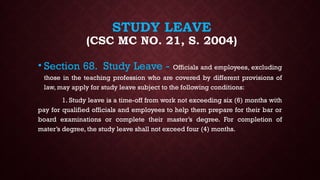
twice---one in the morning and another in the afternoon.
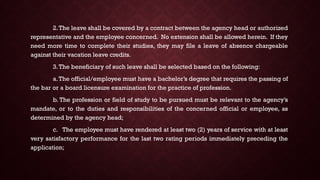
Hence, in just five days, it is possible for said employee to be
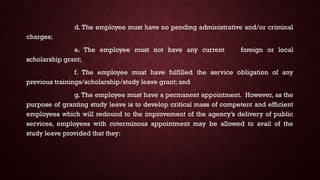
tardy ten (10) times.
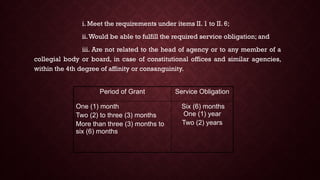
7.
UNDERTIME
- Officer/employee whois absent in the
afternoon and those who leaves from work
earlier than the usual eight-hour work schedule
in a given working day.
8.
Officers and Employeeswho have incurred
tardiness and undertimes regardless of the
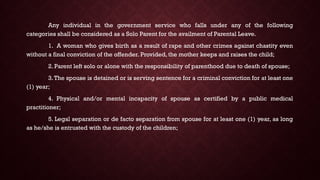
number of minutes per day, ten (10) times a
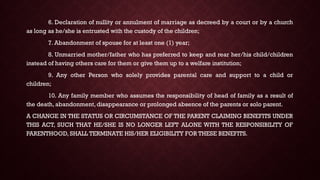
month for at least 2 months in a semester or at
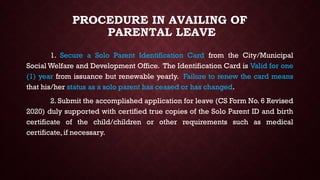
least 2 consecutive months during the year shall
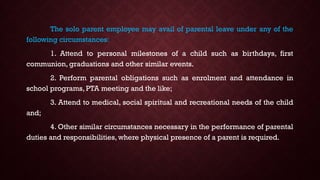
be liable for Simple Misconduct and/or Conduct
Prejudicial to the Best Interest of the Service.
9.
SANCTIONS:
•1st Offense :Reprimand
•2nd Offense : Suspension for one (1) to
thirty (30) days
•3rd Offense : Dismissal from the service
10.
Off-setting of tardinessor absences by
working for an equivalent number of minutes
or hours by which an officer or employee has
been tardy or absent, beyond the regular or
approved working hours of the employees
concerned, shall not be allowed.
11.
Sec. 34. Tardinessand undertimes are
deducted against vacation leave credits. –
Tardiness and undertimes are deducted from
vacation leave credits and shall not be charged
against sick leave credits, unless the undertime
is for health reasons supported by medical
certificate and application for leave.
12.
HABITUAL ABSENTEEISM
“ Anofficer or employee in the civil service shall
be considered habitually absent if he incurs
unauthorized absences exceeding the allowable 2.5
days monthly leave credit under the Leave Law for at
least three (3) months in a semester or at least three
(3) consecutive months during the year.”
13.
SANCTIONS:
1st Offense :Suspension for six (6) months
and one (1) day to one (1) year.
2nd Offense : Dismissal from the service.
14.
EFFECT OF ABSENCESWITHOUT
APPROVED LEAVE (AWOL)
• Sec 63, Rule XVI of CSC Omnibus Rule and Rule 20, 2017 Rules on Administrative
Cases in the Civil Service (2017 RACCS).
1. An official or employee who is continuously absent without approved
leave for at least thirty (30) working days shall be considered on absence without
official leave (AWOL) and shall be separated from the service or dropped from the
rolls without prior notice.
2. If the number of unauthorized absences incurred is less than thirty (30)
working days, a written Return-to-Work Order shall be served to him at his last
known address on record. Failure on his part to report for work within the period
stated in the Order shall be a valid ground to drop him from the rolls.
15.
3. It isclear under the obtaining circumstances that the
official or employee concerned, has established a scheme to
circumvent the rule by incurring substantial absences though
less than thirty (30) working days 3x in a semester, such that a
pattern is already apparent, dropping from the rolls without
notice may likewise be justified.
16.
LOAFING
- refers tothe FREQUENT unauthorized absences
from duty during regular office hours.
SANCTIONS:
1st Offense : Suspension for six (6) months and one
(1) day to one (1) year.
2nd Offense : Dismissal from the service
DEFINITION OF TERMS:
•Leave of Absence is generally defined as a right granted to
officials and employees not to report to work with or without
pay as may be provided by law and as the rules prescribe in
Rule XVI of EO 292.
• Unauthorized Leave is being absent from work despite
prior disapproval of the leave application.
• Unfiled Leave refers to the employee’s absence from work
without filing the necessary leave application as required
under the CSC rules.
19.
CHARACTERISTICS OF LEAVE
•Cumulative refers to incremental acquisition of
unused leaves credits by an official or employee.
• Commutative refers to conversion of unused leave
credits to their corresponding money value.
• Transferable refers to transfer of unused leave
credits from one agency to another.
20.
KINDS OF LEAVE
•SICK LEAVE is granted only on account of sickness or
disability of the employee or any member of his immediate
family (parents, brothers, sisters, children, legal spouse and
any relative who are living under same roof and dependent
upon the employee for support).
• VACATION LEAVE refers to leave of absence granted to
officials and employees for personal reasons, the approval of
which is contingent upon the necessities of the service.
21.
OFFICIALS AND EMPLOYEESSHALL BE
ENTITLED IN A YEAR TO…..
• 15 days Vacation Leave
• 15 days Sick Leave
with full pay exclusive of Saturdays, Sundays and
Holidays without limitation as to numbers of days of vacation
leave and sick leave that they may accumulate.
22.
APPLICATION AND APPROVALOF SICK
LEAVE
• All applications for Sick leave of absence for one (1) full day or more shall
be made on the prescribed form and shall be filed immediately upon
employees return from such leave. Notice of absence, however, should be
sent to the immediate supervisor and/or to the head of agency.
• Application for Sick leave in excess of five (5) successive days shall be
accompanied by a proper medical certificate.
• Sick leave may be applied for in advance in cases where the official or
employee will undergo a medical examination or operation or advised to
rest in view of ill health duly supported by a medical certificate.
23.
• In ordinaryApplication for Sick leave already taken not exceeding five (5)
days, the head of department or agency concerned may duly determine
whether or not granting of sick leave is proper under the circumstances. In
case of doubt, a medical certificate may be required.
• Approval of Sick leave, whether with pay or without pay, is mandatory
provided proof of sickness or disability is attached to the application in
accordance with the requirements prescribed under the preceding section.
• Unreasonable delay in the approval thereof or non-approval without
justifiable reason shall be a ground for appropriate sanction against the
official concerned.
24.
APPLICATION AND APPROVALOF VACATION
LEAVE
• All applications for Vacation leave of absence for one
(1) day or more shall be submitted on the prescribed
form for action by the proper head of agency five (5)
days in advance, of the effective date of such leave.
• The grant of the Vacation leave shall be at the
discretion of the head of the department/agency.
25.
LEAVE WITHOUT PAY
-refers to all absences of an official or employee
in excess of his accumulated vacation or sick leave
credits earned.
26.
LIMIT OF LEAVEWITHOUT PAY
- Leave without pay not exceeding one year may be
granted, in addition to the vacation and/or sick leave
earned.
- Leave without pay in excess of one month shall
require the clearance of the proper head of department or
agency.
27.
When an employeehad already exhausted
his sick leave credits he can use his
vacation leave credits but not vice versa.
(Sec. 56, CSC MC 14, S.1999)
28.
FIVE DAYS FORCED/MANDATORYLEAVE
All officials and employees with ten (10) days or more vacation leave credits shall be
required to go on vacation leave whether continuous or intermittent for a minimum
of five (5) working days annually under the following conditions:
1. The head of agency shall, upon prior consultation with the employee,
prepare a staggered schedule of the mandatory five-day vacation leave of officials
and employees, provided that he may, in the exigency of the service, cancel any
previously scheduled leave.
2.The mandatory annual five-day vacation leave shall be forfeited if not taken
during the year. However, in cases where the scheduled leave have been cancelled
in the exigency of the service by the head of the agency, the scheduled leave not
enjoyed shall no longer be deducted from the total accumulated vacation leave.
29.
3. Retirement andresignation from the service in a particular year
without completing the calendar year do not warrant forfeiture of the
corresponding leave credits if concerned employees opted not to avail of the
required five-day mandatory vacation leave.
4. Those with accumulated vacation leave of less than ten (10) days shall
have the option to go on forced leave or not. However, officials and employees
with accumulated vacation leave of fifteen (15) days who availed monetization
for ten (10) days, under Section 22 hereof, shall still be required to go on forced
leave.
5. Five (5) days forced leave is considered complied with, when an officer
or employee goes on approved vacation leave within a calendar year for not
less than five (5) days which need not be successive.
30.
MATERNITY LEAVE
- refersto leave of absence for pregnant female
government employees for one hundred five (105)
days with full pay, to provide them with ample
transition time to regain health and overall wellness
as well as maternal roles before resuming paid work.
31.
PREGNANCY
- refers tothe period from the conception up to
the time before actual delivery or birth of a child,
miscarriage or emergency termination within of
pregnancy.
32.
AMENDED TO OMNIBUSRULES ON LEAVE
(CSC MC NO. 5, S. 2021)
Section 11. Grant of Maternity Leave – Every female
employee in the government service regardless her civil status,
employment status, length of service and legitimacy of the child, in
addition to her vacation and sick leave credits earned, shall be
granted one hundred five (105) days maternity leave with
full pay for live childbirth regardless of the mode of delivery,
whether normal or caesarian.
33.
• For casesof miscarriage or emergency termination of pregnancy,
maternity of sixty (60) days with full pay shall be granted.
• In case the female employee qualifies as a solo parent under R.A. No.
8972 or the “Solo Parents Welfare Act of 2000”, she shall be granted an
additional maternity leave of fifteen (15) days with full pay.
• Maternity leave shall be non-cumulative and non-commutative (non-
convertible to cash). The Enjoyment of maternity leave cannot be
deferred but part of it may be availed of on or before the actual date of
delivery in continuous and uninterrupted manner.
34.
Section 12. ExtendedMaternity Leave – In case a live
childbirth, the female worker has the option to extend her
maternity leave for and additional thirty (30) days without pay,
or use her earned sick leave credits for extended leave with
pay. In case sick leave credits are exhausted, the vacation
leave credits may be used.
Section 13. Frequency of the Grant of Maternity Leave
– Maternity leave shall be granted to a female employee in
every instance of pregnancy, regardless of frequency.
35.
• Section 14.Tenure of Female Employee Availing the
Expanded Maternity Leave – The availment of maternity leave
shall not be used as basis for the diminution or reduction in rank, status or
salary of the female employee or termination of her employment.
• Section 15. Maternity Leave After Termination of
Employment – Maternity leave with full pay shall be granted even if
the childbirth, miscarriage or emergency termination of pregnancy occurs
not more than fifteen (15) calendar days after the termination of
employee’s service as her right thereto has already accrued.
36.
• Section 16.Maternity leave of Employee with Pending
Administrative Case – Maternity leave benefits shall be enjoyed
by the female employee even if she has a pending administrative case.
In case the female employee delivers a child while under preventive
suspension or serving the penalty suspension, she will be allowed to enjoy the
maternity leave from the date of delivery, miscarriage or emergency
termination of pregnancy until the full enjoyment of the said leave, In such case,
she shall be required to serve the unexpired portion of her suspension.
However, a female employee who delivers a child after a decision in an
administrative case, finding her guilty with a penalty of dismissal from the
service, became final and executory shall not be entitled to maternity leave.
37.
• Section 17.Allocation of Maternity Leave Credits – A
female employee may avail of the option to allocate up to
seven (7) days of her maternity leave to the child’s father,
whether or not she is married to him. The allocated leave is
over and above the seven (7)-day paternity leave benefit
under R.A. No. 8187 or the “Paternity Leave Act of 1996”.
The option to allocate is not applicable to maternity
leave in cases of miscarriage and emergency termination of
pregnancy.
38.
PATERNITY LEAVE
- refersto the benefits granted to a married male employee
allowing him not to report for work to seven (7) days but continues to
earn the compensation therefor, on the condition that his spouse has
delivered a child or suffered a miscarriage, for purposes of enabling him
to effectively lend support to his wife in her period of recovery and/or in
the nursing of the newly-born child.
39.
• Section 19.Grant of Paternity Leave – Every married
male employee in the government service shall be entitled
to paternity leave of seven (7) working days with full pay for
the first four (4) deliveries whether childbirth or
miscarriage, of his legitimate spouse with whom he is
cohabiting.
The first of the four (4) deliveries shall be reckoned from
the effectivity of the Paternity Leave Act on July 15, 1996.
40.
• A maleemployee with more than one (1) legal spouse shall be
entitled to avail of paternity leave for an absolute maximum of four
(4) deliveries regardless of whoever among his spouses deliver.
• Paternity leave of seven (7) days shall be non-cumulative and
strictly non-convertible to cash. The same may be enjoyed either
in a continuous or in an intermittent manner by the employee on
the days immediately before, during and after the delivery of his
legitimate spouse, but not later than the period of the maternity
leave availed of by the spouse.
41.
ADOPTION LEAVE
• Section20. Grant of Adoption Leave – A female Government
Employee, regardless of her civil status and employment status, and length of
service who qualifies as an adoptive parent under R.A. No. 8552 or the
“Domestic Adoption Act of 1998” and whose prospective adoptee is below
seven (7) years of age as of placement, shall be qualified to avail adoption
leave of sixty (60) days with full pay, which leave shall be enjoyed in a
continuous and uninterrupted manner. If she is married, her legitimate spouse
(govt. employee) can avail adoption leave of seven (7) days with full pay which
shall be enjoyed in a continuous or in an intermittent manner.
42.
A Single malegovernment employee, regardless of employment
status and length of service who qualifies as adoptive parent under R.A.
No. 8552 and whose adoptee is below seven (7) years of age as of
placement, shall be entitled to adoption leave of sixty (60) days with full
pay, which leave shall be enjoyed in a continuous and uninterrupted
manner. The same privilege may also be enjoyed by a married male
employee with an unemployed (wife) spouse.
Adoption leave shall provide an opportunity for the prospective
adoptee and the adoptive parent/s to develop bonding similar to that
between a child and his/her biological parents.
43.
SPECIAL PRIVILEGE LEAVE(SPL)
- refers to leave of absence for a maximum of three (3)
days annually over and above the vacation, sick, maternity and
paternity leaves to mark milestones and/or attend to filial and
domestic responsibilities.
44.
• Personal milestone– such as birthdays/wedding/wedding anniversary celebrations and other
similar milestones, including death anniversaries.
• Parental obligations – such as attendance in school programs, PTA meetings, graduations, first
communion, medical needs, among others, where a child of the government employee is
involved.
• Filial obligations – to cover the employee’s moral obligation toward his parents and siblings for
their medical and social needs.
• Domestic emergencies – such as sudden urgent repairs needed at home, sudden absence of a
yaya or maid.
• Personal transactions – to cover the entire range of transactions an individual does with
government and private offices such as paying taxes, court appearance, arranging housing
loan, etc.
• Calamity, accident hospitalization leave - pertain to force majeure events that affect the life,
limb, and property of the employee or his immediate family.
45.
FURTHER;
• An employeecan still avail of his birthday or wedding anniversary leave if such
occasion falls on either a Saturday, Sunday or Holiday, either before or after the
occasion.
• Employees applying for special privilege leaves shall no longer be required to
present proof that they are entitled to avail such leaves.
• Three-day limit for a given year shall be strictly observed: an employee can avail of
one special privilege leave for three (3) days or a combination of any of the leaves
for maximum of three (3) days in a given year. Special leave privileges are non-
cumulative and strictly non-convertible to cash.
46.
STUDY LEAVE
(CSC MCNO. 21, S. 2004)
• Section 68. Study Leave - Officials and employees, excluding
those in the teaching profession who are covered by different provisions of
law, may apply for study leave subject to the following conditions:
1. Study leave is a time-off from work not exceeding six (6) months with
pay for qualified officials and employees to help them prepare for their bar or
board examinations or complete their master’s degree. For completion of
mater’s degree, the study leave shall not exceed four (4) months.
47.
2.The leave shallbe covered by a contract between the agency head or authorized
representative and the employee concerned. No extension shall be allowed herein. If they
need more time to complete their studies, they may file a leave of absence chargeable
against their vacation leave credits.
3.The beneficiary of such leave shall be selected based on the following:
a.The official/employee must have a bachelor’s degree that requires the passing of
the bar or a board licensure examination for the practice of profession.
b. The profession or field of study to be pursued must be relevant to the agency’s
mandate, or to the duties and responsibilities of the concerned official or employee, as
determined by the agency head;
c. The employee must have rendered at least two (2) years of service with at least
very satisfactory performance for the last two rating periods immediately preceding the
application;
48.
d. The employeemust have no pending administrative and/or criminal
charges;
e. The employee must not have any current foreign or local
scholarship grant;
f. The employee must have fulfilled the service obligation of any
previous trainings/scholarship/study leave grant; and
g. The employee must have a permanent appointment. However, as the
purpose of granting study leave is to develop critical mass of competent and efficient
employees which will redound to the improvement of the agency’s delivery of public
services, employees with coterminous appointment may be allowed to avail of the
study leave provided that they:
49.
i. Meet therequirements under items II. 1 to II. 6;
ii.Would be able to fulfill the required service obligation; and
iii. Are not related to the head of agency or to any member of a
collegial body or board, in case of constitutional offices and similar agencies,
within the 4th degree of affinity or consanguinity.
Period of Grant Service Obligation
One (1) month
Two (2) to three (3) months
More than three (3) months to
six (6) months
Six (6) months
One (1) year
Two (2) years
50.
• Should theofficial or employee fail to render in full the
service obligation referred to in the contract on account of
voluntary resignation, optional retirement, expiration of term
of appointment for coterminous employees, separation from
the service through one’s own fault, or other causes within
one’s control, the official or employee shall refund the gross
amount of salary, allowances and other benefits received
while on study leave proportionate to the balance of the
service obligation required.
51.
REHABILITATION LEAVE
- isa privilege leave when an employee sustains
wounds or injuries while in the performance of official
duties for a maximum of period of six (6) months.
52.
REHABILITATION LEAVE (CSC-DBMJOINT
CIRCULAR NO 01 S. 2015)
• Section 3.2 For availing oneself of the Rehabilitation Privilege,
performance of duty means situations wherein the official or
employee is already at work. The same privilege may be extended to
officials or employees in situations where the official or employee meets
an accident while engaged in activities inherent to the performance of
his/her duties, including being on official Business outside of his/her work
station, Official Travel, authorized Overtime, Detail Order, and Special
Assignment Orders.
53.
Injuries from accidentsthat occurred while the official or employee is going
to work and going home from work may be considered sustained while in the
performance of official duties.
These may include, but shall not be limited to the following:
1. Establish intent on the part of the official or employee in going to work from
home or going home from work;
2. The official or employee is in his/her usual route in going to work from
home and going home from work;
3. Reasonable proximity of the accident to the place of work or agency’s
premises; and
4. Wounds or injuries were sustained within reasonable time from leaving
his/her home or recorded departure from the place of work
“Other rightfully established evidence to merit the entitlement of an official
or employee to Rehabilitation Privilege may be considered”
54.
• Section 3.3Absence from work during the period of Rehabilitation Privilege
shall not be deducted from the accumulated sick or vacation leave credits of
the official or employee.
However, Officials and employees while on Rehabilitation Privilege do not earn and
accumulate vacation leave and sick leave credits.
• Section 3.4 Officials and employees availing of the Rehabilitation Privilege
shall receive their salaries and regular benefits such as Personnel Economic
Relief Allowance (PERA). Additional Compensation (Adcom), year-end
bonus, and cash gift mandated by law.
They are not entitled however to benefits and privileges that are enjoyed based on the
actual performance of duties of positions entitled to these benefits such as Representation
and Transportation Allowances.
55.
• Section 3.5Claimants of Rehabilitation Privilege benefits are
entitled to reimbursed by their agency for first-aid expenses,
preferably in government facilities. Reimbursement is subject to
the availability of funds and shall not exceed P 5,000.00 unless
expenditures beyond said amount are necessary as certified by
medical authorities and approved by head of agency.
For this purpose, first aid refers to the basic medical treatment
immediately given to a person hurt in an accident.
56.
PARENTAL LEAVE TOSOLO PARENTS (MC
NO. 8, S. 2004)
Definition of Terms
Sec. 6, Art. III of the IRR of RA 8972
• Children – shall refer to those living with and dependent upon the solo parent for support
who are unmarried, unemployed and below eighteen (18) year and above but are incapable of
self-support and/or physically challenged;
• Family – shall refer to the Solo Parent and his/her child/children; Provided, however, that the
family member referred to in Section 3, Paragraph (a) (10) of RA 8972 and Article III, Sec. 6
paragraph (b) (10) of the IRR shall include any relative by consanguinity up to the fourth civil
degree. These persons shall include, but are not limited, any uncle, aunt, grandfather, niece,
nephew, or cousins.
57.
PARENTAL LEAVE
– shallmean leave benefits granted to a solo
parent to not more than seven (7) working days every
year granted to enable him/her to perform parental
duties and responsibilities where physical presence is
required and who has rendered service of at least one
(1) year.
- non-convertible to cash and non-cumulative.
58.
Any individual inthe government service who falls under any of the following
categories shall be considered as a Solo Parent for the availment of Parental Leave.
1. A woman who gives birth as a result of rape and other crimes against chastity even
without a final conviction of the offender. Provided, the mother keeps and raises the child;
2. Parent left solo or alone with the responsibility of parenthood due to death of spouse;
3.The spouse is detained or is serving sentence for a criminal conviction for at least one
(1) year;
4. Physical and/or mental incapacity of spouse as certified by a public medical
practitioner;
5. Legal separation or de facto separation from spouse for at least one (1) year, as long
as he/she is entrusted with the custody of the children;
59.
6. Declaration ofnullity or annulment of marriage as decreed by a court or by a church
as long as he/she is entrusted with the custody of the children;
7. Abandonment of spouse for at least one (1) year;
8. Unmarried mother/father who has preferred to keep and rear her/his child/children
instead of having others care for them or give them up to a welfare institution;
9. Any other Person who solely provides parental care and support to a child or
children;
10. Any family member who assumes the responsibility of head of family as a result of
the death, abandonment, disappearance or prolonged absence of the parents or solo parent.
A CHANGE IN THE STATUS OR CIRCUMSTANCE OF THE PARENT CLAIMING BENEFITS UNDER
THIS ACT, SUCH THAT HE/SHE IS NO LONGER LEFT ALONE WITH THE RESPONSIBILITY OF
PARENTHOOD, SHALL TERMINATE HIS/HER ELIGIBILITY FOR THESE BENEFITS.
60.
PROCEDURE IN AVAILINGOF
PARENTAL LEAVE
1. Secure a Solo Parent Identification Card from the City/Municipal
Social Welfare and Development Office. The Identification Card is Valid for one
(1) year from issuance but renewable yearly. Failure to renew the card means
that his/her status as a solo parent has ceased or has changed.
2. Submit the accomplished application for leave (CS Form No. 6 Revised
2020) duly supported with certified true copies of the Solo Parent ID and birth
certificate of the child/children or other requirements such as medical
certificate, if necessary.
61.
The solo parentemployee may avail of parental leave under any of the
following circumstances:
1. Attend to personal milestones of a child such as birthdays, first
communion, graduations and other similar events.
2. Perform parental obligations such as enrolment and attendance in
school programs, PTA meeting and the like;
3. Attend to medical, social spiritual and recreational needs of the child
and;
4. Other similar circumstances necessary in the performance of parental
duties and responsibilities, where physical presence of a parent is required.
62.
TERMINAL LEAVE
- refersto money value of the total accumulated
leave credits of an employee based on the highest
salary rate received prior to or upon retirement
date/voluntary separation.
63.
MONETIZATION OF LEAVECREDITS
- refers to payment in advance, under prescribed limits subject to
specified terms and conditions, of the money value of leave credits of an
employee upon his request without actually going on leave.
Officials and employees in the career and non-career service whether
permanent, temporary, casual, or co-terminous, who have accumulated fifteen (15)
days of vacation leave credits shall be allowed to monetize a minimum of ten (10) days.
Provided, that at least five (5) days is retained after monetization and provided
further that at least that a maximum of thirty (30) days may be monetized in a given
year.
64.
MONETIZATION OF 50%OR MORE OF
VACATION/SICK LEAVE CREDITS
• Monetization of fifty percent (50%) or more of the accumulated leave credits may be
allowed for valid and justifiable reasons such as:
a. Health, medical and hospital needs of the employee and the immediate
members of his family;
b. Financial aid and assistance brought about by force majeure events such as
calamities, typhoons, fire, earthquake and accidents that affect the life, limb and property
of the employee and his/her immediate family;
c. Educational needs of the employee and the immediate members of his/her
family;
65.
d. Payment ofmortgages and loans which were entered into for the benefit of
which inured to the benefit of the employee and his/her immediate family;
e. In cases of extreme financial needs of the employee or his/her immediate
family where the present sources of the income are not enough to fulfill basic needs
such as food, shelter and clothing.
THE MONETIZATION OF 50% OR MORE OF THE ACCUMULATED LEAVE CREDITS
SHALL BE UPON THE FAVORABLE RECOMMENDATION OF THE AGENCY HEAD AND
SUBJECT TO AVAILABILITY OF FUNDS.
66.
SPECIAL EMERGENCY LEAVE(SEL)
- refers to a five (5) days special emergency leave shall be granted
to government employees directly affected by natural calamity/disaster.
The special emergency leave shall be for a maximum of five (5) days in a year. The
said leave is non-commutative and non-cumulative.
The special leave may be availed of within thirty (30) days from actual occurrence of
the natural calamity/disaster.
The head of agency/office shall take full responsibility in the grant of the special
emergency leave. As such, he/she shall set parameters in granting said leave which may
include among others, the verification of the situation and extent of damage caused by the
calamity to the affected employees.
67.
THE TEN-DAY LEAVEUNDER R.A. 9262 (ANTI-
VIOLENCE AGAINST WOMEN AND THEIR CHILDREN
ACT OF 2004) MC NO. 15, S. 2006
The phrase “violence against women and their children” shall refer to
any act or a series of acts committed by any person against a woman who is his
wife, former wife, or against a woman with whom the person has or had a
sexual or dating relationship or with whom he has a common child, or against
her child whether legitimate or illegitimate, within or without the family abode,
which result in or is likely to result in physical, sexual, psychological harm or
suffering, or economic abuse including threats or such acts, battery, assault,
coercion, harassment or arbitrary deprivation of liberty. It includes, but is not
limited to the act of enumerated in Section 3 of the Act.
68.
Who are Entitledto a Ten-Day Leave. – The following shall
be entitled to a paid leave of absence not exceeding ten (10) days,
except as provided under Section 43 of RA 9262:
• a. Any woman employee in the government service regardless of
employment status, who is a victim of violence as defined under
Section 3 of the Act.
• b. Any woman employee whose child is a victim of violence as defined
therein and whose age is below eighteen (18) or above eighteen (18)
but unable to take care of himself/herself.
69.
When to File;Submission of Supporting Document. – The application
for leave shall be filed, whenever practicable, before the actual leave of absence or
immediately upon the woman employee’s return from such leave. It shall be accompanied by
any of the following supporting documents:
a. Barangay Protection Order (BPO) obtained from the barangay
b.Temporary/Permanent Protection Order (TPO/PPO) obtained from the court;
c. If the protection order is not yet issued by the barangay or the court, a certification
issued by the Punong Barangay/Kagawad or Prosecutor or the Clerk of the Court that the
application for the BPO, TPO or PPO has been filed with the said office shall be sufficient to
support the application for the ten-day leave; or
d. In the absence of the BPO/PPO or the certification, a police report specifying the
details of the occurrence of violence on the victim and medical certificate may be considered
at the discretion of the immediate supervisor of the woman employee concerned.
70.
• The womanemployee who applies for ten-day leave may avail of the same in a
continuous or intermittent manner to cover the days that she has to attend to
medical and legal concerns
• It is non-cumulative and not convertible to cash. Leaves not availed of are
considered waived.
• When necessity arises as specified in the Protection Order, the woman
employee may apply for extension and, for this purpose use the order leave
benefits provided under civil service rules and regulations
• The official who denies the application for leave of a woman employee-victim of
VAW, despite submission of the BPO/TPO/PPO, shall be held liable for conduct
prejudicial to the best interest of the service.
71.
SPECIAL LEAVE BENEFITSFOR WOMEN UNDER
R.A. 9710 (AN ACT PROVIDING FOR THE MAGNA
CARTA OF WOMEN)
- granted to women who have undergone surgery cause by gynecological disorders.
The special leave may be availed for every instance of gynecological disorder
requiring surgery for a maximum period of two (2) months per year provided she has
rendered at least six (6) months aggregate service in any or various government agencies
for the last twelve (12) months prior to undergoing surgery for gynecological disorders.
• 1 MONTH FOR MINOR OPERATION
• 2 MONTHS FOR MAJOR OPERATION
72.
The earned leavecredits may be used for preparatory
procedures and/or confinement prior to the surgery. Moreover,
should the period of recuperation after the surgery exceed two (2)
months, the female official/employee may used her earned sick
leave credits for the same. If the sick leave credits have been
exhausted, the vacation leave credits may be used pursuant to
Section 56 of the Omnibus Rules on Leave.
This Special leave benefit is non-cumulative and not
convertible to cash.
73.
EMPLOYEE ON EXTENSIONOF SERVICE
• Public officials and employees on extended service are entitled to fifteen (15) days
vacation leave and fifteen (15) sick leave annually subject to the following:
a) Leave credits earned on extended service are non-commutative. Thus, unused
leave credits may not be converted to their corresponding money value;
b) Leave credits earned on extended service are non-cumulative hence, unused
leave credits within the calendar year may not be carried over to the succeeding years;
c) Executive Order No. 1077 dated January 9, 1986 and other laws and rules on
leave are applicable to officials and employees on extended service insofar as they are
not inconsistent with the preceding guidelines.
74.
TRANSFER OF LEAVECREDITS
- when an official/employee transfers from one government agency
to another, he can either have his accumulated vacation leave and/or sick
leave credits COMMUTED or TRANSFERRED to his new agency.
Remedy when transfer of leave credits is denied
- failure to transfer ones leave credits to the new office, may claim
the money value of such leave from the office where earned.
75.
EFFECT OF VACATIONLEAVE WITHOUT PAY ON THE
GRANT OF LENGTH OF SERVICE STEP INCREMENT
- approved vacation leave without pay for an aggregate of fifteen
(15) days shall not interrupt the continuity of the three (3) year service
requirement for the grant of step increment.
- if the authorized vacation leave without pay within 3-year period
exceeds 15 days, the grant of step increment will only be delayed for the
same number of days that an employee was absent without pay.
76.
EFFECT OF PENDINGADMINISTRATIVE CASE
- an official or employee with pending administrative case/s is
NOT BARRED from enjoying leave privileges.
EFFECT OF DECISION IN ADMINISTRATIVE CASE
- an official/employee who has been penalized with dismissal
from the service is NOT BARRED from entitlement to terminal leave
benefits.
77.
EFFECT OF EXONERATIONFROM CRIMINAL/
ADMINISTRATIVE CASE
- officials/employees who have been dismissed from the
service but who were later exonerated and thereafter reinstated,
are ENTITLED to the leave credits during the period they were out
of the service.
CAUSE FOR DISCIPLINARY ACTION
- any violation of the laws, rules or regulations, or any
misrepresentation or deception in connection with an application for leave,
shall be a GROUND FOR DISCIPLINARY ACTION.
78.
THANK YOU……..
References:
• TheCivil Service Laws and Rules (Book V of Executive
Order 292 and its Omnibus Rules, as amended)
• R.A. 11210
• MC No. 5 s. 2021