Prostate cancer invasion is influenced more by
expression of a CD44 isoform including
variant 9 than by Muc18
Archangel Levi Omara-Opyene1
, Jingxin Qiu1
, Girish V Shah2
and Kenneth A Iczkowski1,3
1
Department of Pathology, Immunology, and Laboratory Medicine, The University of Florida, Gainesville, FL,
USA; 2
Department of Pharmaceutical Sciences, University of Louisiana, Monroe, LA, USA and 3
Department
of Pathology and Laboratory Medicine, Veterans Administration Medical Center, Gainesville, FL, USA
The standard form of cell adhesion glycoprotein CD44 is a metastasis suppressor in prostate cancer. However,
we previously showed by RT-PCR and Western blotting that cancer overexpresses unique CD44 variant v7–v10
isoforms. Muc18 is another cell adhesion marker reportedly overexpressed by prostate cancer. Matched frozen
section-confirmed tumor and benign tissues were harvested from 10 prostatectomy specimens and tumor was
microdissected from two lymph node metastases. Tissues were homogenized for RNA preparations, and RT-
PCR was performed for the CD44v7–v10 sequence. In cultured prostate cancer cells, we caused RNA
interference against CD44v9 and/or Muc18. We used PC3M cells and a derivative cell line called Gsa, that
constitutively expresses this G-protein and is more invasive. Lipofection was performed for a green fluorescent
protein plasmid and for two 22-mer DNA fragments, cloned into a plasmid expression vector to generate hairpin,
interfering dsRNA. Assays for invasion into Matrigel, a basement membrane matrix, were performed in 4–5
experiments. RT-PCR demonstrated expression of a 608 bp band representing CD44v7–v10 or a 638 bp band of
CD44v6–v10 in prostate cancer tissues and metastases but not benign tissue. Cultured Gsa cells overexpressed
CD44v9 by comparison with PC3M cells. At 90 h after 6-hour lipofection, protein silencing was evident by
Western blots. Silencing the CD44v9 expression reduced invasiveness into Matrigel to 21.677.0% in PC3M cells
(Po0.001) and 31.2718.3% in Gsa cells (P ¼ 0.001), compared to cells exposed to transfection vehicle alone.
Silencing Muc18 expression reduced invasiveness to 76.9713.5% of the control value in PC3M cells (Po0.05)
and 84.8729.9% in Gsa cells (P ¼ 0.18). Prostate cancer invasion is facilitated more by its overexpression of
CD44 variant 9 than by Muc18. Its relative overexpression by Gsa cells is a novel finding, suggesting a link
between signal transduction and cell adhesion marker expression.
Laboratory Investigation advance online publication, 26 April 2004; doi:10.1038/labinvest.3700112
Keywords: CD44; Muc18; prostate cancer; RNA interference; matrigel invasion
Prostate cancer remains a public health problem of
enormous magnitude; it is the second most common
cause of cancer fatality among North American men
and the most common in Great Britain. Only a minority
of all cases invade locally and metastasize, thus
requiring altered expression of cell adhesion molecules
to allow tumor cell detachment, migration through a
stromal matrix, and lymphovascular invasion.
CD44, a family of transmembrane glycoproteins
involved in homotypic cell, cell–matrix, and cell–
cytoskeletal interaction, holds promise as a prostate
tumor marker. The extracellular domain of CD44
binds numerous matrix substituents: hyaluronic
acid, heparin-affinity growth factors, vascular en-
dothelial growth factor, p185HER2
, epidermal growth
factor, and hepatocyte growth factor. Its intracellular
domain binds to ezrin, radixin, moesin and merlin,
which interact with the cytoskeleton; notably,
neutral endopeptidase 24.11 competes with CD44
for this interaction.1
CD44 also binds directly to
the cytoskeletal substituent ankyrin, thus deter-
mining cell and tissue architectural form.2
CD44
is an oncodevelopmental protein, with roles in
Received 17 January 2004; revised 08 March 2004; accepted 08
March 2004; published online 26 April 2004
Correspondence: Dr KA Iczkowski, MD, Pathology and Laboratory
Medicine Service (113), Veterans Administration Medical Center,
1601 SW Archer Road, Gainesville, FL 32608-1197, USA.
E-mail: iczkoka@pathology.ufl.edu
This paper was presented in poster form at 2004 Annual
Meeting of the American Association for Cancer Research,
Orlando, FL, 31 March 2004.
Laboratory Investigation (2004) 1–14
& 2004 USCAP, Inc All rights reserved 0023-6837/04 $25.00
www.laboratoryinvestigation.org
embryogenesis and tumor metastasis. The CD44
gene, which maps to chromosome 11, contains 20
exons spanning 60 kb, and can be subdivided into
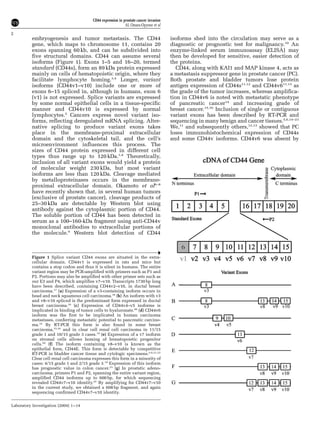
five structural domains. CD44 can assume several
isoforms (Figure 1). Exons 1–5 and 16–20, termed
standard (CD44s), form an 89 kDa protein expressed
mainly on cells of hematopoietic origin, where they
facilitate lymphocyte homing.3,4
Longer, variant
isoforms (CD44v1–v10) include one or more of
exons 6–15 spliced in, although in humans, exon 6
(v1) is not expressed. Splice variants are expressed
by some normal epithelial cells in a tissue-specific
manner and CD44v10 is expressed by normal
lymphocytes.5
Cancers express novel variant iso-
forms, reflecting deregulated mRNA splicing. Alter-
native splicing to produce variant exons takes
place in the membrane-proximal extracellular
domain and the cytoskeletal tail, and the cell’s
microenvironment influences this process. The
sizes of CD44 protein expressed in different cell
types thus range up to 120 kDa.1,4
Theoretically,
inclusion of all variant exons would yield a protein
of molecular weight 230 kDa, but most variant
isoforms are less than 120 kDa. Cleavage mediated
by metalloproteinases occurs in the membrane-
proximal extracellular domain. Okamoto et al6–8
have recently shown that, in several human tumors
(exclusive of prostate cancer), cleavage products of
25–30 kDa are detectable by Western blot using
antibody against the cytoplasmic portion of CD44.
The soluble portion of CD44 has been detected in
serum as a 100–160-kDa fragment using anti-CD44v
monoclonal antibodies to extracellular portions of
the molecule.9
Western blot detection of CD44
isoforms shed into the circulation may serve as a
diagnostic or prognostic test for malignancy.10
An
enzyme-linked serum immunoassay (ELISA) may
then be developed for sensitive, easier detection of
the proteins.
CD44, along with KAI1 and MAP kinase 4, acts as
a metastasis suppressor gene in prostate cancer (PC).
Both prostate and bladder tumors lose protein
antigen expression of CD44s11,12
and CD44v611,13
as
the grade of the tumor increases, whereas amplifica-
tion in CD44v6 is noted with metastatic phenotype
of pancreatic cancer14
and increasing grade of
breast cancer.15,16
Inclusion of single or contiguous
variant exons has been described by RT-PCR and
sequencing in many benign and cancer tissues.5,6,14–23
We,11
and subsequently others,12,13
showed that PC
loses immunohistochemical expression of CD44s
and some CD44v isoforms. CD44v6 was absent by
Figure 1 Splice variant CD44 exons are situated in the extra-
cellular domain. CD44v1 is expressed in rats and mice but
contains a stop codon and thus it is silent in humans. The entire
variant region may be PCR-amplified with primers such as P1 and
P2. Portions may also be amplified with other primer sets such as
our E3 and P4, which amplifies v7–v10. Transcripts 1730 bp long
have been described, containing CD44v2–v10, in ductal breast
carcinoma.17
(a) Expression of a v3-containing isoform occurs in
head and neck squamous cell carcinoma.18
(b) An isoform with v3
and v8–v10 spliced is the predominant form expressed in ductal
breast carcinoma.16
(c) Expression of CD44v4–v5 isoforms is
implicated in binding of tumor cells to hyaluronate.48
(d) CD44v6
isoform was the first to be implicated in human carcinoma
metastases, conferring metastatic potential to pancreatic carcino-
ma.14
By RT-PCR this form is also found in some breast
carcinoma,15,16
and in clear cell renal cell carcinoma in 11/15
grade 1 and 10/15 grade 3 cases.19
(e) Expression of a v7 isoform
on stromal cells allows homing of hematopoietic progenitor
cells.20
(f) The isoform containing v8–v10 is known as the
epithelial form, CD44E. This form is detectable by competitive
RT-PCR in bladder cancer tissue and cytologic specimens.5,6,21,22
Clear cell renal cell carcinoma expresses this form in a minority of
cases: 4/15 grade 1 and 2/15 grade 3.19
Expression of this isoform
has prognostic value in colon cancer.23
(g) In prostatic adeno-
carcinoma, primers P1 and P2, spanning the entire variant region,
amplified CD44 isoforms up to 600 bp, for which sequencing
revealed CD44v7–v10 identity.25
By amplifying for CD44v7–v10
in the current study, we obtained a 608 bp fragment, and again
sequencing confirmed CD44v7–v10 identity.
CD44 expression in prostate cancer invasion
AL Omara-Opyene et al
2
Laboratory Investigation (2004) 1–14
immunohistochemistry in PC of all Gleason grades.
Counter to this trend, PC reportedly overexpressed
CD44 variant v7 compared with benign prostatic
acini.24
By Western blotting, we did not find
significantly altered CD44 standard and v6 isoform
expression in PC.25
We did find an increase in
proteins that included v7–v9; and amplification
using primers P1 and P2 spanning the entire
v1–v10 variant region (Figure 1) disclosed mRNA
whose sequence included combinations of v7–v10
exons.25
These findings served as the impetus
for the current investigation of their functional
significance. Most other cell adhesion molecules
are downregulated or unchanged in PC. The excep-
tions are increased expression of Muc18 (CD146,
or MelCAM),26,27
N-cadherin and cadherin-11,
although expression was consistently seen only in
the highest Gleason score cancer,28
and d-catenin.29
Muc18 was originally found to be overexpressed on
the surface of melanoma cells where it mediates
their metastasis.30
Others have studied Muc18 in PC
in some depth. Expression of Muc18 by prostate
cancer cell lines26,27
correlated with invasiveness
and with in vivo metastasis in nude mice.26
Also,
Muc18 immunohistochemical expression was in-
creased in prostate cancer acini and their precursor
lesion, prostatic intraepithelial neoplasia (PIN), in
37 cases.27
Thus, we chose to study the effect of
expression and silencing of Muc18.
CD44v9 is the longest sequence within the
CD44v7–v10 region. Since the v7–v10 exons were
consistently expressed together, we chose to induce
CD44v9 silencing in the current study in order to
discover the functional significance of CD44v7–v10
expression. The relative functional significance of
CD44v9 and Muc18 in characterized prostate cancer
cell lines was compared in Matrigel invasion assays.
Matrigel experiments will serve as a prelude to
animal studies and clinical trials. If abrogation of
overexpression of these cell adhesion molecules
impairs cancer cell survival or metastasis, gene
therapy may be targeted to them. A component of
the current study was to determine whether Gsa
cells, PC cells which have a constitutively active
Gsa31
and demonstrate increased invasiveness,32
also
overexpress CD44v9 or Muc18. Finally, we acquired
a CD44v10 antibody and performed immunostaining
on a prostate tissue microarray in order to deter-
mine whether CD44v10 is increased in PC at the
protein level along with CD44v7–9, as we showed
previously.25
Materials and methods
RNA Extraction from Prostatic Tissue
Tissue was harvested from prostatectomy, enuclea-
tion or transurethral resection specimens, and in
two cases, pelvic lymph nodes with metastatic
tumor, within 20 min of surgery, with patient
informed consent. Tissue was snap-frozen in liquid
nitrogen and stored at À701C. Frozen sections
were performed on the tissue before use to verify
that it either contained 450% tumor or was free
of tumor.
Total RNA was isolated from the prostate tissues
using Trizol (Invitrogen, Carlsbad, CA, USA) as
described by the manufacturer with some modifica-
tions. Briefly, 100 mg of frozen prostate tissue was
ground on dry ice by cold mortar and pestle, and
the powder was transferred directly into 2 ml of
RTL lysis buffer (Qiagen, Valencia, CA, USA)
þ 20 ml of 2-mercaptoethanol (Sigma) and mixed by
gentle inversion. To every 500 ml of this mixture,
1 ml of Trizol was added, mixed by inversion
and incubated for 5 min at room temperature. This
was followed by addition of 200 ml of chloro-
form, mixed again by inversion and incubated for
10 min at room temperature. The mixture was
centrifuged at 14 000 rpm for 10 min at 41C in a
bench centrifuge (Sorvall RMC 14). Total RNA was
further purified by isopropanol precipitation. The
isolated total RNA was dissolved in DEPC-treated
water and quantified. Laser capture microdissec-
tion was performed in two lymph node metastasis
specimens, and total RNA was isolated using
PicoPure RNA Isolation Kit according to the manu-
facturer’s protocol (Arcturus, Mountain View, CA,
USA). The quality of RNA was verified by loading
6 mg of total RNA in separate wells, electrophoresis
on 1% formaldehyde–agarose gel, and visualiz-
ing bands by ethidium bromide staining and UV
transillumination.
First-strand cDNA Synthesis and RT-PCR for
CD44v7–v10
For first-strand complementary DNA (cDNA) synth-
esis, 1 mg of total RNA was mixed with random
hexamers (Invitrogen) to a final concentration of
50 ng per reaction and DEPC-treated water was used
to bring the volume to 10 ml. The mixture was heated
to 701C for 10 min and incubated on ice for 10 min.
Reverse transcription was started by adding 10 ml of
a master mix (4 ml of 5 Â buffer, 2 ml of 100 mM DTT,
1 ml of dNTPs, 1 ml (200 U) of SuperScriptt II RNaseH
Reverse Transcriptase (Invitrogen) and DEPC-treated
water to a total volume of 10 ml). A master mix of the
above was prepared for 12 reactions and to each
master mix 1 ml of RNAse Out (Invitrogen) was
added. First-strand cDNA synthesis was carried out
at 251C for 10 min, followed by 421C for 45 min,
and the reaction was stopped by heating at 701C
for 3 min. The first-strand cDNAs were used as
templates in PCR reactions.
For PCR amplification, 5 ml of the first-strand
cDNA, 2.5 ml of 10 mM stock of the E3/P4 primer
set33
and 2.5 ml of Taq polymerase (diluted 1:10)
were added to 37.5 ml of master mix to make a 50 ml
reaction volume. Master mix consisted of 1 Â PCR
buffer, 1.5 mM MgCl2 and 200 mM dNTPs. The PCR
CD44 expression in prostate cancer invasion
AL Omara-Opyene et al
3
Laboratory Investigation (2004) 1–14
conditions were as follows: 941C for 5 min; 5 cycles
at 941C for 1 min, 501C for 1 min, and 721C for 3 min;
30 cycles at 941C for 1 min, 601C for 1 min, and 721C
for 3 min; and a final extension of 721C for 10 min.
An amount of 5 ml of PCR product was loaded on a
0.8% agarose gel and electrophoresed at 100 V for
1 h and visualized by ethidium bromide staining
and UV transillumination. The bands of interest
were excised and the DNA extracted out of the gel
using the StrataPrep DNA Gel Extraction Kit
(Stratagene, La Jolla, CA, USA). The purified DNA
was cloned into TOPO (TOPO TA cloning kit for
sequencing, Invitogen) and resulting plasmids were
sequenced by the University of Florida DNA
Sequencing Core. Sequences were compared to
published ones34
using JellyFish (LabVelocity,
Burlingame, CA, USA).
Immunohistochemistry for CD44v10
CD44v10 reactivity in 55 malignant and benign
prostate cores and 18 benign tissues other than
prostate were assessed using Tissue Array Research
Program tissue microarray slides (National Cancer
Institute, Bethesda, MD, USA). Tissue sections
were deparaffinized in xylene and alcohols and
soaked 30 min in Tris-buffered saline, pH ¼ 7.5 with
0.1% Tween-20 (TBST). Slides were subject to
steam heat antigen retrieval in citrate buffer,
pH ¼ 6 for 2 Â 30 min. Slides were quenched in 3%
H2O2 in methanol for 10 min and rinsed well in
distilled water, then in TBST. An ‘Inhibitor solu-
tion’ (Ventana) was applied for 4 min followed
by blocking antibodies for 10 min (20% normal
swine serum in Tris-HCl, pH 7.6). A 1:1000 dilution
of monoclonal anti-CD44v10 (Biosource, Cama-
rillo, CA, USA) was applied at room temperature,
overnight. Its specificity was confirmed by Western
blot using normal lymph node as a positive con-
trol.5
Biotin block (Ventana) was applied 3 min. A
secondary antibody (Dako LSAB Kit mouse/goat/
rabbit) was applied for 25 min. Slides were rinsed
in TBST, covered with avidin-biotin complex
25 min, and rinsed in TBST. Diaminobenzidine
served as the chromogen, and slides were counter-
stained with hematoxylin. The negative control
consisted of application of nonimmune whole rabbit
serum at 1:300 dilution. Number of benign and
tumor tissues staining was compared by w2
-test. The
two-tailed two-sample sign test was used to assess
differences between staining of paired benign and
cancer tissue.
Cell Culture
PC3M cells were purchased (American Type Culture
Collection, Manassas, VA, USA) and incubated in
RPMI 1640 with L-glutamine, 10% fetal calf serum,
and antibiotics at 371C in a 5% CO2 incubator. Gsa
prostate cancer cells were maintained in complete
medium (RPMI 1640 supplemented with L-gluta-
mine, 5% fetal calf serum, 12% horse serum,
50 U/ml penicillin, 50 mg/ml streptomycin, 20 mg/ml
amphotericin).
RNA Interference: Cloning of two-DNA Nucleotide
Fragments, and Transfection for Synthesis of siRNA
We used RNAi to study the function of CD44
and Muc18 genes in prostate cancer cells. The
sequence of CD44v9 was found in GenBank and in
Screaton et al.34
The sequence of Muc18 was
likewise found in published data.25
Our strategy
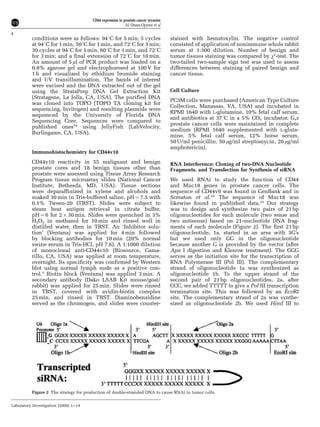
was to design and synthesize two pairs of 21 bp
oligonucleotides for each molecule (two sense and
two antisense) based on 21-nucleotide DNA frag-
ments of each molecule (Figure 2). The first 21 bp
oligonucleotide, 1a, started in an area with 3G’s
but we used only GG in the oligonucleotide
because another G is provided by the vector (after
Apa I digestion and Klenow treatment). The GGG
serves as the initiation site for the transcription of
RNA Polymerase III (Pol III). The complementary
strand of oligonucleotide 1a was synthesized as
oligonucleotide 1b. To the upper strand of the
second pair of 21 bp oligonucleotides, 2a, after
CCC, we added TTTTT to give a Pol III transcription
termination site. This was followed by an EcoRI
site. The complementary strand of 2a was synthe-
sized as oligonucleotide 2b. We used Hind III to
Figure 2 The strategy for production of double-stranded DNA to cause RNAi in tumor cells.
CD44 expression in prostate cancer invasion
AL Omara-Opyene et al
4
Laboratory Investigation (2004) 1–14
make a connection between the two pairs of
oligonucleotides. The complementary oligonucleo-
tides were annealed by mixing (from 250 pmol/ml
stock) 10 ml of one oligonucleotide with 10 ml of
the second oligonucleotide in 180 ml of water,
boiling the 200 ml mixture in a 700 ml water bath
for 5 min and gradual cooling of the water bath
with the 200 ml mixture for 1 h followed by incuba-
tion on ice for 10 min. Using a two-step cloning
strategy, the two pairs of the 21-DNA nucleotide
fragments were arranged head to head and sand-
wiched with a loop of six nucleotides (Hind III site)
into plasmid vector U6pBS. Once the two pairs
of the 21-DNA nucleotide were cloned in vector
U6pBS, clean endotoxin-free plasmids were pre-
pared using the Endo Free Plasmid Maxi Kit
(Qiagen) and the plasmids were then used in
transfection experiments. The goal was to generate
short hairpin RNAs in transfected cells, to sup-
press specific CD44v9 or Muc18 gene activity as
described.35
Transfection of cells with vector U6pBS having
RNAi constructs was optimized using the lipid
agent Metafectene (Biontex, Munich, Germany). In
brief, cells were plated at a density of 5 Â 105
cells
per well in 2 ml of RPMI medium with serum and
antibiotics in a 6-well plate. Cells were then
transfected 24 h later with vector U6pBS containing
RNAi construct:Metafectene complexes. To formu-
late RNAi construct:lipofection complexes, two
tubes were filled with 100 ml of RPMI without serum
or antibiotics. To one tube, 10 ml (10 mg) of PCI-neo-
GFP plasmid (which produces green fluorescent
protein (GFP)) as a reporter was added, followed by
10 ml (4 mg) of RNAi construct (for CD44v9 or
Muc18). To the second tube, 10 ml of Metafectene
were added. The contents of the two tubes were
mixed well, then allowed to stand 25 min to allow
formation of lipofection agent:DNA complexes for
transfection. The incubated complex was added
dropwise to the cells in each well, from which the
serum-containing medium had been removed. An
amount of 4 mg of GFP was cotransfected to monitor
the extent of transfection. Transfection in serum-free
medium proceeded for 6 h. Others have found a 3–4
day interval of further incubation optimal in order
for depletion of previously synthesized protein.36
We tried post-transfection incubations ranging from
1–6 days, and optimized the interval for abrogation
of protein expression by Western blot at 90 h, in
serum-containing medium.
In one experiment, cells were successfully sorted
by FACS into GFP-positive and GFP-negative cell
groups using a FACSVantage SE flow cytometer (BD
Biosciences, San Diego, CA, USA). Portions of
these cell populations were analyzed separately by
Western blotting and used in the Matrigel invasion
assay as above. Differences in percent cell invasion
(compared to control insert) of the GFP-positive
and -negative populations were analyzed by the
w2
-test.
SDS-Polyacrylamide Gel Electrophoresis and
Western blot Analysis for CD44v9
SDS-PAGE was performed according to the method
of Laemmli37
using 12% polyacrylamide gels. A
pellet from centrifuged cultured cells was lysed in
RIPA lysis buffer (Upstate Biologicals, Lake Placid,
NY, USA) plus the protease inhibitors 2 mg/ml
Pepstatin, 1.5 mg/ml Leupeptin and 1 mM PMSF.
The cell lysate was treated with an equal volume of
2% SDS and the protein concentration was esti-
mated by Lowry method.
One part of 5 Â sample buffer (formulated as
described by BIO-RAD) was added to four parts of
the solubilized proteins. An amount of 25 mg of
sample/lane was prepared. The proteins were then
denatured for 5 min in 1001C boiling water bath and
loaded into wells of a 4% stacking gel. A measure of
5 ml of Rainbow protein marker (RPN 756 Amersham
Pharmacia, Piscataway, NJ, USA) was also loaded on
each gel. After 2-h electrophoresis, the protein was
transferred to nitrocellulose (Trans-Blot Transfer
Medium, BIO-RAD). For Muc18 protein, a primary
goat polyclonal IgG antibody (Santa Cruz Biotech-
nology, Santa Cruz, CA, USA) was hybridized at
1:1000 dilution. Bovine anti-goat IgG labeled with
horseradish peroxidase (Santa Cruz) was used as a
secondary antibody at 1:10 000 dilution. To assess
CD44v9, the membrane was reacted with super-
natant from the hybridoma cell line HB-258 (ATCC,
Manassas, VA, USA) which produces antibody
against CD44v9, and this was used neat. Goat anti-
mouse IgG labeled with horseradish peroxidase
(Pierce, Rockford, IL, USA) was used as a secon-
dary antibody at 1:50 000 dilution. Reactivity was
detected using a chemiluminescent system (Super-
Signal West Pico Substrate, Pierce). Each experi-
mental run was conducted twice.
Invasion Study
The experiment was performed in six-well Matrigel
two-tier invasion chambers (Collaborative Biomedi-
cal Products, Bedford, MA, USA), using a protocol
similar to that used successfully by others.32
Prostate
cancer cells (2.5 Â 105
cells per well expressing
hairpin double-stranded CD44v interfering RNA or
controls) were seeded in the upper insert in a serum-
free basal medium (RPMI 1640 medium containing
0.1% BSA, 150 mg/ml of G418, 4 mM L-glutamine,
100 mg/ml penicillin G and 100 mg/ml streptomycin).
The lower chamber contained chemoattractant med-
ium consisting of 70% complete medium, 10% fetal
bovine serum, and 20% conditioned medium ob-
tained from subconfluent cultures. The incubations
were carried out for 36 h. After this period, upper
inserts were removed, and residual cells were
removed from the upper Matrigel surface using
cotton swabs. The invasive cells would penetrate
through the Matrigel layer and would be on the
outside bottom of the upper insert. While the
CD44 expression in prostate cancer invasion
AL Omara-Opyene et al
5
Laboratory Investigation (2004) 1–14
membranes were still wet in culture dishes, the
GFP-positive cells on the entire membrane were
counted under fluorescent illumination. Gels were
fixed, stained using Diff Quik staining (Dade
Diagnostic, Aguar, PR, USA), and mounted on glass
slides. The total number of cells on the entire gel
was counted. The data from invasion assay were
corrected for cell growth during experimental
periods as follows: the experimental cells were
plated at a density of 105
cells per well in six-well
control inserts in chemoattractant medium and
increase in cell number were determined after
48 h. Four experiments were carried out with
PC3M cells and five with Gsa cells. The results were
expressed as mean7standard deviation.
The Percent Invasion is defined as
100 Â (Number of cells invading through entire
Matrigel insert membrane)/Number of cells invading
through entire control insert membrane.
The Invasion Index is defined as
100 Â (Percent Invasion of treated cells)/(Percent
Invasion of untreated cells).
Significance of differences in Percent Invasion
according to treatment (or transfection of Metafec-
tene vehicle alone) were assessed by Student’s t-test.
Results
RT-PCR
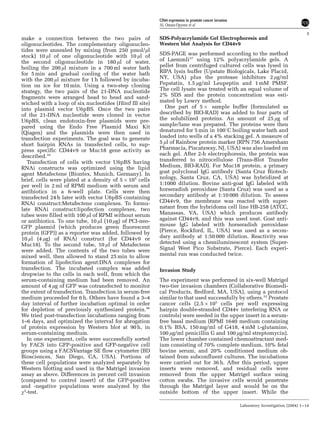
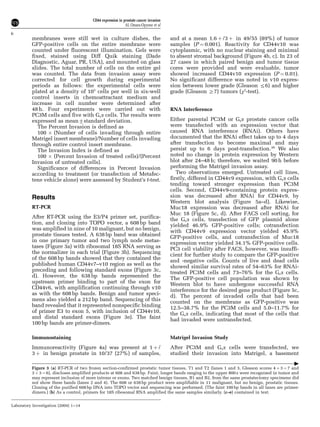
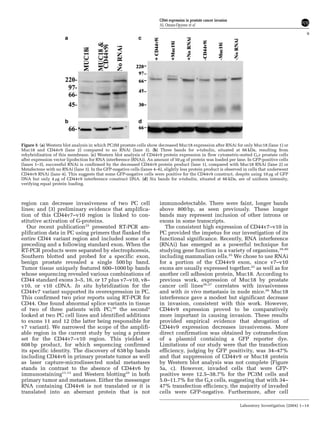
After RT-PCR using the E3/P4 primer set, purifica-
tion, and cloning into TOPO vector, a 608 bp band
was amplified in nine of 10 malignant, but no benign,
prostate tissues tested. A 638 bp band was obtained
in one primary tumor and two lymph node metas-
tases (Figure 3a) with ribosomal 18S RNA serving as
the normalizer in each trial (Figure 3b). Sequencing
of the 608 bp bands showed that they contained the
published human CD44v7–v10 region as well as the
preceding and following standard exons (Figure 3c,
d). However, the 638 bp bands represented the
upstream primer binding to part of the exon for
CD44v6, with amplification continuing through v10
as with the 608 bp bands. Benign and tumor speci-
mens also yielded a 212 bp band. Sequencing of this
band revealed that it represented nonspecific binding
of primer E3 to exon 5, with inclusion of CD44v10,
and distal standard exons (Figure 3e). The faint
100 bp bands are primer-dimers.
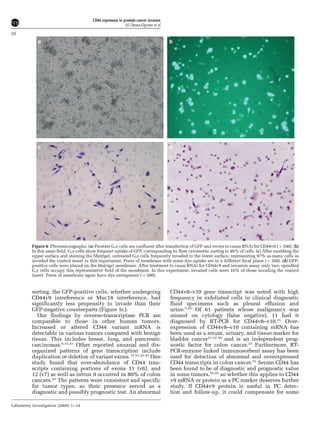
Immunostaining
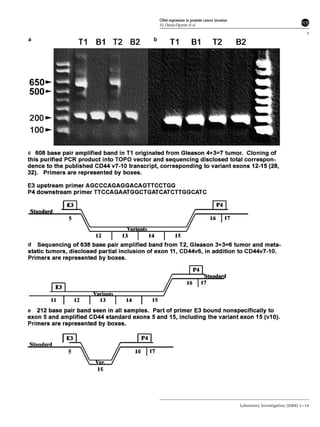
Immunoreactivity (Figure 4a) was present at 1 þ /
3 þ in benign prostate in 10/37 (27%) of samples,
and at a mean 1.6 þ /3 þ in 49/55 (89%) of tumor
samples (P ¼ 0.001). Reactivity for CD44v10 was
cytoplasmic, with no nuclear staining and minimal
to absent stromal background (Figure 4b, c). In 23 of
27 cases in which paired benign and tumor tissue
cores were provided and were evaluable, tumor
showed increased CD44v10 expression (P ¼ 0.01).
No significant difference was noted in v10 expres-
sion between lower grade (Gleason r6) and higher
grade (Gleason Z7) tumors (w2
-test).
RNA Interference
Either parental PC3M or Gsa prostate cancer cells
were transfected with an expression vector that
caused RNA interference (RNAi). Others have
documented that the RNAi effect takes up to 4 days
after transfection to become maximal and may
persist up to 6 days post-transfection.36
We also
noted no change in protein expression by Western
blot after 24–48 h; therefore, we waited 90 h before
performing the Matrigel invasion assay.
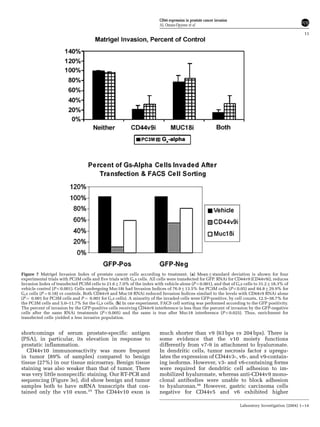
Two observations emerged. Untreated cell lines,
firstly, differed in CD44v9 expression, with Gsa cells
tending toward stronger expression than PC3M
cells. Second, CD44v9-containing protein expres-
sion was decreased after RNAi for CD44v9, by
Western blot analysis (Figure 5a–d). Likewise,
Muc18 expression was decreased after RNAi for
Muc 18 (Figure 5c, d). After FACS cell sorting, for
the Gsa cells, transfection of GFP plasmid alone
yielded 46.9% GFP-positive cells; cotransfection
with CD44v9 expression vector yielded 45.9%
GFP-positive cells, and cotransfection of Muc18
expression vector yielded 34.1% GFP-positive cells.
PC3 cell viability after FACS, however, was insuffi-
cient for further study to compare the GFP-positive
and -negative cells. Counts of live and dead cells
showed similar survival rates of 54–63% for RNAi-
treated PC3M cells and 73–76% for the Gsa cells.
The GFP-positive cell population was shown by
Western blot to have undergone successful RNA
interference for the desired gene product (Figure 5c,
d). The percent of invaded cells that had been
counted on the membrane as GFP-positive was
12.5–38.7% for the PC3M cells and 5.0–11.7% for
the Gsa cells, indicating that most of the cells that
had invaded were untransfected.
Matrigel Invasion Study
After PC3M and Gsa cells were transfected, we
studied their invasion into Matrigel, a basement
Figure 3 (a) RT-PCR of two frozen section-confirmed prostatic tumor tissues, T1 and T2 (lanes 1 and 3, Gleason scores 4 þ 3 ¼ 7 and
3 þ 3 ¼ 6), discloses amplified products at 608 and 638 bp. Faint, longer bands ranging to the upper 800 s were recognized in tumor and
may represent inclusion of more introns or exons. Two matched benign tissues, B1 and B2, from the same prostatectomy specimens did
not show these bands (lanes 2 and 4). The 608 or 638 bp product were amplifiable in 11 malignant, but no benign, prostatic tissues.
Cloning of the purified 608 bp DNA into TOPO vector and sequencing was performed. (The faint 100 bp bands in all lanes are primer-
dimers.) (b) As a control, primers for 18S ribosomal RNA amplified the same samples similarly. (c–e) contained in text.
CD44 expression in prostate cancer invasion
AL Omara-Opyene et al
6
Laboratory Investigation (2004) 1–14
CD44 expression in prostate cancer invasion
AL Omara-Opyene et al
7
Laboratory Investigation (2004) 1–14
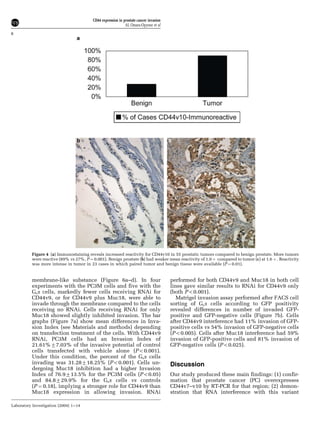
membrane-like substance (Figure 6a–d). In four
experiments with the PC3M cells and five with the
Gsa cells, markedly fewer cells receiving RNAi for
CD44v9, or for CD44v9 plus Muc18, were able to
invade through the membrane compared to the cells
receiving no RNAi. Cells receiving RNAi for only
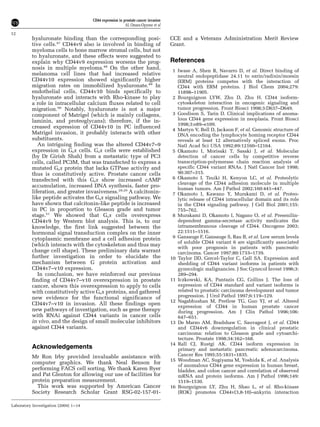
Muc18 showed slightly inhibited invasion. The bar
graphs (Figure 7a) show mean differences in Inva-
sion Index (see Materials and methods) depending
on transfection treatment of the cells. With CD44v9
RNAi, PC3M cells had an Invasion Index of
21.61%77.03% of the invasive potential of control
cells transfected with vehicle alone (Po0.001).
Under this condition, the percent of the Gsa cells
invading was 31.28718.25% (Po0.001). Cells un-
dergoing Muc18 inhibition had a higher Invasion
Index of 76.9713.5% for the PC3M cells (Po0.05)
and 84.8729.9% for the Gsa cells vs controls
(P ¼ 0.18), implying a stronger role for CD44v9 than
Muc18 expression in allowing invasion. RNAi
performed for both CD44v9 and Muc18 in both cell
lines gave similar results to RNAi for CD44v9 only
(both Po0.001).
Matrigel invasion assay performed after FACS cell
sorting of Gsa cells according to GFP positivity
revealed differences in number of invaded GFP-
positive and GFP-negative cells (Figure 7b). Cells
after CD44v9 interference had 11% invasion of GFP-
positive cells vs 54% invasion of GFP-negative cells
(Po0.005). Cells after Muc18 interference had 59%
invasion of GFP-positive cells and 81% invasion of
GFP-negative cells (Po0.025).
Discussion
Our study produced these main findings: (1) confir-
mation that prostate cancer (PC) overexpresses
CD44v7–v10 by RT-PCR for that region; (2) demon-
stration that RNA interference with this variant
Figure 4 (a) Immunostaining reveals increased reactivity for CD44v10 in 55 prostatic tumors compared to benign prostate. More tumors
were reactive (89% vs 27%, P ¼ 0.001). Benign prostate (b) had weaker mean reactivity of 1.0 þ compared to tumor (c) at 1.6 þ . Reactivity
was more intense in tumor in 23 cases in which paired tumor and benign tissue were available (P ¼ 0.01).
CD44 expression in prostate cancer invasion
AL Omara-Opyene et al
8
Laboratory Investigation (2004) 1–14
region can decrease invasiveness of two PC cell
lines; and (3) preliminary evidence that amplifica-
tion of this CD44v7–v10 region is linked to con-
stitutive activation of G-proteins.
Our recent publication25
presented RT-PCR am-
plification data in PC using primers that flanked the
entire CD44 variant region and included some of a
preceding and a following standard exon. When the
RT-PCR products were separated by electrophoresis,
Southern blotted and probed for a specific exon,
benign prostate revealed a single 500 bp band.
Tumor tissue uniquely featured 600–1000 bp bands
whose sequencing revealed various combinations of
CD44 standard exons 3–5, 16, or 17 plus v7–v10, v8–
v10, or v10 cDNA. In situ hybridization for the
CD44v7 variant supported its overexpression in PC.
This confirmed two prior reports using RT-PCR for
CD44. One found abnormal splice variants in tissue
of two of three patients with PC;38
the second2
looked at two PC cell lines and identified additions
to exons 11 and 12 (the latter being responsible for
v7 variant). We narrowed the scope of the amplifi-
able region in the current study by using a primer
set for the CD44v7–v10 region. This yielded a
608 bp product, for which sequencing confirmed
its specific identity. The discovery of 638 bp bands
including CD44v6 in primary prostate tumor as well
as laser capture-microdissected nodal metastases
stands in contrast to the absence of CD44v6 by
immunostaining11,13
and Western blotting25
in both
primary tumor and metastases. Either the messenger
RNA containing CD44v6 is not translated or it is
translated into an aberrant protein that is not
immunodetectable. There were faint, longer bands
above 800 bp, as seen previously. These longer
bands may represent inclusion of other introns or
exons in some transcripts.
The consistent high expression of CD44v7–v10 in
PC provided the impetus for our investigation of its
functional significance. Recently, RNA interference
(RNAi) has emerged as a powerful technique for
studying gene function in a variety of organisms,39,40
including mammalian cells.35
We chose to use RNAi
for a portion of the CD44v9 exon, since v7–v10
exons are usually expressed together,25
as well as for
another cell adhesion protein, Muc18. According to
previous work, expression of Muc18 by prostate
cancer cell lines26,27
correlates with invasiveness
and with in vivo metastasis in nude mice.26
Muc18
interference gave a modest but significant decrease
in invasion, consistent with this work. However,
CD44v9 expression proved to be comparatively
more important in causing invasion. These results
provided empirical evidence that abrogation of
CD44v9 expression decreases invasiveness. More
direct confirmation was obtained by cotransfection
of a plasmid containing a GFP reporter dye.
Limitations of our study were that the transfection
efficiency, judging by GFP positivity, was 34–47%
and that suppression of CD44v9 or Muc18 protein
by Western blot analysis was not complete (Figure
5a, c). However, invaded cells that were GFP-
positive were 12.5–38.7% for the PC3M cells and
5.0–11.7% for the Gsa cells, suggesting that with 34–
47% transfection efficiency, the majority of invaded
cells were GFP-negative. Furthermore, after cell
Figure 5 (a) Western blot analysis in which PC3M prostate cells show decreased Muc18 expression after RNAi for only Muc18 (lane 1) or
Muc18 and CD44v9 (lane 2) compared to no RNAi (lane 3). (b) Three bands for a-tubulin, situated at 66 kDa, resulting from
rehybridization of this membrane. (c) Western blot analysis of CD44v9 protein expression in flow cytometric-sorted Gsa prostate cells
after expression vector lipofection for RNA interference (RNAi). An amount of 50 mg of protein was loaded per lane. In GFP-positive cells
(lanes 1–3), successful RNAi is confirmed by the decreased CD44v9 protein product (lane 1), compared with Muc18 RNAi (lane 2) or
Metafectene with no RNAi (lane 3). In the GFP-negative cells (lanes 4–6), slightly less protein product is observed in cells that underwent
CD44v9 RNAi (lane 4). This suggests that some GFP-negative cells were positive for the CD44v9 construct, despite using 10 mg of GFP
DNA but only 4 mg of CD44v9 interference construct DNA. (d) Six bands for a-tubulin, situated at 66 kDa, are of uniform intensity,
verifying equal protein loading.
CD44 expression in prostate cancer invasion
AL Omara-Opyene et al
9
Laboratory Investigation (2004) 1–14
sorting, the GFP-positive cells, whether undergoing
CD44v9 interference or Muc18 interference, had
significantly less propensity to invade than their
GFP-negative counterparts (Figure 5c).
Our findings by reverse-transcriptase PCR are
comparable to those in other human tumors.
Increased or altered CD44 variant mRNA is
detectable in various tumors compared with benign
tissue. This includes breast, lung, and pancreatic
carcinomas.6,15,41
Other reported unusual and dis-
organized patterns of gene transcription include
duplication or deletion of variant exons.15,21,42,43
One
study found that over-abundance of CD44 tran-
scripts containing portions of exons 11 (v6), and
12 (v7) as well as intron 9 occurred in 80% of colon
cancers.43
The patterns were consistent and specific
for tumor types, so their presence served as a
diagnostic and possibly prognostic test. An abnormal
CD44v8–v10 gene transcript was noted with high
frequency in exfoliated cells in clinical diagnostic
fluid specimens such as pleural effusion and
urine.5,22
Of 61 patients whose malignancy was
missed on cytology (false negative), 11 had it
diagnosed by RT-PCR for CD44v8–v10.21
Over-
expression of CD44v8–v10 containing mRNA has
been used as a serum, urinary, and tissue marker for
bladder cancer21,22,38
and is an independent prog-
nostic factor for colon cancer.23
Furthermore, RT-
PCR-enzyme linked immunosorbent assay has been
used for detection of abnormal and overexpressed
CD44 transcripts in colon cancer.33
Serum CD44 has
been found to be of diagnostic and prognostic value
in some tumors,44,45
so whether this applies to CD44
v9 mRNA or protein as a PC marker deserves further
study. If CD44v9 protein is useful in PC detec-
tion and follow-up, it could compensate for some
Figure 6 Photomicrographs. (a) Prostate Gsa cells are confluent after transfection of GFP and vector to cause RNAi for CD44v9 ( Â 100). (b)
In this same field, Gsa cells show frequent uptake of GFP, corresponding by flow cytometric sorting to 46% of cells. (c) After swabbing the
upper surface and staining the Matrigel, untreated Gsa cells frequently invaded to the lower surface, representing 97% as many cells as
invaded the control insert in this experiment. Pores of membrane with some dye uptake are in a different focal plane ( Â 200). (d) GFP-
positive cells were placed on the Matrigel membrane. After treatment to cause RNAi for CD44v9 and invasion assay, only two, spindled
Gsa cells occupy this representative field of the membrane. In this experiment, invaded cells were 16% of those invading the control
insert. Pores of membrane again have dye entrapment ( Â 200).
CD44 expression in prostate cancer invasion
AL Omara-Opyene et al
10
Laboratory Investigation (2004) 1–14
shortcomings of serum prostate-specific antigen
(PSA), in particular, its elevation in response to
prostatic inflammation.
CD44v10 immunoreactivity was more frequent
in tumor (89% of samples) compared to benign
tissue (27%) in our tissue microarray. Benign tissue
staining was also weaker than that of tumor. There
was very little nonspecific staining. Our RT-PCR and
sequencing (Figure 3e), did show benign and tumor
samples both to have mRNA transcripts that con-
tained only the v10 exon.25
The CD44v10 exon is
much shorter than v9 (63 bps vs 204 bps). There is
some evidence that the v10 moiety functions
differently from v7-9 in attachment to hyaluronate.
In dendritic cells, tumor necrosis factor a upregu-
lates the expression of CD44v3-, v6-, and v9-contain-
ing isoforms. However, v3- and v6-containing forms
were required for dendritic cell adhesion to im-
mobilized hyaluronate, whereas anti-CD44v9 mono-
clonal antibodies were unable to block adhesion
to hyaluronan.46
However, gastric carcinoma cells
negative for CD44v5 and v6 exhibited higher
Figure 7 Matrigel Invasion Index of prostate cancer cells according to treatment. (a) Mean7standard deviation is shown for four
experimental trials with PC3M cells and five trials with Gsa cells. All cells were transfected for GFP. RNAi for CD44v9 (CD44v9i), reduces
Invasion Index of transfected PC3M cells to 21.677.0% of the index with vehicle alone (Po0.001), and that of Gsa cells to 31.2718.3% of
vehicle control (Po0.001). Cells undergoing Muc18i had Invasion Indices of 76.9713.5% for PC3M cells (Po0.05) and 84.8729.9% for
Gsa cells (P ¼ 0.18) vs controls. Both CD44v9 and Muc18 RNAi reduced Invasion Indices similarl to the levels with CD44v9 RNAi alone
(P ¼ 0.001 for PC3M cells and P ¼ 0.001 for Gsa cells). A minority of the invaded cells were GFP-positive, by cell counts, 12.5–38.7% for
the PC3M cells and 5.0–11.7% for the Gsa cells. (b) In one experiment, FACS cell sorting was performed according to the GFP positivity.
The percent of invasion by the GFP-positive cells receiving CD44v9 interference is less than the percent of invasion by the GFP-negative
cells after the same RNAi treatments (Po0.005) and the same is true after Muc18 interference (Po0.025). Thus, enrichment for
transfected cells yielded a less invasive population.
CD44 expression in prostate cancer invasion
AL Omara-Opyene et al
11
Laboratory Investigation (2004) 1–14
hyaluronate binding than the corresponding posi-
tive cells.47
CD44v9 also is involved in binding of
myeloma cells to bone marrow stromal cells, but not
to hyaluronate, and these effects were suggested to
explain why CD44v9 expression worsens the prog-
nosis in multiple myeloma.48
On the other hand,
melanoma cell lines that had increased relative
CD44v10 expression showed significantly higher
migration rates on immobilized hyaluronate.49
In
endothelial cells, CD44v10 binds specifically to
hyaluronate and interacts with Rho-kinase to play
a role in intracellular calcium fluxes related to cell
migration.50
Notably, hyaluronate is not a major
component of Matrigel (which is mainly collagens,
laminin, and proteoglycans); therefore, if the in-
creased expression of CD44v10 in PC influenced
Matrigel invasion, it probably interacts with other
substituents.
An intriguing finding was the altered CD44v7–9
expression in Gsa cells. Gsa cells were established
(by Dr Girish Shah) from a metastatic type of PC3
cells, called PC3M, that was transfected to express a
mutated Gsa protein that lacks GTPase activity and
thus is constitutively active. Prostate cancer cells
transfected with this Gsa show increased cAMP
accumulation, increased DNA synthesis, faster pro-
liferation, and greater invasiveness.28,29
A calcitonin-
like peptide activates the Gsa signaling pathway. We
have shown that calcitonin-like peptide is increased
in PC in proportion to Gleason grade and tumor
stage.51
We showed that Gsa cells overexpress
CD44v9 by Western blot analysis. This is, to our
knowledge, the first link suggested between the
hormonal signal transduction complex on the inner
cytoplasmic membrane and a cell adhesion protein
(which interacts with the cytoskeleton and thus may
change cell shape). These preliminary data warrant
further investigation in order to elucidate the
mechanism between G protein activation and
CD44v7–v10 expression.
In conclusion, we have reinforced our previous
finding of CD44v7–v10 overexpression in prostate
cancer, shown this overexpression to apply to cells
with constitutively active Gsa proteins, and gathered
new evidence for the functional significance of
CD44v7–v10 in invasion. All these findings open
new pathways of investigation, such as gene therapy
with RNAi against CD44 variants in cancer cells
in vivo, and the design of small molecular inhibitors
against CD44 variants.
Acknowledgements
Mr Ron Irby provided invaluable assistance with
computer graphics. We thank Neal Benson for
performing FACS cell sorting. We thank Karen Byer
and Pat Glenton for allowing our use of facilities for
protein preparation measurement.
This work was supported by American Cancer
Society Research Scholar Grant RSG-02-157-01-
CCE and a Veterans Administration Merit Review
Grant.
References
1 Iwase A, Shen R, Navarro D, et al. Direct binding of
neutral endopeptidase 24.11 to ezrin/radixin/moesin
(ERM) proteins competes with the interaction of
CD44 with ERM proteins. J Biol Chem 2004;279:
11898–11905.
2 Bourguignon LYW, Zhu D, Zhu H. CD44 isoform-
cytoskeleton interaction in oncogenic signaling and
tumor progression. Front Biosci 1998;3:D637–D649.
3 Goodison S, Tarin D. Clinical implications of anoma-
lous CD44 gene expression in neoplasia. Front Biosci
1998;3:e89–e109.
4 Martyn V, Bell D, Jackson F, et al. Genomic structure of
DNA encoding the lymphocyte homing receptor CD44
reveals at least 12 alternatively spliced exons. Proc
Natl Acad Sci USA 1992;89:12160–12164.
5 Okamoto I, Morisaki T, Sasaki J, et al. Molecular
detection of cancer cells by competitive reverse
transcription-polymerase chain reaction analysis of
specific CD44 variant RNAs. J Natl Cancer Inst 1998;
90:307–315.
6 Okamoto I, Tsuiki H, Kenyon LC, et al. Proteolytic
cleavage of the CD44 adhesion molecule in multiple
human tumors. Am J Pathol 2002;160:441–447.
7 Okamoto I, Kawano Y, Murakami D, et al. Proteo-
lytic release of CD44 intracellular domain and its role
in the CD44 signaling pathway. J Cell Biol 2001;155:
755–762.
8 Murakami D, Okamoto I, Nagano O, et al. Presenilin-
dependent gamma-secretase activity medicates the
intramembranous cleavage of CD44. Oncogene 2003;
22:1511–1516.
9 Gansauge F, Gansauge S, Rau B, et al. Low serum levels
of soluble CD44 variant 6 are significantly associated
with poor prognosis in patients with pancreatic
carcinoma. Cancer 1997;80:1733–1739.
10 Taylor DD, Gercel-Taylor C, Gall SA. Expression and
shedding of CD44 variant isoforms in patients with
gynecologic malignancies. J Soc Gynecol Invest 1996;3:
289–294.
11 Iczkowski, KA, Pantazis CG, Collins J. The loss of
expression of CD44 standard and variant isoforms is
related to prostatic carcinoma development and tumor
progression. J Urol Pathol 1997;6:119–129.
12 Nagabhushan M, Pretlow TG, Guo YJ, et al. Altered
expression of CD44 in human prostate cancer
during progression. Am J Clin Pathol 1996;106:
647–651.
13 De Marzo AM, Bradshaw C, Sauvageot J, et al. CD44
and CD44v6 downregulation in clinical prostatic
carcinoma: relation to Gleason grade and cytoarchi-
tecture. Prostate 1998;34:162–168.
14 Rall CJ, Rustgi AK. CD44 isoform expression in
primary and metastatic pancreatic adenocarcinoma.
Cancer Res 1995;55:1831–1835.
15 Woodman AC, Sugiyama M, Yoshida K, et al. Analysis
of anomalous CD44 gene expression in human breast,
bladder, and colon cancer and correlation of observed
mRNA and protein isoforms. Am J Pathol 1996;149:
1519–1530.
16 Bourguignon LY, Zhu H, Shao L, et al. Rho-kinase
(ROK) promotes CD44v(3,8-10)–ankyrin interaction
CD44 expression in prostate cancer invasion
AL Omara-Opyene et al
12
Laboratory Investigation (2004) 1–14
and tumor cell migration in metastatic breast cancer
cells. Cell Motil Cytoskeleton 1999;43:269–287.
17 Roca X, Mate JL, Ariza A, et al. CD44 isoform
expression follows two alternative splicing pathways
in breast tissue. Am J Pathol 1998;153:183–190.
18 Franzmann EJ, Weed DT, Civantos FJ, et al. A novel
CD44 v3 isoform is involved in head and neck
squamous cell carcinoma progression. Otolaryngol
Head Neck Surg 2001;124:426–432.
19 Terpe H-J, Storkel S, Zimmer U, et al. Expression of
CD44 isoforms in renal cell tumors. Am J Pathol 1996;
148:453–463.
20 Christ O, Gunthert U, Haas R, et al. Importance of
CD44v7 isoforms for homing and seeding of hemato-
poietic progenitor cells. J Leukoc Biol 2001;69:
343–352.
21 Mortegani MP, Del Prete F, Gasbarri A, et al. Structural
variability of CD44 molecules and reliability of
immunodetection of CD44 isoforms using mAbs
specific for CD44 variant exon products. Am J Pathol
1999;154:291–300.
22 Miyake H, Okamoto I, Hara I, et al. Highly specific and
sensitive detection of malignancy in urine samples
from patients with urothelial cancer by CDv8–v10/
CD44v10 competitive RT-PCR. Int J Cancer 1998;18:
560–564.
23 Yamaguchi A, Urano T, Goi T, et al. Expression of a
CD44 variant containing exons 8 to 10 is a useful
independent factor for the prediction of prognosis in
colorectal cancer patients. J. Clin Oncol 1996;14:
1122–1127.
24 Dhir R, Thomas A, Krill D, et al. Immunohistochemical
detection of isoforms of CD44 in metastatic and organ
confined prostatic adenocarcinoma. Mod Pathol
1998;11:80A (Abstract).
25 Iczkowski KA, Bai S, Pantazis CG. Prostate cancer
overexpresses CD44 variants 7–9 at the messenger
RNA and protein level. Anticancer Res 2003;23:
3129–3140.
26 Wu G-J, Wu M-WH, Wang S-W, et al. Isolation and
characterization of the major form of human MUC18
cDNA gene and correlation of MUC18 over-expression
in prostate cancer cell lines and tissues with malignant
progression. Gene 2001;279:17–31.
27 Wu G-J, Varma VA, Wu M-WH, et al. Expression of a
human cell adhesion molecule, MUC18, in prostate
cancer cell lines and tissues. Prostate 2001;48:
305–315.
28 Tomita K, van Boknoven A, van Leenders GJLH, et al.
Cadherin switching in human prostate cancer progres-
sion. Cancer Res 2000;60:3650–3654.
29 Burger MJ, Tebay MA, Keith PA, et al. Expres-
sion analysis of d-catenin and prostate-specific
membrane antigen: their potential as diagnostic
markers for prostate cancer. Int J Cancer 2002;100:
228–237.
30 Sers C, Riethmuller G, Johnson JP. Muc18, a melanoma-
progression associated molecule, and its potential role
in tumor vascularization and hematogenous spread.
Cancer Res 1994;54:5689–5694.
31 Chien J, Shah GV. Role of stimulatory guanine
nucleotide binding protein (Gsa) in proliferation of
PC-3M prostate cancer cells. Int J Cancer 2001;91:
46–54.
32 Chien J, Wong E, Nikes E, et al. Constitutive activation
of stimulatory guanine nucleotide binding protein
(GsaQL)-medicated signaling increases invasiveness
and tumorigenicity of PC-3M prostate cancer cells.
Oncogene 1999;18:3376–3382.
33 Yoshida K, Goodison S, Sugino T, et al. Semiquanti-
tative detection of abnormal CD44 transcripts in colon
carcinomas by reverse transcription-polymerase
chain reaction enzyme-linked immunosorbent assay
(RT-PCR ELISA). Mol Diagn 1996;1:167–173.
34 Screaton GR, Bell MV, Jackson DG, et al. Genomic
structure of DNA encoding the lymphocyte homing
receptor CD44 reveals at least 12 alternatively
spliced exons. Proc Natl Acad Sci USA 1992;89:
12160–12164.
35 Paddison PJ, Caudy MA, Bernstein E, et al. Short
hairpin RNAs (shRNAs) induce sequence-specific
silencing in mammalian cells. Genes Dev 2002;16:
948–958.
36 Kapadia SB, Brideau-Andersen A, Chisari FV. Inter-
ference of hepatitis C virus RNA replication by short
interfering RNAs. Proc Natt Acad Sci USA 2003;100:
2014–2018.
37 Laemmli UK. Cleavage of structural proteins during
assembly of the head of bacteriophage T4. Nature 1970;
227:680–685.
38 Matsumura Y, Sugiyama M, Matsumura S, et al.
Unusual retention of introns in CD44 gene trans-
cripts in bladder cancer provides new diagnostic and
clinical oncological opportunities. J Pathol 1995;177:
11–20.
39 McManus MT, Sharp PA. Gene silencing in mammals
by small interfering RNAs. Nature Rev 2002;3:
737–747.
40 Elbashir SM, Harborth J, Lendeckel W, et al. Duplexes
of 21-nucleotide RNAs mediate RNA interference in
cultured mammalian cells. Nature 2001;411:494–498.
41 Wong LS, Cantrill JE, Odogwu S, et al. Detection of
circulating tumour cells and nodal metastasis by
reverse transcriptase-polymerase chain reaction tech-
nique. Br J Surg 1997;84:834–839.
42 Goodison S, Yoshida K, Sugino T, et al. Rapid analysis
of distinctive CD44 RNA splicing preferences that
characterize colonic cancer. Cancer Res 1997;57:
3140–3144.
43 Yoshida K, Bolodeoku J, Sugino T, et al. Abnormal
retention of intron 9 in CD44 gene transcripts in
human gastrointestinal tumors. Cancer Res 1995;55:
4273–4277.
44 Holzer G, Kittl E, Pfandelsteiner T, et al. Concentration
of soluble CD44 standard and soluble CD44 variant v5
in the serum of patients with malignant bone tumors.
Med Pediatr Oncol 2003;40:64–65.
45 Kopp R, Classen S, Wolf H, et al. Predictive relevance
of soluble CD44v6 serum levels for the responsiveness
to second line hormone- or chemotherapy in patients
with metastatic breast cancer. Anticancer Res 2001;
21:2995–3000.
46 Haegel-Kronenberger H, de la Salle H, Bohbot A, et al.
Adhesive and/or signaling functions of CD44 isoforms
in human dendritic cells. J Immunol 1998;161:
3902–3911.
47 Harn HJ, Shen KL, Liu CA, et al. Hyaluronate binding
assay study of transfected CD44 v4–v7 isoforms into
the human gastric carcinoma cell line SC-M1. J Pathol
1998;184:291–296.
48 Van Driel M, Gunthert U, van Kessel AC, et al. CD44
variant isoforms are involved in plasma cell adhesion
to bone marrow stem cells. Leukemia 2002;16:
135–143.
CD44 expression in prostate cancer invasion
AL Omara-Opyene et al
13
Laboratory Investigation (2004) 1–14
49 Yoshinari C, Mizusawa N, Byers HR, et al. CD44
variant isoform CD44v10 expression of human mela-
noma cell lines is upregulated by hyaluronate and
correlates with migration. Melanoma Res 1999;9:
223–231.
50 Singleton PA, Bourguignon LY. CD44v10 interac-
tion with Rho-kinase (ROK) activates inositol 1,4,5-
triphosphate (IP3) receptor-mediated Ca2+ signal-
ing during hyaluronan (HA)-induced endothelial
cell migration. Cell Motil Cytoskeleton 2002;53:
293–316.
51 Iczkowski KA, Pantazis CG, Long J, et al. Expression
of calcitonin-like peptide is increased in prostatic
adenocarcinoma. J Urol Pathol 1998;8:135–147.
CD44 expression in prostate cancer invasion
AL Omara-Opyene et al
14
Laboratory Investigation (2004) 1–14

Omara-Opyene et al 2004 CD44

  • 1.
    Prostate cancer invasionis influenced more by expression of a CD44 isoform including variant 9 than by Muc18 Archangel Levi Omara-Opyene1 , Jingxin Qiu1 , Girish V Shah2 and Kenneth A Iczkowski1,3 1 Department of Pathology, Immunology, and Laboratory Medicine, The University of Florida, Gainesville, FL, USA; 2 Department of Pharmaceutical Sciences, University of Louisiana, Monroe, LA, USA and 3 Department of Pathology and Laboratory Medicine, Veterans Administration Medical Center, Gainesville, FL, USA The standard form of cell adhesion glycoprotein CD44 is a metastasis suppressor in prostate cancer. However, we previously showed by RT-PCR and Western blotting that cancer overexpresses unique CD44 variant v7–v10 isoforms. Muc18 is another cell adhesion marker reportedly overexpressed by prostate cancer. Matched frozen section-confirmed tumor and benign tissues were harvested from 10 prostatectomy specimens and tumor was microdissected from two lymph node metastases. Tissues were homogenized for RNA preparations, and RT- PCR was performed for the CD44v7–v10 sequence. In cultured prostate cancer cells, we caused RNA interference against CD44v9 and/or Muc18. We used PC3M cells and a derivative cell line called Gsa, that constitutively expresses this G-protein and is more invasive. Lipofection was performed for a green fluorescent protein plasmid and for two 22-mer DNA fragments, cloned into a plasmid expression vector to generate hairpin, interfering dsRNA. Assays for invasion into Matrigel, a basement membrane matrix, were performed in 4–5 experiments. RT-PCR demonstrated expression of a 608 bp band representing CD44v7–v10 or a 638 bp band of CD44v6–v10 in prostate cancer tissues and metastases but not benign tissue. Cultured Gsa cells overexpressed CD44v9 by comparison with PC3M cells. At 90 h after 6-hour lipofection, protein silencing was evident by Western blots. Silencing the CD44v9 expression reduced invasiveness into Matrigel to 21.677.0% in PC3M cells (Po0.001) and 31.2718.3% in Gsa cells (P ¼ 0.001), compared to cells exposed to transfection vehicle alone. Silencing Muc18 expression reduced invasiveness to 76.9713.5% of the control value in PC3M cells (Po0.05) and 84.8729.9% in Gsa cells (P ¼ 0.18). Prostate cancer invasion is facilitated more by its overexpression of CD44 variant 9 than by Muc18. Its relative overexpression by Gsa cells is a novel finding, suggesting a link between signal transduction and cell adhesion marker expression. Laboratory Investigation advance online publication, 26 April 2004; doi:10.1038/labinvest.3700112 Keywords: CD44; Muc18; prostate cancer; RNA interference; matrigel invasion Prostate cancer remains a public health problem of enormous magnitude; it is the second most common cause of cancer fatality among North American men and the most common in Great Britain. Only a minority of all cases invade locally and metastasize, thus requiring altered expression of cell adhesion molecules to allow tumor cell detachment, migration through a stromal matrix, and lymphovascular invasion. CD44, a family of transmembrane glycoproteins involved in homotypic cell, cell–matrix, and cell– cytoskeletal interaction, holds promise as a prostate tumor marker. The extracellular domain of CD44 binds numerous matrix substituents: hyaluronic acid, heparin-affinity growth factors, vascular en- dothelial growth factor, p185HER2 , epidermal growth factor, and hepatocyte growth factor. Its intracellular domain binds to ezrin, radixin, moesin and merlin, which interact with the cytoskeleton; notably, neutral endopeptidase 24.11 competes with CD44 for this interaction.1 CD44 also binds directly to the cytoskeletal substituent ankyrin, thus deter- mining cell and tissue architectural form.2 CD44 is an oncodevelopmental protein, with roles in Received 17 January 2004; revised 08 March 2004; accepted 08 March 2004; published online 26 April 2004 Correspondence: Dr KA Iczkowski, MD, Pathology and Laboratory Medicine Service (113), Veterans Administration Medical Center, 1601 SW Archer Road, Gainesville, FL 32608-1197, USA. E-mail: iczkoka@pathology.ufl.edu This paper was presented in poster form at 2004 Annual Meeting of the American Association for Cancer Research, Orlando, FL, 31 March 2004. Laboratory Investigation (2004) 1–14 & 2004 USCAP, Inc All rights reserved 0023-6837/04 $25.00 www.laboratoryinvestigation.org
  • 2.
    embryogenesis and tumormetastasis. The CD44 gene, which maps to chromosome 11, contains 20 exons spanning 60 kb, and can be subdivided into five structural domains. CD44 can assume several isoforms (Figure 1). Exons 1–5 and 16–20, termed standard (CD44s), form an 89 kDa protein expressed mainly on cells of hematopoietic origin, where they facilitate lymphocyte homing.3,4 Longer, variant isoforms (CD44v1–v10) include one or more of exons 6–15 spliced in, although in humans, exon 6 (v1) is not expressed. Splice variants are expressed by some normal epithelial cells in a tissue-specific manner and CD44v10 is expressed by normal lymphocytes.5 Cancers express novel variant iso- forms, reflecting deregulated mRNA splicing. Alter- native splicing to produce variant exons takes place in the membrane-proximal extracellular domain and the cytoskeletal tail, and the cell’s microenvironment influences this process. The sizes of CD44 protein expressed in different cell types thus range up to 120 kDa.1,4 Theoretically, inclusion of all variant exons would yield a protein of molecular weight 230 kDa, but most variant isoforms are less than 120 kDa. Cleavage mediated by metalloproteinases occurs in the membrane- proximal extracellular domain. Okamoto et al6–8 have recently shown that, in several human tumors (exclusive of prostate cancer), cleavage products of 25–30 kDa are detectable by Western blot using antibody against the cytoplasmic portion of CD44. The soluble portion of CD44 has been detected in serum as a 100–160-kDa fragment using anti-CD44v monoclonal antibodies to extracellular portions of the molecule.9 Western blot detection of CD44 isoforms shed into the circulation may serve as a diagnostic or prognostic test for malignancy.10 An enzyme-linked serum immunoassay (ELISA) may then be developed for sensitive, easier detection of the proteins. CD44, along with KAI1 and MAP kinase 4, acts as a metastasis suppressor gene in prostate cancer (PC). Both prostate and bladder tumors lose protein antigen expression of CD44s11,12 and CD44v611,13 as the grade of the tumor increases, whereas amplifica- tion in CD44v6 is noted with metastatic phenotype of pancreatic cancer14 and increasing grade of breast cancer.15,16 Inclusion of single or contiguous variant exons has been described by RT-PCR and sequencing in many benign and cancer tissues.5,6,14–23 We,11 and subsequently others,12,13 showed that PC loses immunohistochemical expression of CD44s and some CD44v isoforms. CD44v6 was absent by Figure 1 Splice variant CD44 exons are situated in the extra- cellular domain. CD44v1 is expressed in rats and mice but contains a stop codon and thus it is silent in humans. The entire variant region may be PCR-amplified with primers such as P1 and P2. Portions may also be amplified with other primer sets such as our E3 and P4, which amplifies v7–v10. Transcripts 1730 bp long have been described, containing CD44v2–v10, in ductal breast carcinoma.17 (a) Expression of a v3-containing isoform occurs in head and neck squamous cell carcinoma.18 (b) An isoform with v3 and v8–v10 spliced is the predominant form expressed in ductal breast carcinoma.16 (c) Expression of CD44v4–v5 isoforms is implicated in binding of tumor cells to hyaluronate.48 (d) CD44v6 isoform was the first to be implicated in human carcinoma metastases, conferring metastatic potential to pancreatic carcino- ma.14 By RT-PCR this form is also found in some breast carcinoma,15,16 and in clear cell renal cell carcinoma in 11/15 grade 1 and 10/15 grade 3 cases.19 (e) Expression of a v7 isoform on stromal cells allows homing of hematopoietic progenitor cells.20 (f) The isoform containing v8–v10 is known as the epithelial form, CD44E. This form is detectable by competitive RT-PCR in bladder cancer tissue and cytologic specimens.5,6,21,22 Clear cell renal cell carcinoma expresses this form in a minority of cases: 4/15 grade 1 and 2/15 grade 3.19 Expression of this isoform has prognostic value in colon cancer.23 (g) In prostatic adeno- carcinoma, primers P1 and P2, spanning the entire variant region, amplified CD44 isoforms up to 600 bp, for which sequencing revealed CD44v7–v10 identity.25 By amplifying for CD44v7–v10 in the current study, we obtained a 608 bp fragment, and again sequencing confirmed CD44v7–v10 identity. CD44 expression in prostate cancer invasion AL Omara-Opyene et al 2 Laboratory Investigation (2004) 1–14
  • 3.
    immunohistochemistry in PCof all Gleason grades. Counter to this trend, PC reportedly overexpressed CD44 variant v7 compared with benign prostatic acini.24 By Western blotting, we did not find significantly altered CD44 standard and v6 isoform expression in PC.25 We did find an increase in proteins that included v7–v9; and amplification using primers P1 and P2 spanning the entire v1–v10 variant region (Figure 1) disclosed mRNA whose sequence included combinations of v7–v10 exons.25 These findings served as the impetus for the current investigation of their functional significance. Most other cell adhesion molecules are downregulated or unchanged in PC. The excep- tions are increased expression of Muc18 (CD146, or MelCAM),26,27 N-cadherin and cadherin-11, although expression was consistently seen only in the highest Gleason score cancer,28 and d-catenin.29 Muc18 was originally found to be overexpressed on the surface of melanoma cells where it mediates their metastasis.30 Others have studied Muc18 in PC in some depth. Expression of Muc18 by prostate cancer cell lines26,27 correlated with invasiveness and with in vivo metastasis in nude mice.26 Also, Muc18 immunohistochemical expression was in- creased in prostate cancer acini and their precursor lesion, prostatic intraepithelial neoplasia (PIN), in 37 cases.27 Thus, we chose to study the effect of expression and silencing of Muc18. CD44v9 is the longest sequence within the CD44v7–v10 region. Since the v7–v10 exons were consistently expressed together, we chose to induce CD44v9 silencing in the current study in order to discover the functional significance of CD44v7–v10 expression. The relative functional significance of CD44v9 and Muc18 in characterized prostate cancer cell lines was compared in Matrigel invasion assays. Matrigel experiments will serve as a prelude to animal studies and clinical trials. If abrogation of overexpression of these cell adhesion molecules impairs cancer cell survival or metastasis, gene therapy may be targeted to them. A component of the current study was to determine whether Gsa cells, PC cells which have a constitutively active Gsa31 and demonstrate increased invasiveness,32 also overexpress CD44v9 or Muc18. Finally, we acquired a CD44v10 antibody and performed immunostaining on a prostate tissue microarray in order to deter- mine whether CD44v10 is increased in PC at the protein level along with CD44v7–9, as we showed previously.25 Materials and methods RNA Extraction from Prostatic Tissue Tissue was harvested from prostatectomy, enuclea- tion or transurethral resection specimens, and in two cases, pelvic lymph nodes with metastatic tumor, within 20 min of surgery, with patient informed consent. Tissue was snap-frozen in liquid nitrogen and stored at À701C. Frozen sections were performed on the tissue before use to verify that it either contained 450% tumor or was free of tumor. Total RNA was isolated from the prostate tissues using Trizol (Invitrogen, Carlsbad, CA, USA) as described by the manufacturer with some modifica- tions. Briefly, 100 mg of frozen prostate tissue was ground on dry ice by cold mortar and pestle, and the powder was transferred directly into 2 ml of RTL lysis buffer (Qiagen, Valencia, CA, USA) þ 20 ml of 2-mercaptoethanol (Sigma) and mixed by gentle inversion. To every 500 ml of this mixture, 1 ml of Trizol was added, mixed by inversion and incubated for 5 min at room temperature. This was followed by addition of 200 ml of chloro- form, mixed again by inversion and incubated for 10 min at room temperature. The mixture was centrifuged at 14 000 rpm for 10 min at 41C in a bench centrifuge (Sorvall RMC 14). Total RNA was further purified by isopropanol precipitation. The isolated total RNA was dissolved in DEPC-treated water and quantified. Laser capture microdissec- tion was performed in two lymph node metastasis specimens, and total RNA was isolated using PicoPure RNA Isolation Kit according to the manu- facturer’s protocol (Arcturus, Mountain View, CA, USA). The quality of RNA was verified by loading 6 mg of total RNA in separate wells, electrophoresis on 1% formaldehyde–agarose gel, and visualiz- ing bands by ethidium bromide staining and UV transillumination. First-strand cDNA Synthesis and RT-PCR for CD44v7–v10 For first-strand complementary DNA (cDNA) synth- esis, 1 mg of total RNA was mixed with random hexamers (Invitrogen) to a final concentration of 50 ng per reaction and DEPC-treated water was used to bring the volume to 10 ml. The mixture was heated to 701C for 10 min and incubated on ice for 10 min. Reverse transcription was started by adding 10 ml of a master mix (4 ml of 5 Â buffer, 2 ml of 100 mM DTT, 1 ml of dNTPs, 1 ml (200 U) of SuperScriptt II RNaseH Reverse Transcriptase (Invitrogen) and DEPC-treated water to a total volume of 10 ml). A master mix of the above was prepared for 12 reactions and to each master mix 1 ml of RNAse Out (Invitrogen) was added. First-strand cDNA synthesis was carried out at 251C for 10 min, followed by 421C for 45 min, and the reaction was stopped by heating at 701C for 3 min. The first-strand cDNAs were used as templates in PCR reactions. For PCR amplification, 5 ml of the first-strand cDNA, 2.5 ml of 10 mM stock of the E3/P4 primer set33 and 2.5 ml of Taq polymerase (diluted 1:10) were added to 37.5 ml of master mix to make a 50 ml reaction volume. Master mix consisted of 1 Â PCR buffer, 1.5 mM MgCl2 and 200 mM dNTPs. The PCR CD44 expression in prostate cancer invasion AL Omara-Opyene et al 3 Laboratory Investigation (2004) 1–14
  • 4.
    conditions were asfollows: 941C for 5 min; 5 cycles at 941C for 1 min, 501C for 1 min, and 721C for 3 min; 30 cycles at 941C for 1 min, 601C for 1 min, and 721C for 3 min; and a final extension of 721C for 10 min. An amount of 5 ml of PCR product was loaded on a 0.8% agarose gel and electrophoresed at 100 V for 1 h and visualized by ethidium bromide staining and UV transillumination. The bands of interest were excised and the DNA extracted out of the gel using the StrataPrep DNA Gel Extraction Kit (Stratagene, La Jolla, CA, USA). The purified DNA was cloned into TOPO (TOPO TA cloning kit for sequencing, Invitogen) and resulting plasmids were sequenced by the University of Florida DNA Sequencing Core. Sequences were compared to published ones34 using JellyFish (LabVelocity, Burlingame, CA, USA). Immunohistochemistry for CD44v10 CD44v10 reactivity in 55 malignant and benign prostate cores and 18 benign tissues other than prostate were assessed using Tissue Array Research Program tissue microarray slides (National Cancer Institute, Bethesda, MD, USA). Tissue sections were deparaffinized in xylene and alcohols and soaked 30 min in Tris-buffered saline, pH ¼ 7.5 with 0.1% Tween-20 (TBST). Slides were subject to steam heat antigen retrieval in citrate buffer, pH ¼ 6 for 2 Â 30 min. Slides were quenched in 3% H2O2 in methanol for 10 min and rinsed well in distilled water, then in TBST. An ‘Inhibitor solu- tion’ (Ventana) was applied for 4 min followed by blocking antibodies for 10 min (20% normal swine serum in Tris-HCl, pH 7.6). A 1:1000 dilution of monoclonal anti-CD44v10 (Biosource, Cama- rillo, CA, USA) was applied at room temperature, overnight. Its specificity was confirmed by Western blot using normal lymph node as a positive con- trol.5 Biotin block (Ventana) was applied 3 min. A secondary antibody (Dako LSAB Kit mouse/goat/ rabbit) was applied for 25 min. Slides were rinsed in TBST, covered with avidin-biotin complex 25 min, and rinsed in TBST. Diaminobenzidine served as the chromogen, and slides were counter- stained with hematoxylin. The negative control consisted of application of nonimmune whole rabbit serum at 1:300 dilution. Number of benign and tumor tissues staining was compared by w2 -test. The two-tailed two-sample sign test was used to assess differences between staining of paired benign and cancer tissue. Cell Culture PC3M cells were purchased (American Type Culture Collection, Manassas, VA, USA) and incubated in RPMI 1640 with L-glutamine, 10% fetal calf serum, and antibiotics at 371C in a 5% CO2 incubator. Gsa prostate cancer cells were maintained in complete medium (RPMI 1640 supplemented with L-gluta- mine, 5% fetal calf serum, 12% horse serum, 50 U/ml penicillin, 50 mg/ml streptomycin, 20 mg/ml amphotericin). RNA Interference: Cloning of two-DNA Nucleotide Fragments, and Transfection for Synthesis of siRNA We used RNAi to study the function of CD44 and Muc18 genes in prostate cancer cells. The sequence of CD44v9 was found in GenBank and in Screaton et al.34 The sequence of Muc18 was likewise found in published data.25 Our strategy was to design and synthesize two pairs of 21 bp oligonucleotides for each molecule (two sense and two antisense) based on 21-nucleotide DNA frag- ments of each molecule (Figure 2). The first 21 bp oligonucleotide, 1a, started in an area with 3G’s but we used only GG in the oligonucleotide because another G is provided by the vector (after Apa I digestion and Klenow treatment). The GGG serves as the initiation site for the transcription of RNA Polymerase III (Pol III). The complementary strand of oligonucleotide 1a was synthesized as oligonucleotide 1b. To the upper strand of the second pair of 21 bp oligonucleotides, 2a, after CCC, we added TTTTT to give a Pol III transcription termination site. This was followed by an EcoRI site. The complementary strand of 2a was synthe- sized as oligonucleotide 2b. We used Hind III to Figure 2 The strategy for production of double-stranded DNA to cause RNAi in tumor cells. CD44 expression in prostate cancer invasion AL Omara-Opyene et al 4 Laboratory Investigation (2004) 1–14
  • 5.
    make a connectionbetween the two pairs of oligonucleotides. The complementary oligonucleo- tides were annealed by mixing (from 250 pmol/ml stock) 10 ml of one oligonucleotide with 10 ml of the second oligonucleotide in 180 ml of water, boiling the 200 ml mixture in a 700 ml water bath for 5 min and gradual cooling of the water bath with the 200 ml mixture for 1 h followed by incuba- tion on ice for 10 min. Using a two-step cloning strategy, the two pairs of the 21-DNA nucleotide fragments were arranged head to head and sand- wiched with a loop of six nucleotides (Hind III site) into plasmid vector U6pBS. Once the two pairs of the 21-DNA nucleotide were cloned in vector U6pBS, clean endotoxin-free plasmids were pre- pared using the Endo Free Plasmid Maxi Kit (Qiagen) and the plasmids were then used in transfection experiments. The goal was to generate short hairpin RNAs in transfected cells, to sup- press specific CD44v9 or Muc18 gene activity as described.35 Transfection of cells with vector U6pBS having RNAi constructs was optimized using the lipid agent Metafectene (Biontex, Munich, Germany). In brief, cells were plated at a density of 5 Â 105 cells per well in 2 ml of RPMI medium with serum and antibiotics in a 6-well plate. Cells were then transfected 24 h later with vector U6pBS containing RNAi construct:Metafectene complexes. To formu- late RNAi construct:lipofection complexes, two tubes were filled with 100 ml of RPMI without serum or antibiotics. To one tube, 10 ml (10 mg) of PCI-neo- GFP plasmid (which produces green fluorescent protein (GFP)) as a reporter was added, followed by 10 ml (4 mg) of RNAi construct (for CD44v9 or Muc18). To the second tube, 10 ml of Metafectene were added. The contents of the two tubes were mixed well, then allowed to stand 25 min to allow formation of lipofection agent:DNA complexes for transfection. The incubated complex was added dropwise to the cells in each well, from which the serum-containing medium had been removed. An amount of 4 mg of GFP was cotransfected to monitor the extent of transfection. Transfection in serum-free medium proceeded for 6 h. Others have found a 3–4 day interval of further incubation optimal in order for depletion of previously synthesized protein.36 We tried post-transfection incubations ranging from 1–6 days, and optimized the interval for abrogation of protein expression by Western blot at 90 h, in serum-containing medium. In one experiment, cells were successfully sorted by FACS into GFP-positive and GFP-negative cell groups using a FACSVantage SE flow cytometer (BD Biosciences, San Diego, CA, USA). Portions of these cell populations were analyzed separately by Western blotting and used in the Matrigel invasion assay as above. Differences in percent cell invasion (compared to control insert) of the GFP-positive and -negative populations were analyzed by the w2 -test. SDS-Polyacrylamide Gel Electrophoresis and Western blot Analysis for CD44v9 SDS-PAGE was performed according to the method of Laemmli37 using 12% polyacrylamide gels. A pellet from centrifuged cultured cells was lysed in RIPA lysis buffer (Upstate Biologicals, Lake Placid, NY, USA) plus the protease inhibitors 2 mg/ml Pepstatin, 1.5 mg/ml Leupeptin and 1 mM PMSF. The cell lysate was treated with an equal volume of 2% SDS and the protein concentration was esti- mated by Lowry method. One part of 5 Â sample buffer (formulated as described by BIO-RAD) was added to four parts of the solubilized proteins. An amount of 25 mg of sample/lane was prepared. The proteins were then denatured for 5 min in 1001C boiling water bath and loaded into wells of a 4% stacking gel. A measure of 5 ml of Rainbow protein marker (RPN 756 Amersham Pharmacia, Piscataway, NJ, USA) was also loaded on each gel. After 2-h electrophoresis, the protein was transferred to nitrocellulose (Trans-Blot Transfer Medium, BIO-RAD). For Muc18 protein, a primary goat polyclonal IgG antibody (Santa Cruz Biotech- nology, Santa Cruz, CA, USA) was hybridized at 1:1000 dilution. Bovine anti-goat IgG labeled with horseradish peroxidase (Santa Cruz) was used as a secondary antibody at 1:10 000 dilution. To assess CD44v9, the membrane was reacted with super- natant from the hybridoma cell line HB-258 (ATCC, Manassas, VA, USA) which produces antibody against CD44v9, and this was used neat. Goat anti- mouse IgG labeled with horseradish peroxidase (Pierce, Rockford, IL, USA) was used as a secon- dary antibody at 1:50 000 dilution. Reactivity was detected using a chemiluminescent system (Super- Signal West Pico Substrate, Pierce). Each experi- mental run was conducted twice. Invasion Study The experiment was performed in six-well Matrigel two-tier invasion chambers (Collaborative Biomedi- cal Products, Bedford, MA, USA), using a protocol similar to that used successfully by others.32 Prostate cancer cells (2.5 Â 105 cells per well expressing hairpin double-stranded CD44v interfering RNA or controls) were seeded in the upper insert in a serum- free basal medium (RPMI 1640 medium containing 0.1% BSA, 150 mg/ml of G418, 4 mM L-glutamine, 100 mg/ml penicillin G and 100 mg/ml streptomycin). The lower chamber contained chemoattractant med- ium consisting of 70% complete medium, 10% fetal bovine serum, and 20% conditioned medium ob- tained from subconfluent cultures. The incubations were carried out for 36 h. After this period, upper inserts were removed, and residual cells were removed from the upper Matrigel surface using cotton swabs. The invasive cells would penetrate through the Matrigel layer and would be on the outside bottom of the upper insert. While the CD44 expression in prostate cancer invasion AL Omara-Opyene et al 5 Laboratory Investigation (2004) 1–14
  • 6.
    membranes were stillwet in culture dishes, the GFP-positive cells on the entire membrane were counted under fluorescent illumination. Gels were fixed, stained using Diff Quik staining (Dade Diagnostic, Aguar, PR, USA), and mounted on glass slides. The total number of cells on the entire gel was counted. The data from invasion assay were corrected for cell growth during experimental periods as follows: the experimental cells were plated at a density of 105 cells per well in six-well control inserts in chemoattractant medium and increase in cell number were determined after 48 h. Four experiments were carried out with PC3M cells and five with Gsa cells. The results were expressed as mean7standard deviation. The Percent Invasion is defined as 100 Â (Number of cells invading through entire Matrigel insert membrane)/Number of cells invading through entire control insert membrane. The Invasion Index is defined as 100 Â (Percent Invasion of treated cells)/(Percent Invasion of untreated cells). Significance of differences in Percent Invasion according to treatment (or transfection of Metafec- tene vehicle alone) were assessed by Student’s t-test. Results RT-PCR After RT-PCR using the E3/P4 primer set, purifica- tion, and cloning into TOPO vector, a 608 bp band was amplified in nine of 10 malignant, but no benign, prostate tissues tested. A 638 bp band was obtained in one primary tumor and two lymph node metas- tases (Figure 3a) with ribosomal 18S RNA serving as the normalizer in each trial (Figure 3b). Sequencing of the 608 bp bands showed that they contained the published human CD44v7–v10 region as well as the preceding and following standard exons (Figure 3c, d). However, the 638 bp bands represented the upstream primer binding to part of the exon for CD44v6, with amplification continuing through v10 as with the 608 bp bands. Benign and tumor speci- mens also yielded a 212 bp band. Sequencing of this band revealed that it represented nonspecific binding of primer E3 to exon 5, with inclusion of CD44v10, and distal standard exons (Figure 3e). The faint 100 bp bands are primer-dimers. Immunostaining Immunoreactivity (Figure 4a) was present at 1 þ / 3 þ in benign prostate in 10/37 (27%) of samples, and at a mean 1.6 þ /3 þ in 49/55 (89%) of tumor samples (P ¼ 0.001). Reactivity for CD44v10 was cytoplasmic, with no nuclear staining and minimal to absent stromal background (Figure 4b, c). In 23 of 27 cases in which paired benign and tumor tissue cores were provided and were evaluable, tumor showed increased CD44v10 expression (P ¼ 0.01). No significant difference was noted in v10 expres- sion between lower grade (Gleason r6) and higher grade (Gleason Z7) tumors (w2 -test). RNA Interference Either parental PC3M or Gsa prostate cancer cells were transfected with an expression vector that caused RNA interference (RNAi). Others have documented that the RNAi effect takes up to 4 days after transfection to become maximal and may persist up to 6 days post-transfection.36 We also noted no change in protein expression by Western blot after 24–48 h; therefore, we waited 90 h before performing the Matrigel invasion assay. Two observations emerged. Untreated cell lines, firstly, differed in CD44v9 expression, with Gsa cells tending toward stronger expression than PC3M cells. Second, CD44v9-containing protein expres- sion was decreased after RNAi for CD44v9, by Western blot analysis (Figure 5a–d). Likewise, Muc18 expression was decreased after RNAi for Muc 18 (Figure 5c, d). After FACS cell sorting, for the Gsa cells, transfection of GFP plasmid alone yielded 46.9% GFP-positive cells; cotransfection with CD44v9 expression vector yielded 45.9% GFP-positive cells, and cotransfection of Muc18 expression vector yielded 34.1% GFP-positive cells. PC3 cell viability after FACS, however, was insuffi- cient for further study to compare the GFP-positive and -negative cells. Counts of live and dead cells showed similar survival rates of 54–63% for RNAi- treated PC3M cells and 73–76% for the Gsa cells. The GFP-positive cell population was shown by Western blot to have undergone successful RNA interference for the desired gene product (Figure 5c, d). The percent of invaded cells that had been counted on the membrane as GFP-positive was 12.5–38.7% for the PC3M cells and 5.0–11.7% for the Gsa cells, indicating that most of the cells that had invaded were untransfected. Matrigel Invasion Study After PC3M and Gsa cells were transfected, we studied their invasion into Matrigel, a basement Figure 3 (a) RT-PCR of two frozen section-confirmed prostatic tumor tissues, T1 and T2 (lanes 1 and 3, Gleason scores 4 þ 3 ¼ 7 and 3 þ 3 ¼ 6), discloses amplified products at 608 and 638 bp. Faint, longer bands ranging to the upper 800 s were recognized in tumor and may represent inclusion of more introns or exons. Two matched benign tissues, B1 and B2, from the same prostatectomy specimens did not show these bands (lanes 2 and 4). The 608 or 638 bp product were amplifiable in 11 malignant, but no benign, prostatic tissues. Cloning of the purified 608 bp DNA into TOPO vector and sequencing was performed. (The faint 100 bp bands in all lanes are primer- dimers.) (b) As a control, primers for 18S ribosomal RNA amplified the same samples similarly. (c–e) contained in text. CD44 expression in prostate cancer invasion AL Omara-Opyene et al 6 Laboratory Investigation (2004) 1–14
  • 7.
    CD44 expression inprostate cancer invasion AL Omara-Opyene et al 7 Laboratory Investigation (2004) 1–14
  • 8.
    membrane-like substance (Figure6a–d). In four experiments with the PC3M cells and five with the Gsa cells, markedly fewer cells receiving RNAi for CD44v9, or for CD44v9 plus Muc18, were able to invade through the membrane compared to the cells receiving no RNAi. Cells receiving RNAi for only Muc18 showed slightly inhibited invasion. The bar graphs (Figure 7a) show mean differences in Inva- sion Index (see Materials and methods) depending on transfection treatment of the cells. With CD44v9 RNAi, PC3M cells had an Invasion Index of 21.61%77.03% of the invasive potential of control cells transfected with vehicle alone (Po0.001). Under this condition, the percent of the Gsa cells invading was 31.28718.25% (Po0.001). Cells un- dergoing Muc18 inhibition had a higher Invasion Index of 76.9713.5% for the PC3M cells (Po0.05) and 84.8729.9% for the Gsa cells vs controls (P ¼ 0.18), implying a stronger role for CD44v9 than Muc18 expression in allowing invasion. RNAi performed for both CD44v9 and Muc18 in both cell lines gave similar results to RNAi for CD44v9 only (both Po0.001). Matrigel invasion assay performed after FACS cell sorting of Gsa cells according to GFP positivity revealed differences in number of invaded GFP- positive and GFP-negative cells (Figure 7b). Cells after CD44v9 interference had 11% invasion of GFP- positive cells vs 54% invasion of GFP-negative cells (Po0.005). Cells after Muc18 interference had 59% invasion of GFP-positive cells and 81% invasion of GFP-negative cells (Po0.025). Discussion Our study produced these main findings: (1) confir- mation that prostate cancer (PC) overexpresses CD44v7–v10 by RT-PCR for that region; (2) demon- stration that RNA interference with this variant Figure 4 (a) Immunostaining reveals increased reactivity for CD44v10 in 55 prostatic tumors compared to benign prostate. More tumors were reactive (89% vs 27%, P ¼ 0.001). Benign prostate (b) had weaker mean reactivity of 1.0 þ compared to tumor (c) at 1.6 þ . Reactivity was more intense in tumor in 23 cases in which paired tumor and benign tissue were available (P ¼ 0.01). CD44 expression in prostate cancer invasion AL Omara-Opyene et al 8 Laboratory Investigation (2004) 1–14
  • 9.
    region can decreaseinvasiveness of two PC cell lines; and (3) preliminary evidence that amplifica- tion of this CD44v7–v10 region is linked to con- stitutive activation of G-proteins. Our recent publication25 presented RT-PCR am- plification data in PC using primers that flanked the entire CD44 variant region and included some of a preceding and a following standard exon. When the RT-PCR products were separated by electrophoresis, Southern blotted and probed for a specific exon, benign prostate revealed a single 500 bp band. Tumor tissue uniquely featured 600–1000 bp bands whose sequencing revealed various combinations of CD44 standard exons 3–5, 16, or 17 plus v7–v10, v8– v10, or v10 cDNA. In situ hybridization for the CD44v7 variant supported its overexpression in PC. This confirmed two prior reports using RT-PCR for CD44. One found abnormal splice variants in tissue of two of three patients with PC;38 the second2 looked at two PC cell lines and identified additions to exons 11 and 12 (the latter being responsible for v7 variant). We narrowed the scope of the amplifi- able region in the current study by using a primer set for the CD44v7–v10 region. This yielded a 608 bp product, for which sequencing confirmed its specific identity. The discovery of 638 bp bands including CD44v6 in primary prostate tumor as well as laser capture-microdissected nodal metastases stands in contrast to the absence of CD44v6 by immunostaining11,13 and Western blotting25 in both primary tumor and metastases. Either the messenger RNA containing CD44v6 is not translated or it is translated into an aberrant protein that is not immunodetectable. There were faint, longer bands above 800 bp, as seen previously. These longer bands may represent inclusion of other introns or exons in some transcripts. The consistent high expression of CD44v7–v10 in PC provided the impetus for our investigation of its functional significance. Recently, RNA interference (RNAi) has emerged as a powerful technique for studying gene function in a variety of organisms,39,40 including mammalian cells.35 We chose to use RNAi for a portion of the CD44v9 exon, since v7–v10 exons are usually expressed together,25 as well as for another cell adhesion protein, Muc18. According to previous work, expression of Muc18 by prostate cancer cell lines26,27 correlates with invasiveness and with in vivo metastasis in nude mice.26 Muc18 interference gave a modest but significant decrease in invasion, consistent with this work. However, CD44v9 expression proved to be comparatively more important in causing invasion. These results provided empirical evidence that abrogation of CD44v9 expression decreases invasiveness. More direct confirmation was obtained by cotransfection of a plasmid containing a GFP reporter dye. Limitations of our study were that the transfection efficiency, judging by GFP positivity, was 34–47% and that suppression of CD44v9 or Muc18 protein by Western blot analysis was not complete (Figure 5a, c). However, invaded cells that were GFP- positive were 12.5–38.7% for the PC3M cells and 5.0–11.7% for the Gsa cells, suggesting that with 34– 47% transfection efficiency, the majority of invaded cells were GFP-negative. Furthermore, after cell Figure 5 (a) Western blot analysis in which PC3M prostate cells show decreased Muc18 expression after RNAi for only Muc18 (lane 1) or Muc18 and CD44v9 (lane 2) compared to no RNAi (lane 3). (b) Three bands for a-tubulin, situated at 66 kDa, resulting from rehybridization of this membrane. (c) Western blot analysis of CD44v9 protein expression in flow cytometric-sorted Gsa prostate cells after expression vector lipofection for RNA interference (RNAi). An amount of 50 mg of protein was loaded per lane. In GFP-positive cells (lanes 1–3), successful RNAi is confirmed by the decreased CD44v9 protein product (lane 1), compared with Muc18 RNAi (lane 2) or Metafectene with no RNAi (lane 3). In the GFP-negative cells (lanes 4–6), slightly less protein product is observed in cells that underwent CD44v9 RNAi (lane 4). This suggests that some GFP-negative cells were positive for the CD44v9 construct, despite using 10 mg of GFP DNA but only 4 mg of CD44v9 interference construct DNA. (d) Six bands for a-tubulin, situated at 66 kDa, are of uniform intensity, verifying equal protein loading. CD44 expression in prostate cancer invasion AL Omara-Opyene et al 9 Laboratory Investigation (2004) 1–14
  • 10.
    sorting, the GFP-positivecells, whether undergoing CD44v9 interference or Muc18 interference, had significantly less propensity to invade than their GFP-negative counterparts (Figure 5c). Our findings by reverse-transcriptase PCR are comparable to those in other human tumors. Increased or altered CD44 variant mRNA is detectable in various tumors compared with benign tissue. This includes breast, lung, and pancreatic carcinomas.6,15,41 Other reported unusual and dis- organized patterns of gene transcription include duplication or deletion of variant exons.15,21,42,43 One study found that over-abundance of CD44 tran- scripts containing portions of exons 11 (v6), and 12 (v7) as well as intron 9 occurred in 80% of colon cancers.43 The patterns were consistent and specific for tumor types, so their presence served as a diagnostic and possibly prognostic test. An abnormal CD44v8–v10 gene transcript was noted with high frequency in exfoliated cells in clinical diagnostic fluid specimens such as pleural effusion and urine.5,22 Of 61 patients whose malignancy was missed on cytology (false negative), 11 had it diagnosed by RT-PCR for CD44v8–v10.21 Over- expression of CD44v8–v10 containing mRNA has been used as a serum, urinary, and tissue marker for bladder cancer21,22,38 and is an independent prog- nostic factor for colon cancer.23 Furthermore, RT- PCR-enzyme linked immunosorbent assay has been used for detection of abnormal and overexpressed CD44 transcripts in colon cancer.33 Serum CD44 has been found to be of diagnostic and prognostic value in some tumors,44,45 so whether this applies to CD44 v9 mRNA or protein as a PC marker deserves further study. If CD44v9 protein is useful in PC detec- tion and follow-up, it could compensate for some Figure 6 Photomicrographs. (a) Prostate Gsa cells are confluent after transfection of GFP and vector to cause RNAi for CD44v9 ( Â 100). (b) In this same field, Gsa cells show frequent uptake of GFP, corresponding by flow cytometric sorting to 46% of cells. (c) After swabbing the upper surface and staining the Matrigel, untreated Gsa cells frequently invaded to the lower surface, representing 97% as many cells as invaded the control insert in this experiment. Pores of membrane with some dye uptake are in a different focal plane ( Â 200). (d) GFP- positive cells were placed on the Matrigel membrane. After treatment to cause RNAi for CD44v9 and invasion assay, only two, spindled Gsa cells occupy this representative field of the membrane. In this experiment, invaded cells were 16% of those invading the control insert. Pores of membrane again have dye entrapment ( Â 200). CD44 expression in prostate cancer invasion AL Omara-Opyene et al 10 Laboratory Investigation (2004) 1–14
  • 11.
    shortcomings of serumprostate-specific antigen (PSA), in particular, its elevation in response to prostatic inflammation. CD44v10 immunoreactivity was more frequent in tumor (89% of samples) compared to benign tissue (27%) in our tissue microarray. Benign tissue staining was also weaker than that of tumor. There was very little nonspecific staining. Our RT-PCR and sequencing (Figure 3e), did show benign and tumor samples both to have mRNA transcripts that con- tained only the v10 exon.25 The CD44v10 exon is much shorter than v9 (63 bps vs 204 bps). There is some evidence that the v10 moiety functions differently from v7-9 in attachment to hyaluronate. In dendritic cells, tumor necrosis factor a upregu- lates the expression of CD44v3-, v6-, and v9-contain- ing isoforms. However, v3- and v6-containing forms were required for dendritic cell adhesion to im- mobilized hyaluronate, whereas anti-CD44v9 mono- clonal antibodies were unable to block adhesion to hyaluronan.46 However, gastric carcinoma cells negative for CD44v5 and v6 exhibited higher Figure 7 Matrigel Invasion Index of prostate cancer cells according to treatment. (a) Mean7standard deviation is shown for four experimental trials with PC3M cells and five trials with Gsa cells. All cells were transfected for GFP. RNAi for CD44v9 (CD44v9i), reduces Invasion Index of transfected PC3M cells to 21.677.0% of the index with vehicle alone (Po0.001), and that of Gsa cells to 31.2718.3% of vehicle control (Po0.001). Cells undergoing Muc18i had Invasion Indices of 76.9713.5% for PC3M cells (Po0.05) and 84.8729.9% for Gsa cells (P ¼ 0.18) vs controls. Both CD44v9 and Muc18 RNAi reduced Invasion Indices similarl to the levels with CD44v9 RNAi alone (P ¼ 0.001 for PC3M cells and P ¼ 0.001 for Gsa cells). A minority of the invaded cells were GFP-positive, by cell counts, 12.5–38.7% for the PC3M cells and 5.0–11.7% for the Gsa cells. (b) In one experiment, FACS cell sorting was performed according to the GFP positivity. The percent of invasion by the GFP-positive cells receiving CD44v9 interference is less than the percent of invasion by the GFP-negative cells after the same RNAi treatments (Po0.005) and the same is true after Muc18 interference (Po0.025). Thus, enrichment for transfected cells yielded a less invasive population. CD44 expression in prostate cancer invasion AL Omara-Opyene et al 11 Laboratory Investigation (2004) 1–14
  • 12.
    hyaluronate binding thanthe corresponding posi- tive cells.47 CD44v9 also is involved in binding of myeloma cells to bone marrow stromal cells, but not to hyaluronate, and these effects were suggested to explain why CD44v9 expression worsens the prog- nosis in multiple myeloma.48 On the other hand, melanoma cell lines that had increased relative CD44v10 expression showed significantly higher migration rates on immobilized hyaluronate.49 In endothelial cells, CD44v10 binds specifically to hyaluronate and interacts with Rho-kinase to play a role in intracellular calcium fluxes related to cell migration.50 Notably, hyaluronate is not a major component of Matrigel (which is mainly collagens, laminin, and proteoglycans); therefore, if the in- creased expression of CD44v10 in PC influenced Matrigel invasion, it probably interacts with other substituents. An intriguing finding was the altered CD44v7–9 expression in Gsa cells. Gsa cells were established (by Dr Girish Shah) from a metastatic type of PC3 cells, called PC3M, that was transfected to express a mutated Gsa protein that lacks GTPase activity and thus is constitutively active. Prostate cancer cells transfected with this Gsa show increased cAMP accumulation, increased DNA synthesis, faster pro- liferation, and greater invasiveness.28,29 A calcitonin- like peptide activates the Gsa signaling pathway. We have shown that calcitonin-like peptide is increased in PC in proportion to Gleason grade and tumor stage.51 We showed that Gsa cells overexpress CD44v9 by Western blot analysis. This is, to our knowledge, the first link suggested between the hormonal signal transduction complex on the inner cytoplasmic membrane and a cell adhesion protein (which interacts with the cytoskeleton and thus may change cell shape). These preliminary data warrant further investigation in order to elucidate the mechanism between G protein activation and CD44v7–v10 expression. In conclusion, we have reinforced our previous finding of CD44v7–v10 overexpression in prostate cancer, shown this overexpression to apply to cells with constitutively active Gsa proteins, and gathered new evidence for the functional significance of CD44v7–v10 in invasion. All these findings open new pathways of investigation, such as gene therapy with RNAi against CD44 variants in cancer cells in vivo, and the design of small molecular inhibitors against CD44 variants. Acknowledgements Mr Ron Irby provided invaluable assistance with computer graphics. We thank Neal Benson for performing FACS cell sorting. We thank Karen Byer and Pat Glenton for allowing our use of facilities for protein preparation measurement. This work was supported by American Cancer Society Research Scholar Grant RSG-02-157-01- CCE and a Veterans Administration Merit Review Grant. References 1 Iwase A, Shen R, Navarro D, et al. Direct binding of neutral endopeptidase 24.11 to ezrin/radixin/moesin (ERM) proteins competes with the interaction of CD44 with ERM proteins. J Biol Chem 2004;279: 11898–11905. 2 Bourguignon LYW, Zhu D, Zhu H. CD44 isoform- cytoskeleton interaction in oncogenic signaling and tumor progression. Front Biosci 1998;3:D637–D649. 3 Goodison S, Tarin D. Clinical implications of anoma- lous CD44 gene expression in neoplasia. Front Biosci 1998;3:e89–e109. 4 Martyn V, Bell D, Jackson F, et al. Genomic structure of DNA encoding the lymphocyte homing receptor CD44 reveals at least 12 alternatively spliced exons. Proc Natl Acad Sci USA 1992;89:12160–12164. 5 Okamoto I, Morisaki T, Sasaki J, et al. Molecular detection of cancer cells by competitive reverse transcription-polymerase chain reaction analysis of specific CD44 variant RNAs. J Natl Cancer Inst 1998; 90:307–315. 6 Okamoto I, Tsuiki H, Kenyon LC, et al. Proteolytic cleavage of the CD44 adhesion molecule in multiple human tumors. Am J Pathol 2002;160:441–447. 7 Okamoto I, Kawano Y, Murakami D, et al. Proteo- lytic release of CD44 intracellular domain and its role in the CD44 signaling pathway. J Cell Biol 2001;155: 755–762. 8 Murakami D, Okamoto I, Nagano O, et al. Presenilin- dependent gamma-secretase activity medicates the intramembranous cleavage of CD44. Oncogene 2003; 22:1511–1516. 9 Gansauge F, Gansauge S, Rau B, et al. Low serum levels of soluble CD44 variant 6 are significantly associated with poor prognosis in patients with pancreatic carcinoma. Cancer 1997;80:1733–1739. 10 Taylor DD, Gercel-Taylor C, Gall SA. Expression and shedding of CD44 variant isoforms in patients with gynecologic malignancies. J Soc Gynecol Invest 1996;3: 289–294. 11 Iczkowski, KA, Pantazis CG, Collins J. The loss of expression of CD44 standard and variant isoforms is related to prostatic carcinoma development and tumor progression. J Urol Pathol 1997;6:119–129. 12 Nagabhushan M, Pretlow TG, Guo YJ, et al. Altered expression of CD44 in human prostate cancer during progression. Am J Clin Pathol 1996;106: 647–651. 13 De Marzo AM, Bradshaw C, Sauvageot J, et al. CD44 and CD44v6 downregulation in clinical prostatic carcinoma: relation to Gleason grade and cytoarchi- tecture. Prostate 1998;34:162–168. 14 Rall CJ, Rustgi AK. CD44 isoform expression in primary and metastatic pancreatic adenocarcinoma. Cancer Res 1995;55:1831–1835. 15 Woodman AC, Sugiyama M, Yoshida K, et al. Analysis of anomalous CD44 gene expression in human breast, bladder, and colon cancer and correlation of observed mRNA and protein isoforms. Am J Pathol 1996;149: 1519–1530. 16 Bourguignon LY, Zhu H, Shao L, et al. Rho-kinase (ROK) promotes CD44v(3,8-10)–ankyrin interaction CD44 expression in prostate cancer invasion AL Omara-Opyene et al 12 Laboratory Investigation (2004) 1–14
  • 13.
    and tumor cellmigration in metastatic breast cancer cells. Cell Motil Cytoskeleton 1999;43:269–287. 17 Roca X, Mate JL, Ariza A, et al. CD44 isoform expression follows two alternative splicing pathways in breast tissue. Am J Pathol 1998;153:183–190. 18 Franzmann EJ, Weed DT, Civantos FJ, et al. A novel CD44 v3 isoform is involved in head and neck squamous cell carcinoma progression. Otolaryngol Head Neck Surg 2001;124:426–432. 19 Terpe H-J, Storkel S, Zimmer U, et al. Expression of CD44 isoforms in renal cell tumors. Am J Pathol 1996; 148:453–463. 20 Christ O, Gunthert U, Haas R, et al. Importance of CD44v7 isoforms for homing and seeding of hemato- poietic progenitor cells. J Leukoc Biol 2001;69: 343–352. 21 Mortegani MP, Del Prete F, Gasbarri A, et al. Structural variability of CD44 molecules and reliability of immunodetection of CD44 isoforms using mAbs specific for CD44 variant exon products. Am J Pathol 1999;154:291–300. 22 Miyake H, Okamoto I, Hara I, et al. Highly specific and sensitive detection of malignancy in urine samples from patients with urothelial cancer by CDv8–v10/ CD44v10 competitive RT-PCR. Int J Cancer 1998;18: 560–564. 23 Yamaguchi A, Urano T, Goi T, et al. Expression of a CD44 variant containing exons 8 to 10 is a useful independent factor for the prediction of prognosis in colorectal cancer patients. J. Clin Oncol 1996;14: 1122–1127. 24 Dhir R, Thomas A, Krill D, et al. Immunohistochemical detection of isoforms of CD44 in metastatic and organ confined prostatic adenocarcinoma. Mod Pathol 1998;11:80A (Abstract). 25 Iczkowski KA, Bai S, Pantazis CG. Prostate cancer overexpresses CD44 variants 7–9 at the messenger RNA and protein level. Anticancer Res 2003;23: 3129–3140. 26 Wu G-J, Wu M-WH, Wang S-W, et al. Isolation and characterization of the major form of human MUC18 cDNA gene and correlation of MUC18 over-expression in prostate cancer cell lines and tissues with malignant progression. Gene 2001;279:17–31. 27 Wu G-J, Varma VA, Wu M-WH, et al. Expression of a human cell adhesion molecule, MUC18, in prostate cancer cell lines and tissues. Prostate 2001;48: 305–315. 28 Tomita K, van Boknoven A, van Leenders GJLH, et al. Cadherin switching in human prostate cancer progres- sion. Cancer Res 2000;60:3650–3654. 29 Burger MJ, Tebay MA, Keith PA, et al. Expres- sion analysis of d-catenin and prostate-specific membrane antigen: their potential as diagnostic markers for prostate cancer. Int J Cancer 2002;100: 228–237. 30 Sers C, Riethmuller G, Johnson JP. Muc18, a melanoma- progression associated molecule, and its potential role in tumor vascularization and hematogenous spread. Cancer Res 1994;54:5689–5694. 31 Chien J, Shah GV. Role of stimulatory guanine nucleotide binding protein (Gsa) in proliferation of PC-3M prostate cancer cells. Int J Cancer 2001;91: 46–54. 32 Chien J, Wong E, Nikes E, et al. Constitutive activation of stimulatory guanine nucleotide binding protein (GsaQL)-medicated signaling increases invasiveness and tumorigenicity of PC-3M prostate cancer cells. Oncogene 1999;18:3376–3382. 33 Yoshida K, Goodison S, Sugino T, et al. Semiquanti- tative detection of abnormal CD44 transcripts in colon carcinomas by reverse transcription-polymerase chain reaction enzyme-linked immunosorbent assay (RT-PCR ELISA). Mol Diagn 1996;1:167–173. 34 Screaton GR, Bell MV, Jackson DG, et al. Genomic structure of DNA encoding the lymphocyte homing receptor CD44 reveals at least 12 alternatively spliced exons. Proc Natl Acad Sci USA 1992;89: 12160–12164. 35 Paddison PJ, Caudy MA, Bernstein E, et al. Short hairpin RNAs (shRNAs) induce sequence-specific silencing in mammalian cells. Genes Dev 2002;16: 948–958. 36 Kapadia SB, Brideau-Andersen A, Chisari FV. Inter- ference of hepatitis C virus RNA replication by short interfering RNAs. Proc Natt Acad Sci USA 2003;100: 2014–2018. 37 Laemmli UK. Cleavage of structural proteins during assembly of the head of bacteriophage T4. Nature 1970; 227:680–685. 38 Matsumura Y, Sugiyama M, Matsumura S, et al. Unusual retention of introns in CD44 gene trans- cripts in bladder cancer provides new diagnostic and clinical oncological opportunities. J Pathol 1995;177: 11–20. 39 McManus MT, Sharp PA. Gene silencing in mammals by small interfering RNAs. Nature Rev 2002;3: 737–747. 40 Elbashir SM, Harborth J, Lendeckel W, et al. Duplexes of 21-nucleotide RNAs mediate RNA interference in cultured mammalian cells. Nature 2001;411:494–498. 41 Wong LS, Cantrill JE, Odogwu S, et al. Detection of circulating tumour cells and nodal metastasis by reverse transcriptase-polymerase chain reaction tech- nique. Br J Surg 1997;84:834–839. 42 Goodison S, Yoshida K, Sugino T, et al. Rapid analysis of distinctive CD44 RNA splicing preferences that characterize colonic cancer. Cancer Res 1997;57: 3140–3144. 43 Yoshida K, Bolodeoku J, Sugino T, et al. Abnormal retention of intron 9 in CD44 gene transcripts in human gastrointestinal tumors. Cancer Res 1995;55: 4273–4277. 44 Holzer G, Kittl E, Pfandelsteiner T, et al. Concentration of soluble CD44 standard and soluble CD44 variant v5 in the serum of patients with malignant bone tumors. Med Pediatr Oncol 2003;40:64–65. 45 Kopp R, Classen S, Wolf H, et al. Predictive relevance of soluble CD44v6 serum levels for the responsiveness to second line hormone- or chemotherapy in patients with metastatic breast cancer. Anticancer Res 2001; 21:2995–3000. 46 Haegel-Kronenberger H, de la Salle H, Bohbot A, et al. Adhesive and/or signaling functions of CD44 isoforms in human dendritic cells. J Immunol 1998;161: 3902–3911. 47 Harn HJ, Shen KL, Liu CA, et al. Hyaluronate binding assay study of transfected CD44 v4–v7 isoforms into the human gastric carcinoma cell line SC-M1. J Pathol 1998;184:291–296. 48 Van Driel M, Gunthert U, van Kessel AC, et al. CD44 variant isoforms are involved in plasma cell adhesion to bone marrow stem cells. Leukemia 2002;16: 135–143. CD44 expression in prostate cancer invasion AL Omara-Opyene et al 13 Laboratory Investigation (2004) 1–14
  • 14.
    49 Yoshinari C,Mizusawa N, Byers HR, et al. CD44 variant isoform CD44v10 expression of human mela- noma cell lines is upregulated by hyaluronate and correlates with migration. Melanoma Res 1999;9: 223–231. 50 Singleton PA, Bourguignon LY. CD44v10 interac- tion with Rho-kinase (ROK) activates inositol 1,4,5- triphosphate (IP3) receptor-mediated Ca2+ signal- ing during hyaluronan (HA)-induced endothelial cell migration. Cell Motil Cytoskeleton 2002;53: 293–316. 51 Iczkowski KA, Pantazis CG, Long J, et al. Expression of calcitonin-like peptide is increased in prostatic adenocarcinoma. J Urol Pathol 1998;8:135–147. CD44 expression in prostate cancer invasion AL Omara-Opyene et al 14 Laboratory Investigation (2004) 1–14