Photo Album Visit to Old Madrid Ntra. Sra. Del Remolino El Molar – Madrid - Spain
MADRID capital of Spain The origins of the city dates back to the Paleolithic. Around 1000 B.C, Madrid was inhabited by Iberian tribes, mingling later with Celtics. In 218 B.C the Roman colonization began and the region of Madrid became a focal point of numerous Roman roads. After the decline of the Empire, in the fourth century Madrid became a Visigothic seat with capital in Toledo. In X-th century, the Arabs invaded Madrid. Since then, during the years of the Christian re-conquest Madrid changed hands on various occasions until it was finally liberated by King Alfonso VI in 1080.  During the XV-th century, the city became the usual residence of the Royal family. In the XVI-th century, Madrid had about 17.000 inhabitants and it was then, that the King Felipe II moved the Royal Court and transformed Madrid into capital. During this period Madrid suffered a great architectural and cultural expansion, known as the Golden Age with writers as Cervantes, Lope de Vega, etc. In the XVII-th century Madrid became the most important city in Spain with the constructions of museums, gardens, etc. In the XIX-th century, the first uprising against Napoleon took place in the city and it was the origin of the War of Independence. In the twentieth century, excluding the years of the Civil War (1936-1939), Madrid became a large cosmopolitan city, having been named the European Cultural Capital in 1992.
Old Palace in Madrid
Actual Palace in Madrid
Muslim and Christian walls in Madrid
Madrid Cathedral
Madrid Cathedral in front of the palace
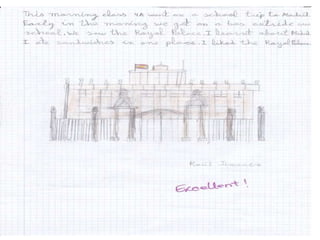
Royal Palace of Madrid
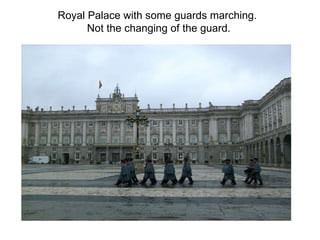
Royal Palace with some guards marching.  Not the changing of the guard.
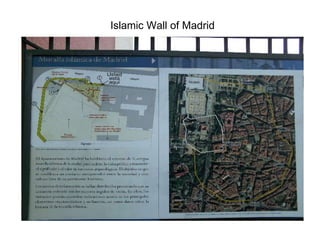
Islamic Wall of Madrid
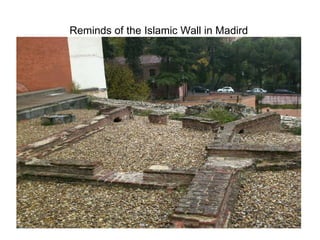
Reminds of the Islamic Wall in Madird
Islamic Wall
Mohamed I Park in Madrid


Plaza de la Villa
Plaza de la Villa
Writings from Medieval Madrid


Old madrid1

  • 1.
    Photo Album Visitto Old Madrid Ntra. Sra. Del Remolino El Molar – Madrid - Spain
  • 2.
    MADRID capital ofSpain The origins of the city dates back to the Paleolithic. Around 1000 B.C, Madrid was inhabited by Iberian tribes, mingling later with Celtics. In 218 B.C the Roman colonization began and the region of Madrid became a focal point of numerous Roman roads. After the decline of the Empire, in the fourth century Madrid became a Visigothic seat with capital in Toledo. In X-th century, the Arabs invaded Madrid. Since then, during the years of the Christian re-conquest Madrid changed hands on various occasions until it was finally liberated by King Alfonso VI in 1080. During the XV-th century, the city became the usual residence of the Royal family. In the XVI-th century, Madrid had about 17.000 inhabitants and it was then, that the King Felipe II moved the Royal Court and transformed Madrid into capital. During this period Madrid suffered a great architectural and cultural expansion, known as the Golden Age with writers as Cervantes, Lope de Vega, etc. In the XVII-th century Madrid became the most important city in Spain with the constructions of museums, gardens, etc. In the XIX-th century, the first uprising against Napoleon took place in the city and it was the origin of the War of Independence. In the twentieth century, excluding the years of the Civil War (1936-1939), Madrid became a large cosmopolitan city, having been named the European Cultural Capital in 1992.
  • 3.
  • 4.
  • 5.
    Muslim and Christianwalls in Madrid
  • 6.
  • 7.
    Madrid Cathedral infront of the palace
  • 8.
  • 9.
    Royal Palace withsome guards marching. Not the changing of the guard.
  • 10.
  • 11.
    Reminds of theIslamic Wall in Madird
  • 12.
  • 13.
    Mohamed I Parkin Madrid
  • 14.
  • 15.
  • 16.
  • 17.
  • 18.
  • 19.
  • 20.
  • 21.
  • 22.
  • 23.
  • 24.
  • 25.
  • 26.
  • 27.
  • 28.
  • 29.
  • 30.
  • 31.
  • 32.
  • 33.
  • 34.
  • 35.
  • 36.
  • 37.
  • 38.
  • 39.

Editor's Notes

  • #7 Madrid Cathedral
  • #8 Madrid Cathedral