/IV — X A.D./
• There are several theories
concerning the origin of the
Ogham writing system:
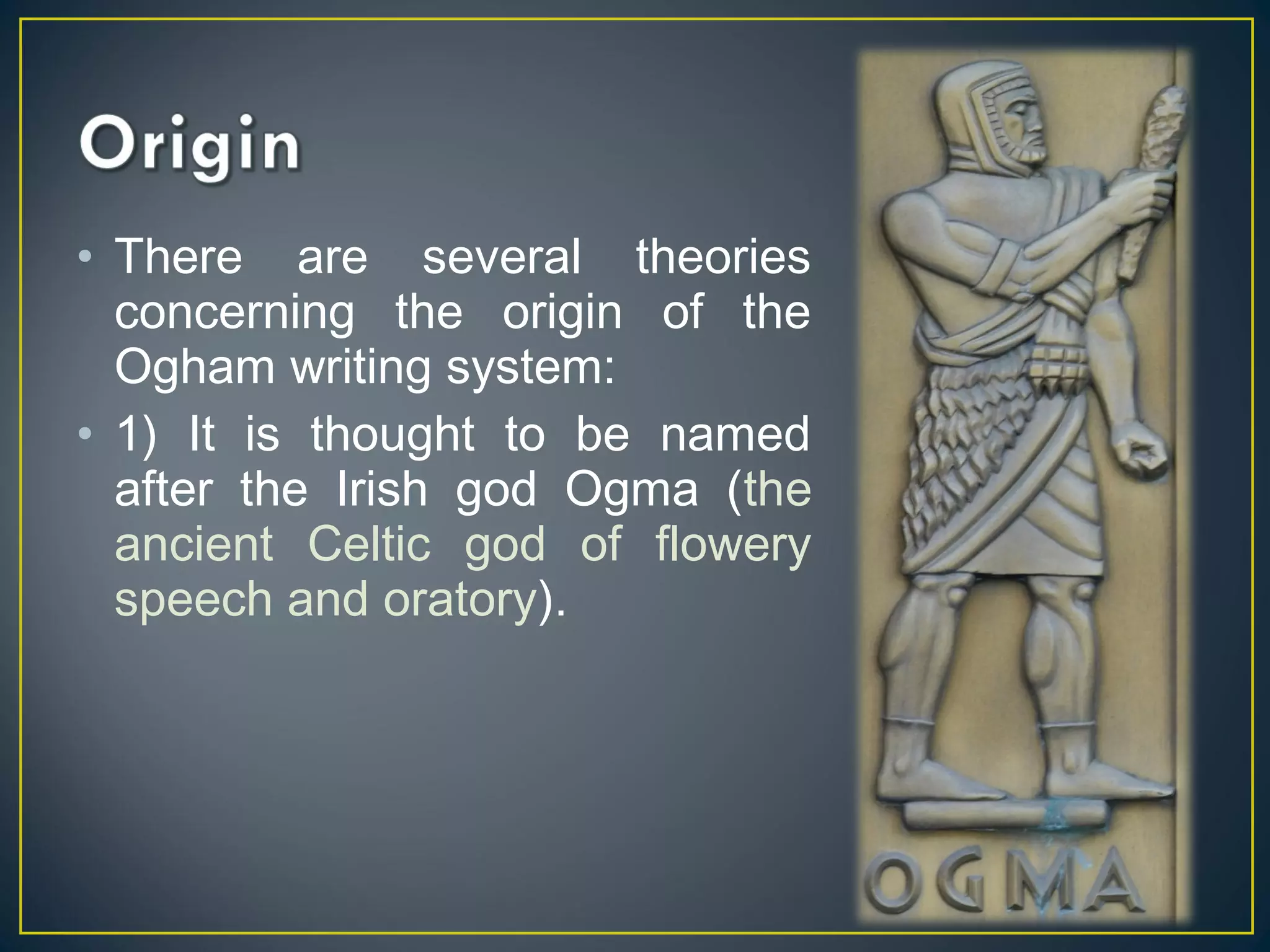
• 1) It is thought to be named
after the Irish god Ogma (the
ancient Celtic god of flowery
speech and oratory). 
• 2) It is asserted that
the alphabet was
created by Irish
scholars or druids for
political, military or
religious reasons to
provide a secret
means of
communication in
opposition to the
authorities of Roman
Britain.
• 3) The Ogham WS was
invented by the first
Christian communities in
early Ireland, out of a
desire to have a unique
alphabet for writing short
messages and inscriptions
in the Irish language.
• About 500 Ogham
inscriptions have been
found in Ireland,
Scotland, Wales and in
parts of western
England dating from
between the 4th and 7th
centuries AD. 
• Ogham WS is the
earliest written
representation of the
Irish language. It was
created using of a
series of
perpendicular and
intersecting lines.
• Sometimes the vowels
use dots rather than
lines intersecting the
vertical axis.
Ballintaggart, Dingle, Kerry, Ireland
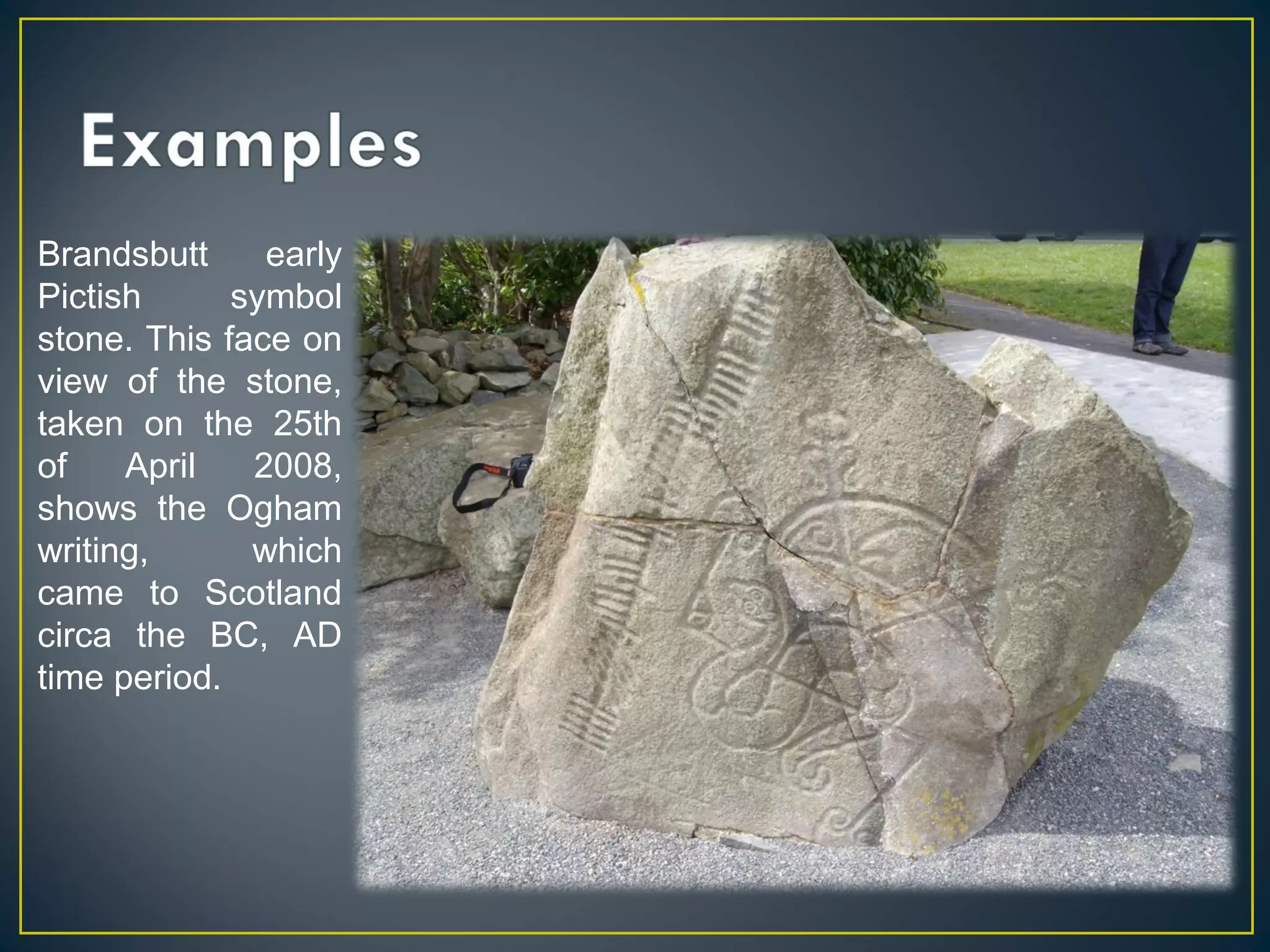
Brandsbutt early
Pictish symbol
stone. This face on
view of the stone,
taken on the 25th
of April 2008,
shows the Ogham
writing, which
came to Scotland
circa the BC, AD
time period.
The stone in Dromatimore in
Aghabullogue was originally located
in Mountrivers before it was moved to
its present site in 1851. The
inscription has been decoded as
MADORA MAQI DEGO or NO MAQI
DEGO. The translation is unclear but
it is thought to be in honour of some
important chief or warrior of the Clana
Deaghda tribe. These were a tribe of
knights who lived in Ireland and held
their territory in West Munster.
The stone is 2.72 metres high and 2.5
metres on the sloped side. It is 0.8
metres wide. It faces east and like the
well nearby is maintained in good
condition.
• Contemporary Irish jewelers
sometimes craft personal
items such as pendants and
bracelets using the Ogham
script. One such master
craftsman is Brian de Staic
o f An Daing e an.
• Plaques in Ogham by Ethel
Kelly are very popular as a
gift for any special occasion
in Ireland and England.
• Also it is used within the
scope of esoteric disciplines
for divination and for the
creation of various oghamic

Ogham writing system

  • 1.
  • 2.
    • There areseveral theories concerning the origin of the Ogham writing system: • 1) It is thought to be named after the Irish god Ogma (the ancient Celtic god of flowery speech and oratory). 
  • 3.
    • 2) Itis asserted that the alphabet was created by Irish scholars or druids for political, military or religious reasons to provide a secret means of communication in opposition to the authorities of Roman Britain.
  • 4.
    • 3) TheOgham WS was invented by the first Christian communities in early Ireland, out of a desire to have a unique alphabet for writing short messages and inscriptions in the Irish language.
  • 5.
    • About 500Ogham inscriptions have been found in Ireland, Scotland, Wales and in parts of western England dating from between the 4th and 7th centuries AD. 
  • 7.
    • Ogham WSis the earliest written representation of the Irish language. It was created using of a series of perpendicular and intersecting lines. • Sometimes the vowels use dots rather than lines intersecting the vertical axis.
  • 10.
  • 12.
    Brandsbutt early Pictish symbol stone.This face on view of the stone, taken on the 25th of April 2008, shows the Ogham writing, which came to Scotland circa the BC, AD time period.
  • 13.
    The stone inDromatimore in Aghabullogue was originally located in Mountrivers before it was moved to its present site in 1851. The inscription has been decoded as MADORA MAQI DEGO or NO MAQI DEGO. The translation is unclear but it is thought to be in honour of some important chief or warrior of the Clana Deaghda tribe. These were a tribe of knights who lived in Ireland and held their territory in West Munster. The stone is 2.72 metres high and 2.5 metres on the sloped side. It is 0.8 metres wide. It faces east and like the well nearby is maintained in good condition.
  • 14.
    • Contemporary Irishjewelers sometimes craft personal items such as pendants and bracelets using the Ogham script. One such master craftsman is Brian de Staic o f An Daing e an. • Plaques in Ogham by Ethel Kelly are very popular as a gift for any special occasion in Ireland and England. • Also it is used within the scope of esoteric disciplines for divination and for the creation of various oghamic