OERBENEFITS AND CHALLENGES BY JOSH
KILDALL
BENEFITS:
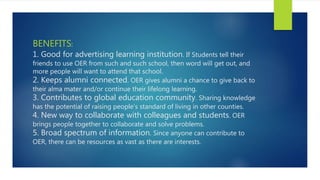
1. Good for advertising learning institution. If Students tell their
friends to use OER from such and such school, then word will get out, and
more people will want to attend that school.
2. Keeps alumni connected. OER gives alumni a chance to give back to
their alma mater and/or continue their lifelong learning.
3. Contributes to global education community. Sharing knowledge
has the potential of raising people’s standard of living in other counties.
4. New way to collaborate with colleagues and students. OER
brings people together to collaborate and solve problems.
5. Broad spectrum of information. Since anyone can contribute to
OER, there can be resources as vast as there are interests.
Challenges:
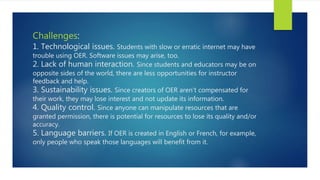
1. Technological issues. Students with slow or erratic internet may have
trouble using OER. Software issues may arise, too.
2. Lack of human interaction. Since students and educators may be on
opposite sides of the world, there are less opportunities for instructor
feedback and help.
3. Sustainability issues. Since creators of OER aren’t compensated for
their work, they may lose interest and not update its information.
4. Quality control. Since anyone can manipulate resources that are
granted permission, there is potential for resources to lose its quality and/or
accuracy.
5. Language barriers. If OER is created in English or French, for example,
only people who speak those languages will benefit from it.

OER

  • 1.
  • 2.
    BENEFITS: 1. Good foradvertising learning institution. If Students tell their friends to use OER from such and such school, then word will get out, and more people will want to attend that school. 2. Keeps alumni connected. OER gives alumni a chance to give back to their alma mater and/or continue their lifelong learning. 3. Contributes to global education community. Sharing knowledge has the potential of raising people’s standard of living in other counties. 4. New way to collaborate with colleagues and students. OER brings people together to collaborate and solve problems. 5. Broad spectrum of information. Since anyone can contribute to OER, there can be resources as vast as there are interests.
  • 3.
    Challenges: 1. Technological issues.Students with slow or erratic internet may have trouble using OER. Software issues may arise, too. 2. Lack of human interaction. Since students and educators may be on opposite sides of the world, there are less opportunities for instructor feedback and help. 3. Sustainability issues. Since creators of OER aren’t compensated for their work, they may lose interest and not update its information. 4. Quality control. Since anyone can manipulate resources that are granted permission, there is potential for resources to lose its quality and/or accuracy. 5. Language barriers. If OER is created in English or French, for example, only people who speak those languages will benefit from it.