I’m American.
Where are
you from?
lesson description
You will be able to identify what country
people are from and use the present tense
form of the verbs “live” and “have.”

objectives
• Discuss place of origin
• Use articles
• Practice present tense verbs

Lesson ID: #0379 	

page 1
vocabulary

T

R
SPO

PAS

tes
Sta
ted
ca
Uni Ameri
of

1

3

5

7

2

4

6

8

Ich bin
Deutscher

1
2

verbs
to live
I live
you live
she/he/it lives
they/we live

Lesson ID: #0379 	

flag
language

3
4

passport
buildings

5
6

Africa
world

your turn
to have
I have
you have
she/he/it has
they/we have

8

man
woman

key phrases

Fill in the blank with the correct
“to live” or “to have” verb.

7

Thank you.
You’re welcome.
Where are you from?
I am from …
Where do you live?
I live in …

For example:
Simon lives in Ireland.
				
1.	 She ________ in Toronto.
2.	 Do you ________ a passport?
3.	 Where do you ________?
4.	 We ________ in the United States.
5.	 She ________ a friend in Asia.
6.	 Sara _________ in Los Angeles.
7.	 Peter ________ a job.
8.	 Peter and Jeff ________ in the city.

page 2
conversation
Read the following conversation
out loud five times.
Narrator: 	 Where are you from?
Peter: 	 am from the United States.
I
I am an American.
Narrator: 	 Where are they from?
Kim: 	
They are from China. They are
Chinese.
Narrator: 	 Where is she from?
Jeff: 	
She is from India. She is Indian.
Narrator: 	 Where are you from?
Sara: 	 are from Mexico. We are
We
Mexicans.
Narrator: 	 Where do you live?
Peter: 	 I live in the United States.

your turn

Bonus Feature: Watch the English Highway video to follow along! (Lesson ID: #0319)

4. Where does your friend live?

Answer the questions using complete sentences and
the correct “to be,” “to live,” or “to have” verbs.
For example:
She lives in Norway.

	
5. What kind of house do you have?

1. Where do you live?

	
6. Where is your grandmother from?

	
2. What city is your mother from?

	
7. Does your father have a passport?

	
3. Does Brazil have an orange flag?

	
8. Where are Japanese people from?


Lesson ID: #0379 	

page 3
articles

your turn

1.	
Use an with general nouns starting with a vowel (a,e,i,o,u).

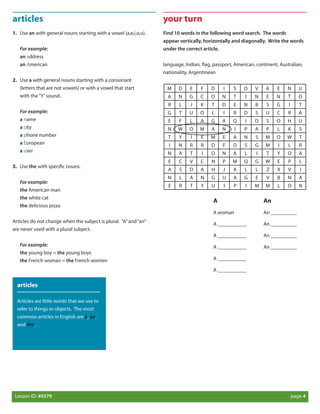
Find 10 words in the following word search. The words
appear vertically, horizontally and diagonally. Write the words
under the correct article.


For example:
an address
an American

2.	
Use a with general nouns starting with a consonant
(letters that are not vowels) or with a vowel that start
with the “Y” sound.

language, Indian, flag, passport, American, continent, Australian,
nationality, Argentinean


For example:
the American man
the white cat
the delicious pizza

D

E

F

D

A

N

G

C

R
	 For example:
	 a name
	 a city
	 a phone number
	 a European
	 a user	
			
3.	 Use the with specific nouns.

M

I

S

D

V

A

E

N

U

L

J

K

O

N

T

D

T

I

N

E

N

T

O

E

N

B

S

G

I

T

G

T

U

O

L

I

R

D

S

U

C

R

A

E

F

L

A

G

A

Q

I

D

S

O

H

U

N

W

O

M

A

N

I

P

A

P

L

K

S

T

Y

I

E

M

E

A

N

S

M

O

W

T

I

N

R

R

D

F

D

S

G

M

I

L

R

N

A

T

I

O

N

A

L

I

T

Y

O

A

E

C

V

C

N

P

M

Q

G

W

E

P

L

A

S

D

A

H

J

K

L

L

Z

X

V

I

N

L

A

N

G

U

A

G

E

V

B

N

A

E

R

T

Y

U

I

P

I

M

M

L

O

N

For example:
the young boy = the young boys
the French woman = the French women

An __________

A ___________

An __________

A ___________


An

A woman
Articles do not change when the subject is plural. “A” and “an”
are never used with a plural subject.

A

An __________

A ___________

An __________

A ___________
A ___________


articles
Articles are little words that we use to
refer to things or objects. The most
common articles in English are a, an,
and the.

Lesson ID: #0379 	

page 4
putting it all together…

cultural tip

Practice this conversation (in English, please!) with two other friends or classmates.
Take turns as each speaker.

When you meet new friends, try
using phrases like “Oh really?”,
“How interesting!”, or “Wow!” to
show you are interested in them.

Student 1 	

Hello, my name’s ___________________________________________ .

Student 2 	

(I’m) glad to meet you. My name is _____________________________ .

Student 1 	

This is my friend ____________________________________________ .

Student 3 	

Pleased to meet you.

Student 2	

Where are you from, ________________________________________?

Student 1	

I (am/live)_________________________________________________ .

Student 3	

Oh really? I_______________________________________ from Santiago.

Student 2	

Wow! Chile _________________________ great food/people/mountains!

Student 3	

Where does your family live?

Student 2	

My family _________________________________________________ .

Student 1	

Do you __________________________________________ a passport?

Student 3	

I have ____________________________________________________ .

Lesson ID: #0379 	

page 5
Answer Key	

your turn - exercise 1

your turn - exercise 2

1. 	 lives
2. 	 have
3. 	 live
4. 	 live
5. 	 has
6. 	 lives
7. 	 has
8. 	 live

1. 	 I live in (Caracas).
2. 	 My mother is from (Pasadena).
3. 	 No, Brazil has a green flag.
4. 	 My friend lives in (London).
5. 	 I have (an old) house.
6. 	 My grandmother is from (Moscow).
7. 	 My father (has/does not have) a passport.
8. 	 Japanese people are from Japan.

your turn - exercise 3

putting it together - exercise 4

(in any order)
• a nationality
• a passport
• a language
• a woman
• a continent
• a flag

Student 1:
Student 2:
Student 1:
Student 3:

Hello, my name is (Andrea).
(I’m) glad to meet you. My name is (Satomi).
This is my friend. (His/her name is Robin.)
Pleased to meet you.

Student 2:
Student 1:
Student 3:
Student 2:

Where are you from, (name)?
I (am from Colombia/live in America).
Oh really? I am from Santiago.
Wow! Chile has great (food/people/mountains)!

Student 3:
Student 2:
Student 1:
Student 3:

Where does your family live?
My family lives in (Osaka).
Do you have a passport?
(Yes/No), I (have/don’t have) a passport.

• an American
• an Australian
• an Argentinean
• an Indian

Lesson ID: #0379 	

page 6

Oe worksheet basic_0379_0

  • 1.
    I’m American. Where are youfrom? lesson description You will be able to identify what country people are from and use the present tense form of the verbs “live” and “have.” objectives • Discuss place of origin • Use articles • Practice present tense verbs Lesson ID: #0379 page 1
  • 2.
    vocabulary T R SPO PAS tes Sta ted ca Uni Ameri of 1 3 5 7 2 4 6 8 Ich bin Deutscher 1 2 verbs tolive I live you live she/he/it lives they/we live Lesson ID: #0379 flag language 3 4 passport buildings 5 6 Africa world your turn to have I have you have she/he/it has they/we have 8 man woman key phrases Fill in the blank with the correct “to live” or “to have” verb. 7 Thank you. You’re welcome. Where are you from? I am from … Where do you live? I live in … For example: Simon lives in Ireland. 1. She ________ in Toronto. 2. Do you ________ a passport? 3. Where do you ________? 4. We ________ in the United States. 5. She ________ a friend in Asia. 6. Sara _________ in Los Angeles. 7. Peter ________ a job. 8. Peter and Jeff ________ in the city. page 2
  • 3.
    conversation Read the followingconversation out loud five times. Narrator: Where are you from? Peter: am from the United States. I I am an American. Narrator: Where are they from? Kim: They are from China. They are Chinese. Narrator: Where is she from? Jeff: She is from India. She is Indian. Narrator: Where are you from? Sara: are from Mexico. We are We Mexicans. Narrator: Where do you live? Peter: I live in the United States. your turn Bonus Feature: Watch the English Highway video to follow along! (Lesson ID: #0319) 4. Where does your friend live? Answer the questions using complete sentences and the correct “to be,” “to live,” or “to have” verbs. For example: She lives in Norway. 5. What kind of house do you have? 1. Where do you live? 6. Where is your grandmother from? 2. What city is your mother from? 7. Does your father have a passport? 3. Does Brazil have an orange flag? 8. Where are Japanese people from? Lesson ID: #0379 page 3
  • 4.
    articles your turn 1. Use anwith general nouns starting with a vowel (a,e,i,o,u). Find 10 words in the following word search. The words appear vertically, horizontally and diagonally. Write the words under the correct article. For example: an address an American 2. Use a with general nouns starting with a consonant (letters that are not vowels) or with a vowel that start with the “Y” sound. language, Indian, flag, passport, American, continent, Australian, nationality, Argentinean For example: the American man the white cat the delicious pizza D E F D A N G C R For example: a name a city a phone number a European a user 3. Use the with specific nouns. M I S D V A E N U L J K O N T D T I N E N T O E N B S G I T G T U O L I R D S U C R A E F L A G A Q I D S O H U N W O M A N I P A P L K S T Y I E M E A N S M O W T I N R R D F D S G M I L R N A T I O N A L I T Y O A E C V C N P M Q G W E P L A S D A H J K L L Z X V I N L A N G U A G E V B N A E R T Y U I P I M M L O N For example: the young boy = the young boys the French woman = the French women An __________ A ___________ An __________ A ___________ An A woman Articles do not change when the subject is plural. “A” and “an” are never used with a plural subject. A An __________ A ___________ An __________ A ___________ A ___________ articles Articles are little words that we use to refer to things or objects. The most common articles in English are a, an, and the. Lesson ID: #0379 page 4
  • 5.
    putting it alltogether… cultural tip Practice this conversation (in English, please!) with two other friends or classmates. Take turns as each speaker. When you meet new friends, try using phrases like “Oh really?”, “How interesting!”, or “Wow!” to show you are interested in them. Student 1 Hello, my name’s ___________________________________________ . Student 2 (I’m) glad to meet you. My name is _____________________________ . Student 1 This is my friend ____________________________________________ . Student 3 Pleased to meet you. Student 2 Where are you from, ________________________________________? Student 1 I (am/live)_________________________________________________ . Student 3 Oh really? I_______________________________________ from Santiago. Student 2 Wow! Chile _________________________ great food/people/mountains! Student 3 Where does your family live? Student 2 My family _________________________________________________ . Student 1 Do you __________________________________________ a passport? Student 3 I have ____________________________________________________ . Lesson ID: #0379 page 5
  • 6.
    Answer Key your turn- exercise 1 your turn - exercise 2 1. lives 2. have 3. live 4. live 5. has 6. lives 7. has 8. live 1. I live in (Caracas). 2. My mother is from (Pasadena). 3. No, Brazil has a green flag. 4. My friend lives in (London). 5. I have (an old) house. 6. My grandmother is from (Moscow). 7. My father (has/does not have) a passport. 8. Japanese people are from Japan. your turn - exercise 3 putting it together - exercise 4 (in any order) • a nationality • a passport • a language • a woman • a continent • a flag Student 1: Student 2: Student 1: Student 3: Hello, my name is (Andrea). (I’m) glad to meet you. My name is (Satomi). This is my friend. (His/her name is Robin.) Pleased to meet you. Student 2: Student 1: Student 3: Student 2: Where are you from, (name)? I (am from Colombia/live in America). Oh really? I am from Santiago. Wow! Chile has great (food/people/mountains)! Student 3: Student 2: Student 1: Student 3: Where does your family live? My family lives in (Osaka). Do you have a passport? (Yes/No), I (have/don’t have) a passport. • an American • an Australian • an Argentinean • an Indian Lesson ID: #0379 page 6