CHANGE MANAGEMENT Lakeland Wonders (Case Analysis)
Case Overview Cheryl Hailstrom, the CEO is the first person outside the Swensen family to hold the top job. She'd been the COO of one of its largest customers and had worked with Lakeland to develop many best-selling products.  Wally Swensen IV, the previous CEO, chose Cheryl because she knew how to generate profits and because he believed her energy and enthusiasm could take the company to the next level. She is, nearing her six-month anniversary, wondering why her expansive vision for the company isn't taking hold. She's tried to lead by example
Problem The problem is that while Cheryl's senior managers are giving her the nod on the surface, they're all really dragging their feet.  Question Is Cheryl pushing too much change too quickly? Should she bring in outsiders to speedily adopt the changes she envisions and overhaul Lakeland's corporate culture?
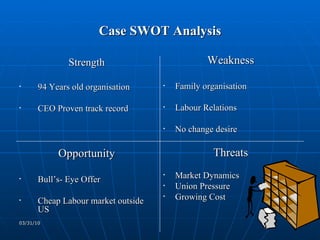
Case SWOT Analysis Strength 94 Years old organisation CEO Proven track record Opportunity Bull’s- Eye Offer Cheap Labour market outside US Weakness Family organisation Labour Relations No change desire Threats Market Dynamics Union Pressure Growing Cost
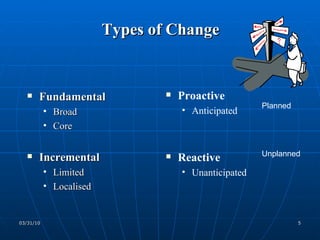
Types of Change Fundamental Broad Core Incremental Limited Localised Proactive   Anticipated Reactive  Unanticipated Planned Unplanned
The Nature of Organisational Change “ Change is a process that is rarely contained within functional, or specialist, boundaries”
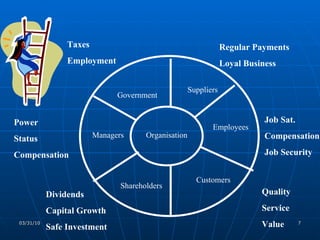
Taxes Employment Power Status Compensation Dividends Capital Growth Safe Investment Quality Service Value Job Sat. Compensation Job Security Regular Payments Loyal Business Organisation Suppliers Employees Customers Shareholders Managers Government
“ The common factor is that when something changes, whether or not it has been planned or decided by organisational members, it will have repercussive effects which will be variously welcomed, discarded or ignored by people within and outside the organisation.  Their reactions will in turn affect other things.” Dawson, S.
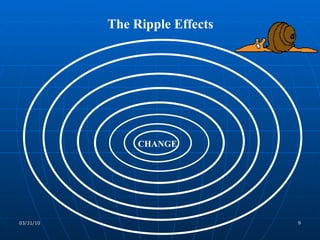
The Ripple Effects CHANGE
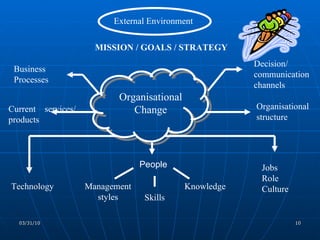
Organisational Change Business Processes Current  services/products Technology People Management styles Knowledge Skills External Environment Decision/ communication channels Organisational structure Jobs Role Culture MISSION / GOALS / STRATEGY
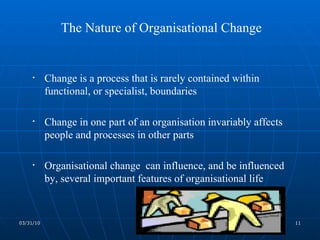
The Nature of Organisational Change Change is a process that is rarely contained within functional, or specialist, boundaries Change in one part of an organisation invariably affects people and processes in other parts Organisational change  can influence, and be influenced by, several important features of organisational life
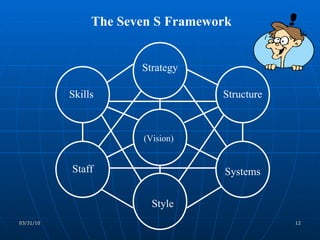
The Seven S Framework Staff Skills (Vision) Structure Systems Strategy Style
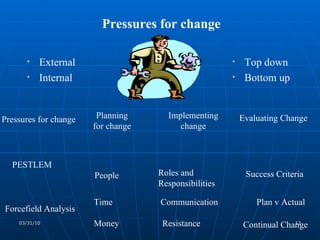
Pressures for change External Internal Top down Bottom up Implementing change Planning for change Pressures for change Evaluating Change PESTLEM Forcefield Analysis Money Time People Resistance Communication Roles and Responsibilities Continual Change Plan v Actual  Success Criteria
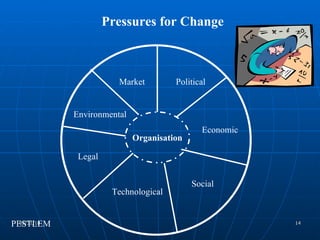
Organisation Social Legal Environmental Political Economic Technological Pressures for Change PESTLEM Market
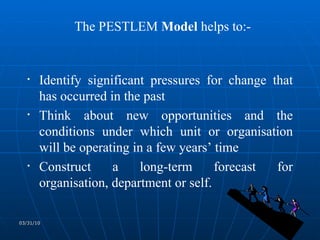
The PESTLEM  Model  helps to:- Identify significant pressures for change that has occurred in the past Think about new opportunities and the conditions under which unit or organisation will be operating in a few years’ time Construct a long-term forecast for organisation, department or self.
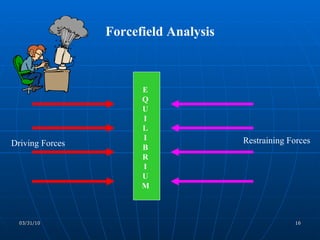
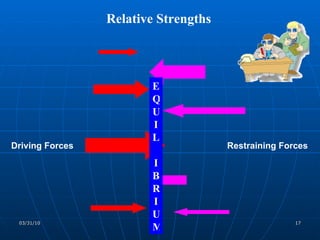
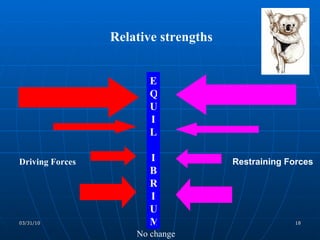
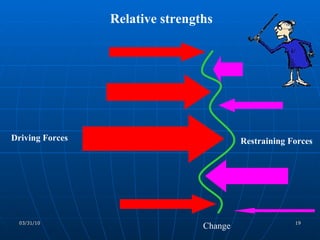
Forcefield Analysis Driving Forces Restraining Forces E Q U I L I B R I U M
Driving Forces Restraining Forces Relative Strengths EQUI L I BRI UM
Driving Forces Restraining Forces No change Relative strengths EQUI L I BRI UM
Driving Forces Restraining Forces Change Relative strengths
Approaches to overcoming resistance to change Educative Facilitative Participative Persuasive Manipulative Coercive
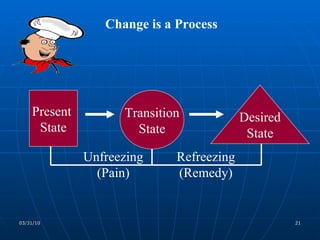
Present  State Desired State Transition State Unfreezing (Pain) Refreezing (Remedy) Change is a Process
Low Stability High Emotional Stress High, often undirected energy Control becomes a major issue Past patterns of behaviour become highly valued Conflict increases. Some characteristics of the Transition State
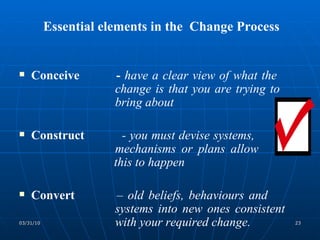
Essential elements in the  Change Process Conceive  -  have a clear view of what the  change is that you are trying to  bring about Construct  - you must devise systems,  mechanisms or plans allow    this to happen  Convert   –  old beliefs, behaviours and  systems into new ones consistent  with your required change.
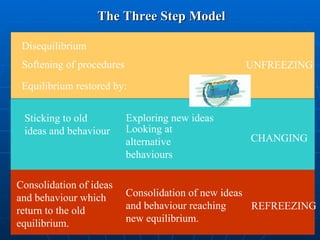
Stages in the Change Process Unfreezing  –  the need to change existing  attitudes towards working practices and processes before the change can begin to take place Changing  –  the implementation stage.  Its success will depend on the thoroughness of the planning and preparation in the first stage Refreezing   –  consolidation.  The change has been incorporated into the working culture.
The Three Step Model Disequilibrium Softening of procedures Equilibrium restored by: Sticking to old ideas and behaviour Exploring new ideas Looking at alternative  behaviours Consolidation of ideas and behaviour which return to the old equilibrium. Consolidation of new ideas and behaviour reaching new equilibrium. UNFREEZING CHANGING REFREEZING
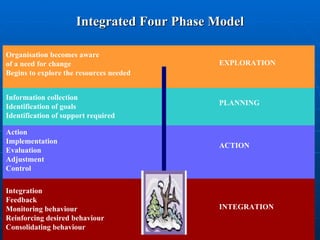
Integrated Four Phase Model Organisation becomes aware of a need for change Begins to explore the resources needed EXPLORATION Information collection Identification of goals Identification of support required PLANNING Action Implementation Evaluation Adjustment Control ACTION Integration Feedback Monitoring behaviour Reinforcing desired behaviour Consolidating behaviour INTEGRATION
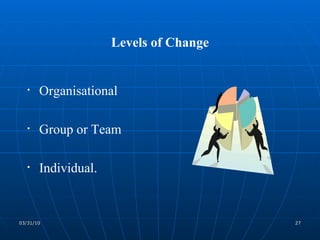
Levels of Change Organisational Group or Team Individual.
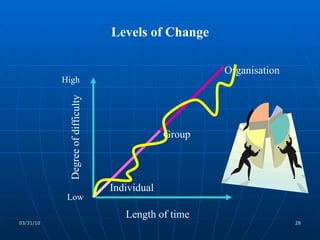
High Low Group Individual Organisation Degree of difficulty Length of time Levels of Change
Change, whether in products,services, market strategies, technological processes or work practices, are designed and implemented not by machines, but by people”
Jeanie Daniel Duck
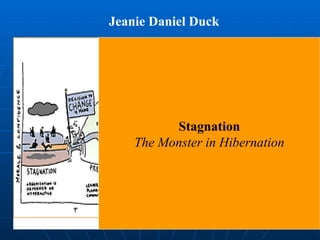
Jeanie Daniel Duck Stagnation The Monster in Hibernation
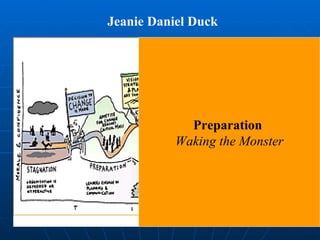
Jeanie Daniel Duck Preparation   Waking the Monster
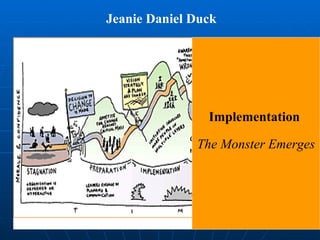
Jeanie Daniel Duck Implementation   The Monster Emerges
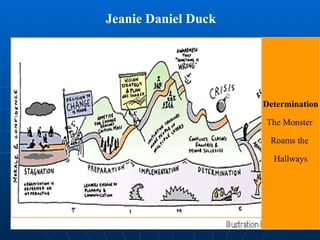
Jeanie Daniel Duck Determination The Monster  Roams the  Hallways
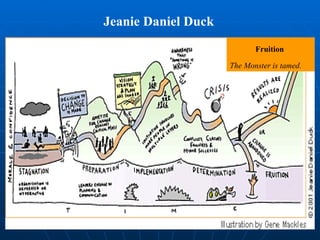
Jeanie Daniel Duck Fruition   The Monster is tamed.
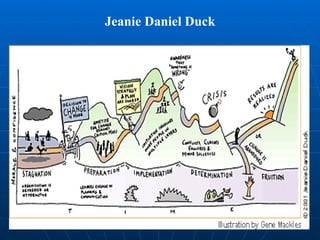
5 Phases of Change Curve  Stagnation  –  The Monster in Hibernation Preparation  –  Waking the Monster Implementation -  The Monster Emerges Determination  –  The Monster Roams the Hallways Fruition  –  The Monster is tamed.
Recommendations Lakeland Wonders CEO must convince Management Team CEO must chart all the Process and Steps involved Time- Span, considering Past, Present and Future calculated out Change must be carried out in Steps in due course of time Quality and Standard of product must be maintained
By: Anubhuti Gupta Kanika Rimpy  Maitreyi Sahoo Soumya Gupta Surya Kanta Jena Thank You !!!!

Od

  • 1.
    CHANGE MANAGEMENT LakelandWonders (Case Analysis)
  • 2.
    Case Overview CherylHailstrom, the CEO is the first person outside the Swensen family to hold the top job. She'd been the COO of one of its largest customers and had worked with Lakeland to develop many best-selling products. Wally Swensen IV, the previous CEO, chose Cheryl because she knew how to generate profits and because he believed her energy and enthusiasm could take the company to the next level. She is, nearing her six-month anniversary, wondering why her expansive vision for the company isn't taking hold. She's tried to lead by example
  • 3.
    Problem The problemis that while Cheryl's senior managers are giving her the nod on the surface, they're all really dragging their feet. Question Is Cheryl pushing too much change too quickly? Should she bring in outsiders to speedily adopt the changes she envisions and overhaul Lakeland's corporate culture?
  • 4.
    Case SWOT AnalysisStrength 94 Years old organisation CEO Proven track record Opportunity Bull’s- Eye Offer Cheap Labour market outside US Weakness Family organisation Labour Relations No change desire Threats Market Dynamics Union Pressure Growing Cost
  • 5.
    Types of ChangeFundamental Broad Core Incremental Limited Localised Proactive Anticipated Reactive Unanticipated Planned Unplanned
  • 6.
    The Nature ofOrganisational Change “ Change is a process that is rarely contained within functional, or specialist, boundaries”
  • 7.
    Taxes Employment PowerStatus Compensation Dividends Capital Growth Safe Investment Quality Service Value Job Sat. Compensation Job Security Regular Payments Loyal Business Organisation Suppliers Employees Customers Shareholders Managers Government
  • 8.
    “ The commonfactor is that when something changes, whether or not it has been planned or decided by organisational members, it will have repercussive effects which will be variously welcomed, discarded or ignored by people within and outside the organisation. Their reactions will in turn affect other things.” Dawson, S.
  • 9.
  • 10.
    Organisational Change BusinessProcesses Current services/products Technology People Management styles Knowledge Skills External Environment Decision/ communication channels Organisational structure Jobs Role Culture MISSION / GOALS / STRATEGY
  • 11.
    The Nature ofOrganisational Change Change is a process that is rarely contained within functional, or specialist, boundaries Change in one part of an organisation invariably affects people and processes in other parts Organisational change can influence, and be influenced by, several important features of organisational life
  • 12.
    The Seven SFramework Staff Skills (Vision) Structure Systems Strategy Style
  • 13.
    Pressures for changeExternal Internal Top down Bottom up Implementing change Planning for change Pressures for change Evaluating Change PESTLEM Forcefield Analysis Money Time People Resistance Communication Roles and Responsibilities Continual Change Plan v Actual Success Criteria
  • 14.
    Organisation Social LegalEnvironmental Political Economic Technological Pressures for Change PESTLEM Market
  • 15.
    The PESTLEM Model helps to:- Identify significant pressures for change that has occurred in the past Think about new opportunities and the conditions under which unit or organisation will be operating in a few years’ time Construct a long-term forecast for organisation, department or self.
  • 16.
    Forcefield Analysis DrivingForces Restraining Forces E Q U I L I B R I U M
  • 17.
    Driving Forces RestrainingForces Relative Strengths EQUI L I BRI UM
  • 18.
    Driving Forces RestrainingForces No change Relative strengths EQUI L I BRI UM
  • 19.
    Driving Forces RestrainingForces Change Relative strengths
  • 20.
    Approaches to overcomingresistance to change Educative Facilitative Participative Persuasive Manipulative Coercive
  • 21.
    Present StateDesired State Transition State Unfreezing (Pain) Refreezing (Remedy) Change is a Process
  • 22.
    Low Stability HighEmotional Stress High, often undirected energy Control becomes a major issue Past patterns of behaviour become highly valued Conflict increases. Some characteristics of the Transition State
  • 23.
    Essential elements inthe Change Process Conceive - have a clear view of what the change is that you are trying to bring about Construct - you must devise systems, mechanisms or plans allow this to happen Convert – old beliefs, behaviours and systems into new ones consistent with your required change.
  • 24.
    Stages in theChange Process Unfreezing – the need to change existing attitudes towards working practices and processes before the change can begin to take place Changing – the implementation stage. Its success will depend on the thoroughness of the planning and preparation in the first stage Refreezing – consolidation. The change has been incorporated into the working culture.
  • 25.
    The Three StepModel Disequilibrium Softening of procedures Equilibrium restored by: Sticking to old ideas and behaviour Exploring new ideas Looking at alternative behaviours Consolidation of ideas and behaviour which return to the old equilibrium. Consolidation of new ideas and behaviour reaching new equilibrium. UNFREEZING CHANGING REFREEZING
  • 26.
    Integrated Four PhaseModel Organisation becomes aware of a need for change Begins to explore the resources needed EXPLORATION Information collection Identification of goals Identification of support required PLANNING Action Implementation Evaluation Adjustment Control ACTION Integration Feedback Monitoring behaviour Reinforcing desired behaviour Consolidating behaviour INTEGRATION
  • 27.
    Levels of ChangeOrganisational Group or Team Individual.
  • 28.
    High Low GroupIndividual Organisation Degree of difficulty Length of time Levels of Change
  • 29.
    Change, whether inproducts,services, market strategies, technological processes or work practices, are designed and implemented not by machines, but by people”
  • 30.
  • 31.
    Jeanie Daniel DuckStagnation The Monster in Hibernation
  • 32.
    Jeanie Daniel DuckPreparation Waking the Monster
  • 33.
    Jeanie Daniel DuckImplementation The Monster Emerges
  • 34.
    Jeanie Daniel DuckDetermination The Monster Roams the Hallways
  • 35.
    Jeanie Daniel DuckFruition The Monster is tamed.
  • 36.
    5 Phases ofChange Curve Stagnation – The Monster in Hibernation Preparation – Waking the Monster Implementation - The Monster Emerges Determination – The Monster Roams the Hallways Fruition – The Monster is tamed.
  • 37.
    Recommendations Lakeland WondersCEO must convince Management Team CEO must chart all the Process and Steps involved Time- Span, considering Past, Present and Future calculated out Change must be carried out in Steps in due course of time Quality and Standard of product must be maintained
  • 38.
    By: Anubhuti GuptaKanika Rimpy Maitreyi Sahoo Soumya Gupta Surya Kanta Jena Thank You !!!!