Engaging workers with
maintaining their own
wellbeing
Frank O’Connor
1
Many larger workplaces now have
wellbeing programmes
o Small workplaces too
o What can we learn?
Reports, experience and
observations from almost 100
New Zealand organisations
o Diverse aims / outcomes
Aspiration and achievement
Problems and expectations
2
O'Connor (c) 2016 - Engaging workers with maintaining their own wellbeing p2 of 19.
Information from …
Construction firms
o noticing and responding to
change in mental health in
self, workmates, contractors
and customers in separate
programme for staff and
safety-accountable managers
Disaster responders
o training special assistance
team members in recognising
and responding to mental
illness and distress symptoms
found near critical incidents
Elite sportspeople
o player self-assessments of
mental health, pressure or
stress; symptoms of
common illnesses with
tools and strategies for
each; giving and getting
help from team-mates
Emergency services
o awareness of common
mental illness symptoms
and responses, self-care
and fitness for work
3
O'Connor (c) 2016 - Engaging workers with maintaining their own wellbeing p3 of 19.
… and from …
Farming sector
o farm owner/manager awareness
of own and family mental health
symptoms, strategies; sources of
further help
Health promotion agencies
o staff and stakeholders; how to
maintain and recognise what’s
done now by individuals and
teams to keep current levels of
wellbeing; enhancing wellbeing;
assisting recovery of wellbeing
HR & H+S managers
o what mental health or illness
is; identify loss at work;
managing alongside injury or
wellness
Law keepers
o challenging conversation
training for managers with
employees about alcohol and
drug use
Manufacturers
o respond to mental distress
and illness; consent- and
help-finding to risk-
management
4
O'Connor (c) 2016 - Engaging workers with maintaining their own wellbeing p4 of 19.
… and also from …
Occupational health
professionals
o seminars on reducing their own
and their workforces’ losses to
distress, fatigue and burnout
Power sector
o training all staff in recognising
change in mental health and
safety behaviour; awareness of
common illnesses and safety
responses; intervening in
bullying; managing fatigue
Safety-critical transport
operators
o training to notice, assess and
respond to changes in own
and staff mental fitness for
work; mental health
awareness in self and others,
including passengers
Territorial local authorities
o workshops on common losses
of mental capacity for work
and using strengths still
present; accommodating
similar in members of the
public
5
O'Connor (c) 2016 - Engaging workers with maintaining their own wellbeing p5 of 19.
Expectations
Obviously
o The case of each
organisation is different
o Any data available are / will
be incompatible
What gains or concerns
might we expect to find?
o To what extent can we say
it's money well spent?
Did they spend it again?
6
O'Connor (c) 2016 - Engaging workers with maintaining their own wellbeing p6 of 19.
Diverse Aims … and Outcomes
o “Making workplaces, systems
and staff the best they can
be”
o “Reducing barriers and
promoting the values of
health and wellness”
o “Embed science-based
wellbeing habits into your
organisation that will increase
the happiness of your team
(at home and at work) and
boost engagement,
productivity and creativity”
Outcomes seem desirable:
o Know myths and truths
about mental illness and
mentally healthy
workplaces
o Identify what ways of
working are effective and
safe every individual
o Find sources and kinds of
stress and how to some
can be used to good effect
o Pursue mentally healthy
ways of working with
others
7
O'Connor (c) 2016 - Engaging workers with maintaining their own wellbeing p7 of 19.
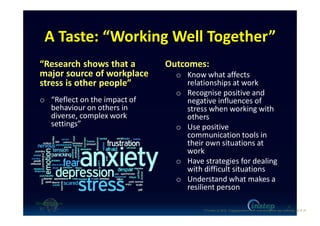
A Taste: “Working Well Together”
“Research shows that a
major source of workplace
stress is other people”
o “Reflect on the impact of
behaviour on others in
diverse, complex work
settings”
Outcomes:
o Know what affects
relationships at work
o Recognise positive and
negative influences of
stress when working with
others
o Use positive
communication tools in
their own situations at
work
o Have strategies for dealing
with difficult situations
o Understand what makes a
resilient person
8
O'Connor (c) 2016 - Engaging workers with maintaining their own wellbeing p8 of 19.
… and in Call and Contact Centres
Call and contact centre
work has grown rapidly
o But shift-work causes fatigue
which:
Increases accidents
Decreases productivity
Affects mood and eating
Lowers resistance to illness
Reduces effective teamwork
Practical and effective tools
and strategies:
o Maintain or regain good
mental health
o Sleep and eat well
o Reduce stress and fatigue
o Reduce impact of shift
work on social and family
life
o Keep relationships with
people working differently
9
O'Connor (c) 2016 - Engaging workers with maintaining their own wellbeing p9 of 19.
For Manager’s Leading Staff
Balancing ‘risk management’
in the light of:
o ‘mental harm’ section of HSE Act
o employees’ rights to health and
privacy
o cost-effectiveness & productivity
Managing to get work done
while managing the impact of:
o organisational stress
o individual distress
o myths and misunderstandings
o ineffective communication
Outcomes:
o Describe mental healthiness
in this workplace
o Notice positive and negative
stressors and stress
responses
o Recognise the characteristics
that keep a person resilient
o Work with tools to help
people to “rise again” after a
setback
o Communicate better
o Maintain what is working well
for staff in this workplace
10
O'Connor (c) 2016 - Engaging workers with maintaining their own wellbeing p10 of 19.
Managers’ Guide to Mental Illness
“Mental illness is more
common in the community
and … it makes sense that
it is a growing issue at
work”
o “Unfortunately there are a lot
of myths and fears around
people who experience
mental illness”
o “… increase managers' ability
and confidence in dealing
successfully with the issues
that may (or may not) arise”
Outcomes
o Understand how and
where mental illness
occurs
o Know their role with
respect to staff with a
mental illness
o Aware of stigma and
discrimination
o Manage at-risk employees
o Take action when needed
o Familiar with workplace
law relating to mental
health
11
O'Connor (c) 2016 - Engaging workers with maintaining their own wellbeing p11 of 19.
Perhaps that is too much …
Rising to the challenge of
real work:
o Balancing personal and
workplace needs
o Knowing what to do when the
pressure is on
o Maintaining safe ways of
working for all
Self-assess and discuss:
o How I am – at work and
beyond
o How I maintain well-being
o What “balance” looks like
Find ways to:
o Use stress positively
o Keep life in balance
o Address key challenges
o Cut unhealthy practices
12
O'Connor (c) 2016 - Engaging workers with maintaining their own wellbeing p12 of 19.
Aspiration and achievement
With goals of improving
the work and the
workers, what do they
actually achieve?
o Aspirations and results
rarely compared
Anecdote prevails
Unwilling to ask?
Unwilling to pay?
o Most achieved: recovery
Measures of increased resilience?
Weak link from engagement?
Are aspirations too diverse?
13
O'Connor (c) 2016 - Engaging workers with maintaining their own wellbeing p13 of 19.
Good Delivery in Summary
Wide range of topics
o Work and family balance
o Capacity for working smarter /
better
o Shift work and sleep
o Food and mood
o Innovation and creativity
o Productivity and balance
o Aging in the workplace
o Coping with change
o Common illnesses: distress,
depression & anxiety, abuses
o Capacity for safe work
Competing goals
o Maintain and recognise
current levels of wellbeing
or
o Build and enhance wellbeing
organisation-wide
or
o Assist recovery of employees
who have lost wellbeing
Variances matter
o Examples vs population data
o Issues raised vs strategies
o Practical tips vs intentions
o “Mental health” vs “illness”
14
O'Connor (c) 2016 - Engaging workers with maintaining their own wellbeing p14 of 19.
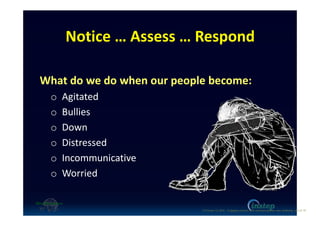
Notice … Assess … Respond
What do we do when our people become:
o Agitated
o Bullies
o Down
o Distressed
o Incommunicative
o Worried
O'Connor (c) 2016 - Engaging workers with maintaining their own wellbeing p15 of 19.
Keys to Effectiveness
Limit your scope
o Work and family balance
o Capacity for working smarter /
better
o Shift work and sleep
o Food and mood
o Innovation and creativity
o Productivity and balance
o Aging in the workplace
o Coping with change
o Common illnesses: distress,
depression & anxiety, abuses
o Capacity for safe work
Clarify goals
o Maintain and recognise
current levels of wellbeing
or
o Build and enhance wellbeing
organisation-wide
or
o Assist recovery of employees
who have lost wellbeing
What’s the matter?
o Examples vs population data
o Issues raised vs strategies
o Practical tips vs intentions
o “Mental health” vs “illness”
16
O'Connor (c) 2016 - Engaging workers with maintaining their own wellbeing p16 of 19.
What problems?
Number of early terminations
o Are the results any good?
Sometimes very durable
o How are the initiatives chosen?
Sometimes very personal
o How are they evaluated?
Do it again next year
o Where is leverage most easily
found?
Presenteeism productivity impact
o What are the promises most
likely to be kept?
Small, public ones
17
O'Connor (c) 2016 - Engaging workers with maintaining their own wellbeing p17 of 19.
What’s Producing Well?
Promote
o Increasing health and
wellbeing as a contribution to
motivation, capacity and then
productivity
Maintain
o Using sound practices to grow
and hold peer support, mental
safety and fitness for work
Recover
o Help those responding to or
recovering from losses of
fitness for work or life in
general
Frank O’Connor
o +64 21 386-911
o frank@moa.net.nz
O'Connor (c) 2016 - Engaging workers with maintaining their own wellbeing p18 of 19.
19
O'Connor (c) 2016 - Engaging workers with maintaining their own wellbeing p19 of 19.
Stigma Costs Productivity
Mental illness stigma
o Prevents disclosure
o Delays treatment
o Slows recovery
Pervasive effect
o Employment
o Healthcare
o Housing
o Social welfare
Impacts contribution in the
workforce and in keeping
communities healthy
Ways to reduce stigma:
o Protest
o Educate
o Contact
Corrigan and Watson (2002)
Understanding the impact of stigma on
people with mental illness
20
O'Connor (c) 2016 - Engaging workers with maintaining their own wellbeing p20 of 19.
Public Stigma …. and Self-Stigma
o Stereotypic negative belief
Dangerousness
Incompetence
Character weakness
o Prejudice in agreement
with belief, causing reaction
Anger
Fear
o Discrimination follows
prejudice
Avoidance
Withhold help and employment
or housing opportunities
o Negative self-belief
Incompetence
Character weakness
o Agreeing, and reacting
Feels low self-esteem
Feels low self-efficacy
o Self-discrimination
Fails to pursue work and
housing opportunities
Corrigan and Watson (2002)
Understanding the impact of stigma on
people with mental illness
21
O'Connor (c) 2016 - Engaging workers with maintaining their own wellbeing p21 of 19.
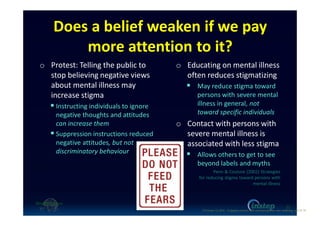
Does a belief weaken if we pay
more attention to it?
o Protest: Telling the public to
stop believing negative views
about mental illness may
increase stigma
Instructing individuals to ignore
negative thoughts and attitudes
can increase them
Suppression instructions reduced
negative attitudes, but not
discriminatory behaviour
o Educating on mental illness
often reduces stigmatizing
May reduce stigma toward
persons with severe mental
illness in general, not
toward specific individuals
o Contact with persons with
severe mental illness is
associated with less stigma
Allows others to get to see
beyond labels and myths
Penn & Couture (2002) Strategies
for reducing stigma toward persons with
mental illness
22
O'Connor (c) 2016 - Engaging workers with maintaining their own wellbeing p22 of 19.

O'Connor (2016) Engaging workers with maintaining their own wellbeing

  • 1.
    Engaging workers with maintainingtheir own wellbeing Frank O’Connor 1
  • 2.
    Many larger workplacesnow have wellbeing programmes o Small workplaces too o What can we learn? Reports, experience and observations from almost 100 New Zealand organisations o Diverse aims / outcomes Aspiration and achievement Problems and expectations 2 O'Connor (c) 2016 - Engaging workers with maintaining their own wellbeing p2 of 19.
  • 3.
    Information from … Constructionfirms o noticing and responding to change in mental health in self, workmates, contractors and customers in separate programme for staff and safety-accountable managers Disaster responders o training special assistance team members in recognising and responding to mental illness and distress symptoms found near critical incidents Elite sportspeople o player self-assessments of mental health, pressure or stress; symptoms of common illnesses with tools and strategies for each; giving and getting help from team-mates Emergency services o awareness of common mental illness symptoms and responses, self-care and fitness for work 3 O'Connor (c) 2016 - Engaging workers with maintaining their own wellbeing p3 of 19.
  • 4.
    … and from… Farming sector o farm owner/manager awareness of own and family mental health symptoms, strategies; sources of further help Health promotion agencies o staff and stakeholders; how to maintain and recognise what’s done now by individuals and teams to keep current levels of wellbeing; enhancing wellbeing; assisting recovery of wellbeing HR & H+S managers o what mental health or illness is; identify loss at work; managing alongside injury or wellness Law keepers o challenging conversation training for managers with employees about alcohol and drug use Manufacturers o respond to mental distress and illness; consent- and help-finding to risk- management 4 O'Connor (c) 2016 - Engaging workers with maintaining their own wellbeing p4 of 19.
  • 5.
    … and alsofrom … Occupational health professionals o seminars on reducing their own and their workforces’ losses to distress, fatigue and burnout Power sector o training all staff in recognising change in mental health and safety behaviour; awareness of common illnesses and safety responses; intervening in bullying; managing fatigue Safety-critical transport operators o training to notice, assess and respond to changes in own and staff mental fitness for work; mental health awareness in self and others, including passengers Territorial local authorities o workshops on common losses of mental capacity for work and using strengths still present; accommodating similar in members of the public 5 O'Connor (c) 2016 - Engaging workers with maintaining their own wellbeing p5 of 19.
  • 6.
    Expectations Obviously o The caseof each organisation is different o Any data available are / will be incompatible What gains or concerns might we expect to find? o To what extent can we say it's money well spent? Did they spend it again? 6 O'Connor (c) 2016 - Engaging workers with maintaining their own wellbeing p6 of 19.
  • 7.
    Diverse Aims …and Outcomes o “Making workplaces, systems and staff the best they can be” o “Reducing barriers and promoting the values of health and wellness” o “Embed science-based wellbeing habits into your organisation that will increase the happiness of your team (at home and at work) and boost engagement, productivity and creativity” Outcomes seem desirable: o Know myths and truths about mental illness and mentally healthy workplaces o Identify what ways of working are effective and safe every individual o Find sources and kinds of stress and how to some can be used to good effect o Pursue mentally healthy ways of working with others 7 O'Connor (c) 2016 - Engaging workers with maintaining their own wellbeing p7 of 19.
  • 8.
    A Taste: “WorkingWell Together” “Research shows that a major source of workplace stress is other people” o “Reflect on the impact of behaviour on others in diverse, complex work settings” Outcomes: o Know what affects relationships at work o Recognise positive and negative influences of stress when working with others o Use positive communication tools in their own situations at work o Have strategies for dealing with difficult situations o Understand what makes a resilient person 8 O'Connor (c) 2016 - Engaging workers with maintaining their own wellbeing p8 of 19.
  • 9.
    … and inCall and Contact Centres Call and contact centre work has grown rapidly o But shift-work causes fatigue which: Increases accidents Decreases productivity Affects mood and eating Lowers resistance to illness Reduces effective teamwork Practical and effective tools and strategies: o Maintain or regain good mental health o Sleep and eat well o Reduce stress and fatigue o Reduce impact of shift work on social and family life o Keep relationships with people working differently 9 O'Connor (c) 2016 - Engaging workers with maintaining their own wellbeing p9 of 19.
  • 10.
    For Manager’s LeadingStaff Balancing ‘risk management’ in the light of: o ‘mental harm’ section of HSE Act o employees’ rights to health and privacy o cost-effectiveness & productivity Managing to get work done while managing the impact of: o organisational stress o individual distress o myths and misunderstandings o ineffective communication Outcomes: o Describe mental healthiness in this workplace o Notice positive and negative stressors and stress responses o Recognise the characteristics that keep a person resilient o Work with tools to help people to “rise again” after a setback o Communicate better o Maintain what is working well for staff in this workplace 10 O'Connor (c) 2016 - Engaging workers with maintaining their own wellbeing p10 of 19.
  • 11.
    Managers’ Guide toMental Illness “Mental illness is more common in the community and … it makes sense that it is a growing issue at work” o “Unfortunately there are a lot of myths and fears around people who experience mental illness” o “… increase managers' ability and confidence in dealing successfully with the issues that may (or may not) arise” Outcomes o Understand how and where mental illness occurs o Know their role with respect to staff with a mental illness o Aware of stigma and discrimination o Manage at-risk employees o Take action when needed o Familiar with workplace law relating to mental health 11 O'Connor (c) 2016 - Engaging workers with maintaining their own wellbeing p11 of 19.
  • 12.
    Perhaps that istoo much … Rising to the challenge of real work: o Balancing personal and workplace needs o Knowing what to do when the pressure is on o Maintaining safe ways of working for all Self-assess and discuss: o How I am – at work and beyond o How I maintain well-being o What “balance” looks like Find ways to: o Use stress positively o Keep life in balance o Address key challenges o Cut unhealthy practices 12 O'Connor (c) 2016 - Engaging workers with maintaining their own wellbeing p12 of 19.
  • 13.
    Aspiration and achievement Withgoals of improving the work and the workers, what do they actually achieve? o Aspirations and results rarely compared Anecdote prevails Unwilling to ask? Unwilling to pay? o Most achieved: recovery Measures of increased resilience? Weak link from engagement? Are aspirations too diverse? 13 O'Connor (c) 2016 - Engaging workers with maintaining their own wellbeing p13 of 19.
  • 14.
    Good Delivery inSummary Wide range of topics o Work and family balance o Capacity for working smarter / better o Shift work and sleep o Food and mood o Innovation and creativity o Productivity and balance o Aging in the workplace o Coping with change o Common illnesses: distress, depression & anxiety, abuses o Capacity for safe work Competing goals o Maintain and recognise current levels of wellbeing or o Build and enhance wellbeing organisation-wide or o Assist recovery of employees who have lost wellbeing Variances matter o Examples vs population data o Issues raised vs strategies o Practical tips vs intentions o “Mental health” vs “illness” 14 O'Connor (c) 2016 - Engaging workers with maintaining their own wellbeing p14 of 19.
  • 15.
    Notice … Assess… Respond What do we do when our people become: o Agitated o Bullies o Down o Distressed o Incommunicative o Worried O'Connor (c) 2016 - Engaging workers with maintaining their own wellbeing p15 of 19.
  • 16.
    Keys to Effectiveness Limityour scope o Work and family balance o Capacity for working smarter / better o Shift work and sleep o Food and mood o Innovation and creativity o Productivity and balance o Aging in the workplace o Coping with change o Common illnesses: distress, depression & anxiety, abuses o Capacity for safe work Clarify goals o Maintain and recognise current levels of wellbeing or o Build and enhance wellbeing organisation-wide or o Assist recovery of employees who have lost wellbeing What’s the matter? o Examples vs population data o Issues raised vs strategies o Practical tips vs intentions o “Mental health” vs “illness” 16 O'Connor (c) 2016 - Engaging workers with maintaining their own wellbeing p16 of 19.
  • 17.
    What problems? Number ofearly terminations o Are the results any good? Sometimes very durable o How are the initiatives chosen? Sometimes very personal o How are they evaluated? Do it again next year o Where is leverage most easily found? Presenteeism productivity impact o What are the promises most likely to be kept? Small, public ones 17 O'Connor (c) 2016 - Engaging workers with maintaining their own wellbeing p17 of 19.
  • 18.
    What’s Producing Well? Promote oIncreasing health and wellbeing as a contribution to motivation, capacity and then productivity Maintain o Using sound practices to grow and hold peer support, mental safety and fitness for work Recover o Help those responding to or recovering from losses of fitness for work or life in general Frank O’Connor o +64 21 386-911 o frank@moa.net.nz O'Connor (c) 2016 - Engaging workers with maintaining their own wellbeing p18 of 19.
  • 19.
    19 O'Connor (c) 2016- Engaging workers with maintaining their own wellbeing p19 of 19.
  • 20.
    Stigma Costs Productivity Mentalillness stigma o Prevents disclosure o Delays treatment o Slows recovery Pervasive effect o Employment o Healthcare o Housing o Social welfare Impacts contribution in the workforce and in keeping communities healthy Ways to reduce stigma: o Protest o Educate o Contact Corrigan and Watson (2002) Understanding the impact of stigma on people with mental illness 20 O'Connor (c) 2016 - Engaging workers with maintaining their own wellbeing p20 of 19.
  • 21.
    Public Stigma ….and Self-Stigma o Stereotypic negative belief Dangerousness Incompetence Character weakness o Prejudice in agreement with belief, causing reaction Anger Fear o Discrimination follows prejudice Avoidance Withhold help and employment or housing opportunities o Negative self-belief Incompetence Character weakness o Agreeing, and reacting Feels low self-esteem Feels low self-efficacy o Self-discrimination Fails to pursue work and housing opportunities Corrigan and Watson (2002) Understanding the impact of stigma on people with mental illness 21 O'Connor (c) 2016 - Engaging workers with maintaining their own wellbeing p21 of 19.
  • 22.
    Does a beliefweaken if we pay more attention to it? o Protest: Telling the public to stop believing negative views about mental illness may increase stigma Instructing individuals to ignore negative thoughts and attitudes can increase them Suppression instructions reduced negative attitudes, but not discriminatory behaviour o Educating on mental illness often reduces stigmatizing May reduce stigma toward persons with severe mental illness in general, not toward specific individuals o Contact with persons with severe mental illness is associated with less stigma Allows others to get to see beyond labels and myths Penn & Couture (2002) Strategies for reducing stigma toward persons with mental illness 22 O'Connor (c) 2016 - Engaging workers with maintaining their own wellbeing p22 of 19.