Occupational Safety for
Housekeeping
Thispresentation explores key aspects of occupational safety in
housekeeping, focusing on common hazards, prevention techniques,
and essential practices to ensure a safe work environment.
by Gerry Molina
2.
Understanding OSH andits Significance
Occupational Safety and Health (OSH)
OSH encompasses all aspects of workplace safety, aiming
to protect workers from injuries, illnesses, and fatalities. It
includes identifying, evaluating, and controlling risks in
various work environments.
OSH Laws in the Philippines
The Philippines has comprehensive OSH laws, including the
Occupational Safety and Health Standards (OSHS) and the
Labor Code of the Philippines. These regulations set
minimum safety standards for workplaces and establish
responsibilities for employers and employees.
SIGN OF POORHOUSEKEEPING
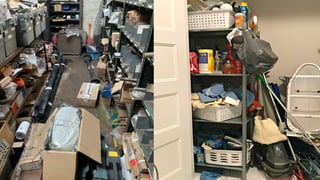
Cluttered and poorly arrange areas
Presence of items no longer needed or in
excess
Tools and equipment left in work areas
Dusty, dirty floors and work surfaces
Presence of spills and leaks
No waste bins and containers
8.
ACCIDENTS FROM POORHOUSEKEEPING
Being hit by falling objects
Tripping over loose objects on floors, stains and
platforms
Slipping on greasy, wet or dirty surfaces
Striking against projecting , poorly stacked or
misplaces material
Cutting, puncturing or tearing the skin of hands or
other parts of the body on projecting nails ,
wire or steel trapping
Electrocution from exposed live wires
Fires resulting form improper storage
• Housekeeping isnot just cleanliness. It
includes keeping work areas neat and orderly,
maintaining halls and floors free of slip and trip
hazards, and removing of waste materials (e.g.,
paper, cardboard) and other fire hazards from work
areas.
• Housekeeping lessen accidents and
related injuries and illnesses.
11.
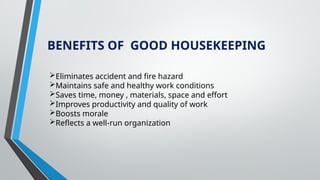
Eliminates accident andfire hazard
Maintains safe and healthy work conditions
Saves time, money , materials, space and effort
Improves productivity and quality of work
Boosts morale
Reflects a well-run organization
BENEFITS OF GOOD HOUSEKEEPING
12.
OSHS : Rule1060.01 – Item
(4)
Good Housekeeping shall be maintained at
all times through cleanliness of building,
yards, machines and equipment, regular
waste disposal and orderly processes,
operations . Storage and filing of materials
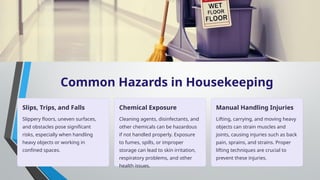
Common Hazards inHousekeeping
Slips, Trips, and Falls
Slippery floors, uneven surfaces,
and obstacles pose significant
risks, especially when handling
heavy objects or working in
confined spaces.
Chemical Exposure
Cleaning agents, disinfectants, and
other chemicals can be hazardous
if not handled properly. Exposure
to fumes, spills, or improper
storage can lead to skin irritation,
respiratory problems, and other
health issues.
Manual Handling Injuries
Lifting, carrying, and moving heavy
objects can strain muscles and
joints, causing injuries such as back
pain, sprains, and strains. Proper
lifting techniques are crucial to
prevent these injuries.
17.
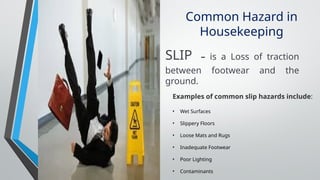
Common Hazard in
Housekeeping
Examplesof common slip hazards include:
• Wet Surfaces
• Slippery Floors
• Loose Mats and Rugs
• Inadequate Footwear
• Poor Lighting
• Contaminants
SLIP – is a Loss of traction
between footwear and the
ground.
18.
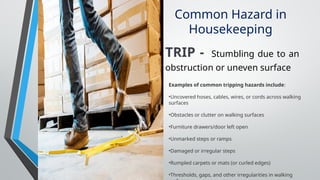
Common Hazard in
Housekeeping
TRIP- Stumbling due to an
obstruction or uneven surface
Examples of common tripping hazards include:
•Uncovered hoses, cables, wires, or cords across walking
surfaces
•Obstacles or clutter on walking surfaces
•Furniture drawers/door left open
•Unmarked steps or ramps
•Damaged or irregular steps
•Rumpled carpets or mats (or curled edges)
•Thresholds, gaps, and other irregularities in walking
19.
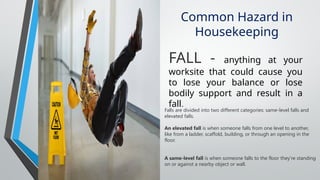
Common Hazard in
Housekeeping
FALL- anything at your
worksite that could cause you
to lose your balance or lose
bodily support and result in a
fall.
Falls are divided into two different categories: same-level falls and
elevated falls.
An elevated fall is when someone falls from one level to another,
like from a ladder, scaffold, building, or through an opening in the
floor.
A same-level fall is when someone falls to the floor they're standing
on or against a nearby object or wall.
20.
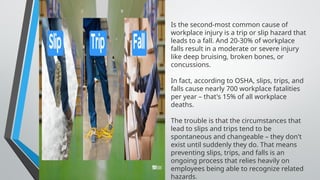
Is the second-mostcommon cause of
workplace injury is a trip or slip hazard that
leads to a fall. And 20-30% of workplace
falls result in a moderate or severe injury
like deep bruising, broken bones, or
concussions.
In fact, according to OSHA, slips, trips, and
falls cause nearly 700 workplace fatalities
per year – that's 15% of all workplace
deaths.
The trouble is that the circumstances that
lead to slips and trips tend to be
spontaneous and changeable – they don't
exist until suddenly they do. That means
preventing slips, trips, and falls is an
ongoing process that relies heavily on
employees being able to recognize related
hazards.
21.
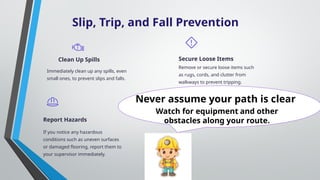
Slip, Trip, andFall Prevention
Clean Up Spills
Immediately clean up any spills, even
small ones, to prevent slips and falls.
Secure Loose Items
Remove or secure loose items such
as rugs, cords, and clutter from
walkways to prevent tripping.
Report Hazards
If you notice any hazardous
conditions such as uneven surfaces
or damaged flooring, report them to
your supervisor immediately.
Watch for equipment and other
obstacles along your route.
Never assume your path is clear
22.
Chemical Safety andHandling
.
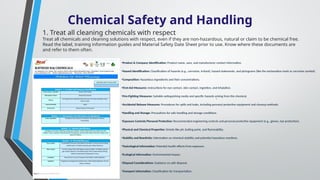
1. Treat all cleaning chemicals with respect
Treat all chemicals and cleaning solutions with respect, even if they are non-hazardous, natural or claim to be chemical free.
Read the label, training information guides and Material Safety Date Sheet prior to use. Know where these documents are
and refer to them often.
•Product & Company Identification: Product name, uses, and manufacturer contact information.
•Hazard Identification: Classification of hazards (e.g., corrosive, irritant), hazard statements, and pictograms (like the exclamation mark or corrosive symbol).
•Composition: Hazardous ingredients and their concentrations.
•First-Aid Measures: Instructions for eye contact, skin contact, ingestion, and inhalation.
•Fire-Fighting Measures: Suitable extinguishing media and specific hazards arising from the chemical.
•Accidental Release Measures: Procedures for spills and leaks, including personal protective equipment and cleanup methods.
•Handling and Storage: Precautions for safe handling and storage conditions.
•Exposure Controls/Personal Protection: Recommended engineering controls and personal protective equipment (e.g., gloves, eye protection).
•Physical and Chemical Properties: Details like pH, boiling point, and flammability.
•Stability and Reactivity: Information on chemical stability and potential hazardous reactions.
•Toxicological Information: Potential health effects from exposure.
•Ecological Information: Environmental impact.
•Disposal Considerations: Guidance on safe disposal.
•Transport Information: Classification for transportation.
23.
Chemical Safety andHandling
2. Do not mix cleaning chemicals together
If you do this serious injury or death may occur. Do not ‘Top Up’ bottles, you risk cross contamination and
could possibly mix chemicals. Always use clean empty containers for refilling.
3. Know the chemical products you use
Make yourself aware of the color, characteristics and safety directions of the products you use.
4. Only use cleaning chemicals with a label
Always report any damaged or illegible labels to your supervisor. Ensure the bottle has the correct product
in it and is correctly labelled. Replace any labels, which are damaged or illegible.
5. Always wear gloves and all required personal protective equipment (PPE)
Avoid splashes. Always wear gloves and all required PPE as indicated on the MSDS. Gloves are to be
worn at all times when using chemicals, emptying waste, cleaning toilets, cleaning up body
secretions and whenever you supervisor instructs you to.
6 . Dilute cleaning chemicals correctly
7. Use the right cleaning chemical for the job
24.
Chemical Safety andHandling
9. Know how cleaning chemicals can enter your body and protect yourself
Chemicals can enter your body by absorption (direct contact), inhalation and ingestion. Personal
Protection Equipment is not optional and must be worn.
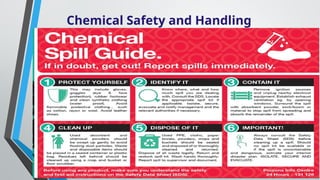
11. In the case of accidents, act immediately!
Report all spills, accidents and safety problems as soon as possible. Ensure spill kits are available and
easily accessible. Remove spills as per MSDS directions. If unable to contain spills safely report the issue to
your supervisor or management immediately.
12. Safety sign must always be used
Whenever a floor surface is wet the risk of a slip-and-fall accident increases and people need to
be warned.
10. Store and stack cleaning chemicals safely
It is advisable to store powders above liquids. Ensure cleaning chemicals are stored in a cool, well-
ventilated area away from direct sunlight. Lock door when unattended.
8. Return cleaning solutions after use
When finished with chemicals, wipe down the bottle and store away safely in the chemical
cupboard. Keep work and storage areas clean and uncluttered.
Chemical Safety and
Handling
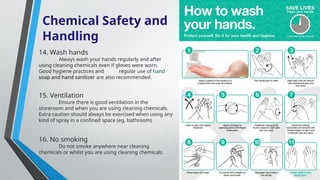
14.Wash hands
Always wash your hands regularly and after
using cleaning chemicals even if gloves were worn.
Good hygiene practices and regular use of hand
soap and hand sanitizer are also recommended.
15. Ventilation
Ensure there is good ventilation in the
storeroom and when you are using cleaning chemicals.
Extra caution should always be exercised when using any
kind of spray in a confined space (eg. bathroom).
16. No smoking
Do not smoke anywhere near cleaning
chemicals or whilst you are using cleaning chemicals.
28.
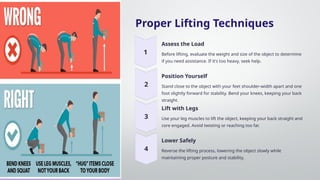
Proper Lifting Techniques
Assessthe Load
Before lifting, evaluate the weight and size of the object to determine
if you need assistance. If it's too heavy, seek help.
Position Yourself
Stand close to the object with your feet shoulder-width apart and one
foot slightly forward for stability. Bend your knees, keeping your back
straight.
Lift with Legs
Use your leg muscles to lift the object, keeping your back straight and
core engaged. Avoid twisting or reaching too far.
Lower Safely
Reverse the lifting process, lowering the object slowly while
maintaining proper posture and stability.
29.
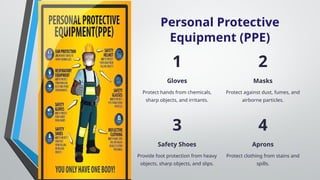
Personal Protective
Equipment (PPE)
1
Gloves
Protecthands from chemicals,
sharp objects, and irritants.
2
Masks
Protect against dust, fumes, and
airborne particles.
3
Safety Shoes
Provide foot protection from heavy
objects, sharp objects, and slips.
4
Aprons
Protect clothing from stains and
spills.
30.
Emergency Preparedness
and Response
1Know Evacuation Routes
Familiarize yourself with the designated evacuation routes
and assembly points in case of an emergency.
2 Fire Extinguisher Training
Learn how to use a fire extinguisher properly and practice
using it in a controlled setting.
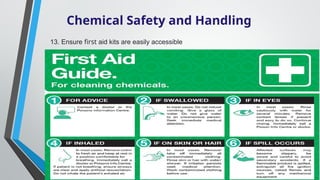
3 First Aid Training
Receive first aid training to be prepared to handle minor
injuries and provide assistance until medical help arrives.
31.
Best Practices fora Safe Work Environment
1
Cleanliness
Maintain a clean and organized work area to prevent slips, trips, and falls.
2
Proper Equipment
Use and maintain equipment properly to ensure it functions correctly and safely.
3
Communication
Communicate any hazards or concerns to your supervisor or colleagues
immediately.
4
Follow Safety Rules
Always follow established safety procedures and guidelines
for all tasks.
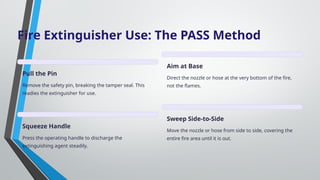
Fire Extinguisher Use:The PASS Method
Pull the Pin
Remove the safety pin, breaking the tamper seal. This
readies the extinguisher for use.
Aim at Base
Direct the nozzle or hose at the very bottom of the fire,
not the flames.
Squeeze Handle
Press the operating handle to discharge the
extinguishing agent steadily.
Sweep Side-to-Side
Move the nozzle or hose from side to side, covering the
entire fire area until it is out.