Dr Ambedkar Institute Of Technology
Occupational safety & Health Administration[18HS72]
Group Activity on
Fire Triangle, Fire Development and its severity,
Effect of Enclosures
1
SHREEDHARA 1DA20EC128
SHREYA S 1DA20EC129
SHWETHA K A 1DA20EC131
SIDDHARAM S G 1DA20EC132
FIRE
 Fire is naturally occurring energy release in the form of heat and light when oxygen
combines with a combustible or burnable material at a suitable high temperature.
 Three things must be present at the same time in order to produce fire.
i. Enough oxygen to sustain combustion.
ii. Enough heat to raise the material to its ignition temperature.
iii. Some sort of fuel or combustible material.
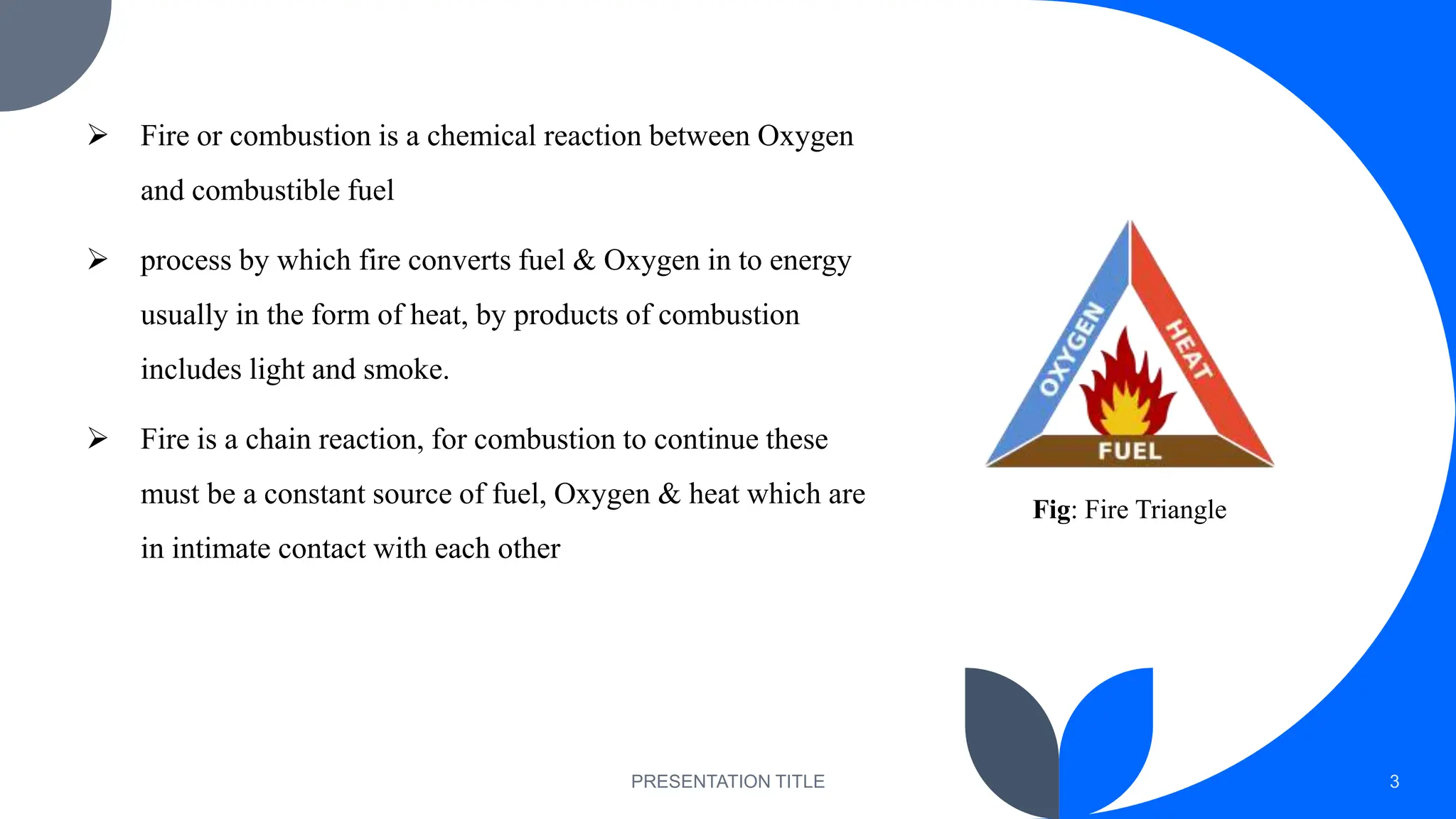
 Fire or combustion is a chemical reaction between Oxygen
and combustible fuel
 process by which fire converts fuel & Oxygen in to energy
usually in the form of heat, by products of combustion
includes light and smoke.
 Fire is a chain reaction, for combustion to continue these
must be a constant source of fuel, Oxygen & heat which are
in intimate contact with each other
PRESENTATION TITLE 3
Fig: Fire Triangle
ClassA - Ordinary materials such as paper, wood, cloth.
Class B-Flammable liquids or Combustible liquids such as gasoline, paint, propane,
kerosene
Class C-Electrical equipment fires, appliances, switches, panels
Class D-Certain metals such as magnesium, sodium, potassium, titanium, and
aluminium.
Class E-Fires involving commercial cooking appliances with vegetable oils, animal oils or
fats at high temperatures.
PRESENTATION TITLE 4
TYPES OF FIRE
FIRE DEVELOPMENT: SEVERITY &
DURATION
PRESENTATION TITLE 5
Critical level
Sever
Hazard Interval for action
to life
Safety Detection level
Major
Ignition Flame stability Spread beyond source
Growth in all direction
Fig: General Effects of Fire Development on Hazards to Life
Safety
 Initially, when fuel, Oxygen and heat combine there is little or no hazard when ignition occur, fires
develops slowly & the rate of hazard increases as the fire develops.
 The figure shows the general effect of fire development on hazards to life safety; from the figure
we can say that there is a time interval between the first detection & the critical level of fire
development which represents hazards to life cycle. All actions to preserve life safety must be
undertaken in this interval to time.
 Ignition: The ignition source along with the fuel first ignited
will determine the initial fire development, the ignition
source dependent on the fuel & presence of flammable
vapors in the right mixtures.
 Flames spread: Flame spreads along the surface of the
original fuel which was ignited depends on the properties of
the fuel & the supply of Oxygen.
THE EFFECTS OF ENCLOSURE
 Once the fire is been started it spread beyond the source is determined by the
enclosure within the building. In larger fire, the effect of enclosure will become
a important factor as it controls the Oxygen source and it traps all combustion
gases in the upper portion of the room. This is a result of heat transfer under fire
conditions. Heat must be transferred to other materials for the fire to spread and
takes place by convection, conduction or radiation.
 Convection is the movement of heat by hot gases, conduction the transfer of
heat through a material from hot to cold area and radiation is transfer of heat by
electromagnetic waves from a source to a solid within line of site with the
source.
 When a fire is contained within a room where Oxygen supply is adequate, the
fire will continue to grow until all the fuel is consumed, such a fire which is
limited by amount of fuel is called fuel controlled fire. When all fuel is
burning, but is slowed because it becomes starved of Oxygen then it is called
ventilation controlled fire.
Thank you

Occupational Safety and Health Adminitration(OSHA).PPT.pptx

  • 1.
    Dr Ambedkar InstituteOf Technology Occupational safety & Health Administration[18HS72] Group Activity on Fire Triangle, Fire Development and its severity, Effect of Enclosures 1 SHREEDHARA 1DA20EC128 SHREYA S 1DA20EC129 SHWETHA K A 1DA20EC131 SIDDHARAM S G 1DA20EC132
  • 2.
    FIRE  Fire isnaturally occurring energy release in the form of heat and light when oxygen combines with a combustible or burnable material at a suitable high temperature.  Three things must be present at the same time in order to produce fire. i. Enough oxygen to sustain combustion. ii. Enough heat to raise the material to its ignition temperature. iii. Some sort of fuel or combustible material.
  • 3.
     Fire orcombustion is a chemical reaction between Oxygen and combustible fuel  process by which fire converts fuel & Oxygen in to energy usually in the form of heat, by products of combustion includes light and smoke.  Fire is a chain reaction, for combustion to continue these must be a constant source of fuel, Oxygen & heat which are in intimate contact with each other PRESENTATION TITLE 3 Fig: Fire Triangle
  • 4.
    ClassA - Ordinarymaterials such as paper, wood, cloth. Class B-Flammable liquids or Combustible liquids such as gasoline, paint, propane, kerosene Class C-Electrical equipment fires, appliances, switches, panels Class D-Certain metals such as magnesium, sodium, potassium, titanium, and aluminium. Class E-Fires involving commercial cooking appliances with vegetable oils, animal oils or fats at high temperatures. PRESENTATION TITLE 4 TYPES OF FIRE
  • 5.
    FIRE DEVELOPMENT: SEVERITY& DURATION PRESENTATION TITLE 5 Critical level Sever Hazard Interval for action to life Safety Detection level Major Ignition Flame stability Spread beyond source Growth in all direction Fig: General Effects of Fire Development on Hazards to Life Safety  Initially, when fuel, Oxygen and heat combine there is little or no hazard when ignition occur, fires develops slowly & the rate of hazard increases as the fire develops.  The figure shows the general effect of fire development on hazards to life safety; from the figure we can say that there is a time interval between the first detection & the critical level of fire development which represents hazards to life cycle. All actions to preserve life safety must be undertaken in this interval to time.  Ignition: The ignition source along with the fuel first ignited will determine the initial fire development, the ignition source dependent on the fuel & presence of flammable vapors in the right mixtures.  Flames spread: Flame spreads along the surface of the original fuel which was ignited depends on the properties of the fuel & the supply of Oxygen.
  • 6.
    THE EFFECTS OFENCLOSURE  Once the fire is been started it spread beyond the source is determined by the enclosure within the building. In larger fire, the effect of enclosure will become a important factor as it controls the Oxygen source and it traps all combustion gases in the upper portion of the room. This is a result of heat transfer under fire conditions. Heat must be transferred to other materials for the fire to spread and takes place by convection, conduction or radiation.  Convection is the movement of heat by hot gases, conduction the transfer of heat through a material from hot to cold area and radiation is transfer of heat by electromagnetic waves from a source to a solid within line of site with the source.  When a fire is contained within a room where Oxygen supply is adequate, the fire will continue to grow until all the fuel is consumed, such a fire which is limited by amount of fuel is called fuel controlled fire. When all fuel is burning, but is slowed because it becomes starved of Oxygen then it is called ventilation controlled fire.
  • 7.