8/28/2012
1
Carmen Brenner, Anna Fensel, Dieter Fensel, Michael Fried, Christoph Fuchs,
Andreea Gagiu, Iker Larizgoitia, Birgit Leiter, Alex Oberhauser, Corneliu-Valentin
Stanciu, Ioannis Stavrakantonakis, Andreas Thalhammer, and Ioan Toma
How to Domesticate the Multi-Channel
Communication Monster*
www.sti-innsbruck.at© Copyright 2008 STI INNSBRUCK www.sti-innsbruck.at *long
The Crazy Hotelier
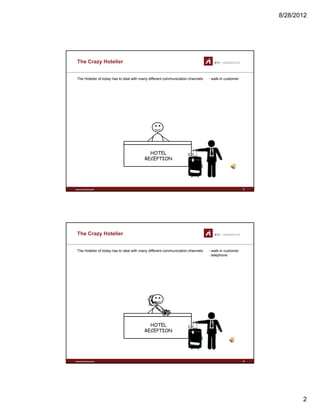
The Hotelier of today has to deal with many different communication channels:
www.sti-innsbruck.at 2
HOTEL
RECEPTION
8/28/2012
2
The Crazy Hotelier
- walk-in customerThe Hotelier of today has to deal with many different communication channels:
www.sti-innsbruck.at 3
HOTEL
RECEPTION
The Crazy Hotelier
- walk-in customer
- telephone
The Hotelier of today has to deal with many different communication channels:
www.sti-innsbruck.at 4
HOTEL
RECEPTION
8/28/2012
3
The Crazy Hotelier
- walk-in customer
- telephone
- email
The Hotelier of today has to deal with many different communication channels:
www.sti-innsbruck.at 5
HOTEL
RECEPTION
The Crazy Hotelier
- walk-in customer
- telephone
- email
- fax
The Hotelier of today has to deal with many different communication channels:
www.sti-innsbruck.at 6
HOTEL
RECEPTION
8/28/2012
4
The Crazy Hotelier
- walk-in customer
- telephone
- email
- fax
- hotel website
The Hotelier of today has to deal with many different communication channels:
hotel website
www.sti-innsbruck.at 7
HOTEL
RECEPTION
The Crazy Hotelier
- walk-in customer
- telephone
- email
- fax
- hotel website
The Hotelier of today has to deal with many different communication channels:
hotel website
- review sites
www.sti-innsbruck.at 8
HOTEL
RECEPTION
8/28/2012
5
The Crazy Hotelier
- walk-in customer
- telephone
- email
- fax
- hotel website
The Hotelier of today has to deal with many different communication channels:
hotel website
- review sites
- booking sites
www.sti-innsbruck.at 9
HOTEL
RECEPTION
The Crazy Hotelier
- walk-in customer
- telephone
- email
- fax
- hotel website
The Hotelier of today has to deal with many different communication channels:
hotel website
- review sites
- booking sites
- social network sites
www.sti-innsbruck.at 10
HOTEL
RECEPTION
8/28/2012
6
The Crazy Hotelier
- walk-in customer
- telephone
- email
- fax
- hotel website
The Hotelier of today has to deal with many different communication channels:
hotel website
- review sites
- booking sites
- social network sites
- blogs
www.sti-innsbruck.at 11
HOTEL
RECEPTION
The Crazy Hotelier
- walk-in customer
- telephone
- email
- fax
- hotel website
The Hotelier of today has to deal with many different communication channels:
hotel website
- review sites
- booking sites
- social network sites
- blogs
- fora & destination sites
www.sti-innsbruck.at 12
HOTEL
RECEPTION
8/28/2012
7
The Crazy Hotelier
- walk-in customer
- telephone
- email
- fax
- hotel website
The Hotelier of today has to deal with many different communication channels:
hotel website
- review sites
- booking sites
- social network sites
- blogs
- fora & destination sites
- chat
www.sti-innsbruck.at 13
HOTEL
RECEPTION
The Crazy Hotelier
- walk-in customer
- telephone
- email
- fax
- hotel website
The Hotelier of today has to deal with many different communication channels:
hotel website
- review sites
- booking sites
- social network sites
- blogs
- fora & destination sites
- chat
- video & photo sharing
www.sti-innsbruck.at 14
HOTEL
RECEPTION
8/28/2012
8
The Crazy Hotelier
The Hotelier doesn’t
only has to deal with an
overwhelming number of
communication
channels, but also haschannels, but also has
to pay up to 15% sales
commissions to the
booking sites!
www.sti-innsbruck.at 15
HOTEL
RECEPTION
The Crazy Hotelier
-> 80 million overnight stays
-> 4 billion € transaction
volume
-> 101 million € sales
commissioncommission
www.sti-innsbruck.at 16
HOTEL
RECEPTION
8/28/2012
9
Hotelnavigator
www.sti-innsbruck.at
http://www.youtube.com/watch?feature=player_embedded&v=rA0wdkPB7gA
17
Major Issues
Scalable Multi Channel Communication:
• Enable more precise targeting and optimized product
positioning
• Reduce the amount of work required for filling out and
observing the various communication channels
• Reach the greatest possible target audience with the
www.sti-innsbruck.at
g p g
smallest possible effort
18
8/28/2012
10
Major Issues
Visibility:
• Increase the quality of visibility
• Increase the degree of visibility
• Increase the number of direct bookings by increasing
the traffic on the hotel website
www.sti-innsbruck.at 19
Major Issues
Credibility:
• Increase the believability of sources and messages
• Increase the trustworthiness of sources and messages
www.sti-innsbruck.at 20
8/28/2012
11
Major Issues
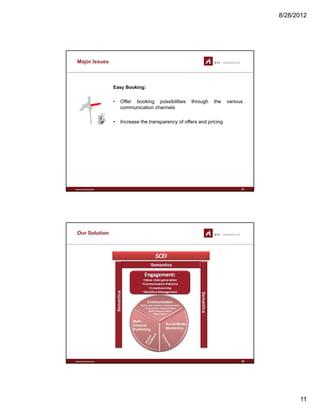
Easy Booking:
• Offer booking possibilities through the various
communication channels
• Increase the transparency of offers and pricing
www.sti-innsbruck.at 21
Our Solution
www.sti-innsbruck.at 22
8/28/2012
12
Content
1. Multi-channel Publishing / Dissemination
2 S i l M di M it i2. Social Media Monitoring
3. Communication
4. Engagement
5. Semantic Engagement
6 The Semantic Communication Engine Innsbruck (SCEI)
www.sti-innsbruck.at
6. The Semantic Communication Engine Innsbruck (SCEI)
7. Application Types
8. Application Field eTourism
23
www.sti-innsbruck.at
1. MULTI-CHANNEL
PUBLISHING / DISSEMINATION
24
8/28/2012
13
Multi-Channel Publishing / Dissemination
Multi-
Channel
Publishing
www.sti-innsbruck.at 25
Multi-Channel Publishing / Dissemination
Overview
1. What is dissemination?
2. Why do it?
3. How is it done?
4. Classification of Dissemination Channels
www.sti-innsbruck.at
5. Pitfalls of dissemination
6. Measuring impact of dissemination
7. Summary
Image taken from: http://www.rgbstock.com
26
8/28/2012
14
What is Dissemination?
• The vital importance of receiving, synthesizing and
communicating online information is increasing
dramatically in our current digital age.
• Dissemination (from the Latin dissēminātus = “sowing
seeds”, “scatter wildly in every direction”) refers to the
process of broadcasting a message to the public without
direct feedback from the audience.
• Takes on the view of the traditional view of communication
which involves a sender and a receiver.
• The message carrier sends out information to many in a
broadcasting system (composed of more than one
www.sti-innsbruck.at
broadcasting system (composed of more than one
channels).
• Harmsworth et al. (2000) define dissemination as the
“delivering and receiving of a message”, “the
engagement of an individual in a process” and “the
transfer of a process or product”.
27
Image taken from: http://nichcy.org/wp-content/uploads/2011/01/rsz_1rsz_dissemination2.jpg
What is a dissemination channel?
• “In telecommunications and computer networking, a communication channel, or
channel, refers either to a physical transmission medium such as a wire, or to a
logical connection over a multiplexed medium such as a radio channel.” (Wikipedia
Channel (communications), 2012)( ), )
• A channel is a means of exchanging information in the on-line space; a “place” where
one can find or leave information, whether it is unanimously referred by a URI or
addressed through a service.
www.sti-innsbruck.at 28
Image taken from: http://www.rgbstock.com
8/28/2012
15
Multi-Channel Publishing / Dissemination
Overview
1. What is dissemination?
2. Why do it?
3. How is it done?
4. Classification of Dissemination Channels
www.sti-innsbruck.at
5. Pitfalls of dissemination
6. Measuring impact of dissemination
7. Summary
29
Why Do It?
Purpose of Dissemination
• Dissemination for Awareness
f f– You wish people to be aware of the work of the project
– Useful for those target audiences that do not require a detailed knowledge of the work and is
helpful for them to be aware of your activities and results
– Will help the “word of mouth” type dissemination and help the organizer build an identity and
profile within the community
• Dissemination for Understanding
– It is aimed at a specific number of groups/audiences that need to be targeted directly
– Target audience that benefits from what your project has to offer and have a deeper
understanding of the project’s work
www.sti-innsbruck.at
g p j
• Dissemination for Action
– “Action” = change of practice resulting from the adoption of products, materials or
approaches offered by the project
– Target audience: people that are in the position to “influence” and “bring about change” within
their organizations (have skills, knowledge and understanding of your work)
30
Source: http://www.northampton.ac.uk/info/200267/pedagogic-research-and-scholarship/1068/dissemination
8/28/2012
16
Multi-Channel Publishing / Dissemination
Overview
1. What is dissemination?
2. Why do it?
3. How is it done?
4. Classification of Dissemination Channels
www.sti-innsbruck.at
5. Pitfalls of dissemination
6. Measuring impact of dissemination
7. Summary
31
How Is It Done?
Components of Effective Dissemination Plan
• Focus on the needs of the target audience and present in an appropriate manner
( i i t l d i f ti l l )(using appropriate language and information levels).
• Include various dissemination methods, including written information, electronic
media, and person-to-person contact.
• Include both proactive and reactive dissemination channels
• Leverage existing resources, relationships, and networks fully.
• Include effective quality control mechanisms.
www.sti-innsbruck.at
q y
• They include sufficient information so that the reader/user can determine the basic
principles underlying specific practices and the settings in which these practices may
be used most productively.
• They establish links to resources that may be needed to implement the information.
32
8/28/2012
17
Multi-Channel Publishing / Dissemination
Overview
1. What is dissemination?
2. Why do it?
3. How is it done?
4. Classification of Dissemination Channels
www.sti-innsbruck.at
5. Pitfalls of dissemination
6. Measuring impact of dissemination
7. Summary
33
Classification of Dissemination Channels
Classified by the type of service they provide:
• Static Broadcasting
• Dynamic Broadcasting
• Sharing
• Collaboration
• Social Networks
• Internet Forums and Discussion Boards
www.sti-innsbruck.at
• Online Discussion Groups
• Semantic-based Dissemination
• Overview of Channels
34
Image taken from: http://www.williamsclass.com/SixthScienceWork/Classification/ClassificationNotes/images/classify%20file%20cabinets.jpg
8/28/2012
18
Static Broadcasting
• Prehistoric methods of dissemination: cave drawings, stories of triumphs on
columns and arches, history on pyramids, stones with messages
• More modern means: printed press, newspapers, journals
www.sti-innsbruck.at
• Online static dissemination: websites and homepages….
35
Static Broadcasting
Homepages / Static Websites
Online Broadcasting – Static Websites
• Powerful tool for reaching the target audience and promoting the project
• Primarily used to provide information about the project and news of its activities and
outcomes.
• There is the temptation to present the information in order to “wow” the visitor
• BUT!: users tend to prefer good content in a simple, clear and easy-to navigate
interface (Keep It Simple, Stupid!)
www.sti-innsbruck.at
• Although created through a collaborative process, Wiki websites can be considered
static forms of online broadcasting as the information contained in them remains the
same for long periods of time (i.e. the collaboration process is mostly employed for
adding new data or editing/correcting existing one).
• Wikipedia is an equally important channel that should be mentioned (although articles
are created through a collaborative process)
36
Image taken from: http://www.softicons.com
8/28/2012
19
Static Broadcasting
Homepage Example
St ti W b it E l
www.sti-innsbruck.at 37
Static Website Example
The same hotel mentioned 
on Wikitravel’s entry for 
Innsbruck
Static Broadcasting
Static Website Example
Entry in Wikipedia for Hotel 
Goldener Adler
www.sti-innsbruck.at 38
8/28/2012
20
Static Broadcasting
Static Website Example
Entry in Wikipedia for
Dieter Fensel
www.sti-innsbruck.at 39
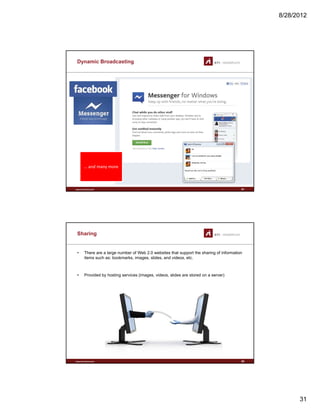
Dynamic Broadcasting
• Small piece of content that is dependent upon constraints such as time and location.
• With Web 2.0 technologies have created dedicated means for publishing streams and
interacting with content generated by users.
• Blogs: pages where people present their ideas, views and opinions on a particular
subject
• News: pages where facts or factual information is provided
• BUT: Producing high quality content for a blog on a regularly basis is time consuming
www.sti-innsbruck.at
• BUT: Producing high-quality content for a blog on a regularly basis is time-consuming
and costly
40
Image taken from: http://www.rgbstock.com
8/28/2012
21
Dynamic Broadcasting
Good practices:
• Each new item has its own URL (in order to be bookmarked, shared, returned in
search results etc )search results, etc.)
• Should contain a pointer to a more detailed description about the information items
described;
• Each new item is archived
• Each new item can be indexed by search engines
• Each new item is types (through the use of the information model)
• Each new item is categorized (using folksonomy)
www.sti-innsbruck.at
• Each post can be directly shared, liked, added to favorites.
• News can be searched for, sorted and filtered
• Important news items stay at the top to highlight main announcements
41
Source: http://oc.sti2.at/images/c/c7/STI_International_On-line_Communication_Handbook.pdf
Dynamic Broadcasting
Channels/Tools – An overview
• Examples of tools (organized considering
first the length of message and second –first the length of message and second
the level of interactivity):
– News Feeds
– Newsletters
– Email / Email lists
– Microblogs
– Blogs
– Social networks
– Chat and instant messaging applications
www.sti-innsbruck.at 42
8/28/2012
22
Dynamic Broadcasting
News Feeds
• RSS (Rich Site Summary) Feeds:
– a family of web feed formats used to deliver regularly changing web content.
– Many websites and blogs offer users the option of subscribing to their RSS feed.
– The content is syndicated automatically – the user does not have to visit each website
manually
– RSS Readers are available for different platforms:
• PC readers: Amphetadesk, FeedReader, NewsGator
• Web-based readers: My Yahoo, Bloglines, Google Reader
www.sti-innsbruck.at
– Includes full or summarized text, plus metadata (publishing dates and authorship)
43
Image taken from: http://www.softicons.com
Dynamic Broadcasting
News Feeds
<?xml version="1.0" encoding="UTF-8" ?>
<rss version="2 0"><rss version= 2.0 >
<channel>
<title>RSS Title</title>
<description>This is an example of an RSS feed</description>
<link>http://www.someexamplerssdomain.com/main.html</link>
<lastBuildDate>Mon, 06 Sep 2010 00:01:00 +0000 </lastBuildDate>
<pubDate>Mon, 06 Sep 2009 16:45:00 +0000 </pubDate>
<ttl>1800</ttl>
<item>
<title>Example entry</title>
www.sti-innsbruck.at
<title>Example entry</title>
<description>Here is some text containing an interesting description.</description>
<link>http://www.wikipedia.org/</link>
<guid>unique string per item</guid>
<pubDate>Mon, 06 Sep 2009 16:45:00 +0000 </pubDate>
</item>
</channel>
</rss>
44
8/28/2012
23
Dynamic Broadcasting
Newsletters
• The newsletter is an instrument used to regularly exchange information among the
members of a communitymembers of a community
• It constitutes the primary means of collecting and spreading the results achieved
through network activities.
• The main objectives of the Newsletter are:
– to report the main activities promoted and undertaken
– to widely disseminate information about published papers (position papers, state of the art
reviews) of researchers involved in the network.
W b it h th ibilit t b ib t th N l tt d t ti ll
www.sti-innsbruck.at
• Website users have the possibility to subscribe to the Newsletter and automatically
receive each issue in their mailbox.
• Users should have the option of subscribing and unsubscribing
45
Dynamic Broadcasting
www.sti-innsbruck.at 46
8/28/2012
24
Dynamic Broadcasting
Email/Email lists
• Email: means of exchanging digital messages from a sender to one or multiple
recipientsrecipients
• (Electronic) Mailing lists: collection of names and (email) addresses used to send
material to multiple recipients.
– Announcement lists (Newsletters, periodicals, advertising – used primarily as a one-way
conduit of information and can be “posted to” by selected people) vs. Discussion lists (any
subscriber can post)
– Can be self-hosted (e.g. GNU Mailman) or third-party hosted (as part of notifications for
Google groups, Yahoo! Groups )
– Requires users to subscribe to the list
www.sti-innsbruck.at
Requires users to subscribe to the list.
47
Dynamic Broadcasting
Email/Email lists
• Well established means for dissemination within a predetermined group
• Since email lists are mostly not accessible to a
wider audience, they should be ignored for
external use and focus should be primarily on
external means of communication
• Email is a good method of sharing information on
a one-to-one basis (e.g. mail this website to a
friend)
• Requires members to subscribe to a mailing list
www.sti-innsbruck.at
friend)
48
• Despite their obvious strength, in the age of information overload and spam, mailing
lists will not perform efficiently if they are not carefully targeted and offer recipients
the option to subscribe/ unsubscribe whenever they wish.
• Note!: there are legal requirements associated with the possibility to
subscribe/unsubscribe and the storage of and access to personal data [European
Commission, n.d.]
8/28/2012
25
Dynamic Broadcasting
Microblogging
• Broadcast medium similar to blogs
• The difference between microblogging and an actual blog is in the size of the
content in both actual and aggregate files.
• The actual messages are called microposts.
• Commercial microblogs exist to promote websites, services, products or
collaboration within an organization.
• Can contain a wide range of topics.
www.sti-innsbruck.at
• Low effort to participate.
49
Dynamic Broadcasting
Microblogging
• Twitter
– Social networking service and microblogging service
– users can send messages of a maximum length of 140 characters, follow other users,
and create interest lists.
– Widely used means of dissemination
– Significant space limitations: 140 characters or less
– Twitts are publicly visible by default (senders can restrict the access control)
– Users can tweet using the website, external APIs or SMS
– The service is free
– Users may subscribe to other users' tweets – this is known as following and subscribers
www.sti-innsbruck.at
are known as followers or tweeps
50
8/28/2012
26
Dynamic Broadcasting
www.sti-innsbruck.at 51
Dynamic Broadcasting
Microblogging
• Tumblr
– Tumblr is a microblogging platform and social networking website.
– It is owned and operated by Tumblr, Inc.
– It allows users to post multimedia and other content to a short-form blog, named a
"tumblelog".
– Users can follow other users' blogs, as well as make their blogs private.
www.sti-innsbruck.at 52
8/28/2012
27
Dynamic Broadcasting
www.sti-innsbruck.at 53
Dynamic Broadcasting
Blogs
• Alternatively called web logs or weblogs
• A weblog is a hierarchy of text, images, media objects and data, arranged
chronologically, that can be viewed in an HTML browser. *
• In some situations, it is the creator’s online journal.
• The activity of updating a blog is “blogging” and someone who keeps a blog is a
“blogger.”
• Items are posted on a regular basis and displayed in reverse chronological order.
www.sti-innsbruck.at
• Individual articles on a blog are called “blog posts,” “posts” or “entries”.
• Blogs are usually (but not always) written by one person and are updated pretty
regularly.
• Blogs are often (but not always) written on a particular topic.
54
*http://blogs.law.harvard.edu/whatmakesaweblogaweblog.html
Images taken from: http://www.softicons.com
8/28/2012
28
Dynamic Broadcasting
www.sti-innsbruck.at 55
Dynamic Broadcasting
Using Social Networks
• Social network content is dynamic in the sense that it provides information that will
expire after a period of time and be important only for that period and moment;expire after a period of time and be important only for that period and moment;
• However, as it focuses more on creating communities than on the temporal and
geospatial aspect of the information, it will be discussed in detail in Section 4.5.
www.sti-innsbruck.at 56
8/28/2012
29
Dynamic Broadcasting
Chat Applications
• one-to-one basis
• Instant method of communication• Instant method of communication
• Text-based chat, video chat, one vs. multiple receivers, web-based etc.
• Can be applied to a small number of people (it does not scale well for large groups –
it is impossible to follow who is discussion when more than one member of the
discussion group is writing/typing simultaneously)
• It is not useful as a method of dissemination due to its instant and intrusive nature
• In order to be used as a dissemination method, the user must add the message
sender to the contact list
www.sti-innsbruck.at 57
Dynamic Broadcasting
www.sti-innsbruck.at 58
8/28/2012
30
Dynamic Broadcasting
www.sti-innsbruck.at 59
Dynamic Broadcasting
www.sti-innsbruck.at 60
8/28/2012
31
Dynamic Broadcasting
www.sti-innsbruck.at 61
… and many more
Sharing
• There are a large number of Web 2.0 websites that support the sharing of information
items such as: bookmarks, images, slides, and videos, etc.
• Provided by hosting services (images, videos, slides are stored on a server)
www.sti-innsbruck.at 62
8/28/2012
32
Sharing
• Can use specialized applications (see below) of features of other platforms and
services (e.g. share photos through Facebook)
• Examples:
– Flickr – as a means of exchanging photos, visible to all users (no account necessary), allows
users to post comments;
– Slideshare – channel for storing and exchanging presentations;
– YouTube and VideoLectures – sharing videos, all users can see the posted videos and leave
comments on the websites
– Social Bookmark sites: e.g. delicious, digg, StumbleUpon
– Social News websites: e.g. reddit
www.sti-innsbruck.at 63
Sharing
slideshare
Slide Sharing
• Launched in 2006
• Is a Web 2.0 based slide hosting service
• Users can upload files privately or publicly as: PowerPoint, PDF, Keynote or
OpenOffice presentations
• Slide decks can then be viewed on the site itself, on hand held devices or
embedded on other sites
www.sti-innsbruck.at
• SlideShare also provides users the ability to rate, comment on, and share the
uploaded content
64
8/28/2012
33
Sharing
www.sti-innsbruck.at 65
Sharing
flickr
L h d i 2004 d i d b Y h ! i 2005
Picture Sharing
• Launched in 2004, and acquired by Yahoo! in 2005
• Image and video hosting website, web services suite and online community
• It is a popular website for users to share and embed personal photographs
• It is a service widely used by bloggers to host images that they embed in blogs and
social media
• features:
– accounts, groups and access control
– organization (based on tags added on the pictures),
– organizr (web application for organizing photos within an account that can be accessed
through the Flikr interface),
www.sti-innsbruck.at
– picnik (default photo editor in a partnership with Picnik online photo-editing application),
access control,
– interaction and compatibility with other applications (e.g. RSS and Atom feeds)
– filtering (lets members specify by default what types of images they generally upload and
how "safe" the images are),
– licensing, map sources (georgraphic locations), account-undelete option (reverse an
account rermination)
66
8/28/2012
34
Sharing
www.sti-innsbruck.at 67
Sharing
YouTube
Video Sharing
• Video-sharing website where users can upload, view and share videos
• Features
– Video technology: Playback (re-watch a video), Uploading (up to 15 min), Quality and codecs
and 3D videos
– Content accessibility - view videos on web pages outside the site
– Localization - adaptability to different languages, regional differences and technical
requirements
www.sti-innsbruck.at 68
8/28/2012
35
Sharing
Videolectures
Video Sharing
• Launched in 2007
• VideoLectures.NET is a free and open access educational video lectures repository.
• The lectures are given by distinguished scholars and scientists at the most important
and prominent events such as conferences, summer schools, workshops and science
promotional events from many scientific fields.
• The portal is aimed at promoting science, exchanging ideas and fostering knowledge
sharing by providing high quality didactic contents not only to the scientific
www.sti-innsbruck.at
sharing by providing high quality, didactic contents not only to the scientific
community but also to the general public.
• All lectures, accompanying documents, information and links are systematically
selected and classified through the editorial process whilst taking into account users'
comments.
69
Sharing
www.sti-innsbruck.at 70
8/28/2012
36
Sharing
• Is a method for Internet users to organize, store, manage and search for bookmarks
of resources online.
Social Bookmarking
• Descriptions may be added to these bookmarks in the form of metadata, so users
may understand the content of the resource without first needing to download it for
themselves.
• The resources themselves aren't shared, merely bookmarks that reference them.
Social bookmarking is particularly useful when collecting a set of resources that are to
www.sti-innsbruck.at
• Social bookmarking is particularly useful when collecting a set of resources that are to
be shared with others.
• Anyone can participate in social bookmarking.
71
Sharing
delicious
F d d i 2003
Social Bookmarking
• Founded in 2003
• Is a social bookmarking web service for storing, sharing, and discovering web
bookmarks.
• Characterized by a non-hierarchical classification system in which users can tag each
of their bookmarks with the desired index terms (which generates a kind of
folksonomy)
• A combined view of everyone's bookmarks with a given tag is available;
www.sti-innsbruck.at
• The most important links or popular ones can be seen on the home page, "popular"
and "recent" pages
• All bookmarks are publicly viewable by default - the public aspect is emphasized the
site is not focused on storing private bookmark collections
• But users have the ability to mark some as private and imported ones are private by
default
72
8/28/2012
37
Sharing
www.sti-innsbruck.at 73
Sharing
digg
L h d i 2004
Social Bookmarking
• Launched in 2004
• User-driven social content website
• After a user submits content, other users read their submission and "Digg" what they
like best
• Allows users to vote stories up or down (called digging and burying, respectively)
www.sti-innsbruck.at
• If a story receives enough Diggs, it is promoted to the first page
74
8/28/2012
38
Sharing
StumbleUpon
Social Bookmarking
• Launched in 2001
• Is a discovery engine that finds and recommends web content to its users
• StumbleUpon uses collaborative filtering (an automated process combining human
opinions with machine learning of personal preference) to create virtual communities
of like-minded Web surfers.
• Rating Web sites update a personal profile (a blog-style record of rated sites) and
generate peer networks of Web surfers linked by common interest
www.sti-innsbruck.at
generate peer networks of Web surfers linked by common interest.
• These social networks coordinate the distribution of Web content, so that users
"stumble upon" pages explicitly recommended by friends and peers.
• Giving a site a thumbs up results in the site being placed under the user's "favorites".
75
Sharing
reddit
Social Bookmarking
• Is a social news website where the registered users submit content, in the form of
either a link or a text "self" post.
• Other users then vote the submission "up" or "down," which is used to rank the post
and determine its position on the site's pages and front page.
• In December 2011, Reddit served just over 2 billion page views to almost 35 million
visitors *
www.sti-innsbruck.at 76
http://www.businessinsider.com/the-secret-to-reddits-astounding-success-an-easy-customization-process-you-should-copy-2012-1
8/28/2012
39
Collaboration
Wiki
• “Wiki” = Hawaiian word for “fast” of “quick”.
• Described by the developer of the first wiki software Ward Cunningham as theDescribed by the developer of the first wiki software, Ward Cunningham, as the
“simplest online database that could possibly work”*.
• Websites whose users can add, modify or delete content via a web browser using
simplified markup language or a rich-text editor.
• Are powered by wiki software.
• Most of the content is created collaboratively.
• Promotes meaningful topic associations between different pages by making link
creation intuitively easy and showing whether an intended page exists or not.
www.sti-innsbruck.at
• It seeks to involve the visitor in an ongoing process of creation and collaboration that
constantly changes the Web site landscape
• However – once created the information remains static until another user edits or
deletes it.
*http://www.wiki.org/wiki.cgi?WhatIsWiki
77
Collaboration
Example WikiExample Wiki
www.sti-innsbruck.at 78
Biggest online free 
encyclopedia
8/28/2012
40
Collaboration
Google Docs
• Is a free, Web-based office suite and data storage service
• It allows users to create and edit documents online while collaborating in real-time
with other users.
• Google Docs combines the features of Writely and Spreadsheets with a presentation
program incorporating technology designed by Tonic Systems.
• Data storage of files up to 1 GB total in size was introduced on January 13, 2010, but
has since been increased to 10 GB, documents using Google Docs native formats do
not count towards this quota.
www.sti-innsbruck.at
q
• Its main features rely on storage, file limits, and supported file formats
79
Collaboration
Ether Pad
• Launched in 2008
• EtherPad web service allows real-time document collaboration for groups and teams.
• Etherpad can be re-branded with your own domain and company name.
• Acquired by Google – the servers are down
www.sti-innsbruck.at 80
8/28/2012
41
Social Networks
• Provide a community aspect, i.e. forms a community that shares information in a
multi-directional way
• Common features (regardless of platform):
– construct a public/semi-public profile;
– articulate list of other users that they share a connection with;
– view the list of connections within the system
• Some sites allow users to upload pictures, add multimedia content or modify the look
and feel of the profile
www.sti-innsbruck.at
• Social networks typically offer more than one channel of dissemination (thus they will
be considered platforms with many available dissemination channels):
– Facebook: Pages, Groups, Share options
– LinkedIn and Xing are focused on professional use and fit the purpose of organizations
81
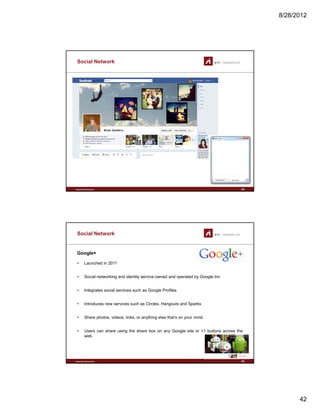
Social Network
Facebook
• Facebook is a social networking service and website;
• Launched in February 2004
• It is owned and operated by Facebook, Inc.
• As of May 2012 has over 900 million active users*
• More than half are using mobile devices*
• Users must register before using the services.
www.sti-innsbruck.at
• Users can create a personal profile, add friends, exchange messages, chat (the
company has also launched a separate instant messaging service), receive automatic
notifications, take part in games, etc.
82
* http://www.nytimes.com/2012/05/15/technology/facebook-needs-to-turn-data-trove-into-investor-gold.html?_r=1
8/28/2012
42
Social Network
www.sti-innsbruck.at 83
Social Network
Google+
• Launched in 2011
• Social networking and identity service owned and operated by Google Inc
• Integrates social services such as Google Profiles
• Introduces new services such as Circles, Hangouts and Sparks
Sh h t id li k thi l th t’ i d
www.sti-innsbruck.at
• Share photos, videos, links, or anything else that’s on your mind.
• Users can share using the share box on any Google site or +1 buttons across the
web.
84
8/28/2012
43
Social Network
www.sti-innsbruck.at 85
Social Network
LinkedIn
• Founded in December 2002
• LinkedIn is the world’s largest professional network
• It has over 120 million members
• LinkedIn connects users to their trusted contacts
H l h k l d id d t iti ith b d t k f
www.sti-innsbruck.at
• Helps users exchange knowledge, ideas, and opportunities with a broader network of
professionals.
• It allows users to search, keep in touch and extend their networks of professionals
86
8/28/2012
44
Social Network
www.sti-innsbruck.at 87
Social Network
Xing
• Social and business networking tool for professionals with over 8 million users;
• Initially established as Open business Club AG in August 2003 in Germany; name
was changed to Xing in November 2006
• Main competitor is LinkedIn
• Seems to attract more small business and independent business owners than its
competitors
www.sti-innsbruck.at 88
• Basic membership is free
• The platform uses https and has a rigid privacy and no-spam policy.
8/28/2012
45
Social Network
www.sti-innsbruck.at 89
Social Network
• Market share for December 2011 (according to ComScore):
Worldwide Unique Visitors Percentage
Facebook.com 792,999,000 55.1 %
Twitter.com 167,903,000 11.7 %
LinkedIn.com 94,823,000 6.6 %
Google+ 66,756,000 4.6 %
MySpace 61,037,000 4.2 %
www.sti-innsbruck.at 90
http://techcrunch.com/2011/12/22/googlesplus/?utm_source=feedburner&utm_medium=feed&utm_campaign=Feed%3A+Techcrunch+%28TechCrunch%29
Others 255,539,000 17.8 %
Total 1,438,877,000 100 %
8/28/2012
46
Internet Forums and Discussion Boards
• Web applications managing user-generated content
• Early forums can be described as a web version of an email list or newsgroup
• Internet forums are prevalent in several countries: Japan, China
• Are governed by a set of rules
• Users have a specific designated role, e.g. moderator, administrator
• The unit of communication is the post
• Common features
– Tripcodes and capcodes - a secret password is added to the user's name following a
separator character
– Private message
www.sti-innsbruck.at
– Attachment
– BBCode and HTML
– Emoticon or smiley to convey emotion
– Poll
– RSS and ATOM feeds
– Other forum features
91
Internet Forums and Discussion Boards
www.sti-innsbruck.at 92
8/28/2012
47
Online Discussion Groups
• Many-to-many
• Threaded conversations
• Usually created on a particular topic
• Have different access levels
• Better for disseminating within a group that shares common interests as the purpose
of the services is to enable collaboration, knowledge and information sharing and
open discussions
• Examples: Google Groups, Facebook Groups, Yahoo! Groups, LinkedIn Groups, Xing
Groups.
• Similar in many ways to Discussion boards and Internet Forums
www.sti-innsbruck.at 93
Online Discussion Groups
Google Groups
• Not a common forum software
• Includes an archive of Usenet news group postings dating back t o 1981• Includes an archive of Usenet news group postings dating back t o 1981
• Strongly focuses on the concept of mailing list - Can have parallel mailing lists (can
use Google groups to archive another mailing list, such as Yahoo Groups)
• Need a Google account to access groups or post messages;
• What can be shared: there’s a limit of 25MB including attachments/ group
• Joining a group: Invitation or request. Owners can make an opt-out issue by inviting
members directly through their email address
• Notifications:
– No email: read group postings only online
www.sti-innsbruck.at
g p p g y
– Abridged Email: one summary email of new activity/day
– Digest Email: get up to 25 full messages in a single email
– Email: send each message to me as it arrives
• Noise: the level of noise is dependent on the managers;
• Fully integrated with Google products : Google Calendars, Google Docs, Google
Sites
94
8/28/2012
48
Online Discussion Groups
www.sti-innsbruck.at 95
Online Discussion Groups
Yahoo! Groups
• Yahoo! Groups is one of the world’s largest collections of online discussion boards.
• Group messages can be read and posted by e-mail or on the Group's webpage like a
web forum.
• Members can choose whether to receive individual, daily digest or Special Delivery e-
mails, or simply read Group posts on the Group’s web site
• Groups can be created with public or member-only access.
• Yahoo! Groups service provides additional facilities for each Group web site, such as
h hi ll l d
www.sti-innsbruck.at
a homepage, message archive, polls, calendar
• announcements, files, photos, database functions, and bookmarks
96
8/28/2012
49
Online Discussion Groups
Facebook Groups
• Create a private space (group) to share
– Post updates questions photos;Post updates, questions, photos;
– Chat with the group;
– Create share docs
– Schedule group events
• Members can stay in touch using:
– Notifications regarding new posts and updates
– The group’s shared email address to connect off Facebook
www.sti-innsbruck.at 97
Online Discussion Groups
Facebook Groups
• Pages allow real organizations, businesses,
celebrities and brands to communicate
broadly with people who like them.
• Pages may only be created and managed by
official representatives.
• Privacy: information and posts are public and
generally available to everyone on Facebook.
• Audience:
– Anyone can like a Page to become connected
with it and get News Feed updates.
– There is no limit to how many people can like a
Page.
– Visitor statistics
• Groups provide a closed space for small groups
of people to communicate about shared
interests.
• Groups can be created by anyone.
• Privacy: groups offer three levels of control over
shared information: open, closed and secret. In
secret and closed groups, posts are only visible
to group members.
• Audience:
– Group members must be approved or added by
other members.
– When a group reaches a certain size, some
features are limited (e.g. chat).
Th t f l t d t b th
www.sti-innsbruck.at 98
• Communication:
– Page admins can share posts under the Page’s
name.
– Page posts appear in the News Feed of people
who like the Page.
– Page admins can also create customized apps
for their Pages and check Page Insights to track
the Page’s growth and activity.
– The most useful groups tend to be the ones you
create with small groups of people you know.
• Communication:
– In groups, members receive notifications by default
when any member posts in the group.
– Group members can participate in chats, upload
photos to shared albums, collaborate on group
docs, and invite all members to group events.
Groups: smaller number of people.
Pages: large number of followers
8/28/2012
50
Online Discussion Groups
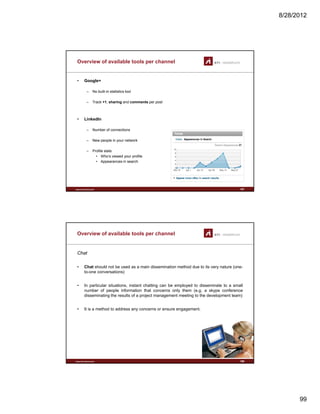
LinkedIn
• Discover the most popular discussions.
• Take an active part in determining the top discussions by liking and commenting.
• Follow the most influential people in your groups by checking the Top Influencers
board or clicking their profile image to see all their group activity.
• Review new members or search for specific ones.
• See both member-generated discussions and news in one setting.
• Easily browse previews of the last three comments in a discussion
www.sti-innsbruck.at
• Easily browse previews of the last three comments in a discussion.
• Find interesting discussions by seeing who liked a discussion and how many people
commented.
99
Online Discussion Groups
Xing
• Social and business networking tool for professionals with over 8 million users;
• Initially established as Open business Club AG in August 2003 in Germany; name
was changed to Xing in November 2006
• Main competitor is LinkedIn
• Seems to attract more small business and independent business owners than its
competitors
• Basic membership is free
www.sti-innsbruck.at 100
• The platform uses https and has a rigid privacy and no-spam policy.
8/28/2012
51
Online Discussion Groups
Tool Website Description
Meetup www.meetup.com Meetup is an online social networking portal that facilitates offline group 
meetings in various localities around the world [Wiki]. 
GroupSpaces groupspaces.com GroupSpaces (styled groupspaces) is a London‐based online company that 
provides technology to help real‐world clubs, societies, associations and 
other groups manage their membership and activities, and promote 
themselves online [Wiki].
Windows Live 
Groups
groups.live.com Windows Live Groups is an online service by Microsoft as part of its 
Windows Live range of services that enable users to create their social 
groups for sharing, discussion and coordination [Wiki].
www.sti-innsbruck.at 101
Online Discussion Groups
Characteristics Google Groups Yahoo Groups Facebook Groups LinkedIn 
Groups
Xing Groups
Forums Yes Yes Yes Yes Yes
Chat Threaded  Yes Yes (max 250  No No
conversation
(
members)
Shared email Yes Yes Yes No No
Upload content (documents, 
images, videos)
Not part of 
groups
Google Docs
Yes Yes Via weblinks Yes
Maximum Storage 25 MB posts and 
attachments
200 MB Unlimited ‐‐ 2 MB
Integrate external content 
(RSS feeds)
Yes Yes Yes Yes Yes
www.sti-innsbruck.at 102
Notifications Customizable: no 
email, abridged, 
digest, email
Email Email, FB 
notifications
Email, 
bundled
http 
newsletter
Search features Google Search / 
Directory Search
Yahoo search,
separate group 
search
Not a separate 
function (Facebook 
classic search), 
clumsy and no 
group suggestion
Advanced  ‐
search for 
group, 
member,
event
Advanced
8/28/2012
52
Social Network vs. Online Discussion Groups
• ODG have a limited number of members;
• ODG are intended for a smaller number of people to collaborate (Facebook places
the number at 250 members);
• ODG have a specific purpose – a goal that unites all members, i.e. a discussion topic.
• In ODG the number of members and the ideas of the members are known to all
participants.
• ODG have a creator/owner recognized by all members;
• ODG follow a set of rules determined by the administrator, moderator or owner;
• In ODG members may have different roles: administrator, moderator, owner,
participant etc
www.sti-innsbruck.at
participant, etc.
103
Social Network vs. Online Discussion Groups
• Moderators and administrators ensure that the ODG’s internal code of conduct is
followed;
• In ODG all members have access to the same shared resources;
• ODG members do not have to be connected with the other members (other than the
group) to communicate
• SN vary in size and heterogeneity;
• In SN different members have access to different resources (e.g. some members
might have restricted access to a friend’s photo archive);
• In SN members do not know how many participant exist, or who they are;
www.sti-innsbruck.at 104
8/28/2012
53
Semantic Based Dissemination
What is semantic web?
• An extension of the current web in which information is given a well defined meaning,
better enabling computers and people to work in cooperationbetter enabling computers and people to work in cooperation
www.sti-innsbruck.at 105
Semantic Based Dissemination
Why use semantics?
• Problems with current day search engines:
– Recall issues
– Results are dependent on the vocabulary
– Results are single Web pages
– Human involvement is necessary for result interpretation
– Results of Web searches are not readily accessible by other software tools
• Content is not machine-readable:
– It is difficult to distinguish between:
“I am a professor of computer science ”
www.sti-innsbruck.at
I am a professor of computer science.
and
“You may think, I am a professor of computer science.
Well, actually. . .”
106
8/28/2012
54
Semantic Based Dissemination
The Semantic Web Approach
• Represent Web content in a form that is more easily machine-processable.
• Use intelligent techniques to take advantage of these representations.
• Knowledge will be organized in conceptual spaces according to its meaning.
• Automated tools for maintenance and knowledge discovery
• Semantic query answering
• Query answering over several documents
www.sti-innsbruck.at
• Defining who may view certain parts of information (even parts of documents) will be
possible.
• Semantic Web does not rely on text-based manipulation, but rather on machine-
processable metadata
107
Semantic Based Dissemination
www.sti-innsbruck.at 108
8/28/2012
55
Semantic Based Dissemination
Implementations – Rich Snippets
• Implementation realization of an application, plan, idea, model, or design.
• Snippets—the few lines of text that appear under every search result—are designed
to give users a sense for what’s on the page and why it’s relevant to their query.
• If Google understands the content on your pages, we can create rich snippets—
detailed information intended to help users with specific queries.
www.sti-innsbruck.at 109
Semantic Based Dissemination
Overview
Format
e.g. RDFa
I l t ti
www.sti-innsbruck.at 110
Implementation
e.g. OWLIM
Vocabulary
e.g. foaf
8/28/2012
56
Semantic Based Dissemination
• A (Semantic Web) vocabulary can be considered as a special form of (usually light-
weight) ontology, or sometimes also merely as a collection of URIs with an (usually
informally) described meaning*.
– URI = uniform resource identifierURI uniform resource identifier
– Semantic vocabularies include: FOAF, Dublin Core, Good Relations, etc.
• Format is an explicit set of requirements to be satisfied by a material, product, or
service.
– The most known examples are RDF and OWL.
www.sti-innsbruck.at
• Implementation realization of an application, plan, idea, model, or design.
– OWLIM - a family of semantic repositories, or RDF database management system
111
* http://semanticweb.org/wiki/Ontology
Semantic Based Dissemination
Format
• an explicit set of requirements to be satisfied by a material, product, or service.
• is an encoded format for converting a specific type of data to displayable information.
www.sti-innsbruck.at 112
8/28/2012
57
Semantic Based Dissemination
Methods of describing Web content:
RDFsRDFs
1998
RDF
HTML Meta 
Elements
1999
RDF
2004
RDFaRDFa
2005
MicroformatsMicroformats
2007
OWLOWL
2008
SPARQLSPARQL
www.sti-innsbruck.at 113
2009
OWL 2OWL 2
2010
RIFRIF
2011
MicrodataMicrodata
Semantic Based Dissemination
Format – HTML Meta Elements
• HTML or XHTML elements which provide structured metadata about a Web page
• Represented using the <meta...> element
• Can be used to specify page description, keywords and any other metadata not
provided through the other head elements and attributes
• Example:
www.sti-innsbruck.at 114
<meta http‐equiv="Content‐Type" content="text/html" >
8/28/2012
58
Semantic Based Dissemination
Format – HTML Meta Elements
• Search engine optimization attributes: keywords, description, language, robots
– keywords attribute - although popular in the 90s, search engine providers realized that
information stored in meta elements (especially the keywords attribute) was often unreliable
and misleading, or created to draw users towards spam sites
– description attribute - provides concise explanation of a Web page's content
– the language attribute - tells search engines what natural language the website is written in
– the robots attribute - controls whether or not search engine spiders are allowed to index a
www.sti-innsbruck.at
page, and whether or not they should follow links from a page
115
Semantic Based Dissemination
Format – HTML Meta Elements
• Example - metadata contained by www.wikipedia.org:
<meta charset="utf‐8"> 
<meta name="title" content="Wikipedia"> 
<meta name="description" content="Wikipedia, the free encyclopedia that anyone can  edit."> 
<meta name="author" content="Wikimedia Foundation">
<meta name="copyright" content="Creative Commons Attribution‐Share Alike 3.0 and  GNU 
Free Documentation License"> 
<meta name="publisher" content="Wikimedia Foundation"> 
<meta name "language" content "Many">
www.sti-innsbruck.at 116
<meta name= language  content= Many > 
<meta name="robots" content="index, follow"> 
<!‐‐[if lt IE 7]>
<meta http‐equiv="imagetoolbar" content="no">
<![endif]‐‐> 
<meta name="viewport" content="initial‐scale=1.0, user‐scalable=yes">
8/28/2012
59
Semantic Based Dissemination
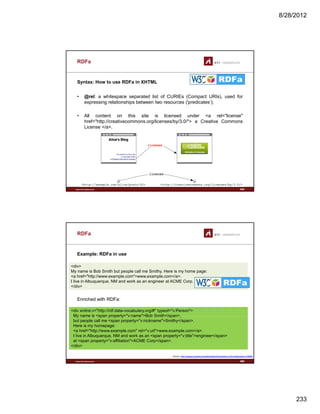
Format – RDFa
• Is a W3C Recommendation that adds a set of attribute-level extensions to XHTML for
embedding rich metadata within Web documents.embedding rich metadata within Web documents.
• Adds a set of attribute-level extensions to XHTML enabling the embedding of RDF
triples;
• Integrates best with the W3C meta data stack built on top of RDF
• Benefits [Wikipedia RDFa, n.d.]:
– Publisher independence: each website can use its own standards;
– Data reuse: data is not duplicated - separate XML/HTML sections are not required for the
same content;
– Self containment: HTML and RDF are separated;
S h d l it tt ib t bl
www.sti-innsbruck.at
– Schema modularity: attributes are reusable;
– Evolv-ability: additional fields can be added and XML transforms can extract the semantics
of the data from an XHTML file;
– Web accessibility: more information is available to assistive technology.
• Disadvantage: the uptake of the technology is hampered by the web-
master’s lack of familiarity with this technology stack
117
Semantic Based Dissemination
Format – RDFa
• RDFa Attributes:
– about and src – a URI or CURIE specifying the resource the metadata is about
– rel and rev – specifying a relationship or reverse-relationship with another resource
– href and resource – specifying the partner resource
– property – specifying a property for the content of an element
– content – optional attribute that overrides the content of the element when using the
property attribute
– datatype – optional attribute that specifies the datatype of text specified for use with the
www.sti-innsbruck.at
property attribute
– typeof – optional attribute that specifies the RDF type(s) of the subject (the resource that the
metadata is about).
118
8/28/2012
60
Semantic Based Dissemination
Format – RDFa
• Example
<div xmlns:dc=http://purl.org/dc/elements/1.1/
about="http://www.example.com/books/wikinomics"> 
<span property="dc:title">Wikinomics</span> 
<span property="dc:creator">Don Tapscott</span>
<span property="dc:date">2006‐10‐01</span> 
</div>
www.sti-innsbruck.at 119
Semantic Based Dissemination
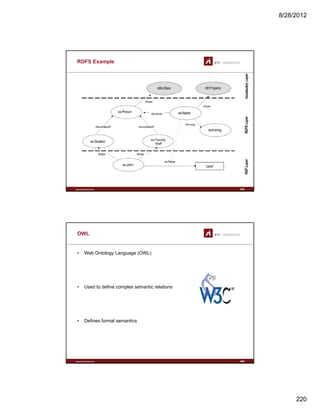
Format – OWL
• Family of knowledge representation languages for
authoring ontologiesauthoring ontologies
• WebOnt developed OWL language
• OWL based on earlier languages OIL and
DAML+OIL
• Characterized by formal semantics and RDF/XML-
based serializations for the Semantic Web
• Endorsed by the World Wide Web Consortium
(W3C)
www.sti-innsbruck.at
Source: McGuinness, COGNA October 3, 2003
120
8/28/2012
61
Semantic Based Dissemination
OWL Sublanguages
• The W3C-endorsed OWL specification includes the definition of three variants of
OWL, with different levels of expressiveness (ordered by increasing expressiveness):
OWL Lite originally intended to support those users primarily– OWL Lite - originally intended to support those users primarily
needing a classification hierarchy and simple constraints
– OWL DL - was designed to provide the maximum expressiveness
possible while retaining computational completeness, decidability,
and the availability of practical reasoning algorithms.
– OWL Full - designed to preserve some compatibility with RDF
Schema
• The following set of relations hold. Their inverses do not.
– Every legal OWL Lite ontology is a legal OWL DL ontology.
Each of these sublanguage
is a syntactic extension of
its simpler predecessor.
www.sti-innsbruck.at
y g gy g gy
– Every legal OWL DL ontology is a legal OWL Full ontology.
– Every valid OWL Lite conclusion is a valid OWL DL conclusion.
– Every valid OWL DL conclusion is a valid OWL Full conclusion.
• Development of OWL Lite tools has thus proven almost as difficult as development of
tools for OWL DL, and OWL Lite is not widely used
Source: McGuinness, COGNA October 3, 2003
121
Semantic Based Dissemination
Format – OWL
• Class Axioms
– oneOf (enumerated classes)
– disjointWith
– sameClassAs applied to class expressions
– rdfs:subClassOf applied to class expressions
• Boolean Combinations of Class Expressions
– unionOf
– intersectionOf
– complementOf
• Arbitrary Cardinality
i C di lit
www.sti-innsbruck.at
– minCardinality
– maxCardinality
– cardinality
• Filler Information
– hasValue Descriptions can include specific value information
Source: McGuinness, COGNA October 3, 2003
122
8/28/2012
62
Semantic Based Dissemination
Format – OWL
• Example:
<owl:Class>
<owl:intersectionOf rdf:parseType=" collection">
<owl:Class rdf:about="#Person"/>
<owl:Restriction>
<owl:onProperty rdf:resource="#hasChild"/>
<owl:allValuesFrom>
<owl:unionOf rdf:parseType=" collection">
<owl:Class rdf:about="#Doctor"/>
<owl:Restriction>
<owl:onProperty rdf:resource="#hasChild"/>
<owl:someValuesFrom rdf:resource="#Doctor"/>
www.sti-innsbruck.at
Source: McGuinness, COGNA October 3, 2003
owl:someValuesFrom rdf:resource #Doctor /
</owl:Restriction>
</owl:unionOf>
</owl:allValuesFrom>
</owl:Restriction>
</owl:intersectionOf>
</owl:Class>
123
Format – OWL 2
• Extends OWL 1
• Inherits OWL 1 language features
Semantic Based Dissemination
• Inherits OWL 1 language features
• Makes some patterns easier to write
• Does not change expressiveness, semantics and complexity
• Provides more efficient processing in implementations
• Syntactic sugar:
– DisjointUnion - Union of a set of classes; all the classes are pairwise disjoint
– DisjointClasses - A set of classes; all the classes are pairwise disjoint
– NegativeObjectPropertyAssertion - Two individuals; a property does not hold between them
– NegativeDataPropertyAssertion - An individual; a literal; a property does not hold between
www.sti-innsbruck.at
g p y p p y
them
• OWL 2 allows the same identifiers (URIs) to denote individuals, classes, and
properties
• Interpretation depends on context
• A very simple form of meta-modelling
Source: McGuinness, COGNA October 3, 2003
124
8/28/2012
63
Format – OWL 2
• New constructs for properties:
– Self restriction: Classes of objects that are related to themselves by a given property
Q lifi d di lit t i ti Q lifi th i t t b t d
Semantic Based Dissemination
– Qualified cardinality restriction: Qualifies the instances to be counted
– Object properties
– Disjoint properties
– Property chain: Properties can be defined as a composition of other properties
– keys
• An OWL 2 profile (commonly called a fragment or a sublanguage in computational
logic) is a trimmed down version of OWL 2 that trades some expressive power for the
efficiency of reasoning.
• OWL 2 profiles
www.sti-innsbruck.at
– OWL 2 EL is particularly useful in applications employing ontologies that contain very large
numbers of properties and/or classes.
– OWL 2 QL is aimed at applications that use very large volumes of instance data,
and where query answering is the most important reasoning task
– OWL 2 RL is aimed at applications that require scalable reasoning without
sacrificing too much expressive power.
• OWL 2 profiles are defined by placing restrictions on the structure of OWL 2
ontologies. Source: http://semwebprogramming.org/?p=175
125
Format – OWL 2
• Example property chains in OWL2:
Semantic Based Dissemination
Declaration( ObjectProperty( :isEmployedAt ) ) 
ObjectPropertyAssertion( :isEmployedAt :Martin :SC ) 
SubObjectPropertyOf( ObjectPropertyChain( 
:isEmployedAt :isPartOf ) :isEmployedAt) 
ObjectPropertyAssertion( :isEmployedAt :Martin :ICS ) 
ObjectPropertyAssertion( :isEmployedAt :Martin :MU )
www.sti-innsbruck.at
Source: http://dior.ics.muni.cz/~makub/owl/
126
8/28/2012
64
Format – RIF
• A collection of dialects (rigorously defined
rule languages)
Semantic Based Dissemination
rule languages)
• Intended to facilitate rule sharing and
exchange
• RIF framework is a set of rigorous
guidelines for constructing RIF dialects in a
consistent manner
• The RIF framework includes several
aspects:
S t ti f k
www.sti-innsbruck.at
– Syntactic framework
– Semantic framework
– XML framework
• RIF can be used to map between
vocabularies (one of the proposed use
cases)
Source: Michael Kifer State University of New York at Stony Brook
127
Format – RIF
• The standard RIF dialects are:
– Core - the fundamental RIF language It is designed to be the common subset of most rule
Semantic Based Dissemination
Core the fundamental RIF language. It is designed to be the common subset of most rule
engines. (It provides "safe" positive datalog with builtins.)
– BLD (Basic Logic Dialect) - adds a few things that Core doesn't have: logic functions,
equality in the then-part, and named arguments. (This is positive Horn logic, with equality
and builtins.)
– PRD (Production Rules Dialect) - adds a notion of forward-chaining rules, where a rule fires
and then performs some action, such as adding more information to the store or retracting
some information.
• Although RIF dialects were designed primarily for interchange, each dialect is a
standard rule language and can be used even when portability and interchange are
www.sti-innsbruck.at
standard rule language and can be used even when portability and interchange are
not required.
• The XML syntax is the only one defined as a standard for interchange. Various
presentation syntaxes are used in the specification, but they are not recommended
for sending between different systems.
Source: http://www.w3.org/2005/rules/wiki/RIF_FAQ#What_is_RIF-BLD.3F__.28and_RIF-Core.2C_PRD.2C_FLD.29
128
8/28/2012
65
Format – RIF
• A simplified example of RIF-Core rules combined with OWL to capture anatomical
knowledge that can be used to help label brain cortex structures in MRI images.
Semantic Based Dissemination
www.sti-innsbruck.at
Source: http://www.w3.org/2005/rules/wiki/Modeling_Brain_Anatomy
129
Semantic Based Dissemination
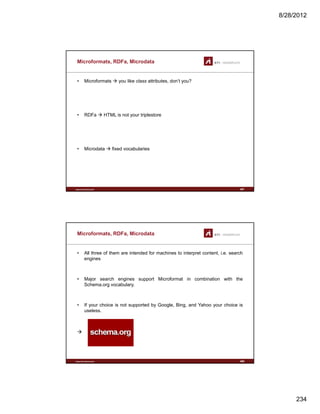
Format – Microformats
• Directly use meta tags of XHTML to embed semantic information in web documents;
• Microformats were developed as a competing approach directly using some existing
HTML tags to include meta data in HTML documents
• As of 2010, microformats allow the encoding and extraction of events, contact
information, social relationships and so on
• Advantages:
– you can publish a single, human readable version of your information in HTML and then
make it machine readable with the addition of a few standard class names
N d t l th l
www.sti-innsbruck.at
– No need to learn another language
– Easy to add
• However: they overload the class tag which causes problems for some parsers as it
makes semantic information and styling markup hard to differentiate
130
8/28/2012
66
Semantic Based Dissemination
Format - Microformats
• Example
<ul class="vcard">
<li class="fn">Joe Doe</li> 
<li class="org">The Example Company</li> 
<li class="tel">604‐555‐1234</li>
<li><a class="url“ href="http://example.com/">http://example.com/</a></li> 
</ul>
www.sti-innsbruck.at 131
Semantic Based Dissemination
Format – Microdata
• Use HTML5 elements to include semantic descriptions into web documents aiming to
replace RDFa and Microformats.replace RDFa and Microformats.
• Introduce new tag attributes to include semantic data into HTML
• Unless you know that your target consumer only accepts RDFa, you are probably
best going with microdata.
• While many RDFa-consuming services (such as the semantic search engine Sindice)
also accept microdata, microdata-consuming services are less likely to accept RDFa.
Ad t
www.sti-innsbruck.at 132
• Advantages:
– the variable groupings of data within published area
tables may not be the detail required for a particular
application (e.g. age group, ethnic group or
occupational classification).
– the cross-tabulations of variables available in area
tables may not be those needed for a study (e.g. counts
of individuals by age and ethnic group and occupation).
8/28/2012
67
Semantic Based Dissemination
Format – Microdata
• Examples:
– Google may use microdata in its results pages:
– Opera from version 11.60 is the only current stable release of a browser that supports
microdata:
www.sti-innsbruck.at
– MicrodataJS is a JavaScript library and jQuery plugin that emulates the DOM API.
133
Semantic Based Dissemination
Format – Microdata
• Example without microdata:
<section> 
Hello, my name is John Doe, I am a graduate research assistant at the University 
of Dreams. My friends call me Johnny. You can visit my homepage at 
<a href="http://www.JohnnyD.com">www.JohnnyD.com</a>
. I live at 1234 Peach Drive Warner Robins, Georgia.
</section>
www.sti-innsbruck.at 134
8/28/2012
68
Semantic Based Dissemination
Format – Microdata
• Example using microdata:
<section itemscope itemtype="http://data‐vocabulary.org/Person"> 
Hello, my name is 
<span itemprop="name">John Doe</span>
, I am a 
<span itemprop="title">graduate research assistant</span> 
at the 
<span itemprop="affiliation">University of Dreams</span>. 
My friends call me 
<span itemprop="nickname">Johnny</span>
. You can visit my homepage at 
<a href=http://www JohnnyD com itemprop="url">www JohnnyD com</a>
www.sti-innsbruck.at 135
<a href=http://www.JohnnyD.com itemprop= url >www.JohnnyD.com</a>. 
<section itemprop="address" itemscope itemtype="http://data‐
vocabulary.org/Address"> 
I live at 
<span itemprop="street‐address"> 1234 Peach Drive</span> 
<span itemprop="locality">Warner Robins</span> , 
<span itemprop="region">Georgia</span>. 
</section> 
</section>
Semantic Based Dissemination
Format – RDF
• The Resource Description Framework (RDF) is a language for representing
information about resources in the World Wide Web.
• RDF provides a common framework for expressing information so it can be
exchanged between applications without loss of meaning.
• It is based on the idea of identifying things using Web identifiers (called Uniform
Resource Identifiers, or URIs) and describing resources in terms of simple properties
and property values
• Thus, RDF can represent simple statements about resources as a graph of nodes
and arcs representing the resources, and their properties and values.
www.sti-innsbruck.at
p g p p
• It specifically supports the evolution of schemas over time without requiring all the
data consumers to be changed
136
Source: http://www.iis.sinica.edu.tw/~trc/public/courses/Fall2008/week15/slide-w15.html#%287%29
8/28/2012
69
Semantic Based Dissemination
Format – RDF
• Based on triples <subject, predicate, object>
• An RDF triple contains three components:
– the subject, which is an RDF URI reference or a blank node
– the predicate, which is an RDF URI reference
– the object, which is an RDF URI reference, a literal or a blank node
– An RDF triple is conventionally written in the order subject, predicate, object.
– The predicate is also known as the property of the triple.
• Triple data model:
<subject, predicate, object>
www.sti-innsbruck.at
j , p , j
– Subject: Resource or blank node
– Predicate: Property
– Object: Resource (or collection of resources), literal or blank node
• Example:
<ex:john, ex:father-of, ex:bill>
137
Semantic Based Dissemination
Format – RDF
• An RDF graph is a set of RDF triples.
• The set of nodes of an RDF graph is the set of subjects and objects of triples in the
graph.
• Person ages (:age) and favorite friends (:fav)
Properties encoded as XML entities:
<rdf:RDF
xmlns:rdf="http://www.w3.org/1999/02/
22-rdf-syntax-ns#"
xmlns:example="http://fake.host.edu/e
xample-schema#">
www.sti-innsbruck.at 138
<example:Person>
<example:name>Smith</example:name>
<example:age>21</example:age>
<example:fav>Jones</example>
</example:Person>
</rdf:RDF>
8/28/2012
70
Semantic Based Dissemination
Format – SPARQL
• A recursive acronym for SPARQL Protocol and RDF Query Language
• On 15 January 2008, SPARQL 1.0 became an official W3C Recommendation
• Query language based on RDQL
• Used to retrieve and manipulate data stored in RDF format
U SQL lik t
www.sti-innsbruck.at
• Uses SQL-like syntax
139
Semantic Based Dissemination
Format – SPARQL
• Example SPARQL Query:
– “Return the full names of all people in the graph”
– Results:
fullName
=================
PREFIX vCard: <http://www.w3.org/2001/vcard‐rdf/3.0#>
SELECT ?fullName
WHERE {?x vCard:FN ?fullName}
@prefix ex: <http://example.org/#> .
@prefix vcard: <http://www.w3.org/2001/vcard‐rdf/3.0#> .
ex:john
vcard:FN "John Smith" ;
vcard:N [
www.sti-innsbruck.at
"John Smith"
"Mary Smith"
140
ca d [
vcard:Given "John" ;
vcard:Family "Smith" ] ;
ex:hasAge 32 ;
ex:marriedTo :mary .
ex:mary
vcard:FN "Mary Smith" ;
vcard:N [
vcard:Given "Mary" ;
vcard:Family "Smith" ] ;
ex:hasAge 29 .   
8/28/2012
71
Semantic Based Dissemination
www.sti-innsbruck.at 141
Semantic Based Dissemination
Vocabulary – Linked Data
www.sti-innsbruck.at 142
Linked Data Cloud
8/28/2012
72
Semantic Based Dissemination
Vocabulary – Linked Data
• Materialization of the usage of vocabularies
• Wikipedia defines Linked Data as "a term used to describe a recommended best
practice for exposing, sharing, and connecting pieces of data, information, and
knowledge on the Semantic Web using URIs and RDF“
• “Semantic web done right” Tim Berners-Lee
• Combination of openness with data + open standards
www.sti-innsbruck.at
• Linked Data Essentials:
– Use URIs
– Use HTTP URIs
– Serve useful information using SPARQL, RDF standards
– Mention URIs of related objects
143
Semantic Based Dissemination
www.sti-innsbruck.at 144
8/28/2012
73
Semantic Based Dissemination
Vocabulary – schema.org
www.sti-innsbruck.at 145
Semantic Based Dissemination
Vocabulary – schema.org
• Example*:
– Imagine you have a page about the movie Avatar—a page with a link to a movie trailer,
information about the director, and so on. Your HTML code might look something like this:
<div> 
<h1>Avatar</h1> 
<span>Director: James Cameron (born August 16, 1954)</span>
<span>Science fiction</span> 
<a href="../movies/avatar‐theatrical‐trailer.html">Trailer</a>
www.sti-innsbruck.at 146
<a href ../movies/avatar theatrical trailer.html >Trailer</a> 
</div>
* http://schema.org/docs/gs.html
8/28/2012
74
Semantic Based Dissemination
Vocabulary – schema.org
• Example with microdata*:
<div itemscope itemtype ="http://schema.org/Movie"> 
<h1 itemprop="name"&g;Avatar</h1> 
<div itemprop="director" itemscope itemtype="http://schema.org/Person"> 
Director: 
<span itemprop="name">James Cameron</span> 
(born 
<span itemprop="birthDate">August 16, 1954)</span>
</div> 
<span itemprop="genre">Science fiction</span> 
www.sti-innsbruck.at 147
<a href="../movies/avatar‐theatrical‐trailer.html" itemprop="trailer">Trailer</a> 
</div>
* http://schema.org/docs/gs.html
Semantic Based Dissemination
Vocabulary – FOAF
• Friend of a Friend
• Uses RDF to describe the relationship people have to other “things” around them
• FOAF permits intelligent agents to make sense of the thousands of connections
people have with each other, their jobs and the items important to their lives;
• Because the connections are so vast in number, human interpretation of the
information may not be the best way of analyzing them.
www.sti-innsbruck.at
• FOAF is an example of how the Semantic Web attempts to make use of the
relationships within a social context.
148
8/28/2012
75
Semantic Based Dissemination
Vocabulary – FOAF
• Example
<foaf:Person> 
<foaf:name>Dan Brickley</foaf:name> 
<foaf:mbox_sha1sum>
748934f32135cfcf6f8c06e253c53442721e15e7
</foaf:mbox_sha1sum> 
</foaf:Person>
www.sti-innsbruck.at
• Which says "there is a Person called Dan Brickley who has an email address whose
sha1 hash is..."
149
Semantic Based Dissemination
Vocabulary – GoodRelations
• A lightweight ontology for annotating offerings and other aspects of e-commerce on
the Web.the Web.
• The only OWL DL ontology officially supported by both Google and Yahoo.
• It provides a standard vocabulary for expressing things like
– that a particular Web site describes an offer to sell cellphones of a certain make and model at
a certain price,
– that a pianohouse offers maintenance for pianos that weigh less than 150 kg,
– or that a car rental company leases out cars of a certain make and model from a particular
set of branches across the country.
www.sti-innsbruck.at
• Also, most if not all commercial and functional details of e-commerce scenarios can
be expressed, e.g. eligible countries, payment and delivery options, quantity
discounts, opening hours, etc.
150
http://semanticweb.org/wiki/GoodRelations
8/28/2012
76
Semantic Based Dissemination
Vocabulary – GoodRelations
• Example:
<rdf:RDF xmlns="http://www.heppnetz.de/ontologies/examples/gr#"
xml:base="http://www.heppnetz.de/ontologies/examples/gr"
xmlns:toy="http://www.heppnetz.de/ontologies/examples/toy#"
xmlns:gr="http://purl.org/goodrelations/v1#"
xmlns:xsd="http://www.w3.org/2001/XMLSchema#"
xmlns:dc="http://purl.org/dc/elements/1.1/"
xmlns:protege="http://protege.stanford.edu/plugins/owl/protege#"
xmlns:rdfs="http://www.w3.org/2000/01/rdf‐schema#"
xmlns:rdf="http://www.w3.org/1999/02/22‐rdf‐syntax‐ns#"
xmlns:owl="http://www.w3.org/2002/07/owl#">
<owl:Ontology rdf:about="">
<owl:imports rdf:resource="http://www.heppnetz.de/ontologies/examples/toy"/>
www.sti-innsbruck.at 151
p p // pp / g / p / y /
<owl:imports rdf:resource="http://purl.org/goodrelations/v1"/>
</owl:Ontology>
<gr:BusinessEntity rdf:ID="ElectronicsCom">
<gr:legalName rdf:datatype="&xsd;string"
>Electronics.com Ltd.</gr:legalName>
<rdfs:seeAlso/>
<gr:offers rdf:resource="#Offering_1"/>
</gr:BusinessEntity>
</rdf:RDF>
Semantic Based Dissemination
Vocabulary – DublinCore
• Early Dublin Core workshops popularized the idea of "core metadata" for simple and
generic resource descriptions.generic resource descriptions.
• Metadata terms are a set of vocabulary terms which can be used to describe
resources for the purposes of discovery.
• The terms can be used to describe a full range of web resources: video, images, web
pages etc. and physical resources such as books and objects like artworks
• The Dublin Core standard includes two levels:
– Simple Dublin Core comprises 15 elements;
www.sti-innsbruck.at
– Qualified Dublin Core includes three additional elements;— Audience, Provenance and
RightsHolder;— as well as a group of element refinements, also called qualifiers, that refine
the semantics of the elements in ways that may be useful in resource discovery.
152
Source: http://dublincore.org (tutorials)
8/28/2012
77
Semantic Based Dissemination
Vocabulary – DublinCore
• Characteristics of DublinCore:
– All elements are optionalAll elements are optional
– All elements are repeatable
– Elements may be displayed in any order
– Extensible
– International in scope
• The fifteen core elements are usable with or without qualifiers
• Qualifiers make elements more specific:
www.sti-innsbruck.at
• Qualifiers make elements more specific:
– Element Refinements narrow meanings, never extend
– Encoding Schemes give context to element values
• If your software encounters an unfamiliar qualifier, look it up –or just ignore it!
153
Source: http://dublincore.org (tutorials)
Semantic Based Dissemination
Vocabulary – DublinCore
• Expressing Dublin Core in HTML/XHTML meta and link elements:
...
<head profile="http://dublincore.org/documents/dcq‐html/">
<title>Expressing Dublin Core in HTML/XHTML meta and link elements</title>
<link rel="schema.DC" href="http://purl.org/dc/elements/1.1/" />
<link rel="schema.DCTERMS" href="http://purl.org/dc/terms/" />
<meta name="DC.title" lang="en" content="Expressing Dublin Core
in HTML/XHTML meta and link elements" />
<meta name="DC.creator" content="Andy Powell, UKOLN, University of Bath" />
<meta name="DCTERMS.issued" scheme="DCTERMS.W3CDTF" content="2003‐11‐01" />
<meta name="DC.identifier" scheme="DCTERMS.URI"
content="http://dublincore org/documents/dcq‐html/" />
www.sti-innsbruck.at 154
content= http://dublincore.org/documents/dcq‐html/  />
<link rel="DCTERMS.replaces" hreflang="en"
href="http://dublincore.org/documents/2000/08/15/dcq‐html/" />
<meta name="DCTERMS.abstract" content="This document describes how
qualified Dublin Core metadata can be encoded
in HTML/XHTML &lt;meta&gt; elements" />
<meta name="DC.format" scheme="DCTERMS.IMT" content="text/html" />
<meta name="DC.type" scheme="DCTERMS.DCMIType" content="Text" />
</head>
...
8/28/2012
78
Semantic Based Dissemination
Implementations – Rich Snippets
• Three steps to rich snippets
1. Pick a markup format.
Google suggests using microdata, but any of the three formats below are acceptable.
• Microdata (recommended)
• Microformats
• RDFa
2. Mark up your content.
Google supports rich snippets for these content types:
• Reviews
• People
www.sti-innsbruck.at
• People
• Products
• Businesses and organizations
• Recipes
• Events
• Music
• Google also recognizes markup for video content and uses it to improve our search results.
155
Semantic Based Dissemination
Implementations – OWLIM
• OWLIM is a high-performance OWL repository
• Storage and Inference Layer (SAIL) for Sesame RDF database• Storage and Inference Layer (SAIL) for Sesame RDF database
• OWLIM performs OWL DLP reasoning
• It is uses the IRRE (Inductive Rule Reasoning Engine) for forward-chaining and “total
materialization”
• In-memory reasoning and query evaluation
• OWLIM provides a reliable persistence, based on RDF N-Triples
• OWLIM can manage millions of statements on desktop hardware
www.sti-innsbruck.at
OWLIM can manage millions of statements on desktop hardware
• Extremely fast upload and query evaluation even for huge ontologies and knowledge
bases
• OWLIM is developed by Ontotext
156
8/28/2012
79
Semantic Based Dissemination
Implementations – OWLIM
• OWLIM is available as a Storage and Inference Layer (SAIL) for Sesame RDF.
• Benefits:
– Sesame’s infrastructure, documentation, user community, etc.
– Support for multiple query language (RQL, RDQL, SeRQL)
– Support for import and export formats (RDF/XML, N-Triples, N3)
www.sti-innsbruck.at 157
Semantic Based Dissemination
Implementations – Jena
• Apache Jena™ is a Java framework for building Semantic Web applications.
• Jena provides a collection of tools and Java libraries to help you to develop semantic
web and linked-data apps, tools and servers.
• The Jena Framework includes:
– an API for reading, processing and writing RDF data in XML, N-triples and Turtle formats;
– an ontology API for handling OWL and RDFS ontologies;
– a rule-based inference engine for reasoning with RDF and OWL data sources;
– stores to allow large numbers of RDF triples to be efficiently stored on disk;
www.sti-innsbruck.at
– a query engine compliant with the latest SPARQL specification
– servers to allow RDF data to be published to other applications using a variety of protocols,
including SPARQL
158
8/28/2012
80
Semantic Based Dissemination
Implementations – Jena
• Jena stores information as RDF triples in directed graphs, and allows your code to
add, remove, manipulate, store and publish that information.add, remove, manipulate, store and publish that information.
• Jena architecture overview:
www.sti-innsbruck.at 159
Overview of Channels
www.sti-innsbruck.at 160
8/28/2012
81
Multi-Channel Publishing / Dissemination
Overview
1. What is dissemination?
2. Why do it?
3. How is it done?
4. Classification of Dissemination Channels
www.sti-innsbruck.at
5. Pitfalls of dissemination
6. Measuring impact of dissemination
7. Summary
161
Pitfalls of Dissemination
• Online dissemination methods are forms of electronic marketing, BUT there are
important differences between electronic spam and conventional marketing
techniques.
• For instance, common sense dictates that there’s no reason to send an
advertisement to somebody who can’t use the product being advertised (e.g.
presenting advantages of cat food to dog owners).
• The method of dissemination must be particularly crafted for the target audience (e.g.
a message containing a large amount of technical details should not be sent to a
partner that cannot understand such details)
• The method of dissemination must be particularly crafted for the channel selected to
disseminate: the message should be shared on channels that permit it otherwise it
www.sti-innsbruck.at
disseminate: the message should be shared on channels that permit it, otherwise it
will be considered spam.
162
• A dissemination channel should not be intrusive: a member should be
asked before being subscribed to a specific list, and should have the
option to unsubscribe and re-subscribe whenever he wishes so
8/28/2012
82
Pitfalls of Dissemination
• The user must not be overloaded with information and must have the option of
managing the content received (e.g. receive daily/weekly digests instead of numerous
messages containing a single message)
• Close attention should be paid to the messages that are disseminated: elements that
are not of utmost important should be just posted on the website regularly (and
provide a single newsletter directing the user to the site).
• Posting elements that are not interesting for a user will be considered spam (in
essence, spam is a message from someone else that the receiver did not ask for and
does not want to have).
• The receiver should not be buried under a large number of messages – it will create
frustration as the important messages become harder to observe
www.sti-innsbruck.at
frustration as the important messages become harder to observe.
• When using chat applications as methods of dissemination, certain etiquette
elements must be taken into consideration:
– Mass messages containing advertising are considered rude
– A discrete way of disseminating is using the status update
163
Multi Channel Publishing / Dissemination
Overview
1. What is dissemination?
2. Why do it?
3. How is it done?
4. Classification of Dissemination Channels
www.sti-innsbruck.at
5. Pitfalls of dissemination
6. Measuring impact of dissemination
7. Summary
164
8/28/2012
83
Communication
Multi-
Channel
Publishing
www.sti-innsbruck.at 165
Measuring impact of dissemination
What is impact and feedback?
Measuring impact of dissemination
Overview of available tools per channel
www.sti-innsbruck.at 166
8/28/2012
84
What is Impact and Feedback
Impact = influence, effect of the dissemination process
Feedback = evaluative information derived from the reaction or response to a
particular activity part of the dissemination
www.sti-innsbruck.at 167
What is Impact and Feedback
Impact of dissemination
• The impact of dissemination refers to:
− the actions that followed the dissemination
of the message;
− the effect of the message on the behavior of
the customers related to an enterprise,
the offered products and services;
− the influence to the customers and their
reaction to the message;
www.sti-innsbruck.at 168
8/28/2012
85
What is Impact and Feedback
Feedback of dissemination
• Refers to the response of an audience to a message or activity.
• Giving the audience a chance to provide feedback is crucial for maintaining an open
communication climate.
• “Feedback refers to a relationship between the behavior of the speaker, the response
of the listener and the effect of the response on the further behavior of the speaker.
… In a sense, we may say that feedback, in order to be feedback, must be used as
feedback.” Theodore Clevenger, Jr., and Jack Matthews – “Feedback” – “Communication theory” edited by C.David Mortenser.
www.sti-innsbruck.at 169
• Feedback should be measured and analysed.
What is Impact and Feedback
Measuring the feedback of the dissemination activities
• Increased understanding of the impact of the dissemination processes.
– The generation of reports, regarding the dissemination activities, helps an organisation to
understand in deep the impact of their work and products to the audience by knowing what
people do not find attractive and useful.
• Evaluate current online and social network strategies.
– It is always important to evaluate a strategy and specify the lessons learned for future use.
www.sti-innsbruck.at 170
• Look forward and plan the next business steps and objectives based on the
effectiveness of the current activities.
– Modify the current dissemination activities according to the reports in order to be more
effective in the future and our efforts more productive.
8/28/2012
86
What is Impact and Feedback
Measuring the feedback of the dissemination activities
• To ensure that the message disseminated has been seen by the target audience.
– By measuring the impact of the dissemination, we could be aware of the visibility that our
message achieved.
• To verify whether the message has been understood by the target audience.
– The disseminated message may be well distributed and visible, but not understood by the
audience in the way that the enterprise would like to.
www.sti-innsbruck.at 171
• To quantify the reach of the dissemination.
– It is important to be able to produce reports with metrics about the effectiveness of the
dissemination. This is realizable only by establishing ways to measure the impact.
What is Impact and Feedback
What should we measure to specify the feedback?
• Social Media Exposure
– How many people did you reach with your message?
• Appeal of your message
– How many people listened to the entire message?
– If the majority of people stopped listening to your message, when did they stop? Was it due
to the content, the implementation of the message or the medium?
www.sti-innsbruck.at 172
• Engagement
– How many people actually reacted to your message?
It is important to find out how many people reacted after the dissemination reached them. Did
they forward the message to their social circle?
8/28/2012
87
What is Impact and Feedback
What should we measure to specify the feedback?
• Influence
– Measure how influential the people who engaged with, and reacted to your message. This
reflects the influence of the enterprise. The enterprise should be sure the messages are
reaching different kinds of people, including average users and influential users.
• Message converted to action
– The ultimate goal of the enterprise is to monetize the
dissemination of products and services.
www.sti-innsbruck.at 173
– Measuring how the disseminated messages were
converted to transactional actions.
– What was the Return On Investment (ROI) and
the Social Return On Investment (SROI)
Measuring Impact of Dissemination
Why and What to measure?
Measuring impact of dissemination
Overview of available tools per channel
www.sti-innsbruck.at 174
8/28/2012
88
Overview of criteria for measuring
Measuring Impact of Dissemination
What syntactical and concrete measuring units to consider?
• Views and clicks
• Unary feedback
• Binary feedback
• Ratings
• Re-publication
www.sti-innsbruck.at
Re publication
• Comments:
(Sentiment of comments)
• Replies
• Platform specific
175
Measuring Impact of Dissemination
Measuring units for static broadcasting
• Traffic Rank:
– Traffic Rank among all sitesTraffic Rank among all sites
– Traffic Rank among its category
– Reputation (by checking on websites like alexa.com or ranking.com)
• Reach:
– Estimated percentage of global internet users who visit
– Number of visitors
– Number of unique visitors
– Number of recurring visitors
www.sti-innsbruck.at
• Audience
– Audience Demographics (age, gender, has children, education, location, etc)
• Page views:
– Estimated percentage of global page views
– Estimated daily unique pageviews per user
176
8/28/2012
89
Measuring Impact of Dissemination
• Percentage of site viewed
• Bounce rate:
– Estimated percentage of visits to website that consist of a single page viewp g g p g
• Time on site:
– Estimated daily time on site (mm:ss)
• Search:
– Estimated percentage of visits that came from a search engine
• Connections:
– Sites linking in
www.sti-innsbruck.at
– Links pointing to this site
– Link popularity ranking
• Reviews
• Click stream
• (for Wikis) number of mentions of interest topic (e.g. hotel name)
177
Measuring Impact of Dissemination
Measuring units for dynamic broadcasting
Type  Tool Unit (number of…)
News feeds RSS Subscriptions, Web site visits
Newsletters Subscriptions, Web site visits
Email  Replies
Microblogging Twitter Tweets, Followers, Retweets, Mentions
Tumblr Notes, Reblog
Blogs Comments, Sharing
Social Networks Facebook Likes, Comments
Google +1 Comments Share
www.sti-innsbruck.at 178
Google +1, Comments, Share
LinkedIn Comment, Like, Flag
Chat Skype Replies, Contacts
Google Talk Replies, Contacts
Facebook Messenger Replies, Contacts
Yahoo! Messenger Replies, Contacts
8/28/2012
90
Measuring Impact of Dissemination
News feeds (e.g. RSS)
• Subscribers
• Web site visitors originating from newsfeed
Newsletters
• Subscribers
• Web site visitors originating from newsfeed
Email
• Replies
www.sti-innsbruck.at
Blogs
• Comments
• Sharing per individual post
179
Measuring Impact of Dissemination
Microblogging
Twitter
• Tweets
• Followers
• Retweets
• Mentions
Tumblr
N b f N t
www.sti-innsbruck.at
• Number of Notes
• Number of Reblogs
180
8/28/2012
91
Measuring Impact of Dissemination
Facebook
Social Networks
• Likes per page, Likes per post
• Comments per page, Comments per post
Google+
• +1 per post, +1 per page
• Comments per page, Comments per post
• Sharing
www.sti-innsbruck.at
LinkedIn
• Comments
• Likes
• Flag
181
Measuring Impact of Dissemination
Chats
e.g. Skype, Google Talk, Facebook Messenger, Yahoo! Messenger
• Number of Contacts
• Replies
www.sti-innsbruck.at 182
8/28/2012
92
Measuring Impact of Dissemination
Measuring units for Sharing
Type Tool Unit (number of )Type Tool Unit (number of …)
Slides SlideShare Share, comments, follow
Images Flickr Comments, faves
Videos YouTube Comments, likes, dislikes, 
share, subscribe to the 
channel
VideoLectures Popularity (star system), 
reviews, comments
Social bookmarking Delicious Stacks, links, comments, 
f i
www.sti-innsbruck.at 183
favorite, saves
Digg diggs
StumbleUpon Like, dislike
Social News Website Reddit Comment, vote up, vote 
down
Measuring Impact of Dissemination
Slideshare
Slides
• Likes per page, Likes per post
• Comments per page, Comments per post
Flickr
Images
www.sti-innsbruck.at
• Comments
• Favorites
184
8/28/2012
93
Measuring Impact of Dissemination
YouTube
Videos
• Comments
• Video replies
• Likes and Dislikes
• Sharing
• Subscribe to channel
VideoLectures
www.sti-innsbruck.at
• Popularity (star system)
• Reviews
• Comments
185
Measuring Impact of Dissemination
Delicious Digg
Social Bookmarking
• Stacks
• Links
• Comments
• Favorites
• Saves
• Diggs
StumblUpon
• Like
• Dislike
www.sti-innsbruck.at 186
Social News Website (e.g. Reddit)
• Comments
• Vote up or Vote down
8/28/2012
94
Measuring Impact of Dissemination
Measuring units for Online Discussion Groups
• Posts
• Replies to posts
• Discussions started (threads)
• Number of members
Measuring units for Forum
N b f di i (th d )
www.sti-innsbruck.at
• Number of discussions (threads)
• Number of members
• Number of comments
187
Measuring Impact of Dissemination
Resulted user generated content as means of measuring content
• Number of times the dissemination channels have been mentioned as sources
• Number of times topics presented by the dissemination channels have appeared in
unrelated websites or user generated content
• Number of responses
www.sti-innsbruck.at 188
8/28/2012
95
Measuring Impact of Dissemination
Why and What to measure?
Measuring Impact of Dissemination
Overview of available tools per channel
www.sti-innsbruck.at 189
Overview of available tools per channel
Social Media impact
• Use automated tools to collect and report customer feedback metrics
S i l di it i t l (R di 6 Alt i ) t– Social media monitoring tools (Radian6, Alterian) to:
– Listening platforms:
– Crawlers
– Web/online information analytics
Brand communities
• A brand community is a specialized non-geographically bound community, based on
a structures set of social relationships among admirers of a brand (Muniz and
O’G i 2001)
www.sti-innsbruck.at
O’Guinn, 2001)
• Feedback and impact can be measured by employing analytics inside the community
itself (surveys, polls, etc.)
190
8/28/2012
96
Overview of available tools per channel
Static broadcasting:
• Use of websites like alexa.com, ranking.com to observe information regarding traffic
( k t ti b f i it i t )(rank, reputation, number of visitors, page views, etc. )
www.sti-innsbruck.at 191
Overview of available tools per channel
Dynamic Broadcasting
Feeds:
• Web statistics
• Third-party RSS feed hosts (e.g. FeedBurner)
• Other (third party) solutions:
– Generating unique URLs for each subscriber
– Anonymity vs. exploration of individual user habits
– Such third party services are often only interested in collecting data
– Uniquely named transparent images
www.sti-innsbruck.at
• Uniquely named transparent 1x1 graphics can be added to the description field of an
RSS feed
• Use standard web logs to see the number of times the image is viewed and
determine the number of times the feed was accessed
192
8/28/2012
97
Overview of available tools per channel
Newsletters:
• Number of subscribers (no un-intrusive method of verifying whether the information
has been received)has been received)
Email and mailing lists:
• Measuring impact:
– Questions:
• Who read my emails?
• How many backlinks were produced?
www.sti-innsbruck.at 193
• BUT: answering this question is difficult!
– Read-receipts:
• MDN - Message Disposition Notifications (inserted into mail header)
• Must be requested prior to sending the email
• BUT:
o Highly depended on email application used (different implementations, or not supported at all)
o Can be turned off by user
Overview of available tools per channel
• Email tracking:
– Web beacons: embedding of a tiny, invisible tracking image into email
– Only working for HTML emails (not plain-text messages)
– An individual tracking code is referenced when an event occurs
• Message is opened or a link is clicked
– Events are stored in database and used for statistics as click-through rates or operates
www.sti-innsbruck.at
– BUT: Images and links can be turned off in email applications, spam-filters (!!)
194
8/28/2012
98
Overview of available tools per channel
Microblogs (e.g. Twitter)
• Twitter account has no
built-in statistics toolbuilt in statistics tool
– Only number of tweets, of people following, and of
followers
• New: Twitter for Businesses offers detailed
statistics (not free service)
• Third-party tools:
– e.g. Topsy Social Analytics, TwitterCounter, …
www.sti-innsbruck.at
e.g. Topsy Social Analytics, TwitterCounter, …
– Track number of mentions (for hashtags and
accounts)
– Track retweets
195
Overview of available tools per channel
Social networks
• Facebook
– Facebook Insight for Pages, Apps and
Websites
– Facebook Insights provide aggregated, non-
personally identifiable information to Facebook
Page owners and Facebook Platform
developers
– Statistics for Likes, Reach, and Talking about
this
www.sti-innsbruck.at
this
– Insight API allows access to these statistics for
Platform developers
196
8/28/2012
99
Overview of available tools per channel
• Google+
– No built-in statistics tool
– Track +1, sharing and comments per post
• LinkedIn
– Number of connections
– New people in your network
www.sti-innsbruck.at
– Profile stats
• Who’s viewed your profile
• Appearances in search
197
Overview of available tools per channel
Chat
• Chat should not be used as a main dissemination method due to its very nature (one-
to-one conversations)
• In particular situations, instant chatting can be employed to disseminate to a small
number of people information that concerns only them (e.g. a skype conference
disseminating the results of a project management meeting to the development team)
• It is a method to address any concerns or ensure engagement.
www.sti-innsbruck.at 198
8/28/2012
100
Sharing
SlideShare
Free Acco nt Statistics per presentation N mber of
Overview of available tools per channel
• Free Account: Statistics per presentation - Number of:
Views (Embed, on slideshare), Favorites, Downloads,
Comments
• Pro Account:
– Analytics summary
– Statistics per presentation
– Latest tweets
– All views (timeline)
– Downloads
www.sti-innsbruck.at 199
– LinkedIn Dashboard
Overview of available tools per channel
SlideShare Pro accounts statistics
Analytics summary
• Total Views / Favorites /• Total Views / Favorites /
Downloads / Tweets / Likes
• Most active presentations
• Most search keywords
• Locations
www.sti-innsbruck.at 200
8/28/2012
101
Overview of available tools per channel
Flickr Free account
• Photos’ views, comments
Set of photos’ ie s comments• Set of photos’ views, comments
• Popular
– Interestingness: “Where the clickthroughs are coming from; who comments on it and when;
who marks it as a favorite; its tags and many more things which are constantly changing.
Interestingness changes over time, as more and more fantastic content and stories are
added to Flickr.” [2]
– Views
www.sti-innsbruck.at
– Favorites
– Comments
201
Overview of available tools per channel
Flickr Pro account
• Account overview
• Individual photos
• Daily referrers
www.sti-innsbruck.at 202
8/28/2012
102
Overview of available tools per channel
YouTube Analytics
www.sti-innsbruck.at 203
Overview of available tools per channel
• YouTube Demographics
www.sti-innsbruck.at 204
8/28/2012
103
Overview of available tools per channel
• YouTube Audience retention:
– Absolute audience retention: How often each moment of your video is watched.
– Relative audience retention: Video’s ability to retain viewers relative to all YouTube videos
of similar length. (limitation: video views>300
www.sti-innsbruck.at 205
Overview of available tools per channel
VideoLectures
• Lecture page
– Information about:Information about:
• Views
• Lecture popularity (stars)
• Social networks counters (Tweets, Likes, Google+, LinkedIn shares, Delicious,
Mendeley)
• Conference page
– Information about:
• Most popular lectures (based on views)
• Top voted lectures
www.sti-innsbruck.at
Top voted lectures
• Author page
– Information about:
• Views of her/his lectures
206
8/28/2012
104
Overview of available tools per channel
Social Bookmarking:
• Visibility of links shared• Visibility of links shared
– Saves
• Visibility of grouped bookmarks shared (playlists for the web)
– Views
– Followers
www.sti-innsbruck.at
Followers
– Social networks counters (Tweets, Likes)
– Comments
207
Overview of available tools per channel
Collaboration
• The success of collaboration can either be observed instantly (e.g. a finished Google
Document) or can be observed over a long period of time by assessing the projectsDocument) or can be observed over a long period of time by assessing the projects
and responses resulting from the collaboration session (e.g. creating software
platforms using information presented in a workshop)
www.sti-innsbruck.at 208
8/28/2012
105
Overview of available tools per channel
Measuring group impact – what to measure
• Size (number of members) – assess whether the group should be large or small
Interconnectedness and net ork densit• Interconnectedness and network density
• Shared Language – a successful group shares the same language
• Communication activity – meaningful and frequent input
• Noise level – low access level
• Access level
• Resource availability – which members and how many members can access the
group’s resources (conversations shared documents etc )
www.sti-innsbruck.at
group s resources (conversations, shared documents, etc.)
• Use third party applications (such as social media monitoring tools)
209
Overview of available tools per channel
Measuring group impact – built in methods
Characteristics  Google Groups Yahoo Groups Facebook 
Groups
LinkedIn 
Groups
Xing 
GroupsGroups Groups Groups
Show number of 
members
Yes Yes Yes Yes Yes
Show number of 
posts
Yes (and the top 
posters)
Yes No  Yes Yes
“Health” (activity) 
measuring 
mechanism
5 star rating 
system (users)
Internal, owner 
can add other 
mechanisms (e.g. 
“like” buttons on 
pictures); 
Like button 
on group 
page and 
individual 
comments
Internal  Internal
www.sti-innsbruck.at 210
Management 
Features to track 
activity
Polls No Yes Yes Yes Yes
Group statistics No No No dashboard Yes
8/28/2012
106
Overview of available tools per channel
Measuring group impact – built in methods – example interface
www.sti-innsbruck.at 211
Overview of available tools per channel
Semantic Based Communication
• Increased SEO• Increased SEO
• Easier reach of information
• Same measuring units as above can be employed
www.sti-innsbruck.at 212
8/28/2012
107
Dissemination Channels
Overview
1. What is dissemination?
2. Why do it?
3. How is it done?
4. Classification of Dissemination Channels
www.sti-innsbruck.at
5. Pitfalls of dissemination
6. Measuring impact of dissemination
7. Summary
213
Summary
• Dissemination = To sow and scatter principles, ideas, opinions for growth and
propagation, such as seed
• Purposes of dissemination: for awareness, understanding, and action.p , g,
• Classification: static, dynamic, sharing, collaboration, group communication, and
semantic-based.
1. Static – fixed content, user cannot reply; e.g. printed press, websites/homepages,
newsletters…
2. Dynamic - mobile, variable piece of content, dependent on constraints; e.g. news feeds
(RSS), microblogging (Twitter), Email / Email list, Social Network, Blog, CMS (Drupal)…
3. Sharing – disseminating documents and files usually through hosting systems; e.g.
YouTube, Flikr…
www.sti-innsbruck.at
YouTube, Flikr…
4. Collaboration – users, add, modify or delete content; e.g. Wikis…
5. Group Communication – threaded conversations, shared workspaces and established
online communities; e.g. Google Groups, Facebook Groups, Yahoo! Groups, LinkedIn
Groups, Xing Groups, Windows Live Groups….
6. Semantic-based – add machine-processable semantics; e.g. RDFa, microformats,
microdata
214
8/28/2012
108
Summary
• Pitfalls of dissemination – dissemination should follow a set of rules to ensure the
limitation / elimination of spam and noise
• Measuring impact of dissemination
– Social media – impact analysis on actor level and item level
– Brand community
– Structured surveys
www.sti-innsbruck.at 215
References and Additional Material
• Wikipedia Channel (communications). (2012, 05 04). Retrieved from Wikipedia:
http://en.wikipedia.org/wiki/Communication_channel
• European Comission (2012, 05 08). Dissemination and exploitation. Retrieved from European
C i i h // /d / d i l / l i i /di h i hComission: http://ec.europa.eu/dgs/education_culture/valorisation/diss-mechanisms_en.htm
• Harmsworth, S., Turpin, S., Rees, A., & Pell, G. (2000). Creating an Effective Dissemination
Strategy An Expanded Interactive Workbook for Educational Development. TQEF National Co-
ordination Team.
• http://www.researchutilization.org/matrix/resources/gcedu/
• Muniz, A.M. Jr. and T.C. O’Guinn. 2001. ‘Brand Community’, Journal of Consumer Research,
27(4): 412–32.
www.sti-innsbruck.at
• Wikipedia RDFa. (2012,05 16). Retrieved from Wikipedia: http://en.wikipedia.org/wiki/Rdfa
216
8/28/2012
109
www.sti-innsbruck.at
2. SOCIAL MEDIA
MONITORING
217
Social Media Monitoring
Social
Media
Monitoring
Multi-
Channel
Publishing
www.sti-innsbruck.at 218
8/28/2012
110
Social Media Monitoring
Overview
1. What is Social Media Monitoring?g
2. Why do we need the SMM?
3. Available media channels
4. Core Features of the SMM tools
5 SMM tools available in the market
www.sti-innsbruck.at
5. SMM tools available in the market
6. Next Step: Response!
7. Summary
219
What is Social Media Monitoring?
Definition*
Social Media Monitoring is the continuous systematic observation and
analysis of social media networks and social communities It supports aanalysis of social media networks and social communities. It supports a
quick overview and insight into topics and opinions on the social web.
www.sti-innsbruck.at
*http://de.wikipedia.org/wiki/Social_Media#Monitoring
220
8/28/2012
111
What is Social Media Monitoring?
• SMM tools facilitate the listening of what people say about various topics in
the social media sphere (blogs, twitter, facebook, etc.)
• Listening: is active, focused, concentrated attention for the purpose of
understanding the meanings expressed by a speaker.
• Hearing: is an accidental and automatic brain response to sound that
requires no effort.
www.sti-innsbruck.at
Are you listening?
221
What is Social Media Monitoring?
• Harness the wealth of information available online in the form of user-
generated content
• These tools offer means for listening to the social media users, analyzing
and measuring their activity in relation to a brand or enterprise
• Offer access to real customers’ opinions, complaints and questions, in real
time, in a highly scalable way
www.sti-innsbruck.at 222
8/28/2012
112
What is Social Media Monitoring?
The Social Media Monitoring (SMM) tools are NOT
Social Media Dashboard tools. Their goal is NOT to
administrate your social media accounts. But, their
goal is to ENABLE YOU TO LISTEN to what is
being said about certain topics on the web.
www.sti-innsbruck.at 223
Social Media Monitoring
Overview
1. What is Social Media Monitoring?g
2. Why do we need the SMM?
3. Available media channels
4. Core Features of the SMM tools
5 SMM tools available in the market
www.sti-innsbruck.at
5. SMM tools available in the market
6. Next Step: Response!
7. Summary
224
8/28/2012
113
Why do we need the SMM?
• “The direct, unfiltered, brutally honest nature of much online discussion is
gold dust to big companies that want to spot trends, or find out what
customers really think of them.”
Th E i t M h 2006– The Economist, March 2006
• “As control of a brand’s marketing messages—and, indeed, its very
image—migrates from traditional media to social media, companies need to
become increasingly adept at paying attention to how they're being
perceived in the online world.”
Th Ab d G F b 2008
www.sti-innsbruck.at
– The Aberdeen Group, February 2008
225
Why do we need the SMM?
• Provide valuable insight from the side of enterprises regarding which
strategy they should employ
• Determine the most effective and ineffective offered features of an enterprise
www.sti-innsbruck.at 226
8/28/2012
114
Why do we need the SMM?
• The speed at which one can investigate a topic of
interest, which greatly exceeds that of a traditional survey
approach.
• Social Media Monitoring is more precise, faster and more
economical than traditional expert panel analysis.
www.sti-innsbruck.at
• Information is conveyed to someone who can absorb,
process and formulate a response – it’s really hearing vs.
listening.
227
Why do we need the SMM?
• Reputation management
• Event detection issue and crisis managementEvent detection, issue and crisis management
• Competitor analysis
• Trend and market research plus campaign monitoring
• Influencer detection and customer relationship management
www.sti-innsbruck.at
Influencer detection and customer relationship management
• Product and innovation management
• Manage Word of mouth
228
8/28/2012
115
Social Media Monitoring
Overview
1. What is Social Media Monitoring?g
2. Why do we need the SMM?
3. Available media channels
4. Core Features of the SMM tools
5 SMM tools available in the market
www.sti-innsbruck.at
5. SMM tools available in the market
6. Next Step: Response!
7. Summary
229
Channels to analyze
1. Social networks, e.g.:
• Facebook (Q1 2012):• Facebook (Q1 2012):
– 526 million daily active users
– 3.2 billion Likes and Comments per day
– 500K comments per minute
www.sti-innsbruck.at
– 700K status updates per minute
– 80K wall posts per minute
230
8/28/2012
116
Channels to analyze
1. Social networks, e.g.:
• Twitter:Twitter:
– 200 million Tweets per day (2011)
– 200K Tweets per minute
• LinkedIn: 147 million users
www.sti-innsbruck.at
• Google+: 170 million users
231
Channels to analyze
2. Sharing networks, e.g.:
• YouTube:YouTube:
– 4 billion videos are viewed a day
– 100 million people take a social action on YouTube every week (likes, shares,
comments, etc)
• Flickr: >6.500 new photos per minute
www.sti-innsbruck.at
• Pinterest:
– 13 million users
– American users spend an average of 97.8 minutes
232
8/28/2012
117
Channels to analyze
3. Email lists
• 2172 million Email users• 2172 million Email users
• 3375 million Active email accounts
• 2.8 million emails per second
www.sti-innsbruck.at
• 90 trillion emails per year
233
Channels to analyze
4. Group Communication and Message Boards (e.g. Google Groups,
Yahoo! Groups, Facebook Groups, etc.)
• Forums: 2K posts per minute
• Yahoo! Groups:
– 9 million groups
www.sti-innsbruck.at
– 113 million users
– 933 thousand unique visitors daily
234
8/28/2012
118
Channels to analyze
5. News feeds
• Total Feeds*: 694,311
• Atom Feeds*: 86,496
• RSS feeds*: 438,102 (63% of the total)
www.sti-innsbruck.at
, ( )
*source: http://www.syndic8.com
235
Channels to analyze
6. Blogs:
• >95 million blogs available online95 million blogs available online
• 22K posts per minute
• Tumblr (Q2 2012):
– 55.9 Million blogs
– 23 3 Billion posts
www.sti-innsbruck.at
– 23.3 Billion posts
– 20K posts per minute
• WordPress (Q2 2012)
– 73.724.911 WordPress sites
236
8/28/2012
119
Channels to analyze
7. Traditional mediums:
• TV:• TV:
– 365 TV channels licensed in Germany
• Radio:
– 822 Radio stations in Germany
Print medi ms (ne spapers maga ines)
www.sti-innsbruck.at
• Print mediums (newspapers, magazines)
– 382 Daily newspapers in Germany
– 4180 Weekly magazines in Germany
237
Channels to analyze
8. Online News:
• News websites: >25 000• News websites: >25.000
• Online radio stations: >2700 Online radio stations in Germany
www.sti-innsbruck.at 238
8/28/2012
120
Available media channels
MICROBLOGS
FORUMS/NEWSGROUPS
VIDEO SHARING
The
Conversation
SOCIAL NETWORKS
WIKIS
VIDEO SHARING
www.sti-innsbruck.at
PHOTO SHARING
BLOGS MAINSTREAM MEDIA
SOCIAL MEDIA NEWS
AGGREGATORS
239
Social Media Monitoring
www.sti-innsbruck.at 240
8/28/2012
121
Available media channels
How many people would you need to manage the chaos of social
media activity and extract valuable insights for your brand?
www.sti-innsbruck.at 241
Social Media Monitoring
Overview
1. What is Social Media Monitoring?g
2. Why do we need the SMM?
3. Available media channels
4. Core Features of the SMM tools
5 SMM tools available in the market
www.sti-innsbruck.at
5. SMM tools available in the market
6. Next Step: Response!
7. Summary
242
8/28/2012
122
Core Features of the SMM tools
A Social Media Monitoring tool should support the following core
features:
• Listening grid
• Data analysis
• Sentiment analysis
www.sti-innsbruck.at
• Historical data
• Dashboard
243
Listening grid
SMMs should be able to gather data from many sources and in different forms
(e.g. posts, pictures, videos) and establish a listening grid to capture such data.
• The listening grid focuses on three main aspects:
1. The channels that are monitored (e.g. blogs and micro-blogs, social networks, video and
image websites, etc.);
2. Which countries and languages the tools provide support for; and
3. The topics relevant to the enterprise. Additionally, the listening grid should send alerts to
inform clients (e.g. when post volume increases over a defined threshold or sentiment be-
www.sti-innsbruck.at
( g p
comes very negative).
244
8/28/2012
123
Data analysis
• Having established a listening grid that captures data and posts around the
topics the user is interested in, the next step is to analyze the data and
produce actionable reports and insights for the user of the tool.
• The analysis is of particular importance as it encompasses the methods
used to both filter the gathered data of unwanted information (e.g. spam,
duplicates) and to process it in a way that is meaningful for the enterprise.
The analysis should provide:
– Brand monitoring and reputation management
– Consumer segmentation, customer insight and market research
– Identify specific conversations to join
www.sti-innsbruck.at
– Gather information about competitors
– Support product and service development
245
Sentiment analysis
• The effort of finding valuable information in user-generated data is called opinion
mining. Sentiments are determined using elements of computational linguistics, text
analytics, and machine learning elements, such as latent semantic analysis, support
vector machines, Natural Language Processing., g g g
• Main purpose is measuring the attitude, opinion, emotional state, or intended
emotional communication of a speaker or writer.
• A sentiment score can be extremely useful in evaluating a large data set of social
brand mentions, as well as allow enterprises to filter content based on positive or
negative comments, thus isolating the themes or issues that have determined the
developed sentiment.
www.sti-innsbruck.at 246
8/28/2012
124
Sentiment analysis
• The major method of extracting sentiment from user generated content is Natural
Language Processing (NLP). Sometimes called text analytics, data mining or
computational linguistics, NLP refers to the computerized process of automatically
analyzing the meaning of human language.y g g g g
• Pros: The automatic techniques are tireless, fast, consistent (they do not make
random errors), and can be improved over time. They offer comparable results to
humans in real world scenarios.
• Cons: Automated sentiment technology cannot reach the quality of a human
annotator.
www.sti-innsbruck.at 247
Historical data
• The user has access only to captured data about
topics that he has requested to monitor. Thus, he
should proactively monitor topics in order to
recognize problems and new opportunities.g p pp
• Access to previously captured data is required in
order to compare the current metrics and reports
related to the monitored topic with any previous
state of it. It is necessary to understand the
improvement of a strategy in the long-run and
through the years.
www.sti-innsbruck.at 248
8/28/2012
125
Historical data
• Exploit the historical data of your monitoring
process in order to figure out the strong points of
your company throughout the years and the points
that hinder the further development.p
• Measure the impact of your various online
marketing campaigns, compare them and modify
them in a productive way.
• Discover actionable insights based on the overall
image of the enterprise and act in the appropriate
www.sti-innsbruck.at
image of the enterprise and act in the appropriate
way.
249
Dashboard
• A user interface that organizes and presents information in a manner that is easy to
read and use.
• Quickly captures the big picture of your monitored topics or your brand.
• Offers users graphical representation of the raw data in the form of charts, listings,
and historical graphing of queries and phrases.
• Should be customizable to the needs of the client and
provide a wide range of visualization tools.
• Present information about demographics, trend topics around
the monitored subject and insights in an actionable way.
www.sti-innsbruck.at 250
8/28/2012
126
Social Media Monitoring
Overview
1. What is Social Media Monitoring?g
2. Why do we need the SMM?
3. Available media channels
4. Core Features of the SMM tools
5 SMM tools available in the market
www.sti-innsbruck.at
5. SMM tools available in the market
6. Next Step: Response!
7. Summary
251
SMM tools available in the market
Commercial Tools
• Alterian SM2
• Brandwatch
• Converseon
• Cymfony Maestro
• evolve24 Mirror
• Media Metrics socialMeme
• Meltwater Buzz
www.sti-innsbruck.at
• NM Incite My BuzzMetrics
• Radian6
• Sysomos
• Visible Technologies Intelligence
252
8/28/2012
127
SMM tools available in the market
Alterian SM2
• Storyboard report
Implements the Dashboard concept. A lot of effort is taken to encapsulate SM2 data
into consumable, easy-to-understand results. This new Storyboard report gives users
an infographics-like report that is easily exportable.
• Alerting
Users can set threshold-based alerts whenever overall volume or sentiment changes
www.sti-innsbruck.at
by specific numbers or percentages as compared to a previous time period. When
an alert is initiated, the user will be emailed of the notification with the pertinent
information and a quick link into SM2 with the relevant report details.
253
SMM tools available in the market
Alterian SM2
• Historical data
Extensive Social Media Warehouse with historical data containing over 20 billion
social media mentions, blogs, tweets, posts, images and conversations. This data
includes in-depth information for each search result, including 36 types of data
ranging from the date of publication to the physical location of the content creator.
• Sentiment Analysis
www.sti-innsbruck.at
Provides word parsing, weighting, proximity and Natural Language Processing to
enable the most accurate and customizable sentiment analysis.
254
8/28/2012
128
SMM tools available in the market
Brandwatch
• Gathering Data
They have built a large distributed Crawler a program which similarly to howThey have built a large, distributed Crawler – a program which, similarly to how
Google searches the Web, goes and visit websites from all around the world.
But, visits the web in near-real time!
• Cleaning Data
From adverts and navigation text, spam, dates (you can accurately filter your
brand’s mentions by date range, and do not see mentions dating from one year ago!),
duplicates, loose query definition: most of the time, a brand’s name is too generic
to provide relevant results (think Orange or Next). To address this their query
definition engine supports advanced query definition syntax including some special
www.sti-innsbruck.at
definition engine supports advanced query definition syntax, including some special
fields which allow for far more accurate query setups.
• Analysing Data (Sentiment analysis, query matching)
• Presenting Data (Dashboard, API)
255
SMM tools available in the market
Brandwatch
• Crawler • Spam filter • Query • Mention • User
www.sti-innsbruck.at
database
• Multiple
crawlers
• Distributed
scalable
architecture
• Change
detection
• Title
extraction
• Content
extraction
• Meta-data
extraction
matching
• Sentiment
analysis
• Topic
extraction
storage
• Text storage
• Text index
• Distributed
scalable
architecture
Interface
• API
256
8/28/2012
129
SMM tools available in the market
MediaMetrics socialMeme
• MonitoringMonitoring
Monitoring of over 100 million online sources in 48 languages as well as TV and
radio from a single source. TV and Radio content is transformed automatically into
written content which is searched through and analyzed.
• Analysis
Articles are analyzed to identify mutual influences and quantify effects of opinion
leaders. Influential authors, sources and stakeholders are identified. Means to
measure the impact of the campaigns.
www.sti-innsbruck.at
• Dashboard
The tool is web-based and provides an overview of the themes landscape via a user
interface. You can evaluate your communication in comparison to that of your
competitors.
257
SMM tools available in the market
Radian6
• Radian6 Analysisad a 6 a ys s
Regarding the listening, you can choose what channels to monitor, which countries
and languages you are interested in to listen to and the most important of all, what
would you like to listen to and which are the hot topics for you.
• Radian6 Insights
Helps you to go beyond the discovery of posts to uncover true social actionable
insights in real-time.
www.sti-innsbruck.at
• Summary Dashboard
Monitor the health of your brand on the social web in one convenient, pre-configured
application with the Radian6 Summary Dashboard. In one easy-to-read view, learn
more about the volume, overall sentiment, key demographics, influencers and more
around your brand, product or competition.
258
8/28/2012
130
SMM tools available in the market
Radian6
• Engagement Console
The solution to scaling social media engagement across your organization. ThisThe solution to scaling social media engagement across your organization. This
desktop application helps your company listen, engage, and measure your outreach
across teams and departments.
• Mobile iPhone app
Information today moves faster than ever before, and since the social web doesn’t
stop when you’re away from your desk, you need to remain aware of the
conversations around your brand at all times.
www.sti-innsbruck.at
• API and extensions
additional flexibility to the social data pulled from Insights and the Engagement
Console through our API and integrations with external applications
• >3,000 clients – including over half of the Fortune 100 companies
259
SMM tools available in the market
Social Media Monitoring
Market
The available Social MediaThe available Social Media
Monitoring tools that are available
in the market have been reviewed
by various organizations and
marketing research laboratories.
The SMMs come in different
shapes and sizes in order to
fulfill the requirements of potential
consumers of their services.
www.sti-innsbruck.at
Most of the tools cover the core
features that have been presented
in the previous slides.
Source: Forrester Research
Listening platforms Q3 ‘10
260
8/28/2012
131
SMM tools available in the market
Free Tools
• Addict-o-matic
P• Boardreader
• Google Alerts
• HyperAlerts
• Klout
• Netvibes
• Social Mention
• Trackur
Pros:
• Cost-efficient alternative
Cons:
• Limited reports
• Limited channel-coverage
• Limited functionality (e.g. workflow
www.sti-innsbruck.at
• Twazzup
• WhosTalkin
• Yahoo Pipes
Limited functionality (e.g. workflow
management, dashboard)
261
SMM tools available in the market
Disadvantages of free tools
• Free tools are free of support service.
• There is no guarantee concerning the availability of the service.
• Functions are often limited to quantitative/statistical reports.
• Complex analysis (e.g. automated sentiment detection) may not be available for
languages other than English.
• Many are point solutions considering few or only one platform (e.g. Twitter).
• Services that claim to search the entire web do not reveal which sources are
• really included.
www.sti-innsbruck.at
• To get a comprehensive overview several free services must be
• combined.
• Results of free tools have to be saved and archived in user-defined structures and
formats.
• Workflow-functionality is usually not available.
262
8/28/2012
132
Social Media Monitoring
Overview
1. What is Social Media Monitoring?g
2. What are the Social Media Monitoring tools?
3. Why do we need the SMM tools?
4. Available media channels
5 Core Features of the SMM tools
www.sti-innsbruck.at
5. Core Features of the SMM tools
6. SMM tools available in the market
7. Next Step: Response!
8. Summary
263
Social Media Monitoring
Social Media
Monitoring
Multi-
Channel
Publishing
www.sti-innsbruck.at 264
8/28/2012
133
Next Step: Response!
Response! Engage!
• Customers need answers to their questions and you need to defend your brand on
the negative comments in the social web sphere.the negative comments in the social web sphere.
• By being authentic, transparent, and operating with integrity, you will successfully
engage your market and a build community of advocates who will spread your
message virally in your market.
• The engagement concept refers to the ability of the tool to support reaction with the
social media posts. Many tools today offer the integrated possibility to reply to posts
and follow up to any mention, complaint or question that is needed or has some
opportunities.
www.sti-innsbruck.at 265
Next Step: Response!
Example scenario
• Consider the case of a hardware company that sells laptops.
• A customer has an issue with his laptop and expresses his frustration via the social
media.
• The hardware company is able to listen to the complaint of this customer in real time
as they are using a Social Media Monitoring tool to capture discussions in the social
networks that are related to their brand.
• The issue of the customer is forwarded to the helpdesk of the company and they
contact the customer via the same medium in order to communicate their reply and
t hi bl
www.sti-innsbruck.at
answer to his problem.
266
8/28/2012
134
Next Step: Response!
Example scenario 2
• Consider the case of a hotel.
• A customer faces a problem with the hygiene of his room and tweets about it.
• The Social Media monitoring tool of the hotel captures that tweet.
• The social media monitoring administrator would be able to easily check the most
urgent issues and assign them to the responsible person with the right deadline as
well as, suggest which channel to use for the response.
www.sti-innsbruck.at 267
Next Step: Response!
Prerequisite: Workflow management
Workflow refers to the process of assigning, tracking and responding to social media
streams usually in a team environment in order to prevent double responses and missedstreams, usually in a team environment in order to prevent double responses and missed
opportunities. It is crucial for an enterprise tool to promote team productivity through
collaboration.
Main goals:
• Coordinate and track who at our firm is engaged, who said what to whom, who
manages what relationships, etc.
• Consider how to get the right information to the right team on an ongoing basis – as
volume increases ad hoc methods won’t scale.
www.sti-innsbruck.at
• Classify and tag posts, adjust sentiment, and route them for follow up and
engagement.
• Internal exploitation of the external feedback in a productive way. The feedback is
routed to the right department regarding the content.
268
8/28/2012
135
Next Step: Response!
Benefits of response and engagement
• Customer satisfaction: “Satisfaction is simply the foundation, and the minimum
requirement for a continuing relationship with customers ”requirement, for a continuing relationship with customers.
• Word of mouth advertising / advocacy
• Awareness - effectiveness of communication
• Filtering: consumer rates and categorize the market
• Complaint-behavior: highly engaged customers are less likely to complain to other
current or potential customers
• Marketing intelligence: highly engaged
www.sti-innsbruck.at
• Marketing intelligence: highly engaged
customers can give valuable
recommendations for improving the quality of
the products offered
269
Next Step: Response!
Limited engagement availability in the tools
 Alterian SM2
 Brandwatch
 Converseon
 Cymfony Maestro
 evolve24 Mirror
 Meltwater Buzz
 MediaMetrics socialMeme
www.sti-innsbruck.at
 NM Incite My BuzzMetrics
 Radian6
 Sysomos
 Visible Technologies Intelligence
270
8/28/2012
136
Social Media Monitoring
Overview
1. What is Social Media Monitoring?g
2. What are the Social Media Monitoring tools?
3. Why do we need the SMM tools?
4. Available media channels
5 Core Features of the SMM tools
www.sti-innsbruck.at
5. Core Features of the SMM tools
6. SMM tools available in the market
7. Next Step: Response!
8. Summary
271
Summary
Summary
M it
• Establish a listening grid that will gather everything said and discussed around your 
brand and the topics that you are interested in
Monitor • Important parameter is the near‐real time gathering of data from the social media
Analyze
• Data mining and opinion mining at the gathered data
• Sentiment analysis with using NLP in order to classify into categories the gathered 
conversations
l
• Visualize the insights generated from the analysis with the dashboard tools
• Communicate internally the insights to the appropriate department
www.sti-innsbruck.at
Results • Communicate internally the insights to the appropriate department 
Engage!
• Respond to the conversations and give the customers what they want
• Take care of the customers and make them feel important
272
8/28/2012
137
www.sti-innsbruck.at
3. COMMUNICATION
273
Communication
Communication
Social
Media
Monitoring
Multi-
Channel
Publishing
www.sti-innsbruck.at 274
8/28/2012
138
Communication
Overview
1. What is communication?
2. Integration of Publication and Monitoring
3. Trace
4. Multi-Channel Switch
www.sti-innsbruck.at
5. Multi-Agent
6. Summary
275
What is communication?
• Communication (from the Latin commūnicātiōn- = “share”) refers to the process of
imparting or interchange of thoughts, opinions, or information by speech, writing, or
signs.*
• Communication may mean**:
– The act of transmitting
– A giving or exchanging of information, signals, or messages as by talk, gestures, or writing
– The information, signals, or message
– Close, sympathetic relationship
– A means of communicating; specif., a system for sending and receiving messages, as by
telephone, telegraph, radio, etc.
– A system as of routes for moving troops and material
– A passage or way for getting from one place to another.
– The art of expressing ideas, esp. in speech and writing.
www.sti-innsbruck.at
p g p p g
– The science of transmitting information, esp. in symbols.
*http://dictionary.reference.com/
** http://answers.yourdictionary.com/language/what-is-communication.htm
276
8/28/2012
139
What is communication?
• Communication is a social interaction where at least two
interacting agents share a common set of signs and a
common set of semiotic rules.
• Types of communication:
– Spoken or Verbal communication: face-to-face, telephone,
radio or television.
– Non-verbal communication: body language, gestures, voice
tone.
– Written communication: letters, e-mails, books, magazines,
information written over the Internet.
– Visualization communication: such as graphs, charts, maps, or
logos.
www.sti-innsbruck.at
Image Source: http://www.rgbstock.com
277
What is communication?
Directional Streams
• Vertical communication:
– Descendant: Communication that begins in the top management for an enterprise and flows
in the way of the hierarchy base of the organization.in the way of the hierarchy base of the organization.
– Ascendant vertical communication (opposing type).
• Lateral or horizontal communication:
– Consists of intergroup communication
– Usually not dependent on standards and rules established by the formal organization
www.sti-innsbruck.at
* http://www.knoow.net/en/sceconent/management/communication.ht
Image Source: http://www.rgbstock.com
278
8/28/2012
140
What is communication?
Need for effective communication
• Issue instructions and enable the business to operate (see vertical communication)
• Enable people at the same level to communicate with each other (see horizontal
communication)
• Communicate with stakeholders and employees.
• Provide essential information.
• Keep stakeholders informed.
www.sti-innsbruck.at 279
What is communication?
Models of communication:
• Conceptual models used to explain the human communication process
• The first major model for communication was created by Shannon and Weaver
(1949) to represent the functioning of radio and telephone technologies.
• Initial model was composed of three primary parts:
– Sender - the part of the telephone a person spoke into;
– Channel – the telephone itself;
– Receiver – part of the phone where one could hear the other person.
www.sti-innsbruck.at
• “noise” component appeared as the authors recognized the presence of static that
interferes with one listening to a telephone conversation.
280
8/28/2012
141
What is communication?
Communication process elements*:
• Transmitter or communication’s message source: initiates the communication
process and sends the message
• Message transmission channel: enables the transmission of the message.
Connects the transmitter and the receiver.
• Message receptor: entity that receives and decodes the message.
• Noises: obstructions in the communication process. Noise is internal (occurs during
the encoding or decoding phases) or external (occurs on the transmission channel)
F db k th th t i lt f th i d C
www.sti-innsbruck.at
• Feedback: the answer the receptor gives as a result of the received message. Can
be transmitted by the same channel or a different one.
* http://www.knoow.net/en/sceconent/management/communication.htm
Image: http://www.productphotographers.net/wp-content/uploads/images/process.j
281
What is communication?
Si l R i d MInformation 
Source
Transmitter DestinationReceiver
Noise Source
Message Signal
Signal
Received Message
www.sti-innsbruck.at
Schematic diagram of a general communication system as proposed by
Shannon and Weaver (1949).
282
8/28/2012
142
What is communication?
However:
• The model presented is a minimalist abstraction of the reality it attempts to reproduce.
• Most communication systems are more complex.
• Most information sources (and destinations) act as both sources and destinations.
• Transmitters, receivers, channels, signals, and messages are layered both serially and
in parallel:
Th lti l i l t itt d d i d h th d i t
www.sti-innsbruck.at
– There are multiple signals transmitted and received , even when they are converged into a
common signal stream and a common channel.
283
What is communication?
Moreover,
• The Shannon model is not a model of communication
• It is a model of the flow of information through a medium.
• It is incomplete and biased
• It is applicable to the system it maps (telephone or telegraph), rather than most other
media.
• It suggests a “push” model in which sources of information can inflict it on
destinations.
www.sti-innsbruck.at 284
8/28/2012
143
What is communication?
In the real world of media:
• Destinations are self-selecting “consumers” of
information who have the ability to:information who have the ability to:
– select the messages they are most interested in
– turn off messages that don’t interest them
– focus on one message in preference to other in
message rich environments
– they can choose to simply not pay attention
• Messages are frequently stored for elongated
periods of time and/or modified in some ways
before they are accessed by the “destination”.
www.sti-innsbruck.at
• Communication is almost never unidirectional and
it is often indirect.
285
What is communication?
• Communication is bidirectional
• Agents interact and communicate in parallel, permanently alternating their role in
these acts of communication.
• Destinations provide feedback in the form of a message or a set of messages.
• The source of feedback is an information source.
• The consumer of feedback is a destination.
www.sti-innsbruck.at
Individuals are simultaneously engaging in sending and receiving 
of messages (Barnlund, 2008).
286
8/28/2012
144
What is communication?
• We communicate to cooperate – regardless of the channel employed.
• Communication is
– Multi-channel
– Self-referential (the transmitter also communicates to himself), i.e. reflexive
– in a network (communication does not occur in a void, the actors communicating are not
isolated).
www.sti-innsbruck.at 287
What is communication?
• Computer mediated communication is compared to other forms of communication
media based on the following aspects:
– Synchronicity
– Persistence or “recordability”
– Anonymity
– Transience
– Multimodal language
– Relative lack of governing codes of conduct (McQuail, 2005)
• A strong dependence on the environment can be observed.
www.sti-innsbruck.at 288
8/28/2012
145
What is communication?
Our approach:
• We disseminate information
• Deal with the aggregation of feedback and impact by:
– simply going through the dissemination chain in the opposite direction
– integrating them under the appropriate knowledge item
We not only
TALK
LISTEN
to
response
www.sti-innsbruck.at 289
What is communication?
Online Communication
• It is not bound by physical, temporal
and social limitations.
• Anonymity and privacy depends on
the context of the channel used.
• enables large number of audience to
transmit and receive information.
www.sti-innsbruck.at
Image Source:
290
8/28/2012
146
What is communication?
• Communication must support:
– Design of an information item;
– Dissemination of an information item over suitable channels;
– Observation of communication acts
M l i d ti f th i f ti bli h d– Measure, analysis, and aggregation of the information published
• A holistic methodology for supporting communication must support the above
subtasks that form a circle or spiral
• These activities form a circle that we call the life cycle model of communication
www.sti-innsbruck.at
Image Source:
291
What is communication?
Measure
Analyze
Aggregate
A Lifecycle of Communication
Aggregate
DesignObserve
Disseminate
www.sti-innsbruck.at
Efficient and effective communication not only creates and
disseminates information, but also deals with measurement,
analysis and aggregation of feedback and impact, collecting
responses in the various channels and integrating them under an
appropriate knowledge item.
292
8/28/2012
147
Communication
Overview
1. What is communication?
2. Integration of Publication and Monitoring
3. Trace
4. Multi-Channel Switch
www.sti-innsbruck.at
5. Multi-Agent
6. Summary
293
Integration of Publication and Monitoring
To make Online Communication
efficient and effective, a tool needs to
• Integrate publication and monitoring
Communication
•Active and reactive communication
• Integrate publication and monitoring
(and support active and reactive
communication)
• Trace the communication in an easy
to use manner
• Address the issue of multiple
channels and multiple agents
Social
Media
Monitoring
Multi-
Channel
Publishing
www.sti-innsbruck.at 294
8/28/2012
148
Integration of Publication and Monitoring
Address the
Issue of
Multiple
Trace the
Communication
Support
Active and
Re-active
Address the
Issue of
Multiplep
Channels
Re-active
Communicati
on
p
Agents
www.sti-innsbruck.at 295
Active vs. re-active communication
Active communication
If an agent starts a communication – the agent takes the role of the message sender – we
talk about active communication.talk about active communication.
Communication
•Active and reactive communication
Social Media
Multi-
Channel
www.sti-innsbruck.at
Monitoring
Channel
Publishing
296
8/28/2012
149
Active vs. re-active communication
• The first step in the Communication Lifecycle will be to design an information item that
will be disseminated over suitable channels in the next step.
• E.g. the hotelier is engaging with potential costumers by publishing a new offer on hisg g g g p y p g
Web site.
Measure
Analyze
Aggregate
www.sti-innsbruck.at
DesignObserve
Disseminate
297
Active vs. re-active communication
Example of 
Active 
Communication 
performed by a 
hotelier on 
Facebook
www.sti-innsbruck.at 298
8/28/2012
150
Active vs. re-active communication
Customer 
response to the 
hotel’s message
www.sti-innsbruck.at 299
Active vs. re-active communication
Re-active communication
Re-active communication describes communication situations initiated by an external agent
– the agent takes the role of the receiver and will re-act on the received message.the agent takes the role of the receiver and will re act on the received message.
Communication
•Active and reactive communication
Social Media
Multi-
Ch l
www.sti-innsbruck.at
Social Media
Monitoring
Channel
Publishing
300
8/28/2012
151
Active vs. re-active communication
• The Communication Lifecycle starts with the observation of all channels. In the next step
impact, feedback and responses are measured, aggregated, and analyzed.
• E.g. the hotelier sees a post on his Facebook page and responds to it.g p p g p
Measure
Analyze
Aggregate
www.sti-innsbruck.at
DesignObserve
Disseminate
301
Active vs. re-active communication
Transmitter: guest at 
hotel
www.sti-innsbruck.at
Reactor: hotelier
Source: http://www.tripadvisor.com/ShowUserReviews-g53449-d96753-r130438938-Hampton_Inn_Pittsburgh_Greentree-Pittsburgh_Pennsylvania.html
302
8/28/2012
152
Communication
Overview
1. What is communication?
2. Integration of Publication and Monitoring
3. Trace
4. Multi-Channel Switch
www.sti-innsbruck.at
5. Multi-Agent
6. Summary
303
Trace
Tracing a conversation through all
channels involved is crucial for making
communication effective and efficient,
and is therefore required for
Communication
•Active and reactive communication
•Tracing the communication
and is therefore required for
• Communication has a history
• The communication history IS the trace
• Communication must be remembered
otherwise it is meaningless
g
Social Media
Monitoring
Multi-
Channel
Publishing
www.sti-innsbruck.at 304
8/28/2012
153
Trace
Trace can be viewed as a set of 5 elements:
• Speaker – transmitter, source of the message that initiates the communication process;
• Listener – receiver, the destination of the message, witch which a collaboration relation
has been established;
• Message – the information disseminated;
• Channel – the type of channel used to transmit the information (e.g. Facebook, email,
Twitter, etc.)
• Time and Date – when was the message received;
www.sti-innsbruck.at 305
Trace
• Thus, trace can be viewed as
WHO
Speaker and 
WHO
WHAT
HOW
Listener
Message
Channel
www.sti-innsbruck.at
HOW
WHEN
Channel
Time and Date
306
8/28/2012
154
Trace
No reaction
Reaction
Reaction Reaction No reaction
Reaction Reaction Reaction No reaction
…
Hotel
Website
www.sti-innsbruck.at
No reaction
Reaction No reaction
307
Trace
Example:
• A hotel disseminates offers using the hotel website.
• Five potential clients view the offers• Five potential clients view the offers.
• 2 clients (marked as green) do not react.
• The red client sends an email
– The hotel replies with a phone call.
– The client is satisfied. The communication stagnates.
• The purple client posts on Facebook a message
– The hotel replies
– The communication stagnates.
www.sti-innsbruck.at
• For the yellow client
– Responds with a tweet, the hotelier replies with a private tweet;
– The client posts on Tumblr, the hotelier responds;
– …
– A chat discussion is initiated via Skype
– The customer is satisfied. Conversation stagnates.
• Note – the communication with either client can be initiated again at any time.
308
8/28/2012
155
Trace
• Communication with a client can continue until the client decides to stop it (such as,
unsubscribes)
• The message may or may not be intended for the hotelier (e.g. a client can expressg y y ( g p
his opinion on the hotel on TripAdvisor, and the hotel can reply there)
• Thus a trace is a set T = {S, L, M, T, C}
– S – the collection of speakers, S ≠ Ø
– L – the collection of listeners, L ≠ Ø
– M – the message collection , M ≠ Ø
– T – the time and date, T ≠ Ø
– C – the possible channels, C ≠ Ø
www.sti-innsbruck.at
Speaker
Listener
Message 
Set
Time  Set
Chanel 
Set
309
Trace
• For yellow it will be:
1: {Hotel, Client, Message1, Time1, Hotel Website}
2: {Client, Hotel, Message2, Time2, Twitter}
3: {Hotel, Client, Message3, Time3, Twitter}
…
N: {Client, Hotel, MessageN, TimeN, Skype}
• Thus:
– S = {Hotel};
– L = {Client};
– M = {Message1, Message2, Message3, …, MessageN};
– T = {Time1, Time2, Time3, …, TimeN};
– C = {Hotel Website, Twitter, Tumblr, …, Skype};
www.sti-innsbruck.at 310
8/28/2012
156
Communication
Overview
1. What is communication?
2. Integration of Publication and Monitoring
3. Trace
4. Multi-Channel Switch
www.sti-innsbruck.at
5. Multi-Agent
6. Summary
311
Multi-Channel Switch
(Online) Communication is scattered
over multiple, often very different
channels. Communication
•Active and reactive communication
•Tracing the communication
• Agents are challenged to disseminate
information over all appropriate
channels.
• Activities of all channels the agent is
active in must be monitored.
• Impact, Feedback and Responses
need to be collected from all channels
•Tracing the communication
•Multi-channel switch
Social Media
Monitoring
Multi-
Channel
Publishing
www.sti-innsbruck.at
need to be collected from all channels.
312
8/28/2012
157
Multi-channel Switch
www.sti-innsbruck.at 313
Multi-channel Switch
WHY
• Transmitting a message over a channel does not guarantee that the reply will be
received on the same channelreceived on the same channel.
• For example, a hotelier might post an offer on Facebook, and receive a response from
Twitter.
• Transmitters must be able to switch cannels properly and identify the channel where
the response will appear.
• Due to the abundance of channels, most of the times there are more than one agents
transmitting and receiving messages – a workflow must be set up to ensure that all
www.sti-innsbruck.at
g g g p
agents are aware of what is discussed and who is speaking.
• To do so, the trace mentioned in the previous section must be used.
314
8/28/2012
158
Multi-channel Switch
Abundance of Available Channels
www.sti-innsbruck.at 315
Multi-channel Switch
• On multiple channels
Disseminate
p
• For a response on the channels selected
Listen
• The impact of the dissemination (and the customer
Monitor and measure
www.sti-innsbruck.at
• The impact of the dissemination (and the customer 
response)
• Respond to customers
React
316
8/28/2012
159
Multi-channel Switch
Hote
l
Clien
t
www.sti-innsbruck.at 317
Communication
Overview
1. What is communication?
2. Integration of Publication and Monitoring
3. Trace
4. Multi-Channel Switch
www.sti-innsbruck.at
5. Multi-Agent
6. Summary
318
8/28/2012
160
Multi-Agent
• Communication requires at least 2
agents: a speaker and a listener
• However communication does not
Communication
•Active and reactive communication
•Tracing the communication
• However, communication does not
occur in a void – thus the initial
model may never occur in real life as
there may always be more than one
listener or more than one agent.
• More agents may be required when
the communication receives
responses from multiple listeners.
g
•Multi-channel switch
•Multi-agent
Social
Media
Monitoring
Multi-
Channel
Publishing
www.sti-innsbruck.at 319
Multi-Agent
• Moreover, due to the lack of time constraints on
online conversations (they may begin at any time,
and be picked up again at irregular intervals), it
may be impossible for a single agent to be on cally p g g
for every response.
• Thus, a client may begin a conversation with one
agent, and receive a response for a different one.
• The trace – explained in the 3rd section, plays an
important role of preparing agents and ensuring
that the proper response is given.
www.sti-innsbruck.at 320
8/28/2012
161
Multi-Agent
1-to-1
• The model represented by the two agents can be coded as 1-to-1, one listener and one
speaker
• The two agents may communicate over a wide variety of channels
• Examples of 1-to-1 communication include phone conversations, char and instant
messaging, email (when the email is sent specifically to one receiver and the sender
knows it will be read only by that person), etc.
• The transmitter will always be active, while the respondent is reactive.
A B
Transmit message
T it
www.sti-innsbruck.at
Transmit response
321
Multi-Agent
1-to-n
• When broadcasting information, usually there is one agent who disseminates information
to n possible respondents.to n possible respondents.
• This model can be mapped out as 1-to-n: 1 speaker to n listeners.
• Examples of such communication include news releases (a press conference for
instance, involves 1 speaker and many listeners), a blog post, a Facebook post, Tweet,
etc.
Listener1
www.sti-innsbruck.at
Speaker
ListenerN
…
322
8/28/2012
162
Multi-Agent
n-to-1
• There are situations where there are more speakers and only one listener.
• The n-to-1 model is not often encountered in real life.
• The speakers would have to transmit messages in a turn-based manner.
• One example is ascendant communication – employees reporting to employer.
• In some situations, the communication is not turn-based – such as the case of a protest
(more speakers trying to address a single listener)
Speaker1 SpeakerN
…
www.sti-innsbruck.at
Listener
Speaker1 SpeakerN
323
Multi-Agent
m-to-n
• In real life, there usually are more speakers and more listeners.
• An enterprise will use n agents to disseminate information and listen to customer
reactions and responses.
• Communication is not isolated, thus there will often be more than one listener.
www.sti-innsbruck.at 324
8/28/2012
163
Multi-Agent
Agent1 Posts offer on
FacebookHotel Facebook
Client Responds on
Agent2 Responds on email
Clients
www.sti-innsbruck.at
g p
Client’s wife reads the email
325
Communication
Overview
1. What is communication?
2. Integration of Publication and Monitoring
3. Trace
4. Multi-Channel Switch
www.sti-innsbruck.at
5. Multi-Agent
6. Summary
326
8/28/2012
164
Summary
Communication
•Active and reactive communication
•Tracing the communicationg
•Multi-channel switch
•Multi-agent
Social
Media
Monitoring
Multi-
Channel
Publishing
www.sti-innsbruck.at 327
Summary
• Communication (from the Latin commūnicātiōn- = “share”) refers to the process of
imparting or interchange of thoughts, opinions, or information by speech, writing, or signs.
• Types of communication: (1) Spoken or Verbal communication; Non-verbalyp ( ) p ;
communication; Written communication; and Visualization communication.
• Directional streams: vertical communication (descendant and ascendant) and lateral or
horizontal communication.
www.sti-innsbruck.at 328
8/28/2012
165
Summary
• Shannon and Weaver (1949) communication model consists of: sender, channel,
receiver, information source, and destination.
• The model is incomplete: communication is bidirectional, agents interact andp , g
communicate in parallel, permanently alternating their role in these acts of
communication.
• Communication between two actors has three steps:(1) send message; (2) hear own
message; and (3) receive non-verbal response.
• Communication is
– Multi-channel
– Self-referential (the transmitter also communicates to himself)
– Reflexive
www.sti-innsbruck.at
– Reflexive
– Embedded in a network (communication does not occur in a void, the actors communicating
are not isolated).
329
Summary
• Computer mediated communication is compared to other forms of communication
media based on the following aspects: Synchronicity; Persistence or “recordability”;
Anonymity ; Transience; Multimodal language; and Relative lack of governing codes
of conduct (McQuail, 2005)( , )
• Communication must support:
– Design of an information item;
– Dissemination of an information item over suitable channels;
– Observation of communication acts
– Measure, analysis, and aggregation of the information published
Measure
Analyze
Aggregate
www.sti-innsbruck.at
gg g
DesignObserve
Dissemina
te
330
8/28/2012
166
Summary
• To make Online Communication efficient and effective, a tool needs to
– Integrate publication and monitoring (and support active and reactive communication)
– Trace the communication in an easy to use manner
– Address the issue of multiple channels and multiple agents
If t t t i ti th t t k th l f th d– If an agent starts a communication – the agent takes the role of the message sender – we
talk about active communication.
– Re-active communication describes communication situations initiated by an external agent –
the agent takes the role of the receiver and will re-act on the received message.
• The communication history IS the trace and Communication must be remembered
www.sti-innsbruck.at 331
Summary
• The trace is composed by passing through the communication channel for a
n number of times (where n ≥ 1, and n is a finite number)
• Thus a trace is a set T = {S, L, M, T, C}
– S – the collection of speakers, S ≠ Ø
– L – the collection of listeners, L ≠ Ø
– M – the message collection, M ≠ Ø
– T – the time and date, T ≠ Ø
– C – the possible channels, C ≠ Ø
www.sti-innsbruck.at 332
8/28/2012
167
Summary
• Transmitters must be able to switch cannels properly and identify the channel where
the response will appear.
• Due to the abundance of channels, most of the times there are more than one agents, g
transmitting and receiving messages – a workflow must be set up to ensure that all
agents are aware of what is discussed and who is speaking.
• Communication requires at least 2 agents: a speaker and a listener
• However, communication does not occur in a void – thus the initial model may never
occur in real life as there may always be more than one listener or more than one
agent.
Th d l 1 t 1 1 t t 1 d t
www.sti-innsbruck.at
• The models are: 1-to-1, 1-to-n, n-to-1, and m-to-n.
333
References
• Barnlund, D. C. (2008). A transactional model of communication. In. C. D. Mortensen (Eds.),
Communication theory (2nd ed., pp47-57). New Brunswick, New Jersey: Transaction.
• Shannon, C. E., & Weaver, W. (1949). The mathematical theory of communication. Urbana,
Illinois: University of Illinois Press
• S. Mulpuru, H. H. Harteveldt, and D. Roberge: Five Retail eCommerce Trends To Watch In 2011,
Forrester Research Report, January 31, 2011
• McQuail, Denis. (2005). Mcquail's Mass Communication Theory. 5th ed. London: SAGE
Publications.
• Warschauer, M. (2001). Online communication. In R. Carter & D. Nunan (Eds.), The Cambridge
guide to teaching English to speakers of other languages (pp 207 212) Cambridge: Cambridge
www.sti-innsbruck.at
guide to teaching English to speakers of other languages (pp. 207-212). Cambridge: Cambridge
University Press.
334
8/28/2012
168
www.sti-innsbruck.at
4. ENGAGEMENT
335
Semantics
Engagement:
•Value‐chain generation
Engagement
Multi-
Communication
•Active and reactive communication
•Tracing the communication
•Multi-channel switch
•Multi-Agent
•Communication Patterns
•Crowdsourcing
•Workflow Management
Semantics
Semantics
Communication
•Active and reactive communication
•Tracing the communication
•Multi-channel switch
•Multi-Agent
www.sti-innsbruck.at
336
Social Media
Monitoring
Multi-
Channel
Publishing
8/28/2012
169
Engagement
Overview
1 Workflow management1. Workflow management
2. Crowdsourcing
3. Communication patterns
4. Value-chain generation
www.sti-innsbruck.at
5. Engagement
6. Summary
337
Semantics
Workflow Management
Engagement:
•Value‐chain generation
Multi-
Communication
•Active and reactive communication
•Tracing the communication
•Multi-channel switch
•Multi-Agent
Semantics
Semantics
Communication
•Active and reactive communication
•Tracing the communication
•Multi-channel switch
•Multi-Agent
•Communication Patterns
•Crowdsourcing
•Workflow Management
www.sti-innsbruck.at
338
Social Media
Monitoring
Multi-
Channel
Publishing
8/28/2012
170
What is Workflow management?
• A workflow consists of a sequence of concatenated (connected) steps*.
• Workflow management refers to the process of assigning, tracking and responding tog p g g, g p g
social media streams, usually in a team environment in order to prevent double
responses and missed opportunities. It is crucial for an enterprise tool to promote team
productivity through collaboration.
www.sti-innsbruck.at
*http://en.wikipedia.org/wiki/Workflow
339
Why do we need Workflow management?
• Distribute customer feedback internally based on the content of the
incoming/monitored discussions.
• Increase the quality of the services and products by communicating the feedback to
h ibl l f th t i (i Q lit t)he responsible employees of the enterprise (i.e. Quality management).
• Coordinate and track who at the enterprise is assigned an issue, who said what to
whom, who manages what relationships, etc.
• Effectively escalate very important issues to a higher support level.
www.sti-innsbruck.at 340
8/28/2012
171
Why do we need Workflow management?
• Consider how to get the right information to the right team on an ongoing basis – as
volume increases ad hoc methods won’t scale.
• Classify and tag posts, adjust sentiment, and route them for follow up and
tengagement.
• Ensure all users have reviewed/closed all posts they are assigned.
• Measure which issues closed faster and more efficiently in order to reuse the
used strategies in the future.
www.sti-innsbruck.at 341
Why do we need Workflow management?
• Exploit the monitoring phase of an enterprise’s strategy in the most efficient way by
assigning the appropriate people to take care of the various issues that are coming
through the social media monitoring diode.
• Establish a collaborative environment around the reputation management of a brand
and leverage the effort of each employee to a step towards the enterprise’s public
visibility and awareness.
www.sti-innsbruck.at 342
8/28/2012
172
Why do we need Workflow management?
• Quality management
The workflow management process supports the quality management activities as:
– it is used to circulate to the appropriate persons of the enterprise the different issues that the
customers realize and modify whatever is needed to improve the quality of the delivered
products and services,
– it provides insights about what the customer decides that quality is, and
– it facilitates the overall administration of the delivered quality.
www.sti-innsbruck.at 343
Engagement
Overview
1.Workflow management
2.Crowdsourcing
3.Communication patterns
4.Value-chain generation
5.Engagement
www.sti-innsbruck.at
6.Summary
344
8/28/2012
173
Semantics
Crowdsourcing
Engagement:
•Value‐chain generation
Multi-
Communication
•Active and reactive communication
•Tracing the communication
•Multi-channel switch
•Multi-Agent
Semantics
Semantics
Communication
•Active and reactive communication
•Tracing the communication
•Multi-channel switch
•Multi-Agent
•Communication Patterns
•Crowdsourcing
•Workflow Management
www.sti-innsbruck.at
345
Social Media
Monitoring
Multi-
Channel
Publishing
345
What is Crowdsourcing?
• Crowdsourcing represents the act of a company or institution taking a function once
performed by employees and outsourcing it to an undefined (and generally large)
network of people in the form of an open call. This can take the form of peer-production
(when the job is performed collaboratively), but is also often undertaken by sole( j p y), y
individuals. The crucial prerequisite is the use of the open call format and the wide
network of potential laborers. (Howe, 2006)
www.sti-innsbruck.at 346
8/28/2012
174
What is Crowdsourcing?
• Crowdsourcing is the act of taking a job traditionally performed by a designated agent
(usually an employee) and outsourcing it to an undefined, generally large group of
people in the form of an open call.
• The application of Open Source principles to fields outside of software.
Howe (2008, 2009)
www.sti-innsbruck.at 347
Advantages of Crowdsourcing
• Get the work done in a cheap way: Similar to outsourcing, crowdsourcing is used to
cut costs. Provides a better value for money.
• Scalability: Crowdsourcing is able to scale tasks and distribute workload in a human
based way and hopefully without any cost (e.g. reCaptcha)
• Numerous ideas from numerous people: A large pool of participants leads to more
ideas, which increases the possibility to come along an especially smart one.
• Fast: It will take less time to find the right person to do the job. In fact it could be
l t i di t l
www.sti-innsbruck.at
almost immediately.
• Awareness: Connects businesses to their audiences and consumers.
348
8/28/2012
175
Disadvantages of Crowdsourcing
• Quality assurance: There is little guarantee that the delivered product will be of sufficient
quality and efficacy.
• Misuse may introduce more problems that it tries to solve: An enterprise should be sure
that crowdsources tasks without and confidentiality issues. The fact that you post your
task on the web for everybody to see is enough to blow any confidentiality away (e.g.
R&D).
• Business model integration: Getting a few jobs done via Crowdsourcing seems to be
beneficial. However, trying to integrate Crowdsourcing in the existing Business model of
a company looks quite tough.
www.sti-innsbruck.at 349
Examples of Crowdsourcing
Application Objective Founder Reward  ↑
OpenStreetMap Geographic content
University College
London, 2004
None
ReCaptcha Digitize archives
Carnegie Mellon
University, 2008
None
Mechanical Turk
(MTurk)
Content analysis and
artificial intelligence
Amazon, 2005 Micro-payments (< 1$)
clickworker Data analysis
Humangrid GmbH,
2005
approx. €10/H
www.sti-innsbruck.at
InnoCentive
Problem solving and
innovation projects
Eli Lilly, 2001 $1000 – $1000000
http://en.wikipedia.org/wiki/List_of_crowdsourcing_projects
350
8/28/2012
176
Examples of Crowdsourcing
OpenStreetMap
• OpenStreetMap (OSM) is an initiative to create and provide free geographic data, such
as street maps to anyoneas street maps, to anyone
• OpenStreetMap collects and pool geographic data in order to establish a world map
under the Creative Commons license. Contributions are voluntary, with no financial
reward.
• There are no restrictions on who can use the data. Individuals, clubs, societies,
charities, academe, government, commercial companies.
www.sti-innsbruck.at 351
Examples of Crowdsourcing
ReCaptcha
• ReCAPTCHA improves the process of digitizing books by sending words that cannotReCAPTCHA improves the process of digitizing books by sending words that cannot
be read by computers to the Web in the form of CAPTCHAs* for humans to decipher.
More specifically, each word that cannot be read correctly by Optical Character
Recognition (OCR) is placed on an image and used as a CAPTCHA.
• Each new word that cannot be read correctly by OCR is given to a user in conjunction
with another word for which the answer is already known. The user is then asked to
read both words. If they solve the one for which the answer is known, the system
assumes their answer is correct for the new one. The system then gives the new
www.sti-innsbruck.at
image to a number of other people to determine, with higher confidence, whether the
original answer was correct.
* A CAPTCHA is a type of challenge-response test used in
computing as an attempt to ensure that the response is
generated by a person
352
8/28/2012
177
Examples of Crowdsourcing
Amazon Mechanical Turk
• Amazon’s Mechanical Turk is a market in which anyone can post tasks to be
completed and specify prices paid for completing themcompleted and specify prices paid for completing them.
• The inspiration of the system was to have users complete simple tasks that would
otherwise be extremely difficult (if not impossible) for computers to perform.
• A number of businesses use Mechanical Turk to source thousands of micro-tasks that
require human intelligence, for example to identify objects in images, find relevant
information, or to do natural language processing.
www.sti-innsbruck.at
information, or to do natural language processing.
• Mechanical Turk has more than 500,000 people in its workforce. Their median wage is
about $1.40 an hour.*
*http://www.economist.com/node/21555876
353
Crowdsourcing
Jeff Bezos, the chief executive
of Amazon.com, has created
A M h i l T k
Amazon Mechanical Turk
Amazon Mechanical Turk, an
online service involving human
workers
www.sti-innsbruck.at
The Turk, also known as the Mechanical
Turk or Automaton Chess Player*
*http://en.wikipedia.org/wiki/The_Turk
354
8/28/2012
178
Examples of Crowdsourcing
www.sti-innsbruck.at 355
Examples of Crowdsourcing
Clickworker
• Clickworker uses a standard web browser to complete tasks on a piece rate basis.
Most of these tasks are part of a larger more complex project Task coordination andMost of these tasks are part of a larger, more complex, project. Task coordination and
oversight is conducted utilizing the technology of clickworker.com, which provides the
Internet-based workflow system.
• Project examples include the processing of unstructured data, such as text,
photographs, and videos.
• Clickworker can create, categorize, append, capture, and translate.
• The platform has more than 210K clickworkers, which are the independent contractors
www.sti-innsbruck.at
The platform has more than 210K clickworkers, which are the independent contractors
on the platform.
• Using special quality assurance procedures such as statistical process testing, audits
and peer review and constantly evaluating all output, they ensure top level results.
356
8/28/2012
179
Examples of Crowdsourcing
www.sti-innsbruck.at 357
Examples of Crowdsourcing
InnoCentive
• Leading commercial, government, and nonprofit organizations such as Eli Lilly, Life
Technologies, NASA, nature.com, Popular Science, Procter & Gamble, Roche,Technologies, NASA, nature.com, Popular Science, Procter & Gamble, Roche,
Rockefeller Foundation, and The Economist partner with InnoCentive to solve
problems and innovate faster and more cost effectively than ever before.
• Total Registered Solvers: More than 250,000 from nearly 200 countries
• Total Solver Reach: 12+ million through our strategic partners
• Total Solution Submissions: 27,000+
www.sti-innsbruck.at
• Total Awards Given: 1,000+
• Total Award Dollars Posted: $34+ million
• Range of awards: $5,000 to $1 million based on the complexity of the problem
Statistics: http://www.crowdsourcing.org/site/innocentive/wwwinnocentivecom/1478
358
8/28/2012
180
Examples of Crowdsourcing
• InnoCentive does not address potential users but experts
• It aims to solve complex tasks and problems that need expertise and innovative
approaches.pp
• The InnoCentive platform connects individual innovators (solvers) with applicants
(seekers) that are generally companies.
www.sti-innsbruck.at 359
Engagement
Overview
1 Workflow management1. Workflow management
2. Crowdsourcing
3. Communication patterns
4. Value-chain generation
www.sti-innsbruck.at
5. Engagement
6. Summary
360
8/28/2012
181
Semantics
Communication patterns
Engagement:
•Value‐chain generation
Multi-
Communication
•Active and reactive communication
•Tracing the communication
•Multi-channel switch
•Multi-Agent
Semantics
Semantics
Communication
•Active and reactive communication
•Tracing the communication
•Multi-channel switch
•Multi-Agent
•Communication Patterns
•Crowdsourcing
•Workflow Management
www.sti-innsbruck.at
361
Social Media
Monitoring
Multi-
Channel
Publishing
361
Communication patterns
In software engineering, a design pattern is a general reusable solution to a
commonly occurring problem within a given context in software design. A
design pattern is not a finished design that can be transformed directly into
code It is a description or template for how to solve a problem that can be usedcode. It is a description or template for how to solve a problem that can be used
in many different situations. So patterns are formalized best practices that you
must implement yourself in your application.
Based on this definition of Software design patterns we introduce at this point
the idea of the communication patterns.
www.sti-innsbruck.at
Software
Design Patterns
Communication
Patterns
362
8/28/2012
182
Communication patterns
• The communication patterns could be a way to facilitate the response phase of an
enterprise.
• A rich set of communication paradigms that address different types of issues by
describing workflows of interaction with customers or potential customers.
• It should be a dynamic set of patterns in the sense that it is being extended and
altered continuously according to the needs of the customers and the nature of the
issues that are arising.
www.sti-innsbruck.at 363
Communication patterns
• There should be an hierarchy among the patterns in order to use the most
appropriate one and a mechanism to escalate an issue.
• The enterprise should be able to realize the effectiveness of each pattern towards
specific types of issues and respectively drop the pattern or give it a better position in
the hierarchy.
• The communication patterns could be analyzed on a 5-dimensional system as the
one that is presented in the following slide.
www.sti-innsbruck.at 364
8/28/2012
183
Communication patterns
www.sti-innsbruck.at 365
The Who dimension
• For any feedback item that is available, someone in the
enterprise should be responsible to interact with the
customer or the user that gave that feedback or
disseminated something related to the brand, products andg , p
services of the enterprise.
• It is crucial for the enterprise to respond via the appropriate employee to the user. To
achieve this the enterprise should have a decent mechanism that could figure out in a
semi automatic way they needs of the user by relying on the content of user’s
www.sti-innsbruck.at
semi-automatic way they needs of the user by relying on the content of user s
feedback.
366
8/28/2012
184
The What dimension
• The What dimension mostly refers to the process of content adaptation. Content
adaptation is the action of transforming content to adapt to the needs of the user.
Thus, the responsible person (who is specified from the Who dimension) should be
able to adapt the existing content, which is available and related to the user’s issue.p g ,
• Furthermore, there are cases that the response should be different than a reply to the
user. Various actions should be taken in order to support and help the user.
www.sti-innsbruck.at 367
The What dimension
Example scenario “Hotel”
• A customer faces a problem with the hygiene of
his room and tweets about that.
• The listening procedures of the hotel capture that
tweet and the administrator assigns the issue to
the responsible person, who is dealing with the
customer services.
www.sti-innsbruck.at
• The responsible employee contacts the customer at his room and asks him if is
everything as it should be and in case there is any problem, they could fix it
immediately. An alternative could be to contact the customer and propose him an
inspection and a second cleaning session within the next minutes/hours to fix the
issue that was publicly disseminated.
368
8/28/2012
185
The Where dimension
• The response of the enterprise to the content of the user, which was spread in the
web sphere should be done not only via the appropriate person that could adapt the
content in the right way, but it should be realized through the correct medium.
• That could be the medium that was used by the user or any other way, which is
considered to be more appropriate.
• Moreover, there is the possibility to switch between the available mediums (social
networks, phone, email, etc.)
www.sti-innsbruck.at 369
The When dimension
• This parameter reflects the appropriate response time of the enterprise in the bi-
directional communication with the user.
Th t i h ld b d h i d t d d t th• The enterprise should be ready enough in order to respond and support the users
within the most efficient time span, which depends on the type of the input.
• An hierarchy model is needed in order to sort the open issues according to the
importance of the discussion for the enterprise. This depends on:
– Popularity of the user in the action field of the enterprise
– The importance of the issue
www.sti-innsbruck.at
– Existing data regarding the issue and the user
370
8/28/2012
186
The Why dimension
• The enterprise should have a set of criteria that could help them decide if a post in
the web sphere should be taken in consideration and should be replied or not.
• There are some types of posts that the enterprise does not gain any added value by
responding. Some of the criteria could be:
– Is that person an influencer and active in the area of the enterprise?
– Does the post need a reply? (e.g. if it is an online discussion between 2 people, it would be
annoying to pop-up in the discussion with the official account of the enterprise.)
– Is there any decent answer to the problem or by jumping into the discussion it would be
uncomfortable for the enterprise?
www.sti-innsbruck.at 371
Engagement
Overview
1 Workflow management1. Workflow management
2. Crowdsourcing
3. Communication patterns
4. Value-chain generation
www.sti-innsbruck.at
5. Engagement
6. Summary
372
8/28/2012
187
Semantics
Value-Chain generation
Engagement:
•Value‐chain generation
Multi-
Communication
•Active and reactive communication
•Tracing the communication
•Multi-channel switch
•Multi-Agent
Semantics
Semantics
Communication
•Active and reactive communication
•Tracing the communication
•Multi-channel switch
•Multi-Agent
•Communication Patterns
•Crowdsourcing
•Workflow Management
www.sti-innsbruck.at
373
Social Media
Monitoring
Multi-
Channel
Publishing
373
Value-Chain generation
“A value chain is a chain of activities for a firm operating in a specific industry.
The business unit is the appropriate level for construction of a value chain, not
the divisional level or corporate level. Products pass through all activities of
the chain in order and at each activity the product gains some value Thethe chain in order, and at each activity the product gains some value. The
chain of activities gives the products more added value than the sum of the
independent activities' values.”
Wikipedia
www.sti-innsbruck.at 374
8/28/2012
188
Value-Chain generation
• The value chain generation lays on top of the other layers (i.e. workflow
management, crowdsourcing and communication patterns) and reflects the aim of the
enterprise to monetize their activities through these layers.
• The ultimate target for keeping the customers happy and engaged to the brand is to
increase the revenue. Thus, it is important to have a layer on top of the
communication that transforms long-term relationships into economic transactions
and new opportunities for the enterprise.
F l f h t li thi l ld b th b k bilit f hi i
www.sti-innsbruck.at
• For example, for a hotelier this layer could be the book-ability of his services.
375
Engagement
Overview
1 Workflow management1. Workflow management
2. Crowdsourcing
3. Communication patterns
4. Value-chain generation
www.sti-innsbruck.at
5. Engagement
6. Summary
376
8/28/2012
189
Semantics
Engagement
Engagement:
•Value‐chain generation
Multi-
Communication
•Active and reactive communication
•Tracing the communication
•Multi-channel switch
•Multi-Agent
Semantics
Semantics
Communication
•Active and reactive communication
•Tracing the communication
•Multi-channel switch
•Multi-Agent
•Communication Patterns
•Crowdsourcing
•Workflow Management
www.sti-innsbruck.at
377
Social Media
Monitoring
Multi-
Channel
Publishing
377
Engagement
• Though the previous sections (1,2,3), it has been extensively discussed the way the
online communication has changed and how do people create and disseminate
content.
• Web 2.0 has radically changed our communication possibilities.
• Discussion forums or blogs are spaces where people can communicate and socialize
in ways that cannot be replicated by any other offline interactive medium.
• The rise of user generated content can take advocacy to another level.
www.sti-innsbruck.at
• Considerable bargaining power has been shifted from the supplier to the consumer.
• Fragmentation and specialization of media and audiences, and the proliferation of
community – and user generated content, business are increasingly losing the power
to dictate the communications agenda.
378
8/28/2012
190
Engagement
• Engagement is very much a personal thing, and that means personal to the
enterprise, too.
• Making sense of online engagement needs to include discussions around employee
engagement policies and guidelines, the establishing of process around engagement
that make it scalable throughout the enterprise, and, most importantly, and the
framing up of what engagement actually means in the context of the enterprise’s
business.
Th t i h ld t t h i l t i th i t hi h i
www.sti-innsbruck.at
• The enterprise should treat each single customer in the appropriate way, which is
specified implicitly by the customer.
379
Engagement
Engagement process =
Infinite loop between the listening and responding steps,
interweaving publishing and listening
Listen  Analyze  Understand  Respond
www.sti-innsbruck.at 380
8/28/2012
191
Engagement
• The Listen and Analyze steps are covered by the tools that was presented thoroughly
in the 2nd section, “Social Media Monitoring”.
• The rest of the steps are addressed by the layers: “Workflow management”,
“Crowdsourcing”, “Communication patterns” and “Value-chain generation”.
– Workflow management: Gives the ability to the enterprise to trace and distribute the
feedback internally to the responsible persons.
– Crowdsourcing: Enables the enterprise to complete tasks that need the human intelligence
and do not scale easily.
– Communication patterns: Provides a reusable set of communication templates that can be
d d i th h
www.sti-innsbruck.at
used during the response phase.
– Value-chain generation: Reflects the aim of the engagement, which is the increase of the
economic transactions (e.g. in the tourism sector, the bookings)
381
Engagement
A possible stack of Engagement stages* could be the following
Stage Description
N C N i d D f l h i i f dNew Content Not reviewed Default when an on topic post is found
Reviewed, Determining Best Response Qualified post, assigned to appropriate 
employee for possible response
Recommend Follow up To be managed by assignee
Commented, Awaiting Reply To be managed by assignee
Commented Closed To be managed by assignee
www.sti-innsbruck.at
Referred To be managed by assignee
Resolved, no further action required To be managed by assignee
Reviewed, Closed, no response needed To be managed by assignee
*Radian6 – Engagement playbook
382
8/28/2012
192
Engagement
Benefits of Engagement
• Lower switching costs, the geographical widening of the market and the vast choice
of content, services and products online have weakened customer loyalty.of content, services and products online have weakened customer loyalty.
Engagement addresses this problem.
• Customer satisfaction: Satisfaction is simply the foundation, and the minimum
requirement, for a continuing relationship with customers.
• Word of mouth advertising / advocacy
• Awareness - effectiveness of communication
www.sti-innsbruck.at
• Filtering: Consumer rates and categorize the market
• Marketing intelligence: Highly engaged customers can give valuable
recommendations for improving the quality of the products offered
383
Engagement
Overview
1 Workflow management1. Workflow management
2. Crowdsourcing
3. Communication patterns
4. Value-chain generation
www.sti-innsbruck.at
5. Engagement
6. Summary
384
8/28/2012
193
Summary
In the new era of Engagement between enterprises and customers:
• The enterprise should incorporate social channels into the customer communications.
• The strategies to be considered should be multichannel (combining social and
traditional) and appropriate to the channels that the customers want to communicate
in.
• It is clear that the CRM and the Social CRM solutions should be integrated with the
communication (i.e. listening and response) platform of the enterprise in order to put
the customer at the focal point.
www.sti-innsbruck.at 385
Summary
In the new era of Engagement between enterprises and customers:
• The effective communication with the customers establishes• The effective communication with the customers establishes
long-term relationships with them and turns customers into
advocates.
• The power of the “word-of-mouth” has become important
as much as it used to be in the small town ecosystems
of the past.
www.sti-innsbruck.at
• Enterprises invest their resources in the communication
with the customers in order to make them feel important
and engage them to the products and services they offer.
386
8/28/2012
194
www.sti-innsbruck.at
5. SEMANTIC ENGAGEMENT
387
Semantic Engagement
www.sti-innsbruck.at 388
8/28/2012
195
Outline
1. Overview
2. Semantic Analysis (= Natural Language Processing)
3. Semantics as a channel (= Semantic vocabularies)
4. Semantic Content Modelling (=Ontologies)
www.sti-innsbruck.at
5. Semantic Match Making (= Automatic distribution)
6. Summary
389
Semantic Analysis
What a computer understands from Tweets:
www.sti-innsbruck.at 390
bla bla bla...
bla...
bla bla...
8/28/2012
196
Semantic Analysis
What is Semantic Analysis?
• Discovering what we did not know
– Deriving new information from data
• Extract Relationships between known entities previously unknown
– The ‘extracting ore from rock’ paradigm
www.sti-innsbruck.at
g p g
391
Semantic Analysis
• Somewhere in the Web the text fragment “Dieter is married to Anna” occurs
Example:
(extracted statement)
• Named Entity Recognition tells us that Dieter is a (German) male given name, and
Anna is a female given name (enriched with background knowledge)
• We can infer that Dieter and Anna are persons and
Di t i l
www.sti-innsbruck.at
– Dieter is male
– Anna is female
(derive new facts)
392
8/28/2012
197
Semantic as a channel
Not to be interpreted by humans, but machines can make something out of it:
www.sti-innsbruck.at 393
Semantic as a channel
www.sti-innsbruck.at 394
8/28/2012
198
Semantic as a channel
• Publishing Linked Data (data represented in accordance to the Semantic Web
paradigms) can take various forms:
– serialized graph (e.g. a RDF-XML file)serialized graph (e.g. a RDF XML file)
– hidden in markup of the text
– access through open graph databases (triple stores)
• Publishing Linked Data also involves publishing the used format:
Th i h t f diff t f t
www.sti-innsbruck.at
– There is a huge amount of different formats
– Formats are often used in combination with another
395
Semantic Content Modelling
Separate format and potential channel.
www.sti-innsbruck.at 396
8/28/2012
199
Semantic Content Modelling
• A Ontology is a
“formal– formal,
– explicit specification
– of a shared conceptualisation”
• (... of a domain)
[Gruber, 1993]
www.sti-innsbruck.at
[ ]
397
Semantic Content Modelling
Branch specific concepts
Weaver
Collect feedback
+
statistics
Distribute content
www.sti-innsbruck.at
Web 3.0/Mobile/OtherWeb/Blog SocialWeb
398
8/28/2012
200
Semantic Match Making
Branch specific concepts
Matcher
Collect feedback
+
statistics
Distribute content
www.sti-innsbruck.at
Web 3.0/Mobile/OtherWeb/Blog SocialWeb
399
Semantic Match Making
• The number of digital publishing channels has heavily increased in the past
decade
• Content production has risen tremendously in the past century
• Everybody has to put a lot of content into a lot of channels
www.sti-innsbruck.at
• Manual efforts begin to be futile
• Automatic review and adjustment of content and dissemination to channels
400
8/28/2012
201
Outline
1. Overview
2. Semantic Analysis (= Natural Language Processing)
3. Semantics as a channel (= Semantic vocabularies)
4. Semantic Content Modelling (=Ontologies)
www.sti-innsbruck.at
5. Semantic Match Making (= Automatic distribution)
6. Summary
401
Semantic Text-Analysis
History
• Traditional (Rationalist) Natural Language Processing:
Main insight: Using rule-based representations of knowledge and grammar (hand-
coded) for language study
Text
www.sti-innsbruck.at 402
Knowledge
Base
NLP
System
Analysis
8/28/2012
202
Semantic Text-Analysis
History
• Empirical Natural Language Processing
Main insight: Using distributional environment of a word as a tool for language study
Text
www.sti-innsbruck.at 403
NLP
System
Analysis
Corpus
Learning
System
Knowledge
Base
Semantic Text-Analysis
History
• Two approaches not incompatible. Several systems use both.
• Many empirical systems make use of manually created domain knowledge.
• Many empirical systems use representations of rationalist methods replacing hand-
coded rules with rules acquired from data.
www.sti-innsbruck.at 404
8/28/2012
203
Semantic Text-Analysis
• Make use of knowledge of language (exploiting syntax and structure, different
extents)
The essence of semantic text analysis
• Use some fundamental text analysis operations
• Deal with language understanding challenges
• Use of a core subset of theoretical models and algorithms
www.sti-innsbruck.at 405
Information Extraction
• Topic detection
Seven typical tasks:
• Named entity recognition
• Sentiment detection
• Opinion mining
• Semantic Ranking
www.sti-innsbruck.at
• Social annotation
• Text summarization
406
8/28/2012
204
Topic Detection
• A topic is a seminal event or activity, along with all directly related events
and activities.
• A meta-definition of topic is required; independent of topic specifics.
• Sources for topics: Open Directory Project (dmoz), Wikipedia,...
www.sti-innsbruck.at 407
Topic Detection
Topics:
US elections, campaign,
michelle obama, donations
www.sti-innsbruck.at 408
8/28/2012
205
Named Entitiy Recognition (NER)
• NER involves identification of proper names in texts, and classification into a set of
predefined categories of interest.
• Three universally accepted categories: person, location and organisation
• Often also: measures (percent, money, weight etc), email addresses, recognition of
date/time expressions etc.
www.sti-innsbruck.at 409
• Domain-specific entities: names of hotels, medical conditions, names of ships,
bibliographic references etc.
Named Entitiy Recognition (NER)
www.sti-innsbruck.at 410
8/28/2012
206
Sentiment Detection
• A sentiment is a thought, view, or attitude, especially one based mainly on emotion
rather than reason
• Must consider features such as:
– Subtlety of sentiment expression e.g. irony
– Domain/context dependence
– Effect of syntax on semantics
www.sti-innsbruck.at 411
Sentiment Detection
www.sti-innsbruck.at 412
8/28/2012
207
Opinion Mining
• Extraction of opinions and their meaning from text.
• Very difficult and not yet solved task.
• Example:
1. This is a great hotel.
2 A great amount of money was spent for promoting this hotel
www.sti-innsbruck.at 413
2. A great amount of money was spent for promoting this hotel.
3. One might think this is a great hotel.
Opinion Mining
Opinion
Barack Obama:
„We don‘t have enough money, yet“
www.sti-innsbruck.at 414
8/28/2012
208
Semanitc Ranking
• Posts, Tweets, articles etc. include a meaning.
• Semantic ranking is defined as ranking according to meaning.
• This helps to filter out important content in accordance to user defined constraints.
www.sti-innsbruck.at 415
Semanitc Ranking
www.sti-innsbruck.at 416
8/28/2012
209
Social Annotation
• Developed for web users to organize and share their favorite web pages online by
social annotations
• Emergent useful information that has been explored for folksonomy, visualization,
semantic web, etc
• : delicious, bibsonomy, last.fm, ...
www.sti-innsbruck.at 417
Social Annotation
Barack Obama
America
Campaign
www.sti-innsbruck.at 418
Campaign
8/28/2012
210
Text Summarization
• Take larger selections of text and reduce them to their essentials
• Summarizing is finding the main idea of a text.
• Summarizing is also finding the supporting details of the main idea.
www.sti-innsbruck.at
• In other words, summarizing is retelling only the important parts of the story in other
words.
419
Text Summarization
 Obama 2012 raised $43.6 million in
April 2012
www.sti-innsbruck.at
April 2012.
420
8/28/2012
211
Outline
1. Overview
2. Semantic Analysis (= Natural Language Processing)
3. Semantics as a channel (= Semantic vocabularies)
4. Semantic Content Modelling (=Ontologies)
www.sti-innsbruck.at
5. Semantic Match Making (= Automatic distribution)
6. Summary
421
Example: The Use of Semantic Channels
• Google‘s rich snippets:
www.sti-innsbruck.at 422
8/28/2012
212
• SPARQL query [1]:
Example: The Use of Semantic Channels
SELECT ?tourismname ?tourism ?tourismgeo
FROM <http://linkedgeodata.org>
WHERE {
?tourism a lgdo:Tourism .
?tourism geo:geometry ?tourismgeo .
?tourism rdfs:label ?tourismname .
Filter(bif:st_intersects
(?tourismgeo, bif:st_point (11.404102,47.269212), 1)) .
}
www.sti-innsbruck.at 423
[1] Prefixes are omitted for reasons of simplicity
Published Data Sets
www.sti-innsbruck.at 424
8/28/2012
213
Evolution of the Web: Web of Data
Web of Data
Hypertext
Hypermedia
Web
Semantic Web
?
Picture from [4]
Semantic
Annotations
www.sti-innsbruck.at 425
Hypertext
Picture from [3]
“As We May Think”, 1945
Motivation: From a Web of Documents to a Web
of Data
• Web of Documents • Fundamental elements:
1. Names (URIs)
2. Documents (Resources)
d ib d b HTML XML tdescribed by HTML, XML, etc.
3. Interactions via HTTP
4. (Hyper)Links between documents
or anchors in these documents
• Shortcomings:
– Untyped links
– Web search engines fail on
l i
Hyperlinks
www.sti-innsbruck.at 426
complex queries
“Documents”
8/28/2012
214
• Web of Documents • Web of Data
Motivation: From a Web of Documents to a Web
of Data
Hyperlinks
Typed Links
www.sti-innsbruck.at 427
“Documents”
“Things”
• Characteristics:
– Links between arbitrary things
( l ti t
• Web of Data
Motivation: From a Web of Documents to a Web
of Data
(e.g., persons, locations, events,
buildings)
– Structure of data on Web pages is
made explicit
– Things described on Web pages
are named and get URIs
– Links between things are made
explicit and are typed
Typed Links
www.sti-innsbruck.at 428
“Things”
8/28/2012
215
Vision of the Web of Data
• The Web today
– Consists of data silos which can be
accessed via specialized search egines
in an isoltated fashion.
• The Web of Data is envisioned as
a global database
– consisting of objects and their
descriptions
– One site (data silo) has movies, the
other reviews, again another actors.
– Many common things are represented
in multiple data sets
– Linking identifiers link these data sets
descriptions
– in which objects are linked with each
other
– with a high degree of object structure
– with explicit semantics for links and
content
– which is designed for humans and
machines
www.sti-innsbruck.at 429
Content on this slide by Chris Bizer,
Tom Heath and Tim Berners-Lee
The three dimensions
Format
e.g. RDFa
I l t ti
www.sti-innsbruck.at 430
Implementation
e.g. OWLIM
Vocabulary
e.g. foaf
8/28/2012
216
The three dimensions
• A (Semantic Web) vocabulary can be considered as a special form of (usually light-
weight) ontology, or sometimes also merely as a collection of URIs with an (usually
informally) described meaning*.
 URI = uniform resource identifier
 Semantic vocabularies include: FOAF, Dublin Core, Good Relations, etc.
• Format is an explicit set of requirements to be satisfied by a material, product, or
service.
 The most known examples are RDF and OWL.
www.sti-innsbruck.at 431
• Implementation realization of an application, plan, idea, model, or design.
 OWLIM - a family of semantic repositories, or RDF database management system
* http://semanticweb.org/wiki/Ontology
• RDF
OWL
Languages
• RDFa
RDFS
http://www.w3.org/RDF/ http://www.w3.org/TR/xhtml-rdfa-primer/
• OWL
• SPARQL
• Microdata
• RDFS
• OWL2
• RIF
http://www.w3.org/TR/2010/REC-rif-bld-20100622/
http://www.w3.org/TR/owl-ref/
http://www.w3.org/TR/rdf-sparql-query/
http://www.w3.org/TR/2011/WD-microdata-20110525/
http://www.w3.org/TR/rdf-schema/
http://www.w3.org/TR/owl2-overview/
www.sti-innsbruck.at 432
• Microformats
http://microformats.org/
8/28/2012
217
RDF Basics
• RDF is a language that enable to describe making statements on resources
– John is father of Bill
• Statement (or triple) as a logical formula P(x, y), where the binary predicate P relates
the object x to the object ythe object x to the object y
• Triple data model:
<subject, predicate, object>
– Subject: Resource or blank node
– Predicate: Property
– Object: Resource (or collection of resources), literal or blank node
• Example:
<ex:john ex:father-of ex:bill>
www.sti-innsbruck.at
<ex:john, ex:father-of, ex:bill>
• RDF offers only binary predicates (properties)
433
Resources
• A resource may be:
– Web page (e.g. http://www.w3.org)
– A person (e.g. http://www.fensel.com)
– A book (e.g. urn:isbn:0-345-33971-1)
– Anything denoted with a URI!
• A URI is an identifier and not a location on the Web
• RDF allows making statements about resources:
– http://www.w3.org has the format text/html
http://www fensel com has first name Dieter
www.sti-innsbruck.at
– http://www.fensel.com has first name Dieter
– urn:isbn:0-345-33971-1 has author Tolkien
434
8/28/2012
218
URI, URN, URL
• A Uniform Resource Identifier (URI) is a string of characters used to identify a name
or a resource on the Internet
• A URI can be a URL or a URN
• A Uniform Resource Name (URN) defines an item's identity
– the URN urn:isbn:0-395-36341-1 is a URI that specifies the identifier system, i.e.
International Standard Book Number (ISBN), as well as the unique reference within that
system and allows one to talk about a book, but doesn't suggest where and how to obtain an
www.sti-innsbruck.at
actual copy of it
• A Uniform Resource Locator (URL) provides a method for finding it
– the URL http://www.sti-innsbruck.at/ identifies a resource (STI's home page) and implies that
a representation of that resource (such as the home page's current HTML code, as encoded
characters) is obtainable via HTTP from a network host named www.sti-innsbruck.at
435
RDF-XML
• RDF-XML serialization of a university canteen (note the different vocabularies):
<rdf:Description rdf:about="http://lom.sti2.at/mensen/8">
<rdf:type rdf:resource="http://purl.org/goodrelations/v1#Location"/>
<gr:name>Musik Penzing</gr:name>
<foaf:page rdf:resource="http://menu.mensen.at/index/index/locid/8"/>
<vcard:adr rdf:resource="http://lom.sti2.at/mensen/8/adr"/>
<vcard:tel rdf:resource="http://lom.sti2.at/mensen/8/tel"/>
<vcard:geo rdf:resource="http://lom.sti2.at/mensen/8/geo"/>
</rdf:Description>
<rdf:Description rdf:about="http://lom.sti2.at/mensen/8/adr">
<rdf:type rdf:resource="http://www.w3.org/2006/vcard/ns#Work"/>
<vcard:street-address>Penzinger Straße 7</vcard:street-address>
<vcard:postal-code>1140</vcard:postal-code>
<vcard:locality> Wien</vcard:locality>
<vcard:country>Austria</vcard:country>
</rdf:Description>
www.sti-innsbruck.at 436
<rdf:Description rdf:about="http://lom.sti2.at/mensen/8/tel">
<rdf:type rdf:resource="http://www.w3.org/2006/vcard/ns#Work"/>
<rdf:value>+43 1 89 42 146</rdf:value>
</rdf:Description>
<rdf:Description rdf:about="http://lom.sti2.at/mensen/8/geo">
<vcard:latitude rdf:datatype="http://www.w3.org/2001/XMLSchema#double">48.1897501</vcard:latitude>
<vcard:longitude rdf:datatype="http://www.w3.org/2001/XMLSchema#double">16.3134461</vcard:longitude>
</rdf:Description>
8/28/2012
219
RDFS Vocabulary
• RDFS Extends the RDF Vocabulary
• RDFS vocabulary is defined in the namespace:
RDFS Classes
– rdfs:Resource
– rdfs:Class
– rdfs:Literal
RDFS Properties
– rdfs:domain
– rdfs:range
– rdfs:subPropertyOf
http://www.w3.org/2000/01/rdf-schema#
www.sti-innsbruck.at
– rdfs:Datatype
– rdfs:Container
– rdfs:ContainerMembershipProperty
– rdfs:subClassOf
– rdfs:member
– rdfs:seeAlso
– rdfs:isDefinedBy
– rdfs:comment
– rdfs:label
437
RDFS Principles
• Resource
– All resources are implicitly instances of rdfs:Resource
• Class
– Describe sets of resources
– Classes are resources themselves - e.g. Webpages, people, document types
• Class hierarchy can be defined through rdfs:subClassOf
• Every class is a member of rdfs:Class
• Property
www.sti-innsbruck.at
p y
– Subset of RDFS Resources that are properties
• Domain: class associated with property: rdfs:domain
• Range: type of the property values: rdfs:range
• Property hierarchy defined through: rdfs:subPropertyOf
438
8/28/2012
220
RDFS Example
ex:Faculty-
Staff
www.sti-innsbruck.at
Staff
439
OWL
• Web Ontology Language (OWL)
• Used to define complex semantic relations
www.sti-innsbruck.at
• Defines formal semantics
440
8/28/2012
221
Design Goals for OWL
• Shareable
– Ontologies should be publicly available and different data sources should be able
to commit to the same ontology for shared meaning. Also, ontologies should be
able to extend other ontologies in order to provide additional definitionsable to extend other ontologies in order to provide additional definitions.
• Changing over time
– An ontology may change during its lifetime. A data source should specify the
version of an ontology to which it commits.
www.sti-innsbruck.at
• Interoperability
– Different ontologies may model the same concepts in different ways. The
language should provide primitives for relating different representations, thus
allowing data to be converted to different ontologies and enabling a "web of
ontologies."
441
Design Goals for OWL
• Inconsistency detection
– Different ontologies or data sources may be contradictory. It should be possible
to detect these inconsistencies.
• Balancing expressivity and complexity
– The language should be able to express a wide variety of knowledge, but should
also provide for efficient means to reason with it. Since these two requirements
are typically at odds, the goal of the web ontology language is to find a balance
that supports the ability to express the most important kinds of knowledge.
www.sti-innsbruck.at
• Ease of use
– The language should provide a low learning barrier and have clear concepts and
meaning. The concepts should be independent from syntax.
442
8/28/2012
222
Design Goals for OWL
• Compatible with existing standards
– The language should be compatible with other commonly used Web and industry
standards. In particular, this includes XML and related standards (such as XML
Schema and RDF) and possibly other modeling standards such as UMLSchema and RDF), and possibly other modeling standards such as UML.
• Internationalization
– The language should support the development of multilingual ontologies, and
potentially provide different views of ontologies that are appropriate for different
cultures.
www.sti-innsbruck.at 443
Experience with OWL
• OWL playing key role in increasing number & range of applications
– eScience, eCommerce, geography, engineering, defence, …
– E.g., OWL tools used to identify and repair errors in a medical ontology: “would
have led to missed test results if not corrected”
• Experience of OWL in use has identified restrictions:
– on expressivity
– on scalability
• These restrictions are problematic in some applications
• Research has now shown how some restrictions can be overcome
www.sti-innsbruck.at
• W3C OWL WG has updated OWL accordingly
– Result is called OWL 2
• OWL 2 is now a Proposed Recommendation
444
8/28/2012
223
OWL 2 in a Nutshell
• Extends OWL with a small but useful set of features
– That are needed in applications
– For which semantics and reasoning techniques are well understood
– That tool builders are willing and able to supportThat tool builders are willing and able to support
• Adds profiles
– Language subsets with useful computational properties (EL, RL, QL)
• Is fully backwards compatible with OWL:
– Every OWL ontology is a valid OWL 2 ontology
– Every OWL 2 ontology not using new features is a valid OWL ontology
Al d t d b l OWL t l & i f t t
www.sti-innsbruck.at
• Already supported by popular OWL tools & infrastructure:
– Protégé, HermiT, Pellet, FaCT++, OWL API
445
Increased expressive power
• Qualified cardinality restrictions
– e.g., persons having two friends who are republicans
• Property chainsProperty chains
– e.g., the brother of your parent is your uncle
• Local reflexivity restrictions
– e.g., narcissists love themselves
• Reflexive, irreflexive, and asymmetric properties
– e.g., nothing can be a proper part of itself (irreflexive)
• Disjoint properties
www.sti-innsbruck.at
j p p
– e.g., you can’t be both the parent of and child of the same person
• Keys
– e.g., country + license plate constitute a unique identifier for vehicles
446
8/28/2012
224
Rule Interchanged Format (RIF)
• RIF is a set of dialects to enable rule exchange among different rule
systems
Rule system 1
RIF dialect X
semantics
preserving
mapping
www.sti-innsbruck.at
Rule system 2
semantics
preserving
mapping
447
Rule Interchanged Format (RIF)
• Exchange of Rules
– The primary goal of RIF is to facilitate the exchange of rules
Goals:
p y g g
• Consistency with W3C specifications
– A W3C specification that builds on and develops the existing range of
specifications that have been developed by the W3C
– Existing W3C technologies should fit well with RIF
www.sti-innsbruck.at
• scale Adoption
– Rules interchange becomes more effective the wider is their adoption ("network
effect“)
448
8/28/2012
225
• Compliance model
– Clear conformance criteria, defining what is or is not a conformant to RIF
Requirements
Rule Interchanged Format (RIF)
Clear conformance criteria, defining what is or is not a conformant to RIF
• Different semantics
– RIF must cover rule languages having different semantics
• Limited number of dialects
– RIF must have a standard core and a limited number of standard dialects based
upon that core
www.sti-innsbruck.at
upon that core
• OWL data
– RIF must cover OWL knowledge bases as data where compatible with RIF
semantics
[http://www.w3.org/TR/rif-ucr/]
449
• RDF data
RIF must cover RDF triples as data where compatible with RIF semantics
Requirements
Rule Interchanged Format (RIF)
– RIF must cover RDF triples as data where compatible with RIF semantics
• Dialect identification
– The semantics of a RIF document must be uniquely determined by the content of
the document, without out-of-band data
• XML syntax
– RIF must have an XML syntax as its primary normative syntax
• Merge rule sets
www.sti-innsbruck.at
Merge rule sets
– RIF must support the ability to merge rule sets
• Identify rule sets
– RIF must support the identification of rule sets
[http://www.w3.org/TR/rif-ucr/]
450
8/28/2012
226
• RIF wants to cover: rules in logic dialects and rules used by production rule
systems (e g active databases)
Basic Principle: a Modular Architecture
Rule Interchanged Format (RIF)
systems (e.g. active databases)
• Logic rules only add knowledge
• Production rules change the facts!
www.sti-innsbruck.at
• Logic rules + Production Rules?
– Define a logic-based core and a separate production-rule core
– If there is an intersection, define the common core
451
SPARQL
• RESTful interface:
http://rdf.sti2.at:8080/openrdf-sesame/repositories/lom4?query%3Dselect%20*%20where%20%7B%3Fs%20%3Fp%20%3Fo%7D
• SPARQL protocol and RDF query language (recursive acronym)
PREFIX vcard:<http://www.w3.org/2006/vcard/ns#>
PREFIX xsd:<http://www.w3.org/2001/XMLSchema#>
PREFIX gr:<http://purl.org/goodrelations/v1#>
PREFIX rdf:<http://www.w3.org/1999/02/22-rdf-syntax-ns#>
PREFIX rdfs:<http://www.w3.org/2000/01/rdf-schema#>
PREFIX foaf:<http://xmlns.com/foaf/0.1/>
www.sti-innsbruck.at 452
select ?lat where {
?s rdf:type gr:Location.
?s vcard:geo ?loc.
?loc vcard:latitude ?lat.
FILTER(?lat > 48)
}
8/28/2012
227
PREFIX uni: <http://example.org/uni/>
SELECT ?name
FROM <http://example.org/personal>
WHERE { ? i ? ? df t i l t }
SPARQL Queries
WHERE { ?s uni:name ?name. ?s rdf:type uni:lecturer }
• PREFIX
– Prefix mechanism for abbreviating URIs
• SELECT
– Identifies the variables to be returned in the query answer
– SELECT DISTINCT
– SELECT REDUCED
• FROM
– Name of the graph to be queried
– FROM NAMED
www.sti-innsbruck.at
• WHERE
– Query pattern as a list of triple patterns
• LIMIT
• OFFSET
• ORDER BY
453
• PREFIX: based on namespaces
DISTINCT Th DISTINCT l ti difi li i t d li t l ti
SPARQL Query keywords
• DISTINCT: The DISTINCT solution modifier eliminates duplicate solutions.
Specifically, each solution that binds the same variables to the same RDF
terms as another solution is eliminated from the solution set.
• REDUCED: While the DISTINCT modifier ensures that duplicate solutions
are eliminated from the solution set, REDUCED simply permits them to be
eliminated. The cardinality of any set of variable bindings in an REDUCED
solution set is at least one and not more than the cardinality of the solution
www.sti-innsbruck.at
solution set is at least one and not more than the cardinality of the solution
set with no DISTINCT or REDUCED modifier.
• LIMIT: The LIMIT clause puts an upper bound on the number of solutions
returned. If the number of actual solutions is greater than the limit, then at
most the limit number of solutions will be returned.
454
8/28/2012
228
• OFFSET: OFFSET causes the solutions generated to start after the
specified number of solutions. An OFFSET of zero has no effect.
SPARQL Query keywords
• ORDER BY: The ORDER BY clause establishes the order of a solution
sequence.
• Following the ORDER BY clause is a sequence of order comparators,
composed of an expression and an optional order modifier (either ASC() or
DESC()). Each ordering comparator is either ascending (indicated by the
ASC() modifier or by no modifier) or descending (indicated by the DESC()
www.sti-innsbruck.at
ASC() modifier or by no modifier) or descending (indicated by the DESC()
modifier).
455
• Search engines, web crawlers, and browsers can extract and process
Microdata from a web page and use it to provide a richer browsing
experience for users.
Microdata
• Microdata uses a supporting vocabulary to describe an item and name-
value pairs to assign values to its properties
• Microdata helps technologies such as search engines and web crawlers
better understand what information is contained in a web page providing
www.sti-innsbruck.at
better understand what information is contained in a web page, providing
better search results.
Two important vocabularies:
http://www.data-vocabulary.org/
http://schema.org/
456
8/28/2012
229
Microdata Global Attributes
• itemscope – Creates the Item and indicates that descendants of this element contain
i f ti b t it
Microdata
information about it.
• itemtype – A valid URL of a vocabulary that describes the item and its properties
context.
• itemid – Indicates a unique identifier of the item.
• itemprop – Indicates that its containing tag holds the value of the specified item
property. The properties name and value context are described by the items
vocabulary Properties values usually consist of string values but can also use URLs
www.sti-innsbruck.at
vocabulary. Properties values usually consist of string values, but can also use URLs
using the a element and its href attribute, the img element and its src attribute, or
other elements that link to or embed external resources.
• itemref – Properties that are not descendants of the element with the itemscope
attribute can be associated with the item using this attribute. Provides a list of
element itemids with additional properties elsewhere in the document.
457
Microdata
<div>
My name is Bob Smith but people call me Smithy Here is my home page:
Example: Microdata in use
<div itemscope itemtype="http://data-vocabulary.org/Person">
My name is <span itemprop "name">Bob Smith</span>
My name is Bob Smith but people call me Smithy. Here is my home page:
<a href="http://www.example.com">www.example.com</a>
I live in Albuquerque, NM and work as an engineer at ACME Corp.
</div>
Enriched with microdata:
www.sti-innsbruck.at 458
My name is <span itemprop="name">Bob Smith</span>
but people call me <span itemprop="nickname">Smithy</span>.
Here is my home page:
<a href="http://www.example.com" itemprop="url">www.example.com</a>
I live in Albuquerque, NM and work as an <span itemprop="title">engineer</span>
at <span itemprop="affiliation">ACME Corp</span>.
</div>
Source: http://support.google.com/webmasters/bin/answer.py?hl=en&answer=176035
8/28/2012
230
Microformats
• An approach to add meaning to HTML elements and to make data
structures in HTML pages explicit.
What are Microformats?
p g p
• “Designed for humans first and machines second, microformats are a set of
simple, open data formats built upon existing and widely adopted standards.
Instead of throwing away what works today, microformats intend to solve
simpler problems first by adapting to current behaviours and usage patterns
(e.g. XHTML, blogging).” [6]
www.sti-innsbruck.at 459
Microformats
• Are highly correlated with semantic (X)HTML / “Real world semantics” / “Lowercase
Semantic Web” [9].
What are Microformats?
• Real world semantics (or the Lowercase Semantic Web) is based on three notions:
– Adding of simple semantics with microformats (small pieces)
– Adding semantics to the today’s Web instead of creating a new one (evolutionary not
revolutionary)
– Design for humans first and machines second (user centric design)
• A way to combine human with machine-readable information.
• Provide means to embed structured data in HTML pages.
• Build upon existing standards.
• Solve a single specific problem (e g representation of geographical information
www.sti-innsbruck.at 460
• Solve a single, specific problem (e.g. representation of geographical information,
calendaring information, etc.).
• Provide an “API” for your website.
• Build on existing (X)HTML and reuse existing elements.
• Work in current browsers.
• Follow the DRY principle (“Don’t Repeat Yourself”).
• Compatible with the idea of the Web as a single information space.
8/28/2012
231
Microformats
Microformats Illustrated
www.sti-innsbruck.at 461
Microformats
<div>
<img src="www.example.com/bobsmith.jpg" />
Example: Microformats in use
<div class="vcard“><img class="photo" src="www.example.com/bobsmith.jpg" />
<strong>Bob Smith</strong>
Senior editor at ACME Reviews
200 Main St
Desertville, AZ 12345
</div>
Enriched with microformat:
www.sti-innsbruck.at
462
<strong class="fn">Bob Smith</strong>
<span class="title">Senior editor</span> at <span class="org">
ACME Reviews</span><span class="adr">
<span class="street-address">200 Main St</span>
<span class="locality">Desertville</span>, <span class="region">AZ</span>
<span class="postal-code">12345</span>
</span></div>
Source: http://support.google.com/webmasters/bin/answer.py?hl=en&answer=146897
8/28/2012
232
RDFa
• RDFa is a W3C recommendation.
• RDFa is a serialization syntax for embedding an RDF graph into XHTML.
• Goals: Bringing the Web of Documents and the Web of Data closer• Goals: Bringing the Web of Documents and the Web of Data closer
together.
• Overcomes some of the drawbacks of microformats
• Both for human and machine consumption.
• Follows the DRY (“Don’t Repeat Yourself”) – principles.
• RDFa is domain-independent. In contrast to the domain-dedicated
microformats, RDFa can be used for custom data and multiple schemas.
www.sti-innsbruck.at 463
• Benefits inherited from RDF: Independence, modularity, evolvability, and
reusability.
• Easy to transform RDFa into RDF data.
• Tools for RDFa publishing and consumption exist.
RDFa
Syntax: How to use RDFa in XHTML
• Relevant XHTML attributes: @rel, @rev, @content, @href, and @src (examples and
explanations on the following slides)
• New RDFa-specific attributes: @about, @property, @resource, @datatype, and
@typeof (examples and explanations on the following slides)
www.sti-innsbruck.at 464
8/28/2012
233
• @rel: a whitespace separated list of CURIEs (Compact URIs) used for
RDFa
Syntax: How to use RDFa in XHTML
@rel: a whitespace separated list of CURIEs (Compact URIs), used for
expressing relationships between two resources ('predicates’);
• All content on this site is licensed under <a rel="license"
href="http://creativecommons.org/licenses/by/3.0/"> a Creative Commons
License </a>.
www.sti-innsbruck.at 465
RDFa
<div>
Example: RDFa in use
<div xmlns:v="http://rdf.data-vocabulary.org/#" typeof="v:Person">
My name is <span property="v:name">Bob Smith</span>
My name is Bob Smith but people call me Smithy. Here is my home page:
<a href="http://www.example.com">www.example.com</a>.
I live in Albuquerque, NM and work as an engineer at ACME Corp.
</div>
Enriched with RDFa:
www.sti-innsbruck.at 466
466
My name is <span property v:name >Bob Smith</span>,
but people call me <span property="v:nickname">Smithy</span>.
Here is my homepage:
<a href="http://www.example.com" rel="v:url">www.example.com</a>.
I live in Albuquerque, NM and work as an <span property="v:title">engineer</span>
at <span property="v:affiliation">ACME Corp</span>.
</div>
Source: http://support.google.com/webmasters/bin/answer.py?hl=en&answer=146898
8/28/2012
234
Microformats, RDFa, Microdata
• Microformats  you like class attributes, don’t you?
• RDFa  HTML is not your triplestore
www.sti-innsbruck.at
• Microdata  fixed vocabularies
467
• All three of them are intended for machines to interpret content, i.e. search
engines
Microformats, RDFa, Microdata
• Major search engines support Microformat in combination with the
Schema.org vocabulary.
• If your choice is not supported by Google, Bing, and Yahoo your choice is
useless.
www.sti-innsbruck.at

468
8/28/2012
235
Vocabularies:
• A (Semantic Web) vocabulary can be considered a special form of (usually light-
Semantic Channels: Vocabularies
weight) ontology, or sometimes also merely as a collection of URIs with an (usually
informally) described meaning.
• Recap “what ontologies are”: “An ontology is a formal specification of a shared
conceptualization”
www.sti-innsbruck.at
• Tom Gruber (http://www-ksl.stanford.edu/kst/what-is-an-ontology.html)
469
Published Data Sets
www.sti-innsbruck.at 470
8/28/2012
236
Semantic Channels: Vocabularies
www.sti-innsbruck.at 471
... and a lot more
Semantic Channels: Vocabularies
• Vocabulary to describe content in social channels
SIOC
• Enables...
– semantic links between online communities
– to fully describe the content and structure of community sites
www.sti-innsbruck.at 472
– the integration of online community information
– browsing of connected Semantic Web items
– to add a social aspect to the Semantic Web
8/28/2012
237
A SIOC document, unlike a traditional Web page, can be combined with
other SIOC and RDF documents to create a unified database of information.
Semantic Channels: Vocabularies
SIOC
www.sti-innsbruck.at 473
• Vocabulary to link people and information using the Web.
Semantic Channels: Vocabularies
Friend of a Friend (FOAF)
• Enables...
– to describe Agents, Documents, Groups, Organizations, Projects and their
relationships.
– a distributed social network that can be crawled.
www.sti-innsbruck.at 474
8/28/2012
238
• Friend of a Friend is a project that aims at providing simple ways to describe
Semantic Channels: Vocabularies
Friend of a Friend (FOAF)
Friend of a Friend is a project that aims at providing simple ways to describe
people and relations among them
• FOAF adopts RDF and RDFS
• Full specification available on: http://xmlns.com/foaf/spec/
• Tools based on FOAF:
www.sti-innsbruck.at
– FOAF search (http://foaf.qdos.com/)
– FOAF builder (http://foafbuilder.qdos.com/)
– FOAF-a-matic (http://www.ldodds.com/foaf/foaf-a-matic)
– FOAF.vix (http://foaf-visualizer.org/)
475
Semantic Channels: Vocabularies
FOAF Schema
www.sti-innsbruck.at
[http://www.foaf-project.org/]
476
8/28/2012
239
<?xml version="1.0" encoding="utf-8"?>
Semantic Channels: Vocabularies
FOAF RDF Example
g
<rdf:RDF xmlns:rdf="http://www.w3.org/1999/02/22-rdf-syntax-ns#"
xmlns:rdfs="http://www.w3.org/2000/01/rdf-schema#"
xmlns:foaf="http://xmlns.com/foaf/0.1/">
<foaf:Person rdf:ID=“DieterFensel">
<foaf:name>Dieter Fensel</foaf:name>
<foaf:title>Univ.-Prof. Dr.</foaf:title>
<foaf:givenname>Dieter</foaf:givenname>
<foaf:family_name>Fensel</foaf:family_name>
<foaf:mbox_sha1sum>773a221a09f1887a24853c9de06c3480e714278a</foaf:mbox_
sha1sum>
<f f h df "htt // f l "/>
www.sti-innsbruck.at
<foaf:homepage rdf:resource="http://www.fensel.com "/>
<foaf:depiction
rdf:resource="http://www.deri.at/fileadmin/images/photos/dieter_fensel.jpg"/>
<foaf:phone rdf:resource="tel:+43-512-507-6488"/>
<foaf:workplaceHomepage rdf:resource="http://www.sti-innsbruck.at"/>
<foaf:workInfoHomepage rdf:resource="http://www.sti-
innsbruck.at/about/team/details/?uid=40"/> </foaf:Person>
</rdf:RDF>
477
• A microdata vocabulary
Semantic Channels: Vocabularies
Schema.org
A microdata vocabulary.
• Schema.org is a collection of schemas, i.e., html tags, that webmasters can
use to markup their pages in ways recognized by major search providers.
• Search engines including Bing, Google, Yahoo! and Yandex rely on this
markup to improve the display of search results, making it easier for people
to find the right web pages.
www.sti-innsbruck.at 478
8/28/2012
240
• In-page structured data for search
Semantic Channels: Vocabularies
Schema.org
• Do not ask “so, how do we describe hotels?”, but “how can we improve
markup on existing pages that describe hotels?” (or Cars, Software, ...)
• Simplify publisher/webmaster experience
• Record agreements between search engines
www.sti-innsbruck.at
• Central use case: augmented search results
479
Hotel example:
Semantic Channels: Vocabularies
Schema.org
<div itemscope itemtype="http://schema.org/Hotel">
<span itemprop="name">Name of Hotel</span>
<div itemprop="aggregateRating" itemscope itemtype="http://schema.org/AggregateRating">
<span itemprop="ratingValue">4</span> stars -
based on <span itemprop="reviewCount">321</span> reviews
</div>
<div itemprop="address" itemscope itemtype="http://schema.org/PostalAddress">
<span itemprop="streetAddress">123 Fake Street</span>
<span itemprop="addressLocality">Seattle </span>
www.sti-innsbruck.at 480
<span itemprop= addressLocality >Seattle </span>,
<span itemprop="addressRegion">Washington </span>
<span itemprop="postalCode">98146 </span>
</div>
<span itemprop="telephone">(206) 123-4321</span>
<a href="http://mapsurl.com/23452345" itemprop="maps">URL of Map</a>
Price Range: <span itemprop="priceRange">$$</span>
</div>
Overview: http://schema.org/Hotel
8/28/2012
241
• GoodRelations is a standardized vocabulary (also known as "schema"
Semantic Channels: Vocabularies
GoodRelations
GoodRelations is a standardized vocabulary (also known as schema ,
"data dictionary", or "ontology") for product, price, store, and company data
that can ...
1. be embedded into existing static and dynamic Web pages and that
2. can be processed by other computers. This increases the visibility of your
products and services in the latest generation of search engines, recommender
systems, and other novel applications.
www.sti-innsbruck.at 481
Design Principles:
Semantic Channels: Vocabularies
GoodRelations
“Keep simple things simple and make
complex things possible”
• Cater for LOD and OWL DL worlds
• Academically sound
• Industry-strength engineering
Lightweight
Web of Data
LOD
RDF + a little bit
Heavyweight
Web of Data
OWL DL
www.sti-innsbruck.at
• Practically relevant
482
http://purl.org/goodrelations
8/28/2012
242
Semantic-based Dissemination
www.sti-innsbruck.at 483483
Outline
1. Overview
2. Semantic Analysis (= Natural Language Processing)
3. Semantics as a channel (= Semantic vocabularies)
4. Semantic Content Modelling (=Ontologies)
www.sti-innsbruck.at
5. Semantic Match Making (= Automatic distribution)
6. Summary
484
8/28/2012
243
How to make on-line communication efficient
Typical knowledge-engineering approach to this problem:
• separate content from presentation [1]
• Reusable content models can be applied to different channels
(channel models).
www.sti-innsbruck.at 485
[1] http://en.wikipedia.org/wiki/Separation_of_presentation_and_content
Semantic as End User Enabler
• Solve these obstacles by mechanizing important aspects of these tasks,
and therefore offer a scalable, cost-sensitive, and effective online
dissemination solution.
• Introduce a layer on top of the various internet based communication
channels that is domain specific and not channel specific.
Information model
defines the type of information items in the domain
Channel model
www.sti-innsbruck.at
describes the various channels, the interaction
pattern, and their target groups
Weaver
mappings of information items to channels
486
8/28/2012
244
Information Model
Weaver
Branch specific concepts
Channel Model
Collect feedback
+
statistics
Distribute content
Weaver
www.sti-innsbruck.at
Web 3.0/Mobile/OtherWeb/Blog
SocialWeb
487
Information model for organizations/projects
www.sti-innsbruck.at 488
8/28/2012
245
Information model for organizations/projects
www.sti-innsbruck.at 489
Information model in action
www.sti-innsbruck.at 490
8/28/2012
246
Information model for tourism
www.sti-innsbruck.at 491
Using the information model for tourism
The hotel’s perspective:
www.sti-innsbruck.at 492
8/28/2012
247
The customer’s perspective:
Using the information model for tourism
www.sti-innsbruck.at 493
Channel model
The channel model describes the different channels, their interaction patterns
and the target groups.
• Channels can be
– online or offline
– for broadcasting or sharing
– for group communication or collaboration
– of static or dynamic information
f ff
www.sti-innsbruck.at
• The number of different channels is growing constantly
• The target groups are very different from channel to channel
494
8/28/2012
248
Offline and Online Channels
• Walk-in customer
• Telephone
• Email
• Fax
• Hotel website
• Review sites
• Booking sites
• Social network sites
• Blogs
• Fora & destination sites
www.sti-innsbruck.at
• Chat
• Video & photo sharing
495
Weaver
The weaver is responsible for mapping of information items to the appropriate
channels.
• Separation of content and communication channels
• Reuse of the same content for various dissemination means
www.sti-innsbruck.at
• Explicit alignment of information items and channels
496
8/28/2012
249
• Elements 1 to 3 are about the content They define the actual categories
Weaver
The details of the Weaver
Elements 1 to 3 are about the content. They define the actual categories,
the agent responsible for them, and the process of interacting with this
agent.
• Elements 4 to 9 are about the dissemination of these items.
www.sti-innsbruck.at 497
Weaver component
1. Information item
It defines an information category that should be disseminated through
The details of the Weaver
various channels.
2. Editor
The editor defines the agent that is responsible for providing the content of an
information item.
3. Interaction protocol
This defines the interaction protocol governing how an editor collects the
content.
4. Information type
An instance of a concept a set of instances of a concept (i e an extensional
www.sti-innsbruck.at
An instance of a concept, a set of instances of a concept (i.e., an extensional
definition of the concept), or a concept description (i.e., an intentional
definition of a concept).
5. Processing rule
These rules govern how the content is processed to fit a channel. Often only
a subset of the overall information item fits a certain channel.
498
8/28/2012
250
Weaver
6. Channel
The media that is used to disseminate the information.
The details of the Weaver
7. Scheduling information
Information on how often and in which intervals the dissemination will be
performed which includes temporal constrains over multi-channel
disseminations.
8. Executor
It determines which agent or process is performing the update of a
channel. Such an agent can be a human or a software solution.
9. Executor interaction protocol
It governs the interaction protocol defining how an executer receives its
www.sti-innsbruck.at 499
It governs the interaction protocol defining how an executer receives its
content.
• The organization STI International has regular general assemblies
Weaver
Example: Weaver Storyline
The organization STI International has regular general assemblies
• A general assembly is described by the president
• The description refers to the general assembly as an event
• The description of a general assembly must refer to a future event
www.sti-innsbruck.at
• The information is published on the content management system Drupal
500
8/28/2012
251
This process forms a part of the weaver component:
Weaver
Example: Weaver Storyline
• Item: sti2:general_assembly
• Editor: President
• Type: Concept Description
• Channel: homepage/event/past--‐event
www.sti-innsbruck.at
• Schedule Constraint: date > current date
• Executor: Drupal
• Executor Interaction Protocol: none
501
Outline
1. Overview
2. Semantic Analysis (= Natural Language Processing)
3. Semantics as a channel (= Semantic vocabularies)
4. Semantic Content Modelling (=Ontologies)
www.sti-innsbruck.at
5. Semantic Match Making (= Automatic distribution)
6. Summary
502
8/28/2012
252
Semantic Match Making
Branch specific concepts
Matcher
Collect feedback
+
statistics
Distribute content
www.sti-innsbruck.at
Web 3.0/Mobile/OtherWeb/Blog SocialWeb
503
Semantic Match Making
In a nutshell:
• Form concept groups through abstraction
• Use artificial intelligence to match new objects to one of the groups
www.sti-innsbruck.at 504
8/28/2012
253
Semantic Match Making
• Scientific aspects:
– Channels and content are matched automatically
– Texts are shortened/enlarged to an amount which fits the Blogpost/Tweet
www.sti-innsbruck.at
– Pictures/Videos/Slides are attached where needed
505
A Semantic Publish/Subscribe System for
Selective Dissemination of the RSS Documents
• System bases on the Semantic Web RDF and OWL standards and RDF
• Site Summaries (RSS) in order to introduce an efficient publish/subscribe
mechanism that includes an event matching algorithm based on graph
matching.
• Our approach, in contrast, matches information items rather than events to
channels rather than users
www.sti-innsbruck.at
channels rather than users.
• Instead of graph matching, we use predefined weavers for channel
selection
506
8/28/2012
254
A Semantic Publish/Subscribe System for
Selective Dissemination of the RSS Documents
www.sti-innsbruck.at 507
Source: J. Ma, G. Xu, J. L. Wang, and T. Huang: A semantic publish/subscribe system for selective dissemination of the RSS documents. In Proceedings of the Fifth International
Conference on Grid and Cooperative Computing (GCC'06), pp. 432-439, 2006.
Semantic Email Addressing: Sending Email to
People, Not Strings
• SEA: Semantic E-Mail Addressing
• Main idea: send emails to concepts that dynamically change over time
• People describe their interests via foaf.
• Senders send emails to interest groups.
www.sti-innsbruck.at
g
508
Source: Michael Kassoff, Charles Petrie, Lee-Ming Zen and Michael Genesereth. Semantic Email Addressing: The Semantic Web Killer App? IEEE Internet Computing 13(1): 48-55 (2009)
8/28/2012
255
Semantic Email Addressing: Sending Email to
People, Not Strings
www.sti-innsbruck.at 509
Source: Michael Kassoff, Charles Petrie, Lee-Ming Zen and Michael Genesereth. Semantic Email Addressing: The Semantic Web Killer App? IEEE Internet Computing 13(1): 48-55 (2009)
Outline
1. Overview
2. Semantic Analysis (= Natural Language Processing)
3. Semantics as a channel (= Semantic vocabularies)
4. Semantic Content Modelling (=Ontologies)
www.sti-innsbruck.at
5. Semantic Match Making (= Automatic distribution)
6. Summary
510
8/28/2012
256
Summary
The four semantic pillars:
1. Semantic text analysis
2. Semantic channels
3. Semantic content modelling
www.sti-innsbruck.at 511
4. Semantic match making
Semantic Text Analysis
• Enables computers to interpret natural language
• A lot of different tasks (Topic detection, Named entity recognition, Sentiment
detection, Opinion mining, etc.)
• Key task in analyzing content and automatically taking decisions about it.
www.sti-innsbruck.at 512
8/28/2012
257
Semantic Channels
• Distinguish between
– languages (such as SPARQL, RDF, OWL, RDFa, Microformats, etc.)
– and vocabularies (such as GoodRelations, Schema.org, FOAF, SIOC, etc.)
• Dissemination in the right channels gains potential (see Google’s rich
snippets)
www.sti-innsbruck.at 513
Semantic Content Modelling
• Content modelling has to be shaped to individual domains or even Web
layouts.
• Content modelling only has to be done once.
• Content is reusable.
www.sti-innsbruck.at 514
• A weaver brings channels and content together
8/28/2012
258
Semantic Match Making
• Channels and content are matched automatically
• Texts are shortened/enlarged to an amount which fits the
Blogpost/Tweet
• Pictures/Videos/Slides are attached where needed
Branch specific concepts
www.sti-innsbruck.at 515
Matcher
Collect feedback
+
statistics
Web
3.0/Mobile/Other
Web/Blog
Distribute content
Social Web
www.sti-innsbruck.at
6. SEMANTIC
COMMUNICATION ENGINE
INNSBRUCK (SCEI), PRONOUNCED SKY
516
8/28/2012
259
SCEI
www.sti-innsbruck.at 517
SCEI
Overview
1. Motivation
2. Reference Architecture
3 Reference Implementation
www.sti-innsbruck.at
3. Reference Implementation
4. Summary
518
8/28/2012
260
Motivation
• Online communication is
manyfold
O li i ti• Online communication
can be complex
www.sti-innsbruck.at 519
Motivation
Online channels are becoming more and more
• Dynamic• Dynamic
• Fragmented
• Technology prone
• Numerous
www.sti-innsbruck.at 520
8/28/2012
261
Motivation
Combine all the different ways to make information available
the „traditional“ way
e.g. web pages, email
the social way
various social platforms (facebook, twitter, etc.)
www.sti-innsbruck.at
the semantic way
readable for machines as well
521
Motivation
• Encapsulate the complexity of online communication on a semantic layer.
This semantic layer and the underlying engine will enable end-users to
efficiently and effectively manage their online communication ecosystem.
• Semantics as enabler for online communication:
– Natural language processing
– Semantics as dissemination channel
– Domain specific ontologies for information dissemination
www.sti-innsbruck.at
– Semantic matchmaking
522
8/28/2012
262
Motivation
Semantics as enabler for online communication:
• Natural language processing
• Semantics as dissemination channel
• Domain specific ontologies for information dissemination
www.sti-innsbruck.at
• Semantic matchmaking
523
SCEI
Overview
1. Motivation
2. Reference Architecture
3 Reference Implementation
www.sti-innsbruck.at
3. Reference Implementation
4. Summary
524
8/28/2012
263
Reference Architecture
• A reference architecture for scalable on-line communication, based on
machine processable semantics, that supports processes such as yield,
brand, and reputation management.
• SCEI is entitled to support the following process:
1. Content creation
2. Selection of publication channels
3. Content adaptation
4. Publication
5 F db k ll ti
www.sti-innsbruck.at
5. Feedback collection
6. Content detection
7. Impact analysis
525
Reference Architecture
Objectives:
• Uniform online communication model for information dissemination
• Transparent multi-channel communication
• Monitoring the visibility and impact of dissemination
• Channel distribution optimization
• Automatic adaptation to heterogeneous communication channels
• Feedback analysis
www.sti-innsbruck.at
• Tools for managing communication cycle - workflow and communication patterns
support
• Support for scalable yield, brand, and reputation management
526
8/28/2012
264
Reference Architecture
Domain and task specific
interface
Domain and task specific
interface
…
Content creator
Semantic
Repository
Semantic
RepositoryContent Management
System
Workflow Engine/ Communication
patterns
interface interface
Workflow
designer
www.sti-innsbruck.at
Publication Engagement Impact
Analysis
Impact
Analysis
SCEISCEI
Target users
Media
Monitoring
Media
Monitoring
527
Reference Architecture
Modules:
• Domain and task specific interface
• Workflow engine/Communication patterns
• Content Management System
• Publication
M di M it i
www.sti-innsbruck.at
• Media Monitoring
• Engagement
• Impact analysis
528
8/28/2012
265
Reference Architecture
• Domain and Task specific interface
• Support for domain experts (e.g. hoteliers) to specify the content in a terminology that
is familiar to them.
– Information dissemination abstraction based on the concrete domain, independent of the
channel.
Concepts
SCEI
Holiday 
package
Theater ‐
weekend
Seminar
www.sti-innsbruck.at
Channels
SCEI
…
529
Reference Architecture
Workflow engine
• Assign, track and respond to feedback from the users.
• Define steps/protocol to be activated when certain events related to the published
information occur.
– e.g. a bad comment on a post in facebook is written.
• Integrated in the SCEI architecture, workflow designers can define this workflows.
D d t th f db k d i t d l
www.sti-innsbruck.at
• Dependent on the feedback and impact modules.
• Abstraction on domain specific events needed.
530
8/28/2012
266
Reference Architecture
Content Management System:
• Provide the infrastructure to store and create content.
• Functionality can be provided by a standard CMS system.
www.sti-innsbruck.at 531
Reference Architecture
Publication:
• Provide support for the information publication in the dissemination channelsProvide support for the information publication in the dissemination channels
– Selection/Recommendation of channel based on information type or content.
– Content adaptation based on channel characteristics.
– Technical adapters to the different underlying channels.
www.sti-innsbruck.at
– Scheduling of publication based on user requirements.
532
8/28/2012
267
Reference Architecture
Engagement:
• Provide support for the activities necessary to carry out the engagement process
– Dissemination channel monitoring.
– Feedback collection from the different dissemination channels.
www.sti-innsbruck.at
– Workflow activation based on impact measurements.
533
Reference Architecture
Impact Analysis:
• Provide appropriate statistical analysis on feedback
• Calculate impact indicators on the disseminated content
www.sti-innsbruck.at 534
8/28/2012
268
SCEI
Overview
1. Motivation
2. Reference Architecture
3 Reference Implementation
www.sti-innsbruck.at
3. Reference Implementation
4. Summary
535
Reference Implementation
www.sti-innsbruck.at 536
…
8/28/2012
269
Reference Implementation
CMS: Drupal
• Version 7.xVersion 7.x
• Semantic technology already present
– RDFa, microdata, SPARQL endpoint
• Flexible architecture
www.sti-innsbruck.at
• Open source
537
Reference Implementation
CMS: Drupal
Plug-ins enable additional functionalityPlug ins enable additional functionality.
1. RDF export plug-in
– Connection to OWLIM
2 plug-in
www.sti-innsbruck.at
2. plug-in
– Current focus: publication
– Work in progress: feedback, statistics, impact analysis,
engagement
538
8/28/2012
270
Reference Implementation
Semantic Repository:
• OWLIM is a scalable semantic repository which allows
– Management, integration, and analysis of heterogeneous data
– Combined with light-weight reasoning capabilities
• is used to:
– The inference is based on logical rule-entailment.
F ll RDFS d li it d OWL Lit d H t t d
www.sti-innsbruck.at
– Full RDFS and limited OWL Lite and Horst are supported.
– Custom semantics defined via rules and axiomatic triples.
539
Reference Implementation
Dacodi:
• Tool for data and content distribution
• Developed as stand-alone web app
• Accessible through an API
• Currently supports 6 platforms
Facebook, Twitter, TwitPic, LinkedIn, Flickr, YouTube
www.sti-innsbruck.at 540
• Supported media types: Text, links, images, videos
8/28/2012
271
Reference Implementation
www.sti-innsbruck.at 541
Reference Implementation
Abstraction on
• Common functionality of channels
• Common characteristics of information items
Architecture based on adapters
• One adapter per channel
www.sti-innsbruck.at
• Multiple channels per platform
Facebook: text, image, video, event
542
8/28/2012
272
Reference Implementation
www.sti-innsbruck.at 543
Reference Implementation
www.sti-innsbruck.at 544
8/28/2012
273
Reference Implementation
Current prototype (alpha)
• Focus was on publication
• Development focus currently on feedback and statistics
• Also in development: semantic mapping of items* to channels
(*concepts)
www.sti-innsbruck.at
• Next steps: reaction to feedback  Engagement
545
Reference Implementation
• One platform may has multiple channels
• e g facebook supports images videos text events etc• e.g. facebook supports images, videos, text, events, etc.
www.sti-innsbruck.at 546
8/28/2012
274
Reference Implementation
• Creation and assignment of arbitrary workflows to content types.
• Workflows are made up of workflow states
– Draft, Review, Published...
• Transitions can be created between states
– Specific roles can be applied to the transitions for permissions
www.sti-innsbruck.at
• Actions on the transitions are defined using the Trigger Module
– Set of predefined actions (e.g. send email to, publish content…)
– Actions can be extended.
547
SCEI
Overview
1. Motivation
2. Reference Architecture
3 Reference Implementation
www.sti-innsbruck.at
3. Reference Implementation
4. Summary
548
8/28/2012
275
Summary
• SCEI defines a comprehensive architecture to facilitate online communication
ecosystems with support for domain specific characteristics.
• Use of Semantic technologies to boost the capabilities of online communication.
• dacodi platform as reference implementation
– Incremental development
– Current focus on the Publication module
www.sti-innsbruck.at
Current focus on the Publication module
– Future work:
• Impact analysis
• Engagement
• Workflow engine
549
www.sti-innsbruck.at
7. APPLICATION TYPES
550
8/28/2012
276
Application Types
www.sti-innsbruck.at 551
Application Types
Yield
management
Customer
Relationship
management
Brand
management
Advertisement Reputation
management
Semantics
management
www.sti-innsbruck.at 552552
8/28/2012
277
Application Types
Yield
management
Customer
Relationship
management
Brand
management
Advertisement Reputation
management
Semantics
management
www.sti-innsbruck.at 553553
Advertisement
Definition
• Advertising is a form of communication used to encourage or persuade an
audience to continue or take some new action.
• Most commonly, the desired result is to drive consumer behavior with
respect to a commercial offering, although political and ideological
advertising is also common.
– http://en.wikipedia.org/wiki/Advertising
www.sti-innsbruck.at 554
8/28/2012
278
Advertisment
Example
• Conventional advertising media include wall paintings, billboards, street
furniture components printed flyers and rack cards radio cinema andfurniture components, printed flyers and rack cards, radio, cinema and
television adverts, etc.
• New and additional advertisement channels are used, e.g. on the Web,
social media, mobile advertisement
– Sharma, C., Herzog, J., Melfi, V. “Mobile Advertising: Supercharge Your Brand in the Exploding Wireless Market”, Wiley, 2008.
www.sti-innsbruck.at 555
Application Types
Yield
management
Customer
Relationship
management
Brand
management
Advertisement Reputation
management
Semantics
management
www.sti-innsbruck.at 556556
8/28/2012
279
Customer Relationship management
Definition
• CRM is a widely implemented model for managing a company’s interactions
with customers clients and sales prospects It involves using technology towith customers, clients, and sales prospects. It involves using technology to
organize, automate, and synchronize business processes — principally sales
activities, but also those for marketing, customer service, and technical
support.
– Shaw, Robert, Computer Aided Marketing & Selling (1991) Butterworth Heinemann ISBN 978-0-7506-1707-9
www.sti-innsbruck.at 557
Example
• Overall technically includes channel management such as managing
Cutomer Relationship management
• Overall, technically, includes channel management, such as managing
phone, SMS, sending customers birthday cards, etc.
• Social CRM: The era of the "social customer“ refers to the use of social
media (Twitter, Facebook, LinkedIn, Yelp, customer reviews in Amazon, etc.)
by customers in ways that allow other potential customers to glimpse real
world experience of current customers with the seller's products and services,
thus make purchase decisions informed by other parties sometimes outside
www.sti-innsbruck.at
thus make purchase decisions informed by other parties sometimes outside
of the control of the seller or seller's network.
– Greenberg, Paul (2009). CRM at the Speed of Light (4th ed.). McGraw Hill. p. 7.
558
8/28/2012
280
Use of Engagement Tools
• Many CRM vendors offer Web-based tools (cloud computing) and software
as a service (SaaS) which are accessed via a secure Internet connection
Cutomer Relationship management
as a service (SaaS), which are accessed via a secure Internet connection
and displayed in a Web browser.
– These applications are sold as subscriptions (customers do not need to invest in
purchasing and maintaining IT hardware).
• Setting up a right strategy: timely and direct interaction with customers via
the proper way and extent (channel, timing, content) is needed
• Holistic customer relationship strategy that is highly customized, up to the
www.sti-innsbruck.at
p gy g y , p
level of individual customers is needed
• Choosing the right software: currently the landscape is littered with
instances of low adoption rates
– In 2003, a Gartner report estimated that more than $1 billion had been spent on
CRM software that was not being used
559
Application Types
Yield
management
Customer
Relationship
management
Brand
management
Advertisement Reputation
management
Semantics
management
www.sti-innsbruck.at 560560
8/28/2012
281
Yield management
Definition
• Yield or revenue management “is an economic discipline appropriate to
many service industries in which market segment pricing is combined with
statistical analysis to expand the market for the service and increase the
revenue per unit of available capacity”
– http://en.wikipedia.org/wiki/Yield_management, and Revenue_management
• The goal of yield management is a short-term increase of income
www.sti-innsbruck.at
– a valid target for a business entity
561
Yield management
Example
• Hotels are confronted with a multitude of online booking channels.
• Hotels should provide their available rooms and their rates to most if not all
of them to prevent not meeting their potential customers.
• In many channels, visibility is achieved through low prices.
– However, often channels also require constraints on the price offers in other
channels.
• Some channels generate costs without guarantying actual income.
www.sti-innsbruck.at 562
8/28/2012
282
Yield management
Use of Engagement 3.0 Tools
• Many solutions to yield management are based on complex statistical
methods and complex domain assumptions on how variation of the pricemethods and complex domain assumptions on how variation of the price
can influence the amount of bookings of a service
• However, a multi-directional multi-channel approach also must rely on
Swarm intelligence. Observing in real time the reaction of customers and
competitors will be the key to achieving on-line marketing. Adopting your
offer and your price dynamically in response to the behavior of your (on-line
visible) environment will become a key for economic success
http://en.wikipedia.org/wiki/Swarm_intelligence
www.sti-innsbruck.at
• Yield management could be realized utilizing reputation and usage values
collected from different channels
563
Application Types
Yield
management
Customer
Relationship
management
Brand
management
Advertisement Reputation
management
Semantics
management
www.sti-innsbruck.at 564564
8/28/2012
283
Brand management
Definition
• Brand – “a name, term, design, symbol, or any other feature that identifies
one seller’s good or service as distinct from those of other sellers”
– American Marketing Association, http://en.wikipedia.org/wiki/Brand
• Brand management –“the art of creating and maintaining a brand”
www.sti-innsbruck.at 565
Brand management
Example
• Brand “Tirol”: “Wer Tirol hört, denkt an Berge. Berge, in
denen man im Sommer wandern und im Winter Ski
fahren kann. Und das wird auch in Zukunft so bleiben.
Aber Tirol bietet mehr als nur Berge. ...” -
www.tirolwerbung.at
www.sti-innsbruck.at
• Brand “Red Bull”: most expensive Austrian brand, valued
at 9,984 billion dollars and world-wide ranked as no. 80
(2012, BrandZ agency study)
566
8/28/2012
284
Brand management
Use of Engagement 3.0 Tools
• Modeling communication communication channels and target groups bears• Modeling communication, communication channels and target groups bears
inherently the advantage of uniformly accessing the provided data and
thereby allowing beyond state of the art processing of the data
• Human computation could increase the process where automated
algorithms lack of efficiency, for example the translation of communicated
content to other languages
www.sti-innsbruck.at
• Potential of crowd sourcing, word-of-mouth
567
Application Types
Yield
management
Customer
Relationship
management
Brand
management
Advertisement Reputation
management
Semantics
management
www.sti-innsbruck.at 568568
8/28/2012
285
Reputation management
Definition
• Reputation “the beliefs or opinions that are generally held about• Reputation – the beliefs or opinions that are generally held about
someone or something”
• Reputation management – monitoring and pro-actively influencing and
thereby shape an entities reputation
• Online reputation management (or monitoring) is the practice of
www.sti-innsbruck.at
Online reputation management (or monitoring) is the practice of
monitoring the Internet reputation of a person, brand or business, with the
goal of suppressing negative mentions entirely, or pushing them lower on
search engine results pages to decrease their visibility. – New York Times
569
Reputation management
Example
• Reputation of a company can be viewed as• Reputation of a company can be viewed as
one of its most important assets such as its
capital
– this dimension interferes with revenue
management
• Maintenance and increase the appreciation
EU parlament
www.sti-innsbruck.at
an organization or a topic or a certain
approach gains in the public on long-term
are needed
570
8/28/2012
286
Reputation management
Use of Engagement 3.0 Tools
• Introducing a domain specific, channel independent model that explicitly
separates content from channel then intelligently interweave the contentseparates content from channel, then intelligently interweave the content
with the channels again & use that for campaigning.
• Estimating the reputation and impact on all of the channels (e.g. by
statistical analysis of online content)
– For example, more than 90% of all Internet users are already reading product
reviews and more than 50% indicate that they base their purchasing decisions
mostly upon them.
www.sti-innsbruck.at
• The abstraction layer allows multi channel communication in a holistic
approach.
• Providing means to increase the effectiveness and efficiency of public
campaigns is needed.
571
Conclusions
• There exist many application fields for engagement:
– Advertising
– Yield management
– Customer Relationship managementCustomer Relationship management
– Brand management
– Reputation management
• There are numerous challenges in new technology (e.g. transition to many
new numerous channels) and part of them are technical, while part is
managerial and creative => cooperation across interdisciplinary activity
fields is required
www.sti-innsbruck.at
• There is also a large potential for beneficial adoption of Engagement 3.0
techniques and tools
572
8/28/2012
287
Conclusions
www.sti-innsbruck.at 573
www.sti-innsbruck.at
8. APPLICATION FIELD
ETOURISM
574
8/28/2012
288
Application Field eTourism
Overview
1 F t d Fi T i i A t i d T l1. Facts and Figures on Tourism in Austria and Tyrol
2. Multi-channel communication (MCC)
3. MCC and yield management (YM)
4 MCC YM LOD and service integration on the fly as
www.sti-innsbruck.at
4. MCC, YM, LOD, and service integration on-the-fly as-
you-go
5. The value proposition in eTourism
575
Facts and Figures on Tourism in Austria and Tyrol
• Number of accomodations in Austria
(http://www.statistik.at/web_en/statistics/tourism/accommodation/accommodation_capacity/034896.html)
– Commercial 20.000
– Private 50.000
• Number of bedplaces winter/summer: 1 Mio.
(http://www.statistik.at/web_en/statistics/tourism/accommodation/accommodation_capacity/034896.html)
• Intensity of tourism supply (beds per 1.000 inhabitants)
(http://www.statistik.at/web_en/statistics/tourism/accommodation/accommodation_capacity/060644.html)
www.sti-innsbruck.at
– Total winter 119 (447 in Tyrol)
– Total summer 124 (467 in Tyrol)
576
8/28/2012
289
• Total overnight stays 126 Mio (42,7 Mio in Tyrol)
(http://www.statistik.at/web_en/statistics/tourism/accommodation/arrivals_overnight_stays/029044.html)
Facts and Figures on Tourism in Austria and Tyrol
• Travel intensity per inhabitant (number of overnight stays divided by the
resident population): Total 16 (63 in Tyrol)
(http://www.statistik.at/web_en/statistics/tourism/accommodation/arrivals_overnight_stays/028972.html)
• Direct employment in tourism: Total 307.000
(http://www.statistik.at/web_de/statistiken/tourismus/tourismus-satellitenkonto/erwerbstaetige/019852.html)
www.sti-innsbruck.at
• Direct spendings of foreign and resident visitors: 30.586.000.000 €
(http://www.statistik.at/web_de/statistiken/tourismus/tourismus-satellitenkonto/wertschoepfung/019849.html)
• Direct percentage of overall GDP through tourism: 7.4%
(http://www.statistik.at/web_de/statistiken/tourismus/tourismus-satellitenkonto/wertschoepfung/019848.html)
577
Facts and Figures on Tourism in Austria and Tyrol
www.sti-innsbruck.at 578
source: http://www.tnooz.com/wp-content/uploads/2012/07/four-pillars-FULLjpg.jpg
8/28/2012
290
Application Field eTourism
Overview
1 F t d Fi T i i A t i d T l1. Facts and Figures on Tourism in Austria and Tyrol
2. Multi-channel communication (MCC)
3. MCC and yield management (YM)
4 MCC YM LOD and service integration on the fly as
www.sti-innsbruck.at
4. MCC, YM, LOD, and service integration on-the-fly as-
you-go
5. The value proposition in eTourism
579
Obstacles of Multichannel Communication
Exponential growth of Online Communication Channels
www.sti-innsbruck.at 580
8/28/2012
291
Obstacles of Multichannel Communication
Exponential growth of Online Communication Channels
Communication is becoming bi-directional
www.sti-innsbruck.at 581
Obstacles of Multichannel Communication
Exponential growth of Online Communication Channels
Communication is becoming bi-directional
Contents of communication are becoming more and
more granular
www.sti-innsbruck.at 582
8/28/2012
292
Efficient and Effective Online Communication
• Solve these obstacles by mechanizing important aspects of these tasks,
and therefore offer a scalable, cost-sensitive, and effective online
dissemination solution.
• Introduce a layer on top of the various internet based communication
channels that is domain specific and not channel specific.
Information model
defines the type of information items in the domain
Channel model
www.sti-innsbruck.at
describes the various channels, the interaction
pattern, and their target groups
Weaver
mappings of information items to channels
583
Information Model
The three pillars of Online Communication
Branch specific concepts
Channel Model
Collect feedback
+
statistics
Distribute content
Weaver
www.sti-innsbruck.at
Web 3.0/Mobile/OtherWeb/Blog
SocialWeb
584
8/28/2012
293
Information model
The information model defines the type of information items in the touristic
domain.
The domain ontology has following features:
• Ability to map as many business entities as possible
• Meaningful information for LOD exposure
• Compatible with Good Relations and schema org for SEO
www.sti-innsbruck.at
• Compatible with Good Relations and schema.org for SEO
585
Tourism Ontology
www.sti-innsbruck.at 586
8/28/2012
294
Example hotel information item acco:Hotel
gr:name: Hotel Rotes Wildschwein
gr:description: Romantik Wellness Hotel in the
Tyrolean Mountains
schema:geo: 47° 16' 0" North, 11° 24' 0" East
acco:size: 56 (rooms)
acco:occupancy: 98 (persons)
acco:occupancyAdults: 95 (adults)
acco:occupancyInfants: 3 (infants)
acco:petsAllowed: yes
www.sti-innsbruck.at 587
Channel model
The channel model describes the different channels, their interaction patterns
and the target groups.
• Channels can be
– online or offline
– for broadcasting or sharing
– for group communication or collaboration
– of static or dynamic information
f ff
www.sti-innsbruck.at
• The number of different channels is growing constantly
• The target groups are very different from channel to channel
588
8/28/2012
295
Offline and Online Channels
• Walk-in customer
• Telephone
• Email
• Fax
• Hotel website
• Review sites
• Booking sites
• Social network sites
• Blogs
• Fora & destination sites
www.sti-innsbruck.at
• Chat
• Video & photo sharing
589
Channels
• Hotel website
– Direct booking (crucial for a successful hotelier)
– Content management system
– Full control and ownership of data
– Integration of social networks via like buttons, widgets, etc.
• Email newsletters
– Still a major means of marketing
– Especially in tourism
www.sti-innsbruck.at
p y
– Mostly for existing customers and not customer aquisition
590
8/28/2012
296
Channels
• Booking and Review Sites
– Customers book over these channels
– Customers can express positive as well as negative views
– Quick reactions are important
– Examples
• Holidaycheck
• tripadvisor
• hotelkritiken.de
• zoover
• trivago
• ciao.de
• Votello
• Profi Hotelempfehlungen
• Real Holiday Reports
• Schiffsbewertungen
• travel-and-guide.de
• Travel Intelligence
• Traveluation
• TripsByTips
www.sti-innsbruck.at
• TrustYou
• Hostelworld.com
• Caribbean Style
• Check my stay
• Cosmotourist
• Cruise Critic
• Global Hotel Review
591
TripsByTips
• UnserSchiff.de
• Yelp
• ab-in-den-urlaub.de
• Booking.com
• Expedia.de
• hotel.de
• tiscover.com
Channels
• Social Networks
– Highly dependent on the target marketing area
– Varying target groups for different businesses
– Examples
• Facebook
• Twitter
• Google Plus
• 200+ social networks worldwide
• Blogs
www.sti-innsbruck.at
• Blogs
– Emerging topics like tumblr
– Often businesses enrich their classical online presence with an additional blog
592
8/28/2012
297
Example: Hotel Edelweiß
• Website with
Facebook Widget
• Facebook page
ith i l ff
www.sti-innsbruck.at
with special offers
and detailed
information on the
hotel
593
Weaver
The weaver is responsible for mapping of information items to the appropriate
channels.
• Separation of content and communication channels
• Reuse of the same content for various dissemination means
www.sti-innsbruck.at
• Explicit alignment of information items and channels
594
8/28/2012
298
Weaver component
1. Information item
It defines an information category that should be disseminated
through various channels.
2. Editor
The editor defines the agent that is responsible for providing the
content of an information item.
3. Interaction protocol
This defines the interaction protocol governing how an editor collects
the content.
4. Information type
An instance of a concept, a set of instances of a concept (i.e., an
www.sti-innsbruck.at
p p (
extensional definition of the concept), or a concept description (i.e.,
an intentional definition of a concept).
5. Processing rule
These rules govern how the content is processed to fit a channel.
Often only a subset of the overall information item fits a certain
channel.
595
Weaver
6. Channel
The media that is used to disseminate the information.
7 Scheduling information7. Scheduling information
Information on how often and in which intervals the dissemination
will be performed which includes temporal constrains over multi-
channel disseminations.
8. Executor
It determines which agent or process is performing the update of a
channel. Such an agent can be a human or a software solution.
www.sti-innsbruck.at 596
9. Executor interaction protocol
It governs the interaction protocol defining how an executer
receives its content.
8/28/2012
299
Weaver Example
Holiday Package
• Target group: families
• Content: text and pictures
Item: holiday_package
Editor: Hotelier
Type: Concept Description
Channel:
homepage/packages
Schedule Constraint:
date > current date
www.sti-innsbruck.at
date > current date
Executor: Drupal (CMS)
Executor Interaction Protocol:
none
597
Weaver Example
Concepts
Holiday 
package
Theater ‐
weekend
Seminar
Weaver
www.sti-innsbruck.at 598
Channels
8/28/2012
300
More Weaver Examples
Theater Weekend
• Target group: senior couples
• Content: text, pictures, video
Conference
• Target group: business audience
• Content: text and pictures
www.sti-innsbruck.at 599
Weaver Example
Concepts
Holiday 
package
Theater ‐
weekend
Seminar
Weaver
www.sti-innsbruck.at 600
Channels
8/28/2012
301
Weaver Example
Concepts
Holiday 
package
Theater ‐
weekend
Seminar
Weaver
www.sti-innsbruck.at 601
Channels
Hotel Rotes Wildschwein
Homepage
http://www.rotes-wildschwein.at
www.sti-innsbruck.at 602
8/28/2012
302
Hotel Rotes Wildschwein
Facebook page
http://www.facebook.com/pages/Rotes-
Wildschwein/321731534545050
www.sti-innsbruck.at 603
Hotel Rotes Wildschwein
Twitter
https://twitter.com/#!/HotelRedBoarp
www.sti-innsbruck.at 604
8/28/2012
303
Application Field eTourism
Overview
1 F t d Fi T i i A t i d T l1. Facts and Figures on Tourism in Austria and Tyrol
2. Multi-channel communication (MCC)
3. MCC and yield management (YM)
4 MCC YM LOD and service integration on the fly as
www.sti-innsbruck.at
4. MCC, YM, LOD, and service integration on-the-fly as-
you-go
5. The value proposition in eTourism
605
Multi-channel booking problem
• Hotels are facing the multi-channel booking problem
• More than 100 different booking channels available
• Daily maintenance of right balance of rooms availability
across more than 100 channels does not scale
• Average time for hoteliers required to maintain a profile of a
medium size hotel at one portal takes between 5 to 15
minutes a day
www.sti-innsbruck.at
• An effort of maintaining hotel’s profile on 100 portals would
require then at least 20 hours of work
606
8/28/2012
304
Multi-channel booking solution
• The multi-channel solution for hotel-industry internet
distribution
seekda! connect
www.sti-innsbruck.at
seekda! IBE
607
• Automatic support for online booking on multiple channels
• One single entry point providing direct connections to
different booking platforms
seekda connect
different booking platforms
• Simple, Web-based user interface for management of
bookings
www.sti-innsbruck.at 608
8/28/2012
305
• Over 4000 accommodation facilities are using sekkda
www.sti-innsbruck.at 609
Direct bookability for hotels
• Booking quickly and directly via hotel Web sites
• Seekda producs for direct bookability:
– Dynamic Shop
– Dynamic Shop Mobile
B fit
www.sti-innsbruck.at
• Benfits:
– Hotels do not give part of theier profit to booking chanells
– Guests spend less time in booking using the instant booking engine solution of
seekda
610
8/28/2012
306
Dynamic Shop integrated in the Hotel website
www.sti-innsbruck.at 611
Direct bookability for hotels
• Does the customer find the hotel web site?
• Does the customer trust the web site?
• Are his/her requests proberly answered?
www.sti-innsbruck.at
• Is his/her feedback taken serious and form a positive review of the hotel?
612
8/28/2012
307
Multi Channel Communication and Yield
Management
• Multi-channel communication tools can improve revenues and benefits
within the hospitality industry by:
– Increasing the on-line visible presence of hotels
– Make hotels offers visible to a broader audience via multiple channels
– Attract potential guests to hotel websites and thus increase direct bookability
www.sti-innsbruck.at
– effective and targeted on-line marketing
613
+
h li i l i h l i i
www.sti-innsbruck.at
= holistic multi channel communication
and yield management for the hotelier
614
8/28/2012
308
Hotelnavigator
www.sti-innsbruck.at
http://www.youtube.com/watch?feature=player_embedded&v=rA0wdkPB7gA
615
Application Field eTourism
Overview
1 F t d Fi T i i A t i d T l1. Facts and Figures on Tourism in Austria and Tyrol
2. Multi-channel communication (MCC)
3. MCC and yield management (YM)
4 MCC YM LOD and service integration on the fly
www.sti-innsbruck.at
4. MCC, YM, LOD, and service integration on-the-fly
as-you-go
5. The value proposition in eTourism
616
8/28/2012
309
MCC, YM, LOD, and service integration on-the-fly
as-you-go
• Multi-channel communication
• seekda booking engine
• Linked Open Data (LOD) (http://linkeddata.org/)
• On the fly service integration as you pay
www.sti-innsbruck.at
y g y p y
• Everything integrated into a comprehensive map
617
Multi-channel communication
- walk-in customer
- telephone
- email
- fax
- hotel website
- review sites
- booking sites
- social network sites
- blogs
- fora & destination sites
www.sti-innsbruck.at
- chat
- video & photo sharing
618
8/28/2012
310
Multi-channel communication
Branch specific conceptsSCEI
Collect feedback
+
statistics
Distribute content
Weaver
www.sti-innsbruck.at
Web 3.0/Mobile/OtherWeb/Blog SocialWeb
619
Multi-channel communication
• Scalable on-line communication tool based on machine processable
semantics, that supports processes such as yield, brand, and reputation
management.
• SCEI is entitled to support the following process:
1. Content creation
2. Selection of publication channels
3. Content adaptation
4. Publication
5 F db k ll ti
www.sti-innsbruck.at
5. Feedback collection
6. Content detection
7. Impact analysis
620
8/28/2012
311
SCEI
Reference architecture
Domain and task specific
interface
Domain and task specific
interface
…
Content creator
Semantic
Repository
Semantic
RepositoryContent Management
System
Workflow Engine/ Communication
patterns
interface interface
Workflow
designer
www.sti-innsbruck.at
Publication Engagement Impact
Analysis
Impact
Analysis
SCEISCEI
Target users
Media
Monitoring
Media
Monitoring
621
seekda booking engine
www.sti-innsbruck.at 622
8/28/2012
312
seekda booking engine - direct bookability for
hotels
• Booking quickly and directly via
hotel Web sites
• Seekda producs for direct
bookability:
– Dynamic Shop
– Dynamic Shop Mobile
• Benfits:
– Hotels do not give part of their
profit to booking chanells
www.sti-innsbruck.at
p g
– You do not loose the guest
having him booking other hotels
623
Linked Open Data (LOD)
• Web of Documents • Web of Data
Hyperlinks
Typed Links
www.sti-innsbruck.at 624
“Documents”
“Things”
8/28/2012
313
Linked Open Data (LOD)
LOD Principles:
1. Use URIs as names for things.
2. Use HTTP URIs so that people can look up those names.
3. When someone looks up a URI, provide useful RDF information.
www.sti-innsbruck.at 625
4. Include RDF statements that link to other URIs so that they can discover related
things.
Linked Open Data (LOD)
Facts:
• 295 data sets
• Over 31 billion triples
• Over 504 billion RDF links between data 
sources
www.sti-innsbruck.at 626
Figure from http://www4.wiwiss.fu-berlin.de/lodcloud/state/, September 2011
8/28/2012
314
Linked Open Data (LOD)
• Use LOD to integrate and lookup data
about
– places and routes
f– time-tables for public transport
– hiking trails
– ski slopes
– points-of-interest
www.sti-innsbruck.at 627
Linked Open Data (LOD) - data sets
• Open Streetmap
• Google Places
• Databases of government
– TIRIS
– DVT
• Tourism & Ticketing association
• IVB (busses and trams)
• OEBB (trains)
• Ärztekammer
• Supermarket chains: listing of products
• Hofer and similar: weekly offers
• ASFINAG: Traffic/Congestion data
• Herold (yellow pages)
• Innsbruck Airport (travel times, airline
schedules)
• ZAMG (Weather)
www.sti-innsbruck.at
(y p g )
• City archive
• Museums/Zoo
• News sources like TT (Tyrol's major daily
newspaper)
• Statistik Austria
• University of Innsbruck (Curricula,
student statistics, study possibilities)
• IKB (electricity, water consumption)
• Entertainment facilities (Stadtcafe,
Cinema...)
• Special offers (Groupon)
628
8/28/2012
315
On the fly service intergation as you pay
• Data and services from destination
sites integrated for recommendation
and booking of
H t l– Hotels
– Restaurants
– Cultural and entertainment events
– Sightseeing
– Shops
www.sti-innsbruck.at 629
On the fly service intergation as you pay
• Solutions for ad-hoc service integration for touristic destination sites
• Two integration approaches:
– via Web scrapping as a quick integration solution
via APIs and backend integration for a long term durable solution
www.sti-innsbruck.at
– via APIs and backend integration for a long term, durable solution
630
8/28/2012
316
• Web scraping integration
– Create wrappers for current web sites and extract data automatically
On the fly service intergation as you pay
– Many Web scraping tools available on the market
www.sti-innsbruck.at
631
• APIs and backend integration
On the fly service intergation as you pay
– Contractual based integration of data, functionalities and services for mutual
benefits
– More fine grain integration not only at the level of Web but deeper, at the level of
backend systems
R i ll t i li ti i t ti l ti ( W b i )
www.sti-innsbruck.at
– Requires usually enterprise application integration solutions (e.g. Web services)
632
8/28/2012
317
Everything integrated
• Integration into a comprehensive map of multi-channel communication,
seekda booking engine, Linked Open Data and on the fly service
integration as you pay to generate added value for businesses as well as
customerscustomers
• Combination of multi channel communication and yield management
– dacodi
– seekda booking solutions
• enriched with Linked (Open) Data
– Machine understandable interlinked data
– Bike and hiking trails, sight information, etc.
www.sti-innsbruck.at
• and on the fly service integration as you pay
– Solutions for ad-hoc service integration for touristic destination sites
– Bike rental, ski passes, etc.
– Services are quickly integrated through scrapping and later through API and
backend integration
633
Everything integrated: Tourist Map Austria
• Based on Open
Street Map
www.sti-innsbruck.at 634
8/28/2012
318
Everything integrated: Tourist Map Austria
• Based on Open
Street Map
• Increase on-line
visibility for hotel andvisibility for hotel and
destination via multi-
channel
communication -
SCEI
www.sti-innsbruck.at 635
SCEISCEI
Everything integrated: Tourist Map Austria
• Based on Open
Street Map
• Increase on-line
visibility for hotel andvisibility for hotel and
destination via multi-
channel
communication -
SCEI
• Hotels, ski passes,
etc. directly bookable
– seekda engine
www.sti-innsbruck.at 636
SCEISCEI
8/28/2012
319
Everything integrated: Tourist Map Austria
• Based on Open
Street Map
• Increase on-line
visibility for hotel andvisibility for hotel and
destination via multi-
channel
communication -
SCEI
• Hotels, ski passes,
etc. directly bookable
– seekda engine
• LOD to integrate and
lookup data about
www.sti-innsbruck.at 637
lookup data about
hiking trails, ski
slopes, etc.
LODSCEISCEI
Everything integrated: Tourist Map Austria
• Based on Open
Street Map
• Increase on-line
visibility for hotel andvisibility for hotel and
destination via multi-
channel
communication -
SCEI
• Hotels, ski passes,
etc. directly bookable
– seekda engine
• LOD to integrate and
lookup data about
www.sti-innsbruck.at 638
lookup data about
hiking trails, ski
slopes, etc.
• On the fly service
integration as you pay
LODSCEISCEI
8/28/2012
320
Everything integrated: Tourist Map Austria
• Based on Open Street Map
• Fullscreen map with GPS for orientation
– Optimized for tablets and smartphones
• Data control
– Hoteliers, Townships, Assotiations, etc. can easily
maintain their own data
– Integration of public transport (missing in Google maps)
– Direct booking possible
www.sti-innsbruck.at
• Social
– Integration of Facebook, Twitter, etc.
– Crowd sourcing of reviews, tips, etc.
– Plan common activities on-site
639
SCEISCEI
Everything integrated
LOD
+ +SCEISCEI
www.sti-innsbruck.at
= independence for the hotelier and
added value for the customer
640
8/28/2012
321
Application Field eTourism
Overview
1 F t d Fi T i i A t i d T l1. Facts and Figures on Tourism in Austria and Tyrol
2. Multi-channel communication (MCC)
3. MCC and yield management (YM)
4 MCC YM LOD and service integration on the fly as
www.sti-innsbruck.at
4. MCC, YM, LOD, and service integration on-the-fly as-
you-go
5. The value proposition in eTourism
641
The value proposition in eTourism
2 Bio € Business Volume/Year in Tyrol
www.sti-innsbruck.at 642
10% Marketing/
Communication
40%
Accommodation
Costs
15% Booking
Fees
5% Profit 30% Taxes
8/28/2012
322
The value proposition in eTourism
The Problem:
Marketing Accommodation
Costs
Booking
Fees
Profit Taxes
www.sti-innsbruck.at 643
The value proposition in eTourism
The Goal:
Marketing Accommodation
Costs
Booking
Fees
Profit Taxes
www.sti-innsbruck.at 644
8/28/2012
323
3 main fields of activity
• Multi Channel Communication (MCC)
• MCC and Yield Management
• Next Generation Destination Sites
www.sti-innsbruck.at
Prevent Black holes in the touristic value proposition!
645

Oc long handouts

  • 1.
    8/28/2012 1 Carmen Brenner, AnnaFensel, Dieter Fensel, Michael Fried, Christoph Fuchs, Andreea Gagiu, Iker Larizgoitia, Birgit Leiter, Alex Oberhauser, Corneliu-Valentin Stanciu, Ioannis Stavrakantonakis, Andreas Thalhammer, and Ioan Toma How to Domesticate the Multi-Channel Communication Monster* www.sti-innsbruck.at© Copyright 2008 STI INNSBRUCK www.sti-innsbruck.at *long The Crazy Hotelier The Hotelier of today has to deal with many different communication channels: www.sti-innsbruck.at 2 HOTEL RECEPTION
  • 2.
    8/28/2012 2 The Crazy Hotelier -walk-in customerThe Hotelier of today has to deal with many different communication channels: www.sti-innsbruck.at 3 HOTEL RECEPTION The Crazy Hotelier - walk-in customer - telephone The Hotelier of today has to deal with many different communication channels: www.sti-innsbruck.at 4 HOTEL RECEPTION
  • 3.
    8/28/2012 3 The Crazy Hotelier -walk-in customer - telephone - email The Hotelier of today has to deal with many different communication channels: www.sti-innsbruck.at 5 HOTEL RECEPTION The Crazy Hotelier - walk-in customer - telephone - email - fax The Hotelier of today has to deal with many different communication channels: www.sti-innsbruck.at 6 HOTEL RECEPTION
  • 4.
    8/28/2012 4 The Crazy Hotelier -walk-in customer - telephone - email - fax - hotel website The Hotelier of today has to deal with many different communication channels: hotel website www.sti-innsbruck.at 7 HOTEL RECEPTION The Crazy Hotelier - walk-in customer - telephone - email - fax - hotel website The Hotelier of today has to deal with many different communication channels: hotel website - review sites www.sti-innsbruck.at 8 HOTEL RECEPTION
  • 5.
    8/28/2012 5 The Crazy Hotelier -walk-in customer - telephone - email - fax - hotel website The Hotelier of today has to deal with many different communication channels: hotel website - review sites - booking sites www.sti-innsbruck.at 9 HOTEL RECEPTION The Crazy Hotelier - walk-in customer - telephone - email - fax - hotel website The Hotelier of today has to deal with many different communication channels: hotel website - review sites - booking sites - social network sites www.sti-innsbruck.at 10 HOTEL RECEPTION
  • 6.
    8/28/2012 6 The Crazy Hotelier -walk-in customer - telephone - email - fax - hotel website The Hotelier of today has to deal with many different communication channels: hotel website - review sites - booking sites - social network sites - blogs www.sti-innsbruck.at 11 HOTEL RECEPTION The Crazy Hotelier - walk-in customer - telephone - email - fax - hotel website The Hotelier of today has to deal with many different communication channels: hotel website - review sites - booking sites - social network sites - blogs - fora & destination sites www.sti-innsbruck.at 12 HOTEL RECEPTION
  • 7.
    8/28/2012 7 The Crazy Hotelier -walk-in customer - telephone - email - fax - hotel website The Hotelier of today has to deal with many different communication channels: hotel website - review sites - booking sites - social network sites - blogs - fora & destination sites - chat www.sti-innsbruck.at 13 HOTEL RECEPTION The Crazy Hotelier - walk-in customer - telephone - email - fax - hotel website The Hotelier of today has to deal with many different communication channels: hotel website - review sites - booking sites - social network sites - blogs - fora & destination sites - chat - video & photo sharing www.sti-innsbruck.at 14 HOTEL RECEPTION
  • 8.
    8/28/2012 8 The Crazy Hotelier TheHotelier doesn’t only has to deal with an overwhelming number of communication channels, but also haschannels, but also has to pay up to 15% sales commissions to the booking sites! www.sti-innsbruck.at 15 HOTEL RECEPTION The Crazy Hotelier -> 80 million overnight stays -> 4 billion € transaction volume -> 101 million € sales commissioncommission www.sti-innsbruck.at 16 HOTEL RECEPTION
  • 9.
    8/28/2012 9 Hotelnavigator www.sti-innsbruck.at http://www.youtube.com/watch?feature=player_embedded&v=rA0wdkPB7gA 17 Major Issues Scalable MultiChannel Communication: • Enable more precise targeting and optimized product positioning • Reduce the amount of work required for filling out and observing the various communication channels • Reach the greatest possible target audience with the www.sti-innsbruck.at g p g smallest possible effort 18
  • 10.
    8/28/2012 10 Major Issues Visibility: • Increasethe quality of visibility • Increase the degree of visibility • Increase the number of direct bookings by increasing the traffic on the hotel website www.sti-innsbruck.at 19 Major Issues Credibility: • Increase the believability of sources and messages • Increase the trustworthiness of sources and messages www.sti-innsbruck.at 20
  • 11.
    8/28/2012 11 Major Issues Easy Booking: •Offer booking possibilities through the various communication channels • Increase the transparency of offers and pricing www.sti-innsbruck.at 21 Our Solution www.sti-innsbruck.at 22
  • 12.
    8/28/2012 12 Content 1. Multi-channel Publishing/ Dissemination 2 S i l M di M it i2. Social Media Monitoring 3. Communication 4. Engagement 5. Semantic Engagement 6 The Semantic Communication Engine Innsbruck (SCEI) www.sti-innsbruck.at 6. The Semantic Communication Engine Innsbruck (SCEI) 7. Application Types 8. Application Field eTourism 23 www.sti-innsbruck.at 1. MULTI-CHANNEL PUBLISHING / DISSEMINATION 24
  • 13.
    8/28/2012 13 Multi-Channel Publishing /Dissemination Multi- Channel Publishing www.sti-innsbruck.at 25 Multi-Channel Publishing / Dissemination Overview 1. What is dissemination? 2. Why do it? 3. How is it done? 4. Classification of Dissemination Channels www.sti-innsbruck.at 5. Pitfalls of dissemination 6. Measuring impact of dissemination 7. Summary Image taken from: http://www.rgbstock.com 26
  • 14.
    8/28/2012 14 What is Dissemination? •The vital importance of receiving, synthesizing and communicating online information is increasing dramatically in our current digital age. • Dissemination (from the Latin dissēminātus = “sowing seeds”, “scatter wildly in every direction”) refers to the process of broadcasting a message to the public without direct feedback from the audience. • Takes on the view of the traditional view of communication which involves a sender and a receiver. • The message carrier sends out information to many in a broadcasting system (composed of more than one www.sti-innsbruck.at broadcasting system (composed of more than one channels). • Harmsworth et al. (2000) define dissemination as the “delivering and receiving of a message”, “the engagement of an individual in a process” and “the transfer of a process or product”. 27 Image taken from: http://nichcy.org/wp-content/uploads/2011/01/rsz_1rsz_dissemination2.jpg What is a dissemination channel? • “In telecommunications and computer networking, a communication channel, or channel, refers either to a physical transmission medium such as a wire, or to a logical connection over a multiplexed medium such as a radio channel.” (Wikipedia Channel (communications), 2012)( ), ) • A channel is a means of exchanging information in the on-line space; a “place” where one can find or leave information, whether it is unanimously referred by a URI or addressed through a service. www.sti-innsbruck.at 28 Image taken from: http://www.rgbstock.com
  • 15.
    8/28/2012 15 Multi-Channel Publishing /Dissemination Overview 1. What is dissemination? 2. Why do it? 3. How is it done? 4. Classification of Dissemination Channels www.sti-innsbruck.at 5. Pitfalls of dissemination 6. Measuring impact of dissemination 7. Summary 29 Why Do It? Purpose of Dissemination • Dissemination for Awareness f f– You wish people to be aware of the work of the project – Useful for those target audiences that do not require a detailed knowledge of the work and is helpful for them to be aware of your activities and results – Will help the “word of mouth” type dissemination and help the organizer build an identity and profile within the community • Dissemination for Understanding – It is aimed at a specific number of groups/audiences that need to be targeted directly – Target audience that benefits from what your project has to offer and have a deeper understanding of the project’s work www.sti-innsbruck.at g p j • Dissemination for Action – “Action” = change of practice resulting from the adoption of products, materials or approaches offered by the project – Target audience: people that are in the position to “influence” and “bring about change” within their organizations (have skills, knowledge and understanding of your work) 30 Source: http://www.northampton.ac.uk/info/200267/pedagogic-research-and-scholarship/1068/dissemination
  • 16.
    8/28/2012 16 Multi-Channel Publishing /Dissemination Overview 1. What is dissemination? 2. Why do it? 3. How is it done? 4. Classification of Dissemination Channels www.sti-innsbruck.at 5. Pitfalls of dissemination 6. Measuring impact of dissemination 7. Summary 31 How Is It Done? Components of Effective Dissemination Plan • Focus on the needs of the target audience and present in an appropriate manner ( i i t l d i f ti l l )(using appropriate language and information levels). • Include various dissemination methods, including written information, electronic media, and person-to-person contact. • Include both proactive and reactive dissemination channels • Leverage existing resources, relationships, and networks fully. • Include effective quality control mechanisms. www.sti-innsbruck.at q y • They include sufficient information so that the reader/user can determine the basic principles underlying specific practices and the settings in which these practices may be used most productively. • They establish links to resources that may be needed to implement the information. 32
  • 17.
    8/28/2012 17 Multi-Channel Publishing /Dissemination Overview 1. What is dissemination? 2. Why do it? 3. How is it done? 4. Classification of Dissemination Channels www.sti-innsbruck.at 5. Pitfalls of dissemination 6. Measuring impact of dissemination 7. Summary 33 Classification of Dissemination Channels Classified by the type of service they provide: • Static Broadcasting • Dynamic Broadcasting • Sharing • Collaboration • Social Networks • Internet Forums and Discussion Boards www.sti-innsbruck.at • Online Discussion Groups • Semantic-based Dissemination • Overview of Channels 34 Image taken from: http://www.williamsclass.com/SixthScienceWork/Classification/ClassificationNotes/images/classify%20file%20cabinets.jpg
  • 18.
    8/28/2012 18 Static Broadcasting • Prehistoricmethods of dissemination: cave drawings, stories of triumphs on columns and arches, history on pyramids, stones with messages • More modern means: printed press, newspapers, journals www.sti-innsbruck.at • Online static dissemination: websites and homepages…. 35 Static Broadcasting Homepages / Static Websites Online Broadcasting – Static Websites • Powerful tool for reaching the target audience and promoting the project • Primarily used to provide information about the project and news of its activities and outcomes. • There is the temptation to present the information in order to “wow” the visitor • BUT!: users tend to prefer good content in a simple, clear and easy-to navigate interface (Keep It Simple, Stupid!) www.sti-innsbruck.at • Although created through a collaborative process, Wiki websites can be considered static forms of online broadcasting as the information contained in them remains the same for long periods of time (i.e. the collaboration process is mostly employed for adding new data or editing/correcting existing one). • Wikipedia is an equally important channel that should be mentioned (although articles are created through a collaborative process) 36 Image taken from: http://www.softicons.com
  • 19.
    8/28/2012 19 Static Broadcasting Homepage Example St tiW b it E l www.sti-innsbruck.at 37 Static Website Example The same hotel mentioned  on Wikitravel’s entry for  Innsbruck Static Broadcasting Static Website Example Entry in Wikipedia for Hotel  Goldener Adler www.sti-innsbruck.at 38
  • 20.
    8/28/2012 20 Static Broadcasting Static Website Example Entry in Wikipedia for Dieter Fensel www.sti-innsbruck.at 39 DynamicBroadcasting • Small piece of content that is dependent upon constraints such as time and location. • With Web 2.0 technologies have created dedicated means for publishing streams and interacting with content generated by users. • Blogs: pages where people present their ideas, views and opinions on a particular subject • News: pages where facts or factual information is provided • BUT: Producing high quality content for a blog on a regularly basis is time consuming www.sti-innsbruck.at • BUT: Producing high-quality content for a blog on a regularly basis is time-consuming and costly 40 Image taken from: http://www.rgbstock.com
  • 21.
    8/28/2012 21 Dynamic Broadcasting Good practices: •Each new item has its own URL (in order to be bookmarked, shared, returned in search results etc )search results, etc.) • Should contain a pointer to a more detailed description about the information items described; • Each new item is archived • Each new item can be indexed by search engines • Each new item is types (through the use of the information model) • Each new item is categorized (using folksonomy) www.sti-innsbruck.at • Each post can be directly shared, liked, added to favorites. • News can be searched for, sorted and filtered • Important news items stay at the top to highlight main announcements 41 Source: http://oc.sti2.at/images/c/c7/STI_International_On-line_Communication_Handbook.pdf Dynamic Broadcasting Channels/Tools – An overview • Examples of tools (organized considering first the length of message and second –first the length of message and second the level of interactivity): – News Feeds – Newsletters – Email / Email lists – Microblogs – Blogs – Social networks – Chat and instant messaging applications www.sti-innsbruck.at 42
  • 22.
    8/28/2012 22 Dynamic Broadcasting News Feeds •RSS (Rich Site Summary) Feeds: – a family of web feed formats used to deliver regularly changing web content. – Many websites and blogs offer users the option of subscribing to their RSS feed. – The content is syndicated automatically – the user does not have to visit each website manually – RSS Readers are available for different platforms: • PC readers: Amphetadesk, FeedReader, NewsGator • Web-based readers: My Yahoo, Bloglines, Google Reader www.sti-innsbruck.at – Includes full or summarized text, plus metadata (publishing dates and authorship) 43 Image taken from: http://www.softicons.com Dynamic Broadcasting News Feeds <?xml version="1.0" encoding="UTF-8" ?> <rss version="2 0"><rss version= 2.0 > <channel> <title>RSS Title</title> <description>This is an example of an RSS feed</description> <link>http://www.someexamplerssdomain.com/main.html</link> <lastBuildDate>Mon, 06 Sep 2010 00:01:00 +0000 </lastBuildDate> <pubDate>Mon, 06 Sep 2009 16:45:00 +0000 </pubDate> <ttl>1800</ttl> <item> <title>Example entry</title> www.sti-innsbruck.at <title>Example entry</title> <description>Here is some text containing an interesting description.</description> <link>http://www.wikipedia.org/</link> <guid>unique string per item</guid> <pubDate>Mon, 06 Sep 2009 16:45:00 +0000 </pubDate> </item> </channel> </rss> 44
  • 23.
    8/28/2012 23 Dynamic Broadcasting Newsletters • Thenewsletter is an instrument used to regularly exchange information among the members of a communitymembers of a community • It constitutes the primary means of collecting and spreading the results achieved through network activities. • The main objectives of the Newsletter are: – to report the main activities promoted and undertaken – to widely disseminate information about published papers (position papers, state of the art reviews) of researchers involved in the network. W b it h th ibilit t b ib t th N l tt d t ti ll www.sti-innsbruck.at • Website users have the possibility to subscribe to the Newsletter and automatically receive each issue in their mailbox. • Users should have the option of subscribing and unsubscribing 45 Dynamic Broadcasting www.sti-innsbruck.at 46
  • 24.
    8/28/2012 24 Dynamic Broadcasting Email/Email lists •Email: means of exchanging digital messages from a sender to one or multiple recipientsrecipients • (Electronic) Mailing lists: collection of names and (email) addresses used to send material to multiple recipients. – Announcement lists (Newsletters, periodicals, advertising – used primarily as a one-way conduit of information and can be “posted to” by selected people) vs. Discussion lists (any subscriber can post) – Can be self-hosted (e.g. GNU Mailman) or third-party hosted (as part of notifications for Google groups, Yahoo! Groups ) – Requires users to subscribe to the list www.sti-innsbruck.at Requires users to subscribe to the list. 47 Dynamic Broadcasting Email/Email lists • Well established means for dissemination within a predetermined group • Since email lists are mostly not accessible to a wider audience, they should be ignored for external use and focus should be primarily on external means of communication • Email is a good method of sharing information on a one-to-one basis (e.g. mail this website to a friend) • Requires members to subscribe to a mailing list www.sti-innsbruck.at friend) 48 • Despite their obvious strength, in the age of information overload and spam, mailing lists will not perform efficiently if they are not carefully targeted and offer recipients the option to subscribe/ unsubscribe whenever they wish. • Note!: there are legal requirements associated with the possibility to subscribe/unsubscribe and the storage of and access to personal data [European Commission, n.d.]
  • 25.
    8/28/2012 25 Dynamic Broadcasting Microblogging • Broadcastmedium similar to blogs • The difference between microblogging and an actual blog is in the size of the content in both actual and aggregate files. • The actual messages are called microposts. • Commercial microblogs exist to promote websites, services, products or collaboration within an organization. • Can contain a wide range of topics. www.sti-innsbruck.at • Low effort to participate. 49 Dynamic Broadcasting Microblogging • Twitter – Social networking service and microblogging service – users can send messages of a maximum length of 140 characters, follow other users, and create interest lists. – Widely used means of dissemination – Significant space limitations: 140 characters or less – Twitts are publicly visible by default (senders can restrict the access control) – Users can tweet using the website, external APIs or SMS – The service is free – Users may subscribe to other users' tweets – this is known as following and subscribers www.sti-innsbruck.at are known as followers or tweeps 50
  • 26.
    8/28/2012 26 Dynamic Broadcasting www.sti-innsbruck.at 51 DynamicBroadcasting Microblogging • Tumblr – Tumblr is a microblogging platform and social networking website. – It is owned and operated by Tumblr, Inc. – It allows users to post multimedia and other content to a short-form blog, named a "tumblelog". – Users can follow other users' blogs, as well as make their blogs private. www.sti-innsbruck.at 52
  • 27.
    8/28/2012 27 Dynamic Broadcasting www.sti-innsbruck.at 53 DynamicBroadcasting Blogs • Alternatively called web logs or weblogs • A weblog is a hierarchy of text, images, media objects and data, arranged chronologically, that can be viewed in an HTML browser. * • In some situations, it is the creator’s online journal. • The activity of updating a blog is “blogging” and someone who keeps a blog is a “blogger.” • Items are posted on a regular basis and displayed in reverse chronological order. www.sti-innsbruck.at • Individual articles on a blog are called “blog posts,” “posts” or “entries”. • Blogs are usually (but not always) written by one person and are updated pretty regularly. • Blogs are often (but not always) written on a particular topic. 54 *http://blogs.law.harvard.edu/whatmakesaweblogaweblog.html Images taken from: http://www.softicons.com
  • 28.
    8/28/2012 28 Dynamic Broadcasting www.sti-innsbruck.at 55 DynamicBroadcasting Using Social Networks • Social network content is dynamic in the sense that it provides information that will expire after a period of time and be important only for that period and moment;expire after a period of time and be important only for that period and moment; • However, as it focuses more on creating communities than on the temporal and geospatial aspect of the information, it will be discussed in detail in Section 4.5. www.sti-innsbruck.at 56
  • 29.
    8/28/2012 29 Dynamic Broadcasting Chat Applications •one-to-one basis • Instant method of communication• Instant method of communication • Text-based chat, video chat, one vs. multiple receivers, web-based etc. • Can be applied to a small number of people (it does not scale well for large groups – it is impossible to follow who is discussion when more than one member of the discussion group is writing/typing simultaneously) • It is not useful as a method of dissemination due to its instant and intrusive nature • In order to be used as a dissemination method, the user must add the message sender to the contact list www.sti-innsbruck.at 57 Dynamic Broadcasting www.sti-innsbruck.at 58
  • 30.
  • 31.
    8/28/2012 31 Dynamic Broadcasting www.sti-innsbruck.at 61 … and many more Sharing •There are a large number of Web 2.0 websites that support the sharing of information items such as: bookmarks, images, slides, and videos, etc. • Provided by hosting services (images, videos, slides are stored on a server) www.sti-innsbruck.at 62
  • 32.
    8/28/2012 32 Sharing • Can usespecialized applications (see below) of features of other platforms and services (e.g. share photos through Facebook) • Examples: – Flickr – as a means of exchanging photos, visible to all users (no account necessary), allows users to post comments; – Slideshare – channel for storing and exchanging presentations; – YouTube and VideoLectures – sharing videos, all users can see the posted videos and leave comments on the websites – Social Bookmark sites: e.g. delicious, digg, StumbleUpon – Social News websites: e.g. reddit www.sti-innsbruck.at 63 Sharing slideshare Slide Sharing • Launched in 2006 • Is a Web 2.0 based slide hosting service • Users can upload files privately or publicly as: PowerPoint, PDF, Keynote or OpenOffice presentations • Slide decks can then be viewed on the site itself, on hand held devices or embedded on other sites www.sti-innsbruck.at • SlideShare also provides users the ability to rate, comment on, and share the uploaded content 64
  • 33.
    8/28/2012 33 Sharing www.sti-innsbruck.at 65 Sharing flickr L hd i 2004 d i d b Y h ! i 2005 Picture Sharing • Launched in 2004, and acquired by Yahoo! in 2005 • Image and video hosting website, web services suite and online community • It is a popular website for users to share and embed personal photographs • It is a service widely used by bloggers to host images that they embed in blogs and social media • features: – accounts, groups and access control – organization (based on tags added on the pictures), – organizr (web application for organizing photos within an account that can be accessed through the Flikr interface), www.sti-innsbruck.at – picnik (default photo editor in a partnership with Picnik online photo-editing application), access control, – interaction and compatibility with other applications (e.g. RSS and Atom feeds) – filtering (lets members specify by default what types of images they generally upload and how "safe" the images are), – licensing, map sources (georgraphic locations), account-undelete option (reverse an account rermination) 66
  • 34.
    8/28/2012 34 Sharing www.sti-innsbruck.at 67 Sharing YouTube Video Sharing •Video-sharing website where users can upload, view and share videos • Features – Video technology: Playback (re-watch a video), Uploading (up to 15 min), Quality and codecs and 3D videos – Content accessibility - view videos on web pages outside the site – Localization - adaptability to different languages, regional differences and technical requirements www.sti-innsbruck.at 68
  • 35.
    8/28/2012 35 Sharing Videolectures Video Sharing • Launchedin 2007 • VideoLectures.NET is a free and open access educational video lectures repository. • The lectures are given by distinguished scholars and scientists at the most important and prominent events such as conferences, summer schools, workshops and science promotional events from many scientific fields. • The portal is aimed at promoting science, exchanging ideas and fostering knowledge sharing by providing high quality didactic contents not only to the scientific www.sti-innsbruck.at sharing by providing high quality, didactic contents not only to the scientific community but also to the general public. • All lectures, accompanying documents, information and links are systematically selected and classified through the editorial process whilst taking into account users' comments. 69 Sharing www.sti-innsbruck.at 70
  • 36.
    8/28/2012 36 Sharing • Is amethod for Internet users to organize, store, manage and search for bookmarks of resources online. Social Bookmarking • Descriptions may be added to these bookmarks in the form of metadata, so users may understand the content of the resource without first needing to download it for themselves. • The resources themselves aren't shared, merely bookmarks that reference them. Social bookmarking is particularly useful when collecting a set of resources that are to www.sti-innsbruck.at • Social bookmarking is particularly useful when collecting a set of resources that are to be shared with others. • Anyone can participate in social bookmarking. 71 Sharing delicious F d d i 2003 Social Bookmarking • Founded in 2003 • Is a social bookmarking web service for storing, sharing, and discovering web bookmarks. • Characterized by a non-hierarchical classification system in which users can tag each of their bookmarks with the desired index terms (which generates a kind of folksonomy) • A combined view of everyone's bookmarks with a given tag is available; www.sti-innsbruck.at • The most important links or popular ones can be seen on the home page, "popular" and "recent" pages • All bookmarks are publicly viewable by default - the public aspect is emphasized the site is not focused on storing private bookmark collections • But users have the ability to mark some as private and imported ones are private by default 72
  • 37.
    8/28/2012 37 Sharing www.sti-innsbruck.at 73 Sharing digg L hd i 2004 Social Bookmarking • Launched in 2004 • User-driven social content website • After a user submits content, other users read their submission and "Digg" what they like best • Allows users to vote stories up or down (called digging and burying, respectively) www.sti-innsbruck.at • If a story receives enough Diggs, it is promoted to the first page 74
  • 38.
    8/28/2012 38 Sharing StumbleUpon Social Bookmarking • Launchedin 2001 • Is a discovery engine that finds and recommends web content to its users • StumbleUpon uses collaborative filtering (an automated process combining human opinions with machine learning of personal preference) to create virtual communities of like-minded Web surfers. • Rating Web sites update a personal profile (a blog-style record of rated sites) and generate peer networks of Web surfers linked by common interest www.sti-innsbruck.at generate peer networks of Web surfers linked by common interest. • These social networks coordinate the distribution of Web content, so that users "stumble upon" pages explicitly recommended by friends and peers. • Giving a site a thumbs up results in the site being placed under the user's "favorites". 75 Sharing reddit Social Bookmarking • Is a social news website where the registered users submit content, in the form of either a link or a text "self" post. • Other users then vote the submission "up" or "down," which is used to rank the post and determine its position on the site's pages and front page. • In December 2011, Reddit served just over 2 billion page views to almost 35 million visitors * www.sti-innsbruck.at 76 http://www.businessinsider.com/the-secret-to-reddits-astounding-success-an-easy-customization-process-you-should-copy-2012-1
  • 39.
    8/28/2012 39 Collaboration Wiki • “Wiki” =Hawaiian word for “fast” of “quick”. • Described by the developer of the first wiki software Ward Cunningham as theDescribed by the developer of the first wiki software, Ward Cunningham, as the “simplest online database that could possibly work”*. • Websites whose users can add, modify or delete content via a web browser using simplified markup language or a rich-text editor. • Are powered by wiki software. • Most of the content is created collaboratively. • Promotes meaningful topic associations between different pages by making link creation intuitively easy and showing whether an intended page exists or not. www.sti-innsbruck.at • It seeks to involve the visitor in an ongoing process of creation and collaboration that constantly changes the Web site landscape • However – once created the information remains static until another user edits or deletes it. *http://www.wiki.org/wiki.cgi?WhatIsWiki 77 Collaboration Example WikiExample Wiki www.sti-innsbruck.at 78 Biggest online free  encyclopedia
  • 40.
    8/28/2012 40 Collaboration Google Docs • Isa free, Web-based office suite and data storage service • It allows users to create and edit documents online while collaborating in real-time with other users. • Google Docs combines the features of Writely and Spreadsheets with a presentation program incorporating technology designed by Tonic Systems. • Data storage of files up to 1 GB total in size was introduced on January 13, 2010, but has since been increased to 10 GB, documents using Google Docs native formats do not count towards this quota. www.sti-innsbruck.at q • Its main features rely on storage, file limits, and supported file formats 79 Collaboration Ether Pad • Launched in 2008 • EtherPad web service allows real-time document collaboration for groups and teams. • Etherpad can be re-branded with your own domain and company name. • Acquired by Google – the servers are down www.sti-innsbruck.at 80
  • 41.
    8/28/2012 41 Social Networks • Providea community aspect, i.e. forms a community that shares information in a multi-directional way • Common features (regardless of platform): – construct a public/semi-public profile; – articulate list of other users that they share a connection with; – view the list of connections within the system • Some sites allow users to upload pictures, add multimedia content or modify the look and feel of the profile www.sti-innsbruck.at • Social networks typically offer more than one channel of dissemination (thus they will be considered platforms with many available dissemination channels): – Facebook: Pages, Groups, Share options – LinkedIn and Xing are focused on professional use and fit the purpose of organizations 81 Social Network Facebook • Facebook is a social networking service and website; • Launched in February 2004 • It is owned and operated by Facebook, Inc. • As of May 2012 has over 900 million active users* • More than half are using mobile devices* • Users must register before using the services. www.sti-innsbruck.at • Users can create a personal profile, add friends, exchange messages, chat (the company has also launched a separate instant messaging service), receive automatic notifications, take part in games, etc. 82 * http://www.nytimes.com/2012/05/15/technology/facebook-needs-to-turn-data-trove-into-investor-gold.html?_r=1
  • 42.
    8/28/2012 42 Social Network www.sti-innsbruck.at 83 SocialNetwork Google+ • Launched in 2011 • Social networking and identity service owned and operated by Google Inc • Integrates social services such as Google Profiles • Introduces new services such as Circles, Hangouts and Sparks Sh h t id li k thi l th t’ i d www.sti-innsbruck.at • Share photos, videos, links, or anything else that’s on your mind. • Users can share using the share box on any Google site or +1 buttons across the web. 84
  • 43.
    8/28/2012 43 Social Network www.sti-innsbruck.at 85 SocialNetwork LinkedIn • Founded in December 2002 • LinkedIn is the world’s largest professional network • It has over 120 million members • LinkedIn connects users to their trusted contacts H l h k l d id d t iti ith b d t k f www.sti-innsbruck.at • Helps users exchange knowledge, ideas, and opportunities with a broader network of professionals. • It allows users to search, keep in touch and extend their networks of professionals 86
  • 44.
    8/28/2012 44 Social Network www.sti-innsbruck.at 87 SocialNetwork Xing • Social and business networking tool for professionals with over 8 million users; • Initially established as Open business Club AG in August 2003 in Germany; name was changed to Xing in November 2006 • Main competitor is LinkedIn • Seems to attract more small business and independent business owners than its competitors www.sti-innsbruck.at 88 • Basic membership is free • The platform uses https and has a rigid privacy and no-spam policy.
  • 45.
    8/28/2012 45 Social Network www.sti-innsbruck.at 89 SocialNetwork • Market share for December 2011 (according to ComScore): Worldwide Unique Visitors Percentage Facebook.com 792,999,000 55.1 % Twitter.com 167,903,000 11.7 % LinkedIn.com 94,823,000 6.6 % Google+ 66,756,000 4.6 % MySpace 61,037,000 4.2 % www.sti-innsbruck.at 90 http://techcrunch.com/2011/12/22/googlesplus/?utm_source=feedburner&utm_medium=feed&utm_campaign=Feed%3A+Techcrunch+%28TechCrunch%29 Others 255,539,000 17.8 % Total 1,438,877,000 100 %
  • 46.
    8/28/2012 46 Internet Forums andDiscussion Boards • Web applications managing user-generated content • Early forums can be described as a web version of an email list or newsgroup • Internet forums are prevalent in several countries: Japan, China • Are governed by a set of rules • Users have a specific designated role, e.g. moderator, administrator • The unit of communication is the post • Common features – Tripcodes and capcodes - a secret password is added to the user's name following a separator character – Private message www.sti-innsbruck.at – Attachment – BBCode and HTML – Emoticon or smiley to convey emotion – Poll – RSS and ATOM feeds – Other forum features 91 Internet Forums and Discussion Boards www.sti-innsbruck.at 92
  • 47.
    8/28/2012 47 Online Discussion Groups •Many-to-many • Threaded conversations • Usually created on a particular topic • Have different access levels • Better for disseminating within a group that shares common interests as the purpose of the services is to enable collaboration, knowledge and information sharing and open discussions • Examples: Google Groups, Facebook Groups, Yahoo! Groups, LinkedIn Groups, Xing Groups. • Similar in many ways to Discussion boards and Internet Forums www.sti-innsbruck.at 93 Online Discussion Groups Google Groups • Not a common forum software • Includes an archive of Usenet news group postings dating back t o 1981• Includes an archive of Usenet news group postings dating back t o 1981 • Strongly focuses on the concept of mailing list - Can have parallel mailing lists (can use Google groups to archive another mailing list, such as Yahoo Groups) • Need a Google account to access groups or post messages; • What can be shared: there’s a limit of 25MB including attachments/ group • Joining a group: Invitation or request. Owners can make an opt-out issue by inviting members directly through their email address • Notifications: – No email: read group postings only online www.sti-innsbruck.at g p p g y – Abridged Email: one summary email of new activity/day – Digest Email: get up to 25 full messages in a single email – Email: send each message to me as it arrives • Noise: the level of noise is dependent on the managers; • Fully integrated with Google products : Google Calendars, Google Docs, Google Sites 94
  • 48.
    8/28/2012 48 Online Discussion Groups www.sti-innsbruck.at95 Online Discussion Groups Yahoo! Groups • Yahoo! Groups is one of the world’s largest collections of online discussion boards. • Group messages can be read and posted by e-mail or on the Group's webpage like a web forum. • Members can choose whether to receive individual, daily digest or Special Delivery e- mails, or simply read Group posts on the Group’s web site • Groups can be created with public or member-only access. • Yahoo! Groups service provides additional facilities for each Group web site, such as h hi ll l d www.sti-innsbruck.at a homepage, message archive, polls, calendar • announcements, files, photos, database functions, and bookmarks 96
  • 49.
    8/28/2012 49 Online Discussion Groups FacebookGroups • Create a private space (group) to share – Post updates questions photos;Post updates, questions, photos; – Chat with the group; – Create share docs – Schedule group events • Members can stay in touch using: – Notifications regarding new posts and updates – The group’s shared email address to connect off Facebook www.sti-innsbruck.at 97 Online Discussion Groups Facebook Groups • Pages allow real organizations, businesses, celebrities and brands to communicate broadly with people who like them. • Pages may only be created and managed by official representatives. • Privacy: information and posts are public and generally available to everyone on Facebook. • Audience: – Anyone can like a Page to become connected with it and get News Feed updates. – There is no limit to how many people can like a Page. – Visitor statistics • Groups provide a closed space for small groups of people to communicate about shared interests. • Groups can be created by anyone. • Privacy: groups offer three levels of control over shared information: open, closed and secret. In secret and closed groups, posts are only visible to group members. • Audience: – Group members must be approved or added by other members. – When a group reaches a certain size, some features are limited (e.g. chat). Th t f l t d t b th www.sti-innsbruck.at 98 • Communication: – Page admins can share posts under the Page’s name. – Page posts appear in the News Feed of people who like the Page. – Page admins can also create customized apps for their Pages and check Page Insights to track the Page’s growth and activity. – The most useful groups tend to be the ones you create with small groups of people you know. • Communication: – In groups, members receive notifications by default when any member posts in the group. – Group members can participate in chats, upload photos to shared albums, collaborate on group docs, and invite all members to group events. Groups: smaller number of people. Pages: large number of followers
  • 50.
    8/28/2012 50 Online Discussion Groups LinkedIn •Discover the most popular discussions. • Take an active part in determining the top discussions by liking and commenting. • Follow the most influential people in your groups by checking the Top Influencers board or clicking their profile image to see all their group activity. • Review new members or search for specific ones. • See both member-generated discussions and news in one setting. • Easily browse previews of the last three comments in a discussion www.sti-innsbruck.at • Easily browse previews of the last three comments in a discussion. • Find interesting discussions by seeing who liked a discussion and how many people commented. 99 Online Discussion Groups Xing • Social and business networking tool for professionals with over 8 million users; • Initially established as Open business Club AG in August 2003 in Germany; name was changed to Xing in November 2006 • Main competitor is LinkedIn • Seems to attract more small business and independent business owners than its competitors • Basic membership is free www.sti-innsbruck.at 100 • The platform uses https and has a rigid privacy and no-spam policy.
  • 51.
    8/28/2012 51 Online Discussion Groups ToolWebsite Description Meetup www.meetup.com Meetup is an online social networking portal that facilitates offline group  meetings in various localities around the world [Wiki].  GroupSpaces groupspaces.com GroupSpaces (styled groupspaces) is a London‐based online company that  provides technology to help real‐world clubs, societies, associations and  other groups manage their membership and activities, and promote  themselves online [Wiki]. Windows Live  Groups groups.live.com Windows Live Groups is an online service by Microsoft as part of its  Windows Live range of services that enable users to create their social  groups for sharing, discussion and coordination [Wiki]. www.sti-innsbruck.at 101 Online Discussion Groups Characteristics Google Groups Yahoo Groups Facebook Groups LinkedIn  Groups Xing Groups Forums Yes Yes Yes Yes Yes Chat Threaded  Yes Yes (max 250  No No conversation ( members) Shared email Yes Yes Yes No No Upload content (documents,  images, videos) Not part of  groups Google Docs Yes Yes Via weblinks Yes Maximum Storage 25 MB posts and  attachments 200 MB Unlimited ‐‐ 2 MB Integrate external content  (RSS feeds) Yes Yes Yes Yes Yes www.sti-innsbruck.at 102 Notifications Customizable: no  email, abridged,  digest, email Email Email, FB  notifications Email,  bundled http  newsletter Search features Google Search /  Directory Search Yahoo search, separate group  search Not a separate  function (Facebook  classic search),  clumsy and no  group suggestion Advanced  ‐ search for  group,  member, event Advanced
  • 52.
    8/28/2012 52 Social Network vs.Online Discussion Groups • ODG have a limited number of members; • ODG are intended for a smaller number of people to collaborate (Facebook places the number at 250 members); • ODG have a specific purpose – a goal that unites all members, i.e. a discussion topic. • In ODG the number of members and the ideas of the members are known to all participants. • ODG have a creator/owner recognized by all members; • ODG follow a set of rules determined by the administrator, moderator or owner; • In ODG members may have different roles: administrator, moderator, owner, participant etc www.sti-innsbruck.at participant, etc. 103 Social Network vs. Online Discussion Groups • Moderators and administrators ensure that the ODG’s internal code of conduct is followed; • In ODG all members have access to the same shared resources; • ODG members do not have to be connected with the other members (other than the group) to communicate • SN vary in size and heterogeneity; • In SN different members have access to different resources (e.g. some members might have restricted access to a friend’s photo archive); • In SN members do not know how many participant exist, or who they are; www.sti-innsbruck.at 104
  • 53.
    8/28/2012 53 Semantic Based Dissemination Whatis semantic web? • An extension of the current web in which information is given a well defined meaning, better enabling computers and people to work in cooperationbetter enabling computers and people to work in cooperation www.sti-innsbruck.at 105 Semantic Based Dissemination Why use semantics? • Problems with current day search engines: – Recall issues – Results are dependent on the vocabulary – Results are single Web pages – Human involvement is necessary for result interpretation – Results of Web searches are not readily accessible by other software tools • Content is not machine-readable: – It is difficult to distinguish between: “I am a professor of computer science ” www.sti-innsbruck.at I am a professor of computer science. and “You may think, I am a professor of computer science. Well, actually. . .” 106
  • 54.
    8/28/2012 54 Semantic Based Dissemination TheSemantic Web Approach • Represent Web content in a form that is more easily machine-processable. • Use intelligent techniques to take advantage of these representations. • Knowledge will be organized in conceptual spaces according to its meaning. • Automated tools for maintenance and knowledge discovery • Semantic query answering • Query answering over several documents www.sti-innsbruck.at • Defining who may view certain parts of information (even parts of documents) will be possible. • Semantic Web does not rely on text-based manipulation, but rather on machine- processable metadata 107 Semantic Based Dissemination www.sti-innsbruck.at 108
  • 55.
    8/28/2012 55 Semantic Based Dissemination Implementations– Rich Snippets • Implementation realization of an application, plan, idea, model, or design. • Snippets—the few lines of text that appear under every search result—are designed to give users a sense for what’s on the page and why it’s relevant to their query. • If Google understands the content on your pages, we can create rich snippets— detailed information intended to help users with specific queries. www.sti-innsbruck.at 109 Semantic Based Dissemination Overview Format e.g. RDFa I l t ti www.sti-innsbruck.at 110 Implementation e.g. OWLIM Vocabulary e.g. foaf
  • 56.
    8/28/2012 56 Semantic Based Dissemination •A (Semantic Web) vocabulary can be considered as a special form of (usually light- weight) ontology, or sometimes also merely as a collection of URIs with an (usually informally) described meaning*. – URI = uniform resource identifierURI uniform resource identifier – Semantic vocabularies include: FOAF, Dublin Core, Good Relations, etc. • Format is an explicit set of requirements to be satisfied by a material, product, or service. – The most known examples are RDF and OWL. www.sti-innsbruck.at • Implementation realization of an application, plan, idea, model, or design. – OWLIM - a family of semantic repositories, or RDF database management system 111 * http://semanticweb.org/wiki/Ontology Semantic Based Dissemination Format • an explicit set of requirements to be satisfied by a material, product, or service. • is an encoded format for converting a specific type of data to displayable information. www.sti-innsbruck.at 112
  • 57.
    8/28/2012 57 Semantic Based Dissemination Methodsof describing Web content: RDFsRDFs 1998 RDF HTML Meta  Elements 1999 RDF 2004 RDFaRDFa 2005 MicroformatsMicroformats 2007 OWLOWL 2008 SPARQLSPARQL www.sti-innsbruck.at 113 2009 OWL 2OWL 2 2010 RIFRIF 2011 MicrodataMicrodata Semantic Based Dissemination Format – HTML Meta Elements • HTML or XHTML elements which provide structured metadata about a Web page • Represented using the <meta...> element • Can be used to specify page description, keywords and any other metadata not provided through the other head elements and attributes • Example: www.sti-innsbruck.at 114 <meta http‐equiv="Content‐Type" content="text/html" >
  • 58.
    8/28/2012 58 Semantic Based Dissemination Format– HTML Meta Elements • Search engine optimization attributes: keywords, description, language, robots – keywords attribute - although popular in the 90s, search engine providers realized that information stored in meta elements (especially the keywords attribute) was often unreliable and misleading, or created to draw users towards spam sites – description attribute - provides concise explanation of a Web page's content – the language attribute - tells search engines what natural language the website is written in – the robots attribute - controls whether or not search engine spiders are allowed to index a www.sti-innsbruck.at page, and whether or not they should follow links from a page 115 Semantic Based Dissemination Format – HTML Meta Elements • Example - metadata contained by www.wikipedia.org: <meta charset="utf‐8">  <meta name="title" content="Wikipedia">  <meta name="description" content="Wikipedia, the free encyclopedia that anyone can  edit.">  <meta name="author" content="Wikimedia Foundation"> <meta name="copyright" content="Creative Commons Attribution‐Share Alike 3.0 and  GNU  Free Documentation License">  <meta name="publisher" content="Wikimedia Foundation">  <meta name "language" content "Many"> www.sti-innsbruck.at 116 <meta name= language  content= Many >  <meta name="robots" content="index, follow">  <!‐‐[if lt IE 7]> <meta http‐equiv="imagetoolbar" content="no"> <![endif]‐‐>  <meta name="viewport" content="initial‐scale=1.0, user‐scalable=yes">
  • 59.
    8/28/2012 59 Semantic Based Dissemination Format– RDFa • Is a W3C Recommendation that adds a set of attribute-level extensions to XHTML for embedding rich metadata within Web documents.embedding rich metadata within Web documents. • Adds a set of attribute-level extensions to XHTML enabling the embedding of RDF triples; • Integrates best with the W3C meta data stack built on top of RDF • Benefits [Wikipedia RDFa, n.d.]: – Publisher independence: each website can use its own standards; – Data reuse: data is not duplicated - separate XML/HTML sections are not required for the same content; – Self containment: HTML and RDF are separated; S h d l it tt ib t bl www.sti-innsbruck.at – Schema modularity: attributes are reusable; – Evolv-ability: additional fields can be added and XML transforms can extract the semantics of the data from an XHTML file; – Web accessibility: more information is available to assistive technology. • Disadvantage: the uptake of the technology is hampered by the web- master’s lack of familiarity with this technology stack 117 Semantic Based Dissemination Format – RDFa • RDFa Attributes: – about and src – a URI or CURIE specifying the resource the metadata is about – rel and rev – specifying a relationship or reverse-relationship with another resource – href and resource – specifying the partner resource – property – specifying a property for the content of an element – content – optional attribute that overrides the content of the element when using the property attribute – datatype – optional attribute that specifies the datatype of text specified for use with the www.sti-innsbruck.at property attribute – typeof – optional attribute that specifies the RDF type(s) of the subject (the resource that the metadata is about). 118
  • 60.
    8/28/2012 60 Semantic Based Dissemination Format– RDFa • Example <div xmlns:dc=http://purl.org/dc/elements/1.1/ about="http://www.example.com/books/wikinomics">  <span property="dc:title">Wikinomics</span>  <span property="dc:creator">Don Tapscott</span> <span property="dc:date">2006‐10‐01</span>  </div> www.sti-innsbruck.at 119 Semantic Based Dissemination Format – OWL • Family of knowledge representation languages for authoring ontologiesauthoring ontologies • WebOnt developed OWL language • OWL based on earlier languages OIL and DAML+OIL • Characterized by formal semantics and RDF/XML- based serializations for the Semantic Web • Endorsed by the World Wide Web Consortium (W3C) www.sti-innsbruck.at Source: McGuinness, COGNA October 3, 2003 120
  • 61.
    8/28/2012 61 Semantic Based Dissemination OWLSublanguages • The W3C-endorsed OWL specification includes the definition of three variants of OWL, with different levels of expressiveness (ordered by increasing expressiveness): OWL Lite originally intended to support those users primarily– OWL Lite - originally intended to support those users primarily needing a classification hierarchy and simple constraints – OWL DL - was designed to provide the maximum expressiveness possible while retaining computational completeness, decidability, and the availability of practical reasoning algorithms. – OWL Full - designed to preserve some compatibility with RDF Schema • The following set of relations hold. Their inverses do not. – Every legal OWL Lite ontology is a legal OWL DL ontology. Each of these sublanguage is a syntactic extension of its simpler predecessor. www.sti-innsbruck.at y g gy g gy – Every legal OWL DL ontology is a legal OWL Full ontology. – Every valid OWL Lite conclusion is a valid OWL DL conclusion. – Every valid OWL DL conclusion is a valid OWL Full conclusion. • Development of OWL Lite tools has thus proven almost as difficult as development of tools for OWL DL, and OWL Lite is not widely used Source: McGuinness, COGNA October 3, 2003 121 Semantic Based Dissemination Format – OWL • Class Axioms – oneOf (enumerated classes) – disjointWith – sameClassAs applied to class expressions – rdfs:subClassOf applied to class expressions • Boolean Combinations of Class Expressions – unionOf – intersectionOf – complementOf • Arbitrary Cardinality i C di lit www.sti-innsbruck.at – minCardinality – maxCardinality – cardinality • Filler Information – hasValue Descriptions can include specific value information Source: McGuinness, COGNA October 3, 2003 122
  • 62.
    8/28/2012 62 Semantic Based Dissemination Format– OWL • Example: <owl:Class> <owl:intersectionOf rdf:parseType=" collection"> <owl:Class rdf:about="#Person"/> <owl:Restriction> <owl:onProperty rdf:resource="#hasChild"/> <owl:allValuesFrom> <owl:unionOf rdf:parseType=" collection"> <owl:Class rdf:about="#Doctor"/> <owl:Restriction> <owl:onProperty rdf:resource="#hasChild"/> <owl:someValuesFrom rdf:resource="#Doctor"/> www.sti-innsbruck.at Source: McGuinness, COGNA October 3, 2003 owl:someValuesFrom rdf:resource #Doctor / </owl:Restriction> </owl:unionOf> </owl:allValuesFrom> </owl:Restriction> </owl:intersectionOf> </owl:Class> 123 Format – OWL 2 • Extends OWL 1 • Inherits OWL 1 language features Semantic Based Dissemination • Inherits OWL 1 language features • Makes some patterns easier to write • Does not change expressiveness, semantics and complexity • Provides more efficient processing in implementations • Syntactic sugar: – DisjointUnion - Union of a set of classes; all the classes are pairwise disjoint – DisjointClasses - A set of classes; all the classes are pairwise disjoint – NegativeObjectPropertyAssertion - Two individuals; a property does not hold between them – NegativeDataPropertyAssertion - An individual; a literal; a property does not hold between www.sti-innsbruck.at g p y p p y them • OWL 2 allows the same identifiers (URIs) to denote individuals, classes, and properties • Interpretation depends on context • A very simple form of meta-modelling Source: McGuinness, COGNA October 3, 2003 124
  • 63.
    8/28/2012 63 Format – OWL2 • New constructs for properties: – Self restriction: Classes of objects that are related to themselves by a given property Q lifi d di lit t i ti Q lifi th i t t b t d Semantic Based Dissemination – Qualified cardinality restriction: Qualifies the instances to be counted – Object properties – Disjoint properties – Property chain: Properties can be defined as a composition of other properties – keys • An OWL 2 profile (commonly called a fragment or a sublanguage in computational logic) is a trimmed down version of OWL 2 that trades some expressive power for the efficiency of reasoning. • OWL 2 profiles www.sti-innsbruck.at – OWL 2 EL is particularly useful in applications employing ontologies that contain very large numbers of properties and/or classes. – OWL 2 QL is aimed at applications that use very large volumes of instance data, and where query answering is the most important reasoning task – OWL 2 RL is aimed at applications that require scalable reasoning without sacrificing too much expressive power. • OWL 2 profiles are defined by placing restrictions on the structure of OWL 2 ontologies. Source: http://semwebprogramming.org/?p=175 125 Format – OWL 2 • Example property chains in OWL2: Semantic Based Dissemination Declaration( ObjectProperty( :isEmployedAt ) )  ObjectPropertyAssertion( :isEmployedAt :Martin :SC )  SubObjectPropertyOf( ObjectPropertyChain(  :isEmployedAt :isPartOf ) :isEmployedAt)  ObjectPropertyAssertion( :isEmployedAt :Martin :ICS )  ObjectPropertyAssertion( :isEmployedAt :Martin :MU ) www.sti-innsbruck.at Source: http://dior.ics.muni.cz/~makub/owl/ 126
  • 64.
    8/28/2012 64 Format – RIF •A collection of dialects (rigorously defined rule languages) Semantic Based Dissemination rule languages) • Intended to facilitate rule sharing and exchange • RIF framework is a set of rigorous guidelines for constructing RIF dialects in a consistent manner • The RIF framework includes several aspects: S t ti f k www.sti-innsbruck.at – Syntactic framework – Semantic framework – XML framework • RIF can be used to map between vocabularies (one of the proposed use cases) Source: Michael Kifer State University of New York at Stony Brook 127 Format – RIF • The standard RIF dialects are: – Core - the fundamental RIF language It is designed to be the common subset of most rule Semantic Based Dissemination Core the fundamental RIF language. It is designed to be the common subset of most rule engines. (It provides "safe" positive datalog with builtins.) – BLD (Basic Logic Dialect) - adds a few things that Core doesn't have: logic functions, equality in the then-part, and named arguments. (This is positive Horn logic, with equality and builtins.) – PRD (Production Rules Dialect) - adds a notion of forward-chaining rules, where a rule fires and then performs some action, such as adding more information to the store or retracting some information. • Although RIF dialects were designed primarily for interchange, each dialect is a standard rule language and can be used even when portability and interchange are www.sti-innsbruck.at standard rule language and can be used even when portability and interchange are not required. • The XML syntax is the only one defined as a standard for interchange. Various presentation syntaxes are used in the specification, but they are not recommended for sending between different systems. Source: http://www.w3.org/2005/rules/wiki/RIF_FAQ#What_is_RIF-BLD.3F__.28and_RIF-Core.2C_PRD.2C_FLD.29 128
  • 65.
    8/28/2012 65 Format – RIF •A simplified example of RIF-Core rules combined with OWL to capture anatomical knowledge that can be used to help label brain cortex structures in MRI images. Semantic Based Dissemination www.sti-innsbruck.at Source: http://www.w3.org/2005/rules/wiki/Modeling_Brain_Anatomy 129 Semantic Based Dissemination Format – Microformats • Directly use meta tags of XHTML to embed semantic information in web documents; • Microformats were developed as a competing approach directly using some existing HTML tags to include meta data in HTML documents • As of 2010, microformats allow the encoding and extraction of events, contact information, social relationships and so on • Advantages: – you can publish a single, human readable version of your information in HTML and then make it machine readable with the addition of a few standard class names N d t l th l www.sti-innsbruck.at – No need to learn another language – Easy to add • However: they overload the class tag which causes problems for some parsers as it makes semantic information and styling markup hard to differentiate 130
  • 66.
    8/28/2012 66 Semantic Based Dissemination Format- Microformats • Example <ul class="vcard"> <li class="fn">Joe Doe</li>  <li class="org">The Example Company</li>  <li class="tel">604‐555‐1234</li> <li><a class="url“ href="http://example.com/">http://example.com/</a></li>  </ul> www.sti-innsbruck.at 131 Semantic Based Dissemination Format – Microdata • Use HTML5 elements to include semantic descriptions into web documents aiming to replace RDFa and Microformats.replace RDFa and Microformats. • Introduce new tag attributes to include semantic data into HTML • Unless you know that your target consumer only accepts RDFa, you are probably best going with microdata. • While many RDFa-consuming services (such as the semantic search engine Sindice) also accept microdata, microdata-consuming services are less likely to accept RDFa. Ad t www.sti-innsbruck.at 132 • Advantages: – the variable groupings of data within published area tables may not be the detail required for a particular application (e.g. age group, ethnic group or occupational classification). – the cross-tabulations of variables available in area tables may not be those needed for a study (e.g. counts of individuals by age and ethnic group and occupation).
  • 67.
    8/28/2012 67 Semantic Based Dissemination Format– Microdata • Examples: – Google may use microdata in its results pages: – Opera from version 11.60 is the only current stable release of a browser that supports microdata: www.sti-innsbruck.at – MicrodataJS is a JavaScript library and jQuery plugin that emulates the DOM API. 133 Semantic Based Dissemination Format – Microdata • Example without microdata: <section>  Hello, my name is John Doe, I am a graduate research assistant at the University  of Dreams. My friends call me Johnny. You can visit my homepage at  <a href="http://www.JohnnyD.com">www.JohnnyD.com</a> . I live at 1234 Peach Drive Warner Robins, Georgia. </section> www.sti-innsbruck.at 134
  • 68.
    8/28/2012 68 Semantic Based Dissemination Format– Microdata • Example using microdata: <section itemscope itemtype="http://data‐vocabulary.org/Person">  Hello, my name is  <span itemprop="name">John Doe</span> , I am a  <span itemprop="title">graduate research assistant</span>  at the  <span itemprop="affiliation">University of Dreams</span>.  My friends call me  <span itemprop="nickname">Johnny</span> . You can visit my homepage at  <a href=http://www JohnnyD com itemprop="url">www JohnnyD com</a> www.sti-innsbruck.at 135 <a href=http://www.JohnnyD.com itemprop= url >www.JohnnyD.com</a>.  <section itemprop="address" itemscope itemtype="http://data‐ vocabulary.org/Address">  I live at  <span itemprop="street‐address"> 1234 Peach Drive</span>  <span itemprop="locality">Warner Robins</span> ,  <span itemprop="region">Georgia</span>.  </section>  </section> Semantic Based Dissemination Format – RDF • The Resource Description Framework (RDF) is a language for representing information about resources in the World Wide Web. • RDF provides a common framework for expressing information so it can be exchanged between applications without loss of meaning. • It is based on the idea of identifying things using Web identifiers (called Uniform Resource Identifiers, or URIs) and describing resources in terms of simple properties and property values • Thus, RDF can represent simple statements about resources as a graph of nodes and arcs representing the resources, and their properties and values. www.sti-innsbruck.at p g p p • It specifically supports the evolution of schemas over time without requiring all the data consumers to be changed 136 Source: http://www.iis.sinica.edu.tw/~trc/public/courses/Fall2008/week15/slide-w15.html#%287%29
  • 69.
    8/28/2012 69 Semantic Based Dissemination Format– RDF • Based on triples <subject, predicate, object> • An RDF triple contains three components: – the subject, which is an RDF URI reference or a blank node – the predicate, which is an RDF URI reference – the object, which is an RDF URI reference, a literal or a blank node – An RDF triple is conventionally written in the order subject, predicate, object. – The predicate is also known as the property of the triple. • Triple data model: <subject, predicate, object> www.sti-innsbruck.at j , p , j – Subject: Resource or blank node – Predicate: Property – Object: Resource (or collection of resources), literal or blank node • Example: <ex:john, ex:father-of, ex:bill> 137 Semantic Based Dissemination Format – RDF • An RDF graph is a set of RDF triples. • The set of nodes of an RDF graph is the set of subjects and objects of triples in the graph. • Person ages (:age) and favorite friends (:fav) Properties encoded as XML entities: <rdf:RDF xmlns:rdf="http://www.w3.org/1999/02/ 22-rdf-syntax-ns#" xmlns:example="http://fake.host.edu/e xample-schema#"> www.sti-innsbruck.at 138 <example:Person> <example:name>Smith</example:name> <example:age>21</example:age> <example:fav>Jones</example> </example:Person> </rdf:RDF>
  • 70.
    8/28/2012 70 Semantic Based Dissemination Format– SPARQL • A recursive acronym for SPARQL Protocol and RDF Query Language • On 15 January 2008, SPARQL 1.0 became an official W3C Recommendation • Query language based on RDQL • Used to retrieve and manipulate data stored in RDF format U SQL lik t www.sti-innsbruck.at • Uses SQL-like syntax 139 Semantic Based Dissemination Format – SPARQL • Example SPARQL Query: – “Return the full names of all people in the graph” – Results: fullName ================= PREFIX vCard: <http://www.w3.org/2001/vcard‐rdf/3.0#> SELECT ?fullName WHERE {?x vCard:FN ?fullName} @prefix ex: <http://example.org/#> . @prefix vcard: <http://www.w3.org/2001/vcard‐rdf/3.0#> . ex:john vcard:FN "John Smith" ; vcard:N [ www.sti-innsbruck.at "John Smith" "Mary Smith" 140 ca d [ vcard:Given "John" ; vcard:Family "Smith" ] ; ex:hasAge 32 ; ex:marriedTo :mary . ex:mary vcard:FN "Mary Smith" ; vcard:N [ vcard:Given "Mary" ; vcard:Family "Smith" ] ; ex:hasAge 29 .   
  • 71.
    8/28/2012 71 Semantic Based Dissemination www.sti-innsbruck.at141 Semantic Based Dissemination Vocabulary – Linked Data www.sti-innsbruck.at 142 Linked Data Cloud
  • 72.
    8/28/2012 72 Semantic Based Dissemination Vocabulary– Linked Data • Materialization of the usage of vocabularies • Wikipedia defines Linked Data as "a term used to describe a recommended best practice for exposing, sharing, and connecting pieces of data, information, and knowledge on the Semantic Web using URIs and RDF“ • “Semantic web done right” Tim Berners-Lee • Combination of openness with data + open standards www.sti-innsbruck.at • Linked Data Essentials: – Use URIs – Use HTTP URIs – Serve useful information using SPARQL, RDF standards – Mention URIs of related objects 143 Semantic Based Dissemination www.sti-innsbruck.at 144
  • 73.
    8/28/2012 73 Semantic Based Dissemination Vocabulary– schema.org www.sti-innsbruck.at 145 Semantic Based Dissemination Vocabulary – schema.org • Example*: – Imagine you have a page about the movie Avatar—a page with a link to a movie trailer, information about the director, and so on. Your HTML code might look something like this: <div>  <h1>Avatar</h1>  <span>Director: James Cameron (born August 16, 1954)</span> <span>Science fiction</span>  <a href="../movies/avatar‐theatrical‐trailer.html">Trailer</a> www.sti-innsbruck.at 146 <a href ../movies/avatar theatrical trailer.html >Trailer</a>  </div> * http://schema.org/docs/gs.html
  • 74.
    8/28/2012 74 Semantic Based Dissemination Vocabulary– schema.org • Example with microdata*: <div itemscope itemtype ="http://schema.org/Movie">  <h1 itemprop="name"&g;Avatar</h1>  <div itemprop="director" itemscope itemtype="http://schema.org/Person">  Director:  <span itemprop="name">James Cameron</span>  (born  <span itemprop="birthDate">August 16, 1954)</span> </div>  <span itemprop="genre">Science fiction</span>  www.sti-innsbruck.at 147 <a href="../movies/avatar‐theatrical‐trailer.html" itemprop="trailer">Trailer</a>  </div> * http://schema.org/docs/gs.html Semantic Based Dissemination Vocabulary – FOAF • Friend of a Friend • Uses RDF to describe the relationship people have to other “things” around them • FOAF permits intelligent agents to make sense of the thousands of connections people have with each other, their jobs and the items important to their lives; • Because the connections are so vast in number, human interpretation of the information may not be the best way of analyzing them. www.sti-innsbruck.at • FOAF is an example of how the Semantic Web attempts to make use of the relationships within a social context. 148
  • 75.
    8/28/2012 75 Semantic Based Dissemination Vocabulary– FOAF • Example <foaf:Person>  <foaf:name>Dan Brickley</foaf:name>  <foaf:mbox_sha1sum> 748934f32135cfcf6f8c06e253c53442721e15e7 </foaf:mbox_sha1sum>  </foaf:Person> www.sti-innsbruck.at • Which says "there is a Person called Dan Brickley who has an email address whose sha1 hash is..." 149 Semantic Based Dissemination Vocabulary – GoodRelations • A lightweight ontology for annotating offerings and other aspects of e-commerce on the Web.the Web. • The only OWL DL ontology officially supported by both Google and Yahoo. • It provides a standard vocabulary for expressing things like – that a particular Web site describes an offer to sell cellphones of a certain make and model at a certain price, – that a pianohouse offers maintenance for pianos that weigh less than 150 kg, – or that a car rental company leases out cars of a certain make and model from a particular set of branches across the country. www.sti-innsbruck.at • Also, most if not all commercial and functional details of e-commerce scenarios can be expressed, e.g. eligible countries, payment and delivery options, quantity discounts, opening hours, etc. 150 http://semanticweb.org/wiki/GoodRelations
  • 76.
    8/28/2012 76 Semantic Based Dissemination Vocabulary– GoodRelations • Example: <rdf:RDF xmlns="http://www.heppnetz.de/ontologies/examples/gr#" xml:base="http://www.heppnetz.de/ontologies/examples/gr" xmlns:toy="http://www.heppnetz.de/ontologies/examples/toy#" xmlns:gr="http://purl.org/goodrelations/v1#" xmlns:xsd="http://www.w3.org/2001/XMLSchema#" xmlns:dc="http://purl.org/dc/elements/1.1/" xmlns:protege="http://protege.stanford.edu/plugins/owl/protege#" xmlns:rdfs="http://www.w3.org/2000/01/rdf‐schema#" xmlns:rdf="http://www.w3.org/1999/02/22‐rdf‐syntax‐ns#" xmlns:owl="http://www.w3.org/2002/07/owl#"> <owl:Ontology rdf:about=""> <owl:imports rdf:resource="http://www.heppnetz.de/ontologies/examples/toy"/> www.sti-innsbruck.at 151 p p // pp / g / p / y / <owl:imports rdf:resource="http://purl.org/goodrelations/v1"/> </owl:Ontology> <gr:BusinessEntity rdf:ID="ElectronicsCom"> <gr:legalName rdf:datatype="&xsd;string" >Electronics.com Ltd.</gr:legalName> <rdfs:seeAlso/> <gr:offers rdf:resource="#Offering_1"/> </gr:BusinessEntity> </rdf:RDF> Semantic Based Dissemination Vocabulary – DublinCore • Early Dublin Core workshops popularized the idea of "core metadata" for simple and generic resource descriptions.generic resource descriptions. • Metadata terms are a set of vocabulary terms which can be used to describe resources for the purposes of discovery. • The terms can be used to describe a full range of web resources: video, images, web pages etc. and physical resources such as books and objects like artworks • The Dublin Core standard includes two levels: – Simple Dublin Core comprises 15 elements; www.sti-innsbruck.at – Qualified Dublin Core includes three additional elements;— Audience, Provenance and RightsHolder;— as well as a group of element refinements, also called qualifiers, that refine the semantics of the elements in ways that may be useful in resource discovery. 152 Source: http://dublincore.org (tutorials)
  • 77.
    8/28/2012 77 Semantic Based Dissemination Vocabulary– DublinCore • Characteristics of DublinCore: – All elements are optionalAll elements are optional – All elements are repeatable – Elements may be displayed in any order – Extensible – International in scope • The fifteen core elements are usable with or without qualifiers • Qualifiers make elements more specific: www.sti-innsbruck.at • Qualifiers make elements more specific: – Element Refinements narrow meanings, never extend – Encoding Schemes give context to element values • If your software encounters an unfamiliar qualifier, look it up –or just ignore it! 153 Source: http://dublincore.org (tutorials) Semantic Based Dissemination Vocabulary – DublinCore • Expressing Dublin Core in HTML/XHTML meta and link elements: ... <head profile="http://dublincore.org/documents/dcq‐html/"> <title>Expressing Dublin Core in HTML/XHTML meta and link elements</title> <link rel="schema.DC" href="http://purl.org/dc/elements/1.1/" /> <link rel="schema.DCTERMS" href="http://purl.org/dc/terms/" /> <meta name="DC.title" lang="en" content="Expressing Dublin Core in HTML/XHTML meta and link elements" /> <meta name="DC.creator" content="Andy Powell, UKOLN, University of Bath" /> <meta name="DCTERMS.issued" scheme="DCTERMS.W3CDTF" content="2003‐11‐01" /> <meta name="DC.identifier" scheme="DCTERMS.URI" content="http://dublincore org/documents/dcq‐html/" /> www.sti-innsbruck.at 154 content= http://dublincore.org/documents/dcq‐html/  /> <link rel="DCTERMS.replaces" hreflang="en" href="http://dublincore.org/documents/2000/08/15/dcq‐html/" /> <meta name="DCTERMS.abstract" content="This document describes how qualified Dublin Core metadata can be encoded in HTML/XHTML &lt;meta&gt; elements" /> <meta name="DC.format" scheme="DCTERMS.IMT" content="text/html" /> <meta name="DC.type" scheme="DCTERMS.DCMIType" content="Text" /> </head> ...
  • 78.
    8/28/2012 78 Semantic Based Dissemination Implementations– Rich Snippets • Three steps to rich snippets 1. Pick a markup format. Google suggests using microdata, but any of the three formats below are acceptable. • Microdata (recommended) • Microformats • RDFa 2. Mark up your content. Google supports rich snippets for these content types: • Reviews • People www.sti-innsbruck.at • People • Products • Businesses and organizations • Recipes • Events • Music • Google also recognizes markup for video content and uses it to improve our search results. 155 Semantic Based Dissemination Implementations – OWLIM • OWLIM is a high-performance OWL repository • Storage and Inference Layer (SAIL) for Sesame RDF database• Storage and Inference Layer (SAIL) for Sesame RDF database • OWLIM performs OWL DLP reasoning • It is uses the IRRE (Inductive Rule Reasoning Engine) for forward-chaining and “total materialization” • In-memory reasoning and query evaluation • OWLIM provides a reliable persistence, based on RDF N-Triples • OWLIM can manage millions of statements on desktop hardware www.sti-innsbruck.at OWLIM can manage millions of statements on desktop hardware • Extremely fast upload and query evaluation even for huge ontologies and knowledge bases • OWLIM is developed by Ontotext 156
  • 79.
    8/28/2012 79 Semantic Based Dissemination Implementations– OWLIM • OWLIM is available as a Storage and Inference Layer (SAIL) for Sesame RDF. • Benefits: – Sesame’s infrastructure, documentation, user community, etc. – Support for multiple query language (RQL, RDQL, SeRQL) – Support for import and export formats (RDF/XML, N-Triples, N3) www.sti-innsbruck.at 157 Semantic Based Dissemination Implementations – Jena • Apache Jena™ is a Java framework for building Semantic Web applications. • Jena provides a collection of tools and Java libraries to help you to develop semantic web and linked-data apps, tools and servers. • The Jena Framework includes: – an API for reading, processing and writing RDF data in XML, N-triples and Turtle formats; – an ontology API for handling OWL and RDFS ontologies; – a rule-based inference engine for reasoning with RDF and OWL data sources; – stores to allow large numbers of RDF triples to be efficiently stored on disk; www.sti-innsbruck.at – a query engine compliant with the latest SPARQL specification – servers to allow RDF data to be published to other applications using a variety of protocols, including SPARQL 158
  • 80.
    8/28/2012 80 Semantic Based Dissemination Implementations– Jena • Jena stores information as RDF triples in directed graphs, and allows your code to add, remove, manipulate, store and publish that information.add, remove, manipulate, store and publish that information. • Jena architecture overview: www.sti-innsbruck.at 159 Overview of Channels www.sti-innsbruck.at 160
  • 81.
    8/28/2012 81 Multi-Channel Publishing /Dissemination Overview 1. What is dissemination? 2. Why do it? 3. How is it done? 4. Classification of Dissemination Channels www.sti-innsbruck.at 5. Pitfalls of dissemination 6. Measuring impact of dissemination 7. Summary 161 Pitfalls of Dissemination • Online dissemination methods are forms of electronic marketing, BUT there are important differences between electronic spam and conventional marketing techniques. • For instance, common sense dictates that there’s no reason to send an advertisement to somebody who can’t use the product being advertised (e.g. presenting advantages of cat food to dog owners). • The method of dissemination must be particularly crafted for the target audience (e.g. a message containing a large amount of technical details should not be sent to a partner that cannot understand such details) • The method of dissemination must be particularly crafted for the channel selected to disseminate: the message should be shared on channels that permit it otherwise it www.sti-innsbruck.at disseminate: the message should be shared on channels that permit it, otherwise it will be considered spam. 162 • A dissemination channel should not be intrusive: a member should be asked before being subscribed to a specific list, and should have the option to unsubscribe and re-subscribe whenever he wishes so
  • 82.
    8/28/2012 82 Pitfalls of Dissemination •The user must not be overloaded with information and must have the option of managing the content received (e.g. receive daily/weekly digests instead of numerous messages containing a single message) • Close attention should be paid to the messages that are disseminated: elements that are not of utmost important should be just posted on the website regularly (and provide a single newsletter directing the user to the site). • Posting elements that are not interesting for a user will be considered spam (in essence, spam is a message from someone else that the receiver did not ask for and does not want to have). • The receiver should not be buried under a large number of messages – it will create frustration as the important messages become harder to observe www.sti-innsbruck.at frustration as the important messages become harder to observe. • When using chat applications as methods of dissemination, certain etiquette elements must be taken into consideration: – Mass messages containing advertising are considered rude – A discrete way of disseminating is using the status update 163 Multi Channel Publishing / Dissemination Overview 1. What is dissemination? 2. Why do it? 3. How is it done? 4. Classification of Dissemination Channels www.sti-innsbruck.at 5. Pitfalls of dissemination 6. Measuring impact of dissemination 7. Summary 164
  • 83.
    8/28/2012 83 Communication Multi- Channel Publishing www.sti-innsbruck.at 165 Measuring impactof dissemination What is impact and feedback? Measuring impact of dissemination Overview of available tools per channel www.sti-innsbruck.at 166
  • 84.
    8/28/2012 84 What is Impactand Feedback Impact = influence, effect of the dissemination process Feedback = evaluative information derived from the reaction or response to a particular activity part of the dissemination www.sti-innsbruck.at 167 What is Impact and Feedback Impact of dissemination • The impact of dissemination refers to: − the actions that followed the dissemination of the message; − the effect of the message on the behavior of the customers related to an enterprise, the offered products and services; − the influence to the customers and their reaction to the message; www.sti-innsbruck.at 168
  • 85.
    8/28/2012 85 What is Impactand Feedback Feedback of dissemination • Refers to the response of an audience to a message or activity. • Giving the audience a chance to provide feedback is crucial for maintaining an open communication climate. • “Feedback refers to a relationship between the behavior of the speaker, the response of the listener and the effect of the response on the further behavior of the speaker. … In a sense, we may say that feedback, in order to be feedback, must be used as feedback.” Theodore Clevenger, Jr., and Jack Matthews – “Feedback” – “Communication theory” edited by C.David Mortenser. www.sti-innsbruck.at 169 • Feedback should be measured and analysed. What is Impact and Feedback Measuring the feedback of the dissemination activities • Increased understanding of the impact of the dissemination processes. – The generation of reports, regarding the dissemination activities, helps an organisation to understand in deep the impact of their work and products to the audience by knowing what people do not find attractive and useful. • Evaluate current online and social network strategies. – It is always important to evaluate a strategy and specify the lessons learned for future use. www.sti-innsbruck.at 170 • Look forward and plan the next business steps and objectives based on the effectiveness of the current activities. – Modify the current dissemination activities according to the reports in order to be more effective in the future and our efforts more productive.
  • 86.
    8/28/2012 86 What is Impactand Feedback Measuring the feedback of the dissemination activities • To ensure that the message disseminated has been seen by the target audience. – By measuring the impact of the dissemination, we could be aware of the visibility that our message achieved. • To verify whether the message has been understood by the target audience. – The disseminated message may be well distributed and visible, but not understood by the audience in the way that the enterprise would like to. www.sti-innsbruck.at 171 • To quantify the reach of the dissemination. – It is important to be able to produce reports with metrics about the effectiveness of the dissemination. This is realizable only by establishing ways to measure the impact. What is Impact and Feedback What should we measure to specify the feedback? • Social Media Exposure – How many people did you reach with your message? • Appeal of your message – How many people listened to the entire message? – If the majority of people stopped listening to your message, when did they stop? Was it due to the content, the implementation of the message or the medium? www.sti-innsbruck.at 172 • Engagement – How many people actually reacted to your message? It is important to find out how many people reacted after the dissemination reached them. Did they forward the message to their social circle?
  • 87.
    8/28/2012 87 What is Impactand Feedback What should we measure to specify the feedback? • Influence – Measure how influential the people who engaged with, and reacted to your message. This reflects the influence of the enterprise. The enterprise should be sure the messages are reaching different kinds of people, including average users and influential users. • Message converted to action – The ultimate goal of the enterprise is to monetize the dissemination of products and services. www.sti-innsbruck.at 173 – Measuring how the disseminated messages were converted to transactional actions. – What was the Return On Investment (ROI) and the Social Return On Investment (SROI) Measuring Impact of Dissemination Why and What to measure? Measuring impact of dissemination Overview of available tools per channel www.sti-innsbruck.at 174
  • 88.
    8/28/2012 88 Overview of criteriafor measuring Measuring Impact of Dissemination What syntactical and concrete measuring units to consider? • Views and clicks • Unary feedback • Binary feedback • Ratings • Re-publication www.sti-innsbruck.at Re publication • Comments: (Sentiment of comments) • Replies • Platform specific 175 Measuring Impact of Dissemination Measuring units for static broadcasting • Traffic Rank: – Traffic Rank among all sitesTraffic Rank among all sites – Traffic Rank among its category – Reputation (by checking on websites like alexa.com or ranking.com) • Reach: – Estimated percentage of global internet users who visit – Number of visitors – Number of unique visitors – Number of recurring visitors www.sti-innsbruck.at • Audience – Audience Demographics (age, gender, has children, education, location, etc) • Page views: – Estimated percentage of global page views – Estimated daily unique pageviews per user 176
  • 89.
    8/28/2012 89 Measuring Impact ofDissemination • Percentage of site viewed • Bounce rate: – Estimated percentage of visits to website that consist of a single page viewp g g p g • Time on site: – Estimated daily time on site (mm:ss) • Search: – Estimated percentage of visits that came from a search engine • Connections: – Sites linking in www.sti-innsbruck.at – Links pointing to this site – Link popularity ranking • Reviews • Click stream • (for Wikis) number of mentions of interest topic (e.g. hotel name) 177 Measuring Impact of Dissemination Measuring units for dynamic broadcasting Type  Tool Unit (number of…) News feeds RSS Subscriptions, Web site visits Newsletters Subscriptions, Web site visits Email  Replies Microblogging Twitter Tweets, Followers, Retweets, Mentions Tumblr Notes, Reblog Blogs Comments, Sharing Social Networks Facebook Likes, Comments Google +1 Comments Share www.sti-innsbruck.at 178 Google +1, Comments, Share LinkedIn Comment, Like, Flag Chat Skype Replies, Contacts Google Talk Replies, Contacts Facebook Messenger Replies, Contacts Yahoo! Messenger Replies, Contacts
  • 90.
    8/28/2012 90 Measuring Impact ofDissemination News feeds (e.g. RSS) • Subscribers • Web site visitors originating from newsfeed Newsletters • Subscribers • Web site visitors originating from newsfeed Email • Replies www.sti-innsbruck.at Blogs • Comments • Sharing per individual post 179 Measuring Impact of Dissemination Microblogging Twitter • Tweets • Followers • Retweets • Mentions Tumblr N b f N t www.sti-innsbruck.at • Number of Notes • Number of Reblogs 180
  • 91.
    8/28/2012 91 Measuring Impact ofDissemination Facebook Social Networks • Likes per page, Likes per post • Comments per page, Comments per post Google+ • +1 per post, +1 per page • Comments per page, Comments per post • Sharing www.sti-innsbruck.at LinkedIn • Comments • Likes • Flag 181 Measuring Impact of Dissemination Chats e.g. Skype, Google Talk, Facebook Messenger, Yahoo! Messenger • Number of Contacts • Replies www.sti-innsbruck.at 182
  • 92.
    8/28/2012 92 Measuring Impact ofDissemination Measuring units for Sharing Type Tool Unit (number of )Type Tool Unit (number of …) Slides SlideShare Share, comments, follow Images Flickr Comments, faves Videos YouTube Comments, likes, dislikes,  share, subscribe to the  channel VideoLectures Popularity (star system),  reviews, comments Social bookmarking Delicious Stacks, links, comments,  f i www.sti-innsbruck.at 183 favorite, saves Digg diggs StumbleUpon Like, dislike Social News Website Reddit Comment, vote up, vote  down Measuring Impact of Dissemination Slideshare Slides • Likes per page, Likes per post • Comments per page, Comments per post Flickr Images www.sti-innsbruck.at • Comments • Favorites 184
  • 93.
    8/28/2012 93 Measuring Impact ofDissemination YouTube Videos • Comments • Video replies • Likes and Dislikes • Sharing • Subscribe to channel VideoLectures www.sti-innsbruck.at • Popularity (star system) • Reviews • Comments 185 Measuring Impact of Dissemination Delicious Digg Social Bookmarking • Stacks • Links • Comments • Favorites • Saves • Diggs StumblUpon • Like • Dislike www.sti-innsbruck.at 186 Social News Website (e.g. Reddit) • Comments • Vote up or Vote down
  • 94.
    8/28/2012 94 Measuring Impact ofDissemination Measuring units for Online Discussion Groups • Posts • Replies to posts • Discussions started (threads) • Number of members Measuring units for Forum N b f di i (th d ) www.sti-innsbruck.at • Number of discussions (threads) • Number of members • Number of comments 187 Measuring Impact of Dissemination Resulted user generated content as means of measuring content • Number of times the dissemination channels have been mentioned as sources • Number of times topics presented by the dissemination channels have appeared in unrelated websites or user generated content • Number of responses www.sti-innsbruck.at 188
  • 95.
    8/28/2012 95 Measuring Impact ofDissemination Why and What to measure? Measuring Impact of Dissemination Overview of available tools per channel www.sti-innsbruck.at 189 Overview of available tools per channel Social Media impact • Use automated tools to collect and report customer feedback metrics S i l di it i t l (R di 6 Alt i ) t– Social media monitoring tools (Radian6, Alterian) to: – Listening platforms: – Crawlers – Web/online information analytics Brand communities • A brand community is a specialized non-geographically bound community, based on a structures set of social relationships among admirers of a brand (Muniz and O’G i 2001) www.sti-innsbruck.at O’Guinn, 2001) • Feedback and impact can be measured by employing analytics inside the community itself (surveys, polls, etc.) 190
  • 96.
    8/28/2012 96 Overview of availabletools per channel Static broadcasting: • Use of websites like alexa.com, ranking.com to observe information regarding traffic ( k t ti b f i it i t )(rank, reputation, number of visitors, page views, etc. ) www.sti-innsbruck.at 191 Overview of available tools per channel Dynamic Broadcasting Feeds: • Web statistics • Third-party RSS feed hosts (e.g. FeedBurner) • Other (third party) solutions: – Generating unique URLs for each subscriber – Anonymity vs. exploration of individual user habits – Such third party services are often only interested in collecting data – Uniquely named transparent images www.sti-innsbruck.at • Uniquely named transparent 1x1 graphics can be added to the description field of an RSS feed • Use standard web logs to see the number of times the image is viewed and determine the number of times the feed was accessed 192
  • 97.
    8/28/2012 97 Overview of availabletools per channel Newsletters: • Number of subscribers (no un-intrusive method of verifying whether the information has been received)has been received) Email and mailing lists: • Measuring impact: – Questions: • Who read my emails? • How many backlinks were produced? www.sti-innsbruck.at 193 • BUT: answering this question is difficult! – Read-receipts: • MDN - Message Disposition Notifications (inserted into mail header) • Must be requested prior to sending the email • BUT: o Highly depended on email application used (different implementations, or not supported at all) o Can be turned off by user Overview of available tools per channel • Email tracking: – Web beacons: embedding of a tiny, invisible tracking image into email – Only working for HTML emails (not plain-text messages) – An individual tracking code is referenced when an event occurs • Message is opened or a link is clicked – Events are stored in database and used for statistics as click-through rates or operates www.sti-innsbruck.at – BUT: Images and links can be turned off in email applications, spam-filters (!!) 194
  • 98.
    8/28/2012 98 Overview of availabletools per channel Microblogs (e.g. Twitter) • Twitter account has no built-in statistics toolbuilt in statistics tool – Only number of tweets, of people following, and of followers • New: Twitter for Businesses offers detailed statistics (not free service) • Third-party tools: – e.g. Topsy Social Analytics, TwitterCounter, … www.sti-innsbruck.at e.g. Topsy Social Analytics, TwitterCounter, … – Track number of mentions (for hashtags and accounts) – Track retweets 195 Overview of available tools per channel Social networks • Facebook – Facebook Insight for Pages, Apps and Websites – Facebook Insights provide aggregated, non- personally identifiable information to Facebook Page owners and Facebook Platform developers – Statistics for Likes, Reach, and Talking about this www.sti-innsbruck.at this – Insight API allows access to these statistics for Platform developers 196
  • 99.
    8/28/2012 99 Overview of availabletools per channel • Google+ – No built-in statistics tool – Track +1, sharing and comments per post • LinkedIn – Number of connections – New people in your network www.sti-innsbruck.at – Profile stats • Who’s viewed your profile • Appearances in search 197 Overview of available tools per channel Chat • Chat should not be used as a main dissemination method due to its very nature (one- to-one conversations) • In particular situations, instant chatting can be employed to disseminate to a small number of people information that concerns only them (e.g. a skype conference disseminating the results of a project management meeting to the development team) • It is a method to address any concerns or ensure engagement. www.sti-innsbruck.at 198
  • 100.
    8/28/2012 100 Sharing SlideShare Free Acco ntStatistics per presentation N mber of Overview of available tools per channel • Free Account: Statistics per presentation - Number of: Views (Embed, on slideshare), Favorites, Downloads, Comments • Pro Account: – Analytics summary – Statistics per presentation – Latest tweets – All views (timeline) – Downloads www.sti-innsbruck.at 199 – LinkedIn Dashboard Overview of available tools per channel SlideShare Pro accounts statistics Analytics summary • Total Views / Favorites /• Total Views / Favorites / Downloads / Tweets / Likes • Most active presentations • Most search keywords • Locations www.sti-innsbruck.at 200
  • 101.
    8/28/2012 101 Overview of availabletools per channel Flickr Free account • Photos’ views, comments Set of photos’ ie s comments• Set of photos’ views, comments • Popular – Interestingness: “Where the clickthroughs are coming from; who comments on it and when; who marks it as a favorite; its tags and many more things which are constantly changing. Interestingness changes over time, as more and more fantastic content and stories are added to Flickr.” [2] – Views www.sti-innsbruck.at – Favorites – Comments 201 Overview of available tools per channel Flickr Pro account • Account overview • Individual photos • Daily referrers www.sti-innsbruck.at 202
  • 102.
    8/28/2012 102 Overview of availabletools per channel YouTube Analytics www.sti-innsbruck.at 203 Overview of available tools per channel • YouTube Demographics www.sti-innsbruck.at 204
  • 103.
    8/28/2012 103 Overview of availabletools per channel • YouTube Audience retention: – Absolute audience retention: How often each moment of your video is watched. – Relative audience retention: Video’s ability to retain viewers relative to all YouTube videos of similar length. (limitation: video views>300 www.sti-innsbruck.at 205 Overview of available tools per channel VideoLectures • Lecture page – Information about:Information about: • Views • Lecture popularity (stars) • Social networks counters (Tweets, Likes, Google+, LinkedIn shares, Delicious, Mendeley) • Conference page – Information about: • Most popular lectures (based on views) • Top voted lectures www.sti-innsbruck.at Top voted lectures • Author page – Information about: • Views of her/his lectures 206
  • 104.
    8/28/2012 104 Overview of availabletools per channel Social Bookmarking: • Visibility of links shared• Visibility of links shared – Saves • Visibility of grouped bookmarks shared (playlists for the web) – Views – Followers www.sti-innsbruck.at Followers – Social networks counters (Tweets, Likes) – Comments 207 Overview of available tools per channel Collaboration • The success of collaboration can either be observed instantly (e.g. a finished Google Document) or can be observed over a long period of time by assessing the projectsDocument) or can be observed over a long period of time by assessing the projects and responses resulting from the collaboration session (e.g. creating software platforms using information presented in a workshop) www.sti-innsbruck.at 208
  • 105.
    8/28/2012 105 Overview of availabletools per channel Measuring group impact – what to measure • Size (number of members) – assess whether the group should be large or small Interconnectedness and net ork densit• Interconnectedness and network density • Shared Language – a successful group shares the same language • Communication activity – meaningful and frequent input • Noise level – low access level • Access level • Resource availability – which members and how many members can access the group’s resources (conversations shared documents etc ) www.sti-innsbruck.at group s resources (conversations, shared documents, etc.) • Use third party applications (such as social media monitoring tools) 209 Overview of available tools per channel Measuring group impact – built in methods Characteristics  Google Groups Yahoo Groups Facebook  Groups LinkedIn  Groups Xing  GroupsGroups Groups Groups Show number of  members Yes Yes Yes Yes Yes Show number of  posts Yes (and the top  posters) Yes No  Yes Yes “Health” (activity)  measuring  mechanism 5 star rating  system (users) Internal, owner  can add other  mechanisms (e.g.  “like” buttons on  pictures);  Like button  on group  page and  individual  comments Internal  Internal www.sti-innsbruck.at 210 Management  Features to track  activity Polls No Yes Yes Yes Yes Group statistics No No No dashboard Yes
  • 106.
    8/28/2012 106 Overview of availabletools per channel Measuring group impact – built in methods – example interface www.sti-innsbruck.at 211 Overview of available tools per channel Semantic Based Communication • Increased SEO• Increased SEO • Easier reach of information • Same measuring units as above can be employed www.sti-innsbruck.at 212
  • 107.
    8/28/2012 107 Dissemination Channels Overview 1. Whatis dissemination? 2. Why do it? 3. How is it done? 4. Classification of Dissemination Channels www.sti-innsbruck.at 5. Pitfalls of dissemination 6. Measuring impact of dissemination 7. Summary 213 Summary • Dissemination = To sow and scatter principles, ideas, opinions for growth and propagation, such as seed • Purposes of dissemination: for awareness, understanding, and action.p , g, • Classification: static, dynamic, sharing, collaboration, group communication, and semantic-based. 1. Static – fixed content, user cannot reply; e.g. printed press, websites/homepages, newsletters… 2. Dynamic - mobile, variable piece of content, dependent on constraints; e.g. news feeds (RSS), microblogging (Twitter), Email / Email list, Social Network, Blog, CMS (Drupal)… 3. Sharing – disseminating documents and files usually through hosting systems; e.g. YouTube, Flikr… www.sti-innsbruck.at YouTube, Flikr… 4. Collaboration – users, add, modify or delete content; e.g. Wikis… 5. Group Communication – threaded conversations, shared workspaces and established online communities; e.g. Google Groups, Facebook Groups, Yahoo! Groups, LinkedIn Groups, Xing Groups, Windows Live Groups…. 6. Semantic-based – add machine-processable semantics; e.g. RDFa, microformats, microdata 214
  • 108.
    8/28/2012 108 Summary • Pitfalls ofdissemination – dissemination should follow a set of rules to ensure the limitation / elimination of spam and noise • Measuring impact of dissemination – Social media – impact analysis on actor level and item level – Brand community – Structured surveys www.sti-innsbruck.at 215 References and Additional Material • Wikipedia Channel (communications). (2012, 05 04). Retrieved from Wikipedia: http://en.wikipedia.org/wiki/Communication_channel • European Comission (2012, 05 08). Dissemination and exploitation. Retrieved from European C i i h // /d / d i l / l i i /di h i hComission: http://ec.europa.eu/dgs/education_culture/valorisation/diss-mechanisms_en.htm • Harmsworth, S., Turpin, S., Rees, A., & Pell, G. (2000). Creating an Effective Dissemination Strategy An Expanded Interactive Workbook for Educational Development. TQEF National Co- ordination Team. • http://www.researchutilization.org/matrix/resources/gcedu/ • Muniz, A.M. Jr. and T.C. O’Guinn. 2001. ‘Brand Community’, Journal of Consumer Research, 27(4): 412–32. www.sti-innsbruck.at • Wikipedia RDFa. (2012,05 16). Retrieved from Wikipedia: http://en.wikipedia.org/wiki/Rdfa 216
  • 109.
    8/28/2012 109 www.sti-innsbruck.at 2. SOCIAL MEDIA MONITORING 217 SocialMedia Monitoring Social Media Monitoring Multi- Channel Publishing www.sti-innsbruck.at 218
  • 110.
    8/28/2012 110 Social Media Monitoring Overview 1.What is Social Media Monitoring?g 2. Why do we need the SMM? 3. Available media channels 4. Core Features of the SMM tools 5 SMM tools available in the market www.sti-innsbruck.at 5. SMM tools available in the market 6. Next Step: Response! 7. Summary 219 What is Social Media Monitoring? Definition* Social Media Monitoring is the continuous systematic observation and analysis of social media networks and social communities It supports aanalysis of social media networks and social communities. It supports a quick overview and insight into topics and opinions on the social web. www.sti-innsbruck.at *http://de.wikipedia.org/wiki/Social_Media#Monitoring 220
  • 111.
    8/28/2012 111 What is SocialMedia Monitoring? • SMM tools facilitate the listening of what people say about various topics in the social media sphere (blogs, twitter, facebook, etc.) • Listening: is active, focused, concentrated attention for the purpose of understanding the meanings expressed by a speaker. • Hearing: is an accidental and automatic brain response to sound that requires no effort. www.sti-innsbruck.at Are you listening? 221 What is Social Media Monitoring? • Harness the wealth of information available online in the form of user- generated content • These tools offer means for listening to the social media users, analyzing and measuring their activity in relation to a brand or enterprise • Offer access to real customers’ opinions, complaints and questions, in real time, in a highly scalable way www.sti-innsbruck.at 222
  • 112.
    8/28/2012 112 What is SocialMedia Monitoring? The Social Media Monitoring (SMM) tools are NOT Social Media Dashboard tools. Their goal is NOT to administrate your social media accounts. But, their goal is to ENABLE YOU TO LISTEN to what is being said about certain topics on the web. www.sti-innsbruck.at 223 Social Media Monitoring Overview 1. What is Social Media Monitoring?g 2. Why do we need the SMM? 3. Available media channels 4. Core Features of the SMM tools 5 SMM tools available in the market www.sti-innsbruck.at 5. SMM tools available in the market 6. Next Step: Response! 7. Summary 224
  • 113.
    8/28/2012 113 Why do weneed the SMM? • “The direct, unfiltered, brutally honest nature of much online discussion is gold dust to big companies that want to spot trends, or find out what customers really think of them.” Th E i t M h 2006– The Economist, March 2006 • “As control of a brand’s marketing messages—and, indeed, its very image—migrates from traditional media to social media, companies need to become increasingly adept at paying attention to how they're being perceived in the online world.” Th Ab d G F b 2008 www.sti-innsbruck.at – The Aberdeen Group, February 2008 225 Why do we need the SMM? • Provide valuable insight from the side of enterprises regarding which strategy they should employ • Determine the most effective and ineffective offered features of an enterprise www.sti-innsbruck.at 226
  • 114.
    8/28/2012 114 Why do weneed the SMM? • The speed at which one can investigate a topic of interest, which greatly exceeds that of a traditional survey approach. • Social Media Monitoring is more precise, faster and more economical than traditional expert panel analysis. www.sti-innsbruck.at • Information is conveyed to someone who can absorb, process and formulate a response – it’s really hearing vs. listening. 227 Why do we need the SMM? • Reputation management • Event detection issue and crisis managementEvent detection, issue and crisis management • Competitor analysis • Trend and market research plus campaign monitoring • Influencer detection and customer relationship management www.sti-innsbruck.at Influencer detection and customer relationship management • Product and innovation management • Manage Word of mouth 228
  • 115.
    8/28/2012 115 Social Media Monitoring Overview 1.What is Social Media Monitoring?g 2. Why do we need the SMM? 3. Available media channels 4. Core Features of the SMM tools 5 SMM tools available in the market www.sti-innsbruck.at 5. SMM tools available in the market 6. Next Step: Response! 7. Summary 229 Channels to analyze 1. Social networks, e.g.: • Facebook (Q1 2012):• Facebook (Q1 2012): – 526 million daily active users – 3.2 billion Likes and Comments per day – 500K comments per minute www.sti-innsbruck.at – 700K status updates per minute – 80K wall posts per minute 230
  • 116.
    8/28/2012 116 Channels to analyze 1.Social networks, e.g.: • Twitter:Twitter: – 200 million Tweets per day (2011) – 200K Tweets per minute • LinkedIn: 147 million users www.sti-innsbruck.at • Google+: 170 million users 231 Channels to analyze 2. Sharing networks, e.g.: • YouTube:YouTube: – 4 billion videos are viewed a day – 100 million people take a social action on YouTube every week (likes, shares, comments, etc) • Flickr: >6.500 new photos per minute www.sti-innsbruck.at • Pinterest: – 13 million users – American users spend an average of 97.8 minutes 232
  • 117.
    8/28/2012 117 Channels to analyze 3.Email lists • 2172 million Email users• 2172 million Email users • 3375 million Active email accounts • 2.8 million emails per second www.sti-innsbruck.at • 90 trillion emails per year 233 Channels to analyze 4. Group Communication and Message Boards (e.g. Google Groups, Yahoo! Groups, Facebook Groups, etc.) • Forums: 2K posts per minute • Yahoo! Groups: – 9 million groups www.sti-innsbruck.at – 113 million users – 933 thousand unique visitors daily 234
  • 118.
    8/28/2012 118 Channels to analyze 5.News feeds • Total Feeds*: 694,311 • Atom Feeds*: 86,496 • RSS feeds*: 438,102 (63% of the total) www.sti-innsbruck.at , ( ) *source: http://www.syndic8.com 235 Channels to analyze 6. Blogs: • >95 million blogs available online95 million blogs available online • 22K posts per minute • Tumblr (Q2 2012): – 55.9 Million blogs – 23 3 Billion posts www.sti-innsbruck.at – 23.3 Billion posts – 20K posts per minute • WordPress (Q2 2012) – 73.724.911 WordPress sites 236
  • 119.
    8/28/2012 119 Channels to analyze 7.Traditional mediums: • TV:• TV: – 365 TV channels licensed in Germany • Radio: – 822 Radio stations in Germany Print medi ms (ne spapers maga ines) www.sti-innsbruck.at • Print mediums (newspapers, magazines) – 382 Daily newspapers in Germany – 4180 Weekly magazines in Germany 237 Channels to analyze 8. Online News: • News websites: >25 000• News websites: >25.000 • Online radio stations: >2700 Online radio stations in Germany www.sti-innsbruck.at 238
  • 120.
    8/28/2012 120 Available media channels MICROBLOGS FORUMS/NEWSGROUPS VIDEOSHARING The Conversation SOCIAL NETWORKS WIKIS VIDEO SHARING www.sti-innsbruck.at PHOTO SHARING BLOGS MAINSTREAM MEDIA SOCIAL MEDIA NEWS AGGREGATORS 239 Social Media Monitoring www.sti-innsbruck.at 240
  • 121.
    8/28/2012 121 Available media channels Howmany people would you need to manage the chaos of social media activity and extract valuable insights for your brand? www.sti-innsbruck.at 241 Social Media Monitoring Overview 1. What is Social Media Monitoring?g 2. Why do we need the SMM? 3. Available media channels 4. Core Features of the SMM tools 5 SMM tools available in the market www.sti-innsbruck.at 5. SMM tools available in the market 6. Next Step: Response! 7. Summary 242
  • 122.
    8/28/2012 122 Core Features ofthe SMM tools A Social Media Monitoring tool should support the following core features: • Listening grid • Data analysis • Sentiment analysis www.sti-innsbruck.at • Historical data • Dashboard 243 Listening grid SMMs should be able to gather data from many sources and in different forms (e.g. posts, pictures, videos) and establish a listening grid to capture such data. • The listening grid focuses on three main aspects: 1. The channels that are monitored (e.g. blogs and micro-blogs, social networks, video and image websites, etc.); 2. Which countries and languages the tools provide support for; and 3. The topics relevant to the enterprise. Additionally, the listening grid should send alerts to inform clients (e.g. when post volume increases over a defined threshold or sentiment be- www.sti-innsbruck.at ( g p comes very negative). 244
  • 123.
    8/28/2012 123 Data analysis • Havingestablished a listening grid that captures data and posts around the topics the user is interested in, the next step is to analyze the data and produce actionable reports and insights for the user of the tool. • The analysis is of particular importance as it encompasses the methods used to both filter the gathered data of unwanted information (e.g. spam, duplicates) and to process it in a way that is meaningful for the enterprise. The analysis should provide: – Brand monitoring and reputation management – Consumer segmentation, customer insight and market research – Identify specific conversations to join www.sti-innsbruck.at – Gather information about competitors – Support product and service development 245 Sentiment analysis • The effort of finding valuable information in user-generated data is called opinion mining. Sentiments are determined using elements of computational linguistics, text analytics, and machine learning elements, such as latent semantic analysis, support vector machines, Natural Language Processing., g g g • Main purpose is measuring the attitude, opinion, emotional state, or intended emotional communication of a speaker or writer. • A sentiment score can be extremely useful in evaluating a large data set of social brand mentions, as well as allow enterprises to filter content based on positive or negative comments, thus isolating the themes or issues that have determined the developed sentiment. www.sti-innsbruck.at 246
  • 124.
    8/28/2012 124 Sentiment analysis • Themajor method of extracting sentiment from user generated content is Natural Language Processing (NLP). Sometimes called text analytics, data mining or computational linguistics, NLP refers to the computerized process of automatically analyzing the meaning of human language.y g g g g • Pros: The automatic techniques are tireless, fast, consistent (they do not make random errors), and can be improved over time. They offer comparable results to humans in real world scenarios. • Cons: Automated sentiment technology cannot reach the quality of a human annotator. www.sti-innsbruck.at 247 Historical data • The user has access only to captured data about topics that he has requested to monitor. Thus, he should proactively monitor topics in order to recognize problems and new opportunities.g p pp • Access to previously captured data is required in order to compare the current metrics and reports related to the monitored topic with any previous state of it. It is necessary to understand the improvement of a strategy in the long-run and through the years. www.sti-innsbruck.at 248
  • 125.
    8/28/2012 125 Historical data • Exploitthe historical data of your monitoring process in order to figure out the strong points of your company throughout the years and the points that hinder the further development.p • Measure the impact of your various online marketing campaigns, compare them and modify them in a productive way. • Discover actionable insights based on the overall image of the enterprise and act in the appropriate www.sti-innsbruck.at image of the enterprise and act in the appropriate way. 249 Dashboard • A user interface that organizes and presents information in a manner that is easy to read and use. • Quickly captures the big picture of your monitored topics or your brand. • Offers users graphical representation of the raw data in the form of charts, listings, and historical graphing of queries and phrases. • Should be customizable to the needs of the client and provide a wide range of visualization tools. • Present information about demographics, trend topics around the monitored subject and insights in an actionable way. www.sti-innsbruck.at 250
  • 126.
    8/28/2012 126 Social Media Monitoring Overview 1.What is Social Media Monitoring?g 2. Why do we need the SMM? 3. Available media channels 4. Core Features of the SMM tools 5 SMM tools available in the market www.sti-innsbruck.at 5. SMM tools available in the market 6. Next Step: Response! 7. Summary 251 SMM tools available in the market Commercial Tools • Alterian SM2 • Brandwatch • Converseon • Cymfony Maestro • evolve24 Mirror • Media Metrics socialMeme • Meltwater Buzz www.sti-innsbruck.at • NM Incite My BuzzMetrics • Radian6 • Sysomos • Visible Technologies Intelligence 252
  • 127.
    8/28/2012 127 SMM tools availablein the market Alterian SM2 • Storyboard report Implements the Dashboard concept. A lot of effort is taken to encapsulate SM2 data into consumable, easy-to-understand results. This new Storyboard report gives users an infographics-like report that is easily exportable. • Alerting Users can set threshold-based alerts whenever overall volume or sentiment changes www.sti-innsbruck.at by specific numbers or percentages as compared to a previous time period. When an alert is initiated, the user will be emailed of the notification with the pertinent information and a quick link into SM2 with the relevant report details. 253 SMM tools available in the market Alterian SM2 • Historical data Extensive Social Media Warehouse with historical data containing over 20 billion social media mentions, blogs, tweets, posts, images and conversations. This data includes in-depth information for each search result, including 36 types of data ranging from the date of publication to the physical location of the content creator. • Sentiment Analysis www.sti-innsbruck.at Provides word parsing, weighting, proximity and Natural Language Processing to enable the most accurate and customizable sentiment analysis. 254
  • 128.
    8/28/2012 128 SMM tools availablein the market Brandwatch • Gathering Data They have built a large distributed Crawler a program which similarly to howThey have built a large, distributed Crawler – a program which, similarly to how Google searches the Web, goes and visit websites from all around the world. But, visits the web in near-real time! • Cleaning Data From adverts and navigation text, spam, dates (you can accurately filter your brand’s mentions by date range, and do not see mentions dating from one year ago!), duplicates, loose query definition: most of the time, a brand’s name is too generic to provide relevant results (think Orange or Next). To address this their query definition engine supports advanced query definition syntax including some special www.sti-innsbruck.at definition engine supports advanced query definition syntax, including some special fields which allow for far more accurate query setups. • Analysing Data (Sentiment analysis, query matching) • Presenting Data (Dashboard, API) 255 SMM tools available in the market Brandwatch • Crawler • Spam filter • Query • Mention • User www.sti-innsbruck.at database • Multiple crawlers • Distributed scalable architecture • Change detection • Title extraction • Content extraction • Meta-data extraction matching • Sentiment analysis • Topic extraction storage • Text storage • Text index • Distributed scalable architecture Interface • API 256
  • 129.
    8/28/2012 129 SMM tools availablein the market MediaMetrics socialMeme • MonitoringMonitoring Monitoring of over 100 million online sources in 48 languages as well as TV and radio from a single source. TV and Radio content is transformed automatically into written content which is searched through and analyzed. • Analysis Articles are analyzed to identify mutual influences and quantify effects of opinion leaders. Influential authors, sources and stakeholders are identified. Means to measure the impact of the campaigns. www.sti-innsbruck.at • Dashboard The tool is web-based and provides an overview of the themes landscape via a user interface. You can evaluate your communication in comparison to that of your competitors. 257 SMM tools available in the market Radian6 • Radian6 Analysisad a 6 a ys s Regarding the listening, you can choose what channels to monitor, which countries and languages you are interested in to listen to and the most important of all, what would you like to listen to and which are the hot topics for you. • Radian6 Insights Helps you to go beyond the discovery of posts to uncover true social actionable insights in real-time. www.sti-innsbruck.at • Summary Dashboard Monitor the health of your brand on the social web in one convenient, pre-configured application with the Radian6 Summary Dashboard. In one easy-to-read view, learn more about the volume, overall sentiment, key demographics, influencers and more around your brand, product or competition. 258
  • 130.
    8/28/2012 130 SMM tools availablein the market Radian6 • Engagement Console The solution to scaling social media engagement across your organization. ThisThe solution to scaling social media engagement across your organization. This desktop application helps your company listen, engage, and measure your outreach across teams and departments. • Mobile iPhone app Information today moves faster than ever before, and since the social web doesn’t stop when you’re away from your desk, you need to remain aware of the conversations around your brand at all times. www.sti-innsbruck.at • API and extensions additional flexibility to the social data pulled from Insights and the Engagement Console through our API and integrations with external applications • >3,000 clients – including over half of the Fortune 100 companies 259 SMM tools available in the market Social Media Monitoring Market The available Social MediaThe available Social Media Monitoring tools that are available in the market have been reviewed by various organizations and marketing research laboratories. The SMMs come in different shapes and sizes in order to fulfill the requirements of potential consumers of their services. www.sti-innsbruck.at Most of the tools cover the core features that have been presented in the previous slides. Source: Forrester Research Listening platforms Q3 ‘10 260
  • 131.
    8/28/2012 131 SMM tools availablein the market Free Tools • Addict-o-matic P• Boardreader • Google Alerts • HyperAlerts • Klout • Netvibes • Social Mention • Trackur Pros: • Cost-efficient alternative Cons: • Limited reports • Limited channel-coverage • Limited functionality (e.g. workflow www.sti-innsbruck.at • Twazzup • WhosTalkin • Yahoo Pipes Limited functionality (e.g. workflow management, dashboard) 261 SMM tools available in the market Disadvantages of free tools • Free tools are free of support service. • There is no guarantee concerning the availability of the service. • Functions are often limited to quantitative/statistical reports. • Complex analysis (e.g. automated sentiment detection) may not be available for languages other than English. • Many are point solutions considering few or only one platform (e.g. Twitter). • Services that claim to search the entire web do not reveal which sources are • really included. www.sti-innsbruck.at • To get a comprehensive overview several free services must be • combined. • Results of free tools have to be saved and archived in user-defined structures and formats. • Workflow-functionality is usually not available. 262
  • 132.
    8/28/2012 132 Social Media Monitoring Overview 1.What is Social Media Monitoring?g 2. What are the Social Media Monitoring tools? 3. Why do we need the SMM tools? 4. Available media channels 5 Core Features of the SMM tools www.sti-innsbruck.at 5. Core Features of the SMM tools 6. SMM tools available in the market 7. Next Step: Response! 8. Summary 263 Social Media Monitoring Social Media Monitoring Multi- Channel Publishing www.sti-innsbruck.at 264
  • 133.
    8/28/2012 133 Next Step: Response! Response!Engage! • Customers need answers to their questions and you need to defend your brand on the negative comments in the social web sphere.the negative comments in the social web sphere. • By being authentic, transparent, and operating with integrity, you will successfully engage your market and a build community of advocates who will spread your message virally in your market. • The engagement concept refers to the ability of the tool to support reaction with the social media posts. Many tools today offer the integrated possibility to reply to posts and follow up to any mention, complaint or question that is needed or has some opportunities. www.sti-innsbruck.at 265 Next Step: Response! Example scenario • Consider the case of a hardware company that sells laptops. • A customer has an issue with his laptop and expresses his frustration via the social media. • The hardware company is able to listen to the complaint of this customer in real time as they are using a Social Media Monitoring tool to capture discussions in the social networks that are related to their brand. • The issue of the customer is forwarded to the helpdesk of the company and they contact the customer via the same medium in order to communicate their reply and t hi bl www.sti-innsbruck.at answer to his problem. 266
  • 134.
    8/28/2012 134 Next Step: Response! Examplescenario 2 • Consider the case of a hotel. • A customer faces a problem with the hygiene of his room and tweets about it. • The Social Media monitoring tool of the hotel captures that tweet. • The social media monitoring administrator would be able to easily check the most urgent issues and assign them to the responsible person with the right deadline as well as, suggest which channel to use for the response. www.sti-innsbruck.at 267 Next Step: Response! Prerequisite: Workflow management Workflow refers to the process of assigning, tracking and responding to social media streams usually in a team environment in order to prevent double responses and missedstreams, usually in a team environment in order to prevent double responses and missed opportunities. It is crucial for an enterprise tool to promote team productivity through collaboration. Main goals: • Coordinate and track who at our firm is engaged, who said what to whom, who manages what relationships, etc. • Consider how to get the right information to the right team on an ongoing basis – as volume increases ad hoc methods won’t scale. www.sti-innsbruck.at • Classify and tag posts, adjust sentiment, and route them for follow up and engagement. • Internal exploitation of the external feedback in a productive way. The feedback is routed to the right department regarding the content. 268
  • 135.
    8/28/2012 135 Next Step: Response! Benefitsof response and engagement • Customer satisfaction: “Satisfaction is simply the foundation, and the minimum requirement for a continuing relationship with customers ”requirement, for a continuing relationship with customers. • Word of mouth advertising / advocacy • Awareness - effectiveness of communication • Filtering: consumer rates and categorize the market • Complaint-behavior: highly engaged customers are less likely to complain to other current or potential customers • Marketing intelligence: highly engaged www.sti-innsbruck.at • Marketing intelligence: highly engaged customers can give valuable recommendations for improving the quality of the products offered 269 Next Step: Response! Limited engagement availability in the tools  Alterian SM2  Brandwatch  Converseon  Cymfony Maestro  evolve24 Mirror  Meltwater Buzz  MediaMetrics socialMeme www.sti-innsbruck.at  NM Incite My BuzzMetrics  Radian6  Sysomos  Visible Technologies Intelligence 270
  • 136.
    8/28/2012 136 Social Media Monitoring Overview 1.What is Social Media Monitoring?g 2. What are the Social Media Monitoring tools? 3. Why do we need the SMM tools? 4. Available media channels 5 Core Features of the SMM tools www.sti-innsbruck.at 5. Core Features of the SMM tools 6. SMM tools available in the market 7. Next Step: Response! 8. Summary 271 Summary Summary M it • Establish a listening grid that will gather everything said and discussed around your  brand and the topics that you are interested in Monitor • Important parameter is the near‐real time gathering of data from the social media Analyze • Data mining and opinion mining at the gathered data • Sentiment analysis with using NLP in order to classify into categories the gathered  conversations l • Visualize the insights generated from the analysis with the dashboard tools • Communicate internally the insights to the appropriate department www.sti-innsbruck.at Results • Communicate internally the insights to the appropriate department  Engage! • Respond to the conversations and give the customers what they want • Take care of the customers and make them feel important 272
  • 137.
  • 138.
    8/28/2012 138 Communication Overview 1. What iscommunication? 2. Integration of Publication and Monitoring 3. Trace 4. Multi-Channel Switch www.sti-innsbruck.at 5. Multi-Agent 6. Summary 275 What is communication? • Communication (from the Latin commūnicātiōn- = “share”) refers to the process of imparting or interchange of thoughts, opinions, or information by speech, writing, or signs.* • Communication may mean**: – The act of transmitting – A giving or exchanging of information, signals, or messages as by talk, gestures, or writing – The information, signals, or message – Close, sympathetic relationship – A means of communicating; specif., a system for sending and receiving messages, as by telephone, telegraph, radio, etc. – A system as of routes for moving troops and material – A passage or way for getting from one place to another. – The art of expressing ideas, esp. in speech and writing. www.sti-innsbruck.at p g p p g – The science of transmitting information, esp. in symbols. *http://dictionary.reference.com/ ** http://answers.yourdictionary.com/language/what-is-communication.htm 276
  • 139.
    8/28/2012 139 What is communication? •Communication is a social interaction where at least two interacting agents share a common set of signs and a common set of semiotic rules. • Types of communication: – Spoken or Verbal communication: face-to-face, telephone, radio or television. – Non-verbal communication: body language, gestures, voice tone. – Written communication: letters, e-mails, books, magazines, information written over the Internet. – Visualization communication: such as graphs, charts, maps, or logos. www.sti-innsbruck.at Image Source: http://www.rgbstock.com 277 What is communication? Directional Streams • Vertical communication: – Descendant: Communication that begins in the top management for an enterprise and flows in the way of the hierarchy base of the organization.in the way of the hierarchy base of the organization. – Ascendant vertical communication (opposing type). • Lateral or horizontal communication: – Consists of intergroup communication – Usually not dependent on standards and rules established by the formal organization www.sti-innsbruck.at * http://www.knoow.net/en/sceconent/management/communication.ht Image Source: http://www.rgbstock.com 278
  • 140.
    8/28/2012 140 What is communication? Needfor effective communication • Issue instructions and enable the business to operate (see vertical communication) • Enable people at the same level to communicate with each other (see horizontal communication) • Communicate with stakeholders and employees. • Provide essential information. • Keep stakeholders informed. www.sti-innsbruck.at 279 What is communication? Models of communication: • Conceptual models used to explain the human communication process • The first major model for communication was created by Shannon and Weaver (1949) to represent the functioning of radio and telephone technologies. • Initial model was composed of three primary parts: – Sender - the part of the telephone a person spoke into; – Channel – the telephone itself; – Receiver – part of the phone where one could hear the other person. www.sti-innsbruck.at • “noise” component appeared as the authors recognized the presence of static that interferes with one listening to a telephone conversation. 280
  • 141.
    8/28/2012 141 What is communication? Communicationprocess elements*: • Transmitter or communication’s message source: initiates the communication process and sends the message • Message transmission channel: enables the transmission of the message. Connects the transmitter and the receiver. • Message receptor: entity that receives and decodes the message. • Noises: obstructions in the communication process. Noise is internal (occurs during the encoding or decoding phases) or external (occurs on the transmission channel) F db k th th t i lt f th i d C www.sti-innsbruck.at • Feedback: the answer the receptor gives as a result of the received message. Can be transmitted by the same channel or a different one. * http://www.knoow.net/en/sceconent/management/communication.htm Image: http://www.productphotographers.net/wp-content/uploads/images/process.j 281 What is communication? Si l R i d MInformation  Source Transmitter DestinationReceiver Noise Source Message Signal Signal Received Message www.sti-innsbruck.at Schematic diagram of a general communication system as proposed by Shannon and Weaver (1949). 282
  • 142.
    8/28/2012 142 What is communication? However: •The model presented is a minimalist abstraction of the reality it attempts to reproduce. • Most communication systems are more complex. • Most information sources (and destinations) act as both sources and destinations. • Transmitters, receivers, channels, signals, and messages are layered both serially and in parallel: Th lti l i l t itt d d i d h th d i t www.sti-innsbruck.at – There are multiple signals transmitted and received , even when they are converged into a common signal stream and a common channel. 283 What is communication? Moreover, • The Shannon model is not a model of communication • It is a model of the flow of information through a medium. • It is incomplete and biased • It is applicable to the system it maps (telephone or telegraph), rather than most other media. • It suggests a “push” model in which sources of information can inflict it on destinations. www.sti-innsbruck.at 284
  • 143.
    8/28/2012 143 What is communication? Inthe real world of media: • Destinations are self-selecting “consumers” of information who have the ability to:information who have the ability to: – select the messages they are most interested in – turn off messages that don’t interest them – focus on one message in preference to other in message rich environments – they can choose to simply not pay attention • Messages are frequently stored for elongated periods of time and/or modified in some ways before they are accessed by the “destination”. www.sti-innsbruck.at • Communication is almost never unidirectional and it is often indirect. 285 What is communication? • Communication is bidirectional • Agents interact and communicate in parallel, permanently alternating their role in these acts of communication. • Destinations provide feedback in the form of a message or a set of messages. • The source of feedback is an information source. • The consumer of feedback is a destination. www.sti-innsbruck.at Individuals are simultaneously engaging in sending and receiving  of messages (Barnlund, 2008). 286
  • 144.
    8/28/2012 144 What is communication? •We communicate to cooperate – regardless of the channel employed. • Communication is – Multi-channel – Self-referential (the transmitter also communicates to himself), i.e. reflexive – in a network (communication does not occur in a void, the actors communicating are not isolated). www.sti-innsbruck.at 287 What is communication? • Computer mediated communication is compared to other forms of communication media based on the following aspects: – Synchronicity – Persistence or “recordability” – Anonymity – Transience – Multimodal language – Relative lack of governing codes of conduct (McQuail, 2005) • A strong dependence on the environment can be observed. www.sti-innsbruck.at 288
  • 145.
    8/28/2012 145 What is communication? Ourapproach: • We disseminate information • Deal with the aggregation of feedback and impact by: – simply going through the dissemination chain in the opposite direction – integrating them under the appropriate knowledge item We not only TALK LISTEN to response www.sti-innsbruck.at 289 What is communication? Online Communication • It is not bound by physical, temporal and social limitations. • Anonymity and privacy depends on the context of the channel used. • enables large number of audience to transmit and receive information. www.sti-innsbruck.at Image Source: 290
  • 146.
    8/28/2012 146 What is communication? •Communication must support: – Design of an information item; – Dissemination of an information item over suitable channels; – Observation of communication acts M l i d ti f th i f ti bli h d– Measure, analysis, and aggregation of the information published • A holistic methodology for supporting communication must support the above subtasks that form a circle or spiral • These activities form a circle that we call the life cycle model of communication www.sti-innsbruck.at Image Source: 291 What is communication? Measure Analyze Aggregate A Lifecycle of Communication Aggregate DesignObserve Disseminate www.sti-innsbruck.at Efficient and effective communication not only creates and disseminates information, but also deals with measurement, analysis and aggregation of feedback and impact, collecting responses in the various channels and integrating them under an appropriate knowledge item. 292
  • 147.
    8/28/2012 147 Communication Overview 1. What iscommunication? 2. Integration of Publication and Monitoring 3. Trace 4. Multi-Channel Switch www.sti-innsbruck.at 5. Multi-Agent 6. Summary 293 Integration of Publication and Monitoring To make Online Communication efficient and effective, a tool needs to • Integrate publication and monitoring Communication •Active and reactive communication • Integrate publication and monitoring (and support active and reactive communication) • Trace the communication in an easy to use manner • Address the issue of multiple channels and multiple agents Social Media Monitoring Multi- Channel Publishing www.sti-innsbruck.at 294
  • 148.
    8/28/2012 148 Integration of Publicationand Monitoring Address the Issue of Multiple Trace the Communication Support Active and Re-active Address the Issue of Multiplep Channels Re-active Communicati on p Agents www.sti-innsbruck.at 295 Active vs. re-active communication Active communication If an agent starts a communication – the agent takes the role of the message sender – we talk about active communication.talk about active communication. Communication •Active and reactive communication Social Media Multi- Channel www.sti-innsbruck.at Monitoring Channel Publishing 296
  • 149.
    8/28/2012 149 Active vs. re-activecommunication • The first step in the Communication Lifecycle will be to design an information item that will be disseminated over suitable channels in the next step. • E.g. the hotelier is engaging with potential costumers by publishing a new offer on hisg g g g p y p g Web site. Measure Analyze Aggregate www.sti-innsbruck.at DesignObserve Disseminate 297 Active vs. re-active communication Example of  Active  Communication  performed by a  hotelier on  Facebook www.sti-innsbruck.at 298
  • 150.
    8/28/2012 150 Active vs. re-activecommunication Customer  response to the  hotel’s message www.sti-innsbruck.at 299 Active vs. re-active communication Re-active communication Re-active communication describes communication situations initiated by an external agent – the agent takes the role of the receiver and will re-act on the received message.the agent takes the role of the receiver and will re act on the received message. Communication •Active and reactive communication Social Media Multi- Ch l www.sti-innsbruck.at Social Media Monitoring Channel Publishing 300
  • 151.
    8/28/2012 151 Active vs. re-activecommunication • The Communication Lifecycle starts with the observation of all channels. In the next step impact, feedback and responses are measured, aggregated, and analyzed. • E.g. the hotelier sees a post on his Facebook page and responds to it.g p p g p Measure Analyze Aggregate www.sti-innsbruck.at DesignObserve Disseminate 301 Active vs. re-active communication Transmitter: guest at  hotel www.sti-innsbruck.at Reactor: hotelier Source: http://www.tripadvisor.com/ShowUserReviews-g53449-d96753-r130438938-Hampton_Inn_Pittsburgh_Greentree-Pittsburgh_Pennsylvania.html 302
  • 152.
    8/28/2012 152 Communication Overview 1. What iscommunication? 2. Integration of Publication and Monitoring 3. Trace 4. Multi-Channel Switch www.sti-innsbruck.at 5. Multi-Agent 6. Summary 303 Trace Tracing a conversation through all channels involved is crucial for making communication effective and efficient, and is therefore required for Communication •Active and reactive communication •Tracing the communication and is therefore required for • Communication has a history • The communication history IS the trace • Communication must be remembered otherwise it is meaningless g Social Media Monitoring Multi- Channel Publishing www.sti-innsbruck.at 304
  • 153.
    8/28/2012 153 Trace Trace can beviewed as a set of 5 elements: • Speaker – transmitter, source of the message that initiates the communication process; • Listener – receiver, the destination of the message, witch which a collaboration relation has been established; • Message – the information disseminated; • Channel – the type of channel used to transmit the information (e.g. Facebook, email, Twitter, etc.) • Time and Date – when was the message received; www.sti-innsbruck.at 305 Trace • Thus, trace can be viewed as WHO Speaker and  WHO WHAT HOW Listener Message Channel www.sti-innsbruck.at HOW WHEN Channel Time and Date 306
  • 154.
    8/28/2012 154 Trace No reaction Reaction Reaction ReactionNo reaction Reaction Reaction Reaction No reaction … Hotel Website www.sti-innsbruck.at No reaction Reaction No reaction 307 Trace Example: • A hotel disseminates offers using the hotel website. • Five potential clients view the offers• Five potential clients view the offers. • 2 clients (marked as green) do not react. • The red client sends an email – The hotel replies with a phone call. – The client is satisfied. The communication stagnates. • The purple client posts on Facebook a message – The hotel replies – The communication stagnates. www.sti-innsbruck.at • For the yellow client – Responds with a tweet, the hotelier replies with a private tweet; – The client posts on Tumblr, the hotelier responds; – … – A chat discussion is initiated via Skype – The customer is satisfied. Conversation stagnates. • Note – the communication with either client can be initiated again at any time. 308
  • 155.
    8/28/2012 155 Trace • Communication witha client can continue until the client decides to stop it (such as, unsubscribes) • The message may or may not be intended for the hotelier (e.g. a client can expressg y y ( g p his opinion on the hotel on TripAdvisor, and the hotel can reply there) • Thus a trace is a set T = {S, L, M, T, C} – S – the collection of speakers, S ≠ Ø – L – the collection of listeners, L ≠ Ø – M – the message collection , M ≠ Ø – T – the time and date, T ≠ Ø – C – the possible channels, C ≠ Ø www.sti-innsbruck.at Speaker Listener Message  Set Time  Set Chanel  Set 309 Trace • For yellow it will be: 1: {Hotel, Client, Message1, Time1, Hotel Website} 2: {Client, Hotel, Message2, Time2, Twitter} 3: {Hotel, Client, Message3, Time3, Twitter} … N: {Client, Hotel, MessageN, TimeN, Skype} • Thus: – S = {Hotel}; – L = {Client}; – M = {Message1, Message2, Message3, …, MessageN}; – T = {Time1, Time2, Time3, …, TimeN}; – C = {Hotel Website, Twitter, Tumblr, …, Skype}; www.sti-innsbruck.at 310
  • 156.
    8/28/2012 156 Communication Overview 1. What iscommunication? 2. Integration of Publication and Monitoring 3. Trace 4. Multi-Channel Switch www.sti-innsbruck.at 5. Multi-Agent 6. Summary 311 Multi-Channel Switch (Online) Communication is scattered over multiple, often very different channels. Communication •Active and reactive communication •Tracing the communication • Agents are challenged to disseminate information over all appropriate channels. • Activities of all channels the agent is active in must be monitored. • Impact, Feedback and Responses need to be collected from all channels •Tracing the communication •Multi-channel switch Social Media Monitoring Multi- Channel Publishing www.sti-innsbruck.at need to be collected from all channels. 312
  • 157.
    8/28/2012 157 Multi-channel Switch www.sti-innsbruck.at 313 Multi-channelSwitch WHY • Transmitting a message over a channel does not guarantee that the reply will be received on the same channelreceived on the same channel. • For example, a hotelier might post an offer on Facebook, and receive a response from Twitter. • Transmitters must be able to switch cannels properly and identify the channel where the response will appear. • Due to the abundance of channels, most of the times there are more than one agents transmitting and receiving messages – a workflow must be set up to ensure that all www.sti-innsbruck.at g g g p agents are aware of what is discussed and who is speaking. • To do so, the trace mentioned in the previous section must be used. 314
  • 158.
    8/28/2012 158 Multi-channel Switch Abundance of Available Channels www.sti-innsbruck.at 315 Multi-channelSwitch • On multiple channels Disseminate p • For a response on the channels selected Listen • The impact of the dissemination (and the customer Monitor and measure www.sti-innsbruck.at • The impact of the dissemination (and the customer  response) • Respond to customers React 316
  • 159.
    8/28/2012 159 Multi-channel Switch Hote l Clien t www.sti-innsbruck.at 317 Communication Overview 1.What is communication? 2. Integration of Publication and Monitoring 3. Trace 4. Multi-Channel Switch www.sti-innsbruck.at 5. Multi-Agent 6. Summary 318
  • 160.
    8/28/2012 160 Multi-Agent • Communication requiresat least 2 agents: a speaker and a listener • However communication does not Communication •Active and reactive communication •Tracing the communication • However, communication does not occur in a void – thus the initial model may never occur in real life as there may always be more than one listener or more than one agent. • More agents may be required when the communication receives responses from multiple listeners. g •Multi-channel switch •Multi-agent Social Media Monitoring Multi- Channel Publishing www.sti-innsbruck.at 319 Multi-Agent • Moreover, due to the lack of time constraints on online conversations (they may begin at any time, and be picked up again at irregular intervals), it may be impossible for a single agent to be on cally p g g for every response. • Thus, a client may begin a conversation with one agent, and receive a response for a different one. • The trace – explained in the 3rd section, plays an important role of preparing agents and ensuring that the proper response is given. www.sti-innsbruck.at 320
  • 161.
    8/28/2012 161 Multi-Agent 1-to-1 • The modelrepresented by the two agents can be coded as 1-to-1, one listener and one speaker • The two agents may communicate over a wide variety of channels • Examples of 1-to-1 communication include phone conversations, char and instant messaging, email (when the email is sent specifically to one receiver and the sender knows it will be read only by that person), etc. • The transmitter will always be active, while the respondent is reactive. A B Transmit message T it www.sti-innsbruck.at Transmit response 321 Multi-Agent 1-to-n • When broadcasting information, usually there is one agent who disseminates information to n possible respondents.to n possible respondents. • This model can be mapped out as 1-to-n: 1 speaker to n listeners. • Examples of such communication include news releases (a press conference for instance, involves 1 speaker and many listeners), a blog post, a Facebook post, Tweet, etc. Listener1 www.sti-innsbruck.at Speaker ListenerN … 322
  • 162.
    8/28/2012 162 Multi-Agent n-to-1 • There aresituations where there are more speakers and only one listener. • The n-to-1 model is not often encountered in real life. • The speakers would have to transmit messages in a turn-based manner. • One example is ascendant communication – employees reporting to employer. • In some situations, the communication is not turn-based – such as the case of a protest (more speakers trying to address a single listener) Speaker1 SpeakerN … www.sti-innsbruck.at Listener Speaker1 SpeakerN 323 Multi-Agent m-to-n • In real life, there usually are more speakers and more listeners. • An enterprise will use n agents to disseminate information and listen to customer reactions and responses. • Communication is not isolated, thus there will often be more than one listener. www.sti-innsbruck.at 324
  • 163.
    8/28/2012 163 Multi-Agent Agent1 Posts offeron FacebookHotel Facebook Client Responds on Agent2 Responds on email Clients www.sti-innsbruck.at g p Client’s wife reads the email 325 Communication Overview 1. What is communication? 2. Integration of Publication and Monitoring 3. Trace 4. Multi-Channel Switch www.sti-innsbruck.at 5. Multi-Agent 6. Summary 326
  • 164.
    8/28/2012 164 Summary Communication •Active and reactivecommunication •Tracing the communicationg •Multi-channel switch •Multi-agent Social Media Monitoring Multi- Channel Publishing www.sti-innsbruck.at 327 Summary • Communication (from the Latin commūnicātiōn- = “share”) refers to the process of imparting or interchange of thoughts, opinions, or information by speech, writing, or signs. • Types of communication: (1) Spoken or Verbal communication; Non-verbalyp ( ) p ; communication; Written communication; and Visualization communication. • Directional streams: vertical communication (descendant and ascendant) and lateral or horizontal communication. www.sti-innsbruck.at 328
  • 165.
    8/28/2012 165 Summary • Shannon andWeaver (1949) communication model consists of: sender, channel, receiver, information source, and destination. • The model is incomplete: communication is bidirectional, agents interact andp , g communicate in parallel, permanently alternating their role in these acts of communication. • Communication between two actors has three steps:(1) send message; (2) hear own message; and (3) receive non-verbal response. • Communication is – Multi-channel – Self-referential (the transmitter also communicates to himself) – Reflexive www.sti-innsbruck.at – Reflexive – Embedded in a network (communication does not occur in a void, the actors communicating are not isolated). 329 Summary • Computer mediated communication is compared to other forms of communication media based on the following aspects: Synchronicity; Persistence or “recordability”; Anonymity ; Transience; Multimodal language; and Relative lack of governing codes of conduct (McQuail, 2005)( , ) • Communication must support: – Design of an information item; – Dissemination of an information item over suitable channels; – Observation of communication acts – Measure, analysis, and aggregation of the information published Measure Analyze Aggregate www.sti-innsbruck.at gg g DesignObserve Dissemina te 330
  • 166.
    8/28/2012 166 Summary • To makeOnline Communication efficient and effective, a tool needs to – Integrate publication and monitoring (and support active and reactive communication) – Trace the communication in an easy to use manner – Address the issue of multiple channels and multiple agents If t t t i ti th t t k th l f th d– If an agent starts a communication – the agent takes the role of the message sender – we talk about active communication. – Re-active communication describes communication situations initiated by an external agent – the agent takes the role of the receiver and will re-act on the received message. • The communication history IS the trace and Communication must be remembered www.sti-innsbruck.at 331 Summary • The trace is composed by passing through the communication channel for a n number of times (where n ≥ 1, and n is a finite number) • Thus a trace is a set T = {S, L, M, T, C} – S – the collection of speakers, S ≠ Ø – L – the collection of listeners, L ≠ Ø – M – the message collection, M ≠ Ø – T – the time and date, T ≠ Ø – C – the possible channels, C ≠ Ø www.sti-innsbruck.at 332
  • 167.
    8/28/2012 167 Summary • Transmitters mustbe able to switch cannels properly and identify the channel where the response will appear. • Due to the abundance of channels, most of the times there are more than one agents, g transmitting and receiving messages – a workflow must be set up to ensure that all agents are aware of what is discussed and who is speaking. • Communication requires at least 2 agents: a speaker and a listener • However, communication does not occur in a void – thus the initial model may never occur in real life as there may always be more than one listener or more than one agent. Th d l 1 t 1 1 t t 1 d t www.sti-innsbruck.at • The models are: 1-to-1, 1-to-n, n-to-1, and m-to-n. 333 References • Barnlund, D. C. (2008). A transactional model of communication. In. C. D. Mortensen (Eds.), Communication theory (2nd ed., pp47-57). New Brunswick, New Jersey: Transaction. • Shannon, C. E., & Weaver, W. (1949). The mathematical theory of communication. Urbana, Illinois: University of Illinois Press • S. Mulpuru, H. H. Harteveldt, and D. Roberge: Five Retail eCommerce Trends To Watch In 2011, Forrester Research Report, January 31, 2011 • McQuail, Denis. (2005). Mcquail's Mass Communication Theory. 5th ed. London: SAGE Publications. • Warschauer, M. (2001). Online communication. In R. Carter & D. Nunan (Eds.), The Cambridge guide to teaching English to speakers of other languages (pp 207 212) Cambridge: Cambridge www.sti-innsbruck.at guide to teaching English to speakers of other languages (pp. 207-212). Cambridge: Cambridge University Press. 334
  • 168.
    8/28/2012 168 www.sti-innsbruck.at 4. ENGAGEMENT 335 Semantics Engagement: •Value‐chain generation Engagement Multi- Communication •Active andreactive communication •Tracing the communication •Multi-channel switch •Multi-Agent •Communication Patterns •Crowdsourcing •Workflow Management Semantics Semantics Communication •Active and reactive communication •Tracing the communication •Multi-channel switch •Multi-Agent www.sti-innsbruck.at 336 Social Media Monitoring Multi- Channel Publishing
  • 169.
    8/28/2012 169 Engagement Overview 1 Workflow management1.Workflow management 2. Crowdsourcing 3. Communication patterns 4. Value-chain generation www.sti-innsbruck.at 5. Engagement 6. Summary 337 Semantics Workflow Management Engagement: •Value‐chain generation Multi- Communication •Active and reactive communication •Tracing the communication •Multi-channel switch •Multi-Agent Semantics Semantics Communication •Active and reactive communication •Tracing the communication •Multi-channel switch •Multi-Agent •Communication Patterns •Crowdsourcing •Workflow Management www.sti-innsbruck.at 338 Social Media Monitoring Multi- Channel Publishing
  • 170.
    8/28/2012 170 What is Workflowmanagement? • A workflow consists of a sequence of concatenated (connected) steps*. • Workflow management refers to the process of assigning, tracking and responding tog p g g, g p g social media streams, usually in a team environment in order to prevent double responses and missed opportunities. It is crucial for an enterprise tool to promote team productivity through collaboration. www.sti-innsbruck.at *http://en.wikipedia.org/wiki/Workflow 339 Why do we need Workflow management? • Distribute customer feedback internally based on the content of the incoming/monitored discussions. • Increase the quality of the services and products by communicating the feedback to h ibl l f th t i (i Q lit t)he responsible employees of the enterprise (i.e. Quality management). • Coordinate and track who at the enterprise is assigned an issue, who said what to whom, who manages what relationships, etc. • Effectively escalate very important issues to a higher support level. www.sti-innsbruck.at 340
  • 171.
    8/28/2012 171 Why do weneed Workflow management? • Consider how to get the right information to the right team on an ongoing basis – as volume increases ad hoc methods won’t scale. • Classify and tag posts, adjust sentiment, and route them for follow up and tengagement. • Ensure all users have reviewed/closed all posts they are assigned. • Measure which issues closed faster and more efficiently in order to reuse the used strategies in the future. www.sti-innsbruck.at 341 Why do we need Workflow management? • Exploit the monitoring phase of an enterprise’s strategy in the most efficient way by assigning the appropriate people to take care of the various issues that are coming through the social media monitoring diode. • Establish a collaborative environment around the reputation management of a brand and leverage the effort of each employee to a step towards the enterprise’s public visibility and awareness. www.sti-innsbruck.at 342
  • 172.
    8/28/2012 172 Why do weneed Workflow management? • Quality management The workflow management process supports the quality management activities as: – it is used to circulate to the appropriate persons of the enterprise the different issues that the customers realize and modify whatever is needed to improve the quality of the delivered products and services, – it provides insights about what the customer decides that quality is, and – it facilitates the overall administration of the delivered quality. www.sti-innsbruck.at 343 Engagement Overview 1.Workflow management 2.Crowdsourcing 3.Communication patterns 4.Value-chain generation 5.Engagement www.sti-innsbruck.at 6.Summary 344
  • 173.
    8/28/2012 173 Semantics Crowdsourcing Engagement: •Value‐chain generation Multi- Communication •Active and reactivecommunication •Tracing the communication •Multi-channel switch •Multi-Agent Semantics Semantics Communication •Active and reactive communication •Tracing the communication •Multi-channel switch •Multi-Agent •Communication Patterns •Crowdsourcing •Workflow Management www.sti-innsbruck.at 345 Social Media Monitoring Multi- Channel Publishing 345 What is Crowdsourcing? • Crowdsourcing represents the act of a company or institution taking a function once performed by employees and outsourcing it to an undefined (and generally large) network of people in the form of an open call. This can take the form of peer-production (when the job is performed collaboratively), but is also often undertaken by sole( j p y), y individuals. The crucial prerequisite is the use of the open call format and the wide network of potential laborers. (Howe, 2006) www.sti-innsbruck.at 346
  • 174.
    8/28/2012 174 What is Crowdsourcing? •Crowdsourcing is the act of taking a job traditionally performed by a designated agent (usually an employee) and outsourcing it to an undefined, generally large group of people in the form of an open call. • The application of Open Source principles to fields outside of software. Howe (2008, 2009) www.sti-innsbruck.at 347 Advantages of Crowdsourcing • Get the work done in a cheap way: Similar to outsourcing, crowdsourcing is used to cut costs. Provides a better value for money. • Scalability: Crowdsourcing is able to scale tasks and distribute workload in a human based way and hopefully without any cost (e.g. reCaptcha) • Numerous ideas from numerous people: A large pool of participants leads to more ideas, which increases the possibility to come along an especially smart one. • Fast: It will take less time to find the right person to do the job. In fact it could be l t i di t l www.sti-innsbruck.at almost immediately. • Awareness: Connects businesses to their audiences and consumers. 348
  • 175.
    8/28/2012 175 Disadvantages of Crowdsourcing •Quality assurance: There is little guarantee that the delivered product will be of sufficient quality and efficacy. • Misuse may introduce more problems that it tries to solve: An enterprise should be sure that crowdsources tasks without and confidentiality issues. The fact that you post your task on the web for everybody to see is enough to blow any confidentiality away (e.g. R&D). • Business model integration: Getting a few jobs done via Crowdsourcing seems to be beneficial. However, trying to integrate Crowdsourcing in the existing Business model of a company looks quite tough. www.sti-innsbruck.at 349 Examples of Crowdsourcing Application Objective Founder Reward  ↑ OpenStreetMap Geographic content University College London, 2004 None ReCaptcha Digitize archives Carnegie Mellon University, 2008 None Mechanical Turk (MTurk) Content analysis and artificial intelligence Amazon, 2005 Micro-payments (< 1$) clickworker Data analysis Humangrid GmbH, 2005 approx. €10/H www.sti-innsbruck.at InnoCentive Problem solving and innovation projects Eli Lilly, 2001 $1000 – $1000000 http://en.wikipedia.org/wiki/List_of_crowdsourcing_projects 350
  • 176.
    8/28/2012 176 Examples of Crowdsourcing OpenStreetMap •OpenStreetMap (OSM) is an initiative to create and provide free geographic data, such as street maps to anyoneas street maps, to anyone • OpenStreetMap collects and pool geographic data in order to establish a world map under the Creative Commons license. Contributions are voluntary, with no financial reward. • There are no restrictions on who can use the data. Individuals, clubs, societies, charities, academe, government, commercial companies. www.sti-innsbruck.at 351 Examples of Crowdsourcing ReCaptcha • ReCAPTCHA improves the process of digitizing books by sending words that cannotReCAPTCHA improves the process of digitizing books by sending words that cannot be read by computers to the Web in the form of CAPTCHAs* for humans to decipher. More specifically, each word that cannot be read correctly by Optical Character Recognition (OCR) is placed on an image and used as a CAPTCHA. • Each new word that cannot be read correctly by OCR is given to a user in conjunction with another word for which the answer is already known. The user is then asked to read both words. If they solve the one for which the answer is known, the system assumes their answer is correct for the new one. The system then gives the new www.sti-innsbruck.at image to a number of other people to determine, with higher confidence, whether the original answer was correct. * A CAPTCHA is a type of challenge-response test used in computing as an attempt to ensure that the response is generated by a person 352
  • 177.
    8/28/2012 177 Examples of Crowdsourcing AmazonMechanical Turk • Amazon’s Mechanical Turk is a market in which anyone can post tasks to be completed and specify prices paid for completing themcompleted and specify prices paid for completing them. • The inspiration of the system was to have users complete simple tasks that would otherwise be extremely difficult (if not impossible) for computers to perform. • A number of businesses use Mechanical Turk to source thousands of micro-tasks that require human intelligence, for example to identify objects in images, find relevant information, or to do natural language processing. www.sti-innsbruck.at information, or to do natural language processing. • Mechanical Turk has more than 500,000 people in its workforce. Their median wage is about $1.40 an hour.* *http://www.economist.com/node/21555876 353 Crowdsourcing Jeff Bezos, the chief executive of Amazon.com, has created A M h i l T k Amazon Mechanical Turk Amazon Mechanical Turk, an online service involving human workers www.sti-innsbruck.at The Turk, also known as the Mechanical Turk or Automaton Chess Player* *http://en.wikipedia.org/wiki/The_Turk 354
  • 178.
    8/28/2012 178 Examples of Crowdsourcing www.sti-innsbruck.at355 Examples of Crowdsourcing Clickworker • Clickworker uses a standard web browser to complete tasks on a piece rate basis. Most of these tasks are part of a larger more complex project Task coordination andMost of these tasks are part of a larger, more complex, project. Task coordination and oversight is conducted utilizing the technology of clickworker.com, which provides the Internet-based workflow system. • Project examples include the processing of unstructured data, such as text, photographs, and videos. • Clickworker can create, categorize, append, capture, and translate. • The platform has more than 210K clickworkers, which are the independent contractors www.sti-innsbruck.at The platform has more than 210K clickworkers, which are the independent contractors on the platform. • Using special quality assurance procedures such as statistical process testing, audits and peer review and constantly evaluating all output, they ensure top level results. 356
  • 179.
    8/28/2012 179 Examples of Crowdsourcing www.sti-innsbruck.at357 Examples of Crowdsourcing InnoCentive • Leading commercial, government, and nonprofit organizations such as Eli Lilly, Life Technologies, NASA, nature.com, Popular Science, Procter & Gamble, Roche,Technologies, NASA, nature.com, Popular Science, Procter & Gamble, Roche, Rockefeller Foundation, and The Economist partner with InnoCentive to solve problems and innovate faster and more cost effectively than ever before. • Total Registered Solvers: More than 250,000 from nearly 200 countries • Total Solver Reach: 12+ million through our strategic partners • Total Solution Submissions: 27,000+ www.sti-innsbruck.at • Total Awards Given: 1,000+ • Total Award Dollars Posted: $34+ million • Range of awards: $5,000 to $1 million based on the complexity of the problem Statistics: http://www.crowdsourcing.org/site/innocentive/wwwinnocentivecom/1478 358
  • 180.
    8/28/2012 180 Examples of Crowdsourcing •InnoCentive does not address potential users but experts • It aims to solve complex tasks and problems that need expertise and innovative approaches.pp • The InnoCentive platform connects individual innovators (solvers) with applicants (seekers) that are generally companies. www.sti-innsbruck.at 359 Engagement Overview 1 Workflow management1. Workflow management 2. Crowdsourcing 3. Communication patterns 4. Value-chain generation www.sti-innsbruck.at 5. Engagement 6. Summary 360
  • 181.
    8/28/2012 181 Semantics Communication patterns Engagement: •Value‐chain generation Multi- Communication •Active andreactive communication •Tracing the communication •Multi-channel switch •Multi-Agent Semantics Semantics Communication •Active and reactive communication •Tracing the communication •Multi-channel switch •Multi-Agent •Communication Patterns •Crowdsourcing •Workflow Management www.sti-innsbruck.at 361 Social Media Monitoring Multi- Channel Publishing 361 Communication patterns In software engineering, a design pattern is a general reusable solution to a commonly occurring problem within a given context in software design. A design pattern is not a finished design that can be transformed directly into code It is a description or template for how to solve a problem that can be usedcode. It is a description or template for how to solve a problem that can be used in many different situations. So patterns are formalized best practices that you must implement yourself in your application. Based on this definition of Software design patterns we introduce at this point the idea of the communication patterns. www.sti-innsbruck.at Software Design Patterns Communication Patterns 362
  • 182.
    8/28/2012 182 Communication patterns • Thecommunication patterns could be a way to facilitate the response phase of an enterprise. • A rich set of communication paradigms that address different types of issues by describing workflows of interaction with customers or potential customers. • It should be a dynamic set of patterns in the sense that it is being extended and altered continuously according to the needs of the customers and the nature of the issues that are arising. www.sti-innsbruck.at 363 Communication patterns • There should be an hierarchy among the patterns in order to use the most appropriate one and a mechanism to escalate an issue. • The enterprise should be able to realize the effectiveness of each pattern towards specific types of issues and respectively drop the pattern or give it a better position in the hierarchy. • The communication patterns could be analyzed on a 5-dimensional system as the one that is presented in the following slide. www.sti-innsbruck.at 364
  • 183.
    8/28/2012 183 Communication patterns www.sti-innsbruck.at 365 TheWho dimension • For any feedback item that is available, someone in the enterprise should be responsible to interact with the customer or the user that gave that feedback or disseminated something related to the brand, products andg , p services of the enterprise. • It is crucial for the enterprise to respond via the appropriate employee to the user. To achieve this the enterprise should have a decent mechanism that could figure out in a semi automatic way they needs of the user by relying on the content of user’s www.sti-innsbruck.at semi-automatic way they needs of the user by relying on the content of user s feedback. 366
  • 184.
    8/28/2012 184 The What dimension •The What dimension mostly refers to the process of content adaptation. Content adaptation is the action of transforming content to adapt to the needs of the user. Thus, the responsible person (who is specified from the Who dimension) should be able to adapt the existing content, which is available and related to the user’s issue.p g , • Furthermore, there are cases that the response should be different than a reply to the user. Various actions should be taken in order to support and help the user. www.sti-innsbruck.at 367 The What dimension Example scenario “Hotel” • A customer faces a problem with the hygiene of his room and tweets about that. • The listening procedures of the hotel capture that tweet and the administrator assigns the issue to the responsible person, who is dealing with the customer services. www.sti-innsbruck.at • The responsible employee contacts the customer at his room and asks him if is everything as it should be and in case there is any problem, they could fix it immediately. An alternative could be to contact the customer and propose him an inspection and a second cleaning session within the next minutes/hours to fix the issue that was publicly disseminated. 368
  • 185.
    8/28/2012 185 The Where dimension •The response of the enterprise to the content of the user, which was spread in the web sphere should be done not only via the appropriate person that could adapt the content in the right way, but it should be realized through the correct medium. • That could be the medium that was used by the user or any other way, which is considered to be more appropriate. • Moreover, there is the possibility to switch between the available mediums (social networks, phone, email, etc.) www.sti-innsbruck.at 369 The When dimension • This parameter reflects the appropriate response time of the enterprise in the bi- directional communication with the user. Th t i h ld b d h i d t d d t th• The enterprise should be ready enough in order to respond and support the users within the most efficient time span, which depends on the type of the input. • An hierarchy model is needed in order to sort the open issues according to the importance of the discussion for the enterprise. This depends on: – Popularity of the user in the action field of the enterprise – The importance of the issue www.sti-innsbruck.at – Existing data regarding the issue and the user 370
  • 186.
    8/28/2012 186 The Why dimension •The enterprise should have a set of criteria that could help them decide if a post in the web sphere should be taken in consideration and should be replied or not. • There are some types of posts that the enterprise does not gain any added value by responding. Some of the criteria could be: – Is that person an influencer and active in the area of the enterprise? – Does the post need a reply? (e.g. if it is an online discussion between 2 people, it would be annoying to pop-up in the discussion with the official account of the enterprise.) – Is there any decent answer to the problem or by jumping into the discussion it would be uncomfortable for the enterprise? www.sti-innsbruck.at 371 Engagement Overview 1 Workflow management1. Workflow management 2. Crowdsourcing 3. Communication patterns 4. Value-chain generation www.sti-innsbruck.at 5. Engagement 6. Summary 372
  • 187.
    8/28/2012 187 Semantics Value-Chain generation Engagement: •Value‐chain generation Multi- Communication •Active andreactive communication •Tracing the communication •Multi-channel switch •Multi-Agent Semantics Semantics Communication •Active and reactive communication •Tracing the communication •Multi-channel switch •Multi-Agent •Communication Patterns •Crowdsourcing •Workflow Management www.sti-innsbruck.at 373 Social Media Monitoring Multi- Channel Publishing 373 Value-Chain generation “A value chain is a chain of activities for a firm operating in a specific industry. The business unit is the appropriate level for construction of a value chain, not the divisional level or corporate level. Products pass through all activities of the chain in order and at each activity the product gains some value Thethe chain in order, and at each activity the product gains some value. The chain of activities gives the products more added value than the sum of the independent activities' values.” Wikipedia www.sti-innsbruck.at 374
  • 188.
    8/28/2012 188 Value-Chain generation • Thevalue chain generation lays on top of the other layers (i.e. workflow management, crowdsourcing and communication patterns) and reflects the aim of the enterprise to monetize their activities through these layers. • The ultimate target for keeping the customers happy and engaged to the brand is to increase the revenue. Thus, it is important to have a layer on top of the communication that transforms long-term relationships into economic transactions and new opportunities for the enterprise. F l f h t li thi l ld b th b k bilit f hi i www.sti-innsbruck.at • For example, for a hotelier this layer could be the book-ability of his services. 375 Engagement Overview 1 Workflow management1. Workflow management 2. Crowdsourcing 3. Communication patterns 4. Value-chain generation www.sti-innsbruck.at 5. Engagement 6. Summary 376
  • 189.
    8/28/2012 189 Semantics Engagement Engagement: •Value‐chain generation Multi- Communication •Active and reactivecommunication •Tracing the communication •Multi-channel switch •Multi-Agent Semantics Semantics Communication •Active and reactive communication •Tracing the communication •Multi-channel switch •Multi-Agent •Communication Patterns •Crowdsourcing •Workflow Management www.sti-innsbruck.at 377 Social Media Monitoring Multi- Channel Publishing 377 Engagement • Though the previous sections (1,2,3), it has been extensively discussed the way the online communication has changed and how do people create and disseminate content. • Web 2.0 has radically changed our communication possibilities. • Discussion forums or blogs are spaces where people can communicate and socialize in ways that cannot be replicated by any other offline interactive medium. • The rise of user generated content can take advocacy to another level. www.sti-innsbruck.at • Considerable bargaining power has been shifted from the supplier to the consumer. • Fragmentation and specialization of media and audiences, and the proliferation of community – and user generated content, business are increasingly losing the power to dictate the communications agenda. 378
  • 190.
    8/28/2012 190 Engagement • Engagement isvery much a personal thing, and that means personal to the enterprise, too. • Making sense of online engagement needs to include discussions around employee engagement policies and guidelines, the establishing of process around engagement that make it scalable throughout the enterprise, and, most importantly, and the framing up of what engagement actually means in the context of the enterprise’s business. Th t i h ld t t h i l t i th i t hi h i www.sti-innsbruck.at • The enterprise should treat each single customer in the appropriate way, which is specified implicitly by the customer. 379 Engagement Engagement process = Infinite loop between the listening and responding steps, interweaving publishing and listening Listen  Analyze  Understand  Respond www.sti-innsbruck.at 380
  • 191.
    8/28/2012 191 Engagement • The Listenand Analyze steps are covered by the tools that was presented thoroughly in the 2nd section, “Social Media Monitoring”. • The rest of the steps are addressed by the layers: “Workflow management”, “Crowdsourcing”, “Communication patterns” and “Value-chain generation”. – Workflow management: Gives the ability to the enterprise to trace and distribute the feedback internally to the responsible persons. – Crowdsourcing: Enables the enterprise to complete tasks that need the human intelligence and do not scale easily. – Communication patterns: Provides a reusable set of communication templates that can be d d i th h www.sti-innsbruck.at used during the response phase. – Value-chain generation: Reflects the aim of the engagement, which is the increase of the economic transactions (e.g. in the tourism sector, the bookings) 381 Engagement A possible stack of Engagement stages* could be the following Stage Description N C N i d D f l h i i f dNew Content Not reviewed Default when an on topic post is found Reviewed, Determining Best Response Qualified post, assigned to appropriate  employee for possible response Recommend Follow up To be managed by assignee Commented, Awaiting Reply To be managed by assignee Commented Closed To be managed by assignee www.sti-innsbruck.at Referred To be managed by assignee Resolved, no further action required To be managed by assignee Reviewed, Closed, no response needed To be managed by assignee *Radian6 – Engagement playbook 382
  • 192.
    8/28/2012 192 Engagement Benefits of Engagement •Lower switching costs, the geographical widening of the market and the vast choice of content, services and products online have weakened customer loyalty.of content, services and products online have weakened customer loyalty. Engagement addresses this problem. • Customer satisfaction: Satisfaction is simply the foundation, and the minimum requirement, for a continuing relationship with customers. • Word of mouth advertising / advocacy • Awareness - effectiveness of communication www.sti-innsbruck.at • Filtering: Consumer rates and categorize the market • Marketing intelligence: Highly engaged customers can give valuable recommendations for improving the quality of the products offered 383 Engagement Overview 1 Workflow management1. Workflow management 2. Crowdsourcing 3. Communication patterns 4. Value-chain generation www.sti-innsbruck.at 5. Engagement 6. Summary 384
  • 193.
    8/28/2012 193 Summary In the newera of Engagement between enterprises and customers: • The enterprise should incorporate social channels into the customer communications. • The strategies to be considered should be multichannel (combining social and traditional) and appropriate to the channels that the customers want to communicate in. • It is clear that the CRM and the Social CRM solutions should be integrated with the communication (i.e. listening and response) platform of the enterprise in order to put the customer at the focal point. www.sti-innsbruck.at 385 Summary In the new era of Engagement between enterprises and customers: • The effective communication with the customers establishes• The effective communication with the customers establishes long-term relationships with them and turns customers into advocates. • The power of the “word-of-mouth” has become important as much as it used to be in the small town ecosystems of the past. www.sti-innsbruck.at • Enterprises invest their resources in the communication with the customers in order to make them feel important and engage them to the products and services they offer. 386
  • 194.
  • 195.
    8/28/2012 195 Outline 1. Overview 2. SemanticAnalysis (= Natural Language Processing) 3. Semantics as a channel (= Semantic vocabularies) 4. Semantic Content Modelling (=Ontologies) www.sti-innsbruck.at 5. Semantic Match Making (= Automatic distribution) 6. Summary 389 Semantic Analysis What a computer understands from Tweets: www.sti-innsbruck.at 390 bla bla bla... bla... bla bla...
  • 196.
    8/28/2012 196 Semantic Analysis What isSemantic Analysis? • Discovering what we did not know – Deriving new information from data • Extract Relationships between known entities previously unknown – The ‘extracting ore from rock’ paradigm www.sti-innsbruck.at g p g 391 Semantic Analysis • Somewhere in the Web the text fragment “Dieter is married to Anna” occurs Example: (extracted statement) • Named Entity Recognition tells us that Dieter is a (German) male given name, and Anna is a female given name (enriched with background knowledge) • We can infer that Dieter and Anna are persons and Di t i l www.sti-innsbruck.at – Dieter is male – Anna is female (derive new facts) 392
  • 197.
    8/28/2012 197 Semantic as achannel Not to be interpreted by humans, but machines can make something out of it: www.sti-innsbruck.at 393 Semantic as a channel www.sti-innsbruck.at 394
  • 198.
    8/28/2012 198 Semantic as achannel • Publishing Linked Data (data represented in accordance to the Semantic Web paradigms) can take various forms: – serialized graph (e.g. a RDF-XML file)serialized graph (e.g. a RDF XML file) – hidden in markup of the text – access through open graph databases (triple stores) • Publishing Linked Data also involves publishing the used format: Th i h t f diff t f t www.sti-innsbruck.at – There is a huge amount of different formats – Formats are often used in combination with another 395 Semantic Content Modelling Separate format and potential channel. www.sti-innsbruck.at 396
  • 199.
    8/28/2012 199 Semantic Content Modelling •A Ontology is a “formal– formal, – explicit specification – of a shared conceptualisation” • (... of a domain) [Gruber, 1993] www.sti-innsbruck.at [ ] 397 Semantic Content Modelling Branch specific concepts Weaver Collect feedback + statistics Distribute content www.sti-innsbruck.at Web 3.0/Mobile/OtherWeb/Blog SocialWeb 398
  • 200.
    8/28/2012 200 Semantic Match Making Branchspecific concepts Matcher Collect feedback + statistics Distribute content www.sti-innsbruck.at Web 3.0/Mobile/OtherWeb/Blog SocialWeb 399 Semantic Match Making • The number of digital publishing channels has heavily increased in the past decade • Content production has risen tremendously in the past century • Everybody has to put a lot of content into a lot of channels www.sti-innsbruck.at • Manual efforts begin to be futile • Automatic review and adjustment of content and dissemination to channels 400
  • 201.
    8/28/2012 201 Outline 1. Overview 2. SemanticAnalysis (= Natural Language Processing) 3. Semantics as a channel (= Semantic vocabularies) 4. Semantic Content Modelling (=Ontologies) www.sti-innsbruck.at 5. Semantic Match Making (= Automatic distribution) 6. Summary 401 Semantic Text-Analysis History • Traditional (Rationalist) Natural Language Processing: Main insight: Using rule-based representations of knowledge and grammar (hand- coded) for language study Text www.sti-innsbruck.at 402 Knowledge Base NLP System Analysis
  • 202.
    8/28/2012 202 Semantic Text-Analysis History • EmpiricalNatural Language Processing Main insight: Using distributional environment of a word as a tool for language study Text www.sti-innsbruck.at 403 NLP System Analysis Corpus Learning System Knowledge Base Semantic Text-Analysis History • Two approaches not incompatible. Several systems use both. • Many empirical systems make use of manually created domain knowledge. • Many empirical systems use representations of rationalist methods replacing hand- coded rules with rules acquired from data. www.sti-innsbruck.at 404
  • 203.
    8/28/2012 203 Semantic Text-Analysis • Makeuse of knowledge of language (exploiting syntax and structure, different extents) The essence of semantic text analysis • Use some fundamental text analysis operations • Deal with language understanding challenges • Use of a core subset of theoretical models and algorithms www.sti-innsbruck.at 405 Information Extraction • Topic detection Seven typical tasks: • Named entity recognition • Sentiment detection • Opinion mining • Semantic Ranking www.sti-innsbruck.at • Social annotation • Text summarization 406
  • 204.
    8/28/2012 204 Topic Detection • Atopic is a seminal event or activity, along with all directly related events and activities. • A meta-definition of topic is required; independent of topic specifics. • Sources for topics: Open Directory Project (dmoz), Wikipedia,... www.sti-innsbruck.at 407 Topic Detection Topics: US elections, campaign, michelle obama, donations www.sti-innsbruck.at 408
  • 205.
    8/28/2012 205 Named Entitiy Recognition(NER) • NER involves identification of proper names in texts, and classification into a set of predefined categories of interest. • Three universally accepted categories: person, location and organisation • Often also: measures (percent, money, weight etc), email addresses, recognition of date/time expressions etc. www.sti-innsbruck.at 409 • Domain-specific entities: names of hotels, medical conditions, names of ships, bibliographic references etc. Named Entitiy Recognition (NER) www.sti-innsbruck.at 410
  • 206.
    8/28/2012 206 Sentiment Detection • Asentiment is a thought, view, or attitude, especially one based mainly on emotion rather than reason • Must consider features such as: – Subtlety of sentiment expression e.g. irony – Domain/context dependence – Effect of syntax on semantics www.sti-innsbruck.at 411 Sentiment Detection www.sti-innsbruck.at 412
  • 207.
    8/28/2012 207 Opinion Mining • Extractionof opinions and their meaning from text. • Very difficult and not yet solved task. • Example: 1. This is a great hotel. 2 A great amount of money was spent for promoting this hotel www.sti-innsbruck.at 413 2. A great amount of money was spent for promoting this hotel. 3. One might think this is a great hotel. Opinion Mining Opinion Barack Obama: „We don‘t have enough money, yet“ www.sti-innsbruck.at 414
  • 208.
    8/28/2012 208 Semanitc Ranking • Posts,Tweets, articles etc. include a meaning. • Semantic ranking is defined as ranking according to meaning. • This helps to filter out important content in accordance to user defined constraints. www.sti-innsbruck.at 415 Semanitc Ranking www.sti-innsbruck.at 416
  • 209.
    8/28/2012 209 Social Annotation • Developedfor web users to organize and share their favorite web pages online by social annotations • Emergent useful information that has been explored for folksonomy, visualization, semantic web, etc • : delicious, bibsonomy, last.fm, ... www.sti-innsbruck.at 417 Social Annotation Barack Obama America Campaign www.sti-innsbruck.at 418 Campaign
  • 210.
    8/28/2012 210 Text Summarization • Takelarger selections of text and reduce them to their essentials • Summarizing is finding the main idea of a text. • Summarizing is also finding the supporting details of the main idea. www.sti-innsbruck.at • In other words, summarizing is retelling only the important parts of the story in other words. 419 Text Summarization  Obama 2012 raised $43.6 million in April 2012 www.sti-innsbruck.at April 2012. 420
  • 211.
    8/28/2012 211 Outline 1. Overview 2. SemanticAnalysis (= Natural Language Processing) 3. Semantics as a channel (= Semantic vocabularies) 4. Semantic Content Modelling (=Ontologies) www.sti-innsbruck.at 5. Semantic Match Making (= Automatic distribution) 6. Summary 421 Example: The Use of Semantic Channels • Google‘s rich snippets: www.sti-innsbruck.at 422
  • 212.
    8/28/2012 212 • SPARQL query[1]: Example: The Use of Semantic Channels SELECT ?tourismname ?tourism ?tourismgeo FROM <http://linkedgeodata.org> WHERE { ?tourism a lgdo:Tourism . ?tourism geo:geometry ?tourismgeo . ?tourism rdfs:label ?tourismname . Filter(bif:st_intersects (?tourismgeo, bif:st_point (11.404102,47.269212), 1)) . } www.sti-innsbruck.at 423 [1] Prefixes are omitted for reasons of simplicity Published Data Sets www.sti-innsbruck.at 424
  • 213.
    8/28/2012 213 Evolution of theWeb: Web of Data Web of Data Hypertext Hypermedia Web Semantic Web ? Picture from [4] Semantic Annotations www.sti-innsbruck.at 425 Hypertext Picture from [3] “As We May Think”, 1945 Motivation: From a Web of Documents to a Web of Data • Web of Documents • Fundamental elements: 1. Names (URIs) 2. Documents (Resources) d ib d b HTML XML tdescribed by HTML, XML, etc. 3. Interactions via HTTP 4. (Hyper)Links between documents or anchors in these documents • Shortcomings: – Untyped links – Web search engines fail on l i Hyperlinks www.sti-innsbruck.at 426 complex queries “Documents”
  • 214.
    8/28/2012 214 • Web ofDocuments • Web of Data Motivation: From a Web of Documents to a Web of Data Hyperlinks Typed Links www.sti-innsbruck.at 427 “Documents” “Things” • Characteristics: – Links between arbitrary things ( l ti t • Web of Data Motivation: From a Web of Documents to a Web of Data (e.g., persons, locations, events, buildings) – Structure of data on Web pages is made explicit – Things described on Web pages are named and get URIs – Links between things are made explicit and are typed Typed Links www.sti-innsbruck.at 428 “Things”
  • 215.
    8/28/2012 215 Vision of theWeb of Data • The Web today – Consists of data silos which can be accessed via specialized search egines in an isoltated fashion. • The Web of Data is envisioned as a global database – consisting of objects and their descriptions – One site (data silo) has movies, the other reviews, again another actors. – Many common things are represented in multiple data sets – Linking identifiers link these data sets descriptions – in which objects are linked with each other – with a high degree of object structure – with explicit semantics for links and content – which is designed for humans and machines www.sti-innsbruck.at 429 Content on this slide by Chris Bizer, Tom Heath and Tim Berners-Lee The three dimensions Format e.g. RDFa I l t ti www.sti-innsbruck.at 430 Implementation e.g. OWLIM Vocabulary e.g. foaf
  • 216.
    8/28/2012 216 The three dimensions •A (Semantic Web) vocabulary can be considered as a special form of (usually light- weight) ontology, or sometimes also merely as a collection of URIs with an (usually informally) described meaning*.  URI = uniform resource identifier  Semantic vocabularies include: FOAF, Dublin Core, Good Relations, etc. • Format is an explicit set of requirements to be satisfied by a material, product, or service.  The most known examples are RDF and OWL. www.sti-innsbruck.at 431 • Implementation realization of an application, plan, idea, model, or design.  OWLIM - a family of semantic repositories, or RDF database management system * http://semanticweb.org/wiki/Ontology • RDF OWL Languages • RDFa RDFS http://www.w3.org/RDF/ http://www.w3.org/TR/xhtml-rdfa-primer/ • OWL • SPARQL • Microdata • RDFS • OWL2 • RIF http://www.w3.org/TR/2010/REC-rif-bld-20100622/ http://www.w3.org/TR/owl-ref/ http://www.w3.org/TR/rdf-sparql-query/ http://www.w3.org/TR/2011/WD-microdata-20110525/ http://www.w3.org/TR/rdf-schema/ http://www.w3.org/TR/owl2-overview/ www.sti-innsbruck.at 432 • Microformats http://microformats.org/
  • 217.
    8/28/2012 217 RDF Basics • RDFis a language that enable to describe making statements on resources – John is father of Bill • Statement (or triple) as a logical formula P(x, y), where the binary predicate P relates the object x to the object ythe object x to the object y • Triple data model: <subject, predicate, object> – Subject: Resource or blank node – Predicate: Property – Object: Resource (or collection of resources), literal or blank node • Example: <ex:john ex:father-of ex:bill> www.sti-innsbruck.at <ex:john, ex:father-of, ex:bill> • RDF offers only binary predicates (properties) 433 Resources • A resource may be: – Web page (e.g. http://www.w3.org) – A person (e.g. http://www.fensel.com) – A book (e.g. urn:isbn:0-345-33971-1) – Anything denoted with a URI! • A URI is an identifier and not a location on the Web • RDF allows making statements about resources: – http://www.w3.org has the format text/html http://www fensel com has first name Dieter www.sti-innsbruck.at – http://www.fensel.com has first name Dieter – urn:isbn:0-345-33971-1 has author Tolkien 434
  • 218.
    8/28/2012 218 URI, URN, URL •A Uniform Resource Identifier (URI) is a string of characters used to identify a name or a resource on the Internet • A URI can be a URL or a URN • A Uniform Resource Name (URN) defines an item's identity – the URN urn:isbn:0-395-36341-1 is a URI that specifies the identifier system, i.e. International Standard Book Number (ISBN), as well as the unique reference within that system and allows one to talk about a book, but doesn't suggest where and how to obtain an www.sti-innsbruck.at actual copy of it • A Uniform Resource Locator (URL) provides a method for finding it – the URL http://www.sti-innsbruck.at/ identifies a resource (STI's home page) and implies that a representation of that resource (such as the home page's current HTML code, as encoded characters) is obtainable via HTTP from a network host named www.sti-innsbruck.at 435 RDF-XML • RDF-XML serialization of a university canteen (note the different vocabularies): <rdf:Description rdf:about="http://lom.sti2.at/mensen/8"> <rdf:type rdf:resource="http://purl.org/goodrelations/v1#Location"/> <gr:name>Musik Penzing</gr:name> <foaf:page rdf:resource="http://menu.mensen.at/index/index/locid/8"/> <vcard:adr rdf:resource="http://lom.sti2.at/mensen/8/adr"/> <vcard:tel rdf:resource="http://lom.sti2.at/mensen/8/tel"/> <vcard:geo rdf:resource="http://lom.sti2.at/mensen/8/geo"/> </rdf:Description> <rdf:Description rdf:about="http://lom.sti2.at/mensen/8/adr"> <rdf:type rdf:resource="http://www.w3.org/2006/vcard/ns#Work"/> <vcard:street-address>Penzinger Straße 7</vcard:street-address> <vcard:postal-code>1140</vcard:postal-code> <vcard:locality> Wien</vcard:locality> <vcard:country>Austria</vcard:country> </rdf:Description> www.sti-innsbruck.at 436 <rdf:Description rdf:about="http://lom.sti2.at/mensen/8/tel"> <rdf:type rdf:resource="http://www.w3.org/2006/vcard/ns#Work"/> <rdf:value>+43 1 89 42 146</rdf:value> </rdf:Description> <rdf:Description rdf:about="http://lom.sti2.at/mensen/8/geo"> <vcard:latitude rdf:datatype="http://www.w3.org/2001/XMLSchema#double">48.1897501</vcard:latitude> <vcard:longitude rdf:datatype="http://www.w3.org/2001/XMLSchema#double">16.3134461</vcard:longitude> </rdf:Description>
  • 219.
    8/28/2012 219 RDFS Vocabulary • RDFSExtends the RDF Vocabulary • RDFS vocabulary is defined in the namespace: RDFS Classes – rdfs:Resource – rdfs:Class – rdfs:Literal RDFS Properties – rdfs:domain – rdfs:range – rdfs:subPropertyOf http://www.w3.org/2000/01/rdf-schema# www.sti-innsbruck.at – rdfs:Datatype – rdfs:Container – rdfs:ContainerMembershipProperty – rdfs:subClassOf – rdfs:member – rdfs:seeAlso – rdfs:isDefinedBy – rdfs:comment – rdfs:label 437 RDFS Principles • Resource – All resources are implicitly instances of rdfs:Resource • Class – Describe sets of resources – Classes are resources themselves - e.g. Webpages, people, document types • Class hierarchy can be defined through rdfs:subClassOf • Every class is a member of rdfs:Class • Property www.sti-innsbruck.at p y – Subset of RDFS Resources that are properties • Domain: class associated with property: rdfs:domain • Range: type of the property values: rdfs:range • Property hierarchy defined through: rdfs:subPropertyOf 438
  • 220.
    8/28/2012 220 RDFS Example ex:Faculty- Staff www.sti-innsbruck.at Staff 439 OWL • WebOntology Language (OWL) • Used to define complex semantic relations www.sti-innsbruck.at • Defines formal semantics 440
  • 221.
    8/28/2012 221 Design Goals forOWL • Shareable – Ontologies should be publicly available and different data sources should be able to commit to the same ontology for shared meaning. Also, ontologies should be able to extend other ontologies in order to provide additional definitionsable to extend other ontologies in order to provide additional definitions. • Changing over time – An ontology may change during its lifetime. A data source should specify the version of an ontology to which it commits. www.sti-innsbruck.at • Interoperability – Different ontologies may model the same concepts in different ways. The language should provide primitives for relating different representations, thus allowing data to be converted to different ontologies and enabling a "web of ontologies." 441 Design Goals for OWL • Inconsistency detection – Different ontologies or data sources may be contradictory. It should be possible to detect these inconsistencies. • Balancing expressivity and complexity – The language should be able to express a wide variety of knowledge, but should also provide for efficient means to reason with it. Since these two requirements are typically at odds, the goal of the web ontology language is to find a balance that supports the ability to express the most important kinds of knowledge. www.sti-innsbruck.at • Ease of use – The language should provide a low learning barrier and have clear concepts and meaning. The concepts should be independent from syntax. 442
  • 222.
    8/28/2012 222 Design Goals forOWL • Compatible with existing standards – The language should be compatible with other commonly used Web and industry standards. In particular, this includes XML and related standards (such as XML Schema and RDF) and possibly other modeling standards such as UMLSchema and RDF), and possibly other modeling standards such as UML. • Internationalization – The language should support the development of multilingual ontologies, and potentially provide different views of ontologies that are appropriate for different cultures. www.sti-innsbruck.at 443 Experience with OWL • OWL playing key role in increasing number & range of applications – eScience, eCommerce, geography, engineering, defence, … – E.g., OWL tools used to identify and repair errors in a medical ontology: “would have led to missed test results if not corrected” • Experience of OWL in use has identified restrictions: – on expressivity – on scalability • These restrictions are problematic in some applications • Research has now shown how some restrictions can be overcome www.sti-innsbruck.at • W3C OWL WG has updated OWL accordingly – Result is called OWL 2 • OWL 2 is now a Proposed Recommendation 444
  • 223.
    8/28/2012 223 OWL 2 ina Nutshell • Extends OWL with a small but useful set of features – That are needed in applications – For which semantics and reasoning techniques are well understood – That tool builders are willing and able to supportThat tool builders are willing and able to support • Adds profiles – Language subsets with useful computational properties (EL, RL, QL) • Is fully backwards compatible with OWL: – Every OWL ontology is a valid OWL 2 ontology – Every OWL 2 ontology not using new features is a valid OWL ontology Al d t d b l OWL t l & i f t t www.sti-innsbruck.at • Already supported by popular OWL tools & infrastructure: – Protégé, HermiT, Pellet, FaCT++, OWL API 445 Increased expressive power • Qualified cardinality restrictions – e.g., persons having two friends who are republicans • Property chainsProperty chains – e.g., the brother of your parent is your uncle • Local reflexivity restrictions – e.g., narcissists love themselves • Reflexive, irreflexive, and asymmetric properties – e.g., nothing can be a proper part of itself (irreflexive) • Disjoint properties www.sti-innsbruck.at j p p – e.g., you can’t be both the parent of and child of the same person • Keys – e.g., country + license plate constitute a unique identifier for vehicles 446
  • 224.
    8/28/2012 224 Rule Interchanged Format(RIF) • RIF is a set of dialects to enable rule exchange among different rule systems Rule system 1 RIF dialect X semantics preserving mapping www.sti-innsbruck.at Rule system 2 semantics preserving mapping 447 Rule Interchanged Format (RIF) • Exchange of Rules – The primary goal of RIF is to facilitate the exchange of rules Goals: p y g g • Consistency with W3C specifications – A W3C specification that builds on and develops the existing range of specifications that have been developed by the W3C – Existing W3C technologies should fit well with RIF www.sti-innsbruck.at • scale Adoption – Rules interchange becomes more effective the wider is their adoption ("network effect“) 448
  • 225.
    8/28/2012 225 • Compliance model –Clear conformance criteria, defining what is or is not a conformant to RIF Requirements Rule Interchanged Format (RIF) Clear conformance criteria, defining what is or is not a conformant to RIF • Different semantics – RIF must cover rule languages having different semantics • Limited number of dialects – RIF must have a standard core and a limited number of standard dialects based upon that core www.sti-innsbruck.at upon that core • OWL data – RIF must cover OWL knowledge bases as data where compatible with RIF semantics [http://www.w3.org/TR/rif-ucr/] 449 • RDF data RIF must cover RDF triples as data where compatible with RIF semantics Requirements Rule Interchanged Format (RIF) – RIF must cover RDF triples as data where compatible with RIF semantics • Dialect identification – The semantics of a RIF document must be uniquely determined by the content of the document, without out-of-band data • XML syntax – RIF must have an XML syntax as its primary normative syntax • Merge rule sets www.sti-innsbruck.at Merge rule sets – RIF must support the ability to merge rule sets • Identify rule sets – RIF must support the identification of rule sets [http://www.w3.org/TR/rif-ucr/] 450
  • 226.
    8/28/2012 226 • RIF wantsto cover: rules in logic dialects and rules used by production rule systems (e g active databases) Basic Principle: a Modular Architecture Rule Interchanged Format (RIF) systems (e.g. active databases) • Logic rules only add knowledge • Production rules change the facts! www.sti-innsbruck.at • Logic rules + Production Rules? – Define a logic-based core and a separate production-rule core – If there is an intersection, define the common core 451 SPARQL • RESTful interface: http://rdf.sti2.at:8080/openrdf-sesame/repositories/lom4?query%3Dselect%20*%20where%20%7B%3Fs%20%3Fp%20%3Fo%7D • SPARQL protocol and RDF query language (recursive acronym) PREFIX vcard:<http://www.w3.org/2006/vcard/ns#> PREFIX xsd:<http://www.w3.org/2001/XMLSchema#> PREFIX gr:<http://purl.org/goodrelations/v1#> PREFIX rdf:<http://www.w3.org/1999/02/22-rdf-syntax-ns#> PREFIX rdfs:<http://www.w3.org/2000/01/rdf-schema#> PREFIX foaf:<http://xmlns.com/foaf/0.1/> www.sti-innsbruck.at 452 select ?lat where { ?s rdf:type gr:Location. ?s vcard:geo ?loc. ?loc vcard:latitude ?lat. FILTER(?lat > 48) }
  • 227.
    8/28/2012 227 PREFIX uni: <http://example.org/uni/> SELECT?name FROM <http://example.org/personal> WHERE { ? i ? ? df t i l t } SPARQL Queries WHERE { ?s uni:name ?name. ?s rdf:type uni:lecturer } • PREFIX – Prefix mechanism for abbreviating URIs • SELECT – Identifies the variables to be returned in the query answer – SELECT DISTINCT – SELECT REDUCED • FROM – Name of the graph to be queried – FROM NAMED www.sti-innsbruck.at • WHERE – Query pattern as a list of triple patterns • LIMIT • OFFSET • ORDER BY 453 • PREFIX: based on namespaces DISTINCT Th DISTINCT l ti difi li i t d li t l ti SPARQL Query keywords • DISTINCT: The DISTINCT solution modifier eliminates duplicate solutions. Specifically, each solution that binds the same variables to the same RDF terms as another solution is eliminated from the solution set. • REDUCED: While the DISTINCT modifier ensures that duplicate solutions are eliminated from the solution set, REDUCED simply permits them to be eliminated. The cardinality of any set of variable bindings in an REDUCED solution set is at least one and not more than the cardinality of the solution www.sti-innsbruck.at solution set is at least one and not more than the cardinality of the solution set with no DISTINCT or REDUCED modifier. • LIMIT: The LIMIT clause puts an upper bound on the number of solutions returned. If the number of actual solutions is greater than the limit, then at most the limit number of solutions will be returned. 454
  • 228.
    8/28/2012 228 • OFFSET: OFFSETcauses the solutions generated to start after the specified number of solutions. An OFFSET of zero has no effect. SPARQL Query keywords • ORDER BY: The ORDER BY clause establishes the order of a solution sequence. • Following the ORDER BY clause is a sequence of order comparators, composed of an expression and an optional order modifier (either ASC() or DESC()). Each ordering comparator is either ascending (indicated by the ASC() modifier or by no modifier) or descending (indicated by the DESC() www.sti-innsbruck.at ASC() modifier or by no modifier) or descending (indicated by the DESC() modifier). 455 • Search engines, web crawlers, and browsers can extract and process Microdata from a web page and use it to provide a richer browsing experience for users. Microdata • Microdata uses a supporting vocabulary to describe an item and name- value pairs to assign values to its properties • Microdata helps technologies such as search engines and web crawlers better understand what information is contained in a web page providing www.sti-innsbruck.at better understand what information is contained in a web page, providing better search results. Two important vocabularies: http://www.data-vocabulary.org/ http://schema.org/ 456
  • 229.
    8/28/2012 229 Microdata Global Attributes •itemscope – Creates the Item and indicates that descendants of this element contain i f ti b t it Microdata information about it. • itemtype – A valid URL of a vocabulary that describes the item and its properties context. • itemid – Indicates a unique identifier of the item. • itemprop – Indicates that its containing tag holds the value of the specified item property. The properties name and value context are described by the items vocabulary Properties values usually consist of string values but can also use URLs www.sti-innsbruck.at vocabulary. Properties values usually consist of string values, but can also use URLs using the a element and its href attribute, the img element and its src attribute, or other elements that link to or embed external resources. • itemref – Properties that are not descendants of the element with the itemscope attribute can be associated with the item using this attribute. Provides a list of element itemids with additional properties elsewhere in the document. 457 Microdata <div> My name is Bob Smith but people call me Smithy Here is my home page: Example: Microdata in use <div itemscope itemtype="http://data-vocabulary.org/Person"> My name is <span itemprop "name">Bob Smith</span> My name is Bob Smith but people call me Smithy. Here is my home page: <a href="http://www.example.com">www.example.com</a> I live in Albuquerque, NM and work as an engineer at ACME Corp. </div> Enriched with microdata: www.sti-innsbruck.at 458 My name is <span itemprop="name">Bob Smith</span> but people call me <span itemprop="nickname">Smithy</span>. Here is my home page: <a href="http://www.example.com" itemprop="url">www.example.com</a> I live in Albuquerque, NM and work as an <span itemprop="title">engineer</span> at <span itemprop="affiliation">ACME Corp</span>. </div> Source: http://support.google.com/webmasters/bin/answer.py?hl=en&answer=176035
  • 230.
    8/28/2012 230 Microformats • An approachto add meaning to HTML elements and to make data structures in HTML pages explicit. What are Microformats? p g p • “Designed for humans first and machines second, microformats are a set of simple, open data formats built upon existing and widely adopted standards. Instead of throwing away what works today, microformats intend to solve simpler problems first by adapting to current behaviours and usage patterns (e.g. XHTML, blogging).” [6] www.sti-innsbruck.at 459 Microformats • Are highly correlated with semantic (X)HTML / “Real world semantics” / “Lowercase Semantic Web” [9]. What are Microformats? • Real world semantics (or the Lowercase Semantic Web) is based on three notions: – Adding of simple semantics with microformats (small pieces) – Adding semantics to the today’s Web instead of creating a new one (evolutionary not revolutionary) – Design for humans first and machines second (user centric design) • A way to combine human with machine-readable information. • Provide means to embed structured data in HTML pages. • Build upon existing standards. • Solve a single specific problem (e g representation of geographical information www.sti-innsbruck.at 460 • Solve a single, specific problem (e.g. representation of geographical information, calendaring information, etc.). • Provide an “API” for your website. • Build on existing (X)HTML and reuse existing elements. • Work in current browsers. • Follow the DRY principle (“Don’t Repeat Yourself”). • Compatible with the idea of the Web as a single information space.
  • 231.
    8/28/2012 231 Microformats Microformats Illustrated www.sti-innsbruck.at 461 Microformats <div> <imgsrc="www.example.com/bobsmith.jpg" /> Example: Microformats in use <div class="vcard“><img class="photo" src="www.example.com/bobsmith.jpg" /> <strong>Bob Smith</strong> Senior editor at ACME Reviews 200 Main St Desertville, AZ 12345 </div> Enriched with microformat: www.sti-innsbruck.at 462 <strong class="fn">Bob Smith</strong> <span class="title">Senior editor</span> at <span class="org"> ACME Reviews</span><span class="adr"> <span class="street-address">200 Main St</span> <span class="locality">Desertville</span>, <span class="region">AZ</span> <span class="postal-code">12345</span> </span></div> Source: http://support.google.com/webmasters/bin/answer.py?hl=en&answer=146897
  • 232.
    8/28/2012 232 RDFa • RDFa isa W3C recommendation. • RDFa is a serialization syntax for embedding an RDF graph into XHTML. • Goals: Bringing the Web of Documents and the Web of Data closer• Goals: Bringing the Web of Documents and the Web of Data closer together. • Overcomes some of the drawbacks of microformats • Both for human and machine consumption. • Follows the DRY (“Don’t Repeat Yourself”) – principles. • RDFa is domain-independent. In contrast to the domain-dedicated microformats, RDFa can be used for custom data and multiple schemas. www.sti-innsbruck.at 463 • Benefits inherited from RDF: Independence, modularity, evolvability, and reusability. • Easy to transform RDFa into RDF data. • Tools for RDFa publishing and consumption exist. RDFa Syntax: How to use RDFa in XHTML • Relevant XHTML attributes: @rel, @rev, @content, @href, and @src (examples and explanations on the following slides) • New RDFa-specific attributes: @about, @property, @resource, @datatype, and @typeof (examples and explanations on the following slides) www.sti-innsbruck.at 464
  • 233.
    8/28/2012 233 • @rel: awhitespace separated list of CURIEs (Compact URIs) used for RDFa Syntax: How to use RDFa in XHTML @rel: a whitespace separated list of CURIEs (Compact URIs), used for expressing relationships between two resources ('predicates’); • All content on this site is licensed under <a rel="license" href="http://creativecommons.org/licenses/by/3.0/"> a Creative Commons License </a>. www.sti-innsbruck.at 465 RDFa <div> Example: RDFa in use <div xmlns:v="http://rdf.data-vocabulary.org/#" typeof="v:Person"> My name is <span property="v:name">Bob Smith</span> My name is Bob Smith but people call me Smithy. Here is my home page: <a href="http://www.example.com">www.example.com</a>. I live in Albuquerque, NM and work as an engineer at ACME Corp. </div> Enriched with RDFa: www.sti-innsbruck.at 466 466 My name is <span property v:name >Bob Smith</span>, but people call me <span property="v:nickname">Smithy</span>. Here is my homepage: <a href="http://www.example.com" rel="v:url">www.example.com</a>. I live in Albuquerque, NM and work as an <span property="v:title">engineer</span> at <span property="v:affiliation">ACME Corp</span>. </div> Source: http://support.google.com/webmasters/bin/answer.py?hl=en&answer=146898
  • 234.
    8/28/2012 234 Microformats, RDFa, Microdata •Microformats  you like class attributes, don’t you? • RDFa  HTML is not your triplestore www.sti-innsbruck.at • Microdata  fixed vocabularies 467 • All three of them are intended for machines to interpret content, i.e. search engines Microformats, RDFa, Microdata • Major search engines support Microformat in combination with the Schema.org vocabulary. • If your choice is not supported by Google, Bing, and Yahoo your choice is useless. www.sti-innsbruck.at  468
  • 235.
    8/28/2012 235 Vocabularies: • A (SemanticWeb) vocabulary can be considered a special form of (usually light- Semantic Channels: Vocabularies weight) ontology, or sometimes also merely as a collection of URIs with an (usually informally) described meaning. • Recap “what ontologies are”: “An ontology is a formal specification of a shared conceptualization” www.sti-innsbruck.at • Tom Gruber (http://www-ksl.stanford.edu/kst/what-is-an-ontology.html) 469 Published Data Sets www.sti-innsbruck.at 470
  • 236.
    8/28/2012 236 Semantic Channels: Vocabularies www.sti-innsbruck.at471 ... and a lot more Semantic Channels: Vocabularies • Vocabulary to describe content in social channels SIOC • Enables... – semantic links between online communities – to fully describe the content and structure of community sites www.sti-innsbruck.at 472 – the integration of online community information – browsing of connected Semantic Web items – to add a social aspect to the Semantic Web
  • 237.
    8/28/2012 237 A SIOC document,unlike a traditional Web page, can be combined with other SIOC and RDF documents to create a unified database of information. Semantic Channels: Vocabularies SIOC www.sti-innsbruck.at 473 • Vocabulary to link people and information using the Web. Semantic Channels: Vocabularies Friend of a Friend (FOAF) • Enables... – to describe Agents, Documents, Groups, Organizations, Projects and their relationships. – a distributed social network that can be crawled. www.sti-innsbruck.at 474
  • 238.
    8/28/2012 238 • Friend ofa Friend is a project that aims at providing simple ways to describe Semantic Channels: Vocabularies Friend of a Friend (FOAF) Friend of a Friend is a project that aims at providing simple ways to describe people and relations among them • FOAF adopts RDF and RDFS • Full specification available on: http://xmlns.com/foaf/spec/ • Tools based on FOAF: www.sti-innsbruck.at – FOAF search (http://foaf.qdos.com/) – FOAF builder (http://foafbuilder.qdos.com/) – FOAF-a-matic (http://www.ldodds.com/foaf/foaf-a-matic) – FOAF.vix (http://foaf-visualizer.org/) 475 Semantic Channels: Vocabularies FOAF Schema www.sti-innsbruck.at [http://www.foaf-project.org/] 476
  • 239.
    8/28/2012 239 <?xml version="1.0" encoding="utf-8"?> SemanticChannels: Vocabularies FOAF RDF Example g <rdf:RDF xmlns:rdf="http://www.w3.org/1999/02/22-rdf-syntax-ns#" xmlns:rdfs="http://www.w3.org/2000/01/rdf-schema#" xmlns:foaf="http://xmlns.com/foaf/0.1/"> <foaf:Person rdf:ID=“DieterFensel"> <foaf:name>Dieter Fensel</foaf:name> <foaf:title>Univ.-Prof. Dr.</foaf:title> <foaf:givenname>Dieter</foaf:givenname> <foaf:family_name>Fensel</foaf:family_name> <foaf:mbox_sha1sum>773a221a09f1887a24853c9de06c3480e714278a</foaf:mbox_ sha1sum> <f f h df "htt // f l "/> www.sti-innsbruck.at <foaf:homepage rdf:resource="http://www.fensel.com "/> <foaf:depiction rdf:resource="http://www.deri.at/fileadmin/images/photos/dieter_fensel.jpg"/> <foaf:phone rdf:resource="tel:+43-512-507-6488"/> <foaf:workplaceHomepage rdf:resource="http://www.sti-innsbruck.at"/> <foaf:workInfoHomepage rdf:resource="http://www.sti- innsbruck.at/about/team/details/?uid=40"/> </foaf:Person> </rdf:RDF> 477 • A microdata vocabulary Semantic Channels: Vocabularies Schema.org A microdata vocabulary. • Schema.org is a collection of schemas, i.e., html tags, that webmasters can use to markup their pages in ways recognized by major search providers. • Search engines including Bing, Google, Yahoo! and Yandex rely on this markup to improve the display of search results, making it easier for people to find the right web pages. www.sti-innsbruck.at 478
  • 240.
    8/28/2012 240 • In-page structureddata for search Semantic Channels: Vocabularies Schema.org • Do not ask “so, how do we describe hotels?”, but “how can we improve markup on existing pages that describe hotels?” (or Cars, Software, ...) • Simplify publisher/webmaster experience • Record agreements between search engines www.sti-innsbruck.at • Central use case: augmented search results 479 Hotel example: Semantic Channels: Vocabularies Schema.org <div itemscope itemtype="http://schema.org/Hotel"> <span itemprop="name">Name of Hotel</span> <div itemprop="aggregateRating" itemscope itemtype="http://schema.org/AggregateRating"> <span itemprop="ratingValue">4</span> stars - based on <span itemprop="reviewCount">321</span> reviews </div> <div itemprop="address" itemscope itemtype="http://schema.org/PostalAddress"> <span itemprop="streetAddress">123 Fake Street</span> <span itemprop="addressLocality">Seattle </span> www.sti-innsbruck.at 480 <span itemprop= addressLocality >Seattle </span>, <span itemprop="addressRegion">Washington </span> <span itemprop="postalCode">98146 </span> </div> <span itemprop="telephone">(206) 123-4321</span> <a href="http://mapsurl.com/23452345" itemprop="maps">URL of Map</a> Price Range: <span itemprop="priceRange">$$</span> </div> Overview: http://schema.org/Hotel
  • 241.
    8/28/2012 241 • GoodRelations isa standardized vocabulary (also known as "schema" Semantic Channels: Vocabularies GoodRelations GoodRelations is a standardized vocabulary (also known as schema , "data dictionary", or "ontology") for product, price, store, and company data that can ... 1. be embedded into existing static and dynamic Web pages and that 2. can be processed by other computers. This increases the visibility of your products and services in the latest generation of search engines, recommender systems, and other novel applications. www.sti-innsbruck.at 481 Design Principles: Semantic Channels: Vocabularies GoodRelations “Keep simple things simple and make complex things possible” • Cater for LOD and OWL DL worlds • Academically sound • Industry-strength engineering Lightweight Web of Data LOD RDF + a little bit Heavyweight Web of Data OWL DL www.sti-innsbruck.at • Practically relevant 482 http://purl.org/goodrelations
  • 242.
    8/28/2012 242 Semantic-based Dissemination www.sti-innsbruck.at 483483 Outline 1.Overview 2. Semantic Analysis (= Natural Language Processing) 3. Semantics as a channel (= Semantic vocabularies) 4. Semantic Content Modelling (=Ontologies) www.sti-innsbruck.at 5. Semantic Match Making (= Automatic distribution) 6. Summary 484
  • 243.
    8/28/2012 243 How to makeon-line communication efficient Typical knowledge-engineering approach to this problem: • separate content from presentation [1] • Reusable content models can be applied to different channels (channel models). www.sti-innsbruck.at 485 [1] http://en.wikipedia.org/wiki/Separation_of_presentation_and_content Semantic as End User Enabler • Solve these obstacles by mechanizing important aspects of these tasks, and therefore offer a scalable, cost-sensitive, and effective online dissemination solution. • Introduce a layer on top of the various internet based communication channels that is domain specific and not channel specific. Information model defines the type of information items in the domain Channel model www.sti-innsbruck.at describes the various channels, the interaction pattern, and their target groups Weaver mappings of information items to channels 486
  • 244.
    8/28/2012 244 Information Model Weaver Branch specific concepts Channel Model Collectfeedback + statistics Distribute content Weaver www.sti-innsbruck.at Web 3.0/Mobile/OtherWeb/Blog SocialWeb 487 Information model for organizations/projects www.sti-innsbruck.at 488
  • 245.
    8/28/2012 245 Information model fororganizations/projects www.sti-innsbruck.at 489 Information model in action www.sti-innsbruck.at 490
  • 246.
    8/28/2012 246 Information model fortourism www.sti-innsbruck.at 491 Using the information model for tourism The hotel’s perspective: www.sti-innsbruck.at 492
  • 247.
    8/28/2012 247 The customer’s perspective: Usingthe information model for tourism www.sti-innsbruck.at 493 Channel model The channel model describes the different channels, their interaction patterns and the target groups. • Channels can be – online or offline – for broadcasting or sharing – for group communication or collaboration – of static or dynamic information f ff www.sti-innsbruck.at • The number of different channels is growing constantly • The target groups are very different from channel to channel 494
  • 248.
    8/28/2012 248 Offline and OnlineChannels • Walk-in customer • Telephone • Email • Fax • Hotel website • Review sites • Booking sites • Social network sites • Blogs • Fora & destination sites www.sti-innsbruck.at • Chat • Video & photo sharing 495 Weaver The weaver is responsible for mapping of information items to the appropriate channels. • Separation of content and communication channels • Reuse of the same content for various dissemination means www.sti-innsbruck.at • Explicit alignment of information items and channels 496
  • 249.
    8/28/2012 249 • Elements 1to 3 are about the content They define the actual categories Weaver The details of the Weaver Elements 1 to 3 are about the content. They define the actual categories, the agent responsible for them, and the process of interacting with this agent. • Elements 4 to 9 are about the dissemination of these items. www.sti-innsbruck.at 497 Weaver component 1. Information item It defines an information category that should be disseminated through The details of the Weaver various channels. 2. Editor The editor defines the agent that is responsible for providing the content of an information item. 3. Interaction protocol This defines the interaction protocol governing how an editor collects the content. 4. Information type An instance of a concept a set of instances of a concept (i e an extensional www.sti-innsbruck.at An instance of a concept, a set of instances of a concept (i.e., an extensional definition of the concept), or a concept description (i.e., an intentional definition of a concept). 5. Processing rule These rules govern how the content is processed to fit a channel. Often only a subset of the overall information item fits a certain channel. 498
  • 250.
    8/28/2012 250 Weaver 6. Channel The mediathat is used to disseminate the information. The details of the Weaver 7. Scheduling information Information on how often and in which intervals the dissemination will be performed which includes temporal constrains over multi-channel disseminations. 8. Executor It determines which agent or process is performing the update of a channel. Such an agent can be a human or a software solution. 9. Executor interaction protocol It governs the interaction protocol defining how an executer receives its www.sti-innsbruck.at 499 It governs the interaction protocol defining how an executer receives its content. • The organization STI International has regular general assemblies Weaver Example: Weaver Storyline The organization STI International has regular general assemblies • A general assembly is described by the president • The description refers to the general assembly as an event • The description of a general assembly must refer to a future event www.sti-innsbruck.at • The information is published on the content management system Drupal 500
  • 251.
    8/28/2012 251 This process formsa part of the weaver component: Weaver Example: Weaver Storyline • Item: sti2:general_assembly • Editor: President • Type: Concept Description • Channel: homepage/event/past--‐event www.sti-innsbruck.at • Schedule Constraint: date > current date • Executor: Drupal • Executor Interaction Protocol: none 501 Outline 1. Overview 2. Semantic Analysis (= Natural Language Processing) 3. Semantics as a channel (= Semantic vocabularies) 4. Semantic Content Modelling (=Ontologies) www.sti-innsbruck.at 5. Semantic Match Making (= Automatic distribution) 6. Summary 502
  • 252.
    8/28/2012 252 Semantic Match Making Branchspecific concepts Matcher Collect feedback + statistics Distribute content www.sti-innsbruck.at Web 3.0/Mobile/OtherWeb/Blog SocialWeb 503 Semantic Match Making In a nutshell: • Form concept groups through abstraction • Use artificial intelligence to match new objects to one of the groups www.sti-innsbruck.at 504
  • 253.
    8/28/2012 253 Semantic Match Making •Scientific aspects: – Channels and content are matched automatically – Texts are shortened/enlarged to an amount which fits the Blogpost/Tweet www.sti-innsbruck.at – Pictures/Videos/Slides are attached where needed 505 A Semantic Publish/Subscribe System for Selective Dissemination of the RSS Documents • System bases on the Semantic Web RDF and OWL standards and RDF • Site Summaries (RSS) in order to introduce an efficient publish/subscribe mechanism that includes an event matching algorithm based on graph matching. • Our approach, in contrast, matches information items rather than events to channels rather than users www.sti-innsbruck.at channels rather than users. • Instead of graph matching, we use predefined weavers for channel selection 506
  • 254.
    8/28/2012 254 A Semantic Publish/SubscribeSystem for Selective Dissemination of the RSS Documents www.sti-innsbruck.at 507 Source: J. Ma, G. Xu, J. L. Wang, and T. Huang: A semantic publish/subscribe system for selective dissemination of the RSS documents. In Proceedings of the Fifth International Conference on Grid and Cooperative Computing (GCC'06), pp. 432-439, 2006. Semantic Email Addressing: Sending Email to People, Not Strings • SEA: Semantic E-Mail Addressing • Main idea: send emails to concepts that dynamically change over time • People describe their interests via foaf. • Senders send emails to interest groups. www.sti-innsbruck.at g 508 Source: Michael Kassoff, Charles Petrie, Lee-Ming Zen and Michael Genesereth. Semantic Email Addressing: The Semantic Web Killer App? IEEE Internet Computing 13(1): 48-55 (2009)
  • 255.
    8/28/2012 255 Semantic Email Addressing:Sending Email to People, Not Strings www.sti-innsbruck.at 509 Source: Michael Kassoff, Charles Petrie, Lee-Ming Zen and Michael Genesereth. Semantic Email Addressing: The Semantic Web Killer App? IEEE Internet Computing 13(1): 48-55 (2009) Outline 1. Overview 2. Semantic Analysis (= Natural Language Processing) 3. Semantics as a channel (= Semantic vocabularies) 4. Semantic Content Modelling (=Ontologies) www.sti-innsbruck.at 5. Semantic Match Making (= Automatic distribution) 6. Summary 510
  • 256.
    8/28/2012 256 Summary The four semanticpillars: 1. Semantic text analysis 2. Semantic channels 3. Semantic content modelling www.sti-innsbruck.at 511 4. Semantic match making Semantic Text Analysis • Enables computers to interpret natural language • A lot of different tasks (Topic detection, Named entity recognition, Sentiment detection, Opinion mining, etc.) • Key task in analyzing content and automatically taking decisions about it. www.sti-innsbruck.at 512
  • 257.
    8/28/2012 257 Semantic Channels • Distinguishbetween – languages (such as SPARQL, RDF, OWL, RDFa, Microformats, etc.) – and vocabularies (such as GoodRelations, Schema.org, FOAF, SIOC, etc.) • Dissemination in the right channels gains potential (see Google’s rich snippets) www.sti-innsbruck.at 513 Semantic Content Modelling • Content modelling has to be shaped to individual domains or even Web layouts. • Content modelling only has to be done once. • Content is reusable. www.sti-innsbruck.at 514 • A weaver brings channels and content together
  • 258.
    8/28/2012 258 Semantic Match Making •Channels and content are matched automatically • Texts are shortened/enlarged to an amount which fits the Blogpost/Tweet • Pictures/Videos/Slides are attached where needed Branch specific concepts www.sti-innsbruck.at 515 Matcher Collect feedback + statistics Web 3.0/Mobile/Other Web/Blog Distribute content Social Web www.sti-innsbruck.at 6. SEMANTIC COMMUNICATION ENGINE INNSBRUCK (SCEI), PRONOUNCED SKY 516
  • 259.
    8/28/2012 259 SCEI www.sti-innsbruck.at 517 SCEI Overview 1. Motivation 2.Reference Architecture 3 Reference Implementation www.sti-innsbruck.at 3. Reference Implementation 4. Summary 518
  • 260.
    8/28/2012 260 Motivation • Online communicationis manyfold O li i ti• Online communication can be complex www.sti-innsbruck.at 519 Motivation Online channels are becoming more and more • Dynamic• Dynamic • Fragmented • Technology prone • Numerous www.sti-innsbruck.at 520
  • 261.
    8/28/2012 261 Motivation Combine all thedifferent ways to make information available the „traditional“ way e.g. web pages, email the social way various social platforms (facebook, twitter, etc.) www.sti-innsbruck.at the semantic way readable for machines as well 521 Motivation • Encapsulate the complexity of online communication on a semantic layer. This semantic layer and the underlying engine will enable end-users to efficiently and effectively manage their online communication ecosystem. • Semantics as enabler for online communication: – Natural language processing – Semantics as dissemination channel – Domain specific ontologies for information dissemination www.sti-innsbruck.at – Semantic matchmaking 522
  • 262.
    8/28/2012 262 Motivation Semantics as enablerfor online communication: • Natural language processing • Semantics as dissemination channel • Domain specific ontologies for information dissemination www.sti-innsbruck.at • Semantic matchmaking 523 SCEI Overview 1. Motivation 2. Reference Architecture 3 Reference Implementation www.sti-innsbruck.at 3. Reference Implementation 4. Summary 524
  • 263.
    8/28/2012 263 Reference Architecture • Areference architecture for scalable on-line communication, based on machine processable semantics, that supports processes such as yield, brand, and reputation management. • SCEI is entitled to support the following process: 1. Content creation 2. Selection of publication channels 3. Content adaptation 4. Publication 5 F db k ll ti www.sti-innsbruck.at 5. Feedback collection 6. Content detection 7. Impact analysis 525 Reference Architecture Objectives: • Uniform online communication model for information dissemination • Transparent multi-channel communication • Monitoring the visibility and impact of dissemination • Channel distribution optimization • Automatic adaptation to heterogeneous communication channels • Feedback analysis www.sti-innsbruck.at • Tools for managing communication cycle - workflow and communication patterns support • Support for scalable yield, brand, and reputation management 526
  • 264.
    8/28/2012 264 Reference Architecture Domain andtask specific interface Domain and task specific interface … Content creator Semantic Repository Semantic RepositoryContent Management System Workflow Engine/ Communication patterns interface interface Workflow designer www.sti-innsbruck.at Publication Engagement Impact Analysis Impact Analysis SCEISCEI Target users Media Monitoring Media Monitoring 527 Reference Architecture Modules: • Domain and task specific interface • Workflow engine/Communication patterns • Content Management System • Publication M di M it i www.sti-innsbruck.at • Media Monitoring • Engagement • Impact analysis 528
  • 265.
    8/28/2012 265 Reference Architecture • Domainand Task specific interface • Support for domain experts (e.g. hoteliers) to specify the content in a terminology that is familiar to them. – Information dissemination abstraction based on the concrete domain, independent of the channel. Concepts SCEI Holiday  package Theater ‐ weekend Seminar www.sti-innsbruck.at Channels SCEI … 529 Reference Architecture Workflow engine • Assign, track and respond to feedback from the users. • Define steps/protocol to be activated when certain events related to the published information occur. – e.g. a bad comment on a post in facebook is written. • Integrated in the SCEI architecture, workflow designers can define this workflows. D d t th f db k d i t d l www.sti-innsbruck.at • Dependent on the feedback and impact modules. • Abstraction on domain specific events needed. 530
  • 266.
    8/28/2012 266 Reference Architecture Content ManagementSystem: • Provide the infrastructure to store and create content. • Functionality can be provided by a standard CMS system. www.sti-innsbruck.at 531 Reference Architecture Publication: • Provide support for the information publication in the dissemination channelsProvide support for the information publication in the dissemination channels – Selection/Recommendation of channel based on information type or content. – Content adaptation based on channel characteristics. – Technical adapters to the different underlying channels. www.sti-innsbruck.at – Scheduling of publication based on user requirements. 532
  • 267.
    8/28/2012 267 Reference Architecture Engagement: • Providesupport for the activities necessary to carry out the engagement process – Dissemination channel monitoring. – Feedback collection from the different dissemination channels. www.sti-innsbruck.at – Workflow activation based on impact measurements. 533 Reference Architecture Impact Analysis: • Provide appropriate statistical analysis on feedback • Calculate impact indicators on the disseminated content www.sti-innsbruck.at 534
  • 268.
    8/28/2012 268 SCEI Overview 1. Motivation 2. ReferenceArchitecture 3 Reference Implementation www.sti-innsbruck.at 3. Reference Implementation 4. Summary 535 Reference Implementation www.sti-innsbruck.at 536 …
  • 269.
    8/28/2012 269 Reference Implementation CMS: Drupal •Version 7.xVersion 7.x • Semantic technology already present – RDFa, microdata, SPARQL endpoint • Flexible architecture www.sti-innsbruck.at • Open source 537 Reference Implementation CMS: Drupal Plug-ins enable additional functionalityPlug ins enable additional functionality. 1. RDF export plug-in – Connection to OWLIM 2 plug-in www.sti-innsbruck.at 2. plug-in – Current focus: publication – Work in progress: feedback, statistics, impact analysis, engagement 538
  • 270.
    8/28/2012 270 Reference Implementation Semantic Repository: •OWLIM is a scalable semantic repository which allows – Management, integration, and analysis of heterogeneous data – Combined with light-weight reasoning capabilities • is used to: – The inference is based on logical rule-entailment. F ll RDFS d li it d OWL Lit d H t t d www.sti-innsbruck.at – Full RDFS and limited OWL Lite and Horst are supported. – Custom semantics defined via rules and axiomatic triples. 539 Reference Implementation Dacodi: • Tool for data and content distribution • Developed as stand-alone web app • Accessible through an API • Currently supports 6 platforms Facebook, Twitter, TwitPic, LinkedIn, Flickr, YouTube www.sti-innsbruck.at 540 • Supported media types: Text, links, images, videos
  • 271.
    8/28/2012 271 Reference Implementation www.sti-innsbruck.at 541 ReferenceImplementation Abstraction on • Common functionality of channels • Common characteristics of information items Architecture based on adapters • One adapter per channel www.sti-innsbruck.at • Multiple channels per platform Facebook: text, image, video, event 542
  • 272.
  • 273.
    8/28/2012 273 Reference Implementation Current prototype(alpha) • Focus was on publication • Development focus currently on feedback and statistics • Also in development: semantic mapping of items* to channels (*concepts) www.sti-innsbruck.at • Next steps: reaction to feedback  Engagement 545 Reference Implementation • One platform may has multiple channels • e g facebook supports images videos text events etc• e.g. facebook supports images, videos, text, events, etc. www.sti-innsbruck.at 546
  • 274.
    8/28/2012 274 Reference Implementation • Creationand assignment of arbitrary workflows to content types. • Workflows are made up of workflow states – Draft, Review, Published... • Transitions can be created between states – Specific roles can be applied to the transitions for permissions www.sti-innsbruck.at • Actions on the transitions are defined using the Trigger Module – Set of predefined actions (e.g. send email to, publish content…) – Actions can be extended. 547 SCEI Overview 1. Motivation 2. Reference Architecture 3 Reference Implementation www.sti-innsbruck.at 3. Reference Implementation 4. Summary 548
  • 275.
    8/28/2012 275 Summary • SCEI definesa comprehensive architecture to facilitate online communication ecosystems with support for domain specific characteristics. • Use of Semantic technologies to boost the capabilities of online communication. • dacodi platform as reference implementation – Incremental development – Current focus on the Publication module www.sti-innsbruck.at Current focus on the Publication module – Future work: • Impact analysis • Engagement • Workflow engine 549 www.sti-innsbruck.at 7. APPLICATION TYPES 550
  • 276.
    8/28/2012 276 Application Types www.sti-innsbruck.at 551 ApplicationTypes Yield management Customer Relationship management Brand management Advertisement Reputation management Semantics management www.sti-innsbruck.at 552552
  • 277.
    8/28/2012 277 Application Types Yield management Customer Relationship management Brand management Advertisement Reputation management Semantics management www.sti-innsbruck.at553553 Advertisement Definition • Advertising is a form of communication used to encourage or persuade an audience to continue or take some new action. • Most commonly, the desired result is to drive consumer behavior with respect to a commercial offering, although political and ideological advertising is also common. – http://en.wikipedia.org/wiki/Advertising www.sti-innsbruck.at 554
  • 278.
    8/28/2012 278 Advertisment Example • Conventional advertisingmedia include wall paintings, billboards, street furniture components printed flyers and rack cards radio cinema andfurniture components, printed flyers and rack cards, radio, cinema and television adverts, etc. • New and additional advertisement channels are used, e.g. on the Web, social media, mobile advertisement – Sharma, C., Herzog, J., Melfi, V. “Mobile Advertising: Supercharge Your Brand in the Exploding Wireless Market”, Wiley, 2008. www.sti-innsbruck.at 555 Application Types Yield management Customer Relationship management Brand management Advertisement Reputation management Semantics management www.sti-innsbruck.at 556556
  • 279.
    8/28/2012 279 Customer Relationship management Definition •CRM is a widely implemented model for managing a company’s interactions with customers clients and sales prospects It involves using technology towith customers, clients, and sales prospects. It involves using technology to organize, automate, and synchronize business processes — principally sales activities, but also those for marketing, customer service, and technical support. – Shaw, Robert, Computer Aided Marketing & Selling (1991) Butterworth Heinemann ISBN 978-0-7506-1707-9 www.sti-innsbruck.at 557 Example • Overall technically includes channel management such as managing Cutomer Relationship management • Overall, technically, includes channel management, such as managing phone, SMS, sending customers birthday cards, etc. • Social CRM: The era of the "social customer“ refers to the use of social media (Twitter, Facebook, LinkedIn, Yelp, customer reviews in Amazon, etc.) by customers in ways that allow other potential customers to glimpse real world experience of current customers with the seller's products and services, thus make purchase decisions informed by other parties sometimes outside www.sti-innsbruck.at thus make purchase decisions informed by other parties sometimes outside of the control of the seller or seller's network. – Greenberg, Paul (2009). CRM at the Speed of Light (4th ed.). McGraw Hill. p. 7. 558
  • 280.
    8/28/2012 280 Use of EngagementTools • Many CRM vendors offer Web-based tools (cloud computing) and software as a service (SaaS) which are accessed via a secure Internet connection Cutomer Relationship management as a service (SaaS), which are accessed via a secure Internet connection and displayed in a Web browser. – These applications are sold as subscriptions (customers do not need to invest in purchasing and maintaining IT hardware). • Setting up a right strategy: timely and direct interaction with customers via the proper way and extent (channel, timing, content) is needed • Holistic customer relationship strategy that is highly customized, up to the www.sti-innsbruck.at p gy g y , p level of individual customers is needed • Choosing the right software: currently the landscape is littered with instances of low adoption rates – In 2003, a Gartner report estimated that more than $1 billion had been spent on CRM software that was not being used 559 Application Types Yield management Customer Relationship management Brand management Advertisement Reputation management Semantics management www.sti-innsbruck.at 560560
  • 281.
    8/28/2012 281 Yield management Definition • Yieldor revenue management “is an economic discipline appropriate to many service industries in which market segment pricing is combined with statistical analysis to expand the market for the service and increase the revenue per unit of available capacity” – http://en.wikipedia.org/wiki/Yield_management, and Revenue_management • The goal of yield management is a short-term increase of income www.sti-innsbruck.at – a valid target for a business entity 561 Yield management Example • Hotels are confronted with a multitude of online booking channels. • Hotels should provide their available rooms and their rates to most if not all of them to prevent not meeting their potential customers. • In many channels, visibility is achieved through low prices. – However, often channels also require constraints on the price offers in other channels. • Some channels generate costs without guarantying actual income. www.sti-innsbruck.at 562
  • 282.
    8/28/2012 282 Yield management Use ofEngagement 3.0 Tools • Many solutions to yield management are based on complex statistical methods and complex domain assumptions on how variation of the pricemethods and complex domain assumptions on how variation of the price can influence the amount of bookings of a service • However, a multi-directional multi-channel approach also must rely on Swarm intelligence. Observing in real time the reaction of customers and competitors will be the key to achieving on-line marketing. Adopting your offer and your price dynamically in response to the behavior of your (on-line visible) environment will become a key for economic success http://en.wikipedia.org/wiki/Swarm_intelligence www.sti-innsbruck.at • Yield management could be realized utilizing reputation and usage values collected from different channels 563 Application Types Yield management Customer Relationship management Brand management Advertisement Reputation management Semantics management www.sti-innsbruck.at 564564
  • 283.
    8/28/2012 283 Brand management Definition • Brand– “a name, term, design, symbol, or any other feature that identifies one seller’s good or service as distinct from those of other sellers” – American Marketing Association, http://en.wikipedia.org/wiki/Brand • Brand management –“the art of creating and maintaining a brand” www.sti-innsbruck.at 565 Brand management Example • Brand “Tirol”: “Wer Tirol hört, denkt an Berge. Berge, in denen man im Sommer wandern und im Winter Ski fahren kann. Und das wird auch in Zukunft so bleiben. Aber Tirol bietet mehr als nur Berge. ...” - www.tirolwerbung.at www.sti-innsbruck.at • Brand “Red Bull”: most expensive Austrian brand, valued at 9,984 billion dollars and world-wide ranked as no. 80 (2012, BrandZ agency study) 566
  • 284.
    8/28/2012 284 Brand management Use ofEngagement 3.0 Tools • Modeling communication communication channels and target groups bears• Modeling communication, communication channels and target groups bears inherently the advantage of uniformly accessing the provided data and thereby allowing beyond state of the art processing of the data • Human computation could increase the process where automated algorithms lack of efficiency, for example the translation of communicated content to other languages www.sti-innsbruck.at • Potential of crowd sourcing, word-of-mouth 567 Application Types Yield management Customer Relationship management Brand management Advertisement Reputation management Semantics management www.sti-innsbruck.at 568568
  • 285.
    8/28/2012 285 Reputation management Definition • Reputation“the beliefs or opinions that are generally held about• Reputation – the beliefs or opinions that are generally held about someone or something” • Reputation management – monitoring and pro-actively influencing and thereby shape an entities reputation • Online reputation management (or monitoring) is the practice of www.sti-innsbruck.at Online reputation management (or monitoring) is the practice of monitoring the Internet reputation of a person, brand or business, with the goal of suppressing negative mentions entirely, or pushing them lower on search engine results pages to decrease their visibility. – New York Times 569 Reputation management Example • Reputation of a company can be viewed as• Reputation of a company can be viewed as one of its most important assets such as its capital – this dimension interferes with revenue management • Maintenance and increase the appreciation EU parlament www.sti-innsbruck.at an organization or a topic or a certain approach gains in the public on long-term are needed 570
  • 286.
    8/28/2012 286 Reputation management Use ofEngagement 3.0 Tools • Introducing a domain specific, channel independent model that explicitly separates content from channel then intelligently interweave the contentseparates content from channel, then intelligently interweave the content with the channels again & use that for campaigning. • Estimating the reputation and impact on all of the channels (e.g. by statistical analysis of online content) – For example, more than 90% of all Internet users are already reading product reviews and more than 50% indicate that they base their purchasing decisions mostly upon them. www.sti-innsbruck.at • The abstraction layer allows multi channel communication in a holistic approach. • Providing means to increase the effectiveness and efficiency of public campaigns is needed. 571 Conclusions • There exist many application fields for engagement: – Advertising – Yield management – Customer Relationship managementCustomer Relationship management – Brand management – Reputation management • There are numerous challenges in new technology (e.g. transition to many new numerous channels) and part of them are technical, while part is managerial and creative => cooperation across interdisciplinary activity fields is required www.sti-innsbruck.at • There is also a large potential for beneficial adoption of Engagement 3.0 techniques and tools 572
  • 287.
  • 288.
    8/28/2012 288 Application Field eTourism Overview 1F t d Fi T i i A t i d T l1. Facts and Figures on Tourism in Austria and Tyrol 2. Multi-channel communication (MCC) 3. MCC and yield management (YM) 4 MCC YM LOD and service integration on the fly as www.sti-innsbruck.at 4. MCC, YM, LOD, and service integration on-the-fly as- you-go 5. The value proposition in eTourism 575 Facts and Figures on Tourism in Austria and Tyrol • Number of accomodations in Austria (http://www.statistik.at/web_en/statistics/tourism/accommodation/accommodation_capacity/034896.html) – Commercial 20.000 – Private 50.000 • Number of bedplaces winter/summer: 1 Mio. (http://www.statistik.at/web_en/statistics/tourism/accommodation/accommodation_capacity/034896.html) • Intensity of tourism supply (beds per 1.000 inhabitants) (http://www.statistik.at/web_en/statistics/tourism/accommodation/accommodation_capacity/060644.html) www.sti-innsbruck.at – Total winter 119 (447 in Tyrol) – Total summer 124 (467 in Tyrol) 576
  • 289.
    8/28/2012 289 • Total overnightstays 126 Mio (42,7 Mio in Tyrol) (http://www.statistik.at/web_en/statistics/tourism/accommodation/arrivals_overnight_stays/029044.html) Facts and Figures on Tourism in Austria and Tyrol • Travel intensity per inhabitant (number of overnight stays divided by the resident population): Total 16 (63 in Tyrol) (http://www.statistik.at/web_en/statistics/tourism/accommodation/arrivals_overnight_stays/028972.html) • Direct employment in tourism: Total 307.000 (http://www.statistik.at/web_de/statistiken/tourismus/tourismus-satellitenkonto/erwerbstaetige/019852.html) www.sti-innsbruck.at • Direct spendings of foreign and resident visitors: 30.586.000.000 € (http://www.statistik.at/web_de/statistiken/tourismus/tourismus-satellitenkonto/wertschoepfung/019849.html) • Direct percentage of overall GDP through tourism: 7.4% (http://www.statistik.at/web_de/statistiken/tourismus/tourismus-satellitenkonto/wertschoepfung/019848.html) 577 Facts and Figures on Tourism in Austria and Tyrol www.sti-innsbruck.at 578 source: http://www.tnooz.com/wp-content/uploads/2012/07/four-pillars-FULLjpg.jpg
  • 290.
    8/28/2012 290 Application Field eTourism Overview 1F t d Fi T i i A t i d T l1. Facts and Figures on Tourism in Austria and Tyrol 2. Multi-channel communication (MCC) 3. MCC and yield management (YM) 4 MCC YM LOD and service integration on the fly as www.sti-innsbruck.at 4. MCC, YM, LOD, and service integration on-the-fly as- you-go 5. The value proposition in eTourism 579 Obstacles of Multichannel Communication Exponential growth of Online Communication Channels www.sti-innsbruck.at 580
  • 291.
    8/28/2012 291 Obstacles of MultichannelCommunication Exponential growth of Online Communication Channels Communication is becoming bi-directional www.sti-innsbruck.at 581 Obstacles of Multichannel Communication Exponential growth of Online Communication Channels Communication is becoming bi-directional Contents of communication are becoming more and more granular www.sti-innsbruck.at 582
  • 292.
    8/28/2012 292 Efficient and EffectiveOnline Communication • Solve these obstacles by mechanizing important aspects of these tasks, and therefore offer a scalable, cost-sensitive, and effective online dissemination solution. • Introduce a layer on top of the various internet based communication channels that is domain specific and not channel specific. Information model defines the type of information items in the domain Channel model www.sti-innsbruck.at describes the various channels, the interaction pattern, and their target groups Weaver mappings of information items to channels 583 Information Model The three pillars of Online Communication Branch specific concepts Channel Model Collect feedback + statistics Distribute content Weaver www.sti-innsbruck.at Web 3.0/Mobile/OtherWeb/Blog SocialWeb 584
  • 293.
    8/28/2012 293 Information model The informationmodel defines the type of information items in the touristic domain. The domain ontology has following features: • Ability to map as many business entities as possible • Meaningful information for LOD exposure • Compatible with Good Relations and schema org for SEO www.sti-innsbruck.at • Compatible with Good Relations and schema.org for SEO 585 Tourism Ontology www.sti-innsbruck.at 586
  • 294.
    8/28/2012 294 Example hotel informationitem acco:Hotel gr:name: Hotel Rotes Wildschwein gr:description: Romantik Wellness Hotel in the Tyrolean Mountains schema:geo: 47° 16' 0" North, 11° 24' 0" East acco:size: 56 (rooms) acco:occupancy: 98 (persons) acco:occupancyAdults: 95 (adults) acco:occupancyInfants: 3 (infants) acco:petsAllowed: yes www.sti-innsbruck.at 587 Channel model The channel model describes the different channels, their interaction patterns and the target groups. • Channels can be – online or offline – for broadcasting or sharing – for group communication or collaboration – of static or dynamic information f ff www.sti-innsbruck.at • The number of different channels is growing constantly • The target groups are very different from channel to channel 588
  • 295.
    8/28/2012 295 Offline and OnlineChannels • Walk-in customer • Telephone • Email • Fax • Hotel website • Review sites • Booking sites • Social network sites • Blogs • Fora & destination sites www.sti-innsbruck.at • Chat • Video & photo sharing 589 Channels • Hotel website – Direct booking (crucial for a successful hotelier) – Content management system – Full control and ownership of data – Integration of social networks via like buttons, widgets, etc. • Email newsletters – Still a major means of marketing – Especially in tourism www.sti-innsbruck.at p y – Mostly for existing customers and not customer aquisition 590
  • 296.
    8/28/2012 296 Channels • Booking andReview Sites – Customers book over these channels – Customers can express positive as well as negative views – Quick reactions are important – Examples • Holidaycheck • tripadvisor • hotelkritiken.de • zoover • trivago • ciao.de • Votello • Profi Hotelempfehlungen • Real Holiday Reports • Schiffsbewertungen • travel-and-guide.de • Travel Intelligence • Traveluation • TripsByTips www.sti-innsbruck.at • TrustYou • Hostelworld.com • Caribbean Style • Check my stay • Cosmotourist • Cruise Critic • Global Hotel Review 591 TripsByTips • UnserSchiff.de • Yelp • ab-in-den-urlaub.de • Booking.com • Expedia.de • hotel.de • tiscover.com Channels • Social Networks – Highly dependent on the target marketing area – Varying target groups for different businesses – Examples • Facebook • Twitter • Google Plus • 200+ social networks worldwide • Blogs www.sti-innsbruck.at • Blogs – Emerging topics like tumblr – Often businesses enrich their classical online presence with an additional blog 592
  • 297.
    8/28/2012 297 Example: Hotel Edelweiß •Website with Facebook Widget • Facebook page ith i l ff www.sti-innsbruck.at with special offers and detailed information on the hotel 593 Weaver The weaver is responsible for mapping of information items to the appropriate channels. • Separation of content and communication channels • Reuse of the same content for various dissemination means www.sti-innsbruck.at • Explicit alignment of information items and channels 594
  • 298.
    8/28/2012 298 Weaver component 1. Informationitem It defines an information category that should be disseminated through various channels. 2. Editor The editor defines the agent that is responsible for providing the content of an information item. 3. Interaction protocol This defines the interaction protocol governing how an editor collects the content. 4. Information type An instance of a concept, a set of instances of a concept (i.e., an www.sti-innsbruck.at p p ( extensional definition of the concept), or a concept description (i.e., an intentional definition of a concept). 5. Processing rule These rules govern how the content is processed to fit a channel. Often only a subset of the overall information item fits a certain channel. 595 Weaver 6. Channel The media that is used to disseminate the information. 7 Scheduling information7. Scheduling information Information on how often and in which intervals the dissemination will be performed which includes temporal constrains over multi- channel disseminations. 8. Executor It determines which agent or process is performing the update of a channel. Such an agent can be a human or a software solution. www.sti-innsbruck.at 596 9. Executor interaction protocol It governs the interaction protocol defining how an executer receives its content.
  • 299.
    8/28/2012 299 Weaver Example Holiday Package •Target group: families • Content: text and pictures Item: holiday_package Editor: Hotelier Type: Concept Description Channel: homepage/packages Schedule Constraint: date > current date www.sti-innsbruck.at date > current date Executor: Drupal (CMS) Executor Interaction Protocol: none 597 Weaver Example Concepts Holiday  package Theater ‐ weekend Seminar Weaver www.sti-innsbruck.at 598 Channels
  • 300.
    8/28/2012 300 More Weaver Examples TheaterWeekend • Target group: senior couples • Content: text, pictures, video Conference • Target group: business audience • Content: text and pictures www.sti-innsbruck.at 599 Weaver Example Concepts Holiday  package Theater ‐ weekend Seminar Weaver www.sti-innsbruck.at 600 Channels
  • 301.
  • 302.
    8/28/2012 302 Hotel Rotes Wildschwein Facebookpage http://www.facebook.com/pages/Rotes- Wildschwein/321731534545050 www.sti-innsbruck.at 603 Hotel Rotes Wildschwein Twitter https://twitter.com/#!/HotelRedBoarp www.sti-innsbruck.at 604
  • 303.
    8/28/2012 303 Application Field eTourism Overview 1F t d Fi T i i A t i d T l1. Facts and Figures on Tourism in Austria and Tyrol 2. Multi-channel communication (MCC) 3. MCC and yield management (YM) 4 MCC YM LOD and service integration on the fly as www.sti-innsbruck.at 4. MCC, YM, LOD, and service integration on-the-fly as- you-go 5. The value proposition in eTourism 605 Multi-channel booking problem • Hotels are facing the multi-channel booking problem • More than 100 different booking channels available • Daily maintenance of right balance of rooms availability across more than 100 channels does not scale • Average time for hoteliers required to maintain a profile of a medium size hotel at one portal takes between 5 to 15 minutes a day www.sti-innsbruck.at • An effort of maintaining hotel’s profile on 100 portals would require then at least 20 hours of work 606
  • 304.
    8/28/2012 304 Multi-channel booking solution •The multi-channel solution for hotel-industry internet distribution seekda! connect www.sti-innsbruck.at seekda! IBE 607 • Automatic support for online booking on multiple channels • One single entry point providing direct connections to different booking platforms seekda connect different booking platforms • Simple, Web-based user interface for management of bookings www.sti-innsbruck.at 608
  • 305.
    8/28/2012 305 • Over 4000accommodation facilities are using sekkda www.sti-innsbruck.at 609 Direct bookability for hotels • Booking quickly and directly via hotel Web sites • Seekda producs for direct bookability: – Dynamic Shop – Dynamic Shop Mobile B fit www.sti-innsbruck.at • Benfits: – Hotels do not give part of theier profit to booking chanells – Guests spend less time in booking using the instant booking engine solution of seekda 610
  • 306.
    8/28/2012 306 Dynamic Shop integratedin the Hotel website www.sti-innsbruck.at 611 Direct bookability for hotels • Does the customer find the hotel web site? • Does the customer trust the web site? • Are his/her requests proberly answered? www.sti-innsbruck.at • Is his/her feedback taken serious and form a positive review of the hotel? 612
  • 307.
    8/28/2012 307 Multi Channel Communicationand Yield Management • Multi-channel communication tools can improve revenues and benefits within the hospitality industry by: – Increasing the on-line visible presence of hotels – Make hotels offers visible to a broader audience via multiple channels – Attract potential guests to hotel websites and thus increase direct bookability www.sti-innsbruck.at – effective and targeted on-line marketing 613 + h li i l i h l i i www.sti-innsbruck.at = holistic multi channel communication and yield management for the hotelier 614
  • 308.
    8/28/2012 308 Hotelnavigator www.sti-innsbruck.at http://www.youtube.com/watch?feature=player_embedded&v=rA0wdkPB7gA 615 Application Field eTourism Overview 1F t d Fi T i i A t i d T l1. Facts and Figures on Tourism in Austria and Tyrol 2. Multi-channel communication (MCC) 3. MCC and yield management (YM) 4 MCC YM LOD and service integration on the fly www.sti-innsbruck.at 4. MCC, YM, LOD, and service integration on-the-fly as-you-go 5. The value proposition in eTourism 616
  • 309.
    8/28/2012 309 MCC, YM, LOD,and service integration on-the-fly as-you-go • Multi-channel communication • seekda booking engine • Linked Open Data (LOD) (http://linkeddata.org/) • On the fly service integration as you pay www.sti-innsbruck.at y g y p y • Everything integrated into a comprehensive map 617 Multi-channel communication - walk-in customer - telephone - email - fax - hotel website - review sites - booking sites - social network sites - blogs - fora & destination sites www.sti-innsbruck.at - chat - video & photo sharing 618
  • 310.
    8/28/2012 310 Multi-channel communication Branch specificconceptsSCEI Collect feedback + statistics Distribute content Weaver www.sti-innsbruck.at Web 3.0/Mobile/OtherWeb/Blog SocialWeb 619 Multi-channel communication • Scalable on-line communication tool based on machine processable semantics, that supports processes such as yield, brand, and reputation management. • SCEI is entitled to support the following process: 1. Content creation 2. Selection of publication channels 3. Content adaptation 4. Publication 5 F db k ll ti www.sti-innsbruck.at 5. Feedback collection 6. Content detection 7. Impact analysis 620
  • 311.
    8/28/2012 311 SCEI Reference architecture Domain andtask specific interface Domain and task specific interface … Content creator Semantic Repository Semantic RepositoryContent Management System Workflow Engine/ Communication patterns interface interface Workflow designer www.sti-innsbruck.at Publication Engagement Impact Analysis Impact Analysis SCEISCEI Target users Media Monitoring Media Monitoring 621 seekda booking engine www.sti-innsbruck.at 622
  • 312.
    8/28/2012 312 seekda booking engine- direct bookability for hotels • Booking quickly and directly via hotel Web sites • Seekda producs for direct bookability: – Dynamic Shop – Dynamic Shop Mobile • Benfits: – Hotels do not give part of their profit to booking chanells www.sti-innsbruck.at p g – You do not loose the guest having him booking other hotels 623 Linked Open Data (LOD) • Web of Documents • Web of Data Hyperlinks Typed Links www.sti-innsbruck.at 624 “Documents” “Things”
  • 313.
    8/28/2012 313 Linked Open Data(LOD) LOD Principles: 1. Use URIs as names for things. 2. Use HTTP URIs so that people can look up those names. 3. When someone looks up a URI, provide useful RDF information. www.sti-innsbruck.at 625 4. Include RDF statements that link to other URIs so that they can discover related things. Linked Open Data (LOD) Facts: • 295 data sets • Over 31 billion triples • Over 504 billion RDF links between data  sources www.sti-innsbruck.at 626 Figure from http://www4.wiwiss.fu-berlin.de/lodcloud/state/, September 2011
  • 314.
    8/28/2012 314 Linked Open Data(LOD) • Use LOD to integrate and lookup data about – places and routes f– time-tables for public transport – hiking trails – ski slopes – points-of-interest www.sti-innsbruck.at 627 Linked Open Data (LOD) - data sets • Open Streetmap • Google Places • Databases of government – TIRIS – DVT • Tourism & Ticketing association • IVB (busses and trams) • OEBB (trains) • Ärztekammer • Supermarket chains: listing of products • Hofer and similar: weekly offers • ASFINAG: Traffic/Congestion data • Herold (yellow pages) • Innsbruck Airport (travel times, airline schedules) • ZAMG (Weather) www.sti-innsbruck.at (y p g ) • City archive • Museums/Zoo • News sources like TT (Tyrol's major daily newspaper) • Statistik Austria • University of Innsbruck (Curricula, student statistics, study possibilities) • IKB (electricity, water consumption) • Entertainment facilities (Stadtcafe, Cinema...) • Special offers (Groupon) 628
  • 315.
    8/28/2012 315 On the flyservice intergation as you pay • Data and services from destination sites integrated for recommendation and booking of H t l– Hotels – Restaurants – Cultural and entertainment events – Sightseeing – Shops www.sti-innsbruck.at 629 On the fly service intergation as you pay • Solutions for ad-hoc service integration for touristic destination sites • Two integration approaches: – via Web scrapping as a quick integration solution via APIs and backend integration for a long term durable solution www.sti-innsbruck.at – via APIs and backend integration for a long term, durable solution 630
  • 316.
    8/28/2012 316 • Web scrapingintegration – Create wrappers for current web sites and extract data automatically On the fly service intergation as you pay – Many Web scraping tools available on the market www.sti-innsbruck.at 631 • APIs and backend integration On the fly service intergation as you pay – Contractual based integration of data, functionalities and services for mutual benefits – More fine grain integration not only at the level of Web but deeper, at the level of backend systems R i ll t i li ti i t ti l ti ( W b i ) www.sti-innsbruck.at – Requires usually enterprise application integration solutions (e.g. Web services) 632
  • 317.
    8/28/2012 317 Everything integrated • Integrationinto a comprehensive map of multi-channel communication, seekda booking engine, Linked Open Data and on the fly service integration as you pay to generate added value for businesses as well as customerscustomers • Combination of multi channel communication and yield management – dacodi – seekda booking solutions • enriched with Linked (Open) Data – Machine understandable interlinked data – Bike and hiking trails, sight information, etc. www.sti-innsbruck.at • and on the fly service integration as you pay – Solutions for ad-hoc service integration for touristic destination sites – Bike rental, ski passes, etc. – Services are quickly integrated through scrapping and later through API and backend integration 633 Everything integrated: Tourist Map Austria • Based on Open Street Map www.sti-innsbruck.at 634
  • 318.
    8/28/2012 318 Everything integrated: TouristMap Austria • Based on Open Street Map • Increase on-line visibility for hotel andvisibility for hotel and destination via multi- channel communication - SCEI www.sti-innsbruck.at 635 SCEISCEI Everything integrated: Tourist Map Austria • Based on Open Street Map • Increase on-line visibility for hotel andvisibility for hotel and destination via multi- channel communication - SCEI • Hotels, ski passes, etc. directly bookable – seekda engine www.sti-innsbruck.at 636 SCEISCEI
  • 319.
    8/28/2012 319 Everything integrated: TouristMap Austria • Based on Open Street Map • Increase on-line visibility for hotel andvisibility for hotel and destination via multi- channel communication - SCEI • Hotels, ski passes, etc. directly bookable – seekda engine • LOD to integrate and lookup data about www.sti-innsbruck.at 637 lookup data about hiking trails, ski slopes, etc. LODSCEISCEI Everything integrated: Tourist Map Austria • Based on Open Street Map • Increase on-line visibility for hotel andvisibility for hotel and destination via multi- channel communication - SCEI • Hotels, ski passes, etc. directly bookable – seekda engine • LOD to integrate and lookup data about www.sti-innsbruck.at 638 lookup data about hiking trails, ski slopes, etc. • On the fly service integration as you pay LODSCEISCEI
  • 320.
    8/28/2012 320 Everything integrated: TouristMap Austria • Based on Open Street Map • Fullscreen map with GPS for orientation – Optimized for tablets and smartphones • Data control – Hoteliers, Townships, Assotiations, etc. can easily maintain their own data – Integration of public transport (missing in Google maps) – Direct booking possible www.sti-innsbruck.at • Social – Integration of Facebook, Twitter, etc. – Crowd sourcing of reviews, tips, etc. – Plan common activities on-site 639 SCEISCEI Everything integrated LOD + +SCEISCEI www.sti-innsbruck.at = independence for the hotelier and added value for the customer 640
  • 321.
    8/28/2012 321 Application Field eTourism Overview 1F t d Fi T i i A t i d T l1. Facts and Figures on Tourism in Austria and Tyrol 2. Multi-channel communication (MCC) 3. MCC and yield management (YM) 4 MCC YM LOD and service integration on the fly as www.sti-innsbruck.at 4. MCC, YM, LOD, and service integration on-the-fly as- you-go 5. The value proposition in eTourism 641 The value proposition in eTourism 2 Bio € Business Volume/Year in Tyrol www.sti-innsbruck.at 642 10% Marketing/ Communication 40% Accommodation Costs 15% Booking Fees 5% Profit 30% Taxes
  • 322.
    8/28/2012 322 The value propositionin eTourism The Problem: Marketing Accommodation Costs Booking Fees Profit Taxes www.sti-innsbruck.at 643 The value proposition in eTourism The Goal: Marketing Accommodation Costs Booking Fees Profit Taxes www.sti-innsbruck.at 644
  • 323.
    8/28/2012 323 3 main fieldsof activity • Multi Channel Communication (MCC) • MCC and Yield Management • Next Generation Destination Sites www.sti-innsbruck.at Prevent Black holes in the touristic value proposition! 645