38  Techniques  February 2014 February 2014  Techniques  39www.acteonline.orgwww.acteonline.org
A Pipeline to Industry A Pipeline to IndustryIn Celebration of CTE In Celebration of CTE
hether they’re blue
or red, the career
and technical student
organization (CTSO)
blazers represent more than nearly two
million students annually. When those
members put on their blazers, they
become some of career and technical edu-
cation’s (CTE’s) superheroes within their
organizations, schools and communities.
They become role models, leaders, phi-
lanthropists, project managers, advocates
and our future.
The journey of CTSO students is full
of incredible experiences, and for each
student, his or her participation in a
CTSO will have a unique meaning. For
some, it’s about networking, for others it’s
about competing, and for others it’s about
preparing for the future. On the other
hand, for CTE educators, it’s all about the
students and the stories they share about
the impact CTE and CTSOs can make.
Morgan Thompson and Elsa Tava-
res are two of many CTE superheroes.
Thompson and Tavares recently com-
pleted their terms as national officers for
DECA and Collegiate DECA, respec-
tively. Here, they share their experiences
and reflections on the impact that CTE
and CTSOs have had on them, as well as
the members they served.
The Voice of Members
Thompson: Serving as the national
president of DECA was easily the greatest
honor I have had because I got to dedi-
cate myself to serving the organization I
love and make an impact on an interna-
tional level. This opportunity gave me
the chance to meet people from around
the world and connect through DECA.
At each point in my DECA career I felt
myself growing as a leader. But on the
national team, I grew faster than I ever
had before.
Tavares: The biggest impact of my
term as national president was realizing
that I was the voice of members that I
interacted with. Each of them relied on
the statements I made. I was the “eyes”
or portal into the organization at the
national level. For this reason, represent-
ing the organization in the highest of
professional manners was a responsibility
I took personally, and I applied the same
honesty and integrity to my personal and
academic lives as well.
Preparing Members for College
and Careers
Tavares: I believe CTE and CTSOs are
vehicles that drive students into college
and careers with quantifiable, quality
experiences that can be beneficial to com-
panies across industries and the economy
as a whole.
Thompson: There are no better
tools that can prepare students for their
future college and career plans like CTE
and CTSOs. They give students relevant
material, and challenges the students to
think creatively about how they can apply
it to their lives.
A New Kind of Learning
Thompson: CTE means a new kind of
learning. It’s a kind of learning that takes
students beyond the classroom and shows
them unlimited opportunities. It opens
students’ eyes to careers they never knew
about, it pushes them to challenge the
way they think and to gain skills they will
use in their careers.
By Christopher Young
Illustration©iStockphoto.com/shelma1
and work ethic that comes with such an
individual.
Into the Present
Morgan Thompson is studying advertising
and marketing communications at John-
son and Wales University, a longstanding
DECA partner, in Providence.
After graduating from the Community
College of Rhode Island, Elsa Tavares is
now a student at Johnson and Wales Univer-
sity where she studies business administra-
tion.
They both remain active in DECA and
Collegiate DECA.
Christopher Young is the high school division
and communications director at DECA Inc. He was
a DECA chapter member, state officer and state
advisor at both the high school and college levels
before joining DECA Inc. He can be reached at
christopher_young@deca.org.
Advocacay Resources
Just in time for CTE Month, the National
Coordinating Council for Career and Technical
Student Organizations has provided a new set
of advocacy resources on its new website at
www.ctsos.org.
The initiative represents the collective impact
of all 11 CTSOs under a unified brand. The
website describes the role and impact CTSOs
have in CTE, in addition to providing the
following advocacy tools:
A downloadable flyer for each congressional
district in each state that reports the
combined CTSO membership within that
district. This flyer is ideal for visits with state
or federal legislators.
A more detailed state report that showcases
the impact and importance of CTSOs and
CTE, as well as providing a school listing of all
active CTSO chapters and total membership.
A downloadable brochure providing a brief
overview of each CTSO.
Connection to the Association for Career and
Technical Education’s Action Center that
allows advocates to send messages to
members of Congress.
CTSOs are key components to strong CTE
programs, and the student members are
among our best advocates. As schools send
student representatives of their CTSOs to
legislative events, these new resources will
allow representatives to advocate on behalf of
all 11 organizations and their combined
annual membership of two million students.
You can also post your CTSO story to
www.facebook.com/ctsos or follow other CTSO
stories at www.twitter.com/NCCTSO.
40  Techniques  February 2014 February 2014  Techniques  41www.acteonline.orgwww.acteonline.org
In Celebration of CTE In Celebration of CTE
It’s not just about the material you
learn in CTE classes, it is the experience
you receive by participating in CTSOs
that brings the information to life. You
gain professional skills needed for your
career. Projects engaging the commu-
nity, thinking creatively and working
with teams to accomplish goals set CTE
students far above the rest and help them
enjoy school more while doing it.
Connecting Digitally
One major goal of Thompson’s was to use
social media in new ways. She spearhead-
ed a Google+ Hangout with the national
presidents of all the CTSOs during CTE
Month in February 2013, as well as initi-
ated many DECA social media initiatives.
Thompson: I saw an opportunity to
really expand the reach and scope of our
message and took the lead on creating
innovative ways for members to connect to
DECA through social media. One of my
favorite projects was creating various cam-
paigns for DECA month, such as an Insta-
gram photo-a-day challenge, Facebook post
days and monitoring the #DECAmonth
and #DECAsuperweekend hashtags dur-
ing the three regional conferences.
Service Learning
Members in all CTSOs have the oppor-
tunity to support the national charities
or causes that the CTSOs have adopted
at the national level. That translates into
service learning, which promotes civic
awareness while also teaching important
21st-century skills, such as collaboration
and communication, as well as project
management skills.
Tavares: CTSOs create visibility in
the community by engaging students in
service learning projects that provide last-
ing and sustainable growth at a grassroots
level. I participated in many local service
projects such as breast cancer walks and
food drives.
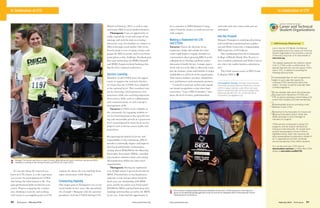
Morgan Thompson watches as Luke Christie, MDA National Youth chairman, pumps up DECA
members running in the annual Finish Line/DECA 5K in April 2013.
Elsa Tavares congratulates Mohamed Sakallah of the Univ. of Minnesota for winning first
place in the Marketing Management Event at the 2013 Collegiate DECA International Career
Development Conference.
Photo courtesy of DECA
Photo courtesy of Frank Peterson/DECA
Recognizing the benefit of service and
responsibility to the community, DECA
members continually impact and improve
their local and broader communities,
raising almost $500,000 for the Muscular
Dystrophy Association (MDA), contribut-
ing countless volunteer hours and raising
thousands more dollars for other local
organizations.
Thompson: During my sophomore
year of high school, I got involved with the
MDA. I learned how to run fundraisers,
organize events and get others involved.
Each year, my relationship with MDA
grew, and by my senior year I had raised
$10,000 for MDA and had built deep rela-
tionships with families served by the MDA
in my area. I also had the opportunity to
be a counselor at MDA Summer Camp,
where I had the chance to work one-on-one
with campers.
Making a Statement for CTE
and CTSOs
Tavares: I knew the diversity of my
experience inside and outside the class-
room could begin to engage members in
conversations about growing DECA at the
collegiate level. During a general session
discussion it finally hit me: A major aspect
of my role was to be able to effectively trans-
late the mission, vision and benefits to major
stakeholders at all levels of the organization.
That meant students, teachers, administra-
tors, and business and community partners.
I wanted to motivate action and expand
our brand recognition so that when busi-
nesses hear “I am a DECA member,” they
know the level of talent, professionalism

TECH_Feb 2014_Theme 6

  • 1.
    38  Techniques  February 2014February 2014  Techniques  39www.acteonline.orgwww.acteonline.org A Pipeline to Industry A Pipeline to IndustryIn Celebration of CTE In Celebration of CTE hether they’re blue or red, the career and technical student organization (CTSO) blazers represent more than nearly two million students annually. When those members put on their blazers, they become some of career and technical edu- cation’s (CTE’s) superheroes within their organizations, schools and communities. They become role models, leaders, phi- lanthropists, project managers, advocates and our future. The journey of CTSO students is full of incredible experiences, and for each student, his or her participation in a CTSO will have a unique meaning. For some, it’s about networking, for others it’s about competing, and for others it’s about preparing for the future. On the other hand, for CTE educators, it’s all about the students and the stories they share about the impact CTE and CTSOs can make. Morgan Thompson and Elsa Tava- res are two of many CTE superheroes. Thompson and Tavares recently com- pleted their terms as national officers for DECA and Collegiate DECA, respec- tively. Here, they share their experiences and reflections on the impact that CTE and CTSOs have had on them, as well as the members they served. The Voice of Members Thompson: Serving as the national president of DECA was easily the greatest honor I have had because I got to dedi- cate myself to serving the organization I love and make an impact on an interna- tional level. This opportunity gave me the chance to meet people from around the world and connect through DECA. At each point in my DECA career I felt myself growing as a leader. But on the national team, I grew faster than I ever had before. Tavares: The biggest impact of my term as national president was realizing that I was the voice of members that I interacted with. Each of them relied on the statements I made. I was the “eyes” or portal into the organization at the national level. For this reason, represent- ing the organization in the highest of professional manners was a responsibility I took personally, and I applied the same honesty and integrity to my personal and academic lives as well. Preparing Members for College and Careers Tavares: I believe CTE and CTSOs are vehicles that drive students into college and careers with quantifiable, quality experiences that can be beneficial to com- panies across industries and the economy as a whole. Thompson: There are no better tools that can prepare students for their future college and career plans like CTE and CTSOs. They give students relevant material, and challenges the students to think creatively about how they can apply it to their lives. A New Kind of Learning Thompson: CTE means a new kind of learning. It’s a kind of learning that takes students beyond the classroom and shows them unlimited opportunities. It opens students’ eyes to careers they never knew about, it pushes them to challenge the way they think and to gain skills they will use in their careers. By Christopher Young Illustration©iStockphoto.com/shelma1
  • 2.
    and work ethicthat comes with such an individual. Into the Present Morgan Thompson is studying advertising and marketing communications at John- son and Wales University, a longstanding DECA partner, in Providence. After graduating from the Community College of Rhode Island, Elsa Tavares is now a student at Johnson and Wales Univer- sity where she studies business administra- tion. They both remain active in DECA and Collegiate DECA. Christopher Young is the high school division and communications director at DECA Inc. He was a DECA chapter member, state officer and state advisor at both the high school and college levels before joining DECA Inc. He can be reached at christopher_young@deca.org. Advocacay Resources Just in time for CTE Month, the National Coordinating Council for Career and Technical Student Organizations has provided a new set of advocacy resources on its new website at www.ctsos.org. The initiative represents the collective impact of all 11 CTSOs under a unified brand. The website describes the role and impact CTSOs have in CTE, in addition to providing the following advocacy tools: A downloadable flyer for each congressional district in each state that reports the combined CTSO membership within that district. This flyer is ideal for visits with state or federal legislators. A more detailed state report that showcases the impact and importance of CTSOs and CTE, as well as providing a school listing of all active CTSO chapters and total membership. A downloadable brochure providing a brief overview of each CTSO. Connection to the Association for Career and Technical Education’s Action Center that allows advocates to send messages to members of Congress. CTSOs are key components to strong CTE programs, and the student members are among our best advocates. As schools send student representatives of their CTSOs to legislative events, these new resources will allow representatives to advocate on behalf of all 11 organizations and their combined annual membership of two million students. You can also post your CTSO story to www.facebook.com/ctsos or follow other CTSO stories at www.twitter.com/NCCTSO. 40  Techniques  February 2014 February 2014  Techniques  41www.acteonline.orgwww.acteonline.org In Celebration of CTE In Celebration of CTE It’s not just about the material you learn in CTE classes, it is the experience you receive by participating in CTSOs that brings the information to life. You gain professional skills needed for your career. Projects engaging the commu- nity, thinking creatively and working with teams to accomplish goals set CTE students far above the rest and help them enjoy school more while doing it. Connecting Digitally One major goal of Thompson’s was to use social media in new ways. She spearhead- ed a Google+ Hangout with the national presidents of all the CTSOs during CTE Month in February 2013, as well as initi- ated many DECA social media initiatives. Thompson: I saw an opportunity to really expand the reach and scope of our message and took the lead on creating innovative ways for members to connect to DECA through social media. One of my favorite projects was creating various cam- paigns for DECA month, such as an Insta- gram photo-a-day challenge, Facebook post days and monitoring the #DECAmonth and #DECAsuperweekend hashtags dur- ing the three regional conferences. Service Learning Members in all CTSOs have the oppor- tunity to support the national charities or causes that the CTSOs have adopted at the national level. That translates into service learning, which promotes civic awareness while also teaching important 21st-century skills, such as collaboration and communication, as well as project management skills. Tavares: CTSOs create visibility in the community by engaging students in service learning projects that provide last- ing and sustainable growth at a grassroots level. I participated in many local service projects such as breast cancer walks and food drives. Morgan Thompson watches as Luke Christie, MDA National Youth chairman, pumps up DECA members running in the annual Finish Line/DECA 5K in April 2013. Elsa Tavares congratulates Mohamed Sakallah of the Univ. of Minnesota for winning first place in the Marketing Management Event at the 2013 Collegiate DECA International Career Development Conference. Photo courtesy of DECA Photo courtesy of Frank Peterson/DECA Recognizing the benefit of service and responsibility to the community, DECA members continually impact and improve their local and broader communities, raising almost $500,000 for the Muscular Dystrophy Association (MDA), contribut- ing countless volunteer hours and raising thousands more dollars for other local organizations. Thompson: During my sophomore year of high school, I got involved with the MDA. I learned how to run fundraisers, organize events and get others involved. Each year, my relationship with MDA grew, and by my senior year I had raised $10,000 for MDA and had built deep rela- tionships with families served by the MDA in my area. I also had the opportunity to be a counselor at MDA Summer Camp, where I had the chance to work one-on-one with campers. Making a Statement for CTE and CTSOs Tavares: I knew the diversity of my experience inside and outside the class- room could begin to engage members in conversations about growing DECA at the collegiate level. During a general session discussion it finally hit me: A major aspect of my role was to be able to effectively trans- late the mission, vision and benefits to major stakeholders at all levels of the organization. That meant students, teachers, administra- tors, and business and community partners. I wanted to motivate action and expand our brand recognition so that when busi- nesses hear “I am a DECA member,” they know the level of talent, professionalism