Observation Lab


Crash Course on Creativity 2012
    Professor Tina Seelig, Stanford University
The „temptation“
             or the science of unnoticeably influencing our buying decisions

What do most shops have in common?

● Most stores display some special offers already at the gate of the store
● Once inside, a shelf with some selected articles is mostly one the first things you see

● Most shops are oriented to the right, meaning the customer is guided to start the

  shopping tour clockwise
● Products are displayed functionally

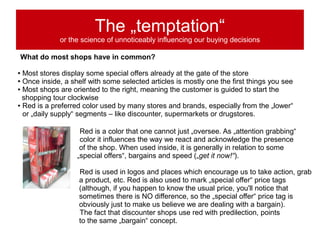
● Red is a preferred color used by many stores and brands, especially from the „lower“

  or „daily supply“ segments – like discounter, supermarkets or drugstores.
                    Red is a color that one cannot just „oversee. As „attention grabbing“
                    color it influences the way we react and acknowledge the presence
                    of the shop. When used inside, it is generally in relation to some
                   „special offers“, bargains and speed („get it now!“).
                    Red is used in logos and places which encourage us to take action, grab
                    a product, etc. Red is also used to mark „special offer“ price tags
                    (although, if you happen to know the usual price, you'll notice that
                    sometimes there is NO difference, so the „special offer“ price tag is
                    obviously just to make us believe we are dealing with a bargain).
                    The fact that discounter shops use red with predilection, points
                    to the same „bargain“ concept.
Beauty is yummy!
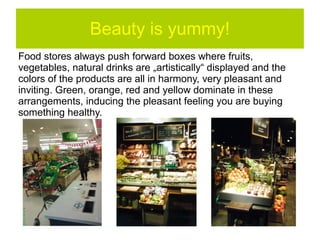
Food stores always push forward boxes where fruits, vegetables,
natural drinks are „artistically“ displayed and the colors of the
products are all in harmony, very pleasant and inviting. Green,
orange, red and yellow dominate in these arrangements,
inducing the pleasant feeling you are buying something healthy.
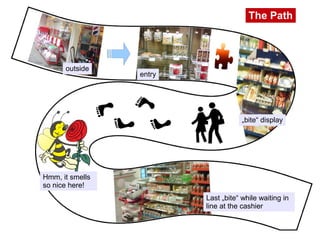
The Path


      outside
                 entry


                                     „bite“ display


Hmm, it smells
so nice here!
                         Last „bite“ while waiting in
                         line at the cashier
See? We are so popular!
                     Come check us out!
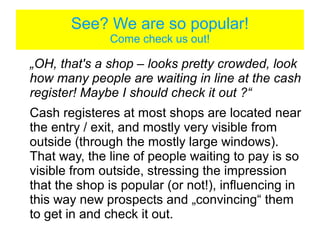
„OH, that's a shop – looks pretty crowded, look how many people
are waiting in line at the cash register! Maybe I should check it
out ?“
Cash registeres at many shops are located near the entry / exit,
and mostly very visible from outside (through the mostly large
windows). That way, the line of people waiting to pay is so visible
from outside, stressing the impression that the shop is popular (or
not!), influencing in this way new prospects and „convincing“ them
to get in and check it out.
In clothing / shoe stores however, I have observed that the cash
register is rather „hidden“ somwhere in the middle of the store,
obviously encouraging some „extra browsing“.
Come & Go
Shopping habits vary according to the type of shop we are in.

In supermarkets we mainly notice people in the 30+ age
group, mostly alone and mainly searching for pre-definied
items. Exception teens who tend to only come in groups,
mainly shopping for „junk food“ and drinks. Shop workers do
always wear some uniforms and do not engage in dialog with
shoppers unless asked.

Different is the situation in fashion shops for ex., where
people mainly „browse“ without a specific target and where
we notice the sales people getting into action. In these shops
the sales people do not wear a uniform, maybe just a tag.
As Peter M. Leschak once said …


All of us are watchers — of television, of time
clocks, of traffic on the freeway — but few are
                    observers.
 Everyone is looking, not many are seeing.

Observe

  • 1.
    Observation Lab Crash Courseon Creativity 2012 Professor Tina Seelig, Stanford University
  • 2.
    The „temptation“ or the science of unnoticeably influencing our buying decisions What do most shops have in common? ● Most stores display some special offers already at the gate of the store ● Once inside, a shelf with some selected articles is mostly one the first things you see ● Most shops are oriented to the right, meaning the customer is guided to start the shopping tour clockwise ● Products are displayed functionally ● Red is a preferred color used by many stores and brands, especially from the „lower“ or „daily supply“ segments – like discounter, supermarkets or drugstores. Red is a color that one cannot just „oversee. As „attention grabbing“ color it influences the way we react and acknowledge the presence of the shop. When used inside, it is generally in relation to some „special offers“, bargains and speed („get it now!“). Red is used in logos and places which encourage us to take action, grab a product, etc. Red is also used to mark „special offer“ price tags (although, if you happen to know the usual price, you'll notice that sometimes there is NO difference, so the „special offer“ price tag is obviously just to make us believe we are dealing with a bargain). The fact that discounter shops use red with predilection, points to the same „bargain“ concept.
  • 3.
    Beauty is yummy! Foodstores always push forward boxes where fruits, vegetables, natural drinks are „artistically“ displayed and the colors of the products are all in harmony, very pleasant and inviting. Green, orange, red and yellow dominate in these arrangements, inducing the pleasant feeling you are buying something healthy.
  • 4.
    The Path outside entry „bite“ display Hmm, it smells so nice here! Last „bite“ while waiting in line at the cashier
  • 5.
    See? We areso popular! Come check us out! „OH, that's a shop – looks pretty crowded, look how many people are waiting in line at the cash register! Maybe I should check it out ?“ Cash registeres at many shops are located near the entry / exit, and mostly very visible from outside (through the mostly large windows). That way, the line of people waiting to pay is so visible from outside, stressing the impression that the shop is popular (or not!), influencing in this way new prospects and „convincing“ them to get in and check it out. In clothing / shoe stores however, I have observed that the cash register is rather „hidden“ somwhere in the middle of the store, obviously encouraging some „extra browsing“.
  • 6.
    Come & Go Shoppinghabits vary according to the type of shop we are in. In supermarkets we mainly notice people in the 30+ age group, mostly alone and mainly searching for pre-definied items. Exception teens who tend to only come in groups, mainly shopping for „junk food“ and drinks. Shop workers do always wear some uniforms and do not engage in dialog with shoppers unless asked. Different is the situation in fashion shops for ex., where people mainly „browse“ without a specific target and where we notice the sales people getting into action. In these shops the sales people do not wear a uniform, maybe just a tag.
  • 7.
    As Peter M.Leschak once said … All of us are watchers — of television, of time clocks, of traffic on the freeway — but few are observers. Everyone is looking, not many are seeing.