INTRODUCTION Following the communicative approach as a methodological guide for our didactic syllabus, the didactic unit that is developed below intends to cover the four basic language skills, i.e. listening, speaking, reading and writing. For the treatment of these four skills we have proposed exercises and activities that promote the use of the target language in class, generate oral communication, integrate the students, cover the students’ needs and, at the same time, are appealing and entertaining.
OBJECTIVES The  main objective  of the teaching of English is to provide the students with a communication tool that can allow them to establish links with people all over the world and have better opportunities in their professional future.
GENERAL OBJECTIVES To understand oral and written English; to be able to extract information from both oral and written texts. To express oneself in oral and written English with correctness, appropriateness and fluency. To appreciate the communicative value of English as a foreign language and as  lingua franca  in the world nowadays. To develop in the students, through the use of the target language, the ideas of cosmopolitism, tolerance and respect for others. To understand and accept the cultural differences between Spain and English speaking countries.
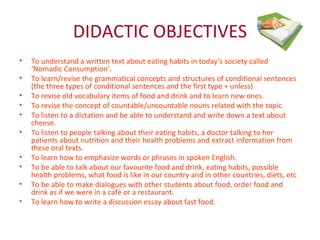
DIDACTIC OBJECTIVES To understand a written text about eating habits in today’s society called ‘Nomadic Consumption’. To learn/revise the grammatical concepts and structures of conditional sentences (the three types of conditional sentences and the first type + unless) To revise old vocabulary items of food and drink and to learn new ones. To revise the concept of countable/uncountable nouns related with the topic. To listen to a dictation and be able to understand and write down a text about cheese. To listen to people talking about their eating habits, a doctor talking to her patients about nutrition and their health problems and extract information from these oral texts.  To learn how to emphasize words or phrases in spoken English.  To be able to talk about our favourite food and drink, eating habits, possible health problems, what food is like in our country and in other countries, diets, etc To be able to make dialogues with other students about food, order food and drink as if we were in a café or a restaurant.  To learn how to write a discussion essay about fast food.

Objetivos

  • 1.
    INTRODUCTION Following thecommunicative approach as a methodological guide for our didactic syllabus, the didactic unit that is developed below intends to cover the four basic language skills, i.e. listening, speaking, reading and writing. For the treatment of these four skills we have proposed exercises and activities that promote the use of the target language in class, generate oral communication, integrate the students, cover the students’ needs and, at the same time, are appealing and entertaining.
  • 2.
    OBJECTIVES The main objective of the teaching of English is to provide the students with a communication tool that can allow them to establish links with people all over the world and have better opportunities in their professional future.
  • 3.
    GENERAL OBJECTIVES Tounderstand oral and written English; to be able to extract information from both oral and written texts. To express oneself in oral and written English with correctness, appropriateness and fluency. To appreciate the communicative value of English as a foreign language and as lingua franca in the world nowadays. To develop in the students, through the use of the target language, the ideas of cosmopolitism, tolerance and respect for others. To understand and accept the cultural differences between Spain and English speaking countries.
  • 4.
    DIDACTIC OBJECTIVES Tounderstand a written text about eating habits in today’s society called ‘Nomadic Consumption’. To learn/revise the grammatical concepts and structures of conditional sentences (the three types of conditional sentences and the first type + unless) To revise old vocabulary items of food and drink and to learn new ones. To revise the concept of countable/uncountable nouns related with the topic. To listen to a dictation and be able to understand and write down a text about cheese. To listen to people talking about their eating habits, a doctor talking to her patients about nutrition and their health problems and extract information from these oral texts. To learn how to emphasize words or phrases in spoken English. To be able to talk about our favourite food and drink, eating habits, possible health problems, what food is like in our country and in other countries, diets, etc To be able to make dialogues with other students about food, order food and drink as if we were in a café or a restaurant. To learn how to write a discussion essay about fast food.