EDUCATIONAL
OBJECTIVES
DR.MAHESWARI JAIKUMAR
maheswarijaikumar2103@gmail.com
• Objectives are the first step in
writing a strong lesson plan.
• The objectives are also known
as the "goal" of your lesson.
• Instructional objectives are
specific, measurable, short-
term, observable student
behaviors.
• An objective is a description
of a performance you want
learners to be able to exhibit
before you consider them
competent
• An objective describes an
intended result of instruction,
rather than the process of
instruction itself.
• Your lesson plan's objectives
describes what the students
will be able to do upon
completion of the
instructional experience.
NEED FOR OBJECTIVES
–To provide direction to
instruction.
–To provide guidelines for
assessment.
–To convey instructional intent
to others.
TYPES OF OBJECTIVES
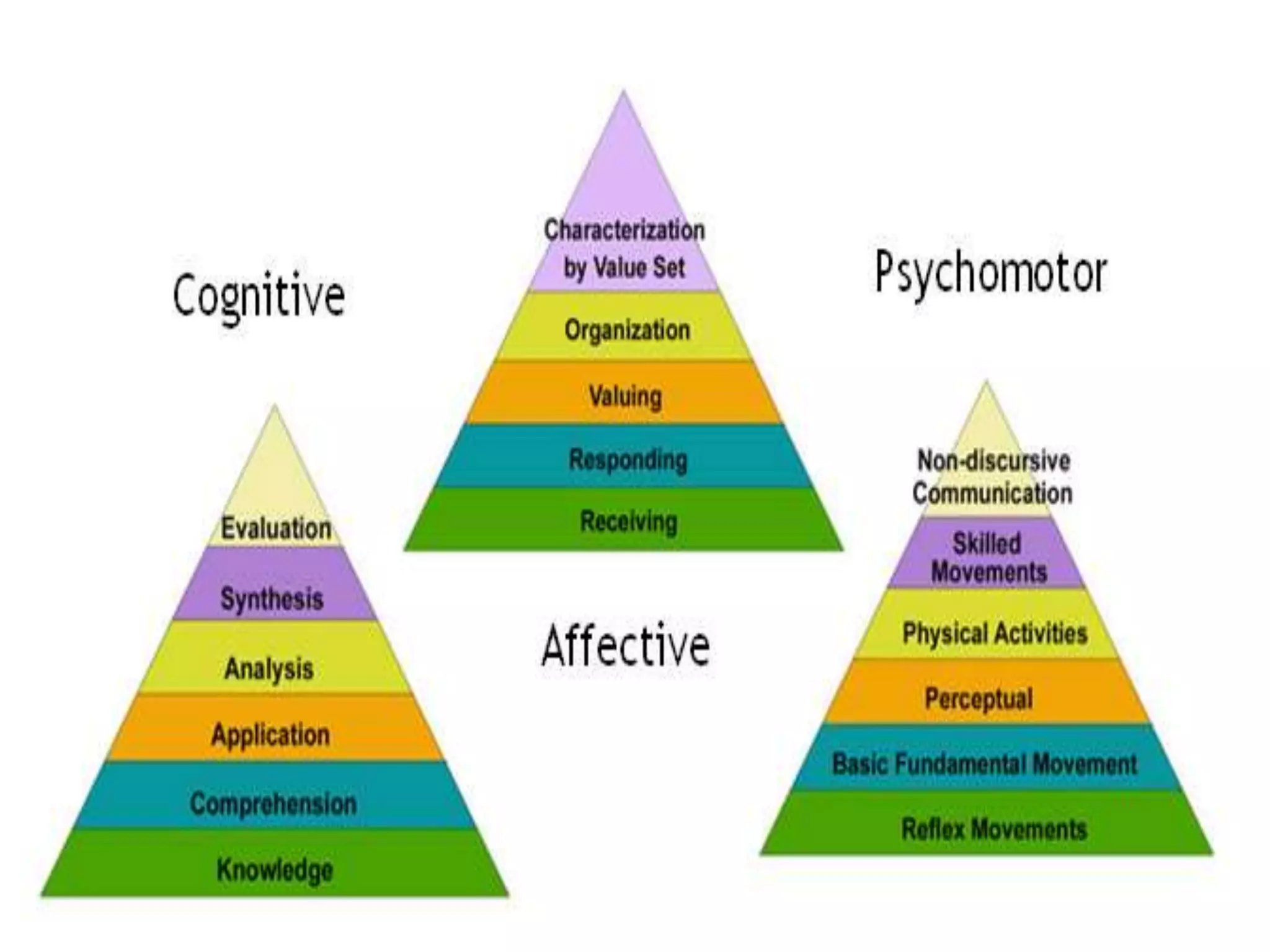
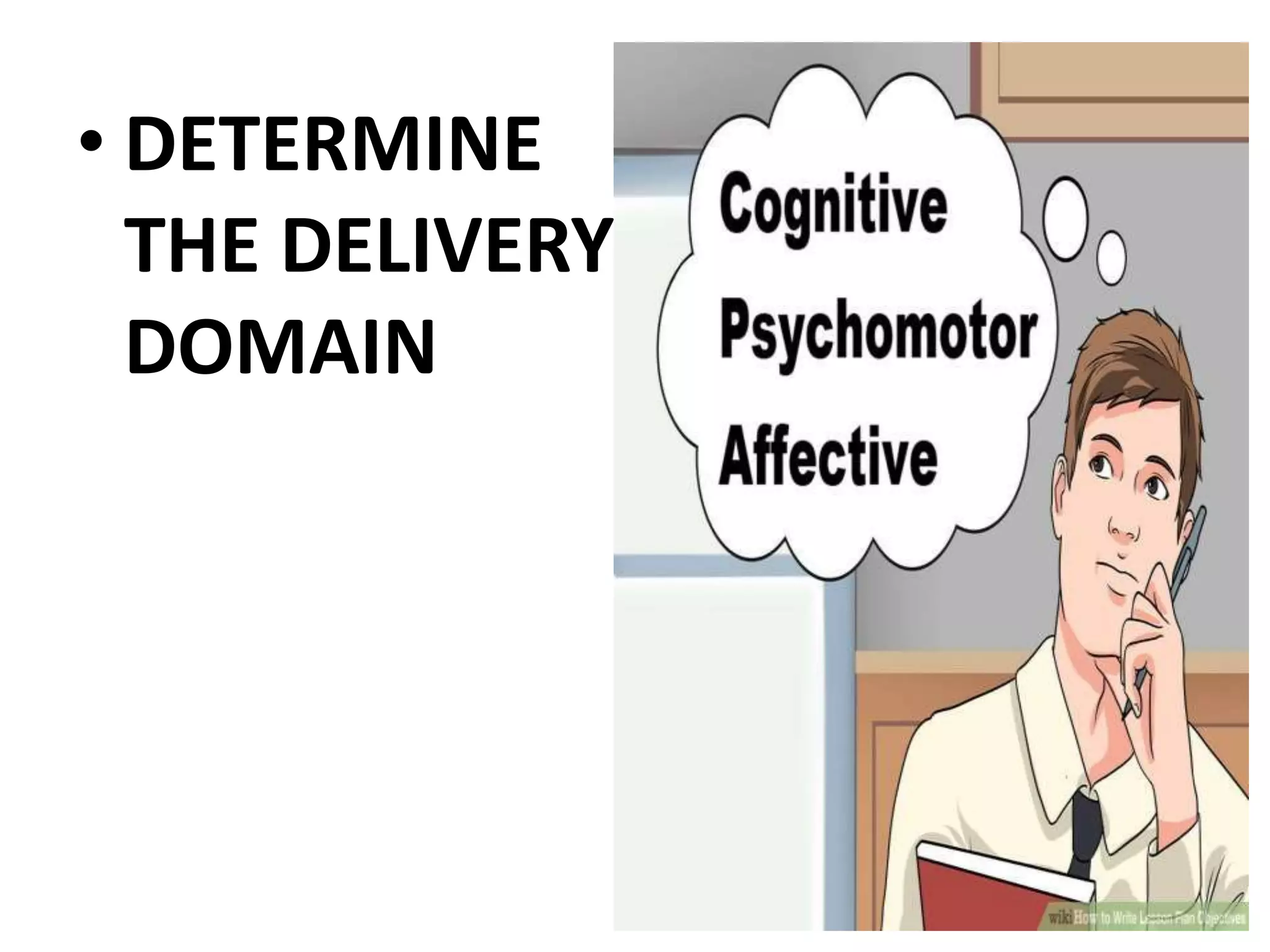
• COGNITIVE OBJECTIVES.
• PYSHOMOTOR PBJECTIVES.
• AFFECTIVE OBJECTIVES.
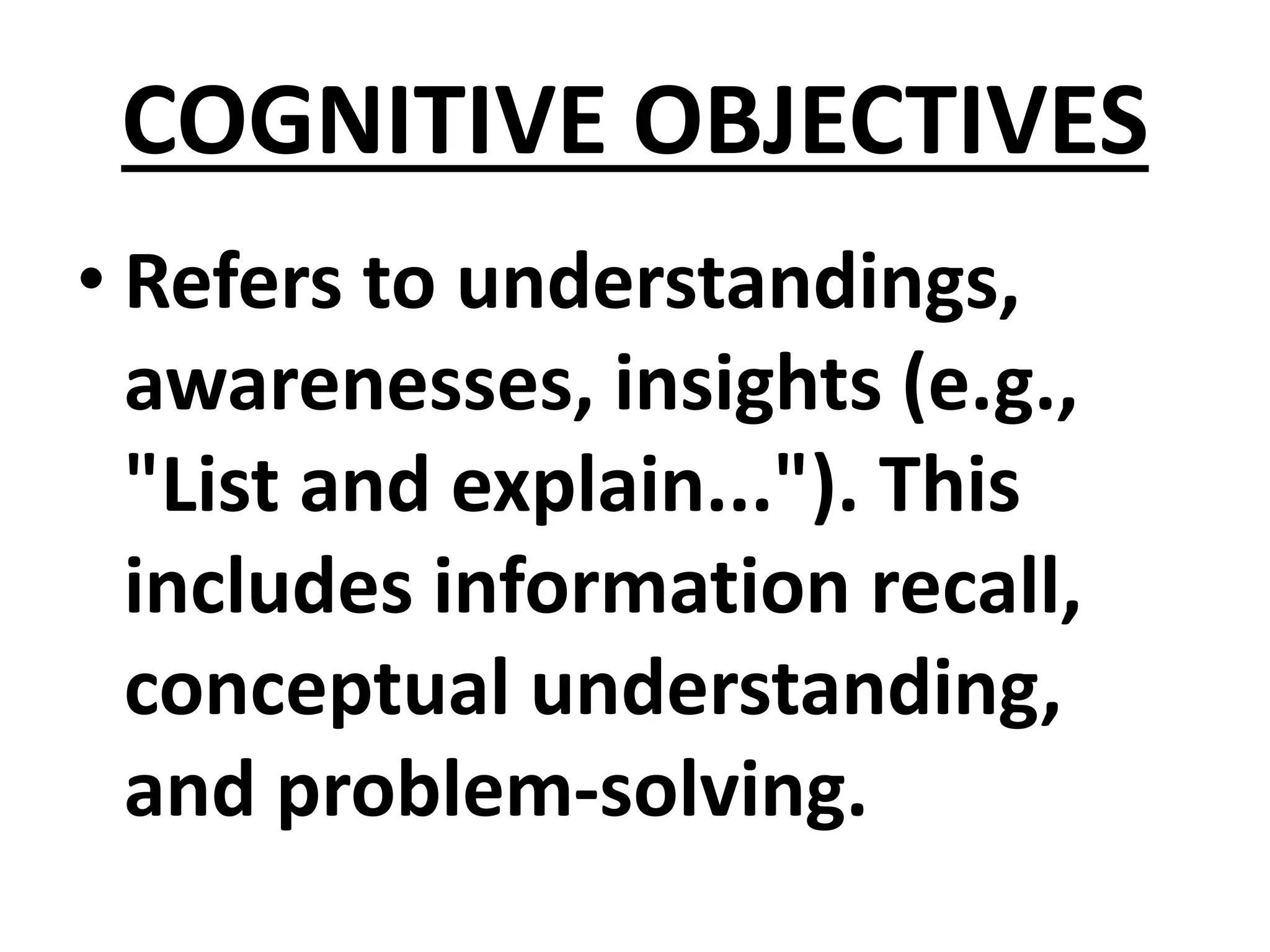
COGNITIVE OBJECTIVES
• Refers to understandings,
awarenesses, insights (e.g.,
"List and explain..."). This
includes information recall,
conceptual understanding,
and problem-solving.
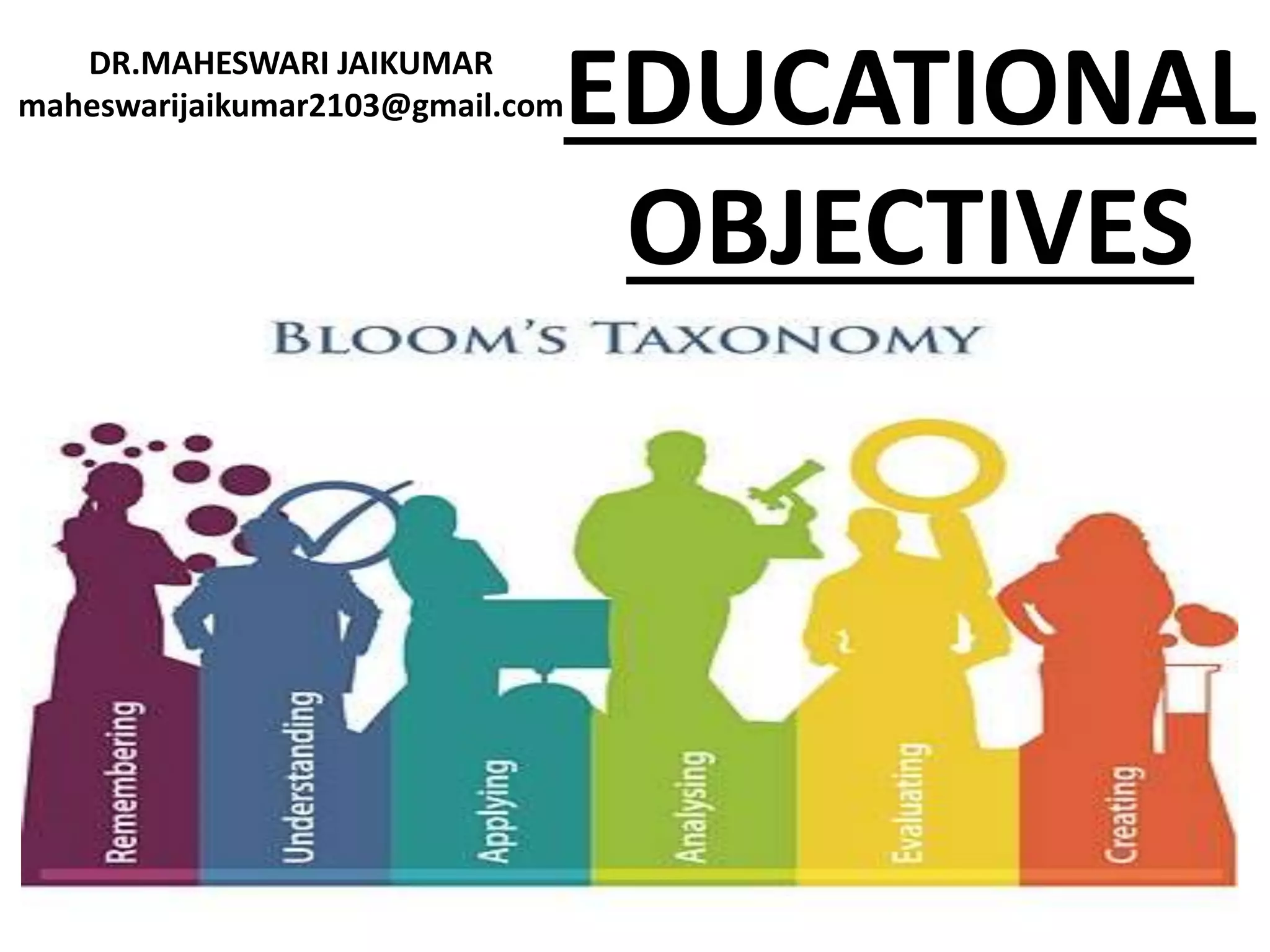
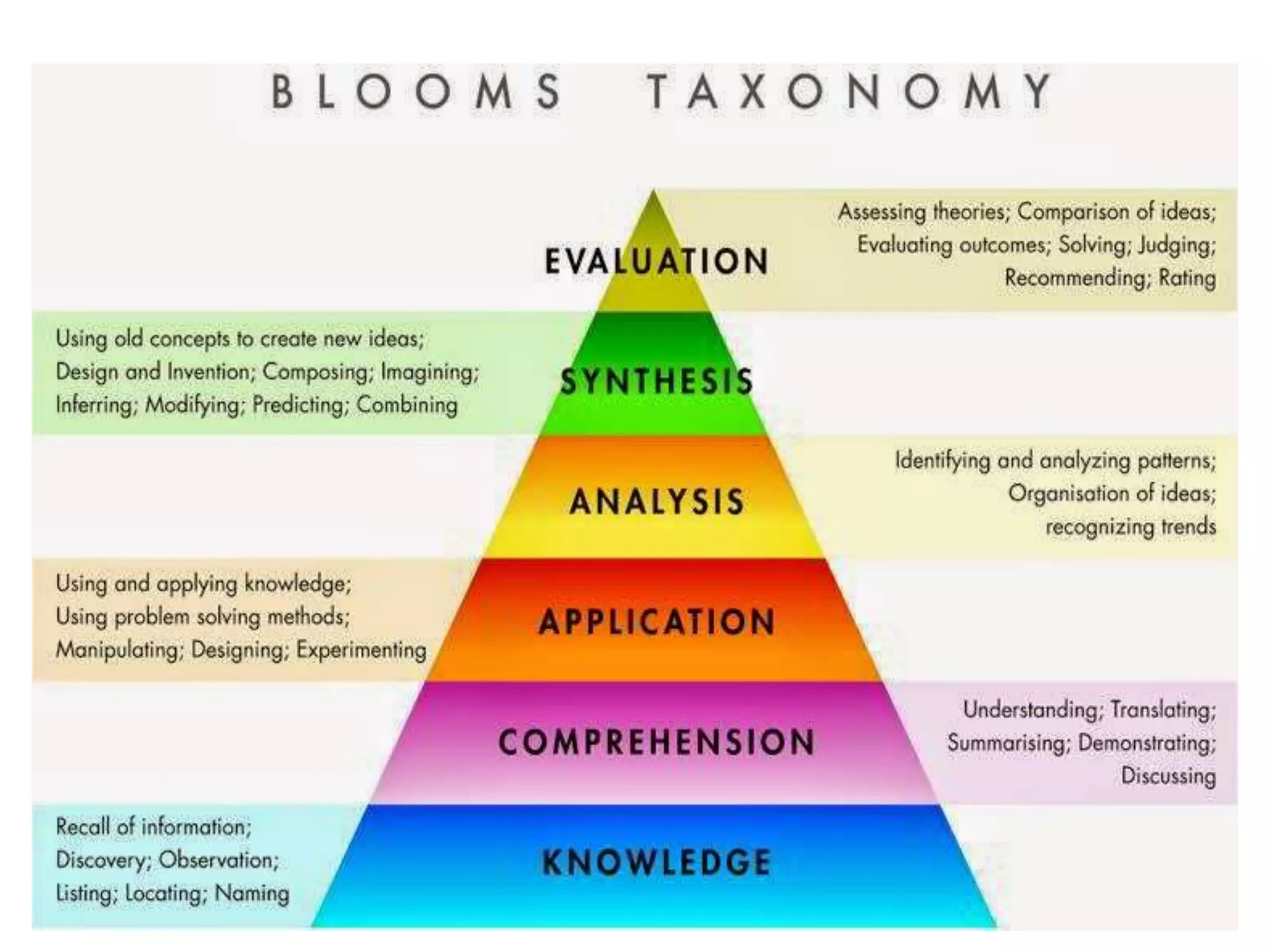
BLOOM’S TAXONOMY OF
COGNITIVE DOMAIN
KNOWLEDGE
• Knowledge remembering of previously
learned material; of terminology;
specific facts; ways and means of
dealing with specifics (conventions,
trends and sequences, classifications
and categories, criteria, methodology);
universals and abstractions in a field
(principles and generalizations,
theories and structures):
• Knowledge is (here) defined as
the remembering (recalling) of
appropriate, previously learned
information. defines; describes;
enumerates; identifies; labels;
lists; matches; names; reads;
records; reproduces; selects;
states; views; writes;.
COMPREHENSION
• Grasping (understanding) the
meaning of informational materials.
Classifies; cites; converts; describes;
discusses; estimates; explains;
generalizes; gives examples;
illustrates; makes sense out of;
paraphrases; restates (in own
words); summarizes; traces;
understands.
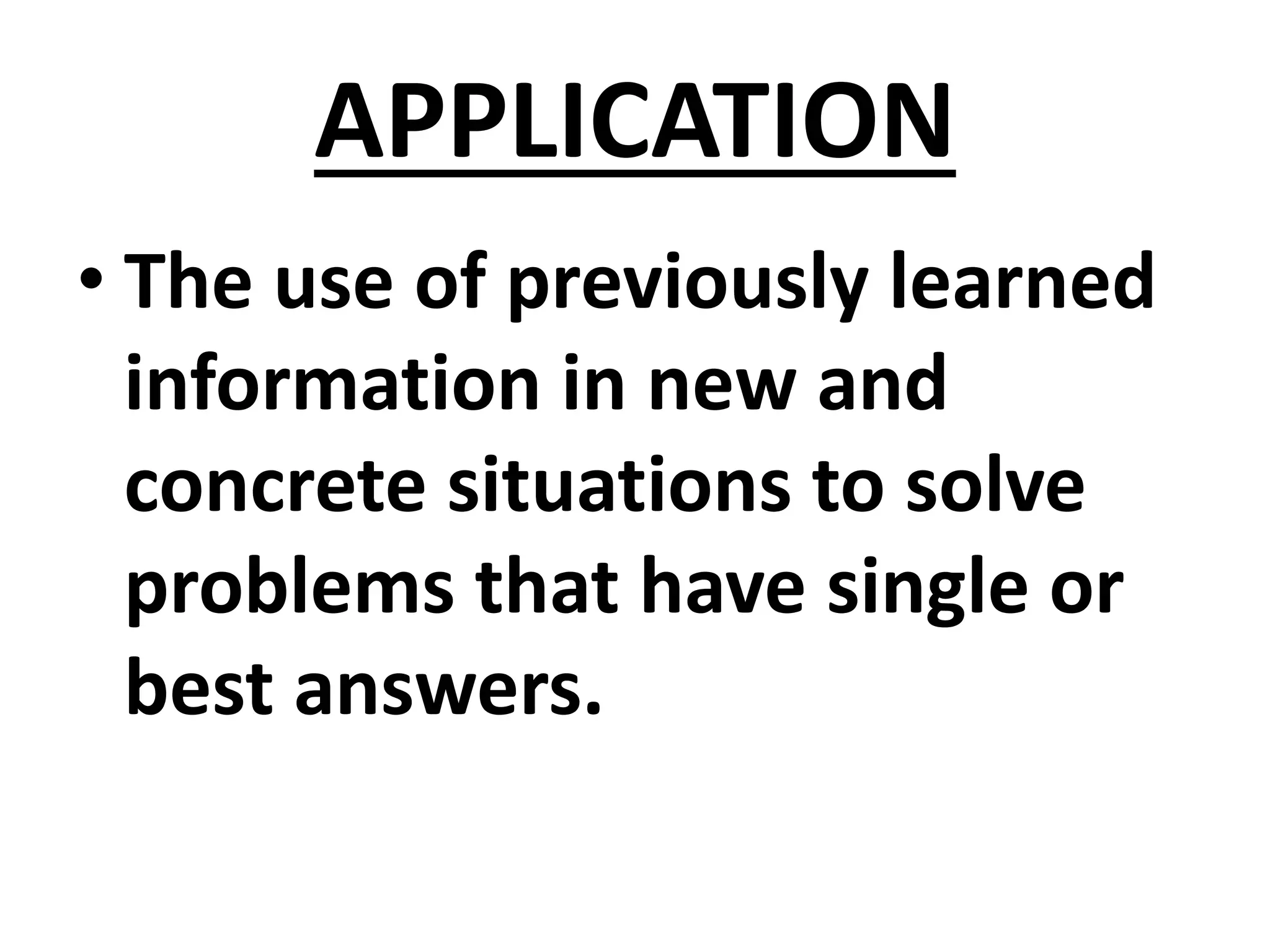
APPLICATION
• The use of previously learned
information in new and
concrete situations to solve
problems that have single or
best answers.
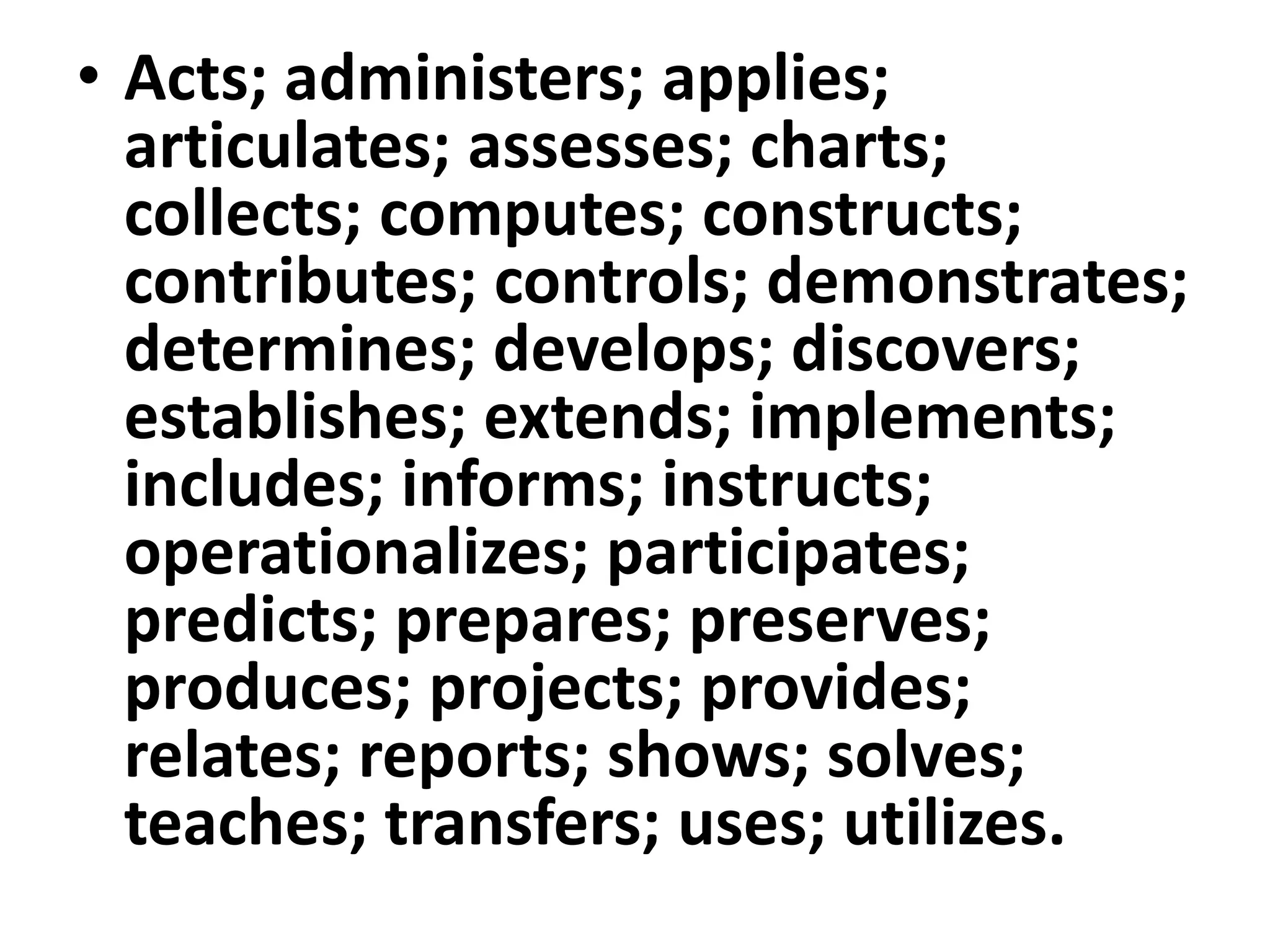
• Acts; administers; applies;
articulates; assesses; charts;
collects; computes; constructs;
contributes; controls; demonstrates;
determines; develops; discovers;
establishes; extends; implements;
includes; informs; instructs;
operationalizes; participates;
predicts; prepares; preserves;
produces; projects; provides;
relates; reports; shows; solves;
teaches; transfers; uses; utilizes.
ANALYSIS
• The breaking down of informational
materials into their component
parts, examining (and trying to
understand the organizational
structure of) such information to
develop divergent conclusions by
identifying motives or causes,
making inferences, and/or finding
evidence to support generalizations.
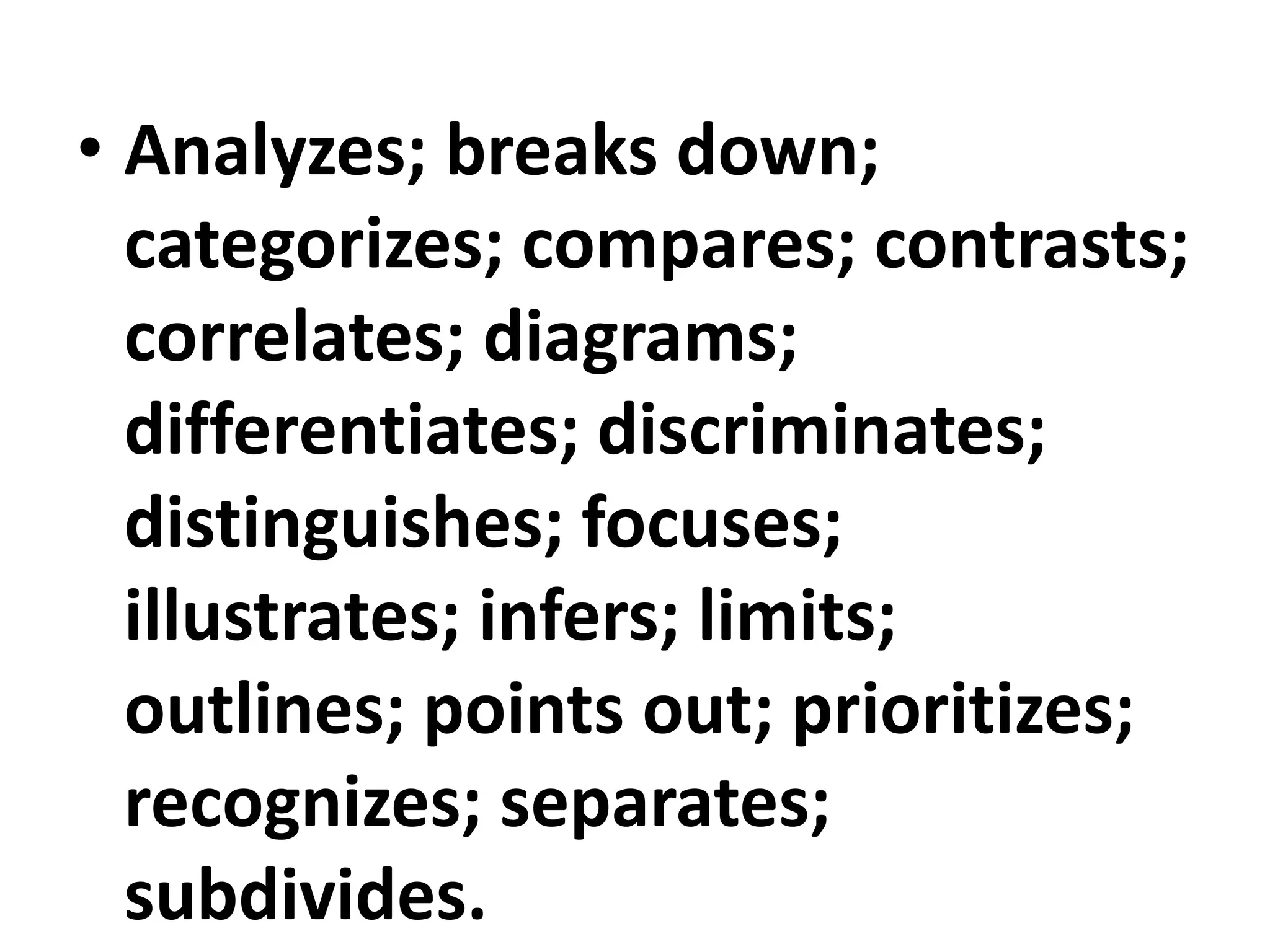
• Analyzes; breaks down;
categorizes; compares; contrasts;
correlates; diagrams;
differentiates; discriminates;
distinguishes; focuses;
illustrates; infers; limits;
outlines; points out; prioritizes;
recognizes; separates;
subdivides.
SYNTHESIS
• Creatively or divergently
applying prior knowledge and
skills to produce a new or
original whole.
• Adapts; anticipates; collaborates;
combines; communicates; compiles;
composes; creates; designs; develops;
devises; expresses; facilitates;
formulates; generates; hypothesizes;
incorporates; individualizes; initiates;
integrates; intervenes; invents; models;
modifies; negotiates; plans; progresses;
rearranges; reconstructs; reinforces;
reorganizes; revises; structures;
substitutes; validates.
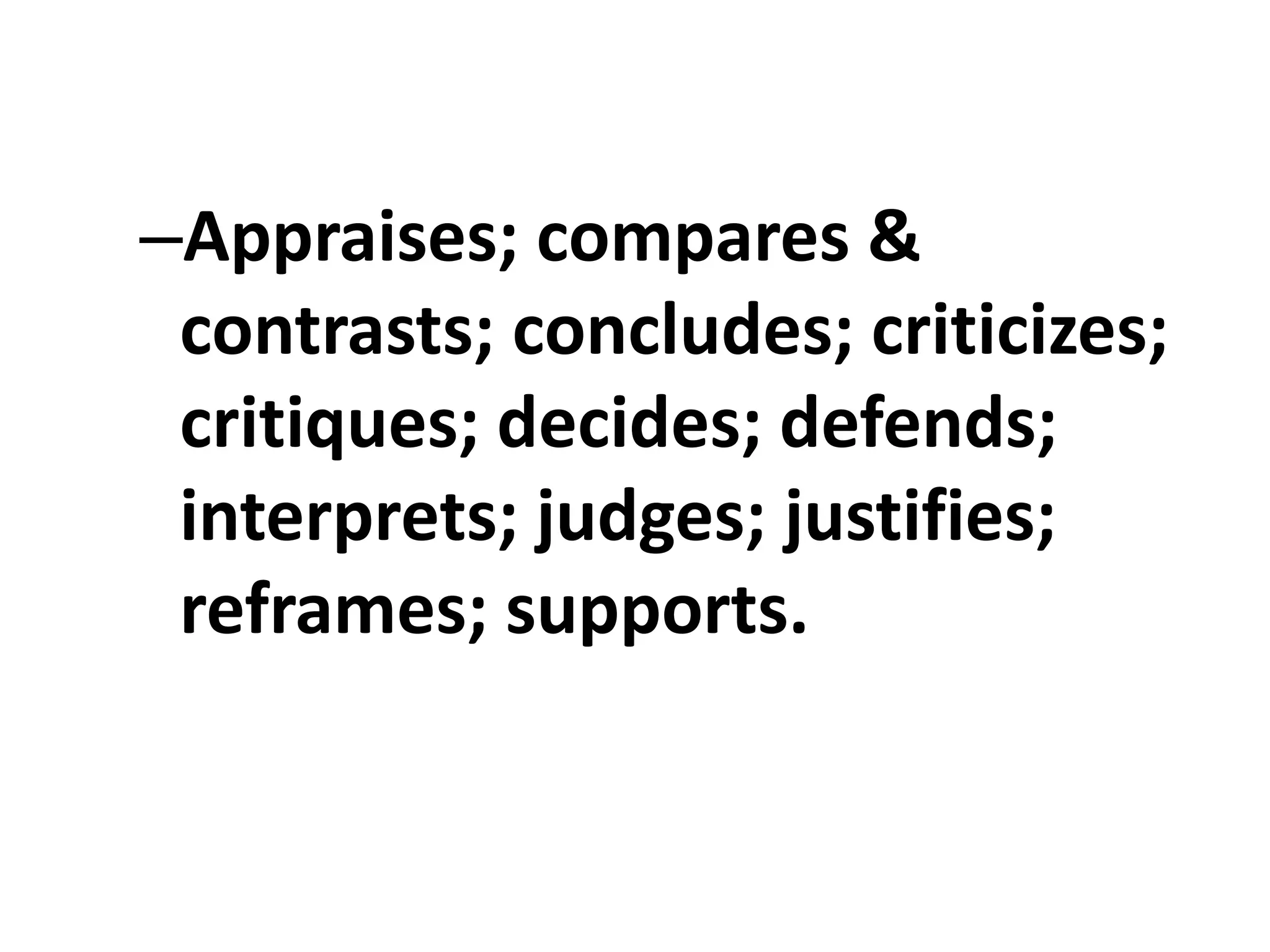
–Appraises; compares &
contrasts; concludes; criticizes;
critiques; decides; defends;
interprets; judges; justifies;
reframes; supports.
EVALUATION
• Judging the value of material
based on personal
values/opinions, resulting in
an end product, with a given
purpose, without real right or
wrong answers.
PYSHOMOTOR OBJECTIVES
• Objectives related to special
skills (e.g., "dissect a frog so
that the following organs are
clearly displayed..."; "take a
replicable blood pressure
reading by appropriately
using a sphygmomanometer.
SIMPSON’S PSYCHOMOTOR
DOMAIN
TAXONOMY OF
PSYCHOMOTOR
DOMAIN
SPEECH
BEHAVIOUR
NON VERBAL
COMMUNICATION
FINE MOTOR SKILLS
GROSS MOTOR
SKILLS
•SPEECH BEHAVIOUR:
Transmission speech &
protection of sound
•NON VERBAL
COMMUNICATION:
Gestures, expressions,
& bodily movements
•FINE MOTOR SKILLS:
Ability to move body
in co-ordination with
eyes & ears.
•GROSS MOTOR
SKILLS: Ability to move
limbs
KARTHWOHL’S TAXONOMY
OF AFFECTIVE LEARNING
CHARACTERIZATION
ORGANIZATION
VALUING
RESPONDING
RECEIVE INPUT
•CHARACTERIZATION:
Value/belief system
•ORGANIZATION OF
VALUE: Bringing
together values
•VALUING: Assigning
value to information
•RESPONDING:
Expressive
communication
•RECEIVE-INPUT :
Receptive
communication
AFFECTIVE OBJECTIVES
• Objectives related to
attitudes, appreciations,
relationships are termed as
affective objectives.
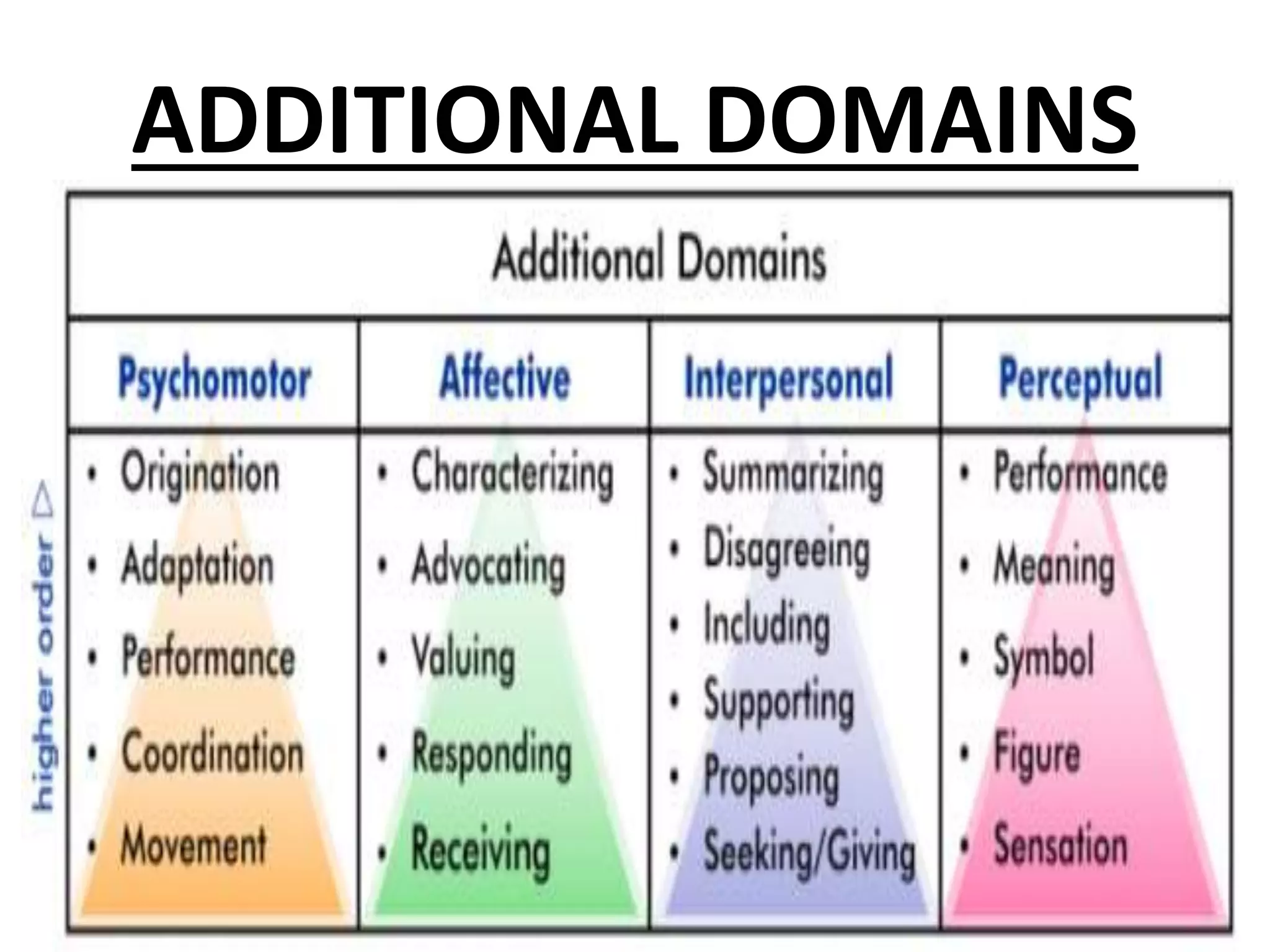
ADDITIONAL DOMAINS
TIPS FOR WRITING
OBJECTIVES
• It depends on what they are
used for! Objectives for
sequencing a unit plan will be
more general than for
specifying a lesson plan.
• Don't make writing objectives
tedious, trivial, time-
consuming, or mechanical.
Keep them simple,
unambiguous, and clearly
focused as a guide to learning.
• The purpose of objectives is
not to restrict spontaneity or
constrain the vision of
education in the discipline;
but to ensure that learning is
focused clearly enough that
both students and teacher
know what is going on.
• Objectives should be
expressed in terms of student
performance, behavior, and
achievement, not teacher
activity.
COMPONENTS OF
OBJECTIVES
–Identify the type of activity in
which competence is required
(e.g., "Dissect...").
–Specify the criteria or
standards by which
competence in the activity will
be assessed (e.g., "a frog so
that the following organs are
clearly displayed...").
–List any conditions or
circumstances required for
students to meet the objective
(e.g., "...given two class
periods working with the
materials at your lab station").
• A. Objectives must be clear
and attainable.
• B. Focus on knowledge/skill
acquisition or reinforcement.
• A recommended wording
format is: "At the completion
of this activity, participants
should be able to..." This
phrase is followed by a
specific performance verb and
the desired learning outcome.
• Words or phrases such as know,
think, appreciate, learn,
comprehend, remember,
perceive, understand, be aware
of, be familiar with, have
knowledge of, grasp the
significance, are NOT measurable
and should be avoided.
• The following are NOT observable or
measurable objectives:
• Appreciate the beauty of a
circuit
• Really understand relativity
theory
• Be familiar with the law
• Understand the process of
osmosis
• Enjoy speaking French
• Change the spark plugs on an
engine
• Learn about erosion
ABCDS OF WRITING
OBJECTIVES
• A-Audience: The who. "The student
will be able to…"
• B-Behavior: What a learner is
expected to be able to do or the
product or result of the doing. The
behavior or product should be
observable.
• C-Condition: The important
conditions under which the
performance is to occur.
• D-Degree: The criterion of
acceptable performance. How
well the learner must perform in
order for the performance to be
considered acceptable.
SMART-OBJECTIVE
• S- Specific
• M- Measurable
• A- Attainable
• R-Results Focused
• T-Time Focused
1. STRUCTURING THE
LESSON PLAN
OBJECTIVES
• CONSIDER
THE
DESIRED
OUTCOME
OF THE
CLASS
• DETERMINE
THE DELIVERY
DOMAIN
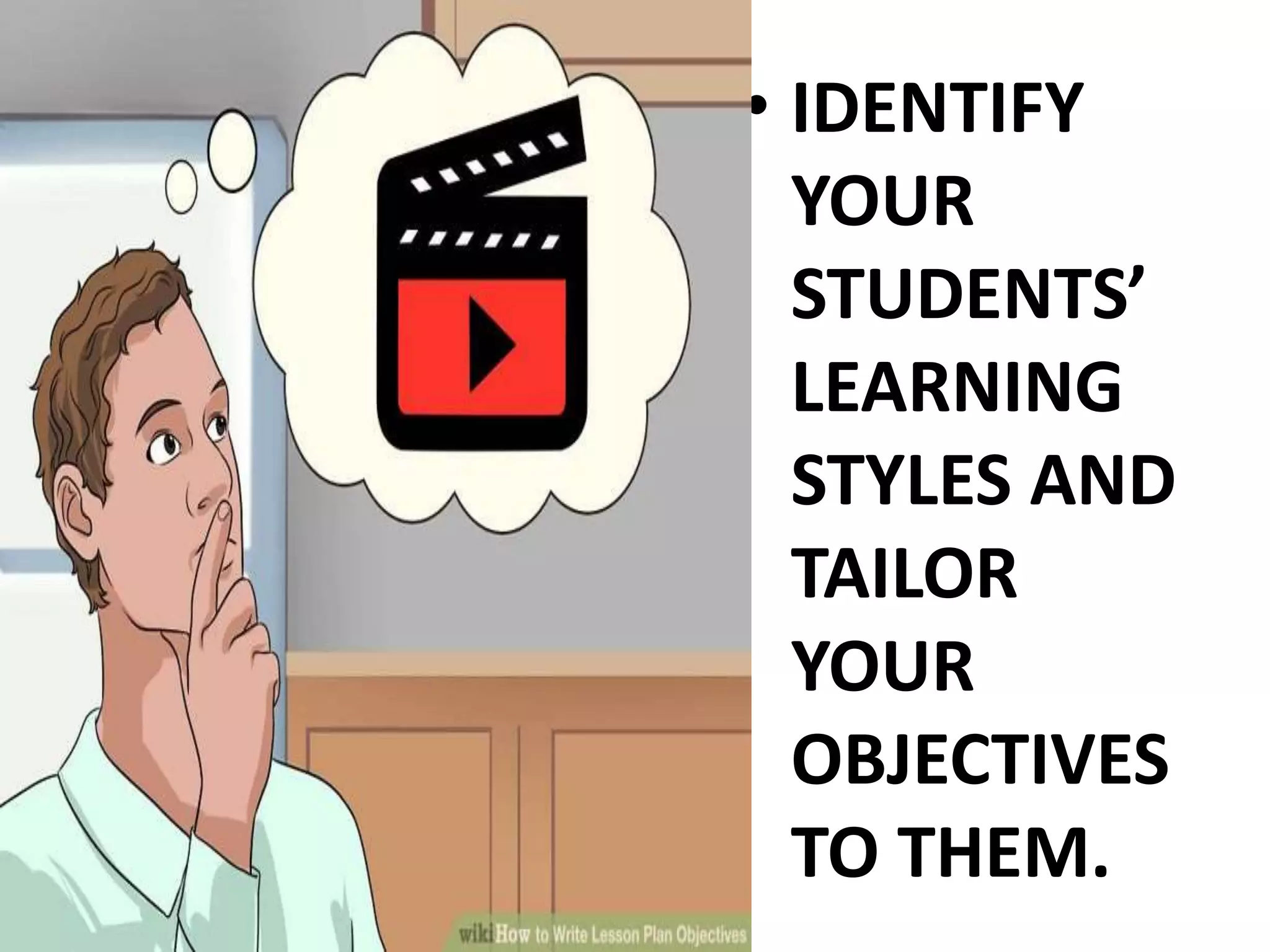
• IDENTIFY
YOUR
STUDENTS’
LEARNING
STYLES AND
TAILOR
YOUR
OBJECTIVES
TO THEM.
2.CREATING THE
LESSON PLAN
OBJECTIVES
•COMPOSE
AN
OUTLINE
• MAXIMIZE
STUDENT
ABILITIES BY
INCLUDING
DIFFERENT
TEACHINGS
STYLES.
• DEVELOP
ACTIVITIES
THAT MEET
THE LESSON
PLAN
OBJECTIVES
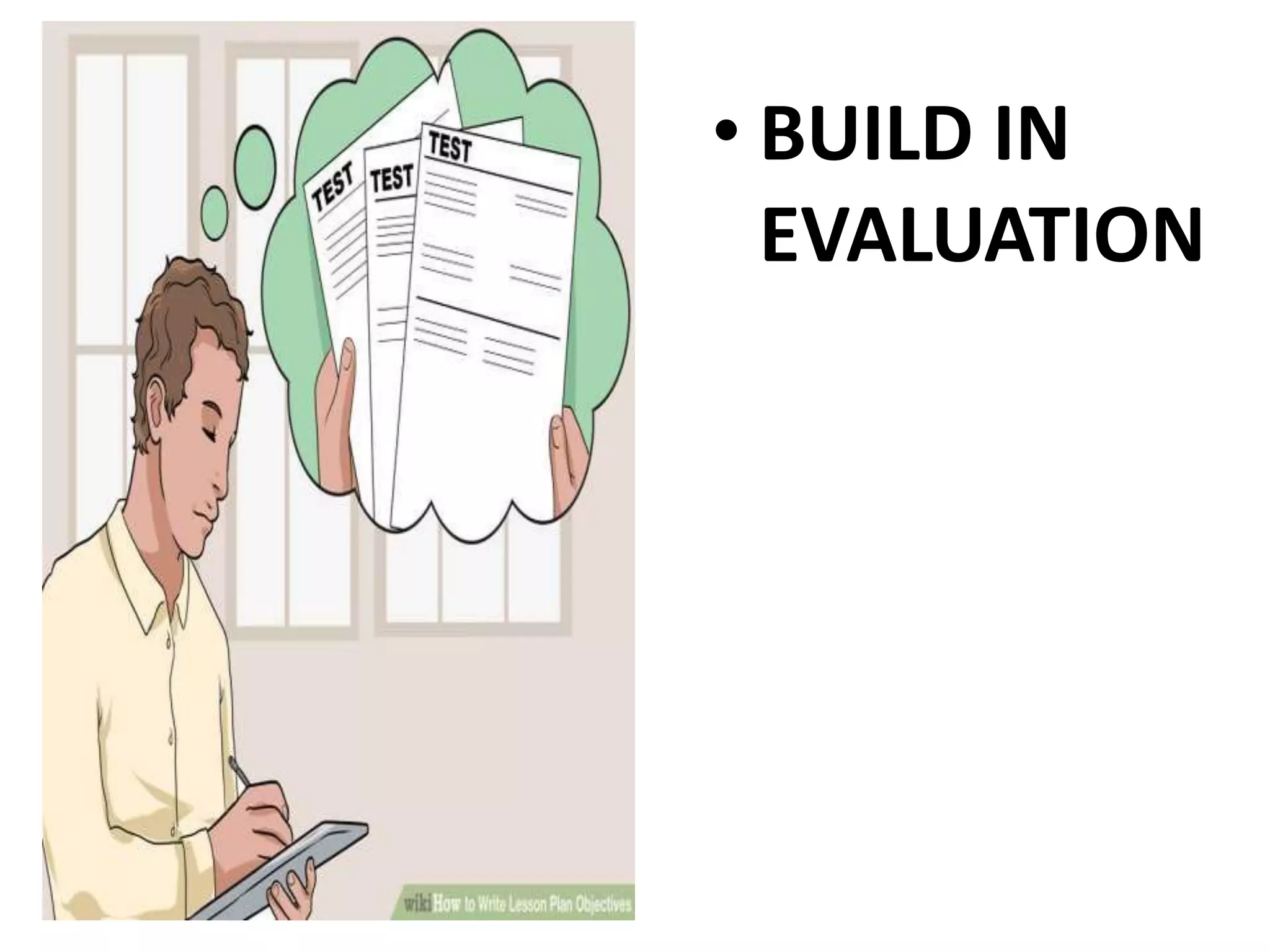
• BUILD IN
EVALUATION
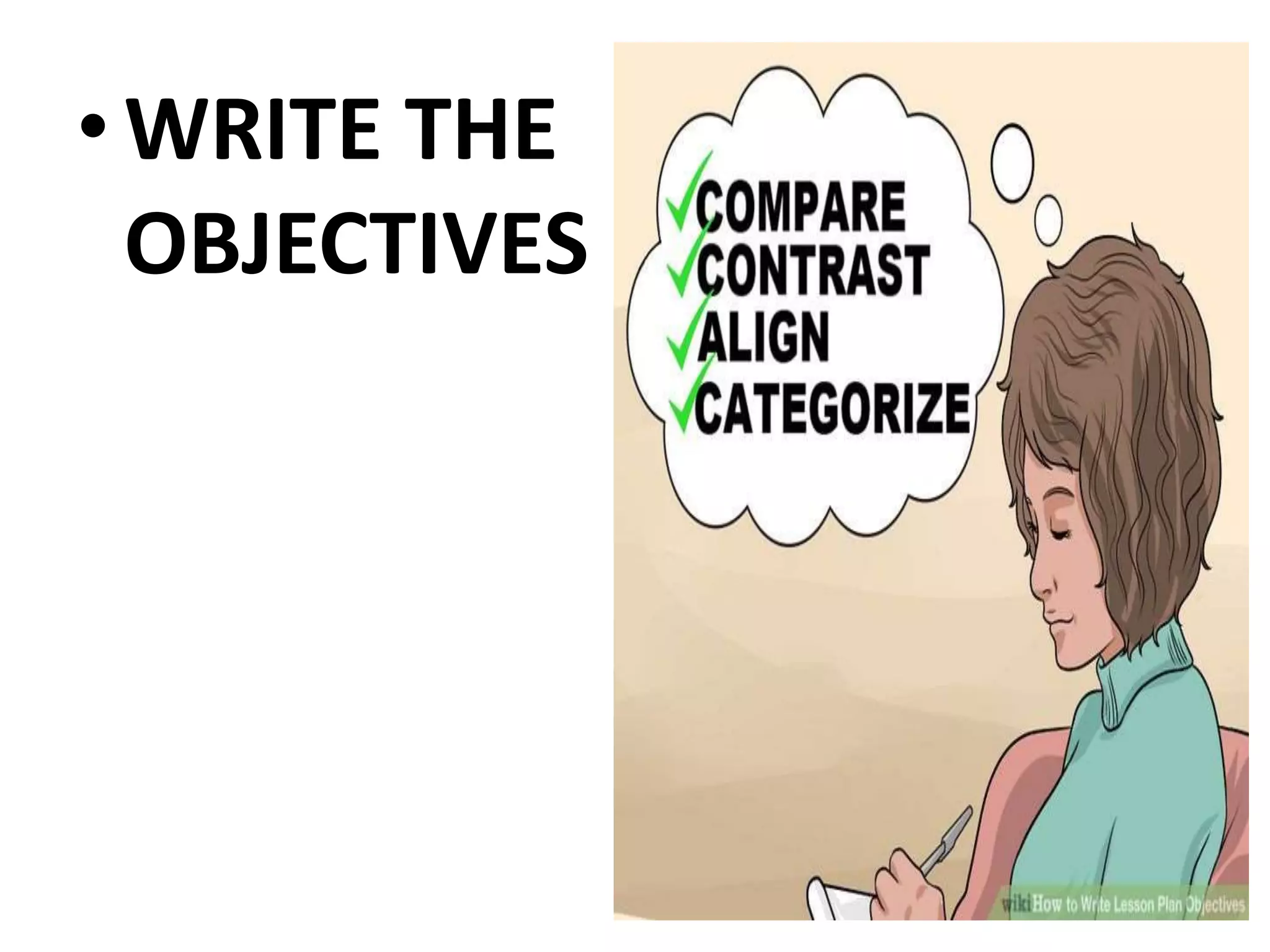
•WRITE THE
OBJECTIVES
3.FOLLOWING THE RULE
• FOLLOW
STATE-WIDE
PRACTICES
•ADOPT
TEACHING
STANDARDS.
• ABIDE
WITH
SCHOOL
POLICIES
ABIDING TO THE
STANDARDS
4. UTILIZING MATERIAL
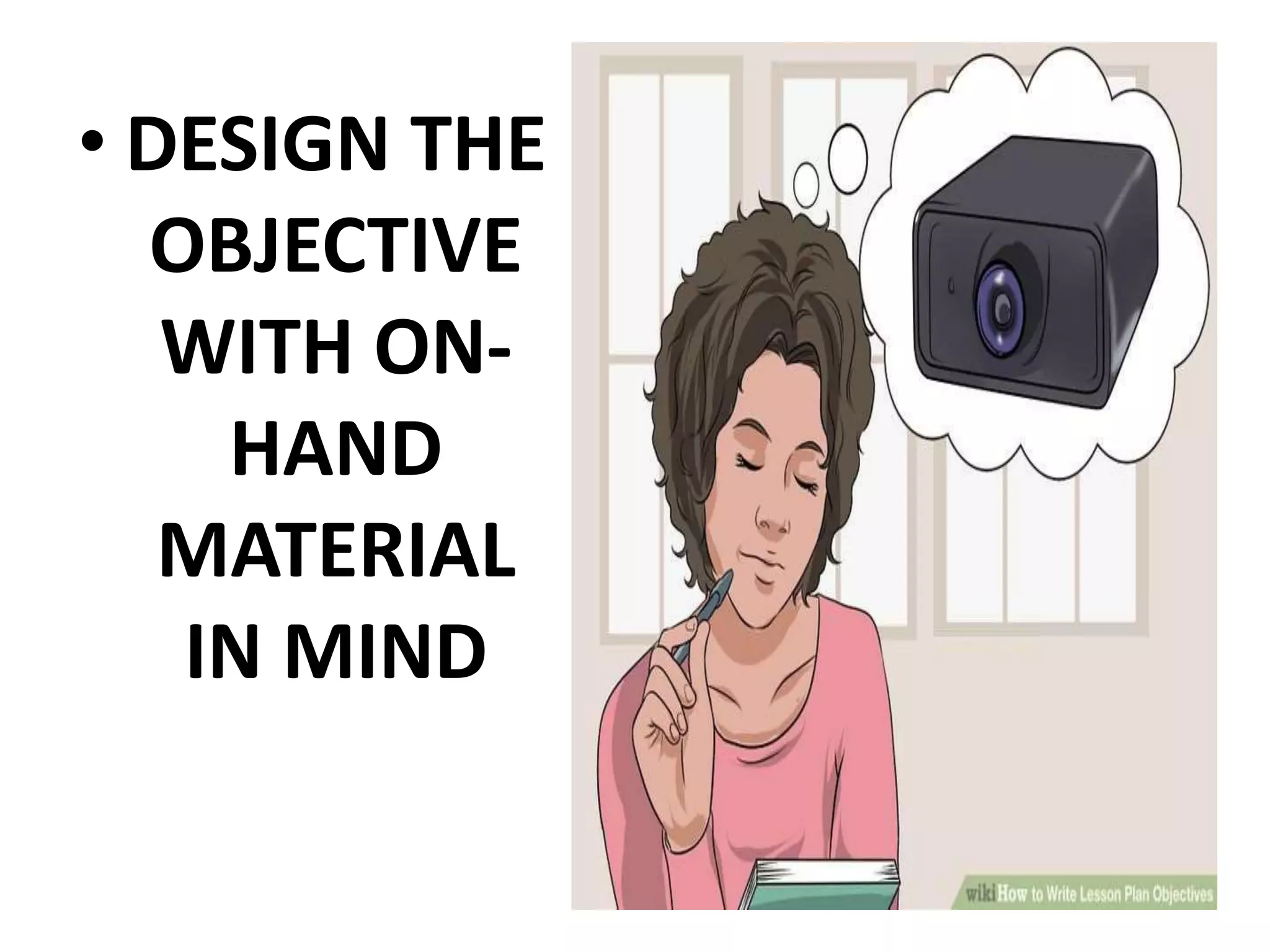
• DESIGN THE
OBJECTIVE
WITH ON-
HAND
MATERIAL
IN MIND
•USE
HANDOUTS
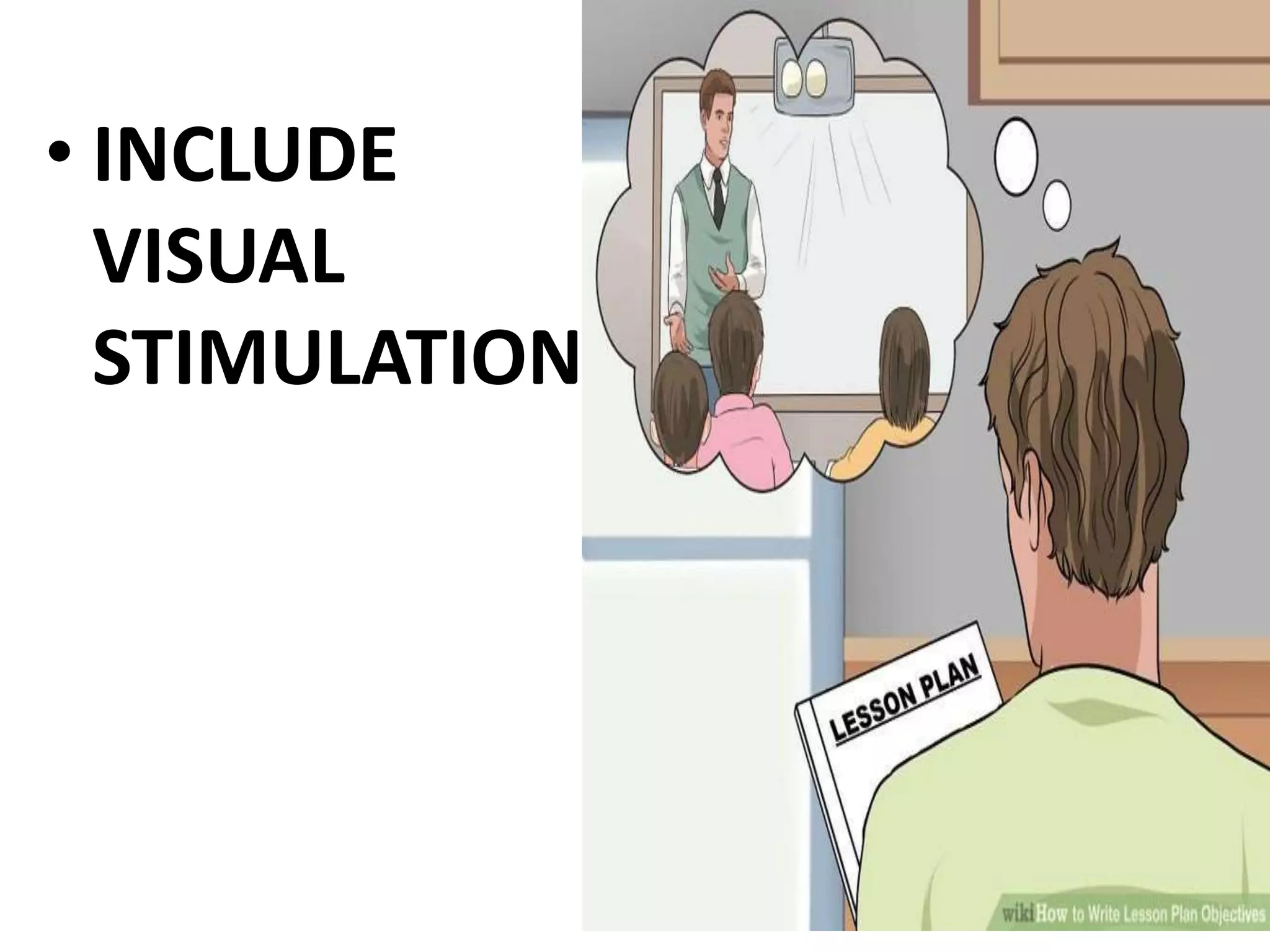
• INCLUDE
VISUAL
STIMULATION
•WRITING OBJECTIVES FOR
LESSON PLANS USING
BLOOM’S TAXONOMY AND
ASSOCIATED ACTION OR
PERFORMANCE VERBS
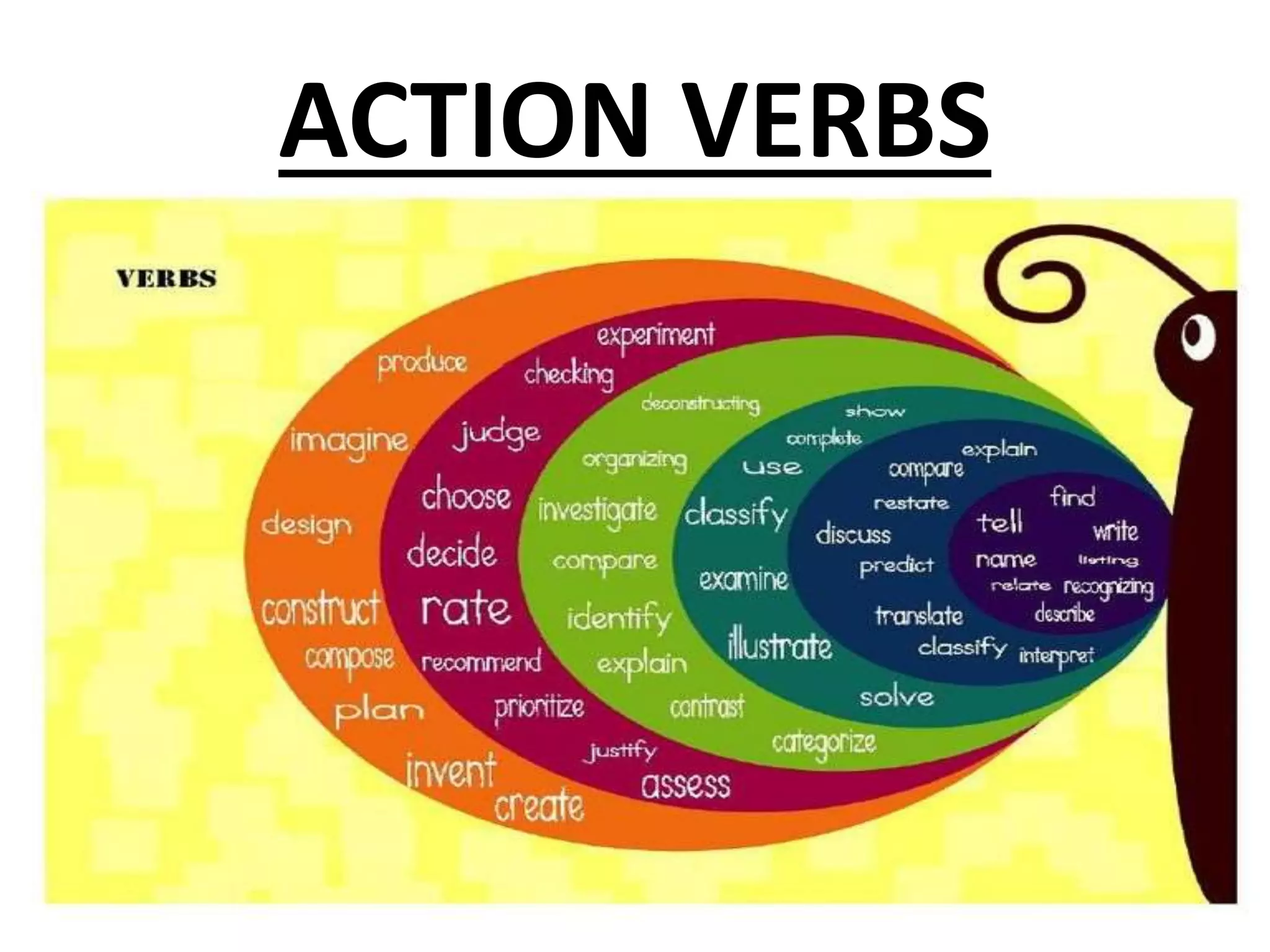
ACTION VERBS
OBJECTIVES & DOMAINS
ACTION VERBS FOR
COGNITIVE DOMAIN
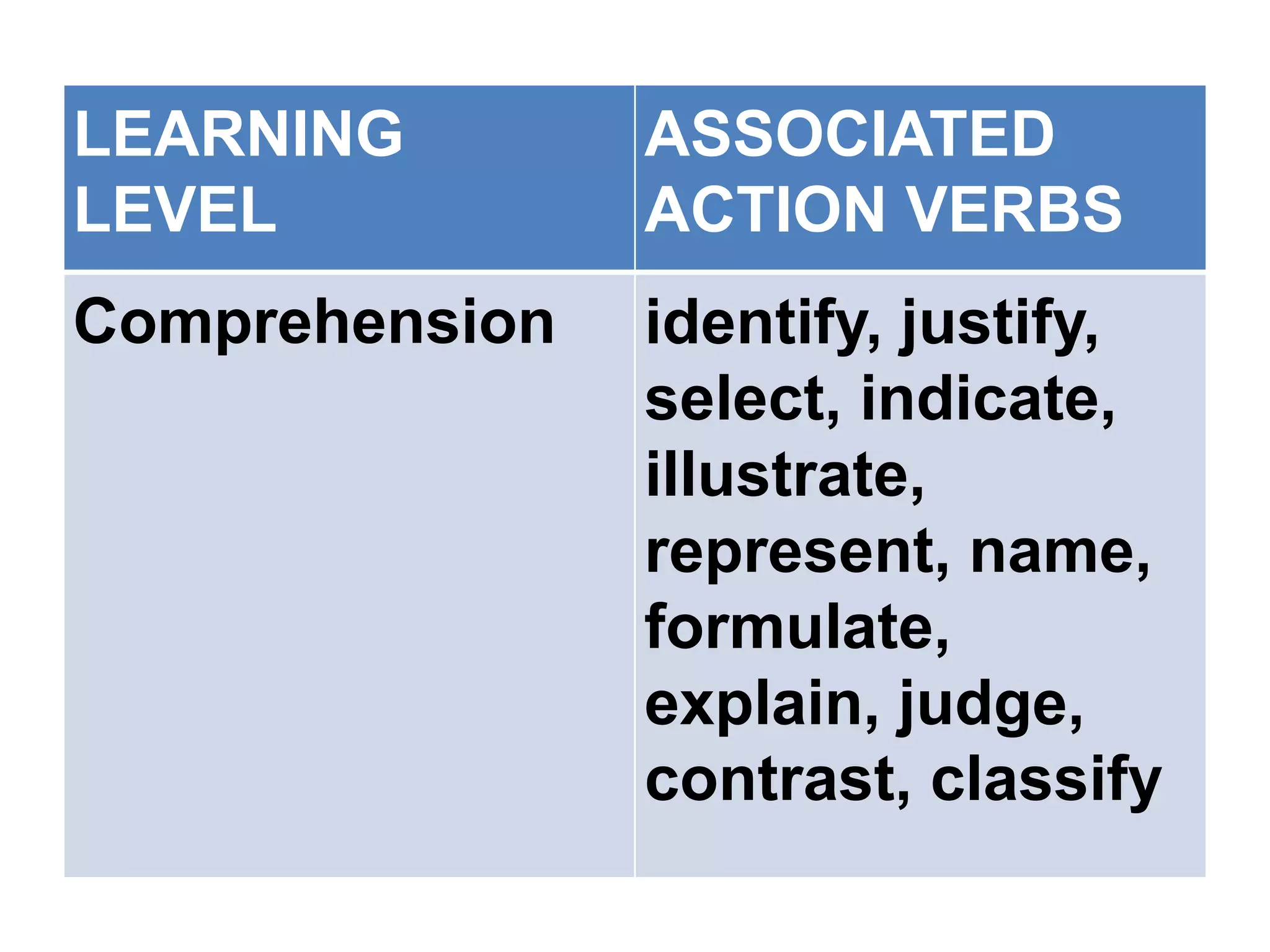
LEARNING
LEVEL
ASSOCIATED
ACTION VERBS
Knowledge define, describe,
state, list, name,
write, recall,
recognize, label,
underline, select,
reproduce,
outline, match
LEARNING
LEVEL
ASSOCIATED
ACTION VERBS
Comprehension identify, justify,
select, indicate,
illustrate,
represent, name,
formulate,
explain, judge,
contrast, classify
LEARNING
LEVEL
ASSOCIATED
ACTION VERBS
Application predict, select,
assess, explain,
choose, find,
show,
demonstrate,
construct,
compute, use,
perform
LEARNING
LEVEL
ASSOCIATED
ACTION VERBS
Analysis analyze, identify,
conclude,
differentiate,
select, separate,
compare,
contrast, justify,
resolve, break
down, criticize
LEARNING
LEVEL
ASSOCIATED
ACTION VERBS
Synthesis combine, restate,
summarize,
precise, argue,
discuss, organize,
derive, select,
relate, generalize,
conclude
LEARNING
LEVEL
ASSOCIATED
ACTION VERBS
Evaluation judge, evaluate,
determine,
recognize,
support, defend,
attack, criticize,
identify, avoid,
select, choose
ACTION VERBS FOR
AFFECTIVE DOMAIN
CHARACTERISTICS ASSOCIATED
ACTION VERBS
RECIEVING Ask, choose,
describe,
identify,
locate, name,
point, reply,
select, use
CHARACTERISTICS ASSOCIATED
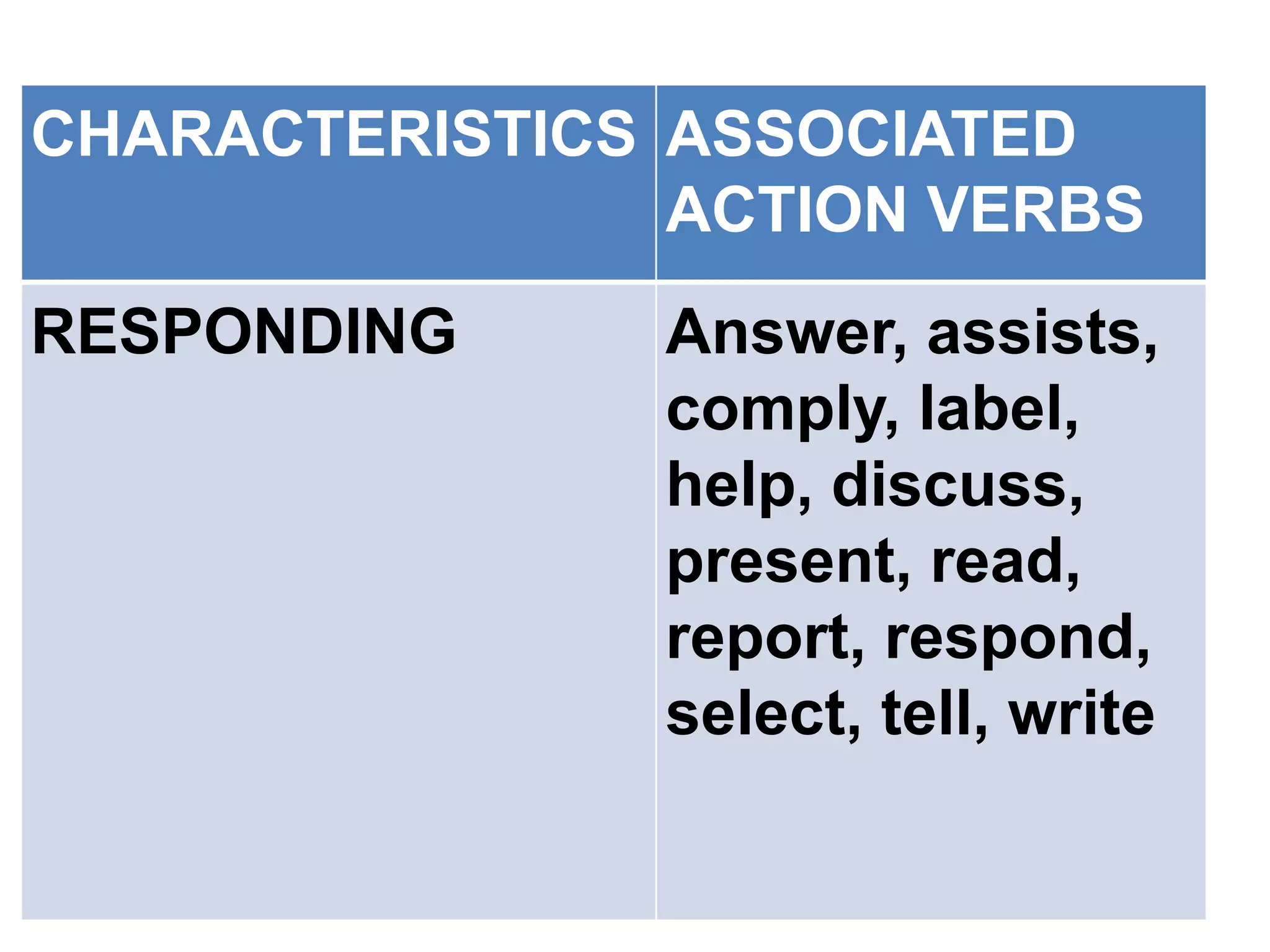
ACTION VERBS
RESPONDING Answer, assists,
comply, label,
help, discuss,
present, read,
report, respond,
select, tell, write
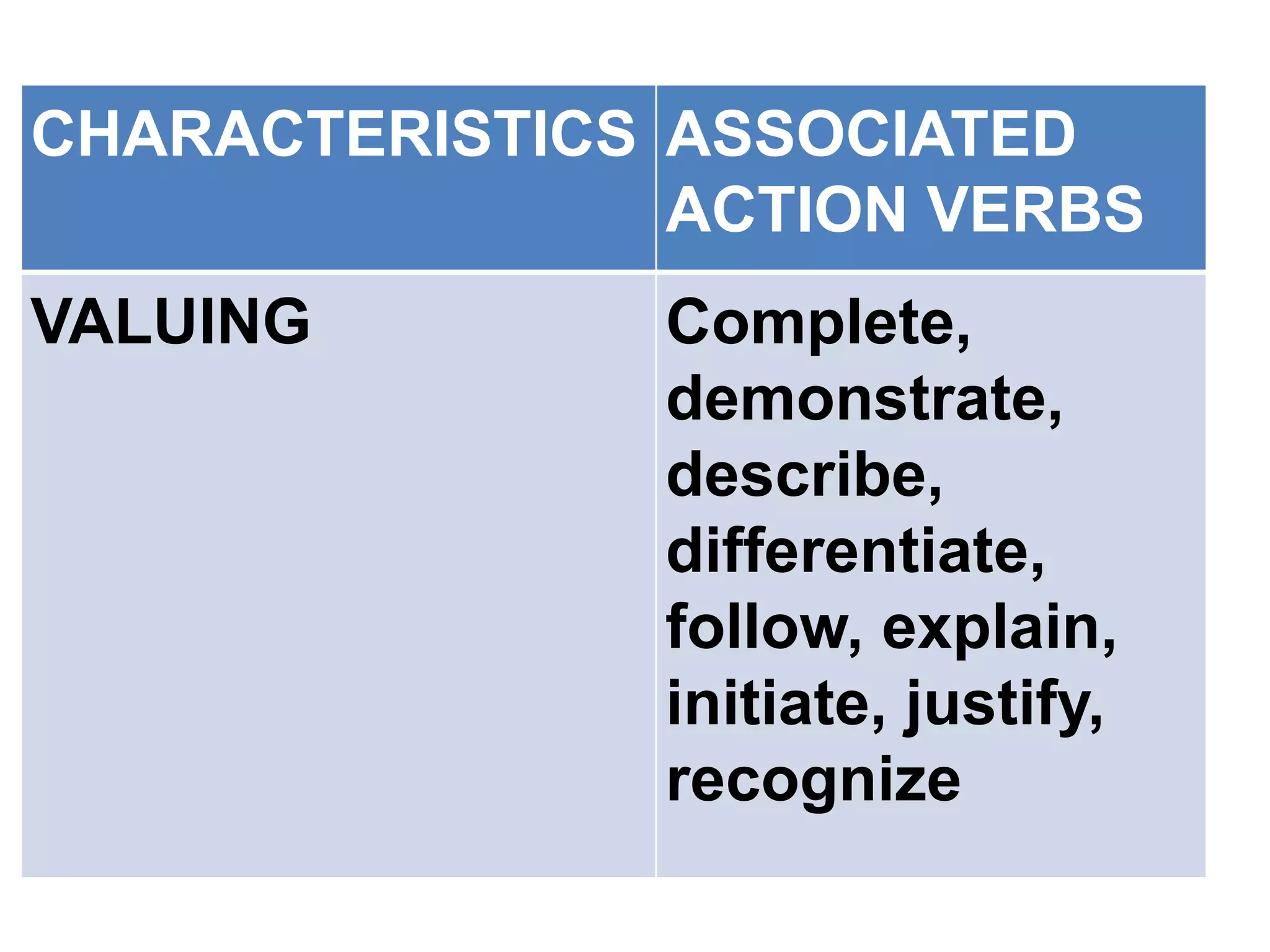
CHARACTERISTICS ASSOCIATED
ACTION VERBS
VALUING Complete,
demonstrate,
describe,
differentiate,
follow, explain,
initiate, justify,
recognize
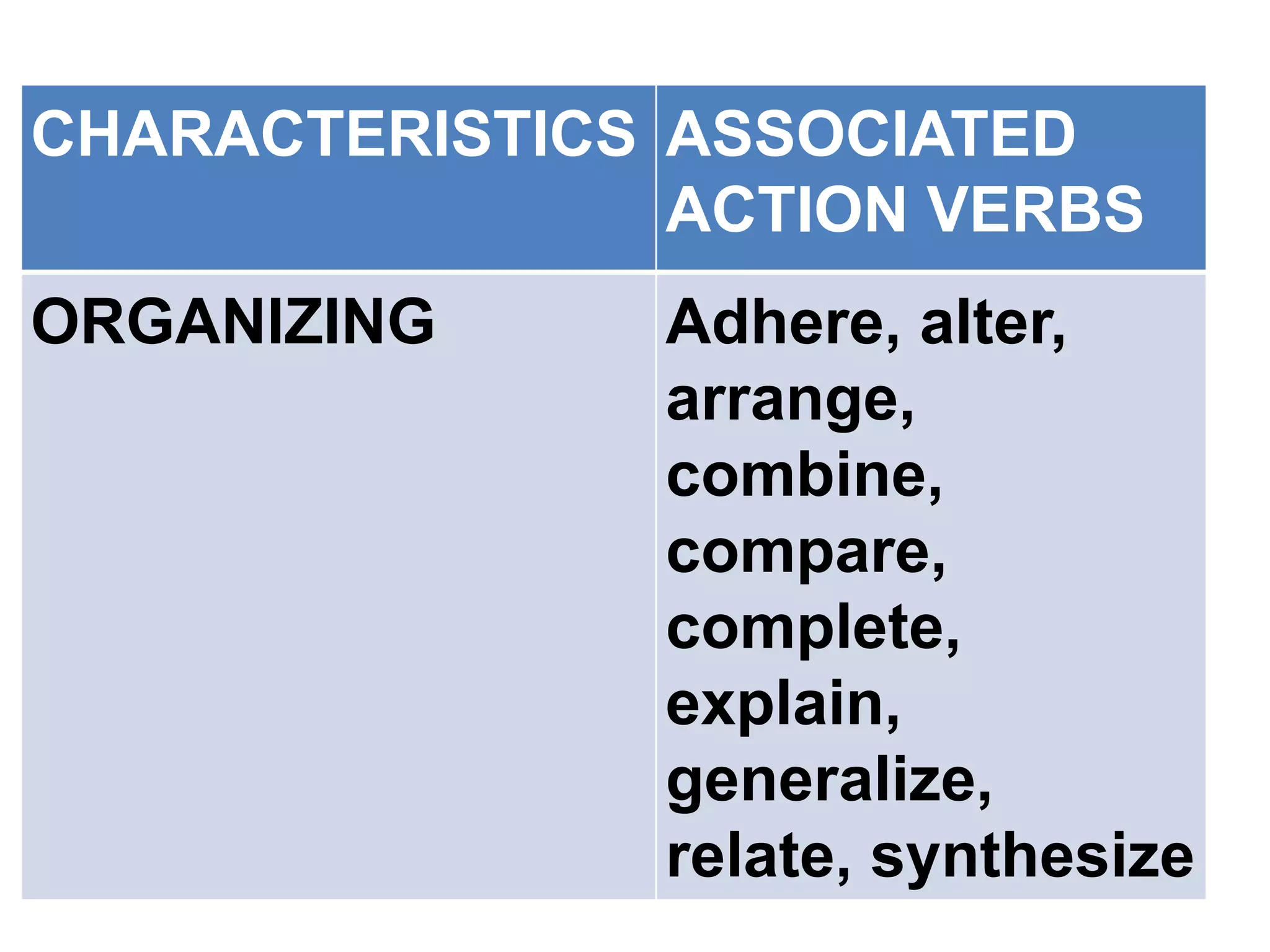
CHARACTERISTICS ASSOCIATED
ACTION VERBS
ORGANIZING Adhere, alter,
arrange,
combine,
compare,
complete,
explain,
generalize,
relate, synthesize
CHARACTERISTICS ASSOCIATED
ACTION VERBS
CHARACTERIZING Act, discriminate,
display,
influence, listen,
modify, perform,
practice, revise,
question, verify,
solve
ACTION VERBS FOR
PSYCHOMOTOR
DOMAIN
REFERENCES
• http://thesecondprinciple.com/inst
ructional-
design/threedomainsoflearning/
• ↑ http://serc.carleton.edu/introgeo
/assessment/domains.html
• ↑ http://courses.washington.edu/p
harm439/Bloomstax.htm
THANK YOU

OBJECTIVES OF EDUCATION